Document of
The World Bank
Report No:
PROJECT BRIEF
ON A
PROPOSED GRANT FROM THE
GLOBAL ENVIRONMENT FACILITY TRUST FUND
IN THE AMOUNT OF usD7 MILLION
TO THE
China, Thailand, Vietnam, Fao
FOR A
Livestock Waste Management in East Asia Project
February 17, 2005
CURRENCY EQUIVALENTS
(Exchange Rate Effective {Date})
|
Currency
Unit
|
=
|
|
|
US$1
|
=
|
RMB
|
|
US$1
|
=
|
BAHT
|
|
US$1
|
=
|
VND
|
FISCAL YEAR
|
January
1
|
–
|
December
31 for China, Vietnam, FAO
|
|
October
1
|
–
|
September 30 for
Thailand
|
ABBREVIATIONS
AND ACRONYMS
|
|
Area
Wide Integration
|
MOAC
|
Ministry
of Agriculture and Cooperatives
|
|
CAS
|
Country
Assistance Strategy
|
MOF
|
Ministry of Finance
|
|
COD
|
Chemical
Oxygen Demand
|
MOI
|
Ministry
of the Interior
|
|
COP
|
Code
of Practice
|
MOIC
|
Ministry
of Information and Culture
|
|
DARD
|
Department
of Agriculture and Rural Development
|
MONRE
|
Ministry
of Natural Resources and the Environment
|
|
DLD
|
Department
of Livestock Development
|
NEG
|
National
Expert Group
|
|
DOA
|
Department
of Agriculture
|
NGO
|
Non-Governmental
Organization
|
|
DOE
|
Department
of Environment
|
NSC
|
National
Steering Committee
|
|
DOF
|
Department
of Finance
|
OP
|
Operational
Program
|
|
DONRE
|
Department
of Natural Resources and the Environment
|
PCD
|
Pollution
Control Department
|
|
DOPH
|
Department
of Public Health
|
PIP
|
Project
Implementation Plan
|
|
EA
|
Environmental
Assessment
|
PLG
|
Project
Leading Group
|
|
ECNEQA
|
Enhancement
and Conservation of National Environmental Quality Act
|
PLO
|
Provincial
Livestock Office
|
|
EMDP
|
Ethnic
Minority Development Plan
|
PMO
|
Project
Management Office/Implementation Unit
|
|
EMP
|
Environmental
Management Plan
|
RCG
|
Regional
Coordination Group
|
|
EPA
|
|
RFO
|
Regional
Facilitation Office
|
|
EPB
|
Environmental
Protection Bureau
|
RP
|
Resettlement
Plan
|
|
FAO
|
Food
and Agriculture Organization
|
RPF
|
Resettlement
Policy Framework
|
|
GEF
|
Global
Environment Facility
|
SA
|
Social
Assessment
|
|
LEAD
|
Livestock,
Environment and Development Initiative
|
|
Strategy for Ethnic Minority
Development
|
|
LEP
|
Law
of Environmental Protection
|
SEPA
|
State
Environmental Project Agency
|
|
LWM
|
Livestock
Waste Management
|
SPP
|
Standing
Pig Population
|
|
M&E
|
Monitoring
and Evaluation
|
TAO
|
|
|
MARD
|
Ministry
of Agriculture and Rural Development
|
TOR
|
|
|
MM
|
Manure
Management
|
UNDP
|
|
|
MOA
|
Ministry
of Agriculture
|
UNEP
|
|
|
Vice
President:
|
|
Jemal-ud-in Kassum,
EAPVP
|
|
Country
Manager/Director:
|
|
David R. Dollar,
EACCF
Ian C. Porter,
EACTF
Klaus Rohland,
EACVF
|
|
Sector
Director:
|
|
Mark D. Wilson,
EASRD
|
|
Task
Team Leader:
|
|
Weiguo Zhou,
EASRD
|
East Asia And Pacific
Livestock Waste Management in East Asia Project
Contents
Page
A.STRATEGIC CONTEXT
AND RATIONALE 1
1.Country and sector issues 1
2.Rationale for Bank involvement 2
3.Higher level objectives to which the Project contributes 3
B.PROJECT
DESCRIPTION 3
1.Lending instrument 3
2.[If Applicable] Program objective and Phases 4
3.Project development objective and key indicators 4
4.Project components (see Annex 4 for a detailed description and
Annex 5 for a detailed cost breakdown) 4
5.Lessons learned and reflected in the project design 7
6.Alternatives considered and reasons for rejection 7
C.IMPLEMENTATION 8
1.Partnership arrangements (if applicable) 8
2.Institutional and implementation arrangements 8
3.Monitoring and evaluation of outcomes/results 9
4.Sustainability and Replicability 10
5.Critical risks and possible controversial aspects 11
6.Loan/credit conditions and covenants 12
D.APPRAISAL SUMMARY 12
1.Economic and financial analyses 12
2.Technical 13
3.Fiduciary 13
4.Social 14
5.Environment 15
6.Safeguard policies 15
7.Policy Exceptions and Readiness 16
Annex 1: Country and
Sector or Program Background 17
Annex 2: Major Related
Projects Financed by the Bank and/or other Agencies 28
Annex 4: Detailed
Project Description 35
1. Livestock Waste Management Technology Demonstration Component
(US$13.6 million) 35
2. Policy and Regulatory Development Component (US$4.8 million) 41
3. Project Management and Monitoring Component (US$4.1 million) 46
4. Regional Support Services Component (US$1.5 million) 49
Regional Component 53
Annex 6:
Implementation Arrangements 54
Funds Flow and Disbursement Arrangements. 61
Project Financing Plan
(US$ ‘000) 67
Annex 8: Procurement
Arrangements 70
Annex 9: Economic and
Financial Analysis 74
Annex 10: Safeguard
Policy Issues 84
Annex 12: Documents in
the Project File 94
Annex 13: Statement of
Loans and Credits 95
Annex 14: Country at a
Glance 102
Annex 15: Incremental
Cost Analysis 108
Annex 16: STAP Roster
Review 119
STRATEGIC CONTEXT AND RATIONALE
Country
and sector issues
The proposed Project addresses one of the most significant and
rapidly growing sources of land-based pollution of the South China
Sea – environmentally unsustainable intensive and
geographically-concentrated livestock production in China, Thailand
and Vietnam.
The South China Sea
is a locally, regionally and globally significant body of water
surrounded by countries that are experiencing rapid population and
economic growth and facing major and similar environmental
challenges. This bio-geographic region is one of the world’s
most biologically diverse shallow-water marine areas. However, this
biological richness is seriously threatened by two major
environmental problems - over-fishing and land-based anthropogenic
pollution. Without wide-scale preventive action, livestock production
would become the single most important source of organic and chemical
pollution of the main catchments draining into this international
water.
A recent World Bank report
reveals that land-based run-off and other inland discharges are
currently estimated to contribute 44 percent of pollution to the
South China Sea and the chemical oxygen demand
(COD) from untreated piggery waste alone in the coastal regions of
Central-south, South-west and East China accounted for 28 percent of
current urban-plus-industrial COD loads in 1996 which is projected to
rise to as much as 90 percent by 2010. The following table presents a
summary of a study conducted in the framework of the Project
preparation.
The East Asia region is the world’s biggest livestock
production area dominant in pig and poultry with China, Thailand, and
Vietnam alone accounting for 52 percent
of all pigs and 28 percent of all
chickens in the world in 2001. The shares of East Asia in world
livestock production would continue to grow fast over the next
decades fuelled by a growing population, rising incomes and
urbanization. This, coupled with economic, technological, and
political evolution, is causing significant change in the scope and
the structure of the livestock industry. In particular, very
intensive forms of livestock production are appearing rapidly and
driving much of the sector’s development. Large-scale
industrial production accounts for about 80 percent of the total
production increase in livestock products in Asia since 1990. In the
future, most livestock production, especially of pigs and poultry are
projected to come from large-scale industrial production with vast
majority of these intensive production farms located around major
urban centers in the participating countries that lie in or close to
the coastal regions of the South China Sea.
Concentrated livestock production, also a major threat to human
health, as evidenced by the recent SARS and Bird Flu outbreaks,
causes significant local, regional and global environmental damage,
particularly to freshwater and marine aquatic systems. Current waste
management practice in these areas is predominately direct or
indirect discharge through streams and rivers into the South China
Sea. The main sector issues are:
(1) Lack of technical solutions to address and deal with the
problem of nutrient imbalance - In all three countries,
limited government support for basic livestock waste management
investments persists. Moreover, these investments address only the
immediate impacts or symptoms of the problem as perceived at the
local level and do not even begin to seriously address the problem of
nutrient imbalance. Without new initiatives and technical solutions,
countervailing tendencies to concentrated livestock production would
be too weak to overcome the incentives driving it. Consequently, the
imbalance between the level of nutrient inputs and absorptive
capacity of the land would worsen progressively with rapidly growing
industrial livestock production.
(2) Lack of policy instruments for industrial livestock
production specific management and mechanism for law enforcement and
coordination among government agencies - All
three participating countries have national level environmental
policies with supporting standards. In each, the components dealing
with livestock waste management are very recent and general with
little effective enforcement. The agencies charged with
enforcement lack the resources committed to properly monitor and
enforce the regulations.
Rationale for Bank involvement
The Project is fully consistent with GEF International Waters Focal
Area Strategic Priorities, in particular with IW-1 catalyzing
financial resource mobilization for implementation of reforms and
stressing reduction measures through agreed Trans-boundary
Diagnostic Analysis and Strategic Action Plans and IW-3
innovative demonstration of removing the barriers to sustainable
industrial livestock management.
The Project is fully consistent with GEF OP10 Contaminant-based
Operational Program. Specifically, the Project would (a) demonstrate
how to address land-based pollution (paragraph 10.2); (b) position
the GEF to play a catalytic role in demonstrating ways to overcome
barriers to best practice in limiting contamination of international
waters (paragraph 10.5); (c) address a threat that is imminent, of
high priority, and on which neighboring countries want to take
collaborative action (paragraph 10.5); (d) stress pollution
prevention over remediation (paragraph 10.7); (e) leverage private
investment (paragraph 10.9); (f) involve close cooperation with other
GEF agencies (paragraph 10.9); and (g) be replicated regionally and
globally (paragraph 10.11).
The Project will also contribute to objective of the GEF Focal Areas
of climate change, OP2 Costal, Marine, and Freshwater Ecosystems, and
OP14 Draft Elements of an Operational Program for Reducing and
Eliminating Releases of Persistent Organic Pollutants into the
Environment.
The Project is also consistent with the proposed objectives and
potential eligibility criteria of a possible GEF/World Bank Strategic
Partnership for a Land-based Pollution Fund for the Large Marine
Ecosystems of East Asia that is under development to further scale-up
this program. The objective of this Partnership would be to
demonstrate and encourage replication of innovative, more
cost-effective ways to reduce land-based pollution of the large
marine ecosystems of East Asia and to stimulate private investment in
such measures. The Partnership is expected to focus on both
wastewater treatment and one or two regional and/or national projects
to reduce agricultural pollution
Higher level objectives to which the Project contributes
The Project is consistent with the goal of the World Bank’s
Country Assistance Strategies (CAS) in China, Thailand and Vietnam
reflecting the need for rapid economic growth that is environmentally
sustainable.
In China, the CAS (25141-CN, December 19, 2002) aims at assisting the
government in poverty reduction and supporting investments in
environmentally sustainable agricultural and livestock development.
As reflected in the CAS, protecting the environment is an overarching
objective for support by the World Bank to sustain rural income
growth while maintaining the natural resource base. This proposed
Project would contribute towards these specific CAS goals by
promoting investment on selected livestock farms in an
environmentally sustainable manner to protect environment around the
farms and towards the South China Sea.
In Thailand, the CAS (25077-TH, January 22, 2003) aims at, as one of
the World Bank’s implementation support, supporting the
government by complementing its development partnership at the
country level with work on regional and global public goods. The
World Bank is already actively involved in a number of regional
initiatives and would strengthen its support for these programs in
the coming years. The World Bank would also help share Thailand's
development experience through cooperation with other countries in
the region. This proposed Project would contribute towards these CAS
goals by promoting an integrated regional approach in Project
preparation, implementation and sharing of experience.
In Vietnam, the CAS (27659-VN, February 19, 2004) sets out three
broad objectives (a) high growth through a transition to a market
economy; (b) an equitable, socially inclusive and sustainable pattern
of growth; and (c) adoption of a modern public administration, legal
and governance system. The proposed Project is in line with these
broad objectives by introducing a legal framework into the livestock
production sector to promote an environmentally sustainable growth.
The Project’s regional approach will maximize its contribution
to the two regional GEF Action Programs by ensuring that (a) the
region’s three most important countries, in terms of livestock
production and waste pollution, are all involved; (b) their common
interest in protecting ecosystems of the South China Sea is
emphasized; (c) important cross-country synergies are promoted; and
(d) experience from the project demonstration could be replicated
throughout the region.
The proposed Project would demonstrate the technically,
agronomically, geographically, economically, and institutionally
workable solutions to protect the environment under tremendously
different political and social situations and conditions. All
three Project participating countries have recognized the negative
effects of industrial livestock production on the environment and
endorsed the proposed Project as a means to tackle these
issues and as a national priority for GEF support.
PROJECT DESCRIPTION
Lending
instrument
The proposed Project would be a full size stand-alone GEF grant
financed Project
[If Applicable] Program objective and Phases
Not applicable.
Project
development objective and key indicators
Project
Development Objective
The Project’s development objective is to reduce the major
negative environmental and health impacts of rapidly increasing
concentrated livestock production on the open waters of and thus on
the people of south-east Asia. Its global environment objective is to
reduce livestock induced, land-based pollution and environmental
degradation of the South China Sea and Gulf of Thailand.
Key
Indicators of Project Performance
Achievement of the Project development objective would be monitored
by the following key performance indicators (see also Annex 3,
Results Framework and Monitoring):
Reduced livestock production related emissions of pollutants in
surface water systems of project area including nitrates,
phosphates, BOD, COD and E. coli;.
The number and size of confined livestock producers within the
demonstration areas preparing and adopting pollution control
practices demonstrated through the project;
Improved spatial distribution planning for livestock production
facilities (to better match waste production and land absorption
capacity);
Local and national adoption and enforcement of suitable policies and
regulations for addressing livestock waste management-related
pollution;
Reduced human health risk as a result of minimized transmission
potential of pathogens, antibiotics and virus from fish to human
being;
Increased public awareness and regional exchange of information on
pollution threats and health problems from livestock waste as shown
in government and World Bank policy documents.
Project components (see Annex 4
for a detailed description and Annex 5 for a detailed cost
breakdown)
On-the-ground demonstrations of innovative, cost-effective livestock
waste management techniques by private livestock producers and
implementation of a replication action plan for them will be the
project’s principal outputs, as agreed at pipeline entry.
Reflecting this emphasis, nearly 60 percent of total project cost is
budgeted for livestock waste management technology demonstration
activities.
The project design is tailored to fit the specific livestock rearing
conditions in the three participating countries, particularly the
different average size of pig farms, which are its main target. In
Thailand and China, large sized industrial pig farms are dominant,
while in Vietnam, pig farms are typically small scale, involving
confined household-based production that is concentrated in
particular villages. This structure of Vietnamese rural society
requires that the project’s demonstration activities be
conducted on a communal (village) rather than individual farm basis.
The targeted project demonstration farms are all located within the
concentrated livestock production jurisdictions bordering South China
Sea and Gulf of Thailand.
The proposed Project takes a comprehensive approach to integrate
technological solutions, regulatory enforcement, capacity building,
and regional synergy for achievement of the Project objectives. The
Project would be integrated into the Governments’ mainstream
programs and based on existing institutional mechanisms. The project
will support activities under the following four project components
to be implemented over a period of five years with focus on
on-the-ground demonstration, policy development and regulatory
enforcement.
Component 1: Livestock Waste Management
Technology Demonstration (US$13.6 million)
This component would finance consultant services, training, goods and
civil works related to the development and construction of
cost-effective and replicable livestock waste management systems and
facilities and the implementation of effective waste management
approaches in areas with a high concentration of intensive pig farms.
Its goal is to demonstrate technically, geographically, economically
and institutionally workable solutions to reduce regionally-critical
livestock waste pollution caused by industrial livestock production
under the different political and social situations of the
participating countries. The livestock waste management strategies
promoted under this component will focus on reducing excess nutrients
(nitrates and phosphates in particular) and human health risks. The
methods to be used would include (a) reducing, through better feeding
practices, the volume of nutrients emission; (b) getting the
nutrients back into the crop cycle; (c) processing and packaging the
nutrients for export to other areas for crop use; (d) converting the
nutrients to plant-available forms; (e) destroying the nutrients; and
(f) taking measures to minimize potential transmission of pathogens,
antibiotics and their resistance strains from livestock to human
being. Specific activities of the component would include:
selection of demonstration farms and villages, technical design,
and implementation.
The demonstration activities would be supported by training and
extension to provide (a) farmers with the essential skills and
technical support needed to improve their on-farm manure management
practices and (b) capacity building. Activities would be specified in
the detailed master capacity building development plan to be prepared
by each participating country. This component would comprise two
subcomponents i.e. Technology Demonstration, and Training and
Extension.
Component 2: Policy and Regulatory Development (US$4.8 million)
This component would finance consultant services, training and goods
to support setting up a policy and regulatory framework for
environmentally sustainable development of livestock production in
each country that will induce further policy reforms and encourage
farmers to adopt improved manure management practices. This will be
achieved through: (a) the development of a replication strategy; (b)
the review and revision of existing regulations; (c) the commitment
to master planning of livestock production (at national and
provincial levels) to direct the geographic focus of future intensive
livestock production; (d) the development and introduction of codes
of practice or best waste management practices; and (e) the
development and introduction of livestock waste recycling and
discharge standards. Specific policy packages will be tested in
sub-national jurisdictions and testing experience will feed back into
the policy and regulatory development subcomponent. Code of Practices
or Best Management Practices will be tested in synergy with Livestock
Waste Management Technology Demonstration component, which will
promote cost-effective and replicable technical options. This
component will also support awareness raising activities, focusing on
policy measures and environment and public health issues associated
with inadequate manure management. This will focus the attention of
national and local governments on livestock waste policy and
regulatory enforcement and facilitate further assistance with this
challenge from the World Bank and other donors. This component would
comprise three subcomponents i.e. Policy and Regulatory Development,
Policy Testing, and Awareness Raising.
Component
3: Project Management and Monitoring (US$4.1 million)
This component would finance consultant services, training, office
equipment and incremental operating costs to support efficient
project management by supporting the establishment of a national
Project Management Office (PMO) in each participating country as the
secretariat of and reporting directly to the respective National
Steering Committee. The PMO, comprising a Project manager supported
by competent staff, based on existing administrative structure and
physically located within the main implementing agency of each
participating country, would be responsible for day to day Project
administration. Replication potential of alternative livestock waste
management technologies as related to farm scale, affordability,
operational capacity, material availability, and compatibility to the
waste handling methods of the local farm communities would be
assessed to achieve widespread replication of the tested manure
management practices throughout the three participating countries
The component would also support effective Project monitoring and
evaluation of the social, economic, environmental, human health risks
and other changes brought about by the Project, and the dissemination
of Project outcomes within respective participating country.
Monitoring on human health risks associated with the project will
focus on measures taken to minimize potential transmission of
pathogens, antibiotics and their resistance strains from livestock to
human being. Specific activities would be detailed in Project
monitoring and evaluation plans to be finalized at appraisal. This
component would comprise two subcomponents i.e. Project Management,
Project Monitoring and Evaluation.
Component 4: Regional Support Services (US$1.5 million)
This component would finance consultant services, training, workshop,
office equipment and incremental operating costs to provide (a)
capacity building support to strengthen the participating countries’
institutional capacity in Project implementation and (b) regional
coordination and facilitation support to ensure regional coordination
and achieve cross-country synergies, and regional replication.
This component would respond to the participating countries’
need for an easily accessible source of support for capacity building
including support for (a) decision tools development, (b) evaluation
of Project activities and outcomes, and (c) development of training
modules and packages. This component would focus on regional
coordination, facilitation amongst the three participating countries
and the dissemination of Project outcomes, decision support tools,
technical guidelines and standards within the three participating
countries and to other countries bordering the South China Sea. This
component would comprise two subcomponents i.e. Capacity Building
Support, and Coordination and Facilitation Support.
Lessons
learned and reflected in the project design
Key lessons learned from the World Bank’s rural environmental
and livestock operations, LEAD’s
earlier AWI pilot studies in China, Thailand and Vietnam, and the
government programs and reflected in the proposed Project design
include the following:
Lack of livestock waste management-specific policy instruments, weak
law enforcement and coordination between concerned government
agencies and existence of sometimes counter-productive policies are
the key weaknesses in policy framework.
Lack of effective analytical tools, appropriate technical solutions
and coordinated inter-agency approaches are the major lessons in
addressing the worsening livestock waste management issue.
Strong government commitment in compliance, enforcement, incentives
and early involvement of key stakeholders including local
administrations, communities, farmers’ organizations in
Project preparation are critical to ensure ownership, sustainability
and successful Project implementation.
Mitigation measures to reduce nutrient load must yield tangible
benefits for key stakeholders, specifically local communities and
farmers to ensure adoption and replicability.
Effective monitoring and evaluation plans should be developed and
applied to assess Project impact.
Capacity building of Project implementing agencies and regulatory
institutions through training, technical assistance and specialized
support is the key to ensure efficient and effective Project
implementation.
Alternatives considered and reasons for rejection
In designing the Project, the following alternative approaches were
considered as possible methods to abate and prevent pollution from
livestock production but rejected as unfeasible.
Exclusively regulation-based approach (forced regulations).
Regulatory measures could comprise (a) capping or reducing of farm
animal numbers; and (b) forced relocation or closing down of existing
farms. These measures may potentially run into major economic, social
and political problems in all three countries. Widespread capping or
reducing of animal numbers is likely to choke the industry as well as
reduce the incentive for investment in livestock farming. Forced
relocation or closing down of existing farms are rarely successful
and acceptable options despite a few cases of large modern farms
established in Thailand where redirection to more suitable areas was
achieved. Such control measures should be reserved only for the most
serious problem cases and be used only as a last resort.
Exclusively technology-based approach (on-farm treatment of all
effluents). Understanding that all participating countries
currently do not use land application of livestock wastes as the
primary disposal practice implies that treatment, to some acceptable
standard, would be required. However in general, stipulation of
universal on-farm treatment of livestock wastes is neither necessary
nor always practical as a measure when land application is used for
the ultimate disposal of livestock wastes. For small farms, the cost
of suitable technology and/or lack of available land may make
treatment a limited option. Where such farms are well dispersed
across watersheds, their individual contributions to the overall
pollution load may be quite limited. However, where such farms are
clustered together, communal treatment facilities may be an option.
Approach to involve all littoral countries bordering South China
Sea. This approach was rejected based mainly on the fact of
limited GEF grant available for the Project. Involving all riparian
countries bordering South China Sea (also Cambodia, Malaysia and The
Philippines) in the Project would likely result in (a) increased
complexity of regional coordination; and (b) diminished interest of
countries due to much smaller average GEF grant allocation to each
participating country.
IMPLEMENTATION
Partnership
arrangements (if applicable)
N/A.
Institutional and implementation arrangements
Regional Coordination Group (RCG). The Project implementation
would be coordinated and facilitated by a RCG which would consist of
representatives of each participating country (also members of their
respective National Steering Committee) and FAO. RCG’s
principal role is to (a) ensure a continuing exchange of information
on livestock waste management issues; (b) coordinate Project
implementation among the countries, (c) ensure the inclusion of the
issue of manure management on the political and budgetary agenda
within respective country, (d) facilitate the gradual adoption of
common policies thereon between the partners, and (e) coordinate
implementation of the Regional Support Service component. RCG would
meet normally twice a year.
National Steering Committee (NSC). A NSC has been formed by
each participating country with members from key government
ministries (agriculture, environment, public health etc.), academies
within each country involved in livestock waste management at
national level with overall responsibility for Project preparation
and implementation in respective country. Its principal functions
would be to (a) review and approve Project annual work plans and
budgets in their respective countries, (b) provide guidance on
national policies and priorities related to livestock waste
management to be followed and help resolve related issues, and (c)
integrate activities of various agencies involved in the Project and
ensure an inter-agency coordinated approach to Project
implementation. To provide immediate guidance to Guangdong PMO, a
Project Leading Group has been established at Guangdong provincial
level.
National Project Management Office. A national Project
Management Office would be established as the secretariat of and
reporting directly to respective National Steering Committee. The PMO
would be responsible for day to day Project administration. Its staff
composition, specific responsibilities, financial budgets and
physical location would be decided by respective NSC and acceptable
to the World Bank. To facilitate Project preparation and
implementation in Guangdong province, a PMO at provincial Department
of Agriculture would be set up.
Local Institutional Arrangement. Project management structure
below the national level varies from one country to another and is
described in detail in Annex 6. Local governments would make
practical institutional arrangements involving various government
agencies for preparation and implementation of respective Project
activities. With guidance and support from national PMOs (provincial
PMO in Guangdong) and training, local level agencies would take the
primary responsibility for Project implementation within their
jurisdictions.
Stakeholder Involvement. All key stakeholders have been
involved in Project preparation and will be continuously involved in
project implementation. Stakeholder participation plans are under
preparation by the participating countries and will specify the
participation and consultation mechanisms tailored to facilitate the
stakeholder involvement especially the private sector. The private
sector will be responsible for implementation on the demonstration
farms and villages.
Implementation Arrangements for Regional Support Services
Component. FAO/LEAD would be responsible for implementation of
the Regional Support Services component. A Regional Facilitation
Office would be set up prior to Project effectiveness and located in
FAO’s Regional Office in Bangkok of Thailand. This Office would
consist of a full-time FAO staff serving as the Regional Project
Coordinator supported by short-term consultants as needed. Its main
functions would be to (a) prepare an annual work program to be
reviewed and approved by the RCG; (b) manage the Project activities
as agreed with the World Bank; and (c) serve as the secretariat of
the RCG.
A detailed description of the Project institutional and
implementation arrangement is presented in Annex 6 and included in
PIPs.
Monitoring and evaluation of outcomes/results
A draft M&E Plan has been prepared by each participating country
and included in country - specific Project Implementation Plans.
These draft M&E Plans have been reviewed by the World Bank, which
provided detailed comments and recommendations. The M&E Plans
will be finalized at project appraisal. The task team will make sure
that process indicators, stress reduction indicators and
environmental status indicators relevant to International Waters
Projects are included in the finalized M&E Plans.
The M&E Plans will specify the details of the scope of and
activities for monitoring and evaluation. The scope will include (i)
nitrate, phosphates and BOD, COD and E. coli discharge at the end of
the pipe of the individual farms or community, and at critical
downstream locations; (ii) number of standing pig population covered
by farms adopting sound livestock waste management systems; and (iii)
extent of awareness and regional exchange of information on pollution
threats and health problems from livestock waste. The activities will
include: (i) progress monitoring, which will include monitoring of
the status of project implementation progress indicators; (ii)
livestock waste management system monitoring, which will include, at
farm and community level, the monitoring of system efficiency and the
effect of the project manure management interventions on public and
animal health; (iii) environmental monitoring, which will include
monitoring of the major physical, chemical, and biological
characteristics of unit processes, or surface and ground water
measurement (where applicable) within project areas
(micro-watersheds) and at the end-of-pipe on demonstration farms;
(iv) project impact monitoring, which will include monitoring of the
implementation of stakeholder participation plans, annual social
impact review and public consultation, impact on human health, and
long-term project impact; and (v) other monitoring of additional
parameters required for achieving project objectives. Annex B
provides the details.
Specific plans for monitoring the long-term project impact will be
developed during project implementation and finalized at project
completion. This may include (i) a World Bank post completion
evaluation mission to visit the participating countries within 3-5
years upon project completion, (ii) a follow-up study by FAO/LEAD in
the participating countries for project impact evaluation, (iii)
defining and development of tools to measure leveraged investment,
and (iv) continuous dissemination of project impact results through
an internet portal on “livestock waste management in East Asia”
to be established during the project implementation based in
FAO/LEAD.
Sustainability
and Replicability
4.1 Sustainability
The project is designed to be sustainable in several respects. To the
extent possible, the project will rely on technologies that are
cost-effective, replicable and environmentally sustainable. For
technologies such as improved feed efficiency or fertilization
techniques that lower production cost, sustainability would be
inherent. The project would ensure that manure treatment systems
promoted under the project would have sufficiently low operation and
maintenance costs to be financially sustainable by livestock
producers.
To a large extent, the project’s long-term sustainability would
be ensured through strengthening of regulatory frameworks for the
livestock sector. While there are risks of insufficient enforcement
when these affect profitable economic activities, the project would
attempt to mitigate such risks in several ways: (i) Sustainable
solutions to ensure the private sector’s willingness to invest
in livestock waste management technologies would be sought through
increased stakeholder participation in the decision-making process,
including favorable pricing policies for livestock waste management
systems’ outputs such as bio-gas, electricity and organic
fertilizer; (ii) Raising of public awareness would encourage local
communities to seek more consistent enforcement of
environmentally-friendly solutions; and (iii) Strengthening of public
institutions and systematic monitoring of livestock development
policies, including their environmental impact, would lead to
improvements in each country’s capacity for sustainable
livestock development, as well as benefits for the global
environment. The project’s monitoring and evaluation plans will
ensure that its environmental and social benefits are adequately
measured, valued and disseminated which would further promote its
sustainability. The governments of the participating countries have
provided assurances about the priority nature of this project and
their commitment to ensure adequate government support, including
financial resources for sustainability beyond the successful
completion of this project.
4.2 Replicability
The project may yield only limited direct impact on water quality of
the South China Sea, since the selected demonstration areas represent
negligible fractions of the total pollution load. Consequently it has
been designed to maximize replicability beyond its immediate impact
area. A noticeable pollution reduction in the South China Sea
catchment areas therefore can be achieved through the replication of
the demonstrated livestock waste management practices throughout the
participating countries and in other countries bordering the South
China Sea. Specific project activities for replication of improved
livestock waste management approaches would be (i) preparation and
implementation of a replication strategy; (ii) specialized training,
cross-visits and study tours for interested farmers, local officials,
decision makers etc.; (iii) engaging farmers groups, local
communities, NGOs, government agencies and other stakeholders; (iv)
support for local pressure through public-awareness building; and (v)
dissemination of demonstration results through targeted workshops and
development of internet portal for in-country as well as regional
replication.
The aim of the project’s replication strategy, is eventual
integration of the project’s successful demonstrations into
each country’s overall livestock waste management strategy and
their scaling up. During this process, opportunities for integrating
livestock waste management activities in future World Bank and other
donor investments would be sought. Through the regional dissemination
activities, which would target primarily the three participating
countries but eventually also other riparian countries draining into
the South China Sea, other countries in the region could benefit from
the knowledge and experience gained under the project. The project
would also intend to provide valuable experiences beyond the East
Asia region. Close cooperation with other international livestock
management projects and assistance agencies would ensure that a
successful project approach can be replicated in other regions that
face similar environmental problems from industrial livestock
production. The project would ensure that all aspects of its design
and implementation are well documented and easily publicly available
to support dissemination and replication efforts.
Critical risks and possible controversial aspects
The proposed Project deals with challenging environmental issues in
the countries of the East Asia region. No controversy was envisaged.
Potential risks may include:
Inadequate collaboration among key
agencies. Agricultural and environmental ministries in the countries
involved have sometimes non-compatible interests and are not
accustomed to working together;
Lack of participation and weak support of local populations and
civil society as well as a weak partnership with the private sector;
Failure in coordination among participating countries due to
ineffective regional coordination arrangement, lack of country
ownership, failure to observe commitment etc.;
Operational failure risk resulting from (a) inadequate financial
incentives for the private sector to invest in waste management
systems; (b) inadequate political will and human resources to
enforce nutrient management regulations; (c) lack of local community
and farmers support for maintaining communal systems; (d)
operational and management support not available or inadequately
accessible, (e) counterpart funding contributions not available on
time;
Technical failure occurring as a result of (a) inappropriate choice
of technology and system, (b) design, equipment, or material
failure, and (c) farm expansion; and
The potential transmission of pathogens, antibiotics and their
resistance strains from livestock to human being under the Project.
To minimize this risk, the following measures have been agreed that
all participating farms will (a) treat all pig manure through
aerobic or anaerobic process including composting, covered lagoon,
anaerobic digester etc. before they are used on cropland, in fish
pond, or marketed; (b) reduce use of antibiotics; (c) not rear any
ducks on the same farms to minimize risk of forming new strain of
influenza virus since human flu virus and a duck virus are very
similar. It is expected that such potential transmission incidence,
not a result of the project, will be greatly reduced through
implementation of these measures.
Loan/credit conditions and covenants
The
Regional Coordination Group, Regional Facilitation Office, and
National Project Management Offices are established by Project
Effectiveness;
Project
management organizations, including Regional Coordination Group,
Regional Facilitation Office, National Steering Committee, National
Expert Group, National Project Management Office, Guangdong Project
Leading Group, Guangdong Provincial Project Management Office, are
maintained throughout the Project implementation period with
composition and staffing acceptable to the World Bank.
APPRAISAL SUMMARY
Economic
and financial analyses
Range of analysis. Although nearly 60 percent of the
Project’s total cost represents on-farm investments for
demonstration of improved livestock waste management technologies,
the main Project benefits are environmental, health and
institutional. Consequently, the appropriate economic analysis is a
cost-effectiveness analysis to determine whether the Project could
achieve its development objective at the least economic cost. A
second important aspect relates to the financial attractiveness to
Project participants of technologies and other approaches to be
promoted under the Project. This is covered by a financial
cost-benefit analysis.
Economic analysis. The cost-effectiveness analysis
examines potential alternative technical solutions for reducing
fluxes of selected critical nutrients (N, P, BOD and COD) from
livestock waste into the target environment and estimates the unit
cost of their removal from the chain. The analysis confirms that, in
terms of reducing the flow of critical pollutants to the South China
Sea, the range of technical solutions to be promoted under the
Project is cost-effective.
Financial Analysis. The financial analyses for all
participating countries find that Level 1 (meeting minimal domestic
requirements) types of manure management are affordable (or even
profitable) for all livestock production units. However, the Level 2
(long-term domestic and regional benefit) types of investments,
required by specialized pig producers lacking the opportunity for
efficient manure recycling, represent an additional cost of
production, which may consume a substantial share of producers’
normal profit. In the short run, therefore, investing in improved
manure management may not be seen as a benefit by the producer but as
an additional cost of production. The most efficient producers can
absorb this cost, and over time an increasing number of producers can
be expected to achieve the productivity gains needed to make such
technology affordable. In the short term, some financial incentives
would be needed to help early adopters of such technology. In the
long run, production costs would be reduced through other
productivity improvements and by shifting farms away from towns to
areas where land for recycling and other factors of production such
as labor, energy and clean water may be less costly.
Technical
Technical design of the Project focused on introducing technical
solutions to address and deal with the key issue of nutrient
imbalance in livestock production. The design, reflected in the
Livestock Waste Management Technology Demonstration component was
based on (a) the cost-effectiveness of proposed technologies to the
waste handling methods of pig farms; (b) the expected environmental
performance of the proposed technologies relative to the nutrient
management objectives of this Project; and (c) the replication
potential relative to the financial, material, and labor skill
availability in the participating countries.
The Project would introduce a package of technology options for each
selected demonstration farm and village to consider. These manure
management technologies are in wide use in the world including
European and North American countries and have been proved to be
effective. Locally, technologies have also been developed with
missing monitoring data for evaluation of their environmental,
agronomic and economic effectiveness. The actual technologies to be
used would be tailored to fit specific conditions of each selected
demonstration farm and village. They would be closely monitored in
order to produce, by mid-term of the Project, a set of best manure
management practices.
Fiduciary
Financial Management. In each of the three countries, a
financial management assessment was conducted to determine whether
the financial management capacity will be able to meet the
requirements of BP/OP 10.02. The assessments concluded that the
proposed implementing agencies in each country and for the Project’s
regional support services component have the ability to
satisfactorily manage the accounting and disbursement of the Project
and to meet the minimum financial management requirements of the
World Bank. The Financial Management Action Plan (cf. Annex 7)
addressed weaknesses in and the actions to be taken of the financial
management arrangements. Each implementing agency will maintain the
financial accounts and records and issue financial management reports
for the project activities for which they are responsible.
Semi-annual financial monitoring reports and annual financial
statements will be submitted to the World Bank by each country and by
the FAO for the Regional Support Services Component of the Project.
The annual financial statements will be audited by auditors
acceptable to the World Bank and the audit reports will be submitted
to the World Bank within 6 months of the end of the fiscal year for
each country and the FAO.
Procurement Capacity. Separate procurement capacity
assessment was carried out by the Bank's procurement specialist for
respective country subproject. These capacity assessments revealed
that the capacity of China-PMO is generally adequate since it had
both qualified procurement staff and good experience with World Bank
procurement, while that of Thailand-PMO and Vietnam-PMO is relatively
weak. Accordingly, the procurement risk rating for China subproject
is moderate and for Thailand's and Vietnam's subprojects is high. The
overall procurement risk of the Project is rated high which will be
reviewed at Project appraisal. Specific recommended actions to build
up PMO procurement capacity are summarized in Annex 8.
Procurement Arrangements. Procurement for the proposed
project would be carried out in accordance with the World Bank’s
“Guidelines: Procurement Under IBRD Loans and IDA Credits”
dated May 2004; and “Guidelines: Selection and Employment of
Consultants by World Bank Borrowers” dated May 2004, and
the provisions stipulated in the Legal Agreements. General
procurement arrangements for the Project are provided in Annex 8 and
the details would be agreed between the clients and the World Bank
Project team in the Procurement Plans. The Procurement Plan will be
updated at least annually or as required to reflect the actual
Project implementation needs and improvements in institutional
capacity. Draft procurement plans for the initial period of the
Project are included in respective PIP.
Social
Field level surveys were conducted in the selected demonstration
sites during Project preparation. The social assessment team
collected relevant data, reviewed reports and provided extensive
inputs to the Project preparation and design. Target groups were
disaggregated based on gender, economic class and ethnicity. Nature
and quality of the interactions between various target group
constituencies and local agencies that regulate, support and
influence the engagement of the primary beneficiary groups in
livestock production and manure management were analyzed. Detailed
assessment findings are presented in Annex 10.
The extent to which negative impacts cause social conflict varies
between the countries and different demonstration sites. In Thailand,
farmers stressed opportunities for reducing pig diseases and social
conflicts with neighbors while in Guangdong and Vietnam, social
conflict related to livestock pollution was not seen as a major
issue. It is essential that training and capacity building efforts
are recognizant of the diversity within the target groups with
respect to their ability to absorb and apply training and capacity
building messages and interventions.
Environment
The EAs and the EMPs have been carried out respectively in all three
countries. During Project preparation, national procedures and the
World Bank’s safeguard policies were diligently followed. The
EA documents, EMPs and EA Summary have been prepared, incorporating
the World Bank’s comments during Project preparation, and found
to be satisfactory.
Potential Impacts.
The Project is designed to reduce nutrient loading, mainly
nitrates, phosphates, BOD and COD, that are polluting the
international waters and causing significant environmental and social
impact including increased eutrophication, fish kills, destruction of
natural mangrove and coral reefs ecosystems of the coastal zone of
South China Sea and the Gulf of Thailand. It would also decrease the
incidence of water-borne and zoonotic diseases, not only within the
livestock raising communities, but also for other water users living
downstream of the livestock raising areas. The overall impacts of the
Project are expected to be both significant and positive. The
majority of identified negative impacts are believed to be short-term
and reversible.
Mitigation measures.
Mitigation measures are specified in EAs focusing on control on
construction practice, control on dust, noise and odors, and
appropriate construction site management. Major mitigation measures
would include environmental monitoring plans, institutional
arrangements, training, and related cost estimates.
Safeguard policies
|
Safeguard Policies Triggered by the
Project
|
Yes
|
No
|
|
Environmental Assessment (OP/BP/GP
4.01)
|
[x]
|
[ ]
|
|
Natural Habitats (OP/BP
4.04)
|
[ ]
|
[x]
|
|
Pest Management (OP
4.09)
|
[ ]
|
[x]
|
|
Cultural Property (OPN
11.03, being revised as OP 4.11)
|
[ ]
|
[x]
|
|
Involuntary Resettlement (OP/BP
4.12)
|
[x]
|
[ ]
|
|
Indigenous Peoples (OD
4.20, being revised as OP 4.10)
|
[x]
|
[ ]
|
|
Forests (OP/BP
4.36)
|
[ ]
|
[x]
|
|
Safety of Dams (OP/BP
4.37)
|
[ ]
|
[x]
|
|
Projects in Disputed Areas (OP/BP/GP
7.60)
|
[ ]
|
[x]
|
|
Projects on International Waterways (OP/BP/GP
7.50)
|
[ ]
|
[x]
|
Triggered safeguard policies by the Project include (a) Environmental
Assessment; (b) Involuntary Resettlement; and (c) Indigenous Peoples.
The Project was classified as a Category B Project based on the Task
Team’s environmental screening and stakeholders discussions.
OP4.01 Environmental Assessment. The EAs were
carried out for the Project. No major critical negative environmental
impacts of the Project are foreseen. Since the Project is aiming to
reduce nutrient loading also other pollutants that are present in
livestock manure, and to improve the environmental condition of the
livestock producing communities and downstream water users, it should
not have any significant and/or long-lasting negative environmental
impacts. Potential impact on human health risks has been assessed and
specific measures to minimize the potential transmission of
pathogens, antibiotics and their resistance strains will be taken by
all participating farms. The proposed EMP for each country has fully
considered potential Project impacts on natural and social
environment and has proposed a detailed plan to ensure that positive
environmental impacts are further enhanced and the negative impacts
are kept to minimum.
OP4.12 Involuntary Resettlement. Respective
Resettlement Policy Framework (RPF) has been developed
and approved by respective participating country (expected by January
31, 2005) that complies with the requirements of the World
Bank’s OP 4.12 Involuntary Resettlement. Based on the task
team’s visits to the selected Project sites, no land
acquisition is foreseen at these sites. Thus, preparation of a RP is
not required for the first phase of Project implementation. However,
specific RP is required from respective countries in subsequent
phases of Project implementation when situations change necessitating
the process. Respective RPFs will apply.
OD4.20 Indigenous Peoples.
A Strategy for Ethnic Minority Development (SEMD)
plan has been developed and approved by
respective participating country (expected by January 31,
2005) that complies with the requirements of the World Bank’s
OD 4.20 Indigenous Peoples. The social assessment carried out in
three countries confirmed that the selected demonstration
sites in three countries do not involve any indigenous peoples. Thus,
preparation of an Ethnic Minority Development Plan (EMDP) is not
required for the first phase of Project
implementation. However, specific EMDP is required from
respective countries in subsequent phases of Project implementation
when situations change necessitating the process. Respective SEMDs
will apply.
Policy
Exceptions and Readiness
This Project complies with all applicable World Bank policies.
Demonstration farms and villages for the first year’s
implementation have been selected. Engineering design documents for
the first year’s activities are being completed prior to
effectiveness. The Project procurement documents for the first year’s
activities are being completed prior to effectiveness. The draft
Project Implementation Plans have been appraised and found to be
realistic and of satisfactory quality which will be finalized at
Negotiations.
Annex 1: Country and Sector or Program Background
East Asia And Pacific:
Livestock Waste Management in East Asia Project
A. REGIONAL BACKGROUND
The South China Sea is a locally, regionally and globally significant
body of water surrounded by countries that are experiencing rapid
population and economic growth and facing major and similar
environmental challenges. This bio-geographic region is one of the
world’s most biologically diverse shallow-water marine areas.
Of the three major near-shore marine habitat types - coral reefs,
mangroves and sea grasses – the South China Sea has 45 mangrove
species out of a global total of 51, almost all the 70
currently-recognized coral genera, and 20 of 50 known sea grass
species, as well as several endangered shellfish species. However,
this biological richness is seriously threatened by two major
environmental problems - over-fishing and land-based anthropogenic
pollution. Pollution run-off and inland discharges to the South
China Sea are estimated to contribute 44 percent of marine pollution,
followed by atmospheric depositions (34 percent) and marine
transportation (12 percent). Land-based pollution reaches marine
ecosystems by three main routes: rivers, drains and direct discharge.
It is severely degrading seawater and sediment quality (e.g. causing
“red tides”), and severely damaging marine habitats
(including coral reefs, mangroves and sea grasses).
Estimated Nitrogen and Phosphorus Fluxes and Their Main Inland
Sources
|
Country
|
Nutrient
|
Potential
Load (ton)
|
Share
of Inland Sources (%)
|
|
Pig
Production
|
Domestic
Wastewater
|
Other
Sources
|
|
China*
|
N
|
530,434
|
72
|
9
|
19
|
|
P
|
219,824
|
94
|
1
|
5
|
|
Thailand
|
N
|
491,262
|
14
|
9
|
77
|
|
P
|
52,795
|
61
|
16
|
23
|
|
Vietnam
|
N
|
442,022
|
38
|
12
|
50
|
|
P
|
212,120
|
92
|
5
|
3
|
* For Guangdong province only.
The UNEP/GEF program for Reversing Environmental Degradation Trends
in the South China Sea and Gulf of Thailand estimates that
agricultural wastes are the second largest land-based source of
marine pollution (after human sewage). The GEF/UNDP/IMO Regional
Program for Environmental Management of the East Asian Seas has also
identified agriculture, and particularly livestock production, as a
major source of land-based pollution of its target ecosystems.
Livestock production is such a major source of land-based pollution
in East (including South East) Asia because the region is the world’s
most important livestock production area. South East Asia is
particularly dominant in the pig and poultry sectors, which are the
two biggest livestock-based sources of water (and other) pollution.
Today, East Asia accounts for considerably more than half of the
world’s stock of pigs and more than one third of the world’s
stock of poultry. In 2001, China, Thailand, and Vietnam alone
accounted for 52 percent of all pigs and
28 percent of all chicken in the world.
These shares of East Asia in world livestock production are rising
fast.
Fuelled by a growing population, rising incomes and urbanization,
demand for livestock products in the region is growing at an
extremely high rate and will skyrocket over the next decades. This
rise in demand, coupled with economic, technological, and political
evolution, is causing significant change in the scope and the
structure of the livestock industry. In particular, very intensive
forms of livestock production are appearing rapidly and driving much
of the sector’s development. In fact, large-scale, industrial
production accounts for roughly 80 percent of the total production
increase in livestock products in Asia since 1990. In the future,
most livestock production, especially of pigs and poultry, is
expected to come not from traditional production systems that have
characterized the region for centuries, but from large-scale
industrial production.
The vast majority of these intensive production
pig farms are located around the major urban centers that lie in or
close to the coastal regions of the (East and) South China Sea (cf.
Map 1). The reason for this geographic concentration of
production is that it is advantageous for the farms to be close to
the consumer and feed input market, given that, in most countries,
infrastructure (including roads, cold chains, marketing and handling
facilities) is still under development.
Map 1:
Estimated pig densities in Asia (1998 to 2000)
D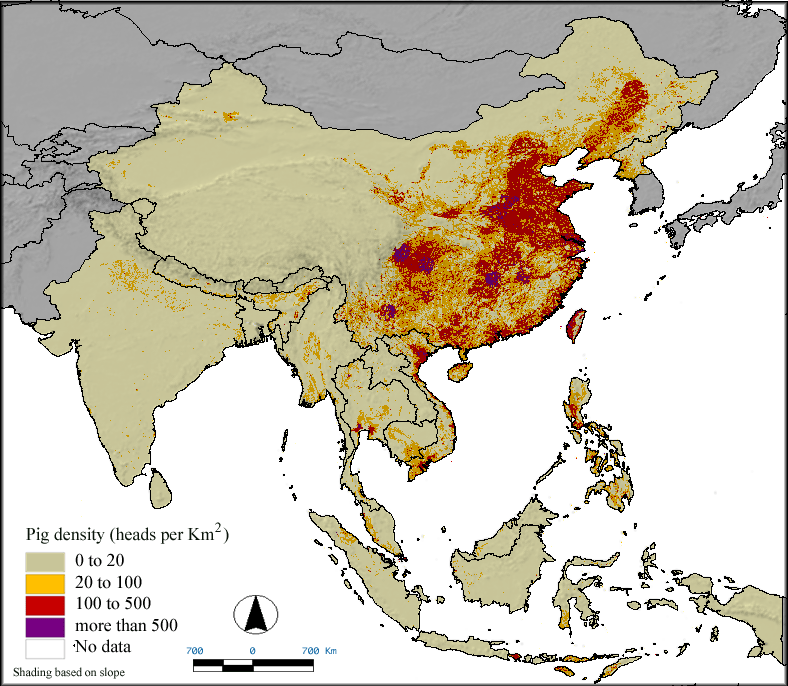
ue
to the high animal concentration and the insufficient agricultural
land destined to the production of feed within these peri-urban
areas, most feed inputs are brought from elsewhere. Considering that
a large proportion of the nutrients contained in feed are not
retained in the animal’s body but excreted in urine and manure,
the result is an excessive concentration of nitrogen and phosphorus
compounds in the periphery of the urban areas, which results in
significant water, land, and air pollution. An initial estimate
indicates that 26 percent of the total
area in East Asia suffers from significant nutrient surpluses which
emanate mainly from agricultural sources.
Preliminary estimations of nutrient mass balances in the region,
which include manure and chemical fertilizers as source of nutrients
and crops as the main nutrient sink, have been made for a coastal
band of 50 km from the South China Sea (cf. Map 2). These estimates
indicate Nitrogen and Phosphorus overloads on the coastal land, with
hotspots in the Mekong delta (7.2 and 3.1 tons per square kilometers
receptively), the Mouth of the Red River (6.3 and 4.0 tons per square
kilometers receptively) and the whole Chinese coast of the South
China Sea (3.1 and 2.4 tons per square kilometers respectively).
Currently, animal manure is estimated to account for 47 percent of
the phosphorus supply and 16 percent of the nitrogen supply.
With the dramatic expected increase in demand for meat and milk, this
share will continue to grow.
M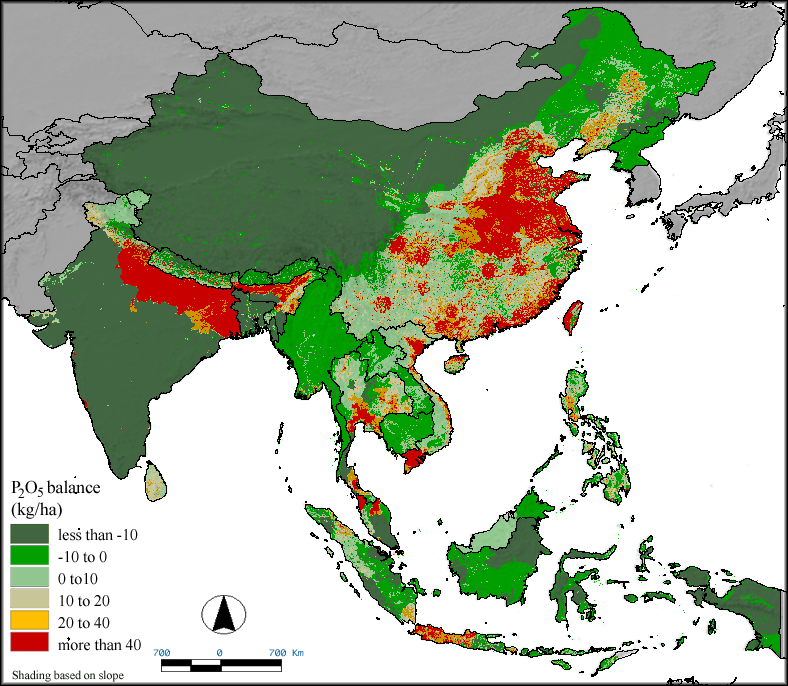
ap
2: Estimated P2O5
mass balance for agricultural land in Asia (1998 – 2000)
Source of both maps 1 and 2: Bioresource Technology
Volume 96, Issue 2, January 2005 by Pierre Gerber, Pius Chilonda,
Gianluca Franceschini, Harald Menzi.
A World Bank analysis for the coastal regions
of Central South, South West, and East China showed that the COD from
untreated piggery waste alone accounted for about 28 percent of the
current urban plus-industrial COD loads already in 1996. However,
this share is estimated to rise to 90 percent in 2010. In greenhouse
gas emissions, livestock contributes about 20 percent of the global
methane emission and 10 percent of global N2O
(nitrous oxide, a much more aggressive greenhouse gas) emission.
LEAD is providing financial and technical assistance to China,
Thailand, and Vietnam to help them begin to address this problem by
carrying out AWI studies in these countries during 2001 to 2003. The
results clearly indicate the magnitude of the environmental
degradation that industrialized livestock production is causing to
freshwater ecosystems and to the seas of South and East Asia.
However, the studies in all three countries also show that the
countries lack effective tools and institutions to address this
problem. The measures being introduced mainly seek to mitigate the
symptoms (end of pipe pollution), but do not address the underlying
cause of excessive concentration of livestock production. Despite an
increasing awareness of the issue at the local and political level,
technical solutions and policy instruments are still to be developed
and implemented.
B. COUNTRY BACKGROUND
In all three countries, national level environmental policies with
supporting standards are in place. The components dealing with
livestock pollution are recent (within the last 5 years), tend to be
rather arbitrary and are not yet effectively enforced in general.
China and Vietnam are in the process of revising major parts of the
national legislation.
The agencies charged with enforcement (EPB in Guangdong, PCD in
Thailand and EPA in Vietnam) lack the resources committed to properly
monitor and enforce the regulations. Currently, PCD in Thailand has10
staff for some 60,000 farms and EPA in Vietnam has 22 stations.
Guangdong provincial EPB has equally limited resources to undertake
extensive monitoring. In Thailand, farmers can refuse access to PCD
monitors necessitating a court order to gain access.
Provincial regulations in China and Vietnam are somewhat stricter
than the national regulations and possibly more realistic in terms of
enforcement. In Thailand, although, provincial and local authorities
are permitted to develop their own environmental management plans
under the Enhancement and Conservation of National Environmental
Quality Act of 1992 (ECNEQA), none appears to have yet done so for
livestock operations. In all provincial and sub-provincial
jurisdictions in the region, monitoring and resources designated for
these activities are far from adequate. Local level enforcement is
compromised by a combination of weak enforcement capacity; overriding
importance assigned to short term economic and employment issues; and
the influence of entrenched commercial interests that conflict with
good environmental management.
Concern and complaints are mainly focused on odor rather than on
water pollution. There is a common lack of widespread awareness and
comprehension of the scale and consequences of pollution. In all
three countries, there is a general preference for targeting
enforcement of regulations on medium sized and large producers but to
exempt small producers. Farmers are generally focused on commercial
and production interests and are less responsive to environmental
concerns. The countries’ key polices and
programs to address environmental degradation from livestock
production on which this proposed Project would build are:
CHINA
The Government of China is in the process of
establishing guidelines for limiting the impact of the intensive
livestock production on the environment. The Government
intends to use a combination of command and
control regulations and other economic instruments to get producers
to reduce the amount of pollution coming from livestock. In
1996, the Ministry of Agriculture introduced a regulation requiring
that all new large-scale livestock farms establish environmental
facilities and storage facilities for manure. The Ministry has also
presented a draft for national standards (how much) for pollution
from livestock production and drafted a detailed regulation (how to
do and size of fine) to implement the standards. In 1998, the State
Environmental Protection Agency (SEPA) set up a facility to evaluate
pollution from livestock production. In 1999, a rural division of
SEPA was established with the objective to focus on environmental
pollution. A new regulation by SEPA on
"Discharge Standard of Pollutants from Livestock and Poultry
Breeding" became effective on January 1, 2003.
The “Political Consultative Conference” has appealed to
the provincial government to take action against pollution from
agriculture. In
May 2001, the Government established environmental management
regulations affecting the livestock industry, and in January 2002 it
established pollutant emission standards with regard to the breeding
industry. In addition, a Government program on renewable energy
promotes the formulation of biogas from livestock waste. In their
next ten-year plan, the Ministry of Agriculture plans to construct
around 300 demonstration bio-gas projects which will be based on the
local specific requirement on environment and factors like
availability of crop field, farming system, and climate etc.
THAILAND
The Government of Thailand is in the process of
establishing regulations to reduce the negative impact of livestock
production on the environment. Currently, there are five types of
plans: (a) the National Economic and Social Development Plans; (b)
the Enhancement and Conservation of National Environmental Quality
Act; (c) the Policy and Plan for National Environmental Quality
Preservation and Promotion; (d) the Environmental Quality Management
Action Plan; and (e) the Energy Conservation Promotion Act. In the
9th
National Economic and Social Development Plan, provisions were added
that required the use of zoning for animal production, the
registration of animal and other farms, and the education of farmers
on livestock waste management.
Based on the water pollution in Tha Chin River, the PCD of the
Ministry of Natural Resource and Environment listed pig farms in
February 2001 as a point-source pollution that needs to be regulated.
PCD defines pig farms into 3 categories: group A (pig farms with
more than 5,000 SPP), group B (pig farms with 500-5,000 SPP) and
group C (pig farms with 50-500 SPP). The waste water standard
differs by group. A grace period of 1 year was applied and the above
standards will be enforced from February 2002. As of February 2002
only pig farms group A and group B are being enforced and monitored.
As for group C and small-scale pig farms, these regulations will not
be enforced but be used only as guideline for promotional incentives.
Aside from the PCD’s control of wastewater from pig farms, the
Department of Livestock Development (DLD) of the Ministry of
Agriculture and Cooperatives established farm standard in 1999 for
the pig, poultry and cattle farms. These farm standards are
voluntary and hence they are rarely observed by the farm owners
except the poultry farmers with products for export. These farm
standards have had no impact on the practices of pig farms with
products for domestic market only.
VIETNAM
In Vietnam, the issue of animal waste
has received serious attention by senior policy makers. While few
policies at the national level are directed specific to agriculture
and the regulations are based on industrial pollutants, there are a
number of regulations at the provincial level that are currently
being implemented. For instance, Long An province has implemented
regulations to relocate large-scale livestock farms and slaughter
houses out of the urban areas. In July 2000, Dong Nai province also
developed regulations to protect the environment from livestock
production activities. These regulations define the size (small,
medium and large) of the livestock farm and the regulation on
treating dead animal, animal waste, introduction for waste water
treatment methods. Binh Duong province has developed a master plan
that identifies specialization areas for livestock production. Newly
established large scale livestock farms are required to have an
appropriate waste treatment system. In Ho Chi Minh City, the
state-owned pig farms are in the process of relocation.
C. SECTOR BACKGROUND IN EACH COUNTRY
CHINA
National Policy Framework
National environmental policy is expressed
through the Law of Environmental
Protection (1989). National
regulations relating specifically to livestock management are
discussed below under the heading of Environmental Protection.
Promotion of Livestock Development. Prior to the
mid-1990s, when large livestock farms were normally state- or
collectively-owned and located in suburbs of large cities,
subsidization of large pig farms was a very popular policy tool. The
main goal was to ensure the survival of the inefficient production
system and to provide the urban population with sufficient meat, milk
and eggs. This was seen as crucial for social and political
stability during times of food shortage. This practice has since been
discontinued and the industry operates on a free market basis.
Environmental Protection. The national
regulations relating specifically to the management of livestock
manure have only been promulgated in the very recent past. They
consist of: Decree of Control and Management of Pollution by
Livestock Production (SEPA Decree 9-May 2001); Discharge
Standards of Pollutants for Livestock and Poultry Breeding
(GB18596-2001); Decree on collection and Use
of Waste Discharge Fees (1 July
2003); Decree on Fee standards for
Waste Discharge (Decree 31); Decree
on Use of Waste Discharge Fees
(Decree 17). Decree No, 9 has several weaknesses including the
fact that it applies only to operations with relatively large scale
operations (more than 500 SPP or 15,000 broilers or 20;000 layers or
100 dairy cows or 200 beef cattle). It is currently being revised on
behalf of the State Council as a new Regulation for Protection
from and Control of Pollution from Livestock Production. The
revision of the discharge standards is desirable with a focus on
nutrient loading into water bodies rather than simply concentrations
of contaminants.
Enforcement. While China has made great strides
recently in framing environmental policies relative to intensive
livestock operations, enforcement and therefore compliance has yet to
catch up with the regulations. In practice, given the great variety
of climatic, geological and other environmental conditions across the
country it might be more appropriate to have general statements of
intent at national level with more specific regulations at provincial
level. Although the use of manure as a source of soil nutrients is
generally popular with Chinese farmers, it should be noted that
chemical fertilizer is exempted from the value added tax. This helps
keep the price of chemical fertilizer at an artificially low level
and makes it more competitive with manure with its relatively lower
nutrient content and higher labor requirement for spreading. Pelleted
compound fertilizer containing both artificially produced nutrients
and manure components would also be tax exempted and might be an
attractive alternative to chemical fertilizer.
Provincial
Policies
Guangdong Province has been under considerable pressure to regulate
land use and pollution resulting from land based activities in the
Pearl River Delta. This originates from concerns over the level of
pollutants in the river and also specifically over the issue of Hong
Kong’s water supply. As a result, a number of regulations have
been passed by the Provincial People’s Congress, which include:
(a) Regulation on Agricultural Environmental Protection (June
1998); (b) Pearl River Water Quality Protection Regulation
(January 1999); (c) Han River Water Quality Protection Regulation
(March 2001); (d) Eastern (Dong) River Water Quality Protection
Regulation (May 2002). There are also provincial regulations
such as the “Reform on the Prevention and control of
Pollution by Livestock in the Pearl River Valley”, prepared
by the Department of Agriculture (April 3, 2003). Many of the
existing and non-compliant operations existed prior to the
promulgation of these regulations and there is no clear timetable for
closing them down, although some progress is being made in this
direction in specific problem areas. The Environmental Protection
and Energy Station within the Department of Agriculture provides some
technical assistance in the siting and design of production
facilities. The problems of pollution stem primarily from: (a)
incorrect selection of production sites; and (b) insufficient
availability of both land and water. The Environmental Protection and
Energy Station estimates that only about 50 percent of manure can be
applied on the land in Guangdong due to the location of production
sites and natural climatic conditions.
Substantial expenditures are being made by GEF and the World Bank
into the implementation of the Comprehensive Plan for Improving Pearl
River Water Quality (November 2003). The Pearl River Water Resources
Commission, on which both Hong Kong Environmental Protection
Department and Guangzhou EPB are represented, would prepare water
resources control plans under terms of the 2002 Water Law.
Guangdong’s strategic plan for wastewater management in the
Pearl River Delta is the ‘Pearl River Cleanup Campaign’,
which sets out phased targets for improvements in water quality in
river reaches in the Province and urban areas; proportion of domestic
and industrial wastewater to be treated; and investments for
environmental protection. Additionally, point source pollution from
urban and industrial wastes is addressed under a parallel World
Bank/GEF-financed Guangdong Pearl River Delta Urban Environment
Project.
Major policy measures with respect to livestock include: (a)
relocation of livestock farms from densely inhabited areas and areas
protected as drinking water sources; (b) strict control of the
existing scale of livestock farms (in principle no new livestock
farms will be approved in the Pearl River Delta); (c) encouraging
livestock farms to move to hilly areas and to promote efficient water
use; (d) requiring existing livestock farms to undertake EAs within a
specified time; and (e) any new livestock farms must undertake EAs
before construction. Agricultural taxes are to be abolished by the
end of 2005, which should assist farmers to invest more in manure
management.
THAILAND
National Policy Framework
No specific policies are applied to the promotion of the pig
industry. Rather, its development has been driven primarily by market
forces and the strength of the Thai feed and meat processing
industry.
The Enhancement and Conservation of National Environmental Quality
Act of 1992 is supported by series of standards such as Surface
Water Quality Standards; Effluent Standards for Pig Farms;
Coastal Water Quality Standards; Ground Water Standards and
Industrial Effluent Standards. The Department of Water Resources
is studying 25 watersheds to explore the possibility of establishing
a zoning system. The National Environment Board has been established
to monitor and control the implantation of the ECNEQA at the national
level.
DLD has farm and slaughterhouse certification procedures, which are
administered by the Bureau of Livestock Standards and Certification.
The certification focuses mainly on operational considerations
(feeding practices, health protocols, animal management, worker
welfare and training), and does not include any environmental
standards. For slaughter houses to be certified, they must meet the
standards of the ECNEQA. It seems that farms are exempted, at least
for the time being. Slaughter houses also have to meet ISO standards.
Supermarkets will only accept meat from certified slaughter houses,
although there is still a substantial informal market. PCD is
developing centralized manure treatment centers under Prime
Minister’s directive. They intend to start in Nakorn Pathom
province in 2005 followed by Ratchaburi province in 2006.
For conversion of biogas to electricity, National Science Development
Agency will provide subsidized loans through participating banks for
the cost of the installation investment. National Science Development
Agency rather than banks does the financial feasibility analysis.
Preference is given to the UASB design of digester designed by the
University of Chang Mai. For generation exceeding 1 Mw, energy has to
be sold to Electricity Generating Authority of Thailand while energy
is sold to Provincial Electrical Authorities for generation below 1
Mw. The Energy Conservation Promotion Fund also promotes biogas
production. It provides subsidies of 40 percent for small producers
(50-500 SPP) and 20 percent for medium to large sized producers (>500
SPP). Funding goes from the Ministry of Energy to Chang Mai
University, which provides the technical supervision. Small farmers
generally install fixed dome systems and larger operations install
high upflow anaerobic sludge blanket systems.
Provincial
Practices
In Thailand, no provincial or local environmental management plans
consisting of long-term environmental policies and plans and annual
Provincial Environmental Quality Management Action Plans have been
developed. Public participation is important to this process and a
framework for action plans has been establishment which includes
consideration of water quality, air quality, solid waste, and
hazardous waste. A Sub-Committee for Provincial Environmental Quality
Management is to be established under the Committee for Provincial
Development to advise on environmental management.
All provinces have to prepare land use plans within 3 years.
Approvals for new enterprises at Tambon level, are required to refer
back to the national level policies on health and environment. These
are generally inadequately applied and considered only in context of
business licenses with little or no technical input. There are
incidences of conflict of interest with elected Tambon level
officials also being major land holders and pig producers.
VIETNAM
National Policy Framework
The environmental impacts of livestock operation in Vietnam are
mainly regulated under the Law on Environmental Protection (LEP,
December 27, 1993). The newly promulgated Decree 67
(January 2004) on wastewater releases will impose fines on
non-complying polluters and may have an immediate impact on larger
livestock operations. The planned expansion of the pig industry from
the present 23 million animals to 30 million by the year 2010
underscores the importance of revising the Law on Environmental
Protection and enforcing Decree 67. Effective local
statutes regulating the livestock operations are generally lacking.
The principal government agencies responsible for regulating the
sub-sector are the Animal Husbandry Section within the Ministry of
Agriculture and Rural Development (MARD) the Department of Land Use
and Environment within the Ministry of Natural Resources and
Environment (MONRE). The Vietnam Environmental Protection Agency,
working under the direction of MONRE, is likely also to have a role.
The capacity of these agencies to effectively regulate the livestock
sub-sector is inadequate in general. However, the role of agriculture
and particularly livestock production is yet to be well appreciated.
The document “State of the Environment Vietnam 2001”
(UNEP, 2001)
makes no mention of livestock waste as a pollution source. Much
greater concern is voiced about effluents from specialized industrial
(handicraft) villages housing paper manufacturing and other polluting
industries.
National
Policies
Promotion of Livestock Development. There have
been a number of decrees and resolution of the central government
since 1991 aimed at promoting agriculture including: (a)
Decision 125/CT (April 18, 1991) and (b) Decision
225/QD-Ttg (December 10, 1999) on breed improvement of livestock,
field crops and forest crops; (c) Resolution 03/2000/NQ-CP
(February 2, 2000) on farm development; (d) Decision
166/2001/QD-Ttg (October 26, 2001) on pig production for
export; and (e) Resolution 09/2000/NQ-CP (June 15,
2000) on economic restructuring and consumption of agricultural
products. Resolution (c) is designed to drive the transition from
small scale household based livestock production (primarily pigs) to
larger scale commercial production, while resolution (e) provides a
framework for zoning export oriented, high quality pig production
towards areas with suitable environmental and hygiene conditions. In
parallel, there have been favorable fiscal policies (Decision
No 24/2000/ND-CP, July 31, 2000) to promote foreign and local
investment in the livestock industry.
Environmental Protection. MONRE is primarily
responsible for administering the laws relating to pollution by
livestock farms. This is done primarily through the Law on
Environmental Protection. In support of this is a Decree
guiding implementation of the law (Decree No. 175-CP, 1994).
The LEP is now being revised and the revised law is
expected to be adopted in mid-2005. The law makes no concrete
reference to livestock waste pollution but has stipulations on
prevention of pollution in general. Other important and relevant
policy documents include (a) National Strategy for Environmental
Protection to 2010 with Vision to 2020 – signed by Prime
Minister on December 2, 2003; (b) Agenda 21 for Vietnam –
Sustainable Development Strategy for the 21st
Century (this forms an umbrella for all other legislation); (c)
Comprehensive Poverty Reduction and Growth Strategy; (d)
Strategy for Social Development (Project until 2010). An
ordinance on Veterinary Medicine (February 3, 1993) issued by
MARD governs such things as the disposal of dead
animals and measures to control the spread of pathogens. Under this
ordinance, the application of untreated manure to crops is not
permitted.
Overall policies for environmental protection are in place but there
is a general lack of appreciation of the contribution of livestock to
pollution of aquatic systems and little or no enforcement compounded
by inadequate monitoring capacity (22 monitoring stations throughout
the country currently, planning to increase to 50 by 2010).
Relocation of heavily polluting industries is possible under Decision
64/2003/QD-TTg on the treatment of seriously polluting units.
This, however, may not apply to agriculture sector.
Provincial
Policies
The only two provinces in Vietnam with legislation targeted
specifically at reducing the impact of livestock on the environment
are Dong Nai and Tien Giang.
Dong Nai province placed livestock farms under Decision
1981/QD.CT.UBT (July 25, 2000) of the Chairman of People’s
Committee on “Regulation of Livestock Production Activities
to Protect the Environment” in three categories: small
(<100 SPP); medium (100-2000 SPP); and large (>2000 SPP). All
farms have to conform to provincial land-use planning codes which
include separation distances (>50m, >300m and >500m for
small, medium and large farms respectively) from schools, residential
areas, and other institutions. Medium and large farms must be located
more than 300m from water sources and more than 500m from water
pumping stations. Farms should also be large enough to have land for
waste storage and treatment.
Ha Tay province
has a General Law on the Environment (promulgated in 1997), but none
dealing specifically with livestock production. Nevertheless, large
(>500 SPP) and medium sized (>200 SPP) pig farms are required
(under Decree
175, Circular
490) to submit EAs and to report quarterly (large farms) or semi
annually (medium farms).
Annex 2: Major Related Projects Financed by the Bank and/or other
Agencies
East Asia And Pacific:
Livestock Waste Management in East Asia Project
The Project preparation incorporated experience and lessons learned
from many other international and national initiatives and programs
already existing or underway in the countries around the South China
Sea and maintains close coordination with them. Major related
projects and programs include the following:
Global Program of Action for the Protection of the Marine
Environment from Land-based Activities (by GEF). This Global
Program is a source of conceptual and practical guidance for
devising and implementing sustained action to prevent, reduce,
control and/or eliminate marine degradation from land-based
activities.
Reversing Degradation Trends in the South China Sea and Gulf of
Thailand Project (by UNEP). This GEF project, implemented by
UNEP, aims to develop regionally coordinated programs of action
designed to reverse environmental degradation particularly in the
area of coastal habitat degradation and loss, halt land-based
pollution and address the issue of fisheries over-exploitation.
Partnerships for the Environmental Protection and Management of
the East Asian Seas Project (by IMO/UNDP). This is a GEF
financed project executed by International Maritime Organization
(IMO) and implemented by UNDP. It focuses on building partnerships
within and among governments of the region, as well as across public
and private sectors of the economy. The goal is to reduce or remove
barriers to effective environmental management, including inadequate
or inappropriate policies, disparate institutional and technical
capabilities and limited investment in environmental facilities and
services.
Mekong River Basin Water Utilization Project (by World Bank).
This is a GEF financed project implemented by the World Bank.. It
will assist the Mekong River Commission in promoting and improving
sustainable water management in the Mekong River Basin, and to
protect the environment, aquatic life, and the ecological balance of
the basin.
Guangdong Pearl River Delta Urban Environment Project (by World
Bank). This is a project financed by the World Bank and GEF. It
will assist the government in addressing the environmental problems
of the Pearl River Delta and the South China Sea, through the
improvement and rationalization of environmental service delivery
based on a regional planning approach.
Global People, Land Management, and Environmental Change Project
(by UNEP). This project will develop sustainable and
participatory approaches to biodiversity conservation within
agricultural systems.
AWI Pilot Projects (by LEAD). The objective of these pilot
projects is to provide local institutions and decision-makers in
China, Thailand and Vietnam with tools in order to insure the
sustainability of livestock development. Main activities included
(a) environmental impact assessment, (b) analysis of nutrient chains
and manure market opportunities, (c) identification and selection of
on-farm manure management, (d) spatial analysis and planning, and
(e) policy dialogue.
Poultry Emergency Recovery Project in Vietnam (by World Bank).
This project will support the short and medium-term actions to be
undertaken by the Government to strengthen its veterinary
surveillance and diagnostic infrastructure in order to avoid, or at
least minimize, a recurrence of Avian Influenza that would further
damage the poultry sub-sector.
Poland Rural Environmental Protection Project (by World Bank).
The project’s long-term goal is to demonstrate effective
mechanisms for improving environmental practices in agriculture by
reducing nutrients entering the Baltic Sea from agriculture in
Poland. The project has been designed specifically to provide a
model activity, which can be replicated at other locations in
Poland, the Baltic Sea region and Central and Eastern Europe. The
project also supports Poland's move towards compliance with its
national policies, European Union (EU) directives and international
agreements. The project was completed in 2002.
Sustainable, Sanitary and Efficient Management of Animal Manure
for Plant Nutrition Program. The pre-project phase, in
collaboration between multiple Danish agricultural research
institutes and the Vietnamese National Institute of Soils and
Fertilizers, aims at developing a research and training program. The
overall objective of the full program, as the outcome of the
pre-project to be submitted to DANIDA for funding in March 2005, is
to develop efficient and sanitary safe recycling of animal manure
for the purpose of developing sustainable agriculture in Vietnam.
Annex 3: Results Framework and Monitoring
East Asia And Pacific:
Livestock Waste Management in East Asia Project
Results
Framework
|
PDO
|
Outcome Indicators
|
Use of Outcome Information
|
|
PDO: reduce the major negative
environmental and health impacts of rapidly increasing
concentrated livestock production on the open waters of and thus
on the people of south-east Asia
Global
environment objective: To reduce land-based pollution and
environmental degradation of the South China Sea and Gulf of
Thailand.
|
Process Indicators
% of all intensive livestock
farmers implementing improved (level 1 and level 2) livestock
waste management practices
Improved spatial distribution
planning for livestock production
Stress
Reduction Indicator
Reduced
livestock production related emissions of pollutants (N, P, BOD,
COD and E. Coli) in surface water systems of project areas
|
YR1-YR2 gauge project
progress.
YR3s determine if
implementation strategy needs to be changed.
YR5
feed into evaluation and strategy for mainstreaming program.
|
|
Intermediate Results
One per Component
|
Results Indicators for Each
Component
|
Use of Results Monitoring
|
|
Outcome
1:
Cost-effective livestock waste
management technologies for intensive livestock production
demonstrated.
|
Outcome
1:
Process Indicators
Improved LWM practices manuals
(Level 2) developed for main pig farming systems of Thailand,
Vietnam and Guangdong province.
Requests for project
intervention received from farmers and local communities outside
demonstration areas (number).
Stress
Reduction Indicator
Reduction in nitrate,
phosphates and BOD, COD and E. Coli discharge at (a) the end of
the pipe of the individual farms or community; and (b) at critical
downstream locations.
Number
of SPP covered by farms adopting Level 2 LWM systems with project
support (head ‘000).
|
Outcome
1:
This information, collected
through project monitoring as well as regular agricultural
surveys, indicates whether the project is on track for meeting its
goals of demonstrating improved LWM approaches and thus for
achieving its PDO.
Necessary
information to determine whether the project’s capacity
building activities are sufficient to permit achievement of the
project’s broader objectives.
|
|
Outcome
2:
Governments and local
communities to encourage and regulate livestock farmers to
implement better manure management practices
|
Outcome
2:
Process Indicators
Number of provinces (Thailand
and Vietnam) and counties (Guangdong) where policies and
regulations for improved LWM developed and introduced.
Number of sub-districts
(Thailand), districts/townships (Vietnam and Guangdong) where
policies for improved LWM and stricter standards for nutrient
discharge are developed and introduced.
% of individuals in local
communities and decision makers aware of LWM issues and willing to
reduce environmental impacts from livestock production.
Increased attention to
livestock waste management issues in local and national government
and donor policy documents.
|
Outcome
2:
This information will provide
feedback on whether a voluntary or compulsory approach is more
effective in obtaining desired changes in behavior by intensive
livestock producers.
Decisions
can be made regarding the most effective media to employ and
audiences to target about LWM issues.
|
|
Outcome
3:
Overall institutional capacity
for project implementation improved.
|
Outcome
3:
Process Indicators
Number of project staff
trained, number of workshop and study tours carried out and master
plan for capacity building prepared.
M&E system in place and
periodic evaluations of project outputs and impacts carried out.
Stress
Reduction Indicator
Reduced
human health risk as a result of minimized potential transmission
of pathogens, antibiotics and their resistance strains from
livestock to human being.
|
Outcome
3:
Review adequacy and
appropriateness of institutional setup, provide technical
assistance if necessary
Up
to three internal evaluations of the project’s progress
towards achievement of the PDO/GEO are envisaged, in PY 1, 3 and 5
(it may be decided to dispense with the first review). Besides
normal project supervisions, these evaluations, covering each of
the three countries, will be the most important guide to the need
for mid-term review.
|
|
Outcome
4:
Vietnam, Thailand and
Guangdong province of China leading among countries bordering the
South China for the use of common tools, and guidelines to address
manure management issues.
|
Outcome
4:
Process Indicators
Decision tools, guidelines and
training packages produced and trainers trained in Vietnam,
Thailand and Guangdong province (no. of DST and related training
packages).
Networks of government staff,
scientists and farmers are operative in Vietnam, Thailand and
Guangdong province of China and neighboring countries.
Reference
data bases and studies in the thematic areas of the project are
made available.
|
Outcome
4:
Adapt decision support tools
developments to local requirements.
Evaluate potential for
harmonized LWM approaches across the countries bordering the South
China Sea.
Expressed
demand by neighboring countries for dissemination and replication.
|
Arrangements for Results Monitoring
|
|
|
Target
Values
|
Data
Collection and Reporting
|
|
Outcome
Indicators
|
Baseline
|
YR1
|
YR2
|
YR3
|
YR4
|
YR5
|
Frequency
and Reports
|
Data
Collection Instruments
|
Responsibility
for Data Collection
|
|
% of intensive livestock
farmers implementing improved (level 1 and level 2) livestock
waste management practices
|
Thailand 25%
Vietnam 35%
Guangdong35%
|
-
-
-
|
-
-
-
|
-
-
-
|
-
-
-
|
40%
50%
50%
|
Yearly cumulative
report
|
Survey
|
Env. agency
|
|
Improved spatial distribution
planning for livestock production
|
Monitoring
|
TBD
|
TBD
|
TBD
|
TBD
|
TBD
|
Yearly cumulative
report
|
National statistics and
survey
|
PMO
|
|
Reduced livestock production
related emissions of pollutants (N, P, BOD, COD and E. Coli) in
surface water systems of project areas
|
Monitoring
|
TBD
|
TBD
|
TBD
|
TBD
|
TBD
|
Yearly cumulative
report
|
Sampling
|
Env. agency
|
|
Results
Indicators for Each Component
|
|
|
|
|
|
|
|
|
|
|
Improved LWM practices
manuals (Level 2) developed for main pig farming systems of
Thailand, Vietnam and Guangdong province.
|
None
|
-
|
-
|
Comp leted
|
Comp leted
|
Comp leted
|
Yearly report
|
N/A
|
PMO, RFO
|
|
Requests for project
intervention received from farmers and local communities outside
the demonstration areas (number)
|
None
|
-
|
10
|
50
|
100
|
500
|
On-going tracking by project
management office
|
Records in project management
office
|
PMO
|
|
Reduction in nitrate,
phosphates and BOD, COD and E. Coli discharge at (a) the end of
the pipe of the individual farms or community; and (b) at
critical downstream locations.
|
To be undertaken YR1
|
-
|
20%
|
40%
|
70%
|
90%
|
Yearly cumulative
report
|
Survey
|
Environment. agency and
livestock development agency
|
|
Number of SPP covered by
farms adopting Level 2 LWM systems with project support. (head
‘000)
|
Thailand 0
Vietnam 0
Guangdong 0
|
-
|
-
|
-
|
-
|
260
145
125
|
Yearly cumulative
report
|
Records of PMO
|
PMO
|
|
Number of provinces (Thailand
and Vietnam) and counties (Guangdong) where policies and
regulations for LWM developed and introduced
|
0
|
3
|
6
|
6
|
9
|
9
|
Yearly cumulative
report
|
N/A
|
PMO
|
|
Number of sub-districts
(Thailand), districts/townships (Vietnam and Guangdong) where
policies for improved LWM and stricter standards for nutrient
discharge are developed and introduced
|
0
|
0
|
6
|
12
|
18
|
27
|
Yearly cumulative
report
|
N/A
|
PMO
|
|
% of individuals in local
communities and decision makers aware of LWM issues and willing
to reduce environmental impacts from livestock production.
|
To be undertaken YR1
|
-
|
-
|
-
|
-
|
LC40%
DM70%
|
Beginning and end of project
– comparative report
|
Media survey
|
Env. agency
|
|
|
Monitoring
|
-
|
-
|
-
|
-
|
-
|
Yearly cumulative
report
|
Progress report
|
PMO
|
|
Number of project staff
trained, number of workshop and study tours carried out and
master plan for capacity building prepared.
|
None
|
based on master plan
|
based on master plan
|
based on master plan
|
based on master plan
|
based on master plan
|
Semi-annual report
|
Progress report
|
PMO
|
|
M&E system in place and
periodic evaluations of project outputs and impacts carried out.
|
None
|
-
|
-
|
-
|
-
|
-
|
As requested by national
steering committees and regional coordinating group
|
Field visits and other as
needed
|
PMO, RFO
|
|
Reduced human health risk as
a result of minimized potential
transmission of pathogens, antibiotics and their resistance
strains from livestock to human being.
|
To be undertaken YR1
|
TBD
|
TBD
|
TBD
|
TBD
|
TBD
|
Semi-annual tracking
|
Records in project management
office
|
PMO, Public Health agency
|
|
Decision tools, guidelines
and training packages produced and trainers trained in Vietnam,
Thailand and Guangdong province (no. of DST and related training
packages)
|
None
|
-
|
2
|
5
|
6
|
6
|
Yearly cumulative
report
|
Regional facilitation office
progress reports
|
RFO
|
|
Networks of government staff,
scientists and farmers established and operative in Vietnam,
Thailand, China and neighboring countries.
|
Monitoring
|
-
|
-
|
-
|
-
|
-
|
Yearly cumulative
report
|
Regional facilitation office
progress reports
|
RFO
|
|
Requests for project support
for training and extension programs received from other countries
(provinces).
|
None
|
-
|
3
|
5
|
10
|
10
|
Yearly cumulative
report
|
Regional facilitation office
progress reports
|
RFO
|
Annex 4: Detailed Project Description
East Asia And Pacific:
Livestock Waste Management in East Asia Project
The proposed Project would consist of four components. This design
takes into consideration the specific local conditions of each
country while maintaining coherence of the Project objective, Project
composition, criteria for selection of demonstration areas, and
regional learning from experiences and coordination.
1. Livestock Waste Management Technology Demonstration Component
(US$13.6 million)
1.1 COMPONENT STRATEGY
LEAD’s AWI Projects have shown that as pig production moves
towards larger, specialized, confined production in peri-urban areas,
the increased amounts of manure are often improperly discharged
leading to surface water and other environmental problems. As these
modern production practices were developed (or adapted from countries
where pig production has intensified earlier, i.e. Western Europe and
North America), many of the pollution control practices are unknown
to the vast majority of farmers and extension officers using or
promoting these production practices. Therefore, there are important
needs for the following to be addressed by this component:
identifying and adapting existing manure management practices or new
ones;
validating and demonstrating the agricultural, environmental and
economic performances of these technologies;
fostering technology transfer and sustained positive change in the
application of pig manure management practices among a wide
constituency of farmers;
training and capacity building of farmers and extension workers.
Demonstration
areas
The project design is tailored to fit the specific livestock rearing
conditions in the three participating countries, particularly the
different average size of pig farms, which are its main target. In
Thailand and China, large sized industrial pig farms are dominant,
while in Vietnam, pig farms are typically small scale, involving
confined household-based production that is concentrated in
particular villages. This structure of Vietnamese rural society
requires that the project’s demonstration activities be
conducted on a communal (village) rather than individual farm basis.
The targeted project demonstration farms are all located within the
concentrated livestock production jurisdictions bordering South China
Sea and Gulf of Thailand.
The selection will be made according to selection criteria agreed
with the Bank, which would be updated periodically during project
implementation as needed and included in the Project Implementation
Plan (PIP) of each country. Key criteria require the farms or
villages to be selected should (1) be large sized pig farms in China
and Thailand or villages with large number of confined
household-based pig farms in Vietnam; (2) be willing to participate
with co-financing commitment; (3) be located in an area where pig
production is the dominant cause of water pollution; (4) be located
in an area where the trend is increasing or steady in pig production;
(5) be located in an area ideally representing a single geographical
catchment area or a micro watershed draining to a single surface
stream; (vi) be located within the identified concentrated livestock
production jurisdictions. They would be selected on a yearly basis to
allow the process of improved planning to adjust for changes and
incorporate lessons learned from demonstrations in earlier years of
Project implementation. A first set of demonstration farms and
villages has been selected and agreed by the World Bank for further
preparation and the first year’s implementation once the
Project is approved.
This component is primarily based on local stakeholder involvement
and interaction. The benefit of manure management technology must be
both real and demonstrable to justify the efforts and cost of
implementation. The demonstrated technologies will deal with current
environmental issues but shall also fit into future production
patterns. Demonstration will be implemented both in (a) traditional
pig production areas, where livestock is currently responsible for
water pollution that has to be mitigated, and (b) in future
production areas, where high growth rates of the production will most
probably lead to water pollution if manure management practices are
not improved. As such, this should ensure:
engagement of farmers in the selection of technologies to be
demonstrated;
offering of a “selection of technical options” to
farmers;
training of farmers in the operation and maintenance of the
technologies and in the assessment of successfulness;
coordination between technology demonstration with the provision of
locally and nationally developed “guidance and policy”
to enable farmers to adopt relevant technologies over the long-term.
Manure
management strategies
Comparatively, livestock wastes are typically 10-100 times stronger
in biodegradable organics than untreated sewage. This is an
important factor recognizing that reducing biodegradable organic
material is the first step in developing cost effective waste
management strategies that mitigate water pollution. As a first step,
pre-treatment processes, such as solids separation, are often used to
remove large particles that contain about 20 percent of the
biodegradable fraction. These are followed by primary treatment
processes that can utilize anaerobic or aerobic processes where each
process results in a different cost and operating structure. Due to
cost impacts, anaerobic processes are typically used for liquid and
slurry wastes and aerobic processes such as composting are used for
solid wastes. Additional steps referred to as secondary and tertiary
treatment processes are added when additional nutrient removal, such
as nitrogen is desired.
Conventional nitrogen removal processes are based on the combination
of nitrification (aerobic oxidation of ammonia into nitrate) and
denitrification (anoxic conversion of nitrate into de-nitrogen gas).
Phosphate removal is realized either by sedimentation, chemical
precipitation, or by phosphate incorporation into biomass. These
processes are frequently used to reduce the nutrient content of urban
waste waters before their release into surface waters and have been
introduced in the framework of livestock production with limited
success due to significant operational costs. However, nutrient
removal is often indicated as the only potential option for farms
when the nutrient availability exceeds that of crop available uptake.
Nutrient recycling covers a range of options where the basic
objective is to use the nutrients present in the manure for other
growing activities, such as cropping and fish farming. Treatment can
make manure recycling and use easier, more effective and less
environmentally offensive. The AWI projects have illustrated the
interest of recycling where local conditions are adapted, both from
economic and environmental perspectives. Recycling of treated manure
is a basic principle of component 1.
Component
goal
The goal of this Component is to demonstrate technically,
geographically, economically and institutionally workable solutions
to reduce regionally-critical livestock waste pollution caused by
industrial livestock production under the different political and
social situations of the participating countries. The livestock waste
management strategies promoted under this component will focus on
reducing excess nutrients, in particular nitrates and phosphates.
1.2 ACTIVITY DESCRIPTION
Subcomponent 1: Technology demonstration (US$12.5
million)
The manure management strategies considered under this Project are
selected according to the expected ultimate fate of the manure and
include methods that either (a) get the nutrients back into the crop
cycle; or (b) process and package the nutrients up for export to
other areas for crop use; or (c) convert the nutrients for plant
available forms; or (d) destroy the nutrients. The demonstration
areas already selected for PY1 are as follows.
Guangdong Province of China
The selected Project jurisdiction is Boluo County. The county,
situated northeast of the city of Guangzhou, has a rapidly-growing
pig population as farms are relocating inland from the lower Pearl
River delta. The Project is strongly supported at county and province
levels as pollution from pig production is affecting the quality of a
raw water intake on the East River for delivery to Hong Kong, which
generates significant revenues for the province. Urgent remedial
action has been mandated by the central and provincial authorities,
making Boluo County an ideal first demonstration area. Eight farms in
Yuanzhou town have been selected as the first group of farms for
further preparation.
Thailand
Provinces of Ratchaburi and Chonburi are selected as Project
jurisdictions. Ratchaburi (west of Bangkok) is the leading pig
production province in Thailand, with a still dynamic growth.
Chonburi (east of Bangkok) is the second highest pig producing
province in Thailand, with a concentration of farms with poor
livestock waste management. The Project has very strong support from
both Provincial Governors as well as from district officials. Six
farms (four in Ratchaburi and two in Chonburi) have been selected as
the first group of farms for further preparation.
Vietnam
Provinces Dong Nai and Ha Tay are selected as Project jurisdictions.
Dong Nai province is located in the South of Vietnam, northeast of Ho
Chi Minh City. Livestock production around is very developed while
agricultural land in this area is very limited. Animal density is 120
pigs and 315 poultries per hectare of agricultural land, in a heavily
polluted peri-urban environment. Ha Tay province, located in the
North of Vietnam, south of Hanoi, is adjacent to the Red River. About
60 percent of households raising pig produce compost while about 10
percent collect solid manure to market it fresh and untreated. It is
estimated that nearly 80 percent of solid manures are used as
fertilizer for crops and fish ponds or sold and over 80 percent of
the liquid effluents are released directly to surface water.
Common
activities
Selection of farms or villages
Selection of farms according to eligibility criteria and selection
criteria agreed by the World Bank;
Design of financial incentives scheme (eligible investments, level
of funding, etc.);
Preparation of contract procedures with farmers and with companies;
Financial estimation.
Preparation
Preparation of farm assessment documentation;
Preparation of brief information sheet for distribution to farmers;
Launch of workshop and meetings;
Initial farm contacts (via local representatives if appropriate);
Program of visits to farmers;
Assessing local potential for manure recycling;
Drawing up plans for monitoring strategy;
Preparing farm dossiers.
Choosing of technologies
Agreement on targets and constraints - both in terms of which
pollution parameters (such as phosphorous, nitrogen, COD, BOD5)
and what percentage level of abatement is required;
Subdividing and grouping farms on the basis of general
circumstances;
Assigning manure management package to the various groups;
Designing and contractual implementation
Carrying out audit of crop system (where relevant);
Establishing demonstration plots for manure use on crops. Decide
what gaps of knowledge must be filled to produce reliable
recommendations for manure and effluent use on crops;
Preparation of implementation report for each farm to include
required general information, geographical and statistical data,
total cost estimate and cost sharing plan;
Preparing a cost estimate;
Construction and commissioning
Technical support and evaluation
Nominating contact person;
Preparing operation guide - one for each farm/farm group;
Assemble and training of a monitoring team;
Arranging for the analysis of samples taken and the collation of all
data collected;
Carrying out monitoring of farm sites;
Assessment of crop production with manure;
Evaluation of manure treatment techniques. Objectively compare
experiences of different farms with the purpose to establish best
management practices;
Cost analysis: actual costs incurred as a direct result of the
implementation of manure handling technologies;
Recommendations and guidelines: prepare interim and final detailed
reports setting out the principal findings from the results. Give
the best manure management practice for the various farm scenarios
covered in the Project field work.
Preliminary identification of example manure management strategies
Guangdong Province of China
Strategy one: specialized large-scale operations (>3,000 SPP).
This strategy is proposed for those farms with adequate land for
lagooning systems. The main technical steps are:
Separation of solid manure in animal houses;
Solids marketed after treatment;
Liquids sent to covered lagoon system with seasonal solids
extraction and treated effluent discharged to a constructed wetland.
The aim of constructed wetlands is to reach a water quality level
allowing for its recycling in animal houses. It will be mostly
relevant in areas with limited water resources.
Strategy two: improvement of the ‘pig-fish’ system. This
strategy is proposed for farms operating alongside large fish
rearing operations. The main technical steps are:
Separation of solid manure in animal houses;
Solids marketed after treatment;
Liquids sent to covered lagoon with seasonal solids extraction and
treated effluent to fishpond system.
Strategy three: small biogas (bag type or fixed dome) plant. It is
similar to strategy two except that the covered lagoon system is
replaced by a biogas reactor.
Thailand
Strategy one: specialized medium and large scale operations (>1,000
SPP) with possibility to recycle manure on surrounding crops. The
main technical steps are:
Separation of solid manure in sow houses;
Solids marketed after treatment;
Liquids from sows and slurry from fatteners sent to:
covered lagoon (if adequate land available) or other biogas
reactor with seasonal solids extraction (gas converted to
electricity);
effluent recycled on crops or stored in short term pond or tank
and then recycled on crops.
Strategy two: specialized medium and large scale operations (>1,000
SPP) with no possibility to recycle manure on surrounding crops. The
main technical steps are:
Separation of solid manure in sow houses and/or;
Mechanical screening/separation to produce a clarified liquid and
solids;
Solids transported out of area and marketed after treatment;
Liquids from sows and slurry from fatteners sent to:
covered lagoon or other biogas reactor with seasonal solids
extraction (gas converted to electricity);
(if adequate land available) treated effluent discharged into a
lagoon treatment system (multiple storage ponds) and then discharged
to stream via a final biofilter.
Strategy three: cluster of large and medium size farms, close to a
village and with available cropland (Mapbai Tambon). The main
technical steps are:
Separation of solid manure in animal houses;
Solids marketed after treatment if opportunity is identified.
Otherwise, recycled on surrounding crops;
Liquids sent to a central bio-gas digester. Gas used by village and
outflow sent to multiple storage ponds and either discharged into
stream or preferably land applied.
Vietnam
Strategy one: for suburban production areas with medium pig farms
(>500 SPP) such as Bien Hoa City in Dong Nai province. The main
technical steps are:
In house separation of manure;
Small, individual bio-digesters;
Aeration step to remove nitrogen;
Individual sedimentation tank with possible attached storage;
Transport of solid manure and dried sludge out of area;
Supernatant from settlement is released to streams or preferably
irrigated to any available land.
Strategy two: for rural pig production in delta areas with dominant
rice production such as Thong Tin in Ha Tay province with many small
pig farms (<50 SPP). The main technical steps are:
Option of manual collection of solid manure within the pig
buildings;
Bringing effluents to a centralized (mesophilic/mixed) biogas unit
supplying gas to farms/housing nearby;
Settlement of digestate to produce a sludge if there is the
opportunity to run central or farm-based compost systems (with
export of compost products out of the commune);
Otherwise, removal of some of the solid dung and selling to local
fish producers after treatment (not exceeding environmental capacity
of the fish ponds), use of bag AD digesters;
Treated effluent applied to crop land in commune to meet nutrient
requirement.
Subcomponent 2: Training and extension (US$1.1
million)
The demonstration activities would be supported by training and
extension to provide (a) farmers with the essential skills and
technical support needed to improve their on-farm manure management
practices and (b) capacity building. The training and extension
approach is to provide technical consultation and advice first to
farmers participating in the project, then to other livestock farmers
in the project areas, and finally to further to livestock farmers in
other parts of the country. Capacity building is crucial to the
effort to address livestock waste pollution issues and to test the
feasibility and replicability of livestock waste management practices
and technologies. Activities would include training of animal
husbandry extension agents, farmer associations and planning
officers, study tours for participating farmers on demonstration
farms, preparation of training manuals, collaboration with livestock
extension projects, etc. A detailed master capacity building
development plan is under preparation by each country which will be
reviewed by the Bank appraisal mission.
2. Policy
and Regulatory Development Component (US$4.8 million)
2.1 COMPONENT STRATEGY
Generally ineffective enforcement of the existing regulations on
livestock waste management is mainly caused by (a) absence of an
effective policy framework clearly linking the environmental concerns
to the operational considerations of livestock production; (b) poor
enforcement and general disregard of the existing legislation; (c)
lack of capacity at lower levels of government throughout the region
to monitor effluents, enforce regulations or advise farmers on
appropriate management approaches; and (d) widespread ignorance of
the cumulative environmental impacts, public risks and negative
externalities (social costs, lost resource access etc.) associated
with inadequately managed manure disposal. These have resulted in a
failure to commit adequate public and private funding with which to
take meaningful pollution prevention measures in the first place and
then to remedy those that have already occurred. From this, it is
concluded that more creative and credible approaches have to be
adopted in designing initiatives to achieve a greater degree of
compliance. For these to succeed, however, there has to be
support from producers to government officials at all levels.
This component would support setting up a policy and regulatory
framework for environmentally sustainable development of livestock
production in each country which will induce further policy reforms
and encourage farmers to adopt improved manure management practices.
This component is expected to lead to the development, testing and
implementation of more effective policies for livestock production
development and waste management with strengthened and
better-enforced policy measures, and strengthened institutions and
financial incentives for enforcement and compliance. It is also
expected to raise awareness about livestock waste management issues
among the line agencies and general public, to support environmental
policies enforcement.
2.2 ACTIVITY DESCRIPTION
Overview
of activities
Subcomponent 1: Policy Development (US$1.3 million)
This subcomponent consists of a variety of elements aimed at
developing a policy and regulatory framework for effective
application. This will be achieved through: (a) the development of a
replication strategy; (b) the review and revision of existing
regulations; (c) the commitment to master planning of livestock
production (at national and provincial levels) to direct the
geographic focus of future intensive livestock production; (d) the
development and introduction of codes of practice or best waste
management practices; and (e) the development and introduction of
livestock waste recycling and discharge standards. An essential part
of the policy development activities would, therefore, be the
establishment of a dialogue with the principal stakeholders on the
proposed regulations and standards.
Subcomponent 2: Policy Testing (US$1.1 million)
Specific policy packages would be tested in sub-national
jurisdictions and testing experience will feed back into the policy
and regulatory development subcomponent. Code of Practices or Best
Management Practices will be tested in synergy with the Livestock
Waste Management Technology Demonstration component, which will
promote cost-effective and replicable technical options. This
subcomponent would address the regulatory and participatory aspects
of the COP preparation to ensure no duplication of the COP with local
existing standards or criteria. The participatory dialogue would
involve all stakeholders especially private sector in an exhaustive
review and negotiation of technical solutions and management options
that might be adopted. Other policy measures to be tested would
include replication strategy, regulations for manure marketing
(contracting, norms for manure content, transport authorization,
etc.) and relocation of farms.
Subcomponent 3: Awareness Raising (US$2.4 million)
This subcomponent will also support public awareness raising
activities, focusing on policy measures and environment and public
health issues associated with inadequate manure management. This will
focus the attention of national and local governments on livestock
waste policy and regulatory enforcement and facilitate further
assistance with this challenge from the World Bank and other donors.
The target group essentially consists in the general public and
governmental agencies at national level and in Project areas. They
would receive training in various aspects through a variety of
approaches.
Country
specific activities
Policy development and policy testing activities are country specific
while awareness raising activities are mostly similar across
countries.
Guangdong Province of China
Although the Project is being implemented solely in Guangdong
province, it is essential to involve national level institutions.
Central Ministries, particularly the Ministry of Agriculture, have a
coordination role and substantial technical and financial resources
that can be utilized by the Project. Two national level activities
are envisioned: continued dialogue with MOA and SEPA; and the
integration, expansion and improvement of the existing LEAD virtual
centre Chinese platform.
At province level, it is anticipated that the policy development
activities will focus on creating a policy framework combining a
strong element of public compliance with the necessary tools for
enforcement. Major activities as part of this pillar include:
Development and implementation of a Replication Strategy;
Research and drafting of a new draft policy by an expert group.
This would include the identification of appropriate incentives to
support policy framework, the development of licensing procedures
and the formulation of a code of practice;
The delivery of the draft to national and provincial governments and
a policy dialogue through workshops in which the new draft policy
and code of practice would be reviewed and the testing of these
approved. The participants would be government officials from the
national, provincial and local levels, farmers, and researchers not
involved in the expert group;
Implementation of GIS tools, including installation of GIS tools and
data collection and the development of maps for zoning. It is
anticipated that national experts may be involved but most of the
responsibility will fall on staff of the provincial agricultural
department;
Development of relevant maps for implementing/enforcing policy
zoning (including hardware and software needs);
Improvement of policies and COP through round table discussions or
workshops involving the expert group as well as national and
provincial officials;
Promulgation of legislation, requiring inputs from the national
steering committee and the Guangdong EPB.
Policy testing would initially focus on Yuanzhou town of Boluo
county. The development of COPs will provide a learning
experience and ensure that future documents are the products of real
experience and do not represent arbitrary rules established in
isolation from producers and other stakeholders. In a context of very
dynamic land use changes, options for farms relocation may also be
assessed.
Thailand
For Thailand the implementation of the policy development pillar
would be the responsibility of the National Steering Committee which
would be chaired by a former Permanent Secretary of MOAC. The focus
will be on developing a more robust policy framework with a sound
basis for enforcement. It is intended that compliance should be
increased by engaging in a dialogue with the stakeholders (producers;
slaughterhouses, feed mills and local authorities and other interest
groups) on the selection of the policy framework to be applied. It is
also suggested that guidelines for the design and operation of
intensive livestock operations be developed through the mechanism of
best practices that will be converted into formal legislation once it
has been tested and validated among stakeholders. An option
identified during Project preparation would be to convert the best
practices in a code of practice that will be enshrined in the revised
Standard Farm Regulation. The new regulation would also benefit from
inputs derived from spatial analysis of potential production areas.
It is therefore important that GIS training happen early in the
Project in order to facilitate this activity. The following
activities will be undertaken:
Development and implementation of a Replication Strategy;
Implementing of GIS tools at national level;
Development of relevant maps for provincial level and for
implementing and enforcing policy zoning at national and provincial
levels;
NSC will develop a dialogue with all departments including the
department of town and country planning and pig producers on a
policy framework;
The NSC will involve the Pig Board (pig development committee), as a
major interest group, into the dialogue on environmental policy
development;
DLD will establish cooperation Energy Conservation Promotion Fund
for pollution control in conjunction with the ENCON program. This
will potentially bring additional funds into the Project,
particularly for initiatives involving large scale biodigesters;
DLD will request the Pig Board and Energy Conservation Promotion
Fund to provide funds for promotion;
DLD will develop the Revised Standard Farm Regulations through PLO
in consultation with local communities;
Identifying appropriate incentives to support policy framework;
Development of licensing procedures;
Workshops for reviewing the applicability of the Revised Standard
Farm Regulations;
Submission and promulgation of Revised Standard Farm Regulations as
Livestock Farm Act;
Strengthening policies for supporting manure marketing;
Policy testing. In Thailand under ECNEQA, provincial and local
authorities are permitted to develop their own environmental
management plans. The development of these revised Standard Farm
Regulations is envisaged as part of this process and as an
opportunity to introduce meaningful enforceable regulations to the
Tambons. These have the responsibility for permitting new ILOs but
no capacity to enforce design or operating standards. Once working
models for the revised Standard Farm Regulations have been developed
and applied in the pilot sites it is envisaged that the process of
developing new ones will primarily be the responsibility of the
provincial level officials. They will be assisted as necessary by
members of the national level working group. It is anticipated that
facilitators will be employed to assist with the farmer dialogue and
negotiation process and that these facilitators will require training
in participatory procedures. The dialogue with farmers or farmers
groups will involve extensive review and negotiation over technical
and management options that might be incorporated into the revised
Standard Farm Regulations.
Vietnam
In Vietnam, Policy Development will consist of four separate elements
involving (a) regulations on environmental protection in livestock
production (at national and local level); (b) the development of
livestock waste discharge and recycling standards; (c) master
planning of livestock production (at national and provincial level);
and (d) policies for the promotion of organic fertilizer production.
The major activities associated with these elements will be:
Development and implementation of a Replication Strategy;
Formation of a working group;
Study of experience in foreign countries;
Drafting of a policy outline;
Review of the outline by national and international experts;
Drafting the policies by national and international experts;
Implementing GIS tools;
Development of relevant maps for implementing/enforcing policy
zoning;
Implementing incentives to support policy framework;
Implementing new policies and enforce existing regulations;
Adjustment and promulgation.
The leading agencies involved in the implementation of these activity
will be MONRE, MARD and MOF at national level and DOE, DOA, VEPA,
DONRE, DARDs, DOFs at provincial level. Policy testing would be
implemented in two Project provinces i.e. Dong Nai and Ha Tay and
will be done in conjunction with Component 1 activities. This will
ensure that future documents are the products of real experience and
do not represent arbitrary rules established in isolation from
producers and other stakeholders.
Awareness raising activities for all three countries would
include:
Training of livestock development and environmental protection staff
in spatial analysis, environmental impact assessment, monitoring of
manure management environmental impacts, use of decision making
tools such as GIS, and nutrient management;
Creation of a nation-wide network of related research institutions
and agricultural universities;
Development of monitoring capacity among environmental agencies;
Private sector integration to provide technology and services;
Study tours and workshops involving local government staff,
producers and general public;
Communication programs and promotion materials (booklets, brochures,
flyers, fact sheets, spots or programs on TV, radio, CD, VCDs),
website etc.;
Publication of tested Code of Practices or Best Management
Practices.
3. Project
Management and Monitoring Component (US$4.1 million)
3.1 COMPONENT STRATEGY
This component would finance consultant services, training, office
equipment and incremental operating costs. It includes two
subcomponents i.e. Project Management subcomponent and Project
Monitoring and Evaluation subcomponent. This component would provide
for efficient Project management and effective monitoring and
evaluation of the social, economic, environmental and other changes
brought about by the Project. Replication potential of alternative
livestock waste management technologies as related to farm scale,
affordability, operational capacity, material availability, and
compatibility to the waste handling methods of the local farm
communities would be assessed to achieve widespread replication of
the tested manure management practices throughout the three
participating countries.
3.2 ACTIVITY DESCRIPTION
Subcomponent 1: Project Management (US$1.2
million)
The Project would ensure that all aspects of its design and
implementation are well documented and easily publicly available.
This subcomponent would support a national Project Management Office
in each participating country to be established as the secretariat of
and reporting directly to the respective National Steering Committee.
The PMO, comprising a Project manager supported by competent staff
and based on existing administrative structure, would be responsible
for day to day Project administration including technical support,
financial management, procurement, accounting, secretary as well as
monitoring and evaluation of all Project activities. Its staff
composition, specific responsibilities, financial budgets and
physical location would be decided by respective NSC and acceptable
to the World Bank. The PMO at Guangdong Provincial Department of
Finance would facilitate Project preparation and implementation in
China. The following principles will guide the design of this
subcomponent:
Respect for national institutional arrangements and preferences;
Ensuring economy, efficiency and coordination in Project
implementation;
Encouraging policy innovation and local initiative for addressing
livestock waste management issues;
Facilitating evaluation, dissemination and replication of
demonstration results; and
Consistency with Project and GEF’s global objectives.
Subcomponent 2: Project Monitoring and Evaluation (US$2.9
million)
This subcomponent would include monitoring and evaluation activities
specified in the M&E Plans prepared by the participating
countries and included in country specific PIPs. The major areas will
include: (1) implementation progress monitoring; (2) livestock waste
management system monitoring; (3) environmental management
monitoring; (4) project impact monitoring; and (5) other monitoring
of additional parameters required for achieving project objectives.
Specific plans for monitoring the long-term Project impact will be
developed during project implementation and finalized at project
completion.
Three types of Project evaluation are planned (a) periodic evaluation
studies made internally by the PMOs in each country with technical
assistance provided by the Project’s Regional Facilitation
Office under the Regional Support Services component, (b) annual
audit reports, and (c) evaluations carried out by the World Bank
during supervision missions, at the mid-term review, and at the
implementation completion. Through extensive reporting of the
findings of Project M&E, necessary adjustment or amendment would
be made and lessons learned would be used to not only improve the
Project performance in each country, but also help resolve potential
shortcomings of the Project plans within and between Project
countries. The proposed monitoring and evaluation program including
the following major activities:
Review and assessment of the capacity of laboratories in Project
countries for conducting required soil, water and public health
monitoring sample analyses;
An extensive water quality testing program to be established for the
proposed demonstration areas to monitor the changing quality of
surface and groundwater bodies that eventually drain into the South
China Sea in response to the implementation of the improved
livestock waste management practices;
Baseline data collection to establish the existing environmental and
social conditions prior to Project implementation including baseline
surveys/inventories of surface and groundwater quantity and quality,
and public and animal health conditions;
Stakeholder/farmer-led M&E to determine the “buy-in”
and replicability of the proposed manure management systems. While
this may feed into other types of evaluation, farmer/stakeholder-led
evaluation will have its “own” purpose of building
support and enhancing replication as a “stand-alone”
activity. In addition, ad-hoc thematic social evaluation and review
will be budgeted;
Monitoring change in qualitative or quantitative values of
environmental and social indicators that have been established
during baseline studies. The main sub-activities include:
Implementation progress monitoring. This would include monitoring of
the status of project implementation progress indicators and policy
and regulatory development indicators.
Livestock waste management system monitoring. This would include ,
at farm and community level, the monitoring of system efficiency and
the effect of the project manure management interventions on public
and animal health including nitrate, phosphates and BOD, COD and E.
coli discharge and volumetric outflow at the end-of-pipe of the
individual farms or community, and at critical downstream locations.
Process based characterizations are recommended to measure the
environmental performance of waste management systems.
Environmental management monitoring. This would include monitoring
of the major physical, chemical, and biological
characteristics of unit processes, or surface and ground water
measurement (where applicable) within project areas
(micro-watersheds) and at the end-of-pipe on demonstration farms.
Surface water monitoring would follow the process based approach and
ground water monitoring could be implemented on pollutant sampling
from in-ground wells in comparison with baseline data collected.
Appropriate experimental designs, protocols, and cost estimates are
detailed in country specific EMP's.
Project impact monitoring. This would include monitoring of the
implementation of stakeholder participation plans, annual social
impact review and public consultation, impact on human health, and
long-term project impact.
Other monitoring of additional parameters required for achieving
project objectives. Specific plans for monitoring the long-term
Project impact will be developed during project implementation and
finalized at project completion.
Development of timelines and site specific technical, environmental
and social indicators for each Project area;
Establishment of TAs and training programs for respective line
agencies involved in Project management, monitoring, and evaluation;
and
Evaluation of the success of Project implementation through detailed
examination of identified performance indicators (cf. Annex 3).
Demonstration farm specific baseline data will be collected after the
farms or villages are selected but prior to their physical
construction. Country specific EMPs have been prepared and are
included in the Project EA report. Since the EMP requirements also
cover the surface and groundwater monitoring requirement of the
Project as a whole, every effort has been made to prevent duplication
of efforts between EMP and Component 1 activities. Therefore,
Component 1 will concentrate on monitoring system efficiency and the
effect of the Project manure management interventions on public and
animal health.
4. Regional
Support Services Component (US$1.5 million)
4.1 COMPONENT STRATEGY
In each of the participating countries, it is evident that a growing
awareness of environmental and public health issues associated with
livestock waste mismanagement is often not translated into action
because of a lack of knowledge and experience about how to deal with
the issue. On the other hand, many of the analytical tools and
approaches required to effectively address the issue would be the
same or very similar in Thailand, Vietnam and China, as well as in
other countries bordering the South China Sea. These provide the
base to draw on cross-country synergies, skills and economies of
scale in pursuing the achievement of the Project’s objective
through a regional component serving each of the participating
countries. This component includes the following two subcomponents.
4.2 ACTIVITY DESCRIPTION
Subcomponent 1: Capacity Building Support (US$0.7
million)
This subcomponent would respond to the participating countries’
need for an easily accessible source of support for capacity building
which is critical for implementation of a range of Project activities
under the countries’ responsibility. Specifically, this would
include the following supports.
Support for decision tools development. This activity would
involve the development and adaptation to local contexts of common
decision support tools and technical standards for improved
livestock waste management, and their translation into national
languages. These tools, tailored to local conditions while
maintaining harmonization across provincial and country boundaries,
would be in the form of handbooks, calculation sheets or software.
Such decision support tools would include:
Tools for spatial planning of livestock development such as
GIS-based programs incorporating multiple criteria for zoning of
livestock production at national and local levels;
Nutrient flux models for calculation of pollutant and nutrient
loading balances on agricultural land at farm, village, catchments
and higher levels;
Technical validation of on-farm manure management technologies
especially for confined pig raising;
Tools for monitoring socio-economic and environmental impacts of
livestock production; and
Tools for monitoring public health aspects of livestock production
and its ancillary activities.
Support for evaluation of Project activities and outcomes.
The Project would build a regional pool of experts and develop a
cost effective, implementable, and credible evaluation methodology
for use in evaluations as required at the initiative of the
participating countries. Periodic and ad hoc evaluation
missions would be organized at the request of the participating
countries. In addition to Project activities and outcomes,
evaluations would recommend on needs for decision-support tools
development and other capacity building.
Support for development of training modules and packages. The
Project would involve development of training modules and related
technical training packages which would be closely coordinated with
training plans for capacity building by participating countries.
Training packages would be developed for various targeted audiences
including primarily farmers, extension agencies, local and national
level decision makers, the Project implementing agencies and
trainers who would be trained in use of these training packages.
Subcomponent 2: Coordination and Facilitation Support (US$0.8
million)
This subcomponent would focus on regional coordination, facilitation
amongst the three participating countries and the replication of
Project outcomes through dissemination, decision support tools,
within the three participating countries and to other countries
bordering the South China Sea. Coordination with other major projects
in the region would be ensured. Specifically, this subcomponent would
include the following activities.
Regional facilitation. Regional facilitation would, through a
Regional Facilitation Office headed by a Regional Project
Coordinator, include activities to (a) deliver the support services
for capacity building and dissemination of Project outcomes
according to an agreed annual work program to be approved by the
Project’s Regional Coordination Group and (b) facilitate RCG
in performing its functions e.g. support for organizing annual RCG
meetings.
Regional coordination. Regional coordination would focus
mainly on key related projects and programs already existing or
underway in the region through regular exchange of information,
invitation to workshops, consultation on key issues. Details would
be included in Project Implementation Plan for the Regional Support
Services Component.
Regional dissemination. Regional dissemination would target
primarily the three participating countries but eventually also
other countries draining into the South China Sea for replication.
It would consist in (a) exchange of experience and results through
study tours and workshops for officials, experts and policy makers
at local and national levels, as well as selected farmers and other
key stakeholders involved in the Project; (b) development of an
internet portal on “livestock waste management in East Asia”
based on the LEAD’s virtual center to include updated
information on the Project, documents and data, forums, expert
roster, links, etc.; and (c) publications. Other countries in the
region would be invited to participate in selected Project workshops
in order to benefit from knowledge and experience gained under the
Project.
Annex 5: Project Costs
East Asia And Pacific:
Livestock Waste Management in East Asia Project
Project Cost Estimate
Total Project
|
Component
|
Local
US$ 000
|
Foreign
US$ 000
|
Total
US$ 000
|
|
Livestock Waste Management Technology
Demonstration
|
9,483
|
2,379
|
11,862
|
|
Technology
Demonstration
|
8,713
|
2,162
|
10,875
|
|
Training
and Extension
|
770
|
217
|
987
|
|
Policy and Regulatory Development
|
3,312
|
829
|
4,141
|
|
Policy
Development
|
859
|
222
|
1,081
|
|
Policy
Testing
|
775
|
191
|
966
|
|
Awareness
raising
|
1,678
|
416
|
2,094
|
|
Project Management and Monitoring
|
2,872
|
708
|
3,581
|
|
Project
Management
|
840
|
219
|
1,060
|
|
Monitoring
and Evaluation
|
2,032
|
489
|
2,521
|
|
Regional Support Services
|
131
|
1,175
|
1,305
|
|
Capacity
building support
|
61
|
548
|
609
|
|
Regional
coordination and facilitation
|
70
|
626
|
696
|
|
Total Baseline Cost
|
15,798
|
5,091
|
20,889
|
|
Physical
Contingencies
|
1,816
|
585
|
2,401
|
|
Price
Contingencies
|
545
|
176
|
720
|
|
Total
Project Cost
|
18,158
|
5,852
|
24,010
|
Total Project cost is estimated based on information provided during
the Project preparation. Project base cost is expressed in December
2004 prices and in US dollar only. Total Project cost includes
physical and price contingencies. Physical contingencies are based on
an average of 11 percent for costs under all Project components.
Price contingencies are estimated based on an annual international
price index of 1.5%, 0.7%, 0.7%, 1.1%, 1.0%, 1.0% for years
2005-2010. Identifiable taxes and duties are US$3.6 million and the
total Project cost, net of taxes, is US$20.4 million. Therefore, the
share of Project cost net of taxes is 85 percent. It
is estimated that during the period 2005-2015, about US$48.4 million
of leveraged investment in on-farm livestock waste management would
be made as a consequence of the project.
Thailand
|
Component
|
Local
US$ 000
|
Foreign
US$ 000
|
Total
US$ 000
|
|
Livestock Waste Management Technology
Demonstration
|
3,316
|
585
|
3,901
|
|
Technology
Demonstration
|
3,180
|
561
|
3,741
|
|
Training
and Extension
|
136
|
24
|
160
|
|
Policy and Regulatory Development
|
3,312
|
829
|
4,141
|
|
Policy
Development
|
859
|
222
|
1,081
|
|
Policy
Testing
|
775
|
191
|
966
|
|
Awareness
raising
|
1,678
|
416
|
2,094
|
|
Project Management and Monitoring
|
1,017
|
179
|
1,196
|
|
Project
Management
|
203
|
36
|
239
|
|
Monitoring
and Evaluation
|
813
|
144
|
957
|
|
Total Baseline Cost
|
5,552
|
980
|
6,532
|
|
Physical
Contingencies
|
638
|
113
|
751
|
|
Price
Contingencies
|
191
|
34
|
225
|
|
Total Project
Cost
|
6,382
|
1,126
|
7,508
|
Vietnam
|
Component
|
Local
US$ 000
|
Foreign
US$ 000
|
Total
US$ 000
|
|
Livestock Waste Management Technology
Demonstration
|
3,028
|
1,009
|
4,037
|
|
Technology
Demonstration
|
2,610
|
870
|
3,480
|
|
Training
and Extension
|
418
|
139
|
557
|
|
Policy and Regulatory Development
|
3,312
|
829
|
4,141
|
|
Policy
Development
|
859
|
222
|
1,081
|
|
Policy
Testing
|
775
|
191
|
966
|
|
Awareness
raising
|
1,678
|
416
|
2,094
|
|
Project Management and Monitoring
|
777
|
259
|
1,036
|
|
Project
Management
|
289
|
96
|
385
|
|
Monitoring
and Evaluation
|
488
|
163
|
650
|
|
Total Baseline Cost
|
4,895
|
1,632
|
6,526
|
|
Physical
Contingencies
|
563
|
188
|
750
|
|
Price
Contingencies
|
169
|
56
|
225
|
|
Total Project
Cost
|
5,626
|
1,875
|
7,502
|
Guangdong Province of China
|
Component
|
Local
US$ 000
|
Foreign
US$ 000
|
Total
US$ 000
|
|
Livestock Waste Management Technology
Demonstration
|
3,139
|
785
|
3,924
|
|
Technology
Demonstration
|
2,923
|
731
|
3,654
|
|
Training
and Extension
|
216
|
54
|
270
|
|
Policy and Regulatory Development
|
3,312
|
829
|
4,141
|
|
Policy
Development
|
859
|
222
|
1,081
|
|
Policy
Testing
|
775
|
191
|
966
|
|
Awareness
raising
|
1,678
|
416
|
2,094
|
|
Project Management and Monitoring
|
1,079
|
270
|
1,349
|
|
Project
Management
|
348
|
87
|
435
|
|
Monitoring
and Evaluation
|
731
|
183
|
914
|
|
Total Baseline Cost
|
5,220
|
1,305
|
6,525
|
|
Physical
Contingencies
|
600
|
150
|
750
|
|
Price
Contingencies
|
180
|
45
|
225
|
|
Total Project
Cost
|
6,000
|
1,500
|
7,500
|
Regional Component
|
Component
|
Local
US$ 000
|
Foreign
US$ 000
|
Total
US$ 000
|
Regional Support Services
|
131
|
1,175
|
1,305
|
|
Capacity
building support
|
61
|
548
|
609
|
|
Regional
coordination and facilitation
|
70
|
626
|
696
|
|
Total Baseline Cost
|
131
|
1,175
|
1,305
|
|
Physical
Contingencies
|
15
|
135
|
150
|
|
Price
Contingencies
|
5
|
41
|
45
|
|
Total Project
Cost
|
150
|
1,350
|
1,500
|
Annex 6: Implementation Arrangements
East Asia And Pacific:
Livestock Waste Management in East Asia Project
The overall Project implementation arrangements would be made at
regional, national and local levels. At regional level, a Regional
Coordination Group represented by each participating country and FAO
would be established to provide coordination and facilitation. A
National Steering Committee has been formed by each participating
country with members from key government ministries (agriculture,
environment, public health etc.), academies within each country at
national level with overall responsibility for Project preparation
and implementation in respective country. A national Project
Management Office or Project Implementation Unit, depending on NSC’s
preference, would be established as the secretariat of and reporting
directly to respective National Steering Committee. The PMO will be
responsible for day to day Project administration including preparing
funding requisitions and handling funds received from GEF through the
Ministry of Finance. Its staff composition, specific
responsibilities, financial budgets and physical location would be
decided by respective NSC and acceptable to the World Bank.
Specific Project implementation arrangement structure, particularly
below the national level, varies from one country to another due to
different country and local environment and conditions. It may
include District Executive Committee in Vietnam, Provincial Livestock
Office and Tambon Administrative Organization in Thailand, County
Leading Group and Township Executive Committee in Guangdong and is
described below.
Vietnam
Approved by the Prime Minister’s office, a four-member National
Steering Committee has been set up comprising members from MONRE and
MARD. The NSC is headed by the director-general of MONRE’s
Department of Environment.
Establishment of a national Project Management Office has been
approved by MONRE which will be located in MONRE. The national PMO
staffing would include a Project director, assistant technical
officer, administrator and accountant. The Project director will be a
senior individual with specific experience in Project management and
expertise in livestock waste management and related environmental
issues. This person will be responsible for directing work of the
national PMO, including recruitment and supervision of the other
national PMO staff; establishment of financial management procedures;
preparation of periodic technical and financial reports; liaison with
the NSC and with provincial and district level officials. In
consultation with the NSC, they will identify the technical
assistance requirements of the Project and make the necessary
arrangements for its provision. It is expected that the Project
director will assist the provinces and selected districts to
establish the District Executive Committees (DEC). Initially, the
focus will be on Bien Hoa District of Dong Nai Province in the south,
and Thuong Tin District of Ha Tay Province in the north, that have
been selected for initial implementation. As the Project progresses,
this responsibility may extend to other provinces that join the
Project.
DECs will initially require training to enhance their administrative
and financial management capacities as well as their understanding of
the technical and environmental issues involved. By the end of the
training, they will have assumed responsibility for Project
implementation in their areas. In view of the weak capacity of the
DECs at initial stages, however, and to achieve the desired national
coordination of Project activities, the national PMO may directly
contract service providers required for Project delivery of the
Technology Demonstration subcomponent with supervision and support as
needed. These services might be as varied as facilitation for the
dialogue with farmers during preparation of codes of practice, to
technical and engineering services for the design and construction of
manure management and treatment facilities. The DECs will be assisted
as necessary with technical inputs from provincial level line
agencies such as DONRE, DARD and DOST. In particular, it is
anticipated that DONRE will provide the ongoing monitoring services
that will be required to determine whether the Project is having the
desired impact.
All key stakeholders including local administrations, communities,
farmer, NGOs in Project preparation have been involved in Project
preparation and will be continuously involved in project
implementation. A stakeholder participation plan is under preparation
and will specify the participation and consultation mechanisms
tailored to facilitate the stakeholder involvement in exhaustive
review and negotiation of technical solutions and management options,
proposed regulations, standards and ‘code of practice’ to
ensure ownership, sustainability and replicability. The private
sector will be responsible for implementation in the demonstration
villages who would contribute to the cost of the installation of
individual or community based manure management facilities and
supported by the national PMO as well as by provincial level
organizations institutionally, technically and financially.
Thailand
A National Steering Committee was set up at the outset of Project
preparation. NSC was expanded to comprise 12 members from Ministry of
Agriculture and Cooperatives, Chulalongkorn University and MONRE. The
NSC is headed by a former permanent secretary of MOAC.
A national level Project Management Office will be established and
located in MOAC. The national PMO will be staffed by a Project
director, an assistant technical officer, an administrator and a book
keeper. The Project director will be a senior individual with
specific experience in Project management and expertise in livestock
waste management and related environmental issues. This person will
be responsible for directing the operation of the national PMO,
including recruitment and supervision of the other national PMO
staff; establishment of financial management procedures; preparation
of periodic technical and financial reports; liaison with the NSC;
and liaison with provincial and district level officials. In
consultation with the Implementation Committee, they will identify
the technical assistance requirements of the Project and make the
necessary arrangements for its provision.
In response to the functional role conferred on provincial
governments by the present national government, it is anticipated
that most Project activities will be focused on this administrative
level and at Tambon level. For purposes of the delivery of Technology
Demonstration subcomponent, the focus would be specifically in
Ratchaburi and Chonburi provinces. The Provincial Governors’
offices will play an important role in setting policy and
coordinating technical inputs and technical support. Much of this
will be done by the provincial level technical staff of the line
ministries. The Provincial Livestock Office (PLO) will be responsible
for Project implementation at provincial level. Project funds will
flow through the PLO from the national PMO. For the technology
demonstration Project farms, service suppliers will be contracted
directly by the PLO. These services might be as varied as
facilitation of the dialogue with farmers during preparation of codes
of practice, to technical and engineering services for the design and
construction of manure management and treatment facilities.
Eventually, and as a result of Project financed capacity development
activities, the Tambon Administrative Organizations (TAO) are
expected to take over these responsibilities. Then, funds and
implementation arrangements and policy matters will flow through TAOs
to the service providers.
All key stakeholders including local administrations, communities,
farmers, NGOs in Project preparation have been involved in Project
preparation and will be continuously involved in project
implementation. A stakeholder participation plan is under preparation
and will specify the participation and consultation mechanisms
tailored to facilitate the stakeholder involvement in exhaustive
review and negotiation of technical solutions and management options,
proposed regulations, standards and ‘code of practice’ to
ensure ownership, sustainability and replicability. Farmer
associations will be invited to participate in the development of
code of practice development committee on which the national PMO and
participating departments will also be represented. The private
sector will be responsible for implementation in the demonstration
villages who would contribute to the cost of the installation of
individual or community based manure management facilities and
supported by the national PMO as well as by provincial level
organizations institutionally, technically and financially.
China
In China, Project implementation is expected to be carried out mostly
in Guangdong province. Within the framework of the overarching
institutional arrangement of the Project, specific institutions would
be established for the Project implementation as follows.
National Steering Committee. Although Guangdong is the
only province of China currently involved in this Project, China’s
NSC was constituted of national level ministries (MOF, MOA and SEPA)
and Guangdong Provincial Department of Finance. The NSC is headed by
a Director under MOF who is also the country’s GEF focal point.
The principal reasons to adopt this set-up are to (a) ensure that the
national ministries are kept informed of progress of the Project so
they may identify successful Project initiatives for replication in
other provinces, (b) provide a mechanism for support from the central
government, and (c) recognize that the South China Sea constitutes
international waters which in China come under national authority.
National Expert Group (NEG). The National Expert Group
would consist of national professionals in the related disciplines. A
group leader will be designated to assist the provincial PMO to
coordinate the professional work involved in implementing the
Project. The major functions of the NEG are, at the request of the
provincial PMO, to provide professional expertise throughout the
implementation of the Project including policy research, technical
proposals, development of training materials, participating in
training activities, special survey design and implementation, and
other related professional support activities. The NEG members would
be nominated and selected by the provincial PMO and accountable to
provincial PMO. At different stages of Project implementation,
non-NEG experts might be needed. However, activities of those non-NEG
professionals will be short-term, while the work of NEG will be of a
relatively longer nature to ensure consistency and efficiency.
Project Leading Group (PLG). Within Guangdong province, a
provincial PLG has been established headed by the director of
provincial PMO who is also a member of the NSC. PLG members comprise
provincial Department of Finance (DOF), Department of Agriculture
(DOA), Environmental Protection Bureau (EPB), and Department of
Public Health (DOPH). The PLG is a policy setting and decision making
body at provincial level with main function to (a) provide immediate
guidance and assistance to the provincial PMO to enable a smooth and
successful implementation of the Project in the demonstration area,
and (b) keep the NSC informed of the progress of the Project. Through
this involvement, NSC is able to benefit from the lessons learned and
to identify Project initiatives that later are to be replicated
elsewhere. Similar structure of county level PLG is expected. County
PLG will be chaired by a county chief and comprise members from the
line agencies at this level (Environment, Agriculture, Livestock,
Veterinary Services, Fisheries, Health, and Land Management) and
farmers’ association representatives.
Project Management Office. A provincial PMO would be
established consisting of representatives from various governmental
departments and related agencies in Guangdong province, including
DOF, DOA, EPB and DOPH. The main functions of the PMO are
coordination, organizational and supporting work at the operational
level for the Project. The provincial PMO is to report to the
provincial PLG on a regular or a request basis. To facilitate Project
preparation and implementation in Guangdong province, a PMO at
provincial Department of Agriculture would be set up. Establishment
of a Township Executive Committee in participating townships is also
expected.
During the implementation of technology demonstration subcomponent in
Yuanzhou township of Boluo county, service suppliers will be
contracted directly by the provincial PMO with supervision and
support as needed. These services might be as varied as facilitation
of the dialogue with farmers during preparation of codes of practice,
to technical and engineering services for the design and construction
of manure management and treatment facilities. Eventually and as a
result of Project-financed capacity development activities, the
Township Executive Committee will take over these responsibilities
under the supervision of a county level PLG. Once the townships take
over responsibility for Project implementation within their
jurisdictions, funds and implementation arrangements and policy
matters will flow through them to the service providers.
Regional
Regional Coordination Group. RCG’s principal role is to
(a) ensure a continuing exchange of information on livestock waste
management issues; (b) coordinate Project implementation among the
countries, (c) ensure the inclusion of the issue of manure management
on the political and budgetary agenda within respective country, (d)
facilitate the gradual adoption of common policies thereon between
the partners, and (e) coordinate implementation of the Regional
Support Service component. RCG would meet normally twice a year.
Regional Facilitation Office. LEAD, aimed at the protection of
natural resources as affected by livestock production within a
poverty reduction perspective, will be responsible for implementation
of the regional component. Under such arrangement, FAO has committed
to financing at least US$0.5 million of the cost of the component;
and has undertaken to seek additional bilateral funding, such as to
permit component activities to be adequately maintained over the full
duration of the Project, as desired by the participating countries. A
Regional Facilitation Office would be set up prior to Project
effectiveness and located in FAO’s Regional Office in Bangkok
of Thailand. This Office would consist of a full-time FAO staff
serving as the Regional Facilitator supported by short-term
international consultants as needed plus office support and travel
budget. Its main functions would be to (a) prepare an annual work
program to be reviewed and approved by the RCG; (b) manage the
Project activities as agreed with the World Bank including submission
of financial and implementation progress reports to the World Bank on
a regular basis and an annual report of activities to the
participating countries; and (c) serve as the secretariat of the
Project’s Regional Coordination Group.
Annex 7: Financial Management and Disbursement Arrangements
East Asia And Pacific:
Livestock Waste Management in East Asia Project
Summary
Assessments of the Project’s FM arrangements in each of the
participating countries and for the Regional Support Services
Component have been conducted to determine whether the financial
management capacity will be able to meet the requirements of BP/OP
10.02. In the three countries
participating of the Project, the financial management (FM) and
disbursements arrangements vary from one country to another due to
different implementation arrangements and country/local environment
and conditions. In summary, the FM arrangements for the Project in
each country and for the regional component are considered adequate
to meet the minimum requirements of the World Bank, provided the
actions recommended in the individual country FM Action Plans are
implemented before the Project becomes effective.
Risk
Analysis
In Thailand, the risks associated with the Project are
considered high due to the limitations of the government financial
system for supporting the Project’s fiduciary requirements and
the lack of experience in management of World Bank supported Projects
and FM requirements. In China, the Project risk is
assessed as moderate as the Project will have in place an adequate
financial management system that can provide, with reasonable
assurance, accurate and timely financial information and the
Project’s finances will be managed by staff with experience in
World Bank requirements. In Vietnam, the conclusion of
the assessment is that there is a certain degree of fiduciary risk in
the use of public resources, however the fiduciary risk for this
Project is manageable with the steps that are envisioned to be taken
under the financial management action plan. For the regional
component, the Project risks are assessed as low, as the
implementing agency has experience in financial management of similar
projects and has adequate financial systems and procedures. The
Project risks are considered manageable through clear specification
an documentation of procedures, use of government control procedures
and, where required, training of staff in the World Bank procedures,
regular audits and World Bank supervision.
Implementing
Arrangements
In each country, a Project Management Office (PMO) within the main
implementing agencies will be established with responsibility for the
day-to-day Project administration and financial management In China,
the Provincial Finance Bureau will have responsibility for the
Project’s financial management, while the PMO in the Ministry
of Agriculture will oversee Project implementation.. A Regional
Facilitation Office will be set up in the Food and Agriculture
Organization (FAO) in Bangkok to implement Component 4, Regional
Support Services, of the Project which will include providing Project
progress reports to the World Bank on as regular basis.
In Thailand, the Department of Livestock Development
(DLD) under the Ministry of Agriculture and Cooperatives (MOAC) will
be the implementing agency. DLD currently comprises 16 divisions, 2
units and 2 provincial Livestock offices. To facilitate Project
implementation, it is proposed that a PMO within MOAC would be set
up, with 5 externally recruited staff, to administer and monitor the
Project. The Project will be managed centrally by PMO, including
Project activities incurred at provincial and district levels. A
Project accountant will be employed with responsibility for Project
day-to-day operations including accounting, financial reporting and
disbursements. Since the Project is small, incompatible functions
between accounting and disbursement cannot be segregated. This risk
will be mitigated through supervision by the Project director and
Project manager including approval and authorization of checks
coupled with regular reporting and annual auditing. The Project
accountant will have to be qualified with an adequate background and
experience in accounting and financial management. The terms of
reference and qualifications of the Project accountant will be agreed
with the World Bank before recruitment and the appointment is subject
to review and must be acceptable to the World Bank and these
requirements are incorporated into the FM Action Plan.
In China, the grant will be implemented simultaneously
with the World Bank’s lending project, the Guangdong Pearl
River Environment Project. For the Project, a
Provincial Project Management Office (PMO) has been established
within the Guangdong Provincial Agriculture Bureau. The PMO will be
responsible for the implementation of the Project. Some Project
activities will be performed at county levels. In these instances,
county agriculture bureaus will be responsible for those activities
and will report to the PMO. The disbursement and Project financial
management related functions at the provincial level will be carried
out by the Guangdong Provincial Finance Bureau, which will be also
responsible for the overall coordination of the Project. The Project
structure set out below and staffing plan are considered proper and
satisfactory.
Provincial
Finance Bureau

Provincial
Agriculture Bureau

County
Agriculture Bureau
In Vietnam, the Project will be implemented through the
Central Project Implementation Unit (CPMU) under the Department of
Environment of Ministry of Natural Resources and Environment (MONRE)
and two District Project Implementation Units (DPMU) of Thuong Tin
District, Ha Tay Province in the North and of Bien Hoa City, Doing
Nai province in the South. The DPMUs will implement most of the
activities under component 1 and some activities of Component 3. The
CPMU will implement activities under Component 2, Components 3 and 4
and also will provide support to DPMUs in implementing activities.
As this is the first World Bank funded Project that the MONRE and the
People’s Committee of Thuong Tin District and Bien Hoa City are
responsible for implementing, the agencies are not familiar with the
World Bank’s policies and procedures on financial management
and disbursement. The accounting software in use for government
budget implementation purposes is not able to analyze expenditure by
different dimensions and so the use of a separate accounting software
for the Project will be more effective than modifying the current
software at different agencies. Each agency will be staffed with at
least one chief accountant, one accountant and one cashier. The chief
accountant and the cashier could work on a part-time basis for the
Project, but the accountant will be working on a full time basis. The
People’s Committees will be able to employ additional resources
from their accounting department for the Project as required. The
Project Chief Accountant has been appointed for the Thuong Tin
District DPMU and one has been identified for the Bien Hoa City DPMU
and they have extensive experience in government accounting and
reporting. However, FM staff at the CPMU have not been identified and
the overall FM system at the CPMU has not been formed. There is a
need to formally set up the Project FM system before effectiveness,
including developing and adopting a Project financial management
manual acceptable to the World Bank, setting up IT infrastructure for
the FM system and appointing CPMU and Bien Hoa DPMU FM staff with
qualifications and experience acceptable to the World Bank. These
requirements are incorporated in the FM Action Plan.
Funds Flow
and Disbursement Arrangements.
Disbursements of the Grant for the Project in each country will be
based on the traditional disbursement system through a special
account (SA) and by direct payments. Replenishment of the SAs will
be made on the basis of Statements of Expenditure, supported by
appropriate documentation submitted to the World Bank together with
withdrawal applications, at least every 2 months or when the balance
of the SA is lower than 70 percent of its authorized allocation,
whichever comes first. Payments from the SA are to be made for the
World Bank’s share of the Project’s eligible expenditure,
in accordance with the grant agreement and the World Bank’s
guidelines. For the Project’s regional component, disbursement
will be on the basis of quarterly advances, as set out in a Project
agreement between the World Bank and the FAO, and reimbursement of
expenditures incurred for Project activities.
In Thailand, the Special Account will be kept at a
minimum and used mainly for Project payments for workshops, training
expenses, and small value of consultant payments. The Special Account
will be maintained in US Dollars and managed by DLD. The authorized
allocation is anticipated to be US$200,000. The funds flow diagram
showing inflow from the World Bank and outflow for each Project
component is set out below (to be inserted).
In China, funds for this GEF grant will flow from the
World Bank to a special account which will be set up at and managed
by the Provincial Finance Bureau, which has been managing special
accounts for various lending and trust fund projects. The Bureau has
accumulated extensive experience in processing withdrawal
applications and is familiar with World Bank disbursement procedures.
The funds will flow from the special account to the provincial PMO
in the Provincial Agriculture Bureau for provincial activities and
then to the county agriculture bureau to support county activities.
The county agricultural bureau will submit withdrawal applications to
the PMO and the PMO will then send them to the Guangdong Provincial
Finance Bureau.
In Vietnam, three special accounts (SA) in US Dollar
will be opened in a commercial bank as instructed by the State Bank
of Vietnam, on terms and conditions acceptable to the World Bank. One
account will be operated by the CPMU, and the other two by the DPMUs.
The initial allocation and authorized allocation are set at
US$100,000 and US$50,000 for the PPMU and DPMUs respectively.
Withdrawal applications will be made by the respective SA holder and
approved by the Ministry of Finance in accordance with the World Bank
procedures.
World
Bank
Ministry
of Finance
CPMU/
DPMU



Special
accounts
State
Treasury




(2)
(1)
(8)
(4)
(3)
(10)
(7)


(5)
(13)
(6)
(12)
(11)


Beneficiaries

(9)
Contractors
Consultants



Legend
Fund
flow
 Document
flow
Document
flow
PMU
submits withdrawal application to MOF for review and approval
MOF
reviews, approves and returns withdrawal application to PMU
PMU
submits withdrawal application to the World Bank
The
World Bank advances/ replenishes to the special account; or
The
World Bank makes payment to contractor/ consultant in case of direct
payment
Contractor/
consultant submit payment request and commercial invoice for goods/
services delivered to PMU
PMU
verify payment request and submit it to State Treasury for review
and approval
State
Treasury authorizes payment to contractor/ consultant after review
payment request; and
State
Treasury makes payment for counterpart share of eligible expenditure
PMU
order payment from special account
The
commercial bank remits the World Bank share of eligible expenditure
from special account
Contribution
in cash from beneficiaries is maintained in an account at State
Treasury;
Contribution in cash from beneficiaries is recorded by the PMU
Accounting
Policies and Procedures.
The Project’s accounts and records will be maintained in
accordance with the acceptable accounting standards and practices and
with government regulations and procedures of each participating
country.
In Thailand, the accounting and financial management
system will be set up in accordance with sound accounting practices
and will include the maintenance of book of accounts and supporting
documents. The accounting system may be based on computerized
accounting software or manual (with spreadsheets) depending on the
availability of system software and the capability of the Project
accountant. Maintaining a manual system with spreadsheets is
acceptable for this Project. The basis of accounting will be cash and
financial reports will be prepared in accordance with the Thailand
accounting standards, which are compatible with IAS. The Project
accountant will be responsible for preparing withdrawals and
payments. World Bank staff will provide training on procedures for
withdrawals and disbursements as well as report
requirements, once the accountant is appointed.
In China, in order to streamline financial management
of trust funds, Ministry of Finance (MOF) has issued, in July
of 2001, a set of financial and accounting regulations, providing
detailed instructions for accounting setup and treatments,
format and content of financial statements, internal control
procedures, and audit requirements. The Project will operate in
accordance with these regulations. For the Project, the county
agriculture bureaus will be responsible for maintaining the financial
records of all the activities carried out at the county level and the
provincial finance bureau will maintain the records of all activities
at the provincial level. The county will prepare financial
statements based on their records and submit them to the Guangdong
Provincial Finance Bureau. The Provincial Finance Bureau will
prepare the Project consolidated financial statements and submit the
audited statements to the World Bank.
In Vietnam, the Project will use accounting policies
and procedures acceptable to the World Bank. For reporting,
International Public Sector Accounting Standards (IPSAS) will be used
by the Project. The Project will rely as much as possible on the
accounting and internal control procedures at the Ministry of Natural
Resources and Environment and the two District/Provincial People’s
Committees, especially in reviewing and approval of financial plans
and expenditure by functional departments and authorization for
payment by State Treasury. Additional and modified procedures will be
established as necessary to comply with the grant agreement and the
World Bank’s policies and procedures on financial management,
and to ensure consistency at all levels of Project implementation.
The procedures will be documented in a Project financial management
manual.
For the Regional Support Services Component, the RFU of
the FAO Bangkok, will maintain separate accounts and records for the
Project in accordance with the FAO financial policies and procedures.
The RFU will produce FMRs semi-annually and annual financial
statements for the component it managers.
Reporting
and Monitoring
The Project will produce Financial Monitoring Reports (FMR) and
Annual audited financial statements for the Project activities in
each country and for the regional component of the Project.
The FMRs are required to be submitted semi-annually to the World Bank
within 45 days after the end of the period. The FMR will be used by
Project management and the World Bank to monitor Project
implementation and financial progress. The FRMs will consist of
reports of Project expenditures by Project component/subcomponent and
by disbursement categories compared to approved Project plans/budgets
and should provide adequate description and explanation of Project
progress and variances analysis. The FMRs are not required to be
audited. The format of FMRs will be agreed before negotiation.
The annual financial statements will be prepared in accordance with
the accounting standards and policies for each country and the
format/content will be agreed with the World Bank. The annual
financial statements prepared by each country’s implementing
agency will include, as a minimum, statements of source and use of
funds (implementation of grant agreement), Project financial position
(balance sheet) and statement of special account. For the regional
component of the Project, the annual financial statements will
summarize sources and use of Project funds and use of funds by
Project subcomponent and disbursement category for the year and
Project to date.
Audit
Arrangements
The World Bank requires that grant financial statements be audited in
accordance with standards acceptable to the World Bank and for the
audit to be conducted by an auditor acceptable to the World Bank.
Each country’s annual financial statements and the regional
component’s financial statement and audit reports will be
submitted to the World Bank within 6 months of the end of each
country’s financial year. Auditing fees, if applicable, may be
financed by the grant.
In Thailand, the audit of the annual financial
statements will be carried out by the Office of Auditor General
according to audit terms of reference acceptable to the World Bank.
The Auditor shall be appointed within 6 months
from the date the Project becomes effective. The auditor
provides an opinion on the annual financial statements and a special
opinion on the appropriate use of Project funds. The auditor will
also be required to provide a management letter addressing any
deficiencies and weaknesses found during the course of audit.
In China, in-line with other World Bank financed
grants, the Project’s financial statements will be audited in
accordance with ISA and the Government Auditing Standards of the
People's Republic of China (1997 edition). The Guangdong Provincial
Audit Office will conduct the audit and the annual audit reports will
be issued in the name of Guangdong Provincial Audit Office.
In Vietnam, the Project’s financial statements
will be audited annually in accordance with
under International Standards on Auditing by an independent
accounting firm. The audit will be carried out
in accordance with terms of reference satisfactory to the World Bank.
The Auditor shall be appointed within 6 months from the date the
Project becomes effective. A management letter addressing internal
control weaknesses of implementation agencies will also be provided
by the auditor together with the financial statements audit report.
For the regional component of the Project administered
by the Regional Facilitation Office of the FAO, the financial
statements will be audited by an auditor acceptable to the World Bank
in accordance with audit terms of reference acceptable to the World
Bank.
FM Action Plan
In order to meet the World Bank’s minimum financial management
requirements, the following actions should be taken in Thailand and
Vietnam and by FAO.
|
|
Action
|
Responsible by
|
To be Completed By
|
|
Thailand
|
|
|
|
1
|
Appoint
accountant with qualifications and experience acceptable to the
World Bank to be responsible for financial management operations
of the Project
|
DLD
|
Effectiveness
|
|
2
|
Agree
format and content of FMR and annual financial statement.
|
DLD/World
Bank.
|
Negotiation
|
|
3
|
Develop
audit TOR with auditing standards and scope acceptable to World
Bank
|
DLD/World
Bank.
|
6
months after effectiveness
|
|
Vietnam
|
|
|
|
1
|
Identify
chief accountant for the PPMU and Bien Hoa DPMU
|
PPMU/
DPMUs
|
Negotiation
|
|
2
|
Prepare
final draft of Project financial management manual
|
PPMU
|
Negotiation
|
|
3
|
Agree
on the format of FMR
|
PPMU/World
Bank
|
Negotiation
|
|
4
|
Appoint
Project accountants and cashier at each implementing agencies
|
PPMU/DPMUs
|
Effectiveness
|
|
5
|
Finalise
and adopt Project FM manual
|
PPMU
|
Effectiveness
|
|
6
|
Develop
audit TOR with auditing standards and scope acceptable to World
Bank
|
PPMU/World
Bank
|
6
months after effectiveness.
|
|
Regional Support Services
Component
|
|
|
|
1
|
Project
agreement or memorandum of understanding between the World Bank
and the FAO to set out schedule for disbursements of grant funds
for the Regional Support Services Component
|
FAO/World
Bank
|
Effectiveness
|
|
2
|
Agree
format and content of FMR and annual financial statement.
|
FAO/World
Bank
|
Negotiation
|
|
3
|
Develop
audit TOR with auditing standards and scope acceptable to World
Bank
|
FAO/World
Bank
|
6
months after effectiveness
|
Allocation of Grant Proceeds – For Total Project
|
Expenditure
Category
|
Amount in US$
‘000
|
Financing
Percentage
|
|
Works
|
2,824.0
|
See
financing percentage for individual account
|
|
Goods
|
521.4
|
See
financing percentage for individual account
|
|
Services
|
2,688.5
|
See
financing percentage for individual account
|
|
Training
and Workshops
|
746.9
|
See
financing percentage for individual account
|
|
Operating
Costs
|
219.2
|
See
financing percentage for individual account
|
|
Project Total
|
7,000.0
|
|
Allocation of Grant Proceeds – For Thailand
|
Expenditure
Category
|
Amount in US$
‘000
|
Financing
Percentage
|
|
Works
|
774.0
|
25%
of expenditures
|
|
Goods
|
450.6
|
100%
of foreign of expenditures, 100% of local expenditures (ex-factory
cost) and 75% of local expenditures for other items procured
locally
|
|
Services
|
623.1
|
92%
of expenditures
|
|
Training
and Workshops
|
102.8
|
80%
of expenditures
|
|
Operating
Costs
|
49.5
|
100%
of expenditures
|
|
Total
|
2,000.0
|
|
Allocation of Grant Proceeds – For Vietnam
|
Expenditure
Category
|
Amount in US$
‘000
|
Financing
Percentage
|
|
Works
|
1,000.0
|
25%
of expenditures
|
|
Goods
|
33.2
|
100%
of foreign of expenditures, 100% of local expenditures (ex-factory
cost) and 75% of local expenditures for other items procured
locally
|
|
Services
|
703.0
|
93%
of expenditures
|
|
Training
and Workshops
|
184.0
|
80%
of expenditures
|
|
Operating
Costs
|
79.7
|
100%
of expenditures
|
|
Total
|
2,000.0
|
|
Allocation of Grant Proceeds – For China
|
Expenditure
Category
|
Amount in US$
‘000
|
Financing
Percentage
|
|
Works
|
1,050.0
|
25%
of expenditures
|
|
Goods
|
37.5
|
100%
of foreign of expenditures, 100% of local expenditures (ex-factory
cost) and 75% of local expenditures for other items procured
locally
|
|
Services
|
662.4
|
91%
of expenditures
|
|
Training
and Workshops
|
160.2
|
80%
of expenditures
|
|
Operating
Costs
|
90.0
|
100%
of expenditures
|
|
Total
|
2,000.0
|
|
Allocation of Grant Proceeds – For FAO
|
Expenditure
Category
|
Amount in US$
‘000
|
Financing
Percentage
|
|
Works
|
|
|
|
Goods
|
|
|
|
Services
|
700.0
|
100%
of expenditures
|
|
Training
and Workshops
|
300.0
|
100%
of expenditures
|
|
Operating
Costs
|
|
|
|
Total
|
1,000.0
|
|
Project Financing Plan (US$ ‘000)
Project Total
|
Component
|
GEF
|
GOVT
|
Farmer
|
FAO
|
Total
|
|
Livestock Waste Management Technology
Demonstration
|
3,471.5
|
3,872.9
|
6,290.0
|
-
|
13,634.4
|
|
Technology
Demonstration
|
3,125.0
|
3,125.0
|
6,250.0
|
-
|
12,500.0
|
|
Training
and Extension
|
346.5
|
747.9
|
40.0
|
-
|
1,134.4
|
|
Policy and Regulatory Development
|
1,456.8
|
3,208.2
|
95.0
|
-
|
4,760.0
|
|
Policy
Development
|
376.1
|
866.9
|
-
|
-
|
1,243.0
|
|
Policy
Testing
|
346.4
|
763.6
|
-
|
-
|
1,110.0
|
|
Awareness
raising
|
734.3
|
1,577.7
|
95.0
|
-
|
2,407.0
|
|
Project Management and Monitoring
|
1,071.7
|
2,973.9
|
70.0
|
-
|
4,115.6
|
|
Project
Management
|
181.4
|
1,036.6
|
-
|
-
|
1,218.0
|
|
Monitoring
and Evaluation
|
890.3
|
1,937.3
|
70.0
|
-
|
2,897.6
|
|
Regional Support Services
|
1,000.0
|
-
|
-
|
500.0
|
1,500.0
|
|
Capacity
building support
|
500.0
|
-
|
-
|
200.0
|
700.0
|
|
Regional
coordination and facilitation
|
500.0
|
-
|
-
|
300.0
|
800.0
|
|
Total Baseline Cost
|
7,000.0
|
10,055.0
|
6,455.0
|
500.0
|
24,010.0
|
Thailand
|
Component
|
GEF
|
GOVT
|
Farmer
|
FAO
|
Total
|
|
Livestock Waste Management Technology
Demonstration
|
1,130.3
|
1,204.1
|
2,150.0
|
-
|
4,484.4
|
|
Technology
Demonstration
|
1,075.0
|
1,075.0
|
2,150.0
|
|
4,300.0
|
|
Training
and Extension
|
55.3
|
129.1
|
|
|
184.4
|
|
Policy and Regulatory Development
|
494.7
|
1,144.3
|
10.0
|
-
|
1,649.0
|
|
Policy Development
|
141.9
|
331.1
|
|
|
473.0
|
|
Policy Testing
|
75.0
|
175.0
|
|
|
250.0
|
|
Awareness raising
|
277.8
|
638.2
|
10.0
|
|
926.0
|
|
Project Management and Monitoring
|
375.0
|
1,000.0
|
-
|
-
|
1,375.0
|
|
Project
Management
|
45.0
|
230.0
|
|
|
275.0
|
|
Monitoring
and Evaluation
|
330.0
|
770.0
|
|
|
1,100.0
|
|
Total Baseline Cost
|
2,000.0
|
3,348.4
|
2,160.0
|
-
|
7,508.4
|
Vietnam
|
Component
|
GEF
|
GOVT
|
Farmer
|
FAO
|
Total
|
|
Livestock Waste Management Technology
Demonstration
|
1,192.0
|
1,418.0
|
2,030.0
|
-
|
4,640.0
|
|
Technology Demonstration
|
1,000.0
|
1,000.0
|
2,000.0
|
|
4,000.0
|
|
Training and Extension
|
192.0
|
418.0
|
30.0
|
|
640.0
|
|
Policy and Regulatory Development
|
501.3
|
1,134.7
|
35.0
|
-
|
1,671.0
|
|
Policy
Development
|
183.0
|
427.0
|
|
|
610.0
|
|
Policy
Testing
|
57.0
|
133.0
|
|
|
190.0
|
|
Awareness
raising
|
261.3
|
574.7
|
35.0
|
|
871.0
|
|
Project Management and Monitoring
|
306.7
|
863.9
|
20.0
|
-
|
1,190.6
|
|
Project
Management
|
82.4
|
360.6
|
|
|
443.0
|
|
Monitoring
and Evaluation
|
224.3
|
503.3
|
20.0
|
|
747.6
|
|
Total Baseline Cost
|
2,000.0
|
3,416.6
|
2,085.0
|
-
|
7,501.6
|
China
|
Component
|
GEF
|
GOVT
|
Farmer
|
FAO
|
Total
|
|
Livestock Waste Management Technology
Demonstration
|
1,149.2
|
1,250.8
|
2,110.0
|
-
|
4,510.0
|
|
Technology Demonstration
|
1,050.0
|
1,050.0
|
2,100.0
|
|
4,200.0
|
|
Training and Extension
|
99.2
|
200.8
|
10.0
|
|
310.0
|
|
Policy and Regulatory Development
|
460.8
|
929.2
|
50.0
|
-
|
1,440.0
|
|
Policy
Development
|
51.2
|
108.8
|
|
|
160.0
|
|
Policy
Testing
|
214.4
|
455.6
|
|
|
670.0
|
|
Awareness
raising
|
195.2
|
364.8
|
50.0
|
|
610.0
|
|
Project Management and Monitoring
|
390.0
|
1,110.0
|
50.0
|
-
|
1,550.0
|
|
Project
Management
|
54.0
|
446.0
|
|
|
500.0
|
|
Monitoring
and Evaluation
|
336.0
|
664.0
|
50.0
|
|
1,050.0
|
|
Total Baseline Cost
|
2,000.0
|
3,290.0
|
2,210.0
|
-
|
7,500.0
|
Regional
|
Component
|
GEF
|
GOVT
|
Farmer
|
FAO
|
Total
|
|
Regional Support Services
|
1,000.0
|
-
|
-
|
500.0
|
1,500.0
|
|
Capacity
Building Support
|
500.0
|
|
|
200.0
|
700.0
|
|
Regional
Coordination and Facilitation
|
500.0
|
|
|
300.0
|
800.0
|
|
Total Baseline Cost
|
1,000.0
|
-
|
-
|
500.0
|
1,500.0
|
Annex 8: Procurement Arrangements
East Asia And Pacific:
Livestock Waste Management in East Asia Project
A General
Procurement
for the proposed Project would be carried out in accordance with the
World Bank’s “Guidelines: Procurement Under IBRD Loans
and IDA Credits” dated May 2004 and “Guidelines:
Selection and Employment of Consultants by World Bank Borrowers”
dated May 2004, and the provisions stipulated in the Legal
Agreements. The general description of various items under different
expenditure category are described below and summarized in Table A.
For each contract to be financed by the GEF Grant, the different
procurement methods or consultant selection methods, the need for
prequalification, estimated costs, prior review requirements, and
time frame are agreed between the Recipient(s) and the World Bank
team in the Procurement Plan(s). The Procurement Plan(s) will be
updated at least annually or as required to reflect the actual
Project implementation needs and improvements in institutional
capacity.
Procurement
of Works (US$12.1 million): Works to be procured under the
Project would include construction of manure treatment systems,
including bio-gas facilities, anaerobic digestion units, aeration
systems, on-farm roads, connecting canal and ditches, open storage
pond, manure drying/composting facilities, sedimentation, settlement
and covered lagoons and fish pond rehabilitation. These facilities
would be constructed on individual or shared farms and on communal
basis. The civil works would involve small valued and geographically
scattered constructions only, and therefore are not suitable to be
procured through ICB procedures. They would be mainly procured using
NCB method. However, small works estimated to cost less than
US$50,000 per contract may be procured through shopping procedures.
Bidding documents for NCB contracts shall follow the Model NCB
Bidding Documents acceptable to the World Bank for each country and
Requests for Quotations (RFQ) for shopping contracts shall follow the
Model RFQ acceptable to the World Bank for each country. The NCB
procedures to be followed shall be that in the respective national
procurement regulations of China and Thailand, but subject to the
waivers and modifications as provided in the attachments to this
Annex.
Procurement
of Goods (US$0.7 million): Goods required under the Project would
include office equipment for all countries and manure transportation
equipment for Thailand. Contracts for these goods costing US$150,000
each would be procured through ICB procedures, and the Bank's
Standard Bidding Documents for Procurement of Goods dated May 2004
shall be used. Goods estimated to cost less than US$150,000 per
contract may be procured using NCB method. In such NCB contracts,
bidding documents shall follow the Model NCB Bidding Documents
acceptable to the World Bank for each country.
The NCB procedures to be followed shall be that in the respective
national procurement regulations of China, Thailand and Vietnam, but
subject to the waivers and modifications as provided in the
attachments to this Annex. Small goods under contracts below
US$50,000 each may be procured using shopping procedures. Of the
total goods required, about US$150,000 worth of office equipment for
FAO will be funded by FAO own sources.
Procurement of non-consulting services (US$3.3 million):
Various training, workshops, study tours for farmers,
NGOs, extension agencies, government officials at all levels and
other stakeholders involved in the Project, all self-organized by the
PMOs would be procured using the procedures acceptable to the World
Bank on the basis of quality, efficiency and cost-effectiveness. Of
the total cost, about US$2.4 million would be non-GEF financed.
Selection of Consultants (US$6.5 million):
Consulting services would generally include policy development,
policy testing, awareness raising, technical assistance, training,
capacity building, monitoring and evaluation, and financial audits.
These services would be procured mostly through various selection
methods including QBS, CQ and IC depending on the value, nature and
complexity of consulting assignments. The use of these methods for
specific assignments would be prior reviewed and cleared with the
World Bank in the Procurement Plans. However, CQ method would apply
to assignments estimated to cost not exceeding US$100,000 per
contract. Short lists of consultants for services estimated to cost
less than US$200,000 equivalent per contract under Vietnam's
subproject, US$300,000 equivalent per contract under China's
subproject or US$500,000 equivalent per contract under Thailand's
subproject may be composed entirely of national consultants in
accordance with the provisions of paragraph 2.7 of the Consultant
Guidelines. Of the total estimated cost for consulting services,
about US$3.9 million is expected to be funded by non-GEF sources.
Operating Costs (US$1.4 million): Incremental
operating costs for operation of PMOs that would be financed by the
Project may be procured using the respective Governments'
administrative and financial management procedures acceptable to the
World Bank on the basis of quality, efficiency and
cost-effectiveness. Of the total estimated incremental operating
cost, about US$1.1 million is expected to be funded by non-GEF
sources.
B. Assessment of the agency’s capacity to
implement procurement
The Project procurement would be implemented by the following
implementing agencies (PIAs):
For China's subproject, the PIA is the Provincial Project Management
Office established within the Center of Rural Environment Protection
and Energy Development under the Department of Agriculture of
Guangdong Province (hereinafter called "China-PMO").
For Thailand's subproject, the PIA is currently not yet setup, but
it is expected that a Project Management Office would be established
within Department of Livestock Development (DLD) under the Ministry
of Agriculture and Cooperatives (MOAC) of Thailand for implementing
Thailand's subproject (hereinafter called "Thailand-PMO").
for Vietnam's subproject, a Project Management Office (PMO) has been
established the Department of Environment within the Ministry of
Natural Resource and Environment (MONRE) of Vietnam for implementing
the major procurement workload under the subproject (hereinafter
called "Vietnam-PMO"). In addition, some
procurement activities would be decentralized to two District
Executing Committees (DECs) which would be established in Thuong Tin
district (Ha Tay province) and Bien Hoa town (Dong Nai province).
Three separate procurement capacity assessments were carried out by
the Bank's procurement specialists in WB China, Thailand and Vietnam
Offices for their respective country subproject. These capacity
assessments revealed that the capacity of China-PMO is
generally adequate since it had both qualified procurement staff and
good experience with World Bank procurement, while that of
Thailand-PMO and Vietnam-PMO/DECs is rather weak
because they lack World Bank procurement experience as well as their
organization has not been fixed. Accordingly, the procurement risk
rating for China subprojects is moderate and for Thailand's
and Vietnam's subprojects is high. The overall
procurement risk under the whole Project is rated high.
Specific recommended actions to build up the PIAs' procurement
capacity are mentioned in the procurement capacity assessment reports
being kept in the Project files. These actions mainly include (i)
timely establishment of Thailand-PMO, (ii) provision of qualified
procurement staff to PMOs, (iii) provision of training on World Bank
procurement to PMOs; (iv) procurement technical assistance to PMOs as
needed, (v) inclusion in each Legal Agreement an annex on
Bank-accepted NCB procedures; and (vi) timely procurement planning.
Procurement Plan
The Recipients, at appraisal, shall be developing Procurement Plans
covering at least the initial period of 18 months for their
respective subproject implementation which provides the basis for the
procurement methods and implementation scheduling. These plans will
be reviewed and agreed between the Recipients and the World Bank team
and are available at the respective National Project Management
Office and the Regional Facilitation Office. These agreed Procurement
Plans will also be available in the Project’s database and in
the Bank’s external website. The Procurement Plans will be
updated in agreement with the World Bank team annually or as required
to reflect the actual Project implementation needs and improvements
in institutional capacity.
D. Bank Review and Frequency
of Procurement Supervision
Based
on the risk ratings and the specific country public procurement
environment, the Bank's prior review shall apply to the following
procurement:
All ICB and NCB contracts for works;
All Shopping contracts for works for the first year’s
implementation;
The first Shopping contract for works for subsequent year’s
implementation for each country;
All ICB and NCB contracts for goods;
The first Shopping contract for goods for each country;
All contracts for GEF-funded consultant services in excess of
US$50,000 for firms and US$25,000 for individuals.
A
prior review ratio of about 20 percent is expected. All other
contracts would be subject to ex-post review by the Bank’s
supervision missions. All overseas training and study tours plans
will be prior reviewed by the Bank.
Attachment 1:
Details
of the Procurement Arrangement Involving International Competition
Works and Goods (list of contract packages which will be
procured following ICB method):
|
1
|
2
|
3
|
4
|
5
|
6
|
7
|
8
|
9
|
|
Ref.
No.
|
Contract
(Description)
|
Estimated
Cost
|
Procurement
Method
|
P-Q
|
Domestic
Preference
(yes/no)
|
Review
by
Bank
(Prior
/ Post)
|
Expected
Bid-Opening
Date
|
Comments
|
|
|
to be finalized during
appraisal
|
|
|
|
|
|
|
|
Consulting Services (list of consulting assignments
with short-list of both national and international firms):
|
1
|
2
|
3
|
4
|
5
|
6
|
7
|
|
Ref.
No.
|
Description
of Assignment
|
Estimated
Cost
|
Selection
Method
|
Review
by
Bank
(Prior
/ Post)
|
Expected
Proposals Submission Date
|
Comments
|
|
|
to
be finalized during appraisal
|
|
|
|
|
|
Attachment 2:
[ATTACH DRAFT PROCUREMENT PLANS OF CHINA'S, THAILAND'S AND
VIETNAM'S SUBPROJECTS FOR AT LEAST THE INITIAL PERIOD OF 18 MONTHS]
Attachment 3
The NCB procedures for China (if applicable and available);
The NCB procedures for Thailand (if applicable and available)
The NCB procedures for Vietnam (if applicable and available)
Annex 9: Economic and Financial Analysis
East Asia And Pacific:
Livestock Waste Management in East Asia Project
Introduction
The commercial pig raising industry is an important and rapidly
growing component of the livestock sectors of Thailand, Vietnam and
Guangdong province of China, where estimated total pig meat
production of 4.4 million MT/year (2003) is valued at some US$3
billion at producer prices, growing at around 5 percent annually
(Table 1). Modern methods of pig production were introduced to these
countries at different times (Thailand in the 1970s, China in the
1980s, Vietnam in the 1990s) and have tended to displace the
traditional pig breeds and animal husbandry methods from the market,
which cannot compete with the much higher productivity of the modern
crossbred animals and the related feed industry. Commercial
producers, defined as those of whatever scale who specialize in the
confined raising of pigs using modern methods to some degree, already
supply more than 50 percent of the pig meat market in each country, a
major destination of urban consumer expenditure,
and are expected to continue to make further inroads into the
respective domestic markets, and possibly into regional export
markets. With weak enforcement of environmental regulations,
intensive modern producers generally do not pay for the negative
externalities they create, although attention is increasingly being
paid to mitigating and preventing these externalities, partially
through the activities of this Project. Allowing the present trend
towards industrialization of livestock production to continue
unabated with its demonstrably negative environmental consequences
will undermine societal goals for improved rural living standards and
public health.
Table 1 Basic Statistics of the Pig Industry in the Project
Countries/Province
|
Items
|
Year
|
Thailand
|
Vietnam
|
China
|
Guangdong
|
|
Agriculture
GDP (US$ mn)
|
2000
|
19,716.0
|
7,069.0
|
200,000.0
|
|
|
Agriculture
as % of total GDP
|
2000
|
10.5
|
24.3
|
15.4
|
|
|
Livestock
GDP (US$ mn)
|
2000
|
4,213.0
|
1,509.0
|
|
|
|
Livestock
as % of total GDP
|
2000
|
2.5
|
5.4
|
|
|
|
Total
pig stocks (mn hd)
|
2000
|
7.1
|
24.9
|
469.8
|
20.3
|
|
Estimated
annual growth rate %
|
2001-05
|
1.5
|
1.0
|
0.5
|
0.5
|
|
Estimated
stock (mn hd)
|
2003
|
7.2
|
24.0
|
462.6
|
28.0
|
|
Annual
offtake %
|
2000
|
140.8
|
85.5
|
|
..
|
|
Average
carcase weight (kg)
|
2000
|
|
81.7
|
|
|
|
Total
feed use (mn MT)
|
2000
|
8.1
|
4.5
|
|
15.2
|
|
Pig
meat production (000MT)
|
2003
|
642.2
|
1,800.4
|
45,000.0
|
1,944.4
|
|
Annual
growth rate %
|
1990-00
|
3.2
|
6.7
|
|
6.5
|
|
Avge.
Producer price (Local Currency/kg)
|
2001
|
51.4
|
10,000
|
4.3
|
4.3
|
|
Exchange
rate Local Currency/US$
|
2004
|
40.0
|
15,700.0
|
8.2
|
8.2
|
|
Gross
value pig meat
production (US$m)
|
2003
|
825.2
|
1,146.8
|
23,614.0
|
1,020.4
|
|
Pig
meat consumption
(000MT)
|
2000
|
457.9
|
1,248.4
|
|
|
|
Annual
growth rate %
|
1990-00
|
2.5
|
5.9
|
|
|
|
Pig
meat net export (000MT)
|
2000
|
..
|
74.2
|
|
|
|
Net
export value (US$ mn)
|
2000
|
|
119.3
|
|
|
Source: FAOstat Nov 2004, World Bank 2004
Project
Rationale and Objectives
In the absence of major change, rapidly increasing livestock
production in the coastal regions bordering the South China Sea can
only lead to increasingly severe environmental problems, both
domestic and global. The Project’s development objective is to
reduce the major negative environmental and health impacts of rapidly
increasing concentrated livestock production on the open waters of
and thus on the people of south-east Asia. The
global environment objective is to reduce livestock induced,
land-based pollution and environmental degradation of the South China
Sea and Gulf of Thailand. The desired project
outcome/impact is reduced pollution originating from livestock
production of waterways draining into the South China Sea.
Incentives
for Improved LWM
The baseline (without the Project) and GEF Alternative (with Project)
scenarios for livestock waste management in the region, described in
Annex 15, are the product of an interactive set of factors comprising
(a) market forces, (b) government regulatory action; (c) informal
social pressure; and (d) government incentives for certain types of
waste treatment facilities (e.g. biogas digesters),, and (e) farmers
having imperfect technical knowledge of manure management. The actual
situation is one which presents environmental and public health risks
in each of the three countries, falling short of governments’
expressed socio-economic and environmental objectives, as well as a
serious threat to natural resources in international waters of the
South China Sea.
By far the most important component of the existing incentives is
market forces which determine the range and cost of manure storage
and handling facilities that farmers can invest in and their options
for sale or on-farm recycling of manure products. Whether separating
and drying solid pig manure for use in orchards, on other crops, or
in fishponds, as widely practiced in southern China, the use of solid
manure is fairly widespread and its economic value appreciated.
Intensive pig producers already use various manure management
systems, but only up to a certain point, as these systems are
typically constrained by physical and market limitations, so tend to
be overwhelmed when farms increase their stock numbers.
In all three countries, regulatory action on LWM has so far had a
very limited impact on actual farm behavior, as documented in Annex
1. The project is designed to demonstrate that achieving much higher
levels of compliance with regulatory standards is possible, provided
that certain conditions are met: e.g. appropriate recycling and
wastewater discharge standards, understanding and acceptance of such
standards by farmers and the general public, adequate support for
their enforcement from local authorities and communities, adequate
staffing and technical training for extension and farm inspection
staff, etc.
It is difficult to generalize about the impact of social pressure on
adoption of better LWM in the East Asia region. There are certainly
instances reported where such pressure has made a difference (e.g. in
the lower Pearl River Delta in Guangdong, in Nakhon Pathom province
of Thailand), and conflict between livestock and crop farmers over a
range of issues, including the nuisance created by manure storage and
disposal especially where pig farms are concerned. The more typical
situation, however, is one of laisser-faire, in which local
communities passively accept environmental and health risks that
would be considered unacceptable in some other countries. In the case
of the numerous specialized pig production villages in Vietnam and
China, such conditions are accepted because most of the population
benefits from the activity. In the future, community pressure on
livestock farmers to adopt a more environment -friendly code of
practice can be expected to become stronger, as a result of better
information and generally improving living standards. The Project
will seek to foster awareness raising to this end, starting
especially in the selected demonstration areas.
To date, financial incentives for improved LWM in each of the three
countries have mostly been for installation of biogas digesters, more
for energy conservation reasons than for avoidance of soil, water and
or air pollution. As described in Annex 4, biogas is useful as a
means for removing organic pollution (BOD), pathogens and odor, but
does not remove most of the excess nutrients and other noxious
compounds, such as heavy metals, which are mostly still discharged
into streams and rivers, with some part carried to the South China
Sea. Nevertheless, continuing to support the adoption of biogas
digesters would still be useful, as well as extending support to
other forms of basic manure management such as construction of ponds
and lagoons for storage.
In order to raise the standards of manure management on all intensive
pig farms to a level acceptable by current domestic standards, it is
estimated that LWM investments of the order of US$3-5 per head of the
standing pig population (SPP) are needed. Such standards would aim
to prevent regular discharge of fresh manure and untreated wastewater
into streams and the creation of environmental nuisance such as
excessive flies and odor. This level of investment, and the
environmental standards it aims to achieve, is referred to as “Level
1”. As existing knowledge and market barriers are overcome,
subsidy for Level 1 investment should no longer be necessary for the
majority of the intensive pig producers, who (as shown in the
financial analysis) would generally be able to afford it themselves.
Therefore, this standard could largely be achieved through technical
training and stronger regulatory enforcement, in conjunction with
informal social pressure and market forces.
However, Level 1 standards of manure management, although attainable
in principle by all specialized pig farmers, would not be sufficient
to achieve the global environmental objective of the Project, which
is to prevent excess nutrients (essentially, N and P) and other
polluting compounds from livestock waste (especially heavy metals
such as Cu, Zn and As) reaching the South China Sea. To achieve this
objective a significantly higher standard of LWM is required, that
effectively prevents discharge of untreated livestock waste into the
waterways. Achieving this higher standard (“Level 2”) is
considered feasible using combinations of waste treatment
technologies, recycling methods and measures to minimize human health
risks. On average, the investment needed to attain Level 2
standard is estimated in the order of US$8-12 per head of the SPP
(Table 2). Level 2 investment is necessary in order to achieve the
global environmental objective, since there is technically no other
way to prevent livestock waste from entering the environment and
polluting the Sea in increasing quantities.
Economic
analysis
The Project adopts a comprehensive approach by opting for the
demonstration and replication of livestock waste management methods
that combine waste treatment with waste recycling wherever feasible,
rather than using a technology-based approach relying exclusively on
waste treatment. This comprehensive approach will only be adopted on
a large scale in each country through the combination of policy
development, capacity and institution building, demonstration and
replication, and monitoring and evaluation activities undertaken by
the Project. For economic analysis of the Project, a
cost-effectiveness of these two approaches was selected to compare
costs of reducing fluxes of critical nutrients (N, P) and organic
matter (BOD) originating from livestock waste into the environment,
using estimates of the unit cost of nutrient removal through
different forms of treatment.
Table 2 presents investment and operating cost estimates for nine
selected manure management systems suitable for farms in different
situations that might be demonstrated under the Project, and compares
the total cost per pig-cycle of seven different systems combining
both treatment and recycling with those of two systems relying
exclusively on treatment technology. The comparison indicates that
the treatment-based systems cost on average US$2.80 per pig-cycle or
twice as much as combined systems (average of US$1.40 per pig-cycle),
confirming the innate cost advantage of the recycling option wherever
this is feasible. In practice, recycling feasibility is limited by
the availability of suitable cropland for liquid manure or slurry
application within about 5 km of the farm, because beyond that
distance transport becomes too costly. However, land application may
also be constrained by agronomic factors or lack of familiarity with
using the product.
Table 2 Typical Costs for Improved Manure Management Systems (Level
2)
|
Farm
type/improved LWM system/investment required
|
SPP
|
Est'd inv't
|
Inv't/
|
Est opg as
|
Opg cost
|
Total cost
|
|
(hd)
|
(total $)
|
($/SPP)
|
% of inv't
|
($/SPP)
|
($pig-cycle)
|
|
I
|
Systems Combining Treatment
with Recycling
|
|
|
|
|
|
|
|
a
|
Small/medium
farm with adequate local crop land
|
500
|
|
|
|
|
|
|
|
collection,
storage and land application
|
|
|
|
|
|
|
|
|
liquid
and solid stores, concrete pad, pumps, pipework
|
|
5,000
|
10.00
|
10%
|
1.00
|
1.36
|
|
b
|
Small/medium
farm w/ fish ponds
|
500
|
|
|
|
|
|
|
|
additional
manure storage, pretreatment of liquid effluent
|
|
|
|
|
|
|
|
|
extra
lagoons, ducts, aerator, covered pad
|
|
5,000
|
10.00
|
15%
|
1.50
|
1.59
|
|
c
|
Small/medium
farm w/ strong local demand for manure products
|
500
|
|
|
|
|
|
|
|
improved
solid processing through composting etc.
|
|
|
|
|
|
|
|
|
extra
lagoons, ducts, storage, compost unit
|
|
4,000
|
8.00
|
15%
|
1.20
|
1.27
|
|
d
|
Medium/large
peri-urban farm w/ limited land for manure application
|
5,000
|
|
|
|
|
|
|
|
controlled
storage and land application (w/o biogas)
|
|
|
|
|
|
|
|
|
lagoon
system, pumps and pipework
|
|
20,000
|
4.00
|
15%
|
0.60
|
0.64
|
|
e
|
Medium/large
rural farm w/ abundant crop land for manure application
|
5,000
|
|
|
|
|
|
|
|
targeted
land spreading
|
|
|
|
|
|
|
|
|
additional
storage and transfer systems
|
|
15,000
|
3.00
|
20%
|
0.60
|
0.55
|
|
f
|
Small/medium
farm with crop land available only at 5 km distance
|
500
|
|
|
|
|
|
|
|
as
for (a), plus separator and pipeline for liquids
|
|
10,000
|
20.00
|
10%
|
2.00
|
2.73
|
|
g
|
Clustered
small farms, without much crop land
|
5,000
|
|
|
|
|
|
|
|
household
biogas, collective treatment of effluent, application or sale
|
|
|
|
|
|
|
|
|
big
storage lagoon, small biogas units, drainage, pipework
|
|
50,000
|
10.00
|
20%
|
2.00
|
1.82
|
|
|
Mean value for systems
combining treatment with recycling
|
|
|
9.29
|
|
|
1.42
|
|
II
|
Systems relying exclusively
on treatment:
|
|
|
|
|
|
|
|
h
|
Medium/large
periurban farm without crop land
|
5,000
|
|
|
|
|
|
|
|
maximize
gas production and reduction in organic matter
|
|
|
|
|
|
|
|
|
UASB
digester, lagoon system, composting option
|
|
90,000
|
18.00
|
10%
|
1.80
|
2.45
|
|
j
|
Large
rural farm without sufficient crop land for manure application
|
10,000
|
|
|
|
|
|
|
|
high
level effluent treatment and sludge processing
|
|
|
|
|
|
|
|
|
shallow
lagoons with aeration
|
|
200,000
|
20.00
|
15%
|
3.00
|
3.18
|
|
|
Mean values for systems
relying exclusively on treatment
|
|
|
19.00
|
|
|
2.82
|
Source: Colin Burton, ‘Proposed Manure Management
Systems for Given Farm Scenarios’ November 2004 report.
In Table 3 estimates are provided of the nutrient removal capacity of
four different types of livestock waste management systems, starting
with the baseline situation for livestock farms with little or no
on-farm manure storage and little or no cropland for manure
application; two types of system considered representative of current
improved livestock waste management practice (Level 1); and finally
for the more effective systems (Level 2) that would be demonstrated
under the Project as a next step for farms already practicing Level
1.
Table 3 Nutrient Removal Capacity of Different Livestock Waste
Management System
|
Systems
|
Quantities
as % of nutrient in fresh pig manure
|
|
Baseline
situation: little/no farm storage, little/no cropland used for
manure application
|
Safely
removed
|
Residual
air pollutant
|
Residual
water pollutant
|
|
P205
|
10
|
0
|
90
|
|
N
|
<5
|
30
|
>65
|
|
BOD
|
10
|
10
|
80
|
|
Level 1
improvement - large lagoons
|
|
|
|
|
P205
|
10
|
0
|
90
|
|
N
|
10
|
40
|
50
|
|
BOD
|
20
|
50
|
30
|
|
Level
1 improvement - storage ponds + small biogas units
|
|
|
|
|
P205
|
10
|
0
|
90
|
|
N
|
10
|
20
|
70
|
|
BOD
|
70
|
10
|
20
|
|
Alternative situation,
Level 2 improvement, objective for all systems
|
|
|
|
|
P205
|
>90
|
0
|
<10
|
|
N
|
>65
|
30
|
<5
|
|
BOD
|
>95
|
0
|
<5
|
Source: Colin Burton, SRI, Pers: comm.. November 29,
2004
In Table 4 estimated costs for different manure management systems
(from Table 2) are combined with estimates for nutrient removal
capacity (from Table 3) to give estimated costs for safe removal of
two key nutrients/pollutants targeted for reduction under the
Project, namely nitrogen and phosphorus, as well as organic pollution
(BOD). Where two of these pollutants are removed simultaneously costs
are allocated equally to the two as there is no better way to
allocate the costs of a joint process. The nutrient removal figures
are presented in Table 4 in ‘steps’ which make it easier
to see the marginal cost of removing an additional unit of a given
nutrient. The results confirm that use of large, shallow lagoons
reduces part of the BOD load, but not nitrogen, which is either
volatilized into ammonia or else gets discharged in wastewater. The
same applies even more clearly to another widely-used manure
management system, storage ponds and anaerobic digesters to produce
biogas: these are very efficient at removing BOD but just as
inefficient as lagoons at removing N. The more effective Level 2
manure management systems to be promoted under the Project have
similar nutrient removal capacities and are therefore grouped
together. All of the proposed Level 2 systems are proven to be
effective in removing approximately 90 percent of nutrients.
The potential benefits, such as biogas, are considered to be similar
and therefore are netted out to allow for comparison of cost of
nutrient removal. These are all much more effective than the
currently-used (Level 1) systems at removing N and P2O5.
The systems using combined treatment and recycling technology emerge
as twice as efficient in terms of cost per ton of N or P safely
removed as the systems using only treatment technologies. Using
combined treatment, removing 1 ton of phosphorus (P2O5)
costs US$222 and removing 1 ton of nitrogen (N) costs US$1,291; while
costs for the treatment-only system are US$441 and US$2,564,
respectively. The analysis therefore confirms that in terms of
reducing the flow of critical pollutants to the South China Sea and
achieving the Project’s objectives, the types of technical
solutions proposed under the Project are much more cost-effective
than solutions that only involve treatment.
Table 4 Estimated Marginal Costs of Nutrient Removal under Different
Livestock Waste Management Situations
|
Situations
|
%
nutrient
|
kg
per pig-cycle
|
LWM cost/pig cycle
|
LWM
cost per ton
|
|
safely
removed
|
safely
removed
|
(from Table 2)
|
safely
removed
|
|
A
|
Baseline
situation: little/no farm storage, little/no cropland used for
manure application
|
|
|
|
|
|
|
P205
|
10%
|
0.4
|
|
|
|
|
N
|
5%
|
0.05
|
|
|
|
|
BOD
|
10%
|
1.5
|
$0.15
|
$100
|
|
B
|
Marginal
cost for Level 1 improvement: large lagoons (compared with
Baseline situation)
|
|
|
|
|
|
|
P205
|
0%
|
0
|
|
|
|
|
N
|
5%
|
0.05
|
$0.15
|
$3,000
|
|
|
BOD
|
10%
|
1.5
|
$0.15
|
$100
|
|
C
|
Marginal
cost for Level 1 improvement - storage ponds + small biogas
units, compared with Baseline
|
|
|
|
|
|
|
P205
|
0%
|
0
|
|
|
|
|
N
|
5%
|
0.05
|
$0.30
|
$6,000
|
|
|
BOD
|
60%
|
9
|
$0.30
|
$33
|
|
D
|
Marginal
cost for Level 2 systems, compared with Level 1
|
|
|
|
|
|
I
|
Using
combined treatment and recycling technology
|
|
|
|
|
|
|
P205
|
80%
|
3.2
|
$0.71
|
$222
|
|
|
N
|
55%
|
0.55
|
$0.71
|
$1,291
|
|
|
BOD
|
25%
|
3.75
|
|
|
|
II
|
Using
only treatment technologies
|
|
|
|
|
|
|
P205
|
80%
|
3.2
|
$1.41
|
$441
|
|
|
N
|
55%
|
0.55
|
$1.41
|
$2,564
|
|
|
BOD
|
25%
|
3.75
|
|
|
Financial analysis
A financial analysis was made of manure management technical options
identified for different types of livestock production unit in each
country. The objective of the financial analysis was to establish the
financial soundness of manure management technologies to be
demonstrated under the Project, with respect to: their financial
viability for the beneficiaries (i.e. livestock producers of various
scales and financial capacities) and the financial incentives
possibly needed to encourage early adoption.
The results of the financial analysis are shown in Table 5, which
illustrates how the estimated costs of improved manure management
would impact the cost structure and profits of typical small, medium
and large-scale pig farms. This table is constructed using data and
estimates from the three countries involved in the proposed Project
and are thus broadly representative of the situation for various
scales of farm in each country. Potential benefits (fertilizer
savings, biogas, inputs to fish production, etc) from improved manure
management are not included in the Project financial analysis, as
they are not necessarily common practice in all areas. This will be
an important area of future development: examples from the Thailand
and Vietnam studies show that earnings from manure sales, where the
market is developed, or energy savings from biogas production, have
potential in some cases be high enough to cover all the operating
costs of a functioning manure management system. In Guangdong
province the operating costs may be offset or even fully covered by
the use or sale of manure for feeding fish in nearby ponds.
The principal results may be summarized as follows:
On
the cost and price assumptions used, adoption of improved manure
management systems as proposed under the Project generally adds 4-6
percent, or between US$1.00 and US$1.25, to the direct costs of
raising a fat pig;
With
the same assumptions, costs of using improved manure management as
proposed under the Project would correspond to between 3 and 5
percent of gross sales;
The higher productivity of
better-equipped modern farms, which also tend to be the largest,
generally yields higher gross profits per unit of output.
Consequently, the impact of manure management costs on gross profit
is likely to be less serious for large farms than for small farms
(about 12 percent of gross profits for the largest farms versus 40
percent for very small farms, in the base case). However, very large
unit may face limited land application capacity in their vicinity.
They would then have to treat or export the manure, resulting in
higher costs;
For similar reasons, the large
farms are better able to remain profitable or to break even in the
face of adverse market movements or unusual losses than small farms.
Consequently, the capacity of the latter to absorb the additional
costs of manure management may generally be lower than for large
farms.
The
results of a sensitivity test to a 10 percent increase in feed
prices, to a 10 percent drop in pig prices, and to a 10% increase in
piglet mortality, show that any one of these events results in
manure management costs constituting a large share (between 33 and
100 percent) of gross profit for the small and very small farms; but
a much smaller share (between 13 and 24 percent) for medium- and
large-scale farms.
The overall conclusion is that the costs of manure management as
proposed under the Project are affordable for medium and large-scale
modern pig farms; while some smaller farms can also afford the
technology provided that they are successful in defraying part of the
costs through manure sales, fish production or similar means.
Table 5 Illustration of Manure Management Cost Incidence on costs and
profit of typical small, medium and large-scale pig farms in East
Asia
|
Farm
size
|
|
V.
small
|
Small
|
Medium
|
Large
|
|
SPP
|
no.
|
100
|
500
|
3,000
|
12,000
|
|
Manure
management costs:
|
|
|
|
|
|
|
MM
investment per SPP (Level 2)
|
USD
|
15.0
|
15.0
|
15.0
|
15.0
|
|
MM
investment incl materials & equipment
|
USD
|
1,500
|
7,500
|
45,000
|
180,000
|
|
Annual
O&M as (%) of investment cost
|
%
|
15
|
15
|
15
|
15
|
|
Annual
O&M cost for MM
|
USD
|
225
|
1,125
|
6,750
|
27,000
|
|
Total MM
costs NPV over 10 years at 12%
|
USD
|
(2,611)
|
(13,053)
|
(78,318)
|
(313,270)
|
|
Total MM
costs per pig sold
|
USD
|
(1.24)
|
(1.19)
|
(1.14)
|
(1.09)
|
|
Pig
raising costs:
|
|
|
|
|
|
|
Cost
of 15 kg piglet
|
USD
|
11.25
|
11.25
|
11.25
|
11.25
|
|
Vet
service, vaccination
|
USD
|
0.5
|
0.5
|
0.5
|
0.5
|
|
Transport
and slaughter
|
USD
|
0.7
|
0.7
|
0.7
|
0.7
|
|
Feed
conversion ratio
|
no.
|
4
|
4
|
3.5
|
3.5
|
|
Feed
required to reach slaughter weight
|
kg
|
220
|
260
|
262.5
|
297.5
|
|
Liveweight/feed
cost ratio
|
no.
|
1.25
|
1.25
|
1.43
|
1.43
|
|
Average
cost of feed
|
USD/kg
|
0.15
|
0.15
|
0.15
|
0.15
|
|
Feed
cost per pig sold
|
USD
|
33
|
39
|
39.375
|
44.625
|
|
Total
direct costs per pig sold
|
USD
|
45.45
|
51.45
|
51.825
|
57.075
|
|
Total
annual direct costs
|
USD
|
9,545
|
56,595
|
357,593
|
1,643,760
|
|
Total
direct costs NPV over 10 years
|
USD
|
(53,929)
|
(319,774)
|
(2,020,477)
|
(9,287,611)
|
|
MM costs
as (%) of direct costs
|
%
|
4.84
|
4.08
|
3.88
|
3.37
|
|
Value
of production:
|
|
|
|
|
|
|
Cycles/year
(under normal management)
|
no.
|
2.1
|
2.2
|
2.3
|
2.4
|
|
Number
fat pigs sold per year
|
no.
|
210
|
1,100
|
6,900
|
28,800
|
|
Average
weight when sold (kg)
|
kg
|
70
|
80
|
90
|
100
|
|
Average
price per kg lwt
|
USD
|
0.75
|
0.75
|
0.75
|
0.75
|
|
Average
sale price per pig
|
USD
|
52.5
|
60
|
67.5
|
75
|
|
Annual
gross sales value
|
USD
|
11,025
|
66,000
|
465,750
|
2,160,000
|
|
NPV
of fat pig sales over 10 years
|
USD
|
62,294
|
372,915
|
2,631,591
|
12,204,482
|
|
MM costs
as (%) of gross sales value
|
%
|
4.19
|
3.50
|
2.98
|
2.57
|
|
Financial
results:
|
|
|
|
|
|
|
Gross
profit per pig sold
|
USD
|
5.81
|
7.36
|
14.54
|
16.84
|
|
Gross
profit as % of sales
|
%
|
11.06
|
12.27
|
21.54
|
22.45
|
|
Annual
gross profit
|
USD
|
1,219
|
8,100
|
100,326
|
484,913
|
|
Total
gross profit NPV over 10 years
|
USD
|
8,365
|
53,140
|
611,114
|
2,916,871
|
|
MM costs
as (%) of gross profits (10 years)
|
%
|
31.21
|
24.56
|
12.82
|
10.74
|
Local
consultations with farmers to determine their willingness to pay have
indicated that once the technology is seen and accepted as efficient,
the medium and larger farmers will be willing to shoulder the
majority of the cost. However, almost all farmers interviewed were
not willing to pay for more than 60 percent of investment costs in
improved manure management as a part of the Project. In the
demonstration phase, in order to induce initial investment and
provide demonstration results, providing a fairly high level of
incentive is considered prudent to help overcome the natural
resistance to innovation and reluctance to increase costs. It is
also assumed that farmers will be more willing to take on these extra
costs once regulations and enforcement are developed through Project
activities. The financial analysis indicates that expenses for
improved manure management are higher per standing pig population for
small farms than for large farms, so a higher percentage of costs
might be financed by GEF for smaller farms than for larger farms. It
is therefore proposed that cost-sharing arrangements for
different-sized farms for on-farm investments to be financed under
Component 1 should be planned on an annual basis and in line with the
overall financing plan.
Annex 10: Safeguard Policy Issues
East Asia And Pacific:
Livestock Waste Management in East Asia Project
A. Social Safeguard Policy Issues
Social
Assessment Process and Approach
The SA analysis included the following elements (a) profiling the
primary stakeholder constituencies groups based on social
characteristics; (b) defining the institutional context in which the
stakeholder constituencies engage in livestock and manure management
activities; (c) defining the conditions on which various target group
constituencies are willing to participate/engage in Project
activities; (d) defining implications of the SA for Project design,
implementation and monitoring; (e) determining whether World Bank
social safeguard policies with respect to involuntary resettlement
and indigenous peoples are triggered by the Project and if so develop
Policy Frameworks for Compensation and Resettlement, Resettlement
Plan(s), Strategy for Indigenous Peoples Development, and Indigenous
People Development Plan(s) in accordance with the World Bank
procedures (OP/PB 4.12 and OD 4.20).
Operational
setting and income of farming households
Very significant structural differences exist for the livestock
industry in the three countries. The role of pig production in local
livelihood strategies and the livelihood setting experienced by pig
farmers therefore varies significantly between countries and between
producers of different scale. Radical structural changes occur in the
fairly developed pig industry in Thailand, which are characterized by
the presence of well-consolidated and very large scale farms and a
large number of small and increasingly vulnerable and unviable pig
farms. In Bien Hoa City in Vietnam and in Boluo county in Guangdong,
a similar but much less radical consolidation and specialization
seems to take place, and Boluo county and Ha Tay province in Vietnam
still host large numbers of what appear to be viable household farms
applying integrated farming methods. Except for Ha Tay province,
farmers in all areas are facing an increasingly market-oriented
operational setting. In the context of Thailand, this seems to cause
increasing dependency of small farmers on contract farming
arrangements with large farmers/feed companies, and market conditions
that are unfavorable to small scale farmers due to price manipulation
by cartels of large scale farmers.
Gender-based
differences
In all three countries, the general trend is that the role of women
in pig farming operations decreases with increasing scale of
production and mechanization. While female household members still
take active part in pig production activities on medium and
particularly small farms with no or a few hired workers, they
generally play a much reduced role on large mechanized pig farms with
hired managers. Decision-making responsibility rests generally with
male household members.
Key
stakeholder groups
The following stakeholder groups were established (a) small scale
farms; (b) medium scale farms; (c) large scale farms, and (d)
neighboring farms and urban businesses and nearby urban dwellers.
Medium and large scale pig producers rely heavily on hired workers
for operation. Workers interviewed associated prospects of better
health and reduced workloads with adoption of improved manure
management practices. Neighboring farms experienced both positive
(availability of manure as fish feed or crop fertilizer) and negative
(income, health and general well-being) effects from their proximity
to pig farms. Effects on urban businesses e.g. restaurants and hotels
are negative including increased diseases, stress and inconvenience
resulting from odor and noise.
Farmers
interest in adoption of manure management practices
Farmers across all farm sizes in all three countries demonstrated
awareness of the negative consequences of livestock pollution and
interest in addressing these problems. However, the level of
awareness and knowledge of potential technical solutions varies
significantly. Not surprisingly small and large scale farms indicate
different preferences with respect to choice of manure management
technology, with large scale farmers preferring more technologically
advanced (and costly) systems. The survey in Guangdong indicated that
women often have different technology preferences than men, and that
they prefer recycling technologies over more expensive treatment
technologies. Farmers in Thailand and Guangdong quoted the need to
adhere to environmental standards as a key motivating factor for
investing in manure management systems. Women in Guangdong in
addition, pointed to the potential for improved health of farming
households and workers. In Thailand, farmers stressed opportunities
for reducing pig diseases and social conflicts with neighbors while
in Guangdong social conflict related to livestock pollution was not
seen as being a major issue.
Plans
and perceived constraints for adoption of manure management practice
Most farmers apply some type of manure management system, but the
actual choice of technology and approach depends greatly on local
conditions such as land availability and the capacity of individual
farms to invest in new or improved technologies. Bio-gas and sale of
manure after treatment are preferred choices in areas characterized
by shortage of land (e.g. Bien Hoa City in Vietnam) while specialized
pig farms in areas with more land tend to prefer lagoon systems
(Thailand) complemented, in some cases, with ecological recycling
(fish production in Guangdong). Small integrated farms in rural
settings such as Ha Tay Province rely entirely on sale of solid
manure or application on own fields while in other areas farmers
apply a range of approaches simultaneously (e.g. sale of manure,
recycling through fish farming, and bio-gas application in
Guangdong). Large scale farmers in both urban and rural settings have
a preference for more advanced and technologically complex systems.
Non-application of manure management systems was most predominant
among small scale farmers and farmers facing restrictions on land
availability.
In addition to restrictions on land availability, the absolute main
perceived barrier to investment in new improved manure management
systems is financial constraints. In Thailand in particular, small
scale pig farming seems to be increasingly unviable, and some medium
and most small scale farmers are therefore not able to consider any
new investments in improved manure management systems. Most large and
medium scale farmers in Thailand are planning to invest in new and
expanded manure management systems as part of plans for production
expansion and to enable them to adhere to newly introduced
regulations for certification of farms. Willingness to invest in
these cases seems to be motivated not only in the need to comply with
environmental regulations but also the need to stay competitive in
the context of the rapid structural transformation of the pig
industry in Thailand. Social contacts to local decision-makers seem
to facilitate large scale farmers in Thailand to overcome barriers in
this regard related to land availability.
Outreach
and responsiveness of service delivery
Farmers in Vietnam in general expressed satisfaction with the
provision and accessibility of livestock extension services and law
enforcement efforts by local authorities. In Guangdong and Thailand
however, farmers experience significant differences in the quality,
relevance and accessibility of extension services depending on which
farm category they belong to. Large scale farmers and male farmers in
general experience better access to services than small, poor farmers
and women. But all farming constituencies particularly in Thailand
noted that the quality and timeliness of services was insufficient.
Large scale and resourceful farmers compensate for this absence of
quality public services by obtaining production inputs, information
and advice from commercial companies and service providers, support
from influential officers and from strong networks of large pig
farmers. Poor and small scale farmers on the other hand do not have
access to these channels and therefore experience that extension and
other support are either not available or of poor quality.
Farmers particularly in Thailand, also note that the quality of law
enforcement systems generally is poor and uncoordinated. In addition,
law enforcement is inequitably applied as some law enforcement
officers often avoid inspection of large farms operated by
influential farmers. Low salaries, poor incentive systems and lack of
real authority contribute to this inequitable application of law.
Community
organizations
In Vietnam, the Farmers Association and Women Union usually play
important roles in transfer of production techniques. However, their
engagement related to introduction and replication of manure
management practices is very limited. The same applies for Guangdong
and Thailand. However in Vietnam but also in Guangdong, the potential
for engaging community organizations in introduction and
mainstreaming of sound manure management practices seems high given
the existence of large and representative farmers’ and women’s
organizations. In the case of Thailand existing farmers’
organizations seem to largely represent the interests of the large
farmers who in any case posses the resources required to adopt
appropriate treatment technologies.
Farmers across farm size in the three countries suggested the
following success indicators related to adoption of manure management
practices (a) higher net income from manure management practices
(e.g. more efficient pig-fish integration, reduced loss of pigs due
to better health), (b) cost savings related to manure management
(e.g. reuse of treated water), (c) equal participation of women, (d)
increased welfare (better health for farmers, workers and neighbors,
including in particular children), (e) pollution reduction (water and
air quality) and reduction in nutrition loads, (f) adoption and
replication rates, and (g) technical functioning and durability of
systems. Neighbors affected by pig production in Thailand suggested
the following additional indicators (a) lower frequency of
complaints, (b) higher proportion of neighbors willing to accept pig
farms in their neighborhood, (c) reduced loss of income caused by
negative effects from pollution, and (d) more local workers hired by
pig farms (as technologically advanced treatment systems require
educated labor inputs that can not be provided by immigrant workers).
Information,
communication and awareness raising
In order to enhance equitable access to information, communication
mechanisms should be accessible to all stakeholder constituencies. To
achieve this, communication channels and information materials need
to be adapted to the varying resources and access levels of different
stakeholder groups with respect to choice of communication
technology, message contents and the form and language of information
materials. In this context, it is important to ensure that the case
for action is made on the basis of arguments of immediate concern to
local stakeholders. The Project therefore should exploit the current
public awareness and concern over the quality and safety of livestock
products that is emerging in the three countries in response to the
recent experiences of avian influenza and severe acute respiratory
syndrome.
Exploiting
community pressure
As evident from the SA surveys, livestock pollution cause social
conflict between livestock producers and adjacent communities facing
negative economic, health and other effects from pollution. This
creates an opportunity for the Project to exploit potential community
pressures as a means to convince polluting livestock farms to adopt
sound manure management practices. Specific instruments to this
effect could include support to (a) creation of channels for affected
neighbors to make complaints and mechanisms for resolution of
conflict as part of the policy development effort under Policy and
Regulatory Development component (these systems could then be tested
in demonstration areas under Technology Demonstration component along
with the testing of other policy measures), (b) establishment of
voluntary systems of arbitration within local community and
farmer/women’s organizations, (c) enabling civil society
organizations and/or local pressure groups to campaign against
pollution, and (d) engaging farmers/women’s organizations in
awareness raising, training, information dissemination and technology
dissemination.
Training
and capacity building
Training and capacity building efforts should be recognizant of the
diversity within the target groups with respect to the ability to
absorb and apply training and capacity building messages and
interventions. The following aspects must be observed.
Training and capacity building interventions need to be adapted to
the varying resources and access levels of different stakeholder
groups.
Training and capacity building should target the agents that are
actually performing the responsibilities that the training/capacity
building seeks to address.
Training and capacity building that applies self-assessment and peer
facilitation techniques are often more effective.
Training needs to address not only skills and capabilities of local
authorities and service providers but also the most disadvantaged
segments within the target groups including women, the poorest and
ethnic minorities.
The likelihood that service delivery and law enforcement are
provided more equitably is enhanced if training efforts are
complemented by other capacity building measures, such as
establishment of incentive systems for local authorities and service
providers that reward equitable service provision and law
enforcement and penalize biased services or malpractices.
Stakeholder
Involvement
Stakeholder involvement in decision-making for design, piloting,
implementation and review of Project interventions is critical for
verifying policy development initiatives being relevant, socially
sensible and realistic, and to ensure a high level of target group’s
satisfaction in adoption of the demonstrated technologies. Draft
stakeholder participation plans are under preparation by the
participating countries and will specify the participation and
consultation mechanisms to facilitate the participation of all
stakeholders, especially industrial livestock producers.
Mechanisms for stakeholder-led M&E would allow representatives
for various target groups to assess Project performance, effects,
impacts, and appropriateness of implementation processes and benefit
systems. Learning gained in this regard can either complement
Project-generated M&E learning or possible replace some M&E
functions that are typically done by external agents. Stakeholder
involvement in M&E should not be limited to data collection, but
also engage in data analysis and participation in subsequent review
and revision of Project implementation processes. The Project should
also undertake regular process monitoring to enable Project
management and stakeholders to assess the adequacy of participation
processes and the influence asserted by stakeholders on specific
interventions. Establishing mechanisms for regular process review as
part of the Project’s M&E plan is critical to ensuring the
actual application in practice of learning emerging from M&E. The
Project’s M&E plan might therefore include the following
elements.
Systems for stakeholder-led M&E;
Mechanisms for (a) regular dissemination of learning from M&E
analysis, (b) periodic process and activity reviews to translate M&E
learning into practice, and (c) use of M&E learning for
awareness raising, consultation and convincing governments, farmers
groups and local communities;
Process monitoring of selected activities including in particular
the development and testing of Codes of Practice;
Baseline social study by PMOs, national universities, research
institutions or consulting companies, supported by the Regional
Facilitation Office;
Mid-term social evaluation at Project Mid-term review aimed at
initial assessment of social effects/impacts and assessment of the
appropriateness of Project implementation processes with
participation of Project staff, partner agencies and a
representative range of target groups supported by the Regional
Facilitation Office;
Final social evaluation at Project implementation completion aimed
at assessing social Project effects and impacts and provision of
recommendations for replication of Project learning with
participation of PMOs, national universities, research institutions
or consulting companies, supported by the Regional Facilitation
Office.
Ongoing social monitoring should follow the regular annual Project
monitoring procedure and be based on standard questionnaire and Rapid
Participatory Appraisal methodologies to determine various
stakeholder constituencies’ perceptions of the Project and
progress of Project sponsored activities.
B. Environmental Safeguard Policy
Issues
Background
The national consultants carried out the Environmental Assessment of
the proposed Project in accordance with country’s national and
the World Bank policies and procedures, with support from an
international consultant. The TORs and various draft version EAs
were reviewed and discussed in detail during Project preparation. The
EA reports were prepared to satisfy relevant environment protection
requirements of the countries involved in Project implementation and
the World Bank. The EAs have covered the
Project description, baseline environmental conditions, the needs for
Projects and expected environmental benefits, alternative analysis,
potential environmental impacts and
mitigation measures both at the construction and operation stages,
environment management plans, public consultation and information
disclosure. The Project is classified as World Bank’s
Category B Project, requiring discussion of significant environmental
issues and preparation of an environmental management plan. The draft
EA reports, EA Summary and Environmental Management Plans, having
incorporated the World Bank’s comments, were submitted to the
World Bank on XX, 2004 and found to be satisfactory (to be
confirmed). The EA documentation was sent to the World Bank’s
Infoshop in Washington DC in XX, 2004. During EA preparation, local
people were consulted at least twice, and their opinions have been
reflected in the Project design and environmental mitigation measures
as appropriate. The final EA report was endorsed by China, Thailand
and Vietnam respectively on XX 2005, XX 2005 and XX 2005.
Baseline
environmental conditions
The details of regional characteristics are provided in Annex 7. In
general, the climatic condition in all three countries is influenced
by South-western monsoon. The average temperature varies from about
19oC in Northern Guangdong to more than 27oC in
Southern Vietnam. The rainfall varies from around 1000mm in Northern
Guangdong to over 2500 mm in Southern Vietnam (Ding Nai province)
representing different agro-ecological systems within Project
countries.
Physiographic settings are also quite variable between different
Project areas with flat river floodplain and deltaic settings in
Northern Vietnam (Ha Tay province) and Guangdong (Boluo county) to
hilly and mountainous in parts of Southern Vietnam (Dong Nai
province) and Thailand (Chonburi province).
The Project areas are located in the major river catchments of the
Gulf of Thailand (Maeklong River in Ratchaburi province, and Bang
Prakong River in Chonburi province, Thailand), and South China Sea
(Dongjiang River in Boluo county, Guangdong province, China, and
Mekong River in Dong Nai province and Red River in Ha Tay province,
Vietnam).
Livestock production is one of the major industries in the identified
Project demonstration areas. The livestock management systems vary
between regions and countries, being dominated by small-scale
production systems in Vietnam, medium-scale in Guangdong, and
large-scale in Thailand. This variation in production system
distribution would provide an opportunity to establish different
manure management technologies through the Project to represent
different livestock production systems that are dominant within
countries bordering the South China Sea and disseminate Project
findings within and between the participating Project countries and
to other countries in the region.
Potential Environmental Impacts and Mitigation Measures
The results of environmental impact assessment indicate that, in
general, the proposed Project will have minimal negative
environmental impact. If successfully implemented, the Project would
be conducive to the improvement of the environment. If the
recommended mitigation and control measures, presented in respective
national EA reports, are adopted, the potential short and long term
impact of the Project on the environment should be highly positive.
However, if the Project locations are improperly selected, and/or if
the proposed mitigation measures are not implemented, the Project
could have potential negative impact on the natural and social
environment, which might jeopardize sustainable development and
effectiveness of the Project in ultimately reducing nutrient loading
to the South China Sea through dissemination of Project findings
within the region.
The negative impacts on the environment during
implementation/construction phase of the Project in all Project areas
in the three countries would be temporal and of low magnitude with
the exception of permanent loss of some land, agricultural or
“wasteland”, for construction of large lagoons for
aerobic/anaerobic ponds. These may include impact to vegetation due
to temporary land occupation at the construction sites, pollution of
waste of daily life at the construction site and noise and dust of
the construction machinery. These negative impacts could be minimized
if the mitigation measures proposed in the EA reports are
implemented.
During operational phase, potential
environmental issues that are identified in the EA reports are mainly
environmental risk/hazards that can happen only if poor construction,
design or operational management are followed. These may include (a)
potential negative impact on surface and groundwater resources if
wastewater from cleaning of breeding facilities or biogas/lagoon
ponds was discharged not up to the discharge standard, (b) potential
soil pollution through improper application of waste sludge from
respective manure management facilities on croplands not according to
the soil character and nutrient condition, (c) potential adverse
impact on biodiversity, contagious animal diseases on wildlife,
increase in plant diseases and yield reduction, (d) potential air
pollution (toxic gases and odor) as well as greenhouse effect (CO2,
CH4)
as a result of improper working of biogas digester systems and
fermentation of livestock manure, and (e) occupation of relatively
large area of farm land for construction of a lagoon/central
biogas/waste water treatment facility in Project sites.
Environmental Management Plan
In order to minimize potential negative environmental impacts and to
enhance positive impacts, national EA reports have proposed detailed
prevention/mitigation measures to minimize potential environmental
impacts. In addition, EMP was prepared for each, in which the
responsibilities of the Project Management organization and other
related institutions, environment management training and capacity
building needs of the Project and environment monitoring plan and
their respective costs have been clearly specified.
The respective cost estimates would be updated as the specific
location of manure treatment activities, manure treatment
methodology, and manure recycling fields are determined and site
specific environmental monitoring and number of sampling locations
are finalized.
Public Consultation and Information Disclosure
The proposed Project has won strong support from individual livestock
producers, farmer groups, NGOs, and government authorities at
national, provincial and local levels with strong commitment in all
participating Project countries. Two rounds of public consultation
for the Project-affected people have been conducted during the EA
work. The following approaches were taken for
public consultation (a) consultation meetings with local residents,
communities, local government representatives, and (b) questionnaire
analysis of public opinion supplemented by interviews. Project
related information and the translated safeguard
documentation were disclosed during public consultation processes and
to the general public by January 31, 2005.
Annex 11: Project Preparation and Supervision
East Asia And Pacific:
Livestock Waste Management in East Asia Project
|
|
Planned
|
Actual
|
|
PCN review
|
October 9, 2003
|
October 9, 2003
|
|
Initial PID to PIC
|
November 14, 2003
|
November 16, 2003
|
|
Initial ISDS to
PIC
|
November 14, 2003
|
December 4, 2003?
|
|
Appraisal
|
March 14, 2005
|
|
|
Negotiations
|
May 23, 2005
|
|
|
Board/RVP approval
|
June 23, 2005
|
|
|
Planned date of
effectiveness
|
November 1, 2005
|
|
|
Planned date of
mid-term review
|
June 2008
|
|
|
Planned closing
date
|
December 31, 2010
|
|
Key institutions
responsible for preparation of the Project:
Ministry of
Agriculture, China
State Environmental
Protection Agency, China
Guangdong Provincial
Government, China
Ministry of
Agriculture and Cooperatives, Thailand
Ministry of Natural
Resources and Environment, Thailand
Ministry of Natural
Resources and Environment, Vietnam
Ministry of
Agriculture and Rural Development, Vietnam
Food and Agriculture
Organization/Livestock, Environment and Development Initiative
World Bank staff and consultants who worked on the Project included:
|
Name
|
Title
|
Unit
|
|
Zhou,
Weiguo
|
Task
Team Leader
|
EASRD
|
|
Bui,
Quang Ngoc
|
Social
Specialist
|
EASES
|
|
Choi,
Hong-Lim
|
Livestock Waste Management Specialist, Consultant
|
EASRD
|
|
Dong,
Yi
|
Financial
Management Specialist for China
|
EAPCO
|
|
Fock,
Achim
|
Sr.
Economist
|
EASRD
|
|
Ifft, Jennifer
|
Junior
Professional Associate
|
EASRD
|
|
Lee,
Hanhee
|
Monitoring
and Evaluation Specialist, Consultant
|
EASRD
|
|
Li,
Xiaoping
|
Procurement
Specialist for China
|
EAPCO
|
|
Mongkolsawat,
Oithip
|
Procurement
Specialist for Thailand
|
EAPCO
|
|
Nyugen,
Dzung The
|
Operations
Officer
|
EASRD
|
|
Pinnoi, Nat
|
Environmental
Economist
|
EASEN
|
|
Roos,
Kurt
|
Livestock Waste Management Specialist, Consultant
|
EASRD
|
|
Serrano,
Martin
|
Counsel,
E.T. Consultant
|
LEGEA
|
|
Siribuddhamas, Nipa
|
Financial
Management Specialist for Thailand
|
EAPCO
|
|
Sun,
Chongwu
|
Sr.
Environmental Specialist
|
EASES
|
|
Tran,
Thong Quang
|
Financial
Management Specialist for Vietnam
|
EAPCO
|
|
Tran, Kien Trung
|
Procurement
Specialist for Vietnam
|
EAPCO
|
|
|
|
|
World Bank funds
expended to date on Project preparation:
World Bank
resources: US$150,000 equivalent of GEF-BB
Trust funds:
US$700,000 equivalent of PDF-B grant executed by FAO to assist the
participating countries in project preparation.
Total:US$750,000
Estimated Approval and
Supervision costs:
Remaining costs
to approval: US$50,000
Estimated annual
supervision cost: US$100,000
Annex 12: Documents in the Project File
East Asia And Pacific:
Livestock Waste Management in East Asia Project
A. Project Implementation Plan
Thailand Project
Implementation Plan, December 15, 2004
Vietnam Project
Implementation Plan, December 27, 2004
China Project
Implementation Plan, December 22, 2004
FAO Project
Implementation Plan, 2005
B. World Bank Report
Aide Memoire
September 2003
Aide Memoire
March 2004
Aide Memoire
September/October 2004
Aide Memoire 2005
Project Concept
For Pipeline Entry and PDF-B Request, 2003
Quality
Enhancement Review Meeting Minutes, September, 2004
Procurement
Capacity Assessment for China, December 2004
Procurement
Capacity Assessment for Thailand, December 2004
Procurement
Capacity Assessment for Vietnam, December 2004
Financial
Management Assessment for China, December 2004
Financial
Management Assessment for Thailand, December 2004
Financial
Management Assessment for Vietnam, December 2004
C. Other
Project
Preparation Report, LEAD, November 19, 2004
Project
Pre-feasibility Study Report, Vietnam National Steering Committee,
October 2, 2004
Project
Preparation Paper No. 1: Policy Baseline Report, LEAD, November 19,
2004
Project
Preparation Paper No. 2: Technical Baseline Report, LEAD, November
19, 2004
Project
Preparation Paper No. 3: Manure Management Technologies, LEAD,
November 19, 2004
Project
Preparation Paper No. 4: Model of Nutrient Migration to the South
China Sea, LEAD, November 19, 2004
Project
Preparation Paper No. 5: Spatial Planning Tools for Livestock Sector
Development, LEAD, November 19, 2004
Project
Preparation Paper No. 6: Environmental Assessment, LEAD, November
19, 2004
Project
Preparation Paper No. 7: Social Assessment, LEAD, November 19, 2004
Project
Preparation Paper No. 8: Detailed Description of Component 1, LEAD,
November 19, 2004
Annex 13: Statement of Loans and Credits
East Asia And Pacific:
Livestock Waste Management in East Asia Project
East Asia And Pacific:
Statement of Loans and Credits
|
|
|
|
Original Amount in US$
Millions
|
|
|
Difference between expected
and actual disbursements
|
|
Project ID
|
FY
|
Purpose
|
IBRD
|
IDA
|
SF
|
GEF
|
Cancel.
|
Undisb.
|
Orig.
|
Frm. Rev’d
|
|
P057933
|
2005
|
CN-TAI BASIN URBAN ENVMT
|
61.30
|
0.00
|
0.00
|
0.00
|
0.00
|
61.00
|
1.85
|
0.00
|
|
P075730
|
2005
|
CN-HUNAN URBAN DEV
|
172.00
|
0.00
|
0.00
|
0.00
|
0.00
|
172.00
|
0.00
|
0.00
|
|
P073002
|
2004
|
CN-Basic Education in
Western Areas
|
100.00
|
0.00
|
0.00
|
0.00
|
0.00
|
96.04
|
-3.96
|
0.00
|
|
P084003
|
2004
|
CN-GEF GUANGDONG PRD URB ENV
|
0.00
|
0.00
|
0.00
|
10.00
|
0.00
|
10.00
|
0.00
|
0.00
|
|
P065035
|
2004
|
CN-Gansu & Xinjiang
Pastoral Dev.
|
66.27
|
0.00
|
0.00
|
0.00
|
0.00
|
61.37
|
7.50
|
0.00
|
|
P069852
|
2004
|
CN-Wuhan Urban Transport
|
200.00
|
0.00
|
0.00
|
0.00
|
1.00
|
198.00
|
125.12
|
0.00
|
|
P066955
|
2004
|
CN-ZHEJIANG URBAN ENVMT
|
133.00
|
0.00
|
0.00
|
0.00
|
0.00
|
131.67
|
0.92
|
0.00
|
|
P065463
|
2004
|
CN - Jiangxi Integrated
Agric. Modern.
|
100.00
|
0.00
|
0.00
|
0.00
|
0.00
|
99.00
|
8.46
|
0.00
|
|
P075035
|
2004
|
CN - GEF-Hai Basin Integr.
Wat. Env.Man.
|
0.00
|
0.00
|
0.00
|
17.00
|
0.00
|
16.55
|
0.96
|
0.00
|
|
P077137
|
2004
|
CN-4th Inland Waterways
|
91.00
|
0.00
|
0.00
|
0.00
|
0.46
|
90.55
|
2.33
|
0.00
|
|
P077615
|
2004
|
CN-GEF-Gansu & Xinjiang
Pastoral Dev.
|
0.00
|
0.00
|
0.00
|
10.50
|
0.00
|
10.50
|
1.90
|
0.00
|
|
P081749
|
2004
|
CN-Hubei Shiman Highway
|
200.00
|
0.00
|
0.00
|
0.00
|
1.00
|
199.00
|
0.00
|
0.00
|
|
P075728
|
2004
|
CN-GUANGDONG/PRD UR ENVMT
|
128.00
|
0.00
|
0.00
|
0.00
|
0.00
|
128.00
|
0.00
|
0.00
|
|
P075602
|
2004
|
CN-2nd National Railways
(Zhe-Gan Line)
|
200.00
|
0.00
|
0.00
|
0.00
|
0.00
|
200.00
|
10.00
|
0.00
|
|
P067337
|
2003
|
CN-2nd GEF Energy
Conservation
|
0.00
|
0.00
|
0.00
|
26.00
|
0.00
|
14.60
|
20.97
|
0.00
|
|
P040599
|
2003
|
CN-TIANJIN URB DEV II
|
150.00
|
0.00
|
0.00
|
0.00
|
0.00
|
143.82
|
8.67
|
0.00
|
|
P068058
|
2003
|
CN-Yixing Pumped Storage
Project
|
145.00
|
0.00
|
0.00
|
0.00
|
0.00
|
132.38
|
-0.44
|
0.00
|
|
P076714
|
2003
|
CN-2nd Anhui Hwy
|
250.00
|
0.00
|
0.00
|
0.00
|
0.00
|
238.50
|
29.83
|
0.00
|
|
P070191
|
2003
|
CN-SHANGHAI URB ENVMT APL1
|
200.00
|
0.00
|
0.00
|
0.00
|
0.00
|
184.92
|
15.25
|
0.00
|
|
P070441
|
2003
|
CN-Hubei Xiaogan Xiangfan
Hwy
|
250.00
|
0.00
|
0.00
|
0.00
|
0.00
|
116.33
|
-23.67
|
0.00
|
|
P058847
|
2003
|
CN-3rd Xinjiang Hwy Project
|
150.00
|
0.00
|
0.00
|
0.00
|
0.00
|
92.81
|
19.47
|
0.00
|
|
P064729
|
2002
|
CN-SUSTAINABLE FORESTRY DEV.
PROJECT
|
93.90
|
0.00
|
0.00
|
0.00
|
0.00
|
71.77
|
15.94
|
0.00
|
|
P060029
|
2002
|
CN-Sustain. Forestry
Dev(Natural Forest)
|
0.00
|
0.00
|
0.00
|
16.00
|
0.00
|
12.08
|
6.20
|
0.00
|
|
P058846
|
2002
|
CN-Natl Railway Project
|
160.00
|
0.00
|
0.00
|
0.00
|
0.00
|
29.76
|
11.43
|
0.00
|
|
P068049
|
2002
|
CN-Hubei Hydropower Dev in
Poor Areas
|
105.00
|
0.00
|
0.00
|
0.00
|
0.00
|
79.75
|
25.42
|
0.00
|
|
P070459
|
2002
|
CN-Inner Mongolia Hwy
Project
|
100.00
|
0.00
|
0.00
|
0.00
|
0.00
|
72.71
|
6.38
|
0.00
|
|
P071147
|
2002
|
CN-Tuberculosis Control
Project
|
104.00
|
0.00
|
0.00
|
0.00
|
0.00
|
71.97
|
-32.03
|
0.00
|
|
P056199
|
2001
|
CN-3rd Inland Waterways
|
100.00
|
0.00
|
0.00
|
0.00
|
0.00
|
68.67
|
10.84
|
0.00
|
|
P056516
|
2001
|
CN - WATER CONSERVATION
|
74.00
|
0.00
|
0.00
|
0.00
|
0.00
|
29.04
|
9.34
|
0.00
|
|
P058845
|
2001
|
Jiangxi II Hwy
|
200.00
|
0.00
|
0.00
|
0.00
|
54.77
|
52.40
|
15.50
|
0.00
|
|
P047345
|
2001
|
CN-HUAI RIVER POLLUTION
CONTROL
|
105.50
|
0.00
|
0.00
|
0.00
|
0.00
|
74.60
|
-30.90
|
0.00
|
|
P051859
|
2001
|
CN-LIAO RIVER BASIN
|
100.00
|
0.00
|
0.00
|
0.00
|
0.00
|
52.64
|
26.11
|
0.00
|
|
P056596
|
2001
|
CN-Shijiazhuang Urban
Transport
|
100.00
|
0.00
|
0.00
|
0.00
|
0.00
|
81.58
|
60.91
|
0.00
|
|
P045915
|
2001
|
CN-Urumqi Urban Transport
|
100.00
|
0.00
|
0.00
|
0.00
|
0.00
|
46.16
|
46.16
|
0.00
|
|
P058843
|
2000
|
CN-Guangxi Highway
|
200.00
|
0.00
|
0.00
|
0.00
|
0.00
|
71.94
|
37.94
|
0.00
|
|
P064730
|
2000
|
CN - Yangtze Dike
Strengthening Project
|
210.00
|
0.00
|
0.00
|
0.00
|
0.00
|
99.91
|
99.91
|
0.00
|
|
P042109
|
2000
|
CN-BEIJING ENVIRONMENT II
|
349.00
|
0.00
|
0.00
|
25.00
|
0.00
|
272.26
|
201.29
|
0.00
|
|
P064924
|
2000
|
CN-GEF-BEIJING ENVMT II
|
0.00
|
0.00
|
0.00
|
25.00
|
0.00
|
23.11
|
21.51
|
8.15
|
|
P058844
|
2000
|
3rd Henan Prov Hwy
|
150.00
|
0.00
|
0.00
|
0.00
|
0.00
|
38.31
|
22.64
|
0.00
|
|
P045910
|
2000
|
CN-HEBEI URBAN ENVIRONMENT
|
150.00
|
0.00
|
0.00
|
0.00
|
0.00
|
107.53
|
54.53
|
0.00
|
|
P056424
|
2000
|
CN-TONGBAI PUMPED STORA
|
320.00
|
0.00
|
0.00
|
0.00
|
100.00
|
107.47
|
103.34
|
0.00
|
|
P045264
|
2000
|
CN-SMALLHLDR CATTLE DEV
|
93.50
|
0.00
|
0.00
|
0.00
|
0.00
|
5.08
|
1.65
|
0.00
|
|
P049436
|
2000
|
CN-CHONGQING URBAN ENVMT
|
200.00
|
0.00
|
0.00
|
0.00
|
3.70
|
140.43
|
83.13
|
0.00
|
|
P041268
|
1999
|
CN-Nat Hwy4/Hubei-Hunan
|
350.00
|
0.00
|
0.00
|
0.00
|
0.00
|
37.87
|
31.21
|
0.00
|
|
P057352
|
1999
|
CN-RURAL WATER IV
|
16.00
|
30.00
|
0.00
|
0.00
|
0.00
|
17.69
|
15.68
|
13.66
|
|
P038121
|
1999
|
CN-GEF-RENEWABLE ENERGY
DEVELOPMENT
|
0.00
|
0.00
|
0.00
|
35.00
|
0.00
|
21.87
|
31.40
|
13.08
|
|
P058308
|
1999
|
CN-PENSION REFORM PJT
|
0.00
|
5.00
|
0.00
|
0.00
|
0.00
|
1.09
|
1.06
|
0.00
|
|
P060270
|
1999
|
CN-ENTERPRISE REFORM LN
|
0.00
|
5.00
|
0.00
|
0.00
|
0.00
|
1.80
|
3.30
|
3.08
|
|
P046829
|
1999
|
CN-RENEWABLE ENERGY
DEVELOPMENT
|
100.00
|
0.00
|
0.00
|
0.00
|
0.00
|
9.03
|
96.03
|
6.16
|
|
P046564
|
1999
|
CN - Gansu & Inner
Mongolia Poverty Red.
|
60.00
|
100.00
|
0.00
|
0.00
|
13.30
|
22.26
|
22.51
|
-13.24
|
|
P046051
|
1999
|
CN-HIGHER EDUC. REFORM
|
20.00
|
50.00
|
0.00
|
0.00
|
0.00
|
5.69
|
7.31
|
0.00
|
|
P003653
|
1999
|
CN-Container Transport
|
71.00
|
0.00
|
0.00
|
0.00
|
18.61
|
2.71
|
21.32
|
1.27
|
|
P043933
|
1999
|
CN-SICHUAN URBAN ENVMT
|
150.00
|
2.00
|
0.00
|
0.00
|
0.00
|
80.95
|
90.04
|
33.22
|
|
P042299
|
1999
|
TEC COOP CREDIT IV
|
10.00
|
35.00
|
0.00
|
0.00
|
0.00
|
33.18
|
-14.18
|
0.00
|
|
P041890
|
1999
|
CN-Liaoning Urban Transport
|
150.00
|
0.00
|
0.00
|
0.00
|
0.00
|
16.87
|
16.87
|
0.00
|
|
P036953
|
1999
|
CN-HEALTH
|
10.00
|
50.00
|
0.00
|
0.00
|
0.40
|
29.39
|
22.17
|
0.27
|
|
P056216
|
1999
|
CN - LOESS PLATEAU II
|
100.00
|
50.00
|
0.00
|
0.00
|
0.00
|
10.77
|
12.91
|
-3.59
|
|
P051888
|
1999
|
CN - GUANZHONG IRRIGATION
|
80.00
|
20.00
|
0.00
|
0.00
|
0.00
|
21.30
|
20.40
|
0.00
|
|
P051856
|
1999
|
ACCOUNTING REFORM &
DEVELOPMENT
|
27.40
|
5.60
|
0.00
|
0.00
|
0.00
|
16.21
|
16.11
|
0.00
|
|
P051705
|
1999
|
CN-Fujian II Highway
|
200.00
|
0.00
|
0.00
|
0.00
|
0.00
|
43.45
|
43.45
|
0.00
|
|
P050036
|
1999
|
Anhui Provincial Hwy
|
200.00
|
0.00
|
0.00
|
0.00
|
9.60
|
20.23
|
29.83
|
0.00
|
|
P049665
|
1999
|
CN-ANNING VALLEY AG.DEV
|
90.00
|
30.00
|
0.00
|
0.00
|
0.00
|
12.93
|
12.10
|
0.00
|
|
P003606
|
1998
|
ENERGY CONSERVATION
|
63.00
|
0.00
|
0.00
|
22.00
|
0.00
|
30.14
|
20.02
|
0.00
|
|
P003566
|
1998
|
CN-BASIC HEALTH (HLTH8)
|
0.00
|
85.00
|
0.00
|
0.00
|
0.00
|
33.63
|
25.76
|
0.00
|
|
P003539
|
1998
|
CN - SUSTAINABLE COASTAL
RESOURCES DEV.
|
100.00
|
0.00
|
0.00
|
0.00
|
2.06
|
42.18
|
44.24
|
0.37
|
|
P036414
|
1998
|
CN-GUANGXI URBAN ENVMT
|
72.00
|
20.00
|
0.00
|
0.00
|
10.19
|
58.34
|
67.53
|
36.27
|
|
P035698
|
1998
|
HUNAN POWER DEVELOP.
|
300.00
|
0.00
|
0.00
|
0.00
|
145.00
|
21.52
|
166.52
|
0.01
|
|
P003619
|
1998
|
CN-2nd Inland Waterways
|
123.00
|
0.00
|
0.00
|
0.00
|
37.00
|
14.13
|
51.13
|
4.94
|
|
P003614
|
1998
|
CN-Guangzhou City Transport
|
200.00
|
0.00
|
0.00
|
0.00
|
20.00
|
98.98
|
118.98
|
98.98
|
|
P036949
|
1998
|
CN-Nat Hwy3-Hubei
|
250.00
|
0.00
|
0.00
|
0.00
|
0.00
|
21.15
|
21.15
|
0.00
|
|
P037859
|
1998
|
CN-GEF Energy Conservation
|
0.00
|
0.00
|
0.00
|
22.00
|
0.00
|
0.71
|
22.06
|
0.00
|
|
P045788
|
1998
|
CN-Tri-Provincial Hwy
|
230.00
|
0.00
|
0.00
|
0.00
|
0.00
|
15.14
|
15.14
|
0.00
|
|
P046952
|
1998
|
CN - FOREST. DEV. POOR AR
|
100.00
|
100.00
|
0.00
|
0.00
|
0.00
|
21.97
|
-76.59
|
14.60
|
|
P049700
|
1998
|
CN - IAIL-2
|
300.00
|
0.00
|
0.00
|
0.00
|
0.00
|
1.21
|
1.21
|
1.21
|
|
P051736
|
1998
|
E. CHINA/JIANGSU PWR
|
250.00
|
0.00
|
0.00
|
0.00
|
86.00
|
33.39
|
119.39
|
16.97
|
|
P040185
|
1998
|
CN-SHANDONG ENVIRONMENT
|
95.00
|
0.00
|
0.00
|
0.00
|
1.40
|
20.07
|
21.47
|
15.60
|
|
P003590
|
1997
|
CN - QINBA MOUNTAINS POVERTY
REDUCTION
|
30.00
|
150.00
|
0.00
|
0.00
|
0.00
|
3.16
|
6.55
|
3.91
|
|
P003654
|
1997
|
CN-Nat Hwy2/Hunan-Guangdong
|
400.00
|
0.00
|
0.00
|
0.00
|
0.00
|
21.04
|
21.04
|
21.04
|
|
P036405
|
1997
|
CN - WANJIAZHAI WATER TRA
|
400.00
|
0.00
|
0.00
|
0.00
|
75.00
|
11.91
|
86.91
|
3.20
|
|
P044485
|
1997
|
SHANGHAI WAIGAOQIAO
|
400.00
|
0.00
|
0.00
|
0.00
|
0.00
|
68.18
|
50.18
|
54.39
|
|
P003650
|
1997
|
TUOKETUO POWER/INNER
|
400.00
|
0.00
|
0.00
|
0.00
|
102.50
|
28.32
|
130.82
|
28.32
|
|
P003637
|
1997
|
CN-NAT'L RURAL WATER 3
|
0.00
|
70.00
|
0.00
|
0.00
|
0.00
|
0.56
|
3.77
|
3.35
|
|
P003594
|
1996
|
CN - GANSU HEXI CORRIDOR
|
60.00
|
90.00
|
0.00
|
0.00
|
0.00
|
71.13
|
62.81
|
0.00
|
|
P003599
|
1996
|
CN-YUNNAN ENVMT
|
125.00
|
25.00
|
0.00
|
0.00
|
19.48
|
30.16
|
51.40
|
15.45
|
|
P003602
|
1996
|
CN-HUBEI URBAN ENVIRONMENT
|
125.00
|
25.00
|
0.00
|
0.00
|
47.32
|
10.77
|
60.13
|
3.14
|
|
P034618
|
1996
|
CN-LABOR MARKET DEV.
|
10.00
|
20.00
|
0.00
|
0.00
|
0.00
|
5.48
|
7.61
|
0.00
|
|
P040513
|
1996
|
2nd Henan Prov Hwy
|
210.00
|
0.00
|
0.00
|
0.00
|
19.00
|
12.88
|
31.88
|
27.88
|
|
P003596
|
1995
|
CN-Yangtze Basin Water
Resources Project
|
100.00
|
110.00
|
0.00
|
0.00
|
1.92
|
0.08
|
4.47
|
4.47
|
|
P003603
|
1995
|
CN-ENT HOUSING & SSR
|
275.00
|
75.00
|
0.00
|
0.00
|
57.46
|
37.63
|
92.94
|
14.60
|
|
P003639
|
1995
|
CN-SOUTHWEST POVERTY
REDUCTION PROJECT
|
47.50
|
200.00
|
0.00
|
0.00
|
0.01
|
0.80
|
24.87
|
24.87
|
|
P003540
|
1994
|
CN-LOESS PLATEAU
|
0.00
|
150.00
|
0.00
|
0.00
|
0.00
|
0.01
|
-0.67
|
0.00
|
|
P003632
|
1993
|
CN-ENVIRONMENT TECH ASS
|
0.00
|
50.00
|
0.00
|
0.00
|
0.00
|
0.76
|
1.31
|
0.99
|
|
|
|
Total:
|
|
|
|
|
|
|
|
|
East Asia And Pacific
STATEMENT
OF IFC’s
Held and
Disbursed Portfolio
In
Millions of US Dollars
|
|
|
Committed
|
Disbursed
|
|
|
|
IFC
|
|
IFC
|
|
|
FY Approval
|
Company
|
Loan
|
Equity
|
Quasi
|
Partic.
|
Loan
|
Equity
|
Quasi
|
Partic.
|
|
2002
|
ASIMCO
|
0.00
|
10.00
|
0.00
|
0.00
|
0.00
|
10.00
|
0.00
|
0.00
|
|
2003
|
Anjia
|
0.00
|
2.00
|
0.00
|
0.00
|
0.00
|
2.00
|
0.00
|
0.00
|
|
2004
|
Antai
|
40.00
|
0.00
|
0.00
|
30.00
|
0.00
|
0.00
|
0.00
|
0.00
|
|
2003
|
BCIB
|
0.00
|
0.00
|
11.60
|
0.00
|
0.00
|
0.00
|
0.00
|
0.00
|
|
1999/00/02
|
Bank of Shanghai
|
0.00
|
24.67
|
0.00
|
0.00
|
0.00
|
24.67
|
0.00
|
0.00
|
|
2002
|
CDH China Fund
|
0.00
|
10.92
|
0.00
|
0.00
|
0.00
|
0.00
|
0.00
|
0.00
|
|
2003
|
CSMC
|
0.00
|
9.45
|
0.00
|
0.00
|
0.00
|
8.92
|
0.00
|
0.00
|
|
2004
|
CUNA Mutual
|
0.00
|
12.00
|
0.00
|
0.00
|
0.00
|
1.47
|
0.00
|
0.00
|
|
1998
|
Chengdu Huarong
|
5.61
|
3.20
|
0.00
|
6.25
|
5.61
|
3.20
|
0.00
|
6.25
|
|
1992
|
China Bicycles
|
4.50
|
0.00
|
0.00
|
0.00
|
4.50
|
0.00
|
0.00
|
0.00
|
|
2004
|
China Green Ener
|
20.00
|
0.00
|
0.00
|
0.00
|
0.00
|
0.00
|
0.00
|
0.00
|
|
2004
|
China II
|
28.00
|
0.00
|
0.00
|
0.00
|
0.00
|
0.00
|
0.00
|
0.00
|
|
2004
|
China Re Life
|
0.00
|
15.41
|
0.00
|
0.00
|
0.00
|
15.41
|
0.00
|
0.00
|
|
1994
|
China Walden Mgt
|
0.00
|
0.01
|
0.00
|
0.00
|
0.00
|
0.01
|
0.00
|
0.00
|
|
2004
|
Colony China
|
0.00
|
17.31
|
0.00
|
0.00
|
0.00
|
0.33
|
0.00
|
0.00
|
|
2005
|
DMK
|
0.00
|
4.00
|
0.00
|
0.00
|
0.00
|
3.00
|
0.00
|
0.00
|
|
2002
|
Darong
|
10.00
|
1.50
|
0.00
|
8.00
|
0.00
|
1.50
|
0.00
|
0.00
|
|
1995
|
Dupont Suzhou
|
6.23
|
0.00
|
0.00
|
0.00
|
6.23
|
0.00
|
0.00
|
0.00
|
|
1994
|
Dynamic Fund
|
0.00
|
7.79
|
0.00
|
0.00
|
0.00
|
6.13
|
0.00
|
0.00
|
|
2004
|
Fenglin
|
19.00
|
6.00
|
0.00
|
18.00
|
0.00
|
0.00
|
0.00
|
0.00
|
|
2003
|
Great Infotech
|
0.00
|
3.50
|
0.00
|
0.00
|
0.00
|
2.80
|
0.00
|
0.00
|
|
2002
|
Huarong AMC
|
9.00
|
2.51
|
0.00
|
0.00
|
9.00
|
0.01
|
0.00
|
0.00
|
|
2004
|
IB
|
0.00
|
52.18
|
0.00
|
0.00
|
0.00
|
52.18
|
0.00
|
0.00
|
|
2002
|
IEC
|
20.00
|
0.00
|
0.00
|
0.00
|
0.00
|
0.00
|
0.00
|
0.00
|
|
2004
|
Jiangxi Chenming
|
0.00
|
12.90
|
0.00
|
0.00
|
0.00
|
0.00
|
0.00
|
0.00
|
|
1998
|
Leshan Scana
|
3.46
|
1.35
|
0.00
|
0.00
|
3.46
|
1.35
|
0.00
|
0.00
|
|
2001
|
Maanshan Carbon
|
8.25
|
2.00
|
0.00
|
0.00
|
8.25
|
2.00
|
0.00
|
0.00
|
|
2001
|
Minsheng Bank
|
0.00
|
23.50
|
0.00
|
0.00
|
0.00
|
23.50
|
0.00
|
0.00
|
|
2001
|
NCCB
|
0.00
|
26.58
|
0.00
|
0.00
|
0.00
|
26.46
|
0.00
|
0.00
|
|
1996/04
|
Nanjing Kumho
|
34.00
|
2.23
|
0.00
|
0.00
|
0.00
|
0.00
|
0.00
|
0.00
|
|
2001
|
New China Life
|
0.00
|
13.21
|
0.00
|
0.00
|
0.00
|
5.83
|
0.00
|
0.00
|
|
1995
|
Newbridge Inv.
|
0.00
|
1.95
|
0.00
|
0.00
|
0.00
|
1.95
|
0.00
|
0.00
|
|
1997
|
Orient Finance
|
5.71
|
0.00
|
0.00
|
7.14
|
5.71
|
0.00
|
0.00
|
7.14
|
|
2003
|
PSAM
|
0.00
|
1.93
|
0.00
|
0.00
|
0.00
|
0.00
|
0.00
|
0.00
|
|
2003
|
SAIC
|
12.00
|
0.00
|
0.00
|
0.00
|
5.00
|
0.00
|
0.00
|
0.00
|
|
2000
|
SEAF SSIF
|
0.00
|
4.50
|
0.00
|
0.00
|
0.00
|
1.02
|
0.00
|
0.00
|
|
2004
|
SIBFI
|
0.00
|
0.08
|
0.00
|
0.00
|
0.00
|
0.08
|
0.00
|
0.00
|
|
1998
|
Shanghai Krupp
|
26.25
|
0.00
|
0.00
|
57.74
|
26.25
|
0.00
|
0.00
|
57.74
|
|
|
Shanghai Midway
|
0.00
|
16.02
|
0.00
|
0.00
|
0.00
|
16.02
|
0.00
|
0.00
|
|
1999
|
Shanxi
|
12.61
|
0.00
|
0.00
|
0.00
|
12.61
|
0.00
|
0.00
|
0.00
|
|
1993
|
Shenzhen PCCP
|
3.76
|
0.00
|
0.00
|
0.00
|
3.76
|
0.00
|
0.00
|
0.00
|
|
2002
|
Sino Gold
|
0.00
|
4.00
|
0.00
|
0.00
|
0.00
|
4.00
|
0.00
|
0.00
|
|
2001
|
Sino-Forest
|
5.00
|
0.00
|
0.00
|
0.00
|
0.00
|
0.00
|
0.00
|
0.00
|
|
1995
|
Suzhou PVC
|
0.00
|
2.48
|
0.00
|
0.00
|
0.00
|
2.48
|
0.00
|
0.00
|
|
|
Wanjie High-Tech
|
12.27
|
0.00
|
0.00
|
0.00
|
12.27
|
0.00
|
0.00
|
0.00
|
|
1996
|
Weihai Weidongri
|
0.36
|
0.00
|
0.00
|
0.00
|
0.36
|
0.00
|
0.00
|
0.00
|
|
2004
|
Wumart
|
0.00
|
4.32
|
0.00
|
0.00
|
0.00
|
4.32
|
0.00
|
0.00
|
|
2004
|
X Colony China
|
0.00
|
0.96
|
0.00
|
0.00
|
0.00
|
0.01
|
0.00
|
0.00
|
|
2003
|
XACB
|
0.00
|
19.94
|
0.00
|
0.00
|
0.00
|
3.25
|
0.00
|
0.00
|
|
2004
|
Xinao Gas
|
25.00
|
10.00
|
0.00
|
0.00
|
25.00
|
10.00
|
0.00
|
0.00
|
|
1993
|
Yantai Cement
|
3.13
|
0.00
|
0.00
|
0.00
|
3.13
|
0.00
|
0.00
|
0.00
|
|
2003
|
Zhengye-ADC
|
15.00
|
0.00
|
0.00
|
7.00
|
6.14
|
0.00
|
0.00
|
2.86
|
|
2002
|
Zhong Chen
|
0.00
|
5.00
|
0.00
|
0.00
|
0.00
|
5.00
|
0.00
|
0.00
|
|
|
Total portfilio:
|
|
|
|
|
|
|
|
|
|
|
|
Approvals
Pending Commitment
|
|
FY Approval
|
Company
|
Loan
|
Equity
|
Quasi
|
Partic.
|
|
2004
|
CCB-MS NPL
|
0.00
|
0.00
|
0.00
|
0.00
|
|
2003
|
Cellon
|
0.00
|
0.01
|
0.00
|
0.00
|
|
2004
|
Chenming LWC
|
0.06
|
0.00
|
0.00
|
0.16
|
|
2004
|
China Green
|
0.00
|
0.00
|
0.01
|
0.00
|
|
2002
|
Huarong AMC
|
0.02
|
0.00
|
0.00
|
0.00
|
|
2002
|
IEC
|
0.00
|
0.00
|
0.01
|
0.00
|
|
2005
|
MS Shipping
|
0.02
|
0.01
|
0.00
|
0.00
|
|
2004
|
NCFL
|
0.00
|
0.02
|
0.00
|
0.00
|
|
2005
|
NHC
|
0.00
|
0.00
|
0.05
|
0.00
|
|
2003
|
Peak Pacific 2
|
0.00
|
0.01
|
0.00
|
0.00
|
|
2004
|
SIBFI
|
0.00
|
0.00
|
0.00
|
0.00
|
|
2002
|
SML
|
0.00
|
0.00
|
0.00
|
0.00
|
|
2002
|
Sino Mining
|
0.01
|
0.00
|
0.00
|
0.01
|
|
2005
|
Vetroarredo
|
0.01
|
0.00
|
0.00
|
0.00
|
|
2002
|
Zhong Chen
|
0.00
|
0.00
|
0.00
|
0.03
|
|
|
Total pending committment:
|
|
|
|
|
East Asia And Pacific
Statemnent of Loans and Credits
|
|
|
|
Original Amount in US$
Millions
|
|
|
Difference between expected
and actual disbursements
|
|
Project ID
|
FY
|
Purpose
|
IBRD
|
IDA
|
SF
|
GEF
|
Cancel.
|
Undisb.
|
Orig.
|
Frm. Rev’d
|
|
P075173
|
2004
|
TH-Highways Management
|
84.29
|
0.00
|
0.00
|
0.00
|
0.00
|
84.29
|
1.67
|
0.00
|
|
P069027
|
2001
|
TH-BUILDING CHILLER
REPLACEMENT PROJECT
|
0.00
|
0.00
|
0.00
|
2.50
|
0.00
|
1.56
|
2.50
|
0.00
|
|
P042268
|
1997
|
TH-Distr. Autom & Relia
|
100.00
|
0.00
|
0.00
|
0.00
|
0.00
|
8.75
|
8.75
|
8.75
|
|
P004791
|
1996
|
TH-SEC EDUC QUALITY IMPROV
|
81.90
|
0.00
|
0.00
|
0.00
|
18.88
|
22.31
|
41.19
|
0.00
|
|
|
|
Total:
|
|
|
|
|
|
|
|
|
East Asia And Pacific
STATEMENT
OF IFC’s
Held and
Disbursed Portfolio
In
Millions of US Dollars
|
|
|
Committed
|
Disbursed
|
|
|
|
IFC
|
|
IFC
|
|
|
FY Approval
|
Company
|
Loan
|
Equity
|
Quasi
|
Partic.
|
Loan
|
Equity
|
Quasi
|
Partic.
|
|
1991/93/96/98
|
Ayudhya Leasing
|
0.00
|
0.92
|
0.00
|
0.00
|
0.00
|
0.92
|
0.00
|
0.00
|
|
1995/96/98
|
BTSC
|
30.00
|
0.00
|
0.00
|
0.00
|
30.00
|
0.00
|
0.00
|
0.00
|
|
1993
|
Bumrungrad
|
0.00
|
1.14
|
0.00
|
0.00
|
0.00
|
1.14
|
0.00
|
0.00
|
|
1993
|
Central Hotel
|
0.00
|
13.95
|
0.00
|
0.00
|
0.00
|
13.95
|
0.00
|
0.00
|
|
1994
|
Dhana Siam
|
2.18
|
0.00
|
0.00
|
0.00
|
2.18
|
0.00
|
0.00
|
0.00
|
|
1987/96
|
HMC Polymers
|
0.00
|
0.65
|
0.00
|
0.00
|
0.00
|
0.65
|
0.00
|
0.00
|
|
1992
|
Krung Thai IBJ
|
0.00
|
0.35
|
0.00
|
0.00
|
0.00
|
0.35
|
0.00
|
0.00
|
|
2000
|
LTIF
|
0.00
|
36.17
|
0.00
|
0.00
|
0.00
|
7.80
|
0.00
|
0.00
|
|
1990
|
Siam Asahi
|
0.00
|
6.37
|
0.00
|
0.00
|
0.00
|
6.37
|
0.00
|
0.00
|
|
1993
|
Star Petroleum
|
62.92
|
0.00
|
0.00
|
137.04
|
62.92
|
0.00
|
0.00
|
137.04
|
|
|
TFB-Ladprao
|
0.00
|
0.33
|
0.00
|
0.00
|
0.00
|
0.33
|
0.00
|
0.00
|
|
1993
|
TUNTEX
|
0.00
|
4.92
|
0.00
|
0.00
|
0.00
|
4.92
|
0.00
|
0.00
|
|
2003
|
Thai CDT
|
40.00
|
0.00
|
0.00
|
0.00
|
0.00
|
0.00
|
0.00
|
0.00
|
|
1996
|
Thai Petrochem
|
91.46
|
0.00
|
7.47
|
391.46
|
91.46
|
0.00
|
7.47
|
391.46
|
|
2001
|
True Corp
|
59.72
|
0.00
|
28.44
|
0.00
|
59.72
|
0.00
|
28.44
|
0.00
|
|
1987
|
UPOIC
|
0.00
|
1.08
|
0.00
|
0.00
|
0.00
|
1.08
|
0.00
|
0.00
|
|
|
Total portfilio:
|
|
|
|
|
|
|
|
|
|
|
|
Approvals
Pending Commitment
|
|
FY Approval
|
Company
|
Loan
|
Equity
|
Quasi
|
Partic.
|
|
2002
|
Fabrinet
|
0.01
|
0.00
|
0.00
|
0.00
|
|
|
Total pending committment:
|
|
|
|
|
East Asia And Pacific
statement of Loans and credits
|
|
|
|
Original Amount in US$
Millions
|
|
|
Difference between expected
and actual disbursements
|
|
Project ID
|
FY
|
Purpose
|
IBRD
|
IDA
|
SF
|
GEF
|
Cancel.
|
Undisb.
|
Orig.
|
Frm. Rev’d
|
|
P066051
|
2005
|
VN - Forest Sector
Development Project
|
0.00
|
39.50
|
0.00
|
0.00
|
0.00
|
40.21
|
0.10
|
0.00
|
|
P074688
|
2005
|
VN-2nd Rural Energy
|
0.00
|
220.00
|
0.00
|
0.00
|
0.00
|
228.31
|
0.00
|
0.00
|
|
P088362
|
2005
|
VN-Avian Influenza Emergency
Recovery Pr
|
0.00
|
5.00
|
0.00
|
0.00
|
0.00
|
5.27
|
0.17
|
0.00
|
|
P070197
|
2004
|
VN-URBAN UPGRADING
|
0.00
|
222.47
|
0.00
|
0.00
|
0.00
|
225.96
|
0.00
|
0.00
|
|
P065898
|
2004
|
VIETNAM WATER RESOURCES
ASSISTANCE
|
0.00
|
157.80
|
0.00
|
0.00
|
0.00
|
158.42
|
0.00
|
0.00
|
|
P059663
|
2004
|
VN-Road Network Improvement
|
0.00
|
225.26
|
0.00
|
0.00
|
0.00
|
234.96
|
9.59
|
0.00
|
|
P071019
|
2003
|
VN-GEF Demand-Side
Management & Energy
|
0.00
|
0.00
|
0.00
|
5.50
|
0.00
|
5.20
|
1.27
|
0.00
|
|
P044803
|
2003
|
VN-PRIMARY EDUC FOR
DISADVANTEGED CHILRE
|
0.00
|
138.76
|
0.00
|
0.00
|
0.00
|
199.29
|
8.00
|
0.00
|
|
P075399
|
2003
|
Public Financial Management
Reform Proj.
|
0.00
|
54.33
|
0.00
|
0.00
|
0.00
|
57.06
|
2.51
|
0.00
|
|
P066396
|
2002
|
VN-SYSTEM ENERGY,
EQUITIZATION & RENEWAB
|
0.00
|
225.00
|
0.00
|
0.00
|
0.00
|
239.97
|
126.53
|
0.00
|
|
P059936
|
2002
|
VN -Northern Mountains
Poverty Reduction
|
0.00
|
110.00
|
0.00
|
0.00
|
0.00
|
106.29
|
34.89
|
0.00
|
|
P073778
|
2002
|
VN-GEF-System Energy
Equitization-Renewa
|
0.00
|
0.00
|
0.00
|
4.50
|
0.00
|
4.20
|
1.37
|
0.00
|
|
P073305
|
2002
|
VN-Regional Blood
Transfusion Centers
|
0.00
|
38.20
|
0.00
|
0.00
|
0.00
|
45.24
|
17.59
|
0.00
|
|
P072601
|
2002
|
VN - Rural Finance II
Project
|
0.00
|
200.00
|
0.00
|
0.00
|
0.00
|
107.49
|
-70.09
|
0.00
|
|
P051838
|
2002
|
VN-PRIMARY TEACHER
DEVELOPMENT
|
0.00
|
19.84
|
0.00
|
0.00
|
0.00
|
20.62
|
11.60
|
0.00
|
|
P042927
|
2001
|
VN-Mekong Transport/Flood
Protection
|
0.00
|
110.00
|
0.00
|
0.00
|
0.00
|
103.15
|
84.83
|
0.00
|
|
P052037
|
2001
|
VN-HCMC ENVMTL SANIT.
|
0.00
|
166.34
|
0.00
|
0.00
|
0.00
|
173.88
|
36.92
|
20.95
|
|
P062748
|
2001
|
VN - COMMUNITY BASED RURAL
INFRA.
|
0.00
|
102.78
|
0.00
|
0.00
|
0.00
|
100.73
|
21.57
|
0.00
|
|
P042568
|
2000
|
VN - COASTAL Wetl/Prot Dev
|
0.00
|
31.80
|
0.00
|
0.00
|
0.00
|
29.95
|
24.65
|
0.00
|
|
P056452
|
2000
|
VN-RURAL ENERGY
|
0.00
|
150.00
|
0.00
|
0.00
|
0.00
|
48.81
|
41.65
|
-1.77
|
|
P059864
|
2000
|
VN-2nd Rural Transport
|
0.00
|
103.90
|
0.00
|
0.00
|
0.00
|
30.24
|
20.04
|
0.00
|
|
P004828
|
1999
|
VN-HIGHER EDUC.
|
0.00
|
83.30
|
0.00
|
0.00
|
0.00
|
53.97
|
43.21
|
31.65
|
|
P051553
|
1999
|
VN-3 CITIES SANITATION
|
0.00
|
80.50
|
0.00
|
0.00
|
0.00
|
59.55
|
41.86
|
4.87
|
|
P004833
|
1999
|
VN-Urban Transport
Improvement
|
0.00
|
42.70
|
0.00
|
0.00
|
8.19
|
14.84
|
20.95
|
4.88
|
|
P004845
|
1999
|
VN - MEKONG DELTA WATER
|
0.00
|
101.80
|
0.00
|
0.00
|
0.00
|
73.80
|
65.10
|
0.00
|
|
P045628
|
1998
|
VN-TRANSMISSION & DISTR
|
0.00
|
199.00
|
0.00
|
0.00
|
0.00
|
102.99
|
95.45
|
34.16
|
|
P004844
|
1998
|
VN-AGRIC. DIVERSIFICATION
|
0.00
|
66.90
|
0.00
|
0.00
|
0.00
|
26.40
|
22.40
|
-2.88
|
|
P004843
|
1998
|
VN-Inland Waterways
|
0.00
|
73.00
|
0.00
|
0.00
|
0.00
|
41.88
|
36.57
|
30.75
|
|
P004839
|
1998
|
VN - FOREST PROT.& RUL
DE
|
0.00
|
21.50
|
0.00
|
0.00
|
0.00
|
16.08
|
14.18
|
1.73
|
|
P004830
|
1997
|
VN-WATER SUPPLY
|
0.00
|
98.61
|
0.00
|
0.00
|
31.28
|
8.57
|
43.78
|
9.47
|
|
P004838
|
1996
|
VN-NATIONAL HEALTH SUPPORT
|
0.00
|
101.20
|
0.00
|
0.00
|
2.35
|
19.69
|
29.17
|
0.00
|
|
|
|
Total:
|
|
|
|
|
|
|
|
|
East Asia And Pacific
STATEMENT
OF IFC’s
Held and
Disbursed Portfolio
In
Millions of US Dollars
|
|
|
Committed
|
Disbursed
|
|
|
|
IFC
|
|
IFC
|
|
|
FY Approval
|
Company
|
Loan
|
Equity
|
Quasi
|
Partic.
|
Loan
|
Equity
|
Quasi
|
Partic.
|
|
2003
|
ACB-Vietnam
|
0.00
|
5.02
|
0.00
|
0.00
|
0.00
|
5.02
|
0.00
|
0.00
|
|
2002
|
AZ/AGF Vietnam
|
0.00
|
1.32
|
0.00
|
0.00
|
0.00
|
1.32
|
0.00
|
0.00
|
|
2002
|
CyberSoft
|
0.00
|
1.25
|
0.00
|
0.00
|
0.00
|
1.25
|
0.00
|
0.00
|
|
2002
|
Dragon Capital
|
0.00
|
0.00
|
2.00
|
0.00
|
0.00
|
0.00
|
2.00
|
0.00
|
|
2002
|
F-V Hospital
|
5.00
|
0.00
|
3.00
|
0.00
|
5.00
|
0.00
|
3.00
|
0.00
|
|
2003
|
Glass Egg
|
0.00
|
1.75
|
0.00
|
0.00
|
0.00
|
0.63
|
0.00
|
0.00
|
|
1998
|
MFL Vinh Phat
|
0.15
|
0.00
|
0.00
|
0.00
|
0.15
|
0.00
|
0.00
|
0.00
|
|
1997
|
Nghi Son Cement
|
13.81
|
0.00
|
0.00
|
7.50
|
13.81
|
0.00
|
0.00
|
7.50
|
|
2001
|
RMIT Vietnam
|
7.25
|
0.00
|
0.00
|
0.00
|
3.50
|
0.00
|
0.00
|
0.00
|
|
1996
|
SMH Glass Co.
|
4.45
|
0.00
|
0.00
|
0.00
|
4.45
|
0.00
|
0.00
|
0.00
|
|
2003/04
|
Sacombank
|
0.00
|
2.31
|
0.00
|
0.00
|
0.00
|
2.31
|
0.00
|
0.00
|
|
2002/03
|
VEIL
|
0.00
|
8.00
|
0.00
|
0.00
|
0.00
|
8.00
|
0.00
|
0.00
|
|
1996
|
VILC
|
0.00
|
0.75
|
0.00
|
0.00
|
0.00
|
0.75
|
0.00
|
0.00
|
|
|
Total portfolio:
|
|
|
|
|
|
|
|
|
|
|
|
Approvals
Pending Commitment
|
|
FY Approval
|
Company
|
Loan
|
Equity
|
Quasi
|
Partic.
|
|
2002
|
F-V Hospital
|
0.00
|
0.00
|
0.00
|
0.00
|
|
2000
|
Interflour
|
0.01
|
0.00
|
0.00
|
0.01
|
|
1999
|
MFL Chau Giang
|
0.00
|
0.00
|
0.00
|
0.00
|
|
1999
|
MFL Minh Minh
|
0.00
|
0.00
|
0.00
|
0.00
|
|
2000
|
MFL Mondial
|
0.00
|
0.00
|
0.00
|
0.00
|
|
2000
|
MFL-AA
|
0.00
|
0.00
|
0.00
|
0.00
|
|
|
Total pending commitment:
|
|
|
|
|
Annex 14: Country at a Glance
East Asia And Pacific:
Livestock Waste Management in East Asia Project
East Asia And Pacific
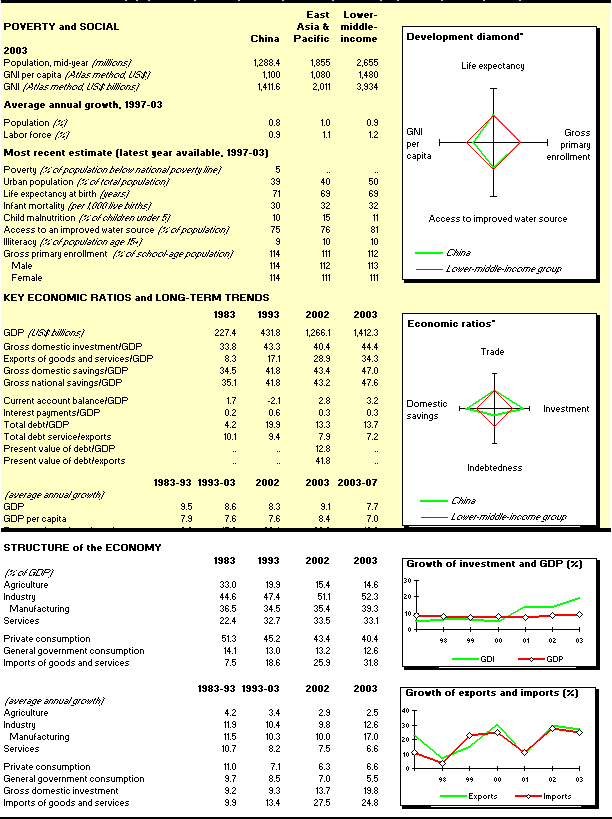
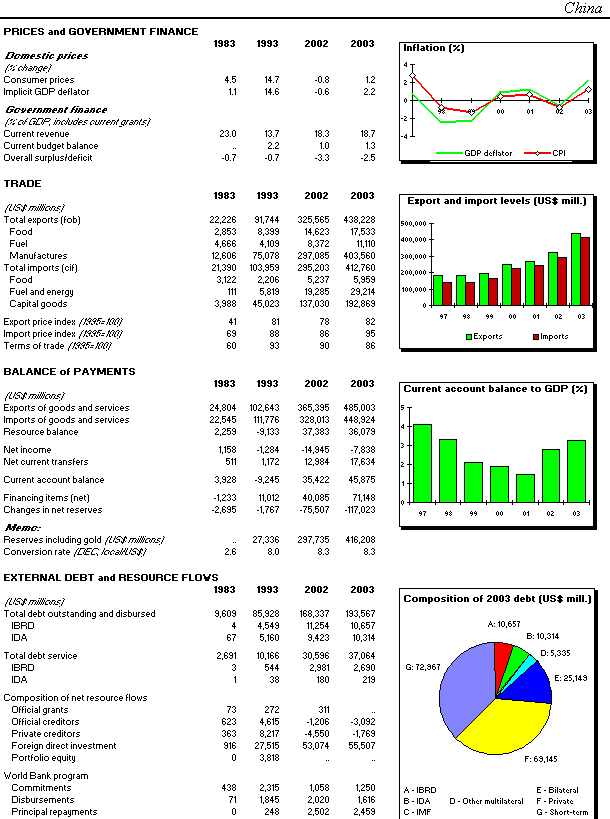
East Asia And Pacific
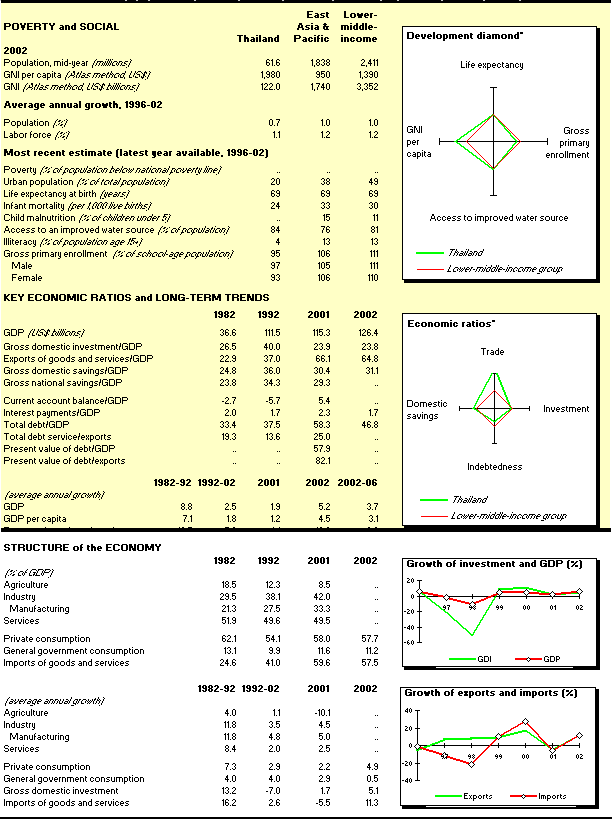
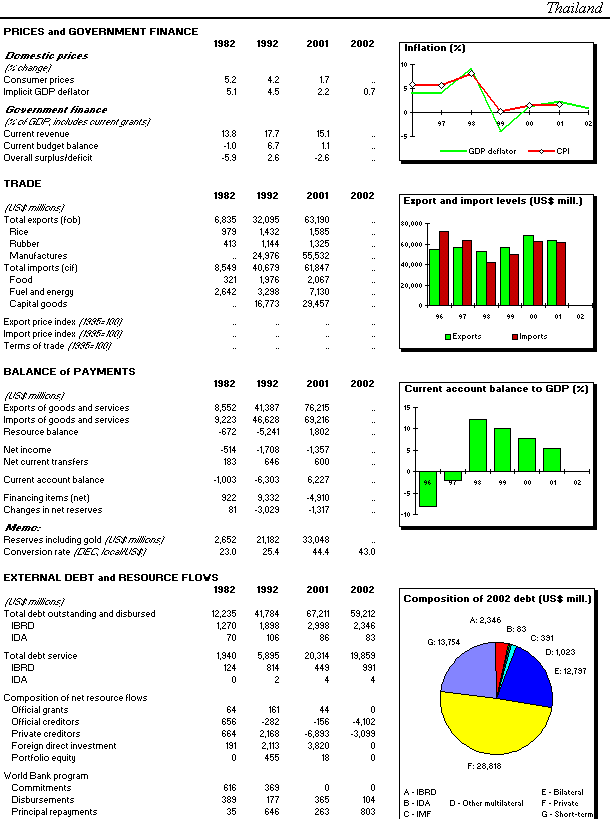
East Asia And Pacific
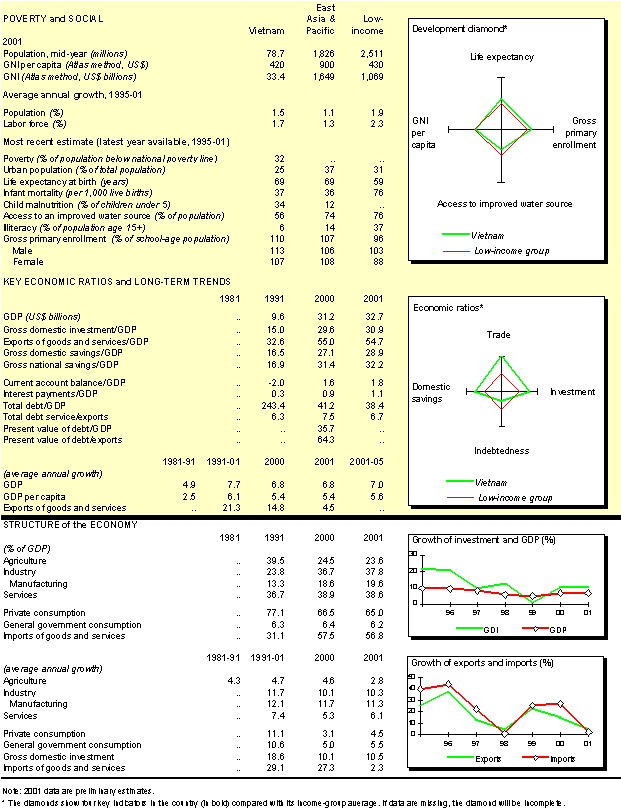
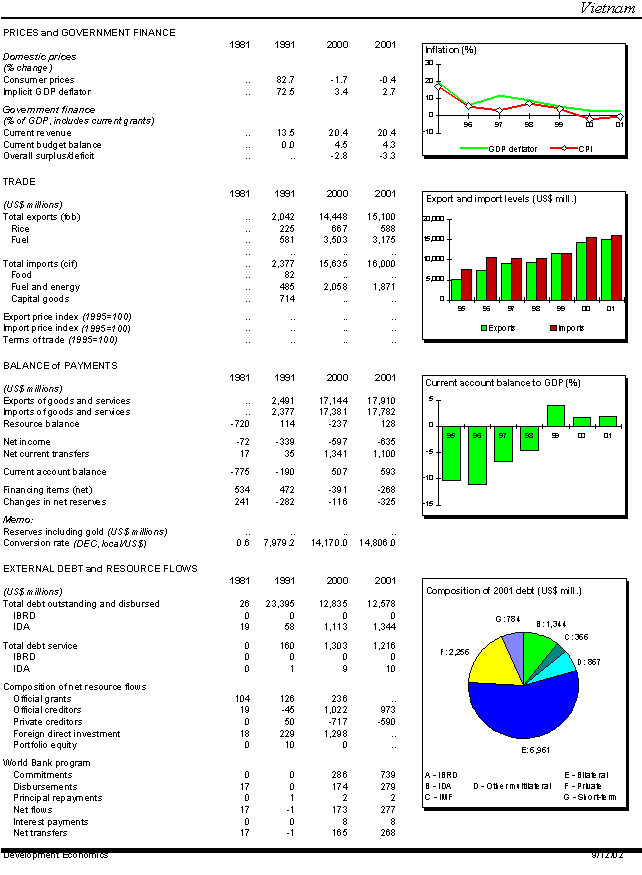
Annex 15: Incremental Cost Analysis
East Asia And Pacific:
Livestock Waste Management in East Asia Project
Broad
Development Goals and the Baseline
China (Guangdong Province), Thailand, and
Vietnam have recognized the negative environmental effects of
intensive livestock production and join in this Project to seek
solutions for protecting the environment from the impact of the
growing industrialization of livestock production. However, these
countries have only within the past five years begun to seriously
develop environmental legislation and policy that is directly related
to livestock waste management.
China. China
is in the process of developing and strengthening policy and
enforcement to reduce the negative environmental impact of intensive
livestock production and intends to use
a combination of regulations and economic instruments. In
1996, the Ministry of Agriculture (MOA) introduced a regulation
requiring all new large-scale livestock farms to establish manure
storage facilities. In 1998, the State Environmental Protection
Agency (SEPA) began to evaluate pollution from livestock production
and in 1999 a new division focusing on environmental pollution from
agriculture was established. In May 2001, the
Government established environmental management regulations affecting
the livestock industry, and in January 2002 it established pollutant
emission standards with regard to the breeding industry.
A new regulation by SEPA on "Pollution Material Emission
Standard for Animal and Poultry Industry" became effective on
January 1, 2003. Additionally,
a Government program on renewable energy promotes the formulation of
biogas from livestock waste. The MOA, based on its ten year plan,
will construct around 300 demonstration projects which will be based
on the local specific requirements on environment and other local
conditions.
Thailand. Thailand
has also established plans and regulations to reduce the negative
impact of livestock production on the environment. Five plans are
relevant to livestock waste management: (a) the National Economic and
Social Development Plans; (b) the Enhancement and Conservation of
National Environmental Quality Act; (c) the Policy and Plan for
National Environmental Quality Preservation and Promotion; (d) the
Environmental Quality Management Action Plan: and (e) the Energy
Conservation Promotion Act. The 9th
National Economic and Social Development Plan contained provisions
that require the use of zoning for animal production, the
registration of animal and other farms, and the education of farmers
on livestock waste management.
Based on high levels of pollution in the Tha Chin River, the
Pollution Control Department (PCD) listed pig farms in February 2001
as a pollution point source that needed to be regulated. The waste
water standards differ by farm size and a grace period of one year
was applied with standards to be enforced from February 2002
initially, only for large and medium scale pig farms. These
regulations are not yet enforced for small-scale farms, but the
standards are used as a guideline for promotional incentives. Aside
from PCD monitoring of wastewater from pig farms, the Department of
Livestock Development (DLD) has established standards for all
livestock farms. These farm standards were voluntary and hence
rarely observed by farm owners, except by poultry farmers because
their products were exported. They have so far had limited impact on
manure management practices for pig producers.
Vietnam. In
Vietnam animal waste problems have received serious attention
by policy makers. While few environmental policies at the national
level are specific to agriculture and regulations are largely based
on industrial pollutants, regulations pertaining to livestock
production are implemented at the provincial level. Long An province
has implemented regulations to relocate large-scale livestock farms
and slaughter houses out of urban areas. Dong Nai province has
developed regulations to protect the environment from livestock
production activities, which define the size of the livestock farms
and address treatment of dead animals, animal waste, and waste water.
Binh Duong province has developed a master plan that identifies
specialization areas for livestock production (Tan Uyen and Ben Cat
districts) and newly established large-scale livestock farm are
required to have an appropriate waste treatment system. The province
of Ho Chi Minh City has relocated some state-owned livestock farms.
The impact of regulations implemented at the provincial level has
been uneven and a clear national policy that can be implemented and
enforced more widely is needed.
Baseline
Scenario
The baseline response to these problems is inadequate both from a
local and global environment perspective. Without a new approach to
livestock waste management, countervailing tendencies to concentrated
livestock production will not be strong enough to overcome the
incentives driving it and thus the impact of livestock pollution on
the South China Sea will increase. Without the proposed project,
private sector investment in livestock waste management and the
development and implementation of policies and tools to address the
problem are likely to be delayed by many years. In the meantime, more
industrial livestock farms will be established around the major
cities of the sub-region; they will dump increasing quantities of
untreated livestock waste into surface waters and on peri-urban land,
worsening pollution loads in local streams and rivers flowing into
the South China Sea. This will accelerate the loss of biodiversity
and precious coral reefs and reduce the sustainable supply of marine
resources in the South China Sea, as well as increase human health
problems.
While steps are being taken to improve environmental protection, such
actions are still inadequate with ongoing growth of intensified
livestock production. The prevailing trend can be expected to
continue or worsen over the period to 2020, despite some
countervailing tendencies stemming from: (a) increasing environmental
awareness as information improves and incomes rise; (b) improvement
in transport and other infrastructure for livestock marketing; and
(c) increasing urban-rural cost differentials for land and labor
which should make peri-urban livestock production relatively less
attractive.
Under the baseline scenario, basic on-farm investments, some
strengthening of government regulatory activities and limited
government support for livestock waste management investments can be
expected. These activities would generally only respond to the
immediate impacts or symptoms of the problem as perceived at the
local level (e.g. odor, flies, and public health) and would not
seriously address the problem of nutrient balance. As a result, the
imbalance between the level of nutrient inputs and absorptive
capacity of the land would worsen. With industrial livestock
production systems growing rapidly and soils already largely
saturated, excess P and N from these industrial farms would leach
into waterways. The already high levels of nutrient loading (as much
as 2-4 tons P and 3-6 tons N per square kilometer) could easily
double over the next decade. These huge nutrient surpluses
ultimately would drain into the South China Sea, seriously affecting
unique mangrove, coral and sea grass resources,
as well as already-threatened shellfish species.
Most government expenditure for livestock waste management is for
programs supporting installation of on-farm biogas plants or other
basic technologies which help mitigate some of the most obvious
problems and contribute to energy conservation but do not
significantly remove excess nutrients. Spending for specific
programs has totaled US$1.64 million in Thailand since 1996, US$2.4
million in Vietnam since 2002 (US$0.8 million from the Netherlands
and US$1.6 million of farmer investment), and US$0.73 million in
Guangdong since 2002 (see Table 1). Based on discussions with
governments, national programs will continue in these areas but
without the Project and as in the past, will focus on on-farm
investments to meet the domestic objectives. The livestock waste
management investments identified by governments did not include past
or future investment in policy development or monitoring, thus it
will be assumed that any direct investment in policy development and
monitoring (Components 2 and 3) under the baseline scenario would be
insignificant, or zero. Since regional coordination is a new concept
directly related to the project, the baseline under Component 4 is
also assumed to be zero.
Table 1. Previous and Current Government Programs for Livestock Waste
Management
|
Agency
|
Program/Note
|
Number
Farms
|
Average
SPP
|
SPP
'000
|
Year
|
Total
Expenditure
|
|
Thailand:
|
|
|
|
|
|
BAHT
million
|
US$
million
|
|
DAE
|
LWM
Technology Development
|
1,763
|
350
|
617
|
1996-2004
|
69.00
|
0.22
|
|
DLD
|
Pond
System Development
|
719
|
974
|
700
|
2001-2003
|
54.10
|
0.45
|
|
PCD
|
Proposed
Nakhon Pathom scheme
|
|
|
30
|
2005-2006
|
140.00
|
1.75
|
|
Local University
|
Ponding
Development
|
36
|
500
|
18
|
2004
|
9.06
|
0.23
|
|
Local University
|
Biogas
Research
|
|
|
235
|
2000-2004
|
150.00
|
0.75
|
|
Total
|
|
|
|
1,600
|
|
422.16
|
3.39
|
|
Current Total
|
Excludes
proposed NP scheme
|
|
|
|
|
|
1.64
|
|
Vietnam:
|
|
|
|
|
|
VND
billion
|
US$
million
|
|
MARD/DOA
|
Biogas
Project (Netherlands)
|
36,000
|
75
|
2,700
|
2002-2004
|
37.68
|
0.80
|
|
MARD/DOA
|
Counterpart
to Biogas Project
|
36,000
|
75
|
2,700
|
2002-2004
|
75.36
|
1.60
|
|
Total
|
|
|
|
|
|
113.04
|
2.40
|
|
Guangdong:
|
|
|
|
|
|
RMB
million
|
US$
million
|
|
DOA
|
Biogas
Project
|
|
|
|
2002-2004
|
9.00
|
0.37
|
|
MOA
|
Subsidy
for LWM facilities
|
|
|
|
2002-2004
|
8.75
|
0.36
|
|
Total
|
|
|
|
|
|
17.75
|
0.73
|
To obtain an estimate of the baseline under
Component 1 (demonstration of livestock waste management), on-farm
investments were considered. In order to raise the standards of
manure management on all intensive pig farms to a level acceptable by
current domestic standards, it is estimated that livestock waste
management investments of the order of US$3–5 per head of the
standing pig population (SPP) are needed. Such standards would aim
to prevent regular discharge of fresh manure and untreated wastewater
into waterways and the creation of environmental nuisance such as
excessive flies and odor. This level of investment, and the
environmental standards it aims to achieve, is referred to as “Level
1”.
The level of increased investment for the
baseline on-farm investment were made as follows: First, the pig
stock was estimated at Project onset (2005), end (2010) and five
years after the Project end (2015),
on the basis of current stocks, and estimating that future growth
will continue at the same pace of average yearly growth rates over
the period 1990 to 2000 (see Table 2). Second, the pig stock
inventory in industrial systems was estimated on the basis of its
current share, and on the conservative assumption that 80% of the
stock growth will occur in industrial/intensive systems (see Table
3). Third, incremental investment costs were estimated assuming
baseline adoption levels and cumulative adoption rates for 2010 and
2015 (see Table 4). Estimates of on-farm investment are assumed to
include government subsidies to adoption of livestock waste
management. The ‘Projected Additional Investment in 2010’
shows the on-farm investment that will be made from 2005 to 2010 in
the baseline scenario, thus baseline spending for Component 1 is
estimated to be US$14.8 million.
Table 2. Estimated pig stock to 2015 (million heads)
|
Country/Province
|
Average stock 2001
to 2003
|
Estimated annual
growth 2002 – 2005 (%)
|
Estimated stock
2005
|
Projected stock
2010
|
Projected stock
2015
|
|
Thailand
|
6.9
|
1.5
|
7.2
|
7.7
|
8.2
|
|
Vietnam
|
23.3
|
1.0
|
24.0
|
24.2
|
24.3
|
|
China - mainland
|
455.7
|
0.5
|
462.6
|
462.7
|
462.8
|
|
Guangdong
|
20.3
|
|
20.8
|
20.8
|
20.8
|
Table 3. Projected share of pig stock raised in commercial systems to
2015
|
Country/Province
|
Projected share of stock in commercial production
2005
|
Projected share of stock in commercial production
2010
|
Projected share of stock in commercial production
2015
|
Projected stock
in commercial production 2005
|
Projected stock
in commercial production 2010
|
Projected stock
in commercial production 2015
|
|
(%)
|
(%)
|
(%)
|
(million
heads)
|
(million
heads)
|
(million
heads)
|
|
Thailand
|
70
|
75
|
80
|
5.05
|
5.78
|
6.56
|
|
Vietnam
|
50
|
60
|
70
|
12.00
|
14.49
|
17.01
|
|
Guangdong
|
40
|
60
|
70
|
8.33
|
12.49
|
14.58
|
Table 4. Baseline On-farm Investment
|
Country/Province
|
Level 1 estimated
investment to meet domestic standard
|
Projected
adoption rate in 2005
|
Projected
adoption rate in 2010
|
Projected
adoption rate in 2015
|
Projected
investment before 2005
|
Projected
additional investment 2010
|
Projected additional investment 2015
|
|
(US$/SPP)
|
(%)
|
(%)
|
(%)
|
(US$
million)
|
(US$
million)
|
(US$
million)
|
|
Thailand
|
5.00
|
25.00
|
35.00
|
45.00
|
6.31
|
3.80
|
4.64
|
|
Vietnam
|
3.00
|
35.00
|
40.00
|
50.00
|
12.60
|
4.79
|
8.12
|
|
Guangdong
|
3.00
|
35.00
|
40.00
|
50.00
|
8.74
|
6.25
|
6.88
|
|
Total
|
|
|
|
|
27.66
|
14.84
|
19.64
|
Global
Environmental Objective
The regional GEF/UNDP/IMO Partnerships for the Environmental
Protection and Management of the East Asian Seas Project has
identified agriculture, and particularly livestock production, as a
major source of land-based pollution of its target ecosystems. China,
Thailand and Vietnam alone accounted for over 50 percent share of
global pig production and almost one-third of poultry. Population
growth, urbanization and income growth are fuelling rapid growth in
demand for livestock products. Intensive forms of livestock
production are appearing rapidly and in the future most livestock
products that reach the market will come from large-scale intensive
production units. From 1990 large-scale, industrial production
comprises 80 percent of the growth in livestock production in Asia.
These structural changes in the industry are causing the
environmental problems to be addressed by this Project.
The majority of intensive production units are
located around major urban centers in or close to the coastal regions
of the South China Sea. It is advantageous for enterprises to
be close to the consumer and feed and input markets, especially given
that infrastructure is still not very well developed including roads,
cold chains, marketing and handling facilities. Most
feed inputs are purchased concentrates and 70 percent of the
nutrients contained in animal feed are not retained in the animal’s
body but excreted. Thus there is an excessive concentration of
nitrogen (N) and phosphorus (P) compounds in the periphery of these
urban areas, which results in significant water, land, and air
pollution.
The Global Environmental Objective of the
Project is to reduce livestock induced, land-based pollution
and environmental degradation of the South China Sea and Gulf of
Thailand. The Project will also have global
benefits by providing a model for an integrated and regional approach
to livestock waste management that can be replicated in other East
and Southeast Asian countries as well as in other regions of the
world.
The
GEF Alternative
The GEF Alternative scenario would finance the incremental costs of
moving from the business-as-usual approach of ineffectively
addressing local, visible environmental problems created by intensive
livestock production to a strategic framework for livestock
production development which is environmentally more sustainable.
The scenario would comprise (i) on-farm demonstration and replication
of innovative technologies for livestock waste management; (ii)
adoption of regulations for livestock waste management; (iii) the
introduction of improved spatial distribution planning of intensive
livestock production to improve nutrient balances; (iv) relevant
training, extension and awareness-raising in the countries concerned;
(v) monitoring and evaluation of project impacts, and (vi) regional
coordination for improved livestock waste management.
The GEF Alternative would involve a substantial volume of additional
public and private sector investment by the three countries in
implementing waste management strategies, to reduce excess nutrients
entering domestic waterways and the South China Sea. The GEF
Alternative under Component 1 will involve additional on-farm
investment as part of the project, as well as leveraged on-farm
investment that will occur as a result of the project without being a
part of project activities. US$4.8 million would be invested in
policy development activities through the proposed project, including
strengthening regulations, policy testing, capacity building, and
awareness raising. US$4.1 million would be invested in project
management, monitoring and evaluation. US$1.5 million would be
invested in regional support services activities which would involve
support and coordination of national efforts, including provision of
tools for policy-making, support for capacity building, and regional
knowledge sharing.
To predict on-farm investment in the GEF
Alternative, the previous baseline estimates of stock numbers (Tables
1 and 2) were applied to conservative estimates of increased adoption
as a result of the Project. The GEF Alternative also takes into
account higher levels of investment at the farm level. Level 1
standards (as discussed in Section 2) of manure management, although
attainable in principle by all specialized pig farmers, would not be
sufficient to achieve the global environmental objective of the
Project, to prevent excess nutrients (essentially N and P) and other
polluting compounds from livestock waste reaching the South China
Sea. To achieve the global environmental objective a significantly
higher standard of livestock waste management is required, that
effectively prevents discharge of any untreated livestock waste into
the waterways that has not been treated to a satisfactory standard.
Achieving this higher standard (“Level 2”) is considered
feasible using combinations of waste treatment technologies,
recycling methods and measures to minimize human health risks. These
measures would focus on minimizing potential transmission of
pathogens, antibiotics and their resistance strains from livestock to
human being.
On average, the investment needed to attain a Level 2 standard is
estimated in the order of US$8–12 per SPP, implying an average
incremental investment of US$6 per SPP. At the same time there would
be additional benefits to the domestic environment, beyond those
currently targeted, in terms of reduced water pollution and public
health risk. Higher adoption rates were estimated in specific areas
where the Project will focus its policy, demonstration and training
activities. The project will monitor adoption rates of both Level 1
and Level 2 standards in project areas.
It is estimated that during the period
2005-2015, about US$48.4 million (excluding Project costs for
‘Technology Demonstration’ under Component 1) of
additional (leveraged) investment in on-farm livestock waste
management would be made as a consequence of the Project (see Tables
5 and 6 below). The GEF Alternative of US$34.4 million under
Component 1, comprising on-farm investment in livestock waste
management technologies and related training, includes baseline
investment (US$14.8 million), Project investment (US$13.6 million)
and estimated leveraged on-farm investment (US$6.0 million) during
the Project period (see Table 6).
Table 5. GEF Alternative On-Farm Investment Costs
|
Category
|
Projected
level of investment
|
Share of
national/provincial pig population
|
Projected
adoption rate in 2005
|
Projected
adoption rate in 2010
|
Projected
adoption rate in 2015
|
Projected
investment 2005
|
Projected additional
investment 2010
|
Projected additional
investment 2015
|
|
(US$/SPP)
|
(%)
|
(%)
|
(%)
|
(%)
|
(US$ million)
|
(US$ million)
|
(US$ million)
|
|
Within
Project areas
|
|
|
|
|
|
|
|
|
|
Farms
with Level 2 investment to meet global standard
|
|
|
|
|
|
|
|
|
|
Thailand
|
12.0
|
15.0
|
0
|
30
|
40
|
0.0
|
3.1
|
1.6
|
|
Vietnam
|
8.0
|
5.0
|
0
|
20
|
30
|
0.0
|
1.2
|
0.9
|
|
Guangdong
|
10.0
|
5.0
|
0
|
20
|
30
|
0.0
|
1.2
|
0.9
|
|
Total
|
|
|
|
|
|
0.0
|
5.5
|
3.4
|
|
Farms
with Level 1 investment to meet domestic standard
|
|
|
|
|
|
|
|
|
|
Thailand
|
5.0
|
15.0
|
25
|
30
|
40
|
0.9
|
0.4
|
0.7
|
|
Vietnam
|
3.0
|
5.0
|
35
|
40
|
50
|
0.6
|
0.2
|
0.4
|
|
Guangdong
|
3.0
|
5.0
|
35
|
40
|
50
|
0.4
|
0.3
|
0.3
|
|
Total
|
|
|
|
|
|
2.0
|
0.9
|
1.4
|
|
Total
on-farm investment
|
|
|
|
|
|
2.0
|
6.4
|
4.8
|
|
Outside
project areas
|
|
|
|
|
|
|
|
|
|
Farms
with Level 2 investment to meet global standard
|
|
|
|
|
|
|
|
|
|
Thailand
|
12.0
|
85.0
|
0
|
5
|
20
|
0.0
|
2.9
|
10.4
|
|
Vietnam
|
8.0
|
95.0
|
0
|
5
|
15
|
0.0
|
5.5
|
13.9
|
|
Guangdong
|
10.0
|
95.0
|
0
|
5
|
15
|
0.0
|
5.9
|
14.8
|
|
Total
|
|
|
|
|
|
0.0
|
14.4
|
39.2
|
|
Farms
with Level 1 investment to meet domestic standard
|
|
|
|
|
|
|
|
|
|
Thailand
|
5.0
|
85.0
|
25
|
30
|
40
|
5.4
|
2.0
|
3.8
|
|
Vietnam
|
3.0
|
95.0
|
35
|
40
|
50
|
12.0
|
4.5
|
7.7
|
|
Guangdong
|
3.0
|
95.0
|
35
|
40
|
50
|
8.3
|
5.9
|
6.5
|
|
Total
|
|
|
|
|
|
25.6
|
12.5
|
18.0
|
|
Total
on-farm investment
|
|
|
|
|
|
25.6
|
26.9
|
57.2
|
Table 6 Summary On-Farm Investment Incremental Costs
|
Investment
|
Project duration
2005 to 2010
(US$ million)
|
Five years
following project 2010 to 2015
(US$ million)
|
|
Estimated on-farm investment
under baseline
|
14.8
|
19.6
|
|
Estimated on-farm investment
under project scenario
|
33.3
|
62.0
|
|
On-farm
investment project scenario - project areas
|
6.4
|
4.8
|
|
On-farm
investment project scenario - out of project areas
|
26.9
|
57.2
|
|
Total on-farm incremental
investment
|
18.5
|
42.4
|
|
Total
to be financed by Project*
|
12.5
|
0.0
|
|
Leveraged Investment
|
6.0
|
42.4
|
|
Total Leverage Investment to
2015
|
|
48.4
|
*Indicating the
cost under subcomponent Technology Demonstration of Component 1 which
finances on-farm investments in improved and innovative technologies
and is included in on-farm investment estimates.
The Project’s impact on pollution of the
international waters of the South China Sea would be substantial.
Current levels of pollution would first be reduced within the Project
areas and then more widely through replication of technologies
demonstrated under Component 1 and promoted under the Project’s
policy and capacity building activities. Equally important would be
the Project’s preventive impact, by assisting the countries to
shift their focus from a ‘cure of symptoms’ approach
towards planning and directing future development of livestock
production with environmental considerations.
Scope
of the Analysis
The analysis estimates baseline and GEF Alternative costs of
investment in prevention or mitigation of nutrient fluxes from
livestock waste entering domestic waterways and the South China Sea
and current farm-level investment on livestock waste management with
and without the Project. These estimates are at the national level in
Thailand and Vietnam and at the provincial level (Guangdong) in
China.
To reach the level of investment necessary to
meet the global environmental objective, significant additional
domestic benefits would be created. These additional domestic
benefits comprise of cleaner water in rivers and streams, reduced
eutrophication of inland water bodies and reduced nitrate content in
ground water. These benefits are
not currently targeted in domestic or national programs. Thus they
are not national priorities and fall into the category of ‘concurrent
domestic benefits’.
Incremental
Costs
The analysis takes into account private and public investment in
improved livestock waste management practices as well as direct
investment related to policy, training, capacity building, and
enforcement involved in moving from the baseline scenario to the GEF
Alternative. The total baseline investment of US$14.8 million is
determined by baseline spending on farm-level livestock waste
management systems and is assumed to include government subsidies to
on-farm investment. The baseline scenario will not involve
significant direct investments in policy development, monitoring and
evaluation, or regional coordination and thus baseline costs under
Components 2, 3, and 4 are considered to be zero. The GEF
Alternative, totaling US$44.8 million, shows costs of moving from the
current approach to an integrated approach that will allow livestock
waste management practices to be improved to a higher level to meet
the global environmental objective. Table 7 shows the incremental
cost by Project component. The incremental cost of moving from the
baseline scenario to the GEF Alternative was estimated at US$30.0
million. Of which, US$24 million would be financed by the Project by
the GEF and cost-sharing arrangements between national governments,
the private sector, and FAO. The remaining US$6.0 million are
expected to be investment in improved livestock waste management by
farmers not involved in the Project.
Table 7. Incremental Cost Matrix (US$ million)
|
Component
|
Category
|
Cost
|
Local
Benefits
|
Global
Benefits
|
|
1. LWM
Technology Demonstration
|
Baseline
|
14.8
|
Improved sustainability of
intensive pig production through adoption of proven manure
storage, treatment and recycling technologies. Reduction in local
environmental hazards and nuisance factors.
|
N/A
|
|
GEF Alternative
|
34.4
|
Increased on-farm investment
in livestock waste management, leading to improved nutrient
balances and quality of domestic waterways, as well as public
health benefits. Increased availability and knowledge of
innovative technologies for mitigating environmental impact of
intensive livestock waste and private and public capacity to
implement such technologies.
|
|
|
Increment
|
19.6
|
|
|
|
2.
Policy and Regulatory Development
|
Baseline
|
0.0
|
|
N/A
|
|
GEF Alternative
|
4.8
|
Development
and adoption of integrated policies and standards for improving
the management of livestock waste and its discharge into the
environment; increased public and producer awareness; improved
capacity for training and enforcing policies
|
Wider
replication of improved LWM practices throughout the project area,
leading to enhanced long-term sustainability of pig production
surrounding the South China Sea
|
|
Increment
|
4.8
|
|
|
|
3.
Project Management and Monitoring
|
Baseline
|
0.0
|
N/A
|
N/A
|
|
GEF Alternative
|
4.1
|
Better
information on the impact of livestock waste management through
regularized monitoring. Improved institutional capabilities for
supporting livestock waste management.
|
|
|
Increment
|
4.1
|
|
|
|
4.
Regional Support Services
|
Baseline
|
0.0
|
|
N/A
|
|
GEF Alternative
|
1.5
|
|
|
|
Increment
|
1.5
|
|
|
|
Total
|
Baseline
|
14.8
|
|
|
|
GEF Alternative
|
44.8
|
|
|
|
Increment
|
30.0
|
|
|
Annex 16: STAP Roster Review
East Asia And Pacific:
Livestock Waste Management in East Asia Project
By Dr. J. Mark Powell, GEF STAP Reviewer
2023 Jefferson Street
Madison Wisconsin, 53711 USA
Overview
The Livestock Waste Management in East Asia Project aims to
demonstrate improved livestock waste management practices in China,
Thailand and Vietnam and thereby reduce the negative environmental
impact of rapidly increasing livestock production in the areas of
these countries bordering the South China Sea through policy
development, implementation and adherence at regional, national, and
local levels, and through cost sharing of technologies that enhance
the capture, processing and recycling of manure nutrients on
livestock farms. The document established compelling reasons to
target initial regional efforts in China, Thailand and Vietnam so it
can demonstrate that politically, socially, and economically workable
solutions can be attained to protect the environment under
tremendously different situations. Success of this multi-national
effort should provide a model for testing extension in other
countries in the region. This appears to be a sound project that will
result in measurable positive impacts on the environment, and on the
health, social and economic well being of residents of this region.
The aim of this review is to provide constructive feedback that may
be used to enhance Project success.
1. Scientific
and Technical Soundness of the Project
1.1 Sufficient
information and knowledge to carry out the Project
The project is based on factual information that highlights current
and potentially worsening impact of livestock waste on water quality.
The project background covers the most pertinent issues at regional,
national and local levels. Extensive quantitative and qualitative
data is used to describe current and expected expanded livestock
numbers, their urban, peri-urban and local distributions and
management practices. Annexes are exceptionally well researched and
written. They not only provide pertinent information for this
document, but the information will be useful also for successful
Project implementation, and monitoring and evaluating Project
impacts.
1.2 Appropriateness
of approaches to collect and integrate relevant information on
sections of society and economy, and on the different aspects of the
environment and ecosystem
A thorough analysis of Social Safeguard Policy Issues is given in the
document. The Project’s monitoring and evaluation component
offers strategies to collect and integrate relevant information on
key societal and economic impacts, and the appropriateness of
implementation processes. The project will also collect information
on the formulation and implementation of environmental policy;
adherence to policy; and measure project impacts on animal and human
health and on environmental change in demonstration areas. However,
the project should be very careful in promising that collected water
quality data will provide definitive indicators of Project impact.
Initial measurements will establish a well-needed base line.
Attributing environmental outcomes, such as water quality
improvement, to Project activities will be very difficult within the
5-year period of this project. Environmental impacts require
frequent, targeted measurements over the long-term. Cause-effect
relationships in water quality improvement may not be as
straightforward as the Project anticipates.
1.3 The
issue of inter-comparability of data
The monitoring and evaluation component of the Project will collect
information on the rate of policy development and implementation,
levels of adherence to policy, and policy impacts including changes
in manure management behavior and the environment. Baseline
measurements will allow the Project to track impacts. The planned use
of common indicators across sites, as depicted in the table
“Arrangements for results monitoring” (p 38-39) and list
of “common activities” (p 48-49) should allow the Project
to compare progress and impacts across sites. Large baseline
differences and site differences in capacity for change will likely
result in very different degrees of change associated with project
activities.
1.4 The
inter-linkages between water-related environmental issues and root
causes behind different environmental problems
There is no doubt that manure mismanagement can impair water quality.
However, the root causes of manure mismanagement, such as lack of
labor, land areas for manure spreading, and availability of
preventative technologies that impact farmer behavior are less well
understood. These factors are not very well explored in the document.
Also, whereas general relationships between runoff and surface water
pollution are well understood, less is known about the relative
contributions of industrial point, and agricultural and
non-agricultural non-point pollution sources to water quality
impairment. The complicated and long-term measurement requirements
to ascertain cause-effect relationships between practices and water
quality improvement may not be attainable during the relative
short-term (5 yrs) of this project. The proposed water quality
measurements are needed as baseline to assess long-term impacts.
Environmental sampling needs to be better thought out in terms of
what to measure where, when, and how often to have the highest
probability of associating measured water quality improvement to
changes in farmer behavior (simple modifications of current
practices, such as feed, manure handling, storage, land application,
marketing strategies).
1.5 Tools and methodologies for TDA
and SAP
The Trans-boundary Diagnostics Analysis (TDA) and Strategic Action
Plans (SAP) were not found in the document.
1.6 Technologies
adequate and adapted to the regional socio-economic profile
The document provides useful information on the diversity of the
production systems across the Project’s target region. This
information could have been used more fully to select sites for the
initial demonstration farms. While initially targeted production
systems (Table 2, Annex 9) encompass a diverse distribution of
production systems based on farm size and farm abilities to recycle
manure nutrients (through crops, fish), little information is
provided on the prevalence of each system type (e.g. relative farm
numbers in a country/region, animals that are raised in each farm
type in a country/region) as the basis for rationalizing technology
requirements, and distribution of cost sharing monies to prominent,
problematic systems to maximize impact.
Current trends point towards a concentration of livestock, apparently
with a pretty grim outlook for the poor. There needs to be a more
clear rationale for selection of production systems and their impact
on the poor, who likely require very different waste management
approaches, than the lagoons, pipes, digesters promoted for small and
medium size operations. The project may wish to consider total
funding the remedial and or preventative measures needed for farms of
the poor within critical pollution source areas.
1.7 Do
the proposed technologies pose environmental threats?
The Potential Environmental Impacts and Mitigation Measures mentions
briefly the risk/hazards of improper construction of manure storage.
However, particular attention may be needed in monitoring the design,
construction, and perhaps most importantly, the maintenance of manure
storage structures. This is perhaps very important in the tropical
monsoon conditions of the Project farms. Ill-designed storage,
neglected upkeep, and storage not emptied on schedule have created
environmental catastrophes in temperate locations where sophisticated
management is suppose to be in place. Given the Project’s high
reliance on technologies that include manure storage, perhaps
potential contingencies should be drawn up that have strict
guidelines that assure contractor adherence to construction
specifications, contingency plans for storage overflows, breaches,
etc.
1.8 Technological
innovations applied to support the Project
The Project’s waste management technologies have been tested
and proven effective in improving environmental outcomes in many
temperate and tropical regions of the world. Methods to collect and
analyze soil and water samples are appropriate. The project will use
GIS and other computer-based tools to monitor changes in spatial
distribution of livestock and waste, nutrient budgets and water
quality.
1.9 Institutional
arrangements including their scientific capacity
Individual responsibilities and connections between the Regional
Coordination Group, National Steering Committees and National Project
Management Offices are well described. The Project relies heavily on
FAO/LEAD for implementation arrangements and for technical and
scientific support. FAO/LEAD has excellent credentials and a long
history in effectively providing science-based technologies, training
modules and support for projects related to animal waste management
in (sub)tropical conditions. The role of research (e.g. Universities,
National Research Institutes) and local (farmer) institutions has not
been articulated in the Project Appraisal Document.
1.10 How
representative and appropriate are demonstration sites?
Initial demonstration sites will be located in areas of each country
where farmers and their communities have identified water quality
problems associated with animal agriculture. The
cross-representatives of these sites in terms of weather, soils,
runoff potential conditions were not clearly stated.
The Project Plan provides very clear justifications for project
activities and linkages between activities, improved manure
management and environmental outcomes. The Project approach uses farm
size for the initial selection of production systems and associated
technologies. However, farm size may/or may not correspond to
production systems and/or points of high runoff. The Project calls
for the use of GIS, but mostly as a monitoring tool. GIS could also
be use to identify points on the landscape that require particular
attention. To have the desired outcomes, the Project’s
monitoring and evaluation efforts should continue to ascertain the
representativeness of selected geographic areas and types of
production systems.
1.11 Problems
overlooked
Two technologies proven to be profitable and to reduce the negative
environmental impacts of manure have been overlooked by the Project:
(1) manipulation of diet to reduce manure nutrient load, and (2)
water conservation strategies to reduce manure bulk making manure
more transportable. In other environments, pig diet modifications,
including use of low-phytate corn; adjustments in protein type and
level, including use of low-stachyose soy; the use of enzymes;
modification of feed particle size, etc. have been shown to
significantly reduce nutrient loads in manure, land requirements to
recycle manure nutrients, nutrient buildup in soils and decrease
nutrient loads in runoff. The project may wish to form strong
collaboration with animal nutritionists, and perhaps most
importantly, the feed industries, or those who formulate, produce and
supply pig rations to farmers. In Thailand small farms are
increasingly contracted by feed companies to grow pigs. Project
association with the feed industry may be critical to maximize feed
use efficiencies and reduce manure nutrient loads. As with feed, the
judicious use of water in barn cleaning, and managing the amount of
water entering manure storage reduced manure loads and decrease the
risk of overflows.
The projected increase in industrial animal production will lead to
concentrations of manure and dead animals. Dealing with the latter
needs to be considered. Also, the project may wish to consider action
plans for emergencies associated with Project-funded technologies,
such as leaks in manure storage structures, structure breaches, and
manure spills.
Additional technical aspects related to manure storage design and use
that were not explicitly addressed in the document are: (1) roofing
over manure storages (2) storage capacity, or how many days storage
is required; (3) are storage structures suppose to be emptied
monthly, quarterly, annually; (4) will the required periodic, timely
emptying of storage cause labor problems?
1.12. Issues
of conflict?
There are no significant issues of conflict that need to be
addressed. Proposed technologies may resolve some of the current
community conflicts surrounding animal agriculture, such as odors and
surface water pollution.
2. The
global environmental benefits of the project and its contribution to
focal area goals of GEF
2.1 Does
the Project address issues that will result in global environmental
benefits?
Abating animal waste emissions should certainly result in significant
improvements in water quality at local and regional levels. The
Project’s strategy to attain initial success in China, Thailand
and Vietnam before expanding to other countries is well founded. The
eventual extension of project successes could broaden environmental
impacts globally.
2.2 Should
any negative environmental effects be anticipated?
Poor design, construction, and perhaps most importantly, poor
maintenance of manure storage structures can exacerbate environmental
problems. Also emissions of ammonia, the greenhouse gasses methane
and CO2 from manure storage, and CO2 emissions
from compost are other potential negative environmental outcomes of
the project. However, projected increases in capturing and recycling
other manure nutrients should outweigh these concerns.
2.3 Does
the Project fit within the overall strategic thrust of the GEF-
funded International Waterway (IW) activities to meet the incremental
costs of:
a) Assisting groups of countries to better understand the
environmental concerns of their IWs and work collaboratively to
address them
Assisting China, Thailand and Vietnam to better understand their
collective role in the pollution of the South China Sea and to work
collaboratively in improving animal waste management and water
quality at local, national and regional levels is the essence of this
Project. The Project Appraisal Document has clearly described
appropriate strategies to involve the necessary stakeholders in
policy development and testing, in raising awareness of environmental
concerns associated with current animal agricultural practices, and
testing technologies that prevent pollution from animal waste.
b) Building the capacity of existing institutions
The Project gives priority to building the capacities of existing
institutions at regional, national and local levels. Regional Support
Services Component of the project has capacity building components
including the creation of the Regional Coordination and Facilitation
Support Office comprised of representatives from each country. This
office will support decision tool development, evaluation of Project
activities and outcomes, and development of training modules and
packages. The technology demonstration, training and extension
components of the Projects should build necessary local-level
capacity.
c) Implement measures that address the priority trans-boundary
environmental concerns
The Project clearly realizes that abating entry of animal waste
pollutants into the South China Sea requires coordinated,
trans-boundary approaches. The Project calls for initial
collaboration between China, Thailand and Vietnam to build success
and later expand to include other countries that discharge into the
Sea. The Project has well-defined strategies that include
trans-boundary coordination at regional levels that consider specific
country conditions, and promote development of close cross-sector
cooperation at all levels within each country.
3. The
project’s replicability and regional context
3.1 The
scope for replication of some of the approaches in other
international water bodies.
Achievement of the proposed international collaboration, project
coordination at national, sub-regional and local level to improve
water quality would certainly provide an excellent model that could
be expanded to include other countries. Initial successes will be
critical, and great efforts will be needed to monitor and evaluate
progress towards relatively short-term outcomes, one of which should
be establishing effective partnerships. Initial successes of the
proposed cost-shares to improve manure handling and storage could
have additive effects. Success can only be achieved through very
careful implementation and persistent follow-up, and the ongoing
management counseling often required during the adoption period.
The project will need to focus on realistic, shorter-term outcomes
that can be measured within the 5-year period and link these to
longer-term environmental impact. These may include changes in animal
densities, more precise feeding and reduced manure nutrient loads,
numbers of farmers that have devised and follow whole-farm nutrient
management plans, etc. These should provide a compelling story and
justification for geographic expansion of project approaches.
3.2 The
regional scope of the Project
The Project includes a very compelling rational for focus on the
South China Sea, on China, Thailand and Vietnam as countries for
initial regional focus, and selection of demonstration sites within
each country.
3.3 The
innovativeness of the project, especially if it takes into account
culture and deeply embedded habits that have given rise to the
current environmental problems.
The Project will rely principally on nine “technology
packages”, seven which relate to systems that combine treatment
with recycling and two which rely exclusively on manure treatment.
Thorough economic and financial analyses of these systems appear in
Annex 9. A number of aspects related to targeted production systems
and technologies (Annex 9, Table 2) remain unclear, such as how
prominent are the described systems (in terms of relative farm and
animal numbers; and have these technologies been tested and proven
successful under local conditions).
Annex 9 provides a synopsis of the cultural habits and
behavior that impact livestock production and manure management.
Alternative technology options will likely be needed for resource
poor livestock producers, especially given the Project’s
implicit goal of alleviating rural poverty. The project recognizes
that small farms because of narrow profit margins, are risk adverse
and much less able than larger farms to afford technologies that do
not improve profits as well as environmental performance. Indeed, the
conclusion of the technology economic analyses is that the proposed
nine technologies will be cost effective for medium and large-scale
modern pig farms. Small farms that have been identified as having
high pollution risks may require not only different technologies but
also additional subsidies, including total cost-share. This may be
particularly true in Vietnam where the analyses of Social Safeguard
Policy Issues (Annex 10) points to many viable household farms. In
the case of Thailand, many small farms have entered contractual
arrangements with large farms/feed companies and may not require the
same cost share as independent small farms.
4. Linkages
to other focal areas, programs, action plans, etc.
4.1 Linkages
to other GEF focal areas
Annex
2 provides a listing and synopsis of major related projects in the
South China Sea region. The Project appears to have incorporated the
experience and lessons learned from these projects. The Project’s
regional mandate and focus on animal agriculture compliments other
projects’ efforts to abate anthropogenic land-base pollution.
4.2 Relevant
conventions considered and taken into account
The Project is fully consistent with GEF International Waters Focal
Are of Strategic Priority; with OP10 Contaminant-based Operational
Program, GEF Focus Areas of Climatic Change, and contributes to the
Global Program of Action for the Protection of the Marine Environment
from Land-based Activities.
4.3 Consistency
of proposed activities with existing National Plans
Annex 6 provides a description of the Project’s implementation
plan and it harmonization at regional, national and local levels. The
diagrams of National implementation structures and description of
implementation plans were very helpful in understanding how the
Project will be integrated into existing administrative structures.
5. Degree of involvement of stakeholders in the project
5.1 Will
regional and national institutions be able to contribute to the
achievement of the project objective?
Annex 6 describes in detail the implementation arrangements at
regional, national and local levels. A Regional Coordination Group
will be established under the guidance of FAO/LEAD, which has an
excellent record in providing such services for animal waste
projects. The abilities of national institutions is less clear as
none appear to have distinct mandates for abating pollution from
animal wastes. There is no presentation or discussion related to
local institutions, such as farmer co-ops, and their possible roles
in attaining project objectives.
5.2 Capacity-building
The Project has a plan to build regional, national and local
capacities through funding consultant services, and an array of
training and extension activities. At region and national levels,
assistance will be provided in policy development, testing and in
raising awareness related to animal waste pollution. Most local
capacity building initiatives are geared toward providing the
necessary training and extension to support the demonstration farms.
Vietnam will rely initially on “contract service providers”
to deliver Technology Demonstration. More detailed descriptions of
how such contracts will be awarded, implemented and evaluated are
warranted.
6. Other
6.1 Consider
alternative terms for “waste”
The Project may wish to consider an alternative to “waste”
terminology, especially for those production systems where the aim is
to strengthen the message that manure is a valuable source of
fertilizer, feed, and energy. Experience from elsewhere shows that
part of manure mismanagement can be attribute to shifts in
educational messages. When “waste disposal” became an
engineering term associated with industrial livestock systems any
connotation of manure’s intrinsic value was lost. Terminology
will be important in developing educational materials aimed at
affecting farmer behavior.
6.2. Environmental
indicators
More modest and perhaps more measurable shorter-term “proxy”
indicators of environmental change should be considered. If the
project can show substantive gains in reducing manure nutrient loads
through diet manipulation; develop, test and evaluate uncomplicated
ways to track more equal distribution of livestock and manure
nutrients; and the impact of storage on manure management, then the
project will have much to say about adoption of management practices
that will yield water quality improvements over a longer-term.
6.3. Involve
feed and fertilizer industries
The project may wish to explore ways to bring input supply dealers,
such as representatives of the feed and fertilizer industries, into
policy development. Involving these nutrient supplies will be
critical in achieving desired project goal of improving regional and
whole-farm nutrient balances.
6.4 Marginal
value of manure nutrients
In Annex 9, it was not clear where the 65-95% of fresh pig manure
nutrients safely removed would go. If fertilizer savings, biogas,
inputs into fish production have not been included in the marginal
costs analyses (Table 4) then what is the basis for the differences
between the costs of removing, for example 1 ton of nitrogen with
(US$1,291) an without (US$2,564) recycling technologies?
6.5. Regional
pollution standards
The project may wish to urge the development of waste
management/emission standards that each of the three countries must
meet. Common targets may help forge international collaboration and
if success can be shown, provide a compelling reason for other
countries to join the effort, as envisioned.
Madison,
16 January 2005
J.
Mark Powell
Bank Task Team's Responses to STAP Reviewer Comments
Appropriateness of approaches to collect and integrate
relevant information. The reviewer believes that this
project appears to be a sound project and that a thorough analysis
of Social Safeguard Policy Issues is given in the document. However,
he comments that attributing environmental outcomes, such as water
quality improvement, to Project activities will be very difficult
within the 5-year period of this project and suggests that the
project should be very careful in promising that collected water
quality data will provide definitive indicators of Project impact.
Response: The Task Team agrees on the suggestion and will
revise the relevant attributes.
The inter-linkages between water-related environmental issues
and root causes. The review has no doubt that manure
mismanagement can impair water quality. However, he stressed that
the root causes of manure mismanagement, such as lack of labor, land
areas for manure spreading, and availability of preventative
technologies that impact farmer behavior are less well understood.
He points out that these factors are not very well explored in the
document.
Response: The Task Team agrees to further explore and fully
document these root causes in the project’s final
documentation.
Environmental sampling. The review mentions that
environmental sampling needs to be better thought out in terms of
what to measure where, when, and how often to have the highest
probability of associating measured water quality improvement to
changes in farmer behavior (simple modifications of current
practices, such as feed, manure handling, storage, land application,
marketing strategies).
Response: The Task Team agrees with the reviewer’s view.
The environmental sampling has been discussed with each country team
during the project preparation and the details will be included in
the M&E plan to be finalized by each participating country at
project appraisal.
Tools and methodologies for TDA
and SAP. The Trans-boundary Diagnostics Analysis
(TDA) and Strategic Action Plans (SAP) were not found in the
document.
Response: Both Trans-boundary Diagnostics Analysis and
Strategic Action Plans are being prepared by
the UNEP/GEF South China Sea and Gulf of Thailand Large Marine
Ecosystem Project. Its Pollution Reduction Committee was briefed on
and strongly supports this project.
Technologies adequate and adapted to the regional
socio-economic profile. The reviewer notes that the
document provides useful information on the diversity of the
production systems across the Project’s target region but
comments that this information could have been used more fully to
select sites for the initial demonstration farms.
Response: The Task Team appreciates the review’s comment
and agrees to use more explicitly the information specifically the
diversity of the production systems in selection of demonstration
farms during later years’ project implementation. The Task Team
would like also to explain that the initial demonstration farms are
selected based on a three-step selection criteria agreed with the
World Bank, which may be updated periodically during Project
implementation as needed and included in the Project Implementation
Plan of each participating country.
Impact on the poor. The reviewer points out that
current trends point towards a concentration of livestock,
apparently with a pretty grim outlook for the poor. There needs to
be a more clear rationale for selection of production systems and
their impact on the poor, who likely require very different waste
management approaches, than the lagoons, pipes, digesters promoted
for small and medium size operations. The project may wish to
consider total funding the remedial and or preventative measures
needed for farms of the poor within critical pollution source areas.
Response: Total funding by the project for poor farms within
critical pollution source areas has been discussed intensively during
project preparation and was rejected due to sustainability and
replicability concerns. Besides, internalizing the environmental
externalities would “level the playing field’ and boost
smallholder’s comparative advantages. The Task Team however
agrees to take a more pro-poor farm approach in selection of
demonstration farms for implementation in year 2 and beyond.
Do the proposed technologies pose environmental threats? The
reviewer urges the project to pay particular attention to monitoring
the design, construction, and perhaps most importantly, the
maintenance of manure storage structures and makes a specific
proposal to draw up strict guidelines for contractors to follow in
terms of construction specifications, contingency plans for storage
overflows, breaches, etc.
Response: The Task Team agrees with the reviewer’s
proposal to ensure that such guidelines are in place prior to actual
construction of any manure treatment facilities.
Role of research and local institutions. The
reviewer comments that the role of research (e.g. Universities,
National Research Institutes) and local (farmer) institutions has
not been articulated in the Project Appraisal Document.
Response: The national research and local institutions are
expected to play an important role in the project e.g. in the areas
of training and extension. The Task Team agrees to illustrate their
defined roles more explicitly in final project documents.
Cross-representatives of demonstration sites. While
noting that initial demonstration sites will be located in areas of
each country where farmers and their communities have identified
water quality problems associated with animal agriculture, the
reviewer comments that the cross-representatives of these sites in
terms of weather, soils, runoff potential conditions were not
clearly stated.
Response: The cross-representativeness of these selected
initial demonstration areas in terms of weather, soils, runoff
potential conditions and a full range of other data has been reviewed
and confirmed during farm selection process. The Task Team will
ensure that the requested site specific information and data will be
presented in a project implementation report required from each farm
and village. In addition, the demonstration areas to be selected at
Project Year 2 and beyond will complement the areas selected for
Project Year 1 to ensure the overall representativeness of the
demonstration areas.
M&E efforts to ascertain the representativeness. The
reviewer stresses that to have the desired outcomes, the Project’s
monitoring and evaluation efforts should continue to
ascertain the representativeness of selected geographic areas and
types of production systems.
Response: The Task Team agrees.
Collaboration. The reviewer suggests the project to
form strong collaboration with animal nutritionists, and perhaps
most importantly, the feed industries, or those who formulate,
produce and supply pig rations to farmers in order to significantly
reduce nutrient loads in manure, land requirements to recycle manure
nutrients, nutrient buildup in soils and decrease nutrient loads in
runoff.
Response: The Task Team agrees.
Livestock production issues. The reviewer believes
that the projected increase in industrial animal production will
lead to concentrations of manure and dead animals. He suggests that
dealing with the latter needs to be considered and also, the project
may wish to consider action plans for emergencies associated with
Project-funded technologies, such as leaks in manure storage
structures, structure breaches, and manure spills.
Response: These issues have been discussed during project
preparation and specific actions are under development which will be
included in Project Implementation Plans. The Task Team will ensure
that the major livestock production issues including those raised by
the reviewer will be dealt with appropriately.
Additional technical aspects. The reviewer lists
the following additional technical aspects related to manure storage
design and use that were not explicitly addressed in the document:
(1) roofing over manure storages (2) storage capacity, or how many
days storage is required; (3) are storage structures suppose to be
emptied monthly, quarterly, annually; (4) will the required
periodic, timely emptying of storage cause labor problems?
Response: The Task Team recognizes the importance of these
technical aspects for a successful design, construction and use of
manure storage and will ensure the inclusion of these technical
aspects.
Focus on measurable short-term indicators. The
reviewer emphasizes that the project will need to focus on
realistic, shorter-term outcomes that can be measured within the
5-year period and link these to longer-term environmental impact. He
lists specific changes for the project to consider. The reviewer
also stresses that more modest and perhaps more measurable
shorter-term “proxy” indicators of environmental change
should be considered.
Response: The Task Team agrees to the approach emphasized by
the reviewer to focus on measurable short-term indicators and will
make specific revisions in the project documents accordingly.
Targeted production systems and technologies. The
reviewer is unclear about a number of aspects related to targeted
production systems and technologies (Annex 9, Table 2) such as how
prominent are the described systems (in terms of relative farm and
animal numbers; and have these technologies been tested and proven
successful under local conditions).
Response: The Task Team agrees to clarify these aspects and
revise the project documents accordingly.
Involvement of stakeholders in the project. The
reviewer is less clear about the abilities of national institutions
as none appear to have distinct mandates for abating pollution from
animal wastes. There is no presentation or discussion related to
local institutions, such as farmer co-ops, and their possible roles
in attaining project objectives.
Response: In each participating country, ministries with
mandates for environmental protection and livestock production at the
national level and their extensions at local levels are the key
institutions responsible for project preparation and implementation.
A variety of stakeholders including farmer groups is expected to be
involved in Project. The Project would establish stakeholder
participation and consultation mechanisms tailored to facilitate the
stakeholder involvement especially those disadvantaged segments on an
equitable basis in decision-making and dialogue with the Project and
local authorities. The Task Team agrees to ensure that these will be
adequately presented in final project documents.
Terminology for “waste”. The reviewer
hopes that the Project may wish to consider an alternative to
“waste” terminology to reflect the manure as a valuable
source of fertilizer, feed, and energy.
Response: The Task Team realizes the limit of livestock
“waste” terminology and agrees to use alternatives
wherever appropriate such as in developing training materials.
However, the project name will remain unchanged to avoid procedural
confusion.
Involvement of supply dealers in policy development. The
reviewer reminds the project to explore ways to bring input supply
dealers, such as representatives of the feed and fertilizer
industries, into policy development.
Response: The Task Team agrees to involve supply dealers in
policy development. Specific mechanism will be discussed and sought
out with each country team.
Marginal value of manure nutrients. The reviewer
comments that in Annex 9, it was not clear where the 65-95% of fresh
pig manure nutrients safely removed would go. If fertilizer savings,
biogas, inputs into fish production have not been included in the
marginal costs analyses (Table 4) then what is the basis for the
differences between the costs of removing, for example 1 ton of
nitrogen with (US$1,291) and without (US$2,564) recycling
technologies?
Response: All the treatment methods
considered are proven to be effective in removing around 90%
nutrients in the environment. The potential benefits are similar and
netted out so as to allow for analysis of the marginal costs of
nutrient removal. The Task Team agrees to clarify the assumptions
used in the cost effectiveness analysis and has revised the
presentation accordingly.
Regional pollution standards. The reviewer suggests
that the project may wish to urge the development of waste
management/emission standards that each of the three countries must
meet.
Response: This option was intensively discussed with the
participating countries during project preparation. The countries
however raised their concerns about a too integrative approach. It
was therefore decided to develop common decision support tools and
training programs rather than regional environment standards under
this project.