Annex 4: Detailed Project Description
Project Objectives
1. The overall global and development objective is: To maintain and enhance the long-term economic value and environmental services of Lake Skadar-Shkoder and its natural resources and
to help establish and strengthen institutional mechanisms for transboundary cooperation through joint efforts to improve sustainable management of Lake Skadar-Shkoder.
Project Rationale.
2. A joint Strategic Action Plan (SAP) for Lake Skadar-Shkoder, based on the Transboundary Diagnostic Analysis has been prepared and approved by both Governments as part of the preparation of the proposed project. Some of the principles underlying the SAP are:
- Lake Skadar-Shkoder is a single, uninterrupted and unified ecosystem, which requires a holistic approach for its conservation and development;
- The greatest challenge is to balance the legitimate needs of local people for development and better living conditions while conserving and enhancing environmental conditions.
- Local people’s support is crucial for successful implementation of project activities so local communities must be involved in the decision-making process for area development. Immediately visible and tangible results are essential to demonstrate to the communities the importance of nature conservation to sustainable local livelihoods.
- Some institutions/agencies have overlapping or unclear roles in managing and developing natural resources and their functions and responsibilities must be clarified.
3. The SAP defines four Strategic Goals: (a) achieve joint lake planning and management; (b) conduct monitoring and research; (c) improve management of the lake and its natural resources at a national level by strengthening the two Protected Areas which together encompass the lake and its surrounding area; and (d) carry out urgent environmental investments. Through interventions in support of the SAP Strategic Goals, the project aims to address current and imminent threats to the lake water and ecosystem: first, by building national and local political commitment for sustainable management; and second, by directly intervening to reduce pollution from point and non-point sources. In both cases, the project will build upon and supplement existing initiatives of both governments and other donors by adding a transboundary dimension.
4. The long-term quality and sustainability of the Lake Skadar-Shkoder ecosystem depends on national and local interest and commitment sufficient to invest in protective measures and counteract pressures for incompatible development. Achieving this commitment will require understanding of the environmental services provided by a healthy lake ecosystem that generates concrete and meaningful benefits for local and national stakeholders. Furthermore, the lake’s status as a bilateral, regional, and global asset must be recognized so that its management supersedes local and national interests, making decision-makers accountable to a wider constituency. To translate commitment into effective action, institutional mechanisms must be established to enable the diverse water users/stakeholders in both countries to coordinate and cooperate on sustainable water resources management. The project will comprise three main components:
5. Component 1: Capacity Building for Improved Understanding and Joint Management of the Lake (Total: US$3.36; GEF: US$2.04 million) The project will help establish and operationalize a high-level Skadar-Shkodra Lake Commission (SLC) with a Secretariat that will serve as the main steering mechanism to implement the SAP, and serve as the key forum to discuss and agree on issues affecting lake resources management and use. The Commission will convene bilateral Working Groups of technical specialists and local stakeholders to facilitate discussions on specific issues and to steer joint program implementation. The project will support an initial four Working Groups: Planning and Legal; Monitoring and Research; Communications/Outreach and Sustainable Tourism; and Water Management. These Working Groups will agree on specific objectives and work programs in their respective areas of responsibility and will directly oversee design and implementation of joint activities. They will also serve as a mechanism to exchange technical information and coordinate with linked non-project activities. The two Governments will be responsible for appointing the SLC and Working Group members. The Committee and Working Groups will be served by a small 2-person Secretariat based in Albania, in premises provided by the Skodra municipality financed through the project for the first three years.
6. Working Group on Planning and Legal. The primary focus of this working group is to help harmonize planning of the two countries with regard to the Lake, and to help identify and facilitate any legal steps required to ensure sustainable management. The initial workprogram of this working group includes in the first year, technical oversight for a follow-up socio-economic study to improve baseline information on local communities’ use of and reliance on the lake’s resources. This working group will provide technical oversight for a lakewide management plan, including steps to help operationalize and legalize its key recommendations. The project will help finance technical assistance in each country on legal framework harmonization and provide recommendations for integration of the work of the Commission into national laws under the guidance of this working group. This working group is responsible for monitoring the implementation and adequacy of the Bilateral Agreement, and making any recommendations for its future revision or updates as required.
7. Working Group on Communications/Outreach and Sustainable Tourism. Key responsibilities of this working group are to help plan and implement coordinated public awareness and tourism marketing campaigns, promote organization of public events (e.g. Lake Skadar/Shkodra Day), and help prioritize expenditures on promotional materials (internet site set up and maintenance, maps, brochures, postcards, etc.). This working group will also promote international donor coordination related to programs around the Lake, and oversee local stakeholder coordination by the Commission and the Secretariat. The working group will establish a liason with the GEF IW-LEARN network and other Lake Commissions and help with information exchange. This working group will also help provide technical inputs for specific project investments to promote sustainable tourism as described in more detail in component 2.
8. Working Group on Water Management. The initial workprogram of this working group supported under the project includes technical oversight for development of a predictive hydrological lake and lake basin model to analyze existing and expected impacts of development activities and proposals. The model will take into account the complexities of multiple sources of water and potential transport routes for pollutants into the lake, including the complex underlying karstic systems and the interconnections among the lake, its tributaries, and groundwater. This working group will also provide technical oversight for the program on sustainable fisheries management including oversight for technical studies on a joint fisheries management and monitoring plan and lakewide stock assessment, and for the sustainable fisheries management investments to benefit fishermen and park rangers as described in more detail in component 2. It is also the bilateral forum for monitoring, and exchange on project specific investments to protect water quality (detailed in component 3).
9. Working Group for Monitoring and Research. Supported activities directly under this working group’s technical guidance include: (i) Establishment of a coordinated, collaborative lake-wide monitoring system for key chemical, physical, and biological parameters that are important to manage lake resources and standardize technology, sampling regimes, and reporting formats in both countries. The monitoring system will include a joint database that will be publicly accessible and facilitate information exchange between Montenegrin and Albanian researchers and resource managers, and offering other stakeholders (e.g., local NGOs) information to contribute knowledgeably and effectively to decision-making processes concerning the lake. The project will also support monitoring of a few indicators that are excluded from routine monitoring by the two countries but have specific transboundary implications (e.g., algal indicators for eutrophication, toxic residues in fish tissues), and (iii) Incremental research and studies to clarify specific technical questions identified by the Working Group.
10. Support for Project Implementation Capacity. The project will contribute over its lifetime to the cost of a small team of consultants to supplement government capacity for specific aspects of project implementation. In Montengro, the project will finance salary and operating costs for a project coordinator. Services for procurement and financial management will be paid and governed through a direct contract with the Technical Services Unit on a fee for service basis. In Albania, the project will finance salary and operating costs for a project coordinator to support the Ministry in project implementation. The project will also finance part-time procurement and financial management specialists based on TORs agreed with the Bank.
11. Component 2: Promoting Sustainable Use of the Lake (Total: US$5.14 ; GEF US$0.86 million) This component aims to promote adoption of sustainable approaches to economic development of the lake and its natural resources. It focuses on tourism and fishing where there is high potential for economically significant sustainable use.
.12. Sustainable Tourism promotion. The proposed project will promote more environmentally and socially sustainable tourism; improve nature- and culture-based facilities and attractions (e.g., eco-camping, cultural sites); and raise public awareness and provide information and Technical Assistance to local residents to help them engage in appropriate tourism enterprises. Investments under this sub-component will be guided by joint tourism development planning coordinated by the Working Groups on Planning and Legal Framework, and on Communications/Outreach and Sustainable Tourism. There are existing and planned government and donor-funded projects to support national tourism development in the area (see Annex 2); the project will complement these activities by emphasizing support for transboundary coordination and joint action, based on the lake-wide tourism plan. The project will support small-scale infrastructure and rehabilitation (e.g., link transboundary hiking trails surrounding the lake, rehabilitate cultural and historical sites to create a transboundary tourist route, etc.). The overall objective is to support public investment to create an enabling environment and attract private sector enterprises; project funds will support TA to market the cross-border Lake Skadar-Shkoder area as a tourist destination, and to help prospective entrepreneurs identify and develop appropriate, compatible business ideas. The project will not directly finance entrepreneurs but support specialized park staff trained to help them access government and donor program funding.
13. Sustainable Fisheries management: Traditionally, local communities have used and marketed Lake Skadar-Shkoder natural resources (e.g., willows for basketry, medicinal plants, wild fruits), but fishing is by far the most significant economic and employment activity and fish mobility makes transboundary cooperation essential for sustainable management. Some of the lake’s most valuable fish species are now threatened by over-exploitation and habitat degradation. Albanian fishermen have increased from 160 prior to 1990, to about 800 today. Both governments have fishing regulation institutions and personnel, but information, mechanisms, and capacity to manage the fisheries on a lake-wide basis are lacking. Similar to tourism, government- and donor-funded initiatives support aspects of individual country fish management (see Annex 2); while the project will complement those programs by filling gaps and improving bilateral management. A lake-wide stock assessment and fisheries management plan will be a key first year activity. These outputs will be integrated into national plans and regulations and some aspects of the management plan will be implemented. Support will provide fishermen with incentives to cease illegal practices and strengthen government regulatory and enforcement capacity for the fishing industry. Project activities to assess and monitor stocks will help evaluate whether present fishing levels are sustainable, and promote measures to correct any imbalances such as declaring some areas of the lake off-limits or reducing the number of boats and fishermen.
14. Component 3: Catalyze Pollution Reduction Investments (Total: US$7.21 million; GEF: US$1.65 million) This component will support investments to help address existing sources of pollution identified in the TDA; the project will complement investments by the two governments and other donors (see Annex 15), addressing transboundary issues and demonstrating innovative approaches. The component includes three subcomponents:
(i) Small-scale, innovative wastewater treatment for a lakeside village (Montenegro)
(ii) TA for protection of groundwater from hazardous wastes at the KAP Aluminum plant (Montenegro)
(iii) Pilot ecological restoration of lakeside vegetation buffer areas (Albania)
15. Small-scale wastewater treatment: Several large donor-funded programs now support construction or upgrading of sewage collection and wastewater treatment facilities in large urban areas, creating positive impacts on Lake Skadar-Shkoder (e.g., Shkodra Municipality, Podgorica). The GEF funds will help pilot and demonstrate a small scale wastewater treatment facility, based on constructed wetlands, in the village of Vranjina, Montenengro, on the northern shore of the lake. The feasibility study will evaluate low-cost options such as small borehole and condominial sewers, and will include in-kind contributions from the local community to the extent possible. This demonstration investment will be combined with public awareness activities to help local people and visitors understand how a small-scale investment in sewage treatment can help reduce impacts to the lake.
16. KAP hazardous waste containment: Improperly stored waste at the Kombinat Aluminijuma Podgorica (KAP) aluminum plant on the Moraca River has been identified as the highest priority industrial threat to the lake, specifically as a source of heavy metals, PCBs, and other toxic pollutants, which have been detected in the lake water, adjacent springs, wells, and some fish. These pollutants emanate from a large, unlined, uncovered dumpsite containing a mixture of non-hazardous and hazardous wastes that have been accumulating since the early 1970s. Under the 2005 privatization contract, the Government of Montenegro is responsible for disposing of the hazardous wastes and the new owner (RUSAL) is responsible for disposal of non-hazardous wastes. However, the materials are co-mingled and likely will be difficult to separate. The government has tentatively budgeted an initial 5 million Euro to remediate legacy hazardous waste. The actual cost, final technical solution, and timetable for remediation, recycling, or proper containment of waste from the site can be estimated only after the waste has been properly characterized, a feasibility study undertaken, and an options analysis and design completed.
17. This component will classify (or verify classification of) KAP wastes, undertake an options analysis and feasibility study, and recommend basic designs for KAP hazardous waste containment. The assignment will determine whether hazardous wastes can be distinguished from non-hazardous wastes, waste from current options versus legacy wastes and help determine the extent of soil pollution and develop and develop and evaluate design options to contain the hazardous wastes. The preferred political option in Montenegro is to construct a secure (EU-standard) hazardous waste landfill on the present dump site. But, since the location is poor for a hazardous waste landfill (highly permeable substrate, directly upstream of Lake Skader-Skodra etc.), the basic option of constructing a landfill at the site needs to be compared with options to recycle some waste back into the manufacturing process, with costs and feasibility of constructing a landfill elsewhere and transporting wastes there. Other technical solutions for remediation and process improvements that would reduce future impacts will also be examined (e.g., perimeter monitoring/pump and treat wells). In Montenegro, previous attempts to establish non-hazardous municipal landfills have provoked strong public resistance, which may make it difficult to relocate a facility from land owned by KAP/RUSAL.
18. Component Description: Project funds will help facilitate a more expeditious response to this urgent threat to the lake. In the first stage, the project will support TA to inventory and classify the extent of soil pollution; the second stage will be a feasibility study and options analysis with designs for hazardous waste containment and recycling. In addition, GEF funds will help finance an international advisor to assist Government to supervise work for the KAP remediation site, and support Montenegro’s efforts to prepare for the IPPC Directive at the KAP site. The proposed project will also finance a Category A Environmental Impact Assessment for the design options that will be proposed in the Feasibility Study. Various environmental laws have been enacted in Montenegro, Integrated Pollution Prevention and Control (IPPC) and the Waste Management laws are particularly relevant to this assignment. There is a desire in the government to aspire to EU legislative standards. However, it is also recognized that the Ministry (MTEP) has a very low capacity both for environmental permitting and regulation. A secondary objective of this assignment is to help build the technical capacity of the Ministry in the particular aspects of IPPC and waste management stemming from this assignment. To this effect, an International Advisor, with appropriate background and experience, will be contracted to support the MTEP for the duration of this KAP assignment. The perspective of that support will derive from the implications of the IPPC legislation and the need for MTEP to understand the scope of any future IPPC permit application with respect to their role in permitting and regulation for the KAP and other IPPC installations. This assignment provides a practical opportunity, and has particular relevance to remediation and process improvements that would reduce future environmental impacts at the KAP site.
19. Pilot buffer vegetation restoration: Natural vegetation along the lakeshore and the banks of inflowing rivers buffers Lake Skadar-Shkoder from pollution and sedimentation from agricultural areas and inflowing river deltas. Excessive tree cutting, over-grazing, and destructive construction practices have eliminated or degraded this vegetative buffer in many places. Ecological studies have identified areas where the ecological damage is pronounced—for example, it has degraded important spawning and nursery areas. These areas include stream banks that flow to the lake from Taraboshi Mountain and coastal areas around fish nursery sites in Kamic and Shiroke (Albania). The project will provide Technical Assistance, equipment, and operational costs to support pilot ecological restoration activities at priority sites.
Annex 5: Project Costs
lake skadar-shkoder integrated ecosystem management project
GEF Grant Allocation by Component and Country
(US$millions)
|
Project Cost by Component- ALBANIA |
Local US $ million |
Foreign US $ million |
Total US $ million | |
|
COMPONENTS |
||||
|
1. Understanding/Managing Lake Ecosystem |
.79 |
0.29 |
1.08 | |
|
2. Enhancing Sustainable Use of Lake Ecosystem |
.60 |
0.05 |
.65 | |
|
3. Catalyze Pollution Reduction Investments |
.26 |
0.0 |
0.26 | |
|
Total Costs (physical and price contingencies included) |
1.55 |
0.43 |
1.99 | |
|
Project Cost by Component- MONTENEGRO |
Local US $ million |
Foreign US $ million |
Total US $ million | |
|
COMPONENTS |
||||
|
1. Understanding/Managing Lake Ecosystem |
0.34 |
0.38 |
0.72 | |
|
2. Enhancing Sustainable Use of Lake Ecosystem |
.41 |
0.0 |
0.41 | |
|
Catalyze Pollution Reduction Investments |
0.43 |
1.0 |
1.43 | |
|
Total Costs (physical and price contingencies included) |
1.18 |
1.38 |
2.56 | |
Annex 6: Implementation Arrangements
lakE skadar-shkoder integrated ecosystem management project
Responsibilities for Project Implementation
1. The Ministry of Tourism and Environment (MTEP) has overall project responsibility in Montenegro. The Ministry of Tourism and Environment is the main project implementing agency. The Ministry is also responsible for planning, coordinating, and financing the national environmental monitoring program, including for Lake Skadar given its protected area status (Water bodies without protected areas status fall under responsibility of the Ministry of Agriculture, Forestry, and Water Resources). The Project Director is the Deputy Minister of the Department of Environmental Protection.
2. The Ministry of Environment, Forests, and Water Administration (MEFWA) has overall project responsibility in Albania; and is responsible for strategic, policy, legal/regulatory framework, and national-level management of protected areas, including operationalizing the Lake Shkodra Managed Nature Reserve. The Water Department of the same Ministry is responsible for coordination of national water resources management policy. Within Albania MEFWA, the Head of the Directorate for Nature Protection Policy has been appointed as the Project Director.
3. Each Ministry will hire a Project Coordinator whose salary is paid by the project budget, and who reports to the Project Director. The Project Coordinator is a full-time project position to ensure day-to-day implementation. The Albanian Project Coordinator will be based in Shkodra, near the Lake, in an office provided by the municipality of Shkodar. The Montenegro Project Coordinator has office space within the MTEP in Podgorica and would travel frequently to the Lake area which has a closer proximity to the Lake.
4. Project activities will be coordinated at a transnational level by the Skadar/Shkodra Lake Commission (SLC), a bilateral body that has been established according to an agreement between the MTEP and MEFWA. The Commission members will be appointed by the two governments. The Commission will be assisted by a Secretariat based in Shkodra, Albania; the Secretariat will employ one person, paid by the project budget.
5. The Commission through the project will establish four Working Groups to advise on issues related to the lake management: (1) Planning and Legal; (2) Monitoring and Research; (3) Communications/Outreach and Sustainable Tourism, and (4) Water Management. The project will support the start-up of the Lake Commission both directly by providing resources for goods, personnel and capacity building and indirectly by testing the functionality and organization of the SLC and its Working Groups.
3. Project implementation requires cooperation with public agencies/institutions acting within their institutional roles and paid with government budget. MTEP and MEFWA will ensure that sharing information on project objectives and programs with these institutions is timely and that implementation roles and responsibilities are clarified and agreed. Local and international consultants will be contracted as necessary to carry out project activities.
Implementation responsibilities are summarized in the table below.
|
Component |
Operations/Implementation Responsibilities Montenegro |
Operations/Implementation Responsibilities Albania |
|
1. Capacity Building for Improved Understanding and Joint Management of the Lake |
||
|
Strengthen institutional structures for cross-border cooperation |
MTEP will hire a Project Coordinator (PC) responsible for day-to-day project implementation, to coordinate activities in Montenegro with activities in Albania, and to organize national-level communication and participation. The PC is based in Podgorica and paid with project funds. MTEP will identify during project implementation any adjustments needed to improve national- and trans-boundary-level institutional arrangements to manage the Lake ecosystem. |
MEFWA will hire a Project Coordinator (PC) responsible for day-to-day project implementation, to coordinate activities in Albania with activities in Montenegro, and to organize national-level communication and participation. MEFWA will identify during project implementation any improvements needed to national- and trans-boundary-level institutional arrangements to manage the Lake ecosystem and the Managed Nature Reserve. MEFWA will provide premises for the Secretariat and the PC. The Secretariat will provide logistical support to the Lake Commission and Working Groups meetings and for internal and external communication of the Lake Commission. |
|
Create bilateral working groups for advisory roles |
MTEP and MEFWA will ensure that the Bilateral Working Groups comprise qualified members by inviting appropriate persons from institutions, NGOs, and stakeholders and providing them with complete information on project objectives, activities, and schedules. Working Groups are advisory and will provide inputs to prepare TORs, opinions on documents produced by Local and International Consultants, make recommendations on project activities, and evaluate outcomes. The Secretariat will deliver WG advice to the Lake Commission and project implementation team. | |
|
Monitoring and Evaluation |
The monitoring WG will evaluate technical specifications for monitoring equipment to be purchased under the project. MTEP and MEFWA will contract certified laboratories to carry out monitoring activities identified in the Monitoring Manual. | |
|
The Project Coordinator will collect website content and deliver it to the Secretariat. |
MEFWA will collaborate with others to prepare technical specifications for the transboundary website. MEFWA will collaborate with the Secretariat to supervise website implementation; the Secretariat will maintain the website during and after project implementation. The Project Coordinator will collect website content and deliver it to the Secretariat. | |
|
2. Promoting Sustainable Use of the Lake |
||
|
Support tourism development |
Skadar National Park will collaborate with the MTEP to prepare TORs for capacity building activities and help identify the eco-camping site and info-points, monitoring platforms, and renovation works. A local consultant will be hired to prepare technical specifications for construction works. Skadar National Park will be responsible for submitting all permit requests necessary for renovation or construction works, and for supervising execution of the works. |
MTEP will collaborate with local officials and the Ministry for Tourism, Culture, Youth and Sport (MTCYS) to prepare TORs for local consultants to develop architectural/landscape guidelines, and to inventory cultural heritage sites. MEFWA will consult with MTCYS and Shkodra Municipality on selecting sites/ buildings to be restored; a local consultant will be hired to prepare technical specifications for these works, if needed. The technical advisor will be responsible for submitting any permit requests necessary for renovation/construction works. |
|
Support sustainable natural resources |
Project Coordinator will collaborate with Skadar National Park and local fisheries organization on the project actions to promote sustainable fisheries |
Project Coordinator will work with Fishermen’s Association on the project actions to promote sustainable fisheries. |
|
Support enhanced enforcement capacity |
The Skadar National Park Director will collaborate with the MTEP to prepare technical specifications for goods and equipment to be procured for park ranger activities. |
The Skadar Lake Managed Nature Reserve/ Directorate for Forest Service, Skadar District will collaborate with MEFWA to prepare technical specifications for goods and equipment to be procured for park ranger activities. |
|
3. Catalyze Pollution Reduction Investments |
||
|
Small scale wastewater control |
MTEP will procure feasibility study and design for the WWTP at Vranjina, in collaboration with Podgorica Municipality technical staff. |
|
|
Support containment of hazardous waste on KAP dump site |
MTEP will hire an international consulting firm to prepare a waste inventory, site investigation, options analysis, feasibility study, preliminary design for the KAP hazardous waste dumpsite. A draft TOR for this assignment is attached to the PIM. MTEP will also hire an international adviser to help evaluate bidding documents, supervise consultant work, and advise a government stakeholder steering committee. MTEP will contract consultant services for an EIA. |
|
|
Support restoration of lake buffer habitat |
MEFWA will promote pilot projects of habitat conservation and restoration and tree-planting. These activities will be developed involving the local community and fishermen associations. | |
KAP Contaminated Site
6. A two-tier mechanism is proposed to support smooth implementation of this project sub-component. The Project Management Team under the Ministry of Environment and Tourism will be responsible for day-to-day project management. A KAP Site Steering Committee (KSC) will be established to oversee coordination between the project management, KAP, other government institutions, and local parties; oversee and coordinate implementation; and ensure that KSC stakeholders’ decision-making is timely. The project will finance an international advisor to help support the work of the KAP Site Steering Committee and assist the Montenegro government to prepare to implement the IPPC Directive for the KAP site.
Project Organisation Structure Related to KAP Technical Assistance (schematic)
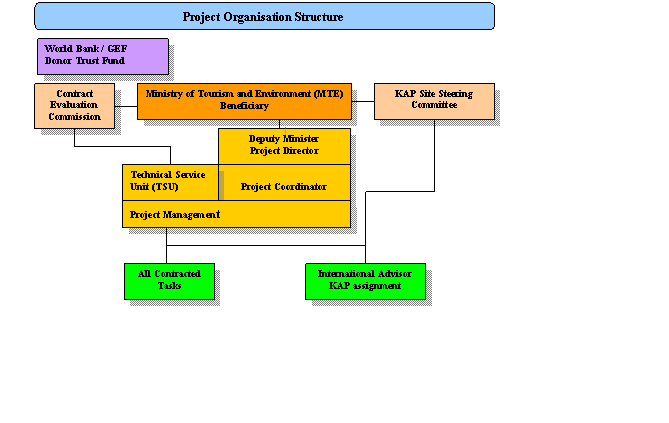

1. Role of the Ministry (MTEP)
The MTEP has the following responsibilities:
· Appoint Project Director; recruit Project Coordinator;
· Lead project and ensure that activities and results comply with the overall project objectives;
· Facilitate partnerships with other line Ministries, local governments, and all institutions and stakeholders that might be usefully involved in and/or impacted by project activities;
· Provide resources and institutional support necessary to implement the project;
· Execute Procurement procedures following the advise/oversight of the TSU and procedures of the WB (Bidding Documents, Procurement Contracts, etc.)
· Appoint Evaluation Commissions in accordance with procedures of the World Bank and under the guidance of the TSU;
· Ensure participation of all institutions/ stakeholders that might be usefully involved at any level in project implementation.
2. KAP Site Steering Committee Participants
A KAP Site Steering Committee (KSC) shall be established prior to inital tendering of the KAP technical studies, to ensure coordination and monitoring of the contracted tasks to be carried out for the benefit of the Ministry (MTEP). The role of the KSC is to provide a forum for planning, evaluation and discussion of the assignment work plan, progress of the activities, and related aspects. The KSC takes decisions upon problems related to the project strategy, and has a monitoring and coordinating role. The Beneficiary (MTEP) approves the assignment outputs. The MTEP Project Director will chair the KSC, which will include representatives from the Ministry of Environment and Tourism, KAP, Ministry of Economic Development, Privatization Agency, Municipality of Podgorica, and the Metallurgical Faculty. The KSC will involve representatives from all parties involved in implementing the KAP assignment. The KSC Chair will convene meetings and meet as often as required to advance the work, and at least every 3 calendar months for the duration of the KAP assignment. The Chair would in addition invite specific attendance at the meetings, depending on the topic(s) to be discussed, including clarification of mandatory and optional attendance for each meeting. Input for Key Decisions would be solicited from all by KSC members, however final decisions are made by the MTEP Chair. In cases where key Decisions required broader endorsement than the MTEP, selected Decisions may be elevated by the Chair to a Government wide Decision.
3. Tasks and Responsibilities of the KAP Site Steering Committee (KSC)
Consultant(s) contracted under the project will work under the supervision of the Project Management team, comprising the Project Director, Project Coordinator, TSU, or any other organizational unit designated by the MTEP. Further, Consultants for KAP site studies will report on a regular basis to the KAP Site Steering Committee (KSC) about assignment progress, any problems, and work scheduled and outputs to be achieved during the period before the next KSC meeting. The Consultant(s) will report to the Project Coordinator, who has the responsibility to receive the reports elaborated by the Consultant and submit them to the KAP Site Steering Committee for comments and approval. The Project Coordinator will help facilitate achievement of the work plan with the Consultant(s), and help convey comments from KAP Steering Committee members.
The key KSC responsibilities include the following:
- Oversee implementation of the KAP assignment;
- Review terms of reference of key consultants for the KAP assignment and provide recommendations to the Project Management team;
- Review consultants’ reports and recommendations, especially those requiring actions and decisions from local authorities, institutions, or industries and provide recommendations for implementation and future remediation steps for the KAP site — resolution, financing, sequencing, and implementation schedule;
- Ensure that local parties and stakeholders decisions and actions are timely; facilitate adoption and implementation;
- Ensure appropriate consultation with local institutions, donors, and other stakeholders.
The KSC Chair will appoint a Secretary-Coordinator, who will prepare and distribute the Minutes/Agenda for each KSC meeting and facilitate daily activities in the Project Management team in coordination with local parties and stakeholders.
Annex 7: Financial Management and Disbursement Arrangements
lake skadar-shkoder integrated ecosystem management project
Montenegro:
1. Country Issues. A 2007 fiduciary review concluded that budgetary control has improved significantly after establishing a fully functioning Treasury system linked to all budget users. Allocating and accounting systems for tax revenues have been enhanced. Revenue and expenditure forecast credibility has improved suggesting that the planning process has become more reliable. Elements of a modern public sector audit function (both internal and external audit) have been established and have improved control and oversight.
2. However significant challenges remain. Considerable investment in developing program budgeting has yet to substantially improve policy planning and prioritization across government. Similar to other countries, further work is required to develop a medium-term expenditure framework that links policies and planning to the budgetary process. The government also needs to develop a comprehensive picture of public sector fiscal risks; particularly loans, contingencies, and guarantees by municipalities and public enterprises. Finally, basic building blocks of financial control are needed, for example the Treasury system needs a commitment control system so MOF can include accounts payable in the accounting system.
3. Risk Analysis. The overall financial management risk for the project is moderate before mitigation measures, and with adequate mitigation measures agreed, the financial management residual risk is rated low. The table below summarizes financial management assessment and risk.
|
Risk |
Risk Rating |
Risk Mitigation Measures |
Risk Rating after mitigation measures |
1. Inherent Risk |
|||
|
Country level. The Perceived corruption is high. State Audit Institution (SAI) and internal audit capacities are relatively low. Treasury system has been modernized but improvements to accomplish measurable and specific results are needed. Internal controls are not always applied in practice—confirmed in reports of internal and external audits. Sector within the MoF that performs SOE oversight has very low capacity (1 person). |
S |
Risks inhibit use of country systems. The risk imposed by insufficient capacity of SAI and internal audit will be mitigated by using private auditors, supervised by the Bank, for project financial statements and by the Bank’s supervision,. In addition, robust internal controls will be applied during project implementation to ensure funds are used for intended purposes, and to safeguard project assets. Internal controls and procedures instituted for ongoing projects implemented by the TSU are assessed adequate for this project. A Designated Account will be opened in a commercial bank acceptable to the World Bank. A stand-alone accounting system will be used for project accounting and reporting. |
M |
|
Entity level. Although the TSU has substantial experience and knowledge of Bank procedures, expanding TSU scope of work to implement the six to seven projects that are envisaged soon, will create capacity concerns. |
M |
The Bank FMS will closely monitor TSU financial management of implementation to detect any potential gaps between quantity of work and unit capacity, and promptly take appropriate remedial action if capacity gaps are noted. |
L |
|
Project level. Adequate financial management arrangements need to be instituted for project implementation and the existing ones tailored to project needs. |
M |
Appropriate financial management arrangements with respect to accounting; financial reporting; auditing; flow of funds have been instituted for project implementation. |
L |
|
Overall Inherent Risk |
M |
L | |
2. Control Risk |
|||
|
1. Budgeting and Planning. Risk created by lack of computerized software to support the budgeting and planning processes. |
M |
Planning and budgeting for previous/ongoing World Bank projects implemented by the TSU proved adequate. The risk is additionally reduced by acquisition of acceptable software. |
L |
|
2. Accounting. Acquisition of software (Quick Book) to be used for project accounting has not been finalized yet and software has not been made fully functional. There is a clear need for computerized accounting software to ensure reliable and transparent accounting and financial information and reduce risk of errors. |
M |
Acquisition and installing of FMS.sys will improve reliability of accounting information and mitigate risk of omission, error, or inaccuracies in project accounting and reporting. The software provides reliable accounting information and is automated to a significant extent. |
L |
|
3. Internal controls. System of internal controls in Montenegro public sector is relatively weak and does not provide sufficient assurance on the use of funds for intended purposes. |
S |
Sound system of internal controls will be applied during project implementation to secure use of funds for intended purposes, and safeguard project assets. Internal controls and procedures instituted for ongoing TSU-implemented projects are assessed as adequate for this project. |
M |
|
4. Funds flow. |
M |
A Designated Account will be opened in a commercial bank acceptable to the World Bank. |
L |
|
5. Financial reporting. Financial reports compiled manually using Excel files based on Excel accounting records, risking reliability, comprehensiveness & accuracy. |
M |
Acquiring and installing Quick Book software needs to be finalized prior to negotiation. Quick Book software generates financial reports automatically, significantly mitigating financial reporting risk. |
L |
|
6. Auditing. |
S |
Private audit firm acceptable to the World Bank will perform audit. |
M |
|
7. Staffing. Although the TSU has substantial experience and knowledge of Bank procedures, expanding TSU scope of work to implement the six to seven projects that are envisaged soon, will create capacity concerns. |
S |
The Bank FMS will closely monitor TSU financial management of implementation to detect any potential gaps between quantity of work and unit capacity, and promptly take appropriate remedial action if capacity gaps are noted. |
M |
|
Overall Control Risk |
M |
L | |
Overall FM Risk |
M |
L |
4. Strengths. The TSU staff are qualified and experienced, including substantial experience implementing World Bank-supported projects (currently implementing three active projects). The project design has relatively low complexity in institutional design (one implementing entity), fairly simple flow of funds, disbursement, accounting and reporting.
5. Weaknesses and Action Plan. Despite the TSU’s strong experience and performance record, its capacity could be overstretched and this should be monitored. The TSU is overseeing fiduciary aspects of implementation for three projects. Irrespectively, the conclusion remains that the pros of assigning the TSU with fiduciary responsibilities outweigh the cons. Previously agreed action plan has been implemented since project accounting software has been acquired and made fully functional.
7. Implementing Entity. The Ministry of Tourism and Environmental Protection (MTEP) will have overall responsibility for project implementation; the Government of Montenegro Technical Services Unit (TSU) will be in charge of fiduciary aspects of project implementation, namely financial management and procurement. The TSU is established and functioning. It is in charge of fiduciary aspects for three ongoing projects in Montenegro. The unit is staffed by qualified and experienced staff with experience in implementation of World Bank supported projects in all functions, including financial management. Performance of the TSU during implementation of the ongoing projects was overall satisfactory.
8. Budgeting and Planning. Planning and budgeting for previous/ongoing World Bank projects implemented by the TSU proved to be adequate. Recent acquisition of acceptable accounting software will facilitate further planning and budgeting and in particular, analysis and comparison of budgeted and actual figures. The MTEP will play an important role in planning and budgeting, thus good communication between the MTEP and the TSU is important to optimize management of funds allocation, liquidity, and overall performance. Regular monitoring of actual versus budgeted figures is essential to detect any variances and take corrective actions.
9. Accounting and Staffing. The TSU financial management staff is an experienced and qualified specialist who is already managing the finances of three active projects and has gained substantial experience in working on World Bank-supported projects. Other functions in the TSU are also adequately staffed. However, soon the TSU will be in charge of implementing six to seven projects and this situation should be closely monitored to detect any gaps in capacity and take appropriate remedial actions. The implementing entity is responsible for project financial management and will provide any supplementary capacity required for World Bank accounting, reporting, disbursement, or procurement procedures.
10. Information Systems. The TSU has acquired and installed FMS.sys accounting software to be used for project accounting for ongoing projects. This software is acceptable to the Bank and will be used for this project. The software provides reliable accounting information and it is automated to a significant extent. Management information systems developed for implementation of ongoing projects is adequate for implementation of this project.
11. Accounting Policies and Procedures: The accounting books and records are maintained on cash basis with additional information on signed contracts. Project financial statements will be presented in EUROs. Accounting policies and procedures in place for ongoing TSU-managed projects will be used for this project.
Additional accounting policies for the project include the following major assumptions:
- cash accounting is the basis for recording transactions;
- reporting in EUROs (reporting currency);
- consolidated IFRs prepared for all donor funds and all components;
- counterpart funds reflected in financial reports.
12. Internal Controls and Internal Audit. The TSU has an adequate internal controls system for projects under implementation, which will be used for this project. Defined controls and procedures are applied in practice as verified by Bank financial management supervision, and private audit firms. The auditors have issued clean audit opinions on ongoing project financial statements. In general, key internal controls to be applied for the project include:
- appropriate authorizations and approvals;
- segregation of duties;
- different persons responsible for different phases of transaction;
- regular reconciliations of records and actual balances, including with third parties;
- maintain complete original documentation to support project transactions.
13. The MTEP publishes tenders and is signatory to the contract. Invoices received are forwarded to technical staff for verification (project coordinator) or to other institutions responsible for checking the quality and quantity of the delivery covered by the invoice. Independent consultants may also be contracted to verify, prior to payment, that acceptable goods, services, or works have been delivered. After technical staff approve the work/service quality and quantity, the TSU registers the invoice in the Archives. The project accountant reviews then registers the invoice in a simple log file with name of supplier, amount, and payment date. The project accountant checks the invoice, the invoice calculation, and selects the appropriate budget to charge (contract number, item number, and program (component), records the accounting codes, his/her initials, and sends the invoice to project procurement. The project procurement staff checks the invoice against the contract number, attaches a copy of the relevant contract paragraph, and signs the invoice.
14. All documentation relevant to the invoice shall be attached so the Project Director can immediately check that all controls have been performed. The invoice is returned to the project accountant, and registered, ensuring that payment can be made as per terms; then payment orders and the invoice with all designated approvals and signatures are submitted for payment. The TSU receives daily bank statements and regular Treasury reports; based on these, the TSU financial specialist will record executed payments and reconcile bank balances. The TSU financial specialist will prepare quarterly interim un-audited financial reports in the agreed format and submit these to the World Bank.
15. Reporting and Monitoring. Project management-oriented interim un-audited financial reports (IFRs) will be used for project monitoring and supervision. The format of the IFRs will be agreed during negotiations and attached to the minutes. The TSU will produce a full set of IFRs for each calendar quarter throughout the life of the project, due 45 days after each quarter ends. The IFRs will comprise the following reports presented in the agreed format:
- Statement of Sources and Uses of Funds;
- Uses of Funds by Activity;
- Designated Account statement;
- Unit of Output by Activity;
- Narratives to the reports.
The accounting for the project is cash basis with additional information provided for commitments on signed contracts.
16. External Audit. The project financial statements will be audited by a private sector audit firm using terms of reference acceptable to the Bank; the audit report will be submitted to the Bank no later than six months after the end of the period audited. Audit TOR has been agreed during negotiatios and attached to the minutes of negotiation. The annual audits costs will be covered by project funds. The project financial statements are prepared on cash basis. Audits should be conducted in accordance with International Standards of Auditing. The following chart identifies the audit reports and submission due dates for the project implementation agency.
|
Audit Report |
Due Date |
|
Entity financial statements |
Na |
|
Project financial statements (PFS), including SOEs and Special/Designated Account. The PFSs include sources and uses of funds by category, by components, and by financing source; SOE statements, Statement of Designated Account, notes to financial statements, reconciliation statement |
Within six months of the end of each fiscal year and at the closing of the project |
Audits performed by State Audit Institution are not acceptable for this project. Although the institution is developing rapidly, it still lacks sufficient capacity.
17. Funds Flow and Disbursement Arrangements. Project funds will flow from: (a) the World Bank - either as an advance, via a Designated Account in United States Dollar, in a commercial bank acceptable to the World Bank, and replenished under transaction- based disbursement, managed as described in disbursement arrangements, or by direct payment on the basis of direct payment withdrawal applications; or (b) the Government of Montenegro.
18. The TSU will administer the Designated Account, and prepare withdrawal applications with designated signatures, which will include a government official of Assistant Minister level or above. Payments from the Designated Account are executed by payment orders. After applying all procedures described in internal controls with respect to flow of documents, verifications, authorizations, signed orders are submitted for payments from either the Designated Account or the Budget (for Government contribution) split according to eligible percentages of financing. In the case of Direct Payment, the application form for such method payment is submitted to the Bank with the same authorized signatories as described above.
19. Designated account will be opened in EURO and the ceiling for this Designated Account will be 200,000 EURO. Replenishment documentation requirements will follow standard Bank procedures as described in the Disbursement Handbook. Reconciled monthly bank statements for the Designated Account will accompany all replenishment requests.
20. Supervision Plan. During project implementation, the Bank will supervise project financial management arrangements in two main ways: (i) review project interim un-audited financial reports for each calendar quarter, and project and entity annual audited financial statements and auditor management letter; and (ii) perform on-site supervisions, review the project financial management and disbursement arrangements to ensure compliance with Bank minimum requirements. On-site supervision will include monitoring agreed actions, review of randomly selected transactions, review of internal controls, and other supervision activities. Supervision will be performed by the Bank accredited Financial Management Specialist.
Albania:
21. Country Issues. The latest draft Country Fiduciary Assessment (CFA-August 2006); draft Public Expenditure and Institutional Review (PEIR-July 2006) and draft Public Expenditure and Financial Accountability Report (PEFA-July 2006) confirm that improvement is required to increase public spending efficiency and accountability by improving planning, budgeting, and executing public investment projects; strengthening lines of accountability, including enabling better access to information by all stakeholders; building stronger monitoring and evaluation systems; and establishing competitive and transparent frameworks for government purchases. Improvements were also needed in public procurement law and implementation regulations to improve procurement transparency, economy, and efficiency. The Procurement Agency supported by EU technical assistance is amending the laws and regulations.
22. The assessment of the country financial management arrangements concluded that the public financial management has improved significantly during the last few years in areas such as budgeting, internal control, internal and external audit, though from a relatively weak base. The fiduciary area will benefit from the ongoing improvements of the Treasury system (especially an improved financial reporting enabling follow-up of programmatic budgeting and giving more analytical information down to the level of individual service units) through implementing an expanded computerized Treasury information system, expected to be ready by June 2008. The proposed project will utilize these improvements by using the Treasury system for the payment and reporting functions. Internal audit is being fully developed to improve the government internal control environment and the internal audit should also be utilized to monitor project implementation. A Public Internal Financial Control framework based on EU principles is being implemented and EU support is strengthening the supreme audit institution.
23. The Project will rely extensively on the various elements of Albania’s public financial management systems, including:
· Budgeting – the project budgets approved annually by the Project Manager;
· Internal controls – the project will use the existing internal control framework within the ministry with additional procedures developed for the Project;
· Flow of funds and payments– the project will use the Treasury system;
· Accounting and reporting – the project will rely extensively on the Treasury system.
24. Risk Analysis and conditions. The overall financial management risk for the project is substantial before mitigation measures, and with adequate mitigation measures agreed, the financial management residual risk is rated moderate. The table below summarizes the financial management assessment and risk ratings of this project:
|
Risk |
FM Risk |
Risk Mitigating Measures |
Residual Risk |
Conditions of Board or Effectiveness |
INHERENT RISKS |
||||
|
Country level. The public financial management is improving, but high corruption risk persists. |
H |
The MEFWA is to rely on the improved Treasury system for payments, use of private auditors for the financial audits, and use of Central Bank for Designated Account |
S |
No |
|
Entity Level. Risk of political interference in entity’s management. |
S |
Any changes to the structure and key staffing in the implementing agency will require agreement with the Bank |
M |
No |
|
Project Level. Project is small, simple, and has a single implementing agency. |
M |
Adequate control mechanism for payments have been agreed and included in the project |
S |
No |
|
OVERALL INHERENT RISK |
S |
S/M |
No | |
3. CONTROL RISKS |
||||
|
Budget. Using government budgetary system |
M |
Ministry develops and approves annual project budget in agreement with IDA |
M |
No |
|
Accounting. Inexperienced FM staff and use of localized Treasury system. |
S |
Hire part-time consultant. Project to use the expanded computerized Treasury system to be ready by June 2008 for payments and reporting. |
S |
No |
|
Internal Controls. Internal controls of the existing Treasury system are acceptable; project-specific controls are incorporated in the project financial manual. |
S |
Additional procedures are included in the FM chapter of the PIM and independent auditors to monitor the project implementation and results verification. |
S |
No |
|
1. Funds flow. A Designated Account would be opened in the Bank of Albania from which the funds will be transferred to the Single Treasury Account (STA) in local currency, but “earmarked” for the project. |
S |
Treasury will through accounting entries keep track of the funding going to this project enabling MEFWA to prepare the interim unaudited financial reports of the project e.g. the sources and uses of the project funds and the remaining balance of the funding from GEF/IBRD. |
M |
No |
|
Financial Reporting. Current manual Treasury system is unable to generate financial reports automatically. |
S |
MEFWA will use the data obtained from the Treasury system after reconciling the data with its own records. The Treasury system is in the process of being developed with WB assistance. The reporting part of the system will be assessed as soon as the system will become fully operational. Currently, the Treasury uses a manual system for its accounting books and records. The manual Treasury system is also used for monthly and annual reports on cash expenditures, which are compared with the annual budgets approved by parliament. |
M |
No |
|
Auditing. |
M |
The audit will be carried out by independent auditors acceptable to the Bank. The global audit arrangements would be streamlined to ensure timely appointment of auditors. |
M |
No |
OVERALL CONTROL RISK |
S |
M |
||
RESIDUAL RISK RATING |
S |
M |
25. Strengths. The basis to rely on the project financial management system include the assessed strengths of the financial management of Government of Albania in controlling budget entities’ spending and the well-functioning Treasury system for payments and reporting.
26. Weaknesses and Action Plan. A time-bound action plan was developed to provide additional fiduciary safeguards. Successful action plan implementation would strengthen mechanisms for third-party assurance on the use of project resources.
|
Actions |
Responsibility |
Deadline |
|
Reporting from new computerized Treasury system: Assess project reporting from the new computerized Treasury system |
MEFWA/WB |
Before relying on reports from the computerized system, planned to start by mid year 2008 |
27. If the agreed actions are taken before negotiation, together with additional financial management measures (strengthened internal controls, private auditor for project accounts) the financial management arrangements for project implementation would be acceptable to the Bank.
28. Implementing Entity. The Ministry of Environment, Forestry and Water Administration (MEFWA) is the main implementing agency with clear responsibilities for strategic, policy, legal/regulatory framework and management the protected areas nation wide. The proposed project implementation will be streamlined within the existing structures of the relevant government agencies.
29. Budgeting. The MEFWA will be responsible for the preparation of annual project budgets (to be included in its departmental budgets) based on their respective procurement plans. This budget will form the basis for allocating funds to project activities, for requesting funds from the government for counterpart contribution, and for payments via Treasury system as appropriate. The risk associated with planning and budgeting is assessed as moderate.
30. Accounting. Staffing. The MEFWA finance and budget department has a staff of five people. The Ministry will hire a part-time consultant (before negotiation) because based on assessment, the existing staff at the Ministry are overloaded and not experienced with the foreign financed projects. The project manager will authorize and control of payments, work closely with finance staff and MoF to ensure timely submission of quarterly interim un-audited financial reports (previously called Financial Monitoring Reports, FMRs), annual financial statements, and other progress reports to the Bank reflecting the project implementation status. The risk associated with staffing after mitigation measures is assessed as substantial.
31. Information systems. The project will use reporting generated by the new computerized Treasury system currently being implemented in all Treasury offices. The Bank will review the reporting generated by the new Treasury system prior to shifting from the manual system to ensure that the new system has the capability of generating the agreed reporting. Currently, the Treasury uses a manual system for its accounting books and records, which are done on a cash basis. The manual Treasury system is also used for monthly and annual reports on cash expenditures, which are compared with the annual budgets approved by parliament. The recent assessment concluded that the current manual system will be able to report according to the agreed formats, although the ongoing computerization will reduce resources required to produce these reports for the project, most probably from second half of 2008. The risk associated with information systems is moderate.
32. .Accounting Policies and Procedures. The accounting books and records will be maintained on a cash basis and project financial statements will be presented in Albanian Lek. The project will follow Government policies and procedures (Treasury) for processing payments. Additional accounting policies to be applied on the project (besides standard accounting policies used for Budget agencies) will include the following major assumptions: (i) cash accounting as the basis for recording transactions; and (ii) all counterpart funds should be reflected in the financial reports. Risk associated with accounting after mitigation measures is moderate.
33. Internal controls and Internal Auditing. The project will utilize existing internal controls within the Ministry and the Treasury, and supplement these with additional controls to ensure that funds are used effectively and efficiently for the purposes intended. The internal controls include (a) procurement controls-World Bank procurement procedures will apply, (b) budgetary controls-the project will form part of the Ministry budget, (c) Treasury controls-payments will flow through the Treasury, (d) accounting controls-additional appropriate controls will be implemented, (e) quality controls – on-site supervisors will verify all bills before payments are made, (f) management controls-project manager will be appointed to coordinate and provide general oversight, (g) audit controls-an independent acceptable audit firm acceptable to IDA will audit annually the project financial statements, based on audit terms of reference acceptable to IDA; and (viii) supervision controls-the World Bank team will regularly carry out project supervision.
34. The project has documented in the financial management chapter of the PIM the internal control mechanisms to be followed in the application and uses of funds and the implementation of the project. The chapter will cover all financial management and administrative procedures, including accounting and record-keeping, flow of funds, and reporting procedures. The manual will also reflect the internal structure relevant to the project, administrative arrangements, internal control procedures, including procedures to authorize expenditures, maintain records, safeguard assets, segregate duties to avoid conflicts of interest, monthly reconciliation of treasury account statements with the project records, ,monthly reconciliation of disbursement summaries of the World Bank with project records, bank signing mandate (to include at least two signatories), regularly reports to ensure close monitoring of project activities.
35. The Ministry internal audit units would audit project activities as a routine part of their work. As the capacity of the internal audit is still generally low, no specific reliance on the internal audit is planned for this project. The risk associated with internal controls is substantial before mitigation measures, and is assessed as substantial after mitigation measures.
36. Financial Reporting. The CFA-July 2006 indicates that the publicly available budget execution and fiscal reports appear to be reliable and frequently updated. All payments are made through the Treasury system for all budget entities, including the implementing entities for this project. Currently, the Treasury uses a manual system for its accounting books and records and on a cash basis. The manual Treasury system is also used for monthly and annual reports on cash expenditures, which are compared with the annual budgets approved by parliament. The system will also enable the continued tracking of the project and is expected to be able to provide reliable reporting for the funding suggested for the project.
37. The MEFWA will prepare interim un-audited financial reports (IFRs) for project monitoring, disbursement and supervision. Draft formats of these IFRs have been agreed upon before and during the negotiations. The implementing entities will produce a full set of IFRs every three months throughout the life of the project and the reporting currency will be Albanian Lek, except as otherwise stated. The IFRs include the following tables: (a) Summary of Sources; (b) Project Sources and Uses of Funds; (c) Components as per cost categories; (d) GEF Desiganted account Statement; (e) STA reconciliation statement; and (f) Contract Monitoring reports for technical serives and goods. The risk associated with financial reporting is moderate.
38. External Auditing. As of the date of this report, the MEFWA had no overdue audit. The auditor will be appointed by the Ministry of Finance as part of an overall agreement for the audit of the non-revenue earning Bank-financed portfolio in Albania. The global audit arrangements should be streamlined to ensure timely appointment of auditors. Specific terms of reference are used for the projects covered by this agreement. Despite Ministry of Finance arrangements, the implementing entity is responsible for delivering to the Bank, within six months of the closing of each fiscal year, the audited financial statements. The annual cost of the audits will be covered by the government part of the portfolio audit. The following chart identifies the audit reports and submission dates for project implementation agencies.
|
Audit Report |
Due Date |
|
Entity financial statements |
N/A |
|
Project financial statements (PFS) for the implementing agency, including SOEs and Designated Accounts. The PFS include sources and uses of funds by category, components, and financing source; SOEs, Statement of Designated Account, notes to financial statements, and reconciliation statement. |
Within six months of the end of each fiscal year and at the closing of the project |
In addition, the Albanian supreme audit institution performs ad hoc external audits of the implementing entities. The risk associated with external audit is moderate.
39. Flow of Funds and Disbursement Arrangements. The project funds will flow from IDA, via one United States Dollar Designated Account (DA) in Bank of Albania (BOA) from which the funds will be immediately transferred to the Single Treasury Account (STA) in local currency, but “earmarked” for the agreed project. Treasury will through accounting entries keep track of the funding going to this project enabling a separate reporting on the sources and uses of the project funds and the remaining balance of the funding from IDA. Counterpart funds are transferred through the Treasury system directly to the suppliers. Project funds will flow from: (a) the Bank, either via a single Designated Account which will be replenished on the basis of SoEs or by direct payment on the basis of direct payment withdrawal applications if a special need arises; or (b) the Government, via the Treasury at the Ministry of Finance (MOF) on the basis of payment requests approved by the Treasury Department of the MOF directly to the local supplier for VAT and other taxes.
40. The ceiling for the GEF-Designated Account would be $200,000. Applications for replenishment of the Designated Accounts will be submitted quarterly or when one-third of the amount has been withdrawn, whichever occurs earlier. Documentation requirements for replenishment would follow standard Bank procedures as described in the Disbursement Handbook Counterpart funding will be executed through Treasury accounts.
41. Supervision Plan. During project implementation, the Bank will allocate one staff week for financial management supervision. The Bank supervises project financial management arrangements in two main ways: (a) review the project’s the quarterly interim un-audited financial reports and project annual audited financial statements and auditor’s management letter; and (b) during the Bank’s supervision missions, review the project’s financial management and disbursement arrangements (including interim reports (IFR) and movements on the Designated Account) to ensure compliance with the Bank's minimum requirements. As required, a Bank-accredited Financial Management Specialist will assist with supervision.
42. Re-assess Treasury System. The Bank will re-assess the expanded computerized Treasury system before the project can rely on the expanded modernized Treasury system for payments and reporting.
Annex 8: Procurement Arrangements
Lake skadar-skoder integrated ecosystem management project
A. General
1. Procurement for the proposed project would be carried out in accordance with the World Bank’s "Guidelines: Procurement under IBRD Loans and IDA Credits" dated May 2004 and "Guidelines: Selection and Employment of Consultants by World Bank Borrowers" dated May 2004 and the provisions stipulated in the GEF Grant Agreements, to be signed for each country separately. A general description of expenditure categories and items appears below. For each GEF Grant-financed contract the Borrower and the Bank will agree on procurement or consultant selection methods, pre-qualifications, estimated costs, prior review requirements, and time frame, and these will be recorded in the Procurement Plan, which will be updated annually or as required to reflect actual project implementation needs, and improvements in institutional capacity.
The project contracts that are not financed directly by the Bank would be procured in accordance with national regulations, or co-financing institutions’ procurement regulations. Initially projected procurement will be advertised in a General Procurement Notice (GPN), and Specific Procurement Notices (SPNs) to be issued thereafter as needed. The Borrowers will publish a GPN, acceptable to the Bank, online in the United Nations Development Business (UNDB) and in the Development Gateway’s dgMarket. The individual SPN for goods and civil works, and request for expression of interests (REoIs) for consulting services, will be advertised following negotiations in a national newspaper or on the MEFWA (for Albania) and in the MTEP (for Montenegro) websites. The SPNs for International Competitive Bidding for goods and civil works packages and REoIs for consultant’s contracts above US$200,000 equivalent will be advertised on-line in UNDB/dgMarket. The results of contract awards for goods, civil works and consulting services will be posted on the UNDB and in the Development Gateway’s dgMarket as the Guidelines require. The TSU (in Montenegro) and the MEFWA/Department of Nature Protection Policies (DNPP) will not engage services of firms and individuals debarred by the Bank for Bank financed contracts. The current listing of such debarred firms and individuals is located at: http://www.worldbank.org/html/opr/procure/debarr.html
2. Procurement of Works: The Project will finance civil works contracts in both countries for refurbishing buildings, for renovating pilot cultural sites, building construction, etc. The civil works will be packaged to the extent possible for tendering under NCB or ICB procedures to increase competition. The following procurement methods will be used:
(a) International Competitive Bidding (ICB) for civil works contracts US$500,000 and over.
(b) National Competitive Bidding (NCB) for contracts more than US$100,000 equivalent and less than US$500,000. The ECA regional sample bidding documents for NCB works contracts will be used. Any other bidding documents for NCB will follow the conditions applicable to Albania and to Montenegro for the NCB procedures established in the Grant Agreements and shall be acceptable to the Bank.
(c) Shopping (minor works) procedures for civil works contracts less than US$100,000 equivalent on the basis of three written quotations obtained from qualified contractors. The Project contains also technical services (TS) contracts for laboratory services for environmental monitoring, each less than US$100,000, which will be procured following shopping procedures.
3. Procurement of Goods: Goods procured under this Project include information technology (IT) systems, office furniture, vehicles, small boats, fishing nets, etc. The TSU and the DNPP/MEFWA will use the Bank’s Standard Bidding Documents (SBDs) for all ICB. Contracts for goods will be grouped in bid packages as much as feasible to increase competition.
International Competitive Bidding (ICB): Goods packages estimated to cost US$100,000 and above per contract will be procured through ICB. IT equipment and software would be procured as separate packages and using a single-stage procurement procedure.
Shopping: Goods packages estimated to cost less than US$100,000 per contract may be procured through shopping procedures on the basis of at least three quotations. The TSU (in Montenegro) and DNPP/MEFWA supported by procurement consultant (in Albania) would solicit quotations from at least three (normally 5-6) suppliers from eligible source countries.
When shopping for procurement of IT equipment (hardware, software, etc.) the TSU and DNPP of MEFWA will follow procedures set forth in the Bank external website. When soliciting quotations, they will include in the shortlist the authorized firms recommended in this website for each country; other firms or local dealers may be added to the shortlist, after confirming their credentials with respective manufacturers.
Direct Contracting: Where certain goods are available from one supplier or in cases where compatibility with existing equipment requires that goods must be procured under Direct Contracting (single-source) and having obtained prior approval from the Bank (in accordance with paragraphs 3.6 and 3.7 of the Procurement Guidelines).
4. Selection of Consultants: Consulting services under this project would include technical assistance for developing predictive hydrological models; feasibility studies and site investigation for waste inventory; socio-economic studies; capacity building; etc. The project will also finance training and study tours. Short lists of consultants for services estimated to cost less than US$100,000 equivalent per contract may be composed entirely of national consultants in accordance with the provisions of paragraph 2.7 of the Consultant Guidelines. Selection methods will be as follows: Consulting services estimated to cost normally US$200,000 or more per consultant contract will be procured through Quality and Cost-Based Selection (QCBS) method; this method also would be used for smaller contract amounts of a complex nature. Consulting services costing each less than US$200,000 equivalent may be procured through Consultants Qualifications (CQ) method. The Fixed Budget (FB) method of selection may be used for simple assignments when the contract amount should not exceed the allocated budget. The consulting contract for project audit may be selected through Least Cost Selection (LCS) method. Individual consultants will be selected in accordance with Section V of the Consultants Guidelines. Single source (SS) method may be used for consulting assignments with prior Bank approval in accordance with paras 3.9 through 3.13 of the Consultants Guidelines.
5. Training: Training will include study tours connected with project component activities and reflected in the Annual Training and Study Tour plans, to be approved by the Bank and after that changes and additions would be reviewed separately as they occur and would cover participants, agenda for training events, and budget estimate. Consultants required to prepare, facilitate, or conduct training activities shall be selected under Consultants Guidelines described above, and shall be included in the Procurement Plan.
6. Operating Costs: The Project would finance operating expenditures incurred by each component and country, such as office supplies, utilities, communication, etc. The project will finance, for Montenegro, the operating cost including salaries, for the TSU in Podgorica for about 10 months of operation. The TSU is carrying out other World Bank projects and the cost for the remaining part of the project will be covered from other Bank projects the TSU will implement. Existing three TSU staff are consultants (not government employees) and were selected competitively under the previous Bank projects.
Assessment of the agency’s capacity to implement procurement
7. In Montenegro the TSU staff comprises a procurement officer, a financial officer, and an assistant, who will work with the MTEP Project Coordinator on technical issues. The TSU procurement officer’s main responsibility will be to coordinate procurement under the Montenegro part of the project, ensuring compliance in accordance with World Bank procurement procedures for project components.
8. In Albania the Director of DNPP will be Project Director, assisted by the Project Coordinator in Shkodra, and supported by an experienced procurement consultant who will be selected competitively for this part-time position to ensure procedural compliance and contract awards in accordance with the World Bank procurement procedures on the Albanian side.
9. A procurement capacity assessment of the TSU in Podgorica and of the Department of Nature Protection Policies in MEFWA in Tirana (and in Shkodra Municipality, where the Project Coordinator is located) was carried out in September 2007. The key issues and risks for procurement for project implementation include the following:
- For Montenegro, at country level, a Country Financial Accountability Assessment (CFAA) and a Country Procurement Assessment Report (CPAR) were carried out in 2002 for the former Republic of Serbia and Montenegro. The CPAR has categorized Montenegro as high risk given the issues identified in its legal framework, regulatory functions, enforcement regime, etc. A preliminary Review of Fiduciary Arrangements in supporting CAS was prepared in draft in April 2007 for Montenegro. As above, although the TSU in charge of procurement for Montenegro has World Bank project experience, given the CPAR findings, the overall procurement risk is rated “high”.
- For Albania, the Bank carried out an assessment of the Albanian procurement system in January 2001 (CPAR) and in August 2006 (CFA-Country Fiduciary Assessment). The 2006 rated “Significant” the risks associated with public procurement in Albania. The 2006 CFA identified shortcomings such as high-level government attempts to bypass the law, capacity deficiencies in the public procurement agency and implementing ministries, and an inadequate complaints review mechanism. A new Public Procurement Law became effective January 1, 2007, but the Albanian project implementing institution, MEFWA/DNPP lacks experience with Bank procurement (the Project Director has no procurement experience; the Project Coordinator located in Shkodra has modest experience with Bank procurement). Therefore, the overall project procurement risk for Albania is “high”.
10. The following actions need to be undertaken to alleviate risks to project procurement:
- The Bank shall prepare and provide to TSU (Montenegro) and DNPP in MEFWA (Albania) a file with the latest procurement documents (guidelines, manuals, procurement notice templates, standard bidding documents for procurement of goods and works, standard request for proposal documents for consulting services, evaluation report formats, regional and simplified procurement documents, etc.) at the time of Project Launch Workshop. It is recommended that the TSU and the DNPP in MEFWA visit the World Bank website for latest procurement documents. The Project Launch Workshop to be organized jointly, will include a procurement training session for staff.
- The TSU has a full-time procurement officer; however, in Albania the Project Director (head of DNPP of MEFWA) will have procurement support from a part-time experienced procurement consultant, who will be hired through comparison of CVs among qualified candidates. The TSU procurement officer and the Project Director in Tirana will attend World Bank regional procurement trainings/seminars.
- A clear communications procedure must be established between the TSU and the DNPP of MEFWA and the project beneficiaries. For example, all correspondence regarding procurement, disbursement, should be routed to the Bank through the TSU and DNPP. The TSU (Montenegro) and DNPP of MEFWA (Albania) should ensure that all information exchanged with the World Bank team is complete and accurate. This will also allow the TSU/Project Director in DNPP to track procurement and other activities on behalf of BAs and to take corrective measures in case of delays; this also allows them to collect data on procurement, project management, etc., for project monitoring and evaluation and for preparing periodic consolidated project progress reports.
- The TSU and the DNPP Project Director should have adequate office space and equipment, such as computers, phone/fax machines, photocopiers, to expedite their procurement function.
C. Procurement Plan
11. Each Borrower (Montenegro, Albania) under this project developed a procurement plan for project implementation. These plans were discussed during appraisal and will be agreed with the MTEP/TSU (of Montenegro) and with MEFWA (of Albania) and the World Bank Project Team during Negotiations on April 23, 2008. These procurement plans will be available in the project database and on the Bank external website, and will be updated annually or as required in agreement with the World Bank Project Team to reflect project implementation needs and improvements in institutional capacity.
D. Frequency of Procurement Supervision
12. In addition to the prior review supervision carried out from Bank offices, the TSU and MEFWA capacity assessments recommended procurement supervision missions visit the countries to carry out a procurement post–review, a minimum of once per annum.
E. Details of the Procurement Arrangements Involving International Competition
1. Goods and civil works
(a) List of contract packages to be procured following ICB, direct contracting, and other methods: See Procurement Plan (below) for each country; and
2. Consulting Services
(a) List of consulting assignments with short-list of international and local firms and individual consultants: See Procurement Plan (below) for each country;
Attachment to Annex 8
Procurement Plan
I General
Agreed date of procurement Plan
Original: April 23, 2008
Date of General Procurement Notice: estimated June 2008
II. Goods and Works and non-consulting services.
1. Prior Review Threshold: Procurement Decisions subject to Prior Review by the Bank as stated in Appendix 1 to the Guidelines for Procurement:
|
Procurement Method |
Method Threshold |
Prior Review Threshold /Comments | |
| 1. |
ICB for Goods |
> $100,000 |
All subject to prior review |
| 2. |
ICB for Civil Works |
> $500,000 |
All subject to prior review |
| 3. |
NCB for Civil Works |
< $500,000 |
First two contracts for each country and all contracts more than $200,000 subject to prior review |
| 4. |
Shopping for Goods, Civil Works and technical services (TS) |
< $100,000 |
First two contracts for each country subject of prior review |
| 5. |
Direct Contracting * |
- |
All subject of prior review |
Note: *) All contracts subject of justification
Detailed procurement contracts for goods and works are enclosed in the table below (in para III. 3).
III. Selection of Consultants
1. Prior Review Threshold: Selection decisions subject to Prior Review by Bank as stated in Appendix 1 to the Guidelines Selection and Employment of Consultants:
|
Selection Method |
Applicable Method Threshold |
Prior Review Threshold /Comments | |
| 1. |
Competitive Methods (Firms) QCBS |
>$200,000 |
All prior review |
| 2. |
Competitive Methods (Firms) LCS |
Any amount |
All contracts more than $100,000 each |
| 3. |
Competitive Methods (Firms) FB |
Any amount |
All contracts more than $100,000 each |
| 4. |
Competitive Methods (Firms) CQ |
<$ 200,000 |
First two contracts for each country and all more than $100,000 subject to prior review |
| 5. |
Individual consultants (Individual) |
- |
First two contracts for each country and all more than $50,000 subject to prior review |
| 6. |
Single Source (Firms and individual) * |
- |
All subject of prior review |
| 7. |
TOR for consulting contracts |
All methods/values |
All subject to prior review |
*) All contracts subject to justification
2. Short list comprising entirely of national consultants: Short list of consultants for services, estimated to cost less than $100,000 equivalent per contract, may comprise entirely of national consultants in accordance with the provisions of paragraph 2.7 of the Consultant Guidelines.
3. Consulting Services assignments and contracts for goods and works with selection methods and time schedule:
- For Albania:
|
1 |
2 |
3 |
4 |
5 |
6 |
7 |
|
Contract (Description) |
Type of contract |
Number of Contract |
Procurement Method |
Review by Bank (Prior / Post) |
Expected Contract signature Date |
Expected contract completion date |
|
Component 1 – Understanding and management of Lake Shkodra Ecosystem |
||||||
|
1. Project Coordinator for Albania (local consultant) |
CS |
1 |
Individual |
Prior |
01/01/2008 |
09/30/2012 |
|
2. Operating cost for Project Coordination |
OC |
- |
- |
- |
Annual Plan |
|
|
3. Project Vehicle |
G |
1 |
Shopping |
Prior |
10/01/2008 |
11/01/2008 |
|
4. Secretariat staff local |
CS |
1 |
Individual |
Post |
09/01/2008 |
09/01/2011 |
|
5. Assistant for Secretariat (local) |
CS |
1 |
Individual |
Post |
09/01/2008 |
09/01/2011 |
|
6. Operating cost for Secretariat (office supply, consumables, etc) |
OC |
- |
- |
- |
Annual Plan |
|
|
7. Operating cost for bilateral Lake Management Committee (office supply; consumables, utilities; etc) |
OC |
- |
- |
- |
Annual Plan |
|
|
8. IT equipment and office furniture for bilateral Lake Management Committee (*) |
Goods |
2 |
Shopping |
Prior |
09/30/2008 |
12/30/2008 |
|
9. Refurbishment of Lake management Committee office |
CW |
1 |
Shopping |
Prior |
09/30/2008 |
06/30/2009 |
|
10. Operating cost for WGs |
OC |
- |
- |
- |
Annual Plan |
|
|
11. Seminars, workshops, study tours for working groups (*) |
TR |
- |
- |
- |
Annual Plan |
|
|
12. Legal framework harmonization and integrating role of commission into national legislation (*) |
CS |
1 |
CQ |
Prior |
09/30/2008 |
06/30/2009 |
|
13. Public awareness campaign, public outreach/communication (local firms) (*) |
CS |
multiple |
CQ |
Post |
03/30/2009 |
06/30/2012 |
|
14. Developing joint fisheries monitoring and management plans (*) |
CS |
1 |
CQ |
Post |
06/30/2009 |
03/15/2010 |
|
15. Establish and maintain joint database (*) |
CS |
1 |
Individual |
Prior |
09/30/2009 |
09/30/2010 |
|
16. Lab equipment for targeted transboundary monitoring programs (*) |
G |
multiple |
shopping |
Prior |
07/30/2009 |
11/30/2009 |
|
17. Laboratory services for environmental monitoring |
TS |
1 |
Shopping |
prior |
09/01/2009 |
09/01/2011 |
|
18. Expertise for socio-economical study (*) |
CS |
1 |
CQ |
Prior |
09/30/2008 |
06/30/2009 |
|
19. Local expertise for targeted studies identified by working groups (*) |
CS |
6 |
Individuals |
Post |
03/30/2009 |
06/30/2012 |
|
20. Assistance on learning and capacity building on international cooperation on water basin management (regional expertise) (*) |
CS |
1 |
Individual |
Post |
10/30/2010 |
03/30/2011 |
|
21. Prepare Lake-wide Zoning and Management Plan |
CS |
1 |
Individual |
Post |
10/30/2008 |
01/30/2009 |
|
Component 2. Enhancing Sustainable use of Lake ecosystem |
||||||
|
22. Development of architectural/landscape design (local) |
CS |
1 |
Individual |
Post |
06/30/2009 |
09/30/2009 |
|
23. Expertise on inventory cultural heritage sites |
CS |
1 |
Individual |
Post |
12/30/2008 |
04/30/2009 |
|
24. Pilot renovation of cultural sites/visitor centers |
CW |
2 |
NCB |
Prior |
03/15/2010 |
09/30/2010 |
|
25. Feasibility study and design for pilot renovation of cultural sites/visitor centers (local) |
CS |
1 |
CQ |
Post |
06/30/2009 |
12/30/2009 |
|
26. Different Equipment for fishermen organization support (refrigerated truck, fishing nets, cell phones, etc) |
G |
3 |
Shopping |
Post |
06/30/2009 |
09/30/2009 |
|
27. Expertise on fishermen organization support |
CS |
2 |
Individual |
Post |
03/30/2009 |
07/15/2009 |
|
28. Equipment for Enhance Lake protection enforcement capacity |
G |
2 |
Shopping |
Post |
03/30/2009 |
06/30/2009 |
|
29. Operating cost |
OC |
- |
- |
- |
Annual Plan |
|
|
Component 3. Investment to protect water quality |
||||||
|
30. Public awareness (local) |
CS |
1 |
CQ |
Post |
03/30/2010 |
11/30/2010 |
|
31. Design study of needs for restoring lake trees groves |
CS |
1 |
Individual |
Post |
03/15/2009 |
08/30/2009 |
|
32. Restoring lake trees groves |
CW |
1 |
shopping |
post |
09/30/2009 |
11/30/2009 |
|
33. Design for stream bank erosion control |
CS |
1 |
CQ |
post |
10/15/2009 |
04/30/2010 |
|
34. Stream design bank erosion control |
CW |
1 |
Shopping |
Post |
09/15/2010 |
12/30/2012 |
|
35. Architectural design for community based lakeside vegetation management pilot |
CS |
1 |
Individual |
Post |
03/15/2010 |
08/15/2010 |
|
36. Improvement works for community based lakeside vegetation management pilot |
CW |
1 |
shopping |
Post |
03/30/2011 |
06/30/2011 |
|
37. Equipment for community based lakeside vegetation management pilot |
G |
1 |
Shopping |
Post |
07/30/2010 |
09/30/2010 |
|
38. Procurement consultant (local) |
CS |
1 |
Individual |
Prior |
09/01/2008 |
09/30/2012 |
Notes: (*) – These marked assignments are for joint activities, where the selection process (and contracting) will be made from one country, while the beneficiaries will be both countries.
(**) Contracts for part time FM specialist (0.030) and financial audits are government financed.
- For Montenegro:
|
1 |
2 |
3 |
4 |
5 |
6 |
7 |
8 |
|
Contract (Description) |
Type of contract |
Amount financed by the GEF (million USD) |
Number of Contract |
Procurement Method |
Review by Bank (Prior / Post) |
Expected Contract signature Date |
Expected contract completion date |
|
Component 1 – Understanding and management of Lake Skadar Ecosystem |
|||||||
|
1. Project Coordinator (local) |
CS |
0.105 |
1 |
Individual |
Prior |
06/30/2008 |
09/30/2012 |
|
2. Operating cost for bilateral Lake Management Committee (office supply; consumables, utilities; etc) |
OC |
0.028 |
- |
- |
- |
Annual Plan |
|
|
3. Operating cost for the TSU (**) |
OC |
0.048 |
- |
- |
- |
Annual Plan |
|
|
4. Seminars, workshops, study tours for working groups (*) |
TR |
0.040 |
- |
- |
- |
Annual Plan |
|
|
5. Operating cost for working groups (*) |
OC |
0.030 |
- |
- |
- |
Annual Plan |
|
|
6. International consultant for preparing Lake-wide zoning and management plan (*) |
CS |
0.070 |
1 |
Individual |
Prior |
06/30/2009 |
03/30/2010 |
|
7. Local experts for preparing Lake-wide zoning and management plan (*) |
CS |
0.020 |
1 |
Individual |
Post |
07/30/2009 |
03/30/2010 |
|
8. Develop joint lake water/ecological monitoring manuals as per EU parameters (*) |
CS |
0.040 |
1 |
CQ |
Post |
11/30/2008 |
03/30/2009 |
|
9. Equipment for targeted transboundary monitoring program (small boat, net, etc) (*) |
G |
0.020 |
2 |
Shopping |
Post |
09/30/2009 |
04/15/2010 |
|
10. Laboratory services for environmental monitoring |
TS |
0.050 |
1 |
Shopping |
Prior |
09/01/2009 |
09/01/2011 |
|
11. TA for designing predictive hydrological model (*) |
CS |
0.240 |
1 |
QCBS |
Prior |
10/30/2010 |
03/30/2011 |
|
12. Assistance on learning and capacity building on international cooperation on water basin management (regional expertise) (*) |
CS |
0.033 |
1 |
Individual |
Post |
10/30/2010 |
03/30/2011 |
|
Component 2. Enhancing Sustainable use of Lake ecosystem |
|||||||
|
13. Capacity building on tourism (local - first year contract financing only from GEF)) |
CS |
0.012 |
1 |
Individual |
Post |
01/01/2009 |
12/30/2009 |
|
14. Pilot renovation of cultural sites/visitor centers |
CW |
0.100 |
1 |
Shopping |
Prior |
03/15/2010 |
09/30/2010 |
|
15. Construction works for model eco-camping site |
CW |
0.045 |
1 |
Shopping |
Post |
03/15/2010 |
06/15/2010 |
|
16. Works on migratory waterfowl monitoring stations |
CW |
0.040 |
1 |
Shopping |
Post |
09/15/2010 |
11/30/2010 |
|
17. Capacity building for natural resources support (local – first year contract financing only from GEF) |
CS |
0.013 |
1 |
Individual |
Prior |
01/01/2009 |
12/30/2009 |
|
18. Different Equipment for fishermen organization support (fishing nets, etc) |
G |
0.025 |
2 |
Shopping |
Post |
02/15/2010 |
05/30/2010 |
|
19. Expertise on fishermen organization support |
CS |
0.025 |
1 |
Individual |
Post |
06/30/2009 |
11/30/2009 |
|
20. Motorized Small Boats (three types) for Enhancing Lake protection enforcement capacity |
G |
0.090 |
2 |
Shopping |
Post |
03/30/2009 |
05/30/2009 |
|
21. Vehicles for Enhancing Lake protection enforcement capacity |
G |
0.050 |
2 |
Shopping |
Post |
06/30/2009 |
09/30/2009 |
|
22. Other equipment (binoculars, cameras, walkie-talkie, compass, etc) for Enhance Lake protection enforcement capacity |
G |
0.010 |
1 |
Shopping |
Post |
03/30/2009 |
08/30/ |
|
Component 3. Investment to protect water quality |
|||||||
|
23. Vranja WWTP building construction |
CW |
0.430 |
1 |
NCB |
Prior |
02/15/2009 |
09/30/2009 |
|
24. Study on waste inventory, site investigation, option analyses and feasibility study |
CS |
0.800 |
1 |
QCBS |
Prior |
10/30/2008 |
04/15/2010 |
|
26. Environmental impact assessment |
CS |
0.100 |
1 |
CQ |
Prior |
06/15/2010 |
12/15/2010 |
|
27. International advisor KAP hazardous waste containment |
CS |
0.100 |
1 |
Individual |
Prior |
09/30/2008 |
09/30/2010 |
|
Total for Montenegro (***)) |
2.56 |
||||||
|
Total GEF financing (Albania and Montenegro) |
4.55 |
Notes: (*) – These marked assignments are for joint activities, where the selection process (and contracting) will be conducted from one country, while the beneficiaries will be both countries.
(**) - The Project will finance, for Montenegrin part, the operating cost including salaries for the TSU in Podgorica for about 10 months of operation. The TSU is carrying out other WB projects and it was agreed that the cost for the remaining part of the project will be covered from other Bank projects the TSU is/will implement. The three TSU staff are consultants (not Government employees) and were selected competitively under the previous WB project.
(***)- contracts for financial audits are government financed
IV. Ex-Post review:
1. Contracts for goods, woks and consulting services below prior review thresholds are subject of Bank’s selective ex-post review. Periodic ex-post review by the Bank will be undertaken during regular supervision missions. Procurement documents, such as bidding documents, bids, bid evaluation reports and correspondence related to bids and contracts will be kept readily available for the Bank’s ex-post review during supervision mission or at any other point of time. Bank’s mission will review at least one out of every five contracts which are subject of ex-post review.
2. Record Keeping: The TSU in Montenegro and DNPP of MEFWA in Albania will maintain complete procurement files which will be reviewed by supervision missions. All procurement related documents that requires prior review will be cleared by the Procurement Accredited Staff (PAS) and related technical staff. Procurement information will be recorded by the TSU and DNPP and submitted to the Bank as part of quarterly (FMRs) and annual progress reports.
Annex 9: Economic and Financial Analysis
lake skadar-skoder integrated ecosystem management project
Economic Analysis
1. Project benefits are long-term and cannot be quantified in monetary terms so this section describes economic cost/benefit. Most investments are institutional and capacity building and do not lend themselves to economic and financial analyses thus analysis was limited to the KAP site and untreated wastewater. The KAP feasibility study will use cost-benefit analysis to evaluate alternatives. The feasibility study for a rural village wastewater investment will assess cost-effectiveness based on investment costs per capita, and promote lowest-cost design solutions proven effective in other rural areas. Most financing comprises a capital grant, so no payback calculations are required. An assessment of affordability and willingness-to-pay for operations and maintenance costs of the small-scale wastewater investment will be conducted using surveys.
2. Waste dump at KAP site. The KAP waste dump facility lacks a base liner, lateral barriers, cover, drainage, and water treatment systems, which exposes the waste to precipitation and results in rainwater percolating through the waste. Without investment to stop migration of polluted soil, contaminants in the underlying and adjacent soils and groundwater leading to Lake Skhodra will continue to degrade the water quality. In 2005-2006, water quality near the factory showed increased levels of PCB, PAH, As, Pb, Cd, Zn, pH, phenols, Fe, and failed to meet standards for drinking water quality. The aluminum plant is the biggest polluter of groundwater in the Zeta valley. Groundwater pollution with PCB compounds (the most serious environmental problem in the previous period) is reported to have decreased due to removal of old barrels of Pyralene on the KAP site. Toxic substances have been measured in soils near the plant, with elevated concentrations of PAHs, PCBs, fluorides, mercury, cyanides, and ammonia well above maximum allowable concentrations. Some of the soil on the KAP site is extremely polluted and is a permanent source of groundwater pollution.
3. Primary existing and potential environmental and health risks that the KAP site poses include the following:
- Toxic emissions into the atmosphere
- Toxic emissions into groundwater and drinking water from seepage through polluted soil
- Toxic substances contaminating surface water runoff
- Exposure to toxic substances threatens human and animal health through skin contact, inhalation, ingestion
4. Quantifying the health impacts of toxins on the population is possible only through surveys that precisely measure exposure duration and severity, or by studying epidemiological evidence of the impact of soil pollution on health. Populations can be exposed to toxins from polluted soils via diverse routes (ingestion, consuming polluted crops, soil dust, or inhaling air polluted by soil). Lead is a known carcinogen that has been linked to decreased intellectual function. Cadmium can cause lung cancer and mercury can accumulate in the food chain, for example, larger and older fish usually contain the highest amounts of methyl mercury. The human nervous system is highly susceptible to the effects of mercury, particularly fetuses and children. Methyl mercury is commonly associated with risks of developmental defects but short- and long-term effects depend on amounts and exposure. Relatively small exposure can result in slight decreases in intellectual function and might not be apparent, but significant exposure poses a serious health threat.
5. The proposed component will benefit Montenegro, particularly in avoiding costs for cleaning up polluted groundwater, treating drinking water, and removing polluted sediments. Benefits also accrue from avoiding damage to public health that would result from taking no action because over time, more toxic substances would build up in the environment as they are released. Typical clean-up costs for groundwater and sediments substantially exceed the costs for appropriate landfill storage. In addition to the health benefits, remediation of the KAP waste dump facility would protect drinking water supplies, increase real estate values, improve the ecosystem, and reduce some of the local populations’ pollution-related concerns.
6. The Zeta Plain is the largest plain and one of the most densely populated areas in Montenegro; it consists of fertile lowland that stretches from Podgorica in the north to Skadar Lake in the south and is home to the vast vineyards of “Plantaže” a quality wine producer. Zeta Plain also has ideal growing conditions for a wide variety of Mediterranean fruits and vegetables. Golubovci town is the biggest settlement in the plain (3000 inhabitants), and is the capital of Golubovci urban municipality, which encompasses most of the plain.
7. Small scale wastewater treatment. Several donor-funded programs are supporting construction or upgrading of sewage collection and wastewater treatment facilities in large urban areas connected to the lake basin. In Montenegro, the project will finance a pilot small- scale wastewater treatment, possibly based on constructed wetlands, for the village of Vranjina.
8. Wastewater treatment will provide the following:
- Health benefits from improved availability and quality of drinking water
- Natural resources benefits from improved water quality for recreational and downstream surface water uses
- Economic benefits from enhanced prospects for tourism growth, related employment, increased number of potential users, and increased land values
- Ecological benefits from improved systems for better lake water quality, which represents a non-use value
9. Wastewater schemes must be affordable and technically sustainable; prior to approval, feasibility studies will evaluate the technologies, financing, and affordability of initial investments plus operation and maintenance requirements.
Annex 10: Safeguard Policy Issues
lake skadar-skoder integrated ecosystem management project
Environment
1. Overall, the project has been classified as Category B based on screening proposed investment types. Three types of project investments are identified with potential construction-related impacts including: small scale wastewater treatment system; waterfowl monitoring stations; and rehabilitating historic and cultural monuments. Each of these investments requires EMP development and environmental assessment under national laws and environmental permitting applications. Additionally the cultural monument renovations will require special permits from the respective Ministries of Culture. The project will support feasibility studies a EIA for the KAP site, which would be prepared to the standard of a category “A” World Bank assessment. Technical Assistance related to the KAP site (feasibility study, EIA, and technical advisory support) financed through the project is considered most compatible with a Category “B” classification, since it requires involvement of Bank environment specialists in reviewing TORs, project supervision, and providing technical comments for reports for risk mitigation and quality assurance.
2. Environmental Impact Assessment: An EIA has been carried out and publicly disclosed in both countries in the form of a Framework EIA because on-the-ground investments were not specified (e.g., locations and technologies for small-scale wastewater treatment) during preparation. The EIA describes potential activities and outlines the process by which environmental screening and assessment for such investments will be undertaken in accordance with government and World Bank policies and procedures. The EIA also reviews relevant legislative and regulatory frameworks and implementation/enforcement capacity in each country and assesses the extent to which these are compatible with and sufficient to meet WB requirements; evaluates the project’s potential environmental risks and impacts in its area of influence, including transboundary aspects and international obligations; examines the project alternatives; identifies improvements to project selection, siting, planning, design and implementation by preventing, minimizing, mitigating, or compensating for adverse environmental impacts and enhancing positive impacts; includes mitigation processes and managing adverse impacts by developing environmental monitoring and mitigation plans (EMP), which will be implemented as a part of the project execution. The EIA will be incorporated into the project PIM, which will specify review processes and responsibilities. For any subproject, the respective ministry or project proponent will carry out an appropriate Environmental Assessment (EA) for activities under the main project. Before approving a subproject, the Project Coordinator verifies (through its own staff, outside experts, or existing environmental institutions) that the subproject meets the environmental requirements of appropriate national and local authorities and is consistent with the OP 4.01 and other applicable environmental policies of the Bank. The Project Coordinator will submit all EAs to the Bank for review and comment before finalization of the national EA review.
3. Natural Habitats: This OP is triggered because the project area comprises legally designated PAs and Ramsar sites and because some on-the-ground works will be financed (e.g., ecological campground, waterfowl monitoring stations, and a village-level constructed wetland wastewater treatment facility. Project impacts are expected to be positive, through improved monitoring of lake conditions and strengthened capacity of the agencies responsible for managing the lake (the management units of the two Protected Areas). The lake-wide zoning and management plan will be integrated with, and add an essential transboundary element to protected area management plans in each country.
4. International Waterways: Lake Skadar-Shkoder empties into the Adriatic Sea via the transboundary Buna-Bojana River. There will be no water abstraction and the only interventions will be environmentally positive (reducing pollution inputs to the lake). However, in accordance with Bank policy and practice, this OP is triggered because investment in new wastewater treatment infrastructure is envisioned. The Adriatic states have been notified through UNEP, which serves as the Secretariat for the Barcelona Convention for the Protection of the Mediterranean Sea against Pollution.
Public Consultation and Disclosure
6. During the EA process for sub-investments, the respective ministry will consult with project-affected groups and local nongovernmental organizations (NGOs) about project environmental impacts and take their views into account. The respective ministry will provide information that is understandable and accessible in format and language to project-affected groups and local NGOs in a timely fashion prior to consultation.
Potential Environmental Impacts
7. The following investments are sample descriptions of potential environmental impacts of proposals that would require a site-specific EA and Environmental Management Plan. Details are provided in the project EIA. All investments should be consistent with PA management plans and spatial plans.
|
Example: New wastewater system in the village of Vranjina | |
|
Potential environmental issue and impact |
Mitigation measures |
|
Contamination of surroundings during construction with construction waste (packaging, solvents, paints, plastic, etc.) |
A waste management plan should be prepared, covering the whole construction phase. Waste containers with locks could be placed at the building site to separate types of waste, and frequent inspections should be done by the monitoring authority. A special container should be dedicated to hazardous waste—solvents, paints, and other toxic chemicals. |
|
Contamination of the lake with domestic waste water, containing fecalia, pathogens and contaminants (e.g. detergents, disinfectants, chlorine, etc.) |
Different solutions for treating wastewater should be considered, including sand filters, mini wastewater treatment plants, and modern septic tanks. If septic tank solutions are used, a system for emptying the tanks should be put in place. |
|
Destruction of recreational values because of odors, tainting of the water at outlets, etc.; Health risks near outlets |
Local environmental authorities on both sides of the lake should ensure future monitoring programs analyze water samples for E. coli and/or coliform bacteria to underpin public information on health risks in the lake |
|
Oxygen depletion due to high organic content in waste water |
Oxygen content (dissolved oxygen) should be part of future monitoring programs to be measured on a regular basis |
|
Eutrophication due to high phosphorus content of waste water |
As mentioned above, different solutions for treating the wastewater should be considered, including sand filters, mini wastewater treatment plants, and modern septic tanks. |
Legacy Pollution (KAP) Site
9. Terms of Reference for the waste classification and pre-investigation studies will be prepared by authorities in Montenegro and members of a KAP site steering group with comments and no-objection from the World Bank. The project description from the feasibility study report should be used for an application of approval to the Ministry of Tourism and Environment and follow normal EIA procedures, and be submitted to the World Bank for review and comment. Movement of hazardous waste and construction of a landfill for hazardous waste is on the list for preparation of a mandatory EIA study according to the Law on EIA in Montenegro. An extra hearing/consultation apart from the obligatory one under the Montenegrin EIA Law should be initiated by the project proponent, as soon the project description is well developed. As expertise for this kind of remediation, containment or construction of landfills for hazardous waste is not present in the Ministry, the project supports an international adviser to help in supervision and an advisory role to the Ministry. This support will supplement and not replace Bank and Ministry of Environment and Tourism supervision.
Capacity Development and Institutional strengthening
10. Both Montenegro and Albania have been actively revising sectoral policies and legislation to harmonize with EU policies and Directives. This includes recently updated legislation on Environmental Impact Assessment (including Strategic Environmental Assessment), environmental protection, Protected Areas, and protection and management of water and living natural resources. National and local governments in both countries have made considerable progress in re-establishing a regulatory presence since the early 1990s. However, law enforcement relating to land and resource use remains weak. Uncontrolled and unregulated construction is a major threat, particularly on the Albanian side (and some on the Montenegro side). There are issues of conflicting and overlapping sectoral agencies’ mandates and between central and local government levels. EIA recommendations to strenthen environmental enforcement capacity have been incorporated by the project: (1) Train park rangers of both countries to enforce nature park regulations and take action against illegal fishery, waste disposal, etc. Training would be conducted in cooperation with the Regional Environment Agency Shkodra, and the future Environment Agency in Montenegro. Park rangers have the primary responsibility to identify and assess fees and fines related to natural resources including fisheries, and some responsibility for small solid waste violations. Parks rangers in Albania and Montenegro do not have authority to issue fines or take action against illegal construction, and must defer to other responsible government agents. (2) Training regional environmental agency staff in Shkodra on environmental auditing and inspection.
Social Safeguards
11. Cultural Property: This OP is triggered because there are legally designated cultural heritage sites within the project area (e.g., old monasteries), some of which will be rehabilitated for touristic and educational purposes. Special measures will be taken in the rehabilitation designs and construction works, including close consultations and permissions from legal bodies responsible for cultural heritage in each country. Construction agreements will include provisions related to “chance finds” in all contracts that involve earth movement, following procedures specified in the PIM.
12. Involuntary resettlement: The project will not finance any land acquisition; activities carried out under the project will not require or entail any land acquisition and/or physical relocation of people. However, the project may require involuntary restriction of access to natural resources in legally designated protected areas. The TDA indicated that over-fishing and fishing in inappropriate areas or with inappropriate methods probably represents a significant threat to the sustainable use of this valuable element of the lake ecosystem. This remains to be confirmed through a detailed study of the fish resources during the first year of the project. Confirmation that fishing pressure needs to be reduced could damage livelihoods for some current users. Anticipating this possibility, Resource Access Restriction Process Frameworks were prepared for both countries during project preparation in accordance with WB OP/BP 4.12. These Process Frameworks have been publicly disclosed with government cover letters endorsing the Frameworks. The process frameworks do not address re-settlement associated with possible demolitions by ongoing government programs in accordance with their law. Planning supported under this project only addresses natural resources management at a regional level which does not trigger WB OP/BP 4.12.
Annex 11: Project Preparation and Supervision
lake skadar-skoder integrated ecosystem management project
|
Planned |
Actual | |
| PCN review |
03/04/2004 |
03/04/2004 |
|
Initial PID to PIC |
03/30/2004 |
03/12/2004 |
|
Initial ISDS to PIC |
03/30/2004 |
05/04/2004 |
| Appraisal |
2/27/2008 |
3/12/2008 |
| Negotiations |
4/21/2008 |
|
|
Board/RVP approval |
05/27/2008 |
|
|
Planned date of effectiveness |
||
|
Planned date of mid-term review |
||
|
Planned closing date |
Key institutions responsible for preparation of the project:
Albania: Ministry of Environment, Forests, and Water
Montenegro: Ministry of Tourism and Environmental Protection
Bank staff and consultants who worked on the project included:
| Name |
Title |
Unit |
| Agi Kiss |
Lead Ecologist |
ECSSD |
|
Aleksandar Crnomarkovic |
Financial Management Analyst |
ECSPS |
|
Rohan Selvaratnam |
Sr. Program Assistant |
ECSSD |
| Nikola Ille |
Sr. Rural Development |
ECSSD |
| Drita Dade |
Projects Officer |
ECSSD |
|
Karin Shepardson |
Sr. Operations Officer, TTL |
ECSSD |
|
Olav Christensen |
Sr. Financial Management Specialist |
ECSPS |
| Arben Maho |
Procurement Specialist |
ECSPS |
|
Aleksandar Nacev |
Sr. Agriculturist |
ECSSD |
|
Kirsten Burghardt Propst |
Counsel |
LEGEM |
| Danielle Malek |
Counsel |
LEGEM |
| Paula M. Lytle |
Senior Social Dev. Specialist |
ECSSD |
| Elona Gjika |
Financial Management Analyst |
ECSPS |
|
Konrad Buchauer |
Wastewater Consultant |
ECSSD |
|
Katelijn Van den Berg |
Environmental Economist |
ECSSD |
|
Marina Markovic |
Environment Consultant |
ECSSD |
| Wolfhart Pohl |
Sr. Environment Specialist |
ECSSD |
| Chris Cosslett |
GEF ICA Consultant |
ECSSD |
| Robin Drewett |
Industrial Pollution Consultant |
ECSSD |
Bank funds expended to date on project preparation:
1. Bank resources: BBGEF US$390,100.05
2. Trust funds: PDF-B US$119,349.73
3. BBFAO: US$12,100
4. Total:US$521,549.73
Annex 12: Documents in the Project File
lake skadar-sHkoder integrated ecosystem management project
1. Project Concept Note
2. Project Information Document
3. Albania: Environmental Impact Assessment
4. Albania: Resource Access Restriction Process Framework
5. Republic of Montenegro: Environmental Impact Assessment
6. Republic of Montenegro: Resource Access Restriction Process Framework
7. Joint Strategic Action Plan
8. PDF B Audit of the Annual Financial Statements for the year ended 31st. December 2006
9. Lake Shkoder/Skadar: Transboundary Diagnostic Analysis Report
10. Lake Shkoder Integrated Ecosystem Management Project: “Support for Preparation Revision of Montenegrin Draft Water Law – Final Report, February 20, 2006
11. Lake Skadar: Health Screening Assessment Report
12. Social Surveys
13. Draft PIM for the Lake Skadar-Shkoder Integrated Ecosystem Management Project
14. Zero State Analysis (Environmental Audit) of KAP Site
15. Agreement Between the Government of the Republic of Montenegro and the Council of Ministers of the Republic of Albania for the Protection and Sustainable Development of the Lake of Shkodra (Skadar) and its Watershed, February 25, 2008
16. Vranjina Draft Feasibility Study TORs
17. Project Procurement Plan
Annex 13: Statement of Loans and Credit-
ALBANIA
|
Original Amount in US$Millions |
Difference between expected and actual disbursements | |||||||||
| Project ID |
FY |
Purpose |
IBRD |
IDA |
SF |
GEF |
Cancel. |
Undisb. |
Orig. |
Frm. Rev’d |
| P096643 |
2007 |
BERIS |
5.60 |
3.70 |
0.00 |
0.00 |
0.00 |
8.85 |
-0.43 |
0.00 |
| P096263 |
2007 |
LAND ADMIN & MGMT PROJ |
19.96 |
15.00 |
0.00 |
0.00 |
0.00 |
36.04 |
0.38 |
0.00 |
| P096205 |
2007 |
DPL |
0.00 |
10.00 |
0.00 |
0.00 |
0.00 |
10.43 |
0.00 |
0.00 |
| P078949 |
2007 |
TRANSPORT |
20.00 |
5.00 |
0.00 |
0.00 |
0.00 |
25.82 |
0.00 |
0.00 |
| P100273 |
2006 |
AVIAN FLU – AL |
0.00 |
5.00 |
0.00 |
0.00 |
0.00 |
4.49 |
1.13 |
0.00 |
| P082814 |
2006 |
HEALTH SYST MOD |
0.00 |
15.40 |
0.00 |
0.00 |
0.00 |
15.71 |
1.38 |
0.00 |
| P078933 |
2006 |
EDUC EXCEL & EQUITY |
0.00 |
15.00 |
0.00 |
0.00 |
0.00 |
14.52 |
0.28 |
0.00 |
| P082375 |
2005 |
NATURAL RES DEVT |
0.00 |
7.00 |
0.00 |
0.00 |
0.00 |
5.67 |
1.98 |
0.00 |
| P086807 |
2005 |
COASTAL ZONE MGMT (APL #1) |
0.00 |
17.50 |
0.00 |
0.95 |
0.00 |
15.45 |
5.96 |
0.00 |
| P089061 |
2005 |
NATURAL RES DEVT (GEF) |
0.00 |
0.00 |
0.00 |
5.00 |
0.00 |
4.08 |
0.00 |
0.00 |
| P090656 |
2005 |
ECSEE APL2 (ALBANIA) |
0.00 |
27.00 |
0.00 |
0.00 |
0.00 |
25.76 |
0.77 |
0.00 |
| P082128 |
2004 |
WATER RES MGMT |
0.00 |
15.00 |
0.00 |
0.00 |
0.00 |
8.12 |
-0.80 |
0.00 |
| P077526 |
2004 |
POWER SECTOR GENER & RESTRCT'G |
0.00 |
25.00 |
0.00 |
0.00 |
0.00 |
24.82 |
22.16 |
0.00 |
| P075156 |
2004 |
INTGD WATER/ECOSYS MGMT (GEF) |
0.00 |
0.00 |
0.00 |
4.87 |
0.00 |
4.01 |
4.67 |
0.00 |
| P077297 |
2003 |
COM WRKS 2 |
0.00 |
15.00 |
0.00 |
0.00 |
0.00 |
2.74 |
1.42 |
-0.82 |
| P041442 |
2003 |
MUN WATER/WW |
0.00 |
15.00 |
0.00 |
0.00 |
0.00 |
6.15 |
1.18 |
0.00 |
| P069479 |
2002 |
FISHERY DEVT |
0.00 |
5.60 |
0.00 |
0.00 |
0.00 |
0.51 |
-0.32 |
0.00 |
| P055383 |
2001 |
SOC SERV DEVT |
0.00 |
10.00 |
0.00 |
0.00 |
0.00 |
7.70 |
4.50 |
2.20 |
| P054736 |
2001 |
AG SERVICES |
0.00 |
9.90 |
0.00 |
0.00 |
0.00 |
1.74 |
-0.02 |
0.00 |
|
Total: |
45.56 |
216.10 |
0.00 |
10.82 |
0.00 |
222.61 |
44.24 |
1.38 | ||
Albania
STATEMENT OF IFC’s
Held and Disbursed Portfolio
In Millions of US Dollars
|
Committed |
Disbursed | ||||||||
|
IFC |
IFC |
||||||||
| FY Approval |
Company |
Loan |
Equity |
Quasi |
Partic. |
Loan |
Equity |
Quasi |
Partic. |
| 2005 |
Fushe Kruje |
30.00 |
0.00 |
0.00 |
0.00 |
30.00 |
0.00 |
0.00 |
0.00 |
| 2002 |
INSIG |
0.00 |
0.00 |
6.23 |
0.00 |
0.00 |
0.00 |
6.22 |
0.00 |
| 2000 |
NCBank |
0.00 |
2.00 |
0.00 |
0.00 |
0.00 |
2.00 |
0.00 |
0.00 |
| 1999 |
ProCredit ALB |
0.00 |
0.98 |
0.00 |
0.00 |
0.00 |
0.98 |
0.00 |
0.00 |
| 2003 |
Vodafone Albania |
17.83 |
0.00 |
0.00 |
3.70 |
17.83 |
0.00 |
0.00 |
3.70 |
|
Total portfolio: |
47.83 |
2.98 |
6.23 |
3.70 |
47.83 |
2.98 |
6.22 |
3.70 | |
|
Approvals Pending Commitment | |||||
| FY Approval |
Company |
Loan |
Equity |
Quasi |
Partic. |
| 2002 |
Savings Bank |
0.00 |
0.02 |
0.00 |
0.00 |
|
Total pending commitment: |
0.00 |
0.02 |
0.00 |
0.00 | |
Statement of Loans and Credits
Montenegro:
|
Original Amount in US$Millions |
Difference between expected and actual disbursements | |||||||||
| Project ID |
FY |
Purpose |
IBRD |
IDA |
SF |
GEF |
Cancel. |
Undisb. |
Orig. |
Frm. Rev’d |
| P106899 |
2008 |
ECSEE APL #3 – MONTENEGRO |
0.00 |
9.00 |
0.00 |
0.00 |
0.00 |
9.46 |
0.33 |
0.00 |
| P093461 |
2007 |
SUST TOURISM DEVT |
0.00 |
10.00 |
0.00 |
0.00 |
0.00 |
10.12 |
0.70 |
0.00 |
| P084597 |
2005 |
EDUC (MONTENEGRO) |
0.00 |
5.00 |
0.00 |
0.00 |
0.00 |
0.85 |
-0.65 |
0.00 |
| P079116 |
2004 |
ENVIRONMENT |
0.00 |
7.00 |
0.00 |
0.00 |
0.00 |
5.15 |
4.58 |
0.00 |
| P082223 |
2004 |
HEALTH SYSTEM (MONTENEGRO) |
0.00 |
7.00 |
0.00 |
0.00 |
0.00 |
3.89 |
2.83 |
-1.16 |
| P087470 |
2004 |
PENSION ADMIN (MONTENEGRO) |
0.00 |
5.00 |
0.00 |
0.00 |
0.00 |
4.09 |
3.00 |
0.00 |
|
Total: |
0.00 |
43.00 |
0.00 |
0.00 |
0.00 |
33.56 |
10.79 |
- 1.16 | ||
Montenegro
STATEMENT OF IFC’s
Held and Disbursed Portfolio
In Millions of US Dollars
|
Committed |
Disbursed | ||||||||
|
IFC |
IFC |
||||||||
| FY Approval |
Company |
Loan |
Equity |
Quasi |
Partic. |
Loan |
Equity |
Quasi |
Partic. |
| 1982/82/87/87 |
Gov montenegero1 |
22.14 |
0 |
0 |
0 |
22.14 |
0 |
0 |
0 |
| 0/00 |
Gov montenegro 2 |
3.04 |
0 |
0 |
0 |
3.04 |
0 |
0 |
0 |
|
Total portfolio: |
25.18 |
0.00 |
0.000 |
0.000 |
25.18 |
0.00 |
0.00 |
0.00 | |
Annex 14: Country at a Glance
Montenegro 
Annex 14: Country at a Glance
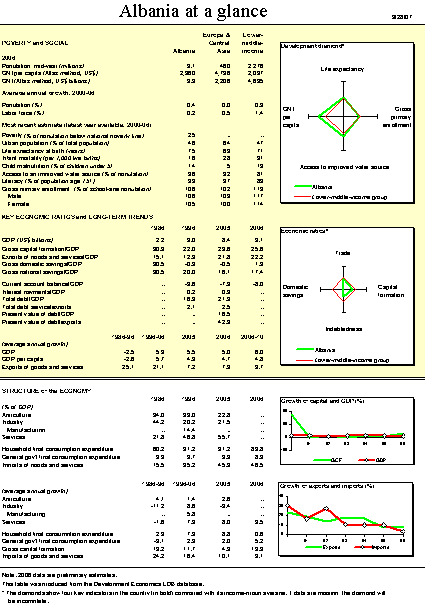
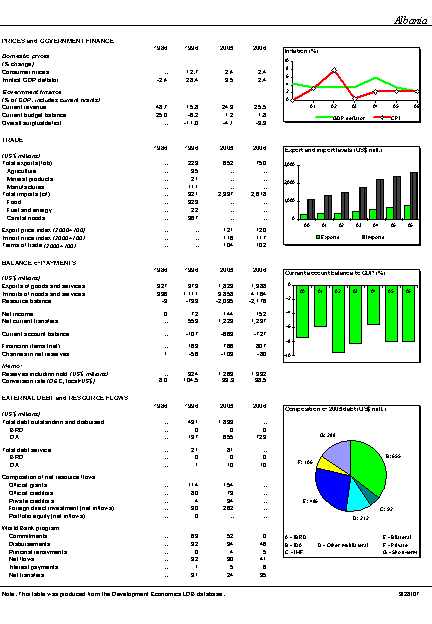
Annex 15: Incremental Cost Analysis
Lake Skadar-sHkoder integrated ecosystem management project
Project Development Objective and Baseline Scenario
1. The project development objective is to maintain and enhance the long-term economic value of Lake Skadar-Skhoder and its natural resources. The baseline funding in support of the project amounts to US$40.2 million. The baseline scenario and corresponding funding with regards to each project component are described below.
Lake Ecosystem monitoring and management
2. In the past, both Montenegro and Albania pursued lake management from a predominantly national perspective with little transboundary co-operation. There is no institutional structure for co-ordinating protection and management. As such, under a forward-looking baseline scenario, it would prove increasingly difficult for managers to address mounting challenges to lake sustainability during the planned project period.
3. This situation began to change with the creation of a project involving the two Governments together with the Regional Environment Center (REC) and with the move to develop a GEF project. Launched in 2000, the REC project has a total budget of US$600,000, of which US$170,000 will be spent during the project period. REC project activities include: (i) institutional capacity building to promote cross-border communication and collaboration (especially for communities and NGOs), (ii) public awareness activities, including preparation of promotional materials for ecotourism, (iii) a small amount of equipment for Skadar Lake NP.
4. While the REC project focuses on community/local communication, it does not support high-level government coordination, nor does it implement activities on the ground to make the cooperation concrete. Thus, while the REC project is very valuable to instill the idea of transboundary cooperation, it cannot fund its completion.
5. Both countries carry out environmental quality monitoring within the lake basin and this will continue at a similar rate of expenditure under the baseline scenario. However, this scenario has the following shortcomings: (a) each country uses different monitoring approaches and data collection methods meaning that the data are not inter-comparable; (b) no common database exists for open and efficient exchange of information; (c) data gathering and analysis are not necessarily carried out based on priorities concerning the lake as a whole; (d) the parameters measured are not necessarily the most useful to underpin lake-wide management decisions; (e) research may be too donor-driven, reflecting the priorities of the respective funders, (f) data are not readily available within either country because data collection is done by semi-autonomous institutions, which often charge high fees, and; (g) technical capacities to analyze and interpret data are limited, particularly in Albania.
6. For all these reasons, accurate and up-to-date information on the status and trends of key elements of the lake ecosystem are almost impossible to obtain. However, such information is essential for effective lake-wide management to achieve national and transboundary priorities. These drawbacks tend to limit both national and transboundary benefits from monitoring.
7. Estimated baseline spending for environmental monitoring in the lake area during the project period is US$675,000 in Montenegro[18] and US$68,000 for Albania. Some spending will be reoriented under the GEF Alternative to increase and capture transboundary benefits. As part of baseline funding, data from a transformed program of monitoring will be complemented by a transboundary research project funded by the Norwegian Research Council (NIVA). The three-year DRIMON[19] project involves Montenegro, Albania, and Macedonia and covers Lakes Skadar-Shkoder and Prespa. Total funding for Lake Skadar-Shkoder is estimated at US$237,500. Project activities include: (i) establish nutrient budgets and address siltation challenges for the lake basins, (ii) assess the status of the lakes through dose-response relationships between nutrients and sediment inputs and their effects; (iii) suggest environmental goals for the lakes, based on information on their trophic status and evidence of their reference (or natural) conditions, in dialogue with stakeholders. This NIVA-financed study will provide essential management-related data that would otherwise be available only with GEF support.
8. In addition, GTZ will finance complementary activities under the “Physical Planning and Transboundary Management” project that covers both Montenegro and Albania. The project, which has been approved and is expected to begin shortly, will provide US$625,000 over 18 months to prepare detailed urban plans for six pilot lakeside villages (to reduce illegal building, support well-regulated residential and tourism development), some small ecotourism-related infrastructure.[20] The province of Pisa, Italy is financing urban planning activities in cooperation with the Municipality of Shkodra for approximately US$612,000.
lake Skadar-skhoder water and natural resources management
9. At present, no zoning or management plan exists in the areas surrounding the lake so most areas are legally accessible to tourists and fishermen. Local and commercial use of the lake natural resources is allowed everywhere, including fishing, hunting, recreation (boating, hiking, etc.). Ensuring that these resources are used sustainably and limiting negative ecological impacts is an essential and challenging part of lake management. However, these objectives are undermined by capacity constraints in both countries, as evidenced by extensive illegal fishing and hunting and inappropriate alternative uses of the lake waters that promise localized short-term gains. Local authorities have limited experience with modern, integrated, and participatory approaches to natural resources management.
10. In the case of Montenegro, an estimated US$1,875,000 in baseline support will be provided during the full project period,[21] to cover the annual operational budget of the project implementation entity (the Lake Skadar National Park administration), awareness raising and government counterpart funding for USAID and Council of Europe (CoE) projects.
11. In Albania, the lake area received area status only in 2006, near the end of the project preparation period. The move to initiate transboundary co-operation, including the anticipation of international (GEF and others’) support for this objective, has been an important impetus underlying the establishment of the PA and the creation of an associated budget. In the absence of GEF support, baseline spending by Albania under this component would have been zero.
12. The following donor support is being provided under the baseline scenario for natural resource management in the project area:
GTZ in Montenegro is supporting the “Improving Touristic Offer of LSNP” project and is financing small tourism-related infrastructure such as signs, trails, promotional materials, etc. Total financing is estimated at US$225,000. GTZ and Austrian Aide (ADA) are providing US$340,000 to support small/medium tourist-friendly infrastructure, e.g., rehabilitate Virpazar market.
USAID, Council of Europe, and Government of Montenegro: Together are providing financing for tourism development activities based on natural and cultural heritage, including bird watching, lake clean-up, building thematic visitor centers at Bar and Cetinje, and supporting cultural heritage and local traditions that emphasize social inclusion. Total financing: US$340,000.
UNDP: UNDP has a national project to develop GIS for natural resource management, although it does not support on-the-ground activities at Lake Skadar. A three-phase project totaling US$512,500 is expected to provide US$50,000 of geographically relevant support during the project.
Water Quality protection investments
13. Important baseline investments are controlling pollution within the lake watershed that used to reach the lake. Pollutants included hazardous wastes, solid wastes and wastewater. In the area of wastewater collection and treatment, major challenges remain, particularly in Albania, where wastewater from the city of Shkodra flows largely untreated into the lake. Overall baseline financing includes the following:
· US$17 million to Albania from KfW and Austria to help provide Shkodra city with wastewater collection and treatment facilities
· US$200,000 to Montenegro from the European Agency for Reconstruction (EAR) to rehabilitate an existing wastewater treatment plant for Podgorica (a significant source of pollution through the Moraca River).
· US$100,000 from Montenegro government to pilot small-scale wastewater treatment along the lake. Some financing will be redirected to innovative approaches under the GEF Alternative.
14. In the area of hazardous wastes, the contract to privatize Montenegro’s State-owned KAP aluminum plant was awarded to RUSAL, a Russian company. This contract requires that by 2010, “legacy” hazardous and non-hazardous waste dump site on the KAP grounds must be removed or contained in EU-standard sanitary land fill, and RUSAL is responsible for non-hazardous wastes (estimated financing of US$10 million), while Government of Montenegro is responsible for the hazardous waste component.
15. Hazardous waste from KAP presents a particular threat to Lake Skadar as it is contaminating groundwater that enters the lake, primarily through the Moraca River. Addressing the KAP hazardous waste issue will have important national and transboundary benefits by removing a significant threat to lake environmental quality. In conjunction with GEF support, the Government of Montenegro is providing baseline financing of US$100,000 for the feasibility study and US$5.16 million to clean up the site.[22]
16. Management of solid waste represents an important task for lake managers and local governments in both countries. Domestic solid waste is a recognized serious and growing problem throughout the lake basin. Wastes from settlements and tourism facilities near the lake and in river basins are blown into the lake and collect at the mouths of rivers, where they damage ecological functions, local health status, and tourism prospects. Shkodra city has an established (though inadequate) waste collection system, but villages and communes on either side of the lake lack waste collection systems.
17. Baseline spending in this area includes the following:
· IDA-financed Montenegro Environmentally Sensitive Tourism Project (MESTAP) is funding two regional municipal solid waste landfills, one for Bar municipality, which borders Lake Skadar. Relevant baseline costs at this site are estimated at US$300,000.[23]
· Baseline spending for the city of Shkodra in Albania is estimated based on an ongoing US$500,000 annual contract for solid waste collection and disposal. An estimated 10 percent of that contract is collecting waste from areas proximate to the lake, therefore reducing the risk of solid waste entering the lake. Thus, US$200,000 of baseline spending is estimated over the four-year life of the project.
Global Environmental Objective and Alternative Scenario
18. The project global environmental objective is to enhance transboundary cooperation for managing sources and impacts of potentially conflicting development objectives and activities affecting the waters of the Lake Skadar-Shkoder basin. The total cost of the alternative scenario is US$46.6 million—US$40.2 million baseline investments and US$6.5 million incremental finance. The proposed project, with total financing of US$15.7 million including a GEF contribution of US$5 million, covers all incremental activities and key baseline activities financed by the two governments. It addresses major gaps in baseline activities and aims to achieve global, transboundary, and national benefits.
Component 1: Capacity Building for Improved Understanding and Joint Management of the Lake
19. Under the alternative GEF scenario, US$2.8 million of incremental support will be provided to enhance and solidify a long-term programme of integrated environmental lake management. This is key to establishing and operating a permanent institutional structure for lake management. The additional support will establish a Skadar-Shkodra Lake Commission (SLC) and bilateral Working Groups to coordinate implementation of key actions called for in the Strategic Action Plan. Working Groups will cover the following activities:
- Coordinate legal and institutional frameworks;
- Coordinate planning, including developing a lake-wide management plan;
- Design and oversee a lake-wide research and water-quality monitoring program;
- Coordinate and resolve conflicts on water management issues;
- Develop and oversee a joint public awareness and education program; and
- Prepare a coordinated strategy and plan to promote sustainable tourism development.
20. The project will also finance a small Secretariat to support the SLC and Working Groups and to coordinate and facilitate implementation of joint project activities.[24] Accurate and up-to-date information on the status and trends of key elements of lake ecosystem is essential for effective protection and management. For a transboundary lake it is important that both countries use the same monitoring approaches and data collection methods, that a common database is established with open and efficient exchange of information, and that analysis is carried out based on priorities concerning the lake as a whole.
21. Incremental support under this component leveraged by the GEF is as follows:
(i) Government of Montenegro will provide US$160,000 for the SLC and Working Groups; US$25,000 for public outreach and communication, and US$67,000 for monitoring
(ii) Government of Albania will provide US$100,000 for the SLC and Working Groups and US$7,000 for monitoring.
(iii) SNV Netherlands is providing US$112,500 for institutional strengthening, stakeholder participation, and co-operation between the two countries.
(iv) GTZ will provide approximately US$20,000 in technical assistance to develop a framework strategy for preparation of the Lake-wide Management Plan.
22. In addition to the above, US$2,330,000 in incremental support is being requested from the GEF for the following elements:
(i) Technical assistance, training, equipment, and support for incremental operating costs (on a declining basis) to support the establishment of the SLC and Working Groups to enable them to carry out their responsibilities. This includes establishing a small Secretariat for the SLC and one-person technical support units in each country, and the costs of regular meetings and communications.
(ii) Technical assistance, equipment, and support for incremental operating costs to implement joint activities designed and overseen by the Working Groups. These will mainly consist of studies, targeted research, monitoring, and preparing spatial and development plans, and developing and implementing a public outreach and education program. Lead responsibility for implementation of joint activities will be assigned to either Montenegro or Albania, based on capacity of their implementing agencies and their priorities. An important part of the monitoring program will be to establish and maintain a common, publicly accessible data base and networks for information exchange.
Component 2: promoting Sustainable Use of the lake
23. The total cost of the GEF Alternative under Component 2 is US$6.4 million. This total consists of US$4.9 million in baseline support and US$1.5 million in incremental support. Incremental support from GEF totalling US$1.025 million will include the following:
· Technical assistance, training, equipment, and materials, and some incremental operating costs to strengthen the capacity of the local administrations responsible for management of the lake and its natural resources, including both improved communication and partnership with local governments and communities and more effective enforcement of regulations (e.g. against illegal fishing).
· Technical assistance, civil works, equipment, and materials to support development of sustainable tourism as the best alternative for the use of the lake ecosystem. This includes small-scale infrastructure such as hiking trails and signage, birdwatching platforms, and rehabilitation of cultural heritage sites to enhance their touristic and educational value.
· Technical assistance, equipment, and materials to build capacity and provide incentives for sustainable fisheries management. This may include, for example, legal and technical assistance for local fishermen and other resource user associations, improved market facilities accessible to registered fishermen, training in handicrafts based on local resources, among others.
24. An incremental budget of US$420,000 is leveraged from the government of Montenegro and US$60,000 from the government of Albania in support of this component.
Component 3: Catalyze pollution reduction investments
25. The total cost of the GEF Alternative under Component 3 is US$34.7 million. It includes US$32.5 million in baseline support and US$2.2 million in incremental support. The GEF incremental support is estimated at US$1.6 million, which will help address urgent pollution hot-spots, including the following:
· Hazardous waste: GEF will provide incremental support to address KAP site hazardous waste; US$1.0 million GEF funding is requested to inventory and categorize wastes and finance an options analysis and feasibility study, and for technical advisory services.
· Wastewater treatment: GEF support is requested to help address the growing problem of untreated wastewater flowing directly into the lake from lakeside villages and communes. Specifically, based on priorities identified in the SAP, GEF would contribute to installing a small-scale, environmentally and economically sustainable wastewater collection and treatment system in one village in Montenegro. The proposed GEF contribution to this effort is US$365,000.
· Restore lake buffer vegetation: GEF will finance TA and investments (estimated US$280,000) in equipment, materials, and labor to control stream bank erosion, and restore tree groves and fish nursery buffer vegetation at priority sites on both sides of the lake
26. An incremental budget is leveraged from the Montenegro government of US$520,000 and from the Albania government for US$20,000 to support this component.
Annex 16: STAP Roster Review
STAP ROSTER TECHNICAL REVIEW OF THE PROPOSED GEF-IW PROJECT: “LAKE SKADAR-SHKODER INTEGRATED ECOSYSTEM MANAGEMENT”
(ALBANIA, MONTENEGRO)
by J. A. Thornton PhD PH CLM
Managing Director
International Environmental Management Services Ltd – United States of America
Introduction
This review responds to a request from The World Bank (WB) to provide a technical review of the proposed International Waters project entitled Lake Skadar-Shkoder Integrated Ecosystem Management.
I note that I am a designated expert on the STAP Roster of Experts with particular experience and knowledge concerning watershed management and land-ocean interactions. I have served as Government Hydro biologist with the Zimbabwe Government, Chief Limnologist with the South African National Institute for Water Research, Head of Environmental Planning for the City of Cape Town (South Africa), and, most recently, as Principal Environmental Planner with the Southeastern Wisconsin Regional Planning Commission (USA), a position that I hold concurrent with my position as Managing Director of International Environmental Management Services Ltd, a not-for-profit corporation providing environmental education and planning services to governments worldwide. In each of these positions, I have had oversight of projects and programs designed to assess contaminant loads to aquatic ecosystems from land-based activities, and to develop appropriate and affordable mitigation measures to reduce such loads and minimize their impacts on the aquatic environment, both freshwater and marine.
This review is based upon a thorough review of the project document, consisting inter alia of the Project Document (22 pages plus Annexes 1, 3-5, 8 and 17); the Project Executive Summary and GEF Council Work Program Submission inclusive of Annex A; and, the (Draft) Lake Shkoder Transboundary Diagnostics Analysis (TDA). Other, relevant documents served as reference sources, including the GEF Operational Strategy, Agenda 21, and related materials establishing the necessity and priority of land-based activities to control marine pollution as set forth in the Global Program of Action for the Protection of the Marine Environment from Land-Based Activities.
Scope of the Review
This review addresses, seriatim, the issues identified in the Terms of Reference for Technical Review of Project Proposals.
Key Issues
Key issue 1. Scientific and technical soundness of the project. Overall, the project appears to be scientifically and technically sound. The approach proposed, which includes an on-going diagnostic and demonstration project-based program, adequately addresses the needs to initiate actions to (1) create a binational mechanism to jointly manage the shared water resources of Lake Skadar-Shkoder, (2) quantify the risks associated with a legacy of historic water quality degradation and current threats to the biodiversity and ecology of the Lake, (3) strengthen the existing national mechanisms for management of land- and water-based activities within the drainage basin tributary to the Lake, and (4) encourage implementation of urgent environmental management actions through provision of incremental financing of remedial actions to address identified “hotspots”. The need for both a land- and water-based approach is documented in the Lake Shkoder Transboundary Diagnostics Analysis that was completed during the preparation of this project. The TDA also identified a number of priority interventions that could be considered as recipient activities under Component 4, targeting priority environmental concerns within the Lake Skadar-Shkoder Basin.
A review of the Components set forth in the project document suggests that the primary focus of this proposed project will be on capacity building and institutional strengthening; to wit, Component 1 focuses on the institutional and human resources necessary to manage and monitor the water resources of Lake Skadar-Shkoder at the binational level, Component 2 focuses on research and monitoring necessary to complete and refine the data available to substantiate the management measures employed, and Component 3 primarily focuses on the human resources necessary to undertake the management of the resource at the national level. In addition, Component 4 will provide important “on-the-ground” experience in problem solving. These needs are adequately documented in the TDA, especially for management actions at both the national and binational levels where the countries appear to have utilized a primarily passive and country-based management strategy, rather than a holistic approach to managing the shared resources of the Lake.
From a scientific standpoint, providing a framework within which the two countries can assemble a shared data base comprised of similar variables, measured in a consistent manner, and stored in an accessible form is an essential first step toward creating the baseline from which disturbances can be measured and assessed. Such a data base will also facilitate both individual and joint enforcement of regulations and standards by the countries within the shared basin. In addition, disseminating these data to interested parties, including citizens, nongovernmental organizations, and corporations, through an accessible data base will help to ensure timely action to correct problems, be they concerns regarding overexploitation of the living resources of the Lake, pollution from lakeshore development, or impacts related to human activities within the drainage basin tributary to the Lake.
With regard to creating an appropriate regulatory framework, an understanding of the current status of the Lake waters is also useful in determining whether or not conditions of impairment continue to exist, and in identifying emerging issues that could potentially adversely affect the Lake ecosystem. Appropriate data will permit a realistic evaluation of the standards likely to be applied by regulators at the country and local government levels. Further, the upgrading of the laboratories and enhancing of the institutional capacities to utilize shared methodologies, implemented by trained and competent staff in the Basin countries, is a necessary element in the shared enforcement process. Joint action of this nature can overcome the possibility that operations could be shifted between Basin countries in order to avoid regulations at the country and local levels.
Key issue 2. Identification of global environmental benefits and/or drawbacks of the project, and consistency with the goals of the GEF. The proposed project establishes a framework within which to address the major causes of environmental stress within the aquatic environment of Lake Skadar-Shkoder; namely, the historic legacy of contamination, the current threat of overexploitation of aquatic resources, and the likely future risk of uncontrolled development in the drainage area, including the inputs of contaminants washed off the land surface and into the aquatic ecosystem.
The legacy of contamination stems from the presence of aluminum and steel plants in the drainage basin, and from ongoing discharges of wastewater from the human settlements in the Basin. While the data gathered during the TDA suggest that the legacy of the aluminum and steel processing plants has been mitigated by the rapid flushing rate of the Lake, the threat of ongoing degradation from wastewater discharges from urban and agricultural operations within the drainage basin remains. If unchecked, these discharges threaten the globally significant ecosystems of the Lake, including Ramsar sites in both countries, and downstream areas of the Adriatic Sea. These ecosystems, in addition to be transboundary aquatic systems in their own rights, are either directly or indirectly connected to the transboundary waters of the Mediterranean Large Marine Ecosystem (LME). Consequently, true global benefit is presumed as a result of the connection of the Mediterranean Sea with the North Atlantic Oceanic circulation.
The project is consistent with the goals and objectives of OP 8,[25] contributing to the global effort to address environmental concerns arising from industry, agriculture, fishing, and exploitation of the natural environment for tourism and recreation insofar as it relates to Lake Skadar-Shkoder. A regional approach is essential, and provides the basis for GEF participation, given that each country may need to engage in an additional level of effort beyond that required under their current national legal framework.
In this regard, the participation of a broad cross-section of governmental, nongovernmental and civil organizations with interests in the Lake and its drainage basin would be an important element in ensuring the implementation of the project outcomes, even though the outcomes, in the global sense, are environmental in nature. Currently, this participation is provided through the relevant national agencies. Establishment of the various working groups and secretariat, and the stakeholder involvement, as proposed in the project document, will contribute to achieving this objective, and add the necessary community and transboundary dimensions to the management of this resource. Unfortunately, the civil society organizations are not listed in the project document, so it is not possible to gain a full understanding of the extent or nature of the proposed stakeholder involvement in the project.
This project is complementary to other GEF initiatives within the eastern Mediterranean region, including the Lake Ohrid project. Given the GEF aim of incrementally funding projects that contribute to sustainable economic development in a replicable manner, the current proposal and its companion proposal would seem to be well-suited to achieving such an aim.
Key issue 3. Regional context. The participation in this project of the two countries in the Lake Skadar-Shkoder Basin argues persuasively that adequate and appropriate consideration has been given to the regional context of the project. Notwithstanding, the project team noted that a Basin-wide approach to water resources management, which would have significantly increased the area of influence of the project, was discounted due to the size of this larger geographic unit and the fact that the available financial resources would be insufficient to bring about meaningful change in such a large area. It was noted, however, that one reason for discounting this larger project area was the fact that the Basin would be incorporated into the River Basin planning and management program mandated by the European Union (EU) Water Framework Directive. Further, this larger drainage basin was included in the TDA and resultant Strategic Action Program (SAP), which should ensure that actions undertaken within the Lake Skadar-Shkoder ecosystem management project are fully integrated into this larger Basin framework.
Actions proposed to better integrate the national regulatory initiatives into a regional program are fully consistent with the development of a sustainable regional approach to managing this waterway. These actions are supported within the proposed project by complementary actions to strengthen the national regulatory programs and institutions. To this end, however, this reviewer notes that the project funds are expected to be allocated to each country and to the regional working group. It would seem advantageous, however, to further strengthen the binational entity by channeling the funds to each country through the binational organization. This would provide greater surety that the projects undertaken are truly regional in scope, even if located within the national territory of one or other of the Basin countries. By so doing, this financial management mechanism also would create a more substantial role for the binational authority and potentially accelerate the creation of a permanent binational commission tasked with jointly managing the shared water and ecological resources of Lake Skadar-Shkoder.
The proposal clearly indicates an intention to disseminate information and results on a regional basis, both within the Basin and elsewhere in the region. Such a regional (European) effort has been initiated during the project development process through the exchange visits to Lake Geneva and Lake Constance, amongst others. In part, this dissemination process will utilize the proposed binational secretariat as a repository and focal point for information on the protection and conservation of the ecosystem. As suggested above with respect to the fiscal arrangements for the project, delegation of such responsibilities to the Secretariat should help to hasten and strengthen the process of formation of a truly binational commission for the management of the Lake.
Key issue 4. Replicability. The implementation of demonstration projects as a key feature of this project clearly contributes to the potential for replication of beneficial practices and techniques. Further, the inclusion of mechanisms for disseminating information and results achieved fosters replication of effective and successful measures throughout the region, and especially within the participating countries. As identified through the Global International Waters Assessment process and related initiatives such as the Lake Basin Management Initiative of the International Lake Environment Committee Foundation (ILEC), GEF International Waters projects are a primary means by which basin-scale management practices are being developed and implemented through the world. These initiatives have endorsed the development and implementation of information sharing mechanisms at both the regional and global scales—in part, through the global IW-LEARN initiative. This endorsement underlines the importance of information sharing and dissemination between projects, a fact that is adequately and clearly identified within the project brief for this project. Nevertheless, it is recommended that this project seek to ensure the dissemination of lessons-learned in the broadest possible manner.
The project document suggests that the proposed activities will continue to embrace the concept of project twinning as one mechanism to enhance exchange of knowledge and experience. As recognized within the project brief for this project, there are considerable complementarities between this project and the projects currently being implemented in the eastern Mediterranean Basin. The inclusion within the Project Document of establishment of explicit linkages between projects is wholly consistent with this concept. Such communication will enhance the replicability of the project outputs and the results of the project, significantly contributing to the coordinated and comprehensive management of the Aegean Sea and Mediterranean Sea basins.
Key issue 5. Sustainability of the project. The project executive summary indicates that a significant element of the sustainability of the project supported interventions rests upon the implementation of the EU Water Framework Directive and related initiatives. In addition, country-level actions in support of the project are identified as indicative of a commitment to ongoing support of project actions and activities, beyond the immediate period of project implementation with GEF support. The project brief acknowledges a number of incentives for the participating countries to provide the necessary resources beyond the project period, including their participation as signatories to the Ramsar Convention. Further, the project proposes to address another key element in the provision of adequate resources to ensure the future sustainability of the project-supported interventions; that is, the availability of information, the development of a trained cadre of individuals, and the strengthening of appropriate institutions with the knowledge and ability to implement actions to protect the Lake environment. To this end, the project document sets forth an array of financial and other mechanisms, both in-hand and proposed, to ensure the sustainability of the land- and water-based elements proposed to be developed during the project. These mechanisms include various bilateral financing arrangements and grass roots activities designed to sustain the project actions beyond the period of application of GEF funds. To a great extent, the to-be-determined stakeholder participation element will be critical to the long-term sustainability of the project, particularly those relating to future environmental challenges and threats.
Key issue 6. Targeted Research Projects. Targeted technical demonstration and capacity building projects are key features envisioned within the GEF International Waters Water body-based Operational Program. These activities are clearly included as major elements of this proposed project, primarily under Component B which is focused on the use of targeted surveys as the means of determining and identifying appropriate and applicable management measures to quantify emerging issues (such as avian influenza that is in part spread by waterfowl), and Component C which is focused on improved environmental management.
There is also provision within the project brief for creating and implementing an on-demand small-grant program that would support creation of capacity and strengthening of academic and research institutions in the Basin. Implementation of these provisions is strongly recommended. The interventions, funded in part by the GEF, strive for sustainability and the continuation of successful interventions beyond the project period. For this reason, it is most important that the lake and watershed management measures identified by the project be internalized within the appropriate ministries such that they continue to be implemented over the longer term. Likewise, it is equally important that the demonstration projects continue to be monitored, and the results reported using the information dissemination mechanisms previously identified, beyond the project period. Such continuity is totally consistent with the catalytic nature of the GEF, and an essential element to the sustainability of the project. Capacity building and trainer training, envisioned in the project brief, thus become the basic building blocks upon which this project will succeed or fail, both from the point of view of its sustainability and from its scientific and technical integrity.
Secondary Issues
Secondary issue 1. Linkage to other focal areas. This project is formulated as an International Waters project under OP 8 of the GEF Operational Strategy. While no specific cross-cutting areas are identified, the project clearly has linkages to the cross-cutting area of land degradation in terms of its focus on land-based activities and to the protection of aquatic biodiversity in terms of its focus on fisheries.
Secondary issue 2. Linkages to other proposals. The project recognizes the complementarities between the management of Lake Skadar-Shkoder and other GEF-related initiatives in the region. Indeed, actual linkages were explored and strengthened during the period of project formulation. Specific linkages with these projects are proposed and identified in the project brief. Where such linkages are based upon project development initiatives, this reviewer recommends that the project team seek to maintain ongoing contacts with relevant sister institutions during the period of project implementation and beyond. As noted above, such linkages include contacts with the Lake Geneva and Lake Constance organizations, among others.
In addition, the project proposes to make use of IW-LEARN. Such an overt linkage provides a high degree of sustainability and connectivity to this project, and contributes to the likelihood that lessons learned can and will be transferred beyond the project boundaries to other, similar situations and locations within the Mediterranean region and beyond.
Secondary issue 3. Other beneficial or damaging environmental effects. The project has no known or obvious damaging environmental impacts associated with the activities proposed to be executed. The beneficial impacts of the project have been fully articulated above, and include the identification of alternative methods for achieving a high quality lake environment through targeted interventions that address both chronic land-based sources and catastrophic lake-based events that contribute to the degradation of the Lake and its resources. The provision of trained staff and institutional capacities needed to enforce and enhance existing environmental protection regulations, and the dissemination of successful management measures further contribute to the benefit of the Lake and its drainage basin. All of these benefits accrue not only within the project area, but, as a result of their wider dissemination using the electronic and other media provided, also to the wider river basin and beyond.
Secondary issue 4. Degree of involvement of stakeholders in the project. Component C of the project is geared toward the involvement of stakeholders. Involvement of the wider public is catered for through an information system established by the Regional Environment Center and other media. Active stakeholder participation is encouraged through the committee and working group structure to be created under Component A. Unfortunately, there are few additional details as to the participants proposed to be included. That said, the project brief does allude to the participation of the relevant regulatory agencies and ministries in the execution and implementation of the project activities, and the project explicitly indicates support for capacity building and institutional strengthening with respect to these organizations. Such involvement is in addition to the current level of involvement of the country- and local-level institutions, and is critical to the sustainability of the project and its expansion into areas not specifically involved in the demonstration projects.
Secondary issue 5. Capacity building aspects. Components A through C are aimed in part at the acquisition and dissemination of information on the successful measures to protect the Lake environment through the creation of appropriate institutions (Component A), conduct of targeted research and monitoring (Component B), and the training of agency staff and strengthen institutions (Component C). In addition, Component A, in part, seeks to encourage dissemination of lessons learned with respect to lake and watershed management practices. These elements should be implemented in conjunction with complementary GEF International Waters initiatives, including the best practices data base being compiled by the United Nations Environment Programme (UNEP) and the IW-LEARN initiatives being executed by the United Nations Development Programme (UNDP). These efforts will enable wider dissemination of knowledge of practices that have positive effects. Such knowledge is an essential element in building capacity and strengthening institutions in the region.
In addition to the dissemination of knowledge and information, the proposed development of standard methods for analysis and impact assessment will benefit institutions and staff throughout the region. In this regard, Component B contains work elements that are likely to be aimed at establishing a certification process for laboratories, common standards, and reinforced institutional capacity within the region. Maintaining such standards and certification requires trained individuals, actively and conscientiously applying their knowledge and skills for the public good.
Secondary issue 6. Innovativeness. Development of appropriate management practices governing the protection of the Lake environment, within the context of an integrated land- and water-based management program, demonstrates a strong desire that the results and outputs of this project reflect the state-of-the-art with respect to the integration of lake management and economic development in transboundary inland lakes. By creating and strengthening the appropriate human resources, institutions, data acquisition and dissemination systems, and shared management mechanisms, the project team has clearly attempted to develop a management program that will be accepted by the basin governments and stakeholders. While many of the actions and approaches reflect state-of-the-art practice, their application in the Lake Skadar-Shkoder Basin will significantly advance current practice in that specific Basin and within the region as a whole. In this manner, the project promotes innovation and development of regionally applicable remedial practices and experiences.
General Conclusion and Recommendations
Overall, it is the conclusion of this reviewer that the proposed project, with the goal of “Lake Skadar-Shkoder Integrated Ecosystem Management”, is wholly consistent with the GEF International Waters operational program, its broader philosophy, and funding criteria. Consequently, this project is recommended for funding.
In completing the Project Executive Summary and GEF Council Work Program Submission, the reviewer recommends that each of the Components be elaborated so as to clearly summarize the following elements of each activity; namely, (1) the objectives of the Component, (2) the results or outcomes that this Component is intended to achieve, (3) the outputs or deliverables to be generated by the activities carried out under the Component, (4) indicative activities to be conducted, (5) the costs broken out as GEF funds requested, local share provided, and total cost of the Component, and (6) an indication of the likely stakeholders targeted to be participants in executing the activities. This information, to the extent that it is presented, is currently scattered throughout the document or indicated as an expected outcome of the project Appraisal process. The likely participants are not clearly identified, and the activities and component costs are shown in some detail only in Annex A, the Incremental Cost Analysis.
In implementing this project, the GEF Implementing Agency is enjoined to give consideration to strengthening the role of the binational Secretariat by centering project management, including financial management, and monitoring within this Committee. Such strengthening could accelerate the ability of the countries to create a River Basin Authority, pursuant to the EU Water Framework Directive, and contribute to the creation of lasting working relationships between the binational entity and the national ministries having responsibilities for the management of Lake Skadar-Shkoder.
IA RESPONSE TO STAP REVIEW[26]:
The STAP Reviewer’s main suggestion is that all GEF funds should be channeled through the binational Secretariat, rather than just funds that will finance jointly implemented activities. The proposal is that this would strengthen the Secretariat and potentially accelerate the creation of a permanent transboundary institution. While the objective is good, the proposal to channel all funds through the Secretariat is not realistic. This Secretariat does not yet have a clear legal status as does the Commission (through the Bilateral Agreement) and establishment of transboundary institutional structures needs to be done through a phased approach, giving them successively greater mandate and responsibilities as their specific roles are clarified, agreed and approved by the two Governments. It should also be borne in mind that the permanent institutional structure may be a formal coordination mechanism, rather than an implementing body. Finally, it is now considered Bank good practice to mainstream project implementation responsibilities within regular government structures to avoid the creation of independent “Project Implementation Units.” We believe the implementation structure as proposed provides the bilateral Secretariat with responsibility for implementing some activities to achieve coordination and efficiency (e.g. procurement of equipment which will be the same for both countries), but according to WB good practice the bulk of national level activities will be implemented by the respective responsible government agencies.
The STAP Reviewer also noted that the PAD could include more information regarding civil society organizations and other stakeholders which will participate in the project. We have included some more information on this aspect in Sections 3B and 4D of the PAD, to reflect some of the information from the Social Assessments already carried out in both countries during preparation. These assessments provided a starting point by identifying some relevant formal and informal local organizations (e.g. fishermen’s associations, religious organizations), and by raising awareness about the project through public meetings and focus group interviews. The PAD will be further strengthened based on the continued public discussions of the proposed project, which will take place prior to Appraisal.
We note that the “small grants program” referred to on p. 6 of the STAP Review is actually the competitive research grants program under Component B.
The Project Description and the Results Framework have been revised to more clearly identify the objectives, outputs, deliverables, activities and financing (GEF vs. other) for each component, as indicated on p. 8 of the Review. However, we note that in keeping with WB procedures, the PAD includes a Results Framework rather than a LogFrame, and that the former does not call for a detailed breakdown of project activities. Detailed activity and cost breakdowns are not normally part of a WB PAD, but they have been prepared and were used as the basis for the more general descriptions and aggregate project cost tables presented in the PAD.
Annex 17: Map
LAKE SKADAR-SHKODER INTEGRATED ECOSYSTEM MANAGEMENT PROJECT

P:\!UNITS\ECSSD\KALALA\ROHAN projects\PAD - LAKE SS feb 21.doc
02/22/2008 10:54:00 AM