E1468
Consulting Services for
Environment Impact Assessment
Public Disclosure Authorized
in the
Neretva and Trebisnjica River Basin (NTRB)
No. TF052845/GE-P084608
Public Disclosure Authorized
F I N A L EIA R E P O R T
Public Disclosure Authorized
Public Disclosure Authorized
Sarajevo/Banja Luka, August 2006
Bosnia and Herzegovina and Croatia
Proposed Integrated Ecosystem Management of the Nerteva and
Trebisnjica River Basin
(NTRB) Project
Table of Contents
Abbreviations and Acronyms
EXECUTIVE SUMMARY
List of Tables
List of Pictures
List of Annexes
References
1. PROJECT DESCRIPTION .....................................................................................14
1.1. Background .............................................................................................. 14
1.2. Project objectives..................................................................................... 15
1.3. Project components ................................................................................. 16
2. POLICY, LEGAL AND ADMINISTRATIVE FRAMEWORK ......................................21
2.1. Overall Project Implementation Arrangements....................................... 21
2.2. Requirements of the WB .......................................................................... 22
2.3. Bosnia and Herzegovina environmental policy ........................................ 23
2.4. Legislation of Republic of Croatia ............................................................ 26
2.5. Evaluation of project environmental aspects .................................................27
3. BASE LINE DATA.................................................................................................29
3.1. Environment ............................................................................................. 29
3.2. Biological Aspects..................................................................................... 31
3.3. Climate ..................................................................................................... 34
3.4. Hydrology and Morphology ...................................................................... 37
3.4.1. General Hydrological Features ................................................................. 37
3.4.2. Quality of surface waters......................................................................... 38
3.4.3. Activities affecting the hydrological regime and a change of the general ecological
function of water.............................................................................................. 45
3.4.4. General morphological features ............................................................... 49
3.5. Seismology ............................................................................................... 49
3.6. Social Assessment .................................................................................... 50
4. IDENTIFIED ENVIRONMENTAL IMPACTS .......................................................52
4.1 Impacts during construction..................................................................... 52
4.2. Changes in Land Use ................................................................................ 52
4.3. Noise and Vibration .................................................................................. 52
4.4. Odour........................................................................................................ 52
4.5. Impact on Population and Development ................................................. 53
4.6. Impact on Historical Sites ........................................................................ 53
4.7. Impact on Surface and Ground Water ..................................................... 53
4.8. Impact on Agriculture .............................................................................. 53
4.9. Impact on Health...................................................................................... 53
4.10. Adverse Impacts on Natural Environment ............................................. 54
5. ENVIRONMENTAL MANAGEMENT PLAN .............................................................55
5.1. General aspects ........................................................................................ 55
5.2. Sub-components description and affiliated EMPs.................................... 56
5.2.1. Bilea municipal wastewater collection and treatment infrastructure .......... 56
5.2.2. Konjic municipal wastewater collection and treatment infrastructure .......... 75
5.2.3. Ljubuski municipal wastewater treatment infrastructure ............................ 97
5.2.4. Nevesinje municipal wastewater collection and treatment infrastructure... 112
2
Bosnia and Herzegovina and Croatia
Proposed Integrated Ecosystem Management of the Nerteva and
Trebisnjica River Basin
(NTRB) Project
5.2.5. Trebinje Municipal Wastewater Collection and Treatment Infrastructure... 123
5.2.6. Industrial Pollution Control .................................................................... 134
5.2.7. Improved Dam Safety At The Alagovac Dam .......................................... 159
5.2.8.
Wetlands restoration in Hutovo Blato ................................................ 159
5.2.9. Improvement of tourist site at Baina lakes............................................ 164
5.2.10. Improvement of tourist site at Vjetrenica Cave ..................................... 169
6. ANALYSIS OF ALTERNATIVES ..........................................................................174
6.1. Alternatives for Konjic municipal wastewater collection ...................... 174
6.2. Alternatives for Bilea municipal wastewater collection....................... 174
6.3. Alternatives for municipal wastewater treatment in Ljubuski .............. 176
6.4. Alternatives for industrial wastewater treatment in "SurTecSjaj" mettalurgy
company ........................................................................................................ 176
6.5. Alternatives for industrial wastewater treatment in "UNISGAL" mettalurgy
company ........................................................................................................ 177
7. ENVIRONMENTAL FRAMEWORK GUIDELINES.................................................178
7.1. Environmental Framework Guidelines for Small Grants Program ......... 178
7.2. Environmental Framework Guidelines for Salt Water Intrusion ........... 183
7.2.1. Objectives..................................................................................... 183
7.2.2. Environmental Considerations ..................................................... 184
7.2.3. Expected Outputs ......................................................................... 184
7.2.4. Implementation Arrangements and Time Table .......................... 185
7.2.5. Estimated Costs............................................................................ 186
3
Bosnia and Herzegovina and Croatia
Proposed Integrated Ecosystem Management of the Nerteva and
Trebisnjica River Basin
(NTRB) Project
List of Tables
Table 1: Project Costs
Table 2.1: WB Safeguard Policies triggered by the NTRB Project
Table 3.1: Analyses of wastewater bulk parameters in Konjic
Table 3.2: Qualitative and quantitative parameters of process wastewater in SUR-Eurosjaj
factory in Konjic
Table 3.3.: Chemical structure of outlet water from WWTP at SurTecEurosjaj
Table 3.4.: Quantitative and qualitative parameters of Wastewater Treatment Plant UNISGAL
Table 3.5: Qualitative and quantitative parameters of the effluent and influent WWTP
Ljubuski (kg/day)
Table 3.6.: Estimated flow rates of household wastewaters
Table 3.7: Expected quality of treated water
Table 5.1.: Mitigation Plan for Municipal Wastewater System Bilea
Table 5.2.: Environmental Monitoring Plan for Municipal Wastewater System Bilea
Table 5.3: Training
Table 5.4.: Monitoring equipment
Table 5.5.: Mitigation Plan for Konjic Wastewater System
Table 5.6.: Environmental Monitoring Plan for Konjic Wastewater System
Table 5.7.: Summary of Training Proposed
Table 5.8.: Monitoring equipment
Table 5.9.: Mitigation Plan for Ljubuski Wastewater Treatment System
Table 5.10.: Environmental Monitoring Plan for Ljubuski Wastewater Treatment System
Table 5.11.: Summary of Training Proposed
Table 5.12.: Monitoring equipment
Table 5.13.: Mitigation Plan for Nevesinje Municipal Wastewater Collection and Treatment
Infrastructure
Table 5.14.: Environmental Monitoring Plan for for Nevesinje Municipal Wastewater
Collection and Treatment Infrastructure
Table 5.15.: Summary of Training Proposed
Table 5.16.: Monitoring Equipment
Table 5.17.: Mitigation Plan for Trebinje Municipal Wastewater Collection and Treatment
Infrastructure
Table 5.18.: Environmental Monitoring Plan for Trebinje Municipal Wastewater Col ection and
Treatment Infrastructure
Table 5.19.: Summary of Training Proposed
Table 5.20.: Monitoring Equipment
Table 5.21.: Mitigation Plan for Upgrade to Wastewater Treatment System at the
"SurTecEurosjaj" metallurgy company in Konjic
Table 5.22.: Environmental Monitoring Plan for Upgrade to Wastewater Treatment System at
the "SurTecEurosjaj" metallurgy company in Konjic
4
Bosnia and Herzegovina and Croatia
Proposed Integrated Ecosystem Management of the Nerteva and
Trebisnjica River Basin
(NTRB) Project
Table 5.23: Summary of Training Proposed
Table 5.24: Monitoring equipment
Table 5.25: Mitigation Plan for Upgrade to Wastewater Treatment System at the "UNISGAL"
metallurgy company in Konjic
Table 5.26: Environmental Monitoring Plan for Upgrade to Wastewater Treatment System at
the "UNISGAL" metallurgy company in Konjic
Table 5.27.: Summary of Training Proposed
Table 5.28.: Monitoring equipment
Table 5.29.: Mitigation plan for wetlands restoration in Hutovo Blato
Table 5.30.: Environmental Monitoring Plan for Wetlands restoration in Hutovo Blato
Table 5.31.; Mitigation Plan for Improvement of tourist site at Baina Lakes
Table 5.32.: Environmental Monitoring Plan for Improvement of tourist site at Baina Lakes
Table 5.33.: Mitigation Plan for Improvement of tourist site at Vjetrenica Cave
Table 5.34.: Environmental Monitoring Plan for Improvement of tourist site at Vjetrenica
Cave
Table 7.1.: Format of Client Proposal to be Included in Operational Manual
Table 7.2: EIA Procedure
5
Bosnia and Herzegovina and Croatia
Proposed Integrated Ecosystem Management of the Nerteva and
Trebisnjica River Basin
(NTRB) Project
List of Pictures
Picture 3.1: Schematic map of climate regions in Project area
Picture 3.2: Average annual amount of rainfalls in the area of HR and BiH
Picture 3.3.: Average annual temperature in the area of HR and BiH
Picture 5.1.: Panorama of city of Konjic
Picture 5.2.; Technological scheme of wastewater treatment in Ljubuski
Picture 5.3.: View on a house at Baina Lakes
Picture 5.4.: Bain Lakes and Modro oko
Picture 5.5.: Access road to Vjetrenica Cave
6
Bosnia and Herzegovina and Croatia
Proposed Integrated Ecosystem Management of the Nerteva and
Trebisnjica River Basin
(NTRB) Project
Annexes
Annex 1: Map of Project location and brief profiles of beneficiary countries
Annex 2: Comparison of World Bank Requirements with BiH and Croatia Requirements
Annex 3: Good Practice
Annex 4: Projects in BiH and Croatia financed by the World Bank
Annex 5: Policy, legal and administrative framework
Annex 6: Public consultations
Annex 7: ToR
Annex 8: Rare, endangered and protected species in NTRB
7
Bosnia and Herzegovina and Croatia
Proposed Integrated Ecosystem Management of the Nerteva and
Trebisnjica River Basin
(NTRB) Project
References
1. Elektroprojekt Zagreb; "Transboundary Assessment of the Water Dependent
Ecosystems and Water Resource Management in the Neretva and Trebisnjica River
Basin", Zagreb, June 2005
2. Bosna-S Oil Services Company; "Assessment of Water and Land Resources in the
Neretva and Trebisnjica River Basin", Sarajevo, April 2005
3. Oikon d.o.o., Institute for Urbanism of Republika Srpska, RS Ministry of Spatial
Planning, Civil Engineering and Ecology; "Rapid Economic Assessment of the
Competing Uses of Water Resources in the Neretva and Trebisnjica River Basin, July
2005
4. Bosna-S Oil Services Company; "Social and Rural Development Assessment",
Sarajevo, April 2005
5. Bosna S Oil Services Company; Pre-feasibility studies of wastewater treatment
facilities in Konjic, Bilea, Ljubuski, and metallurgy companies SurTecEurosjaj and
UNISGAL, May 2006.
6. Croatian Social and Economic Recovery Project, Elaboration of General Guidelines for
Identification and Analysis of Environmental Impacts of Project Loan Activities and
Legal/ Institutional Assessment of Land Expropriation Policy and Procedures in
Croatia, Ministry of the Sea, Tourism, Transport and Development, September 2004
7. Education Sector Support Program - Environmental and Social Safeguards
Assessment - General Guidelines for Identification and Analysis of Environmental
Impacts of Project Loan Activities, Ministry of education, science and sport, February
2005
8
Bosnia and Herzegovina and Croatia
Proposed Integrated Ecosystem Management of the Nerteva and
Trebisnjica River Basin
(NTRB) Project
Abbreviations and Acronyms
BiH Bosnia
and
Herzegovina
EA Environmental
Assessment
EARB
East Adriatic River Basin
EBS Population
equivalent
EIA Environmental
Impact
Assessment
EMP
Environmental Management Plan
FBIH
Federation of Bosnia and Herzegovina
HNK Herzegovina
Neretva
Canton
HPP
Hydro Power Plant
HR Croatia
HRK
Croatian Kuna
ISWC
Inter-State Water Committee
KM
Convertible Mark
MAFWM
Ministry of Agriculture, Forestry and Water
Management
NGO Non
governmental
organisation
NP Nature
Park
NTRB
Neretva and Trebisnjica River Basin
PAD Project
Appraisal
Document
PMT Project
Management
Team
PIU Project
Implementation
Unit
RBA
River Basin Authority
RBMP
River Basin Management Plan
RS Republic
of
Srpska
9
Bosnia and Herzegovina and Croatia
Proposed Integrated Ecosystem Management of the Nerteva and
Trebisnjica River Basin
(NTRB) Project
SA Social
Assessment
SC Steering
Committee
SEE
South East Europe
TWG Technical
Working
Group
WB
World Bank
WFD
Water Framework Directive 2000/60/EC
WWTP
Waste Water Treatment Plant
10
Bosnia and Herzegovina and Croatia
Proposed Integrated Ecosystem Management of the Nerteva and
Trebisnjica River Basin
(NTRB) Project
EXECUTIVE SUMMARY
Introduction
The World Bank has established policies for environmental screening and assessment
of loan projects. However, all activities financed by the Bank have to be in compliance with
local environmental rules and regulations, as well as with the WB environmental policies.
All World Bank and GEF projects are subject to the existing WB safeguard operational
policies and procedures. The OP 4.01, Environmental Assessment (EA), stipulates that an EA
should take into account the natural environment, human health and safety; social aspects,
transboundary and global environmental aspects. These safeguard policies require inter alia
that affected groups within the project area and local NGOs must be informed and consulted
as part of the EA process and project design planning and implementation.
Project objectives
The objective of the project is to improve management of transboundary water resources in
the NTRB laying the basis for efficient and equitable water allocation amongst users and for
improved health of the ecosystems on which the sustainable economic growth of the project
area depends. The project is consistent with the GEF Integrated Land and Water Multiple
Focal Area Operation Program, under the International Waterways Operational Strategy
(OP#9) as it will: (i) provide a comprehensive framework to manage natural systems across
sectors and political or administrative boundaries within the context of sustainable
development; (ii) utilize inter-sectoral and participatory approaches to transboundary water
resource management and implementation on an ecosystem scale; and (iii) facilitate
prioritisation and strategic sequencing of needed policy reforms, investments, and other
interventions.
Key indicators to measure project impact would include:
· A transboundary river basin management plan completed and agreed upon by both
countries
· A functioning comprehensive hydrological measurement and monitoring program,
linked to a transboundary water information system
· Reduced discharge through wastewater effluents of municipal and industrial
pollutants to international waterways
· Establishment of a mathematical simulation model for water management (quantity
and quality) in the Neretva Delta
· Implement a Pilot Salt Water Intrusion Scheme to reduce soil and water salinity in
the Neretva Delta
· Increased number of civil society activities, which engage stakeholders in river basin
management planning and improved use of water resources.
The proposed Neretva and Trebisnjica River Basin (NTRB) Integrated Ecosystem
Management Project includes four components with their respective costs as shown in Table
1.:
11
Bosnia and Herzegovina and Croatia
Proposed Integrated Ecosystem Management of the Nerteva and
Trebisnjica River Basin
(NTRB) Project
Table 1: Project Costs US$ millions
Component
GEF
Other GoBiH
GoC Beneficiaries Total
donors
I. Improved Transboundary
2.72
3.50
0.20
0.04
6.47
Water Resource
Management
II. Improved Management
1.73
0.10
0.07
0.54
0.20
2.64
and use of wetlands
ecosystems
III. High priority
3.37
0.33
3.02
3.25
0.30
10.27
investments for water
pollution control
IV. Public participation and
1.28
0.74
0.50
2.51
Management of Project
Implementation*
Total including physical
9.11
3.93
4.03
4.32
0.50
21.89
and price contingencies
In percent
42%
18% 18%
20%
2%
* Includes costs for overall project management. US$ GEF 0.70 million; BiH US$0.74
million; GoC US$0.50, Total US$1.93 million
In accordance with World Bank policies and procedures (OP/BP/GP 4.01, Environmental
Assessment) the project has been assigned the environmental category "B". The Borrower
requirements for this environmental category include development of an EA study with EMP
for each specific activity proposed by the project investments. According to national
regulations of both BiH and Croatia, planned project activities do not fall under categories
that require EIA. However, EA procedure of WB is required and it includes conductance of
public consultation procedure. Document for Public consultations was prepared and sent to
project activity municipalities and after revision of the document Public consultations were
held in municipalities of Konjic, Trebinje (covering activities in Nevesinje and Bilea as well),
Ljubuski (also covering activities in Hutovo Blato) and Bainska Lakes (including salt water
intrusion). Public consultations have been recorded and presented in Annex 6.
Several selected activities requiring an EIA have been identified during the EA inception
report phase as presented below:
1) Bilea municipal wastewater collection and treatment infrastructure
2) Konjic municipal wastewater collection and treatment infrastructure:
3) Ljubuski municipal wastewater treatment infrastructure
4) Nevesinje municipal wastewater collection and treatment infrastructure
5) Trebinje municipal wastewater collection and treatment infrastructure
6) Upgrade to wastewater treatment system at the "SurTec Eurosjaj" and UNISGAL
metallurgy companies in Konjic to reduce emissions of toxic chemicals
7) Protection from salt water intrusion in the Neretva Delta
8) Strengthening of the Alagovac dam through development of a monitoring program
9) Small grants project
10) Wetlands Restoration in Hutovo Blato
12
Bosnia and Herzegovina and Croatia
Proposed Integrated Ecosystem Management of the Nerteva and
Trebisnjica River Basin
(NTRB) Project
11) Improvement of tourist site at Baina Lakes
12) Improvement of tourist site at Vjetrenica Cave
Since there is a possible transboundary impact of NTRB project, several meetings during the
project preparation took place with participants from Serbia and Montenegro, so that the
representatives are informed about the project objectives and activities. None of the project
activities was identified as a activity with significant large scale negative impact on wider
environment, not during the construction, nor during exploitation. All environmental impacts
are identified as positive.
Chapter 1 describes Project components and gives an insight in the scope of work performed
during EA preparation, as well as Project description and its objectives.
Moreover, Chapter 2 describes project arrangement and gives introduction to policy and
administrative framework of WB, BiH and Croatia and their comparisons, as well as
environmental policies of beneficiary countries and WB.
Chapter 3 described base line data of Project region that include description of geography,
environment, biological aspects, climate, etc.
Environmental impacts identified during project preparation are described in Chapter 4.
Chapter 5 gives general aspects of EMP as an introduction and afterwards elaborates Project
sub-components in terms of description of their activities and affiliated EMPs.
In Chapter 6, where applicable, Alternatives for selected projects were described.
At the end of the document, in Chapter 7, environmental framework guidelines for small
grants program and salt-water intrusion are described.
EIA
According to general WB safeguard policies, all investment activities must be subject to an
environmental management process framework consistent with beneficiary countries and
World Bank environmental policies, procedures and regulations.
Generally, the impact of proposed activities on the environment is positive. No significant
threats to the environment or environmental impacts have been identified in any of the
project activities. The environmental impacts, if any, deal with the construction works, or
issues such as waste management and wastewater releases during operation. During public
discussions and consultations, it was concluded that there is no major opposition to the
project, and that the projects benefits with regard to improved living conditions and efficient
natural resource use are far more significant.
Developed Environmental Guidelines include obligations and responsibilities of the PIU and
borrower concerning screening procedures, EA documentation, consultation, disclosure, and
implementation of the project specific EMP shall be incorporated into the project Operations
Manual.
13
Bosnia and Herzegovina and Croatia
Proposed Integrated Ecosystem Management of the Nerteva and
Trebisnjica River Basin
(NTRB) Project
1. PROJECT DESCRIPTION
1.1. Background
The proposed project site Neretva and Trebisnjica River Basin (NTRB) is an inter
boundary river basin shared by both BiH and Croatia. Within the BiH, this river basin is
shared by two entities, the Federation of Bosnia Herzegovina and the RS. The NTRB plays an
important part in the economies of both countries and of a total of 430,000 people many of
which are considered rural poor. The waters of Neretva and Trebisnjica Rivers are the main
source for hydropower generation, irrigation, transport, recreation and drinking water
supply. The NTRB is also considered to be of great cultural/historic importance, with ruins
dating back to the 4th century B.C. The natural beauty and cultural heritage of the NTRB
support some local tourism but the potential is largely unexploited.
The Neretva River, the largest river of the eastern part of the Adriatic Basin with a length
of 220 km,.flows from the RS, towards the FBiH. The Trebisnjica River (99 km) flows entirely
through the RS into the Neretva as its major tributary but is hydraulical y linked to the
Neretva River. The Neretva River watershed has a high diversity of habitats, mainly aquatic
and wetland. The upper part of the Neretva Delta, located in FBiH, is a protected area of the
Hutovo Blato Nature Park while the lower part of the Delta, located in Croatia, includes five
scattered protected areas. The lower flow of the Neretva River from Mostar (FBiH) to the
mouth of the river (Croatia) contains the largest and most valuable remnants of the
Mediterranean wetlands in the entire Eastern Adriatic coast and is one of the few areas of
this kind in Europe. During preparation of NEAP for BiH it was identified that NTRB area is
extremely significant considering needs for nature and biodiversity protection. Moreover,
entire project area, especially its sensitive ecosystems of karst and wetlands are endangered
by different activities. In Croatia the Delta area is also recognized as very significant for
protection of nature and biodiversity, so that in last few years there are activities undertaken
by Government to protect the are as natural park.
Although 90% of the Neretva River basin is in BiH, with the lower basin and delta
primarily located within Croatia, inter boundary cooperation is essential because decisions
and management in BiH regarding upstream have significant impacts in Croatia; yet this
cooperation is uneven. The challenges of meeting conflicting requirements of water and land
by users are most prevalent in the lower Neretva because the use and management of the
upper basin water resources have a very strong impact on downstream ecosystems (e.g.
operation of the five hydropower plants in the upper and middle flows of the Neretva and
Trebisnjica Rivers).
Both entities in BiH and Croatia have their own water legislation, water rights, water
management practices, and institutions, which unfortunately lack in coordination. No
institution has been effective in maintaining adequate monitoring and evaluation of the
supply, demand and quality of water in detail permitting adequate planning and regulation.
Moreover, the lack of a comprehensive hydrological monitoring system triggers few reliable
scientific data and weak, which hampers the rational allocation of water rights through
concessions. management tools. Water use is theoretical y based on a permit system in each
country but the basis for water use licenses and permits as wel as enforcement procedures
are inadequate. Water pricing, particularly for irrigation, is ineffective, e.g. in the delta
14
Bosnia and Herzegovina and Croatia
Proposed Integrated Ecosystem Management of the Nerteva and
Trebisnjica River Basin
(NTRB) Project
region, where land tenure rights are vague and charges for irrigation water are essentially
ignored.
1.2. Project objectives
The objectives of the proposed project are to maintain conservation of biodiversity in
NTRB area, to improve management of inter boundary water resources within the project
region through strengthening national and inter boundary institutional framework; to apply
an integrated river basin-level resource planning for efficient and equitable water allocation
amongst users; and to pilot specific investment projects.
The following four studies have been developed during Project implementation preparations
with most of their findings being incorporated in the current EA report:
The "Inter boundary assessment of the ecosystems and biodiversity of the NTRB"1 provides a
comprehensive analysis of the state of the environment in the project region, focusing on the
biodiversity and protected area management issues. Moreover, the study includes an
assessment of cultural heritage resources.
The "Water and land management in the river basins" study reviews the water management
and environmental flows, the water and land use, and all users (hydropower, irrigation,
agriculture, drinking water, recreation, fisheries). Including identification of problems and
their mitigation.
The "Economic evaluation of biodiversity, natural and cultural resources of the project
region": report identifies the following aspects: (i) the economic value of the existing
resources (water, land, forests); (ii) their current use in the basin; (iii) the social and
economic aspects of threats to water and land resources (e.g. the impacts of tourism, local
industry, (iv) the consumptive use of natural resources for forestry, agriculture, grazing,
hydro-technical works, traffic); (v) the existing local development initiatives that demonstrate
linkage between economic benefits for local communities and improved water resource
management, (e.g. rural tourism, traditional community activities, provision of
accommodation in traditional homes, guiding and site interpretation, local production of
handicrafts, and traditional agriculture); (vii) the key stakeholders including the analysis of
their capabilities, interests, conflicts, and potential roles in project implementation.
The "Social Assessment" report identifies important social and rural development issues and
their relation to the project objectives. Moreover, the study assesses the current level of
participation of communities in decision-making related to water resource management and
identifies the existing structure and mechanisms needed for community participation in the
project; Recommendations on how to support community based organizations to facilitate a
partnership on water and environment, with concerned NGOs, and with
county/cantonal/municipal development committees are also highlighted.
1 Please note Refernces for more information on Studies
15
Bosnia and Herzegovina and Croatia
Proposed Integrated Ecosystem Management of the Nerteva and
Trebisnjica River Basin
(NTRB) Project
1.3. Project components
The project proposes investments within the territory of the Republic of Croatia and Bosnia
and Herzegovina, East European Countries located in the Western Balkans. The project area
is part of the Dinaride Alps Karsts, with the NTRB being located 90% in BiH.
The proposed project would consist of the fol owing four components: (i) Improved
transboundary Water Resources Management; (ii) Improved management and use of
wetlands ecosystems (iii) High Priority Investments for Water Pollution Control; and (iv)
Public Participation and Management of Project Implementation
Component 1: Improved transboundary water resources management
The objective of this component is to strengthen the institutional capacity for the
comprehensive management of the NTRB's water resources and environment. It will
improve water resource management capacity in both countries and strengthen the
transboundary mechanisms (institutional, technical, and regulatory) and tools for effective
water resource management. The proposed Project sub-components activities include:
1.1 Institution and capacity building
· Support and equipment for the river basin management authorities
· Support for operations of the Adriatic sub-committee of the ISWC
· Training on preparation of river basin management plans and implementation of the
EU WFD
· Design of a set of appropriate regional coordination procedures for transboundary
water resource management
· Identification of necessary additional policy and institutional reforms to facilitate
enhanced transboundary management actions
1.2. Measurement, monitoring and information management
· Equipment and expansion of the existing network of water measurement and
monitoring stations in the NTRB
· Develop basin-wide water information system including GIS system, equipment and
training
1.3. River basin management planning
· Preparation of background studies for development of the NTRB RBMP
· Identification of protected areas in NTRB, sensitive ecosystems, and ecological
management objectives for the NTRB
· Conduct an economic analysis of water use in the NTRB
· Develop river basin management plan
Component 2: Improved management and use of wetlands ecosystems
The objective of this component is to maintain and conserve water dependent ecosystems
and their associated biodiversity in the NTRB, according to requirements of the EU WFD. The
component has a balance of protection and prevention. It has three sub-components:
Improved management of sensitive ecosystems; Water managrement infrastructure; and
16
Bosnia and Herzegovina and Croatia
Proposed Integrated Ecosystem Management of the Nerteva and
Trebisnjica River Basin
(NTRB) Project
Improved operation of reservoirs, HPPs and dams. The activities to be financed under this
sub-component are:
2.1 Improved wetlands management
· Improvements in sites, services, and management tools for the existing nature park
in the NTRB in BiH and five protected areas in Croatia
· Conservation of wetlands sites used for eco tourism to mitigate potential negative
environmental impacts
· Refurbishing of scientific and educational facilities for wetlands biodiversity
conservation & financing of the transboundary newsletter "NASA Neretva"
· Salt Water Intrusion Pilot Project in the Neretva Delta in Croatia. The objectives of
this activity are to identify and elaborate a sustainable solution for the reduction of
negative impacts of salt intrusion, and to apply recent research results and modern
irrigation technology as well as good agricultural practice on a pilot area of about 400
ha to increase and maintain sustainable crop production. As the Neretva Delta is a
priority area for future country-wide irrigation development in Croatia, the
Government of Croatia (GOC) is ready to co-finance the rehabilitation works and
eventually upscale the rehabilitation/development measures once their effectiveness
and beneficial impact on crop production and environment is proved. It is understood
that any intervention planned on arable (and irrigable) land in the Delta will be
undertaken with the full participation of the concerned farmers. The pilot project
has two tasks: a salinity assessment study and a rehabilitation/development project
for sustainable land use practice in the Neretva Delta.
2.2 Water Management Infrastructure:
Protection from saltwater intrusion in the Neretva Delta. This activity will finance preparation
of a monitoring network for salt water intrusion and a feasibility study for infrastructure
options to reduce salt water intrusion.
Wetlands Restoration in Hutovo Blato: This activity wil finance infrastructure to regulate the
water regime in the Krupa River within Hutavo Blato Nature Park in order to restore natural
wetlands in the Park.
Rehabilitation of Bunica River gate and wooden irrigation wheels: This activity will finance
reconstruction of flood regulation gate and 10 wooden irrigation wheels on the Bnica river in
BiH.
Restoration of River Banks. This activity will finance investments to reduce erosion processes
along the banks of the Neretva River and its tributaries including the right river bank of the
Neretva River at Capljina, and at locations on the Bregava, Trebizat and Lade, and Bregava
rivers.
2.3 Improved operation of reservoirs, HPPs, and dams
· Conduct a study to re-evaluate and determine the minimum biological flow in the
Neretva and Trebisjnica rivers
· Prepare a plan, guidelines, and training program for optimal management of HPP
reservoirs
17
Bosnia and Herzegovina and Croatia
Proposed Integrated Ecosystem Management of the Nerteva and
Trebisnjica River Basin
(NTRB) Project
· Develop and test a comprehensive dynamic management model for reservoir
operations
· Equip Alagovac dam for seismological monitoring
Component 3: High Priority Investments for Water Pollution Control
The objective of this component is to reduce water pollution to the NTRB through high
priority investments in low cost, appropriate wastewater technology improvements in three
municipalities and one industrial sector in BiH. The municipalities and industries will
contribute a minimum of 50% of the investment costs. It has three sub-components:
Municipal wastewater treatment improvements; Industrial Pollution Control; and
Strengthening of water quality monitoring laboratories. The activities to be financed under
this component are:
3.1 Municipal wastewater treatment improvements in BiH . Water pollution from municipal
sources is one of the main threats to the water resources of the NTRB. This sub-component
will finance improvements to wastewater treatment in five municipalities in BiH Bilea,
Konjic, Ljubuski, Nevesinje and Trebinje - to reduce pollution in the Neretva and the
Trebisjnica Rivers. Next to the city of Mostar, where an existing World Bank financed project
is supporting an upgrade to the municipal wastewater treatment plant, these municipalities
are the most significant municipal pol uters in the NTRB. (Through the World Bank financed
Croatia Coastal Cities Pollution Control Project, Croatia is contributing US$3.25 million for
rehabilitation of the municipal wastewater treatment plants in the two cities in the Neretva
Delta Metkovic and Opuzen and extension of the sewerage network in Maliston Bay).
Pre-feasability studies conducted during project preparation examined technical options for
the investments and proposed solutions. GEF financing of the upgrades will be matched by
the municipalities. In general, the project will support:
Bilea municipal wastewater collection and treatment infrastructure Bilea, population
14,000, is situated on Bilea lake - the headwaters of the Trebisnjica river. The artificial lake
serves as the drinking water supply for the major municipalities in the region and well as for
Dubrovnik in Croatia. The pollution caused by the discharge of inadequately treated
wastewater from Bilea leads to severe eutrophication of the lake in the summer as well as
bacteriological contamination, which threatens public health. Rehabilitation of the
wastewater collection and treatment system is a top environmental priority in RS. The
project would finance upgrade to secondary treatment and expansion and rehabilitation of
the collection system which currently covers only 55% of the population.
Konjic municipal wastewater collection and treatment infrastructure: Konjic municipality in
the FBiH (population 20,000) is the first major town on the Neretva River, with the
wastewater releases directly impacting further, downstream settlements both in BiH and
Croatia. Particularly significant is the declining water quality in Jablanica Lake, immediately
downstream from Konjic. The lake is used for recreation, potable water use, and irrigation.
The wastewater collection system currently in place is fragmented, with outdated equipment
and provides incomplete treatment. Certain portions of the col ection system are not
connected to the sedimentation tanks, but are directly discharged into the Neretva River.
The project will finance upgrade of the collection system and installation of equipment for
secondary biological treatment.
18
Bosnia and Herzegovina and Croatia
Proposed Integrated Ecosystem Management of the Nerteva and
Trebisnjica River Basin
(NTRB) Project
Ljubuski municipal wastewater treatment infrastructure Ljubuski municipality in the FBiH,
population 30,000, discharges its wastewater effluent into the Trebizat River. The Trebizat
River and its karst basin is a very sensitive area within the NTRB. It has a unique travertine
ecosystem for the basin. Located near the Croatian border, its pollution through the karst
has direct transboundary pollution impacts. The project will finance rehabilitation to upgrade
the secondary wastewater treatment system for nutrient removal; rehabilitation of the
sedimentation tanks; and equipment for sludge dewatering.
Nevesinje municipal wastewater collection and treatment infrastructure. Nevesinje
municipality in RS, population 14,000, discharges its wastewater effluent into the Algovac
reservoir which is used for the drinking water supply of the town. Insufficient capacity of the
collection system has resulted in emergency public health situations when septic tanks have
proven inadequate to handle flows. The primary treatment facility needs upgrades to provide
improved nutrient removal as eutrophication of the reservoir is a problem
Trebinje municipal wastewater collection and treatment infrastructure. Trebinje is a town of
RS and has a population of about 32,000. Only 60% of the city is covered by sewerage and
this has resulted in significant pollution of the Trebisnjica River into which it directly
discharges. The project would finance extension of the collection system and upgrades to
the wastewater treatment plant to provide secondary treatment and nutrient removal.
3.2 Industrial Pollution Control in BiH (GEF US$ xx). While industrial pollution has decreased
in the NTRB since the war, hot spots of industrial pollution have been identified and can be
expected to increase as economic activity develops. The two metallurgy companies
(UNISGAL and "SurTec Eurosjaj") in Konjic have been identified as particularly "hot spots"
industries by local authorities. Wastewater effluents from the plants are acidic, basic and
contain chromium. They receive inadequate primary treatment and there is no recycling of
water within the plants thus producing unnecessarily large quantities of wastewater.
Previous work at the plant, financed by USAID in 2002, identified low cost improvements
that could be made to recycle production water and to improve wastewater treatment
particularly reduction in the heavy metals concentration. The project will finance equipment
to recirculate rinse waters; concentrate collectors; batch processing equipment; and sludge
processing and neutralization equipment. The two companies will finance a minimum of 50%
of the costs.
The project will also finance capacity building for monitoring and enforcement of industrial
wastewater effluents by upgrading the municipal water quality laboratory (see below) and by
developing effluent standards; developing enforcements guidelines; and training.
3.3 Strengthening of Water Quality Monitoring Laboratories
Water quality laboratories are either poorly equipment or non-existent at the municipal
wastewater treatment plant facilities. The project will finance equipment for three water
quality laboratories in BiH which can then more broadly serve the region for purposes of
monitoring wastewater effluent.
19
Bosnia and Herzegovina and Croatia
Proposed Integrated Ecosystem Management of the Nerteva and
Trebisnjica River Basin
(NTRB) Project
Component 4: Public Participation and Management of Project Implementation
The objective of this component is to increase civil society participation in the decision
making process for water resource management and to establish an incentive mechanism for
responsible, local level resource management. It also finances project management. It has
three sub-components: Scientific community involvement; Civil society participation; and
Management of project implementation. The activities to be financed are:
4.1 Scientific Community Involvement:
· Establishment of a basin wide working group with representatives from principal
universities and resource institutes to facilitate transboundary and cross-sectoral
scientific exchange. The group will advise the TWG so as to ensure application of
scientific knowledge into the water resource decision making process.
· Finance four annual workshops to disseminate results of scientific community to a
broad range of stakeholders
4.2 Civil Society participation:
· Training and facilitation to support community participation in preparation of the
RBMP
· Supporting grants for NGOs transboundary partnerships and projects which address
the NTRB objectives
· Community based demonstration projects through matching grants of practices which
conserve water resources, promote improved water quality, reduce pollutant loads,
and maintain wetlands.
Community based demonstration projects wil be identified during the project development.
These projects will have relatively smal financial support and therefore will have relatively
small but positive environmental impact.
4.3 Management of Project Implementation
The budget for this component includes project management (GEF US$0.70 million) which
will be divided amongst the agencies responsible for implementing the project activities.
Project management would include management of the project; monitoring of the project;
and training for national and local government officials on project implementation, during the
five-year period of the project implementation; office equipment and vehicles; operating
costs; and project management staff in BiH (for procurement and financial management
only), and in Croatia, as needed.
20
Bosnia and Herzegovina and Croatia
Proposed Integrated Ecosystem Management of the Nerteva and
Trebisnjica River Basin
(NTRB) Project
2. POLICY, LEGAL AND ADMINISTRATIVE FRAMEWORK
The World Bank has established specific policies for environmental screening and
assessment of the proposed projects. However, all activities financed by the Bank should be
in compliance with the local environmental rules and regulations as well as with the
environmental and social policies of the Bank2.
During the initial stage of this report, the WB policies and the national policies for both
countries were compared. Annex 2 presents the outcomes of this analysis, which concluded
that BiH and Croatia have comparable policies
2.1. Overall Project Implementation Arrangements3
The project will be implemented during FY 2007-2012. Although there are two GEF grants,
the recipients intend to implement the project jointly, e.g. joint contracts, tendering, TORS,
to fully ensure the inter-state quality and objectives of the project. On the transboundary
level, overall coordination of project implementation will be the responsibility of the ISWC.
The ISWC will be supported by the joint Steering Committee (SC), established during project
preparation and consisting of authorized representatives (8 from BiH and 4 from Croatia) of
relevant ministries from both countries (ministries responsible for environment, water
management, cultural heritage, energy, communal infrastructure) and the Technical Working
Group (TWG) (shown as one body in the organizational figure because members overlap).
The TWG will consist of experts in water, environment, agriculture, and energy sectors; HPP
authorities; municipal representatives; and NGOs. The core of the TWG will be that group
established during project preparation, with additional members as noted above. It is
already functional and fully financed by the countries. The TWG significantly contributed to,
and supervised, project design. It is proposed to establish sub-groups of the TWG to provide
sector specific assistance on specific issues and project activities. This is a model used by
both countries in other similar river basin commissions, e.g. the Sava River Commission.
In BiH the overall project implementation is the responsibility of the two entity ministries of
Agriculture, Forestry and Water Management. The two entity ministries of environment will
be responsible for implementation of those project activities under their mandate primarily
maintenance of protected areas and protection of sensitive ecosystems. The BiH State level
Ministry of Foreign Trade and Affairs (MOFDA) will coordinate the activities of the
implementing agencies across sectors and entities and will serve as the liaison with Croatia.
A project management team (PMT) will be established with the members delegated from the
ministries of water and environment and financed as part of the government contribution.
The project manager will be from MOFDA. Procurement and financial management
assistance are required and would be financed by the grant. Upon the establishment of the
two offices of the Adriatic River Basin Authority in Mostar and Trebinje, which report to the
2 Note: activities financed by the Bank have to be completely in compliance with local environmental rules and regulations if for those
activities national rules and regulation are stronger than those required by the Bank.
3 The entities responsible for implementation should be noted where appropriate in the EMP (under the Responsible Entities)
21
Bosnia and Herzegovina and Croatia
Proposed Integrated Ecosystem Management of the Nerteva and
Trebisnjica River Basin
(NTRB) Project
MAFWM, it is expected that project implementation activities would be managed from these
locations.
In Croatia the project implementation is the responsibility of the Ministry of Agriculture,
Forestry and Water Management through Croatia Waters. The Ministry of Culture and the
Ministry of Environmental Protection and Physical Planning will have responsibility for
implementation of project activities within their scope, similar to that noted above for BiH. A
project management team would be established within Croatia Waters with the support of
experts from the three Ministries (Ministry of Agriculture, Forestry and Water Management;
Ministry of Environmental Protection, Physical Planning and Construction; and Ministry of
Culture). The project management team will be financed by government contribution.
Procurement and financial management assistance are required and would be financed by
the grant. During project preparation, the project management teams in each country have
developed strong working relationships with each other and across sectors and it is expected
this will continue.
The Operations Manual (to be completed by appraisal) spells out the implementation
arrangements and clear roles and responsibilities for each agency.
2.2. Requirements of the WB
The World Bank's environmental assessment policy OP 4.01 is considered to be the
umbrella policy for the Bank's environmental safeguard policies. These policies are critical to
ensuring that potentially adverse environmental and social consequences are identified,
minimized, and mitigated. These policies receive particular attention during the project
preparation and approval process.
The Bank undertakes screening of each proposed project to determine the
appropriate extent and type of EA to be undertaken and whether or not the project may
trigger other safeguard policies. The Borrower is responsible for any assessment required by
the Safeguard Policies, with general advice provided by Bank staff.
The safeguard policies and their application to NTRB project are given in the Table 2.1.
Table 2.1: WB Safeguard Policies triggered by the NTRB Project
Safeguard
Brief Description
Relevance to NTRB
Policy
Project
Environmental
Bank financed projects must be
RELEVANT. Although EIAs
Impact
environmentally sound and sustainable. If a
are not expected to be
Assessment EA project is likely to have potential (adverse)
required by sub-projects
(OP 4.01)
environmental risks and impacts in its area of
due to their small size, and
influence the EA is obligatory. Type and details type of activities, all sub-
(NOTE: OP 4.01
of the EA depend on nature, scope and
projects will require
is the overarching potential environmental risks.
environmental screening
safeguard policy
and some will require more
and is applicable
detailed environmental
to most projects.
review and environmental
This covers
management plans. EIA
environmental
may be required in some
22
Bosnia and Herzegovina and Croatia
Proposed Integrated Ecosystem Management of the Nerteva and
Trebisnjica River Basin
(NTRB) Project
Safeguard
Brief Description
Relevance to NTRB
Policy
Project
screening and
exceptional cases, for
environmental
example if any significant
review, and EIA
sub-projects will be planed
as well)
in protected areas.
Dam safety
Bank financed new dams must be designed
Two elements of OP 4.37
(OP 4.37)
and built under the supervision of component
are relevant: (i) safety, e.g.
professionals. Dam over 15 meters in height
environment would be
are of concern particularly if there is a
devastated in case of
requirement for large flood handling or if the
uncontrolled release of
dam is in a zone of high seismicity and/or
water from the reservoirs;
where foundations and other design features
and (i ) reliable operation,
are complex.
e.g. if a management river
flows framework is agreed
upon, the physical
infrastructure should be
capable of implementing it.
The client will prepare a
report which describes the
inspection and evaluation
procedures used to
monitoring dam safety; the
current status of each dam
safety report; and make
recommendations for any
remedial work or safety
related measures
necessary to upgrade the
existing dam to an
acceptable standard of
safety. The dam safety
report is a separate report
from the EA.
2.3. Bosnia and Herzegovina environmental policy
In BiH only environmental responsibilities under international conventions are a
responsibility of the State through the Council of Ministers, and are co-coordinated by the
Ministry of Foreign Affairs and Economic Relations.
In general, environmental issues within BiH are in the jurisdiction of each of the two
entities, the FBiH and the RS, as well as the Brcko District. In the FBiH, environmental
jurisdiction is even more complex, because the fundamental responsibility for the
environmental issues is on the Canton level there are 10 Cantons in the FBiH. The RS is
not administratively organized on a regional level, only on Entity and local levels. The legal
framework for efficient environmental management and protection was based on the
constitutional right of citizens to a healthy environment, and also on international principles
in this field.
23
Bosnia and Herzegovina and Croatia
Proposed Integrated Ecosystem Management of the Nerteva and
Trebisnjica River Basin
(NTRB) Project
New environmental legislation is based on the EC Directives.
A set of five new Environmental Laws was developed in 2000/2001 and now form the
basis for future environmental management in the country. They are as follows:
- Law on Environmental Protection;
- Law on Air Protection;
- Law on Water Protection;
- Law on Waste Management
- Law on Nature Protection
- Law on Environmental Fund
Regulations need to be passed to enact these laws, and this will be done within each
entity. Some Regulations on Law on Air Protection and on Law on Waste Management were
already enacted, both in the FBiH and in the RS.
There is no State Agency that could co-ordinate environmental issues for the country
at present (although there are plans to establish a National Environmental Protection Agency
(NEPA)). An Environmental Steering Committee (ESC) has been functional since 1998 to
assist in co-operative work between the two entities and the co-ordination of environmental
activities. The ESC seems to be very efficient, even without the required legal responsibility.
Funding from different donors ensured ECS activities until now. It is anticipated that
additional funding will be given to extend its activities.
New entity laws on environmental protection regulate the area of environmental
assessment and the Environmental Permit procedure. These two entity laws are almost
identical, and were prepared in accordance with environmental policies of the EU and
international conventions. Permits required by other laws (e.g. waste management permit
from the Law on Waste Management, water management permit from the law on water
protection), as well as other necessary permits (forestry, agriculture, etc.) are part of the
integrated Environmental Permit.
2.3.1. Environmental Impact Assessment Procedure
Plants and installations or significant changes of the existing installations listed in
implementing regulation shall be also subject to EIA, if the relevant ministry decides so.
The following should be considered as significant changes of instal ation and plants:
-Any modification of plants and installations;
-If the total of modifications exceeds 25% growth in production, energy use, water
consumption, territory use, emission or waste production,
- if the (last) modification brings to the excess of 25% growth (within ten years).
Decommissioning the operation of the projects and demolishing the sites in
connection with such decommissioning is subject to EIA.
An EIA should serve at the identification, description and assessment of the direct
and indirect effects of a project on the following elements and factors:
- human beings, fauna and flora;
- soil, water, air, climate and the landscape;
- material assets and the cultural heritage;
- interaction between factors mentioned above.
24
Bosnia and Herzegovina and Croatia
Proposed Integrated Ecosystem Management of the Nerteva and
Trebisnjica River Basin
(NTRB) Project
Relevant authority shall not accept a request for issuing a building permit or other necessary
consent for a project requiring an EIA unless the requestor attaches to his application a copy
of an approved environmental impact study (EIS Environmental Impact Statement).
The EIA procedure has to be run by the relevant Ministry. The relevant authorities
shall involve all authorities at the cantonal and federal levels.
The plants and installations or significant changes of the existing installations listed in
implementing regulation shal be subject to EIA in all cases.
The EIA may be carried out in two phases:
- prior to environmental impact assessment EIA, and
- Environmental impact study EIS.
2.3.2. Screening Procedure
There is no unique screening procedure at state level.
- Federation of Bosnia and Herzegovina
As stipulated by the Law on Environmental Protection of Federation of Bosnia and
Herzegovina, screening will be conducted in accordance with a regulation (Official Gazette of
FBiH 19/04) establishing a list of projects and activities for which an EIA is mandatory.
- Republika Srpska
Article 58 of Law on Environmental Protection establishes the scope of project subject
to mandatory EIA stipulating that project shall be subject to EIA in all cases, as wel as
projects that shall be subject to EIA if the authority decides so in the screening decision. This
shall be governed by a by-law.
2.3.3. Environmental Management Plan
Practice of preparation of the EMP is obligatory only for projects for which the EIA
procedure has been met.
2.3.4. Monitoring
In BiH, Laws on Environmental Protection in both entities govern that an
environmental monitoring program be a part of an environmental permit, thus making it
compulsory for a developer/proponent to implement it.
Ministry of Environment and Tourism in FBiH inspects and controls implementation of
the agreed program. Inspections can be conducted on Entity, cantonal or municipal level.
In the RS, depending on the jurisdiction, inspectors can conduct inspections on the
RS or municipal level.
25
Bosnia and Herzegovina and Croatia
Proposed Integrated Ecosystem Management of the Nerteva and
Trebisnjica River Basin
(NTRB) Project
2.4. Legislation of Republic of Croatia
Environment protection is traditional y divided between different administrative bodies
(sectors, directorates) with separate authorities, which often prevent integral/sustainable
approach to environment protection even among them. Above all, it refers to water related
problems (that has always been an autonomous administrative unit), nature, environment,
physical planning, soil, forests.
After the last Governmental reorganization, several changes occurred in the
organizational structures and competencies/responsibilities of the state environmental
institutions. The former Ministry of Environmental Protection and Physical Planning (MEPPP)
was reorganized into Ministry of Environmental Protection, Physical Planning and
Construction (MEPPPC). The new competencies of the MEPPPC do not cover nature
protection. The Nature Protection Division was transferred to the Ministry of Culture Affairs.
The former State Water Directorate was transferred to the Ministry of Agriculture,
Forestry and Water Management as a new division. The mandate of the former state
directorate has remained unchanged.
Responsibility for Industrial Pollution Control and Risk Management is shared between
the Ministry of Economy, Labour and Entrepreneurship, Ministry of Agriculture, Forestry and
Water Management and MEPPPC.
Responsibility for Chemicals and GMO's is shared between the Ministry of Economy,
Labor and Entrepreneurship, Ministry of the Interior, Ministry of Health and Social Affairs,
Ministry of Culture Affairs, the MEPPPCE and Ministry of Agriculture, Forestry and Water
Management.
Responsibility for Nuclear Safety and Protection against Radiation is shared between
Ministry of Health and Social Affairs and Ministry of Economy, Labour and Entrepreneurship.
The Government strengthened the environmental institutional capacity via three new
bodies:
-
Environment Protection Agency was established in 2002. Its main task is
environmental data management.
- Fund for Environment Protection and Energy Efficiency was established in January
2004, mandated to finance preparation, implementation and development of programs,
projects and similar activities in the sector for preservation, sustainable use, protection and
improvement of environment.
- State Institute for Nature Protection was established in 2003 as a state body
responsible for implementation of nature protection policy and providing adequate technical
expertise primarily for the Nature Protection Division within the Ministry of Culture Affairs,
the MEPPPC and Ministry of See, Tourism, Transport and Development.
The MEPPC is authorized to issue location and building permits and oversee
environment impact assessment procedures.
Some authorities (important for this project) have been transferred from the regional
level to county offices, while others have been transferred to the local government and self-
government level. For example, in compliance with the Law on Waste, local self-
government is responsible for municipal waste management (organization, collection,
disposal, financing) while counties are responsible for industrial waste disposal. The
management of hazardous waste has been raised to the state level.
In Croatia, one additional safeguard mechanism closely related to the environment
has existed for years i.e. the obligation that the location of any plant has to be approved by
Physical plan and the location of the plant must be marked in physical plans. This concerns
26
Bosnia and Herzegovina and Croatia
Proposed Integrated Ecosystem Management of the Nerteva and
Trebisnjica River Basin
(NTRB) Project
urban areas, where physical plans are obligatory and detailed, but this can be required also
for rural areas. At a minimum, in County and/or City Physical Plans, general
recommendations and limitations regarding the environmental impact for development of
rural areas and business activities are given. According to the law, County and/or
municipalities can set much stronger environmental standards than the national law.
2.4.1. Environment Impact Assessment Procedure
The Environment Impact Assessment has been governed by articles No. 25 to 32 of
(NN 82/94). The procedure is defined by the (NN 27/2000). The procedure must foresee
possible detrimental impacts of the planned project on the environment based on which
adequate environment protection measures are recommended.
The law requires that the EIA should be carried out for selected projects and
activities, the latest before issuing the location permit. In compliance with the Law on
Physical Planning, locations of the aforementioned structures shall be registered in physical
plans of lower order.
Environmental impact assessment is obligatory for interventions defined in the List of
Interventions that is part of Rule Book. Cantons could request EIA for additional plants and
interventions.
2.4.2. Screening Procedure
According to Croatian practice, screening process is foreseen only regarding the
"interventions for which environmental impact assessment is obligatory". If the activities do
not belong to the interventions defined in the List of Interventions in the Book of Rules,
screening process is not explicitly foreseen. Additional screening could be part of some other
permitting process e.g. Building permit or Water use permit or requests and Cantonal
regulation.
2.4.3. Environmental Management Plan (EMP)
Environmental Management Plan is not mandatory in Croatian practice. It is mandatory only
for projects required to perform EIA.
2.4.4. Monitoring
Environmental monitoring is explicit obligation in Croatia only for objects/projects
which require EIA. For other objects/projects, regular supervision, defined by other laws,
such as Law on construction etc., is to be conducted.
2.5. Evaluation of project environmental aspects
According to the World Bank requirements, environmental monitoring during project
implementation provides information about key environmental aspects of the project,
particularly the environmental impacts generated by the project investments and the
effectiveness of their proposed mitigation measures. This information allows the borrower
27
Bosnia and Herzegovina and Croatia
Proposed Integrated Ecosystem Management of the Nerteva and
Trebisnjica River Basin
(NTRB) Project
and the Bank to successfully evaluate environmental impacts mitigation as part of project
supervision, and to allow corrective action to be taken if needed.
During the project inception phase, the project activities were classified as
environmental category B, therefore requiring only an Environmental Assessment (EA) with
related EMPs. Component 2 and Component 3 cover the environment issues that require
main attention within the EA.
The activities envisaged in Component 2 will include minor construction works for
refurbishment of existing structures and improved protected area management. Component
3 wil finance activities for municipal and water pollution control and strengthening of water
quality monitoring laboratories. The EIAs and environmental management plans would be
required for each demonstration project. While the small grants program will be
administered according to an operations manual, which would include guidelines for
environmental analysis and monitoring of all smal grants.
28
Bosnia and Herzegovina and Croatia
Proposed Integrated Ecosystem Management of the Nerteva and
Trebisnjica River Basin
(NTRB) Project
3. BASE LINE DATA
3.1. Environment
The Neretva and Trebisnjica Rivers and their surroundings have been inhabited since
ancient times. They reflect impact of centuries of human activity. However, since 1950s,
various activities have left a notable mark on the ecosystems. There has been a change in
the natural flow regime; imbalance in sediment deposits, transformation of large wetland
areas into arable agricultural land, conveyance of water from one sub-basin to another,
construction of canal networks, development of hydropower plants, intensive monoculture in
agricultural production and an increase in the use of agrochemicals, uncontrolled waste
disposal and discharges of untreated municipal and industrial wastewater into water flows.
The Neretva basin encompasses areas of two countries, Bosnia and Herzegovina and
Croatia. The area of the basin within BiH currently has 350,000 inhabitants, while some
150,000 inhabitants live in the area of the Neretva basin within Croatia.
Majority of the basin is surrounded by mountain massive of Bosnia and Herzegovina,
where Neretva, in its entire flow forces its way through the Dinarides to the Adriatic Sea.
Length of the Neretva course is 250 km, with an elevation drop of 1,050 m, while some 720
m of elevation decrease can be used for hydropower production.
Neretva river has a high flow, while the area surrounding the river is rich with karst
valleys, fertile and arable land, diverse wetlands, al of which play an important role in the
economic development and well-being of the population in the area. In geological terms, this
area is typically karst, made up mostly of limestone rocks. Along with the limestone, the
basin is also marked with dolomite rocks with very low permeability, acting as barriers to
groundwater flows.
Neretva River, with its significant elevation drop is one of the major energy potentials
in Bosnia and Herzegovina. Currently, in the upper and middle areas of the basin the
installed hydropower infrastructure amounts to 1120 MW, with the average annual energy
production of 3393 GWh. The artificial lakes (accumulations) in the basin ensure constant
river flow, and prevent high waters and floods, that is environmental accidents.
The Neretva basin can roughly be divided into three areas: the upper, middle and lower
(Delta) watershed. In the upper watershed, from the source to the city of Jablanica, Neretva
receives a high number of tributaries. On the right side, the tributaries are Raketnica, Ljuta,
Tresanica, Kraljusica, Neretvica and Rama, while Neretva also has another 15 smaller
tributaries.
The Dabarsko polje field is the first elevation decrease below the Nevesinje horizon,
lower for some 400 m. The amount of water that runs through this field is 210 million m3.
Water from the Dabarsko polje field drains into karst sinkholes and surfaces at the source of
Bregava river upstream of Stolac.
Underneath the snow capped Lebrsnik the Trebisnjica river, the largest European
sinking river, starts to flow. Smaller streams become the Gracanica and Musnica rivers which
sink in the Gatacko polje field at some 900 m above sea level, and then appear at the
springs of Trebisnjica some 650 m below. During the wet period, subsurface canals where
the water from the Gatacko polje disappears into are flooded and cannot receive all of the
water in the field. As a result, one portion of this water surfaces prior to reaching the source
of Trebisnjica, in the Cernicko and Vatnicko polje fields. Flowing over from one horizon to the
29
Bosnia and Herzegovina and Croatia
Proposed Integrated Ecosystem Management of the Nerteva and
Trebisnjica River Basin
(NTRB) Project
next, this water floods the karst fields, while the duration of the flood gets longer going from
the upper to the lower horizons.
The uneven, seasonal precipitation in the basin with the area of approximately 1,100
km2, discharges in a concentrated manner through the springs of the Trebisnjica river below
Bilea city and then flow towards Popovo polje field. It is characteristic for these springs to
have great flow variations, from the minimum 2 m3/s in the dry period to 500 m3/s in the
wet period. Sinkholes with the capacity of 300 m3/s cannot receive all of the water from
Trebisnjica, which frequently meant that Popovo polje would turn into a lake over 40 km in
length, deep up to 40 m and with 1 billion m3 of water. The field would remain flooded
approximately up to 250 days in a year.
Through the source of Ombla, one portion of the water from Trebisnjica is discharged
through the Dubrovacka River with its length of 5 km which then enters the Adriatic Sea. In
the coastal area from Dubrovnik to Hutovo blato, water from Trebisnjica and Popovo polje
appear as numerous springs within the sea itself, or in the salty wetlands around Metkovi,
or enter the water within Hutovo Blato.
The main polluters in the NTRB are the settlements and towns with improper sewage
systems. The towns of Trebinje, Ljubuski and Grude have equipment for the treatment of
municipal wastewater; however, the sewage systems do not cover all the households in the
cities and suburbs. Beside this, these installations have only mechanical and biological
treatment, while tertiary treatment phase for nutrient removal is missing. Wastewater from
households that are not attached to the sewage systems is released into septic tanks, from
which excessive wastewater enters the karst ground. In some cases, wastewater is directly
released into the ground.
The city of Mostar, the regional center with a population of 105,000, has a sewage
system, however it covers only one third of the households, while the rest of them use septic
tanks or ground pits for wastewater releases. The sewage is discharged into the river of
Neretva on 34 locations9.
Wastewater from the city of Bilea represents yet another problem. Untreated fecal
and other sewage is directly discharged into the Bileko Lake, while
untreated industrial wastewater from the carpet factory "Bileanka", is released into the
sewage system.
There is also a problem of pollution of surface watercourses in the area of Gacko
town. Untreated industrial wastewater from the power plant Gacko and the associated
coalmines affects the whole downstream watershed of Trebisnjica.
At present, wetlands of marsh habitats are considered highly endangered, along with
the species and communities in them, in both watersheds. Since these habitats are located
mostly in the lower parts of the river basin, their survival greatly depends on the human
activities in the upper areas of the river basin.
Major concerns relevant to the project design are limits on environmental resources
and widespread environmental degradation. The key concern is the adequate supply of good
quality potable water. However, stakeholders have limited views on what to do to improve
the situation. In general, they feel powerless to affect changes. The NTRB project includes
activities, which seek to develop initiatives, which help communities to help themselves while
demonstrating sustainable use of water resources and biodiversity conservation.
30
Bosnia and Herzegovina and Croatia
Proposed Integrated Ecosystem Management of the Nerteva and
Trebisnjica River Basin
(NTRB) Project
3.2. Biological Aspects
The current biodiversity of the habitats of plant and animal species and of landscape
features is the result of Earth's long historical evolution. Floral, faunal and vegetational
features of an area are the result of various abiotic and biotic factors, whose interaction
creates certain habitat conditions. Ecosystems know no administrative borders in nature,
such as borders between municipalities and states. Ecosystems have to be considered
comprehensively, especially if they are to be properly protected. This is clearly illustrated by
the NTRB, which lies in two countries, the Republic of Croatia and Bosnia Herzegovina, and
in two entities in Bosnia Herzegovina. The specific characteristic of the basin is the fact that
it is only the Neretva River which has a direct surface connection with the sea. It is therefore
that all the activities in the basin directly or indirectly affect the ecosystems of the Neretva
basin, its hinterland and also Adriatic sea. The most important ecological factors in the NTRB
are the geographical location, geomorphology, lithology composition, glaciations, recent
climate conditions, and, undoubtedly, man-made impact. Waters borne on surface
watercourses are of particular importance, as well as those from underground watercourses
and springs, particularly in the rainy period of the year, when many Karst fields flood. The
NTRB is affected by all the changes in hydrological indicators, which occur in these systems.
Especially important are the activities related to water, one of the main a biotic factors
modifying all other ecological factors which the diversity of habitats of plant and animal
species depend on. Based on this and in order to protect the region's biodiversity, the above-
mentioned has to be taken into consideration when preparing the Water Resources
Management Plan for this region.
The most prominent feature of the NTRB, which represents relief of unique specific quality,
is a wide diversity of ecological units. The types of habitats are the following:
-
inland surface waters (surface still waters, surface running waters and inland surface
water bodies) and marshes (seasonal and permanent)
-
inland non-vegetated or sparsely vegetated habitats (screes and rocks)
-
grasslands and fens (meadows, pastures and alpine meadows)
- underbrush
- forests
- seacoast
-
underground (Karst subterranean hydrological systems)
-
cultivated non-forest areas and habitats with weed and tipical vegetation (agricultural
land and artificial landscapes)
- underbrush
industrial
habitats
(towns,
villages).
The following types of habitats according to the Ramsar Classification are represented
in the entire NTRB: A/B (permanent shallow marine waters and marine subtidal aquatic
beds), F (estuarine waters), M (permanent rivers/streams/creeks) N
(seasonal/intermittent/irregular rivers/streams/creeks), P (seasonal/intermittent freshwater
lakes karst fields), Zk/b (karst and other subterranean hydrological systems), Y (freshwater
springs), and 6 (water storage areas).
The following types of habitats are represented only in the Neretva basin: E (sand,
shingle or pebble shores), G (intertidal mud, sand or salt flats), H (intertidal salt marshes), J
(coastal brackish/saline lagoons), Ts (seasonal/intermittent freshwater marshes/pools), Tp
31
Bosnia and Herzegovina and Croatia
Proposed Integrated Ecosystem Management of the Nerteva and
Trebisnjica River Basin
(NTRB) Project
(permanent freshwater marshes/pools), Ss (seasonal/intermittent saline/brackish/alkaline
marshes/pools), O (permanent freshwater lakes), and 9 (canals and drainage channels,
ditches).
The habitats represented in the upper part of the Neretva basin, which comprises the
section of the Neretva from its source to a onetime confluence of the Rama and the Neretva,
are the following: inland waters (rivers, streams, natural and storage lakes), inland
unvegetated or sparsely vegetated habitats (screes, rocks), grasslands (meadows, pastures,
alpine meadows), forests, underground habitats, cultivated non-forested areas and habitats
with weed and ruderal vegetation (agricultural land and artificial landscapes), and
underbrush industrial habitats (towns and villages). According to the Ramsar Classification,
the habitats on this area belong to the following habitat types: M (permanent
rivers/streams/creeks), N (seasonal/intermittent/irregular rivers/streams/creeks), Zk/b (Karst
and other subterranean hydrological systems), O (permanent freshwater lakes), Y
(freshwater springs), and 6 (water storage areas).
The habitats in the middle part of the Neretva basin, which comprises the section of
the Neretva from a onetime confluence of the Neretva and the Rama to Zitomisli, are the
following: inland waters, inland unvegetated or sparsely vegetated habitats, grasslands,
forests, underbrush, underground habitats, cultivated non-forested areas and habitats with
weed and ruderal vegetation, and underbrush industrial habitats (towns and villages). The
habitats on this area belong to the following habitat types according to the Ramsar
Classification: M (permanent rivers/streams/creeks), N (seasonal/intermittent/irregular
rivers/streams/creeks), P (seasonal/intermittent freshwater lakes), Zk/b (Karst and other
subterranean hydrological systems), O (permanent freshwater lakes), Y (freshwater springs),
and 6 (water storage areas).
In the lower part of the Neretva basin, stretching from Zitomisli to the place where
the Neretva enters the sea, there are the following habitats: coastal habitats (mediolittoral,
infralittoral, adilittoral, supralittoral), inland surface waters and marshes (rivers, streams,
natural and storage lakes, marshes), inland unvegetated or sparsely vegetated habitats
(rocks), grasslands (meadows, pastures), forests, underbrush, maquis, underground habitats
(caves and pits), cultivated non-forested areas and habitats with weed and ruderal
vegetation, and underbrush industrial habitats. The habitats on this area belong to the
following habitat types according to the Ramsar Classification: A/B (permanent shallow
marine waters and marine subtidal aquatic beds), E (sand, shingle or pebble shores), F
(estuarine waters), G (intertidal mud, sand or salt flats), H (intertidal salt marshes), J
(coastal brackish/saline lagoons), M (permanent rivers/streams/creeks), N
(seasonal/intermittent/irregular rivers/streams/creeks), P (seasonal/intermittent freshwater
lakes karst fields), Ts (seasonal/intermittent freshwater marshes/pools), Tp (permanent
freshwater marshes/pools), Ss (seasonal/intermittent saline/brackish/alkaline
marshes/pools), Zk/b (Karst and other subterranean hydrological systems), O (permanent
freshwater lakes), Y (freshwater springs), 6 (water storage areas), and 9 (canals and
drainage channels, ditches). The waters from the Neretva make a large impact on the
coastal sea in the Neretvanski Channel region and beyond. Apart from enriching the sea with
nutrients, they affect temperature conditions and salinity reduction, which can be felt at a
stretch of ca. 60 km.
There is a specific gypsum habitat on the Trebizat River. The development of such
habitat is determined by the fulfilment of specific physico-chemical and biological conditions.
The key ecological factors for the development of gypsum are the purity, speed,
temperature, and hardness of water.
32
Bosnia and Herzegovina and Croatia
Proposed Integrated Ecosystem Management of the Nerteva and
Trebisnjica River Basin
(NTRB) Project
On the basis of the above, it is obvious that the habitats present in the entire Neretva basin
are the following:
-
inland waters (rivers and streams, both seasonal and permanent, natural and
storage lakes)
-
inland unvegetated or sparsely vegetated habitats (rocks, screes)
-
grasslands (meadows, pastures, alpine meadows)
- forests
- underbrush
- underground
habitats
(caves)
-
cultivated non-forested areas and habitats with weed and ruderal vegetation
(agricultural land and artificial landscapes)
-
underbrush industrial habitats (settlements and towns).
-
in the central and lower parts of the Neretva basin there are also habitats of:
- karst
fields
-
in the lower part of the Neretva basin there are also habitats of:
- seacoasts
-
various wetland habitats.
The Trebisnjica basin is characterized by the existence of fens. The biological and
ecological importance of this region is illustrated by the fact that the total of 383 plant
associations has been identified in the area stretching from the seacoast to the highest
mountains of Bosnia Herzegovina. More than a half of these associations, on the basis of
which the classification of habitats is made, belong to the Neretva river basin, which covers
only one fifth of the area of Bosnia Herzegovina.
The upper Trebisnjica River basin encompasses the section upstream from
Gorica, namely the river basin section discharged through the Trebisnjica spring and the
section between the Trebisnjica spring and Gorica.
The river basin section discharged through the Trebisnjica spring encompasses
Gatacko Polje, Cernicko Polje and part of Fatniko Polje and Mt. Bjelasnica hil slopes, while
the river basin section from the Trebisnjica spring to Gorica encompasses the Bilea and
Gorica Reservoirs with pertaining subbasins of the Susica surface course, and some seasonal
and permanent springs.
The inland water habitats (rivers and creeks, and reservoirs), bare and poorly
overgrown land surfaces (scree, rocks), grasslands and fens (meadows, pastures, fens,
alpine meadows), forests, underbrush, underground habitats (caves), cultivated non-forest
areas and habitats with weed and ruderal vegetation (agricultural land), and developed and
industrial habitats (settlements and towns) are encountered in this part of the river basin
area. According to the Ramsar classification, habitats in this area belong to the following
wetland types: M (permanent running water), N (seasonal running water), P
(seasonal/intermittent freshwater lakes - karst fields), Zk/b (karst and other subterranean
hydrological systems), Y (freshwater springs) and 6 (reservoirs).
It is significant that in the lower Trebisnjica River basin area the river course through
Popovo Polje was trained after construction of the Trebinje 2 HPP, as required for discharge
of the "biological minimum" of 8 m3/s for the Capljina HPP built on the Trebisnjica in 1985.
However, measurements carried out in Hrasno have proven that the stipulated biological
minimum is not always discharged into the Trebisnjica, since frequently 2 m3/s is measured.
The coastal and inland water habitats (rivers and reservoirs), bare and poorly
overgrown land surfaces (rocks), grasslands (meadows, pastures), forests, underbrush,
33
Bosnia and Herzegovina and Croatia
Proposed Integrated Ecosystem Management of the Nerteva and
Trebisnjica River Basin
(NTRB) Project
maquis, underground habitats (caves), cultivated non-forest areas and habitats with weed
and ruderal vegetation (agricultural land), and developed and industrial habitats (settlements
and towns) are present in this part of the river basin area. According to the Ramsar
classification, habitats in this area belong to the fol owing wetland types: A/B (marine
waters and beds), F (estuarine waters), M (permanent running water), N (seasonal running
water), P (seasonal/intermitted freshwater lakes - karst fields), Zk/b (karst and other
subterranean hydrological systems), Y (freshwater springs) and 6 (reservoirs).
Therefore, the following habitats are present at the entire Trebisnjica River basin area:
-
inland water (rivers and creeks, and reservoirs
-
bare and poorly overgrown land surfaces (scree, rocks)
-
grasslands (meadows, pastures, alpine meadows)
- forests
- underground
habitats
(caves)
-
cultivated non-forest areas and habitats with weed and ruderal vegetation
(agricultural land)
-
developed and industrial habitats (settlements and towns).
-
and in the lower Neretva River basin area, habitats of:
- coastal
area.
In general, wetland habitats and related species and associations still abounding in
the NTRB are considered highly endangered today. As these habitats occur mostly in the
lower parts of the basin, their survival depends largely on human activities in the upstream
parts of the basin. Having in mind that water is an important ecological factor, it is crucial to
manage water in the entire basin area from the Neretva source to the "Upper Horizons" in
eastern Herzegovina on the principles of sustainability.
Detailed elaboration of rare, endangered and protected species in NTRB are given in
Annex 8.
3.3. Climate
This is the area full of climatic variations. Parts remote from the coast as well as a higher
relief part of the river basin have the continental climate with abundance of rainfalls (from
around 1650 mm/a year in the Neretva river basin, to 1800 mm/a year in the area of
Trebisnjica river basin which is the average two times higher than the average for all BiH).
High mountain area has subalpic climate, with considerable amount of snowfalls sometimes
even kept during the summer period. Parts near to the Adriatic sea and relief lower part of
the river basin have altered form of Mediterranean climate (middle annual temperature from
10 to 15 °C), with great number of sunny days, rainy winters and long warm summer period.
Mediterranean impact along Neretva valley extends quite deeply in the land area (for
example, average annual temperature in Mostar is over 16°C). Picture 3.1. shows climate
regions in Project region.
34
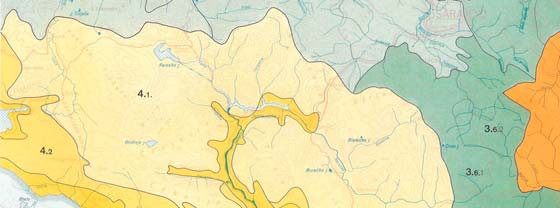
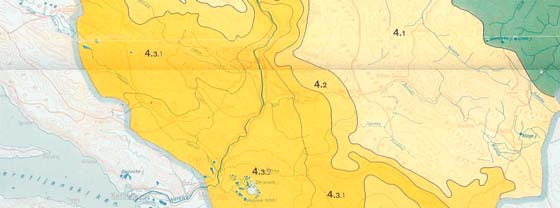
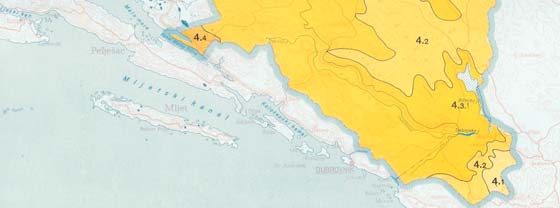
Bosnia and Herzegovina and Croatia
Proposed Integrated Ecosystem Management of the Nerteva and
Trebisnjica River Basin
(NTRB) Project
Picture 3.1: Schematic map of climate regions in Project area
Legend:
4.1
Sub-mediterranean mountainous region
4.2
Sub mediterranean hilly region
4.3
Sub Mediterranean region
4.3.1 Region without evergreen elements
4.3.2 Region with evergreen elements
Picture 3.2. shows average annual amount of rainfalls in the area of RH and BiH, where it is
obvious that the Neretva and Trebisnjica river basin is absolutely and relatively abundant
with the rainfalls. Consequently, with around 11.900 km3 of fresh water annually, River
Neretva is, right behind Nil river, the second river on Mediterranean in terms of intake of
fresh water. The most waters of river basin empty into the sea by River Neretva, but
considerable amount empty (especially from Trebisnjica river basin) through many other
springs (both on land and in the sea).
35
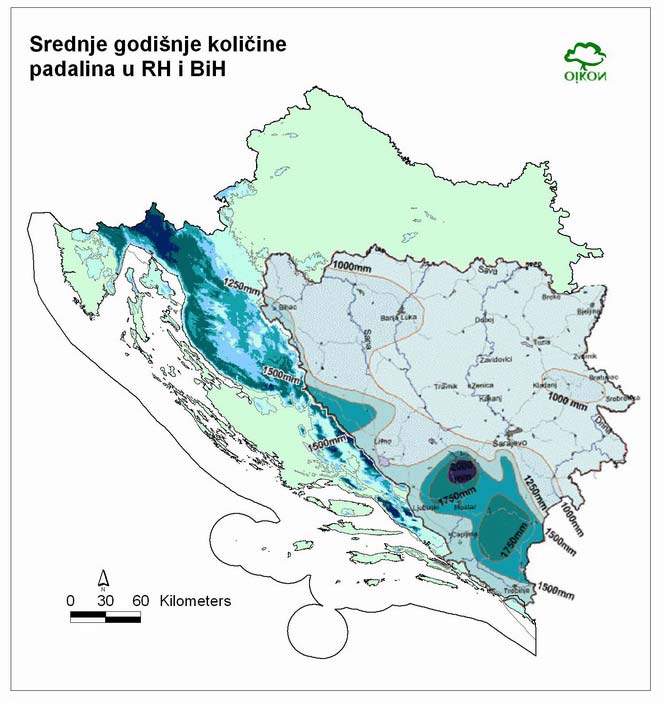
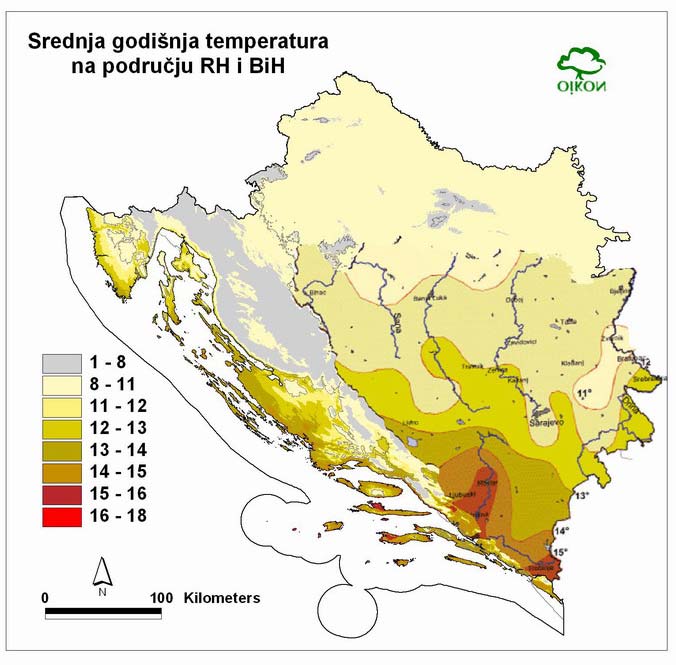
Bosnia and Herzegovina and Croatia
Proposed Integrated Ecosystem Management of the Nerteva and
Trebisnjica River Basin
(NTRB) Project
Picture 3.2. Average annual amount of rainfalls in the area of HR and BiH
(data source: RH Oikon climatic database; BiH Bosna S Oil data
Picture 3.3. shows average annual temperature in the area of RH and BiH, indicating that
temperature is higher in the river basin area than in the surrounding area of similar distance
from the sea, first of all due to Mediterranean impact spreading along Neretva valley.
Picture 3.3. Average annual temperature in the area of HR and BiH
(Data source: RC Oikon climatic database; BiH Bosna S Oil database)
36
Bosnia and Herzegovina and Croatia
Proposed Integrated Ecosystem Management of the Nerteva and
Trebisnjica River Basin
(NTRB) Project
3.4. Hydrology and Morphology
3.4.1. General Hydrological Features
The basic characteristic of the NTRB is that the terrain rises gradually from the sea
level to many mountains at an altitude above 2,000 m.
The entire area is under the influence of the Mediterranean climate, which weakens
with the increase in altitude. The average annual air temperature depends on the altitude
and varies between 7 and 15 °C, while the annual average precipitation ranges between
1,150 and 1,800 mm. Precipitation is heaviest in wintertime and it often causes flooding. On
the other hand, the vegetation period is characterized by the shortage of water.
Due to the abundance of karstic phenomena, the vegetation on this markedly karstic
area is poorly developed and there is little arable land. Between 15 and 20 hectares of alpine
and subalpine grasslands come per one hectare of arable land. The fields of western
Herzegovina descend from an altitude of 900 m to the sea, while the fields of eastern
Herzegovina descend from an altitude of 1,100 m to the sea.
The area of the Neretva basin together with the basin of the Trebisnjica, with which
the former is connected through underground watercourses, is supposed to amount to ca.
12,750 km2, even though hydrological yearbooks state that the area of the basins is ca.
9,800 km2.
In terms of size, the NTRB belongs to a very large basin whose watercourses or their parts
lie at altitudes rising above 800 m.
The main four ecological regions that can be differentiated in the basin are the following:
-
Submediterranean mountainous region
-
Submediterranean hilly region
-
Submediterranean region
-
Eumediterranean region
The limnological issues of the NTRB are very complex, comprising hydrological and
hydrobiological problems related to all the karstic phenomena occurring in this region. The
underground represents a specific ecological unit. The most significant feature of the region
is a wide diversity of ecological units: there are the habitats of wetlands, flood meadows,
soft broadleaves, water, land, and man-made habitats. The Neretva delta represents the
largest area of brackish water in Croatia. Gypsum barriers represent a specific phenomenon,
particularly on the Trebizat watercourse.
Important traffic routes pass through the NTRB, with a large number of settlements
and towns lying along the watercourses. The region is supposed to be inhabited by around
500,000 people, ca. 350,000 of which live in Bosnia-Herzegovina, and ca. 150,000 in Croatia.
The lower part of the upper course and the middle course of the Neretva and the
upper course of the Trebisnjica are used for the production of electricity.
There are plans for energetic exploitation of the upper part of the upper course and
the upper part of the lower course of the Neretva and some of its tributaries, as well as of
water from the "Upper Horizons" karst fields in eastern Herzegovina.
Intensive agricultural production is currently underway only in the Neretva delta
region and in Popovo Polje. As part of the project of transposing waters of the "Upper
Horizons" from the Neretva basin into the Trebisnjica basin, there are intentions of irrigating
37
Bosnia and Herzegovina and Croatia
Proposed Integrated Ecosystem Management of the Nerteva and
Trebisnjica River Basin
(NTRB) Project
the karst fields of eastern Herzegovina, but 20 years after the construction of hydropower
plants.
In the NTRB in general, and particularly in the lower course of the Neretva, there are
problems related to maritime influence, i.e. to increased salinization of water and soil due to
a drop in the level of groundwaters caused by the deepening of the Neretva riverbed.
The Neretva River basin: The Neretva is the longest and water-richest tributary of the
Adriatic Sea. The Neretva supplies the Adriatic Sea with around 11,900 km3 of fresh water
per year from the above-ground basin of an area of some 10,100 km2. About 90% of the
Neretva basin is located on the area of Bosnia-Herzegovina.
The Neretva basin area can provisionally be divided into three units:
-
the upper part of the Neretva basin, from its source to a former confluence of the
Rama and the Neretva Rivers (a few kilometres upstream of Jablanica)
-
the central part of the Neretva basin, from a former confluence of the Rama and the
Neretva to Zitomisli
-
the lower part of the Neretva basin, from Zitomisli to the sea.
The source area of the basin belongs to a high mountainous region of Bosnia. At a
stretch from Jablanica to Mostar the basin belongs to the zone of high karst, and
downstream of Mostar it belongs to the lower zone of high karst.
The tributaries of the Neretva joining it in its upper course from the right are the Slatnica,
the Rakitnica, the Ljuta, the Bijela, the Tresanica, the Kraljusnjica, the Neretvica, and the
Rama, while from the left it is joined by the Laanica, the Krupac, the Bukovica, the Sistica,
the Idbar, and the Draganka.
In its middle course the Neretva is joined by its right tributaries of the Doljanka and
the Drezanka, the Radobolje and the Jasenice, while from the left it is joined by its
tributaries of the Prenjska River and the Buna.
In its lower course the Neretva is joined by the Trebizat River from the right, and by
the Bregava and the Krupa from the left.
3.4.2. Quality of surface waters
Until 1989, the Republican Hydro meteorological Institute in Sarajevo performed the regular
water quality control in the watercourses in Bosnia Herzegovina. The quality of water at
reference stations in the Republic of Croatia is monitored by Hrvatske vode.
The quality of water is at present systematically monitored on the following watercourses:
-
in the Neretva basin: the Neretva, the Trebizat, the Vrljika, the Jasenica and the
Listica, Matica, Bainska jezera and Norin spring
-
in the Trebisnjica basin: the Musnica in Gatacko Polje, Bileko jezero, the Gorica
balancing reservoir and the Trebisnjica.
On the basis of inadequate physic-chemical indicators (conductivity, oxygen, redox, turbidity
and nitrate), the water from the upper and central Neretva basin and from the lower part of
the basin bordering on the Republic of Croatia meets the prescribed criteria for water class
II. The Trebizat, Jasenica and Listica waters also comply with the prescribed water quality in
accordance with the above-mentioned parameters.
38
Bosnia and Herzegovina and Croatia
Proposed Integrated Ecosystem Management of the Nerteva and
Trebisnjica River Basin
(NTRB) Project
Water in the Neretva on the Metkovi and Opuzen areas (the territory of the Republic
of Croatia) is of a lesser quality than the prescribed water class II due to increased values of
electric conductivity and microbiological indicators, on the area of Matica and Bainska jezera
due to an increased value of microbiological indicators, and in the Norin spring due to an
increased value of electric conductivity. The values indicating the oxygen regime and
nutrients in the Croatian part of the Neretva course meet the prescribed criteria.
According to the physico-chemical indicators of water quality, the waters from the
Bilea storage lake, the Gorica balancing reservoir, and the Trebisnjica upstream of the
wastewater treatment plant belong to water class I with occasional changeover into water
class II. The waters from the Trebisnjica downstream of the wastewater treatment plant
belong to water class III, particularly at a time of low water level. However, the above-
mentioned waters are loaded with bacteria and according to that parameter do not meet the
criteria for water class II.
3.4.2.1. Water quality in proposed WWTPs
Data on water quality in proposed WWTPs, if available, are presented below.
1) Konjic municipal wastewater
Recipient of the wastewater from the city is Neretva River, which, according to the Decree
on the Water Classification (Official Gazette, number 2/67) belongs to the Category II of the
water streams, and as such may be used for: swimming, water sports, fish farming, and with
adequate filters could be used for drinking and supplying of the industry. Wastewaters,
which flow into some water flow, should not change the proper class of the water stream
after they flow into it. Basic values of the parameters, which should be met in case of a Class
II water supply system, after the wastewaters are discharged, are as follows:
a) Suspended solids, not more than 30 mg/l;
b) Total evaporation residue, not more than 1000 mg/l;
c) Dissolved oxygen, at least 6 mg O2 /l;
d) BOD5, nor more than 4 mg/l;
e) pH value 6.8 8.5
The quality of wastewater of the city of Konjic deviates from these values. Table 3.1. below
gives an average value analysis of the Konjic wastewater.
Table 3.1.: Analyses of wastewater bulk parameters in Konjic
Parameters
Household
Small
Industry
Institutions
business
Turbidity (NTU)
28
95
17
700
pH value
7.59
7.78
7.05
6.79
Total evaporation residue at
318
780
352
2,748
105°C (mg/l)
Ashes at 550°C (mg/l)
162
348
134
558
39
Bosnia and Herzegovina and Croatia
Proposed Integrated Ecosystem Management of the Nerteva and
Trebisnjica River Basin
(NTRB) Project
Parameters
Household
Small
Industry
Institutions
business
Volatile compounds at
156
432
218
2,190
550°C (mg/l)
Suspended solid substances
62
198
26
1,625
(mg/l)
Electrical conductivity at
536
1583
366
718
20°C
m-alkalinity (mg CaCO3/l)
241
506
147
367
n-Kjeldahl (mg N/l)
14.84
96.60
1.68
24.64
Total phosphates (mg P/l)
3.002
5.912
0.525
4.120
COD (mg O2/l)
106
447
57
976
BOD5 (mg O2/l)
33
238
22
370
Toxicology (%)
-
70
30
-
Flow rate Q (m3/day)
21.75
1.34
166.67
26.67
Water consumption per
-
-
-
-
capita (l/day)
Number of inhabitants
-
-
-
-
connected to sewerage
network
EBS BOD5
34
9
139
382
EBS (suspended matters)
25
5
79
788
TSS
EBS toxicology
0
2
556
0
Total EBS
59
16
774
170
BOD5 kg/100 m3
3.3
23.8
2.2
37.0
Suspended solids TSS
6.2
19.8
2.6
162.5
(kg/100 m3)
40
Bosnia and Herzegovina and Croatia
Proposed Integrated Ecosystem Management of the Nerteva and
Trebisnjica River Basin
(NTRB) Project
2) SurTecEurosjaj metallurgy company in Konjic
SUR-Eurosjaj wastewater quality measurements were undertaken in period 18-20
December 2002, according to the methodology for estimation of PE, which is regulated by
the law (Regulation on types, range and methodology of wastewater quality measurements
Official Gazette FBiH, no. 48, 28.12.1998).
The measurements estimated the total wastewater load, expressed in population
equivalents as PE = 336. Estimation of the total wastewater load was undertaken on a
wastewater collector with its daily load of 100% of full capacity. The measurements were
undertaken on 18.12.2002. In the working period, sampling was done continuously both on
inlet (influent) and outlet (effluent) of the system. In order to obtain a satisfactory accuracy
of the time profile of all quantitative and qualitative parameters of the system in shift
working regime, the sampling rate was set on 8 hours. The results of these measurements
are given in Table 3.2.
Table 3.2: Qualitative and quantitative parameters of process wastewater in SUR-Eurosjaj
factory in Konjic
Parameters
Influent
Effluent
Effects of
treatment (%)
COD (mg/l)
103
50
51.4
BOD (mg/l)
15
7
53.2
Chlorides (mg/l)
257
15
94.2
Sulphur (mg/l)
135
17
87.4
Detergents (mg/l)
0.8
0.6
25
Phosphates (mg/l)
22,4
0.24
98,9
Copper (mg/l)
1.58
0.37
76.5
Tin (mg/l)
0.046
0.008
82.6
Lead (mg/l)
0.005
0.003
40
Nickel (mg/l)
-
-
-
Zink (mg/l)
16.1
0.36
97.7
Chrome (mg/l)
0.22
0.14
36.3
Cyanides (mg/l)
0.061
0.009
85.2
Suspended solids
18
14
22.2
(mg/l)
Properly treated wastewater discharged from the treatment plant will have the following
characteristics:
41
Bosnia and Herzegovina and Croatia
Proposed Integrated Ecosystem Management of the Nerteva and
Trebisnjica River Basin
(NTRB) Project
Table 3.3.: Chemical structure of outlet water from WWTP at SurTecEurosjaj
Item
Description
Permissible
Expected
Comment
no.
concentration (mg/l)
concentration
1.
Chrome Cr3+
0.1
0.5
0.05
2.
Nickel Ni2+
0.05
0.1
0.04
3.
Copper Co2+
0.01
0.1
0.1
4.
Zinc Zn2+
0.2
1.0
0.1
5.
Cyanides CN-
0.1
0.1
0.05
6.
Iron Fe2+
0.3
1.0
0.2
7.
pH level
6.8-8.5
6.0-9.0
6.5-8.0
8.*
Sodium Na+
Not prescribed
9.*
Chlorides Cl-
Not prescribed
10.*
Calcium Ca2+
Not prescribed
11.*
Sulphates
Not prescribed
12.
HCO
2-
3-; CO3
Not prescribed
* Defined in terms of evaporation residue and heating losses
** Permissible concentrations are given with respect to the recipient and class of water and
expected concentrations are given for the facility outlet.
3) UNISGAL metallurgy company in Konjic
Testing of wastewaters is conducted daily in company's own Laboratory and the test
data are logged. The chemical analysis is performed by a spectrophotometer, and besides
chemical
parameters, physical parameters such as flow rate, temperature, conductivity are
determined.
In addition to company's own testing, wastewater is also tested by the ,,Public health
institute Mostar" that issues a report on the efficiency of the wastewater treatment. Results
of such test are given in Table 3.4. below. Based on the report, and according to the
regulations, wastewater exits the neutralization tank before entering the recipient water flow
contain parameters in the following ranges:
· BOD5 < 50 mg/l;
· COD < 150 mg/l;
· Suspended substances 60 mg/l;
· pHvalue 6.58.5.
42
Bosnia and Herzegovina and Croatia
Proposed Integrated Ecosystem Management of the Nerteva and
Trebisnjica River Basin
(NTRB) Project
Table 3.4.: Quantitative and qualitative parameters of Wastewater Treatment Plant UNISGAL
Parameters
Values
pH
8.05
Water temperature (°C)
11.3
Turbidity (NTU)
4.15
Electrical conductivity (µS/cm)
420
COD (mg O2/l)
47
BOD (mg/l)
12
Sulphur (mg/l)
13
Residual after evaporation (mg/l)
198
Suspended solids (mg/l)
9
Phosphate (mg/l)
0.15
Copper (mg/l)
0.20
Iron (mg/l)
1.11
Zinc (mg/l)
0.79
Chrome (mg/l)
0.02
Cyanides (mg/l)
0.009
Detergents (mg/l)
1.0
Here it was showed the application of a completely new method of wastewater treatment,
which has a number of advantages in comparison to the ion exchanger method, and
especially in comparison with the current method. This new method of wastewater treatment
in comparison to the ion exchanger method or in comparison to the current method shows
fol owing improvements:
· Cross-contamination deficiency is removed;
· Each wastewater flow is separately treated;
· Higher degree of wastewater purification;
· Lesser amount of precipitated sediment after treatment;
· Reduction of wastewater flow rates;
· Complete automation of the wastewater treatment process which greatly
reduces the possibility of human error;
· Possibility of phased system implementation depending on available funds;
· Unlike the current system, this method treats at the start and not at the end
of the pipe.
43
4) Ljubuski municipal wastewater
Public enterprise JKP "Ljubuski" is responsible for management of the water supply system and wastewater treatment in the Ljubuski
municipality. Department "Water supply, sewage system and wastewater treatment" is operational within the Public enterprise. It consists of
separate units for maintenance of water supply system, maintenance of sewage system, wastewater treatment, water quality control and
pumping stations. Results of water quality control are given in Table 3.5. below. Wastewater treatment plant is operating under this
department along with the laboratory for water quality control.
Table 3.5: Qualitative and quantitative parameters of the effluent and influent WWTP Ljubuski (kg/day)
Influent
Effluent
Mean values
Effects
Parameters
Month
Month
Influent
Effluent
%
06/2005 07/2005 08/2005 06/2005 07/2005 08/2005
Alkalinity (CaCO3)
100.896
142.620
135.787
102.047
105.793
108.740
126.434
105.527
16.5
KPK
76.339
64.307
56.310
27.927
38.821
23.061
65.652
29.936
54.4
BOD5
31.185
42.067
39.575
15.063
17.820
14.563
39.609
15.816
60.1
Nitrogen (N)
4.333
4.672
4.900
1.513
0.790
0.772
4.635
1.025
77.9
Total Nitrogen
2.113
1.892
1.793
0.922
1.145
1.298
1.933
1.119
42.1
Nitrites
0.064
0.180
0.322
0.118
0.649
1.123
0.189
0.63
+233.3
Nitrates
1.413
1.591
1.107
4.219
5.388
5.352
1.370
4.986
+263.9
Total phosphor (P)
4.659
4.407
3.731
3.527
4.181
4.381
4.266
4.030
5.5
Dry residue at 105°C
158.881
223.913
228.303
145.523
234.753
208.443
203.699
196.240
3.7
Ashes at 550°C
76.379
98.973
164.233
64.938
88.580
120.992
113.195
91.503
19.2
Volatile at 550°C
82.502
124.940
64.070
80.585
146.173
87.451
90.504
104.736
+15.7
Suspended solids at 18.326
17.923
20.307
12.646
5.867
7.475
18.525
8.663
53.2
105°C
Dissolved at 550°C
140.554
205.990
207.997
132.877
228.886
200.968
184.847
187.577
+1.5
Flow (m3/24 h)
1,050
1,310
1,340
1,050
1,310
1,340
Parameters Household Smal
5) Bilea and Trebinje
Table 3.6. below summarizes the flow rates of municipal wastewaters into Bileko lake from
municipalities Trebinje and Bilea, due to the fact that their municipal water supply takes
water from the Bileko lake, close to the wastewater discharge point.
Table 3.6.: Estimated flow rates of household wastewaters
Trebinje
Bilea
From households Sewage Diffusion
Sum
Sewage Diffusion
Sum
COD as KmnO4
135,000
135,000
270,000
49,500
49,500
99,000
(kg/year)
BOD5 (kg/year)
225,000
225,000
450,000
82,500
82,500
165,000
SM (kg/year)
270,000
270,000
540,000
99,000
99,000
198,000
Total Nitrogen
45,000
45,000
90,000
16,500
16,500
33,000
(kg/year)
Total phosphor
9,000
9,000
18,000
3,300
3,300
6,600
(kg/year)
Chlorides (kg/year)
324,000
324,000
648,000
118,800
118,800
237,600
Cyanides (kg/year)
31.5
31.5
63
11.55
11.55
23.10
Led (kg/year)
58.5
58.5
117
21.45
21.45
42.9
Expected quality of treated water from Bilea municipality using modern variant based on
conventional technology of biological treatments as follows:
Table 3.7: Expected quality of treated water
Parameter
Results of treatment
BOD5
< 10 mg O2/l
Suspended solids
< 20 mg/l
NH4-N
Removal rate > 90%
Total nitrogen N
Removal rate > 70%
Total phosphor P
Removal rate > 60%
3.4.3. Activities affecting the hydrological regime and a change of the
general ecological function of water
The Neretva and Trebisnjica Rivers and their surroundings have been under the influence of
various human activities for a long time, particularly after the 1950-ies. Particularly
remarkable are the activities related with:
a change in the natural flow regime and a disturbance in the settling of alluvium
amelioration, or a conversion of large wetland areas into arable agricultural land
a transposal of waters from one sub-basin into another sub-basin by the construction
of a duct network
the obstruction of rivers with the purpose of exploiting their energetic hydropotential
intensive monocultural agricultural production, more and more accompanied by the
use of agrochemicals, i.e. a change in traditional cultivation of field crops
inadequate use
uncontrolled disposal of household/industrial waste
Bosnia and Herzegovina and Croatia
Proposed Integrated Ecosystem Management of the Nerteva and
Trebisnjica River Basin
(NTRB) Project
the discharge of untreated communal and industrial wastewater into the
watercourses and the underground
the exploitation of mineral raw materials.
However, in this chapter we shall deal only with the construction of storage lakes, the
performed ameliorations and the exploitation of gravel.
The Neretva basin: Among the storage lakes on the Neretva River, the storage lakes of
the Jablanica, Grabovica, Salakovac and Mostar I Hydropower Plants were constructed
primarily for the production of electricity. The Rama Hydropower Plant storage lake was
constructed on the Rama, the right tributary of the Neretva.
The Jablanica storage lake, about 24.5 km in length and about 0.59 km in average
width, was constructed in 1955. It has an area of ca. 14.4 km2 and a total capacity of ca.
487.0 x 10⁶m3. The Grabovica storage lake, constructed in 1982, has an area of ca. 1.34
km2, and a total capacity of 19.77 x 10⁶m3. The Salakovac storage lake was constructed in
1981, with an area of ca. 3,665 km2, and a total capacity of ca. 68.0 x 10⁶m3. The Mostar I
HPP storage lake, constructed in 1987, has an area of ca. 1,908 km2 and an effective
capacity of ca. 10.92 x 10⁶m3. The Rama HPP storage lake was constructed in 1968. It is ca.
7.5 km long and ca. 2.0 km wide on average. It has an area of ca. 14,808 km2 and an
effective capacity of ca. 487.0 x 10⁶m3 (Pehar 2003).
With the purpose of reducing the floods in Imotsko-bekijsko Polje, the Ricica multi-
purpose storage and two retarding basins are used in the basin of the Trebizat, the right
tributary of the Neretva. The construction of the Ricica storage significantly reduced the
intensity of floods in Imotsko-bekijsko Polje, provided water for the irrigation of ca. 8,000 ha
of agricultural land, and created preconditions for energetic exploitation of the accumulated
water. The total capacity of the storage is 31.0 x 10⁶m3. The Prolozac Retarding Basin,
constructed on the western part of the field near the settlement of Prolozac, has a capacity
of ca. 11.4 x 10⁶ m3. Nuga, a former natural retarding basin in the southeastern part of the
field with a capacity of 80 x 10 6 m3, has been used for the purposes of the Pe Mlini HPP
since 2004.
Furthermore, a drainage system, i.e. a gravity duct network, has been constructed in
the field. The Rastovaca Retarding Basin near Posusje, with a capacity of ca. 24 x 106m3, has
been constructed for flood protection in Posusko-virsko Polje. Furthermore, the first phase of
the Tribistovo storage, with a total capacity of 4.95 x 10⁶m3, has been constructed near
Posusje for water supply needs and flood protection of this field and downstream horizons.
There are plans for the construction of the second phase of the Tribistovo storage, with the
purpose of supplying water to the wider region.
The Sluzanj Retarding Basin, with a capacity of ca. 5.20 x 10⁶m3, was constructed for
the protection of the field of Brotnjo (Citluk) from floods (Pejakovi 2003). A tunnel with a
capacity of 60 m3/s was constructed with the purpose of draining Vrgorsko Polje; the tunnel
conveys the waters into Bainska Lakes, from where they are conveyed into the sea through
another tunnel.
The regulation of the Neretva at a section from Metkovi to the sea, carried out with
the purpose of ensuring the navigability of the Neretva to the port of Metkovi, had a
significant impact on the hydrological regime of the Neretva delta. Intensive meliorative
works which began in the 1960-ies in accordance with the decision reached by the FAO in
1963 had the same impact. As a result of these works, the total water surfaces which once
amounted to around 80% of the entire delta area, amount today to only around 25%. Since
46
Bosnia and Herzegovina and Croatia
Proposed Integrated Ecosystem Management of the Nerteva and
Trebisnjica River Basin
(NTRB) Project
the entire area is markedly low in relation to the mean sea level, the drainage of
precipitation water was resolved by the construction of several pumping stations. The main
non-meliorated areas are located at a stretch Vid Norin, as well as on the Kuti area.
However, the melioration of the Kuti area began in 1978, ceased in 1980, continued in 1986,
only to cease again in 1990. The flood protection facilities have been around 80% complete
(avar. S. 2001).
According to a study entitled The Hydroenergetic Exploitation of the Upper Neretva (Sarajevo
1984), the following storages are planned to be constructed on the Neretva upstream of
Konjic:
· Konjic
capacity 75 x 10 6 m3
· Glavaticevo capacity 157 x 10 6 m3
· Ljubaca capacity
62
x
10
6 m3
· Ulog
capacity 389 x 10 6 m3
However, following the preparation of preliminary designs for the Konjic Storage in 1985 and
the Glavaticevo Storage in 1989, the fol owing effective capacities of the storages were
adopted: the Konjic storage: 69 x 10 6 m3, the Glavaticevo Storage: 157 x 10 6 m3 prior to
the construction of the Ljubaca and Ulog Storages, and 55 x 10 6 m3 after the construction of
the Ljubaca and Ulog Storages.
The construction of the Glavaticevo Storage with a capacity of 157 x 106 m3 would lead to a
significant increase in the minimum flow of the Neretva near Jablanica, unlike the
construction of the Glavaticevo Storage with a capacity of 55 x 106 m3. This is related with
abandoning the construction of the Ljubaca and Ulog Storages.
The rest of the Neretva basin has been considered in relation with the needs and possibilities
of constructing the following storages:
· storages on the lower course of the Neretva:
· Buna
capacity
1.0
x
106 m3
· Pocitelj capacity
6.5
x
106 m3
· Mostar II
· storages on the Trebizat
· Klokun
capacity
26
x
106 m3
· storages on the Listica
· Dubrava
capacity 6.0 x 10⁶ m3
The projects for energetic exploitation of water from Mostarsko blato for the needs of the
Mostarsko blato HPP are in the process of preparation.
The exploitation of gravel results not only in an increased deepening of the riverbed,
but also in the reduction of groundwater levels in the hinterland and in increased salinization
of the delta. Gravel is exploited from the Neretva mostly in the Capljina area.
The Trebisnjca Basin: Storage lakes constructed on the Trebisnjica River primarily with the
purpose of the production of electricity, reduction of floods in Popovo Polje and water supply
are the Bilea storage lake serving the Trebinje I HPP and the Gorica storage lake serving
the Trebinje II HPP and partly the Dubrovnik HPP.
47
Bosnia and Herzegovina and Croatia
Proposed Integrated Ecosystem Management of the Nerteva and
Trebisnjica River Basin
(NTRB) Project
The Bilea storage lake dates from 1969, when a dam was constructed on the
Trebisnjica some 17 km upstream of Trebinje in the Grancarevo region. It is ca. 18 km long,
with an area of ca. 2,020 ha and a total capacity of ca. 1,280 x 106 m3. The Gorica balancing
reservoir was formed with the construction of the Gorica Dam 13.5 km downstream of
Trebinje. It is used for the daily balancing of the waters from the Trebinje HPP and from the
Susnica, the tributary of the Trebisnjica. It is ca. 13.5 km long, with an area of ca. 150 ha
and a total capacity of ca. 15.6 x 10⁶ m3.
It had been decided that the biological minimum of ca. 8 m3 of water is to be
discharged from the Bilea storage lake into the Trebisnjica riverbed downstream of the
Gorica Dam. As these waters used to sink underground on their way through Popovo Polje, a
68 km long canal was constructed in the field in 1978. The canal was constructed for
energetic exploitation of these waters in the Capljina HPP and for the irrigation of Popovo
Polje, which used to flood regularly before 1978. The facilities of the Capljina HPP occupy a
part of the Hutovo Blato wetland, which belongs to the lower Neretva basin.
Several significant water management facilities constructed in the karst fields of
eastern Herzegovina prior to the construction of the existing HPPs on the Trebisnjica are the
Klinje storage on the Musnica watercourse (constructed in 1898) and several smaller HPPs
which are no longer operational. The Klinje storage was constructed for the irrigation of
Gatacko Polje, whose irrigation system has been neglected for a long time.
According to The Report on the Construction Impact of the System of Multi-purpose
Use of Water from "Upper Horizons" of Eastern Herzegovina on the Trebisnjica and Neretva
Water Regimes (Trebinje 2004.), there is a plan of constructing several storage lakes in
eastern Herzegovina in the second stage of the realisation of the "Trebisnjica Hydrosystem"
Project, all with the purpose of spatial and temporal redistribution of runoff and the
protection of karst fields from floods.
The spatial redistribution, i.e. the transposition of waters from the Neretva basin into
the Trebisnjica basin, would be achieved by constructing a tunnel between the fields of
Nevesinjsko, Dabarsko and Fatnicko Polje, a channel through these fields, and a channel
through Bileko Polje. The first stage would encompass the drainage of Dabarsko Polje and
Fatnicko Polje and provide energetic exploitation of waters from these fields at the existing
Trebinje I, Trebinje II and Dubrovnik HPPs. To that end, a 2.77 km long channel and a 15.6
km long tunnel leading to the Bilea storage would be constructed.
The second stage would consist of the following steps: the transposition of waters
from Gatacko Polje into Nevesinjsko Polje, the construction of two dams, which would lead
to the formation of two storages in Nevesinjsko Polje, Zalomka and Posenje, and the
construction of the Nevesinje, Dabar and Bilea HPPs.
One portion of waters from Gatacko Polje, together with waters from the Zalomka
watercourse in Nevesinjsko Polje, would be used at the Nevesinje HPP in Nevesinjsko Polje.
The construction of the Posenje Dam would entail the formation of the Nevesinje Storage,
whose water would be used at the Dabar HPP. Apart from energetic exploitation, water from
both storages would be used for the irrigation of Nevesinjsko Polje, Dabarsko Polje and
Fatnicko Polje. However, the original plan was to construct the irrigation system of these
fields only 20 years after the construction of the intended hydropower plants (The Karst
fields of Eastern Herzegovina, 1967).
Water used at the Dabar HPP would be conveyed via a tunnel to Fatnicko Polje, and
futher through channels and tunnels into the Bilea Storage. The Bilea HPP is planned to be
constructed at the end of a water transfer tunnel.
48
Bosnia and Herzegovina and Croatia
Proposed Integrated Ecosystem Management of the Nerteva and
Trebisnjica River Basin
(NTRB) Project
The planned storages have the following capacities:
- Zalomka
185.5
x
106 m3
- Poscenje
61.8 x 10⁶ m3
Among other facilities in eastern Herzegovina, the Gacko Thermal Power Plant might have a
considerably negative impact on the Trebisnjica basin.
3.4.4. General morphological features
The Neretva and Trebisnjica basin represents a unique morphological body in the central
part of the Dinaric Alps in terms of its origin, individual relief elements, shape, length and
geographical location.
In morph metric terms the NTRB is characterized by a richly articulated relief. The
terrain slopes the most in gorges and transitional surfaces towards mountains, while it slopes
the least in ravines and depressions between the mountains.
Among the numerous karst fields in the NTRB, the most important ones are located in the
middle part of the course.
In the lower part of the NTRB there sticks out the Neretva delta. The Croatian part of
the delta was included into the Ramsar List in 1993. The most important part of the delta in
Bosnia-Herzegovina belongs to the Hutovo Blato Nature Park, which has been on the Ramsar
List since 2001.
Intensive amelioration, which began in the Neretva delta in the 1960-ies, has reduced
its total water surface from 80% to the current 25%.
In terms of its origin, individual relief elements, shape, length and geographical
location, the Trebisnjica River basin, just as the Neretva River basin, represents a typical
karst region, i.e. a unique morphological body located in the south-eastern part of the
Dinaric Alps.
The relief of the NTRB is basically made of karstic mountainous massifs, karst fields,
and numerous canyons and gorges with periodical and permanent watercourses. The
mountains are mostly rocky, largely without forest vegetation.
The region is characterized by the morphological forms typical of karst, such as
karrens, funnel-shaped sinkholes, dry valleys, shafts, caves, and karst fields.
Among many karst fields in the Trebisnjica basin with numerous springs, swallets and
estavelles on their edges, Popovo Polje is particularly prominent. Popovo Polje is located in
the lower part of the Trebisnjica basin. It would flood regularly prior to the construction of
hydropower plants on the Trebisnjica. It used to connect the Trebisnjica with the sea over
numerous springs by the sea, as well as with the Neretva over Hutovo blato and the springs
near Metkovi.
3.5. Seismology
Area of NTRB is very seismological active area, with frequent occurrences of earth
quakes. Maximum expected earthquake intensity ranges from 7-10 MCS. In terms of
seismicity, Dubrovnik Region is the most active region in the Balkan.
Project foresees networking of all seismology station in Project region, in order to
monitor seismology activities.
Seismic area of Herzegovina (Ljubinje) is located in a zone with maximum degree of
seismic intensity created by earthquake in 1927, from the local focal point intensity of
which was Io= 8 MCS in epicenter, magnitude M= 6,0.
49
Bosnia and Herzegovina and Croatia
Proposed Integrated Ecosystem Management of the Nerteva and
Trebisnjica River Basin
(NTRB) Project
Besides earthquake from local focal point, this area was influenced by earthquakes
in neighboring countries, especially earthquake from Montenegro 1979, whose intensity in
epicenter was Io= 9 MCS, magnitude M= 7,1 and earthquakes from Croatia, especially
from the focal point Imotsko (earthquake in 1923, Io = 8-9 MCS, magnitude M= 6,2).
A large earthquake could cause hundreds of deaths and lasting damage the economic
base. They could spawn hazardous materials spills, landslides, conflagrations and seiches.
Each of these secondary events would cause additional damage and casualties. Impacts of
Earthquake are:
· Disruption of normal Life.
· Losing of lives, livelihoods and property.
· Loss of housing.
· Damage to infrastructure
· Disruption of transport and communication
· Disruption of marketing systems.
· Breakdown of social order
· Loss of business
· Loss of industrial output
3.6. Social Assessment
Of the total population living in the project region, 90% live in BiH, with most of them
(78%) living in the FBiH. In BiH, poverty and unemployment are high. Economic conditions
are better in the Croatia section of the Neretva River Watershed, but there too depopulation,
aging population, and lack of economic opportunities characterize the area. While the
population generally is aware of the importance of the integrity of water resources and their
related ecosystems to the economic development of the region, and recognize the
degradation that is occurring, they feel powerless to influence the decision-making.
Approximately 430,000 people inhabit the NTRB of which less than 10% reside in
Croatia. In BiH, the population is primarily rural and poor. Although the return process
continues, the number of population is in decline. Almost 18% of the population is under age
of 15 and almost 14% is over age of 65. Prior to the recent war, the towns in the NTRB were
fairly multicultural, however the cultural demography has changed and now towns are
dominated by a single majority ethnic group. The transition and war caused new reasons for
poverty in the NTRB, including high unemployment rate, economic emigration and related
loss of technical expertise and aging population. The unemployment rate varies between 26
and 46%. Over 60% of respondents to the household survey have other sources of income
to support their families, primarily receiving aid from family members.
Participation of citizens and interest groups is low throughout the NTRB and there is a
lack of civil representation in decision-making structures; lack of awareness about citizen
rights; and lack of knowledge about mechanisms and processes available to protect them.
The capacity of environmental groups and networks, with only a few exceptions, is
limited. The social assessment identified that local communities feel disconnected from the
decision making process. The lack of community input into and control over decision-making
is accompanied by a lack of sense of local ownership. The household survey found that there
is little participation at the grass roots level in community organizations, in particular relating
to water and land issues.
50
Bosnia and Herzegovina and Croatia
Proposed Integrated Ecosystem Management of the Nerteva and
Trebisnjica River Basin
(NTRB) Project
The social assessment identified an overarching desire of local communities to be
able to increase their input and control over decision-making on issues, which affect their
lives. There is a high level of agreement on key issues throughout the watershed. The three
priority areas for action identified are:
· Improve environmental quality especially regarding water resource management
· Build economic capacity
· Strengthen historical and cultural traditions.
Of 205 individual stakeholders surveyed, no one has ever participated in either land
or water management, and overall, only 14% expressed interest in doing so if offered the
opportunity. The SA indicated that stakeholders throughout the watershed are concerned
about resource limitation and environmental degradation. Stakeholders are concerned that
environmental degradation will affect the potential for economic development through
agriculture and tourism. Many have expressed feeling of lack of self-esteem that results from
living in a litter-strewn environment.
The household survey found that water was perceived as the most precious natural
resource in the NTRB by 42% of respondents, while 39% responded forests were most
precious. Consultation with community based and government organizations identified the
supply of good quality potable water and agriculture as serious and pressing issues in most
parts of the watershed.
51
Bosnia and Herzegovina and Croatia
Proposed Integrated Ecosystem Management of the Nerteva and
Trebisnjica River Basin
(NTRB) Project
4.
IDENTIFIED ENVIRONMENTAL IMPACTS
4.1 Impacts during construction
Short-term impacts on the environment, i.e. immediate surrounding of the site, could
be expected to occur during the construction or future decommissioning activities. Noise,
vibration, dust and construction wastes could be generated during construction, while land
quality may be affected and vegetation destroyed during the works. It is also important to
emphasize that there is certain probability of chance findings of cultural heritage items or
mass graves during excavation or construction activities.
In particular, the principles given in Mitigation measures in next chapter should be fol owed
see below.
Proposed project activities are relatively small in scale so that negative impact on
environment during the construction works will be minimal.
4.2. Changes in Land Use
Change in land use is one of the impacts that is permanent, and can be mitigated in one of
the following ways applicable to this project:
construct collectors and plants on public owned land,
use locations of former wastewater treatment plants if applicable
use locations within possible industrial zones
In the project foreseen activities are relatively small in scale so that limited changes in land
use could be expected.
4.3. Noise and Vibration
Noise and vibration may occur both during the construction and during the later plant
operation phases. During the construction and decommissioning phases, noise and vibration
occur as a result of the increased traffic and construction works, such as compaction,
excavation, drilling or mechanical digging.
However, proper scheduling of the construction activities can substantially reduce the
noise and vibration impacts, by limiting them to regular daytime periods. Additionally, all
transport to and from the site with larger vehicles should be adapted to the local traffic flow
of the daytime periods given.
During the plant operation, the noise levels produced should be maintained within
acceptable limits.
4.4. Odour
Unpleasant odour is an unavoidable issue during wastewater treatment, due to a
number of gasses produced and emitted, such as hydrogen sulphide. Since this odour cannot
be avoided, it can be minimized by means of buffer zones around the treatment plant, or
costly instal ation of odour control equipment.
During normal operation, no significant odour problems should arise, unless there is a
52
Bosnia and Herzegovina and Croatia
Proposed Integrated Ecosystem Management of the Nerteva and
Trebisnjica River Basin
(NTRB) Project
malfunction that can make the sewage or sludge become septic and emit strong odours. It is
important to ensure disposal of solids and wastes on an appropriate disposal site, such as a
sanitary landfill, in a way described in Mitigation plans given in Chapter 5.
The overall effect of the project shall result in a long-term reduction of certain
problems, such as odour release from the open water bodies in the project area.
4.5. Impact on Population and Development
This project will create new work places during the construction phase and the later
plant operation, maintenance and management. The establishment of appropriate
wastewater collection and treatment systems will help overcome substantial urban
development barriers, and therefore this project wil facilitate further construction within the
urban areas.
4.6. Impact on Historical Sites
No impacts on historical sites or cultural heritage objects are expected on the
locations of the identified four project components. All construction works and activities are
planned outside areas with cultural heritage. However, even though unlikely, chance findings
of archaeological sites or mass graves during the construction activities cannot be ruled out.
4.7. Impact on Surface and Ground Water
The project is expected to have a direct positive effect on the surface water quality,
especial y in the water bodies that have been the recipients of raw sewage. This will
particularly be reflected in the achievement of more acceptable BOD (biological oxygen
demand) values for the recipient, as wel as significant reduction of microbiological and
nutrient pollution on all project locations. This positive effect will depend on the plant
efficiency.
4.8. Impact on Agriculture
No negative impact on agriculture is expected.
If the sludge from the treatment plant is adequately treated, it can be used in
agriculture as fertilizer, while disinfected effluent can be used for irrigation. As a result, the
agricultural activities can be intensified, or provided potential to develop while preserving
natural resources.
However, it is important to note that the quality of the sludge and effluent needs to
be carefully and continuously monitored in case of their agricultural use, in order to prevent
toxic levels of heavy metals or pathogenic microbes in crops. Along with the monitoring
system, the agricultural workers would need to be trained.
4.9. Impact on Health
When considering that the rivers and other watercourses in BiH are used for drinking water
supply, irrigation and recreational purposes, it is evident that the release of untreated
wastewater can cause significant concern, especially with regards to public health.
Through collection and adequate treatment of wastewater, the quantities of raw sewage
released into the watercourses will be reduced. As an immediate result, the amount of
53
Bosnia and Herzegovina and Croatia
Proposed Integrated Ecosystem Management of the Nerteva and
Trebisnjica River Basin
(NTRB) Project
pathogenic micro organisms and polluting constituents is expected to be decreased, thus
reducing the chances of disease occurrence either through drinking water, irrigation of crops
or direct contact.
4.10. Adverse Impacts on Natural Environment
No negative impacts on natural environment are expected in relation to this project.
Following the adequate mitigation measures recommended in Chapter 5, the project is
expected to have a positive overall effect on the nature.
Thus improvement of water quality in the watercourses concerned is expected, which
will in turn help preserve and protect the biodiversity and ecosystems.
54
Bosnia and Herzegovina and Croatia
Proposed Integrated Ecosystem Management of the Nerteva and
Trebisnjica River Basin
(NTRB) Project
5. ENVIRONMENTAL MANAGEMENT PLAN
5.1. General aspects
Each of the sub-components listed above have its own specifics, but it can be divided in four
segments:
- Improving of tourism infrastructure on behalf of Nature protection promotion and
valuating
- Improving of waste water systems on behalf of Terrestrial and aquatic habitats
protection
- Salt water intrusion
- Small grants
All segments shal be improved or rehabilitated in order to increase level of Nature
protection in NTRB. By meeting these aims, the project would also protect the health of
general population in the region. Furthermore, through the improving of waste water
systems as for sub-components would be placed improvement of Water quality in rivers,
lakes and underground waterways and lakes.
According to procedures of BiH and RH, planned activities do not require preparation of EIA,
neither praxis foresees preparation of EMP.
However, in this document, an Environmental Management Plan (EMP) is provided for each
of the sub-components. The EMP addresses possible environmental issues, which are mostly
minor, or are already included in the project implementation itself.
The EMPs contain the following:
- mitigation plan,
- monitoring plan,
- institutional strengthening
In this way, proposed sub-components for improvement of water quality will
significantly mitigate impact of wastewater from cities.
Preliminary step during EA procedure was screening process for identification of
possible negative environmental impacts and the manner in which these issues could be
mitigated. Following the mitigation plan, a monitoring plan comprising all parameters and
issues identified in the mitigation plan is provided. These mitigation measures need to be
regularly monitored and plants operators have to include monitoring in their working routine,
providing continuous supervision through selected control indicator.
Prior to commencement of all activities foreseen within this Project, it is important to
note that the majority of possible environmental impacts would occur during the construction
phases.
Additionally, it is important to note that all of the issues listed within the EMP as
responsibility of the construction or decommission contractor shall be specified within the
construction bid documents.
55
Bosnia and Herzegovina and Croatia
Proposed Integrated Ecosystem Management of the Nerteva and
Trebisnjica River Basin
(NTRB) Project
5.2. Sub-components description and affiliated EMPs
For all activities which were determined as subject of EIA, short description, review of
legislation requirements and environmental mitigation and monitoring plan are given below
and in the tables.
Also, examples of good practice for some selected issues are given in Annex 3 of this Report.
5.2.1. Bilea municipal wastewater collection and treatment infrastructure
Description of current situation: Bileca is a municipality and town in the southeastern
part of Bosnia and Herzegovina. Area of the municipality is 633 km², with approximately
15,000 inhabitants, 9,000 of which live in the town of Bileca. The average altitude of Bileca is
476 m above sea level. Mediterranean and continental-mountainous climates meet on the
territory of Bileca. The landscape is hilly with karstic fields: Dabarsko, Fatnicko, Plansko and
Bileko fields. South of Bileca the spring of Trebisnjica River is located. In 1996, a
hydroelectric power plant was built and one of the largest accumulation lakes in the world
was founded, Bileko Lake, 18 km long and 3-4 km wide.
The existing wastewater collection system in Bileca is incomplete and covers only the
central part of the urban area. Around 50% of consumers are connected to the sewage
system, (approx. 1,300 households), and the rest are connected to septic tanks which are
freely discharged in to the ground and probably infiltrate into Bilecko Lake. There are two
collectors in the town area. Collector no.1, with a 300 mm diameter, covers the town area
above the following streets: Obiliev vijenac, Kralja Aleksandra, Srpske vojske and a section
of the regional road to the wastewater treatment facility Drakuljice. Collector no.2, with a
500 mm diameter runs through the town area Grabovica and army barracks "Srpska vojska"
and connects with the collector no.1 near southern gates of the army barracks. This collector
is used to collect wastewater from the buildings located between the bus station and the
army barracks, i.e. from buildings that are lower than collector no.1. Due to the small
diameter of collector no.1 it is often clogged and wastewater freely overflows, most
frequently between the col ector no.1 connection site and the treatment facility. Parts of
town located at lower altitudes, which are not connected to the sewage system, use septic
tanks, which are improperly built, leak or are in direct contact with the groundwater. The
wastewater treatment facility Drakuljice, built in 1967, is sized to handle 10,000 PE and was
meant to treat household wastewater and pre-treated industrial wastewater. However, the
filtration system with two manual grates, two primary sedimentation tanks, a biological filter,
two secondary sedimentation tanks and a contact chlorination tank has been out of service
for over twenty years. Wastewater is freely discharged at the facility and flows untreated
into Bileko Lake close to the water supply intake. Since the lake has a multifunctional
character and its water supplies municipalities Bilea, Trebinje, Niksi, Dubrovnik, Herceg
Novi and Capljina, it is evident that the wastewater of Bileca represents a regional problem.
Industrial wastewater treatment system of the carpet factory "Bileanka" was built in
1962 with only equalization tanks as a treatment method, until 1976 when a new facility
offering the complete wastewater treatment was built. That system consisted of two
treatment lines: one for treatment of dyed water and one for treatment of wool rinse. The
treatment facility was fully operational until the beginning of the war in 1992, and in 1993, it
was put out of operation. After that the untreated wastewater is being freely discharged into
the underground from where they can flow into the Bileko Lake.
56
Bosnia and Herzegovina and Croatia
Proposed Integrated Ecosystem Management of the Nerteva and
Trebisnjica River Basin
(NTRB) Project
The basic structure of the treatment facility is preserved, but in order to be
operational, a general rehabilitation is needed. A collection system for precipitation runoff
practically does not exist; it is only in place in the "Solunskih dobrovoljaca" street and
partially in the "Kralja Aleksandra" street. Precipitation sewage waters discharge into Bileko
Lake occurs close to the water supply intake.
Before preparation of Main Project, it is necessary to analyse alternative treatment solutions,
especially constructed wetlands.
Description of activity: (Technical proposals for the facilities) In July 2004 the Bileca
Municipality ordered from the CUV-BL company a technical audit of the main project of
reconstruction of Bileca wastewater treatment facility including proposals for further actions;
with the project coordinator Prof. Dr. Cedo Maksimovi. The technical audit was performed
based on the project documentation that deals with the reconstruction of the existing Bileca
wastewater treatment facility. Technical documentation, which served as a basis for the
technical audit, consisted of a report in which the lead designer replied to previous remarks
made about the project documentation originally made in 1988. The graphical
documentation, which is an integral part of the aforementioned documentation, helped
clarify the concept of the designed treatment process, but without the required detail.
Based on the audit and the quality assessment of the proposed solution, it was concluded
that the project could not be used as a basis for the construction of the wastewater
treatment facility for the two main reasons:
- The project documentation was made a long time ago, and the proposed solution is
technologically out-of-date; and
- A number of deficiencies were found in the documentation, but all corrections were
ceased due to the first reason.
As a result, a new project with modern technological solutions is the recommended solution.
This means that the facility, upon completion, could operate optimally and in accordance
with the latest achievements in the area of environmental protection. The two concepts have
been analysed within this document:
Proposal 1: Up to date version based on conventional technology
Proposal 2: Solution with a membrane bioreactor
Modern version based on conventional technology. The solution is based on the concept of
extended aeration, where bio-aeration and aerobic stabilization of sludge occur in one-step,
in the same bio-aeration tank. Activated sludge, which settles after bio-aeration is completely
biologically stabilized and can be safely disposed on the landfil or applied onto the land. In
addition, the pumping station for transportation of sludge from bio-aeration into the
stabilization tank is not needed. Process control is simple, the process is flexible with respect
to the flow rate variation and wastewater quality, and it results in a very stable effluent
quality. Depth aeration implies blowing of compressed air through a pipeline to membrane
diffusers, which are installed at the bottom of bio-aeration tank. The optimal tank depth is
4.5 m (i.e. depth of water in the tank). Air bubbles of average diameter of 2 mm or less,
enable a more efficient transfer of oxygen into the water.
Diffusion is not the key transfer mechanism here, but the developed turbulence
caused by intensive barbotation of the entire water in the tank (no dead zones). Such a
treatment device, like the classical one, requires mechanical treatment and usage of an
57
Bosnia and Herzegovina and Croatia
Proposed Integrated Ecosystem Management of the Nerteva and
Trebisnjica River Basin
(NTRB) Project
aerated sand trap. Disinfections of the treated water can be done by UV light, which is a
convenient alternative to gaseous chlorine and has a number of advantages such as lack of
residuals that could harm the ecosystem of the recipient. The proposed solution
encompasses a sludge silo, centrifugal pumps that transport the condensed sludge to a band
filter press, and sludge conditioning through addition of a solution of appropriate
polyelectrolyte. Strained matter is gravitationally returned from the press to the start of the
treatment process.
Solution with a membrane bioreactor. This technology has been recently improved in
Germany and has been applied in several treatment facilities in that country. The relative
novelty technology may offer the possibility to receive some of the equipment as a donation
while the facility could be used as a demonstration facility for the region.
Remark: Proposal no. 1. results in excellent effluent characteristics. It would not be rational
to build such a facility with a capacity below 20,000 PE, which exceeds current needs. The
second limiting factor is the price which would not be below 2,000,000.00 and the surface
area required for the plant is 10,000 m2.
Mitigation Plan and Environmental Management Plan
Mitigation Plan and Environmental Monitoring Plan for activities to be performed in Bilea
concerning wastewater treatment are given in Tables 5.1. and 5.2. below.
58
Bosnia and Herzegovina and Croatia
Proposed Integrated Ecosystem Management of the Nerteva and Trebisnjica River Basin
(NTRB) Project
Table 5.1.: Mitigation Plan for Municipal Wastewater Treatment System Bilea
Phase
Action
Mitigation measures
Remarks
Cost / KM
Institutional
Responsibility
Construction activities
Clearly display
Part of sub component
Included in construction Contractor to be
may lead to traffic
informative/warning signs activates may be in
costs
selected in the Public
disruptions and
around construction area. urban area and part in
procurement procedure
n
congestions.
Limit construction works
the rural area. New
tio
to regular time intervals.
roads for works and
Allocate possible
WWTP access may be
nstruc
alternative traffic routes
needed.
o
C
(diversions). Minimize
vegetation clearing for
new roads.
Construction activities
Clearly display
Included in construction Contractor to be
may affect traffic
informative/warning signs
costs
selected in the Public
safety.
around construction area.
procurement procedure
Limit construction works
to regular time intervals.
Allocate possible
nstruction
o
alternative traffic routes
C
(diversions).
Damage of trees and
Minimize vegetation
Roots of the trees may
Included in construction Contractor and
n
other vegetation
clearing. Prevention of
be severally damaged
costs
Environment or Civil
o
during construction
erosion, especially on big during construction
engineer supervisor - to
activities
gravels sites.
works.
be selected in the Public
r
ucti
Restore and reforest all
procurement procedure
damaged trees or
Const
vegetation after
completion of works.
59
Bosnia and Herzegovina and Croatia
Proposed Integrated Ecosystem Management of the Nerteva and Trebisnjica River Basin
(NTRB) Project
Table 5.1.: Mitigation Plan for Municipal Wastewater Treatment System Bilea
Phase
Action
Mitigation measures
Remarks
Cost / KM
Institutional
Responsibility
Construction works
Reduce dust generated
Minor/Included in
Contractor and
may generate
by traffic to the extent
construction costs
Environment or Civil
temporary higher
possible. If possible, use
engineer supervisor to
concentrations of
closed or covered trucks
be selected in the Public
n
o
dust.
for transportation of
procurement procedure
construction materials.
ucti
Sprinkle earth with water
to prevent dust
generation (especially in
Constr
dry season), remove
excess materials and
clean sites upon
completion of activities.
Noise and vibration
Limit construction
Minor/Included in
Contractor and
disturbances due to
activities to regular
construction costs
Environment or Civil
construction works
daytime intervals.
engineer supervisor to
Establish schedule and/or
be selected in the Public
other specific restrictions
procurement procedure
nstruction
on works. If necessary,
o
use noise barriers and/or
C
noise suppressors on
equipment.
Temporary
Providing temporary
Minor, included in
Constructor - to be
interruptions in waste
wastewater pipelines and
construction costs
selected in the Public
n
water lines
by pass if needed.
procurement procedure,
i
o
WWTP Operator (Public
Communal Company
truct
Water management and
Canalisation) and
Cons
Municipality of Bilea
60
Bosnia and Herzegovina and Croatia
Proposed Integrated Ecosystem Management of the Nerteva and Trebisnjica River Basin
(NTRB) Project
Table 5.1.: Mitigation Plan for Municipal Wastewater Treatment System Bilea
Phase
Action
Mitigation measures
Remarks
Cost / KM
Institutional
Responsibility
Removed material
Al non-hazardous
WB Environmental
Approximate transport
Municipal environmental
and/or construction
construction wastes need supervision may be
costs are 1 KM/ton *km inspector (does not
wastes may pose an
to be disposed of in an
needed.
Disposal costs:
exist in this municipality
environmental threat if environmentally sound
There is no local (BIH
80 KM/ton on sanitary
work to be done by
not disposed of
manner. Earth, rock and
or HR) Rules or Laws
landfill, in accordance
referent for
properly, especially if
cut vegetation can be
according asbestos or
with given or more
environmental
hazardous. Special
reused or composted,
cement pipes or
convenient conditions.
protection in
attention needs to be
while all non-reusable
materials.
Municipality or by
paid to removed
wastes need to be
Environmental inspector
asbestos-cement pipes landfilled at a sanitary
from Trebinje
n
.
landfill. All hazardous
municipality, Mr. Stevan
o
wastes need to be
Bekan since there is
ucti
handled in accordance
currently reform of
with procedures of the
Inspection taking place
Entity Law on Waste
in BiH and it is very
Constr
Management
likely that Mr. Bekan will
Prevention of erosion for
be in charge of few
all materials specially in
Municipalities in that
vicinity of surface water
region) must ensure all
Asbestos, cement pipe
regulations and
remains need to be
procedures are met.
contained in order to
prevent crumbling and
generation of air-borne
particles, and then
disposed.
61
Bosnia and Herzegovina and Croatia
Proposed Integrated Ecosystem Management of the Nerteva and Trebisnjica River Basin
(NTRB) Project
Table 5.1.: Mitigation Plan for Municipal Wastewater Treatment System Bilea
Phase
Action
Mitigation measures
Remarks
Cost / KM
Institutional
Responsibility
Fuel, grease and
Control of equipment and
Minor/Included in
Contractor to be
chemicals spillage may vehicles. Isolate and
construction works
selected in the Public
cause pollution of
clean the location in case
procurement procedure.
surface water,
of spil age. Solidification
WWTP Operator (Public
underground waters
of spilled liquids using
Communal Company
n
i
o
and soil
adequate materials.
Water management and
Store fuels, lubricants,
Canalisation)
truct
coolants, paint, solvents
and bitumen safely and
Cons
handle them cautiously.
Although unlikely,
Cease all construction
Minor
Contractor to be
chance findings of
works in the area,
selected in the Public
n
ordnances, cultural
contact police/civil
procurement procedure
i
o
heritage items.
protection/authorities.
and Institute for
.
Arrange necessary site
protection of nature
truct
preservation measures
monuments and cultural
heritage Banjaluka
Cons
Incidental discharge of Continuous control of
Included in wastewater WWTP Operator (Public
wastewaters not
equipment, regular
treatment plant costs Communal Company
complying with set
maintenance of
(maintenance costs)
Water management and
quality may endanger
equipment, control of
Canalisation) and
t up and
surroundings
discharged wastewater
Municipality of Bilea
operation
quality. Develop
Star
emergency/accident
procedures.
62
Bosnia and Herzegovina and Croatia
Proposed Integrated Ecosystem Management of the Nerteva and Trebisnjica River Basin
(NTRB) Project
Table 5.1.: Mitigation Plan for Municipal Wastewater Treatment System Bilea
Phase
Action
Mitigation measures
Remarks
Cost / KM
Institutional
Responsibility
Production of sludge
Proper disposal of sludge.
Approximate transport
WWTP Operator (Public
from wastewater
Establish control of
and disposal costs are
Communal Company
treatment process
sludge content
200 KM/tone
Water management and
Canalisation)
Odour from the
Establish continuous
Control of methane
Included in the plant
WWTP Operator (Public
treatment plant
treatment plant process
concentration may be
and maintenance costs
Communal Company
control
needed
Water management and
eration
Canalisation)
Improper waste
Establish plan and
Estimation: 1KM/t*km,
WWTP Operator (Public
disposal may result in
procedures for waste
for transport and 80
Communal Company
environmental
management. Waste
KM/t for disposal on
Water management and
pollution
disposal to be performed
sanitary landfill, in
Canalisation)
t up and op
in environmentally sound
accordance with given
Star
way. All non-hazardous
or more convenient
waste to be disposed of
conditions
in a proper way. Eventual
occurrence of hazardous
waste to be resolved in
accordance with law.
63
Bosnia and Herzegovina and Croatia
Proposed Integrated Ecosystem Management of the Nerteva and Trebisnjica River Basin
(NTRB) Project
Table 5.2: Environmental Monitoring Plan for Municipal Wastewater Treatment System Bilea
Phase
Which
Where is the
How is the
When is the
Why is the
Cost / KM
Responsibility
parameter is
parameter to
parameter to be
parameter to
parameter to
to be
be monitored
monitored
be monitored
be monitored
monitored
64
Bosnia and Herzegovina and Croatia
Proposed Integrated Ecosystem Management of the Nerteva and Trebisnjica River Basin
(NTRB) Project
Table 5.2: Environmental Monitoring Plan for Municipal Wastewater Treatment System Bilea
Phase
Which
Where is the
How is the
When is the
Why is the
Cost / KM
Responsibility
parameter is
parameter to
parameter to be
parameter to
parameter to
to be
be monitored
monitored
be monitored
be monitored
monitored
Traffic
On site, around
Visual inspection,
Regularly during Prevention of
Minor/Included
Contractor to be
disruptions and
site
complaints from
construction,
disruptions.
in construction
selected in Public
congestions,
neighbours or traffic daily or weekly
Population,
costs
procurement
traffic safety
participants
as appropriate
traffic
procedure.
participants and
Supervision
workers safety.
(Construction and
Environmental)
to be selected in
Public
procurement
procedure
Site admittance
On site, around
Visual inspection
Daily during
Population safety Negligible
Contractor to be
nstruction
o
control
site
construction
selected in Public
C
procurement
procedure.
Supervision
(Construction and
Environmental)
to be selected in
Public
procurement
procedure
65
Bosnia and Herzegovina and Croatia
Proposed Integrated Ecosystem Management of the Nerteva and Trebisnjica River Basin
(NTRB) Project
Table 5.2: Environmental Monitoring Plan for Municipal Wastewater Treatment System Bilea
Phase
Which
Where is the
How is the
When is the
Why is the
Cost / KM
Responsibility
parameter is
parameter to
parameter to be
parameter to
parameter to
to be
be monitored
monitored
be monitored
be monitored
monitored
Dust generation
On site, around
Visual inspection,
Daily, or as
Minimization of
Minor/Included
Contractor to be
site
complaints from
required during
dust dissipation
in construction
selected in Public
neighbours, irritation construction
in the area,
works
procurement
of respiratory
minimization of
procedure.
system
irritation of
Supervision
respiratory
(Construction and
systems of the
Environmental)
population and
to be selected in
workers.
Public
procurement
procedure
Noise and
On site, around
Aural inspection,
Daily, or as
Minimization of
Minor/Included
Contractor to be
nstruction
o
vibration
site
complaints from
required during
population
in construction
selected in Public
C
generation
neighbours or
construction
nuisance,
costs
procurement
workers
protection of
procedure.
workers health
Supervision
(Construction and
Environmental)
to be selected in
Public
procurement
procedure
66
Bosnia and Herzegovina and Croatia
Proposed Integrated Ecosystem Management of the Nerteva and Trebisnjica River Basin
(NTRB) Project
Table 5.2: Environmental Monitoring Plan for Municipal Wastewater Treatment System Bilea
Phase
Which
Where is the
How is the
When is the
Why is the
Cost / KM
Responsibility
parameter is
parameter to
parameter to be
parameter to
parameter to
to be
be monitored
monitored
be monitored
be monitored
monitored
Waste
On site
Visual inspection,
Regular daily
Protection of
Included in
Contractor to be
generation and
disposal records or
control
soil,
construction
selected in Public
management
receipts from
groundwater,
costs
procurement
landfills
surface waters,
procedure.
aesthetic
Supervision
reasons.
(Construction and
nstruction
Environmental)
o
C
to be selected in
Public
procurement
procedure
Leaks/spills of
On and around
Visual inspection. In Visual inspection Protection of
Should be
Contractor to be
fuel, lubricants,
site
case of frequent and daily during
environment,
included in
selected in Public
coolants, paint,
substantial spills or
works. Lab
workers safety.
construction
procurement
n
i
o
solvents and
leaks, detailed lab
analysis as
costs; cost of
procedure.
bitumen
analysis of the
required.
additional lab
Supervision
truct
contaminated media
testing:
(Construction and
and water in the
approximately
Environmental)
Cons
system should be
800 KM
to be selected in
conducted
Public
procurement
procedure
67
Bosnia and Herzegovina and Croatia
Proposed Integrated Ecosystem Management of the Nerteva and Trebisnjica River Basin
(NTRB) Project
Table 5.2: Environmental Monitoring Plan for Municipal Wastewater Treatment System Bilea
Phase
Which
Where is the
How is the
When is the
Why is the
Cost / KM
Responsibility
parameter is
parameter to
parameter to be
parameter to
parameter to
to be
be monitored
monitored
be monitored
be monitored
monitored
Equipment
On site, around
Sensory inspection,
Weekly during
Population and
Portable air
Contractor to be
emissions into
site
air quality meters
construction
workers health
emission
selected in Public
air
protection, air
monitors:
procurement
quality
approximately
procedure.
protection
3000 KM
Supervision
(Construction and
nstruction
Environmental)
o
C
to be selected in
Public
procurement
procedure
Cut down
On site
Visual inspection,
Before and after Natural
Minor/Included
Contractor to be
damaged
photographs prior to construction
resources
in construction
selected in Public
trees/vegetation
start of construction works
preservation,
costs
procurement
n
i
o
replacement
works
aesthetic
procedure.
reasons
Supervision
truct
(Construction and
Environmental)
Cons
to be selected in
Public
procurement
procedure
68
Bosnia and Herzegovina and Croatia
Proposed Integrated Ecosystem Management of the Nerteva and Trebisnjica River Basin
(NTRB) Project
Table 5.2: Environmental Monitoring Plan for Municipal Wastewater Treatment System Bilea
Phase
Which
Where is the
How is the
When is the
Why is the
Cost / KM
Responsibility
parameter is
parameter to
parameter to be
parameter to
parameter to
to be
be monitored
monitored
be monitored
be monitored
monitored
Chance findings
On site, around
Visual inspection
Daily during
Protection of
Negligible
Contractor to be
of cultural
site
construction
cultural heritage
selected in Public
heritage items
works
procurement
procedure.
Supervision
(Construction and
nstruction
Environmental)
o
C
to be selected in
Public
procurement
procedure
Quality of
On the place of
Laboratory analyses
Before any
In order to
800 per analysis WWTP Operator
recipient water
discharge
(BOD, COD, SM,
decision on
determine load
and Referent for
n
o
TKN)
number of small of recipient and
environmental
scale facilities
evaluate danger
protection within
r
ucti
and starting of
to human health
Municipality of
operations
and determine
Bilea
Const
level and type of
treatment
needed
69
Bosnia and Herzegovina and Croatia
Proposed Integrated Ecosystem Management of the Nerteva and Trebisnjica River Basin
(NTRB) Project
Quality and
On the place of Laboratory
Laboratory
To prevent
- Minimum 3000 KM per Referent for
quantity of
discharge
analyses (BOD,
analyses
pol ution of
analysis, - once in two
environmental
discharged
COD, SM, TKN)
periodically.
recipient
years PE calculation -
protection within
wastewater
Monitoring with
Monitoring with
costs according Water
Municipality and
d operations
portable water
portable water
management company
WWTP operator
quality equipment quality
regulation;
(Public
an
equipment to
- 2500 KM for portable
Communal
be performed
monitoring equipment
Company Water
daily, during
management and
Start up
plant operation
Canalisation)
Chlorination level
On site,
Chlorine dozers,
Measurement
Protection of
Included in operational
WWTP Operator
chlorination
measurement of
of chlorine
recipient flora
costs (chlorination
(Public
station/unit
chlorine, content
content in
and fauna
dozer: approximately
Communal
in treated
treated
400 KM; chlorine-in-
Company Water
wastewater
wastewater in
water meter:
management and
accordance
approximately 300 KM
Canalisation)
with chlorine
dozing regime
(continuous or
batch-wise)
erations
Disposal/treatment On site,
Visual inspection,
Every batch, in Prevention of
Included in operational
WWTP Operator
of residual solid
around site
laboratory
accordance
environmental
costs
(Public
products (sludge)
analyses
with internal
pollution
Communal
from WWTP
sludge
Company Water
t up and op
management
management and
plan
Canalisation)
Star
Quality of recipient Downstream of Visual/sensory
Visual
Prevention of
Included in operational
WWTP Operator
effluent
inspection, simple
inspection:
recipient
and maintenance costs,
(Public
discharge point routine analyses of daily/weekly;
pollution
plus laboratory analyses Communal
recipient samples
Laboratory
costs, approximately
Company Water
analyses:
500 KM
management and
monthly of
Canalisation)
twice a month
70
Bosnia and Herzegovina and Croatia
Proposed Integrated Ecosystem Management of the Nerteva and Trebisnjica River Basin
(NTRB) Project
s
Disposal of waste
On site,
Visual inspection,
During
Prevention of
Included in maintenance WWTP Operator
n
materials
around site
disposal record or
operation,
environmental
costs
(Public
receipts from
according to
pollution,
Communal
a
t
io
er
landfills
waste
overall plant
Company Water
management
safety
management and
Start-up and
op
plan
Canalisation)
Odour releases
On site and in
Sense of smell,
Daily/upon
Minimization of
Negligible
WWTP Operator
from the plant
immediate
complaints by
complaint
nuisance of
(Public
surrounding
neighbouring
local population
Communal
population
Company Water
management and
Canalisation), if
not satisfied,
Environmental
Inspection
(referent for
Environmental
protection has to
be informed and
act in accordance
Start-up and operations
with its
obligations in
accordance with
legal
requirements
71
Bosnia and Herzegovina and Croatia
Proposed Integrated Ecosystem Management of the Nerteva and Trebisnjica River Basin
(NTRB) Project
Leaks or spills of
¸On site,
Visually, by means Daily, during
Prevention of
Included in
WWTP Operator
fuel, lubricants,
around site,
of records/routine
operation, or,
environmental
operational/maintenance (Public
coolants and
along supply
control, accident
as required
pollution,
costs; chlorine leak
Communal
chemicals, such as routes
report, etc.) or by
upon delivery
overall safety
detector: approximately Company Water
chlorine
means of
of chemicals,
1500 KM
management and
detectors
fuels, lubricants
Canalisation), ),
and coolants
if not satisfied,
Environmental
operations
Inspection
d
(referent for
Environmental
protection has to
r
t-up an
be informed and
a
act in accordance
St
with its
obligations in
accordance with
legal
requirements
Institutional Strengthening
- Training
72
Bosnia and Herzegovina and Croatia
Proposed Integrated Ecosystem Management of the Nerteva and Trebisnjica River Basin
(NTRB) Project
Table 5.3.: Summary of Proposed Training
Type of training
Training
Duration of
Remarks
Costs /KM
Participant
methods
training
Training on environmental monitoring
The training should
5 days
Local Consultant
15000
WWTP operator
-Training on applicable environmental be organized on site4
20 man/days literature
employees
regulations (focusing on water issues)
and handouts
-Training on environmental monitoring
-Technical monitoring on equipment use
and maintenance
WWTP Equipment operation
The training should
20 days
Two sessions for Including in
WWTP operator
-
Safe handling, storage and use of be organized on site7
maintenance in
purchasing of
employees
chemicals
vegetative and non WWTP
-
Maintenance of equipment
vegetative period of
year
-
Gaining new knowledge on water use
and management
-
Introduction of new equipment and its
technology,
-
Equipment use, safety and efficiency
- Equipment purchase
Table 5.4.: Monitoring equipment
4The training include theoretical lectures, but to focus on active participation and interaction of the trainees, coupled with specific examples.
73
Bosnia and Herzegovina and Croatia
Proposed Integrated Ecosystem Management of the Nerteva and Trebisnjica River Basin
(NTRB) Project
Type of equipment
Units
Unit Cost
Total Cost (KM)
Local or international
(KM)
purchase
Portable Conductivity meter
1
600
600
Local
Portable Dissolved O2 meter
1
700
700
Local
Portable pH meter
1
500
500
Local
Calibration solution
3
100
300
Local
Digital Photo
1
400
400
Local
74
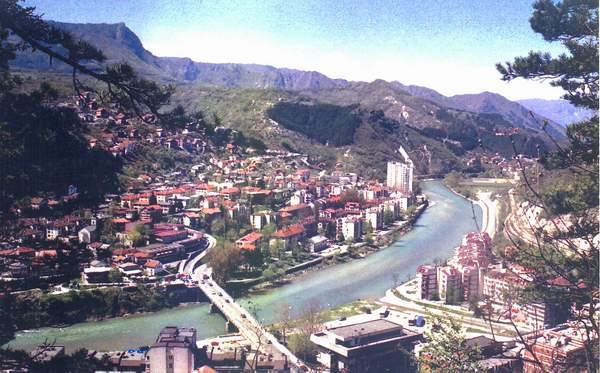
Bosnia and Herzegovina and Croatia
Proposed Integrated Ecosystem Management of the Nerteva and
Trebisnjica River Basin
(NTRB) Project
5.2.2. Konjic municipal wastewater collection and treatment infrastructure
Description of current situation: The city of Konjic is situated on the banks of river
Neretva and is surrounded by the slopes of mountains Bjelasnica and Prenj. Altitude ranges
between 270 and 320m. Konjic has a mild continental climate with an average annual
temperature of 9.5°C. Jablanicko lake is located northwest from the city. Several brooks and
rivers cut through the city, where the most important are rivers Neretva and Tresanica and
brooks Tuscica, Oraslje, Radava, Drecelj and Suhi Do, most of which are regulated. Regional
road M17 Sarajevo Mostar runs through Konjic and the railroad as well.
There are around 12,500 people living in the city (data from 2004), 75% of them are
connected to the city sewage system, the rest have solved the wastewater problem through
the construction of septic tanks those are mainly located on the edge of the city. Analyses
predicted that at the end of the planning period the city should have around 20,000
inhabitants.
Before the war, Konjic was a very industrialized town with developed metal and wood
processing industries. In the previous projects, industrial wastewaters were also included
because of the previous ownership structure (public ownership). There was a common
interest of the city and industry to solve this problem. After the war and the privatisation of
companies, and because some companies closed down, the problem of wastewater
treatment became the responsibility of company owners and they approach this problem
independently.
Picture 5.1.: Panorama of city of Konjic
Based on the existing Konjic sewage system project from 1979, a part of the left collector
was constructed within the area from Orasje neighbourhood to ,,Monument - Spomenik". It
was approximately 860 meters long, and collected faecal waters from Orasje and Prkanj
neighbourhoods and some wastewater from Varda neighbourhood. Temporary discharge to
the Neretva river was constructed downstream of "New Bridge" (about 30 meters).
75
Bosnia and Herzegovina and Croatia
Proposed Integrated Ecosystem Management of the Nerteva and
Trebisnjica River Basin
(NTRB) Project
Wastewater treatment project for the city of Konjic and sewage system projects for
the city of Konjic from 1970 and 1979 included construction of two collectors (left and right)
which were supposed to use three pump stations to convey wastewater to the water
treatment plant. The treatment plant is of standard design, and the price of their
construction together with the collector construction would amount to 22,000,000.00 KM or
approximately 11,260,000.00 . The plant was to be built in two phases (design
documentation is available). The plant was designed to serve 30,000 population equivalent
at the end of the planned period (year 2000).
The project included wastewater of the industry of that period, which, at present,
works with insignificant capacity compared to the period when the project design was
prepared. Major disadvantages of the project are: unfeasibility of collectors construction in
phases, high price of construction, high operating costs and costs of maintenance of the
device and pump stations, which, having in mind the existing economic situation, could not
be financed from the revenue collection from water consumption for a longer period of time.
In order to solve a problem, since the city of Konjic is the major polluter in the basin of the
Neretva, and largely affects the quality of water of the Neretva and Jablanica Lake,
alternative solutions have been sought since 2005 by using bio-filter modules (rotating
biological contactor) on main outlets. Due to the terrain configuration, it was concluded that
an installation of rotating biological contactor would be very complex both from the technical
and construction perspective, and such an option was practical y rejected, that is, the option
of installing only one such device on the location where it is relatively easy to place such
device was selected.
Sewage system of the city of Konjic is constructed as a separate system with the
exception of smaller areas of the city where the precipitation waters are integrated into
faecal sewage system, which should be reconstructed within the project implementation. The
basic concept is based on a construction of two collectors parallel to the flow of the river
Neretva, that is, left and right col ector.
The main selection criteria for the purpose of analysis were:
- System reliability;
- Implementation costs;
- Maintenance costs;
- Meeting requirements for discharge of treated wastewater
The 1970 and 1974 projects addressing the issue of collection and drainage of the
wastewater included several options regarding the collectors. The ,,Konjic Sewage System
Project" from 1970 envisaged construction of two collectors to collect wastewater and direct
it to the water treatment plant location. Major drawbacks of this option are too long
collectors, that is, high costs of construction and high operating costs.
Description of activity: An urgent intervention project includes investment into
improvement of the collector system and additional treatment for reduction of nutrients as
follows:
1. Additional construction and reconstruction of parts of the collector system (right
col ector);
2. Improvement of primary treatment and installation of a smaller device for biological
processing for the purposes of reduced nutrient load
76
Bosnia and Herzegovina and Croatia
Proposed Integrated Ecosystem Management of the Nerteva and
Trebisnjica River Basin
(NTRB) Project
Before preparation of Main Project, it is necessary to analyse alternative treatment solutions,
especially those concerning constructed wetlands.
Mitigation Plan and Environmental Monitoring Plan
Mitigation Plan and Environmental Monitoring Plan for Konjic Wastewater Treatment System
are given in Tables 5.5. and 5.6. below.
77
Bosnia and Herzegovina and Croatia
Proposed Integrated Ecosystem Management of the Nerteva and Trebisnjica River Basin
(NTRB) Project
Table 5.5: Mitigation Plan for Konjic Wastewater Treatment System
Phase
Action
Mitigation Measure
Remarks
Costs
Institutional
Responsibility
Sewage sludge from the All sewage sludge
Approximate transport
Cantonal Environmental
improper sewage tank
needs to be collected
and disposal costs are
Inspection (Mrs.
may cause an
and disposed of in an
200 KM/tone*km
Mirsada Golos) and
environmental threat if
environmental y sound
WWTP operator (Public
not disposed of properly manner onto landfill
communal company
Water management and
canalisation Konjic)
n
Construction activities
Clearly display
New roads for works
Included in construction Contractor to be
may lead to traffic
informative/warning
and WWTP access may
costs
selected in Public
r
uctio
disruptions and
signs around
be needed.
procurement procedure
congestions.
construction area.
Const
Limit construction to
regular time intervals.
Allocate possible
alternative traffic routes
(diversions). Minimize
vegetation clearing for
new roads.
Damage of trees and
Minimize vegetation
Roots of the trees may
Included in construction Contractor to be
other vegetation during clearing. Restore and
be severally damaged
works
selected in Public
n
construction activities
reforest all damaged
during construction
procurement procedure
o
trees or vegetation after works, if any digging
and if needed,
completion of works
takes place
environmental
r
ucti
supervision
Const
Temporary interruptions Providing temporary
Minor
Contractor - to be
in waste water lines
wastewater pipelines
selected in Public
and by pass if needed.
procurement procedure
78
Bosnia and Herzegovina and Croatia
Proposed Integrated Ecosystem Management of the Nerteva and Trebisnjica River Basin
(NTRB) Project
Table 5.5: Mitigation Plan for Konjic Wastewater Treatment System
Phase
Action
Mitigation Measure
Remarks
Costs
Institutional
Responsibility
Construction works may Reduce dust generated
Minor/Included in
Contractor to be
generate temporary
by traffic to the extent
construction costs
selected in Public
higher concentrations of possible. If possible,
procurement procedure
dust.
use closed or covered
and if needed,
n
trucks for transportation
environment
o
of construction
supervision
ucti
materials. Sprinkle earth
with water to prevent
dust generation
Constr
(especially in dry
season), remove excess
materials and clean
sites upon completion
of activities.
Noise and vibration
Limit construction
Minor/Included in
Contractor and
disturbances due to
activities to regular
construction costs
Environment or Civil
construction works.
daytime intervals.
engineer supervisor to
Establish schedule
be selected in the Public
and/or other specific
procurement procedure
restrictions on works. If
nstruction
o
necessary, use noise
C
barriers and/or noise
suppressors on
equipment.
79
Bosnia and Herzegovina and Croatia
Proposed Integrated Ecosystem Management of the Nerteva and Trebisnjica River Basin
(NTRB) Project
Table 5.5: Mitigation Plan for Konjic Wastewater Treatment System
Phase
Action
Mitigation Measure
Remarks
Costs
Institutional
Responsibility
Dug and disposed
Humus and cut trees
Included in construction Contractor - to be
refuse may cause
may be used again.
works. If hazardous
selected in Public
environmental damage
Hazardous waste, if
waste will be disposed
procurement procedure
if not taken care in a
any, must be disposed
of, it will be charged as
proper way
of in environmentally
per local prices of
nstruction
o
sound way and in
Cantonal communal
C
accordance with
company
regulations.
Fuel, grease and
Control of equipment
Included in construction Contractor - to be
chemicals spillage may
and vehicles. Isolate
works
selected in Public
cause pollution of
and clean the location
procurement procedure,
n
o
underground waters
in case of spillage.
WWTP Operator (Public
and soil
Solidification of spilled
communal company
ucti
liquids using adequate
Water management and
material. Store fuels,
canalisation Konjic)
lubricants, coolants,
Constr
paint, solvents and
bitumen safely and
handle them cautiously.
Contractor working
Protection of material
Minor
Contractor - to be
uc
camp and working sites erosion specially on
selected in Public
tion
Boracko lake site and in
procurement procedure
Constr
vicinity of surface water
80
Bosnia and Herzegovina and Croatia
Proposed Integrated Ecosystem Management of the Nerteva and Trebisnjica River Basin
(NTRB) Project
Table 5.5: Mitigation Plan for Konjic Wastewater Treatment System
Phase
Action
Mitigation Measure
Remarks
Costs
Institutional
Responsibility
Although unlikely,
Cease all construction
Minor
Supervision to be
chance findings of
works in the area,
selected in Public
ordnances, cultural
contact police/civil
procurement procedure
heritage items
protection/authorities.
and Institute for
Arrange necessary site
protection of
preservation measures
monuments within
Federal Ministry of
Construction
Culture and Sport
81
Bosnia and Herzegovina and Croatia
Proposed Integrated Ecosystem Management of the Nerteva and Trebisnjica River Basin
(NTRB) Project
Table 5.5: Mitigation Plan for Konjic Wastewater Treatment System
Phase
Action
Mitigation Measure
Remarks
Costs
Institutional
Responsibility
Removed material
All non-hazardous
May be needed WB
Approximate transport
Cantonal Environmental
and/or construction
construction wastes
Environmental
costs are 1 KM/ton *km Inspector (Ms. Mirsada
wastes may pose an
need to be disposed of
supervision.
Disposal costs:
Golos) must ensure all
environmental threat if
in an environmentally
There are no local (BIH
80 KM/ton on sanitary
regulations and
not disposed of
sound manner. Earth,
or HR) Rules or Laws
landfill, in accordance
procedures are met.
properly, especially if
rock and cut vegetation according asbestos
with given or more
hazardous.
can be reused or
cement pipes or
convenient conditions.
Special attention needs
composted, while all
materials
to be paid to removed
non-reusable wastes
asbestos-cement pipes
need to be landfilled at
.
a sanitary landfill. All
n
hazardous wastes need
o
to be handled in
ucti
accordance with
procedures of the
Entity Law on Waste
Constr
Management
Prevention of erosion
for all materials
specially in vicinity of
surface water
Asbestos, cement pipe
remains need to be
contained in order to
prevent crumbling and
generation of air-borne
particles, and then
disposed.
82
Bosnia and Herzegovina and Croatia
Proposed Integrated Ecosystem Management of the Nerteva and Trebisnjica River Basin
(NTRB) Project
Table 5.5: Mitigation Plan for Konjic Wastewater Treatment System
Phase
Action
Mitigation Measure
Remarks
Costs
Institutional
Responsibility
Incidental discharge of
Continuous control of
Included in wastewater WWTP Operator (Public
wastewaters not
equipment, regular
treatment plant costs communal company
complying with set
maintenance of
(maintenance costs)
Water management and
quality may endanger
equipment, control of
canalisation Konjic) and
surroundings
discharged wastewater
Municipality of Konjic
quality. Develop
emergency/accident
operation
procedures.
Production of sludge
Proper disposal of
80 KM/t for disposal,
WWTP Operator (Public
from wastewater
sludge. Establish control
plus 1 KM/t for sludge
communal company
treatment process
of sludge content
transport
Water management and
determination
canalisation Konjic)
Start up and
Odour from the
Establish continuous
Control of VOC and
Included in the plant
WWTP Operator (Public
treatment plant
treatment plant process methane concentration
and maintenance costs
communal company
control
may be needed
Water management and
canalisation Konjic)
Regular discharging of
Use adequate car for
Approximate transport Cantonal Environmental
sewage tank
discharging sewage
costs are 1 KM/tone* Inspector (Ms. Mirsada
tank
km
Golos) and WWTP
Operator (Public
communal company
Start-up and
operations
Water management and
canalisation Konjic)
83
Bosnia and Herzegovina and Croatia
Proposed Integrated Ecosystem Management of the Nerteva and Trebisnjica River Basin
(NTRB) Project
Table 5.5: Mitigation Plan for Konjic Wastewater Treatment System
Phase
Action
Mitigation Measure
Remarks
Costs
Institutional
Responsibility
Improper waste
Establish plan and
Approximate transport
WWTP Operator (Public
disposal may result in
procedures for waste
costs are 1 KM/ton *km communal company
environmental pollution management. Waste
Disposal costs:
Water management and
disposal to be
80 KM/ton on sanitary
canalisation Konjic)
performed in
landfill, in accordance
environmental y sound
with given or more
way. All non-hazardous
convenient conditions
and operations
waste to be disposed of
in a proper way.
Possible occurrence of
hazardous waste to be
Start up
resolved in accordance
with law.
84
Bosnia and Herzegovina and Croatia
Proposed Integrated Ecosystem Management of the Nerteva and Trebisnjica River Basin
(NTRB) Project
Table 5.6: Environmental Monitoring Plan for Konjic Wastewater Treatment System
Phase
Parameter to be
Where is the
How is the
When is the
Why is the
Cost
Responsibility
monitored
parameter to parameter to be parameter to parameter to
be monitored
monitored
be monitored
be monitored
Quality of recipient On the place of Laboratory
Before any
In order to
Laboratory analyses:
WWTP Operator
water
discharge
analyses (BOD,
decision on
determine load 800 KM
(Public communal
COD, SM, TKN)
number of
of recipient and
company Water
small scale
evaluate
management and
facilities and
danger to
canalisation
starting of
human health
Konjic) and
operations
and determine
Inspection
level and type
(Cantonal water
of treatment
inspector in co-
needed
operation with
n
environmental
i
o
inspector)
truct
Collection and
On the location Visually
During removal To prevent
Included in transport of
Operator (Public
Cons
disposal of sewage
of existing
pollution of the sludge
communal
sludge
plant
surrounding
company Water
environment
management and
and possible
canalisation
threats to
Konjic) and
human health
Supervisor to
be selected in
Public
procurement
procedure
85
Bosnia and Herzegovina and Croatia
Proposed Integrated Ecosystem Management of the Nerteva and Trebisnjica River Basin
(NTRB) Project
Table 5.6: Environmental Monitoring Plan for Konjic Wastewater Treatment System
Phase
Parameter to be
Where is the
How is the
When is the
Why is the
Cost
Responsibility
monitored
parameter to parameter to be parameter to parameter to
be monitored
monitored
be monitored
be monitored
Traffic disruptions
On site, around Visual inspection,
Regularly
Prevention of
Minor/Included in
Contractor to
and congestions,
site
complaints from
during
disruptions.
construction costs
be selected in
traffic safety
neighbours or
construction,
Population,
Public
traffic participants daily or weekly traffic
procurement
n
o
as appropriate participants
procedure.
and workers
Supervision
ucti
safety.
(Construction
and
Constr
Environmental)
to be selected in
Public
procurement
procedure
Site admittance
On site, around Visual inspection
Daily during
Population
Negligible
Contractor to
control
site
construction
safety
be selected in
Public
procurement
procedure.
Supervision
(Construction
nstruction
and
o
C
Environmental)
to be selected in
Public
procurement
procedure
86
Bosnia and Herzegovina and Croatia
Proposed Integrated Ecosystem Management of the Nerteva and Trebisnjica River Basin
(NTRB) Project
Table 5.6: Environmental Monitoring Plan for Konjic Wastewater Treatment System
Phase
Parameter to be
Where is the
How is the
When is the
Why is the
Cost
Responsibility
monitored
parameter to parameter to be parameter to parameter to
be monitored
monitored
be monitored
be monitored
Dust generation
On site, around Visual inspection,
Daily, or as
Minimization of Minor/Included in
Contractor to
site
complaints from
required
dust dissipation construction works
be selected in
neighbours,
during
in the area,
Public
irritation of
construction
minimization of
procurement
n
o
respiratory system
irritation of
procedure.
respiratory
Supervision
ucti
systems of the
(Construction
population and
and
Constr
workers.
Environmental)
to be selected in
Public
procurement
procedure
Noise and
On site, around Aural inspection,
Daily, or as
Minimization of Minor/Included in
Contractor to
vibration
site
complaints from
required
population
construction costs
be selected in
generation
neighbours or
during
nuisance,
Public
workers
construction
protection of
procurement
workers health
procedure.
Supervision
(Construction
nstruction
and
o
C
Environmental)
to be selected in
Public
procurement
procedure
87
Bosnia and Herzegovina and Croatia
Proposed Integrated Ecosystem Management of the Nerteva and Trebisnjica River Basin
(NTRB) Project
Table 5.6: Environmental Monitoring Plan for Konjic Wastewater Treatment System
Phase
Parameter to be
Where is the
How is the
When is the
Why is the
Cost
Responsibility
monitored
parameter to parameter to be parameter to parameter to
be monitored
monitored
be monitored
be monitored
Waste generation
On site
Visual inspection, Regular daily
Protection of
Included in construction Contractor to
and management
disposal records
control
soil,
costs
be selected in
or receipts from
groundwater,
Public
landfills
surface waters,
procurement
n
o
aesthetic
procedure.
reasons.
Supervision
ucti
(Construction
and
Constr
Environmental)
to be selected in
Public
procurement
procedure
Leaks/spills of
On and around
Visual inspection. Visual
Protection of
Should be included in
Contractor to
fuel, lubricants,
site
In case of
inspection daily environment,
construction costs; cost
be selected in
coolants, paint,
frequent and
during works.
workers safety. of additional laboratory
Public
solvents and
substantial spills
Lab analysis as
analysis: approximately
procurement
bitumen
or leaks, detailed
required.
800 KM
procedure.
lab analysis of the
Supervision
contaminated
(Construction
nstruction
media and water
and
o
C
in the system
Environmental)
should be
to be selected in
conducted
Public
procurement
procedure
88
Bosnia and Herzegovina and Croatia
Proposed Integrated Ecosystem Management of the Nerteva and Trebisnjica River Basin
(NTRB) Project
Table 5.6: Environmental Monitoring Plan for Konjic Wastewater Treatment System
Phase
Parameter to be
Where is the
How is the
When is the
Why is the
Cost
Responsibility
monitored
parameter to parameter to be parameter to parameter to
be monitored
monitored
be monitored
be monitored
Equipment
On site, around Sensory
Weekly during
Population and
Portable air emission
Contractor to
emissions into air
site
inspection, air
construction
workers health
monitors: approximately be selected in
quality meters
protection, air
3000 KM
Public
quality
procurement
n
o
protection
procedure.
Supervision
ucti
(Construction
and
Constr
Environmental)
to be selected in
Public
procurement
procedure
Cut down
On site
Visual inspection, Before and
Natural
Minor/Included in
Contractor to
damaged
photographs prior after
resources
construction costs
be selected in
trees/vegetation
to start of
construction
preservation,
Public
replacement
construction
works
aesthetic
procurement
works
reasons
procedure.
Supervision
(Construction
nstruction
and
o
C
Environmental)
to be selected in
Public
procurement
procedure
89
Bosnia and Herzegovina and Croatia
Proposed Integrated Ecosystem Management of the Nerteva and Trebisnjica River Basin
(NTRB) Project
Table 5.6: Environmental Monitoring Plan for Konjic Wastewater Treatment System
Phase
Parameter to be
Where is the
How is the
When is the
Why is the
Cost
Responsibility
monitored
parameter to parameter to be parameter to parameter to
be monitored
monitored
be monitored
be monitored
Chance findings of On site, around Visual inspection
Daily during
Protection of
Negligible
Contractor to
cultural heritage
site
construction
cultural
be selected in
items
works
heritage
Public
procurement
n
o
procedure.
Supervision
ucti
(Construction
and
Constr
Environmental)
to be selected in
Public
procurement
procedure
90
Bosnia and Herzegovina and Croatia
Proposed Integrated Ecosystem Management of the Nerteva and Trebisnjica River Basin
(NTRB) Project
Table 5.6: Environmental Monitoring Plan for Konjic Wastewater Treatment System
Phase
Parameter to be
Where is the
How is the
When is the
Why is the
Cost
Responsibility
monitored
parameter to parameter to be parameter to parameter to
be monitored
monitored
be monitored
be monitored
Quality and
On the place of Laboratory
Laboratory
To prevent
- Minimum 3000 KM per Cantonal water
quantity of
discharge
analyses (BOD,
analyses
pollution of
analysis, - once in two
inspector and
discharged
COD, SM, TKN)
periodically.
recipient
years PE calculation -
WWTP operator
wastewater
Monitoring with
Monitoring
costs according Water
(Public
portable water
with portable
management company
Communal
quality equipment water quality
regulation;
Company Water
equipment to
- 2500 KM for portable
management and
be performed
monitoring equipment
Canalisation) if
d operations
daily, during
not satisfied,
plant operation
water inspector
an
has to be
informed and act
in accordance
Start up
with its
obligations in
accordance with
legal
requirements
91
Bosnia and Herzegovina and Croatia
Proposed Integrated Ecosystem Management of the Nerteva and Trebisnjica River Basin
(NTRB) Project
Table 5.6: Environmental Monitoring Plan for Konjic Wastewater Treatment System
Phase
Parameter to be
Where is the
How is the
When is the
Why is the
Cost
Responsibility
monitored
parameter to parameter to be parameter to parameter to
be monitored
monitored
be monitored
be monitored
Chlorination level
On site,
Chlorine dozers,
Measurement
Protection of
Included in operational
WWTP Operator
chlorination
measurement of
of chlorine
recipient flora
costs (chlorination
(Public
station/unit
chlorine, content
content in
and fauna
dozer: approximately
Communal
in treated
treated
400 KM; chlorine-in-
Company Water
wastewater
wastewater in
water meter:
management and
accordance
approximately 300 KM
Canalisation
with chlorine
Konjic)
dozing regime
(continuous or
ations
batch-wise)
er
Disposal/treatment On site, around Visual inspection, Every batch, in Prevention of
Included in operational
WWTP Operator
of residual solid
site
laboratory
accordance
environmental
costs
(Public
products (sludge)
analyses
with internal
pollution
Communal
from WWTP
sludge
Company Water
management
management and
t up and op
plan
Canalisation
Star
Konjic)
Quality of recipient Downstream of Visual/sensory
Visual
Prevention of
Included in operational
WWTP Operator
effluent
inspection, simple inspection:
recipient
and maintenance costs,
(Public
discharge point routine analyses
daily/weekly;
pollution
plus laboratory analyses Communal
of recipient
Laboratory
costs, approximately
Company Water
samples
analyses:
500 KM
management and
monthly of
Canalisation
twice a month
Konjic)
92
Bosnia and Herzegovina and Croatia
Proposed Integrated Ecosystem Management of the Nerteva and Trebisnjica River Basin
(NTRB) Project
Table 5.6: Environmental Monitoring Plan for Konjic Wastewater Treatment System
Phase
Parameter to be
Where is the
How is the
When is the
Why is the
Cost
Responsibility
monitored
parameter to parameter to be parameter to parameter to
be monitored
monitored
be monitored
be monitored
Disposal of waste
On site, around Visual inspection, During
Prevention of
Included in maintenance WWTP Operator
d
materials
site
disposal record or operation,
environmental
costs
(Public
an
ns
receipts from
according to
pollution,
Communal
t
io
a
landfills
waste
overall plant
Company Water
t
-
up
ar
management
safety
management and
St
oper
plan
Canalisation
Konjic)
Odour releases
On site and in
Sense of smell,
Daily/upon
Minimization of Negligible
WWTP Operator
from the plant
immediate
complaints by
complaint
nuisance of
(Public
surrounding
neighbouring
local population
Communal
population
Company Water
management and
Canalisation), if
erations
not satisfied,
Environmental
Inspector has to
be informed and
act in accordance
with its
Start-up and op
obligations in
accordance with
legal
requirements
93
Bosnia and Herzegovina and Croatia
Proposed Integrated Ecosystem Management of the Nerteva and Trebisnjica River Basin
(NTRB) Project
Table 5.6: Environmental Monitoring Plan for Konjic Wastewater Treatment System
Phase
Parameter to be
Where is the
How is the
When is the
Why is the
Cost
Responsibility
monitored
parameter to parameter to be parameter to parameter to
be monitored
monitored
be monitored
be monitored
Leaks or spills of
¸On site,
Visually, by
Daily, during
Prevention of
Included in
WWTP Operator
fuel, lubricants,
around site,
means of
operation, or,
environmental
operational/maintenance (Public
coolants and
along supply
records/routine
as required
pollution,
costs; chlorine leak
Communal
chemicals, such as routes
control, accident
upon delivery
overal safety
detector: approximately Company Water
chlorine
report, etc.) or by of chemicals,
1500 KM
management and
means of
fuels,
Canalisation), ), if
erations
detectors
lubricants and
not satisfied,
coolants
Environmental
Inspector has to
be informed and
act in accordance
with its
Start-up and op
obligations in
accordance with
legal
requirements
94
Bosnia and Herzegovina and Croatia
Proposed Integrated Ecosystem Management of the Nerteva and Trebisnjica River Basin
(NTRB) Project
Institutional Strengthening
- Training
Table 5.7.: Summary of Training Proposed
Type of training
Training methods
Duration of
Remarks
Costs
Participant
training
Training on environmental monitoring
The training should be 5 days
Local Consultant
15000 KM
-Training on applicable environmental organized on site5
20 man/days
regulations (focusing on water issues)
literature and
-Training on environmental monitoring
handouts
-Technical monitoring on equipment use
and maintenance
WWTP Equipment operators
The training should be 22 days
Two sessions for Including in
-
Safe handling, storage and use of organized on site9
maintenance in
purchasing of
chemicals
vegetative and non WWTP
-
Maintenance of equipment
vegetative period of
year
-
Special training for Wetland operating
-
Gaining new knowledge on water use
and management
-
Introduction of new equipment and its
technology,
-
Equipment use, safety and efficiency
5The training include theoretical lectures, but to focus on active participation and interaction of the trainees, coupled with specific examples.
95
Bosnia and Herzegovina and Croatia
Proposed Integrated Ecosystem Management of the Nerteva and Trebisnjica River Basin
(NTRB) Project
- Equipment purchase
Table 5.8.: Monitoring equipment
Type of equipment
Units
Unit Cost
Total Cost (KM)
Local or international
(KM)
purchase
Portable Conductivity meter
1
600
600
Local
Portable Dissolved O2 meter
1
700
700
Local
Portable pH meter
1
500
500
Local
Calibration solution
3
100
300
Local
Digital Photo
1
400
400
Local
96
Bosnia and Herzegovina and Croatia
Proposed Integrated Ecosystem Management of the Nerteva and
Trebisnjica River Basin
(NTRB) Project
5.2.3. Ljubuski municipal wastewater treatment infrastructure
Description of current situation: The main hydrological and hydro geological
characteristics of the Ljubuski area are related to the karst nature of the dinarids terrain and
its Adriatic precipitation regime. The soil composition is mostly limestone of Mesozoic and
Cenozoic periods, while impermeable rocks appear sporadically. Results of tectonic
movements and deep in-ground karstification have created complex subsurface hydro-
geological characteristics. In depth clarification of the karst hydro geological and hydrological
characteristics can be found in the morphological occurrences, such as karst fields, pits, sink
holes, caves and constant or periodical springs. "Ljubusko polje" as a karst field extends
along with Tihanljina-Mlade-Trebizat Rivers from Studenci to Ljubuski, Vitina (up to Klobuk)
and to the western part of the field up to Grab and Vrgorac (Croatia). Ljubuski municipality is
located in the area of 282.7 km2 with 27,603 inhabitants, which is expressed in population
density around 98 inhabitants per km2. 53% of total land in the municipality is agricultural
land, 23% is forestry and only 5% is barren land. Agricultural land covers the surface of
121.5 km2 out of what 21% is cultivable soil and 22% are meadows and cattle grazing land.
More than 2,800 ha of land, consisted of 10 separated areas, have been irrigated by
separated irrigation channels.
There is a wastewater treatment plant in the Ljubuski municipality, but not al
households in the area are connected to the sewage collection network. For this reason,
wastewater is not entirely taken to the plant. Furthermore, the plant consists of only
mechanical and biological wastewater treatment. Third phase for nutrient removal has not
been implemented yet.
Wastewaters from households that are not connected to the sewage system, but are
collected to individual septic tanks, or that include precipitation runoff are directly taken to
the karst underground. In same cases, wastewater from households is directly discharged to
sink holes, and into the underground.
The sewage system in Ljubuski covers 8,705 PE1 (Population Equivalent), and the
total industrial wastewater load is 7,500 PE2. Due to agricultural activities (vegetable farms,
vineyards, orchards, tobacco growing) in the area of the karst fields near Ljubuski, significant
quantity of agricultural chemicals is used. In cases of their inadequate and unplanned use,
their toxic ingredients pollute the soil, surface water and groundwater, as well as the air.
These chemicals and their packaging should be handled properly. Herbicides and pesticides
used are divided in 4 categories in accordance with the World Health Organization (WHO).
These categories are based on the hazard level, i.e. toxicity. The WHO recommends using
less toxic constituents and handling them properly. Persistent organic pollutants POPs are
another important environmental pollutant category.
Wastewater treatment plant in Ljubuski is located in Matinjevac, some 350 m South-
West from the city centre, and around 350 m away from point of release in the recipient.
Naturally sloped terrain enables gravitational flow of the water through the plant (reducing
the investment and maintenance costs). The plant was built in 1989 as the first phase of the
planned construction of the facility.
The construction has been planned in two phases:
Phase I 5,000 PE, implemented in 1989;
Phase II 10,000 PE, has not been implemented yet.
The plant has been working continuously since the completion of the Phase I.
97
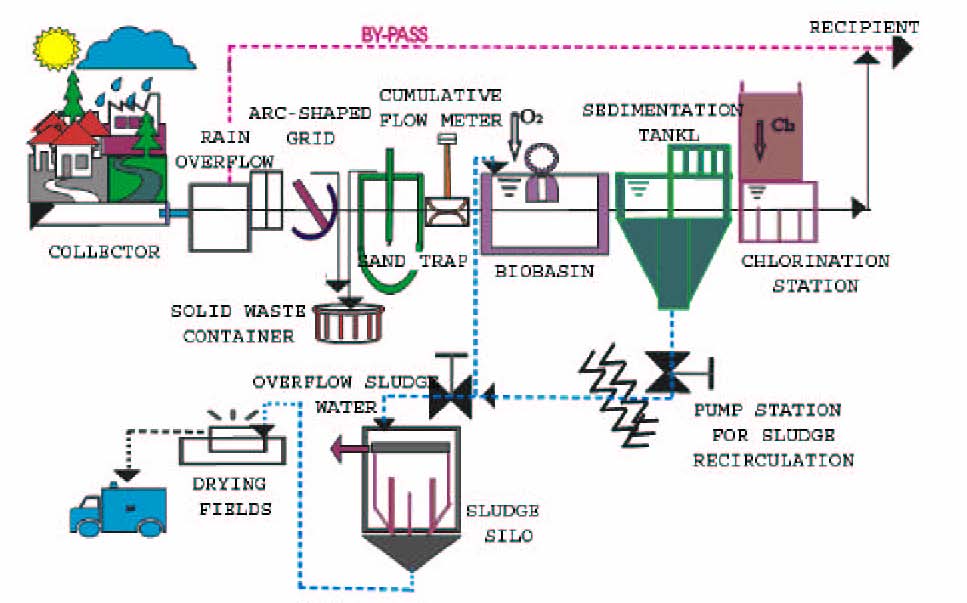
Bosnia and Herzegovina and Croatia
Proposed Integrated Ecosystem Management of the Nerteva and
Trebisnjica River Basin
(NTRB) Project
Picture 5.2.: Technological scheme of existing wastewater treatment (Phase I)
Rain overflow: Incoming wastewater comes into the plant by gravitation force. Rain
overflow regulates quantity of water coming to device.
Automatic arc-shaped gird Primary mechanical treatment (removal of bigger waste
residues of organic and mineral origin). Collected material is stored into a waste tank and
transported to the town's landfill.
Sand trap: Separation of bigger mineral additives (sand, gravel, slag, ash, fruit and
vegetable waste). Particles collected at the bottom of the sand trap are being pumped by
mammoth pump and collected into waste tank to be transported to city landfil .
Cumulative flow meter: Control of hydraulic load, daily reading.
Aeration tank: Biological process of treatment in aerobic conditions is achieved by
maintaining micro organisms in suspensions (active sludge). Wastewater runs through
microbiological membrane and organic substances are being decomposed on the sludge
surface.
Secondary sedimentation tank: Separation of flocculated active sludge, its sedimentation
and solidification. Part of the active sludge goes back to bio pool and the rest is being
pumped to sludge tanks. Project foresees low organic load (0,05 kg BPK x kg SM x d-1), with
98
Bosnia and Herzegovina and Croatia
Proposed Integrated Ecosystem Management of the Nerteva and
Trebisnjica River Basin
(NTRB) Project
retention time of 20-30 hours. Nitrification takes place in this tank (necessity for oxygen is
being reduced and thus, better quality of effluent is accomplished).
Chlorination (disinfections) of effluent: Disinfections is done if needed (epidemics, low
flow in recipient etc.) and is foreseen in order to protect the Trebizat River from significant
bacteriological pollution.
Sludge tank: Gravitation thickening of aerobically stabilized sludge. Water above the sludge
discharges to bio pool and thickened sludge goes to drying fields.
Drying fields: At the open concrete field with sand filling and drainage system, thickened
and aerobic stabilized sludge is drying while concentration of dry matter increases up to
40%. There are 4 fields in total, each of 60m2 surface. Drying process lasts between 10 and
15 days (pending weather conditions). Dehydrated sludge goes for disposal to the landfill or
is used as secondary raw material (fertilizer, material for improvement of sand and clay soil).
Description of activity: All the existing structures are planned to be kept during
reconstruction. The goal of this specific reconstruction is to increase the capacity of the plant
by around 1,000 PE (the long term goal remains 10,000 PE), while ensuring financial
sustainability of the plant and respecting the rules of selecting the most appropriate
technology; another goal is to improve the clarification level from the current 50-60% to
95%.
Presently some components are operating with reduced capacity or are not being
used at all for instance, the sand trap is not being used, it has been temporarily replaced
by barriers at the bottom of the channel from where the sediments are removed manually,
using shovels. As a result, this directly affects quality and duration of the biological treatment
and secondary sedimentation, and ultimately, the end parameter of elimination of N and P as
the main causes of eutrophication.
Reconstruction of the plant would help ensure long-term projected increase in the
capacity to 10,000 PE the sewer network is expected to expand to new neighbourhoods,
and include the local vinery.
Mitigation Plan and Environmental Management Plan
Mitigation Plan and Environmental Monitoring Plan for activities to be performed in Ljubuski
concerning wastewater treatment are given in Tables 5.9. and 5.10. below.
99
Bosnia and Herzegovina and Croatia
Proposed Integrated Ecosystem Management of the Nerteva and Trebisnjica River Basin
(NTRB) Project
Table 5.9.: Mitigation Plan for Ljubuski Wastewater Treatment System
Phase
Action
Mitigation measures
Remarks
Cost
Institutional
Responsibility
Damage of trees and
Minimize vegetation
Roots of the trees may
Included in Construction Contractor and
other vegetation during clearing. Prevention of
be severally damaged
costs
Environment or Civil
construction activities
erosion especially on
during construction
engineer supervisor
big gravels sites.
works.
both to be selected in
Restore and reforest all
Public procurement
nstruction
procedure
o
damaged trees or
C
vegetation after
completion of works
Construction works may Reduce dust generated
Minor/Included in
Contractor and
generate temporary
by traffic to the extent
construction costs
Environment or Civil
higher concentrations of possible. If possible,
engineer supervisor to
dust.
use closed or covered
be selected in the Public
trucks for transportation
procurement procedure
of construction
materials. Sprinkle earth
with water to prevent
nstruction
o
dust generation
C
(especially in dry
season), remove excess
materials and clean
sites upon completion
of activities.
100
Bosnia and Herzegovina and Croatia
Proposed Integrated Ecosystem Management of the Nerteva and Trebisnjica River Basin
(NTRB) Project
Noise and vibration
Limit construction
Minor/Included in
Contractor and
disturbances due to
activities to regular
construction costs
Environment or Civil
construction works
daytime intervals.
engineer supervisor to
Establish schedule and/or
be selected in the Public
other specific restrictions
procurement procedure
nstruction
on works. If necessary,
o
use noise barriers and/or
C
noise suppressors on
equipment.
Removed material
Al non-hazardous
WB Environmental
Approximate transport
Cantonal environmental
and/or construction
construction wastes need supervision may be
costs are 1 KM/ton *km inspector (Ms. Mirsada
wastes may pose an
to be disposed of in an
needed. There are no
Disposal costs: 80
Golos) must ensure all
environmental threat if environmentally sound
local (BIH or HR) Rules
KM/tone on sanitary
regulations and
not disposed of
manner. Earth, rock and
or Laws according
landfill, in accordance
procedures are met.
properly, especially if
cut vegetation can be
asbestos cement pipes
with given or more
hazardous. Special
reused or composted,
or materials.
convenient conditions.
attention needs to be
while all non-reusable
paid to removed
wastes need to be
asbestos-cement
landfilled at a sanitary
n
pipes.
landfill. All hazardous
o
wastes need to be
ucti
handled in accordance
with procedures of the
Entity Law on Waste
Constr
Management.
Prevention of erosion for
all materials especially in
vicinity of surface water.
Asbestos. cement
pipe remains need to be
contained in order to
prevent crumbling and
generation of air-borne
particles, and then
disposed.
101
Bosnia and Herzegovina and Croatia
Proposed Integrated Ecosystem Management of the Nerteva and Trebisnjica River Basin
(NTRB) Project
Fuel, grease and
Control of equipment
Minor/Included in
Contractor to be
chemicals spillage may
and vehicles. Isolate
construction works
selected in the Public
cause pollution of
and clean the location
procurement procedure.
n
surface water,
in case of spillage.
WWTP Operator (Public
i
o
underground waters
Solidification of spilled
Communal Company
and soil
liquids using adequate
Water management and
materials.
Canalisation)
Construct
Store fuels, lubricants,
coolants, paint, solvents
and bitumen safely and
handle them cautiously.
Incidental discharge of
Continuous control of
Included in wastewater WWTP Operator (Public
wastewaters not
equipment, regular
treatment plant costs communal company
complying with set
maintenance of
(maintenance costs)
"Ljubuski" in Ljubuski)
quality may endanger
equipment, control of
surroundings
discharged wastewater
quality. Develop
emergency/accident
procedures if not
developed yet.
Drying fields for sludge
Use covers for drying
Up to 2000 KM
WWTP Operator (Public
Start up and operation
drying may cause
fields in order to
communal company
unpleasant odours
prevent spreading of
"Ljubuski" in Ljubuski)
spreading
odour
102
Bosnia and Herzegovina and Croatia
Proposed Integrated Ecosystem Management of the Nerteva and Trebisnjica River Basin
(NTRB) Project
Use of sludge in
Test sludge quality,
Sludge can be used in
Included in operation al WWTP Operator (Public
agriculture may
especially
agriculture after
costs, with a possibility
communal company
degrade the soil or pose microbiological
additional treatment
of cost sharing with
"Ljubuski" in Ljubuski)
erations
a risk to human health
characteristics. If not
sludge users.
if done inadequately
satisfactory, prohibit its
use in agriculture. If
sludge quality is
satisfactory and the
sludge is used in
agriculture,. Check
Start-up and op
regularly its quality.
Odour from the
Establish continuous
Control of methane
Included in the plant
WWTP Operator (Public
treatment plant
treatment plant process concentration my be
and maintenance costs
communal company
control
needed
"Ljubuski" in Ljubuski)
Improper waste
Establish plan and
Estimate: 1KM/t,km, for WWTP Operator (Public
disposal may result in
procedures for waste
transport and 80KM/t
communal company
environmental pollution management. Waste
for disposal
"Ljubuski" in Ljubuski)
operation
disposal to be
performed in
environmental y sound
way. All non-hazardous
r
t up and
waste to be disposed of
a
in a proper way.
St
Eventual occurrence of
hazardous waste to be
resolved in accordance
with law.
103
Bosnia and Herzegovina and Croatia
Proposed Integrated Ecosystem Management of the Nerteva and Trebisnjica River Basin
(NTRB) Project
Table 5.10.: Environmental Monitoring Plan for Ljubuski Wastewater Treatment System
Phase
Which
Where is the
How is the
When is the
Why is the
Cost / KM
Responsibility
parameter is to parameter to parameter to be parameter to parameter to
be monitored
be
monitored
be monitored
be monitored
monitored
104
Bosnia and Herzegovina and Croatia
Proposed Integrated Ecosystem Management of the Nerteva and Trebisnjica River Basin
(NTRB) Project
Quality of recipient On the place
Laboratory
Before any
In order to
800 per analysis
Cantonal water
water
of discharge
analyses (BPK,
decision on
determine load
inspector and
n
HPK, SM, TKN)
number of
of recipient and
WWTP Operator
o
small scale
evaluate
r
ucti
facilities and
danger to
starting of
human health
operations
and determine
Const
level and type
of treatment
needed
Dust generation
On site,
Visual inspection,
Daily, or as
Minimization of Minor/Included in
Contractor to
around site
complaints from
required during dust dissipation construction works
be selected in
neighbours,
construction
in the area,
Public
irritation of
minimization of
procurement
respiratory system
irritation of
procedure.
respiratory
Supervision
systems of the
(Construction and
population and
Environmental)
workers.
to be selected in
Public
procurement
procedure
Noise and
On site,
Aural inspection,
Daily, or as
Minimization of Minor/Included in
Contractor to
nstruction
o
vibration
around site
complaints from
required during population
construction costs
be selected in
C
generation
neighbours or
construction
nuisance,
Public
workers
protection of
procurement
workers health
procedure.
Supervision
(Construction and
Environmental)
to be selected in
Public
procurement
procedure
105
Bosnia and Herzegovina and Croatia
Proposed Integrated Ecosystem Management of the Nerteva and Trebisnjica River Basin
(NTRB) Project
Equipment
On site,
Sensory
Weekly during
Population and
Portable air emission
Contractor to
emissions into air
around site
inspection, air
construction
workers health
monitors: approximately be selected in
quality meters
protection, air
3000 KM
Public
quality
procurement
protection
procedure.
Supervision
(Construction and
Environmental)
to be selected in
n
Public
o
procurement
procedure
r
ucti
Cut down
On site
Visual inspection,
Before and
Natural
Minor/Included in
Contractor to
damaged
photographs prior after
resources
construction costs
be selected in
Const
trees/vegetation
to start of
construction
preservation,
Public
replacement
construction
works
aesthetic
procurement
works
reasons
procedure.
Supervision
(Construction and
Environmental)
to be selected in
Public
procurement
procedure
Quality and
On the place
Laboratory
Laboratory
To prevent
Minimum 3000 per
Water inspector
quantity of
of discharge
analyses (BOD,
analyses
pollution of
analysis once in two
and
ations
discharged
COD, SM, TKN)
periodically.
recipient
years
WWTP operator
wastewater
Monitoring with
Monitoring
(EBS calculation costs
(Public
Portable water
with Portable
According Water
Communal
quality equipment water quality
management company
company
equipment
regulation);
"Ljubuski")
up and oper
Daily, during
2500 for portable
plant operation
monitoring equipment
Start
106
Bosnia and Herzegovina and Croatia
Proposed Integrated Ecosystem Management of the Nerteva and Trebisnjica River Basin
(NTRB) Project
Chlorination level
On site,
Chlorine dozers,
Measurement
Protection of
Included in operational
WWTP Operator
chlorination
measurement of
of chlorine
recipient flora
costs (chlorination
(Public
station/unit
chlorine, content
content in
and fauna
dozer: approximately
Communal
in treated
treated
400 KM; chlorine-in-
company
wastewater
wastewater in
water meter:
"Ljubuski")
ations
accordance
approximately 300 KM
er
with chlorine
dozing regime
(continuous or
batch-wise)
t up and op
Disposal/treatment On site,
Visual inspection,
Every batch, in Prevention of
Included in operational
WWTP Operator
of residual solid
around site
laboratory
accordance
environmental
costs
(Public
Star
products (sludge)
analyses
with internal
pollution
Communal
from WWTP
sludge
company
management
"Ljubuski")
plan
Quality of recipient Downstream
Visual/sensory
Visual
Prevention of
Included in operational
WWTP Operator
of effluent
inspection, simple inspection:
recipient
and maintenance costs,
(Public
discharge
routine analyses
daily/weekly;
pollution
plus laboratory analyses Communal
point
of recipient
Laboratory
costs, approximately
company
samples
analyses:
500 KM
"Ljubuski"), if not
monthly of
satisfied, water
operations
twice a month
Inspector has to
be informed and
act in accordance
with its
r
t up and
a
obligations in
St
accordance with
legal
requirements
107
Bosnia and Herzegovina and Croatia
Proposed Integrated Ecosystem Management of the Nerteva and Trebisnjica River Basin
(NTRB) Project
Disposal of waste
On site,
Visual inspection,
During
Prevention of
Included in maintenance WWTP Operator
materials
around site
disposal record or operation,
environmental
costs
(Public
receipts from
according to
pollution,
Communal
landfills
waste
overall plant
company
management
safety
"Ljubuski")
plan
Odour releases
On site and in
Sense of smell,
Daily/upon
Minimization of Negligible
WWTP Operator
from the plant
immediate
complaints by
complaint
nuisance of
(Public
surrounding
neighbouring
local population
Communal
operations
population
company
"Ljubuski"), if not
satisfied,
Environmental
Inspector has to
be informed and
Start up and
act in accordance
with its
obligations in
accordance with
legal
requirements
108
Bosnia and Herzegovina and Croatia
Proposed Integrated Ecosystem Management of the Nerteva and Trebisnjica River Basin
(NTRB) Project
Leaks or spills of
¸On site,
Visually, by
Daily, during
Prevention of
Included in
WWTP Operator
fuel, lubricants,
around site,
means of
operation, or,
environmental
operational/maintenance (Public
coolants and
along supply
records/routine
as required
pollution,
costs; chlorine leak
Communal
chemicals, such as routes
control, accident
upon delivery
overall safety
detector: approximately company
ns
chlorine
report, etc.) or by of chemicals,
1500 KM
"Ljubuski"), if not
t
io
means of
fuels,
satisfied,
a
detectors
lubricants and
Environmental
coolants
Inspection
(referent for
Environmental
protection has to
be informed and
act in accordance
Start up and oper
with its
obligations in
accordance with
legal
requirements
109
Bosnia and Herzegovina and Croatia
Proposed Integrated Ecosystem Management of the Nerteva and Trebisnjica River Basin
(NTRB) Project
Institutional Strengthening
- Training
Table 5.11.: Summary of Proposed Training
Type of training
Training
Duration of
Remarks
Costs / KM Participant
methods
training
Training on environmental monitoring
The training should
5 days
Local Consultant
15000
Employees of
-Training on applicable environmental be organized on site6
20 man/days
WWTP
regulations (focusing on water issues)
literature and
operator
-Training on environmental monitoring
handouts
-Technical monitoring on equipment use
and maintenance
WWTP Equipment operators
The training should
20 days
Two sessions for Including in
Employees of
-
Safe handling, storage and use of be organized on site7
maintenance in
purchasing of WWTP
chemicals
vegetative and non WWTP
operator
-
Maintenance of equipment
vegetative period of
year
-
Gaining new knowledge on water use
and management
-
Introduction of new equipment and its
technology,
-
Equipment use, safety and efficiency
6The training includes theoretical lectures, but to focus on active participation and interaction of the trainees, coupled with specific examples.
110
Bosnia and Herzegovina and Croatia
Proposed Integrated Ecosystem Management of the Nerteva and Trebisnjica River Basin
(NTRB) Project
- Equipment purchase
Table 5.12.: Monitoring equipment
Type of equipment
Units
Unit Cost
Total Cost (KM)
Local or international
(KM)
purchase
Portable Conductivity meter
1
600
600
Local
Portable Dissolved O2 meter
1
700
700
Local
Portable pH meter
1
500
500
Local
Calibration solution
3
100
300
Local
Digital Photo
1
400
400
Local
111
Bosnia and Herzegovina and Croatia
Proposed Integrated Ecosystem Management of the Nerteva and
Trebisnjica River Basin
(NTRB) Project
5.2.4. Nevesinje municipal wastewater collection and treatment infrastructure
Description of current situation: Nevesinje is municipality in RS, population 14.000,
discharges its wastewater effluent into the Alagovac reservoir, which is used for the drinking
water supply of the town. Insufficient capacity of the collection system has resulted in
emergency public health situations when septic tanks have proven inadequate to handle
flows. The primary treatment facility needs upgrades to provide improved nutrient removal,
as eutrophication of the reservoir is a problem.
Description of activity: Since in Nevesinje, finalization of construction of main collector of
fecal sewerage which leads to Zdrijelo (sinking hole) recipient, current priority is to address
discharge of rainfall and fecal waste water in the direction Military Barracks City Stadium
and Gas Station Lapcevine. Existing channels are open type channels, they are not
functional and they are undersized, thus wastewater spill over in the surrounding areas is
frequent, particularly during rainy period. The problem is even larger having in mind that
spill over takes place in the central part of the Town. If this issue is addressed, it would
primarily reduce health hazard for population. Also, collector construction and prevention of
rainfall spil over would enable use of additional agricultural area, which is very important
economic resource. The Project envisages construction of closed type concrete channels, 910
m total length with oval diameter size 135/140 cm, with channel cleaning and control
manholes. Cannels would be dug at 2,25 m. Channel longitudinal slope would range from
0,95 5,7%. After concrete works, channels would be covered by dug earth at the level of
surrounding terrain. Collector construction presents Phase I of Nevesinje waste water
management and create preconditions to regulate wastewater treatment, which would
present Phase II. Current Neretva and Trebisnjica River Basin Management Project would
cover Phase I of this project.
Mitigation Plan and Environmental Management Plan
Mitigation Plan and Environmental Monitoring Plan for activities to be performed in Nevesinje
concerning wastewater collection and treatment infrastructure are given in Tables 5.13. and
5.14. below.
112
Bosnia and Herzegovina and Croatia
Proposed Integrated Ecosystem Management of the Nerteva and Trebisnjica River Basin
(NTRB) Project
Table 5.13.: Mitigation Plan for Nevesinje municipal wastewater collection and treatment infrastructure
Phase
Action
Mitigation measures
Remarks
Cost
Institutional
Responsibility
Construction activities
Clearly display
May be needed new
Included in construction Contractor to be
may lead to traffic
informative/warning
roads for works and
costs
selected in Public
disruptions and
signs around
WWTP access.
procurement procedure
n
congestions.
construction area.
tio
May be needed new
Limit construction to
roads for works and
regular time intervals.
WWTP access.
Allocate possible
nstruc
o
alternative traffic routes
C
(diversions). Minimize
vegetation clearing for
new roads.
Damage of trees and
Minimize vegetation
Roots of the trees may
Included in Construction Contractor and
n
i
o
other vegetation during clearing. Restore and
be severally damaged
Costs
Environment or Civil
construction activities
reforest all damaged
during construction
engineer supervisor - to
trees or vegetation after works.
be selected in Public
completion of works
procurement procedure
Construct
113
Bosnia and Herzegovina and Croatia
Proposed Integrated Ecosystem Management of the Nerteva and Trebisnjica River Basin
(NTRB) Project
Table 5.13.: Mitigation Plan for Nevesinje municipal wastewater collection and treatment infrastructure
Phase
Action
Mitigation measures
Remarks
Cost
Institutional
Responsibility
Construction works may Reduce dust generated
Minor/Included in
Contractor and
generate temporary
by traffic to the extent
construction costs
Environment or Civil
higher concentrations of possible. If possible,
engineer supervisor to
dust.
use closed or covered
be selected in the Public
n
trucks for transportation
procurement procedure
o
of construction
materials. Sprinkle earth
r
ucti
with water to prevent
dust generation
Const
(especially in dry
season), remove excess
materials and clean
sites upon completion
of activities.
Noise and vibration
Limit construction
Minor/Included in
Contractor and
disturbances due to
activities to regular
construction costs
Environment or Civil
n
construction works
daytime intervals.
engineer supervisor to
o
Establish schedule
be selected in the Public
ucti
and/or other specific
procurement procedure
restrictions on works. If
necessary, use noise
Constr
barriers and/or noise
suppressors on
equipment.
114
Bosnia and Herzegovina and Croatia
Proposed Integrated Ecosystem Management of the Nerteva and Trebisnjica River Basin
(NTRB) Project
Table 5.13.: Mitigation Plan for Nevesinje municipal wastewater collection and treatment infrastructure
Phase
Action
Mitigation measures
Remarks
Cost
Institutional
Responsibility
Removed material (if
All non-hazardous
WB Environmental
Approximate transport
Municipal environmental
hazardous) may pose
construction wastes will supervision may be
costs are 1 KM/ton *km inspector (does not
an environmental threat be used for covering
needed.
Disposal costs: 80
exist in this municipality
if not disposed of
dug channels in which
There is no local (BIH
KM/ton on sanitary
work to be done by
properly. Special
concrete collectors will
or HR) Rules or Laws
landfill
referent for
attention needs to be
be placed. Earth, rock
according asbestos
environmental
paid to removed
and cut vegetation can
cement pipes or
protection in
asbestos-cement pipes
be reused or
materials
Municipality or by
.
composted, while all
Environmental inspector
non-reusable wastes
from Trebinje
need to be landfilled at
municipality, Mr. Stevan
a sanitary landfill. All
Bekan since there is
n
i
o
hazardous wastes need
currently reform of
to be handled in
Inspection taking place
accordance with
in BiH and it is very
procedures of the
likely that Mr. Bekan will
Construct
Entity Law on Waste
be in charge of few
Management Prevention
Municipalities in that
of erosion for all
region) must ensure all
materials especially in
regulations and
vicinity of surface
procedures are met.
water. If occurred,
asbestos cement pipe
remains need to be
contained in order to
prevent crumbling and
generation of air-borne
particles, and then
disposed.
115
Bosnia and Herzegovina and Croatia
Proposed Integrated Ecosystem Management of the Nerteva and Trebisnjica River Basin
(NTRB) Project
Table 5.13.: Mitigation Plan for Nevesinje municipal wastewater collection and treatment infrastructure
Phase
Action
Mitigation measures
Remarks
Cost
Institutional
Responsibility
Fuel, grease and
Control of equipment
Included in construction Contractor
n
chemicals spillage may
and vehicles. Isolate
works
o
cause pollution of
and clean the location
ucti
surface water,
in case of spillage.
underground waters
Solidification of spilled
and soil
liquids using adequate
Constr
materials.
*Mitigation measures for operation phase will be determined for Phase II of the WWTP construction , which is not the subject of
current NTRB Project.
116
Bosnia and Herzegovina and Croatia
Proposed Integrated Ecosystem Management of the Nerteva and Trebisnjica River Basin
(NTRB) Project
Table 5.14.: Environmental Monitoring Plan for Nevesinje municipal wastewater collection and treatment infrastructure
Phase
Which
Where is the
How is the
When is the
Why is the
Cost / KM
Responsibility
parameter is
parameter to
parameter to be
parameter to
parameter to
to be
be monitored
monitored
be monitored
be monitored
monitored
117
Bosnia and Herzegovina and Croatia
Proposed Integrated Ecosystem Management of the Nerteva and Trebisnjica River Basin
(NTRB) Project
Dust generation
On site, around
Visual inspection,
Daily, or as
Minimization of
Minor/Included
Contractor to be
site
complaints from
required during
dust dissipation
in construction
selected in Public
neighbours, irritation construction
in the area,
works
procurement
n
i
o
of respiratory
minimization of
procedure.
system
irritation of
Supervision
truct
respiratory
(Construction and
systems of the
Environmental)
Cons
population and
to be selected in
workers.
Public
procurement
procedure
Noise and
On site, around
Aural inspection,
Daily, or as
Minimization of
Minor/Included
Contractor to be
vibration
site
complaints from
required during
population
in construction
selected in Public
generation
neighbours or
construction
nuisance,
costs
procurement
workers
protection of
procedure.
workers health
Supervision
(Construction and
Environmental)
Construction
to be selected in
Public
procurement
procedure
Traffic
On site, around
Visual inspection,
Regularly during Prevention of
Minor/Included
Contractor to be
disruptions and
site
complaints from
construction,
disruptions.
in construction
selected in Public
congestions,
neighbours or traffic daily or weekly
Population,
costs
procurement
traffic safety
participants
as appropriate
traffic
procedure.
participants and
Supervision
workers safety.
(Construction and
nstruction
Environmental)
o
C
to be selected in
Public
procurement
procedure
118
Bosnia and Herzegovina and Croatia
Proposed Integrated Ecosystem Management of the Nerteva and Trebisnjica River Basin
(NTRB) Project
Site admittance
On site, around
Visual inspection
Daily during
Population safety Negligible
Contractor to be
control
site
construction
selected in Public
procurement
n
i
o
procedure.
Supervision
truct
(Construction and
Environmental)
Cons
to be selected in
Public
procurement
procedure
Waste
On site
Visual inspection,
Regular daily
Protection of
Included in
Contractor to be
generation and
disposal records or
control
soil,
construction
selected in Public
management
receipts from
groundwater,
costs
procurement
landfills
surface waters,
procedure.
aesthetic
Supervision
reasons.
(Construction and
Environmental)
Construction
to be selected in
Public
procurement
procedure
Leaks/spills of
On and around
Visual inspection. In Visual inspection Protection of
Should be
Contractor to be
fuel, lubricants,
site
case of frequent and daily during
environment,
included in
selected in Public
coolants, paint,
substantial spills or
works. Lab
workers safety.
construction
procurement
solvents and
leaks, detailed lab
analysis as
costs; cost of
procedure.
bitumen
analysis of the
required.
additional lab
Supervision
contaminated media
testing:
(Construction and
nstruction
and water in the
approximately
Environmental)
o
C
system should be
800 KM
to be selected in
conducted
Public
procurement
procedure
119
Bosnia and Herzegovina and Croatia
Proposed Integrated Ecosystem Management of the Nerteva and Trebisnjica River Basin
(NTRB) Project
Equipment
On site, around
Sensory inspection,
Weekly during
Population and
Portable air
Contractor to be
emissions into
site
air quality meters
construction
workers health
emission
selected in Public
air
protection, air
monitors:
procurement
n
i
o
quality
approximately
procedure.
protection
3000 KM
Supervision
truct
(Construction and
Environmental)
Cons
to be selected in
Public
procurement
procedure
Cut down
On site
Visual inspection,
Before and after Natural
Minor/Included
Contractor to be
damaged
photographs prior to construction
resources
in construction
selected in Public
trees/vegetation
start of construction works
preservation,
costs
procurement
replacement
works
aesthetic
procedure.
reasons
Supervision
(Construction and
Environmental)
Construction
to be selected in
Public
procurement
procedure
*Environmental monitoring plan for operation phase will be determined for Phase II of the WWTP construction , which is not the
subject of current NTRB Project.
120
Bosnia and Herzegovina and Croatia
Proposed Integrated Ecosystem Management of the Nerteva and Trebisnjica River Basin
(NTRB) Project
Institutional Strengthening
- Training
Table 5.15.:Summary of Proposed Training
Type of training
Training
Duration of
Remarks
Costs / KM Participant
methods
training
Training on environmental monitoring
The training should
5 days
Local Consultant
15000
Employees of
-Training on applicable environmental be organized on site7
20 man/days
WWTP
regulations (focusing on water issues)
literature and
operator
-Training on environmental monitoring
handouts
-Technical monitoring on equipment use
and
maintenance
WWTP Equipment operators
The training should
20 days
Two sessions for Including in
Employees of
-
Safe handling, storage and use of be organized on site7
maintenance in
purchasing of WWTP
chemicals
vegetative and non WWTP
operator
-
Maintenance of equipment
vegetative period of
year
-
Gaining new knowledge on water use
and management
-
Introduction of new equipment and its
technology,
-
Equipment use, safety and efficiency
*Training will be performed when WWTP and its operation will be close to being established.
7The training include theoretical lectures, but to focus on active participation and interaction of the trainees, coupled with specific examples.
121
Bosnia and Herzegovina and Croatia
Proposed Integrated Ecosystem Management of the Nerteva and Trebisnjica River Basin
(NTRB) Project
- Equipment purchase
Table 5.16.: Monitoring equipment
Type of equipment
Units
Unit Cost
Total Cost (KM)
Local or international
(KM)
purchase
Portable Conductivity meter
1
600
600
Local
Portable Dissolved O2 meter
1
700
700
Local
Portable pH meter
1
500
500
Local
Calibration solution
3
100
300
Local
Digital Photo
1
400
400
Local
122
Bosnia and Herzegovina and Croatia
Proposed Integrated Ecosystem Management of the Nerteva and
Trebisnjica River Basin
(NTRB) Project
5.2.5. Trebinje Municipal Wastewater Collection and Treatment Infrastructure
Description of current situation: Trebinje is a town in RS and has a population of about
32.000. Only 60% of the city is covered by sewerage and this has resulted in significant
pollution of the Trebisnjica River into which it directly discharges. There is a primary
wastewater treatment, insufficient by quality and quantity.
Description of activity: The project would finance extension of the collection system and
upgrades to the wastewater treatment plant to provide secondary treatment and nutrient
removal. Project objective is construction of faecal sewerage in Police community, Jovana
Cvijia Street, and its connection to existing municipal sewerage networks, a well as waste
water transport to waste water treatment plant, which has been functioning over twenty
years. This would enable to eliminate in the community septic tanks, large number of which
spills over on the surface. Current activities related to Neretva and Trebisnjica River Basin
Management Project, and Neretva and Trebisnjica River Basin Water and Land Resources
Assessment, particularly, assessed communal wastewater treatment issue as the one, which
should be addressed as priority. Current faecal wastewater collection methods from
households present significant environmental threat. Majority of households is not connected
to sewerage networks, but they use individual septic tanks to collect their wastewater. Such
septic tanks have not been constructed as sanitary ones, but they are water permeable and
they pollute ground water. Addressing this problem would prevent further ground water
pollution, particularly having in mind that it is extremely karst area. Around 400 people live
in this area. Implementation period will be conducted in two phases, as follows:
Phase I: Main desing development, obtaining necessary permits, construction permit,
carrying out procurement procedure around 150 days.
Phase II: Construction works on main street fecal collector and accompaning secondary civil
works 60 days
Mitigation Plan and Environmental Management Plan
Mitigation Plan and Environmental Monitoring Plan for activities to be performed in Trebinje
concerning wastewater collection and treatment infrastructure are given in Tables 5.17. and
5.18. below.
According to the information obtained by designer and Municipality, only construction works
will be done within NTRB project, thus mitigation measures and environmental monitoring
plan are given only for this phase.
123
Bosnia and Herzegovina and Croatia
Proposed Integrated Ecosystem Management of the Nerteva and Trebisnjica River Basin
(NTRB) Project
Table 5.17.: Mitigation Plan for Trebinje municipal wastewater collection and treatment infrastructure
Phase
Action
Mitigation measures
Remarks
Cost
Institutional
Responsibility
Construction activities
Clearly display
Included in construction Contractor to be
may affect traffic
informative/warning
costs
selected in the Public
n
safety.
signs around
procurement procedure
o
construction area.
ucti
Limit construction works
to regular time
intervals.
Constr
Allocate possible
alternative traffic routes
(diversions).
Construction activities
Clearly display
Part of sub component
Included in construction Contractor to be
may lead to traffic
informative/warning
activates may be in
costs
selected in the Public
disruptions and
signs around
urban area and part in
procurement procedure
congestions.
construction area.
the rural area. New
n
i
o
Limit construction works roads for works and
to regular time
WWTP access may be
truct
intervals.
needed.
Allocate possible
Cons
alternative traffic routes
(diversions). Minimize
vegetation clearing for
new roads.
124
Bosnia and Herzegovina and Croatia
Proposed Integrated Ecosystem Management of the Nerteva and Trebisnjica River Basin
(NTRB) Project
Table 5.17.: Mitigation Plan for Trebinje municipal wastewater collection and treatment infrastructure
Phase
Action
Mitigation measures
Remarks
Cost
Institutional
Responsibility
Damage of trees and
Minimize vegetation
Roots of the trees may
Included in construction Contractor and
n
other vegetation during clearing. Prevention of
be severally damaged
costs
Environment or Civil
o
construction activities
erosion, especially on
during construction
engineer supervisor - to
big gravels sites.
works.
be selected in the Public
ucti
Restore and reforest all
procurement procedure
damaged trees or
Constr
vegetation after
completion of works.
Fuel, grease and
Control of equipment
Included in construction Contractor to be
chemicals spillage may
and vehicles. Isolate
works
selected in the Public
cause pollution of
and clean the location
procurement procedure
surface water,
in case of spillage.
underground waters
Solidification of spilled
and soil
liquids using adequate
nstruction
o
materials. Store flues,
C
lubricants, coolants and
chemicals safely and
handle them cautiously.
125
Bosnia and Herzegovina and Croatia
Proposed Integrated Ecosystem Management of the Nerteva and Trebisnjica River Basin
(NTRB) Project
Table 5.17.: Mitigation Plan for Trebinje municipal wastewater collection and treatment infrastructure
Phase
Action
Mitigation measures
Remarks
Cost
Institutional
Responsibility
Construction works may Reduce dust generated
Minor/Included in
Contractor and
generate temporary
by traffic to the extent
construction costs
Environment or Civil
higher concentrations of possible. If possible,
engineer supervisor to
dust.
use closed or covered
be selected in the Public
trucks for transportation
procurement procedure
of construction
materials. Sprinkle earth
with water to prevent
nstruction
o
dust generation
C
(especially in dry
season), remove excess
materials and clean
sites upon completion
of activities.
Noise and vibration
Limit construction
Minor/Included in
Contractor and
disturbances due to
activities to regular
construction costs
Environment or Civil
n
construction works
daytime intervals.
engineer supervisor to
o
Establish schedule
be selected in the Public
and/or other specific
procurement procedure
r
ucti
restrictions on works. If
necessary, use noise
Const
barriers and/or noise
suppressors on
equipment.
126
Bosnia and Herzegovina and Croatia
Proposed Integrated Ecosystem Management of the Nerteva and Trebisnjica River Basin
(NTRB) Project
Table 5.17.: Mitigation Plan for Trebinje municipal wastewater collection and treatment infrastructure
Phase
Action
Mitigation measures
Remarks
Cost
Institutional
Responsibility
Removed material
All non-hazardous
WB Environmental
Approximate transport
Municipal environmental
and/or construction
construction wastes
supervision may be
costs are 1 KM/ton *km inspector - Mr. Stevan
wastes may pose an
need to be disposed of
needed.
Disposal costs:
Bekan must ensure all
environmental threat if
in an environmentally
There is no local (BIH
80 KM/ton on sanitary
regulations and
not disposed of
sound manner. Earth,
or HR) Rules or Laws
landfill, in accordance
procedures are met.
properly, especially if
rock and cut vegetation according asbestos or
with given or more
hazardous. Special
can be reused or
cement pipes or
convenient conditions.
attention needs to be
composted, while all
materials.
paid to removed
non-reusable wastes
asbestos-cement pipes
need to be landfilled at
.
a sanitary landfill. All
hazardous wastes need
to be handled in
accordance with
procedures of the
Entity Law on Waste
Construction
Management
Prevention of erosion
for all materials
specially in vicinity of
surface water
Asbestos, cement pipe
remains need to be
contained in order to
prevent crumbling and
generation of air-borne
particles, and then
disposed.
127
Bosnia and Herzegovina and Croatia
Proposed Integrated Ecosystem Management of the Nerteva and Trebisnjica River Basin
(NTRB) Project
Table 5.18.: Environmental Monitoring Plan for Trebinje municipal wastewater collection and treatment infrastructure
Phase
Which
Where is the
How is the
When is the
Why is the
Cost / KM
Responsibility
parameter is
parameter to
parameter to be
parameter to
parameter to
to be
be monitored
monitored
be monitored
be monitored
monitored
128
Bosnia and Herzegovina and Croatia
Proposed Integrated Ecosystem Management of the Nerteva and Trebisnjica River Basin
(NTRB) Project
Quality of
On the place of
Laboratory analyses
Before any
In order to
800 per analysis Water inspector of
recipient water
discharge
(BOD, COD, SM,
decision on
determine load
Trebinje
TKN)
number of small of recipient and
Municipality
scale facilities
evaluate danger
r
uction
and starting of
to human health
operations
and determine
level and type of
Const
treatment
needed
Traffic
On site, around
Visual inspection,
Regularly during Prevention of
Minor/Included
Contractor to be
disruptions and
site
complaints from
construction,
disruptions.
in construction
selected in Public
congestions,
neighbours or traffic daily or weekly
Population,
costs
procurement
traffic safety
participants
as appropriate
traffic
procedure.
participants and
Supervision
workers safety.
(Construction and
Environmental)
to be selected in
Public
procurement
procedure
Site admittance
On site, around
Visual inspection
Daily during
Population safety Negligible
Contractor to be
nstruction
o
control
site
construction
selected in Public
C
procurement
procedure.
Supervision
(Construction and
Environmental)
to be selected in
Public
procurement
procedure
129
Bosnia and Herzegovina and Croatia
Proposed Integrated Ecosystem Management of the Nerteva and Trebisnjica River Basin
(NTRB) Project
Dust generation
On site, around
Visual inspection,
Daily, or as
Minimization of
Minor/Included
Contractor to be
site
complaints from
required during
dust dissipation
in construction
selected in Public
neighbours, irritation construction
in the area,
works
procurement
of respiratory
minimization of
procedure.
system
irritation of
Supervision
respiratory
(Construction and
systems of the
Environmental)
population and
to be selected in
n
workers.
Public
o
procurement
ucti
procedure
Noise and
On site, around
Aural inspection,
Daily, or as
Minimization of
Minor/Included
Contractor to be
vibration
site
complaints from
required during
population
in construction
selected in Public
Constr
generation
neighbours or
construction
nuisance,
costs
procurement
workers
protection of
procedure.
workers health
Supervision
(Construction and
Environmental)
to be selected in
Public
procurement
procedure
Waste
On site
Visual inspection,
Regular daily
Protection of
Included in
Contractor to be
generation and
disposal records or
control
soil,
construction
selected in Public
management
receipts from
groundwater,
costs
procurement
landfills
surface waters,
procedure.
aesthetic
Supervision
reasons.
(Construction and
nstruction
Environmental)
o
C
to be selected in
Public
procurement
procedure
130
Bosnia and Herzegovina and Croatia
Proposed Integrated Ecosystem Management of the Nerteva and Trebisnjica River Basin
(NTRB) Project
Leaks/spills of
On and around
Visual inspection. In Visual inspection Protection of
Should be
Contractor to be
fuel, lubricants,
site
case of frequent and daily during
environment,
included in
selected in Public
coolants, paint,
substantial spills or
works. Lab
workers safety.
construction
procurement
n
i
o
solvents and
leaks, detailed lab
analysis as
costs; cost of
procedure.
bitumen
analysis of the
required.
additional lab
Supervision
truct
contaminated media
testing:
(Construction and
and water in the
approximately
Environmental)
Cons
system should be
800 KM
to be selected in
conducted
Public
procurement
procedure
Equipment
On site, around
Sensory inspection,
Weekly during
Population and
Portable air
Contractor to be
emissions into
site
air quality meters
construction
workers health
emission
selected in Public
air
protection, air
monitors:
procurement
quality
approximately
procedure.
protection
3000 KM
Supervision
(Construction and
Environmental)
Construction
to be selected in
Public
procurement
procedure
Cut down
On site
Visual inspection,
Before and after Natural
Minor/Included
Contractor to be
damaged
photographs prior to construction
resources
in construction
selected in Public
trees/vegetation
start of construction works
preservation,
costs
procurement
replacement
works
aesthetic
procedure.
reasons
Supervision
(Construction and
nstruction
Environmental)
o
C
to be selected in
Public
procurement
procedure
Institutional Strengthening
131
Bosnia and Herzegovina and Croatia
Proposed Integrated Ecosystem Management of the Nerteva and Trebisnjica River Basin
(NTRB) Project
- Training
Table 5.19..:Summary of Proposed Training
Type of training
Training
Duration of
Remarks
Costs / KM Participant
methods
training
Training on environmental monitoring
The training should
5 days
Local Consultant
15000
Employees of
-Training on applicable environmental be organized on site8
20 man/days
WWTP
regulations (focusing on water issues)
literature and
operator
-Training on environmental monitoring
handouts
-Technical monitoring on equipment use
and maintenance
WWTP Equipment operators
The training should
20 days
Two sessions for Including in
Employees of
-
Safe handling, storage and use of be organized on site7
maintenance in
purchasing of WWTP
chemicals
vegetative and non WWTP
operator
-
Maintenance of equipment
vegetative period of
year
-
Gaining new knowledge on water use
and management
-
Introduction of new equipment and its
technology,
-
Equipment use, safety and efficiency
8The training include theoretical lectures, but to focus on active participation and interaction of the trainees, coupled with specific examples.
132
Bosnia and Herzegovina and Croatia
Proposed Integrated Ecosystem Management of the Nerteva and Trebisnjica River Basin
(NTRB) Project
- Equipment purchase
Table 5.20.: Monitoring equipment
Type of equipment
Units
Unit Cost
Total Cost (KM)
Local or international
(KM)
purchase
Portable Conductivity meter
1
600
600
Local
Portable Dissolved O2 meter
1
700
700
Local
Portable pH meter
1
500
500
Local
Calibration solution
3
100
300
Local
Digital Photo
1
400
400
Local
133
Bosnia and Herzegovina and Croatia
Proposed Integrated Ecosystem Management of the Nerteva and
Trebisnjica River Basin
(NTRB) Project
5.2.6. Industrial Pollution Control
5.2.6.1. Upgrade to wastewater treatment system at the
"SurTecEurosjaj" metallurgy company in Konjic
Description of current situation: Company SUR-Eurosjaj deals with galvanization, among
other business activities, and provides following services:
zinc plating of steel in low acid zinc baths;
passivation of zinc plated objects (yellow, blue and green);
hard chroming;
decorative protection Cu Ni Cr;
cyanide copper plating.
In all of the listed processes metal salts of Zinc, Copper, Chrome and Nickel are used, as well
as various alkaline degreasers, detergents (additives), acids (HCl, HNO3) for activation. A
consequence of using those chemicals is production of wastewaters that contain Cr6+, Cr3+,
Cu2+, Ni2+, Fe2+, Fe3+, anions Cl-, NO3-, SO42-, CN- and others. Additives are also used
in flattening and polishing, and catalysts are used in passivation and degreasing. Keeping in
mind the stated facts, in this conceptual solution 9598 % of rinse waters will re-circulate
inside the facility, while only 25 % will appear as pollution carrying concentrates, which will
be subjected to chemical and physical treatment aimed at removing harmful substances.
The current solution for wastewater treatment is not capable of removing heavy metals even
close to the regulative requirements. Wastewaters are collected in tanks where neutralization
is carried out.
Description of activity: Conceptual solution for wastewater treatment is based on:
Re-circulation of rinse waters in a closed loop, tank collector metal removal
device (filled with an ion exchange resin) tank.
Accumulation of concentrates in col ectors based on water quality, Chrome water,
Copper, Nickel, Zinc, Acidic waters, Alkaline waters
Concentrate processing according to the prescribed technology in two batch
processes for Chrome, Cyanides and other metals up to 0,1 mg/l
Separation of heavy metal sludge on a filter press
Selective ion processing where the leftover heavy metals (concentrations below 0,1
mg/l) are collected on a special ion exchange resin
Neutralization of wastewaters to a pH level of 6,0 9,0, or if desired to a narrower
range, by an automated device that logs pH values of water being discharged into
the recipient.
Mitigation Plan and Environmental Management Plan
Mitigation Plan and Environmental Monitoring Plan for Upgrade to wastewater treatment
system at the "SurTecEurosjaj" metallurgy company in Konjic are given in Tables 5.21. and
5.22. below.
134
Bosnia and Herzegovina and Croatia
Proposed Integrated Ecosystem Management of the Nerteva and Trebisnjica River Basin
(NTRB) Project
Table 5.21.: Mitigation Plan for Upgrade to wastewater treatment system at the "SurTecEurosjaj" metallurgy company in Konjic
Phase
Action
Mitigation Measure
Remarks
Costs
Institutional
Responsibility
Sewage from the
All sewage sludge
Approximate transport
Cantonal Environmental
improper sewage tank
needs to be collected
and disposed of costs
Inspection (Mrs.
may cause an
and disposed of in an
are 200 KM/tone6
Mirsada Golos) and
environmental threat if
environmental y sound
WWTP operator (Public
s
t
r
uction
n
not disposed of properly manner onto landfill
communal company
c
o
Water management and
Re
canalisation Konjic)
n/
Temporary dislocation
Assure proper collection It may be needed to Approximately 5000 KM Cantonal Environmental
o
of wastewaters flow
of wastewaters in order purchase additional
for wastewaters
Inspection (Mrs.
to release them after
container for temporary container plus
Mirsada Golos) and
rehabilitation works into storage of wastewaters additional equipment
WWTP operator
a
bilitati
recipient in
for container
SurTecEurosjaj
environmental y sound
discharging amounting
Reh
manner
approximately 3000 KM
Fuel, grease and
Control of equipment
Included in construction Contractor to be
ns
o
chemicals spillage may
and vehicles. Isolate
works
selected in Public
cause pollution of
and clean the location
procurement procedure
underground waters
in case of spillage.
and WWTP operator
n/Rec
and soil
Solidification of spilled
SurTecEurosjaj
liquids using adequate
i
l
i
t
atio
truction
material. Store fuels,
lubricants, coolants,
chemicals safely and
Rehab
handle them safely.
135
Bosnia and Herzegovina and Croatia
Proposed Integrated Ecosystem Management of the Nerteva and Trebisnjica River Basin
(NTRB) Project
Table 5.21.: Mitigation Plan for Upgrade to wastewater treatment system at the "SurTecEurosjaj" metallurgy company in Konjic
Phase
Action
Mitigation Measure
Remarks
Costs
Institutional
Responsibility
Incidental discharge of
Continuous control of
Included in wastewater WWTP Operator
wastewaters not
equipment, regular
treatment plant costs SurTecEurosjaj
complying with set
maintenance of
(maintenance costs)
quality may endanger
equipment, control of
surroundings
discharged wastewater
quality
Production of sludge
Proper disposal of
80 KM/t for disposal,
WWTP Operator
operation
from wastewater
sludge. Establish control
plus 1 KM/t for sludge
SurTecEurosjaj
treatment process
of sludge content
transport
determination
Higher concentrations
Assure proper
Additional laboratory
WWTP Operator
of heavy metals in
laboratory analyses are
analyses for
SurTecEurosjaj
Start up and
effluent may endanger
performed regularly at
determination of heavy
human health and flora
the discharge point.
metals: 60 KM per
and fauna of the
Keep plant operation
metal determined.
recipient
regular and control it.
Odour from the
Establish continuous
Control of VOC and
Included in the plant
WWTP Operator
treatment plant
treatment plant process methane concentration
and maintenance costs
SurTecEurosjaj
and
control
my be needed
up
Regular discharging of
Use adequate car for
Approximate transport WWTP Operator
operation
sewage tank
discharging sewage
costs are 1 KM/tone, SurTecEurosjaj
Start
tank
km
136
Bosnia and Herzegovina and Croatia
Proposed Integrated Ecosystem Management of the Nerteva and Trebisnjica River Basin
(NTRB) Project
Table 5.21.: Mitigation Plan for Upgrade to wastewater treatment system at the "SurTecEurosjaj" metallurgy company in Konjic
Phase
Action
Mitigation Measure
Remarks
Costs
Institutional
Responsibility
Improper waste
Establish plan and
Approximate
WWTP Operator
disposed may result in
procedures for waste
transport costs
SurTecEurosjaj
environmental pollution management. Waste
are 1 KM/ton *km
disposal to be
Disposal costs:
performed in
80 KM/ton on sanitary
environmental y sound
landfill
d operation
way. All non-hazardous
waste to be disposed of
in a proper way.
Possible occurrence of
Start up an
hazardous waste to be
resolved in accordance
with law.
137
Bosnia and Herzegovina and Croatia
Proposed Integrated Ecosystem Management of the Nerteva and Trebisnjica River Basin
(NTRB) Project
Table 5.22.: Environmental Monitoring Plan for Upgrade to wastewater treatment system at the "SurTecEurosjaj" metallurgy company in
Konjic
Phase
Parameter to be Where is the
How is the
When is the
Why is the
Cost / KM
Responsibility
monitored
parameter to
parameter to be parameter to
parameter to
be monitored
monitored
be monitored be monitored
Collection and
On the location
Visually
During
To prevent
Included in
WWTP Operator
disposal of sewage
rehabilitation
pollution of the
transport of
SurTecEurosjaj
sludge
works
surrounding
sludge
and Supervisor(
environment
to be selected in
and possible
public
threats to
procurement
s
t
r
uction
n
human health
procedure )
c
o
Re
Fuel, grease and
Below and
Visually in order to Daily, during
Ground and
Included in
Contractor to be
n/
chemicals spillage around material
determine
construction
surface waters
rehabilitation
selected in Public
o
storage
spillage, in case of works and if
protection
costs and
procurement
major spillage it is needed in
additional 1000- procedure
necessary to make laboratory
1500 for
a
bilitati
analysis of media
laboratory tests
Reh
at the location.
Production of
On the location
Moisture, quantity Weekly, during Environmental
Included in
WWTP Operator
sludge from
of the plant for
and content of
plants
protection and
costs of
SurTecEurosjaj
wastewater
collection of
sludge
operation
protection of
operations
treatment process treated sludge
employees on
ploitation
Set up and
the plant
e
x
138
Bosnia and Herzegovina and Croatia
Proposed Integrated Ecosystem Management of the Nerteva and Trebisnjica River Basin
(NTRB) Project
Table 5.22.: Environmental Monitoring Plan for Upgrade to wastewater treatment system at the "SurTecEurosjaj" metallurgy company in
Konjic
Phase
Parameter to be Where is the
How is the
When is the
Why is the
Cost / KM
Responsibility
monitored
parameter to
parameter to be parameter to
parameter to
be monitored
monitored
be monitored be monitored
Concentrations of
On the discharge Laboratory
Periodical y
To prevent
60 KM per
Cantonal water
heavy metals in
point
analyses
recipient
metal
inspector and
effluent
pollution, treats determined
WWTP operator
to human
SurTecEurosjaj. If
health and
not satisfied,
protect flora
water inspector
exploitation
and fauna of
has to be
the recipient
informed and act
in accordance
with its
obligations in
Set up and
accordance with
legal
requirements
139
Bosnia and Herzegovina and Croatia
Proposed Integrated Ecosystem Management of the Nerteva and Trebisnjica River Basin
(NTRB) Project
Table 5.22.: Environmental Monitoring Plan for Upgrade to wastewater treatment system at the "SurTecEurosjaj" metallurgy company in
Konjic
Phase
Parameter to be Where is the
How is the
When is the
Why is the
Cost / KM
Responsibility
monitored
parameter to
parameter to be parameter to
parameter to
be monitored
monitored
be monitored be monitored
Improper work of
On the location
Visually,
Daily during
Protection of
Included in
WWTP Operator
the plant.
of the plant
compliance
plant operation recipient waters plant operation
SurTecEurosjaj
Incidental
control
costs.
discharge of
untreated
Eventually
wastewater
needed
ploitation
additional
e
x
analyzes out of
plant
laboratory: 800
per analysis
(BPK, HPK, SM,
Set up and
TKN)
140
Bosnia and Herzegovina and Croatia
Proposed Integrated Ecosystem Management of the Nerteva and Trebisnjica River Basin
(NTRB) Project
Table 5.22.: Environmental Monitoring Plan for Upgrade to wastewater treatment system at the "SurTecEurosjaj" metallurgy company in
Konjic
Phase
Parameter to be Where is the
How is the
When is the
Why is the
Cost / KM
Responsibility
monitored
parameter to
parameter to be parameter to
parameter to
be monitored
monitored
be monitored be monitored
Quality and
On the place of
Laboratory
Laboratory
To prevent
Minimum 3000
Cantonal water
quantity of
discharge
analyses (BOD,
analyses
pollution of
per analysis
inspector and
discharged
COD, SM, TKN)
periodically.
recipient
once in two
WWTP operator
wastewater
years
SurTecEurosjaj. If
Monitoring with
Monitoring with
not satisfied,
Portable water
Portable water
(PE calculation
water inspector
quality equipment quality
costs According has to be
equipment
Water
informed and act
ploitation
management
in accordance
e
x
Daily, during
company
with its
plant operation
regulation);
obligations in
accordance with
2500 KM for
legal
portable
requirements
Set up and
monitoring
equipment
141
Bosnia and Herzegovina and Croatia
Proposed Integrated Ecosystem Management of the Nerteva and Trebisnjica River Basin
(NTRB) Project
Table 5.22.: Environmental Monitoring Plan for Upgrade to wastewater treatment system at the "SurTecEurosjaj" metallurgy company in
Konjic
Phase
Parameter to be Where is the
How is the
When is the
Why is the
Cost / KM
Responsibility
monitored
parameter to
parameter to be parameter to
parameter to
be monitored
monitored
be monitored be monitored
Chlorination level
On site,
Chlorine dozers,
Measurement
Protection of
Included in
WWTP Operator
chlorination
measurement of
of chlorine
recipient flora
operational
SurTecEurosjaj
station/unit
chlorine, content
content in
and fauna
costs
in treated
treated
(chlorination
wastewater
wastewater in
dozer:
exploitation
accordance
approximately
with chlorine
400 KM;
and
dozing regime
chlorine-in-
t
up
(continuous or
water meter:
batch-wise)
approximately
Se
300 KM
Disposal/treatment On site, around
Visual inspection,
Every batch, in Prevention of
Included in
WWTP Operator
of residual solid
site
laboratory
accordance
environmental
operational
SurTecEurosjaj
products (sludge)
analyses
with internal
pollution
costs
from WWTP
sludge
Set up and
management
exploitation
plan
142
Bosnia and Herzegovina and Croatia
Proposed Integrated Ecosystem Management of the Nerteva and Trebisnjica River Basin
(NTRB) Project
Table 5.22.: Environmental Monitoring Plan for Upgrade to wastewater treatment system at the "SurTecEurosjaj" metallurgy company in
Konjic
Phase
Parameter to be Where is the
How is the
When is the
Why is the
Cost / KM
Responsibility
monitored
parameter to
parameter to be parameter to
parameter to
be monitored
monitored
be monitored be monitored
Quality of recipient Downstream of
Visual/sensory
Visual
Prevention of
Included in
WWTP Operator
effluent
inspection, simple inspection:
recipient
operational and SurTecEurosjaj, if
discharge point
routine analyses
daily/weekly;
pollution
maintenance
not satisfied,
of recipient
Laboratory
costs, plus
Cantonal water
samples
analyses:
laboratory
inspector has to
exploitation
monthly of
analyses costs,
be informed and
twice a month
approximately
act in accordance
and
500 KM
with its
t
up
obligations and
legal
Se
requirements
143
Bosnia and Herzegovina and Croatia
Proposed Integrated Ecosystem Management of the Nerteva and Trebisnjica River Basin
(NTRB) Project
Institutional Strengthening
- Training
Table 5.23.: Summary of Training Proposed
Type of training
Training methods
Duration of
Remarks
Costs/KM
Participant
training
Training on environmental monitoring
The training should be 5 days
Local Consultant
15000
Metal urgy
-Training on applicable environmental organized on site9
20 man/days
company
regulations (focusing on water issues)
literature and
management
-Training on environmental monitoring
handouts
-Technical monitoring on equipment use
and maintenance
WWTP Equipment operators
The training should be 22 days
Two sessions for Including in
Metal urgy
-
Safe handling, storage and use of organized on site9
maintenance in
purchasing of
company
chemicals
vegetative and non WWTP
management
-
Maintenance of equipment
vegetative period of
year
-
Special training for Wetland operating
-
Gaining new knowledge on water use
and management
-
Introduction of new equipment and its
technology,
-
Equipment use, safety and efficiency
9The training includes theoretical lectures, but to focus on active participation and interaction of the trainees, coupled with specific examples.
144
Bosnia and Herzegovina and Croatia
Proposed Integrated Ecosystem Management of the Nerteva and Trebisnjica River Basin
(NTRB) Project
- Equipment purchase
Table 5.24.: Monitoring equipment
Type of equipment
Units
Unit Cost
Total Cost (KM)
Local or international
(KM)
purchase
Portable Conductivity meter
1
600
600
Local
Portable Dissolved O2 meter
1
700
700
Local
Portable pH meter
1
500
500
Local
Calibration solution
3
100
300
Local
Digital Photo
1
400
400
Local
145
Bosnia and Herzegovina and Croatia
Proposed Integrated Ecosystem Management of the Nerteva and
Trebisnjica River Basin
(NTRB) Project
5.2.6.2 Upgrade to wastewater treatment system at the "UNISGAL" metallurgy
company in Konjic
Description of current situation: The company UNISGAL was established in 1978 as a
part of a larger company UNIS TADIV Konjic for galvanic protection of its products. It was a
part of the company TADIV until 1989 when it was transformed into an autonomous
company UNISGAL with an expanded scope of activities.
Together with its German partner, management of UNISGAL has developed a
program for production of salts and additives for galvanization and had conquered the
market of the former state. This is certainly the best business period for the company
UNISGAL Konjic.
In 2001 the ownership structure changes and UNISGAL transforms into a holding
company (owned by shareholders) UNISGAL d.d. Konjic. From 1996 the production program
of UNISGAL is based on galvanic protection of metals, most of which are zinc, copper, nickel
and chrome plating, phosphating, black finishing and other types of protection which
represent a smaller part of the entire production volume.
Description of activity: During 2002, UNISGAL in cooperation with ECOLINKS and
REASCOM developed a study for the wastewater treatment system. The study is based on a
re-circulation water system and on the usage of certain substances, which are physically and
chemically extracted from the wastewater.
The study was done based on real parameters, which were collected using modern
measuring techniques during the whole year. In the study, two phases of the wastewater
system implementation are planned. Such a system enables, through addition of certain
electrolytes and certain equipment components, an increase in production volumes that is
certainly better than the ion exchangers, which are sized for a specific water flow rate.
The two phases of implementation are:
PHASE I
To reduce the costs of the wastewater treatment equipment it is necessary first to reduce
the water flow rate and with it the concentration of ions present after rinsing. This phase
presumes that water is separated based on chemical contents and discharged into separate
accumulation tanks.
PHASE II
In this phase a number of construction activities on existing accumulation tanks are planned,
as well as acquisition and instal ation of equipment necessary for the physical chemical
treatment of wastewaters and recycling according to methods elaborated in the study.
Separate pipes to accumulation tanks would convey acidic and alkaline rinse waters that do
not contain metals (waters from the material preparation phase). From these tanks, rinse
water would be piped through filters with active coal to the final tank and following the
controlled adjustment of pH values, would be returned into the rinsing process.
146
Bosnia and Herzegovina and Croatia
Proposed Integrated Ecosystem Management of the Nerteva and
Trebisnjica River Basin
(NTRB) Project
Mitigation Plan and Environmental Management Plan
Mitigation Plan and Environmental Monitoring Plan for Upgrade to wastewater treatment
system at the "UNISGAL" metallurgy company in Konjic are given in Tables 5.25. and 5.26.
below.
147
Bosnia and Herzegovina and Croatia
Proposed Integrated Ecosystem Management of the Nerteva and Trebisnjica River Basin
(NTRB) Project
Table 5.25.: Mitigation Plan for Upgrade to wastewater treatment system at the "UNISGAL" metallurgy company in Konjic
Phase
Action
Mitigation
Remarks
Costs
Institutional
Measure
Responsibility
Sewage from the
All sewage sludge
Approximate transport
Cantonal Environmental
improper sewage tank
needs to be col ected
and disposed of costs
Inspection (Mrs.
may cause an
and disposed of in an
are 200 KM/tone6
Mirsada Golos) and
environmental threat if
environmentally sound
WWTP operator (Public
s
t
r
uction
n
not disposed of
manner onto landfill
communal company
c
o
properly
Water management
Re
and canalisation Konjic)
n/
Temporary dislocation
Assure proper collection It may be needed to Approximately 5000 KM Cantonal Environmental
o
of wastewaters flow
of wastewaters in order purchase additional
for wastewaters
Inspection (Mrs.
to release them after
container for temporary container plus
Mirsada Golos) and
rehabilitation works
storage of wastewaters additional equipment
WWTP operator
a
bilitati
into recipient in
for container
UNISGAL
environmentally sound
discharging amounting
Reh
manner
approximately 3000 KM
Fuel, grease and
Control of equipment
Included in
Contractor to be
ns
o
chemicals spillage may
and vehicles. Isolate
construction works
selected in Public
cause pollution of
and clean the location
procurement procedure
underground waters
in case of spillage.
and WWTP operator
n/Rec
and soil
Solidification of spilled
UNISGAL
liquids using adequate
i
l
i
t
atio
truction
material. Store fuels,
lubricants, coolants,
chemicals safely and
Rehab
handle them safely.
148
Bosnia and Herzegovina and Croatia
Proposed Integrated Ecosystem Management of the Nerteva and Trebisnjica River Basin
(NTRB) Project
Table 5.25.: Mitigation Plan for Upgrade to wastewater treatment system at the "UNISGAL" metallurgy company in Konjic
Phase
Action
Mitigation
Remarks
Costs
Institutional
Measure
Responsibility
Incidental discharge of
Continuous control of
Included in wastewater WWTP Operator
wastewaters not
equipment, regular
treatment plant costs UNISGAL
complying with set
maintenance of
(maintenance costs)
quality may endanger
equipment, control of
surroundings
discharged wastewater
quality
Production of sludge
Proper disposal of
80 KM/t for disposal,
WWTP Operator
operation
from wastewater
sludge. Establish
plus 1 KM/t for sludge
UNISGAL
treatment process
control of sludge
transport
content determination
Higher concentrations
Assure proper
Additional laboratory
WWTP Operator
of heavy metals in
laboratory analyses are
analyses for
UNISGAL
Start up and
effluent may endanger
performed regularly at
determination of heavy
human health and flora the discharge point.
metals: 60 KM per
and fauna of the
Keep plant operation
metal determined.
recipient
regular and control it.
Odour from the
Establish continuous
Control of VOC and
Included in the plant
WWTP Operator
treatment plant
treatment plant process methane concentration and maintenance costs UNISGAL
and
control
my be needed
up
Regular discharging of
Use adequate car for
Approximate transport WWTP Operator
operation
sewage tank
discharging sewage
costs are 1 KM/tone, UNISGAL
Start
tank
km
149
Bosnia and Herzegovina and Croatia
Proposed Integrated Ecosystem Management of the Nerteva and Trebisnjica River Basin
(NTRB) Project
Table 5.25.: Mitigation Plan for Upgrade to wastewater treatment system at the "UNISGAL" metallurgy company in Konjic
Phase
Action
Mitigation
Remarks
Costs
Institutional
Measure
Responsibility
Improper waste
Establish plan and
Approximate
WWTP Operator
disposed may result in
procedures for waste
transport costs
UNISGAL
environmental pollution management. Waste
are 1 KM/ton *km
disposal to be
Disposal costs:
performed in
80 KM/ton on sanitary
environmentally sound
landfill
d operation
way. Al non-hazardous
waste to be disposed of
in a proper way.
Possible occurrence of
Start up an
hazardous waste to be
resolved in accordance
with law.
150
Bosnia and Herzegovina and Croatia
Proposed Integrated Ecosystem Management of the Nerteva and Trebisnjica River Basin
(NTRB) Project
Table 5.26.: Environmental Monitoring Plan for Upgrade to wastewater treatment system at the "UNISGAL" metallurgy company in
Konjic
Phase
Parameter to be Where is the
How is the
When is the
Why is the
Cost / KM
Responsibility
monitored
parameter to
parameter to
parameter to parameter to
be monitored be monitored
be monitored be monitored
Collection and
On the location Visually
During
To prevent
Included in
WWTP Operator
disposal of sewage
rehabilitation
pollution of the transport of
UNISGAL and
sludge
works
surrounding
sludge
Supervisor( to be
environment
selected in public
and possible
procurement
threats to
procedure )
s
t
r
uction
human health
n
c
o
Fuel, grease and
Below and
Visually in order
Daily, during
Ground and
Included in
Contractor to
Re
chemicals spillage around material to determine
construction
surface waters
rehabilitation
be selected in
n/
o
storage
spillage, in case
works and if
protection
costs and
Public
of major spillage
needed in
additional
procurement
it is necessary to
laboratory
1000-1500 for
procedure
a
bilitati
make analysis of
laboratory tests
media at the
Reh
location.
Production of
On the location
Moisture,
Weekly, during Environmental
Included in
WWTP Operator
and
sludge from
of the plant for
quantity and
plants
protection and
costs of
UNISGAL
wastewater
collection of
content of sludge operation
protection of
operations
treatment process treated sludge
employees on
ploitation
Set up
the plant
ex
151
Bosnia and Herzegovina and Croatia
Proposed Integrated Ecosystem Management of the Nerteva and Trebisnjica River Basin
(NTRB) Project
Table 5.26.: Environmental Monitoring Plan for Upgrade to wastewater treatment system at the "UNISGAL" metallurgy company in
Konjic
Phase
Parameter to be Where is the
How is the
When is the
Why is the
Cost / KM
Responsibility
monitored
parameter to
parameter to
parameter to parameter to
be monitored be monitored
be monitored be monitored
Concentrations of
On the
Laboratory
Periodically
To prevent
60 KM per
Cantonal water
heavy metals in
discharge point
analyses
recipient
metal
inspector and
effluent
pollution, treats determined
WWTP operator
to human
UNISGAL. If not
health and
satisfied, water
protect flora
inspector has to
exploitation
and fauna of
be informed and
the recipient
act in accordance
with its
obligations in
accordance with
Set up and
legal
requirements
152
Bosnia and Herzegovina and Croatia
Proposed Integrated Ecosystem Management of the Nerteva and Trebisnjica River Basin
(NTRB) Project
Table 5.26.: Environmental Monitoring Plan for Upgrade to wastewater treatment system at the "UNISGAL" metallurgy company in
Konjic
Phase
Parameter to be Where is the
How is the
When is the
Why is the
Cost / KM
Responsibility
monitored
parameter to
parameter to
parameter to parameter to
be monitored be monitored
be monitored be monitored
Improper work of
On the location
Visually,
Daily during
Protection of
Included in
WWTP Operator
the plant.
of the plant
compliance
plant operation recipient waters plant operation UNISGAL
Incidental
control
costs.
discharge of
untreated
Eventually
wastewater
needed
ploitation
additional
e
x
analyzes out of
plant
laboratory: 800
per analysis
(BPK, HPK, SM,
Set up and
TKN)
153
Bosnia and Herzegovina and Croatia
Proposed Integrated Ecosystem Management of the Nerteva and Trebisnjica River Basin
(NTRB) Project
Table 5.26.: Environmental Monitoring Plan for Upgrade to wastewater treatment system at the "UNISGAL" metallurgy company in
Konjic
Phase
Parameter to be Where is the
How is the
When is the
Why is the
Cost / KM
Responsibility
monitored
parameter to
parameter to
parameter to parameter to
be monitored be monitored
be monitored be monitored
Quality and
On the place of
Laboratory
Laboratory
To prevent
Minimum 3000
Cantonal water
quantity of
discharge
analyses (BOD,
analyses
pollution of
per analysis
inspector and
discharged
COD, SM, TKN)
periodically.
recipient
once in two
WWTP operator
wastewater
years
UNISGAL. If not
Monitoring with
Monitoring
satisfied, water
Portable water
with Portable
(PE calculation
inspector has to
quality
water quality
costs According be informed and
equipment
equipment
Water
act in accordance
ploitation
management
with its
e
x
Daily, during
company
obligations in
plant operation
regulation);
accordance with
legal
2500 KM for
requirements
portable
Set up and
monitoring
equipment
154
Bosnia and Herzegovina and Croatia
Proposed Integrated Ecosystem Management of the Nerteva and Trebisnjica River Basin
(NTRB) Project
Table 5.26.: Environmental Monitoring Plan for Upgrade to wastewater treatment system at the "UNISGAL" metallurgy company in
Konjic
Phase
Parameter to be Where is the
How is the
When is the
Why is the
Cost / KM
Responsibility
monitored
parameter to
parameter to
parameter to parameter to
be monitored be monitored
be monitored be monitored
Chlorination level
On site,
Chlorine dozers,
Measurement
Protection of
Included in
WWTP Operator
chlorination
measurement of
of chlorine
recipient flora
operational
UNISGAL
station/unit
chlorine, content
content in
and fauna
costs
in treated
treated
(chlorination
wastewater
wastewater in
dozer:
exploitation
accordance
approximately
with chlorine
400 KM;
and
dozing regime
chlorine-in-
t
up
(continuous or
water meter:
batch-wise)
approximately
Se
300 KM
Disposal/treatment On site, around Visual inspection, Every batch, in Prevention of
Included in
WWTP Operator
of residual solid
site
laboratory
accordance
environmental
operational
UNISGAL
products (sludge)
analyses
with internal
pollution
costs
from WWTP
sludge
Set up and
management
exploitation
plan
155
Bosnia and Herzegovina and Croatia
Proposed Integrated Ecosystem Management of the Nerteva and Trebisnjica River Basin
(NTRB) Project
Table 5.26.: Environmental Monitoring Plan for Upgrade to wastewater treatment system at the "UNISGAL" metallurgy company in
Konjic
Phase
Parameter to be Where is the
How is the
When is the
Why is the
Cost / KM
Responsibility
monitored
parameter to
parameter to
parameter to parameter to
be monitored be monitored
be monitored be monitored
Quality of recipient Downstream of
Visual/sensory
Visual
Prevention of
Included in
WWTP Operator
effluent
inspection,
inspection:
recipient
operational and UNISGAL, if not
discharge point
simple routine
daily/weekly;
pollution
maintenance
satisfied,
analyses of
Laboratory
costs, plus
Cantonal water
recipient samples analyses:
laboratory
inspector has to
exploitation
monthly of
analyses costs, be informed and
twice a month
approximately
act in accordance
and
500 KM
with its
t
up
obligations and
legal
Se
requirements
156
Bosnia and Herzegovina and Croatia
Proposed Integrated Ecosystem Management of the Nerteva and Trebisnjica River Basin
(NTRB) Project
Institutional Strengthening
- Training
Table 5.27.: Summary of Training Proposed
Type of training
Training methods
Duration of
Remarks
Costs/KM
Participant
training
Training on environmental monitoring
The training should
5 days
Local Consultant
15000
Metal urgy
-Training on applicable environmental be organized on site10
20 man/days
company
regulations (focusing on water issues)
literature and
management
-Training on environmental monitoring
handouts
-Technical monitoring on equipment use
and maintenance
WWTP Equipment operators
The training should
22 days
Two sessions for Including in
Metal urgy
-
Safe handling, storage and use of be organized on site9
maintenance in
purchasing of
company
chemicals
vegetative and non WWTP
management
-
Maintenance of equipment
vegetative period of
year
-
Special training for Wetland operating
-
Gaining new knowledge on water use
and management
-
Introduction of new equipment and its
technology,
-
Equipment use, safety and efficiency
10The training includes theoretical lectures, but to focus on active participation and interaction of the trainees, coupled with specific examples.
157
Bosnia and Herzegovina and Croatia
Proposed Integrated Ecosystem Management of the Nerteva and Trebisnjica River Basin
(NTRB) Project
- Equipment purchase
Table 5.28.: Monitoring equipment
Type of equipment
Units
Unit Cost
Total Cost (KM)
Local or international
(KM)
purchase
Portable Conductivity meter
1
600
600
Local
Portable Dissolved O2 meter
1
700
700
Local
Portable pH meter
1
500
500
Local
Calibration solution
3
100
300
Local
Digital Photo
1
400
400
Local
158
Bosnia and Herzegovina and Croatia
Proposed Integrated Ecosystem Management of the Nerteva and
Trebisnjica River Basin
(NTRB) Project
5.2.7. Improved Dam Safety At The Alagovac Dam
Description of activity: The analysis of dam safety on the Neretva and Trebisnjica Rivers
made during project preparation has established satisfactory operation and maintenance of
the dams in the river basins with the exception of the Alagovac dam (RS). The Alagovac
dam, Nevesinje municipality (RS), is the only dam in the NTRB lacking equipment for dam
safety monitoring. The dam itself is located in a seismically active area. Installation of proper
equipment would allow for proper reaction upon registration of earthquakes in the area. This
would facilitate networking of seismic stations on dams into a unified information subsystem
within the Water Information System.
The dam was constructed in 1964, forming the artificial accumulation lake of overall
volume of 2,5 x 10⁶m3. The construction height of the dam is 19 meters; the width at the
crown is 180 meters. Therefore, due its height, this dam falls into the category of high dams.
It is metal ed land dam water supply. Public company "Water supply and sewage system"
Nevesinje operates the dam. There is no technical surveil ance of the dam.
Technical surveillance system of the Alagovac dam has never been established,
except for the 4 piesometric drills for water level measuring in the body of the dam.
However, these measuring have been totally neglected. Based on this, one could conclude
that the surveillance system has been total y neglected and that it is inadequate for the
category and the significance of the facility.
It is necessary to construct the new surveillance facilities in order to obtain basic
parameters of the dam's operations, which are important for the safety, and the use of the
facility. In view of the importance of these problems, the technical surveillance project of the
Alagovac dam should be developed.
5.2.8.
Wetlands restoration in Hutovo Blato
This activity will finance infrastructure to regulate the water regime in the Krupa River
within Hutovo Blato Nature Park in order to restore natural wetlands in the Park.
Main objective of this activity would be flora and fauna protection and prevention of
salinity impact on Nature Park "Hutovo Blato". Dam would regulate water in wetland
ecosystems, as a main factor in creation and survival of these significantly important
habitats. Many plants and animals would be no longer endangered as they are today. Dam
construction would regulate as well waters from existing HPP Capljina, which do major
damage to fish, birds and plants. Last couple of decades, after construction of dams on river
Neretva, wetland ecosystems remain temporarily without the part of ground waters that
would be a mud fertilizer, as a consequence of increasing occurrence of small waters in
Neretva during summer periods and penetration of salt water and from sea ecosystems into
wetlands.
Dam construction in protected wetland is a priority and recommendation of expert
team of Project LIFETCY 99/035 BIH, named "New policy of Hutovo Blato Nature park
management that was supported by EU in financial means in order to protect entire flora and
fauna of this area.
159
Bosnia and Herzegovina and Croatia
Proposed Integrated Ecosystem Management of the Nerteva and Trebisnjica River Basin
(NTRB) Project
Mitigation Plan and Environmental Management Plan
Mitigation Plan and Environmental Monitoring Plan for wetlands restoration in Hutovo Blato are given in Tables 5.29. and 5.30. below.
Table 5.29.: Mitigation Plan for Wetlands restoration in Hutovo Blato
Phase
Action
Mitigation
Remarks
Costs
Institutional
Measure
Responsibility
Assuring minimum
It could be necessary
Temporary disturbance
biological flow on
to make separate by
Minor
Contractor to be
of water line
construction location
pass during
selected in public
construction works at
procurement procedure
the point of dam
placement
Construction works
Usage of covered
Included in
Contractor to be
may generate higher
trucks during transport,
construction costs
selected in public
concentrations of dust
immediate removal of
procurement procedure
and noise levels
materials, minimization
and if needed,
n
o
of site works in terms
environment
of size of construction
supervision
r
ucti
area and storing
materials on greater
Const
distance from the
location in order to
preserve nearby
vegetation and animal
species
160
Bosnia and Herzegovina and Croatia
Proposed Integrated Ecosystem Management of the Nerteva and Trebisnjica River Basin
(NTRB) Project
Table 5.29.: Mitigation Plan for Wetlands restoration in Hutovo Blato
Phase
Action
Mitigation
Remarks
Costs
Institutional
Measure
Responsibility
Fuel and grease
All equipment and
Mitigation measure has Included in
Contractor, Investor
spillage may cause
vehicles have to be
to be taken into
construction works plus and Environmental
pollution of
maximum 7 years old
account when making
cost for the supervisor supervisor
n
o
underground waters
and/or 5000 working
the selection of
and soil
hours. Also, al
contractor.
ucti
equipment and vehicles
have to be in good
technical condition,
Constr
with certificate issued
by authorized
institution.
Removed material
All materials have to be WB Environmental
Approximate
Environmental
and/or
placed away from
supervision may be
transport costs
inspector must
construction wastes
construction site and
needed
are 1 KM/ton *km
ensure all
may pose an
transported and
Disposal costs:
regulations and
environmental threat if
landfilled at a sanitary
80 KM/ton on sanitary
procedures are
not disposed
landfill.
landfill
met.
of properly.
Construction
Construction works
Perform al construction
Minor
Investor
may cause disturbance works out of time
n
in aquatic and
frame of nesting,
o
terrestrial fauna life
coupling and spawning
cycle
(reproduction cycle)
r
ucti
and in minimal period
of time maximum 60
Const
days.
161
Bosnia and Herzegovina and Croatia
Proposed Integrated Ecosystem Management of the Nerteva and Trebisnjica River Basin
(NTRB) Project
Table 5.29.: Mitigation Plan for Wetlands restoration in Hutovo Blato
Phase
Action
Mitigation
Remarks
Costs
Institutional
Measure
Responsibility
Dam operation may
Control spillway and
Operational costs of
Investor / Operator
cause disturbance in
maintain minimum
Nature Park
water course
biological flow. Regular
Operatio
n
maintenance
Table 5.30.: Environmental Monitoring Plan for Wetlands restoration in Hutovo Blato
Phase
Parameter to
Where is the
How is the
When is the
Why is the
Cost / KM
Responsibility
be monitored
parameter to
parameter to be
parameter to
parameter to
be monitored
monitored
be monitored be monitored
Number of
On the location Visually, counting
Before start of
To get in insight 10.000,00
Investor
species
upstream and
method and
construction
in situation at
/Operator
downstream
biological analyses
works in
the location
from the dam
vegetation
location
period of year
n
o
Concentration of On the project
Visually and by
Daily, during
Protection of NP Included in
Contractor and
ucti
dust and noise
activities location listening. If higher
construction
habitats
construction
Environmental
levels
and around it
concentrations of
works
costs, plus cost
supervisor
Constr
dust (respiratory
for the
problems etc.) and
supervisor
irritating levels of
noise occur,
perform measuring
162
Bosnia and Herzegovina and Croatia
Proposed Integrated Ecosystem Management of the Nerteva and Trebisnjica River Basin
(NTRB) Project
Table 5.30.: Environmental Monitoring Plan for Wetlands restoration in Hutovo Blato
Phase
Parameter to
Where is the
How is the
When is the
Why is the
Cost / KM
Responsibility
be monitored
parameter to
parameter to be
parameter to
parameter to
be monitored
monitored
be monitored be monitored
Number of
On the location Visually, counting
Six months
To get in insight 10.000,00
Investor
species
upstream and
method and
after
in situation at
/Operator
downstream from biological analyses finalization of
the location
the dam location
construction
when dam is
but in
working
n
vegetation
period
e
r
a
t
i
o
Op
Number of
On the location Visually, counting
Once a year in
To get in insight 1.000,00
Investor
species
upstream and
method
vegetation
in situation at
/Operator
downstream from
period
the location
the dam location
when dam is
working
163
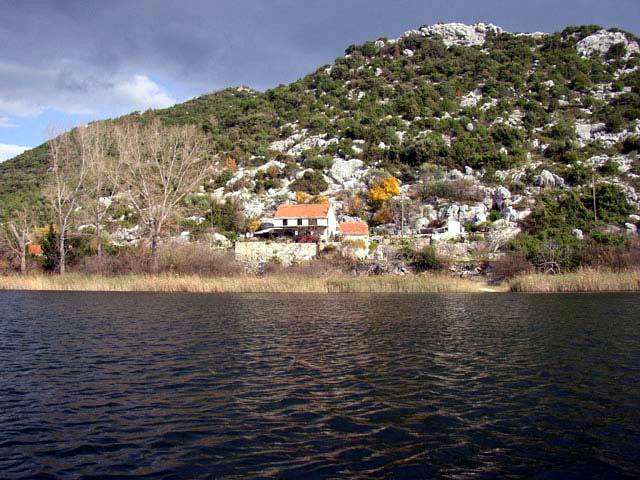
Bosnia and Herzegovina and Croatia
Proposed Integrated Ecosystem Management of the Nerteva and
Trebisnjica River Basin
(NTRB) Project
5.2.9. Improvement of tourist site at Baina lakes
Description of present situation: Baina is a settlement in southern Dalmatia (Croatia), 7
km distant from city of Ploce. The Baina lakes, situated near the city of Ploce in Croatia, are
a group of 7 karst lakes (Crnisevo, Ousa, Plitko lake, Podgora, Sladinac, Sipak and Vrbnik).
According to the Ploce master plan, Bainska lakes are designated as a recreational/tourism
area. This site currently supports ad hoc and relatively uncontrolled tourism.
Baina lakes are supplied with water trough permanent and temporary springs. The biggest
spring is Klokun, which runs into Plitko jezero. Klokun is abundant in water, from 70 to 480
l/s and it is used for water supply of Ploce. Great amount of water flows into the Lake
Podgora through drainage tunnel and channel dug in 1938, used for drainage of waters from
the Field of Vrgorsko. In summer, this channel dries up. There are some permanent and
temporary springs on the coast of certain lakes, also running into Baina lakes.
Water from the area of Baina lakes (Klokun) is used for supplying Ploce. Water supply pipes
connect Gradac, Brist, Podaca, Baina, Ploce, Rogotin, Sari-Struga, Banja and Komin.
Description of activity: The project would finance preparation of a site management plan;
and establishment of environmentally sound recreational and education offerings. It will
finance rehabilitation of a building to serve as a visitor/education center; a 3 km trail around
the lakes; ramp construction; watch towers; and preparation of souvenirs and brochures.
Picture 5.3.: View on a house at Baina lakes
164
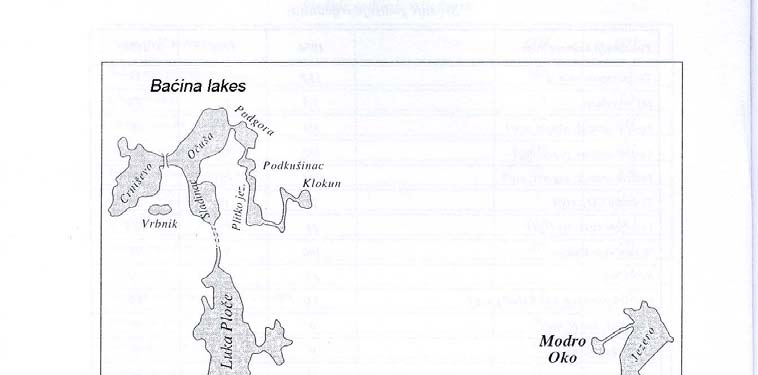
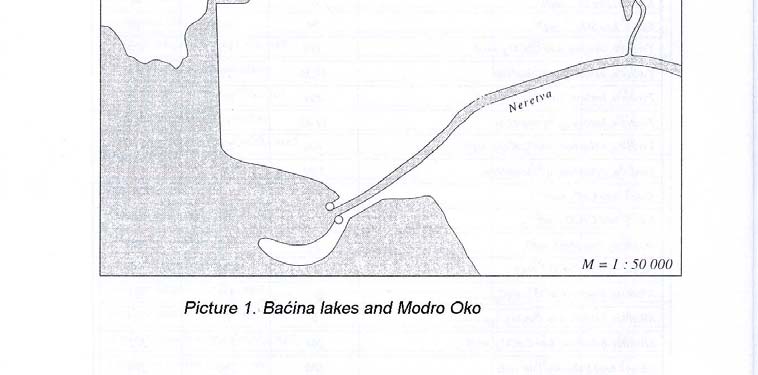
Bosnia and Herzegovina and Croatia
Proposed Integrated Ecosystem Management of the Nerteva and
Trebisnjica River Basin
(NTRB) Project
Picture 5.4.: Baina Lakes and Modro oko
Mitigation Plan and Environmental Monitoring Plan
Mitigation Plan and Environmental Monitoring Plan for activities to be performed on Baina
Lakes are given in Tables 5.31. and 5.32. below.
165
Bosnia and Herzegovina and Croatia
Proposed Integrated Ecosystem Management of the Nerteva and Trebisnjica River Basin
(NTRB) Project
Table 5.31.: Mitigation Plan for Improvement of tourist site at Baina Lakes
Phase
Action
Mitigation measures
Remarks
Cost
Institutional
Responsibility
Continuous arrival of
Timely public
Minor, only for
Operator
the visitors
information to stop
advertising
visitors from coming
aration
during the closure of
ep
existing plant and
Pr
construction period
Damage of trees and
Minimize vegetation
Included in construction Contractor and
other vegetation during clearing. Restore and
works
Environment supervisor
construction activities
reforest all damaged
trees or vegetation after
completion of works
Autochthones materials Using original material
Included in construction Contractor and
and architecture
as stone and wooden
works
Environment or Civil
pillars
engineer supervisor
n
Construction works may Usage of covered trucks
Included in construction Contractor and
tio
generate higher
during transport,
costs
Environment or Civil
concentrations of dust
immediate removal of
engineer supervisor
and noise levels
materials, good
nstruc
o
organization of site
C
works
Fuel, grease and
Control of equipment
Included in construction Contractor
chemicals spillage may
and vehicles. Isolate
works
cause pollution of
and clean the location
underground waters
in case of spillage.
and soil
Solidification of spilled
liquids using adequate
materials.
166
Bosnia and Herzegovina and Croatia
Proposed Integrated Ecosystem Management of the Nerteva and Trebisnjica River Basin
(NTRB) Project
Table 5.31.: Mitigation Plan for Improvement of tourist site at Baina Lakes
Phase
Action
Mitigation measures
Remarks
Cost
Institutional
Responsibility
Regular discharging of
Use adequate car for
Approximate transport Environmental
d
sewage tank
discharging sewage
and disposed of costs Inspection and Operator
tank
are 400 HRK/tone (in
region)
t up an
Incidental discharge of
Continuous control of
Included in wastewater
Operator
Se
exploitation
wastewaters not
equipment and waste
treatment plant costs
complying
water level in tank
Table 5.32.: Environmental Monitoring Plan for Improvement of tourist site at Baina lakes
Phase
Parameter to
Where is the
How is the
When is the
Why is the
Cost
Responsibility
be monitored
parameter to
parameter to be
parameter to
parameter to
be monitored
monitored
be monitored
be monitored
Concentration of On the project
Visually and
Daily, during
Protection of NP Included in
Contractor
dust and noise
activities
listening. If higher
construction
habitants and
construction
levels
location and
concentrations of
works
workers
costs
around it
dust (respiratory
problems etc.) and
irritating levels of
noise occur, perform
measuring
nstruction
o
C
Proper disposal
On the project
Visually
During and at
Protection of
Included in
Contractor and
of materials
activities
the end of
ground and
construction
Environmental
location and
construction
surface waters,
costs, plus costs
supervisor
around it
works
for transport of
waste materials
167
Bosnia and Herzegovina and Croatia
Proposed Integrated Ecosystem Management of the Nerteva and Trebisnjica River Basin
(NTRB) Project
Table 5.32.: Environmental Monitoring Plan for Improvement of tourist site at Baina lakes
Phase
Parameter to
Where is the
How is the
When is the
Why is the
Cost
Responsibility
be monitored
parameter to
parameter to be
parameter to
parameter to
be monitored
monitored
be monitored
be monitored
Fuel, grease and Below and
Visually in order to
Daily, during
Ground and
Included in
Contractor
n
o
chemicals
around material
determine spillage;
construction
surface waters
construction
spillage
storage
in case of major
works
protection
costs,
ucti
spillage it is
necessary to make
Constr
analysis at the site.
Improper work
On the location. Visually,
During operation Protection of
Included in plant Operator
of eco trail and
.
surface waters
operation costs.
and
ion
sewage tank
and habitats
Possible
Set up
exploitat
Institutional Strengthening
- Training
No training is necessary for this activity.
168
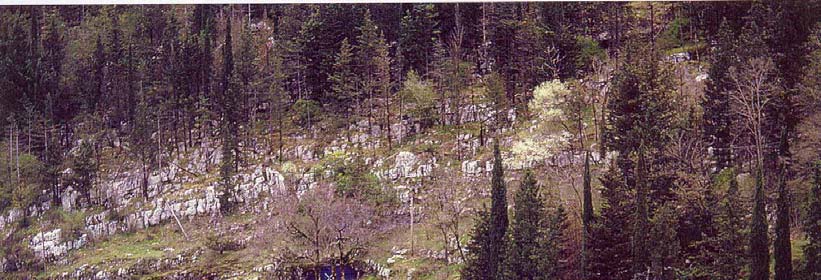
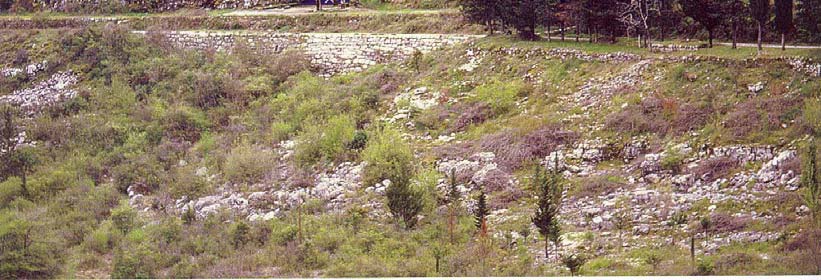
Bosnia and Herzegovina and Croatia
Proposed Integrated Ecosystem Management of the Nerteva and
Trebisnjica River Basin
(NTRB) Project
5.2.10. Improvement of tourist site at Vjetrenica Cave
Description of current situation: Vjetrenica Cavern is located at the western end of the
Popovo polje. From the entrance to the cave, there is a nice view on the Popovo polje, with
the typical shape of a flat fertile soil and bare, steep limestone hills surrounding it. At the
entrance to the cave there is a massive iron bar gate. There are paths inside. The cave was
electrified, but the lines were destroyed during the war in the mid 1990s. The tourist section
of the cave consists mainly of a huge passage. In some parts of the cave, there are rim
stone pools on the floor. In times of very wet weather the water rises in the inner part of the
cave (beyond 700 m). There are many streams and lakes; the largest one is Veliko jezero
(Great Lake), about 180 m long and 1250 m from the cave entrance. The colour of the rock
is mainly reddish-brown or red, caused by the red iron oxide. This cave is a blowing cave or
a wind cave, and that is what its name stands for. The cave system is rather huge, and
differences in temperature and air pressure make air flow in and out of the cave. The
direction depends on the season, and the outside temperature. The wind blows rather
strong, it can reach velocity of more than 10 m/s.
Picture 5.5.: Access road to Vjetrenica Cave
Nowadays this cave is famous for its cave life. The Vjetrenica Cave contains at least 80 types
of stygobites and troglobites, which make it one of the most diverse caves in the world. The
most famous troglobiont (cave animal) in this cave is the olm (Proteus anguinus). And the
cave also contains the bones of extinct animals, such as cave bear (Ursus spelaeus). The
most significant finding was the discovery of a complete skeleton of a leopard (Panthera
pardus).
169
Bosnia and Herzegovina and Croatia
Proposed Integrated Ecosystem Management of the Nerteva and
Trebisnjica River Basin
(NTRB) Project
The name of the cave means Wind Cave, the reason for which is immediately obvious, when
one arrives at the entrance. A howling gale at about 10.6°C flows from the cave, and into
the cave in winter. Over the past hundred or so years, Vjetrenica has been visited by
thousands of tourists. Since 1964 the cave has had electricity up to a distance of about 1000
m. There were guides, a motel. Souvenirs could also be purchased here. During the fighting
in 1991, the tourist equipment was destroyed. Now, it is reopened for tourist again. Many
questions about the origins, development and length of Vjetrenica still await answers from
scientists. Regardless of this, Vjetrenica offers a special glimpse into the soul of the Earth,
which breadth in many ways depends on the eye of beholder.
Since Vjetrenica cave is of great importance for Bosnia and Herzegovina as described above,
it is very important to preserve authentic setting of the location. That means usage of
natural materials that would not endanger natural outlook of the location. Also, it is very
important not to construct access road close to the cave (It should be at least 500 m away
from the cave's entrance).
Description of activity: The aim of this activity is to protect the existing cave ecosystem
by improving the tourist usage and establishing protection methods for the ecosystem. The
project will finance preparation of a management plan which includes establishing zones of
protection; infrastructure supporting tourism focusing on educational offerings;
environmental y friendly infrastructure including special lighting, trail material, and waste
management systems; and promotional and educational materials.
Mitigation Plan and Environmental Monitoring Plan
Mitigation Plan and Environmental Monitoring Plan for activities to be performed near
Vjetrenica Cave are given in Tables 5.33. and 5.34. below.
170
Bosnia and Herzegovina and Croatia
Proposed Integrated Ecosystem Management of the Nerteva and Trebisnjica River Basin
(NTRB) Project
Table 5.33.: Mitigation Plan for improvement of tourist site at Vjetrenica cave
Phase
Action
Mitigation measures
Remarks
Cost
Institutional
Responsibility
Construction causes a
Clearly post information Recommended
Included in construction Constructor
lot of disruption
signs around
construction before
costs
construction area.
tourist season
Limit construction to
regular time intervals
Allocate possible
n
alternative routes for
i
o
tourists.
truct
Chance findings of
Arrange necessary site
Use of hydro pneumatic
Minor
Contractor
monastery and villa
preservation measures
hammer is strictly
Cons
and contact authorities
forbidden
Noise and vibration Limit construction
Use of any quantity of
Included in construction Contractor
disturbances due to activities to regular
explosive is strictly
costs
construction works
daytime intervals.
prohibited.
Construction activities
Sprinkle earth with
Minor
Contractor
may generate dust
water to prevent
generation of dust
Use protective covers
nstruction
for certain areas with
o
C
increased dust
generation
171
Bosnia and Herzegovina and Croatia
Proposed Integrated Ecosystem Management of the Nerteva and Trebisnjica River Basin
(NTRB) Project
Removed material or
All material need to be
Minor
Contractor
former asphalt may
disposed of to the
cause an environmental landfill
threat if not disposed of
properly.
Pollution of earth by Periodically check
Minor included in
Contractor and
fuel, and bitumen
technical condition of
construction costs
environmental
n
machines and all
supervision
o
equipment.
r
ucti
Handle cautiously with
stored fuel, lubricant,
bitumen etc. cautiously.
Const
Any spills must be
contained and cleaned
up.
Open areas must be
All materials must be
Minor included in
Contractor and
cleaned after
disposed from other
construction costs
environmental
completion of
areas where such
supervision
construction
material may be in
excess.
Place sewage tank in
All sewage needs to be
Necessary to make
In accordance with local Management of
the vicinity of the
disposed of in an
long-term agreement
process.
Vjetrenica cave
visitor's centre.
environmental y sound
for transport, treatment
manner. It has to be
and disposal of sewage
transported to Trebinje
sludge, with communal
or Neum for treatment
companies of Trebinje
and disposal.
or Neum
Regular discharge of
Use proper car for
200 KM/tone of sludge,
Municipality
sewage tank
discharging sewage
transport to Neum or
tank and transport it to
Trebinje
Set up and exploitation
the landfill
172
Bosnia and Herzegovina and Croatia
Proposed Integrated Ecosystem Management of the Nerteva and Trebisnjica River Basin
(NTRB) Project
Table 5.34.: Environmental Monitoring Plan for improvement of tourist site at Vjetrenica cave
Phase
Parameter to
Where is the
How is the
When is the
Why is the
Cost
Responsibility
be monitored
parameter to
parameter to be
parameter to
parameter to
be monitored
monitored
be monitored
be monitored
Chance findings
On the place of
Visual inspection
Daily during
Protection of
None
Contractor and
of monastery
construction
during construction
construction
cultural heritage
Inspection
n
and villa
works
works
o
r
ucti
Improper work
On the location. Visually,
During operation Protection of
Included in plant Operator
of eco trail and
.
surface waters
operation costs.
Const
sewage tank
and habitats
Possible
Institutional Strengthening
- Training
No training is necessary for this activity.
173
Bosnia and Herzegovina and Croatia
Proposed Integrated Ecosystem Management of the Nerteva and Trebisnjica River Basin
(NTRB) Project
6. ANALYSIS OF ALTERNATIVES
During preparation of wastewater treatment activities different alternatives were considered for each project location. They are shown and
described briefly in the following text.
6.1. Alternatives for Konjic municipal wastewater collection
In order to solve a problem, since the city of Konjic is the major pol uter in the basin of the Neretva, and largely affects the quality of
water of the Neretva and Jablanica Lake, alternative solutions have been sought since 2005 by using bio-filter modules (rotating biological
contactor) on main outlets.
Due to the terrain configuration, it was concluded that an installation of rotating
biological contactor would be very complex both from the technical and construction perspective, and such an option was practically rejected,
that is, the option of installing only
one such device on the location where it is relatively easy to place such device was selected.
Cost and benefit analysis for the wastewater treatment plant in Konjic takes into account two alternatives with different values of
income. Case 1 considers the charged fees for wastewater col ection as the only direct income, and represents the worst-case scenario for the
cost-effectiveness of the project.
On the other hand, Case 2 was developed through the review of EU standards, and taking into consideration indirect incomes, that are
significantly larger than direct incomes, but do not affect the cost-effectiveness of the investment.
Results of the latter analysis may not reflect the actual conditions of BiH in meeting the economic conditions as assumed in the analysis,
and the reality may be much closer to the starting assumptions used in the Case 1.
6.2. Alternatives for Bilea municipal wastewater collection
Three cases of the wastewater treatment facility for Bileca municipality were considered and
proposed.
174
Bosnia and Herzegovina and Croatia
Proposed Integrated Ecosystem Management of the Nerteva and Trebisnjica River Basin
(NTRB) Project
- Case 1: Modern option based on conventional technology - Considering the need for environmental protection of Bilecko Lake, which
serves as a source for the regional water supply system, it is proposed to treat municipal and industrial wastewaters with a biological-
mechanical treatment system that employs activated sludge in an extended aeration process. In this system, removal of organic
pollutants and sludge stabilization occur in the same bio-aeration tank, producing stabilized sludge that can be safely disposed at a
landfil or a disposal site.
- Case 2: Biological treatment facility based on SBR Technology - A modern biological treatment plant based on Swedish SBR
(Sequencing Batch Reactor) technology could be proposed as a solution for Bileca. This type of plant is convenient because it does not
require a large surface area and its tanks are placed on the ground, which is suitable for terrains with high groundwater tables. No
secondary settling tanks for separation of water and activated sludge are necessary in these facilities, since aeration reactors work in an
alternating fashion with aeration and after aeration is completed they are used as settling tanks or are filled with new water.
Installation requires only a minimum of ground removal work (only what is necessary for foundations of devices) and concrete tanks
are assembled from concrete components, which are made on site. Treatment efficiency is high: effluent has less than 10 mg/l BOD5
and 20 SS, and 6090% of nutrients are removed.
Treatment plant capacity (phase I): 10,000 PEI (final capacity: 18,000 PE).
Hydraulic capacity: 2,500 m3/day.
Aeration system: diffuse aeration.
Treatment system: biological (SBR - Sequencing Batch Reactor activated sludge
modification).
Sludge treatment: aerobic stabilization and removal of water at centrifuges.
- Case 3: Installation of 3 rotating biological contactors - One of the options is a phased solution, where each phase would represent a
finished project, resulting in reduction of pollution of Bilecko Lake. Smaller compact treatment devices of the rotating biological
contactor type are also proposed. There would be one plant for 5,000 PE and two plants, each for 2,000 PE (total 9,000 PE). The
wastewater treatment device is designed to have seven parts, which together make up a complete solution for wastewaters. The
system is sized for 5,000 PE with the possibility of not using certain parts of the system depending on the season and loading, which
means that it is not necessary for the system to work at full capacity. The system can be expanded by adding new rotating biological
contactors, if there is an increase in PE.
175
Bosnia and Herzegovina and Croatia
Proposed Integrated Ecosystem Management of the Nerteva and Trebisnjica River Basin
(NTRB) Project
Conclusion: It is better for Bilea to build a classical biological wastewater treatment plant for 10,000 PE, which can handle pre-treated
industrial waters and a part of precipitation waters from the mixed sewage system. This would satisfy the town needs for at least 15 years.
6.3. Alternatives for municipal wastewater treatment in Ljubuski
For this activity, only economy alternatives in terms of investment recovery and financing were analysed.
Cost and benefit analysis for the wastewater treatment plant in Ljubuski takes into account two alternatives with different values of
income. Case 1 considers the charged fees for wastewater col ection as the only direct income, and represents the worst-case scenario for the
cost-effectiveness of the project.
On the other hand, Case 2 was developed through the review of EU standards, and taking into consideration indirect incomes, that are
significantly larger than direct incomes, but do not affect the cost-effectiveness of the investment.
Results of the latter analysis may not reflect the actual conditions of BiH in meeting the economic conditions as assumed in the analysis,
and the reality may be much closer to the starting assumptions used in the Case 1.
6.4. Alternatives for industrial wastewater treatment in "SurTecSjaj" mettalurgy company
Alternatives in terms of technology were not analysed.
Cost and benefit analysis for the wastewater treatment plant in Konjic takes into account two alternatives with different values of income. Case
1 considers the charged fees for wastewater collection as the only direct income, and represents the worst-case scenario for the cost-
effectiveness of the project.
On the other hand, Case 2 was developed through the review of EU standards, and taking into consideration indirect incomes, that are
significantly larger than direct incomes, but do not affect the cost-effectiveness of the investment. Results of the latter analysis may not reflect
the actual conditions of BiH in meeting the economic conditions as assumed in the analysis, and the reality may be much closer to the starting
assumptions used in the Case 1.
176
Bosnia and Herzegovina and Croatia
Proposed Integrated Ecosystem Management of the Nerteva and Trebisnjica River Basin
(NTRB) Project
6.5. Alternatives for industrial wastewater treatment in "UNISGAL" mettalurgy company
Alternatives in terms of technology were not analysed.
Cost and benefit analysis for the wastewater treatment plant in Konjic takes into account two alternatives with different values of
income. Case 1 considers the charged fees for wastewater col ection as the only direct income, and represents the worst-case scenario for the
cost-effectiveness of the project.
On the other hand, Case 2 was developed through the review of EU standards, and taking into consideration indirect incomes, that are
significantly larger than direct incomes, but do not affect the cost-effectiveness of the investment. Results of the latter analysis may not reflect
the actual conditions of BiH in meeting the economic conditions as assumed in the analysis, and the reality may be much closer to the starting
assumptions used in the Case 1.
177
Bosnia and Herzegovina and Croatia
Proposed Integrated Ecosystem Management of the Nerteva and Trebisnjica River Basin
(NTRB) Project
7. ENVIRONMENTAL FRAMEWORK GUIDELINES
Available data for some of the planned projects are not sufficient enough and on the appropriate level for preparation of EA and EMP
and therefore, Environmental Framework Guidelines are given here.
Detailed EIA (if necessary) and EMP will be elaborated for each of potentials projects, during project development.
7.1. Environmental Framework Guidelines for Small Grants Program
In order to avoid possible negative environmental impacts of certain activities under up to date insufficiently detailed projects,
Environmental Framework Guidelines are proposed within small grant projects.
With respect to the WB safeguard policy, the following procedure is proposed:
Because of relatively limited number of possible different projects (type of activity, scope, location) and bearing in mind that the most of the
projects are very small, that they all fall under category B, that they do not require EIA or EA, nor WB procedures or national obligations, and
that all of them will contribute to the environmental improvement, simplified procedure is therefore proposed.
In order to easily evaluate projects being subjects of smal grants up to few thousand dol ars, Client proposal has to be unified and as simple
as possible, so that a Client itself, to the greatest possible extent, can prepare it.
Format given in Table 7.1 is proposed to be reviewed and introduced in the Operational Manual.
Table 7.1.: Format of Client proposal to be included in Operational Manual
(For each type of selected project-to-project activities sample shall be prepared)
Client: Name, address, status
Sub-project: Name and location
178
Bosnia and Herzegovina and Croatia
Proposed Integrated Ecosystem Management of the Nerteva and Trebisnjica River Basin
(NTRB) Project
Description of present situation
Description of location: (half to one page) purpose of land land use plan, properties right, surrounding, geographical position, hydrology, access to
transport infrastructure, soil, level of potable water, nature flora and fauna, protected areas, important cultural monuments; archaeological heritage;
.............
Relation to Physical Plan: Physical Plan exist/does not exist / is not needed; location already included as a special requirement as per Physical Plan, if any
State of environment: sewage system exist/does not exist; solid waste disposal exist/does not exist; air pollution; impact of other/existing industry/plants;
state of transport facilities;
Description of planned activities
Description of activities: (half page What? How many? .......)
Land (which surface will be under crop/activity)
Used raw materials: for each type of materials, including water and chemicals (quantity/year; quantity/day; storage facilities)
Energy type and source: What kind? How many?
Products: product (quantity)
Solid waste: type and quantity; disposal solution
Waste water: type and quantity; disposal solution
Air emissions: type and quantity
Noise: source and impact on residential area
Transport: access to transport facility;
179
Bosnia and Herzegovina and Croatia
Proposed Integrated Ecosystem Management of the Nerteva and Trebisnjica River Basin
(NTRB) Project
EXPECTED IMPACT
Relation to BiH or/and Croatian EIA practice: checking of the planed activities against the List of the NTRP activities for which EIA is required and if
required, against the List of Intervention requested EIA (Regulation on EIA of BiH and Croatia) and checking of planned activities against Bank's exclusion list
of activities forbidden for financing.
DECISION
EIA is required/not required; if YES complete/target EIA is required /not required
Additional criteria: EMP, Good practice recommendation, Mitigation measures, Monitoring (i.e. cal ed EMP in WB)
Anyhow, for each of the planned projects, the PIU shall compare proposed activity with respect to the WB safeguard policies and
categorization of the projects in group A, B, or C, but also having in mind that the WB forbids financing of some types of activities.
Table 7.2.: EIA Procedure
ENVIRONMENTAL IMPACT ASSESSMENT generally consists of the following steps:
Screening to determine whether or not proposed activities should be subject of EIA and, if so, at what level of detail
Scoping to identify the issues and impacts that are likely to be important and to establish the terms of reference for EIA
180
Bosnia and Herzegovina and Croatia
Proposed Integrated Ecosystem Management of the Nerteva and Trebisnjica River Basin
(NTRB) Project
Impact Analysis to identify and predict the likely environmental, social and other related impacts of the proposed activities
Mitigation and Impact Management to establish the measures that have to be avoided, minimize or offset predicted adverse impact and, where
appropriate, to incorporate these into an environmental management plan or system
Evaluation of Significance to determine the relative importance and acceptability of residual impacts (i.e. impacts that cannot be mitigated)
Monitoring to control efficiency of proposed measures
For the activity preliminary screening related to national criteria will be performed. If the proposed activity is the subject of the EIA
(according to the BiH and Croatian practice), the screening process is hereby completed. This means that EIA must be developed. If the
proposed activity is not the subject of the EIA according to the national practices of BiH and Croatia, the borrower shall undertake secondary
screening according to the WB practice.
If there is any uncertainty (concerning the size and type of the projects), on the World Bank classification of activities related to exclusion, the
PIU must seek the opinion of the World Bank.
If the proposed activity belongs to the Category A the activity will be excluded from financing by the project.
Preparation of EIA
For the project activities categorized as A or B and/or for project activities, which are subject to EIA according to BiH and Croatian law,
EIA must be prepared. Nevertheless, although the format of the EIA document of the Bank and BiH and Croatian is almost the same, it will be
an advantage if all requirements are to be met in the same document. The efficiency could be achieved if licensed institutions for the EIA
preparation in BiH (currently only in the RS) and Croatia are familiar with the Bank safeguard policies and procedures. The Project can finance
training for each responsible officials and at least one licensed institution (currently only in the RS) on the Bank World Bank safeguard policy
with a particular emphasis on the screening process.
For each Canton, at least one licensed institution for preparation of EIA shall be selected for required EIA in the NTRB project and
trained on Bank safeguard practice. Licensed institution shall, if needed, work closely with the PIU and borrower.
181
Bosnia and Herzegovina and Croatia
Proposed Integrated Ecosystem Management of the Nerteva and Trebisnjica River Basin
(NTRB) Project
The environmental permitting process in BiH and Croatia is established. However, not sufficient care on environment and sustainable
development is undertaken, particularly by small-scale projects. It could happen, especially with a project for which the EIA is not required,
that environmental standards would not be met and that most appropriate environmental practice would not be introduced, because screening
is not mandatory for projects which do not require EIA.
Nevertheless, for al NTRB activities with possible environmental impact screening is foreseen. It is proposed that experienced
environmentalist shall do this or licensed institution.
For this purpose it will be very useful if the PIU contracts or executes site visits for each relevant project activity, even if law does not
require the EIA: e.g. scale of the plant and expected moderate environmental impact.
It is known that most rural areas in BiH and Croatia are lacking minimum municipal infrastructure as for example: sewage system and
solid waste disposal sites. Experts can suggest minimum mitigation measures to the Client that can help sustainability of the project and also
present additional guarantee for the Bank (e.g. in case there is no central sewage system, construction of environmental friendly septic pit is
recommended; if there is no organized solid waste disposal, measures for minimizing waste production and/or composting of organic waste
should be imposed). Such proposed mitigation measures, based on the local principle so called "Best Available Technology Not Entailed
Enlarged Costs" (BATNEEC) shal be introduced in the project, as a mandatory measure.
For each type of the project activity, the PIU can prepare a "good practice guidelines". These shall not be prepared in advance for all
possible activities. They will be worked on a "case by case" basis with periodic updating of the "good practice guidelines".
Site visits for each relevant project activities shall be organized. During the screening process, project activities shall be linked to good
environmental practice.
In case that the EIA is required, the Client must submit to the borrower official documents issued by the Ministry.
NOTE: The activity cannot start before the Location and/or Construction permits are issued!
Protection of cultural heritage, chance finds and landscape
According to the BiH (both the Federation and the RS) and Croatian cultural heritage protection practice, building permit will usually
contain provision about the chance findings and protection of cultural heritage, particularly if the planned activities are related to digging and
other activities, such as restoration (of old buildings). It could happen that authorities will not require construction permit. The borrower shall
182
Bosnia and Herzegovina and Croatia
Proposed Integrated Ecosystem Management of the Nerteva and Trebisnjica River Basin
(NTRB) Project
screen if chance findings can be expected during the particular project and if there is a need for protection of cultural heritage. If need be,
request that particular provisions are included in the Contract with the Client.
To protect the value of the environment, the landscape should be taken care in particular. The landscape can be affected by
reconstruction and rehabilitation activities and/or by construction of new buildings. However, it should be requested that the construction
works comply with culture and tradition of constructing in that particular area. The building permit usually covers this. The borrower shal
check if the provision about the landscape protection is included in the building permit for the related project/s. If not, than it shall request this
provision to be included in the contract entered into with the Client.
The borrower shall screen particular projects for provisions regarding protection of cultural heritage, chance findings and landscape,
and if needed, include it in the building permit.
In BiH and Croatia, the EMP is mandatory only for projects for which the EIA procedure was met. Licensed institution based on "case by
case" practice could prepare templates for EMP.
7.2. Environmental Framework Guidelines for Salt Water Intrusion
7.2.1. Objectives
The objectives of this pilot scheme are (i) to identify and elaborate a sustainable solution for the reduction of negative impacts through
salt intrusion (salinity assessment study); and (ii) to apply recent research results and modern irrigation technology as well as good agricultural
practice on a pilot area of about 400 ha to increase and maintain sustainable crop production.
The proposed pilot scheme "Salt Intrusion in the Neretva Delta" will consist of two parts:
1. a salinity assessment study as an input to the preparation of the Neretva-Trebisnjica River Basin Management Plan; and
2. a rehabilitation/development of about 400 ha of irrigated land for improved agricultural production and sustainable land use practice
in the Neretva Delta.
It is prudent that this rehabilitation will be in an agricultural production area which wil not be negatively affected from whatever the final
solution of appropriate land and water management in the Delta will be according to the future River Basin Management Plan (RBMP).
183
Bosnia and Herzegovina and Croatia
Proposed Integrated Ecosystem Management of the Nerteva and Trebisnjica River Basin
(NTRB) Project
7.2.2. Environmental Considerations
In coastal aquifers, sea water intrusion is common. It is a natural process, but it becomes an environmental problem when low quality
water is used for irrigation purposes. This problem is exacerbated by the karst features in the catchment areas which control the variation of
river flows draining towards the Adriatic Sea, and by hydropower production and water diversions. This is particularly evident in the Neretva
Delta, where farmers who grow mostly vegetables and fruits have no alternative water source, and thus use saline groundwater for irrigation
purposes, thereby potential y degrading the soil and lowering crop yields. The problems caused by sea water intrusion and subsequent soil
salinity have become particularly acute over the past few years, particularly for farmers whose revenues depend on agricultural production in
the Neretva Delta.
The design of this pilot wil have accompanying measures such as the provision of extension, the introduction of Integrated Pest
Management (IPM), and on-farm water management assistance which will help to optimize the use of the existing land and water resources
without negatively affecting the environment, and thus enhancing sustainability.
7.2.3. Expected Outputs
The Salinity Assessment Study is expected to produce the following outputs:
Col ection and analysis of existing reports and data (particularly most recent research results);
Survey and mapping of soil salinity;
Extension and operation of the existing surface and groundwater observation network;
Establishment of a mathematical simulation model for water management (quantity and quality) in the Neretva Delta
Delineation of potential land use as a function of soil salinity;
Socio-economic appraisal of the situation of the population using land and water resources
in the Delta;
Appraisal of the proposed technical options to reduce salt intrusion; and
Integration of the study results into the Neretva-Trebisnjica River Basin Management Plan.
184
Bosnia and Herzegovina and Croatia
Proposed Integrated Ecosystem Management of the Nerteva and Trebisnjica River Basin
(NTRB) Project
The Rehabilitation of some 400 ha of irrigated areas in the Neretva Delta is expected to produce the following outputs:
High degree of farmers' participation in design and implementation of irrigation and
drainage infrastructure as wel as in on-farm
water management;
Adequate irrigation and drainage infrastructure and a sustainable operation and maintenance system on about 400 ha of suitable land;
Application of good agricultural practices;
Higher yields and income; and
Sustainable management of land and water resources for irrigation purposes.
7.2.4. Implementation Arrangements and Time Table
The detailed design of this pilot scheme will be carried out during the first project year. As a result of this, the selection of the priority
area will be finalized, which wil be in either Glog or Vidrice in the Opuzen Usce area of the Neretva Delta. The 440 ha in the Glog area were
reclaimed in the early sixties and are characterized by a functioning drainage system of open canals including the main drain pumping station
and guaranteed electricity supply. The agricultural production in that area consists of citrus plantations, which are about 35 years old. The
irrigation infrastructure is insufficient, and farmers are interested in more profitable agricultural production. The 430 ha in the Vidrice area were
reclaimed in the eighties and are characterized by increasing salt intrusion over the last years, a drain pumping station discharging at present
into Mala Neretva, a lack of irrigation facilities, and an available and guaranteed electricity supply. The agricultural production consists of a few
young citrus plantations, and primarily vegetables sensitive to salinity. The farmers have also expressed interests in developing lands for higher
yields and income. Both areas can be irrigated from the Mala Neretva as the latter is supposed to be the fresh water reservoir for any irrigation
needs in Opuzen Usce. This can also occur independent of whatever solution will materialize with regard to the decrease of the negative sea
water intrusion impact, and the required increase of fresh water discharged to the Delta.
The Ministry of Agriculture, Forestry and Water Management will be responsible for the implementation of this pilot scheme, and will
eventually delegate responsibilities to national agencies who have already accumulated a considerable amount of knowledge and experience in
the Neretva Delta, such as Croatian Waters in Opuzen, the Institute for Adriatic Crops and Karst Reclamation in Split, the Civil Engineering
Faculty of the University of Split, and the Amelioration Department of the Faculty of Agriculture of the University of Zagreb.
A preliminary version of the Salinity Assessment Study would be available in 2 years, and would build on data from previous as well as
ongoing research activities. The final version, however, would only be available in five years, when additional monitoring results can be used
185
Bosnia and Herzegovina and Croatia
Proposed Integrated Ecosystem Management of the Nerteva and Trebisnjica River Basin
(NTRB) Project
from the extended and upgraded surface and groundwater observation network. The Pilot Rehabilitation/Development Project would be
planned in the first year, implemented in the second year, operated for two years and eventual y evaluated after the fourth year. It is essential
that the participating farmers are involved right from the outset in the design, implementation, operation, and maintenance of the pilot project.
7.2.5. Estimated Costs
The total cost estimate for the Soil Salinity Assessment Study will be about US$ 300,000 and for the Rehabilitation of Irrigation
Infrastructure is about US$1,000,000. As the Neretva Delta is a priority area for future country-wide irrigation development in Croatia, the
Government of Croatia (GoC) is ready to co-finance the rehabilitation works and eventually upscale the rehabilitation/development measures
once their effectiveness and beneficial impact on crop production and environment is proved.
It is expected that the GoC cofinancing for this sub-component is about US$400,000. It is understood that any intervention planned on
arable (and irrigable) land in the Delta will be undertaken with the full participation of the concerned farmers. It anticipated that the
beneficiaries will contribute about US$200,000 to cofinance only about 33% of the on-farm equipment. The total estimated cost of the
proposed pilot will be about US$1,300,000.
In order to protect environment during implementation of proposed pilot project following approach is suggested:
· Proposed procedure has to be described in details, while special attention has to be given to possible impacts on waters, soil and air
during preparation, implementation and closure of pilot project.
· Proposed procedure will be evaluated in similar way as in case of smal grants
· In case of any doubts WB will be contacted
186
Bosnia and Herzegovina and Croatia
Proposed Integrated Ecosystem Management of the Nerteva and Trebisnjica River Basin
(NTRB) Project
Annex 1: Map of Project location and brief profiles of beneficiary countries
187
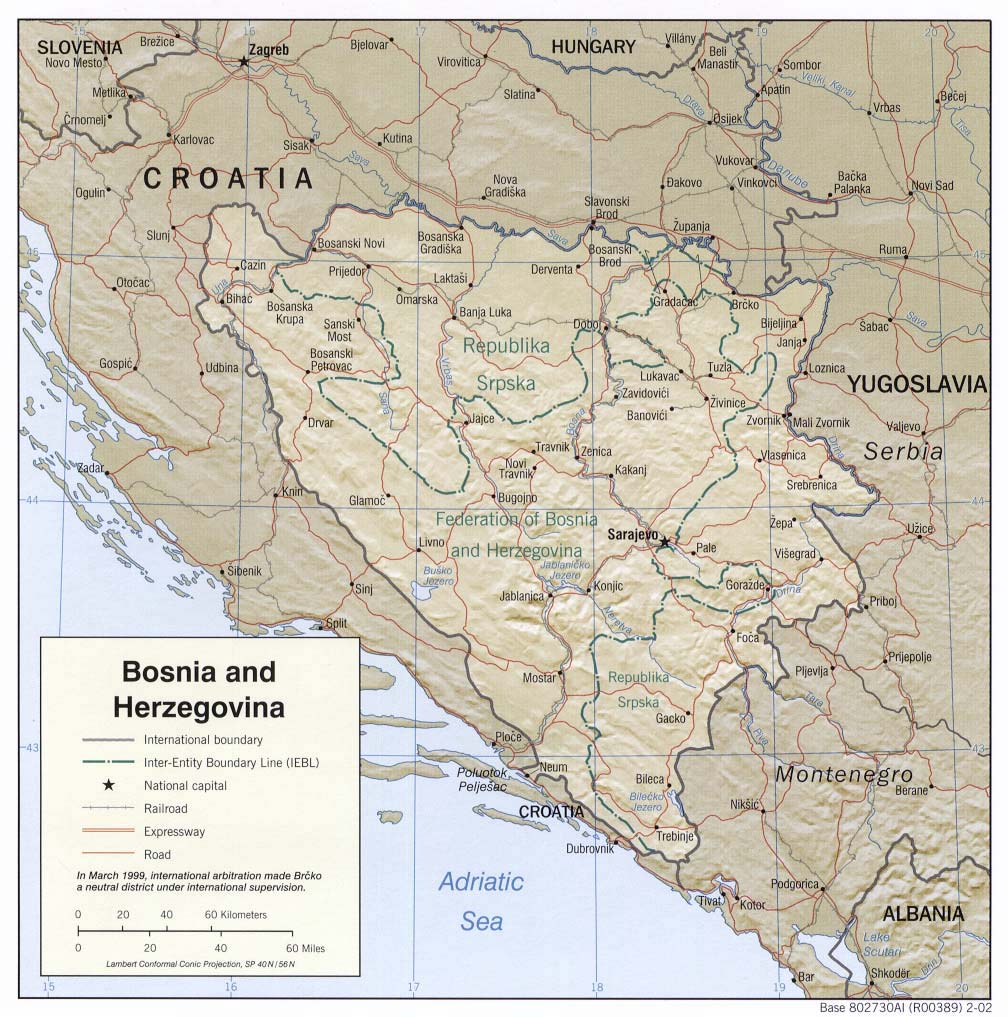
Bosnia and Herzegovina and Croatia
Proposed Integrated Ecosystem Management of the Nerteva and Trebisnjica River Basin
(NTRB) Project
Ljubuski
Buna
Vjetrenica
- Locations of activities
188
Bosnia and Herzegovina and Croatia
Proposed Integrated Ecosystem Management of the Nerteva and Trebisnjica River Basin
(NTRB) Project
Picture 1. Map of project location including site of activities
189
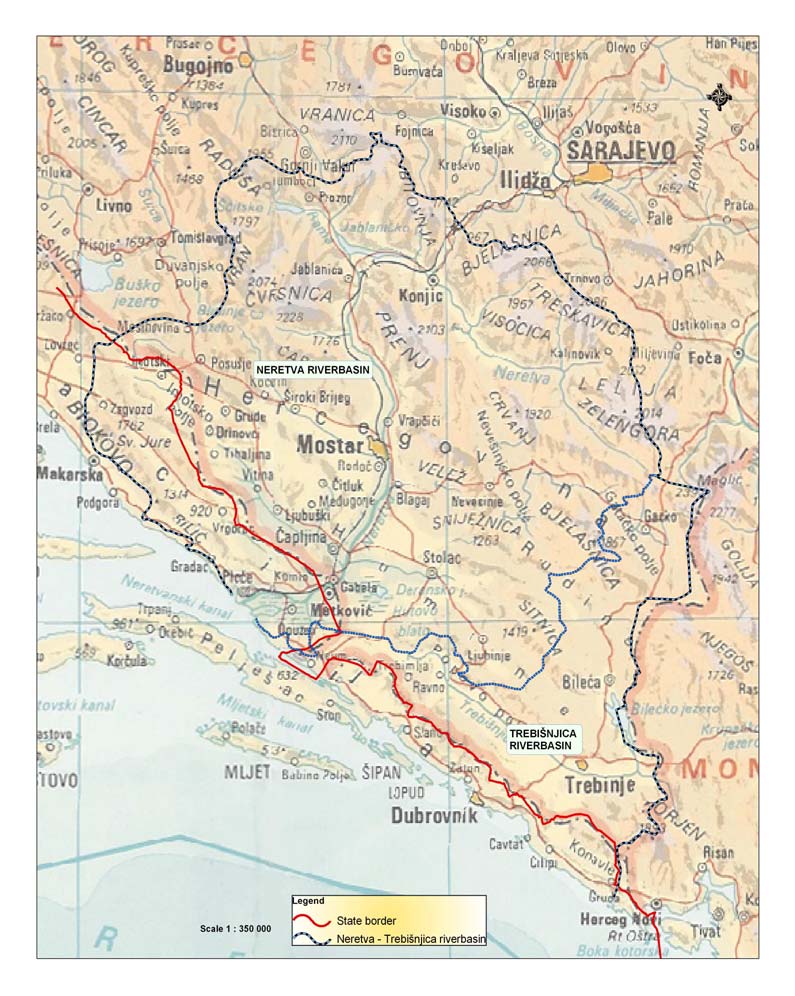
Bosnia and Herzegovina and Croatia
Proposed Integrated Ecosystem Management of the Nerteva and Trebisnjica River Basin
(NTRB) Project
190
Bosnia and Herzegovina and Croatia
Proposed Integrated Ecosystem Management of the Nerteva and Trebisnjica River Basin
(NTRB) Project
Picture 2: Neretva and Trebisnjica River Basins
191
Bosnia and Herzegovina and Croatia
Proposed Integrated Ecosystem Management of the Nerteva and Trebisnjica River Basin
(NTRB) Project
Brief Project beneficiary countries' profiles
Bosnia and Herzegovina (BiH)
The total surface area of Bosnia and Herzegovina is 51,129 km2 with a border line of 1,537 km (762.5 km terrestrial; 751.0 km river;
and 23.5 km sea border). BiH borders the Republic of Croatia in the North and West parts (931 km), Serbia (375 km) in the East part and
Montenegro (249 km) in the South-East part. BiH has access to river Sava in the north and to the Adriatic Sea in the south in Neum. The
terrain in BiH is mostly highland with the average height of 150 m above sea-level. The climate is mostly moderate continental and
Mediterranean. BiH has vast natural resources including forests, ore deposits and water sources.
According to the 1991 census, BiH has 4.4 million inhabitants; the capital is Sarajevo with about 460,000 people.
Croatia (HR)
Croatia is a medium-size European country located in the Southeastern part of Europe and bordering the Adriatic Sea.
The HR area of total 87,677 km2 includes a mainland zone covering 65 % of the total surface (or about 56,538 km2), and a coastal sea zone
(interior plus territorial sea) covering about 35% of the total surface (about 31,139 km2). The Croatian total length of the mainland border is
2,028 km. The country borders Serbia in the north-east (241 km); Hungary in the north (329 km); Slovenia in the north-west (501 km); BiH in
the lower part of the crescent (932 km), Montenegro in the extreme south (25 km), and Italy and Slovenia around the sea zone (about 930
km).
Croatia has a population of 4,784,265 inhabitants; the capital is Zagreb including about 1 million people.
According to the Constitution, Bosnia and Herzegovina is composed of two entities, Federation of Bosnia and Herzegovina and Republika
Srpska and District Brcko, as special administrative unit of Bosnia and Herzegovina. Republika Srpska is divided between Republic and local
self-governmental units. In Federation of Bosnia and Herzegovina, besides federal authority, there are ten cantons, municipalities and cities
that exist as local self-governmental units.
Republic of Croatia, beside state administration, is composed of regional self governmental units (counties) and local self-governmental
units (municipalities and cities).
The NTRB is located within several administrative regions (national and regional level). Generally speaking, the Neretva watershed is
mostly located in the area of the Federation of BiH, whereas the Trebisnjica watershed is mainly located in RS area. Part of the river basin in
the area of RH administratively belongs to two RH counties: Split-Dalmatia County in the continental part of the Neretva River basin, and
Dubrovnik-Neretva County which covers all coastal part of the river basins with fresh water flow into the Adriatic Sea. Administrative regions in
192
Bosnia and Herzegovina and Croatia
Proposed Integrated Ecosystem Management of the Nerteva and Trebisnjica River Basin
(NTRB) Project
the NTRB are in Federation of BiH (BiH): the city of Mostar (administrative center of the canton), and municipalities of Konjic, Jablanica,
Prozor, Citluk, Capljina, Stolac, Neum, Ravno (Herzegovina-Neretva Canton), municipalities of Siroki Brijeg (administrative center of the
canton), Posusje, Grude, Ljubuski (West Herzegovina Canton); in the Republika Srpska (BiH): municipalities of Trebinje, Ljubinje, Bilea,
Gacko, Nevesinje, Berkovii, Kalinovik, Trnovo; and in the Republic of Croatia Cities of Dubrovnik, Ploce, Metkovi and Opuzen and
municipalities of Kula Norinska, Pojezerje, Slivno and Zazablje (Dubrovnik-Neretva County) and municipalities of Vrgorac, Imotski, Zmijavci,
Runovii, Lovrec, Prolozac, Gradac, Podgora, Tucepi, Zagvozd, Podbablje, Lokvicii (Split-Dalmatia County).
The Neretva River is the longest and the most water abundant river, which flows into the Adriatic Sea on East cost. Its watershed can
be seen in three spatial segments starting from the North: the upper Neretva River Watershed, from its source to Jablanica; Central Neretva
River Watershed, from Jablanica to Zitomisli and the lower Neretva River Watershed, the bottom stretch to the sea. In the lower basin the
Neretva Delta is of particular interest. It is generally characterized as wetlands and its Croatian part was put on the Ramsar list in 1993. The
most important part of the Delta in BiH is in the Hutovo Blato Nature Park, which has been on the Ramsar list since 2001. The Trebisnjica River
Watershed can similarly be divided into three stretches. The main characteristics of the Trebisnjica River Watershed are high waters and floods
in the winter-spring season and lack of water accompanied by droughts during the summer. Underground drainage dominates surface
drainage.
There is a diversity of land and water conditions in the Neretva and Trebisnjica River Basin arising from its geographical position, which
encompasses both a mild Mediterranean and a harsh continental climate. The upper Neretva Watershed is mountainous and characterized by
narrow canyons and rapids, interspersed with large lake/reservoirs created by hydroelectric dams. The high plains of the middle Watershed are
remote and characterized by distinctive Karst geology, which resembles an arid moonscape but is in fact surprisingly fertile. Moving toward the
lower Watershed the land descends into a landscape of dense green forests, freshwater springs and streams and an abundance of flora and
fauna. Further southwards, there is the Trebisnjica River Watershed, which is a major tributary of the Neretva River. It is located in South
Herzegovina and the Republika Srpska. Here, there is a strip of Karst land, which levels out towards the Adriatic coast, boasting newly
reconstructed villages; several import facilities, extensive flat agricultural lands and productive soils.
193
Bosnia and Herzegovina and Croatia
Proposed Integrated Ecosystem Management of the Nerteva and Trebisnjica River Basin
(NTRB) Project
Annex 2: Comparison of World Bank Requirements with BiH and Croatia Requirements
Action
FBiH and RS Requirements
Croatia Requirements
World Bank Requirements
Categorization/
FBiH: Categorization and screening is based Environmental impact assessment is obligatory for
Screening and categorization is
Screening
on lists of installations and facilities
interventions defined in the List of Interventions
based on type, location,
requiring environmental permits obtained
that is part of this Rule Book.
sensitivity, and scale of the
through either EIA or without EIA.
proposed project identifying key
Environmental impact assessment is also required
issues including any
RS: Categorization and screening is based
for the reconstruction of plants referred to in par.
resettlement, indigenous
on a list (to be drafted) of projects requiring 1 of this article:
peoples, and cultural property
environmental permits obtained through
- if no environmental impact assessment has been
concerns.
either EIA or without EIA.
carried out and the intervention' s surface area,
size, production and/or power are being increased
and the technological procedure, production
programmed or the operating power source is
being changed;
- if environmental impact assessment was carried
out, and the intervention's surface area" size,
production and/or power are being increased by
30% or more.
Environmental impact assessment is obligatory
also for the removal or cessation of operation of
interventions referred to in par. 1 of this article for
which no environmental impact assessment
procedure has been carried out.
NOTE: Regardless of the above regulation, the
obligation to perform an environmental impact
assessment could be defined in the physical plan
of the County or City of Zagreb; separate and
more detailed List of Intervention with obligatory
194
Bosnia and Herzegovina and Croatia
Proposed Integrated Ecosystem Management of the Nerteva and Trebisnjica River Basin
(NTRB) Project
Action
FBiH and RS Requirements
Croatia Requirements
World Bank Requirements
EIA could be given
Significant impacts FBiH: A: Installations and facilities to be
All projects given on List of Intervention have the
Cat. A: Projects likely to have
assessed for their impact on environment
same category
significant adverse
requiring ful EIA are defined by secondary
environmental impacts that are
legislation. The EIA is a requirement for
sensitive (irreversible).
obtaining an Environmental Permit.
RS: A: Projects requiring full EIA will be
defined by secondary legislation.
Moderate Impacts
FBiH & RS:
Cat B: Projects with
B: Entity ministries responsible for
environmental impacts less
environment wil screen and decide whether
adverse than those of Cat A.
an EIA is required.
C: Installations and facilities for which
Environmental Permit is issued by entity
ministries responsible for environment and
which do not require a full EA.
Low or no impacts FBiH: D: All smaller facilities and
Cat C: Projects with minimal or
installations, which require an
no adverse impacts.
Environmental Permit to be issued by
responsible cantonal ministry. Secondary
legislation defines the size and thresholds of
these facilities. By-Law enacted in Sarajevo
Canton (OG of Sarajevo Canton 19/04)
RS: D: Local administration units
(municipalities) responsible for
environment, issue environmental permits
to facilities (which require an Environmental
195
Bosnia and Herzegovina and Croatia
Proposed Integrated Ecosystem Management of the Nerteva and Trebisnjica River Basin
(NTRB) Project
Action
FBiH and RS Requirements
Croatia Requirements
World Bank Requirements
Permit) with threshold levels below A, B, C
and those facilities which are not included in
A, B and C.
FBiH: E: Very small installations and
facilities (which do not exceed household
emissions) not requiring environmental
permits are under the responsibility of
relevant cantonal ministries. These
thresholds have not been defined yet. The
cantons may transfer this obligation to
municipalities in the future.
RS: E: Installations, which do not require
environmental permits.
EA
A:
Cat A: Full EA is required,
Documentation/
Phase I: Prior to environmental assessment EIA shall include the following chapters and
normally an EIA. The EMP is an
Document
needs to be submitted by the project
contents:
essential part of the EA. EA
Content
developer to the Federal Ministry (in FBiH)/
content for a Cat A project is
Decision request for and EIA to the Entity
Description of the intervention and its location
given in Annex I.
Ministry (in RS) in order to determine the
1. Purpose of undertaking or developing the
scope of the EIA study. The
intervention;
(Separate Resettlement Plans
assessment/request contains the project
2. Data from the physical planning document;
and Indigenous Peoples Plans
description including information about the
3. Description of the location environment and
are Disclosed with the EA
location, purpose and size of installation,
impact area of the intervention;
report)
measures to prevent or mitigate possible
4. Description of the intervention;
negative impacts, information required for
5. Assessment of realization costs and work related
identification and assessment of basic
to the intervention;
environmental impacts, copy of spatial plan
6. Description of the relationship between the
of the location, non-technical summary
intervention's executor and the public prior to
196
Bosnia and Herzegovina and Croatia
Proposed Integrated Ecosystem Management of the Nerteva and Trebisnjica River Basin
(NTRB) Project
Action
FBiH and RS Requirements
Croatia Requirements
World Bank Requirements
(non-technical summary is submitted in
study elaboration.
FBiH only).
Acceptability assessment of the intervention:
Phase II (FBiH): The Entity Ministry defines
1. Identification and review of possible
the content and scope of the EIA based on
environmental impacts of the intervention and its
the results of the Prior Environmental
variants during preparation, development and use
Assessment and in accordance with
of the intervention, or cessation of use and/or
secondary legislation. The Ministry also
removal of the intervention, including ecological
provides a list of institutions authorized to
accident and the risk of its occurrence;
prepare EIA not yet prepared and issued
2. Cost-benefit analysis of the intervention;
in FBiH.
3. Coordination of the intervention with
Phase II (RS): Following Entity Ministry's
international liabilities of the Republic of Croatia
decision, the project developer submits a
related to the decrease of inter boundary
request for preparation of an EIA. Based on environmental impacts and/or the decrease of
the request, the Entity Ministry contracts an global environmental impacts;
authorized institution for the preparation of
4. Substantiated proposal of the most adequate
the EIA, selected from the list of institutions intervention variant with regard to environmental
licensed for performing EIA (OG of RS,
impact.
02/03)
C. Environmental protection measures and
measure implementation plan:
1. Proposal of environmental protection measures
during intervention execution and use, or cessation
of use and/or removal of the intervention,
including the proposal of measures for the
prevention and mitigation of consequences of
possible ecological accidents;
2. Monitoring programs, if needed, with regard to
the state of environment;
3. Environmental protection policy of the
197
Bosnia and Herzegovina and Croatia
Proposed Integrated Ecosystem Management of the Nerteva and Trebisnjica River Basin
(NTRB) Project
Action
FBiH and RS Requirements
Croatia Requirements
World Bank Requirements
intervention's executor with a review of objectives
and principles of environmental protection actions;
4. Organization structure of the intervention's
executor with a review of the total practice,
responsibility, procedures and potentials of the
intervention's executor for implementing
environmental protection measures;
5. Review of the planned cooperation of the
intervention's executor with the public during and
upon intervention realization;
6. Assessment of costs related to environmental
protection measures and monitoring measures
related to the state of the environment and their
share in the costs of realization and works, or
cessation of the intervention's use.
D. Conclusion (concise)
1. Rationale of the intervention's most appropriate
option;
2. Review of the environmental impact of the
selected option of intervention;
- environmental protection measures during
execution and use, or cessation of use and/or
removal of the intervention, including measures for
prevention and mitigation of consequences of
possible ecological accidents;
- monitoring programs, if necessary, related to the
state of the environment during the intervention's
execution and use, or cessation of use, with
argumentation.
198
Bosnia and Herzegovina and Croatia
Proposed Integrated Ecosystem Management of the Nerteva and Trebisnjica River Basin
(NTRB) Project
Action
FBiH and RS Requirements
Croatia Requirements
World Bank Requirements
E. The study's summary for public inspection
prepared for the general public
F. Data sources
- Physical planning and environmental protection
documents, other planning documents,
regulations, statistical reviews, expert and scientific
articles, etc.
B (FBiH & RS): Activities in this category are Concerning:
Cat B: Scope of EA narrower
also subject of a Prior environmental
than Cat. A project. Usually just
assessment, where the content of the
For the reconstruction, removal or cessation
an EMP is required.
document submitted is identical to that of
of operation of the intervention referred to
Environmental considerations
A.
in art. 3 par. 2 and 3 of this Book of Rules,
are either incorporated in
the elaboration of a study with target
project documents or are
C (FBiH & RS): Written request for
contents may be allowed on request of the
included in a separate report.
Environmental Permit needs to contain the
authorized person.
The Concept Review decides
following:
the scope of the EMP and
-Name and address of the project developer By a study with target contents specific aspects of
whether any additional
-Location and description of: installation,
environmental impact of the reconstruction and
environmental requirements are
facility and activity (plan, process
closing or removal of existing interventions are
necessary.
description); raw materials; sources of
elaborated.
emissions; site conditions; type and
(Separate Resettlement Plans
quantity of emissions; key environmental
The executor of the intervention has to explain the and Indigenous Peoples Plans
impacts; prevention and mitigation
reasons why the elaboration of the study referred
are Disclosed with the EA
measures; measures for prevention of
to in par. 1 of this article is requested and to
report)
waste generation; after closure measures;
propose the objective and contents of the study.
alternatives; request form for other required
permits, non-technical summary.
A study with target contents may be granted also
199
Bosnia and Herzegovina and Croatia
Proposed Integrated Ecosystem Management of the Nerteva and Trebisnjica River Basin
(NTRB) Project
Action
FBiH and RS Requirements
Croatia Requirements
World Bank Requirements
for interventions from the List of interventions
Chapter II. Power facilities 2.1. Electric power
plants hydro-electric power plants with installed
power below 5 MW ;-power plants with
unconventional energy sources, installed power
below 10 MW and Chapter IX. Facilities in
protected areas.
The Ministry of Environmental Protection and
Physical Planning (hereinafter: the Ministry) grants
the elaboration of the study referred to in par. 1 of
this article and defines its contents.
D (FBiH & RS): Formal written request to
Cat C: No EA is required. No
Cantonal Ministry responsible for
action is required beyond
environmental issues (in FBiH)/ Municipal
screening.
body responsible for urbanism (in RS), has
the same content as request for C.
The Cantons are authorized to modify the
above requirements for D in the Cantonal
laws dealing with EA.
Inter boundary
For all projects and installations/facilities
For all projects and installations/facilities that may
Notification of riparian may be
Environmental
that may have negative inter boundary
have negative inter boundary environmental
required if international
Impacts
(including inter-entity boundary)
impacts the following are required:
waterways are involved.
environmental impacts the following are
The EIA report needs to have special chapter
required:
containing information on possible inter boundary
-
The EIA report needs to have a
environmental impacts relation to ESPOO
special chapter containing
Convention. Also the chapter with the respect to
200
Bosnia and Herzegovina and Croatia
Proposed Integrated Ecosystem Management of the Nerteva and Trebisnjica River Basin
(NTRB) Project
Action
FBiH and RS Requirements
Croatia Requirements
World Bank Requirements
information on possible inter
other international obligation (Kyoto,) could be
boundary environmental impacts.
required.
-
The request for an Environmental
Permit (and relevant documents
included with the request) needs to
be sent to relevant entity/foreign
state authorities.
Consultations /
Public consultation is the responsibility of
The borrower is required to
Public Hearings
entity ministries responsible for
consult project-affected groups
environment for A, B and C, while it is
and local NGO's about the
under the responsibility of Cantonal
projects environmental aspects
Ministries (in FBiH)/Municipalities (in RS) for
and take their views into
D.
account.
A: Article 61 of the FBiH Law on
Cat A: At least two
environmental protection (and Article 62 in
consultations (1) at the scoping
RS) prescribes that the public consultation
stage, shortly after
should take place after the draft EIA study
environmental screening, and
is submitted. However, Article 36. (Article
before the ToRs for the EA are
35 in RS) requires public consultations to be
finalized, and (2) once a draft
carried out through al phases of the EIA.
EA report is prepared.
Although not specified explicitly, this article
may be interpreted that the public
Cat B: At least once during the
consultation is also required during the Prior
EA process.
environmental Assessment phase. The
Ministry will decide whether a consultation
is required. It always decides it is
necessary.
B: Depending on the screening results, B is
201
Bosnia and Herzegovina and Croatia
Proposed Integrated Ecosystem Management of the Nerteva and Trebisnjica River Basin
(NTRB) Project
Action
FBiH and RS Requirements
Croatia Requirements
World Bank Requirements
re-categorized either as A or C and will thus
inherit the requirements of these
categories.
C and D: Consultation is carried out once,
during the Environmental Permit issuing
procedure.
Inter boundary impacts: In case of negative
inter boundary (including inter-entity
boundary) environmental impacts; the
representatives and the public of the
entity/foreign state have the right to
participate in the consultation process.
Disclosure
A and B (FBiH and RS):
Environmental Assessment Report (draft) is
Cat A: Borrower provides for
Prior to environmental Assessment Report
disclosed prior to consultation (15-30 days allowed the initial consultation a
(in FBiH)/Request for Decision (in RS) is
for comments).
summary of the proposed
disclosed prior to consultation (30 days
project's objectives, description,
allowed for comments).
Public hearing process is obligatory. Participation
and potential impacts. After
of NGO and other groups is given.
draft EA report is prepared, the
A and B (FBiH): For all A projects, and
borrower provides a summary
those B projects that require an EIA
of the EA's conclusions. The
(following the PRIOR EIA), Entity Ministry
borrower makes the draft EA
sends a copy of the EIA study (may be
report available at a public
interpreted as "draft EIA study" although
place (in local language).
not mentioned in the Law) to relevant
authorities and other interested parties,
Cat B: Separate Cat B reports
al owing 30 days for receiving comments to
are to be made available to
the report.
local NGOs and affected groups
(local language).
A and B (RS): For all A projects, and those
202
Bosnia and Herzegovina and Croatia
Proposed Integrated Ecosystem Management of the Nerteva and Trebisnjica River Basin
(NTRB) Project
Action
FBiH and RS Requirements
Croatia Requirements
World Bank Requirements
B projects that require an EIA (following the
The disclosure process is
PRIOR EIA), Entity Ministry sends a copy of
complete only after the EA
the draft EIA study to the project developer
report is officially received by
(since the Ministry contracts the preparation
the Bank.
of the EIA study), relevant authorities and
other interested parties, allowing 30 days
for receiving comments to the report.
C and D (FBiH & RS): Request for issuing an
Environmental Permit (and relevant
documents) must be accessible by the
public, where 30 days are allowed for
comments.
EA Review and
A ,B and C (FBiH and RS): Entity ministries
EIA Commission appointed by the Ministry
For Cat. A & B Projects, before
Approval
responsible for environmental issues review organizes it.
formal clearance of
and approve the EIA reports and
The number of commission members and its
environmental aspects of the
Environmental Permit requests.
composition are determined depending on the
project, the Bank reviews the
intervention's environmental impact and
results of the EA (especially
C and D: Cantonal Ministries (in
environmental features in the intervention s impact consultations, EMP and
FBiH)/Municipal authorities (in RS) review
area.
institutional capacity), ensuring
and approve Environmental Permit
that the EA report is consistent
requests.
Field visit by Commission is obligatory.
with the ToR.
Licensing /
New projects (FBiH): The following permits
The Ministry provides a list of institutions
None
permitting
are required (each being a requirement for
authorized to prepare EIA.
the next) for new projects:
-
Environmental Permit (for
installations and facilities listed in
203
Bosnia and Herzegovina and Croatia
Proposed Integrated Ecosystem Management of the Nerteva and Trebisnjica River Basin
(NTRB) Project
Action
FBiH and RS Requirements
Croatia Requirements
World Bank Requirements
the proposed EA secondary
legislation, A, B, C and D)
-
Physical Planning Permit (not
required if detailed physical plans
are available. Physical planning and
technical conditions are prescribed
by the relevant authority)
-
Building Permit
-
Usage permit
Reconstruction/Rehabilitation projects
(FBiH): The following permits are required
(each being a requirement for the next) for
reconstruction/rehabilitation projects:
-
Environmental Permit (for
installations and facilities listed in
the proposed EA secondary
legislation an Environmental Permit
is not required until 2008 if a
conditioning plan exists for A, B, C,
D)
-
Physical planning Permit (not
required if detailed physical
planning is available. Physical
planning and technical conditions
are prescribed by the relevant
authority)
-
Building Permit
-
Usage permit
204
Bosnia and Herzegovina and Croatia
Proposed Integrated Ecosystem Management of the Nerteva and Trebisnjica River Basin
(NTRB) Project
Action
FBiH and RS Requirements
Croatia Requirements
World Bank Requirements
Note: Repair/rehabilitation of buildings and
facilities destroyed during the war only
require a construction permit and do not
require urbanism and environmental
permits.
E projects (FBiH & RS): E projects do not
require an Environmental Permit, however
environmental aspects have to be included
in the physical planning permit. The
following permits are required (each being a
requirement for the next).
-
Physical planning Permit (not
required if detailed physical
planning is available. Physical
planning and technical conditions
are prescribed by the relevant
authority)
-
Building Permit
-
Usage permit
During the issuing of environmental and
physical planning permits for all categories,
other permits may be required by the
relevant entity, cantonal or municipal
authorities issuing the permits (e.g. water
use permit).
RS: The permitting system in RS is similar
but more flexible than in the FBiH where
205
Bosnia and Herzegovina and Croatia
Proposed Integrated Ecosystem Management of the Nerteva and Trebisnjica River Basin
(NTRB) Project
Action
FBiH and RS Requirements
Croatia Requirements
World Bank Requirements
the Environmental Permit is in some cases a
condition for a physical planning permit and
in other case it is a condition for a building
permit. Similarly, the EIA, if the Ministry
decides so, may also be a requirement for
the building permit. Relevant
ministries/authorities decide on the
sequence of permits, i.e. when the
Environmental Permit is a condition for
other permits.
Effluent
The Environmental Permit contains the limit The Environmental Permit contains the limit values Emission levels acceptable to
standards /
values for pollutant emissions. Emission
for pol utant emissions.
the Bank are given in the PPAH
guidelines
limit values are to be taken from recently
issued by-laws regulating actual emission
limit values and guidelines. They are as
follows:
In FBiH:
By-laws on Law on Air Protection
1. Regulation on Air Quality
Monitoring, (OG of FBiH 12/05)
2. Regulation on Monitoring of
Emission of Pollution Substances
into Air (OG of FBiH 12/05)
3. Regulation on Air Quality
Concentration Limit Values (OG of
FBiH 12/05)
4. Regulation on VOC Emission (OG of
FBiH 12/05)
206
Bosnia and Herzegovina and Croatia
Proposed Integrated Ecosystem Management of the Nerteva and Trebisnjica River Basin
(NTRB) Project
Action
FBiH and RS Requirements
Croatia Requirements
World Bank Requirements
5. Regulation on Conditions for
Operations of Waste Incineration
Plants (OG of FBiH 12/05)
6. Regulation on Emission Limit Values
from Combustion Plants (OG of
FBiH 12/05)
7. Regulation on Emission Limit Values
(OG of FBiH 12/05)
By-laws on Law on Waste Management
1. Regulation on Conditions for
Transfer of Obligations from
Producer and Seller Regarding
Waste Management (OG of FBiH
09/05)
2. Regulation on Licensing Activities of
Small Economy in Waste
Management (OG of FBiH 09/05)
3. Regulation on Categories of Waste
with Lists (OG of FBiH 09/05)
4. Regulation on Handling Waste from
Hazardous Waste List or its content
is unknown (OG of FBiH 09/05)
5. Regulation on Content of Plan for
Adjustment of Waste Management
for Existing Treatment Plants or
Disposal Sites and Activities Done
by Authorized Institutions (OG of
207
Bosnia and Herzegovina and Croatia
Proposed Integrated Ecosystem Management of the Nerteva and Trebisnjica River Basin
(NTRB) Project
Action
FBiH and RS Requirements
Croatia Requirements
World Bank Requirements
FBiH 09/05)
In RS:
By-laws on Law on Air Protection (OG of RS
39/05)
1. Regulation on Monitoring of
Emission of Pollution Substances
into Air
2. Decree on Emission Limit Values
3. Regulation on Air Quality Monitoring
4. Regulation on Air Quality
Concentration Limit Values
5. Regulation on VOC Emission
6. Regulation on Conditions for
Operations of Waste Incineration
Plants
7. Regulation on Emission Limit Values
from Combustion Plants
By-laws on Law on Waste Management
1. Regulation on Content of Plan for
Adjustment of Waste Management
for existing treatment plants or
disposal sites and activities done by
authorized institutions
2. Regulation on waste types and
waste management activities which
208
Bosnia and Herzegovina and Croatia
Proposed Integrated Ecosystem Management of the Nerteva and Trebisnjica River Basin
(NTRB) Project
Action
FBiH and RS Requirements
Croatia Requirements
World Bank Requirements
require permit
3. Regulation on categories of waste
with lists
4. Regulation on waste categories,
characteristics that make it
hazardous, reuse of waste
components and waste disposal
Mitigation Plan
For A projects, mitigation measures are
Measures for protection of air, water, soil, flora
Mitigation measures are
prescribed in the EIA study which are also
and fauna, solid waste are part of EIA. Mitigation
included in the EMP. Obligation
included in the Environmental Permit. For
measures have to be given for construction,
to carry out the EMP and
other categories requiring an Environmental operation and de-commissioning phase. These
additional conditions/measures
Permit, measures for protection of air,
measures can be considered as mitigation
under the EMP need to be
water, soil, flora and fauna and solid waste
measures.
included in the loan conditions.
management measures are included in the
The EMP format is given in
permit itself. These measures can be
Annex II.
considered as mitigation measures.
Monitoring Plan
The Ministry may require the preparation of Monitoring plan is mandatory included in the EIA.
Monitoring plan is included in
the monitoring plan during preparation of
Inspection is foreseen by regular practice.
the EMP.
EIA.
Self-monitoring plan is included in the
Environmental Permit for all categories that
require an Environmental Permit (A, B, C,
D).
Besides self-monitoring, for categories that
require an Environmental Permit, the
environmental protection law states that,
monitoring of installations and facilities by
authorized institutions will be carried out
every 3 years, in order to ensure that the
209
Bosnia and Herzegovina and Croatia
Proposed Integrated Ecosystem Management of the Nerteva and Trebisnjica River Basin
(NTRB) Project
Action
FBiH and RS Requirements
Croatia Requirements
World Bank Requirements
requirements of the Environmental Permit
(monitoring and other issues) are satisfied.
Other environmental laws (e.g. law on air
protection, law on water protection etc.)
also specify the required monitoring
procedures to be carried out by authorized
institutions.
Permits and
The Environmental Permit is reissued every
Not given by EIA procedure.
None
Licensing during 5 years or earlier if found necessary by the
implementation
responsible Ministry (Art. 74 in FBiH and
Art. 71 in RS).
210
Bosnia and Herzegovina and Croatia
Proposed Integrated Ecosystem Management of the Nerteva and Trebisnjica River Basin
(NTRB) Project
Annex 3: Good Practice
Table 1: Examples of Good Practice for Upgrade and expansion of Municipal Wastewater Collection and Treatment System for the
City of Konjic
Personnel Premises
and Documentation Quality
Control
Operation
Equipment
211
Bosnia and Herzegovina and Croatia
Proposed Integrated Ecosystem Management of the Nerteva and Trebisnjica River Basin
(NTRB) Project
-Substantial number
-Premises to be
-Documentation is essential -Sampling,
- Handling in accordance with
of quality human
located, designed,
part of quality assurance
specifications and
procedures
resources.
constructed in
system
testing
- Education of staff operating the
-Defined
accordance with
- Design, creation, review
-Separate sector for
plant
responsibilities of the requests
and distribution of
quality control
staff
-Temperature,
documents.
- Hiring of external
-Quality and
humidity and
-Upgrade and review of
laboratories
continuous education ventilation of toilet to documents
- Necessary pollution
of the staff being
be in accordance with - Availability and archiving
control systems
involved in tourism
its purpose
of documents
- Operations have to
activities
-Laboratory has to be - Written procedures during comply with limits for
-Precise
separated room with
sampling and testing
discharge of
organizational
protected instruments - Keeping records on all
wastewaters, local
scheme
-There are workshops performed calibrations
canalization and
- Key staff
for maintenance of
-Written procedures for
contaminated rainfalls
- Concrete tasks for
parking and other
usage of all instruments
into surface waters.
key personnel
facilities
Table 2: Examples of Good Practice for Rehabilitation of Primary Wastewater Treatment Plant in Ljubuski
Personnel
Premises and
Documentation
Quality Control
Operation
212
Bosnia and Herzegovina and Croatia
Proposed Integrated Ecosystem Management of the Nerteva and Trebisnjica River Basin
(NTRB) Project
Equipment
-Substantial number
-Premises to be
-Documentation is essential -Sampling,
- Handling in accordance with
of quality human
located, designed,
part of quality assurance
specifications and
procedures
resources.
constructed in
system
testing
- Education of staff operating the
-Defined
accordance with
- Design, creation, review
-Separate sector for
plant
responsibilities of the requests
and distribution of
quality control
staff
-Temperature,
documents.
- Hiring of external
-Quality and
humidity and
-Upgrade and review of
laboratories
continuous education ventilation of toilet to documents
- Necessary pollution
of the staff being
be in accordance with - Availability and archiving
control systems
involved in tourism
its purpose
of documents
- Operations have to
activities
-Laboratory has to be - Written procedures during comply with limits for
-Precise
separated room with
sampling and testing
discharge of
organizational
protected instruments - Keeping records on all
wastewaters, local
scheme
-There are workshops performed calibrations
canalization and
- Key staff
for maintenance of
-Written procedures for
contaminated rainfalls
- Concrete tasks for
parking and other
usage of all instruments
into surface waters.
key personnel
facilities
213
Bosnia and Herzegovina and Croatia
Proposed Integrated Ecosystem Management of the Nerteva and Trebisnjica River Basin
(NTRB) Project
Table 3: Examples of Good Practice for Wastewater Treatment Plants in Trebinje, Nevesinje and Bilea
Personnel Premises
and Documentation Quality
Control
Operation
Equipment
-Substantial number
-Premises to be
-Documentation is essential -Sampling,
- Handling in accordance with
of quality human
located, designed,
part of quality assurance
specifications and
procedures
resources.
constructed in
system
testing
- Education of staff operating the
-Defined
accordance with
- Design, creation, review
-Separate sector for
plant
responsibilities of the requests
and distribution of
quality control
staff
-Temperature,
documents.
- Hiring of external
-Quality and
humidity and
-Upgrade and review of
laboratories
continuous education ventilation of toilet to documents
- Necessary pollution
of the staff being
be in accordance with - Availability and archiving
control systems
involved in tourism
its purpose
of documents
- Operations have to
activities
-Laboratory has to be - Written procedures during comply with limits for
-Precise
separated room with
sampling and testing
discharge of
organizational
protected instruments - Keeping records on all
wastewaters, local
scheme
-There are workshops performed calibrations
canalization and
- Key staff
for maintenance of
-Written procedures for
contaminated rainfalls
- Concrete tasks for
parking and other
usage of all instruments
into surface waters.
key personnel
facilities
214
Bosnia and Herzegovina and Croatia
Proposed Integrated Ecosystem Management of the Nerteva and Trebisnjica River Basin
(NTRB) Project
Annex 4: Projects in BiH and Croatia financed by the World Bank
Country Financed
Project name
Focal Area
Project
Project
by
stage
cost
($ million)
BiH
WB
Solid Waste
Water
Active
21.0
Management Project
sanitation and
flood
protection; Law
and justice and
public
administration
BiH
WB
Solid Waste
Water
Active
9.3
Management
sanitation and
Supplemental Project
flood
protection; Law
and justice and
public
administration
BiH
WB
Urban Infrastructure &
Water
Active
22.5
Service Delivery Project
sanitation and
flood
protection; Law
and justice and
215
Bosnia and Herzegovina and Croatia
Proposed Integrated Ecosystem Management of the Nerteva and Trebisnjica River Basin
(NTRB) Project
public
administration
BiH
WB
Forest Development &
Agriculture,
Active
5.09
Conservation Project
fishing and
forestry
BiH
WB
Small-Scale Commercial
Agriculture,
Active
14.13
Agriculture Development
fishing and
Project
forestry;
Industry and
trade
BiH
WB
Cultural Heritage Pilot
Law and justice
Closed
15.8
Project
and public
administration;
Health and
other social
services
BiH
WB
Mostar Water Supply &
Water
Closed
13.38
Sanitation Project
sanitation and
flood protection
BiH
WB
Local Development Pilot
Water
Closed
18.5
Project
sanitation and
flood
protection;
Transportation;
Energy and
mining; Law
and justice and
public
administration
216
Bosnia and Herzegovina and Croatia
Proposed Integrated Ecosystem Management of the Nerteva and Trebisnjica River Basin
(NTRB) Project
BiH
WB
Forestry Project
Agriculture,
Closed
20.2
fishing and
forestry; Law
and justice and
public
administration
BiH
WB
Water, Sanitation and
Water
Closed
70.0
Solid Waste Urgent
sanitation and
Works Project
flood protection
HR
WB
Coastal Cities Pol ution
Water
Active
95.05
Control Project
sanitation and
flood
protection; Law
and justice and
public
administration
HR
WB
Agric Acquis Cohesion
Agriculture,
Pipeline
40.0
(Crl)
fishing and
forestry
HR
WB
Municipal Environmental
Water
Active
145.4
Infrastructure
sanitation and
flood protection
HR
WB
Coastal Forest
Law and justice
Closed
67.3
Reconstruction And
and public
Protection Project
administration;
Agriculture,
fishing and
forestry
217
Bosnia and Herzegovina and Croatia
Proposed Integrated Ecosystem Management of the Nerteva and Trebisnjica River Basin
(NTRB) Project
Annex 5: Policy, legal and administrative framework
The World Bank has established policies for environmental screening and assessment of loan projects. All activities financed by the Bank have to be in
compliance with local environmental rules and regulations, as well as with environmental policies of the Bank11. Since the World Bank will finance selected
projects and activities, through the GEF found, environmental policies of the World Bank, as well as of Croatia and Bosnia and Herzegovina will have to be
taken into account. This is an international project. It is not related only to the two implementing countries but Serbia and Montenegro, as well.
During the initial stage of this report, it has been established that the WB policies and that of the two implementing countries are in compliance. See
annex 7 for details
11 IMPORTANT: activities financed by the Bank have to be completely in compliance with local environmental rules and regulations if national rules and regulation are higher as than the Bank.
218
Bosnia and Herzegovina and Croatia
Proposed Integrated Ecosystem Management of the Nerteva and Trebisnjica River Basin
(NTRB) Project
World Bank is present at the Project area long time. According to that, all activities, funded by the WB are regulated thru environmental policies of
the World Bank, as well as Croatian and Bosnia and Herzegovina legal frame work. See Annex 5 for list of projects.
1. World Bank
The World Bank has established policies for environmental screening and assessment of projects. All activities financed by the Bank have to be in
compliance with local environmental rules and regulations, as well as with the environmental policies of the Bank. The Bank requires environmental
screening and, when warranted, environmental assessment of activities proposed for Bank financing to help ensure that they are environmentally sound and
sustainable. The environmental assessment runs concurrently with the design activities and implementation process. Its type and particularities depend on
nature, scope, and any potential environmental risks.
The Bank undertakes environmental screening of each proposed project to determine the appropriate EA scope and type. The Bank classifies the
proposed project into one of the four categories, depending on the type, location, sensitivity, and scope of the project and the nature and magnitude of its
potential environmental impacts.
- Cat A: A proposed project is classified as Cat A if it is likely to have significant adverse environmental impacts that are sensitive, diverse, or
unprecedented. These impacts may affect an area broader than the sites or facilities subject to physical works. For a Cat A project, the borrower is
responsible for preparing a report, normally an EIA.
- Cat B: A proposed project is classified as Cat B if its potential adverse environmental impacts are less adverse than those of Cat A projects. These impacts
are site-specific; few if any of them are irreversible; and in most cases mitigate measures can be designed more readily than for Cat A projects. The scope
of EA for a Cat B project may vary from project to project, but it is narrower than that of Cat A EA.
- Cat C: A proposed project is classified as Cat C if it is likely to have minimal or no adverse environmental impacts. Beyond screening, no further EA
action is required for a Cat C project.
Furthermore, the World Bank's exclusion list forbids financing of certain activities and projects. Several items on the exclusion list are directly related to
environmental protection:
- Production or activities involving harmful or exploitative forms of forced labour/harmful child labour.
- Production or trade in any product or activity deemed illegal under host country laws or regulations or international conventions and
agreements.
- Production or trade in weapons and ammunitions.
219
Bosnia and Herzegovina and Croatia
Proposed Integrated Ecosystem Management of the Nerteva and Trebisnjica River Basin
(NTRB) Project
- Production or trade in alcoholic beverages (excluding beer and wine).
- Production or trade in tobacco.
- Gambling, casinos and equivalent enterprises.
- Trade in wildlife or wildlife products regulated under CITES.
- Production or trade in radioactive materials.
- Production or trade in or use of unbounded asbestos fibbers.
- Commercial logging operations or the purchase of logging equipment for use in primary tropical moist forest (prohibited by the Forestry
policy).
- Production or trade in products containing PCBs.
- Production or trade in pharmaceuticals subject to international phase outs or bans.
- Production or trade in pesticides/herbicides subject to international phase outs or bans.
- Production or trade in ozone depleting substances subject to international phase out.
- Drift net fishing in the marine environment using nets in excess of 2.5 km in length.
Both beneficiary countries have an obligation of performing EIA included in Regulations to Law on Environmental Protection, but those obligations
are dependant on size and capacities of certain plant and facilities. As for screening requirements, the situation is similar both in BiH and Croatia. The
screening is not always obligatory, it rather depends on the EIA request.
Environmental politics and main EA procedures of both countries involved in the project mostly comply with World Bank requirements (at least for B
and C Category projects).
However, there are gaps, especially concerning the screening and identification of EMP in both countries.
It is possible to overcome these gaps and harmonise procedures by preparing environmental guidelines that will be included in the project Operations
Manual. The purpose of the guidelines is to provide instructions to the beneficiaries on the analyses of projects submitted to the grants program.
There are no proposed sub-projects falling into category "A", however, in case of any, they would be EXCLUDED from financing by the Project.
Comparison of World Bank requirements with BiH and Croatia requirements is given in Annex 1 to this Report.
2. Bosnia and Herzegovina
220
Bosnia and Herzegovina and Croatia
Proposed Integrated Ecosystem Management of the Nerteva and Trebisnjica River Basin
(NTRB) Project
Environmental responsibilities under international conventions are a responsibility of the State via the Council of Ministers, and are co-ordinated by
the Ministry of Foreign Affairs and Economic Relations or the Ministry of Euro Preliminary EIAn Integration.
Environmental issues within BiH are in the jurisdiction of each of the two entities, FBiH and RS, as well as Brcko District. In the FBiH environmental
jurisdiction is even more complex, because the fundamental responsibility for the environmental issues is on the Canton level there are 10 Cantons in FBiH.
RS is not administratively organized on a regional level, only on an Entity and local level. The legal framework for efficient environmental management and
protection was based on the constitutional right of citizens to a healthy environment, and also on international principles in this field.
New environmental legislation is based on the EC Directives.
A set of five new Environmental Laws was developed in 2000/2001 and now form the basis for future environmental management in
the country. Regulations to Law on Air Protection and Law on Waste Management were passed to enact these laws, and this was done within
each entity.
There is no State Agency that could co-ordinate environmental issues for the country at present (although there are plans to establish a National
Environmental Protection Agency (NEPA) at the current time). An Environmental Steering Committee (ESC) has been in operation since 1998 to assist in co-
operative work between the two entities and the co-ordination of environmental activities. Work of ESC seems to be very efficient, even without the needed
legal responsibility. Funding for ECS activities were ensured until now by different donors and it is anticipated that additional funding will be given to extend
its activities.
The new entity laws on environmental protection regulate the area of environmental assessment and the Environmental Permit
procedure. These two entity laws are almost identical, and were prepared in accordance with environmental policies of the Euro Preliminary
EIAn Union and international conventions. Permits required by other laws (e.g. waste management permit from the Law on Waste
Management, water management permit from the law on water protection) as well as other necessary permits (forestry, agriculture, etc.) are
part of the integrated Environmental Permit. During preparation and implementation of subprojects, other relevant laws will also need to be
reviewed for specific requirements; Law on Concessions, Law on Construction Land, Law on Physical Planning; and Law on Construction.
A key requirement of the Law on Environmental Protection, the by-law regulating the EIA and Environmental Permit procedure was adopted in April 2004.
in FBiH (Official Gazette of FBiH 19/04)
The by-law regulates:
221
Bosnia and Herzegovina and Croatia
Proposed Integrated Ecosystem Management of the Nerteva and Trebisnjica River Basin
(NTRB) Project
- Installations and facilities12, or significant modifications in existing plants and processes, for which the Entity Ministry (Ministry of Physical Planning
and Environment in FBiH and Ministry of Urbanism, Civil Engineering and Ecology in RS) responsible for environment requires an EIA within the
environmental permitting procedure - A 13.
- Installations and facilities, or significant modifications in existing plants and processes, for which the Entity Ministry responsible for environment shall
decide whether an EIA is required during the Environmental Permitting procedure - B.
- Installations and facilities which do not require an EIA, and which can be constructed and start operating only if they have obtained an Environmental
Permit from the Entity Ministry responsible for environment - C.
- Installations and facilities which do not require an EIA, and which can be constructed and start operating only if they have obtained an Environmental
Permit from the Cantonal Ministry responsible for environment in FBiH/Municipality in RS - D.
- Content of the EIA Report.
- Criteria for Environmental Screening.
Identical by-law is being prepared in RS (Chapter IX in RS Law on Environmental Protection is devoted to EIA. Article 62 establishes the objectives of EIA,
meaning to: "the identification, description and assessment in an appropriate manner and in the light of each individual case of direct and indirect effects of
a project on the following elements and factors: human beings, fauna and flora; soil, water, air, climate and the landscape; material assets and the cultural
heritage; the interaction between the factors mentioned above". Article 63 mandates a project/activity proponent to attach the approved EIA to his application
for "a construction permit or urban consent in cases when the construction permit is not required").
2.1. Legislation concerning EA for selected Project activities
- WWTP in Federation of Bosnia and Herzegovina
According to Environmental Permit issuing in FBIH defined by Environmental Law (OG 19/04) and amended by `"Regulation on Plants and
Facilities for which EIA is mandatory and plants and facilities that may be built and put in operations", EIA is mandatory only for plants for the
WWT of capacity more than 50.000 EBS. Consequently, this plant does not require issuing of Environmental permit on Federal level and there
is no Regulation on environmental permits in the Herzegovina-Neretva Canton.
12 "Projects" in RS.
13 This categorzation and numbering method does not exist in the by-law. It is used in this document for easier comparison and reference.
222
Bosnia and Herzegovina and Croatia
Proposed Integrated Ecosystem Management of the Nerteva and Trebisnjica River Basin
(NTRB) Project
It is necessary to calculate equivalent population number every two year. This would be included in water management permit issued by the
Ministry of Agriculture, Water Management and Forestry.
Even though environmental permit is not required by Federation regulations, it would be necessary to involve public in this process in terms of
organization of public hearing for population and all stakeholders.
- WWTP IN Republika Srpska
Regulation on EIA in Republika Srpska has not been enacted yet. It is expected, however that the Regulation on EIA procedure and contents will enter into
force by the end of 2005, since they have been passed by the Parliament of Republic of Srpska this November. The EIA requirements of both Bosnia and
Herzegovina's entities are therefore identical, with consideration only of differences in constitutional arrangement and administrative setting of each Entity.
Therefore, it is not expected that creation of EIA will be needed for this plant.
Even though national (entity) legislation does not require EIA, it is strongly recommended to perform it before issuing any Permits (Location,
construction etc.).
Even though national (entity) legislation does not require the EIA development, it is strongly recommended to make it before issuing any
Permits (Location, construction etc.).
3. Croatia
Environment protection is traditionally divided between different administrative bodies (sectors, directorates) with separate authorities, which often
prevent integral/sustainable approach to environment protection even between themselves. It refers, before all, to water related problems (that has always
been an autonomous administrative unit), nature, environment, physical planning, soil, forests.
After the last Governmental reorganization, several changes occurred in the organizational structures and competencies/responsibilities of the state
environmental institutions. The former Ministry of Environmental Protection and Physical Planning (MEPPP) was reorganized into Ministry of
Environmental Protection, Physical Planning and Construction (MEPPPC). The new competencies
of MEPPPC do not cover nature protection. The Nature Protection Division was transferred to the Ministry of Culture Affairs.
The former State Water Directorate was transferred to the Ministry of Agriculture, Forestry and Water Management as a new division. The mandate
of the former state directorate has remained unchanged.
Responsibility for Industrial Pollution Control and Risk Management is shared between the Ministry of Economy, Labor and Entrepreneurship,
Ministry of Agriculture, Forestry and Water Management and MEPPPC.
223
Bosnia and Herzegovina and Croatia
Proposed Integrated Ecosystem Management of the Nerteva and Trebisnjica River Basin
(NTRB) Project
Responsibility for Chemicals and GMO's is shared between the Ministry of Economy, Labor and Entrepreneurship, Ministry of Interior, Ministry of
Health and Social Affairs, Ministry of Culture Affairs, MEPPPCE and Ministry of Agriculture, Forestry and Water Management.
Responsibility for Nuclear Safety and Protection against Radiation is shared between Ministry of Health and Social Affairs and Ministry of Economy,
Labor and Entrepreneurship.
The Government strengthened the environmental institutional capacity via three new bodies:
Environment Protection Agency was established in 2002. Its main task is environmental data management.
Fund for Environment Protection and Energy Efficiency was established in January 2004, mandated to finance preparation, implementation and
development of programs, projects and similar activities in the sector for preservation, sustainable use, protection and improvement of environment.
State Institute for Nature Protection was established in 2003 as a state body responsible for implementation of nature protection policy and providing
adequate technical expertise primarily for the Nature Protection Division within the Ministry of Culture Affairs, MEPPPC and Ministry of See, Tourism,
Transport and Development.
The MEPPC is authorized to issue location and building permits and oversee environment impact assessment procedures.
Some authorities (importance from the standpoint of this project) have been transferred to the regional level to county offices, while others have been
transferred to the local government and self-government level. For example in compliance with the Law on Waste, local self- government is responsible for
municipal waste management (organization, collection, disposal, financing) while counties are responsible for industrial waste disposal. The management of
hazardous waste has been raised to the state level.
In Croatia, one additional safeguard mechanism closely related to the environment has existed for years i.e. the obligation that the location of any
plant has to be approved by Physical plan and the location of the plant must be marked in physical plans. This concerns urban areas, where physical plans are
obligatory and detailed, but this can be required also for rural areas. At a minimum, in County and/or City Physical Plans, general recommendations and
limitations regarding the environmental impact for development of rural areas and business activities are given. According to the law, County and/or
municipalities can set much stronger environmental standards than the national law.
3.1. Legislation concerning EA for selected Project activities
According to the Ploce master plan, the Baina lakes are designated as the recreational and tourism area. The regulation on EIA (Official Gazette of Croatia
No. 59/00) to Law on Environmental Protection does not require the EIA study for construction works in designated areas, only in Nature and National Parks.
The new Regulation Plan of Ploce has still not been enacted and it is possible that Baina Lakes will be proclaimed the Park of Nature. In that case, it will be
necessary to make an EIA in accordance with Croatian legislation.
224
Bosnia and Herzegovina and Croatia
Proposed Integrated Ecosystem Management of the Nerteva and Trebisnjica River Basin
(NTRB) Project
Annex 6: Record of Public Consultations
1. Introduction
During preparation of this Study, along with the existing Technical studies, the Consultant has contacted local authorized institutions in
order to get more information on performance of the proposed Project activities.
List of contacted people and their responses are given in the Table 1 below.
Table 1: List of contacted people and their responses
Project activity
Contacted person(s)
Response given
Rehabilitation of the Primary Mr. Blago Brki, Director, In accordance with their
Wastewater Treatment Plant Communal Company
response, Mitigation plan for
in Ljubuski
Ljubuski; Mr. Zlatko Grizelj, this activity was made. They
225
Bosnia and Herzegovina and Croatia
Proposed Integrated Ecosystem Management of the Nerteva and Trebisnjica River Basin
(NTRB) Project
Chief Engineer, Communal were very cooperative and
Company
gave the best proposal that
we have described. Mr.
Grizelj has sent us
presentation of entire facility
for treatment of
wastewaters. The best,
fastest and the simplest
solution for wastewater
treatment is to replace
braced girder in primary
pool. Braced girder is very
large, with 2,5 cm diameter
of holes, which is too large
for this purpose and allows
larger particles of pollution to
come trough it.
All things listed above cause
very fast soil and plugging of
pores. Replacement of that
braced girder (with one that
has of 2,5 mm diameter
holes) would solve
everything. There is an ideal
solution as well: during
replacement of braced
girder, incoming water to be
discharged into the channel
for emergency situations.
226
Bosnia and Herzegovina and Croatia
Proposed Integrated Ecosystem Management of the Nerteva and Trebisnjica River Basin
(NTRB) Project
There is enough space for
broadening of the channel if
needed, or using it just as an
additional option.
Wastewater Treatment Plant Mr. Nikola Zovko, Director, Mr. Dalmatin was director of
for the facilities within
Nature Park;
the Nature Park before the
Hutovo Blato Nature Park
Mr. Marinko Dalmatin,
war. He is informed about
Chairman, NGO "Lijepa nasa" the proposed project and
gave some suggestion.
Existing bio-desk is ruined.
He doubts that it could be
repaired and suggests the
use of plastic containers
(sewage tank). There is no
link between dairy and other
objects. Dairy should solve
its problem with WW.
Current situation is terrible
and worrying.
Improved tourism
Mr. Andrija Luci, Tourist He is not informed about any
infrastructure in Vjetrenica
Bureau of Vjetrenica
activities near Vjetrenica
cave
cave. There are many
options, but none has been
implemented so far.
Everything is devastated, he
feels embarrassed when
tourists visit. His family
finances all costs. He is very
227
Bosnia and Herzegovina and Croatia
Proposed Integrated Ecosystem Management of the Nerteva and Trebisnjica River Basin
(NTRB) Project
interested in any further
cooperation.
Development of an eco-trail
Mr. Andrija Mili, Director,
They have no information of
with information center at
Tourism Community Baina
any Project or any activities
Baina lakes
Mr. Jaki, Chairman, City
planned to be done at this
Government
location and ask us to give
him all the information we
have about it. The only
person that might know
something about it was Mr.
Miseti, project manager of
Elektroprojekt, but he was
not available at the time.
Continuation of Construction Mr. Esad Omerovi, Assistant ToR sent in Bosnian
of Municipal Wastewater
Minister for Physical Planning language to Mr. Petar
Collector for the City of
and Environment, Konjic
Begovi. Part of ToR included
Konjic
Municipality;
in Baseline Data
Mr. Dzenamir Hasagi,
Engineer, Vodovod Konjic
228
Bosnia and Herzegovina and Croatia
Proposed Integrated Ecosystem Management of the Nerteva and Trebisnjica River Basin
(NTRB) Project
2. Reports from workshops on project activities mainly dealing with wastewater treatments and land use
During 2005, several workshops were held with the aim to inform stakeholders about the project and seek for their opinions and
suggestions, as well as approvals for implementation of project activities.
First workshop of regional GEF project "Integrated Ecosystem Management of Neretva and Trebisnjica River Basin (NTRB)" was held on
02.12.2004. Participation in workshop was accepted by large number of participants from almost all relevant institutions in area of
environmental protection and natural resources management, both from BiH and Croatia.
Participants were divided into four groups. Each group consisted of participants from different sectors and areas. Each group made log-
frame matrix for identification of problems in area and their causes and propose measures to be taken and activities on the basis of that
analysis.
Objection of NTRB GEF project was to contribute to environmentally sound management of Neretva and Trebisnjica River Basin
ecosystem. Main task of the workshop was to gather al relevant experts and authorized institutional bodies so that they could assist in
preparation of project documentation.
Mr. Ramiz Mehmedagi, Minister of Spatial Planning and Environmental Protection and Mr. Zdravko Begovi, Assistant Minister for
Ecology in Ministry for Spatial Planning, Construction and Ecology of RS addressed participants stressing the support of authorized entity
ministries in NTRB GEF project realization. This was the first informal meeting of Technical Working Group for project realization that will
actively involve all authorized institutions from BiH and Croatia in project realization.
Workshop has presented current activities being realized on the project. Approval of grant in amount of 8 million US $ (6 BiH, 2 HR)
should launch realization of planned designed activities in duration of next five years.
It is important to identify main problems in the phase of preparation of project documentation, as wel as to mark their causes and to
give suggestions for activities for their removal. Participants agreed that priority was to focus on problematic of legal and administrative
framework and to assure more efficient co-operation within sectors. Solving this issue would significantly facilitate implementation of NTRB GEF
Project.
Methodology that would be applied in order to solve complex problematic of integrated ecosystem management in the basin was
proposed. Some basic principles were given:
1 Monitoring of state and information system
2 Exact definition of current state
3 Detection of cause for current state
4 Determination of priorities by sectors
229
Bosnia and Herzegovina and Croatia
Proposed Integrated Ecosystem Management of the Nerteva and Trebisnjica River Basin
(NTRB) Project
5 Rising awareness and public participation
All persons and institutions involved in project activities have to efficiently co-operate between themselves. Following issues were discussed as
well:
1 Plan and legal basis
2 Non harmonization of jurisdictions
3 Integrated basin management
4 Lack of international co-operation
5 Inadequate valorisation of main resources
6 Protection and management of natural areas
7 Monitoring and data exchange
8 Insufficient and inadequate public involvement
9 Water supply in basins
10 Non existence of data base
11 Disconnection of hydro power systems
12 Alerting system
13 Waste waters
14 Landfil s
15 Impact of TPPs on air and land
16 Exploitation of gravel for rivers
17 Priorities for resources protection
18 Criteria of sustainable economic development
19 Pollution of waters with hazardous substances
20 Modified working regime of HPP
Some specific and general suggestions were given. Need for the following issues was stressed:
1 Redefining of legislation concerning water and land resources.
2 Redefinition of water supply conditions.
3 Definition of accumulations upstream from Konjic
230
Bosnia and Herzegovina and Croatia
Proposed Integrated Ecosystem Management of the Nerteva and Trebisnjica River Basin
(NTRB) Project
4 Necessity of harmonizing priorities on relation biodiversity humans
5 Determine strategy of relation between development and environmental protection
6 Co-operation of key institutions as a precondition for successful accomplishment of this project
7 Pay attention to efficient co-ordination during realization of project activities. Co-ordination between Interstate commission, Steering
Committee and Technical working group is extremely important.
Table 2: Workshop participants
Name of participant
Institution
Aida Hrnjica
Bosna-S Co. - Sarajevo
Aleksandar Bjelica
PAP/RAC
Ministry of spatial planning and environmental
Amra Krajina
protection, FBiH
Dragan Milosevi
HPPs on Trebisnjica
Dusko Vujovi
HPPs on Trebisnjica
Hellen Russell
Golder Associates
Majda Hadzimuratovi
Bosna-S Co. - Sarajevo
Miroslav Steinbauer
Croatian Waters
Hydro-Engineering Institute of Civil Engineering
Tarik Kupusovi
Faculty Sarajevo
Zoran Mateljak
REC BiH
Ante Sprlje
Dubrovnik-Neretva County
Marinko Dalmatin
Ecological association "Lijepa nasa", Capljina
University "Dzemal Bijedi", Mostar Civil
Mehmed Sari
Engineering Faculty
Mirjana Svonja
Croatian Waters, Split
Ministry of constructing, spatial planning and
Sreko Gali
environmental protection of Herzegovina Neretva
231
Bosnia and Herzegovina and Croatia
Proposed Integrated Ecosystem Management of the Nerteva and Trebisnjica River Basin
(NTRB) Project
County
Adnan Hodzi
Bosna-S Co. Sarajevo
Ante Sprlje
Dubrovnik-Neretva County
Branislav Mikovi
Municipality of Nevesinje
Branka Martinovi-Vukovi
Dubrovnik-Neretva County
Regional Agency for Economic Development
Bozo Vukoje
"Redah"
Ljubica Mirkovi (Dusanka
Nosovi)
Municipality of Bilea
Esma Kreso
Bosna-S Co. Sarajevo
Hasan Zuli
Program od River Una Basin development
Irena Bakalar-Bulum
Municipality of Capljina
Ministry of Agriculture, Forestry and Water
Karmen Cerar
Management of Croatia
Ljubica Mirkovi
Municipality of Bilea
Marinko Kordi
Federal Meteorological Institute
Mirko Hadzi
HPPs on Trebisnjica
Neo Prljeta
"Urbing" Mostar
Sead Pintul
City Administration, Mostar
Slobodan Saraba
Institute for constructing-business centre Trebinje
Sreko Vucina
Elektroprivreda HZ HB
Stjepan Mati
«Nature Park Hutovo Blato»
Zoran Milasinovi
Civil Engineering Faculty, Sarajevo
Azra Tabakovi
Bosna-S Co. Sarajevo
Borislav Vukoje
Water Resource Management Company, Bilea
Esad Dukanovi
Embassy of Spain, Sarajevo
Marinko Dalmatin
Ecological Association «Lijepa Nasa» Capljina
Mirjana Menalo
Municipality of Capljina
232
Bosnia and Herzegovina and Croatia
Proposed Integrated Ecosystem Management of the Nerteva and Trebisnjica River Basin
(NTRB) Project
Mirko Sarac
«Water Region of Adriatic Sea Basin» Mostar
Ministry of Agriculture, Forestry and Water
Nada Gali
Management of FBiH
Sabiha Zahirovi
HPPs on Neretva, Jablanica
Sanja Jelavi
Elektroprivreda HZ HB
Vojislava Dragicevi
Municipality of Berkovii
Ministry of spatial planning, resources and
environmental protection of Western Herzegovina
Zdenko Mandi
County
2.1. Conclusion
Workshop was closed summarizing the results of work by representatives of expert team that are involved in activities of preparation of
project documentation with reactions of workshop participants.
Mr. Roko Andricevi, representative of PAP/RAC from Split gave a closing word. It was stressed that workshop was successful in terms
of number and type of participants from different levels and sectors. Product of this project phase wil be proposal of feasible project activities
that can be financially incorporated into project budget.
All workshop participants were told that their active participation concerning definition of project activities is expected.
Final decision on project activities to be implemented during NTRB Project wil be made from bodies on state levels and in co-operation
with all stakeholders.
The second workshop of the Land and Water Resource Assessment of the Neretva and Trebisnjica River Basin (NTRB) was held
together with the National Conference for the Social Assessment Study. This was done, as most of the stakeholders for both of the study
components are the most of the same people, and in order to decrease redundancies and repetition, the plenary sessions were held together,
while the actual group work was split according to the two study components.
The aim of the second workshop of the L&W Study was to inform the stakeholders on developments made within the preparation of
"L&W" study input into the full GEF project design. The workshop was also formulated with the major emphasis being stakeholder involvement
and participation, assuming that the local and other stakeholders would provide best comments and input.
233
Bosnia and Herzegovina and Croatia
Proposed Integrated Ecosystem Management of the Nerteva and Trebisnjica River Basin
(NTRB) Project
The national workshop for the Social Assessment was designed to understand how people use land and water in the NTRB, to identify
sites of significance (cultural, historical and environmental) and to identify what communities can do for themselves in these areas and what
support they need to do it.
Most of important stakeholders within the sectors of water, land and environment in the NTRB have been involved in development of GEF
project documentation. After the first "L&W" workshop, which was held in December 2004, the consultant was provided with participatory
input from involved stakeholders on identification of main issues in sectors of interest in the NTRB. As a result of the first workshop a log-frame
matrix has been developed. In the following period, and relying on information provided with the log-frame, a list of possible activities related
to "L&W" has been proposed. Proposed activities have been gathered into eight "L&W" projects and at the second workshop presented to the
stakeholders in a form of a list of projects.
Following the opening greetings and information provided by chairman Mr. Goran Krstovi, the participants were greeted first by Mr.
Ramiz Mehmedagi, Minister of Physical Planning and Environment of Federation BiH, and then by Mr. Reuf Hadzibegi, assistant Minister for
Energy, within the Ministry of Foreign Trade and Economic Relations of BiH.
Mr. Mehmedagi has expressed his satisfaction with the work done so far, and with the organization of this second workshop. He
stressed the importance of this workshop, where the participants and stakeholders would be introduced to progress made within this project
since the first workshop held in Hutovo Blato. He proceeded to discuss the deadline in June, with an emphasis on the gravity of the work and
tasks ahead, which need to be completed by June.
Mr. Hadzibegi opened his statement with gratitude for participating at such an important meeting. Water resources are one of the
greatest development assets of BiH, which require further work, in close cooperation with Croatia, not only in the NTRB, but also the Sava, that
is Danube basin. Within this project a Steering Committee and the Technical Working Group have been formed, which shall further develop this
project with the assistance of the World Bank, in cooperation with Croatia.
234
Bosnia and Herzegovina and Croatia
Proposed Integrated Ecosystem Management of the Nerteva and Trebisnjica River Basin
(NTRB) Project
3. Bilea Meeting of stakeholders
Table 3: List of participants of meeting held in Bilea
No.
Name of participant
Institution
1.
Nosovi Dusanka
Mayor for urbanism, Municipality of
Bilea
2.
Samardzi Miladin
Assistant to Mayor of Municipality
Bilea
3.
Sarenac Vaso
Mayor of Municipality Bilea
4.
Radmilovi Radoslav
President of Assembly Bilea
5.
Bjelica Zeljko
Vice-president of Assembly Bilea
6.
Radovanovi Milivoje
Acting Mayor for Economy
7.
Keseljevi Blagoje
Higher expert associate for
economy
8.
Tabakovi Nedjo
Acting Mayor for Finances
9.
Milievi Zoran
Youth representative
10.
Ini Slavojka
Sanitary inspector
11.
Greda Verica
Water-agriculture inspector
12.
Bjelica Savo
Expert for urbanism of Municipality
of Bilea
13.
Denda Simo
Communal inspector
14.
Nosovi Nedjo
Construction inspector
15.
Batini Obrad
Fishermen representative
16.
Vukoje Borislav
Director of Water management
235
Bosnia and Herzegovina and Croatia
Proposed Integrated Ecosystem Management of the Nerteva and Trebisnjica River Basin
(NTRB) Project
company Bilea
17.
Milosevi Dragan
Water management company
representative
18.
Bjelovi Dragan
Representative of Communal
company
19.
Mitri Natasa
Representative of Commission for
development
20.
Uljarevi Radislav
Representative of local radio
21.
Lero Nenad
Representative of private sector
22.
Rogan Rajko
Director of ,,Bileanka"
23.
Bekan Stevan
Municipality of Trebinje
24.
Kokolj Mladen
Elementary school Sveti Sava
25.
Vuckovi Obrad
Assembly of Bilea Municipality
26.
Sakoti Slobodan
NGO Trebinje
27.
Toholj Dusan
NGO Trebinje
28.
Milijana Kovac
Service for environmental
protection, Municipality of Niksi,
Montenegro
29.
Olivera Bozovi
Water management and plumbing
company Niksi, Montenegro
30.
Drazen Cepanovic
Water management and plumbing
company Niksi, Montenegro
31.
Zoran Sabanovi
Water management and plumbing
company Niksi, Montenegro
32.
Zeljko Nikoli
Municipality of Niksi
33.
Branka Vujovi
Elektroprivreda of Montenegro,
Niksi
34.
Tanja Stamenkovi
Water management and plumbing
236
Bosnia and Herzegovina and Croatia
Proposed Integrated Ecosystem Management of the Nerteva and Trebisnjica River Basin
(NTRB) Project
company Niksi, Montenegro
35.
Jelena Masulovi
Assembly of Niksi Municipality
36.
Vera Mirkovi
Assembly of Niksi Municipality
37.
Milenija Erakovi Karadzi
Assembly of Niksi Municipality
38.
Boro Vukovi
Assembly of Niksi Municipality
39.
Branko Radojci
University of Niksi
40.
Luka Mitrovi
HMZ of Montenegro
41.
Dragomir Brnjos
Co-ordinator for preparation of
Feasibility Study
42.
Zdravko Mrkonja
Expert for technical and water
quality issues
43.
Rade Ivankovi
Expert for financial and economy
analyses
44.
Mira Puri
REC Montenegro
45.
Zoran Mateljak
REC Bosnia and Herzegovina
Creation of conceptual design for «Project of water resources quality in Municipality of Bilea» is related to services concerning Project
«Transboundary Cooperation through Environmental Planning and Investment» financed by Holland Ministry of Foreign Affairs and
implemented by REC for Middle and Eastern Europe.
General objective of the Project is to improve contacts and transboundary co-operation and to stress key needs for investments
regarding environment in four countries of SEE region (Albania, Bosnia and Herzegovina, FYROM and Serbia and Montenegro).
Project consists of several main tasks consisting of four phases:
I.
Initial project phase already implemented with results in identification of three priority problems in environmental protection in the
region.
II.
Project identification and formulation REC will assist stakeholders from municipalities Bilea, Niksi and Herceg Novi in mutual work,
in order to mutually analyse problems concerning shared water resources to develop project strategy and tasks necessary to solve
237
Bosnia and Herzegovina and Croatia
Proposed Integrated Ecosystem Management of the Nerteva and Trebisnjica River Basin
(NTRB) Project
problems. This phase started with workshop and meeting of all stakeholders (Bilea, Trebinje, Niksi and Herceg Novi) held in
October 2005. Workshop was a combination capacity building/training to inform key community stakeholders (local authorities, public
institutions) about project management concepts and approach to log-frame matrix, to enable them to use those in future definition
of environmental problems unsustainable usage and intensive pollution of water resources.
III.
Preparation and development of Project
IV.
Communication with sources of financing and data distribution
3.1. Conclusions /Recommendations
In order to protect water of Bilea Lake from deterioration that may occur in the future and endanger health of inhabitants. It is
necessary to perform fol owing activities, in three phases:
I Phase - priority
2 Construction of wastewater treatment plant in Bilea.
3 Reconstruction of old and construction of new sewerage network in Bilea and connection of all inappropriate discharge systems to this
sewerage network.
II Phase
6 Rehabilitation of water network in Bilea
III Phase:
7 Construction or expansion of sedimentation tank and extension of surface of filter fields for complete treatment of drinking water.
Possible introduction of ionisation during disinfections.
It is necessary to introduce complete monitoring of Bilea lake waters.
238
Bosnia and Herzegovina and Croatia
Proposed Integrated Ecosystem Management of the Nerteva and Trebisnjica River Basin
(NTRB) Project
After final definition of scope and type of project activities, project documentation consisting of description of project activities and
affiliated EMPs for public access was delivered to Municipalities.
Public access lasted for 30 days. It was led by Municipal Mayor or Chief of urbanism sector within Municipality.
After completion of public access procedure, Municipalities supported consultant in organising Public Consultations. Records from
recently held Public Consultations are given below.
239
Bosnia and Herzegovina and Croatia
Proposed Integrated Ecosystem Management of the Nerteva and Trebisnjica River Basin
(NTRB) Project
4. Konjic
4.1. First Public Consultations
Public consultations in Konjic were held within the Second Forum for LEAP for Konjic municipality preparation. Forum was held on
28.02.2006. There were 15 participants, representatives of all structures important for LEAP and general environmental decision making.
Project activity presentation and discussion were very useful and great interest of Local community representatives in solving environmental
problems, primarily infrastructure ones, was shown.
The need was shown for determination of priorities that could be realised through support of GEF and WB. One of selected priorities
was construction of wastewater treatment. This is the priority problem to be solved in a due time, as agreed by citizens and representatives of
authorities.
Table 4: List of participants in Konjic
No.
Name of participant
Institution
Position
1.
Dragan Agi
Municipality of Konjic
Local LEAP co-
ordinator
2.
Azra Gacki
Federal Ministry of
Federal
Spatial planning and
environmental
environmental
inspector
protection
3.
Suad Hajri
REC
Project manager
4.
Nesib Mutapcija
Cantonal Ministry for
Director of forest
Economy Konjic
directorate
5.
Enver Tahirovi
JKP Standard
Director
240
Bosnia and Herzegovina and Croatia
Proposed Integrated Ecosystem Management of the Nerteva and Trebisnjica River Basin
(NTRB) Project
6.
Senka Dragani
NGO «Zeleni Neretva»
Co-ordinator
7.
Suad Spago
Water Management
Director
Company Konjic
8.
Izet anovi
Energetika d.d. Konjic
Director
9.
Dzenamir Hasagi
Water Management
Technical Director
Company Konjic
10.
Esad Omerovi
Municipality of Konjic
Assistant to
Mayor of Konjic
Municipality
11.
Afan Hajduk
NGO for Herzegovina
12.
Sabit Spago
Municipality of Konjic
Councilmen in
Municipal Council
of Konjic
13.
Almedin Begi
Government of
Expert advisor
Herzegovina-Neretva
Canton, Ministry of
Economy
14
Andrea Markovi
Dvokut pro Sarajevo
Expert
241
Bosnia and Herzegovina and Croatia
Proposed Integrated Ecosystem Management of the Nerteva and Trebisnjica River Basin
(NTRB) Project
4.2. Additional Public Consultations
Additional public consultations were held in Konjic on 19.07.2006. Project of wastewater treatments for municipal wastewaters and two
metal urgy companies were presented to participants, after which discussion followed. List of participants is showed in the table 5 below.
Table 5: List of participants in Konjic public consultations
242
Bosnia and Herzegovina and Croatia
Proposed Integrated Ecosystem Management of the Nerteva and Trebisnjica River Basin
(NTRB) Project
243


Bosnia and Herzegovina and Croatia
Proposed Integrated Ecosystem Management of the Nerteva and Trebisnjica River Basin
(NTRB) Project
4.2.1. Discussion
Mr. Suad Ridi, representative of Local community Stari Grad: Not one part of our local community has water treatment plant. It can be
suggested to proclaim this part as critical and to include it in the mentioned project.
Mr. Esad Omerovi, Municipality of Konjic: It is not the case only in Stari Grad, but in Varda and other local communities as well. It will be considered later and separately since it has no negative impact on
environment.
Mr. Viktor Simonici: We could try to include this problem in the LEAP for Konjic Municipality.
244
Bosnia and Herzegovina and Croatia
Proposed Integrated Ecosystem Management of the Nerteva and Trebisnjica River Basin
(NTRB) Project
Mr. Dzenamir Hasagi, Water Management Company from Konjic: This problem was included when alternatives were considered. It was
decided to choose alternative with collector on right side of the Neretva River and 2 container types.
Mr. Dervis Dizdarevi, Municipality of Konjic: Before the recent war, there was a treatment plant that comprised all factories from ex UNIS
company and their wastewaters.
Mr. Viktor Simonci: It is a obligation of Water Management company to make further analysis and estimations for upgrade of canalisation
network, re-pumping of waters from Unisgal and to include all o that in projects for financing.
Mr. Izet Camari, DUMS Energetika: I think that it wil be an epidemic because all the waters will be mixed. This story about the companies is
cosmetics only. The biggest polluters break through all canalisations. It should b solved in more comprehensive way.
Mr. Kemo Bilanovi, president of Local community Centar: It surprises me that no one from company Tabit has not been informed. They are
polluters as well and have damaged water treatment plant.
Mr. Viktor Simonci: LEAP group for waters should seat down together and solve these problems, find better solutions for financing, It is in our
interest to help industry to work.
4.2.2. Conclusion
All participants agree with proposed project activities, with proposed measures and EMP. The only that was discussed here is the necessity for
more similar projects in order to completely solve this kind of problems in Konjic.
245
Bosnia and Herzegovina and Croatia
Proposed Integrated Ecosystem Management of the Nerteva and Trebisnjica River Basin
(NTRB) Project
5. Ljubuski
Public Consultations in Ljubuski were held on 27th of July in the City Hall. Invitees were not only stakeholders from Ljubuski, but from Hutovo
Blato Nature Park and Vjetrenica Cave as wel . Since it is the season of holidays, some of the invited people were prevented to come. Anyway,
representatives of public company Ljubuski were and NGO " Slapovi Kravice" were present. Moreover, as a representative of his NGO "Kravice",
Mr. Ivica Ramljak was "spokesman" of habitants living nearby existing water treatment plant. Unfortunately, Mr. Andrija Luci and Ivo Luci
from Tourist Bureau of Vjetrenica could not come, but were very interested in the subject (the only ones from Vjetrenica), and have proposed
to arrange a meeting afterwards, and so we did. Short report of that meeting is given at the end of Ljubuski meeting report. List of participants
is shown in table 6 below.
Table 6: List of participants at Public Consultations in Ljubuski
246

Bosnia and Herzegovina and Croatia
Proposed Integrated Ecosystem Management of the Nerteva and Trebisnjica River Basin
(NTRB) Project
After the presentation of project activities and affiliated EMPs, discussion started.
5.1. Discussion
Mr. Ivan Mihaljevi, president of NGO "Slapovi Kravice": You mentioned that water quality has to be monitored. What if it is not good?
247
Bosnia and Herzegovina and Croatia
Proposed Integrated Ecosystem Management of the Nerteva and Trebisnjica River Basin
(NTRB) Project
Mr. Zlatko Grizelj from public company Ljubuski (operator of WWTP) wanted to give an answer: Daily analyses of main parameters are being
done and every two years tests of efficiency of city WWTP are being done. We have problem on primary treatment, first grid, it needs to be
changed, as well as mechanical flow limitation and it will be solved by this project. Our canalisation system is of gravitational type; all waters
flow to city WWTP and are discharged into Trebizat.
Mr. Nediljko Grani, public company Ljubuski: Concerning the operation of WWTP, we from Ljubuski may be not only satisfied, but very
satisfied. It had failure for only one week since it started with operations (1989). This is the first time that serious investment is coming to our
city. But, it is extremely important to work more on legislation concerning environment. Also, we have a lot new polluters, such as car wash,
industrial facilities, etc. It is important to make a list of these polluters in our area. I was in Velika Gorica in Croatia recently and was amazed
by the exhibition they have prepared there. It was an exhibition of objects taken from canalisations. I have to tell you that I was really
positively surprised when I saw a turtle 10 days ago at the exit of WWTP, at the discharge point.
Mr. Ivica Ramljak, NGO "Kravica": I am coming from fishing association. Also, I am speaking on behalf of habitants of Matinjevac. We strongly
support any investment and hope it will come soon. We have a problem with illness of fish, fish fund decreased to 0,1 %, there are only algae,
sludge and nothing else. It has to be analysed what is the cause of it.
Mr. Zlatko Grizelj: This project is very welcome and we all strongly support it. Emphasise has to be on primary treatment, thus the greatest
savings will be made on maintenance since impact of human factor will be decreased.
Mr. Ivan Mihaljevi, NGO "Slapovi Kravice": We made an application to Ministry of environment of Western Herzegovina Canton for creation of
list of septic tanks in the area of Ljubuski Municipality. We think it is extremely important to do so and to bring water in all households within
Municipality. Also, it is necessary to make insight into all septic tanks. We hope that this project or any other project could do this and solve
these problems.
5.2. Conclusion
All participants consider proposed project a good and necessary investment for Ljubuski municipality and are convinced that it would have very
positive environmental impact. Also, they hope that more investments and projects of this type will come to Ljubuski.
5.3. Report from meeting with Vjetrenica people
248
Bosnia and Herzegovina and Croatia
Proposed Integrated Ecosystem Management of the Nerteva and Trebisnjica River Basin
(NTRB) Project
After short introduction to project activities and presentation of EMPs, discussion followed. In general, both Andrija Luci and Ivo Luci (author
of Monograph "Vjetrenica") agree with project activities. However, since there was no detailed project to present they could not be sure that
they have been willing to accept these activities immediately. First, they would have to see the entire project and all planned activities,
including who was the person who made the project and what EXACTLY project activities include. They confirmed that they are willing to co-
operate, but it is necessary that entire procedure is transparent and clear. They simply want to avoid any activities that may be performed and
cause contra effects on the site. They said that there were some bad examples in the past in the area and they simply want to avoid it
happening again.
Conclusion: It is necessary to present Vjetrenica Cave project in details to these stakeholders and then they will make decision about accepting
it.
249
Bosnia and Herzegovina and Croatia
Proposed Integrated Ecosystem Management of the Nerteva and Trebisnjica River Basin
(NTRB) Project
6. Trebinje
Public Consultations in Trebinje were held on 31st of July in the building of Municipality Trebinje. Invitees were not only stakeholders from
Trebinje, but from Bilea and Nevesinje as wel . After presentation of project activities and affiliated EMPs for all three municipalities discussion
followed. List of participants is shown in table 7 below.
Table 7: List of participants at Public Consultations in Trebinje
250


Bosnia and Herzegovina and Croatia
Proposed Integrated Ecosystem Management of the Nerteva and Trebisnjica River Basin
(NTRB) Project
251

Bosnia and Herzegovina and Croatia
Proposed Integrated Ecosystem Management of the Nerteva and Trebisnjica River Basin
(NTRB) Project
6.1. Discussion
Miljan urasovi, Municipality Nevesinje: Main collector in Nevesinje is finished. Now we are preparing activities for reconstruction of channels
that you presented. No one asked Municipality to give detailed technical data, so they were not delivered. We have a problem that faecal
outlets go to two existing channels for rainfalls, but we do not know where exactly. There are no WWTP, only collector and discharging of
wastewaters is directly to recipient. It is necessary to construct WWTP as soon as possible in order to solve these problems.
Dragomir Brnjos, HET Trebinje: It is necessary probably to make pre-feasibility studies for Trebinje and Nevesinje as well, so that all project
activities are defined in details.
6.2. Conclusion
No one had any negative remarks towards EMPs or definition of projects. The only component common to almost all Public Consultations is
that all would like to have more activities and more projects to solve their problems. Anyhow, everyone support projects activities and look
forward to positive changes and improvement of environment and consequently improvement of life quality.
252
Bosnia and Herzegovina and Croatia
Proposed Integrated Ecosystem Management of the Nerteva and Trebisnjica River Basin
(NTRB) Project
7. Ploce Bainska Lakes
Public Consultations in Ploce were held on 2nd of August 2006 at Hotel "Bebi" in Ploce. Meeting was organized in cooperation with Ms. Ana
Musa from PPP "Lijepa nasa" and Local authorities. Representatives form Croatian waters were invited as wel and they promised that someone
from regional offices in Ploce, Metkovi, Opuzen or Split will be present, but unfortunately no one showed up. There were present
representatives from three NGOs, local authorities, tourist community and REC office from Metkovi. After the meeting site visit to Bainska
Lakes was organized and it was amazing, showing all the beauty of nature and environment. List of participants is shown in table 8 below.
Table 8: List of participants at Public Consultations in Ploce
253


Bosnia and Herzegovina and Croatia
Proposed Integrated Ecosystem Management of the Nerteva and Trebisnjica River Basin
(NTRB) Project
After presentation of planned activities and affiliated EMPs discussion followed. It was actually very vivid discussion; since there were present
all local people, decision makers on certain levels and in certain areas.
After the meeting, the next day, e-mail came to Consultant with official letter from Ploce Mayor. Letter reflects the most issues covered during
the meeting and it is translated at the end of this text.
7.1. Discussion
254
Bosnia and Herzegovina and Croatia
Proposed Integrated Ecosystem Management of the Nerteva and Trebisnjica River Basin
(NTRB) Project
Mr. Andrija Mili, Tourist Community There is a study on salinity prepared by Romi and Vranjes. Maybe that will be used when preparing the
new salinity study.
Mr. Vitko Tomasevi, City of Ploce Until the end of 2008 we expect closing of existing dump in cooperation with Environmental Protection
Fund. There is a finished Environmental impact study, geology base and permit for remediation and closing has to be issued soon. City
supports all proposed projects since objectives of all of them are to protect environment and improve quality of life. From the spring till mouth
of Neretva, city of Ploce is the most endangered city. Our opinion is that Ploce are not directly included in the project, only Opuzen and
Metkovi are mentioned. Before, water from Bainska Lakes was potable, nowadays only hand washing is possible.
Ms. Meri Rogosi, REC office Metkovi River Neretva has 10 times more nitrates then other rivers and it is the most polluted in regards with
faecal pollution.
7.2. Translation of letter received by e-mail from City of Ploce, signed by Mayor
Concerning the preparation of GEF Project «Proposed Integrated Ecosystem Management of Neretva and Trebisnjica River
Basin», and regarding yesterday's meeting held in Ploce on August the 2nd 2006:
City of Ploce supports mentioned projects completely understanding that they contribute to environmental protection and are
directly connected with life quality improvement in this. Thus, City of Ploce wants to be directly involved in preparation of project
documentation and project implementation.
We consider important to place City of Ploce through project implementation in a position where it belongs considering the fact
that Ploce is on the very mouth of river Neretva and all pollution, as well as possible solutions, directly affect life quality. All that comes with
River Neretva stays in Ploce Bay and that is why we are grateful that problems are being solved upstream. Through other cities Neretva flows
and goes further and here is where it mouths to Adriatic Sea and keeps all that comes with it.
In order to complete solution for wastewaters that come to Ploce Bay, where Ploce itself discharges untreated wastewaters, the
City took steps regarding preparation of certain documentation:
- Environmental Impact Studies of undersea outlet with diffuser;
- Disposition of wastewaters in grasp GUP Ploce is divided in phase construction and in more stages. In the first stage it is foreseen to
construct undersea outlet (1800 m) of wastewater treatment plant into Neretva channel, pressure pipeline with siphon over sea
255
Bosnia and Herzegovina and Croatia
Proposed Integrated Ecosystem Management of the Nerteva and Trebisnjica River Basin
(NTRB) Project
surface «harbour Ploce» and main pumping station. In that way drainage of wastewaters from urban part of City of Ploce would be
solved and it is an upgrade to already planned systems in upstream flow of River Neretva. Second stage is linkage and construction
of separated drainage systems, which raises maintenance costs and has significant impact on pollution of both water stream and
entire Ploce Bay.
- Program of salinity prevention of currently arable land that will become saline should be taken in co-operation with Croatian waters
and Board for irrigation in Neretva Delta. Following that, Civil Engineering Faculties in Split and Zagreb prepared the Study that
gives relevant data on endanger and possible solutions.
Bainska Lakes
We intercede for preparation of comprehensive document Study on endanger of Bainska Lakes that will indicate necessity
and way of protection of lakes.
Bainska Lakes are nature jewel and to preserve its status they need to be protected in appropriate way.
Two main polluters are communal waste disposal site «Lovornik», in vicinity of lakes and unsolved issue of canalisation network.
City of Ploce has its own limited funds for preparation of Environmental Impact Study and technical documentation, but City doesn't have
enough funds for financing remediation.
It is necessary to maintain and protect existing water sources, especial y because the biggest water source Klokun brings smaller
amounts of water into lakes since its usage for potable water is higher every day.
In winter periods, through tunnel Krotusa a large amount of ground and sludge comes into lakes and covers them. Water
objects (tunnels, arrays, connections between lakes etc.) should be maintained in a far better manner.
It is necessary to prepare behavioural codex for area of lakes and educate local population to provide measures of better
protection.
Mutual objective is to protect nature for our sake and sake of future generations, and not to take for globalisation granted and
ravish nature by turning it against us instead of coexisting with nature.
256
Bosnia and Herzegovina and Croatia
Proposed Integrated Ecosystem Management of the Nerteva and Trebisnjica River Basin
(NTRB) Project
Annex 7: ToR - Terms of References
Bosnia Herzegovina and Croatia
Proposed Integrated Ecosystem Management of the Neretva and Trebisnjica River Basin (NTRB) Project
Terms of Reference for Environmental Impact Assessment
Background
The Neretva River (220 km), the largest river in the Eastern Adriatic watershed, is an international waterway shared by
Bosnia Herzegovina (B&H) and Croatia. Within B&H it has additional transboundary characteristics as it is shared by two
entities - the Federation of Bosnia Herzegovina (FB&H) and the Rebuplika Srpska (RS)14 each with its own government and
body of law. The Trebisnjica River (99 km) and its basin are located entirely in the RS but are hydraulically linked to the
Neretva River. The Neretva and Trebisnjica River Basins (NTRB) ecosystems include wetlands of international significance.
The lower course of the Neretva River from Mostar (FB&H) to the river's mouth (Croatia) contains the largest and most
valuable remnants of the Mediterranean wetlands in the Eastern Adriatic coast and is one of the few areas of this kind
remaining in Europe. The NTRB are also considered to be of great cultural/historic importance with ruins dating back to the
4th century B.C.
The NTRB play an important part in the economies of both countries. The rivers are used by the population for transport, gravel and sand
extraction, recreation, fisheries, fishing and abstraction for drinking water, irrigation and energy. Despite their dominant hydroelectric power
purposes, several reservoirs in each basin are multi-purpose providing for flood protection, water supply of industry and irrigation, and
provision of minimum biological flows. Southeast Europe regional development activities planned in the NTRB include expansion of the existing
regional traffic routes which criss-cross the basins (e.g. Sarajevo Ploce railroad, Adriatic Highway) and potential development of hydropower.
There are already five hydropower plants (HPP) on the Neretva River with four more under consideration; and four HPP on the Trebisnjica
River. The natural beauty and cultural heritage of the NTRB support some local tourism but the potential is largely untapped.
14 The state of Bosnia and Herzegovina is regulated by the Dayton General Framework Agreement for Peace (1995) and is comprised of three separate administrative units: (i) the Federation of
Bosnia Herzegovina, the Republic Srpska and the District of Brcko.
257
Bosnia and Herzegovina and Croatia
Proposed Integrated Ecosystem Management of the Nerteva and Trebisnjica River Basin
(NTRB) Project
The problem is that current management practices for water resources in NTRB have been unable to deter degradation, in terms of quality and
quantity, to the resource itself as wel as to the basins' ecosystems, particularly wetlands. Pressures on water resources and their associated
ecosystems are inter-related and include: conversion of wetlands and other critical natural habitats to agriculture; illegal land
possession/construction in sensitive and/or protected areas; excessive illegal hunting and fishing in the wetlands; unsustainable agriculture
practices including excessive use of pesticides and lack of crop rotation; interference with the hydrological regime of the NTRB for agricultural,
municipal, industrial and hydropower use of water; inadequate flood control; water pollution from point (municipal and industrial wastewaters,
solid waste dump sites) and non point (agricultural) sources; and lack of public awareness and involvement. While these pressures represent
competing water demands by users, a characteristic of many river basins, in the case of the NTRB the problem is that demands for water
resources are not balanced through any comprehensive and coordinated strategy. The cumulative negative impacts of these pressures include
a documented loss of habitat and biodiversity; land degradation and reduced agricultural productivity; sedimentation and erosion leading to
reduced efficiency of reservoir operations; Stalinization; and salt water intrusion. The problem has resulted from comprehensive and
harmonized institutional, legal and policy frameworks for water resource management in each country and across borders. However, there is
an evident increasing realization of the importance of transboundary cooperation in improved water resource management. Each country and
entity have identified improved water resource management and biodiversity conservation as key development and environmental issues.
Proposed Project Objectives and Description
The objective of the project is improved management of transboundary water resources in the project region through a strengthened national
and transboundary institutional framework; application of integrated, river basin-level resource planning which lays the basis for efficient and
equitable water allocation amongst users; maintenance and conservation of sensitive basin ecosystems; and pilot investment projects. The
strategy to meet the project objective is to: (i) introduce an integrated water resource management approach (ii) support biodiversity
conservation within key water dependent ecosystems; and (iii) demonstrate linkages between economic development and sustainable natural
resources use. The project is to be implemented over five years. GEF financing of approximately US$8 million will be al ocated approximately
US$2 million to Croatia and US$6 million to B&H, depending on final project design.
Contents of project components can be modified till the end of the project preparation. Final contents of the components will be defined with
the final report of previous studies. Project components on this project preparation level are the fol owing:
Component 1. Transboundary water resource management on the Neretva and Trebisnjica River Basins This component would promote
development of institutional mechanisms for transboundary river basin management; develop a NTRB management plan utilizing an integrated
258
Bosnia and Herzegovina and Croatia
Proposed Integrated Ecosystem Management of the Nerteva and Trebisnjica River Basin
(NTRB) Project
water resource management approach and finance the studies to support the plan, e.g an environmental flows assessment; support
transboundary management tools including a basin-wide measurement, monitoring, modeling and database management system; and support
training and capacity building.
Component 2. Ecosystem management and biodiversity conservation Since the wetlands ecosystems of the Neretva River Basin are designated
as global y significant and a Ramsar site, their conservation is an international obligation of both countries and a key component of the project.
This component would finance activities for the maintenance, conservation and protection of sensitive ecosystems and their associated
biodiversity within the NTRB. This could include an inventory of the biodiversity resources of the project region identifying key habitats,
species and ecosystems for protection and/or restoration and development of specific strategies to address problems, e.g. hunting strategy;
studies to determine the influence of water regime on ecosystems; identification of basin ecological objectives; improved facilities for
conservation, e.g. nature museum, protected area facilities. This component would also finance a research grants program to promote
transboundary exchange and cooperation on scientific studies.
Component 3. Community based resource conservation This component would support demonstration projects which show how communities
living in vulnerable land/water environments can benefit from improved opportunities that arise when water resources and ecosystems are
managed more effectively. The component could also finance broader investments in water management infrastructure. The projects would
be selected through a competitive grants program which will be implemented according to an Operations manual.
Component 4. This component would support project management operations in each country.
If any possible changes of project components emerge, they will be submitted to the consultant.
The project region includes, by definition, the basins of the Neretva and Trebisnjica rivers which comprise the Adriatic watershed of Bosnia
Herzegovina and the lower course and delta of the Neretva River in Croatia. The total area is approximately 10,000 km2. The Neretva River
(220 km) is an international waterway shared by Bosnia Herzegovina (B&H) and Croatia. Within B&H it has additional transboundary
characteristics as it is shared by two entities - the Federation of Bosnia Herzegovina (FB&H) and the Republic of Srpska (RS) each with its
own government and body of law. The Trebisnjica River (99 km) and its basin are located entirely in the RS but are hydraulically linked to
the Neretva River. (Annex 1: Map). The lower course of the Neretva River from Mostar (FB&H) to the river's mouth (Croatia) contains the
largest and most valuable remnants of the Mediterranean wetlands in the Eastern Adriatic coast and is one of the few areas of this kind
remaining in Europe. The NTRB are also considered to be of great cultural/historic importance with ruins dating back to the 4th century B.C.
259
Bosnia and Herzegovina and Croatia
Proposed Integrated Ecosystem Management of the Nerteva and Trebisnjica River Basin
(NTRB) Project
Key existing technical studies
Project preparation included the following studies the results of which should be used in preparing the EA:
#1. Transboundary assessment of the ecosystems and biodiversity of the NTRB. This study provides a comprehensive analysis of the state of
the environment in the project region, focusing on the biodiversity and protected area management issues. It includes an assessment of
cultural heritage resources.
.
#2.
Water and land management in the river basins: This study reviews water management (including environmental flows), water use and
users (hydropower, irrigation, agriculture, drinking water, recreation, fisheries) and land use. Problems and root causes are identified.
#3.
Economic valuation of biodiversity, natural and cultural resources of the project region. This study identifies the economic value of the
existing resources (water, land, forests); what the current uses of the resources are in the basin and the efficiency of these uses; identification
of socio-economic aspects of the threats to water and land resources, e.g. the impacts of tourism, local industry, the consumptive use of
natural resources (forestry, agriculture, grazing, hydro-technical works, traffic); identification of existing local development initiatives that
demonstrate linkages between economic benefits for local communities and improved water resource management, e.g. rural tourism,
traditional community activities, provision of accommodation in traditional homes, guiding and site interpretation, local production of
handicrafts, and traditional agriculture; identification of key stakeholders with analysis of their capabilities, interests, conflicts, and potential
roles in project implementation.
#4. Social
Assessment. This study identifies important social and rural development issues that need to be addressed and their relation to
project objectives. It assesses the current level of participation of communities in decision making for water resource management; identify the
existing structure and mechanisms needed for community participation in the project and necessary resources; recommends how best to
support community based organizations so as to facilitate a partnership with water and environment, with concerned NGOs, and with
county/cantonal/municipal development committees, as appropriate.
Applicable World Bank Environmental and Social Safeguard Policies and Related Requirements
Review of the proposed project indicate that the following World Bank Safeguard policies would be triggered by the proposed project:
260
Bosnia and Herzegovina and Croatia
Proposed Integrated Ecosystem Management of the Nerteva and Trebisnjica River Basin
(NTRB) Project
OP4.01 Environmental Assessment. The propose project has been classified as a Category B project and therefore requires an Environmental
Assessment (EA).
The Bank requires environmental assessment (EA) of projects proposed for Bank financing to help ensure that they are environmentally sound
and sustainable, and thus to improve decision making. The EA is required to evaluate the project's potential environmental risks and impacts in
its area of influence. It aims at identifying ways of improving project selection, citing, planning, design, and implementation by preventing,
minimizing, mitigating, or compensating for adverse environmental impacts and enhancing positive impacts. The process includes the means
for mitigating and managing adverse environmental impacts throughout project implementation. The Bank favors preventive measures over
mitigatory or compensatory measures, whenever feasible.
The EA will need to assess the impacts of any infrastructure/construction impacts
The proposed project includes analyses of alternatives if any, Land use on project sites, Impacts during construction, (all relevant impacts),
Landscape impact, Climate , Flooding, Water supply impacts, Conversation management and Monitoring, EMP, definition of hot spots
Environmental risk assessment for accidental pol ution, Environmental base line situation, Terrestrial and Aquatic Biodiversity, Cultural heritage,
Water quality monitoring, Cost estimate for EMP, Regional context of the projects.
The environmental issues that may require attention would be related to Component 2 (Ecosystem management and biodiversity conservation)
and Component 3 (Community based resource conservation). Component 2 would include smal civil works for rehabilitation of existing
structures, e.g. visitor center; and improved protected area management, e.g. trails, information kiosks. Component 3 would finance
demonstration projects to be determined during preparation. EIAs and environmental management plans would be required for each
demonstration project. The small grants program under this component would be administered according to an operations manual which
would include guidelines for environmental analysis and monitoring of small grants.
The project might finance restoration works in cultural or historical monuments in the Neretva delta (Croatia). Croatia's "Cultural Property"
regulations, which have been reviewed under previous WB projects and found satisfactory (Croatia Municipal Infrastructure Project), would
apply.
261
Bosnia and Herzegovina and Croatia
Proposed Integrated Ecosystem Management of the Nerteva and Trebisnjica River Basin
(NTRB) Project
These anticipated impacts are site-specific and few if any of them are irreversible. The EA examines the project's potential negative and
positive environmental impacts and recommends any measures needed to prevent, minimize, mitigate, or compensate for adverse impacts and
improve environmental performance.
Safety of Dams OP/BP4.37 The project triggers the Operation Policy of Safety of Dams (OP4.37). The two elements of OP4. 37 which are
relevant to the project area: (i) safety, e.g. environment would be devastated in case of uncontrolled release of water from the reservoirs; and
(ii) reliable operation, e.g. if a management river flows framework is agreed upon, the physical infrastructure should be capable of
implementing it. As such, the World Bank requires the borrower to arrange for an independent dam specialist to (i) inspect and evaluate the
safety status of the existing dams (>15 m in height), its appurtenances, and its performance history; (i ) review and evaluation the owner's
operation and maintenance procedures; and (iii) provide a written report of findings and recommendations for any remedial work or safety-
related measures necessary to upgrade the existing dam to an acceptable standard of safety. The dam safety assessment is a separate report
from the EA.
Cultural Property The project might finance restoration works in cultural or historical monuments in the Neretva delta (Croatia). Croatia's
"Cultural Property" regulations, which have been reviewed under previous WB projects and found satisfactory (Croatia Municipal Infrastructure
Project), would apply
International Waterways OP 7.50 This safeguard is triggered as the Neretva and Trebisjnica River Basins are transboundary with B&H
and Croatia. The two riparian countries are considered "notified" already as they are both part of the project. The Trebisjnica River is entirely
within B&H.
Scope of Work
This consultancy should produce an environmental assessment (EA) and environmental management plan (EMP) for the identified project
components. It should also produce environmental guidelines for analysis of projects to be financed under the grants program.
I. EA: The EA should include:
Executive summary. Concisely discuss significant findings and recommended actions contained in the main documents
262
Bosnia and Herzegovina and Croatia
Proposed Integrated Ecosystem Management of the Nerteva and Trebisnjica River Basin
(NTRB) Project
Policy, legal and administrative framework. Discuss the policy, legal and administrative framework within which the EA is carried out.
Explain the environment assessment requirements of each country as they relate to the project. Identify relevant international environmental
agreements to which the countries are party. The key safeguard issues should be described and the countries' requirements to address these
described.
Project Description. Concisely describe the proposed project and its geographic, ecological, social and temporal context, including any offise
investments that may be required. Include a map showing the project sites the project area's influence. The project region includes, by
definition, the basins of the Neretva and Trebisjnica rivers which comprise the Adriatic watershed of Bosnia Herzegovina and the lower course
and delta of the Neretva River in Croatia. The total area is approximately 10,000 km2. The Neretva River (220 km) is an international
waterway shared by Bosnia Herzegovina (BiH) and Croatia. Within BiH it has additional transboundary characteristics as it is shared by two
entities - the Federation of Bosnia Herzegovina (FBiH) and the Republic of Srpska (RS) each with its own government and body of law. The
Trebisjnica River (99 km) and its basin are located entirely in the RS but are hydraulical y linked to the Neretva River. (Annex 1: Map). The
lower course of the Neretva River from Mostar (FBiH) to the river's mouth (Croatia) contains the largest and most valuable remnants of the
Mediterranean wetlands in the Eastern Adriatic coast and is one of the few areas of this kind remaining in Europe.
Base line Data. Assess the dimensions of the study area and describe the relevant physical, biological and socioeconomic conditions. Data
should be relevant to decisions about project location, design, operation or litigator measures.
Environmental impacts: Predict and asses the project project's likely positive and negative impacts in quantities terms to the extent
possible. Identify mitigation measures and any potential negative impacts that cannot be mitigated.
Analysis of alternatives. Compare feasible alternatives to the project technology, design and operation including the "without project"
situation in terms of their potential environmental impacts; the feasibility of mitigating these impacts; their capital and recurrent costs;
suitability under local conditions. State the bass for selecting the particular project design proposed.
Record of interstate and interentity consultation meetings on the EA.
II. Environnemental Management Plan
263
Bosnia and Herzegovina and Croatia
Proposed Integrated Ecosystem Management of the Nerteva and Trebisnjica River Basin
(NTRB) Project
The Consultants are required to development an Environmental Management Plan (EMP) with focus on three generic areas: Mitigation
measures, institutional strengthening and training, and monitoring. The EMP should include:
Mitigation of environmental impact: Recommend feasible and cost-effective measures to prevent or reduce significant negative impacts to
acceptable levels. Estimate the impacts and costs of those measures. Consider compensation to affected parties for impacts that cannot be
mitigated. The plan should include proposed work programs, budget estimates, schedules, staffing and training requirements, and other
necessary support services to implement the mitigating measures.
Institutional strengthening and training: Identification of institutional needs to implement environmental assessment recommendations.
Recommend any additional support that should be provided to the PIUs to strengthen or expand them so that the management and monitoring
plans in the environmental assessment can be implemented. The institutional needs should be presented separately for the two countries and
two entities as well.
Monitoring: Prepare detailed arrangements for monitoring implementation of mitigating measures and the impacts of the project during
construction and operation. Include in the plan an estimate of capital and operating costs and a description of other inputs (such as training
and institutional strengthening) needed to carry it out.
III. Environmental Guidelines for Analysis of sub-projects
The Consultant are required to prepare environmental guidelines to be included in the project Operations Manual. The purpose of the
guidelines is to provide instructions to the borrower on the analysis of projects submitted to the grants program. Generic guidelines will be
provided to the Consultant and will need to be adapted for the purposes of the project.
Duration schedules and place of work
Consultant is expected to start his work ten days after contract signing i.e. on March__, 2005 and until April_, 2005, i.e. the contract will be
completed up to 1 (one) calendar month period.
The candidate would be expected to work throughout the project region per this TOR.
Consultants qualification
264
Bosnia and Herzegovina and Croatia
Proposed Integrated Ecosystem Management of the Nerteva and Trebisnjica River Basin
(NTRB) Project
The consultant should have experience in the similar assignments. The Consultant should propose a multidiscipline team to carry out the
environmental assessment considering the amount of basic data and studies already available for both Croatia, RS and FB&H. The team, as a
minimum requirement, should comprise an environmental specialist and a water resources management specialist.
Reporting requirements
1. Delivery of an inception report satisfactory to the PIU and World Bank which outlines the approach to the assignment; a timeframe; a
schedule for stakeholders consultations/workshops; issues to be resolved and outstanding concerns. The inception report should be submitted
within 1 week after signing of the contract.
2. The deliverables are an EA, satisfactory to the World Bank and the client, that follows the format described above; and EMP that follows the
format described above and the sample attached; and environmental guidelines to be included in the project Operations Manual. The purpose
of the guidelines is to provide instructions to the borrower on the analysis of projects submitted to the grants program. Sample guidelines will
be provided. The consultant must conduct a public consultation of the draft EA and EMP.
The deliverables should be submitted to the PIU Office in Banja Luka in hard copy and electronic form. They will be reviewed and commented
by the PIU and the Consultant will be required to complete any outstanding work and finalize the three deliverables with the comments
incorporated. All deliverables should be submitted in English and the local language. The consultant will provide 3 copies in English and 5
copies in local language, together with diskette files of all materials produced.
265
Bosnia and Herzegovina and Croatia
Proposed Integrated Ecosystem Management of the Nerteva and Trebisnjica River Basin
(NTRB) Project
ANNEX 8: RARE, ENDANGERED AND PROTECTED SPECIES IN NRTB
Extracts from the Study: "Transboundary Assessment of the Water Dependent Ecosystems and Water Resource Management in the Neretva
and Trebisnjica River Basin"
Rare, endangered and protected species
Microphytes
There are no rare, endangered or protected species of phytoplankton and microphytobenthos in the Neretva and Trebisnjica river basins. Some
benthos diatoms were included in the Red book of endangered species of Germany and Belgium; there are no data for the plankton forms.
Vascular flora
Rare, endangered and protected species of vascular flora of the upper part of the Neretva river basin: Unlike Croatia (Nikoli and
Topi 2005), Bosnia and Herzegovina does not have a Red book of vascular flora. Bosnia and Herzegovina published the List of rare,
endangeded, and endemic plant species of Bosnia and Herzegovina (Sili 1996), compiled according to the criteria of the International Union
for the Conservation of Nature and Natural Resources (IUCN 1983, 1994). The list consists of 678 species cathegorized according to IUCN
criteria. A total of 16.95% of species of Bosnia and Herzegovina fal s under one of the threatened species categories. Of course, this data
should be taken with a grain of salt, since it is based on the assumption that the flora of Bosnia and Herzegovina consists of ca 4000 species
(assumption by Bjelci 1987).
The list includes 13 species of trees and 62 species of bushes and shrubs. The largest number of endangered species (included are only the
families with the largest number of species) belong to the families Euphorbiaceae (8 species), Caryophyllaceae (34 species), Ranunculaceae
(31 species), Brassicaceae (25 species), Violaceae (10 species), Saxifragaceae (7 species), Rosaceae (24 species), Fabaceae (35 species),
Apiaceae (31 species), Primulaceae (13 species), Boraginaceae (12 species), Scrophulariaceae (50 species), Lamiaceae (34 species),
Dipsacaceae (19 species), Campanulaceae (29 species), Compositae (78 species), Liliaceae (29 species), Iridaceae (13 species), Cyperaceae
(12 species), Poaceae (15 species) and Orchidaceae (28 species). Three species are extinct (EX), five are probably extinct (EX?), 43 are
266
Bosnia and Herzegovina and Croatia
Proposed Integrated Ecosystem Management of the Nerteva and Trebisnjica River Basin
(NTRB) Project
endangered (E), 286 are vulnerable or endangered (VU), while 52 species are data deficient (DD). A large number of species (289) belong to
the category of rare (R) or potentially endangered species, which are not directly endangered, but are facing a high risk of extinction. These
are species of a narrow range, mostly endemic and relict species of fauna of Bosnia and Herzegovina.
A large percentage of those species are found in the Neretva river basin, namely in its upper and central parts (about 32% of the total number
from the Red list). This number consist mostly of species of the Il yrian flora element, species on mountains of the endemic centre of
Herzegovina, and the Arcto-Alpine species on the highest mountaintops (mountain alpine meadows).
Table 3.1.52 contains the abundance of flora and number of endangered species of Bosnia and Herzegovina compared with other, mostly
neighbouring countries. According to the selected parameters, the flora of Bosnia and Herzegovina is closest to the Croatian flora. Bosnia and
Herzegovina has the largest number of endangered species in total flora. In comparison, only 8.49% of endangered Croatian flora is also
endangered in Bosnia and Herzegovina (Nikoli 2001).
Table 3.1.52
Comparison of the total number of species of vascular flora in Bosnia and Herzegovina and certain European
countries.
N
No. of
%
Surface
No of
o.
Country
species
endanger
(sq.km.)
species
ed
/sq.km.
1 Slovenia
3126
12
20251 0.15881
2. Albania
3031
2.60
28748 0.10543
3 Croatia1 4275
11.01
56538
0.07561
4. Croatia2 5347
8.80
56538
0.09457
5. Serbia
and
Montenegro
4282 - 102173
0.04191
6. Italy
5599
5.60
301249 0.01859
267
Bosnia and Herzegovina and Croatia
Proposed Integrated Ecosystem Management of the Nerteva and Trebisnjica River Basin
(NTRB) Project
7. Hungary
2411
1.40
93030 0.02592
8. Romania
3400
2.90
237500 0.01432
9. Bulgaria
3572
3,00
110912 0.03221
1
Bosnia and
4000* 16.95 51129 0.07823
0
Herzegovina
.
Legend:
1 number of species; 2 number of species and sub-species; * - according to Bjelci (1987) (adapted
according to Nikoli 2001).
The comparison of the absolute nuber of species with the number of (endangered) species in other European countries does not make much
sense because the difference between the sizes of compared areas is sometimes great. Also, the comparison and assessment of the number of
species in the whole of Bosnia and Herzegovina and in the area of the Neretva river basin are difficult. The Neretva river basin takes up one
fifth of the total area of Bosnia and Herzegovina. Larger areas usually contain a wider range of gradients of ecological factors (along the
geographical longitude and latitude, height above sea level, climatic zones) and heterogenity i.e. diversity of habitats, which in most cases
directly influences the increased number of species (Hawksworth and Kalin-Arroyo 1995).
A more realistic indicator would be the ratio of number of species and the area where they were registered. By such a comparison, Bosnia and
Herzegovina takes up a high place in Europe, possibly before Croatia which is third according to current data, after Slovenia and Albania. But
all these are preliminary assessments which are to be evaluated in the future. First of all, it would be of importance to establish the Index of
flora, if not publish the overall Flora of Bosnia and Herzegovina (which would not be realistic to expect at this moment), and then the Red
book.
The species Leontopodium alpinum and Gentiana lutea subsp. symphyandra are protected by law.
Chapter 2.2.5 Protection of Endangered Species, Article 10 of the Bosnian Forest Act prohibits logging, uprooting, or any other damage to a
total of eight species of trees, with the exception of cultivation and sanitary logging. The species are:
268
Bosnia and Herzegovina and Croatia
Proposed Integrated Ecosystem Management of the Nerteva and Trebisnjica River Basin
(NTRB) Project
-
Picea omorika,
- Taxus
baccata,
- Corylus
colurna,
- Acer
heldreichii,
- Pinus
mugo,
- Alnus
viridis,
- Pinus
heldreichii,
- Petteria
ramentacea.
Most of these species inhabit the Neretva river basin.
In the upper part of the Neretva river basin, the rare plants are usually relicts of ancient flora and mostly belong to boreal and Arcto-Alpine
species: Dryas octopetala, Arctostaphyllos alpinus, Sedum atratum, Leontopodium alpinum etc.
Bjelci (1970) lists three species as very rare (glacial relict) in the wider area of the upper part of the Neretva river basin, which belong to the
boreal-montane element: Drosera rotundifolia, Eriophorum gracile and E. angustifolium. They were found in the remnants of vegetation that
represents the degraded variant of classic boreal vegetation of central European transitional fens.
Rare, endangered, and protected species of vascular flora of the central part of the Neretva river basin: out of the rare,
endangered and protected species in this part of the Neretva river basin, especially important are:
A. Eumediterranean-submediterranean species which inhabit canyons: Selaginella denticulata (along the Neretva valley up to Mostar),
Adiantum capillus veneris (Neretva canyon, Drezanka val ey, Jablanica), Euphorbia wulfenii (up to Jablanica), Anemone hortensis (up to
Podvelezje), Seseli tommasinii (Neretva canyon, Grabovica canyon, Drezanka canyon), Chaerophyllum coloratum (Grabovica valley, Jablanica),
Bupleurum veronense (Dreznica, Grabovica, Doljanka, Jabljanica), Pistacia terebinthus (up to along Diva Grabovica), Phillyrea media (up to
Aleksin Han), Satureja montana subsp. montana (up to Jablanica), Satureja cuneifolia (up to Salakovac in Neretva canyon), Calamintha
glandulosa (up to Doljanka), Salvia offcinalis (deep into the hinderland, along Neretva and its tributaries), Micromeria juliana (up to above
Dreznica), Vitex agnus castus (Mostar) (according to Pavlovi et al. 1982). Some of the species are also present in the lower part of the river
basin.
269
Bosnia and Herzegovina and Croatia
Proposed Integrated Ecosystem Management of the Nerteva and Trebisnjica River Basin
(NTRB) Project
B. Rare species: Asplenium lepidum (Neretva, Grabovica, Dreznica), Legousia hybrida (Drezanka valley), Cardamine carnosa (above
Salakovac), Dianthus cruenthus subsp. cruenthus (Diva Grabovica, Doljanka), Scabiosa graminifolia (lower Dreznica).
During the recent phytocenological research of Herzegovian canyons in the Neretva river basin, Lovri et al. (2000) collected about 20
significant (thermophylic) species which were up to now unknown or at least rare and doubtful in the flora of Herzegovina (see: Beck et al.
1903-1983). These are: Acer orientale (A. sempervirens s.l.) in Ugrovaca canyon; Acer velutinum (A. villosum) in canyons of Dreznica, Doljanka
and Glogosnica; Anthericum liliago subsp. balcanicum in lithosols and below cliffs (more frequent on dolomite), and in canyons of central
Neretva, Dreznica, Doljanka and near Livno; Arabis hornungiana, upper Neretva, Doljanka, Rama and near Livno; Aristolochia lutea, frequent in
most canyons in Herzegovina; Asplenium csikii, on warm submediterranean cliffs in canyons of Dreznica, Ugrovaca, Buna, Bregava and near
Livno; Asplenium dolomiticum (A. tauricum), on submediterranean cliffs in canyons of central Neretva, Dreznica, Doljanka and Glogosnica;
Carpinus caucasica (C. oxycarpa), in canyon submediterranean woods along Dreznica and Doljanka; Centaurea pannonica subsp. substituta (C.
,,pannonica" auct. medit.), in valleys of Neretva, Dreznica, Ugrovaca, and in most karst fields in Herzegovina; Ceterach javorkeanum
(Asplenium ceterach subsp. bivalens), on sunny canyon cliffs in northern Herzegovina, along upper Neretva, Glogosnica, Doljanka and Rama,
near Livno and Suica; Cymbalaria pallida (Linaria pallida), warm and shady canyon cliffs along central Neretva, Dreznica, Ugrovaca and
Bregava; Dryopteris submontana (D. californica), submediterranean screes in Herzegovian canyons along central Neretva, Doljanka,
Glogosnica, Dreznica, Ugrovaca; Juniperus navicularis (J. transtagana), northern Herzegovina and southwestern Bosnia, valleys of upper
Neretva, Glogosnica, Doljanka and Rama, near Livno and Sujica, and along Butisnica; Sedum clusianum (S. album subsp. gypsicolum),
southern Herzegovina, cliffs and screes in the warmest canyons of Buna, Ugrovaca and Bregava; Sedum orientale (S. dinaricum), sub-endemic
species on submediterranean cliffs and screes, canyons of central Neretva, Dreznica and Ugrovaca; Seseli globiferum, canyons along Bregava,
Buna, Ugrovaca and Dreznica.
Rare, endangered and protected species of vascular flora of the lower part of the Neretva river basin: out of rare, endangered
and protected species, the lower part of the Neretva river basin, which partially corresponds to the Mediterranean region of Bosnia and
Herzegovina, is inhabited by more than 10% of the species from the List of rare, endangered and endemic plants of Bosnia and Herzegovina.
The threat status was determined on the basis of the number of populations of species on the level of Bosnia and Herzegovina, based on the
data collected in the previous 130 years of research. A part of Bosnia and Herzegovina which bio-geographical y belongs to the Mediterranean
region is relatively small, so it could be expected that many species, which are not categorized as endangered in the neighbouring areas of
Croatia, would be on the List according to the Red book of vascular flora of the Republic of Croatia (Nikoli i Topi 2005). In the lower part of
the delta and surrounding area, 13 species of plants (according to Horvat et al. 1974, and references in Jasprica and Bunti 2003) were
classified as either critically endangered, endangered, or vulnerable.
270
Bosnia and Herzegovina and Croatia
Proposed Integrated Ecosystem Management of the Nerteva and Trebisnjica River Basin
(NTRB) Project
Those are the following species (after the names are categories of global endangerment, regional endangerment, criteria of assessment and
the population trend):
1 Baldellia
ranunculiodes, CR (EN), EN, A4ac, reducing?
2 Blysmus
compressus, EN, VU, A4c, reducing
3 Cyperus
flavescens, VU, NT, A4c, reducing
4 Cyperus
fuscus, VU, NT, A4c, reducing
5 Cyperus
longus, VU, NT, A4c, reducing
6 Cyperus
michelianus, VU, VU, A4c; B1ab (ii,iii)+2b(iii), reducing
7 Cyperus
serotinus, VU, VU, A4c;B2b(iii), reducing
8 Eleocharis
carniolica, EN, EN, A4c, reducing
9 Fimbristylis
bisumbellata, CR, CR, A4c;B1ab(iii)+2b(iii), reducing
10 Hydrocotyle
vulgaris, CR, EN, A4c, reducing
11 Periploca
graeca, EN, EN, A4ac, reducing?
12 Wolffia
arrhiza, VU, NT, A3c;B2b(ii,iii)
13 Dorycnium
rectum, CR, EN, B2a+b (i ,iii), stable? (Topi et al. 1996)
Most of the said species belong to the Mediterranean amphybian communities of low sedges (Fimbrystilion dichotomae); they develop along
riverbeds on occasionally flooded areas. Regulation of watercourses and drainage eliminated the periodical flooding of the coast, so the
communities are fragmentary developed, and these species are already very rare in the lower part of the delta (Opuzen and below).
Another endangered species or two will most probably be found on the surrounding karst elevations, especially from the family Orchidaceae,
but there are no data on the presence and/or range of these species in that area. Even though the revision of the number of populations of
orchids in Croatia has not been conducted yet, according to recent data, "the ecological status and size of populations of orchids are adequate,
and sometimes even better than the common, pesimistic opinion in scientific literature" (Kranjcev 1999). The same autor, in his work Orchids
of Croatia (2005), does not list the Neretva delta and neighbouring karst area as an orchid garden.
In this area there are no steno-endemic species, nor species protected by law.
271
Bosnia and Herzegovina and Croatia
Proposed Integrated Ecosystem Management of the Nerteva and Trebisnjica River Basin
(NTRB) Project
According to the List of rare, endangered and endemic species of Bosnia and Herzegovina (Sili 1996), and based on available literature
(Jasprica 2001, Jasprica and Cari 2002), 28 plant species in the Bosnian part of the Neretva delta (lower part of the river basin) can be
categorized as either critically endangered, endangered, or vulnerable.
The largest number of species (22) belongs to the category of vulnerable species (VU): Thelypteris palustris, Marsilea quadrifolia, Celtis
tournefortii, Nuphar lutea, Hippuris vulgaris, Hydrocotyle vulgaris, Hottonia palustris, Cyclamen neapolitanum, Cyclamen repandum, Veronica
anagalloides, Utricularia vulgaris, Acanthus spinossisimus, Nymphoides peltata, Periploca graeca, Baldel ia ranunculus oides, Butomus
umbellatus, Hydrocharis morsus-ranae, Zanichellia palustris, Ruscus aculeatus, Galanthus nivalis, Orchis simia, Orchis spitzelii.
A smaller number of species (5) belong to the category of rare species (R), usually with small populations that are not as yet endangered, but
are at high risk of extinction in the future: Dittrichia viscosa, Rhamnus intermedius, Petteria ramentacea, Moltkea petraea i Asphodelus
aestivus. Ludwigia palustris is an endangered species (EN). It is facing a risk of extinction if the causing factors maintain their influence on the
habitat.
Invertebrates
Rare, endangered and protected species of invertebrates of the upper and central part of the Neretva river basin: since the
invertebrates of these parts of the Neretva river basin are poorly researched, there are no data on the rare, endangered and protected species
of invertebrates.
Rare, endangered and protected species of invertebrates of the lower part of the Neretva river basin: since the invertebrates of
the lower part of the Neretva river basin are poorly researched, the data on the rare, endangered and protected species of invertebrates are
scarce. A species of freshwater shrimp, Palaemonetus antennarius, found in the Baine lakes, is extremely endangered.
Out of butterflies and moths, the fol owing species are protected by the Croatian Law on Nature Protection:
-
Papilom machaon L. (Old World swallowtail), and
- Iphiclides
podalirius
L (scarce swal owtail).
Vertebrates
Rare, endangered and protected species of vertebrates of the upper part of the Neretva river basin: as said, out of vertebrates in
this part of the Neretva river basin, only fish were sufficiently researched. For the threat status of fish species, see Table 3.1.53
272
Bosnia and Herzegovina and Croatia
Proposed Integrated Ecosystem Management of the Nerteva and Trebisnjica River Basin
(NTRB) Project
Table 3.1.53
Threat status of fish species in the upper part of the Neretva river basin
Appendix
Appendix Appendix Appendix Appendix
Rare,
endangered
Threat
II of the
III of the II of the IV of the V of the
and
SPECIES
protected
status
Bern
Bern
Habitats Habitats Habitats
species of
vertebrates
convention convention Directive Directive Directive
of the central
part of the
1
Oncorhynchus mykiss
None
Neretva river
basin: as said
2
Salmo trutta
VU
before, out of
vertebrates in
Salmothymus obtusirostris
this area, only
3
fish and certain
oxyrhynchus
CR
species of birds
were
sufficiently
4
Salmo marmoratus
CR
researched.
(D.D.)
5
Salmo trutta m. lacustris None
Fish: out of
the ichtyo-
6
Salvelinus alpinus None
fauna, critically
endangered
7
Thymallus thymallus
VU
(CR) is Adriatic
salmon
Salmothymus
8
Alburnus albidus
VU
obtusirostris
oxyrhynchus,
9
Carassius gibelio
None
Dalm
atian
soiffe
10 Cyprinus carpio
None
Chondr
ostoma
knerii is
11 Leuciscus c. cephalus
None
endangered
(EN), and the
12 Leuciscus cephalus albus
VU
vulnerable
species (VU) is 13 Leuciscus svallize
VU
Adriatic dace
Leuciscus
14 Phoxinellus alepidotus
D.D.(VU)
Svallize
, which
is, as well as
15 Phoxinus phoxinus
None
Dalm
atian
soiffe, listed in
16 Rhodeus sericeus amarus
Appendix III of
the Bern
17 Alburnoides binpunktatus
convention. For
the threat
18 Godio gobio
status of fish in
this part of the
19 Cobitis narentana
VU
Nere
tva river
basin, see
20 Cottus gobio
Table 3.1.54
21 Lepomis gibbosus
None
22 Sander lucioperca
None
273
Bosnia and Herzegovina and Croatia
Proposed Integrated Ecosystem Management of the Nerteva and Trebisnjica River Basin
(NTRB) Project
Birds: the Draft of the Red List of Endangered Birds of Bosnia and Herzegovina (Obratil, Matvejev, 1989), lists the following species
registered in the area of Vran-planina and Dugo Polje:
- Endangered
species
(EN)
-
Platalea leucorodia L.
Spoonbill
-
Hieraaetus pennatus (gmelin)
Booted Eagle
- Tetrao
urogallus
l.
Capercaillie
-
Eemophila alpestris l.
Shore Lark
- Vulnerable
species
(VU)
- Neophron
percnopterus
(l.)
Egyptian Vulture
- Gvps
fulvus
(hablizl)
Griffon
Vulture
-
Oircaetus gallicus (gmelin)
Short-toed Eagle
-
Falco peregrinus tunstall
Peregrine
-
Alectoris graeca (meisner)
Rock partridge
Apart from the listed species, the species golden eagle Aquila chrysaetos (l.) is also endangered.
274
Bosnia and Herzegovina and Croatia
Proposed Integrated Ecosystem Management of the Nerteva and Trebisnjica River Basin
(NTRB) Project
Table 3.1.54
Threat status of fish species in the central part of the Neretva river basin
Appendix
Appendix Appendix Appendix Appendix
Threat
II of the
III of the II of the IV of the V of the
SPECIES
status
Bern
Bern
Habitats Habitats Habitats
convention convention Directive Directive Directive
1
Oncorhynchus mykiss
None
2
Salmo trutta
VU
Salmothymus obtusirostris
3
oxyrhynchus
CR
4
Salmo marmoratus
CR (D.D.)
5
Salmo trutta m. lacustris.
None
6
Thymallus thymallus
VU
7
Alburnus albidus
VU
8
Rutilus basak
VU
9
Cyprinus carpio
None
10 Chondrostoma knerii
EN
11 Leuciscus cephalus albus
VU
12 Leuciscus Svallize
VU
13 Gasterosteus aculeatus
14 Phoxinus phoxinus
None
15 Anguilla anguilla
None
16 Cobitis narentana
VU
17 Cottus gobio
18 Lepomis gibbosus
None
19 Sander lucioperca
None
275
Bosnia and Herzegovina and Croatia
Proposed Integrated Ecosystem Management of the Nerteva and
Trebisnjica River Basin
(NTRB) Project
Rare, endangered and protected species of vertebrates of the lower part of
the Neretva river basin: as said before, the vertebrates were researched more
adequately in this part of the river basin.
Fish: Almost half of the fish species of the lower part of the Neretva river basin are
endangered; among them are the species endemic to this area. At present, none of
the fish species are protected either by Croatian or Bosnian law.
For a categorization of fish species in the lower part of the Neretva river basin
according to their threat status and internationational conventions, see Table 3.1.55
Amphibians: for a list of protected species of amphibians in the Neretva delta
according to Croatian law, see Table 3.1.56, and according to international
conventions, see Table 3.1.57
276
Bosnia and Herzegovina and Croatia
Proposed Integrated Ecosystem Management of the Nerteva and
Trebisnjica River Basin
(NTRB) Project
Table 3.1.56
Threat status of amphibian species in Croatia
According to the Red Compensation1 Protected Endangered
Species
List of Amphibians in
(HRK)
species2
species2
Croatia
Proteus anguinus
VU 8000
Salamandra salamandra
- 500
Triturus vulgaris
DD 1000
Bombina variegata
- 1000
Bufo bufo
- 1000
Bufo viridis
DD 500
Hyla arborea
NT 1000
Rana ridibunda
- 500
Rana dalmatina
-
1 -
pursuant with the Regulation on Compensation for Damage Resulting from Il egal
Acts Performed on Animal Species
2 -
pursuant with the Regulations on Protection of Certain Species of Amphibians (NN
48/99.)
Table 3.1.57 Overview of threat status and protection of certain amphibian species on
the European level
Endangermen Appendix Appendix Appendix Appendix IV Appendix V
t on the
II of the III of the
II
of the
of the
Species
European
Bern
Bern
of the
Habitats
Habitats
level (IUCN) Conventio Conventio Habitats
Directive
Directive
n
n
Directive
Proteus anguinus
VU
Salamandra
salamandra
Triturus vulgaris
D.D.
Bufo bufo
Bufo viridis
Bombina variegata
Hyla arborea
NT
Rana dalmatina
277
Bosnia and Herzegovina and Croatia
Proposed Integrated Ecosystem Management of the Nerteva and
Trebisnjica River Basin
(NTRB) Project
Rana ridibunda
Reptiles: for a list of protected reptile species in the Neretva delta according to Croatian law
see Table 3.1.58, and according to international conventions, see Table 3.1.59
Table 3.1.58
Threat status of certain reptile species in Croatia
Status according to the
Species
Red List of Reptiles of
Compensation (HRK)
the Republic of Croatia
Testudo hermanni
NT 4000
Emys orbicularis
NT 1000
Podarcis melisellensis
NT 500
Elaphe situla
DD 8000
Natrix tesselata
DD 2000
Compensation pursuant with the Regulation on Compensation for Damage Resulting from
Illegal Acts Performed on Animal Species (NN 84/96).
Table 3.1.59
Threat status of certain reptile species on the European level
Appendix II Appendix IV
Appendix II Appendix III
of the
of the
Appendix II
Species
of the Bern of the Bern
of CITES
Convention Convention
Habitats
Habitats
Directive
Directive
Testudo hermanni
Emys orbicularis
Ophisaurus apodus
Anguis fragilis
Hemidactylus turcicus
Archaeolacerta
oxycephala
Lacerta trilineata
Podarcis melisellensis
Coluber gemonensis
Coluber najadum
Elaphe longissima
Elaphe quatuorlineata
Elaphe situla
278
Bosnia and Herzegovina and Croatia
Proposed Integrated Ecosystem Management of the Nerteva and
Trebisnjica River Basin
(NTRB) Project
Malpolon
monspessulanus
Natrix natrix
Natrix tesselata
Vipera ammodytes
Birds: according to the latest Red list of vertebrates of the Republic of Croatia, 148 bird
species of lower Neretva belong to one of the categories of endangerment.
Out of nesting birds, 129 species belong to one of the categories, namely 11 species are
regionally extinct (RE), 16 species are critically endangered (CR), 19 are endangered (EN),
13 vulnerable (VU), 9 data deficient (DD), 33 near threatened (NT), and 28 belong to the
cathegory of least concern (LC).
Out of the birds that spend winters in the Neretva area, 18 species belong to one of the
cathegories: 1 species is critically endangered (CR), 6 are endangered (EN), 2 vulnerable
(VU), 5 near threatened (NT), and 4 belong to the cathegory of least concern (LC).
Out of non-nesting birds, 9 species belong to one of the categories: 2 species are regionally
extinct (RE), 1 is critically endangered (CR), 1 endangered (EN), 1 data deficient (DD) and 4
near threatened (NT).
Out of birds that fly over this area, 20 species belong to one of the categories: 1 species is
critically endangered (CR), 3 endangered (EN), 5 near threatened (NT), a 11 belong to the
cathegory of least concern (LC).
Out of the total number of birds from the endangerment list (148), 15 species belong to two
categories, namely depending whether the birds are nesting or non-nesting i.e. birds that fly
over this area.
List of bird species in the Neretva estuary area that are globally endangered or endangered
on the European level:
1. Black-throathed
Diver
Gavia arctica
2.
Pygmy Cormorant
Halietor pygmaeus
3.
Little Bittern
Ixobrychus minutus
4. Night
Heron
Nycticorax nycticorax
5.
Squacco Heron
Ardeola ralloides
6.
Purple Heron
Ardea purpurea
7.
Spoonbill
Platalea leucorodia
8.
Gadwall
Anas strepera
9.
Garganey
Anas querquedula
10. Short-toed Eagle
Circaetus gallicus
11. Crvenonoga Kestrel
Falco vespertinus
12. Peregrine
Falco peregrinus
13. Quail
Coturnix coturnix
14. Common Crane
Grus grus
15. Corncrake
Crex crex
279
Bosnia and Herzegovina and Croatia
Proposed Integrated Ecosystem Management of the Nerteva and
Trebisnjica River Basin
(NTRB) Project
16. Scops Owlavica
Burhinus oedicnemus
17.
Curlew
Numenius arquata
18.
Redshank
Tringa totanus
19. Wood Sandpiper
Tringa glareola
20. Sumska Woodcock
Scolopax rusticola
21. Great Snipe
Gallinago media
22. Black Tern
Chlidonias nigra
23. Turtle Dove
Streptopelia turtur
24. Barn Owl
Tyto alba
25. Kingfisher
Alcedo atthis
26. Bee-eater
Merops apiaster
27. Wryneck
Jynx torquilla
28. Crested Lark
Galerida cristata
29. Woodlark
Lullula arborea
30. Skylark
Alauda arvensis
31. Sand Martin
Riparia riparia
32. Swallow
Hirundo rustica
33. Tawny
Pipit
Anthus campestris
34.
Red-backed Shrike
Lanius collurio
35. Lesser Grey Shrike
Lanius minor
36. Greatr Grey Shrike
Lanius excubitor
37. Woodchat Shrike
Lanius senator
38. Stonechat
Saxicola torquata
39. Black-eared Wheatear
Oenanthe hispanica
40. Blue Rock Thrush
Monticola solitarius
41. Olivaceous Warbler
Hippolais pallida
42. Orphean Warbler
Sylvia hortensis
43. Spotted Flycatcher
Muscicapa striata
44. Rock Bunting
Emberiza cia
45. Black-headed
Bunting
Emberiza melanocephala
List of bird species of the Neretva estuary area which are endangered on the Croatian level
(if not endangered on the European level):
1.
Little Egret
Egretta garzetta
2. Teal
Anas crecca
3. Goldeneye Bucephala clangula
4.
Gossander
Mergus merganser
5.
Montagu's Harrier
Circus pygargus
6.
Sparrowhawk
Accipiter nisus
7.
Yellow wagtail
Motacilla flava
In the area of Hutovo blato, the extinct, probably extinct, endangered, rare and vulnerable species
are:
Extinct species (EX):
1 Anser
anser
Greylag
2.
Circus pygargus
Montagu's Harrier
3.
Chlidonias niger
Black Tern
280
Bosnia and Herzegovina and Croatia
Proposed Integrated Ecosystem Management of the Nerteva and
Trebisnjica River Basin
(NTRB) Project
4.
Grus grus
Common Crane
Probably extinct species:
1.
Aquila clanga Pallas
Spotted Eagle
2.
Aquila pomarina
LesserSpotted Eagle
Endangered species (EN)
1.
Phalacrocorax pygmaeus
Pygmy Cormorant
2. Ardea
purpurea Purple
Heron
3. Platalea
leucorodia
Spoonbill
4. Plegadis
falcinel us
Glossy
ibis
5. Ciconia
ciconia
White
Stork
6. Falco
biarmicus
Temminck
Lanner
7. Merops
apiaster Bee-eater
8.
Upupa epops
Hoopoe
9.
Eremophila alpestris
Shore Lark
Vulnerable species (VU)
1.
Ixobrychus minutus
Little Bittern
2.
Nycticorax nycticorax
Night Heron
3.
Ardeola ralloides
Squacco Heron
4.
Egretta garzetta
Little Egret
5. Milvus
korschun
Red
Kite
6.
Circaetus gallicus
Short-toed Eagle
7.
Circus aeruginosus
Marsh Harrier
8.
Falco peregrinus Tunstall
Peregrine
9. Alectoris
graeca
Rock
partridge
10. Rallus
aquaticus
Water
Rail
11.
Porzana porzana
Spotted Crake
12.
Porzana parva
Little Crake
13.
Porzana pusilla
Baillon's Crake
14.
Chlidonias hybrida
Whiskered Tern
15.
Sterna hirundo
Common Tern
16.
Alcedo atthis
Kingfisher
17.
Dendrocopos medius
Middle Spotted Woodpecker
18.
Sylvia hortensis
Orphean Warbler
19.
Sylvia melanocephala
Sardinian Warbler
20. Remiz
pendulinus
Penduline
Rare species (R)
1.
Podiceps ruficollis
Little Grebe
2. Podiceps
nigricollis
Black-necked
Grebe
3.
Ana s strepera
Gadwall
4. Aquila
chrysaetos
Golden
Eagle
5.
Tringa totanus
Redshank
6.
Bubo bubo
Eagle Owl
7.
Apus
melba
Alpine
Swift
281
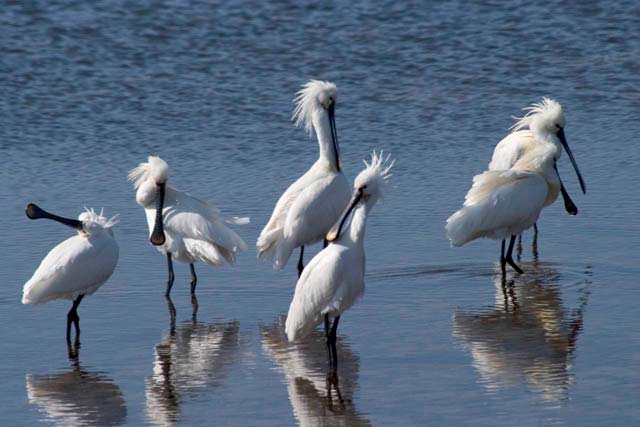
Bosnia and Herzegovina and Croatia
Proposed Integrated Ecosystem Management of the Nerteva and
Trebisnjica River Basin
(NTRB) Project
8.
Riparia
riparia
Sand
Martin
9. Hirundo
daurica
Daurska
Swallow
10.
Lanius senator
Woodchat Shrike
11.
Cinclus cinclus
Dipper
Fig. 3.1.3
Spoonbills at the Neretva estuary
Mammals: for a list of protected species of mammals in the Neretva delta according to
Croatian law, see Table 3.1.60, and according to international conventions, see Table 3.1.61.
282
Bosnia and Herzegovina and Croatia
Proposed Integrated Ecosystem Management of the Nerteva and
Trebisnjica River Basin
(NTRB) Project
Table 3.1.60
Threat status and protection of certain mammal species on the national
level
Status
Protected sp. Protected sp.
according to
according to according to
Compensatio
Latin name of species
the Red List of
the Regulation the Regulation
n (HRK)
Mammals in
on Protection
on Close
Croatia
of Mammals
Season
1
2 3 4 5
1. Erinaceus concolor
3000
2. Crocidura leucodon
500
3. Crocidura suaveolens
500
4. Suncus etruscus
500
5. Rhinolophus blasii
VU 4000
6. Rhinolophus euryale
VU 2000
7. Rh. ferrumequinum
NT 1000
8. Rh. Hipposideros
NT 3000
9. Rhinolophus mehelyi RE
4000
10. Myotis bechsteini
VU 4000
11. Myotis blythi
2000
12. Myotis capaccinii
2000
13. Myotis daubentoni
4000
14. Myotis emarginatus
NT 3000
15. Myotis myotis
NT 2000
16. Myotis mystacinus
2000
17. Myotis nattereri
3000
18. Miniopterus schreibersii
EN 2000
19. Pipistrellus kuhlii
1000
20. Pipistrellus nathusii
4000
21. Pipistrellus pipistrellus
1000
22. Hypsugo savii
1000
23. Eptesicus nilssoni
4000
24. Eptesicus serotinus
2000
25. Plecotus kolombatovici
DD
26. Nyctalus noctula
2000
27. Nyctalus lasiopterus
DD
4000
28. Nyctalus leisleri NT
4000
29. Tadarida taeniotis
4000
30. Vulpes vulpes
31. Canis lupus NT
32. Canis aureus
33. Mustela nivalis
34. Mustela putorius
35. Martes foina
36. Meles meles
37. Lutra lutra
DD
30000
283
Bosnia and Herzegovina and Croatia
Proposed Integrated Ecosystem Management of the Nerteva and
Trebisnjica River Basin
(NTRB) Project
38. Felis silvestris
10000
39. Sus scrofa
40. Sciurus vulgaris
NT
2000
41. Apodemus mystacinus
42. Apodemus sylvaticus
43. Dinaromys bogdanovi
DD
44. Rattus norvegicus
45. Rattus rattus
46. Mus domesticus
47. Micromys minutus
NT
48. Myoxus glis
LC
2000
49. Eliomys quercinus
NT
3000
50. Lepus europaeus NT
51. Oryctolagus cuniculus
Compensation pursuant with the Regulation on Compensation for Damage Resulting
from Illegal Acts Performed on Animal Species (NN 84/96).
Table 3.1.61
Threat status and protection of certain mammal species according to
European conventions
Bern
Habitats
Bonn
IUCN
Latin name of species
Convention
Directive
Convention
Europe
Appendix Appendix Appendix
1 2
3
4
5
1. Erinaceus concolor
2. Crocidura leucodon
III
3. Crocidura suaveolens
III
4. Suncus etruscus
III
5. Rhinolophus blasii
LR-nt II II/IV II
6. Rhinolophus euryale
VU II II/IV II
7. Rh. Ferrumequinum
LR-nt II II/IV II
8. Rh. hipposideros
VU II II/IV II
9. Rhinolophus mehelyi VU
II
II/IV
II
10. Myotis bechsteini
VU II II/IV II
11. Myotis blythi
II
II/IV II
12. Myotis capaccinii
VU II II/IV II
13. Myotis daubentoni
II
II
14. Myotis emarginatus
VU II II/IV II
15. Myotis myotis
LR-nt II II/IV II
16. Myotis mystacinus
II IV II
17. Myotis nattereri
II IV II
18. Miniopterus
LR-nt II IV
II
schreibersii
284
Bosnia and Herzegovina and Croatia
Proposed Integrated Ecosystem Management of the Nerteva and
Trebisnjica River Basin
(NTRB) Project
19. Pipistrellus kuhlii
II IV II
20. Pipistrellus nathusii
II
IV
II
21. Pipistrellus pipistrellus
III IV II
22. Hypsugo savii
III IV II
23. Eptesicus nilssoni
II
IV
II
24. Eptesicus serotinus
II IV II
25. Plecotus
kolombatovici
26. Nyctalus noctula
II IV II
27. Nyctalus lasiopterus
LR-nt
II
IV
II
28. Nyctalus leisleri LR-nt II IV
II
29. Tadarida taeniotis
DD
II/III
II
II
30. Vulpes vulpes
31. Canis lupus
II
II/IV
32. Canis aureus
V
33. Mustela nivalis
III
34. Mustela putorius
III
V
35. Martes foina
III
36. Meles meles
III
37. Lutra lutra
NT
II
II/IV
38. Felis silvestris II
IV
39. Sus scrofa
40. Sciurus vulgaris
III
41. Apodemus
mystacinus
42. Apodemus sylvaticus
43. Dinaromys bogdanovi LR-nt
44. Rattus norvegicus
45. Rattus rattus
46. Mus domesticus mis
47. Micromys minutus
LR-nt
48. Myoxus glis
LR-nt
III
49. Eliomys quercinus
VU
III
50. Lepus europaeus III
51. Oryctolagus cuniculus
285