

REGIONAL STEERING COMMITTEE
3rd Meeting of the RSC
Rarotonga, Cook Islands
6 October 2007
Paper Number
RSC3/INFO 1
Title
LIST OF DOCUMENTS
Document No.
Title
RSC3/INFO 1
List of Documents
RSC3/WP 2
Draft Agenda
RSC3/INFO 3
Provisional Programme
RSC3/WP 4
Annual Reports
ˇ Draft UNDP/GEF Annual Project Report (APR)/Project
Implementation Report (PIR)
ˇ GEF IW Results Framework Report
RSC3/INFO 5
National Reports
RSC3/WP 6
Financial Report
RSC3/WP 7
Mid-Term Project Review of the Pacific Islands Oceanic Fisheries
Management Project Process and Terms of Reference
RSC3/INFO 1


REGIONAL STEERING COMMITTEE
3rd Meeting of the RSC
Rarotonga, Cook Islands
6 October 2007
PROVISIONAL AGENDA
a.
Opening of Meeting
Introductory Remarks
Opening Remarks
Procedural Issues
b.
Apologies
c.
Adoption of Agenda
1.
Annual Reports
ˇ Draft UNDP/GEF Annual Project Report (APR)/Project
Implementation Report (PIR)
ˇ GEF IW Results Framework Report
2.
National Project Reports
3.
Financial Reporting, Work Plans and Budgets
4.
Mid-Term Project Review (Process and Terms of
Reference)
5.
Other Matters
d.
Next Meeting
e.
Adoption of the Summary Record of Proceedings
f.
Close of the Meeting
RSC3/WP 2


REGIONAL STEERING COMMITTEE
3rd Meeting of the RSC
Rarotonga, Cook Islands
6 October 2007
PROVISIONAL PROGRAMME
Presenter
0900
Opening
FFA/ OFM Project Coordinator
UNDP Representative Mr. Toily
Introductory Remarks
Kurbanov
Mr. Tanielu Su'a
Opening Remarks
Director General
Forum Fisheries Agency
Procedural issues, Apologies
RSC Co- Chairs Mr. Toily Kurbanov for
Adoption of the Agenda
UNDP and Lt Cdr. Sanaila Naqali for Fiji
1000
Morning Tea
Lead RSC2 Co-Chairs
Annual Reports
Presenters:
SPC - Dr John Hampton
UNDP/GEF Annual Project Report
FFA -
1020
(APR)/Project Implementation Report (PIR)
Mr. Moses Amos (FM & Legal)
GEF IW Results Framework
Mr. Michael Ferris (Compliance)
Barbara Hanchard
& Executing Agency Presentations
IUCN Taholo Kami
1230
Lunch
1330
National Project Reports
National Project Focal Points
Mr. Royden Gholomo Project Finance
Financial Reporting - Work Plans and
1430
and Administration Officer
Budgets
Barbara Hanchard, Project Coordinator
1530
Afternoon Tea
Mid-Term Project Review (Process and
1545
UNDP Mr. Toily Kurbanov
Terms of Reference)
Other Matters
1630
Next Meeting
RSC3 Co-Chairs
Summary Record of Proceedings
1700
Close
1830
Function
TBA
RSC3 /INFO 3


REGIONAL STEERING COMMITTEE
3rd Meeting of the RSC
Rarotonga, Cook Islands
6 October 2007
Paper Number RSC3/WP 4
Title PACIFIC ISLANDS OCEANIC FISHERIES
MANAGEMENT PROJECT ANNUAL REPORTS
Summary
This paper presents the annual reports for the Pacific Islands Oceanic Fisheries
Management Project (OFM Project) prepared by the Project Coordination Unit
(PCU). The reports are in formats required by the Global Environment Facility (GEF)
and United Nations Development Programme (UNDP). The reports are the
`UNDP/GEF Annual Performance Review/Performance Implementation Review' and
the `GEF International Waters Annual Project Performance Results Framework' in
2007.
The Pacific Islands Oceanic Fisheries Management Project (OFM Project) has been
operational for 2 years at the end of September 2007. Contributions to the reports
compiled and coordinated by the Project Coordination Unit are from the Pacific
Islands Forum Fisheries Agency (FFA), Secretariat for the Pacific Community (SPC)
and the World Conservation Union (IUCN) who are responsible for the executing
project activities, and in collaboration with UNDP as the implementing agency for the
project. The reporting period of the
`UNDP/GEF Annual
Performance
Review/Performance Implementation Review 2007' and the `GEF International
Waters Annual Project Performance Results Framework 2007' is from 1 July 2006 to
30 June 2007.
The reports are presented on this occasion to the OFM project Regional Steering
Committee as the body responsible for oversight of the project implementation and
progress.
Recommendation
The Regional Steering Committee is invited to consider:
i)
the project annual reports prepared by the PCU in collaboration with the FFA,
SPC, IUCN and UNDP; and
ii)
provide comment on the reports noting their onward submission to UNDP and
GEF.
PACIFIC ISLANDS OCEANIC FISHERIES MANAGEMENT PROJECT ANNUAL
REPORTS
Introduction
1.
The Pacific Islands Oceanic Fisheries Management Project (OFM Project)
has been operational for two years (1 October 2005 30 September 2007). The
Regional Steering Committee (RSC) for the OFM Project has a role as the primary
policy making body for the project.
2.
This paper presents the annual reports for the Pacific Islands Oceanic
Fisheries Management Project prepared by the Project Coordination Unit (PCU). The
reports are in formats required by the Global Environment Facility (GEF) and United
Nations Development Programme (UNDP). The reports are the `UNDP/GEF Annual
Performance Review/Performance Implementation Review 2007' and the `GEF
International Waters Annual Project Performance Results Framework 2007'.
3.
Contributions to the reports compiled and coordinated by the Project
Coordination Unit are from the Pacific Islands Forum Fisheries Agency (FFA),
Secretariat for the Pacific Community (SPC) and the World Conservation Union
(IUCN) who are responsible for the executing project activities, and in collaboration
with UNDP as the implementing agency for the project. The reporting period of the
`UNDP/GEF Annual Performance Review/Performance Implementation Review' and
the `GEF International Waters Annual Project Performance Results Framework' is
from 1 July 2006 to 30 June 2007.
Project Evaluation and Reporting
4.
The OFM Project objectives, outputs and emerging issues are to be regularly
reviewed and evaluated on an annually by the RSC. Reporting (annual and quarterly)
is undertaken by the PCU based at the FFA consistent with GEF and UNDP rules
and regulations. Quarterly financial and narrative reports for third and fourth quarters
in 2006 and the first two quarters of 2007 have been submitted to UNDP and to GEF.
5.
The annual reports were required to be completed and submitted to
UNDP/GEF no later than the 31 July 2007. While some latitude was permitted last
year for the submission of these reports to UNDP/GEF to allow for consideration of
the reports by the RSC (which was not scheduled to meet until October 2006), the
same arrangement has not occurred this year. The reports were completed and
submitted to UNDP/GEF by the imposed deadline and before the scheduled meeting
of RSC.
6.
Copies of the reports are appended at Attachment A. The Regional Steering
Committee also acts as a Multipartite Review body and is expected to review and
discuss the report.
7.
To support the annual reports, presentations (at an activity level) will be made
at RSC3 by representatives of the executing agencies on the activities in the
respective components of the project for which they are responsible for
implementing.
RSC3/WP.4
2
8.
The Regional Steering Committee is invited to consider:
i)
the project annual reports prepared by the PCU in collaboration with
the FFA, SPC, IUCN and UNDP; and
ii)
provide comment on the reports noting their onward submission to
UNDP and GEF.
RSC3/WP.4
3
ATTACHMENT A
UNDP GEF APR/PIR 2007 INTERNATIONAL WATERS
(1 July 2006 to 30 June 2007)
I. Basic Project Data
Official Title:
PACIFIC ISLANDS OCEANIC FISHERIES MANAGEMENT PROJECT
Country/ies:
Cook Islands, Federated States of
PIMS Number
2992
Micronesia, Fiji, Kiribati, Marshal
Islands, Nauru, Niue, Palau, Papua
New Guinea, Samoa, Solomon
Islands, Tonga, Tokelau, Tuvalu
and Vanuatu
Atlas Project Number
00039704/00044655
Focal Area
International Waters
Project Type (FSP/MSP)
Ful -sized project
Strategic Priority
IW1 Catalyse financial resource
Operational Programme
OP 9, Integrated
mobilization for implementation of
Land and Water
reforms and stress reduction
Multiple Focal Area,
measures agreed through TDA-SAP
SIDS Component
or equivalent processes for
particular transboundary systems;
IW2 Expand global coverage of
foundational capacity building
addressing the two key programme
gaps and support for target
learning, specifical y the fisheries
programme gap.
Date of Entry into Work
GEF Council endorsement March
Planned Project
Five (5) years
Programme
2005
Duration
GEF CEO endorsement 24 May
2005
ProDoc Signature Date
See Attachment A
Original Planned Closing
2010
Date
Date of First Disbursement
28 October 2005 (USD628,676)
Revised Planned Closing
None currently
Date
proposed
Is this the Terminal
Date Project
APR/PIR?
No
Operationally Closed
2010
(if applicable)
Date Mid Term Evaluation
Not applicable
Date Final Evaluation
Not applicable
carried out
carried out
(if applicable)
(if applicable)
Dates of visits to project by
8 February 2007 (UNDP Suva
Date of last TPR Meeting
22 October 2006
UNDP country office
Deputy RR, Toily Kurbanov)
Date of last visit to project by
22 October 2006 (RSC/TPR)
UNDP-GEF RTA
Page 4 of 45
Project Contacts:
Title
Name
E-mail
Date
Signature
National Project
N.Barbara
barbara.hanchard@ffa.int
Manager / Coordinator
HANCHARD
Government GEF OFP1
(optional)
UNDP Country Office
Asenaca RAVUVU
asenaca.ravuvu@undp.org
Programme Manager
UNDP Regional
Anna TENGBERG
anna.tengberg@undp.org
Technical Advisor
Key: Ratings used through out this report:
HS - Highly Satisfactory
S Satisfactory
MS Marginally Satisfactory
MU - Marginally Unsatisfactory
U Unsatisfactory
HU Highly Unsatisfactory.
1 In the case of a project involving more than 1 country, it is suggested that for simplicity only the OFP
(optional) and Country Office Programme Manager from the lead country sign-off. If representatives
from more than 1 country sign off, please add additional rows as necessary, clearly indicating the
country name for each signature.
Page 5 of 45
Project Summary (as in PIMS and ProDoc)
ProDoc Summary
Smal Island Developing States (SIDS) have special conditions and needs that were identified for international attention in the
Barbados Programme of Action for the Sustainable Development of Small Island Developing States and in the World Summit
for Sustainable Development's Johannesburg Plan of Implementation. Throughout these instruments, the importance of coastal
and marine resources and the coastal and marine environment to sustainable development of SIDS is emphasised, with the Plan of
Implementation specifical y cal ing for support for the Western and Central Pacific Fisheries Convention (the WCPF Convention).
The Global Environmental Facility (GEF) identifies sustainable management of regional fish stocks as one of the major environmental
issues SIDS have in common and as a target for activities under the SIDS component of OP 9, the Integrated Land and Water Multiple
Focal Area Operational Programme.
In addition, the GEF promotes the adoption of an ecosystem-based approach to addressing environmental problems in Large Marine
Ecosystems is through activities under the Large Marine Ecosystem Component of OP 8, the Waterbody-Based Operational Program.
Consistent with this framework, GEF financing for the International Waters (IW) South Pacific Strategic Action Programme (SAP)
Project from 2000 supported the implementation of an IW Pacific Islands SAP, including a pilot phase of support for the Oceanic
Fisheries Management (OFM) Component, which underpinned successful efforts to conclude and bring into force the WCPF
Convention. Now, GEF assistance is sought for a new Pacific Islands OFM Project to support Pacific SIDS efforts as they participate in
the setting up and initial period of operation of the new Commission that is at the centre of the WCPF Convention, and as they reform,
realign, restructure and strengthen their national fisheries laws, policies, institutions and programmes to take up the new opportunities
which the WCPF Convention creates and discharge the new responsibilities which the Convention requires.
The goals of the Project combine the interests of the global community in the conservation of a marine ecosystem covering a huge area
of the surface of the globe, with the interests of some of the world's smal est nations in the responsible and sustainable management of
resources that are crucial for their sustainable development.
The global environmental goal of the Project is to achieve global environmental benefits by enhanced conservation and management
of transboundary oceanic fishery resources in the Pacific Islands region and the protection of the biodiversity of the Western Tropical
Pacific Warm Pool Large Marine Ecosystem.
The broad development goal of the Project is to assist the Pacific Island States to improve the contribution to their sustainable
development from improved management of transboundary oceanic fishery resources and from the conservation of oceanic marine
biodiversity general y.
The IW Pacific Islands SAP identified the ultimate root cause underlying the concerns about, and threats to, International Waters in the
region as deficiencies in management and grouped the deficiencies into two linked subsets lack of understanding and weaknesses in
governance. In response, the Project wil have two major technical components.
Component 1, the Scientific Assessment and Monitoring Enhancement Component, is aimed at providing improved scientific
information and knowledge on the oceanic transboundary fish stocks and related ecosystem aspects of the Western Tropical Pacific
Warm Pool Large Marine Ecosystem (WTP LME) and at strengthening the national capacities of Pacific SIDS in these areas. This work
wil include a particular focus on the ecology of seamounts in relation to pelagic fisheries and the fishing impacts upon them.
Component 2, the Law, Policy and Institutional Reform, Realignment and Strengthening Component, is aimed at assisting Pacific Island
States as they participate in the earliest stages of the work of the new WCPF Commission and at the same time reform, realign and
strengthen their national laws, policies, institutions and programmes relating to management of transboundary oceanic fisheries and
protection of marine biodiversity.
Component 3, the Coordination, Participation and Information Services Component, is aimed at effective project management,
complemented by mechanisms to increase participation and raise awareness of the conservation and management of oceanic
resources and the oceanic environment.
The design of the Project has involved a substantial consultative process, which has been warmly supported throughout the region.
Reflecting outcomes of this process, the Project seeks to apply a regional approach in a way that recognises national needs; to strike a
balance between technical and capacity-building outputs by twinning technical and capacity building activities in every area; and to
open participation in al project activities to governmental and non-governmental stakeholders.
The structure for implementation and execution of the Project builds on a record of successful col aboration between the United Nations
Development Programme (UNDP), regional organisations and Pacific SIDS in past activities in oceanic environmental management and
conservation, strengthened by planned new partnerships with The World Conservation Union (IUCN), a regional environmental non-
governmental organisation (ENGO) and a regional industry non-governmental organisation (INGO).
Page 6 of 45
II. Progress towards achieving project objectives
Project Strategy (Objectives
Target (by June 2010 unless
Description of Indicator:
Baseline Level
Level at June 2007
& Outcomes)
otherwise indicated)
Information & Knowledge
Improved information on the
SCTB17 (2004) summarized
(a) assessments utilize improved
The project has resulted in:
Objective
biology & ecology of target fish
major information/knowledge
fishery information available from
(a) improved flow and quality of
To improve understanding of the
stocks, including their exploitation gaps and needs as fol ows:
al sources and new tagging data
fisheries data from beneficiary
transboundary oceanic fish
characteristics & fishery impacts,
(a) better estimates of catch,
(b) assessments incorporate
countries, which are
resources & related features of
the fishery impacts on non-target, effort and catch composition,
information on environmental
progressively incorporated into
the Western & Central Pacific
dependent & associated species
particularly in Indonesia,
impacts on stock productivity
stock assessments
Warm Pool Large Marine
& on the pelagic ecosystem as a
Philippines & Vietnam, and in the
(c) comprehensive and reliable
(b) new tagging data generated
Ecosystem.
whole.
purse seine fishery
by-catch estimates available
from 6 months of field operations
(b) better indices of abundance
(d) ecosystem impacts of fishing
in PNG (Phase 1 of a proposed
from CPUE data
are characterized
regional programme)
(c) information on the
(c) new analyses of
environmental impacts on
environmental impacts on
recruitment, including regime
yel owfin and bigeye recruitment
shifts
completed
(d) fishery-independent (tagging)
(d) comprehensive estimates of
data on exploitation rates and
by-catch levels and uncertainty
population dynamics
now routinely reported to
(e) ecosystem impacts of fishing
WCPFC SC
(f) better estimates of
size/species composition and by-
catch estimates from enhanced
observer data
Substantial y improved
Little knowledge of confirmed
(a) seamount occurrence
The occurrence of seamounts
understanding of Seamount
seamount occurrence in the
documented using available data
has been documented using
ecosystems, especial y their
region or their significance to the
sources
available data, but further work is
relation to migratory pelagic
pelagic ecosystem
(b) Impacts of seamounts on
required
fisheries.
physical/biological oceanogrphy
and pelagic fisheries better
understood
Governance Objective
The WCPFC established &
WCPFC had preliminary meeting
WCPFC structure & programmes
See progress reported under
To create new regional
functioning.
in December 2004 to adopt some functioning by 2010 as described
Outcome 2 a) below
institutional arrangements, &
Rules & Regs, establish the SC & under Outcome 2 a) below
reform, realign & strengthen
TCC & elect officers of
national arrangements for
commission & subsidiary bodies.
conservation & management of
Page 7 of 45
Project Strategy (Objectives
Target (by June 2010 unless
Description of Indicator:
Baseline Level
Level at June 2007
& Outcomes)
otherwise indicated)
transboundary oceanic fishery
WCPFC beginning to adopt
No binding regional regional
WCPFC has begun to adopt &
WCPFC has applied:
resources
conservation & management
stock conservation &
apply measures to
a) a mix of catch & effort limits to
measures for target stocks & the
management measures in place
a) limit al major sources of
fisheries for bigeye & yel owfin,
WTP LME2
fishing mortality on heavily fished
north & south Pacific albacore &
target species, including bigeye & swordfish
yel owfin tunas & swordfish
b) measures to mitigate mortality
b) mitigate mortality from fishing
from fishing on sharks (including
on non-target species, including
a finning ban) & seabirds
sharks, seabirds & turtles
PacSIDS amend their
See Outcome 2 c) below
domestic laws & policies &
strengthen their national fisheries
institutions & programmes,
especial y in the areas of
monitoring & compliance, to
implement the WCPF Convention
& apply the principles of
responsible & sustainable
fisheries management more
general y.
2 Not in the original logframe, inserted as Stress Reduction Indicator to meet GEF IW reporting requirements
Page 8 of 45
Project Strategy (Objectives
Target (by June 2010 unless
Description of Indicator:
Baseline Level
Level at June 2007
& Outcomes)
otherwise indicated)
OUTCOME 1:
a) Improved quality, compatibility
Substantial, relevant & reliable
Scientific information &
Establishment of SC & subsidiary Achieved 2005
& availability of scientific
information col ected & shared
knowledge is shared among
bodies including bodies for
information & knowledge on the
between stakeholders with
countries voluntarily, primarily
statistics & Ecosystem/Bycatch
oceanic transboundary fish
respect to transboundary oceanic through SPC/OFP & the SCTB.
work (by Dec 2007)
stocks & related ecosystem
fish stocks & related ecosystem
Regional scientific work carried
aspects of the WTP warm pool
aspects, (particularly for
out by SPC with donor funding
Binding agreement on protocols
Catch & Effort Protocol in place.
LME, with a particular focus on
seamounts).
No WCPFC science staff, experts for fisheries data col ection &
the ecology of seamounts in
or programmes, but plan agreed
provision, including catch & effort
Port & onboard sampling
relation to pelagic fisheries, & the
for interim scientific structure and
logs, & port & onboard sampling
sampling protocols stil under
fishing impacts upon them.
other arrangements.
(by Dec 2007)
consideration
Establishment of Commission
Interim arrangements in place
data management structure and,
databases (by Dec 2007)
Appointment of science staff
Staff appointed, interim
and/or contracting of experts for
arrangements agreed for
the provision of scientific services scientific experts, subject to
(by Dec 2007)
review in 2007
Agreement on scientific work
programme, including forms of
Achieved
stock assessment analysis (by
Dec 2007)
Little knowledge of confirmed
(a) seamount occurrence
The occurrence of seamounts
seamount occurrence in the
documented using available data has been documented using
region or their significance to the
b) Impacts of seamounts on
available data, but further work is
pelagic ecosystem
physical/biological oceanography
required
and pelagic fisheries better
understood
b) This information being used by The WCPFC using this
Annual meetings of the SCTB
Measures of target stock status
Stock status measures available,
the WCPFC & PacSIDS to
information as the basis for
provide a forum to discuss
in relation to agreed
but no agreed reference points
assess measures for the
discussions & policy decisions on scientific issues related to data,
management reference points
conservation & management of
WCPF management.
research & stock assessment
available
transboundary oceanic fishery
including providing statements on
resources & protection of the
stock status & opinions on
Measures of status of ecosystem
Proposal under consideration
WTP LME.
scientific issues.
including trophic status & status
of key non-target species
Page 9 of 45
Project Strategy (Objectives
Target (by June 2010 unless
Description of Indicator:
Baseline Level
Level at June 2007
& Outcomes)
otherwise indicated)
Provision of scientific advice to
Achieved, ongoing
the Commission including
information & recommendations
on TACs & other management
measures from the Scientific
Committee to the Commission
Measures of the impact of
Achieved, ongoing
environmental variability on
target species abundance &
distribution
Assessments available of the
Achieved & ongoing for target
impact of fishing on target & non-
species, less progress for non-
target species
target species
Analysis made of impact of
Achieved & ongoing
possible conservation measures
c) National capacities in oceanic
Relevant national technical
SPC assessment shows that no
Programme in SPC to train SIDS
Achieved & ongoing through
fishery monitoring & assessment
capacities & knowledge greatly
PacSIDS have the capacity to
national data and science
attachments and workshops
strengthened, with PacSIDS
improved
ful y meet WCPFC-related
personnel
meeting their national & WCPFC-
responsibilities in fishery
related responsibilities in these
monitoring & data provision
Arrangements in place for
Financial Regs provide funding
areas.
financing of SIDS participation in
for PacSIDS to participate in
Commission activities
al WCPFC-related meetings
Arrangements in place for
Items for Special reqts in
recognition of special
standing agendas of SC since
requirements of SIDS in science
2005
and other technical areas
High level of participation by
Achieved (2006- 13 of 15)
PacSIDS in SC meetings (80%)
Level of resources and pattern of
Japan has committed US$2m for
Commission programmes, and of
WCPFC special reqts, partial y
other agencies for building
for science-related capacity-
capacity of SIDS to participate in
building
Commission scientific activities
Page 10 of 45
Project Strategy (Objectives
Target (by June 2010 unless
Description of Indicator:
Baseline Level
Level at June 2007
& Outcomes)
otherwise indicated)
OUTCOME 2:
WCPFC operating with a formal y Rules of Procedure & Financial
WCPFC & subsidiary bodies
Draft Rules for subsidiary bodies
a) The WCPFC established &
adopted framework of rules &
Regs adopted at WCPFC1
operating with a complete set of
being considered by SC & TCC
beginning to function effectively.
regulations.
fol owing inputs from SAPI
Rules & Regulations & a
Project. Staff regs, subsidiary
Secretariat, with sustainable
bodies rules needed.
financial arrangements (by Dec
2007)
WCPFC Secretariat has been
No appointments to the
Staff Regs adopted & Secretariat Staff Regs adopted. Secretariat
established & the core science &
secretariat, no WCPFC staff
posts al fil ed. (by Dec 2007)
posts being fil ed with some
compliance programmes &
regs, no WCPFC compliance,
difficulty.
Committee structures are
data or science programmes
operational.
operational.
TCC operational (by Dec 2007)
Achieved 2005
Adoption & Implementation of
Authorisation/Notification/Vessel
Complete package of compliance Implemented:
Compliance Measures3
Marking adopted in Dec 2004
programmes implemented,
Authorisation, Notification, Vessel
including:
Marking
III. Authorisation
Adopted:
High Seas Boarding &
IV. Notification
Inspection, VMS, IUU List
Vessel marking
Observers
VMS
High Seas Boarding & Inspection
Transhipment regulation
Port State Controls
IUU List
Dealing With Infringements
Application of Sanctions
b) Pacific Island nations playing a PacSIDS are participating
13 of 15 PacSIDS ratified or
Al PacSIDS are Commission
Achieved Nov 2005
ful role in the functioning & effectively in provision of
been authorised to participate as
Members (by Dec2007)
management of the WCPFC, & in information & in decision-making
territories
Tuvalu, Palau, Vanuatu (non-
the related management of the & policy adoption process for
Al PacSIDS are Parties to the
Parties to 1995 UN FSA - current
fisheries & the global y-important WCPF fisheries management.
??
UN Fish Stocks Agreement
official list maintained by UN
LME.
DOALOS dated 4 June 2007).
At WCPFC1 in December 2004,
PACSIDS col ective
Palau recently ratified but yet to
PACSIDS participated
participation is effective on issues inform when deposited with UN
3 Not in the original logframe, inserted as Stress Reduction Indicator to meet GEF IW reporting requirements
Page 11 of 45
Project Strategy (Objectives
Target (by June 2010 unless
Description of Indicator:
Baseline Level
Level at June 2007
& Outcomes)
otherwise indicated)
effectively on WCPFC
of importance to them.
administrative issues, but did not
No independent assessment
participate effectively on
Most PACSIDS are able to
made, but in 2007, the WCPFC
compliance, science & technical
participate effectively individual y
adopted 5 stock measures, al
issues.
on issues of importance to them
based on FFA Members
proposals, and 4 compliance
measures al supported by FFA
Members
No independent assessment
made
c) National laws, policies,
National institutions & supportive
To be assessed by a baseline
PacSIDS are implementing
Assessment yet to be completed
institutions & programmes
laws & policies have been
study
WCPFC measures & national
relating to management of
reformed effectively to support
conservation & management
transboundary oceanic fisheries
national roles in WCPFC & to
measures
reformed, realigned &
meet national commitments both
strengthened to implement the
to WCPF Convention, & to other
WCPF Convention & other
relevant MEAs, & global treaties
applicable global & regional
& conventions.
instruments.
d) National capacities in oceanic Relevant national technical
Project design work identified
Expanded programmes in FFA to
Achieved & ongoing through
fisheries
law,
fisheries capacities & knowledge greatly
lack of capacities in fisheries law
train SIDS national law, fisheries
attachments and workshops
management
&
compliance improved
and compliance and especial y
management & personnel
strengthened
fisheries management as
important constraints to achieving Arrangements in place for
Financial Regs provide funding
Project objectives
financing of SIDS participation in
for PacSIDS to participate in
Commission activities
al WCPFC-related meetings
Arrangements in place for
Items for Special reqts in
recognition of special
standing agendas of SC since
requirements of SIDS in fisheries
2005
& management and compliance
However, as noted in the ProDoc
Most PacSIDS are stil
(p.81) there are limits to progress
struggling to develop the
that can be made in capacity
necessary capacities
building in 15 countries within the
Project life
Page 12 of 45
Project Strategy (Objectives
Target (by June 2010 unless
Description of Indicator:
Baseline Level
Level at June 2007
& Outcomes)
otherwise indicated)
OUTCOME 3:
a) Effective project management
Project achieving its objectives.
Not applicable
PCU established by Dec 2005
Achieved 2005
at the national & regional level.
National and regional Project
RSC established 2005 (National
committees established by Dec
committees see comment
2006
below)
Procedures for NGO
Achieved
participation adopted by the
WCPFC
National consultative
National consultative
mechanisms in SIDS include
mechanisms typical y in the form
NGO and broad governmental
of Tuna Management
participation
Committees. These are not
always inclusive.
b) Major governmental & non-
Extent to which Project
Phase I terminal evaluation noted Project Evaluations indicate that
No evaluations conducted yet
governmental
stakeholders implementation & management is lack of NGO involvement as a
project implementation &
participating in project activities & participatory with appropriate
major weakness in Phase I
management is ful y participatory
consultative
mechanisms
at involvement of stakeholders at al
national & regional levels.
levels.
c) Information on the project &
Project Evaluations indicate that
No evaluations conducted yet
the WCPF process contributing Transparency & simplicity of
Design process identifies lack of
to increased awareness of information access
simple, clear information on the
- Information access is
oceanic fishery resource &
WCPF preparatory process as a
transparent & simple
ecosystem management.
problem
Relevance & significance of
- Information available is
available information
relevant & significant.
Public awareness raising at
- Public awareness raising at
national & regional policy level is
national & regional policy level
effective.
is effective.
d) Project evaluations reflecting Project evaluation ratings.
Not applicable
Positive project evaluation
No evaluations conducted yet
successful & sustainable project
ratings.
objectives.
Page 13 of 45
Rating of Project Progress towards Meeting Objective
2006
2007 Rating
Comments
Rating
National Project
S
S
Considerable and steady progress has been achieved
Manager/Coordinator
towards project objectives (2) as detailed in the report above
against indicators. The progress towards of functioning of the
WCPFC continues to evolve and chal enge the resources
and capabilities of the Pacific SIDS.
The WCPF Commission is operating formal y with a number
of conservation and management measures adopted of
which Pacific SIDs have been actively involved. Implications
for the implementation of those measures both regional y and
at national levels is assisted greatly by the project but
continues to channel the resources and capacity of Pacific
SIDs.
Government GEF OFP
(optional)
UNDP Country Office
S
S
The complexity of working at regional level to initiate change,
interest and support for fisheries management is both
chal enging and time-consuming. It is noted that the project is
employing approaches that exhibit inclusiveness and good
information strategies at international, regional level and
national levels, which wil be the key towards meeting project
objectives.
Interventions in creating an enabling environment and
strengthening existing capacity for fisheries management has
been highlighted through various in-country training, policy
reform and scientific analytical activities. Hence it is
recommended that the project continues to increase scientific
and technical col aboration, including integrated assessment
at the SIDS regional/national levels for the conservation and
management of living and non-living marine resources and
expanding ocean-observing capabilities for the timely
prediction and assessment of the state of marine
environment. In line with WSSD plan of implementation and
the WCPF, UNDP wil support col aboration between the
multi-stakeholders to develop capacity in marine science,
information and management, through, inter alia, promoting
establishment of regional/national monitoring systems, and
the use ecosystem models to assess management options
and training of policy makers.
UNDP Regional Technical
XX
XX
XXX
Advisor
Action Plan to Address Marginally Unsatisfactory, Unsatisfactory or Highly Unsatisfactory Rating
Where a project has received a rating of MU, U or HU describe the actions to be taken to address this:
Action to be Taken
By Whom?
By When?
Page 14 of 45
V. Progress in Project implementation
List the 4 key outputs delivered so far for each project Outcome:
Project Outcomes
Key Outputs
Outcome 1: Scientific Assessment and Monitoring Enhancement:
a) Improved quality, compatibility & availability of scientific information & knowledge on the oceanic transboundary fish stocks & related ecosystem aspects of the WTP warm pool LME,
with a particular focus on the ecology of seamounts in relation to pelagic fisheries, & the fishing impacts upon them.
b) This information being used by the WCPFC & PacSIDS to assess measures for the conservation & management of transboundary oceanic fishery resources & protection of the
WTP LME.
c) National capacities in oceanic fishery monitoring & assessment strengthened, with PacSIDS meeting their national & WCPFC-related responsibilities in these areas.
Sub-component 1.1 Fishery Monitoring,
A template for national integrated monitoring programmes including logsheet, observer, port sampling and landing data
Coordination and Enhancement
collection and management; and provision of data to the Commission
Regional Tuna Database template available on SPC website www.spc.int/oceanfish/ .
Outcome: Integrated and economical y
TUFMAN database review, development and updating rol out including, port sampling and unloading totals modules, reconciliation
sustainable national monitoring programmes
reports, mapping module, inclusion of form for WCPFC Vessel Record data. Video and training manual initiated.
in place including catch and effort, observer,
Support for the preparation of data summaries and catch estimates for national reports to WCPFC SC.
port sampling and landing data; Pacific SIDS Report on the WCPFC Ad hoc Task Group posted.
providing data to the Commission in the form National monitoring systems based on the regional template for integrated monitoring, customised to meet national needs
required; national capacities to process and
TUFMAN in-country development and training (RMI, FSM, Palau, Tonga).
analyse data for national monitoring needs
Review and support of national monitoring capacity (Niue, Tuvalu, RMI, PNG and Vanuatu). National Tuna Data Procedures document
enhanced; improved information on fishing
initiated in al countries. Identified funding support needs furnished (Palau, FSM, Nauru, Vanuatu).
in national waters and by national fleets
In-country support to National observer and port sampling programmes (Palau, FSM, RMI, PNG, Fiji).
being used for national policy making and to
A regional monitoring coordination capacity, to develop regional standards such as data formats, and to provide a clearing
inform national positions at the Commission. house for information on fishery monitoring
Enhanced quality and accessibility of
Industry and sampling data forms distributed. Longline logbook trial underway.
fisheries information and data leading to
Longline Observer Guide and Marine species identification manual completed and distributed.
more effective development and
First Tuna Data Workshop concluded, report and material distributed on CD.
improvement of the Commission's policy and WCPFC Regional Observer Programme document and strategic plan.
decision-making process.
Training of national monitoring staff, particularly monitoring coordinators, observers and port samplers
Monitoring attachments (PNG, Tonga, Vanuatu, PNG, Solomons, Nauru). Observer and tag seeding training (PNG, Palau, RMI), port
sampling training (RMI) debriefing training (PNG, sub-regional in RMI) debriefing support (Fiji, Tonga, Palau, FSM), senior observer
training workshop (PNG).
Sub-component 1.2 Stock Assessment
National oceanic fisheries status reports prepared collaboratively with national scientific staff
National Tuna Fishery Status Reports (Cook Is, FSM, Vanuatu, Palau, Nauru, Tonga)
Outcome: Detailed information available on
In-country stakeholder workshops for NTFSRs (FSM, Vanuatu, Palau, Tonga, Nauru)
the status of national tuna fisheries,
Advice to Pacific SIDS on scientific issues in the work of the Commission
including the implications of regional stock
Scientific presentations at regional SWG, MOW and contributions to Pacific SIDs brief for WCPFC SC, advice to WCPFC SC
Page 15 of 45
assessments and the impacts of local
Training of national technical and scientific staff to understand regional stock assessment methods, and interpret and apply
fisheries and oceanographic variability on
the results; and to use oceanographic data
local stocks and fishing performance;
Regional Stock Assessment workshop
strengthened national capacities to use and
Attachments (Samoa, FSM, Vanuatu, Nauru and Palau)
interpret regional stock assessments,
Contribution to regional eNGO workshop on WCPFC
fisheries data and oceanographic
In-country training on interpretation of fisheries and stock assessment (FSM)
information at the national level, to
participate in Commission scientific work,
and to understand the implications of
Commission stock assessments.
Sub-component 1.3 Ecosystem Analysis
Observer sampling and analysis of commercial fishery catches to determine trophic relationships of pelagic species in the
WTP LME
Outcome: Enhanced understanding of the
Sampling strategy & work plan report for observer programmes (info paper to WCPFC SC2)
dynamics of the WTP warm pool pelagic
Biological sampling and land based analysis (stomach content & tissue sampling) Solomon Is, FSM, Samoa, Cook Islands, Fiji & RMI
ecosystem, with particular focus on trophic
(newsletter)
relationships; enhanced understanding of
Collection and analysis of information on seamounts in the WTP LME
the ecology of seamounts, in particular their
Seamount activity planning workshop, validation of seamounts in the Pacific (report), database reviewed
impacts on aggregation and movement of
Examination of satel ite oceanographic data in relation to seamounts (report)
pelagic species and the fisheries impacts
Co-funded Tagging campaign (PNG)
thereon; provision of ecosystem-based
Benthic biodiversity survey under discussion with IRD (limited progress with IUCN survey)
scientific advice to the Commission and to
Model-based analysis of ecosystem-based management options
Pacific SIDS; enhanced information on the
Ecological Risk Assessment indicators of species susceptibility and productivity to evaluate ecosystem-based management options
magnitude of by-catch in WCPO oceanic
Ecosystem modeling workshop (balance ecopath models to WCP and comparison with existing models)
fisheries.
Estimate Levels of By catch in the Western and Central Pacific Ocean fisheries
WCPFC SC working papers on status of stocks (historical observer data and estimates of levels of by-catch)
Ecosystem Risk Assessment (WCPFC SC) co-financing from Commission to progress work in 2007/2008
Ecosystem analysis for Pacific SIDs (at FFC)
Updated analysis of estimates of levels of by-catch for Statistics Specialist Working Group
Results of ecosystem analysis and proposals for long-term ecosystem monitoring and operationalisation of the ecosystem-
based approach for use by the Commission's Scientific Committee, especially its Ecosystems & Bycatch Working Group, and
by Pacific SIDS
Preliminary Ecological Risk Assessment WCPFC SC
Training incorporated in Stock Assessment Workshop, briefings on ecosystem analysis (Pacific SIDs pre SC)
Page 16 of 45
Outcome 2: Law, Policy and Institutional, Reform, Realignment and Strengthening:
a) The WCPFC established & beginning to function effectively.
b) Pacific Island nations playing a ful role in the functioning & management of the WCPFC, & in the related management of the fisheries & the global y-important LME.
c) National laws, policies, institutions & programmes relating to management of transboundary oceanic fisheries reformed, realigned & strengthened to implement the WCPF Convention
& other applicable global & regional instruments.
d) National capacities in oceanic fisheries law, fisheries management & compliance strengthened
Sub-component 2.1 Legal Reform
A strategy and workplan for activities on regional and national legal issues
Role out of the strategy and workplan to address regional and legal issues related to the Commission and other related international legal
Outcome: Major Commission legal
instruments on schedule; including the completion of draft guidelines for fisheries legislation to assist Pacific SIDS review their national
arrangements and mechanisms in place,
legislations and regulations. A number of countries have completed legislative reviews.
including provisions relating to non-Parties
Enhancement of legal capacity in the Convention and domestic laws and prosecutions procedures Judicial Seminar and Sub-regional
and sanctions for non-compliance; national
WCPFC workshops
laws, regulations, license conditions
New draft laws, regulations, agreements & license conditions in line with WCPF Convention prepared and shared with PacSIDS
reformed to implement the WCPF
Legislative reviews identify the gaps in national legislations and regulations and draft legislation and regulations are amended accordingly
Convention and other relevant international
for processing through individual national legislative repeal systems.
legal instruments; enhanced national legal
Proposals for the Commission from Pacific SIDS for legal arrangements to implement the Convention
capacity to apply the Convention and
Briefs are prepared for Pacific SIDS prior to Commission meetings and subsidiary meetings (WCPFC3,TTC2 & SC2)
national management regimes, including
Training of policy makers and legal personnel in oceanic fisheries management legal issues
domestic legal processes for dealing with
Port State Enforcement workshop, WCPFC Sub-regional workshops (Cooks,PNG and Vanuatu), Prosecutions, Dockside Boarding and
infringements.
Inspection workshops (Tuvalu), legal fel owships and Law of the Sea & Maritime Law short course (Uni of Wol ongong)
Sub-component 2.2 Policy Reform
National oceanic fisheries management plans, policies and strategies
Rol out of EAFM (Vanuatu, Tonga, Palau and Nauru) and regional strategy to determine framework and processes to deliver tuna and
Outcome: Commission Secretariat and
oceanic fisheries management plans based on EAFM.
technical programmes established and
Strategies and specific proposals for the overall development of the Commission, including its Secretariat and technical
conservation and management measures
programmes, and for Commission conservation and management measures
beginning to be adopted; national oceanic
Studies on by-catch mitigation options for seabirds, issues associated with shark finning and harvest, turtles, charter vessel control and
fisheries management plans, policies and
purse seine closures, management options for albacore and swordfish, implementation of a catch documentation scheme, catch
strategies prepared, implemented and
retention, FAD Management and capacity management options. Information incorporated into Pacific SIDS FM policies and strategies for
reviewed; adoption of a more integrated and
proposals to the Commission (WCPFC3).
cross-sectoral approach and, improved
Briefs for Pacific SIDS and used at Commission meeting on ful range of scientific (stock specific and ecosystem wide) technical and
coordination between government
compliance and institutional (establishment of the Commission) issues at Commission and subsidiary meetings & ad-hoc Data Task
departments (Fisheries, Environment,
group. Proposals to Commission on catch and effort limits for target species, by-catch mitigation measures, VMS & Observer programme.
Development, Economy, etc); enhanced
10 draft measures proposed in 2006 to the Commission by Pacific SIDS.
understanding by policy makers and
Informal consultation on albacore management, Pre-Commission FFC caucas, MOW workshops
enhanced national capacities in regional and
Advice on purse seine effort limitation (VDS), longline management, purse seine fisheries closures and overcapacity.
Page 17 of 45
national policy analysis for sustainable and
Identification of possible management options for seamounts, including compliance options
responsible fisheries; enhanced stakeholder
Limited progress on activities related to this output
understanding of Commission and national
Training of policy makers, technical personnel and other Pacific SIDS stakeholders to increase understanding of sustainable
policy issues, especial y the private sector.
and responsible fisheries
Management Options workshops, WCPFC workshops & workshop on regional fisheries management arrangements and implications for
Tuvalu, Pre Commission FFC (Ministerial), Pacific SIDS attendance at other regional RFMO IATTC .
Train Sea Coast preparations (reviewing & updated modules) delivered through USP.
Sub-component 2.3 Institutional Reform
Strategies, plans and proposals for the reform, realignment and strengthening of national oceanic fisheries management
administrations
Outcome: Public sector fisheries
Scoping review Nauru Fisheries and Marine Resources Authority - consultations and workshops included NGOs
administrations reformed, realigned and
Processes for national consultation between stakeholders in oceanic fisheries management
strengthened; capacities of national non-
No activity to date
governmental organisations to participate in
oceanic fisheries management enhanced;
consultative processes enhanced to promote
a more integrated approach to fisheries
management and administration that
encourages coordination and participation
between diverse government and non-
government stakeholders.
Sub-component 2.4 Compliance
Strategies, plans and proposals for realigning and strengthening national oceanic fisheries compliance programmes
Strengthening
MCS country workshops review the status of existing laws governing compliance and implications of WCPFC outcomes for Pacific SIDS
9th & 10th Monitoring, Control and Surveil ance Working Group Meetings (MCS review, data harmonization and preparations for Pacific
Outcome: Realigned and strengthened
SIDS at TCC)
national compliance programs; improved
Development of IPOA for the prevention of IUU (Cook Islands)
regional MCS coordination; strategies for
Arrangements for regional coordination of monitoring, control and surveillance activities
Commission compliance programs;
Planning and coordination of regional operations and data harmonization and integration tests of display tools.
enhanced national compliance capacities
Niue Treaty implementation and development of subsidiary agreements, including the promoting the concept of multilateral surveil ance
(inspection, observation, patrol, VMS,
cooperation agreements as opposed to bilateral.
investigation).
Development of E-operations
Strategies and proposals for regional compliance measures and programmes
MCS Working Group Meetings and preparations for TCC2 and WCPFC3
IUU Prosecutions workshop review cases, legislation and experience for prosecuting IUU cases.
Development of a regional MCS Strategy
Training of national compliance staff, especially in inspection and VMS
In-country training (PNG & Vanuatu) legal aspects, Dockside Boarding, Inspection and Prosecutions, FAO Port State measures, MCS
attachments
Page 18 of 45
Outcome 3: Coordination, Participation and Information Services:
a) Effective project management at the national & regional level.
b) Major governmental & non-governmental stakeholders participating in project activities & consultative mechanisms at national & regional levels.
c) Information on the project & the WCPF process contributing to increased awareness of oceanic fishery resource & ecosystem management.
d) Project evaluations reflecting successful & sustainable project objectives.
Sub-component 3.1 Project information
Project Information System for capture, storage and dissemination of project data, lessons and best practices, and provision of
System
information products
Project identifies designed and in use
Outcome: Enhancement of awareness
Interaction with GEF IWLEARN IWLEARN Experience Note, communication on website management
about the Project and understanding of its
WCPF Convention publication
objectives and progress; establishment of a
Clearing House for lessons and best
Knowledge management process identifying innovative, best practice and replicable ideas within the Project and relevant to
practices within the Pacific SIDS, as wel as
the Project
through linkages to other global fisheries
Draft Knowledge Management Strategy prepared
and their issues; capture of up-to-date
information and advice on related ecosystem
management and innovative fisheries
management approaches; transfer of
lessons and replication of best practices
through an active mechanism linked to the
Commission; active participation with
IW:LEARN
Sub-component 3.2 Monitoring and
Measures of, and reports on, overall project performance and delivery, including independent evaluations of the Project
Evaluation
Quarterly reporting (Q3 & 4 2006 and Q1 & 2 2007), GEF IW Results Framework and PIR/APR (also serves as annual report to RSC)
Completed audit
Outcome: Effective monitoring and
Analysis of process, stress-reduction, and environmental status indicators as per the GEF International Waters Operational
evaluation of progress and performance,
Strategy
including monitoring of process, stress
GEF IW Results Framework
reduction and environmental status
Gaps in baseline information addressed with the exception of some information required on national indicators.
indicators; monitoring and evaluation outputs
used in project management and in
assessing the effectiveness of Commission
measures.
Page 19 of 45
Sub-component 3.3 Stakeholder
ENGO participation and awareness raising in Convention-related processes
Participation and Awareness Raising
LOA (and co-financing agreement) with WWF Pacific concluded. Successful workshop for regional ENGOs and civil society on WCPF
Convention and oceanic fisheries management. WWF participation at regional MOW sessions and WCPFC and subsidiary bodies
Outcome: Non-governmental stakeholder
meetings
participation in national and regional oceanic
Support industry participation and awareness raising in Convention-related processes
fisheries management processes, including
INGO participation at MOW, WCPFC3, inaugural meeting of PITIA (presentations on WCPFC)
the Commission, enhanced; awareness of
PITIA participation at WCPFC meetings
oceanic fisheries management issues and
the WCPF Convention improved. Specific
forums developed for NGO participation and
discussion process; promotion of awareness
of national and regional development and
economic priorities and how these relate to
sustainable fisheries management.
Sub-component 3.4 Project Management
Project Coordination Unit staffing and office
and Coordination
Completed
Outcome: Project effectively managed and
coordinated between implementing and
executing agencies and other participants in
the Project; effective participation in Project
management and coordination by
stakeholders; reports on Project progress
and performance flowing between Project
participants and being used to manage the
Project.
Page 20 of 45
Rating of Project Implementation
2006
2007 Rating
Comments
Rating
National Project
S
S
Project implementation, the rol out of activities supporting
Manager/Coordinator
the overal project objectives continues to professional y
executed by the FFA and SPC.
A significant activity that wil not be implemented in
accordance with the approved work plan, is the work
in relation to research activities on benthic
communities of seamounts. This sub-component of
Ecosystems Analysis is to be performed by IUCN and
circumstances beyond their control have hampered
implementation. Communication with IUCN is on-going on
the matter. These events wil be taken into
account in revised work plans and budgets that wil
reviewed by the Regional Steering Committee.
Government GEF OFP
(optional)
UNDP Country Office
X
X
Project implementation is satisfactory. Discussions continue
on the approach to sea mount component analysis and a
possibility of `non ship-based research' activities as wel
other options of supporting SPC seamount research. The
precise timing of this activity is not critical to current project
results, and hence there is flexibility of accommodating the
activity within the PIOFPM goals and objectives. Other
project based activities has been implemented in accordance
with its work plans.
As the work of the WCPF convention picks up momentum,
the project provides every possible opportunity within its
framework to assist Pacific SIDS meet their obligations. It is
highly recommended that the PCU continues strong
communications on the implementation as wel as developing
national capacity for undertaking institutional and policy
reforms, with partners to attract national/regional support for
OFM initiatives.
Page 21 of 45
UNDP Regional Technical
X
X
X
Advisor
Action Plan to Address Marginally Unsatisfactory, Unsatisfactory or Highly Unsatisfactory Rating
Where a project has received a rating of MU, U or HU describe the actions to be taken to address this:
Action to be Taken
By Whom?
By When?
Page 22 of 45
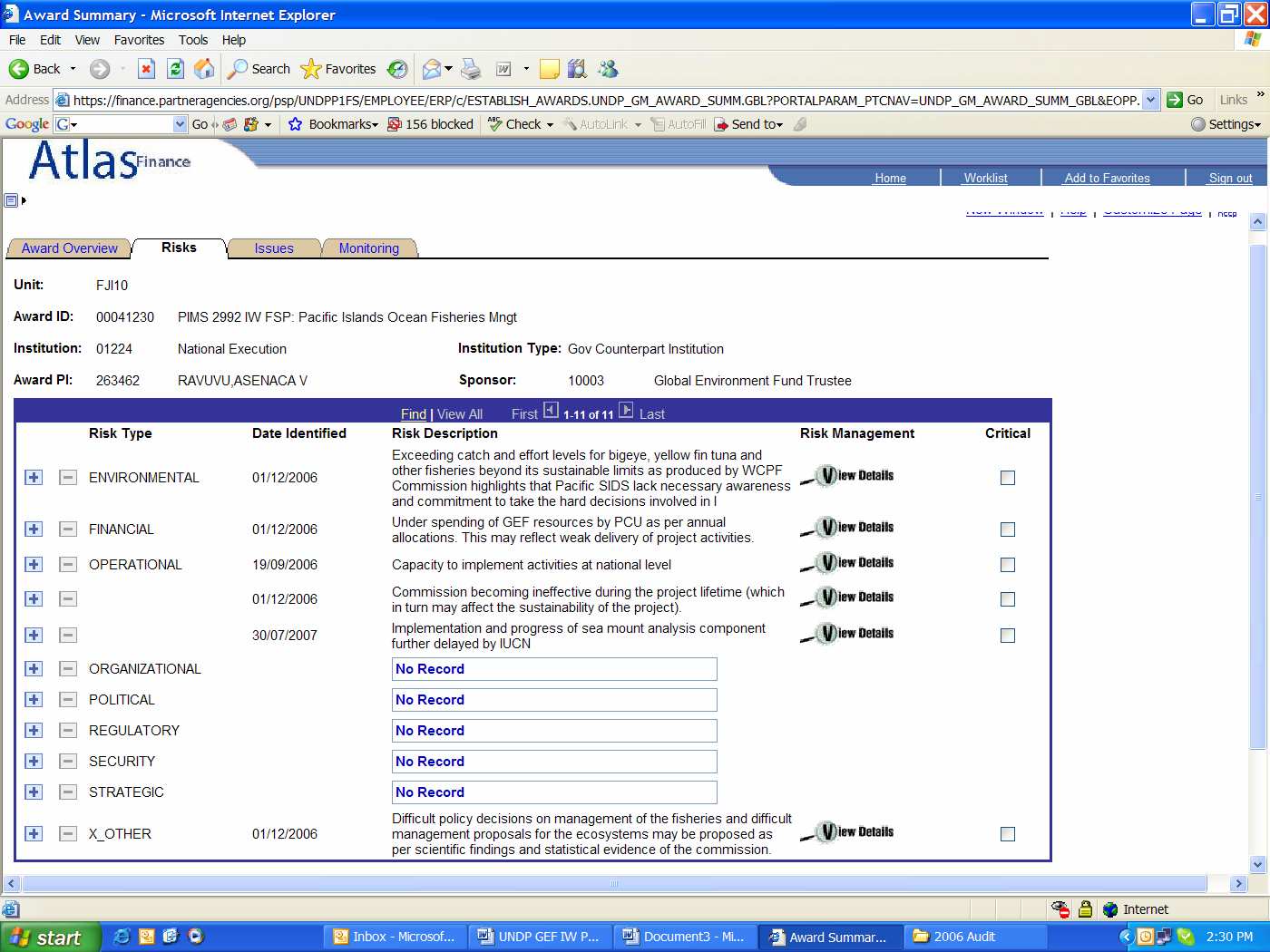
VI. Risks
1. Please annex to this report a print out of the corresponding Atlas Risk Tab (please use landscape format and only print the frame).
Page 23 of 45
2. For any risks identified as "critical" please copy the following information from Atlas:
Risk Type
Date
Risk Description
Risk Management Response
Identified
VII.
Page 24 of 45
VIII.
Adjustments to Project Strategy
Please report any adjustments made to the project strategy, as reflected in the logical framework matrix, since
the Project Document signature:
Change Made to:
Yes/No
Reason for Change
Project Objective
No
Project Outcomes
No
Project Outputs/ Activities / Inputs
Yes
Benthic survey on seamounts postponed due to factors
beyond the control of IUCN. Further funding is required to
undertake the original work plan as a result of non-event of
vessel charter. Intentions to secure additional co-financing
and review survey schedule are being pursued by IUCN.
Adjustments to Project Time Frame
If the duration of the project, the project work schedule, or the timing of any key events such as project start up,
evaluations or closing date, have been adjusted since project approval please explain the changes and the
reasons for these changes.
Change
Reason for Change
N/A
N/A
Page 25 of 45
IX. Financial Information
Please present all financial values in US$ millions to 2 decimal places only (e.g. $3,502,000 should be written as
$3.50m)
Name of
Nature of
Amount
Amount
Additional
Estimated
Expected Total
Partner or
Contributor4
used in
committed
amounts
Total
Disbursement
Contributor
Project
in Project
committed
Disbursement
by end of
(including the
Preparation
Document5
after Project
to
project
Private Sector)
(PDF A, B)
Document
30 June 2007
finalization11
GEF
Contribution
GEF
$0.69 m
$10.94 m
$Nil
$4.00 m
Cash
Cofinancing
UNDP
Managed
UNDP
UN Agency
(TRAC)
(add rows as
necessary)
Cash
Cofinancing
Partner
Managed
NZAID
$0.40 m
$0.40 m
PNG PFA
$0.10 m
Fr Pacific
Fund
$0.06 m
ACIAR
$0.30 m
Uni of Hawaii
$0.10 m
WWF Pacific
$0.10 m
Under
Consideration
EC
$1.90 m
US dept of
State (OESI)
$0.20 m
Japan (JFT)
$2.00 m
PITIA
$0.55 m
In-Kind
Cofinancing
Participating
Governments
(In cash and
kind):
$17.28 m
Regional
Organisation
4 Specify if: UN Agency, other Multilateral, Bilateral Donor, Regional Development Bank (RDB),
National Government, Local Government, NGO, Private Sector, Other.
5 Committed amounts are those shown in the approved Project Document. These may be zero in the
case of new leveraged project partners.
Page 26 of 45
(In cash and
Kind):
$14.46 m
NGOs (In cash
and Kind):
$0.61 m
NGOs (In cash
and Kind):
$0.40 m
Othere
WCPFC
members
(Commission
Contributions):
$6.49 m
Other
Estimates Co-
Financing
Fishing States
(In King
regulation
costs):
$32.25 m
Survellance
Partners (In
Kind):
$7.20 m
Total
Cofinancing
$79.09
Total for
Project
$0.69
$90.03
$5.71
Comments
Please explain any significant changes in project financing since Project Document signature, or differences
between the anticipated and actual rates of disbursement:
Anticipated and actual rates of disbursement are relatively aligned.
Page 27 of 45
X. Additional Financial Instruments used in the Project
This section only needs to be completed if the project provides funds to any Financial Instruments such as: Trust
Funds, Sinking Funds, Revolving Funds, Partial Credit Risk Guarantees, Microfinance services, Leasing or
Insurance mechanisms.
If this project does not use any Additional Financial Instruments skip this and go to Section VIII.
Financial
Financial
Basis for Selection of Financial Institution
Instrument
Institution
Responsible for
Management
N/A
N/A
N/A
For Each Financial Instrument please complete the following two tables:
Name of Financial Instrument:
N/A
Source of Funds
Funds
Amount
Issues or Comments
(add rows for each
Committed
Disbursed to
source)
in Project
Date
Document
GEF
N/A
N/A
N/A
Rating of Performance of Financial Instrument
2006 Rating
2007 Rating
Comments
National Project
N/A
N/A
N/A
Manager/Coordinator
Government GEF OFP
UNDP Country Office
UNDP Regional Technical
Advisor
Overall Rating
Action Plan to Address Marginally Unsatisfactory, Unsatisfactory or Highly Unsatisfactory Rating
Where a project has received a rating of MU, U or HU describe the actions to be taken to address this:
Action to be Taken
By Whom?
By When?
N/A
End of Project Situation
What is to happen to any funds remaining in the Financial Instrument at the end of the project?
N/A
Page 28 of 45
XI. Lessons
Are there any lessons from this project that could benefit the design and implementation of other GEF-funded
projects? Please list up to three and indicate which one/s could be worth developing into case studies of
good/bad practice.
i) In the design phase of the ful project, a strategic decision to recruit regional fisheries experts to work along side
international experts to consult with stakeholders proved to be exceptional y beneficial in the final design of the project
document. Notably, in designing the project emphasis is directed not only to the regional aspects of project assistance but a
clear direction to address national level interventions to address the root causes and threats to international waters in the
region, specifical y deficiencies in management relating to governance and lack of understanding. A wel executed terminal
review of the first phase with clear recommendations also provided noteworthy guidance in the formation of the ful Oceanic
Fisheries Management project for the Pacific region.
i ) The Pacific region has a long history of regional cooperation on oceanic fisheries management matters and this is
supported by the evolution of regional organizations whose technical and management competence have worked for the
benefit of the smal island developing States in this area. In the case of the Pacific, these recognized and established
mechanisms serve positively for addressing transboundary international waters concerns, particularly for migratory
resources.
i i) A set of guidelines detailing the processes, including timeframes, involved from project concept to the official start date of
projects might have prevented the delayed rol out of the PI OFM Project. While some delays by their nature of needing
scheduled committee type approval are unavoidable, others concerning communication, preparation work and roles of
responsibility could have reasonably been avoided with clear guidelines for al organizations involved. In the course of
addressing the accessibility of GEF assistance to the Pacific region any advice provided should be inclusive of clear process
guidelines with timeframes.
Page 29 of 45
XII.
Project Contribution to GEF Strategic Targets in International Waters
The International Waters Results Template is designed to be cumulative and updated on an annual basis (using a
new color each year). Based on the results from the FY 07 reporting year, please update last year's results
template using red color font to highlight new and revised sections.
SEE ATTACHED TABLE ONE AND THE 2007 GEF INTERNATIONAL WATERS ANNUAL
PERFORMANCE RESULTS (GEF RESULTS FRAMEWORK)
Note: The PI OFM Project 2006 UNDP GEF APR/PIR for International Waters reported this section (IX) as a narrative. In a
separate report format the OFM Project completed the "GEF International Waters Annual Project Performance Report (GEF
IW Results Framework)" which reported against Process outcomes and indicators, Stress reduction Outcomes and
Environmental & Socioeconomic Status Outcomes as wel as linkages & support by the project for achievement of the
MDGS and project support to the WSSD Plan of Implementation. The fol owing table provides updated results against
Process, Stress reduction and Environmental indicators, is linked to and should be read in conjunction with Section II
(Progress towards achieving project objectives) of this report.
Page 30 of 45
Table 1
Outcomes as Specified in
Target (by June 2010 unless
Description of Indicator:
Baseline Level
Level at June 2007
GEF IW PPR
otherwise indicated)
PROCESS INDICATORS
Effective national inter-
Existence of inter-ministry
Establish by baseline study
Improvements in most
Contacts at the national
ministry coordination
coordination mechanisms.
PACSIDS
between relevant national
Nos. of meetings/contacts of
government institutions dealing
inter-Ministry coordination
with fisheries management
issues have been enhanced
particularly on the WCPFC
issues relating to compliance of
the Conservation and
Management Measures
Stakeholder involvement in PacSIDS involvement in
Not applicable
High level of participation by
Effective participation of the FFA
SAP implementation
WCPFC, SC & TCC meetings
PacSIDS in WCPFC (100%),
members at the Northern Group
SC & TCC meetings (80%)
and Eastern Group WCPFC Sub
NGO involvement in Project
regional workshops in
activities
Phase I terminal evaluation noted ENGOs & INGOs involved in
preparation for the SC3, TCC3
lack of NGO involvement as a
Project execution
and the WCPFC4. The Western
major weakness in Phase I
Group WCPFC sub regional
workshop is scheduled to be in
first week of September 2007.
Newly established and/or
strengthened transboundary
waters institutions
The WCPFC established &
See Outcome 2 a) in Section A
Outcome 2 a) Level of first 3
beginning to function effectively;
above
elements only
Adoption of national & regional
legal, policy & institutional
reforms that address priority
transboundary concerns
The WCPF Convention being
Status of WCPFC Convention
Convention entered into force in
Al major coastal & fishing states
WCPFC Convention ratified for
implemented
June 2004, with 12 of the 13
party to the Convention
33 of 34 States & Territories
Convention ratifications to bring
participating in WCPFC process.
the Convention into force from
This includes al major coastal &
Page 31 of 45
Outcomes as Specified in
Target (by June 2010 unless
Description of Indicator:
Baseline Level
Level at June 2007
GEF IW PPR
otherwise indicated)
PACSIDS , fol owing PDF-B
fishing states except Indonesia
support.
(Depends on US ratifying as
announced by June)
21 Members or participating
territories at June 2005
National laws, policies,
See Outcome 2 c) in Section A
See Outcome 2 c) in Section A
institutions & programmes
above
above
relating to management of
transboundary oceanic fisheries
reformed, realigned &
strengthened to implement the
WCPF Convention & other
applicable global & regional
instruments
Financial sustainability of joint
WCPFC Financial Regulations &
WCPFC adopted Financial
Satisfactory level of payment of
Satisfactory payment of
transboundary waters
Budgets.
Regulations & schedule of
CCM financial contributions
membership contributions by
institutions
financial contributions at its First
FFA members and al other
Session in December 2004,
CCMs and by donor agencies
based largely upon the principle
of "those who fish should pay"
WCPFC core programmes not
Effective delivery of service and
(70% of contributions based on
blocked by lack of funding
reports by the WCPFC
catches with discount for
Secretariat in regards to SC3
developing countries)
and TCC3 and meeting targets
for its core programmes
Other Process Indicators
Improved quality, compatibility &
availability of scientific
See Outcome 1 a) in Section A
See Outcome 1 a) in Section A
information & knowledge on the
oceanic transboundary fish
stocks & related ecosystem
aspects of the WTP warm pool
LME, with a particular focus on
the ecology of seamounts in
relation to pelagic fisheries, & the
fishing impacts upon them.
STRESS REDUCTION OUTCOMES
Information on the WTP Warm
Pool fish stocks & LME being
See Outcome 1 b) of Section A
See Outcome 1 b) of Section A
used by the WCPFC to assess &
Page 32 of 45
Outcomes as Specified in
Target (by June 2010 unless
Description of Indicator:
Baseline Level
Level at June 2007
GEF IW PPR
otherwise indicated)
adopt conservation &
management measures for
transboundary fish stocks & the
LME.
The WCPFC established &
See Governance objective, 2nd
See Governance objective, 2nd
beginning to function effectively
element
element
ENVIRONMENTAL & SOCIOECONOMIC STATUS OUTCOMES 6
Improved information &
Status of target stocks
Target stocks within limits agreed
Limits yet to be agreed
knowledge on the oceanic
by the WCPFC
transboundary fish stocks &
related ecosystem aspects of the
Impacts of fishing on non-target
Significant reductions in mortality
High priority being given to
WTP warm pool LME being used
species
from fishing on non-target
improving data on mortality.
by the WCPFC & Pacific SIDS to
species
Impacts not yet measurable
adopt & apply measures to
enhance the conservation &
Broader ecosystem impacts
Positive results for broader
Proposal for monitoring
management of transboundary
ecosystem indicators (yet to be
ecosystem indicators presented.
oceanic fishery resources &
identified)
Impacts not yet measurable
protection of the biodiversity of
the WTP LME
Improvements in the contribution
Sustainable gains in PACSIDS
First report on economic
to PACSIDS sustainable
benefits including jobs, access
indicators presented to FFC.
development from improved
fees, exports etc
Impacts not yet measurable
management of transboundary
oceanic fishery resources & from
the conservation of oceanic
marine biodiversity general y.
6 Since the Project is largely aimed at Process Outcomes, focused on the establishment & functioning of the WCPFCP, it wil take time before impacts can be measured at the environmental
& socioeconomic status level, & they may not be measurable by the planned end of project at 2010. Project activity at this level is currently focused on establishing baseline data & reference
points. Price data can indicate that limits being applied to fishing are increasing the socioeconomic value of stocks in a way that should be measurable within the term of the Project.
Page 33 of 45
ATTACHMENT A
Pacific Islands Oceanic Fisheries Management Project Beneficiary Country Endorsements,
Confirmations and Signatures on the Project Document (as at July 2007)
GEF Operational Points
Dates of Endorsement/
Project Document
(at November 2004)
Confirmation
Signatures7
Cook Islands
Endorsed: 13 October 2003
Mr Vaitoti Tupa, Director, Environment Service
Confirmed: 24 December 2004
Federated States of Micronesia
Endorsed: 6 November 2003
Mr John Mooteb, Deputy Assistant Secretary
Confirmed: 29 December 2004
Sustainable Development Unit
Fiji
Endorsed: 1 March 2004
Endorsed: 29 August 2005
Mr Cama Tuiloma, Chief Executive Officer, Ministry of Local
Confirmed 1 February 2005
Government, Housing, Squatter Settlement & Environment
Kiribati
Endorsed: 28 November 2003
Mr Tererei Abete-Reema, Deputy Director, Environment and
Conservation Division
Republic of Marshall Islands
Endorsed: 16 September 2003
Ms Yumiko Crisostomo, Director, Office of Environmental
Confirmed 4 February 2005
Planning and Policy Coordination
Nauru
Endorsed: 20 October 2003
Mr Joseph Cairn, The Secretary, Department of Industry &
Confirmed 14 December 2004
Economic Development
Niue
Endorsed: 9 February 2004
Endorsed: 27 July 2005
Mr Crossley Tatui, Deputy Secretary, Ministry of External
Confirmed: 24 December 2004
Affairs Office
Palau
Endorsed: 22 October 2003
Ms Youlsau Bel s, National Environment Planner, Office of
Confirmed: 17 December 2004
Environmental and Response Coordination
Papua New Guinea
Endorsed: 19 February 2004
Endorsed: 10 August 2005
Mr Wari Iamo, Director, Department of Environment and
Confirmed 2 February 2005
Conservation
Samoa
Endorsed: 17 October 2003
Mr Aiono Mose Pouvi Sua
Confirmed: 23 December 2004
Chief Executive Officer, Ministry of Foreign Affairs and Trade
Solomon Islands
Endorsed: 11 October 2003
Mr Steve Likaveke, Permanent Secretary, Ministry of Forests,
Confirmed: 20 December 2004
Environment & Conservation
Tonga
Endorsed: 26 January 2004
Mr Uilou Samani, Director, Department of Environment
Confirmed: 3 January 2005
Tokelau
Endorsed: 27 February 2004
Endorsed: 18 July 2007
Mr Falani Aukuso, Director, Office of the Council of Faipule
Confirmed: 13 December 2004
Tuvalu
Endorsed: 7 November 2003
Endorsed: August 2005 (Mr. Enate Evi Tuvalu
Mr Nelesone Panapasi, Secretary to Government, Office of
Confirmed 1 February 2005
GEF Focal Point)
the Prime Minister
Vanuatu
Endorsed: 17 March 2004
Endorsed: 24 August 2005
7 Status UNDP Suva.
Page 34 of 45
GEF Operational Points
Dates of Endorsement/
Project Document
(at November 2004)
Confirmation
Signatures7
Mr Ernest Bani, The Head, Environment Unit
Other Project Document Signatures
Implementing Agency
United Nations Development Programme
Suva
Endorsed: 30 September 2005
Mr. Hans de Graff
Deputy Resident Representative
Papua New Guinea
Endorsed: 4 August 2005
Ms. Jacqui Badcock
Resident Representative
Executing Agency
Endorsed: 13 July 2005
Pacific Islands Forum Fisheries Agency
Mr. Feleti.P.Teo
Director General
Page 35 of 45

G l o b a l E n v i r o n m e n t F a c i l i t y
GEF INTERNATIONAL WATERS
ANNUAL PROJECT PERFORMANCE RESULTS
I. Project Identifiers:
Reporting Year
2007
Project Title
Pacific Islands Oceanic Fisheries Management Project.
Implementing Agency/ies
Implementing Agency: UNDP
Executing Agencies: FFA, SPC, IUCN
International Waters Operational Programme (8, 9, or 10)
OP 8 the Waterbody-Based Operational Program - Large Marine Ecosystem Component; and
OP 9 - the Integrated Land and Water Multiple Focal Area Operational Programme, SIDS
programme
International Waters Strategic Priority (1, 2, or 3)
IW1 - Catalyse financial resource mobilisation for implementation of reforms and stress
reduction measures agreed through TDA-SAP or equivalent processes for particular
transboundary systems; and
IW2 - Expand global coverage of foundational capacity building addressing the two key
programme gaps and support for targeted learning, specifical y the fisheries programme gap.
Priority Transboundary Concerns (Project Types A-C only)
Unsustainable use of transboundary oceanic fish stocks in the Pacific region. Specifical y :
the impact on target transboundary oceanic fish stocks;
the impact on non-target fish stocks;
the impact on other species of interest (such as marine mammals, seabirds and turtles);
the impact of fishing around seamounts;
the impact on foodwebs; and
the impact on biodiversity
II. Project Type:
A. Foundational/Capacity Building Project
Go to III.A
p. 2
B. SAP Implementation Regional Project
Go to III.B
p. 4
C. SAP Implementation - Strategic Partnership Investment Fund
Go to III.C
p. 6
D. Global/Regional/National Demonstration project
Go to III.D
p. 8
E. Technical Support and Portfolio Learning Project
Go to III.E
p. 10
Page 36 of 45
III. B. International Waters Results Template SAP Implementation Projects
PROCESS OUTCOMES AND INDICATORS
Process OUTCOMES
Process INDICATORS
Project
Rating
Catalytic
Project
Effective national inter-ministry
MU
Information on this issue from the 15 Pacific SIDS not yet available to
coordination
the Project
Existence of inter-ministry coordination mechanisms.
Nos. of meetings/contacts of inter-Ministry coordination. Data yet to be
col ected
Contacts at the national between relevant national government institutions
dealing with fisheries management issues have been enhanced particularly on
the WCPFC issues relating to compliance of the Conservation and
Management Measures
Stakeholder involvement in SAP
S
Eight NGOs accorded observer
All Pacific SIDS participated in the meetings of the WCPFC, and its
implementation
status and participated in the
Scientific Committee (SC) and Technical & Compliance Committee
WCPF Commission (WCPFC)
(TCC), with 1 participant each financed from the WCPFC budget,
meetings in the reporting period
additional participants nationally funded also supported by technical
advice from the Project.
ENGO & INGO representatives have participated in most national and
regional Project activities including pre-WCPFC, SC & TCC meetings
and Project National Consultative Committees
High level of participation by PacSIDS in WCPFC (100%), SC & TCC
meetings (80%) maintained
ENGOs (WWF) & INGOs (PITIA) involved are involved in Project execution
Newly established and/or
strengthened transboundary
waters institutions
HS
The WCPFC established and
WCPFC established and
SC established & first regular session held in August 2005. The SC
beginning to function effectively;
adopted Rules of Procedure and
ˇ established specialist WGs in Fishing Technology, Methods,
organizational structure at its
Statistics, Biology, Stock Assessment and Ecosystem and Bycatch;
First Session in December 2004.
ˇ agreed on the future work programme for the SC and
ˇ provided advice to the WCPFC on the status of major stocks amd
impacts of conservation and management measures
TCC established & first regular session held in Dec 2005. The TCC
began establishment of:
Page 37 of 45
ˇ a compliance programme including observer, boarding &
inspection, VMS schemes and
ˇ a process for identifying infringements and applying sanctions
Executive Director and other key WCPFC staff appointed by
December 2005
WCPFC & subsidiary bodies operating with a complete set of Rules &
Regulations & a Secretariat, with sustainable financial arrangements (by Dec
2007) - Draft Rules for subsidiary bodies being considered by SC & TCC
Staff Regs adopted & Secretariat posts al fil ed. (by Dec 2007) - Staff Regs
adopted. Secretariat posts being fil ed with some difficulty.
TCC operational (by Dec 2007) - Achieved 2005
Adoption of national and regional
legal, policy and institutional
reforms that address priority
transboundary concerns
The WCPF Convention being
HS
All major fishing states except
WCPFC Convention entered into force in June 2004, with 12 of the 13
implemented
the US have ratified the
Convention ratifications to bring the Convention into force from
Convention at June 2006
Pacific SIDS, following PDF-B support.
WCPFC Convention ratified for 33 of 34 States & Territories participating in
WCPFC process. This includes al major coastal & fishing states except
Indonesia (Depends on US ratifying as announced by June)
Regional institutional arrangements
HS
Pacific Island Forum Heads of
WCPFC-related legal, policy and institutional reviews under way in
for oceanic fisheries management
State established a Ministerial
many Pacific SIDS, supported from the Project by national fishery
strengthened
committee to oversee regional
status reports (2 in 2005-06) legal reviews (4 in 2005-06) and reviews
fisheries affairs which met in
of management plans based on EAFM, and by regional scientific,
May 2004 and May 2005
legal, compliance and policy workshops and consultations.
National laws, policies, institutions
and programmes relating to
management of transboundary
S
PacSIDS are implementing WCPFC measures & national conservation &
oceanic fisheries reformed, realigned
management measures Assessment yet to be completed.
and strengthened to implement the
WCPF Convention and other
applicable global and regional
instruments
Financial sustainability of joint
HS
WCPFC has begun to finance
WCPFC adopted Financial Regulations and schedule of financial
transboundary waters institutions
oceanic SPC fisheries
contributions at its First Session in December 2004, based largely upon
Page 38 of 45
monitoring and science activities
the principle of "those who fish should pay" (70% of contributions
previously funded by donors
based on catches with discount for developing countries)
Satisfactory level of payment of CCM financial contributions The failure to
Japan pledged $2m over 5 years
pay three consecutive annual contributions results in the withdrawal of voting
to the WCPFC for technical
privileges. Some instances of arrears to date
assistance (implementation to be
Financial Regulations include provision for a Special Requirements
coordinated with the GEF
Fund for SIDS. Permanent HQ jointly donated by FSM and China.
PIOFMP). Voluntary extra-
budgetary assistance for specific
WCPFC core programmes not blocked by lack of funding - To date there are
WCPFC activities provided by
no programme implementation demands attributed to lack of funding.
other Commission Members.
Improved information and
S
WCPFC has established
MOU between SPC and the WCPFC provides the basis for provision
knowledge on the oceanic
arrangements with ISC or data
of data management and scientific services by SPC to the WCPFC.
transboundary fish stocks and related
services and scientific services
ecosystem aspects of the WTP warm
related to northern WCPO stocks
WCPFC adopted standards for provision of WCPFC data
and with IATTC relating to
pool LME being used by the WCPFC
WCPO/EPO cooperation
and Pacific SIDS to adopt and apply
SPC oceanic fisheries data and scientific programmes, including SIDS
measures to enhance the conservation
capacity building, strengthened by resources from the Project, the EU
and management of transboundary
and the WCPFC
oceanic fishery resources and
protection of the biodiversity of the
Tuna Fishery Data Management System installed & operation in 7
WTP LME
Pacific SIDS, national Observer Programmes established in 10 of the
15 Pacific SIDS,
Establishment of SC & subsidiary bodies including bodies for statistics &
Ecosystem/Bycatch work (by Dec 2007) - achieved 2005
Binding agreement on protocols for fisheries data col ection & provision,
including catch & effort logs, & port & onboard sampling (by Dec 2007) - catch
& Effort Protocol in place.
Establishment of Commission data management structure and, databases (by
Dec 2007) - Port & onboard sampling sampling protocols stil under
consideration
Appointment of science staff and/or contracting of experts for the provision of
scientific services (by Dec 2007) - Interim arrangements in place
Agreement on scientific work programme, including forms of stock assessment
analysis (by Dec 2007) Staff appointed, interim arrangements agreed for
scientific experts, subject to review in 2007
(a) seamount occurrence documented using available data
b) Impacts of seamounts on physical/biological oceanography and pelagic
fisheries better understood - The occurrence of seamounts has been
documented using available data, but further work is required
Page 39 of 45
The occurrence of seamounts has been documented using available data, but
further work is required.
Information on the Project and the
S
OFM Project webpage established April 2006
WCPF process contributing to
IWLEARN participation, publications
increased awareness of oceanic
fishery resource and ecosystem
management;
STRESS REDUCTION OUTCOMES AND INDICATORS
Stress Reduction OUTCOMES
Stress Reduction INDICATORS
(report vs. baseline if possible)
Project
Rating
Catalytic
Project
Improved information and
HS
SPC and the SC provided advice to WCPFC1 and 3 identifying stocks
knowledge on the oceanic
requiring management attention and assessing the projected impacts of
transboundary fish stocks and related
a range of conservation and management measures.
ecosystem aspects of the WTP warm
pool LME being used by the WCPFC
WCPFC1 (Dec 2004) adopted conservation and management measures
and Pacific SIDS to adopt and apply
barring vessels of states that were not WCPFC Members or
measures to enhance the conservation
cooperating non-Members (CCMs) from operating in the region and
and management of transboundary
establishing a record of vessels authorised to operate in the WCPO
oceanic fishery resources and
protection of the biodiversity of the
WCPFC2 (Dec 2005) adopted conservation and management measures
WTP LME
requiring Members to :
ˇ not increase fishing effort for bigeye & yellowfin beyond current
levels;
ˇ cap purse seine effort at 2004 levels or an average of 2001 to 2004;
ˇ limit the longline catch of bigeye generally to 2001-04 average
levels
ˇ not increase numbers of fishing vessels targeting South Pacific
albacore;
ˇ keep fishing effort for North Pacific albacore north of the equator not
greater than current levels.
WCPFC2 also adopted resolutions to apply the FAO International Plan
of Action to Reduce the Incidental Catch of Seabirds, and the FAO
Guidelines to Reduce Turtle Mortality , reduce incidental catches of
other non-fish species and avoid vessel transfers that contribute to
over-capacity.
Page 40 of 45
Measures of target stock status in relation to agreed management reference
points available Stock status measures available, but no agreed reference
points
Measures of status of ecosystem including trophic status & status of key non-
target species Proposal under consideration
Provision of scientific advice to the Commission including information &
recommendations on TACs & other management measures from the Scientific
Committee to the Commission - Achieved, ongoing
Measures of the impact of environmental variability on target species
abundance & distribution - Achieved, ongoing
Assessments available of the impact of fishing on target & non-target species
- Achieved & ongoing for target species, less progress for non-target species
Analysis made of impact of possible conservation measures -Achieved &
ongoing
Page 41 of 45
ENVIRONMENTAL STATUS OUTCOMES AND INDICATORS
Environmental & Socioeconomic Status OUTCOMES
Environmental & Socioeconomic Status INDICATORS (1)
Project
Rating
Catalytic
Project
Pacific SIDS improve the
S
FFA produced a first report to measure indicators of socio-economic
contribution to their sustainable
contributions of oceanic fisheries
development from improved
Target stocks within limits agreed by the WCPFC. Limits yet to be agreed
management of transboundary
oceanic fishery resources and from
Significant reductions in mortality from fishing on non-target species. High
the conservation of oceanic marine
priority being given to improving data on mortality. Impacts not yet
biodiversity generally.
measurable
Improved information and
S
SPC and the SC provided estimates to the Commission of:
knowledge on the oceanic
ˇ key indicators of status of four major tuna stocks
transboundary fish stocks and related
ˇ estimates of mortalities of non-target species from fishing (including
ecosystem aspects of the WTP warm
sharks, seabirds and turtles)
pool LME being used by the WCPFC
and, inter alia, a proposal for ecosystem monitoring, measuring of
and Pacific SIDS to adopt and apply
ecosystem indicators and ecosystem reference points and ecosystem
measures to enhance the conservation
model development
and management of transboundary
Positive results for broader ecosystem indicators (yet to be identified).
oceanic fishery resources and
Proposal for monitoring ecosystem indicators presented. Impacts not yet
protection of the biodiversity of the
measurable
WTP LME
(1) It will take time before impacts can be measured at the environmental and socioeconomic status level, and Project activity at this level is currently focused on establishing
baseline data. Impacts on resources and stocks may take several years to measure reliably, but there are already preliminary indications from price data that the limits being
applied to fishing are increasing the socioeconomic value of stocks in a way that should be measurable within the term of the Project.
Ratings:
Highly Satisfactory
HS
The outcome is likely to be achieved or exceeded, efficiently with no significant shortcomings
Satisfactory
S
The outcome is likely to be achieved, efficiently with only minor shortcomings
Moderately Satisfactory
MS
The outcome is likely to be achieved, efficiently with moderate shortcomings.
Moderately Unsatisfactory
MU
The outcome has moderate shortcomings that limit or jeopardize its achievement, but resolution is likely.
Unsatisfactory
U
The outcome has significant shortcomings that limit or jeopardize its achievement, and resolution is uncertain.
Highly Unsatisfactory
HU
The outcome has major shortcomings that limit or jeopardize its achievement, and resolution is unlikely.
Page 42 of 45
IV. Linkages and support to achievement of MDGs
Millenium Development Goals: Briefly summarize how the project is helping to achieve the relevant MDGs below.
MDG
MDG Descriptor
Check
Indicator
MDGs
No.
that
Briefly describe how the MDG is being supported
apply
1.1.1
Proportion of population
below $1 per day
1.1.2
Poverty gap ratio.
1.1.3
Share of poorest quintile
The project targets sustainable development of oceanic fisheries. Sustainable development of oceanic
in national consumption
fisheries is a major component of the plans for socio-economic development of all SIDS. The scope for
1.2.4
Prevalence of
benefits from sustainable oceanic fisheries, including food security and incomes, is particularly important in
underweight children
the poorer Pacific SIDS - most of the Pacific SIDS with the lowest levels of development, as measured by the
under-five years of age
UNDP Human Development Index, are also the countries with the richer oceanic fisheries resources.
1.2.5
Proportion of population
below minimum level of
dietary energy
consumption
Page 43 of 45
V. Project Support to WSSD Plan of Implementation:
Check
WSSD PoI Action
WSSD
WSSD
Reference Code
Description
that
apply
III.15.c
Collect and disseminate information on cost-effective examples in cleaner production, eco-efficiency and environmental management,
and promote the exchange of best practices and know-how on environmentally sound technologies between public and private
institutions;
III.17.a
Encourage industry to improve social and environmental performance through voluntary initiatives, including environmental management
systems, codes of conduct, certification and public reporting on environmental and social issues, taking into account such initiatives as the
International Organization for Standardization (ISO) standards and Global Reporting Initiative guidelines on sustainability reporting,
bearing in mind principle 11 of the Rio Declaration on Environment and Development;
IV.29.b
Promote the implementation of chapter 17 of Agenda 21 which provides the programme of action for achieving the sustainable
development of oceans, coastal areas and seas through its programme areas of integrated management and sustainable development of
coastal areas, including exclusive economic zones; marine environmental protection; sustainable use and conservation of marine living
resources; addressing critical uncertainties for the management of the marine environment and climate change; strengthening
international, including regional, cooperation and coordination; and sustainable development of small islands.
IV.29.d
Encourage the application by 2010 of the ecosystem approach, noting the Reykjavik Declaration on Responsible Fisheries in the Marine
Ecosystem and decision 5/6 of the Conference of Parties to the Convention on Biological Diversity.
IV.29.e
Promote integrated, multidisciplinary and multisectoral coastal and ocean management at the national level, and encourage and assist
coastal States in developing ocean policies and mechanisms on integrated coastal management.
IV.29.f
Strengthen regional cooperation and coordination between the relevant regional organizations and programmes, the UNEP regional seas
programmes, regional fisheries management organizations and other regional science, health and development organizations.
IV.29.g
Assist developing countries in coordinating policies and programmes at the regional and subregional levels aimed at the conservation and
sustainable management of fishery resources, and implement integrated coastal area management plans, including through the promotion
of sustainable coastal and small-scale fishing activities and, where appropriate, the development of related infrastructure.
IV.30.a-g
To achieve sustainable fisheries, the following actions are required at all levels:
(a) Maintain or restore stocks to levels that can produce the maximum sustainable yield with the aim of achieving these goals for depleted
stocks on an urgent basis and where possible not later than 2015;
(b) Ratify or accede to and effectively implement the relevant United Nations and, where appropriate, associated regional fisheries
agreements or arrangements, noting in particular the Agreement for the Implementation of the Provisions of the United Nations
Convention on the Law of the Sea of 10 December 1982 relating to the Conservation and Management of Straddling Fish Stocks and
Highly Migratory Fish Stocks and the 1993 Agreement to Promote Compliance with International Conservation and Management
Measures by Fishing Vessels on the High Seas;
(c) Implement the 1995 Code of Conduct for Responsible Fisheries, taking note of the special requirements of developing countries as
noted in its article 5, and the relevant Food and Agriculture Organization of the United Nations (FAO) international plans of action and
technical guidelines;
(d) Urgently develop and implement national and, where appropriate, regional plans of action, to put into effect the FAO international
plans of action, in particular the international plan of action for the management of fishing capacity by 2005 and the international plan of
action to prevent, deter and eliminate illegal, unreported and unregulated fishing by 2004. Establish effective monitoring, reporting and
enforcement, and control of fishing vessels, including by flag States, to further the international plan of action to prevent, deter and
eliminate illegal, unreported and unregulated fishing;
(e) Encourage relevant regional fisheries management organizations and arrangements to give due consideration to the rights, duties and
interests of coastal States and the special requirements of developing States when addressing the issue of the allocation of share of fishery
Page 44 of 45
resources for straddling stocks and highly migratory fish stocks, mindful of the provisions of the United Nations Convention on the Law
of the Sea and the Agreement for the Implementation of the Provisions of the United Nations Convention on the Law of the Sea of 10
December 1982 Relating to the Conservation and Management of Straddling Fish Stocks and Highly Migratory Fish Stocks, on the high
seas and within exclusive economic zones;
(f) Eliminate subsidies that contribute to illegal, unreported and unregulated fishing and to over-capacity, while completing the efforts
undertaken at WTO to clarify and improve its disciplines on fisheries subsidies, taking into account the importance of this sector to
developing countries;
(g) Strengthen donor coordination and partnerships between international financial institutions, bilateral agencies and other relevant
stakeholders to enable developing countries, in particular the least developed countries and small island developing States and countries
with economies in transition, to develop their national, regional and sub-regional capacities for infrastructure and integrated management
and the sustainable use of fisheries;
(h) Support the sustainable development of aquaculture, including small-scale aquaculture, given its growing importance for food security
and economic development.
IV.31.a-e
In accordance with chapter 17 of Agenda 21, promote the conservation and management of the oceans through actions at all levels, giving
due regard to the relevant international instruments to:
(a) Maintain the productivity and biodiversity of important and vulnerable marine and coastal areas, including in areas within and beyond
national jurisdiction;
(b) Implement the work programme arising from the Jakarta Mandate on the Conservation and Sustainable Use of Marine and Coastal
Biological Diversity of the Convention on Biological Diversity, including through the urgent mobilization of financial resources and
technological assistance and the development of human and institutional capacity, particularly in developing countries;
(c) Develop and facilitate the use of diverse approaches and tools, including the ecosystem approach, the elimination of destructive
fishing practices, the establishment of marine protected areas consistent with international law and based on scientific information,
including representative networks by 2012 and time/area closures for the protection of nursery grounds and periods, proper coastal land
use; and watershed planning and the integration of marine and coastal areas management into key sectors;
(d) Develop national, regional and international programmes for halting the loss of marine biodiversity, including in coral reefs and
wetlands;
(e) Implement the RAMSAR Convention, including its joint work programme with the Convention on Biological Diversity, and the
programme of action called for by the International Coral Reef Initiative to strengthen joint management plans and international
networking for wetland ecosystems in coastal zones, including coral reefs, mangroves, seaweed beds and tidal mud flats.
IV.34.a, c
Improve the scientific understanding and assessment of marine and coastal ecosystems as a fundamental basis for sound decision-making,
through actions at all levels to:
(a) Increase scientific and technical collaboration, including integrated assessment at the global and regional levels, including the
appropriate transfer of marine science and marine technologies and techniques for the conservation and management of living and non-
living marine resources and expanding ocean-observing capabilities for the timely prediction and assessment of the state of marine
environment.
(c) Build capacity in marine science, information and management, through, inter alia, promoting the use of environmental impact
assessments and environmental evaluation and reporting techniques, for projects or activities that are potentially harmful to the coastal
and marine environments and their living and non-living resources.
Page 45 of 45
NATIONAL LEVEL ANNUAL REPORT
TO THE
OCEANIC FISHERIES MANAGEMENT PROJECT
REGIONAL STEERING COMMITTEE (OFM RSC)
Reporting Period, October 2006 June 2007
1. Country: Federated States of Micronesia
2. Project Title: Oceanic Fisheries Management: Implementation of the
Strategic Action Program of the Pacific SIDs (Pacific SAP II)
3. Period Covered: 1 October 2006 30 June 2007
4. Summary of Overall Project Progress
The Federated States of Micronesia is pleased with the overall progress of the
project and project activities delivery. As the project document was done
sometimes back, some flexibility should be exercised to be able to shift funds
to other areas as new challenges arise.
The project activities have been most useful in capacity building at the country
level as well as at the regional level. Without the project, most of the small
administrations in the region will have been ill-prepared to effectively
participate in the meetings of the Commission and its subsidiary bodies and in
meeting their various obligations under the Commission. The two
components (SPC and FFA) of the project have gone a long way in assisting
the Small Island Developing States (SIDS) of the region, not only to
participate, but to participate effectively in the work of the Commission and in
meeting their obligations under the Commission.
The FSM through NORMA has particularly benefited from both components of
the project. Under Component One of the project, the TUFMAN database has
been set up in country with some training on its use. This is work in progress
and more work is still being carried out to further develop the program to
produce the reports that are required. Assistance and support have also been
extended to the FSM in data quality improvements and collections through
various guides, workshops and attachments. The FSM National Fishery
Status Report has also been worked on and a short version has been
presented and fuller version will be delivered at the planned EAFM
Consultation workshop in November. The Stock Assessment Workshops
have also been most useful to the FSM in understanding the scientific
concepts involved in stock assessments and comprehend the scientific
reports better and participate more in discussing these issues as they come
1
up at the Scientific Committee and the Commission itself. The scientific
papers developed for the Commission have also been very useful for the
FSM's effective participation in the Commission.
Project activities under Component Two of the project have been most useful
for the FSM in several areas. On the legal side, on-going effort and advice in
the review and assistance in drafting fisheries legislation to be compliant with
regional and international requirements have been graciously extended and
very much appreciated. Assistance has also been extended in port state
enforcement through workshops and legal attachments. The regional judicial
seminar is another useful legal seminar that assists countries in the region to
prosecute fisheries cases more efficiently and successfully in the on-going
effort to curtail IUU fishing.
In conservation and management, the FSM has greatly benefited from the
WCPFC Workshops, the pre-WCPFC meeting (including TCC and the SC)
FFC caucuses. These have helped prepare us for more effective participation
at the meetings of the Commission and its subsidiary bodies. The on-going
Management Options Workshop is viewed by the FSM as one of the most
useful undertakings of the Project in terms of the Region's response to the
need to conserve and manage the resources in a sustainable manner for our
generation and future generations of our Pacific peoples. This workshop is
most useful in getting the region to strategically prepare to take on the delay
tactics and attempts by the distant water fishing nations to continue fishing as
usual despite the scientific advice to cut back effort. The reports on the
mitigations of seabirds, turtles, sharks and the use of fish aggregating devises
(FADS) in the fisheries assist as well in developing our strategies on these
issues as they come in the Commission meetings (including SC and TCC ).
Monitoring, Control and Surveillance (MCS) workshops and attachments that
have been held in the region as well as the annual MCS Working Group
meeting funded by the project have also gone a long way in preparing the
region in tackling the MCS aspects of the Commission's work.
5. Specific Outputs/Results Achieved (as per annual work-plan):
National level activities
TUFMAN Database was installed at the NORMA Office
with some training
The National Tuna Fishery Status Report (Short Version)
was delivered
In-country data coordinator support was provided
A port state enforcement workshop was held in country
2
Regional level activities
The FSM participated in the first stock assessment
workshop
Scientific papers provided for the WCPFC benefited the
FSM
The FSM participated in two WCPFC workshops (West
and North)
The FSM participated in the Management Option
Workshop last year
The FSM participated in all FFC caucuses pre-WCPFC
(including SC and TCC)
The FSM was involved in the EAFM Training Workshop
The FSM participated in the annual MCS Working Group
meeting
The FSM participated in the Regional Judicial Seminar
The FSM benefited from the draft guideline for fisheries
legislation and advice on its on-going activities with Palau
and the Marshall Islands on our subsidiary arrangement
under the Niue Treaty.
6. Challenges/Issues Encountered
This region is overloaded with meetings and for small administrations as most
of the fisheries offices in the region, it is very difficult to keep up with all these
meetings. This is not saying that the activities undertaken under the project
are of less importance. They are very important for us to meet our obligations
under the Commission and we need to have them. We need to make more
time for these meetings and workshops so participants can really absorb the
materials and concepts and cut down other meetings.
Challenges are an continuing thing. As the Commission develops, new
challenges arise; as new measures are taken, new challenges are developed
especially for the SIDS with small fisheries administration and limited capacity
put the mechanisms in place necessary to implement new decisions by the
Commission.
Getting the necessary mechanisms and procedures in place at the
Commission so that the Commission can effectively meet its mandates in the
3
Convention continue to be a challenge. We will continue to talk while the
resources are being depleted.
7. Solutions Applied (to address issues and challenges)
The above are regional issues that perhaps should be addressed by the
region and not the individual country level. The FSM is keen to discuss these
further with others and seek regional solutions to them.
8. Recommendations for Future Action
As a region, which will be impacted most if no agreement is reached at the
Commission level on procedures and mechanisms to effectively conserve and
manage the tuna resources, we should be greatly concern about the lack of
progress on the development and implementation of these procedures and
mechanisms. No management measures can be effective without these
procedures and mechanism. We should seek ways to make some head-ways
on some of these issues.
9. Report Prepared By: Bernard Thoulag, National (OFM Project) Focal
Point.
4
NATIONAL LEVEL ANNUAL REPORT
TO THE
OCEANIC FISHERIES MANAGEMENT PROJECT
REGIONAL STEERING COMMITTEE (OFM RSC)
Reporting Period 1 Oct 2006 30 June 2007
1. Country: MARSHALL ISLANDS
2. Project Title: Oceanic Fisheries Management: Implementation of the Strategic Action
Programme of the Pacific SIDs (Pacific SAP II)
3. Period Covered: 1 October 2006 30 June 2007
4. Summary of Overall Project Progress: As in the previous reporting period, the RMI continued to
benefit from various projects under the overall project progress. A few of the highlights from this
current reporting period include:
1. Deputy Director attended 3rd Management Options Workshop (MOW3) in Nadi, Fiji in
October 2006 as well as 2nd Regional Steering Committee (RSC2) which also took place in
Nadi. RMI national progress report was tabled at the RSC2 alongside those submitted by
Cook Islands, FSM, Solomon Islands, and Tonga.
2. Key MIMRA staff along with RMI Attorney General and industry representative
attended pre-WCPFC (FFA briefing) and WCPFC meetings in Apia, Samoa in
December 2006; Director attended Joint RFMO Meeting in Kobe, Japan in late
January 2007. It is well understood that the project contributes significantly in the
form of assisting with FFA briefs for such meetings.
3. The TUFMAN database at MIMRA was upgraded to version 3.0 during this reporting
period; in addition, the RMI also benefited from the availability of the CES database
system which was provided to all member countries throughout this period.
4. `National Tuna Data Procedures Documents' (NTDPD) progressed with program visit
to RMI during this reporting period. These were later routinely reviewed and updated.
National monitoring capacity in the RMI was reviewed and funding requirements
under GEF were established during this time.
5. Specific Outputs/Results Achieved (as per annual work-plan):
National level activities:
ˇ A basic observer training course was conducted in Majuro in late February / early
March 2007. Considerable effort was undertaken by SPC staff in successfully putting
the pre-selection test procedures in place for the course. It was agreed that these
procedures would become standardized for future courses. A debriefer course was
successfully completed along with port sampling refresher course earlier in August
2006 with senior RMI observers getting full port sampling certification.
ˇ A very timely in-country visit by the PCU was more than welcomed. Details of said
visit will comprise part of the highlights for next reporting period as the visit only
commenced a little after the end of current reporting period which this report entails.
1
Regional level activities:
ˇ Deputy Director and VMS Officer from RMI Sea Patrol attended 10th MCS Working Group
meeting held at FFA Headquarters in March 2007.
ˇ MIMRA Data Specialist and Sea Patrol VMS Officer attended VMS Training in Canberra, April
2007.
ˇ RMI hosted first WCPFC sub-regional workshop (Northern Group) in Majuro from 23 to 27
June 2007. Participants from Palau, FSM, Kiribati, and Nauru were well-represented and the
workshop deemed successful. As with the other WCPFC sub-regional workshops, it is
envisaged that key national and regional issues discussed at the Majuro workshop will be
taken up considerably at the forthcoming Management Options Workshop (MOW4)
scheduled to be held in Rarotonga in October 2007.
ˇ Chief Fisheries Officer for the Oceanic & Industrial Affairs Division, MIMRA attended stock
assessment workshops at SPC, Noumea in late June / early July 2007.
6. Challenges/Issues Encountered
Challenges and issues encountered with project activities during this reporting period include:
ˇ Ongoing lack of familiarity with the Project; specifically, which projects fall under or are
entitled to GEF funding, etc.
ˇ Inability to keep track or up to date on overall progress of Project.
ˇ Ongoing lack of local/national coordination in formally establishing a national project
coordinator at this juncture. In all likelihood, this is further complicated by the fact that
another RMI government agency is GEF focal point and there is minimal interaction and/or
coordination at the national level when it comes to seeking out who is entitled to what and
how.
7. Solutions Applied (to address issues and challenges)
Solutions applied to address the issues and challenges included:
ˇ Need for increased and effective coordination with relevant agencies at the national level.
ˇ Increased awareness and up to date liaison with PCU. Establishment of routine contact with
PCU via email has been well-received and very responsive. RMI considers this to be a big
plus and thus very positive engagement.
ˇ More frequent liaison with PCU. In-country visit has really helped RMI in ongoing efforts at
familiarization of the project and related cross-cutting issues at the national and regional
levels.
9. Recommendations for Future Action
The RMI will continue to support in-country visits by the PCU. Effective engagement with PCU will
continue to form an integral part of our efforts. As such, continued future correspondence with PCU
will remain essential.
10. Report Prepared By: Samuel K. Lanwi, Jr. [for RMI National (OFM Project) Focal Point]
2
NATIONAL LEVEL ANNUAL REPORT
TO THE
OCEANIC FISHERIES MANAGEMENT PROJECT
REGIONAL STEERING COMMITTEE (OFM RSC)
Reporting Period, July 2006 June 2007
1. Country : TONGA
2. Project Title: Oceanic Fisheries Management: Implementation of the Strategic
Action Programme of the Pacific SIDs (Pacific SAP II)
3. Period Covered: 01 JULY 2006 30 JUNE 2007
4. Summary of Overall Project Progress
Tonga, like all FFA member countries participated in all regional workshops and
meetings where GEF OFM Project had made contributions.
5. Specific Outputs/Results Achieved
National Level Activities
ˇ TUFMAN The TUFMAN database for Tonga was updated during the
3rd quarter of 2006, and also to version 3.0 on first quarter of 2007 and
version 4.0 on second quarter of 2007. Tuna Data Procedures Document's
were also drawn up and trial of the Longline Logbook started with the
logbook delivered to Tonga and taken onboard by one of fishing
companies. These trial logbooks were retrieved back for review.
ˇ Observer Program - National observer program, for Tonga, was also
established during the 3rd quarter of 2006. Observer workbook and
waterproof sampling pads with debriefing forms were received by Tonga
during this period. Debriefing work was carried out by SPC staff in Tonga
with the primary aim of selecting experienced observers to become in-
country observer debriefers.
ˇ Operations `Kurukuru' and `Islands Chief' was held on 3rd quarter 2006
This was supported by Australian Defence with contributions from FFA
MCS Division, to undertake coordinated surveillance operations between
and across national jurisdictions.
ˇ Attachments - An attachment undertaken by one fisheries officer from
Tonga, (SPC/OFP), during this reporting period. Also Tonga Fisheries
Legal officer attended an attachment in FFA during 1st quarter 2007. An
MCS two week attachment was also taken around March 2007 by one
Fisheries staff from Tonga.
ˇ National Status Report - An in-country workshop undertaken during first
quarter of 2007 for delivery of National Status Report prepared around the
same quarter.
ˇ EAFM - During the first quarter of 2007, a consultation was undertaken to
progress EAFM on Tuna Fisheries in Tonga, mainly for senior staffs of
Tonga Fisheries. Tonga also participated on a training workshop on the
delivery of the EAFM process which was conducted by Dr. Rick Fletcher
in Vanuatu in 1st quarter or 2007.
6. Regional Level
ˇ MCS Tonga MCS staff participated in regional operations, (Kurukuru
06), held in Tonga 3rd quarter 2006, undertaking planning and
coordination of air and Sea patrols in conjunction with the Pacific Patrol
boat program.
ˇ Stock Assessment - Tonga participated in the first OFMP stock
assessment workshop that was held at SPC Headquarters in Noumea in
early July 2006.
ˇ Tonga also participated on the 9th MCS working Group meeting in
Brisbane, October 2006 which included substantial TCC preparations for
Pacific SIDS and also the 10th MCS working group meeting in Honiara,
March 2007.
ˇ Tonga participated in the National Consultative Committee meeting,
October 2006.
7. Challenges/Issues Encountered
Challenges and issues encountered with the project activities within this reporting
period (July 2006 June 2007) included the following:
ˇ One of the main issues encountered by Tonga is that the National Focal
Point finds it hard to follow projects assisted by GEF, however, the
quarterly reports are of great assistance and the country visit by the Project
Coordinator in May 2007.
8. Solutions Applied (to address issues and challenges)
ˇ National Focal Point to follow through quarterly reports and coordinator
the activities related to GEF contributions. This can be done when
coordinator is sending invitations to member countries and good
communications with coordinator.
9. Recommendation
More frequent visits by Project Coordinator will be very useful in addition to
keeping better communications between focal points and coordinator.
Prepared by: Siliveinusi M. Ha'unga,
National ( OFM Project) Focal Point of Contact, TONGA


REGIONAL STEERING COMMITTEE
3rd Meeting of the RSC
Rarotonga, Cook Islands
6 October 2006
Paper Number
RSC3/INFO.5
Title
NATIONAL ANNUAL PROJECT REPORTS
Summary
The Pacific Islands Oceanic Fisheries Management Project (OFM Project) provides
assistance to Pacific Small Islands Developing States (SIDS) at two levels, regionally and
at national levels. Each of the countries participating in the OFM Project has designated a
Project National Focal Point and these individuals have a number of project related
responsibilities, including the preparation of a national annual report. National annual
reports prepared by the project focal points for the Federated States of Micronesia and
Tonga have been received to-date. Of the 15 countries participating in the OFM Project
only five countries (Cook Islands, FSM, Marshall Islands, Solomon Islands and Tonga)
submitted reports in 2006.
Recommendation
The Regional Steering Committee is invited to:
i)
advise on the status of national consultative committee mechanisms in-
country;
ii)
note the national annual project reports submitted by the FSM and Tonga;
iii)
provide verbal presentations where no written country report has been
submitted in advance; and
iv)
raise for discussion matters relating to any national concerns regarding the
project activities and their delivery.
NATIONAL ANNUAL PROJECT REPORTS
Introduction
1.
The Pacific Islands Oceanic Fisheries Management Project (OFM Project) provides
assistance to Pacific Small Islands Developing States (SIDS) at two levels, regionally and
at national levels. Each of the countries participating in the OFM Project has designated a
Project National Focal Point (see Attachment A - updated as at June 2007) to the project
and these individuals have a number of national level project responsibilities.
National Level Project Management and Coordination and National Consultative
Committee
2.
Based on information provided to the Project Coordinator by project focal points
during country visits, the formation or resurrection of functioning fisheries management
committees is in some countries non-existent, at best stalled. In those countries in which
fisheries management committees are functioning, it is noticeable that they tend to have
active domestic fisheries and industry operators participating in governance processes.
3.
The level of discussion related to the project and WCPFC matters at the national
consultative level is not known. Ideally the project focal point obtains from the National
Consultative Committee (NCCs) process, the endorsement of requests for in-country
project activities. They are also expected to monitor the effectiveness of in-country
activities; prepare work plans1 for in-country Project activities and discuss project progress
at a national level.
4.
There is also the expectation that focal points and NCC processes should identify
national concerns regarding project activities and delivery; and ensure integrated
coordination of actions and project concepts with those government departments or
ministries that have the responsibility and accountability for fisheries management and
convention related issues. The NCC should also provide national, non-governmental
stakeholders and government representatives alike with an opportunity to be updated and
exchange information on the fisheries management developments to ensure transparency
of process and multisectoral participation.
Reporting
5.
The National Focal Point in each country has been requested to provide the Project
Coordinating Unit (PCU) with a summary report of its discussions as they relate to project
issues highlighting specific issues that need to be brought to the attention of the Regional
Steering Committee. The PCU has provided Project National Focal Points with a
standardised reporting template for countries to complete and submit to the Regional
Steering Committee. The template has been designed to be concise and is mindful of the
need not to burden National Focal Points with extensive reporting requirements on top of
their daily national work responsibilities.
6.
National annual reports prepared by the project focal points for the Federated
States of Micronesia and Tonga have been received at the time this paper was prepared.
Of the 15 countries participating in the OFM Project only five countries (Cook Islands,
FSM, Marshall Islands, Solomon Islands and Tonga) submitted reports in 2006.
Recommendation
7.
The Regional Steering Committee is invited to:
i)
advise on the status of national consultative committee mechanisms in-
country;
1 Work plans are originally based on the national needs assessment completed during the design
phase of the project. They should be revised on an annual basis by the project focal points to take
into account shifting priorities and completed activities.
RSC3/INFO.5
2
ii)
note the national annual project reports submitted by the FSM and Tonga;
iii)
provide verbal presentations where no written country report has been
submitted in advance; and
iv)
raise for discussion matters relating to any national concerns regarding the
project activities and their delivery.
RSC3/INFO.5
3
ATTACHMENT A
Pacific Islands Oceanic Fisheries Management Project
NATIONAL (OFM PROJECT) FOCAL POINT
[UPDATED 21 JUNE 2007]
Country
Focal Point
Designation
Address
Telephone/Fax
Email
COOK ISLANDS
GRAHAM
Peter
Legal Advisor
P.O. Box 85
Tel: (682) 28721
P.W.Graham@mmr.gov.ck
Ministry of Marine Resources
AVARUA, RAROTONGA
Fax: (682) 29721
Cook Islands
FSM
THOULAG
Bernard
Executive Director
P O Box PS122
Tel: (691) 320
norma@mail.fm
National Oceanic Resource
PALIKIR, POHNPEI
2700/5181
Management Authority(NORMA)
Federated States of Micronesia
Fax: (691) 320 2383
96941
FIJI
NAQALI
Sanaila (Lt
Acting Director of Fisheries
P.O. Box 358
Tel: (679) 336 1122
snaqali@mff.net.fj
Cdr)
Ministry of Agriculture, Fisheries
SUVA
Fax: (679) 331
and Forestry
Fiji
8769/336 1184
Fisheries Division
KIRIBATI
TEKINAITI
Tooti (Ms)
Ag. Principal Fisheries Officer
P O Box 276
Tel: (686) 21296 /
k2toosi@yahoo.com
Fisheries Department
BIKENIBEU, TARAWA
21099
Republic of Kiribati
Fax: (686) 22289 /
21120
MARSHALL IS
JOSEPH
Glen
Director
P.O. Box 860
Tel: (692) 625 8262
gjoseph@mimra.com
Marshall Islands Marine Resources
MAJURO
Fax: (692) 625 5447
mimra@ntamar.net
Authority
Marshall Islands 96960
LANWI
Sam
Deputy Director
P.O. Box 860
Tel: (692) 625 8262
skljr@mimra.com
Oceanic & Industrial Affairs
MAJURO
Fax: (692) 625 5447
Marshall Islands Marine Resources
Marshall Islands 96960
Authority
NAURU
DEIYE
Charleston
Chief Executive Officer
Aiwo District
Tel: (674) 444 3739/
ceonfmra@cenpac.net.nr
Nauru Fisheries & Marine
Republic of Nauru
3733
Resources Authority
Fax: (674) 444 3812
AMRAM
Terry
Oceanic Fisheries Manager
Aiwo District
Tel: (674) 444 3739/
tamramnr@yahoo.com
Oceanic Department
Republic of Nauru
3733
Nauru Fisheries & Marine
Fax: (674) 444 3812
Resources Authority
NIUE
PASISI
Brendon
Director
P.O. Box 74
Tel: (683) 4032
fisheries@mail.gov.nu
Department of Agriculture,
ALOFI
Fax: (683) 4079 / 4010
Forestry & Fisheries
Niue
PALAU
MALSOL
Nanette
Fisheries Law Compliance Officer
P O Box 117
Tel: (680) 488 3125
dillymalsol@yahoo.com
Ministry of Resources and
KOROR
Fax: (680) 488 3555
tunapal@palaunet.com
Development
Republic of Palau 96940
RSC3/INFO.5
4
PNG
MARTIN
Paul
Industry Liaison Coordinator
Investment Haus
Tel: (675) 309 0442
pmartin@fisheries.gov.pg
National Fisheries Authority
P O Box 2016
Fax: (675) 3202061
PORT MORESBY, NCD
Papua New Guinea
KUMORU
Ludwig
Manager Tuna Fishery
Investment Haus
Tel: (675) 309 0442
lkumoru@fisheries.gov.pg
National Fisheries Authority
P O Box 2016
Fax: (675) 3202061
PORT MORESBY, NCD
Papua New Guinea
SAMOA
MULIPOLA
Antonio.P
Assistant Chief Executive Officer
P.O. Box 1874
Tel: (685) 23863
apmulipola@lesamoa.net
Fisheries Division
APIA
Fax: (685) 24292
Ministry of Agriculture and
Samoa
Fisheries
SOLOMON IS
LILOQULA
Ruth
Permanent Secretary
P O Box G13
Tel: (677) 38674
tatemale@solomon.com.sb
Department of Fisheries and
HONIARA
Fax: (677) 38106 /
Marine Resources
Solomon Islands
38730
OREIHAKA
Ed
Director
P O Box G13
Tel: (677) 38674
edohaka@yahoo.com.au
Department of Fisheries and
HONIARA
Fax: (677) 38106 /
Marine Resources
Solomon Islands
38730
TOKELAU
PELASIO
Mose
Director
Tauata o Faleagafulu Building
Tel: (690) 3127 or 3134
Mose.pelasio@clear.net.nz
Department of Economic
Fakaofo
Fax: (690) 3108 or
Development, Natural Resources
TOKELAU
3133
& Environment;
TONGA
HA'UNGA
Siliveinusi M. Fisheries Officer
P. O. Box 871,
Tel: (676) 21399,27799
shaunga@tongafish.gov.to
Licensing
NUKU'ALOFA
Fax: (676) 23891
Department of Fisheries
Kingdom of Tonga
TUVALU
FINIKASO
Sam
Director of Fisheries
VAIAKU, FUNAFUTI
Tel: (688) 20836 ext
safin70@yahoo.com
Tuvalu Fisheries Department
Tuvalu
2206
Ministry of Natural Resources and
Fax: (688) 20151
Lands
Cell: (688) 90720
VANUATU
NAVITI
William
Acting Director
Private Mail Bag 045
Tel: (678) 23621
fish-inspector@vanuatu.com.vu
Fisheries Department
PORT VILA
Fax: (678) 23641
Republic of Vanuatu
AUSTRALIA
ANDERSON
Gordon
Pacific Fisheries Program
02 6206 4315
cell 0400003977
Gordon.anderson@ausaid.gov.au
Development Advisor
Advisory Group
Corporate Governance and Review
Division
AusAID
NEW ZEALAND
LINEHAM
Rebecca
Second Secretary
New Zealand High Commission
Tel: (677) 28534
rebecca.lineham@mfat.govt.nz
P.O. Box 697
Fax: (677) 22377
Honiara
RSC3/INFO.5
5


REGIONAL STEERING COMMITTEE
3rd Meeting of the RSC
Rarotonga, Cook Islands
6 October 2007
Paper Number
RSC3 / WP.6
Title
2007 FINANCIAL REPORTS
Summary
The purpose of this paper is to present the financial report in 2007 for the Pacific
Islands Oceanic Fisheries Management Project to the Regional Steering Committee.
This report comprises the acquittal of the 2006 approved Budget and Work Plan with
the report of the auditors, the approved revised 2007 Budget and Annual Work Plan,
an interim report on budget against expenditures up until 31 August in 2007 and the
approved 2008 Budget and Annual Work Plan.
This paper also outlines a plan of action to address if required, a number of
budgetary matters that have the potential to impact on the 2008 Budget and Annual
Work Plan (AWP). It is proposed that a revised 2008 Budget and AWP be prepared
in November for the Committee to consider after the Project Coordination Unit
consults with executing agencies and UNDP.
Recommendation
The OFM Project Regional Steering Committee is invited to:
i)
note and endorse the audited 2006 financial report year ending 31st
December 2006;
ii)
consider and note the 2007 Interim Financial Report;
iii)
note the 2008 Annual Work Plan and Budget; and
iv)
consider the plan of action relating to the revised 2008 Budget and AWP
scheduled for November.
2007 FINANCIAL REPORT
Introduction
1.
The second meeting of the Regional Steering Committee (RSC2) for the
Pacific Islands Oceanic Fisheries Management (OFM) Project) was held on the 21
October 2006 at Nadi, Fiji. This meeting of the RSC considered a revised budget and
annual work plan for project activities in 2007. While there was agreement in
principle on the proposed revisions to the 2007 Budget and AWP, the Committee
decided that further discussion was required between UNDP and the PCU to show
clearly the impacts of carry forward attributed to some activities that were not on
schedule.
2.
The PCU prepared detailed quarterly work plans to support the revised
budget for 2007 and in consultation with UNDP, the revised Budget and AWP for
2007 was completed and circulated to the RSC for endorsement. The revised 2007
Budget and AWP were endorsed in November 2006.
2007 Financial Reporting
3.
Following the 2006 reporting format for presentation to the Regional Steering
Committee, the 2007 financial reporting for the OFM Project is divided into a number
of parts. The financial reporting comprises three parts as follows:
4.
Part One presents the 2006 Financial Report. This is the reporting of
expenditures (actuals) against the approved 2006 Annual Budget & AWP.
5.
An independent audit of the 2006 expenditures was conducted by the FFA
appointed auditors and completed on the 30 May 2007. The resulting audit report
was submitted to UNDP, Suva as required. The Auditor's Report is made up of the
report and a management letter. A copy of the Auditor's Report for expenditure in
2006 is appended at Attachment A.
6.
Part Two of this paper is presented in two parts:
ˇ Section A presents again the approved 2007 revised Budget & AWP
for the information of the RSC, and should be read in conjunction
with;
ˇ Section B which is the Interim 2007 Financial Report covering January
to August 2007.
7.
Lastly, Part Three of this report presents the 2008 Budget and AWP approved
by the GEF Council and endorsed by the first meeting of the RSC in Honiara.
8.
The tables associated with Parts One, Two and Three of this report
are presented as:
i)
Table A: 2006 Financial Report;
ii)
Table B: 2007 Revised Budget & AWP;
iii)
Table C: 2007 Interim Financial Report;
iv)
Table D: 2008 Approved Budget & AWP.
RSC3 / WP 6
2
PART ONE
2006 Financial Report
9.
The total budget approved for the first full year (2006) of the project was
$3,171,9031. As at 31 December 2006, actual expenditure was $2,092,871 (66% of
the 2006 annual budget), leaving an unspent budget of $1,079,032 (34% of the 2006
annual budget). Table A summarizes and reports the financial outcomes of the
approved 2006 AWP and Budget at the close of the financial year ending 31
December 2006.
10.
The annual independent audit for the OFM Project was completed on 30 May
2007 and submitted to UNDP Suva, the project Implementing Agency. The project
has been audited by the FFA appointed auditors. The Auditor's Report is made up of
the report and a management letter. A copy of the Auditor's Report for expenditure in
2006 is appended at Attachment A.
Summary
11.
The 2006 Financial Report (Table A), presents the OFM Project expenditures
year ending 31 December 2006 against the approved revised 2006 Budget. It
reports the 2006 expenditures against the 2006 approved revised Budget & AWP.
The Budget reporting format is consistence with UNDP's standardized financial and
reporting format known as ATLAS.
Recommendation
12.
The Committee is invited to note and endorse the audited 2006 financial
report year ending 31st December 2006.
1 All figures are US Dollars
RSC3 / WP 6
3
Table A:
2006 Financial Report
CONSOLIDATED Financial Report
(a) Designated Institution:
Pacific Islands Forum Fisheries Agency
(b) Programme/Project number PIMS No. 2992
Programme/Project title
Pacific Islands Oceanic Fisheries Management Project
(c) Year Ending
31 December 2006
(d) Currency:
United States Dollars
Chart of
Total
Item
Account
Jan-Mar
Apr-June
July-Sept
Oct-Dec
Amount
(f) Opening Balance:
$420,546
$81,794
-$30,532
$167,406
$420,546
(g) Advanced Received:
$180,847
$812,649
$840,572
$1,834,068
(h) Available Funds:
$420,546
$262,641
$782,117 $1,007,978
$2,254,614
Annual
Budget
Total
Budget
%
Detail Expenditures:
Account
2006
Expenditure
Available % spent Available
Activity 1:
International Consultants
71200
139,337
4,558
5,472
16,955
24,606
51,591
87,746
37%
63%
Local Consultants
71300
140,565
3,116
328
11,812
72,909
88,165
52,401
63%
37%
Contract Services
71400
619,039
126,662
118,705
117,596
123,451
486,414
132,626
79%
21%
Un Vol
71500
0
0
Travel
71600
148,750
4,809
4,169
25,763
29,337
64,079
84,671
43%
57%
Service Contract-Company
72100
365,000
0
5,540
161,470
164,258
331,268
33,732
91%
9%
Equip&Furniture
72200
130,000
188
0
91,971
11,932
104,091
25,909
80%
20%
Material & Goods
72300
0
0
Communication & AV
72400
5,000
417
0
0
0
417
4,583
Supplies
72500
0
0
Grants
72600
0
0
InfoTechEq
72800
18,000
7,250
0
3,349
3,769
14,368
3,632
80%
20%
Rent&Maint
73100
0
0
Premises Alterations
73200
0
0
Rnt&Maint
73300
0
0
Rntl&Maint
73400
0
0
Prof Srvcs
74100
0
0
AudioVisl
74200
0
0
MiscExp (workshops)
74500
245,446
7,975
62,305
45,676
53,838
169,793
75,652
69%
31%
Misc Exp (Exchange gain /(loss)
0
0
Total Activity 1_B
_ udget & Exp
1,811,137
154,975
196,519
474,591
484,101
1,310,186
500,951
72%
28%
Activity 2
International Consultants
71200
394,986
64,188
4,750
54,335
139,222
262,495
132,491
66%
34%
Local Consultants
71300
0
0
Contract Services
71400
147,102
12,469
8,613
6,602
34,472
62,156
84,946
42%
58%
Un Vol
71500
0
0
Travel
71600
80,527
5,667
9,201
2,422
4,337
21,627
58,900
27%
73%
Service Contr-Company
72100
0
0
Equip&Furn
72200
5,000
0
0
2,398
0
2,398
2,602
48%
52%
Matl&Goods
72300
0
0
Comm&AV
72400
1,000
0
0
0
0
0
1,000
0%
100%
Supplies
72500
0
0
Grants
72600
0
0
InfoTechEq
72800
1,879
0
818
0
0
818
1,061
Rent&Maint
73100
0
0
PremAlter
73200
10,000
0
0
0
7,929
7,929
2,071
79%
21%
Rnt&Maint
73300
0
0
Rntl&Maint
73400
0
0
Professional Services
74100
0
0
AudioVisl
74200
0
0
MiscExp (workshops)
74500
313,854
75,574
22,943
46,884
80,047
225,448
88,406
72%
28%
Total Activity 2_B
_ udget & Exp
954,348
157,898
46,326
112,641
266,007
582,871
371,477
61%
39%
Activity 3
International Consultants
71200
39,500
2,562
3,972
5,876
0
12,409
27,091
31%
69%
Local Consultants
71300
0
0
Contract Services
71400
236,368
14,124
22,108
5,664
73,079
114,975
121,393
49%
51%
Un Vol
71500
0
0
Travel
71600
30,000
4,044
11,228
6,797
5,160
27,229
2,771
91%
9%
Contr-Cmpy
72100
0
0
Equip&Furn
72200
11,758
0
5,000
0
1,138
6,138
5,620
52%
48%
Matl&Goods
72300
4,000
0
0
0
0
0
4,000
0%
100%
Comm&AV
72400
0
0
Supplies
72500
0
0
Grants
72600
0
0
InfoTechEq
72800
0
0
Rent&Maint
73100
0
0
PremAlter
73200
0
0
Rnt&Maint
73300
0
0
Rntl&Maint
73400
0
0
Prof Srvcs
74100
0
0
AudioVisl
74200
0
0
MiscExp (workshops)
74500
84,792
5,150
8,021
9,142
16,751
39,064
45,728
46%
54%
Misc Exp (Bank fees)
0
0
Misc Credit (Bank Int)
0
0 Misc credits
Total Activity 3_B
_ udget & Exp
406,418
25,880
50,328
27,479
96,128
199,815
206,603
49%
51%
Total Budget & Expenditures
3,171,903
338,752
293,172
614,712
846,235
2,092,871
66%
34%
Closing Balances & YTD Budget Available:
81,794
-30,532
167,406
161,743
161,743 1,079,031
% Spent on advances & cfwd funds available
92.83%
NB: The $4 difference from the auditors report expenditures report on table A is the rounding effect.
RSC3 / WP 6
4
PART TWO
Section A. 2007 Revised Budget & AWP (approved)
13.
2007 revised Budget & AWP that was approved by the Committee in November 2007, the
revision of which was based on further collaboration between the PCU and UNDP directly after
RSC2 in October:
TABLE B: 2007 Revised Budget & AWP
2007 REVISED ANNUAL WORK PLAN AND BUDGET _With Actual Carry Forwards
Source
Revised 2007
Resp.
of
Original 2007 2006 Actual Budget With 2007 cfwd to 2007 Working
OUTCOMES/Outputs
Key Activities
Timeframe
Party
funds
Budget Code
Budget
CFWD
Cfwd budget
2008
Budget
1: Improved scientific information
Q1 Q2 Q3 Q4
and knowledge on oceanic
X
X
X
X
SPC
GEF
71200 Intl Cnslt
$25,000
$23,861
$48,861
$48,861
transboundary fish stocks and
Fishery Monitoring
X
X
X
X
SPC
GEF
71300 Local Cnslt
$80,000
$25,076
$105,076
$105,076
related ecosystem aspects of the
X
X
X
X
SPC
GEF
71400 Cntract Serv
$100,000
$0
$100,000
$100,000
WTP WP LME; this information
X
X
X
X
SPC
GEF
71600 Travel
$36,000
$12,282
$48,282
$48,282
being used to adopt and apply
X
SPC
GEF
72800 InfoTechEq
$0
$551
$551
$551
conservation and management
SPC
GEF
74500 MiscExp
$0
-$12,551
-$12,551
-$12,551
measures; relevant national
X
X
SPC
GEF
71200 Intl Cnslt
$30,000
$9,394
$39,394
$39,394
capacities stren
Stock Assessment
X
X
X
X
SPC
GEF
71400 Cntract Serv
$100,000
$0
$100,000
$100,000
X
X
X
X
SPC
GEF
71600 Travel
$36,000
$13,333
$49,333
$49,333
SPC
GEF
72800 InfoTechEq
$0
$3,000
$3,000
$3,000
X
SPC
GEF
74500 MiscExp
$0
$42,165
$42,165
$42,165
X
X
X
SPC
GEF
71300 Local Cnslt
$60,000
$27,324
$87,324
$87,324
Ecosystem Analysis
X
X
X
X
SPC
GEF
71400 Cntract Serv
$240,000
$81,449
$321,449
$321,449
X
X
X
X
SPC
GEF
71600 Travel
$59,500
$10,500
$70,000
$70,000
X
X
X
X
SPC
GEF
72100 Contr-Cmpy
$315,000
$33,732
$348,732
$348,732
X
X
X
X
SPC
GEF
72200 Equip&Furn
$100,000
$0
$100,000
$100,000
X
SPC
GEF
72800 InfoTechEq
$0
$81
$81
$81
X
SPC
GEF
74500 MiscExp
$0
$12,478
$12,478
$12,478
X
X
IUCN
GEF
71200 Intl Cnslt
$18,000
$61,319
$79,319
-$54,319
$25,000
X
X
X
IUCN
GEF
71400 Cntract Serv
$30,000
$41,479
$71,479
-$38,479
$33,000
IUCN
GEF
72200 Equip&Furn
$20,000
$30,000
$50,000
-$50,000
$0
IUCN
GEF
72400 Comm&AV
$10,000
$4,583
$14,583
-$14,583
$0
IUCN
GEF
74500 MiscExp
$0
$50,000
$50,000
-$50,000
$0
Project Support
X
X
X
X
SPC
GEF
71400 Cntract Serv
$35,000
$5,877
$40,877
$40,877
X
X
X
X
SPC
GEF
74500 MiscExp
$83,055.00
$25,018
$108,073
$108,073
COMPONENT 1 TOTAL
$1,377,555
$500,950
$1,878,505
-$207,381
$1,671,124
2. The WCPFC established and
Q1 Q2 Q3 Q4
beginning to function effectively; Legal Reform
X
X
X
X
FFA
GEF
71200 Intl Cnslt
$72,000
$39,641
$111,641
$111,641
Pac SIDS taking a lead role in
X
X
X
FFA
GEF
71600 Travel
$9,000
$9,547
$18,547
$18,547
the functioning and management
X
X
X
X
FFA
GEF
74500 MiscExp
$80,000
$19,970
$99,970
$99,970
of the Commission and in the
Policy Reform
X
X
X
X
FFA
GEF
71200 Intl Cnslt
$100,000
$5,000
$105,000
$105,000
related management of the
X
X
X
X
FFA
GEF
71400 Cntract Serv
$100,000
$32,939
$132,939
$132,939
fisheries and the LME; national
X
X
X
X
FFA
GEF
71600 Travel
$45,000
$36,376
$81,376
$81,376
laws, policies, relevant
X
X
FFA
GEF
72200 Equip&Furn
$5,000
$2,602
$7,602
$7,602
institutions and
FFA
GEF
72800 InfoTechEq
$0
$1,061
$1,061
$1,061
X
X
FFA
GEF
73200 PremAlter
$10,000
-$2,399
$7,601
$7,601
X
X
X
FFA
GEF
74500 MiscExp
$120,000
$10,820
$130,820
$130,820
x
x
x
x
IUCN
GEF
71200 Intl Cnslt
$64,000
$16,667
$80,667
-$25,667
$55,000
x
x
x
x
IUCN
GEF
71400 Cntract Serv
$20,000
$20,833
$40,833
-$23,833
$17,000
x
x
IUCN
GEF
71600 Travel
$24,000
$860
$24,860
-$9,860
$15,000
x
IUCN
GEF
72400 Comm&AV
$2,000
$1,000
$3,000
$3,000
x
IUCN
GEF
74500 MiscExp
$30,000
$0
$30,000
$30,000
Institutional Reform
X
X
FFA
GEF
71200 Intl Cnslt
$72,000
$61,393
$133,393
$133,393
X
X
FFA
GEF
74500 MiscExp
$20,000
$20,000
$40,000
$40,000
Compliance
X
X
FFA
GEF
71200 Intl Cnslt
$60,000
$45,965
$105,965
$105,965
Strengthening
X
X
FFA
GEF
71600 Travel
$9,000
$7,117
$16,117
$16,117
X
X
X
FFA
GEF
74500 MiscExp
$90,000
$42,085
$132,085
$132,085
Project Support
X
X
X
X
FFA
GEF
74500 MiscExp
$55,440
$0
$55,440
$55,440
COMPONENT 2 TOTAL
$987,440
$371,477
$1,358,917
-$59,360
$1,299,557
3. Effective project management
X
X
FFA
GEF
71200 Intl Cnslt
$3,000
$1,938
$4,938
$4,938
Information System
at national and regional level;
X
X
FFA
GEF
72300 Matl&Goods
$4,000
$4,000
$8,000
$8,000
major governmental and NGO
Monitoring &
X
X
FFA
GEF
71200 Intl Cnslt
$10,000
$10,000
$20,000
$20,000
stakeholders participating in
Evaluation
X
X
FFA
GEF
71400 Cntract Serv
$3,000
$18,800
$21,800
$21,800
Project activities and consultative
FFA
GEF
74500 MiscExp
$0
$0
$0
$0
mechanisms at national and
Stakeholder
regional levels; information on
X
X
FFA
GEF
71400 Cntract Serv
$80,000
$40,408
$120,408
$120,408
Participation
the Project and the WCPF
Proj. Mgmt &
X
X
X
FFA
GEF
71200 Local Cnslt
$20,000
$15,153
$35,153
$35,153
process contr
Coordination
X
X
X
X
FFA
GEF
71400 Cntract Serv
$135,000
$62,186
$197,186
$197,186
X
X
X
X
FFA
GEF
71600 Travel
$30,000
$2,771
$32,771
$32,771
X
X
FFA
GEF
72200 Equip&Furn
$3,000
$5,620
$8,620
$8,620
X
X
X
X
FFA
GEF
74500 MiscExp
$65,000
$45,729
$110,729
$110,729
Project Support
X
X
X
X
FFA
GEF
74500 MiscExp
$19,110
-$1
$19,109
$19,109
COMPONENT 3 TOTAL
$372,110
$206,604
$578,714
$0
$578,714
GRAND TOTAL
Total Revised 2007 Annual Work Plan and Budget
$2,737,105
$1,079,031
$3,816,136
-$266,741
$3,549,395
RSC3 / WP 6
5
Section B.
Interim 2007 Financial Report (January to August 2007)
15.
The total approved revised budget for year 2007 is $3,549,395. The break
down of the revised 2007 budget & AWP is as follows:
Amount $
2007 Approved Budget
2,737,105
Cfwd budget from 2006
1,079,031
IUCN 2006 budget cfwd to 2008
(266,741)
--------------
2007 Revised Budget
3,549,395
========
16.
Total expenditure to August 2007 is $1,854,963 which is 52% of the annual
budget.
Summary
17.
The 2007 Interim Financial Report (Table C), presents the OFM Project
activities expenditure YTD 31 August 2007 against the revised approved 2007
Annual Work Plan and Budget. At year to date (August 2007), 52% of the budget
was spent with 48 % of the budget remaining.
18.
The last column in Table C provides predictions, as at the time of writing this
report, of anticipated budget line spending directions.
RSC3 / WP 6
6
TABLE C: 2007 Interim Financial Report
INTERIM 2007 CONSOLIDATED FINANCIAL REPORT
(a) Designated Institution:
Pacific Islands Forum Fisheries Agency
(b) Programme/Project number
PIMS No. 2992
Programme/Project title
Pacific Islands Oceanic Fisheries Management Project
(c) For the period:
January - August 2007
(d) Currency:
United States Dollars
Chart of
Total Amount
Item
Account
Jan-Mar
Apr-June
July-Aug
(f) Opening Balance:
$163,359
$284,700
$192,669
$163,359
(g) Advanced Received:
$871,937
$667,781
$802,520
$2,342,238
(h) Available Funds:
$1,035,296
$952,481
$995,189
$2,505,597
Comments - Key: Blue = under spent, Red =
Annual
Budget
%
Anticipated over expenditure , Black =
Detail Expenditures:
Account
Budget 2007
Total
Available
% spent
Available
Spending on target
Activity 1:
113,255
2,337
1,024
11,323
14,684
Fishery Monitoring (1.1) & Stock Assessment (1.2)
International Consultants
71200
98,571
13%
87% conslt
Local Consultants
71300
192,400
16,112
27,888
18,245
62,244
130,156
32%
68% Field assistance (1.3) & National coordinators (1.1)
Anticipated over expenditures due to CROP agreed 7%
Contract Services
71400
595,326
132,381
157,072
107,542
396,995
198,331
67%
33% salary increment.
Un Vol
71500
0
0
Travel
71600
167,614
27,307
24,023
13,720
65,049
102,565
39%
61% Travel for 1.1, 1.2, & 1.3 on traget
297,360
56,421
0
Seamount mapping consultancy overspent but
Service Contract-Company
72100
348,732
353,781
-5,049
101%
-1% subcomponent 1.3 under spent.
Equip&Furniture
72200
100,000
16,581
9,607
0
26,189
73,811
26%
74% 1.3 on target
Material & Goods
72300
0
0
Communication & AV
72400
0
0
0
0
0
0
Supplies
72500
0
0
Grants
72600
0
0
InfoTechEq
72800
3,632
0
0
0
0
3,632
0%
100%
Rent&Maint
73100
0
0
Premises Alterations
73200
0
0
Rnt&Maint
73300
0
0
Rntl&Maint
73400
0
0
Prof Srvcs
74100
0
0
AudioVisl
74200
0
0
Current deficit due to Q4 2006 programme support not
MiscExp (workshops)
74500
150,165
68,516
48,843
33,932
151,291
-1,126
101%
-1% charged until Q1 2007.
SPC operates in XPF & do not operate a USD account.
Misc Exp (Exchange gain /(loss)
22,152
30,682
52,834
-52,834
A weak USD has resulted in exchange losses.
Tot
o al
a A
ct
c ivity
t 1_
1 Bu
B dg
d e
g t &
E
xp
x
1,671,124
560,594
347,030
215,444
1,123,068
548,056
67%
33%
Activity 2
International Consultants
71200
512,060
32,365
104,512
65,403
202,280
309,780
40%
60% LR, FM, IR & CS consultancy
Local Consultants
71300
0
0
Contract Services
71400
149,939
45,297
34,122
0
79,419
70,520
53%
47% 2.2 on target
Un Vol
71500
0
0
Travel
71600
131,040
18,009
36,231
78
54,318
76,722
41%
59% 2.2 on target
Service Contr-Company
72100
0
0
Equip&Furn
72200
7,602
0
0
0
0
7,602
0%
100% 2.2 under spent
Matl&Goods
72300
0
0
Comm&AV
72400
3,000
0
0
0
0
3,000
0%
100% IUCN
Supplies
72500
0
0
Grants
72600
0
0
InfoTechEq
72800
0
0
Rent&Maint
73100
0
0
PremAlter
73200
7,601
0
4,056
0
4,056
3,545
53%
47% BL in 2.2 under spent
Rnt&Maint
73300
0
0
Rntl&Maint
73400
0
0
Professional Services
74100
0
0
AudioVisl
74200
0
0
MiscExp (workshops)
74500
488,315
26,028
147,407
0
173,435
314,880
36%
64% BL in 2.1, 2.2, 2.3 & 2.4 on target
Tot
o al
a A
ct
c ivity
t 2_
2 Bu
B dg
d e
g t &
E
xp
x
1,299,557
121,699
326,328
65,481
513,507
786,050
40%
60%
Activity 3
International Consultants
71200
60,091
0
5,153
0
5,153
54,938
9%
91% BL in 3.1, 3.2, 3.3 & 3.4 on target
Local Consultants
71300
0
0
Contract Services
71400
339,394
57,894
56,162
56,000
170,057
169,337
50%
50% BL on target except for PFAO
Un Vol
71500
0
0
Travel
71600
32,771
4,789
13,249
6,129
24,167
8,604
74%
26% BL in 3.4 on target
Contr-Cmpy
72100
0
0
Equip&Furn
72200
8,620
0
2,589
0
2,589
6,031
30%
70% BL in 3.4 under spent
Matl&Goods
72300
8,000
0
5,451
1,503
6,953
1,047
87%
13% BL in 3.1 on target
Comm&AV
72400
0
0
Supplies
72500
0
0
Grants
72600
0
0
InfoTechEq
72800
0
0
Rent&Maint
73100
0
0
PremAlter
73200
0
0
Rnt&Maint
73300
0
0
Rntl&Maint
73400
0
0
Prof Srvcs
74100
0
0
AudioVisl
74200
0
0
BL on target except for National consultative committee
MiscExp (workshops)
74500
129,838
5,620
6,457
0
12,078
117,760
9%
91% unspent.
Misc Exp (Bank fees)
25
25
-25 Misc debits
Misc bank charges
Misc Credit (Bank Int)
-2,634
-2,634
2,634 Misc credits
Bank interest
Tot
o al
a A
ct
c ivity
t 3_
3 Bu
B dg
d e
g t &
E
xp
x
578,714
68,303
86,453
63,631
218,388
360,326
38%
62%
Total Budget & Expenditures
3,549,395
750,596
759,811
344,556
1,854,963
52%
48%
Closing Balances & YTD Budget Available:
284,700
192,669
650,634
650,634
1,694,432
% Spent on advances & cfwd funds available
74.03%
Recommendation
19.
The Committee is invited to consider and note the 2007 Interim Financial
Report.
RSC3 / WP 6
7
PART THREE
2008 Budget and Annual Work Plan
Introduction
20.
The 2008 Budget & AWP presently before the Committee was originally
approved by the GEF Council and reviewed and endorsed by RSC1 in October 2005.
It provides for a total budget of $2,058,330 in 2008. The break down of the budget by
component for 2008 is as follows:
$/USD
Component 1
861,040
Component 2
801,640
Component 3
395,650
--------------
Total
2,058,330
========
Issues with Potential Impacts on the 2008 Budget and AWP
21.
A number of issues have emerged in the last 12 months that have the
potential to impact on the project budget and work plans. Principally, these matters
relate to the effects of the application of the CROP agreed salary increment of 7
percent on project funded positions, and secondly a weak US dollar and the impact
of the exchange rate gains/losses on activities in Component One implemented by
the Secretariat of the Pacific Community who operate in Polynesian Francs (XFP).
22.
While at this point it is not deemed critical, the emerging trend is evident and
it was thought prudent to bring these matters to the attention of the Committee now,
although the full affect will not be clear until the last quarter of this financial year.
Given these developments it decided that a revised budget and AWP for 2008 would
not be presented to the Committee at this stage.
23.
A revised 2008 Budget and AWP will be prepared in November and circulated
to the Committee for their comments and endorsement. It is anticipated that the
intervening two month period will provide further details of expenditure related to
activities and of impacts of exchange rate losses or gains. It will also provide an
opportunity for the PCU to consult further with executing agencies to address any
negative budgetary impacts with solutions that will have minimal if any impact on the
overall project budget and its intended outputs and outcomes.
RSC3 / WP 6
8
TABLE D:
2008 Approved Budget & AWP
OCEANIC FISHERIES MANAGEMENT PROJECT
2008 DRAFT BUDGETS AND ANNUAL WORKPLAN
Resp.
Source
2008 Approved
OUTCOMES/Outputs
Key Activities
Timeframe
Party
of funds
Budget Code
Budget
Quarterly Activity Descriptions
1: Improved scientific
Q1 Q2 Q3 Q4
Q1
Q2
Q3
Q4
information and knowledge on
x
x
x
x
SPC
GEF
71200 Intl Cnslt
$25,000
By-catch estimation consultancy
oceanic transboundary fish
Fishery
stocks and related ecosystem
Monitoring
x
x
x
x
SPC
GEF
71300 Local Cnslt
$80,000
Estimation by-catch; develop observer database, TUFMAN video training module
aspects of the WTP WP LME;
x
x
x
x
SPC
GEF
71400 Cntract Serv
$100,000
Position costs
this information being used to
adopt and apply conservation
x
x
x
x
SPC
GEF
71600 Travel
$33,000
5 duty travel missions to review and support national monitoring programmes; 6 monitoring attachments to OFP
and management measures;
relevant national capacities
x
SPC
GEF
72800 InfoTechEq
$3,000
Equipment support
stren
x
SPC
GEF
74500 MiscExp
$42,000 2nd tuna data workshop early 2008
Stock
x
x
x
x
SPC
GEF
71200 Intl Cnslt
$30,000
MFCL development (Fournier)
Assessment
x
x
x
x
SPC
GEF
71400 Cntract Serv
$100,000
Position costs
Present scientific briefs
6 duty travel missions for preparation 3 National Oceanic Fisheries to preparatory meeting of
x
x
x
SPC
GEF
71600 Travel
$33,000 Status reports, train scientific counterparts in-country, facilitate
Pacific SIDs for the
attachments of national technical staff to OFP
Commission
x
x
SPC
GEF
72800 InfoTechEq
$3,000
Equipment
Workshops on stock
assessment methods
x
SPC
GEF
74500 MiscExp
$42,000
and amalysis of
oceanographic impacts
on fisheries July 08
SPC
GEF
71300 Local Cnslt
$0
Ecosystem
Coordinate in-country biological sampling of stomach contents and tissue samples for national observer programs, lab-
Analysis
x
x
x
x
SPC
GEF
71400 Cntract Serv
$240,000
based analysis of samples and data base will be updated, analysis of tag recoveries (including electronic tags),
biological sampling SPC newsletter,
Coordinate national involvement in field operations for tissue sampling, conduct a co-funded scientific cruise in
x
x
x
x
SPC
GEF
71600 Travel
$36,000
Bismarck Sea to study influence of seamounts on benthic and pelagic ecosystems; present scientific papers at
fisheries meetings
SPC
GEF
72100 Contr-Cmpy
$0
SPC
GEF
72200 Equip&Furn
$0
SPC
GEF
72800 InfoTechEq
$0
SPC
GEF
74500 MiscExp
$0
x
x
IUCN
GEF
71200 Intl Cnslt
$0
Research cruise contract signing (Activity
Execution of cruise (Activity
x
x
IUCN
GEF
71400 Cntract Serv
$0
will be funded from cwfd)
will be funded from cwfd)
x
x
IUCN
GEF
72200 Equip&Furn
$0
Execution of cruise, media
x
x
IUCN
GEF
72400 Comm&AV
$5,000 Preparation for events in ports
events
Research cruise contract signing (Activity Execution of cruise (Activity
x
x
IUCN
GEF
74500 MiscExp
$0
will be funded from cwfd)
will be funded from cwfd)
Data
Project Support
x
x
x
x
SPC
GEF
71400 Cntract Serv
$35,000
Data processing/management
processing/manageme
nt & Audit
x
x
x
x
SPC
GEF
74500 MiscExp
$54,040.00
Programme Support
COMPONENT 1 TOTAL
$861,040
2. The WCPFC established and
Q1 Q2 Q3 Q4
beginning to function effectively; Legal Reform
x
x
x
x
FFA
GEF
71200 Intl Cnslt
$72,000 Legal conference
consultancy, Ben Martin Tsamenyi for WCPFC workshops
Pac SIDS taking a lead role in
x
x
FFA
GEF
71600 Travel
$9,000
Attachments
the functioning and
x
x
x
x
FFA
GEF
74500 MiscExp
$20,000
Tonga, Niue + two other countries(Prosecution & Dockside Boarding)
management of the Commission Policy Reform
x
x
x
x
FFA
GEF
71200 Intl Cnslt
$100,000
Fisheries Management Consultancy
and in the related management
x
x
x
x
FFA
GEF
71400 Cntract Serv
$100,000
FMA Position costs
of the fisheries and the LME;
x
x
x
x
FFA
GEF
71600 Travel
$45,000
FMA travel & Attachments travel costs
national laws, policies, relevant
x
FFA
GEF
72200 Equip&Furn
$5,000
Equipment support
institutions and
FFA
GEF
72800 InfoTechEq
$0
x
x
x
FFA
GEF
73200 PremAlter
$10,000
Country support
WCPFC, National workshop,
x
x
x
FFA
GEF
74500 MiscExp
$40,000 WCPFC,National workshop, SI
Vanuatu
FFC, Pre WCPFC, Guam
x
x
x
x
IUCN
GEF
71200 Intl Cnslt
$44,000
Development and coordination of policy work in region with FFA
IUCN
GEF
71400 Cntract Serv
$10,000
Regional travel and
x
x
x
x
IUCN
GEF
71600 Travel
$12,000 Participation in expert consultation on
Regional travel -
Regional travel -
participation in IUCN
corruption and fisheries in DC
consultations
consultations
WCC in Barcelona
x
x
IUCN
GEF
72400 Comm&AV
$8,000
Printing, media for workshop
Printing, shipping costs
PI vision for regional
x
IUCN
GEF
74500 MiscExp
$30,000
fisheries governance
Institutional
x
x
FFA
GEF
71200 Intl Cnslt
$72,000
Reform
Marshall Islands IS review scoping
Samoa IS review scoping
FFA
GEF
74500 MiscExp
$20,000
MCS officer OJT - ALC
Compliance
inspections PG, MH or
x
x
x
FFA
GEF
71200 Intl Cnslt
$60,000
Strengthening
MCS Officer OJT - ALC
FM dependent on vessel
inspections. FJ 15k
activity. 15k
x
x
FFA
GEF
71600 Travel
$9,000 Fellowships attachements with NZ Fish.
Fellowships/Attachments
FFA WkGp TCC4
preparation
National in-country &
National in-country &
x
x
x
x
FFA
GEF
74500 MiscExp
$90,000
dockside and prosecution
dockside and prosecution
11th MCS WkGp meetings. Venue and
WkShop. Either Q2 or Q3 -
WkShop. Either Q2 or Q3.
Observer coordinators
dates YTBD
7k
7k
Wk Shop. 16k (19k)
Project Support
x
x
x
x
FFA
GEF
74500 MiscExp
$45,640
Programme Support
COMPONENT 2 TOTAL
$801,640
3. Effective project
Information
x
FFA
GEF
71200 Intl Cnslt
$3,000
Information consultancy
management at national and
System
x
FFA
GEF
72300 Matl&Goods
$4,000
Publications, CDs
Independent mid term evaluation to be commissioned
regional level; major
Monitoring &
x
x
x
FFA
GEF
71200 Intl Cnslt
$60,000
Annual Review
by Project Team (UNDP to lead)
governmental and NGO
Evaluation
x
FFA
GEF
71400 Cntract Serv
$3,000
Annual Audit for 2007
stakeholders participating in
FFA
GEF
74500 MiscExp
$0
No Budget
Project activities and
Stakeholder
consultative mechanisms at
x
FFA
GEF
71400 Cntract Serv
$80,000
Participation
Transfer to WWF & PTIA
national and regional levels;
Proj. Mgmt &
x
x
FFA
GEF
71200 Local Cnslt
$20,000
information on the Project and
Consultancy
Coordination
x
x
x
x
FFA
GEF
71400 Cntract Serv
$135,000
the WCPF process contr
Position costs
x
x
x
x
FFA
GEF
71600 Travel
$30,000
OFM PC Travel
Laptop replacement
x
FFA
GEF
72200 Equip&Furn
$0
(anticipated cwfd)
1.RSC 4/Mid Term Review
In Country support for
x
x
x
x
FFA
GEF
74500 MiscExp
$40,000
In Country support for National Consultative Committees
out come 2.In country National Consultative
support for National
Committees
Consultative Committees.
Project Support
FFA
GEF
74500 MiscExp
$20,650
Programme Support
COMPONENT 3 TOTAL
$395,650
GRAND TOTAL
Total Revised 2007 Annual Work Plan and Budget
$2,058,330
Recommendation
24.
The Committee is invited to:
i)
note the 2008 Annual Work Plan and Budget;
RSC3 / WP 6
9
ii)
consider the plan of action relating to the revised 2008 Budget and
AWP scheduled for November.
Conclusion
25.
This report has been prepared for the purpose of presenting the financial
reports in 2007 for the OFM Project, to the third meeting of the Regional Steering
Committee with whom the responsibility lies for overall oversight of the project. This
Committee paper contains:
i)
the 2006 Acquittal Financial Report;
ii)
2006 Audit Report;
iii)
approved revised 2007 Budget and AWP;
iv)
2007 Interim Financial Report year to date 31 August 2007; and
v)
the 2008 Budget and Work Plan.
26.
The PCU has prepared these financial reports adhering to best practice,
international standards of accounting and in accordance with the financial regulations
of the FFA and UNDP. Overall the third meeting of the OFM Project Regional
Steering Committee (RSC3) is invited to consider and endorse the following
recommendations.
Recommendations
27.
The OFM Project Regional Steering Committee is invited to:
i)
note and endorse the audited 2006 financial report year ending 31st
December 2006;
ii)
consider and note the 2007 Interim Financial Report;
iii)
consider and note the 2008 Annual Work Plan and Budget; and
v)
consider the plan of action relating to the revised 2008 Budget and AWP
scheduled for November.
RSC3 / WP 6
10
ATTACHMENT A
AUDITOR'S REPORT
RSC3 / WP 6
11
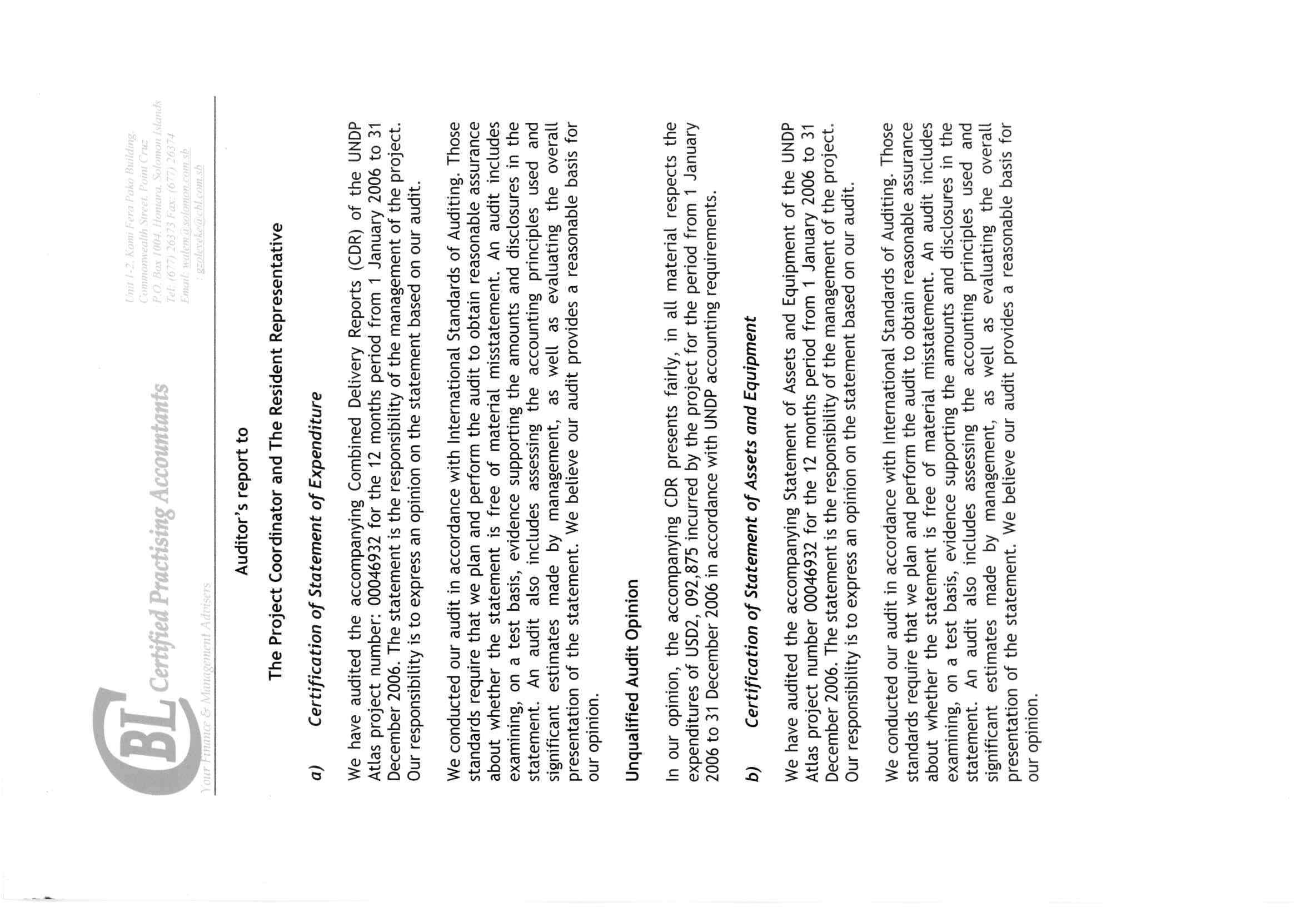
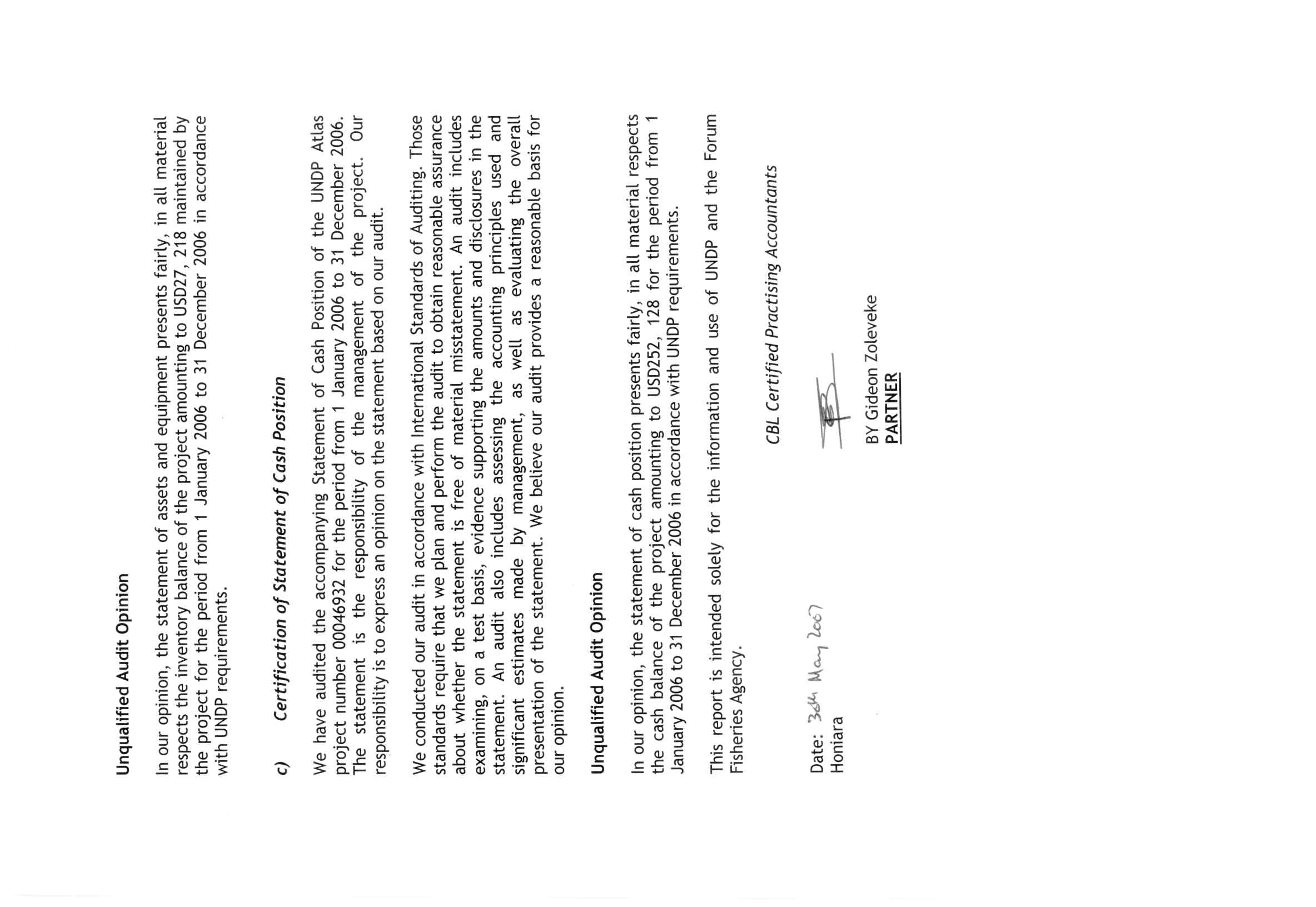
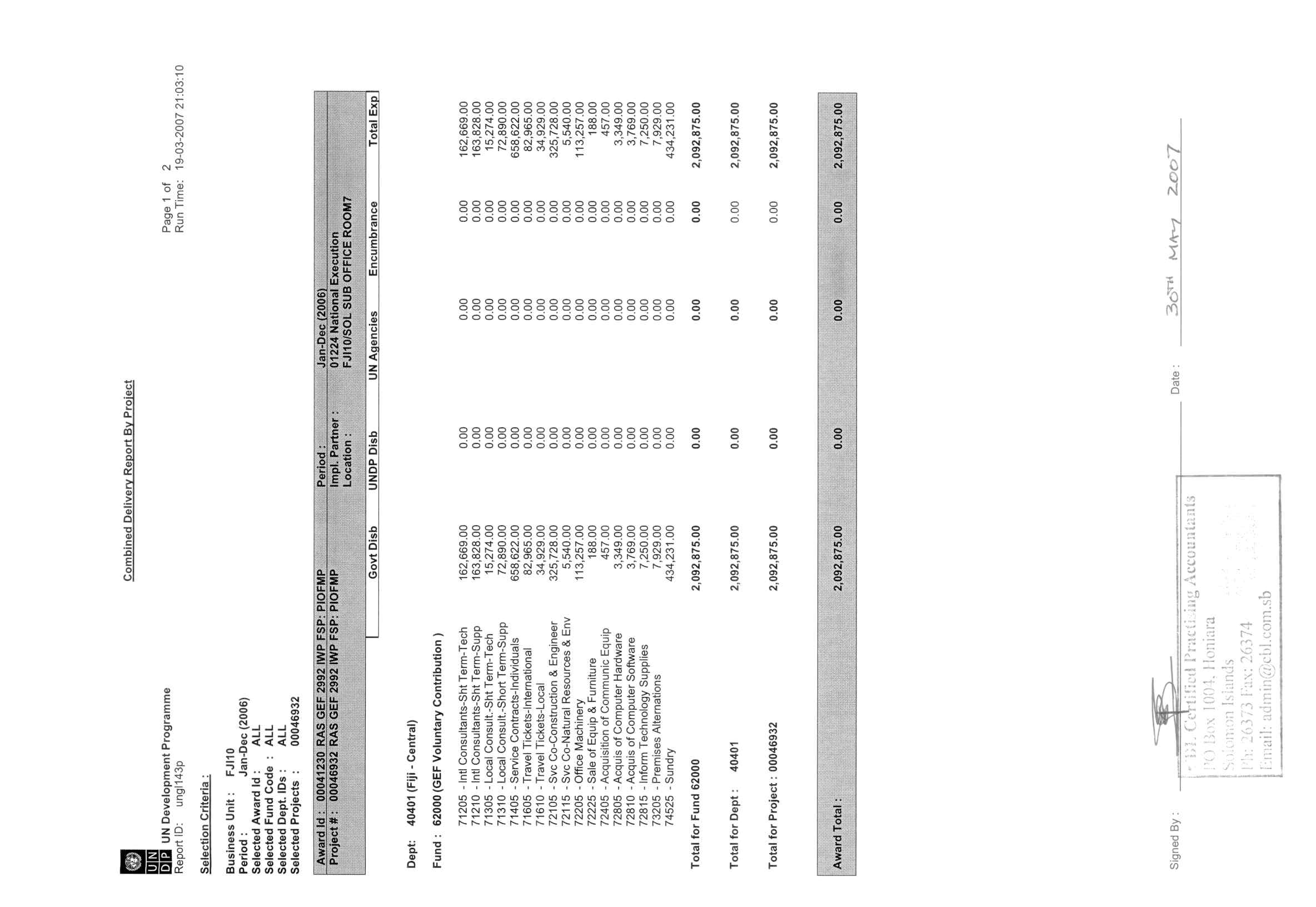
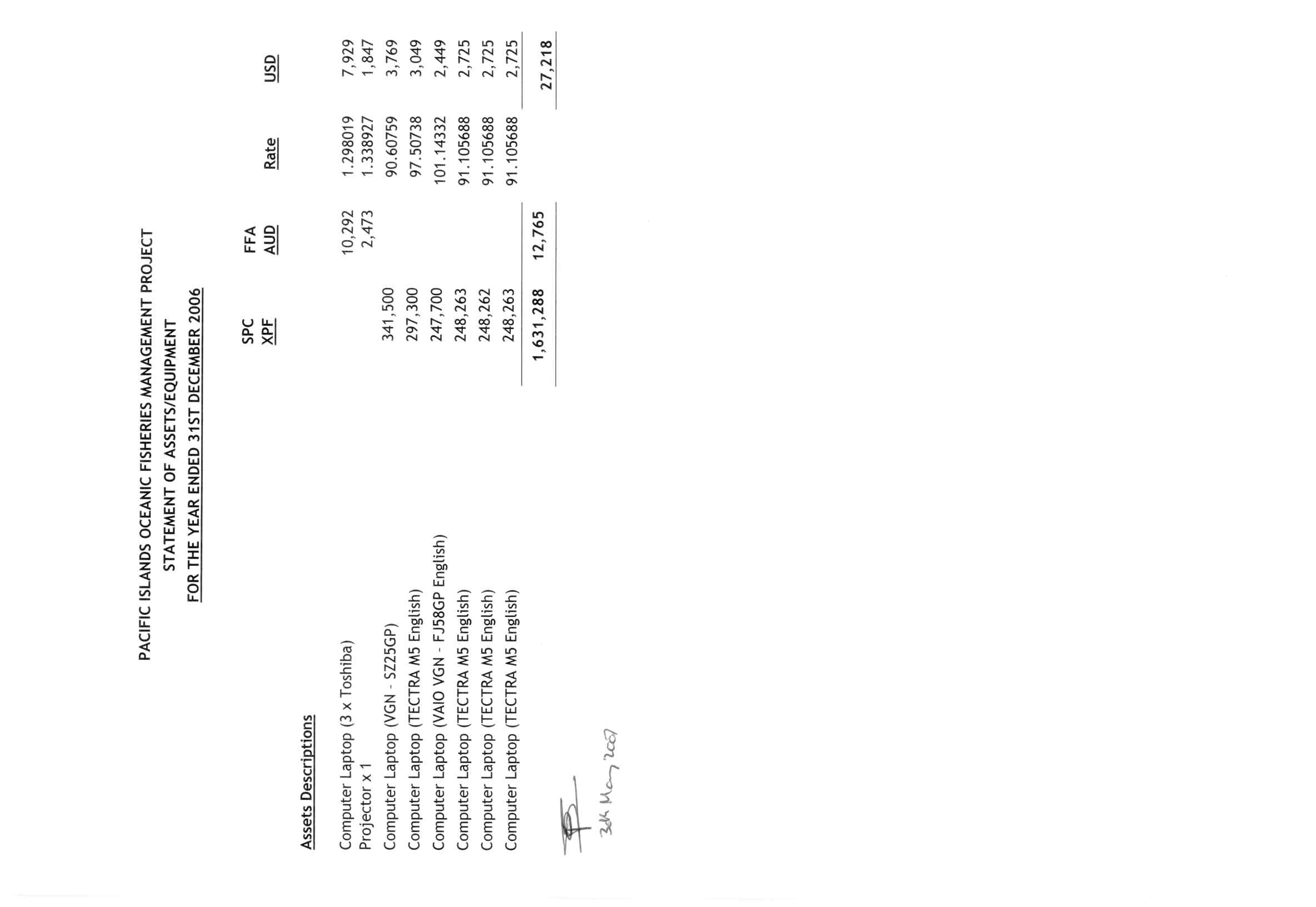
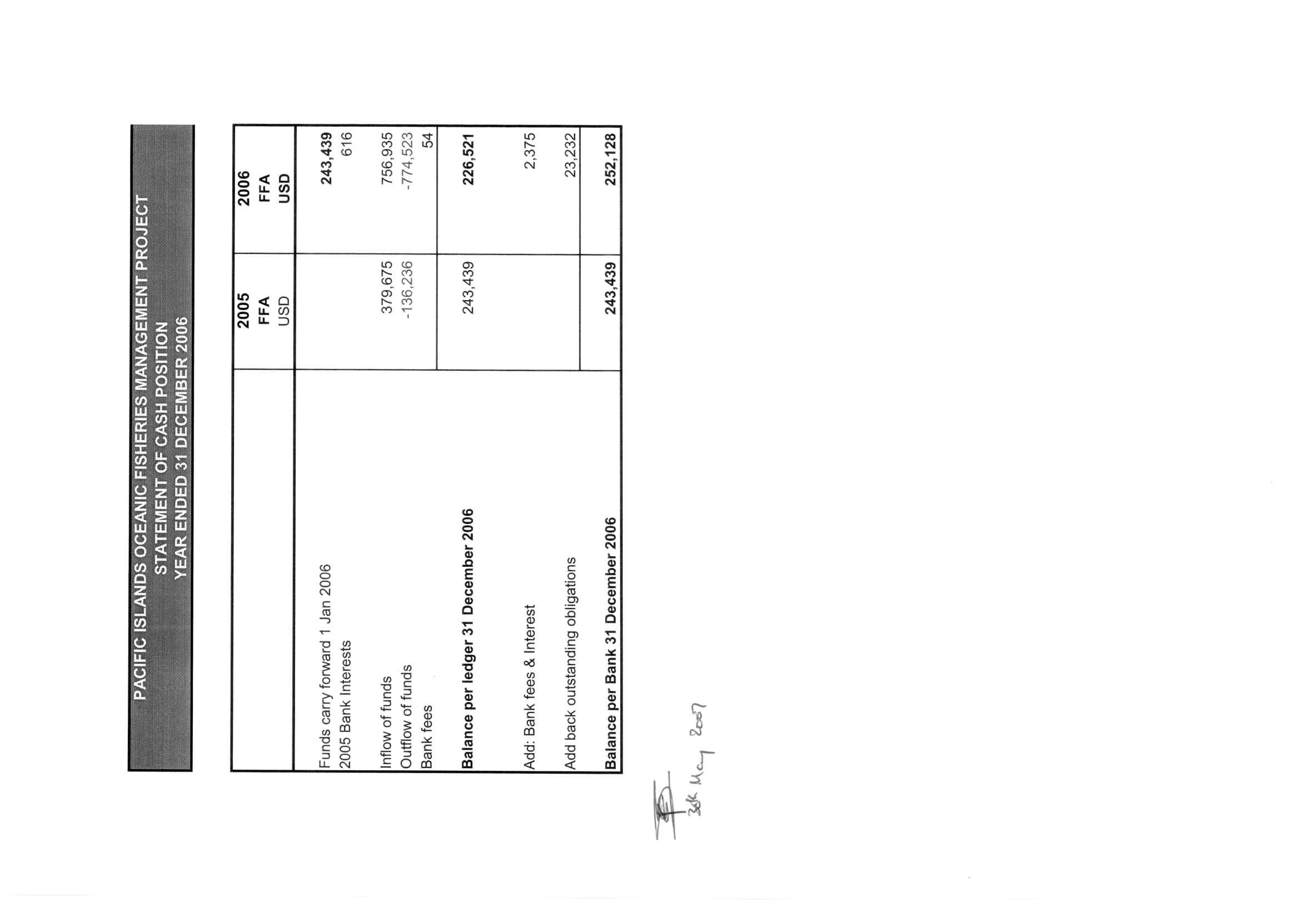
i
PACIFIC ISLANDS OCEANIC FISHERIES MANAGEMENT PROJECT
MANAGEMENT LETTER
FOR THE FINANCIAL YEAR ENDED 31 DECEMBER 2006
Index
1.
Review of the Project Progress
1.1
Work Plans and Financial Reports
1.2
Annual Project Reports
1.3
UNDP's Roles and Responsibilities to the Project
2.
Assessment of Internal Control Systems
3.
Available Facilities and Right of Access
4.
Audit Findings
4.1
Activity One Audit Findings
4.1.1 Advance not fully acquitted (Priority medium)
4.1.2 Position upgraded without written justification (Priority low)
4.1.3 Non compliance with internal procedures for consultant
recruitment (Priority low)
4.1.4 Non compliance with internal procedures for payment of
consultants (Priority medium)
4.1.5 Non compliance with SPC's Accommodation Policy (Priority
medium)
4.1.6 Overspending (Priority medium)
4.1.7 Management fees not posted (Priority low)
4.1.8 Late posting of expenses (Priority low)
4.2
Activity Two and Three Audit Findings
4.2.1 Project Work Plans (Priority low)
4.2.2 Minutes of Regional Steering Committee Meetings (Priority low)
4.2.3 Overspending (Priority medium)
4.2.4 FFA Project Ledger (Priority low)
4.2.5 WWF South Pacific Programme (Priority low)
Pacific Islands Oceanic Fisheries Project
Management Letter
Financial Year Ended 31 December 2006
1.
Review of the Project Progress
The following representation comprises the management letter compiled from the
independent audit of the Pacific Islands Oceanic Fisheries Management Project (OFM
Project) for the financial year ended 31st December, 2006. The project is executed by the
Pacific Islands Forum Fisheries Agency (FFA), Honiara, Solomon Islands. The project is
administered by the Project Coordinating Unit (PCU) housed at the FFA Headquarter in
Honiara.
We were responsible for the overall audit of the Project. This entails auditing records held
at FFA Headquarters in Honiara and those held by SPC and IUCN. The SPC audit was
however conducted by Pricewaterhouse Coopers and their management letter and audit
findings were then forwarded to us. IUCN records were forwarded to FFA in Honiara and
these have been subjected to our normal audit processes and procedures. Our management
letter therefore comprises a consolidation of all of our findings. These are specifically dealt
with in the relevant sections below.
Our tasks were limited to the audit of the Project books and documents in the Project
Office. We were unable to carry out field visits to verify the implementation phase on
project locations and to consultants, contractors and other persons or firms engaged by the
project management.
We are therefore unable to comment on the actual project implementation.
Management should include in the future audits, site visits by auditors to verify whether the
project funds have been used in the Project costs or alternatively engage the auditors of
SPC or IUCN to verify, sight and/or interview project officers on location where projects are
being implemented.
1.1
Work Plans and Financial Reports
We noted that quarterly financial reports were compiled, reviewed, and signed off for
submission to the UNDP Office in Suva, Fiji. To verify the accuracy and existence of
amounts, we traced all figures to the FFA project ledger and have satisfied our selves that
all balances relating to receipts and expenditures for the period were taken up correctly
when the relevant income and expenditures were received and incurred.
Also, our review of the Project bank account (USD #4) revealed that there was a monthly
reconciliation of the account to bank statement balances and the general ledger. We have
sighted monthly reconciliation statements placed on file and have satisfied ourselves that
reconciliations were done continuously.
Compliance with reporting requirements set out in the Letter of Agreement between
FFA and SPC
SPC has complied with all the requirements for timely reporting and has sent the following
reports to FFA:
ˇ Financial monthly reports in the format requested by FFA.
ˇ Progress reports covering the period concerned.
Management has continued to comply well with all the requirements for timely reporting on
the Pacific Islands Oceanic Fisheries Management Project.
There is no indication that quarterly financial reports have been late for submission to the
UNDP Office, Fiji.
Both the quarterly and annual work plans were executed in accordance with the
requirements of the project. We note however in 4.2.1 that the discrepancy in fully
Page 2
Pacific Islands Oceanic Fisheries Project
Management Letter
Financial Year Ended 31 December 2006
executing or implementing the work plans was due mainly to circumstances beyond the
control of PCU and difficulties faced by IUCN in commencing research activities.
1.2
Annual Project Reports
The minutes of the RSC are documented as a "Summary Record of Discussions". We note
that records of the meetings are circulated and endorsed by the RSC intersessionally. They
are noted as being acceptable to all members present at the meeting.
We were unable to sight a copy of the 2006 Annual Project Report (APR) although reference
was made to them in the APR in the minutes. It appears that the quarterly and annual work
plans and the Annual Project Report (APR) were completed as a monitoring obligation and
tabled by the management of FFA at the RSC meetings.
1.3
UNDP's Roles and Responsibilities to the Project
We have reviewed the UNDP Project Implementation guidelines and are satisfied that the
OFM Project complies with the UNDP guidelines and procedures.
Page 3
Pacific Islands Oceanic Fisheries Project
Management Letter
Financial Year Ended 31 December 2006
2.
Assessment of Internal Control Systems
Observation
Our review of systems of policies and procedures that protect the assets of OFM revealed
that effective control was maintained within OFM. We have reviewed the findings of
Pricewaterhouse Coopers on internal controls and concur that they are consistent with our
findings.
In a general way, we report that:
ˇ Effective procedures are in place for handling of funds received and expended by
the Oceanic Fisheries Management Project for the financial year ended 31st
December 2006;
ˇ Payments are supported by invoices, documentations, correspondences and are
properly authorized by the finance manager;
ˇ There is no indication that Double payments could occur;
ˇ Our audit indicated that good control measures are in place for writing and signing
checks or vouchers and receiving, recording, securing and depositing cash and other
receipts. Such procedures ensures that no single individual is responsible for
receiving, recording and depositing funds or writing and signing checks at the time
of the audit;
ˇ Oceanic Fisheries Management has maintained an effective accounting software
where processing and monitoring of all income and expenditures were taken up
correctly when they are received and incurred;
ˇ There is safe accessing of data, inputting and changing of electronic data are
restricted access by password to only personnel who maintained project
documents;
ˇ Effective procedures for approving contracts to which OFM is a party including
securing competitive bids from consultants are in place;
ˇ There is manpower in terms of staffing at OFM to ensure these policies and
procedures are carried out, professionalism is maintained at all times and to
achieve results.
Activities Two and Three FFA and IUCN
During the conduct of our audit at Project office, we noted that three staff were employed,
the Project Coordinator, Fisheries Management Advisor and Project Finance Officer. We
noted that all transactions during the twelve months audited for Activities two and three,
complied with the UNDP Programming Manual chapters 6.4 and 6.5 and the South Pacific
Forum Fisheries Agency's financial regulation. The project was fully resourced at audit date
except for cases relating to IUCN where project activities did not eventuate during the
period. There was no audit evidence to substantiate the existence of human errors in the
books and records maintained for Activities two and three.
Page 4
Pacific Islands Oceanic Fisheries Project
Management Letter
Financial Year Ended 31 December 2006
Activity One SPC and IUCN
Our review of SPC's Management Letter highlighted a number of non compliance with
internal procedures and policies.
We note however, that circumstances prevailing at the time may have made these
procedures inoperable. Generally, OFM Project continues to comply with the UNDP
Programming Manual, South Pacific Forum Fisheries Agency's financial regulation and the
financial policies and procedures manual of the Secretariat of the Pacific Community
Recommendation
We recommend that management review the changing operational circumstances inorder to
update existing financial policies and procedures.
Management Comments
Page 5
Pacific Islands Oceanic Fisheries Project
Management Letter
Financial Year Ended 31 December 2006
3.
Available Facilities and Right of Access
During the course of our audit, we have had full and complete access to all records and
documents available at FFA and to all employees. We are grateful to FFA for the assistance
accorded to us by the management and staff of OFM.
Page 6
Pacific Islands Oceanic Fisheries Project
Management Letter
Financial Year Ended 31 December 2006
4.
Audit Findings
The audit findings contained in this management letter relates to all project activities.
Those audit findings described in component one (SPC) of the letter are those of
Pricewaterhouse Coopers. The audit findings relating to component two and three (FFA and
IUCN)
were
assessed
directly
by
ourselves.
Page 7
Pacific Islands Oceanic Fisheries Project
Management Letter
Financial Year Ended 31 December 2006
4.1
Activity One Audit Findings
4.1.1 Advance not fully acquitted (Priority medium)
Observation (Compliance)
During the tagging campaign in Papua New Guinea, advance payments were made to PNG
Tagging coordinator, Dr A. Lewis, into his personal bank account, to cover expenses related
to the day-to-day organization of the campaign. These expenses were to be acquitted
afterwards by sending the original invoices to the SPC. We observed that 48, 058 Kina out of
the total advance of 600, 745 kina was not acquitted (approximately XPF1, 500,000 or
USD16, 000).
Recommendation
We recommend that advances made to the consultant be covered by a letter of agreement,
jointly signed by SPC and the consultant, which states that all expenditure by the
consultant must be fully acquitted with the project requirements.
Management response
The advance payments were made to personal PNG bank account of the project coordinator
in order to facilitate the purchase of essentials (fuel, food etc) for the crew and the
scientific staff working for the three-month phase 1 of the PNG tagging project on the
chartered vessel Soltai 6. SPC was requested by the owner of the vessel to advance the
funds and purchase fuel, oil, water, and food for the crew which was then deducted from
the charter costs of USD384, 000 as Soltai Fishing Ltd did not have a bank account in PNG
and could not make the requisite purchases for the three month cruise. This meant a huge
unplanned increase in the workload of the coordinator which he undertook on top of his
scientific and coordination duties.
The time constraints were severe in each port of call (only one day) to undertake the
necessary purchases which led to some invoices not collected and some bonuses for the
crew not signed off. (The crew at each port of call requested advances on their bonuses
which were based on the number of fish caught and tagged.)
In future greater efforts will be made to ensure that all invoices are collected and all crew
bonuses are signed off.
Page 8
Pacific Islands Oceanic Fisheries Project
Management Letter
Financial Year Ended 31 December 2006
4.1.2 Position upgraded without written justification (Priority low)
Observation (Guidelines)
The contract of a data entry technician (Savea Sonia) was renewed in November 2006. Her
position was upgraded from "E9" to "F4", which meant a salary increase of XPF15, 000
(USD158.00) every month. We were unable to find written justification for this upgrade in
her personal file.
Recommendation
We recommend that SPC establish written duty statements.
Management response
The positions of the Oceanic Fisheries data entry technicians were reclassified during the
year in light of the change of duties and increased data quality control duties.
Page 9
Pacific Islands Oceanic Fisheries Project
Management Letter
Financial Year Ended 31 December 2006
4.1.3 Non compliance with internal procedures for consultant recruitment (Priority
low)
Observation (Compliance)
SPC's rules indicate that, in the event that the budget for an operation is equal to or
greater than XPF2, 000,000 (USD21, 000) the section/programme head must consider the
files of at least three applicants. This condition may be waived in cases where an individual
consultant is demonstrably the only person who could undertake the proposed assignment.
In such cases, the choice of consultant must be justified and then approved by the Director
General (or the Director of Corporate Services).
We note that this rule was not followed in respect to Mrs. Chagnaud, Mr. Itano and Mr.
Fournier. No evidence of the required justification was found. However, the Director
General of SPC approved the appointments by signing the contracts with the terms of
reference.
Recommendation
When a consultant is the only person who could undertake the assignment, we recommend
that SPC follows the formal procedures for the dispensation mentioned above.
Management response
Consultants hired without an invitation to tender are the only ones who are able to
undertake the assignment.
Page 10
Pacific Islands Oceanic Fisheries Project
Management Letter
Financial Year Ended 31 December 2006
4.1.4 Non compliance with internal procedures for payment of consultants (Priority
medium)
Observation (Compliance)
SPC's rules (dated 2002) indicate that the normal daily rate of payment for a consultant is
set at USD250 per day. However, the Director General or the Director of Corporate Services
may authorize payment of higher fees, on an exceptional basis, upon received documented
proof from the head of the section and /or programme concerned with the recruitment.
During the audit, we noted that Mr. Fournier, Mr.Lewis and Mr. Itano received remuneration
of approximately USD400 per day. We did not obtain the documented proof mentioned
above.
Recommendation
We recommend that SPC complies with its policy on hiring consultants or consider updating
policy if not aligned with market.
Management response
The consultants' fees paid are the normal rate for such specialists.
Page 11
Pacific Islands Oceanic Fisheries Project
Management Letter
Financial Year Ended 31 December 2006
4.1.5 Non compliance with SPC's Accommodation Policy (Priority medium)
Observation (Compliance)
SPC normally allocates a two bedroom accommodation to single or married staff with or
without children. We observed that one staff member who fulfilled the conditions for
obtaining a two bedroom accommodation, had a three bedroom house. Consequently,
the excess cost charged to the program is estimated at XPF26, 250 (USD276.00) per month.
Recommendation
We recommend that SPC complies with its policy on accommodation.
Management response
The allocation of the three bed roomed house was done due to the pressure of time and
logistic constraints of finding appropriate housing for the large increase in the number of
SPC staff during the past 18 months. There was a call for two bedroom apartments in
exchange for a three bedroom house on the SPC housing complex at Receiving. The
allocation in this instance was made according to the SPC housing policy which states that
allocation is based on the applicant's length of continuous residency in Receiving, and the
applicant's length of continuous service with SPC.
Page 12
Pacific Islands Oceanic Fisheries Project
Management Letter
Financial Year Ended 31 December 2006
4.1.6 Overspending (Priority medium)
Observation (Compliance)
A review of the summary statement of income and expenditure shows the following
overspending (compared to USD revised budget):
Fishery Monitoring
ˇ International Consultants: +USD7,573.19
ˇ Contract Services: +USD2,758.40
ˇ Info/tech/equipment: +USD2,448.81
ˇ Miscellaneous expenditure: +USD14,853.84
Stock Assessment
ˇ Info/tech/equipment: +USD5,497.48
ˇ Miscellaneous expenditure: +USD6,165.36
Ecosystem Analysis
ˇ Equipment and furniture: +USD4,838.58
ˇ Info/tech/equipment: +USD2,241.32
Project Support
ˇ Data Entry: +USD3,510.42
Recommendation
SPC should ensure that the reasons for overspending are identified and that corrective
measures are undertaken. We recommend that SPC validate these changes with the
concerned authority.
Management response
The USD budget revision was made in September 2006 and it was difficult to predict with
precision actual expenditure for the fourth quarter.
In addition, the cost of operating in Noumea, New Caledonia is comparatively higher than
other places in the Pacific and this is reflected in both project design and budget
allocations. Projected costs in some areas have increased.
Figures identified in section 4.1.6 by the auditor's that examined SPC books in relation to
expenditure against Activity One, examines expenditure at a sub-component level within
Activity One only of the project. The project Executing Agency reports to UNDP at the
prescribed level according to UNDP ATLAS Budgetary and Expense Codes (Nov 2004), set out
in the UNDP Financial Report (FR01) and which in turn generates the Combined Delivery
Report (CDR). Funds to date have been applied against "national and regional results" and
the costs of project operation are on the whole within the confines of the budget i.e. there
is no identified overspending as per the CDR for Activity One.
Page 13
Pacific Islands Oceanic Fisheries Project
Management Letter
Financial Year Ended 31 December 2006
4.1.7 Management fees not posted (Priority low)
Observation (Compliance)
To support the administrative cost of managing the program, management fees of 7% of the
funds received are charged by SPC. This amount represents XPF4, 350,996 (USD45, 704.00)
for the first two instalments received in 2006. No charge has been recorded for this in
relation to the last instalments for the year. Consequently, total expenses for 2006 were
understated by XPF2, 130,793 (USD22, 382.00).
Recommendation
SPC should perform, towards year end, a reasonable check on the program to ensure that
an appropriate amount of fees has been claimed.
Management response
No changes in the financial statement will be made for the period 1 January to 31
December 2006 as the financial reports have already been sent to FFA and acquitted.
Page 14
Pacific Islands Oceanic Fisheries Project
Management Letter
Financial Year Ended 31 December 2006
4.1.8 Late posting of expenses (Priority low)
Observation (Compliance)
Some 2006 expenditures for a total amount of XPF475, 178 (USD4, 991.00) have been
charged to the project in January 2007. Consequently, these were not included in both
summary statement of income and expenditure and statement of cash position as at
December 31st, 2006.
Recommendation
Nil
Management response
Nil
Page 15
Pacific Islands Oceanic Fisheries Project
Management Letter
Financial Year Ended 31 December 2006
4.2
Activity Two and Three Audit Findings
4.2.1 Project Work Plans (Priority low)
Observation (Resources)
We reviewed the Project Work Plans at the project office. There were no issues that would
hinder the implementation of the Project.
However, we noted the work of IUCN was held up due to current problems faced with
unavailability of vessels to carry out research and project activities. We noted in the
minutes that the committee was striving to secure an appropriate vessel to conduct the
scientific research as planned, but that they would not know until February 2007 which falls
in a new financial year. Our reporting of IUCN activities were confined to documents such
as, receipts and acquittals sent to OFM and interviews conducted with OFM personnel. In
this respect, we were unable to comment any further of project activities.
Results
No exception noted
Recommendation
We recommend management continue to comply with the Project Work Plans.
Management Comments
Project activities that were to have been undertaken by the IUCN remain the only major
discrepancy in the annual work plans of the project. Circumstances beyond the control of
the PCU and in some respects IUCN itself prevent the seamount research activities
commencing. The matter was also placed before the Project Regional Steering Committee
in October 2006 who agreed to allow IUCN to work out which of the alternative options
would be employed in 2007. To date IUCN have not been able to advise alternative options
to address the related project output and outcomes. The PCU will now promote a
suggestion by SPC for the use of IUCN research funds for similar work beginning undertaken
at SPC and for which further financial support is required.
Page 16
Pacific Islands Oceanic Fisheries Project
Management Letter
Financial Year Ended 31 December 2006
4.2.2 Minutes of Regional Steering Committee Meetings (Priority low)
Observation
During the course of our audit, we sighted minutes of the 1st and 2nd meetings of the
Regional Steering Committee in Honiara and Fiji respectively. Our review of past meeting
held had it that there was no part to hinder the work of Oceanic Fisheries Management. We
have agreed all issues to minutes and are satisfied that there were no matters unusual that
need special investigation. We noted proper documents were maintained and filed by OFM
personnel at audit date. Similarly, we have satisfied there was overwhelming support given
by Small Member Countries towards the work of the organization in the region.
We were unable to sight signed minutes. Electronic copies handed to us were printed from
documents maintained by OFM during the time of the audit. However, we were informed
that minutes of meetings made available to us were endorsed by RSC respectively.
Recommendation
Minutes are very important documents of meetings held. It implies that all parties to the
meetings have agreed on the matters and they represent a true record of meetings. All
original minutes should be filed at OFM office.
Minutes also record the authorization of revenues and expenditures and commitments to
procurements of assets or liabilities.
Management Comments
We note the auditor's comments and think they hold merit. However, traditionally Records
of Proceedings are cleared at the close of regional meetings and records state that the
forum has endorsed the outcomes on all issues. They are not typically signed by the
chairperson/country.
Page 17
Pacific Islands Oceanic Fisheries Project
Management Letter
Financial Year Ended 31 December 2006
4.2.3 Overspending (Priority medium)
Observation (Compliance)
Our review of OFM detailed expenditure worksheet shows the following overspending
(compared to USD revised budget):
Policy Reform
ˇ Fisheries Management Consultants: +USD31,174.00
Policy Reform
ˇ National Fisheries Management Workshops: +USD4,470.00
Results
The financial effect of the over expenditure is a shortfall in the budgetary allocation for
other expenditures for the year. These funds will have to be drawn either from other
allocations or sources within the project to complete activities thereby depriving other
activities of their allocations.
Recommendation
We recommend management ensure that the reasons for overspending are identified and
that corrective measures are promptly undertaken. Chapter six of the UNDP Programming
Manual, clause 6.5.2 (c) specify's that disbursements do not exceed the available funds or
the amount allocated to each approved budgetary category.
Managements Comments
A number of issues relating to by-catch issues (turtles, sharks, seabirds and FADs) in the
Commission arose during the year for which fisheries management consultancies were
required. This work was established until mid 2006 and provisions where not detailed in the
quarterly work plans. Expenditure was incurred under this budget category in anticipation
of under spending in other areas of the project. The work remains consistent with the
outputs and outcomes of fisheries management consultancies and advice for Pacific
countries on the WCPF Commission.
The 2006 budget National Fisheries Management workshops expenditures exceeded
marginally the budget estimated for this activity. A workshop was held in Vanuatu and
another in Samoa were slightly more expensive than anticipated.
Page 18
Pacific Islands Oceanic Fisheries Project
Management Letter
Financial Year Ended 31 December 2006
4.2.4 FFA Project Ledger (Priority low)
Observation (Guidance)
Our audit revealed that as at 31st December, 2006, a balance of USD13, 923.00 was taken
up in FFA project Ledger as a liability for OFM to reimburse FFA (Trust Fund). This relates
to OFM expenditures paid by FFA and to be reimbursed at a later date when funds are
forthcoming. We were informed by FFA personnel that this amount represents overpayment
of OFM expenditures by Trust Fund. However, from information obtained from OFM Finance
Officer, he was not aware of any overpayments of this kind which is still outstanding. He
claimed that all expenditures paid by Trust Fund were reimbursed in full and by now there
was non left. In the books of FFA (Trust Fund) it was obvious that the balance of USD13,
923.00 remain as arrears at audit date.
Results
The financial effect of the above is that a debt is recorded in the books of the Trust Fund
whilst a corresponding liability is recorded in the books of OFM. These are additional
financial and potential cash flow burdens for both entities given the limited financial
resources made available to the entities annually.
Recommendation
We recommend management ensure that proper reconciliations are done to monitor such
reimbursable expense. We report that a balance of USD13, 923.00 is material for project
funds and can have an effect on the financial reports of OFM if it is not addressed
accordingly.
Management Comments
Initially FFA trust funds have made payments for a majority of project activities
(component's two and three) on a reimbursement basis. Monthly bills are produced and the
PCU ensures that immediate payment is made from the project USD account to cover this
expenditure. As the project unit became more established the tendency is to pay bills
directly where possible to reduce the two step billing arrangement as much as possible with
FFA Finance.
A fiscal examination of this discrepancy post audit has been conducted. The examination of
the FFA finance ledgers could not substantiate the amount of USD13, 923 as being owed by
the project to the FFA. A memo from the FFA Finance Department stating that expenditure
to the amount of USD13,923 has been incorrectly attributed to the project has been
forwarded to the Auditor's and is on record with the PCU. The matter is now considered
closed.
Page 19
Pacific Islands Oceanic Fisheries Project
Management Letter
Financial Year Ended 31 December 2006
4.2.5 WWF South Pacific Programme (Priority low)
Observation (Compliance)
Our audit revealed that at 31st December 2006, a balance of USD37, 985.00 transferred to
WWF in Suva, Fiji still remained outstanding and is yet to be acquitted by WWF. We sighted
the letter of agreement signed by both parties for the implementation of the United
Nations Development Programme/Global Environmental Facility. We then sent a letter of
confirmation to confirm funds held by WWF. We were advised by the client that receipts
and acquittals would be sent very soon. However, after completion of our task we were
unable to verify receipts and acquittals sent from WWF. In this respect, we were unable to
ascertain whether funds allocated to run project activities were utilized for its purposes.
Recommendation
We recommend management ensure that receipts and acquittals are returned prior to the
commencement of audit work. Lack of these documents would cause long delays in future
completing audit tasks.
Management must also ensure that there is timely follow up with parties to which they
disburse funds to for one off projects.
Management Comments
The LOA with WWF was not concluded until late 2006 (November). Funds for the
commencement of activities described in the agreement where made available immediately
the agreement was concluded in the hope that a workshop could take place in December
2006. The uncertainty of when the agreement would be formally completed and the limited
time to organize an event resulted in a deferment of the workshop.
At the time of auditing while funds had been transferred, no expenses had occurred. We
note the auditors' comments concerning non-acknowledgement of receipt of funds in 2006.
Communication has since been provided by WWF concerning the receipt of funds. The PCU
will ensure in future that acknowledgement is immediate and clearly recorded.
Page 20


REGIONAL STEERING COMMITTEE
3rd Meeting of the RSC
Rarotonga, Cook Islands
6 October 2007
Paper Number RSC3/WP 7
Title MID-TERM REVIEW OF THE PACIFIC ISLANDS
OCEANIC FISHERIES MANAGEMENT PROJECT
PROCESS AND TERMS OF REFERENCES
Summary
The purpose of this paper is to provide the Regional Steering Committee with relevant
information relating to Mid-term Evaluation (MTE) of the Pacific Islands Oceanic Fisheries
Management Project. The document outlines the rationale, the main deliverables and the
ethical conduct of the evaluation.
The objective of the Mid-term Evaluation of the Pacific Islands Oceanic Fisheries
Management Project is to determine progress being made towards the achievement of
project outcomes and identify course correction if needed. It will also highlight initial
lessons learned about project design, implementation and management and finances.
Recommendation
The Regional Steering Committee is invited to:
i)
consider and comment on the draft Terms of Reference for the consultancy that
will perform the Mid-term Evaluation; and
ii)
endorse the approach, context and timeframe for the Mid-term Evaluation of the
OFM Project.
MID-TERM REVIEW OF THE PACIFIC ISLANDS OCEANIC FISHERIES
MANAGEMENT PROJECT PROCESS AND TERMS OF REFERENCES
Introduction
1.
The Monitoring and Evaluation (M&E) policy at the project level in UNDP/GEF has
four objectives:
i) to monitor and evaluate results and impacts;
ii) to provide a basis for decision making on necessary amendments and
improvements; iii) to promote accountability for resource use; and
iii) to document, provide feedback on, and disseminate lessons learned.
2.
A mix of tools is used to ensure effective project M&E. These might be applied
continuously throughout the lifetime of the project e.g. periodic monitoring of indicators,
or as specific time-bound exercises such as mid-term reviews, audit reports and
independent evaluations.
3.
In accordance with UNDP/GEF M&E policies and procedures, all projects with long
implementation periods (e.g. over 5 or 6 years) are strongly encouraged to conduct mid-
term evaluations. In addition to providing an independent in-depth review of
implementation progress, this type of evaluation is responsive to GEF Council decisions on
transparency and better access of information during implementation.
Evaluation Objective
4.
The objective of the Mid-term Evaluation of the Pacific Islands Oceanic Fisheries
Management Project (OFM Project) is to determine progress being made towards the
achievement of project outcomes and identify course correction, if needed.
5.
The evaluation will determine initial lessons learned about project design,
implementation and management and an assessment of the impact of the activities to date
and best practices. This evaluation will provide the Governments of Pacific Islands, the
FFA, UNDP, IUCN, SPC, project donors and stakeholders with an assessment of the
project progress towards achievement of the intended results. It will also provide
recommendations on the possible future project focus, including its management, financial
issues and institutional implementation framework.
Review Process.
6.
The Mid-term Evaluation will be supervised by the UNDP Deputy Resident
Representative and UNDP Regional Technical Adviser in the Regional Bureau for Asia
and Pacific (RBAP) in close collaboration with the FFA. A contract will be developed for
signature by the successful consultants. The contract will detail all aspects of input and
required deliverables. The consultants will be bound by the terms and conditions of UNDP
Procurement Rules and Guidelines. Two consultants (a team leader and an regional
resource specialist) will conduct consultations at selected project sites with national and
regional stakeholders to determine project achievements and challenges and with which to
provide recommendations for future project focus. The evaluation is expected to
commence in late June 2008 and should be completed by 31 October 2008.
7.
On completion of the evaluation, the MTE consultants will circulate draft outputs to
key stakeholders for comments before completing a final evaluation report. The
deliverables of the MTE will be a report that provides advice on project management
regarding opportunities to improve the project's efficiency, effectiveness and will be
presented at the fourth Regional Steering Committee Meeting.
Recommendation
8.
The Regional Steering Committee is invited to:
RSC3/WP 7
2
iii)
consider and comment on the draft Terms of Reference for the consultancy that will
perform the Mid-term Evaluation; and
i)
endorse the approach, context and timeframe for the Mid-term Evaluation of the
OFM Project.
RSC3/WP 7
3


ATTACHMENT A
TERMS OF REFERENCE
[Draft, September 2007]
Mid-term Evaluation of UNDP-GEF's Pacific Islands Oceanic Fisheries
Management Project PIMS 2992
A
Introduction
The Pacific Islands Oceanic Fisheries Management Project (OFM Project) is a multi-
governmental five year initiative by 14 independent islands nations and one territory1 to
address the sustainable management of regional fish stocks in the Pacific region. The project
is implemented by the United Nations Development Programme (UNDP) through its Fiji
country office and executed by the Pacific Islands Forum Fisheries Agency (FFA). The project
document was signed by UNDP on 30 September 2005 and by the FFA on 13 July 2005. The
execution start date was not until November of the last quarter of 2005 which resulted in the
first Regional Steering Committee agreeing to adjust the 5 year period of project
implementation across 2005 to completion in 2010 and a post evaluation phase in 2012.
The OFM Project fits within the overarching Strategic Action Programme (SAP) for the
International Waters of the Pacific Island Developing States (RAS/98/G32) which contained at
the time, two complementary linked consultative sub programmes: Integrated Coastal and
Watershed Management and Oceanic Fisheries Management. The delivery of actions of the
full OFM Project is now undertaken directly by the FFA rather than through the South Pacific
Regional Environment Programme (SPREP). The mid-term evaluation (MTE) is confined to
the OFM Project executed by the FFA.
Project objectives
The two OFM Project objectives address the threats to the sustainability of the use of the
region's oceanic fish resources identified in the SAP, principally the lack of understanding and
the weaknesses in governance relating to oceanic fisheries in the International Waters in the
region. They seek to improve the understanding of transboundary oceanic fisheries resources
and create new regional institutional arrangements as well as realigning, reforming and
strengthening national arrangements for the conservation and management of transboundary
oceanic fishery resources.
The origins of the project, its preparation, its objectives and structure address the concerns
that Pacific Islands small developing States (Pacific SIDS) have for the unsustainable use of
transboundary oceanic fish stocks of the Pacific region and unsustainable levels and patterns
of exploitation in the fisheries that target those stocks.
At the centre of these concerns is the transboundary nature of the stocks. The stocks are
dominantly highly migratory, with their range extending through waters under the jurisdiction
of around 20 countries and into large areas of high seas. Each of the countries within whose
waters the stocks occur has responsibilities under international law to adopt measures for the
1 The 14 Pacific Island States and territory that qualify for GEF support under the OFM Project are:
Cook Islands, Federated States of Micronesia, Fiji, Kiribati, Marshall Islands, Nauru, Niue, Palau, Papua
New Guinea, Samoa, Solomon Islands, Tokelau, Tonga, Tuvalu and Vanuatu.
4


conservation and management of these stocks. But without a coherent and legally binding
framework to establish and apply measures throughout the range of the stocks, including the
high seas, the efforts made by individual countries in their own waters can be undermined by
unregulated fishing on the high seas and by inconsistencies in measures in different national
zones.
These are global concerns. They were important issues in the preparation of the UN
Convention on the Law of the Sea (UNCLOS) during the 1970s, particularly in the provisions
relating to management of fishing on the high seas and management of fishing for highly
migratory species. In 1992 they found expression in the call from the United Nations
Conference on the Environment and Development (UNCED) within Agenda 21 for a UN
intergovernmental conference on high seas fishing and they are also the key concerns
addressed in the UN Fish Stocks Agreement.
A Project Coordination Unit (PCU) based at the FFA administers the project.
B
Objective and Purpose of the Mid-term Evaluation
"The Monitoring and Evaluation (M&E) policy at the project level in
UNDP/GEF has four objectives: i) to monitor and evaluate results and
impacts; ii) to provide a basis for decision making on necessary
amendments and improvements; iii) to promote accountability for
resource use; and iii) to document, provide feedback on, and disseminate
lessons learned. A mix of tools is used to ensure effective project M&E.
These might be applied continuously throughout the lifetime of the project
e.g. periodic monitoring of indicators -, or as specific time-bound
exercises such as mid-term reviews, audit reports and independent
evaluations.
In accordance with UNDP/GEF M&E policies and procedures, all projects
with long implementation periods (e.g. over 5 or 6 years) are strongly
encouraged to conduct mid-term evaluations. In addition to providing an
independent in-depth review of implementation progress, this type of
evaluation is responsive to GEF Council decisions on transparency and
better access of information during implementation.
Mid-term evaluations are intended to identify potential project design
problems, assess progress towards the achievement of objectives,
identify and document lessons learned (including lessons that might
improve design and implementation of other UNDP/GEF projects), and to
make recommendations regarding specific actions that might be taken to
improve the project. It is expected to serve as a means of validating or
filling the gaps in the initial assessment of relevance, effectiveness and
efficiency obtained from monitoring. The mid-term evaluation provides
the opportunity to assess early signs of project success or failure and
prompt necessary adjustments."
The objective of the MTE is to principally to provide an assessment of the progress made
towards the OFM project's original objectives and outputs. It should also identity strengths
and weaknesses; and provide an evaluation of the implementation and management of the
project by identifying factors that have facilitated or impeded the achievements of the project
objectives and outputs. In addition, the MTE should also provide recommendations and
lessons learned to assist on defining future directions for the project.
5


The key stakeholders for the MTE include the Global Environment Facility (and the global
community), UNDP, Pacific SIDS, Pacific regional organizations, relevant donor organizations
and industry and environment non-government organizations.
The following key issues should be addressed during the MTE of the OFM Project [modified
from the MTE TORs for the ICWM component of the SAP Anna would need to add more to
this]:
Assess progress towards attaining the Programme's regional and global
environmental objectives as described in GEF operational focal areas 9;
Assess progress towards achievement of OFM Project outcomes;
Describe the project's adaptive management processes how have project activities
changed in response to new conditions, and have the changes been appropriate?
Review the clarity of roles and responsibilities of the various institutional
arrangements for project implementation and the level of coordination between
relevant players;
Review any partnership arrangements with other donors and comment on their
strengths and weaknesses;
Describe and assess the efforts of UNDP, the FFA, Secretariat for the Pacific
Community (SPC) and The World Conservation Union (IUCN) in support of the PCU
and national institutions;
Review and evaluate the extent to which OFM Project impacts have reached the
intended beneficiaries, both within and outside project sites;
Assess the likelihood of continuation of project outcomes and benefits after
completion of GEF funding;
Describe key factors that will require attention in order to improve prospects for
sustainability of OFM Project outcomes;
Assess whether the Logical Framework approach and performance indicators have
been used as effective management tools;
Review the implementation of the projects monitoring and evaluation plans;
Describe the main lessons that have emerged in terms of:
country ownership/drivenness;
regional cooperation and inter-governmental cooperation;
stakeholder participation;
adaptive management processes;
efforts to secure sustainability; and
the role of M&E in project implementation.
In describing all lessons learned, an explicit distinction needs to be made between those
lessons applicable only to this project, and lessons that may be of value more broadly,
including to other, similar projects in the UNDP/GEF pipeline and portfolio.
The Report of the MTE will be a stand-alone document that substantiates its
recommendations and conclusions and will be targeted at meeting the evaluation needs of all
key stakeholders (GEF, UNDP, FFA, SPC, IUCN and participating countries).
C
Scope of the Evaluation
6


The scope of the MTE will critically assess issues pertaining to the relevance, performance
(based on indicators identified in the logframe matrix) and success of the project including the
sustainability of results. In considering the effectiveness, efficiency, relevant impacts and
sustainability of the project the MTE will also make an assessment to-date of project
implementation, design and management and administration. The evaluation will also result in
the formulation of recommendations and identification of lessons learned to assist
determining future directions of the project.
Project Impact (Results)
This section should be read in conjunction with the objectives of the MTE, specifically the key
issues identified Section B.
The Evaluation will examine the relevance, efficiency, effectiveness and sustainability of
operational activities and results achieved by the project to-date, by showing how the
component(s) processes and outcomes have contributed (or have the potential to contribute)
to the achievement of project goals and objectives. Specifically the MTE will:
assess, quantitatively and qualitatively, the achievements and impact in terms of
outputs and their contribution to outcomes as defined in the project document;
assess to what extent the project has or will contribute to the establishment of
regional arrangements for sustainable oceanic fisheries management;
assess to what extent the project has made impacts on the promotion of Pacific
SIDS participation in decision-making and the realignment and strength of local
governance in sustainable fisheries management;
how the project contributed to improved governance at national levels, and examine
how governance issues have impacted on the achievement of project goals and
outputs;
determine lessons learned and assess the sustainability of project results; and
provide recommendations for how the project implementation can be strengthened
and can most effectively support regional and national priorities, management of
transboundary oceanic fishery resources and strengthen and achieve project
objectives.
Project Design
The MTE will assess:
i)
the extent to which the overall project design remains valid;
ii)
review the project's concept, strategy and approach within the context of effective
capacity development and sustainability;
iii)
assess the approach used in design and whether the selected intervention
strategy addresses the root causes and principal threats in the project area;
iv)
the effectiveness and the methodology of the overall project structure, how
effectively the project addresses responsibilities especially towards capacity
building and challenges; and
v)
assess plans and potential for replication.
Project Management and Administration
The MTE will assess the extent to which project management has been effective, efficient and
responsive in the following areas:
i)
Project Delivery
7


The MTE will assess to what extent the OFM Project has achieved its immediate objectives. It
will also identify what outputs have been produced and how they have enabled the OFM
Project to achieve its objectives. The assessment will address the following priority areas:
a) Progress of the OFM Project towards achieving anticipated outcomes by
assessing the efficiency and quality of project activities, progress towards
immediate objectives (level of indicator achievement if available); and
b) partnerships of collaboration between governments, intergovernmental and
NGOs, national level involvement and perceptions and the involvement of other
stakeholders.
ii)
Project Implementation
The evaluation will assess of the overall institutional arrangements for the execution,
implementation, management, monitoring and evaluation and risk management of the project,
including the assessment and review of:
a) the OFM Project management structure and implementation arrangements at all
levels, in order to provide an opinion on its efficiency and cost effectiveness;
b) the project implementation structure of the project for oversight by UNDP, FFA,
Regional Steering Committee (RSC) multipartite review processes, and national
consultative committees); project execution by FFA as the executing agency
under the UNDP National Execution (NEX) modality, the PCU and the project
focal points; and project implementation by UNDP as the implementing agency;
c) whether there has been a monitoring and evaluation framework for the OFM
Project and the use of logical framework as a management tool during
implementation;
d) whether the reporting framework is effective and appropriate and if it is suitable
for replication/continuation for any future project support;
e) indicators of adaptive management;
f) the mechanisms for information dissemination of project implementation; and
g) risk management by identifying any problems or constraints which may impact, or
are impacting on the successful delivery of the OFM Project, whether they have
been, or are being appropriately dealt with and if they are likely to be repeated in
future phases.
iii)
Project Finances
The evaluation will critically analyze the project finance elements including:
a) budget procedures including the review of audits; and the subsequent
adjustments to accommodate audit recommendations; and any changes to fund
allocations as a result of budget revisions providing an opinion on the
appropriateness and relevance of such revisions;
b) the appropriateness of and efficiency of disbursements and actual spending;
c) the effectiveness of coordinating mechanisms by evaluating the appropriateness
and efficiency of coordinating mechanisms between UNDP, the FFA (including
internal coordination), with SPC & IUCN and GEF;
d) by providing an overview of actual spending versus budget expectations;
e) assessing how the project has materialized/leveraged co-financing for various
components; and
f) assessing the financial effectiveness of the PCU as a regional approach in
support of in-country conservation and sustainable oceanic fisheries resource
8


management initiatives in the Pacific, and if so how can this approach be
improved.
D
Products Expected from the Evaluation
The main product of the MTE will be a Mid-term Evaluation Report based on an agreed
format (Annex A)
The final Mid-term Evaluation Report of no more than 40 pages (excluding an Executive
Summary and annexes) will include:
ˇ findings and conclusions in relation to issues to be addressed under sections B and C
of these TORs; and
ˇ assessments of gaps and/or additional measures needed to justify future GEF
investment in the Pacific Islands region in relation to International Waters issues and
sustainable oceanic fisheries resource management.
The draft and final Mid-Term Evaluation Report will be:
ˇ written in the format outlined in Annex A;
ˇ submitted to UNDP and the FFA in time for distribution to project focal points who will
participate in the Regional Steering Committee/Multipartite Review meeting
scheduled for early October 2008 at Honiara, Solomon Islands. This will require the
submission of a draft on or before 10 August 2008. Based on feedback from
stakeholders, including those participating in the Regional Steering Committee at
Honiara, a final report will be prepared by 31 October 2008; and
ˇ produced in hardcopy and electronically of which 50 hard copies of the Final Mid-
Term Report will be submitted to UNDP and the FFA. Electronic copies of both the
draft and the final reports will also be submitted to UNDP and the FFA at the time of
their respective due dates.
E
Methodology
The MTE will be undertaken through a combination of processes including desk research,
selected site visits, questionnaires and interviews - involving all stakeholders, including, but
not restricted to: UNDP (Suva, Bangkok, New York), GEF, FFA, SPC, IUCN, SPREP,
participating Governments, regional ENGOs and industry, communities, resource users and
local governments.
The methodology for the study is envisaged to cover the following areas:
ˇ Desk study review of all relevant OFM Project documentation, including but not confined
to those listed at Annex B;
ˇ Fiji-based consultations with UNDP, SPC, IUCN, WWF South Pacific Programme,
University of the South Pacific Marine Programme (USP), Pacific Islands Tuna Industry
Association (PITIA, including Pacific Islands Private Sector Organisation (PIPSO) based
at the Forum Secretariat and PITIA Fiji based officials) national project related
stakeholders, other Fiji-based agencies;
ˇ Solomon Islands-based consultations with UNDP, FFA, national project-related
stakeholders, other Fiji-based agencies;
ˇ Selected visits to Fiji, Solomon Islands, New Caledonia, Cook Islands, Federated States
of Micornesia, Nauru and Samoa;
9


ˇ Participation in the Regional Steering Committee/Multipartite Review Meeting scheduled
for early October 2008 at Honiara, Solomon Islands.
A total of approximately 45 days (including in-country travel, meeting participation, research,
write-up and presentation) has been budgeted to support the Evaluation.
F
Evaluation Team
The evaluation team will comprise two consultants with the appropriate expertise, a team
leader and a Pacific island national (Regional resource specialist). Principles of gender equity
will and selection will be subject to the UNDP Ethical Code of Conduct appended at Annex C.
The following attributes are requirements for the selection of the review team:
Team Leader
ˇ Academic and/or professional background in the institutional aspects of resource
management with a minimum of 15 years experience;
ˇ In depth knowledge of the international sustainable development agenda, particularly
with emphasis on the regional priorities of Pacific region and SIDS, regional
groupings, structures and operations;
ˇ Experience in the evaluation of technical assistance projects, preferably with UNDP
or other United Nations development agencies and major donors;
ˇ Experience in the evaluation of GEF funded projects, preferably those under the
International Waters portfolio;
ˇ Proven capacity in working across the levels of institutions from policy, to legislation
and organisations;
ˇ Excellent leading multi-disciplinary teams to deliver quality products in high stress or
short deadline situations;
ˇ An ability to assess institutional capacity and incentives;
ˇ Excellent written and English communication skills with a demonstrated ability to
assess complex situations in order to succinctly and clearly distil critical issues and
draw forward looking conclusions; and
ˇ Excellent facilitation skills.
Regional Resource Specialist
ˇ Academic / professional background in oceanic fisheries management/fisheries
science with extensive experience in sustainable development and conservation
preferably in Pacific Islands environments with a minimum of 15 years of working
experience;
ˇ An understanding of GEF principles and the expected impacts in terms of global
benefits;
ˇ Experience in implementation or evaluation of technical assistance projects;
ˇ An understanding of UNDP, the FFA, SPREP and IUCN activities and operational
programmes in the Pacific region;
ˇ Skills and experience in oceanic fisheries management regimes, preferably the
development and establishment of the Western and Central Pacific Fisheries
Convention;
10


ˇ Excellent written and English communication skills; and
ˇ Excellent facilitation skills.
Applications
Expressions of interest should include:
ˇ A short (maximum three page) covering letter addressing the evaluation criteria;
ˇ Curriculum vitae, including references;
ˇ Cost estimates for services rendered including:
a)
daily consultancy fees, travel costs, communication costs,
publishing and stationary costs and other logistical costs as relevant;
and
b)
airfares, anticipated accommodation and living costs are to be
included in overall fee charged
G
Implementation Arrangements
Responsibility for overall supervision and contracting of the MTE rests with UNDP. The review
consultants will be bound by the terms and conditions of the UNDP Procurement Rules and
Guidelines. An indicative schedule (2008) for the completion of the MTE is as follows:
16 June
Reviewers commence evaluation
16 - 20 June
Reviewers assemble in Suva, Fiji for briefing by UNDP and Fiji
based consultations
23 27 June
Reviewers assemble in Honiara, Solomon Islands for consultations
1 26 July
Travel to Fiji, Solomon Islands, New Caledonia, Cook Islands,
Federated States of Micronesia, Nauru and Samoa
August 10
Draft Report completed
October (early)
Report presentation at RSC4, Solomon Islands
October 31
Final Report submitted to UNDP & the FFA
Applications
Expressions of interest should be addressed to:
The Resident Representative
United Nations Development Programme (UNDP)
Private Mail Bag
Suva
FIJI
Re: Pacific Islands Oceanic Fisheries Management Project
Email: registry.ug@undp.org
Applications submission deadline: 30 May 2008.
11


ANNEX A
Evaluation Report: Sample Outline
Executive summary
Brief description of project
Context and purpose of the evaluation
Main conclusions, recommendations and lessons learned
Introduction
Purpose of the evaluation
Key issues addressed
Methodology of the evaluation
Structure of the evaluation
The project(s) and its development context
Project start and its duration
Problems that the project seek to address
Immediate and development objectives of the project
Main stakeholders
Results expected
Findings and Conclusions
Project formulation
-
Implementation approach
Country ownership/Driveness
-
Stakeholder participation
-
Replication approach
-
Cost-effectiveness
-
UNDP comparative advantage
-
Linkages between project and other interventions within the sector
-
Indicators
-
Management arrangements
Implementation
-
Financial Planning
-
Monitoring and evaluation
-
Execution and implementation modalities
-
Management by the UNDP country office
-
Coordination and operational issues
Results
-
Attainment of objectives
-
Sustainability
-
Contribution to upgrading skills of the national staff
Recommendations
Corrective actions for the design, implementation, monitoring and evaluation of the
project
Actions to follow up or reinforce initial benefits from the project
Proposals for future directions underlining main objectives
Lessons learned
12


Best and worst practices in addressing issues relating to relevance, performance and
success
Annexes
TOR
Itinerary
List of persons interviewed
Summary of field visits
List of documents reviewed
Questionnaire used and summary of results
Summary of Evaluation Findings (see Table 1 attached)
13


Table 1. Summary of Evaluation Findings
OBJECTIVE
MEASURABLE
MID TERM TARGET
STATUS RATING
INDICATORS FROM
OF
**
PROJECT LOGFRAME
DELIVERY
*
OUTCOMES
MEASURABLE
MID TERM TARGET
STATUS RATING
INDICATORS FROM
OF
PROJECT LOGFRAME
DELIVERY
* STATUS OF
** RATINGS: Highly Satisfactory =
DELIVERY:
HS
GREEN /
= Indicators show successful
COMPLETED achievement
Satisfactory = S
= Indicators show expected
Marginally Satisfactory
YELLOW
completion by end of Project
= MS
= Indicators show poor achievement - unlikely to be complete by Unsatisfactory = U
RED
end of Project
14


ANNEX B
Key Documentation for Review
1. UNDP/GEF Project Document
2. Quarterly project progress reports
3. Project Implementation Report/Annual Project Report (PIR/APR)
4. GEF International Waters Results Framework Reports
5. Tracking tools for GEF International Focal Area/IWP
6. Inception Report
7. Regional Steering Committee/Multipartite Review Minutes/Reports
8. Project Technical Reports
9. Financial and Audit Reports
15


ANNEX C
Ethical Code of Conduct for UNDP Evaluations
Evaluations of UNDP-supported activities need to be independent, impartial and rigorous.
Each evaluation should clearly contribute to learning and accountability. Hence evaluators
must have personal and professional integrity and be guided by propriety in the conduct of
their business.
Evaluators:
Must present information that is complete and fair in its assessment of strengths and
weaknesses so that decisions or actions taken are well founded
Must disclose the full set of evaluation findings along with information on their limitations
and have this accessible to all affected by the evaluation with expressed legal rights to
receive results.
Should protect the anonymity and confidentiality of individual informants. They should
provide maximum notice, minimize demands on time, and: respect people's right not to
engage. Evaluators must respect people's right to provide information in confidence, and
must ensure that sensitive information cannot be traced to its source. Evaluators are not
expected to evaluate individuals, and must balance an evaluation of management functions
with this general principle.
Evaluations sometimes uncover evidence of wrongdoing. Such cases must be reported
discreetly to the appropriate investigative body. Evaluators should consult with other
relevant oversight entities when there is any doubt about if and how issues should be
reported.
Should be sensitive to beliefs, manners and customs and act with integrity and honesty in
their relations with all stakeholders. In line with the UN Universal Declaration of Human
Rights, evaluators must be sensitive to and address issues of discrimination and gender
equality. They should avoid offending the dignity and self-respect of those persons with
whom they come in contact in the course of the evaluation. Knowing that evaluation might
negatively affect the interests of some stakeholders, evaluators should conduct the
evaluation and communicate its purpose and results in a way that clearly respects the
stakeholders' dignity and self-worth.
Are responsible for their performance and their product(s). They are responsible for the
clear, accurate and fair written and/or oral presentation of study limitations, findings and
recommendations.
Should reflect sound accounting procedures and be prudent in using the resources of the
evaluation.
16
THIRD MEETING OF THE REGIONAL STEERING COMMITTEE (RSC)
FOR THE PACIFIC ISLANDS OCEANIC FISHERIES MANAGEMENT
PROJECT
Rarotonga, Cook Islands
06 October 2007
SUMMARY RECORD OF DISCUSSION1
1.
The third meeting of the Regional Steering Committee (RSC) for the Pacific Islands
Oceanic Fisheries Management Project (OFM Project) was held at the Rarotonga, Cook
Islands on 06 October 2007. Representatives from the following participating country
Governments and organizations were present: Cook Islands, Federated States of Micronesia,
Kiribati, Nauru, Palau, Papua New Guinea, Solomon Islands, Tonga, Tuvalu, Vanuatu, the
Secretariat of the Pacific Community (SPC), the Pacific Islands Forum Fisheries Agency
(FFA), World Wildlife Fund for Nature, and the United Nations Development Programme
(UNDP Suva country office). A list of participants is appended at Attachment A.
Opening of Meeting
2.
The Project Coordinator briefly welcomed the delegates and acknowledged the
presence of UNDP and other organizations at the meeting. The Tongan Project Focal Point,
Mr. Silivenusi Ha'unga was invited to open the meeting with a prayer.
Introductory Remarks
3.
Mr. Toily Kurbanov, Deputy Regional Representative, UNDP Suva, made
introductory remarks that explained the importance of the Oceanic Fisheries Management
Project (OFMP) and objective of the meeting. A copy of his introductory remarks is
appended at Attachment B.
Opening Remarks
4.
Mr Dan Sua, Director-General of the Pacific Islands Forum fisheries Agency made an
opening address. A copy of his opening address is appended at Attachment C.
Procedural Issues
5.
The Co-Chairs for this meeting are Fiji Director of Fisheries and Deputy Regional
Representative, UNDP Suva Office.
Apologies
6.
The Co-Chair conveyed apologies of Niue, Tokelau, and the Marshall Islands.
1 Endorsed on .... 2007
1
Adoption of Agenda
7.
The provisional agenda was adopted, and a copy is appended at Attachment D.
Agenda Item 1: Pacific Islands Oceanic Fisheries Management Project Annual Report
(UNDP/GEF Annual Project Report/Project Implementation Report)
8.
Prior to reporting from SPC, FFA and IUCN on current GEF projects Ms Barbara
Hanchard the OFM Project Co-coordinator provided an overview of the "Pacific Islands
Oceanic Fisheries Management Project Annual Reports". These reports are required to be
completed for GEF funded projects and are designed to provide monitoring and evaluation
information required by both UNDP and GEF..
9.
The Pacific Islands Oceanic Fisheries Management Project has now been operational
for 2 years (1 October 2005- 30 September 2007). The financial reporting on GEF funded
projects is required on a financial year basis (1 June to 30 July). The annual narrative reports
presented at this meeting prepared in the UNDP/GEF standardized format are from June 2006
to July 2007 against project strategic objectives and outcomes.
10.
Dr. John Hampton from SPC made a presentation of science related work contained
in Component One of the OFM Project which SPC have the responsibility for implementing.
Dr. Hampton reported against the 3 sub-components of Component 1: Fishery Monitoring,
Coordination and Enhancement; Stock Assessment; and Ecosystem Analysis. Within each
sub-component SPC are building information and knowledge, with staff assigned to activities
within each sub-component.
11.
The Tufman project being applied by SPC has now been identified as an essential tool
for reconciling, recording and monitoring data. Implementation at a national levels are now
being undertaken on a country by country basis. Each country has a designated person
responsible for the Tufman software, with their prime responsibilities being data entry and the
production of reports to assist in the management of fisheries at a national level. The Tufman
software in-country development and training has been identified as an effective means of
applying monitoring systems at a national and regional level and continued work will be
undertaken by SPC to implement it in countries where it has not yet been applied. In
countries where it has been implemented, ongoing support will be provided to enhance
systems, provide ongoing training and further develop the application of Tufman. A second
workshop of in-country coordinators will also be held in March 2008.
12.
Under the Fishery Monitoring, Coordination and Enhancement sub-component the
SPC tabled the proposal to activate in-country staff attachments and explained that these
attachments would allow for a concentrated level of assistance on the ground in country and
would continue for the life of the OFM project.
13.
Under the Stock Assessment sub-component the principal work being undertaken at a
national level is the production of National Tuna Fishery Status Reports. At a regional level
the OFM project supports the provision of scientific advisory services to the Western and
Central Pacific Commission (WCPFC).
14.
It is intended to undertake the National Tuna Fishery Status Reports in conjunction
with the Ecological Approach to Fisheries Management (EAFM) work being undertaken by
FFA, as these two programs compliment each other.
15.
The advisory services to the Commission range from stock assessment training
workshops for FFA member countries to direct scientific advice to the Commission based on
2
specific scientific questions being raised by the Commission. The first Stock Assessment
training workshop was held in June 2006. Since the first workshop, subsequent workshops
have been held in June 2007, for both those undertaking a workshop for the first time and
those who had completed the initial workshop. Feedback from the workshops has been
positive and SPC will continue to hold the workshops annually, as well as providing on-going
support to workshop participants to ensure the skills they have learnt are maintained and
applied.
16.
The comment was also made by SPC that teaching is not SPC's field of expertise. As
such, in the future it may be appropriate for SPC to collaborate or hand over the task of
providing stock assessment training to those with specific expertise in this area. It was
suggested that universities may have greater expertise in this area, in particular University of
South Pacific (USP).
17.
Under the Ecosystem Analysis sub-component, information was provided on the
tagging program, seamount mapping and the Ecological Risk Assessment (ERA). The recent
tagging program in PNG has successfully tagged more than 2,000 fish. The total number of
tag recoveries has now reached 600. Tags have been recovered from far reaching areas, as a
result of the translation of information on tag recovery into a number of languages and the
promotion of the tagging program throughout the region. From the GEF funding successful
leveraging of additional funding for the tagging program has also been possible.
18.
In regard to the ERA future work to be undertaken by SPC under the project and at
the national level was detailed.
19.
A question relating to the seamount mapping work to be undertaken and future IUCN
cruises to undertake this work was raised by the Committee. The meeting was advised that it
is still IUCN's intention to undertake the research cruise and efforts are being made to secure
co-financing to meet the short fall left by the non-progress of the original arrangements. Final
decisions on these activities are expected to be made by the end of 2007.
20.
The Committee sought clarification on whether the tagging was throughout the region
and not just in the waters surrounding PNG was raised. SPC explained that the tagging
project in the waters surrounding PNG is intended to be the first phase of a new regional
tagging program.
21.
A number of questions concerning the future development and application of the
Tufman Database were raised. It was explained that the software can be modified to meet
specific data requirements and used, as it has been by some countries to process information
that can be used in national reporting requirements to the Commission.
22.
SPC explained that most fisheries agencies typically have a small staff numbers and
while ongoing training on the Tufman system is essential, attempts are also being made to
keep this training to a minimum to ensure staff were not tired up for prolonged periods.
23.
Mr. Moses Amos Director of Fisheries Management Division at the FFA reported on
the work being undertaken by the Fisheries Management Division under Component 2 of the
OFM project, which includes Legal Reform; Policy Reform and Institutional Reform.
24.
FFA reported that as part of efforts for legal reform national, legislation reviews are
being undertaken to assist in the incorporation at the national level of conservation and
management measures adopted by the WCPFC. These reviews also assist countries in
standardizing their legislation and ensuring they comply with contemporary fisheries
legislation.
3
25.
Fellowships at FFA have also been provided to legal officers from Pacific Island
Countries (PIC) to assist in capacity building and the development of national legislation.
26.
Within the policy reform sub-component the principles of the Ecosystem Approach to
Fisheries Management (EAFM) is being applied. This sub-component has made use of
prominent regional consultants from throughout the region who are intimately involved in
tuna resources fisheries management for EAFM work. It is intended that three EAFM reports
will be completed each year. To date reports have been completed for Vanuatu and Palau,
with Nauru, FSM and Kirabati in various stages of undertaking the EAFM process.
27.
Three WCPFC Sub-regional workshops have also been conducted under policy
reform. These workshops have been designed to enable FFA members to develop their
understanding and positions on Commission related matters. In regard to institutional
strengthening, Nauru is the only country where concentrated work to develop institutional
strengthening has been applied to date.
28.
Mr. Michael Ferris, Director of Operations at the FFA reported on the work being
undertaken by the Monitoring Compliance and Surveillance (MCS) for the Compliance
Strengthening activities of the project under Component 2 of the OFM project.
29.
FFA provided an overview of the MCS work under the sub-component Compliance
Strengthening, which included the following:
ˇ MCS in-country workshops conducted in Vanuatu, PNG and Tuvalu;
ˇ MCS input to the legal review workshops to provide linkages between
legislation and compliance application;
ˇ IUU plan developed for the Cook Islands;
ˇ VMS workshop conducted in Canberra; and
ˇ VMS data sharing arrangements to improve the effectiveness of compliance
operations.
30.
Following the presentation PNG raised the question of the effectiveness of the VMS
throughout the region. The meeting was advised that an effective VMS system would be in
place as at 1 December 2007, to align with the commencement of the Vessel Day Scheme
(VDS).
31.
At the end of the presentations provided by the FFA, member countries commended
the FFA on assisting members towards effective implementation of many of the current
fisheries treaties and arrangements, WCPFC Convention, Fish stock agreement and FAO
guidelines through the project. They acknowledged that the legal workshops helped members
identify the gaps in their national legislations and with revising old regulations. The
Committee noted that Palau sent seven participants to the FFA legal workshops and expressed
sincere appreciation to the FFA and the OFM Project for capacity development and funding.
32.
A presentation on project coordination was made by Ms. Barbara Hanchard to report
against Component three of the OFM project, which includes four sub-components Project
Information System, Monitoring and Evaluation, Stakeholder Participation and Awareness
Raising and Project Management and Coordination.
33.
The key points raised were as follows:
ˇ The successful work of WWF under the project in relation to the dissemination
of information to environmental non-governmental organizations (ENGOs) and
WWF's attendance at the annual Management Options Workshop (MOW) and
Commission meetings;
4
ˇ The development and implementation of recommendations from the
Knowledgement Management Strategy;
ˇ All monitoring and evaluation requirements have been met by the Project
Coordination Unit (PCU);
ˇ Formal links between the project and a regional environmental NGO and the
regional tuna industry association (Pacific Islands Tuna Association) have been
established;
ˇ Project visits to countries are on-going but are impacted by the heavy regional
fisheries agenda;
ˇ Other GEF funded initiatives include the development of a project through the
WCPFC Secretariat to provide assistance to Indonesia, Vietnam and the
Philippines for a complete overview of the tuna stocks throughout their
geographical distribution;
ˇ The GEF Pacific Alliance for Sustainability (GEF-PAS) process currently
being discuss for a future funding framework; and
ˇ The need for participating countries in the OFM project to have input and
engage in the mid-term review of the OFM project scheduled for 2008 which
will have implications for funding beyond 2010 when the current GEF funding
finishes.
34.
Mr. Taholo Kami, the Regional Director for IUCN in the Pacific addressed the
Committee reporting on the status of the activities that IUCN are responsible for under
Components 1 and 2 of the OFM project. The Committee was advised that while the
scientific aspects of the activities are pending some progress has been made with regards to
fisheries management policy in collaboration with the FFA including support for Pacific
islands participation at the South Pacific Regional Fisheries Organisation meeting in Chile.
IUCN also reported on other aspects of their new Pacific programme for legal reform and
institutional reform from a legal perspective. This work included community and outreach
programs identifying environmental issues associated with tuna fishing activities.
35.
The Committee considered and endorsed the project annual reports presented to the
RSC3.
Agenda Item 2: National Annual Project Reports
36.
The PCU presented information paper RSC2/INFO.5 National Annual Reports and
reiterated the responsibilities of the National Project Focal Points for the OFM Project. The
presentation also highlighted the low level of operation of project National Consultative
Committees noting that many countries are making good progress towards re-establishing
national tuna fisheries management committees.
37.
The Committee noted the written submission of annual national project reports by at
least 8 member countries including the Cook Islands, Federated States of Micronesia,
Marshall Islands, Nauru, Palau, Papua New Guinea, Samoa, Tonga, Tuvalu and Vanuatu.
These reports are appended at Attachment E Those countries that had not submitted reports
were invited to submit them to the PCU as soon as practically possible. These countries were,
nonetheless, able to make presentations of their national reports at this meeting.
38.
The Committee noted the attempt by the Project Coordinator to complete in-country
consultations including Kiribati and Palau to further discuss national issues before the annual
committee meeting. The Committee encouraged the Project Coordinator to complete the visits
5
to provide assistance with national level priorities and to assist focal points with coordination
responsibilities and reporting difficulties.
39.
In their submission of national reports, members outlined several issues including the
lack of awareness of project activities including objectives, outputs and criteria, and exchange
of information between PCU and national focal points. It was pointed out that there existed
confusion due to the lack of clarity on project activities actually funded by this project. There
needs to be clear record and track of in-country project implemented activities. It was
suggested that the development of a TOR for each project activities would better enhance
clarity. In response the PCU explained that a detailed list of project activities funded by GEF
was circulated to focal points, and that communication is a two way process. The project
website could also be consulted for further enhancement of project awareness. The PCU
referred project focal points to the project documentation and needs assessment reports to
help raise awareness of country needs originally proposed.
40.
The Committee noted the numerous fisheries meetings and the impact this agenda on
effective participation. It was suggested that the FFA plan and prioritize the meetings to
minimize the undertaking of too many meetings. Members further learnt that the work plan
and project itself has allows some flexibility for finances to be carried forward but that at
project end all project activities and goals must be met and any unspent funds would no
longer be available.
41.
SPC asked that members provide comments that identify perceived gaps on fisheries
monitoring and related work currently pursued by SPC under the OFM project. Members
were also asked to provide comments on the proposal of re-aligning National Tuna Status
Reports with the FFA EAFM work.
42.
It was noted that several training activities by both FFA and SPC funded from the
OFM Project were executed in the last calendar year. This includes stock assessment
workshop, WCPFC sub-regional workshops, EAFM in-country consultations and institutional
strengthening and reforms. The outputs of these GEF funded activities can be referred to the
project web-site or sought directly from PCU.
43.
The challenges and issues raised in national reports were concerned with technical
assistance to changes in regulations, capacity building, and institutional changes that enable
Members to meet their obligations under various arrangements. Some committee members
noted the confusion in the effectiveness of National Coordination Committees given the
placement of project focal points in either the fisheries or environment administrations. In
reposnse it was pointed out separate NCCs did not have to be established but existing fisheris
bodies in-country such as Tuna management committees could be used for national level
oversight of the OFM Project..
44.
Several countries requested SPC for further training and workshops on TUFMAN,
scientific inputs or reporting of national tuna status report and from the FFA for EAFM
consultations and follow-ups.
45.
The Deputy Resident Representative from UNDP Fiji noted the wealth of data
generated from the project but that the utility activities required better reflection of that
actually happening on the ground. It was pointed out that the in-country activities can be
better facilitated through a central coordination committee, i.e. the National Consultative
Committees. At the same time the regional agencies involved in this project should have
consolidated and consultative workplan as minimum step to enable predicability regarding
project activities to be implemented.
6
46.
The Committee noted the national reports presented to the Committee and the need to
progress national level consultation processes.
Agenda Item 3: Financial Reports
47.
Working paper RSC3/WP 6 2007 Financial Reports was presented to the
Committee. This report contained the acquittal of the 2006 approved Budget and Annual
Work Plan, inclusive of the audit report, the approved (revised) 2007 Budget and Annual
Work Plan, an interim report on budget expenditures up until 31 August 2007 and the
approved 2008 Budget and Annual Work Plan.
48.
The total budget for 2006 was 3.2 million, of which 66% had been spent as at the end
of the 2006 calendar year, with 34% remaining unspent. Against the individual components
of the GEF project for 2006 the following percentages of the actual budgets had been spent:
Component 1: 62%, Component 2: 28% and Component 3: 10%.
49.
The 2007 financial report up until 31 August 2007 was also presented. The original
approved budget for 2007 was $2,737,105. Added to this budget was the unspent funds
carried forward from 2006 ($1,079,031) less IUCN funds of $266,741 carried forward to
2008. This left a revised 2007 budget of $3,549,395. The budget breakdown by individual
components of the GEF project were: Component 1: 47%, Component 2: 37% and
Component 3: 16%. Expenditure against the 2007 budget, as at 31 August 2007 is $1,854,963
(or 52%).
50.
The approved budget for 2008 of $2,058,330 was also presented. The proposed
expenditure against each component in the budget are presently: Component 1: $861,040,
Component 2: $801,640 and Component 3: $395,650
51.
The 2008 budget has been approved by the GEF Council and endorsed by RSC1. The
meeting was also advised in relation to a number of potential issues that could impact on the
2008 budget. These issues included:
ˇ The implementation of incremental increases in salary approved by CROP
agencies; and
ˇ Exchange rate gains and losses, as a result of payments being made in local
currencies which are changing against a weakening US dollar (i.e. Pacific Franc).
52.
In order to account for these changes it was recommended that the revised 2008
budget be reviewed again in November to ensure it accurately reflects the associated costs of
the OFM annual work plan.
53.
At the end of the presentation questions were invited. A number of questions were
asked in regard to incremental salary increases. The Committee was advised that the 2008
budget had not accounted for a 7% salary increment that was expected to be approved prior to
2008.
54.
A number of questions were also asked in regard to unspent funds, as had occurred in
2006, and what would occur in 2010 when the project was due to be completed if all the funds
had not been spent. The Committee was advised that the 2007 budget was on track to be
spent and to ensure this problem did not occur at the end of the project every attempt would
be made to spend all the funds prior to the completion of the project in 2010.
7
55.
The Committee:
i)
noted and endorsed the audited 2006 financial report year ending 31
December 2006;
ii)
noted the interim 2007 Financial Report; and
iii)
agreed to review the 2008 Budget and Annual Work Plan in November 2007.
Agenda Item 4: Mid term Review
56.
The representative the Suva UNDP Office presented a brief plan for the mid term
review of the OFM Project covering the terms of reference and options for its implementation
The funds for this work will be sourced from the project budget and, any extra/ additional
funding required to fully implement the review would be sourced from elsewhere. The TOR
will include one or two Consultants that will be engaged for the work and, that it is possible to
merge the options to arrive at the best option. The presentation made by UNDP is appended at
Attachment F.
57.
Committee members discussed the pros and cons of the options and agreed to an
option that does not impinge on funding allocated for other project activities. There was
further agreement that national consultations require prior planning for national coordinators,
and to ensure that selective list of target stakeholders are available for in-country
consultations.
58.
The stakeholder consultations will align with current FFA in-country work as not to
burden countries. All the stakeholders or at least key people in the countries would need to be
available during the consultations.
59.
Members asked to go through TOR first before deciding on the options, particularly
in regard to the indicators used for assessing the review. Members also suggested that options
2 and 4 would be a best combined. Members further suggested that the two regional
consultants be hired for this work and to negotiate a package for the entire consultancy.
60.
In planning ahead, the two consultants should be present in the margins of another
fisheries meeting, and as well organised meetings with focal points. The visits should be
strategic in order to report on activities that have profound impact on the ground. For the
remaining countries consultations would be undertaken electronically.
61.
UNDP called for the exchange of information between countries on project related
activities. The meeting agreed on the combination of options 2 and 4 presented by UNDP for
the review. The Chair sought approval and confirmation of countries visited from the
meeting. The assessment will also use national reports presented to the Steering the
Committee in its annual meetings.
62.
The Committee:
i)
noted that the project budget made allocations for the mid-term review of the
project and that options for its implementation should not impinge on the
funding allocated for other project activities;
ii)
agreed that two regional consultants could be recruited but that the work
should be negotiated as a package;
iii)
agreed that options 2 and 4 in the UNDP presentation should be combined;
and
iv)
agreed that the consultants would undertake visits to some project FFA
8
member countries.
Agenda Item 5: Other Matters
63.
The Committee asked if there are funds available to support National Consultative
Committees. The PCU confirmed that there were limited funds available on request to support
this process in smaller countries but noted some countries with functioning tuna advisory
committees and active industry participation did not require this assistance.
64.
The Committee agreed:
i)
the next annual meeting of the Regional Steering Committee shall be held in
conjunction with the 5th Management Options workshop in 2008;
ii)
that the national Co-Chair for the fourth Regional Steering Committee in
2007 would be from the Cook Islands; and
iii)
that the Summary Record will be made available for comment within 7 days.
The PCU will make available the final version for endorsement by the
Committee inter-sessionally within 30 days.
The UNDP Deputy Resident closed the meeting with closing remarks and the meeting
concluded with a closing prayer.
9
ATTACHMENT A
LIST OF PARTICIPANTS
Cook Islands
Kiribati
Mr Ian Bertram
Mr Kintoba Tearo
Secretary
Principle Fisheries Officer
Ministry of Marine Resources
Oceanic Fisheries Program
Box 85, Rarotonga
Fisheries Department
i.bertram@mmr.gov.ck
P O Box 64
Bairiki, Tarawa
Mr Peter Graham
kintobat@yahoo.co.uk
Legal Advisor/ Focal Point
Ministry of Marine Resources
Mr Takuia Uakeia
Box 85, Rarotonga
Deputy Secretary
P.W.Graham@mmr.gov.ck
Ministry of Fisheries & Marine Resources
Development
Federated States of Micronesia
P O Box 64
Bairiki, Tarawa
Mr Bernard Thoulag
takuiau@fmrd.gov.ki
Executive Director
NORMA
Nauru
P O Box PS122
Palikir, Pohnpei, FSM
Mr Terry Amram
bthoulag@mail.fm
Nauru Fisheries & Marine Resources
Authority
Ms Patricia Jack
Aiwo District, Nauru Island
NORMA
tamramnr@yahoo.cm
P O Box PS122
Palikir, Pohnpei, FSM
Mr Darryl Tom
keestracy@yahoo.com
Nauru Fisheries & Marine Resources
Authority
Fiji
Aiwo District, Nauru Island
dtom@yahoo.com
Mr Sanaila Naqau
Director
Papua New Guinea
Fisheries Department
Ministry of Fisheries, Forestry &
Mr Ludwig Kumoru
Agriculture
Manager-Tuna
P O Box 2218
National Fisheries Authority
Government Building, Suva
P O Box 2016, Port Moresby, NCD, PNG
naqali@hotmail.com
lkumoru@fisheries.gov.pg
Mr Anare Raiwalui
Mr Augustine Morgan
Principle Fisheries Officer
National Fisheries Authority
Fisheries Department
P O Box 2016, Port Moresby,NCS, PNG
Ministry of Fisheries, Forestry &
amorgan@fisheries.gov.pg
Agriculture
P O Box 2218, Government Building
Palau
Suva
Ms Nannette Malsol
Anare_raiwalui@yahoo.com
National Focal Point
Bureau of Fisheries
10
P O Box 385
Secretariat of the Pacific Community
Koror
Dr John Hampton
Ms Kathleen Sisior
Manager
Bureau of Fisheries
Oceanic Fisheries Programme
P O Box 385
Koror
United Nations Development
Programme
FFA
Toily Kurbanov
Deputy Resident Representative
Ms Barbara Hanchard
UNDP Suva Country Office
OFM/GEF Project Coordinator
Suva, Fiji
barbara.hanchard@ffa.int
Toily.kurbanov@undp.org
Mr Royden
Alvin Chandra
Finance Officer
Programme Officer
Royden. @ffa.int
UNDP Suva Country Office
Suva, Fiji
Mr Dan Sua
alvin.chandra@undp.org
Director General
dan.sua@ffa.int
World Wildlife Fund Pacific
Dr Transform Aqorau
Mr. Seremia Tuqiri
Deputy Director General
Oceans Policy Officer
transform.aqorau@ffa.int
WWF SPPO
Suva
Ms Jean Gordon
Fiji
Legal Officer
stuqiri@wwfpacific.org.fj
jean.gordon@ffa.int
Mr Moses Amos
Director, Fisheries Management Division
moses.amose@ffa.int
Mr Samasoni Sauni
Fisheries Management Adviser
samasoni.sauni@ffa.int
Mr Steve Shanks
Fisheries Management Adviser
samasoni.sauni@ffa.int
Mr Kaburoro Tuai
Manager, US Treaty
Mr Anton Jimiwerey
PNA Coordinator
11
ATTACHMENT B
UNDP OPENING REMARKS
Mr. Toily Kurbanov, Deputy Resident Representative
United Nations Development Programme (UNDP), Fiji
Pacific Island Oceanic Fisheries Management Project
Rarotonga, Cook Islands
Saturday 06 October 2007
Honourable representatives from Pacific governments,
Director General of the Forum Fisheries Agency,
Representatives of the CROP agencies,
Development partners,
Ladies and gentlemen,
It is a great honour and distinct privilege to greet you on behalf of UNDP at the
Third Regional Steering Committee (RSC) meeting of the Pacific Islands Oceanic Fisheries
Management Programme.
United Nations agencies are committed to strengthening partnership with the
Pacific governments and regional organizations to support national development strategies
and attainment of Millennium Development Goals (MDG). Since RSC meeting last year, UN
organizations, led by UNDP, have developed joint UN Development Assistance Framework
in the Pacific, covering 5 years from 2008 to 2012. In this Framework, the UN team has come
together with Pacific Island Countries to forge partnership in 4 outcome areas, 4 strategic
pillars: economic growth, good governance, sustainable environmental management, and
social services. These goals have been further reinforced in UNDP's own multi-country
programme in the Pacific for 2008-2012, which last month has been presented for approval of
our Executive Board in New York.
According to this strategic document, we will continue to support national
capacity development in the area of sustainable environmental management, including
fisheries management, in the years to come. UNDP's efforts will be guided, among other, by
the World Summit on Sustainable Development (WSSD) plan of implementation and the
Convention on the Conservation and Management of Highly Migratory Fish Stocks in the
Western and Central Pacific Ocean (WCPF). Working closely with you, we will strive for
creating enabling environment and strengthening capacities for fisheries management through
establishment of regional and national monitoring systems and the use of ecosystem models
to assess management options, as well as through training of policy-makers. In this regard, we
acknowledge tremendous potential value of the Pacific Islands Oceanic Fisheries
Management Programme, which is uniting us around this table today.
We in UNDP are pleased to note that this potential is beginning to be realized, as
is highlighted in the progress of the Programme during the year under review. Against the
background of extremely complex tasks and multiple priorities, the Programme
implementation exhibited inclusiveness and strong communication strategies to initiate
change and to strengthen support for fisheries management. Above all, the results of the
Programme to date would not have been possible without hard work and commendable
dedication of the three executing agencies (Forum Fisheries Agency, Secretariat of the Pacific
Community, and the World Conservation Union) and, of course, without strong efforts of the
Programme Coordination Unit, led by our able Programme Coordinator Barbara Hanchard.
12
As the Programme evolves, and the objectives are being pursued, and first results
are being generated, changing realities and new issues may arise. This is natural for the
Programme of this scope and complexity. One of the main purposes of this meeting is to get
an update as to where we are, what can be our new horizons, and what are the steps that need
to be taken in order to open those horizons. In this regard, UNDP is looking forward to the
presentation and discussion of the Annual Programme progress report and the Executing
agencies' presentations, as well as of the financial reports on work plan and budget. Just as
important we see National Project reports to be presented by National Programme Focal
Points, which will give us indications of actual impact on the ground and some of the lessons
learned already. Last but not least, fir the Programme of this scope and multi-year duration, it
will be important that we get the benefit of independent, external assessment of the
implementation. My UNDP colleague Alvin Chandra will present us proposed approach to
Mid-term Programme evaluation.
Ladies and gentlemen,
These are main agenda topics in front of us. On behalf of UNDP, I wish most
productive deliberations of the Regional Steering Committee. We have no doubt that the
meeting will help to strengthen our partnership partnership that is aimed at ensuring
sustainable environmental management of natural resources for our future generations.
Thank you
13
ATTACHMENT C
Brief Opening Remarks by the FFA Director General, Mr. Tanielu Su'a to the
Third Meeting of the Pacific Island Oceanic
Fisheries Management Project
At Rarotonga, Cook Islands; 06 October 2007
Kia Orana and good morning,
Firstly let me thank the Cook Islands, especially the Ministry of Marine Resources for the
warm and garlanded welcome on arrival. You will all have no doubt, in the short time you
have been here witnessed the efficiency and a warm hospitality of the Cook Islands and I am
sure you will agree with me in saying that it's a pretty hard act to follow.
Please let me acknowledge the co-chairs of today's meeting; the Deputy Resident
Representative from UNDP Suva, Mr. Toily Kurbanov and for Fiji Fisheries, Lieutenant
Commander Sanaila Naqali. I wish them well in their roles today. Welcome also to project
focal points and other members of your country delegation. We are also joined by project
associates from the SPC, FFA, IUCN, UNDP, WWF and PITIA and I also understand we will
be joined by the GEF focal point for the Cooks Islands.
It gives me great pleasure to be able to make some brief opening remarks for the third
meeting of the Regional Steering Committee for the Global Environment Facility (GEF)
funded Oceanic Fisheries Management Project. But before I make those remarks, let me first
thank you for your attendance recognising that not only have many of you come from afar,
but that you may have also come directly from the Technical and Compliance Committee
meeting in Pohnpei and other meetings held there and that must be tiring. Those of you that
have submitted written annual project reports for this year, mention that there are just too
many fisheries meetings and workshops. I readily acknowledge that the fisheries meeting
agenda in the Pacific is punishing and it does not look as though it will become less intense
any time soon. We do need to prioritise and explore other ways in which to exchange views
and make decisions on fisheries issues and matters of importance so as not to overly tax what
limited resources we have available. In some ways we really are `spreading things a little
thin'.
One of the floats that allow us to keep our heads above water in the rapidly paced oceanic
fisheries management regime that we have designed and established for the Pacific, is the
GEF OFM Project for which we must be extremely grateful. GEF and the project have
provided Pacific island countries with the support attributed to incremental costs associated
with our efforts to be responsible and effective regional and national fisheries managers for
the benefit of not only our own development but the global community.
The project is now two years old. While we have measured progress on an annual basis
through monitoring, soon it will be time to ask ourselves the real question, `what have we
really gained and what progress have we really made?" Next year UNDP as the project's
implementing agency will coordinate a mid-term review of the project. Let me urge all of you
to remain engaged in the progress we making with GEF's help under this project and also to
be vigilant in seeing that fisheries is rightfully acknowledge at all opportunities a national and
regional priority.
I don't wish to delay the commencement of the meeting proper so let me conclude by
thanking you for participating in the project and the regional steering committee. Please be
frank and fair in your contributions today and I wish the meeting well.
Finally, for those of you that are ardent rugby fans our apologies for double booking the time
slot with the world cup quarter finals.
Thank you.
14
ATTACHMENT D
REGIONAL STEERING COMMITTEE
2nd Meeting of the RSC
Honiara, Solomon Islands
10 October 2006
Paper Number
RSC2/WP.2
Title
ADOPTED AGENDA
a.
Opening of Meeting
b.
Apologies
c.
Adoption of Agenda
d.
Regional Steering Committee Representation
1. Pacific Islands Oceanic Fisheries Management Project Annual
Report - (UNDP/GEF Annual Project Report /Project
Implementation Report)
2. Financial Reports
3. National Annual Project Reports
4. Other Matters
e.
Next Meeting
f.
Records of Proceeding
g.
Close of the Meeting
15
ATTACHMENT E
NATIONAL REPORTS
NATIONAL LEVEL ANNUAL REPORT
TO THE
OCEANIC FISHERIES MANAGEMENT PROJECT
REGIONAL STEERING COMMITTEE (OFM RSC)
Reporting Period, October 2006 June 2007
1. Country: COOK ISLANDS
2. Project Title: Oceanic Fisheries Management: Implementation of the Strategic Action
Programme of the Pacific SIDs (Pacific SAP II)
3. Period Covered: 1 October 2006 30 June 2007
4. Summary of Overall Project Progress
The Cook Islands pleased with the progress of the project to date. The activities supported by
the project have assisted in capacity building at the National Level as well as at the regional
level. The assistance has enabled the Cook Islands and other FFA Member countries to
participate effectively at the meetings of the Commission and its subsidiary bodies the
Science Committee and Technical and Compliance Committee.
5. Specific Outputs/Results Achieved (as per annual work-plan):
National level activities
ˇ
TUFMAN Database development System up and running smoothly, regular
upgrades made with assistance of SPC.
ˇ
National Tuna Fishery Status Report for the Cook Islands completed.
ˇ
Observer Sampling Bio samples collected and forwarded to SPC
ˇ
Scientific Papers for WCPFC valuable assistance in preparation of the Science
Committee meetings.
Regional level activities
ˇ
Stock Assessment Workshop - MMR Data Management Coordinator participated
in Stock Assessment Workshop, SPC
ˇ
Seamount Analysis the Assessment was a valuable piece of information that we
were able to use during the SPRFMO Meetings.
16
ˇ
Management Options Workshop Cook Islands participated in the MOW 06 held
in Nadi, Fiji.
ˇ
OFMP Regional Steering Committee Cook Islands National Focal Point
attended RSC 2 in Nadi, Fiji.
ˇ
Regional Judicial Officers Seminar MMR Legal Adviser participated in the
Regional Judicial Officers Seminar in Palau, April 2007.
ˇ
MCS Working Group meeting MMR Legal Adviser and one of its'MCS Officer
participated in the 9th MCS working Group meeting in Brisbane, October 2006.
6. Challenges/Issues Encountered
The Cook Islands is very grateful for the assistance provided enabling us to develop and build
our capacity. However, having someone available to attend all the meetings, workshops and
training is sometimes difficult to meet. With limited staff numbers, it can at times be very
demanding on the particular staff attending. In order to maintain consistency, we prefer no to
just send anyone that is available.
7. Solutions Applied (to address issues and challenges)
The Cook Islands believes more planning amongst FFA Members and other Regional
Organizations is required when considering dates for meetings and workshops.
9. Recommendations for Future Action
Visits by the Project Coordinator have in the past been very useful, and we believe they
should continue on a more regular basis.
We also believe that the Work Plan should be a living document and evolve with time, and
where planned activities are not undertaken, then the Plan should be flexible enough for them
to be conducted/implemented in the following years activities.
10. Report Prepared By: Peter W Graham, National (OFM Project) Focal Point.
17
NATIONAL LEVEL ANNUAL REPORT
TO THE
OCEANIC FISHERIES MANAGEMENT PROJECT
REGIONAL STEERING COMMITTEE (OFM RSC)
Reporting Period, October 2006 June 2007
1. Country: Federated States of Micronesia
2. Project Title: Oceanic Fisheries Management: Implementation of the Strategic Action
Program of the Pacific SIDs (Pacific SAP II)
3. Period Covered: 1 October 2006 30 June 2007
4. Summary of Overall Project Progress
The Federated States of Micronesia is pleased with the overall progress of the project and
project activities delivery. As the project document was done sometimes back, some
flexibility should be exercised to be able to shift funds to other areas as new challenges arise.
The project activities have been most useful in capacity building at the country level as well
as at the regional level. Without the project, most of the small administrations in the region
will have been ill-prepared to effectively participate in the meetings of the Commission and
its subsidiary bodies and in meeting their various obligations under the Commission. The two
components (SPC and FFA) of the project have gone a long way in assisting the Small Island
Developing States (SIDS) of the region, not only to participate, but to participate effectively
in the work of the Commission and in meeting their obligations under the Commission.
The FSM through NORMA has particularly benefited from both components of the project.
Under Component One of the project, the TUFMAN database has been set up in country with
some training on its use. This is work in progress and more work is still being carried out to
further develop the program to produce the reports that are required. Assistance and support
have also been extended to the FSM in data quality improvements and collections through
various guides, workshops and attachments. The FSM National Fishery Status Report has
also been worked on and a short version has been presented and fuller version will be
delivered at the planned EAFM Consultation workshop in November. The Stock Assessment
Workshops have also been most useful to the FSM in understanding the scientific concepts
involved in stock assessments and comprehend the scientific reports better and participate
more in discussing these issues as they come up at the Scientific Committee and the
Commission itself. The scientific papers developed for the Commission have also been very
useful for the FSM's effective participation in the Commission.
Project activities under Component Two of the project have been most useful for the FSM in
several areas. On the legal side, on-going effort and advice in the review and assistance in
drafting fisheries legislation to be compliant with regional and international requirements
have been graciously extended and very much appreciated. Assistance has also been
extended in port state enforcement through workshops and legal attachments. The regional
judicial seminar is another useful legal seminar that assists countries in the region to prosecute
fisheries cases more efficiently and successfully in the on-going effort to curtail IUU fishing.
18
In conservation and management, the FSM has greatly benefited from the WCPFC
Workshops, the pre-WCPFC meeting (including TCC and the SC) FFC caucuses. These have
helped prepare us for more effective participation at the meetings of the Commission and its
subsidiary bodies. The on-going Management Options Workshop is viewed by the FSM as
one of the most useful undertakings of the Project in terms of the Region's response to the
need to conserve and manage the resources in a sustainable manner for our generation and
future generations of our Pacific peoples. This workshop is most useful in getting the region
to strategically prepare to take on the delay tactics and attempts by the distant water fishing
nations to continue fishing as usual despite the scientific advice to cut back effort. The
reports on the mitigations of seabirds, turtles, sharks and the use of fish aggregating devises
(FADS) in the fisheries assist as well in developing our strategies on these issues as they
come in the Commission meetings (including SC and TCC ).
Monitoring, Control and Surveillance (MCS) workshops and attachments that have been held
in the region as well as the annual MCS Working Group meeting funded by the project have
also gone a long way in preparing the region in tackling the MCS aspects of the
Commission's work.
5. Specific Outputs/Results Achieved (as per annual work-plan):
National level activities
TUFMAN Database was installed at the NORMA Office with some
training
The National Tuna Fishery Status Report (Short Version) was
delivered
In-country data coordinator support was provided
A port state enforcement workshop was held in country
Regional level activities
The FSM participated in the first stock assessment workshop
Scientific papers provided for the WCPFC benefited the FSM
The FSM participated in two WCPFC workshops (West and North)
The FSM participated in the Management Option Workshop last year
The FSM participated in all FFC caucuses pre-WCPFC (including
SC and TCC)
The FSM was involved in the EAFM Training Workshop
The FSM participated in the annual MCS Working Group meeting
The FSM participated in the Regional Judicial Seminar
The FSM benefited from the draft guideline for fisheries legislation
and advice on its on-going activities with Palau and the Marshall
Islands on our subsidiary arrangement under the Niue Treaty.
19
6. Challenges/Issues Encountered
This region is overloaded with meetings and for small administrations as most of the fisheries
offices in the region, it is very difficult to keep up with all these meetings. This is not saying
that the activities undertaken under the project are of less importance. They are very
important for us to meet our obligations under the Commission and we need to have them.
We need to make more time for these meetings and workshops so participants can really
absorb the materials and concepts and cut down other meetings.
Challenges are an continuing thing. As the Commission develops, new challenges arise; as
new measures are taken, new challenges are developed especially for the SIDS with small
fisheries administration and limited capacity put the mechanisms in place necessary to
implement new decisions by the Commission.
Getting the necessary mechanisms and procedures in place at the Commission so that the
Commission can effectively meet its mandates in the Convention continue to be a challenge.
We will continue to talk while the resources are being depleted.
7. Solutions Applied (to address issues and challenges)
The above are regional issues that perhaps should be addressed by the region and not the
individual country level. The FSM is keen to discuss these further with others and seek
regional solutions to them.
8. Recommendations for Future Action
As a region, which will be impacted most if no agreement is reached at the Commission level
on procedures and mechanisms to effectively conserve and manage the tuna resources, we
should be greatly concern about the lack of progress on the development and implementation
of these procedures and mechanisms. No management measures can be effective without
these procedures and mechanism. We should seek ways to make some head-ways on some of
these issues.
9. Report Prepared By: Bernard Thoulag, National (OFM Project) Focal Point.
20
NATIONAL LEVEL ANNUAL REPORT
TO THE
OCEANIC FISHERIES MANAGEMENT PROJECT
REGIONAL STEERING COMMITTEE (OFM RSC)
Reporting Period 1 Oct 2006 30 June 2007
1. Country: MARSHALL ISLANDS
2. Project Title: Oceanic Fisheries Management: Implementation of the Strategic Action
Programme of the Pacific SIDs (Pacific SAP II)
3. Period Covered: 1 October 2006 30 June 2007
4. Summary of Overall Project Progress: As in the previous reporting period, the RMI
continued to benefit from various projects under the overall project progress. A few of the
highlights from this current reporting period include:
1. Deputy Director attended 3rd Management Options Workshop (MOW3) in Nadi, Fiji
in October 2006 as well as 2nd Regional Steering Committee (RSC2) which also took
place in Nadi. RMI national progress report was tabled at the RSC2 alongside those
submitted by Cook Islands, FSM, Solomon Islands, and Tonga.
2. Key MIMRA staff along with RMI Attorney General and industry representative
attended pre-WCPFC (FFA briefing) and WCPFC meetings in Apia, Samoa in
December 2006; Director attended Joint RFMO Meeting in Kobe, Japan in late
January 2007. It is well understood that the project contributes significantly in the
form of assisting with FFA briefs for such meetings.
3. The TUFMAN database at MIMRA was upgraded to version 3.0 during this reporting
period; in addition, the RMI also benefited from the availability of the CES database
system which was provided to all member countries throughout this period.
4. `National Tuna Data Procedures Documents' (NTDPD) progressed with program
visit to RMI during this reporting period. These were later routinely reviewed and
updated. National monitoring capacity in the RMI was reviewed and funding
requirements under GEF were established during this time.
5. Specific Outputs/Results Achieved (as per annual work-plan):
National level activities:
ˇ A basic observer training course was conducted in Majuro in late February / early
March 2007. Considerable effort was undertaken by SPC staff in successfully putting
the pre-selection test procedures in place for the course. It was agreed that these
procedures would become standardized for future courses. A debriefer course was
successfully completed along with port sampling refresher course earlier in August
2006 with senior RMI observers getting full port sampling certification.
21
ˇ A very timely in-country visit by the PCU was more than welcomed. Details of said
visit will comprise part of the highlights for next reporting period as the visit only
commenced a little after the end of current reporting period which this report entails.
Regional level activities:
ˇ Deputy Director and VMS Officer from RMI Sea Patrol attended 10th MCS Working
Group meeting held at FFA Headquarters in March 2007.
ˇ MIMRA Data Specialist and Sea Patrol VMS Officer attended VMS Training in
Canberra, April 2007.
ˇ RMI hosted first WCPFC sub-regional workshop (Northern Group) in Majuro from
23 to 27 June 2007. Participants from Palau, FSM, Kiribati, and Nauru were well-
represented and the workshop deemed successful. As with the other WCPFC sub-
regional workshops, it is envisaged that key national and regional issues discussed at
the Majuro workshop will be taken up considerably at the forthcoming Management
Options Workshop (MOW4) scheduled to be held in Rarotonga in October 2007.
ˇ Chief Fisheries Officer for the Oceanic & Industrial Affairs Division, MIMRA
attended stock assessment workshops at SPC, Noumea in late June / early July 2007.
6. Challenges/Issues Encountered
Challenges and issues encountered with project activities during this reporting period include:
ˇ Ongoing lack of familiarity with the Project; specifically, which projects fall under or
are entitled to GEF funding, etc.
ˇ Inability to keep track or up to date on overall progress of Project.
ˇ Ongoing lack of local/national coordination in formally establishing a national project
coordinator at this juncture. In all likelihood, this is further complicated by the fact
that another RMI government agency is GEF focal point and there is minimal
interaction and/or coordination at the national level when it comes to seeking out who
is entitled to what and how.
7. Solutions Applied (to address issues and challenges)
Solutions applied to address the issues and challenges included:
ˇ Need for increased and effective coordination with relevant agencies at the national
level.
ˇ Increased awareness and up to date liaison with PCU. Establishment of routine
contact with PCU via email has been well-received and very responsive. RMI
considers this to be a big plus and thus very positive engagement.
ˇ More frequent liaison with PCU. In-country visit has really helped RMI in ongoing
efforts at familiarization of the project and related cross-cutting issues at the national
and regional levels.
9. Recommendations for Future Action
22
The RMI will continue to support in-country visits by the PCU. Effective engagement with
PCU will continue to form an integral part of our efforts. As such, continued future
correspondence with PCU will remain essential.
10. Report Prepared By: Samuel K. Lanwi, Jr. [for RMI National (OFM Project) Focal
Point]
23
NATIONAL LEVEL ANNUAL REPORT
TO THE
OCEANIC FISHERIES MANAGEMENT PROJECT
REGIONAL STEERING COMMITTEE (OFM RSC)
Reporting Period, October 2006 June 2007
1. Country: NAURU
2. Project Title: Oceanic Fisheries Management: Implementation of the Strategic Action
Programme of the Pacific SIDs (Pacific SAP II)
3. Period Covered: 1 October 2006 30 June 2007
4. Summary of Overall Project Progress
A restructuring of the Nauru Fisheries and Marine Resources Authority (NFMRA) GEF
Oceanic Fisheries Management project was undertaken with the appointment of a new
national focal point to better focus and coordinate the increasing activities under the project.
A national consultative committee is being selected from relevant stakeholders within the
broader community to work closely with the national focal point in achieving the objectives
of the project in an effective and transparent manner.
Other initiatives which will improve the capacity of NFMRA to carry out the implementation
of its projects include the receipt of three high end laptop pc's for the Oceanic Section and
two desktop computers to be used by the catch data and licensing officers from the same
section.
5. Specific Outputs/Results Achieved (as per annual work-plan):
National level activities
Component 1: Scientific Assessment and Monitoring Enhancement:
a) Staff officer from the Oceanic Section attended 1 month training attachment at
OFP SPC in Noumea which included modules on TUFMAN, basic preparation
for NTFSR and as a participant in the regional Stock Assessment Workshop (
Introductory)
b) IT Support Data reporting capacity enhanced with the delivery of two desktop
pc's to the licensing and catch data desks at Oceanic Section; and three laptops to
Oceanic management staff and the NFMRA Board Policy advisor.
c) NTSFR/EAFM preparatory work on a draft NTSFR commenced in the first
quarter of 2007. In-country EAFM Scoping workshop was held in the second
quarter of 2007 followed by another in-country stakeholder consultation last
month to follow up on the output of the scoping workshop and progress the stages
of the EAFM process.
Component 2: Law, Policy and Institutional Reform, Realignment and Strengthening
a)
A Scoping study on Institutional Strengthening for the NFMRA requested by
the Government of Nauru through NFMRA was conducted in the final quarter of
2006 culminating in the delivery of a final report that was accepted and submitted
for donor funding earlier this year. Proposal was given high priority by
Government and is now in the final process of review by one of Nauru's main
24
donor partners. Additionally, some key components of the report have been
prioritized and will receive additional funding from other donors prior to
commencement of the main project.
b) A proposed in-country analysis of national legal issues and structures was
replaced by a sub-regional workshop in June 2007 in RMI.
Component 3: Coordination, Participation and Information Services
a) National GEF OFM Focal point restructured and finalized to be followed by the
formation of a National Consultative Committee.
Regional level activities
a) Training opportunities which were available under Sub-regional programs
included the Stock Assessment Workshop in Noumea, and the WCPFC Sub
regional workshops to review national legislations with respect to WCPFC
obligations. Nauru sent two participants to the Train Sea Coast/ USP Policy
training course held at USP Suva in July 2007.
b) Assistance received for draft Niue Treaty Subsidiary agreement.
6. Challenges/Issues Encountered:
a) Departure of key legal personnel from Nauru means greater reliance on FFA
Secretariat for legal
advice on ensuring compatibility between national legal
instruments and WCPFC Obligations.
c) former focal points were from NFMRA executive management and were not able
to effectively carry out GEF project activities under pressing national and
regional work commitments. This had implications towards the implementation
of projects under the work plan.
d) demanding meeting agenda and oceanic regional fisheries commitments has
placed burden on a small administration with limited capacity and budget.
7. Solutions Applied (to address issues and challenges)
a) restructuring of focal points to ensure that a dedicated officer can accord priority and focus
on project commitments and their implementation. Additionally the impending formation of
a National Consultative Committee will enhance the status of the project.
b) in country visit by FFA GEF Coordinator was very useful in providing guidance and
advise to national authorities and clarified many of the uncertainties that plagued
management.
9. Recommendations for Future Action
a) Liaison with FFA GEF National Coordinator is very useful and should be maintained. The
dedicated website and subscription to the GEF OFM mailing lists has also provided useful
information and should be maintained and enhanced where possible,.. i.e. updated circulars
distributed on a regular schedule.
10. Report Prepared By: DARRYL TOM, National (OFM Project) Focal Point.
25
NATIONAL LEVEL ANNUAL REPORT
TO THE
OCEANIC FISHERIES MANAGEMENT PROJECT
REGIONAL STEERING COMMITTEE (OFM RSC)
Reporting Period, October 2006 June 2007
1. Country: PALAU
2. Project Title: Oceanic Fisheries Management: Implementation of the Strategic Action
Programme of the Pacific SIDs (Pacific SAP II)
3. Period Covered: 1 October 2006 30 June 2007
4. Summary of Overall Project Progress
ˇ A number of Sub-regional workshops were held during this period where Palau was able
to send at least 7 participants to attend namely, on the VDS and WCPFC issues. Palau is
grateful and pleased of the outcome of these meetings. In terms of awareness and
capacity building issues, Palau was able to clearly express the need for inter-agency
cooperation to fulfill the numerous measures and obligations required under the Western
and Central Pacific Fisheries Commission.
5. Specific Outputs/Results Achieved (as per annual work-plan):
National level activities
ˇ An Assistant National Tuna Data Coordinator (local) was recruited in November 2006
through the SPC-OFP with funding arrangements of up 2-4 years.
ˇ A scanner was purchased and installed to assist the Palau Bureau of Marine
Resource/Oceanic Fisheries Management Section and to be utilized by the Palau
National Tuna Data Coordinator and Assistant Coordinator.
ˇ Some projects and assistance were made to the assist the BMR-OFP (Palau), but the
source of funding is unclear whether GEF made any contribution at the time of writing
this report.
ˇ A need to review the existing Palau National Tuna Management Plan was endorsed by
the Palau Fisheries Advisory Committee, the oceanic fisheries governing body. At the
request of the Director of Marine Resource to the Forum Fisheries Agency, it was further
approved that an Ecosystem Approach to Fisheries Management (EAFM) would be used
as a framework to review the Tuna Management Plan. EAFM preliminary talks and
stakeholders consultation was held in Palau in mid-August of 2006 at the request of
Palau to the Forum Fisheries Agency. Because this was not reported at last year's RSC,
please note that further work needs to be done to further this project.
Regional level activities
ˇ Sub-Regional Judicial Workshop was held in Palau in early 2007 to address and discuss
the legal issues relating to the Western & Central Pacific Fisheries Commission.
ˇ North Pacific Sub-Regional Workshop on WCPFC issues held in Majuro, RMI in June
2007
26
ˇ Several workshops and meetings were held during this period, but the source of funding
is still unclear at the time of writing this report.
6. Challenges/Issues Encountered
ˇ Visit to Palau by Barbara Hanchard, Project Coordinator, was scheduled to take place
in mid-June 2007. Unfortunately, this trip was not made possible as Palau sent all its
resource people, including the Director of the Bureau of Marine Resources, to attend
the series of workshops on the WCPFC issues in Majuro, RMI during the same week of
the scheduled visit. (As has always been the case for Palau, severe capacity issues
should now be seriously addressed) Attempts were made to request another visit by the
Project Coordinator before the RSC Meeting, but due to other commitments, regional
meetings, and tight schedules, this request for visit before the RSC Meeting was not
possible.
ˇ The GEF National Focal Point for Palau is currently tasked with several objectives and
when preparing this report, it was realized that most GEF contributed projects should
be closely monitored and a system (among many others) should be created to address
this.
7. Solutions Applied (to address issues and challenges)
Solution to address the above issues and challenges:
ˇ A need for the Project Coordinator to visit Palau before the end of 2007.
ˇ National Focal Points need to be aware of all GEF contributed projects on a monthly
basis on regional and national programs. This will fully support and assist the
National Focal Points to comprehensively and accurately prepare and timely submit
annual reports.
9. Recommendations for Future Action
ˇ As reported above, the need for visit to Palau by the Project Coordinator will be very
helpful. I believe it will narrow down many questions relating to the GEF issue.
ˇ I also believe that national focal points should to meet at least once a year (exclusive of
the RSC) prior to the RSC to effectively develop and plan the needs and priorities of
each country.
10. Report Prepared By: NANNETTE D. MALSOL, National (OFM Project) Focal
Point.
27
NATIONAL LEVEL ANNUAL REPORT
TO THE
OCEANIC FISHERIES MANAGEMENT PROJECT
REGIONAL STEERING COMMITTEE (OFM RSC)
Reporting Period, October 2006 June 2007
1. Country: Papua New Guinea
2. Project Title: Oceanic Fisheries Management: Implementation of the Strategic Action
Programme of the Pacific SIDs (Pacific SAP II)
3. Period Covered: 1 October 2006 30 June 2007
4. Summary of Overall Project Progress
In the period covered by this report, Papua New Guinea benefited through funding mainly to
participate in regional workshops and meeting. PNG however didn't have any in country
projects during this period and before than. The only project which is in-country thought
forms part of the regional project partly funded by GEF is the tuna tagging project which
ended in June 2007.
As for workshops, GEF funded PNG's participation at the second stock assessment workshop
in Noumea, New Caledonia in July 2007 as well as attend the briefing and planning of the
second stage of the tuna tagging project also in Noumea in July, 2007. GEF also funded
PNG's participation in the Management options workshop held in Nadi in October, 2006.
PNG also participated in the annual MCS working group meeting and also participated in the
Sub regional workshop leading up to this year's management Options workshop.
GEF also co-funded PNG's participation at the FFA science meeting, which was held before
the WCPFC science meeting in Hawaii in August 2007.
5. Specific Outputs/Results Achieved (as per annual work-plan):
National level activities
ˇ GEF through SPC is co funding the tuna tagging project in Papau anew
Guinea which started in February 2006 and ended in June 2007.
ˇ Mr. Augustine Mobiha and Ludwig Kumoru attended the Briefing on the tuna
tagging project and eventual planning for Pacific wide Tuna tagging project
in Noumea, July, 2007.
Regional level activities
ˇ Mr. Ludwig Kumoru , attended the 2nd stock Assessment workshop in
Noumea in 2007.
ˇ Mr. Augustine Mibiha and Gisa Komangin participated in the Sub regional
workshop, in Honiara a lead up to this year's Management Options
Workshop.
ˇ Mr. Ludwig Kumoru was co funded to attend the FFA science meeting in
Hawaii August, 2007.
6. Challenges/Issues Encountered
Papua New Guinea has no specific in country project and in a way is not very active in this
project. This is due to a lack of knowledge on the project itself.
28
7. Solutions Applied (to address issues and challenges)
PNG will needs a round table discussion with GEF personnel on this project overall, but in
particular where the project applies to in-country projects.
9. Recommendations for Future Action
PNG will very much appreciate a round table discussion with GEF personnel. Only than can
we find our way to fully participate, especially in some in country projects.
10. Report Prepared By: Ludwig Kumoru, National (OFM Project) Focal Point.
29
NATIONAL LEVEL ANNUAL REPORT
TO THE
OCEANIC FISHERIES MANAGEMENT PROJECT
REGIONAL STEERING COMMITTEE (OFM RSC)
Reporting Period, October 2006 June 2007
1. Country: Samoa
2. Project Title: Oceanic Fisheries Management: Implementation of the Strategic Action
Programme of the Pacific SIDs (Pacific SAP II)
3. Period Covered: 1 October 2006 30 June 2007
4. Summary of Overall Project Progress
List of OFM Project Activities 2007
(i) Component one (SPC)
Stock Assessment Workshop provide assistances allowing SFO to attend a stock
assessment training at SPC twice.
Observer sampling and analysis Samoa involved in the collection of gut contents of
tuna fishes caught locally to scientifically determine the trophic relationship of
pelagic species in the WTP LME.
(ii) Component Two (FFA)
ˇ WCPFC Workshops - provide supports for Fisheries staff and member of the industry
to attend management options (Solomon and Cook islands), legislative gap analysis in
Tonga, dockside inspection and monitoring national workshop training, VMS
training, etc. East sub-regional workshop in Tonga 2007
ˇ Port State Enforcement Workshops (co-funded) will be held for national Fisheries
Compliance staff, Police Maritime Officers and Quarantine officers on October 2007.
ˇ Management Options Workshop Senior staffs of the Fisheries and a representative
from the tuna industry participated in the WCPFC management related workshop in
Tonga, July 2007.
ˇ Support for FFC caucus pre WCPFC meetings (including TCC & SC) Fisheries
staff attending both the SC3 in Hawaii and TCC3 in Pohnpei participated in FFA
arranged meetings to discuss and formulate positions on important science, and
technical and compliance issues.
ˇ Annual MCS Working Group meeting (fully project funded) a Principal Fisheries
Officer responsible for the Compliance and Enforcement of the Fisheries attended a
9th MCS working Group meeting in Brisbane October 2006 which included
substantial TCC preparation for Pacific SIDs. Moreover, a Fisheries Officer also
participated in the 10th MCS working group workshop in Solomon, March 2007.
ˇ Attachments (MCS, Legal) provide attachment for our Legal Officer to attend the
drafting process of Samoa's Legislative Framework in FFA.
ˇ Draft guidelines for fisheries legislation assist in the first consultation for the
Fisheries Legislative Framework with key stakeholder reps (CFMAC)
30
ˇ Assistance with fisheries legislation Provide support for the Review of Samoa
Fisheries Legislative Framework as to incorporate Convention conservation and
management measures.
ˇ MSC Surveillance cooperation Samoa also participated in regional surveillance
operation (Tuimoana and Kurukuru) in 2006-2007 period where planning and
coordination of surface and aerial surveillance in conjunction with Police Patrol Boat
undertaken.
ˇ Strengthen Compliance provide equipment assistances (computers) to improve
services of the Compliance programmes in regards to data management and
documentation.
5. Specific Outputs/Results Achieved (as per annual work-plan):
National level activities
(i)
Fisheries legislative framework review
was undertaken first with the analysis of gaps existed in the existing Fisheries Act 1988. Two
consultation meetings were held with the Fisheries staff and key representatives of the
domestic tuna commercial fisheries held in July 2007. Professor Martin Tsamenyi, Legal
Consultant of the FFA facilitated both workshops. Key issues relating to matters to further
strengthen the fisheries legal framework were gathered as outcomes of these consultations.
(ii)
Fisheries legislative Attachment
The Legal Officer for MAF joined the legislative drafting team at the FFA to draft Samoa
Fisheries new legislative framework in September 2007 for two weeks. It is anticipate that
the first draft of the Samoa Fisheries Legislation will be completed by the year end.
Regional level activities
(i)
Stock Assessment Workshop I (SAW I ) - Samoa participated in SAW I conducted
by OFP- SPC. Critical knowledge was gained in understanding stock assessment principles
and interpretation of stock assessment results.
(ii)
Tuna Data Workshop (TDW) - Samoa participated in the first TDW conducted by
OFP-SPC in 2006.
(iii)
SC and TCC meetings participated in the pre-SC3 and TCC3 meetings in 2007
(iv)
Observer Coordinators workshop. Samoa participated to this workshop in 2006 at
Solomon Is.
6. Challenges/Issues Encountered
(i)
Low level of understanding on the PI OFM project especially to know the assistances
that the project can provide to countries. However, with the country visit undertaken
by the Project Coordinator in March 2007, thus provided a understanding of the
project objectives, activities, expected targets and supports can provided as per the
workplan.
(ii)
Clarity on the type of project assistances and procedures to gain access to these
assistances from the GEF regional project.
(iv)
Given new developments in the WCPFC, it is envisage that the project should not
only focused on capacity building purposes for the fisheries personal from each
Pacific island country, but should also be focusing in facilitating recruitment process
as to the intensity of the work involve. To some least develop Pacific Island countries,
31
coming into force of the Commission means additional work for the already limited
staff and possibly will affect the work on both the national and regional level
7. Solutions Applied (to address issues and challenges)
Round table discussion between project coordinators on the mentioned issues and challenges
8. Recommendations for Future Action
(i)
Great awareness and improve understanding on the objectives of the project and
provide clarity on the accessibility of financial assistance from this project
(ii)
Taken into consideration and address issues and challenges from each Pacific Island
countries.
.
9. Report Prepared By: Mulipola Atonio Mulipola, National (OFM Project) Focal Point.
32
NATIONAL LEVEL ANNUAL REPORT
TO THE
OCEANIC FISHERIES MANAGEMENT PROJECT
REGIONAL STEERING COMMITTEE (OFM RSC)
Reporting Period, July 2006 June 2007
1. Country : TONGA
2. Project Title: Oceanic Fisheries Management: Implementation of the Strategic
Action Programme of the Pacific SIDs (Pacific SAP II)
3. Period Covered: 01 JULY 2006 30 JUNE 2007
4. Summary of Overall Project Progress
Tonga, like all FFA member countries participated in all regional workshops and
meetings where GEF OFM Project had made contributions.
5. Specific Outputs/Results Achieved
National Level Activities
ˇ TUFMAN The TUFMAN database for Tonga was updated during the 3rd
quarter of 2006, and also to version 3.0 on first quarter of 2007 and version
4.0 on second quarter of 2007. Tuna Data Procedures Document's were also
drawn up and trial of the Longline Logbook started with the logbook
delivered to Tonga and taken onboard by one of fishing companies. These
trial logbooks were retrieved back for review.
ˇ Observer Program - National observer program, for Tonga, was also
established during the 3rd quarter of 2006. Observer workbook and
waterproof sampling pads with debriefing forms were received by Tonga
during this period. Debriefing work was carried out by SPC staff in Tonga
with the primary aim of selecting experienced observers to become in-
country observer debriefers.
ˇ Operations `Kurukuru' and `Islands Chief' was held on 3rd quarter 2006 This
was supported by Australian Defence with contributions from FFA MCS
Division, to undertake coordinated surveillance operations between and
across national jurisdictions.
ˇ Attachments - An attachment undertaken by one fisheries officer from Tonga,
(SPC/OFP), during this reporting period. Also Tonga Fisheries Legal officer
attended an attachment in FFA during 1st quarter 2007. An MCS two week
attachment was also taken around March 2007 by one Fisheries staff from
Tonga.
ˇ National Status Report - An in-country workshop undertaken during first
quarter of 2007 for delivery of National Status Report prepared around the
same quarter.
ˇ EAFM - During the first quarter of 2007, a consultation was undertaken to
progress EAFM on Tuna Fisheries in Tonga, mainly for senior staffs of
Tonga Fisheries. Tonga also participated on a training workshop on the
delivery of the EAFM process which was conducted by Dr. Rick Fletcher in
Vanuatu in 1st quarter or 2007.
33
6. Regional Level
ˇ MCS Tonga MCS staff participated in regional operations, (Kurukuru 06),
held in Tonga 3rd quarter 2006, undertaking planning and coordination of air
and Sea patrols in conjunction with the Pacific Patrol boat program.
ˇ Stock Assessment - Tonga participated in the first OFMP stock assessment
workshop that was held at SPC Headquarters in Noumea in early July 2006.
ˇ Tonga also participated on the 9th MCS working Group meeting in Brisbane,
October 2006 which included substantial TCC preparations for Pacific SIDS
and also the 10th MCS working group meeting in Honiara, March 2007.
ˇ Tonga participated in the National Consultative Committee meeting, October
2006.
7. Challenges/Issues Encountered
Challenges and issues encountered with the project activities within this reporting
period (July 2006 June 2007) included the following:
ˇ One of the main issues encountered by Tonga is that the National Focal Point
finds it hard to follow projects assisted by GEF, however, the quarterly
reports are of great assistance and the country visit by the Project Coordinator
in May 2007.
8. Solutions Applied (to address issues and challenges)
ˇ National Focal Point to follow through quarterly reports and coordinator the
activities related to GEF contributions. This can be done when coordinator is
sending invitations to member countries and good communications with
coordinator.
9. Recommendation
More frequent visits by Project Coordinator will be very useful in addition to
keeping better communications between focal points and coordinator.
Prepared by: Siliveinusi M. Ha'unga,
National ( OFM Project) Focal Point of Contact, TONGA
34
NATIONAL REPORT
Oceanic Fisheries Management Project
Regional Steering Committee (OFM, RSC)
1.
Country:
Tuvalu
2. Project Title:
Oceanic Fisheries Management: Implementation of the
Strategic Action Programme of the Pacific SIDs (Pacific SAP 11).
3.
Project Covered: October 01, 2006 June 30, 2007
4.
Summary of Overall Project Progress
A number of activities where Tuvalu was benefited from were resourced and covered under
the overall project progress. The following is a list of programmes and activities where
Tuvalu received financial assistance from the programme and was participated in during the
period.
National Level Activities
a)
Financial Support for Mr Feleti Teo's participation as a Technical Advisor to the
Tuvalu delegation to the WCPFC 3 meeting in Apia, Samoa in December 2006.
b)
Prosecution and Dockside Workshop for in Tuvalu, May 2007.
Regional Level Activities
a)
Tuvalu participation in the Management Option Workshop in Nadi 2006
b)
Tuvalu participation in the 9th MCS working group meeting in Brisbane,
Australia, October 22-27, 2006
c)
Workshop on IUU in Vanuatu, 2006
d)
Tuvalu participation in the VDS Workshop in PNG, June 2007.
e)
Tuvalu participation in the West WCPFC Workshop in Honiara, 2007.
Challenges and Issues Encountered
As part of Tuvalu fisheries development priorities, Tuvalu is seeking GEF assistance in the
development of National Management Framework as well as assistance in areas of
management plan review.
Ongoing institutional support is also an area that Tuvalu needed technical and financial
support from GEF. Continued support from the project is also needed for the provision of
technical support to develop our national policies issues on emerging WCPFC issues and
challenges.
During this period, Tuvalu is already struggling and slowly coming to terms with the
enormity of its obligations and responsibilities under the Commission emerging issues. In the
same token and more critically, Tuvalu has come to experience the pressure and strain these
issues are placing on Tuvalu.
35
As a SIDs, Tuvalu does not have the capacity to discharge these obligations. There is an
urgent need of assistance from GEF in order for Tuvalu to be able to discharge its
conventional obligations.
Solution Applied (to address issues and challenges)
As part of our proposed institutional review in our National Fisheries Master Plan, Tuvalu is
proposing to establish a National Project Coordinator that coordinates all the WCFPC issues.
It is envisaged that the establishment of this new position within the Tuvalu Fisheries
Department would provide a better coordination on our obligations to keep track on the GEF
overall progress and WCPFC issues and at the same time facilitate and better coordinates
national programmes that are funded under the project.
Recommendations for Future Action
There is a need for a better coordination between the Project Coordinator and National Project
Focal in identifying critical areas that needed support for Tuvalu from GEF.
Prepared by: Sam Finikaso (OFM Project) National Focal Point of Contact, TUVALU
36
NATIONAL LEVEL ANNUAL REPORT
TO THE
OCEANIC FISHERIES MANAGEMENT PROJECT
REGIONAL STEERING COMMITTEE (OFM RSC)
Reporting Period, October 2006 June 2007
1. Country: VANUATU
2. Project Title: Oceanic Fisheries Management: Implementation of the Strategic Action
Programme of the Pacific SIDs (Pacific SAP II)
3. Period Covered: 1 October 2006 30 June 2007
4. Summary of Overall Project Progress
5. Specific Outputs/Results Achieved (as per annual work-plan):
National level activities
ˇ Still No progress on the establishment of a National Consultative Committee
ˇ Consultations with Stakeholders with concerning the review of the Vanuatu tuna
management plan
ˇ Appointment of a NTDC was made and is now employed full-time.
ˇ NTDC was attachment with OFP/SPC to assist in developing NTFR
ˇ Training of NTDC and industry rep (VU Flag) in TUFMAN planned for 2 weeks in
July 2007.
ˇ Consulted with OFP/SPC on schedule for TUFMAN installation in VFD and further
training for NTDC and VFD licencing & surveillance officer in operating TUFMAN
database system. To take place hopefully in early 2008.
ˇ Investigation & Prosecution 2 wks workshop for law enforcement agencies (VFD,
PMW, SLO, PO) on Dockside boarding, Identification and Investigation of IUU
activities, and prosecution, in doing so some major gaps in legislation were identified
for further analysis in pending legislation reviews, December 2006, Luganville,
Santo.
ˇ During a tuna management plan review stakeholder workshop work that comprised
part of the Vanuatu NTFSR was also presented to the meeting by the OFP/SPC.
ˇ A national legal workshop relating to the obligations under the WCPF Convention
and the Commission's decisions, was held in August 2006.
ˇ As part of the Vanuatu tuna management plan review, Dr. Fletcher consulted with
national stakeholders (including local ENGOS and INGOS) on the Vanuatu
Ecosystem Approach to Fisheries Management.
ˇ Vanuatu Tuna (Fisheries) Management Plan still not finalized following further
consultations with stakeholders, in 2007.
ˇ An OFP/SPC staff held a meeting with the Head of Fisheries for the final sign off.
ˇ A country visit was undertaken by the Project in 2006of the Vanuatu NTFSR.
37
Regional level activities
ˇ Vanuatu participated in SC2. The SC2 and SC3 reports were completed and
delivered thanks to the effective technical support of OFP/SPC in terms of providing
data summaries and annual catch estimates
ˇ Vanuatu participated in TCC2. The technical support of the Forum Fisheries Agency
in the MCS meeting prior to TCC2 was appreciated.
ˇ Request for assistance with FAD management plan????.....
ˇ One participant from Vanuatu, participated in the first 2 week stock assessment
workshop, in early July 2006, OFP/SPC, Noumea, New Caledonia.
ˇ Two participants from Vanuatu participated in the regional workshop in Fiji on Port
States Enforcement in August 2006.
ˇ The Vanuatu NTDC participated in the first `Tuna Data Workshop' at the end of
October 2006, SPC, Noumea, New Caledonia.
ˇ Vanuatu confirmed its candidate for the Regional Workshop on stock assessment for
2007.
ˇ Vanuatu participated in a training workshop (2 days) on the delivery of the EAFM
process that was conducted by Dr. Rick Fletcher.
ˇ Vanuatu participated in the 9th MCS working group meeting, 22-27 October, 2006,
Brisbane, Australia.
ˇ The Vanuatu NTDC as the national monitoring personnel was attached to the
OFP/SPC in early November 2006, for further training which resulted in the officer
producing drafts of chapters to be included in the final Vanuatu NTFSR.
ˇ Vanuatu participated in the Regional Tenth MCS WG meeting held at FFA
Secretariat from 26-30 March 2006.
ˇ Vanuatu confirmed its candidate for the Policy Training Course on responsible
fisheries course to take place 9-20 July 2007.
ˇ Vanuatu continued to utilize the opportunities of regionally coordinated surveillance
patrols while these foreign patrol assets operated in Vanuatu.
6. Challenges/Issues Encountered
ˇ No efforts to establish NCC.
ˇ Tight datelines for submissions of WCFC reports.
ˇ Delayed implementation of an efficient data management system.
ˇ WCPFC data requirements still poorly coordinated and maintained.
7. Solutions Applied (to address issues and challenges)
ˇ Small laptop provide to NTDC.
ˇ Funding to establish a computer network is in the pipeline to facilitate establish an
operational and effective computer network before end of 2007.
ˇ TUFMAN should be installed by first half of 2008 to enhance Vanuatu fish catch and
effort data as well as vessel licencing information.
ˇ Enhanced tasking of responsibilities for individual staff.
ˇ Received valuable technical support from OFP/SPC and FFA for the production of
the WCPFC reports i.e data and information obligations.
ˇ Currently working on a ministerial paper to formerly establish a NCC.
9. Recommendations for Future Action
Annual Project visits need
10. Report Prepared By: William Naviti, National (OFM Project) Focal Point.
38
ATTACHMENT F
ATTACHMENT F
UNDP PRESENTATION ON THE MID TERM REVIEW
PIOFM Mid-Term
Review
Regional Steering Committee
6th October 2007
1
Background
ˇBetter access of information at national & regional level
ˇStakeholders have a say on project implementation
ˇImproved understanding of the results of the PIOFM
ˇMonitoring systems tied into the LFA targets and
indicators
ˇProvide recommendations for future project focus
ˇEarly opportunity to address gaps & shortfalls
2
39
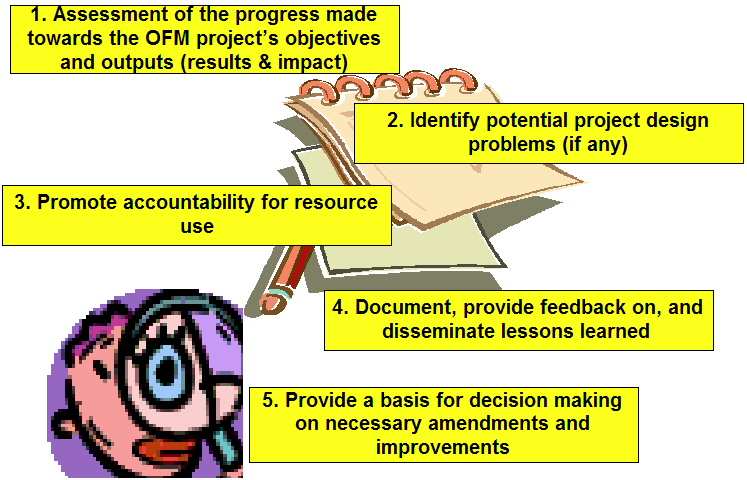
Evaluation MTR & Final
ˇ
UNDP evaluation policy: Defines standards for
evaluation
ˇ
Major responsibilities of UNDP COs :
Draft and review ToR
Selects consultants
Circulates to government and major
stakeholders
Follows up on management actions
ˇ
MTR and FE reports sent to GEF M&E for
review and quality control
3
Objectives of OFM MTR
4
40
Scope
ˇ Project Impact (Results)
& Design
ˇ Project Management
and Administration
Evaluation
ˇ Project Implementation
Report
ˇ Project Finances
ˇ Lessons learned
5
Evaluation Approach
ˇ Baseline data and statistics - desk study review
of all relevant OFM Project documentation
ˇ Fiji-based consultations
ˇ Solomon Island & New Caledonia based
consultations
ˇ Selected visits to countries for national and
regional impact analysis
ˇ Validation through the Regional Steering
Committee/Multipartite Review Meeting
6
41
Evaluation Team
ˇ Will comprise of 2 consultants - 1 team leader
and 1 Resource Specialist
ˇ Team leader will be responsible for the overall
evaluation exercise & take lead in preparation of
the expected outputs
ˇ Regional resource specialist will assist the Team
leader & in stakeholder consultations
ˇ Overall supervision of the MTR will rest with the
UNDP-CO & UNDP RBAP
7
Timeline
Schedule
January
Call for expressions of Interests
February
Application submission deadline
February April
Selection process, contract
June
Evaluators commence evaluation
June
Evaluators assemble in Suva, Fiji for briefing by
UNDP and undertake Fiji based consultations
June
Evaluators assemble in Honiara, Solomon Islands
for consultations
July
Travel to New Caledonia, Cook Islands, Federated
States of Micronesia, Nauru and/or Samoa
10 August*
Draft Report completed
10September*
Final report completed
October (early)
Report presentation at RSC4, Solomon Islands by
Evaluation Team Leader
8
42
MTR Options
1.
1 Consultant to lead the MTR, with some country
consultations happening via telecom;
2.
2 regional consultants where a package is negotiated for
entire consultancy;
3.
Budget for MTE increased by 20K to cover costs of 2
consultants & travel;
4.
Consultants to be present in the margins of another fisheries
meeting & organise meetings with focal points; and
5.
Proceed as per current TOR where visits to countries are
strategised and most consultations happen via video and
telconf.
9
Recommendations
ˇ
Consider options for MTR
ˇ
Consider the Terms of Reference for
consultants that will be engaged in the
review; and
ˇ
Endorse the evaluation approach,
context and timeframe.
10
43