THIRD MEETING OF THE REGIONAL STEERING COMMITTEE (RSC)
FOR THE PACIFIC ISLANDS OCEANIC FISHERIES MANAGEMENT
PROJECT
Rarotonga, Cook Islands
06 October 2007
SUMMARY RECORD OF DISCUSSION1
1.
The third meeting of the Regional Steering Committee (RSC) for the Pacific Islands
Oceanic Fisheries Management Project (OFM Project) was held at the Rarotonga, Cook
Islands on 06 October 2007. Representatives from the following participating country
Governments and organizations were present: Cook Islands, Fiji, Federated States of
Micronesia, Kiribati, Nauru, Palau, Papua New Guinea, Samoa, Solomon Islands, Tonga,
Tuvalu, Vanuatu, Ministry of Environment, Cook Islands, the Secretariat of the Pacific
Deleted: the
Community (SPC), the Pacific Islands Forum Fisheries Agency (FFA), World Wildlife Fund
for Nature, and the United Nations Development Programme (UNDP Suva country office). A
list of participants is appended at Attachment A.
Opening of Meeting
2.
The Project Coordinator briefly welcomed the delegates and acknowledged the
presence of UNDP and other organizations at the meeting. The Tongan Project Focal Point,
Mr. Silivenusi Ha'unga was invited to open the meeting with a prayer.
Introductory Remarks
3.
Mr. Toily Kurbanov, Deputy Regional Representative, UNDP Suva, made
introductory remarks that explained the importance of the Oceanic Fisheries Management
Project (OFMP) and objective of the meeting. A copy of his introductory remarks is
appended at Attachment B.
Opening Remarks
4.
Mr Dan Sua, Director-General of the Pacific Islands Forum fisheries Agency made an
opening address. A copy of his opening address is appended at Attachment C.
Procedural Issues
5.
The Co-Chairs for this meeting are Fiji Director of Fisheries and Deputy Regional
Representative, UNDP Suva Office.
Apologies
6.
The Co-Chair conveyed apologies of Niue, Tokelau, and the Marshall Islands.
1 Endorsed on .... 2007
1
Adoption of Agenda
7.
The provisional agenda was adopted, and a copy is appended at Attachment D.
Agenda Item 1: Pacific Islands Oceanic Fisheries Management Project Annual Report
(UNDP/GEF Annual Project Report/Project Implementation Report)
8.
Prior to reporting from SPC, FFA and IUCN on current GEF projects Ms Barbara
Hanchard the OFM Project Co-coordinator provided an overview of the "Pacific Islands
Oceanic Fisheries Management Project Annual Reports". These reports are required to be
completed for GEF funded projects and are designed to provide monitoring and evaluation
information required by both UNDP and GEF..
9.
The Pacific Islands Oceanic Fisheries Management Project has now been operational
for 2 years (1 October 2005- 30 September 2007). The financial reporting on GEF funded
projects is required on a financial year basis (1 June to 30 July). The annual narrative reports
presented at this meeting prepared in the UNDP/GEF standardized format are from June 2006
to July 2007 against project strategic objectives and outcomes.
10.
Dr. John Hampton from SPC made a presentation of science related work contained
in Component One of the OFM Project which SPC have the responsibility for implementing.
Dr. Hampton reported against the 3 sub-components of Component 1: Fishery Monitoring,
Coordination and Enhancement; Stock Assessment; and Ecosystem Analysis. Within each
sub-component SPC are building information and knowledge, with staff assigned to activities
within each sub-component.
11.
The Tufman project being applied by SPC has now been identified as an essential tool
for reconciling, recording and monitoring data. Implementation at a national levels are now
being undertaken on a country by country basis. Each country has a designated person
responsible for the Tufman software, with their prime responsibilities being data entry and the
production of reports to assist in the management of fisheries at a national level. The Tufman
software in-country development and training has been identified as an effective means of
applying monitoring systems at a national and regional level and continued work will be
undertaken by SPC to implement it in countries where it has not yet been applied. In
countries where it has been implemented, ongoing support will be provided to enhance
systems, provide ongoing training and further develop the application of Tufman. A second
workshop of in-country coordinators will also be held in March 2008.
12.
Under the Fishery Monitoring, Coordination and Enhancement sub-component the
SPC tabled the proposal to activate in-country staff attachments and explained that these
attachments would allow for a concentrated level of assistance on the ground in country and
would continue for the life of the OFM project.
13.
Under the Stock Assessment sub-component the principal work being undertaken at a
national level is the production of National Tuna Fishery Status Reports. At a regional level
the OFM project supports the provision of scientific advisory services to the Western and
Central Pacific Commission (WCPFC).
14.
It is intended to undertake the National Tuna Fishery Status Reports in conjunction
with the Ecological Approach to Fisheries Management (EAFM) work being undertaken by
FFA, as these two programs compliment each other.
2
15.
The advisory services to the Commission range from stock assessment training
workshops for FFA member countries to direct scientific advice to the Commission based on
specific scientific questions being raised by the Commission. The first Stock Assessment
training workshop was held in June 2006. Since the first workshop, subsequent workshops
have been held in June 2007, for both those undertaking a workshop for the first time and
those who had completed the initial workshop. Feedback from the workshops has been
positive and SPC will continue to hold the workshops annually, as well as providing on-going
support to workshop participants to ensure the skills they have learnt are maintained and
applied.
16.
The comment was also made by SPC that teaching is not SPC's field of expertise. As
such, in the future it may be appropriate for SPC to collaborate or hand over the task of
providing stock assessment training to those with specific expertise in this area. It was
suggested that universities may have greater expertise in this area, in particular University of
South Pacific (USP).
17.
Under the Ecosystem Analysis sub-component, information was provided on the
tagging program, seamount mapping and the Ecological Risk Assessment (ERA). The recent
tagging program in PNG has successfully tagged more than 2,000 fish. The total number of
tag recoveries has now reached 600. Tags have been recovered from far reaching areas, as a
result of the translation of information on tag recovery into a number of languages and the
promotion of the tagging program throughout the region. From the GEF funding successful
leveraging of additional funding for the tagging program has also been possible.
18.
In regard to the ERA future work to be undertaken by SPC under the project and at
the national level was detailed.
19.
A question relating to the seamount mapping work to be undertaken and future IUCN
cruises to undertake this work was raised by the Committee. The meeting was advised that it
is still IUCN's intention to undertake the research cruise and efforts are being made to secure
co-financing to meet the short fall left by the non-progress of the original arrangements. Final
decisions on these activities are expected to be made by the end of 2007.
20.
The Committee sought clarification on whether the tagging was throughout the region
and not just in the waters surrounding PNG was raised. SPC explained that the tagging
project in the waters surrounding PNG is intended to be the first phase of a new regional
tagging program.
21.
A number of questions concerning the future development and application of the
Tufman Database were raised. It was explained that the software can be modified to meet
specific data requirements and used, as it has been by some countries to process information
that can be used in national reporting requirements to the Commission.
22.
SPC explained that most fisheries agencies typically have a small staff numbers and
while ongoing training on the Tufman system is essential, attempts are also being made to
keep this training to a minimum to ensure staff were not tired up for prolonged periods.
23.
Mr. Moses Amos Director of Fisheries Management Division at the FFA reported on
the work being undertaken by the Fisheries Management Division under Component 2 of the
OFM project, which includes Legal Reform; Policy Reform and Institutional Reform.
24.
FFA reported that as part of efforts for legal reform national, legislation reviews are
being undertaken to assist in the incorporation at the national level of conservation and
management measures adopted by the WCPFC. These reviews also assist countries in
3
standardizing their legislation and ensuring they comply with contemporary fisheries
legislation.
25.
Fellowships at FFA have also been provided to legal officers from Pacific Island
Countries (PIC) to assist in capacity building and the development of national legislation.
26.
Within the policy reform sub-component the principles of the Ecosystem Approach to
Fisheries Management (EAFM) is being applied. This sub-component has made use of
prominent regional consultants from throughout the region who are intimately involved in
tuna resources fisheries management for EAFM work. It is intended that three EAFM reports
will be completed each year. To date reports have been completed for Vanuatu and Palau,
with Nauru, FSM and Kirabati in various stages of undertaking the EAFM process.
27.
Three WCPFC Sub-regional workshops have also been conducted under policy
reform. These workshops have been designed to enable FFA members to develop their
understanding and positions on Commission related matters. In regard to institutional
strengthening, Nauru is the only country where concentrated work to develop institutional
strengthening has been applied to date.
28.
Mr. Michael Ferris, Director of Operations at the FFA reported on the work being
undertaken by the Monitoring Compliance and Surveillance (MCS) for the Compliance
Strengthening activities of the project under Component 2 of the OFM project.
29.
FFA provided an overview of the MCS work under the sub-component Compliance
Strengthening, which included the following:
· MCS in-country workshops conducted in Vanuatu, PNG and Tuvalu;
· MCS input to the legal review workshops to provide linkages between
legislation and compliance application;
· IUU plan developed for the Cook Islands;
· VMS workshop conducted in Canberra; and
· VMS data sharing arrangements to improve the effectiveness of compliance
operations.
30.
Following the presentation PNG raised the question of the effectiveness of the VMS
throughout the region. The meeting was advised that an effective VMS system would be in
place as at 1 December 2007, to align with the commencement of the Vessel Day Scheme
(VDS).
31.
At the end of the presentations provided by the FFA, member countries commended
the FFA on assisting members towards effective implementation of many of the current
fisheries treaties and arrangements, WCPFC Convention, Fish stock agreement and FAO
guidelines through the project. They acknowledged that the legal workshops helped members
identify the gaps in their national legislations and with revising old regulations. The
Committee noted that Palau sent seven participants to the FFA legal workshops and expressed
sincere appreciation to the FFA and the OFM Project for capacity development and funding.
32.
A presentation on project coordination was made by Ms. Barbara Hanchard to report
against Component three of the OFM project, which includes four sub-components Project
Information System, Monitoring and Evaluation, Stakeholder Participation and Awareness
Raising and Project Management and Coordination.
33.
The key points raised were as follows:
4
· The successful work of WWF under the project in relation to the dissemination
of information to environmental non-governmental organizations (ENGOs) and
WWF's attendance at the annual Management Options Workshop (MOW) and
Commission meetings;
· The development and implementation of recommendations from the
Knowledgement Management Strategy;
· All monitoring and evaluation requirements have been met by the Project
Coordination Unit (PCU);
· Formal links between the project and a regional environmental NGO and the
regional tuna industry association (Pacific Islands Tuna Association) have been
established;
· Project visits to countries are on-going but are impacted by the heavy regional
fisheries agenda;
· Other GEF funded initiatives include the development of a project through the
WCPFC Secretariat to provide assistance to Indonesia, Vietnam and the
Philippines for a complete overview of the tuna stocks throughout their
geographical distribution;
· The GEF Pacific Alliance for Sustainability (GEF-PAS) process currently
being discuss for a future funding framework; and
· The need for participating countries in the OFM project to have input and
engage in the mid-term review of the OFM project scheduled for 2008 which
will have implications for funding beyond 2010 when the current GEF funding
finishes.
34.
Mr. Taholo Kami, the Regional Director for IUCN in the Pacific addressed the
Committee reporting on the status of the activities that IUCN are responsible for under
Components 1 and 2 of the OFM project. The Committee was advised that while the
scientific aspects of the activities are pending some progress has been made with regards to
fisheries management policy in collaboration with the FFA including support for Pacific
islands participation at the South Pacific Regional Fisheries Organisation meeting in Chile.
IUCN also reported on other aspects of their new Pacific programme for legal reform and
institutional reform from a legal perspective. This work included community and outreach
programs identifying environmental issues associated with tuna fishing activities.
35.
The Committee considered and endorsed the project annual reports presented to the
RSC3.
Agenda Item 2: National Annual Project Reports
36.
The PCU presented information paper RSC2/INFO.5 National Annual Reports and
reiterated the responsibilities of the National Project Focal Points for the OFM Project. The
presentation also highlighted the low level of operation of project National Consultative
Committees noting that many countries are making good progress towards re-establishing
national tuna fisheries management committees.
37.
The Committee noted the written submission of annual national project reports by at
least 8 member countries including the Cook Islands, Federated States of Micronesia,
Marshall Islands, Nauru, Palau, Papua New Guinea, Samoa, Tonga, Tuvalu and Vanuatu.
These reports are appended at Attachment E Those countries that had not submitted reports
were invited to submit them to the PCU as soon as practically possible. These countries were,
nonetheless, able to make presentations of their national reports at this meeting.
5
38.
The Committee noted the attempt by the Project Coordinator to complete in-country
consultations including Kiribati and Palau to further discuss national issues before the annual
committee meeting. The Committee encouraged the Project Coordinator to complete the visits
to provide assistance with national level priorities and to assist focal points with coordination
responsibilities and reporting difficulties.
39.
In their submission of national reports, members outlined several issues including the
lack of awareness of project activities including objectives, outputs and criteria, and exchange
of information between PCU and national focal points. It was pointed out that there existed
confusion due to the lack of clarity on project activities actually funded by this project. There
needs to be clear record and track of in-country project implemented activities. It was
suggested that the development of a TOR for each project activities would better enhance
clarity. In response the PCU explained that a detailed list of project activities funded by GEF
was circulated to focal points, and that communication is a two way process. The project
website could also be consulted for further enhancement of project awareness. The PCU
referred project focal points to the project documentation and needs assessment reports to
help raise awareness of country needs originally proposed.
40.
The Committee noted the numerous fisheries meetings and the impact this agenda on
effective participation. It was suggested that the FFA plan and prioritize the meetings to
minimize the undertaking of too many meetings. Members further learnt that the work plan
and project itself has allows some flexibility for finances to be carried forward but that at
project end all project activities and goals must be met and any unspent funds would no
longer be available.
41.
SPC asked that members provide comments that identify perceived gaps on fisheries
monitoring and related work currently pursued by SPC under the OFM project. Members
were also asked to provide comments on the proposal of re-aligning National Tuna Status
Reports with the FFA EAFM work.
42.
It was noted that several training activities by both FFA and SPC funded from the
OFM Project were executed in the last calendar year. This includes stock assessment
workshop, WCPFC sub-regional workshops, EAFM in-country consultations and institutional
strengthening and reforms. The outputs of these GEF funded activities can be referred to the
project web-site or sought directly from PCU.
43.
The challenges and issues raised in national reports were concerned with technical
assistance to changes in regulations, capacity building, and institutional changes that enable
Members to meet their obligations under various arrangements. Some committee members
noted the confusion in the effectiveness of National Coordination Committees given the
placement of project focal points in either the fisheries or environment administrations. In
reposnse it was pointed out separate NCCs did not have to be established but existing fisheris
bodies in-country such as Tuna management committees could be used for national level
oversight of the OFM Project..
44.
Several countries requested SPC for further training and workshops on TUFMAN,
scientific inputs or reporting of national tuna status report and from the FFA for EAFM
consultations and follow-ups.
45.
The Deputy Resident Representative from UNDP Fiji noted the wealth of data
generated from the project but that the utility activities required better reflection of that
actually happening on the ground. It was pointed out that the in-country activities can be
better facilitated through a central coordination committee, i.e. the National Consultative
Committees. At the same time the regional agencies involved in this project should have
6
consolidated and consultative workplan as minimum step to enable predicability regarding
project activities to be implemented.
46.
The Committee noted the national reports presented to the Committee and the need to
progress national level consultation processes.
Agenda Item 3: Financial Reports
47.
Working paper RSC3/WP 6 2007 Financial Reports was presented to the
Committee. This report contained the acquittal of the 2006 approved Budget and Annual
Work Plan, inclusive of the audit report, the approved (revised) 2007 Budget and Annual
Work Plan, an interim report on budget expenditures up until 31 August 2007 and the
approved 2008 Budget and Annual Work Plan.
48.
The total budget for 2006 was 3.2 million, of which 66% had been spent as at the end
of the 2006 calendar year, with 34% remaining unspent. Against the individual components
of the GEF project for 2006 the following percentages of the actual budgets had been spent:
Component 1: 62%, Component 2: 28% and Component 3: 10%.
49.
The 2007 financial report up until 31 August 2007 was also presented. The original
approved budget for 2007 was $2,737,105. Added to this budget was the unspent funds
carried forward from 2006 ($1,079,031) less IUCN funds of $266,741 carried forward to
2008. This left a revised 2007 budget of $3,549,395. The budget breakdown by individual
components of the GEF project were: Component 1: 47%, Component 2: 37% and
Component 3: 16%. Expenditure against the 2007 budget, as at 31 August 2007 is $1,854,963
(or 52%).
50.
The approved budget for 2008 of $2,058,330 was also presented. The proposed
expenditure against each component in the budget are presently: Component 1: $861,040,
Component 2: $801,640 and Component 3: $395,650
51.
The 2008 budget has been approved by the GEF Council and endorsed by RSC1. The
meeting was also advised in relation to a number of potential issues that could impact on the
2008 budget. These issues included:
· The implementation of incremental increases in salary approved by CROP
agencies; and
· Exchange rate gains and losses, as a result of payments being made in local
currencies which are changing against a weakening US dollar (i.e. Pacific Franc).
52.
In order to account for these changes it was recommended that the revised 2008
budget be reviewed again in November to ensure it accurately reflects the associated costs of
the OFM annual work plan.
53.
At the end of the presentation questions were invited. A number of questions were
asked in regard to incremental salary increases. The Committee was advised that the 2008
budget had not accounted for a 7% salary increment that was expected to be approved prior to
2008.
54.
A number of questions were also asked in regard to unspent funds, as had occurred in
2006, and what would occur in 2010 when the project was due to be completed if all the funds
had not been spent. The Committee was advised that the 2007 budget was on track to be
spent and to ensure this problem did not occur at the end of the project every attempt would
be made to spend all the funds prior to the completion of the project in 2010.
7
55.
The Committee:
i)
noted and endorsed the audited 2006 financial report year ending 31
December 2006;
ii)
noted the interim 2007 Financial Report; and
iii)
agreed to review the 2008 Budget and Annual Work Plan in November 2007.
Agenda Item 4: Mid term Review
56.
The representative the Suva UNDP Office presented a brief plan for the mid term
review of the OFM Project covering the terms of reference and options for its implementation
The funds for this work will be sourced from the project budget and, any extra/ additional
funding required to fully implement the review would be sourced from elsewhere. The TOR
will include one or two Consultants that will be engaged for the work and, that it is possible to
merge the options to arrive at the best option. The presentation made by UNDP is appended at
Attachment F.
57.
Committee members discussed the pros and cons of the options and agreed to an
option that does not impinge on funding allocated for other project activities. There was
further agreement that national consultations require prior planning for national coordinators,
and to ensure that selective list of target stakeholders are available for in-country
consultations.
58.
The stakeholder consultations will align with current FFA in-country work as not to
burden countries. All the stakeholders or at least key people in the countries would need to be
available during the consultations.
59.
Members asked to go through TOR first before deciding on the options, particularly
in regard to the indicators used for assessing the review. Members also suggested that options
2 and 4 would be a best combined. Members further suggested that the two regional
consultants be hired for this work and to negotiate a package for the entire consultancy.
60.
In planning ahead, the two consultants should be present in the margins of another
fisheries meeting, and as well organised meetings with focal points. The visits should be
strategic in order to report on activities that have profound impact on the ground. For the
remaining countries consultations would be undertaken electronically.
61.
UNDP called for the exchange of information between countries on project related
activities. The meeting agreed on the combination of options 2 and 4 presented by UNDP for
the review. The Chair sought approval and confirmation of countries visited from the
meeting. The assessment will also use national reports presented to the Steering the
Committee in its annual meetings.
62.
The Committee:
Formatted Table
i)
noted that the project budget made allocations for the mid-term review of the
project and that options for its implementation should not impinge on the
funding allocated for other project activities;
ii)
agreed that two regional consultants could be recruited but that the work
should be negotiated as a package;
iii)
agreed that options 2 and 4 in the UNDP presentation should be combined;
and
iv)
agreed that the consultants would undertake visits to some project FFA
8
member countries.
Agenda Item 5: Other Matters
63.
The Committee asked if there are funds available to support National Consultative
Committees. The PCU confirmed that there were limited funds available on request to support
this process in smaller countries but noted some countries with functioning tuna advisory
committees and active industry participation did not require this assistance.
64.
The Committee agreed:
i)
the next annual meeting of the Regional Steering Committee shall be held in
conjunction with the 5th Management Options workshop in 2008;
ii)
that the national Co-Chair for the fourth Regional Steering Committee in
2007 would be from the Cook Islands; and
iii)
that the Summary Record will be made available for comment within 7 days.
The PCU will make available the final version for endorsement by the
Committee inter-sessionally within 30 days.
The UNDP Deputy Resident closed the meeting with closing remarks and the meeting
concluded with a closing prayer.
9
ATTACHMENT A
LIST OF PARTICIPANTS
Cook Islands
Kiribati
Mr Ian Bertram
Mr Kintoba Tearo
Secretary
Principle Fisheries Officer
Ministry of Marine Resources
Oceanic Fisheries Program
Box 85, Rarotonga
Fisheries Department
i.bertram@mmr.gov.ck
P O Box 64
Bairiki, Tarawa
Mr Peter Graham
kintobat@yahoo.co.uk
Legal Advisor/ Focal Point
Ministry of Marine Resources
Mr Takuia Uakeia
Box 85, Rarotonga
Deputy Secretary
P.W.Graham@mmr.gov.ck
Ministry of Fisheries & Marine Resources
Development
Federated States of Micronesia
P O Box 64
Bairiki, Tarawa
Mr Bernard Thoulag
takuiau@fmrd.gov.ki
Formatted: Font: Not Bold
Executive Director
NORMA
Nauru
P O Box PS122
Palikir, Pohnpei, FSM
Mr Terry Amram
bthoulag@mail.fm
Nauru Fisheries & Marine Resources
Authority
Ms Patricia Jack
Aiwo District, Nauru Island
NORMA
tamramnr@yahoo.cm
P O Box PS122
Palikir, Pohnpei, FSM
Mr Darryl Tom
keestracy@yahoo.com
Nauru Fisheries & Marine Resources
Authority
Fiji
Aiwo District, Nauru Island
dtom@yahoo.com
Mr Sanaila Naqau
Director
Papua New Guinea
Fisheries Department
Ministry of Fisheries, Forestry &
Mr Ludwig Kumoru
Agriculture
Manager-Tuna
P O Box 2218
National Fisheries Authority
Government Building, Suva
P O Box 2016, Port Moresby, NCD, PNG
naqali@hotmail.com
lkumoru@fisheries.gov.pg
Mr Anare Raiwalui
Mr Augustine Morgan
Principle Fisheries Officer
National Fisheries Authority
Fisheries Department
P O Box 2016, Port Moresby,NCS, PNG
Ministry of Fisheries, Forestry &
amorgan@fisheries.gov.pg
Agriculture
P O Box 2218, Government Building
Palau
Suva
Ms Nannette Malsol
Anare_raiwalui@yahoo.com
National Focal Point
Bureau of Fisheries
10
P O Box 385
Koror
Mr Tanielu Sua
Director General
Ms Kathleen Sisior
dan.sua@ffa.int
Bureau of Fisheries
P O Box 385
Dr Transform Aqorau
Koror
Deputy Director General
transform.aqorau@ffa.int
Samoa
Ms Barbara Hanchard
Ueta Faasili, Jr
Project Coordinator
Deleted: OFM/GEF
faasilijr@gmail.com
barbara.hanchard@ffa.int
Atonio P. Mulipola
Mr Royden Gholomo
apmulipola@lesamoa.net
Project Finance and Administration
Officer
Solomon Islands
royden.gholomo @ffa.int
Deleted: R
Simon Alekera
Deleted: Mr Dan Sua
salekera@fisheries.gov.sb
Ms Jean Gordon
Director General
dan.sua@ffa.int
Legal Officer

Fred Aleziru
jean.gordon@ffa.int
Dr Transform Aqorau
faleziru@fisheries.gov.sb
Deputy Director General
transform.aqorau@ffa.int
Tonga
Mr Michael Ferris
Director, Fisheries Operations
Ulanga Fa'anunu
michael.ferris@ffa.int
ulungaf@tongfish.gov.to
Mr Moses Amos
Siliveinusi Haunga
Director, Fisheries Management Division
shaunga@tongfish.gov.to
moses.amose@ffa.int
Mr Samasoni Sauni
Tuvalu
Fisheries Management Adviser
samasoni.sauni@ffa.int
Sam Finikaso
safin70@yahoo.com
Mr Steve Shanks
Fisheries Management Adviser
samasoni.sauni@ffa.int
Vanuatu
Mr Kaburoro Ruaia
Deleted: Tuai
William Naviti
Manager, US Treaty
wnaviti@gmail.com
Mr Anton Jimiwerey
Beverleigh Kanas
PNA Coordinator
bevakanas@gmail.com
Secretariat of the Pacific Community
Deleted:
Column Break
Cook Islands
Dr John Hampton
Ministry of Environment
Manager
Oceanic Fisheries Programme
Ms Pasha
Formatted: Font: Not Bold
United Nations Development
Formatted: Font: Not Bold
Programme
FFA
11
Toily Kurbanov
Deputy Resident Representative
UNDP Suva Country Office
Suva, Fiji
Toily.kurbanov@undp.org
Alvin Chandra
Programme Officer
UNDP Suva Country Office
Suva, Fiji
alvin.chandra@undp.org
World Wildlife Fund Pacific
Mr. Seremia Tuqiri
Oceans Policy Officer
WWF SPPO
Suva
Fiji
stuqiri@wwfpacific.org.fj
12
ATTACHMENT B
UNDP OPENING REMARKS
Mr. Toily Kurbanov, Deputy Resident Representative
United Nations Development Programme (UNDP), Fiji
Pacific Island Oceanic Fisheries Management Project
Rarotonga, Cook Islands
Saturday 06 October 2007
Honourable representatives from Pacific governments,
Director General of the Forum Fisheries Agency,
Representatives of the CROP agencies,
Development partners,
Ladies and gentlemen,
It is a great honour and distinct privilege to greet you on behalf of UNDP at the
Third Regional Steering Committee (RSC) meeting of the Pacific Islands Oceanic Fisheries
Management Programme.
United Nations agencies are committed to strengthening partnership with the
Pacific governments and regional organizations to support national development strategies
and attainment of Millennium Development Goals (MDG). Since RSC meeting last year, UN
organizations, led by UNDP, have developed joint UN Development Assistance Framework
in the Pacific, covering 5 years from 2008 to 2012. In this Framework, the UN team has come
together with Pacific Island Countries to forge partnership in 4 outcome areas, 4 strategic
pillars: economic growth, good governance, sustainable environmental management, and
social services. These goals have been further reinforced in UNDP's own multi-country
programme in the Pacific for 2008-2012, which last month has been presented for approval of
our Executive Board in New York.
According to this strategic document, we will continue to support national
capacity development in the area of sustainable environmental management, including
fisheries management, in the years to come. UNDP's efforts will be guided, among other, by
the World Summit on Sustainable Development (WSSD) plan of implementation and the
Convention on the Conservation and Management of Highly Migratory Fish Stocks in the
Western and Central Pacific Ocean (WCPF). Working closely with you, we will strive for
creating enabling environment and strengthening capacities for fisheries management through
establishment of regional and national monitoring systems and the use of ecosystem models
to assess management options, as well as through training of policy-makers. In this regard, we
acknowledge tremendous potential value of the Pacific Islands Oceanic Fisheries
Management Programme, which is uniting us around this table today.
We in UNDP are pleased to note that this potential is beginning to be realized, as
is highlighted in the progress of the Programme during the year under review. Against the
background of extremely complex tasks and multiple priorities, the Programme
implementation exhibited inclusiveness and strong communication strategies to initiate
change and to strengthen support for fisheries management. Above all, the results of the
Programme to date would not have been possible without hard work and commendable
dedication of the three executing agencies (Forum Fisheries Agency, Secretariat of the Pacific
Community, and the World Conservation Union) and, of course, without strong efforts of the
Programme Coordination Unit, led by our able Programme Coordinator Barbara Hanchard.
13
As the Programme evolves, and the objectives are being pursued, and first results
are being generated, changing realities and new issues may arise. This is natural for the
Programme of this scope and complexity. One of the main purposes of this meeting is to get
an update as to where we are, what can be our new horizons, and what are the steps that need
to be taken in order to open those horizons. In this regard, UNDP is looking forward to the
presentation and discussion of the Annual Programme progress report and the Executing
agencies' presentations, as well as of the financial reports on work plan and budget. Just as
important we see National Project reports to be presented by National Programme Focal
Points, which will give us indications of actual impact on the ground and some of the lessons
learned already. Last but not least, fir the Programme of this scope and multi-year duration, it
will be important that we get the benefit of independent, external assessment of the
implementation. My UNDP colleague Alvin Chandra will present us proposed approach to
Mid-term Programme evaluation.
Ladies and gentlemen,
These are main agenda topics in front of us. On behalf of UNDP, I wish most
productive deliberations of the Regional Steering Committee. We have no doubt that the
meeting will help to strengthen our partnership partnership that is aimed at ensuring
sustainable environmental management of natural resources for our future generations.
Thank you
14
ATTACHMENT C
Brief Opening Remarks by the FFA Director General, Mr. Tanielu Su'a to the
Third Meeting of the Pacific Island Oceanic
Fisheries Management Project
At Rarotonga, Cook Islands; 06 October 2007
Kia Orana and good morning,
Firstly let me thank the Cook Islands, especially the Ministry of Marine Resources for the
warm and garlanded welcome on arrival. You will all have no doubt, in the short time you
have been here witnessed the efficiency and a warm hospitality of the Cook Islands and I am
sure you will agree with me in saying that it's a pretty hard act to follow.
Please let me acknowledge the co-chairs of today's meeting; the Deputy Resident
Representative from UNDP Suva, Mr. Toily Kurbanov and for Fiji Fisheries, Lieutenant
Commander Sanaila Naqali. I wish them well in their roles today. Welcome also to project
focal points and other members of your country delegation. We are also joined by project
associates from the SPC, FFA, IUCN, UNDP, WWF and PITIA and I also understand we will
be joined by the GEF focal point for the Cooks Islands.
It gives me great pleasure to be able to make some brief opening remarks for the third
meeting of the Regional Steering Committee for the Global Environment Facility (GEF)
funded Oceanic Fisheries Management Project. But before I make those remarks, let me first
thank you for your attendance recognising that not only have many of you come from afar,
but that you may have also come directly from the Technical and Compliance Committee
meeting in Pohnpei and other meetings held there and that must be tiring. Those of you that
have submitted written annual project reports for this year, mention that there are just too
many fisheries meetings and workshops. I readily acknowledge that the fisheries meeting
agenda in the Pacific is punishing and it does not look as though it will become less intense
any time soon. We do need to prioritise and explore other ways in which to exchange views
and make decisions on fisheries issues and matters of importance so as not to overly tax what
limited resources we have available. In some ways we really are `spreading things a little
thin'.
One of the floats that allow us to keep our heads above water in the rapidly paced oceanic
fisheries management regime that we have designed and established for the Pacific, is the
GEF OFM Project for which we must be extremely grateful. GEF and the project have
provided Pacific island countries with the support attributed to incremental costs associated
with our efforts to be responsible and effective regional and national fisheries managers for
the benefit of not only our own development but the global community.
The project is now two years old. While we have measured progress on an annual basis
through monitoring, soon it will be time to ask ourselves the real question, `what have we
really gained and what progress have we really made?" Next year UNDP as the project's
implementing agency will coordinate a mid-term review of the project. Let me urge all of you
to remain engaged in the progress we making with GEF's help under this project and also to
be vigilant in seeing that fisheries is rightfully acknowledge at all opportunities a national and
regional priority.
I don't wish to delay the commencement of the meeting proper so let me conclude by
thanking you for participating in the project and the regional steering committee. Please be
frank and fair in your contributions today and I wish the meeting well.
Finally, for those of you that are ardent rugby fans our apologies for double booking the time
slot with the world cup quarter finals.
Thank you.
15
ATTACHMENT D
REGIONAL STEE RI NG COMMITTEE
2nd Meeting of the RSC
Honiara, Solomon Islands
10 October 2006
Paper Number
RSC2/WP.2
Title
ADOPTED AGENDA
a.
Opening of Meeting
b.
Apologies
c.
Adoption of Agenda
d.
Regional Steering Committee Representation
1. Pacific Islands Oceanic Fisheries Management Project Annual
Report - (UNDP/GEF Annual Project Report /Project
Implementation Report)
2. Financial Reports
3. National Annual Project Reports
4. Other Matters
e.
Next Meeting
f.
Records of Proceeding
g.
Close of the Meeting
16
ATTACHMENT E
NATIONAL REPORTS
NATIONAL LEVEL ANNUAL REPORT
TO THE
OCEANIC FISHERIES MANAGEMENT PROJECT
REGIONAL STEERING COMMITTEE (OFM RSC)
Reporting Period, October 2006 June 2007
1. Country: COOK ISLANDS
2. Project Title: Oceanic Fisheries Management: Implementation of the Strategic Action
Programme of the Pacific SIDs (Pacific SAP II)
3. Period Covered: 1 October 2006 30 June 2007
4. Summary of Overall Project Progress
The Cook Islands pleased with the progress of the project to date. The activities supported by
the project have assisted in capacity building at the National Level as well as at the regional
level. The assistance has enabled the Cook Islands and other FFA Member countries to
participate effectively at the meetings of the Commission and its subsidiary bodies the
Science Committee and Technical and Compliance Committee.
5. Specific Outputs/Results Achieved (as per annual work-plan):
National level activities
·
TUFMAN Database development System up and running smoothly, regular
upgrades made with assistance of SPC.
·
National Tuna Fishery Status Report for the Cook Islands completed.
·
Observer Sampling Bio samples collected and forwarded to SPC
·
Scientific Papers for WCPFC valuable assistance in preparation of the Science
Committee meetings.
Regional level activities
·
Stock Assessment Workshop - MMR Data Management Coordinator participated
in Stock Assessment Workshop, SPC
·
Seamount Analysis the Assessment was a valuable piece of information that we
were able to use during the SPRFMO Meetings.
17
·
Management Options Workshop Cook Islands participated in the MOW 06 held
in Nadi, Fiji.
·
OFMP Regional Steering Committee Cook Islands National Focal Point
attended RSC 2 in Nadi, Fiji.
·
Regional Judicial Officers Seminar MMR Legal Adviser participated in the
Regional Judicial Officers Seminar in Palau, April 2007.
·
MCS Working Group meeting MMR Legal Adviser and one of its'MCS Officer
participated in the 9th MCS working Group meeting in Brisbane, October 2006.
6. Challenges/Issues Encountered
The Cook Islands is very grateful for the assistance provided enabling us to develop and build
our capacity. However, having someone available to attend all the meetings, workshops and
training is sometimes difficult to meet. With limited staff numbers, it can at times be very
demanding on the particular staff attending. In order to maintain consistency, we prefer no to
just send anyone that is available.
7. Solutions Applied (to address issues and challenges)
The Cook Islands believes more planning amongst FFA Members and other Regional
Organizations is required when considering dates for meetings and workshops.
9. Recommendations for Future Action
Visits by the Project Coordinator have in the past been very useful, and we believe they
should continue on a more regular basis.
We also believe that the Work Plan should be a living document and evolve with time, and
where planned activities are not undertaken, then the Plan should be flexible enough for them
to be conducted/implemented in the following years activities.
10. Report Prepared By: Peter W Graham, National (OFM Project) Focal Point.
18
NATIONAL LEVEL ANNUAL REPORT
TO THE
OCEANIC FISHERIES MANAGEMENT PROJECT
REGIONAL STEERING COMMITTEE (OFM RSC)
Reporting Period, October 2006 June 2007
1. Country: Federated States of Micronesia
2. Project Title: Oceanic Fisheries Management: Implementation of the Strategic Action
Program of the Pacific SIDs (Pacific SAP II)
3. Period Covered: 1 October 2006 30 June 2007
4. Summary of Overall Project Progress
The Federated States of Micronesia is pleased with the overall progress of the project and
project activities delivery. As the project document was done sometimes back, some
flexibility should be exercised to be able to shift funds to other areas as new challenges arise.
The project activities have been most useful in capacity building at the country level as well
as at the regional level. Without the project, most of the small administrations in the region
will have been ill-prepared to effectively participate in the meetings of the Commission and
its subsidiary bodies and in meeting their various obligations under the Commission. The two
components (SPC and FFA) of the project have gone a long way in assisting the Small Island
Developing States (SIDS) of the region, not only to participate, but to participate effectively
in the work of the Commission and in meeting their obligations under the Commission.
The FSM through NORMA has particularly benefited from both components of the project.
Under Component One of the project, the TUFMAN database has been set up in country with
some training on its use. This is work in progress and more work is still being carried out to
further develop the program to produce the reports that are required. Assistance and support
have also been extended to the FSM in data quality improvements and collections through
various guides, workshops and attachments. The FSM National Fishery Status Report has
also been worked on and a short version has been presented and fuller version will be
delivered at the planned EAFM Consultation workshop in November. The Stock Assessment
Workshops have also been most useful to the FSM in understanding the scientific concepts
involved in stock assessments and comprehend the scientific reports better and participate
more in discussing these issues as they come up at the Scientific Committee and the
Commission itself. The scientific papers developed for the Commission have also been very
useful for the FSM's effective participation in the Commission.
Project activities under Component Two of the project have been most useful for the FSM in
several areas. On the legal side, on-going effort and advice in the review and assistance in
drafting fisheries legislation to be compliant with regional and international requirements
have been graciously extended and very much appreciated. Assistance has also been
extended in port state enforcement through workshops and legal attachments. The regional
judicial seminar is another useful legal seminar that assists countries in the region to prosecute
fisheries cases more efficiently and successfully in the on-going effort to curtail IUU fishing.
19
In conservation and management, the FSM has greatly benefited from the WCPFC
Workshops, the pre-WCPFC meeting (including TCC and the SC) FFC caucuses. These have
helped prepare us for more effective participation at the meetings of the Commission and its
subsidiary bodies. The on-going Management Options Workshop is viewed by the FSM as
one of the most useful undertakings of the Project in terms of the Region's response to the
need to conserve and manage the resources in a sustainable manner for our generation and
future generations of our Pacific peoples. This workshop is most useful in getting the region
to strategically prepare to take on the delay tactics and attempts by the distant water fishing
nations to continue fishing as usual despite the scientific advice to cut back effort. The
reports on the mitigations of seabirds, turtles, sharks and the use of fish aggregating devises
(FADS) in the fisheries assist as well in developing our strategies on these issues as they
come in the Commission meetings (including SC and TCC ).
Monitoring, Control and Surveillance (MCS) workshops and attachments that have been held
in the region as well as the annual MCS Working Group meeting funded by the project have
also gone a long way in preparing the region in tackling the MCS aspects of the
Commission's work.
5. Specific Outputs/Results Achieved (as per annual work-plan):
National level activities
TUFMAN Database was installed at the NORMA Office with some
training
The National Tuna Fishery Status Report (Short Version) was
delivered
In-country data coordinator support was provided
A port state enforcement workshop was held in country
Regional level activities
The FSM participated in the first stock assessment workshop
Scientific papers provided for the WCPFC benefited the FSM
The FSM participated in two WCPFC workshops (West and North)
The FSM participated in the Management Option Workshop last year
The FSM participated in all FFC caucuses pre-WCPFC (including
SC and TCC)
The FSM was involved in the EAFM Training Workshop
The FSM participated in the annual MCS Working Group meeting
The FSM participated in the Regional Judicial Seminar
The FSM benefited from the draft guideline for fisheries legislation
and advice on its on-going activities with Palau and the Marshall
Islands on our subsidiary arrangement under the Niue Treaty.
20
6. Challenges/Issues Encountered
This region is overloaded with meetings and for small administrations as most of the fisheries
offices in the region, it is very difficult to keep up with all these meetings. This is not saying
that the activities undertaken under the project are of less importance. They are very
important for us to meet our obligations under the Commission and we need to have them.
We need to make more time for these meetings and workshops so participants can really
absorb the materials and concepts and cut down other meetings.
Challenges are an continuing thing. As the Commission develops, new challenges arise; as
new measures are taken, new challenges are developed especially for the SIDS with small
fisheries administration and limited capacity put the mechanisms in place necessary to
implement new decisions by the Commission.
Getting the necessary mechanisms and procedures in place at the Commission so that the
Commission can effectively meet its mandates in the Convention continue to be a challenge.
We will continue to talk while the resources are being depleted.
7. Solutions Applied (to address issues and challenges)
The above are regional issues that perhaps should be addressed by the region and not the
individual country level. The FSM is keen to discuss these further with others and seek
regional solutions to them.
8. Recommendations for Future Action
As a region, which will be impacted most if no agreement is reached at the Commission level
on procedures and mechanisms to effectively conserve and manage the tuna resources, we
should be greatly concern about the lack of progress on the development and implementation
of these procedures and mechanisms. No management measures can be effective without
these procedures and mechanism. We should seek ways to make some head-ways on some of
these issues.
9. Report Prepared By: Bernard Thoulag, National (OFM Project) Focal Point.
21
NATIONAL LEVEL ANNUAL REPORT
TO THE
OCEANIC FISHERIES MANAGEMENT PROJECT
REGIONAL STEERING COMMITTEE (OFM RSC)
Reporting Period 1 Oct 2006 30 June 2007
1. Country: MARSHALL ISLANDS
2. Project Title: Oceanic Fisheries Management: Implementation of the Strategic Action
Programme of the Pacific SIDs (Pacific SAP II)
3. Period Covered: 1 October 2006 30 June 2007
4. Summary of Overall Project Progress: As in the previous reporting period, the RMI
continued to benefit from various projects under the overall project progress. A few of the
highlights from this current reporting period include:
1. Deputy Director attended 3rd Management Options Workshop (MOW3) in Nadi, Fiji
in October 2006 as well as 2nd Regional Steering Committee (RSC2) which also took
place in Nadi. RMI national progress report was tabled at the RSC2 alongside those
submitted by Cook Islands, FSM, Solomon Islands, and Tonga.
2. Key MIMRA staff along with RMI Attorney General and industry representative
attended pre-WCPFC (FFA briefing) and WCPFC meetings in Apia, Samoa in
December 2006; Director attended Joint RFMO Meeting in Kobe, Japan in late
January 2007. It is well understood that the project contributes significantly in the
form of assisting with FFA briefs for such meetings.
3. The TUFMAN database at MIMRA was upgraded to version 3.0 during this reporting
period; in addition, the RMI also benefited from the availability of the CES database
system which was provided to all member countries throughout this period.
4. `National Tuna Data Procedures Documents' (NTDPD) progressed with program
visit to RMI during this reporting period. These were later routinely reviewed and
updated. National monitoring capacity in the RMI was reviewed and funding
requirements under GEF were established during this time.
5. Specific Outputs/Results Achieved (as per annual work-plan):
National level activities:
· A basic observer training course was conducted in Majuro in late February / early
March 2007. Considerable effort was undertaken by SPC staff in successfully putting
the pre-selection test procedures in place for the course. It was agreed that these
procedures would become standardized for future courses. A debriefer course was
successfully completed along with port sampling refresher course earlier in August
2006 with senior RMI observers getting full port sampling certification.
22
· A very timely in-country visit by the PCU was more than welcomed. Details of said
visit will comprise part of the highlights for next reporting period as the visit only
commenced a little after the end of current reporting period which this report entails.
Regional level activities:
· Deputy Director and VMS Officer from RMI Sea Patrol attended 10th MCS Working
Group meeting held at FFA Headquarters in March 2007.
· MIMRA Data Specialist and Sea Patrol VMS Officer attended VMS Training in
Canberra, April 2007.
· RMI hosted first WCPFC sub-regional workshop (Northern Group) in Majuro from
23 to 27 June 2007. Participants from Palau, FSM, Kiribati, and Nauru were well-
represented and the workshop deemed successful. As with the other WCPFC sub-
regional workshops, it is envisaged that key national and regional issues discussed at
the Majuro workshop will be taken up considerably at the forthcoming Management
Options Workshop (MOW4) scheduled to be held in Rarotonga in October 2007.
· Chief Fisheries Officer for the Oceanic & Industrial Affairs Division, MIMRA
attended stock assessment workshops at SPC, Noumea in late June / early July 2007.
6. Challenges/Issues Encountered
Challenges and issues encountered with project activities during this reporting period include:
· Ongoing lack of familiarity with the Project; specifically, which projects fall under or
are entitled to GEF funding, etc.
· Inability to keep track or up to date on overall progress of Project.
· Ongoing lack of local/national coordination in formally establishing a national project
coordinator at this juncture. In all likelihood, this is further complicated by the fact
that another RMI government agency is GEF focal point and there is minimal
interaction and/or coordination at the national level when it comes to seeking out who
is entitled to what and how.
7. Solutions Applied (to address issues and challenges)
Solutions applied to address the issues and challenges included:
· Need for increased and effective coordination with relevant agencies at the national
level.
· Increased awareness and up to date liaison with PCU. Establishment of routine
contact with PCU via email has been well-received and very responsive. RMI
considers this to be a big plus and thus very positive engagement.
· More frequent liaison with PCU. In-country visit has really helped RMI in ongoing
efforts at familiarization of the project and related cross-cutting issues at the national
and regional levels.
9. Recommendations for Future Action
23
The RMI will continue to support in-country visits by the PCU. Effective engagement with
PCU will continue to form an integral part of our efforts. As such, continued future
correspondence with PCU will remain essential.
10. Report Prepared By: Samuel K. Lanwi, Jr. [for RMI National (OFM Project) Focal
Point]
24
NATIONAL LEVEL ANNUAL REPORT
TO THE
OCEANIC FISHERIES MANAGEMENT PROJECT
REGIONAL STEERING COMMITTEE (OFM RSC)
Reporting Period, October 2006 June 2007
1. Country: NAURU
2. Project Title: Oceanic Fisheries Management: Implementation of the Strategic Action
Programme of the Pacific SIDs (Pacific SAP II)
3. Period Covered: 1 October 2006 30 June 2007
4. Summary of Overall Project Progress
A restructuring of the Nauru Fisheries and Marine Resources Authority (NFMRA) GEF
Oceanic Fisheries Management project was undertaken with the appointment of a new
national focal point to better focus and coordinate the increasing activities under the project.
A national consultative committee is being selected from relevant stakeholders within the
broader community to work closely with the national focal point in achieving the objectives
of the project in an effective and transparent manner.
Other initiatives which will improve the capacity of NFMRA to carry out the implementation
of its projects include the receipt of three high end laptop pc's for the Oceanic Section and
two desktop computers to be used by the catch data and licensing officers from the same
section.
5. Specific Outputs/Results Achieved (as per annual work-plan):
National level activities
Component 1: Scientific Assessment and Monitoring Enhancement:
a) Staff officer from the Oceanic Section attended 1 month training attachment at
OFP SPC in Noumea which included modules on TUFMAN, basic preparation
for NTFSR and as a participant in the regional Stock Assessment Workshop (
Introductory)
b) IT Support Data reporting capacity enhanced with the delivery of two desktop
pc's to the licensing and catch data desks at Oceanic Section; and three laptops to
Oceanic management staff and the NFMRA Board Policy advisor.
c) NTSFR/EAFM preparatory work on a draft NTSFR commenced in the first
quarter of 2007. In-country EAFM Scoping workshop was held in the second
quarter of 2007 followed by another in-country stakeholder consultation last
month to follow up on the output of the scoping workshop and progress the stages
of the EAFM process.
Component 2: Law, Policy and Institutional Reform, Realignment and Strengthening
a)
A Scoping study on Institutional Strengthening for the NFMRA requested by
the Government of Nauru through NFMRA was conducted in the final quarter of
2006 culminating in the delivery of a final report that was accepted and submitted
for donor funding earlier this year. Proposal was given high priority by
Government and is now in the final process of review by one of Nauru's main
25
donor partners. Additionally, some key components of the report have been
prioritized and will receive additional funding from other donors prior to
commencement of the main project.
b) A proposed in-country analysis of national legal issues and structures was
replaced by a sub-regional workshop in June 2007 in RMI.
Component 3: Coordination, Participation and Information Services
a) National GEF OFM Focal point restructured and finalized to be followed by the
formation of a National Consultative Committee.
Regional level activities
a) Training opportunities which were available under Sub-regional programs
included the Stock Assessment Workshop in Noumea, and the WCPFC Sub
regional workshops to review national legislations with respect to WCPFC
obligations. Nauru sent two participants to the Train Sea Coast/ USP Policy
training course held at USP Suva in July 2007.
b) Assistance received for draft Niue Treaty Subsidiary agreement.
6. Challenges/Issues Encountered:
a) Departure of key legal personnel from Nauru means greater reliance on FFA
Secretariat for legal
advice on ensuring compatibility between national legal
instruments and WCPFC Obligations.
c) former focal points were from NFMRA executive management and were not able
to effectively carry out GEF project activities under pressing national and
regional work commitments. This had implications towards the implementation
of projects under the work plan.
d) demanding meeting agenda and oceanic regional fisheries commitments has
placed burden on a small administration with limited capacity and budget.
7. Solutions Applied (to address issues and challenges)
a) restructuring of focal points to ensure that a dedicated officer can accord priority and focus
on project commitments and their implementation. Additionally the impending formation of
a National Consultative Committee will enhance the status of the project.
b) in country visit by FFA GEF Coordinator was very useful in providing guidance and
advise to national authorities and clarified many of the uncertainties that plagued
management.
9. Recommendations for Future Action
a) Liaison with FFA GEF National Coordinator is very useful and should be maintained. The
dedicated website and subscription to the GEF OFM mailing lists has also provided useful
information and should be maintained and enhanced where possible,.. i.e. updated circulars
distributed on a regular schedule.
10. Report Prepared By: DARRYL TOM, National (OFM Project) Focal Point.
26
NATIONAL LEVEL ANNUAL REPORT
TO THE
OCEANIC FISHERIES MANAGEMENT PROJECT
REGIONAL STEERING COMMITTEE (OFM RSC)
Reporting Period, October 2006 June 2007
1. Country: PALAU
2. Project Title: Oceanic Fisheries Management: Implementation of the Strategic Action
Programme of the Pacific SIDs (Pacific SAP II)
3. Period Covered: 1 October 2006 30 June 2007
4. Summary of Overall Project Progress
· A number of Sub-regional workshops were held during this period where Palau was able
to send at least 7 participants to attend namely, on the VDS and WCPFC issues. Palau is
grateful and pleased of the outcome of these meetings. In terms of awareness and
capacity building issues, Palau was able to clearly express the need for inter-agency
cooperation to fulfill the numerous measures and obligations required under the Western
and Central Pacific Fisheries Commission.
5. Specific Outputs/Results Achieved (as per annual work-plan):
National level activities
· An Assistant National Tuna Data Coordinator (local) was recruited in November 2006
through the SPC-OFP with funding arrangements of up 2-4 years.
· A scanner was purchased and installed to assist the Palau Bureau of Marine
Resource/Oceanic Fisheries Management Section and to be utilized by the Palau
National Tuna Data Coordinator and Assistant Coordinator.
· Some projects and assistance were made to the assist the BMR-OFP (Palau), but the
source of funding is unclear whether GEF made any contribution at the time of writing
this report.
· A need to review the existing Palau National Tuna Management Plan was endorsed by
the Palau Fisheries Advisory Committee, the oceanic fisheries governing body. At the
request of the Director of Marine Resource to the Forum Fisheries Agency, it was further
approved that an Ecosystem Approach to Fisheries Management (EAFM) would be used
as a framework to review the Tuna Management Plan. EAFM preliminary talks and
stakeholders consultation was held in Palau in mid-August of 2006 at the request of
Palau to the Forum Fisheries Agency. Because this was not reported at last year's RSC,
please note that further work needs to be done to further this project.
Regional level activities
· Sub-Regional Judicial Workshop was held in Palau in early 2007 to address and discuss
the legal issues relating to the Western & Central Pacific Fisheries Commission.
· North Pacific Sub-Regional Workshop on WCPFC issues held in Majuro, RMI in June
2007
27
· Several workshops and meetings were held during this period, but the source of funding
is still unclear at the time of writing this report.
6. Challenges/Issues Encountered
· Visit to Palau by Barbara Hanchard, Project Coordinator, was scheduled to take place
in mid-June 2007. Unfortunately, this trip was not made possible as Palau sent all its
resource people, including the Director of the Bureau of Marine Resources, to attend
the series of workshops on the WCPFC issues in Majuro, RMI during the same week of
the scheduled visit. (As has always been the case for Palau, severe capacity issues
should now be seriously addressed) Attempts were made to request another visit by the
Project Coordinator before the RSC Meeting, but due to other commitments, regional
meetings, and tight schedules, this request for visit before the RSC Meeting was not
possible.
· The GEF National Focal Point for Palau is currently tasked with several objectives and
when preparing this report, it was realized that most GEF contributed projects should
be closely monitored and a system (among many others) should be created to address
this.
7. Solutions Applied (to address issues and challenges)
Solution to address the above issues and challenges:
· A need for the Project Coordinator to visit Palau before the end of 2007.
· National Focal Points need to be aware of all GEF contributed projects on a monthly
basis on regional and national programs. This will fully support and assist the
National Focal Points to comprehensively and accurately prepare and timely submit
annual reports.
9. Recommendations for Future Action
· As reported above, the need for visit to Palau by the Project Coordinator will be very
helpful. I believe it will narrow down many questions relating to the GEF issue.
· I also believe that national focal points should to meet at least once a year (exclusive of
the RSC) prior to the RSC to effectively develop and plan the needs and priorities of
each country.
10. Report Prepared By: NANNETTE D. MALSOL, National (OFM Project) Focal
Point.
28
NATIONAL LEVEL ANNUAL REPORT
TO THE
OCEANIC FISHERIES MANAGEMENT PROJECT
REGIONAL STEERING COMMITTEE (OFM RSC)
Reporting Period, October 2006 June 2007
1. Country: Papua New Guinea
2. Project Title: Oceanic Fisheries Management: Implementation of the Strategic Action
Programme of the Pacific SIDs (Pacific SAP II)
3. Period Covered: 1 October 2006 30 June 2007
4. Summary of Overall Project Progress
In the period covered by this report, Papua New Guinea benefited through funding mainly to
participate in regional workshops and meeting. PNG however didn't have any in country
projects during this period and before than. The only project which is in-country thought
forms part of the regional project partly funded by GEF is the tuna tagging project which
ended in June 2007.
As for workshops, GEF funded PNG's participation at the second stock assessment workshop
in Noumea, New Caledonia in July 2007 as well as attend the briefing and planning of the
second stage of the tuna tagging project also in Noumea in July, 2007. GEF also funded
PNG's participation in the Management options workshop held in Nadi in October, 2006.
PNG also participated in the annual MCS working group meeting and also participated in the
Sub regional workshop leading up to this year's management Options workshop.
GEF also co-funded PNG's participation at the FFA science meeting, which was held before
the WCPFC science meeting in Hawaii in August 2007.
5. Specific Outputs/Results Achieved (as per annual work-plan):
National level activities
· GEF through SPC is co funding the tuna tagging project in Papau anew
Guinea which started in February 2006 and ended in June 2007.
· Mr. Augustine Mobiha and Ludwig Kumoru attended the Briefing on the tuna
tagging project and eventual planning for Pacific wide Tuna tagging project
in Noumea, July, 2007.
Regional level activities
· Mr. Ludwig Kumoru , attended the 2nd stock Assessment workshop in
Noumea in 2007.
· Mr. Augustine Mibiha and Gisa Komangin participated in the Sub regional
workshop, in Honiara a lead up to this year's Management Options
Workshop.
· Mr. Ludwig Kumoru was co funded to attend the FFA science meeting in
Hawaii August, 2007.
6. Challenges/Issues Encountered
Papua New Guinea has no specific in country project and in a way is not very active in this
project. This is due to a lack of knowledge on the project itself.
29
7. Solutions Applied (to address issues and challenges)
PNG will needs a round table discussion with GEF personnel on this project overall, but in
particular where the project applies to in-country projects.
9. Recommendations for Future Action
PNG will very much appreciate a round table discussion with GEF personnel. Only than can
we find our way to fully participate, especially in some in country projects.
10. Report Prepared By: Ludwig Kumoru, National (OFM Project) Focal Point.
30
NATIONAL LEVEL ANNUAL REPORT
TO THE
OCEANIC FISHERIES MANAGEMENT PROJECT
REGIONAL STEERING COMMITTEE (OFM RSC)
Reporting Period, October 2006 June 2007
1. Country: Samoa
2. Project Title: Oceanic Fisheries Management: Implementation of the Strategic Action
Programme of the Pacific SIDs (Pacific SAP II)
3. Period Covered: 1 October 2006 30 June 2007
4. Summary of Overall Project Progress
List of OFM Project Activities 2007
(i) Component one (SPC)
Stock Assessment Workshop provide assistances allowing SFO to attend a stock
assessment training at SPC twice.
Observer sampling and analysis Samoa involved in the collection of gut contents of
tuna fishes caught locally to scientifically determine the trophic relationship of
pelagic species in the WTP LME.
(ii) Component Two (FFA)
· WCPFC Workshops - provide supports for Fisheries staff and member of the industry
to attend management options (Solomon and Cook islands), legislative gap analysis in
Tonga, dockside inspection and monitoring national workshop training, VMS
training, etc. East sub-regional workshop in Tonga 2007
· Port State Enforcement Workshops (co-funded) will be held for national Fisheries
Compliance staff, Police Maritime Officers and Quarantine officers on October 2007.
· Management Options Workshop Senior staffs of the Fisheries and a representative
from the tuna industry participated in the WCPFC management related workshop in
Tonga, July 2007.
· Support for FFC caucus pre WCPFC meetings (including TCC & SC) Fisheries
staff attending both the SC3 in Hawaii and TCC3 in Pohnpei participated in FFA
arranged meetings to discuss and formulate positions on important science, and
technical and compliance issues.
· Annual MCS Working Group meeting (fully project funded) a Principal Fisheries
Officer responsible for the Compliance and Enforcement of the Fisheries attended a
9th MCS working Group meeting in Brisbane October 2006 which included
substantial TCC preparation for Pacific SIDs. Moreover, a Fisheries Officer also
participated in the 10th MCS working group workshop in Solomon, March 2007.
· Attachments (MCS, Legal) provide attachment for our Legal Officer to attend the
drafting process of Samoa's Legislative Framework in FFA.
· Draft guidelines for fisheries legislation assist in the first consultation for the
Fisheries Legislative Framework with key stakeholder reps (CFMAC)
31
· Assistance with fisheries legislation Provide support for the Review of Samoa
Fisheries Legislative Framework as to incorporate Convention conservation and
management measures.
· MSC Surveillance cooperation Samoa also participated in regional surveillance
operation (Tuimoana and Kurukuru) in 2006-2007 period where planning and
coordination of surface and aerial surveillance in conjunction with Police Patrol Boat
undertaken.
· Strengthen Compliance provide equipment assistances (computers) to improve
services of the Compliance programmes in regards to data management and
documentation.
5. Specific Outputs/Results Achieved (as per annual work-plan):
National level activities
(i)
Fisheries legislative framework review
was undertaken first with the analysis of gaps existed in the existing Fisheries Act 1988. Two
consultation meetings were held with the Fisheries staff and key representatives of the
domestic tuna commercial fisheries held in July 2007. Professor Martin Tsamenyi, Legal
Consultant of the FFA facilitated both workshops. Key issues relating to matters to further
strengthen the fisheries legal framework were gathered as outcomes of these consultations.
(ii)
Fisheries legislative Attachment
The Legal Officer for MAF joined the legislative drafting team at the FFA to draft Samoa
Fisheries new legislative framework in September 2007 for two weeks. It is anticipate that
the first draft of the Samoa Fisheries Legislation will be completed by the year end.
Regional level activities
(i)
Stock Assessment Workshop I (SAW I ) - Samoa participated in SAW I conducted
by OFP- SPC. Critical knowledge was gained in understanding stock assessment principles
and interpretation of stock assessment results.
(ii)
Tuna Data Workshop (TDW) - Samoa participated in the first TDW conducted by
OFP-SPC in 2006.
(iii)
SC and TCC meetings participated in the pre-SC3 and TCC3 meetings in 2007
(iv)
Observer Coordinators workshop. Samoa participated to this workshop in 2006 at
Solomon Is.
6. Challenges/Issues Encountered
(i)
Low level of understanding on the PI OFM project especially to know the assistances
that the project can provide to countries. However, with the country visit undertaken
by the Project Coordinator in March 2007, thus provided a understanding of the
project objectives, activities, expected targets and supports can provided as per the
workplan.
(ii)
Clarity on the type of project assistances and procedures to gain access to these
assistances from the GEF regional project.
(iv)
Given new developments in the WCPFC, it is envisage that the project should not
only focused on capacity building purposes for the fisheries personal from each
Pacific island country, but should also be focusing in facilitating recruitment process
as to the intensity of the work involve. To some least develop Pacific Island countries,
32
coming into force of the Commission means additional work for the already limited
staff and possibly will affect the work on both the national and regional level
7. Solutions Applied (to address issues and challenges)
Round table discussion between project coordinators on the mentioned issues and challenges
8. Recommendations for Future Action
(i)
Great awareness and improve understanding on the objectives of the project and
provide clarity on the accessibility of financial assistance from this project
(ii)
Taken into consideration and address issues and challenges from each Pacific Island
countries.
.
9. Report Prepared By: Mulipola Atonio Mulipola, National (OFM Project) Focal Point.
33
NATIONAL LEVEL ANNUAL REPORT
TO THE
OCEANIC FISHERIES MANAGEMENT PROJECT
REGIONAL STEERING COMMITTEE (OFM RSC)
Reporting Period, July 2006 June 2007
1. Country : TONGA
2. Project Title: Oceanic Fisheries Management: Implementation of the Strategic
Action Programme of the Pacific SIDs (Pacific SAP II)
3. Period Covered: 01 JULY 2006 30 JUNE 2007
4. Summary of Overall Project Progress
Tonga, like all FFA member countries participated in all regional workshops and
meetings where GEF OFM Project had made contributions.
5. Specific Outputs/Results Achieved
National Level Activities
· TUFMAN The TUFMAN database for Tonga was updated during the 3rd
quarter of 2006, and also to version 3.0 on first quarter of 2007 and version
4.0 on second quarter of 2007. Tuna Data Procedures Document's were also
drawn up and trial of the Longline Logbook started with the logbook
delivered to Tonga and taken onboard by one of fishing companies. These
trial logbooks were retrieved back for review.
· Observer Program - National observer program, for Tonga, was also
established during the 3rd quarter of 2006. Observer workbook and
waterproof sampling pads with debriefing forms were received by Tonga
during this period. Debriefing work was carried out by SPC staff in Tonga
with the primary aim of selecting experienced observers to become in-
country observer debriefers.
· Operations `Kurukuru' and `Islands Chief' was held on 3rd quarter 2006 This
was supported by Australian Defence with contributions from FFA MCS
Division, to undertake coordinated surveillance operations between and
across national jurisdictions.
· Attachments - An attachment undertaken by one fisheries officer from Tonga,
(SPC/OFP), during this reporting period. Also Tonga Fisheries Legal officer
attended an attachment in FFA during 1st quarter 2007. An MCS two week
attachment was also taken around March 2007 by one Fisheries staff from
Tonga.
· National Status Report - An in-country workshop undertaken during first
quarter of 2007 for delivery of National Status Report prepared around the
same quarter.
· EAFM - During the first quarter of 2007, a consultation was undertaken to
progress EAFM on Tuna Fisheries in Tonga, mainly for senior staffs of
Tonga Fisheries. Tonga also participated on a training workshop on the
delivery of the EAFM process which was conducted by Dr. Rick Fletcher in
Vanuatu in 1st quarter or 2007.
34
6. Regional Level
· MCS Tonga MCS staff participated in regional operations, (Kurukuru 06),
held in Tonga 3rd quarter 2006, undertaking planning and coordination of air
and Sea patrols in conjunction with the Pacific Patrol boat program.
· Stock Assessment - Tonga participated in the first OFMP stock assessment
workshop that was held at SPC Headquarters in Noumea in early July 2006.
· Tonga also participated on the 9th MCS working Group meeting in Brisbane,
October 2006 which included substantial TCC preparations for Pacific SIDS
and also the 10th MCS working group meeting in Honiara, March 2007.
· Tonga participated in the National Consultative Committee meeting, October
2006.
7. Challenges/Issues Encountered
Challenges and issues encountered with the project activities within this reporting
period (July 2006 June 2007) included the following:
· One of the main issues encountered by Tonga is that the National Focal Point
finds it hard to follow projects assisted by GEF, however, the quarterly
reports are of great assistance and the country visit by the Project Coordinator
in May 2007.
8. Solutions Applied (to address issues and challenges)
· National Focal Point to follow through quarterly reports and coordinator the
activities related to GEF contributions. This can be done when coordinator is
sending invitations to member countries and good communications with
coordinator.
9. Recommendation
More frequent visits by Project Coordinator will be very useful in addition to
keeping better communications between focal points and coordinator.
Prepared by: Siliveinusi M. Ha'unga,
National ( OFM Project) Focal Point of Contact, TONGA
35
NATIONAL REPORT
Oceanic Fisheries Management Project
Regional Steering Committee (OFM, RSC)
1.
Country:
Tuvalu
2. Project Title:
Oceanic Fisheries Management: Implementation of the
Strategic Action Programme of the Pacific SIDs (Pacific SAP 11).
3.
Project Covered: October 01, 2006 June 30, 2007
4.
Summary of Overall Project Progress
A number of activities where Tuvalu was benefited from were resourced and covered under
the overall project progress. The following is a list of programmes and activities where
Tuvalu received financial assistance from the programme and was participated in during the
period.
National Level Activities
a)
Financial Support for Mr Feleti Teo's participation as a Technical Advisor to the
Tuvalu delegation to the WCPFC 3 meeting in Apia, Samoa in December 2006.
b)
Prosecution and Dockside Workshop for in Tuvalu, May 2007.
Regional Level Activities
a)
Tuvalu participation in the Management Option Workshop in Nadi 2006
b)
Tuvalu participation in the 9th MCS working group meeting in Brisbane,
Australia, October 22-27, 2006
c)
Workshop on IUU in Vanuatu, 2006
d)
Tuvalu participation in the VDS Workshop in PNG, June 2007.
e)
Tuvalu participation in the West WCPFC Workshop in Honiara, 2007.
Challenges and Issues Encountered
As part of Tuvalu fisheries development priorities, Tuvalu is seeking GEF assistance in the
development of National Management Framework as well as assistance in areas of
management plan review.
Ongoing institutional support is also an area that Tuvalu needed technical and financial
support from GEF. Continued support from the project is also needed for the provision of
technical support to develop our national policies issues on emerging WCPFC issues and
challenges.
During this period, Tuvalu is already struggling and slowly coming to terms with the
enormity of its obligations and responsibilities under the Commission emerging issues. In the
same token and more critically, Tuvalu has come to experience the pressure and strain these
issues are placing on Tuvalu.
36
As a SIDs, Tuvalu does not have the capacity to discharge these obligations. There is an
urgent need of assistance from GEF in order for Tuvalu to be able to discharge its
conventional obligations.
Solution Applied (to address issues and challenges)
As part of our proposed institutional review in our National Fisheries Master Plan, Tuvalu is
proposing to establish a National Project Coordinator that coordinates all the WCFPC issues.
It is envisaged that the establishment of this new position within the Tuvalu Fisheries
Department would provide a better coordination on our obligations to keep track on the GEF
overall progress and WCPFC issues and at the same time facilitate and better coordinates
national programmes that are funded under the project.
Recommendations for Future Action
There is a need for a better coordination between the Project Coordinator and National Project
Focal in identifying critical areas that needed support for Tuvalu from GEF.
Prepared by: Sam Finikaso (OFM Project) National Focal Point of Contact, TUVALU
37
NATIONAL LEVEL ANNUAL REPORT
TO THE
OCEANIC FISHERIES MANAGEMENT PROJECT
REGIONAL STEERING COMMITTEE (OFM RSC)
Reporting Period, October 2006 June 2007
1. Country: VANUATU
2. Project Title: Oceanic Fisheries Management: Implementation of the Strategic Action
Programme of the Pacific SIDs (Pacific SAP II)
3. Period Covered: 1 October 2006 30 June 2007
4. Summary of Overall Project Progress
5. Specific Outputs/Results Achieved (as per annual work-plan):
National level activities
· Still No progress on the establishment of a National Consultative Committee
· Consultations with Stakeholders with concerning the review of the Vanuatu tuna
management plan
· Appointment of a NTDC was made and is now employed full-time.
· NTDC was attachment with OFP/SPC to assist in developing NTFR
· Training of NTDC and industry rep (VU Flag) in TUFMAN planned for 2 weeks in
July 2007.
· Consulted with OFP/SPC on schedule for TUFMAN installation in VFD and further
training for NTDC and VFD licencing & surveillance officer in operating TUFMAN
database system. To take place hopefully in early 2008.
· Investigation & Prosecution 2 wks workshop for law enforcement agencies (VFD,
PMW, SLO, PO) on Dockside boarding, Identification and Investigation of IUU
activities, and prosecution, in doing so some major gaps in legislation were identified
for further analysis in pending legislation reviews, December 2006, Luganville,
Santo.
· During a tuna management plan review stakeholder workshop work that comprised
part of the Vanuatu NTFSR was also presented to the meeting by the OFP/SPC.
· A national legal workshop relating to the obligations under the WCPF Convention
and the Commission's decisions, was held in August 2006.
· As part of the Vanuatu tuna management plan review, Dr. Fletcher consulted with
national stakeholders (including local ENGOS and INGOS) on the Vanuatu
Ecosystem Approach to Fisheries Management.
· Vanuatu Tuna (Fisheries) Management Plan still not finalized following further
consultations with stakeholders, in 2007.
· An OFP/SPC staff held a meeting with the Head of Fisheries for the final sign off.
· A country visit was undertaken by the Project in 2006of the Vanuatu NTFSR.
38
Regional level activities
· Vanuatu participated in SC2. The SC2 and SC3 reports were completed and
delivered thanks to the effective technical support of OFP/SPC in terms of providing
data summaries and annual catch estimates
· Vanuatu participated in TCC2. The technical support of the Forum Fisheries Agency
in the MCS meeting prior to TCC2 was appreciated.
· Request for assistance with FAD management plan????.....
· One participant from Vanuatu, participated in the first 2 week stock assessment
workshop, in early July 2006, OFP/SPC, Noumea, New Caledonia.
· Two participants from Vanuatu participated in the regional workshop in Fiji on Port
States Enforcement in August 2006.
· The Vanuatu NTDC participated in the first `Tuna Data Workshop' at the end of
October 2006, SPC, Noumea, New Caledonia.
· Vanuatu confirmed its candidate for the Regional Workshop on stock assessment for
2007.
· Vanuatu participated in a training workshop (2 days) on the delivery of the EAFM
process that was conducted by Dr. Rick Fletcher.
· Vanuatu participated in the 9th MCS working group meeting, 22-27 October, 2006,
Brisbane, Australia.
· The Vanuatu NTDC as the national monitoring personnel was attached to the
OFP/SPC in early November 2006, for further training which resulted in the officer
producing drafts of chapters to be included in the final Vanuatu NTFSR.
· Vanuatu participated in the Regional Tenth MCS WG meeting held at FFA
Secretariat from 26-30 March 2006.
· Vanuatu confirmed its candidate for the Policy Training Course on responsible
fisheries course to take place 9-20 July 2007.
· Vanuatu continued to utilize the opportunities of regionally coordinated surveillance
patrols while these foreign patrol assets operated in Vanuatu.
6. Challenges/Issues Encountered
· No efforts to establish NCC.
· Tight datelines for submissions of WCFC reports.
· Delayed implementation of an efficient data management system.
· WCPFC data requirements still poorly coordinated and maintained.
7. Solutions Applied (to address issues and challenges)
· Small laptop provide to NTDC.
· Funding to establish a computer network is in the pipeline to facilitate establish an
operational and effective computer network before end of 2007.
· TUFMAN should be installed by first half of 2008 to enhance Vanuatu fish catch and
effort data as well as vessel licencing information.
· Enhanced tasking of responsibilities for individual staff.
· Received valuable technical support from OFP/SPC and FFA for the production of
the WCPFC reports i.e data and information obligations.
· Currently working on a ministerial paper to formerly establish a NCC.
9. Recommendations for Future Action
Annual Project visits need
10. Report Prepared By: William Naviti, National (OFM Project) Focal Point.
39
ATTACHMENT F
ATTACHMENT F
UNDP PRESENTATION ON THE MID TERM REVIEW
PIOFM Mid-Term
Review
Regional Steering Committee
6th October 2007
1
Background
·Better access of information at national & regional level
·Stakeholders have a say on project implementation
·Improved understanding of the results of the PIOFM
·Monitoring systems tied into the LFA targets and
indicators
·Provide recommendations for future project focus
·Early opportunity to address gaps & shortfalls
2
40
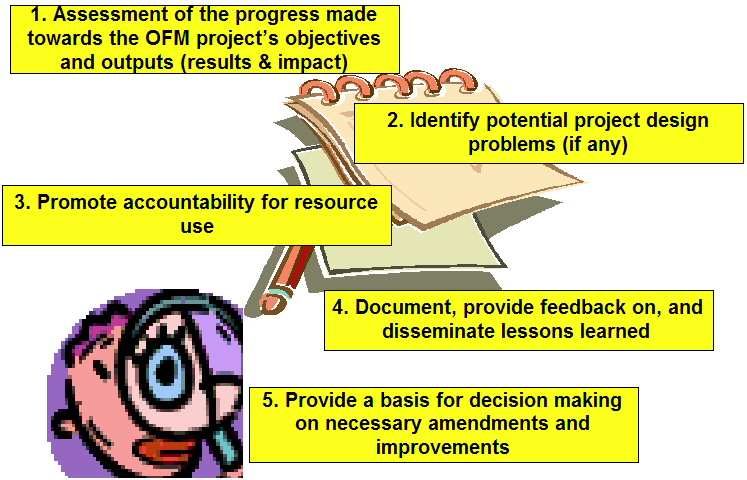
Evaluation MTR & Final
·
UNDP evaluation policy: Defines standards for
evaluation
·
Major responsibilities of UNDP COs :
Draft and review ToR
Selects consultants
Circulates to government and major
stakeholders
Follows up on management actions
·
MTR and FE reports sent to GEF M&E for
review and quality control
3
Objectives of OFM MTR
4
41
Scope
· Project Impact (Results)
& Design
· Project Management
and Administration
Evaluation
· Project Implementation
Report
· Project Finances
· Lessons learned
5
Evaluation Approach
· Baseline data and statistics - desk study review
of all relevant OFM Project documentation
· Fiji-based consultations
· Solomon Island & New Caledonia based
consultations
· Selected visits to countries for national and
regional impact analysis
· Validation through the Regional Steering
Committee/Multipartite Review Meeting
6
42
Evaluation Team
· Will comprise of 2 consultants - 1 team leader
and 1 Resource Specialist
· Team leader will be responsible for the overall
evaluation exercise & take lead in preparation of
the expected outputs
· Regional resource specialist will assist the Team
leader & in stakeholder consultations
· Overall supervision of the MTR will rest with the
UNDP-CO & UNDP RBAP
7
Timeline
Schedule
January
Call for expressions of Interests
February
Application submission deadline
February April
Selection process, contract
June
Evaluators commence evaluation
June
Evaluators assemble in Suva, Fiji for briefing by
UNDP and undertake Fiji based consultations
June
Evaluators assemble in Honiara, Solomon Islands
for consultations
July
Travel to New Caledonia, Cook Islands, Federated
States of Micronesia, Nauru and/or Samoa
10 August*
Draft Report completed
10September*
Final report completed
October (early)
Report presentation at RSC4, Solomon Islands by
Evaluation Team Leader
8
43
MTR Options
1.
1 Consultant to lead the MTR, with some country
consultations happening via telecom;
2.
2 regional consultants where a package is negotiated for
entire consultancy;
3.
Budget for MTE increased by 20K to cover costs of 2
consultants & travel;
4.
Consultants to be present in the margins of another fisheries
meeting & organise meetings with focal points; and
5.
Proceed as per current TOR where visits to countries are
strategised and most consultations happen via video and
telconf.
9
Recommendations
·
Consider options for MTR
·
Consider the Terms of Reference for
consultants that will be engaged in the
review; and
·
Endorse the evaluation approach,
context and timeframe.
10
44