N e w s l e t t e r
T h e M o n i t o r i n g N e w s l e t t e r
for the Tuna Fisheries of the Western and Central Pacific Ocean -- Issue #7 -- November 2007
Editor: Deirdre Brogan, Fisheries Monitoring Supervisor; Production: Oceanic Fisheries Programme, Secretariat of the Pacific Community,
BP D5, 98848 Noumea Cedex, New Caledonia. Tel: +687 262000, Fax: +687 263818, Email: observer@spc.int or portsampler@spc.int
(This edition is also available on the Oceanic Fisheries Programme website at: http://www.spc.int/OceanFish/Docs/Statistics/index.asp).
Printed with financial assistance from the Global Environment Facility and the European Union.
Welcome to another edition of Fork Length.We have broad-
ened Fork Length's focus to include the many different
aspects of the work that contributes to the proper scien-
tific monitoring of oceanic species in the western and cen-
Contents
tral Pacific Ocean. The newsletter will no longer be confined
to the work of shipboard observers and port samplers, but
DATA COLLECTION
will now include articles on all aspects of the oceanic fish-
eries data system, including collecting and managing infor-
· Unloadings data
p. 2
mation as well as reporting.
· Observer stomach
Infuture editions we'll review the different data types that
sampling identifies new
squid species
p. 4
make up a comprehensive tuna data system. To get things
started, this edition includes an article on unloadings data,
· Species identification
which are recorded by industry and help to verify catch and
manual published p. 5
effort information (i.e. logsheets). Unfortunately, the col-
lection of unloadings data needs to be improved, especially
· Photo competition p. 7
for some of the domestic longline fleets. In an effort to
bring attention to the problem, we look at some of the uses
DATA MANAGEMENT
of these data and discuss how they can be collected.
· Marshall Islands Oceanic
Monitoring Programme
The article on page 10 describes how the national monitoring
p. 10
programme in the Marshall Islands have tackled the responsi-
bilities of meeting both their national and regional data oblig-
· Tuna Data Workshop p. 13
ations. They have addressed earlier problems and are now pro-
ducing great results. If you've ever wondered how other pro-
DATA DISSEMINATION
grammes in the region go about their work, take some time out
· Stock assessment results
to read about how things are done in Micronesia.
p. 14
We've tried to provide something for everyone -- whether
· Data summaries p. 16
you're sampling, collecting information from industry or other
sources, or have been tasked with
TRAINING
either managing or reporting on
· Random sampling of
the data that your national fishery
purse-seine catches p. 18
offices collects. Don't miss our
first-ever photography competi-
· New recruits
p. 19
tion for observers and port sam-
plers. The prize is a generous one,
· Assistance from the
and details of the competition can
Hawaiian Observer
I
S
be found on page 7.
Programme
p. 22
S
· Wallis and Futuna has
N
1
Enjoy Fork Length!
two new observers p. 23
6
0
7
-
0
2
2
4
Fork length -- Issue #7 -- November 2007
2
DATA COLLECTION
Industry data
UNLOADINGS DATA: WHAT IS IT?
How is it collected?
Some data provide information about individual fish.
Other data are collected to provide information Unloadings data should be collected for all gear
about what is happening on a larger scale. One impor- types (i.e. longline, purse seine and pole-and-line),
tant data type -- unloadings data -- shows the total but the approach to recording and collecting the
weight of each fish species taken off the vessel fol- data may be dif erent. For longliners the fishing
lowing each fishing trip. Longline unloadings data also company generally records the actual measured
show the total numberof fish that were unloaded. weight of each individual tuna during the packing
process. This information -- the individual weights
There are other terms for unloadings data; the of exported fish -- is also known as "Packing List
most common is transshipment data. The defini- Data". The fishing company collects this informa-
tions given by the Merriam-Webster online dictio- tion for their own purposes so it should be readily
nary offer some insight into how these terms dif- available. The main challenge with longline unload-
fer. Unload"...to take off: deliver (2): to take the ings data is ensuring that every fish that was
cargo from ...". Transship "...to transfer for fur- unloaded is accounted for. This is especially true
ther transportation from one ship to another..."It for fish that are not immediately exported after
may be helpful to see transshipment (vessel to unloading, but may be marketed differently (i.e.
vessel whether at sea or in port) as a subset of sent to a cannery, the local fish market, or taken
unloadings. The Western and Central Pacific home by the crew). There are two regional stan-
Fisheries Commission (WCPFC) considers the dard unloadings forms for recording unloadings
unloading process to be something that takes information: the standard longline unloadings
place between a fishing vessel and either one or form and the longline unloadings destination form.
several carrier vessels, fishing vessels or unload- The longline unloadings destination allows coastal
ing facilities, which will process or further dis- states to collect economic statistics, which is
patch the catch. These terms are likely to evolve, often a national data reporting requirement.
especially as WCPFC focuses its attention on
improving transshipment procedures.
The transient and sporadic nature of purse-seine
vessel unloadings can test the data collection pro-
Why is it collected?
cedures in port state fisheries divisions; data col-
lectors must be organised and ready to go as soon
Unloadings data are required for each fishing trip as the first vessels arrive in port. Generally, purse-
operating in the region (that is, 100% coverage is seine unloadings data are supplied to fisheries
required). The true value of unloadings data is that departments by the carrier vessel (through its
it can be used to validate other data types, espe- agent), or during the final clearance before exiting.
cially logsheet information. It also has the potential A standard regional purse-seine unloadings form
to be more accurate than logsheet data. At least
two parties have an interest in ensuring that unload-
ings data are accurate -- the fisher or vessel oper-
ator who doesn't want to be paid too little, and the
buyer or fish processor who doesn't want to pay too
much. The needs of both parties help ensure that
accurate data are recorded. Furthermore, the
regionally agreed ban on high-seas transshipment
gives better access to unloading vessels, allowing
national fisheries staff access to cross-check and
verify the unloading information in a way that isn't
possible for catch and effort data. Collecting
unloadings data can also help to highlight vessels
that are not currently providing logsheets, which in
turn has the potential to shed light on any illegal,
unreported and unregulated (IUU) vessels.
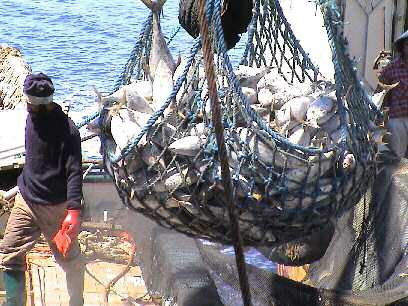
Unloading purse-seine catch
Fork length -- Issue #7 -- November 2007
3
formatted by the data collection committee (DCC)
is available online, along with other regional forms: How well are we doing?
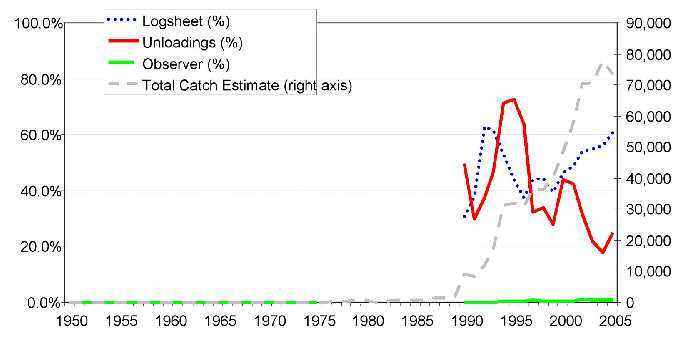
The longline unloadings coverage remains low,
http://www.spc.int/oceanfish/Html/Statistics/Forms/index.htm especially for the domestic longline fleet (see
But, it remains common for carrier vessels to submit graph below). Much work still needs to be done in
a "mate's receipt" when asked for unloadings infor- Pacific Island countries to improve the coverage
mation. While it is always better to work towards col- of unloadings data. WCPFC, through its Scientific
lecting the data using the standard form -- this and Technical and Compliance committees, is cur-
ensures all necessary information, as revised and rently reviewing the use, purpose and need for
reviewed by the DCC, is collected -- the mate's unloadings and transshipment data, and it is
receipt does provide much of the required unloadings expected that unloadings data will become a
information. Finally, pole-and-line regional unloadings WCPFC data obligation in the near future.
forms are also available and are used mostly by the
domestic pole-and-line fleet in the Solomon Islands.
Data coverage for domestic longline fleets
Sampling data
· BIOLOGY OF STRIPED MARLIN
by R. Keller Kopf*
Samples from New Caledonia and Fiji have been
particularly important because they include
Since 2006, observers throughout the southwest rarely seen juvenile striped marlin and also
Pacific have collected samples -- from 268 spawning females. A big thank you goes to the
striped marlin -- for age, growth, and reproduc- Fijian observer programme (which have been vital
tive studies. The project is aimed at determining to the project's success) for its focused efforts
the location and timing of spawning, age-at-matu- on collecting young striped marlin.
rity, size-at-age, and annual growth rates of
striped marlin in the southwest Pacific. Sample Preliminary data suggest that striped marlin
collections were initiated in New Zealand and spawn near 25°S from September through
Australia but have expanded into the tropical January, and the species may live beyond 12
Pacific with the assistance of SPC and longline years of age. Project sampling will continue
observers in New Caledonia and Fiji.
through 2008, so please contact Keller Kopf or
observer@spc.int if you are interested in help-
ing. T-shirts and other awards are available.
* R. Keller Kopf, Charles Sturt University, School of Agriculture and Veterinary Sciences, Wagga Wagga NSW 2670, Australia.
Email: rkopf@csu.edu.au
Fork length -- Issue #7 -- November 2007
4
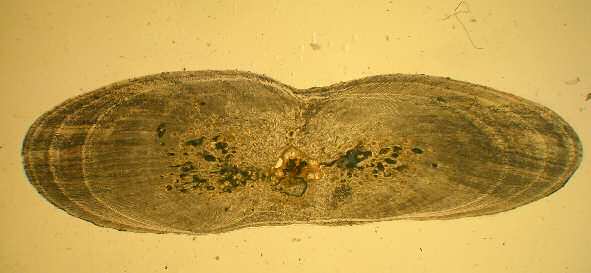
Cross-section of dorsal fin, spine number 5 from a 106 kg female striped
marlin. Note the three clearly visible bands on the outer edge of the spine.
Observer stomach sampling identifies new squid species
Observers from around the region have been asked
to help with sampling stomachs from mainly tuna, fish. In this indirect manner, lancetfish are helping
but also other fish. Stomach samples help scien- to improve our knowledge of the diet of tuna and
tists understand more about what fish eat, how other commercial pelagic species.
they behave and the oceanographic environments
they prefer. By collecting stomach samples from Lancetfish stomach contents have also helped to
mainly tuna, but also other pelagic species, shed light on some of the remote and more inac-
observers can help scientists explore what types cessible areas of the ocean. The lancetfish's abil-
of things tuna eat, how much they eat and how they
and other pelagic species interact. In this article
we look at one pelagic species that lives in the same
environment as tuna and often interacts with it.
While the stomach samples from this fish are
revealing interesting results, observers are
reminded that scientists require samples from all
species, especially tuna, so that they can gain a
better knowledge of how species that inhabit the
same pelagic ecosystem as tuna interact.
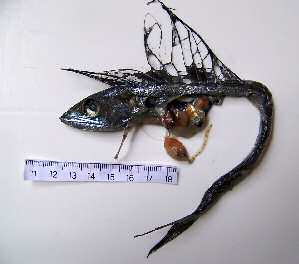
It may not be the prettiest species you'll ever
encounter on a longline vessel, but the lancetfish
(Alepisaurussp.) may turn out to be the most inter-
esting. Examination of the stomach contents of a
number of lancetfish has brought important infor-
mation to light. Surprisingly, the prey ingested dur-
ing feeding can be found whole and intact inside
these stomachs, having suffered no significant dam-
age from the digestion process, which takes place
mostly in the intestines. These lightly digested prey
are easier for scientists to identify, especially when
compared with the more heavily digested stomach
contents seen in other pelagic species such as tuna.
The stomach samples taken from lancetfish are now
being used as "reference prey", meaning they can
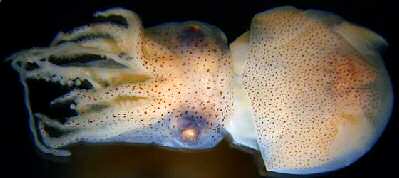
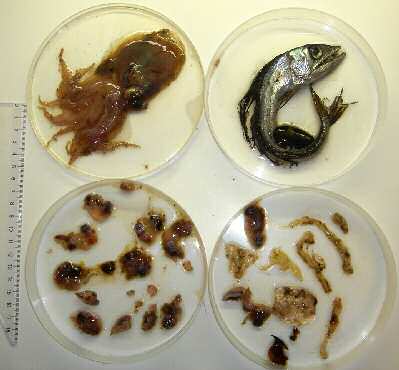
Top: Lancet fish stomach contents showing
help scientists to identify similar but more exten-
juvenile reef fish
sively damaged prey found in the stomachs of other Bottom: A new squid species. Family Sepiolidae
Photo: R. Young
Fork length -- Issue #7 -- November 2007
5
ity to consume and retain prey from these out-of-
the-way areas has recently led to the discovery sample received. More information is available
of new species. The stomach of a lancetfish col- from your observer coordinator. Perhaps your
lected by Charles Cuewapuru when fishing in New stomach sample will be the next one to reveal a
Caledonian waters contained three whole, well- new species to the world!
preserved squids that lab assistants could not
identify. After consultation with a squid expert in
Hawaii, it was found that these are new species
previously unknown to science. Countless more
unknown marine species are present in the ocean,
and stomach sampling is proving to be one way of
collecting these species. Just as importantly,
lancetfish stomachs also capture the fragile and
soft juvenile stages of many of the common
marine species, including pelagic and reef fishes.
This is crucial information that will help improve
our knowledge of commercial species.
The last lancetfish secret to be revealed is the
pleasure they seem to get from eating their mates!
It's not uncommon for lab technicians at SPC's
stomach sampling laboratory to find lancetfish
inside lancetfish inside other lancet fish.
Please continue to collect and ship more stomach
samples. Stomach sampling kits are available
from SPC and a financial reward is given for each
A selection of stomach contents
taken from a lancetfish
Summary of stomach sampling to date
Observer Programme
Number sampled and at SPC
Number examined, entered
Number that need to be
Number sampled and not yet
in the database
examined
received at SPC
Cook Islands
34
34
French Polynesia
105
67
38
FSM
51
81
30*
New Caledonia
60
60
SPC1
2275
307
1968
Samoa
13
13
Fiji
100
100*
Total
2538
374
2294
130
1PNG tagging trip
*Rec'd Oct' 07
Species Identification manual published
The introduction of the "Marine Species Identification
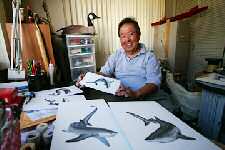
Manual for Horizontal Longline Fishermen" was a great name in four different languages. The manual has
step forward for tuna data collection. It is a high qual- been distributed to both observers and domestic
ity document with professionally painted fish pictures longline vessels in the Pacific, and has helped to
(the majority done by Hawaiian artist Les Hata, see improve the collection of information recorded on
photo).
both logsheets and observer forms.
The manual includes all of the major pelagic species
that interact with longline vessels in the Pacific
area. Each page of the manual shows a painting, the
3-letter FAO species code, a line diagram with the
main identification features, as well as the common
Fork length -- Issue #7 -- November 2007
6
The publication was a collaborative effort by
many people, with the outstanding contribution
being made by the hard working at-sea
Useful Group Codes
observers. The information collected by a multi-
tude of observers over a number of years was
BIL
Billfish
used to define the list of species included in the
MAR
Marlin
manual. If you're an at-sea observer and have
MAM
Marine Mammals
recorded information or taken photographs on
DLP
Dolphins
the type of species that interact with longline
ODN
Toothed whales
vessels, your work is included in this publication.
MYS
Baleen whales
WLE
Whales
TTX
Turtles
Your contribution is both acknowledged and
RMV
Manta and Devil Rays
appreciated -- thank you!
BIZ
Birds
U
SKH
Sharks
SING THE MANUAL
SPN
Hammerhead sharks
THR
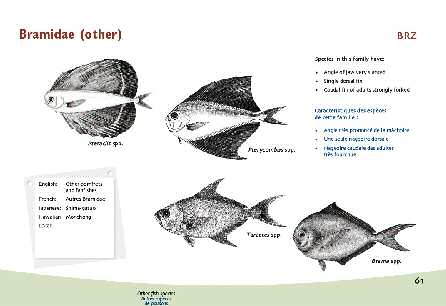
Some species in the manual are only described to
Thresher sharks
the group code level (that is a collection of similar
ALI
Lancetfish
fish, or fish from the same scientific family).
MOP
Sunfish
Group codes are helpful when the full species code
TRP
Dealfish
is not known or cannot be established. It is
not always possible to fully identify a species.
This may happen if there has not been enough
time to see the species, if it was struck off
before it was landed or had some identifica-
tion features removed (i.e. cut or bitten off).
Group codes are also effective if an observer
does not have enough experience to fully
recognise the species.
If it's not possible to record a full species code
then try to record a group code. Whenever
possible, avoid recording only the very basic
species code UNS -- (unspecified species), as
this gives very little information. However,
there will be times when the UNS species code
will be the only one that is appropriate to use.
If you do record UNS or group species codes, The group code BRZ (for pomfrets and other fan fishes)
try to provide a further description of the
is described in the longline species manual.
species by doing one of the following:
1) Taking some photographs of the specimen.
2) Bringing the specimen or parts of the speci-
men back to shore for further identification.
3) Drawing the species and writing a full descrip-
tion in the written report. Don't shy away from
this you may be surprised how revealing your
drawing can be even if you have no faith in your-
self as an artist. With this information your
debriefer and/or national coordinator may be
able to help you establish the full species name.
Some of the "rarer" species that will be encoun-
tered periodically on longline vessels may not be
pelagic (open ocean) species but rather deepwater
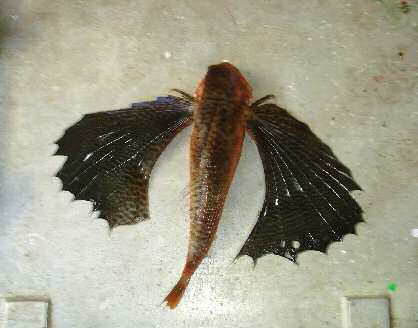
Flying gurnard
Fork length -- Issue #7 -- November 2007
7
or bottom dwelling (benthic) species that have Observers in some national programmes may
gone astray. These non-pelagic species are not encounter more deepwater species than others,
available in the longline species manual, but many especially if their vessels regularly fish close to
will be described in the soon-to-be-published SPC seamounts. Try to identify all rare species. Each
deepwater species guides. An example of a benth- national observer programme should aim to build up
ic species that recently interacted with a longline a reference folder showing the rarer species that
vessel is this flying gurnard (Dactyloptena orien- have been encountered. This will help when it
talis), which was observed by Steve Beverly.
comes to training both the active observers and
any new observers to join the team in later years.
Photography competition
Photographs taken by observers were found to be useful when compiling the identification manual. It is
also helpful to have good photographs for training purposes, and for enhancing publications and reports
on observer work. To encourage observers to take more photographs SPC & FFA are running a photo
competition for field staff (observers and port samplers), with three digital cameras offered as the
main prizes. There will be more than one chance to win, as the competition will be repeated in the future,
but the subject topic will be different. You can see the full details of the first competition on page 8.
Some tips for taking photos at sea
· Keep the sun behind you;
· Avoid taking photos in the mid-day sun;
· Watch out for shadows (especially your own) covering the fish. Bright cloudy days are best for photog-
raphy. Otherwise, it is best to take the photo in full shade with a flash or in full sun without a flash. Avoid
taking pictures in half sun, half shade;
· Use a contrasting background. Blue and green tarpaulins are recommended and a pile of netting is great
if it is not the same colour as the fish;
· Allow for some space around the fish if using a disposable camera (the viewer is somewhat misleading).
Whenever possible, focus in as close to the object as possible, so that there are no other distracting
objects in the frame;
· Try to take as many photos as you can. Take them from different angles as well as close-ups so that later
on you will have a choice of photos to pick from. You may only end up with one or two good photographs
even though you take 10 or more. Even professional photographers throw away more than 90% of their
photos;
· Ideally, a ruler should be placed in the photo so the size of the fish can be gauged. If you have no ruler
then place a well-known object such as a cigarette pack or pencil so that the fish size can easily be com-
pared;
· If possible, place a label with information about date, time position, etc., near enough to the pho-
tographed object for it to appear in the photo. But not somewhere that gets in the way or distracts from
the main subject of the photo;
· The international convention is that fish are placed with their head to the left of the photograph.
Fork length -- Issue #7 -- November 2007
8
RULES AND REGULATIONS
coordinators and are always available by
1. Photographs of the following three subjects request from observer@spc.int);
can be submitted:
· Tuna -- A single photo or a series of 10.In the unlikely event that none of the submit-
photos (three maximum)
ted photographs are thought to merit the
· Billfish -- A single photo or a series of
prize it will be held over and added to the
photos (three maximum)
next photographic competition;
· Purse-seine brailing--A single picture or
a series of pictures (five maximum);
11.Only photographs taken during 2007 and up
until 31 March 2008 should be submitted;
2. A single photograph or a sequence of pictures of
the same subject will make up one competition 12.Photographs that have been previously sub-
entry. A maximum of three pictures for each mitted to SPC/FFA will not be considered;
entry can be submitted for tuna and billfish, and
amaximum of five for purse-seine brailing;
13.Ashortlist of the top 20 entries for each sub-
ject will be selected by the Statistics Section
3. The participant (the photographer) must have of SPC and the Observer Programme of FFA.
completed an FFA/SPC basic observer training The winning photographs will be selected from
course or be a recognised SPC port sampler;
the shortlist by an invited judge;
4. Entries will be judged for both clarity and 14.One digital camera will be offered for what is
artistic value. The intention of the competi- judged to be the best photograph or series of
tion is to generate good photographs for photographs in each subject area;
training purposes and possibly fishery
reports. Participants should keep this in mind 15.The judgement of SPC and FFA will be final;
when taking their photographs;
16.Winners will be announced in the next (8th)
5. A participant can submit up to three entries edition of the Fork Length newsletter and/or
per competition. Any person found to be sub- by email to national observer coordinators on
mitting more than three entries will be dis- 1 June 2008;
qualified from the current and future compe-
titions;
17.All submitted photographs remain the proper-
ty of SPC and FFA and will not be returned at
6. The photograph can be either a digital or a the end of the competition. Should the photo-
hardcopy photograph. Digital photos must be graph be used in future SPC/FFA publications,
at least 300 dpi;
acknowledgement to the photographer will be
given;
7. All photographs must be submitted to SPC by
1 April 2008 (date of the email for electronic 18.The digital camera prize will have a maximum
submissions and the date of postmark for value of USD 200. The make and model of the
standard photographs sent in the mail). camera will be chosen by SPC and announced
Observer coordinators are asked to assist with the result of the competition. SPC will
competitors in sending email entries to not replace the digital camera prize with an
obsphotocomp@webmail.spc.int;
equivalent monetary amount. T-shirts and
caps may also be given as runner-up prizes.
8. All entries must be marked with the "name of
the subject/name of the participant" (e.g.
Tuna/Dike Poznanski). That is the file name
for electronic entries, or should be marked on
the back of the photograph for hard copy
entries);
9. All entries must come with a completed com-
petition entry form, signed by the national or
sub-regional observer coordinator. (Competi-
tion entry forms will be available from observer
Fork length -- Issue #7 -- November 2007
9
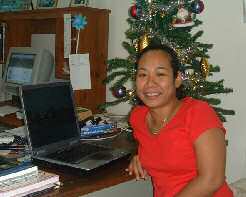
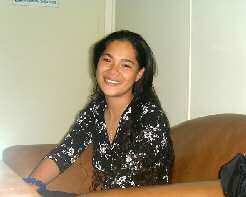
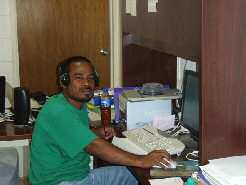
Time Out: Questions and answers with Fijian port samplers
· How many trained port samplers are there in
Fiji?
· How many days a week is port sampling done?
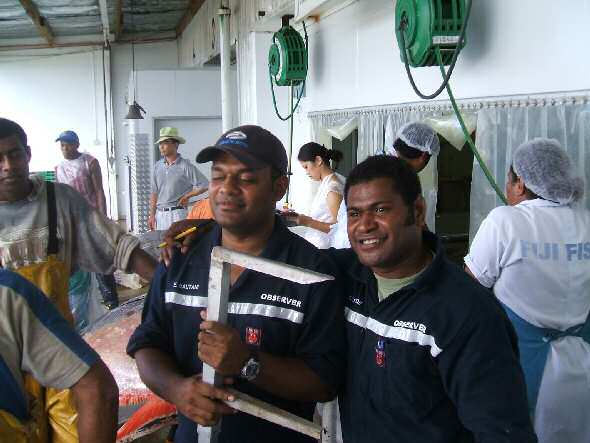
There is a team of 10 trained port samplers. three to four days.
The samplers also work as at-sea observers
and take up the port sampling work when not · How many vessels are sampled during a day?
observing.
Usually between one and three.
· How many unloading ports are there in Fiji? · Do you use callipers or measuring tapes to
There are four: Main port, Muaiwalu Jetty, measure fish?
Fiji Fish Jetty (all in Suva) and Levuka on Aluminium callipers.
Ovalau Island.
· Where are the callipers stored?
· How do you get to the port of unloading?
At the unloading port.
Transport is provided from the port samplers'
homes to the unloading port by the Ministry · Is the vessel's hold checked?
of Fisheries.
Yes, always.
· What type of vessels do you sample?
· Do you have anything to share with other port
Offshore longline vessels, distant-water long- samplers in the region?
line vessels and some purse-seine vessels that Always be at the port before the vessel
call into Levuka.
starts to unload. Be careful with the length
measurement and species code, and bring your
· What is the target coverage level?
species identification manual with you every
20%.
time.
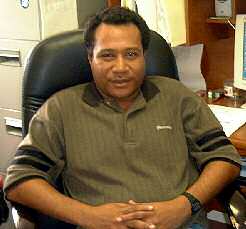
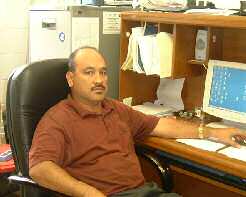
Fijian port samplers Eroni Bautani and Sailosi Naiteqe take time out.

Fork length -- Issue #7 -- November 2007
10
DATA MANAGEMENT
The Marshall Islands Oceanic Monitoring Programme
with Manasseh Avicks, Dike Poznanski and Berry Muller
Afull-time team of eight staff
and 20 contract samplers are involved. From their office in Majuro, the staff
employed in the oceanic divi- monitors a national fleet of five Marshallese
sion of the Marshall Islands purse-seine vessels (that landed 41,000 metric
Marine Resources Authority tonnes of tuna in 2006)1and 223 foreign-licensed
(MIMRA). The team work to vessels (that caught 12,919 metric tonnes of tuna
ensure that the Republic of in the Marshall Islands' exclusive economic zone
the Marshall Islands (RMI) fulfils its flag, -- EEZ -- during 2006). They also oversaw
coastal and port state data provision responsibil- approximately 750 longline unloadings and 100
ities to the Western and Central Pacific purse-seine unloadings in 2006 as part of their
Fisheries Commission (WCPFC), while keeping in port state responsibilities.
mind their own national data needs as established
by the RMI's 1997 Marine Resources Act. This A first-time visitor to MIMRA is struck by how
work is achieved alongside their reporting and close their offices are to the action. Situated on
compliance roles. Sam Bati (Deputy Director), an islet within the atoll, their workplace is only
Xavier Myazoe (Deputy Chief Licensing Officer), steps away from the unloading port, with locally
Berry Muller (Chief Oceanic Officer), Slam Kalen based foreign longliner vessels unloading their
(Assistant Licensing Officer), Manasseh Avicks fish almost on MIMRA's doorstep. These longlin-
(Observer Coordinator) and Dike Poznanski ers have links to China and the Federated States
(Assistant Observer Coordinator) are all of Micronesia (FSM), and appear at the local
"fish base" approximately every 10 days, eager to
MIMRA staff, from left to right and top to bottom: Xavier,
Berry, Eminra, Slam, Motelang, James and Manasseh.
(Dike is on the back page)
1. Data from Annual Report Part I Information on Fisheries, Research, and Statistics -- Republic of the Marshall Islands
presented to WCPFC SC3.
Fork length -- Issue #7 -- November 2007
11
unload their catch of large bigeye and yellowfin
tunas, which will be air-freighted to Japan for The collection of logsheet and port sampling data
the sashimi market. Despite the proximity of the is complemented by the collection of unloadings
main office to the longline unloading port, data. While the regional standard longline unload-
MIMRA made the decision to appoint and perma- ings form is in use, the collection method is some-
nently locate a new Port Sampler Supervisor what unique. The data are recorded electronical-
(James Elio) at the base. His presence has ly by the local fishing agent, and the MS Excel
already had a noticeable effect on the collection file is then forwarded by the agent to MIMRA via
of data from this locally based fleet. James has email. Finally, with the help of SPC the informa-
built a relationship with the fishing agents and tion is imported directly into the tuna fisheries
his presence is a daily reminder to them of their database (TUFMAN). Even though the data are
reporting requirements. This Marshallese initia- recorded electronically, the benefit of having an
tive is one that other countries in the region on-site staff member to remind fleet managers
could consider. James, in cooperation with the to send their Excel files in a timely manner can't
Port Sampling Assistant (Lomodro Jobas), col- be underestimated. James is also responsible for
lects the longline logsheets from either the fish- completing the Fishing Trip and Port Visit Log for
ing captain or the fleet manager before the ves- the locally based fleet. These data are used as
sel unloads its catch.
baseline information and help ensure that RMI
achieves full coverage for coverage for logsheet,
This team, supported by the port samplers, then unloadings and port sampling data.
proceeds to sample 100% of the vessels that
unload, and 100% of the fish that are unloaded. In The Marshall Islands strongly enforces the
fact, while the regional target for port sampling regional ban on transshipment at sea, while
coverage is 20%, MIMRA has shown their initiative actively encouraging the transient purse-seine
and set a national target of 100% coverage. Their fleet to unload in Majuro to allow some of the
motives are to improve data collection, to better positive economic benefits to flow to the local
capture data discrepancies, and to highlight any community. The re-opening of the local loining
illegal, unreported and unregulated fishing (IUU) plant in October 2007 will also ensure that purse-
vessels. Unloading is synchronised with the com- seine unloading will continue in the future. It's
mercial airline schedule, so the aluminium callipers easy for locals to follow the movements of the
are put to work on most Mondays, Wednesdays and purse seiners as they make their way in and out of
Fridays. It's a full day's commitment from the team the main lagoon to unload. At night their presence
(08:00 h to 17:00 h) and may extend to a 12-hour is even more obvious, as the bright deck and cabin
day if the fish are really biting.
lights light up the lagoon. While local residents
may be generally aware of the vessels' move-
ments, MIMRA staff carefully monitor all
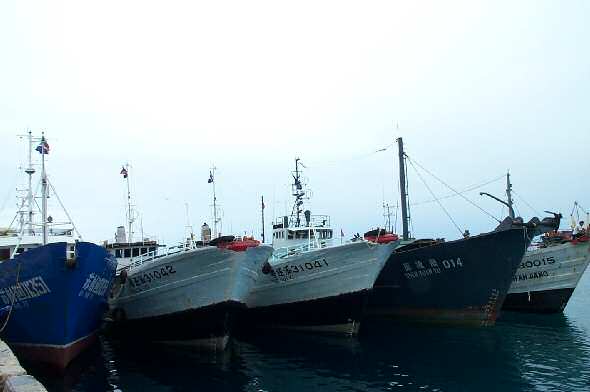
Longline boats line up at the "fishbase" in Marshall Islands
Fork length -- Issue #7 -- November 2007
12
licensed vessels from the moment
they move into the EEZ. Following
mandatory reporting by telex, a ves-
sel's arrival into the port of Majuro
is clearly marked on the large office
whiteboard that dominates the
oceanic division office. Despite a
strong computing environment, the
office whiteboard remains the
method of choice to ensure the
whole team is aware of which vessels
are in port, and which tasks need to
be completed. Vessels full with fish
and eager to unload are first met by
port inspection officers, who carry
out national boarding procedures
using the locally created boarding
checklist form. This work is carried
out by the licensing team with sup-
port from experienced observers.
Purse seiners moor a short distance
away from the "fish base". Transport
to the vessels is provided by vessel
skiffs during unloading hours (07:00
hrs 22.00 hrs). Port samplers (who
are locally known and legally referred
to in RMI as observers) are assigned
to every unloading purse-seine vessel,
unless the vessel has been sampled
by an at-sea observer. Lengthfre-
quency sampling is in keeping with the
regional norm of 20% coverage, and
regional standard purse-seine port
sampling forms are used. A national
monitoring form (the Purse Seine to
Carrier Report Form) tallies the net
movements and highlights any dis-
crepancies between the vessel unload-
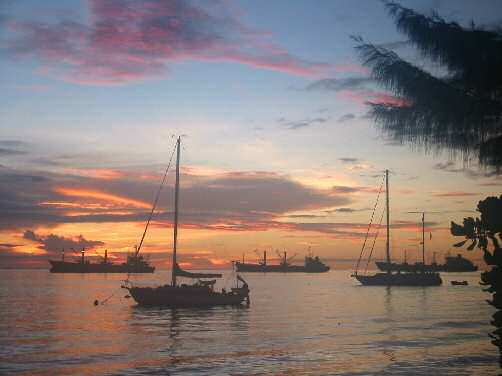
Majuro's busy lagoon (top)
ing tonnages and those of the MIMRA
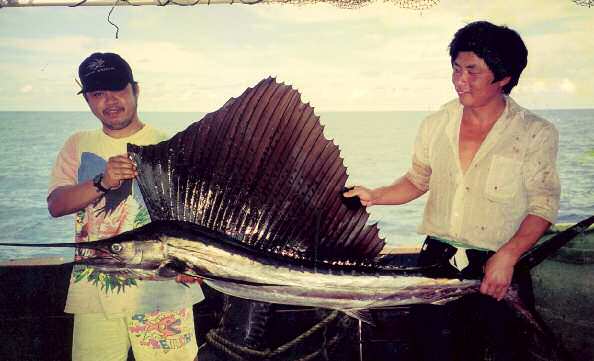
MIMRA's Director Glen Joseph on board
observer. The vessel unloading ton-
the F/V Zhong Yuan Yu 944 (bottom)
nages are recorded by the vessel on their mate's
receipt, and these are collected by the sampling
observer or the port inspection officer.
Although established in 1995, the national observer
programme became effective following the recruit-
More detailed fishery information is collected by ment of an overseas Observer Coordinator to inject
the observer programme. The Marshall Islands experience and onsite advice to the programme.
has a strong and growing national observer pro- Manasseh Avicks (a Solomon Islander) was chosen
gramme, and it may be the only place in the and recruited in late 2003 in a joint initiative
Pacific where the current Director of Fisheries between MIMRA and SPC. The appointment of
has actually carried out an observer trip. This Manasseh has had a positive impact on the Marshall
insight and MIMRA's acceptance of the benefits Islands observer programme, with consistent
of a national observer programme along with improvements in the number of trips and the sam-
their adherence to the regional observer policy pling coverage. In addition to the valuable experi-
has helped them develop a strong observer pro- ence Manasseh brought from outside RMI, the local
gramme that meets national needs and fulfils knowledge of Dike Poznanski, the Assistant
regional obligations.
Observer Coordinator, has also helped in developing
and shaping the local observer programme.
Fork length -- Issue #7 -- November 2007
13
Trained RMI observers typically board two dif-
ferent types of vessels. Most new observers help people out, but observers will be politely
start their careers with a trip on locally based directed back to their fishing agent or their own
foreign longliners. These vessels generally stay national observer coordinator if they abuse their
at sea for around 10 days; while the trips aren't welcome". The follies of a few can affect the rep-
long, conditions are far from luxurious. There are utation of all observers; hopefully in the future,
cockroaches, and the day's menu can be as much all transient observers will behave in a manner
of a personal challenge as the language barrier. that respects both their host's welcome and their
However, they also get a chance to board purse- colleagues' professional reputations.
seine vessels with far superior living conditions.
As Majuro is a busy purse-seine unloading port, The Marshall Islands observer programme is per-
and RMI is a signatory to the sub-regional observ- forming well. They have benefited from a high
er programmes (the United States Multilateral number of basic observer trainings, and past
Treaty and the FSM Arrangement), purse-seine problems relating to keeping trained observers
trips make up a large proportion of any local on the team are slowly being resolved. With
observer's trips.
debriefing in place and a clear intention to meet
regionally recommended coverage levels, and
Marshallese observers don't just encounter fish. excellent ongoing support from their Director,
Being stationed at a major transshipment port, RMI's national observer programme is currently
they may well meet some of their regional peers one of the most dynamic in the region. The
who end their observer trips in the port of broader oceanic fisheries team has also worked
Majuro. The Flame Tree Hotel is a recognised consistently over the last few years to improve
haunt for transient observers seeking to share the collection and management of information
experiences, and a warm Pacific welcome is required to monitor migratory oceanic species,
extended to all visiting observers. Unfortunately, and have made impressive improvements:
this welcome has been abused on occasion, and it logsheet and unloadings data coverage has
is not MIMRA's responsibility to help out irre- increased exponentially and is now close to 100%.
sponsible observers. As Manasseh puts it When asked what their secret was they replied
"Everybody gets one chance. We are happy to "It has to come from the heart".
Tuna Data Workshop
The inaugural Tuna Data Workshop (TDW-1) took
tuna statistics staff away from their desks for The full report of the workshop is available from
one week, brought people together, and allowed the Global Environment Fund's Pacific Islands
them the time and space to reflect on tuna data Oceanic Fisheries Management project website
systems while enjoying the congenial settings of http://www.ffa.int/gef/node/31. The Global
SPC's conference centre. Presentations from SPC Environment Fund was the main sponsor of the
and FFA staff provided background material and workshop.
up-to-date information to generate discussion and
to stimulate problem-solving in small working A second Tuna Data Workshop (TDW-2) is
groups. The workshop concentrated on data col- scheduled for the first quarter of 2008. The
lection; topics included the reasons for collecting
data, national and regional data obligations, types
of data to collect, "best practices" for tuna data
systems, and tuna fishery data collection system
problems and solutions.
The workshop produced a checklist (see page 14)
for establishing or reviewing tuna fishery data
collection systems.
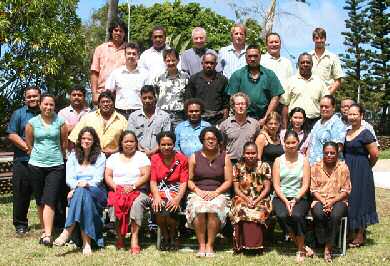
Participants of the first Tuna Data Workshop

Fork length -- Issue #7 -- November 2007
14
second workshop will build on the experiences of
the first workshop, with data dissemination or system. Much like TDW-1, the workshop will use a
data reporting, becoming the main focus. The combination of presentations, group discussions
workshop's main objective will be for participants and exercises to help participants acquire the
to acquire the understanding and skills necessary skills needed to produce National Fishery Reports
to produce annual catch estimates for their for the WCPFC Scientific Committee meetings. It
national fleets, which is their main data-report- is also expected that time spent at the workshop
ing obligation to the WCPFC. TDW-2 wil help will give participants a better understanding of
participants explore the data methodologies that the best practises for scientific monitoring of
are best suited to their own national tuna data their oceanic fish stocks at the national level.
TUNA DATA SYSTEM CHECKLIST
1. Obligations for collecting data*
2. Functions of data to be collected are described
3. Protocols/methods for collection/submission*
4. Reference to data collection forms to be used*
5. Required "coverage" of data*
6. Resources and training required are available (e.g. where does funding come from)
7. Schedule for the provision of data*
8. Consequences for non-compliance in collection and provision of data*
9. Contact points for data*
· Who records the data
· Who provides the data (e.g. Fishing Company representative)
· Who receives the data (Fisheries Division staff member)
· The respective liaison points in regards to problems with data
· Procedures for liaising with respect to problems with data*
10. Quality control procedures (in the data collection system; e.g. audit/reviews)
11. Feedback mechanisms from data management (mechanisms/procedures for data management staff
to liaise with data collection staff, e.g. on data quality issues)
12. Data security issues in data collection (addressing both Fisheries Division and Fishing Companies
concerns)
13. Mechanism for integrating/sharing data collection systems with other countries
* indicates items suggested for inclusion in conditions for fishing access
DATA DISSEMINATION
Current stock assessment results delivered
at the Third WCPFC Scientific Committee Meeting
WHAT TUNA WERE CAUGHT IN 2006?
less than the record in 2005 (2,204,335 mt).
The provisional catch of tuna in the Convention About 70% of the catch (1,537,524 mt) was skip-
Area (the Convention for the Conservation and jack tuna, which
Management of Highly Migratory Fish Stocks in was the highest
the Western and Central Pacific Ocean) for ever, continuing the
2006 was estimated at 2,189,985 mt, the second trend of consecu-
highest annual catch recorded, and only slightly tive record catches
since 2002. The

Fork length -- Issue #7 -- November 2007
15
yellowfin catch (426,726 mt 19%) was about 5%
lower than in 2005, but still around the average The 2006 South Pacific albacore catch was esti-
catch level for the period since 2000. The mated to be about 68,000 mt. Most of the catch
Convention Area bigeye catch for 2006 (125,874 is taken by longline, and albacore represents a
mt 6%) was also lower than in 2005, but slight- significant component of the catch by domestic
ly higher than the average catch level for the longline fisheries. The latest stock assessment
period since 2000.
for albacore indicates that the current catch
levels are sustainable and the stock could sup-
W
port higher yields. However, increased catches
HAT IS THE CURRENT STATUS OF TUNA STOCKS
may reduce the abundance of species and, conse-
IN THE CONVENTION AREA?
quently, catch rates for the longline fishery may
The results of a recent stock assessment indi- fall below economically viable levels.
cated that the "bigeye stock is not currently in
an overfished state; however, exploitation rates MEETING OUTPUTS
are high and current levels of catch are not sus-
tainable in the medium term". In response to Six specialist working groups make up the WCPFC
these results, the WCPFC Scientific Committee Scientific Committee. These are the Biology,
recommended a 25% reduction in fishing mortal- Ecosystem and Bycatch, Fish Technology, Methods,
ity (fishing effort) to prevent the stock from Stock Assessment and the Statistics Specialist
being overfished. In simple terms, this means Working Group. While outputs from all these work-
that while there are still enough bigeye in the ing groups do have relevance for scientific monitor-
western and central Pacific Ocean (WCPO) to ing staff the most relevant group is the Statistics
maintain their total numbers by reproduction, Specialist Working Group (ST-SWG). We have
there are only barely enough, and there are high reported on some of the meeting outputs here.
risks that by continuing to catch the same num-
ber of bigeye the overall total number of bigeye Overviews of Gaps / Issues with Data
might be reduced in the coming years, especially
if changes in some environmental factors (such The list of outstanding data that was recently
as water temperature) were to cause more nat- submitted to the WCPFC was presented. It was
ural deaths or reduce reproduction.
noted that important data gaps still exist and
include data from the Indonesian and Philippines
The stock assessment results maintain that "the domestic fisheries as well as the distand-water
yellowfin stock in the WCPO is not in an over- longline fishery. The impact of data gaps (includ-
fished state although there is a considerable ing late and/or absent data) on the stock assess-
probability that overfishing is occurring. Any ments result and, thus, the ability of the WCPFC
future increase in fishing mortality would not to provide the best available advice was dis-
result in any long-term increase in yield and may cussed. Access to a database that will highlight
move the yellowfin stock to an overfished state". important data gaps should be available from the
This means that current yellowfin catches are at WCPFC website in the coming year.
the maximum level that can be supported by the
stock over the long term. Any further increase in
fishing effort is likely to reduce the stock's abil-
ity to sustain the current catch level.
The total skipjack catch in 2006 was estimated
to be 1,537,000 mt -- the highest on record.
While no formal stock assessment was conducted
this year, all indicators suggest that "the skip-
jack tuna stock of the WCPO is not overfished
owing to recent high levels of recruitment and a
modest level of exploitation relative to the
stock's biological potential". This means that the
skipjack stock is still in a healthy state. The
recent high levels of catch have been attained by
an increase in recruitment and higher levels of
fishing effort by the purse-seine fleet.
Fork length -- Issue #7 -- November 2007
16
Regional Observer Programme
4. Sample other biological parameters, such as
The scientific objectives and priorities for the gender, stomach contents, hard parts (e.g.
proposed Regional Observer Programme (ROP), otoliths, first dorsal bone), tissue samples,
as well as data standards, were discussed and and collect data to determine relationships
accepted by the ST-SWG (see below). At the between length and weight, and processed
end of the discussion, over 100 data standards or weight and whole weight;
data fields were accepted as the starting point
by the group. However, a large number of data 5. Record information on mitigation measures
standards still require discussion and this will be utilised and their effectiveness; and
done through the Intercessional Working Group,
or the WCPFC. We hope to report on this in the 6. Record information on the catch and fishing
next edition of Fork Length.
effort during baitfishing, when baitfishing is
undertaken by the tuna fishing vessel.
For now the accepted scientific objectives and
priorities for the ROP are to:
Procedures for the provision of annual catch
estimates and effort and size data
1. Record the species, fate (retained or discard-
ed) and condition at capture and release (e.g. These procedures were fine-tuned and updated
alive, barely alive, dead etc) or the catch of by the ST-SWG. The latest edition of these
target and non-target species; depredation important data procedures is available as
effects; and interactions with other non-tar- Appendix IV of the Third Regular Session of the
get species, including species of special inter- Scientific Committee (SC3) report.
est (i.e. sharks, marine reptiles, marine mam-
mals and sea birds);
Data confidentiality, security,
and dissemination
2. Collect data to allow the standardization of
fishing effort, such as gear and vessel attrib- It is likely that the WCPFC will put into place the
utes, and fishing strategies. etc;
new information security policy that was presented
and discussed at SC3. New revisions to the rules
3. Sample the length and other relevant mea- and procedures for access to and the dissemination
surements of target and non-target species; of data were accepted by the ST-SWG.
Data summaries
Summary of completed observer trips for all observer programmes*
2005
Observer Programme
Gear
Number of Trips
Fiji
L
39
Federated States of Micronesia
L
8
Kiribati
L
1
Marshall Islands
L
26
New Caledonia
L
4
French Polynesia
L
17
Papua New Guinea
L
20
Palau
L
1
Tonga
L
1
Solomon Islands
P
9
FSM Arrangement
S
51
Federated States of Micronesia
S
11
Kiribati
S
1
Marshall Islands
S
17
Papua New Guinea
S
135
Solomon Islands
S
35
US Treaty
S
15
Fork length -- Issue #7 -- November 2007
17
2006
Observer Programme
Gear
Number of Trips
Fiji
L
27
Federated States of Micronesia
L
11
Kiribati
L
3
Marshall Islands
L
63
New Caledonia
L
7
French Polynesia
L
20
Papua New Guinea
L
14
Tonga
L
19
Western Samoa
L
2
FSM Arrangement
S
56
Federated States of Micronesia
S
7
Kiribati
S
13
Marshall Islands
S
19
Papua New Guinea
S
138
US Treaty
S
14
Summary of port sampling data*
Size Sampling
2005 - Country
Port
Gear
Vessels
SKJ
YFT
BET
ALB
OTH
TOT
American Samoa
Pago Pago
L
104
1,233
2,120
824
17,874
570
22,621
Cook Islands
Avatiu
L
2
0
45
21
13
67
146
Levuka
L
55
134
127
47
25,376
0
25,684
Levuka
S
3
3,988
239
123
0
0
4,350
Fiji
Suva
L
93
1,467
19,212
4,995
46,586
20,310
92,570
Fiji Total
5,589
19,578
5,165
71,962
20,310
122,604
Pohnpei
L
26
0
1,290
905
19
1
2,215
FSM
Pohnpei
S
4
600
0
0
0
0
600
FSM Total
600
1,290
905
19
1
2,815
Majuro
L
40
0
3,489
4,872
8
10
8,379
Marshall Islands
Majuro
S
12
5,993
610
368
0
17
6,988
Marshall Islands Total
5,993
4,099
5,240
8
27
15,367
Koumac
L
9
0
2,445
498
14,399
2,860
20,202
New Caledonia
Noumea
L
8
0
1,621
188
3,490
1,407
6,706
New Caledonia Total
0
4,066
686
17,889
4,267
26,908
Niue
Alofi
L
6
191
163
18
400
93
865
French Polynesia
Papeete
L
59
66
6,056
7,191
21,387
7,922
42,622
Palau
Koror
L
147
0
44,603
24,126
31
1,208
69,968
Tonga
Nuku'alofa
L
15
137
3,176
1,923
6,913
7,861
20,010
Samoa
Apia
L
41
1,330
3,914
1,350
30,369
3,881
40,844
Size Sampling
2006 - Country
Port
Gear
Vessels
SKJ
YFT
BET
ALB
OTH
TOT
American Samoa
Pago Pago
L
99
1,244
1,421
917
21,771
757
26,110
Levuka
L
41
386
11
6
22,339
0
22,742
Fiji
Suva
L
13
220
3,116
707
3,587
5,163
12,793
Fiji Total
606
3,127
713
25,926
5,163
35,535
FSM
Pohnpei
S
34
7,894
21
0
0
0
7,915
Majuro
L
50
0
21,586
22,781
3
1,298
45,668
Marshall Islands
S
30
13,271
977
506
0
0
14,754
Marshall Islands Total
13,271
22,563
23,287
3
1,298
60,422
Koumac
L
13
0
3,969
343
16,484
3,049
23,845
New Caledonia
Noumea
L
2
0
244
29
278
130
681
New Caledonia Total
0
4,213
372
16,762
3,179
24,526
Niue
Alofi
L
1
101
188
112
541
420
1,362
French Polynesia
Papette
L
54
49
2,289
4,526
34,821
8,690
50,375
Koror
L
152
1
39,201
37,812
26
1,712
78,752
Palau
Malakal
L
106
0
9,269
5,717
1
164
15,151
Palau Total
1
48,470
43,529
27
1,876
93,903
Tonga
Nuku'alofa
L
15
1,238
4,566
2,383
12,255
5,152
25,594
Samoa
Apia
L
13
44
756
146
1,907
193
3,046
* All data received and registered at SPC by Sept 2007
Fork length -- Issue #7 -- November 2007
18
TRAINING
Random sampling of purse-seine catches
Large numbers of individual fish are caught and
landed by purse-seine vessels. It is not physical- it was the first fish you sampled that day. It is not
ly possible for samplers to measure every one of feasible to carry out sampling while blindfolded, but
these fish. To get around this problem, purse- this is ideally how sampling should be carried out.
seine fish are generally sampled randomly.
Random sampling is a vital competency for every Never choose a fish because you think it hasn't
purse-seine sampler and every active sampler shown up on your data form recently. If you've
should be able to demonstrate physically and seen some bigeye tuna in the catch, but have not
convey verbally the important aspects of this measured any during your sampling session, that's
technique when required. Are you sure that you okay. Do not worry about the results you get.
are carrying out your random sampling correctly?
Do you think you would pass a competency test? If you have carried out your random sampling
correctly your results will always be right
Please take the time now to review the correct pro-
cedures for random sampling. Talk about random NEVER be tempted to collect a fish because:
sampling with your colleagues and your coordina-
tors. Describe to them exactly how you are carry- · you haven't sampled that species yet;
ing out your random sampling. They can help you
decide if you are doing it correctly. One reason that · you haven't sampled that size of fish yet
random sampling must be carried out correctly is (either very large or very small fish);
because only one fish among thousands in the ocean
is sampled, therefore a small sampling mistake may · it looks good;
be multiplied thousands of times when the informa-
tion is used to calculate the whole tuna population. · it's easier to lift out than other fish.
For random sampling, samplers are normally asked Do not let the crew select the fish for you. They
to take five fish from every brail/net that they have not been trained to carry out random sampling
sample. The key to random sampling is to always col- and are quite likely to make an incorrect selection
lect the first fish that come to hand. The main dif- (i.e. they might choose the largest fish). Try to
ficulty with carrying out this technique is that as come up with your own random sampling technique
random sampling continues, samplers can uncon- and stick to it. Some suggested random sampling
sciously build up a prejudice about which type of methods include: Selecting an area of the net,
fish they think they should choose next. They may preferably an area close to you, and grabbing all the
think, "I haven't recorded any small skipjack yet", fish whose tails point towards you; or selecting a
and then go ahead and unconsciously select that small area of the net and taking all the fish that
fish. Clear your mind and collect the next fish as if land there; or selecting an area of the net and grab-
bing all the fish whose heads point towards you.
One other thing to remember, however, is that
when you select a particular area of the net to
sample from, give some thought as to how or why
the fish got to that area. If they have the same
chance as every other fish in that brail to get to
that area, regardless of their species or size,
then it is a good area to sample from. If, howev-
er, only smaller fish can reach that area -- per-
haps because it is a corner -- then this is not a
good area to sample from.
There may be some physical restrictions to car-
rying out random sampling properly, such as when
Avoid pre-selecting or choosing fish
the brailing is too fast or the fish are too large
when random sampling
to remove. If these physical restrictions exist,
Fork length -- Issue #7 -- November 2007
19
try to reduce the number of species that are
sampled (normally five). If it is still not possible your sampling form and either stop sampling or
to carry out random sampling, explain this on choose a different sampling protocol (i.e. non-
random species sampling).
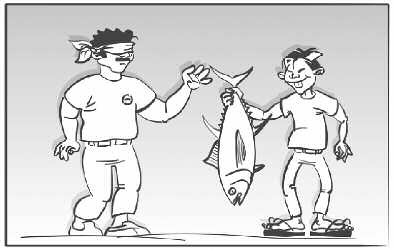
RANDOM SAMPLING IS IMPORTANT.
TAKE THE TIME TO LEARN THE TECHNIQUE AND TO CARRY IT OUT PROPERLY.
New recruits
by Siosifa Fukofuka
Eighty-eight new observers have joined our ranks since 2004; below is an outline of the training
courses that have been held since then.
Country
Start Date Number of Number of
participants certified
observers
Marshall Islands
Jan-05
14
10
Federated States of Micronesia*
Apr-05
12
9
PNG
Jul-05
20
16
Samoa*
Aug-05
10
9
Marshall Islands
Feb-06
15
7
Palau
Jun-06
12
12
PNG
Jul-06
16
15
Marshall Islands*
Feb-07
9
5
Tonga
Aug-07
8
5
*Sub-regional courses
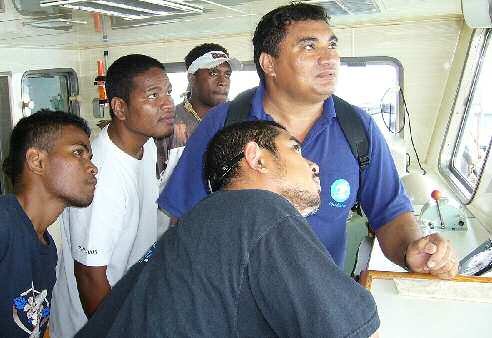
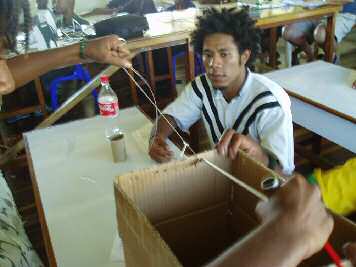
A look around the wheelhouse during
basic training in the Marshall Islands
Fork length -- Issue #7 -- November 2007
20
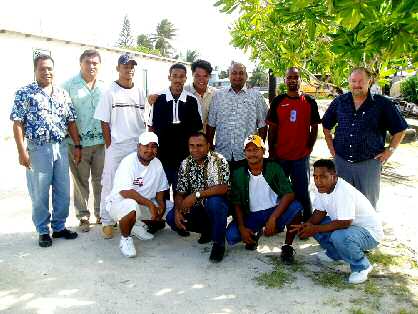
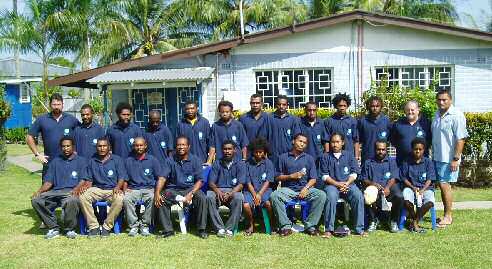
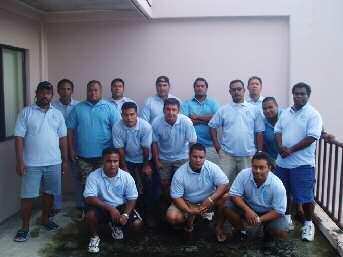
· Marshall Islands
25 January11 February 2005
Fourteen trainees attended the training after
passing the selection test. Ten trainees were
certified with SPC/FFA certification.
Back row: Manasseh Avicks (MIMRA
Coordinator), Siosifa Fukofuka (SPC),
Gordon Paul, Leban Jelton,
Lino Thompson, Dickson Betti,
Laan K. Loran, Karl Staisch (FFA)
Front row: Chris Alberttar,
Waisiki Baleikorocau,
Embi Ruben, Franny Zacharaia
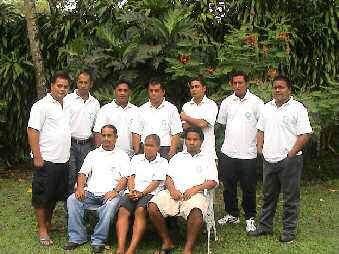
· Federated States of Micronesia Course
18 April6 May 2005
Nine new observers received SPC/FFA certifica-
tion. Two participants were from Palau, two from
Nauru and eight from FSM. Staff from the US
National Marine Fisheries Service (NMFS) in
Hawaii assisted with the course, especially with
the identification of species of special interest
and de-hooking presentations.
Learning to dehook turtles
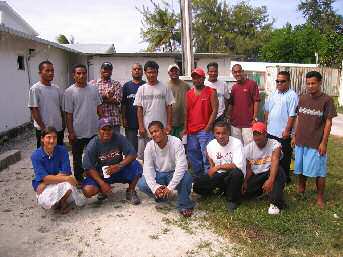
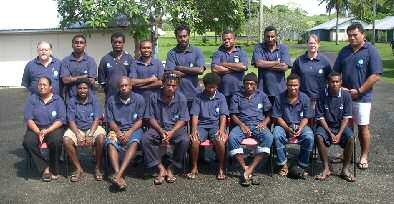
· Papua New Guinea
421 July 2005
In July 2005, 20 participants, select-
ed from a pool of over 1000 appli-
cants, attended a course conducted
by SPC, FFA and the PNG National
Fisheries College (NFC).
This basic observer course was the
seventh conducted in PNG by SPC/FFA
since 1996. Trainees attended the
course for five weeks with three
weeks for the observer component
carried out by SPC/FFA and two
weeks for sea safety, fire fighting
and first aid carried out by NFC.
Sixteen observers were eventually Back row: Joe Arceneaux (NMFS), Jaremiah Kuau, Lindsay
certified. Three female participants Kovero, Douglas Kenats , Simon Tibli, Michael Chamoko,
Walter Rusiat, Kaluwin Pondros, Groverto Kukuh, Miller
attended the course and two were Loras, Udill Jotham, Karl Staisch (FFA), Siosifa Fukofuka
certified.
(SPC); Front row: Cosmas Hecko, Garry Elias, Ilaitia
Taudarepa, Lyndsay Mundri, Emil Billy, Suluet Elaizah ,
Kerry Ragagalo, Elsie Gemelaia, Keith Agen, Sylvia Lohumbo
Fork length -- Issue #7 -- November 2007
21
· Samoa
29 August16 September 2005
Back row: Michael Forsyth, Matele Ievali,
Kimaere Biteiti (Kiribati), Steven Ve'a Neufeldt,
Mijieli Vakatubou (Fiji),
Kirennang Tokiteba (Fiji)
Front row: Sataraka Solomona,
June Kwanairara (Solomon Islander FFA),
Patrick Itara (Kiribati)
· Marshall Islands
13 February3 March 2006
Front row: Oriana Villar (NMFS),
Lenest Debrum, Leto Toto, Cliff Phillip,
Atran Samuel, Caston Caleb, Johnny Debrum
Back row: Helmer Mote, Alington Abij,
Frank Ward, Fred Mckay, Faliton Aisea,
Paulwin Jennop, Johnny Debrum,
Caston Caleb, Sashimi Debrum,
Paulton Mote, Lawremce Jitiam
· Palau
1230 June 2006
Back row: Johnny Sambal, Moses Nestor,
Kitridge Worstwick (Yap),
Masubed Tkel, Dominic Kyota
Second row: Fred Ramarui, Ricky Narruhn
(Pohnpei), Ian Tervet, Samuel Ldesel,
Jesse Rumong, Allen Maldangesang
Front row: Jim Kloalechad, Erwin Edmond
(Pohnpei), Moses Nestor, Rngei Taima
· Papua New Guinea
1228 July 2006
Sixteen trainees attended the courses. Most
trainees were previously employed as port samplers
based out of the six PNG unloading ports (Madang,
Rabaul, Kavieng, Wewak, Port Moresby and Lae).
Fifteen participants completed the course.
Back Row: Karl Staisch (FFA), Rakum Tumaleng,
Ashley Barol, Lawrence Pero, Elizah Lucas, Towai
Pelly, Ben Oli, Mathew Suarkia, Gauwa Gedo,
Dawn Golden (NMFS), Siosifa Fukofuka (SPC)
Front Row: Joyce Akaru (NFA), Jacinta, Robert
Rarap, George Pomat, Suluet Elaizah, John Igua
Dickson Ronney, Daniel Sau
Absent: Ataban Gibson
Fork length -- Issue #7 -- November 2007
22
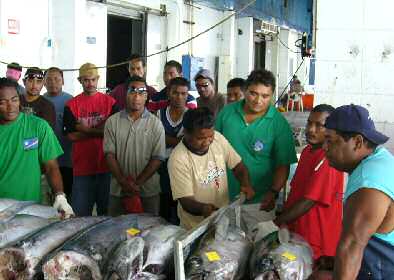
· Marshall Islands
28 February20 March 2007
Tuna longliner unloading in Majuro. New
trainees (FSM and Marshalls) watch the
Marshall Islands port sampler Lomodro Jibas
at work measuring tuna.
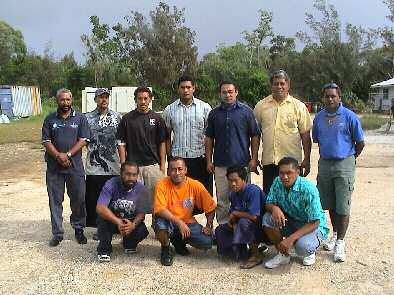
· Tonga
122 August 2007
The basic observer training course carried out in
Tonga was noteworthy for a number of reasons. Also, PNG had the foresight to send one of their
The main trainer (Siosifa Fukufuka) was Tongan, of own senior observers, Glen English, to the train-
course, but FFA was represented by Ambrose ing to contribute as a trainer as they develop
Orianihaa (and not Karl Staisch) for the first time. their own path towards a national capacity for
observer training.
Standing: Glen English (PNG), Mehesala Tupou,
Sione Manu, Tonga Tuiano, Taani He, Ambrose
Orianihaa (FFA)
Front row: Siosifa Fifita, Mosese Mateaki,
Penisoni Vea, Siosifa `Amanaki
Absent: Sione Mahe
· Assistance from the Hawaiian Observer Programme
(NOAA National Marine Fisheries Service)
Trainers and debriefers from Honolulu provided
assistance for most of the above training courses,
especially in the identification and handling of marine
mammals and sea turtles. Fork Length would like to
acknowledge their contribu-
tion to the SPC/FFA observ-
er courses, keeping both the
trainees and the SPC/FFA
trainers up-to-date on these
important subjects.
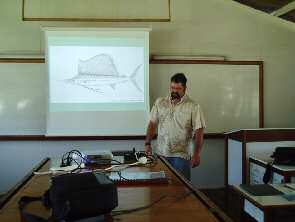
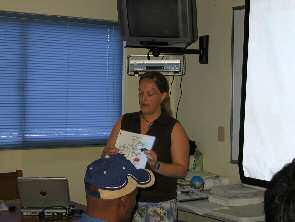
Left: Stuart Arceneaux (Joe)
Some debriefers who
going through billfish identifi-
assisted with the training
cations, PNG course 2006
were Adam Baily, Colleen,
Right: Dawn Golden in Class,
Oriana Villa and Tom
FSM course - Pohnpei 2005
Swenarton.
Fork length -- Issue #7 -- November 2007 23
· Wallis and Futuna has two new observers
by Charles Cuewapuru
After passing the pre-selection test conducted
locally by the "Service de l'Économie Rurale et de la
Pêche du Territoire de Wallis et Futuna" two new
observer candidates were flown to New Caledonia to
take part in longline observer training. The course
was held by SPC (with Charles Cuewapuru as the
main trainer) and the local marine school. The train-
ing course was run during November (2006) and con-
sisted of two weeks of class work followed by a 15-
day dishing trip onboard the local longline fleet.
At the end of their training, the observers flew back
to Wallis and Futuna, where it is hoped they will play
an important role in the observation of the new
exploratory fishing campaign that is expected to
start up. This exploratory fishing, by a commercial
company, hopes to gauge the potential for the com-
mercial fishing of pelagic fish (including pomfrets),
deepwater snappers and groupers. Because none of
these stocks have ever legally been fished intensively
for profit, the work of the observers will allow scien-
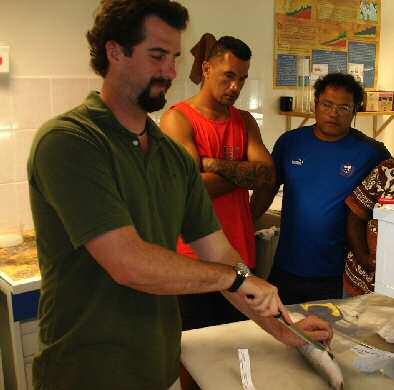
tists to survey the fishery both before, during and Keller Kopf (Charles Sturt University) explains
after this potential new fishery is developed.
sampling techniques to the new Wallis and
Futuna recruits Salua Wilfrid
and Valetino Polelei
© Copyright Secretariat of the Pacific Community, 2007
All rights for commercial / for profit reproduction or translation, in any form, reserved. SPC authorises the partial reproduction or translation of
this material for scientific, educational or research purposes, provided that SPC and the source document are properly acknowledged. Permission
to reproduce the document and/or translate in whole, in any form, whether for commercial / for profit or non-profit purposes, must be requested
in writing. Original SPC artwork may not be altered or separately published without permission.
Original text: English
Secretariat of the Pacific Community, Marine Resources Division, Oceanic Fisheries Programme, BP D5, 98848 Noumea Cedex, New Caledonia
Telephone: +687 262000; Fax: +687 263818; E-mail: observer@spc.int; http://www.spc.int/OceanFish
Around the region
It looks like tuna are not the only migratory species in the Pacific Islands. Below are staff from the
region who have recently taken up new monitoring-related positions, as well as other travelling staff.
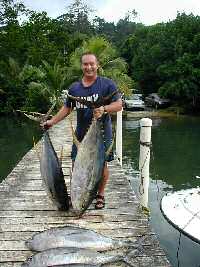
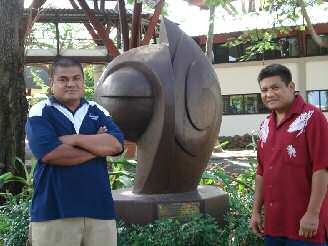
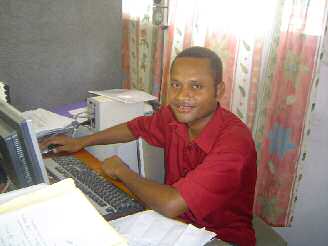
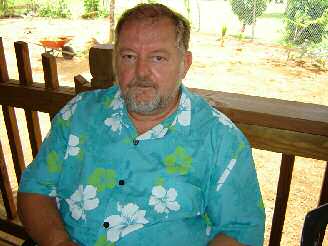
Left: Congratulations and good luck to Karl Staisch on his appointment
as the new WCPFC Observer Programme Coordinator
Middle: Palau's recently promoted Port Sampling Supervisor (Rimirch Katosang, left)
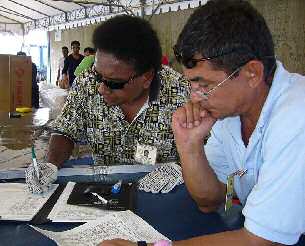
and the new Observer Coordinator (Ian Tervet on the right) busy with port sampling paper work.
Right: The newly appointed Solomon Island Observer Coordinator Derek Suimae
Left: Hudson Wakio who has quickly become comfortable in his new position
as the Solomon Island National Tuna Data Coordinator
Middle: FFA's new Observer Programme Manager, Tim Park.
Welcome back to the region Tim
Right: Alfred Lebehn, FSM (left) and Dike Poznanski, RMI (right) who were on attachment
with the Statistics and Monitoring Section of the Oceanic Fisheries Programme in Sept 2007