Document of
The World Bank
Report No:
PARTNERSHIP INVESTMENT FUND
BRIEF
ON A
PROPOSED GRANT FROM THE
GLOBAL ENVIRONMENT FACILITY
TRUST FUND
IN THE AMOUNT OF USD 25 MILLION
FOR THE FIRST TRANCHE OF A GEF
USD60 MILLION
TO THE
Governments of Coastal Countries
in Sub-Saharan Africa
FOR A
Strategic Partnership for a
Sustainable Fisheries Investment Fund in the Large Marine Ecosystems
of Sub-Saharan Africa
October
6, 2005
ABBREVIATIONS AND
ACRONYMS
AU African
Union
CAADP Comprehensive
African Agriculture Development Program
CECAF Fishery
Committee for the Eastern Central Atlantic
COREP Regional
Fishery Committee for the Gulf of Guinea
CPUE Catch
per unit of fishing effort
DFID United
Kingdom Department for International Development
FAO Food
and Agriculture Organization of the United Nations
GEF Global
Environment Facility
IDA International
Development Association
IBRD International
Bank for Reconstruction and Development
LME Large
Marine Ecosystem
MaCEMP Tanzania
Marine and Coastal Environment Management Project
MPA Marine
Protected Area
NEPAD New
Partnership for Africa’s Development
PDF-B Project
Development Facility Block B
PROFISH Global
Program for Fisheries
PRSP Poverty
Reduction Strategy Paper
RAC Regional
Advisory Committee
SEAFO Southeast
Atlantic Fisheries Organization
SRFC Sub-Regional
Fisheries Commission
SSA Sub-Saharan
Africa
SWIOFC Southwest
Indian Ocean Fisheries Commission
UNCLOS United
Nations Convention on the Law of the Sea
UNDP United
Nations Development Program
UNEP United
Nations Environment Program
WSSD World
Summit on Sustainable Development
WWF World
Wildlife Fund
TABLE OF CONTENTS
A. STRATEGIC
CONTEXT AND RATIONALE 3
1.
Country and Sector Issues 4
2.
Rationale for World Bank involvement 9
3.
Higher level objectives to which the Partnership contributes
(Rational for GEF Funding) 9
B.
PARTNERSHIP DESCRIPTION 10
1.
Financial instrument 10
2.
Partnership development objectives and key indicators (See Annex 1.
Logframe) 12
3.
Partnership Components and Outputs 14
2. Regional
Coordination, Communications and Capacity-Building 14
4.
Lessons Learned and Reflected in Partnership Design 15
5.
Alternatives considered and reasons for rejection 16
2.
Type of Sub–Projects (Country- level Investment projects)
supported by the Partnership Investment Fund 21
Investment
Program Eligibility 24
Institutional
and Implementation Arrangements 25
Monitoring
and Evaluation of Outcomes (see Annex 1. Logframe) 26
Sustainability
and Replicability 29
Project
Cycle 30
8.
Stakeholder Participation 31
Regional
Coordination, Communications and Capacity-Building. The output of
this component will be dissemination of the lessons from successes
and failures of country and LME level investments in sustainable
fisheries (i.e. to at least 75 percent of SSA countries), as well as
the scale of replication throughout the region. This includes the
following sub-components: 46
OPENING 91
APPENDIX
B: List of participants 95
BENIN 95
A.
STRATEGIC CONTEXT AND RATIONALE
1. Country and Sector Issues
Global Decline of the
Fisheries Sector and the WSSD Response
Both
the living resources of the seas and the marine habitats that support
them are increasingly threatened. The open access nature of these
seas and the living resources within them (i.e. resources supporting
fisheries) has not only encouraged the build-up of severe
over-capacity in the world’s fishing fleets, but has also
caused the global
decline of the fisheries resource base
and threatened the health of the sector in the waters of many coastal
countries. Global production from capture fisheries once grew at a
rate of 6 percent per year, increasing from 18 million tons in 1950
to 56 million tons in 1969. However, during the 1970s and 1980s, the
average rate of the increase in fisheries production declined to 2
percent per year, falling to almost zero in the 1990s, as production
has since stabilized at roughly 90 million tons annually. At the
same time, the total number of people fishing and fish farming
worldwide more than doubled (compared with a 35 percent increase in
the economically-active population in agriculture). As a result, FAO
estimates that most of the world's fishing areas have now reached
their maximum potential for capture fisheries production, with at
least 60 percent of the world’s major fisheries over- or fully
fished. The last decade of relatively zero growth in capture
fisheries production has led FAO to suggest that no increases in
total fisheries catch would be obtained in the future, to the
contrary, a decline in the total stock, and the production, in
particular for the most valuable species is most likely. However,
the decline in the resource base is not yet irreversible. Provided
concerted action is taken, the prevailing opinion is that stocks can
be rebuilt.
Unfortunately,
over-fishing and subsequent declining returns from the sector have
only reinforced cycles of coastal poverty for millions of rural
fishing communities around the world, while at the same time
threatening the marine biodiversity and coastal ecosystems that
support fisheries. For this reason, the recent World Summit on
Sustainable Development (WSSD) felt over-fishing represented a
serious crisis meriting a concerted effort by the international
community over the next 10 to 12 years, to restore the world’s
fisheries to health by the year 2015 (including the coastal
ecosystems that support these fisheries). The WSSD further called on
donor agencies and stakeholders to create new and flexible
partnerships to be able to respond to this growing crisis in world
fisheries and implement the target for 2015. At the same time, the
WSSD reiterated the poverty reduction targets of the Millennium
Development Goals as essential goals for international assistance.
The
Global Importance of the Declining Fisheries Sector within the Large
Marine Ecosystems in Sub-Saharan Africa, and the Linkages to Poverty
Nowhere
is the crisis in global fisheries more evident, and the need to
implement both the fisheries and poverty reduction targets set by the
WSSD greater, than in the five Large Marine Ecosystems (LMEs) that
cover the coastal waters of Sub-Saharan Africa (SSA).
These LMEs possess a wealth of globally significant marine
biodiversity and habitats that provide the coastal countries of SSA
with some of the world’s most fertile fishing grounds, many of
which are transboundary in nature (with either the fish stocks or the
fishing fleets migrating regularly across national boundaries, or
both). In most coastal countries in SSA, the fishing sector supported
by these LMEs is a major contributor to rural income and employment,
attracts considerable local and foreign investment, contributes
significantly to food security, and in many countries is a
substantial source of foreign exchange and funding for public
budgets. More specifically, FAO has estimated that some 2.7 million
people in the region are engaged in coastal and inland fishing
activities on a full or part-time basis, often in labor-intensive
small-scale fisheries that include both subsistence and commercial
activities. Similarly, in terms of food security, fish provides up
to 70 percent of the daily animal protein intake in some coastal
countries in the region (e.g. Ghana, Sierra Leone), with an average
in the region of about 23 percent in 2000, significantly higher than
the global average of 16 percent. Lastly, in terms of foreign
exchange earnings, the value of net exports of fish products for the
continent as a whole reached the equivalent of roughly US$1.7 billion
in 2001, exceeding the net foreign exchange income reported for any
other agricultural commodity.
However,
as significant as they are for the livelihoods and economies in many
countries in the region, and for continued poverty reduction efforts,
the fisheries resources supported by the Large Marine Ecosystems of
SSA are beginning to feel the cumulative effects of growing
populations and over-fishing. Total marine production from these LMEs
seems to have reached a plateau since the early 1990s, and the number
of overexploited and depleted stocks is rising throughout the region.
More specifically:
In
the Canary Current LME, the FAO 10-year trend (1990-1999)
shows a decline in the catch from 2.3 million tons in 1990 to 1.8
million tons in 1999. This LME has been characterized by the Global
Integrated Water Assessment as highly impacted by fisheries
overexploitation.
In
the Guinea Current LME,
the FAO 10-year trend shows a catch of 950,000 tons in 1990,
a marked decrease to 700,000 tons in 1994, and a recovery to 900,000
tons in 1999. While the LME is rich in living marine resources and
commercially valuable fish, it shows evidence of ecosystem stress.
There are major fluctuations of commercially valuable species.
Significant changes in species composition have occurred over time
and several demersal and pelagic fish species are considered
over-exploited.
In
the Benguela Current LME,
the FAO 10-year trend shows decreasing catches of hakes,
herrings, sardines, anchovies and miscellaneous pelagic fishes, but
with differences in trends across coastal countries. For example,
the Namibian sardine stock has largely stagnated over the last 10
years, but the South African anchovy and sardine stocks increased
dramatically between 1995 and 2003. While some commercial stocks
are being maintained at productive levels, in some areas there has
been severe depletion and even collapse of key stocks.
In
the Agulhas Current LME,
the 10-year trend shows a decrease from roughly 284,000
metric tons in 1990 to a level of approximately 220,000 tons in the
early 1990s and a recovery to 260,000 metric tons in 1999.
In
the Somali Coastal Current LME,
the FAO 10-year trend shows a decrease from 60,000 tons in
1990 to about 50,000 tons in 1999, as the fisheries are
predominantly small, traditional and artisanal. Several areas are
considered heavily overexploited or at risk from destructive fishing
practices.
Fig.
1. The Large Marine Ecosystems of Africa
I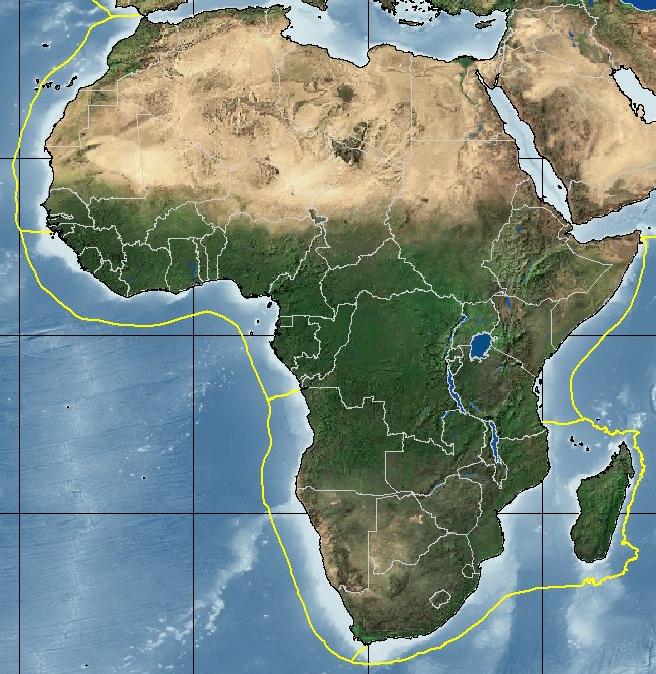 n
addition to the direct over-harvesting of fisheries, the LMEs
of Sub-Saharan Africa are also beginning to feel the cumulative
effects of growing populations, which threaten habitats such as
mangroves and wetlands through a variety of activities including
infrastructure development and logging of mangrove forests for
fuelwood. As such, the LMEs, and the fisheries they support, are
being threatened on two fronts: from the destruction of critical
habitat that provides spawning and nursery grounds for many species
of fish in the early stages of their life cycle, to over-harvesting
of target fish stocks based on inadequate management of fishing
effort.
n
addition to the direct over-harvesting of fisheries, the LMEs
of Sub-Saharan Africa are also beginning to feel the cumulative
effects of growing populations, which threaten habitats such as
mangroves and wetlands through a variety of activities including
infrastructure development and logging of mangrove forests for
fuelwood. As such, the LMEs, and the fisheries they support, are
being threatened on two fronts: from the destruction of critical
habitat that provides spawning and nursery grounds for many species
of fish in the early stages of their life cycle, to over-harvesting
of target fish stocks based on inadequate management of fishing
effort.
As
a result, according to FAO wild stocks of marine fish currently being
exploited in the LMEs of Sub-Saharan Africa, with few exceptions
(Somalia being one, also the large meso-pelagic stocks around the
continent that are unexploited) will not withstand further increases.
However, because many of the poorest countries lack the capacity for
effective fisheries management based on an ecosystem approach, both
local and foreign fleets fish in de facto open access
conditions along most of the continent, with fishing pressures
continuing to increase. These de facto conditions of open
access to African fisheries exist in many cases despite the adoption
over 20 years ago of the United Nations Convention on the Law of the
Sea (UNCLOS). This “constitution of the sea” essentially
gave countries exclusive rights and control to manage their fisheries
resources up to 200 nautical miles from the coast (which includes all
of the waters delineated within the five LMEs), yet 20 years later
many coastal countries throughout SSA still do not have the capacity
to take control of their own fisheries resources nor prevent their
overexploitation. The end result is that the fisheries sector
contributes far less than its potential to poverty reduction and food
security in many SSA countries, due significantly to unsustainable
levels of resources exploitation (much of which is illegal) and the
skewed allocation of fish resources between small-scale and
industrial fisheries. For example, the level of illegal, unreported
and unrecorded (IUU) fishing in the Large Marine Ecosystems of SSA
was recently estimated by a DFID-sponsored report to include catch
volumes worth on the order of US$0.9 billion per year, and in some
countries (e.g. Guinea and Somalia) over US$100 million per year.
This average annual value of the fish caught illegally, or unreported
and unrecorded, in the waters of coastal SSA countries is equivalent
to roughly 16 percent of the total value of all fish caught legally
in these waters.
Current
Efforts to Address the Decline of the Fisheries Sector in SSA and the
Need for Additional Assistance to Meet the WSSD Fisheries and Poverty
Reduction Targets
The
pressures on the marine biodiversity and fisheries resources
supported by the LMEs of Sub-Saharan Africa, and particularly the
resulting imbalance between catches of fish and
sustainable production levels, have been highlighted by the Regional
Commissioner for Rural Economy and Agriculture as a priority for the
African Union (AU), as well as in the Comprehensive African
Agriculture Development Program (CAADP) agenda developed by the New
Partnership for Africa’s Development (NEPAD). However, while
the existing fisheries governance regimes, including the FAO Code of
Conduct for Responsible Fisheries, the WSSD, and the NEPAD-CAADP,
have provided a mandate, technical direction and targets for
sustainable fisheries in the LMEs of SSA, there are still very
limited financial resources to implement these mandates.
Additionally, the Regional Fisheries Management Organizations created
by the countries themselves, in some cases with the assistance of
FAO, lack adequate funds to assist individual coastal countries to
implement the needed governance reforms in fisheries. Thus, in many
coastal countries of SSA, governments still do not have the capacity
to take control of their own resources and prevent overexploitation,
and specifically to regulate access to these resources and protect
the critical habitats that support them.
Process of Proposing
this Strategic Partnership
As
a first step towards assisting governments of coastal countries in
SSA to sustainably manage their fisheries resources and protect the
critical habitats that support them, the Global Environment Facility
(GEF) sponsored sub-regional LME Programs in each of the 5 LMEs. The
coastal SSA countries involved have already provided GEF Focal Point
endorsements of each of these 5 LME Programs, and the Programs are
now providing a critical knowledge base from which individual
countries can improve the governance of their marine resources and
protect marine biodiversity and habitats. To complement this ongoing
process, additional assistance is being sought at the country level
to implement the fisheries-related action programs and
recommendations generated by the work undertaken through the LME
Programs. Thus, in line with the WSSD targets and the LME projects,
the World Bank proposed to explore options for creating a
stakeholder-driven funding mechanism to assist individual coastal
countries to build on the findings and recommendations provided
through the implementation of the LME Programs and meet the targets
for sustainable fisheries and poverty reduction set by the WSSD. As a
result, the World Bank prepared a concept for establishing a
Strategic Partnership for a Sustainable Fisheries Investment Fund
in the LMEs of Sub Saharan Africa based on the model of the
GEF-sponsored Danube/Black Sea Basin Strategic Partnership.
Significantly, this Sustainable Fisheries Investment Fund (i.e. the
Partnership Investment Fund) is part of a larger Partnership that
encompasses the Investment Fund , the GEF-sponsored Large Marine
Ecosystem (LME) Programs, and a coordinating mechanism to promote
interaction and synergy between the two, which will be financed by an
MSP grant (see Annex 3). Coordination between these elements
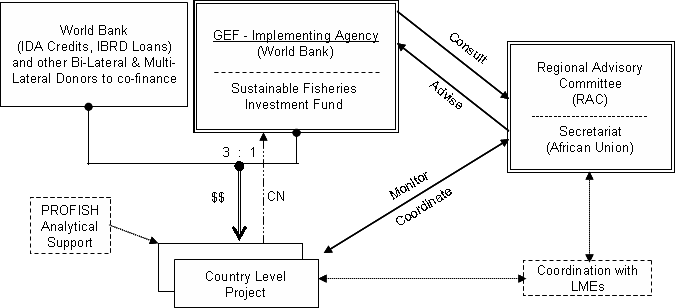
and IA partners will be achieved through a Regional Advisory
Committee comprised of the AU, Regional Fisheries bodies, 2 civil
society organizations, UNEP, UNDP, FAO and WWF (see section C.1 for
further details). This concept for a Strategic Partnership for
fisheries was approved by the GEF in mid-2003, and the World Bank
asked the Food and Agriculture Organization of the United Nations
(FAO) and the World Wildlife Fund (WWF) to serve as partners in the
preparation of this initiative.
In
order to ensure this concept for a stakeholder-driven regional
funding mechanism would fit within such regional inter-governmental
agreements as the WSSD, the AU priorities, the NEPAD CAADP, the
strategies of the Regional Fisheries Management Organizations and the
ongoing LME Programs, the Strategic Partnership was prepared through
wide consultations within the region. The process began when the
First Consultative Workshop with stakeholders from throughout the
region was convened by FAO, the World Bank and WWF in Dakar, Senegal,
18-20 January 2005. The meeting attained broad agreement on the goals
and objectives of the Strategic Partnership and its operating
principals, as well as on eligibility criteria for country level
projects to be supported by the Partnership Investment Fund. More
specifically, there was agreement among the participants on the
premise that inadequate governance of the fisheries resources is the
root cause of the current levels of overexploitation in the LMEs, and
the Strategic Partnership is a suitable mechanism to generate funds
which could assist coastal countries in SSA to take the necessary
actions to meet the WSSD fisheries and poverty reduction targets.
After
the First Consultative Workshop, a small meeting was held in Dakar
with several representatives from the LME Programs, in order to
discuss ongoing coordination. The meeting agreed that the LME
Programs should be represented at the regional level in the Strategic
Partnership, and then would also coordinate in terms of individual
country level activities as well.
A
Second Consultative Workshop was convened by FAO, the World Bank and
WWF in Dar es Salaam, Tanzania, 22 – 24 June 2005. This
workshop was opened by the Commissioner for Rural Economy and
Agriculture at the African Union, and the meeting subsequently
attained broad agreement on a project cycle that would ensure
stakeholder input into a portfolio of roughly 10 to 12 national level
projects aimed at assisting coastal SSA countries to implement the
WSSD fisheries and poverty reduction targets. More specifically, the
meeting agreed that this portfolio and project cycle would be advised
by a group of stakeholders led by the AU, and would be complementary
to the ongoing LME Programs. The meeting further agreed on the
governance framework for such a stakeholder-driven regional funding
mechanism. This Brief aims to reflect these two consultations to
every extent possible.
2. Rationale for World Bank involvement
The
Strategic Partnership is consistent with the goals of the World
Bank’s Environment Strategy to support sustainable development,
reduce poverty, and improve quality of life by removing the
environmental constraints to economic development, and empowering
people and societies to manage their environmental recourses. It is
also consistent with World Bank’s Rural Strategy, which
reflects and reinforces the Bank’s commitment to the UN
Millennium Development Goals. At the regional level, it is
consistent with the Regional SSA Environmental Strategy and the
Africa Region’s Rural Strategy, which emphasizes enhancing the
management of natural resources.
The
rationale for the World Bank’s leadership in this initiative
also follows directly from the Bank’s formally approved Sector
Approach Paper: Saving Fish and Fishers. Towards Sustainable and
Equitable Governance of the Fishing Sector, as there is (1) the
imperative to reduce poverty among 30 million small-scale fisheries
families now faced with declining income; (2) the urgent need to
address the imminent danger of affected marine ecosystems; and (3)
clear and repeated client and donor requests for increased World Bank
involvement. This Sector Approach Paper formally recommended that
the World Bank re-engage in the fisheries sector with a focus on
assisting countries to improve their governance of fisheries
resources, utilizing an ecosystem-based approach.
The
World Bank has comparative advantages in its convening power to draw
global attention to the crisis in the fisheries sector, its
experience in economic and sector analysis and strengthening public
governance, in developing cross-sector solutions, in organizing
decentralized natural resource management and in being able to
provide substantial investment funding to support sector strategy
implementation.
3. Higher level objectives to which
the Partnership contributes (Rational for GEF Funding)
The
Strategic Partnership for a Sustainable Fisheries Investment Fund in
SSA was proposed in order to reverse the depletion of fisheries in
the LMEs of Sub-Saharan Africa, and to assist the individual coastal
countries bordering these LMEs to meet the fisheries and poverty
reduction targets set by the WSSD. The rationale for a partnership
is that the fisheries resources supported by the large marine
ecosystems of Sub-Saharan Africa are both poorly governed and often
transboundary in nature. For this reason, the WSSD has recommended
partnerships of donors, technical agencies and NGOs as the best
vehicle to assist developing countries to change both policies and
practices in fisheries management and the governance of large marine
ecosystems.
The
Strategic Partnership will act to support and complement, but not
duplicate, existing initiatives, allowing multiple Implementing
Agencies for the GEF to work together according to their comparative
advantages. The Sustainable Fisheries Investment Fund, i.e. the
Partnership Investment Fund, will encourage county-level investments
in the LMEs of SSA, which would complement the ongoing GEF-led
sub-regional LME projects. These investments would build the capacity
of coastal countries in SSA to implement policy and institutional
reforms needed at the national level in order to meet the targets for
sustainable fisheries and poverty reduction set by the WSSD, and as
well as to support monitoring, surveillance and enforcement of
national and international laws and regulations with regard to
fisheries and the ecosystems that support them, thereby enabling the
countries to more fully collaborate with and participate in the
ongoing GEF-funded regional LME projects. Such investments
facilitated by the Partnership Investment Fund would be consistent
with the principles of the treaty of the 1982 United Nations
Convention on the Law of the Sea (UNCLOS), assisting coastal
countries in SSA to build their capacity to sustainably manage
fisheries resources, while utilizing an ecosystem-based approach that
recognizes the importance of the marine and coastal habitats that
support these fisheries.
The
activities and projects to be funded under the Strategic Partnership
for a Sustainable Fisheries Investment Fund in SSA could be supported
by two of the 15 GEF’s Operational Programs, namely the
Coastal, Marine, and Freshwater Ecosystems (OP2) and Waterbody-based
Operational Program (OP8). Initially the Strategic Partnership will
be supported through the Waterbody-based Operational Program (OP8),
and activities within will contribute directly to meeting the targets
of the International Waters Strategic Priorities in Sub-Saharan
Africa, specifically IW#1: to catalyze financial resources for
implementation of agreed actions (e.g. WSSD fisheries targets) and
IW#2: to expand global coverage of foundational capacity building.
Lastly, it should be noted that SSA countries that will participate
will be those that have ratified the UNCLOS.
B.
PARTNERSHIP DESCRIPTION
1. Financial instrument
Sustainable Fisheries
Investment Fund (US$60 million)
The
GEF will create a Sustainable Fisheries Investment Fund, or
Partnership Investment Fund, of US$60 million to be disbursed as
grants, which will be available in three tranches over a ten-year
period. This Brief seeks approval of US$25 million in GEF funds for
the first tranche of the Partnership Investment Fund, with a total of
US$75 million in co-financing from other donors expected for this
first tranche. Following the model of the Danube/Black Sea Basin
Strategic Partnership that was initially approved by the GEF Council
on May 9, 2001 (GEF/C.17/7), and the subsequent two tranches that
were approved in May 2002 and May 2003, requests for the second and
third tranche of this Partnership Investment Fund will be submitted
to the GEF Council when the indicators for the previous tranche have
been met. The total GEF funds disbursed through the Partnership
Investment Fund over 10 years will be US$60 million. This
Partnership Investment Fund will be available to co-finance, together
with IDA credits and IBRD loans from the World Bank and/or funds from
other interested donors, country-level projects aimed at assisting
SSA countries to achieve sustainability in their marine fisheries and
meet the fisheries and poverty reduction targets set by the WSSD. As
mentioned previously, this regional GEF funding mechanism is based on
the Danube/Black Sea Basin Strategic Partnership model, in which the
GEF Council would approve the overall funding mechanism described in
this Brief, and more specifically the criteria that each project must
meet in order to be eligible to receive co-financing from the
Partnership Investment Fund, so that the subsequent individual
project proposals will not have to go back to the GEF Council
provided they meet the eligibility criteria, but will only need
approval by the GEF CEO.
Strategic
Partnership’s Role
In
order for the Sustainable Fisheries Investment Fund to be a
stakeholder-driven regional funding mechanism, it will be advised by
a partnership of stakeholders in the region (led by the African
Union), i.e. a Strategic Partnership for a Sustainable Fisheries
Investment Fund in Sub-Saharan Africa. These stakeholders will
include representatives of governments, civil society and donors, and
will help ensure that the projects proposed for support by the
Sustainable Fisheries Investment Fund reflect the priorities of the
region and are in line with the eligibility criteria approved by the
GEF Council, as well as complement existing initiatives such as the
GEF-sponsored LME Programs. In addition, the partnership of
stakeholders will promote lessons learned from the individual
projects throughout the region, in order to encourage replication and
the prioritization of sustainable fisheries in national development
policies such as Poverty Reduction Strategy Papers, as well as the
development planning of the World Bank (e.g. in relevant Country
Assistance Strategies). These activities of the Strategic
Partnership of stakeholders will be funded separately from the
Sustainable Fisheries Investment Fund, through a Medium-Sized Project
Grant from the GEF given for each tranche of funds disbursed to the
Partnership Investment Fund.
World Bank’s Role
As
mentioned previously, the Partnership Investment Fund will be
implemented by the World Bank as the Implementing Agency, and
co-financed by IDA credits and IBRD loans and through funds from
other interested multilateral and bilateral donors. In addition, any
upstream technical assistance that might be required by a country in
order to prepare a Concept Note for submission to the GEF could be
supported by the World Bank’s Global Program on Fisheries
(PROFISH), which includes an already existing multi-donor trust fund
as well as technical assistance to support the World Bank’s
ongoing country dialogue for development of regional and country
programs. As a co-financing ratio of one GEF dollar to every three
dollars from the World Bank or any other donors is being targeted by
the GEF for each of the three tranches, the total anticipated funding
volume of the Partnership Investment Fund is US$240 million.
FAO and WWF’s
Role
FAO
and WWF have been partners with the World Bank in the preparation of
the Strategic Partnerships for a Sustainable Fisheries Investment
Fund in SSA. As a continuation of their roles as partners, and in
addition to their active roles as members of the Strategic
Partnership of stakeholders, FAO and WWF will be requested to provide
support to the African Union (who will lead the Partnership of
stakeholders) for communications, awareness building and information
dissemination of the Strategic Partnership and the lessons learned
from individual projects co-financed by the Partnership Investment
Fund (see Annex 3: Overview of the Medium-Sized Project Request for
the Regional Activities of the Strategic Partnership). In both
cases, the Strategic Partnership will leverage the organization’s
comparative advantages. FAO will provide support to the African
Union based on its primacy for fisheries within the UN system and its
global experience, knowledge of fisheries, and mandate and mechanisms
for serving FAO members on matters related to fisheries. WWF will
provide support to the African Union based on its global experience
and knowledge of fisheries management gained through its marine
conservation initiatives, in particular the development of marine
protected area networks.
2. Partnership development objectives and key
indicators (See Annex 1. Logframe)
The
common Global Environmental/Development Objective is to
promote the sustainable management of fisheries resources in
the LMEs of Sub-Saharan Africa in order to assist coastal countries
to make concrete progress towards achieving the fisheries and poverty
reduction targets set by the WSSD. This objective combines the
sustainable use of fisheries resources and the marine ecosystems that
support them, with the need for effective poverty alleviation and
sustainable income growth of fishing communities in SSA.
The
two broad results indicators of the success of the Strategic
Partnership in achieving the Global Environmental/Development
Objective are based on the WSSD targets:
Sustainable use of fisheries resources achieved in at
least 10 countries in the LMEs of Sub-Saharan Africa by 2015; and
Poverty
alleviation and vulnerability reduction in coastal and fishing
communities in at least 10 countries of-Saharan Africa.
The
more specific objectives of the Strategic Partnership
are to:
Accelerate
country-level investments and actions in the fisheries sector in
accordance with the WSSD fisheries targets and consistent with the
emerging priorities of the GEF-sponsored Large Marine Ecosystem
(LME) Programs, in order to assist individual coastal countries in
Sub-Saharan Africa to undertake the necessary governance (i.e.
policy, legal, and institutional) reforms and sector adjustments to
sustainably manage their fisheries in a way that ensures a
distribution of benefits that will contribute to poverty reduction
and food security;
Assist
individual coastal countries to build the capacity to participate in
the ongoing GEF-sponsored LME Programs and other regional and
sub-regional initiatives as well as collaborate through these
projects to implement management measures for the marine ecosystems
and the transboundary fisheries resources and/or fishing fleets that
would be more appropriate at the sub-regional scale (e.g.
sub-regional monitoring, control and surveillance systems,
management of fishing capacity, sub-regional research initiatives,
networks of marine protected areas (MPAs), etc.);
Promote
learning, information exchange and capacity building at the regional
level, to ensure that the lessons from successes and failures of
country and LME level investments are adequately disseminated; and
Encourage
direct financial support to the fisheries sector in order to meet
the sustainable development objectives in fisheries and a reduction
in poverty.
Progress
towards achieving these specific objectives will be measured
quantitatively on a project/country basis and aggregated to the
regional level. However, the types of results indicators that
would be used by each project can be presented here in a generic
form:
1. Increase in benefits e.g.
Economic benefit
Social benefit
Environmental benefits
2. Distribution of benefits, e.g.
allocation of resources - small scale/ industrial
distant water/ coastal state benefits
national PRSP (poverty) monitoring
national (fish) food security tracking
3. Sustainability of benefits, i.e. of national and
transboundary fisheries, e.g.
4. Good governance at national and regional levels, e.g.
implementation of the Code of Conduct and best
practices in national fisheries
World Bank governance indicators applied to the
fisheries sector (includes transparency)
national consensus/partnership with key donors
human
and institutional capacity indicators
In
order to achieve the Global Environmental/Development Objective and
the more specific objectives above, the Strategic Partnership will,
within a regional context, encourage at least 10 country level
investments in SSA over the next 10 years. The results of each of
these individual country investments will be aggregated to the
regional level in order to measure progress towards the two broad
results indicators and the indicators for the specific objectives.
Thus, if the Strategic Partnership is successful, the fisheries
resources in the LMEs bordering at least 10 SSA countries, i.e. the
global environmental good, will be replenished to sustainable levels
by the end of the Partnership, and the poverty and vulnerability of
the communities dependent on these resources will be measurably
reduced.
3. Partnership Components and
Outputs
The
Strategic Partnership for a Sustainable Fisheries Investment Fund in
SSA will include the following components, which are linked to the
specific objectives described in section B.2:
Sustainable
Fisheries Investment Fund
1. Country-Level Projects: the Project Cycle for
Investments co-financed by the Sustainable Fisheries Investment Fund
(i.e. Partnership Investment Fund)
This component will aim to implement the first two
specific objectives listed above, encouraging country-level
investments and assisting individual countries to build the capacity
to participate in the LME Programs. The output from this component
will be at least 10 country-level projects to assist SSA coastal
countries to meet the fisheries and poverty reduction targets set by
the WSSD. For each country, the basic project cycle will include:
1.1. Project selection
1.2. Project design (preparation)
1.3. Project implementation
Strategic
Partnership
2. Regional Coordination, Communications and Capacity-Building
This component will aim to implement the third and
fourth specific objectives above, in order to promote learning,
information exchange and capacity building at the regional level, and
encourage direct financial support to the fisheries sector as a
result of good practices and lessons learned. The output will be
dissemination of the lessons from successes and failures of country
and LME level investments (i.e. to at least 75 percent of SSA
countries), as well as the scale of replication throughout the
region. This includes the following sub-components:
2.1. Coordination
2.2. Communication
2.3. Linkage and cohesion with LME programs
2.3. Mobilization of co-finance
3. Monitoring and Evaluation
The output from this component will be the information
necessary to measure the success of the Strategic Partnership towards
achieving its Global Environmental/Development Objective and the more
specific objectives. This includes the following sub-components:
3.1. Project level (processes)
3.2. Country level (results)
3.3. Program level (results)
4. Lessons Learned and Reflected in
Partnership Design
The
design of the Strategic Partnership as a stakeholder-driven regional
funding mechanism is based in part on the experiences of the GEF
Strategic Partnership on the Danube/Black Sea Basin (Danube/Black Sea
Basin Strategic Partnership) and, in general terms, the GEF LME
Programs.
The
Danube/Black Sea Basin
Strategic Partnership,
through the Nutrient Reduction Investment Fund included within the
Partnership, leveraged a large envelope of both World Bank and GEF
funds for nutrient pollution reduction investments on a
country-by-country basis in more sustainable wastewater treatment and
agriculture. In terms of implementation, the GEF Council approved a
first tranche of US$20 million in May 2001, a second tranche of $16
million in May 2002 and a third tranche of US$24 in May 2003 to the
Partnership Investment Fund, which was administered by the World Bank
to be available for country-specific nutrient reduction activities.
Once each tranche of money disbursed to the Investment Fund was
approved by the Council, individual projects administered by that
Fund did not require further Council approval, so long as they met
the original criteria set for projects co-financed by the Fund.
While
the Nutrient Reduction Investment Fund was the model for the
Partnership Investment Fund, i.e. the Sustainable Fisheries
Investment Fund, the intent was not just the mobilization of
additional funding to achieve the Global Environmental/Development
Objective, but also to ensure that such a funding mechanism is
stakeholder driven, hence the Strategic Partnership. A lesson from
the Danube/Black Sea Basin Strategic Partnership was that this
regional stakeholder participation and information exchange between
individual projects will require an additional funding source from
the Partnership Investment Fund. In the case of the Danube/Black Sea
Basin Strategic Partnership, the Nutrient Reduction Investment Fund
encouraged even larger investments and faster disbursements than
originally envisaged, but funding for the regional element was
insufficient. Based on these experiences, the Strategic Partnership
will include a request for a GEF Medium-Sized Project Grant, in
parallel to each tranche of funds for the Partnership Investment
Fund, in order to ensure that the regional coordination and
information exchange is undertaken. However, because this is a
time-bound initiative, no new institutions will be created to
implement the regional activities. Rather, these activities will be
undertaken through capacity-building for existing institutions, i.e.
the African Union, to eventually lead the regional coordination and
stakeholder participation, with FAO and WWF providing assistance as
needed.
The
GEF LME Programs also provide useful examples of sub-regional
projects, particularly in terms of the small projects supported by
each LME Program. A project cycle for projects supported by the LME
Programs (largely similar to the Danube/Black Sea Basin Strategic
Partnership) is based on identification of projects by the proposing
country, with assistance from the World Bank and/or other eligible
financiers. All eligible countries have an equal opportunity to
benefit from the GEF allocation and are encouraged to submit project
proposals. Project proposals are considered based on merit, and are
reviewed on the basis of a standard template. Funds are made
available on a “first come first served” basis. These
principles of equal opportunity to benefit from the GEF allocation
and the use of a standard template for project proposals have been
incorporated into the project cycle for the Partnership Investment
Fund, i.e. the Sustainable Fisheries Investment Fund.
5. Alternatives considered and reasons for
rejection
1.
Creation of a Sustainable Fisheries Investment Fund alone, with no
Strategic Partnership: The World Bank considered the option of
creating a regional funding mechanism that would simply augment
existing donor activities in the sector and LMEs, without providing
for stakeholder leadership or exchange at the regional level. In that
sense, the initiative would only have included component 1, in order
to support a portfolio of country-level investments. However, the
Strategic Partnership and the regional activities have been designed
as an integral aspect to the success of this initiative, in order to
ensure that stakeholders not only have a voice in the selection
process for projects to be supported by the Sustainable Fisheries
Investment Fund, but also help exchange lessons learned and good
practices, as well as advocate on a wider basis throughout the region
for the need for sustainable fisheries. Thus, the Strategic
Partnership can serve as a mechanism to help replicate the
experiences gained from the activities supported by the Sustainable
Fisheries Investment Fund (see section C.6).
2.
Support for both Sub-Regional and Country-Level Investments:
Another option considered was to establish a funding mechanism that
would support investments at both the sub-regional and country level.
However, this option was rejected for two reasons: (i) the World
Bank as one of the key partners and likely co-financiers of projects,
disburses to individual countries, even if part of larger
sub-regional projects; and (ii) the sub-regional LME projects and
regional fisheries management bodies are already working at the
sub-regional level, and what is needed most is increased capacity of
individual countries to govern their fisheries resources and in many
cases to work together at the sub-regional level.
3.
Potential Sources of Funding for the Regional Activities of the
Strategic Partnership: Several options were considered for
pursuing funding for the regional activities of the Strategic
Partnership, including requesting additional funding from other
donors for these activities, as well as adding a regional funding
element (i.e. a charge) on each individual project. However, these
options were rejected because there is already a Global Program for
Fisheries (PROFISH) housed at the World Bank, with which the
Strategic Partnership would compete for funding from other donors,
and the World Bank did not wish to dictate specific activities or
regional funding required of the individual country-level
19191919191919191919191919191919191919191919191919191919191919191919191919191919191919191919191919191919191919191919191919191919191919191919191919191919191919191919191919191919191919191919191919191919191919191919191919191919191919191919191919191919191919191919191919191919191919191919191919191919191919191919191919191919191919191919191919191919191919191919191919191919191919191919191919191919191919191919191919191919191919191919191919191919191919191919191919191919191919191919191919191919191919191919191919191919191919191919191919191919191919191919191919191919191919191919191919191919191919191919191919191919191919191919191919191919191919191919191919191919191919191919191919191919191919191919191919191919191919191919191919191919191919191919191919191919191919191919191919191919191919191919191919191919191919191919191919191919191919191919191919191919191919191919191919191919191919191919191919191919191919191919191919191919191919191919191919191919191919191919191919191919191919191919191919191919191919191919191919191919191919191919191919191919191919191919191919191919191919191919191919191919191919191919191919191919191919191919191919191919191919191919191919191919191919191919191919191919191919191919191919191919191919191919191919191919191919191919191919191919191919191919191919191919191919191919191919191919191919191919191919191919191919191919191919191919191919191919191919191919191919191919191919191919191919191919191919191919191919191919191919191919191919191919191919191919191919191919191919191919191919191919191919191919191919191919191919191919191919191919191919191919191919191919191919191919191919191919191919191919191919191919191919191919191919191919191919191919191919191919191919191919191919191919191919191919191919191919191919191919191919191919191919191919191919191919191919191919191919191919191919191919191919191919191919191919191919191919191919191919191919191919191919191919191919191919191919191919191919191919191919191919191919191919191919191919191919191919191919191919191919191919191919191919191919191919191919191919191919191919191919191919191919191919191919191919191919191919191919191919191919191919191919191919191919191919191919191919191919191919191919191919191919191919191919191919191919191919191919191919191919191919191919191919191919191919191919191919191919191919191919191919191919191919191919191919191919191919191919191919191919191919191919191919191919191919191919191919191919191919191919191919191919191919191919191919191919191919191919191919191919191919191919191919191919191919191919191919191919191919191919191919191919191919191919191919191919191919191919191919191919191919191919191919191919191919191919191919191919191919191919191919191919191919191919191919191919191919191919191919191919191919191919191919191919191919191919191919191919191919191919191919191919191919191919191919191919191919191919191919191919191919191919191919191919191919191919191919191919191919191919191919191919191919191919191919191919191919191919191919191919191919191919191919191919191919191919191919191919191919191919191919191919191919191919191919191919191919191919191919191919191919191919191919191919191919191919191919191919191919191919191919191919191919191919191919191919191919191919191919191919191919191919191919191919191919191919191919191919191919191919191919191919191919191919191919191919191919191919191919191919191919191919191919191919191919191919191919191919191919191919191919191919191919191919191919191919191919191919191919191919191919191919191919191919191919191919191919191919191919191919191919191919191919191919191919191919191919191919191919191919191919191919191919191919191919191919191919191919191919191919191919191919191919191919191919191919191919191919191919191919191919191919191919191919191919191919191919191919191919191919191919191919191919191919191919191919191919191919191919191919191919191919191919191919191919191919191919191919191919191919191919191919191919191919191919191919191919191919191919191919191919191919191919191919191919191919191919191919191919191919191919191919191919191919191919191919191919191919191919191919191919191919191919191919191919191919191919191919191919191919191919191919191919191919191919191919191919191919191919191919191919191919191919191919191919191919191919191919191919191919191919191919191919191919191919191919191919191919191919191919191919191919191919191919191919191919191919191919191919191919191919191919191919191919191919191919191919191919191919191919191919191919191919191919191919191919191919191919191919191919191919191919191919191919191919191919191919191919191919191919191919191919191919191919191919191919191919191919191919191919191919191919191919191919191919191919191919191919191919191919191919191919191919191919191919191919191919191919191919191919191919191919191919191919191919191919191919191919191919191919191919191919191919191919191919191919191919191919191919191919191919191919191919191919191919191919191919191919191919191919191919191919191919191919191919191919191919191919191919191919191919191919191919191919191919191919191919191919191919191919191919191919191919191919191919191919191919191919191919191919191919191919191919191919191919191919191919191919191919191919191919191919191919191919191919191919191919191919191919191919191919191919191919191919191919191919191919191919191919191919191919191919191919191919191919191919191919191919191919191919191919191919191919191919191919191919191919191919191919191919191919191919191919191919191919191919191919191919191919191919191919191919191919191919191919191919191919191919191919191919191919191919191919191919191919191919191919191919191919191919191919191919191919191919191919191919191919191919191919191919191919191919191919191919191919191919191919191919191919191919191919191919191919191919191919191919191919191919191919191919191919191919191919191919191919191919191919191919191919191919191919191919191919191919191919191919191919191919191919191919191919191919191919191919191919191919191919191919191919191919191919191919191919191919191919191919191919191919191919191919191919191919191919191919191919191919191919191919191919191919191919191919191919191919191919191919191919191919191919191919191919191919191919191919191919191919191919191919191919191919191919191919191919191919191919191919191919191919191919191919191919191919191919191919191919191919191919191919191919191919191919191919191919191919191919191919191919191919191919191919191919191919191919191919191919191919191919191919191919191919191919191919191919191919191919191919191919191919191919191919191919191919191919191919191919191919191919191919191919191919191919191919191919191919191919191919191919191919191919191919191919191919191919191919191919191919191919191919191919191919191919191919191919191919191919191919191919191919191919191919191919191919191919191919191919191919191919191919191919191919191919191919191919191919191919191919191919191919191919191919191919191919191919191919191919191919191919191919191919191919191919191919191919191919191919191919191919191919191919191919191919191919191919191919191919191919191919191919191919191919191919191919191919191919191919191919191919191919191919191919191919191919191919191919191919191919191919191919191919191919191919191919191919191919191919191919191919191919191919191919191919191919191919191919191919191919191919191919191919191919191919191919191919191919191919191919191919191919191919191919191919191919191919191919191919191919191919191919191919191919191919191919191919191919191919191919191919191919191919191919191919191919191919191919191919191919191919191919191919191919191919191919191919191919191919191919191919191919191919191919191919191919191919191919191919191919191919191919191919191919191919191919191919191919191919191919191919191919191919191919191919191919191919191919191919191919191919191919191919191919191919191919191919191919191919191919191919191919191919191919191919191919191919191919191919191919191919191919191919191919191919191919191919191919191919191919191919191919191919191919191919191919191919191919191919191919191919191919191919191919191919191919191919191919191919191919191919191919191919191919191919191919191919191919191919191919191919191919191919191919191919191919191919191919191919191919191919191919191919191919191919191919191919191919191919191919191919191919191919191919191919191919191919191919191919ing
of representatives from the LME Programs at least once a year to
ensure coordination and exchange of lessons learned,
ensuring coherence between the country-level projects
supported by the Strategic Partnership,
advising each proposed project,
allowing for independent analysis and evaluations of
projects,
identifying synergies and disseminate common lessons
that could be shared between different projects, and
formulating
strategies to replicate similar projects in the region;
raising awareness of the importance of sustainable
fisheries in development policies and strategies such as Poverty
Reduction Strategy Papers and World Bank Country Assistance
Strategies, and
assisting countries in the mobilization of co-funding.
The
Regional Advisory Committee will have the following 13 permanent
members:
The
African Union (as the Chair);
The
Regional Fisheries Bodies;
Sub-Regional
Fisheries Commission (SRFC)
Regional
Fishery Committee for the Gulf of Guinea (COREP)
Southeast
Atlantic Fisheries Organization (SEAFO)
Southwest
Indian Ocean Fisheries Commission (SWIOFC)
Fishery
Committee for the Eastern Central Atlantic (CECAF)
The
Ministerial Conference of the African States bordering the Atlantic
2
Civil Society Organizations (on a rotational basis to be decided by
the RAC, should include professional organizations);
United
Nations Development Program (UNDP), on behalf of LME Programs;
United
Nations Environment Program (UNEP), on behalf of LME Programs;
FAO;
and
WWF.
In
addition, representatives with an observer status will be invited
from each of the 4 GEF-funded LME Programs, the World Bank, the GEF
Secretariat, PROFISH, additional civil society organizations and
other donors.
The
RAC will be serviced by a small Secretariat, whose overall
role will be to support the RAC to undertake the functions described
above. More specifically, the Secretariat will:
provide assistance to countries for preparation of
proposals;
support the activities of the RAC, on communications,
coordination and exchange of information from lessons learned;
assist in informing countries, stakeholders, potential
co-financiers, and other relevant parties of the objectives and
requirements of the Strategic Partnership; and
assist in the preparation of annual reports, progress
reports, work plans and budgets for approval by RAC.
Through
a phased approach, the Secretariat will eventually be established
in the African Union, funded (along with the costs of the RAC) by a
GEF Medium-Sized Project Grant for each tranche of the Partnership
Investment Fund. However, during the first tranche, FAO will be
requested to provide secretarial services to the RAC and its Chair
the AU. In addition, FAO and WWF, will be requested to provide
support in communications, awareness building and information
dissemination of the Strategic Partnership. At the end of the first
tranche of GEF funds disbursed for the Partnership Investment Fund,
the RAC will commission an independent evaluation of the Strategic
Partnership, and based on the outcome of the review, consider and
recommend when and how to move forward in establishing the
Secretariat at the African Union.
Institutional Arrangements for the Strategic
Partnership
2. Type of Sub–Projects (Country- level
Investment projects) supported by the Partnership Investment Fund
Coastal
countries in SSA are expected to request support from the Partnership
Investment Fund, i.e. Sustainable Fisheries Investment Fund, for
projects that would be designed to assist them to meet the fisheries
and poverty reduction targets set by the WSSD, i.e. to pursue the
Global Environmental/Development Objective of the Strategic
Partnership. Project proposals would clearly reflect the countries’
own vision of sustainable fisheries and the key priority actions
necessary to achieving that vision, as developed through a
participatory process with the key stakeholders. Depending on the
existing effectiveness of sector governance and the nature of sector
restructuring required, these projects will differ in terms of the
combination of activities implemented. However, the following menu
of the types of sub-projects and activities will be supported,
provided they meet the eligibility criteria discussed in section C.3:
Strengthening or improving sector governance (i.e.
policy, legal, and institutional reforms) to sustainably manage
fisheries in a way that ensures a distribution of benefits that
will contribute to poverty reduction and food security, including:
(a) supporting or strengthening a long-term strategy for the
fisheries sector, (b) supporting an effective legal and
administrative framework and related human resources, and
capacity-building (c) adjusting the regulatory framework of the
sector – including on-shore activities - comprising fish
quality control, investment, fiscal, funding and trade aspects.
Strengthening stakeholder consultation processes and
institutions for fisheries governance at the national and local
level, including: a) fostering public and private participation in
the management of the fisheries, b) strengthening or establishing
conflict resolution mechanisms, and (c) enhancing the capacity of
civil society organizations to participate in fisheries resources
management.
Promoting the conservation of ecologically important
areas for fisheries and the wider marine environment in general,
including: (a) supporting the establishment and/or expansion of
effective networks of marine protected areas that assure benefits
to coastal communities, (b) protecting threatened marine species,
and (c) supporting measures to reduce fisheries by-catch.
Strengthening resource management systems for
industrial and international fishing fleets, including: a)
facilitating equitable rights-based fisheries management, b)
improving integrated fisheries assessment and strengthening
Monitoring, Control and Surveillance of all fisheries in the
country’s waters, and (c) strengthening the capacity to
negotiate equitable fishing agreements.
Supporting industrial fishing effort reduction
programs, specifically: a) fishing vessel/gear buybacks, b)
time-bound fishing effort reduction measures, c) livelihoods
diversification (including appropriate sustainable aquaculture),
and d) economic incentive/disincentive systems.
Supporting the creation and/or expansion of
co-management programs and area based management programs for
small-scale fisheries, including: (a) establishing adaptive
frameworks of management measures in support of fisheries and
biodiversity targets including the use of marine protected areas,
(b) strengthening the capacity of artisanal fishers and fishworkers
to participate in co-management programs.
Freezing and/or reducing small- and medium scale
fisheries fishing effort where and when necessary and compensating
or otherwise assisting those affected; including: (a) introducing
license reduction schemes, (b) facilitating access to micro-credit,
(c) expanding vocational training and education programs, and (d)
promoting alternative sources of income.
Strengthening the institutional and financial
effectiveness of Ministries, fisheries extension services,
fisheries training institutions and research institutes, including
a) supporting training in relevant subject matters and at all
levels including communities, (b) communicating and sharing lessons
learned and best practices, (c) facilitating technology development
and transfer, (d) strengthening fisheries research capacity, and
(e) supporting assessment of fishery resources.
Providing direct financial support to meet the
sustainable development objectives in fisheries through: a)
improving financial sustainability and viability of the sector, b)
creating or strengthening credit and savings programs with emphasis
on micro-finance schemes, especially for women, (c) strengthening
formal and informal insurance schemes, (d) implementing or
promoting measures to enable increased domestic value-added for
fishery products, product quality improvement and export growth,
reducing post-harvest losses.
Integrating fisheries in national poverty reduction
strategies, through: a) improving fisheries stakeholder
participation in PRSP processes, b) strengthening fisheries
agencies interaction with planning and finance ministries, and c)
enhancing food security.
Building the capacity to participate in the ongoing
GEF-led LME projects and other regional and sub-regional
initiatives to implement management measures for the marine
ecosystems and the transboundary fisheries resources, including
advancing applicable fisheries science, and promote learning,
information exchange and capacity building at the regional level
(e.g. through programs such as the GEF-supported IW: LEARN).
In
terms of implementing the above activities or types of projects, a
hypothetical package of components and co-financiers for a country
level project supported by the Partnership Investment Fund might
include:
Institutional
strengthening, technical assistance for policy reform (e.g. World
Bank technical assistance loans, sector improvement maintenance
programs/loans);
Fishing
fleet reduction, management infrastructure for monitoring, control
and surveillance of the fisheries (e.g. World Bank specific
investment loans);
Alternative
income opportunities for displaced fishers, economic diversification
in rural fishing communities (e.g. World Bank financial intermediary
loans, specific investment loans, for community-driven development
activities);
Extension,
education and institutions for co-management of small-scale
fisheries (e.g. GEF Partnership Investment Fund); and
Establishment
of effectively managed networks of marine protected areas (e.g. GEF
Partnership Investment Fund).
For
more concrete examples of the types of country level projects that
the Partnership Investment Fund would support, see Annexes 4 and 5.
Annex 4 provides a description of the Tanzania Marine and Coastal
Environment Management Project (MaCEMP), the first project that will
receive GEF co-financing under the Strategic Partnership (but not as
part of the current request of US$60 million). The second project,
from Senegal, is among the first proposals that will be submitted for
support from the Partnership Investment Fund.
Investment
Program Eligibility
Project Eligibility
Criteria
All
projects eligible to receive GEF funds from the Partnership
Investment Fund must comply with the following criteria (i.e. any of
the types of projects listed above):
As
the context for the proposed project, the country must complete and
endorse the Sector Strategy and Stakeholder Participation Template
(as the first annex to the Project Concept Note, see Annex 3 of this
Brief), describing the country’s long-term vision for a
sustainable fisheries sector and its contribution to poverty
alleviation, as well as the key activities needed to achieve that
vision, including those that are or would be supported by other
donors, and those that would be supported by the Strategic
Partnership. This Template has been developed from the goals and
objectives, Operating Principles (see Box 1) and Project Eligibility
Criteria of the Strategic Partnership as agreed upon in the two
consultative workshops. The Template will be subject to review and
amendment by the RAC, as appropriate.
The
proposed project must identify ongoing or planned donor initiatives
affecting the country’s fisheries sector, and demonstrate how
the project would complement and not overlap with them, e.g. the LME
Programs.
The
proposed project must demonstrate that GEF funds will be used to
cover the incremental costs of activities with environmental
benefits that extend beyond national borders.
The
proposed project must demonstrate that project financing meets the
three (donor dollars) to one (GEF dollar) co-financing ratio.
T
Box.
1. Operating Principles of the Strategic Partnership
All
activities of the Strategic Partnership, whether regional
coordination activities or individual country-level projects
supported by the Sustainable Fisheries Investment Fund, will
operate according to a basic set of principles, i.e. the Operating
Principles of the Partnership. As mentioned in section C.3, all
proposed projects must be consistent with these Operating
Principles. According to the Operating Principles, the Strategic
Partnership shall:
(i) Ensure that fisheries sector strategies are
consistent and in harmony with broader national development
policies and strategies, and contribute to poverty eradication.
(ii) Facilitate and strengthen regional cooperation in
relation to the implementation and management of sustainable
fisheries programs and activities to make the best use of available
financial and governance capacities.
(iii) Create opportunities to ensure long-term
sustainable livelihoods and gender equity in coastal communities
that may reach beyond the fisheries sector.
(iv) Assist countries in building the capacity of
public institutions, community associations and civil society to
ensure well managed, productive and healthy fisheries.
(v) Assist countries in addressing issues related to
overexploitation of fisheries including development of recovery
plans, the ecosystem approach to fisheries management, and
alternatives to capture fisheries production.
(vi) Ensure country level capacity to conserve
critical habitats and threatened and overexploited species in the
waters of SSA countries.
(vii) Assist countries in creating sustainable market
opportunities for fisheries sector while at the same time
addressing competing interests, including issues related to foreign
exchange.
(viii) Strengthen country capacity to provide
transparent, collaborative management structures with broad
stakeholder engagement including community participation.
(ix) Enable country level capacity to achieve and
maintain food security, inter alia, by enhancing the supply of food
fish products at affordable prices to ensure food security.
Ensure
that country level projects are consistent with existing
international instruments for sustainable fisheries and poverty
eradication, specifically the FAO Code of Conduct for Responsible
Fisheries.
he proposed project must be consistent with and support the
implementation of the FAO Code of Conduct for Responsible Fisheries
and be in line with the Operating Principles of the Strategic
Partnership (see Box 1).
Institutional
and Implementation Arrangements
As
mentioned previously, as the Implementing Agency for the Strategic
Partnership for a Sustainable Fisheries Investment Fund in SSA, the
World Bank will carry the legal and fiduciary responsibilities
for the Partnership Investment Fund, including ensuring that projects
supported by the Fund meet the GEF Council-approved eligibility
criteria (see section C.3 above) and advance the Global
Environmental/Development Objective of the Partnership, as well as
the management, monitoring and reporting on these projects. In most
if not all projects, the World Bank will provide IDA credits or IBRD
loans to co-finance the GEF funds from the Partnership Investment
Fund, and will also coordinate with other donors to help secure the
required co-financing. The World Bank will also disburse the GEF
Medium-Sized Project Grants for the regional and coordination
activities, including regional monitoring and evaluation, and will
report to the GEF Secretariat on the results of an independent
evaluation of the first tranche of funds for the Strategic
Partnership.
For
the regional activities and monitoring and evaluation, the African
Union will chair the Regional Advisory Committee and host a small
Secretariat to help implement the decisions of the Committee and
carry out these activities on its behalf, including coordinating with
the LME Programs. During the first tranche of funds disbursed for
the Partnership Investment Fund, FAO and WWF will
provide secretarial services to the African Union until the capacity
is in place for the AU to undertake these activities independently.
As mentioned previously, these regional activities will be supported
by a GEF Medium-Size Project Grant disbursed through the World Bank.
In
summary, the World Bank will be responsible for the implementation of
all three components of the Strategic Partnership (see Section B.3),
directly managing the implementation of the country-level projects
under component 1, and supporting the African Union (assisted by FAO
and WWF) to implement components 2 and 3. As mentioned in section
C.1, the World Bank will be joined by other bi-lateral and
multi-lateral donors, as well as PROFISH, on a project-by-project
basis for the implementation of component 1, and the African Union
will chair a committee of stakeholders from across the region to
assist in the implementation of components 2 and 3.
Monitoring
and Evaluation of Outcomes (see
Annex 1. Logframe)
As
discussed in section B.2, the Strategic Partnership aims to achieve a
Global Environmental/Development Objective, with two broad results
indicators, and four specific objectives. Progress of the Strategic
Partnership towards achieving these objectives will be monitored and
evaluated by the Regional Advisory Committee. The Regional Advisory
Committee will solicit the collection of data for these indicators
by: (i) aggregating the results of the individual country-level
projects supported by the Partnership Investment Fund, and (ii)
conducting an independent evaluation roughly every three years on the
impact of the regional activities. The RAC will provide these
results to the World Bank as the Implementing Agency in both cases,
and the World Bank may also conduct supplementary evaluations as
needed. Furthermore, the RAC will work with the World Bank and the
GEF to hold a mid-term ‘stock-taking’ review meeting
after year 5 with representatives from all of the coastal countries
in SSA (similar to the participants in the two consultations for the
preparation of the Strategic Partnership). This meeting would allow
the RAC to report on the progress of the Strategic Partnership
towards meeting the two broad results indicators and four specific
objectives, and to make any ‘mid-course corrections’ that
might need to be taken.
In
terms of evaluating the results of the regional activities,
the RAC will use the independent evaluation conducted roughly every
three years to monitor the success of the Strategic Partnership in
coordinating among projects and among donors, in advocating for the
prioritization of sustainable fisheries in Poverty Reduction Strategy
Papers, World Bank Country Assistance Strategies and other key
development policies and strategies, and in disseminating good
practices and experiences from projects and LME programs. Three
output indicators that will be used include (see Annex 1. Logframe):
Awareness of recent developments and proven approaches
to management for sustainable fisheries, of the status of global
fisheries, and of the dialogue between developing and developed
countries and distant water fishing interests on sharing benefits
promoted in at least 75% of all Sub-Saharan African countries.
Examples of support for sector strategy design and
development of tactical programs to implement the sector strategy
documented and distributed to all SSA countries.
Examples
of programs to effectively provide more remunerative alternative
employment to fishermen (including creation of vocational training,
education, micro-credit programs and the introduction of social
security programs) documented and distributed to all SSA countries.
In
terms of aggregating the results of the individual projects in
order to provide the data for the broader results indicators of the
Strategic Partnership, each of the 10 to 12 projects will include a
monitoring and evaluation component that will produce annual
monitoring reports collected by the RAC through the Secretariat.
While the specific objectives and results indicators will be designed
on a project-by-project basis, below are some indicative project
objectives and indicators that would likely be included in many of
the types of projects described in section C.2, which have been
developed based in part on the Monitoring and Evaluation Indicators
used for GEF International Waters Projects:
|
Project
Objective
|
Possible
Result Indicators
|
|
Strengthen
stakeholder consultation processes and institutions at the
national and local level.
|
The
full range of relevant stakeholders, including local
co-management and civil society groups and industrial
professional organizations endorse sector vision and strategy and
annual resource management plans, as well as participate in
regular fisheries management consultations.
|
|
Strengthens
resource management systems for industrial and international
fishing fleets; support fishing effort reduction programs
|
Annual management plans: a)
define relative share of resources of industrial, foreign and
artisanal fleets, b) define optimal resource exploitation
levels, methods of exploitation, and limits on catches, c)
define resource ‘rent’ and its allocation, d)
methods of monitoring and control, and e) management measures to
protect specific species or bio-diversity targets, such as MPAs.
CPUE for industrial vessels
increased while overall catch may be reduced. CPUE and long-term
catch of artisanal fleet increased.
Net
income per vessel increased.
|
|
Support
the expansion of co-management programs and area based management
programs for small-scale fisheries.
|
Improved size of selected
coastal fish stocks and level of fishermen household income.
Improved status of coastal
and marine biodiversity.
Increased number of local
stakeholder groups draft and implement annual management plans
for specific areas and stocks.
Actual
impact of local management plans on fish stocks is effectively
integrated in industrial fisheries management plans.
|
|
Reduce
fishing effort and compensate or otherwise assist those affected
(introduce license reduction schemes, develop micro-credit, expand
vocational training and education programs, create social security
to coastal communities etc).
|
Number of retrained fishermen
having found and continuously working in alternative employment
increased as percentage of coastal population.
Average income of lowest 60
percentile of fishermen households increased by x percent over y
years.
Average income of households
in specified coastal areas increased relative to urban household
incomes.
|
|
Strengthen
effectiveness of local and national MCS.
|
Number of infractions from
local and foreign industrial vessels reported and persecuted, and
value of total fines – including losses of catch and gear
and forfeiture vessel - increased.
Number of infractions
reported and persecuted in small-scale fisheries and value of
total fines increased.
Number of vessels fishing
illegally in the country’s waters reduced
|
|
Introduce
or expand MPAs.
|
Coastal and marine area
covered by MPAs, and MPA areas covered by co-management programs
for small-scale fisheries, increased.
Health of marine ecosystems
in MPAs improved.
Total biomass of
overexploited marine species increases within MPAs.
|
|
Strengthening the
institutional and financial effectiveness of Ministries, fisheries
extension services, fisheries training institutions and research
institutes.
|
Annual budgets – of
Ministries, extension services, fishery training programs and
fisheries research - as percentage of the value of production of
the sector reduced.
The percentage of the annual
budget of fisheries research – related to resources
management - , MCS and Quality Control paid by stakeholders
increased.
Key performance indicators
for research (data collected, analyses performed, timely
production of reports, research costs within budget) MCS (number
of flight and vessel trip hours, inspections of catches and gear
on shore, control of transshipments, infractions adjudicated) and
quality control (number of tests performed, number of rejections
reduced, information about changes in quality control standards
distributed and enforced) achieved.
|
|
Adjust
regulatory framework of the fishing sector - including on-shore
activities - comprising fish quality control, investment, fiscal,
funding and trade aspects.
|
|
In
terms of measuring the impacts of the country-level projects towards
the two broad indicators for the Global Environmental/Development
Objective of the Strategic Partnership, it is important to note the
different types of impacts that can be made in terms of the fisheries
targets of the WSSD and the poverty reduction targets. While
individual projects are expected to make differences at a national
level and beyond on the status and health of fish stocks and the
sustainability of the fisheries in the LMEs, it is unlikely that they
will make such impacts at a national level on the reduction of
poverty. Rather, the projects are much more likely to make
significant impacts on poverty reduction in project areas and in the
communities that are the beneficiaries. For this reason, the
projects would include more localized poverty reduction indicators.
Proceeding to the
Second Tranche
In
addition to the outputs and results indicators that will be used to
monitor and evaluate the impacts of the regional activities and
country-level projects, a World Bank-led review of the tranche will
be used to track when enough progress has been made during the first
tranche to proceed to the second. As the Implementing Agency, the
World Bank will make a specific request to the GEF Council for
disbursement of the second tranche (following the model of the
Danube/Black Sea Basin Strategic Partnership), with a Progress Report
that includes the results of the Independent Evaluation conducted by
the RAC, as well as any additional evaluations carried out by the
World Bank. To track progress a benchmark will behas been developed
based on the expectation of a 2 to 3 year first tranche, in
consideration of realistic targets for this time period.
This
benchmark for when enough progress has been made to proceed to the
second tranche, will be that at least 75 percent of the GEF funds
allocated for the Sustainable Fisheries Investment Fund during the
first tranche have been committed.
In
addition, as mentioned previously in this section, once the benchmark
is reached the World Bank will work with the RAC and the GEF to lead
a mid-term ‘stock-taking’ review meeting, in order to
review progress of the Strategic Partnership and to ensure that any
needed adjustments can be made.
Sustainability
and Replicability
Sustainability
The
sustainability of the country-level projects supported by the
Partnership Investment Fund will be assured by the nature of these
investments, which will be focused on institutional capacity-building
and national policy and regulatory reforms that would enable
sustainable management of the fisheries resources of the LMEs long
after the completion of individual projects. Based on the
eligibility criteria and operating principles, as well as the
suggested types of projects and monitoring indicators, each
individual project will be designed to implement long-lasting reforms
in the fisheries of the LMEs. In addition, each project will include
a sustainability and replication plan in the design, in order to
ensure that the outcomes of the projects supported by the Partnership
Investment Fund are sustained. These outcomes of the individual
projects would be sustained not just at the country level, but also
at the wider level of the entire LME, as some of the types of
projects envisioned, such as support for MCS systems and policies
based on a wider ecosystem approach to fisheries management, would
enhance the ability of the country to participate in the larger LME
Programs.
The
regional Strategic Partnership activities, e.g. the coordination
between countries and LME Programs, the dissemination of lessons
learned, and the promotion of sustainable fisheries as a development
priority, will be sustained by the African Union long after the
completion of the Strategic Partnership. As the Chair of the RAC
and the eventual host of the small Secretariat to the RAC, the
capacity of the African Union to take a leadership role on
sustainable fisheries in the region will be significantly enhanced
over the 10 year span of the Strategic Partnership. The African
Union is expected to remain the leading regional voice for African
nations, and by building up the levels of staff, training and
individual success stories at the disposal of this institution, the
Strategic Partnership will have empowered the African Union to
permanently serve as a leading advocate for sustainable fisheries in
the region.
Replicability
One
of the key objectives of the Strategic Partnership is to promote the
replication of successful reforms and management measures implemented
by countries with the support of the Partnership Investment Fund (see
specific objectives in section B.2). The Regional Advisory
Committee, funded by a separate Medium-Size Project Grant from the
GEF and serviced by a small Secretariat in the African Union, will
formulate strategies to replicate successful projects and examples
throughout the region, for example by utilizing existing resources
such as the GEF-sponsored International Waters Resources Center
(IW:Learn Program) and website (www.iwlearn.net)
to share the lessons from one country-level project supported by the
Partnership Investment Fund with other current or prospective
projects, or to assist the wider LME Programs to promote the reforms
made by one country more broadly throughout the LME, etc. As the
RAC will include members and observers from the LME Programs, the
Regional Fisheries Bodies, civil society and donors, it will be well
placed to communicate success stories throughout the region,
particularly through the African Union.
Project
Cycle
Individual
Projects (sub-projects/investment projects) receiving GEF funding
from the Partnership Investment Fund would go through the following
project cycle, in compliance with the existing rules and procedures
of the World Bank and GEF:
The
Country prepares a Project Concept Note (including the Sector
Strategy and Stakeholder Participation Template) in line with the
Operating Principles and Eligibility Criteria of the Strategic
Partnership, with upstream analytical and technical support provided
as needed (e.g. from PROFISH or any other organizations or groups).
At this stage, the Country and Project Concept Note should give an
indication of the likely sources of co-financing, although firm
commitments would not be required yet;
The
Country submits the Project Concept Note, with the Sector Strategy
and Stakeholder Participation Template, to the World Bank as the
Implementing Agency;
The
World Bank sends the Project Concept Note and Sector Strategy and
Stakeholder Participation Template to the RAC for comments and
advice;
The
World Bank submits the Project Concept Note (if PDF-B is needed the
Concept note includes PDF-B request) and Sector Strategy and
Stakeholder Participation Template to the GEF for approval on a
fast-track rolling basis, after giving full consideration to any
comments from the RAC;
Once
the Project Concept Note has been approved, the World Bank will
notify the Country and the Country can avail GEF Block B preparation
grant of up to US$350,000 (and/or if application had not been made
alongwith concept note then PDF-B application can be submitted for
preparation work);
The
Country prepares a detailed Project Brief and submits it to the
World Bank along with GEF focal point endorsement letters. At this
stage, i.e. the Project Brief, firm commitments for the required
co-financing, a STAP review and the incremental costs analysis will
be included.
The
World Bank submits the Project Brief to the GEF for approval;
Projects will not be submitted to GEF Council for approval through
standard work programs but go to GEF CEO for endorsement following
streamlined procedures.
Once
approved by GEF, the Project Document (PAD format) will be processed
to the World Bank Board of Directors for final approval through
expedited streamlined procedures.
Once
approved by the GEF, and the World Bank’s Board of Directors
the World Bank sends the approved Project Document to the RAC for
information;
The
implementation, monitoring and evaluation of the Project begins; and
The
results and any monitoring and evaluation findings of the Project
are sent to the RAC as inputs to its regional monitoring and
evaluation function.
All
project proposals (i.e. Concept Notes with the Sector Strategy and
Stakeholder Participation Template) will be reviewed based on merit
and their compliance with the eligibility criteria described in
section C.3. Provided that project proposals meet the criteria, they
will be given priority by the Strategic Partnership on a first-come,
first-serve basis.
8. Stakeholder Participation
Stakeholder
participation is one of the central features of the Strategic
Partnership, at the level of individual countries, LMEs and the
entire SSA region. First and foremost, the Strategic Partnership
will be guided by the priorities and needs of the coastal countries
themselves, in order to build their capacity to sustainable manage
the fisheries of the LMEs. These priorities and needs will be
reflected in the Sector Strategy and Stakeholder Participation
Template that will be completed and attached to each Concept Note
submitted to the World Bank for support from the Partnership
Investment Fund, i.e. the Sustainable Fisheries Investment Fund.
This Template (see Annex 2) has been developed from the goals and
objectives, operating principles (see Box 1) and project eligibility
criteria of the Strategic Partnership, based on the consensus of the
two regional consultations held during preparation. The Template has
been designed for use by the Strategic Partnership to ensure that
Concept Notes, i.e. project proposals for the Partnership Investment
Fund, clearly reflect the countries’ own vision of sustainable
fisheries and the key priority actions to achieving that vision, as
well as the various stakeholders involved in the fisheries and the
degree of consultation the Government has with them. By completing
the Template, countries submitting Concept Notes to the Strategic
Partnership will have already identified and consulted with key
stakeholders in the sector. For those countries who will need
additional resources and technical assistance to support the
development of Concept Notes and particularly the completion of the
Sector Strategy and Stakeholder Participation Templates, the Global
Program for Fisheries (PROFISH) is already in place and committed to
providing such upstream assistance for project design.
At
the regional level stakeholder participation will be ensured through
the Regional Advisory Committee, a body that will be created to
represent stakeholders in the fisheries of the LMEs in Sub-Saharan
Africa. Through the RAC, the Strategic Partnership will allow
stakeholders to advise the World Bank and GEF on the design of
country-level projects to be supported by the Partnership Investment
Fund, representing a commitment by the World Bank towards enhanced
stakeholder participation in project design. As mentioned in section
C.7, stakeholders represented in the RAC will review Concept Notes
that are submitted to the World Bank for support from the Partnership
Investment Fund, advising the Bank on the proposed project and also
ensuring that it will complement existing activities (e.g. the LME
Programs) and include appropriate stakeholder consultation. In
essence, the entire portfolio of projects that will be supported by
the Partnership Investment Fund will be advised upstream by
stakeholders, and each individual project will include a Stakeholder
Participation Plan specific to the situation in that country.
Annex
1. Logframe for Strategic Partnership for a Sustainable Fisheries
Investment Fund in Sub-Saharan Africa
|
Overall
Program Goal
|
Indicators
|
Means of Verification
|
Critical
Assumptions
|
|
Concrete
progress towards achieving the fisheries and poverty WSSD targets
in Sub-Saharan African countries
|
(1) Sustainable use of
fisheries resources achieved in at least 10 countries in the LMEs
of Sub-Saharan Africa by 2015
(2)
Poverty alleviation and vulnerability reduction in coastal and
fishing communities in at least 10 countries of-Saharan Africa
|
Progress
of Investment Fund-supported countries towards achieving WSSD
fisheries targets and enhancing the contribution of the sector to
meeting the poverty reduction targets and relevant MDGs
|
Investments
and activities co-financed by Investment Fund are successfully
implemented and will contribute towards recipients achieving the
relevant WSSD targets and MDGs
|
|
Specific
objectives
|
Generic
Indicators
|
Means of Verification
|
Critical
Assumptions
|
|
Encourage
country-level investments in order to support individual coastal
countries in Sub-Saharan Africa to undertake the necessary
governance (i.e. policy, legal, and institutional) reforms and
sector adjustments to
sustainably manage their fisheries in a way that ensures a
distribution of benefits that will contribute to poverty reduction
and food security.
Assist
individual coastal countries to build the capacity to participate
in the ongoing GEF-led Large Marine Ecosystem (LME) projects and
other regional and sub-regional initiatives as well as collaborate
through these projects to
implement management measures for the marine ecosystems and the
transboundary fisheries resources and/or fishing fleets
that would be more appropriate at the sub-regional scale (e.g.
sub-regional monitoring, control and surveillance systems,
management of fishing capacity, sub-regional research initiatives,
networks of marine protected areas (MPAs), etc.); and
Promote
learning, information exchange and capacity building at the
regional level, to ensure that the lessons from successes and
failures of country and LME level investments are adequately
disseminated.
Provide
direct financial support to the fisheries sector in order to meet
the sustainable development objectives in fisheries and a
reduction in poverty
|
Types of indicators (generic)
– to be made quantitative on a project / country basis. See
M&E .
1. Increase in benefits
(Stress Indicators) e.g.
- Economic benefit
- Social benefit
- Environmental benefits
2. Distribution of benefits,
(Process Indicators) e.g.
- allocation of resources -
small scale/ industrial
- distant water/ coastal state
benefits
- national PRSP (poverty)
monitoring
- national (fish) food
security tracking
3. Sustainability of benefits,
i.e. of national and transboundary fisheries, (Process and Stress
Indicators) e.g.
- sustainable fisheries
indicators being developed by FAO
- other possible indicators
(e.g. FAO ecolabeling guidelines)
4. Good governance at national
and regional levels (Process Indicators), e.g.
- implementation of Code of
Conduct and best practice in national fisheries
- World Bank governance
indicators applied to the fisheries sector (includes transparency)
- national consensus /
partnership with key donors
- human and institutional
capacity indicators
|
|
|
|
Program
OUTPUTS
|
Output Indicators
|
Means of Verification
|
Critical
Assumptions
|
|
1.
At least 10 country-level projects strengthening pro-poor
sustainable fisheries initiatives and priority activities to
implement the Code of Conduct for Responsible Fisheries.
2. Fisheries Sector Governance
gives priority to resource sustainability and poverty reduction.
3.
Global experience with fisheries sector management and pro-poor
sustainable fisheries initiatives and poverty alleviation programs
in coastal communities disseminated.
|
1.1 At least 10 country-level
investment, sector structural adjustment and/or technical
assistance programs enhancing sustainable fisheries management are
operational.
1.2 Pro-poor sustainable
fisheries initiatives, policy adjustment programs and
institutional strengthening to implement the Code of Conduct for
Responsible Fisheries are developed in 8 countries.
1.3 Interventions on
sustainable use of aquatic ecosystems and habitats and management
of selected trans-boundary species effectively aligned and
harmonized at regional level through regional fisheries
organizations or bilateral cooperation for 5 countries.
1.4 Scalar indicator
monitoring and reporting on changes in the marine environment
2.1 Annual management plans in
10 countries optimize incomes of small-scale fishermen –through
a combination of access to larger resources, reducing their number
and providing access to alternative employment and income.
3.1 Awareness of
recent developments and proven approaches to management
for sustainable fisheries, of
the status of global fisheries, and of the dialogue between
developing and developed countries and distant water fishing
interests on sharing benefits promoted
in at least 75% of all
Sub-Saharan African countries.
3.2 Examples of support for
sector strategy design and development of tactical programs to
implement the sector strategy documented and distributed to all
sub-Saharan countries.
3.3 Examples of programs to
effectively provide more remunerative alternative employment to
fishermen (including creation of vocational training, education,
micro-credit programs and the introduction of social security
programs) documented and distributed to all sub-Saharan countries.
|
1.1 Concept notes and Project
Briefs, CASes, PRSPs,
1.2. Annual fisheries mgt
plans, strategy notes,, FAO assessments on implementation of the
Code of Conduct
1.3. Peer reviewed research
reports, reports of intl. fisheries commissions
1.4 Reports from LME programs
2.1. Annual mgt plans, sector
strategy notes, agreements of fishery councils
3.1. Attendance of workshops,
etc.
3.2. Existence of functional
knowledge sharing and dissemination networks
3.3. Declarations of
ministerial and summit meetings
|
Projects are selected that
satisfy basic sector governance requirements:
- High quality of analyses and
sector notes has resulted in adoption of key elements into
national plans and strategies and sector reforms
- Broad national consensus
achieved and maintained on a strategy and roadmap to sustainable
fisheries
- Project design transparently
reflects agenda of all major stakeholders
- Acceptable progress in human
and institutional capacity building can be achieved
-
Political will and impetus towards sustainable fisheries and
poverty alleviation maintained by political elite over extended
periods.
|
|
(INPUTS)
Program Components
|
Indicators
|
Means
of verification
|
Critical
assumptions
|
|
1. Country
Level Projects
1.1. Project selection
1.2. Project design
(preparation)
1.3. Project implementation
|
1.1.1 Upstream analytical
work for sector strategy or vision that reflects consensus of
stakeholders and donors
1.1.2 Compliance with Program
Operating Principles and Eligibility Criteria
1.2.1 Project preparation
utilizing PDF-B funds
1.3.1
Co-financing ratio achieved
|
|
Political will and commitment
at country level
Co-financing made available
|
|
2. Regional Coordination,
Communications and Capacity-Building
2.1. Coordination
2.2. Communication
2.3. Linkage and cohesion with
LME programs
2.3. Mobilization of
co-finance
|
2.1.1 Coordination among
projects
2.1.2 Coordination among
donors for projects
2.2.1 Advocacy for
prioritization of sustainable fisheries in PRSPs, key development
policies
2.3 Dissemination of Good
Practices and Experiences from Projects and LME Programs
2.4
Mobilization of Co-Financing for Projects
|
|
|
|
3. Monitoring and
Evaluation
3.1. Project level (processes)
3.2. Country level (results)
3.3. Program level (results)
|
3.1 Project Cycle Monitoring
(Process)
3.1.1 Project cycle completed
and effective for projects supported by program, co-financing
mobilized
3.1.2 Complementarity of
projects to LME Programs
3.1.3 Independent evaluation
of first tranche to inform / guide second tranche
3.2. Success of individual
projects towards meeting their specific indicators (which would
define how that country and project would contribute towards
meeting the larger aggregate result indicators like the WSSD
Targets)
3.3. Program Indicators
(Results)
Aggregate
result indicators for projects in relation to WSSD Targets (i.e.
analytical sum of 3.2 above).
|
|
|
Annex 2. Fisheries Sector Strategy and
Stakeholder Participation Template
As
mentioned in section C.8, in addition to submitting the standard GEF
Concept Note for entry into the pipeline, countries wishing to
receive support from the Sustainable Fisheries Investment Fund will
also submit the below Sector Strategy and Stakeholder Participation
Template (as an annex to the Concept Note). The purpose of this
template is to provide a means for the Government to work together
with the key stakeholders to state clearly a vision for sustainable
governance of the fisheries sector and resources, and to highlight
the key activities that would be needed to achieve that vision.
Thus, the countries themselves, and the key stakeholders in the
sector, would define the specific parameters for measuring
sustainability in the fisheries sector, i.e. achieving the WSSD
fisheries targets, as well as contribution to poverty alleviation,
and the key needs for donor assistance. In addition, the Template
would allow the Strategic Partnership to pursue a programmatic
approach for fisheries in each country that is supported by the
Investment Fund, as the countries would define their vision for the
sector, where other donor activities and the LME Programs fit into
that vision, and where additional assistance would be needed from the
Partnership.
Preparation
of the Template is not meant to require significant new research or
an extensive amount of time, rather the compilation of existing data
and information, and a summary of existing donor-funded activities in
the country. The process of ensuring that the responses included in
the Template represent the consensus of the key stakeholders in the
sector is the more important element. For countries that need
financial and/or technical support in preparing the Concept Note and
Template, the Global Program for Fisheries (PROFISH) is available to
provide upstream analytical assistance, as well as various other
groups and organizations that the Strategic Partnership can contact.
Annex 2. Table 1. Fisheries Sector Strategy and
Stakeholder Participation Template
|
Overview of the
Marine Fisheries Resources
|
|
Please
list in bullets the following:
|
For
each of the bullets and/or species groups, what is the current
annual catch as well as the most recent annual sustainable yield?
|
For
each species groups, targeted largely by small-scale or industrial
fisheries or both?
|
|
Sector
Governance
|
|
Description of
‘ideal’ situation.
|
Response:
description of current situation, and plans for future
(Attach
existing reports and other documentation as much as possible;
indicate N.A. when described situation does not apply)
|
Brief Description of
Current and Proposed Activities to Implement Response and Plans
for Future.
|
|
LME
Programs
(list
current or planned activity)
|
Other
Donors (list donors
and current or planned activity)
|
Proposed
for Support by the Strategic Partnership
|
A.1
Consultation
|
|
|
|
|
|
The
national Government regularly:
Consults
private sector stakeholders in a public forum – in which
stakeholder groups are equitably represented - about sector
policies, long-term development goals, short-term sector
strategies and annual management plans?
|
|
|
|
|
|
Local
stakeholder organizations:
|
Description
of local organizations, their mandate, membership and procedures
for preparation, approval and implementation of annual management
plans (attach example of recent management plans).
|
|
|
|
|
A.2 Long-term
sector vision
|
|
|
|
|
|
The country does have a long term
vision of the sector which defines:
|
|
|
|
|
|
A.3
Sector strategy
|
|
|
|
|
|
The
Government and private sector agree on a fishery sector strategy
that:
|
Explain role of management systems and support
measures needed during a transition towards responsible fisheries
additional methods (buy-back schemes, a freeze on industrial
and/or small-scale fishing fleet expansion, etc.)
|
|
|
|
|
A.4
Fisheries management approach
|
|
|
|
|
|
The principles of the
FAO ‘Code of Conduct’ have been incorporated into
national fisheries management.
|
|
|
|
|
|
Fishery
management includes:
Programs
that enable small-scale fishermen to transfer to another
occupation – including micro-credit programs, vocational
training and basic social security facilities, as well as
sufficient education opportunities for children of fishermen
|
|
|
|
|
|
A.5 Monitoring
Control and Surveillance (MCS)
|
|
|
|
|
MCS is executed by a unit that:
Controls
and monitors through a combination of electronic VMS in
combination with air and sea surveillance, control of vessels
entering and leaving the EEZ, fish landings and transshipments,
and – for small-scale fisheries – through land based
MCS.
|
|
|
|
|
|
A.6 Public sector
management institutions
|
|
|
|
|
|
Does the Ministry of
Fisheries (Directorate of Fisheries):
If so describe:
|
Describe authorities (for quota management,
research, fishing ports management, public sector companies,
others ?)
|
|
|
|
|
Does the
Ministry/Directorate of Fisheries:
Support efforts
to bring basic social security to fishing communities, including
formal and/or informal life and medical insurance schemes, basic
pension programs and accident insurance for surviving families
|
|
|
|
|
|
Does the institution responsible
for marine ecosystem and fisheries research:
|
|
|
|
|
Annex
3. Overview of the Medium-Sized Project (MSP) Request for the
Regional Activities of the Strategic Partnership
Background: MSP
Proposal for the Strategic Partnership
As
mentioned in the Partnership Brief, in order for the Sustainable
Fisheries Investment Fund to be a stakeholder-driven regional funding
mechanism, it will be advised by a partnership of stakeholders in the
region (led by the African Union), i.e. a Strategic Partnership for a
Sustainable Fisheries Investment Fund in Sub-Saharan Africa. These
stakeholders will include representatives of governments, civil
society and donors, and will help ensure that the projects proposed
for support by the Sustainable Fisheries Investment Fund reflect the
priorities of the region and are in line with the eligibility
criteria approved by the GEF Council, as well as complementing
existing initiatives such as the GEF-sponsored LME Programs. In
addition, the partnership of stakeholders will promote lessons
learned from the individual projects throughout the region, in order
to encourage replication and the prioritization of sustainable
fisheries in national development policies such as Poverty Reduction
Strategy Papers. These activities of the Strategic Partnership of
stakeholders will be funded separately from the Sustainable Fisheries
Investment Fund, through a Medium-Sized Project (MSP) Grant from the
GEF given for each tranche of funds disbursed to the Investment Fund
(i.e. an expected total of three tranches and three MSP Grants).
Objectives of the
MSP
The
objective of each MSP Grant will be to support the Strategic
Partnership contributions to the larger initiative, and more
specifically the implementation of the following objectives of this
larger initiative:
Promote
learning, information exchange and capacity building at the regional
level, to ensure that the lessons from successes and failures of
country and LME level investments are adequately disseminated; and
Encourage
direct financial support to the fisheries sector in order to meet
the sustainable development objectives in fisheries and a reduction
in poverty.
Components of the
MSP
Regional
Coordination, Communications and Capacity-Building. The
output of this component will be dissemination of the lessons from
successes and failures of country and LME level investments in
sustainable fisheries (i.e. to at least 75 percent of SSA countries),
as well as the scale of replication throughout the region. This
includes the following sub-components:
2.1. Coordination
2.2. Communication
2.3. Linkage and cohesion with LME programs
2.3. Mobilization of co-finance
Monitoring and Evaluation.
The output from this component will be the information
necessary to measure the success of the larger initiative towards
achieving its Global Environmental/Development Objective and the more
specific country and project level objectives. This includes the
following sub-components:
3.1. Project level (processes)
3.2. Country level (results)
3.3. Program level (results)
Institutional
Arrangements for the MSP
The
Strategic Partnership supported by the MSP will consist of a Regional
Advisory Committee (RAC), which will operate as an advisory body and
be served by a small Secretariat. The RAC will meet as needed, at a
minimum of once a year, to review Concept Notes and undertake any of
the other functions listed below, including receiving the full
Project Briefs for information once they have been approved. These
functions of the RAC will include:
ensuring that country-level projects are in agreement
with the decisions and recommendation of regional fisheries
management organizations and in support of agreed upon regional
goals,
coordinating with regional fisheries management bodies
and with the GEF-sponsored LME Programs, e.g. by developing and
maintaining an inventory of all LME and GEF fisheries projects in
the region and by convening a meeting of representatives from the
LME Programs at least once a year to ensure coordination and
exchange of lessons learned,
ensuring coherence between the country-level projects
supported by the Strategic Partnership,
advising each proposed project,
allowing for independent analyses and evaluations of
projects,
identifying synergies and disseminating common lessons
that could be shared between different projects, and
formulating
strategies to replicate similar projects in the region;
raising awareness of the importance of sustainable
fisheries in development policies such as Poverty Reduction Strategy
Papers, and
assisting countries in the mobilization of co-funding.
The
Regional Advisory Committee will have the following 13 permanent
members:
The
African Union (as the Chair);
The
Regional Fisheries Bodies;
Sub-Regional
Fisheries Commission (SRFC)
Regional
Fishery Committee for the Gulf of Guinea (COREP)
Southeast
Atlantic Fisheries Organization (SEAFO)
Southwest
Indian Ocean Fisheries Commission (SWIOFC)
Fishery
Committee for the Eastern Central Atlantic (CECAF)
The
Ministerial Conference of the African States bordering the Atlantic
2
Civil Society Organizations (on a rotational basis to be decided by
the RAC, should include professional organizations);
United
Nations Development Program (UNDP), on behalf of LME Programs;
United
Nations Environment Program (UNEP), on behalf of LME Programs;
FAO;
and
WWF.
In
addition, representatives with observer status will be invited from
each of the 4 GEF-funded LME Programs, the World Bank, the GEF
Secretariat, additional civil society organizations and other donors.
The
RAC will be serviced by a small Secretariat, whose overall
role will be to support the RAC to undertake the functions described
above. More specifically, the Secretariat will:
provide assistance to countries for preparation of
proposals;
support the activities of the RAC, on communications,
coordination and exchange of information from lessons learned;
assist in informing countries, stakeholders, potential
co-financiers, and other relevant parties of the objectives and
requirements of the Strategic Partnership; and
assist in the preparation of annual reports, progress
reports, work plans and budgets for approval by RAC.
Summary of the MSP
For
each tranche of GEF funds disbursed to the Sustainable Fisheries
Investment Fund, an MSP Grant will be disbursed for the Strategic
Partnership aspect of the larger initiative described in this
Partnership Brief. The MSP will be disbursed through the World Bank
as Implementing Agency, to the African Union who would serve as the
Executing Agency as well as both the Secretariat and Chair for the
RAC. These funds would allow the African Union to pay for the costs
of the RAC, as well as carry out the functions of that Committee on
its behalf as directed by the Committee, i.e. the Strategic
Partnership functions. However, due to current capacity levels, this
Secretariat will be established at the African Union through a phased
approach. During the first tranche, FAO will be requested to provide
secretarial services to the RAC and its Chair the African Union. As
a continuation of their roles as partners during the preparation
phase of the Strategic Partnership for a Sustainable Fisheries
Investment Fund in SSA, and in addition to their active roles as
members of the Regional Advisory Committee, FAO and WWF will be
requested to provide support to the African Union for communications,
awareness building and information dissemination of the Strategic
Partnership. At the end of the first tranche of GEF funds disbursed
for the Investment Fund, the RAC will commission an independent
evaluation of the Strategic Partnership, and based on the outcome of
the review, consider and recommend when and how to move forward in
establishing the Secretariat at the African Union.
Next steps
In
order to prepare and submit the MSP proposal to the GEF for the first
tranche, the three partners (using PDF Block B funds) will meet with
African Union, as well as representatives from the LME programs, the
GEF Secretariat and other relevant stakeholders, in October/November
2005. This meeting will be used to:
Establish
the institutional and operational arrangements for the first MSP,
i.e. will the African Union submit the proposal and then request and
sub-contract FAO to provide secretarial services, or will FAO submit
the proposal, etc.;
Establish
specific terms of reference for each of the agencies involved in the
implementation of the MSP, including the three partners, FAO, WWF
and the World Bank;
Establish
a work program and schedule for the implementation of the MSP;
Ensure
formal coordination arrangements with the GEF-sponsored LME
programs; and
Draft
the MSP proposal.
Annex 4. Example of
a Country-Level Project: Tanzania Marine and Coastal Environment
Management Project
Tanzania
Marine
and Coastal Environment Management Project
PROJECT
CONCEPT NOTE
Africa
region
AFTS4
Date:
July 21, 2005
Country
Director: Judy M. O’Connor
Sector
Manager/Director: Karen Mcconnell Brooks
Project
ID: P082492
Lending
Instrument: Specific Investment LoanTeam Leader(s): Indumathie V.
Hewawasam
Sectors:
General agriculture, fishing and
forestry sector (100%)
Themes:
Environmental policies and
institutions (P) , Biodiversity (P), Other environment and natural
resources management (S)
For
Loans/Credits/Others: 10.0
Total
Project Cost (US$m.): 62.75 Cofiancing:
1.75
Total
Bank Financing (US$m.): 51.0SourceLocalForeignTotalBorrower
IBRD/IDA
Project
Preparation Facility Advance
GEF
Others0.75
40.75
0.85
7.52
1.000.00
9.25
0.15
2.48
0.000.75
50.00
1.00
10.00
1.00Borrower:
Government of Tanzania
Responsible
Agency: Ministry of Natural Resources and TourismProject
implementation period: 2005 - 2011
Key development
issues and rationale for Bank involvement
Growing
coastal populations and persistent foreign interests in marine
fisheries are placing increasing pressures on fisheries and the
marine and coastal habitats that support them. Local fishermen and –
to a much larger extent – foreign fleets are fishing in de
facto open access conditions in most of Tanzania’s Exclusive
Economic Zone (EEZ) and territorial seas. Marine and coastal
ecosystems are being threatened from pressures such as destruction of
critical habitats that provide spawning and nursery grounds for fish
and other marine biodiversity, from over-exploitation of some key
commercial and vulnerable species, and form inadequate management of
fishing methods and fishing effort. Sustainability of near-shore and
transboundary fish stocks is further determined by inadequate
information about the stress-level on and the resilience of the
resource base. The lack of clear access rights in near-shore waters
continues to exacerbate the ongoing poverty in coastal communities
and thwarts potential for substantial government revenue in the EEZ.
As
such, the coastal districts remain among the poorest in Tanzania.
For this reason, the Marine and Coastal Environment Management
Project (MACEMP) provides an opportunity to target these populations
directly through acting concurrently on their environmental and
economic vulnerability. The underlying development hypothesis of the
project is that sound management of coastal resources, many of which
are currently open access and are thus over-exploited or
sub-optimally utilized, will contribute directly to improved incomes
and to reduced vulnerability to external shocks. A second hypothesis
(acting in a reverse causal direction from the first), is that
increased local empowerment, through enhancing community management
of the resource base and through better definition of coastal and
marine property rights and responsibilities, will in turn lead to
more sustainable use of the resource base through, for example,
improved commercial fish stocks, reduced by-catch wastes, and
reduction in destructive fishing practices. These two causal links
are mutually reinforcing, contributing over time to a concurrent
reduction in poverty and improvement in the quality of the resource
base.
The
MACEMP will not act alone in supporting the country to more
sustainably manage the fisheries and marine and coastal habitats.
International donors have been active in this sector for about one
decade. The United States Agency for International Development has
supported coastal district planning and the development of the
National Integrated Coastal Environment Management Strategy on
mainland Tanzania, adopted officially in December 2003. The European
Commission (EC) has concentrated on strengthening the United Republic
of Tanzania’s (URT) capacity in the Monitoring, Control and
Surveillance (MCS) of the country’s EEZ through providing
technical assistance and equipment to facilitate offshore management.
Numerous donors and NGOs (WWF, IUCN, Ireland, Norway, Finland,
Sweden) are providing site-specific support for marine protected area
management along the coast, including a wide spectrum of ecosystems
on the mainland and the Zanzibar islands. At a regional scale,
multi-country efforts to improve sustainable management and
exploitation of the resources of the South West Indian Ocean are
being supported through Southwest Indian Ocean Fisheries Project
(SWIOFP). Scientific knowledge of selected coral reef ecosystems is
being improved through the GEF-supported Global Coral Reef Targeted
Research and Capacity Building for Management Project. Sustainable
management and improvement of cultural resources and assets along the
coast have been the focus of attention by French assistance and
UNESCO.
The
gaps in the current assistance are primarily as follows:
lack
of support for a common governance regime in the EEZ between Zanzibar
and mainland Tanzania, although achieving and implementing such a
regime is a policy priority and has supporting legislation such as
the Deep Sea Fishing Authority Act.
lack
of a systemic approach to developing a network of marine managed
areas consistent with URT’s 2003 commitment at the World Parks
Congress to increase its level of protection of the territorial seas
from less than 4% now to 10% by 2012 and to 20% by 2025.
lack
of explicit interventions that comprehensively tie coastal community
livelihoods within a framework of empowerment and local resource
management, such as that contemplated in the National Integrated
Coastal Environment Management Strategy and in similar Integrated
Coastal Management policies on Zanzibar.
The
World Bank has a comparative advantage in addressing some of these
gaps, and in providing unique contributions that could not be
addressed by other donors or other means, as follows:
the
Bank is seen as an impartial facilitator in developing and
implementing a common governance regime in the EEZ. For example, the
European Commission is concurrently negotiating a commercial
fisheries agreement with Tanzania while also providing technical
assistance in areas that would influence the monitoring of that
agreement.
the
Bank can coordinate activities in MACEMP with those in its other
operations, consistent with the intent of the Tanzania Assistance
Strategy which is to “raise the effectiveness of development
assistance and reduce the transactions cost of aid delivery.”
Specifically, one of the components of MACEMP will deliver coastal
community demand driven sub-projects through a social fund dedicated
for coastal communities.
URT
can optimize the use of its borrowed resources by leveraging grant
resources from the GEF-supported Strategic Partnership for a
Sustainable Fisheries Investment Fund in the Large Marine Ecosystems
of Sub-Saharan Africa through the World Bank, which provide for
financing of incremental costs associated with conservation of
biodiversity in coastal and marine ecosystems and protection and
sustainable use of fish stocks in the territorial sea and EEZ.
Proposed project
development objectives
The
project development objective is to improve sustainable management
and use of the URT’s Exclusive Economic Zone, territorial seas,
and coastal resources. Sustainable management and use will be
reflected in enhanced revenue collection, reduced threats to the
environment, improved livelihoods of participating coastal
communities and improved institutional arrangements.
The
project’s global objectives are: (i) to develop an ecologically
representative and institutionally and financially sustainable
network of marinee protected areas, and (ii) to build URT’s
capacity to measure and manage transboundary fish stocks.
III. Preliminary
project description
The
MACEMP has four components:
Component
1. Sound Management of the Exclusive Economic Zone (EEZ), with
the objective to establish and implement a common governance regime
for the EEZ that contributes to the long-term sustainable use and
management of EEZ resources. Planning and policy support is provided
to harmonize domestic legal and policy instruments, with a view to
operationalizing the Deep Sea Fisheries Authority through: improved
licensing of foreign vessels; enhanced monitoring, compliance and
surveillance; establishment of a sustainable financing mechanism; and
improved fishery stock assessments on near-shore stocks.
Partnerships with neighboring countries, local communities and the
private sector are strengthened so that URT can better meet its
regional obligations for improving the sustainable use of
trans-boundary fish stocks and for decreasing post-harvest losses
through reducing by-catch and enhancing opportunities for domestic
value added processing.
Component
2. Sound Management of the Coastal Marine Environment, with the
objective to establish and support a comprehensive system of managed
marine areas in the Territorial Seas, building on Integrated Coastal
Management strategies that empower and benefit coastal communities.
Planning and policy support will be provided at the national, local
government, and village levels to improve spatial planning along the
coastal margin, to develop a national system plan for marine managed
and marine protected areas (MPAs), and to promote marine zoning that
encourages local co-management and decreasing open access conditions.
Support is provided to strengthen the existing network of marine
managed areas, and to increase the area under effective management to
meet the URT’s objective of achieving 10 percent protection of
its seas by 2012. Domestic partnerships are developed with local
communities and the private sector to improve co-management efforts
and to improve the overall cost efficiency of marine area management.
Regional partnerships are enhanced to pursue joint marine management
initiatives, including establishment of regional MPAs with bordering
Kenya and Mozambique.
Component
3. Coastal Community Action Fund, with the objective to empower
coastal communities to access opportunities so that they can request,
implement and monitor sub-projects that contribute to improved
livelihoods and sustainable marine ecosystem management. The
component mirrors the structure of the Tanzania Second Social Action
Fund (TASAF 2). It establishes a ring-fenced Coastal Village Fund
(CVF) within TASAF 2 to deliver Community Demand Driven sub-projects
to coastal populations in mainland Tanzania and Zanzibar islands. A
Coastal Community Capacity Enhancement sub-component supports
villages and local government authorities in ensuring that the CVF
delivers sub-projects consistent with overall MACEMP objectives,
using TASAF 2 access protocols.
Component
4. Project Implementation Unit, with the objective to provide
efficient project implementation services. The Project
Implementation Unit will support two Project Management Units to
implement project activities on the mainland Tanzania and in
Zanzibar, while providing technical oversight and liaison with TASAF
2. A comprehensive Monitoring and Evaluation Strategy and
Development Communication Strategy will be managed through the
Project Implementation Unit.
IV. Proposed
arrangement for project implementation and coordination
The
Ministry of Natural Resources and Tourism in Tanzania mainland and
the Ministry of Agriculture, Natural Resources, Environment and
Cooperatives in Zanzibar will have overall responsibility for project
implementation. Both Ministries will coordinate closely with the
Vice President’s Office, the Ministry of Foreign Affairs, the
Ministry of Lands, and the National Environment Management Council
for specific project activities.
At
the national level a Project Steering Committee composed of the
Permanent Secretaries responsible for Natural Resource, Finance, and
Local Administration from both sides of the Union as well as the
Permanent Secretary of the Vice President’s Office will guide
on policy, institutional, and regulatory reform as well as strategies
for implementation. The Project Steering Committee will also adopt
the annual work plan and corresponding budget and semiannual update
there of.
A
Technical Committee composed of Directors of key ministries and
institutions as well as private sector representatives will monitor
and guide project operations, advise on research needs, and review
annual work plans and budget as well as annual progress and
performance reports prior to submission to the Project Steering
Committee. Responsibility to review and clear the procurement
process below set thresholds is delegated to the two Directors of
Fisheries. Short-term support for quality control, risk mitigation,
and technical and scientific guidance would be available from a
Roster of Experts on the basis of an honorarium agreement.
One
joint Project Coordination Unit will facilitate coordination between
Tanzania mainland and Zanzibar and be responsible for consolidated
reporting on all aspects of project implementation to the Technical
Committee and the World Bank. It will serve an advisory function for
Project Management Units in Tanzania mainland and Zanzibar on all
operational aspects such as monitoring, disbursement, financial
management, procurement, and reporting.
Implementation
at local level will follow the current decentralized administrative
structure, which provides for significant delegation of control to
the regional and district level as sector district officers answer
directly to the local District Council instead of the line Ministry.
Coastal Community Subprojects financed via the Coastal Community
Action Fund would be implemented according to the TASAF 2
implementation structure through Local Service Providers and
Community Management Committees under supervision from Village or
Shehia Advisory Council. To interact with the TASAF 2 sub-project
approval mechanism, a CCAF Technical Committee (CCAFTC) is
established to meet quarterly and participate in TASAF 2 Sector
Experts Team which reviews subproject eligibility against sector
norms.
Potential risks and
mitigation
The
following key issues have been raised as potential risks:
Implementation
of decentralization in the country slows down.
Conflicts
arise between Zanzibar and mainland Tanzania in executing activities.
Delays
realized in operationalizing of Deep Sea Fishing Authority.
Appropriate
alternative income generating opportunities are difficult to
identify.
Target
communities are unable to access TASAF 2 funding window.
Delivery
capacity is constrained because of unavailability of qualified staff.
Unclear
standards for acceptable rehabilitation of cultural sites.
Parallel
activities in deep sea stock assessments (planned under SWIOFP) not
undertaken.
Conformity with the
goals, objectives and eligibility criteria of the Strategic
Partnership
The
proposed project complies with all eligibility criteria as proposed
in the Strategic Partnership:
Despite
the fact that the Sector Strategy and Stakeholder Participation
Template are not approved yet and consequently can not be submitted
along with this concept note, the country has described its long-term
vision for a sustainable fisheries sector and its contribution to
poverty alleviation, as well as the key activities needed to achieve
that vision, including those that are or would be supported by other
donors;
The
proposed project will be used to cover the incremental costs of
activities with environmental benefits that extend beyond national
borders, without these incremental resources many of the proposed
project activities would likely go unfunded in the face of the
numerous competing demands on the country’s extremely limited
budgetary resources;
The
proposed project financing meets the three donor dollars to one GEF
dollar co-financing ratio: The US$5 million from Partnership
Investment Fund will match the US$51 million of IDA credits.
Finally
the proposed project is consistent with the 10 operating principles
of the Strategic Partnership.
Proposed preparation
schedule
The
MACEMP was approved by the World Bank’s Board of Directors on
July 21, 2005.
Annex 5. Example of
a Country-Level Project: Proposed Concept for Senegal
Senegal
Integrated
Marine and Coastal Resources Management Project
(Supplemental
Grant)
PROJECT
CONCEPT NOTE
Africa
region
AFTS4
Date:
Country
Director: Madani M. Tall
Sector
Manager/Director: Mary Barton-Dock
Project
ID:
Lending
Instrument:Team Leader(s):
Sectors:
General agriculture, fishing and
forestry sector (100%)
Themes:
Environmental policies and
institutions (P) , Biodiversity (P), Other environment and natural
resources management (S)
Global
Supplemental ID:
Lending
instrument:
Focal
area:
Supplement
fully blended?:Team Leader(s):
Sectors:
General agriculture, fishing and
forestry sector (100%)
Themes:
Environmental policies and
institutions (P) , Biodiversity (P), Other environment and natural
resources
management
(S)Project Financing Data:[ ] Loan [ X] Credit
[X] Grant [ ] Guarantee [ ] Other:
For
Loans/Credits/Others: 3.5
Total
Project Cost (US$m.): 13.5
Cofiancing:
Total
Bank Financing (US$m.): 10.0SourceLocalForeignTotalBorrower
IBRD/IDA
GEF
Others
10.0
3.5
10.0
3.5Borrower:
Government of Senegal
Responsible
Agency: Ministry of Maritime
Economy, Dakar, SénégalProject implementation
period: 2006 - 2010Sector Unit Estimate of Resources Required for
Preparation and ApprovalSource of FundsIdentification and preparation
Expenses to Date (US$)Estimate of Resource Requirements (US$)Bank
BudgetFrom systemTrust FundsFrom system
Key development
issues and rationale for Bank involvement
The
marine ecosystems of Senegal are characterized by major up-welling
currents that bring nutrient rich waters to the coastal zone between
the months of November and June. Nutrients in the Senegalese waters,
in combination with light (sunshine, i.e. primary productivity in
shallow coastal areas) and wind (which supports mixing of deeper
water with surface water), support large and diverse fisheries
resources – many of which are bottom-dwelling (i.e. demersal)
species highly dependent on the coastal habitats. These fisheries
resources play a critical role in Senegal's economy, contributing
approximately 2.3 percent to GDP in 2002. If all sector related
activities such as processing and marketing are included, the gross
value of fish production in 2002 was approximately US$550 million,
and the domestic value added approximately US$370 million. Senegal's
fisheries also directly or indirectly employ some 600,000 people
(roughly 17 percent of the active workforce), including a total of
over 52,000 full-time artisanal fishers. In 1999, Senegal exported
roughly 124,000 tons of fish products (over 60 percent intended for
the European market), with a commercial value of over US$300 million,
representing between 25 percent and 30 percent of the country's
exports.
Despite
the economic importance of the fisheries resources and the marine
ecosystems that support them in Senegal, a recent sector study (ESW)
by the World Bank reported that the high-value coastal demersal fish
stocks are rapidly declining, and the fisheries dependent upon them
(largely artisanal fisheries) are facing a crisis. The coastal
demersal species are the most valuable of the fisheries
resources in Senegal in the sense that they generally represent more
than 25 percent of all catches in the country, and as much as 50
percent of the total value of fisheries exports. However, at the
same time, the coastal demersal species are also the most heavily
over-exploited in the country. A growing body of evidence points to
a substantial decline in the overall biomass of these species in
recent years, notably those with the highest commercial value, as
well as a corresponding decline in catches. For example, models of
Senegal’s marine ecosystems suggest the total biomass of five
of the most valuable coastal demersal species on the continental
shelf (Pandoras (Pagellus bellottii), White groupers
(Epinephelus aeneus), Sea breams (Pagrus caeruleostictus),
Goatfishes (Pseudupeneus prayensis) and Lesser African
Threadfins (Galeoides decadactylus)), declined by roughly 75
percent over the fifteen year period from 1983 to 1998, while
effective fishing effort for these species more than doubled over
that same period. In particular, the abundance of white groupers
declined from 60,000 tons in 1971 to 7,000 tons in 1999. Similarly,
catches of coastal demersals have also declined, although these five
species still constituted 15 percent of the total catch of coastal
demersals in 2000. While catches of high value species have often
been replaced by catches of lower value species (somewhat masking the
extent of the over-exploitation in this fishery), total catches of
coastal demersals have declined from a peak of over 140,000 tons in
1997 to an estimated 84,000 tons in 2002. In terms of high value
species, the decline was even more dramatic, as the relative share of
lower value species in the catch increased.
While
the stocks of coastal demersal species have declined, artisanal
fishing efforts targeting these resources have continued to increase
over the years. Their catches of high value coastal demersal species
have substantially declined, but by increasing fishing effort to
catch alternative and often lower value species they have tried to
make up the difference. They have also compensated by traveling
farther to fish, and as a result some estimates suggest up to 30
percent of the coastal demersals landed in Senegal by artisanal
fishers is currently caught outside of the country. The artisanal
fishers in Senegal are some of the most prolific fishers in West
Africa, and this fishery has now become a significant transboundary
fishery, with environmental and economic implications for neighboring
countries such as the Gambia, Guinea-Bissau and Mauritania, as well
as Guinea. As the Senegalese coastal demersal fish stocks become
more and more over-exploited, and the marine ecosystems that support
them more heavily degraded, this large artisanal fishery dependent
upon them will likely continue to migrate into neighboring waters and
countries in West Africa, incurring higher costs and lower profits.
For all of these reasons, the World Bank study concluded that the
coastal demersal fish stocks in Senegal and the transboundary
artisanal fisheries dependent upon them were facing a crisis.
As
a first step towards addressing this crisis, on November 11, 2004,
the World Bank’s Board of Directors approved the Integrated
Marine and Coastal Resources Management Project (GIRMaC). This
project includes a component aimed at empowering artisanal fishing to
sustainably co-manage the coastal demersal fisheries and the
ecosystems that support them, in three large pilot sites. These
sites are intended to serve as models that could be replicated in
artisanal fishing communities throughout the country. This
artisanal fisheries co-management component of the GIRMaC is financed
by a US$10 million IDA credit. This supplemental GEF grant is being
requested from the Strategic Partnership for a Sustainable Fisheries
Investment Fund in the Large Marine Ecosystems of Sub-Saharan Africa
to co-finance this component, and allow the lessons learned in these
pilot sites to be disseminated and replicated at both the national
and regional level, particularly through a network of protected areas
and ecosystem rehabilitation.
The
proposed project will therefore supplement the GIRMaC project, as a
supplemental GEF grant from the Strategic Partnership. The proposed
project is consistent with the strategic orientations of the PRSP and
the CAS for Senegal, most particularly the need to “pursue the
rational management of natural resources and the environment for
sustainable development”. It also fits into the Capacity
building and social services pillar, in that it will help develop
Senegal’s “natural capital” including natural
resources and the stock of biodiversity. It meets the concern
expressed on page 31 of the CAS that “rapid growth and
lack of national management capacities subjects Senegal's coastal and
marine biodiversity to over-exploitation while posing a serious risk
to the sustainability of marine exports”.
The
proposed project fits well with the GEF Biodiversity Operational
Strategy and supports the objectives set out in the Operational
Program on Coastal and Marine Ecosystems. It is in line with guidance
from the first, second and third Conference of the Parties to the
Convention on Biological Diversity, which stresses in situ
conservation of coastal and marine ecosystems. It specifically
responds to the Jakarta Mandate endorsed at COP2, by supporting
conservation and sustainable use of vulnerable marine habitats and
species. Senegal ratified the Convention on Biological Diversity in
June 1994.
The
proposed project is also aligned with GEF Strategic Priority #I:
Catalyzing Sustainability of Protected Areas, Priority # II:
Mainstreaming biodiversity in production landscapes and sectors and,
Operational Policy # 8: International Waters: Large Marine Ecosystem.
GEF support would significantly contribute to strengthening the
network of coastal protected areas in Senegal. This would include
participation of local communities residing in and around protected
areas in co-management, and lead to increased stability of the
coastal protected area network.
The
conservation and sustainable use of coastal and marine ecosystems
have been identified as priorities within the national biodiversity
strategy and action plan. The proposed program recognizes the
importance of conserving ecosystem structures and functions in order
to maintain, increase and diversify ecological services of global,
national and local benefit. This integrated approach to the
management of coastal ecosystems represents a strategy that promotes
conservation and sustainable use of natural resources in an equitable
way.
Proposed project
development objectives
The
project’s development objective is to promote sustainable
co-management of marine and coastal resources by artisanal fishing
communities and the Government of Senegal. Sustainable co-management
includes responsible exploitation of resources combined with
protection of the ecosystems and ecological processes critical for
their replenishment. As such, the project would aim to
integrate conservation priorities and sustainable use into existing
area-based fisheries management practices by local fishing
communities, extending the area of influence of
the GIRMaC outside the existing three pilot areas to the entire
country, and placing these activities within the regional
context and understanding of the Canary Current Large Marine
Ecosystem.
The
global environmental objective of the Project is to further secure
the conservation and co-management of Senegal's key marine and
coastal ecosystems critical to supporting the country’s
transboundary artisanal fisheries and, which are globally significant
and vital to the sustained livelihoods of coastal communities.
Preliminary project
description
The
proposed project, which would be supplemental to the IDA-financed
component A (Management of sustainable fisheries) of the GIRMAC,
would include the following components and activities:
Component
1: Co-management of the transboundary artisanal fisheries
(particularly the coastal demersal fisheries). This component
would seek to build on and expand the co-management activities in the
pilot sites of the GIRMaC, both at the national level and to local
communities. This would include: (i) adapting the institutional and
legal framework at the national level to support co-management; (ii)
promoting together with stakeholders and fishers a code of conduct
for responsible fisheries co-management (based on the FAO Code of
Conduct); (iii) building on activities piloted through the assistance
of the Government of Switzerland and the GIRMaC project to implement
national registration of all artisanal fishing vessels; and (iv)
replicating the examples in the three pilot areas of the GIRMaC to a
broader number of coastal communities throughout the country.
Component
2: Implementation of 5 Management Plans for key coastal demersal
fish stocks. This component would seek to build on both the
pilot activities supported through Component 1, as well as the larger
sub-regional activities supported through the Canary Current Large
Marine Ecosystem Program, in order to develop and implement national,
ecosystem-based Management Plans for 5 high-value and overexploited
coastal demersal fish stocks. This would include: (i) developing
and implementing mid-term Management Plans for 5 key coastal demersal
fisheries and the threatened coastal habitats they depend upon; (ii)
consensus-building with stakeholders for implementation of the plans;
(iii) establishing a real time monitoring system of the
implementation of these Management Plans, including the status of the
resources, ecosystems and fisheries, as well as an information system
to monitor the landings of artisanal fishing fleet and the industrial
vessels targeting coastal demersals; (iv) supporting the expansion of
a network of MPAs for the protection of the key habitats that support
the coastal demersal species included in the Management Plans; (v)
enhancing the participation of the Government and coastal communities
co-managing the coastal demersal fish stocks and the transboundary
artisanal fisheries that exploit them in the Canary Current Large
Marine Ecosystem Program, ensuring that their efforts are based on
principles of management for large marine ecosystems and promoting
bi-lateral agreements with neighboring countries on management
measures for shared fisheries and stocks; and (vi) supporting
participatory surveillance and enforcement of the Management Plans.
Component
3: Rehabilitation and restoration of critical coastal habitats, in
order to help rebuild coastal demersal fish stocks. This
component would follow the principles of ecosystem-based management
(as well as the guidance on the large marine ecosystem from the
Canary Current Large Marine Ecosystem Program) to promote the
rehabilitation and restoration of the key habitats that support the
transboundary coastal demersal fisheries. This would include: (i)
supporting the creation of artifical reefs where appropriate and
based on good practices; (ii) promoting and disseminating
methodologies and technologies for sustainable fish capture, such as
those technologies that could help reduce by-catch, as well as the
use of traditional capture techniques.
Component
4: Sustainable finance for
co-management of the transboundary artisanal fisheries.
This component would aim to ensure that the activities promoted in
the previous three components would be sustained long after the close
of the project, so that a durable financing mechanism would be in
place to support conservation of the critical coastal habitats and
the co-mangaement of the transboundary artisanal fisheries. This
would include: (i) conducting a feasibility study for the
establishment of a trust fund to support sustainable fisheries
management; and (ii) establishing an eco-labeling system for
sustainable fish products, including dissemination of best practices
and support for economic management and marketing of products.
IV. Proposed
arrangement for project implementation and coordination
The
proposed project will supplement GIRMAC’s component A and
benefit from the already established Project Management Unit. Thus,
an additional component for project management and monitoring was not
necessary, because the resources for these activities already exist
under the GIRMaC. Furthermore, the proposed project will reinforce
the capacity of the Ministry of Maritime Economy to supervise and
monitor project implementation. The project will be implemented in
collaboration with the Commission Sous-Régionale des Pêches
(CSRP), and the Canary Current Large Marine Ecosystem Program.
Potential risks and
mitigation
The
following key issues have been raised as potential risks at this
early stage:
Government
does not formally recognize the right of local communities to manage
fisheries;
The
institutional structure of the Ministry of Maritime Economy will not
be adapted to support artisanal fisheries co-management;
The
organization, responsibilities and funding of surveillance and
enforcement activities to support co-management of the artisanal
fisheries will not be rationalized between the national and local
levels; and
The
fishing capacity of the industrial fleet and influence of foreign
fleets will not be reduced and will adversely impact the coastal
demersal fish stocks.
Conformity with the
goals, objectives and eligibility criteria of the Strategic
Partnership
The
proposed project complies with all eligibility criteria as proposed
in the Strategic Partnership:
Despite
the fact that the Sector Strategy and Stakeholder Participation
Template are not approved yet and consequently can not be submitted
along with this concept note, a long-term vision for a sustainable
fisheries sector and its contribution to poverty alleviation, as well
as the key activities needed to achieve that vision, are described in
the World Bank ESW;
The
proposed project does not overlap with ongoing activities. As
supplemental to the GIRMAC it will focus only on promoting
sustainable co-management of fisheries resources in collaboration
with the CCLME;
The
proposed project will be used to cover the incremental costs of
activities with environmental benefits that extend beyond national
borders, without these incremental resources many of the proposed
project activities would likely go unfunded in the face of the
numerous competing demands on the country’s extremely limited
budgetary resources; and
The
proposed project financing meets the three donor dollars to one GEF
dollar co-financing ratio: The proposed US$3.5 million from the
Partnership Investment Fund will match the US$10 million of the
IDA-financed component A of the GIRMaC.
Finally,
the proposed project is consistent with the 10 operating principles
of the Strategic Partnership.
Proposed preparation
schedule, team composition
The
project will follow the project cycle defined by the Strategic
Partnership, pending approval of the first tranche of the Partnership
Investment Fund by the GEF council:
Preparation
of the concept note and submission to the World Bank as the
Implementing Agency;
The
World Bank sends the Concept Note and Sector Strategy and Stakeholder
Participation Template to the RAC for comments and advice;
The
World Bank submits the Concept Note and Sector Strategy and
Stakeholder Participation Template to the GEF for approval, after
giving full consideration to any comments from the RAC;
Once
the Concept Note has been approved, the World Bank will notify the
Country and the Country can apply for and receive a GEF Block B
preparation grant of up to US$350,000 (or the Country can also submit
the application for preparation funding together with the Concept
Note);
The
Country prepares a detailed Project Brief (including co-financing)
and submits it to the World Bank. At this stage, i.e. the Project
Brief, firm commitments for the required co-financing will be
included;
The
World Bank submits the Project Brief to GEF for approval;
Once
approved by GEF, the World Bank sends the approved Project Brief to
the RAC for information;
The
implementation, monitoring and evaluation of the Project begins; and
The
results and any monitoring and evaluation findings of the Project are
sent to the RAC as inputs to its regional monitoring and evaluation
function.
Annex 6. Final
Report of the First Consultation, Dakar, Senegal
OPENING
The
First Consultative Workshop of the Strategic Partnership for a
Sustainable Fisheries Investment Fund in Sub-Saharan Africa was held
in Dakar, Senegal, 18 – 20 January 2005. The list of
participants in the workshop is shown in Appendix B. The documents
which were before the workshop are listed in Appendix C.
Dr.
Papa Samba Diouf welcomed the participants on behalf of the World
Wide Fund for Nature (WWF). He noted that WWF’s interest in
this initiative stemmed from the fact that a crisis of overfishing is
occurring throughout the Africa region, resulting in the need for
strengthened fisheries management. He asserted that solutions to the
crisis, such as improved fisheries governance and management,
co-management, etc., are in reach and could be implemented through a
process that includes local views. He hoped that the Strategic
Partnership initiative will help contribute to such an effort. His
full statement is given in Appendix E.
Mr
Waly A. Ndiaye welcomed the participants on behalf of the Food and
Agriculture Organization of the United Nations (FAO). He noted that
the Strategic Partnership initiative was a significant opportunity to
promote sustainable fisheries, economic growth, food security and
poverty reduction in the region. The proposed fund could help
strengthen initiatives already underway in the region to improve
fisheries management and support sustainable fisheries livelihoods.
He closed by stating that FAO is happy to collaborate with countries
in the region, the Large Marine Ecosystem programmes, WWF and the
World Bank in the development of this initiative, and thanked the GEF
for its support of this effort. His full statement is given in
Appendix F.
On
behalf of the World Bank, Mr. Francois Le Gall welcomed the
participants and thanked the Government of Senegal for hosting this
event. He explained that the World Bank has recently highlighted the
importance of sustainable fisheries to poverty reduction in many
areas of the world. For this reason the World Bank made a formal
decision to re-engage in the fisheries sector to assist developing
countries to improve the governance of their fisheries. It was in
this context and the anticipated need for country-level investments
to complement the LME programmes that the GEF Secretariat requested
the World Bank to develop the concept of a Strategic Partnership for
Sub-Saharan countries with FAO and WWF as planning partners. He
stressed that it was up to this workshop and the stakeholders in the
region whether or not to go forward with this initiative and how it
should take shape. His full statement is given in Appendix G.
Mr
Sidy Guèye, Directeur de Cabinet au Ministère de
l’Economie Maritime du Sénégal welcomed the
participants on behalf of the Government of Senegal. He noted that
fisheries in the Africa region are under heavy pressure from
artisanal, industrial and foreign vessels, and the impacts from this
overexploitation can be disastrous. He noted that because of the
shared nature of the resources, the problems cannot be solved in
isolation, but rather would require working through a partnership.
For this reason, he noted that the concept for the Strategic
Partnership was in line with the vision of Maître Abdoulaye
Wade, President of Senegal, who had recommended a financing mechanism
for environment protection and sustainable resources management at
the NEPAD Ministerial Meeting held in October 2004 in Dakar. He also
pointed out that this workshop was the first to examine the
possibility of a sustainable financing mechanism for fisheries in the
region. Finally, he thanked the planning partners for choosing Dakar
to hold the first consultative workshop for the Strategic Partnership
and declared it open. His full statement is given in Appendix H.
Mr
Alassane Dieng was elected Chairman of the workshop.
The
agenda shown in Appendix A was adopted by the workshop.
At
the request of the Chairman, the meeting observed a minute of silence
for the victims of the 26 December 2004 tsunami.
Introduction of the
Strategic Partnership Concept
Mr
Francois Le Gall introduced the Strategic Partnership Concept.
The
objectives of the Strategic Partnership were to support country level
strategies and investments to:
reverse
the depletion of fisheries in the large marine ecosystems (LMEs) of
SSA,
assist
the individual coastal countries bordering these LMEs to meet the
fisheries targets and poverty eradication goal of the WSSD, and
complement
the ongoing LME initiatives in SSA.
In
order to attain these objectives, GEF would create a Sustainable
Fisheries Investment Fund of US$ 60 million (disbursed in 3 tranches
over 10 years). This Investment Fund would be available to co-finance
country-level projects aimed at helping countries in SSA meet the
WSSD fisheries targets and poverty eradication goal.
The
Investment Fund would be co-financed through the World Bank’s
Global Programme for Fisheries (PROFISH); IDA loans and through other
interested multilateral and bilateral donors. As a co-financing ratio
of one to three was targeted by GEF, the total anticipated funding
volume of the Sustainable Fisheries Investment Fund was US $ 240
million.
The
Strategic Partnership would be advised by a regional advisory
structure comprised of representatives of the various stakeholder
groups including relevant government ministries (e.g. fisheries,
environment, planning & finance), regional fisheries management
organizations, the Large Marine Ecosystem programmes, economic
groupings, private sector and civil society organizations, donors and
others, as appropriate. The Partnership would facilitate regional
learning exchanges and coordination between country-level
investments.
The
types of country-level projects that could be potentially supported
by the Strategic Partnership would include, for example:
Community-driven
development programs to introduce co-management
Long-term
strategy for management of the sector
Strengthened
monitoring, control and surveillance of fisheries
Effective
networks of marine protected areas
Alternative
livelihoods to fishing
In
concluding his overview, Francois Le Gall stressed that the purpose
of the planning phase and especially this first consultative workshop
were to allow for broad-based consultation among the stakeholders in
the Sub-Saharan region on the objectives of the Strategic Partnership
and on options for its governance structure, to develop transparent
eligibility criteria for the kinds of country-level projects to be
supported by it, to identify monitoring and evaluation indicators of
country-level projects and the overall Strategic Partnership, and the
mechanism for information and lessons learned sharing and
communication and coordination. In addition, the planning phase also
included the preparation of Concept Notes for the first two
country-level projects to be funded by the Partnership.
In
the discussion that followed, participants noted that while the
presentation is clear, the concept will need to be sure to harmonize
efforts with existing initiatives such as integrating the results of
the Africa Process led by NEPAD and projects proposed through that
process, as well as the Strategic Action Programmes prepared by the
Large Marine Ecosystem (LME) projects. The importance of avoiding
duplication, filling gaps in the implementation of existing efforts
to improve fisheries governance and coordinating with ongoing
initiatives was reiterated by several participants, as was the
importance of sharing information and lessons learned. Participants
also seconded the concept of country-level projects (which might
evolve into sub-regional projects) as the focus of the Strategic
Partnership, noting that while issues are common throughout the
region, solutions are often national and local. However, it was
stressed that country-level projects should coordinate together in
order to, for example, contribute towards solving transboundary
management problems.
The need for and
potential role of the Strategic Partnership as an additional funding
mechanism
Participants
considered three premises that provided the rationales for the
Strategic Partnership initiative:
There
is overfishing throughout the region as a result of inadequate
governance and fisheries management;
Sub-Saharan
coastal countries and governments need increased donor assistance to
meet the WSSD targets of sustainable fisheries and poverty
eradication
The
Strategic Partnership is a suitable mechanism to help provide such
increased donor support.
There
was agreement among the participants on these three premises provided
that the Strategic Partnership acted to support and complement, but
not duplicate, existing initiatives. However, it was noted that US$60
million over the next 10 years might not even be enough to ensure
sustainability in the fisheries of one or two individual countries in
the region much less the entire region. Thus, while participants
agreed to the need for and concept of the Strategic Partnership and
the Fund, they felt it would need to be bigger, and would need to
leverage significant additional donor resources, in order to
accomplish the objectives.
Discussion in
Working Groups
The
workshop divided in two working groups. WG 1 examined the goals and
objectives of the SP, the types of country level projects it should
support and the specific results it should seek to achieve.
WG
2 discussed the possible governance structure of the SP and the roles
and responsibilities of the different partners.
The
reports of the two working groups were presented and discussed in
plenary. The final text as agreed in the plenary session is presented
in the following.
Goals and Objectives
of the Strategic Partnership
Goal:
Within a regional context, encourage country-level investments aimed
at: (i) building the capacity of countries in Sub-Saharan Africa to
implement policy and institutional reforms needed at national level
in order to meet the fisheries targets of the WSSD and contribute to
the achievement of the poverty reduction targets (e.g. halving by
2015 the proportion of the people in the world who suffer from
hunger), and (ii) promoting the sustainable management of fisheries
resources in the large marine ecosystems (LMEs) of Sub-Saharan
Africa. The intended result would be sustainable fisheries achieved
in at least 10 countries by 2015 and an enhanced contribution from
the fisheries sector within these countries to meeting the UN
Millennium Goals.
Objectives:
Encourage
country-level investments in order to support individual coastal
countries in Sub-Saharan Africa to undertake the necessary governance
(i.e. policy, legal, and institutional) reforms and sector
adjustments to sustainably manage their fisheries in a way that
ensures a distribution of benefits that will contribute to poverty
reduction and food security.
Assist
individual coastal countries to build the capacity to participate in
the ongoing GEF-led Large Marine Ecosystem (LME) projects and other
regional and sub-regional initiatives as well as collaborate through
these projects to implement management measures for the marine
ecosystems and the transboundary fisheries resources that would be
more appropriate at the sub-regional scale (e.g. sub-regional
monitoring, control and surveillance systems, management of fishing
capacity, sub-regional research initiatives, networks of marine
protected areas (MPAs), etc.); and
Promote
learning, information exchange and capacity building at the regional
level, to ensure that the lessons from successes and failures of
country and LME level investments are adequately disseminated.
Provide
direct financial support to the fisheries sector in order to meet the
sustainable development objectives in fisheries and a reduction in
poverty
Types of
Country-Level Projects to be Supported by the Strategic Partnership
The
workshop agreed that country-level projects to be supported by the
Strategic Partnership should address the following areas:
A
long-term strategy for the fisheries sector
Improving
fisheries sector governance
Effective
legal and administrative framework and related human resources,
capacity-building
Strengthening
the capacity to negotiate equitable fishing agreements
Measures
to enable increased domestic value-added for fishery products
Co-management
measures
Strengthening
the capacity of artisanal fishers and fishworkers to participate in
co-management schemes
Rights-based
fisheries management
Fisheries
monitoring, control, surveillance and law enforcement measures
Where
overcapacity exists, fishing capacity and effort reduction measures
Effective
networks of marine protected areas that assure benefits to coastal
communities
Promoting
the conservation of ecologically important areas for fisheries
Promotion
of alternative sources of income
Strengthening
of fisheries research and fisheries management capacities
Assessment
of fishery resources
Enhancing
communication skills and capacities
Strengthening
fisheries administrations
Enhancing
the capacity of civil society organizations
Protection
of threatened species
Reduction
of bycatches
Assistance
to product quality improvement and exports
Integration
of fisheries into poverty reduction strategies
Enhancing
the financial viability of the fisheries sector
Minimizing
adverse impacts of other sectors on fisheries
Promotion
of integrated management
Fisheries
development measures in countries where fishery resources are
under-exploited
Reduction
of post-harvest losses
Improving
safety at sea
Conservation
of the marine environment
Further,
the workshop agreed that projects be also eligible for funding
through the Strategic Partnership that concern coastal estuaries,
lagoons, wetlands and other habitats that support marine fisheries as
well as projects relating to livelihoods diversification including
appropriate sustainable aquaculture that reduce dependency on limited
marine fisheries resources.
Governance Structure
of the Strategic Partnership
Participants
were conscious of the multitude of existing regional and sub-regional
structures in support of sustainable marine fisheries in Sub-Saharan
Africa and the need to create synergies and avoid any duplication in
mandates and activities.
There
was consensus that the governance structure for the Strategic
Partnership should be guided by the following principles:
Country-
and stakeholder-driven structures, where guidance for the development
and implementation of the Strategic Partnership will come from within
the region;
Transparency,
as the criteria for countries and projects that could access the
funds should be available to all, as well as the selection process
itself being transparent;
Inclusiveness,
as participation in the Strategic Partnership should be open to all
interested parties;
Collaboration
with and complementary to, existing initiatives (avoiding any
duplication); and
Accountability,
so that the projects and actions taken by the Strategic Partnership
are accountable to the partners.
The
Workshop examined whether any of the already existing regional and
sub-regional governance structures would be amenable to function as
the structure for the Strategic Partnership. It noted that while
several of these entities would be desirable participants in the
governance structure of the Strategic Partnership, their mandates
were not geared towards governing the envisaged funding mechanism for
country-level investments. Moreover, it was recognized that the
Strategic Partnership would have a time-bound non-permanent
governance structure that set it apart from, for example, regional
and sub-regional fisheries management organizations.
The
Workshop concluded that the Strategic Partnership required a
governance structure at both the national and regional level. The
structure at the national level should allow for participation by
national stakeholders including the relevant concerned ministries as
well private sector and civil society organizations.
The
structure at the regional level would best be served through a
Regional Advisory Committee (RAC). In order to function effectively
and flexibly, the number of participants in the RAC at any time
should be appropriately limited while ensuring representativeness
across each category of stakeholder group and taking into account
regional and sub-regional balance. The membership of the AC should
appropriately represent governments, various regional and
sub-regional organizations, national and regional civil society
organizations (CSOs), specialized technical agencies at regional and
international levels, and donors. Participation on a rotational basis
was seen as a way to ensure broad-based participation in the RAC over
time and effective and flexible functioning. The RAC would have to be
supported by a small Secretariat.
The
Workshop recommended that specific funding be made available for the
governance structure of the Strategic Partnership.
The
responsibilities and functions of the Regional Advisory Committee
should encompass the following:
to
ensure that country-level projects are in agreement with the
decisions and recommendation of regional fisheries management
organizations and in support of agreed upon regional goals,
to
strengthen sub-regional coordination, e.g. with regional fisheries
management bodies, with the GEF-sponsored LME projects, etc.
to
ensure coherence between the country-level projects supported by the
Strategic Partnership
to
advise each proposed project,
to
allow for independent analysis and evaluations of projects,
to
identify synergies and disseminate common lessons that could be
shared between different projects, and
develop
strategies to replicate projects in the region
The
Workshop recommended that the Planning Partners engage a consultant
in order to further elaborate upon the governance structure of the
Strategic Partnership giving various options for issues such as
representative composition, rotation, functions and required budget.
The work of the consultant should be completed well in advance of the
second consultative workshop in order for governments and other
stakeholder groups to internally discuss and reviews the different
options.
Operating Principles
of the Strategic Partnership
The
participants took note of the report of the independent panel of
experts to develop eligibility criteria, which met in Nairobi, Kenya,
5 – 7 January 2005. The panel of experts developed a set of
operating principles which were discussed and amended by the
consultative workshop. The agreed upon 10 Operating Principles shown
below should be used to guide the formulation and assessment of
project proposals for funding under the Strategic Partnership:
1.
The partnership shall ensure that fisheries sector strategies are
consistent and in harmony with broader national development policies
and strategies, and contribute to poverty eradication.
2.
The partnership shall facilitate and strengthen regional cooperation
in relation to the implementation and management of sustainable
fisheries programmes and activities to make the best use of available
financial and governance capacities.
3.
The partnership shall create opportunities to ensure long-term
sustainable livelihoods and gender equity in coastal communities that
may reach beyond the fisheries sector.
4.
The partnership shall assist countries in building the capacity of
public institutions, community associations and civil society to
ensure well managed, productive and healthy fisheries.
5.
The partnership shall assist countries in addressing issues related
to overexploitation of fisheries including development of recovery
plans, the ecosystem approach to fisheries management, and
alternatives to capture fisheries production.
6.
The partnership shall strengthen country level capacity to conserve
critical habitats and threatened and overexploited species in the
waters of SSA coastal countries;
7.
The partnership shall assist countries in creating sustainable
market opportunities for fisheries sector;
8.
The partnership shall strengthen country capacity to provide
transparent, collaborative management structures with broad
stakeholder engagement including community participation.
9.
The partnership shall enable country level capacity to achieve and
maintain food security, inter alia, by enhancing the supply of food
fish products.
10.
The partnership shall ensure that country level projects are
consistent with existing international instruments for sustainable
fisheries and poverty eradication, including the FAO Code of Conduct
for Responsible Fisheries, the WSSD plan of implementation, and the
Nairobi and Abidjan conventions. Further, projects should compliment
the existing work of the regional Large Marine Ecosystem (LME)
programmes and of the New Partnership for Africa’s Development
(NEPAD), as part of the Comprehensive African Agriculture Development
Programme (CAADP) agenda.
Project Pipeline
Eligibility
The
Workshop endorsed the recommendation of the independent panel of
experts that irrespective of the source of funding, any project
proposal or concept will have to comply with the 10 Operating
Principles to be eligible for entry into the “project pipeline”
of the Strategic Partnership. All project proposals or concepts are
required to seek to enhance the contribution of marine fisheries to
attaining the MDG and WSSD poverty eradication and sustainable
fisheries targets.
Eligibility
Criteria for Project Briefs
The
Workshop endorsed, with slight amendments, the eligibility criteria
developed by the independent panel of experts. All project briefs
will have to comply with the Partnership eligibility criteria (A 1 to
A 10 in below Table 1) which are based on the ten Operating
Principles.
Projects
proposed solely under the sustainability and biodiversity
category/type would be eligible for GEF funds under either the GEF
Operational Programs OP 2 or OP8. Such projects/components would have
to comply with the partnership eligibility criteria, the general GEF
criteria (i.e., the cross-cutting criteria B 1 – B 13), as well
as the criteria specific to these two OPs (C.1 – C.3 or D.1 –
D.4).
For
projects/components falling under other themes within the Partnership
Operating Principles, the GEF Operational Program criteria need not
be obligatory where GEF funds are not to be used.
Table
1 Eligibility Criteria for Project Briefs
Applicability
CriteriaA.
Criteria based on Operational Principles of PartnershipA.1Fisheries
sector strategies contribute to national development and contributes
to poverty reduction (see also B 5)A.2 Contribute to the
strengthening of regional cooperationA.3 Addresses long-term
sustainable livelihoods and gender equity in coastal communitiesA.4
Contributes to capacity building of public and civil society
institutions and professional organizationsA.5 Addresses
over-exploitation of fisheriesA.6 Conserves critical habitats and
threatened speciesA.7 Creates sustainable market opportunitiesA.8
Enhances transparent and collaborative management structuresA.9
Contributes to food securityA.10 Consistent with relevant
international and regional instrumentsB. Cross-cutting CriteriaB.1
Clear description of project goals, objectives, outputs and
outcomesB.2 Ability to leverage development assistanceB.3
Implementation capacity in-place and/or enabledB.4 Potential for
replicationB.5 Consistent with national policy, plans &
agreements B.6 Contain M&E and adequate reporting requirementsB.7
Access & transfer of technologyB.8 Demonstrably sustainable
project benefitsB.9 Development of innovative implementation
mechanismsB.10. Identification of stakeholders and their involvement
in design and implementation B.11 Integration of social dimension
esp. poverty B.12 Financing plan (incl. non-incremental costs,
instruments, etc)B.13 Cost effective solution to the problems to be
addressesC. International Waters (OP 8)C.1 Responds to a
transboundary threatC.2 Recognised severity of threatC.3 Threat
potentially irreversibleD. Biodiversity (OP 2)D.1 Fulfils
national priority status & CBD obligationsD.2 Strengthens
national ecosystem managementD.3 Promotion of sustainable use of
biological diversityD.4 Conservation and sustainable use of endemic
species
Prioritization
process
Participants
discussed whether there should be any specific criteria to establish
a priority ranking of project briefs that have been assessed as
eligible for support through the Strategy Partnership Investment
Fund. It was recognized that the entire project cycle from the
initial step of a project concept note until the completion and
approval of the project brief was a demanding and usually
time-consuming exercise that, moreover, required to secure the GEF
targeted co-funding ratio of 1 to 3, i.e. each US $ of GEF funding
needed to secure US $ 3 from other funding sources. Therefore, the
need for priority ranking of projects might be more theoretical than
practical.
Participants
also took note of the example of the GEF Black Sea/Danube Strategic
Partnership. In this partnership no portion of the GEF grant is
earmarked for any individual country or specific project, and all
eligible countries have an equal opportunity to benefit from the GEF
allocation to the investment fund on a first-come-first served basis.
The
Workshop agreed that project briefs submitted by coastal countries
are each considered based on merit. While no consensus was reached
whether in the interest of speedy advancement of investments, funds
should be made available to countries on a "first come first
served" basis in line with standard project processing
procedures, the Workshop agreed that the following factors should be
taken into account if and when prioritized ranking needed to be laid
down in the funding of approved project briefs:
countries
submitting coordinated and harmonized proposals that will contribute
to strengthening regional cooperation;
replicability
and demonstration effect;
Fast-Track Project
Cycle
Participants
considered the fast-track project cycle as applied in the example of
the Black Sea/Danube Strategic Partnership (Appendix I). Noting that
in the case of the SSA Strategic Partnership the Regional Advisory
Committee would introduce an additional but essential review step in
the project cycle, the Workshop recommended that the planning
partners elaborate options to simplify the project cycle in order to
allow for speedy access to funding and early project implementation.
Participants
stressed that the required co-funding ratio of 1:3 was likely a
greater impediment for speedy access to the Investment Fund than
typical requirements of the project cycle. For this reason, the
Workshop recommended for GEF consideration that the overall
co-financing ratio be decreased (to one to two), and consequently the
GEF-funding be increased from the current amount of US $ 60 million.
Monitoring and
Evaluation Indicators
Participants
discussed the kind of monitoring and evaluation indicators to assess
both the impact of individual country-level projects as well as the
overall impact of the Strategic Partnership. It was noted that the
specific project-level indicators would need to be derived from the
specific goals, objectives and expected outcomes of country-level
projects. Wherever possible, indicators should seek to measure the
outcome of projects rather than the level of inputs provided.
On
the basis of the types of projects that should be supported by the
Strategic Partnership, the Workshop elaborated a list of possible
indicators and recommended that the planning partners further develop
them for consideration at the second consultative workshop. The list
of possible M & E indicators is given in Appendix J.
Communication and Awareness Raising
Participants
stressed the importance of a communication strategy for the
Partnership as a whole as well as for individual country-level
projects. The workshop recommended that
the
Strategic Partnership develop a communications strategy to raise
public awareness regarding the importance of ensuring sustainable
fisheries and its linkages to poverty reduction,
eligible
projects include appropriate activities to promote increased public
awareness among stakeholders regarding the importance of sustainable
fisheries, and
the planning partners prepare a short communications
background paper for further elaboration and discussion at the
second consultative workshop.
In
providing further guidance to the three planning partners, the
Workshop listed the below elements for consideration in the
communication strategy:
Media
campaigns in close collaboration with local communities
Thematic
days
Web
site
Information
seminars
Sensibilization
at the grass-roots level
Development
of posters for awareness raising
Literacy
programmes as means of awareness raising
Continuous
dialogue between artisanal and industrial fishers
Collaboration
with agencies and departments in charge of development planning
Communication
plans (adapted to each level) for each of the projects
Awards
and prizes to encourage competition
Coordination and
Collaboration with other Ongoing and/or Planned Bi-Lateral and
Multi-Lateral Projects
Participants
stressed that the Strategic Partnership must collaborate and
coordinate with ongoing and planned initiatives in the region in
order to create synergies and avoid duplication. In order to assure
good coordination and synergies, the Workshop proposed the following
means:
Forums
(e.g. workshops, seminars, etc.) for discussion and sharing of
lessons learned
Coordination
with existing programmes and projects
Close
collaboration between the concerned international organizations
Thematic
groupings by fisheries sector donor agencies
Closing
Participants
unanimously adopted the Resolution shown in Appendix D.
The
representatives of the three planning partners, Tom Grasso, Francois
Le Gall and Rolf Willmann, from WWF, World Bank and FAO,
respectively, thanked the participants for their participation and
fruitful discussions and wished them a safe home journey. They also
expressed their gratitude to the host country and organizers for the
excellent conference arrangements and to the interpreters for their
good work. Finally, they thanked Alassane Dieng for his able
chairmanship of the workshop, and Dr Papa Samba Diouf and Mr Munesh
Munbodh for ably chairing the working groups.
In
closing the workshop, Mr Alassane Dieng stated that this workshop had
been an important step in the setting-up of the envisaged sustainable
fisheries investment fund that could provide critical support to the
coastal countries in the Sub-Saharan region. He thanked the
participants for their valuable contributions to the workshop and
wished them a good return journey to their home countries.
Appendix A: Agenda
1 Opening
2 Election of chairpersons
3 Introduction of the Strategic Partnership Concept
5 Goals and objectives of the Strategic Partnership
6 Types of country-level projects to be supported by
the Strategic Partnership
7 Governance structure of the Strategic Partnership
8 Operating principles and eligibility criteria
9 Monitoring and evaluation indicators
10 Communication and awareness raising
11 Coordination and collaboration with other ongoing
and/or planned bi-lateral and multi-lateral projects
Appendix B: List of
Participants
CAMEROON
Raymond Jean-J. SANZHIE BOKALLY
Secrétaire Exécutif de la Caisse de
Développement de la Pêche Maritime
BP 1846 / Douala
Tel. No. : (237) 342 40 64
Fax No.: (237) 342 40 64
COMOROS
Youssouf Ali MOHAMED
Directeur National Adjoint des Ressources Halieutiques
et Chef de Service Planification et études
Direction Nationale des Ressources Halieutiques
BP 41 Moroni
Tel. No. : (269) 750 013/735 630
Fax No. : (269) 735 630
Email: dg.peche@snpt.km;
ozone.comores@snpt.km
CONGO
Apollinaire NGOUEMBE
Directeur Général de la Pêche
Brazzaville
BP 1650
Tel. No.: (242) 558 08 22 / 810 097
Fax No.: (242) 81 45 13
Email:
ngouembe@yahoo.fr
CÔTE
D’IVOIRE
Séraphin NADJE DEDI
Ingénieur des eaux et forêts
Directeur des Productions Halieutiques
Ministère de la Production Animale et
des Ressources Halieutiques
Tel. No. : (225) 21 35 61 69
Fax
No.: (225) 21 35 04 09
Email:
dphci@yahoo.fr
Yékéléya COULIBALY (Dr)
Vétérinaire inspecteur
Sous-directrice à la Direction de la
Planification et des Programmes
Ministère de la Production Animale et
des Ressources Halieutiques
Tel. No.: (225) 20 21 88 75
E-mail
: yekcoul@yahoo.fr
DJIBOUTI
Ibrahim Elmi MOHAMED
Directeur de la Pêche
B.P.
2277, Djibouti
Tel.
No.: (253) 357 818
Mobile
: (253) 812 875
Fax
No. : (253) 357 850
Email: ibrahimelmi@voila.fr
Ibro175@hotmail.com
ERITREA
Andom
GHEBRETINSAE
Director
General
Fisheries
Resources Regulatory Services
Department
P.O. Box 27 – Asmara
Tel. No.: (291) 1 552 935
Fax No.: (291) 1 552 177
Email:
andom20042000@yahoo.com
FRANCE
Eric LE BRUN
Conseiller Technique
Ministère de l’Economie Maritime
Building
Administratif (4ème étage)
BP
2014
Dakar
Senegal
Tel. No. : (221) 822 62 45
Fax No.: (221) 842 30 67
Email:
e_lebrun@yahoo.fr
Jean Philippe LARTIGUE
Conseiller Technique du Ministre de la Pêche et
de l’Aquaculture
SCAC
Ambassade de France
BP 570
Conakry
Tel. No.: (224) 45 42 43
Fax No.: (224) 41 36 60
Email: minipaq.jpl@biasy.net
Philippe REMY
Conseiller Régional
Développement Rural Environnement
Pêche
SCAC
Ambassade de France
BP 2014
Dakar
Tel. No.: (221) 839 53 24
Fax No.: (221) 839 53 59
Email:
philippe.remy@diplomatie.gouv.fr
GABON
Christian NGWE ASSOUMOU (Dr)
Vétérinaire Inspecteur
Chef de Service de la Qualité et de l’Inspection
Sanitaire
Ministère de l'agriculture, de l'élevage
et du
développement rural
B.P. 511
Libreville
Tel. No. : (241) 76 80.09
Mobile : (241) 24 82.21
Fax No.: (241) 76 46 02
Email:
lengosey@yahoo.fr
dgpa@internetgabon.com
GAMBIA
Nfamara
Jerro DAMPHA
Acting
Director of Fisheries
Fisheries
Department
6
Marina Parade
Banjul
Tel. No.: (220) 422 33 73, 992 48 34
Fax No. : (220) 422 41 54
Email:
jerro@ganet.gm
GUINEA
Sékou Mohamed CAMARA
Directeur du Fonds de Sauvegarde
de l’Environnement et Point
Focal du
Fonds pour l’Environnement Mondial (FEM)
Ministère de l’Environnement
BP 761 – Conakry
Tel. No.: (224) 46 81 24
Mobile : (224) 21 10 83
Email: sekula1@yahoo.fr
Mody Hady DIALLO
Directeur Général Adjoint du BSD
Ministère de la Pêche et de l’Aquaculture
BP 307
Conakry
Tel. No.: (224) 29 44 50
(224) 45 42 58
Fax No.: (224) 41 36 60
E-mail:
modyhady@yahoo.fr
Mamadi KEITA
Conseiller économique du Ministre
Ministère de la Pêche et de l’Aquaculture
BP 307 – Conakry
Tel. No. : (224) 54 79 84
: (224) 45 42 58
Fax No. : (224) 41 36 60
E-mail:
modyhady@yahoo.fr
GUINEA
BISSAU
M. Malam MANE
Directeur de la Pêche Artisanale
Ministère de la Pêche
Tel. No. : (245) 206 393 ; (245) 201 699
Mobile : (245) 720 55 45
Fax No. : (245) 202 580
B.P. 102
Bissau
Djibril BALDE
Conseiller Technique
Ministère de la Pêche
B.P. 102
Tel. No. : (245) 20 16 99
(245) 25 50 42
Bissau
E-mail:
dimam2003@yahoo.com.br
KENYA
Samuel GITAHI
Wetlands Coordinator
National Environment Management Authority
(NEMA)
P.O. Box 67839
Nairobi 00200
Tel. No.: (254) 20-60 55 31
Fax No.: (254) 20-60 55 31
Email
: samgitahi@yahoo.com
sgitahi@nema.go.ke
LIBERIA
J. Frederick SEILAY
Director of National Bureau of Fisheries
Ministry of Agriculture
P.O. Box 10-9110
Monrovia
Tel. No.: (231) 226 399
Fax No.: (231) 227 365
MAURITANIA
Sidina Ould CHEIKHNA
Conseiller Technique du Ministre des Pêches
et de l’Economie Maritime
MPEM, BP 137 – Nouakchott
Tel. No.: (222) 641 15 36
(222) 529 14 37
Fax No.: (222) 525 31 46
Email: Ouldcheikhna_sidina@yahoo.fr
sidina@mpem.mr
Oumar Sada KELLY
Directeur de la Promotion de l’Investissement
Privé
Ministère des Affaires Economiques et du
Développement
Nouakchott
Tel. No.: (222) 529 04 35
(222) 525 22 06
Fax No.: (222) 529 04 35
Email
: DGUI@mauritania.mr
Ahmed Salem Ould BOUHEDA
Banque Centrale de Mauritanie
BP 623 – Nouakchott
Tel. No.: (222) 630 91 22
Fax No.: (222) 529 14 35
Email
: bouheda@bcm.mr
MAURITIUS
Munesh
MUNBODH
Chief
Fisheries Officer
Ministry
of Fisheries
4th
Floor
LICI
Building
John
Kennedy Street
Port
Louis
Tel.
No.: (230) 2112451
Fax No.: (230) 2081929
E-mail: mumunbodh@mail.gov.mu
NIGERIA
G.T. IRELE
Director
Planning, Research and Statistics
Federal Ministry of Finance
Abuja
Tel. No.: (234) 9 234 46 86
Fax No.: (234) 9 234 09 32
NORWAY
Tore Strømme
Institute of Marine Research (IMR)
P.O. Box 1870
5032 Bergen
Tel. No. : (47 55) 238517
Fax No. : (47 55) 238579
Email : tore@imr.no
tore.stroemme@imr.no
SAO TOME ET PRINCIPE
Aida D’ALMEIDA (Ms)
Gestionnaire des Ressources Maritimes
Chargée du Département de la Recherche
Scientifique
Direction de la Pêche
Ministère de l’Agriculture, du
Développement Rural et de la Pêche
B.P. 59
Sao Tomé
Tel. No. : (239) 22 20 91
Mobile : (239) 90 33 96
Fax No. : (239 ) 22 28 28
Email
: aidadalmeida@yahoo.com.br
SENEGAL
Modou KHOULE (M.)
Chargé du Secteur de la Pêche
Direction de la Coopération Economique et
Financière du MEF
Ministère de l’Economie et des Finances
Tel. No.: (221) 822 12 67
Mobile : (221) 558 93 27
Fax No.: (221) 822 12 67
Email :
modouk@caramail.com
Alassane DIENG
Gestionnaire des ressources maritimes Direction des
Pêches Maritimes
Ministère de l'Economie Maritime
1, Rue Joris
BP 289 – Dakar
Tel. No.: (221) 823 01 37
Mobile : (221) 542 45 36
Fax No. : (221) 821 47 58
E-mail: alassane_dieng@hotmail.com
Dopm@sentoo.sn
Elimane BA
Chef de la Division Etudes d'Impacts,
Prévention et Lutte contre les
Pollutions et Nuisances
Direction de l'Environnement et des Etablissements
Classés,
Ministère de l'Environnement et de la Protection
de la Nature
106, Rue Carnot – Dakar
Tel. No.: (221) 821 07 25 / 538 90 14
Email: elimanel2003@yahoo.fr
Fatou SAMB (Ms)
Direction des Parcs Nationaux
Chef Division Formation et Communication
BP 5135 – Dakar Fann
Tel. No.: (221) 832 23 09
Fax No. : (221) 832 23 11
Email: dpn@sentoo.sn
Mbarack DIOP
Coordonnateur National
GIRMaC
Direction des parcs nationaux
Parc Zoologique et Forestier de Hann
BP 5135
Dakar
Tel. No.: (221) 859 01 51
Fax No.: (221) 832 58 11
Email: biomarine@sentoo.sn
Youssoupha MBENGUE
Expert en Information et Communication
GIRMaC
Direction des parcs nationaux
Parc Zoologique et Forestier de Hann
BP 5135 – Dakar
Tel. No.: (221) 859 01 51
Fax No.: (221) 832 58 11
Email: biomarine@sentoo.sn
Modou THIAM
Expert en Aménagement des Pêches
GIRMaC
Direction des parcs nationaux
Parc Zoologique et Forestier de Hann
BP 5135 – Dakar
Tel. No.: (221) 859 01 51
Fax No.: (221) 832 58 11
Email: biomarine@sentoo.sn
SEYCHELLES
Michel MARGUERITE
Principal
Economist
Seychelles
Fishing Authority (SFA)
P.O.
Box 449
Fishing
Port – Mahé
Tel.
No.: (248) 670 300
Fax
No.: (248) 224 508
Email:
mmarguerite@sfa.sc
SIERRA LEONE
Mr
Winston B. GBONDO
Assistant
Director of Fisheries
Brookfields
HoTel. No.
Jomo
Kenyatta Road
Freetown
Tel.
No.: (232) 22 24 04 85
Fax No.: (232) 22 235 135/235 035
E-mail :
fishmare@sierratel.sl
SOMALIA
Abdirahman Jama KULMIYE
P.O. Box 30197 GPO 00100
Department
of Zoology
University
of Nairobi
Nairobi, Kenya
Tel. No.: (254) 20 444 61 41
Mobile : (254) 733 70 75 66
Fax No. : (254) 20 44 46 141
Email :
akulmiye@uonbi.ac.ke
SOUTH AFRICA
André
SHARE
Director
Resource Management and Allocations
Marine
and Coastal Management
Department of Environmental Affairs and Tourism
Private
Bag x 2, Rogge Bay
8012
Cape Town
Tel. No.: (27) 21 402 3019 / 402 35 52
Fax No.: (27) 21 421 36 70
Email:
ashare@deat.gov.za
TANZANIA
Harold
Simon MONGI
Principal
Fisheries Officer
Fisheries
Division
Ministry
of Natural Resources and Tourism
P.O. Box 2462
Dar-Es-Salam
Tel. No.: (255) 22 212 29 30/211 61 62
Fax No.: (255) 22 2110352
E-mail:
fisheries@accesstanzania.com
TOGO
Kossi Maxoe SEDZRO
Ingénieur Agronome, Statisticien des Pêches
Chef Division Promotion des Pêches et
Aquaculture
Direction de l’Elevage et de la Pêche
Ministère de l’Agriculture, de l’Elevage
et de la Pêche
BP 1095
Lomé
Tel. No.: (228) 221 3470
Fax No.: (228) 221 7120
Email: peche@laposte.tg
Ksedzro69@hotmail.com
SUB-REGIONAL ORGANIZATIONS
COREP
Baptême François NDOUNGA
Secrétaire Général du Comité
Régional des
pêches du Golfe de Guinée (COREP)
BP 161
Libreville, Gabon
Tel. No. : (241) 214 825
Fax No. : (241) 744 609
Email :
ndoungabapteme@yahoo.fr
CSRP
Ciré Amadou KANE
Secrétaire Permanent de la Commission
Sous-Régionale des Pêches
BP 137
Dakar, Sénégal
Tel. No. : (221) 834 55 80
Fax No. : (221) 834 44 13
E-mail :
csrp@sentoo.sn
Joseph CATANZANO
Consultant FAO/CSRP
Institut du développement
durable et
des ressources
aquatiques (IDDRA)
135 rue Nivose
1 Les Terrasses de Marianne
34000 Montpellier
France
Tel. No. : (33) 04 67 99 67 66
Fax No. : (33) 04 67 64 61 44
Email : catanzano@iddra.org
LARGE MARINE ECOSYSTEM PROGRAMMES
BCLME
Michael O’TOOLE (Dr)
Chief Technical Advisor
Benguela Current Large Marine Ecosystem
(BCLME) Programme, Hidas Centre
Corner of Sam Njuoma & Nelson Mandela Ave.
Klein Windhowek
Windhoek
Namibia
Tel. No.: (264) 61 246 948
Fax No.: (264 61 246 803
Email: otoole@bclme.un.na
CCLME
Dora
BLESSICH (Ms)
Consultant
- Fisheries Project Operations
FAO/
Canary Current Large Marine
Ecosystem
Project
Fisheries
Department
Food and Agriculture Organization of the United Nations
(FAO)
Viale delle Terme di Caracalla
00100 Rome, Italy
Tel. No.: (39) 06 570 56 923
Fax No.: (39) 06 570 53 020
Email:
dora.blessich@fao.org
GCLME
George
WIAFE
Guinea
Current Large Marine Ecosystem
Department
of Oceanography & Fisheries
University
of Ghana
P.O.
Box LG 99
Legon
Ghana
Tel. No.: (233) 21 513 263
Mobile: (233) 24 465 74 75
Fax No.: (233) 21 502 701
Email:
wiafeg@ug.edu.gh
INTERGOVERNMENTAL
ORGANIZATIONS
FAO
Germain
DASYLVA
Fishery
Planning Officer
FAO
Regional Office for Africa
P.O.
Box 1628
Accra
Ghana
Tel. No.: (233) 21 675 000 Extension 3207
Fax No.: (233) 21 668 427
Email:
germain.dasylva@fao.org
Benoît
Horemans
Programme
Coordinator
FAO-DFID Sustainable Fisheries Livelihoods Programme
(SFLP)
Viale delle Terme di Caracalla
00100 Rome, Italy
Tel. No.: (39) 06 570 56 007
Fax No.: (39) 06 570 56 500
Email : benoit.horemans@fao.org
A.M.
JALLOW
Senior
Fisheries Officer
Regional
Office for Africa (RAF)
FAO
Building
Gamel
Abdul Nasser Road
P.O.
Box GP 1628
Accra, Ghana
Tel. No.: (233) 24 331 746
Fax No. : (233) 21 668 427
Email:
alhaji.jallow@fao.org
Rolf
WILLMANN
Senior
Fishery Planning Officer
Fisheries
Department
Food and Agriculture Organization of the United Nations
(FAO)
Viale delle Terme di Caracalla
00100 Rome
Italy
Tel. No.: (39) 06 570 53 408
Fax No.: (39) 06 570 56 500
Email:
rolf.willmann@fao.org
Louise-Anne LE BAILLY (Ms)
Secretary
Fisheries
Department
Food and Agriculture Organization of the United Nations
(FAO)
Viale delle Terme di Caracalla
00100 Rome
Italy
Tel. No.: (39) 06 570 52 054
Fax No.: (39) 06 570 56 500
Email: LouiseAnne.LeBailly@fao.org
GEF
Sara
Gräslund (Ms)
Global
Environment Facility (GEF)
International
Waters
MSN
G6-602
1818
H Street, NW
Washington,
DC 20433
USA
Tel. No.: (001) 202 458 73 35
Fax No.: (001) 202 522 32 40
Email: sgraslund@thegef.org
NEPAD
Cheikh FOFANA
Assistant au Secrétaire Exécutif du
Secrétariat Intérimaire du Volet
Environnement du NEPAD (SINEPAD/Env.) -
3, Bd Djily Mbaye
Immeuble FAHD 3ème Etage
Dakar
Sénégal
Tel. No.: (221) 842 73 11 / 649 34 68
Email: chfofana1@yahoo.fr
Faustin
MWAPE
NEPAD
AGRICULTURE UNIT
DBSA
Building
1258
Lever Road
Headway
Hill
P.O.
Box 1234
Halfway
House
1685
Midrand
South
Africa
Tel.
No.: (270) 720 836 313
Fax No.: (270) 720 836 313
Email:
faustinmwape@yahoo.com
UNDP/GEF
Abdoulaye
NDIAYE
UNDP/GEF
Regional Coordinator
Biodiv/Int’l
Waters for West/Central Africa
PNUD, Immeuble Faycal
19 Rue Parchappe – BP 154
Dakar
Senegal
Tel. No.: (221) 849 17 78
Fax No.: (221) 849 17 94
Email:
abdoulaye.ndiaye@undp.org
WORLD BANK
Lidvard
GRONNEVET
Senior
Fisheries Specialist
Environment
Department
MC5-517
The
World Bank
1818
H Street, N.W.
Washington, D.C. 20433
USA
Tel. No.: (001) 202 473 56 72
Fax No.: (001) 202 522 03 67
E-mail:
lgronnevet@worldbank.org
François LE GALL
Program Manager
Région Afrique
Banque
mondiale
1818
H Street, NW
Washington,
D.C. 20433
USA
Tel.
No : (001) 202 473 03 55
Email:
flegall1@worldbank.org
John Virdin
Operations Officer
Environmental, Rural and Social Development
West Africa, The World Bank
1818
H Street, NW
Washington, D.C. 20433
USA
Tel. No. : (202) 473 20 77
Fax No. : (202) 473 51 47
E-mail: jvirdin@worldbank.org
NON-GOVERNMENTAL
ORGANIZATIONS
FENAGIE-PECHE
Hadji
Amadou WADE
Quai de Hann
BP 20374
Dakar-Thiaroye
Senegal
Tel. No. : (221) 832 11 00
Mobile : (221) 694 49 91
Fax No. : (221) 826 17 62 (Privée)
Email :
fenagiepeche@sentoo.sn
UNAPEMAB-Benin
Augustin Y. AMOUSSOUGBO
03 BP 3475 Jéricho
R du Bénin.
Cotonou
, Benin
Mobile
: (229) 05 84 37
Answering
machine: (229 )33 61 14
Fax No. : (229) 33 59 96 (Direction des Pêches)
Email
: ucnbenin@firstnet.bj
(UCN)
WIOMSA
Julius
FRANCIS
Executive
Secretary, Western Indian
Ocean Marine Science Association
P.O.
Box 3298
Zanzibar
Tanzania
Tel.
No. : (255) 24 22 33 472
Fax
No. : (255) 24 22 33 852
Email:
Julius@wiomsa.org
WWF
Tom
GRASSO
Director
of Marine Conservation Policy
World
Wildlife Fund (WWF)
1250
24 Street NW
Washington DC 20037-1132
USA
Tel. No.: (1 202) 778 96 04
Fax No.: (1 202) 530 07 43
E-mail:
tom.grasso@wwfus.org
Jane
MBENDO (Ms)
Eastern
African Marine Ecoregion Programme
WWF Tanzania Programme Office
350 Regent Estate
P O Box 63117
Dar-es-Salaam
Tanzania
Tel. No.: (255) 22 277 53 46
Fax No.: (255) 22 277 55 35
Email
: jmbendo@wwftz.org
jmbendo@yahoo.com
Papa Samba DIOUF (Dr)
Director
WAMER (West Africa Marine Ecoregion)
9442 Sacré Coeur III
PO Box 22928
Dakar
Senegal
Tel. No.: (221) 869 37 00
Fax No.: (221) 869 37 02
Email : psdiouf@wwfsenegal.org
Bernard Codou Dioh (Dr)
Fisheries Agreements Programme Officer
Chargé de Programme accord de pêche
WAMER (Western African Marine Ecoregion)
9442, Sacré Coeur III
Box 22928
Dakar, Senegal
Tel. No.: (221) 869 37 00
Fax No.: (221) 869 37 02
Email : bdioh@wwfsenegal.org
Lyne LAROCHELLE (Ms)
Chargé de Communication
WAMER (Western African Marine Ecoregion)
9442, Sacré Coeur III
Box 22928
Dakar
Senegal
Tel. No.: (221) 869 37 00
Fax No.: (221) 869 37 02
Email : Llarochelle@wwfsenegal.org
INTERPRETERS
Momar
Khary DIAGNE
BP
5138 Fann
Dakar
Senegal
Tel. No.: (221) 825 70 14
Mobile : (221) 634 25 41
Fax No.: (221) 825 70 14
Email:
opusling@sentoo.sn
momarkhary@hotmail.com
Abdoul Aziz NDIAYE
BP 29520
Dakar
Senegal
Mobile (221) 661 20 67
E-mail :
azizndiaye-diamatil@yahoo.fr
Serigne DIAGNE
Dakar
Senegal
Tel. No.: (221) 832 22 82
Email:
serdiagne@yahoo.com
Marie-Aïda DIOP-WANE (Ms)
Dakar
Senegal
Tel. No.: (221) 824 10 31
Email:
mariaïda02@hotmail.com
mariaïda@sentoo.com
Appendix
C: List of documents
Provisional
agenda
Provisional
list of participants
Discussion
paper on issues and options to guide first consultation workshop
Report
of the meeting of the independent panel of experts to develop
eligibility criteria, Nairobi, Kenya, 5 – 7 January 2005.
Appendix D: Resolution
of the First Consultative Workshop of the Strategic
Partnership for a Sustainable Fisheries Investment Fund in
Sub-Saharan Africa, adopted on 20 January 2005 in Dakar, Senegal
THE
PARTICIPANTS
Recognizing
the fact that most of the marine fisheries in Sub-Saharan Africa are
fully or over-exploited and require strengthened sector governance in
order to achieve the WSSD targets for fisheries sustainability and
poverty reduction;
Recognizing
that the coastal countries of Sub-Saharan Africa will require
additional assistance from donors in order to strengthen sector
governance and achieve these targets;
Welcoming
the Strategic Partnership for a Sustainable Fisheries Investment
Fund in Sub-Saharan Africa (Strategic Partnership) as a
useful funding mechanism to help generate this additional assistance;
Emphasizing
that such a Strategic Partnership must collaborate and
coordinate with ongoing and planned initiatives in the region in
order to create synergies and avoid duplication;
Appreciating
the collaboration of the Food and Agriculture Organization of the
United Nations (FAO), the World Wide Fund for Nature (WWF) and the
World Bank in the planning of this initiative;
Expressing
its gratitude to the Ministry of Marine Economy of the Republic of
Senegal to host and facilitate this first consultative workshop;
THE
PARTICIPANTS
Agreed
on the goals and objectives of the Strategic Partnership and
the list of the types of projects that it should support as detailed
in its report;
Recommended
that projects relating to coastal estuaries, lagoons, wetlands and
other habitats that support marine fisheries be also eligible for
funding through the Strategic Partnership;
Recommended
that projects relating to livelihoods diversification including
appropriate sustainable aquaculture in order to reduce dependency on
limited marine fisheries resources be eligible for funding through
the Strategic Partnership;
Agreed
on the need of a specific governance structure for the Strategic
Partnership and the principles that should guide it as further
detailed in the report of the first Consultative workshop;
Agreed
that the governance structure should comprise of a Regional Advisory
Committee (RAC) and a small Secretariat for which separate funding
should be made available;
Agreed
on the overall functions of the RAC and the range of stakeholders
that should be represented in it as further described in the report
of the Consultative workshop;
Recommended
that the three planning partners engage a consultant in order to
further elaborate upon the governance structure of the Strategic
Partnership giving various options for issues such as
representative composition, rotation, functions and required budget;
Agreed
on the operating principles of the Strategic Partnership and
project eligibility criteria as detailed in its report;
Recommended
that the approval process for project pipeline and project brief be
kept as simple as possible;
Recommended
that the terms of reference of the consultant include the elaboration
of options to simplify the project cycle in order to allow for speedy
access to funding and early project implementation;
Recommended
that a similar funding mechanism be set up for SSA inland fisheries;
Recommended
that the indicators for monitoring and evaluation be further
developed based on the type of project, their outcomes, and the
examples provided during the first consultation;
Recommended
for GEF consideration that, in order to facilitate the access to the
investment fund, the overall co-financing ratio currently fixed at
one to three be decreased (to one to two), and consequently
the overall amount of sixty million US dollars be increased;
Recommended
that (i) the Strategic Partnership develop a communications
strategy to raise public awareness regarding the importance of
ensuring sustainable fisheries and its linkages to poverty reduction,
(ii) eligible projects include appropriate activities to promote
increased public awareness among stakeholders regarding the
importance of sustainable fisheries, and (iii) the planning partners
prepare a short communications background paper for further
elaboration and discussion at the second consultative workshop.
Annex
7. Final Report of the Second Consultation, Dar es Salaam, Tanzania
OPENING
The
Second Consultative Workshop of the Strategic Partnership for a
Sustainable Fisheries Investment Fund in the large Marine Ecosystems
of Sub-Saharan Africa was held in Dar Es Salaam, Tanzania, from 22 to
24 June 2005. The list of participants in the workshop is shown in
Appendix B. The documents which were before the workshop are listed
in Appendix C.
Dr
Kwame Koranteng welcomed the participants on behalf of WWF. He noted
the preeminent importance of sustainable fisheries for the
livelihoods and health of the citizens of Sub-Saharan Africa, yet,
fisheries and marine resources were being put under enormous stress
from a variety of factors, most importantly fishing pressure. He
stressed that a sustainable future for the communities along the
coast of Sub-Saharan Africa depended upon the wise stewardship of the
region’s natural resources. He expressed the hope that the
Strategic Partnership initiative will help contribute to such an
effort and noted the particular importance from an Africa regional
standpoint of leadership and responsibility. His full statement is
given in Appendix E.
Ms
Louise Setshwaelo welcomed the participants on behalf of the Food and
Agriculture Organization of the United Nations (FAO). She observed
that the Strategic Partnership will be an important vehicle, to
promote and facilitate in Sub-Saharan Africa the implementation of
the Code of Conduct for Responsible Fisheries and, the associated
International Plans of Action. FAO sees an important link, between
attaining the objective of sound fisheries management and meeting the
United Nations Millennium Development Goals, especially so for
countries in the SSA region with large numbers of poor and food
insecure people. Her full statement is given in Appendix F.
On
behalf of the World Bank, Mr Francois Le Gall welcomed the
participants and thanked the Government of Tanzania for hosting this
event. He noted that nowhere was the crisis in world fisheries more
apparent than in Sub-Saharan Africa, where marine fisheries provide
an important source of livelihoods for millions of poor people.
Throughout the region the exploitation of fish stocks is increasing,
as is the number of overexploited and depleted stocks. It was for
this reason that the World Bank was asked by GEF to create this
Strategic Partnership initiative which can provide support to a
significant number of countries over the next 10 years to help
achieve sustainability in their fisheries and enhanced livelihoods
for the people that depend upon them. His full statement is given in
Appendix G.
Mr
Haule, Assistant Director of Fisheries read out the Opening Statement
by Mr. Salmon Odunga, Permanent Secretary, Ministry of Natural
Resources and Tourism, who unexpectedly was unable to attend the
opening ceremony. Mr Odunga warmly welcomed the participants on
behalf of the Government of Tanzania. He noted that marine fisheries
worldwide are facing a crisis as overfishing has steadily increased
over the last twenty years and catches of the most valuable fish have
fallen in an alarming rate. Developing countries are the most
affected, especially in the Sub-Saharan African region, where the
income of the majority of about 30 million small-scale fishers is now
rapidly declining and food security of about 400 million poor people
living in tropical coastal areas is threatened. For this reason, and
not least the great importance of fisheries for Tanzania’s
well-being, he remarked that the Government of Tanzania fully
supported this important initiative. In formally opening the
workshop, he appealed to the planning partners, international and
regional partners and other stakeholders to remain united, committed
and focussed on matters of sustainable fisheries in Sub-Saharan
Africa for the benefit of present and future generations. His full
statement is given in Appendix H.
Mme
Rosebud Kurwijila, Commissioner, Rural Economy and Agriculture,
African Union, delivered the keynote address to the workshop. She
noted the African Union’s strong commitment to the development
of the fisheries sector as expressed, inter alia, at the occasion of
the African Union Extra Ordinary Summit of African Heads of State and
Government in Sirte, Libya, February 2004. She noted that across
Africa, fisheries and aquaculture supply high quality food at low
cost to millions of people, generate income for households, and play
a central role in many local and international economies. However,
there was widespread concern about over-fishing of both marine and
freshwater resources across the region and degradation of the aquatic
environment. Unless action was taken to address these problems, the
region’s capture fisheries risked a sustained decline. She
noted that the Strategic Partnership therefore came at a very
opportune time to address these concerns which had been articulated
in the World Summit on Sustainable Development (WSSD) targets for
fisheries sustainability and poverty reduction, the declarations made
by the African Heads of State and Government on this sector, and the
Strategic Action plan of the Commission of the African Union. The
full text of her keynote address is given in Annex I.
Dr
Magnus Ngoile was elected Chairman of the workshop. Ms Nancy Gitonga
and Mr Munesh Munbodh served as Vice-Chairpersons.
The
agenda shown in Appendix A was adopted by the workshop.
Outcome of first
consultative workshop and follow-up in the interim period
Mr
Rolf Willmann presented a summary of the main outcomes and
recommendations of the first consultative workshop (Dakar, Senegal,
January 2005). He noted that the workshop reached agreement on the
most important aspects of the Strategic Partnership, in particular
its operating principles and major goals & objectives, the
types of country-level projects it should support and the related
project eligibility criteria, and the main elements of its governance
structure. He recalled that the Strategic Partnership was warmly
welcome as a useful funding mechanism but that participants also
noted the need for close collaboration with ongoing and planned
projects to avoid duplication and create synergies.
With
respect to the follow-up by the planning partners since the Dakar
workshop, he explained the work accomplished by the three planning
partners in preparation of this second consultative workshop, in
particular the background papers prepared on the options for the
governance structure of the Strategic Partnership and on monitoring
and evaluation indicators. With regard to the recommendation for a
communication strategy to be developed, he referred to the discussion
paper that would guide the interactive process through which such a
strategy was to be developed during the workshop itself.
Following
the introductory presentation, a discussion ensued on the
recommendation of the Dakar workshop to request GEF to lower the
envisaged 3:1 co-financing ratio and increase correspondingly the
grant amount by GEF. The World Bank had contacted the GEF Secretariat
in this respect but any change in this condition was unlikely because
of the limit in available funding.
Participants
re-affirmed the recommendation from Dakar that a similar partnership
for a sustainable fisheries investment fund be established for inland
fisheries of Sub-Saharan Africa. The workshop also recommended that
the Strategic Partnership be represented at the forthcoming Fish for
All conference
Options for the
Governance Structure of the Strategic Partnership
Mr
John Virdin introduced the consultant’s paper on options for
the governance structure of the Strategic Partnership and the
proposals with respect to the regional activities to be supported
through separate funding. [to be completed].
Monitoring and
evaluation indicators
Mr
Kevern Cochrane introduced the consultant’s paper on monitoring
and evaluation indicators. The Strategic Partnership would need to
implement monitoring and evaluation plans for both the Partnership as
a whole and for the individual country-level projects undertaken
within the partnership.
The
paper proposed that the plans would need to contain:
a
logical framework;
frequency
and timing for a) monitoring and b) evaluation reports;
monitoring
and evaluation responsibilities for all relevant parties;
activities
required to complete the M&E requirements;
methods
and tools to be used to collect information and data necessary for
different indicators;
technical
issues related to specific indicators and their means of
verification; and
dissemination
components and techniques.
The
logical frameworks for the Partnership and for individual
country-level projects would provide the details of the goals and
objectives for each project and the outputs and activities that would
be required to achieve the overall goals. Appropriate indicators
would need to be identified to facilitate tracking of inputs and
outputs in order to monitor progress towards achieving the goals and
objectives in the Partnership and each project. Indicators can be
classified as process and performance indicators and performance
indicators can be sub-divided into stress reduction indicators and
status indicators.
In
the subsequent discussion, it was clarified that the costs of the
monitoring and evaluation activities would have to be included in the
individual project budgets and, in the case of the Partnership, in
the Partnership budget. It would be important to ensure that the
monitoring and evaluation plans in each case were designed to be
feasible, accurate and cost-effective.
In
response to a question about the emphasis of the Partnership on
poverty alleviation and food security, as opposed to projects on
higher economic issues, the planning partners noted that the
eligibility criteria for project briefs agreed to at the Dakar
workshop placed strong emphasis on poverty reduction. However, any
project brief would be evaluated across all criteria and projects
that were not focused primarily on poverty reduction and food
security could still be considered. The views of the RAC in such
cases would be an important determinant of the acceptability of
project concept notes.
A
communication strategy for the Strategic Partnership and for
individual country-level projects
Dr
Paul Siegel introduced this agenda item [to be completed]
Closing
Participants
unanimously adopted the Resolution shown in Appendix D.
The
representatives of the three planning partners, Tom Grasso, Francois
Le Gall and Rolf Willmann, from WWF, World Bank and FAO,
respectively, thanked the participants for their participation and
fruitful discussions and wished them a safe home journey. They also
expressed their gratitude to the host country and organizers for the
excellent conference arrangements and to the interpreters for their
good work. Finally, they thanked Dr Magnus Ngoile, Ms Nancy Gotonga
and Mr Munesh Munbodh for their able chairmanship of the workshop.
In
closing the workshop, Dr Magnus Ngoile stated that through its
deliberations the workshop had found a wise solution to its
governance structure that emphasizes regional participation and
leadership. This had been perhaps the most difficult accomplishment
in the setting-up of the Strategic Partnership. He thanked the
participants for their valuable contributions to the workshop and
wished them a good return journey to their home countries.
APPENDIX
A
Agenda
1 Opening
2 Election
of chairpersons
3 Outcome
of first consultative workshop and follow-up in the interim period
4 Options for the Governance Structure of the Strategic
Partnership
5 Monitoring and evaluation indicators to assess both
the impact of individual country-level projects as well as the
overall impact of the Strategic Partnership
6 A
communication strategy for the Strategic Partnership and for
individual country- level projects
7 Closing
APPENDIX B: List of participants
BENIN
Césaire Ben JOHNSON
Direction des Pêches
(Unité de Coordination nationale)
du PMEDP/FAO/DFID
BP
383 Cotonou
Tel. No. : (229) 33 61 14 / 06 26 20 / 33 18 31
Fax No.: (229) 33 05 19.
email
: ucnbenin@firstnet.bj
COMOROS
Mohamed Halifa
Directeur national des Ressources Halieutiques
Ministère du Développement Rural,
de
la pêche, et de l‘environnement
BP 41, Moroni
Tel. No. : (269) 735 630/735580
Fax No. : (269) 735 630
Email: dg.peche@snpt.km;
CONGO
Appolinaire NGOUEMBE
Directeur Général de la Pêche
BP 1650, Brazzaville
Tel. No.: (242) 558 08 22 / 810 097
Fax No.: (242) 81 45 13
Email:
ngouembe@yahoo.fr
Item ITEMESSOUNDOU
Directeur Départemental de la Pêche et de
l’Aquaculture
B.P. 593
Kouilou
Tel. No. (242) 5567161
CÔTE
D’IVOIRE
Séraphin NADJE DEDI
Ingénieur des eaux et forêts
Directeur des Productions Halieutiques
Ministère de la Production Animale et
des Ressources Halieutiques
Abidjan
Tel. No. : (225) 21 35 61 69
Fax
No.: (225) 21 35 04 09
Email: dphci@yahoo.fr
ERITREA
Andom GHEBRETINSAE
Director
General
Fisheries
Resources Regulatory Services
Department
P.O.
Box 27
Massawa
Tel.
No.: (291) 1 552 935
Fax No.: (291) 1 552 177
Email:
andom20042000@yahoo.com
FRANCE
Jean Philippe LARTIGUE
Conseiller Technique du Ministre de la Pêche et
de l’Aquaculture
SCAC
Ambassade de France
BP 570
Conakry
Tel. No.: (224) 45 42 43
Fax No.: (224) 41 36 60
Email: minipaq.jpl@biasy.net
jplart@yahoo.fr
GABON
Christian NGWE ASSOUMOU*(Dr)
Vétérinaire Inspecteur
Chef de Service de la Qualité et de l’Inspection
Sanitaire
Ministère de l'agriculture, de l'élevage
et du
développement rural
B.P. 511
Libreville
Tel. No. : (241) 76 80.09
Mobile : (241) 24 82.21
Fax No.: (241) 76 46 02
Email:
lengosey@yahoo.fr
dgpa@internetgabon.com
GAMBIA
Nfamara
Jerro DAMPHA
Assistant
Director of Fisheries
Fisheries
Department
6
Marina Parade
Banjul
Tel.
No.: (220) 422 33 73, 992 48 34
Fax
No. : (220) 422 41 54
Email:
jerro@qanet.gm
GHANA
Alfred
TETEBO
Director
of Fisheries
Ministry
of Fisheries
P.O.
Box 630
Accra
Tel. No.: (233) 217 72302
Fax No.: (233) 216 78670
Email:
mfrd@africaonline.com.gh
Lionel
AWITY
Assistant
Director of Fisheries
Ministry
of Fisheries
P.O. Box 630
Accra
Tel. No.: (233) 217 72302
Fax No.: (233) 216 78670
Email: mfrd@africaonline.com.gh
GUINEA
Mody Hady DIALLO
Directeur Général Adjoint du BSD
Ministère de la Pêche et de l’Aquaculture
BP 307, Conakry
Tel. No.: (224) 29 44 50
(224) 45 42 58
Fax No.: (224) 41 36 60
E-mail:
modyhady@yahoo.fr
GUINEA
BISSAU
Djibril BALDE
Conseiller Technique
Ministère de la Pêche
B.P. 102, Bissau
Tel. No. : (245) 20 16 99
Fax No. : (245) 25 50 42
E-mail:
dimam2003@yahoo.com.br
KENYA
Nancy
K. GITONGA (Ms)
Director
of Fisheries
P.O.
Box, 58187, Nairobi
Tel.
No.:254 20 3744530
254
20 3744530
E-mail:
samaki@saamnet.com
or kgitonga@wananchi.com
Samuel
GITAHI
Wetlands
Coordinator
National
Environment Management Authority
(NEMA)
P.O.
Box 67839, Nairobi 00200
Tel.
No.: (254) 20-60 55 31
Fax
No.: (254) 20-60 55 31
E-mail:
sgitahi@nema.go.ke
LIBERIA
J. Frederick SEILAY
Director of National Bureau of Fisheries
Ministry of Agriculture
P.O. Box 10-9110, Monrovia
Tel. No.: (231) 6562895
Fax No.: (231) 227 365
MADAGASCAR
Andriantsoa
MAMY
Directeur de la pêche et des ressources
halieutiques
Ministère de l’agriculture, de l’élevage
et
de la pêche
Antananarivo
Tel. No. : (261) 202240900
Fax No. : (261) 202240900
Email : mamy.andriantsoa@wanado.mg
MAURITANIA
Sidina Ould CHEIKHNA
Conseiller Technique du Ministre des Pêches
et de l’Economie Maritime
MPEM, BP 137 – Nouakchott
Tel. No.: (222) 641 15 36
(222) 529 14 37
Fax No.: (222) 525 31 46
Email. Ouldcheikhna_sidina@yahoo.fr
MAURITIUS
Munesh
MUNBODH
Chief
Fisheries Officer
Ministry
of Fisheries
4th
Floor
LICI
Building
John
Kennedy Street, Port Louis
Tel. No.: (230) 2087989
Fax No. (230) 2081929
E-mail: mumunbodh@mail.gov.mu
MOZAMBIQUE
Manuel Luis GONÇALVES
Chairman of the Board of Directeors
of the Fisheries Development Fund
Av.
Emilia Daússe no 591
/ RC
Maputo
Tel. No.: (258) 1- 300571 /300568 /300581
Fax No.: (258) 1- 300584
Email: celpes@hotmail.com
Alfredo MASSINGA
Adviser for development and planning
Fisheries Development Fund
Av.
Emilia Daússe no 591
/ RC
Maputo
Tel. No.: (258) 1- 300571 /300568 /300581
Fax No.: (258) 1- 300584
NAMIBIA
Ekherhard
KLINGELHOEFFER
Director - Aquaculture
Ministry of Fisheries and Marine Resources
Windhoek
Tel.No.: (264) 61 2053095
Mobile: (264) 081 1420393
Fax No.: (264) 61 246009
Email: eklingelhoeffer@mfmr.gov.na
NIGERIA
G.T. IRELE
Director
Planning, Research and Statistics
Federal Ministry of Finance
Abuja
Tel. No.: (234) 9 234 02 87
Fax No.: (234 9 234 69 51
SAO TOME ET PRINCIPE
Aida D’ALMEIDA (MS)
Gestionnaire des Ressources Maritimes
Chargée du Département de la Recherche
Scientifique
Direction de la Pêche
Ministère de l’Agriculture, du
Développement
Rural et de la Pêche
B.P. 59
Sao Tomé
Tel. No.. : (239) 22 20 91
Mobile : (239) 90 33 96
Fax No. : (239 ) 22 28 28
Email
: aidadalmeida@yahoo.com.br
SENEGAL
Alassane DIENG
Gestionnaire des ressources maritimes Direction de la
Gestion et de l’Exploitation des
Fonds Marins
Ministère de l'Economie Maritime
Km 10,5 Blvd Centenaire Commune de Dakar
BP 1496
Dakar
Tel. No.: (221) 853 07 98
Mobile : (221) 542 45 36
Email: alassane_dieng@hotmail.com
SEYCHELLES
Michel MARGUERITE
Principal Economist
Seychelles Fishing Authority (SFA)
P.O. Box 449
Fishing
Port
Mahé
Tel.
No.: (248) 670 300
Fax
No.: (248) 224 508
Email.
mmarguerite@sfa.sc
Rondolph
J.PAYET
Managing
Director
Seychelles
Fishing Authority (SFA)
P.O.
Box 449
Fishing
Port
Mahé
Tel.
No.: (248) 670 312
Mobile
(248) 714874
Fax
No.: (248) 224 508
Email
rpayet@sfa.sc
rj.payet@odinafrica.net
SIERRA LEONE
Winston
B. GBONDO
Assistant
Director of Fisheries
Brookfields
HoTel. No.
Jomo
Kenyatta Road
Freetown
Tel.
No.. (232) 22 24 04 85
Fax No.. (232) 22 235 135/235 035
E-mail :
fishmare@sierraTel.
No..sl
TANZANIA
Harold
Simon MONGI
Principal
Fisheries Officer
Fisheries
Division
Ministry
of Natural Resources and Tourism
P.O. Box 2462
Dar-Es-Salam
Tel. No.: (255) 22 2122930/2116162
Fax No.: (255) 22 2110352
E-mail:
fisheries@accesstanzania.com
Magnus Ngoile
Director General
National Environment Management Council
P.O. Box 63154/63207
Dar es Salaam
Tel. +011-255-22-2-134603
Fax +011-255-22-2134603
Email:
magnus@isimbanet.net
WinfrIed HAULE
Assistant director of Fisheries
P O Box 2462
Dar es Salaam
Tel. No: + 255 22 2122930
Mobile: 0744 211 362
Fax: +255 22 211 0352
E-mail:
wvhaule@yahoo.co.uk
Charles
BYARUGABA
Senior Fisheries Officer
P O Box 2462
Dar es Salaam
Tel. No. +255 22 2122930
Mobile: 0748 775737
Fax. No: + 255 22 2110352
E-mail:
fisheries@accesstanzania.com
Hamad S. KHATIB
Assistant Chief Fisheries Officer
P O Box 774
Zanzibar
Tel. No: +255 24 2237285
+255 24 2233206
Mobile: 0747 420065
E-mail:
hakhatib9@hotmail.com
Chikambi RUMISHA
Manager
Marine Parks & Reserves Unit
Ministry of Natural resources & Tourism
P O Box 7565
Dar es Salaam
Tel. No: +255 22 2150621/2150420
Fax: 2150420
E-mail; marineparks@marineparktz.com
Benjamin NGATUNGA (Dr)
Director of Research
Tanzania Fisheries Research Institute
P O box 9750
Dar es Salaam
Tel./Fax: +255 22 2650043
Mobile: +255 0748 369755
E-mail:
bpngatunga@hotmail.com
LMEs
BCLME
Maria de Lourdes SARDINHA
Director
BCLE Activitiy Centre for biodiversitsy Ecosystem,
Health and Polution
c/o IIM Rua Morthala Mohamed
P.O. Box 2601, Angola
Tel. No.: (244) 2309330
Fax No.: 244 2 309330
Email: milu_sardinha@yahoo.com
SUB-REGIONAL
ORGANIZATIONS
COREP
Baptême François NDOUNGA
Secrétaire Général du Comité
Régional des
pêches du Golfe de Guinée (COREP)
B.P. 161 Libreville, Gabon
Tel. No. : (241) 06214825
Fax No. : (241) 744609
Email :
ndoungabapteme@yahoo.fr
INTERGOVERNMENTAL
ORGANIZATIONS
AFRICAN UNION
Rosebud
Kurwijila (Ms)
Commissioner
Rural
Economy and Agriculture
AU
Headquarters
P.O.
Box 3243
Addis
Ababa, Ethiopia
Tel.
No. : (251) 1 525844 (direct)
(251) 1 525841
Mobile :
(251) 9 255323
Fax
No. : (251)1 525835
Email :
kurwijilar@africa-union.org
Edson
Mpyisi
Head
of Division
Food
Security and Agriculture
P.O.
Box 3243
Addis
Ababa, Ethiopia
Tel.No. :
(251) 1 517700 ext 344
Mobile
(251) 9 487801
Email
MpyisiE@africa-union.org
Edsonj_mpyisi@yahoo.com
Frank
M. RAYMOND
Special
Assistant to the Commissioner
Ruraol
Economy and Agriculture
AU
Headquarters
P.O.
Box 3243
Addis
Ababa, Ethiopia
Tel.
No. (251) 1 525836 (Direct)
(251)1 517700 Ext 114
Mobile
(251) 9 230592
Fax
No. :(251 525835
Email :
raymond@raha.com
FAO
Aubrey HARRIS
Senior Fishery Officer
Subregional Office for Southern and East Africa
PO Box 3730
Harare, Zimbabwe
Tel.: (263 4) 253655, 253657
Fax : (263 4) 700724, 703497
E-mail
: aubrey.harris@fao.org
Kevern COCHRANE
Senior
Fisheries Ressources Officer
Fisheries
Department
Food
and Agriculture Organization of the United Nations (FAO)
Viale delle Terme di Caracalla
00100 Rome, Italy
Tel. No.: (39) 06 570 56 109
Fax No.: (39) 06 570 53020
Email:
kevern.cochrane@fao.org
Benoît
HOREMANS
Programme
Coordinator
FAO-DFID Sustainable Fisheries Livelihoods Programme
(SFLP)
Viale delle Terme di Caracalla
00100
Rome, Italy
Tel. No.: (39) 06 570 56 007
Fax No.: (39) 06 570 56 500
Email : benoit.horemans@fao.org
Rolf
WILLMANN
Senior
Fishery Planning Officer
Fisheries
Department
Food
and Agriculture Organization of the United Nations (FAO)
Viale delle Terme di Caracalla
00100 Rome
Italy
Tel. No.: (39) 06 570 53 408
Fax No.: (39) 06 570 56 500
Email:
rolf.willmann@fao.org
Louise-Anne LE BAILLY
Secretary
Fisheries
Department
Food and Agriculture Organization of the United Nations
(FAO)
Viale delle Terme di Caracalla
00100 Rome
Italy
Tel. No.: (39) 06 570 52 054
Fax No.: (39) 06 570 56 500
Email: LouiseAnne.LeBailly@fao.org
NEPAD
Faustin
MWAPE
NEPAD
AGRICULTURE UNIT
DBSA
Building
1258
Lever Road
Headway
Hill
P.O.
Box 1234
Halfway
House
1685
Midrand
South
Africa
Tel.
No. : (270) 720836313
(270) 720836313?
Email.
faustinmwape@yahoo.com
WORLD BANK
Yves
Jantzem
Information
System Specialist
The
World Bank
1818
H Street, N.W.
Washington D.C.
20433, USA
Tel. No.: (001) 202 473 5271
Fax No.: (001) 202 473 8229
E-mail:
yjantzem@worldbank.org
Kieran
Kelleher
Senior
Fisheries Specialist
Agriculture
and Rural Development Dept.
The
World Bank
1818
H Street, N.W.
Washington D.C.
20433, USA
Tel. No.: (001) 202 473 9180
Fax No.: (001) 202 522 3308
E-mail:
kkelleher@worldbank.org
François LE GALL
Program Manager
Région Afrique
Banque mondiale
1818 H Street, NW
Washington, D.C.
20433, USA
Tel. No. : (001) 202 473 0355
Fax No. : (001) 202 473 8229
Email :
flegall1@worldbank.org
Patrice Talla Takoukam
Département juridique
Banque
mondiale
1818
H Street, NW
Washington,
D.C. 20433
USA
Tel. No. : (001) 202 458 9249
Fax
No. : (001)202 522 1573
Email :
ptallatakoukam@worldbank.org
John Virdin
Operations Officer
Environmental, Rural and Social Development
West Africa, The World Bank
1818
H Street, NW
Washington
D.C. 20433, USA
Tel. No. : (202) 473-2077
Fax No. : (202) 473-5147
E-mail: jvirdin@worldbank.org
Eriko HOSHINO (Ms)
Agriculture and Rural Development Dept
1818
H Street, NW
Washington
D.C. 20433, USA
Tel. No. : (202) 473 9855
Fax No.: (202) 522 3308
E-mail: ehoshino@worldbank.org
NON-GOVERNMENTAL ORGANIZATIONS
FENAGIE-PECHE
Hadji
Amadou WADE
Quai de Hann
BP 20374 Dakar-Thiaroye
Sénégal
Tel. No. : (221) 832 11 00
Mobile : (221) 694 49 91
Fax No. : 826-17-62 (Privée)
Email :
fenagiepeche@sentoo.sn
GCFA
David
Eli
Ghana
Canoe Fishermen's Association Technical Services For Community
Dev.,
P.O. BOX DS 1469,
Dansoman-Accra,
Ghana.
Tel.
No.: (233) 244 803281
(233) 21-308146
e-mail: tescod2@yahoo.com
UNAPEMAB-Benin
Augustin Y. AMOUSSOUGBO
(Direction des Pêches)
BP 3475 Jéricho
Cotonou
Mobile
: (229) 05 84 37
Answering
machine: (229 )33 61 14
Fax
No. : (229) 33 59 96
Email
: ucnbenin@firstnet.bj
(UCN)
UNPAG
Issiaga
DAFFE
Président de l’Union nationale des
Pêcheurs artisans de Guinée
B.P. 2050
Conakry – Guinée
Tel. : 224 11 216285
Email:
camaramolota@yahoo.fr
WIOMSA
Julius
FRANCIS
Executive
Secretary
Western
Indian Ocean Marine Science Association
P.O. Box 3298
Zanzibar, Tanzania
Tel. No. : (255) 24 22 33 472
Fax No. : (255) 242233852
Email:
Julius@wiomsa.org
INTERNATIONAL
AGRICULTURAL CENTRE (IAC)
Ingrid
GEVERS
Visserij
en Kustbeheer
Wageningen
UR
Internatioaal
Agrarisch Centrum
Duurzaam
Beheer van Natuurlijke
Postbus
88
6700
AB Wageningen
Tel.
No: 0317 49 53 78
Fax:
0317 49 53 95
E-mail:
Ingrid.givers@wur.nl
WWF
Tom
GRASSO
Director
of Marine Conservation Policy
World
Wildlife Fund (WWF)
1250
Twenty – Fourth St.NW
Washington DC 20037-1132, USA
Tel. No..: (1-202) 778-9604
Fax No.: (1-202) 2039211
E-mail: tom.grasso@wwfus.org
Philip
GOELTENBOTH
World
Wildlife Fund (WWF)
1250
Twenty – Fourth St.NW
Washington
DC 20037-1132, USA
Tel. No..: (1-202) 861 83 75
Fax No.: (1-202) 861 83 77
Email: philipp.Goeltenboth@wwfus.org
Paul SIEGEL (Dr)
West Africa Marine Programme, WWF
9442 Sacré Coeur III
PO Box 22928
Dakar / SENEGAL
Tel. No. : (221) 869 3700
Fax No. :(221) 869 3702
Email : psiegel@wwfsenegal.org
Remi RATSIMBAZAFY (Dr)
Marine Programme Officer
WWF
Madagascar/West Indian Ocean Programme
Office
P O Box 738
(101) Antananarivo, Madagascar
Tel. No: +261 20 22 304.20
+261 20 22 348.85
+261 32 02 534.60
Fax No: +261 20 22 348.88
E-mail:
RRatsimbazafy@wwf.mg
Jane MBENDO
Eastern African Marine Ecoregion Programme
WWF Tanzania Programme Office
350 Regent Estate
P O Box 63117 Dar Es Salaam, Tanzania
Tel. No. (255) 22 2775346
Fax No. (255) 22 2775535
Email.
: jmbendo@wwftz.org
jmbendo@yahoo.com
Kwame KORANTENG (Dr.)
WWF
Regional Representative Eastern Africa
Regional
Programme Office
ACS Plaza, Lenana Road
P.O. Box 62440
Nairobi, Kenya
Tel. (+254-20) 577355/ 572630
Fax (+254-20) 577389
E-mail:
KKoranteng@wwf.earpo.org
Papa Samba DIOUF (Dr)
Director
West Africa Marine Programme, WWF
9442 Sacré Coeur III
PO Box 22928
Dakar / SENEGAL
Tel. No. : (221) 869 37 00
Fax No. :(221) 869 37 02
Email : psdiouf@wwfwafrica
Amani
NGUSARU (Dr)
Leader
Eastern
African Marine Ecoregion
WWF Tanzania
P O box 63117
Dar es Salaam/Tanzania
Tel: +255 22 2700077
Fax: +255 22 2775535
E-mail:
angusaru@wwftz.org
Modesta
MEDARD
Fisheries
Community Development Officer
Eastern
African Marine Ecoregion
WWF
Tanzania
P
O Box 63117
Dar es Salaam/Tanzania
Tel:
+255 22 2700077
Fax:
+255 22 2775535
E-mail:
mmedard@wwftz.org
Jason
RUBENS
Programme
Coordinator
RUMAKI
Seascape Programme
WWF Tanzania
P O box 63117
Dar es Salaam/Tanzania
Tel: +255 22 2700077
Fax: +255 22 2775535
E-mail:
jrubens@wwftz.org
Rachel
CLEETUS
Environmental
Economist Consultant
WWF-MPO
23
Winter Street, Apt.1
Somerville
MA 02144 USA
Tel. No: +1 617-718-7214
E-mail:
Rachel.Cleetus@wwfus.org
INTERPRETERS
Ernest
KONG’ANI
Tel.
No. (254) 20 271 7293
Nairobi
Kenya
Email:
kongani@wananchi.com
Maria-Lily PAVLIDIS (Ms)
Tel.
No. (254) 2 226 870
Nairobi, Kenya
Email:
marlipav@iconnect.co.ke
Chantal MARIOTTE (Ms)
Tel.No. : (254) 2 520 431
Nairobi, Kenya
Emai:
cmdm@iconnect.co.ke
Joe
Keguro MUHINDI
Tel. No.: 254 2 434 7066
Nairobi, Kenya
Email: muhindi@africaonline.co.ke
APPENDIX
C
List of documents
Provisional
agenda
Provisional
list of participants
Consultant
paper on governance and implementation of the regional
partnership/projects
Consultant
paper on monitoring and evaluation indicators
Communication
strategy discussion paper
APPENDIX
D
Resolution
of the Second Consultative Workshop of the Strategic
Partnership for a Sustainable Fisheries Investment Fund in
Sub-Saharan Africa, adopted on 24 June 2005 in Dar Es Salaam,
Tanzania
CONSIDERING:
The
Report of the First Consultative Workshop of the Strategic
Partnership for a Sustainable Fisheries Investment Fund in
Sub-Saharan Africa in Dakar, Senegal;
The
Resolution of the Dakar Workshop adopted on 20 January 2005;
The
engagement of the African Union in the Strategic Partnership;
The
collaboration of the Food and Agriculture Organization of the United
Nations (FAO), WWF and the World Bank in the planning of this
initiative;
The
sessions at the Second Consultative Workshop held in Dar es Salaam,
Tanzania;
THE
PARTICIPANTS RECOMMENDED:
On
the Functions and Structure of the Regional Advisory Committee (RAC):
That
the RAC would operate as an advisory body for the Strategic
Partnership. It would meet as needed, at a minimum of once a year, to
review concept notes and undertake any other function pertaining to
the RAC, including receiving the full project proposals for
information.
On
the Functions of the RAC
That
the Regional Advisory Committee would have the functions agreed upon
in the Dakar workshop:
to
ensure that country-level projects are in agreement with the
decisions and recommendation of regional fisheries management
organizations and in support of agreed upon regional goals,
to
coordinate with regional fisheries management bodies and with the
GEF-sponsored LME projects, e.g. by developing and maintaining an
inventory of all LME and GEF fisheries projects in the region,
to
ensure coherence between the country-level projects supported by the
Strategic Partnership
to
advise each proposed project,
to
allow for independent analysis and evaluations of projects,
to
identify synergies and disseminate common lessons that could be
shared between different projects, and
to
formulate strategies to replicate similar projects in the region;
and,
in addition, the following functions:
to
raise awareness of the importance of sustainable fisheries in
development policies such as PRSPs; and
to
assist countries in the mobilization of co-funding.
On
the Membership of the RAC
That
the Regional Advisory Committee would have the following 13 permanent
members:
The
African Union as the Chair;
GEF
Secretariat;
The
World Bank;
The
Food and Agriculture Organization of the United Nations;
WWF;
SRFC;
COREP;
SEAFO;
SWIOFC;
CECAF;
The
Ministerial Conference of the African States bordering the Atlantic;
2
Civil Society Organizations (on a rotational basis to be decided by
the RAC, should include professional organizations).
That,
in addition representatives with an observer status would be invited
from the 4 GEF-funded Large Marine Ecosystem programs in the region,
UNDP and UNEP as the GEF Implementing Agencies, and donors.
On
the Secretarial Support to the RAC
That,
through a phased approach, the Secretariat would eventually be
established in the AU. In the first tranche, FAO would be requested
to provide secretarial services to the RAC and its Chair. All of the
planning partners would be requested to provide support in
communications, awareness building and information dissemination of
the Strategic Partnership. At the end of the first tranche, the RAC
would commission an independent evaluation of the Strategic
Partnership, and based on the outcome of the review, consider and
recommend when and how to move forward in establishing the
Secretariat.
That
the functions of, first the FAO and, once it has been established,
the Secretariat will be to support the RAC, and more specifically to:
provide
assistance to countries for preparation of proposals;
support
for the activities of the RAC, for example communications,
coordination and exchange of information from lessons learned;
assistance
in informing countries, stakeholders, potential co-financiers, and
other relevant parties of the objectives and requirements of the
Strategic Partnership; and
assistance
in the preparation of annual reports, progress reports, work plans
and budgets for approval by RAC.
On
the Project Cycle
That
the following project cycle be established:
provision
of upstream support to a Country as needed for the preparation of a
Concept Note in line with the Operating Principles and Eligibility
Criteria of the Strategic Partnership;
the
Country submits the Concept Note to the World Bank as the
Implementing Agency;
the
World Bank sends the Concept Note to the RAC for comments and
advice;
the
World Bank submits the Concept Note to GEF for approval after giving
full consideration to any comments from the RAC;
once
the Concept Note has been approved, the World Bank will notify the
Country and the Country can apply for and receive a GEF project
preparation grant of up to US$350,000 (this would not be drawn from
theUS$60 million GEF contribution to the Sustainable Fisheries
Investment Fund);
the
Country prepares a detailed Project Brief (including co-financing)
and submits it to the World Bank;
the
World Bank submits the Project Brief to GEF for approval;
once
approved by GEF, the World Bank submits the approved Project Brief
to the RAC for information;
implementation,
monitoring and evaluation of the Project begins; and
the
results and any monitoring and evaluation findings of the Project
are submitted to the RAC as inputs to its regional monitoring and
evaluation function.
That
a timetable be defined for each step in the project cycle with a set
time limit, in order to avoid an unduly long process and to
facilitate a streamlined process.
That
after 1 year an independent evaluation of the efficiency of the
project cycle be conducted by the RAC.
Reaffirmation
of the Recommendations of Dakar
Reaffirmed
the recommendations from the Dakar workshop that:
the
possibility of a similar partnership arrangement for the inland
fisheries of Africa be explored; and
as
a matter of urgency and in order to improve the accessibility to the
Fund, the required co-financing ratio for projects be reduced from
3:1 to 2:1, and GEF increases its contribution to the Sustainable
Fisheries Investment Fund accordingly in order to maintain the
overall funding level;
and
recommended that they be considered by the GEF.
Annex 8.
Partnership Processing
Bank Staff &
Consultants
STAFF
NAME POSITION UNIT
Francois
Le Gall Task Team Leader AFTS3
John
Virdin Fisheries AFTS4
Yves
Jantzem Operations AFTS3
Gert
van Santen Fisheries AFTS3
Eriko
Hoshino Coastal Biodiversity ARD
Alberto
Ninio Lawyer LEGAF
Marie-Christine Balaguer Lawyer LEGAF
Christophe
Crepin AFR GEF Focal Point AFTS4
Gayatri
Kanungo GEF Coordination AFTS4
Renee
M. Desclaux Disbursement LOAG2
Adriana
Florez Procurement AFTPC
Pooshpa
Muni Reddi Team Assistant AFTS3
Joseph
Baah-Dwomoh Sector Manager AFTS3
Kieran
Kelleher Peer Reviewer ARD
Cees
de Haan Peer Reviewer ARD
Marea
Hatziolos Peer Reviewer ENV
Annex 9. Documents
in the Partnership File
Draft
Report of the 2nd Consultative Workshop of the Strategic
Partnership for a Sustainable Investment Fund in the Large Marine
Ecosystems of Sub-Saharan Africa. Dar es Salaam 22 - 24, June 2005.
Rome and Washington, 2005. FAO, the World Bank and WWF.
Governance
and of the Regional Partnership/Projects. Strategic Partnership for a
Sustainable Investment Fund in Sub-Saharan Africa. Discussion Paper
for the Second Consultative Workshop in Dar es Salaam, Tanzania, June
2005. J. Swan, May 2005.
Initial
Concept for a Proposed Strategic Partnership for a Sustainable
Investment Fund in Sub-Saharan Africa. Discussion Paper on Issues
and Options to Guide the First Consultative Workshop. Dakar, January
2005. FAO, the World Bank and WWF.
Monitoring
and Evaluation Indicators: Strategic Partnership for a Sustainable
Investment Fund in the Large Marine Ecosystems of Sub-Saharan Africa.
Discussion Paper for the Second Consultative Workshop in Dar es
Salaam, Tanzania, June 2005. G. Macfadyen, May 2005.
Report
of the 1st Consultative Workshop of the Strategic
Partnership for a Sustainable Investment Fund in the Large Marine
Ecosystems of Sub-Saharan Africa. Dakar 18 – 20, January 2005.
Rome and Washington, 2005. FAO, the World Bank and WWF.
Report
of the Meeting of the Independent Panel of Experts to Develop
Eligibility Criteria. Strategic Partnership for a Sustainable
Investment Fund in the Large Marine Ecosystems of Sub-Saharan Africa.
Nairobi, Kenya, 5 – 7 January 2005.
GEF
PDF-B proposal.