ANNEXES
ANNEX 1
Incremental Cost Analysis and Matrix Project Tranche 2
ANNEX 2
Logical Frame Matrix Tranche 2 (Objectives, Results, Activities)
ANNEX 3
External Reviews and Response
ANNEX 4
Project Budget Project Tranche 2
ANNEX 5
Project Implementation Schedule Project Tranche 2
ANNEX 6
Assessment of Nutrient Emissions and Loads Discharged into the Black
Sea
ANNEX 7
Thematic Maps
ANNEX 8
Summary Reports on National Contributions in Support of the Project
Brief
ANNEX 9
Danube / Black Sea Strategic Partnership
ANNEX 10
Relevance of the GPA for Land-Based Sources of Pollution in the frame
of the DRPC
ANNEX 11
Causes and Effects of Eutrophication in the Black Sea
ANNEX 12
Evaluation of the UNDP/GEF Pollution Reduction Programme
ANNEX 13
Endorsement Letters
ANNEX 14
Danube Regional Project Tranche 1: APR 2003
ANNEX 15
Danube Regional Project Tranche 1: Objectives / Success Criteria /
Progress
1
ANNEX 1
Incremental Cost Analysis and Matrix Project Tranche 2
1. BROAD DEVELOPMENT GOAL
The Danube River Basin is an extensive unique ecosystem in which the balance between the non-
living and living resources on one hand and human population on the other has been repeatedly
disturbed. Due to the numerous environmental disturbances within its own limits, the Danube
River has a negative impact on the complex ecosystems of the Black Sea. All Danube countries
are urgently seeking to address environmental protection of transboundary waters under the
Danube River Protection Convention.
The current economic conditions of the countries in transition do not allow them to fully respond
to the needs for environmental protection and implementation of pollution control measures.
Therefore, the GEF project will assist the countries in transition to respond to regional and global
environmental issues with particular attention to pollution control and nutrient reduction.
The major perceived problems of the Danube River Basin can be summarized as follows:
Ø Significant degradation of water quality and ecosystems
Ø Change in hydrological systems
Ø Increased nutrient loads to the Black Sea
Ø Reduced quality of life and human health
Ø Limited capability to create a sustainable mechanism for co-operation that will be
embodied in an international legal and policy framework for co-operation in protection
and sustainable use of the Danube River.
The long-term development objective of the proposed Regional Project is to contribute to
sustainable human development and promotion of economic activities in the DRB through
reinforcing the capacities of the participating countries in developing effective mechanisms for
regional cooperation and coordination, in order to ensure protection of international waters,
sustainable management of natural resources and biodiversity.
2. BASELINE
The need for protection and management of the Danube River Basin environment and its
resources has preoccupied the Danube countries for many years. However, while the EU member
States, Germany and Austria have already adapted their legal frame according to EU
requirements, the Danube countries in transition are still making great efforts to revise and adapt
their legislation to EU standards.
Recently, largely as a consequence of the development of previous UNDP/GEF project "Danube
Pollution Reduction Program", there has been an increasing awareness that legal measures and
projects to reduce emissions from point and non-point sources of pollution are urgently needed,
in particular measures that will substantively contribute to reducing the transport of nutrients, in
particular nitrates to the Black Sea.
The commitment to cooperate and seek common solutions towards implementing nutrient
reduction and pollution control measures has been underlined during the development of the
Pollution Reduction Program and the elaboration of the Transboundary Analysis. In addition, the
Danube countries have cooperated either in the frame of ICPDR or bilaterally and multilaterally,
through conventions and agreements, with a view to jointly formulating and implementing
transboundary pollution reduction and environmental protection actions and measures.
However, national mechanisms for pollution control in transition countries are often not fully
operational and the inter-ministerial structures for transboundary cooperation in water related
environmental issues are weak or missing in most of the transition countries.
All Danube countries, in particular Germany and Austria, have made significant investments in
an effort to reduce emissions and improve environmental standards. These ongoing programs
form an important part of the project baseline. In addition, there is financial support being
provided by international and bilateral organisations. Contributions came from EU PHARE and
TACIS, GEF/UNDP, USAID, DEPA, and other multilateral and bilateral donors as well as from
international NGOs.
The ICPDR Expert Groups and the Joint Danube-Black Sea Ad-hoc Working Group have already
formulated and facilitated the development of common strategies and policies to assure a
reduction of nutrient load in the Black Sea. It is a solid baseline for co-operative research and
joint implementation of measures for pollution abatement. Moreover, the ICPDR Information
System, DANUBIS, has contributed to an efficient exchange of information throughout the
Danube Basin countries.
In November 2000 the ICPDR and the countries participating in the implementation of the
Danube River Protection Convention (DRPC) have agreed to develop a common approach for
implementing the EU Water Framework Directive. This important decision provides the common
platform for cooperation in setting up mechanisms and in implementing programs and projects
for sustainable water management, protection of ecosystems, pollution control and nutrient
reduction also in view to rehabilitate the ecological conditions of the Black Sea.
Considering that the approximation process of the Danube countries will take 7 to 20 years,
including the introduction of new environmental standards in line with international and EU
directives, the "incremental" support of the Project will enhance the process with particular
attention to nutrient reduction and will considerably accelerate the development and
implementation of policies, regulations and adequate monitoring and enforcement systems for
nutrient emissions and reduction of nutrient loads discharged into the Black Sea.
3. GLOBAL ENVIRONMENTAL OBJECTIVE
The global environmental objective of the proposed project is to ensure a regional approach to (i)
the development of national policies and legislation and, (ii) the identification of priority
measures and actions for nutrient reduction and pollution control, so as to obtain maximum long-
term benefits while protecting human health and ecological integrity and ensuring sustainability.
The potential global and regional benefits are likely to be substantial, including the protection of
international waters, sustainable management of natural resources and the maintenance of a
diverse aquatic ecosystem. The project will also develop effective mechanisms for regional co-
operation and co-ordination geared towards the implementation of pollution control and nutrient
reduction measures.
The GEF interventions will be accompanied by the current support through bilateral and
multilateral programmes in the basin.
2
4. GEF PROJECT ACTIVITIES
GEF will provide the catalytic support for incremental costs associated with the development of
nutrient reduction policies and the creation of efficient mechanisms for regional co-operation
under the Danube River Protection Convention to assure efficient control and monitoring of
transboundary benefits of the reduction of nutrients and toxic substances within the Danube River
Basin.
The strengthening of transboundary co-operation will contribute to an efficient implementation of
the ICPDR Joint Action Program under DRPC with particular benefits gained due to nutrient
reduction in the Black Sea and the rehabilitation of its ecosystems.
The approach would be consistent with the guidance for the GEF "Waterbody-based Operational
Programme." For this project, the goal is to assist the Danube countries, especially the transition
countries, in making changes in the ways that human activities are conducted in different sectors
so that the Danube River and its multi-country drainage basin can sustainably support the human
activities. Projects in this Operational Programme focus mainly on seriously threatened water
bodies and the most imminent transboundary threats to their ecosystems as described in the
Operational Strategy. Consequently, priority is pla ced on changing sectoral policies and activities
responsible for the most serious root causes needed to solve the top priority transboundary
environmental concerns which is given for this present project by the pollution and nutrient
reduction.
The GEF alternative would support the proposed project in:
Ø Developing nutrient reduction policies and legal instruments and measures for exacting
compliance
Ø Strengthening institutional mechanism and building capacity for transboundary
cooperation in nutrient reduction
Ø Raising awareness and reinforcing NGO participation in implementing "Small Grants"
Projects
Ø Strengthening the monitoring and information mechanisms on transboundary pollution
control and nutrient reduction
This regional project represents a motivating case in which the improvement of transboundary
co-operation and co-ordination shall help ICPDR and the countries to reinforce their efforts
aimed at an efficient implementation of the DRPC.
In addition, improved transboundary co-operation will provide a better basis for the sustainable
use of natural resources and the conservation of biological diversity in the Danube river basin.
The cost of doing this is evidently incremental to the national efforts of all thirteen countries,
focused on maximising environmental benefits through comprehensive global and domestic
environmental management strategies.
In its 1st Phase, the Project will reinforce existing implementation mechanisms, analyse and
prepare methodological and practical approaches for various project components and organize
workshops to train trainers in technical, legal and economic aspects of water management and
pollution reduction. The 2nd Trancheof the Project will build up on the results of the 1st
Trancheand assure full implementation of all project components and efficient achievement of set
targets for sustainable management of waters and protection of ecosystems in the Danube River
Basin and the Black Sea.
3
5. SYSTEM BOUNDARY
For the purpose of this project, the area of GEF interventions is defined by the hydrological
catchment basin of the Danube river, as regards the international water boundaries, and beyond
this, the natural resources of the Danube countries, as regards the natural resources management
and biodiversity conservation objectives.
The project will inevitably result in a large number of domestic and regional impacts and benefits
and attention has been paid to include these within the system boundary.
The participating countries include Germany, Austria, the Czech Republic, the Slovak Republic,
Hungary, Slovenia, Croatia, Bosnia & Herzegovina, Serbia & Montenegro, Bulgaria, Romania,
Moldova and Ukraine.
Over the long-term, a variety of domestic benefits would be gained through the implementation
of the proposed project. The most valuable domestic benefits to be gained from the project are
associated with substantially strengthened institutional and human capacity in pollution control
and water quality assessment, increased technical knowledge and public awareness of Danube
environmental issues and transboundary co-operation, and improved national capacities in
environmental legislation and enforcement as well as in natural resources management.
Bilateral and multilateral programmes focused on domestic improvements in water manage ment
and pollution control have been included within the baseline in order to clearly distinguish
between actions most likely to result in domestic benefits (baseline bilateral projects) and those
that will mainly result in regional and global ones (the present project).
Summary Incremental Costs during Tranche 2 (July 2003 June 2006):
Baseline
529,631,000 USD
Alternative
554,509,000 USD
Incremental
24,878,00 USD
GEF Financing
Project Tranche 1
Project Tranche 2
Project
5,000,000 USD
12,000,000 USD
PDF-B
350,000 USD
Co-Financing (ICPDR and
6,600,000 USD
12,878,000 USD
others)
Total project Cost
11,950,000 USD
24,878,000 USD
4
ANNEX 1 cont.: Incremental Cost Matrix Benefits
Component
Benefits
Baseline
Alternative
Incremental
OBJECTIVE 1:
Domestic 1. EU member states, Germany and
1. EU member states Germany and
1. Inventories of "hot spots" with particular
Creation of
Austria, have adapted their legal
Austria will continue to improve
attention to agricultural and industrial
sustainable
frame to EU standards and are
compliance with guidelines for
emissions are constantly updated; policies
ecological conditions
improving conditions through
nutrient reduction from non-point
and regulations are harmonized with those
for land use and
additional investments to assure
sources of pollution through changes
existing in EU member states and
water management
compliance;
in agricultural and land use practices
improved mechanisms for compliance are
2. Danube countries in transition are in
(eco-farming);
introduced to assure efficient reduction of
different stages of adapting their
2. Countries in transition in the central
nutrients and toxic substances :
legislation to EU standards;
and lower DRB will increase their
· from agricultural non-point sources of
3. Countries in transition have to revise
efforts to adapt national legislation to
pollution by introducing concepts and
their water and waste water tariffs to
EU standards with particular attention
implementing pilot projects for best
assure amo rtization of investments
to the EU nitrate directives and
agricultural practices (agrochemicals,
and economic operation of treatment
phosphorus phase-out regulations for
organic farming) and for land
plants, considering in particular third
detergents;
management (green river belts,
stage for nutrient removal;
3. Economic conditions for investments
wetlands restoration; etc);
4. At the national level, most Danube
and operation of waste water
· from agricultural point sources of
countries in transition have no
treatment facilities in the municipal,
pollution (animal farms, agro-
efficient mechanisms or inter-
industrial and agro-industrial sectors,
industries) by implementing concepts
ministerial structures for cooperation
in particular for nutrient reduction,
and practical pilot projects in adequate
in water related environmental issues
will be improved through adopted
waste water treatment and new manure
(pollution control, nutrient removal,
regulations and new tariffs for waste
handling practices;
etc.);
water management;
· from industrial and mining companies
5. All Danube countries have developed 4. Policies and regulations as well as
in introducing concepts and practical
investment programs to reduce
mechanisms for compliance will be
pilot projects for "clean" (BAT)
emissions and improve environmental
developed for nutrient reduction from
industrial production and safety
standards; the total investment of
non-point sources of pollution with
regulation in industrial sectors;
committed priority projects for
particular attention to agricultural
2. Agreed specific proposals for revised
municipal, industrial, agricultural
practices (organic farming) and land
tariffs, incentives and fines available for
waste water treatment facilities and
management (green river belts,
implemen-tation in all transition countries
wetland restoration projects is 4.4
wetlands restoration; etc);
to assure amortization of investments and
billion .
coverage of operational cost for waste
water treatment and nutrient reduction;
3. Legislation adapted to EU standards in all
transition countries introduced and
existence of measures for compliance in
relation to the implementation of the
Nitrate Directive and regulations for
phosphorus phase-out in detergent;
Component
Benefits
Baseline
Alternative
Incremental
OBJECTIVE 1:
Global-
1. Either in the frame of the ICPDR or
1. The harmonization of national
1. Improved and harmonized standards and
Creation of
Regional
bilaterally and multilaterally, the
standards and procedures will
procedures in all participating countries
sustainable
Danube countries formulate common
facilitate regional cooperation under
facilitates joint monitoring of
ecological
policies and actions for transboundary
the Danube River Protection
transboundary effects and control of
conditions for land
cooperation in pollution reduction
Convention as well as control and
pollution and nutrient reduction measures
use and water
and environmental protection;
monitoring of transboundary benefits
introduced in municipal, industrial and
management
compliance is often not assured
of pollution and nutrient reduction;
agricultural sectors;
2. The ICPDR has created an ad-hoc
2. The new EU WFD will be
2. Middle and lower Danube states will have
working group to assure efficient
implemented in the whole DRB using
established their respective program of
implementation of the new EU Water
river basin management as the most
cooperation for the implementation of the
Framework Directive using river
efficient approach; this calls for the
EU WFD and their participation in the
basin management as the appropriate
cooperation of all Danube countries,
development of River Basin Management
approach to assure stakeholder
the civil society and NGOs to develop
Plans;
participation and transboundary
joint mechanisms and structures at the 3. The first and second trancheof the EU
cooperation;
ICPDR and the sub-regional level;
WFD is being implemented by the
3. In the Joint Action Program of the
3. The implementation of the Joint
majority of the DRB countries and
ICPDR, transboundary policy
Action Program under the DRPC will
operational mechanisms and structures for
measures and projects have been
be reinforced through transboundary
the preparation of RBM plans are in
identified to reduce transboundary
cooperation, defining complementary
place;
pollution;
actions to reach common goals of
4. The implementation of common policies
pollution reduction in Significant
for sustainable use of land and natural
Impact Areas (SIA) and rehabilitation
resources, nature conservation and
of ecosystems; particular benefits will
wetland restoration, developed in the
be the reduction of nutrient load in the
frame of an Annex to the Convention,
Black Sea and the rehabilitation of its
will facilitate the development of RPM
ecosystems;
plans;
5. Capacities for cooperation under the
DRPC are improved and established
linkages to International Financing
Institutions facilitate the implementation
projects and measures of the Joint Action
Program; consequently, a further
reduction of pollution and nutrient loads
affecting ecosystems in the DRB and in
the Black Sea is achieved.
OBJECTIVE 2:
Domestic 1. National mechanisms for pollution
1. National and transboundary
1. National "Inter-ministerial Committees"
Capacity buildi ng
control in transition countries are
mechanisms for pollution control will
will assure implementation of new
and reinforcement
frequently not fully operational (lack
reach comparable standards in all
policies and legislation for nutrient
of transboundary
of funds, outdated equipment etc.)
Danube countries to assure reliable
reduction and pollution control.
6
Component
Benefits
Baseline
Alternative
Incremental
cooperation for
2. National allowable emissions and
data and coherence of information;
Improved national mechanisms for
the improvement
quality standards are not yet fully
2. National emission limits and water
environmental impact assessment and
of water quality
harmonized with EU standards and
quality standards will be adapted to
harmonized standards for emission
and environmental
control mechanisms (laboratories) are
EU regulations and control
control and water quality assessment will
standards in the
insufficiently equipped;
mechanisms will be fully functional
facilitate regional cooperation in
Danube River
3. In transition countries, national
in all DRB countries;
producing coherent data for monitoring
Basin
mechanisms for environmental
3. Environmental impact assessment
and reporting;
impact assessment are weak and
will be part of national regulations to
2. Improved accidental emergency system
control mechanisms are often not
assure efficient control of industrial,
will facilitate efficient monitoring of
operational (see recent accidental
mining and transport activities and to
accidental "hot spots" and prevention of
pollution in theTisza and Siret River
introduce preventive measures;
accidental pollution from toxic substances
Basins);
from mining and industrial plants;
Global-
1. The ICPDR has put in place Expert
1. To facilitate monitoring and
1. The existence of commonly agreed
Regional
Groups to develop common strategies
evaluation of joint implementation of
indicators to measure process,
and standards for pollution control
pollution reduction measures, the
environmental status and stress reduction
(emissions), water quality control,
participating countries under the
will facilitate joint monitoring and
accidental emergency warning,
ICPDR will improve mechanisms for
evaluation of the implementation of
ecology and river basin manage-ment
monitoring and evaluation and
pollution reduction measures;
(implementation of EU WFD);
develop indicators to measure
2. Increased technical and managerial
2. The Joint DanubeBlack Sea ad-hoc
process, environmental status and
knowledge for transboundary cooperation
working group has formulated
stress reduction;
and development of joint policies and
common strategies to assure a
2. The DanubeBlack Sea Joint
actions through training workshops and
reduction in nutrient load in the Black
Working Group will implement the
regional consultation meetings;
Sea with the objective to restore the
commonly agreed strategies and
3. The publishing of regular evaluation
Black Sea ecosystems;
actions, develop respective impact
reports on water quality and nutrient
3. The ICPDR has put in place an
indicators and report the results
loads/concen-trations in the TNMN
Information System (DANUBIS) to
regularly to both Commissions;
Yearbooks and other relevant documents
assure efficient exchange of
3. All Danube countries will use the
will facilitate coopera-tion and public
information within the member states
ICPDR Information System
information;
and Expert groups and to provide
(DANUBIS) as an interactive plat-
4. Regular reports on the status of the Black
information to the public
form for the development and
Sea ecosystems will be issued by the Joint
exchange of information and provide
Danube-Black Sea Working Group based
access to reliable data and
on observation of commonly agreed
information to the public;
indicators;
5. The upgrading of the ICPDR Information
System will strengthen interactive internal
monitoring and information exchange and
provide information to the public;
7
Component
Benefits
Baseline
Alternative
Incremental
OBJECTIVE 3:
Domestic 1. National NGO have been actively
1. Community-based activities for
1. Community based actions and programs
Strengthening of
participating in implementing GEF
pollution/nutrient reduction measures
for nutrient reduction and awareness
public
Small Grants projects and in
and wetlands restoration will be
raising are efficiently implemented by
involvement in
conducting awareness raising
supported by the "Small Grants
national NGOs with the financial support
environmental
campaigns for pollution reduction;
Programme" and implemented
of the "Small Grants Program";
decision making
2. In Germany as well as in Austria and
through NGO involvement;
2. Efficient participation of NGOs in
and reinforcement
also in several Danube transition
2. National NGO's will be strengthened
national debates and public hearings
of community
countries, national NGOs have
to enable them to participate in
related to environmental protection and
actions for
established good working or
national debates and public hearings
RBM is strengthened through their
pollution
influential relationships with
on environmental issues with
involvement in the Small Grants Program
reduction and
governments at national and local
particular attention to pollution
and in the organization of awareness
protection of
level;
control, nutrient reduction and EIA;
raising campaigns;
ecosystems
3. Government campaigns for
3. National NGOs will organize and
3. Improved public awareness and response
awareness raising for pollution
implement, in relation to "Small
to nutrient reduction and pollution control
control and waste water management
Grants Programmes" particular
is strengthened through public campaigns
are relatively rare in transition
awareness raising campaigns for
and the implementation of actions and
countries (scarcity of funding);
pollution control and nutrient
projects in the frame of the Small Grants
4. Reports from mass media on National
reduction;
Program ("applied" awareness raising);
Planning Workshops, organized in
the frame of the UNDP/GEF
Pollution Reduction Program in
1998/99, contributed to public
awareness raising;
Global-
1. At the regional level, national NGOs
1. The Danube Environmental Forum
1. Operational mechanisms and structures
Regional
are organized in the Danube
will be fully operational at the
for basin-wide cooperation and
Environmental Forum (DEF); DEF
national and regional levels; the DEF
development of common NGO actions
representatives participate in ICPDR
will participate with qualified
under the DEF are in place to respond to
meetings, in the RMB and in the ad-
expertise in all ICPDR Expert Groups
environmental issues at the national and
hoc ECO Expert Groups; an internal
to assure the implementation of NGO
regional level;
information exchange by e-mail is
strategies and actions in support of
2. Improved and efficient cooperation with
functioning;
the DRPC;
the ICPDR is assured through continued
2. International NGOs, and WWF in
2. The DEF has developed mechanisms
NGO participation in ICPDR bodies and
particular, play an important role in
to assure sustainable financial
decision making process (observers);
wetland restoration and
resources for its operation and
3. Financial sustainability of the DEF is
environmental awareness raising and
activities;
assured through development of funding
participate in all emergency situations 3. Under the ICPDR, basin-wide
schemes and resource mobilization;
(Balkan Task Force, Baia Mare Task
awareness raising campaigns will be
4. Increased awareness of the public and the
Force, etc.);
organized to enhance public
decision makers of nutrient reduction and
3. Under the Danube River Basin
participation in the implementation of
pollution control is achieved through
Environ-mental Program, the
the water framework and nitrate
public awareness raising campaigns
periodical "Danube Watch" was
directives with particular attention to
8
Component
Benefits
Baseline
Alternative
Incremental
periodical "Danube Watch" was
directives with particular attention to
organized in cooperation with the DEF
published quarterly from 1994 to
nutrient reduction measures and
and national NGOs and through special
2000 as a channel to inform the
phosphorus phase- out programs;
publications of the ICPDR;
govern-ment and private readers
4. The Danube Watch will be used as a
about water pollution and related
periodical information journal of the
problems in the DRB and the
ICPDR;
progress made in implementing the
programme in support of the DRPC;
OBJECTIVE 4:
Domestic 1. In transition countries, the analysis of 1. Specialized institutions at the national 1. Improved performance of national
Reinforcement of
sediments and monitoring of bio-
level will be identified to participate
institutions to execute sampling and
monitoring,
indicators is only done occasionally;
in the sampling and analysis of bio-
analysis of environmental status
evaluation and
funding of institutions and
indicators and sediments to control
indicators (with particular attention to
information
laboratories is insufficient to conduct
toxic substances, heavy metals and
bio-indicators) and sediments to control
systems to control
regular programs;
other pollutants in national waters;
toxic substances, heavy metals and other
transboundary
2. Monitoring of nutrient-removal
2. In the frame of the implementation of
pollutants in national waters;
pollution, and to
capacities of wetlands is only done in
wetland rehabilitation projects,
2. Improved knowledge on toxic substances
reduce nutrients
the frame of specific projects outside
monitoring programs will be set up to
accumulated in sediments in the Danube
and harmful
the DRB; no regular observation
analyze the effects of nutrient
River and its tributaries and on possible
substances
program exists in the Danube
reduction and to determine the most
effects on the Black Sea;
countries;
cost-effective solutions for wetland
3. Improved knowledge and experience on
restoration in the DRB;
the most cost-effective way of wetland
restoration and nutrient removal in the
DRB;
Global-
1. Upstream Danube countries, in
1. EU countries, Germany and Austria
1. Economic instruments are defined and
Regional
particular Germany and Austria, are
are increasing their efforts to comply
discussion with the EU is ongoing to
introducing ecological agricultural
with EU Nitrate Directive in regard to
identify new or alternative ways for the
systems and further adapting national
diffuses sources of pollution, (in
implemen-tation of nutrient reduction
legislation to EU directives (e.g.
particular agricultural activities); in
measures, including incentives and
Nitrate Directive) whereas
this context, economic measures will
voluntary measures of basin wide
downstream countries have a good
be examined to speed up nutrient
cooperation;
potential (but no funds!) to introduce
reduction measures in the frame of
2. Regular monitoring programs exist to
cost-efficient nutrient reduction
joint actions under the ICPDR;
analyze the effects of nutrient reduction
measures
2. The ICPDR will set up a regular
and to evaluate their effect on ecosystems
2. Transboundary effects of pollutants in
programme for the sampling and
in the DRB and the Black Sea;
sediments (toxic substances and
analysis of bio indicators and
heavy metals) are not investigated;
sediments to control transboundary
transport mechanisms of sediments
flow of toxic substances, heavy
and effects on the Black Sea
metals and other pollutants as well as
ecosystems are presently not known;
their effects on ecosystems in the
DRB and the Black Sea;
9
Component
Benefits
Baseline
Alternative
Incremental
INVESTMENTS:
Domestic
Investments: 4.4 billion (4.0 billion
In the frame of the existing funding
Through the implementation of the above-
Five Year Nutrient
USD) for five years out of which 39%
schemes, additional funds (850 million
mentioned measures of the GEF Regional
Reduction Plan /
of funding is assured through national
) will be mobilized through:
Project in terms of the development of
ICPDR Joint
funding, 26 % through international
· World Bank Investment Fund for
policies and regulations for nutrient
Action
loans and 15% through international
Nutrient Reduction : 210 million $
reduction in line with EU Directives (Urban
Programme
grants; 20% of the proposed investment
in loans and 70 million $ in GEF
Waste Water Directive, Nitrate Directive,
remains to be raised.
grants
WFD, etc.), additional benefits will be
Through the implementation of projects
· ISPA funds : 3.5 billion
achieved in reducing emissions from point
for waste water treatment in the
· SAPARD funds : 1.7 billion
and non-point sources, in particular from
municipal, industrial and agro-industrial
·
agricultural activities.
Other EU funds : 8.3 billion
sectors (ICPDR Joint Action
The 2nd Trancheof the GEF project from
Programme), domestic benefits in
· EBRD funds : to be determined
2003 to 2006 will reinforce the results of the
pollution reduction (COD, BOD, N + P)
· Bilateral funds : to be determined
investment program and will increase the
are achieved;
Considering that the economic situation
effectiveness of investments for pollution
of all transition countries will be
control and nutrient reduction.
improved over time, the 5-year
investment program can be amended
and additional investments can be
foreseen to further facilitate the
implementation of pollution reduction
measures. Particular attention will also
be paid to nutrient reduction from non-
point sources of pollution through the
development and implementation of
respective policies and legislation.
Global-
The implementation of the above
All the projects described above and the
The implementation of the above measures
Regional
measures will also yield transboundary
measures implemented at the national
at the national level will also yield
and therefore regional benefits;
level will have transboundary
transboundary and therefore regional
concerning the reduction of nutrient
consequences in the improvement of
benefits in improving the ecological
transport to the Black Sea, global
health and ecological conditions in the
conditions in Significant Impact Areas of
benefits will also be achieved.
Danube River Basin (Significant Impact
the DRB; concerning the reduction of
Areas) and, through reduction of
nutrients from point and non-point sources,
nutrient load, in the recovery of the
substantive global benefits will also be
Black Sea ecosystems.
achieved for the Black Sea and the
restoration of its ecosystems.
10
Danube Regional Project Tranche 2 / Incremental Costs Matrix Costs
Objective
Outputs
Baseline Costs (USD)
Alternative
Incremental Costs (USD)
Governments UNDP
Bilat.
EU
NGOs
Total
Costs
ICPDR
GEF
Total
Donors
Baseline
(USD)
Incremental
Objective 1: Creation of General costs related to Objective 1
600,000
600,000
1,300,000
700,000
700,000
sustainable ecological 1.1 Development and implementation of policy
conditions for land use guidelines for river basin and water resources
33,480,000 150,000
33,630,000 35,893,920 1,802,920 461,000
2,263,920
and water management management
1.2 Reduction of nutrients and other harmful
substances from agricultural non-point sources through 25,110,000
25,110,000 25,407,250
297,250
297,250
agric. policy changes
1.3 Development of pilot projects on reduction of
nutrients and other harmful substances from
25,110,000 70,000
25,180,000 25,936,000
756,000
756,000
agricultural point-sources
1.4 Policy development for wetlands rehabilitation and
appropriate land use
13,950,000 80,000
120,000 14,150,000 14,340,800
190,800
190,800
1.5 Industrial reform and development of policies and
legislation for application of BAT towards reduction of 20,925,000 265,000 3,000,000
24,190,000 24,519,700
329,700
329,700
nutrient (N and P) and dangerous substances
1.6 Policy reform and legislation measures for
development of cost -covering concepts for water and 8,370,000 200,000 3,000,000
11,570,000 11,741,700
171,700
171,700
waste water tariffs, focusing on nutrient reduction and
control of dangerous substances
1.7 Implementation of effective systems of water
pollution charges, fines and incentives, focusing on 6,975,000
50,000
7,025,000 7,229,700
204,700
204,700
nutrients and dangerous substances
1.8 Recommendations for the reduction of phosphorus 5,580,000 60,000
5,640,000 5,713,600
73,600
73,600
in detergents
Subtotal 139,500,000 875,000 6,600,000
120,000 147,095,000 152,082,670 1,802,920 3,184,750 4,987,670
Objective 2: Capacity
General costs related to Objective 2
3,600,000
3,600,000 3,945,000
345,000
345,000
building and
2.1 Setting up of "Inter-ministerial Committees" for
reinforcement of
development, implementation and follow-up of
transboundary
national policies legislation and projects for nutrient
cooperation for the
reduction and pollution control
improvement of water
2.2 Development of operational tools for monitoring,
quality and
laboratory and information management and for
environmental standards emission analysis from point and non-point sources of 33,480,000
33,480,000 35,420,858 1,622,628 318,230
1,940,858
in the Danube River Basin pollution
2.3 Improvement of procedures and tools for accidental
emergency response with particular attention to
23,436,000
23,436,000 24,829,520 1,135,840 257,680
1,393,520
transboundary emergency situations
2.4 Support for reinforcement of ICPDR Information
and Monitoring System
36,828,000
36,828,000 38,990,791 1,784,891 377,900
2,162,791
2.5 Implementation of the MoU between the ICPDR
and the ICPBS relating to discharges of nutrients and 6,696,000
6,696,000 7,153,646 324,526
133,120
457,646
hazardous substances to the Black Sea
2.6 Training and consultation workshops for resource
mamangement and pollution control with particular
0
206,700,000
217,860,000 218,783,076 540,876
382,200
923,076
attention to nutrient reduction and transboundary issues
Subtotal 111,600,000
3,600,000 206,700,000
321,900,000 329,122,890 5,408,760 1,814,130 7,222,890
11
Objective
Outputs
Baseline Costs (USD)
Alternative
Incremental Costs (USD)
Governments UNDP
Bilat.
EU
NGOs
Total
Costs
ICPDR
GEF
Total
Donors
Baseline
(USD)
Incremental
Objective 3:Strengthening General costs related to Objective 3
6,000,000
9,150,000 15,150,000 15,402,192
252,192
252,192
of public involvement in 3.1 Support for institutional development of NGOs and
environmental decision
70,000
3,750,000 3,820,000 4,420,350 216,350
384,000
600,350
community involvement
making and
3.2 Applied awareness raising through community
reinforcement of
based "Small Grants Program"
30,000 9,000,000
4,500,000 13,530,000 15,749,962 86,962
2,133,000 2,219,962
community actions for 3.3 Organization of public awareness raising
pollution reduction and campaigns on nutrient reduction and control of toxic
94,000
22,200
116,200
1,345,526 324,526
904,800
1,229,326
protection of ecosystems substances
3.4 Public participation and access to information
0
4,694,840 2,978,000 1,716,840 4,694,840
Subtotal
194,000 15,000,000
17,422,200 32,616,200 41,612,872 3,605,840 5,390,832 8,996,670
Objective 4:
General costs related to objective 4
242,250
242,250
242,250
Reinforcement of
4.1 Development of indicators for project monitoring
monitoring, evaluation and impact evaluation
11,160,000
2,790,000 3,104,198 206,048
108,150
314,198
and information systems 4.2 Analysis of sediments in the Iron Gate reservoir
to control transboundary and impact assessment of heavy metals and other
pollution, and to reduce dangerous substances on the Danube and the Black Sea 8,370,000
7,533,000 8,247,330 556,330
158,000
714,330
nutrients and harmful ecosystems
substances
4.3 Monitoring and assessment of nutrient removal 11,160,000
120,000 10,164,000 11,118,773 741,773
213,000
954,773
capacities of riverine wetlands
4.4 Danube Basin study on pollution trading and
corresponding economic instruments for nutrient
8,370,000
7,533,000 8,089,330 556,330
0
556,330
reduction
Subtotal 27,900,000
0
120,000 28,020,000 30,801,880 2,060,480 721,400
2,781,880
Total Capacity Building
279,000,000 1,069,000 25,200,000 206,700,000 17,662,200 529,631,200 553,620,312 12,878,000 11,111,112 23,989,110
PDF-B
0
Support Costs
888,888
888,888
Total
279,000,000 1,069,000 25,200,000 206,700,000 17,662,200 529,631,200 554,509,200 12,878,000 12,000,000 24,878,000
12
Logical Frame Matrix Tranche 2 (Objectives, Outputs, Activities)
Objectives/Purpose
Objectively Verifiable Indicators
Sources of Verification
Assumptions and Risks
1. Long-term development Objective:
Overall Project Objective: At the end of
· Reports of Joint Danube/ Black Sea
· The Danube/Black Sea
The long-term development objective of the proposed
Tranche 2 of the Project, nutrient loads to the
Working Group, in 2005;
Joint Working Group
Regional Project is to contribute to sustainable human Black Sea are considerably reduced by 21.1 %
development in the DRB through reinforcing the
· TNMN Annual Reports.
is operational.
capacities of the participating countries in developing
for nitrogen and 32.0 % for phosphorus,
effective mechanisms for regional cooperation and
Objective 1 : At the end of the Project Tranche
· EU Water Framework Directive
· All countries
coordination in order to ensure protection of international
waters, sustainable management of natural resources and
2, all Danube River Basin countries have
applied in the frame of RBM Plans;
participate in the
biodiversity.
developed and ratified policies and legal
· National policies and legislation in
development of new
instruments for sustainable water management
line with EU Directives;
legal and institutional
and nutrient reduction and have put in place
instruments
2. Overall Objective:
mechanisms for exacting compliance.
· Institutional and legal mechanisms
The overall objective of the Danube Regional
for exacting compliance
Project with its Tranche 1 and Tranche 2 is to
Objective 2: Institutional and organizational
· Working reports of Inter-ministerial
· National Governments
complement the activities of the ICPDR
mechanisms for transboundary cooperation and
Committees for nutrient reduction
continue providing
required to provide a regional approach and
improved water quality monitoring, emission
and pollution control;
sufficient funding for
global significance to the development of
control emergency warning, accidental
monitoring and
national policies and legislation and the
· Regular publication of TNMN
prevention and information management are fully
evaluation operation of
definition of priority actions for nutrient
annual reports;
operational at the regional and national level to
national Information
reduction and pollution control with particular
assess improvement of water quality and nutrient
· Up-dated emission inventories and
Systems.
attention to achieving sustainable
reduction to the Black Sea.
list of priority pollutants;
transboundary ecological effects within the
· Operational accidental warning
DRB and the Black Sea area.
system and prevention (accidental
risk inventory)
The specific objective of Tranche 2 of the
·
Project
Progress reports from the Danube-
is to set up institutional and legal
Black Sea Joint Working Group.
instruments to assure nutrient reduction and
sustainable management of water bodies and
ecological resources. To do this, the project
has to build up on the results of Tranche 1.
13
2
Objectives/Purpose
Objectively Verifiable Indicators
Sources of Verification
Assumptions and Risks
Objective 3: The civil society and in particular
· Fully operational and self-sustained
· The DEF has the
3. Purpose of the Project:
national NGOs in all Danube countries are at the
DEF Secretariat;
personnel and has
Further, the Danube Regional Project
end of the Project proactively implicated in
· List of NGOs in all Danube countries
mobilized financial
(Tranche 1 and Tranche 2) shall facilitate
national nutrient reduction programmes, have
and their activity reports and results
support to play its role
project implementation in providing a
organized workshops and produced in national
of nutrient reduction
efficiently in the DRB
framework for coordination, dissemination
language information material for awareness
and replication of successful demonstration
raising campaigns and have successfully
· Fully implemented GEF Small
that will be developed through the
implemented community based nutrient
Grants Programme with 80 % of all
implementation of investment projects.
reduction projects financed under the GEF Small
projects showing sustainable results
Grants Programme.
Objective 4: Knowledge on sedimentation,
· Projects/measures to reduce toxic
· Cooperation of all
transport and removal of nutrients and toxic
substances in the Iron Gate
countries and
substances is considerably increased and
reservoirs;
organizations, in
economic instruments to encourage investments
· Reports on quantified nutrient
particular the EU, in
for nutrient reduction are accepted and
retention capacities of DRB wetland;
defining economic
implemented at the national and regional level.
·
instruments
Endorsed wetlands management
programmes;
· Economic instruments to facilitate
investments in nutrient reduction
projects.
14
Objective 1: Creation of sustainable ecological conditions for land use and water management
Objective / Output / Activity Objectively Verifiable Indicators
Sources of Verification
Assumptions and Risks
Output 1.1:
1. National reports on environmental characteristics and
1. National reports and analytical
1. Differing concepts on the sub-river
Development and
economic analysis in line with EU WFD existing;
summary reports
basins delimitation might appear
implementation of policy
2. River basin management practices and gaps in relation of
2. GIS system and maps showing
2. Limited capacities for participation
guidelines for river basin
WFD requirements identified
typology of surface waters and
in workshops and for
and water resources
3. GIS and related data base for RBM Planning
groundwater bodies
implementation of WFD in
management
4. Pilot River Basin Plans in line with EU WFD
3. RBM Plans for pilot river basins
downstream countries
5. Appropriate structures for transboundary cooperation such 4. Guidelines for compliance with EU
as river basin committees are created and operational
directives
1.1.1 Identify the River Basin District (RBD), with particular attention to coastal waters, and develop respective maps for RBD and sub-units (accomplished in the Tranche
1)
1.1.2 Adapt and Implement the common approaches and methodologies for pressure and impact analysis with particular attention to hydromorphological conditions (at the
national level);
1.1.3 Apply the EU Guidelines for economic analysis and arrive at the overall economic analysis for the Danube River Basin;
1.1.4 Developing RBM tools (mapping, GIS, remote sensing, etc.) and related data management
1.1.5 Develop the typology of surface waters and define the relevant reference conditions;
1.1.6 Implement ecological status assessment in line with requirements of EU WFD using specific bio-indicators
1.1.7 Characterization and analysis of groundwater bodies (accomplished in the Tranche 1)
1.1.8 Develop RBM Plan in pilot project (Sava River Basin) and apply common approaches, methodologies, standards and guidelines (taking into account relevant activities
within the EU WFD implementation strategy);
1.1.9 Assist Danube River Basin countries in developing strategies to come in compliance with the EU WFD, and in particular the EU Nitrate Directive, in preparing the
programme of measures;
1.1.10 Organize workshops and training courses in order to produce the River Basin Management Plan and to strengthen basin-wide cooperation.
15
2
Objective 1: Creation of sustainable ecological conditions for land use and water management
Objective / Output / Activity Objectively Verifiable Indicators
Sources of Verification
Assumptions and Risks
Output 1.2:
1. Concepts for best agricultural practices in line with EU
1. Recommendations for application
1. Information need to be available
Reduction of nutrients and
requirements for central and downstream Danube
of best agricultural practices for
2. Policy makers discourage the
other harmful substances
countries are elaborated and discussed in workshops
each DRB country
adoption of best agricultural
from agricultural point and
2. National experts are trained to introduce best agricultural
2. Workshop Report
practices
non-point sources through
practices in their countries
3. Limited internet access in some
agricultural policy changes
3. Internet information on the introduction of best
3. Internet address
DRB countries
agricultural practices in each DRB country
1.2.1 Update the basin -wide inventory on agricultural point and non-point sources of pollution in line with EMIS emission inventory and EMIS project (MONERIS) (accomplished in the
Tranche 1)
1.2.2 Review relevant legislation, existing policy programmes and actual state of enforcement in the DRB with respect to promotion and application of best agricultural
practices;
1.2.3 Review inventory on important agrochemicals (nutrients etc.) in terms of quantities of utilization, their misuse in application, their environmental impacts and potential
for reduction;
1.2.4 Identify main institutional, administrative and funding deficiencies (including complementary measures) to reduce pollutants (accomplished in the Tranche 1)
1.2.5 Introduce or, where existing, further develop concepts for the application of best agricultural practices in all DRB countries, by taking into account country-specific
traditional, social and economic issues, and the ECE recommendations;
1.2.6 Discuss the new concepts with and disseminate results to governments, farming communities and NGOs in the basin.
Output 1.3:
1. Pilot projects (related to identified priority "hot spots")
1. Pilot project reports for six DRB
1. Technical feasibility at pilot sites
Development of pilot
on practical farm training and institutional support to
countries
2. Conflict with existing farm
projects on reduction of
expand best agricultural practices are carried out.
2. New farming network addresses
networks
nutrients and other harmful
2. New institutions (networks) on eco-farming are initiated
3. Better agricultural practices and
3. Knowledge needed to inform
substances from agricultural
resp. strengthened
manure handling (less input of
farm managers and policy
point and non-point sources
3. Pilot project monitoring and progress evaluation
agro-chemicals, less nutrient
makers on the trade-off between
regarding financial implications is performed
emissions)
on-farm practices and off-farm
4. Demonstration workshops assessing practical
4. Number of pilot projects, trained
consequences
experiences in pilot projects conducted
farmers and farming experts
4. Controversy on the economic
and financial viability of selected
pilot farms may occur
1.3.1 Analyze existing programs and pilot projects promoting best agricultural practice (especially regarding animal farming and manure handling, as well as organic
farming) in DRB countries, and assess nutrient reduction capacities (accomplished in the Tranche 1)
1.3.2 Develop practical concepts for the introduction respectively promotion of appropriate agricultural practices and manure handling in the central and downstream RB
countries by taking into account national demand and international markets and relevant EC legislation (accomplished in the Tranche 1)
1.3.3 Prepare and implement for the central and lower DRB countries typical pilot projects (especially in UA, MD, RO, BG, SM and B-H) to train and support farmers in the
application of best agricultural practice;
1.3.4 Organize a series of demonstration workshops to disseminate the results of the pilot projects.
16
Objective 1: Creation of sustainable ecological conditions for land use and water management
Objective / Output / Activity Objectively Verifiable Indicators
Sources of Verification
Assumptions and Risks
Output 1.4:
1. Three concepts for land use reforms of selected wetland
1. Three new land-use concepts for
1. Need for interdisciplinary
Policy development for
are discussed with stakeholders (proposal: Morava,
wetland areas
problem solving research system
wetlands rehabilitation
Drava, Tisza)
2. Policy and legal commitment for
2. Disinterest of authorities for
under the aspect of
2. New concepts for wetland areas are endorsed by
land use reform around wetlands
commitment; lack of financial
appropriate land use
governments (legal and institute. reform for integration
3. New wetland projects in
resources
of environmental and economic issues is prepared)
preparation or under
3. DRB workshop on project results and conclusions
implementation
1.4.1 Define methodology for integrated land use assessment and establish inventory of protected areas (accomplished in the Tranche 1)
1.4.2 Carry out case studies for selected wetland areas and assess inappropriate land use (e.g. forestry, settlements and development zones, agriculture and hydraulic
structures) (accomplished in the Tranche 1)
1.4.3 Develop alternative concepts and strategies for achieving integrated land use and management in chosen wetland areas, including required actions and measures
(regulatory and legal issues, economic fines and incentives, compensation payments, etc);
1.4.4 Secure governmental commitments to implement the newly proposed integrated land use for selected wetland areas;
1.4.5 Disseminate project results in the Danube river basin.
17
2
Objective 1: Creation of sustainable ecological conditions for land use and water management
Objective / Output / Activity Objectively Verifiable Indicators
Sources of Verification
Assumptions and Risks
Output 1.5:
1. Annually updated assessment of the progress in existing 1. Annual reports on existing legal
1. Accessibility to the most updated
Industrial reform and
legislative and enforcement status is elaborated
status
databases
development of policies and 2. DRB countries have adapted national legislation in line
2. Statistics of compliance schedule
3. Industrial managers, researchers
legislation for application of
with the EU
and enforcement actions taken by
and policy makers will perceive
BAT (best available
3. Measures for nutrient reduction in relation to SIA and
industries
the benefits of the EU policies
techniques including cleaner
industrial "hot spots" are implemented
3. Guides to pollution reduction for
technologies) towards
4. Case studies on environmentally friendly production
different industries
5. The industries are reluctant to
reduction of nutrients (N
technologies in industries in particular countries are
4. Case studies on application of
the changes
and P) and dangerous
performed
alternative concepts
substances
5. Knowledge and understanding on the benefits and costs 5. Number of trained industry
of various alternative concepts are improved
experts
1.5.1 Up-date the basin-wide inventory on industrial and mining "hot spots" (EMIS inventory) taking into account emissions of nutrients and toxic substances (accomplished
in the Tranche 1)
1.5.2 Identify industrial hot spots having a significant impact on water resources (abstraction, thermal pollution) and water quality; define SIA of industrial pollution
(analyze cause-effect relationship))
1.5.3 Review data and information on the actual status of industrial production techniques involving nutrients (N and P) and dangerous substances in the DRB countries
(accomplished in the tranche 1)
1.5.4 Review policies and relevant existing and future legislation for industrial pollution control and identification enforcement mechanisms on a country level;
1.5.5 Compare and identify gaps between relevant EU and national legislation;
1.5.6 Develop necessary complementing policy and legal measures for the introduction of BAT (taking into account regulatory and legal issues, awareness raising, financial
fines and incentives, etc);
1.5.7 Develop appropriate implementation concepts for a step-by-step introduction of BAT in industrial sectors;
1.5.8 Organize workshops with participants from relevant ministries, industrial managers, banking institutions, introducing information on BAT, financial support, etc.
18
Objective 1: Creation of sustainable ecological conditions for land use and water management
Objective / Output / Activity Objectively Verifiable Indicators
Sources of Verification
Assumptions and Risks
Output 1.6:
1. Economic and financial viability of the tariffs reform for
1. Financial accounts of the water
1. Information accessibility;
Policy reform and
the water companies in specific countries are ensured
companies
2. Political and administrative
legislation measures for the
2. Improved knowledge on the best tariff alternatives is
2. Economically and socially
constraints
development of cost-
ensured for all stakeholders
accepted tariff scheme rules
3. Keeping the water companies
covering concepts for water
cooperative and competitive
and waste water tariffs,
4. Absence of governmental
focusing on nutrient
income support programme
reduction and control of
dangerous substances
1.6.1 Analyze present status and significant deficiencies regarding water supply and wastewater relevant legislation, structure of tariff system, level of tariffs, status of
metering, level of illegal and unaccounted for consumptions, collection rates, etc. (accomplished in the Tranche 1)
1.6.2 Develop country specific concepts for tariff reforms aimed at cost covering models in line with the EU WFD, taking into account Implementation Strategies in EU
candidate countries (accomplished in the Tranche 1)
1.6.3 Develop for the different categories of DRB countries alternative concepts for tariff reforms, considering cost covering models also for the low income segments of the
population;
1.6.4 Organize national workshops with participants from relevant ministries, municipalities, the private sector and relevant NGOs on the introduction of economically and
socially acceptable water and wastewater tariffs.
Output 1.7:
1. Recommended water pollution fines, incentives and
1. Country-specific
1. Low government willingness to
Implementation of effective
tariffs are harmonized and implemented
recommendations for rules on
introduce economic incentives
systems of water pollution
2. Information on the cost-benefits of incentives based on
water pollution fines, incentives
2. Lack of commitment of
charges, fines and
instruments is discussed and disseminated
and tariffs
economic authorities to introduce
incentives, focusing on
2. Workshop reports , number of
incentives
nutrients and dangerous
trained participants
3. Limited knowledge on costs and
substances
benefits of incentives schemes
1.7.1 Analyze the present legal and regulatory systems of water pollution charges, fines and incentives in the DRB countries and identify significant deficiencies and
interferences (basis and types of charges, fines and incentives, effectiveness, collection procedures, exemptions, etc) (accomplished in the Tranche 1)
1.7.2 Identify and recommend essential and effective water pollution charges, fines and incentives, assess the main obstacles/barriers to their introduction and capabilities of
the particular DRB countries for a reform of water pollution charges, fines and incentives (accomplished in the Tranche 1)
1.7.3 Develop appropriate concepts for the introduction of balanced and effective systems of water pollution charges, fines and incentives including enforcement
mechanisms (accomplished in the Tranche 1)
1.7.4 Develop appropriate concepts for the introduction of balanced and effective systems of water pollution charges, fines and incentives in the particular DRB countries
1.7.5 Organize workshops on the application of appropriate water pollution charges, fines and incentives, with participants from relevant ministries, municipalities and
private sector
19
2
Objective 1: Creation of sustainable ecological conditions for land use and water management
Objective / Output / Activity Objectively Verifiable Indicators
Sources of Verification
Assumptions and Risks
Output 1.8:
1. Lessons on phosphorus reduction are learned during
1. Monitoring and evaluation reports 1. Low priority concern for
Recommendations for the
implementation of new phasing-out programme for P-
on P reduction
introducing detergents standard
reduction of phosphorus in
detergents
2. Recommendations on future
at governmental level
detergents
actions on P reduction
2. Availability of data from some
countries
1.8.1 Review the existing legislation, policies and voluntary commitments (accomplished in the Tranche 1)
1.8.2 Compile and evaluate the data on phosphorus containing detergents delivered by Detergent Industry (accomplished in the Tranche 1)
1.8.3 Develop proposals for accomplishing a voluntary agreement between ICPDR and the Detergent Industry (accomplished in the Tranche 1)
1.8.4 Organize a basin-wide workshop on introduction of phosphate-free detergents
1.8.5 Monitor and evaluate results.
20
Objective 2: Capacity building and reinforcement of transboundary cooperation for the improvement of water quality and environmental
standards in the Danube River Basin
Objective / Output /
Objectively Verifiable Indicators
Sources of Verification
Assumptions and Risks
Activity
Output 2.1:
Carried out only in the Tranche 1 of the Project!
Setting up of "Inter-
ministerial Committees" for
development, implementation
and follow-up of national
policies legislation and
projects for nutrient reduction
and pollution control
2.1.1 Evaluate existing national structures for coordination of water management and water pollution control (follow-up action on the report on "Existing and Planned Inter-
ministerial Coordination Mechanisms Relating to Pollution Control and Nutrient Reduction") (accomplished in Tranche 1)
2.1.2 In cooperation with national governments, propose adequate structures, including technical, administrative and financial departments to coordinate the review and
implementation of policies, legislation and projects for nutrient reduction and pollution control (accomplished in Tranche 1)
2.1.3 Assist governments in improving national coordinating mechanisms, provide initial guidance for the implementation of GEF Project Components and assure effective
coordination with activities related to WFD and to project development in the frame of the DABLAS Task Force (accomplished in Tranche 1)
Output 2.2:
1. Classification of water quality objectives and
1. Reviewed standards and river
1. Criteria for harmonization agreed
Development of operational
nutrient and toxics quality conditions is finalized
classification
2. - 4. Continuous capacity building
tools for monitoring,
2. Inventories of emissions from priority point and
2. Annual lists of N, P emissions from
and training ensured
laboratory and information
non-point sources ("hot spots") for P and N are
point and non-point sources
5. Need for participatory approach
management and for emission
revised
3. Reviewed statistics of priority
analysis from point and non-
3. Inventory of priority chemicals in line with EU
chemicals
point sources of pollution
are updated
4. Results of analysis
with particular attention to
4. Laboratories are better equipped and operational 5. Annual transmission reports on EU
nutrients and toxic substances 5. Information system and network are operational
priority substances
2.2.1 Harmonize water quality standards and quality assurance for nutrients and toxic substances;
2.2.2 Further development of databases for EMIS / MLIM in order to assess environmental stress and impacts,
2.2.3 Optimize TNMN and identify sources and amounts of transboundary pollution for substances on the list of EU and DRPC priority substances
2.2.4 Organize workshops to support strengthening of operational tools for monitoring, laboratory and information management and for emission analysis from point and
non-point sources of pollution
21
2
Objective 2: Capacity building and reinforcement of transboundary cooperation for the improvement of water quality and environmental
standards in the Danube River Basin
Objective / Output /
Objectively Verifiable Indicators
Sources of Verification
Assumptions and Risks
Activity
Output 2.3:
1. Guidelines on accidental pollution prevention are
1. Upgraded Gu idelines on
1. Low priority for the accidental
Improvement of procedures
reviewed
interventions during accidents
pollution issues in the ministries
and tools for accidental
2. National stations - PIACs for MD, UA, BiH, SM
2. Transmission files
2. Delays in regulatory decisions
emergency response with
are fully operational
3. , 5. Accessible reports and statistics
3. Financial and material resources
particular attention to
3. Inventory and assessment of high accidental
of emissions
secured
transboundary emergency
risks spots are completed in all countries
4. Rules of operation of DBAM
4. Countries need to receive
situations
4. DBAM is improved to respond to pollution
5. Completed workshops with trained
information and assessment in
transport issues
participants
developing new management skills
5. Cooperation on preventive and emergency
5. Methods have not focused on
measures is improved
integrating knowledge into practical
solutions to intervene during
accidents
2.3.1 Reinforce operational conditions in the national AEPWS alert centers (PIACs) and geographical extension in Bosnia-Herzegovina and Serbia & Montenegro;
2.3.2 Support to completing and prioritisation of the Inventory of old contaminated sites in potentially flooded areas in the Danube River Basin ,
2.3.3 Support to upgrade of the ARS Inventory providing the detailed analysis, distribution on sub-basin and industry branches and implementation of the check-lists,
2.3.4 Maintenance and calibration of the Danube Basin Alarm Model (DBAM), to predict the propagation of the accidental pollution and evaluate temporal, spatial and
magnitude characteristics in the Danube river system and to the Black Sea;
2.3.5 Organization of workshops to reinforce cooperation in accidental emergency warning and development of preventive measures.
Output 2.4:
1. Networking within DANUBIS by all ICPDR
1. Number of users of the working area
1. Delays in reaching agreement on
Support for reinforcement of
contracting parties is realized
by ICPDR Expert Groups
the integration within WPPCM
the ICPDR Information
2. Interactive DANUBIS web site is operational
2. Information exchange during
2. Low commitment and limited
System (DANUBIS)
3. Mechanisms of having access to information are
emergency situations
resources of governments to link to
available
3. Regular updated DANUBIS data
DANUBIS
base
3. Inadequate user skills
4. Number of trained users
4. Countries must undertake
interactions to facilitate
transboundary communication
2.4.1 Further develop ICPDR Information System and ensure that it is used by its expert groups and other operational bodies
2.4.2 Link all Contracting Parties of the ICPDR and other participating countries to DANUBIS, which implies the development and implementation of national linkages
and the establishment of operational units to communicate also in case of accidental emergency situations;
2.4.3 Reinforce DANUBIS through the implementation of an interactive web-site to integrate further textual, numerical and digital mapping information and to fulfil all
requirements of the work of the nutrient reduction programme , respectively the work of the ICPDR and the GEF Project (communication, monitoring, public information,
etc.);
2.4.4 Launch training at the national level and organize a series of workshops in order to train and assist future users in the best use of the tools made available by the system.
22
Objective 2: Capacity building and reinforcement of transboundary cooperation for the improvement of water quality and environmental
standards in the Danube River Basin
Objective / Output /
Objectively Verifiable Indicators
Sources of Verification
Assumptions and Risks
Activity
Output 2.5:
1. Joint work programme for MoU is applied
1. Regular meetings (meeting reports)
1. Unequal involvement of ICPDR
Implementation of the
2. Reports are produced according to new rules
of joint working group
and ICPBS
"Memorandum of
3. Agreement on regular meetings is concluded
2. 4. Agreements on the indicators,
2. Delayed national contributions the
Understanding" between the
monitoring and reporting
MoU
ICPDR and the ICPBS
relating to discharges of
nutrients and hazardous
substances to the Black Sea
2.5.1
Develop joint work programme for MOU implementation
2.5.2
Define and agree on status indicators to monitor nutrient transport from the Danube and change of ecosystems in the Black Sea;
2.5.3
Define and establish reporting procedures
2.5.4
Reestablish and organize regular meeting of the Joint Danube - Black Sea working Groups to evaluate progress of nutrient reduction and recovery of Black Sea
ecosystems;)
2.5.5
Facilitate coordination of the Danube Regional Project with the Black Sea Regional Project and the World Bank Investment Fund
Output 2.6:
1. Knowledge, professional skills and
1. Number of conducted workshops
1. Lack of participation, differences
Training and consultation
understanding on nutrient reduction issues are
and trained participants
in competence of participants,
workshops for resource
enhanced
2. Evaluation Report
absence of certain DRB countries
management and pollution
2. Training evaluation is updated
in training workshops
control with particular
attention to nutrient reduction
and transboundary issues
Training courses in the following fields:
2.6.1 Develop policy and legal frame for transboundary cooperation in nutrient reduction and control of toxic substances (in the context of bilateral and multilateral
agreements);
2.6.2 Bring technical and legal issues of river basin planning and transboundary water resources management in line with the new EU Water Framework Directive with a
view to ensuring effective nutrient reduction;
2.6.3 Technical and legal issues (land reclamation) of wetland restoration and management to assure nutrient removal;
2.6.4 Innovative technologies for municipal and industrial waste water collection, treatment; use of sewage and animal waste as fertilizer to reduce nutrient emissions;
2.6.5 Technical and legal issues of management and control of use of agrochemicals and manure;
2.6.6 Preparation of documents for nutrient reduction projects with international co-funding and application of GEF criteria concerning incremental cost calculation,
considering the experiences from the World Bank IF supported projects;
2.6.7 Training courses for NGO activities.
23
Objective 3: Strengthening of public involvement in environmental decision making and reinforcement of community actions for
pollution reduction and protection of ecosystems
Objective / Output / Activity Objectively Verifiable Indicators
Sources of Verification
Assumptions and Risks
Output 3.1:
1. Optimal operation of DEF secretariat is achieved
1. Praised service of the Secretariat
1. Consistent performance of the
Support for institutional
2. Knowledge on nutrient and toxic are improved
2. Implemented training programme
Secretariat
development of NGOs and
3. Reports on nutrient and toxic, in national
3. Printed publications
2. Low interest of NGOs in pollution
community involvement
languages, are published
4. First partnerships of NGOs and
issues
4. Cooperation between NGOs and governments is
governments
4. Low willingness of governments to
strengthened
collaborate with NGOs, resp. of NGOs
with governments
3.1.1 Provide support for the DEF for operation, communication and information management;
3.1.2 Organize consultation meetings and training workshops on nutrients and toxics issues;
3.1.3 Publish special NGO publications in national languages on nutrients and toxic substances;
3.1.4 Organization of training courses for development of NGO activities and cooperation in national projects.
Output 3.2:
1. Efficient and effective NGO involvement through
1. List of proposed and implemented
1. Correct acknowledgement of the SGP
Applied awareness raising
one regional and two local grants programmes
grants projects
ensured
through community based
2. Local impacts of NGO activities
2. Failure of NGO activities
"Small Grants Programme"
on pollution problems
3.2.1 Identify NGO grants programme and projects for reduction of nutrients and toxic substances and mitigation of transboundary pollution (accomplished in the Tranche
1)
3.2.2 Prepare and implement region-wide granting programme focusing on demonstration activities and awareness campaigns for sustainable land management and pollution
reduction (nutrients) in the agricultural, industrial and municipal sectors;
3.2.3 Prepare and implement two granting programmes for the local and regional level for small scale community based investment projects for pollution control,
rehabilitation of wetlands, best agricultural practices, reduction of use of fertilizers, manure management, improvement of village sewer systems, etc.
Output 3.3:
1. Public campaigns are implemented
1. Number of trained participants and 1. Willingness of local administration to
Organization of public
2. Sufficient and reliable information for mass media
national campaigning activities
support organization of public events;
awareness raising
purposes are prepared and published
2. Public interest in material (e.g. via
2. Campaign subject bears local conflicts
campaigns on nutrient
3. Basin-wide documents are periodically published
media reports)
with polluter
reduction and control of
3. Printed and published material
3. Information access restricted
toxic substances
4. Limited funds
3.3.1 Conceptualize and implement public awareness raising campaigns on nutrient-related issues in all DRB countries, national projects awarded through grants;
3.3.2 Develop and produce materials for public press and mass media on nutrients and toxic substances;
3.3.3 Support publication of scientific documents and regular papers or special issues on water management and pollution reduction with particular attention to nutrient
issues and Black Sea recovery.
25
2
Objective 3: Strengthening of public involvement in environmental decision making and reinforcement of community actions for
pollution reduction and protection of ecosystems
Objective / Output / Activity Objectively Verifiable Indicators
Sources of Verification
Assumptions and Risks
Output 3.4:
1. Strengthened capacity of governmental officials to
1. Number of government officials
1. Willingness of government officials to
Enhancing Support of
implement public involvement and of national
and NGO members trained
cooperate, and demand by NGOs for
Public Participation in
NGOs to become more effectively involved in
2. Number of requests to
information.
Addressing Priority Sources
implementation of the EU WFD;
governments for information
2. Risk: Government officials give low
of Pollution ("hot spots")
2. Strengthened cooperation between government
concerning hot spots;
priority to Aarhus Convention
Through Improved Access
officials, NGOs and other stakeholders;
3. Partnerships between government,
implementation;
to Information in the Frame
3. Country-specific measures and practical
NGOs and other stakeholders
3. Lack of identification of appropriate
of the EU Water Framework
arrangements supporting NGOs ,citizens and
established;
government officials, and other
Directive
communities involvement in water resources
4. Number of multi-stakeholder
stakeholders needed for successful
management and pollution control
meetings held;
implementation.
4. Country-specific strategies for effectively
5. Processes for addressing hot spots 4. NGOs not engaged to demand
implementing and sustaining public involvement
are established;
information for addressing hot spots
over the long-term;
6. Citizens guides, manuals,
of pollution.
5. Increased sustainability of the pollution reduction
protocols, exist.
initiatives and results of the DRP generally
3.4.1 Set a harmonized approach, plan joint activities, and share experience In-region plenary meetings including participants from all countries to;
3.4.2 Development of best practices methods and supporting written materials of potentially region-wide application
3.4.3 Examination, through research, written analyses and joint study tours, of options and models from EU, CEE countries and the United States, including both mature and
developing systems for effective public involvement in water pollution reduction, hot spots control and identification of specific approaches for public access to
information on pressure and impact analysis that can be adapted to the particular circumstances of participating countries
3.4.4 Development of specific legal, regulatory, policy, institutional and/or practical measures to increase public access to information and related public participation in hot
spot control ; development of guidance manuals for public officials; citizen manuals; drafting or commenting on new legislation, regulations, institutional arrangements
and/or policies
3.4.5 Technical assistance in response to country requests to help develop options for or to assist in drafting these measures and field testing of proposed measures and
approaches at specific hot spots through small pilot projects combined with local capacity building/training sessions and workshops
3.4.6 Organize Capacity building workshops for government officials and NGOs at national, regional and local levels, conducted in national languages on issues of public
access to information concerning water management and pollution control
26
Objective 4: Reinforcement of monitoring, evaluation and information systems to control transboundary pollution, and to reduce
nutrients and harmful substances
Objective / Output / Activity
Objectively Verifiable Indicators
Sources of Verification
Assumptions and Risks
Output 4.1:
1. Monitoring and evaluation system for project
1. Monitoring and Evaluation System
1.-5. Continued cooperation of all
Development of indicators for
implementation is operational
at the ICPDR and at national level
ICPDR Expert Groups
project monitoring and impact
2. Indicators for emissions and water quality are
2. Improved statistics on the emissions
1.-5. Countries need to apply
evaluation
applied to respond to nutrient concerns
and water quality status (TNMN
selected indicators
3. Progress indicators for monitoring project
yearbooks)
progresses are applied
2.-4. Data from monitoring systems
4. Impact indicators to evaluate environmental
5. Guidelines
effects are applied
5. Guidelines for the use of monitoring and impact
indicators are available
4.1.1 Establishing a system for M&E in using specific indicators for process (legal and institutional frame), stress reduction (emissions, removal of hot spots) and
environmental status (water quality, recovery of ecosystems) to demonstrate results of programme and project implementation and to evaluate environmental effects of
implementation of policies and regulations (nutrient reduction);
4.1.2 Development of indicators for project evaluation with particular attention to process indicators (DRPC+WFD) and GEF project evaluation;
4.1.3 Assess and review the monitoring networks for surface waters and develop an approach to adapt the monitoring programmes to requirements of the WFD;
4.1.4 Prepare a manual on use and application of monitoring and impact indicators.
Output 4.2:
1. Assessment of the sediment contents and impact 1. Report including maps and diagrams
1. Appropriate analysis
Analysis of sediments in the Iron
on environment and health in relation to the
showing the existing situation and
equipment, data and trained
Gate reservoir and imp act
sediments dynamics are analyzed
expected trends
personnel available
assessment of heavy metals and
2. Recommendations, control measures and
2. Recommendations for Joint Action
2. Financial sources assured
other substances on the Danube
monitoring programmes are proposed
Programme
and the Black Sea ecosystems
4.2.1 Collect and review existing data and information on present situation;
4.2.2 Assess main types and quantities of dangerous substances;
4.2.3 Assess potential environmental impacts in the Danube and the Black Sea;
4.2.4 Forecast development for a period of 20 years;
4.2.5 Discuss possible precautionary and rehabilitation measures for the Danube and the Black Sea;
4.2.6 Prepare recommendations how to deal with this problem in the forthcoming decade (measures to be include in the a joint action programme of the ICPDR);
4.2.7 Propose further monitoring programmes.
27
2
Objective 4: Reinforcement of monitoring, evaluation and information systems to control transboundary pollution, and to reduce
nutrients and harmful substances
Objective / Output / Activity
Objectively Verifiable Indicators
Sources of Verification
Assumptions and Risks
Output 4.3:
1. Observation programme to assess annual removal 1. Observation programme file and data
1. Lack of understanding/support
Monitoring and assessment of
capacities is implemented
2. Recommendations for specific
on the need to restore wetlands
nutrient removal capacities of
2. Effects on pollution removal are assessed and
wetland management and restoration
for pollution reduction
riverine wetlands
quantified and wetland management schemes are
3. Government commitment
2. Limited availability of other
identified
data sources
3. DRB governments agree on wetland management
3. Difference in effects between
plan
pollution removal and ecology
needs in wetland management
4. Lack in follow-up funding for
observation and wetland
management programmes
4.3.1 Identify and assess the wetlands and floodplains in the DRB by category and define potential observation sites (accomplished in the Tranche 1)
4.3.2 Define the methodological approach for assessment of nutrient removal capacities of wetlands and floodplains (accomplished in the Tranche 1)
4.3.3 Implement the observation programme to assess the annual removal capacity (tons of N & P and of harmful substances per ha) for each category of wetland for a period
of 20 years (3 years covered by the present project)
4.3.4 Assess possibilities for follow-up financing of observation programme after 2005;
4.3.5 Evaluate the aggregated removal capacities/potentials of nutrient & other harmful substances for the wetlands proposed for restoration (DPRP), taking into account the
results of other investment and observation pro-grams (incl. Danube Partnership, "Lower Danube Green Corridor");
4.3.6 Develop optimized wetland management programmes to assure ecologically acceptable nutrient removal in the Danube River Basin;
4.3.7 Prepare relevant regulations for wetland restoration to assure implementation of projects with ecologically acceptable removal capacities for nutrients & other harmful
substances.
Output 4.4:
Carried out only in the Tranche 1 of the Project
Danube Basin study on pollution
trading and corresponding
economic instruments for nutrient
reduction
4.4.1 Review existing concepts of successful "pollutant trading / auctions" and corresponding economic instruments in the water and air pollution sector, e.g.. in the US,
Australia and Europe (accomplished in the Tranche 1)
4.4.2 Study the principle possibilities of "pollution trading" and corresponding economic instruments for nutrient reduction taking into account the EU policies and
directives in the Danube River Basin (accomplished in the Tranche 1)
4.4.3 Assess the main problems / obstacles for "pollution trading" and possible corresponding economic instruments in the DRB and the interest of the particular DRB
countries for implementation (accomplished in the Tranche 1)
28
ANNEX 3
External Reviews and Response
Annex 3.1
STAP Review (UNDP) and Response
Annex 3.2
World Bank Comments and Response
STRENGTHENING THE IMPLEMENTATION CAPACITIES FOR NUTRIENT
REDUCTIOON AND TRANSBOUNDARY COOPERATION IN THE DANUBE RIVER
BASIN (Tranche 2)
UNDP/GEF: International Waters, Waterbody-Based OP 8 Project
STAP Roster Expert Review
undertaken by
Dr Gunilla Björklund
Marmorv 16A
SE-752 44 Uppsala, SWEDEN
--------------------------------------------
1. Overall impressions general soundness
The European Community and the UNDP/GEF have since 1992 supported efforts of the Danube
countries and the Interim Commission for the Protection of the Danube River (ICPDR) to ensure
effective cooperation towards protection of international waters. In this context the GEF Regional
Project, planned within the frame of the Danube/Black Sea Basin Programmatic Approach for the
Danube and the Black Sea Basin to complement activities of the ICPDR and the Black Sea
Program Implementation Unit was developed. The GEF Regional Project shall inter alia facilitate
the implementation of the Danube River Protection Convention.
In May 2001 Tranche 1 of the UNDP/GEF Danube Regional Project (DRP): "Strengthening of
Implementation Capacities for Nutrient Reduction and Transboundary Cooperation" was
approved by the GEF Council. According to the current Project Brief the Objectives remains the
same for the Second Trancheof the Project. The Tranche 1, the activities of which are assumed to
be concluded by October 2003, was designed as a Preparatory tranche to prepare concepts,
methodologies, policies, capacity building etc. that is to be implemented during Tranche 2.
The Tranche 2 Project Brief recognises challenges in this implementation tranche including such
posed by the implementation of the EU Water Framework Directive concerning water policy.
The EU WFD is an important legal framework applicable in meeting the objectives of the DRP
for the EU countries as well as the EU accession countries of the region and would be a useful
tool also for the other countries, where the Danube Regional Project would work to strengthen
their abilities to participate on equal basis within the regional framework.
I had a possibility to undertake a STAP Expert review of the DRP before the GEF Council
approval 2001. My overall impressions of the project at that time were very positive. I found, in
particular, the basin based approach that includes all riparian countries, with their varying need
for assistance as important and well met. I found the project to demonstrate a clear integrated
approach and with a strong participatory approach ensured by "supporting NGOs to boost their
capacity for active participation within the project by setting up a Small Grants Program". These
important aspects are met also in the project brief under Tranche 2. They are even strengthened.
29
My concern resulting from the previous review, a weakness concerning analyses of
environmental impacts and ecosystem degradation could now be addressed under Component 1
"Creation of sustainable ecological conditions for land use and water management" under the
proposed Tranche 2. The project brief for the Tranche 2 has also developed provisions for an in-
depth structure for Monitoring and Evaluation including for useful "lessons learned" that will
take care of my other previous concern. The project documentation is detailed and includes
evaluation reports etc. from earlier supported projects. The documentation, further, includes
detailed references for how to use and build on experiences from earlier projects including how to
implement the framework constructed as a result of Tranche 1. All this strengthens my positive
overall impression also of Tranche 2.
2. Relevance and priority
The project, as the total Danube Regional Project relates highly to the GEF: International Waters
focal area and has particular relevance under the Operational Program 8: Waterbody-based
Operational Program in that it aims at helping a group of countries, the riparian countries within
the river basin, to work "collaboratively with the support of implementing agencies in achieving
changes in sectoral policies and activities so that transboundary environmental concerns
degrading specific water-bodies can be solved".
The project is considered to be of high priority, as it would provide for implementation of
policies, concepts and methodologies developed under the first phase. Unless provisions for
implementation are secured the objectives established in the first tranchewill not be secured, in
particularly for the most downstream countries of the river basin, which should strengthen the
prioritisation.
3. Approach
The project approach is building on the approach presented in 2000 but improved by a stronger
emphasis on environmental concern. A first priority is to solve environmental concerns by
improving the water quality of the degraded river and river basin. Important aspects to achieve
this are of course community actions for pollution reduction and protection of ecosystems. To
reach more long-term sustainability decision-making capacity, including for public involvement
in decision-making are seen as important parts of the project. Such decision-making must be
based on policies that provide for water pollution abatement, that is an application of what is
embedded in the EU WFP. The project provides for that even though it could have been clearer
emphasised in the text.
4. Objectives
The objectives of the Tranche 2 of the DRP are according to text in the project brief the same as
in what is already approved and would by a successful project implementation be possible to
reach.
5. Background and Justification
Extensive background documentation is provided, including on other projects in the Danube
River Basin, on River Basin Pollution Reduction, Nutrient Control, Eutrophication and its effects
etc. References are also made to the Common Platform, the Transboundary Analysis Report, the
Joint Action Programme, the Danube River Basin Management Planning Process in support of
30
EU WFD implementation for the DRB etc. Evaluation reports for the relevant projects are
included. These documents give very valuable and important background documentation. Most
important is however the documentation on different activities undertaken within Tranche 1 of
the Danube Regional Project. The Tranche 1 project implementation report describes to what
extent the different objectives are met; lessons learned by different activities, success criteria and
progress related to the expected outputs. The different activities under Tranche 2 are also within
the Project Brief related to what is achieved during Tranche 1, thus what is provided as
background documentation gives full justification to the project.
6. Government commitment and sustainability
The governments show clear commitment to pollution control, nutrient reduction and sustainable
water management and the Tranche 1 of the project is a platform for mobilizing national
governments, which is assuring governmental commitment to its implementation phase, Tranche
2 that would ensure a more sustainable situation.
7. Activities
The different activities under the Components: to create sustainable ecological conditions;
Capacity building for transboundary cooperation for the improvement of water quality and
environmental standards; strengthening of public involvement in environmental decision making
and reinforcement of community actions for pollution reduction and protection of ecosystems;
and reinforcement of monitoring, evaluation and information systems; are to an overwhelming
extent grounded in activities initiated at policy or methodological level under Tranche 1 and
should, successfully implemented ensure for a successful implementation of the DRP. A strong
component to ensure NGO participation was introduced during Tranche 1 by the setting up of a
Small Grants Programme. This is reinforces for Tranche 2 which would provide for important
cooperation between all actors, governmental as well as NGOs.
8. Project Funding
Tranche 2 of the DRP implies that an institutional structure for implementation of the project is
already set up which in turns imply financial and structural benefits. A considerable part of the
GEF funding, 45.7%, is allotted for awareness raising and NGO activities, one third of which the
Small Grants Program. This aspect is to be seen as decisive for the success of the project, which
would justify for a considerable funding share. Funding distribution seems otherwise as well to
be reasonable, as is a relatively small amount of the overall funding is intended for staffing and a
considerable larger proportion for implementation activities.
9. Replicability
Project implementation would ensure for the participating countries to meet their commitments to
the DRPC and also to the EU WFD, for EU countries but also for EU accession countries, which
will facilitate the enhancement of "good governance" in those countries, a clear replicability
demonstrated by the project.
10. Time frame
Given the foundation laid during Tranche 1 of the project as well as other projects within the
Danube River Basin the given time frame seems reasonable.
31
11. Global Environmental Benefits and goals of the GEF
Issues addressed within the project and founded under Tranche 1 should result in global
environmental benefits not only under the International Waters focal area. This is particularly the
case as this Tranche 2 of the project is also addressing the creation of sustainable ecological
conditions for land use and water management as well as the meeting of environmental standards.
12. Rational for GEF support
The project, having a strong component of capacity building and awareness rising of
management personnel as well as NGOs through different workshops etc. will assist towards
better understanding of environmental concerns including within the existing institutions and to
implementing measures that address the priority transboundary environmental concerns. The
institutional and legal structure to be developed under the project will assist the countries to work
collaboratively to address these concerns.
13. Secondary issues to be addressed
The project, if successfully implemented will contribute towards the protection of wetlands and
floodplains, thus towards objectives under the Biodiversity Convention, CBD. It will further
strengthen and enhance community involvement and reinforce capacities to meet with
undertakings within the framework of the EU WFD and the Aarhus Convention.
The strong component under the Small Grants Program that was seen as an innovative aspect of
the project when it was initiated is now enhanced and would constitute an important insurance for
community participation.
14. Additional comments
The project has since its inception developed towards a more integrated, system based project
including with a higher degree of environmental concern. Although, the emphasis still will need
to be on pollution reduction and improved water quality of the river system towards which all the
riparian countries, at national, local and NGO level, need to cooperate, it is important that the
project provides for future policy framework that would enhance a redirection towards water
pollution abatement.
4 March 2003
Gunilla Björklund
32
Response from the UNDP/GEF Project Team to the Comments from:
STAP-Roster Independent Technical Review undertaken by:
Dr. Gunila Bjórklund
Marmorv 16A
SE-752 44 Uppsala, SWEDEN
RE: Strengthening the Implementation Capacit ies for Nutrient Reduction and Transboundary
Cooperation in the DRB (Tranche 2)
We appreciate Dr. Gunilla Bjórklund's comments related to both the structure and the substance
of the 2nd Trancheof the DRP. Given that the comments were positive and require no specific
actions, we would like to provide further details to some important aspects of the review as
follows:
3. Approach
We are pleased that it is clear that we have put an emphasis on the linkage between understanding
environmental concerns and priorities and then empowering the public's ability to be involved in
environmental decision-making; this is a central feature of Tranche 2 of the project. An
important lesson learned in Tranche 1 of the project so far, is that the EU Water Framework
Directive (WFD) provides the legislative foundation for meeting the objectives of the DRP while
also provides a major basis for assuring the sustainability of project results. This includes, as the
STAP reviewer has pointed out, that the WFD provides the basis fo r implementing the policy
approaches that are being developed in the frame of the DRP. Therefore, this close linkage to
WFD will now be an important element of the approach for Tranche 2 implementation.
7. Activities
In the context of strengthening NGO participation in pollution reduction activities via the Small
Grants Programme, we would like to point out that this includes not only "national" grants
(conventional approach) but also transboundary grants (NGOs from more than 1 country.) This
is closely linked with efforts to further develop the Danube Environmental Forum, the regional
network of Danube NGOs and reinforcing the cooperation of various stakeholders across national
borders.
8. Project Funding
The emphasis of the project on enhancing stakeholder involvement in environmental decision-
making was highlighted by the STAP reviewer. This central focus (reflected in the portion of
funding) in Tranche 2 of the DRP clearly reflects the recognition of the essential role of
appropriate public participation in catalyzing action to reduce pollution in the Danube River
Basin.
13. Secondary Issues to Be Addressed
We agree with the reviewer that the implementation of Tranche 2 of the DRP by supporting the
basin management framework, will not only support pollution reduction and improved water
quality, but also provide other (secondary) important benefits e.g. reinforcing the ecosystem
33
approach, appropriate land management, public participation and access to information (in the
frame of WFD and the Aarhus Convention.)
14. Additional Comments
The reviewer has underlined an essential feature (and value added) of the DRP to Danube River
Basin cooperation: the development of the appropriate policy approaches for addressing priority
pollution in the DRB. This is central to Tranche 2 activities and the ultimate success of the entire
project; the close linkage to EU Water Framework Directive implementation should, as already
pointed out, help assure the application of the policy framework as well as the long-term
achievement of pollution reduction goals.
Vienna, Austria, March 6, 2003
Ivan Zavadsky, Project Manager,
UNDP/GEF Danube Regional Project
34
STRENGTHENING THE IMPLEMENTATION CAPACITIES FOR NUTRIENT
REDUCTIOON AND TRANSBOUNDARY COOPERATION IN THE DANUBE RIVER
BASIN (Tranche 2)
UNDP/GEF: International Waters, Waterbody-Based OP 8 Project
IA Review Received from:
Ms. Emila Battaglini
World Bank
GEF Regional Coordinator for ECA
Text of email received as follows:
To:
Frank.Pinto@undp.org, Yannick.Glemarec@undp.org, undpgef@undp.org,
Andrew.Hudson@undp.org, cathy.Maize@undp.org, Nick.Remple@undp.org,
Nadezda.Liscakova@undp.org, Tehmina.Akhtar@undp.org
cc:
Ahmed.Djoghlaf@unep.org, gefprojects@unep.org, Kristin.Mclaughlin@rona.unep.org,
kennedyW@ebrd.com, wbgefoperations@worldbank.org,
gcoordination@worldbank.org, tarin@worldbank.org, Pkrzyzanowski@worldbank.org,
Mhatziolos@worldbank.org, mjarosewich@worldbank.org, Jholt@worldbank.org,
Ebattaglini@worldbank.org, Mzeki@worldbank.org, Jsrivastava@worldbank.org,
Smanghee@worldbank.org, Adamianova@worldbank.org, Anacev@worldbank.org,
Drachita@worldbank.org, Ishuker@worldbank.org, khomanen@worldbank.org,
Rkhanna2@worldbank.org, Swedderburn@worldbank.org, Daryal@worldbank.org
Subject IW/OP#8 - REGIONAL Europe: Strengthening the Implementation Capacities for
:
Nutrient Reduction and Transboundary Cooperation in the Danube River Basin
(Tranche2) - WORLD BANK'S COMMENTS
Dear Frank:
Please find below comments from our Bank staff for the above proposal:
We have reviewed the Project Brief and have the following comments/requests for clarifications.
Besides minor editorial issues, the thrust of our comments is the need for continued enhancement
of cooperation and coordination between the Danube Regional Project (DRP) and the WB
Investment Fund (IF) to create synergies and avoid duplication of efforts, in the spirit of the
integrated approach of the Danube/Black Sea Partnership in which the IF and the regional
projects support each other. Through the implementation of the US$ 70 million IF, the Bank is
carrying out innovative projects in the Danube/Black Sea Basin which provide very valuable
lessons in terms of policy reform, improved knowledge and practices in the agriculture,
industrial and infrastructure sectors, monitoring programs as well as best practices that could be
replicated across the region. We think that the Danube River Regional Project Tranche 2 would
enhance its impact if it linked more with the investment program carried out under the IF.
Similarly, Bank IF projects can benefit from more amenable policy environments and increased
capacities to implement projects achieved under the regional projects. We would welcome a more
strategic approach to the development of Tranche 2 and stronger linkages with the work program
carried out under the IF. In this regard, we very much appreciated the recent visits by an ICPDR
35
delegation, including the current President, Executive Director and DRP Project Manager, as well
as a visit by the contractor of one of the DRP activities to the Bank's headquarters. Both visits
offered a good opportunity to share views and experiences and reinforce our common vision for
the protection of the Danube River Basin. We would therefore like to recommend that the DRP
Project Brief elaborate in an additional section (maybe I-8?) on areas of cooperation and
coordination between the DRP and IF. We, on our side, have initiated activities to foster
coordination, including knowledge dissemination (see below) and encouragement of project
implementation units to establish a constant dialogue with the ICPDR, and are open to further
suggestions.
Specific comments on cooperation and coordination:
· P.23, III 1.3. More information on the "pilot projects", including scale, level of funding,
activities supported and outcomes envisaged would be useful. More fundamentally, we
would like to know what the rationale for such "pilot projects" is in those countries where
the IF is already implementing US$5-7 million projects. For example, the Bank is
implementing and preparing Agricultural Pollution Control (APC) Projects in Romania,
Bulgaria (as part of the Wetlands Restoration Project), Moldova, and Ukraine (as part of
the Azov Black Sea Corridor Biodiversity Conservation). Would it not make sense to
focus on the dissemination of lessons learnt from the APC projects and help strengthen
capacity to replicate them?
· P.22, III 1.1 Would you please clarify: Will the DRP assist individual DRB countries in
developing strategies to come in compliance with EU WFD, or will it take a general
DRB? Has work started on this in Tranche 1? This is an important piece of information
for the IF, as all investment projects in one way or the other support policy change toward
harmonizing with the WFD.
· P.24, III 1.4. Would you please clarify what is meant by "standardized " concept for the
rehabilitation of sensitive areas/wetlands. Also, it would be very helpful if you elaborated
on how "required policy, legal and institutional reforms shall be applied in the case study
areas as model for integrated land use in the DRB. " What is the scale of and funding for
the intervention? Is there an investment component? One of the activities is stated as
"Securing governmental commitments to implement the newly proposed concepts for
integrated land use in the selected case study areas." Has consensus with stakeholders in
wetland areas been reached? Are stakeholders whose livelihood depend on the economic
use of protected areas being compensated? The IF Bulgaria Wetlands Rehabilitation
Project has provided significant lessons on the complexities of implementing land use
changes in protected wetlands areas and these should be taken into account in proposing
any policy changes to the Government. If the lesson have been taken into account, then
this should be stated.
· P.30, III 2.6. Could you mention how many topics will be covered in training
courses/workshops.
· The WB is organizing a knowledge sharing activities to help disseminate experiences
from IF projects. DRP teams working on related policy support, training and pilot
project activities are most welcome to take part in these activities. Progress in the
development of these activities may be followed at www.worldbank.org/blacksea-danube.
36
(i)
Regional workshops on Agricultural Pollution Control , first one held in Poland in
September 2002 and the second planned for September 2003;
(ii)
A series of video conferences on APC in the Baltic and Black Sea/ Danube
regions during the May-June 2003 period;
(iii)
A web page with background studies related to individual APC projects which
present a wealth of information about agricultural practices in each country and
their environmental impact; and a discussion forum of APC practitioners in the
region.
Other comments:
· P.10, I-5 (c) It may be useful for the uninformed reader to have some background
information on DABLAS, such as when it was started, who the members are, its
objectives. You may also wish to note that the DABLAS process has achieved further
prioritization of projects.
· In referring to the Serbia and Montenegro, you may wish to use this name rather than the
old name, "Yugoslavia".
· The Project Brief refers to the "World Bank GEF Investment Fund for Nutrient
Reduction in the Danube/Black Sea Basin" by its old name, "WB GEF Strategic
Partnership". To avoid confusion, it would be useful to correct this reference with the
name of the overall "GEF Strategic Partnership on the Danube/Black Sea Basin", which
constitutes the umbrella over the Investment Fund and the two Regional Projects.
Finally, the brief does not make any reference to the UNDP-led IW: Lear Project, which could
provide strategic support in disseminating valuable experience and lessons learned from Tranche
1 and Tranche 2 of this regional project.
Specifically, there is broad scope to take the lessons learned from the application of appropriate
economic instruments, such as tariffs for water supply and sanitation, enforcement of polluter
pays principles, and introduction of incentives and regulations for elimination of phosphate in
detergents in demonstration sites, for replication and scaling up.
Kind regards.
Emilia Battaglini
GEF Regional Coordinator for ECA
37
Response from the UNDP/GEF Project Team to the Comments from:
World Bank Technical Review provided by:
Emilia Battaglini
GEF Regional Coordinator for ECA
World Bank
Washington, D.C., USA
RE: Strengthening the Implementation Capacities for Nutrient Reduction and Transboundary
Cooperation in the DRB (Tranche 2)
We appreciate Ms. Battaglini's comments related to the 2nd Trancheof the DRP. Please find
below our response to specific points that were raised.
Enhancement of Cooperation and Coordination Between the UNDP/GEF Danube Regional
Project (DRP) and the WB Investment Fund (IF)
We concur with the importance that Ms. Battaglini has given to the need for the IF and the DRP
(as well as the BSERP) to assure appropriate cooperation and coordination between respective
activities. Considering this, and given consultations with the GEF Secretariat, we have now
included in the Project Brief a Danube-Black Sea Stock-taking meeting that we will organize in
cooperation with the IF and the BSERP at the beginning of Tranche 2 activities in 2004. This
will provide a further for forum coordination as well as to discuss implementation issues that are
key to the ultimate success of the GEF Black Sea Basin Programmatic Approach. The discussions
should include determining the most effective means for national level activities, like those being
supported b y the IF, to be disseminated by the DRP at the basin-wide level. One immediate step
that we would like to initiate, is the use of the DRP web page, through appropriate links to IF web
pages, as a platform for information exchange at the DRB wide level.
Further, we will, continue our efforts to develop direct cooperation with specific IF projects
already under implementation like we already have with the Bulgarian Wetlands project and the
Romanian APC project. We would further welcome communication and involvement concerning
new projects that the IF is developing so that cooperation with and within the DRP can be assured.
Pilot Activities
The DRP is developing pilot activities related to components concerning agricultural policy and
land use. In both cases, the activities are to initiate pilot activities that will both assist in
developing appropriate policy approaches that can be utilized throughout the DRB, as well as that
can lead to real impacts in the specific pilot locations. In this sense, the pilot activities are to be
complementary the IF projects related to agriculture and land/use wetlands. For example, in the
Land Use Assessment component (1.4), the focus is on relieving specific pressures on existing
wetlands (better management practices) rather than specific large-scale wetland restoration
activities like funded by the IF. In both thematic areas, DRP consultants are in contact with IF
project teams to assure cohesion of results, approach and to obtain lessons learned. In this context,
the Bulgarian Wetlands project team has been directly engaged in the corresponding DRP
wetland activities most recently in a DRB Wetlands Manager meeting in March 2003.
38
More specific details on scale, level of achievement to be expected and possible financing needs
will be a result of this Tranche 1 planning activity. Multi-stakeholder meetings are, for example,
being organized in the pilot wetland areas as part of these preparations.
WFD: Helping individual countries develop a plan on to meet EU WFD
Ms. Battaglini rightly points out the importance of assisting countries to meet WFD requirements.
As reflected in the Project Brief, particularly in Component 1.1, the DRP, at the request of the
ICPDR and its parties, is assisting DRB countries to prepare for and implement the WFD. While
the focus is on helping them to meet the requirements at the regional level (DRB Management
Plan,) the process established and tools developed are directly relevant to meeting needs at the
national level. In this sense, the DRP is providing an opportunity for non-accession countries
(Serbia & Montenegro, Bosnia & Herzegovina, Moldova and the Ukraine) to participate on an
equal basis.
DRP Training Activities
Many of the training topics being considered for implementation of training courses in the 2nd
Trancheare listed in the Project Brief under component 2.6. Currently, a training consultant is
undertaking a training needs assessment to help identify priorities. In this sense we have added
text to the Project Brief to highlight the obvious importance of linking to releva nt activities in IF
supported projects as well as to benefit from specific lessons learned.
DABLAS
Please note that concerning DABLAS, information is provided in sections I-1 as well as I-5 of the
Project Brief.
UNDP: IW Learn
The importance of cooperation with IW Learn has been highlighted in section V- 1 "Lessons
Learned." Specific areas of cooperation are being considered in the frame of the training needs
assessment and the DRP's efforts to enhance the dissemination of information (DRB
Communications Strategy.) Discussions have already begun between IW Learn and the Danube
Environmental Forum about strengthening the capabilities of this NGO network to facilitate
information flow and exchange of best practices in the DRB.
Vienna, Austria, March 31, 2003
Ivan Zavadsky, Project Manager,
UNDP/GEF Danube Regional Project
39
Annex 4: Project :Budget: Danube Regional Project Tranche 2
Permanent Project Staff
Sub-contractors/
National
Workshops/Training
Investments Operatio Support
TOTAL
Professional StaffAdmin. Technical
Int. Consultants
Consultants
Courses/Meetings
(Small
n &
cost
Budget
Project Components and Objectives
Support Staff
(18000 USD/month) (5000 USD/month) (natl.: 50 USD /day/partic., 20 USD
Grants,
administr UNOPS/
travel) / (intl.: 120 USD/day/partic.; equip./trans.) ative
ICPDR
500 USD travel / partic.)
support
Months USD Months
USD
Months
USD
Months
USD No of No of No of
USD
USD
USD
USD
USD
WS Particip. days
1. Creation of sustainable ecological
conditions for land use and water
management
General Project Costs
20 260,000
40
250,000
20,000 170,000 254,780
954,780
1.1 Development and implementation of policy
guidelines for river basin and water resources
8
144,000
40
200,000
10
30
2
117,000
461,000
management.
1.2 Reduction of nutrients and other harmful
substances from agricultural non-point sources
5
90,000
20
100,000
11
25
2
107,250
297,250
through agricultural policy changes
1.3 Development of pilot projects on reduction
of nutrients and other harmful substances from
6
108,000
40
200,000
5
40
2
98,000
350,000
756,000
agricultural non-pt. & point-sources
1.4 Policy development for wetlands
rehabilitation under the aspect of appropriate
4
72,000
12
60,000
3
40
2
58,800
190,800
land use
1.5 Industrial reform and development of
policies and legislation for application of BAT
(best available techniques including cleaner
7
126,000
15
75,000
11
30
2
128,700
329,700
technologies) towards reduction of nutrient (N
and P) and dangerous substances
1.6 Policy reform and legislation measures for
development of cost -covering concepts for
water and waste water tariffs, focusing on
1
18,000
5
25,000
11
30
2
128,700
171,700
nutrient reduction and control of dangerous
substances
1.7 Implementation of effective systems of
water pollution charges, fines and incentives,
2
36,000
8
40,000
11
30
2
128,700
204,700
focusing on nutrients and dangerous substances
1.8 Recommendations for the reduction of
1
18,000
6
30,000
1
40
2
25,600
73,600
phosphorus in detergents
SUBTOTAL
20 260,000
40 250,000
34
612,000
146 730,000
63
265
16 792,750
370,000 170,000 254,780 3,439,530
41
Permanent Project Staff
Sub-contractors/
National
Workshops/Training
Investments Operatio Support
TOTAL
Professional StaffAdmin. Technical
Int. Consultants
Consultants
Courses/Meetings
(Small
n &
cost
Budget
Project Components and Objectives
Support Staff
(18000 USD/month) (5000 USD/month) (natl.: 50 USD /day/partic., 20 USD
Grants,
administr UNOPS/
travel) / (intl.: 120 USD/day/partic.; equip./trans.) ative
ICPDR
500 USD travel / partic.)
support
Months USD Months
USD
Months
USD
Months
USD No of No of No of
USD
USD
USD
USD
USD
WS Particip. days
2. Capacity building and reinforcement of
transboundary cooperation for the
improvement of water quality and
environmental standards in the DRB
General Project Costs
10 130,000
20
125,000
90,000 145,130
490,130
2.1 Setting up of "Inter-ministerial Committees"
for development, implementation and follow-up
of national policies legislation and projects for
nutrient reduction and pollution control (carried
out in the Tranche 1)
2.2 Development of operational tools for
monitoring, laboratory and information
management and for emission analysis from
1
18,000
15
75,000
7
22
4
112,420
112,810
318,230
point and non-point sources of pollution with
particular attention to nutrients and toxic
substances
2.3 Improvement of procedures and tools for
accidental emergency response with particular
1
18,000
15
75,000
6
22
2
64,680
100,000
257,680
attention to transboundary emergency situations
2.4 Support for reinforcement of ICPDR
Information and Monitoring System
8
144,000
16
80,000
5
22
2
53,900
100,000
377,900
(DANUBIS)
2.5 Implementation of the "Memorandum of
Understanding" between the ICPDR and the
4
52
2
133,120
133,120
ICPBS relating to discharges of nutrients and
hazardous substances to the Black Sea
2.6 Training and consultation workshops for
resource management and pollution control
7
126,000
12
35
3
256,200
382,200
with particular attention to nutrient reduction
and transboundary issues
SUBTOTAL
10 130,000
20 125,000
17
306,000
46 230,000
34 1024
94 620,320
312,810 90,000 145,130 1,959,260
42
Permanent Project Staff
Sub-contractors/
National
Workshops/Training
Investments Operatio Support
TOTAL
Professional StaffAdmin. Technical
Int. Consultants
Consultants
Courses/Meetings
(Small
n &
cost
Budget
Project Components and Objectives
Support Staff
(18000 USD/month) (5000 USD/month) (natl.: 50 USD /day/partic., 20 USD
Grants,
administr UNOPS/
travel) / (intl.: 120 USD/day/partic.; equip./trans.) ative
ICPDR
500 USD travel / partic.)
support
Months USD Months
USD
Months
USD
Months
USD No of No of No of
USD
USD
USD
USD
USD
WS Particip. days
3. Strengthening of public involvement in
environm. decision making and
reinforcement of community acti ons for
pollution reduction and protection of
ecosystems
General Project Costs
6 78,000
8
50,000
124,192 431,266
683,458
3.1 Support for institutional development of
NGOs and community involvement
7 49,000
7
35,000
300,000
384,000
3.2 Applied awareness raising through
community based "Small Grants Programme"
15 105,000
6
108,000
24
120,000
1,800,000
2,133,000
3.3 Organization of public awareness raising
campaigns on nutrient reduction and control of
20 140,000
1
18,000
7
35,000
7
35
2
156,800
555,000
904,800
toxic substances
3.4 Public participation and access to
information
11 77,000
25
450,000
33
165,000
33
33
3
827,640
197,200
1,716,840
SUBTOTAL
59 449,000
8
50,000
32
576,000
71 355,000
33 1089
99 984,440 2,552,200 424,192 431,266 5,822,098
4.Reinforcement of monitoring, evaluation
and information systems to control transb.
pollution, and to reduce nutrients and
harmful substances
General Project Costs
7 91,000
13
81,250
70,000
57,712
299,962
4.1 Development of indicators for project
monitoring and impact evaluation
2
36,000
11
55,000
1
35
2
17,150
108,150
4.2 Analysis of sediments in the Iron Gate
reservoir and impact assessment of heavy
6
108,000
10
50,000
158,000
metals and other substances on the Danube and
the Black Sea ecosystems
4.3 Monitoring and assessment of nutrient
removal capacities of riverine wetlands
6
108,000
12
60,000
45,000
213,000
4.4 Danube Basin study on pollution trading
and corresponding economic instruments for
nutrient reduction
SUBTOTAL
7 91,000
13
81,250
14
252,000
33 165,000
1
35
2
17,150
0 115,000 57,712
779,112
TOTAL BUDGET
96 930,000
81 506,250
97 1,746,000
296 1,480,000 131 2413 211 2,414,660 3,235,010 799,192 888,888 12,000,000
43
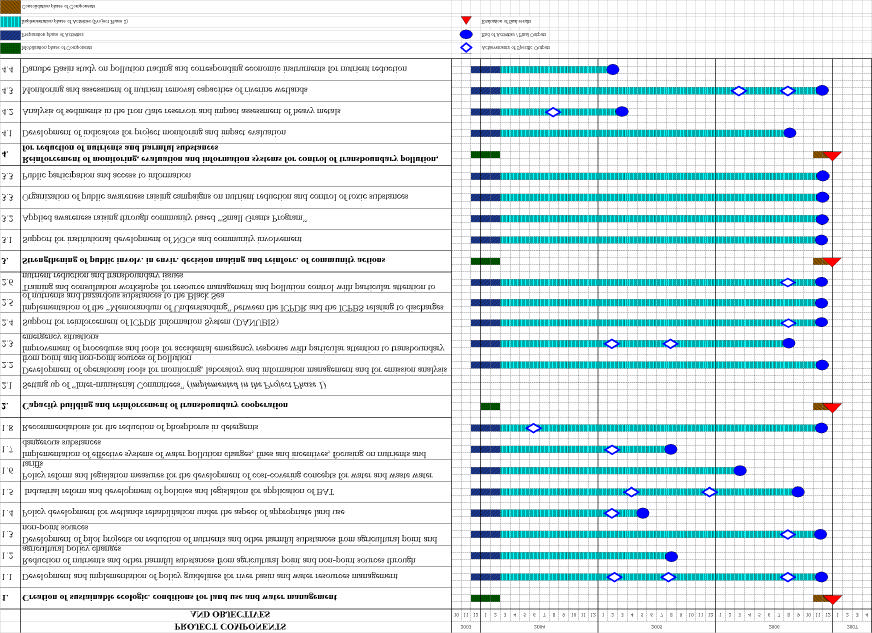
Annex 5: Project Implementation Schedule - Danube Regional Project - Tranche 2
45