Laguna de Bay
Experience and Lessons Learned Brief
Adelina Santos-Borja*, Chief, Research and Development Division, Laguna Lake Development Authority, Pasig, Philippines,
lennieborja@yahoo.com
Dolora N. Nepomuceno, Assistant General Manager, Laguna Lake Development Authority, Pasig, Philippines
* Corresponding author
1. Introduction
introduction of fi shpen technology in the lake has produced
economic benefi ts, but also has become a source of serious
Laguna de Bay is the largest, most important lake in the confl ict on resource utilization and access that reached the
Philippines. Its watershed contains 66 Local Government Units
attention of the President of the Philippines. It took 15 years
(LGUs), grouped into 5 provinces, 49 municipalities and 12 to develop a feasible and acceptable management plan to
cities with an estimated population of 6 million people. The
address the concerns regarding the lake. Rapid urbanization
creation of the Laguna Lake
Development Authority (LLDA)
in 1966 started with a vision of
the political leaders from the
provinces of Rizal and Laguna
to cultivate the potential of the
lake and its environs for further
development and, at the same
time, control its environmental
degradation. It also refl ects
the wisdom of the lawmakers
in creating a separate agency
to manage the lake amidst the
multiple political jurisdictions
in the watershed. A unique
feature of the jurisdictional
area of the LLDA is that it goes
beyond the lake's watershed
(Figure 1).
The existence of an Authority in
the drainage basin puts Laguna
de Bay in the best position
in terms of conservation and
management, compared to the
other lakes in the Philippines
and, perhaps, to some of
the lakes within the Asian
region. The current state of
Laguna de Bay is the result of
actions taken by its different
stakeholders; thus, although
everyone is accountable, most
of the responsibility goes to
the LLDA.
Although the lake is a multiple
use resource, its dominant
use is for fi sheries. The Figure 1. The Laguna de Bay Basin.
and industrialization have greatly increased the demand for
The watershed area excluding the lake itself is 2,920 km2,
environmental goods and services, mirroring the challenges
approximately 1.3% of the country's land area of 300,000
the LLDA faces in sustainably managing the lake basin.
km2. It is occupied by the provinces of Rizal and Laguna, and
partly by the National Capital Region, and the provinces of
The LLDA has both a developmental and regulatory mandate,
Cavite, Batangas and Quezon, consisting of 8 cities and 49
but with more emphasis on the latter because of its present
municipalities, including 2 lakeshore cities and 27 lakeshore
structure and fi nancial capability. Although it is yet to assume
towns. More than 100 streams fl ow into its drainage area,
a developmental role, it has laid the groundwork for this role.
which is divided into 24 sub-basins. There is only one outlet,
It is an agency with a very broad mandate, but with limited
the 27 km Pasig River, which drains to Manila Bay. When the
resources, with the result that some of its mandates are not
lake level is lower than Manila Bay, and when there is suffi cient
yet exercised. Given this predicament, the LLDA was able to
tidal fl uctuation that can push saltwater into the lake, Pasig
pioneer the Environmental User Fee System (EUFS) in the River becomes a tributary. During backfl ow of the Pasig River,
Laguna de Bay Region. The EUFS will be implemented by the
therefore, Laguna de Bay becomes a brackish water lake.
Department of Environment and Natural Resources throughout
The extent of saline water intrusion depends on the duration
the country.
of the backfl ow and the prevailing climatic conditions. The
normal chloride concentration ranges between 250-350 mg/L
The trust and cooperation of a substantial proportion of the
but can reach 4,000 mg/L at sustained Pasig River backfl ows
stakeholders, donor agencies and international organizations
(see Figure 2 below). The fi shermen and aquaculture operators
enjoyed by the LLDA did not come easily; it was and still is a
favor this phenomenon because higher salinity improves the
work in progress.
lake's transparency by the fl occulating effect of saline water
on the suspended colloidal particles in the water column.
2. Background
Subsequently, an abundance of phytoplankton follows
(Santos-Borja 1994).
2.1 Biophysical
Features
The lake provides a variety of environmental goods and
Laguna de Bay used to be an "arm of the sea" (Wolfe and Self
services to the surrounding communities, which extend to
1983; Adams 1910; and Gervacio 1964). The evolution of the
other stakeholders inside and outside the basin. It provides
lake was defi ned by at least three major paleosalinity shifts
food, water for irrigation, power supply, cooling of industrial
that occurred over the past 6,000 years (Jaraula 2001). Sea-
equipment and, more recently, a source of raw water for
level changes and tectonic changes controlled the evolution of
domestic supply. It also is a convenient transport route for
the lake from a brackish to a marine and ultimately to a fresh
people and products, a receptacle for fl oodwaters coming
body of water that now lies at 14°10'-14°35' N, 121°-121°30'
from Metropolitan Manila, and a sink for treated and untreated
E, specifi cally in the island of Luzon, the biggest of the 7,100
liquid wastes. Its dominant use at present is for fi shery, both
islands of the Philippine archipelago.
open water fi shing and aquaculture.
Among the 216 lakes in the Philippines (Santos-Borja 2001),
The lake also is part of the fl yway of migratory birds for shelter
Laguna de Bay is the largest, with a surface area of 900 km2.
and food. Its full potential as a place for recreation and nature
It also is one of the largest lakes in southeast Asia and one
appreciation has not been given much importance, due
of the shallowest, with an average depth of 2.5 m. It has a
perhaps to the environmental degradation observed in some
water volume of 2.25 km3. The high surface area to volume
parts of the lake, especially closer to Metropolitan Manila.
ratio accounts for the lake's characteristic turbidity. The water
retention time is approximately 8 months. Its shoreline of Observance of religious rites in the lake (e.g., baptism; fl uvial
285 km delineates three distinct bays; namely, the West Bay,
parade in honor of the patron saint) refl ects the close link
Central Bay and East Bay that converge towards the south. A
of lakeshore inhabitants to the lake. There also are some
South Bay also is referred to along the southwestern towns of
historical sites, such as the town of Calamba in Laguna
Laguna Province. The West and Central Bays are separated by
Province, the home of the Philippines' national hero, Dr. Jose P.
Talim Island, the largest, most populated of the nine islands
Rizal, who also highlighted the signifi cance of the lake and the
within the lake.
Pasig River in the daily lives of people in one of his novels. The
Laguna de Bay watershed abounds with natural and cultural
scenic spots, including Mt. Makiling and Pagsanjan Falls and
the century-old churches in Pakil, Pangil and Majayjay in
Table 1. Watershed Land Use.
Laguna Province. The Angono petroglyphs in the lakeshore
Land Use Type
Area (ha)
Percent
town of Binangonan Rizal is a world cultural heritage site.
Forested Areas
19,100
5%
Open Areas
59,480
14%
Watershed land use is presented in Table 1. The watershed
has a forest cover of only 5% of total watershed area, mainly
Built-up/Industrial Areas
110,780
29%
represented by Mt. Makiling which is considered a microcosm
Agricultural Areas
198,640
52%
of the only remaining forested environment in the Laguna de
226
Laguna de Bay
Bay basin (Sly 1993) as well as being one of the 18 centers
resulting mainly from the perceived economic opportunities in
of plant biodiversity in the Philippines (DENR/UNEP 1997), Manila (Francisco 1985).
following its early designation in 1910 by the Philippine
Government as a Forest Reserve.
2.2.3 Economy
In terms of economic output, the Laguna de Bay Region
Approximately 1,990 km2 (52% of the total land area) is produces a Gross Regional Domestic Product of PhP101.3
used for agricultural purposes, mainly livestock raising and
billion and a potential labor force of 6.1 million in 1990
coconut, fruit trees and rice farming. Industrial and urban (LLDA 1995). Agriculture still retains considerable economic
areas account for 29% of the watershed area, while deforested
importance, being the watershed's dominant land use.
areas (grass, bushland) comprise 14%. There has been a rapid
land conversion for industrial and residential uses in the past
Industrial establishments previously were concentrated in the
20 years.
Metropolitan Manila area, but have expanded over the last
20 years to other cities and municipalities. As of July 2003,
2.2
Political and Socio-economic Features
there are about 4,351 industrial establishments in the basin.
Based on the industry sub-sector classifi cation, the majority
2.2.1 The Watershed and the Laguna de Bay Region
are food manufacturing, livestock raising, chemical and
In 1983, the term Laguna de Bay Region was introduced through
pharmaceuticals, metals, minerals and non-metals. Real estate
Executive Order 927 Further Defi ning Certain Functions and
and housing, shopping centers and recreational facilities
Powers of the Laguna Lake Development Authority. LLDA can
constitute the highest number of business establishments.
exercise its mandate (indicated by "LLDA jurisdiction" line in
Figure 1) over almost the whole watershed, as well as political
The aquaculture industry also thrives in the Laguna de
units such as Quezon, Manila, Kalookan and Pasay which are
Bay Region, with ownership classifi ed into corporation,
located outside the watershed area but within the National
cooperative and individual operators. The hired fi sh pen
Capital Region (NCR).
and fi sh cage caretakers, service contractors that construct
fi sh pens and fi sh cages, and suppliers of materials and
Technically, the Laguna de Bay Region is not synonymous to the
fi sh vendors also benefi t from this industry. Ironically, there
lake's watershed. This refl ects the previous lack of appreciation
are not many socio-economic studies on such an important
by lawmakers of using the watershed as the management industry, resulting in a lack of accurate information on its
unit for the environmental protection of Laguna de Bay. The
economic benefi ts. Another factor is the reluctance of fi sh
inclusion of areas outside the watershed was essentially a pen operators to disclose their harvest and earnings, their
political accommodation. The city of Makati, the Philippine's
apprehension being that the disclosure will be used as a basis
prime fi nancial district, together with Mandaluyong and San
for determining their tax obligation and for increasing fi sh pen
Juan, were carved out of the continuous land mass in the fees. Thus, the LLDA estimated the lake's fi sh production on
National Capital Region (the area along the Pasig River marked
the basis of the stocking density, mortality rate and average
"outside LLDA jurisdiction" in Figure 1). Extension of the LLDA's
size of harvestable fi sh, with the estimated 2002 harvest being
management unit outside the watershed has been an irritant
60,000 tons/ha.
to local offi cials and regulated industries at times, and a source
of confusion in exercising its mandate. With the Laguna de Bay
2.3
Institutional and Managerial Features
Region so defi ned, it is necessary to differentiate between the
LLDA's geographical jurisdiction (its 2,920 km2 watershed) and
2.3.1 The Laguna Lake Development Authority and its
its administrative jurisdiction (the Laguna de Bay Region, with
Evolution
a total area of about 3,880 km2). Unless otherwise specifi ed,
The potential of the lake and its environs for further
all the facts and fi gures in this document refer to the Laguna
development, and perceived threats from the rapidly changing
de Bay Region, which is composed of the National Capital character of the lake region, prompted the political leaders
Region, 5 provinces, 51 municipalities, and 10 cities, altogether
of the Rizal and Laguna Provinces to enact legislation in the
comprising 66 local government units.
early 1960s geared toward management of the lake and its
resources and control of environmental degradation. This
2.2.2 Demography
move was intended to create an instrument to facilitate
The population growth and distribution in the watershed is
rational utilization of the lake's resources, under the belief
strongly infl uenced by the proximity of some lakeshore towns
that creation of an "Authority" would facilitate cooperation,
to Metropolitan Manila. About 18.3% of the total population
coordination and resource pooling among national government
resides in the National Capital Region. The growth rate is agencies, local governments and the private sector (Francisco
2.25%, slightly higher than the average national growth rate
1985). On July 18, 1966 the Laguna Lake Development
(2.02%). The population density is 20 persons/ha.
Authority was created through Republic Act 4850 An Act
Creating the Laguna Lake Development Authority, Prescribing
The more densely populated municipalities are located within
Its Powers, Functions, and Duties, Providing Funds Thereof
or close to Manila, with the high population growth rate and for Other Purposes. As stated in the law, its mandate is "to
attributed to migration in from other regions of the country,
promote and accelerate the development and balanced growth
Experience and Lessons Learned Brief
227
of the Laguna Lake area and the surrounding provinces, Guidelines Formulated by the National Credit Council. Being
cities and towns...with due regard and adequate provisions
a government-owned and controlled corporation (GOCC), the
for environmental management and control, preservation LLDA is no longer allowed "to be engaged in providing credit
of the quality of human life and ecological systems, and the
services directly or indirectly to various sectors."
prevention of undue ecological disturbances, deterioration and
pollution." Three years after enactment of R.A. 4850, the LLDA
This national initiative is aimed at rationalizing directed credit
was organized as a semi-government corporation. Presidential
programs to provide greater access by marginalized sectors
Decree (P.D.) 813 of 1975 further expanded the LLDA's mandate
to fi nancial services and to improve their living conditions. It
to address environmental concerns and confl icts over the was envisioned to provide the enabling environment for the
lake's jurisdiction and control. This was followed by the 1983
effi cient functioning of markets and participation of the private
Executive Order (E.O.) 927, which further strengthened the sector.
institutional, fi nancial and administrative responsibilities of
the Authority, including its regulatory functions in industrial
In the late-1970s up to the early-1990s, the LLDA implemented
pollution.
some fi nancing mechanisms to address the socio-economic
condition of marginalized users of the lake's water resources,
The General Manager is the Authority's Chief Executive, prompted by the following conditions:
with the corporate power vested in the Board of Directors.
An operational subsidy of PhP1,000,000 was appropriated ·
Declining lake productivity--Factors contributing to
annually for fi ve years from the National Government
the declining lake productivity include pollution from
general fund. Thereafter, the LLDA became a self-sustaining
industries, siltation and sedimentation, fertilizer runoff
organization, with its operation fi nanced through income from
from agricultural lands, encroachment of shoreland
regulatory fees and fi nes, laboratory services, resource user
areas, and rapid conversion of prime agricultural lands
fees (aquaculture operation, water abstraction) and from its
into industrial and residential lands;
corporate investments and marketable securities.
·
Effect of the Napindan Hydraulic Control Structure
In 1993, the LLDA was placed under the administrative
(NHCS) on the lake fi sheries--The small fi shermen
supervision of the Department of Environment and Natural
blamed the prevention of entry of saline waters from
Resources (DENR), through Executive Order 149. As such,
Manila Bay through the Pasig River for the productivity
it maintains its separate policy-making functions through
decline, claiming saline water was an important factor in
the Board of Directors. The LLDA decides and acts on policy
clearing the lake water of turbidity, thereby promoting
matters, although not all are elevated to the DENR Secretary
growth of natural fi sh food. The NHCS was eventually
for fi nal approval, since the Secretary is an LLDA Board
opened; and,
member.
·
Protracted use of the lake as a source of domestic
Laguna de Bay is the only lake in the Philippines managed by
water supply--The pronouncement in early-1990 by
a special agency of the Philippine Government. Although the
then President Corazon C. Aquino that the Government
LLDA is mandated by law to perform its function as a basin wide
would use Laguna de Bay as a domestic water supply
authority, it does not have control over all projects affecting the
caused widespread apprehension and agitation among
lake and its region, due to overlapping areas of jurisdiction with
fi shermen, although they were assured by the LLDA that
other government agencies. The latter exercise their respective
they would not be affected by this move.
mandates in the region on policy and planning, regulation
and infrastructure development. The Local Government Units
These factors had three potential major consequences:
also exercise their mandate on environmental protection and
(a) lower income for marginal fi shermen and other lake
management, which was further strengthened by Republic dependent sectors; (b) displacement/unemployment because
Act 7160 or the Local Government Code. The existence of of perceived restrictions in using the lake for fi sheries; and (c)
many players, the majority being government institutions, has
confl ict of interest among different resource uses/users versus
become a liability in the management of the Laguna de Bay
domestic water supply, causing further agitation of other non-
Region (see Section 3.4.2).
fi shery sectors as well.
2.3.2 The LLDA Mandate vis-à-vis Provision of
In response, the LLDA identifi ed some important fi nancing
Livelihood Funding Mechanisms
programs/projects partly supported from its corporate
The Charter of the LLDA authorizes it to lend or facilitate revenues, external sources (e.g., LGUs, overseas development
the extension of fi nancial assistance and/or act as surety assistance), envisioned to provide alternative livelihoods
or guarantor of worthwhile agricultural, industrial and through an integrated package of assistance to the fi sherfolk
commercial enterprises. However, this provision was recently
and other stakeholders dependent on the lake's resources. The
affected by the issuance of Executive Order No. 138 dated 10
programs/projects sought to transform these stakeholders
August 1999 Directing Government Entities Involved in the and users totally dependent on the lake's natural resources
Implementation of Credit Programs to Adopt the Credit Policy
into versatile entrepreneurs capable of engaging in other
228
Laguna de Bay
income-generating projects, in addition to lake-based activities
prompt assistance, especially in the aftermath of typhoons
like fi shing.
and calamities, as well as in their daily subsistence; and (d)
the urgency of institutionalizing mid-term and periodic project
Laguna de Bay Fishpen Development Project (LBFDP). In implementation reviews. Overall, fi shery projects, especially
December 1978, the Asian Development Bank (ADB) and the
for marginalized fi shermen, should be supported by reliable
OPEC Fund for International Development approved a loan resource surveys.
to fi nance the Laguna de Bay Fishpen Development Project
(LBFDP), with the Development Bank of the Philippines Livelihood development program. Recognizing its resource
(DBP) and the Laguna Lake Development Authority (LLDA) limitations, the LLDA undertook a joint livelihood program,
as executing agencies. The project was conceived to help with counterpart funding from the Rizal and Laguna
marginal fi sherfolk improve their socio-economic condition by
Provincial Governments in 1990. It was intended to provide
providing them with an opportunity to enter into fi shpen and
start-up fi nancing to small-scale livelihood projects of
fi shcage industries, to systematically develop the lake fi shery
lake stakeholders, with the Provincial Livelihood Offi ces
through fi shpen/cage technology, and augment the region's
implementing the credit program on the ground, and the LLDA
fi sh supply, including nearby provinces.
providing technical assistance (e.g., training on fi shery and
aquaculture-related training; advisory services). For their part,
The LBFDP was designed to organize small fi shermen into the Rizal and Laguna Provinces each contributed an equivalent
cooperatives, provide credit, a supply of fi ngerlings and other
amount to the livelihood fund, which was rolled over to fi nance
production inputs, and harvesting and marketing support succeeding batches of income-generating projects. Other
services, in order for the cooperatives to own and operate their
program components included institution building (organizing
own fi shpen/cage modules.
cooperatives) and enterprise development, and provision of
support services (e.g., management assistance, marketing
The project had two components, namely:
and raw materials sourcing). Out of 13,000 target lakeshore
families below the poverty threshold, the program supported
·
Fishpen development. Provision and administration 3,250 families, in terms of livelihood assistance during its fi rst
of sub-loans for developing fi ve and ten hectare fi sh
year of implementation, with granted loans totaling about
pen modules, covering an area of 1,680 ha, benefi ting
PhP11.50 million.
about a thousand fi shermen-families residing in LDBR.
This component is administered by the DBP with LLDA
While the signed Memorandum of Agreement (MOA) between
assistance; and,
the LLDA and Provincial Governments provided for monitoring
and evaluation protocols, including periodic physical and
·
Hatchery/nursery complex and related facilities and fi nancial reports from the implementers to the LLDA, there
services. Construction of a large-scale hatchery/nursery
was no strict adherence to the requirements under the
complex and provision of other facilities and services,
MOA. Although the Agreement provided for the scheduled
including consulting services, under LLDA supervision.
remittance of interest to the LLDA after the principal had been
rolled over several times, for example, there was initially only
In spite of the systematic organization of small fi shermen
partial remittance, and eventually none whatsoever.
cooperatives by the LLDA, and establishment and operation of
fi sh pen modules by the cooperatives, the project was deemed
3. Biophysical
Environment
unsuccessful by both the Philippine Government and the
ADB, because its implementation was constrained by design
3.1
Past and Current Conditions
defi ciencies and inadequate environmental assessments,
leading to drastic changes in project design and scope, 3.1.1 Biodiversity
and
Fishery
implementation delays, and consequent shortfalls in targeted
Laguna de Bay is traditionally used as a communal fi shing
outputs. Most loans made under the Fishpen Development ground for daily sustenance and livelihood, explaining why
or credit component of the LBDFP were in arrears and never
the earliest recorded studies on the lake focused mostly on
collected by the DBP, thereby having to be written off. The
fi sheries (Mane 1929, Villadolid and Sulit 1931, Villadolid 1934,
project was terminated in March 1988.
Mane and Villaluz 1939). Concerns already were raised on the
use of destructive fi shing gear, over-fi shing, declining native
Based on the November 1996 ADB Post-Evaluation Offi ce
species populations, and pollution of the Pasig River.
Report, the key lessons from this LBFDP experience were: (a)
the need to incorporate adequate environmental concerns Studies on the fi sh population of Laguna de Bay during 1960-
into the technical design of the project and to conduct 1964 (Delmendo and Bustillo 1968) showed that there were
environmental assessments on an on-going basis; (b) the 23 species of fi sh belonging to 16 families and 19 genera.
importance of adequate risk analysis at the project design The most dominant and important species were Therapon
level, and of balancing risks with appropriate safeguards; plumbeus and Glossogobius giurus (white goby). Most of the
(c) the need to provide institutional mechanisms for training,
stock were migratory species, but were scarce in distribution
organizing and motivate small fi shermen, and provide them
due to pollution of the Pasig River, suggesting a high mortality
Experience and Lessons Learned Brief
229
for migrating fry. Stocking the lake with milkfi sh since 1959 due
The benthic fauna is composed of mollusks (e.g., Corbicula,
to its higher market price, was reported and was identifi ed as a
Melanoides,
Thiara), oligochaetes (e.g., Branchiura,
reason for the accidental introduction of other species.
Limnodrilus, Naididae); the ostracod Cypricercus sp., and the
dipterans represented by chironomid larvae.
During the same period, there was an alarming decline in
the sea catfi sh (Arius manilensis) population, which used to
There presently are no recorded endemic species in Laguna
constitute the lake's fi shery. This was attributed to a decrease
de Bay, probably because it is a very young lake, formed some
in the snail (Thiara sp.) population because of rampant 6,000 years ago. Its link to Manila Bay, and the introduction
dredging to sustain the duck farming industry, notably in of non-native species, also could have contributed to this
the eastern towns of Rizal Province. Related to this industry
phenomenon.
is the making of "balut" which is a native delicacy of boiled
unhatched duck embryo, although after almost twenty years,
3.1.2 Water
Quality
there was a tremendous decrease in the number of duck Critical pollution levels were detected in the lake in 1973
farms.
(SOGREAH 1974). It is estimated that about 5,000 tons of
nitrogen entered the lake, 26% being of domestic origin,
The catfi sh population started to increase a few years after the
36% from livestock and poultry, 5% from industrial sources,
introduction of aquaculture in the early-1970s and it is now the
11% from fertilizers, and 22% from Pasig River backfl ow. The
most commonly-caught fi sh in the lake. It thrives near the fi sh
average nitrate concentration was 150 µg/L, with the total
pen areas, where the catfi sh seek shelter.
nitrogen assumed to be between 900-1,000 µg/L. The inorganic
phosphate concentration was less than 40 µg/L, and the total
Aquaculture became a very lucrative lake-related business, phosphate was below 100 µg/L. The initial fi ndings were that
encouraging the culture of other species (e.g., tilapia; bighead
nitrogen limits algal growth in Laguna de Bay. A follow-up
carp, Hypopthalmichthys nobilis). A stock assessment of major
study from 1975 to 1977 also indicated nitrogen was the most
fi shery resources showed the open water catch is composed of
likely limiting factor controlling algal growth in the lake.
13 species, including the shrimp commonly found in the lake
(Palma et al. 1997). Of the fi sh species, the most commonly
Reassessment of the status of Laguna de Bay in 1984 (BCEOM
caught were Tilapia sp., H. nobilis and A. manilensis.
1984) showed that nitrogen still can be considered the main
eutrophication factor, although there also were times when
In 2002, an alarming population of janitor fi sh (Hypostomus
light (at times of high turbidity) and temperature (during the
plecostomus) was observed in the lake and tributary rivers.
cooler months when blue green algae numbers were low)
This is a common aquarium fi sh because of its ability to clean
seemed to limit the maximum algal biomass. It is believed
organic debris. Maintenance of aquariums became a very Laguna de Bay has not yet reached an extreme level of
popular hobby in the late-1900s, now being a common fi xture
eutrophication. Recent estimates in 2000, generated via the
in homes, offi ces and businesses. Businessmen ventured in
Laguna de Bay waste load model, indicated a total nitrogen
the culture of aquarium fi sh along the lakeshore and near the
input of 13,800 tons nitrogen per year, with 79% being from
rivers, and the escape of janitor fi sh from such operations is
domestic sources, 16.5% from agricultural activities, 4.5%
believed to have caused this introduction.
from industrial effl uents, and 0.5% from other sources.
The most common phytoplankton in the lake are blue-green
Laguna de Bay is classifi ed as a Class C inland water (DENR
algae and diatoms. The former is composed mostly of 1990), meaning it is suitable for fi sheries. Assessment of its
Anabaena, Anabaenopsis, Microsystis and Oscillatoria, while
water quality is based on the criteria for different parameters,
the diatom population is dominated by Stephanodiscus. Other
including dissolved oxygen, biochemical oxygen demand
genera (e.g., Coscinodiscus, Melosira) also are consistently (BOD), nitrate, phosphate, dissolved solids, suspended solids,
found throughout the year. Representative genera of green etc. Values of chloride ion, transparency, total suspended
algae include Scenedesmus, Hormidium, Closterium and
solids, chemical oxygen demand (CODCr) and dissolve oxygen
Pediastrum. Dinofl agellates like Glenodinium and Ceratium
are presented in Figure 2 for Station I which is located near
are rarely present. An abundance of phytoplankton is the center of the West Bay. These parameters refl ect that the
generally observed from May to September. Algal blooms that
lake's water quality is within the Class C criteria, except for
sometimes reach alarming levels occur during these months,
chloride. Although not presented in Figure 2, the phosphate
often dominated by Microcystis sp.
concentration exceeded the maximum limit in 1997, an El Nino
year.
The zooplankton population consists of rotifers like Brachionus
angularis, B. calycifl orus, B. urceolaris, B. forfi cula, B. falcatus,
Due to its eutrophic character, algal blooms are common
Keratella sp., Trichocerca sp., Filinia sp. Asplanchna sp. and
occurrences in the lake. A lake-wide algal bloom of Microcystis
Hexartha sp. The cladocerans are composed of Diaphanosoma,
sp., with concentrations up to one million algae per milliliter,
Bosmina, Ceriodaphnia, and Moina. The identifi able copepods
was recorded in 1973. Its most damaging effect on aquaculture
include the adult forms of Mesocyclops sp., Thermocyclops sp.
was in 1975 (June-July), killing about 5 million of milkfi sh.
and Arctodiaptomus sp.
230
Laguna de Bay
Figure 2. Laguna de Bay Water Quality: Selected Parameters (Source: LLDA monitoring data).
Experience and Lessons Learned Brief
231
3.2.1 Urbanization
and
Industrialization
Localized fi shkills due to the collapse of blue-green algal
blooms also are experienced in the lake.
The impacts of rapid population growth, urbanization and
industrialization, and the concomitant real estate development,
Total coliforms and fecal coliforms seldom exceed the are causing severe stress on the lake environment and its
allowable limit for Class C water of 5,000 MPN/100 ml and
watershed. The lake is getting shallower (i.e., average depth
200 MPN/100 ml, respectively. However, because the sampling
of 3 m in 1970s to current average of 2.5 m). Rapid denudation
stations are in open water, the same fi ndings may not be true
of the forested areas and land conversion have further
near lakeshore areas, considering that individual septic tanks
aggravated this problem. Recent studies have shown that the
in residential areas are common, and sewerage systems are
in-lake siltation rate is between 1.03-1.20 cm/yr. Flash fl oods
lacking.
and mudslides have become frequent in recent times, resulting
in loss of property and death.
Heavy metals, such as cadmium, chromium, lead, copper, iron,
nickel, and zinc, are regularly monitored in the lake. The fi rst
Rapid migration to urban centers, and uncontrolled human
three are included in the list of parameters for assessment of
settlement along river bank and lakeshore areas, has
Class C water. Their in-lake concentrations (LLDA 1999) were
contributed to the growing solid and liquid waste problem.
below the set criteria of 0.01, 0.05 and 0.05 mg/L, respectively.
Domestic wastes of a majority of the watershed's 6 million
Lead and nickel concentrations were below the detection limit,
inhabitants ultimately fi nd their way to the lake. The estimated
while that for zinc ranges between 0.03-0.10 mg/L. The iron
BOD load contribution of 26% from domestic wastes in 1976
concentration is normally high, with an average value of 1.986
(WHO/UNDP/LLDA 1978) has increased to 68% in 2000 (LLDA
mg/L. Preliminary studies (NEDO/LLDA/JEMAI 2000) showed
monitoring data). Unfortunately, the government has no
that the level of arsenic ranged between 0.022-0.030 mg/L,
signifi cant program to treat domestic wastes. No centralized
compared to the criteria of 0.05 mg/L.
sewerage system exists, except for newly-developed housing
and commercial subdivisions. Although primary treatment via
The heavy metal concentrations in the lake sediments are septic tanks is common in urban residential areas, it is not in
very low, up to only twice the average shale values, except
rural areas and places occupied by informal settlers (usually
for nickel which has concentrations ranging from 2 to 12 along river banks and lakeshore). Waste segregation and
times the average shale values. Based on an assessment in
recycling is practiced in some places, although indiscriminate
1999 by the National Institute of Geological Sciences, the open dumping of wastes is a common practice. Laguna de
lake's overall pollution level derived from sediment data can
Bay serves as the receptacle of treated, partially treated and
still be described as very low, corresponding to unpolluted to
untreated liquid waste, with this type of use directly confl icting
moderately-polluted levels (Igeo values of 0-2).
with all other uses, posing a great challenge to the LLDA and
other agencies and stakeholders.
3.2
History of Lake Degradation
Industrial pollution contributes about 30.35% of the total
The root causes of rapid deterioration of the resources in the
pollution load to the lake. The number of regional industrial
lake and its watershed are well documented (e.g., SOGREAH
fi rms has increased fi ve-fold since 1970. There were an
1991; Sly 1993; LLDA 1995; LLDA and ERDB 2000). They estimated 1,538 industrial fi rms in 1994. Based on the LLDA's
include:
record of 3,881 industrial establishments situated mostly in
the western side of the lake, about 26% use dry processes,
· Intensifi ed economic activities, resulting in increased 23% generate wastewater through wet processes, and 45%
urbanization, industrialization and population pressures,
involve both wet and dry processes. The remaining 6% is still
mostly in the western zone of the basin, thereby unclassifi ed. Of those fi rms with wet and dry processes, 34%
exacerbating the environmental quality problems in the
have installed wastewater treatment facilities, while others
urban sector and the degradation of forest and fi shery
have adopted full recycling practices.
resources of the lake and its watershed;
3.2.2 Resource Extraction
·
Open access to natural resources use;
Illegal fi shing practices (e.g., use of fi ne-meshed nets and suro
(a device that scours the lake bed)) have occurred since the
·
Lack of economic resource pricing policies; and,
1930s. A decline in open water fi shery was previously reported
in the early-1970s (Shimura and Delmendo 1969; Delmendo
·
Lack of a common policy objective for management and Gedney 1974), with the effects being clearly manifested
and development of the resources of the lake and its
in the 1980s. Thus, it became diffi cult to convince fi shermen
watershed.
that their common fi shing practices were causing the decline
in their fi sh catch. Destruction of the lake bed, especially near
These root causes can be further classifi ed into urbanization,
littoral areas, was suspected to be the reason for the declining
industrialization and resource extraction.
populations of some native aquatic macrophytes (Hydrilla
sp.).
232
Laguna de Bay
As previously noted, snail dredging used to support the scale under the USAID-assisted Environmental and Natural
duck raising industry in some lakeshore towns. The practice
Resources Accounting Project (ENRAP). Under this project,
continued unabated in the mid-1980s to 1990s. Truckloads application of this valuation technique for Laguna de Bay was
of snails are being hauled from the lake to support the limited to inland fi sheries.
land-based duck-raising industry and prawn culture in
earthen ponds outside the lake basin. The income from snail
For purposes of providing a reasonable estimate of the
harvesting seemed to be high since most fi shermen and economic value of Laguna de Bay watershed environmental
boatmen in lakeshore towns shift to snail gathering during
resources, the economic analysis undertaken by the Laguna
the peak season. This type of livelihood is no longer observed.
de Bay Strengthening and Community Participation Project
Unfortunately, this economic activity was not given due (LISCOP) (also discussed in Section 5.4.3) was used. The
attention in terms of documentation and research, especially
approach started with an examination of the uses of Laguna
on the impacts of excessive snail gathering on the lake's de Bay (e.g., fi sheries; irrigation; domestic water supply;
ecology.
recreation; bird sanctuary; habitat for a variety of fl ora and
fauna). It is emphasized that the notion of "use" does not imply
Aquaculture operation started in a commercial scale in the
that absence of an "observable" use translates into no use. All
early-1970s, with the cultured fi sh (Chanos chanos or milkfi sh)
resources have a "use", even if it is not directly observable.
relying on the natural food in the lake. Two croppings per Thus, the total economic value can be computed as:
year was the practice, thereby accelerating the return of
investment. This business attracted many businessmen, such
Total Economic Value = Use values + non-use values
that aquaculture structures occupied almost 2/3 of the lake's
surface area in 1983. A declining harvest was then observed,
where:
due to depletion of natural food, as well as obstructed water
movement caused by a disorderly arrangement of fi sh pen ·
direct use values = those generated from actual use of
structures. Further, water hyacinth infestation became serious,
the resource for livelihood or communal or reservation;
especially where they were trapped within the structures.
and,
Other fi sh species also were introduced in the lake for the
purpose of aquaculture without an assessment of the potential
·
indirect values = benefi ts to society resulting from the
impacts to the lake's ecology. Unfortunately, the organic load
functions of the ecosystem (e.g., forests act as carbon
to the lake from fi sh pens and fi sh cage operation has not been
sinks and provide watershed protection);
monitored.
Direct use can be further differentiated into:
The denudation of the forests, and siltation of the lake and its
tributary rivers in the area of the Rizal Province, are blamed on
·
Existence values = values to individuals of specifi c
quarry operations and limestone extraction. Local communities
aspects of the environmental resources that are
often complain not only about air and noise pollution, but also
unrelated to any form of current or future use; and,
the unusual coloration of the river water.
·
Bequest values = the benefi ts to future generations to
3.3
Economic Valuation of Laguna de Bay
be able to use the resources in the future.
Environmental Resources
A schematic of this approach is presented in Figure 3.
Economic valuation framework developed to determine the
costs and benefi ts of environmental goods and services has
To compute the economic benefi ts for the Laguna de Bay,
been applied to natural resources valuation on a national direct uses were confi ned to important direct uses only, and
Total Economic Value
Use Values
Non-use Values
Direct
Indirect
Option
Bequest
Existence
Values
Values
Values
Values
Values
Consuptive and
Ecosystem
Premium
Benefits
"Knowing
non-consuptive
functions
placed on
for
that it
use of
and
possible
future
is there..."
resources
services
future uses
generations
Figure 3. Total Economic Value of Using Laguna de Bay's Resources.
Experience and Lessons Learned Brief
233
do not include other direct and indirect uses, or non-use Environmental User Fee (see section 4.4.1 for discussion) on
values that would normally be included in developing a more
BOD in 1997 (Table 4) led to slight fi sh catch improvements.
comprehensive measure of the total economic value of the
environmental good and service (Table 2).
The general decline in the weight of fi sh catch meant a
corresponding decline in the market value of the catch. In
In regard to its fi sheries, the total fi sh catch from Laguna de
1984, the estimated market value of fi sh catch was around
Bay in 1984 was estimated to be about 116 million metric tons.
P53 million, declining to approximately PhP28 million in
By 1995, the total catch had decreased to about 24 million
2000. Thus, the declining quality of the lake has real indirect
metric tons. By 2000, the estimated total fi sh catch had further
effects on the economy, with falling incomes and threatened
declined to about 18 million metric tons. In spite of occasional
livelihoods.
short-run improvements in total fi sh catch, the last twenty
years have exhibited a strong general trend of declining catch.
In the absence of LISCOP, the level of fi sh catch in the lake was
predicted to decrease by 25%. Thus, the avoided cost with the
Not surprisingly, the declining fi sh catch has coincided with
project would be PhP17 million per year (using the December
increased pollution levels in Laguna Lake (Table 3). On the
2003 peso-dollar exchange rate of P55.5/US$1.00). If the fi sh
other hand, although insuffi cient data exist to establish catch would continue to decrease at 3.5% per year without the
a strong link, it also appears that the introduction of the project, the avoided cost with the project also would grow at
the same rate. The project's economic benefi t, with respect to
Table 2. General Methodology for Computing Benefi t from Important Direct Use of Laguna de Bay.
Nature of Direct Use
Method Used to Compute Benefi ts
Fisheries
Value of fi sh catch lost without the project
Irrigation
Additional cost of sourcing water without the project
No benefi ts computed, but the benefi ts equal the additional cost of adopting
Industrial cooling
alternative technologies for industrial cooling
Domestic
Cost avoided in extracting drinking water from alternative source
Recreational activities
Value of recreational benefi ts lost without the project
Power generation
No economic benefi t (for hydropower plants)
Table 3. Water Quality of Laguna de Bay and Fish Catch (Annual average in mg/L, unless stated).
Biochemical Oxygen
Total Suspended Solids
Total Dissolved Solids
Year
Fish Catch (metric tons)
Demand (BOD)
(TSS)
(TDS)
1990
2.10
56
1,011
1991
2.60
46
750
1992
2.00
56
1,223
1993
1.80
34
1,726
44,741
1994
1.60
67
734
18,020
1995
1.80
82
1,113
24,432
1996
1.60
48
368
13,060
1997
2.04
89
555
1998
2.68
47
2,192
1999
1.81
39
823
2000
1.14
Table 4. Total BOD Loading (metric tons/day).
No. of Firmsa
1997
1998
1999
2000
222 fi rms
5,403.29
4,102.38
1,200.37
1,240.51
255 fi rms
4,431.71
1,515.78
1,278.75
429 fi rms
1,790.03
1,448.48
628 fi rms
2,309.08
Note:
a) The increased BOD loading for 2000 was due to the increased volume of discharge (industrial park and residential subdivision),
and the increased BOD concentration of fi rms with water pollution cases; only fi rms those with complete documents are counted.
234
Laguna de Bay
direct use of the lake for fi sheries in net present value terms
stakeholder environment, including their characteristics and
(i.e., at a 15% discount rate) will be around PhP30.5 million.
motives.
The project's benefi t with respect to irrigation, domestic water
3.4.1 Analysis of Stakeholders
supply and recreation also were determined in terms of the
The Laguna de Bay watershed stakeholders can be grouped
avoided cost of using alternative sources. The computed values
into the following categories: (a) regulators; (b) policy makers,
were PhP70 million per year for irrigation, PhP0.5 million per
planners and coordinators; (c) developers (land and water),
year for domestic water supply and PhP30.1 million for tourism
including infrastructure development and provision of basic
over a 20-year horizon. With respect to irrigation (farming services; (d) research and development institutions; (e)
activities), the benefi t of improved water quality for irrigation
resource users (f ) local government units; and (g) informal
(or prevention of its further deterioration) is measured by the
stakeholders (Figure 4). The stakeholders in the last category
avoided cost of using alternative sources, computed as PhP69
also may fall into the resource users group.
million per year.
Table 5 shows the existing and potential areas of confl ict
3.4
Lake and Drainage Basin Resource Confl icts
between and among stakeholders' categories, as well as
the responses, which have been established, or are in the
The current institutional arrangement for managing the Laguna
pipeline.
de Bay watershed is characterized by the lack of a coherent,
harmonized relationship between and amongst the key Among the Resource Users/Communities, there are important
stakeholders, which thereby hinders its effective management.
players who have evolved from the development challenges
Each stakeholder, agency and institution has its own agenda,
and issues in the lake watershed, including:
separately formulated and separately implemented policies,
mandates and programs to meet relatively narrow, sectoral or
·
Formally organized and unorganized fi shermen and
stand-alone goals. This section discusses the evolution of the
farmers;
Figure 4. Stakeholders in the Laguna de Bay Region.
Experience and Lessons Learned Brief
235
3.4.2 Confl ict among Institutions
·
Laguna de Bay fi sh pen operators' associations;
The existing institutional arrangements in the Laguna de
·
Informal stakeholders, including informal settlers Bay Region are complex, with no coherent and integrated
(squatters), fi sh pen poachers, etc;
environmental or development governance system. This
has led to a series of separately-formulated and separately-
·
Indigenous Peoples, such as the Dumagats and implemented policies, mandates, and programs, each
Remontados of the Tanay micro-watershed; and,
striving to meet relatively-narrow, stand-alone goals. Such
arrangements have been ineffi cient in: (a) creating a widely
·
Non-governmental organizations supporting urban poor
accepted common objective for managing the natural
issues, IP concerns, gender issues, etc.
resources of the lake and its watershed; (b) balancing the
different political, economic, and social interests; and (c)
Except for the Indigenous Peoples, for whom the National focusing government, private sector, and citizen resources
Commission on Indigenous Peoples (NICP) was created, on managing this ecosystem. The factors causing and
there is limited literature or documentation on these informal
exacerbating the institutional ineffi ciency detailed above can
resource user groups. Recently, organization of the informal
be summarized as:
settlers' group has been hastened by controversial government
projects in the Laguna de Bay area.
· Fragmented,
often-confl icting policies in environmental
and natural resources management of the lake and its
The Institutional Re-engineering Studies undertaken for the
watershed;
LLDA by Tetra Tech EM Inc. and PNB Capital and Investment
Corporation (LLDA et al. 2001), under a World Bank/Japan-
·
Limited capacities in environmental management,
funded project, developed a detailed analysis of the root
particularly at LGUs;
causes of confl icts in the Laguna de Bay Region, as presented
in the following sections.
·
Exhausted administrative and civil service, and a weak
political will in the central and regional environmental
Table 5. Areas of Confl ict and Response for Stakeholders in the Laguna de Bay Region.
Stakeholder Category
Areas of Confl ict
Response
Coordination, development, monitoring,
Rationalizing the mandates/functions,
enforcement of land use plans, issuance of
streamlining their functions, procedures and
Regulators
permits/clearances, standard setting, policy
requirements (e.g., one-stop-processing of
development on resource pricing and allocation,
permits), policy and program coordination
market-based instruments
Inconsistencies in policy setting, and planning;
lack of coordination; sectoral policy development
Institutionalize micro-watershed, participative
Policy makers, planners
approaches result in inconsistencies/
environmental action planning at the LGU/
and coordinators
contradictions/overlapping; lack of clear
agency level
responsibility for formulating and implementing
commonly acted policy
Uncoordinated infrastructure development
planning by national/regional agencies in relation
to the LLDA; inconsistency of infrastructure
Creation of enabling environment for private
Infrastructure
projects with the strategic policy direction for the
sector participation with government as
developers
management of the lake as set out in the Master
facilitator and catalyst
Plan; limited public investments in environmental
infrastructures
The LLDA as clearinghouse to coordinate and
integrated R&D activities to (a) ensure focused
Research and
Lack of proper coordination with the LLDA;
research agenda centered around priority
development
dissemination of research outputs is limited
research areas, (b) minimize duplications
institutions
and maximize outputs; (c) dissemination of
outputs to widest audience/users as possible
In addition to using the resources of the lake
Strengthening regulation, monitoring and
Resource users/
and the watershed for common good (fi sheries,
enforcement; expansion of MBIs, enhanced
communities
irrigation, drinking water, navigation, recreation,
IEC activities; application of user fee to
etc.), the lake has served as waste receptacle.
households
Sometimes confl ict with the LLDA responsibilities
Local Government Units
in the management and maintenance of
Co-management of the watershed with LGUs
(LGUs)
ecological balance within their territorial
and stakeholder communities
jurisdiction
236
Laguna de Bay
agencies, thereby preventing these agencies from
navigation. To reduce the adverse impacts of fi sh pens
expeditiously addressing the region's confl icting
on fi sh production, the LLDA implemented a zoning plan
institutional arrangements;
that reduced the fi sh pen areas to 10,000 ha and the fi sh
cage areas to 5,000 ha. Nevertheless, the fi shermen,
·
Slow devolution of responsibilities and resources from
fi sh pen operators, Bureau of Fisheries and Aquatic
central agencies to LGUs, and inadequate efforts to
Resources, and the LLDA continues to debate the
strengthen the governance and capabilities of LGUs
wisdom, size, location, and benefi ts of the structures.
to assume greater responsibility in fulfi lling their
Compounding the problem is the weak enforcement of
mandates; and,
laws on fi shing boat registration, illegal fi shing, and the
role of LGUs in enforcing the laws.
·
Lack of or, at best, narrow opportunities for community
and private sector participation in the management and
·
The lake's potential as a key drinking water source
sustainable use of the region's natural resources.
cannot be ignored. The two previous Philippine
administrations proclaimed this goal for Laguna de Bay.
The LLDA re-engineering study also suggested that limited
Increasing emphasis on the lake's role as a drinking
overlapping of mandates and responsibilities often is not
water source may eventually challenge all other uses of
a hindrance. The confl ict arises when the objectives of the
the lake.
policies and laws creating those mandates contradict one
another. The confl icts also become deeper when the resource
·
Quarry operations around the lake and in its watershed
base in question is delicate, with limited carrying capacity to
are another activity potentially contributing to the
satisfy all mandates.
lake's pollution and sedimentation. The Mines and
Geosciences Bureau (MGB), an offi ce under the DENR,
3.4.3 Confl icts among Users
currently regulates quarries over 5 ha in area, while
Almost all previous studies about Laguna de Bay highlight the
the Provincial Governors control the smaller quarries.
confl icts among the various users, infrastructure developers,
However, the authorities for permitting, clearance, and
and regulators and policy makers, and most current and
enforcement among DENR, LGUs, and LLDA have not
foreseen problems in managing the lake and its watershed
been streamlined. Further, illegal small-scale mining
are attributable to them. A set of case studies exist that clearly
operations continue in the region.
refl ect the root causes of confl icts among the lake users, with
the following being representative statements of the confl ict
·
A large portion of the region's population consists of
issues.
informal settlers who typically cluster in fl ood and
pollution-prone locations (e.g., shorelands, river banks,
·
Development projects to improve the use of lake water
embankments, and other areas subject to severe
for irrigation face increasing salinity and contamination
fl ooding). Most of the areas are environmentally-
from the Pasig River that will make the lake water
sensitive areas. The rivers carry solid wastes generated
unsuitable for agriculture. Pollution from industries,
by this large population to the lake.
household waste, and transportation within the lake
also threatens agricultural enterprises. Although the ·
Attempts to protect the lake as a protected site have
LLDA has started to implement strict regulations against
long been ignored in favor of unavoidable demands
industrial effl uent discharges, the lake's role as a waste
for water and fi sh. Nevertheless, a small-scale tourism
receptacle is not likely to decrease.
industry still struggles to survive amidst the lake traffi c,
and visitors can take historic tours and boat rides to
·
The Napindan Hydraulic Control Structure (NHCS) has
remote pockets where it is considered safe to swim.
been the cause of confl icts between the Department
of Public Works and Highways (DPWH) and the fi shing
3.4.4 The Case of the Northern Lakeshore Project: The
community. The purpose of the NHCS (to regulate
Evolution of the Informal Settlers Group
backfl ow from the Pasig River) has been ignored, to The disputed 9.8-km Metro Manila Flood Control Project:
favor fi shermen who need the brackish water for the
West of Manggahan Floodway (popularly called "Lakeshore
productivity of the lake's aquatic resources. The role of
Dike Project") is funded by the Japan Bank for International
the lake as a buffer against fl ooding along the Marikina
Cooperation (JBIC), for a total of PhP2.9 billion and is being
and Pasig Rivers also has exacerbated the confl icts by
implemented by the Department of Public Works and Highways
the impacts of a fl ooded lake on farms, fi shpens, and
(DPWH). This project will be located in the northern shores of
lakeshore development.
Laguna de Bay, covering the Municipalities of Taguig, Cainta,
Taytay, Pateros and Pasig, with a total drainage area of 39.01
·
Use of the lake by fi sh pen owners constitutes another
km2. It is intended to protect the fl oodplains from fl oods, with
level of confl ict. Fish pens grew from 38 ha in the the design high water level (elevation 13.8 m) corresponding
1970s, to more than 30,000 ha in 1983, seriously to a 40-year probable recurrence. Some 600,000 inhabitants
reducing areas available for open fi shing and impeding
along the fi ve municipalities will be directly affected by the
Experience and Lessons Learned Brief
237
project, which was issued a notice to proceed in September
Development of the Laguna de Bay Environment (SDLBE).
2000, with a target completion date of February 2006. The
Although modeling results showed that the dike construction
President of the Philippines, however, ordered suspension will not greatly affect the lake's hydrodynamics, in terms of
of the road dike construction, in response to protests the ecological aspects, water quality and sedimentation in
by affected residents and LGUs, calling for a series of the area, the effect may be different than expected. For this
consultation meetings among relevant government agencies,
reason, the LLDA recommended new studies to update the
LGUs and People's Organizations (POs). A moratorium was environmental impact assessment, including the impacts
issued in 2001 on the construction of the dike, while public
of the loss of the fl oodplains on the functioning of the lake
consultations were being conducted under the auspices of ecosystem, since this aspect could not be described by the
the National Anti-Poverty Commission (NAPC). There are two
LLDA's modeling tools. Further, a legal study should be done
opposing groups of stakeholders: (a) the LGUs and residents
to determine the implications regarding the LLDA's jurisdiction
of the fl ood-prone areas who are in favor of the project; and
over the covered shoreland areas, especially the Proclamations
(b) the LGUs, residents of the areas where the displaced declaring portions of the lakeshore for socialized housing
waters are expected to fl ow, and their NGO supporters. Those
projects (Proclamations 704 and 458).
opposed to the lakeshore dike project stressed that if it was
built, it would cut through residential areas, turning vast tracts
To address the affected stakeholder issues and concerns, an
of land into a virtual marsh. Supporters, however, argued that
inter-agency Memorandum of Agreement was signed on 16
the project was designed not only to solve the Taguig and
April 2002, calling for studies through the University of the
Metro Manila area fl ood problems, but would also serve as a
Philippines National Hydraulic Research Center (NHRC) as the
road network linking Rizal Province to the South Expressway
lead institution, and with one representative each from the
going to Laguna, Cavite and Batangas Provinces. It also would
concerned LGUs and fi ve representatives from TLLD and PLLD.
open about 2,000 ha of prime land in Lower Bicutan, Taguig for
The study was meant to review the original dike alignment,
industrial development and infrastructure projects.
and a feasibility study on the polder dike proposed along
the lakeshore from Taguig to the west bank of Manggahan
At the height of the controversy, a number of stakeholders'
Floodway. The study results were presented to the stakeholders
groups came into being, primarily formerly unorganized, on 12 February and to DPWH on 17 February 2003. In a 4 March
informal settlers, and their NGO partners; these are Taytay 2003 inter-agency meeting, the "most optimum plan from the
Laban sa (against the) Lakeshore Dike (TLLD), Pasig Laban sa
social, environmental and economic viewpoints" was agreed
Lakeshore Dike (PLLD), Urban Poor Associates, and Community
upon, wherein the original alignment at elevation 11.5 m shall
Organizer Multiversity. Table 6 shows the range of groups and
be pursued with a polder-cum-road dike along the above
the degree of their opposition/approval of the project.
mentioned lakeshore segment, in lieu of not constructing the
dike in the original alignment in a socialized housing project
Except for those that have to keep a neutral position because
in Lupang Arienda. It was the LLDA's position that the selected
of their roles in the consultation and project approval process,
alternative has far-reaching implications that may prejudice
the remaining stakeholders are strongly motivated to advocate
the integrity of the Laguna de Bay environment.
their positions. Determination of these factors within each
stakeholder groups should be considered in drawing up their
It also was agreed that the affected residents shall be resettled
roles and resource commitments in either forging agreements
jointly by the National Housing Authority (NHA) and DPWH
with the government regarding whether or not to proceed with
within Proclamation 704, in coordination with LGUs of Taytay
the project construction.
and Pasig and the concerned POs.
The LLDA position on the proposed project hinges on the results
The agreement also provides for implementation of the
of its study with the Decision Support System/modeling tools
agreed roles and responsibilities and required actions. The
established under the Dutch-assisted project on Sustainable
DENR and the LLDA have been tasked to closely monitor
Table 6. Opposition and Approval for the Lakeshore Dike Project.
Opposed, but with
In favor, under certain
Vehemently Opposed
Neutral
For the project
open mind
conditions
National Government
National Government
Local Government
Fishpen/cage
Agencies including
Agencies including
NAPC
Units including Taguig,
operators
DENR/EMB and UP-
NHA, ODAA, MMDA,
Pasig, Pateros
NHRC
DPWH and HUDCC
Informal settlers
including UPA,
LLDA
COM, TLLD, PLD and
MAPAGPALA
Local Government
Units including Taytay
238
Laguna de Bay
the project's compliance to the Environmental Clearance laboratory, performing both the collection and analysis of lake
Certifi cate conditionalities, and the proper implementation and river water samples. The laboratory also services external
of its environmental management plan. Among others, clients, thereby generating income for the LLDA.
the NHA shall ensure that the affected families will not be
disenfranchised of their position and lot apportionment, due to
The lake and the tributary rivers are monitored on a monthly
the dike construction. The National Anti-Poverty Commission
basis. Industrial effl uents are collected by Pollution Control
(NAPC) also shall coordinate and monitor the implementation
Division inspectors trained in the collection and handling of
by various implementing agencies of the Kapit-Bisig Laban samples. The laboratory analysis results become the basis for
sa Kahirapan Program (KALAHI) in the provision of livelihood
evaluating compliance of industrial establishments to existing
projects in the area.
effl uent discharge rules and regulations. Data on the lake and
tributary rivers are published annually. The monthly status of
Finally, after the series of consultations and signing of the the lake and tributary water quality also is posted on the LLDA
MOA, in March 2003, the President approved the resumption
website, using the Water Mondriaan (see Section 5.6).
of dike construction in three months time, under the belief that
the agreed combined roles and actions provided a "win-win"
Environmental user fee system (EUFS). Implementation of
solution to the confl icts among the various stakeholders.
the EUFS started in January 1997, as Phase 1 of the National
Program. It was designed to integrate and harmonize
4. Management
Environment
command-and-control (CAC) and economic instruments, in
order to generate a mechanism to improve environmental
4.1
Lake Management Programs and Processes
enforcement and compliance status of fi rms located in the
Laguna de Bay region. It now is an integral part of the LLDA's
The more serious and systematic approach to the integrated
Environmental Management Program.
management of the Laguna de Bay Region was the formulation
of the Laguna de Bay Master Plan in 1995, and its subsequent
The EUFS focuses primarily on reducing the pollutant load
approval by the President of the Philippines in 1996. While a
to the Laguna de Bay, making all liquid waste dischargers
water resources development master plan was formulated directly accountable for environmental damages caused by
in 1974, as a result of the Water Resources Development their day-to-day operations, by internalizing the environmental
Studies in 1972-1974, the Master Plan took cognizance of degradation and enhancement costs into their business
the interacting relationship between and among the various
decisions and actions. The eventual goal of the EUFS is to limit
uses of land and water resources and the confl icts among point source wastewater discharges to a level that ensures
alternative production activities, as well as uses of the lake
waterbodies within the Laguna de Bay system would be
water and surrounding related land resources, particularly protected and made suitable for their intended uses.
those dictated by urbanization and industrialization. The
Master Plan prescribes strategic policies, institutional reforms
The fee system is composed of a fi xed and variable fee. The
action programs and management measures to harmonize, former covers the administrative costs of implementing the
integrate and strike a balance between downstream and system, based on the volumetric discharge rate, while the latter
upstream activities in the watershed, consistent with a lake-
depends on whether the BOD concentration is above or below
basin management approach.
the existing effl uent standard of 50 mg/L, regardless of the
total BOD load. This scheme has induced fi rms to be more cost
The Master Plan places heavy emphasis on identifi cation,
effective in trying to comply with standards, in effect making
formulation and elaboration of priority programs and projects
the EUFS a model mixed regulatory and economic instrument.
needed to attain the goals of sustainable development of the
An enterprise must obtain a Discharge Permit (DP), renewable
Laguna de Bay region. Thus, it represents the most explicit
annually, from the LLDA, the DP being a legal authorization to
action towards the strengthening of an integrated lake basin
discharge their wastewater of acceptable concentration under
management approach. Four fl agship programs are currently
DENR DAO 35 to the lake or its tributary rivers.
being pursued: environmental management, watershed
management, fi sheries development and institutional reform
The EUFS is meant to cover all water pollution sources from
and development.
industrial, commercial, domestic and even agricultural
sources. The LLDA cautiously implemented the EUFS in stages,
4.1.1 Environmental
Management
Program
with a budget of PhP27 million initially allocated to support
Water quality monitoring. This activity began in 1973, with implementation requirements.
initial focus on lake water quality. When the LLDA mandate
was expanded to include pollution control, monitoring of During the fi rst year of EUFS implementation in 1997,
industrial effl uents also became a regular activity. The LLDA,
imposition of user fee was based only on the BOD content of
through its Environmental Quality Management Division, industrial wastewaters and applied to around 120 industrial
operates its own water quality laboratory, having gradually fi rms within the LLDA's area of jurisdiction. These fi rms
improved its capability through the acquisition of state-of-the-
belong to fi ve industrial sub-sectors estimated to account for
art laboratory instruments. A pool of well-trained staff runs the
nearly 90% of the total organic load to the lake; namely, food-
Experience and Lessons Learned Brief
239
processing fi rms, pig farms and slaughterhouses, beverage an administrative system whereby the rights of legitimate
manufacturers, fi rms engaged in dyes and textiles, and paper
titleholders are respected.
and pulp mills. All industries generating process wastewater
were covered in the second year. In the third year, residential
The LLDA is evaluating the effectiveness of current policy
subdivisions and commercial establishments, including food
instruments for shoreline management and control, based on a
chains and restaurants that discharge wastewater into the number of implementation and enforcement issues:
environment, were also covered.
· Development projects/activities have overtaken
The EUFS is implemented by the LLDA through its Pollution
regulation and control (the law, P.D. 813, defi ning
Control Division (PCD) as the lead unit, with support from
the shoreline was enacted in 1975, while the policy
the Environmental Quality Management Division for analysis
guidelines were issued in 1996);
of wastewater samples collected by the inspectors. A Public
Hearing Committee (PHC) supports the adjudication and ·
Lack of resources to monitor shoreline activities and
litigation of cases, including those related to non-payment of
enforce the rules and regulations;
environmental user fees.
·
Indifference of lakeshore LGUs, manifested in siting of
Aside from the EUFS, the traditional regulatory system of the
illegal open dumpsites on shorelines and riverbanks;
LLDA is still in place. All industrial establishments are required
proceeding with local development activities/projects
to register, with those with wastewater discharges also
without needed environmental clearances and permits
required to have a Pollution Control Offi cer (PCO) accredited
from the DENR and LLDA; and,
by the LLDA. The LLDA has developed a PCO training program
for accreditation purposes, including lectures on such issues
·
While policy tools exist (e.g., Shoreline Occupancy
as clean technologies. Aside from generating a modest income
Permits, Notice of Violation, Ex-Parte Orders and Cease
for the LLDA, it has also become a vehicle for disseminating the
and Desist Orders), they are insuffi cient for the purpose
Authority's plans and programs, as well as the pollution laws
of shoreline restoration and environmental regulation
being implemented in the Laguna de Bay region. The program
and control.
has gained wide acceptance from the industrial sector, with
cases in which they themselves requested a special training
4.1.3 Watershed
Development
Program
schedule.
Reforestation and tree planting. The watershed area is three
times the size of the lake, and where 66 local government
4.1.2 Shoreland Management Program
units exercise their respective political mandates. Their
It took almost thirty years for the LLDA to assert its mandate on
responsibility to protect and manage the environment in their
the management of its 140 km2 shoreline of Laguna de Bay, the
areas of jurisdiction as stipulated in the Local Government
fi rst action being the 1995 issuance of Board Resolution No.
Code also is important. Within these realities, the LLDA started
10, Series of 1995, asserting the LLDA's authority and exclusive
to link closely with the local offi cials and the communities
jurisdiction over Laguna de Bay, banning reclamation projects
as an entry point to a meaningful and practical watershed
and disallowing any non-environmentally feasible activities for
development program.
the lake. The LLDA Board approved the rules and regulations
on the use/occupancy of Laguna de Bay shoreland areas on
Almost all LGUs have a reforestation or tree planting program,
14 December 1996. Another two years were needed to create
in response to the massive CLEAN and GREEN campaign of
a new unit at the LLDA, the Special Concerns Offi ce (later the national government. To respond to the need for more
becoming the Special Concerns Division), to take the lead in
seedlings and enhance its desire of the LLDA to cooperate
implementing the rules. The guidelines on the lease of the
with the LGU environmental programs, the LLDA embarked on
shoreland were prepared and implemented in 1999.
the maintenance of a plant nursery to support reforestation
programs of different towns within the watershed. Similar
It is the declared policy of the LLDA under these rules, pursuant
support is being given to socio-civic organizations and non-
to RA 4850 as amended, to: (a) properly manage and control
governmental organizations (NGOs).
the use and/or occupancy of Laguna de Bay shoreline areas
within the context of national socio-economic development River rehabilitation. In 1996, the LLDA started a River
plans and policies and environmental concerns; (b) maintain
Rehabilitation Program for the rivers and streams fl owing
all shoreline areas lying below elevation 12.50 m as buffer
through the 24 sub-basins or micro-watershed of the Laguna
zones, in consonance with the Authority's policies, plans and
de Bay basin. This program evolved from a mere physical
programs for managing the water quality and protection and
river clean-up to a more comprehensive and sustainable
conservation of Laguna de Bay's water resources; (c) exercise
approach encouraging broad multi-sectoral involvement and
administrative and regulatory control on land use and/or support. Various stakeholders within each sub-basin (local
occupancy of shoreline areas within the context of the LLDA's
government offi cials, academic institutions, industrial and
plans and programs, and to manage such uses and occupancy
commercial establishments, religious groups, NGOs, POs, civic
along desirable environmental considerations; and (d) Provide
organizations, homeowners, etc.) were organized for a River
240
Laguna de Bay
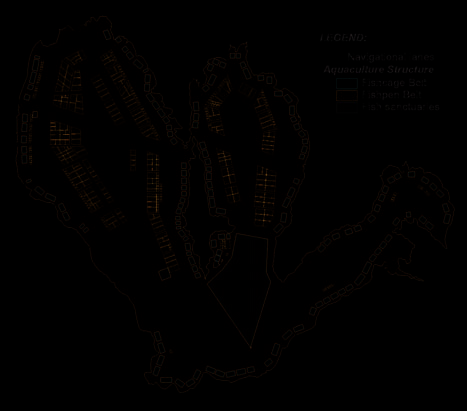
Rehabilitation and Protection Council (RRPC). A systematic directed to enhancing the capabilities of the members to
approach is being followed by the Council, including (a) perform their tasks.
mapping the watershed, (b) comprehensive survey of the river
system and its watershed, (c) development of a vision for a
4.1.4 Fisheries
Development
Program
healthy river system and watershed and, based on this vision,
Aquaculture operation. Regulation of aquaculture operation
(d) formulation of a River Rehabilitation and Protection Plan.
is based on the lake's Zoning and Management Plan (ZOMAP),
considered by far as the most feasible management system
River clean-up campaigns also are being sustained that involve
for equitable allocation of the lake's fi shery resource. Fish pen
the physical clean-up of rivers. The LLDA has organized the
belts and fi sh cage belts were delineated in specifi ed locations
Hukbong Pangkapaligiran ("Environmental Army", a volunteer
in the lake, covering a total area of 100 km2 and 50 km2,
organization consisting mainly of fi sherfolk and farmers) to
respectively (Figure 5). The area allocation was determined
lead the activity. The men and women of the Environmental
via analysis of the lake's carrying capacity for aquaculture,
Army are exemplars of volunteerism who play a vital role in
which was based on long-term primary productivity data from
raising environmental awareness and heightening motivation
different locations in Laguna de Bay (Centeno et al. 1987).
among various sectors to be involved in rehabilitation Limits were set on the maximum area to be occupied for fi sh
efforts. The program was so successful it led the LLDA to pen operation, (i.e., 0.05 km2 for a corporation, 0.01 km2 for
institutionalize the RRPC, with seed money of PhP50,000 (a
a cooperative, and 0.005 km2 for an individual owner). The
little under US$1,000) being given to support their activity or
maximum area for fi sh cage is 0.001 km2. An annual permit is
their registration as a foundation.
issued, with fi sh pen owners paying PhP6,000/ha (0.001 km2)
and fi sh cage owners paying PhP4,200,ha. Vacant areas within
The involvement of the industrial sector in the RRPC has the fi sh pen belt are awarded to an operator by bidding.
narrowed the gap between it and the community, especially
those with a preconceived view that industrial establishments
In keeping with provisions of RA 4850 on the distribution of
pollute the environment. Most successful and active RRPCs
benefi ts from fi shery to the LGUs, the fi sh pen fee collected
are those with active members from this sector, and whose
by the LLDA is shared according to the following scheme: (a)
representatives are often elected to higher position in the from 1983 to May 1996: 20% to lakeshore LGUs, 5% to Project
council.
Development Fund (PDF), and 75% to the LLDA; (b) from June
1996 to present: 35% to lakeshore LGUs, 5% to PDF and 60%
All the RRPC were federated on 26 June 2001 to serve as an
to the LLDA (Board Resolution No. 15, Series of 1996 dated 27
umbrella organization of the River Councils in the Laguna de
June 27 1996). From a fi shpen fee per hectare of PhP6000.00
Bay region. A conference of the RRPC is held every year, whereby
(US$120), every lakeshore municipality currently receives a
each council or foundation presents their accomplishments share of 15%, and an additional 20% if there are fi sh pens off
and updates the other councils or foundations on present their shoreline. The LLDA specifi es that their share should be
projects and future plans and programs. It also serves as an
used to fi nance environmental projects.
occasion for enriching their knowledge through lectures by
invited experts on matters concerning solid and liquid waste
The guidelines on release and utilization of fi sh pen fee shares
management, waste exchange, and other topics of interest of lakeshore LGUs was defi ned as early as 1986 under Board
Resolution No. PCLL-20, Series of 1986. The release of funds
shall be based only on the cost estimates of LGU-proposed
programs, projects or activities related to environment,
livelihood, river embankment and fl ood protection works,
watershed development and the likelihood for review/approval
by the LLDA. The LGUs are required to render a quarterly
accounting of funds, indicating the nature of disbursements,
its balances and the physical accomplishments. Such a report
is a prerequisite to the release of additional and succeeding
municipal fi sh pen fee shares. During June 1996, however,
during deliberations on modifi ed sharing of fi sh pen fees, the
Board of Directors (three being local government offi cials--
Governors of Rizal and Laguna and President of League of
Mayors), waived the requirements for the release/use of
fi sh pen fee shares, because they were perceived as being
cumbersome, hence making the funds inaccessible to the
LGUs.
The Fisheries and Aquatic Resource Management Council
(FARMC). The President of the Philippines issued Executive
Figure 5. Zoning and Management Plan (ZOMAP) of Laguna
de Bay.
Order 240 in 1995, "Creating the Fisheries and Aquatic
Experience and Lessons Learned Brief
241
4.1.5 Institutional Reform and Development Program
Resources Management Councils in Barangays, Cities, and
Municipalities and their composition and functions", in The proposed LLDA reorganization is consistent with the
accordance with the policy of the Philippine Government Public Sector Reform Program and the Water Resources
to ensure that management and control over fi sheries and Sector Policies and Directions, as embodied in the Philippine
aquatic resources shall be effected through the active, Medium-Term Development Plan 2002-2004, which stipulates
extensive participation of the people directly affected. It "the government shall support the strengthening of existing
also called for empowerment of the subsistence fi sherfolk
and effi ciently operating river/lake basin authorities".
through meaningful participation in the management,
development and protection of fi sheries and aquatic resources
Re-engineering the LLDA. Since its creation in 1966, new
for sustainable productivity. Republic Act 8550 (known as the
tasks and demands have emerged for the LLDA, including
Fisheries Code of 1998) further strengthened the important
confronting new challenges such as a rapidly-growing demand
role of the FARMC by specifying its composition, and the for lake water to serve an expanding metropolis and lakeshore
responsibility of concerned government agencies in ensuring
towns, as well as to properly coordinate infrastructure
that its functions are recognized and institutionalized. It development and regulate the multiplicity of resource uses
is composed of representatives from the Department of by various sectors. It also must facilitate interaction among
Agriculture, LGUs, NGOs, and fi sherfolk, including women and
various stakeholders, including confl icting interests amidst
representative from the youth sector. LGU representation is
alarming threats on the lake's sustainability.
given due importance to ensure that the plans and programs
will be incorporated in the municipal or city development plan
The LLDA was authorized as early as 1983, through Executive
and given due priority.
Order 927, to undertake a thorough corporate reorganization.
Although the Laguna de Bay Master Plan also calls for LLDA
Even before the passage of these laws, the LLDA has already
institutional and organizational reforms, the envisioned
established links with fi shermen organizations, rendering reorganization was not implemented by the LLDA because
fi nancial and technical assistance in their operation. Support
of changes in the country's political environment and
included fi nancing their training as Bantay Lawa (Lake
accompanying administrative and fi nancial constraints. Given
Guard) and deputizing qualifi ed fi shermen as Fish Warden, the rapid increase in population, settlements, industrial
in coordination with the Bureau of Fisheries and Aquatic establishments and other economic activities in its basin,
Resources. Funds from the LLDA development fund also are
the last 15 years witnessed growing concern for more active
being given to implement lake clean-up activities, and for the
protection of the lake.
surveillance of illegal fi shing activities.
Figure 6. The LLDA Institutional Re-engineering Model.
242
Laguna de Bay
The re-engineering study for the LLDA was conducted during
region. The Council will serve as a convergence point for
2000-2001 through a grant from the World Bank. It is a self-
review of sectoral policies and programs with implications for
directed effort of the Authority to transform itself into an watershed resources.
expanded, effective organization capable of fully discharging
its mandated powers and functions, with the purpose of Capacity building. The Sustainable Development of the Laguna
developing the most appropriate institutional model and de Bay Environment Project, which ended August 2003, was
associated planning and policy framework to enable it to supported by a grant from the Netherlands Government. The
become an effective development authority, while also three-year project was undertaken to ensure sustainable
maintaining its regulatory mandate. An integrated water development of the lake's resources, based upon a sound
resources management and development institutional model
knowledge of the functioning of the system, its users and
was recommended (Figure 6), also being the most acceptable
the institutional setting. It is specifi cally directed to capacity
option for all Laguna de Bay region stakeholders.
building and developing practical and realistic solutions for
current problems and issues in the lake basin. Among the
The main characteristics of the institutional model are as project achievements were establishment of an Integrated
follows:
Water Resources Management Unit, and the establishment
of an appropriate GIS/database and state-of-the-art modeling
·
The primary mandate of the re-engineered LLDA will be
system to support decision-making. All are geared to the
policy making, planning and implementing an integrated
transformation of the LLDA into an Integrated Water Resources
water resources management, and development of Management and Development Authority.
the lake and its river systems, including enhancing
water quality and quantity, expanding regulatory Conservation of Laguna de Bay Environment and Resources
responsibilities for monitoring compliance with water (CLEAR). CLEAR is a tripartite partnership involving the LLDA,
standards, and expanding the EUFS;
Unilever Philippines, and the Society for Conservation of
Philippine Wetlands (SCPW), with the objective of pursuing
·
The scope includes overall management of Laguna de
the lake's membership in the Living Lakes Network. A
Bay and its river tributaries, shorelands and aquatic Memorandum of Agreement was signed in June 2000 to ensure
resources, expanding it to include groundwater in continuity in efforts to conserve the lake's resources, and to
the future. In collaboration with LGUs, the scope empower and educate the watershed communities.
also includes raw water pricing development and
implementation, environmental infrastructure
As a private sector partner, Unilever provides funding support
development and coordination of land use planning;
for advocacy initiatives and activities that infl uence and
mobilize the business sector towards corporate responsibility.
·
The level of autonomy will expand from its current status
As a collaborating agency, the LLDA coordinates the tripartite
as a Government Owned and Controlled Corporation partnership's activities, and provides funds for biodiversity
(GOCC), relying solely on operating revenues, to an studies on the lake and environmental education projects.
investment-oriented development organization through
As an NGO partner, SCPW has been tasked to design
the proposed Laguna de Bay Development Corporation;
and implement advocacy activities for lake conservation,
and,
coordinate with other environmental NGOs in the lake region
and be the focal point for coordination with other Living Lakes
·
The LLDA becomes the apex body in the Laguna de Bay
partners around the world.
region, with responsibility for coordinating integrated
watershed management and development program.
The idea of joining the network began in November 1999
during Unilever's meeting on Sustainable Water and Integrated
The LLDA Board remains the policy-making body of the Catchment Management (SWIM) in Liverpool, England. The
Authority in this model. To make the decision-making process
lake's candidacy was formalized in November 2000 at the 5th
more inclusive, two advisory groups support the Board: the
Living Lakes Conference in Lake Biwa, Japan.
Technical Council and the Watershed Management Council.
The Technical Council serves as a permanent advisory council
Laguna de Bay was accepted as the 18th member of the Living
to the LLDA for making policy for resolving issues related Lakes Network in August 2001, during the 6th Living Lakes
to institutional arrangements in the Laguna de Bay region, Conference. Its admission to the network was a "breakthrough
including harmonization and resolution of confl icting and for Laguna de Bay and a milestone for Philippine environmental
overlapping functions, activities, policies and plans that exist
history" (Jerry Esplanada, Philippine Daily Inquirer). More
or arise between, and among, the LLDA and other regional
importantly, it brought conservation of the lake to the
government agencies and GOCCs.
attention of the international community, which can serve as a
positive pressure on the government to take serious actions in
The Watershed Management Council will be a multi-sectoral
preventing deterioration of the lake environment.
advisory council to support policy and planning activities
in the lake watershed among the sectors with stakes in the
Experience and Lessons Learned Brief
243
The Philippine 12th Congress, through House Resolution There was a signifi cant reduction in the BOD load to the lake
No.140, commended and congratulated the LLDA, Unilever from 1997 to 2002 (Table 7).
Philippines and the SCPW in their successful bid making
Laguna de Bay the 18th member of the Living Lakes Network,
The signifi cant BOD load reduction to the lake during 1997-
thereby also making protection and conservation of the lake an
1999 coincided with the introductory phase of the EUF,
international imperative.
refl ecting its successful implementation. The reduced BOD
load was due to several factors: (a) increased efforts among
Partnership with U.S. Agencies, Chesapeake Bay and Tha the regulated sources to treat their wastewater with new
Chin River (Thailand). The LLDA forged a partnership with or improved treatment facilities; (b) wastewater recycling
United States agencies (US-AEP, USEPA, USAID, etc.) in activities; (c) waste minimization; and (d) voluntary closure or
August 2002 on sharing of knowledge, experiences, and best
plant relocation.
practices on community-based environmental management
and resource conservation in Chesapeake Bay in the eastern
The actual impacts on ambient lake water quality relating to
United States, as well as with the Pollution Control Department
the reduced BOD load from point sources as a result of EUFS
of the Kingdom of Thailand on Integrated Watershed and Water
implementation are still undetermined. The LLDA intends to
Quality Management and Public Participation in the Tha Chin
apply its newly-developed Decision Support Systems and
River Basin. The LLDA's River Rehabilitation Program, and its
modeling tools to achieve full coupling of laboratory analysis
partnership with River Councils in the river systems in the lake
database on industrial pollution loads to the waste load model
region, was cited as one of the best practices on community-
and the GIS-generated information.
based resource management scheme during the August 2002
international workshop in Manila.
4.3 Enabling
Environment
4.2
Reduction of Lake Stresses
4.3.1 Regulatory Powers and Functions
The all-encompassing powers of the LLDA are clear in their
A snap shot analysis of the result of concerted efforts in authority to pass, approve, or disapprove all plans, programs,
protecting Laguna de Bay is the maintenance of its Class C
and projects proposed by LGUs, and public and private
status, in spite of growing threats to the lake. The orderly corporations. LLDA also has exclusive jurisdiction to issue
arrangement of fi sh pens as a result of the revised Zoning and
permits and collect fees for using the lake water, as well as
Management Plan of the lake allowed better water movement
authority to earmark revenues generated for its own activities.
between the structures, lessening the accumulation of
water hyacinth. Also noteworthy is the resolution of confl ict
The LLDA also exercises police powers. Violators of the laws,
between the fi sh pen operators and fi shermen. Improved rules and regulations can be held administratively, civilly and
fi sh production due to the ZOMAP implementation is diffi cult
criminally liable. Further, the LLDA can pursue a separate civil
to assess because of other environmental factors affecting action for damages resulting from violations of the law. As
production and lack of cooperation from fi sh pen operators to
specifi cally provided by law, any damages recovered by civil
disclose their harvest per cropping season. The latter do not
action shall be earmarked for environmental management.
appreciate the importance of their information in evaluating
the program and assessing the lake's productivity.
The LLDA's mandate allows it to introduce a wide range of
innovative policies. It was the fi rst agency in the Philippines,
A more objective assessment is presented in terms of for example, to apply the concepts of natural resource pricing
implementation of the Environmental User Fee System (EUFS).
in the form of fi sh pen fees and, more recently, imposition of
After the three-year EUFS introductory and implementation wastewater discharge fees (EUFS). The LLDA's experience
phase, there were 914 fi rms covered as of December 2002.
in resource pricing is setting the stage for a comprehensive
national implementation of a similar policy by the Department
of Environment and Natural Resources (DENR). The LLDA's
venture into raw water pricing will establish another policy
Table 7. Estimated BOD Reduction in the Lake Due to EUFS
Implementation.
precedent with potentially wider national application.
BOD Load
BOD Loading
Cumulative
The numerous laws, rules and regulations on the protection of
Year
(metric
Reduction
No. of Firms
ton/year)
(%)
the lake environment are presented in Table 8.
1997
222
5,403
4.3.2 Financial Capability
1998
255
4,432
24.08
Under the 1999-2000 LLDA Institutional Re-engineering
1999
429
1,790
65.80
Studies, an assessment of the fi nancial performance, fi nancing
2000
628
2,309
19.08
and investments of the LLDA was undertaken for the years
1995-1999.
2001
738
1,687
40.61
2002
914
791
61.30
244
Laguna de Bay
Capitalization. The LLDA was created in 1966 under RA 4850
·
Processing fees for clearances and permits;
as a quasi-government agency with a corporate structure
and management operations. Of its authorized capital stock
·
Reasonable fees from users/benefi ciaries of the lake
of PhP7.0 million, the total issued and outstanding and
resources (water supply, aquaculture, fi sh pen fees,
subscribed capital stock amounted to PhP387.14 million
etc.); and,
(55.3% of the total authorized capital). Of this quantity, 92.2%
is accounted for by the National Government and the remaining
· Administrative
fi nes and penalties for violating pollution
by the Rizal and Laguna Provinces, various municipalities and
control laws, rules and regulations.
private corporations and individual stockholders. Of the total
paid-in capital of PhP173.27 million, 94.12% is paid up by The LLDA Board of Directors fi xes the fees to be collected, and
the National Government. The two provinces took up only recommends to the President the approval of the sharing of the
14.9% of their combined subscriptions. Calling for additional
fees with LGUs and other government agencies, if necessary.
subscription is a clear option to improve the LLDA's fi nancial
This excludes the fi sh pen fees, which are addressed under EO
position, and the Authority can easily generate PhP312.86 927.
million from this option.
The LLDA Charter also allows it to collect these revenues and
Financing. Under its present mandate, the LLDA is authorized
earmark the collection for environmental management and
to source its funds from the following:
development of the lake and its watershed. However, this
requisite earmarking for environmental enhancement also
·
National Government subsidies and fi nancial assistance
limits the Authority's fl exibility to embark on initiatives strategic
to carry out its social overhead projects, upon to its mandate. It should engage in pioneering activities/
recommendation of the NEDA Board;
projects, in order not to compete with the private sector. It is
prohibited from investing its funds in high-risk endeavors and
·
Bilateral and multilateral sources through their technical
debt instruments without recourse to commercial banks or
assistance grants or loan facilities;
investment houses and in highly speculative stocks.
·
Contracted loans through fl oating of bonds and other
The LLDA revenue performance for the years 1995-2002 is
debt instruments;
summarized below (Table 9), with the annual percentage
growth rate for each revenue item to the total revenue
·
Sale of stocks and invest in secured debt instruments;
presented in the last row.
·
Public-private partnership; and,
Analysis of the above fi gures on relative contributions of the
various revenue sources indicates the following trends.
·
Build-Operate-Transfer contracts with private entities
pursuant to the BOT Law (RA 6957, as amended by RA
·
No perceptible trend in fi shpen fee collections: Except
7718)
for the windfall collection of fi shpen fees in 1996, after
the Supreme Court Decision in December 1995 ruling
The LLDA also can make recommendations to proper
out the authority of LGUs over issuance of fi shery
government agencies on the peso or dollar fi nancing
permits, and favoring the LLDA's jurisdiction over
requirements of its mandated functions, technical support,
fi shery and aquaculture regulation in the Laguna de
the level of priority for certain projects and, accordingly,
Bay area, the 1995-2002 fi sh pen fee collections can be
solicit assistance from the National Government or any of
considered normal levels. Further, in 1997 all registered
its instrumentalities. The LLDA Charter further allows the
fi shpen structures were fully transferred to the approved
Philippine Government to guarantee the payment for principal
1996 Fish Pen Belt.
and interest of the Authority's loans, bonds, debentures and
other obligations.
·
Steady increase in environmental regulation revenues:
These revenues primarily consist of Environmental User
Although the LLDA Charter provides for broad opportunities to
Fees, processing fees and other environmental permit/
expand its fi nancial base, these are nevertheless limited and
clearance fees, wastewater/effl uent sampling and
hampered by the National Government's long, tedious, multi-
laboratory analysis fees, and development clearance
layered approval process, thus affecting the proper timing and
fees. The share of revenues from environmental
provision of fi nancing for long-term sustainability of the lake
activities to total revenues since introduction of EUFS
and watershed resources.
in 1997 increased from 28% to 46% in 2002, averaging
45% for the 8-year period.
Flow of revenues through the LLDA mandate/functions. As a
GOCC with an enabling Charter, the LLDA can raise revenues
·
Remarkable increase in collection of administrative fi nes
and retain the same for its own disposition. The revenue-
and penalties: This represents charges for failure to
raising sources of the Authority include the following:
meet established water and effl uent quality standards
Experience and Lessons Learned Brief
245
Table 8. Summary of Laws, Rules and Regulations for Laguna de Bay Basin Management.
Objectives Laws
and
Ordinances
General mandates
1. Republic Act No. 4850:
on lake basin
An act creating the Laguna Lake Development Authority, prescribing its powers, functions and duties, providing funds
management
thereof and for other purposes (July 18, 1966)
2. Presidential Decree No. 813:
Amending certain sections of Republic Act No. 4850, granting the LLDA the exclusive jurisdiction to issue permits for the
use of all surface waters of the lake for any project or activity within the region (October 17, 1983)
3. Executive Order No. 927:
Further amending the original charter of the LLDA, granting it the power to control and abate pollution within the Laguna
de Bay Region (December 16, 1983).
4. Executive Order No. 121:
Creating the Mt. Makiling Reserve Area and Laguna de Bay Commission (August 24, 1993).
5. Executive Order No. 149:
Streamlining the Offi ce of the President (December 28, 1993).
6. Executive Order No. 349:
Adopting the Mt. Makiling Reserve Area and Laguna de Bay Region Master Plan, providing for the implementation thereof
and for other purposes (July 18, 1996).
Pollution control
1. Presidential Decree No. 984:
Providing for the revisions of Republic Act 3931 ("The Pollution Control Law of the Philippines") and for other purposes
(August 18, 1976).
2. Presidential Decree No. 1586:
Establishing an Environmental Impact Assessment System, including Environmental Management-related measures and
for other purposes (June 11, 1978).
3. DENR Administrative Order No. 34, Series of 1990:
Revised water usage and classifi cation/water quality criteria amending section Nos. 68 and 69 and Chapter III of the 1978
NPCC Rules and Regulations (March 20, 1990).
4. Republic Act No. 6969
An act to control toxic substances and hazardous nuclear wastes, providing penalties for violations thereof and for other
purposes (July 23, 1990).
5. DENR Administrative Order No. 26-92, Series of 1992:
Amending Memorandum Circular No. 02 Series of 1981: Appointment/Designation of Pollution Control Offi cers (June 29,
1992).
6. Resolution No. 7, Series of 1993:
Approving new schedule of processing fees for environmental permit/clearance (November 4, 1993).
7. DENR Administrative Order No. 35-91, Series of 1993:
Revised effl uent regulations of 1990 revising and amending the effl uent regulations of 1982 (December 9, 1993).
8. Resolution No. 24, Series of 1996:
Adoption of Department Administrative Order (DAO) No.30, Section 3, Paragraph 3.3 (C) of the Department of Environment
and Natural Resources (DENR), as part of the policy of the Laguna Lake Development Authority (LLDA) (September 26,
1996).
9. Resolution No. 25, Series of 1996:
Implementation of the Environmental User Fee System (EUFS) in the Laguna de Bay Region and approval of its work and
fi nancial plan for CY1997 (November 19, 1996).
10. Resolution No. 33, Series of 1996:
Approving the rules and regulations implementing the Environmental User Fee System in the Laguna de Bay Region
(December 19, 1996).
11. Resolution No. 41, Series of 1997:
Adoption of the defi nition of development activities per DENR Administrative Order No. 96-37, and integration of said
defi nition in the LLDA rules and regulations, thereby clarifying further the development activities required to secure LLDA
clearance (March 21, 1997).
12. Resolution No. 42, Series of 1997:
Approving the administrative fi nes for violations of the LLDA Rules and Regulations (March 21, 1997).
13. Memorandum Circular No. 2, Series of 1997:
Inspection and investigation of establishments compliance to environmental quality standards and pollution control rules
and regulations (May 2, 1997).
14. Resolution No. 64, Series of 1997:
Prescribing new schedule of processing fees and other fees for environmental permits/clearances within the Laguna de
Bay Region (December 23, 1997).
15. Memorandum Circular No. 98-8:
Ensuring safe navigation in specifi ed lake areas (December 10, 1998).
16. Resolution No. 104, Series of 1999:
Adoption of Department Administrative Order No. 51, Series of 1998, pertaining to the Industrial Ecowatch System and its
implementing guidelines, of the Department of Environment and Natural Resources (DENR), as part of the policy of the
Laguna Lake Development Authority (LLDA) (March 25, 1999).
17. Memorandum Circular No. 99-02:
Amendment of certain provisions of Memorandum Order No. 97-84, Series of 1997, concerning the simplifi ed requirements
for Accrediting Pollution Control Offi cers (March 29, 1999).
18. Resolution No. 106, Series of 1999:
Approving the policy guidelines governing all industrial estates/parks within the Laguna de Bay Region (April 25, 1999).
19. DENR Administrative Order No. 99-17, Series of 1999:
Updating Department Administrative Order No. 35, Series of 1990, otherwise known as the Revised Effl uent Regulations of
1990, revising and amending the effl uent regulations of 1982 (July 8, 1999).
246
Laguna de Bay
Table 8. Summary of Laws, Rules and Regulations for Laguna de Bay Basin Management. (cont'd.)
Objectives Laws
and
Ordinances
Fishery management 1. Executive Order No. 240:
Creating Fisheries and Aquatic Resources Management Councils (FARMC's) in barangays, cities and municipalities, their
composition and functions (April 28, 1995).
2. Memorandum Circular No. 96-60:
Policy guidelines for fi sh cage operation in the Laguna de Bay (April 28, 1995).
3. Rules and Regulations Implementing the Revised Laguna De Bay zoning and Management Plan (ZOMAP) (January
25, 1996):
4. Resolution No. 9, Series of 1996:
Amending Section 4.3 of the Rules and Regulations implementing the Revised Laguna De Bay Fishery Zoning and
Management Plan (ZOMAP) of 1996 (February 29, 1996).
6. Resolution No. 15, Series of 1996:
Approving the implementation of modifi ed sharing of fi sh pen fee per R.A. 4850, as amended (June 27, 1996).
7. Resolution No. 26, Series of 1996:
Approving the co-management approach to attain sustainability of the Seven-Crater Lakes of San Pablo City, by
deconcentrating certain administrative functions of the LLDA (November 19, 1996).
8. Resolution No. 27, Series of 1996:
Approving policy guidelines for fi sh cage operation in the Laguna de Bay (November 19, 1996).
9. Resolution No. 28, Series of 1996:
Approving policy guidelines for public bidding of the remaining free fi sh pen areas in the Laguna de Bay (November 19,
1996).
10. Memorandum Circular No. 97-5:
Fish pen block verifi cations (July 15, 1997).
11. Resolution No. 70, Series of 1998:
Approving the policy framework on the use of Seven-Crater Lakes of San Pablo City (March 30, 1998).
12. Memorandum Circular No. 2, Series of 1998:
Moratorium in the construction of fi sh cages in Laguna de Bay (August 19, 1998).
13. Memorandum Circular No. 98-06:
Policy guidelines for fi sh cage operation in the Laguna de Bay (October 7, 1998).
14. Memorandum Circular No. 7, Series of 1998:
Policy guidelines for collection of annual fi sh pen fees for Winning bidders.
15. Memorandum Circular No. 1, Series of 1999:
Policy guidelines for fi sh pen registration in Laguna de Bay (January 25, 1999).
Shoreland
1. Section 41 (11) of Republic Act No. 4850:
management
2. Memorandum Order No. 204:
Creating an effective committee to oversee implementation of short and long term plans for the Mt. Makiling Reserve Area
and Laguna de Bay Commission (April 27, 1994).
3. Resolution No. 10, Series of 1995:
Asserting the LLDA's authority and exclusive jurisdiction in Laguna de Bay concerning issuance of permits for reclamation
projects, and disallowing any non-environmentally-feasible activities in the lake (June 29, 1995).
4. DENR Administrative Order No. 27-95:
Moratorium on the acceptance and processing of all public land applications covering areas immediately adjacent to the
Laguna Bay Basin (November 17, 1995).
5. Resolution No. 23, Series of 1996:
Approving the rules and regulations implementing section 41 (11) of R.A. No.4850, as amended defi ning and regulating the
use /occupancy of Laguna de Bay shoreland areas (December 14, 1996).
6. Resolution No. 39, Series of 1997:
Approving the increase of rates for the survey of shorelands within the Laguna de Bay Region and areas for aquaculture
operation (February 27, 1997).
7. Resolution No. 110, Series of 1999:
Amending the Administrative Fine for violation of the LLDA Rules on reclamation/landfi lling of any portion of the Laguna
de Bay and its shoreland
8. Resolution No. 113, Series of 1999:
Amending Board Resolution No.23, Series of 1996, by adding implementing guidelines governing the lease of the Laguna
de Bay shoreland areas
9. Resolution No. 42, Series of 1997:
Approving administrative fi nes for violations regarding the LLDA rules and regulations.
Ferry system
1. Resolution No. 66, Series of 1998:
operation
Approving the navigational route for the ferry system to be introduced in Laguna de Bay (January 29, 1998).
management
2. Resolution No. 67, Series of 1998:
Approving policy framework toward operationalizing a ferry system in Laguna de Bay (February 26, 1998).
3. Resolution No. 74, Series of 1998:
Approving policy guidelines on the operation of a ferry system in the Laguna de Bay Region (June 19, 1998).
4. Resolution No. 75, Series of 1998:
Ratifi cation of policy guidelines on the operation of a ferry system in the Laguna de Bay (July 2, 1998).
5. Resolution No. 81, Series of 1998:
Approving implementing rules and regulations governing the operation of a ferry system in the Laguna de Bay Region
(September 12, 1998).
Experience and Lessons Learned Brief
247
Table 9. Revenue from Operations (million PhP).
1995
1996
1997
1998
1999
2000
2001
2002
Fish pen/fi sh cage fees
17.873
44.571
17.054
28.505
25.856
36.938
22.901
39.766
Fish pen repairs/
0.121
0.012
-
0.008
0.022
0.008
0.013
0.211
processing
Survey fee - fi sh pen
0.039
0.040
0.404
0.718
0.326
0.816
0.642
0.926
Barging fees
0.380
0.437
0.676
0.595
0.352
0.418
0.470
0.046
LLDA clearance fees/
7.175
9.210
11.903
16.537
19.746
17.844
17.060
7.192
air pollution
Discharge permit fees
-
-
6.660
14.798
12.490
13.334
11.964
21.376
Laboratory fees
0.370
0.398
0.223
0.650
0.225
0.126
0.341
0.625
Admin. fi nes - pollution
1.395
5.914
16.114
33.217
24.649
20.004
14.080
13.762
Shoreland
-
-
-
-
0.112
1.225
2.133
2.194
management fees
Survey fees land
-
-
-
-
-
-
0.055
0.193
Water abstraction
-
-
-
-
0.184
1.158
1.607
1.844
Receipts from market
0.488
0.421
0.036
0.025
0.064
0.389
-
0.026
Interest on marketable
8.388
11.770
12.470
18.873
15.776
13.940
13.985
7.484
securities
Interest on other bank
0.073
0.143
0.121
0.235
0.167
0.207
0.169
0.103
accounts
Miscellaneous
0.261
1.586
3.482
2.937
2.414
3.256
1.394
2.278
Total
36.563
74.502
69.143
117.098
102.383
109.663
86.814
98.026
or other non-compliance with the LLDA rules and in spite of fast leadership turnover in the LLDA, it was able to
regulations. It ranged from a low of PhP1.395 million in
sustain its program due its pool of experienced, well-trained
1995, to an unprecedented high of PhP33.217 million in
senior staffs and managers.
1998. Over the period 1995 to 2002, administrative fi nes
and penalties contributed an average of 18% to the total
4.3.4 Cooperation of Stakeholders
revenues of the LLDA.
With the increased trust in the Authority, there is better
and wider stakeholder participation in the LLDA's plans
·
Increase in average growth rate in investments in and programs, a concrete example being the involvement
marketable securities: This revenue source contributed
of citizens in reporting pollution violations. Consultation
an average of 14% to LLDA's total revenues for the meetings also are well attended, compared to the past. The
period.
LLDA also has increased its capacity in public consultation and
participation, using popular, widely-adopted methods such as
4.3.3 Improved Track Record and Experienced
the Pair-Wise Comparison and Multi-Criteria Analysis.
Workforce
For about the last ten years, there was a persistent clamor
5.
Lessons Learned and Recommended
for abolition of the LLDA, due to the impression that it is
Initiatives
doing nothing to combat pollution or to address the confl icts
between different lake users. This is due to the very limited
5.1
Legislated Actions on Environmental Protection
fi nancial and human resources of the Authority, compared to
are Time-tested Support for Sustainable Lake
the enormity of its mandate. It can partly be attributed to lack
Management
of an appropriate vehicle for information dissemination and
for reaching the different stakeholders. Improvements in the
One of the best things that happened for the management
Authority revenue, external funding assistance through grants
of Laguna de Bay was the Philippine Government's creation
from international donor agencies, opportunities for further
of a management authority with specifi c mandates on the
studies and training, and timely implementation of meaningful
development and environmental protection of the lake and
programs enhanced the LLDA's capabilities. Coupled with the Laguna de Bay region. Succeeding amendments to the
a more aggressive information dissemination campaign, LLDA Charter (RA 4850), through Presidential Decree 813
networking and linkage with different local and international
and Executive Order 927, further strengthened the LLDA
institutions, and successful implementation of projects with
mandate in environmental protection and regulation. In spite
foreign funding, the credibility of the LLDA has improved and,
of these advances, the exclusive authority of the LLDA to issue
248
Laguna de Bay
permits for the enjoyment of fi shery privileges, specifi cally the
To cite a specifi c example, on 4 March 2002, the Offi ce of
operation of fi sh cages and fi sh pens, was challenged in court
the President issued Executive Order No. 75 to create a
by some fi sh pen operators and mayors of certain lakeshore
Board of Advisors for the LLDA, consisting of three fi sherfolk
municipalities, invoking the provisions of Republic Act 7160,
representatives from Laguna de Bay, to broaden participation
or the Local Government Code of 1991, which granted the of various resource users in managing the lake. A proposal
municipalities exclusive authority to grant fi shery privileges
to amend this executive issuance was submitted to the LLDA
to erect fi sh corrals, etc. within a defi nite zone of municipal
Board of Directors, recognizing sectors other than fi shery,
waters. The case reached the Supreme Court of the Philippines,
whose concerns and interests should be represented in the
which ruled in favor of the Laguna Lake Development Authority.
policy decision-making process. Unfortunately, the LLDA Board
A specifi c paragraph on the decision of Justice Hermosisima Jr.
decided to defer submission of the proposed amendment in
refl ected his appreciation of the lake environment, quoted as
deference to the President.
follows:
The frequent shifts in the top management of the LLDA
"Laguna de Bay therefore cannot be subjected to fragmented
have affected implementation of fl agship programs. The
concepts of management policies where lakeshore local LLDA General Manager is appointed by the President of the
government units exercise exclusive dominion over specifi c
Philippines and, therefore, serves at the President's pleasure.
portions of the lake water. The garbage thrown or sewage Processing of the General Manager's appointment and his
discharged into the lake, abstraction of water therefrom or
tenure at the topmost post in the agency are subject to
construction of fi sh pens by enclosing its certain area, affect
political underpinnings. Over the last 34 years, the LLDA has
not only that specifi c portion but the entire 900 km2 of lake
been managed by twelve General Managers, an average of
water. The implementation of a cohesive and integrated lake
only three years for every appointee.
water resource management policy, therefore, is necessary to
conserve, protect and sustainably develop Laguna de Bay."
The frequent changes in the General Manager of the Authority,
in addition to the presence of other political appointees in
This phrase has become a famous quotation for advocating
the LLDA Board who sit at the pleasure of the President, have
integrated resource management and sustainable resulted in shifting policy and program directions, posing
development, serving as an inspiration for the LLDA.
serious implications to the sustainability of development
efforts in lake resource management (Nepomuceno 1996). It is
The LLDA also asserted its mandate on environmental the desire of the LLDA work force, and most LLDA stakeholders,
regulation when it was sued by a private fi rm for issuing a
that the LLDA Manager be a career professional whose tenure
cease-and-desist order for violation of the LLDA's rules and
is dependent only on performance.
regulations. The court affi rmed LLDA's action as a "practical
matter of procedure under the circumstances of the case, and
A worthy initiative of the Department of Environment and
is a proper exercise of its power and authority under its charter
Natural Resources is advocating Good Environmental
and its amendatory laws." This case further strengthened the
Governance. Started this year, the program requires key
LLDA regulatory role in the region.
offi cials and middle managers of the different bureaus and
agencies under its supervision to undergo a facilitated two-day
5.2
Politics in Lake Governance
training workshop on Good Environmental Governance, with
one component being stressed is accountability to the people
The policy-making powers of the LLDA are vested in its Board of
and to the environment.
Directors. Of its ten members, two are ex-offi cio representatives
from the National Economic and Development Authority 5.3
Institutionalization of a Re-engineered LLDA
(NEDA) and the Department of Trade and Industry (DTI), four
are elected offi cials (namely, the Governors of the Rizal and
Lost opportunities to re-organize in a timely manner have
Laguna Provinces, and the Presidents of the Mayors' League
prompted the LLDA to be more aggressive in pursuing
of Rizal and Laguna); four are Presidential appointees, such
its reorganization on the basis of an institutional model
as the LLDA General Manager, Chairman of the Metropolitan
building on a fully integrated water resources management
Manila Development Authority, representative of the Offi ce
and development institution. One is the proposed wider
of the President, and representative of Private Investors. The
representation and participation of stakeholders through
latter is supposed to be selected from among the LLDA private
the Technical Council and the Watershed Management
stockholders, but most often is chosen by the President of the
Council, which was adopted by its Board of Directors on 25
Philippines. Furthermore, the Board Chairperson, who should
January 2001 through Board Resolution No. 157, Series of
be elected from among the Board members, is almost always
2001. Representations made to the Legislative Branch of
designated by the Philippine President. Relevant sectors the Philippine Government resulted in the fi ling of House
and lake users have no direct representation in the Board,
Bill 4252, meant to strengthen the LLDA. In fact, President
illustrating how politics could infl uence policy decision-making
Gloria Macapagal-Arroyo expressed support to the LLDA re-
processes at the Board level.
engineering, to make it more responsive in carrying out its
Experience and Lessons Learned Brief
249
mandates, considering the impacts of its operations on the
The LLDA Re-engineering Program centers on creation of a
lives of the people living in its watershed.
sustainable management model for the lake and its watershed.
The study recommended a commercial approach for building a
Although still facing a long path, the LLDA has already framework amenable to private sector participation (PSP). To
begun operating under the principle of integrated watershed
build the LLDA capacity for infrastructure project development
management. Adoption of a framework focused on integrated
and fi nancing, the Board approved a staged process wherein
water resources management has become imperative due to a
a subsidiary called Laguna de Bay Development Corporation
number of factors, including strategic location and economic-
(LBDC) will be created after the LLDA successfully completes a
environmental signifi cance of Laguna de Bay, multiple use of
prototype phase (Figure 7).
the lake water and watershed resources; and ineffi ciency of
the institutional arrangements.
During the Prototype Phase, the LLDA will create a separate
Prototype Project Development Unit (PPDU). If successful,
Although the LLDA presently is performing more of a PPDU would be the core of the LBDC, when incorporated.
regulatory function than its planning and development roles,
Reasons for adopting this approach include:
its existing Charter contains the developmental function for
water resources development purposes. This overarching ·
A need to establish an LLDA track record for
LLDA mandate has not been realized because of the lack
infrastructure project development;
of capacity and mechanisms to enable the Authority to
initiate and involve the private sector in capital-intensive ·
Positioning the LLDA for project development for
infrastructure development projects in the region. Further,
potential PSP and other investors; and,
the fi nancial fl exibility of the LLDA and other government-
owned corporations has largely been constrained by the ·
A need to determine initial capitalization of LBDC and
Philippine Government's multi-layered approval process for
LBIDF, and the LBIDF legal and tax structure, in relation
fund solicitation through the NEDA/Investment Coordinating
to the LLDA as Fund Sponsor.
Committee.
The LLDA will not be the only government-owned corporation
Performing as a regulator and, to a limited extent, as a developer
in the Philippines with a wholly-owned subsidiary. The LBDC
has overstretched the capabilities of the LLDA, resulting in an
shall be incorporated as a public limited corporation under the
inability to accomplish its original mandate as a development
Philippine Laws. If properly implemented, the benefi t to the
agency, as evident in its current business strategy and fi nancial
LLDA would be the ability to leverage its resources with non-
profi le. Thus, there is a need to delineate and segregate its
budgetary sources to implement large-scale infrastructure and
regulatory and planning-developmental functions. Further, other projects identifi ed in the Master Plan of 1995, thereby
the LLDA has realized that building institutional capacities for
also leading to greater effi ciency, lower costs and higher
undertaking large-scale infrastructure projects requires that
PSP. How fi nancing environmental infrastructure and social
regulatory and policy-making functions must be balanced by a
development projects will be accomplished through the LBDC
strong, but segregated, development function. This comprised
is discussed in the succeeding section.
the starting point of the institutional re-engineering program.
Previous studies identifi ed potential investments of around 5.4
Financing Environmental Protection and Social
US$381 million to maintain the environmental quality in the
Development Projects
Laguna de Bay area (e.g., dredging, embankments, sanitary
landfi lls, sewage and treatment plants). The LLDA urgently The LLDA experience shows that environmental improvements
needs to develop the capability to leverage and facilitate cannot take place solely through soft approaches. The
private sector participation in large-scale environmental and
competing demands for scarce water resources of the lake
water-related infrastructure projects in the lake area.
and its river system requires a comprehensive infrastructure
development plan, which should ensure that the lake's water
quality is enhanced and maintained at an optimal level, and
development needs addressed in an equitable, economically-
effi cient manner. A concrete example is the domestic waste
problem, particularly sewage. Without such infrastructure
support as establishment of sanitary sewer facilities, pollution
from this source will not be abated and is likely to get
increasingly serious because of the increasing water demands
of a growing population.
A component of the Integrated Water Resources Management
and Development Model for the re-engineering of the
LLDA is the provision of a special project trust fund and an
Figure 7. Evolution of the LLDA's Development Functions.
infrastructure fi nancing facility.
250
Laguna de Bay
·
Environmental Trust Fund: A certain percentage of the
protection works, dredging, etc.). Commercial projects would
LLDA operating revenue set up in trust exclusively for
include water supply systems, central waste treatment and
supporting the implementation of LLDA environmental
disposal plants, toll roads, eco-tourism, and other commercial/
management projects and activities at the sub-basin recreational facilities.
or LGU level, and at other environmentally concerned
research and academic institutions and NGOs.
To make this framework effective, the LLDA must vest to the
LBDC the rights to income from developmental activities.
·
Laguna de Bay Infrastructure Development Fund (LBIDF):
To support the LBDC fi nancing activities, a Laguna de Bay
A pool of resources from institutional investors, created
Infrastructure Development Fund (LBIDF) will be created. The
for the purpose of funding the planning, programming,
LLDA will be the initial contributor to the Fund and, when a
development and evaluation of recommended projects,
more specifi c list of projects is developed, contributions also
and generating revenues by selling the projects to will be forthcoming from multilateral agencies, local fi nancial
prospective bidders/sponsors for a project development
institutions, international investors and private equity funds.
fee.
5.4.2 Establishing the Environmental Trust Fund
5.4.1 Operationalizing the LBIDF
Historical background. Section 3 of Executive Order 927 of
The LBIDF will be created to support the planning, 1983 provides that "fi shpen fee will be shared in the following
development and evaluation of necessary environmental and
manner: 20 percent of the fees shall go to the lakeshore local
water-related infrastructure projects. This Fund will initially governments, 5 percent for the Project Development Fund (PDF)
receive contributions from the LLDA, multilateral agencies that shall be administered by a Council and the remaining 75
and local fi nancial institutions during the initial states, and
percent shall constitute the share of LLDA." In 1996, through
subsequently from international investors and private equity
the LLDA Board Resolution No. 15, Series of 1996, the fi sh
funds upon development of a specifi c list of projects. It will
pen fee share collection was modifi ed as follows: 35% to the
be managed by the Laguna de Bay Development Corporation
lakeshore local governments, 5% to the PDF, and 60% to the
(LBDC).
LLDA. The 35% share of the LGUs is further differentiated
into 20% shared proportionately by cities and municipalities
As the Investment Manager, the LBDC would pose funding possessing fi sh pen and fi sh cage operations in their municipal
proposals to the LBIDF Investment Committee, the Fund's waters, and 15% shared equally with all 29 lakeshore LGUs,
decision-making body. The LBIDF would invest in all irrespective of existence of fi shpens. The Authority collected
development projects undertaken by the LBDC. This structure
PhP21.752 million and PnP50.736 million in fi sh pen fees
also will ensure the LBDC has the incentive to maximize the
during 2001 and 2002, respectively. Thirty-fi ve percent of this
throughput of developed projects. Since the LBDC is positioned
latter revenue was disbursed to LGUs for environmental and
as a service provider to the LLDA for project development,
other projects.
with recourse to LBIDF, its initial capitalization will be wholly
provided by the LLDA. Over time, its capitalization may be As demonstrated by the LLDA through its PDF, project
increased by selling additional stocks to other investors at development and implementation funds, as well as
a premium, thereby providing the following revenues to the
environmental funds, can be an effective mechanism for
LBDC:
channeling corporate revenues to help address environmental
problems. The Fund has allowed the LLDA to provide fi nancial
·
Appraisal fees for initial screening of projects proposed
resources for implementing environmental and social
to the LLDA;
development projects and activities at the LGU level. If not
because some of the releases from the PDF to LGUs go to
·
Annual management fees for managing and evaluating
their General Fund (which can be used for maintenance and
projects for LBIDF funding;
other operating expenses, rather than implementing concrete
projects on the ground), the PDF could provide much-needed
·
Oversight fees for all projects under implementation, fi nancial resources where government fi nancing may be
including those bid out and those developed for the limited or unavailable.
LLDA; and,
Legal basis. The PDF could be the precursor of the
·
Carry fees to be paid by the LBIDF at the end of its life, if
Environmental Trust Fund (ETF), and expanded as the ETF
the Fund earns a return beyond a stipulated threshold.
pursuant to the legal authority vested in the LLDA by its
Charter. Section 4 (d) of RA 4850 provides that reasonable
It is envisioned that LBDC would undertake both non-
fees, as determined by the LLDA Board of Directors, shall
commercial projects fi nanced by the LLDA and the Government
be collected for processing plans, programs and projects
at the central/national and local levels, and commercial proposed by LGUs in the region, public corporations, and
projects through private sector fi nancing. Examples of private entities where such plans, programs and/or projects
non-commercial projects include solid waste management are within the Authority's mandate. Section 3 of EO 927 also
(landfi lls, sewage collection and treatment systems, lakeshore
empowers the LLDA to collect fees for use of the lake water
Experience and Lessons Learned Brief
251
and its tributaries for all benefi cial purposes, including, but
sources as determined by the LLDA. The Fund is disbursed
not limited to, fi sheries, recreation, municipal, industrial, annually to LGUs or other LDLA partners.
agricultural, navigation, irrigation, and waste disposal.
However, it states that the fees to be collected, and sharing
Trust Fund arrangement. The parties to the Trust Fund are:
of the revenues with other government agencies and LGUs, if
(a) Grantors to the Fund--regulated businesses and facilities
necessary, is subject to the approval of the President of the
required to secure permits and clearances and make payments
Philippines, upon recommendation of the LLDA Board (except
to the LLDA in the form of environmental fees, fi nes and
for the sharing of fi sh pen fee collections).
penalties, sources of international or domestic grants to
enhance the regional environmental management program;
In addition, Section 4-A of RA 4850 authorizes the LLDA (b) Trustee--a bank or other fi nancial entity qualifi ed to hold
to collect fees as compensation for damages to the water and invest such funds; and (c) Benefi ciary--recipients of the
and aquatic resources of Laguna de Bay and its tributaries,
fund, LGUs or other partners.
from failure to meet established water and effl uent quality
standards, or from such other wrongful acts or omissions of a
The LLDA shall have a two-part structure for fund management,
person, private or public, juridical or not, punishable under the
consisting of the Management Unit and a decision-making
law. The money collected should only be used for water quality
body. The Management Unit, located within the LLDA,
control and management. Section 4-B empowers the LLDA to
will monitor payments made to the trust and oversee the
collect annual fees for the use of lake water and its tributaries
environmental activities undertaken by the trustee and
for all benefi cial purposes. The law specifi cally mandates fund recipients. Through the Supervisory Board, the Fund
the LLDA to earmark the fees collected for managing and decision-making body, the LLDA shall assume responsibility
developing the lake and its watershed. Finally, as a government
for monitoring the fl ow of revenues into the trust fund and
corporation, the LLDA can generate its own revenues and use
informing the trustee on fund disbursements. The Board shall
them to realize its aims and purposes, limited to managing and
undertake procedures for identifying, preparing and deciding
developing the lake and its watershed.
upon projects to be fi nanced through the Fund.
Principles and objectives of the Trust Fund. The objective of
5.4.3 Financing Co-managed Investments in Watershed
the Environmental Trust Fund is to enhance implementation
Development
of environmental management activities in the Laguna de Bay
Committed to continually espousing the sustainable
region. Establishment of the Fund shall be in accordance with
development of the Laguna de Bay drainage basin, the LLDA
the following principles:
developed the Laguna de Bay Institutional Strengthening and
Community Participation (LISCOP) Project, to be implemented
·
The broad scope of the Fund to address a wide range of
over a fi ve-year period, and fi nanced from loan proceeds from
environmental projects to attain environmental policy
the World Bank and an equivalent grant from the Netherlands
objectives inherent in the LLDA Charter and the Local
Government. With the proposed initiative, the LLDA hopes
Government Code, and within the priorities of the LLDA
to be able to optimize the level of interactions between the
mandate;
environmental, economic, and institutional dimensions of
resource use and management, via a combination of strategic
·
Flexibility to adapt to economic, social and environmental
interventions which also form the integral components of the
situation over time;
LISCOP, including (a) co-managed investments for watershed
development (component 1); and (b) strengthening institutions
·
A clear set of criteria for using the Fund;
and instruments (component 2).
·
Establishment of a Fund Trustee, either a private-sector
Under the LISCOP, the LLDA will be restructured and
accounting fi rm or national development bank, to impose
strengthened to establish it as an effective watershed
general rules for fi nancial control and accounting; and,
management agency in planning, regulatory and enforcement
activities, as well as facilitating investments in environmental
·
Publication of Annual Financial Reports and other infrastructure. River Councils and communities will be engaged
documents to provide the public information on the fund
in implementing interventions through a fund that provides
operations.
fi nances for supporting small-scale investments to improve
environmental quality at the micro-watershed level. A full-
Funding sources of the Trust Fund. The Fund shall be generally
scale, follow-up investment project also is planned, that would
sourced from environmental charges, clearances and permits
seek to improve the environmental quality of the Laguna de
collected through the LLDA operational activities, thereby Bay watershed to enable the sustainable and equitable use
providing a revenue base to fi nance priority environmental of its resources to different users. The ultimate goal is to
projects in the Laguna de Bay region. Thus, the Trust Fund is
secure sustainability in effectively managing the basin's water
a revolving fund replenished by the LLDA through a set-aside
resources, institutional building, and poverty alleviation.
percentage of its annual operating revenues, or such other
252
Laguna de Bay
The project has passed the due diligence requirement of ·
To improve regional air quality by limiting carbon
the Philippine Government and was approved by the NEDA
emission from the use of fossil fuel in power generation;
Board, with the loan and grant negotiations taking place on
and,
4-5 November 2003. The LLDA is preparing the requirements
for loan and grant signing in January 2004, expected to be
·
To establish mitigating measures to control or reduce
effective in March 2004.
land degradation and lake siltation.
Financing the implementation of micro-watershed 5.5
Integrated and Demand-driven Monitoring and
environmental improvement sub-projects by the LGUs under
Research
the LISCOP Project will be done through the Municipal
Development Fund Offi ce (MDFO) of the Department of After the Water Resources Study and the Comprehensive Water
Finance, for the following reasons: (a) the MDFO is the agency
Quality Management Program (1971-1978), monitoring of the
mandated to administer the MDF to fi nance devolved social
lake and its tributary rivers became a routine activity. Data
and environmental activities to LGUs, and the only government
was compiled, with comprehensive assessment of the water
instrumentality authorized to intercept the Internal Revenue
quality water being limited. No additional parameters were
Allotment (IRA) of the LGUs in case of loan amortization sampled and the sampling stations did not change, in spite of
payment defaults; and (b) the LLDA (a GOCC) is no longer the watershed's fast-paced development. This reality was the
allowed to engage in credit lending, based on the previously-
basis for the criticism that the LLDA only focused on the lake,
mentioned Executive Order No. 138.
rather than its entire drainage basin.
The MDFO, created on 29 March 1984 pursuant to Presidential
Fish pens and fi sh cages proliferated in the lake, becoming
Decree 1914, administers the Municipal Development Fund an important revenue source for the LLDA, through the
(MDF), a special revolving fund aimed at establishing an collection of fi sh pen fees. Unfortunately, no monitoring
effective mechanism to make funds available to LGUs from
program was developed to assess the associated impacts
local and international assistance to implement social on the lake's ecology and water quality, and on the region's
and environmental projects. Establishment of the MDF is economy. Thus, when the fi rst zoning and management plan
consistent with the Philippine Government's strategic vision of
was prepared, there was very little quantitative information to
local government autonomy and self-reliance, with the Policy
assess the impacts, thereby necessitating application of the
Government Board of MDFO being the approving body for precautionary principle.
projects funded from the MDF.
One limitation for pursuing a more demand-driven monitoring
Parallel with the LISCOP Project is development of a and lake research program is the lack of additional funds and
proposal for GEF funding through the World Bank for project
needed personnel. Although the LLDA has a pool of trained
implementation (PDF Block A) of the "Integrated Ecosystems
personnel, the magnitude of the task to monitor the lake and
Management of the Laguna de Bay Region".
its major tributaries, while at the same time conducting water
quality analyses (including those from industrial effl uents
The general objective of the proposed project is to sustainably
and outside clients), limited the time available to do a
manage the Laguna de Bay region for the continuous comprehensive assessment of the state of the lake.
promotion of its ecological, economic and social functions and
services, with specifi c aims being:
To address this concern, research collaboration with
international and local academic and research institutions
·
To integrate management and development of the was undertaken. The LLDA also started to assume its role as
Laguna de Bay and Mt. Makiling watersheds, including
a "clearinghouse" for research in the lake, to avoid duplication
appropriate policies and regulations with active and to market the Authority's research needs.
community participation;
With the credibility established by the LLDA through the
·
To conserve and use the region's species and genetic
years, local research institutions have taken cognizance of
diversity in a sustainable manner;
the LLDA capabilities. It presently is an active partner of the
University of the Philippines-Environmental Forestry Program
·
To strengthen institutional capability and enhance in the implementation of the Philippine Millennium Ecosystem
participation of various stakeholders to ensure Sub-Global Assessment, focusing on the Laguna de Bay
environmental health, social empowerment and ecosystem.
economic productivity;
5.6
Developing and Sharing Knowledge
·
To improve water quality via limiting pollution from
domestic, industrial, and agricultural sources;
The LLDA has produced a "gold mine" of data on Laguna de Bay
since 1973. After the comprehensive water quality assessment
reports of 1974 and 1978, the water quality of the lake and
Experience and Lessons Learned Brief
253
its tributary rivers was reported on a monthly, quarterly and
5.7
Community Networking and Co-Management for
annual basis. However, little effort was made on assessment
Lake Watershed Development
activities to guide management on planning and decision-
making. Most of the reports also were only for offi ce use. With a wide jurisdictional mandate, and limited staff to
As more students and researchers became interested in the
effectively carry it out, the LLDA has long acknowledged that
lake, however, demands for water quality data also increased.
partnership is a key element in managing the lake's resources
In 1986, the LLDA began publication of annual reports on (Santos-Borja 2002). The formation of strategic alliances
the water quality of the lake and its tributary rivers. A few
with the LGUs, people's organizations and non-government
years later, the publication improved through the addition organizations is needed to gain wide support in implementing
of more water quality parameters, as well as a written report
its plans and programs, and its rules and regulations within the
on each parameter. Assessment of water quality is based on
region.
compliance with the National Criteria (DENR-DAO 34) for Class
C water (suited for fi shery). However, the LLDA has not yet
The shifting of management orientation towards stakeholders,
published a comprehensive ecological assessment of the lake.
as co-managers of the lake's water resources, augurs well for
value re-orientation (i.e., common values and a shared vision)
Through the Sustainable Development of the Laguna de and a sense of ownership, as a prerequisite to the desired
Bay Environment Project, funded by the Royal Netherlands lake ecosystem orientation among stakeholders. The LLDA
Government, the "mined" data for 2000-2003 was extracted
and Laguna de Bay are already reaping the early fruits from
and transformed into different information sets used in the shift in the lake management paradigm, as indicated from
development of a Decision Support System for Laguna de the experience with the River Rehabilitation and Protection
Bay. Training personnel in the hydrology, ecological and Councils, the Fisheries and Aquatic Resource Management
water quality modeling and GIS was vigorously pursued, Councils, and the tripartite partnership CLEAR.
with the vision of making the LLDA a credible center of lake
information. One outcome of the project is the presentation
5.8
Lessons Learned from Program Implementation
of water quality data in a simple schematic diagram that can
be easily understood by non-technical people. Inspired by the
5.8.1 The Environmental User Fee System (EUFS)
work of the Dutch painter, Piet Mondriaan, simple lines and
The LLDA's experience in implementing the EUFS provided
colors were adopted to present technical information in an
two important lessons: (a) start simple and build experience;
easily-understandable format. By examining colors, people and (b) the battle cry should be "Ready, Fire, Aim" rather
would easily comprehend the current state of the lake and its
than "Ready, Aim, Fire" (Nepomuceno 2001). In other words,
tributary rivers. The so-called Water Mondriann (Figure 8) is
it is better to start simple, and fi ne tune as experience is
posted on the LLDA website to promote wide dissemination.
accumulated.
The above activity has somewhat addressed the criticism The appropriate ways forward in regard to pollution charges/
directed at the LLDA by the fi sh operators in the lake; namely,
user fees that emerged from the LLDA experience are:
the lack of advice on the lake's condition that could help them
make crucial decisions in operating their business. Indeed, ·
A simple, modest approach;
a more aggressive approach in disseminating water quality
information is needed (e.g., publication in newspapers or ·
A sector-based pilot run to help understand feasibility
through leafl ets).
aspects, administrative convenience, institutional
arrangements, and acceptability by all stakeholders;
·
Picking one to two controllable
parameters;
·
Revising charges based on monitoring
results;
·
A strong, credible regulatory arm with
multi-stakeholder orientation; and,
·
Pollution charges at all levels from
zero discharge, and increasing when
it rises above the effl uent standards.
The EUFS created a strong incentive for
regulated fi rms to reduce the biochemical
Figure 8. The Water Mondriaan.
oxygen demand (BOD) concentration in
254
Laguna de Bay
wastewaters discharged to the lake. Unfortunately, it also not under their jurisdiction. In spite of the dissemination of
created an incentive for fi rms to dilute their discharges, the Laguna de Bay Shoreland Policy, the LGUs still continue
a potential weakness of the system that highlights the giving permits for shoreland use which, by law, is the LLDA's
importance of properly-pricing the input water to avoid responsibility.
perverse responses to the EUFS.
A very critical and sensitive issue is the interpretation of other
Because the EUFS is implemented to complement the governmental agencies on what constitutes the shoreland. By
existing command-and-control approach for pollution law, the shoreland is public land. Other government agencies
control and abatement, administering it under the existing in charge of land management, surveys and land titling,
regulatory system was administratively complex and diffi cult
however, classify these shoreland areas as alienable and
to enforce. In response to this concern, the LLDA introduced
disposable lands, in spite of the fact that DENR Administrative
policy refi nements and clarifi cations into existing rules and
Order No. 97-95 Series of 1995 was approved to prevent this
regulations to ensure effective implementation of the EUFS
situation from occurring. Resolution of this situation will
and enforcement of existing policies and regulations.
require action and political will by the top executives of the
involved agencies.
It is the LLDA's policy position that Market Based Instruments
(MBIs) should not replace traditional regulatory systems. In 1999, the LLDA Board allowed qualifi ed individuals or
Rather, they are complementary tools for promoting effi cient
people's association to lease a portion of the shoreland areas,
resource use. To make use of the LLDA's unique experience in
pursuant to their allowable use as long as the area was still
MBIs, its strategy is to expand the EUFS, using four strategies:
untitled, and not covered by any government development
plans, programs and projects.
·
Revising the existing formula for industrial EUFS, by
introducing other parameters (in addition to BOD);
The LLDA's shoreland regulation is a dramatic example of
a situation whereby development projects/activities have
·
Exploring arrangements to include households in the overtaken regulations and control. Many people, including
EUFS coverage;
the LGUs have already put their stake in these areas. Thus,
after delineation of the shoreland areas and inventory of
·
Exploring opportunities for introducing EUFS for raw their status, there is a need to review the policy on using the
water extracted from the lake; and,
shorelands and revising the existing rules in a way that does
not adopt the existing situation, but rather adapt the rules in
·
Public Disclosure Program.
a way that does not compromise the goal of protecting the
shoreland and lake from further deterioration.
Drawing on international and local experiences, a public
disclosure program will be used to create incentives for 5.8.3 The Fish Pen Controversy
pollution control and improve the environmental performance
The confl icts brought about by use of the lake for aquaculture
of industrial polluters. Focusing on introducing the concept of
have taught the LLDA many lessons in policy-making and
public disclosure to LGUs and including them in a program of
program implementation. The ensuing discussion is based on
monitoring and disclosure of environmental performance, the analysis presented in Pacardo et al. (1988).
the program will encourage them to invest in improving their
environmental management performance.
The introduction of fi sh pen technology in the lake illustrates
an ill-conceived policy-making and implementation common
5.8.2 Shoreland Management
to many public agencies. This type of aquaculture operation
In spite of the LLDA's assertiveness in the regulatory fi eld, it
was introduced in the lake in the early-1970s, with the noble
was not able to exercise its critical mandate on the 140 km2
goal of improving the lives of fi shermen. However, it ended up
shoreland area in a timely manner. The 30-year gap from the
in the hands of businessmen because of a failure to quickly
LLDA's charter enactment to the time that it was able to take
implement the necessary fi nancial assistance program to
action on the shoreland became a window of opportunity for
enable fi shermen to construct fi sh pen enclosures. The LLDA
people to claim the shoreland for socio-economic benefi ts. By
failed to set policies to protect the scheme and the lake from
the time the necessary actions were undertaken, the LLDA was,
such speculators.
and still is, faced with the problems of reclamation of shoreland
areas, construction of illegal structures, and dumping of solid
The benefi ts from the industry proved very impressive, gaining
wastes and waste from construction work. Informal settlers
the approval of politicians, businessmen, and even the LLDA.
also found it convenient to settle in the shore land, where they
Aside from the steady supply of fi sh in the region, it provided
could conveniently put their wastes into the lake.
a source of revenue for the LLDA via collection of fi sh pen fees.
While the policies were drawn, the policy-makers remained
The delayed action also made it diffi cult for people, especially
confi dent, and unsuspecting of what was actually happening in
the LGUs, to understand why the parts of the lake within their
the fi sh pens, underestimating the complexity and diffi culty of
municipality that remain dry at certain times of the year are
coordinating the tasks involved in implementing the program.
Experience and Lessons Learned Brief
255
Illegal operation and expansion of fi sh pens was not controlled,
arrangement to adequately address this problem has not been
to the detriment of marginal fi shermen who rely on open water
developed.
fi shing. In 1983, the confl ict was suffi ciently critical that it led
to the loss of lives and properties. The fi sh pen controversy
The shares of the LGUs in the fi sh pen fees are not handouts,
raised two essential issues in resource management: (a) but rather are meant to support environmental projects.
the level of "effi ciency" in developing and using the lake's Although attempts were made to monitor its utilization, most
resources; and (b) the issue of "equity" among those who LGUs did not welcome this move. This again is one issue where
receive the benefi t, and those who pay for the consequences
political will on the part of local offi cials, and vigilance on the
of environmental actions (Francisco 1985). The proliferation
part of other stakeholders, is needed.
of fi sh pens also took its toll on the lake, with fi sh production
negatively affected and the fi sh harvest declining, thereby The key lessons presented herein indicate that managing
severely affecting the livelihood of marginal fi shermen.
a lake and its drainage basin is always a work in progress
with the different stakeholders. Understanding a lake and
The fi sh pen controversy raised national attention to the its environs takes time and, along the way, knowledge is
degree that the President of the Philippines issued instructions
gained and mistakes are made. Examining the latter, however,
to demolish illegal fi sh pens and rationalize the use of the
represents an opportunity for improvement that accrues to the
lake. Although the fi rst Zoning and Management Plan of benefi t of the entire lake basin.
Laguna de Bay was formulated in 1983, its implementation
failed because of lack of cooperation by fi sh pen operators
6. Acknowledgements
and the intervention of local offi cials. In 1996, the ZOMAP
was revised and a more organized implementation scheme This brief was prepared with valuable contributions from
developed. Unlike the previous plan, whereby fi sh pens can
Ceazar N. Natividad, Jose K. Cariño, Jacqueline N. Davo, Jun
be constructed anywhere within the fi sh pen belt, a defi nite
Paul U. Mistica, Alicia E. Bongco, Angelita C. Rivera, Elrem A.
area of specifi ed size was allotted to prevent expansion Peña and Johnson L. Yu.
(Santos-Borja 1997). The strong political will of the LLDA
General Manager and the implementing unit were instrumental
7. References
in successful implementation of the revised ZOMAP. To
augment the manpower needed to monitor the lake, the LLDA
Adams, G.I. 1910. "Geologic Reconnaissance of Southern
organized fi shermen groups, deputizing them as wardens. Luzon in SOGREAH." In Water Resources Development Study,
The Fisheries and Aquatic Resource Management Councils Vol. 2, 1974.
(FARMCs) were subsequently formed, becoming a partner of
the LLDA in resource management. A one-hectare area in the
BCEOM (Bureau Central D'Etudes Pour Les Equipments D'Outre
fi sh cage belt in each lakeshore municipality also was allotted
Mer). 1984. Laguna de Bay Environmental Reassessment Study.
to the municipal FARMCs to generate income they can use to
Vol.1. Asian Development Bank and Laguna Lake Development
sustain their activities in the lake. This privilege is not yet fully
Authority: Pasig City, Philippines.
explored by the FARMC, however, pending fi nalization of the
Authority's implementing guidelines. Maintaining the area for
Centeno J.D., A.E. Santiago and A.C. Santos-Borja. 1987.
aquaculture is always challenged by requests from prospective
"The Carrying Capacity for Aquaculture of Laguna de Bay,
fi sh pen owners to increase the in-lake area for operation Philippines." Paper presented at 7th International Symposium,
so they can have a chance to do business in the lake. The
North American Lake Management Society, Orlando, Florida.
vigilance of fi shermen and the fi sh pen operators themselves
should be encouraged in the long run, since they stand to lose
Delmendo, M.N. and R.H. Gedney. 1974. Fish Farming in Pens:
if the lake's capacity to sustain fi sheries is exceeded.
A New Fishery Business in Laguna de Bay. LLDA Technical
Paper No. 2, Laguna Lake Development Authority: Pasig, Metro
One of the areas in which the LLDA has been unsuccessful
Manila, Philippines.
is in controlling illegal fi shing, which is an enormous task,
considering the size of the lake and the required manpower.
Delmendo, M.N. and R.N. Bustillo. 1969. Studies on Fish
The assistance of the LGUs through the maritime police, Population of Laguna de Bay. FAO Indo-Pacifi c Fisheries
FARMC and Fish Wardens are essential, but their assistance
Council.
could not be sustained because of inadequate funding.
A recurring complaint is the intervention of local offi cials
DENR (Department of Environment and Natural Resources).
whenever illegal fi shermen are apprehended, especially if 1990. Department Administrative Order 34 1990 Revised Water
the fi sherman is a constituent. The lack of alternative sources
Usage and Classifi cation/Water Quality Criteria Amending
of livelihood, and the responsibility to earn a living, makes it
Section Nos. 68 and 69, Chapter 3 of the National Pollution
diffi cult to convince fi shermen of the negative consequences
Control Commission's Rules and Regulations.
of their illegal practices. A cosmetic approach being adopted
by the local offi cials and the LLDA is to seed the lake with
fi ngerlings, although an effective mechanism and institutional
256
Laguna de Bay
DENR and UNEP (United Nations Environment Programme). Sound Management of Water Resources, Otsu and Nagoya,
1997. Philippine Biodiversity: An Assessment and Action Plan.
Japan.
Bookmark, Inc.: Makati City.
Palma, A., A. Diamante and R. Pol. 1997. Stock assessment of
Francisco, F.R. 1985. Management of Lake Resources, Laguna
the major fi shery resources of the Laguna de Bay. Bureau of
Lake Development Authority, Philippines. Master's Thesis, Fisheries and Aquatic Resources: Tanay, Rizal, Philippines.
University of Otago, New Zealand.
Santos-Borja, A.C. 1994. "The control of saltwater intrusion into
Gervacio, F.C. 1964. The geology, structures, and landscape
Laguna de Bay: socioeconomic and ecological signifi cance."
development of Manila and suburbs. Cited in C.M.B. Jaraula.
Lake and Reservoir Management 10(2): 213-219.
2001. Changes in Salinity and Sediment Supply in Laguna de
Bay During the Past 6,000 years. Master's Thesis, College of
Santos-Borja, A.C. 2001. Setting Priorities for Biodiversity
Science, University of the Philippines.
Conservation in Philippine Inland Waters. Final Report, Inland
Water Technical Working Group, Conservation International:
Jaraula, C.M.B. 2001. Changes in Salinity and Sediment Supply
Quezon City, Philippines.
in Laguna de Bay During the Past 6,000 years. Master's Thesis,
College of Science, University of the Philippines.
Santos-Borja, A.C. 2002. "Building Partnerships for Sustainable
Lake Management: The Laguna de Bay Experience." In the
Laguna Lake Development Authority. 1995. The Laguna de Bay
Proceedings of the International Symposium on Building
Master Plan. Pasig City, Philippines, June 1995.
Partnerships Between Citizens and Local Governments for
Sustainable Lake Management, IETC Freshwater Management
LLDA, Tetra Tech EM and PNB Capital and Investment Corp.
Series No.3, UNEP International Environmental Technology
2001. Institutional Re-Engineering of the Laguna Lake Centre: Osaka/Shiga,. Japan.
Development Authority. LLDA: Pasig City, Philippines.
Santos-Borja, A.C. 1997. "The Zoning and Management
LLDA/EDRB (Laguna Lake Development Authority and Plan of Laguna de Bay for Fisheries." Paper presented at
Ecosystems Development and Research Bureau). 2000. the 7th International Conference on Lake Conservation and
Inventory of Users of Surface Water and Water Resource Pricing
Management,27-31 October 1997, San Martin de los Andes,
Study. Final Report. Unplublished.
Argentina.
Mane, A.M. 1929. "A preliminary study of the life history and
Shimura T. and M.N. Delmendo. 1969. Report on the Listing
habits of kanduli (Arius spp.) in Laguna de Bay." The Philippine
Survey of Duck Farms and Fishing Families of the Fishery
Agriculturist 18(22): 81-108.
Survey of Laguna de Bay. Philippine Fisheries Commission.
Mane, A.M. and D.K. Villaluz. 1939. "The pukot fi sheries of
SOGREAH (Societe Grenebloise D'Etudes et D'Applications
Laguna de Bay." Philippine Journal of Science 69(4): 397-412.
Hydrauliques). 1974. Laguna de Bay Water Resources
Development Study. Final Report. UNDP and ADB: Manila,
NEDO/LLDA/JEMAI (New Energy and Industrial Technology Philippines.
Development Organization, Laguna Lake Development
Authority and Japan Environmental Management Association
SOGREAH. 1991. Environmental Assessment of Laguna de Bay.
for Industry). 2000. Research Cooperation on Toxic and Final Report.
Hazardous Waste Management in the Laguna de Bay Region.
Sly, G.P. (ed.). 1993. Laguna Lake Basin, Philippines: Problems
Nepomuceno, D.N. 1996. A Framework Towards and Opportunities. Environmental and Resource Management
Operationalizing a Stakeholders' Convergence Policy in Project: Manila.
Laguna de Bay. Master's Thesis, Development Academy of the
Philippines.
Villadolid, D.V. 1934. "Kanduli fi sheries of Laguna de Bay
Philippine Islands." Philippine Journal of Science 54(4): 545-
Nepomuceno, D.N. 2001. Paper presented at International 552.
Workshop on the Introduction of Market-Based Instrument for
Pollution Prevention and Control. New Delhi, India
Villadolid, D.V. and M.D. Sulit. 1931. "A list of plants used in
connection with fi shing activities in the Laguna de Bay Region
Pacardo, E.P., B. Bartolome, F.R. Francisco, D.N. Nepomuceno,
and in Batangas Province, Luzon." Philippine Agriculturist
M.V.O. Espaldon, J. Lamanilao and S.L. Pantindol. 1988. "Basin
21(1): 25-35.
Approach to Water Resources Management: A Case Study
of Laguna de Bay." Paper presented at the 1st Expert Group
Wolfe, J.A. and S. Self. 1983. "Structural lineaments and
Workshop on River/Lake Basin Approach to Environmentally
Neogene volcanism in southwestern Luzon." In D.E. Hayes
(ed.). The Tectonic and Geologic Evolution of Southeast Asian
Experience and Lessons Learned Brief
257
Seas and Islands, Part 2. Geophys. Monogr. Series 27. AGU:
Washington, DC.
WHO/UNDP/LLDA (World Health Organization, United Nations
Development Programme and Laguna Lake Development
Authority). 1978. Comprehensive Water Quality Management
Program for Laguna de Bay. Final Report, Vols. 1, 3 and 4.
Pasig, Metro Manila, Philippines.
Disclaimer
The fi ndings, interpretations and conclusions expressed
in this report are the views of the authors and do not
necessarily represent the views of The World Bank and its
Board of Directors, or the countries they represent, nor do
they necessarily represent the view of the organizations,
agencies or governments to which any of the authors are
associated. Also, the colors, boundaries, denominations, and
classifi cations in this report do not imply, on the part of The
World Bank and its Board of Directors, or the countries they
represent, and the organizations, agencies or governments to
which any of the authors are associated, any judgment on the
legal or other status of any territory, or any endorsement or
acceptance of any boundary.
258
Laguna de Bay