Annex A.I : Incremental Cost Analysis : Breakdown by Objectives and Outcomes
( figures in USD 1,000 and for five years unless otherwise stipulated)
Objective I: Commence implementation of SAP in the areas of biodiversity, invasive species and PTS
Outcome A: Quantitative assessment of habitat loss, verification of Cost
critically threatened areas and the design and establishment of a Baseline total: $ 46 m
standardized monitoring methodology programme.
Azerbaijan: $ 14.7 m
I.R. Iran: $ 8.9 m
Domestic benefits:
Kazakhstan: $ 20* m
Russia: $ 2.1**m
Baseline: Present state of information on marine and coastal Turkmenistan: $ .3 plus $ 149 ***
biodiversity and its development is poor and inadequate. Staff not
sufficiently trained, motivated and equipped
* The figure is inclusive of all activities dealing with sustainable
and integrated coastal zone management.
Alternative: A better knowledge combined with trained and capacitated
staff will enable rational management of biodiversity and Bioresources. ** The figure does not include activities and projects related to
Quantification and verification of the critical habitats will enable Volga. It however covers activities related to Outcome B and C.
environmentalists and communities to lobby for enhanced resources an
attention to the issue at national and local coastal level.
*** Turkmenistan NCAP includes $ 149 millions towards coastal
Global Benefits:
zone planning and refurbishment and modernization of industries
and services
Baseline: No region wide biodiversity data base or sensitivity maps in
existence. Very little regional dialogue /networking.
Increment total: $ 4.511m
Alternative: Coastal and marine habitats quantitatively assessed, - Committed co-funding by littoral countries: $ 2.746m
inventoried and mapped to form a Caspian wide biodiversity data base - CEP/GEF: $ .665m
inter alia as a component of a Regional Oil Spill response Plan. - EU/Tacis: $ 1.100m
Guidelines developed for protection and rehabilitation of
environmentally sensitive habitats and a regional monitoring Alternative: $ 50.511 m
programme developed. Regional dialogue on biodiversity assessment
established and strengthened. Outcome to ease pressure on threatened
Caspian biodiversity and Bioresources.
Outcome B: Preliminary implementation of the BSAP focusing on Baseline total: $ 14.3m
compliance issues, protection and conservation action plans and Azerbaijan: see Outcome A
targeted public awareness campaign.
I.R.Iran: see Outcome A
Kazakhstan: $ 4.3
1
Domestic Benefits:
Russia: see Outcome A
Turkmenistan: $ 10
Baseline: During first phase a BSAP developed. Also TDA identified
poor monitoring &compliance with often stringent norms and standards Increment total: $ 6.38
as major issue .
-Committed co-funding by littoral countries: $ 5.14 m
-CEP/GEF: $. 520m
Alternative: Implementations of BSAP in each of the Caspian littoral -BTC: $ .720m
countries will strengthen national bio-monitoring structures and -World Bank: $. 700m(Biodiversity in Turkmenistan)
capacities. National compliance issues will come under focus with the -World Bank : $ 6m ( Kura project in Azerbaijan)
objective of enhancing effectiveness. Roots of stress on biodiversity
will be addressed. Baseline investment complemented by targeted The WB projects are both in preparation and are not included as
international assistance will alleviate pressure on critical habitats co-funding .Furthermore the WB project in TK will be funded
including watersheds, forest, wetlands and rivers.
from GEF . Their inclusion here is only for information
Global benefits:
Alternative: $ 20.68 m
Baseline: Under a World Bank supported initiative under CEP regional
cooperation started to identify root causes of seal death in Caspian.
Information on Seal numbers/habitats still far from satisfactory
Alternative: Establishment of an Caspian Eco-net will lead to enhanced
regional information exchange and integrated decision making
processes. A Caspian Seal Action plan will be developed that will be a
major step towards conservation of this globally important species. A
water level fluctuations adaptation plan for a pilot lagoon of global
significance will put theory into practice to obtain concrete positive
biodiversity conservation impacts.
2
Outcome C: Implementation of CEP Invasive Spices Action Plan
Baseline total:
Azerbaijan: see Outcome A
Domestic benefits:
I.R.Iran: see Outcome A
Baseline: National authorities in particular in southern Caspian alarmed Kazakhstan: -
by impact of ML on fisheries. Work underway in Iran to assess impact Russia: see Outcome A*
of Beroe introduction on ML.
Turkmenistan: see Outcome B
Alternative: National legislations reviewed on introduction of alien * Russia is considering a $ 50 millions emergency response
species to mitigate impacts of same on ecosystems. Create/strengthen facility in Astrakhan but not budgetary earmarking has yet been
national ML monitoring capacity. Mitigate impact of ML on fisheries made
communities. Assist national deliberations on consideration of ML
mitigation policies including pre-feasibility studies for reception Increment total: $ 1.231 m
facilities.
Committed co-funding by littoral countries: $. 716m
CEP/GEF: $ .515m
Global benefits:
Baseline: A regional strategy outlined to deal with ML developed under Alternative: $ 1.231m
CEP which helped the region to develop and discuss a preliminary EIA
for introduction of Beroe. No regional mechanism to discuss and agree
on introduction /mitigation of alien species.
Alternative: Mitigate impact of ML on caspian fisheries. Assist
towards regional dialogue /understanding towards integrated regional
ML mitigation policies/measures. Reduce likelihood of undesired
introduction of Caspian species to other marine systems and vice versa.
Outcome D: Assessment of Pollution loading and determination of
Baseline total: $ 26.9m
sources, distribution and composition of PTS in the riverine waters
Azerbaijan: $ 4.4 m
and sediments and coastal waters to prioritize amelioration
I.R.Iran: $ .9 m
interventions.
Kazakhstan: $ 6.4 m
Russia: $ 15 *m
3
Domestic benefits:
Turkmenistan: $ .2 plus 200m **
* the figure is inclusive of activities under Outcome E
Baseline: While land and water pollution remains a major issue both at
national and transboundary level there is not much reliable, accessible ** Turkmenistan NCAP includes 200 millions towards renovation
and up to date on state of pollution. Nor much has been done to address of industry including the Turkmenbashi refinery
the issue, this being in spite of the keen national and community interest
for reduced contamination levels .
Increment total: $ 7.2905m
-Committed co-funding by littoral countries: $ 6.438 m*
Alternative: Improved information agreed by all will help the national -CEP/GEF: $ .6525m
authorities to avoid apportioning blame on others and begin to harness -EBRD: $ .200m (support to Emergency Response in AZ)
resources towards dealing with pollution. It will also enhance the
national management capacities and effectiveness .
* excluding cost of modernization of emergency response facility
Global benefits:
in Russia.
Baseline: Under CEP both Tacis and GEF components assisted the Alternative: $ 34.1905m
region to identify and quantify sources of contaminants. While this has
resulted in invaluable information on hot spots the information is not
fully Caspian wide and does not cover all sources of contamination
Alternative:
Caspian-wide contaminants source
identification/quantification including major rivers' accessible basins
and coastal zones to identify/assess major sources in order to facilitate
regional accord on priority actions.
Out come E: develop regional action plans addressing the activities
Baseline total: $ 49.2m
contributing to transboundary PTS
Azerbaijan: $ 42.5 m
I.R.Iran: $ 6.7 m
Domestic benefits:
Kazakhstan: see Outcome D
Russia: see Outcome D
Baseline: Most countries are developing POPs National Plans
Turkmenistan: see Outcome D
With GEF assistance
Increment total: $ 3.7245m
Alternative: Regional coordination will improve quality/effectiveness Committed co-funding by littoral countries: $ 3.222m
of National Plans
CEP/GEF: $ .5025m
Alternative: $ 52.9245m
4
Global benefits:
Baseline: No regional agreement / strategy to deal with PTS.
Alternative: A regional system of effective monitoring and action plan
that will inter alai synergise the National POPs action plans. Two pilot
initiatives will be undertaken to survey usage and stockpiling of
pesticides and efforts will be made to enhance stakeholders sensitivity
to the issue.
5
Objective II: to continue specific capacity building towards a regionally owned CEP coordination mechanism capable of SAP
implementation and consolidate/update the TDA, SAP and NCAPs following a series of information gap-filling measures
Outcome F: A sustainable, strengthened and regionally owned Baseline total: -
coordination mechanism including PCU in Tehran, CNSs and network of Azerbaijan:
institutions addressing transboundary issues
I.R.Iran:
Domestic benefits:
Kazakhstan:
Russia
Baseline: Under CEP an Inter sectoral Function was established in each Turkmenistan:
country to ensure improved inter-sectoral coordination. Also in each
country a National Caspian Action Plan was developed and approved.
Increment total: $ 3.092m
Alternative: In each country a Caspian National Coordination Structure Committed co-funding by littoral countries: $ 1.9 m
(NCS) will be established to assist national inter-sectoral coordination
- cost of participation in CEP activities: $ 1.450m
towards NCAP implementation in synergy with SAP. The NSC will also
- cost of Coordinator and Assistant: $ .150m
assist liaison with PCU and the Regional Advisory Groups.
- Cost of hosting PCU: $ .300m
Global benefits:
CEP/GEF: USD 1.192 m
Baseline: Under CEP a regional structure has been established to
improve Caspian wide environmental management coordination. The Alternative: $ 3.092m
structure which included A Steering Committee, a PCU , Magicas ,
National Focal Points(NFPs) , Public Participation Advisors (PPAs) and
CRTCS has substantively improved the regional environmental dialogue
and cooperation. The structure however will need to be modified to
satisfy the enhanced regional ownership of the CEP .
Alternative: Strong regional body and regional cooperation and
partnership will facilitate the regional dialogue towards improved
management of the environmental resources of the Caspian. Thematic
Regional Advisory Groups (RAGs) will become central to the
coordination of environmental cooperation towards implementation of
the SAP. Updated TDA and SAP will also be pursued.
6
Outcome G: Enhanced and informed stakeholders and inter-sectoral Baseline total: $ 16.84m
participation in CEP management
Azerbaijan: $ 15.8*m
Domestic benefits:
I.R.Iran: $ .7m
Kazakhstan: $ .3 m
Baseline: Progress has been made to sensitize and involve coastal Russia: -
communities, the industry and the local governments in the Turkmenistan: $ .04 **m
environmental management activities around the caspian Sea. This has
however not been fully adequate and there is a clear need for more * also includes community development initiatives
public partnership.
** Turkmenistan NCAP includes some 15 millions over three
years for social and economic development of coastal
Alternative: Enhanced stakeholders partnership through training, communities.
sensitization campaigns, participation in national evenets and community
development initiatives .
Increment total: $1,418m
-Committed co-funding by littoral countries: $. 912m
Global benefits:
-CEP/GEF: USD .506m
Baseline: Attempts have been made under CEP, and also by
international NGOs, to create networking of NGOs around the Sea and Alternative: $ 18.258 m
to encourage regional stakeholders regional environmental dialogue.
The progress has been fairly promising but there is a clear need for
further improvement.
Alternative: A possible Stakeholders Advisory Group in addition to
PPAs can be considered. All organs of CEP will be open to stakeholders
participation. Efforts will be made to network local authorities and
NGOs around the Sea. Training and educational initiatives for local
communities will be strongly pursued.
7
Objective III: to strengthen the regional and national environmental legal and policy frameworks including implementation and
compliance capacities
Outcome H: preparation of ancillary agreements to the Framework Baseline total -
Convention and drafts of the protocols targeting priority transboundary Azerbaijan:
issues
I.R.Iran:
Domestic benefits:
Kazakhstan:
Russia
Baseline: Efforts have been made to build /strengthen national legal Turkmenistan:
capacities in areas of relevance to international environmental domain
under CEP.
Increment total: $ .516m
-Committed co-funding by littoral countries: reflected in other -
Alternative: Continuation of the efforts. National capacity legal outcomes in particular F
building activities will be undertaken.
CEP/GEF: USD.516m
Global benefits:
Alternative: $ .516 m
Baseline: CEP has been instrumental to assist in getting the region to
discuss and agree on the Framework, the Regional cooperation Plan for
Response to Oil Spills, and the SAP. These will be incomplete if are not
seriously pursued
Alternative: Countries will be assisted towards ratification of the FC
and towards formulation, discussion and agreement on ancillary
protocols and agreements. Use of national and regional economic
instruments and EIA will be encouraged.
8
Objective IV: To achieve tangible environmental improvements in priority areas by implementation of small scale investment
supported by Matched Small Grants Programme
Outcome I: Matched Small Grant programme to fund small scale
Baseline total: Total equivalent matching
investments
Azerbaijan:
I.R.Iran:
Domestic benefits:
Kazakhstan:
Russia
Baseline: MSGP projects are being implemented in each of the five
Turkmenistan:
countries and the demand for more of the same appears to be fairly
considerable.
Increment total: $ 3.151m
Alternative: MSGP will continue to benefit local community applicants -Committed co-funding by littoral countries:
who meet the programme criteria.
- GEF $ .511m
- EU/Tacis: 2.640 m
Global benefits:
Alternative: $3.151 m
Baseline: MSGP projects with transboundary impact or potential to be
replicated are being implemented in each of the five countries.
Alternative : MSGP will continue and will be complemented by the
Tacis small grants initiative under its Sustainable Coastal development
project
9
Total funding picture
A: GEF funding
$ 6, 448,800
-
PDF A
$
25,000
-
PDF B
$
397,400
-
Full Project
$ 6,026,400
B: Co-funding by littoral countries
$ 21, 142, 000
-
towards SAP activities (EQ II, III and V)
$ 19,242,000
-
towards cost of participation in CEP
$ 1,450,000
-
cost of Coordinator and Assistant
$ 150,000
-
cost of PCU
$ 300,000
C: Co-funding by international agencies
$ 4,660,000
-
Co-funding by EU/Tacis
$ 3,740,000
-
Co-funding by BTC
$ 720,000
-
Co-funding by EBRD
$ 200,000
TOTAL INCREMENT:
$ 32,250,800
D. Total Baseline
$ 153,240,000
Total Alternative
$ 185,490,800
10
Annex A.II: Incremental Cost Analysis
Co-funding: Breakdown by EQOs, Targets and Interventions
(Figures in USD 1000 and for three years period unless otherwise stipulated )
EQOs/Targets/ Interventions
Azerbaijan
I.R.Iran
Kazakhstan
Russian
Turkmenistan
total
Federation
EQO I: Conservation and sustainable use of
commercial fisheries resources
Target 1: Sustainable use of commercial fisheries resources
1.1 Adopt the Regional Agreement on the preservation and
management of Bioresources of the Caspian Sea.
1.2 Further strengthen the regional cooperation for
fisheries management.
60
30
300
15
1.3 Develop compliance, enforcement and monitoring
mechanisms for sturgeon fisheries in accordance with
CITES Paris declaration.
780
90
840
317.4
1.4 In coordination with nationa`l and regional
organizations,
develop enforcement mechanisms and economic
instruments to reduce illegal trade in Caspian
336
36
commercial
fish resources.
Target 2: Rehabilitate stocks of commercially viable fish
species
2.1 Carry out national activities to identify, protect, restore
and manage natural spawning grounds for sturgeon
and other commercially viable anadromous species.
3720
102
90
600
2.2 Increase sturgeon hatchery efficiency through creation
of
new hatcheries, rehabilitation of existing facilities and
4200
600
3000
6000
introduction of improved methodologies.
11
Total for EQOI for three years
8,760
720
1,578
3,090
6,968
21116
EQO II: Conservation of Biodiversity
Target 1: Increased regional collaboration to achieve
maximum regional benefit for biodiversity
1.1 Draft and initiate implementation of a Biodiversity
30
Protocol to the Caspian Marine Environment Framework
Convention.
1.2 Establish a regional biodiversity monitoring system.
150
600
750
60
1.3 Create a regional `clearing house mechanism (CHM) on
150
225
150
6
biodiversity.
1.4 Develop a framework for international research on
30
300
10.2
Caspian
biodiversity related issues.
1.5 Develop and implement an awareness campaign to
60
150
15
highlight the biological uniqueness of the Caspian.
1.6 Ensure biodiversity issues and impacts are taken into
60
account in all EIA applications.
Target 2: Ensure all key species are maintained or restored
to viable levels
45
12
12
2.1 Identify and assess key threatened and endangered species
status and publish results.
2.2 Ensure adequate legal protection for key threatened
-
45
18
-
15
and
endangered species.
2.3 Provide in-situ and ex-situ protection for key
600
24
600
105
threatened
and endangered species
12
Target 3: Control of introduction and invasion of non-
native (alien) species and manage impact of
existing introduced/invasive species.
3.1 Control of the purposeful and accidental introduction
105
180
6
and
spread of alien species, including management of key
transport routes.
3.2 Investigation of biological control measures to reduce
300
84
11,4
the
impact of Mnemiopsis on the ecosystem of the Caspian.
3.3 Development and adopt a protocol to the Caspian
30
Convention on introduction and invasion of non-native
Species
3.4 Implementation of IMO Ballast Water Management
Guidelines (or of new Ballast Water Convention).
Target 4: Ensure all key coastal and marine habitats are
represented in a regional system of protected
areas.
4.1 Improve effectiveness of protection measures for
1080
120
102
600
6
protected
areas.
4.2 Create new and expand existing protected areas to
1020
-
-
cover all
key Caspian coastal and marine habitats.
4.4 Promote the positive aspects of eco-tourism and
420
30
300
60
develop
pilot projects.
Total for EQOII for three years
3,510
1,980
186
2,706
295
8,677
EQO III: Improve the water quality of the Caspian
13
Target 1: Strengthen environmental enforcement and
management littoral states
1.1 Develop regional proposals for strengthening discharge
licensing, compliance monitoring and enforcement of
60
30
6
180
6
pollution of the Caspian.
1.2 Increase resources to regulatory bodies responsible for
1320
600
90
pollution control and improve capacity through
targeted
training programmes
1.3 Develop recommendations for harmonization of
90
pollution
discharge and water quality standards
Target 2: Implement a regionally coordinated water
quality monitoring programme
2.1 Develop and implement regional monitoring
600
78
1,050
programme
focused on critical contaminants and hotspots
2.2 Develop and implement a rapid assessment programme
(see above)
(see above)
(see above)
(see above)
(see above)
for
contaminant levels in all Caspian waters
2.3 Provide report on contaminant levels in Caspian every
300
three years, and make proposals for remedial actions
Target 3: Development of regional pollution reduction
Strategies
3.1 Develop and adopt a protocol to the Caspian
180
Environment
Convention for land based sources of pollution and
undertake a comprehensive land-based source
assessment
14
assessment
of the near Caspian basin
3.2 Develop and adopt a protocol on Hazardous
180
Substances
and encourage all littoral states to sign and ratify the
Stockholm Convention on Persistent Organic
Pollutants
3.3 Develop and implement a programme to dispose of
30
stores
of banned agro chemical products in the region in
accord
with Stockholm Convention provisions
3.4 Develop and implement protocols on environmental
30
180
standards for oil and gas activities in the region
3.4 Develop and adopt a protocol on dumping at sea
180
Target 4: Develop and initiate implementation of a regional
action plan for contaminated land
4.1 Undertake a survey of coastal zone to identify and
characterize major contaminated land sites and develop a
hot spot strategy to be coordinated with PoPs enabling
900
activities in signatory states
Target 5: Promote environmentally sound agricultural
practices in the Caspian region
5.1 Establish and promote guidelines for the use of agro
chemicals, including application times and rates,
60
handling,
storage and disposal
15
Target 6: Disaster prevention and response
6.1 Finalize and implement national and regional oil spill
150
1500
90
30,000
contingency plans
6.2 Sign and implement a Regional Cooperation Plan on Oil
Spill Preparedness and finalise a protocol on
Emergency Response
6.3 Update sensitive area mapping of the Caspian
150
600
6.4 Undertake risk assessment for oil and hazardous
120
600
300
substances
from shipping, pipelines, offshore and onshore
production and storage facilities
6.5 Develop guidelines for liability in the event of oil spills
in
line with the Civil Liability Convention
Total for EQOIII for three years
2,700
3,420
1,104
32,340*
96
39,660
EQO IV: Sustainable development of the coastal zones
Target 1: Sustainable use and management of coastal areas
through integrated coastal area management
1.1 Review and revise, as needed, national regulation on
60
45
30
coastal area planning and management
1.2 Strengthen technical capacity at local and municipal
300
11,4
government level for coastal planning and introduce
economic instruments to promote rational land use.
1.3 Develop a regional and national data center and GIS
90
15
database for coastal planning and management
1.4 Undertake pilot integrated coastal area management
600
16
planning project in each Caspian state with a view
to replicate and to develop national guidelines
Target 2: Combat the desertification and deforestation
Process
2.1 Strengthen national legislation, if necessary, to combat
desertification and deforestation, to be coordinated
with
60
11,4
activities under the Convention to Combat
Desertification
2.2 Apply remote sensing techniques and GIS database to
120
monitor trends in desertification and deforestation in
the
Caspian region
Total for EQOIV for three years
60
1215
0
0
68
13,43
EQO V: Strengthen stakeholder participation in Caspian
environmental stewardship
Target 1. Increased coastal community involvement in
managing the Caspian environment
1.2 Promote broader public access to Caspian relevant
environmental information held by public authorities, in
100
375
10
29
accordance with the Aarhus Convention
1.3 Create press bureau for CEP to improve country,
regional
and international awareness of status of Caspian
environmental issues and encourage the mediate to
participate in the dissemination of information
1.4 Development of academic curriculum materials
150
100
5
focusing
on Caspian environmental issues at all school levels,
including university
1.6 Develop environmental awareness for issue specific
100
250
17
stakeholder groups, e.g. farmers, water consumers,
through
public outreach campaigns and training programmes.
1.7 Set up a fund for micro-grants addressing coastal
community development schemes and local
environmental
problems, sponsored by the private sector
Target 2. Increase local and regional authorities
understanding of socio-economic importance of
environmental issues
2.1 Establish environmental issues awareness training for
local
authorities, and national ministries that affect the
100
100
Caspian
environment emphasizing cost/benefit analysis of status
quo and proposed projects
2.2 Review, and revise, as needed, national legislation to
50
100
require EIA in all development project decisions, and
develop procedures for application, including provision
for
public participation, and encourage littoral countries to
sign ESPOO convention
2.3 Hold biennial CEP mayoral conferences sponsored by
national and international partners to foster networking
among coastal local authorities and enhance their
participation in implementing Caspian environmental
policies
Target 3. Develop active partnerships between CEP, local
and multinational enterprises
3.1 Promote NGO/ government/ private sector
50
environmental
partnerships to improve monitoring, public relations
and
educational activities related to specific Caspian issues
3.2 Develop a programme to encourage adoption of
environmental management systems by local industries
18
3.3 Set up "Friends of CEP" programme with annual
competition for local, national and international
company
or facility
Total for EQOV for three years
300
585
9
0
17
911
Grand Totals for three years for all EQOs
15,330
7,920
2,877
38,136*
7,444
71, 707*
Grand totals for three years for EQO II, III and V
6,510
5,985
1,299
35,046*
402
49,248*
* The figure includes a $ 50 millions investment to upgrade and modernize emergency response facility in Russia. This proposed investment has not been included
in the total co-funding for lack of clear commitment.
19
Annex B - LOGFRAME
OBJECTIVE I: To commence implementation of the SAP in three priority areas: Biodiversity, Invasive Species and Persistent Toxic Substances.
Activities
Verifiable Indicators
Sources of Verification
Assumptions and Risks
Out come A: A quantitative assessment of habitat loss in the Caspian and its coastal zone and verification of critically threatened areas, and, the design and establishment of a standardised
monitoring methodology programme for the Caspian Sea in conjunction with the oil and gas industry.
§ Activity A 1 Undertake quantitative § National and regional § National reports on coastal sites § Access to data and information regarding
surveys of coastal wetland and marine
understanding of the diversity
within 18 months of
coastal zones freely available from national
habitats of the Caspian Sea and develop a
of coastal biotopes and
programme commencement.
and regional sources.
preliminary Caspian Coastal Sites
reference to in development § Completed Caspian Coastal
Inventory, which will include information
planning.
Sites Inventory within 2 years
·
Maximum use made of remote sensing
on environmental sensitivity, prevailing § Evaluation of sensitivity and
threats (including water level
threats and incorporation into § No. of references to Caspian § Minimum ground-truthing surveys
fluctuations), usage history and legal
Caspian Coastal Sites Inventory
Coastal Sites inventory in
required
status of the sites.
and Land use/CZM plans
EIA's, and development plans
§ Development and
in 3 year period.
§ Risk Mitigation: clearly indicate to
implementation of action plans
countries that failure to supply nationally
to protect venerable coastal § Increased number of proposals
controlled data could result in cessation of
sites.
submitted to donors for marine
funds from Project. Indentify where
protected areas in the Caspian
ground-truthing surveys may be required.
at the end of 3 year period.
§ Activity A 2 In collaboration with UNEP's § Inclusion of ImapS outputs in § Placement of the interactive § The data set will be of sufficient size and
World Conservation Monitoring Center
national regional and industry
map on the WWW by WCMC
quality to support the interactive map
produce quantitative and accurate
oil spill contingency plans
within 18 months
technology
Environmental Sensitive areas maps of the
Caspian and make available using internet § ImapS to be accepted as the ·
No. of visits to the interactive § Funds will be made available from the oil
map server technology (ImapS). These
regional biodiversity database
map on WCMC's web-site over
industry to maintain the Caspian ImapS
maps will form one block of a Caspian
to be supplemented and
a 12 month period to be
on WCMC's web-site.
biodiversity database and be a component
supported financially by
recorded and reported to SC
of the Regional Oil Spill Cooperation Plan.
countries and industry alike.
meeting
§ Risk mitigation: establish current status of
data set, and target specific areas for
·
Funding for ImapS upkeep
improvements. Obtain commitments for
secured after 18months.
logistical support and information sharing
with oil industry.
·
Number of new data sets
submitted for inclusion to
WCMC in 3 years.
20
Activities
Verifiable Indicators
Sources of Verification
Assumptions and Risks
§ Activity A 3 Create an up-to-date Caspian § Closer agreement between
A published Caspian species § All major stakeholders will make available
biodiversity database, building on work
regional and international
check-list on CEP web-site
biodiversity data, including fisheries
done in the first GEF support project to
scientists on the species
within 12 months
organizations and the private sectors
CEP.
diversity and endemicity of the
Caspian and a baseline from ·
A published biodiversity § Risk mitigation: clearly emphasise that
which to trends, and identify
database on CEP web-site
biodiversity data is to be shared among all
and differentiate between
within 24 months
stakeholders
natural and man-made drivers.
·
No. of new published scientific
§ A better foundation for decision
papers on Caspian biodiversity
making for biodiversity
in three years
protection.
·
Amendments to national and
regional biodiversity
monitoring programmes,
decision frameworks and action
plans in four years.
§ Activity A 4 Develop guidelines for the § Development of regional and § Monitoring protocols agreed § Habitat monitoring protocols appropriate
protection and rehabilitation of
national monitoring protocols
and an initial regional
for region, and feasible to implement
environmental sensitive sites and design a
and programmes, which are
management framework
monitoring programme to serve the
affordable, cost effective and
accepted through the CEP
decision making process.
linked to agreed management
Biodiversity Advisory Board § The monitoring programme once
frameworks.
within 18 months
established can be maintained by Caspian
states, perhaps with support of the private
§ An improved and more ·
Establishment of the
sector
effective decision process, which
monitoring programme and the
will empower the authorities to
first set of monitoring results § Risk mitigation: Solicitation of funds and
initiate bolder measures and
published within 3 years
other support from private sector with
increase funds for biodiversity
public/private partnerships.
protection.
·
A measurable increase in
national and local funding
allocations for Caspian Sea
biodiversity within 4 years
§ Activity A 5 Provide training to § To demonstrate how the results § Report on development and use § The training recipients are of an
government agencies, NGOs and local
of the monitoring can be used to
of environment management
appropriate age and level to benefit from
communities on the management
improve the decision processes
plans 6 months after delivery of
training.
framework and underlying monitoring
and how to encourage more
training.
§ Risk mitigation: carefully select
programme.
active participation.
participants and training session for
specific groups
21
Outcome B: Preliminary implementation of the Caspian Biodiversity Action Plan, focusing on compliance with existing nature protection regulations, implementation of species and habitat
protection conservation action plans and targeted public awareness campaigns
§ Activity B 1 Establishment an Eco-Net ·
Strong, independent network of § Quarterly reports by CoNet § Effective communication between the
around the Caspian, comprising a
conservation professionals,
advisors
CoNet members can be executed through
coordinated network of conservation
which will initiate, mobilise
the Caspian web-site and e-mail
practitioners from institutions, NGOs and
funding and execute ·
Involvement of CoNet members
interest groups. A structured training
conservation projects in the
in international conservation ·
International conservation bodies are
programme will be provided and linkages
Caspian.
projects within 12 months of
willing to support CoNet activities
facilitated with international conservation
project commencement
groups.
·
An active self-financing forum
·
Risk mitigation: technological support for
for discussion of conservation ·
CoNet published in English and
CoNet members, including e-mail
issues, that engages actively
Russian on the web-site and in
addresses and access to internet where
with the public and key interest
paper form. Within 6 months of
possible. Communication with
groups.
initiation of project.
International conservation bodies.
·
Letters of awards of contracts
and grants for 10 conservation
projects within 3 years
·
The organisation by the forum
of three self funded public
awareness campaigns on
critical Caspian conservation
issues within three years.
·
A 30% increase in public
subscription/donation to the
NGO membership of the forum
within 3 years.
§ Activity B 2
Development and § Evaluation of the potential § Seal census undertaken and § The seal monitoring programme once
implementation of a conservation action
threats to the survival of a
results published widely in
established can be maintain by the
plan for the Caspian seal. Assistance will
viable population of Caspian
regional and international
Caspian states
be sought from the private sector in
seal.
publications 15 months from § The ministries of Environment have the
implementation of the plan.
initiation, and ongoing annual
resources to enforce any new protection
§ Promote a regional response to
thereafter
measures
address threats to the Caspian
§ The public opinion will drive the need for
seal through the establishment
increase protection of the Caspian seal.
of a seal advisory group and § Increase protective measures
implementation of an action
for seals adopted at the national § No additional lethal infections in seal
plan
and regional levels. 24 months
populations
from initiation
§ Reports on seal mortalities and § Risk mitigation: establishment of private
22
their root causes to be
sector support fund, obtain firm
completed 18 months from
commitment from Environment Ministries
initiation
for enforcement, public awareness
campaign as part of the management plan
·
In the long term stabilized seal
population numbers to occur
within 10 years
§ Activity B 3 Development and § Development of conversation § TDA report within 12 months
·
The local administration understands the
implementation of a water level
management techniques for
threats to the pilot site, understands the
fluctuation adaptation management plan
coastal wetlands which allow
wetlands value and wishes to take action.
for a lagoon selected for a pilot project.
for natural acclimatization to ·
Stakeholder analysis report and ·
All stakeholders are involved within the
water level fluctuations to be
minutes of stakeholder
catchment not just the immediate area
replicated throughout the
meetings within 12 months
around the lagoon.
Caspian
·
The local administration is prepared to
§ Integration of wetland
involve the stakeholders in the decision
management into the local ·
Management plan agreed by
making process.
development and planning
local authorities and budget ·
Risk mitigation: selection of lagoon site
processes
allocated to its implementation
based upon local administrators
within 24 months]
understanding of wetlands value, and
§ Inclusion of major stakeholders
willingness to involve all stakeholders in
in the development and · Legislative, capacity building
the decision making process. Stakeholders
implementation of the
public awareness and
throughout catchments area identified
management plan.
investment activities
through TDA.
implemented within
approximately 36 months
23
Outcome C: Implementation of the CEP invasive species action plan in close coordination with the GEF Globlast Ballast Waters project to address, in particular, the impact of the
ctenophore Mnemiopsis on the Caspian ecosystem.
§ Activity C 1 Support and expand the § Determine the present and § Bulletin on Mnemiopsis § Commitment to and equipment for
Mnemiopsis monitoring programme on-
forecast the future impact of
activities published 2 times per
monitoring efforts in all Caspian countries
going in the five Caspian States.
Mnemiopsis on the Kilka
year, first within 6 months of
fisheries and the general
initiation
§ Multisectoral support for monitoring
biodiversity of the north,
efforts
middle and southern Caspian.
§ National and regional annual
monitoring reports
§ Risk mitigation: ensure monitoring
§ Determine other potential
equipment availability prior to initiation of
causes for the dramatic decline § Revised action plan to tackle
project.
in zooplankton and subsequent
Mnemiopsis to be produced
failure of kilka fishery.
within 12 months
§ A revised ISAG action plan to
combat Mnemiopsis.
§ Activity C 2 Provide technical assistance in § An assessment of the long-term § Delivery of Environmental § Beroe introduction does not exacerbate
development of a proposal for the
impact of the introduction of
Impact Study findings and
destruction of biodiversity
introduction of Beroë Ovata in the Caspian
Beroe as a biological control
recommendations to CEP
as biological control agent for Mnemiopsis,
agent for Mnemiopsis.
Invasive Species Advisory § Controlled introduction of Beroe most
and provide support to the I.R. Iran and
Group 12 months after project
appropriate means of managing
Russia in undertaking in-vitro behavioural § The first regional agreement on
initiation
Mnemiopsis infestation
studies of Beroë and an environmental
the introduction or otherwise of
impact assessment report.
biological control agent into the § Delivery of Invasive Species § Advisory Group approval of study findings
Caspian and the establishment
Advisory Group
of future procedures (see
recommendations on § Full country support throughout region
activity C 3)
introduction of
Beroe or
for activities including introduction of
alternatives 15 months after
predator species
project initiation
§ Risk mitigation Full country inclusion in
§ If approved controlled
decision making process.
introduction of Beroe into
region 18 months after project
initiation
§ Regional procedures (in
perhaps the form of a signed
protocol) for the approval of
purposeful introductions into
the Caspian agreed by the
littoral states within 24 months
24
§ Activity C 3 Review the national § A regional body trained and § A functioning authority § Country, multisectoral support for
legislation on introduction of alien species
equipped to authorize, monitor,
established to oversee planned
authority of invasive species management
and make recommendations for the
and police purposeful
alien species introductions, with
officials
formation of a Caspian Regional body to
introductions of alien species
broad responsibility within 18
evaluate and authorize introductions.
months of project initiation
§ Invasive species management officials
§
adequately trained and equipped to
§ Regional procedures in place
monitor invasive species introductions
§ Signed regional procedures for
(in perhaps the form of a signed
authorising purposeful
protocol) for the approval of § Complete and accurate data available to
introduction of alien species to
purposeful introductions into
construct database
protect the existing biodiversity
the Caspian, agreed by the
and bioresources of the
littoral states within 24 months § Enforcement of and compliance with new
Caspian.
legislation
§ .National legislation updated § Functional database accessible § Risk mitigation: Data compilation verified
within all Caspian states in line
to multiple stakeholders
and quality evaluated by empirical means.
with regional procedures
delivered within 18 months of
Legislation created with strong incentives
project initiation.
for enforcement and compliance.
§ Reports by countries of
legislation adopted and
implemented within 3 years of
project initiation.
§ Activity C 4 In collaboration with the § A commitment from the § Delivery of pre-feasibility study § Pre-feasibility study recommendations
GEF Globallast undertake an assessment
Caspian countries and their
15 months of commencement
realistic and realizable
of extent of traffic of ship-borne invasive
Ministries of Shipping and
species into the Caspian via the River
transport to implement actions ·
Regional proposal agreed by § Risk mitigation: alternative management
Volga and undertake a pre-feasibility
to managed ballast waters
the CEP SCM and the
strategies explored within study.
study into ways and means of controlling
coming into and out of the
Ministries of
invasions at the port of entry Astrakhan.
Caspian Sea.
Shipping/Transport within 24
months of commencement.
Outcome D: Assessment of the pollution loading of the Caspian and determination of distribution and composition of PTS (such as persistent organic pollutants, oil products, and heavy
metals) in the riverine waters and sediments and coastal waters, in order to prioritise future interventions directed at amelioration of the environment.
§ Activity D 1. Expand and improve the § An assessment of the pollution § Regional and national land-
§ States become defensive when assessing
Tacis land-based activity assessment,
loading into the Caspian from
based source assessment
land-based sources and rely on official
including contaminant source assessment
the near basin taking account of
reports within 15 months from
data.
in the coastal zone and major river basins
the sequestering in the major
project initiation
(Kura/Arax, Volga up to Volgograd, Sefid
river impoundments.
§ Access is granted to public and private
Rood, and Ural), including point and non-
§ Ground-truthing reports
enterprises to verify pollution loads
point sources and quantification of hot-
§ Identification of the priority
produced within 18 months of
spots within the rivers (working with the
hot-spots in the near basin and
project initiation
§ Good working relationships are formed
GPA Secretariat in The Netherlands, the
agreement to address those hot-
with GPA and the POPs secretariat
POPs Secretariat in Geneva, and with the
spots through a regional action § Regional plan endorsed at the
regional and national PTS and POPs
plan to combat land-based
regional level and incorporated § Risk Mitigation: inform relevant ministries
25
assessments and enabling activities)
sources, including timetable
into the revised SAP within 3
of actions to be taken and incorporate
and financing plan.
years
their concerns into strategy for
information gathering.
§ Five priority hot-spots
addressed within 4 years.
§ Activity D 2 Determine the flux of major § Preparation and § Estimate contaminant flux and § UNESCO funding assured
contaminants from the Volga cascade (in
implementation of contaminant
forecast possible percent
conjunction with the planned UNESCO
management plans for the
change in contaminants § Normal distribution of contaminants in
project) and the Mingechaur reservoir.
Volga casacade and
brought about by reductions in
sampling year
Mingechaur reservoirs, which
live-storage and climate change
will address an emerging threat
and prepare a report within 24 § The authorities regulating the reservoirs
to the Caspian.
months
give approval for studies
§ Recommendations of the § Risk Mitigation: Develop close working
contaminant management plans
relationship with the UNESCO project
adopted by responsible
team and the beneficiaries
authorities in Russia and
Azerbaijan within 2 years
§ Agreements reached with
upstream oblasts/states for
reduction of pollution loading
within 3 years.
26
§ Activity D 3 As a continuation of work § Agreement between states on § Report on survey (s) within 6 § Access denied to coastal waters by
from the first GEF CEP project, further
the priority transboundary
months of completion and
countries.
surveys of the riverine water, sediments
contaminants impacting the
approval of results and
and sea waters in the Caspian states,
coastal and off-shore waters of
recommendations by the § Difficulty in analysing Furans and Dioxins
including the coastal sediments off
the Caspian.
Caspian states.
Turkmenistan, assessing the impact of key
transboundary contaminants in water and § Production of improved § Involvement of at least 3 § Regional laboratories unable to participate
sediments.
baseline data for the design of a
regional laboratories in sample
in inter-calibration exercises because of
regional ambient contaminant
analysis and inter-calibration
lack of capacity.
monitoring programme
exercises with IAEA and report
on results and R&C for § Risk mitigations;articulation of clear
capacity building within 18
benefits of all countries cooperation with
§ Assessment of capabilities of
months.
this activity. Careful selection of regional
key regional laboratories
laboratories to be involved in study
§ Laboratory report on
contaminant analysis within 9
months
§ As part of the revised TDA,
production of a pollution status
report for the Caspian Sea,
within 30 months of project
initiation
§ Activity D 4 Assistance in the design and § Implementation of a cost § Agreement on the first phase of § Region-wide access for monitoring
implementation of a cost effective and
effective and affordable
an itegrated (chemical,
affordable regional monitoring
monitoring programme for
biological and physical § Effectiveness of biomarker marker and
methodology / programme for key
contaminants tied to an agreed
parameters) regional
biological effects techniques for rapid
transboundary contaminants and in
management/decision
monitoring programme key
assessment in the Caspian Sea
conjunction with the oil industry develop
framework contained in the
transboundary contaminants § Support of oil industry
an environmental rapid assessment
Land-based activities action
by CEP, within 12 months,
methodology/programme using bio-
plan (activity D1).
based on existing monitoring § Appropriate stakeholders identified and
marker techniques, combined with
commitments and capabilities.
targeted
awareness-raising activities
§ Development of a suite of
agreed environmental rapid § Agreement on a Risk mitigation: Evaluation of appropriate
assessment methodology/
management/decision
techniques by the regulating authorities.
programme using bio-marker,
framework within 12 months.
Maintaining open channels of communication
biological effects and biological
with oil industry.
monitoring techniques, tied § Results from the first year of
again to a management/decision
the monitoring programme
framework.
within 24 months
§ Heightened and informed § Training delivered on
awareness of pollution
environmental rapid assessment
problems of the Caspian Sea
programme within 15 months
amongst the key stakeholders
and agreement of a suite of
methods to be tested in an
27
enhanced monitoring
programme.
§ Proposals for a second phase of
enhanced monitoring, taking
into account results from
activities D1,D2 and D3.
§ Implementation of awareness
raising campaign, including
materials for distribution to key
stakeholders within 2 years
Outcome E: Regional (developed as part of the project) and National Action Plans addressing the activities contributing to transboundary Persistent Toxic Substances (PTS) including
persistent organic pollutants, oil products, and heavy metal pollution (as only two of the five Caspian littoral states are presently signatories to the Stockholm Convention, assistance by
UNEP in developing national support for signature and in developing enabling activities will be part of the project).
§ Activity E 1 Draft and agree to a regional § Strengthen legislation and § Signed and ratified agreement § The states have the capacity and
Action Plan for addressing the activities
guidelines relating to the usage
on PTS within 15 months
willingness to implement plans
contributing to transboundary PTS,
of agro chemicals. Each country
including Persistent Organic Pollutants
countries to commit to 5% ·
§ Risk mitigation: incorporate clearly
and heavy metal pollution.
annual reduction in agro § Standardized plan approved in
articulated incentives for states to
chemicals for next 5 years.
all Caspian states within 3 years
implement plans
§ Linkage to POPs enabling
activities in countries which are
signatories to the Convention
§ Drafted and signed Regional
Action Plan for addressing the
activities contributing to
transboundary PTS adopted by
at least 4 countries within 2
years
·
Activity E 2 In two pilot project areas a § Recommendations for the § Report on pesticide stocks and § Good collaboration with the local farmers
survey of usage and stockpiling of
introduction of integrated pest
sources and verification of
and Ministry of Agriculture
pesticides, undertake public education
control as a means of reducing
problem within 18 months of
programme and demonstrate the use of
the use of pesticides and their
project inception.
§ Strong linkage with Activity E3
Integrated Pest Management (coordinated
adoption by at least two
with any national POPs Enabling Activity
Caspian states.
§ Report on training and a record § Risk mitigation: Choice of pilot project site
inventories to avoid duplication).
§ Replicate pilot projects
of number of site visits by local
to be competitive among farmers, in
established in the other three
farmers within 24 months
centrally located area, and clear incentives
states within 3 years.
for Ministry of Agriculture to support
§ Guidelines for IPC produced by
programme. Close collaboration with the
two littoral governments within
POPs secretariate and the enabling
28
3 years.
projects.
§ Activity E 3 Undertake a regional public § A reduction in banned pesticide ·
Increased attendance at public ·
Pressure in the main population centres
awareness campaign against the use of
usage monitored in the areas
information meetings on use of
can impact not only the decision makers
banned pesticides and other PTS
where awareness campaign was
pesticides, within 6 moths.
but also the farmers in the agricultural
(coordinate with any similar activities
implemented.
·
In those countries which are
regions.
planned under country's POPs Enabling § On-going, self supporting,
signatories to PoPs Convention, ·
Risk mitigation: Focus of enforcement
Activities). .
campaigns against pesticide
increased reported stockpiles of
capacity rather than individuals in PA
usage created.
banned substances in those
campaign
areas where the public
awareness campaign is being
implemented, within 18 mnths.
·
Increased membership and
funding of NGOs involved in
pesticides control, within 18
months.
29
OBJECTIVE II : To continue with specific capacity building measures to ensure a regionally owed CEP coordination mechanism capable of full implementation of the SAP and regional
coordination of the NCAPs and consolidate/update the TDA, SAP and NCAPs following a series of information gap-filling measures
Activities
Verifiable Indicators
Sources of Verification
Assumptions and Risks
Outcome F: A sustainable, strengthened, and regionally owned coordination mechanism for development and management of the Caspian Sea environment, in the form of a newly formed
country-supported PCU located in the Islamic Republic of Iran capable of execution of regional projects, strong country-supported National Coordination Structures capable of execution of
national projects, and a network of institutions addressing transboundary environmental issues as addressed in the NCAPs and SAP.
§ Activity F 1 Supporting § A fully functioning regional § A staffed PCU office in Tehran, § Availability of staff and training resources
establishment of the
coordinating body established
including Programme Coordinator
Programme Coordination Unit
in Tehran heading a vibrant
and assistant established within 3 § Country agreement on staffing components
in Islamic Republic of Iran,
Caspian Environment
months of project initiation.
including provision of
Programme.
§ At least two new bilateral/private § Littoral states unanimous support of Programme
additional furniture and
funded projects confirmed within 12
Coordinator and assistant
computer equipment and § Increased bi-lateral and private
months
assistance with preliminary
funding of CEP activities
§ Risk mitigation: Selection of PCU staff should be
training needs.
§ Web-site up-dated and new project
based on merit.
§ Country support to CEP
information available within 3
activities in-kind and in cash
months of project initiation with
maintained throughout the
monthly updates
GEF project life time and
beyond.
§ Web-site maintained in accordance
with IW-learn guidelines.
§ The international profile of the
CEP maintained and enhanced
principally through the CEP
web-site
§ Activity F 2 If not already § A strong CEP
outreach § Fully functional Caspian § Transferability of systems
undertaken as part of PDF-B
programme maintained in
Information System at PCU in I.R. § Communication networks capable of forming and
activities, transfer the Caspian
regional and internationally
Iran posted on web-page within 3
maintaining strong linkages with regional
Information System and web-
through the web-site.
months of project initiation.
institutions
site to I.R. Iran. Develop the
§ Risk mitigation: testing of available systems and
information system further by § CEP contributing institutions § Linkages with regional institutions
networks to ensure optimal compatibility
developing strong linkages
producing regular reports to
functional and active with either
throughout region and with regional institutions.
with contributing institutions.
the CEP for inclusion on the
separate web-sites or web-pages
web-site and their own web-
within 6 months.
pages.
§ Increased number of scientific
§ Increased connectivity between
papers written by regional scientists
regional and international
/institutions and accepted by
scientific research institutions,
recognised journals.
CEP and other regional seas
programmes
§ At least three joint activities
implemented by CEP with
neighbouring Regional Seas
programmes (Aral, Black Sea,
30
Activities
Verifiable Indicators
Sources of Verification
Assumptions and Risks
ROPME, MEDPOL) within 18
months.
§ Activity F 3 Provision of § An independent PCU and § Improved delivery from PCU and § Access to training materials for staff throughout
project management training
network of regional officer
NCS measured in terms of the
region
to the staff of the PCU and
capable of coordinating a large
number of inter-connected activities
NCS to enable them to execute
number of component SAP
between the SAP component
regional and national projects.
projects.
projects, within 3 months of training § Training/workshops will be effective for execution
completion
of national and regional projects
§ A PCU with the management
and technical capacity of § Three proposals for regional SAP § Risk mitigation: Review of previous training
developing and executing
implementation projects submitted
efforts for successful trends. Careful
component SAP projects.
to bi-lateral/private donors, within
consideration of design of workshops and training
12 months, one of which is
to meet intended objectives.
approved.
§ Activity F 4 Support NSC SAP § Inter-sectoral coordination
§ Delay in status of SAP or Framework Convention
implementation activities by
improved in each country with § Coordination body established and
provision of a SAP
the appointment of a SAP
SAP advisor appointed within 4 § Lack of acceptance by ministries of Intersectoral
implementation advisor for
implementation advisor and
months
activities due to bureaucratic turf guarding
GEF focal areas and inter-
creation of an inter-sectoral
sectoral coordination activities
body.
§ Improved coordination and § Risk Mitigation: Increased inter-sectoral in all five
by the formation and support
accelerated implementation of SAP
countries
of a coordination body.
§ Inter-sectoral body meeting on
in specific for GEF focal areas,
a regular basis to review the
within 1 year
national implementation of the
SAP and NCAP and agree
means of overcoming
blockages, including financial,
to implementation.
§ Activity F 5 Develop an § A standardised integrated § National reports on effectiveness of § Access to materials, reports, etc, for monitoring
integrated monitoring and
monitoring and evaluation
SAP and NCAP implementation
and evaluation
evaluation programme for the
programme applied to
with clear quantitative and
SAP and the NCAPs and
implementation of the SAP and
empirical measurement criteria § National acceptance of regional monitoring
revise the CEP concept paper,
NCAPs based on specific
within 2 years, to be reviewed every
with reference to the SAP and
quantifiable results to ensure
2 years thereafter.
§ Framework Convention not signed by all littoral
Framework Convention.
uniform and on programme
countries
implementation.
§ Delivery of final draft of CEP
Concept Paper to the SCM within 6 § Risk Mitigation Improved articulation of the need
§ Strengthening the of CEP by
months and approval within 12
for monitoring of the NCAPs and SAP.
31
Activities
Verifiable Indicators
Sources of Verification
Assumptions and Risks
approval by the SCM of a
months.
Alternative scenarios in the event that Convention
revised concept paper, taking
only signed and ratified by a portion of countries.
into account SAP and
Framework Convention within
12 months year
§ Activity F 6 Revise the TDA § A revised TDA taking into § Revised TDA within 24 months,
§ Lack of substantive information to update TDA
and the SAP.
account the findings of outsputs
A,B and C of the GEF project § Revised SAP and NCAPs within 3 § NCAPs not effectively implemented due to delays
and the findings from the EU-
years
or lack of capacity
Tacis fisheries and sustainable
coastal development projects.
§ Risk Mitigation: increase informational sources for
TDA including linked projects. Close
§ A revised SAP and NCAPS,
coordination of NCAP and SAP project objectives
which, following national
to provide incentives for NCAP progress.
reports on implementation
(activity F5) and revised TDA,
will make better use of limited
resources to target the priority
transboundary issues.
Outcome G: Enhanced and informed stakeholder and intersectoral participation in the management of the Caspian environment
§ Activity G 1 Enhanced § An enhanced regional and § Production and distribution of § Support and interest from journalists and media
participation of media through
international image for CEP
media kits to relevant local, national
outlets
the development of a CEP
and greater media exposure of
and international journalists and
media kit for local, national,
its activities
media outlets with 6 months
§ Terms and concepts correctly
and international journalists
translated/translatable into local languages
outlining mission objectives, § Improved management of the § Journalists database to be produced
projects, and programmes of
press by CEP.
within 12 months
§ Correct outlets targeted
the CEP. Develop database of
media contacts.
§ Improved understanding by the § Press release mechanisms tested § Risk Mitigation:.Proven local language translators
media of the environment
within 12 months
indentified and UNDP offices consulted on
complexities of the Caspian and
appropriate press release mechanisms.
implementation constraints and § At least five positive articles on CEP
realities.
activities to be published regionally
within 18 months.
§ Activity G 2 Strengthening of § A maintained and strengthened § NGO workshops (co-) hosted by § NGOs representative of civil society
Caspian NGO community
NGO involvement and input
CEP and ISAR annually and
building on the work
into CEP activities
publish NGO comments feed-back § NGO supporting organizations run
undertaken by ISAR and
on CEP web-site
democratically
USAID. Encourage NGO § Increased local NGO execution
representation on the CEP
of CEP activities and develop a § Value of contracts with local NGOs § Steering Committee acceptance of NGO
Steering Committee and in
better sense of local ownership.
increased by at least 50% above the
representative
32
Activities
Verifiable Indicators
Sources of Verification
Assumptions and Risks
CEP activities.
level recorded during the first GEF
project.
§ Risk Mitigation: work closely with NGOs and
ISAR/USAID to encourage NGO grassroots
§ NGO representative serving on
efforts and governance procedures, encourage
CEP Steering Committee within two
Steering Committee to accept NGO
years
representative nomination.
Activity G 3 Continue with the An increased sense of ownership of Expansion of the network of Caspian Caspian Coastal Concerns Groups representative of
support of Caspian Coastal the CEP programme at the coast Coastal Concerns Groups to include a regional and local stakeholders
Concern Groups, established in the and improved engagement of the minimum of 3 groups per country
first project, and expand the key stakeholders by the municipical
Input made with best intentions
network. Hold a conference of the aythorities.
Reports produced semi-annually on
Caspian Mayors.
activities of the country coastal concern Mayoral/local authorities willing and able to
groups.
participate
An improved sense of community
created Caspian wide and focussed
on the common, shared Reports on conferences of Caspian Risk Mitigation: CCCG representatives able to
environment.
Mayors for all towns with populations demonstrate grassroots involvement and support
over 10,000.
Report on bi-lateral and trilateral
environmental projects outside CEP
initiated by coastal authorities.
§
Activity G 4 Creation and Enhanced Intersectoral Improved Intersectoral cooperation Appropriate curriculum development
implementation of environmental cooperation between the measured by increased financial
awareness training programme for government bodies and institutions commitments to SAP and NCAP year-
policy makers, building on GEF-I and creation of environmental on-year by government Ministries other Policy makers willingness to attend training
PIPP training. Active intersectoral champions.
than Ministry of Environment.
coordination enhanced within all
five Caspian States.
Number of new environmental cross Intersectoral coordination enhancement institutionally
New Intersectoral coordination ministry environmental initiatives feasible
strategies shared throughout region created in 3 years.
via annual report
§
Risk Mitigation: Importance of interesectoral
coordination for all sectors to be emphasised with the
countries. Garnering of high level institutional support
for coordination.
Activity G 5 Strengthened private Improved and coordinated private § Database of private sector § Identification of appropriate private sector
sector participation in the CEP, sector involvement in the Caspian
representatives to be ongoing, but
industries
perhaps through establishment of a Environment Programme
established within 6 months of § Willingness of private sector to participate
33
Activities
Verifiable Indicators
Sources of Verification
Assumptions and Risks
CEP private sector advisory body
project initiation.
§ Advisory body not given undue influence in CEP
which could include the § Enhanced funding of the CEP § Active CEP private sector advisory § Risk Mitigation: private sector industries
International Petroleum Industry
at local, national and regional
body established within one year of
identified in part through stakeholder analysis
Environmental Conservation
levels.
project initiation
and to be expanded as appropriate throughout
Association (IPIECA), local oil and
§ Increased private sector support to
project. Private sector encouraged to attend as
gas operators, shipping companies
SAP and NCAPs activities measured
networking opportunity, advisory board input
and fish processing companies.
year-on year.
weighted equally as other groups institutionally.
§ Activity G 6 An evolving public §
§ Number of new environmental § Plans appropriate for changing needs and
participation plan that is § A CEP engaged public at both
initiatives taken up by CEP arising
conditions
updated frequently according
the local and national level, that
from on-going public awareness § Risk Mitigation: Flexibility of plans, and close
to changing conditions and
drives rather than leads policy.
/participation plans.
coordination with public sector allow for
needs.
§ The speed and flexibility with which
monitoring of changing needs and conditions.
public participation programmes
can be recovered after a dramatic
change in the political or financial
atmosphere.
§ Updated public participation plan
submitted annually
OBJECTIVE III: To strengthen the environmental legal and policy frameworks operating at the regional and the national levels and where necessary improve implementation and compliance of
those frameworks.
Activities
Verifiable Indicators
Sources of Verification
Assumptions and Risks
Outcome H: Preparation of ancillary agreements to the Framework Convention and drafts of the major protocols targeting priority transboundary issues (biodiversity, persistent toxic
substances, invasive species, land-based sources, marine and seabed pollution, and environmental impact assessment, data exchange)
§ Activity H 1 To provide assistance that §
§ Documentation of FC support § The FC process will continue and not
may be needed by some countries in § A ratified Framework Convention
compiled semi-annually
be abandoned
the process leading to the ratification
document within the life-time of
§ Requests for assistance realistic and
of the Framework Convention.
the project.
appropriate
§ Risk Mitigation: high prioritisation of
FC process emphasised to countries,
assistance provided to towards
enhancement of FC process.
§ Activity H 2 To develop ancillary § Protocols to the Convention § Documentation of all working § The differing titles and content of
agreements to the Framework
covering key aspects of
groups participation and outcomes
protocols in the SAP and FC are
Convention, most likely in the form of
environmental management,
to be delivered every 6 months
rationalized
protocols that will become integral
including oil spill response, § Drafted protocols or other ancillary § Countries agree to negotiate protocols
parts of the Convention.
biodiversity and hazardous
agreements within life-time of the
before ratification of the FC
substances
project.
§ Working groups sufficiently
§ Ancillary agreements to the
knowledgeable of issue and relevant
Convention need to make it
legalese
operable.
§ Working groups able to reach
consensus on protocol
34
Activities
Verifiable Indicators
Sources of Verification
Assumptions and Risks
§ Risk Mitigation: harmonization of
protocol titles and content in SAP and
FC. Selection of protocol working to be
based on merit. Goal oriented
management of working groups.
§ Activity H 3 To strengthen the §
§ Country reports on the where in the § Conventions signed and ratified by
capacity of the countries and their § A closer linkage between the
legislative aegis national
required number of states
institutions to participate fully in the
obligations contained in the
environmental legislation either § Drafted policies/legislation will address
implementation of the Framework
Framework Convention and its
supports or conflicts with the FC
intended problems
Convention, including the functioning
protocols and the National
and its protocols, produced within § Recommendations which are regional
of an active secretariat.
legislation
24 months.
are applicable and heeded at the
§ A good understanding in each of § Documentation of assistance in
national level
the functions of an active regional
drafting enabling policies in § Risk Mitigation:
The proposed
seas secretariat and the pitfalls.
consultants mission reports to be
legislation amendments additions
delivered annually
should target root causes identified in
TDA. Emphasis of importance
compliance of existing legislation and
approximation rather than full
harmonisation of legislation..
§ Activity H
4
To delivery § An improved record in § National reports detailing the § National circumstances allow for
workshops/seminars reviewing the
compliance with selected multi-
challenges to good compliance and
enforcement and implementation of
salient features of selected multi-
lateral environmental agreements
strategies for over-coming them to
agreements
lateral environmental agreements
related to the CEP and
be produced and approved by the
and programmes, including the legal
Framework Convention (g.g.
relevant Ministries within 12 § The appropriate ministries are
obligations of the parties to these
CITES, Arhaus).
months.
targeted
conventions and activities expected
from countries participating in these
§ Independent verification of § Ministries receptive to technical and
programmes.
implementation and enforcement of
legal assistance
agreements.to be carried out 24
month after project initiation.
§ Risk Mitigation: close monitoring of
national circumstances
§ Activity H 5 Promote the regional § A regional agreed procedure for § Protocol on EIA procedures § Region wide acceptance of regional
practice of environmental impact
Transboundary EIA to be agreed
developed within 30 months
EIA procedures at Ministerial level
assessment and the use of economic
based on the guidelines set out in
instruments contributing to improved
the ESPOO Convention.
§ Report on possible economic § Technical assistance accepted by
environmental management.
instruments (levies on bioresource
littoral states
§ Regional supported
products, tourism, etc) that could be
recommendations for the
used to support regional § Involvement of Ministries of Finance
introduction of appropriate
environment activities and
assured at an early stage
economic instruments to support
recommendations for their
transboundary environmental
development, within 18 months.
§ Ability to successfully implement
activities , concurrent with
economic measures in region for
existing economic situations.
§ Regional agreement on introduction
environmental sustainability
of regional economic instruments.
§ Consensus of countries on proportional
35
Activities
Verifiable Indicators
Sources of Verification
Assumptions and Risks
§ A sustainable funding source for
dedication of revenues to Caspian Sea
implementation of the SAP.
sustainability environmental economic
instruments
§ Risk Mitigation: inclusion of
representatives from all relevant
ministries throughout process. Finance
ministries involvement assured prior to
any commitment to a study on
economic instruments.
OBJECTIVE IV: To achieve tangible environmental improvements in priority areas by implementation of small-scale investments supported by a small matched
grants programme
Activities
Verifiable Indicators
Sources of Verification
Assumptions and Risks
Outcome I: Matched Funding of small-scale investments from the NGO, public and private sector, which target common or transboundary Caspian issues identified as priorities in the
TDA/NCAPs/SAP and will result in tangible environmental improvements. This activity will be a continuation of the Matched Small Grants Programme currently being executed by the
World Bank as part of the first GEF support project to the CEP.
§ Activity I 1 Matched funding of small-
§ Tangible improvements in the § Report on training and feed-back § The matching funds committed by the
scale investments from the NGO, public
local environment of the Caspian
from trainees within one month of
grantees are not illusory.
and private sector, which target common
Sea.
project preparation training
or transboundary Caspian issues
sessions.
§ Improved capacity at the local
§ The successful projects will spawn new
identified as priorities in the
level to design, promote and § Number of project proposals
projects that will be executed without
TDA/NCAP/SAP and will result in
implement environmental
received and the range of
the need of support.
tangible environmental improvements.
projects.
organizations applying.
This activity will be a continuation of
§ Risk Mitigation: Lessons learnt from
the Matched Small Grants Programme
§ Amount of money disbursed in the
the first MSGP applied. Close
currently being executed by the World
first and second phases..
monitoring of project implementation.
Bank as part of the first CEP GEF
§ Reports on individual project at
project.
mid-way and the end of execution
period.
36
Annex C1: STAP REVIEWER'S COMMENTS
Towards a Convention and Action Programme for the Protection of the Caspian Sea Environment
Requesting countries -- Azerbaijan, Islamic Republic of Iran,
Kazakhstan, Russian Federation, Turkmenistan)
Implementing agency -- United Nations Development Programme
Executing agency -- UNOPS
Introduction
As a preface to this review, it is noted that the environment of the Caspian region has attracted media, political
and global attention over the past few decades. It is because of this reality that Caspian Sea has subsequently
received the attention of the United Nations, international and regional organizations, and the Global
Environment Facility (GEF). Accordingly, the comments provided herein are directed to the program
elements in three priority areas to receive initial attention in support of the Strategic Action Programme (SAP),
and continuance of the Convention process, as agreed in the Caspian Environmental Programme (CEP) for the
Caspian Sea and its drainage basin. These latter activities resulted from the first phase of this continuing
GEF/UNDP/UNOPS-sponsored CEP, the goals of which were to (1) create a regional coordination mechanism
to achieve sustainable development and management of the Caspian Sea and its drainage basin, (2) complete a
Transboundary Diagnostic Analysis (TDA) of priority environmental issues to guide necessary environmental
actions; (3) formulate and endorse a Strategic Action Programme (SAP) and adopt National Caspian Action
Plans (NCAPs). All the riparian states expressed continued support for a single, regional structure to
coordinate initiatives to address regional environmental issues associated with the Caspian Sea; hence the
development of this proposal.
As a follow-up to the initial effort, the comments presented herein are directed to the program elements
in three priority areas to receive initial attention in support of the SAP, and continuance of the
Convention process, as agreed in the CEP. The objectives focus on implementation of the SAP in three
priority areas, namely biodiversity, invasive species, and persistent toxic substances. Additional
elements include continued regional capacity building efforts to allow full SAP implementation and
regional coordination of the National Action Plans (NCAPs), as well as implementation of small-scale
investments supported by a small matched grants programme to provide tangible environmental
improvements in SAP priority areas.
The project is being proposed under the International Waters focal area of the GEF, under Operational
Program 9 (Integrated Land and Water Multiple Focal Area). Also relevant to this review is the fact
that the GEF specifically recognizes the need for more integrated approaches to land and water
management as a mechanism to address threats to their water resources. The proposal supports the
notion of Integrated Watershed and Coastal Area Management (IWCAM) as essential for a sustainable
future for the Caspian Sea and its bioresources, and this approach should also produce results beneficial
in other GEF focal areas as well.
Key Issues
Key issue 1. Scientific and technical soundness of the project. The SAP identified four major socio-
environmental concerns, including habitat/biodiversity loss, pollution, invasive species and fisheries declines.
Accordingly, this proposal focuses on activities to address these regional environmental concerns; namely,
biodiversity, invasive species, and persistent toxic substances. Conceptually, the project appears to be
scientifically and technically sound in regard to these individual components. The background information on
these issues is extensive and explanatory of the problems and their impacts on the Caspian Sea ecosystem. The
social, economic, institutional and legal implications of these issues also are identified and discussed. The
37
current inadequacies of regional cooperation and institutional frameworks are also identified, and the problems
that this reality superimposes on the scientific and technical components of the project also are noted.
The proposal notes a history of involvement by various national and international governments, institutions
and organizations on issues of concern in the Caspian Sea.
However, it seems they are poorly coordinated, A weakness of the proposal is the lack of practical guidance on
how the scientific and technical elements of the biodiversity and pollution issues are to be assessed and
remediated on a drainage basin scale by the various governments, agencies and institutions (i.e., how will they
be addressed on a national basis; how will a basin-wide approach based on the national efforts be developed,
etc.). A need to coordinate existing environmental activities, as a means of facilitating synergism for
integrated water resource management (IWRM) in this region, provides part of the rationale for this proposal.
It also is conceptually consistent with the interdisciplinary goals of Chapters 17 and 18 of Agenda 21.
In fact, it could be argued that the project is not comprehensive enough in focusing only on biodiversity and
pollution, but that it also should incorporate research elements focusing on how such large aquatic ecosystems
respond to continued environmental degradation, including aquatic chemistry, hydrodynamics and sediment
characteristics, particularly in view of the increasing pollution of the Caspian Sea. Further, it would be useful
if the implementing agencies and their partners provided more detailed information on their specific roles, and
how they will coordinate others working in this project.
Key issue 2. Identification of global environmental benefits and/or drawbacks of the project, and
consistency with the goals of the GEF. The proposed project addresses specific elements of
biodiversity loss and environmental degradation in the Caspian Sea. Consistent with the goals of the
GEF, the proposal suggests that the holistic approach to integrated management and use of the
Caspian Sea and its resources, as emphasized in the SAP, is fundamental to addressing these
elements. This approach should facilitate addressing most environmental concerns in the Caspian
Sea drainage basin, and the coordinated management of aquatic resources for their sustainable use.
Lack of clear responsibility and authority in the Caspian Sea drainage basin, as well as inadequate
financial and intellectual resources, are major root causes of the lack of integrated approaches to
integrated management of the Caspian Sea for its sustainable use. Against this background,
addressing the environmental problems associated with the sustainable use of this major water
system, especially against the background of its use by multiple countries, with differing goals and
objectives, should prove especially beneficial for other large, international waterbodies around the
world.
The project has few obvious drawbacks, other than consideration of the anticipated lag period
between the management interventions and the ultimate response of the Caspian Sea to these
interventions. Given the size of the Caspian Sea, its volume and its flushing rate, it is likely that
positive responses may require an extensive period of time to become evident. Effort should be made
to point out that this period of seemingly no response is a natural feature of any water system, and
should not be interpreted as failure of the remedial activities. The primary concern would be to
determine how soon positive responses may become evident. Further, given the size and complexity
of the Caspian Sea ecosystem, it is also likely that other environmental concerns may become evident
during the course of this project. Some attention should be given in the proposal in regard to how any
emerging environmental issues might also be considered.
Given the underlying project goals of facilitating IWRM within the Caspian Sea drainage basin, this
project appears to be consistent with the goals of the integrated land and water multiple focal area
outlined in Operational Programme 9 of the GEF Operational Strategy. Accordingly, the project
results also should be applicable to large international waterbodies in other parts of the world. To this
end, it would be important to widely disseminate the results and outcomes of this project; with the
38
UNDP national offices and IW-LEARN network being good examples of potential information
sources.
Key issue 3. Regional context. The participation of all the riparian countries, including Azerbaijan,
Islamic Republic of Iran, Kazakhstan, Russian Federation and Turkmenistan, suggests the regional
context of the project is more than adequate. However, as previously noted, clear information on which
agencies, entities and/or countries will undertake specific project elements is a weakness of the proposal.
It is not clear how the proposed activities will be distributed among the participating riparian country
institutions and agencies. Clarification of this matter would significantly strengthen the ability of the
project to deliver its identified outcomes.
Key issue 4. Replicability. A major contribution of this project would be its transferability and
replicability to similar waterbodies around the world. Noting that virtually all international, large
enclosed bodies of water share to varying degrees the same environmental stresses, and often limited
financial and intellectual resources, it is anticipated that the project results should be replicable in other
regions of the world. The identified outcomes should contribute to the overall potential value of the
project activities. Further, the inclusion of mechanisms and networks for disseminating information
and project results should facilitate the replication of the project outcomes in other locations throughout
the world.
Key issue 5. Sustainability of the project. The sustainability of this project will depend primarily on the full
implementation of the SAP by the riparian countries throughout the Caspian Sea drainage basin. As stated in
the proposal, the Caspian littoral countries are cognizant of an array of environmental, socio-economic,
legislative, and institutional challenges to reach their objectives. It is suggested that they are also conscious of
potential barriers to success, and are considering alternative strategies to avoid the obstacles. A related
concern is the unresolved legal status of the Caspian Sea. It is pointed out that this issue will impact any
subsequent regional agreements, even for those environment and fisheries issues de-linked from the legal
status question. Further, as part of the Phase I CEP activities, the Region has prepared a near-final draft of a
Framework Convention for the Protection of the Environment of the Caspian Sea. However, the signing and
ratification of this convention has been delayed by the lack of a regional agreement on the legal status of the
Caspian Sea and other factors, including the Convention institutional arrangements. However, no discussion is
provided in the proposal in regard to how this issue should be addressed within the context of the sustainability
of the project.
As a practical observation, it appears that the activities associated with Objectives II and III comprise the
`make or break' elements of the project in regard to its sustainability. Unfortunately, it is not clear how
strongly the participating countries will undertake and carry out these activities over the long term. It is
assumed that their participation in the project in the first place illustrates their desire to complete the proposed
activities. However, this goal may requireimplementation of additional activities on a national basis, including
the possibility of seeking donor and/or other funding for specific activities, following completion of the
project. The project document simply does not provide sufficient information to determine how strong this
will is among all the riparian countries.
Key issue 6. Targeted Research Projects. Targeted demonstration and capacity building projects are key
features envisioned within the GEF International Waters Program. Although strictly speaking, they
don't necessarily constitute targeted research, the activities associated with Objective IV of the proposal
(small-scale investments from the NGO, public and private sectors targeting common or transboundary
Caspian issues identified as priorities in the SAP) are relevant here. These activities are a continuation
of the Matched Small Grants Programme (MSGP) currently being executed by the World Bank as part
of the first GEF support project to the CEP. The MSGP is one of the most successful components of
GEF's Priority Investment Portfolio Project (PIPP) in the CEP. It exhibits a strong demand shown for
grants from a range of projects, including drinking water purification, sturgeon management projects,
oil contamination remediation, biodiversity projection and cleanup and restoration projects.
39
It is noted, however, that the development and application of the SAP Environmental
Quality Objectives should receive more research attention that currently discussed in the proposal. The
relevance of specific indicators is being looked at for other large water systems, the most notable
example being the "State of the Lake Environment Condition" (SOLEC) being undertaken in the
Laurentian Great Lakes of North America. The project should make use of this considerable
international effort, considering its possible application to the Caspian Sea. Further, given the focus of
the project on invasive species and water pollution, attention should be given to some targeted research
projects directed specifically to these issues. Finally, more specific information and rationale should be
provided for the research activities to be directed to the study of the Caspian seal, as an indicator species
for the impacts and consequences of human activities in the region.
Secondary Issues
Secondary issue 1. Linkage to other focal areas. This project is formulated as an International Waters
project under International Waters focal area of the GEF, under Operational Program 9 (Integrated
Land and Water Multiple Focal Area). It also suggests that it will likely produce benefits in other GEF
focal areas, most notably biodiversity. Noting the interrelated goals of the proposed project, there is
clear linkage with other focal areas, and the project appears more than adequate in regard to its
proposed coverage of relevant topics, notwithstanding the need for additional information on specific
project components.
Secondary issue 2. Linkages to other proposals. The goal of integrated water resource management is a
major focus of many projects within the GEF International Water portfolio. Further, UNDP, UNEP
and the World Bank have implemented many projects under the International Water Portfolio
identifying integrated freshwater resource management as a fundamental goal. Thus, the project as
envisioned appears to be adequately linked to other GEF water-related goals.
Secondary issue 3. Other beneficial or damaging environmental effects. The potential beneficial
outcomes of the project were previously articulated. Further, the project has no apparent damaging
environmental impacts associated with the activities proposed to be executed.
Secondary issue 4. Degree of involvement of stakeholders in the project. Stakeholder involvement is
acknowledged as a fundamental requirement for the success of this project. Coordination and dissemination of
project results, including demonstration projects, and possible revision of existing legislation and policy, are
fundamental project goals. The full array of stakeholders expected to participate in the Project include officials
from Environmental Ministries/Agencies, Agriculture and Fishing Ministries, Foreign Affairs Ministries,
Economic/Finance Ministries, Energy Ministries, Transportation Ministries, and other relevant national
ministries, local and regional government officials, oil and gas industry officials, fishermen and fishing
industry managers, nature park staff, educators, students, scientists, NGO representatives, public healthcare
providers, coastal zone residents, and international organization representatives. By including these wide
ranging groups as stakeholders, CEP has enabled broader and more comprehensive participation within the
Project. The project is more than adequate in this regard.
Secondary issue 5. Capacity building aspects. Objective II of this project specifically focuses on capacity
building, with Outcome G calling for enhanced stakeholder and inter-sectoral participation in the
management of the Caspian Sea environment. The project also contains specific activities designed to
increase stakeholder participation as part of capacity building efforts. Accordingly, the project appears
adequate in regard to this element.
Secondary issue 6. Innovativeness. There is nothing in the project that can be considered especially
innovative in regard to new topics, elements or procedures. However, the continued environmental
degradation of this large aquatic ecosystem does not require new or innovative approaches to be useful.
Indeed, the proposed elements focus on problems and issues that have existed for many years. In most
cases, the means of attempting to address these issues are not unknown; indeed, most are well known.
40
What is necessary is to get agreement among the riparian states on their coordinated use, and the means
(intellectual and financial) to implement them. Thus, the lack of "innovative" elements does not
constitute a reason for not considering this proposed project as an important and relevant activity.
General Conclusion and Recommendations
Overall, this reviewer concludes that the proposed project is wholly consistent with the GEF
International Waters operational program, its broader philosophy, and general funding criteria. As
previously noted, there are several places in the proposal where additional information on how specific
project elements will be done, how they will be done, who will do them, etc., would be beneficial. The
environmental and socioeconomic situation in regard to the sustainable use of the Caspian Sea and its
resources is extremely complex in regard to the scientific and technical elements, and extremely difficult
in regard to the institutional, economic, institutional and legal elements to be identified and considered.
In fact, without implementation and long-term continuation of the SAP by the riparian countries, it is
doubtful that the Caspian Sea can be used in a sustainable manner. The tragic and dramatic demise of
the Aral Sea of southcentral Asia, in the absence of such an approach, provides sobering proof of this
reality. Against this background, and noting the substantial effort already expended in developing the
Caspian Sea TDA and SAP, this reviewer recommends this project be funded by the GEF. In making this
recommendation, the reviewer also believes that additional efforts will be required in the future to
further the goal of the sustainable use of the Caspian Sea and its resources. Nevertheless, this possibility
does not preclude the need for completion of the activities in this proposal as necessary components of
continuing efforts directed to the sustainable use of this major water system of global significance.
As additional recommendations, the GEF Implementing Agency should also give specific attention to:
· The means for implementing the results of this project within the context of the SAP;
· Providing additional information on the expected consequences to the Caspian Sea and its environs if
the proposed studies and activities are not undertaken and the trends in the present use(s) of the
Caspian Sea and its bioresources continues;
· The relevance of the proposed environmental indicators, both in regard to scientific and technical
assessments, as well as the rationale for making changes in the social, economic, institutional and/or
legal frameworks in the riparian countries in the Caspian Sea drainage basin;
· The means for ensuring that national legislation and policy requiring reform and/or revision are
adequate, particularly for facilitating the project results vis-à-vis integrated water resource
management throughout the region;
· The means for ensuring widespread dissemination of project results throughout the Caspian Sea
riparian countries, and for other large water systems facing similar problems in other parts of the
world;
· Ensuring the will and determination of the participating governments to obtain the necessary
funding and intellectual resources required to successful address the problems addressed in the
proposal, as well as for implementing the SAP throughout the Caspian Sea drainage basin; this
latter element is particularly important for implementing effective integrated water resource
management efforts throughout the Caspian region in order to ensure its sustainable use.
Walter Rast
Roster of STAP Experts
41
Annex C.2: Response to STAP Review:
The following changes have been made in the proposal in response to STAP review:
p. 6
removed "...having overseen the evolution of the first phase of CEP and guided programme
development thus far" para 3
replaced "...project and assistance with the implementation of the SAP." para 3
Added: ".... The institutional arrangements of the CEP are reproduced in annex H of this
document." para 3
Changed: "Endorsement of the FC" to "Signing of the FC"
Added: "National Support for any Caspian Regional Thematic Centres (CRTCs) that the countries
agree to maintain, and support to the Regional Advisory Boards"
Added: ". Countries that have not signed the Framework Convention will not be eligible for
support by the Project." To paragraph 5
Added: " Initial steps have already been taken to increase the intersectoral coordination within the
government ministries in each country; the continuation of this will be an integral component of the
next phase of the Project. This coordination will enhance national level support of the Project as
well as limit redundancy, improve efficiency and enhance national and regional communication
among sectoral stakeholders." after para 7
Page 7
Added: "The Caspian Sea the largest enclosed water body on earth and given its volume and
flushing rate there will be a considerable lag between managed interventions and the hoped for
positive responses in the environmental conditions. All parties must understand that a period of
seemingly no response is a natural feature of the water system and should not be interpreted as a
failure of the remedial activities." Before pare starting "Two major areas of environmental
concern...." At top of page.
Page 10
Added "capacity" to " v)
To reduce risk of pollution disasters and improve response capacity.
This involves the signing of a regional agreement on oil spill response, updating mapping of
sensitive areas of the Caspian, risk assessment for oil and hazardous substances, and development
of a regional agreement on minimum standards of maintenance of existing Caspian tanker fleet.
Page 12
Added to the end of the first paragraph "Another risk that will continue to be closely monitored is
the possibility of a sub sea pipeline from the port of Aktau in Kazakhstan to the post Sangachal
south of Baku. Azerbaijan and Kazakhstan are currently in negotiations regarding this potential
pipeline that would feed oil from Kazakhstan into the Baku-Tbilisi-Ceyhan system. Though
construction of this sub-sea pipeline is largely illusory to date, the increased pressure to supply the
Baku-Tbilisi-Ceyahn route with sufficient crude oil may lead to actualisation of this project."
Page 12
Under section "g. HUMAN HEALTH" added "directly" to last sentence: As a result, it is
problematic to tie human health decline directly to poor environmental concerns.
Page 13
Under section "i.
LACK OF TRANSPARENCY/ACCOUNTABILITY", first paragraph:
42
Added: "Further this lack of transparency traditionally hampers coordination between sectors, and
specifically leads to environmentally counterproductive efforts from Ministries unintentionally working at
cross-purposes."
Page 14
In section "c. COMPLIANCE AND ENFORCEMENT ISSUES"
Changed "Low income levels and poverty amongst some Caspian residents results in subsistence use of
Caspian resources in a manner that irreversible environmental degradation often occurs." to "Low income
levels and high poverty rates amongst some Caspian residents leads to non-sustainable use of Caspian
resources leading to irreversible environmental degradation."
Page 15
Last paragraph in section "a. NATIONAL INSTITUTIONS", added "Strategic Action
Programme Implementation Coordinators" to define (SAPICs).
Page 16
Added to "VI. PROJECT RATIONALE AND OBJECTIVES" section "a. OBJECTIVES", below last
paragraph on page 16: "A key component to these early reforms is the enhancement of
intersectoral cooperation. During the initial phase measures were taken with the
intention of reducing the redundancy of efforts by competing sectors. Multiple
ministries were addressing various components of a single issue. In many cases these
countries, the competing approaches were counterproductive and a waste of already
limited revenues. Within the SAP the countries have emphasised the need to increase
intersectoral inclusion and cooperation. It is a key objective of this project to improve
intersectoral harmonization and to assist the countries to develop strong inter-sectoral
mechanisms."
Page18
Section "d.
BASELINE SCENARIO" after last paragraph added "The environmental damage
to the Caspian has come to attention of the world quite dramatically over the last ten years with the
failure of the sturgeon fisheries, decline of the Caspian seal, impact of invasive species such as
Mnemiopsis, and increase in oil production by multinational corporations. However the major
damage was begun much earlier in the 1950's and 1960's with the expansion of the industry and
agriculture in the Soviet Union, combined with the impoundment of the great rivers entering the
Caspian for hydro-electrity and irrigation waters. Slowly the anthropogenic pressures placed on the
Caspian took their toll and brought about a sudden, although not fatal, collapse. To reverse the
trend there needs to be active interventions on numerous fronts, but there also needs to be patience.
The Caspian is an extremely large water body with a very slow flushing rate and it will be slow to
react to the remedies, just as in the same way it was slow to succumb to the anthropogenic
impacts."
p. 19
added to section vi) "....and development of institutional structures to deliver intersectoral cooperation,
communication and coordination."
P. 22
5th full paragraph significantly revise to include:
"The Project will provide guidance for initiatives to conserve the endemic marine mammal, the Caspian
seal, as the main top predator in the Caspian Sea. The Caspian Seal is characteristic of much of the flora
and fauna of the Caspian Sea - it was originally an import. The seal is thought to have originated from the
43
Artic Sea during the glacial periods along with the Lake Baikal seal. The Caspian seal is one of the
World's smallest seals, weighing 50-60kg and has adapted to the Caspian's harsh environment. It is listed
in the IUCN Red list of threatened animals as vulnerable and it is unclear how many seals remain in the
Caspian. The population in the early 20th century was estimated to be more than 1 million. Population
numbers at present are unclear with estimates varying between 30,000 to 400,000. The true significance
of the recent mass mortalities of up to 10,000 individuals is unknown but they do signify an alarming
indication of deteriorating ecological conditions in the Caspian Sea. The seal is a flagship species at the
top of the food-chain and sensitive to impacts and consequences of human activities in the Caspian Basin.
It is a bell-weather species.. The CEP has a significant role to play in coordinating and facilitating
concerted actions leading to conservation of the Caspian Seal, between countries, and scientists, policy
makers and managers."
p.26
Outcome D, end of page:
"In addition, linkages were made with the Academy of Sciences in each country and through those to
active research projects. The Russian Academy of Sciences are particularly active in the Caspian and CEP
has collaborated with the Oceanographic Institute in Moscow, NIRO the Fisheries Science Institute, the
Zoological and Botany Institutes in St. Petersburg and research institutes of the Federal Service of
Hydrometeorology and Environmental Monitoring Service. The CEP web-site contains a meta-database
of all scientific institutions involved in the Caspian and a list of active scientists from all five countries. In
this project, these linkages will be strengthened and deepened. Coordination of SAP activities and on-
going research project will be undertaken by the CEP Advisory Boards, the ToR of which are given in
full in Annex H."
Page 30
Bottom of page:
The CEP web-site has been the main tool for dissemination of results for the Caspian projects. It has been
highly successful and widely praised by scientists and decision makers alike. The Caspian Information
System is the most complete gathering of information and data on the Caspian Environment anywhere.
This project will help to maintain and expand this valuable resource and increase its capabilities and
linkages with other international waters projects. Through the UNEP regional seas programme and IW-
Learn CEP has excellent communication and knowledge transfer with many international waters projects.
Page 31
Bottom of page:
The possible composition of the inter-sectoral coordination bodies in each Caspian State is given in the
table below.
Table of Ministries and relevant intersectoral agencies.
Page 34
4th paragraph, Outcome H
Added "Signing of the Convention by the Caspian States is scheduled to take place in late October 2003.
Only those who have signed the document will be eligible for support under this project. " after second
sentence.
Page 37
Paragraph 5
44
Added "Consideration will be given to research based proposals if they are shown to be directly
applicable to implementation of transboundary elements of the SAP and NCAPs." To the beginning of
paragraph
Page 39
Paragraph Assumption 6, added to first risk:
"Considerable efforts have been made in the last 18 months by the International Partners to ensure good
coordination, both at the project and implementing agency level. In addition to the Steering Committee
meeting the International Partners meet every six months to discuss project execution and development.
The CEP PCU team is confident that there is maximum synergy and minimum overlap between the
planned EU-Tacis projects on fisheries and sustainable coastal development, and the new GEF project.
With the separation of the GEF CTA role from that of Programme Coordinator the potential for friction
between the International Partners has been lessoned considerably."
45
Caspian Environment Programme
Transboundary Diagnostic Analysis
ANNEX D1: Executive Summary and Environment Quality Objectives of Transboundary
Diagnostic Analysis of the Caspian Environment programme
I.
The Caspian Environment Programme
The Caspian Environment Programme (CEP) is a regional umbrella Programme established by
the Caspian littoral states and aided by the international agencies. Born our of a desire for
regional cooperation, expressed through a number of regional agreements, including the Almaty
Declaration on Environmental Cooperation of May, 1994, the CEP was agreed to in June 1995
during a joint mission by The World Bank, United Nations Environment Programme (UNEP),
and United Nations Development Programme (UNDP). This mission marked the start of a close
partnership between the region and the international community. The mission also cemented the
collaborative mechanisms between the GEF implementing agencies.
The CEP, which encompasses all Caspian States and numerous international agencies, including
the World Bank, UNEP, UNDP, the European Union/TACIS (EU/TACIS) is now officially four
years old and now approaching completion of its strategic planning and study stage. A Steering
Committee has been established and national managements structures created.
As a part of this initial study this Transboundary Diagnostic Analysis of the Caspian Sea has
been undertaken and a information managements system created, which can be accessed via the
CEP web site (www.caspianenvironment.org). National Caspian Action Plans (NCAPs) and a
Caspian Strategic Action Programme (SAP) are currently under preparation.
II.
TDA Content and Process
According to GEF guidance, the purpose of conducting a Transboundary Diagnostic Analysis (TDA) is to
scale the relative importance of sources and causes, both immediate and root, of transboundary waters
problems and to identify potential preventive and remedial actions. The TDA has been treated as a process
through which regional experts have passed and in so doing gained experience in evaluation and prioritization
of environmental problems and a deeper understanding of their underlying causes. These same regional
experts have since progressed to work on their NCAP and the SAP. The TDA presented here is the product
of the regional experts and although the national governments were consulted at all stages they have not
adopted or approved its content. The TDA provides the technical basis for development of both the NCAPs,
which are to be endorsed and agreed by the national government, and the SAP.
The TDA focuses on the major Transboundary issues. "Transboundary" can include several types of issues,
such as an environmental concern that originates in one country, but affects other countries (for example,
river discharge) or an issue that originates in several countries (air pollution, Transboundary rivers).
Transboundary issues are normally defined as problems shored by all littoral states, however, in some cases,
in this TDA Transboundary has been defined as a problem common to several target countries even though
they may not have common sources, but this is not the general definition.
This TDA, therefore, summarizes information available from the region, gathered both as part of ongoing
national activities within the littoral states, as well as information made available since the inception of
the Caspian Environment Programme (CEP) in May 1998. The CEP established a series of ten Caspian
1
Caspian Environment Programme
Transboundary Diagnostic Analysis
Regional Thematic Centers (CRTCs), or themes, throughout the Caspian littoral countries, in order to
facilitate the acquisition of the information required to produce this TDA and to support the requirements
of the NCAPs and SAP. Much of the information for this TDA came directly from studies produced by
the CRTCs. This TDA also draws on the Preliminary TDA, adopted by the Caspian littoral states at the
Ramsar Steering Committee Meeting (May 1998), Draft Tacis TDAs (May 2000 and December 2001).
Since May 1998, five regional meetings of experts have been held to discuss the format and content of the
TDA. Decisions made by experts are included in this TDA, including the TDA Outline, Major Perceived
Problems and Issues, Causal Chain Analysis (including root causes), and Environmental Quality Objectives
with targets and interventions.
The TDA, as the technical basis for the NCAPs and SAP, provides expert opinion on the above matters. It
ends with a list of actions that are recommended for consideration in the NCAPs and SAP. This list of
recommendations must be considered in the context of national priorities and regional priorities, and is
expected to be refined during the NCAP/SAP process. In addition, the list of recommendations is not
exhaustive. Indeed, many of the CEP reports list a series of actions that may be considered for the
NCAP/SAP, and which may not be fully presented here.
The geographic scope of the Caspian Sea TDA cannot be described simply, much depends on the
transboundary problem and issues being analyzed. Thus, a common geographical scope for the TDA
cannot be identified, even though the TDA guidance states that the entire water basin must be covered
under the study. Within the Framework TDA approved at Ramsar in May 1998, it was agreed to take the
boundaries as far out to sea as can be actively managed, and as far inland as the administrative boundaries
of coastal provinces. Where these boundaries impinge too far inland, the TDA should concentrate on a
corridor width of between 100 and 200 km. In general, the geographic scope agreed at Ramsar is used
where other guidance is not available.
The geographic scope or scale for some issues may extend farther, for instance, coastal desertification and
water level fluctuations may be caused by climatic events on a global scale. Pollution also has a much
broader scale, since rivers may bring pollution from all portions of the drainage basin. The Volga River,
for instance, services much of interior Russia, and the drainage basin extends beyond basin Moscow and
the Kura River pollution may emanate from any of the countries including Turkey, Georgia, Armenia,
Iran, and Azerbaijan. For pollution it has not been practical in this initial phase (schedule-wise and
budget-wise), to include the entire Caspian drainage basin and therefore, the TDA is limited to the lower
basin reaches. This shortcoming is partly offset by considering river mouths as "point sources" of
pollution to the Sea, where sufficient data on river pollution exists. However, the TDA has attempted to
make up for these shortfalls by cooperating with ongoing programme focusing on the rivers. For
instance, USAID and Tacis are working on monitoring for the Kura River Basin and the Russian Federal
Volga Revival project focused on obtaining data on the Volga River and on developing plans for
improved governance of the river basin. These data were incorporated into the TDA as available.
The Caspian region provides special challenges for a TDA. All five countries are in socio-economic
transition; the four former USSR countries have developed much new policy and legislative structure during
the past decade, and have not yet finished these efforts; the legal status of the Caspian Sea has not been
resolved, contributing indecisiveness and uncertainty to negotiations regarding the environment. But despite
all of these uncertainties, the five Caspian littoral states have cooperated on environmental matters within the
Caspian Environment Programme, producing this TDA with assistance from international partners.
The TDA is composed of three volumes:
Volume 1:
The Executive Summary and Environmental Quality Objectives;
2
Caspian Environment Programme
Transboundary Diagnostic Analysis
Volume 2:
Section 1, Caspian Environment Status and Its Legal Economic and Social Settings;
Section 2, Major Perceived Problems and Issues;
Volume 3:
Supplementary Materials, Causal Chain Analyses and Bibliography;
Volume 1, the Executive Summary gives details of the TDA content and process, a summary of the Causal
Chain Analysis and details of Agreed EQOs and associated targets and interventions. The summary also
includes a brief description of the Major Perceived Problems and Issues of the Caspian and the legal and
economic settings. Attached to the Executive Summary is a CD Rom prepared by the PCU with the
assistance of GRID-Arendal containing GIS information on key aspects of the Caspian.
Volume 2, Sections 1 and 2 summarize vast knowledge of the Caspian socio-economic regime, legal and
regulatory regime, environmental status, and stakeholders. The major components are:
· Physical and biogeochemical setting of the Caspian Sea and its catchment area:
This component establishes the geographic scope of the TDA, the primary geomorphic, biophysical
and biogeochemical processes operating within the Caspian basin, as well as establishing its unique
biodiversity.
· Socio-economic and development setting:
This component summarizes the socio-economic conditions and trends within the region in order to
identify constraints to action, so that interventions can be directed either at removing these
constraints, or at addressing problems and issues that can in fact be addressed effectively. Describes
the state of human development within the countries and how this state may contribute to constraints
to action.
· Legal and regulatory setting:
This component summarizes the major international, regional and national environmental laws and
regulations affecting the Caspian region. Reviews existing instruments for environmental control and
identifies weaknesses and gaps. Documents specific legal and regulatory constraints to effective
intervention.
· Major Transboundary Perceived Problems and Issues:
This component summarizes the regional consensus on major perceived problems and issues, and
identifies their Transboundary aspects. Includes a detailed stakeholder analysis that identifies
conflicts amongst stakeholders that may constrain effective interventions. Summarizes the Causal
Chain Analysis for each of the major perceived problems and issues, including root causes,
environmental impacts, and sectoral analysis of the contributors to the causes and impacts.
This information has been placed in a separate volume in order to make the contents of the TDA more
accessible and focused for the reader. A summary of salient points is given in section II of Volume 1.
The first step in the TDA process was to identify the Major Perceived Problems and Issues (MPPI). This
step was performed as part of the PDF-B activity in 1998, and then revisited in TDA meetings during the
CEP. These MPPI then were the basis for the analysis activity, during which time the validity of the
MPPI was investigated.
Causal chain analyses were then undertaken for each of the MPPI by regional experts drawn from the
countries and the CRTCs. Each MPPI was broken down to determine primary, secondary and root causes
and the experts were asked to identify and prioritize interventions to target root causes. The result of this
3
Caspian Environment Programme
Transboundary Diagnostic Analysis
exercise, which took place during two TDA workshops held four months apart, is given in Volume three
of the TDA, Annex 3.4 and is synthesized in table 1.
These steps lead to investigation of the Quantitative Understanding of the Environment, which is the
TDA. By nature this quantitative understanding has uncertainties: The data are not perfect, they are too
infrequent, they are too sparsely located around the Caspian, the analytical methods are imperfect, etc.
The TDA is therefore based on an expert judgment of the best available data and an analysis, the Causal
Chain Analysis, of the underlying root causes. The TDA process followed by CEP is depicted in Figure 1.
This investigation then is followed by agreement of regional Environments Quality Objectives: If the
TDA describes the current status of the environment, what is the desired status? What environmental
goals are desirable for the Caspian? These are the Environmental Quality Objectives (EQOs). This TDA
has therefore added an additional step to the general GEF TDA Guidelines for International Waters projects,
the use of EQOs in order to facilitate consensus on the desired state of the Caspian Sea.
Borrowing from methodology commonly used in the European Union and other regions, the TDA Meetings
identified a series of five EQOs, which represent the regional perspective of major goals for the Caspian
environment. The use of EQOs helps to refine the TDA process by achieving consensus on the desired status
of the Caspian Sea.
Each EQO is a broad policy-oriented statement. To move towards the EQOs, several specific, quantifiable,
time-constrained targets are set. Each target generally has a timeline associated with it, as well as a specific
level of improvement/status. Specific interventions or actions were identified to permit realization of each
target within the time frame designated. For the purposes of this TDA, the time frames were limited to the
first five or ten year periods, with some targets achieved earlier.
In general, per each MPPI there is a corresponding EQO and the targets and interventions have been
prepared with close reference to the Causal Chain Analysis, noting the importance of addressing the root
causes.
The activities or interventions that lead to the achievement of the targets are the main output of the TDA:
They represent expert opinions about how best to achieve the EQOs given the existing conditions
(environmental, institutional, capacity, state of knowledge, etc.).
Figure 1 TDA Process Flow Diagram
4
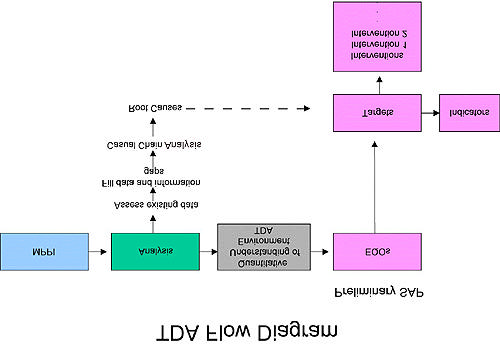
Caspian Environment Programme
Transboundary Diagnostic Analysis
III.
Caspian Economic and Legal Settings and its Major Perceived Problems and Issues
The Caspian coastal region is home to some 14.7 million people. Iran has the highest population (6.0
million) followed by Azerbaijan (4.1 million), Russia (3.5 million), Kazakhstan (0.8 million), and
Turkmenistan (0.4 million). In Azerbaijan close to half of population lives in the coastal region and in all
other countries the figure is less than 10%. On the basis of Human Development Index (HDI) the
Caspian littoral countries fall in the lower half of the `medium human development countries,' thus
reflecting the unsatisfactory global human development condition for the region.
The region as a whole is not, at least for the time being, a major economic center. The region's total GDP
was $534.9 billions in 1999, which was equal to 6 percent of the USA GDP and only slightly lower than
Spain's GDP of 595.9. Unemployment rates are generally high and considerably higher among the
women and the internally displaced population. Increased economic inequality has also been a feature of
economic development of the past decade. In general, the income, job, education, and health situation for
most of the region is not satisfactory. The implications are twofold: i) for years to come, the littoral
governments will give higher priority to job creation, health, and education than to environment
protection; and ii) individuals will be less concerned with safeguarding the environment when they are
unemployed and faced with finding adequate health, food, shelter, and education for their families.
The Caspian Sea is believed to contain considerable oil and gas deposits. The recoverable oil reserves
were estimated to be around 200 billion in the mid-1990s, but have recently been revised downward to
100 billion or less. The potentially vast oil and gas resources have already brought in millions of dollars
worth of foreign investment into the region. Most of the money is being spent on the application of high
technology to the often daunting task of drilling in the open seas, in which case the money basically
reverts to the technology providers in foreign countries. A small part of the money is being spent in the
littoral countries, particularly in the logistical support services, but not much substantial impact has been
made at the national level. The Caspian Sea is also rich in fish. The street value of Caspian caviar alone
can be estimated at close to 3 billion US dollars annually, although again only a small fraction of this
money will return to the coastal communities at any time.
5
Caspian Environment Programme
Transboundary Diagnostic Analysis
Governments dominated by strong executive powers mark the Caspian littoral states. Each country now
has a democratically elected president, but the five countries have reached varying stages of
democratization. For most part governmental accountability is weak coupled with weak and undeveloped
civil society. This has led to paternalism on the part of the central governments. Governmental structures
are large and economically unsustainable across the region. Environmental and natural resources are
overseen by a host of ministries and local governments. Reforms have been attempted to streamline
environmental management, although efforts are often duplicated and scarce human and technical
resources are often wasted. In most countries government agencies often do not have the resources to
conduct the necessary monitoring and enforcement activities to protect the regional environment. The
governments in the region have primarily focused their efforts on economic growth and revitalization,
giving much less attention to policy development aimed at encouraging environmental protection.
Integration of the development planning process and environmental development still remains a distant
objective. The countries are not using economic incentives as much as possible in the region in order to
promote environmental protection.
In the next decade it is likely that the Caspian littoral countries will continue to develop economically in
the same vein as the last decade. This means that dependence on the oil and gas sector will remain strong.
A full review of the Socio-economic setting of the Caspian is given in Volume II of the TDA, section 1.3.
The existing legal and regulatory setting of the region is not conducive to the effective environmental
management of the Caspian, with no regional agreement for the Caspian Sea signed by all five littoral
states. Under these conditions, protection and sustainable management of the Caspian Sea environment
and its resources depend predominantly on national legislations combined with the efforts to further
international cooperation. From a regional perspective, the absence of agreement on the legal status of the
Caspian Sea continues to delay the signing of the Framework Convention for the Protection of the
Environment of the Caspian Sea. The lack of regional agreements on the use of mineral resources
complicates relations among the countries. Given that each country has claims to hydrocarbon resources
in the Caspian and many foreign oil companies are active in the region, there is an urgent need for
addressing these regional issues. The legal regime for navigation is defined by international conventions
and, in part, by national legislation. Of all the Caspian states, only Russia is a party to the Maritime Law
Convention and no other Caspian littoral state is obliged to comply although these countries are guided by
the generally accepted principles and norms of maritime law. Legal regulation of fishing and protection of
biodiversity takes place mainly at the national level. The CIS countries set up a Commission on Aquatic
Bioresources with advisory powers in 1992 and Iran has been recently joined the Commission, which will
need to be more active in the future. The basic agreements between the Russia and Persia (1921) and
between the USSR and Iran (1940) laid down the principle of free fishing throughout the sea except for a
10-mile nationally exclusive coastal zone. The definition of the 10-mile coastal zone is uncertain now
because of the absence of an agreement on the legal status of the Caspian Sea. No country has a special
law to preserve biodiversity. Legislation includes traditional legal mechanisms for protecting wildlife,
such as regulations on fishing, protection of certain species' habitats and artificial reproduction. No
national legislation even has a definition of biodiversity, although the term is employed in a general way
to refer to plants and animals. No regional agreements on special protected areas exist, a deficiency that
must be corrected in order to preserve regionally significant biodiversity. All Caspian littoral states have
set quality standards to reduce negative impacts on the environment. The countries employ two tools:
environmental quality standards and pollution limitations. For the CIS countries, economic incentives to
encourage achievement of standards are absent. For these countries, the standards are said by some to be
too strict, by others too weak. No Caspian-specific standards exist; instead, the standards apply to all
water bodies for specific uses such as fishing, communal water supply, and economic use.
Commendable efforts have been made to encourage international and regional cooperation to safeguard
the Caspian environment, although results have been mixed. Tehran Communiqué of 1992, committed the
6
Caspian Environment Programme
Transboundary Diagnostic Analysis
states to cooperation in environmental management of the Caspian Sea and the Astrakhan Communiqué
of 1993 reinforced the need to cooperate in environmental matters. Almaty Declaration of Cooperation in
the Field of Environmental Protection in1994 called on the countries to jointly implement the Convention
on Biodiversity. In Tehran in June 1995 the countries confirmed willingness to cooperate in
environmental matters, regardless of the legal status of the Caspian Sea. In Ramsar in 1998 the first
Steering Committee launched the Caspian Environment Programme and initiated implementation with
assistance from the EU/Tacis, UN agencies, and the Global Environmental Facility. In 1995, UNEP,
working in conjunction with experts from all the Caspian littoral states, launched work on a Framework
Convention on the Protection of the Environment of the Caspian Sea. During the ensuing years, seven
working meetings were held to discuss and amend the text of the Convention, which is now ready in
advanced form ready for singanture. The Convention could be signed by the littoral countries in 2002.
CEP also successfully led a regional initiative to develop a Regional Cooperation Plan in case of Major
Oil Spills. The draft Plan is ready for submission to the CEP Final Steering Committee for approval in
principle. CEP has also been substantively involved in furthering regional interest in Aarhus, CITES and
Espoo Conventions.
Despite the lack the regional agreements signed by all five countries, all the states carry obligations to
protect the Caspian under global environmental conventions. During the past few years, the Caspian
littoral states joined many major global environmental conventions. The best results have been achieved
in the area of flora and fauna protection. The conventions on Biological Diversity and CITES, to which
all the Caspian countries are signatories except Turkmenistan oblige them to maintain a certain level of
flora and fauna protection. Compliance with these global conventions needs to be closely monitored and
improved.
In general, the national environmental laws of all the Caspian littoral states are fairly well developed, and
most environmental issues engage attention at the highest legislative levels. During the past few years,
the political, legal, and economic regimes of the Caspian Sea countries have undergone radical
transformations, and this transition continues. Difficulties still exist in environmental protection and
management, caused by various factors including deficiencies in laws and governmental regulations; gaps
and inconsistencies in laws and regulations; lack of economic instruments to encourage polluters not to
pollute; lack of regional agreements and economic and financial constraints. A full review of the legal
and regulatory setting of the Caspian Sea is given in Volume II of the TDA, section 1.4.
IV. Major Perceived Problems and Issues
The significance of the perceived issues and problems should be substantiated on environmental, economic,
social, and cultural grounds. The Ramsar Steering Committee Meeting in May 1998 approved a
Preliminary TDA that included a preliminary list of major perceived problems and issues associated with
the Caspian Sea. During subsequent regional TDA meetings, this list was expanded and refined. The
following list of major MPPI was finalized to include six existing problems/issues, and two emerging
problems/issues:
7
Caspian Environment Programme
Transboundary Diagnostic Analysis
MAJOR PERCEIVED PROBLEMS AND ISSUES
EXISTING PROBLEMS/ISSUES
DECLINE IN CERTAIN COMMERCIAL
OVERALL DECLINE IN ENVIRONMENTAL
FISH STOCKS, INCLUDING STURGEON
QUALITY
DEGRADATION OF COASTAL LANDSCAPES
DECLINE IN HUMAN HEALTH
DAMAGE TO COASTAL HABITATS
THREATS TO BIODIVERSITY
DAMAGE TO COASTAL INFRASTRUCTURE
AND AMENITIES
EMERGING PROBLEMS/ISSUES
INTRODUCED SPECIES
CONTAMINATION FROM
OFFSHORE OIL AND GAS ACTIVITIES
The status assessment was undertaken by the PCU and the CRTCs and recorded in the national and
regional reports prepared over a four year period. These reports can all be found on the CEP web-site:
www.caspianenvironment.org and their fundings are condensed and summarized in Volume two of this
TDA document.
The analysis recognizes that society commonly acts within a number of nearly independent sectors
(agriculture, industry, transport, etc.), which are poorly coordinated and often have conflicting interests
and associated policies. Within these sectors, various Stakeholders have interests in the Caspian
Environment, both affecting and being affected by that environment. Sectors and their Stakeholders work
in an uncoordinated and sometimes conflicting fashion, but they typically affect the Caspian environment
in similar ways. Loss of habitat, for instance, may be caused by activities of various sectors (transport,
farming, industry), and by various types of Stakeholders (governmental policy-makers, ranchers grazing
animals, small farmers). A detailed Stakeholder analysis has been completed and is summarized in this
TDA (Volume 2, section 2.1) to identify Stakeholder priorities and conflicts that might have an impact on
implementation of targeted interventions.
The TDA analysis of the MPPI can be summarized as follows:
1) Decline in certain commercial fish stocks, including sturgeon: strongly transboundary.
a. Brief statement of the problem: Catches of various fishes have declined in recent
years for a variety of reasons. Included in this decline have been sturgeon, cyprinids,
herring, salmon, mullet, and others. Official sturgeon catch, for instance, has
dropped from an average 13.8 thousand tons a year in the period from 1910-1930 to
1.8 thousand tons a year in the period from 1996-1998 (excluding Iran), peaking in
the 1970s at about 22 thousand tons a year. Official catches may be swamped by
illegal poaching, particularly for sturgeon, the most economically valuable fishes of
the Caspian Sea.
b. Analysis: Historical data and a recent Caspian Marine Expedition documented the
decline in certain commercial fisheries. Poaching, effects of dams, loss of habitats,
and perhaps pollution have all contributed to this decline. This major issue is the
most important one to the Stakeholders in the region. Interventions are required in
order to improve the fisheries situation before it becomes irretrievable.
1
Caspian Environment Programme
Transboundary Diagnostic Analysis
2) Degradation of coastal landscapes and damage to coastal habitats: strongly transboundary.
a. Brief statement of the problem: The coastal landscapes and habitats are damaged by
a variety of natural and man-made factors. Natural factors include water level
fluctuations (on both storm and decadal scales), earthquakes, and climate change.
Some of the man-made causes of the degradation of coastal landscapes and damage
to coastal habitats are: desertification/deforestation, regulation of rivers,
urbanization/ industrial development, inadequate agricultural/ aquaculture
development, inadequate recreational development, and land-based and sea-based
pollution. About 40 percent of the Caspian coastal hinterland is arid; of this arid
area, about 69 percent has been desertified.
b. Analysis: Ranked by Stakeholders as a medium-to-low priority, this perceived
problem has both natural causes (water level fluctuations and earthquakes) and
human influence (desertification). There are links with biodiversity, below, and loss
of habitats caused by human interventions. Lack of regional and integrated planning
is a major cause of this problem; multi-sectoral approaches will be required to
achieve improvement in this area.
3) Threats to biodiversity: strongly transboundary.
a. Brief statement of the problem: Caspian species biodiversity across nearly all phyla is
low compared to that of other more open seas. Two major flagship species exist in
the Caspian: the Caspian Seal and the Beluga sturgeon. Both are threatened at
present, enhancing concern over biodiversity. A high rate of species endemism in the
Caspian Sea, due to long separation from world oceans, increases the potential for
loss of biodiversity in the Caspian due to industrial pollution, overfishing, invasion
of exotic species, and other activities in the region.
b. Analysis: Data documenting loss of biodiversity are sparse, yet this is one issue that
many people are concerned about. Concern over loss of biodiversity in the Caspian
Sea at species, genetic, and habitat levels is widespread in the region. Stakeholders
ranked this as a medium-to-high priority. Loss of biodiversity comes from a number
of causes, including overfishing, poor water and sediment quality, damming of rivers,
loss of habitat, exotic species, and other factors. A first step will be to document the
true biodiversity of the region, and then to continue monitoring it. Strategic creation
of protected areas to target regionally important elements of biodiversity may assist
in conservation efforts.
4) Overall decline in environmental quality: strongly transboundary.
a. Brief statement of the problem: Decline in environmental quality includes the decline
in air, water and sediment quality, damage to ecosystems due to human activities,
loss of aesthetic appeal, and related issues. There have been widespread fears of
increasing rates of decline in overall environmental quality due to the strong
dependence of the economies of all five nations on oil and gas extraction from the sea
or its coastal zone. Widespread die-offs of seals in 2000, a kilka mortality in 2001,
and other similar natural disasters create fear of widespread decline in environmental
quality.
b. Analysis: Knowledge of pollution load is incomplete; CEP estimates are rough and
incomplete. Ambient contaminant levels have been measured somewhat unevenly.
Large volumes of data exist on ambient levels, but much of it lacks full quality
assurance/quality control documentation and could not be used in this analysis. Most
useful data were from the CEP activities and from other multinational and
international efforts in the Caspian region. Few data exist on air quality, water
2
Caspian Environment Programme
Transboundary Diagnostic Analysis
quality data are weak, and sediment quality data are reasonably good. In general,
except for some hot spots, the Caspian water and sediment quality, as far as can be
assessed and in comparison with other regional seas, is good. No widespread
eutrophication exists basin-wide. Hotspots of pollution exist in Azerbaijan (Baku
Bay/ Absheron peninsula, Kura River, Sumgait), Iran (Sefid Rood River, Bandar
Anzali, Chalus/Noshahr ports, and Gorgan Bay), Kazakhstan (Ural River delta, Fort
Shevchenko, Aktau), Russia (Derbent, Makhachkala, Volga Delta), and
Turkmenistan (Turkmenbashi, Chelekan). Migratory biota are affected by this
contamination: Seals, sturgeon, and migratory fish carry significant concentrations of
contaminants. The priority contaminants appear to be persistent organic pollutants
(specifically DDT and its breakdown products, HCH, endosulfans, oil and oil
products) and heavy metals (mercury, zinc and barium).
5) Decline in human health: weakly transboundary.
a. Brief statement of the problem: UNDP, EU, World Bank, WHO, and other health
data sources in the region show high levels of infant mortality, relatively short life
spans compared to developed countries, and incidence of certain types of diseases in
certain areas. Some improvement in health has occurred during the past half decade,
following a precipitous decline in health after dissolution of the Soviet Union.
b. Analysis: Few data are available on this issue, as the CEP has not focused on it.
Stakeholders rank this problem as a medium-to-high priority. However, clear links
between human health and the Caspian environment are weak. They require
investigation as a focus for the CEP in the future.
6) Damage to coastal infrastructure and amenities: not transboundary.
a. Brief statement of the problem: As water level fluctuates, coastal infrastructure and
related amenities are affected. As water level drops, water-related structures may no
longer be useable (piers, docks, etc.). As water level rises, previously dry areas will
be inundated, causing damage to infrastructure of various types, and, where
contaminated land is affected, pollution. Damage occurs on both storm time scales
and decadal time scales. Wind-induced or storm-induced surges cause considerable
flooding or exposure of coastal areas, particularly in the North Caspian region where
not only are the wind directions more likely to cause such changes, but also the land
slope is quite flat (slopes of 1:10,000 or 1:20,000 are commonly found there). Lack
of planning at all levels has led to construction practices that ignore water level
fluctuations. Desertification may push urbanization closer to the water, further
increasing pressure on coastal infrastructure. Earthquakes may cause hazards due to
the strong tectonic activity in the middle and southern sections of the region.
b. Analysis: Damage to coastal infrastructure and amenities comes largely from long-
term water level change, short-term storm surge impacts, and desertification. This
issue was ranked as a low-to-medium priority by the Stakeholders. Improved coastal
planning and intersectoral exchange would benefit this area of concern. Planning to
adapt to water level fluctuations is important, as all countries are vulnerable to water
level change, particularly if it rises much above the levels of 1995.
7) Introduced species: strongly transboundary.
a. Brief statement of the problem: Introduction of exotic species is a natural
phenomenon in the Caspian Sea, as much of the ecosystem arises from flora and
fauna transported from other bodies of water (Atlantic, Mediterranean and Arctic
fauna and flora versus the indigenous or para-tethyan fauna and flora). Subsequent
separation of the Caspian from these earlier geological connections has allowed
3
Caspian Environment Programme
Transboundary Diagnostic Analysis
endemism to proliferate, for instance amongst gobies. More recently, man has
introduced species both purposely and accidentally. Certain mollusks have been
introduced into the North Caspian Sea in the past, for instance, in response to
changes in river hydrological regimes. Plant species have been introduced to coastal
wetlands in Iran. Some of these introduced species have unexpectedly caused anoxia
in lagoons as a result of decreasing light penetration (e.g., Azolla pinnata in Iran).
New fish have been introduced for economic purposes. Some organisms enter the
Caspian by accident, including most recently the ctenophore Mnemiopsis leidyi
(ML), a gelatinous organism that has devastated the Black Sea and now threatens the
Caspian Sea. Concern over its introduction extends to the commercial fishing
industry, which fears loss of kilka and other valuable fisheries, and perhaps
ultimately the Caspian seal. Not only is the Caspian a recipient of invasive species, it
is also a source. Many Caspian species are now widespread throughout the world.
b. Analysis: Exotic species are of considerable concern for the Caspian Sea, and dozens
of species have been introduced both naturally and artificially. Stakeholders don't
view this as a major concern, possibly because of lack of awareness. This issue ranks
as low as the issue of damage to coastal infrastructure. The recent accidental
introduction of Mnemiopsis threatens the stability of the Caspian ecosystem, much as
it did the Black Sea's ecosystem one decade earlier. Observations that the effects of
Mnemiopsis in the Caspian are even faster than in the Black Sea argue for rapid
action. Direct effects of Mnemiopsis could include reduction in kilka and other fish
stocks, with consequent effects on human livelihoods, food sources for the local
populace, and food sources for the Caspian seal and the sturgeon. Rectification of
this problem will require short-term action against Mnemiopsis, and in the longer
term, regional agreements on mechanisms to control future invasive species will be
required.
8) Contamination from offshore oil and gas activities: strongly transboundary.
a. Brief statement of the problem: Commercial oil and gas exploration and production
have taken place in the Caspian Sea for nearly 150 years, following nearly two
millennia of local extraction and use. Production has waxed and waned during this
period, but the current international focus on the Caspian raises the possibility that oil
and gas extraction and processing may be a primary economic driver for the
economies of most of the Caspian countries. Present estimates of recoverable
reserves in the Caspian linger around 100 billion barrels of oil, with a range of
estimates from about 50 billion up to nearly 200 billion. The largest reserves appear
to be near the Kazakh coast, but exploration is taking place in all five Caspian
countries, and extraction in the Caspian coastal area is occurring in all but Iran at
present (where exploration is now taking place). This economic activity creates
concerns over the environmental impacts of oil and gas development. First, the
Caspian Sea is a closed basin, with no direct connections to other world oceans, so
other than natural degradation processes and oil spill response clean-up, any spills in
the Caspian will not flush from the system. Second, the Soviet conditions of oil
extraction in the region were characterized during the 1970s and 1980s by
environmentally unsound practices and procedures as well as outdated and
obsolescent technology. High levels of pollution in Caspian air and waters have been
reported due to these exploitation activities. Besides extraction, downstream
activities such as oil refining, transport, and related industries may increase the
environmental pressures in the sea, in the sediments, and in air.
b. Analysis: This issue is ranked as a medium priority for most of the Stakeholders.
The major concerns are twofold: First, historically, oil and gas development in the
4
Caspian Environment Programme
Transboundary Diagnostic Analysis
Caspian region has been without concern for the environment. More than 150 years
of neglect have left the Caspian coast with vast environmental problems (particularly
in Azerbaijan). Second, the expected expansion of oil and gas activities in the
Caspian increases the risk of significant spills or other impacts on the environment.
This vast expansion requires comprehensive approaches to emergency planning and
response infrastructure to safeguard the environment.
V.
Causal Chain Analyses
Identification of common root causes is important, because these tend to be more systemic and
fundamental contributors to environmental degradation. The common root regional causes include such
fundamentals as poor law enforcement and compliance, inadequate development planning, undeveloped
civil society and public awareness and inadequate finances.
Interventions and actions directed at the root causes tend to be more sustainable and effective than
interventions directed at primary or secondary causes. However, because the links between root causes
and solution of the perceived problems are often not clear to policymakers, interventions are commonly
directed at primary or secondary causes. This TDA attempts to make the links between root causes and
perceived problems more clear, to encourage sustainable interventions at the root level. Fortunately, as
table 1 shows, root causes are often common to a number of different perceived problems and issues, so
addressing a few root causes may have positive effects on several problems and issues.
5
Caspian Environment Programme
Transboundary Diagnostic Analysis
Figure 2
Causal Chain Analyses
1
Caspian Environment Programme
Transboundary Diagnostic Analysis
Common Regional Root Causes
- inappropriate regional
- inadequate &
- poor law enforcement &
- inadequate pricing policies
agreements plans &
insufficient & information
compliance
- inadequate finances
measures
- poverty & unemployment
- population dynamics
- absence of Caspian legal
- inadequate development
- corruption
- inadequate technology
framework
planning
- undeveloped civil society &
- greed
inadequate awareness
Major Perceived
Primary causes
Specific Anthropogenic Root Causes
Issues
1
Decline in certain Fish
- poaching & over-fishing
- corruption & crime
stocks
- loss of spawning
- low re-stocking investment
& feeding habitats
- high global demand for caviar
- pollution
- competition from introduced species
- Inadequate fisheries
- coastal poverty
management
- river impoundments & river mining
2
Coastal habitat &
- deforestation
- overuse of agro-chemicals
Landscape degradation
- desertification
- inadequate industrialization
- waste dumping
- coastal population growth
- soil erosion
- inadequate waste management
- over-grazing
- damaging agricultural practices
- rapid urbanization
- inadequate spatial planning
3
Decline in
- agro-chemicals
- inadequate & obsolete treatment technologies
Environmental Quality
- municipal &
- inadequate contaminant monitoring
industrial pollution
- chemical subsidies
- inadequate agricultural practices
- uncontrolled discharge of mining waters
4
Biodiversity erosion
- loss of habitat municipal &
- poor land use planning & actions
industrial pollution
- detrimental water-use policy
- over-fishing
& reduced in-water flows
- introduced & invasive
- inadequate biodiversity monitoring
species
- aggressive agricultural development
policies
5
Damage to coastal
- water level fluctuation
- inadequate spatial planning
infrastructure &
- sea surges
- insufficient & inadequate knowledge of water level
amenities
- desertification
trends
- lack of awareness
6
Decline in human
- air & soil pollution
- inadequate sewage & waste management policies
health
- desertification
- inadequate & insufficient health information
- decline in ground &
- malnutrition
surface water quality
- food safety
7
Introduced Species
- transfer of species
- lack of regional agreements on introduction of
by ballast waters
species
- introduction of
- inadequate EIA practices
species without
- lack of awareness
appropriate control & per
- inadequate customs procedures
trade
- lack of ballast water control
2
8
Oil & Gas
- plans for enhanced
- inadequate equipment
Contamination
activities
- inadequate monitoring
- state of existing oil
- increased shipping/pipelines
Caspian Environment Programme
Transboundary Diagnostic Analysis
VI.
Environmental Quality Objectives, Targets and Interventions
EQOs are a means to develop broad Stakeholder agreement on the major environmental objectives of the region. They represent consensus views
of environmental priorities, or visions of what the environment should look like in the future. Clearly, these EQOs are visions, not simple, rapidly
achievable actions. By identifying specific targets and clearly defined time frames, the EQOs can lead to concrete actions (interventions) that will
help achieve the EQOs in the long term.
The targets are quantitative statements of progress towards achieving a particular EQO, and generally have associated timelines or milestones.
The targets generally are focused on relatively short-term goals, which are achievable in time frames that governments can understand.
Once EQOs and targets are identified, it is relatively straight-forward to identify specific or concrete steps required in the next few years to
achieve these targets. What policies are required? What legislative acts? What investments? What capacity building? What infrastructure?
These specific steps are identified in this TDA as activities or interventions. In drawing up the targets and interventions the experts' group were
instructed to use the causal chain analyses as an identification and prioritization guide.
The EQOs identified for the Caspian at the third TDA meeting were:
1. Sustainable economic uses of the natural resources of the Caspian Sea
2. Balanced Caspian environment including biodiversity conservation (species, habitat, and genetic)
3. High quality of Caspian Sea, surface and groundwaters
4. Sustainable multiple use of the Caspian coastal environment
5. Strengthened civil society for the purposes of environmentally sustainable development
Table 1, page 15, outlines for each EQO targets, specific actions/interventions, and estimated costs identified during the Third TDA Workshop and
categorizes the intervention by type. Categories of intervention were defined as:
· Legal / Regulatory
· Baseline investment
· Incremental investment
· Institutional strengthening
3
Caspian Environment Programme
Transboundary Diagnostic Analysis
· Policy
· Scientific investigation
· Capacity building
· Data management
Although some actions / interventions may span several categories, the dominant category was selected as representative. In some cases, a single
action / intervention was assigned to two categories, when no dominant type was apparent. The table also lists the intervention in terms of GEF
indicators (see below). Consistent with GEF guidance, each Target and each Intervention/Activity is assigned an environmental indicator. GEF
specifies three types of indicators, as follows:
Process Indicator (PI)
Stress Reduction Indicator (SPI)
Environment Status Indicator (ESI)
A review of the environmental indicators for each target should show a logical sequence of PI to SRI to ESI.
Table 1 contains many of the regional elements foreseen to be included in the Strategic Action Programme, and is to be used by the countries as a
guide when developing their National Action Programme. The cost estimates given in the table are admittedly crude, however, they are very
useful in identifying those interventions, which can and cannot be considered for implementation in the short and medium timeframe.
The actions and interventions listed represent only some part of recommendations of the experts to be considered while drafting the NCAPs and
SAP. Other recommendations are included in the individual CEP reports available through the PCU. Not all recommendations from all previous
published reports were collated since many are repetitive and some lack the rationale provided by the use of the EQOs.
4
Caspian Environment Programme
Transboundary Diagnostic Analysis
Table 1 Environmental Quality Objectives, Targets, and Interventions Agreed at the Fourth and Fifth CEP TDA Meetings
EQO I: Sustainable economic uses of the natural resources of the Caspian Sea.
Targets
Interventions
Estimated Cost
Type of Intervention
Indicators
in U.S. $
1- To reduce the oil &gas
1. Development and endorsement of Protocols on higher
$ 500 K
Legislative / Regulatory at
PI: New legislations and
related pollution of the Caspian environmental standards (best international practice),
regional and national levels
Regulations
including possibly zero emission standards, for
exploitation and exploration, licenses granted after 2004
2. Development and endorsement of Protocols on
$ 500 K
Legislative / Regulatory at
reduction of oil emissions from old installations to half of
regional and national levels
PI: New legislation
current value by 2015
3. Development (1 year), endorsement (1year) and
$ 5 - $ 10 million
Investment at national level
PI/SRI: proven capacity to
implementation (2 years) of national and regional oil
effectively
spill emergency plans, for ships and offshore units as
deal with oil spills and clean-up
well as for sea ports and oil handling facilities by
2006.
4. Decommissioning of obsolete non-competitive on shore
$ 10s millions
Investment mostly at national SRI: Survey the existing oil and
and offshore installations including storage facilities to
level
gases emission rate. Monitoring
ensuring elimination of their emissions by 2008
Reduced emission rate by
execution of the project
$ 100s millions
Investment at national level
SRI: Survey the amount of oil
5. Protection of oil /chemical facilities oil contaminated
or specific chemical discharge
land under potential threat of inundation from rising sea
into the sea in different scenario
level, including the development of monitoring and early
warning system for water level rise or surges to protect
facilities and installations by 2015
5
Caspian Environment Programme
Transboundary Diagnostic Analysis
Targets
Interventions
Estimated Cost
Type of Intervention
Indicators
in U.S. $
1. Regional agreement on minimum standards of $ 10s millions
Legislative / Regulatory at
PI/SRI: Licensing and regular
maintenance of tanker fleet and establishment of a
regional level investment
audit of the tanker fleet
regulating mechanism by 2012
6
Caspian Environment Programme
Transboundary Diagnostic Analysis
Targets
Interventions
Estimated Cost
Type of Intervention
Indicators
in U.S. $
2. Ratification and implementation of MARPOL by the
$ 10s millions
Legislative / Regulatory at
PI/SRI: Auditing of fleet,
five littoral states. 2010.
regional level investment
floating installations as well as
ports
3. Regional agreement on minimum standards for
$ 500k
Legislative / Regulatory at
PI/New legislation
construction and maintenance, and national licensing
regional level investment
mechanisms for undersea pipelines 2004.
4. Risk assessment of shipping routes to feed into National
$1 million
Scientific investigation
PI/ESI: Redrafting of National
and Regional Oil Spill Contingency plans by 2003
and Regional Oil Spill
Contingency Plan to take
account of shipping risk
5. Establishment of a safe system of navigation and
$ 10s
Investment both at regional
SRI/ Implement safety record
shipping control (navigation aids, buoys, lighthouses, etc.)
and national levels
by 2012
3- To abate the impact of
1.Development and endorsement of agreement on a list of
$ 1-10 million
Legislative / Regulatory
PI/SRI: Reduction in levels of
agriculture on ecosystems of the
banned agrochemicals and a program to destroy stored
agrochemicals detected in
Caspian Sea
banned products by 2003, and implementation by 2005
runoff
2. Establishment of a coastal zone of delimitation within
$ 5-10 million
Legislative/ Regulatory
PI/SRI: Reduction in levels of
which special limits ( amount & type) are established for
regional &
agrochemicals monitored in
use of agrochemicals and implementation by 2007
national/Investment
coastal waters
4- To ensure sustainable use of
1.Establish a five-country Commission on the management $ 500k
Legislative / Regulatory
PI/SRI/ESI: Improved
aquatic resources , with
of bioresources by 2003 that should include as priorities:
at the regional level
knowledge of bioresource
emphasis on fisheries
a. an agreed methodology for distributing the total
stocks evidence and application
allowable catch between five countries as annual catch and
of that knowledge in changes in
export quotas;
fishery practice.
b. an interstate Caspian Fisheries Inspectorate to verify
fisheries and restocking, reporting to Commission
(composition: one member of each Caspian State +
international observer); and
c. shared network of scientific institutions investigation
regional bioresource issues,
7
Caspian Environment Programme
Transboundary Diagnostic Analysis
Targets
Interventions
Estimated Cost
Type of Intervention
Indicators
in U.S. $
2.Strengthen and establish a formal mechanism for co-
$ 100k
Institutional Strengthening at PI/SRI: New regulation
ordination between national fisheries protection
regional and national levels
organizations by 2003
3. Strengthen national fisheries organizations efficiency,
$ 1-10 million
Institutional strengthening at
PI/SRI: Improved record in
training & equipment by 2005
national level
management of fisheries in
sustainable manner
- Stable with returns.
4. Identify, protect and manage natural spawning grounds
$ 10 millions
Investment
SRI/ESI: Increase use of
of sturgeon, Caspian salmon and other commercial species.
at national levels
spawning ground (number of
redds cut) and higher
recruitment
5. Develop environmentally sound aqua-culture
$ 10s millions
Scientific investigation at
PI/SRI: Development of a
programmes for commercially viable species
regional and national levels
commercial aquaculture
industry
6. Study of genetic variability at population level,
$ 2 million
Scientific investigation at
ESI/PI: Increased genetic
particularly for sturgeon and other important fish stocks
regional and national levels
variability
and establish a genetic conservation strategy
8
Caspian Environment Programme
Transboundary Diagnostic Analysis
Targets
Interventions
Estimated Cost
Type of Intervention
Indicators
in U.S. $
1. Review reservoir control rules on the major rivers to
$ 500k
Institutional Strengthening & PI/SRI/ESI: Increased levels of
ensure adequate releases are mode for anadromus while
Legislative / Regulatory at
in-river flows, particular during
fish spawning 2007.
national and regional levels
sensitive spring period
9
Caspian Environment Programme
Transboundary Diagnostic Analysis
Targets
Interventions
Estimated Cost
Type of Intervention
Indicators
in U.S. $
2. Develop and implement guideline for upstream rational
$ 1 million
Institutional Strengthening & PI/ESI: Policy guideline and
use of water in coastal wet land area 2007.
Legislative / Regulatory
improved resistance of coastal
wetlands to draught events
__________________________
1
PI:
Process Indicator
SRI:
Stress Reduction Indicator
ESI:
Environmental Status Indicator
10
Caspian Environment Programme
Transboundary Diagnostic Analysis
EQO II: Conservation of Caspian Biodiversity
Estimated
Type of
Targets
Interventions
Cost in U.S.
Indicators
Intervention
$
1- Development and
1.Elaborate on and ratify Regional Strategy and Action Plan $300k
Policy
PI A Regional Strategy on
implementation of a strategy for
on Biodiversity by 2003, as well as a Protocol on Regional
Biodiversity adopted.
the protection of Caspian
Strategy on Biodiversity, including the Protocol on
biodiversity
preliminary plan on Biodiversity to the Framework
Convention and specific action plans on specie(s) and habitat.
2. Establish an eco-net (net between specially protected
$ 400k
Institutional
PI Eco-net between specially
Natural Territories (SPNT)) by 2005 in the Caspian through
Strengthening
protected territories established.
collaboration with NGOs and international organizations.
Transboundary Protected Natural
Territories (TPNT) established.
3. Survey the sensitivity of areas and habitats in the Caspian
$ 500k
Institution
PI Action Plan on sensitive
imposed to anthropogenic and natural impact;
strengthening
territories developed and
Develop Action Plan for sensitive eco-system/habitat; and
normative-legislative instruments on
Develop necessary recommendations for legislative
legislative protection developed.
protection.
4.Adopt in 2005 and implement ESPOO Convention and
$ 200 k
Legal/regulatory
PI Convention ratified and its
regional EIA procedures. 2005
provisions implemented
SRI Impact of economic activities
on biodiversity reduced
2. Establish control system for
1. Develop protocol/agreement to the framework convention
$ 200 k
Legislative /
PI An agreement on control of
the import and export of exotic
on control of introduced new species by 2003
Regulatory
introduced species signed
species into and from the
Caspian Sea
2. Develop and implement proposals for control of ballast
$10 Million
Investment
SRI a list of proposals on the
waters transfer to and from the Caspian Sea (2005); including
control of ballast waters
possibly a ballast reception and inspection facility in
elaborated and establishment of
Astrakhan (2010)
relevant technical facilities.
3. Implement special studies and monitoring program for
$ 500k
PI Monitoring of invasive species
invasive species in the frame work of biodiversity monitoring
is being conducted
2004
11
Caspian Environment Programme
Transboundary Diagnostic Analysis
4.Establish a regional inter-governmental body to review
$ 300k
Institutional
PI A regional inter-governmental
planned introduction of new species and develop proposals
Strengthening /
body on a regular basis and meeting
for financing by 2004.
Scientific
established
investigation
3. A biodiversity monitoring
1.Develop a set of biodiversity monitoring protocols for the
$ 5 Millions
Institutional
PI National centers endorsed and
system based on a set of regional Caspian and implement monitoring programmes in the coastal
Strengthening/
regional center established.
monitoring protocols
waters and areas of each littoral state by 2004
Scientific
Investigation
2.Create Caspian Biodiversity Data Base, including a
$ 400k
Scientific
PI Database on biodiversity in the
complete check-list of species, specific Caspian identification
Investigation/Data
Caspian created and volumes of
keys, and reference collections
processing
reference collections published.
3.Develop target monitoring and conservation programmes
$ 1 Million
Institutional/
PI Monitoring programmes
for endangered species.
Scientific
elaborated for individual species of
Investigation
flora and fauna
4.Establish a bio-molecular laboratory under the Regional
$ 2 Million
Institutional
PI Laboratory has been created
Biodiversity Center to investigate genetic biodiversity
investigation
5. Organize recurring expeditions to assess the biodiversity of
$ 300 k
Scientific
PI - Expeditions has been conducted
the deep part of the middle and southern sectors of Caspian.
investigation
and their findings published. Trend
analysis undertaken.
4. Increase public awareness of
1.Dissemination of information on biodiversity in the
$400k
Institutional
Publication of informational
the value of the Caspian Sea
Caspian; promotion of eco-tourism and sensitization of
Strengthening
materials of CRTC (Caspian
biodiversity
decision makers to biological diversity protection
Regional Thematic Center) on
biodiversity.
Information on eco-tourist route
published.
Training for decision-makers
facilitated.
5. Establish inter-governmental
1. Identify national bodies charged with coordination of rapid
$5 million
Institutional
PI/ SRI List of regional experts
mechanisms for rapid response
response to oil and non-oil emergencies; establish lists of
Strengthening
published. National Funds created.
to oil and non-oil emergency
rapid response regional experts; establish national fund for
National
Animal Advocacy Centers are
events affecting Caspian
rapid response activities and animal welfare centers
investment
operating.
biodiversity (mass mortality
2. Develop and adopt intergovernmental agreement on rapid
$ 50k
Legal/regulatory
PI Regional agreement signed and
events, etc.) 2005
communication, data access and sampling during Emergency
adopted.
situations
12
Caspian Environment Programme
Transboundary Diagnostic Analysis
EQO III: High quality of Caspian Sea, surface and groundwaters
Estimated
Targets
Interventions
cots in U.S.
Type of intervention
Indicators
$
1. Develop, based on water use, a
$ 200k
Legislative / Regulatory PI: New legislation
1. Develop and adopt a protocol to the Convention on Protection of the
regional legal framework for
protection of the Caspian from
Environment of the Caspian Sea in connection with land-based
Pollution under the Framework of
the Convention
activities (2004)
$ 200k
Legislative / Regulatory PI: New legislation
2. Develop and adopt a protocol to the Convention on hazardous
waste. 2005.
$ 200k
Scientific Investigation
PI: New legislation
3. Develop and adopt a protocol to the Convention on at sea dumping.
2005.
4. Develop regional guidelines for solid waste disposal in coastal areas
$ 200k
Legal/
PI: New legislation
Regulatory
5. Sign, ratify and implement Convention of Persistent Organic Pollutants.
$200k
Legal/
PI: New legislation
2008.
Regulatory
6. Develop EQOs / EQSs for establishing realistic goals for water sediment
$ 400k
Scientific Investigation
PI: New guideline
and bio-quality improvement in the Caspian Sea. 2004.
2- To prepare, agree to, and
1. Develop and implement regional contaminant monitoring Programme
$ 4 million
Legislative /
PI/ESI: Monitoring
initiate the implementation of a
focused on the coastal sediments and transboundary pollutants 2004
Regulatory/ Scientific
of the Sea
regionally coordinated ambient
Investigation
monitoring program for trends in
2. Develop and implement a rapid assessment programme in the Caspian Sea
$ 2 million
Institutional
PI/ESI: Monitoring
place
using biomarker techniques tied to regional EQO/EQSs. 2006.
Strengthening /
of the Sea
Scientific Investigation
3. Establish monitoring programmes on the major rivers to measure the inflow
$ 10
Institutional
PI/ESI: Monitoring
of the priority transboundary contaminants.
million
Strengthening,
of the Sea
National / Scientific
Investigation
13
Caspian Environment Programme
Transboundary Diagnostic Analysis
3- Develop and begin
1. Undertake a comprehensive land-based source assessment of the near
$ 300 k
Scientific Investigation PI/ESI: Pollution
implementation of a Regional
Caspian Basin, including point and diffuse sources. 2004.
load
Action Plan for land-based
activities to meet defined Water
2. Develop national action plan and portfolio of hot-spots, for the near Caspian
$ 500 k
Legal / Regulatory
PI/SRI: Auditing of
Quality objectives
basin, action plan is to contain a compliance strategy for polluting industry
polluting industries
based on the Polluter Pays principle and BATEC. 2005.
3. Establish and implement restrictions on application of agro-chemicals for
$ 10s
Legal /
PI
user corridor buffer zones and nutrient areas associated with groundwater
million
Regulatory/Scientific
SRI/ESI: Monitoring
aquifers in the Caspian basin. 2008.
investigation
of nutrient in
groundwater
4. Introduce primary treatment for all coastal sewage from settlements with
$ 10s
National Investment
SRI/ Monitoring of
population greater than 10,000 by 2012
millions
effluent
5. Address 50% of priority pollution hot-spots by the year 2012
$ 10s
National Investment
SRI/Auditing
millions
6. Develop the legislation and technology basis for the free and regular
$ 2 million Data management
PI/ criteria for
exchange of environmental data and information within the region by the year
Legal/Regulatory
exchange rate
2005. Implementation by 2006.
14
Caspian Environment Programme
Transboundary Diagnostic Analysis
EQO IV: Sustainable multiple use of the Caspian coastal environment
Estimated
Type of
Targets
Interventions
Indicators
cost in U.S $
Intervention
1. Establish coastal planning
1. Establish or revise national legislation on coastal zone planning and
$2 million
Legislative/
PI: National legislation on
zones (including spatial plans)
management, including determination and adoption of the Coastal Planning
Regulatory
coastal zone management
in the five littoral states
Zones, 2005
established or revised and
planning guidelines
developed
2. In each littoral country develop full environmental, socio-economic, sea- and $ 2.5 million Scientific
ESI: Regional GIS
land-use and other related information GIS database on the coastal zone by
Investigation
established
2006.
PI: Coastal planning
guidelines developed
3. Establish planning authorities in critical coastal zones and implement coastal $ 10 million
Legislative/
PI / SRI
zone planning. 2016.
Regulatory /
PI: Functional coastal
National
planning authorities
SRI: Improved coastal
zone management
4. Develop and demonstrate technical and information mitigation measures to
$ 2 million
Investment
PI: Guidelines for natural
reduce negative impacts of natural hazards (such long-term water level
hazards mitigation
fluctuation of the Caspian, storms, surges, and earthquakes) on the life style of
Transboundary /
measures are developed
the population and infrastructure of the coastal zone. 2004.
National
PI: Related pilot projects
completed
5. Establishment of a regional Standing Committee on coastal zone planning
$100k
Institutional
PI: Regional cooperation
and management under auspices of CEP, following approval by the
Strengthening
on coastal zone planning
Governments of the Caspian littoral states by 2005
and management is
initiated
PI: National inter-
sectoral and regional
cooperation on coastal
zone planning and
management is achieved
2. Establish an eco-tourism
1.Establish a regional "green" belt working group to review national coastal
$2 million
Institutional
PI: Intergovernmental
"green" belt around the entire
eco-tourism proposals and recommend alternatives, develop a management
Strengthening
agreement on regional
Caspian Sea by 2007
framework, and identify regional financial mechanisms
eco-tourism framework
15
Caspian Environment Programme
Transboundary Diagnostic Analysis
2. Develop investment strategies for ecotourism in the region
$ 100k
PI: Financial Mechanism
in place
3. Develop one or two eco-tourism centers in each country and market them
$10 million
National
SRI: Improved social-
actively linked to eco-network
Investment
economic situation
SRI: Enhanced
environment awareness
3. Net rate of loss of coastal
1. Identify main contributors to deforestation, in the public and private sector,
$300k
Scientific
PI: Causes for
forests to be reduced by 50% by socio-economic reasons; legal and regulatory failures; and poor forestry
investigation
deforestation are
2007
practice and develop action programme 2007. Undertake trend analysis and
identified
taxonomic studies by 2005.
????
2. Identify alternative sources for timber products historically produced from
$600k
Scientific
PI: Alternative sources
coastal forests, and link with appropriate incentives and disincentives
investigation
economic instruments are
(economic instruments). 2005.
Legislative /
proposed.
Regulatory
3. When necessary draft new legislation to reduce rate of deforestation, based
$200k
Legislative /
PI: New legislation is
on economic incentives and disincentives. 2005.
Regulatory
adopted
4. Establish reforestation programs and commence implementation in affected
$10s million National
SRI: 50% reduction of
regions. 2006.
Investment
coastal deforestation is
achieved
4. Reduce rate of loss of land
1. Improve legal basis in each country for combating desertification,
$50k
Legislative /
PI: Legal basis
due to technogenic
including:
Regulatory
established in each
desertification by 10% by the
- criteria to define land degradation
National
country
year 2008.
- amend laws on forestry, water resource and land use
- strengthened legal mechanisms such as EIA, planning procedures. 2005.
2. Increase public awareness of the desertification process, thereby preventing
$500k
Institutional
PI: Institutions
the public being causes or victims of this process, and strengthen institutional
Strengthening
strengthened
structures making them more effective in combating desertification. 2005.
National
SRI: Decreased rate of
desertification
3. Develop a desertification monitoring system based on remote sensing and
$500k
Institutional
ESI: Monitoring system
GIS database 2005.
Strengthening,
in place
Capacity Building
National
4. Demonstrate ways to reverse Technogenic degradation. 2002.
$4 million
Investment,
SRI: Decreased the share
national
of technogenic
degradation
16
Caspian Environment Programme
Transboundary Diagnostic Analysis
EQO V: Strengthened civil society for purposes of Environmentally Sustainable Development
Estimated
Type of
Targets
Interventions
Indicators
cost in U.S $
intervention
1. Integration of
1. Creation and implementation of environmental awareness training
$2.5 million
Capacity Building/
PI: Development plans approved to
environmental
program for policy makers, planners, and development project managers to
Transboundary
include factors of carrying
considerations in local,
be administered to regional and municipal governments throughout the
capacity,
national and regional
region. Implementation to be begin by 2004
sustainable environmental
development strategies,
protection
implementation to start by
PI: 50% of key environmental
2004
management personnel of the
coastal area to be trained
2. Enhanced and informed 1. Strengthening national NGOs and civil society movements focusing on
$500k
Capacity Building,
PI: Legal support for stakeholder
stakeholders participation environmental awareness and sustainable development components of
Legislative/
participation achieved
in the development
developmental processes by 2003 including:
Regulatory
PI: Increased environmental
process
a. New legislation to require broader civil society, including
National
education for Public, industry and
Stakeholder Participation
governments;
b. Environmental science and policy program/curriculum for public
Increased transparency of planning
administration students at universities throughout the region.
processes
2. Community driven development: Empower local authorities including
$500k
Capacity Building
PI: local development plans
collaboration among cities and local scale activities including:
(process)
produced and implemented,
a. Study of current local development plans across the Caspian
consistent across the region
region for coastal communities.
b. Development of criteria for minimum impact goals
c. Development of regional network to assess implementation of
materials by 2006
3. Demonstrate Caspian-conscious school curricula by 2003
$500k
Capacity building
PI: teachers trained in
National
environmental education
incorporated into school curricula
17
Caspian Environment Programme
Transboundary Diagnostic Analysis
4. Enhance participation of media (in particular regarding
$60k
Capacity Building/
PI: Higher incidences of accurate
environmental issue reporting) by 2002
Transboundary
news items on the environment
-
Development of Caspian Environment Programme Media kit for
locally, nationally and
local, regional, national, and international news teams outlining
internationally
mission, objectives, projects and programmes of the CEP and
related organizations.
-
Distribution of news kits on CD-ROM with contact information
for project leaders, and affiliates for major news issues, and
information listed above. Summary of news items/issues of
interest
-
Develop and make available a database of specialized media
contacts throughout the Caspian Region
5. Public-private partnership for environmental monitoring and
$500k
Capacity Building/
PI: Implementation of pilot for
public awareness:
National
monitoring and evaluation of
-
Pilot projects on Caspian private/public sector coordination to
environmental impacts of private
increase environmental monitoring and development in region by
sector activities.
2005
PI:
Process indicator
SRI:
Stress reduction indicator
ESI: Environmental status indicator
18
Caspian Environment Programme
Transboundary Diagnostic Analysis
Annex D2 (full annex) : Strategic Action Programme (SAP) for the Caspian Sea
STRATEGIC ACTION PROGRAMME (SAP)
FOR
THE CASPIAN SEA
Caspian Environment Programme
Baku, July 2003
19
Caspian Environment Programme
Transboundary Diagnostic Analysis
This Strategic Action Programme was agreed by the Caspian Environmental Programme National Focal Points of
the respective countries:
On behalf of the Azerbaijan Republic:
..................................
........................................................... Date: ......................
On behalf of the Islamic Republic of Iran:
..................................
............................................................ Date: ......................
On behalf of the Republic of Kazakhstan:
.................................
.......................................................... Date: ......................
On behalf of the Russian Federation:
...............................
........................................................ Date: .........................
On behalf of Turkmenistan:
................................
...................................................... Date: ..........................
20
Caspian Environment Programme
Transboundary Diagnostic Analysis
List of Abbreviations
Aarhus :
UN/ECF Convention on Access to Information, Public Participation in Decision Making and
Access to Justice in Environmental Matters (Aarhus)
BSAP
:
Biodiversity Strategic Action Plan
CCA
:
Causal Chain Analysis
CEP
:
Caspian Environment Programme
CHM
:
Clearing House Mechanism
CIS
:
Commonwealth of Independent States
CITES:
Convention on International Trade in Endangered Species of Wild Fauna and Flora
CLC
:
Civil Liability Convention
CMS :
Convention on the Conservation of Migratory Species of Wild Animals
CRTC :
Caspian Regional Thematic Centre
EIA
:
Environment Impact Assessment
EQO
:
Environment Quality Objective
EQS
:
Environment Quality Standard
ESI
:
Environment Status Indicator
Espoo
:
Convention on Environmental Impact Assessment in a
Transboundary Context (Espoo)
EU/Tacis:
European Union/Technical Assistance for CIS
GEF :
Global Environment Facility
GIS
:
Geographical Information System
HDI :
Human Development Index
IA :
Institutional Arrangement
I.R. Iran :
Islamic Republic of Iran
ML
:
Mnemiopsis Leidyi
MPPI
:
Major Perceived Problem and Issue
NEAP
:
National Environmental Action Plan
NCAP
:
National Action Plan
NCS
:
National Coordination Structure
NGO
:
Non Governmental Organization
NFP
:
National Focal Point
PCU
:
Programme Coordination Unit
PI
:
Process Indicator
PIP
:
Priority Investment Project
POPs
:
Persistent Organic Pollutants
SAP
:
Strategic Action Programme
SRI
:
Stress Reduction Indicator
TDA
:
Transboundary Diagnostic Analysis
UNDP
:
United Nations Development Programme
UNEP :
United Nations Environment Programme
21
Caspian Environment Programme
Transboundary Diagnostic Analysis
Strategic Action Programme for the Caspian Sea
Section 1:
Introduction
The Caspian Environment Programme (CEP) represents a partnership between the five littoral
states namely Azerbaijan, Islamic Republic of Iran, Kazakhstan, Russian Federation and
Turkmenistan and the International Partners namely the EU, UNDP, UNEP, and the World
Bank. The overall goal of the CEP is environmentally sustainable development and management
of the Caspian environment, including living resources and water quality, so as to obtain the
utmost long term benefits for the human population of the region, while protecting human health,
ecological integrity and the region's economic and environmental sustainability for future
generations.
The goals of CEP during its first phase included 1) development of a regional coordination mechanism to
achieve sustainable development and management of the Caspian environment 2) completion of a
Transboundary Diagnostic Analysis (TDA) of priority environmental issues to guide the prioritization of
environmental actions and 3) formulation and endorsement of a Strategic Action Programme (SAP) and
adoption of National Caspian Action Plans (NCAPs).
The SAP identifies the national and regional interventions needed to address four priority regional
environmental concern areas:
· unsustainable use of bioresources;
· threats to biodiversity, including those from invasive species;
· pollution; and
· unsustainable coastal area development .
The SAP lays down the principles of environmental management and cooperation; notes the challenges to the
sustainable integrated management of the Caspian Sea environment; sets the regionally agreed Environmental
Quality Objectives (EQOs) for the four areas of environmental concern in a transboundry context and proceeds
to define a set of targets and interventions to meet these objectives. The SAP also highlights the financial
resource and the institutional structure required for the implementation of the priority actions for the next 5 +5
years.
The SAP is a regional policy framework document. The Programme is designed for voluntary adherence by the
Caspian States and its contents are supported by and in accordance with the NCAPs, with appropriate support
from the International Partners. Such voluntary adherence will promote and ensure the cooperative and
coherent action for safeguarding the fragile environment of the Caspian Sea and for advancing the sustainable
and equitable use of the Caspian bioresources.
The SAP is the final of a regional consultation process, which has involved the littoral countries and the
International Partners. The NCAPs and the TDA, which are the major pillars of the SAP have been thoroughly
studied and reviewed at a number of regional meetings leading to the draft, review and finalized SAP. This
process has included a causal chain analysis, stakeholders analysis and gap analysis to help to sharpen and
prioritize the SAP interventions. The consultation process has also benefited from the regional dialogue
concerning the Framework Convention for the Caspian Marine Environment. The consultation process is
further detailed in the attached SAP Chronology in Annex 1.
Implementation of the SAP is the responsibility of the Caspian States independently as component of their
NCAP, and collectively as part of the Caspian Environment Programme. The Steering Committee of the Caspian
22
Caspian Environment Programme
Transboundary Diagnostic Analysis
Environment Programme with the assistance of the Programme Coordination Unit has the responsibility of
monitoring and reporting on SAP implementation progress.
1.1 The need for and purpose of the SAP
The SAP sets the agenda for enhanced regional environmental cooperation among the littoral states over the
next ten years, in two distinct five year periods. To improve environmental stewardship and protect the
ecosystems of support the Caspian, the SAP outlines five regional Environmental Quality Objectives (EQOs)
to be addressed, and identifies environmental interventions to be taken in order to meet those EQOs at the
national and regional level (See Section 3). The SAP builds upon and complements the NCAPs and creates
clear objectives and targets for priority investment action considerations for the international community.
1.2 The geographic scope of the SAP
The immediate geographic scope of the SAP is the Caspian Sea and the coastal areas up to 100 km inland.
This delimitation however does not exclude identification and prioritization of interventions that address
environmental stressors and challenges beyond this 100 km zone. In a number of the SAP interventions
reference is made to the concept of the near Caspian basin, which incorporates the lower Volga basin below
Volgograd, the coastal rivers of Kalmykia, Dagestan, and northern Azerbaijan, the Kura basin in the
territory of Azerbaijan below Mingachaur reservoir, the basins of the coastal rivers in Iran, and the rivers in
the territory or Turkmenistan and Kazakhstan.
1.3
Principles of environmental management and cooperation
The five littoral states share a common desire for the sustainable management of the natural resources and
biodiversity of the Caspian for the benefit of present and future generations, and recognize their role and
responsibility in conserving the global value of the biodiversity resources. The littoral states have considered and
taken into account, where appropriate, the following principles and values when developing this document.
1 3.1 The principle of sustainable development shall be applied such that there is a prudent and rational
utilization of living resources and the preservation of the rights of future generations to a viable environment.
1.3.2 The precautionary principle shall be applied, such that measures shall be taken when there are reasonable
grounds for concern that any activity may increase the potential hazards to human health, harm living
resources or marine ecosystems, damage amenities, or interfere with other legitimate uses of the Caspian Sea,
even when there is no conclusive evidence of a causal relationship between the activity and the effects; and by
virtue of which, greater caution is required when information, including scientific information, is uncertain,
unreliable or inadequate.
1.3.3 The polluter pays principle shall be applied, such that the cost of preventing and eliminating pollution,
including clean-up costs, shall be paid by the polluter.
1.3.4 The principle of anticipatory action shall be applied, such that contingency planning, environmental
impact assessment and strategic impact assessment (involving the assessment of the environmental and social
consequences of governmental policies, programmes and plans) shall be undertaken in the future
development in the region.
1.3.5 The principle of preventative action shall be applied, such that timely action shall be taken to alert the
responsible and relevant authorities of likely impacts and to address the actual or potential causes of adverse
impacts on the environment, before they occur. Many adverse impacts are irreversible or, if they can be
reversed, the cost of remedial action is higher than the costs associated with prevention.
1.3.6 Environmental and health considerations shall be included into all relevant policies and sectoral plans and
programmes, including, inter alia, urban planning, industrial development, oil and gas exploitation, fisheries,
aquaculture and tourism.
1.3.7 Use of clean technology shall be promoted when replacing or phasing-out high waste and waste-
generating technologies.
23
Caspian Environment Programme
Transboundary Diagnostic Analysis
1.3.8 Development planning and environmental planning processes should be integrated to the maximum
extent. The use of economic instruments that foster sustainable development shall be promoted through, inter
alia, the implementation of economic incentives for introducing environmentally friendly technologies,
activities and practices; the phasing-out of subsidies which encourage the continuation of non-
environmentally friendly technologies, activities and practices; and the introduction of user fees.
1.3.9 The principle of accessibility of information shall be applied, such that information on the pollution of the
marine environment of the Caspian Sea held by a littoral state shall be provided by that state to all littoral
states, where relevant and in the maximum possible amount.
1.3.10 The principle of public participation and transparency shall be applied, such that all stakeholders,
including communities, individuals and concerned organizations shall be given the opportunity to participate,
at the appropriate level, in decision-making and management processes that affect the Caspian Sea. This
includes providing access to information concerning the environment that is held by public authorities and
effective access to judicial and administrative proceedings to enable all stakeholders to exercise their rights
effectively. Public authorities shall widely disseminate information on the work proposed and undertaken to
protect and rehabilitate the Caspian Sea.
Section 2:
The challenge: Sustainable integrated management of the Caspian environment
The extensive work carried under the first phase of the CEP has led to the identification of four priority
regional environmental concern areas, namely: unsustainable use of bioresources; threats to biodiversity,
including those from invasive species; pollution; and unsustainable coastal area development. The observed
impacts are degrading the environment, draining already strained state resources and, moreover, in the
longer term reducing the range of economic and development options available to the states. Common
regional root causes of these areas of concern include poor law enforcement and compliance, inadequate
development planning, undeveloped civil society and public awareness and inadequate pricing policies.
2.1
Priority Regional Environmental Concern Areas
2.1.1
Unsustainable use of bioresources
Catches of sturgeons, herring, salmon, sprat, and other commercial fish have declined in recent years.
Official data from Caspian states (excluding Iran) indicate that the sturgeons catch has dropped from an
average of 13.8 thousand tons a year in the period from 1910-1930, to 1.8 thousand tons a year in the period
from 1996-1998, peaking in the 1970s at about 22 thousand tons a year; poaching, the impact of dams, loss of
habitats, and perhaps pollution have all contributed to the decline of these key fisheries. A major recent
factor impacting both fisheries and biodiversity has been the invasion by the ctenophore Mnemiopsis leidyi
(ML), a jellyfish that devastated the Black Sea a decade ago and now threatens the Caspian Sea. The
commercial fishing industry fears for the loss of kilka and other valuable fisheries, with consequent effects on
human livelihoods, food for the local population, and food sources for the Caspian seal and the sturgeon
populations. Observations showing that the growth of Mnemiopsis biomass in the Caspian Sea is even faster
than in the Black Sea support the need for rapid action.
2.1.2
Threats to biodiversity, including those from invasive species
The Caspian biodiversity is low across all phyla compared to other seas, but, due to its historic isolation, endemism
is high. Approximately 40% of the species found in the Caspian are endemic and the potential loss of global
biodiversity is high. Quantifiable data on the status of the biodiversity of the Caspian Sea is scarce. In recent years
no systematic monitoring of biodiversity, except in connection with fisheries productivity has been undertaken by
the Caspian states; even population numbers of flagship species such as the Beluga sturgeon and Caspian seal are in
dispute. This lack knowledge is in itself a major threat. Other threats include habitat erosion and degradation - again
observed but not measured - habitat fragmentation, unsustainable use of key species, pollution and invasive species.
Of these invasive species is potentially the most damaging and most acute threat, as witnessed by the invasion of
Mnemiopsis, which may have already irrevocably changed the composition of the zooplankton of the Caspian. The
presence of persistent organic pollutants, in particular DDT, in the food-chain is also a major source of concern.
24
Caspian Environment Programme
Transboundary Diagnostic Analysis
2.1.3 Pollution
Data on the overall environmental quality of the Caspian are generally not systematic or comprehensive. In the
former USSR water and sediment quality measurements were taken on a regular basis and with good coverage,
however, since its break up monitoring has increasingly become more fragmented and irregular. Over the same
period the flux of pollutants into the Caspian has changed with a drastic reduction in industrial and agricultural
activity in the four CIS states. A review of those reliable data that do exist, including data from sediment and
ecotoxicological surveys undertaken as part of CEP, do not indicate a highly stressed environment, but of course
there are hot-spots. These data do not support the generally held view that the Volga is the major source of pollution,
or that nutrient loading is a regional problem, although on the Iranian coast eutrophication is observed. Some heavy
metals (Aluminum, Cadmium, Chromium, Nickel, Copper and Arsenic) are found at comparatively high levels
throughout the Caspian sediments, but the distribution suggests the source is due to the regional geology rather than
pollution. Elevated levels of mercury, lead and chromium indicate local pollution sources superimposed over the
regional signature. Levels of agrochemicals, in particular DDT and endosulfans, are a major cause for concern in the
Caspian. Although a banned substance, DDT and its break-down products have been detected at high levels in CEP
sediment analyses indicating continued use of the chemical. DDT was also detected at relatively high levels in the
tissues of seal and fish in autopsies undertaken by CEP. Hydrocarbons are an area of concern where there has been
oil and gas production over many years, particularly in the waters off the Azerbaijan coast. Pollution threats include
contaminants sequestered in the major impoundments on the Volga, above Volgograd, and the Kura; continued and
increased use of banned agrochemicals; potential widespread hydrocarbon pollution, with the anticipated expansion
of oil and gas development; and, acute damage from oil and hazardous substance spillage.
2.1.4
Unsustainable coastal area development
The coastal landscapes, habitats, amenities and infrastructures are being damaged by a variety of natural and man-
made factors. Natural factors include water level fluctuations, wind induced or storm-induced surges, earthquakes,
and climate change. Man-made causes, which are also likely to exacerbate impacts of the above-mentioned natural
factors, include desertification/deforestation, regulation of rivers, urbanization/ industrial development, inadequate
agricultural/aquaculture planning and development, inadequate recreational development, and land-based and sea-
based pollution. Close to 40 percent of the Caspian coastal area is arid and it is estimated that of this area, about 69
percent has undergone desertification in various ways. Understanding of the concepts of integrated coastal zone and
coastal land use planning are critical to addressing these issues.
2.2.
Environmental Management Challenges
2.2.1
Legal and regulatory
All the littoral states have comprehensive laws on environmental protection and on the use of natural
resources, supported by provisions in their constitutions, although none have specific laws on environmental
protection of the Caspian Sea. A desk study undertaken as part of the transboundary diagnostic analysis has
identified a number of deficiencies, gaps and inconsistencies in national laws and regulations relating to
priority regional environmental concern areas. While the Soviet-Iranian (Persian) agreements of 1921 and
1940 might not fully corresponds with the new realities of region after the collapse of the USSR, the problem
of the new legal status of the Caspian sea remains undetermined. The littoral states, however, recognize the
need to take joint and separate actions to protect the Caspian Sea environment and to protect, preserve,
restore and use its resources in a sustainable and rational manner. At present time littoral states prepare for
signing Framework Convention on the Protection of the Marine Environment of the Caspian Sea and also
negotiate to create the necessary legal base to solve the major transboundary problems of the region. A
number of the multilateral agreements, such as: " On the protection of the environment of the Caspian Sea",
"On the preservation and management of biological resources of the Caspian Sea", "On the cooperation of
the Caspian states in the field of hydrometeorology and monitoring of pollution of the Caspian Sea" are
under preparation. I.R. Iran, Kazakhstan and Russia have signed the Stockholm convention on persistent
organic pollutants. Littoral states are participating in many other major international environmental
conventions. The issues of necessity of improvement of legal base also will be covered in NCAPs preparing in
all littoral states.
25
Caspian Environment Programme
Transboundary Diagnostic Analysis
2.2.2
Institutional
Over the past few years, the political, legal and economic regimes of the Caspian states have undergone
radical transformations and this transition continues to create enormous challenges. In most states, the
necessary monitoring and enforcement activities are not carried out. Some of the responsible institutions
lacking adequate capacity, resources, mandate or expertise. At times, the responsibilities are shared across a
range of organizations, with likely consequences of inconsistent or conflicting policies and measures.
Institutional deficiencies bring about ineffective spatial planning, environmentally aggressive subsidies,
insufficient control procedures, inadequate EIA practices, and/or aggressive agricultural and development
policies, all of which have been identified as root causes in the concern areas. The littoral states are engaged
in programmes to streamline policies, build capacity in the institutions and reform the relevant sectors, but
the impacts of these reforms are slow to materialize and are still to be felt.
2.2.3
Economic and financial
The Caspian Sea is believed to contain considerable oil and gas deposits and is rich in bioresources;. For the
time being however the Caspian region as a whole is not a major economic center. Unemployment rates are
generally high, and considerably higher among the women and the internally displaced population and,
consequently, for many years to come the littoral governments will need to give higher priority to job
creation, health, and education than to environment protection. Individuals too will be less concerned with
safeguarding the environment when they are unemployed and faced with finding adequate food, shelter,
education and healthcare for their families. For most part governmental accountability is weak, and coupled
with weak and undeveloped civil society. Environmental and natural resources are overseen by a host of
ministries and local governments. In most countries government agencies often do not have the resources to
conduct the necessary monitoring and enforcement activities to protect the regional environment.
Integration of the development planning process and environmental development still remains a distant
objective. The countries are not using economic incentives as much as possible in the region in order to
promote environmental protection. Limited donor based financial contributions to the region is also a major
constraint.
2.2.4 Information
The region suffers from severe limitations in the data and information that is available, both to decision
makers and to informed members of the society. Considerable research and monitoring has been carried out
in the past, but the data is often not comparable across the region, it is often insufficient, inaccurate or non-
harmonized and not freely exchanged and shared among the responsible institutions. The lack of data often
promotes regulatory capture and self interest. Further, if when national legislation requires open access to
information, it is often constrained by poor dissemination, non-user friendly formats and insufficient media
attention to the environmental issues or lack of information technology for information exchange. This sub-
optimal availability of information can result in uncoordinated and unsubstantiated policies and measures at
regional level.
Section 3.
SAP development and prioritization
The TDA identified eight Major Perceived Problems and Issues. These were later refined through further
regional consultation into four priority environmental regional concern areas, described above, requiring
coordinated efforts by all littoral states. It was determined that these areas of concern, and their root causes,
could be most effectively and appropriately addressed through the aims of the five Environmental Quality
Objectives (EQOs). Four of these EQOs correlate to the four concern areas, plus one EQO addressing the
cross-sectoral issue of strengthening the involvement of all stakeholders. The five EQOs are:
· Conservation and sustainable use of bioresources
· Conservation of Caspian biodiversity
· Improved water quality of the Caspian
· Sustainable development of the coastal zones
· Strengthened stakeholder participation in Caspian environment stewardship
Each EQO consists of a number of targets that are comprised of inter-related interventions that address the
root causes of the concern areas. For the regional level interventions, the littoral states and the international
26
Caspian Environment Programme
Transboundary Diagnostic Analysis
partners shall work collectively to take the required steps to fulfill the intervention. The national level
supporting interventions will be the responsibility of the littoral countries. The EQOs, their targets and
interventions are listed below. The timings of the interventions in order to meet their targets are also listed,
whether within the time span of five or ten years. Interventions have only been included in the first five year
period if they are supported by a majority of the NCAPs, that is if the national level supporting are included
within the NCAP, and they have been identified as priority interventions. The countries have classified each
intervention as having either high (H) or medium (M) priority. In addition, in Annex II of this document are
listed the interventions and their corresponding indicators.
EQO I: Conservation and sustainable use of bioresources
EQO Indicator: Commercial fish stocks are maintained at sustainable levels with reference to the base year
(1998)
Target 1:
Sustainable use of commercial fisheries resources
1.1 Promote the signature and implementation at the governmental level of a regional agreement on the
preservation and management of Bioresources of the Caspian Sea. (H) 1-5 years.
1.2 Further strengthen the regional cooperation for fisheries management, including the development of
regional standards of fisheries harvest practices for commercial species, and the setting of scientifically
based quota system. (H) 1-5 years.
1.3 Develop compliance, enforcement and monitoring mechanisms for sturgeon fisheries in accordance with
CITES Paris declaration. (H) 1-5 years.
1.4 In coordination with national and regional organizations, develop enforcement mechanisms and
economic instruments to reduce illegal trade in Caspian commercial fish resources in accordance with
CITES Paris declaration. (H) 1-5 years.
Target 2:
Rehabilitate stocks of migratory (sturgeon, inconnu, herring) commercially valuable fish species
2.1
Carry out national activities to identify, protect, restore and manage natural spawning grounds for
sturgeon and other commercially valuable anadromous species, within the framework of regional
agreements, including development of a financing strategy. (M) 1-5 years.
2.2
Increase sturgeon hatchery efficiency and capacity through improvement in bio-techniques and fry growth
technology as well as enhancing production scales (H) 1-5 years.
2.3
Strengthen regional cooperation including scientific exchanges on improving hatchery efficiency and the
creation of a gene bank for anadromous fish stocks. (H) 1-5 years.
Target 3:
Improve livelihoods in coastal communities to reduce dependency on unsustainable fishing
practices via pilot projects
3.1
Promote more selective fishing methods and small-scale aqua-culture. (M) 5-10 years.
3.2
Promote alternative income sources for fishing communities and adoption sustainable livelihoods,
and improve access to social/community services. (H) 5-10 years.
EQO II: Conservation of Biodiversity
27
Caspian Environment Programme
Transboundary Diagnostic Analysis
[EQO II was extracted from the CEP Caspian Sea Biodiversity Strategy and Action Plan, developed with support of
Flora and Fauna International]
EQO Indicator: Arrest biodiversity erosion due to anthropogenic impacts
Target 1:
Increased regional collaboration to achieve maximum regional benefit for biodiversity
1.1
Draft and adopt a Biodiversity Protocol to the Framework Convention for the Protection of
the Marine Environment of the Caspian Sea. (H) 1-5 years.
1.2
Establish a regional biodiversity monitoring system. (M) 1-5 years.
1.3
Create a regional `clearing house mechanism' on biodiversity. (M) 1-5 years.
1.4
Develop a framework for international research on Caspian biodiversity related issues. (H) 1-5 years.
1.5
Develop and implement an awareness campaign to highlight the biological uniqueness of the Caspian. (H)
1-5
years.
1.6
Ensure biodiversity issues and impacts are taken into account in all EIA applications. (H) 1-5 years.
Target 2:
Ensure all key species are maintained or restored to viable levels
2.1
Identify and assess key threatened and endangered species status and publish results. (M) 1-5 years.
2.2
Ensure adequate legal protection for key threatened and endangered species. (H) 1-5 years.
2.3
Provide in-situ and ex-situ protection for key threatened and endangered species. (H) 1-5 years.
2.4
Create a gene bank for key threatened and endangered species. (M) 5-10 years.
Target 3:
Control of introduction and invasion of non-native (alien) species and manage impact of
existing introduced/invasive species.
3.1
Development and adopt a protocol to the Framework Convention for the Protection of the Marine
Environment of the Caspian Sea on introduction and invasion of non-native species. (H) 1-5 years.
3.2
Develop regional control procedures to manage the introduction, both purposeful and accidental and
spread of alien species in the Caspian, in particular along the key transport routes. (H) 1-5 years.
3.3
Investigate potential biological control measures to reduce the impact of Mnemiopsis on the
ecosystem of the Caspian. (H) 1-5 years.
3.4
Implementation of existing IMO Ballast Water Management Guidelines. H.1-5 years
3.5
Study on the possibilities of development of a Ballast Water Reception facilities at all shipping exits
and entrances to the Caspian Sea. (M) 1-5 years
Target 4:
Ensure all key coastal and marine habitats are represented in a regional system of protected
areas.
28
Caspian Environment Programme
Transboundary Diagnostic Analysis
4.1 Improve effectiveness of management of Caspian protected coastal areas, including compliance with
existing legislation. (H) 1-5 years.
4.2 Create new and expand existing protected coastal areas, where necessary transboundary areas, to
encompass priority sensitive coastal and marine habitats. (H) 1-5 years.
4.3 Create a regional information network between Caspian protected coastal areas. (M) 5-10 years.
4.4 Develop management plans for the hydrological regimes of the major impounded rivers in the Caspian
basin, the Volga, Kura and Sefidrude. (H) 1-5 years.
Target 5:
Identify and restore priority sensitive coastal habitats
5.1 Develop and apply a standardized methodology for assessment of priority coastal habitat health. (M) 5-10
years.
5.2 Design, implement and monitor a minimum of five priority coastal habitat restoration projects. (M) 5-10 years.
Target 6:
Identify and restore priority marine habitats
6.1 Develop and apply a standardized methodology for assessment of priority marine habitat health. (M) 5-
10 years.
6.2 Design, implement and monitor a minimum of five priority marine habitat restoration projects. (M) 5-10
years.
EQO III:
Improve the water quality of the Caspian
EQO Indicator: a measurable decline in levels of the main contaminant groups in the water, sediment and biota.
Target 1:
Strengthen environmental enforcement and management in the littoral states
1.1 Develop regional proposals for strengthening discharge licensing, compliance monitoring and
enforcement of pollution control in the near Caspian basin. (H) 1-5 years.
1.2 Increase resources to regulatory bodies responsible for pollution control and improve capacity through
targeted training programmes. (H) 1-5 years.
1.3 Develop recommendations for harmonization of pollution discharge and emission standards, and water
quality standards. (H) 1-5 years.
1.4 Introduce economic instruments to encourage reduced pollution loads. (M) 5-10 years.
Target 2 :
Implement a regionally coordinated water quality monitoring programme
2.1 Develop and implement regional monitoring programme focused on critical contaminants and hotspots. (H) 1-5
years.
2.2 Develop and implement a rapid assessment programme for contaminant levels in all Caspian waters. (H)
1-5 years.
2.3 Provide report on contaminant levels in Caspian every three years, and make proposals for remedial
actions. (H) 1-5 years.
29
Caspian Environment Programme
Transboundary Diagnostic Analysis
Target 3:
Development of regional strategies for pollution reduction
3.1 Develop and adopt a protocol to the Framework Convention for the Protection of the Marine Environment of
the Caspian Sea for land based sources of pollution and undertake a comprehensive assessment of land based
sources of pollution in the near Caspian basin. (H) 1-5 years.
3.2 Develop and implement a regional action plan to remedy hotspots identified in the near Caspian basin. (H) 5-10
years.
3.3 Develop and adopt a protocol on Hazardous Substances to the Framework Convention for the Protection
of the Marine Environment of the Caspian Sea and encourage all littoral states to sign and ratify the
Stockholm Convention on Persistent Organic Pollutants. (H) 1-5 years.
3.4 Develop and implement a programme to dispose of stores of banned agro chemical products in the region in
accord with Stockholm Convention on Persistent Organic Pollutants provisions (H) 1-5 years.
3.5 Through the use demonstration pilot projects, investigate cost effective means of treating municipal
wastewaters and produce regional recommendations. (M) 5-10 years.
3.6 Reduce pollution from existing and decommissioned coastal and offshore oil and gas facilities, including the
re-sealing of well heads. (M) 5-10 years.
3.7 Develop and adopt a protocol to the Framework Convention for the Protection of the Marine Environment of
the Caspian Sea on dumping at sea. (H) 1-5 years.
3.8 Establish waste reception facilities in all major ports. (M) 5-10 years.
Target 4:
Develop and initiate implementation of a regional action plan for contaminated land
4.1 Undertake a survey of coastal zone to identify and characterize major contaminated land sites and develop a hot
spot strategy to be coordinated with POPs enabling activities in signatory states. (H) 1-5 years.
4.2 Implement pilot projects to demonstrate the most cost effective reclamation technologies for a range of
contaminants. (H) 5-10 years.
Target 5:
Promote environmentally sound agricultural practices in the Caspian region
5.1 Establish and promote recommendations for the use of agro chemicals, including application times and
rates, handling, storage and disposal. (M) 1-5 years.
5.2 Promote through pilot projects environmentally sound agricultural practices such as soil conservation,
creation of river protection zones, use of natural fertilizers, and use of pest resistant crop strains. (M) 5-10
years.
5.3 Combat eutrophication in sensitive coastal zones by controlling soil and water contamination from
agriculture and other nutrient sources. (M) 5-10 years.
Target 6:
Disaster prevention and response
6.1 Finalize and approve national oil spill contingency plans and harmonize mutual aid plans. (H) 1-5 years.
6.2 Sign Memorandum of Understanding on Oil Spill Preparedness and implement a Regional Cooperation Plan.
(H) 1-5 years.
30
Caspian Environment Programme
Transboundary Diagnostic Analysis
6.3 Finalize and adopt of a protocol to the Framework Convention for the Protection of the Marine
Environment of the Caspian Sea on Emergency Response. (H) 1-5 years.
6.3 Update sensitive area mapping of the Caspian. (H) 1-5 years.
6.5 Undertake risk assessment for oil and hazardous substances from shipping, pipelines, offshore and
onshore production and storage facilities. (H) 1-5 years.
6.6 Promote development of a regional intergovernmental agreements for liability and compensation in the
event of oil spills,. (H) 1-5 years.
6.7 Develop regional agreement on minimum standards of maintenance of existing Caspian tanker fleet. (M)
5-10 years.
EQO IV:
Sustainable development of the coastal zones
EO IV Indicator:
Measurable and sustained increase in human development indices in the Caspian
coastal areas
Target 1:
Sustainable use and management of coastal areas through integrated coastal area management
1.1 Review and revise, as needed, national regulation on coastal area planning and management. (M) 1-5 years.
1.2 Strengthen technical capacity at local and municipal government level for coastal planning and
introduce economic instruments to promote rational land use. (M) 1-5 years.
1.3 Develop regional and national data centers and GIS databases for coastal planning and management.
(M) 1-5 years.
1.4 Undertake pilot integrated coastal area management planning project in each Caspian state with a view
to replication and development of national guidelines. (M) 1-5 years.
1.5 Promote the positive aspects of eco-tourism and develop pilot projects. (H) 1-5 years.
Target 2:
Combat the desertification and deforestation process
2.1 Where necessary, strengthen national legislation to combat desertification and deforestation and
encourage signing by the Caspian states of the Convention to Combat Desertification. (H) 1-5 years.
2.2 Apply remote sensing and GIS techniques to monitor trends in desertification and deforestation in the
Caspian coastal region. (H) 1-5 years.
2.3 In critical desertification and deforestation areas, develop and implement pilot restoration projects designed to
address both immediate and root causes. (M) 5-10 years.
2.4 In threatened forest areas introduce renewable energy alternatives to fuel wood. (H) 5-10 years.
2.5 In threatened desert areas conduct targeted awareness campaign on sustainable grazing practices. (H) 5-
10 years.
31
Caspian Environment Programme
Transboundary Diagnostic Analysis
EQO V: Strengthen stakeholder participation in Caspian environmental stewardship
EQO Indicator: Enhanced involvement of civil society representatives in the NCAPs and SAP implementation,
including NGO representation on the CEP Steering Committee.
Target 1.
Increased coastal community involvement in managing the Caspian environment
1.1 Create a Caspian Environment Center in each littoral state to provide information to public on Caspian
environmental issues. (M) 5-10 years.
1.2 Create press bureau for CEP to improve country, regional and international awareness of status of
Caspian environmental issues and encourage the media to participate in the dissemination of
information. (H) 1-5 years.
1.3 Promote broader public access to Caspian relevant environmental information held by public authorities,
in accordance, where applicable, with the Aarhus Convention. (H) 1-5 years.
1.4 Development of academic curriculum materials focusing on Caspian environmental issues and promote
academic partnerships at school and University levels. (H) 1-5 years.
1.5 Set up a fund for micro-grants addressing coastal community development schemes and local
environmental problems, in partnership with the private sector and international donor community. (M)
1-5 years.
Target 2.
Increase local and regional authorities understanding of importance of environmental issues
2.1 Establish environmental issues awareness training for local authorities, and national ministries that
affect the Caspian environment, emphasizing the need to take account of environmental costs/benefits of
proposed projects. (H) 1-5 years.
2.2 Implement national EIA procedures for all appropriate project developments, including provision for
public participation, and encourage all littoral countries to sign and apply the ESPOO convention. (H) 1-5
years.
2.3 Hold biennial CEP mayoral conferences sponsored by national and international partners to foster networking
among coastal local authorities and enhance their participation in implementing Caspian environmental policies.
(H) 1-5 years.
2.4 Promote the positive aspects of eco-tourism and develop one pilot project in each Caspian littoral state. (H) 1-5
years.
Target 3.
Develop active partnerships between CEP and local and multinational enterprises
3.1 Promote NGO/ government/ private sector environmental partnerships to improve monitoring, public
relations and educational activities related to specific Caspian issues. (H) 1-5 years.
3.2 Develop a programme to encourage adoption of cleaner technologies by local industries. (M) 1-5 years.
3.3 Set up "Friends of CEP" programme with annual competition for local, national and international
company or facility that has achieved the most concrete gains in protection of the Caspian environment
in the previous year. (M) 1-5 years.
Section 4:
SAP implementation
4.1
National Caspian Action Plans (NCAPs)
32
Caspian Environment Programme
Transboundary Diagnostic Analysis
The NCAPs are the main foundation of the SAP. Preparation of the NCAPs by the littoral states was started
prior to the SAP preparation, based on an assessment of the priority national concern areas, which included,
where they were in concordance, regional concerns identified in the TDA. Each country developed
objectives, targets, proposed interventions, and drew up a resource mobilization strategy to address their
objectives. They entered into a thorough inter-sectoral dialogue as an integral part of a national endorsement
process. The NCAPs represent an awareness of and commitment to enhanced environmental stewardship by
the littoral states. It is critical that all states continue to make further steps towards improved environmental
stewardship at the national levels, with the confidence that even the smallest action can lead to large
improvements when taken collectively.
In preparing the SAP, the CEP assembled the NCAP teams of experts from all five states with the purpose of
defining the priority regional environmental concern areas to be addressed and agreeing the corresponding
Environmental Quality Objectives. Through a following series of regional meetings the targets and
interventions needed to meet these EQOs were articulated and this intense national involvement has resulted
in a SAP, which contains regional interventions which are supported to a great extent by national
interventions contained in the NCAPs. Without this commitment to implement the national supporting
interventions the SAP's regional interventions have no foundations and their implementation is undermined.
Whilst the NCAPs feed into the SAP, they are also cohesive, independent documents which detail national
objectives, targets and interventions to be achieved. They have been prepared along common guidelines and
like the SAP will be implemented in two separate 5-year periods and will be reviewed every four years. Once
full government endorsement has been granted the NCAP and will move forward independently of the SAP
process.
4.2
Policy Coordination
The littoral states have ensured and will continue to ensure that the NCAP and SAP content, policy and
measures, are coordinated and consistent with those developed across the sectoral ministries. The NCAP
consultation process leading to endorsement was designed to ensure all key government stakeholders were
consulted as early as possible to ensure integration. In preparing the NCAPs the littoral states were required
to refer to existing development and environment plans, including the National Environmental Action Plan
(NEAP) and National Biodiversity Strategic Action Plan and it has been stressed that each littoral state
should ensure that its body of laws and regulations is fully coordinated and supportive of environmental
policies developed through the SAP.
4.3
Resource mobilization
It has been calculated by the Caspian states that implementation of SAP in its first five year period will
require a total of approximately $170 million. The present total national budgetary earmarking in the five
littoral states for Caspian related NCAP initiatives in the corresponding period however only amounts to
$120 million. Potential assistance from the international donor community and the private sector over this
period is estimated at $20 million. International grant sources could be further tapped; however, any success
will undoubtedly be tied to the Caspian states demonstrating the commitment and implementation of their
NCAPs. International financial institutions should be approached for loans with the full involvement of both
technical environmental institutions and financial, economic and planning authorities to ensure that the
requests meet the strict financial criteria and are nationally guaranteed. A Donor Conference could be
planned for the second half of 2003 upon definition of priority funding needs and clarification of national
commitments.
Even given the above initiatives there will remain however a significant funding gap, which will principally
need to be filled by the littoral states. This may be done through further integration of development and
environment planning processes; assigning higher value to environmental consideration in the region and
allocation of substantially enhanced national financial resources to environmental issues in general and to the
Caspian in particular. The most doable, cost effective and upstream measures dealing with fisheries
development, biodiversity protection, pollution monitoring and control, and sustainable development of
coastal areas should be given higher implementation priority. Regional and supporting national policy
measures and initiatives, including regional agreements and Memoranda of Understanding that would
contribute to the creation of an environment conducive to implementation of other measures, such as
33
Caspian Environment Programme
Transboundary Diagnostic Analysis
investment activities and environmental sensitization initiatives, should be assigned highest
priority. Environmentally oriented economic measures, environmentally oriented budgets, and private sector
partnership for environmental protection should be promoted throughout the region.
4.5
Institutional Arrangements
Once agreed at Ministerial level, implementation of the SAP will become the responsibility of the
governments of the littoral states. At the national level the CEP National Coordination Structures (NCSs) will
be responsible for coordination of NCAP and SAP implementation activities under the leadership of the CEP
National Focal Points. At the regional level SAP implementation will be coordinated by the CEP Programme
Coordination Unit (PCU) assisted by Advisory Boards for Biodiversity, Fisheries, Pollution, Emergency
Response and Sustainable Coastal Development. The PCU will also be responsible for coordination of the
International Partner CEP umbrella projects and work to attract further SAP implementation support from
the both the public and private sectors at the regional and national levels. The PCU will maintain close
communication with the NCSs to ensure concordance between the SAP and the five NCAPs and shall report
annually to the Steering Committee on the implementation status of the SAP and the NCAPs. Every four
years the littoral states, facilitated by the PCU, shall review and recast the SAP for the next 5+5 year period
and, if necessary, resetting the regional environmental priorities. The full terms of reference of the Steering
Committee, PCU and NCU, and Advisory Boards and Advisory Groups are contained in the CEP
Institutional Arrangements document (updated March 2003).
Section 5.
The Future of the Strategic Action Programme
The SAP is officially launched with its adoption by the CEP Steering Committee and verification by the CEP
National Focal Points of the littoral states. Active promotion of the SAP by the littoral states and the PCU at
national, regional and international fora is critical in gaining the broad support it needs for successful
implementation. Key stakeholders are to be targeted through public meetings, media campaigns and
briefings and consultations. Ultimately, the littoral states responsibility to create and maintain the necessary
momentum for SAP implementation. The littoral states and the CEP International Partners will maintain
their close dialogue on how best to support implementation of the SAP and strenuous efforts will be made to
attract new international donors to CEP. Private sector will be approached with the aim of obtaining
coincidental, parallel funding. At the end of its first year a detailed SAP financial gap analysis will be
undertaken at regional and national levels, and a donor conference convened.
34
Caspian Environment Programme
Transboundary Diagnostic Analysis
Annex 1: Caspian Strategic Action Programme Development: A Chronology
November 1997- May 1998. The Concept Paper for the first phase of the CEP was prepared and approved at
the CEP Steering Committee Meeting at Ramsar, I.R. Iran. It was based on the Preliminary TDA formulated
in 1997/1998; the joint missions by the UNDP, UNEP, the World Bank to the five countries in 1995 and 1997
and the significant input from the EU/Tacis after their mission in 1996. The Concept paper proposed the
overall goal of the CEP to be the promotion of 'the sustainable development and management of the Caspian
environment over the long term'. The document identified three Environmental Challenges namely a) sea
level rise b) pollution threat including oil products from oilfields and transportation, and c) biodiversity and
depletion of bio-resources. It therefore aimed at i) understanding and learning to live with the water level
fluctuations; ii) abatement of existing and prevention of new types of pollution and deterioration of the
Caspian environment and its bio-resources, iii) recovery and rehabilitation of the degraded elements of
environment including biological diversity and iv) long term sustainability of environmental quality and
bioresources. These challenges and goals laid the basic principles for future work on the SAP. The CEP
Project Brief and Project Documents subsequently developed in 1998/1999 incorporated these as major
elements and issues.
July 2000. The First Regional TDA/NCAPs/SAP Meeting was held in Baku. The meeting identified eight
Caspian Major Perceived Problems and Issues (MPPIs). These were i) decline in certain fisheries stocks
including Sturgeon, ii) threats to biodiversity iii) overall decline in environmental quality, iv) damage to
coastal infrastructure and amenities, v) degradation of coastal landscapes and damage to coastal habitats, vi)
and decline in human health, vii) introduced species and viii) contamination from offshore oil and gas
activities. The last two MPPIs were at the time considered as 'emerging' MPPIs. The meeting continued to
identify the list of threats to the Caspian environment. The PCU and the CRTCs were requested by the
meeting to collect needed information on the MPPIs to ascertain their relevance and significance.
December 2000. The Second Regional TDA/NCAPs/SAP Meeting was held in Baku. It initiated the
preliminary Causal Chain Analysis (CCA) of the MPPIs to identify Primary, Secondary and Root Causes of
the MPPIs, and began the dialogue on the identification of Prioritized Interventions (PIs) to deal with the
Root Causes. The meeting outlined the NCAP Terms of Reference for the countries and tasked them to
initiate the NCAP development process. It requested each country to have its own National TDA Forum to
review the relevance and significance of MPPIs, CCA and PIs for the country in question. The meeting also
identified additional supporting studies and activities to gather and analyze data and information required to
verify the links between the MPPIs and the Root Causes. These were undertaken over 2000 and 2001 and
included inter alia over 30 national and regional studies and a number of cruises and marine expeditions.
April-May 2001. Five National TDA Meetings were held, one in each of the five countries. These provided the
preliminary inputs to the NCAPs and also inputted to the TDA. These were seen as the main vehicle to reflect
the national concerns into the TDA.
July 2001. The Third Regional TDA/NCAPs/SAP Meeting was held in Baku. The meeting reviewed the TDA
progress including the National TDAs and the TDA supporting studies and activities findings. An Outline for
the TDA structure was discussed and approved. The dialogue on CCA and PIs continued. The concept of a
Stakeholders Analysis was introduced and the countries were requested to input into it. The meeting was
presented, discussed and approved five Environmental Quality Objectives (EQOs) for the TDA. These closely
reflected the initial Concept Paper and Project Document. They were i) sustainable economic uses of the
Caspian and its hinterland, ii) balanced Caspian environment including biodiversity conservation, iii) high
quality Caspian Sea surface and groundwater, iv) sustainable mixed use of the Caspian coastal environment
and v) enhancing the quality of human life. For each EQO a set of Targets and Indicators were identified and
the Prioritized Interventions were reviewed and listed against EQOs.
July 2001-November 2001. The first TDA draft was produced under stewardship of PCU by an international
consulting firm in September 2001. The draft was revised following a technical review at PCU. The second
draft was shared with the region for review and comments.
35
Caspian Environment Programme
Transboundary Diagnostic Analysis
September 2001. The first regional meeting of the Biodiversity Strategy Action Plan (BSAP) was held in
Atyrau. The meeting outlined the BSAP structure and identified the roadmap for its production and
integration into the SAP. FFI was recruited to produce BSAP draft in consultation with regional
stakeholders.
November 2001. The Fourth TDA/NCAPs/SAP meeting was held in Baku. In addition to the regional
technical experts and representatives of the governments and international partners, a number of
internationally renowned experts participated. The TDA drat was thoroughly reviewed and revised. MPPIs,
EQOs, Targets, Indicators and Prioritized Interventions were reviewed, revised, changed and reworded for
purposes of additional clarity and analytical value. A rough costing of the Interventions was attempted.
Preliminary SAP Interventions were extracted from the list of Prioritized Interventions.
December 2001. EU/Tacis completed and published its input to the CEP TDA.
December 2001-May 2002. Five draft National NCAPs produced. In each country a national team of experts
was recruited to produce the draft under the leadership of a national planer/strategist with necessary
support from PCU. NCAPs provided the national MPPIs, the Prioritized Interventions and the interlinking
analytical structure. They also identified the challenges to the implementation of the NCAPs and the
suggested resource mobilization strategies.
January - April 2002. The Concept Paper for CEP II developed. Concurrently EU/Tacis initiated a process to
develop a framework for its partnership with CEP II. A consensus emerged to focus on a number of
environmental transboundary concern areas including fisheries and Bioresources development, biodiversity
protection, pollution control and sustainable development of degraded coastal areas.
February 2002. A regional BSAP/NCAPs meeting was held in Baku. The first BSAP draft was presented,
discussed and reviewed. The major findings of the NCAPs were also presented and discussed. At same time a
structural linkages was established between the NCAP process on one hand the Priority Investment Projects
(PIP) identification process on the other hand. The NCAP teams and the World Bank Local Consultants were
requested to fully cooperate to ensure that the NCAPs included a listing of PIPs.
May 2002. A meeting of the regional technical experts was held in Baku to once again review the TDA draft
in particular the SAP Preliminary List of Interventions. Final TDA was released in July 2002.
June 2002. Under the stewardship of PCU two international experts were recruited to produce the first SAP
draft on the basis of the TDA and the NCAPs. The draft was shared with the region and the CEP
international partners for review and comments. Concurrently the NCAPs were subjected to national review
through National Forums in all the five countries.
July 2002. A BSAP/ SAP Meeting was held in Baku. The SAP first draft including the MPPIs, EQOs, Targets
Indicators, Interventions were thoroughly reviewed, changed and improved. BSAP was discussed as an
integral component of the SAP. Following the meeting the SAP and BSAP were redrafted and shared with the
region for comments.
July 2002. A meeting of the CEP Institutional Structure for CEP II was held in Tehran. The meeting was
immediately followed by the 7th Meeting of the Framework Convention for the Protection of Marine
Environment of the Caspian. These meetings resulted in a regional agreement of the general institutional
arrangements for the CEP II and the final text of the draft Convention.
August 2002. The second SAP meeting was held. The SAP draft including the text, the institutional
arrangements and the EQOs were reviewed. A Gap Analysis was performed to ensure that the root causes
identified in the CCA were addressed in the listing of the Prioritized Interventions. EQOs, Targets, Indicators
and Interventions were once again reviewed and revised. BSAP related EQO(s) were also revisited. In line
with the TDA and the Concept Paper four areas of concerns that were need to be addressed were identified as
fisheries and bioresources development, biodiversity protection, pollution control and sustainable
development of degraded coastal areas.
36
Caspian Environment Programme
Transboundary Diagnostic Analysis
October 2002. Review of SAP draft by Steering Committee.
December 2002. Written comments received by SC members on SAP draft.
February 2003. National SAP consultation meetings held in each Caspian state to determine whether the SAP
1-5 year activities are supported by the pre-requisite baseline activities in the National Caspian Action Plans;
if the countries allocate high or medium priorities to these 1-5 year activities; and a cost estimate of SAP
implementation in the first five years at the national and regional levels and what level of funding has been
earmarked in the NCAPs.
March 2003. Presentation of the final draft of the SAP and final comments from the Steering Committee.
37
A n n e x I I : I n t e r v e n t i o n s a n d t h e c o r r e s p o n d i n g i n d i c a t o r s
EQO
CONSERVATION AND SUS TAINABLE USE OF BIORE S O U R C E S
I:
EQI INDICATOR: COMMERCIAL FISH STOCKS ARE MAINTAINED AT SUSTAINABLE LEVELS WITH REFERENCE TO THE BASE YEAR (1998)
Indicator
Time-
Target
Intervention
Indicator
type
frame
1. Sustainable use of
1.1 Promote the signature and implementation at the governmental
a) Signed and implemented agreement
PI
1-5
commercial fisheries
level of a regional agreement on the preservation and management
years
resources
of Bioresources of the Caspian Sea.
1.2 Further strengthen the regional cooperation for fisheries
a) Relevant regional standards of
PI
1-5
management, including the development of regional standards of
fisheries harvest practices developed
years
fisheries harvest practices for commercial species, and the setting
and adopted by the national
of scientifically based quota system.
governments
b) An effective regional fisheries body
PI
1-5
made operational
years
c) Regular joint stock assessments
PI
1-5
undertaken and annual quotas set
years
based on results.
1.3 Develop compliance, enforcement and monitoring mechanisms for
a) Reduced level of illegal trade
SRI
1-5
sturgeon fisheries in accordance with CITES Paris declaration.
measured and verified by CITES.
years
b) A system of regional fisheries
PI
1-5
inspection established.
years
1.4 In coordination with national and regional organizations, develop
a) Development of required national
PI
1-5
enforcement mechanisms and economic instruments to reduce
legislation of enforcement
years
illegal trade in Caspian commercial fish resources in accordance
b) Legal instruments in place to mitigate
PI
1-5
with CITES Paris Declaration.
illegal trade/strengthen mechanisms
years
to reduce illegal trade.
Indicator Types:
38
PI Process Indicator
SRI Stress Reduction Indicator
ESI Environmental Status Indicator
A n n e x I I : I n t e r v e n t i o n s a n d t h e c o r r e s p o n d i n g i n d i c a t o r s
EQO
CONSERVATION AND SUS TAINABLE USE OF BIORE S O U R C E S
I:
2. Rehabilitate stocks of migratory
2.1 Carry out national activities to identify, protect, restore and
a) Caspian-wide inventory of spawning
PI
1-5
(sturgeon, inconnu, herring)
manage natural spawning grounds for sturgeon and other
grounds
years
commercially valuable anadromous species, within the
commercially valuable fish
b) Key spawning grounds restored,
SRI
1-5
framework of regional agreements, including development of
species.
protected and maintained at productive
years
a financial strategy for their protection.
levels including Kura, Sefidrood, Anzali
Wetlands, Ural and Volga.
c) Increase in numbers of fish using
SRI
1-5
spawning grounds.
years
d) Financial strategies developed and
PI
1-5
approved
years
2.2 Increase sturgeon hatchery efficiency and capacity through
a) Double amount of fingerlings released
SRI
1-5
improvement of bio-techniques and fry growth technology as
from hatcheries from baseline 120 millions
years
per year.
well as enhancing scales of their production
b) Double survival rate of released
SRI
1-5
fingerlings from 2002 rate of 2.5%.
years
c) Broodstocks are maintained alive in
SRI
1-5
hatcheries.
years
2.3 Strengthen regional cooperation including scientific
a) Gene bank established.
SRI
5-10
exchanges on improving hatchery efficiency and the
years
creation of a gene bank for anadromous fish.
b) Hatcheries management network
PI
1-5
established
years
3. Improve livelihoods in coastal
3.1 Promote more selective fishing methods and small scale
a) Detailed regulations requiring selective
PI
5-10
communities to reduce
aqua-culture
fishing methods in place and enforced in
years
dependency on unsustainable
all Caspian Countries.
fishing practices via pilot
b) 25% of fishermen use more selective
SRI
5-10
projects
fishing methods in first five years and
years
100% use selective methods in ten years.
Indicator Types:
39
PI Process Indicator
SRI Stress Reduction Indicator
ESI Environmental Status Indicator
A n n e x I I : I n t e r v e n t i o n s a n d t h e c o r r e s p o n d i n g i n d i c a t o r s
EQO
CONSERVATION AND SUS TAINABLE USE OF BIORE S O U R C E S
I:
c) At least one functioning coastal
SRI
5-10
community small-scale aqua-culture
years
scheme in each of the Caspian states
3.2 Increase well-being of fishing communities by inter alia
a) Extension programmes in each Caspian
SRI
5-10
improving access to basic social /community services.
country to promote alternative livelihoods
years
in all coastal communities. Revenue of
fishing in communities to fall less than
50% of total.
b) Improved health and education status in
SRI
5-10
coastal communities as measured by life
years
expectancy and years at school
Indicator Types:
40
PI Process Indicator
SRI Stress Reduction Indicator
ESI Environmental Status Indicator
A n n e x I I : I n t e r v e n t i o n s a n d t h e c o r r e s p o n d i n g i n d i c a t o r s
EQO
CONSERVATION OF
I I :
BIODIVERSITY
EQO INDICATOR: BIODIVERSITY EROSION DUE TO ANTHROPOGENIC IMPACTS ARRESTED
Target
Indicator
Time-
Intervention
Indicator
type
frame
1
Increased regional
1.1 Draft and adopt of a
a) Regionally endorsed Biodiversity Protocol
PI
1-5 years
collaboration to achieve
Biodiversity Protocol to
maximum regional
the framework
benefit for biodiversity
Convention for the
Protection of the Marine
Environment of the
Caspian Sea.
1.2 Establish a regional
a) Regional report on status of biodiversity of the Caspian
PI
1-5
biodiversity monitoring
years
system
1.3 Create a regional `clearing
a) Established mechanism for communication between national and
PI
1-5 years
house mechanism' (CHM)
international scientists working on the Caspian
on biodiversity
b) A continually updated review of the status of the Caspian biodiversity
ESI
1-5 years
1.4 Develop a framework for
a) Coordinated and accelerated research into Caspian biodiversity,
ESI
1-5 years
international research on
leading to deeper understanding of threats and better amelioration
Caspian biodiversity
actions
related issues
1.5 Develop and implement
a) An informed and more active public and more environmentally
PI
1-5 years
an awareness campaign
conscious decision making bodies
to highlight the biological
uniqueness of the
Caspian
1.6 Ensure biodiversity issues
a) Increased reference to biodiversity as a key issue in coastal planning
PI
1-5 years
and impacts are taken into
/land use decision making documents
account in all EIA
applications
Indicator Types:
41
PI Process Indicator
SRI Stress Reduction Indicator
ESI Environmental Status Indicator
A n n e x I I : I n t e r v e n t i o n s a n d t h e c o r r e s p o n d i n g i n d i c a t o r s
EQO
CONSERVATION OF
I I :
BIODIVERSITY
Target
Indicator
Time-
Intervention
Indicator
type
frame
2
Ensure all key
2.1 Identify and assess key
a) A list of threatened key species whose predicament embodies the
ESI
1- 5 years
threatened and
threatened and
overall threats to biodiversity
endangered species are
endangered species
maintained at or
status and publish results
restored to viable levels
2.2 Ensure adequate legal
a) New or strengthened national legislation for the protection of key
PI
1-5 years
protection for key
threatened species
threatened and
endangered species
2.3 Provide in-situ and ex-situ
a) Increased or slowed down rate of decrease in population numbers of
PI
5-10 years
protection for key
key threatened species
threatened and endangered
b) Expansion of the ranges of key threatened species
SRI
5-10 years
species
c) Increased level of effective re-introduction of species /restoration of
SRI
5-10 years
habitats
2.4 Create a gene bank for
a) DNA of known threatened and endandered species deposited in gene
ESI
5-10
threatened and
bankspecies
years
endangered species
3 Control of introduction
3.1 Develop and adopt a
a) Endorsed Protocol on Control of Invasive Species
PI
1-5 years
and invasion of non-
protocol to the
native (alien) species and
Framework Convention
manage impact of
for the Protection of the
existing
Marine Environment of
introduced/invasive
the Caspian Sea on
species.
invasive species.
3.2 Develop Regional control
PI
1-5 years
procedures to manage the
a) Agreement and implementation of regional guidelines
introduction and spread
of alien species in the
b) Management plan for the control of invasive species via the Volga-
Caspian, in particular
Don and Volga-Baltic navigation routes
PI
1-5 years
along the key transport
routes
Indicator Types:
42
PI Process Indicator
SRI Stress Reduction Indicator
ESI Environmental Status Indicator
A n n e x I I : I n t e r v e n t i o n s a n d t h e c o r r e s p o n d i n g i n d i c a t o r s
EQO
CONSERVATION OF
I I :
BIODIVERSITY
Target
Indicator
Time-
Intervention
Indicator
type
frame
3.3 Investigate potential
a) Mnemiopsis levels decreased to a harmless level
SRI
1-5 years
biological control
measures to reduce the
impact of Mnemiopsis on
the ecosystem of the
Caspian
3.4 Implementation of
a) Caspian states prepare Ballast Water management Plans
PI
1-5 years
existing IMO Ballast Water
Guidelines
3.4 Study on the possibilities
a) Documents based the decision on the construction of one ballast water
SRI
5-10 years
of development of ballast
reception facility
water reception facilities at
all shipping exits and
entrances to the Caspian
Sea
4 Ensure all key coastal
4.1 Improve effectiveness of
a) Increased number of better trained protected area wardens
PI
1-5 years
and marine habitats are
management of Caspian
b) Evidence of use of modern protected area management
PI
1-5 years
represented in a regional
protected coastal areas
system of protected
including compliance with
c) Increased local community involvement in protected area
PI
1-5 years
areas.
existing legislation
management decision making
4.2 Create new and expand
a) Increased area (30%) of key threatened habitats under protection
SRI
5-10 years
existing protected areas
(including where
necessary transboundary
areas) to cover all key
threatened and
endangered Caspian
coastal and marine
habitats
Indicator Types:
43
PI Process Indicator
SRI Stress Reduction Indicator
ESI Environmental Status Indicator
A n n e x I I : I n t e r v e n t i o n s a n d t h e c o r r e s p o n d i n g i n d i c a t o r s
EQO
CONSERVATION OF
I I :
BIODIVERSITY
Target
Indicator
Time-
Intervention
Indicator
type
frame
4.3 Create a regional
a) Regional integration of protected area management as evidenced by
PI
1-5 years
information network
regional meetings/conferences, newsletters, annual reports etc.
between Caspian
protected coastal areas.
4.4 Develop management
a) New management plans agreed which include increased allocations
SRI
1-5 years
plans for the hydrological
for environmental needs
regimes of the major
impounded rivers in the
Caspian basin, the Volga,
Kura and Sefidrude
5 Identify and restore
5.1 Develop and apply a
a) A health map of the region's coastal habitats based on standardized
PI
5-10 years
priority coastal habitats
standardized methodology
assessment methodology
for assessment of the
environmental health of
coastal habitats.
5.2 Design, implement and
a) Agreed and financed prioritized action plan for restoration of coastal
PI
5-10 years
monitor a minimum of five
habitats
coastal habitat restoration
b) Restored and protected priority coastal habitats in all five littoral
SRI
5-10 years
projects
states
6 Identify and restore
6.1 Develop and apply a
a) A health map of the Caspian `s marine habitats based on standardized
PI
5-10 years
priority marine habitats
standardized methodology
assessment methodology
years
for assessing the health of
marine habitats.
6.2 Design, implement and
a) Agreed and financed prioritized action plan for restoration of marine
PI
5-10years
monitor a minimum of five
habitats
priority marine habitat
b) Restored and protected marine habitats in all five littoral states
SRI
5-10 years
restoration projects.
Indicator Types:
44
PI Process Indicator
SRI Stress Reduction Indicator
ESI Environmental Status Indicator
A n n e x I I : I n t e r v e n t i o n s a n d t h e c o r r e s p o n d i n g i n d i c a t o r s
EQO
IMPROVE THE WATER QU ALITY OF THE
I I I :
CASPIAN
EQO INDICATOR: A MEASURABLE DECLINE IN LEVELS OF MAIN CONTAMINANT GROUPS IN THE WATER, SEDIMENT AND BIOTA
Indicator
Time-
Target
Intervention
Indicator
type
frame
1. Strengthen environmental
1.1 Develop regional proposals for
a) Completed, acceptable regional proposals which
PI
1-5
enforcement and management by
strengthening discharge licensing,
address the need for enhanced management
years
the littoral states
compliance monitoring and enforcement
capacity of licensing, compliance monitoring and
of pollution in the near Caspian basin
enforcement of pollution discharges in the
Caspian.
1.2 Increase resources to regulatory bodies
a) Increased number of training days of staff in
PI
1-5
responsible for enforcement and
regulatory institutions
years
improve capacity through targeted
training programmes.
1.3 Develop recommendations for
a) Developed recommendations for harmonized
PI
1-5
harmonization of pollution discharge
regional pollution discharge standards and
years
and emission, and water quality
Caspian EQOs/ EQSs
standards
1.4 Introduce economic instruments to
a) Introduced economic instruments which can be
SRI
5-10
encourage reduced pollution loads
shown to encourage pollution reduction in public
years
and private sectors at local, national and regional
levels
2. Implement a regionally
2.1 Develop and implement regional water
a) Implemented regional monitoring programme to
ESI
1- 5
coordinated water quality
quality monitoring programme focused
focus on certain contaminants and hotspots, with
years
monitoring programme
on critical contaminants and hotspots
information exchange among relevant bodies,
standardized monitoring protocols, including
baseline contaminant levels.
2.2 Develop and implement a rapid
a) Implemented rapid assessment programme for
ESI
1- 5
assessment programme for contaminant
contaminant levels throughout all Caspian waters,
years
levels in all Caspian waters
including synchronized assessment standards,
and region-wide information sharing mechanisms.
Indicator Types:
45
PI Process Indicator
SRI Stress Reduction Indicator
ESI Environmental Status Indicator
A n n e x I I : I n t e r v e n t i o n s a n d t h e c o r r e s p o n d i n g i n d i c a t o r s
EQO
IMPROVE THE WATER QU ALITY OF THE
I I I :
CASPIAN
Indicator
Time-
Target
Intervention
Indicator
type
frame
2.3 Provide report on contaminant levels in
a) Production of standardized reports on regional
PI
1-5
Caspian every three years, and make
contaminant levels with concrete, realistic and cost
years
proposals for remedial actions
effective proposals for remedial action to reduce
initiall
impacts where needed, based on baseline
y, 5-10
contaminant levels.
on
going
3. Development of regional
3.1 Develop and adopt a protocol to the
a) Developed and adopted protocol on land based
PI
1-5
strategies for pollution reduction
Framework Convention for the
sources of pollution
years
Protection of the Marine Environment of
b) Implemented land source assessment (point and
PI
1-5
the Caspian Sea for land based sources
diffuse sources) in the Caspian water basin leading
years
of pollution and undertake a
to prioritized listing of hotspots
comprehensive land-based source
assessment of the near Caspian basin
3.2 Develop a regional action plan to
a) An agreed action plan and development of a
PI
1-10
remediate pollution hotspots identified
prioritized investment programme
years
in the near Caspian basin
b) Reduction in the number of hotspots by 20%
SRI
1-10
years
3.3 Develop and adopt a protocol to the
a) Developed and agreed protocol on hazardous
PI
1-5
Framework Convention for the
substances
years
Protection of the Marine Environment of
b) Signed and ratified Convention on Persistent
PI
1-5
the Caspian Sea on Hazardous
Organic Pollutants by all five littoral countries
years
Substances and encourage all littoral
states to sign and ratify the Stockholm
Convention on Persistent Organic
Pollutants
3.4 Develop and implement a programme to
a) Removal of all stocks of banned agrochemicals
PI
1-5
dispose of stores of banned agro
within near Caspian basin
years
chemical products in the region in
accord with the Stockholm Convention
on Persistent Organic Pollutants
provisions.
Indicator Types:
46
PI Process Indicator
SRI Stress Reduction Indicator
ESI Environmental Status Indicator
A n n e x I I : I n t e r v e n t i o n s a n d t h e c o r r e s p o n d i n g i n d i c a t o r s
EQO
IMPROVE THE WATER QU ALITY OF THE
I I I :
CASPIAN
Indicator
Time-
Target
Intervention
Indicator
type
frame
3.5 Through the use of demonstration pilot
a) Three demonstration pilot projects established in the
PI
5-10
projects investigate cost effective
coastal zone.
years
means of treating municipal wastewater
and produce regional recommendations
5-10
b) Recommendations developed for cost effective
PI
years
means of environmentally sensitive treatment of
municipal wastewater in the littoral states and
available resources.
3.6 Reduce pollution from existing and
a) Decreased hydrocarbon pollution from existing
SRI
5-10
decommissioned coastal and off shore
and decommissioned facilities by 50 %
years
oil and gas facilities, including the
resealing of well heads
3.7 Develop and adopt a protocol to the
a) Adopted protocol on dumping at sea
PI
1-5
Framework Convention for the Protection
years
of the Marine Environment of the Caspian
Sea on dumping at sea
3.8 Establish waste reception facilities in all
a) Functional waste reception facilities installed in all
SRI
5-10
major ports
major ports with standardized management
years
practices and enforcement
4. Develop and initiate
4.1 Undertake a survey of coastal zone to
a) Coastal survey completed, with major contaminants
PI
1-5
implementation of a regional
identify and characterize major
listed and hot spot management strategy devised.
years
action plan for contaminated
contaminated land sites and develop a
lands
hot spot strategy to be coordinated with
PoPs enabling activities in signatory
states.
4.2 Implement pilot projects to demonstrate
a) Functioning contaminants reclamation pilot
SRI
5-10
the most cost effective reclamation
projects in all five littoral countries
years
techniques for a range of contaminants.
5. Promote environmentally sound
5.1 Establish and promote recommendations
a) Recommendations developed and disseminated
PI
1-5
agricultural practices in the
for the use of agro chemicals, including
throughout region to relevant stakeholders
years
Caspian region
application times and rates, handling,
storage and disposal.
Indicator Types:
47
PI Process Indicator
SRI Stress Reduction Indicator
ESI Environmental Status Indicator
A n n e x I I : I n t e r v e n t i o n s a n d t h e c o r r e s p o n d i n g i n d i c a t o r s
EQO
IMPROVE THE WATER QU ALITY OF THE
I I I :
CASPIAN
Indicator
Time-
Target
Intervention
Indicator
type
frame
5.2 Promote through pilot projects
a) Functioning environmental conservation
SRI
5-10
environmentally sound agricultural
promotional pilot projects in all five littoral
years
practices such as soil conservation,
countries
creation of river protection zones, use of
natural fertilizers and use of pest
resistant crop strains.
5.3 Combat eutrophication in sensitive
a) Reduction in nutrient loading by 30% in critical
SRI
5-10
coastal zones by controlling soil and
areas
years
water contamination from agriculture and
other nutrient sources.
6. Disaster prevention and response
6.1 Finalize and approve national oil spill
a) Operational national oil spill contingency plans,
PI
1-5
contingency plans and harmonize mutual
harmonized with the industry mutual aid plans
years
aid plans
6.2 Sign Memorandum of Understanding on
a) First regional exercises to test regional
PI
1-5
Oil Spill Preparedness at an inter-
cooperation plan
years
governmental level and implement and
regional cooperation plan
6.3 Finalize and adopt of a protocol to the
a) Adopted protocol
PI
1-5
Framework Convention on the Marine
years
Environment of the Caspian Sea
6.4 Update sensitive areas mapping of the
a) Sensitive areas mapped and information made
ESI
1-5
Caspian
available on Internet to relevant local, national,
years
regional and international bodies
6.5 Undertake risk assessment for oil and
a) Risk assessment completed and made available to
PI
1-5
hazardous substances spillage from
relevant bodies for consideration
years
shipping, pipelines, offshore and
onshore production and storage facilities
6.6 Promote development of a regional
a) Draft agreements developed with input from oil
PI
1-5
intergovernmental agreements for
industry, relevant ministries, and international
years
liability and compensation in the event of
organizations and adopted by the littoral states
oil spills,
Indicator Types:
48
PI Process Indicator
SRI Stress Reduction Indicator
ESI Environmental Status Indicator
A n n e x I I : I n t e r v e n t i o n s a n d t h e c o r r e s p o n d i n g i n d i c a t o r s
EQO
IMPROVE THE WATER QU ALITY OF THE
I I I :
CASPIAN
Indicator
Time-
Target
Intervention
Indicator
type
frame
6.7 Develop regional agreement on minimum
a) IReduction in ship borne pollution incidents by
SRI
5 -10
standards of maintenance of existing
50%
years
tanker fleet
Indicator Types:
49
PI Process Indicator
SRI Stress Reduction Indicator
ESI Environmental Status Indicator
A n n e x I I : I n t e r v e n t i o n s a n d t h e c o r r e s p o n d i n g i n d i c a t o r s
EQO
SUSTAINABLE DEVELOPM ENT OF COASTAL
I V :
ZONES
EQO INDICATOR: MEASURABLE AND SUSTAINED INCREASE IN HUMAN DEVELOPMENT INDICIES IN THE CASPIAN COASTAL ZONES
Indicator
Time-
Target
Intervention
Indicator
type
frame
1. Sustainable use and
1.1 Review and revise, as needed, national regulation on
a) Put in place improved, cost effective and
PI
1-5
management of coastal areas
coastal area planning and management.
environmental conscious national
years
through integrated coastal
regulations on coastal area planning and
area management
management.
1.2 Strengthen technical capacity at local and municipal
a) Increased number of trained and skilled
PI
1-5
government level for coastal planning and introduce
local and municipal staff
years
economic instruments to promote rational land use.
b) Develop and implemental economic
PI
1-5
instruments aiming at efficient and wise
years
land use in coastal areas
1.3 Develop a regional and national data center and GIS
a) Functioning national and regional data
PI
1-5
database for coastal planning and management.
centers and access to GIS database for
years
use by coastal planning authorities
1.4 Undertake a pilot integrated coastal area
a) Functioning pilot projects and
SRI & PI
1-5
management planning project in each Caspian state
publication of national guidelines on
years
with a view to develop and replicate national
integrated coastal area management
guidelines
planning for the Caspian.
1.5 Promote positive aspects of eco-tourism and
a) Functioning pilot project and guidelines
PI
1-5
develop pilot projects
for development of eco-tourism in the
years
Caspian coastal zone
2. Combat the desertification and
2.1 Where necessary, strengthen national legislation, to
a) Improved deforestation and
PI
1-5
deforestation process
combat desertification and deforestation and
desertification control legislation in place
years
encourage the signing of the Convention to Combat
in all five littoral countries and all five
Desertification (CCD) by the Caspian states.
countries signatories to the CCD.
2.2 Apply remote sensing and GIS techniques to
a) GIS Database established and regional
ESI
1-5
monitor trends in desertification and deforestation in
reports and reviews produced on a
years
the Caspian region.
regular basis
Indicator Types:
50
PI Process Indicator
SRI Stress Reduction Indicator
ESI Environmental Status Indicator
A n n e x I I : I n t e r v e n t i o n s a n d t h e c o r r e s p o n d i n g i n d i c a t o r s
EQO
SUSTAINABLE DEVELOPM ENT OF COASTAL
I V :
ZONES
Indicator
Time-
Target
Intervention
Indicator
type
frame
2.3 In critical desertification and deforestation areas
a) Functioning pilot projects in all five
SRI & PI
5-10
develop and implement pilot projects designed to
littoral states and guidelines for
years
address immediate and root causes.
protection of coastal forest and desert
areas.
2.4 In threatened forest areas introduce alternatives to
a) Measurable reduction in wood fuel
SRI
5-10
fuel wood sources.
consumption in coastal forest areas
years
2.5 In threatened desert areas conduct targeted
a) Measurable reduced in animal population
SRI
5-10
awareness campaigns on sustainable grazing
grazing in coastal areas
years
practices and targeted habitat restoration.
Indicator Types:
51
PI Process Indicator
SRI Stress Reduction Indicator
ESI Environmental Status Indicator
A n n e x I I : I n t e r v e n t i o n s a n d t h e c o r r e s p o n d i n g i n d i c a t o r s
EQO
SUSTAINABLE DEVELOPM ENT OF COASTAL
I V :
ZONES
EQI
ENHANCED INVOLVEMENT OF CIVIL SOCIETY REPRESENTATIVES IN THE NCAPS AND SAP IMPLEMENTATION INCLUDING NGO
INDICATOR:
REPRESENTATION ON THE CEP STEERING COMMITTEE
Indicator
Time-
Target
Intervention
Indicator
type
frame
1. Increased coastal community involvement
1.1 Create a Caspian Environment Center in
a) Functioning Caspian Environment
PI
5-10
in managing the Caspian environment
each littoral state to provide information
Centers in each littoral state and
years
to public about Caspian environmental
issues
1.2 Create a CEP press bureau to improve
a) Functioning press bureau and an
PI
1-5
country, regional and international
increased number of articles at all levels
years
awareness of the status of Caspian
published on the Caspian environment
environmental issuses and encourage the
media to participate in the dissemination
of information
1.3 Promote broader public access to
a) The establishment of easy accessing
PI
1-5
Caspian relevant environmental
mechanisms to Caspian environmental
years
information held by public authorities in
information held by public authorities in
accordance with, where applicable, the
all five littoral states.
Aarhaus Convention.
1.4 Development of academic curriculum
a) New curriculum included in primary,
PI
1-5
materials focusing on Caspian
secondary and tertiary schools in coastal
years
environmental issues and promotion of
communities in the region and a 100%
academic partnerships at school and
increase in the number of academic
university levels.
partnerships recorded by CEP
1.5 Set up a fund for micro-grants addressing
a) Established fund and number of micro-
SRI
1-5
coastal community development schemes
grants disbursed
years
and local environmental problems, in
partnership with the private sector and
international donor community.
Indicator Types:
52
PI Process Indicator
SRI Stress Reduction Indicator
ESI Environmental Status Indicator
A n n e x I I : I n t e r v e n t i o n s a n d t h e c o r r e s p o n d i n g i n d i c a t o r s
EQO
SUSTAINABLE DEVELOPM ENT OF COASTAL
I V :
ZONES
Indicator
Time-
Target
Intervention
Indicator
type
frame
2. Increase local and regional authorities
2.1 Establish environmental issues
a) Development and execution of
PI
1-5
understanding of socio-economic
awareness training programmes for local
environmental awareness training
years
importance of environmental issues
authorities, and national ministries,
programmes for local authorities, and
emphasizing cost/benefit analysis of
national ministries.
status quo and proposed projects.
2.2 Implement national EIA procedures for all
a) Mandatory application of EIA in
PI
1-5
appropriate project developments,
development project decisions making
years
including the provisions for public
process and increased number of public
participation, and encourage littoral
meetings and
countries to sign ESPOO Convention.
2.3 Hold biennial mayoral conferences
a) Regular mayoral conferences held with
PI
1-5
sponsored by national and international
environmentally focused networking
years
partners to foster networking among
linkages developed.
coastal local authorities and enhance
their participation in implementing
Caspian environmental policies.
3. Develop active partnerships between
3.1 Promote NGO/ government/ private sector
a) Number of enhanced multiple stakeholder
PI
1-5
CEP, local and multinational enterprises
environmental partnerships to improve
group partnerships to address Caspian
years
monitoring, public relations and
environmental issues increased by 100%
educational activities related to specific
Caspian issues.
3.2 Develop a programme to encourage
a) Increased number of coastal industries
SRI
1-5
adoption of cleaner technologies by local
installing new, cleaner technologies (to be
years
industries.
measured in conjunction with EQO III
intervention 1.4)
3.3 Set up "Friends of CEP" programme with
a) Number of applicants for Friends of CEP
SRI
1-5
annual competition for local, national and
over the first five years of operation.
years
international company or facility that has
achieved the most concrete gains in
protection of the Caspian environment in
the previous year.
Indicator Types:
53
PI Process Indicator
SRI Stress Reduction Indicator
ESI Environmental Status Indicator
ANNEX E: MAPS
E.1 Map of the Caspian Sea
54

55
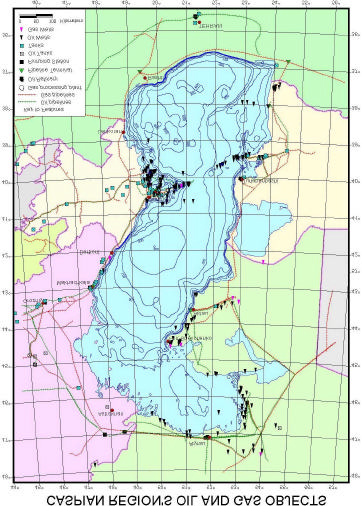
ANNEX E.2 Map showing the oil and gas activities in the Caspian Sea and environs
56
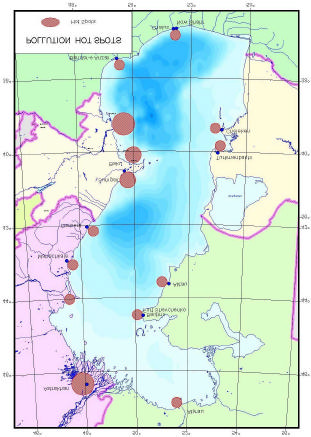
ANNEX E.3 Map showing the identified pollution hot spots in the Caspian Sea
57
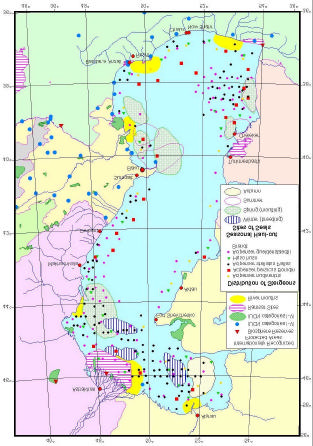
ANNEX E.4 Map showing biodiversity hot spots in Caspian Sea
58
Annex F.1: Budget
Project Number: 2622
Project Title: Towards a Convention and Action Programme for the Protection of the Caspian Sea
Environment
A. Budget Lines
Budget
Line Description
Year 1
Year 2
Year 3
Total
010 Project Personnel
011 International Experts - CTA
$120,000
$ 120,000
$120,000 $360,000
- Biologist
$90,000
$90,000
$90,000
$270,000
- Chemist/IT expert
$90,000
$90,000
$45,000
$225,000
- Public Awareness
$30,000
$30,000
$20,000
$80,000
- Invasive species expert
$30,000
$30,000
$60,000
- Seal expert
$20,000
$30,000
$50,000
-POPs expert
$30,000
$30,000
$60,000
- Miscellaneous consultants
$100,000
$100,000
$50,000
$250,000
013 Administrative Support (NPPP)
$80,000
$80,000
$50,000
$230,000
015 Monitoring and Evaluation
$10,000
$50,000
$60,000
016 Mission costs
$80,000
$80,000
$80,000
$240,000
017 National Consultants
$100,000
$100,000
$100,000
$300,000
SUBTOTAL
$780,000
$790,000
$605,000
$2,175,000
020 Contracts/Inter Agency Agreements
021 Regional Institutions
$100,000
$100,000
$100,000
$300,000
022 IAEA (Marine Environmental Laboratory)
$100,000
$100,000
$200,000
023 GPA
$70,000
$70,000
024 FAO
$100,000
$50,000
$150,000
025 WCMC
$70,000
$70,000
026 IMO
$50,000
$50,000
027 Vessel hire
$60,000
$20,000
$80,000
028.01 Ballast Water Reception Facility feasibility study
$70,000
$70,000
UNEP (Outcome I:Framework Convention
028.02 support)
$180,000
$180,000
$140,000
$480,000
SUBTOTAL
$580,000
$620,000
$290,000
$1490,000
030 Training and Meetings
032.01 Project steering Committee meetings
$30,000
$30,000
$30,000
$90,000
032.02 Thematic meetings
$90,000
$90,000
$90,000
$270,000
032.03 PCU and NCS training
$60,000
$60,000
$120,000
032.04 MSGP training
$50,000
$25,000
$75,000
032.05 Public Awareness campaigns
$100,000
$100,000
$50,000
$250,000
59
SUBTOTAL
$330,000
$305,000
$170,000
$805,000
040 Equipment
045.01 Office equipment
$60,000
$30,000
$10,000
$100,000
045.02 Web-site
$30,000
$30,000
045.03 Biological monitoring equipment
$100,000
$100,000
$200,00
SUBTOTAL
$190,000
$130,000
$10,000
$330,000
050 Miscellaneous
52.01 Office operations
$50,000
$50,000
$50,000
$150,000
52.02 Reporting costs
$10,000
$20,000
$60,000
$90,000
SUBTOTAL
$60,000
$70,000
$110,000
$240,000
070 Micro-capital grants
071 Match Small Grants
$200,000
$200,000
$400,000
072 Caspian Coastal Concern Group grants
$60,000
$80,000
$140,000
SUBTOTAL
$260,000
$280,000
$540,000
093.01 UNOPS execution fee
$176,000
$175,600
$94,800
$446,400
99.00 Total Project cost
$2,376,000 $2370,600
$1,279,800
$6,026,400
60
Annex F.II Project Objectives and Outcomes:
Objective I:
commence implementation SAP in the areas of biodiversity, invasive species and PTS
Outcome A:
Quantitative Assessment of habitat loss, verification of critically threatened areas and the design and
establishment of a standardized Monitoring methodology programme.
Budget: $ : 665,000
Activity A1: Undertake a quantitative assessment of the coastal and marine habitats of the Caspian Sea and develop a
preliminary Caspian Coastal Sites Inventory, which will include information on environmental sensitivity, prevailing
threats (including water level fluctuations), usage history and legal status of the sites.
Budget: $285,000
Activity A2: In collaboration with UNEP's World Conservation Monitoring Center produce quantitative and accurate
Environmental Sensitive areas maps of the Caspian and make available using internet map server technology (ImapS).
These maps will form one block of a Caspian biodiversity database and be a component of the Regional Oil Spill
Cooperation Plan.
Budget: $150,000
Activity A3: Create an up-to-date Caspian biodiversity database, building on work done in the first GEF support
project to CEP.
Budget: $100,000
Activity A4: Develop guidelines for the protection and rehabilitation of environmental sensitive sites and design a
monitoring programme to serve the decision making process.
Budget: $50,000
Activity A5: Provide training to government agencies, NGOs and local communities on execution of the monitoring
programme.
Budget: $80,000
Outcome B: Preliminary implementation of the Biodiversity Action Plan focusing on compliance issues, protection
and conservation action plans and targeted public awareness campaigns
Budget: $ 520,000
Activity B1: Establishment of an Eco-Net around the Caspian, comprising a coordinated network of conservation
practitioners from institutions, NGOs and other stakeholder groups. A structured training programme will be
provided and linkages facilitated with international conservation groups.
Budget: $120,000
Activity B2: Development and implementation of a conservation action plan for the Caspian seal. Assistance will
be sought from the private sector in implementation of the plan.
Budget: $100,000
Activity B3: Development and implementation of a water level fluctuation adaptation management plan for a
coastal lagoon of global biodiversity significance selected for a pilot project.
61
Budget: $300,000
Outcome C:
Implementation of CEP Invasive Species Action Plan
Budget: $ 515,000
Activity C1: Support and expand the Mnemiopsis monitoring programme on-going in the five Caspian States.
Budget: $75,000
Activity C2: Provide technical assistance in development of a proposal for the introduction of Beroë Ovata and/or
other alternatives in the Caspian as biological control agent for Mnemiopsis, and provide support to the I.R. Iran and
Russia in undertaking in-vitro behavioural studies of Beroë and an environmental impact assessment report.
Budget: $60,000
Activity C3: Review the national legislation on introduction of alien species and make recommendations for the
formation of a Caspian Regional body to evaluate and authorize introductions.
Budget: $80,000
Activity C4: In collaboration with the GEF Globallast undertake an assessment of extent of traffic of ship-borne
invasive species into and from the Caspian via the River Volga and undertake a pre-feasibility study into ways and
means of controlling invasions at the port of entry Astrakhan.
Budget: $300,000
Outcome D:
Assessment of pollution loading of the Caspian and determination of the source, distribution and
composition of PTS in the riverine waters and sediments and coastal waters to prioritize amelioration
interventions .
Budget: $ 652,500
Activity D1: Expand and improve the Tacis land-based activity assessment, including contaminant source assessment in the
coastal zone and major river basins (Kura/Arax, Volga up to Volgograd, Sefid Rood, and Ural), including point and non-point
sources and quantification of hot spots within the rivers (working with the GPA Secretariat in The Netherlands, the POPs
Secretariat in Geneva, and with the regional and national PTS and POPs assessments and enabling activities).
Budget: $200,000
Activity D2: Determine the flux of major contaminants from the Volga cascade (in conjunction with the planned UNESCO
project) and the Mingechaur reservoir.
Budget: $100,000
Activity D3: As a continuation of work from the first GEF CEP project, further surveys of the riverine waters, sediments and
sea waters in the Caspian states, including the coastal sediments off Turkmenistan, assessing the impact of key transboundary
62
contaminants in water and sediments.
Budget: $300,000
Activity D4: Assist in the design, promotion and implementation of a cost effective and affordable regional monitoring
methodology/programme for key transboundary contaminants and in conjunction with the oil industry develop an
environmental rapid assessment methodology/programme using bio-marker techniques, combined with awareness-raising
activities.
Budget: $52,500
Outcome E:
Develop regional action plans addressing the activities contributing to transboundary PTS
Budget: $ 502,500
Activity E 1: Draft and agree , in coordination with the national GEF supported enabling POP activities, a regional Action Plan
for addressing the activities contributing to transboundary PTS, including Persistent Organic Pollutants hydrocarbons and heavy
metal pollution.
Budget: $100,000
Activity E2: In two pilot project areas, undertake a survey of usage and stockpiling of pesticides, undertake a stakeholder
education programme and demonstrate the use of Integrated Pest Management (coordinated with any national POPs Enabling
Activity inventories to avoid duplication).
Budget: $300,000
Activity E3: Undertake a regional public awareness campaign against the use of banned pesticides and other PTS (coordinate
with any similar activities planned under country's POPs Enabling Activities).
Budget: $102,500
Objective II:
To continue specific capacity building towards a regionally owned CEP coordination mechanism
capable of SAP implementation and NCAPs coordination
Outcome F:
A sustainable , strengthened and regionally owned coordination mechanism including PCU in Tehran
, CNSs and network of institutions addressing transboundary issues.
Budget: $ 1,192,000
Activity F1: Supporting establishment of the Programme Coordination Unit in Islamic Republic of Iran, including provision of
additional furniture and computer equipment and assistance with preliminary training needs.
Budget: $300,000
Activity F2: If not already undertaken as part of PDF-B activities, transfer the Caspian Information System and web-site to I.R.
Iran. Develop the information system further by developing strong linkages with contributing institutions. Maintain web-site.
Budget: $102,000
Activity F3: Provision of project management training to the staff of the PCU and NCS to enable them to execute regional and
63
national projects.
Budget: $250,000
Activity F4: Support national SAP implementation activities by provision of a SAP implementation coordinator for GEF focal
areas and national inter-sectoral coordination activities by formation and support of a coordination body.
Budget: $150,000
Activity F5: Develop an integrated monitoring and evaluation programme for the SAP and the NCAPs, measured against the
process, stress reduction and environmental status indicators defined in the SAP (see annex D)
Budget: $50,000
Activity F6: Revise the TDA and the SAP.
Budget: $120,000
Activity F7: Fund semi-annual inter-agency consultation meetings in each country; the GEF Project Manager will attend CEP
Steering Committee meetings.
Budget: $200,000
Outcome G:
Enhanced and informed stakeholders and intersectoral participation in CEP management
Budget: $ 506,000
Activity G 1: Enhanced participation of media through the development of a CEP media kit for local, national, and
international journalists outlining mission objectives, projects, and programmes of the CEP. Develop database of media
contacts; publication of CEP Bulletin.
Budget: $60,000
Activity G 2: Strengthening of Caspian-wide NGO community building on the work already undertaken in the region with a
view to promote NGOs regional outlook. Encourage NGO representation on the CEP Steering Committee and in CEP activities.
Budget: $70,000
Activity G 3: Continued support of Caspian Coastal Concern Groups, established in the first project, and expand the network.
Hold a conference of the Caspian Mayors and establish linkages with EU-Tacis Coastal Sustainable Development project
through information exchange, joint activities, reciprocal representation/participation in meetings/activities.
Budget: $226,000
Activity G 4: Creation and implementation of environmental awareness training programme for policy makers.
Budget: $80,000
Activity G 5: Strengthened private sector participation in the CEP, perhaps through considering the establishment of a CEP
private sector advisory body that could include the International Petroleum Industry Environmental Conservation Association
(IPIECA), local oil and gas operators, shipping companies and fish processing companies.
64
Budget: $50,000
Activity G 6: Creation and implementation of an evolving public participation plan that is updated frequently according to
changing conditions and needs.
Budget: $20,000
Objective III: to strengthen the regional and national environmental legal and policy frameworks including
implementation and compliance capacities
Outcome H:
Preparation of ancillary agreements to the Framework Convention and drafts of the major protocols
targeting priority transboundary issues .
Budget: $ 516,000
Activity H1: provide assistance that may be needed by some countries in the process leading to the ratification of the Framework
Convention.
Budget: $80,000
Activity H2: develop ancillary agreements to the Framework Convention, most likely in the form of protocols that will become
integral parts of the Convention.
Budget: $160,000
Activity H3: strengthen the capacity of the countries and their institutions to participate fully in the implementation of the
Framework Convention, including the functioning of an active secretariat.
Budget: $96,000
Activity H4: delivery workshops/seminars reviewing the salient features of selected international environmental agreements and
programmes, including the legal obligations of the parties to these conventions and activities expected from countries
participating in these programmes.
Budget: $100,000
Activity H5: promote the regional practice of environmental impact assessment and the use of economic instruments
contributing to improved environmental management.
Budget: $80,000
Objective IV:
To achieve tangible environmental improvements in priority areas by implementation of small
scale investments supported by matched small grants programme
Outcome I
Matched Small Grant Programme to fund small scale Investments
Budget: $ 511,000
Activity I:
establishment and training of the new MSGP team in Iran
65
Budget: $ 30,000
Activity 2: development of application, evaluation, implementation and monitoring documents/procedures by the new MSGP
team for approval by UNOPS, in consultation with the World Bank whenever required
Budget: $20,000
Activity 3:
grants awareness campaign conducted in the coastal region/applications sought for grants; applications for 1st
grant round received
Budget: $ 10,000
Activity 4:
evaluation meeting conducted and grants disbursed
Budget: $ 376,000
Activity 5:
grant projects executed, monitored and reported on.
Activities 3, 4 and 5 are repeated for the 2nd grant round
Budget: $ 75,000
66