Integrated Safeguards Data Sheet (Initial)
Section I - Basic Information
Date ISDS Prepared/Updated: 07/29/2003
A. Basic Project Data (from PDS)
I.A.1. Project Statistics
Public Disclosure Authorized
Country: EAST ASIA AND PACIFIC
Project ID: P078034
Project: Investigations of Impacts of Localized Stress and Task Team Leader: Marea Eleni Hatziolos
Compounding Effects of Climate Change on
Sustainability of Coral Reef Ecosystems
Authorized to Appraise Date: January 15, 2004
IBRD Amount ($m):
Bank Approval: April 29, 2004
IDA Amount ($m):
Global Supplemental Amount ($m): 11.00
Managing Unit: ENV
Sector: General agriculture, fishing and forestry
Lending Instrument: Specific Investment Loan (SIL)
sector (100%)
Status: GEF Grant
Theme: Other environment and natural resources
management (P)
Public Disclosure Authorized
I.A.2. Project Objectives (From PDS):
The Project Development Objective and the Global Environment objective are to fill critical gaps in our
understanding of what determines coral reef ecosystem vulnerability and resilience to a range of
stressors--from climate change to localized human stress-- and to use this knowledge to strengthen
management and policy globally for the benefit of coral reefs and the communities that depend on them.
A related objective is to build capacity for science-based management of coral reefs in developing
countries where the majority of reefs are found. This will be achieved through targeted investigations
involving networks of scientists and managers, and the dissemination of knowledge within and across
regions.
I.A.3. Project Description (From PDS):
The project is organized around six key themes and research questions, which will be
investigated by interdisciplinary teams of developing and developed country scientists. These
Public Disclosure Authorized
themes were identified through extensive consultation over the course of project preparation to
encompass the kinds of knowledge and management tools that underpin sustainability science for
coral reefs. They include:
a. The physiological mechanisms and ecological consequences of large area (or massive) coral reef
bleaching, particularly in response to sea surface temperature anomalies, like the El Niño/Southern
Oscillation episodes, and the potential consequences of their changes in frequency;
b. The nature, severity and spread of coral reef diseases, some of which may be responsible for major
shifts in the structure, function, health and sustainability of coral reefs;
c. The importance of physical and biological connections (or "connectivity") between coral reefs,
whether within or between different regions of International Waters. This also has direct bearing on the
Public Disclosure Authorized
environmental conditions and key design factors needed to establish and sustain effective Marine
Protected Areas (MPAs);
d. The tools, technologies and efficacy of restoring coral reefs that have been severely degraded or
destroyed, and the key organisms and environmental conditions to consider when rehabilitating a given
2
ISDS
coral reef environment;
e. The application of advanced technology, such as remote sensing, modeling and genetics to refine
information and enhance the rate and scale at which knowledge can be generated and applied. This
includes the need to modify technology so that it can be practically deployed and sustained within
developing countries;
f. The need to develop decision support tools and scenario building to help anticipate impacts to coral
reefs associated with various economic development plans or climate change related events, and to lower
uncertainties related to ecosystem response/recovery to these impacts. Such decision support tools may
also be used to build constituencies for action among key stakeholders and to build political will for
conservation oriented policies whose benefits are distributed more broadly and continuously than those
aligned with intensive use.
Each theme is addressed by a working group composed of developed and developing country scientists
from around the world. The chairs of these working groups, plus four additional professionals
(including economists and managers), form the Synthesis Panel, whose job is to oversee the quality and
direction of the research, evaluate and interpret the results for target audiences.
The working groups have prioritized questions to be addressed within each theme, through field-based
hypothesis testing. The research questions and field locations have been organized so as to maximize
synergies between groups and to produce a robust framework for the ongoing creation of knowledge and
new tools essential for adaptive management of coral reefs. Knowledge will be disseminated widely and
in a format useable by decision-makers.
Working Groups:
1. Coral Bleaching and Local Ecological Responses. Goal: To develop molecular, cellular, physiological and community
indicators for coral bleaching and other responses to a range of stressors, and examine potential mechanisms of coral reefs to
adapt to environmental change.
2. Coral Diseases. Goal: To examine, prioritize and target investigations that are critical to the understanding of coral diseases,
and how this information can assist managers in minimizing disease frequency and transmission;
3. Large-Scale Ecological Processes, Recruitment and Connectivity. Goal: To examine the role that larval transport,
recruitment, post-recruitment survival, and connectivity play in networking coral reef environments, particularly as they relate to
the siting and management of marine protected areas;
4. Coral Restoration and Remediation. Goal: To examine the state of remediation techniques and efficacy of potential
applications, with considerations on protocols to design and implement restoration strategies; baseline data for developing
effective criteria; the efficacy and feasibility of restoration and remediation techniques, and prospects for enhancing natural
recovery;
5. Remote Sensing. Goal: To develop systems for holistic monitoring of the physical environment and stress on coral reefs;
develop tools to measure the status of reef ecosystems at various ecological, spatial and temporal scales; an integrate above to
provide a comprehensive perspective of how global, regional and local processes affect the health of coral reef ecosystems;
6. Modeling and Decision Support. Goal: To develop a coordinated information base that can improve the accuracy and
reliability of forecasting and predictive modeling, and to develop modeling tools to handle data on aspects such as community
dynamics, oceanography, climate, as well as socio-economic data on fisheries, tourism, and coastal development.
Project components are organized around the following four main headings:
1. Addressing Knowledge and Technology Gaps
Over the past ten years, an increasing awareness of the importance of coral reefs has been evident,
especially in light of their rapid decline in many regions, and their significance to developing countries.
However, what remains fundamentally unknown about these ecosystems is alarming, especially when
3
ISDS
management interventions are becoming increasingly important. Significant gaps in understanding some
of the basic forcing functions affecting coral reefs remain. This targeted research framework will
systematically define those information gaps, and prioritize them in an order of strategic importance to
management, so that the resulting information and tools developed can lead to credible outcomes.
Furthermore, policies developed at regional and national levels can also be strengthened to help bring
about better legislation to sustain the products and services provided to SIDS and coastal communities by
coral reefs.
Each working group has developed a detailed work program which has been vetted and approved by the
Synthesis Panel (see Annex 2 for a detailed description of key hypotheses to be tested and criteria for
priority setting). This work program defines the investigations to be carried out under Component 1.
Research plans, standard methods and inter-institutional collaboration, including twinning arrangements
for graduate students and post-docs between developed and developing country institutions, are being
coordinated to maximize knowledge sharing and capacity building (see section 3 below).
2. Linking Scientific Knowledge to Management and Policy
The results generated from the targeted investigations with be formulated for various users. Over the
course of project implementation, the information and tools produced, will be disseminated as knowledge
products to enhance the management of coral reefs. These products may range from in-situ diagnostics
(for example, disease assessment and bio-indicators of specific forms of stress and metabolic response in
coral reef organisms, to markers for larval recruitment indicating source and sink reefs) to remote sensing
products and applications to assess the state of coral reef health. In addition to these tools, a series of
management and policy briefs will be developed periodically by the Synthesis Panel and released to
targeted audiences. These audiences include CAS and PRSP/C teams, GEF project teams,
policy-makers, and members of regional and global fora (e.g, the IPCC, CSD, ICRI, SBSTTA, Regional
Seas Conventions).
3. Promoting Learning and Capacity Building
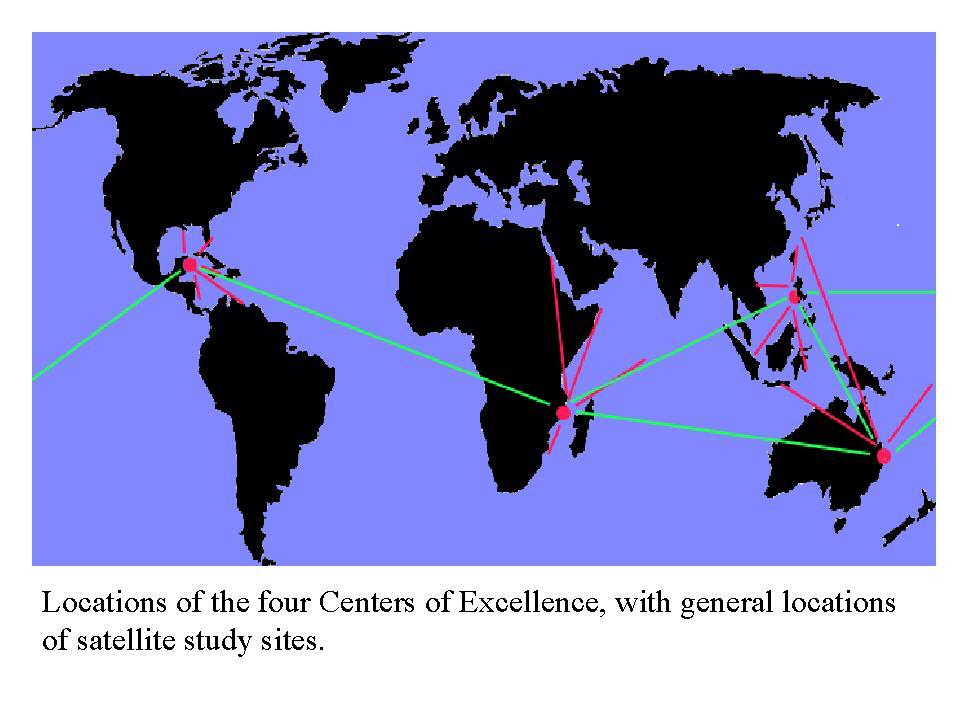
The Targeted Research investigations will focus around four "Centers of Excellence" (COE)in four
major coral reef regions (Western Caribbean (Universidad Autónoma Nacional de México), Eastern
Africa (Marine Science Institute of University of Dar Es Salaam, Zanzibar, Tanzania), Southeast Asia
(Marine Science Institute, University of the Philippines, and the central south Pacific (University of
Queensland, Australia)). These COEs will serve as nodes for targeted learning and capacity building
between developed and developing country scientists. Current study site locations within each region
include (i) the Mesoamerican Barrier Reef System (Puerto Morelos/Akumal, Mexico and Glover's Reef
Marine Station, Belize), (ii) Bolinao (and the Hundred Islands), northwest Philippines, (iii) Zanzibar,
Tanzania (iv) Papua New Guinea, (v) Heron Island, (vi) and Palau. Other potential locations are also
under consideration.
Specific learning exchanges are already underway in which interdisciplinary teams of researchers have
the opportunity to formally exchange ideas, and jointly implement research techniques and methods.
Large-scale experimental designs also offer the opportunity to engage both researchers and managers in
the design, testing and implementation of the priority, targeted experiments. Through twinning
arrangements between various universities and research institutions, coral reef scientists from developing
countries will spend up to six months at partner institutions to learn cutting edge techniques in e.g., the
identification of coral pathogens, measurements of metabolic stress linked to specific environmental
stressors, the use of genetic markers to track larval dispersal and connectivity, and application of
agent-based modeling techniques to simulate coral reef ecosystem response to various stress regimes.
4
ISDS
The Targeted Research Project will support a series of workshops each year which will bring researchers
in the various working groups together to orient field research, brief each other on findings and based on
these results, modify and design the next phase of research. Links will be made between research results
and management efforts in the region. The Center of Excellence in a given region will serve as the
conduit of information to satellite sites and various user/stakeholder groups (including NGOs and others
involved in MPA management, coastal zone management and marine regulation, national and
community-based coral reef management activities, ecosystem monitoring efforts, etc.) At the other end
of the spectrum, high level audiences will be kept abreast of research findings through publications of
each of the working groups (a list of those already out or in press since project preparation is available on
request); through Synthesis Panel briefings, and in the form of periodic management and policy briefs
(précis).
The Project will also use the IW:Learn Project (a GEF/UNDP/UNEP/WB Knowledge Management
Project for International Waters) to help disseminate research findings. Electronic fora and roundtable
discussions focusing on key themes emerging from the targeted investigations may be supported through
the IW:Learn Project and open to the relevant community of practice .
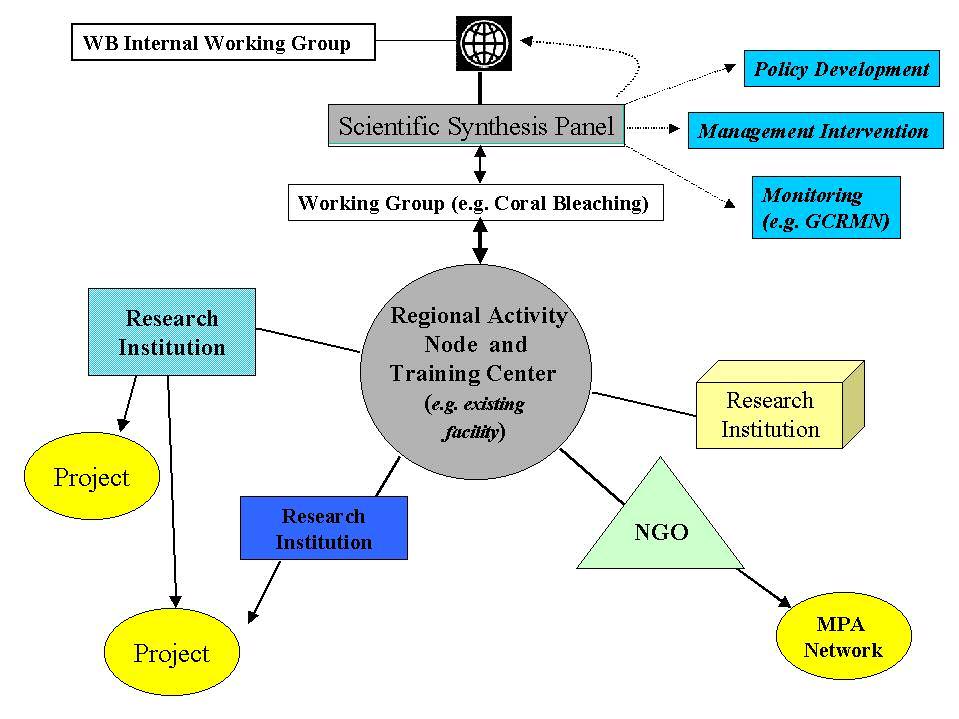
Illustration of the institutional linkages involved in designing, implementing and disseminating the results of the targeted investigations.
Institutional Nodes, or Centers of Excellence, will provide the quality control and research rigor required to carry out the experimental design
formulated by the working groups and endorsed by the Synthesis Panel. Capacity building is the result of collaboration between a COE and
other research facilities in selected locations with coral reef ecosystems, through formal exchanges, targeted learning and collaborative research.
Research results are channeled to management projects and activities to inform decision making, and to policymakers to introduce needed
reforms. Similar clusters of node and satellite institutions are envisioned in each region and some of the working groups may overlap in their use
of field sites and clusters to carry out investigations.
5
ISDS
4. Modeling and Shaping the Future (Scenario Building for Policy/Decision-making)
A key outcome of this work will be to improve our predictive capability in assessing impacts to coral reef
ecosystems, in the face of cumulative stress from increasing coastal populations, changes in climate and
other uncertainty. These targeted investigations are being designed to feed into models and decision
support systems for managers, policy makers, and other stakeholders.
A guiding Synthesis Panel helps gives direction to the targeted research program (see Component 1).
This Panel also serves as a formal interlocutor with other disciplines,such as development economics and
law, to enhance the relevance and uptake of results by policymakers. It synthesizes and interprets
results and modifies the focus of investigations as needed to benefit management and policy Examples
include the development and dissemination of a series of management and policy briefs in a form easily
internalized by several audiences (see Component 2.)
The project will finance the following four components major components:
1.
Addressing Knowledge and Technology Gaps
Testing rigorously designed hypotheses under each of the key investigative themes at
coordinated study sites within each of the four regions
2.
Linking Scientific Knowledge to Management
Development of specific knowledge products and indicators that can be used by
management and policy
3.
Promoting Learning and Capacity Building
Developing and implementing Targeted Learning exchanges and research working
meetings, so that investigators can share knowledge and techniques in address the
prioritized hypotheses (i.e. #1 above). This will also including engaging local and
traditional ecological knowledge.
4.
Modeling and Shaping the Future (Scenario Building for Policy/Decision-making)
A key outcome of this work will be to improve our predictive capability in assessing
impacts to coral reef ecosystems in the face of uncertainty, the stresses of increasing
coastal populations, and changes in climate. This has significant implications for
developing countries relying upon these systems for sustainable development,
particularly Small Island Developing States (SIDS).
I.A.4. Project Location: (Geographic location, information about the key environmental and social
characteristics of the area and population likely to be affected, and proximity to any protected areas, or sites
or critical natural habitats, or any other culturally or socially sensitive areas.)
The Project will be implemented at research facilities in four key locations (nodes) and satellite sites. These are
located in four separate regions of the world: (i) Mesoamerican Barrier Reef System (at the UNAM facility at
Puerto Morelos, Mexico and at Glovers Reef Marine Station in Belize; (ii) Western Indian Ocean (at the
University of Zanzibar, Marine Science Institute) and the Western Indian Ocean Marine Science Association
(WIOMSA); (iii) South East Asia (University of the Philippines, Marine Science Institute (Bolinao) and satellite
locations, and (iv) South/Central Pacific (University of Queensland's Heron Island Research Station on the Great
Barrier Reef, and Milne Bay Research Station in PNG).

6
ISDS
B. Check Environmental Classification: C (Not Required)
Comments: There are no negative environmental issues/impacts associated with this project. It is primarily a
technical assistance project to build capacity for science based management of coral reef ecosystems. The
approach is one of trying to create the investigative framework that will help reef scientists and managers
understand the basis for ecosystem vulnerability or resilience in the face of key environmental stressors,
such as climate change, landbased sources of pollution, disease, etc., and to develop tools that may be most
cost-effective in reducing risk and enhancing sustainability. In light of this, the Project Team requests a
Category C Environmental Rating.
C. Safeguard Policies Triggered (from PDS)
(click on for a detailed desciption or click on the policy number for a brief description)
Policy
Triggered
Environmental Assessment (OP 4.01, BP 4.01, GP 4.01)
Yes
No
TBD
Natural Habitats (OP 4.04, BP 4.04, GP 4.04)
Yes
No
TBD
Forestry (OP 4.36, GP 4.36)
Yes
No
TBD
Pest Management (OP 4.09)
Yes
No
TBD
Cultural Property (OPN 11.03)
Yes
No
TBD
Indigenous Peoples (OD 4.20)
Yes
No
TBD
Involuntary Resettlement (OP/BP 4.12)
Yes
No
TBD
Safety of Dams (OP 4.37, BP 4.37)
Yes
No
TBD
Projects in International Waters (OP 7.50, BP 7.50, GP 7.50)
Yes
No
TBD
Projects in Disputed Areas (OP 7.60, BP 7.60, GP 7.60)*
Yes
No
TBD
Section II - Key Safeguard Issues and Their Management
D. Summary of Key Safeguard Issues. Please fill in all relevant questions. If information is not available,
describe steps to be taken to obtain necessary data.
7
ISDS
II.D.1a. Describe any safeguard issues and impacts associated with the proposed project. Identify and
describe any potential large scale, significant and/or irreversible impacts.
None anticipated.
II.D.1b. Describe any potential cumulative impacts due to application of more than one safeguard policy or
due to multiple project component.
None anticipated.
II.D.1c Describe any potential long term impacts due to anticipated future activities in the project area.
No negative long term impacts anticipated. With project success, there would be an extension of
technical capacity based upon the twinning arrangements between developed and developing country
researchers, and therefore, this could be considered a long term net positive outcome of the project.
II.D.2. In light of 1, describe the proposed treatment of alternatives (if required)
II.D.3. Describe arrangement for the borrower to address safeguard issues
N/A - this is a technical assistance project focused on targeted research and learning. None of the
activities identified under this project are likely to trigger any of the Bank's Safeguard Policies.
II.D.4. Identify the key stakeholders and describe the mechanisms for consultation and disclosure on
safeguard policies, with an emphasis on potentially affected people.
Participation of stakeholders will be via workshops, collaborative research, exchange of graduate
students and post-docs, publications, symposia and application of research results to policy and
management of coral reefs.
E. Safeguards Classification (select in SAP). Category is determined by the highest impact in any policy.
Or on basis of cumulative impacts from multiple safeguards. Whenever an individual safeguard policy is
triggered the provisions of that policy apply.
[ ] S1. Significant, cumulative and/or irreversible impacts; or significant technical and institutional risks
in management of one or more safeguard areas
[ ] S2. One or more safeguard policies are triggered, but effects are limited in their impact and are
technically and institutionally manageable
[X] S3. No safeguard issues
[ ] SF. Financial intermediary projects, social development funds, community driven development or
similar projects which require a safeguard framework or programmatic approach to address
safeguard issues.
F. Disclosure Requirements
Environmental Assessment/Analysis/Management Plan:
Expected
Actual
Date of receipt by the Bank
Date of "in-country" disclosure
Date of submission to InfoShop
Date of distributing the Exec. Summary of the EA to the Executive
Directors (For category A projects)
Resettlement Action Plan/Framework:
Expected
Actual
Date of receipt by the Bank
8
ISDS
Date of "in-country" disclosure
Date of submission to InfoShop
Indigenous Peoples Development Plan/Framework:
Expected
Actual
Date of receipt by the Bank
Date of "in-country" disclosure
Date of submission to InfoShop
Pest Management Plan:
Expected
Actual
Date of receipt by the Bank
Date of "in-country" disclosure
Date of submission to InfoShop
Dam Safety Management Plan:
Expected
Actual
Date of receipt by the Bank
Date of "in-country" disclosure
Date of submission to InfoShop
If in-country disclosure of any of the above documents is not expected, please explain why.
Signed and submitted by
Name
Date
Task Team Leader:
Marea Eleni Hatziolos
6/26/2003
Project Safeguards Specialists 1:
Stephen F. Lintner/Person/World Bank
7/22/2003
Project Safeguards Specialists 2:
Anthony J. Whitten
7/28/2003
Project Safeguards Specialists 3:
Chaohua Zhang/Person/World Bank
7/29/2003
Approved by:
Name
Date
Regional Safeguards Coordinator: Glenn S. Morgan
7/29/2003
Comments
Regional Safeguards Unit Director: Maria Teresa Serra 7/29/2003
Sector Manager/Director
Kristalina Georgieva
7/22/2003