Southeast Asian
Centre of Excel ence
Update
Philippines.
V
anessa Baria
Maria
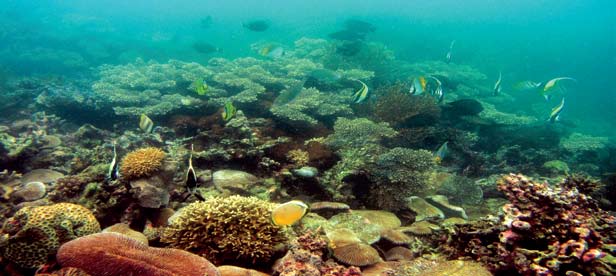
Hundred Islands National Park,
Photo:
Brokering knowledge, research and study
Coral reefs are the richest repositories of marine
Connecting people with coral reefs
biodiversity across Southeast Asia and they are
Southeast Asia is home to half of the world's coral
important economic assets, contributing more than
reefs. A key function of the SEA CoE is to build the
The Coral Reef Targeted Research &
$1 billion annually to the Philippines economy.
Capacity Building for Management
scientific capacity and coastal knowledge that is
Program (CRTR) is a leading
Nearly all of the Philippines' reefs are under severe
necessary in order to sustain coral reef ecosystems
international coral reef research
initiative that provides a coordinated
threat from economic development and climate
for both present and future generations in the
approach to credible, factual and
change. Although there are 1,000 Marine
region. The primary target for this knowledge
scientifically-proven knowledge for
improved coral reef management.
Protected Areas (MPAs) within the country,
transfer is coastal communities.
only 20% are functioning.
The CRTR Program is a proactive
Many local, coastal communities do not understand or
research and capacity building
As a result, the Coral Reef Targeted Research
know what a coral reef actual y is, how its ecosystem
partnership that aims to lay the
& Capacity Building for Management (CRTR)
interacts with them, and why it is so important for their
foundation in filling crucial knowledge
gaps in the core research areas of Coral
Program established the Southeast Asian Centre of
villages to preserve and conserve it.
Bleaching, Connectivity, Coral Diseases,
Excellence (SEA CoE) in the heart of the region.
Coral Restoration and Remediation,
At a community-level, the SEA CoE seeks to
Remote Sensing and Modeling and
The SEA CoE is one of four international centres
educate villagers, fishers, marine managers and
Decision Support.
under the CRTR Program.
policy-makers about the damage to reefs caused
Each of these research areas are
From its base at the Marine Science Institute at The
by pollution, overfishing and unsustainable coastal
facilitated by Working Groups
underpinned by the skills of many of the
University of Philippines, metropolitan Manila, and
development.
world's leading coral reef researchers.
at the Bolinao Marine Laboratory in northwestern
By linking advances in scientific knowledge to
The CRTR also supports four Centers of
Excellence in priority regions, serving as
Philippines, the SEA CoE is a hub for coral reef
on-the-ground decisions and by providing and
important regional centers for building
studies in Southeast Asia.
improving science-based coral reef management
confidence and skills in research,
training and capacity building.
The SEA CoE serves as a venue for the research
and policy tools, the CRTR Program's SEA CoE aims
The CRTR Program is a partnership
of various CRTR Working Groups, providing them
to strengthen the way coral reef managers, villagers
between the Global Environment
with technical support as appropriate. In addition, it
and policy-makers view and manage coral reefs.
Facility, the World Bank, The University
of Queensland (Australia), the
undertakes or supports local research on coral reefs.
United States National Oceanic and
Importantly, it is ideally located to provide a platform
Atmospheric Administration (NOAA) and
approximately 50 research institutes and
for education and training activities. These include
other third parties around the world.
postgraduate degrees, short courses, workshops,
July 2008
study tours and mentoring programs.
Product code: CRTR 012/2008
Making progress with targeted research
The Southeast Asian Centre of Excellence
is making major in-roads in three local research projects:
1 Coral Identification
Coral Disease
& Taxonomy
2& Marine Microbiology
3
This sub-project seeks to provide expert identification and
This project aims to:
reference services for the CRTR Program at Bolinao Marine
1. Survey diseases of corals
Laboratory (BML), initiate the improvement of the collections
from the Gulf of Lingayen
at the BML and the rest of the Marine Science Institute,
(near Bolinao and Alaminos)
develop a virtual (Internet-based) museum of photographs and
and to identify microbial
descriptions of these collections, and develop field guides in
populations as single
support of the coral research at BML.
causative agents.
2. Test the hypothesis
of a linkage between
organic pollution from
nearby mariculture and
the incidence of certain
bacterial diseases in corals.
3. Identify epidemiological
pathways by screening for
potential vectors carrying
bacterial pathogens such as
certain coral reef inhabiting
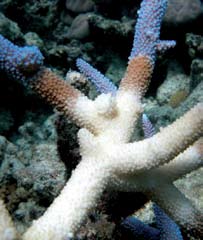
Brown Band Disease
invertebrates.
4. Test the hypothesis of a
linkage between monsoonal
climate-linked changes in
coastal water quality and
the incidence of microbial
diseases in nearby coral
reefs.
5. Test the hypothesis of
a linkage between the
incidence of microbial coral
diseases and elevated water
temperature maxima, also
in combination with organic
pollution levels favoring
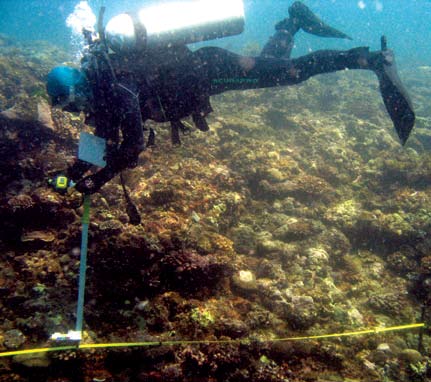
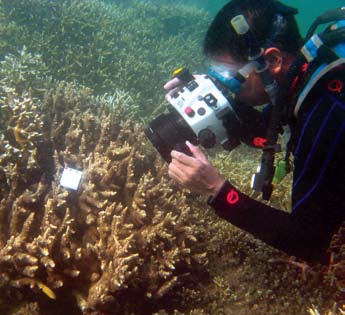
Survey of benthic communities using digital photo transects. Photo: George Imperial
opportunistic mesophilic
pathogens.
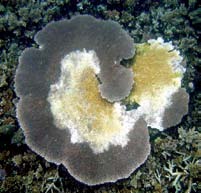
White Syndrome
Progress to date includes:
·
Progress to date includes:
The on-line map library of Philippine corals has been updated
to include information on coral distribution, species lists,
· Infection trials have revealed three Vibrio spp. isolates as
virtual museum, taxonomic guides and featured species.
causative agents of Porites ulcerative white spot (PUWS)
· A Field Guide to the Bubble Corals of the Philippines has
disease. On the other hand, fish farming waste did not have
been developed. The guide is being used by non-scientific
significant effect on the incidence of, and recovery from,
divers who are trained by the project to map the distributions
PUWS under experimental conditions.
of these corals in the Philippines.
· A Guide to the Corals of Bolinao and Western Luzon has
commenced with field surveys and taxonomic identification
of the coral species photographed.
Making progress with targeted research
The Southeast Asian Centre of Excellence
is making major in-roads in three local research projects:
3Connectivity
Key objectives for
The Connectivity project aims to explore the following
research questions:
the Southeast Asian CoE
1. Are there distinct spatial patterns of community structuring
of reef-associated rabbitfish in the reef areas in Bolinao and
1. Provide technical support for the research activities of the
adjacent localities?
various Working Groups (WGs) of the CRTR Program, initially
2. Do natural environmental phenomena such as seasonal
with the Remediation and Restoration WG and the Remote
monsoon winds and oceanographic processes influence the
Sensing WG.
community structuring of these species in Bolinao
and adjacent localities?
2. Upgrade the reference coral collections in local museums,
3. Are the different methods for determining genetic
starting with those of the University of the Philippines, and to
structuring concordant in the model species being studied?
develop local expertise for the identification of Indo-Pacific
Progress to date on the Connectivity project includes:
species. Taxonomic guides and coral collections will be made
· Initial results of microsatellite analyses suggest significant
available to all WGs and local individuals that require the
genetic differentiation among populations and a putative
partitioning of six populations into three genetically distinct
identification of specimens.
groups among the study sites. However, morphometric
analysis, performed to analyse population differentiation
of S. fuscescens collected in 2005 and 2006, suggest that
morphometric methods might not be powerful enough to
differentiate among S. fuscescens populations as this method
relies on morphological differences on the body shape.
· A genomic library containing 180 clones was generated.
Out of these clones 60 were screened for putative
microsatellite markers. Thirteen primers were designed for
amplification and testing for polymorphisms of which eight
initially showed polymorphisms and were tested for Hardy-
Weinberg Equilibrium.
V
ergara
Mark
.
Wilfredo Licuanan examining a new coral species record for the Philippines.
Dr
Photo:
3. Undertake other research related to coral disease and to
connectivity, with a view to expanding the activities of the
WGs for these disciplines, while focusing on local issues.
4. Increase the capacity of the CoE, in particular to conduct
coral reef research and training, in order to extend
information and skills to local and regional stakeholders,
managers and researchers alike. The ultimate objective is
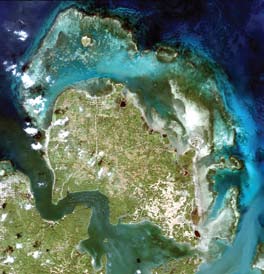
Satellite image of the Bolinao reef complex. Source: Quickbird Satellite Image
to contribute to the conservation of coral reefs which are
of vital importance to the rural poor in coastal areas.
North Atlantic
Linking global
Ocean
North Pacific
Ocean
research to local action
The Local Government Initiative (LGI) project
Indian Ocean
undertaken by the SEA CoE is well on the way
South Pacific
South Atlantic
Ocean
to achieving its goals with the hosting of a
Ocean
workshop titled `Environmental Compliance
Assessment as an Approach to Improving
Coastal Governance' during October 2007
in Alaminos City, Pangasinan. Under the LGI,
the SEA CoE also provided assistance in
organising the Workshop on the Development
of Local Fisheries Code and Coastal Resource
Management Programs held at the School of the
Seas, Bantayan, Cebu, during February 2008.
Through the Local Government Initiative (LGI)
the CoE is providing technical assistance
Bolinao,
to the Marine Protected Area (MPA)
Philippines
establishment in Agno, Pangasinan. Two
MPA orientations at the Local Government
Unit (LGU) and community levels in the
Lingayen Gulf area were conducted in
December 2007 and January 2008. These
were followed by underwater assessments
undertaken in March 2008 to gather
important data needed to determine the
best sites for the MPA establishment in the
municipality of Agno. Results of the survey
are being collated and analysed and will be
presented to local residents through a series of
community validations. This will serve as one of
the bases for the selection of the appropriate
MPA(s) in the locality.
Each LGU is undergoing a self assessment
(scorecard) of how effective it is in compliance
Further Information
with the legislation for protection of the marine
Dr. Edgardo D. Gomez
environment. Within the LGUs, the issue of
Phil/SEA CoE Coordinator
The Marine Science Institute
compliance can be more readily monitored due
University of the Philippines
to the link with the Ombudsman (whom the
LGUs have to report to), and therefore there
Velazquez St. Diliman,
Quezon City 1101 Philippines
is a message of accountability.
TeleFax: (63 2) 4357417
In conjunction with this activity, the LGI has
Project Executing Agency
been working with villages to establish common
Coral Reef Targeted Research & Capacity
Building for Management Program
protocols for enforcing the MPA zones, as
C/- Centre for Marine Studies
there are many differences across villages.
The University of Queensland
St Lucia QLD 4072
This initiative has involved meetings with MPA
Australia
managers, local police and other relevant
Telephone: +61 7 3346 9942
people.The meetings have looked at the
Facsimile: +67 7 3365 4755
issues facing villages and assessed issues for
Email: info@gefcoral.org
enforcement. The end-result has been a simple
The CRTR Program is a partnership be-
set of guidelines, in the form of a pamphlet on
tween the Global Environment Facility, The
operational protocols which shares lessons learnt
World Bank, The University of Queensland
(Australia), the United States National
and experiences, for how coastal law enforcers
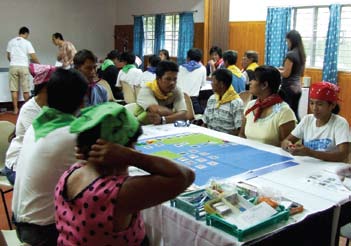
Fishers, Barangay Captains (community leaders) and government officials gather to play
Oceanic and Atmospheric Administration
can enforce the MPA zone.
ReefGame - a role-playing game to explore livelihood alternatives in traditional fishing
(NOAA) and approximately 50 research
communities in Bolinao, Philippines Photo: Anne Dray
institutes and other third-parties around
the world.