



Research Update
Coral Reef Targeted Research & Capacity Building for Management
Over one-half
Coral
of the world's population lives
Reef
within 100 kilometres
Targeted Research &
Capacity Building for Management
of the sea.
Coral Reef Restoration and Remediation
Working Group
Long-term efficacy and cost-effectiveness of
coral reef restoration interventions
Management Implications
Coral reefs worldwide are suffering
degradation from a number of
disparate natural and man-induced
causes. Tackling the root-causes
of degradation through effective
coastal management measures is
likely the best way both to reduce
further damage and to allow
reefs to return to viable healthy
states. Nevertheless, there can
also be opportunities for direct
intervention to actively restore
degraded coral reefs.
At present we have only a
rudimentary understanding of
a) the complex processes that
Levy
contribute to natural recovery
G.
of coral reef systems from
ge:
Ima
The Coral Reef Targeted Research &
disturbance, and b) the types and
Te
Capacity Building for Management
advisability of interventions (i.e.
The research being carried out
· Coral reef restoration is in its
Program (CRTR) is a leading
international coral reef research
restoration actions). It is therefore
by the CRTR Restoration and
infancy. We cannot create fully
N
initiative that provides a coordinated
difficult to assess both the recovery Remediation Working Group
functional reefs.
e
approach to credible, factual and
scientifically-proven knowledge for
potential of different sites and
(RRWG) is seeking not only to
T
improved coral reef management.
the likelihood of any given site
· Ecological restoration is the
address many of the knowledge
s
The CRTR Program is a proactive
benefiting from active restoration
process of assisting the recovery
gaps which hinder restoration
research and capacity building
interventions. Criteria are needed
of an ecosystem that has
but also to channel advice
partnership that aims to lay the
foundation in filling crucial knowledge
that can specify the degree to
been degraded, damaged, or
(however limited this may be) to
gaps in the core research areas of Coral
which an injured site might benefit
destroyed.
the management community so
Bleaching, Connectivity, Coral Diseases,
Coral Restoration and Remediation,
from better management and/or
that restoration projects can be
· Improved management of reef
Remote Sensing and Modeling and
active restoration. To develop
undertaken in a more informed way
areas is the key to their health.
Decision Support
these, we need to understand
and with better chance of success.
However, within an overall
Each of these research areas are
more about the factors and
management plan, active
facilitated by Working Groups
underpinned by the skills of many of the
processes that contribute to both
restoration offers managers a
world's leading coral reef researchers.
the time-course and the success or
useful and potentially powerful
The CRTR also supports four Centers of
Excellence in priority regions, serving as
failure of natural recovery and of
tool for assisting recovery of
important regional centers for building
active restoration interventions.
degraded reefs.
confidence and skills in research,
training and capacity building.
The CRTR Program is a partnership
between the Global Environment
Facility, the World Bank, The University
of Queensland (Australia), the
United States National Oceanic and
Atmospheric Administration (NOAA) and
Image: University of the Philippines
approximately 40 research institutes &
Society for Ecological Restoration, 2004
other third parties around the world.
March 2007
www.gefcoral.org
Research Update
Coral Reef Targeted Research & Capacity Building for Management
· To improve our understanding
s
of natural recovery processes
Programme 2:
on reefs so that we can better
Enhancing larval
recruitment
advise managers on appropriate
management options for
degraded reef areas.
Programme 1:
Long-term efficacy and
· To evaluate and compare the
cost-effectiveness of
long-term cost-effectiveness of
restoration interventions
a range of the active restoration
interventions currently available.
Programme 3:
Enhancing recovery
· To investigate ways of improving
by culture and
implementation of existing
transplantation of corals
restoration techniques so as to
minimize environmental impacts,
maximize survival of transplants,
Progress to Date
3. What is the impact of the initial
and lower costs.
For the initial five years of the
size and structure of pruned
Achieving these goals will enable
project, the RRWG has set up three
coral fragments or nubbins on
WORKING GROUP GOAL us to better advise managers
research programs.
subsequent growth and colony
and policy-makers on options
development?
for restoration, relative costs of
1. Enhancing recovery by
4. Are low-profile ( 50 cm above
these and likelihood of success in
culture and transplantation of
substrate) or high-profile in
different management contexts.
corals
situ nurseries better for coral
maintenance and ultimately which
This program focuses on asexual
are more cost-effective?
propagation of corals to assist
restoration. The key to cost-
5. What effects do the density
effectiveness in restoration using
of coral transplants have on
transplants, is balancing the costs
survival and overall success of
of nursery rearing and effective
restoration?
use of limited source material
Three types of coral nursery
against the likelihood of survival
have been set up close to the
of transplants. This program is
Bolinao Marine Laboratory in the
investigating the effect of the size
Philippines. These include one
and structure of coral fragments
floating nursery, one bottom-
on subsequent growth and survival
attached nursery and one low-cost
for a range of species. Low-cost
experimental rope nursery. The
approaches involving direct
floating nursery has the advantage
transplantation are being compared that corals are held at a constant
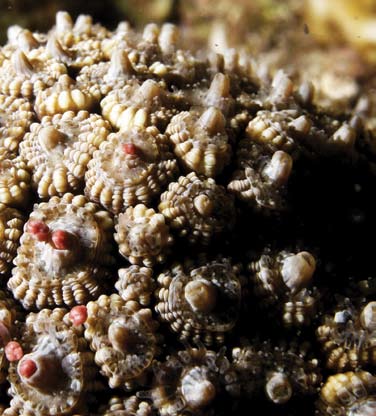
Montastraea spawning
to more costly approaches involving depth (the whole nursery moving
Image: James Guest
periods of in situ culture prior to
up and down with the tide). Further,
transplantation to damaged reefs.
in the event of El Niño warming
Research is focused on a lagoon
the corals can be moved to greater
near the Bolinao Marine Laboratory depth or the nursery towed to a site
in the Philippines which has
with better mixing. The bottom-
suffered from both blast fishing and attached nursery is cheaper to make
mass-bleaching and subsequent
but water depth varies with the tide.
mortality of coral during the 1998
The experimental rope nursery is
El Niño Southern Oscillation
very cheap as coral fragments are
warming. Recovery since then has
just slipped between the strands of
been negligible. Blast fishing has
a rope and then allowed to grow.
now ceased but there is still heavy
Approximately 10,000 1-4 cm coral
fishing pressure in the area.
nubbins derived from 17 donor
Key questions being studied:
colonies belonging to nine species
have now been reared for about one
1. How important is the choice of
year. Results after one year show
coral species on both the success that overall about 10% mortality and
of transplants and the sustained
6% detachment of coral fragments
growth and reproduction of the
is achievable. Preliminary results
donor colony?
show not only significant differences
2. What is the relative efficacy of
between species in terms of growth
restoration using coral nubbins
and survival, but also between
and coral fragments, with and
different genotypes of the same
without in situ nursery rearing?
species. Faster growing species
have already grown into small
colonies in the nurseries and many
hundreds of these have now been
transplanted to degraded bommies
(large coral heads) to see how they
will survive there.
In parallel, a series of degraded
bommies have had coral fragments
transplanted to them directly at
two different densities to compare
survival and growth of directly
transplanted common coral
species. This is cheaper but uses
more source material. Initial results
are promising with about 85%
survival overall after 5 months.
2. Enhancing larval
recruitment
This research program focuses on
the sexual propagation of corals
from the larval stage fol owing
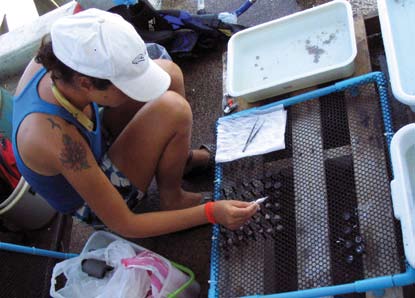
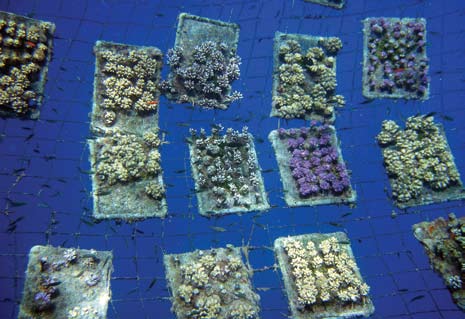
Trays of coral nubbins being cultured
spawning. This involves a higher
Image: S. Shafir
level of technology and at present
Spawning of key Acropora species
3. Long-term efficacy
much higher costs, but does offer
in Palau was confirmed to be
and cost-effectiveness of
the potential of rearing 100,000s
predictable to the day allowing
restoration interventions
of sexual recruits for restoration.
mass culture of coral larvae using
Research is being carried out in
either laboratory based tank culture Efficacy of restoration interventions
Palau in col aboration with the Palau or simple low-cost floating-pond
should be judged in terms of what
International Coral Reef Center
culture. Indoor and outdoor ex situ
these interventions achieve in
(PICRC) with additional work on
hatcheries were successfully built
comparison to what occurs with
coral reproduction at the Bolinao
and made operational. Colonies of
natural recovery over at least a 5-10
Marine Laboratory in the Philippines. Acropora digitifera, A. hyacinthus,
year timescale. The natural reef is
varied and it is difficult to perform
Key questions being studied:
A. tenuis and A. humilis were
spawned and single colony crosses
adequately controlled comparisons
1. Does enhancement of coral larval
and batch fertilization carried out.
using patches of natural reef as
recruitment significantly enhance
Developing larvae were cultured
there are too many potentially
recovery on a 5-10 year timescale
indoors for about 6 days until ready confounding factors. To address
and is it cost effective?
to settle and then settled onto
this problem, this program is using
standardized artificial structures of
2. Does the use of "larval flypapers" larval "flypapers" before transfer
sufficient scale and replication to
to effect control ed settlement
to the outdoor hatchery to grow to
allow long-term statistically rigorous
and metamorphosis of larvae of
a transplantable size. Growth and
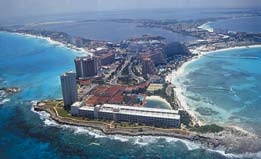
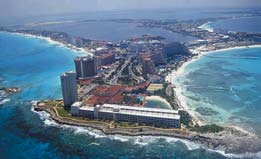
Aerial photograph of hotel development in Cancun,
comparisons to be made between
selected coral species in a lab-
survival is being monitored.
Mexico adjacent to coral reefs
© Wolcott Henry 2001
the outcomes of natural processes
based hatchery facility contribute
In a slightly different approach
and the outcomes of a range of
to enhanced growth and survival
over 600,000 planula larvae,
interventions. The manipulative
of recruits out-planted to the field obtained from Acropora spp.
experiments are being set up in
for purposes of restoration?
colony segments spawned in the
Mexico, Bolinao and Palau so
3. Could mass culture of corals
laboratory, were mass-cultured in
that various active restoration
in open water using sexual
tanks and about 170,000 coral spat
interventions can be compared to
reproduction significantly enhance settled out on tiles. These were
natural recovery at sites with very
efficacy of coral reef restoration
then transferred in situ in cages
different recovery potentials.
and is it cost effective?
where the corals were co-cultured
with grazing snails (Trochus) to
Key question being studied:
keep down the algae. Within only
1. To what degree do active
4 months some species had grown
restoration interventions
to mean diameters of almost 1
significantly enhance recovery
cm. Survivorship is less than 20%
of coral reef communities in
but starting numbers are very
comparison to what would be
high. Clearly there are economies
achieved by natural recovery
of scale that can be made but at
processes over a 5-10 year
present the cost per transplantable
time-scale?
coral appears to be at least 20
times what can be achieved using
Restoration interventions which
will be tested include (1) direct
nubbin culture.
www.gefcoral.org
Research Update
Coral Reef Targeted Research and Capacity Building for Management
transplantation of naturally
now available for distribution via
· Under what circumstances is
detached coral fragments ("corals
the CRTR Program website (www.
active restoration likely to be of
of opportunity"), (2) enhanced larval gefcoral.org). It is aimed primarily
little benefit?
recruitment using pond cultured
at the kind of people, usually with
· What is the relative cost-
spawning slicks, (3) transplantation
some biology background, who
effectiveness of a range of
of nursery farmed corals, (4)
act as technical advisers to reef
restoration interventions?
enhanced grazing using Trochus,
restoration projects. The early
and (5) enhanced invertebrate
sections aim to provide simple
· How is asexual coral transplant
settlement. All will be compared to advice on coral reef restoration
survival related to size in
the outcomes of natural recovery
to coastal managers and decision
different species and in different
at each site. Key processes such
makers, whereas the later provide
environments?
as coral recruitment, mortality
more detail for those who may
· Which coral species are not well
and growth rates, and herbivory
be involved in community-based
suited for transplantation?
rates will be
reef restoration efforts.
monitored to
The second is planned
· What effects do pruning coral
gain a better
as a multiauthor book
colonies for asexual fragments
understanding
involving people from
have on the reproduction, growth
of what factors
several international
and survival of donor colonies;
are crucial for
reef restoration
how much can be safely excised?
oup
recovery.
projects currently being
· How does the nursery rearing
undertaken. We hope
environment affect survivorship of
Expected
to make chapters on
outplanted corals on the reef?
Outcomes
individual aspects of
· At what size is it most cost-
restoration methodology
effective to outplant sexual
orking Gr
We intend to
available over the
produce at least
recruits reared from coral spawn?
internet as Fact Sheets.
fectiveness
two outputs
Among a range of
specifically
questions which we
for managers.
hope to be able to
These include
better answer are:
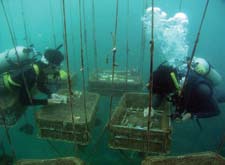
Monitoring and cleaning mid-water cages
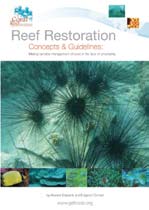
Reef Restoration Concepts and
Image: The Akajima Marine Science Laboratory
Guidelines: making sensible
· What minimum local conditions
management choices in the face
and management need to be
of uncertainty and towards the end
in place for active restoration
of the project a more substantial
interventions to have a chance of
Reef Restoration Manual. The first is
success?
estoration interventions te
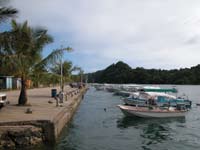
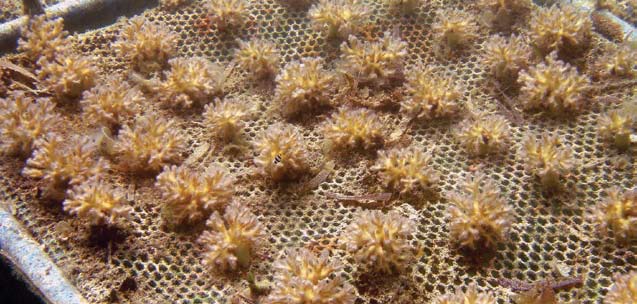
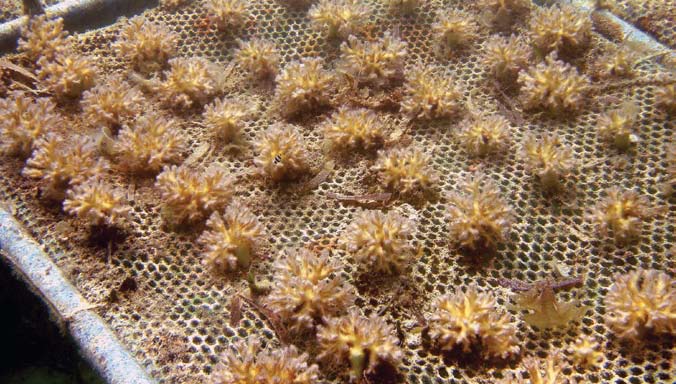
Shallow water coral nursery in the Philippines
Image: G. Levy
eef r upda
Aerial photograph of hotel development in Cancun,
Mexico adjacent to coral reefs
© Wolcott Henry 2001
Coral Reef Restoration and Remediation W
Long-term efficacy and cost-ef of coral r - research
Further Information
Restoration and Remediation Working
Group
University of Newcastle, United Kingdom
Chair: Dr Alasdair Edwards
Email: A.J.Edwards@newcastle.ac.uk
Co-Chair: Dr Edgardo D. Gomez
Email: edgomez@upmsi.ph
Project Executing Agency:
Coral Reef Targeted Research &
Capacity Building for Management
Program
C/O Centre for Marine Studies
The University of Queensland
St Lucia QLD 4072
Australia
Telephone: +61 7 3365 4333
Facsimile: +61 7 3365 4755
Email: info@gefcoral.org
www.gefcoral.org