Focus on Remote Sensing
Coral reefs are complex systems
meaningful large scale variations
affected by a large number
to coral reefs.
of natural and anthropogenic
The Coral Reef Targeted
processes operating across
Research & Capacity Building for
many scales.
Management (CRTR) Program's
Remote Sensing Working Group
is developing multi-scale physical
ch Update
and biological observing systems
for coral reefs with the aim of
improving the efficiency of coral
reef management. There are three
major objectives:
1. To provide better information for
managers by developing and testing
the tools necessary to measure
and monitor the status of coral reef
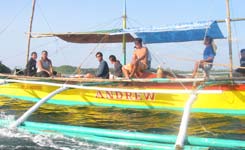
Remote Sensing Working Group fieldwork, Bolinao, Philippines.
Photo: Yanneck Meunier
ecosystems at multiple ecological,
To manage coral reefs effectively,
spatial and temporal scales.
2. To improve the use of spatial
Resear
managers need spatially-explicit
information to guide and support
information by developing the
decisions, whether designing
application of remote sensing
Marine Protected Areas, monitoring
products for conservation science
the health of coral reefs or
and spatial decision-making.
providing early warning systems
3. To critically examine the cost-
The Coral Reef Targeted Research &
to identify major sources of stress.
effectiveness of new methods to
Capacity Building for Management
Remote sensing provides the
ensure that overselling of remote
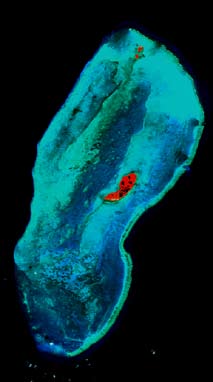
Remote sensing can easily show coral formations fringing
Program (CRTR) is a leading
international coral reef research
only practical way to measure
sensing technology does not occur.
seaward from volcanic islands in the Pacific. Source: NASA
initiative that provides a coordinated
approach to credible, factual and
scientifically-proven knowledge for
improved coral reef management.
Working Group Members
The CRTR Program is a proactive
Peter Mumby
research and capacity building
partnership that aims to lay the
University of Exeter, Uk
foundation in filling crucial knowledge
Laura David
gaps in the core research areas of Coral
Bleaching, Connectivity, Coral Diseases,
University of the Philippines,
Coral Restoration and Remediation,
Philippines
Remote Sensing and Modeling and
Wo
Decision Support.
Stuart Phinn
Each of these research areas are
University of Queensland, Australia
facilitated by Working Groups
Ellsworth LeDrew
R
underpinned by the skills of many of the
kin
world's leading coral reef researchers.
University of Waterloo, Canada
The CRTR also supports four Centers of
Excellence in priority regions, serving as
Mark Eakin
important regional centers for building
Coral Reef Watch Project,
G
confidence and skills in research,
training and capacity building.
noAA, USA
G
The CRTR Program is a partnership
William Skirving
R
between the Global Environment
Facility, the World Bank, The University
Coral Reef Watch Project,
o
of Queensland (Australia), the
noAA, Australia
UP
United States National Oceanic and
Atmospheric Administration (NOAA) and
Alan Strong
approximately 50 research institutes and
Coral Reef Watch Project,
other third parties around the world..
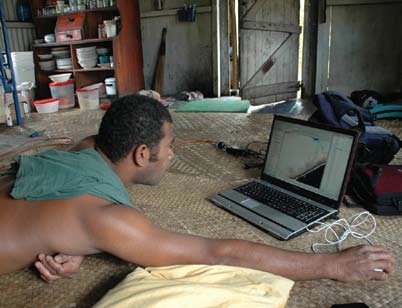
Local community representative is validating satellite
noAA, USA
July 2008
image of coral reef, Vitu Levu, Fiji. Photo: Chris Roelfsema
Product code: CRTR 009/2008
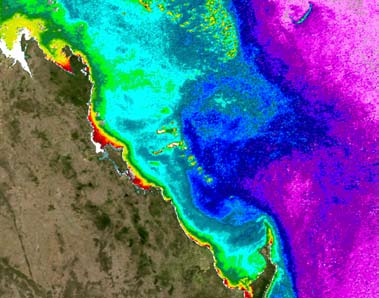
Oceanographic patterns are clearly evident from the remote sensing of Chlorophyll
a concentrations along the Great Barrier Reef, Australia. Source: NASA
Mapping and
monitoring toolkit
An online toolkit is showing
managers, scientists and tech-
nicians working in coastal marine
environments how to use remote
Y
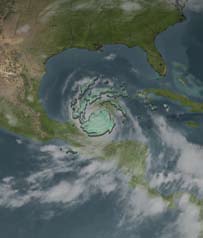
ucatan Peninsula on
sensing images to map and
monitor changes to coastal
ecosystem health.
NASA.
The Coastal Remote Sensing toolkit
helps select appropriate data
and an appropriate technique to
Source:
then map and monitor coral reefs,
2007.
seagrass beds and water quality.
The toolkit is focused on coastal
Hurricane Dean makes landfall along the
August 21,
water bodies, seagrass beds, coral
reefs, and mangroves; however, the Remote sensing
Group plans to extend the toolkit in software available to
the future to cover all other coastal developing countries
ecosystems.
Research highlights from the
The Coastal Remote Sensing toolkit
The Group is nearing completion
Group include:
can be found at:
of its decision-support and analysis
software to monitor the health of
http://www.gpa.uq.edu.au/CRSSiS/
Links to global satellite data
coral reefs using remote sensing.
tools/rstoolkit/
The software will be available
Coral reef managers and researchers
to students and scientists in
can now access near-real-time global
developing countries giving them
satellite data on factors affecting
free access to industry-standard
coral reefs via a new Data Resources
methods for modelling light
web-portal. Developed by Coral
interactions in natural waters.
Reef Watch, national oceanic and
Atmospheric Administration (noAA),
Development of the beta-version
the web-portal organises and lists
of the software is near completion,
data freely available over the web.
while the development of the
The portal includes links to resources
decision support tool is currently
relating to sea surface temperature
in progress being refined by
and derivatives, ocean colour,
application to sensitivity analysis to
ocean surface winds, ocean surface
accurately detect coral bleaching.
currents, true colour imagery, global
precipitation, sea surface topography,
cloud cover and ultraviolet radiation.
The information includes a range
of data formats to meet a variety of
user needs. Further contributions
are welcome.
Further Information
Remote Sensing Working Group
Chair: Prof. Peter J Mumby
University of Exeter
Email: p.j.mumby@exeter.ac.uk
Co-Chair: Dr Laura T David
University of the Philippines
Email: ldavid@upmsi.ph
Robert Canto
Project Executing Agency:
Coral Reef Targeted Research
orkshop learn to use remote
& Capacity Building for
W
Photo:
Management Program
C/- Centre for Marine Studies
The University of Queensland
St Lucia QLD 4072
Australia
Telephone: +61 7 3346 9942
Facsimile: +61 7 3365 4755
Email: info@gefcoral.org
The Data Resources web-portal can
be found at http://coralreefwatch.
noaa.gov/crtr/data_resources.html
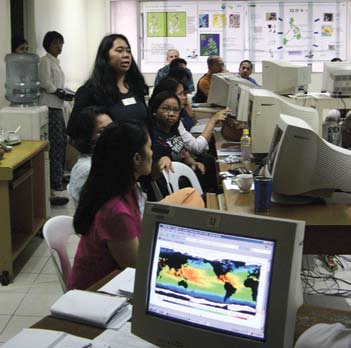
Participants of a Capacity Building
sensing as a decision support tool.