
CORAL REEF TARGETED RESEARCH & CAPACITY BUILDING FOR MANAGEMENT
CENTRE OF EXCELLENCE: EAST AFRICA
University of Dar Es Salaam, Institute of Marine Sciences (IMS), Zanzibar, Tanzania
The Institute of Marine Sciences in Zanzibar is one of four
Coral Reef Targeted Research & Capacity Building for
Management (CRTR) Program Centres of Excellence
throughout the world.
Partnerships have been formed to enable these Centres of
Excellence to convene the CRTR Program Working Groups.
This ensures that collaborative research can be discussed and
implemented with regional and local scientists, managers,
NGOs and stakeholders.
The Program supports annual workshops at the Centres of
Excellence, bringing researchers from the various Working
Groups together to orient field research, provide briefings on
key findings and engage in training opportunities.
GOAL
Build scientific capacity to inform management and
policy, so that coral reef ecosystems under threat from
climate change and multiple human stressors can be
sustained for current and future generations.
OBJECTIVES
1. To provide technical support to Working Groups' research
and training activities.
2. To build regional capacity through:
· graduate scholarships
· training workshops on regionally emerging issues, and
· access to new expertise.
3. To undertake regionally relevant coral reef research such as
the impacts of coral bleaching, fisheries, and various
environmental factors (nutrients, sedimentation, primary
productivity) to coral recovery processes, and also
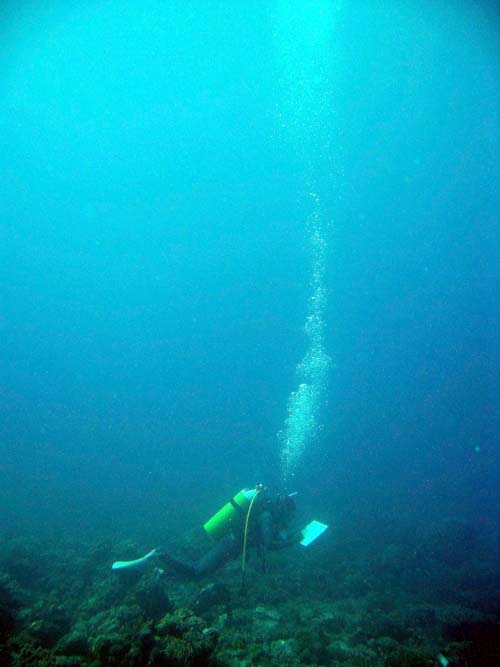
Scientist from the IMS recording habitat variables (S Yahya)
facilitating information outreach and uptake in the East
Africa region.
Turning Knowledge into Practice
Currently, most reef research is based in universities and research institutions in the developed world, whereas most coral
reefs are located in developing countries. Rectifying this global imbalance in knowledge and capacity is a key mission of
the CRTR Program.
To accomplish this, the first phase of the Program is building and enhancing the capacity of institutions in East Africa
(Zanzibar, Tanzania), Meso-America (Puerto Morelos, Mexico) and South-east Asia (Bolinao, Philippines) with a fourth centre
based in Australia, so that they can function as regional Centres of Excellence.
These Centres of Excellence provide facilities and technical support for the various CRTR Working Groups and also sup-
port training for local and regional students and scientists. The Centres are an important bridge in communicating re-
search results to management and policy communities, and consulting with stakeholders such as organisations of fishers,
coastal managers and local government.






The CRTR Program Working Groups form the scientific basis for the Program and are major areas in which
additional knowledge is essential. The Groups, with members from both developed and developing countries, are
informing coral reef management through research on:
· Bleaching and local ecological factors
· Connectivity and large-scale ecological processes
· Coral diseases
· Restoration and remediation
· Remote sensing
· Modelling and decision support.
The Institute of Marine Sciences, the focus for coral reef research in Eastern Africa, is collaborating with the CRTR
Working Groups to build regional capacity through graduate scholarships, training workshops and strengthening
expertise and information outreach.
The Institute, located in the heart of Stone Town, Zanzibar, provides laboratory facilities and office space for over 25
faculty and staff.
Local Research Priorities
Key research activities at the IMS focus on:
Investigations on coral replenishment processes (settlement,
recruitment, restoration), fisheries and associated
environmental factors (nutrients, sedimentation, primary
productivity, ocean currents) and isotope studies.
· Researchers are collecting and analysing data on
temporal and spatial coral settlement, recruitment and
complexity patterns.
· Researchers are collecting data on seawater temperature
(using loggers).
· Nutrient levels have been measured along transects from
Zanzibar town to and beyond coral study sites at Chumbe
and Bawe. Detailed analysis of pollutants is planned.
· Sedimentation rates are being determined with data from
sediment traps.
· Ocean current profiling is being undertaken at Chumbe
reef.
· Sedimentation rates are being determined and coral chips
for isotope studies have been collected for analysis.
· Reef fish are being counted and fish-catch landing
Most fisheries in Tanzania are artisanal on near-shore
statistics are being collected and analysed.
reefs (S Yahya)
· Researchers are collecting data on primary productivity
(chlorophyll).
The IMS plays a role in policy setting at a
Mapping and characterisation of coral reefs and associated
national level, central in the formulation of
threats.
various policies related to utilisation,
· Data on coastal threats to coral reef ecosystems is being
conservation and management of coastal
collected and summarised. Mapping of the distribution of
and marine resources. It has coordinated
threats and determination of vulnerability indices to
and facilitated a variety of local, national and
Tanzania coral is ongoing.
regional workshops, meetings and initiatives
aimed at developing and implementing
Information dissemination on coral reefs and indigenous
Integrated Coastal Zone Management.
knowledge.
· Posters, brochures, and folders on CRTR and East Africa
CoE are in production.
· A booklet on the contribution of indigenous knowledge to
coral reef management is in preparation.
The CRTR Project is a partnership of the Global Environment Facility,
The World Bank, The University of Queensland (UQ), US National
Oceanic and Atmospheric Administration, and approximately 40 re-
search organisations around the world. The CoEs are East Africa
(Institute of Marine Sciences, Zanzibar, Tanzania); South-east Asia
(Marine Science Institute, University of the Philippines); Meso-America/
University of Dar es Salaam
Western Caribbean (Unidad Academica, Puerto Morelos, Universidad
Institute of Marine Sciences
Nacional Autonoma de Mexico); and Australasia/South Pacific (Centre
for Marine Studies, UQ, Australia)