Focus on Coral Disease
Coral reefs are under increasing
syndromes which are infectious;
Working Group Members
stress from a number of causes,
measuring baseline levels of many
C. Drew Harvell
including global warming, poor
disease worldwide at each of the
Cornell University, USA,
water quality, habitat degradation Centres of Excellence; identifying
and over-fishing.
Bette Willis
which Centres of Excellence are
James Cook University, Australia
Coral diseases worldwide have
the most suitable for identifying
garriet Smith
increased in both frequency and
local factors that might drive
Wo
University of South Carolina, USA
ch Update
severity, especially in the Caribbean disease; and investigating
over the last three decades.
whether climate factors affects
Eric Jordan Dahlgren
coral disease levels. The DWg
Universidad nacional Autonoma
R
Disease outbreaks have resulted
has also sponsored graduate
de Mexico
king
in loss of coral cover and species
diversity, as well as significant
students and post-doctoral
Farooq Azam
changes in community structure
fellows from palau, puerto Rico,
Scripps institution of
of reefs. However, we are just
Mozambique, Mexico, the
oceanography, UCSD, USA
philippines and the USA.
Laurie Raymundo
gR
beginning to understand what is
driving these dramatic increases
Recent research highlights
University of guam, USA
in disease.
are detailed below.
Eugene Rosenberg
o
The CRTR Coral Disease Working
Tel Aviv University, israel
U
Impact of fish farms
group (DWg) is funded by the
Ernesto Weil
p
Resear
on coral health
Coral Reef Targeted Research &
University of puerto Rico, USA
Capacity Building for Management Effluent from coastal fish farms
program (CRTR) to advance
has been linked to reduced water
understanding of coral disease in
quality and increased abundances
(philippines) have a strong influence
key areas. Their research effort will
of microorganisms in the water
on the bacteria population, nutrient
provide more insight into the ways column. Therefore aquaculture
input, primary production and
The Coral Reef Targeted Research &
in which coral diseases can alter
may play a role as an incubator,
the patterns of energy and carbon
Capacity Building for Management
Program (CRTR) is a leading
reef function and the conditions
conveyor and facilitator of disease
flux in the surrounding waters.
international coral reef research
under which outbreaks may
into natural populations.
in addition, the DWg is invest-
initiative that provides a coordinated
approach to credible, factual and
occur. With this information more
As part of its study of the impact
igating whether these changes in
scientifically-proven knowledge for
appropriate management options
of local environmental factors on
water quality influence response
improved coral reef management.
can be made for a given situation.
coral health, the DWg has found
to disease and the coral innate
The CRTR Program is a proactive
research and capacity building
The DWg aims to fill critical
that the fish pens in Bolinao Bay
immunity.
partnership that aims to lay the
information gaps about coral
foundation in filling crucial knowledge
reef disease, build capacity
gaps in the core research areas of Coral
Bleaching, Connectivity, Coral Diseases,
internationally and develop
Coral Restoration and Remediation,
situations for managing and
Remote Sensing and Modeling and
Decision Support.
conserving reef ecosystems.
Each of these research areas are
Major areas of investigation are:
facilitated by Working Groups
underpinned by the skills of many of the
1. Global impact of coral disease
world's leading coral reef researchers.
The CRTR also supports four Centers of
2. Global warming and local human
Excellence in priority regions, serving as
inputs that can facilitate disease
important regional centers for building
confidence and skills in research,
3. The causes, reservoirs and
training and capacity building.
vectors of coral disease
The CRTR Program is a partnership
4. Coral resistance to disease
between the Global Environment
Facility, the World Bank, The University
5. Capacity Building
of Queensland (Australia), the
United States National Oceanic and
To date, the DWg has addressed
Atmospheric Administration (NOAA) and
many pressing issues such as
approximately 50 research institutes and
other third parties around the world.
identifying several disease
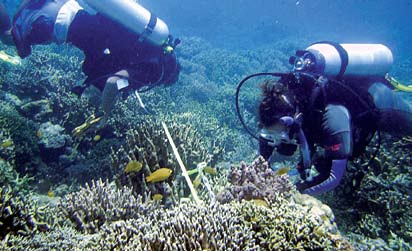
Students being trained in coral disease assessment methods in the Zaragosa Marine Protected Area,
July 2008
Central Philippines. Photo: L. Raymundo
Product code: CRTR 007/2008
in other news...
in partnership with the Bolinao
The DWg continue their annual
The DWg has made progress on
Center of Excellence and the
surveys to assess the global
determining the causative agents
Restoration & Remediation
disease prevalence in Australia,
of numerous coral diseases. Several
Working group, this investigation
the philippines, guam, Mexico
papers on skeletal eroding band,
aims to produce significant new
and the Caribbean. The DWg
brown band and white syndrome
scientific knowledge that might
has also investigated the role that
are published or in review. They
feed directly into policy relating to
Marine protected Areas have on
have also developed several of
the sustainability of aquaculture
the health of coral reefs and coral
new methods to measure coral
adjacent to coral reef systems.
disease dynamics. These surveys
immunity, and these tools are
Disease in a warming ocean
provide invaluable information on
currently being used to understand
the temporal and spatial changes
how the coral immune response
ocean temperatures are predicted
in coral community structure, and
functions during disease and
to rise considerably as the global
disease prevalence and severity.
environmental stress.
climate warms, with serious
implications for coral health.
on-site resources for reef managers
Coral reef managers and
easily misidentified as knowledge
researchers now have access to
is still very limited. There are few
new resources to identify and
individuals throughout the world
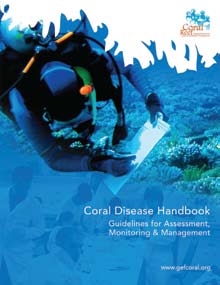
address coral disease the Coral
trained to recognize disease on
Disease Handbook: Guidelines
coral reefs, therefore this manual
for Assessment, Monitoring and
brings together what is currently
Management and two sets of
known about coral diseases, how
Underwater Cards for Assessing
they are studied and what options
Coral Health on Indo-Pacific and
are available for managing them.
Caribbean Reefs.
The Handbook is supplemented
Launched at the 11th international
by underwater coral disease
Coral Reef Symposium in July,
identification cards for the indo-
the Handbook provides coral
pacific and Caribbean. Extensively
reef managers with a `how to'
illustrated, the cards include a
approach for recognizing coral
decision tree to quickly identify
syndromes and other compromised coral diseases in the field, and
states of health, quantifying these
underwater slates for data
impacts through assessment
recording. The next step is to
and monitoring, and recognizing
establish a central web-based data
potential outbreak situations.
collection system where users of
With the rise in disease prevalence the cards can disseminate their
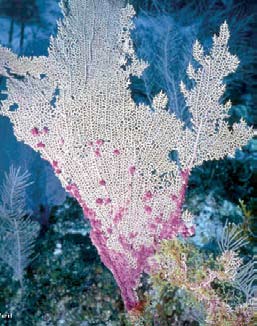
Sea fan affected by Colored Band Disease (Purple Spots).
Photo: Ernesto Weil
worldwide, coral diseases can been data to others.
The DWg has made significant
discoveries in Australia and the
Caribbean regarding the potential
impacts of climate warming events
on the outbreak of coral disease.
Further Information
in collaboration with the Remote
Coral Disease Working Group
Sensing Working group, the
Chair: Dr. C. Drew Harvell
Cornell University
DWg developed several new
Email: cdh5@cornell.edu
models to predict disease
Co-Chair: Dr. Bette Willis
outbreaks by integrating baseline
James Cook University
monitoring data from Australia
Email: bette.willis@jcu.edu.au
and the Caribbean with satellite
Co-Chair: Prof Garriet Smith
temperature data. The models
University South Carolina
use predicted sea temperature
Email: smithRes@usca.edu
data and can therefore identify
Project Executing Agency.
the potential efficacy of various
Coral Reef Targeted Research & Capacity
Building for Management Program
management strategies for
C/- Centre for Marine Studies
future scenarios.
The University of Queensland
St Lucia QLD 4072
Australia
Telephone: +61 7 3346 9942
Facsimile: +61 7 3365 4755
The Coral Disease Handbook: Guidelines for Assessment, Monitoring
Email: info@gefcoral.org
and Management and two sets of underwater identification cards
are available separately ($US20 each) or as a set.
To order, visit www.gefcoral.org/publications