



Research Update
Coral Reef Targeted Research and Capacity Building for Management
Over one-half
Coral
of the world's population lives
Reef
within 100 kilometres
Targeted Research &
Capacity Building for Management
of the sea.
Connectivity and Large-Scale
Ecological Processes Working Group
Connectivity: What is it? How is it
measured? Why is it important for
management?
Implications for Coral Reef
Management
Until now, management of coral
reefs, where it exists, has been
reactive rather than proactive. With
coral reefs entering a time of even
greater stress, it is mandatory that
managers develop more proactive
approaches, strongly embedded in
science.
The use of connectivity information
to accurately assess linkages
among locations, and local
demographic capabilities is going
to be essential if we are to have
management programs that
are capable of sustaining coral
reefs. The CRTR Connectivity
program is providing and testing
Goals:
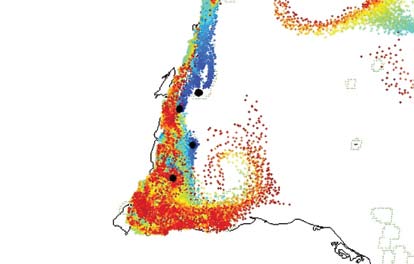
Model run showing possible pattern of dispersal of larval
snapper from known spawning sites in Belize during May
The Coral Reef Targeted Research and
new methods for building the
The Coral Reef Targeted Research
2004. Red represents greatest number of of larvae while
Capacity Building for Management
connectivity database that effective and Capacity Building for
blue represents fewest Belizean larvae arriving at that
Program (CRTR) is a leading
international coral reef research
management wil use.
Management (CRTR) Connectivity
location after 30 days of larval life. An example of the
initiative that provides a coordinated
modelling done in Project 7
approach to credible, factual and
Marine Protected Areas (MPAs) are
Working Group is undertaking
scientifically-proven knowledge for
a management tool holding great
demonstration projects in the
improved coral reef management.
promise. Realizing that promise
Mesoamerican region that will
Most reef species have pelagic
The CRTR Program is a proactive
requires Connectivity science as an
develop tools and apply them to
larval stages. The dispersal during
research and capacity building
partnership that aims to lay the
essential tool for guiding the design determine connectivity patterns
larval life means that neighboring
foundation in filling crucial knowledge
and implementation of MPAs.
for selected species in that region.
populations are connected by the
gaps in the core research areas of Coral
Work is being done in collaboration exchange of lavae. This connection
Bleaching, Connectivity, Coral Diseases,
Coral Restoration and Remediation,
with local management agency
is termed connectivity.
Remote Sensing and Modeling and
personnel, students from the region
Decision Support
are receiving advanced education,
How?
Each of these research areas are
and efforts are being made to
facilitated by Working Groups
underpinned by the skills of many of the
use the projects and results to
Measuring connectivity is
world's leading coral reef researchers.
inform local communities and
technically difficult for several
The CRTR also supports four Centers of
Excellence in priority regions, serving as
show how connectivity data can be
reasons, including:
important regional centers for building
obtained, and used effectively in
· Long larval lives
confidence and skills in research,
training and capacity building.
management planning.
· Larvae too small to be tagged
The CRTR Program is a partnership
between the Global Environment
What?
· Dispersal a complex product
Facility, the World Bank, The University
of passive transport and active
of Queensland (Australia), the
Marine populations are
movement.
United States National Oceanic and
interconnected, exchanging
Atmospheric Administration (NOAA) and
approximately 40 research institutes &
individuals mainly through larval
Many species are larval for many
other third parties around the world.
dispersal and thereby influencing
days or weeks and potentially
October 2006
the dynamics of each population.
able to travel large distances
www.gefcoral.org
Research Update
Coral Reef Targeted Research and Capacity Building for Management
At present there is very
little information on levels
of connectivity in coral
reef regions, and MPA
management depends too
much on good luck and
`guesstimates'.
If we are to be successful in
maintaining coral reefs into the
future, we must incorporate
much more information
on connectivity into our
management plans and
procedures. The first step is
to develop the tools to collect
that information.
during this time. Their dispersal is
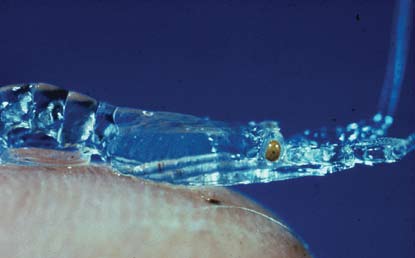
lA tiny postlarval stage of the Caribbean spiny lobster
Studies of fish concern one typical
ed?
strongly influenced by patterns of
sitting on a finger. This is the larval stage that enters reef
species that does not aggregate
water movement, but larvae can
habitat, and the stage that recruits to collectors used in
over large distances to spawn,
project 6.
sense their surroundings, respond
and one species that aggregates
to them, and swim, sometimes
as well as on local reproductive
for spawning once a year. Quite
surprisingly well. Larval behavior
potential. Design and management different methods are required for
also changes as the larvae develop
of Marine Protected Areas, in
these different kinds of species.
and grow.
particular, depends on knowledge
Studies of corals center on
The movement of water around
of the connectivity relationships of
technique development for tracking
complex coral reef topography is
the local populations of targeted
dispersing planula larvae and
itself far from simple.
species.
for identifying them to species.
Genetic studies of coral populations
oup
are being used to discern likely
Measuring connectivity
Progress to date
connectivity patterns in the past.
requires field observations
The Connectivity program has
Studies of coral settlement and
that are:
commenced several distinct,
but interrelated projects in the
early survival are being done
orking Gr
Mesoamerican region. They are
because this early benthic phase
1) Over large regions to encompass intended to advance the science,
may be a critical bottleneck to coral
ge-Scale
the potential extent of larval
and demonstrate its effectiveness
success.
te
movement
in measuring connectivity for
The spiny lobster has one of
2) Timed to coincide with critical
particular kinds of species. We work the longest larval lives of any
ocesses W
biological events such as
closely with local management
reef species, so determining is
upda
spawning pulses, and
agencies to build a database of
connectivity patterns may be very
recruitment of particular species at
difficult. We are collecting data
3) By people with a broad range of
sites through the region, because
on lobster recruitment, and on
skills physical oceanographers,
recruitment data can inform us of
lobster larval biology for use in
ecologists, behavioral scientists
the demographic rates of local
building models of larval dispersal.
and others.
research
populations, and can provide
Validated models can provide
Connectivity and Lar Ecological Pr
Connectivity: What is it? How is it measur Why is it important for management?
-
basic data needed for determining
information on connectivity among
It also benefits from use of
connectivity patterns.
locations.
Further Information
sophisticated laboratory-based
Connectivity and Large-Scale Ecological
sciences including molecular
Processes Working Group
genetics, trace-element chemistry,
Chair: Dr Peter F. Sale
and advanced computer modeling.
United Nations University
This is not routine monitoring.
International Network on Water,
Environment and Health, Canada
Email: sale@uwindsor.ca
Why?
Co-Chair: Dr Yvonne Sadovy
University of Hong Kong
Management of coral reefs, for
Email: yjsadovy@hkucc.hku.hk
conservation and/or for sustainable
fisheries requires that we manage
Project Executing Agency:
human impacts to levels that are
Coral Reef Targeted Research &
Capacity Building for Management
sustainable by the populations of
Program
reef organisms. This depends on
C/O Centre for Marine Studies
The University of Queensland
the ability of the local (impacted)
St Lucia QLD 4072
population to grow, and population
Australia
growth depends upon connectivity
Telephone: +61 7 3365 4333
Facsimile: +61 7 3365 4755
Email: info@gefcoral.org
www.gefcoral.org
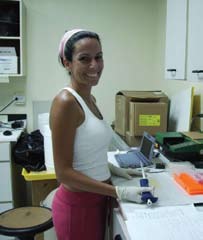
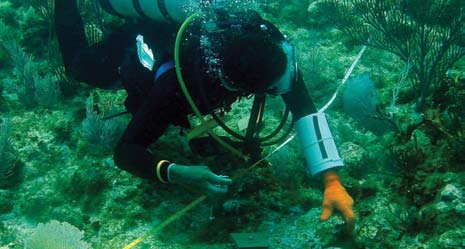
Belizean student, Nataniel Alvarado, attaching settlement
plates to monitor recruitment of coral larvae for Project 3.