Connectivity & Large-scale Ecological Processes
Effective management of coral
reefs must take into account the
variety of interconnections between
local populations and the spatial
and temporal scales across which
these occur. However, developing
Arnold
management strategies and tools
ch Update
depends on a better understanding
Belize
of connectivity processes,
supported by sound empirical data.
Importance to Management
Theoretical studies suggest that
population connectivity plays a
fundamental role in local and meta-
population dynamics, community
dynamics and structure, genetic
diversity, and the resiliency of
populations to human exploitation.
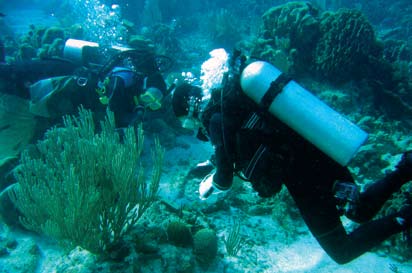
Researcher Dr Bob Steneck (l) and PhD student Susie
working on a settlement plate at Glovers Reef,
Resear
However, modeling efforts have
been hindered by the paucity
Major areas of research activity
Working Group Members
of empirical estimates of, and
and capacity building are:
Peter Sale
knowledge of the processes
United nations University, Canada
controlling population connectivity · Development of techniques
Carmen Ablan
in ocean ecosystems. While
for tracking dispersal of
De la Salle University, Philippines
The Coral Reef Targeted Research &
J. Ernesto Arias
progress has been made with older
planula larvae.
Capacity Building for Management
CINVESTAV-Unidad Merida, Mexico
Program (CRTR) is a leading
life stages, the larval-dispersal
· Genetic studies of coral
Mark Butler
international coral reef research
component of connectivity remains
populations to discern likely
Old Dominion University, USA
initiative that provides a coordinated
approach to credible, factual and
unresolved for most marine
connectivity patterns.
Robert Cowen
scientifically-proven knowledge for
populations. This lack of knowledge · Studies of a typical fish species
University of Miami, USA
improved coral reef management.
represents a fundamental obstacle
that does not aggregate over
Bret Danilowicz
Georgia Southern University, USA
The CRTR Program is a proactive
to obtaining a comprehensive
large distances to spawn.
research and capacity building
geoff Jones
partnership that aims to lay the
understanding of the population
· Factors responsible for critical
James Cook University, Australia
foundation in filling crucial knowledge
dynamics of marine organisms.
gaps in the core research areas of Coral
bottlenecks in coral recruitment.
Serge Planes
Bleaching, Connectivity, Coral Diseases,
Furthermore, a lack of spatial
Universite de perpignan, France
Coral Restoration and Remediation,
context that such information
· Lobster recruitment and larval
Barry Ruddick
Remote Sensing and Modeling and
would provide has limited the
biology for use in building
Dalhousie University, Canada
Decision Support.
Wo
ability of ecologists to evaluate the
models of larval dispersal.
Yvonne Sadovy
The University of Hong kong, China
Each of these research areas are
design and potential benefits of
· Assist local management
facilitated by Working Groups
Robert Steneck
underpinned by the skills of many of the
novel conservation and resource-
agencies to understand
R
University of Maine, USA
world's leading coral reef researchers.
connectivity, recruitment,
king
management strategies.
Alina Szmant
The CRTR also supports four Centers of
Excellence in priority regions, serving as
protected area management,
University of north Carolina at
important regional centers for building
Connectivity
and population resilience.
Wilmington, USA
confidence and skills in research,
training and capacity building.
Working Group aims
Simon Thorrold
Highlights of the group's research
Woods Hole oceanographic
Institution, USA
gR
The CRTR Connectivity Working
to date are summarised below.
The CRTR Program is a partnership
between the Global Environment
group aims to advance the
Mary Alice Coffroth
Facility, the World Bank, The University
State University of New York, USA
o
science of connectivity and large-
of Queensland (Australia), the
United States National Oceanic and
scale ecological processes and
Ken Lindeman
U
Florida Institute of Technology, USA
Atmospheric Administration (NOAA) and
demonstrate its effectiveness for
approximately 50 research institutes and
Enric Sala
p
other third parties around the world.
selected species in the
Scripps Institution of
Meso-American region.
Oceanography, USA
July 2008
Product code: CRTR 008/2008
Tracing coral connectivity
the group is monitoring the
of the interannual variation in
using DNA and magnets
settlement of corals at five sites in
connectivity for this species.
Collecting coral tissue from
Belize, Guatemala and Honduras,
The studies have also revealed a
juveniles, small adults and large
with permanent transects
number of complicating features
adults across large sections of
established at each. This forms
that make the determination of
reefs in Belize and Mexico, the
the basis of large scale annual
connectivity patterns using genetic
group has characterised the
monitoring which is important
or otolith techniques far from
genetic composition of these coral
as local marine populations
routine, yet still feasible, and it is
populations. genetic analysis has
are interconnected in a variety
anticipated that this will prove true
of ways, and the
for most reef fish species.
scale(s) of these
interconnections
Modelling lobster
must be considered
larval dispersal
if management
The group has obtained data from
programs are to be
a rearing study on the longevity
fully effective.
of the multiple larval stages of
The project is
Caribbean Spiny Lobster (Panulirus
evaluating the
argus) which will be critically
demography of
important to the development of
naturally occurring
dispersal models for this species.
coral recruits
Studies of larval behavior, and
and the factors
a catalog of adult population
affecting settlement. size (spawning potential) at sites
Measurements
throughout the Mesoamerican Reef
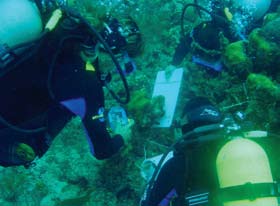
PhD student Susie Arnold working with American students on recruitment
of algal biomass
provide further data for developing
monitoring at Callabash Caye, Belize. Photo: Bob Steneck
and juvenile coral
dispersal models. The first stages of
been based upon DNA extracted
abundance show an inverse
modeling larval dispersal are now
from the samples and is then used
relationship, indicating that
under way. Recruitment continues
to assess if juveniles of a species
macroalgae might adversely
to be monitored to provide data for
have been produced by the local
impact on the survival of newly
validating outputs of the model.
adult population.
settled corals.
Tools to trace dispersal of planulae
More generally, the survival of
of Montastrea faveolata are being
newly settled corals is likely to be
developed based on larval biology
strongly influenced by the local
and behavior, immunogenetic
biological environment, with a
probes to identify planulae, and
dynamic equilibrium between
magnetically attractive beads to
the positive effects of settlement
trace patterns of water flow. The
facilitators and the negative effects
resulting data will then assist with
of algal abundance and other
development of reliable dispersal
barriers to settlement. The project
models of this species. Tracking at
has already accumulated evidence
glovers Reef has already confirmed that localised recruitment potential
the exchange of particles between
of reefs is a critical component of
the inside and outside of the reef,
connectivity.
while at Belize Barrier Reef sites,
particles have been collected up to Connectivity in
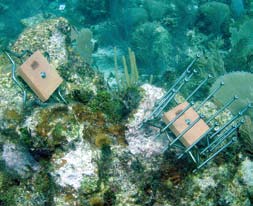
Parrotfish Exclusion Device (PED) and PED control at
bicolor damselfish
Glovers Reef, Belize. Photo: Susie Arnold
Further Information
20 kilometres from the release site.
Research on bicolor damselfish
Connectivity Working Group
Investigating
Capacity building
United Nations University International
is assessing several approaches
and outreach
Network on Water, Environment & Health
post-settlement bottlenecks
to measuring connectivity in
Chair: Prof Peter Sale
those reef species which do not
Much of the information on
Email: sale@uwindsor.ca
Coral is most vulnerable in the first
year of settlement, with mortality
aggregate over large distances to
connectivity and recruitment
Co-Chair: Dr Yvonne Sadovy
spawn. Sampling from Mexico to
data gathered in this research,
University of Hong Kong
exceeding 90% on the Meso-
Email: yjsadovy@hkucc.hku.hk
American Barrier Reef. However
Honduras, the group has made
and synthesised from other work,
excellent progress combining
has supported training workshops
Project Executing Agency:
juvenile corals that make it through
Coral Reef Targeted Research & Capacity
to a size refuge of about 40
genetic assignment tests,
for managers of reefs and
Building for Management Program
mm have much more promising
otolith microchemistry, ecology
protected areas. Members of local
C/- Centre for Marine Studies
The University of Queensland
prospects with an estimated 75%
of settlement patterns, and
reef management communities
St Lucia QLD 4072
chance of long term survival.
hydrodynamic and habitat data to
have also been trained in
Australia
monitoring procedures, in principle
Critical bottlenecks in the months
develop patterns of connectivity
Telephone: +61 7 3365 4333
for populations of this common
enabling data collection over a
Facsimile: +61 7 3365 4755
between settlement and reaching
species. The work has provided the
large area, but also providing
Email: info@gefcoral.org
a viable size may be the primary
these managers with feasible
determinant of patterns of coral
first empirical estimates for likely
management strategies that they
connectivity. To assess these
dispersal distance for larvae of this
bottlenecks in coral recruitment,
species, and has provided evidence
can implement at the local scale.