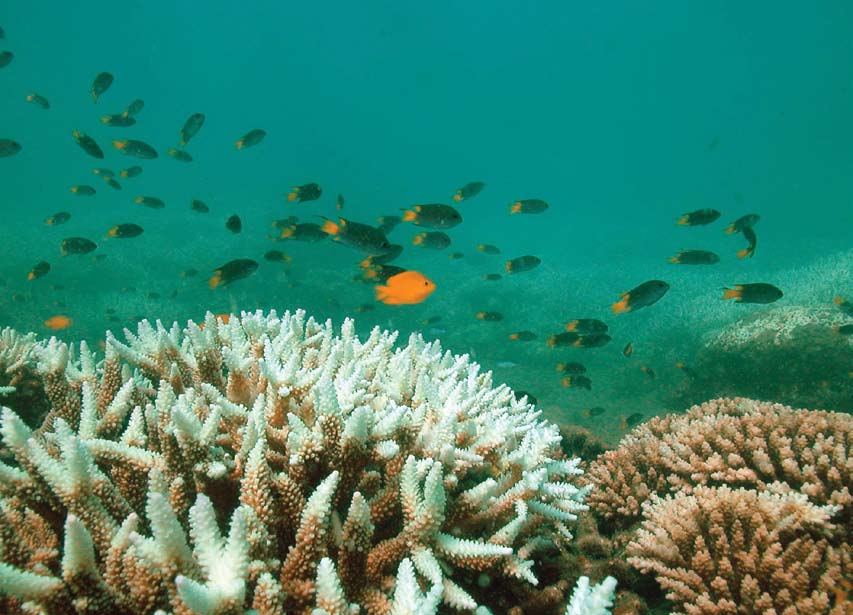



Over one-half
Coral
of the world's population lives
Reef
within 100 kilometres
Targeted Research &
Capacity Building for Management
of the sea.
Coral Reef Targeted Research
& Capacity Building
for Management Program
2006 Annual Report
Technical & Financial Progress Report 4
(1 April 2006 - 30 September 2006)
Contents
Contents ............................................................................................................................ 2
Acknowledgements.......................................................................................................... 4
Further Information .......................................................................................................... 4
Executive Summary......................................................................................................... 6
Component One: Addressing Knowledge & Technology Gaps............................. 10
Component Summary............................................................................................ 10
BLEACHING WORKING GROUP....................................................................... 10
Activities & Implications for Management .......................................................... 11
CONNECTIVITY WORKING GROUP ................................................................ 14
Activities & Implications for Management .......................................................... 14
DISEASE WORKING GROUP............................................................................. 18
Activities & Implications for Management .......................................................... 19
RESTORATION AND REMEDIATION ............................................................... 21
WORKING GROUP ............................................................................................... 21
Activities & Implications for Management .......................................................... 22
REMOTE SENSING WORKING GROUP.......................................................... 23
Activities & Implications for Management .......................................................... 24
MODELLING & DECISION-SUPPORT WORKING GROUP.......................... 26
Activities & Implications for Management .......................................................... 27
Component Two: Promoting Scientific Learning & Capacity Building .................. 30
AUSTRALASIAN CENTRE OF EXCELLENCE ................................................ 31
Activities & Implications for Management .......................................................... 31
EAST AFRICAN CENTRE OF EXCELLENCE.................................................. 34
Activities & Implications for Management .......................................................... 34
MESO-AMERICAN CENTRE OF EXCELLENCE ............................................ 36
Activities & Implications for Management .......................................................... 37
Activities & Implications for Management .......................................................... 38
Component Three: Linking Scientific Knowledge to Management and Policy.... 40
Local Government Initiative .................................................................................. 43
Compilation of reef-friendly practices.................................................................. 44
Synthesis Panel...................................................................................................... 45
Common Sampling for Working Groups & Centres of Excellence................. 45
Technical Baseline Compendium ........................................................................ 46
Synthesis Workshop .............................................................................................. 46
Component Four: Program Management ................................................................. 47
Activities & Implications............................................................................................. 48
Disbursements........................................................................................................ 48
Procurement............................................................................................................ 48
The procurement for the Project for the year is below: .................................... 48
Monitoring & Evaluation ........................................................................................ 49
Page 2 of 2
Communication....................................................................................................... 50
Appendix A Students affiliated with the CRTR............................................... 52
Appendix B Local Mayors Statement .............................................................. 56
Page 3 of 3
Acknowledgements
This report was developed and col ated by Melanie King
(Executive Officer, Project Executing Agency) with significant
contributions from the fol owing Program members:
Mr Andy Hooten, Synthesis Panel Executive
Secretary & U.S Coordinator
Ms Kristen Sampson, Finance Officer Project
Executing Agency
Mr Kim Mitchel (Currie Communications)
Communication Coordinator
Professor Ove Hoegh-Guldberg, Chair Bleaching
Working Group & Australasian Centre of Excel ence
Professor Peter Sale, Chair Connectivity Working
Group
Professor Drew Harvel , Chair Coral Disease
Working Group
Professor Peter Mumby, Chair Remote Sensing
Working Group
Dr Alasdair Edwards, Chair Restoration &
Remediation Working Group
Professor Roger Bradbury, Chair Model ing &
Decision Support Working Group
Emeritus Professor Ed Gomez Southeast Asian
Centre of Excel ence
Dr Roberto Iglesias-Prieto MesoAmerican Centre of
Excel ence
Dr Alfonse Dubi East African Centre of Excel ence
Further Information
Information used in this report has been col ated from the
individual Working Group and Centres of Excel ence 2006
Annual Reports, and from the communication products
produced during the year. Additional information has been
produced with the input of the Management Team.
Further information regarding this report and/or to request
copies of the individual Working Group and Centre of
Excel ence Annual Reports can be requested from the
Executive Officer, Melanie King (m.king4@uq.edu.au).
Page 4 of 4
"...Until now, management of coral
reefs, where it exists, has been
reactive rather than proactive...
"With coral reefs entering a time of
even greater stress, it is mandatory
that managers develop more
proactive approaches, strongly
embedded in science..."
Prof. Peter Sale, CRTR Program
Connectivity Working Group
Page 5 of 5
Executive Summary
The CRTR Program aims
The Coral Reef Targeted Research & Capacity Building for
to bridge gaps in our
Management (CRTR) Program is a proactive research and
knowledge of coral reefs
capacity building partnership that aims to lay the foundation in
through targeted
fil ing crucial knowledge gaps in the core research areas of
research to improve the
coral bleaching, coral reef connectivity, coral disease, remote
management of coral
sensing, restoration and remediation and model ing and
reefs in key developing
decision support, to provide scientifical y credible information
countries
to the management and policy communities, and to support
these proactive approaches and decisions. Each of these
research areas are facilitated by Working Groups underpinned
by the skil s of many of the world's leading coral reef
researchers.
Supporting this science base are four Centres of Excel ence in
priority regions (Mesoamerica, East Africa, Southeast Asia
and Australasia/South Pacific), which serve as important
regional hubs for building confidence and skil s in research,
training and capacity building.
This 2006 Annual Report provides a snapshot of progress
during the past year along with extended Program activities al
working at building the science knowledge base and linking
the findings and information products into the management
and policy communities. Further details on the technical
progress of the Working Groups and Centres of Excel ence
can be found in the detailed reports for each Working Group
Future generations wil continue
to rely on coral reefs
and Centre of Excel ence at Annex A.
In building the knowledge base regarding the six key areas
surrounding coral reef ecosystem health, the Working Groups
have continued to undertake their research activities with
All Working Groups and
some early results already being produced.
Centres of Excellence
have forged important
Al Groups are establishing strong col aborative networks not
links with management
just within the broader CRTR group, but also external y with
and policy stakeholders
other researchers, the management community, and policy-
in 2006
makers. These networks wil continue to be developed and
wil have a significant impact for the Program in the later years
as the research findings and outputs start to be
communicated to these groups.
Page 6 of 6
In addition to these networks, the Working Groups have al
established CRTR scholarships for students from developing
countries. This is a major focus under Components One and
Two in building the next generation of coral reef scientists and
Over 40 students from
to ensure that skil s, expertise and knowledge are exchanged
16 universities world-
across a range of countries and cultures.
wide are now associated
with the CRTR Program
Even more significant is the success that Working Groups
have had in attracting highly skil ed students whom are funded
from other sources outside of the CRTR scholarship funds,
and who are providing valuable input into the work being
undertaken by the CRTR research groups. A ful listing of al
students is available at Appendix A.
CRTR Program `Reef
Restoration Guidelines'
As can be seen below, the efforts of CRTR Program members
due to be released in
have already seen some significant findings and outputs,
December
including:
A guide entitled "Reef Restoration Concepts and
Guidelines: making sensible management choices in the
face of uncertainty" has been produced by the Restoration
CRTR Program regional
& Remediation Working Group Chair and Co-Chair.
planning models are
being tested by
The Model ing & Decision Support Working Group is
managers in Meso-
developing its first local model for Chinchorro Bank,
America
Mexico, and the regional models for the Meso-American
Barrier Reef System. These are currently being tested
with stakeholders for refinement.
The production of colour cards used for quantifying the
`Colour cards' have been
detection of changes in coral colour. This methodology
developed with CRTR
wil al ow managers a non-invasive and simple technique
Program support to help
to measure the amount of stress in their coral populations.
detect coral bleaching
These cards were distributed in conjunction with the
Manager's Guide to Bleaching at the International Tropical
Marine Ecosystem Management Symposium (ITMEMS)
conference in October 2006 in Cozumel, Mexico.
Through their work with managers in the Meso-American
Science has been found
region, the Connectivity Working Group is finding that
to be often lacking in
there is an enormous gap between the development of
management decisions.
science-based procedures for guiding management
CRTR Program
decisions, and the actual creation of effective
researchers are focusing
environmental management in these countries. That gap
on building relationships
wil not be bridged by doing more science; however, the
with managers to
building of effective relationships between scientists and
improve awareness and
managers must become an important part of the solution.
uptake of research
This gap appears to exist despite the wil ingness of many
outcomes
scientists to work with managers.
Page 7 of 7
The Australasian Centre of Excel ence hosted a
Several highly
successful policy & management study tour by Cook
successful training and
Islanders sponsored by NZAID. The tour looked at the
capacity building
impacts of management and policy decisions on coastal
workshops were
ecosystems and how policy worked in practice to provide
facilitated by CRTR
the participants with some valuable insights into the
Program in target
practicalities of policy decisions on the environment.
regions
These insights and information gained during the study
tour are now being incorporated into policy frameworks
being developed for the Cook Islands to protect their
coastal and marine environment.
The Disease Working Group and East African Centre of
Excel ence col aborated on a successful regional
workshop on coral disease. The workshop trained 25
regional scientists and managers in the identification of
disease and the impacts.
The Southeast Asian Centre of Excel ence hosted the
The Local Government
second Stakeholders Consultation on 9 August 2006,
Initiative has had a
together with the Launch of the Philippine Environment
significant impact on
Monitor 2005 (PEM 2005) and the Pre-testing of Best
raising awareness of
Practices for Coral Reef Management of the Local
coral reef management
Government Initiative. This workshop involved the
issues with Mayors in
participation of four mayors of the municipalities of Anda,
high priority regions
Bani and Bolinao and of the City of Alaminos, as wel as
representatives from various local government units
(LGUs), national government agencies, non-government
organizations, academe and the media.
The CRTR Program participated in the 3rd International
Tropical Marine Ecosystem Management Symposium in
The CRTR Program was
October 2006 with a large contingent of members
a key supporter of
attending. The Program hosted a special sponsored
ITMEMS 3 in Mexico,
CRTR event presenting the activities of the Program, and
connecting program
supported the Local Mayors Panel which successful y
researchers with over
produced a Statement outlining local government
250 delegates
commitment to the conservation of coral reefs.
The Local Government Initiative, funded by the World
Bank/DGF contribution to the CRTR, is underway,
addressing how to `green' policies for activities which
impact on coral reef ecosystems across the four regions.
Page 8 of 8
Overal , it has been a year of implementation, consolidation,
establishing networks and ensuring that the research and
capacity building activities of the CRTR Program are relevant
to target audiences.
As can be seen in this report (and in the individual Annual
Reports), progress has been steady with some early outputs
and impacts already generated.
The expectation is that this wil increase in 2007 with some
major, synthesised knowledge products being produced and
disseminated in order to enhance coral reef sustainability and
their important contribution as natural capital to developing
countries.
Page 9 of 9
Component One:
Addressing Knowledge &
Technology Gaps
Component Summary
The Program is organised around six key themes,
investigated by interdisciplinary Working Groups of developing
and developed country scientists. The Working Groups are:
1. Coral Bleaching & Local Ecological Responses
2. Connectivity & Large-scale Ecological Processes
3. Coral Disease
4. Restoration & Remediation
5. Remote Sensing
6. Model ing & Decision Support.
The Working Groups are producing credible research through
a series of targeted research studies addressing the most
significant gaps in global understanding of how major drivers
and stressors affect the structure and function of coral reefs
(from the cel ular level to the ecosystem level).
These studies wil also reveal how improved knowledge and
information can be used to design more effective
management tools and techniques. The new knowledge and
management tools produced should help coral reef managers
understand and address both chronic and acute forms of
stress.
BLEACHING WORKING GROUP
The Bleaching Working Group (BWG) is focused on fil ing
critical information gaps with respect to coral bleaching and
mortality with the aim of supporting management responses
for climate change.
The BWG has identified four major research themes into
which it is putting its efforts. These themes are
interconnected and are aimed at improving the scientific basis
upon which management responses wil be developed as the
climate warms and carbonate ion concentrations in our
oceans decline.
BWG Training activities
Page 10 of 10
Overal , the Group's technical and capacity building activities
are progressing wel and the BWG has delivered on their
stated milestones including delivery of a large number of
The BWG has generated
outputs as planned. During 2006, the members of the BWG
significant public
have produced in association with the project, over 80
awareness in 2006
newspaper articles, TV interviews and documentaries
featuring the work of BWG members; 53 papers (including ten
review articles and ten in high impact journals); given 38 talks
and plenary addresses; been cited over 1490 (for work done
since 2001), and; supervised 35 postgraduate students from
countries including: Australia, Venezuela, India, Israel, Italy,
Kenya, Mexico, Netherlands, Sweden, Tanzania, Thailand,
United Kingdom and the United States.
The BWG has also established a strong col aborative network
which now extends wel beyond the discrete membership of
the Working Group and is focused on linkages and synergies
between developed and developing countries. This is a
substantial output for a group of ten scientists and these
achievements, along with the research findings, wil continue
to be built upon and expanded during the forthcoming year.
Activities & Implications for Management
The BWG continues to bring together and lead the formerly
fragmented research efforts in the area of coral bleaching and
ecological change research. Some of the key activities and
The BWG has been
outcomes (and their management implications) that have
pivotal this year in
occurred during 2006 include:
discoveries related to
coral bleaching impact
Discoveries through BWG research relating to the
on the associations
associations corals have with a wide variety of organisms
between corals and a
such as bacteria and endolithic (skeleton-dwel ing) algae
wide variety of
are providing important information for both the scientific
organisms
and management communities on the reasons for
bleaching and the factors that may determine recovery
fol owing bleaching events.
This information wil al ow managers to have a clearer
We now have a clearer
understanding of the causes and effects of bleaching and
understanding of what
to assist in management decisions to mitigate bleaching
causes coral bleaching,
impacts.
and the factors that may
determine recovery
Page 11 of 11
The BWG has established permanent study sites within
three of the CRTR regions (Zanzibar, Puerto Morelos and
Heron Island) for investigating community dynamics
underpinning
coral
bleaching
and
mortality.
Permanent study sites
Understanding how changes to reproduction, mortality
are now established in
and other aspects of coral populations is important to
target regions
detect and understand the changes that are occurring on
coral reefs around the world and for establishing better
projections of the future trends and scenarios. This
project is working with students and staff from these
regions to assist in identifying the conditions associated
with the impacts of coral bleaching and mortality on coral
population dynamics.
One of the problems that often face reef managers and
policy makers is that they are confronted with reefs in
which damage has occurred but the reasons are less
clear. In this respect, determining changes due to climate
change per se versus declining water quality can have
Understanding the
important implications on which direction a reef manager
causes, and impacts, of
may take. Having tools by which to distinguish these
bleaching have been a
different stresses is critical for reef management. The
priority in 2006
BWG is currently investigating and developing
technologies for managers so that stress can be detected
earlier so that response timing and options can be
improved.
One of these investigations by the Group has been a
partnership to develop the use of colour cards for
quantifying the detection of changes in coral colour. The
project is developing a new approach using inexpensive
Simple to use colour
colour and a careful protocol to assess the extent of coral
cards have been
bleaching within the major CoE regions. These cards
supported by BWG to
were distributed in conjunction with the Manager's Guide
detect changes in coral
to Bleaching at the International Tropical Marine
colour.
Ecosystem
Management
Symposium
(ITMEMS)
conference in October 2006 in Cozumel, Mexico. This
methodology wil al ow managers a non-invasive and
simple technique to measure the amount of stress in their
coral populations.
One of the conclusions that is rapidly becoming evident
The `tipping point' for
from research done by the BWG and other groups is that
coral reefs is at
the tipping point for coral reefs is at atmospheric
atmospheric
concentrations of 500 ppm of carbon dioxide (CO2). At
concentrations of
this concentration of carbon dioxide, the BWG expects
500ppm of CO2. This is
that ocean temperatures wil increase by 2oC, which has
when ocean
been confirmed by the Bleaching Working Group and
temperatures rise and
other research groups as being wel above the threshold
major bleaching occurs
for major bleaching and mortality events. This information
has significant implications for climate change responses
in coastal and marine systems worldwide.
Page 12 of 12
There are now suggestions that the synergies between
thermal stress and that arising from ocean acidification
need to be considered.
Ocean acidification has the potential to threaten the
functioning of marine ecosystems, fisheries, and
Synergies between
carbonate-based coastlines. For example, rising CO2
thermal stress and rising
levels in the ocean wil impact on a broad range of
ocean acidification need
organisms through reduced calcification rates or acidosis
to be considered
the build up of carbonic acid in body fluids, which wil
impact metabolism, respiration, and reproduction.
Lowered calcification rates wil impair the ability of coral
reefs to grow their carbonate skeletons, leading to slower
growth of the reef and a more fragile structural support,
making the reef more vulnerable to erosion.
Managers wil need to know issues such as the impact of
Reduced levels of
ocean acidification, what are the major pathways and
certain organisms in reef
modes of propagation of ocean acidification impacts that
ecosystems result in
wil affect most ecosystem services upon which human
lower calcification rates,
communities rely, and if marine biota can adapt to these
impairing the ability
changes without significant disturbance to the marine
coral reefs to grow and
ecosystem. Combined with thermal stress, this may
resulting in erosion
accelerate ecosystem change.
The BWG is also making progress toward technologies
that wil support management and policy. Later this year,
the BWG is hosting a meeting to explore how coral and
fish communities vary with the abundance of corals in the
Western Indian Ocean (entitled "Meso-scale effects of
coral bleaching"). This wil deliver insights into
management strategies in response to climate change
The BWG facilitated a
such as mass bleaching and mortality events. The
regional workshop in
meeting wil be held from 28th 30th November 2006 at
late 2006 to develop
the Institute of Marine Science in Zanzibar. It is
management strategies
anticipated that this meeting along with the work being
in response to climate
done by Mebrahtu Ateweberhan and Tim McClanahan wil
change
identify which features of reefs maintain fish populations,
for example, and wil suggest how management might
protect these features.
Page 13 of 13
CONNECTIVITY WORKING GROUP
"Until now, management of coral reefs, where it exists, has
been reactive rather than proactive. With coral reefs entering
a time of even greater stress, it is mandatory that managers
develop more proactive approaches, strongly embedded in
science."
Marine Protected Areas
(MPAs) are a
The use of connectivity information to accurately assess
management tool
linkages between coral reefs, and local demographic
holding great promise,
capabilities of various species wil be essential if we are to
but managers must
have management programs that are capable of sustaining
consider the role of
coral reefs. For example, Marine Protected Areas (MPAs) are
connectivity in guiding
a management tool holding great promise. Realising that
MPA design and
promise requires connectivity science as an essential tool for
implementation
guiding the design and implementation of MPAs. If we are to
be successful in maintaining coral reefs into the future, we
must incorporate much more information on connectivity into
management plans and procedures.
The Connectivity Working Group (CWG) is providing and
testing new methods for building the connectivity knowledge
base that effective management wil use. The CWG is
undertaking demonstration projects in the Mesoamerican
region that wil develop tools and apply them to determine
connectivity patterns for selected species in that region. Work
is being done col aboratively with local management
agencies; students from the region are receiving advanced
education, and; efforts are being made to use the projects and
results to inform local communities and show how connectivity
data can be obtained, and used effectively in management
planning.
Activities & Implications for Management
The Connectivity Working Group developed an ambitious
program including seven distinct research projects that
tackled connectivity issues from various directions, and used
fish, corals or lobster.
During 2006 these projects have continued their research
activities, and there has been a continued approach to
management agencies and individuals in order to embed
connectivity into their knowledge and information sets and
ultimately, their management plans. Key activities and
outcomes for the CWG during the past year include:
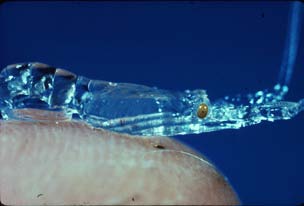
A tiny postlarval stage of the
Caribbean spiny lobster sitting on
a finger. This is the larval stage
that enters reef habitat, and the
stage that recruits to col ectors
used in Project 6
Page 14 of 14
Five graduate students are now in place and performing
wel . Al are from the Caribbean basin, two are
completing M.Sc. degrees at U.S. institutions, and three
are completing M.Sc. or Ph.D. degrees at regional
institutions, but with significant opportunities through
secondments to U.S. or Canadian institutions. In addition
to the students recruited and supported through CRTR
fel owships, a number of other graduate students are
participating with support from other sources. These
include Canadian, U.S., Irish, Australian and French
students.
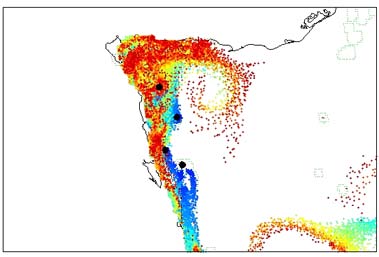
Model run showing possible pattern of dispersal of larval snapper
from known spawning sites in Belize during May 2004. Red
represents greatest number of larvae while blue represents fewest
CRTR Program
Belizean larvae arriving at that location after 30 days of larval life.
Connectivity Working
Group research has
found that up to 70% of
Several Working Group members wil participate in a day-
newly settled corals die
long symposium on connectivity being scheduled for the
during the first year,
2006 Gulf and Caribbean Fisheries Institute (GCFI)
which has implications
meeting in Belize City in November.
for recruitment, growth
and survival of adult
Project Three (Post-settlement bottlenecks in coral
coral on reefs
recruitment): To date our results show that up to about
70% of newly settled corals die during the first year.
Monitoring has been accomplished at Glovers, Carrie Bow
Caye and Turneffe Atol . To date results show that 77%
of the juvenile corals survived over the past year. More
analyses are necessary but the ontogenetic change in
mortality rates is becoming clear and should al ow the
trajectories of recruitment for each of the study areas to
be determined. The growth rate al ows determination of
how rapidly corals transit through this vulnerable juvenile
stage and recruit as adults on reefs.
Page 15 of 15
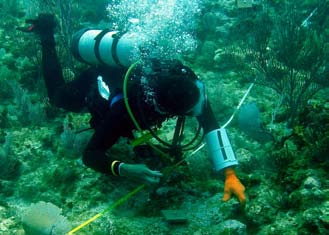
Project Four (Coral Connectivity): Larval development
and behaviour: During years 1 and 2 researchers
developed time courses of development of swimming and
settlement behaviour for five of the major species of
Global warming and
Caribbean reef coral: Montastraea faveolata, M.
climate change is
annularis, M. cavernosa, Acropora palmata and Diploria
potentially reducing
strigosa. Development time-courses vary significantly
coral connectivity
among species suggesting some species may have
greater dispersal potential than others. Results show that
at currently high ambient seawater temperatures in the
Caribbean (300C), both larval and post-settlement
survivorships are reduced relative to rearing at lower
High ambient seawater
temperatures. Thus, global warming/climate change is
temperatures in the
potential y reducing coral connectivity.
Caribbean (30OC) reduce
larval and post-
Project Seven (Model ing lobster larval dispersal) involves
settlement survival
determining whether stage-specific differences in larval
behavior may affect vertical distribution. The CWG tested
in laboratory experiments the response of different stages
of development of the spiny lobster larvae, Paniluris
Argus, to light wavelengths and intensities that mimicked
day and night il umination at depths of 0 50m, 50 75m,
and 75 100m. Results suggest that early larval stage P.
argus are positively phototactic (the influence of light on
movement) and remain near the surface (< 75m deep)
during the day until they are about four months old. After
that, the late stage larvae are negatively phototactic; at
night, al stages are more active which presumably
promotes greater vertical dispersal in the water column.
This information has important implications for the
connectivity trends of an important Caribbean-wide
fishery, because it helps determine the distance this
species is likely to travel and when settlement is most
likely to occur.
The CWG is attempting a different form of capacity
building by working with a cadre of junior management
agency personnel, who are staff biologists involved in
environmental monitoring as part of their management
responsibilities. Annual workshops are being used to
Attaching settlement plates to
raise their understanding of recruitment and connectivity
monitor recruitment of coral
larvae for Project 3.
issues, and they are expected in turn to undertake
recruitment monitoring at their home locations. The
Group is also taking the first steps in bringing the
Connectivity program to the notice of more senior
management agency personnel and NGO representatives
from within the Region, al of which assists in providing a
considerable profile for the Connectivity program in the
region.
Page 16 of 16
The third workshop at Centro Ecologica Akumal ((CEA)
Akumal, Mexico) was conducted in April 2006. Sixteen
participants attended from management agencies and
environmental NGOs with monitoring or management
responsibilities in Mexico, Belize, Guatemala, and
The CWG is attempting a
Honduras. Nine of the 16 had participated in previous
non-traditional form of
CWG workshops. The workshop included presentations
capacity building by
and discussion on the use of recruitment information in
working with junior
management decisions, field recalibration exercises to
management agency
ensure accurate recruitment monitoring in the coming
personnel, who are staff
year, presentation of research results from the first year of
biologists involved in
the project, and discussions of problems encountered in
environmental
year one and possible ways to resolve them.
monitoring as part of
their management
Three training workshops with personnel from the region
responsibilities.
have now been held. These have been targeted to junior-
level staff (i.e. field biologists), conducting environmental
assessments. This program has been explained to senior
management staff and has their support (or no objection).
Limited CWG funding has been made available to support
such staff in the monitoring effort. Despite considerable
efforts to mentor the agency personnel, both during, and
between workshops, it has proved difficult to get this
monitoring program under way (fish monitoring data are
now in hand for just 7 of 11 sites, for example). The
reasons appear to be a) turnover of junior personnel, b)
lack of real commitment by individual employees, c)
change or reduction in the support original y proffered by
The CWG has
senior staff.
determined that
environmental
The extent of the difficulty has been both surprising and
monitoring is not being
disappointing, considering that the CWG chose to work
used to guide
with the same individuals and agencies that have
management decisions
participated in the region-wide monitoring program
mounted by the MBRS project, and in many earlier
monitoring programs. The fact is that, at least in this
region, environmental monitoring is not being used to
Building effective
guide management decisions, there appears to be scant
relationships between
appreciation for how such data might be of local use, and
scientists and managers
the resources al ocated to management of designated
must become an
areas are woeful y inadequate. Rather than take people
important part of the
thought to be experienced in environmental monitoring
solution
and then train them to monitor recruitment, the CWG is
finding it necessary to first build a basic appreciation of
participants and their bosses of the value and need for
monitoring and its relationship to supporting development
indicators.
Page 17 of 17
The need to build real commitment for a routine and
committed monitoring program may wel be beyond the
capability of the CRTR Program, or could use additional
assistance to convince coastal governments of its
importance in assessing the status and processes
affecting the resource base. Given the considerable effort
that has been devoted by World Bank, NGO, and other
programs, over many years, to improving environmental
management in these waters, the evidently poor capacity
stil present is of concern.
There is an enormous gap between the development of
science-based procedures for guiding management
decisions, and the actual creation of effective
environmental management in these countries. That gap
wil not be bridged by doing more science; however, the
building of effective relationships between scientists and
managers must become an important part of the solution.
This gap appears to exist despite the wil ingness of many
scientists to work with managers. The CWG efforts
described above are attempting to bridge this gap.
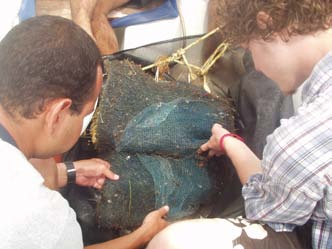
Searching a col ector for lobster
larvae. Technique used in
monitoring lobster recruitment in
Project 6
DISEASE WORKING GROUP
Strategies for dealing
Coral diseases potential y impact both wel -managed and
with coral disease
unmanaged reefs indiscriminately. However, strategies for
outbreaks are currently
dealing with disease outbreaks are currently nonexistent. The
non-existent
increasing frequency with which diseases influence and alter
reef communities necessitates their consideration and
incorporation in management plans.
The Disease Working Group (DWG) is undertaking research
addressing this need by providing the scientific background to
Understanding the
formulate recommendations for managers and policy makers.
specific ways in which
For example, links between the role of coral community
coral diseases can alter
structure and diversity in maintaining productive fish and
reef function will allow
invertebrate populations is general y unstudied. As many
better predictive power
MPAs are established specifical y with the goal of protecting
for conditions under
the fishery in mind, diseases that alter a reefs' ability to
which outbreaks may
support a diverse fish population is of concern.
occur
Understanding the specific ways in which coral diseases can
alter reef function wil al ow better predictive power for
conditions under which outbreaks may occur, and the
rationale to apply pressure to policy makers and local
government to improve waste water treatment, solid waste
disposal and land use practices.
Page 18 of 18
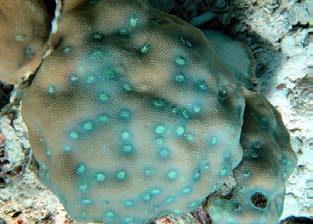
Significant advances have been made across al goals of the
Disease Working Group (DWG). For example, in year one
and two, the DWG established baseline disease surveys at al
Centres of Excel ence except East Africa, with permanent
transects established along the Yucatan Peninsula and Great
Barrier Reef, Australia. The Group demonstrated for the first
time, links between disease and warm temperature anomalies
in Australian and Caribbean reefs.
Baseline disease
surveys at most Centres
The DWG has preliminary evidence for effects of nutrients as
of Excellence have now
facilitators of some coral disease syndromes and has made
been completed.
significant advances in epidemiology, notably through
molecular studies of black band disease, yel ow blotch, and
Aspergil osis. Substantial inroads in uncovering enzymatic
mechanisms of resistance to disease have been made whilst
a new frontier has been opened investigating potential for
phage therapy of coral disease.
The Disease Working Group's scholarship program is
supporting four graduate students and one postdoctoral fel ow
from the Philippines, Palau, Venezuela, and Mexico.
Workshops have been conducted on the Microbiology of Coral
Disease in Mexico, Australia, Palau, and East Africa. The
most ambitious of these is the regional scale workshop run at
the Institute for Marine Studies, Zanzibar, funded in part by
the Living Oceans Foundation.
Activities & Implications for Management
DWG surveys revealed new coral
Fol owing efforts from the previous year, in 2006, the
disease syndromes at each of
DWG surveys revealed new coral disease syndromes at
four Centers of Excel ence, which
each of four Centers of Excel ence (MesoAmerica, the
wil provide managers with new
Philippines, Australia, and East Africa). This effort wil
information regarding coral
provide managers with new information regarding coral
disease in these regions and
knowledge necessary to develop
disease in these regions and wil ultimately provide them
strategies to monitor disease.
with the information necessary to develop strategies to
monitor disease.
Whilst investigating the relationship between temperature
and coral disease, the DWG used a new high-resolution
Using satellite
satel ite dataset of ocean temperature and six years of
technology the DWG
coral disease and coral cover data from annual surveys of
found a highly
48 reefs to investigate whether the frequency of warm
significant relationship
temperature anomalies was positively related to coral
between the frequency
disease frequency across 1,500 km of Australia's Great
of warm temperature
Barrier Reef.
anomalies and the
emergent disease White
Syndrome
Page 19 of 19
The Group found a highly significant relationship between
the frequencies of warm temperature anomalies and white
syndrome, an emergent disease of Pacific reef-building
corals. The DWG and members of the RSWG (Mark
One increasing priority
Eakin and Wil iam Skirving) wil now apply these same
area is the attempt to
methods to disease levels fol owed at sites in the
link ecosystem and coral
Caribbean. Similarly, col eagues are developing Pacific-
health with management
wide disease surveys that wil al ow additional tests of the
actions through a test of
climate as a facilitator of coral disease hypothesis.
the hypothesis that
MPAs have lower levels
One increasing priority area is the attempt to link
of coral disease
ecosystem and coral health with management actions,
through a test of the hypothesis that Marine Protected
Areas (MPAs) wil have lower levels of coral disease.
This is an extremely complex hypothesis to test due to
variability in effectiveness and longevity of MPAs.
However, it is also an absolutely critical issue because we
currently
have
no
implementable
management
approaches to coral disease and MPAs remain one of our
most important management tools to sustain coral reefs.
Success in demonstrating an increase in coral health
inside MPAs would be an important advance. DWG
members are submitting a paper on preliminary work in
Palau, and next year wil report on progress in the
Results with phage
Philippines. Work is underway to address components of
therapy are showing one
this hypothesis in Mexico.
potential, ecologically
sustainable frontier for
The DWG continues to work to uncover diverse elements
treating coral disease in
in coral resistance to disease. Eugene Rosenberg's
target regions
results with phage therapy are very interesting in showing
one potential, ecological y sustainable frontier for treating
coral disease. Phage therapy is undergoing a resurgence
(for example in the meat-packing industry, where phage is
used to control bacterial growth on consumer products),
and does indeed have some potential in natural
ecosystems.
A major regional scale workshop on Microbiology of Coral
Disease was held at the Institute for Marine Studies,
Zanzibar, funded in part by the Living Oceans Foundation.
Twenty-five East African scientists from Mozambique,
Tanzania, Zanzibar, Kenya, and the Seychel es
participated in a five day workshop that included coral
taxonomy, coral microbiology, and coral disease survey
methods. Dr Harvel also gave the keynote address at the
2006 US Coral Reef Task Force meeting about links
between climate warming and coral disease outbreaks.
Page 20 of 20
RESTORATION AND REMEDIATION
WORKING GROUP
Coral reefs worldwide are suffering degradation from a
number of disparate natural and man-induced causes.
CRTR Program `Reef
Tackling the root causes of degradation through effective
Restoration Guidelines'
coastal management measures is likely the best way both to
due to be released in
reduce further damage and to al ow reefs to return to viable
December 2006
healthy states. Nevertheless, there can also be opportunities
for direct intervention to actively restore degraded coral reefs.
Three tenets of coral reef restoration were published in the
Society for Ecological Restoration, 2004, which are important
to managers. These tenets are:
o
Coral reef restoration is in its infancy. We cannot
create ful y functional reefs.
o
Ecological restoration is the process of assisting the
recovery of an ecosystem that has been degraded,
damaged, or destroyed.
o
Improved management of reef areas is the key to
their health. However, within an overal management
plan, active restoration offers managers a useful and
potential y powerful tool for assisting recovery of
degraded reefs.
Given these tenets, the research being carried out by the
Restoration & Remediation Working Group (RRWG) is
seeking not only to address many of the knowledge gaps
which hinder restoration but also to channel advice to the
management community so that restoration projects can be
undertaken in a more informed way and with better chance of
success.
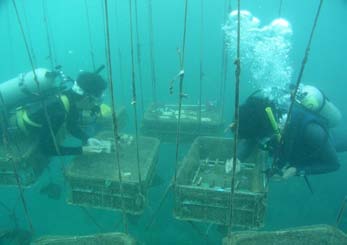
Restoration trials using nursery
The RRWG has continued to develop its research program
cages to rear young corals
and has made significant inroads during the past year. The
Working Group's capacity building activities during 2006
worthy of note includes the continuation of scholarship
support, workshops and the development of products for
managers.
Of particular note has been the development of a guide
entitled "Reef Restoration Concepts and Guidelines: making
sensible management choices in the face of uncertainty".
These guidelines have been produced by the Chair and Co-
Chair and based on discussions and comments from the
RRWG. A PDF version, which is updated as new knowledge
becomes
available,
wil
be
downloadable
from
www.gefcoral.org by the end of 2006.
Page 21 of 21
Activities & Implications for Management
During 2006, the Restoration & Remediation Working Group
has advanced significantly in their research and capacity
Three types of coral
building activities. Major activities and outcomes for the year
nurseries have been
include:
established to
investigate the
The scholarship program under the RRWG continues to
enhancement of
move forward with currently four Philippines graduates,
recovery of corals by
working for MSc degrees, being trained by the RRWG at
culture and
the Southeast Asian Centre of Excel ence with
transplantation
scholarships whol y or partial y supported by the CRTR
Program. Further to this, one recent Philippines PhD has
been appointed from September as a CRTR postdoctoral
fel ow to carry out RRWG research at Bolinao and Palau.
A Tanzanian PhD student, supported by a scholarship
from the East African CoE, is engaged in restoration
research under the direction of Dr Rinkevich of the
RRWG. Two Research Assistants at the Palau
International Coral Reef Center have been trained by
RRWG members and are assisting in RRWG research
there. For one of these Prof. Omori was able to obtain
$17,500 of JICA funding for two months additional training
at Akajima Marine Science Laboratory, Okinawa. The
fieldwork costs of four developed country students (2
MSc, 2 PhD) are funded by the RRWG.
In August, 2006 a five-day workshop for al students and
research assistants working with the RRWG and funded
under the CRTR Program was held in conjunction with EC
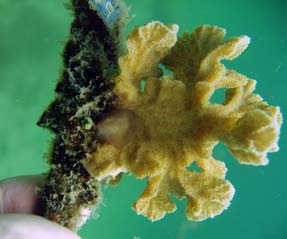
Rope nursery reared fragment of
REEFRES project postdoctoral fel ows based at the South
coral
East Asian CoE. The workshop was rated as a valuable
experience for al concerned and assisted in building the
peer networks of these researchers.
Three types of coral nurseries have been set up close to
the Bolinao Marine Laboratory (Philippines) looking at the
enhancement of recovery of corals by culture and
transplantation. These include one floating nursery, one
bottom-attached nursery and one low-cost experimental
rope nursery. Initial results are:
-
The floating nursery has the advantage that corals are
held at a constant depth (the nursery moves up and down
with the tide), and can be moved to greater depths if
ocean temperatures warm.
-
The bottom-attached nursery is cheaper to make but the
water depth varies with the tide.
-
The experimental rope nursery is very cheap as coral
fragments are just slipped between the strands of a rope
and al owed to grow.
Page 22 of 22
-
Approximately 10,000 nubbins belonging to nine species
have been reared for about one year. Results show that
Faster growing species
there is about 10% mortality and 6% detachment of coral
have already grown into
fragments.
small colonies in the
nurseries and many
Preliminary results show not only significant differences
hundreds of these have
between species in terms of growth and survival, but also
now been transplanted
between different genotypes (inheritable traits) of the
to degraded bommies
same species. Faster growing species have already
(large coral heads)
grown into smal colonies in the nurseries and many
hundreds of these have now been transplanted to
degraded bommies (large coral heads) to see how they
wil survive.
In paral el, a series of degraded bommies have had coral
fragments transplanted to them directly at two different
densities to compare survival and growth of directly
transplanted common coral species. Initial results are
promising with about 86% survival overal after 5 months.
REMOTE SENSING WORKING GROUP
The Remote Sensing Working Group (RSWG) is quantifying
the limitations of coral reef remote sensing by combining
model ing and field experiments. Models predict the ability of
a given remote sensing instrument to detect the subtleties of
bottom reflectance that distinguish reef habitats or the cover
of corals and macroalgae within habitats. Remote sensing is
also needed to identify habitat type and possibly predict the
cover of corals and algae on a reef. Methods used to identify
this wil highlight which areas of the coast have undergone the
greatest change and help managers quantify the rate of
change in reef habitats and to identify areas where
management efforts may be better focused.
Recent remote sensing research has improved the detail of
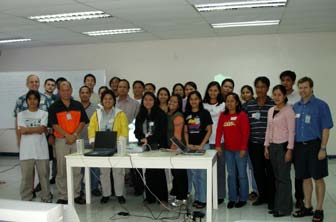
Remote Sensing workshop in
Manila
reef habitat maps but the interpretation and uses of these
products for management has received relatively little
attention. Specifical y, what do habitat maps mean in terms of
biodiversity and reef function and how should they be used for
conservation planning? Outputs from the RSWG wil enable
managers to monitor the effectiveness of reserves effectively
by stratifying their sampling by both habitat type and local
habitat complexity, both of which affect the densities of reef
fish.
Page 23 of 23
Maps of habitat complexity may also identify the location and
extent of critical fish habitat which wil guide MPA site
selection and help understand the connectivity of fish
populations.
The second year of the RSWG has proceeded largely as
expected. A few changes occurred such as member Eric
Hochberg leaving the Group and the failure to acquire
airborne hyperspectral data in Palau (due to airport closure).
However, the RSWG is overcoming these set-backs by
creating a new PhD scholarship for a student at UQ (probably
from the Philippines and to work on use of hyperspectral data
for monitoring coral cover) and conducting an alternative
airborne campaign at Heron Island in 2007.
Managers will have the
ability to monitor the
The research of al project students is progressing wel . Sonia
effectiveness of reserves
Bejarano has already made an empirical link between
better through stratifying
acoustic remote sensing and the density of particular reef fish
their sampling by both
species, and the management implications are discussed in
habitat type and local
the detailed RSWG report.
habitat complexity, both
of which affect the
The oceanic remote sensing team (Wil iam Skirving, Al
densities of reef fish
Strong, Mark Eaking and Laura David) have had two
workshops in the Philippines and the Working Group held a
broader, group-wide workshop in Mindoro (Philippines) in
November.
Activities & Implications for Management
Major activities and outcomes for the Remote Sensing
Working Group in 2006 include:
The RSWG scholarship program is continuing apace with
the project taking on two Filipino, one Colombian, one
Singalese and one Palauan student, and a further PhD
scholarship wil commence later this year. The students
have worked in Belize, Bolinao and Palau as part of
intensive field activities at each location.
A month-long field campaign was undertaken in Bolinao
and Palau throughout April which extended into May for
several students. Studies were divided into several
complementary categories:
habitat mapping surveys;
detailed studies of reef and lagoon microhabitats
including their rugosity, 3-dimensional structure,
species
composition
and
associated
fish
communities;
studies of the effects of reef structure on grazing by
herbivorous fishes;
Page 24 of 24
discrimination of reef structure using high resolution
optical data (Quickbird imagery) and acoustic sensors
(though a col aboration with Dr B. Riegl at NOVA
Southeastern University);
prediction of relative reef fish density and grazing
through combination of acoustic and optical remote
sensing;
A cost-effective and
measurement of inherent optical water properties (the
easy-to-use radiosity-
first set of data from Pacific reefs with strong
based model for
gradients in water quality);
predicting light
measurement of apparent optical water properties;
distribution over
testing a new automated system for extracting coral
structural benthos will
cover from towed video data.
be made available once
fine-tuning for accuracy
John Hedley's radiosity-based model for predicting light
is completed
distribution over structural benthos has been completed
and is currently being fine-tuned for accuracy. This wil
improve the ability to detect and identify coral reef
features from satel ite data. As an additional output of the
project, the model wil be made available as a cost-
effective and easy-to-use alternative to HydroLight© for
managers and students interested in the light environment
of the water column and benthos.
In April 2006, Inherent Optical Properties (IOP) data
(beam attenuation, total scattering and back-scattering)
The RSWG has now
were col ected for around 40 locations in Bolinao,
completed the world's
Philippines and around 20 locations in Palau. Together
first thorough global
with the Belize IOP data from 2005 this constitutes the
survey of Inherent
first-ever thorough global survey of IOPs of coral reef
Optical Properties (IOP)
waters, and encompasses a wide variety of water
data which will provide
conditions, including unique situations such as water
critical information for
pol ution due to overfeeding near fish farms in Bolinao. Al
managers using the
of the raw IOP data has been processed ready for use in
`Reef Observer' expert
the models mentioned above. The data combined with
system
RSWG models wil have direct management application:
1) for guiding remote sensing campaigns as part of our
planned "Reef Observer" expert system, and 2) in
photobiology applications, for example in assessing the
effect of fish farm pol ution on benthic light levels and
Video clips sourced from
photosynthesis.
the RSWG supported
`ReefVid' website have
John Hedley and Peter Mumby created the website
been used in Al Gore's
www.Reefvid.org which is housed on the Project server.
film `An Inconvenient
The site offers over 500 free video clips of coral reef
Truth'
phenomena for educational purposes, several of which
were filmed during Project field work. ReefVid's popularity
is growing rapidly with over two thousand registered
users, and we anticipate that it wil become one of the
premier online coral reef educational resources.
Page 25 of 25
The ReefVid site has been featured in Science (Netwatch,
August 2006) and clips have been used for Al Gore's
DVD, 'An Inconvenient Truth', and for educational DVD-
Roms in the British Virgin Islands and in Australia.
Stuart Phinn has been involved in a project developing
educational materials such as and on-line toolkit for
selecting suitable image data and mapping techniques to
use for mapping and monitoring coral reefs, seagrass
beds
and
water
quality
(http://www.gpa.uq.edu.au/CRSSIS/tools/rstoolkit/). The
aim of this toolkit is to show managers, scientists and
technicians working in coastal marine environments how
images col ected from satel ites and aircraft (remote
sensing) can be used to map and monitor changes to
indicators of coastal ecosystem health. We recognise that
"coastal environments" encompass a broad range of
ecosystems, however, this toolkit focuses on coastal
water bodies, seagrass, coral reefs, and mangroves.
A priority for future work is to extend the toolkit to cover al
other coastal ecosystems. This toolkit focuses on sensors
that measure reflected sunlight (passive systems), for
more detail on active systems (e.g. acoustic technologies)
refer to http://www.coastal.crc.org.au/cwhm/toolkit/.
MODELLING & DECISION-SUPPORT
WORKING GROUP
Model ing is an important management technology that al ows
decision makers and reef users to see the dynamics of the
whole system the biophysical and the socio-economic parts.
Models can be organised so that the results of scenarios of
`what if' questions can be computed and visualized
Modelling is an
immediately. The Model ing & Decision Support Working
important tool for
Group (MDSWG) is developing model ing resources to enable
managers, allowing the
reef managers to work with simulations for their own areas,
results of `what if'
better understand the links between local, regional and global
questions to be
processes and access realistic scientific and economic data
visualized immediately
over the internet.
The 2006 year the second year of the Model ing & Decision
Support project has seen progress against the Working
Group's goals. In the current year, the Group has elaborated
its fundamental model ing framework to the point where it can
be used to develop particular models.
Page 26 of 26
It has developed its first local models (of Chinchorro Bank,
Mexico) and regional models (of the Meso-American Barrier
Reef System) which incorporate both biophysical and socio-
economic dynamics. In developing these models, the Group
has built relationships with reef managers, involving them in
The MDSWG has
workshops during the development and testing. The MDSWG
developed its first local
shared the regional model with managers and policy makers
and regional models
at the ITMEMS conference in Cozumel and at the annual
incorporating both
meeting in Akumal in October.
biophysical and socio-
economic dynamics
The Group has received some external support through two
doctoral scholarships (Col ege of London and University of
Tasmania). It has also formed links with clients through
participatory workshops and site visits held thus far.
Activities & Implications for Management
In the ten months of the current year (to September 2006), the
Group has made significant progress against its goals:
The Group has further elaborated the fundamental
mathematical framework it now includes the ecological
dynamics of the reef benthos and fish as wel as the
socio-economic dynamics of fishing and tourism.
The Group has built a regional model of the Yucatán reef
system suitable for role-playing scenarios this was
launched at the ITMEMS meeting, and was be the basis
for a special workshop with regional managers in Akumal
fol owing ITMEMS (Oct. 23rd-27th, 2006).
The local model of Chinchorro Bank has been tested with
web-based data feeds through a GIS interface.
The MDSWG project is proceeding through five paral el,
and interacting, streams of work:
·
The first is work on the fundamental mathematical
structures. These structures wil underpin al the
models they are the basis for the Group's high-level
frameworks. They describe the key interactions (such
as phase shifts in reefs or economic choices between
resources) between and within the reef ecosystem
and the socio-economic system. Through a process
of stepwise refinement, the Group has analysed and
is now satisfied with the elements of the dynamics.
Page 27 of 27
·
The second is work on local models. The MDSWG
has built and tested the first elaborations of the
fundamental mathematical structures as agent-based
models. The Group transformed the equations into
`stocks-and-flows' systems dynamics models and
then from these into ABM models, checking at each
stage that the basic dynamics could be reproduced.
The models are now being parameterized with real
A regional model of the
data from Chinchorro Bank in the Meso-American
Meso-American Barrier
Barrier Reef System. Work on the Lingayen Gulf is
Reef System was
also starting with associated project funding initiatives
demonstrated during
together with the socio-economic survey undertaken
ITMEMS 3 as a `hands-
by the Philippine COE.
on' tool for managers to
develop and test
·
The third is work on regional models. This work was
scenarios
made a high priority at our March 2006 workshop
fol owing the request from the Executive Committee to
make a significant contribution to the ITMEMS
meeting. The MDSWG decided that it should offer a
workshop that would present a regional model of the
Meso-American Barrier Reef System, and use such a
model as a hands-on tool to al ow managers to
develop and test scenarios.
A prototype ABM model of the MBRS from Belize to
Cancun has been built on a ca 5 km grid, using the
CORMAS modelling system. The dynamics of this
model
fol ow
the
fundamental
mathematical
structures. It captures basic ecology (corals, algae
and fish), basic connectivity (ocean currents for
recruitment, land-sea connections for nutrients and
pol ution), and basic economics (fishing, tourism,
The MDSWG has
land-based development and pol ution) in an
commenced work on
integrated, visual and interactive way.
linkages between the
global economy and the
·
The fourth stream is work on global models. At the
world's reefs
March 2006 workshop the group sketched a way to
handle the linkages between the global economy and
the world's reefs. This work is stil embryonic and wil
draw extensively on global futures and scenarios
developed in other contexts.
Page 28 of 28
·
The fifth stream is work on linkage between scales
and on data management and processing issues.
This stream of work was seriously explored for the
first time at the workshop in March 2006. Some web-
based approaches were discussed as ways to ensure
that both models and data could be accessed by al
stakeholders. The Group now has some preliminary
results in applying web-based workflow methods to
the ABM models for Chinchorro Bank. This stream of
work gave rise to two workshops at ITMEMS: one on
the problems of scale for management, and the other
on the impact of the future Web 2.0 on management.
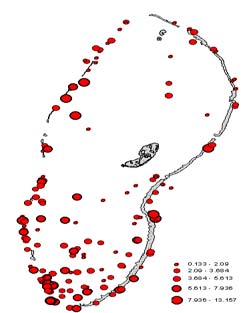
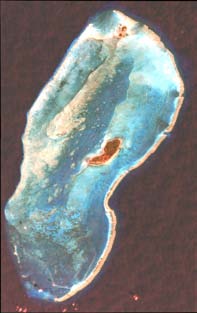
The MDSWG is developing models that enable managers to work with
simulations for their own areas
Page 29 of 29
Component Two:
Promoting Scientific
Learning & Capacity
Building
Although most coral reefs are located in developing countries,
the majority of coral reef research is currently based in
universities and research institutes in the developed world.
Rectifying this global imbalance in knowledge and capacity is
a key mission of the CRTR program. The program is building
or enhancing the capacity of institutions at sites in at least
three developing countries within the first phase so that they
can function as regional Centres of Excel ence. These three
sites wil be supported by a fourth site based in Australia.
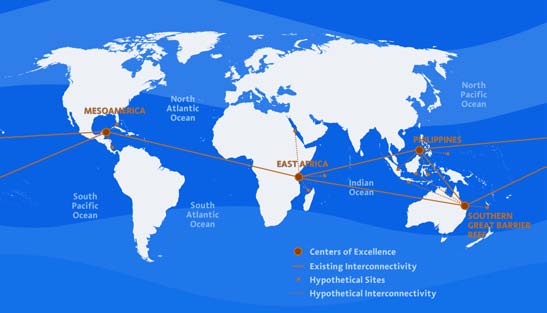
The Centres of Excel ence are:
1. Southeast Asia: Marine Science Institute of Bolinao,
University of the Philippines.
2. East Africa: Institute of Marine Sciences, University of Dar
es Salaam, Zanzibar, Tanzania.
3. Mesoamerica/Western Caribbean: Unidad Academica
Puerto Morelos, Universidad Nacional Autonoma de
Mexico, Mexico.
4. Australasia/South Pacific: Heron Island Research
Laboratory, Centre of Marine Studies, The University of
Queensland, Australia.
Page 30 of 30
Each Centre of Excel ence (COE) is intended to become a
sustained regional resource with responsibility for engaging
CRTR Program Centres
stakeholders throughout each region and serving as a hub for
of Excellence continue
research, capacity building, and information exchange. This
to facilitate strong
is the first step in what wil be a long-term effort.
engagement with local
and regional
In support of the Working Group efforts, the Centres of
management and policy
Excel ence have also continued to build their resources
stakeholders
through both research implementation and infrastructure in
order to engage regional stakeholders and to support the work
of the Working Groups. In particular, there has also been
strong engagement with the local and regional management
and policy communities.
AUSTRALASIAN CENTRE OF
EXCELLENCE
The Australasian Centre for Excel ence has continued to build
its resources and presence in the Australasian and Western
Pacific region.
The Australasian CoE is
building capacity in
The Centre has also pursued its objectives to build capacity
Indonesia and the
within the Australasian region and is now firmly focused on
Western Pacific
Indonesia and the Western Pacific countries. In this regard,
countries
the project has attracted two students (from Thailand and
Indonesia) to undertake PhD programs within the Centre.
The Australasian Centre for Excel ence intends to expand its
linkages and activities in 2007. In this regard, the continual
focus on Indonesia and the Western Pacific wil be a priority,
but wil also expand its contributions to selected countries in
the wider Indo-Pacific region.
Activities & Implications for Management
The Australasian Centre of Excel ence has made some
significant inroads in its workplan during 2006 and has made
advancements both with training and scholarship. Specific
key outputs and outcomes for the year are as fol ows:
Fol owing the completion of infrastructure improvements
at Heron Island Research Station, the CoE has hosted
workshops for both the Bleaching Working Group (2) and
the Disease Working Group (2). These Groups were also
initial users of the new equipment purchased to support
the research activities of the CRTR Working Groups.
Page 31 of 31
The Centre for Marine Studies (UQ) has successful y
positioned Heron Island Research Station as part of the
integrated Ocean Observing System via the Australian
National Competitive Research Infrastructure (NCRIS)
Scheme. This has linked the activities and capability of
Centre for Excel ence into the Great Barrier Reef Ocean
Observing System (GBROOS). The central aim of this
GBROOS project (now funded) is to further enhance our
research capacity to understand climate change on the
southern Great Barrier Reef. This wil provide much
needed information and connectivity of the southern Great
Barrier Reef into the broader regional environmental
trends and understanding. This development wil be
synergistic with a large ARC Linkage project with NOAA,
which has been approved to start on Sep 30, 2006. This
project wil focus on developing new technologies for
monitoring and projecting change on coral reefs.
The project has attracted two students (from Thailand and
Indonesia) to undertake PhD programs within the CoE.
While the students are based in Australia, their field work
wil be conducted in Thailand and Indonesia with the idea
of building stronger capacity and linkages within these
countries. The CoE has also sponsored a PhD student
from James Cook University in Australia who is focused
on the role of effective coral reef governance in coral reef
management.
The CoE also ran a short course for research students
from the University of Diponegoro in central Java,
Indonesia, leading to several students applying to do
graduate work through AusAID with Centre researchers.
Page 32 of 32
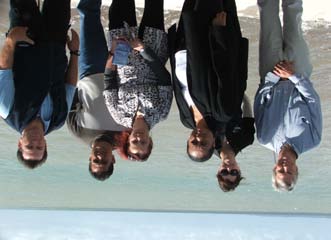
The Centre has established a relationship with New
Zealand Aid (NZAID) Cook Island Marine Resources
Institutional Strengthening Project (CIMRIS) as part of a
broader Pacific initiative. As part of this relationship, the
Centre organised and hosted a study tour for senior staff
on policy and management in practice. The focus for the
tour included: policy and its role in the management of
natural resources; policy and how it is developed, and;
policy in action. Further plans are underway to send a
smal team to the Cook Islands in 2007 to undertake
monitoring and assessment of long-term changes in the
health of the Cook Island reef systems.
Cook Islands look to Australasian CoE
for coastal policy insights
A delegation of senior coastal environment managers from the
Cook Islands visited Australia to learn the keys to successful
marine conservation and sustainable economic development
policy first-hand from some of the world's leading researchers.
The smal nation of just 20,000 people spread across 15
separate islands is rapidly emerging as a `must see' tourism
destination in the
Pacific. With such
growth inevitably
comes pressure on
the Cook Islands'
natural resources
and the coastal
and marine
environment in
particular so
developing sound policy for management to keep up with the
expected growth is becoming critical.
One of the visiting Cook Islanders, Paul Lynch, a lawyer with
the Cook Island National Environmental Services, said that
with nearly 80 per cent of the country's exports derived from
fish products and pearls, and the increasing focus on the
islands as tourism hot spot, the delegates were keen to
strengthen the capacity of their country's policy developers
and law makers to guide the long-term management of its
relatively pristine marine resources.
Page 33 of 33
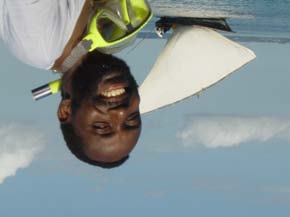
EAST AFRICAN CENTRE OF
EXCELLENCE
Infrastructure
The Eastern African CoE served as a hub for research and
improvements have
started to build its capacity and that of the Eastern African
significantly improved
region as planned. The CoE has provided support to several
the capacity of the East
members of the Working Groups, e.g. Prof Rob van Woesik
African CoE
and Tim McClanahan of the Bleaching Working Group.
Regional y important coral reef research was undertaken
under three subprojects. The CoE continued to build its
capacity through the acquisition of some field and laboratory
equipment. Included in this was the upgrade of its internet
band-width and the stabilizing of the electrical power supply
with the instal ation of a new standby power generator.
The CoE supported the Disease Working Group with their
field work and col aborated on the holding of a regional
workshop on coral disease. Other members of various
Working Groups had an opportunity to work with the CoE in
planning and implementing various CRTR Program activities.
Further to this, the CoE has recruited three PhD students and
wil support them during Phase One; a National Advisory
Group of experts has been established to provide advice and
guidance, and; various col aborative activities have been
initiated, such as the CoE-MACEMP-WIOMSA col aboration.
Activities & Implications for Management
The East African CoE scholarship
process has commenced with the
recruitment of three PhD students
The East African Centre of Excel ence has continued to work
towards its goals in the research and capacity building areas.
Key outputs during 2006 include:
The CoE has provided support to several members of the
Bleaching Working Group, e.g. Prof Rob van Woesik and
Tim McClanahan. A col aborative research project
between the CoE and Drs. McClanahan and van Woesik
is progressing wel . This col aboration has resulted in a
joint coral reef research sub-project on assessing reef
health conditions and climatic change impacts.
The CoE, jointly with the Disease Working Group,
organised and conducted a regional workshop on the
microbiology of coral disease on 3rd 7th April 2006 in
Zanzibar. Twenty-five East African scientists from
Mozambique, Tanzania, Zanzibar, Kenya, and the
Seychel es participated in a five day workshop that
included coral taxonomy, coral microbiology, and coral
disease survey methods.
Page 34 of 34
The Centre of Excel ence scholarship process has
commenced with the recruitment of three PhD students.
These students (Mbije, Suleiman and Jones) are currently
in the admission and registration process within and
outside Tanzania.
The indigenous
Remote Sensing Working Group activities in the region
knowledge project on
have already started. Through the RSWG Chair, the CoE
coral reef management
has received Ikonos Satel ite images for Unguja
has found even where
(Zanzibar) Island. These images wil be analysed and wil
some forms of
serve as demonstrations to the upcoming Remote
traditional management
Sensing and GIS workshop to be held in September 2007.
strategies exist in the
study area, these are of
The CoE hosted a regional meeting of the Indian Ocean
decreasing effectiveness
Global Ocean Observation Systems (IOGOOS) on 10th
in protecting fishing
12th October 2006.
habitats and marine
resources in general
A GIS expert, Dr. Lauretta Burke, of the World Resource
Institute, Washington DC visited. The purpose of the visit
was to provide technical guidance to the GIS unit
including performing a basic informal user needs
assessment, establishing good basic GIS practices, and
helping to prepare for a GIS training workshop in 2007.
In July 2006, the CoE hosted a collaborative meeting
The East African CoE
between CRTR, WIOMSA and MACEMP. The objective
has become an
of the meeting was to discuss how MACEMP, CRTR, and
important hub for
WIOMSA could establish more linkages and col aboration
encouraging linkages
as wel as create enabling mechanisms for continuous
and collaboration
and fruitful partnership in research and management.
between research and
management
Through the sub-project looking at indigenous knowledge
on coral reef management, the CoE has already come to
some early conclusions. They state that even where
some forms of traditional management strategies exist in
the study area, these are of decreasing effectiveness in
protecting fishing habitats and marine resources in
general. They conclude there are two reasons for this.
The first relates to population increase within the fishing
community, and an intensification of fishing effort because
of more efficient gear and increasing exports of fish. The
other relates to the arrival of increasing numbers of
immigrant fishermen who are overwhelming local
communities even where they use legal techniques and
conform to local customs (and frequently they do neither).
For reasons such as these, there is little doubt that fishing
habitats (including coral reefs) wil be threatened and
catch per unit effort wil decrease significantly.
Page 35 of 35
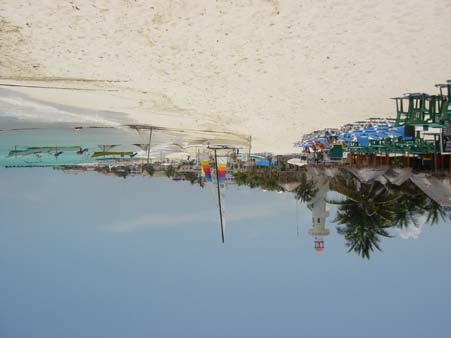
MESO-AMERICAN CENTRE OF
EXCELLENCE
The Mesoamerican CoE at Puerto Morelos is hosted by the
Unidad Académica Puerto Morelos (UAPM) of the Instituto de
Ciencias del Mar y Limnología (ICML) of the Universidad
Nacional Autónoma de México (UNAM).
The activities of the Mesoamerican CoE are centered on the
fol owing four main objectives: a) To conduct research
activities linked with the Working Groups, b) to conduct local
research activities, c) the development and implementation of
capacity building activities and final y d) the linkage of the
scientific results to local management and policy decision-
makers. Although meeting the benchmarks has been delayed
as a consequence of the late approval of the sub-grant
Agreement by UNAM, significant progress has been achieved
in al four objectives:
Coral reefs in the area are under the influence of two major
water fluxes, on the ocean side the Yucatan Current and on
the continental part, and the drainage of groundwater through
the karstic geology characteristic of the zone. Considering the
Development in the Meso-
major objectives of the project, the CoE has identified the
American region continues to put
study of these two fluxes as the local research priorities. The
pressure on coral reef systems
Centre of Excel ence is currently focusing on two major
research outputs relating to the development of two models (a
circulation model and a groundwater model) for understanding
these major water fluxes that influence the region.
The dynamics of the Yucatan Current greatly influences the
water fluxes in the interior of the reef lagoon. On the other
The Meso-American CoE
hand the quality and volume of the freshwater inputs may
is focusing on two major
have a profound effect on the health of the fringing reef. The
research outputs
CoE has selected a 6 km section of the reef in front of ICML-
relating to the
UNAM facilities in Puerto Morelos as a study site. The
development of a
development of a hydrodynamic model for the lagoon and the
circulation model and a
description of the ground water fluxes wil generate important
groundwater model for
information for both scientists and managers of the protected
understanding these
area. Furthermore, this information can be important for coral
major water fluxes that
reef stakeholders in other geographic areas.
influence the region
In addition to the research activities, the CoE has, during the
last year, hosted the continuous operation of some of the
Bleaching and Disease Working Groups and initiated a
col aboration with local managers and the Restoration &
Remediation Working Group. The CoE has also offered two
graduate courses as part of the capacity building activities
with the participation of 29 students from seven countries.
Page 36 of 36
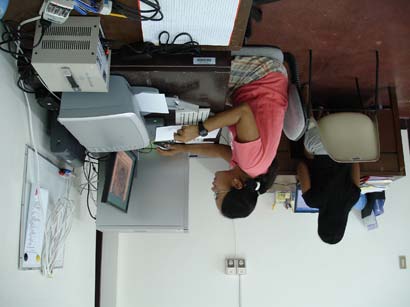
Activities & Implications for Management
The development of a
Significant outputs for 2006 under the Centre of Excel ence
hydrodynamic model for
activities include the fol owing:
the lagoon and the
description of the
The development of a hydrodynamic model for the lagoon
ground water fluxes will
and the description of the ground water fluxes wil
generate important
generate important information for both scientists and
information for both
managers. Products wil have direct applications for
scientists and managers
management, such as: a) an early coral bleaching
and that can be applied
warning system for the local fringing reefs, that currently
to other regions
are not wel covered by the current NOAA satel ite
products, and b) a model describing the dispersion in the
reef lagoon of pol utants introduced into the watershed.
Although it is too early to release both products, they have
the potential to be useful management tools.
The Centre of Excel ence provided six students from
around the region (Cuba, Mexico, Venezuela and
Colombia) to attend courses in Marine Protected Areas
and Light & Photosynthesis on Coral Reefs. The two
courses were attended by 19 and 10 students respectively
and have provided valuable insight and knowledge to the
participants which can be used in their home countries.
SOUTH-EAST
ASIAN
CENTRE
OF
EXCELLENCE
This second annual report covering the period from 1st
September 2005 to 31st August 2006 represents the first ful
year of normal operations of the Philippines/Southeast Asia
Center of Excel ence (CoE). Activities within the CoE are now
wel under way and described below.
The coordination office continues to support the CoE
activities, and provides some assistance for the linked
research activities of CRTR Working Group members, both
local and foreign, who are conducting research activities in the
Philippines.
Two doctoral students and three master's degree students are
now engaged in the research projects of the CoE, plus
another two doctoral and five master's level students
supported at the CoE from funds from projects of WG
members.
South-East Asian CoE Graduate
students at work
Page 37 of 37
In addition to formal, ongoing training, coral taxonomy
workshops were held in February and August while a training
course on coral diseases/marine microbiology was held from
April-May 2006.
The three local research projects (improvement in coral
taxonomy, coral disease and the connectivity and rearing of
rabbitfish) continue to make progress. In contrast to last
year's reports which primarily covered organizational aspects,
the present period indicates more substantive activities from
col ection of specimens to initial analysis and characterization
of microbiological and genetic materials.
Activities & Implications for Management
Major outputs for the Centre of Excel ence in 2006 are as
fol ows:
A workshop on the Development of a Communication and
Capacity Building Strategy for the Philippines/Southeast
Asia CoE was held on 22-23 May 2006 at the Marine
Science Institute in Diliman. This was attended by the
principal investigators of CoE-assisted projects, members
of Remote Sensing Working Group and Model ing and
Decision Support Working Group, the CoE Coordinator
(also RRWG member) and staff and the Project Executive
Officer. The workshop was aimed at developing a
communication and capacity building workplan and action
plan within a Philippine context.
The Second Stakeholders Consultation was held on 9
August 2006, together with the Launch of the Philippine
Environment Monitor 2005 (PEM 2005) and the Pre-
testing of Best Practices for Coral Reef Management of
the Local Government Initiative. The PEM 2005 is a
project of various Philippine agencies with funding from
the World Bank. The Best Practice for Coral Reef
Management project is a component of the Local
Government Initiative of the World Bank executed by the
Research Institute for the Subtropics (RIS) of Okinawa,
Japan.
Page 38 of 38
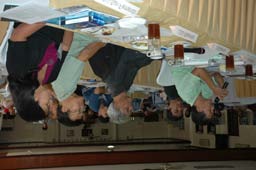
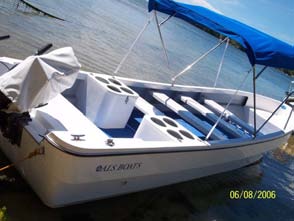
Four mayors participated in the event from the
municipalities of Anda, Bani and Bolinao and of the City of
Alaminos, as wel as representatives from various local
government units (LGUs), national government agencies,
non-government organizations, academia and the media.
A summary of the feedback from the LGUs regarding best
practices for coral reef management, obtained through the
questionnaire provided by Dr. Seiji Nakaya of the RIS is
provided in the detailed CoE report.
The CoE has received a large amount of media exposure
during 2006. In April 2006, the CRTR Program was
The second Stakeholders
featured in three national daily newspapers, namely: The
Consultation attracted Mayors
Philippine Star, The Manila Times and Business World.
and other representatives from
various government and non-
The articles focused on the overal objectives and
government organisations,
significance of the CRTR Program, both in the
together with researchers and
international and national context. It should be noted that
representatives of the media
the Philippine Star is the second most widely read daily
newspaper in the country. These different articles were
based on an expanded article initial y published in the
January-February 2006 issue of the UP Forum, a
publication of the UP Information Office circulated within
the UP System nationwide. A PDF file of the article may
be obtained from http://www.gefcoral.org.
The Second Stakeholders Consultation, held on 9 August
2006, was featured in a news article posted on the
website of the City Government of Alaminos City,
Pangasinan (http://www.alaminoscity.gov.ph/news/). In
the beginning of this year, an article on the First
Stakeholders Consultation workshop was published in the
Philippine Daily Inquirer, the paper with the largest
circulation.
The purchase and completion of infrastructure and
equipment has continued in order to build the capacity of
the research institute. Some examples include: the
instal ation of the PABX telephone system (which has
A new long-range dive boat has
al owed more efficient field trips
made telephone communication between researchers and
for the CRTR Program
administrative staff in UPMSI at Diliman and BML much
researchers operating in
easier); the purchase of a new boat for CRTR research
partnership with the South-East
project use in Bolinao, and; construction of a new coral
Asian CoE
museum at the third floor of BML, Pangasinan was
completed as wel as repainting and renovation of the
coral museum at UP MSI in Diliman.
The CoE has been lending support to the activities of the
EU INCO-DEV Reef Restoration Project (REEFRES).
Two work programs are being undertaken in Bolinao by
two members of the RRWG (E. Gomez and A. Edwards).
Page 39 of 39
The Bolinao-based COE subproject on coral disease is
stil soliciting col aborative input from international experts
in coral disease pathology including histology and
enzymology. Close col aborative links with international
members of the DWG are indispensable. The
forthcoming DWG workshop to be held at Bolinao in
January 2007 is viewed as an important milestone for
further progress.
Informal contacts have been made with the Seagrass
Demonstration Site personnel at the Bolinao Marine
Laboratory which is a component of the GEF/UNEP South
China Sea Project. Discussions have related to common
concerns about conservation of coastal resources and
linkages with stakeholders, especial y the local
governments and the schools in the region. Further
col aboration is expected.
Component Three:
Linking Scientific
Knowledge to
Management and Policy
2006 has seen the research activity of the Working Groups,
Centres of Excel ence and the Program as a whole, being
firmly linked to the management and policy audiences. As
evidenced in the sections for Components One and Two,
each Working Group and Centre of Excel ence is making
excel ent progress towards ensuring that their research
outputs are being linked early in the process and to the
respective target audiences. This has been occurring through
a series of capacity building and communication forums i.e
networking opportunities (meetings, workshops, and training
sessions), and the development of products targeted
specifical y for the audience and training sessions.
During the past year specific activities have commenced at
not only the Working Group or Centre of Excel ence level, but
also at the strategic Program level, which have been designed
specifical y for linking outputs and information to the
management and policy audiences.
Page 40 of 40
The most prominent of these activities include the fol owing:
·
The Local Government Initiative has been developed
to link local governments and communities at chosen
sites in the four regions to the Program, and to
provide information to assist local communities in their
management practices to reduce the impacts on the
coral reefs;
During the past year
·
The development and release of the compilation of
specific activities have
reef-friendly practices designed to assist managers,
commenced at Working
policy-makers and local governments with case-
Group, Centre of
studies showing effective management of coral reefs;
Excellence and at the
strategic Program level,
·
The compilation of a technical baseline compendium
specifically to link
has been developed that establishes the state of our
outputs and information
knowledge of coral reefs at the commencement of this
to the management and
Program, and later wil be used as the baseline
policy audiences
against which future knowledge and progress can be
measured, and;
·
The CRTR Program provided support to, and
attended the 3rd International Tropical Marine
Ecosystems Management Symposium (ITMEMS) in
October 2006.
Of particular note is the 3rd ITMEMS conference of which a
large contingent of CRTR Program members attended in
Cozumel, Mexico. The CRTR was a prominent supporter and
participator in a number of the conference sessions including
a Local Mayors Panel, workshop sessions and the sponsoring
of a special event promoting the work being undertaken by the
Program. This event was critical in raising the profile of the
Program and its participants, building linkages into the
management community and exchanging information to
ensure that the CRTR outputs are credible, in demand and
viewed as valuable to the stakeholders the Program is
targeting.
These above activities, combined with those of the individual
Working Groups and Centres of Excel ence, have ensured
that the targeted research is relevant to the appropriate
audiences, and in particular, has emphasized the value of the
research outputs. The efforts to date have also built essential
linkages with those stakeholders who wil most benefit from
the Program's findings and products.
Page 41 of 41
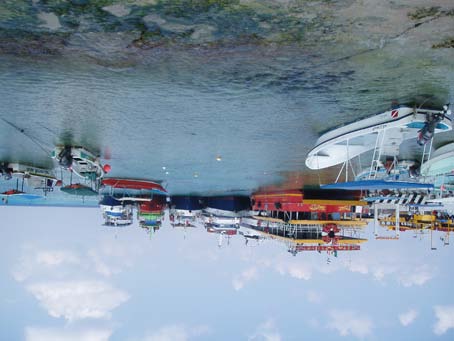
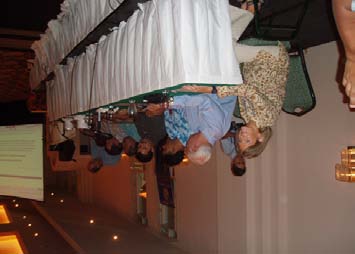
3rd International Tropical Marine Ecosystems
Management Symposium (ITMEMS)
The 3rd ITMEMS Conference was held from the 15 20
October in Cozumel, Mexico. The CRTR Program had a
strong presence at the conference with al Synthesis Panel
members attending along with a number of Working Group
members. The Program sponsored a special cocktail
reception event which highlighted the work of the Program
including the importance of integration between managers
and scientists as wel as providing an effective feedback
mechanism on priorities and the utility of the targeted
research to management needs. Individuals participated in 14
different workshop sessions. Of note was the participation of
the members of the Model ing & Decision Support Working
Group under the Model ing and Decision Support Theme,
Cozumel was host to the 3rd
whereby (amongst other things) they conducted sessions of
ITMEMS conference where the
model ing workshops where a new regional model for the
CRTR Program had a major
session to highlight the
Meso-American Barrier Reef System was presented.
importance of integration
between scientists and managers
Local Mayors Panel
The Program was also a major supporter and sponsor of the
Local Mayors Panel which was held as part of ITMEMS.
The Mayors Panel consisted of:
-
Gustavo Ortega Joaquin Mayor, Island of Cozumel,
Mexico
-
Mahmoud Juma Issa Mayor. Zanzibar Municipal Council,
Tanzania
-
Ann Bunnel Deputy Mayor, Townsvile, Queensland,
Australia
-
Lucilo Bayron Vice Mayor, Puerto Princesa City,
Philippines
-
Teariki Matenga Mayor, Tukitumea, Rarotonga, Cook
Islands
The CRTR Program was a strong
-
Hermani Braganza Mayor, City of Alaminos, Pangasinan,
supporter of the Local Mayors
Philippines
Panel held as a part of the 3rd
-
Jeremy Harris Former Mayor, Honolulu, Hawaii, USA
ITMEMS conference in Mexico
The Program sponsored the three mayors from the
Philippines (Mayor Braganza), Zanzibar (Mayor Issa) and the
Cook Islands (Mayor Matenga).
The public Panel sessions were strongly supported by
attendees at ITMEMS and culminated in the drafting and
signing of a Local Government Leaders' Statement (see
Appendix B) whereby the Panel identified six major issues
that should be addressed to develop the partnership between
the global coral reef management community and local
government.
Page 42 of 42
The Program is continuing the association with these mayors
and others through the Local Government Initiative (see
below).
Further information and findings on the ITMEMS conference
can be found at the ITMEMS website www.itmems.org.
Local Government Initiative
The Local Government Initiative is a new initiative developed
under the CRTR Program which aims to bring about change
to assist in raising awareness of the issues facing local
governments and communities who depend upon coral reefs
for their livelihoods, and to work with chosen communities to
exchange information and knowledge which may assist in
addressing these issues. They include:
Unsustainable fishing and coastal management practices.
Lack of public awareness, limited acceptance of rules and
low level of compliance.
Lax or ineffective enforcement.
The Local Government
Lack of plans/ordinance for coral reef management.
Initiative is now being
Lack of alternative income generating activities to reduce
integrated into projects
human impacts on the reefs.
managed by CRTR
Lack of funding.
Program Centres of
Excellence
The Local Government Initiative aims to address these issues
through the fol owing goals:
1. To `green' policies and business practices of local
government so that they align with those factors
essential to maintaining coral reef health and
productivity.
2. To improve the capacity of the Coral Reef Targeted
Research and Capacity Building for Management
(CRTR) Program's Centres of Excel ence to partner
with local governments throughout their target regions
in the identification, dissemination and uptake of good
practices.
Al Centres of Excel ence are currently preparing projects
within their regions to bring about change in the practices of
local governments and communities in combating some of the
issues facing coastal and coral reef ecosystems from human
impacts.
Page 43 of 43
Compilation of reef-friendly practices
Through support from the Japanese Trust Fund, a
compendium of good management practices for coral reefs,
based on sound science and documented literature, has been
compiled by the Research Institute for the Sub-tropics (RIS), a
Japanese NGO. These practices range from integrated
coastal management, erosion management and waste water
treatment, to Marine Protected Areas, tourism guidelines and
A compendium of good
restrictions on fishing and equipment.
management practices
has been developed and
These practices including the rationale, methods, results and
integrated into the CRTR
lessons learned, have been drawn from coral reef
Program's Local
management contexts around the world.
Government Initiative
projects
Pre-testing of good practices
A representative sample of the coral reef friendly practices
compiled above was vetted in stakeholder consultations with
Filipino Mayors and other local government leaders in
Alaminos City, Pangasinan, Philippines in early August 2006.
Over 80 stakeholders attended the day long workshop, which
included a briefing on the declining state of coastal and
marine resources in the Philippines, estimates of economic
loss from degraded coral reefs, and what some communities
were doing in response.
Examples of field-tested best practice for coral reef
management in the Philippines were presented to
stakeholders for discussion, along with those examples from
other parts of the world. Local government leaders were both
disturbed by the accelerated rates of coral reef degradation
and consequent loss of resource rents in the Philippines (e.g.,
in the fisheries and tourism sectors) and hopeful that this
could be turned around with decisive and appropriate actions.
Presentation of pilot results at ITMEMS 3
The local government leaders representing coral reef
communities from around the world (e.g., from Mexico,
Philippines, Cook Islands, Tanzania, Fiji, PNG, Hawai ,
Australia, Belize) discussed a compendium of coral reef
friendly practices and the pre-test results in the Philippines.
Page 44 of 44
The Commitment by mayors and other local government
leaders to take on board several of these good practices in
response to threats to coral reefs in their own communities is
expected, along with a statement cal ing local government
leaders to take action and develop a strategy outlining key
steps that they can take to protect coral reefs in their
communities.
Publication of Manual and Brochures in three languages
for broad dissemination
Feedback from the Local Government Leaders' Forum and
plenary discussions involving a broad group of stakeholders
wil be incorporated into a final report. This wil also be
reviewed by the coral reef research community to ensure that
recommendations are robust and based on good science.
An il ustrated brochure of these coral reef friendly practices
wil be published initial y in English, Spanish and Tagalog for
broad dissemination to local governments which depend on
coral reef goods and services.
Synthesis Panel
The Synthesis Panel has continued to make decisions
determining the direction of the Program's research agenda.
During 2006, the Panel held its meeting at Puerto Morelos,
Mexico, from the 11-14 October 2006. A copy of the minutes
wil be available in the 2007 six-monthly progress report.
Common Sampling for Working Groups &
Centres of Excellence
In October, 2004, a joint meeting of selected working group
members initiated a special program to establish common
repeated measures of key process variables in and around
each of the Centres of Excel ence. The approach was roughly
modeled after the 50 hectare terrestrial monitoring plots
original y established by researchers of the Smithsonian
Tropical Research Institute, which has since grown into a
global network of comparable data sets. The CRTR team met
with two consulting statisticians to help in reviewing program
design.
Dr. Rob van Woesik of the BWG has been coordinating the
effort and study sites have been established in three of the
CoEs to date. Additional effort wil be directed toward the
Philippines in 2007, as wel as engaging other Working Group
members who can assist with standard operating procedures,
methods and techniques in common data col ection.
Page 45 of 45
This wil be so that al repeated measures sampling wil be
comparable across study sites and over the life of the
program. Ultimately, the data generated should also benefit
each of the Working Groups and CoEs, but also contribute
toward data validation and parameterization needed by the
Model ing and Decision Support Working Group.
Technical Baseline Compendium
The draft of the technical baseline summary, to serve as the
state-of-knowledge at the commencement of the project, was
presented during the October, 2006 Synthesis Panel meeting
for review and comment by Synthesis Panel members.
The compendium wil be made available for internal Program
members in early 2007. A special edition for external release
wil also be completed in early 2007.
Synthesis Workshop
Based upon targeted research conducted and findings to
date, a workshop wil be held in early 2007 for Synthesis
Panel members to commence the integration and synthesis of
this research information and outputs. A key output from this
meeting wil be the development of summary statements on
the research findings so far.
The intent of the workshop is to review summary material for
producing several documents 1) a statement by the panel
relating to early findings and areas of concern (and produced
as a product by the CRTR program) 2) a policy forum
discussion to be submitted to Science and other peer-
reviewed articles.
These outcomes wil be the first synthesised product from the
Program utilising research outputs from across the six
Working Groups and wil be specifical y for the Program's
target audiences.
Page 46 of 46
Component Four:
Program Management
2006 has seen the finalisation of many of the procedures to
be implemented by the Project Executing Agency (PEA) to
ensure an effective and accountable operating structure. Al
sub-grant contracts are now in place and the terms and
conditions of the contracts are being effectively met with the
assistance of the institutions involved. CRTR members of the
Management Team, Working Groups and Centres of
Excel ence, along with their respective institutions, have been
instrumental in assisting the PEA through the implementation
process and the ongoing operation of the Program, and their
support is most appreciated.
Despite a slower than expected start to the funds
disbursement, the past year has seen a steady progression
towards meeting the estimated program expenditure as
outlined in the project planning documents, due to al sub-
grant Agreements now being in place and increased
momentum with the Program activities under al three
components.
Monitoring and evaluation of Program activities has been
tracked throughout the year. Fol owing direction from the
World Bank, the performance indicators for the Program are
currently undergoing revision. Due to this, a monitoring and
evaluation report is unable to be supplied with this report, but
wil be undertaken against the new performance indicators
and submitted to the World Bank Team Leader once these
have been finalised.
Work has continued on the development of the
Communication program for the CRTR Program with the
communication strategy and visual identity being reviewed
and revised by Currie Communications. Promotional and
information products have also been produced including
posters and research updates. These products were
presented at the ITMEMS Conference in October to an
audience of coral reef managers and decision-makers, with
great effect. Efforts in this area wil continue in 2007 with a
greater emphasis on the production of synthesized
information.
Page 47 of 47
Activities & Implications
Disbursements
Disbursements have continued during 2006 with the Program
on-target with its expenditure projections. By the end of the
reporting period (30 September 2006), the Project is on-target
to meet its expenditure objectives for Year Two. Activities
funded include the research activities under Component One,
the research and capacity building activities under Component
Two and the activities to link scientific knowledge to
management under Component Three.
Prolonged agreement negotiations with some institutions
caused initial delays in the disbursement of funds. However,
these negotiations have now al been finalised and the
disbursement under the GEF funding source is now on-track.
Research activity has also accelerated in the past year which
has had an impact on the amounts disbursed as Working
Groups increase activity to meet their objectives.
Procurement
The procurement for the Project for the year is below:
Consultancies
During the reporting period, the fol owing consultancy has
been granted:
Mr Andy Hooten, Synthesis Panel Executive Secretary &
US Coordinator.
Dr Lauretta Burke, Provide technical guidance to the GIS
unit located at the Institute of Marine Science, Zanzibar.
Dr Roger Green and Dr Brian McArdle were contracted on
a retainer basis, to participate in discussions and provide
statistical guidance on common sampling and information
sharing approaches.
Executive Committee Honoraria
As mentioned in previous reports, Drs Knowlton and Muthiga
have been placed on the Honoria list for their work undertaken
on behalf of the Project as Executive Committee members.
Sub-Grants
During the reporting period, the Project Executing Agency
have finalised al sub-grant Agreements.
Page 48 of 48
Monitoring & Evaluation
Monitoring of Program activities has continued during 2006
and there have been significant inroads in the first two years
of the Program to ensure that the research outputs are of
value to the target audiences. Due to the revision of the
Program's performance indicators a report has not been
prepared at this stage demonstrating targets and impacts
against the revised indicators. A report wil be prepared once
the performance indicators have been finalised in the coming
months.
Page 49 of 49
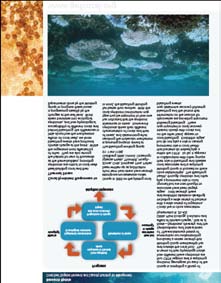
Communication
Fol owing the resignation of Elaine Tilson in May 2006 as the
Communication Officer, the Program appointed Currie
Communications in the interim period to review the
communication strategy and provide recommendations as to
how the Program could move forward, and to revise the
Program branding.
Kim Mitchel , a senior consultant from Currie Communications
has been working effectively with the Management Team, and
more recently, with the Synthesis Panel to revise and
implement the communication strategy and Program
branding. Specific details of the communication activity are
detailed below by Mr Mitchel .
A detailed review of the CRTR Program communication
program and visual identity was facilitated by Currie within the
first few weeks of being appointed. This has since resulted in
a complete revision of the program branding, establishment of
more open and flexible design protocols for products and the
development of a revised communication strategy.
A series of CRTR Program
posters have proven popular at
major events
Fol owing consultation with members of the Executive
Committee and PEA, the new visual identity has now been
applied to a number of flagship communication materials,
including conference/exhibition posters, program promotional
materials such as the summary brochure, postcards and other
corporate materials including business cards for al Synthesis
Panel members, PowerPoint, letterhead and other templates.
Currie has also worked with Synthesis Panel members to
initiate a series of `Research Updates' which were published
for the ITMEMS 2006 conference in Mexico. A series of highly
visual scientific posters have also been developed for each of
the Working Groups as wel as for the Centres of Excel ence
and Local Government Initiative.
Both products have been very wel received by Working
Group and COE Chairs with strong demand for additional
copies noted for targeted communication by CRTR Program
members.
CRTR Program Research
Updates aim to provide a detailed
insight into research progress
Page 50 of 50
The CRTR Program website is undergoing a major update,
with a stronger focus on connecting on-line users with CRTR
Program research outcomes, providing a news and feature
article-style information service for first-time users while
ensuring the site has the level of technical capacity and
interactivity required by CRTR participants. The revised
website also offers significantly easier navigation and
functionality, aiming to al ow users to go directly to their area
of interest (by Working Group, COE, etc) or stepping through
an intuitive pathway via the graphic-rich strapline and banner
sections.
Kim Mitchel participated in a one-week Communication
Workshop at the SCRIPPS Institute, University of California,
The revised CRTR Program
in late August 2006 to interact with the SeaWeb
website wil offer higher levels of
communication group and senior staff members at SCRIPPS.
functionality and ease of use to
access program information
During this workshop Kim met with CRTR Program Synthesis
Panel Chair Nancy Knowlton to facilitate feedback on the
CRTR's Communication and Capacity-Building Strategies.
Kim also coordinated a component to the workshop's media
training session by stepping participants through a media
conference exercise to improve the level of skil s in
anticipating, and successful y answering, questions from the
media.
Kim also attended the October 2006 Synthesis Panel meeting
in Puerto Moreles, Mexico. During this time a number of one-
to-one briefings were undertaken with the various Chairs to
determine the level of progress, and assistance required, in
implementing
communication
workplans.
A
major
communication focus emerging for many of the Working
Groups lies in the development of Products derived from
CRTR and other research for key program stakeholders.
Working with Chairs and project teams in successful y
developing and disseminating such materials wil be a priority
focus for the CRTR Program in the coming year.
Fol owing approval of the final draft CRTR Program
Communication Strategy Currie wil work with the PEA to
assist Working Groups and COEs to develop communication
working plans and also to refine communication guidelines
and protocols for the broader program.
Page 51 of 51
Appendix A Students affiliated with the CRTR
Working
Surname
First Name
Scholars
Country
Scholarship Institution
Scholarship Title
Start Date
End Date
Group or
hip
Centre of
Excellence
Bleaching
Kongjandtre
Narinratana
PhD
Thailand
University of Queensland,
Taxonomy and connectivity of corals
01/07/2006 30/03/2010
Australia.
from the genus Favia in Thailand
and on the southern Great Barrier
Reef.
Bleaching
Padillo-Gamino
Jackie
PhD
TBC
University of Hawaii
Assessing the impacts of
01/01/2005
31/12/2010
disturbance on reproduction of corals
Bleaching
Furaha
Juliet
Masters
TBC
Moj University
The influence of area protection and
01/01/2005
01/01/2008
site characteristics on recruitment,
survival, and growth of coral species
on the Kenyan Coast
Bleaching
Visram
Shakil
PhD
TBC
TBC
TBC
TBC
TBC
Connectivity
Alvarado
Nathaniel
B.Sc.
Belize
University of Maine, USA
Coral ecology
01/01/2006
31/12/2007
Connectivity
Mojica
Angela
M.Sc.
Guatemala
Old Dominion University,
(1) Impact of grazing crabs on coral
01/07/2006
30/06/2008
USA
reefs
(2) Postlarval lobster responses to
settlement cues
Connectivity
León Zubillaga
Ainhoa
M.Sc.,
Venezuelan Universidad Simón Bolivar,
Genetics and connectivity of
01/04/2006
31/03/2009
Caracas with secondments to Acropora palmata
Georgia Tech, Waterloo
University (Canada)
Connectivity
Porto Morales
Isabel
M.Sc.
Colombia
Universidad de los Andes,
Coral genetics and connectivity
01/06/2006
31/05/2008
Colombia, with secondment
to Georgia Tech.
Connectivity
María Salas De
Eva
MSc
Costa Rica
Population genetics of the Bicolor
01/06/2005
30/05/2007
La Fuente
damselfish, Stegastes partitus
Disease
Croquer
Aldo
Post-doc
University of Puerto Rico
Geographic assessment and
TBC
TBC
monitoring of diseases in the wider
Caribbean.
Disease
Jordán Garza
Guillermo
Masters
Mexico
Instituto de Ciencias del Mar
Geographic assessment and
TBC
TBC
y Limnología, Mexico
monitoring of diseases on Mexico
reefs
Page 52 of 52
Disease
Ridep-Morris
Alma
Australia
James Cook University,
The dynamics and epidemiology of a TBC
TBC
Australia
coral disease outbreak in Nikko Bay
Disease
Rosell
Kathryn B.
Philippines
Philippines
The effects of the riverine discharges TBC
TBC
on coral disease prevalence
Modelling &
Ching Fung
Tak
PhD
UK
University College, UK
Modelling coral reef ecosystems and
01/10/2004
30/09/2008
Decision
their interaction with human
Support
societies
Modelling &
Geronimo
Rollan C.
MSc
Philippines
University of the Philippines
Modeling marine protected area
01/01/2006
30/03/2007
Decision
networks along the South China
Support
Sea
Modelling &
Trebilco
Jessica
PhD
Australia
University of Tasmania,
Decision support systems for
01/10/2006
31/10/2009
Decision
Australia
managing coral reefs at a regional
Support
scale
Modelling &
Cleland
Deborah
Other
Australia
ANU, Australia
Summer Research Scholarship
01/09/2006
31/03/2007
Decision
Support
Remote
Idip
David
MSc
Palau
Canada (2/3) and Exeter
Dedicated training in remote
15/09/2006
31/08/2007
Sensing
(1/3)
sensing: mapping reefs, bathymetry,
wave exposure and beta diversity of
Palau
Remote
Bejarano
Sonia
PhD
UK
University of Exeter
Use of acoustic remote sensing to
01/10/2005
30/10/2008
Sensing
predict relative fish density and
grazing intensity
Remote
Lim
Alan
PhD
Canada
University of Waterloo
Use of remote sensing to detect
TBC
TBC
Sensing
ecological changes in coral reef
environments using textural
measures
Remote
Ticzon
Victor
Philippines University of the Philippines
Use of remote sensing to predict the
01/04/2005 TBC
Sensing
density of keystone taxa
Remote
Penaflor
Eileen
PhD
Philippines University of the Philippines
Remote sensing of coral bleaching.
TBC
TBC
Sensing
Began October 2005
Restoration
Vicentuan
Kareen
Masters
Philippines
UPMSI, Philippines
The reproductive biology of
01/01/2006
30/03/2008
and
scleractinian corals and in addition,
Remediation
the effects of fragmentation on their
reproductive status
Restoration
Baria
Maria
Masters
Philippines
UPMSI, Philippines
Spatial and temporal patterns of
01/03/2006 TBC
and
coral recruitment in Bolinao,
Remediation
Pangasinan
Restoration
Cabaitan
Patrick
Masters
Philippines
University of the Philippines
TBC
TBC
TBC
and
Remediation
Page 53 of 53
Restoration
De La Cruz
Dexter
Masters
Philippines
University of the Philippines
TBC
TBC
TBC
and
Remediation
Restoration
Baria
Vanesa
Masters
Philippines
University of the Philippines
TBC
TBC
TBC
and
Remediation
Australasian
Schuttenberg
Heidi
PhD
USA
James Cook University,
Understanding Effective Coral Reef
01/12/2006
30/03/2010
Australia
Governance
Australasian
Kongjandtre
Narinratana
PhD
Thailand
University of Queensland,
Taxonomy and connectivity of corals
01/07/2006
30/03/2010
(Nong)
Australia
from the genus Favia in Thailand
and on the southern Great Barrier
Reef.
Australasian
Albert
Simon
PhD
Australia
The University of Queensland New tools to identify coral reef
TBC
TBC
ecosystems at risk
East African
Mbije
Nsajigwa
PhD
Africa
Tanzania
TBC
TBC
TBC
East African
Suleiman
Mohammed PhD
TBC
State University of Zanzibar
TBC
TBC
TBC
East African
Jones
Leonard
PhD
TBC
Institute of Marine Sciences
TBC
TBC
TBC
Meso
Coronado
Cesar
PhD
Mexico
Centro de Investigación
Water Circulation in the Puerto
01/01/2006
01/01/2010
American
Científica y de Educación
Morelos Reef Lagoon
Superior de Ensenada.
Mexico
Meso
Colombo
Florencia
PhD
Mexico
Centro de Investigación
Support for attending the course on
10/01/2006
10/02/2006
American
student
Científica y de Educación
Ligth and Photosynthesis on Coral
Superior de Ensenada,
Reefs
Mexico
Meso
Perera
Susana
Manager
Cuba
Centro Nacional de Áreas
Support for Attending the course of
17/06/2006
25/06/2006
American
Valderrama
Protegidas de Cuba, Cuba
Marine Protected Areas
Meso
Hernández
Aylem
Manager
Cuba
Centro Nacional de Áreas
Support for attending the Marine
16/06/2006
25/06/2006
American
Protegidas de Cuba, Cuba
Protected Areas course
Meso
Bohorquez
Carlos
Manager
Colombia
Colombia
Support for attending the Marine
17/06/2006
25/06/2006
American
Protected Areas course
Meso
Yepsi
Alejandra
Manager
Venezuela
Venezuela
Support for attending the Marine
17/06/2006
25/06/2006
American
Protected Areas Course
Meso
García Nieto
Natalia
Masters
Mexico
Facultad de Ciencias, UNAM, Support for attending the Marine
17/06/2006
25/06/2006
American
México
Protected Areas course
South East
Arboleda
Mark Dondi
PhD
Philippines
Marine Science Institute,
TBC
16/06/2005
15/06/2007
Asian
Philippines
South East
Ravago-Gotangco Rachel
PhD
Philippines
The Marine Science Institute,
TBC
01/11/2005
31/10/2006
Asian
Philippines
South East
Vergara
Mark
MSc
Philippines
The Marine Science Institute,
TBC
01/02/2005
31/01/2007
Asian
Philippines
Page 54 of 54
South East
Lumibao
Candice
MSc
Philippines
The Marine Science Institute,
TBC
01/02/2006
31/08/2006
Asian
Philippines
South East
Pueblos
Miahnie Joy
MSc
Philippines
The Marine Science Institute,
TBC
15/07/2006
15/10/2006
Asian
Philippines
Page 55 of 55
Appendix B Local Mayors Statement
ITMEMS 3 COZUMEL DECLARATION
LOCAL GOVERNMENT LEADERS' STATEMENT
Local Governments hold the key to the future of coral reefs and other tropical marine
ecosystems.
Greenhouse gas emissions, land based sources of marine pol ution, unsustainable
coastal development, overfishing and destructive fishing are local problems that impact
at the global level. Healthy coral reefs are a beautiful indicator of healthy coastal and
marine ecosystems and an increasingly valuable natural resource. The economic, social
and cultural futures of people of tropical coasts and islands are linked to the health of
coral reefs.
Local Government is on the front line of the issues that directly affect the future of coral
reefs and associated ecosystems. Many local governments face huge and constantly
changing chal enges in providing for sustainability meeting the needs of the present
without compromising the needs of the future.
We are grateful for the opportunity provided for us to engage with the expertise of the
coral reef management and scientific community through participation in the program of
the Third International Tropical Marine Ecosystems Management Symposium.
We have identified 6 major issues that should be addressed to develop the partnership
between the global coral reef management community and local government
EMPOWERMENT
We cal upon the management and scientific community to support the empowerment
and resourcing of local governments to manage tropical marine ecosystems.
NETWORKS
We cal upon the management community to work with local government and community
networks to develop informed partnerships to address the management of tropical
marine ecosystems.
CAPACITY BUILDING
We cal upon the management community to work with local government to develop
practical technical capacity at the local level to address marine ecosystem issues.
KNOWLEDGE AND COMMUNICATION
We cal upon researchers to communicate current research information in a manner that
addresses the needs of local government.
POLITICAL WILL
We cal upon the management community to work with local government to build the
political wil to meet the chal enges of managing tropical marine ecosystems.
RECOGNITION OF ACHIEVEMENT
Page 56 of 56
We encourage the management community to publicly recognize the achievements of
local government in sustainable management of marine resources.
Gustavo Ortega Joaquin Mayor, Island of Cozumel, Mexico
Mahmoud Juma Issa Mayor. Zanzibar Municipal Council, Tanzania
Ann Bunnell Deputy Mayor, Townsvile, Queensland, Australia
Lucilo Bayron Vice Mayor, Puerto Princesa City, Philippines
Teariki Matenga Mayor, Tukitumea, Rarotonga, Cook Islands
Hermani Braganza Mayor, City of Alaminos, Pangasinan, Philippines
Jeremy Harris Former Mayor, Honolulu, Hawaii, USA
Page 57 of 57