

Building scientific capacity
Further Information:
and management capability
Professor Ove Hoegh-Guldberg
University of Queensland, Australia
Email: oveh@uq.edu.au
Project Executing Agency
Understanding
Coral Reef Targeted Research
& Capacity Building for
an essential asset
Management Program
c/- Centre for Marine Studies
The coral reefs of the Australasian region are highly
The University of Queensland
significant resources. They are essential to the health
of the regional economy, due to the fishing, tourism
St Lucia QLD 4072
and protection they provide to coastal communities.
Australia
The Great Barrier Reef underpins more than $4 billion
Telephone: +61 7 3346 9942
Australasian
of economic activity each year. Within the larger
Facsimile: +61 7 3365 4755
Australasian region, coral reefs are critical platforms
Email: info@gefcoral.org
Centre of Excellence
that support tens of millions of people through artisan
fisheries and the subsistence gathering of resources.
Like reefs in most parts of the world, coral reefs within
the Australasian region are under pressure from such
factors as declining water quality, over-exploitation and
climate change. Linking regions that face similar types of
Update
threats is one of the objectives of the Australasian CoE.
This sharing of ideas and resources will allow for better
management of coral reefs not only in the Great Barrier
Reef but also for those reefs adjacent to developing
countries. Many of the challenges facing reefs worldwide
are being researched both in Australia and in regions
outside the Great Barrier Reef.
Supporting research,
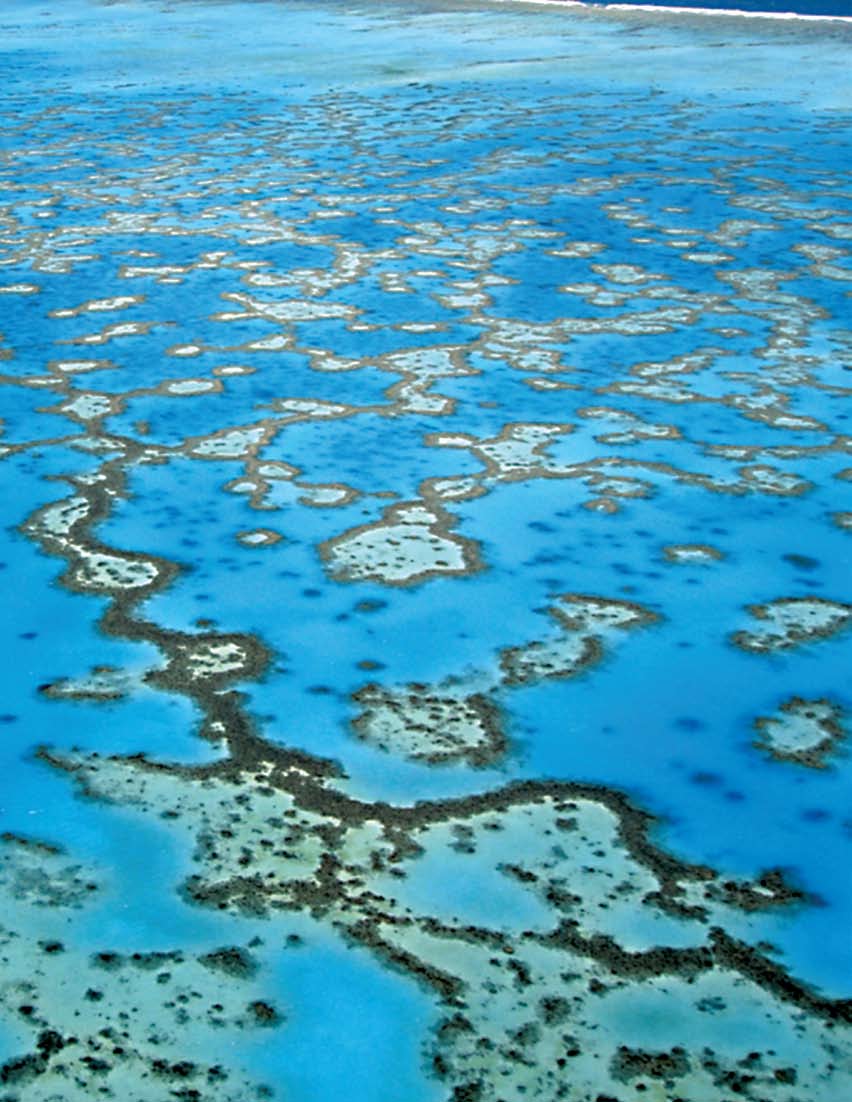
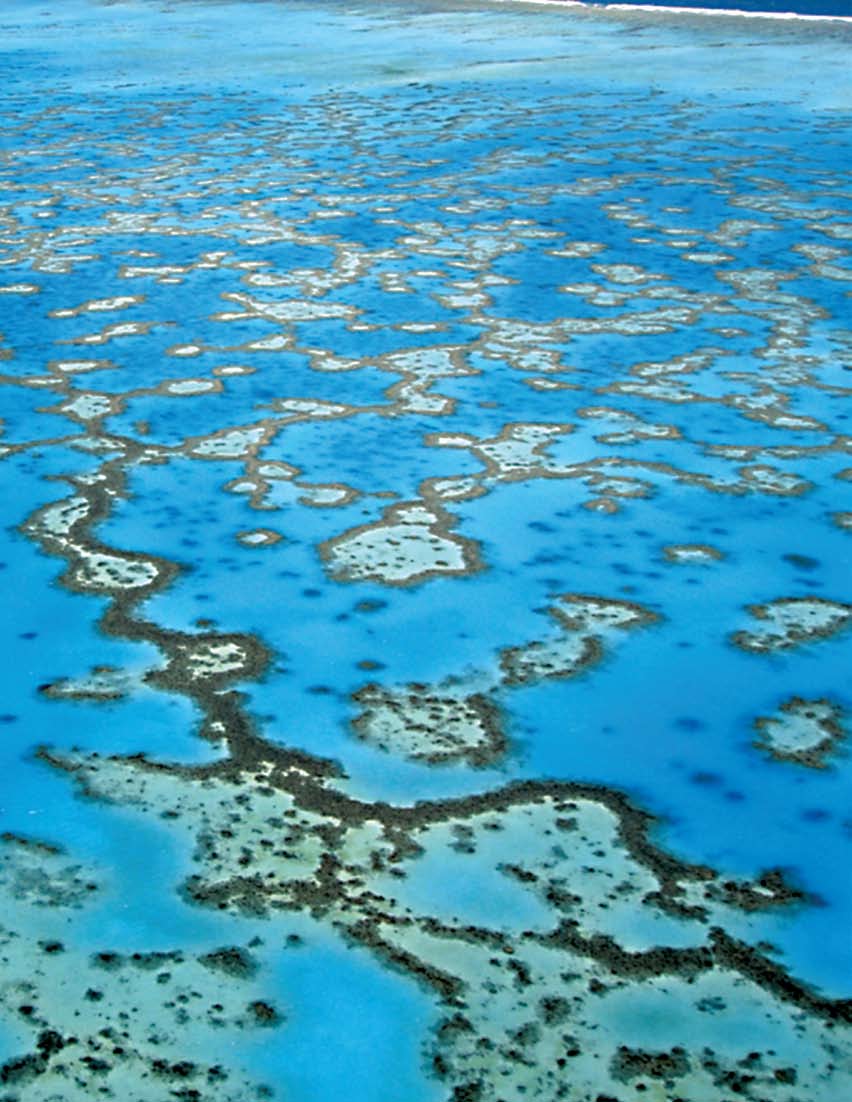
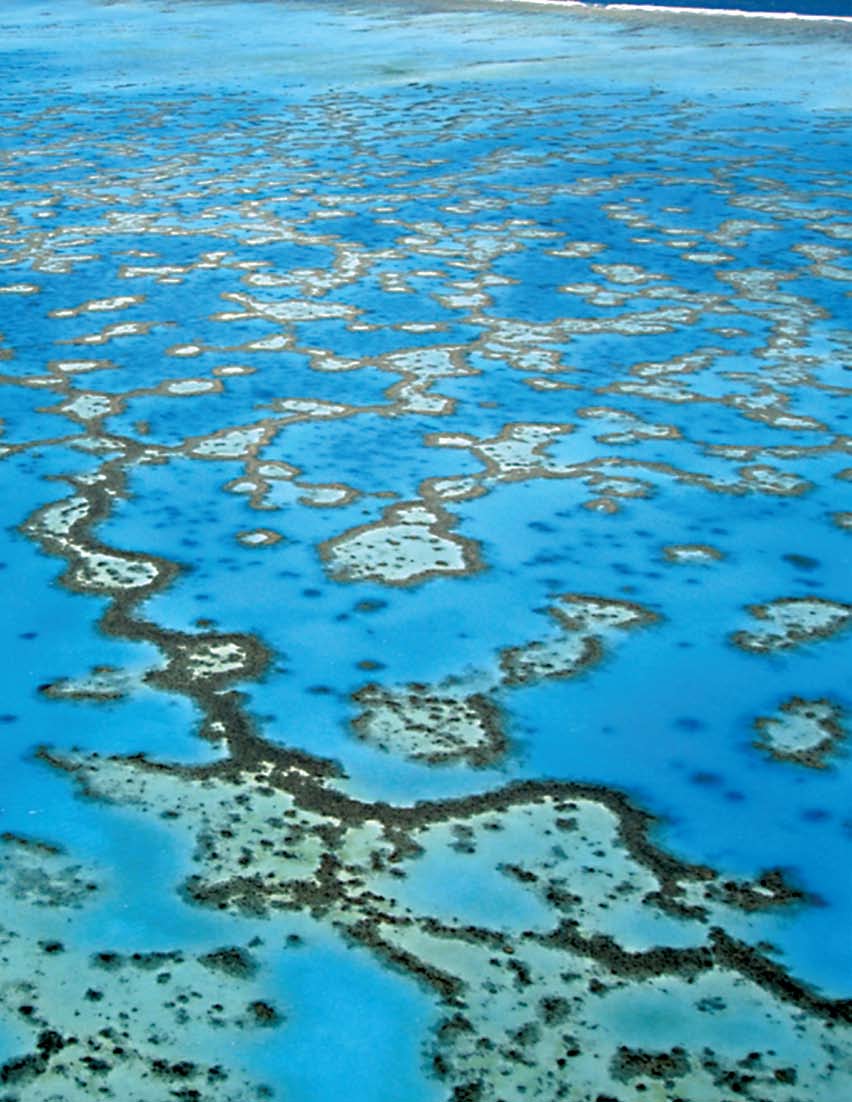
southern Great Barrier Reef.
This document is printed on r
The University of Queensland
training partnerships
The Australasian CoE is linking the advanced in-
frastructure and intellectual capital available in Australia
with the research projects and monitoring and assessment
Centre for Marine Studies,
programs already in place in the larger region, in order to
extend the knowledge base and management capabilities
for coral reefs. This partnership advances the aim of
the Australasian CoE to become a regional knowledge
ecycled stock
centre, as well as supporting regional collaborations in
Ove Hoegh-Guldberg,
research and training.
Coral community in the marine protected area at Heron Island,
Photo:
The Coral Reef Targeted Research &
The CRTR Program is a proactive research
Each of these research areas are facilitated The CRTR Program is a partnership between
Capacity Building for Management Program
and capacity building partnership that
by Working Groups underpinned by the
the Global Environment Facility, the World
(CRTR) is a leading international coral
aims to lay the foundation in filling crucial
skills of many of the world's leading coral
Bank, The University of Queensland (Australia),
reef research initiative that provides a
knowledge gaps in the core research
reef researchers. The CRTR also supports
the United States National Oceanic and
coordinated approach to credible, factual
areas of Coral Bleaching, Connectivity,
four Centers of Excellence in priority
Atmospheric Administration (NOAA) and
and scientifically-proven knowledge for
Coral Diseases, Coral Restoration and
regions, serving as important regional
approximately 50 research institutes and
improved coral reef management.
Remediation, Remote Sensing and
centers for building confidence and skills
other third parties around the world.
Modeling and Decision Support.
in research, training and capacity building.
July 2008
Product code: CRTR 011/2008


Building scientific capacity
Further Information:
and management capability
Professor Ove Hoegh-Guldberg
University of Queensland, Australia
Email: oveh@uq.edu.au
Project Executing Agency
Understanding
Coral Reef Targeted Research
& Capacity Building for
an essential asset
Management Program
c/- Centre for Marine Studies
The coral reefs of the Australasian region are highly
The University of Queensland
significant resources. They are essential to the health
of the regional economy, due to the fishing, tourism
St Lucia QLD 4072
and protection they provide to coastal communities.
Australia
The Great Barrier Reef underpins more than $4 billion
Telephone: +61 7 3346 9942
Australasian
of economic activity each year. Within the larger
Facsimile: +61 7 3365 4755
Australasian region, coral reefs are critical platforms
Email: info@gefcoral.org
Centre of Excellence
that support tens of millions of people through artisan
fisheries and the subsistence gathering of resources.
Like reefs in most parts of the world, coral reefs within
the Australasian region are under pressure from such
factors as declining water quality, over-exploitation and
climate change. Linking regions that face similar types of
Update
threats is one of the objectives of the Australasian CoE.
This sharing of ideas and resources will allow for better
management of coral reefs not only in the Great Barrier
Reef but also for those reefs adjacent to developing
countries. Many of the challenges facing reefs worldwide
are being researched both in Australia and in regions
outside the Great Barrier Reef.
Supporting research,
southern Great Barrier Reef.
This document is printed on r
The University of Queensland
training partnerships
The Australasian CoE is linking the advanced in-
frastructure and intellectual capital available in Australia
with the research projects and monitoring and assessment
Centre for Marine Studies,
programs already in place in the larger region, in order to
extend the knowledge base and management capabilities
for coral reefs. This partnership advances the aim of
the Australasian CoE to become a regional knowledge
ecycled stock
centre, as well as supporting regional collaborations in
Ove Hoegh-Guldberg,
research and training.
Coral community in the marine protected area at Heron Island,
Photo:
The Coral Reef Targeted Research &
The CRTR Program is a proactive research
Each of these research areas are facilitated The CRTR Program is a partnership between
Capacity Building for Management Program
and capacity building partnership that
by Working Groups underpinned by the
the Global Environment Facility, the World
(CRTR) is a leading international coral
aims to lay the foundation in filling crucial
skills of many of the world's leading coral
Bank, The University of Queensland (Australia),
reef research initiative that provides a
knowledge gaps in the core research
reef researchers. The CRTR also supports
the United States National Oceanic and
coordinated approach to credible, factual
areas of Coral Bleaching, Connectivity,
four Centers of Excellence in priority
Atmospheric Administration (NOAA) and
and scientifically-proven knowledge for
Coral Diseases, Coral Restoration and
regions, serving as important regional
approximately 50 research institutes and
improved coral reef management.
Remediation, Remote Sensing and
centers for building confidence and skills
other third parties around the world.
Modeling and Decision Support.
in research, training and capacity building.
July 2008
Product code: CRTR 011/2008
Key activities under the
Sharing ideas,
Building knowledge, networks and expertise
Australasian CoE include:
skills and resources
1. Research
How we're
Getting involved
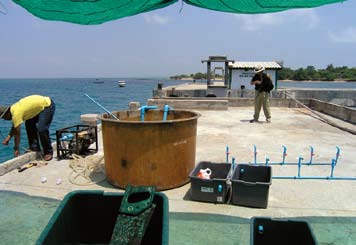
Thailand
The Australasian CoE is undertaking projects on:
The Australasian Centre of Excellence (CoE) is one of
making a real difference
across the region
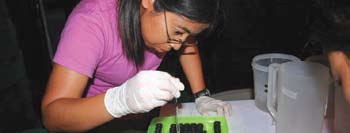
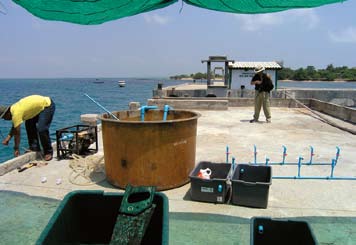
An Australasian CoE-sponsored postgraduate student
based at The University of Queensland spent three
· Climate change.
four international centres under the Coral Reef
months in Thailand researching coral spawning and cross
· Tracing the origins of stress in the symbionts
As a leading, international knowledge centre, the
The Australasian CoE has been instrumental in undertaking
pollenisation of coral species.
of reef-building corals.
Targeted Research & Capacity Building
activities of the Australasian CoE focus on four areas:
a range of projects across several areas, including:
· Solar radiation and coral bleaching.
for Management (CRTR) Program. The
1. Research
Australasian CoE is based at the
Indonesia
· Ecology, physiology and molecular microbiology
2. Capacity building, including training courses,
Centre for Marine Studies at The
secondments, study tours and mentoring programs
A Memorandum of Understanding has recently been signed
of coral disease on the Great Barrier Reef.
between The University of Queensland and Diponegoro
· Great Barrier Reef water quality and connectivity
University of Queensland in
3. Communication and dissemination of research
University (Semarang), thereby formal y affiliating students
between coral reef ecosystems.
Brisbane, Australia, and at the
results and information
with an Indonesian university. The MOU includes training of
Heron Island Research Station.
4. Building networks and collaborations
postgraduate students; undertaking col aborative research
· New tools for managing ecosystem responses to
projects, and; joint efforts between institutions to build capacity
climate change on the southern Great Barrier Reef.
Heron Island Research Station
in the area of sustainable resource use and management
· Understanding the risk of ocean acidification
Specifically, the Australasian CoE's objectives are to:
will be re-opened in November
in Indonesia.
for coral reefs.
2008 after a destructive
· Provide a solid technical platform for the research and
training activities of the various Working Groups within
Thailand
fire during March 2007.
2. Training
the CRTR Program.
The station will be modern
Aq setting,
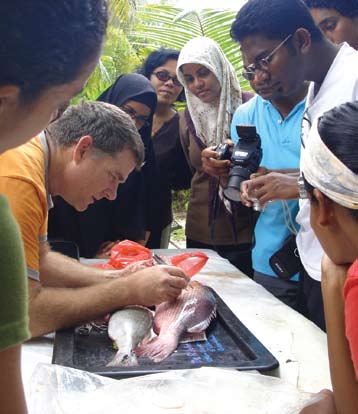
Sponsoring researchers and coastal managers from
· Establish critical equipment in preparation for research
Southeast Asia and the Pacific Islands to attend
and spacious and will cont-
and training activities of bleaching, disease, connectivity
and remote sensing Working Groups.
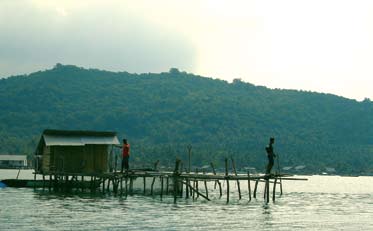
Solomon Islands
professional development courses in subjects, including
inue to attract high-profile
Coastal Resource Management, Tropical Marine Invert-
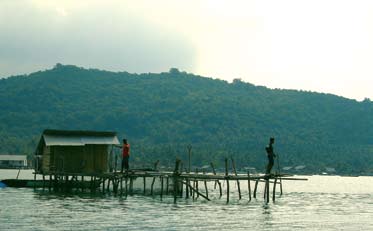
The Australasian CoE is undertaking a project in the
researchers from around the
· Undertake research related to coral bleaching and climate
ebrates and Marine Neurobiology.
Solomon Islands under the CRTR Program's Local
world. Considering the Centre's
issues, the development of stress markers, coral disease,
Government Initiative (LGI). Under this initiative the CoE
genetic connectivity and remote sensing.
access to leading international
will be working on-ground with local participants to incease
· Develop and run training courses for Australian and regional
understanding within the community of the benefits and
researchers, information, skills
developing country students in advanced materials and
costs of maintaining a healthy marine ecosystem.
and expertise, it focuses upon
techniques on coral reefs and environmental change.
Thailand
exchanging expertise and information
Indonesia
· Stimulate and build regional networks across the
Australasian, Indonesian and Pacific in research and
The CoE, with support from the Packard Foundation, has a
across the South Pacific, Indonesia and
Cross fertilize,
training expertise.
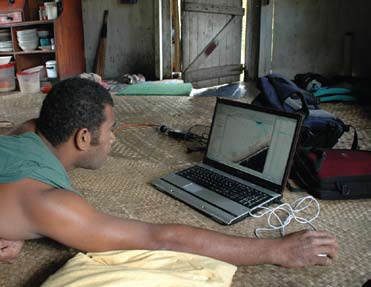
major research initiative in Indonesia focusing upon a tool
South Asia and is perfectly located to provide
package for managers for resilience-based reef management
Sponsoring and hosting study tours for senior managers
a sound platform for a variety of training activities.
· Support activities aimed at increasing regional capacity
under Dr Ken Anthony. Fol owing a scoping trip and fieldwork
from the Maldives and the Cook Islands to look at issues
for understanding and managing coral reefs under rapid
in the Karimunjawa Islands (Northern Java), the research
focusing on policy issues concerning coastal and coral
These include degrees, postgraduate studies, short
environmental stress.
team undertook assessment of the state of the reefs in the
reef ecosystems and implementation; the practical
courses, workshops, study tours and mentoring programs.
Karimunjawa Marine Park; selected field sites from different
application of marine protected areas; management of
Marine Park zones subjected to a range of threats, and;
tourism operations in a sensitive environment; latest
obtained a deeper understanding of the environmental and
research into coral reefs, and climate change policies.
The coral reefs of the
socio-economic pressures that these reefs are faced with.
Further results from this project wil be released at the end of
3. Networks
Australasian region are highly
2008 and in 2009.
Hosting a major international forum of 55 postgraduate
significant resources.
North Atlantic
Ocean
North Pacific
Maldives
students from 17 countries to establish networks, discuss
Ocean
focal areas of interest relating to research, management
The Australasian CoE is collaborating with the Maldivian
and communicating coral reef issues.
Ministry of Environment, Energy and Water on a project
Indian Ocean
titled `Capacity building in ecosystem-based management
4. Scholarships
South Pacific
South Atlantic
approaches to coral reefs and coastal areas in the Maldives'.
Ocean
Ocean
This collaboration has led to a program of training courses,
Supporting and sponsoring 10 postdoctoral research
study tours, and mentoring being developed which has led
fellows, 23 postgraduate students, two Masters students
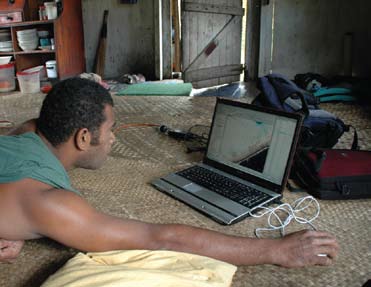
Fiji
to the increased knowledge of Ministry staff in ecosystem-
and three honours students, working across all research
based management functions, and the planning and
priorities.
Vitu Levu,
application of a management plan for an atoll.
Key activities under the
Sharing ideas,
Building knowledge, networks and expertise
Australasian CoE include:
skills and resources
1. Research
How we're
Getting involved
Thailand
The Australasian CoE is undertaking projects on:
The Australasian Centre of Excellence (CoE) is one of
making a real difference
across the region
An Australasian CoE-sponsored postgraduate student
based at The University of Queensland spent three
· Climate change.
four international centres under the Coral Reef
months in Thailand researching coral spawning and cross
· Tracing the origins of stress in the symbionts
As a leading, international knowledge centre, the
The Australasian CoE has been instrumental in undertaking
pollenisation of coral species.
of reef-building corals.
Targeted Research & Capacity Building
activities of the Australasian CoE focus on four areas:
a range of projects across several areas, including:
· Solar radiation and coral bleaching.
for Management (CRTR) Program. The
1. Research
Australasian CoE is based at the
Indonesia
· Ecology, physiology and molecular microbiology
2. Capacity building, including training courses,
Centre for Marine Studies at The
secondments, study tours and mentoring programs
A Memorandum of Understanding has recently been signed
of coral disease on the Great Barrier Reef.
between The University of Queensland and Diponegoro
· Great Barrier Reef water quality and connectivity
University of Queensland in
3. Communication and dissemination of research
University (Semarang), thereby formal y affiliating students
between coral reef ecosystems.
Brisbane, Australia, and at the
results and information
with an Indonesian university. The MOU includes training of
Heron Island Research Station.
4. Building networks and collaborations
postgraduate students; undertaking col aborative research
· New tools for managing ecosystem responses to
projects, and; joint efforts between institutions to build capacity
climate change on the southern Great Barrier Reef.
Heron Island Research Station
in the area of sustainable resource use and management
· Understanding the risk of ocean acidification
Specifically, the Australasian CoE's objectives are to:
will be re-opened in November
in Indonesia.
for coral reefs.
2008 after a destructive
· Provide a solid technical platform for the research and
training activities of the various Working Groups within
Thailand
fire during March 2007.
2. Training
the CRTR Program.
The station will be modern
Aq setting,
Sponsoring researchers and coastal managers from
· Establish critical equipment in preparation for research
Southeast Asia and the Pacific Islands to attend
and spacious and will cont-
and training activities of bleaching, disease, connectivity
and remote sensing Working Groups.
Solomon Islands
professional development courses in subjects, including
inue to attract high-profile
Coastal Resource Management, Tropical Marine Invert-
The Australasian CoE is undertaking a project in the
researchers from around the
· Undertake research related to coral bleaching and climate
ebrates and Marine Neurobiology.
Solomon Islands under the CRTR Program's Local
world. Considering the Centre's
issues, the development of stress markers, coral disease,
Government Initiative (LGI). Under this initiative the CoE
genetic connectivity and remote sensing.
access to leading international
will be working on-ground with local participants to incease
· Develop and run training courses for Australian and regional
understanding within the community of the benefits and
researchers, information, skills
developing country students in advanced materials and
costs of maintaining a healthy marine ecosystem.
and expertise, it focuses upon
techniques on coral reefs and environmental change.
Thailand
exchanging expertise and information
Indonesia
· Stimulate and build regional networks across the
Australasian, Indonesian and Pacific in research and
The CoE, with support from the Packard Foundation, has a
across the South Pacific, Indonesia and
Cross fertilize,
training expertise.
major research initiative in Indonesia focusing upon a tool
South Asia and is perfectly located to provide
package for managers for resilience-based reef management
Sponsoring and hosting study tours for senior managers
a sound platform for a variety of training activities.
· Support activities aimed at increasing regional capacity
under Dr Ken Anthony. Fol owing a scoping trip and fieldwork
from the Maldives and the Cook Islands to look at issues
for understanding and managing coral reefs under rapid
in the Karimunjawa Islands (Northern Java), the research
focusing on policy issues concerning coastal and coral
These include degrees, postgraduate studies, short
environmental stress.
team undertook assessment of the state of the reefs in the
reef ecosystems and implementation; the practical
courses, workshops, study tours and mentoring programs.
Karimunjawa Marine Park; selected field sites from different
application of marine protected areas; management of
Marine Park zones subjected to a range of threats, and;
tourism operations in a sensitive environment; latest
obtained a deeper understanding of the environmental and
research into coral reefs, and climate change policies.
The coral reefs of the
socio-economic pressures that these reefs are faced with.
Further results from this project wil be released at the end of
3. Networks
Australasian region are highly
2008 and in 2009.
Hosting a major international forum of 55 postgraduate
significant resources.
North Atlantic
Ocean
North Pacific
Maldives
students from 17 countries to establish networks, discuss
Ocean
focal areas of interest relating to research, management
The Australasian CoE is collaborating with the Maldivian
and communicating coral reef issues.
Ministry of Environment, Energy and Water on a project
Indian Ocean
titled `Capacity building in ecosystem-based management
4. Scholarships
South Pacific
South Atlantic
approaches to coral reefs and coastal areas in the Maldives'.
Ocean
Ocean
This collaboration has led to a program of training courses,
Supporting and sponsoring 10 postdoctoral research
study tours, and mentoring being developed which has led
fellows, 23 postgraduate students, two Masters students
Fiji
to the increased knowledge of Ministry staff in ecosystem-
and three honours students, working across all research
based management functions, and the planning and
priorities.
Vitu Levu,
application of a management plan for an atoll.


Building scientific capacity
Further Information:
and management capability
Professor Ove Hoegh-Guldberg
University of Queensland, Australia
Email: oveh@uq.edu.au
Project Executing Agency
Understanding
Coral Reef Targeted Research
& Capacity Building for
an essential asset
Management Program
c/- Centre for Marine Studies
The coral reefs of the Australasian region are highly
The University of Queensland
significant resources. They are essential to the health
of the regional economy, due to the fishing, tourism
St Lucia QLD 4072
and protection they provide to coastal communities.
Australia
The Great Barrier Reef underpins more than $4 billion
Telephone: +61 7 3346 9942
Australasian
of economic activity each year. Within the larger
Facsimile: +61 7 3365 4755
Australasian region, coral reefs are critical platforms
Email: info@gefcoral.org
Centre of Excellence
that support tens of millions of people through artisan
fisheries and the subsistence gathering of resources.
Like reefs in most parts of the world, coral reefs within
the Australasian region are under pressure from such
factors as declining water quality, over-exploitation and
climate change. Linking regions that face similar types of
Update
threats is one of the objectives of the Australasian CoE.
This sharing of ideas and resources will allow for better
management of coral reefs not only in the Great Barrier
Reef but also for those reefs adjacent to developing
countries. Many of the challenges facing reefs worldwide
are being researched both in Australia and in regions
outside the Great Barrier Reef.
Supporting research,
southern Great Barrier Reef.
This document is printed on r
The University of Queensland
training partnerships
The Australasian CoE is linking the advanced in-
frastructure and intellectual capital available in Australia
with the research projects and monitoring and assessment
Centre for Marine Studies,
programs already in place in the larger region, in order to
extend the knowledge base and management capabilities
for coral reefs. This partnership advances the aim of
the Australasian CoE to become a regional knowledge
ecycled stock
centre, as well as supporting regional collaborations in
Ove Hoegh-Guldberg,
research and training.
Coral community in the marine protected area at Heron Island,
Photo:
The Coral Reef Targeted Research &
The CRTR Program is a proactive research
Each of these research areas are facilitated The CRTR Program is a partnership between
Capacity Building for Management Program
and capacity building partnership that
by Working Groups underpinned by the
the Global Environment Facility, the World
(CRTR) is a leading international coral
aims to lay the foundation in filling crucial
skills of many of the world's leading coral
Bank, The University of Queensland (Australia),
reef research initiative that provides a
knowledge gaps in the core research
reef researchers. The CRTR also supports
the United States National Oceanic and
coordinated approach to credible, factual
areas of Coral Bleaching, Connectivity,
four Centers of Excellence in priority
Atmospheric Administration (NOAA) and
and scientifically-proven knowledge for
Coral Diseases, Coral Restoration and
regions, serving as important regional
approximately 50 research institutes and
improved coral reef management.
Remediation, Remote Sensing and
centers for building confidence and skills
other third parties around the world.
Modeling and Decision Support.
in research, training and capacity building.
July 2008
Product code: CRTR 011/2008