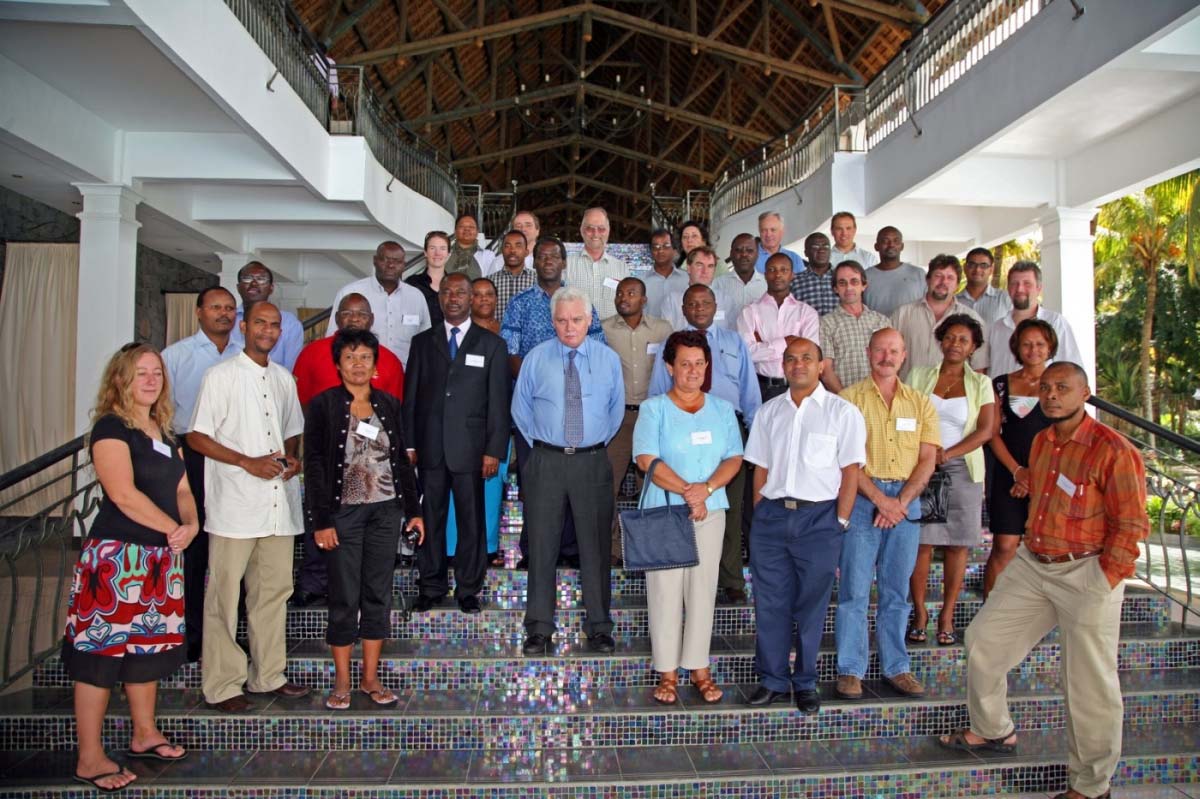



ASCLME Regional Project Coordination Forum
2-4 October 2008
La Plantation, Mauritius
Proceedings of the ASCLME Regional Project Coordination Forum
Contents
DAY ONE
1. Welcome and opening address
1
2. Introduction to the workshop and discussion of the agenda
2
3. Session 1: Project presentations
2
DAY TWO
1. Session 1: Project presentations (continued)
12
2. Session 2: Cruises
14
3. Session 3: Data and information
16
DAY THREE
1. Session 3: Data and information (continued)
18
2. Session 4: Capacity building and training
19
3. Conclusions and the way forward
20
ANNEX I: Provisional agenda for the workshop
23
ANNEX II: List of Participants
26
ANNEX III: List of Acronyms
28
i
Proceedings of the ASCLME Regional Project Coordination Forum
Proceedings
DAY ONE
2 October 2008
Registration commenced at 08h00
1. Welcome and opening address
The ASCLME Project Director, Dr David Vousden, warmly welcomed the UNDP Resident
Coordinator, Mr Claudio Caldarone, Dr Aubrey Harris, Secretary to South West Indian Ocean
Fisheries Commission, and all the members present. The Director remarked that the ASCLME Project
has been running for almost a year and is being implemented in eight countries in the region. He
further referenced the success of the 1st Regional Meeting of ASCLME Technical Coordination
Groups (COGs), which was held from 29 September to 1 October 2008 at the same venue. He
attributed the success to the active participation of closely-linked technical coordination working
groups. The Director mentioned that he was looking forward to the equally exciting Regional Forum,
which will run for the next three days. The ASCLME Regional Project Coordination Forum aims at
the realisation of better communication and coordination among national and regional marine and
coastal projects in the region. He also hoped that discussion during the meeting would lead to
improved communication that could be developed among the partners to yield better success of all the
projects. The Director also remarked on the warm welcome and encouragement provided by the
Minister of Environment and National Development Unit of Mauritius, Mr Lormus Bundhoo on the
very first day of the 1st Regional Meeting of ASCLME Technical Coordination Groups.
Mr Claudio Caldarone welcomed the representatives of regional projects and institutions, ASCLME
Project coordinators and all participants to the ASCLME Regional Forum. He raised the importance
of regional projects in contributing to sustained long-term ecosystem-based management in the region.
He noted that around 160 million coastal people are involved in coastal resource use and about one
third of them are directly dependent on the sea for food security. Thus, he believes that it is high time
to aim to provide each country the opportunity to engage in regional collaboration, raise awareness
and create mechanisms for cross-country dialogue. Joint activities and sharing of baseline scientific
data, especially for Small Island Developing States (SIDS), will help them realise these challenges.
This is an ideal way to mobilise all necessary efforts to map out the resources for better management.
He looked forward to an active and successful participation by the nations of the region.
Dr Aubrey Harris expressed his gratification in seeing such a broad group of stakeholders present, and
welcomed all members and participants. He emphasised that this is a very good opportunity to look at
the objectives and outcomes of various projects in the region. He highlighted the importance of having
an ecosystem-based approach to managing the fisheries in the region. He looked forward to increased
collaboration amongst projects for the benefit of the people of the region.
1
Proceedings of the ASCLME Regional Project Coordination Forum
2. Introduction to the workshop and discussion of the agenda
Mr David Laroche was nominated as the Chairman of the meeting.
The Chairman welcomed the members and requested self introductions by the participants. He then
briefly presented the programme for the meeting. The programme was endorsed by the delegates.
3. Session 1: Project Presentations
The representatives of the various projects made presentations as described below.
3.1 Agulhas and Somali Current Large Marine Ecosystems (ASCLME) Project was presented
by Dr David Vousden, Director of the ASCLME Project LINK TO THE PRESENTATION ON ASCLME.ORG
[4.1 MB]
The presentation covered the following points:
o Project Details:
· ASCLME System Boundary
· Project Objectives
· ASCLME Programme
· Project Outcomes 1-4
· ASCLME Regional Project Management Structure
o Progress to date
o Updates to LME websites
o ASCLME Research Cruises
o Project National Structure
· Summary of principal national COG inputs to ASCLME Project delivery
3.2 South Western Indian Ocean Fisheries Project (SWIOFP) was presented by Kaitira Ibrahim
Katonda, Interim Regional Coordinator, SWIOFP LINK TO THE PRESENTATION ON ASCLME.ORG [429 KB]
SWIOFP is a fisheries research and management module within an LME framework. The presentation
highlighted the following areas:
o Introduction 9 countries. Due to the present political situation, Somalia currently has an
observer status.
o Background problem: lack of information, capacity and structures
o Aims & objectives ecosystem approach to marine resource assessment and management
o Specific objectives
o Six components were described, including planned activities, with subcomponents in some
cases
o Three phases depending on timing of implementation
o Project management structure includes:
o Regional Management Unit RMU
o National management units NMUs
o National component coordinator (NCC)
o Regional component coordinator (RCC)
2
Proceedings of the ASCLME Regional Project Coordination Forum
o Regional component working groups (RCWG) standardisation of data collection
o Memorandum of Understanding (MoU) developed and signed by each of the participating
countries except France
o Integration of SWIOFP, ASCLME & WIO-LaB to achieve a pragmatic approach
o Specific areas of co-operation
o ASCLME productivity data will be used to explain the abundance and distribution of
fisheries in the region
o Sharing of staff
o Sharing of Nansen cruise time
o Plan to consult for 2009 cruise
o SWIOFP is restricted to the EEZs (i.e. not high seas) of participating countries.
3.3 Addressing Land-Based Activities in the Western Indian Ocean (WIO-LaB) was presented
by Johnson Kitheka, representative of WIOLaB: LINK TO THE PRESENTATION ON ASCLME.ORG [2.3 MB]
The presentation covered the following areas:
o WIO-LaB addresses issues related to degradation of the coastal environment of the Western
Indian Ocean due to land-based activities
o Eight countries are involved
o Three main objectives under the auspices of Nairobi Convention
o Project coordination structure
o Project management unit; national focal point institutions, national/inter-ministerial
coordination committees
o Project governance focal points forum; project Steering Committee
o Technical working groups and task forces
o Informal structures for stakeholder consultation and involvement in the WIO region
o National nodes for the Clearinghouse Mechanism
o TDA drafting task team
o Eight components of the project, including 10 demonstration projects
o Main thematic areas and activities
o Thematic areas for training
o Regional assessment and reviews
o LBA TDA and SAP
o Consultative meetings on TDA-SAP
o Key features of the WIO-LaB TDA/SAP process
o Key transboundary problems/issues
o Underlying root causes
o Validation of TDAs
o SAP for addressing land-based activities in the WIO region
The Chairman highlighted the advantage of having members of WIO-LaB also being the National
Focal points or COG members for ASCLME, which will help to ensure continuity with the ASCLME
efforts.
3
Proceedings of the ASCLME Regional Project Coordination Forum
3.4 Western Indian Ocean Projects of the IRD/France - presented by Jean-Francois Ternon:
LINK TO THE PRESENTATION ON ASCLME.ORG [5.1 MB]
The presentation included the following areas:
o The IRD THETIS/EME research unit
o Exploited marine ecosystems WIO (tuna fisheries and marine top predators), Pacific (Peru),
Benguela Current (upwelling systems, small pelagic fisheries).
o THETIS within SWIOFP/ASCLME SWIOFP, EU (MADE), French national ANR
programmes (REMIGE, BIOPS)
o Participation in leg 4 of the 2008 Dr Fridtjof Nansen cruises
o Capacity building in SWIO Region on pelagic fishes and ecosystems
o MESOP 2009 mesoscale dynamics influence on pelagic resources, focus on physical
processes associated with eddies in the Mozambique channel
o Scientific questions
o Physical processes versus biological signature
o Mesoscale activity within the Mozambique channel: evidence from biology and impact
on exploited resources
o Gaps could be bridged along with aims of ASCLME & SWIOFP
o The perspectives for MESOP
o Other projects of THETIS in the WIO Region
·
FP7 MADE 2009-2010
·
ANR BIOPS 2008-2010
·
ANR REMIGE September 2009
o Long-term research actions
o IRD Research Vessel Antea in the region in coming years (2009-2010)
3.5 African Coelacanth Ecosystem Programme (ACEP) was presented by Dr Tommy Bornman,
representative of ACEP: LINK TO THE PRESENTATION ON ASCLME.ORG [2.1 MB]
In introducing the presentation by ACEP, the Chairman clarified the significant role that ACEP had
undertaken in getting the ASCLME project up and running and the on-going close partnership that
exists between ACEP and the ASCLME.
The following points were presented:
o Introduction
o ACEP phases I (2002) & II (2007-2011)
o Difference between ACEP I & II
o Objectives for ACEP II
o Funded projects (2008-2011)
o ACEP cruise plans
·
ROV procurement
·
Coastal research platform
The Chairman indicated that in 3-4 years time the results from these efforts will contribute towards
the realisation of the ecosystem-based management of the marine and coastal resources in the region.
4
Proceedings of the ASCLME Regional Project Coordination Forum
3.6 Western Indian Ocean Marine Science Association (WIOMSA) was presented by
Melckzedeck Osore: LINK TO THE PRESENTATION ON ASCLME.ORG [1.8 MB]
The following was presented:
o Background to WIOMSA
o MASMA 5 components
o Research grants 5 activities
o Publications (e.g. Journal of Marine Science WIO, Ambio, Estuarine Coastal and Shelf
Science, Ocean and Coastal management, books, technical reports and publications in the
pipeline )
o Projects
o Completed research projects
o Ongoing research projects
o Newly launched projects
o WIOMSA interest in ASCLME
o Exchange of information
o Organisation of joint activities
o Increasing engagement of regional institutions
3.7 IOC/UNESCO Projects in the WIO Region was presented by Mr Mika Odido:
LINK TO THE PRESENTATION ON ASCLME.ORG [5.1 MB].
The presentation covered the following areas:
o Objectives
o IOC regional groupings
o Activities
o Capacity building/development strategy 3 areas
o Capacity Development (CD) Phase I institutions workshops for heads of marine-
related academic/research institutions in the region; proposal writing workshops;
decision support tools; modelling workshops
o Other topics in capacity development
o Sea level monitoring network
o Tsunami sea level station monitoring facility
o Development of databases
o Development of the African Marine Atlas
o Development of the African Ocean Portal
o Assessments undertaken
o ODINAFRICA IV
o Possible areas of collaboration with ASCLME
o Assessment of capacities available
o Further development of the African Marine Atlas
o Capacity building/development
5
Proceedings of the ASCLME Regional Project Coordination Forum
Discussion
It was suggested that a website be developed to carry the posting of the summaries of the projects
presented during the Forum meeting. It was agreed that the ASCLME Project will facilitate the
development of such a web facility, which will have links to the websites of the relevant projects such
as the ODINAFRICA and the Nairobi Convention CHM.
Judging from the information presented by the projects it is clear that there is sufficient knowledge to
guide management actions.
It was noted that national data centres used during ACEP I would be part of the ASCLME network. It
was also clarified that ACEP II is not isolated from the regional effort, despite only funding South
African research at present. ACEP is an integral part of the ASCLME, as described in the Project
Document that has been signed by the countries of the region. Concern was expressed by participating
countries regarding the lack of publication from the work done and results obtained by ACEP I. The
presenter clarified that arrangements were being made for the publication of those results under ACEP
II, with assistance from ASCLME.
The delegates agreed that the meeting had provided a valuable avenue for exchange of information
and experiences. As a consequence it was suggested that the Forum should meet periodically, for
example once a year, to discuss how resources could be shared in a cost-effective way among ongoing
projects in the region and continue with exchange of information and experiences. It was further
agreed that the Forum should reconvene during the WIOMSA Scientific Symposium, which is
planned for August 2009. It was proposed that the ASCLME website be a platform for posting
information on the Forum activities.
3.8 Food and Agricultural Organisation (FAO) Projects in the WIO were presented by Aubrey
Harris (Secretary, SWIOFC) and Kwame Koranteng, FAO Representative (Rome)
The SWIOFC Commission and its various activities: LINK TO THE PRESENTATION ON ASCLME.ORG [1.6
MB]
o Background and history
·
1980 SWIOF
·
1990 IOTC
·
1999 Fisheries Commission to FAO council
·
2004 SWIOF Commission
o What is it?
·
Advisory fisheries commission
·
Objectives
·
Eligible members
·
Right to attend
·
Observers
o Operation
·
Rotating chair and bureau
·
Secretary
·
Session
Scientific
6
Proceedings of the ASCLME Regional Project Coordination Forum
Other committee or working parties
o Decision by majority, usually is general consensus
o Supporting activities
·
Travel support
·
Training workshops
·
Ecosystem approach to fisheries management
·
Working party on fisheries
o 3rd session
·
Seychelles safety at sea projects
·
Regional conference on fisheries development
o Summary
·
Commission structure to turn scientific information and recommendations into agreed
regional fisheries policy and management
·
Rarely absolute answers; management should be based on the best of our knowledge
o FAO projects
·
Multilateral
o FAO assistance
·
Ad hoc assistance on request
o Recent and new projects
·
Ecosystem approach to fisheries Nansen project
·
Strategic interventions in fisheries and aquaculture in Africa
o Areas of collaboration with ASCLME
·
Strengthening the monitoring of artisanal and small scale fisheries (catch, value, socio-
economics)
·
Increase contribution of fisheries to poverty reduction
The EAF-Nansen Project: LINK TO THE PRESENTATION ON ASCLME.ORG [12 MB]
o Nansen survey 1975-2007
o Description of the EAF-Nansen Project
Long-term objectives of this project:
Project organisation
Funded by NORAD
Expected results
o Collaboration with ASCLME
o ASCLME to take onboard EAF principles to influence policy and management
o Providing additional data for TDA
o GIS & EAF (expert meeting in progress in Rome)
o Other project contributions to the TDA process
o RAG for SWIOFC region discussions in Maputo
o Formal participation of ASCLME in NTGs
7
Proceedings of the ASCLME Regional Project Coordination Forum
Ecosystem surveys and special studies R/V Dr Fridtjof Nansen: LINK TO THE PRESENTATION ON
ASCLME.ORG [11 MB]
o Introduction
o Access to the vessel
o To request for Nansen time, the survey of fisheries or ecosystem approach should be
one of the objectives.
o What does the vessel do at sea?
o Research activities onboard the Dr Fridtjof Nansen
o In the ASCLME survey, what needs to be done is summed up in the Sailing Orders. EAF
Nansen and FAO are particularly pleased with this approach. Research activities include:-
o Meteorological and hydrographic sampling
o Seafloor mapping
o Fish biomass estimates
o Biological fish sampling
o Capacity building
o Data and information policy
o IMR maintains the database (Nan-SIS)
o Data belongs to governments
o Reporting
o Who participates in the surveys?
o Who pays the bill?
·
USD$23,000 per day
·
USD$10,000 (ASCLME) and USD$13,000 (FAO)
General Discussion
The Chairman opened the floor for discussion to allow delegates to reflect on the presentations. The
ASCLME Project Director thanked Mr Koranteng and the FAO for their ongoing support of the joint
cruises. He also assured them that the ecosystem approach is always at the forefront of the ASCLME
project activities.
The Chairman highlighted the cost effectiveness and the geographical coverage of the Nansen
compared to other locally available research vessels.
3.9 Indian Ocean Commission (COI) Projects in the WIO were presented by Gina Bonne,
Executive Director, COI: LINK TO THE PRESENTATION ON ASCLME.ORG [422 KB]
o Overview
o Intergovernmental organisation
·
for regional cooperation
·
to safeguard the interest of its island states
o Outline of the strategy
o Political, diplomatic and security
o Economic
o Environment
o Human safety
o Structure of organisation
·
Head office
8
Proceedings of the ASCLME Regional Project Coordination Forum
·
Permanent liaison officer
·
Council of ministers
·
Head of state summit
·
Head office (secretariat general)
·
5 officers in charge
o Partners
·
Member states
·
Regional organisations (COMESA, EAC, IGAD, AU and SADC)
·
International organisations (UN agencies UNDP, UNEP, FAO, UNICEF, UNESCO
etc.)
o Funding agencies
·
European Commission
·
African Development Bank
·
World Bank
·
French GEF
o Projects and programmes
·
Pilot project education for environment
·
Coral reef monitoring/Coremo
·
Regional environment programme
·
Regional oil spill contingency planning
·
Regional marine protected areas programme (RAMP-COI)
·
Control monitoring and surveillance
·
Regional tuna tagging project
·
Regional fisheries surveillance plan
·
WIO marine highway programme
·
Regional programme for the sustainable management of coastal zone
·
Regional climate change adaptation project
·
African Monitoring of the Environment for Sustainable Development (AMESD)
·
Programmes in perspective
·
Regional cetacean conservation project
·
Regional fisheries management project
3.10 Reseau des aires marine protégées des pays de la COI (RAMP-COI) was presented by
Denis Etienne: LINK TO THE PRESENTATION ON ASCLME.ORG [8.3 MB]
o MAP network in the region
o Maintain biodiversity through well-managed prevailing networks
o Five countries
o Funding: 2 M Euros
o Motivation
·
high biodiversity in the region
·
many anthropogenic threats
o 26 MPAs created but little management
o Components:
·
create a regional strategy
·
hotspot identification
·
bathymetry
9
Proceedings of the ASCLME Regional Project Coordination Forum
·
surface currents
·
coral reef diversity
·
reef fish biodiversity
·
creation and support of existing MPAs
·
regional forum for managers to meet once a year
·
sensitisation of people about the importance of creating MPAs
o Links with ASCLME
·
Exchange of data
·
Studying connectivity/larvae
·
Strengthening capacity
·
Socio-economic analyses
3.11 Cetacean & dugong study and conservation was presented by Denis Etienne: LINK TO THE
PRESENTATION ON ASCLME.ORG [1.9 MB]
o Five countries
·
1979 Indian ocean sanctuary creation
·
Whaling problems
o Reasons
·
Lack of information, e.g. on dugongs
·
Threats
·
Locals are not aware of threats
·
Degradation/economic loss
·
No regional coordination so far
o Steps
o Objectives
o Components:
·
Creation of a network
·
Ecotourism & sensitisation
·
Dugongs (in Madagascar, Seychelles, Comoros)
·
Way forward
·
Funding 3-4 M Euros
·
Coordination with ASCLME
·
Collect data on cetaceans links to the TDA
·
Biodiversity & SWIOFP
3.12 GEF-WIO Marine Highway Development and Coastal Marine Contamination Prevention
Project was presented by Raj Prayag: LINK TO THE PRESENTATION ON ASCLME.ORG [5.7 MB]
WIO regional oil spill contingency plan project (3.1 M Euros)
o 5 countries
o Global objectives
· Reactive approach
· Develop manual
· Training
· CB&T
· Sustainability
10
Proceedings of the ASCLME Regional Project Coordination Forum
o Components
o Performance indicators
o Proposed marine highway development (initiated 2003)
Introduction
Five countries
Project sites
Regional maritime traffic
5000 trips, 500 m tons of oil products
Creation of highway in the Mozambique Channel
Implemented in various phases
Hydrographic surveys carried out on proposed routes and will be provided to
captains of appropriate ships
Products of the respective components:
· Electronic nautical charts will be produced
· Sensitisation for coastal and marine protection
· Sensitive sites
· Integration of IMO conventions
· Coordination with other related GEF supported projects
· Implementation status
The Project Director noted that many projects are underway in the region and can provide significant
synergies with ASCLME activities, and that there are many potential advantages for coordination.
Identifying and realising this potential synergy and reaching cooperative agreements was one of the
fundamental purposes of this forum. He thanked each of the presenters. The Chairman added that as a
project developer it is exciting to be in a meeting of this nature and to see what happens when a
project like ASCLME grows and flourishes.
The meeting noted that consultations, collaborations and awareness are key issues. It was suggested
that a review of the experience of the consultations carried out in the region over the last five years
could help identify weaknesses and strengths in collaborations.
The first day of the meeting ended at 18h00.
11
Proceedings of the ASCLME Regional Project Coordination Forum
Proceedings
DAY TWO
3 October 2008
The second day of the Regional Forum started at 08h40
1. Session 1: Presentations (continued)
Chairman: Mr David La Roche
3.13 Regional Programme for the sustainable management of the coastal zones of the Indian
Ocean countries (ReCoMap / ProGeCo) was presented by Winfried Wiedermeyer: LINK TO THE
PRESENTATION ON ASCLME.ORG [5.4 MB].
The following points were addressed in the presentation:
o Background
o 5yr programme IOC
o EU-funded 18 M Euros
o Regional Coordination Unit
o ReCoMap National ICZM officers in each country
o 7 countries partners
o 2 projects in Somalia
o Regional structure
o 7 Thematic areas:
·
Management of coastal resource use
·
Capacity building
·
Sensitisation on ICZM
·
ICZM structures and plans
·
Capacity building for MEAs
·
ICZM implementation through Non-State Actors (6.5M Euro)
·
Regional policy consensus and Networks
o Activities: Fisheries
·
Kenya & Madagascar
·
Mauritius/Rodrigues assembly
·
Seychelles
·
Tanzania
o Regional SOCMON-WIO Manual
o CORDIO
o MASMA
o WION managers network
o MPA handbook in French
o WIOMSA COMPASS programme
o MPA grants (Euro 600,000)
o MPA Regional Training Capacity
o Activities: Coastal Zones
·
Coastal tourism: Mauritius
·
Solid waste management regional
·
ICZM: support to national ICZM bodies and frameworks
o ReCoMap ICZM short courses
12
Proceedings of the ASCLME Regional Project Coordination Forum
o Training course CHARM, Thailand
o Activities: Non-state actors participating in ICZM
o Main themes
·
Marine resources
·
Soil erosion
·
Coastal erosion
·
Solid waste management
·
Waste water management
o National Data Nodes
o Web-based ICZM KMS
o Regional assessments
·
GIS
·
Coastal mariculture
·
IOC coral reef network
·
Coastal tourism/SEAs
·
Solid waste management
·
WIO cetacean network
3.14 International Knowledge Management was presented by Francois Odendaal: LINK TO THE
PRESENTATION ON ASCLME.ORG [302 KB]
The presentation included the following:
o Origin of the DLIST approach (www.dlist.org)
o Obstacles in the way of sustainable development
·
Whose reality counts? people on ground, target people with lack of information and
access to information
·
The information divide
·
Compartmentalisation of information flow
·
Informed participation
·
Engagement
o Distance learning information
o Components of the web-based platform: information sharing
o General activity
o Courses: 5 different courses, 4 tertiary institutions
o Stakeholder participation for a better future
o ICZMC
o Cleaner production course
o ASCLME different languages
o ICT: reaching beyond connectivity
·
Radios
·
Cell phones
·
Travelling film festival
·
Using country television networks
·
Using local networks, structures, mechanisms and programmes
o Enriching the TDA and the SAP through the DLIST approach
o From before, to steps ahead
o Example: Antingil Bay, northern-eastern Madagascar
13
Proceedings of the ASCLME Regional Project Coordination Forum
3.15 GOOS-Africa projects and CLIVAR/TRIO Projects were presented by Dr Juliet Hermes:
LINK TO THE PRESENTATION ON ASCLME.ORG [GOOS [14 Megabytes] / CLIVAR [5.4 Megabytes] / TRIO [7.6 Megabytes]
o New marine observing systems around Africa
o Cooperation: African LMEs & GOOS-Africa
o Vision of GOOS-Africa
o CLIVAR
o Ferry Box-Africa
o Drivers: societal issues
o Indian Ocean Observing System (IndOOS)
o RAMA
o ARGO floats
Discussion
The discussion that followed centred on the DLIST presentation. With regard to language barrier
related to DLIST activities, it was clarified that information would be translated to the communities to
establish a good link between science and people; language should not be a barrier. Currently three
main languages (English, French and Portuguese) are being employed and computers are also
reaching rural areas. It was further clarified that the DLIST is not the full communications strategy but
is part of the strategy that ASCLME programme would like to adopt.
2. Session 2: Cruises
Chairman: Mr Mike Roberts
A summary of the deliberations on the planning for the ASCLME cruises presented by Tommy
Bornman, Regional Cruise Coordinator: LINK TO THE PRESENTATION ON ASCLME.ORG [4.1 M]
(a) 2009 Cruise
· East Africa Current Survey (Kenya, Tanzania, Mozambique with 4, 3 and 1 environmental
lines, respectively)
· Comoros Basin Survey (4-5 Environmental lines & moorings)
(b) 2010 Cruise
· 60 days available on R/V Dr Fridtjof Nansen
o
West Madagascar Shelf
o
Mozambique Shelf
o
Fill data gaps
· 20 days on Nansen for research on seamounts
· 60 days on FRS Algoa
o
Natal Bight
o
Agulhas Bank
· 3 - 6 day training cruise
(c) Cruise planning requirements were identified:
· Cruises to be planned
o
2009 - URGENT
o
2010
14
Proceedings of the ASCLME Regional Project Coordination Forum
· Discuss & agree on:
o
Area of operation
o
Research needs (gaps)
o
Scientific work plan
o
Scientific expertise/training required
· National Cruise Coordinators
o
National COG
o
National scientists
o
Regional Cruise Coordinator & PCU
(d) Appropriate training and capacity building requirements were identified:
· Training cruise
o
ASCLME training programme
o
Large research ships & coastal craft
o
Oceanography & fisheries
o
2008: Two trainees from South Africa, Mozambique, Madagascar, Mauritius
and Seychelles. Location: Cape Town
o
2009: Two trainees from Tanzania, Kenya, Somalia and Comoros. Location:
Cape Town
· On-board training on Dr Fridtjof Nansen
o
ASCLME Research Cruises
o
Scientists from region
· Oceanographic equipment
Discussion
It was noted that the ASCLME would be working with other projects such as: CORDIO to look at
coral reef and larvae in the Comoros, similar projects funded by MASMA and Dutch teams to look at
bottom sediments and physics in the East Madagascar current in order to assess seasonal variability,
as well as the GEF Global Seamounts project in the southern Indian Ocean.
Discussion centred on:
o Moorings:
o ACEP funded the deployment of moorings around the Western Indian Ocean, but funding
for servicing was not sustained. These moorings can be used by other projects.
o Buoys for the collection of near real-time data
o Ocean tracking network
o ACEP II restricted to SA
It was suggested that it would be necessary to establish a programme or routine for repair,
monitoring or replacement of existing mooring buoys, possibly assisted through the use of
schedules similar to those for the vessels.
The delegates were informed that a website will be created and relevant information could be sent
to the PCU of the ASCLME so that everybody can see what is going on in the region. It was also
noted that CLIVAR has a similar website.
15
Proceedings of the ASCLME Regional Project Coordination Forum
Collaboration with the private sector was proposed for the collection of data in this area (for
oil/gas exploitation). An example was cited of the South African company that has deployed
moorings, although they do not necessarily share data.
It was further suggested that sharing of cruise plans could facilitate improved planning by all
projects, and allow for shared ships' time, and/or data exchange to address the spatial and
temporal gaps in surveys. There may be an opportunity for a meeting in Seychelles in November
2008 (in conjunction with the ASCLME Steering Committee meeting) to plan SWIOFP-ASCLME
cruises.
It was clarified that biodiversity studies have been scheduled for the seamounts.
It was also suggested that the ASCLME Cruise Coordinator should communicate/liaise with
THETIS/IRD regarding the French cruises scheduled in the region.
It was noted that IOC programmes have cruise announcements on websites.
It was proposed that the ASCLME Regional Coordinator for Data and Information would send out
requests to projects for inputs regarding their project activities and use of ship time. and the
gathered information would be put on the website as a starting point. Similarly, others engaged in
similar cruise activities could also post their activities. The details of the online tables were
discussed.
Note was taken regarding circulation of the documents to the countries and cruise coordinators /
projects and then circulated back to have further comment on the cruise plan, with a deadline
before the FAO coordination meeting in December 2008.
3. Session 3: Data and information
The summary of the deliberations on data and information were presented by Lucy Scott,
ASCLME Regional Coordinator on Data and Information: LINK TO THE PRESENTATION ON
ASCLME.ORG [4.3 MB). The presentation gave an update from the Regional COG meeting as follows:
o Preparation of activities, 2004
· Regional projects and programme collaboration encouraged
o Recent development
· Nairobi Convention Clearinghouse Mechanism
· Data nodes
· ODINAFRICA / African Marine Atlas
· ACEP
· Long-term ownership of data by participating countries (data centres)
o ASCLME approach and update
· COGs
· Data coordinators
· Continuity of ACEP
· MEDA
16
Proceedings of the ASCLME Regional Project Coordination Forum
· Data management plans developed by countries
· COG meeting: ASCLME document guidelines and principles for data management
· Overall framework for D&I management.
· Collaborations
· Summary document of profiles of WIO regional projects
· Presentation: Ocean data and information network for Africa ODINAFRICA (Mika Odido
LINK TO THE PRESENTATION ON ASCLME.ORG) [5.1 M]
The following was addressed in the presentation:
o ODINAFRICA the Network
o ODINAFRICA III Goals
o Coastal observations
o Sea level stations
o Near real-time data access
o Sea level training course
o Co-location of GPS stations
o Data management
o Information management
o Products development
o Marine biodiversity
o Development of the African Marine Atlas
o Improvement of internet access
o Public awareness
o ODINAFRICA IV coordination
o Development of national atlases
o Other product development
o Establishment of Ocean Data Portals
o Portal Geospatial query interface
o Web-based data and information services
o Publications online
o Outreach activities
Day 2 of the Regional Forum ended at 14h50. Participants proceeded to the Port-Louis
harbour to visit the vessel and participate in the function.
17
Proceedings of the ASCLME Regional Project Coordination Forum
Proceedings
DAY THREE 4 October 2008
Day 3 of the meeting started at 08h55
The Chairman welcomed the participants.
1. Session 3: Data and information (continued)
· Presentation of the Nairobi Convention Clearinghouse and Information Sharing System
(Mr Mwangi Theuri LINK TO THE PRESENTATION ON ASCLME.ORG [13 MB)
The presentation highlighted the following points:
o Purpose and obligations of the Nairobi Convention
o Article 14: Scientific and technical co-operation
o Decision 4/8 of 4th CoP (2004)
o Objectives of the Clearinghouse Mechanism (CHM)
o Theory behind the CHM
o Expected impacts of the CHM
o Nairobi Convention CHM Benefits enhanced visibility of the region attracting new funding
o Implementation structure
·
UNEP + 8 national institutions
·
Regional collaboration
o CH progress since 2006
o Website of the regional Clearinghouse Mechanism
o Some capabilities
o CHM sustainability strategy (ownership of data by involved nations)
o National nodes of Tanzania and other countries
o Way forward with ASCLME
Discussion
It was noted that the data from regional projects should also be kept in national data centres to secure
sustainability of collection and continued use after projects end. Thus coordination of collection and
storage of data on a continual basis is imperative. It was highlighted that the data need to be
transformed into useful information for ecosystem-based management.
It was further noted that ASCLME could give support in the long term to identify activities for
sustainability, capacity building, data analysis and access to information important for the Strategic
Action Programme (SAP) as well as seeking additional funding opportunities.
The delegates urged the participation of France in the Clearinghouse Mechanism in future since
France is a contracting party to the Nairobi Convention.
Note was taken that data collected would be published in peer-reviewed journals and transformed into
information useful for ecosystem-based management actions.
18
Proceedings of the ASCLME Regional Project Coordination Forum
It was also noted that FAO do not analyse data statistically but act as a data repository and organiser.
Statistical analyses need technical staff, which is provided by the countries.
Specific discussions concentrated on the following themes:
a)
Repatriation of cruise data
The forum was informed that the ASCLME has developed guidelines for data sharing, which will be
applied in the region, and a clear mechanism to ultimately publish and submit the data to respective
countries' data centres would be adopted by the ASCLME Project.
In addition it was noted that specimens collected by the ASCLME will be safely preserved and kept at
museums or institutions with the right expertise for identification and repatriation to respective
countries.
It was also highlighted that FAO has a structure for a regional task group to meet and discuss relevant
issues and it was suggested that both SWIOFP and ASCLME could nominate their representatives to
attend these meetings.
b)
Sustainability of archives
It was suggested that nationals be empowered to archive project data & information at both regional
and national institutions.
It was noted that data management is a professional activity, requiring skills and training. Retaining
capacity for data management is challenging due to high turnover of government employees. After
some time, people and facilities are often lost. Another challenge is that national focal points do not
always share data with other local institutions. Thus governments must be committed to have local
structures to archive as well as to share data and/or metadata.
It was proposed that diversification is the answer through the use of national, regional and global
(e.g. The World Ocean Database) data centres for the archiving of new data.
The Chairman highlighted the complexity of D&I management. It was suggested to arrange for D&I
coordinators from SWIOFP, ODINAFRICA and ASCLME to meet physically to discuss and resolve
some of the challenges.
2. Session 4: Capacity building and training
Warwick Sauer presented an update from the ASCLME COG meeting.
The Regional Capacity Building and Training Working Group for the ASCLME Project agreed to:
· Work with the focal points of each country.
· All correspondence from each group will be copied to all members of the COG and the
Focal Institutions.
In terms of appointing someone to collect the information:
19
Proceedings of the ASCLME Regional Project Coordination Forum
· COGs agreed to design a common tender (all countries), translated into the appropriate
language
· The COG and PCU would make the final selection.
The following were noted:
In terms of 2009 training requirements:
· The COG Coordinators for CB&T had agreed to hold the 2009 training course in Cape
Town.
· Comoros mentioned that the requirements for nominating students stated the need for an
ability to be able to speak English.
· In this context, language issues need to be addressed and the training institutions
approached to discuss the feasibility of training in French or Portuguese.
· The course outline will be sent to all members for comment following a review of
feedback from the 2008 course.
· People trained last year may be able to accompany the ship if space allows.
· Cruise planning must be carried out with training needs in mind.
· The D&I group would provide training input for GIS and remote sensing.
· If required for ASCLME MEDA development, countries would forward any urgent
training requests for 2009.
Training Plan framework:
· Minor changes were suggested.
· A copy of the BENEFIT Training Plan would be sent to all.
General Discussion:
It was noted that depending on the course content of cruise training and capacity needs assessment,
training sessions could be synchronised with SWIOFP and FAO training sessions.
The Chairman pointed out that the three projects (ASCLME, SWIOFP and WIO-LaB) had agreed
that coordinators would meet and exchange information.
3. Conclusions and the way forward
A summary of the salient discussions, conclusions and the way forward was provided by Dr
David Vousden, Director of the ASCLME Project.
· What activities are underway in the WIO region?
The questions we need to ask each other include:
Who is doing what and where?
Who is planning cruises?
Where will the cruises go?
What scientific questions are being answered?
What equipment is being deployed?
What other forms of data are being collected in the field?
Where (which countries and areas)?
When and using what methods?
20
Proceedings of the ASCLME Regional Project Coordination Forum
Where will this data be stored and who has access?
What capacity building activities are taking place and in which institutions/countries?
What training courses/mechanisms are planned and for what purpose?
Who will be trained?
· How can we coordinate activities?
· What are the opportunities for Cooperation and Coordination? (based on the answers to
the questions)
Timing
Cost-sharing
Realignment between projects to balance needs
Agreements for sharing of data and access
Country agreement
On-going partnership and mutual monitoring of progress and activities (e.g. Steering
Committee and Technical Group membership)
· Possible mechanisms for coordination
What mechanisms should we put in place to be able to share information on project activities and
aims?
Use of website(s)
Bilateral cooperation
How can we ensure/encourage that these mechanisms are used and updated frequently?
Reminders to update website information
Coordination workshops
Who will take responsibility for this coordination role?
WIOMSA?
The ASCLME Programme?
Nairobi Convention?
· Has the Forum been a useful exercise?
· What has been particularly valuable about this meeting?
· How could we improve the meeting if we hold one in future?
· How would we wish to continue this process?
Possible draft Regional Project Coordination Paper (mechanisms, responsible parties
and funding sources, endorsement/inclusion of policy-makers)
Discussion at next WIOMSA Symposium in Reunion, August 2009
Conference on Contribution of Fisheries to MDG
Endorsement by the Nairobi Convention/SWIOFC/COI?
In order to facilitate the process, the ASCLME Project Director made an offer to develop a draft
Project Coordination document that would provide options for ongoing coordination and for a further
Forum meeting.
It was proposed that a special session at the WIOMSA 2009 meeting report on the science of regional
projects. It was agreed that a second forum coordination meeting would be held at the 6th WIOMSA
Science Symposium in Reunion.
21
Proceedings of the ASCLME Regional Project Coordination Forum
It was suggested that additional projects and international institutions active in the region, be invited
again, and that if lead-up time were longer, representation would be better.
It was proposed that the outcomes from the WIOMSA meeting be taken to the conference on
contribution of Fisheries to the Millennium Development Goals, where policy makers would be
meeting. This would help endorsement and adoption of outputs at higher levels.
The Project Director highlighted the really valuable contribution brought by all the participants to the
Regional Forum. He sincerely thanked the ASCLME team as well as the Chairman and Marie-Ange
from the UNDP Country office of Mauritius and Seychelles.
The Regional Forum closed at 12h20.
22
Proceedings of the ASCLME Regional Project Coordination Forum
ANNEX I. Provisional agenda for the workshop
ASCLME Regional Project Coordination Forum
2-4 October 2008
La Plantation, Mauritius
Provisional agenda
Time
Thursday 2 October (day one)
Speaker
08h00
Registration
08h30
Welcome and opening address
David Vousden (ASCLME), Claudio Caldarone (UNDP), Representative (Mauritius)
09h00
Introduction to the workshop and discussion of the agenda
Magnus Ngoile
09h20
Agulhas and Somali Current Large Marine Ecosystems (ASCLME) Project
David Vousden
10h00
Tea/coffee
10h30
South Western Indian Ocean Fisheries Programme (SWIOFP)
Kaitira Katonda
10h45
Addressing Land Based Activities in the Western Indian Ocean (WIO-LaB)
Johnson Kitheka
11h00
Discussion
11h15
Western Indian Ocean Projects of the IRD/France
Jean-Francois Ternon
11h30
African Coelacanth Ecosystem Programme (ACEP)
Tommy Bornman
11h45
Western Indian Ocean Marine Science Association (WIOMSA)
Melckzedeck Osore
12h00
IOC/UNESCO Projects in the WIO Region
Mika Odido
African Monitoring of Environment for Sustainable Development
12h15
(AMESD)
12h30
Discussion
13h00
lunch
Aubrey Harris and Kwame
14h00
Food and Agricultural Organisation (FAO) Projects in the WIO
Koranteng
1. The SWIOFC Commission and its various activities
2. The EAF-Nansen project
3. The Ecosystem surveys and other studies conducted by the RV Dr Fridtjof Nansen
14h45
GOOS-Africa Projects and CLIVAR/TRIO
Juliet Hermes
15h00
Discussion
15h15
Tea/coffee
15h45
Indian Ocean Commission (COI) Projects in the WIO
Gina Bonne
Regional Programme for the Sustainable Management of the Coastal Zones
15h55
of the Indian Ocean Countries (ReCoMaP / ProGeCo)
Jim Anderson
16h10
RESEAU des Aires Marines Protégées des pays de la COI (RAMP-COI)
Denis Etienne
GEF-WIO Marine Highway Development and Coastal and Marine
16h25
Contamination Prevention Project
Raj Prayag
16h40
International Knowledge Management
Francois Odendaal
17h00
Other projects (5 minutes per project)
Contributions from the floor
17h30
Discussion
18h30
Evening function: icebreaker
23
Proceedings of the ASCLME Regional Project Coordination Forum
Time
Friday 3 October (day two)
Speaker Facilitator
Coffee/tea and lunch breaks will be announced during the course of the day
08h30
Review of Day One and ASCLME COG meeting
Magnus Ngoile
Session 1: Cruise coordination
Mike Roberts
LME Programme priorities
Johann Lutjeharms
Discussion:
and Tommy Bornman
Vessels
Study areas
Date and timing of expeditions
In-situ instrumentation (proposed and deployed)
International participation in cruises
Opportunities for shipboard training
Deployment of instrumentation
Use of global information resources (eg cruise reports)
Session 2: Data and information
Magnus Ngoile
Mika
ODINAFRICA
Odido
Nairobi Convention Clearinghouse mechanism
Mwangi Theuri
The African Marine Atlas
Lucy Scott
African Ocean Portal Desiderius
Masalu
Regional coordination plans and introduction to the discussion
Lucy Scott et al.
Discussion:
Repatriation of cruise data to participating countries
Selected crosscutting data requirements (3-4 themes) of Projects
(breakaway)
The use of long term data archives
Requirements, suggestions and concerns from regional projects
about existing data archives for the region
24
Proceedings of the ASCLME Regional Project Coordination Forum
Time
Saturday 4 October (day three)
Speaker Facilitator
Coffee/tea and lunch breaks will be announced during the course of the day
08h30
Session 2: Data and information (continued)
Magnus Ngoile
Session 3: Capacity building and training
David Vousden
ASCLME Training plan
Warwick Sauer
Types of training and training initiatives.
Training
facilities.
Key role players and disciplines
Current assessment of training courses - quality control and
accreditation.
Collaboration between projects and programs for training.
Funding
sources
Session 4: Ongoing communication
Discussion of useful follow-on activities to continue inter-project communication and collaboration
Discussion
forums
Internet-based resources for cruise planning, tracking and
reporting
Increased awareness and use of existing resources
Summary and capture of next steps
Close of the formal agenda
Informal discussions between projects
25
Proceedings of the ASCLME Regional Project Coordination Forum
ANNEX II. List of Participants
Country Name
Title/Organization
Contact Details- e-mail addresses
Head, GIS Department - Ministry of Agriculture
Tel: +269 3327068
Comoros
Mr ANASSE Farid
Fishery & Environment
Email: farid_anasse@yahoo.fr
Tel: +269 3330307
Ms ALI M'CHANGAMA
Technical Advisor Ministry of Agriculture Fishery
Email: najalim@gmail.com or
Comoros
Nadjat
and Environment
najat_cheikh@yahoo.fr
National Focal Point of Coral Reef Network in the
Tel: 269 333712
Comoros
Mr SOIFA Ahmed Soilihi
Indian Ocean
Email: soifamed@yahoo.fr
Kenya
Dr ONGANDA Harrison
KMFRI-Kenya National Oceanographic Data Centre
Email: honganda@kmfri.co.ke
Kenya
Dr MWASI Shem
MOI University of Environmental Studies
Email: smwasi@africaonline.co.ke
Kenya
Dr MAGORI Charles
KMFRI-Research Marine & Coastal
Email: cmagori@kmfri.co.ke
Mr RAKOTOARIJAONA
Directeur des Informations environnementales, Office
Tel: +261 3207322 10
Madagascar
Jean Roger
National pour l'Environnement
Email: jroger@pnae.mg
Ms RAZANOELISOA
Chef Départemental Formation à l'IHSM - Univesité
Madagascar
Jacqueline
Tuléare
Email: jrazanoelisoa@yahoo.fr
Ms RAZAFINDRAINIBE
Service d'Appuii àla Gestion de l'Environnement
Email: hajanirina.sage@blueline.mg or
Madagascar
Hajanirina
(SAGE), National Focal Point of ASCLME
hajaniry@yahoo.fr
Dr (Mrs) APPADOO
Tel: +230 4541041 Ext.1406;
Mauritius
Chandani
Senior Lecturer, University of Mauritius
Email: chandani@uom.ac.mu
Mauritius
Mr Bhagooli Ranjeet
University of Mauritius (Rapporteur)
Email: rbhagooli@gmail.com
Tel: +230 4274434;
Mauritius
Mr MUSSAI Prakash
(MOI) Mauritius Oceanographic Institute
Email: pmuissai@moi.intnet.mu
Tel: +258824922690;
Email: eandre01@hotmail.com;
Mozambique
Mr ANDRE Emidio Raul
Instituto de Investigacao Pesquera
dee@moziip.com
Tel: +258824711260;
Email: avelinolanga@yahoo.com or
Mozambique
Mr LANGA Avelino
Lecture/VEM - School of Marine and Coastal Science avelino.langa@uem.mz
Email: objacoe@hotmail.com;
Mozambique
Mr COSSA Obadias
Mse Oceanography (INAHINA)
ocossa@inahina.gov.mz
Tel: (Mobile) +248521592; Office: 248
Administrator, Fishing Vessel Manager, Seychelles
670300;
Seychelles Mrs
GEORGES Kethsia
Fishing Authority
Email: kgeorges@sfa.sc
Tel: (Mobile) +248514182; Office: 248
Research Officer, Seychelles Centre for Marine
323494;
Seychelles Ms
ETIENNE
Michelle Research & Technology, Marine Parks Authority
Email: m.etienne@scmrt-mpa.sc
Tel: (Mobile) +248 517223; Office 248
Administration & Human Resource Manager,
225114/224085;
Seychelles
Ms BETSY Christelle
Seychelles Centre for Marine Research & Technology Email: c.betsy@scmrt-mpa.sc
Mr KHANYILE Jimmy
(MCM) Marine and Coastal Management, Capacity
Tel: +27(0)214023401; 27 (0)834337652;
South Africa
Phumlani
Building
Email: Jkhanyile@deat.gov.za
(MCM) Marine & Coastal Management, Scientific
Tel: +27216023198;
South Africa
Ms DU PLESSIS Shaz
Coordinator Research Ships
Email: sharon@deat.gov.za
26
Proceedings of the ASCLME Regional Project Coordination Forum
Tel: +27834729159;
South Africa
Dr HERMES Juliet
SAEON/MCM
Email: juliet@saeon.ac.za
ASCLME
PCU
Dr VOUSDEN David
Email: davidvousden@aol.com
ASCLME
Tel: +27 82886 7654;
PCU
Ms SCOTT Lucy
ASCLME
Email: L.Scott@ru.ac.za
ASCLME
Tel: +27 82774 1337;
PCU
Prof. SAUER Warwick
Rhodes University
Email: w.sauer@ru.ac.za
ASCLME
Tel: +27 4662 9899
PCU / ACEP
Dr BORNMAN Tommy
ACEP/ASCLME
Email: T.Bornman@ru.ac.za
ASCLME
PCU
Dr NGOILE Magnus
Email: mngolie@simbanet.net
ASCLME
PCU
Mr STAPELY James
Email: james@jamesstapley.com
Advisor to
Tel: +27 21650 3279;
ASCLME
Prof. LUTJEHARMS
Email: jre@mweb.co.za;
PCU
Johann
Prof., University of Cape Town
johann@ocean.uct.ac.za
Advisor to
ASCLME
PCU
Mr LAROCHE David
Email: dal1727@myvermont.com
Tanzania
Dr MASALU Desiderius
Univ. of Dar-es-Salaam Institute of Marine Science
Email: masalu@ims.udsm.ac.tz
Tanzania
Dr LUGOMELA Charles
Email:
lugomela@uccmail.co.tz
Tanzania
Dr KANGWE Juma
Email: jumakangwe@yahoo.com
Kenya
Mr Kaitira Katonda
SWIOFP
Email: kikatonda@yahoo.co.uk
Kenya
Mr Mika Odido
ODINAFRICA Email:
m.odido@unesco.org
Kenya
Mr Mwangi Theuri UNEP-DEWA
Email:
Theuri.Mwangi@unep.org
Madagascar
Mr Remi Ratsimbazafy
WWF COI - MPA network
Email: RRatsimbazafy@wwf.mg
Mauritius
Mr S. Soondron
SWIOFP
Email: ssoondron@mail.gov.mu
Mauritius
Dr Winfried Wiedermeyer
ReCoMaP
Email: winfried.wiedemeyer@coi-ioc.org
Mauritius
Mr Sharveen Persand
ReCoMaP / MAU GIS
Email: spersand@gmail.com
Mauritius
Dr Gina Bonne
COI
Email: gina.bonne@coi-ioc.org
Mauritius
Mr Denis Etienne
COI
Email: denis_etienne@coi.intnet.mu
Mauritius
Mr Brice Monfraix
COI
Mauritius
Dr Raj PRAYAG
COI
Email: raj.prayag@coi-ioc.org
Reunion
Dr Jean-Francois Ternon
IRD
Email: Jean.Francois.Ternon@ifremer.fr
Reunion
Dr Michel Potier
IRD
Email: michel.potier@ird.fr
Tanzania
Dr Kizzie Osore
WIOMSA
Email: mosore@wiomsa.org
Zimbabwe
Dr Aubrey Harris
FAO
Email: Aubrey.Harris@fao.org
Italy
Mr Kwame Koranteng
FAO
Email: Kwame.Koranteng@fao.org
27
Proceedings of the ASCLME Regional Project Coordination Forum
ANNEX III. List of acronyms
Acronym Full
Name
ACEP
African Coelacanth Ecosystem Programme
ADCP
Acoustic Doppler Current Profiler
ALTICORE
Value added ALTImetry in Coastal Regions
ASCLME
Agulhas and Somali Current Large Marine Ecosystems
BCLME
Benguela Current Large Marine Ecosystem
BENEFIT
Benguela Environment Fisheries Interaction Training Programme
BIOPS
BIOdiversité des écosystèmes PélagiqueS marins de l'Océan Indien
CI Conservation
International
CoML
Census of Marine Life
CTD Conductivity,
Temperature and Depth recorder
EAME
Eastern African Marine Ecoregion (WWF)
EEZ
Exclusive Economic Zone
EME
Exploited Marine Ecosystems / Ecoystèmes Marins Exploités
EU European
Union
FAO
Food and Agricultural Organization (UN)
GEF
Global Environmental Facility (UN)
GIS
Geographic Information Systems
GODAR
Global Ocean Data Rescue and Archaeology
GOOS
Global Ocean Observing System
IOC
Intergovernmental Oceanographic Commission
IOTC
Indian Ocean Tuna Commission
IRD
Institut de Recherche pour le Développement
IUCN
International Union for the Conservation of Nature
IUU
Illegal Unregulated and Unreported fishing
LME Large
Marine
Ecosystem
MADE
Mitigating ADverse Ecological impacts of open ocean fisheries
MEDA
Marine Ecosystem Diagnostic Analysis
MESOP
MESOscale dynamics influence on Pelagic resources
MPA Marine
Protected
Area
NAP National
Action
Programme
NEPAD
New Partnership for Africa's Development
NOAA
National Oceanic and Atmospheric Administration (USA)
ODINAFRICA Ocean Data and Information Network for Africa (IOC/UNESCO)
REponses comportementales et démographiques des prédateurs Marins de
l'océan Indien aux changements Globaux Environnementaux (Behavioural
and demographic responses of Indian Ocean marine top predators to global
REMIGE
changes)
RS Remote
Sensing
SAP Strategic
Action
Programme
SWIOFP
South West Indian Ocean Fisheries Project
TDA
Transboundary Diagnostic Analysis
THons tropicaux et Ecosystèmes pélagiques : Taxies, Interactions et
THETIS
Stratégies d'exploitation
UNDP
United Nations Development Programme
UNEP
United Nations Environment Programme
UNESCO
United Nations Educational, Scientific and Cultural Organization
WIO Western
Indian Ocean
WIO-LaB
Addressing Land-based Activities in the Western Indian Ocean
WIOMSA
Western Indian Ocean Marine Science Association
28