
Strengthening the Implementation Capacities
for Nutrient Reduction and Transboundary Cooperation
in the Danube River Basin
Final Report
Second Grants Round
RER03/G31/A/1G/31
Project Component 3.2: Small Grants Programme
May, 2007
Prepared by: Entela Pinguli Project Manager
Project Output 3.2: Small Grants Programme
3
Preface
This report was produced by the Regional Environmental Center for Central and Eastern Europe
(REC) as part of the Danube Regional Project (DRP), which was launched on August 2005, as part of
the United Nations Development Programme's Global Environmental Facility (UNDP-GEF). This
report covers the second round of granting of component 3.2 of the DRP the `Small Grants
Programme' which aims to strengthen and support NGO participation in Danube nutrient reduction
by providing small grants for projects. This component is managed by the REC, through its head
office in Hungary, in cooperation with its offices in the Danube basin countries.
In this report, the REC describes the second round of grants selection, which started in August, 2005,
and was successfully finalised by January, 2006. The report describes the monitoring process of the
grants, which took place from January, 2006, to March, 2007. It also provides a final analysis of the
results of the grants, and their contributions towards nutrient reduction in the Danube.
As a result of the second round of granting, by January, 2006, a total of 62 non-governmental
organisations (NGOs) were awarded over USD 636,000, enabling them to contribute to nutrient
reduction in eleven Danube Basin countries: Bosnia and Herzegovina, Bulgaria, Croatia, Czech
Republic, Hungary, Moldova, Romania, Serbia and Montenegro, Slovakia and Slovenia.
The REC, through its network, managed the monitoring of the selected projects at the national and
regional levels. The majority of the objectives set out by the NGOs were successfully accomplished by
March, 2007; the grants component managed to contribute to the nutrient reduction efforts of the
whole Danube Regional Project by addressing agricultural, industrial and municipal sources of
pollution.
The REC's mission is to assist in solving environmental problems in Central and Eastern Europe
(CEE) by promoting cooperation among non-governmental organizations, governments, businesses
and other environmental stakeholders, and by supporting the free exchange of information and public
participation in environmental decision-making. The REC has been involved in Danube environment-
related projects since its inception in the early nineties, and has taken an active role in cooperating
with key Danube players to enable NGO involvement in the international environmental initiatives
related to the entire basin. Among other relevant stakeholders, the REC is closely cooperating with
the International Commission for the Protection of the Danube River (ICPDR) and the Danube
Environmental Forum. The Danube represents quite an important environmental subject for the REC.
The REC took part on the Danube pollution Reduction Programme (19992001), enabling NGO
contributions to the process of pollution reduction. Additionally, the REC participated in the ICPDR
expert group developing the Danube River Basin Strategy for Public Participation in River Basin
Management Planning 2003-2009, which was adopted by the ICPDR in June, 2003.
In the area of Public Participation, the REC implemented a medium-sized pilot project - Building
Environmental Citizenship to Reduce Transboundary Pollution in the Danube - in Hungary and
Slovenia from 2000 to 2002, which was also funded through GEF. Building on the results of this pilot
project, a new component has been developed and integrated into the Danube Regional Project -
Enhancing Support of Public Participation in Addressing Priority Sources of Pollution (`hot spots')
through Improved Access to Information in the Frame of the EU Water Framework Directive
(component 3.4) - which was implemented in Bulgaria, Croatia, Romania, Serbia and Montenegro and
Bosnia and Herzegovina from 2004 to 2006.
Final Report Second DRP Grants Round
Prepared by REC
Project Output 3.2: Small Grants Programme
5
Table of contents
Executive Summary ............................................................................................................... 11
Project description.................................................................................................................. 13
National grants in 10 Danube Countries ............................................................................ 13
Regional Grants.................................................................................................................. 27
Overall conclusions of the projects supported through second round of DRP grants.... 37
Project Set-up ......................................................................................................................... 39
Final Report Second DRP Grants Round
Prepared by REC
Project Output 3.2: Small Grants Programme
7
Annexes
National Grants
Appendix I National Grants Announcement
Appendix II National Grants Guidelines
Appendix III National Grants Country Reports
Appendix IV National Grants Monitoring Reports
Appendix V List of the DRP Grants winners (National and Regional)
Regional Grants
Appendix VI Regional Grants Announcement
Appendix VII Regional Grants Guidelines
Appendix VIII Regional Grants Monitoring Reports
Appendix IX Regional Grants summaries
Final Report Second DRP Grants Round
Prepared by REC
Project Output 3.2: Small Grants Programme
9
Abbreviations
CEE Central Eastern Europe
CP Concept Paper
DEF- Danube Environmental Forum
DRP Danube Regional Project
FP Full Proposal
ICPDR International Commission for the Protection of the Danube River
NGO Non-Governmental Organisation
REC The Regional Environmental Center for Central and Eastern Europe
UNDP/GEF The United Nations Development Programme/Global Environmental Facility
Final Report Second DRP Grants Round
Prepared by REC

EXECUTIVE SUMMARY
This project was designed to issue grants that enable environmental non-governmental organisations
(NGOs) in the Central and Eastern European (CEE) countries of the Danube Basin to contribute to the
reduction of nutrients and toxic substances. Two rounds of granting were conducted at the regional
and national levels throughout the project period. This summary describes the second round.
The second round of Danube Regional Project (DRP) grants followed the granting structure which was
developed during the first round closely, with some additional steps added in response to feedback
from NGOs and observations made during the first round. These lessons learned and applied included
the introduction of grants training and media components. The grants documents - such as the
announcements and guidelines - were revised in line with the NGO, experts and donor
recommendations in order to reflect the outcomes of the independent monitoring which was conducted
by the DRP expert Alexander Zinke after the first grants round selection. Information and experience
gained by the project team during the grant monitoring was also taken into account, together with
inputs from REC Country Offices.
As with the first round, grants were distributed at two levels:
· Nationally-based granting programmes for environmental NGOs in the Danube Basin,
focusing on issues of national priority related to nutrients and toxic substances; and
· A regional grants programme promoting regional cooperation and supporting regional
environmental projects being implemented by NGOs from CEE to address nutrient and toxic
substance issues.
62 non-governmental organisations (NGOs) from Bosnia and Herzegovina, Bulgaria, Croatia, the
Czech Republic, Hungary, Moldova, Romania, Serbia and Montenegro, Slovakia and Slovenia were
awarded over USD 636,000 to contribute to nutrient reduction in the Danube Basin.
At the regional level, five multi-country projects were carried out. Their accomplishments include
building bridges between stakeholders near the Hernad River in Hungary and the Sebes-Koros rivers
in Romania; increasing public participation in the management of the Sava River Basin; promoting the
best agricultural practices to reduce pollution from farming in lower Danube countries; and extolling
the benefits of using re-usable diapers and environmentally friendly detergents in Slovenia and
Croatia.
At the national level, 57 projects were supported. They included: Reducing pollution from Danube
rivers, such as the Sava, Drina, Ipoly, Prut, Zitova and Maramures; campaigning for and promoting
organic agriculture in Vukovar, Croatia, in the Morava River Basin in the Czech Republic, in
Subotica, Serbia and Montenegro, and in Moldova; promoting best agricultural practices to eliminate
nutrients and toxics in Croatia, Hungary, and Serbia and Montenegro; promoting environmentally
friendly detergents in the Czech Republic and Slovenia; and implementing new wastewater cleaning
systems for households and farms in Slovenia.
The majority of the national projects focused either on agricultural or municipal discharge. The two
most prominent topics were promoting eco-farming methods and alternative rural development (i.e.
Good Agricultural Practices (GAP)), and addressing household waste management (i.e. the reduction
of the use of conventional detergents). Dealing with agricultural and municipal discharge equally
shared the largest proportions of all projects. Awareness-raising was the most common tool used.
Final Report Second DRP Grants Round
Prepared by REC
12
UNDP/GEF Danube Regional Project
The involvement of and cooperation with a variety of stakeholders - originating from different levels
and backgrounds - is a highlight of the national grants; this contributed to the development of more
participatory approaches to addressing pollution problems in the basin. Several partnerships were
initiated among NGOs and industries, farmers, water management bodies, local authorities and
scientific institutions through the grants where the NGOs played catalytic roles to facilitate multi-
sectoral cooperation.
In their approaches, NGOs built on their expertise in lobbying, campaigning, working with public and
local and central authorities. They focused on developing best practices and pilot projects for
demonstration, and they provided alternative solutions to the current production and consumption
patterns in the region. Increased attention was dedicated to working with the media; all involved
NGOs built on the training provided within the project and had the possibility to share best practices
and lessons learned in the Danube basin.
The projects implemented within the DRP contributed to the reduction of nutrients and toxic
pollutants discharged into the basin by promoting organic agriculture and changes in people's
behaviours and attitudes, raising awareness of space and resources use, strengthening local
communities, fostering public involvement and participation in environmental decision making, and
raising public awareness related to the wise use of chemicals in agriculture and soil-use related
activities. The grants programme enforced the urgent need to strongly take into account environmental
concerns and mobilize the public to foster a healthy environment and regularly practice sustainable
development principles.
In conclusion, this second round of DRP regional grants can be considered a significant contribution
towards reducing nutrient and toxic pollution in the Danube Basin. Additionally, NGO project
management skills and capacities were improved through the granting process via training sessions
that took place during the second round. NGOs were able to share experiences and know how through
out the granting process, which helped to enhance their knowledge and practices on nutrient and toxic
pollution related issues.
Final Report DRP Grants (second round)
Prepared by REC

PROJECT DESCRIPTION
The second phase of project implementation started with a review of the second round grants process
in order to reflect lessons learned through the first round of granting, experiences from grants
monitoring, comments from the NGOs, and the outcomes of the independent monitoring that was
conducted by DRP expert Alexander Zinke after the first grants round selection. The review included
meeting with the donor, experts and NGOs. Additionally, discussions on grants training took place and
the decision was made that it should contain two elements: one which relates to the project proposal
preparation in order to help NGOs focus on the nutrient reduction aspects of their work and be result
oriented, and the second to NGOs working with the media and finding better ways to promote the
project results through the grants.
As a result of the review, the grants announcement, guidelines, evaluation criteria, and process were
finalised.
National grants in 10 Danube Countries1
The terms of reference provided guidance to all countries, following tasks in the granting process,
according to the REC's Grants Manual instructions:
· Announce the grants
· Select the concept ideas
· Train selected NGOs on LOG frame, public relations and media work
· Select full proposals
· Organise a winners meeting in each of the Danube Countries
· Manage grants monitoring
· Evaluate the grants' results with the help of indicators
· Disseminate information and results broadly
The total amount of national grants awarded in the second round was 458,834 USD. The amounts
allocated to each country are noted in the table below. The maximum amount that was to be allocated
to any one NGO project at the national level was 15,000 USD, though offices were advised to give
over 10,000 USD only in special circumstances.
1 The DRP grants beneficiary countries were: Bosnia and Herzegovina, Bulgaria, Croatia, the Czech Republic,
Hungary, Moldova, Romania, Serbia and Montenegro, Slovakia and Slovenia. Moldovan NGOs were reached
through the independent REC Moldova. Ukraine was excluded from the second grants round.
Final Report Second DRP Grants Round
Prepared by REC
14
UNDP/GEF Danube Regional Project
Country
Available Amount in USD
Awarded Amounts in USD
Bosnia and Herzegovina
50,000
49,972
Bulgaria 40,000 40,000
Croatia 50,000 48,865
Czech Republic
40,000
40,000
Hungary 50,000 49,997
Romania 50,000 50,000
Slovakia 50,000 50,000
Slovenia 40,000 40,000
Serbia and Montenegro
50,000
50,000
Moldova 40,000 40,000
Totals
USD 460,000
USD 458,834
Grants announcement
The grants call was announced in all 10 eligible countries in August, 2005. The concept paper
selection process took place in September, 2005, and the winners of the first selection process were
invited to the trainings.
Selection process
The grants selection process included two stages: Concept paper and full Proposal stages. The NGOs
expressed their first interests through the concept paper stage. The first selection took place in
September, 2005, in each of the countries with the contributions of the Local Advisory Boards (LAB),
DEF Representatives and ICDPR representatives. Differing from the first round, this time the NGOs
who wrote the best Concept papers was given the chance to attend trainings, which related mostly to
proposal writing and media work.
Training
Short trainings were organised by the REC at the national level in each of the involved countries to
assist selected NGOs at the Concept Paper level to prepare full proposals. Trainings on proposal
writing, LOG Frame and media work were provided. The unified methodology and approach to the
training - adjusted to the local conditions - was developed by REC HO and Cos, in collaboration with
external experts. NGOs had the opportunity to improve their capacities in project writing, discuss their
project ideas and receive in-depth information on donor priorities. The training was also used to
strengthen partnerships between the involved NGOs and to help them learn from each other how to
improve the impacts of different activities on Danube protection. The media part of the training was
prepared jointly by a REC expert (Mr. Pavel Antonov) and a DRP expert (Mr. Paul Csagoly). They
prepared special medial kits for training NGOs at the national level in media and project outreach
work. All travel related expenses for the participants were covered by the project.
The two main components, in more detail, were:
I. Component one: LOG Framework approach, which assisted NGOs with project planning.
This session consisted of three parts:
1. Introduction to the Logical Framework approach
2. The LOG Frame Process (Analyses of the problem, objectives setting, indicators, planning phase)
3. LOG Frame Matrix for a REC project design
Final Report DRP Grants (second round)
Prepared by REC

II. Component two: Media session aimed at:
- preparing the selected NGOs to include media and communication components in their proposals;
- assist the NGO applicants with hands-on skills in mass-media communications and holding media
events that they should employ during project implementation.
NGOs prepare proposals
NGOs with selected concept papers then prepared full proposals in October-November, 2005. Full
Proposal guidelines were provided to the NGOs to assist in the preparation process. Additionally, the
REC staff assigned in each country office also provided help, paying attention to equal treatment
principles. REC staff regularly replied to requests for information and further explained the details of
the application process.
Full Proposal selection
In December, 2005, and January, 2006, the full proposal selection process took place in all countries.
The selection process was coordinated by the REC Country offices in each of the eligible countries
and the evaluation committee made the proposal review and selection. The evaluation committees
were composed of: A REC CO office representative, a DEF representative in the country, an ICPDR
representative in the country, and the usual LAB members. Grants review and evaluation was done
based on the following selection criteria, which were distributed to the NGOs together with the grants
forms and documents:
Environmental impact
Direct or indirect actions which promise pollution (nutrients and/or toxic) reduction
are clearly explained.
SMART2 indicators are set and the way to verify them is defined.
NGO approach/methodology
· Feasible and effective methods are used to achieve the goal and objectives.
Cooperation
The commitment of stakeholders to the project is proven and their role clearly
defined.
Proposal quality
· The action plan is clear, feasible and realistic.
· The budget is cost-effective.
Staff capability
· NGO staff and other experts involved have experience and competence related to the
addressed issue.
The REC applied strict evaluation rules, following the REC Granting principles honed during the last
15 years of experience in the region. They include:
· Transparent granting process and awarding procedures.
· Service oriented attitude towards the NGOs.
· Fair decision-making on published grants evaluation criteria, with use of independent experts.
The REC's Grants Manual was a followed by each of the Country offices during the grants selection
process to ensure the quality of the process.
2 Specific, Measurable, Achievable, Results Oriented, and Time-bound
Final Report Second DRP Grants Round
Prepared by REC
16
UNDP/GEF Danube Regional Project
Winners Meetings in 11 Danube Countries
During January and February, 2005, the REC Country offices in the Danube Basin countries, and REC
Moldova, organised Winners Meetings in their countries. 57 CEE NGOs took part and received
instructions on project management and reporting.
In each case, grant winners were invited to the country office for the meeting. The project leader
presented their project to the other grantees. The aim was to see potential synergies among the projects
and new ways to disseminate information and best practices. Discussions on the terms of the Award
Agreements were conducted, covering such things as: The schedule for providing progress and
financial reports, and the schedule for providing the NGO with funding, based upon their progress in
implementing the project.
When signed by both the grantee and the Country Office Director, an Award Agreement becomes a
legally binding contract. Award Agreements state the approved budgets for each grant, the
disbursement schedules, the reporting requirements, and any other conditions. Two original copies of
the Award Agreement were sent to the NGO project officer who signed and returned both of them to
the Country Office. When the signed copies of the Award Agreement was received, the Country
Director accepted and signed them, placing one in the grant file and returning the other to the NGO
project officer.
The Award Agreement also states that the grantee is obligated to undertake the project as described in
the grant application. Any material changes to the project proposal must be submitted in writing in
advance to the Grants Manager and must be approved in writing by the Grants manager. Material
changes include a budget variance of 10% or more, a change in the dates of project implementation,
and significant changes to the nature of the project.
Funds were transferred to the NGO accounts directly from the RE COs, therefore detailed information
about the NGO back accounts was attached to the Award Agreements.
National Grants implementation progress in the 10 Danube Grants countries
Individual reports prepared by each of the REC offices coordinating and monitoring the NGO work
implementing the national grants are attached to this report. These reports indicate the progress of
implementation individually for each grant.
Following the REC Grants Monitoring rules, as stated in the grants manual, each of the REC Countries
involved in the programme followed the grants monitoring process for each of the granted projects.
The Grants managers were very closely following the progress of each of the grants and visited the
projects site at least once during implementation. The monitoring trip reports highlight the successes,
as well as the problematic areas, of the projects.
Generally speaking, project implementation went smoothly and the majority of the grants were
successfully closed upon completion. Nevertheless, there were some problems faced during the
project, particularly with NGOs not completing the granting reporting procedures, which lead to
abnormal close outs of their grants. Such cases are detailed in the Country reports (e.g. Croatia).
Final Report DRP Grants (second round)
Prepared by REC

Analyses of the impact of the DRP national Grants
Summary of all the country projects according to their main environmental topic
Agricultural
Industrial
Land
Municipal
Country
Totals
discharge
discharge
use/Wetlands discharge
Bosnia &
2
2
1
1
6
Herzegovina
Bulgaria
3
1
3
0
7
Croatia
1
1
1
1
4
Czech Republic
3
2
0
0
5
Hungary
3
1
2
5
11
Moldova
1
0
0
3
4
Romania
5
0
0
0
5
Serbia &
2
1
0
2
5
Montenegro
Slovakia
0
0
1
5
6
Slovenia
3
0
0
1
4
Totals
23
8
8
18
57
Percentage (%)
40.4
14.0
14.0
31.6
100.0
Bosnia &
Slovenia
Herzegovina
Slovakia
Municipal
Agricultural
discharge
discharge
Serbia &
Bulgaria
Montenegro
Croatia
Romania
Czech Republic
Moldova
Industrial
Land use &
discharge
Wetlands
Hungary
Share of projects for each Share of projects for each country
environmental topic
It is clear from the table above that there was a strong focus on addressing the problems of pollution
originating from land use (protection of wetlands was not highly represented in this round) and from
agricultural discharges, and a focus on working with municipalities. Municipalities (both rural and
urban areas) were the most common stakeholders in all the projects and outnumbered all the others.
Farmers and municipalities are typically easier to approach and more keen to cooperate than, for
instance, industrial companies or higher-level authorities. However, the problem of industrial
discharge was also well addressed by the NGOs. The portfolio of projects represents well the priorities
of the grant call, and the proposed approaches were promising from the perspective of the grant call
goals and objectives. In each country, NGOs are focusing on the issues that they perceive to be the
Final Report Second DRP Grants Round
Prepared by REC
18
UNDP/GEF Danube Regional Project
most in need of action and where they see the biggest obstacles for the sustainable development of the
Danube region. Agriculture is one of the most problematic areas in terms of pollution generation and
NGOs are increasingly focusing on working with farmers and local communities. NGOs are also
developing ways to work with industry and municipalities.
The table below illustrates what parts of the scope have been addressed by the projects and by which
countries. The categorization has been made according to the countries' main environmental topic and
scope.
Environmental topic
Frequency
Agricultural discharge
Promote eco-farming methods and alternative rural development (i.e. best
15
agricultural practices)
Address rural waste management (i.e. the reduction of the use pesticides)
8
Industrial discharge
Promote the best available technology, reporting requirements on pollutant
3
release and transfer registers, and environmental management systems
Address (alternative) treatment methods and/or practices that lead to efficient
5
removal of nutrients and toxic substances (i.e. phosphate detergents)
Land use & Wetlands
Address flood management, irrigation, and drainage with attention to the
2
associated pollution-related effects
Support conservation and restoration of floodplain and wetland habitat
6
Municipal discharge
Address household waste management (i.e. the reduction of the use of
15
conventional detergents)
Address urban waste-water collection and treatment
3
As can be seen from this table, the emphasis is mainly on promoting eco-farming methods and
alternative rural development (agricultural discharges) and towards addressing household waste
management (municipal discharges). Both parts of the discharge-scopes are important contributors
towards the reduction of nutrient and toxic pollution.
Tools used
Frequency Percentage (%)
Awareness-raising and information dissemination
47
30.7
Public participation
28
18.3
Lobbying and campaigning, networking and partnerships
37
24.2
Environmental education and training
22
14.4
Monitoring and research
19
12.4
Monitoring and
research
Awareness-raising
and information
dissemination
Environmental
education and training
Lobbying and
campaigning,
Public participation
networking and
partnerships
Final Report DRP Grants (second round)
Prepared by REC

The NGO projects apply a variety of tools and approaches such as awareness raising, public
participation, lobbying, campaigning, training and education, as well as monitoring and research.
More than 30 percent of the national projects in the second round focused on awareness-raising and
information dissemination as the main way to reach their targets. By using media (i.e. for press
releases or radio and TV broadcasts) a greater number of people were reached. Media was used as an
important tool in reaching key stakeholders as well as informing the general public.
With regards to the effects of the projects on nutrient and toxic pollution reduction in the Danube
basin, we can say that the majority of national projects had an indirect effect. This is not surprising
since one of the particular strengths of NGO's is to raise public awareness on different issues. Based
on our assessment, the types of activities that resulted in direct effects are listed below. The
environmental benefit of the actions are also specified.
Impact of the DRP National grants in each of the Countries
Summaries of the impacts the grants have had in each of the countries of the Danube River Basin
follow.
Impacts of DRP national grants in Bosnia and Herzegovina
The DRP National Grants Program (second round) has provided financial support to six local NGO
projects in order to reinforce their participation, and the participation of other stakeholders, in water
management and pollution reduction. BiH NGOs were faced with the specific issue of nutrient
reduction; based on their experience in this area, NGOs had the possibility to work together with other
relevant institutions/sectors preparing and implementing project proposals. All of the awarded projects
were very complex, so the NGOs involved expert partners in preparing full project proposals. NGO
NERDA involved NGO EkoPot for an agricultural training session and radio Kameleon for media
coverage and public relations. They also involved agricultural engineers for full proposal preparation,
especially for developing agricultural training curricula. NGO Eco-Logic involved the Institute for
Forestry and forestry engineers.
Some of the NGO activities combined indirect and direct nutrient reduction activities, but the overall
focus was on creating public awareness on various issues, thus indirectly reducing nutrients. Overall,
28 environmental NGOs were involved (as leaders or partners), 25 representatives of various
governmental bodies (ministries, municipalities, city administration, institutes, etc.), and 41 print and
electronic media outlets covered DRP small grants implementation.
A range of NGO activities did lead to direct nutrient reduction. These activities range from the
removal of illegal dumps close to waterways (5 actions) to the practical education in the field of
farmers about the controlled utilization of natural (organic) fertilizers. Agricultural producers were
also educated on the necessity to reduce chemical products and properly dispose of containers. (7
trainings held on this issue). While there are no statistical measures to verify this, another project
directly reduced the amount of nutrients from the food and beverage industry from the Vrbas and
Drina River basins, and the Sava River basin. Two targeted sites were also reforested: Two ha were
planted with black pine in Banja Luka (F.U. `'Crni vrh'' section 75), and one ha was planted in Jajce
(F.U. `'Sedinac'' section 72).
Final Report Second DRP Grants Round
Prepared by REC
20
UNDP/GEF Danube Regional Project
Women and youth in the upper Drina region were informed and educated on pollution and its sources.
Strong media campaigns on water protection and public participation (41 various media were covering
NGO's projects implementation) were fostered through the project.
The reduction of diffuse pollution was also supported through the promotion of ecological production
(i.e. biological products instead of chemical ones), and promotion of their proper use. Various projects
focused on:
- The promotion and application of cleaner production measures;
- The organisation of trainings and round tables for target groups;
- The development of promotional materials, brochures and collaboration with media;
- Increasing public participation, linking stakeholders in all sectors;
- Engaging local communities in the process of decision making, notably concerning pollution
in the Ukrina river, caused by the Sanari Lignite Mine;
- Promoting the importance of forestation for local populations, but also for different
governmental and non governmental institutions; and
- Developing cooperation with all interested stakeholders.
Awarded projects and NGOs experience (gained through implementation) could serve as a platform
for other similar programs for the reduction of river contaminants (from different pollutants). This
grant program linked all environmental stakeholders groups around nutrient reduction issues.
Impacts of DRP national grants in Bulgaria
Taking into account the variety of negative factors the Danube River is facing, the awarded non-
governmental organisations had the opportunity to choose where to stream their efforts to decrease
nutrient and toxic pollution. One of the topics addressed by the grantees was excessive pollution from
agricultural fertilizers and manure. Meetings were held with farmers from the Danube region and
materials were disseminated. 100 stakeholders participated in meetings for environmental agricultural
practices and 1500 hard copies of best agricultural practices materials were distributed.
Floods have been one of the biggest problems in recent years with social, economic and environmental
impacts; they were, therefore, the attention of some projects. Floods occur as a consequence of
governmental decisions that led to deforestation and the destruction of natural floodplains. One of the
projects worked on the restoration of wetlands in areas where lands were drained and turned into
agricultural territories (Euromodel Association). The achievement of the implemented project is one
wetland which will serve as a model, and an established public-private partnership for future
cooperation and project preparation. As a result of European Environment Foundation project
implementation, institutions responsible for flood monitoring, control and prevention were gathered
and discussed their joint actions. The Space Research Institute of the Bulgarian Academy of Sciences
made a presentation on the use of satellite technologies for flood prognosis and assessment and
received additional funding from the national budget. The film festival in Dolna Banya will continue
to present media products with environmental contexts in its next edition in 2007 (climate change).
The Bulgarian Biodiversity Foundation (BBF) project can be considered as achievement as this
organisation successfully cooperates with institutions at a high level, like the Danube River Basin
Directorate, MoEW, and the Environment and Water Commission of the Parliament. BBF mapped the
Osam River in relation to the degree of damage after the floods in 2005 and made assessments of the
possibilities for river ecosystems improvement and the reduction of floods risk. The success story is
that the institutions are working with BBF and are looking for their expert opinion and experience in
the elaboration of plans, programs and measures at the regional and national levels.
Awareness-raising was used in all projects, but in different forms, including: Open lessons with school
children and drawing competitions; seminars, round tables, and meetings with stakeholders; websites;
and work with the media. The Bulgaria in Europe Association project achieved long-lasting effects
using the awareness raising approach, establishing an informational and educational centre in the town
of Vidin.
Final Report DRP Grants (second round)
Prepared by REC

Lobbying and campaigning, addressing transboundary pollution in the Timok river, was achieved by
the Regional Initiative Association. Heavy metals pollution from the Serbian side, the lack of
information on excessive concentrations, and public participation in decision-making were the topics
addressed by the project.
The overall impacts of the grants are: Established public-private partnerships; better coordination
between authorities for floods monitoring and prevention; restored wetlands; addressed transboundary
pollution; the implementation of the Aarhus convention; a decrease in agricultural pollution; society
informed and with raised awareness; and contributions made to water management plans, programs,
and measures.
Impacts of DRP national grants in Hungary
Out of the eleven projects supported, two contributed to minimizing agricultural discharges by
collecting data and raising awareness among farmers. One project developed a demonstration area on
sustainable forest and water management in order to avoid floods and two others succeeded in
rehabilitating a lake and a meadow respectively. Two reached their very ambitious goals of providing
information about pollution in the Danube (Reflex and the Dráva River Alliance). Environmental
awareness-raising was emphasized in all projects, especially the one which created a moving
exhibition about the Danube, and the one which developed cleaning actions along the Ipoly River. The
project of Esztergomi Környezetkultúra Egyesület was a success in the field of public participation.
Above all, most of the actions of the eleven funded projects were reported by local media and
sometimes by national media as well.
Short descriptions of the projects are available on the homepage of REC Country office Hungary
(www.rec.hu).
Impacts of DRP national grants in Moldova
One pilot platform for the collection and composting the organic waste was created in Falesti district
as part of the project. Organic waste, in particular animal waste, represents 30-40 % of the waste
generated in the Falesti district. The implementation team decided to build a pilot platform for few
villages; the organic fractions are collected separately from other waste and the composted organic
waste is used to improve the soil quality and enrich it with organic fertilizers. Preliminary instruction
was also organised for the local population. This activity will help to reduce the impact of water and
soil pollution with nutrients. The implementation team is thinking to extend this practice to other
villages in the district.
20 farmers from the Falesti district that were involved in the project decided not to use chemical
fertilisers, which means that more than 1500 ha will be treated only with organic fertilisers. Taking
into consideration that the main pollution of the Prut River in this region is coming from agricultural
discharge, it is clear that this is a great achievement for the project.
A partial upgrade of the second stage of water treatment plant in Ungheni was also planned.
Unfortunately, due to a lack of funds, it was not possible to renovate completely the second stage of
water treatment at the Water Treatment Plant. However, even with the work done a great achievement
in water treatment was realised:
o 70 % increase in the level of water purification
Final Report Second DRP Grants Round
Prepared by REC
22
UNDP/GEF Danube Regional Project
o 20 % decrease in the concentration of ammonium
o 30 % decrease in the concentration of organic substances
Hotspots were mapped in three municipalities (Cahul, Cantemir, Cimislia), and polluters identified and
fined. Moreover, two maps with the schemes for collecting water and soil samples were developed, as
were two maps with the levels of nutrient and pesticide pollution in the Southern region.
Two projects were implemented with the major aims of "Promoting public participation in water
protection, and raising public information and awareness on water protection issues". The concrete
results of these projects will be available only in few years, but deep cooperation with the
implementation teams within the Ministry of Ecology and Natural Resources, Ministry of Education,
public TV Company "TeleRadio Moldova", and local public Administrations could be considered a
big achievement.
Impacts of DRP national grants in Croatia
All NGOs expressed relative satisfaction related to the process of project implementation and
progress, although a few expected and unexpected obstacles appeared in almost all cases of project
implementation for several reasons, including a pig-plague epidemic in Eastern Slavonia, a relatively
low level of seasonal agricultural production, and the low level of satisfaction among local people with
the political state in the Counties in which projects were implemented. All project implementers
expressed a high level of interest and motivation among local people to implement environmentally
sound methods and knowledge, and to anticipate implementation of the sustainable development
principles within their local circumstances.
The results of the projects were numerous, and included: a relative reduction of nutrients and toxic
pollution discharged by promoting organic agriculture and changes in people's behaviours and
attitudes; raising the knowledge of space and resources users; and strengthening local communities
and increasing public involvement and participation in environmental decision making. Still,
relatively weak inputs and the involvement of particular local communities and their political leaders
and decision makers in the region can be used as an excuse for the weak prioritization of
environmental and sustainable development issues, since Danube region in Croatia is economically
relatively poor and has lots of financial and organizational problems. Effort still has to be invested in
order to reach a full understanding and social consensus around the complete fulfillment of DRP
objectives.
Impacts of DRP national grants in Serbia
Taking into account the direct impacts of nutrient reduction in the agriculture sector, the most
important and concrete impacts of the project were the increase of organic agriculture in at least two
municipalities (Subotica and Becej); and the creation of a database registry of 81 agricultural
producers interested in organic production from Belo Blato, Sremska Mitrovica, Subotica, Becej and
Novi Sad. Based on this, it is possible to expect a reduction in the amount of pollutants in soil and
water.
In terms of the promotion of best available technology, the main achievement was raising awareness
among the wider public and the industrial sector of problems with water pollution from the Hydro
System Nadel (HSN). Establishing communications with the competent authorities for the HSN
management - including industry, Public enterprise "Tamis-Dunav", NGOs CEBI and DTI, Primary
school "Branko Radicevic" - as well as the preparation, printing and dissemination of a publication
("Guide for the reduction of nutrient pollution reduction with active public participation" resulted in
joint activities toward pollution reduction. It is important to note that sector of industry includes NGOs
and the public in decision making process, in order to establish cooperation in reduction of the
pollution with nutrient and toxic pollution matters.
Final Report DRP Grants (second round)
Prepared by REC

Another project that addressed the alternative treatment methods and practices that lead to the efficient
removal of nutrients and toxic substances from the environment can serve as a good example for
follow up activities. Some of the activities, such as the promotion of the best available techniques for
storing used oil, campaign leaded by school children, review of legal documents related to problem
with used oil, resulted in communication strategy development, GPS identification of 30 location of
generators used oil, as well 30 questionnaires analyzed and compiled into GIS. Ministry of science and
environment of Serbia recognized this problem as priority and in the mean time prepared and co-
finance project with «Ekorec» from Popovac which is addressed on legislation development in this
topic. It is possible to say that by this project and activities of this NGO such reaction and interest was
initiated.
National project which has been addressed on household waste management, took into account
reduction of the use of conventional detergents. Citizens and local authorities were informed about
consequences of phosphate presence in the water ecosystems through media, campaigns, leaflets
dissemination, but most important result was started initiative for introducing law regulation. City of
Nis is second town in Serbia by size, and it was very important to establish cooperation among
different stakeholders, first of all among citizens and local authorities, in order to protect local
environment, especially improvement of the river Nisava quality. In a few meeting between NGO
representatives and main officials from the City Hall, these activities were recognized as very
important public participation in decision making process and cooperation in joint activities toward
pollution reduction was announced.
Project that was addressed on urban waste-water collection and treatment was carried out total
implementation of Cacak municipality LEAP document, as its first task, but not the least establishing
conditions for reduction of waste waters pollution from rural area. Great solution for problem of waste
water treatment in rural area Municipality Cacak recognized as one of the priorities, which resulted in
joint activities between Cacak Municipality, Department for environmental protection and NGO
(financial co-financing and expert enrolment). Very concrete results were installations of two waste
water treatment tanks, with complete documentations, licences and permits, which use microbiological
method for waste water treatment (aerobic bacterial cultures). Good cooperation established with
Public Health Institute of Cacak Municipality, which is responsible for monitoring of lagoons'
functioning, and good cooperation with media, which covered all phases of this huge project.
Impacts of DRP national grants in Slovakia
During project implementation, great emphasis was placed on cooperation with various groups,
including local governments, citizens, and especially with youth. Five out of six projects supported
focused on environmental education.
NGOs closely collaborated with the public and representatives of self-governments in two projects
which aimed at schoolchildren (project Waters of Kysuce and project Streams are not drains II). A
variety of promotional materials leaflets, publications, brochures and so on were created for
different stakeholders during project implementation. School children participated in revitalisation
activities in two projects: Waters of Kysuce and Revitalization of Cilizsky potok catchments such us
common design of the Danube river coalition partners. One NGO (Friends of the Earth stressed
lobbying, targeting Brussels and the European Parliament. Perhaps the greatest success was within the
project run by Friends of the Earth Slovakia, which halted the plan for the construction of a hazardous
waste incineration plant in the town of Sala.
Impacts of DRP national grants in Romania
Final Report Second DRP Grants Round
Prepared by REC
24
UNDP/GEF Danube Regional Project
The second round of DRP national grants increased knowledge and awareness among the communities
and stakeholders in water pollution and water management issues. Even small projects with limited
areas of implementation had strong impacts in local communities where the messages were promoted
effectively and so reached the targeted audience. In terms of geographic location, it is worth
emphasizing that the selected projects covered various locations and sub-basins, from the Lower Olt
sub-basin to the Prut in Central Moldova. Whereas one project demonstrated NGO capacity to directly
address nutrient control priorities (through building individual manure platform), all five projects
adopted a capacity building focus pertaining to agricultural practices that are benefiting the
environment and the market-value of agricultural products. Capacity building activities aimed mainly
at rural communities, including local councilors, landowners and farmers. 12 events (workshops,
public meetings, training courses) were organized, involving more then 500 participants, as were three
local awareness-rising campaigns and two collaborative Action Plans for agricultural pollution control.
New messages were developed and tested in the specific local social-cultural contexts in the form of
printed materials and, in one project, radio was extensively used as a channel to disseminate
information and respective key messages.
Impacts of DRP national grants in Slovenia
Due to the limited financial resources for environmental NGOs in Slovenia, the DRP grants provided a
rare opportunity for small NGOs in Slovenia to get co-financing for their projects. The demand from
NGOs was much higher than the funds available; altogether, 80.000 USD was request while only
40.000 USD could be awarded.
The cooperative approach used by the REC vis-ŕ-vis NGOs within tender procedures, full support in
project proposal preparation, additional trainings and readiness to help during the implementation
period, was valued as a very positive experience by NGOs. On the other hand, it was evident that
NGOs have quality personnel and a high level of knowledge in the field of environmental protection,
so they are able to address technical problems related to nutrient and toxic reduction and to introduce
new approaches.
One of the important achievements of the Danube grants programme in Slovenia was the relatively
high number of local inhabitants and land owners directly involved in project implementation (250
farmers participated the seminars on eco farming, and 60 joined the field activities on the appropriate
cutting of swamp meadows, plucking of alder trees and cleaning of riverbanks). The project managed
to transfer the message of why it is important to use appropriate farming methods in order to reduce
nutrient pollution and to preserve rich biodiversity in the protected area as they took over the initiative
to continue with similar activities by them selves in the future and with that actively contribute to
biodiversity preservation in the preserved area. The project also managed to link different stakeholders
who did no work together successfully in the past.
Another important achievement was that one of the NGOs managed to apply a new, technically
supported, method for reducing nutrient and toxic pollution in the rural area of Podravje: the use of
Ecoremediations (ERM). ERM is a way of protecting and restoring devastated environments by using
natural ecosystems. In cooperation with top specialists in this field, the NGO prepared three booklets
and several workshops for farmers (250 farmers and land owners were directly involved in educational
activities). The NGO approached the potential users (farmers) directly, showing why and how they
could use the ecoremediation with relatively low investment and thus contribute to water pollution
reduction.
Another important achievement was made by an NGO that influenced consumers particularly young
families and youth to change their behaviour using target promotions. They developed a media
campaign, produced 10.000 leaflets showing all the advantages of phosphate-free detergents, used the
internet and existing infrastructure (health centers), as well as traditional events (Day of health, Day of
Final Report DRP Grants (second round)
Prepared by REC

Environment,) in order to promote alternative washing means. The research done at the beginning and
at the end of the project showed that 57% of the population is using phosphate-free detergents after
having gained knowledge on its advantages (450 participated in each round).
The addition of the media training, which contributed a lot to better promotion of the Danube Regional
Project as a whole as well as of particular projects, was well-received.
Final Report Second DRP Grants Round
Prepared by REC

REGIONAL GRANTS
The Regional Grants selection and monitoring process followed the REC Grants Manual. The REC's
reputation on NGO financing depends very much on a coherent and transparent approach to
supporting NGOs; the REC has to demonstrate that its decision-making on financial allocations of
resources to NGOs are accountable and fair. The granting procedures and guidelines developed for
this programme are based on the following principles:
· Open calls/ announcements for proposals.
· Tailored but consistent granting processes across the organisation.
· Transparent granting process and awarding procedures.
· Service oriented attitude towards the NGOs.
· Fair decision-making on published grants evaluation criteria, with use of independent experts.
· Publicly announcing the grant award results.
· Building of NGO project management capacity through granting.
· Financial accountability of REC and NGOs, towards one another and the donor.
· Professional monitoring of NGOs project implementation.
· Assuring the quality of NGOs project results.
The REC's granting team at the Head Office and country offices are responsible for ensuring that all
grants fulfils these principles and that conformity to REC's granting procedures are adhered to across
the organisation.
Grants announcement and selection
The regional grants were announced in July, 2005. The regional grants announcement is enclosed in
this report as an attachment (Appendix XXII).
The selection of concept ideas took place in September, 2005. The process was slightly different than
the first round; independent experts were involved from this early stage on, rather than only at the
second (full proposal) stage. DEF and ICPDR representatives were also involved at both selection
stages in the second round of grants (concept papers and full proposals).
NGOs with selected concept papers were invited to a training on LOG-framework and working with
the media in Szentendre on September 30th, 2005. Training was organised by the REC at the regional
level to assist the short selected NGOs during the concept-paper stage in preparing full proposals. In
total, 16 NGO members from NGOs who submitted the 9 best CPs took part in the training. The aim
was to improve their capacities to develop solid and comprehensive proposals by discussing their
project ideas; enhance their capacities and provide them with an in-depth understanding of the donor's
priorities. Special attention was paid to working with media and project outreach. The media part of
the training was prepared jointly by a REC expert (Pavel Antonov) and a DRP expert (Paul Csagoly),
who also lead the media training personally.
The two components of the training in more detail were:
I. Component one: the LOG framework approach, to assist NGOs with project planning, consisting
of three parts:
Final Report Second DRP Grants Round
Prepared by REC
28
UNDP/GEF Danube Regional Project
· Introduction to the logical framework approach;
· The LOG frame process (analyses of the problem, objectives setting, indicators, planning phase);
and
· LOG frame matrix for a REC project design.
II. Component two: media session with the aim of:
· Preparing the selected NGOs to include media and communication components in their proposals;
and
· Assist the NGO applicants with hands-on skills in mass-media communications and holding media
events that they should employ during project implementation.
The meeting also provided an opportunity for project management to hold individual sessions with the
authors of each of the CPs to discuss their proposals in the light of the comments from the evaluation
committee, explain proposed changes to the project as suggested by the evaluation panel including
independent experts, and make sure that the applicants are clear with the selection criteria and
requirements on the projects to be awarded.
The NGOs whose concept papers were approved in stage 1 were eligible for a project preparation
start-up grant. The purpose of the grant is to help partners meet and work together on a full proposal.
The amounts awarded did not exceed USD 1,500, and were approved during the evaluation of the
concept papers.
The Full Proposal Evaluation Meeting took place on December 2nd, 2005, in Szentendre. An
independent expert panel evaluated all proposals. The expert panel consisted of: Robert Atkinson
(absent from meeting) from REC, Jasmine Bachman (absent from meeting) from ICPDR, Paul
Csagoly from the DRP programme team in Vienna, Richard Filcak and Todd Schenk from the REC,
Jaroslav Ungerman and David Varnagy from DEF, and Alexander Zinke as an independent expert.
The proposals were first pre-screened by REC staff for completeness. The expert panel the reviewed
the proposals and scored them based on the following standard criteria:
Environmental impact
· Measurable results lead directly or indirectly to nutrient pollution reduction.
· Process and stress reduction indicators are clearly defined.
NGO approach/methodology
· Feasible and effective methods are used.
· Trans-boundary perspective/watershed approaches are applied.
Cooperation
· Feasible regional/cross-border cooperation is demonstrated.
· Multi-stakeholder cooperation is involved.
Proposal quality
· There is a reasonable and realistic action plan.
· The budget is cost effective.
Staff capability
· Staff experience and competence on the issue exists in all NGOs involved.
The respective REC country offices (and REC Moldova) contributed to the evaluation with their
comments on the issues relevant to their particular countries, the methods employed by the NGOs,
staff capacity and validation of information provided by the applicants. Nine proposals were
submitted. As a result of the evaluation process, five projects were chosen to be awarded a total of
177,827 USD and 4 others were rejected.
Final Report DRP Grants (second round)
Prepared by REC

The minutes of the meeting are attached to this report (Appendix XXIV Regional Grants Evaluation
Minutes).
The evaluation process was concluded in January 2006 and the list of the regional Grants winners is
following:
Danube Regional Project, Round II, Regional Grants
Project number: 21719
Project title: "Barriers and Bridges": Barriers to Waste, Nutrients and Chemicals
Bridges for Communities, Sectors and Information
Project leader: Laszlo Stoll
Leading NGO:
First Partner:
Second Partner:
HOLOCEN Nature Protection
SILVANUS Ecological
Dialogue for the Communities
Association
Association
Public Welfare Association
Kossuth u. 13
407515 Sancraiu, jud. Cluj
3530 Miskolc
3525 Miskolc
Sancraiu 331-332
Malomszog u. 2
Hungary
Tel: +40264257662
Tel: +36302529121
Tel: +3646508944
Fax: +40264257588
E-mail: ari@freemail.hu
Fax: +3646352010
E-mail: parpi2001@yahoo.com,
Email: holocen@holocen.hu,
silvoko@yahoo.com
stoll@holocen.hu
Project number: 21722
Project title: Strengthening NGO participation in EU WFD implementation in Sava River Basin
Project leader: Irma Popovic
Leading NGO:
First Partner:
Second Partner:
Green Action
Center for Environmentally
DPPVN - Society of Bird
Frankopanska 1, p. p. 952
Sustainable Development CESD
Research and Nature Protection
10000 Zagreb
71000 Sarajevo
2327 Race
Croatia
S. Tomica 1
Ptujska c. 91
Tel: +38514813096
Tel: +38733207949
Tel: +38641699268
Fax: +38514813096
Fax: +38733207949
Fax: +386027883051
Email: za@zelena-akcija.hr
E-mail: coorsa@bih.net.ba
E-mail:
milan.vogrin@guest.arnes.si
Third Partner:
Danube Environmental Forum
Serbia and Montenegro
11000 Belgrade
Andricev venac 2
Tel: +381113231374
Fax: +381113231374
E-mail: defyu@eunet.yu
Project number: 21724
Project title: Cross-sectoral cooperation for good water quality management on lower Danube farms
Project leader: Yuliya Grigorova
Leading NGO:
First Partner:
Association for Integrated Rural
Romanian Ornithological Society
Final Report Second DRP Grants Round
Prepared by REC
30
UNDP/GEF Danube Regional Project
Development
400336 Cluj
str. Hristo Belchev 21, 6th floor,
str. Gh. Dima 49/2
office 80
Tel: +40213184701
1000 Sofia
Fax: +40213184701
Bulgaria
E-mail: office@sor.ro
Tel: 35929809837
Fax: 35929809837
Email: julia_aicc@yahoo.co.uk
Project number: 21727
Project title: Preserving the water by promoting diapers friendly for earth and baby
Project leader: Spelca Morojna
Leading NGO:
First Partner:
Association Storky
RODA - Parents in action
Leona Zalaznika ulica 4
10000 Zagreb
2000 Maribor, Kosaki
Savska cesta 80
Slovenia
Tel: +38516177500
Tel: +386(0)22512411
Fax:
Email: info@storklja.si
E-mail: roda@roda.hr
Project number: 21728
Project title: Best agricultural practice in my farm
Project leader: Emma Gileva
Leading NGO:
First Partner:
Second Partner:
Black Sea NGO Network
Prietenii Pamantului (Earth
Eco Counselling Center Cahul
str. Sheinovo 12
Friends)
Cahul
9000 Varna
800025 Galati
str. Stefan cel Mare 21/28
Bulgaria
str. Portului bl. Siret 4, sc. 7 ap.
Tel: +37329921478
Tel: 35952615856
109
E-mail: arturneb@hotmail.com
Fax: 35952602047
Tel: +40236462564
Email: reg_off@bseanetwork.org
E-mail: earthfriends@rdslink.ro
For regional grants, in the second round, 177,830 USD was awarded to NGOs throughout the Danube
watershed. The maximum that was to be allocated to an individual project was 50,000 USD.
Regional Winners meeting in Hungary
The Regional Winners Meeting was held in Budapest, Hungary, on January 13th, 2006, with the
participation of the five NGO leaders of the Regional Grants selected. The main goal of the meeting
was to review and sign the award agreements between the NGOs and the REC, as well as to provide
explanations on the REC Grants Requirements and Reporting Forms to NGOs. Any clarification about
the projects, including the way the pre-conditions were addressed, was discussed during the meeting.
In addition to this, the meeting provided an opportunity for the NGOs to present their projects and
meet all organizations that were awarded a grant under this call. The NGOs met the Grants Manager
assigned to their projects, which is important as he or she is their main contact person at the REC
during project implementation. The NGOs were asked to present their projects in the winners meeting.
The time scheduled for each project was about 30 min. Each presentation was 15 minutes, and an
additional 15 minutes was allocated for questions and clarifications.
Following the REC's standard procedures, NGOs signed their Award Agreements - which serve as
legal contracts stating the disbursement of funds, the reporting schedule and other terms and
conditions - at the Winners Meeting. In this particular case, due to the delay in several cases, the
Award Agreements were discussed but not signed with all NGOs during this meeting. The REC signed
Final Report DRP Grants (second round)
Prepared by REC

the remaining Award Agreements within days, after all details of the agreements were agreed by both
sides and all suggestions and comments from the evaluation committee were addressed in the full
project proposals. Prior to transferring the first instalment, the Lead NGOs had to send the sub-award
agreements to their partner NGOs for signatures. The first instalment was transferred to each of the
organizations involved only after the Lead NGO and the REC signed their Award Agreements, and the
Sub-award Agreements signed and stamped by the Lead and Partner NGOs were provided to the REC.
Regional Grants implementation progress
NGOs started working on the implementation of Regional Grants immediately after the Award
Agreements were signed in January, 2006. The REC maintained regular communication with the
involved NGOs in order to effectively monitor and support their projects.
The grants monitoring process consist of:
· Direct contacts: Direct contacts were initiated at the Winners Meeting and they were kept
throughout project implementation. The REC requires the grantee to inform them, in advance,
about any event organized within the framework of the Grant so a REC representative can
attend. Any important direct communication with the grantees is filed in the project files
which are kept at the REC.
· Reporting review process, took place twice during the grant implementation during the
progress and final stages and consisted of:
· Assessing the activities according to the plan (project proposal)
· Checking to what extend the projects have achieved the results set by phase and
overall
· Checking the products and their quality
· Checking if any changes occurred during project implementation, and how this
change is reflected in the project.
As an outcome of the reporting review the reports were all well prepared and followed the REC
reporting standards. NGOs fulfilled the additional requirements and accommodated the REC
comments and requirements when needed.
· Site visits: The REC visited the NGOs in action at least once during project implementation.
The meetings generally took place in the NGO office space and, in some cases, in the project
event site. Every site visit required preparation from the NGOs on the project file, papers,
documentation, financial issues, and so on. Each site visit is documented with a "Trip Report",
which identifies the positive and negative issues of project implementation and points out the
changes and recommendations for future actions agreed upon between the REC and the
NGOs. The trip reports of the Regional grants monitoring visits are annexed to this report.
Analyses of the regional grants impact
The main environmental topics of the five selected and awarded regional projects are related to
agricultural discharge and municipal discharge. Subtopics include promoting organic farming,
promoting ecological products and informing households about the possibilities of waste reduction.
Facilitating multi-stakeholder cooperation is an important element towards the implementation of all
projects. Due to the backgrounds and expertise of the NGOs involved, the most important tools used
Final Report Second DRP Grants Round
Prepared by REC
32
UNDP/GEF Danube Regional Project
were awareness-raising, developing and disseminating information and lobbying, networking and
campaigning.
The five regional projects are shortly described below. More in-dept information about project results
can be found on the Project fact sheets annexed to this report.
Project A / "Barriers and Bridges" barriers to waste, nutrient and chemicals; bridges for
communities, sectors, information
This project encouraged cooperation between local institutions, civil organizations, authorities and
municipalities alongside the river Hernad in Hungary and the river Sebes-Koros in Romania. The most
common tools used were awareness-raising and the development and dissemination of information
materials in the region. Furthermore, practical lessons were organized, as well as trainings and
meetings. Schoolchildren, for instance, constitute an important stakeholder; they are involved in
various activities with a high educational character. To exploit this educational focus the NGOs
contacted a special educational institution with ample experience in this field of expertise. Together
they were able to involve schoolchildren in field trips examining water quality and cross-border
presentations.
The environmental impacts are primarily indirect and long term. Some of the projects more direct
contributions towards improving water quality were the clearing of waste dumps and establishing
partnerships between NGOs and stakeholders concerned with water management.
Project B / "Strengthening NGO participation in EU/WFD implementation in the Sava River
Basin"
The overall objective of this project was to influence government legislation through the intensive use
of lobbying and networking. Most importantly, the project aimed to push national water policies
forward towards the implementation of the Water Framework Directive.
This was the only regional grant that contributed directly to the spreading of the principles of the
Aarhus Convention by increasing public participation in management planning for the Sava River.
Activities included the development and dissemination of specific information materials, organizing
conferences, and - most importantly - establishing a special Sava River Basin Committee.
This project focused on indirect environmental impacts, contributing to policy work at the national and
international levels. It increased the understanding of national contributions to trans-boundary
environmental problems.
{ TC "10. 2 Project B: The Prut Basin wide approach for Nutrient Reduction and Cross-border
Cooperation" \f C \l "2" }
Project C / "Cross-sectoral cooperation for good water quality management on Lower Danube
farms"
This project focused on long-term nutrient reduction by establishing two pilot-farms in Romania and
Bulgaria, which serve as practical case studies to be used for convincing other stakeholders about the
success of implementing the GAP. The overall project goal - the reduction of water pollution - is thus
projected to be achieved in the longer term with the help of specific water-agriculture policies. In that
case, the overall nutrient reducing effect is not just limited to those pilot farms as the effect can be
multiplied on other farms and possibly other regions. In order to convince government officials, cross-
border field visits were organized.
This project focuses on long term achievements towards nutrient reduction. The establishment of two
pilot farms resulted in practical case studies for measuring the success of applying the GAP.
Stakeholders - local farmers and government officials - can thus see the achievements of GAP with
their own eyes.
Final Report DRP Grants (second round)
Prepared by REC

Project D / "Preserving the water by promoting diapers friendly for earth and baby"
This project took an innovative approach towards concretely reducing nutrient and toxic pollutant
reduction. The NGOs involved have traditionally been involved in promoting the use of re-usable
diapers. Recognising the increased use of washing detergents when promoting reusable diapers, they
are now also focusing on promoting ecologically friendly washing agents. This project is very suitable
as a model for other areas within the Danube Basin.
Project E / "Best agricultural practices on my farm"
This project promoted the application of Good Agricultural Practices (GAP) on farms in five regions
in Bulgaria, Romania and Moldova. Focusing on sustainable, environmentally friendly solutions
eventually will lead to the reduction of eutrophication from farming in ecologically sensitive areas of
the Danube Basin.
The project also encouraged compliance with existing and emerging national legislations on
agricultural pollution control policies in the three countries and to support these policies through the
sharing of GAP and information on the EU Water Framework Directive.
Awareness-raising and providing information and training for interested farmers were the approaches
most used. The project reached a considerable number (approximately 125-200) of farmers who will
effectively contribute to the reduction of the environmental impacts from agriculture in the Danube
River Basin. Furthermore, the involvement of other stakeholders - government officials and rural
communities - with the help of more NGOs and media, promoted GAP to an even wider extent. The
environmental effects can thus be considerable considering the increasing number of farmers
dedicated to applying GAP on their land.
Methods of NGO work in the regional grants
Awareness-raising/information dissemination and lobbying/campaigning, networking and partnerships
were the most used tools. Almost all the projects managed to raise awareness on nutrient and other
pollutants through campaigning and education. They provided access to knowledge by creating
databases and compiling studies on water related information and pollution prevention and measures.
Three projects directly supported nutrient reduction policies by implementing pollution reduction
measures in their pilot sites. Direct actions such as the establishment of a multi-stakeholder forum or
creation of a transboundary information network contributed to the DRP goals and objectives. Two of
the agriculture projects promoted environmentally friendly farming methods and Best agriculture
policies in the countries involved. The frequent use of media coverage shows that the media trainings
conducted by the REC and DRP paid off, as there were an impressive number of press releases.
All the projects show that there is a successful interaction between NGOs and other stakeholders. This
comes to light when, for instance, feedback is generated and processed or when local people are
requested to fulfil questionnaires. Here are the most common stakeholders involved or targeted
through the regional grants (indicated per project):
Local communities; overall the prime target group for awareness-raising and information
dissemination activities (A, B, C, D, E)
Final Report Second DRP Grants Round
Prepared by REC
34
UNDP/GEF Danube Regional Project
Schools; the involvement of school children in educational and practical activities is very
encouraging as this indirectly involves their parents and families as well (A)
Agricultural farms; mainly by addressing nutrient reduction through the implementation of Good
Agricultural Practices (A, C, E)
NGOs; leading and partner NGOs form the managerial framework of the project's activities (A, B,
C, D, E)
Media; important contributor to publishing the results (A, B, C, D, E)
Authorities; stakeholders in all projects with officials from several levels of authority
(A, B, C, D, E)
Companies; represented only in a few projects and then to a small extent i.e. for educational
activities (A)
Scientific institutions; only involved in a few projects and then even to a small extent. (D, E)
Final Report DRP Grants (second round)
Prepared by REC

Assessment of the regional grants impact { TC "9.1 Assessment of the area of impact
and objectives" \f C \l "2" }
All of the projects should directly or indirectly have a concrete and measurable impact on reducing
nutrients and toxic substances.
DRP grants
Methods used NGO activity
DRP objective Indirect effect
Direct effect
scope
Impact on
· Interactive
· Pilot farms
Creation of
Education on
· Reduction of
pollution3
case projects;
· Production
sustainable
alternative
pollution from
· Focusing
and
ecological
agriculture,
farms
attention on
consumption
conditions for
helping to reduce · Waste
pollution
patterns
land use and
nutrients in the
reduction
sources
· Clean up
water
long run
actions
management
Model4 value
Interactive
· Pilot projects Capacity
· Identification
Multiplication of
and multiplier case projects + · Development
building and
of hot spots
best agricultural
effect
involvement
of common
Awareness
and solutions.
practices;
of other
positions and
raising
· Dissemination- Awareness
stakeholders
proposals in
on of
raising among
river basin
information to
the key
authorities
stakeholders;
Alternative
(environmentall
y friendly)
products
promotion
Regional
· Building
· Strengthening
Strengthening
· Raise
Better
approach
regional
NGO
public
transboundary
communication
coalitions of
participation
involvement in
awareness,
and involvement
NGOs
in EU WFD
environmental
improve
of NGOs in the
· Cross-
implementatio
decision
international
river basin
boundaries
n in the Sava
making
cooperation
management
campaigns
River Basin
· Disseminate
(e.g., Sava
· Education
· .Cross-sectoral
experiences
River);
of key
cooperation
· Increased
Sharing lessons
stakeholders
for good water
capacities of
learned in
quality
NGOs to
transboundary
management
participate in
projects
· Schools
river
involvement
management
for learning
and policy
about water
formulations
pollution
We conclude that the projects supported represent good examples of how to tackle pollution problems
in the Danube basin by utilising the strengths, know-how, skills and experiences of different NGOs
simultaneously. The activities promoted by the NGOs range from higher level policy involvement in
River basin management (i.e., Sava River) to practical work with farmers, teaching them best
3 The concrete scope is: Have a concrete and measurable impact on reducing nutrients and toxic substances.
4 Serve as a model for the other areas in the Danube River Basin.
Final Report Second DRP Grants Round
Prepared by REC
36
UNDP/GEF Danube Regional Project
agricultural practices and approaches to minimize pollution from their agricultural practices (e.g.,
trans-boundary project promoting cross-sectoral cooperation for good water quality management on
lower Danube farms between Romania and Bulgaria ) and promoting alternative modes of production
and consumption (e.g., by reducing the waste pollution in the Danube River by promoting reusable
diapers and ecological detergents).
There was a good mix of actions that lead directly to nutrient and toxic pollutant reduction and others
that have a more indirect effect. Grantees (in collaboration with the REC) developed sets of indicators
for measuring the project, both quantitatively and qualitatively. All the five regional projects resulted
in environmental impacts in terms of nutrient and toxic pollution reduction. However, there are some
clear distinctions between direct and indirect environmental impacts, as well as between long term and
short term results. All the projects sufficiently address the Danube Regional Programme's objectives.
Due to the additional training, the NGOs were able to use media to the greatest extent. Wide media
coverage publishing the positive results proved to be a successful tool for spreading the project
messages even further. Thousands of people, originating from different backgrounds, have been
actively involved in reducing nutrient and toxic pollution in the Danube Basin.
Final Report DRP Grants (second round)
Prepared by REC

OVERALL CONCLUSIONS OF THE PROJECTS SUPPORTED THROUGH SECOND
ROUND OF DRP GRANTS.
The projects implemented within the DRP contributed to the reduction of nutrients and toxic pollution
discharged by promoting a variety of changes in behaviour and attitude in various areas, from organic
agriculture to resource use. These processes involved strengthening local communities, public
involvement and participation in environmental decision making, and raising public awareness on the
wise use of chemicals in agriculture and soil-use related activities.
The DRP grants programme was, from the start, well positioned within the framework of local needs
and interests, as is strongly visible in growth of environmentally sound agriculture initiatives. Danube
pollution problems gained significant public support throughout the region through the participation
and cooperation of different stakeholders, including the food industry, manure producers, agricultural
producers and farmers, and consumers; and as a result of serious and consistent public pressure. The
issue was also spread among students and teachers, sensitive from the media standpoint and
economically interesting.
The majority of the national projects focused either on agricultural or municipal discharge. The two
most common topics were promoting eco-farming methods and alternative rural development (e.g.
Good Agricultural Practices (GAP)), and addressing household waste management (e.g. the reduction
of the use of conventional detergents). National projects tended to focus on local communities, either
in rural or urban areas, ranging from hamlets to cities. NGOs have the tendency to tackle
environmental problems close to home; this reflects the bottom-up approach that was promoted
through the DRP granting programme.
The involvement of, and cooperation with, a variety of stakeholders originating from different levels
and backgrounds is also a highlight of the national grants. This contributed to the use of participatory
approaches in addressing pollution problems in the basin. NGO activities were complimentary to the
efforts of other stakeholders - government, local environment authorities, international environment
programmes, and so on. Several partnerships were initiated among NGOs and industries, farmers,
water management bodies, local authorities and scientific institutions through grants in which the
NGOs played the catalytic role, facilitating multi-sectorial cooperation.
Public awareness of the need to preserve and conserve floodplains and wetlands was also heightened.
Local communities in the Danube are expressing higher levels of concern and sensitivity towards the
use and management of these natural assets as they have been acknowledged lately as both EU
relevant and economically valuable. Also, significant levels of voluntarism occurring within projects;
NGOs are gaining stronger public appreciation and a multi-stakeholder approach is starting to become
a precondition to reaching best environmental and economic scenarios and solutions.
In their approaches, NGOs built on their expertise in lobbying, campaigning, working with the public
and local and central authorities. They focused on developing best practices and pilot projects for
demonstration and they provided alternative solutions to the current production and consumption
patterns in the region. Increased attention was dedicated to working with the media; all involved
NGOs built on the training they went through during the proposal preparation and the project team at
the REC also focused during the grants monitoring on raising the visibility of the projects as well as
on the sharing of best practices and lessons learned in the Danube basin.
Final Report Second DRP Grants Round
Prepared by REC
38
UNDP/GEF Danube Regional Project
The DRP grants programme reinforced the urgent need to take environmental concerns into account
and follow more sustainable principles so that a healthy environment will remain for future
generations. Significant improvements were made in terms of the fostering of numerous
environmentally sound initiatives, and new modes of cooperation and participation.
Altogether all the projects resulted in positive results towards reducing nutrient and toxic pollution. As
the independent evaluation conducted in the end of 2006 noted (stated in the report prepared by A.
Zinke), most NGOs could not list direct benefits of their projects (e.g. in terms of reduced nutrient
pollution), but the effects of these projects are usually measurable only as an indirect effect over
several years.
Concluding, this second round of the DRP regional grants can be considered as a significant
contribution towards reducing nutrient and toxic pollution in the Danube Basin. Additionally, NGO
project management skills and capacities were improved through the granting process via training
sessions which took place during the second round. NGOs were able to share experiences and know
how throughout the granting process, which helped in enhancing their knowledge and know-how on
nutrient and toxic pollution related issues.
Final Report DRP Grants (second round)
Prepared by REC

PROJECT SET-UP
The project staff is composed of members of the REC's NGO Support Programme staff, employed at
the REC head office in Szentendre Hungary; members of the REC Country Office staff in the Danube
Basin countries REC-CEE operates within; and representatives of REC Moldova.
REC head office
Project director: Robert Atkinson, Director of Civil Initiatives
Activity manager: Entela Pinguli, Grants Manager, NGO Support Programme
Project management
The following chart shows how the work has been managed:
Project Committee
NGO Support representatives
Country Office representatives
DEF representatives
Donor representatives
Project Director
Robert Atkinson
Project Manager
Entela Pinguli
Project implementation Team
NGO Support staff
Capacity Building staff
Information Programme staff
9 Country Office staff
REC Moldova staff
Expert advisors
Final Report Second DRP Grants Round
Prepared by REC

DRP National Grants Second Round
Danube Regional Project
National Grants - Second Round
Call for Danube Basin-related NGO National Environmental Projects
The Regional Environmental Center for Central and Eastern Europe (REC), on behalf of the UNDP/GEF
Danube Regional Project (DRP), hereby announces the second call for proposals to support non-
governmental organisation (NGO) projects related to the reduction of Danube River basin nutrient and toxic
chemicals pollution at the national level.
The total value of grants is USD X (insert your country's amount from grants distribution table). Individual
national grants range from USD 5,000 to USD 10,000, for a project period of 12 months. In exceptional
cases (i.e. proposals that involve more than three NGOs, require some form of construction or involve
extended networking), the amount can exceed this limit by 50 percent (i.e. up to a maximum USD 15,000).
Second round of national grants
Country
Amount in USD
Bosnia and Herzegovina
50,000
Bulgaria
40,000
Croatia
50,000
Czech Republic
40,000
Hungary
50,000
Romania
50,000
Slovakia
50,000
Slovenia
40,000
Serbia and Montenegro
50,000
Moldova
40,000
Totals
USD 460,000
The deadline for submitting concept papers is September 2005. The NGOs of selected concept papers
will then be assisted with training in October 2005 to prepare full project proposals. The full proposals will be
evaluated in December 2005. The awarded projects should be implemented by NGOs from January 2006
January 2007.
-------------------------------------------------------------------------------------------------------------------------------------------------------------------------------------------
1
DRP National Grants Second Round
BACKGROUND
The Danube Basin and its Environmental Problems
The Danube is Europe's second-longest river, extending 2,780 kilometres from its source in Germany to its
delta at the Black Sea. The river forms a political boundary for 10 countries with vastly different political,
economic and historical backgrounds. It is also a cultural and romantic symbol of central Europe's rich past
and hopes for future integration.
The Danube's drainage basin is extremely large and diverse. It hosts very different ecosystems, including
various wetlands of European importance (e.g. karst caves, alpine and steppe lakes, floodplain forests, the
Danube delta). With more than 80 million people living in its vicinity, the Danube basin is the most
international in the world. Countless tributaries drain into the Danube, including the Inn, the Morava, the
Tisza, the Sava, and the Prut rivers.
Pollution remains a serious problem in the Danube region. The volume of nutrients -- mainly from
agricultural fertilizers and manure, and urban household sewage -- entering the Danube basin waters is very
high. Nutrient pollution is the contamination of surface and groundwater bodies by excessive inputs of
nutrients. Although the natural input of nutrients is a prerequisite for the growth of organisms (i.e. the natural
food chain), while river floodplains can cope with even large amounts of nutrients, pollution is typically
caused by human activities and includes point sources such as municipal sewage treatment plants and industry
emissions (e.g. foods), while non-point sources refer to the spraying of commercial fertilisers and animal
waste on agricultural land, from where it infiltrates groundwater or drains with rain water into creeks, lakes
and rivers. Hazardous substances often cause water pollution. The term "hazardous" means substances that
have toxic, carcinogenic, mutagenic, and teratogenic or bio-accumulative effects, in particular those that
decompose slowly or are persistent and have a significant adverse impact on living organisms. Heavy metals
such as copper, iron, manganese, cobalt, zinc, cadmium, mercury, nickel, lead, etc., are toxic substances
(mainly from the mining and metal industries), which tend to accumulate in the food chain and represent a
big risk to aquatic and human life. Numerous other hazardous compounds that cause toxic and/or chronic
pollution are of an organic nature and stem from the chemical, pharmaceutical and paper industries.
This pollution has placed local drinking water sources as well as the Black Sea in a serious condition. The
situation is made worse by industrial incidents that spill or flush toxics directly into watercourses.
The August 2002 floods that raged through Central Europe and the Danube basin are evidence of other
environmental problems. They were partly the result of past economic development decisions that led to
deforestation and the destruction of natural floodplains in the Danube basin. Global warming also played a
role. This degradation of the natural flood retention capacities also reduces the natural self-purification
capacities for the uptake of nutrients e.g. in floodplains.
Preserving habitat for the rich and diverse natural species living in the basin is also a constant struggle. Some
80 percent of the Danube's wetlands and floodplains have been lost since the end of the 19th century,
threatening the habitats of pelicans in the Danube delta, sturgeon in the lower Danube, beavers in the upper
Danube, as well as the habitats of countless other species.
In 1998, the Danube River Protection Convention (DRPC) came into force after ratification by eight Danube
states and the European Commission (EC). The International Commission for the Protection of the Danube
River (ICPDR) was created to coordinate the implementation of the convention. Since its creation, the
ICPDR has been effective in finding consensus among basin countries on priorities and strategies for
improving the Danube and implementing the DRPC. Successes include the improvement of tools to manage
the basin, such as the Accident Emergency Warning System, the Trans-National Monitoring Network for
-------------------------------------------------------------------------------------------------------------------------------------------------------------------------------------------
2
DRP National Grants Second Round
water quality and the information system for the Danube (DANUBIS). In effect, the commission has done
much to promote trans-boundary cooperation among numerous countries in a highly complex European
region.
The objectives of the ICPDR's 2001-2005 Joint Action Programme for the Danube River Basin are directed
towards:
· the improvement of the ecological and chemical status of the water;
· the prevention of accidental pollution events; and
· the minimisation of flood impacts.
In addition to these main objectives, the implementation of the Joint Action Programme will: improve the
living standard of the Danube basin's population, enhance economic development in the region, contribute to
the European Union accession process, restore the region's biodiversity and strengthen cooperation between
the contracting parties. For further information about the Joint Action Programme's objectives and directives
see http://www.icpdr.org.
The Danube Joint Survey published in May 20021, identified various chemical pollutants such as heavy
metals, volatile organic hydrocarbons, polar pesticides and pharmaceuticals, which are directly affecting the
chemical and biological status of the Danube River. The study on nutrients found different quantities of
nitrogen and phosphorus in organic and inorganic forms along the Danube River, which indicated that the
water quality in different parts of the river is contaminated. As a result, the middle Danube reach indicated
eutrophication, which can cause the pollution of drinking water sources and decrease biodiversity in the long-
term. Based on the level of the water contamination different hotspots were detected and prioritised.
The Trans-boundary Analysis, and other documents produced within the framework of the Danube Pollution
Reduction Programme (1999, GEF/UNDP) are available on the ICPDR website1 under "GEF Assistance to
the ICPDR" and then "Danube Pollution Reduction Programme 1997 to 1999". This site contains useful
information about the sources of pollution and ways to address them in different parts of the Danube River
basin. These publications, contain maps with information on the pollution hotspots, wetlands and other
useful pollution data generated in different pollution sectors such as: municipalities, agriculture, industry and
land-use and wetlands. Further information on the current UNDP/GEF DRP (2001-2006) is available at
http://www.undp-drp.org.
The EU Water Framework Directive is now the basis for river basin management in Europe and thereby is
the platform for implementing the DRPC. The ICPDR has been entrusted to coordinate WFD
implementation at the DRB level including the development of the Danube River Basin Management Plan.
Danube Regional Project
The Danube Regional Project (DRP), with the official title "Strengthening the Implementation Capacities for
Nutrient Reduction and Transboundary Cooperation in the Danube River Basin", was launched on
December 1, 2001, as the next phase of GEF/UNDP's long-term commitment to achieving environmental
health in the Danube River Basin. A key focus of the DRP is to strengthen the capacity of the ICPDR and
Danube countries to fulfil their legally binding commitment to implement the Danube Protection
Convention. Already well under way, the DRP is an umbrella for some 80 activities.
A recent success story was significant support from the DRP for developing the `Danube River Analysis
2004', the first ever comprehensive analysis of the environment, and pressures impacting it, in the Danube
Basin. The report was required by the EC to help assess how Danube countries will meet the WFD by 2015.
1 http://www.icpdr.org
-------------------------------------------------------------------------------------------------------------------------------------------------------------------------------------------
3
DRP National Grants Second Round
It also serves as a key step toward preparing the future `Danube River Basin Management Plan'. (see report at
www.icpdr.org)
To reduce nutrient and toxic pollution, the DRP works with a wide range of local, national and international
stakeholders. For example, the DRP is helping national pollution control offices to assess which areas in the
Danube basin are most at risk from floods washing hazardous substances into water bodies. The project
works with farmers and farmer advisory services to improve techniques for applying fertilizers and pesticides.
An activity will soon help Danube governments implement voluntary bans on phosphates used in washing
detergents. And a pilot project will try to demonstrate the effectiveness of wetlands removing and retaining
nutrients.
The Danube Grants Programme is part of DRP `Objective 3' to strengthen public involvement in
environmental decision-making and to reinforce community actions for pollution reduction and the
protection of ecosystems. In this context, the Grants Programme is also seen as "applied" awareness raising.
To date, DRP "Objective 3" has supported the Danube Environmental Forum (DEF), a basin-wide network
of NGOs. From 30 members in 2002, the DEF grew to 160 by mid-2005. The DEF's capacity to implement
actions for controlling water pollution has been improved. Training materials about wetland rehabilitation
and nutrient reduction have been developed in ten languages. In the future, DEF member involvement in
developing policies will be supported through government partnerships (e.g. the Danube River Basin
Management Plan within the framework of the EU's Water Framework Directive).
The DRP's Communications Strategy calls for strengthening NGO communications. DEF members, for
example, have already received support in developing products such as their newsletter, website and
publications. The strategy opens the door for NGOs to assist in implementing communications strategies
targeted at key audiences, in part through awareness-raising campaigns at the community level (e.g. for
wetland restoration and changing land-use patterns). And the DRP will actively bring `the news' from NGO
activities to the people of the Danube through the media.
The DRP will be carried out over five years with a total budget of USD 15 million. The bigger picture is that
the DRP is part of the 95 million USD `GEF Strategic Partnership for Nutrient Reduction in the
Danube/Black Sea Basin' one of GEF's largest and perhaps most ambitious water-related projects in the
world. The Partnership supports the goals of the Commissions for the Danube and Black Sea to reduce
nutrient and toxic loads to the levels necessary to allow Black Sea ecosystems to recover to conditions in the
1960s.
NGO Contributions to Nutrient Reduction
NGOs and other stakeholders can contribute to the reduction of nutrients and toxics in the Danube River
basin at both the national and regional levels. NGOs can undertake activities that lead directly to pollution
reduction or facilitate the process of solving pollution problems. These projects could directly address the
reduction of point and non-point sources of pollution, and confront the trans-boundary or national problems
present in the identified hotspots. The nutrient reduction projects of NGOs can also take indirect
approaches, such as preventing pollution generation by improving and raising industry and public awareness;
facilitating the flow of information; assisting in the prevention of accidental pollution, promoting the
production and use of phosphate-free detergents and the sound use of organic fertilisers. These projects
should also facilitate the development and functioning of democratic processes by ensuring public
involvement and participation in pollution-related issues and decisions.
They can represent community views in front of decision makers (serve as a bridge between officials and the
general public), facilitate public participation in decision-making processes for Danube basin issues or suggest
-------------------------------------------------------------------------------------------------------------------------------------------------------------------------------------------
4
DRP National Grants Second Round
alternative solutions for preventing or reducing pollution. Furthermore, NGOs can be a useful channel for
the dissemination of information to the public, increasing their awareness of the problems and possible
solutions. In order to fulfil their roles, NGOs concerned with the Danube basin need to strengthen their
capacities. Awareness-raising can effectively contribute to expanding the common understanding of trans-
boundary and even global environmental problems and respective solutions.
Based on the DRP grants experience with the first round of grants the overall majority of NGO activities
supported by the grants component had an indirect effect on nutrient and toxic pollutant reduction in the
Danube. This was expected since one of the strengths of NGOs is their ability to raise public awareness;
change of behavior and attitude which is indirectly affecting pollution prevention. However, there were a
variety of NGO activities at the national level which lead to direct nutrient reduction and the removal of
toxins. These activities range from the removal of illegal dumps close to waterways to the reforestation of
riverbanks to avoid erosion and improve water quality. Artificially constructed wetlands that can function as
wastewater treatment areas were also planned, along with the management of hydrophytes and the
management of nature reserves, improved water quality of ponds and the creation of new protected areas.
The most typical pollution resource addressed by the most by the National Grants in the fist DRP Grants
round was agriculture, namely "Addressing flood management, irrigation, and drainage with attention to the
associated pollution-related effects". This is followed in popularity by "Promoting eco-farming methods and
alternative rural development". Pollution from agriculture is the most common target, followed by pollution
from municipal discharge. "Addressing urban waste-water collection and treatment" was the NGO's second
favourite area of their work. The least popular part of the scope has been industrial discharges, within which
the specific aim to, "Assist in reducing the risk of accidental release of pollutants from facilities".
During the first Grants round NGOs contributed to this process through direct actions as well as through
collaboration with other stakeholders. A range of stakeholders have been targeted during the first grants
round, including farmers, authorities, school children, enterprises, and designers. In general, the projects were
able to reach a wide range of stakeholders, as expected. The biggest challenge for the involved NGOs and for
the REC was to monitor and measure the extend to which the stakeholders are impacting the success of the
project. This aspect of the work needs to be further improved and better tackled by the NGOs in the second
grants round.
With respect to the tools used, considering the nature of the NGO work, during the first grants round some
lobbying and awareness-raising is used extensively, whereas research and monitoring are less popular tools.
This DRP National Grants programme is a fol ow up of the first round and is expected to enable NGOs of
the Danube basin region to increase public involvement in nutrient reduction through "practical" projects,
education and training, monitoring and the influencing of policy at local and regional levels.
ELIGIBILITY
Registered NGOs in the Danube basin countries of Bosnia & Herzegovina, Bulgaria, Croatia, the Czech
Republic, Hungary, Moldova, Romania, Slovakia, Slovenia and Serbia and Montenegro with an environmental
focus and an NGO bank account are eligible for national grants.
NGOs applying for national grants are expected to meet the following criteria:
·
Commitment to cooperating with different stakeholders;
·
Proven track record in project management;
·
Experience with water, agriculture or nutrient issues (preferred); and
·
Access to office equipment and facilities for effective communication.
-------------------------------------------------------------------------------------------------------------------------------------------------------------------------------------------
5
DRP National Grants Second Round
LIMITATIONS
The REC's national grants do not fund:
· Projects in which the main result is scientific research, data collection and sampling;
· General operational expenditures, such as salaries or rent; or
· The purchase of land, buildings, investments, or vehicles not related to the project.
Technical limitations:
· Organisations which by the time of the announcement are still running a current DRP Grant at the
National level.
· If an organisation is involved in two concept papers, the NGO must appoint different project
coordinators for each project proposal.
· At the full proposal stage only one grant can be awarded to one NGO.
· Projects lasting for more than 12 months.
· Danube Environmental Forum (DEF) National Focal Point will be excluded from the decision-
making process if their NGO is submitting a grant application.
PROJECT SCOPE
The main point of the national grants is to facilitate multi-stakeholder cooperation in the reduction
of both point and non-point sources of nutrient and toxic pollution at the national level in the
Danube basin.
NGOs are encouraged to involve other stakeholders, such as local (environment) authorities, water-related
institutions, the industrial sector and the agricultural community.
These grants will help NGOs to manage projects that:
Directly contribute to the reduction of point and non-point sources of pollution;
Contribute to overall improvement of the monitoring system;
Address trans-boundary and/or national problems present in identified hotspots;
Prevent pollution generation by increasing public awareness;
Facilitate the flow of information to the public;
Assist in the prevention of accidental pollution;
Promote the production and use of phosphate-free detergents and organic fertilizers; and
Aid democratic processes by ensuring public involvement and participation in decisions affecting
environmental quality in the Danube River Basin.
NGOs are encouraged to manage activities leading to a direct or indirect, impact on reducing nutrient
and toxic substances through the following approaches. This impact must be measurable through
indicators, which should be well defined. Additionally the National Grants should:
Involve other stakeholders. Projects should identify stakeholders from the water-management
sector, decision makers in pollution-producing units and other key players, and actively involve them
in project implementation.
Change consumer behaviour. NGO projects using an awareness-raising or campaigning approach
towards consumers must be able to demonstrate the impact on consumers' behaviour (i.e. in terms
of reducing nutrient pollution, promoting best agricultural practices).
-------------------------------------------------------------------------------------------------------------------------------------------------------------------------------------------
6
DRP National Grants Second Round
Serve as a model for other areas in the Danube River basin. Preferred projects are those that use
a replicable approach and serve as an example for other areas in the Danube River basin that have
similar problems and framework conditions.
Promote and assist the application of the Aarhus Convention at the national or local level,
especially by improving the public access to information on pollution and their sources and
enhancing public participation in decision-making on Danube water-related issues.
Contribute to policy work at the national level. NGOs are encouraged to contribute to policy
development and political discussions related to nutrients in the Danube basin (e.g. national or local
pollution abatement programmes, environment education, the implementation of EU directives).
Promote networking among NGOs at the national level. Make nutrient pollution reduction an
NGO topic (e.g. a national campaign with concrete local activities; involve other local NGOs into
action).
Address the trans-boundary perspective and integrated watershed approach. Projects must
intend to increase the understanding of national contributions to trans-boundary environmental
problems. Although the pollution problem can be local or national, its consequences are usually
regional and affect the neighbouring countries. Especially in those projects addressing land-use
development and water management, NGOs should relate the source of pollution with the impact
area when different from administrative or political boundaries, and emphasise the responsibility of
upstream water-users in the prevention of downstream environmental problems.
Other innovative and creative approaches by NGOs in addressing the nutrient and toxics-related problems in
a direct and indirect way are welcomed.
The REC encourages NGOs to use one or several of the following tools in this grant programme:
Awareness-raising and information dissemination through the media. These components,
which represent the most successful NGO tools, should be frequent components of the grant
proposals. The results of the NGO activities must be disseminated within the project timeframe and
the project outreach must be clearly ensured. The dissemination strategy of the project outcomes
should be clearly explained in the proposal.
Lobbying and campaigning. The use of lobbying activities is encouraged, as this allows NGOs to
reach and influence policy makers. Campaigning can be the appropriate way to influence consumers,
producers, local communities and various stakeholder groups (e.g. with regard to changing producer
behaviour on sewage treatment, fertiliser use, production of phosphate-free detergents, etc.).
Public participation. NGOs are encouraged not only to reach the public and the producers of
pollution but also to promote and facilitate public involvement in the decision-making process in
relation to water management, planning and other relevant environmental processes reducing
pollution in hotspot areas. At the same time such facilitation should not be limited to information
dissemination and community involvement, but should also be present in active and lasting dialogue
with decision makers, discussing problems and influencing the decision-making process.
Preparation for or participation in the implementation of the Water Framework Directive.
NGOs should actively cooperate with and assist the authorities in the implementation of the Water
Framework Directive, or its preparation. Activities including the different forms of information and
active involvement of all interested parties including NGOs and affected public in phase I and II of
the WFD, as well as the preparation for the phase III when the information and consultation of
public including users should be organized about the draft RBM plan are encouraged. Existing
opportunities for stakeholder and NGO involvement for example through River Basin Committees
should be enhanced and improved.
Environmental education and training. Education activities that reach and influence different
individuals or target groups (e.g. teachers, pupils, students, associations or other NGOs) are also
encouraged. These activities should aim to improve understanding of nutrient and toxics-related
problems, as well as engage to prevent and reduce them.
-------------------------------------------------------------------------------------------------------------------------------------------------------------------------------------------
7
DRP National Grants Second Round
Networking and partnerships. NGOs are encouraged to develop networks and partnerships with
other NGOs as well as with other stakeholders from related institutions (e.g. with water and
environmental agencies, industry, agricultural cooperatives.)
Interactive case projects. Activities consisting of concrete conservation, rehabilitation work and
clean-up actions are encouraged; their lasting benefit should be demonstrated.
Monitoring. Projects which include environmental monitoring work but exclude work requiring
sophisticated technical equipment and certified expertise are also encouraged.
Research. NGOs can receive support for simple applied research projects which do not require
complex scientific work (e.g. opinion polls or assessment of available data).
Innovative ideas in addressing the reduction of nutrient and toxics pollution are encouraged.
ENVIRONMENTAL TOPICS
The environmental issues that the national grants must address are related to the deterioration of ground
water and the eutrophication of surface water, both stemming from point and non-point sources of pollution
from agriculture, industry and municipal sectors as well as problems which relate to other water management
issues.
Grants will be awarded to NGO projects addressing the following nutrient and toxic substances pollution-
related issues:
Agriculture discharges
·
Introduce and apply best agricultural practices related to avoiding, minimising and/or
controlling non-point sources of pollution in the ground- and /or surface waters.
·
Contribute to policy work (EU directives, SAPARD, common agriculture policies).
·
Promote eco-farming methods and alternative rural development.
Industrial discharges
·
Promote the best available technology, reporting requirements on pollutant release and transfer
registers, and environmental management systems.
·
Assist in reducing the risk of accidental release of pollutants from facilities.
·
Address toxic-substance pollution
·
Promote production (and use) of phosphate-free detergents.
·
Address (alternative) treatment methods and/or practices that lead to efficient removal of
nutrients and toxic substances.
Municipal discharges
·
Address household waste management, like the reduction of the use of conventional detergents.
·
Address urban waste-water collection and treatment.
Land-use and Wetlands
·
Address flood management, irrigation, and drainage with attention to the associated pol ution-
related effects.
·
Save and protect the natural floodplains (buffer strips).
·
Support conservation and restoration of floodplain and wetland habitat.
-------------------------------------------------------------------------------------------------------------------------------------------------------------------------------------------
8
DRP National Grants Second Round
APPLICATION PROCESS AND TIMING
This project intends to support and develop the involvement of NGOs in name your country. In name your
country a local-language granting scheme will be carried out over the period of one year. The calls for projects
will be open and competitive. The application process consists of two phases: the concept paper and the full
proposal. Different stakeholders (local authorities, academic and scientific organisations, local business
including pollution producers) are invited to cooperate with NGOs. Only registered NGOs may apply.
Step 1 Choosing partners
Following the call for tender on national grants, NGOs should begin to look for partners from their own
sectors and other areas (e.g. governments, institutions, universities and businesses) that are working on similar
topics. For some NGOs this will be a new challenge, for others, it will be a familiar process. The following
resources are recommended for finding partner organisations: personal contacts, other NGOs, local
universities, the REC NGO Directory2 and environmental agencies. The REC country office staff will assist
the applicants.
Step 2 Concept paper phase (see concept paper form). Deadline for submission: September 2005.
Concept paper evaluation: October 2005
NGOs should use the attached concept paper form to propose their project concept. This proposal is shorter and
simpler than the full proposal form. The basic information, emphasising the partner or partners, and a short
introduction to the project should be included. As outlined in the format, the NGO should estimate the full amount
of funds required from the grants programme in order to complete the entire project.
While registering the concept papers, country office staff will pre-screen the eligibility of the project proposals
according to the following criteria:
· Applicants must be eligible to receive a grant.
·
The concept paper addresses nutrient reduction in the Danube basin.
·
The application follows REC standards (the form is completed, the budget and timeline are within
the set limits, stakeholders are identified and the cooperation statement is signed).
The concept papers that meet these restrictions will enter the first stage of the evaluation process. The REC
CO Grants Officers in cooperation with country representatives of DEF and ICPDR structures will evaluate
the concept papers.
Projects will be chosen from this pool based on the following standards:
o relevance to the issue: How does the problem addressed fit into the grant's scope of nutrient
reduction, as stated in the announcement?
o the potential impact of the NGO activities: What does the project intend to improve or change?
Do the goals and objectives contribute to the grant programme's scope?
o approach:
a. Are
the methodology and tools proposed appropriate/realistic for addressing and
solving the problem? To what extent are the NGOs using the suggested tools and
approaches?
b. Involvement of other stakeholders: Are the stakeholders identified and willing to
cooperate with the NGO in addressing the environmental problem?
o the capability of the NGO: Is the NGO qualified according to its previous project management
experience/annual budgets?
2 http://www.rec.org/REC/Databases/NGODirectory/
-------------------------------------------------------------------------------------------------------------------------------------------------------------------------------------------
9
DRP National Grants Second Round
NGOs will be notified if their projects are chosen. The DEF representatives taking part in the decision
making process will be excluded from the possibility to submits a grant application.
Step 3 Training on LOG Frame and media work. Timing: October, 2005
A short training will be organised by the REC at the national level to assist the short selected NGOs at the
Concept Paper level to prepare the full proposals. All travel related expenses for the participants will be
covered by the REC. The training will be organized within one day covering two mayor components:
I. Component one: LOG Framework approach which will aim at assisting NGOs with project planning.
This session will consist of three parts:
1. Introduction to the Logical Framework approach
2. The LOG Frame Process (Analyses of the problem, objectives setting, indicators, planning phase)
3. LOG Frame Matrix for a REC project design
II. Component two: Media session will aim to:
- prepare the selected NGOs to include media and communication components in their proposals;
- assist the NGO applicants with hands-on skills in mass-media communications and holding media
events that they should employ during project implementation.
Step 4 Proposal preparation (see Annex A: Guidelines for a full proposal.) Deadline: December
2005
Only those NGOs with selected concept papers and went through the training will enter the full proposal
preparation phase, which will last from November to December 2005. The NGOs should then meet with the
identified stakeholders and jointly write the full project proposal. One representative from an NGO must be
designated as the project leader for the whole project. The stakeholders are not eligible for grant funding, but
they can contribute to the project as consultants. In the preparation of full proposals the NGOs should
follow the standard guidelines for writing a project proposal, which will be given by the REC to the selected
NGOs after the concept paper stage. Additionally the NGOs should pay attention to the instructions given in
the training about LOG frame and media work.. The full proposal must arrive at the REC country office
by insert date within December, 2005. Only proposals sent by mail will be accepted.
Step 5 Selection of grantees based on full project proposal. Deadline: December 2005 - January
2006
Project proposals are accepted in local languages and decisions are made on the basis of evaluations
undertaken by independent local advisory boards. Representatives of ICPDR and DEF in each country will
be asked to contribute to the grants selection process. Grant selection will be based on the project's quality,
feasibility, presence and number of cooperative partners, as well as the potential for measurable
environmental impact in the country. The selection will be made based on well-defined criteria that will judge:
Environmental impact
Direct or indirect actions which promise measurable pollution (nutrients and/or toxic)
reduction are clearly explained.
SMART3 indicators are set and the way to verify them is defined.
NGO approach/methodology
· Feasible and effective methods are used to achieve the goal and objectives.
3 Specific, Measurable, Achievable, Results Oriented, and Time-bound
-------------------------------------------------------------------------------------------------------------------------------------------------------------------------------------------
10
DRP National Grants Second Round
Cooperation
The commitment of stakeholders to the project is proven and their role clearly defined.
Proposal quality
· The action plan is clear, feasible and realistic.
· The budget is cost-effective.
Staff capability
· NGO staff and other experts involved have experience and competence related to the
addressed issue.
Step 6 Winners' meetings (January 2006)
Once the winning project proposals have been selected, the NGOs will be notified and awarded. They will
also be provided with information on financial management and reporting requirements.
Grant winners will be notified and invited to the REC's country offices for a "winners' meeting." During the
winners meeting the NGOs will: 1) present their joint projects to the other grantees, 2) get familiar with the
REC's reporting forms and requirements as well as 3) review and sign an award agreement. This document
specifies the reporting conditions and disbursement schedule. The grantees will meet the grant officer and
financial assistant from the REC's country office, who will work closely with them throughout the project's
implementation.
Step 7 Project implementation (January 2006 -- January 2007)
Once the contracts have been signed with the awarded NGOs, the projects can be implemented as planned.
This will be part of the second project phase, which is expected to start by January 2006.
CONTACTS
For more detailed information on the project application procedure, as well as project guidelines, the country
office in name your country should be contacted.
Additional Information
For more information on this grant programme, interested parties can:
· Visit the website:
http://www.rec.org/REC/Programs/NGO_Support/Grants/NationalDanubeGrants/
· Contact Richard Filcak at the REC's Head Office (e-mail: Rfilcak@rec.org; tel: [36-26] 504-000; fax: [36-
26] 311-294).
More information on the overall Danube Regional Project can be found on the UNDP/GEF Danube
Regional Project web page: http://www.undp-drp.org.
Parallel to the national grants, the REC is managing, on behalf of the UNDP/GEF Danube Regional Project,
second round of the regional grants of up to EUR 35,000 for NGOs working in the Danube basin region.
More information on this grant can be found at:
http://www.rec.org/REC/Programs/NGO_Support/Grants/RegionalDanubeGrants/
-------------------------------------------------------------------------------------------------------------------------------------------------------------------------------------------
11

DRP National Grants Second Round
Danube Regional Project
National Grants Second Round
Call for Danube Basin-related NGO National Environmental Projects
Format for Concept Paper for National Grants
(This is a protected document. You may not modify the forms, but can type the appropriate data into the fields provided. The
maximum length of text is limited in each field; the number of available characters is indicated. If you prefer to prepare this
information outside of this template,, please answer all of the questions listed below on three to five pieces of paper. Cooperating
partners must sign Appendix A. If more than two partners intend to work together, please make copies of Appendix A and
sign. This concept paper should be brief.)
A. NGO Information
NGO name:
(200 characters)
NGO registration number:
(100 characters)
NGO bank account number:
(100 characters)
NGO address, phone number, fax (200 characters)
and email
Name of individual preparing this (200 characters)
proposal:
Address, phone number, fax and (200 characters)
email if different from above, for
correspondence:
-------------------------------------------------------------------------------------------------------------------------------------------------------------------------------------------
12
DRP National Grants Second Round
B. Project Description
Project Title:
(50 characters)
1) Statement of the identified (300 characters)
problem. Please describe the Danube
basin-related issue your project will
address. Please indicate the relevance of
the problem within the identified
environmental issues given in the
Announcement.
2) Goal and Objectives: Define the (200 characters)
goal and the objectives of the project
and make sure they contribute to the
overall scope of the grants.
3) Approach:
(500 characters)
a) Describe the actions you will take to
address this issue.
b) Identify the methods or approaches
your project intends to use. You can
use the list outlined in the
announcement or add new and
innovative ones.
c) Indicate the types of tools you will
use.
4) Impact: Describe the environmental (150 characters)
impact of the project, and the direct and
indirect relation with the grant's scope
(i.e. nutrient reduction).
5) Timeframe: Estimate the time (200 characters)
schedule for completing these tasks.
6) List of cooperative partners/ (100 characters)
stakeholders and the way they will be
involved:
-------------------------------------------------------------------------------------------------------------------------------------------------------------------------------------------
13
DRP National Grants Second Round
C. Budget: Estimate the total budget for the project.
a) Funding required from the REC:
(USD)
b)Funding to be provided by other
(USD)
sources:
Signature
Date
___________________________________________________ ________________
Contact Names
Country office contact
Applications may be sent by mail, fax, or e-mail, postmarked by set the date
-------------------------------------------------------------------------------------------------------------------------------------------------------------------------------------------
14

DRP National Grants Second Round
Danube Regional Project
National Grants Second Round
Call for Danube Basin-related NGO National Environmental Projects
Format for Concept Paper for National Grants
Cooperative Partner Information
This is a protected document. You cannot modify the forms, but you can type the appropriate data into the
fields provided. The maximum length of the texts is limited; the number of available characters is indicated.
Please fill in the information for each cooperative partner.
Partner's name
(200 characters)
Address (include country):
(200 characters)
Telephone number:
(50 characters)
Fax number:
(50 characters)
E-mail
(50 characters)
Partner's name
(200 characters)
Address (include country):
(200 characters)
Telephone number:
(50 characters)
Fax number:
(50 characters)
E-mail
(50 characters)
Copy as necessary
NOTES:
· Partners can consist of local or central municipalities, business representatives, scientific laboratories
or other institutions.
· By presenting their contact information at this stage the NGO is indicating the partner's interest to
assist the full proposal preparation and, at a later date, contribute to the project implementation if the
project is supported.
· In addition to stakeholders, other local NGOs can take part in the implementation of the project as
partners. Their contact information must be included in this form.
-------------------------------------------------------------------------------------------------------------------------------------------------------------------------------------------
15

Danube Regional Project (DRP)
National Grants Programme
(Second Round)
G U I D E L I N E S F O R P R E PA R I N G
P RO P O S A L S F O R N AT I O N A L
D R P G R A N T S
(Concept paper and full proposal stage)
Send the original proposal to the REC Office in......
The proposal must be submitted by the end of the day on .., 2005 or it
will not be accepted.
Danube Regional Project (DRP)
DRP National Grants Proposal Guidelines- Second Round
page 1
Description of DRP National Grants
Introduction
Other innovative and creative approaches in
addressing nutrient and toxics-related problems in a
The main scope of the DRP national grants is
direct or indirect way are welcomed.
to facilitate intersectoral cooperation in the
The REC encourages NGOs to use the following
reduction of both point and non-point sources
tools in this grant programme:
of nutrient and toxics pollution at the national
Awareness-raising and information
level in the Danube basin.
dissemination through the media;
Lobbying and campaigning;
These grants will help NGOs to manage projects
Public participation;
that:
Preparation for or participation in the
Directly contribute to the reduction of point
implementation of the Water
and non-point sources of pollution;
Framework Directive;
Contribute to overall improvement of the
Environmental education and training;
monitoring system;
Networking and partnerships;
Address trans-boundary and/or national
Interactive case projects;
problems present in identified hotspots;
Monitoring;
Prevent pollution generation by increasing
Research.
public awareness;
The REC encourages innovative ideas for other
Facilitate the flow of information to the public;
tools that could prove useful in addressing the
Assist in the prevention of accidental pollution;
reduction of nutrients and toxics pollution.
Promote the production and use of phosphate-
Environmental Topic
free detergents and organic fertilizers; and
Aid democratic processes by ensuring public
Nutrient pollution is the contamination of surface
involvement and participation in decisions
and groundwater by excessive levels of nutrients.
affecting environmental quality in the Danube
Although the natural input of nutrients is a
River Basin.
prerequisite for the growth of organisms (i.e. the
NGOs are encouraged to involve other
natural food chain), and while river floodplains are
stakeholders, such as local (environment)
able to cope with large amounts of nutrients,
authorities, water-related institutions, the industrial
pollution is typically caused by human activities and
sector and the agricultural community.
includes point sources such as municipal sewage
NGOs are encouraged to manage activities using
treatment plants and industry emissions (e.g. food
the following approaches:
waste). Non-point sources refer to the spraying of
commercial fertilisers and animal waste onto
Manage activities with a concrete and
agricultural land, from where it infiltrates
measurable impact on the reduction of
groundwater, or drains with rainwater into creeks,
nutrient and toxic substances, either
lakes and rivers.
directly or indirectly.
Hazardous substances often cause water pollution.
Involve other stakeholders.
The term 'hazardous' applies to substances that
Change consumers' behaviour.
have toxic, carcinogenic, mutagenic, and teratogenic
Serve as a model for other areas in the
or bio-accumulative effects, in particular those that
Danube River basin.
decompose slowly or are persistent and have a
Promote and assist the application of
significant adverse impact on living organisms.
the Aarhus Convention principles at the
Heavy metals such as copper, iron, manganese,
national level.
cobalt, zinc, cadmium, mercury, nickel, lead etc., are
Contribute to policy work at the
toxic substances, which stem primarily from mining
national level.
and metal industries. These substances tend to
Promote networking among NGOs at
accumulate in the food chain and represent a big
the national level.
risk to aquatic and human life. Other countless
Address the trans-boundary perspective
hazardous compounds causing toxic and/or
and watershed approach.
chronic pollution are of an organic nature and stem
from the chemical, pharmaceutical and paper
industries.
Danube Regional Project (DRP)
DRP National Grants Proposal Guidelines Second Round
page 2
The Danube Joint Survey published in May 2002
Industry
identified various chemical pollutants such as heavy
· Promote the best available technology,
metals, volatile organic hydrocarbons, polar
reporting requirements on pollutant release and
pesticides and pharmaceuticals, which are directly
transfer registers, and environmental
affecting the chemical and biological status of the
management systems.
Danube River. The study on nutrients found
· Assist in reducing the risk of accidental release
different quantities of nitrogen and phosphorus in
of pollutants from facilities.
organic and inorganic forms along the Danube
· Address toxic-substance pollution (point
River, which indicated that the water in different
emissions from, for example, chemical and
parts of the river is contaminated. As a result, the
paper industries).
middle reach of the Danube indicated
·
eutrophication, which can cause the pollution of
Promote production (and use) of phosphate-
drinking water sources and decrease biodiversity in
free detergents.
the long-term. Based on the level of water
· Address (alternative) treatment methods and/or
contamination different hotspots were detected and
practices that lead to efficient removal of
prioritised.
nutrients and toxic substances.
The Trans-boundary Analysis produced within the
Municipality
framework of the GEF/UNDP Danube Pollution
· Address household waste management (e.g.
Reduction Programme 1999 is available on the
reduce the use of conventional detergents).
ICPDR website: <www.icpdr.org>. We suggest
· Address urban waste-water collection and
NGOs use this resource for information on
treatment (e.g. construction of wetlands).
pollution and ways to address it in different parts of
Land-use and wetlands
the Danube River basin. The publication contains
· Address flood management, irrigation, and
maps with information on the pollution hotspots,
drainage with attention to the associated
wetlands and other useful pollution data generated
pollution-related effects.
in different pollution sectors such as municipalities,
· Save and protect the natural floodplains (buffer
agriculture, industry and land-use and wetlands.
strips).
The Danube Regional Project has outlined the
· Support conservation and restoration of
following approaches to reducing nutrient pollution
floodplain and wetland habitat.
in the Danube River basin:
· improving awareness and knowledge of
More information about the pollution problems,
pollution;
and the ways to address them, can be found on
· improving the management tools available to
the Danube Regional Project website www.undp-
prevent, reduce and treat pollution;
drp.org and the REC's website <www.rec.org>.
·
These websites also give some examples of
developing prognoses on pollution
solutions that can be followed by NGOs. We
development and mitigation programmes.
therefore suggest that NGOs visit these websites
The environmental issues that the DRP national
while drafting their proposals.
grants must address are related to the deterioration
of groundwater and the eutrophication of surface
water, both stemming from point and non-point
sources of pollution from agriculture, industry and
municipal sectors.
Grants will be awarded to NGO projects addressing
the following nutrient and toxic substances
pollution-related issues:
Agriculture
· Introduce and apply the best agricultural
practices related to avoiding, minimising and/or
controlling non-point sources of pollution in
ground- and/or surface waters.
· Contribute to policy work (EU directives,
SAPARD, common agriculture policies).
· Promote eco-farming methods and alternative
rural development.
Danube Regional Project (DRP)
DRP National Grants Proposal Guidelines Second Round
page 3
Programme Guidelines
different project leaders for each project
proposal.
Local Administration
· At the full proposal stage only one grant can
be awarded to one NGO.
The REC's country offices administer the DRP
· Projects lasting for more than 12 months.
national grants programme.
· Danube Environmental Forum (DEF)
National Focal Point will be excluded from
Eligibility
the decision-making process if their NGO is
submitting a grant application.
Registered NGOs with an environmental focus in
the Danube countries of Bosnia and Herzegovina,
Evaluation
Bulgaria, Croatia, the Czech Republic, Hungary,
Moldova, Romania, Slovakia, Slovenia, Ukraine and
When registering the concept papers, country office
Serbia and Montenegro are eligible for DRP
staff will pre-screen the eligibility of the project
national grants. Applicants should hold an NGO
proposals according to the following criteria:
bank account.
·
Applicants are eligible to receive a REC
NGOs applying for DRP national grants are
grant.
expected to meet the following criteria:
·
The concept paper addresses the issue of
· commitment to cooperating with different
reducing pollution in the Danube River
stakeholders;
basin.
· proven track record in project management;
·
The application follows the REC
· experience with water, agriculture or nutrient
standards (form is completed, the budget
issues (preferred); and
and the timeline are within the limits,
·
stakeholders identified and the
access to office equipment and facilities for
cooperation statement is signed).
effective communication.
Financial Terms
The concept papers that meet these criteria enter
the first stage of the evaluation procedure.
Individual national grants range from USD 5,000 to
First stage
USD 10,000, for a project period of 12 months. In
exceptional cases (i.e. proposals that involve more
Evaluation
than three NGOs, require some form of
of the concept paper
construction or involve extended networking), the
amount can exceed this limit by 50 percent (i.e. up
At this stage of the application the country office
to a maximum USD 15,000).
carries out an evaluation. REC country offices, with
The REC encourages NGOs to seek matching or
the help of the Danube Environmental Forum
supporting funds from other sources such as other
national focal point representative will decide which
foundations, from state and local governments, or
NGOs will prepare full project proposals, based on
environmentally friendly businesses in their
their concept papers. The selection process will
countries.
consist of the review of the individual concept
paper and the evaluation meeting, which will take
Limitations
place between the REC and DEF representatives at
the REC country office. (DEF national focal points
DRP national grants do not fund:
are excluded from the decision-making process if
· projects in which the main result is research,
their NGO submits a proposal).
data collection and sampling;
· purely operational expenditures, such as
Projects will be chosen from this pool based on the
salaries or rent; or
following standards:
· the purchase of land, buildings, investments,
or vehicles not related to the project.
o Relevance to the issue. How does the
Technical limitations:
problem addressed fit into the grant's scope of
· Organisations which by the time of the
nutrient and toxic reduction, as stated in the
announcement are still running a current
announcement?
DRP Grant at the National level.
o The potential impact of NGO activities.
· If an organisation is involved in two
What does the project intend to improve or
concept papers, the NGO must appoint
Danube Regional Project (DRP)
DRP National Grants Proposal Guidelines Second Round
page 4
change? Do the goals and objectives contribute
Action plan: tips *
to the grant's scope?
A clear action plan is critical to the success of your
o Approach. Are the proposed methodology and
application. In your action plan, address the
tools appropriate/realistic for addressing and
following questions:
solving the problem? To what extent are the
Who does what?
NGOs using the tools and approaches
How do they do it?
suggested in the announcement?
When do they do it?
- Involvement of other stakeholders. Have
Where do they do it?
stakeholders been identified and are they willing
Why do they do it?
to cooperate with the NGO in addressing the
* This subject is treated in greater detail in the section
environmental problem?
"Application Preparation."
o Capability of the NGO. Is the NGO qualified
in terms of its previous project management
experience/annual budgets?
Project Period
Second Stage
The project period must not exceed 12 months and
the implementation must start within one month of
Evaluation
the award announcement. The timeframe of the
of the full proposal
project implementation is expected to be January
2006 -- January 2007. All projects must finish by
After the first stage of the evaluation the best
January 2007.
concept papers be asked to develop full proposals,
which will be evaluated in the second round by a
panel consisting of Local Advisory Board members
and additional experts such representatives of the
Danube Environmental Forum and International
Commission for the Protection of the Danube
Region. In assessing the proposals for the DRP
national grants programme the evaluating panel will
consider the following criteria:
Environmental impact
Direct or indirect actions that promise
measurable pollution (nutrients and/or toxic)
reduction are clearly explained.
SMART1 indicators are set and the way to
verify them is defined.
NGO approach/methodology
· Feasible and effective methods are used to
achieve the goal and objectives.
· Multiplier effect: the project can be replicated.
Cooperation
There is proven commitment to the project
from stakeholders and their role is clearly
defined.
Proposal quality
· Action plan is clear, feasible and realistic.
· Budget is cost-effective.
Staff capability
· NGO staff and other experts involved have
experience and competence related to the
addressed issue.
1 Specific, Measurable, Achievable, Realistic, Timely
Danube Regional Project (DRP)
DRP National Grants Proposal Guidelines Second Round
page 5
Terms and Conditions
the award agreement is signed and the first
Notification
instalment can be forwarded.
All applicants are notified of the decision of the
REC's grant evaluation board no later than six
Grant Payment
weeks after the application deadline.
The NGO must have a bank account and supply
this information to the REC. Grant funds are
Award Agreement
transferred from the REC's country office account
to the NGO's bank account. Grant payment cannot
After the full proposal evaluation the grant winners
be made in cash or by cheque. The transfer is made
are invited to the country office for a "winners'
in either the local currency or the original currency
meeting," at which the project leader presents the
named in the grant. The budget summary must be
project and meets the other winners. Another
important activity at the winners' meeting is
proposed in USD.
preparing the award agreement. The country
director/representative writes the award agreement
Budget Breakdowns
based on the suggestions of the grantee. The award
agreement states the approved budget for the grant,
The REC delivers the DRP grants in two or three
the disbursement schedule, the reporting
payments. The NGO may choose how they want to
requirements and any other conditions.
arrange the budget in the application stage (use the
When signed by the grantee and the REC country
budget summary form). The NGO decides how
director/representative, the award agreement is a
they want the money allocated based on the way
legal contract between the REC and the NGO,
their project is organised. At the winners' meeting,
which is represented by the project leader.
this issue will be discussed and agreed upon
The award agreement also states that the project
between the project leader and the REC country
must function as described in the grant application.
director/representative.
If there is any significant change to the project
The first payment of the grant is made when the
proposal, it must be submitted and approved in
pre-conditions have been met and the signed award
writing by the country director/representative
agreement has been received in the country office.
before the change takes place. Significant changes
The next payments are made when the country
include: a budget difference of any line item greater
director/representative approves the required
than 10%; a change in the dates of project
reports. The NGO then finishes the project. Once
implementation; and major changes to the idea of
the REC country office has approved the final
the project.
report, the last 10% is paid to the NGO. Each time
a grant payment is made, the NGO's project leader
The award must include the signatures of:
is notified.
· the project leader, who signs on behalf of the
NGO; and
Reporting Requirements
· the country director/representative, who signs
The project leader is responsible for preparing the
on behalf of the REC.
narrative and financial part of the reports, following
all reporting requirements. Each partner should
All signatures must be validated with the NGO
report to the project leader about his or her activity.
stamp. With the signature of the REC country
The project leader reviews the partner's reports for
director/representative, and the stamp of the REC,
accuracy and sends it completed with the financial
the award agreement is a legally binding document.
receipts to the REC country office for approval.
Further, the terms and conditions outlined in the
The award agreement states the reporting
guidelines and the call for projects are legally
requirements. All reports must be in the local
binding.
language. A short summary of the final report in
English is required from the NGO for the REC
Pre-conditions
Head Office.
In many cases pre-conditions are set. These must be
Detailed reporting instructions will be provided at
met by a deadline, stated in the award letter, before
the winners' meeting.
Danube Regional Project (DRP)
DRP National Grants Proposal Guidelines Second Round
page 6
Auditing
Access to Information
The REC's staff or private audit firms may monitor
All approved grant applications and their products
project performance at any time to make sure that it
are considered to be public domain. Any
is in order. The REC reserves the right to review
information resulting from grant projects is
finances and expenditures at any time during the
available for the public. NGOs are encouraged to
project period (in response, for example, to changes
develop project websites highlighting the results of
in local legislation) in addition to the obligatory
the implemented projects and promoting them to
review one year after project completion.
other stakeholders.
Accordingly, all original receipts must be kept for
If a project results in a publication, the grantee is
one year after the project has finished.
requested to provide the REC country office with
complimentary copies for further distribution.
Returning funds
Rejected proposals are not made available to the
public unless the author gives the REC country
If, for any reason, conditions are not met, funds
office permission to make the application public.
have to be returned to the REC country office. The
award agreement is a legal document and the
Endorsement and Disclaimer
requirements should be met by the NGO and the
REC. In case of disagreement, national legislation is
Sponsorship by the donors of any proposal does
applicable.
not suggest their endorsement of the results. They
assume no liability, expressed or implied, for
Equipment
damages arising from any activity of grantees. The
opinions expressed in connection with the project
When REC funds are used to purchase equipment,
[or, publication] does not necessarily represent the
the receipt must show that the REC purchased the
policies or opinions of the donors.
equipment. In other words, the REC's name must
be on the invoice and the REC Equipment
Account Form should be filled out and included in
Grants Acknowledgement
the financial report.
Acknowledgement of UNDP/GEF and REC
The award agreement states that the REC maintains
support is appreciated. Any announcement
ownership of the equipment for the entire period of
published by the NGO, such as a newsletter article
the project. During this period, the REC is
or conference brochure, should include an
"lending" the equipment to the NGO. At the end
acknowledgement such as following:
of the project; or if the NGO ceases to exist; or if
"This grant is supported by the Regional Environmental Center for
the NGO no longer needs the equipment; all pieces
Central and Eastern Europe on behalf of UNDP/GEF
of equipment costing more than USD 200 must be
Danube Regional Project"
made available for use by another NGO. In such
cases the country office will decide on the future
use of the equipment.
Use of REC and DRP Logos
In the final report, the NGO may request to
NGOs making use of the REC's and DRP logos on
prolong the use of the equipment, stating by whom
a publication, poster, T-shirt, stickers, etc, should
and for what purposes. It must be used to support
contact to inform their REC Grants Officer. REC
environmental, non-profit activities.
will forward the official logos to the NGO upon
The NGO's performance concerning the grant is
request. The logos should be used together with the
taken into consideration, as well as the information
above acknowledgement sentence.
in the completed equipment accounting form, when
reviewing the request. If the request is approved,
the NGO takes ownership of the equipment.
VAT
In the unlikely event that the NGO is using the
The DRP grants will not cover services and
equipment improperly, for example, in a profit-
purchases that include payment of customs or
making venture, the REC country office reserves
import charges and duties, including VAT.
the right to take it back immediately.
Danube Regional Project (DRP)
DRP National Grants Proposal Guidelines Second Round
page 7
Full Proposal Preparation
The total funds requested usually exceed the
The LFA is a tool for project design and
amount of funds available. Therefore, applications
management. It consists of two phases: the analysis
are selected in a competitive process. The local
phase and the planning phase. The output of the
advisory board established at the REC's country
LFA is the logframe matrix, a table which shows the
offices evaluate the applications entirely on the basis
goals, objectives, outputs, and activities of the
of the submitted proposal.
project, the indicators which will be used to evaluate
the project, and the project risks and assumptions.
The proposal must include the following items:
· Proposal cover page (Appendix A);
How to develop a logical framework
· Logical framework (Appendix B);
· Narrative description of the project
(Appendix C);
Designing a project starts by defining the contours
· Completed budget summary (Appendix D)
of the project's intervention area and making an
· Budget justification by phase and activity
inventory of all related problems. An analysis of
(Appendix E)
the identified problems enables the relevant
·
project parties to decide on the precise set of
Statement of Cooperation (Appendix F);
problems that will be addressed by the project and
to select the key problem.
And support documentation:
· Description of the NGOs background;
Analysis phase:
· CVs of the project coordinator and all other
problemsobjectivesstrategy
key persons involved in the project (NGOs
or other stakeholders);
The analysis phase normally starts with a basic idea
How to apply
generated by stakeholders related to an existing
problem. The analysis should break this problem
If your NGO and project meet the eligibility criteria
down into a set of smaller problems. The
for DRP national grants, please follow the following
problems should be listed according to cause and
steps:
effect.
1. Proposal cover page
Internal logic is the basis for the logical
Complete the cover page (Appendix A), sign it and
framework, which is designed during the analysis
stamp it.
phase. It visualises the causal and hierarchical
relations between project activities, project results,
2. Log frame
the project objectives and the overall goal.
Prior to writing a detailed description of the project,
several elements should be considered. The REC
The next step is for the project team to agree upon
recommends that applicants use the logical
a project strategy. This is achieved by developing a
framework approach (LFA) to formulate and
series of solutions needed to attain the objectives,
develop the project, following the steps below. It is
and choosing which objectives will be included in
expected that the analysis and preparation of the
the project and which will not. The selected
logical framework (or logframe) will be done during
strategy and objectives then become the focus of
the preparatory meeting, when the applicant NGO
the project and can be used to complete the
will meet together with the partners (other NGOs
logframe matrix.
and key stakeholders).
The last step is to complete the logframe matrix. It
The results should be summarised in the logframe
is important to remember that the logframe matrix
matrix (Appendix B). Please keep the logframe
is not a form to be filled in but the result of careful
matrix for the project to one page (the
analysis and reasoning, which must be done before
information in the table should be concise and
filling in the boxes.
specific). However, detailed information about the
project must be included in the narrative description
(as explained later in this document).
Danube Regional Project (DRP)
DRP National Grants Proposal Guidelines Second Round
page 8
3. The narrative description (Appendix C)
· What is the timeframe of all planned activities?
When preparing the narrative description of the
· Are any other organisations cooperating in the
project, the applicant must fill out all sections of
implementation of this project?
Appendix C by responding in detail to the questions
· Who is the target group for each activity?
below. This template document should be about
· What independent references (media, local
four pages in length (including the project plan).
authorities other beneficiaries) are on hand to
report on the project's progress and
3.a) Project statement
achievements?
· Provide a description of the specific Danube
Expected outputs and results
nutrient or toxic reduction related problem or
· What will be the results or outputs of the
needs the project addresses. Why are they
proposed activities?
important? Are they significant for the country?
· What is the expected impact and benefit of the
project, what improvement and positive
3.b) Detailed project plan
changes will the project will bring?
Overall goal of the project
· How will you determine whether your activities
What is the general goal (broader objective) that the
have led to the achievement of the set
project will attain? Please be aware that the general
objectives?
goal should correspond with the overall goal given
·
in the grant announcement related to nutrients
What means will you use to determine how
and/or toxic reduction.
your project contributed to the overall
How does the goal fit (integrate) into the overall
programme goal?
objectives of the DRP grants component, which
· What qualitative and quantitative indicators will
are:
be used to measure the extent to which the
· Directly contribute to the reduction of point
project achieves the expected outcomes and
and non-point sources of pollution;
effects? List them.
·
·
Contribute to overall improvement of the
How will information resulting from the project
monitoring system;
be disseminated to the public?
·
·
Address trans-boundary and/or national
Can this project be used as a model for others?
problems present in identified hotspots;
How?
·
·
Prevent pollution generation by increasing
Are the results of the project sustainable?
public awareness;
Follow-up
· Facilitate the flow of information to the public;
· Do you plan follow-up activities? Describe
·
them.
Assist in the prevention of accidental pollution;
·
· Can the results of this project be used as a
Promote the production and use of phosphate-
model for others? How?
free detergents and organic fertilizers; and
·
Aid democratic processes by ensuring public
3.c) Stakeholders
involvement and participation in decisions
affecting environmental quality in the Danube
As emphasised throughout this application, proper
River Basin.
identification and involvement of all key
Objectives
stakeholders in the project is required by the REC.
Under this section, please explain how you identify
· What are the specific objectives that the project
the stakeholders, what their relation is to the
plans to achieve? The objectives should be set
problem and in what way they were involved in the
in accordance with the main goal of the project.
project preparation. Fill out all the information
· How does the objectives help directly or
required in Appendix C for each stakeholder
indirectly to reduce the load of nutrients or
separately.
toxic substances.
Activities/time frame
4. Budget summary (Appendix D)
· What activities do you plan in order to achieve
Appendix D, describing the budget for the whole
the goal and objectives? How do they
project, must be clearly and fully completed for the
correspond to the suggested approaches and
part of the budget requested from REC. State
tools of this grants programme?
amounts in USD.
· Are these activities impacting the reduction of
Danube pollution directly or indirectly?
Please include in the budget summary the over all
· Describe in detail the steps to be taken for each
amount of your project including the committed
activity, including which organisation (NGOs
amount by other donors for your project (if
or other stakeholders) will carry them out.
applicable).
Danube Regional Project (DRP)
DRP National Grants Proposal Guidelines Second Round
page 9
5. Budget justification (Appendix E)
costing more than USD 200 and which is
useful for more than one year. Furniture,
The lead NGO must prepare a detailed budget
computers and other machinery such as farm
justification for the project, which is the basis for
implements are examples of equipment.
the budget summary. Use Appendix E to prepare
Software may be "equipment" depending on the
the budget for each activity. Please follow the guide
value.
below, and add any other details appropriate to your
Supplies
project.
List items and amount, price estimation per item
I. Break down by phase and year
and purpose. Supplies include paper, floppy
discs, calculators, upgrades to computers, etc.
Most projects are long enough to be divided into
Communication costs
phases. The NGO should decide how many months
Estimate e-mail, telephone and fax expenses;
each project phase will last. If your project is
estimate mailing costs; other, detail purpose of
divided into phases, please indicate the length of
expenses.
each phase. Then indicate the budget required to
Publication costs
pay for each phase.
Estimate the number of pages, number of
II. Break down by tasks
copies, language, topic, cost per copy and cost of
writing, editing, printing and distributing.
When you are in the planning stages of a project, it
Translation services
is difficult to know exactly how much things will
Specify languages; estimate the number of hours
cost. By doing this budget exercise, you will be able
or pages, fee per hour or page, purpose.
to picture how the project will progress. You should
Other direct costs
imagine each step of the process and try to think of
Specify (e.g. rental of conference facility:
all the different things you will need to pay for.
number of days, price per day, purpose, etc.)
Then try to fit all of these costs into the budget
items of the budget summary form. For example,
When estimating costs, please consider the inflation
bus tickets go in travel, and bird food goes in
rate in your country and how prices will be affected
supplies.
over the course of the project. Include the inflation
For each item listed below, try to estimate or predict
rate when you give the total cost. Unfortunately, if
the entire cost throughout the life of the project. Be
there are unexpected costs, like a significant rise in
as specific as you can, even if you don't know all of
inflation, the REC is not able to offer
the details yet. Write all these details on a separate
compensation.
sheet or sheets of paper from the budget summary.
Here are the budget items listed as the following:
The REC does not cover contingency costs.
Stipends/salaries (monthly)
Although it is not a requirement, you may consider
Specify the amount of time that the project
using additional funds or in-kind support to cover
officer or project leader and staff will spend in
the project activities costs. If this is the case, you
running the project by showing how much they
need to indicate this amount under Appendix D
earn per month and during the term of the
(Summary Budget) as well as under Appendix E for
project.
each activity. The REC is interested to know only
Consultants/contract personnel (for occasional work)
about additional funds for which donor
Estimate for each consultant how much time
commitment is secured. In-kind may include
they are going to spend on the project and how
materials and supplies, work, communication, etc.
much each person earns.
Travel
6. Statement of cooperation (Append. F)
For each trip list the means of transportation,
Appendix F should indicate the commitment of the
destination, purpose, number of people and the
stakeholder to take part in this project, including the
cost per trip per person.
role they will play. The statement should be signed
Accommodation and food
by both the project coordinator and the nominated
Approximate the price of accommodation per
person from the stakeholder' side. The agreement
person per night, per diem allowance per person,
should be signed with each of the stakeholders
number of people staying and the number of
identified.
days.
Equipment
7. Description of the NGO background
Specify type of equipment, how many pieces are
Describe your NGO's background and its capability
needed and the price per piece. Why is the
to implement the project (with emphasis on your
equipment needed? According to the REC's
experience to sustainable development related
financial rules, "equipment" is any item
Danube Regional Project (DRP)
DRP National Grants Proposal Guidelines Second Round
page 10
issues). Include the NGO's mission or goals; its
5. Nationality:
legal status; the size of its active membership; its
6. Present employer:
target audience; its decision-making process; its past
7. Years of experience in the field:
accomplishments; and its current projects.
8. Key qualifications (relevant to the project):
8. Curriculum vitae of the project leader
9. Education: under this heading, summarise
college/university and other specialised education
The REC country office requires documentation of
of staff members, giving names of schools, dates
all the people you expect to pay to work on your
attended and degrees obtained.
project. Their names, addresses and a description of
10. Experience record: under this heading, list all
their roles or tasks in the project must be included.
positions, locations, assignments, titles, dates,
If new people join the project, please inform the
names of employers. Indicate work undertaken
country office.
which best illustrates the ability to handle the tasks
Standard format for curriculum vitae should
assigned in the present project.
include:
1. Family name:
2. First names:
3. Date of birth:
4. Place of birth:
Danube Regional Project (DRP)
DRP National Grants Proposal Guidelines Second Round
page 11
Introduction to the REC
The Regional Environmental Center for Central and
Recent donors are the European Commission and
Eastern Europe (REC) is a non-partisan, non-
the governments of the United States, Japan,
advocacy, not-for-profit organisation with a mission
Austria, Canada, Denmark, Finland, France,
to assist in solving environmental problems in
Germany, Hungary, the Netherlands, Norway,
Central and Eastern Europe (CEE). The Center
Slovakia, Switzerland, and the United Kingdom, as
fulfils this mission by encouraging cooperation
well as other inter-governmental and private
among non-governmental organisations, institutions.
governments, businesses and other environmental
The REC assists environmental non-governmental
stakeholders, by supporting the free exchange of
organisations (NGOs), governments, businesses,
information and by promoting public participation
and other environmental stakeholders in fulfilling
in environmental decision-making.
their role in a democratic, sustainable society. The
The United States, the European Commission and
REC works in nine programme areas:
Hungary established the REC in 1990. Today, the
1. Environmental
capacity
building
REC is legally based on a charter signed by the
2. Information
governments of twenty-seven countries and the
European Commission, and on an international
3. NGO support
agreement with the Government of Hungary. The
4. Business and environment
REC has its headquarters in Szentendre, Hungary,
5. Local
initiatives
and country offices in each of its 15 beneficiary
6. Public
participation
CEE countries: Albania, Bosnia and Herzegovina,
Bulgaria, Croatia, the Czech Republic, Estonia,
7. Environmental
policy
Hungary, Latvia, Lithuania, Macedonia, Poland,
8. Climate
change
Romania, Slovakia, Slovenia, Serbia and
9. Environmental
law
Montenegro and Kosovo.
Appendix A
Danube Regional Project (DRP)
National Grant Application Second Round
1. Proposal Cover Page
This is a protected document. You cannot modify the forms, but you can type the appropriate data into the
fields provided.
Danube Regional Project (DRP)
DRP National Grants Proposal Guidelines- Second Round
page 12
Project title:
Lead NGO information
Name of NGO
Registration number
E-mail:
Telephone number
Fax:
Address (include
country)
Project leader
Dates of project period Start
- -
End
- -
date:
year month - day
date:
year month - day
Brief description of the
project (400 characters)
Products to be
developed (bullet
points)
Amount requested
from REC (USD)
Bank info (name,
Bank name:
address, account
Account holder:
holder, account
Account number:
number, Swift code)
SWIFT Code:
To be filled in by REC
Date Received
Responsible grant officer
Keywords
Decision
Use extra sheets where necessary
Danube Regional Project (DRP)
DRP National Grants Proposal Guidelines Second Round
page 13

Appendix B
Danube Regional Project (DRP)
National Grant Application Second Round
2. Logical Framework
This is a protected document. You cannot modify the forms, but you can type the appropriate data into the fields
provided.
2.1 The project
2.2 Indicators of achievement
2.3 Stakeholders/ beneficiaries
a. Overall goal
What is the goal to which
What are the key indicators
What are the long-term
the project will contribute?
related to the overall objective?
partnerships this project will
bring about?
Who are the long-term
beneficiaries of this project?
b. Project
What are the specific
What are the quantitative or
Who are the strategic partners
objectives
objectives of the project?
qualitative indicators showing
(stakeholders) required to
whether and to what extent the
achieve each of the objectives?
project's specific objectives are
achieved?
c. Expected
What are the concrete
What are the indicators to
Who are the beneficiaries of the
outputs and
outputs envisaged to achieve measure the extent to which the
project results? Who will further
results
the specific objectives?
project achieves the envisaged
use the project outputs?
What are the envisaged
results and effects?
effects and benefits of the
project? What improvements
and changes will be
produced by the project?
d. Activities &
What are the key activities to What are the methods and
Who will participate in the
timeframe
be carried out and in what
approaches used to implement
project activities? What will be
sequence in order to
each of the activities?
their contribution?
produce the expected
results?
Danube Regional Project (DRP)
DRP National Grants Proposal Guidelines Second Round
page 14

Appendix C
Danube Regional Project (DRP)
National Grant Application- Second Round
3. Narrative Project Description
This is a protected document. You cannot modify the forms, but you can type the appropriate data into the
fields provided.
Project title:
3.a Problem
Description of the addressed problem:
Statement
3.b. Detailed
Project goal:
project plan
Project objectives:
Activities/timeframe:
Expected outputs and results:
Planned follow-up:
3.c. Stakeholders
Stakeholder 1
Organisation/entity
Name of the contact person and position
Address (include country):
Telephone and fax number:
E-mail
Description of the role:
Stakeholder 2
Organisation/entity
Name of the involved person and position
Address (include country):
Telephone and fax number:
E-mail
Description of the role:
Stakeholder 3
Organisation/entity
Name of the involved person and position
Address (include country):
Telephone and fax number:
E-mail
Description of the role:
Use extra sheets where necessary
Danube Regional Project (DRP)
DRP National Grants Proposal Guidelines Second Round
page 15

Appendix D
Danube Regional Project (DRP)
National Grant Application Second Round
Budget Summary for the Entire Project (in USD)
This is a protected document. You cannot modify the forms, but you can type the appropriate data into the
fields provided..
Project title:
Lead NGO information
Name of NGO
Registration number
E-mail:
Telephone number
Fax number:
Address (include
country)
Project leader
Dates of project
Start
- -
End
- -
period
date:
year month - day
date:
year month day
Over all budget:
Budget items
Phase I
Phase II
Budget USD
Stipends/ salaries
Equipment
Travel
Accommodation and food
Supplies
Consultants/ contract personnel
Publication costs
Translation services
Communication costs
Other direct costs (please specify)
Total requested from the REC:
Additional funds committed by other donors/in-kind:
Total project budget: (REC + additional funds)
Please sign and stamp this budget summary.
A signature will validate the document.
Danube Regional Project (DRP)
DRP National Grants Proposal Guidelines Second Round
page 16

Appendix E
(copy as necessary)
Danube Regional Project (DRP)
National Grant Application Second Round
Budget Justification (in USD)
This is a protected document. You cannot modify the forms, but you can type the appropriate data into the
fields provided.
Phase:
Activity:
Timeframe:
REC budget item Description
Unit
Number of Requested
Other
cost/perso
units/wor
from the
support/in-
nnel cost
k time
REC
kind
contribution
Stipends/salary
Equipment
Travel
Accommodation
and food
Supplies
Consultants/
contract personnel
Publication costs
Translation
services
Communication
costs
Other direct costs
(please specify)
TOTAL Activity
Note:
· This form should be copied and filled out for each of the project activities and for each phase. Should an
activity bridge two phases, then the costs should be split accordingly and two of these forms prepared.
· Under "description" please give a detailed explanation about the budgeted amount. Example: (1) for
consultants/contracted personnel you need to specify each of the contracted experts or organisations in
relation to the respective activity; (2) For travel, specify the name of the person travelling, destination and the
means of transport.
Danube Regional Project (DRP)
DRP National Grants Proposal Guidelines Second Round
page 17

Appendix F
(copy as necessary)
Danube Regional Project (DRP)
National Grant Application Second Round
Statement of Cooperation
By signing this statement of cooperation, we agree to work together in implementing this project if the
proposal is selected according to the work plan provided in the full proposal.
We all agree that the project coordinator of the lead NGO is responsible for coordinating all
stakeholders, maintain the communication with the REC and fulfil the reporting requirements.
The stakeholders are responsible to bring their contribution to the project according to the description
and the timeframe given in the proposal, providing input for the activities on time as well as maintaining
close cooperation with the other project stakeholders and beneficiaries.
Project title:
Stakeholder information
Organisation/entity:
Field of expertise:
Phone number:
E-mail address:
Fax number:
Address:
Contact person:
Name and signature of the partner
(please stamp and date):
Name and signature of the NGO
project leader (please stamp and date):
Notes:
1. If more than two partners intend to cooperate on this project, please make copies of the
Statement of Cooperation as necessary. Both lead NGO and partner should sign and stamp
this statement at the project preparation meeting. The document, in its original, should be
submitted with the full proposal package.
2. Stakeholders can consist of local or central municipalities, business representatives, scientific
laboratories or other institutions. In addition, a letter of interest, which indicates the
partner's commitment to assisting the project implementation and describes their specific
role in the project, must be submitted at the full proposal stage.
3. Other local NGOs can take part in the implementation of the project. This statement must
be signed by them and submitted to the REC country office as part of the full proposal
stage.
Danube Regional Project (DRP)
DRP National Grants Proposal Guidelines Second Round
page 18

Danube Regional Project (Second Round)
National Grants
COUNTRY NARRATIVE PROGRESS REPORT
REC Country Office: Bosnia and Herzegovina (BiH)
Amount of Grant Fund: 50.000 USD
Amount Disbursed: 49.972 USD
Number of NGOs supported: 6
REPORT OF GRANTING SELECTION
Information dissemination of the second round
Call for National grants within the second round of the Danube Regional Project (DRP) was announced -
distributed through various communication tools:
- REC BiH Bulletin;
- REC BiH Web site (http://www.rec.org.ba)1.
- Environmental NGOs network /web portal/ "EkoMrezaBiH": http://www.ekomrezabih.net
- Environmental NGOs mailing list (app. 170 e-mail addresses).
- REC BiH staff used the opportunity to introduce grant program on various NGO
meetings/trainings in the country.
Information on BiH national grants time frame
In accordance with project ToR, deadline for concept paper and full project proposal was agreed and
announced, as well as another deadlines.
Timeframe:
Announcement
1st August 2005
Deadline for Concept paper 20th September 2005
Concept paper evaluation
3rd October 2005
CP winners training 31st October 2005
Deadline for Full proposals submission 12th December 2005
LAB meeting 22nd December 2005
Winners meeting 12th January 2006
- 1 Materials available on the web sites are the following: Call for National grants; Guidelines for Preparing
Full Proposal for National Grants; Short description of the DRP Project and grant program; Time frame of
the national grants program.
- After final evaluation web site was updated with results and criteria of evaluation and power point
presentations of each awarded project.
Implementation of the awarded projects
January 2006 - January 2007
Concept paper pre-screening
The NGOs were invited to submit their concept papers (short description of the project with eligibility
documents) and to identify the obligated key stakeholders. They were asked to follow the `Concept Paper
Form' and to submit all necessary documentation, which was described in the Call for project proposals
/concept paper stage/.
Applications were delivered by mail to the REC BiH Office in Sarajevo by the end of the workday on
September 20th 2005. Concept papers received after specified deadline and sent by fax or e-mail were not
taken into consideration. REC CO BiH staff reviewed all received concept papers, in technical and
administrative context, and did the selection and archiving according to specified criteria. 38 applications
(concepts) were received in total. They were all numbered, filed and copied. The copies of the concept
papers, together with the Evaluation Form and evaluation instructions, previously prepared by the REC
BiH based on criteria given in the Call for Grants, were hand delivered to the LAB members on 23rd
September 2005.
Local Advisory Board (LAB) composition and Concept paper evaluation process
In respect with the DRP grant program criteria, REC BiH officially invited ICPDR and DEF BiH focal
points to join the Local Advisory Board (LAB).
REC BiH appointed Local Advisory Board (LAB) and it was consisted of the following members:
- On behalf of ICPDR: Ms. Naida Andjelic, B.Sc. of Hydro Engineering - expert (works in Public
Enterprise Sava River Basin) - officially nominated by the state level Ministry - ICPDR BiH focal
point.
- On behalf of DEF: Mr. Viktor Bjelic, DEF member; B.Sc. in Geography and Tourism (NGO
Young researchers of Banja Luka) officially nominated by the DEF BiH focal point.
- Independent expert: Mr. Mihajlo Markovic2, Ph. D. of Agronomy (professor at the Faculty of
Agriculture of Banja Luka University and BiH and focal point for UNCCD convention).
LAB meeting for concept paper evaluation was held on 3rd October 2005, in the REC office in Sarajevo.
REC BiH was in charge for facilitating, chairing the meeting and taking LAB minutes. After short
presentation of the project and methods of work by Project Manager, LAB Members evaluated the
concept papers, giving their comments and appraisals. Out of 38 concepts submitted, LAB chose 12
concepts for the second phase (preparation of full project proposals).
NGOs notification about the results of Concept Paper evaluation
The REC BiH notified the NGOs whose concept papers were selected (the official letters with LAB
suggestions/remarks were sent by mail on 5th October 2005) and invited them to submit full project
proposals by December 12th 2005, following the given Guidelines (in local language). They were also
invited to participate on the Training in the scope of DRP grant program.
Applicants/NGOs, whose concept papers were not approved, were informed about the results, by official
letters with LAB explanations sent by mail on 5th October 2005.
Information about evaluation process, pending and rejected concept papers is available on REC BiH web
site under the link (http://www.rec.org.ba/danube2call.htm)
Concept paper evaluation results are also announced in the REC BiH Bulletin (Issue: Autumn 2005).
- 2 Expert involved in many agricultural projects including UNDP/GEF Danube Regional Project - "Policies
for the control of agricultural point and non-point sources of pollution" and "Pilot project on agricultural
pollution reduction" (Project Outputs 1.2 and 1.3) during 2003-2004 as National Expert of GFA Terra
Systems GmbH.
DRP 2 national grant program - Bosnia and Herzegovina - Final Narrative Report March 2007
2
Information about CP evaluation and LAB CVs were sent to PM, Mr. Richard Filcak by e-mail on 5th October 2005.
Training of Log-frame and Work with the Media
In accordance with the DRP national grants project timeframe, REC BiH organized training session with
the aim to assist the short selected NGOs at the Concept Paper level to prepare the full proposals.
Invitation letters and agenda were sent to the selected NGO representatives by e-mail.
The training was organized on 31st October 2005, in the REC office in Sarajevo and was covering two
mayor components:
1. Component one: Full proposal preparation (including LOG Frame and Budget)
2. Component two: Media session
REC BiH staff prepared training materials and presentations that were distributed to NGOs during the
training:
- DRP presentation and the grants (translated in local languages);
- Presentation on Full proposal writing, how to fulfill REC FP forms, Components of full project
proposal with emphasize on Log- frame and indicators;
- How to prepare project budget;
- Example of good developed budget (break down by tasks);
- Training Program: Using the Media to Reach the Goals of DRP-Funded Projects/Training Handout
(translated in local languages);Presentation on work with mass media, How to use the media effectively
etc.;
- Presentation on press release tips;
- Manual for NGOs "Working with the mass media".
Beside mentioned presentation/materials, trainees also got hardcopy original of the following:
Manual for NGOs (Project proposals writing; Project Budgeting and Project Management);
Manual on Aarhus Convention in BiH; and
Manual on Elements of strategic implementation of Aarhus Convention in BiH
All invited (15) NGOs participated at the training and they evaluated that training was very successful and
very useful for their future work on full proposal preparation.
Detailed information about training and training materials were sent to PM, Mr. Richard Filcak by e-mail on
2nd November 2005.
Full proposal evaluation - Local Advisory Board (LAB) meeting
LAB meeting for the full project proposal evaluations was held at the REC BiH Office in Sarajevo at 22nd
December 2005. REC BiH staff also participated at the meeting and was in charge for facilitating, chairing
the meeting and taking LAB minutes.
LAB members evaluated full project proposals, giving their comments and marks. Final decision about the
most qualitative projects was made by the consensus. After decision, the LAB members were obliged to
sign the evaluation form for each awarded project with their comments (if existed) and awarded amount.
They were also obliged to give detail explanations for rejected project proposals.
Out of 9 submitted full proposals, LAB approved 6 most quality projects, in total amount 49.972
USD.
The results of the LAB meeting and awarded grants are posted on the REC BiH web site and announced
in the REC BiH Bulletin (winter 2006 edition). REC BiH sent press release to the BiH news agencies.
LAB minutes of the project proposals evaluation were sent by e-mail to PM Mr. Richard Filcak on 9th January 2006.
Signed hardcopy of LAB minutes was sent to HO Finance, as well.
Notification of NGOs on LAB full proposal decision
DRP 2 national grant program - Bosnia and Herzegovina - Final Narrative Report March 2007
3
The REC BiH notified all NGOs who submitted project proposals about the LAB decision by the official
letters, sent by mail. Awarded NGOs were notified about the LAB decision; amounts awarded and were
invited at the Winners Meeting. Rejected NGOs were notified about the LAB decision and detailed
reasons for project proposals rejection, based on the LAB comments.
Winners Meeting
The grantees were invited to the Winners Meeting at the REC Office in Sarajevo on 12th January 2006. At
the meeting, the project leaders presented the projects, and after discussions on the budget lines with REC
BiH Financial Manager, they were informed about reporting procedure (progress and final narrative and
financial reports) and way of payments. The Award Agreements were signed between the REC BiH and
NGOs representatives in two original copies (one copy for each side).
The first payment (40%) of the awarded amount was made to the NGOs after the winners meeting.
Subsequently payments (40%) were made upon revision of the required reports, in accordance with the
approved disbursement schedule. Third payment (20%) was transferred to the NGOs bank accounts after
submission and approval of the Final Reports.
After Winners Meeting, REC BiH prepare and sent press releases to media agencies and uploaded NGO
projects power point presentations to REC BiH web site.
Signed Award Agreements in (original) were sent to HO Finance on 13th January 2006.
Information
PROJECTS (LIST OF ALL AWARDED GRANTS)
No Award Amount
Project title
DESCRIPTION
No
awarded
1. LO 14 630
7400
Improvement of water Goal of the project is to reduce and
USD
protection from farms prevent water pollution in the Danube
and slaughterhouses
basin (River Sava) that is caused by
pollution in river Sava wastewater from farms and
area
slaughterhouses, nutrients, and protection
chemicals (pesticides, herbicides,
insecticides), which are used in agriculture.
Implementation of the project has achieved
following specific objectives :
- changed bahaviour of pollution
generators and increased awareness on
consequences of water pollution and
about possible solutions;
- educated consumers about usage of
potential water pollutants;
- established basis for dialog between
interested parties and strengthened
participation of public in decision
making in area of environment
protection (councelling bodies for
farmers, farmers, agriculture producers'
associations, representatives of
municipal environmental sectors,
representatives of municipal agriculture
sectors, representatives of governmental
departments dealing with water
DRP 2 national grant program - Bosnia and Herzegovina - Final Narrative Report March 2007
4
management, envrionmental NGOs)
and facilitating of information flow...
Results of the project are following:
- During project implemetation, public
awareness of the consumers was raised.
64 Memorandums of understanding,
published 5 tv reports (4 RTRS, 1
VIKOM), 5 radio interviews (Uno-
radio, Radio Gradiska, Radio Srpske,
Radio Srbac x 2), at each radio station,
news were broadcasted about beginning
of project implementation (4) and,
before each training, one day in
advance, news/notices were
broadcasted and participants were
invited to the trainings at mentioned
radio stations (4); and 9 news paper
articles were published.
- Four (4) trainings/round tables were
held with above mentioned topics and
82 participans were educated.
- Designed, published and distributed
brochures/leaflets with recp
aknowledgement.
- Signed Memorandums of Understanding
purpose of pollution reduction
stakeholders present at trainings/round
64 MoUs signed.
Indirect impact on nutrient/toxics
reduction is in organization and conduction
of constant education (trainings/round
tables for target groups), discussions,
promotional materials, brochures and
collaboration with media. In that way, a
great number of beneficiaries had
opportunity to learn more and to get
involved into discussion and solving
process. It is necessary to constantly remind
consumers through media and seminars
about dangers from underground waters.
2. LO 14 634
5000
Cleaner production in Goal of the project is to raise awareness of
food industry
food industry representatives on impact of
their activities on pollution of Danube river
catchments areas.
Implementation of the project has achieved
following specific objectives :
trained representatives of food industry on
environmental and economic
advantages of cleaner production
implementation, as well as on benefits
from implementation of best available
techniques and environmental
DRP 2 national grant program - Bosnia and Herzegovina - Final Narrative Report March 2007
5
management systems
- motivated representatives of local
governments, chambers of commerce,
NGOs, and media to participate in this
project and continue activities on
promotion of use of preventive
methods.
Information about pollution of water by
organic substances and nutrients from
activities in food and beverage industry was
disseminated through:
- 3 meetings organized with
representatives of the Chamber of
Commerce of the Republic of Srpska,
Chamber of Commerce of Banja Luka
Region and Government of Brcko
District and Department of Public
Affairs.
- Brochure "Possibilities for Application
of Cleaner Production Measures in the
Food and Beverage Industry", which
has been prepared, printed and
distributed.
- 2 trainings held in Banja Luka and
Bijeljina
DVD film on "Capacity building on cleaner
production in BIH"
- Through various media
The level of awareness and responsibility
toward environment in the regions of Banja
Luka, Bijeljina, Doboj and wider is raised.
Indirect impact on nutrient/toxics
reduction is through promotion and
application of cleaner production measures,
while direct impact is reduction of the
amount of nutrients from food and
beverage industry from the Vrbas and
Drina River basins, and the direct Sava
River basin.
3. LO 14 636
7000 Increasing
public
Goal of the project is to inform and educate
participation in
women and youth on the region of upper
reducing nitrification
Drina, by strengthen awareness of direct
through education and consumers and improve access to
informing women and information about sources and pollution
youths on upper Drina reducing. Besides that, it is important to
River Region
increase public participation by linking
stakeholders and all sectors in reducing
nitrification, because without cooperation
between sectors it is impossible to make a
progress in any field.
Implementation of the project has achieved
following specific objectives :
DRP 2 national grant program - Bosnia and Herzegovina - Final Narrative Report March 2007
6
Initiateed and established Eco-sections in
the scope of secondary schools in the
towns of Visegrad, Foca, Rudo and
Gorazde.
- Involved and linked authorized sectors
and relevant interest groups from the
region through the project.
Strengthened awarness and changed
conduct of direct users through
education and informing women and
youth about the ways of influences in
reducing pollution.
Promoted principles of the Aarhus
convention and using hygiene products
without phosphor and other nutrients.
- Conducted intensive media campaign
through the local media.
Results of the project are following:
- Prepared and broadcasted
promotional TV video and radio
jingle,
- Prepared and distributed
educational-promotion leaflets -
distributed to citizens in 4 towns
- Prepared and broadcasted radio
show program on Radio Visegrad
- Prepared and broadcasted interview
about planned activities and aims of
this project by media agency SRNA,
- Prepared and broadcasted 5 reports
about the project by various local
media,
- Four (4) training /ecological
education/ were held (for
associations of women and
entrepreneurs on region) in cities of
Gorazde, Foca, Visegrad and Rudo,
- Organized 2 workshops for
representatives of all associations
and partners,
- Organized 8 promotional meetings
in high schools,
- Organized 4 performing trainings
with members of eco-sections in all
four cities. (in total 70 participants)
Indirect impact: Significant contribution to
reducing nitrification was achieved by
informing, educating direct buyers -
consumers (women &youth) of hygienically
products. Contribution is also achieved by
initiating and establishing ecological
DRP 2 national grant program - Bosnia and Herzegovina - Final Narrative Report March 2007
7
sections in secondary centers in 4 towns.
4. LO 14660
9.972
Vrbas river littoral
Goal of the project proposal is
USD
afforestation with the improvement of ecological and chemical
purpose of erosion
water status, and also overflow influence
prevention and water decreasing. This project had indirect
quality improvement
contribution for decreasing of pollution
sources by forestation of Vrbas` brinks,
what will prevent erosion but also will
improve water quality. Implementation of
the project has achieved following specific
objectives :
- direct forestation of Vrbas` brinks and
basin at Forestry economy ''Banja Luka''
in Republic of Srpska and ''Forestry
unit Jajce'' in Federation of BiH
- erosion prevention and prevention of
sediments water pollution
- improvement of water quality by bio-
filtration, what affected in decreasing of
nutrients and toxically matters which
are present in waters of Vrbas river
- cooperation with media representatives
- cooperation with secondary school
''Gimnazija'' Banja Luka
- cooperation with NGO representatives
Results of the projects are:
- Afforested 2 ha of forest in Banja Luka
(5000 seeding)
- Afforested 1 ha of forest in Jajce (2500
seeding)
- 7000 pamphlets printed and
disseminated
- 350 brochures printed and disseminated
- Educated 40 pupils of secondary school
''Gimnazija'' Banja Luka
- 2 radio emissions at ''UNO'' radio
performed
- Project is presented over internet pages
of partner organizations
- Improved cooperation with Forestry
economy ''Banja Luka''
- Improved cooperation with Forestry
unit ''Jajce''
- Improved cooperation with local
population
- Improved cooperation with different
institutions: Faculty of Forestry Banja
Luka, Holland organization GSN ,
Informative development centre,
secondary school ''Gimnazija'' Banja
Luka, NGO sector
DRP 2 national grant program - Bosnia and Herzegovina - Final Narrative Report March 2007
8
- Media coverage: printed media: promo
materials disseminated to local
population and to governmental and
non governmental organizations,
electronically media: over internet and 2
radio shows.
Indirect impact on nutrient/toxics
reduction is through promotion of
afforestation importance for local
population, but also for different
governmental and non governmental
institutions. Promotion was performed over
printed materials, radio shows and
secondary school pupils' education. Direct
impact on nutrient/toxics reduction is in
afforestation of two target sites: in Banja
Luka (F.U. `'Crni vrh'' section 75) where 2
ha have been afforested with black pine and
in Jajce (F.U. `'Sedinac'' section 72) where 1
ha has been afforested with black pine, as
well. It is important to add that this project
in inter-entity project.
5. LO 14 639
13 400
Save the Spreca River Goal of the project is to contribute to
(Sava River Basin)
reduction of pollution sources by reducing
the use of chemicals and promoting their
adequate application, promoting alternative
solutions in agriculture production in Sava
basin and raising awareness on this issue.
Implementation of the project has achieved
following specific objectives :
- protected underground and surface
waters in the area of river Spreca
from toxic pollution caused by
excessive use of chemicals in
agriculture production,
- raised awareness in primary
agriculture producers, students and
others on necessity to preserve river
basin to include indicators of
economically viable gradual transfer
from conventional to ecological
food production,
- improved cooperation among
interested parties,
- transfered experineces among
partner non-governmental
organisations.
Achievements and outcomes of the project:
- In depth information of the project area
obtained (wider area of municipalities
Kalesija and Gracanica), setting up
working group (Active participation of
DRP 2 national grant program - Bosnia and Herzegovina - Final Narrative Report March 2007
9
the Agriculture Institute of Tuzla
Canton and representatives of
muncipalities Gracanica and Kalesija in
project implementation achieved).
- Questionnaire form developed to be
used in polling of agriculture producers
- The survey conducted in the wider
territory of Kalesija and Gracanica
municipalities. In total 50 producers
were interviewed (25 in Gracanica and
25 in Kalesija) and starting situation
photographed. Result of the analysis
was used in the framework of planned
workshops. Interviewed agriculture
producers
were participants of
workshops.
- Working material for the workshops
prepared (main issues: why it is
important to protect river Spreca and
problems of diffuse pollution caused by
agriculture activities; How to treat
pesticides and mineral ferilizers;
Ecological production and agri-eco
tourism; Biological products in
agricultural production;
Manuring/dressing and Lumbri humus)
- Organized 4 workshops from farmers
in Kalesija and Gracanica
municipalities.
- Organized training - education of
agriculture producers in the area of river
Spreca Riverwas planned on the basis of
needs and requests from farmers.
- 500 copies of eco-booklet ,,Sacuvajmo
zivot Sprece" printed and distributed.
- 2nd round of survey targeting
agricultural producers was conducted -
Questionnaire analysis has shown there
were certain movements in relation to
project start period. Examinees received
more information which relate to use of
chemical means for plant protection,
package disposal, increased interest for
alternative solutions and biological
products has been recorded.
Media activities - The bearer of project
activities related to media activities was the
Foundation ,,Kameleon - otvorena mreza
ljudskih prava i demokratije" through radio
station Kameleon. According to the action
plan, Kameleon prepared the following:
press release, i.e. radio announcement on
DRP 2 national grant program - Bosnia and Herzegovina - Final Narrative Report March 2007
10
organization of public presentation in
January 2006; design and broadcast of 2
radio jingles during the project life span;
design and dissemination of billboards;
design and dissemination of city lights;
design and broadcast of radio shows.
Main results of the project:
- Improved relation of target groups
towards protection of river Spreca,
- Proper application of chemical
products in agriculture productions,
- Increased interest in use of
alternative solutions in agriculture
practice,
- Increased interest of agriculture
producers for ecological production
- Raising awarenes on possibilities of
agri-eco tourism and potential
economic prosperity of eco-farm
initiated.
- ECO-booklet 500 copies
- Billboards 4 x 3 m 9 billboards: 3
months * 3 locations
- City lights
- Radio shows and radio jingles
Indirect impact on nutrient/toxics
reduction is through promotion of
ecological production, biological products
instead of chemical and promotion of their
proper use. Direct impact on
nutrient/toxics reduction is in educated
agriculture producers on necessity to reduce
chemical products and proper disposal of
containers.
This project was implemented by 2 NGOs
and 1 media partner.
6. LO 14 665
7000
Let clean water flow
This project is implementing by 2 NGOs,
down the rivers Ukrina, as partner.
Sava and Danube to
The purpose of the project is to engage the
the Black Sea
local community into the process of
decision making concerning the pollution
of the environment from several points of
view, such as:
1. The problem concerning the river Ukrina
pollution by the Lignite Mine Stanari, which
endangers the water area and the people
who live downstream.
Problem is in direct hazards for the health
as a result of an unfinished rehabilitation of
the localities of the mine including a
reconstruction of the area and dumps of the
mine.
DRP 2 national grant program - Bosnia and Herzegovina - Final Narrative Report March 2007
11
2. Low water levels during the summer,
caused by the exploitation of the
gravestones and through uncontrolled
taking of the water out of the river for the
two fishponds and it's returning into the
river Ukrina with a nutritive and biological
pollution.
3. Lay down of the rubbish next to the
riverbanks as well as into the river.
4. Using of the pesticides on the agricultural
fields
Such polluted water influence on sources of
drinking water. The polluting matters
in the water heavy metals, pesticides,
nutrients etc. have a toxically influence
for people, animals and plants, which is
later transferred to future generations.
Achievements:
- TV-show ,,The protection and
managing the Water of the Ukrina
River". (A dialog between the
representatives of the local
governments and NGOs and
business sector, with the goal to
inform wider public about
protection and water management
of the Ukrina River),
- The manifestation ,,Danube
Days"was organized, under the
motto: ,,The Publicity should know
and take part",
- Advertisement/competition of the
literal and paint works, a leaflet was
made and a press conference was
organized,
- Eco boards with ecological
messages were made and placed
through the area,
- Rafting was organized at Ukrina
River. 20 participants took part, as
well as the representatives of the
NGO, local government, media ...
- Round table was organized about
,,The management quality of the
water of Ukrina River",
- Reportage about the Ukrina River
was emitted on the ,,K3"-TV,
- Two press conferences held,
- Cleaning actions of the bank of the
Sava River organized by partner
NGO Eko Brod in municipality of
Bosanski Brod (town at the border
DRP 2 national grant program - Bosnia and Herzegovina - Final Narrative Report March 2007
12
with Croatia on the Sava River),
- The youth ecological action of
cleaning the banks of Ukrina River,
- Three education training were held
(on the subject ,,Reduction of the
pollution of the waters caused by
the intensive agricultural
production").
Indirect impact on nutrient/toxics
reduction is through strong media pressure
to public to undertake the concrete steps
and influence on people who make
decisions to reduce a level of the pollution
of the river Ukrina.
Direct impact on nutrient/toxics reduction
is in educated agriculture producers on
necessity to reduce chemical products and
pesticides in daily work.
REPORT OF GRANTING IMPLEMENTATION
Grants topics addressed in the country:
Agriculture discharges
· Introduce and apply best agricultural practices related to avoiding, minimising and/or
controlling non-point sources of pollution in the ground- and /or surface waters.
· Promote eco-farming methods and alternative rural development.
Industrial discharges
· Promote the best available technology, reporting requirements on pollutant release and
transfer registers, and environmental management systems.
· Address toxic-substance pollution
· Address (alternative) treatment methods and/or practices that lead to efficient removal of
nutrients and toxic substances.
Municipal discharges
· Address household waste management, like the reduction of the use of conventional
detergents.
· Address urban waste-water collection and treatment.
Land-use and Wetlands
· Address flood management, irrigation, and drainage with attention to the associated pollution-
related effects.
Grants monitoring
After signing the award agreements (12th January 2006), the NGOs started with project implementation.
From the beginning of projects implementation, REC BiH has been closely monitoring the
DRP 2 national grant program - Bosnia and Herzegovina - Final Narrative Report March 2007
13
implementation of all activities in accordance with the terms and conditions of the grant agreements.
Three main monitoring tools have been applied:
- Regular contact with grantees by phone and e-mail in order to establish closer relationship and to see
how the projects are implemented.
- Revision of the progress narrative and financial reports. Progress reports have been used as the
opportunities to correct problems and to get NGOs on the right track. After submission and revision
of the first report (after the 1st installment of 40% was spent), REC BiH contacted the NGOs,
informing them about the quality of their reports, and asked for additional clarifications where those
were needed.
- On-site monitoring encouraged constructive face-to-face communication with the NGOs. REC
team set up the monitoring agenda and informed the grantees about the time and date of planned
monitoring in their premises. The purpose of the site visit included confirmation of the following:
- Information contained in the narrative and financial report is accurate.
- Project activities are going as planned; and/or in the case of major problems or delays, the
grantee is attempting to resolve such issues.
- The grantees respect the terms and conditions of the grant agreement.
On-site monitoring was also the opportunity for the REC to better understand the projects and obtain
details not found in submitted reports.
Conclusion of the conducted on-site monitoring:
During grant program implementation, REC BiH conducted on-site monitoring by visiting all grantees in
their premises in order to do financial control and regular monitoring and to ensure that all expenditures
and project activities are properly handled.
REC staff was obliged to conduct one on-site monitoring of all awarded projects. In specific cases REC
BiH conducted on site monitoring more than 1 time during the project implementation.
NGOs were previously informed about the date of monitoring visit and documentation that should be
prepared.
Dates of on-site monitoring:
Nr. REC BiH grant no. NGO
Date of on-site
monitoring
1. LO14665
NGO Ecological Society Ekologika from
21st June 2006
Derventa and partner NGO Forum
Derventa
2. LO14630
NGO "Local initiatives Development"
22nd June 2006
Banja Luka
3. LO14660
NGO "Eco-logic" Banja Luka
23rd June 2006
4. LO14636
NGO "Mother and Childe" (environmental 26th June 2006
department)" Rudo
5. LO14639
NGO "Development Association -
19th July 2006
NERDA", Tuzla
6. LO 14 634
NGO "Center for Environmentally
25th July 2006
Sustainable Development", Sarajevo
During the on-site monitoring REC BiH assured that all activities implemented in NGO projects were
progressing as stated in the project proposal. Supporting documentation existed, as well as photos of all
undertaken activities. NGOs have good cooperation with local stakeholders and other partners included in
the projects. Partners in the projects are participating in accordance with agreed metodology. Projects are
following metodology and they were finished by the deadline stated in FPs. There was just one project that
needed to be prolong, so REC BiH accepted its prolongation and helped NGO to finalized project and to
DRP 2 national grant program - Bosnia and Herzegovina - Final Narrative Report March 2007
14
correctly report about implemented activities. Financial control showed that all original documents were
corresponding to the copies submitted in the 1st NGOs progress report. Promotional materials of all
awarded projects were done in accordance with the RECs rules and are available at the REC BiH Office in
Sarajevo.
N/B: REC BiH submitted detailed narrative Trip Reports including financial on-site monitoring minutes as additional
document to HO PM Ms. Entela Pinguli by e-mail on 18th September 2006.
ACHIEVEMENTS/INDICATORS OF SUCCESS
Overall results and impacts of the DRP grants results in BiH
The DRP National Grants Program (second round) has provided financial support to six local NGOs
projects in order to reinforce their participation and participation of other stakeholders in water
management and pollution reduction.
- BiH NGOs were faced with specific issue of the nutrients reduction, so, based on their experience
on mentioned issue, NGOs had possibility to work together with other relevant
institutions/sectors in preparing and implementing project proposals. E.g. All awarded projects
were very complex, so in that regard NGOs involved expert partners in preparing full project
proposals. NGO NERDA involved NGO EkoPot for agricultural training session, radio
Kameleon for media covering and PR. They also involved agricultural engineers for full proposal
preparation (especial for the part for agricultural training curricula). NGO Eco-Logic involved
Institute for forestry and forestry engineers etc.
- Some of the NGO activities have combined indirect and direct nutrient reduction activities, but
the overall focus was on creating public awareness on various issues, indirectly reducing nutrients.
E.g. In whole grant program (based on NGO reports) 28 environmental NGOs were involved
(like leaders or partners), 25 representatives of various governmental sector: ministries,
municipalities, city administration, institutes etc. and 41 print & electronic media were covering
DRP small grants implementation.
- There are range of NGO activities planned that leaded to direct nutrient reduction. E.g. These
activities range from the removal of illegal dumps close to waterways (5 actions) to the practical
education on the field with farmers about controlled utilization of natural (organic) fertilizers.
o Educated agriculture producers on necessity to reduce chemical products and proper
disposal of containers. (7 trainings held on this issue).
o Direct reduction of the amount of nutrients from food and beverage industry from the
Vrbas and Drina River basins, and the direct Sava River basin. (Unfortunately, there are no
statistical measures for this indicator, but based on project success we could state this).
o Informed and educated women and youth on the region of upper Drina, by strengthen
awareness of direct consumers and improve access to information about sources and
pollution reducing. (Four (4) training /ecological education/ were held (for associations of
women and entrepreneurs on region) in cities of Gorazde, Foca, Visegrad and Rudo, 2
workshops organized for representatives of all associations and partners, 8 promotional
meetings organized in high schools, 4 performing trainings organized with members of
eco-sections in all four cities. (in total 70 participants).
o Strong media campaign on water protection and public participation. (41 various media
were covering NGO's projects implementation).
o Direct forestation of two target sites: in Banja Luka (F.U. `'Crni vrh'' section 75) where 2
ha have been afforested with black pine, and in Jajce (F.U. `'Sedinac'' section 72) where 1
ha have been afforested with black pine.
- Indirect impact on nutrient/toxics reduction is in organization and conduction of constant
education (trainings/round tables for target groups), discussions, and dissemination of
promotional materials, brochures and collaboration with media. In that way, a great number of
DRP 2 national grant program - Bosnia and Herzegovina - Final Narrative Report March 2007
15
beneficiaries had opportunity to learn more and to get involved into discussion and solving
process. E. g.:
o Reduction of diffuse pollution through promotion of ecological production, biological
products instead of chemical and promotion of their proper use.
o Reduction of nutrients and organic pollution through promotion and application of cleaner
production measures.
o Reduction of nutrients through trainings/round tables for target group, discussions,
o promotional materials, brochures and collaboration with media.
o Nutrients reduction by increasing public participation by linking stakeholders and all
sectors.
o Nutrients reduction by engaging local community into the process of decision making
concerning the pollution river Ukrina caused by Lignite Mine Stanari.
o Nutrients and toxic materials reduction over promotion of forestation importance for local
population but also for different governmental and non governmental institutions.
- Through cooperation with all interested stakeholders, awarded projects and NGOs experience
(through its implementation) could serve as a platform for other similar programs of reduction of
river's contaminations (from different pollutants). E.g.: This grant program linked all
environmental stakeholders groups in nutrient reduction issues. (detailed info in paragraph: Type
and Number of Stakeholders)
- During the project implementation, NGOs and their project partners improved their
knowledge/skills on nutrients reduction and lesson learned could offer to other interested
colleagues.
Addressed
Results and approaches
List of indicators
topic area
Indirect impact on
Direct impact on
Quantitative
Qualitative
nutrient/toxics
nutrient/toxics
reduction
reduction
1 national
- Reduction of - Educated
- Total 92
· Improved
project
diffuse
agriculture
persons
cooperation and
contributed to
pollution
producers
attended
experience through
agriculture
through
on necessity
project
project workshops
discharges
promotion
to reduce
workshops out
of all involved
(introduce and
of ecological
chemical
of which:
parties
apply best
production,
products and - 34 farmers
· Initiated
agricultural
biological
proper
- 5 interested
establishment of the
practices related
products
disposal of
parties:
Forum for
to avoiding,
instead of
containers
farmers and
protection of river
minimising
chemical and
consumers,
Spreca
and/or
promotion
NGOs,
· Project activities (Jan
controlling
of their
municipal
2006 Jan 2007)
non-point
proper use
administration,
were covered by the
sources of
students of
radio station
pollution in the
High schools
Kameleon through
ground- and
and wider
radio shows, radio
/or surface
public
jingles and
waters).
- 1 Eco-booklet
announcements of
- 1 information
workshops
leaflet
- 5 radio shows
- 2 radio jingles
- 9 billboards 4
DRP 2 national grant program - Bosnia and Herzegovina - Final Narrative Report March 2007
16
x 3 m
2 national
- Reduction of - Direct
- 3 meetings
· Excellent
projects
nutrients and
reduction of
were held with
cooperation was
contributed to
organic
the amount
representatives
established with the
Industrial
pollution
of nutrients
of Chambers
Chamber of
discharges
through
from food
of Commerce
Commerce of RS
(Promote the
promotion
and beverage
and
and its regional
best available
and
industry
Government
chambers for Banja
technology,
application
from the
of the Brcko
Luka, Bijeljina and
reporting
of cleaner
Vrbas and
District
Doboj regions
requirements
production
Drina River
- 15 informative · Partially satisfactory
on pollutant
measures
basins, and
leaflets about
media coverage of
release and
- Reduction of
the direct
the project
the project activities
transfer
nutrients
Sava River
were printed
· Collaboration with
registers, and
through
basin
and distributed
partners was at very
environmental
trainings/ro
- 2 one-day
high level, partners
management
und tables
trainings were
were involved in all
systems;
for target
organized
phases of projcet
address toxic-
group,
- 31 participant
implementation.
substance
discussions,
at trainings
·
pollution)
Concsumers showed
promotional
- 19
big interes.
materials,
representatives ·
brochures
Local authorities did
from food and
and
not show enough
beverage
collaboration
interes.
industry were
with media.
· Coverage by media
trained for
was higher then
application of
planned. The
pollution
following media was
prevention
active and present at
methods
organised events:
- 4 media
TV- RTRS,
representatives
VIKOM; Radio-
were present
Uno-radio, Radio
at the trainings
Gradiska, Radio
- 350 brochures
Srpske, Radio Srbac;
were prepared
Novine- Focus ,
and distributed
Blic, Glas Srpske,
- 60 DVD
Vecernje novine.
movies were
prepared and
distributed
- 2
broadcastings
in the media
- 2 articles in
the press
- 82 farms
- 10stakeholders
groups
- 2 types of
brochures, in
DRP 2 national grant program - Bosnia and Herzegovina - Final Narrative Report March 2007
17
total 600
copies,
- 27 recorded
media
performances
2 national
- Nutrients
- Inform and
- 4 eco-sections - Informed and
projects
reduction by
educate
in 4 high
educated women
contributed to
increasing
women and
schools
and youth
Municipal
public
youth on the
initiated and
association on the
discharges
participation
region of
established,
region of upper
(Address
by linking
upper Drina, - 1 promotional
Drina, by strengthen
household
stakeholders
by
TV video
awareness of direct
waste
and all
strengthen
- 1 promotional
consumers and
management,
sectors
awareness of
radio jingle,
improve access to
like the
direct
- 1200
information about
reduction of the - Nutrients
consumers
educational-
sources and
use of
reduction by
and improve
promotion
pollution reducing
conventional
engaging
access to
leaflets -
- Significant
detergents;
local
information
distributed to
contribution to
address urban
community
about
citizens in 4
reducing nitrification
waste-water
into the
sources and
towns
was achieved by
collection and
process of
pollution
- 1 broadcasted
informing, educating
treatment).
decision
reducing
radio show
direct buyers -
making
- 1 interview,
consumers (women
concerning
- Strong
- 5 reports
&youth) of
the pollution
media
about the
hygienically
river Ukrina
campaign on
project by
products.
caused by
water
various local
- Contribution is also
Lignite Mine
protection
media,
achieved by initiating
Stanari.
and public
- 4 training
and establishing
participation
/ecological
ecological sections in
education/ in
secondary centers in
4 towns,
4 towns.
- 2 workshops
- Cooperation with
held for
local stakeholder
representatives
improved
of all
- Media interest raised
associations
on specific issue
and partners,
- 8 promotional
meetings held
in high
schools,
- 4 performing
trainings with
members of
eco-sections in
all four cities.
(in total 70
participants)
- 2 farms
DRP 2 national grant program - Bosnia and Herzegovina - Final Narrative Report March 2007
18
- 1 TV-show
,,The
protection and
managing the
Water of the
Ukrina River".
(A dialog
between the
representatives
of the local
governments
and NGOs
and business
sector, with
the goal to
inform wider
public about
protection and
water
management
of the Ukrina
River),
- 1
manifestation
,,Danube
Days"
- 2 press
conferences
- 10 Eco boards
with ecological
message,
- 1 round table,
- 1 study tour to
Lignite Mining
Stanari,
- 1 Reportage
about the
Ukrina River,
- 2 cleaning
actions of the
bank of the
Sava River,
- 3 youth
ecological
action of
cleaning the
banks of
Ukrina River,
- 3 education
training
- 7 promotional
DRP 2 national grant program - Bosnia and Herzegovina - Final Narrative Report March 2007
19
materials
packages
1 national
Nutrients and
Direct
- 2 ha in Banja
· Upgrading
project
toxic materials
forestation of
Luka have
cooperation with
contributed to
reduction over
two target sites:
been
F.E. Banja Luka
Land-use and
promotion of
in Banja Luka
afforested
· Upgrading
Wetlands
forestation
(F.U. `'Crni vrh''
(5000 seeding)
cooperation with
(Address flood
importance for
section 75)
- 1 ha in Jajce
F.U. Jajce
management,
local population where 2 ha have
have been
· Upgrading
irrigation, and
but also for
been afforested
afforested
cooperation with
drainage with
different
with black pine,
(2500 seeding)
local population
attention to the governmental
and in Jajce
- Printed and
·
associated
and non
(F.U. `'Sedinac''
Upgrading
disseminated
pollution-
governmental
section 72)
cooperation with
7000
related effects). institutions.
where 1 ha have
different
pamphlets
been afforested
organizations:
- Printed and
with black pine.
Faculty of Forestry
disseminated
Banja Luka,
350 brochures
Holland's
- educated 40
organization GSN,
members of
Informative-research
ecological
centre Banja Luka,
section
NGO sector
- 2 live radio
organizations
emissions
· Media coverage by
printed media,
electronically media:
over internet, and 2
live radio emissions
have been made
Type and Number of Stakeholders:
o Environmental NGOs: 28
o Governmental sector (ministries, municipalities, city administration, institutes etc.): 25
o Industry (brewery, factories for juice production, mining-industry, wood industry etc.): 8
o Schools (primary and secondary schools): 21
o Local production (farms, bee keepers etc.): 64
o Communal local enterprises: 9
o Media (print & electronic media): 41
o Graphic designer houses (including marketing & advertising agencies): 11
o Business sector (private business, chamber of commerce, forestry enterprises etc.) : 18
o Sport clubs (e.g. rafting, fisheries etc.): 1
o Faculties: 5
o Volunteers: 18
o Buyers & consumers
o Pupils/students
o Teachers/professors
o Housewives/households
o Farmers
o Experts/external consultants
o General Public
DRP 2 national grant program - Bosnia and Herzegovina - Final Narrative Report March 2007
20
Tools
NGOs used the following tools in the projects:
- Awareness-raising and information dissemination were done using the local media.
- Lobbying and campaigning were done during the meetings in local communities and reaching
decision-makers or inviting them to take part in TV debates.
- Public participation was done by informing the public about their rights and rights on accurate and
actual information, especially information related pollution in their close environment (caused by
industry accidents etc.) using the Law on free access to information.
- Environmental education and training was done by organizing intensive lectures or education
training in primary or secondary schools or education of farmers, producers etc. Each NGO
prepare educative materials for the purpose of education (materials were done by
consultants/experts who were involved in the projects).
- Networking and partnerships was done by linking NGOs (and other stakeholders) directly in the
project implementation, or linking stakeholders who have same interest or work at similar
initiative/project.
- Research was done by conducting surveys or opinion polls on specific issues.
Media coverage:
NGOs mostly used local media (especially TV or radio stations) in promotion of projects' activities with
the aim to achieve higher local public awareness of the environmental pressures, problems and conditions
of the Danube basin with regard to nutrients and toxic pollution. NGOs disseminate the tip-sheets for
journalist using news agencies and local reporters. All materials related to the media coverage of the NGO
projects (e.g. copies from the newspapers, magazines, video material etc.) is available at REC BiH office.
NGOs also used new media; such is Internet portals to announce press releases, invitations,
advertisements, results of competitions, survey results etc.
This grant program was covered very well by local media. NGOs strengthen their capacities in effective
communication by using mass media to raise awareness or to create support for participation in the
project. REC BiH was always on their disposal regarding the information dissemination or helping them in
their PR techniques.
SUCCESS STORIES
NGO
Development Association NERDA
Name of project "Let's Protect River Spreca"
Project goals
To contribute to reduction of pollution sources by reducing the use of chemicals
and promoting their adequate application, promoting alternative solutions in
Project
agriculture production in Sava basin and raising awareness on this issue.
objectives
To contribute to realisation of the overall objective, this project should achieve the
Project activities following specific objectives: to protect underground and surface water in Spreca
basin from toxic polluters caused by extreme use of chemicals in agriculture; to
raise awareness in agriculture producers, students amd others on necessity to
preserve river basin including indicators of economic rentability of gradual transfer
from transfer from convential to ecological food production; to improve
cooperation among interested parties; to exchange experiences among
partners/NGOs and relevant institutions in the area. Main project activities
include: organisation of 4 thematic workshops, preparation of radio shows and
DRP 2 national grant program - Bosnia and Herzegovina - Final Narrative Report March 2007
21
radio jingles, poll among agriculture producers and design, printing and
distribution of billboards, citylights and an eco-booklet.
Description of its Direct impact on nutrient reduction is through education and raising awareness of
impact on direct students and agriculture producers providing them with knowledge on proper use
or indirect
of chemicals in agriculture production and alternative solutions such as biological
nutrient
plant protection means.
reduction
Range and
There are two project partners to NERDA Development Association:
involvement of
«EKOPOT» Association of Citizens for development, improvement and
stakeholders
promotion of eco-agriculture, tourism and environment protection and
Foundation «Radio Kameleon-open network for human rights and democracy» as
media partner
Other stakeholders are: Municipality of Kalesija, Municipality of Gracanica,
Ministry of agriculture, forestry and water of Tuzla Canton, Ministry of spatial
planning and environment protection of Tuzla Canton, Directorate for enviroment
protection of TC, High School for Agriculture in Kalesija and Gracanica and
Center for ecology and energy Tuzla
Measurable and
- 4 workshops organized and attended by high schools students, agriculture
concrete
producers and representatives of local authorities and relevant public
outcomes of the
institutions
project
- 5 radio shows, 1 treating in particular use of biological plant protection
products
- 2 radio jingles broadcast 3 times a day during the project
- 9 advertising billboards
- 6 city lights in visible locations
- Training per request of agriculture producers in proper use of chemicals in
agriculture production
DRP 2 national grant program - Bosnia and Herzegovina - Final Narrative Report March 2007
22

Danube Regional Project (Second Round)
National Grants
COUNTRY NARRATIVE PROGRESS REPORT
REC Country Office:
Bulgaria
Amount of Grant Fund:
40,000 USD
Amount Disbursed:
40,000 USD
Number of NGOs supported: ____7__________
R E P O RT O F GR AN T IN G S E L E C T IO N
The Deadline for receiving Concept proposals under DRP National Grants II-nd round was 12 September, 2005. 15
Concept proposals were received in total, as one organization submitted 2 Concepts. Representatives from all 14
organizations which submitted Concept proposals were invited to write and submit a Full proposal and attended a
training on Full proposals writing on 3 October, 2005 in Sofia. The deadline for submission of Full proposals was
15 November, 2005. 14 Full proposals were submitted within the deadline by 14 Bulgarian NGOs. Out of them 7
Full proposals received a positive evaluation by the Local Advisory Board members and signed a Grant Contract
with REC for CEE CO Bulgaria. The LAB which participated in the Concepts and Full proposals evaluation
consisted of 5 members: 1 NGO expert, 1 expert from academic institution, 2 experts from national authorities and
was chaired by the Director of REC CO Bulgaria. The LAB's final evaluation meeting of the Full Proposals took
place on 8 December, 2005. The Winners Meeting of the awarded Full proposals took place on 20 December, 2005
in Sofia. The grants implementation in Bulgaria started on 4 January, 2006 with the 1st grants transfer.
P RO J E C T S ( L I S T O F ALL AWAR DED GR AN TS )
No Award
No
Amount Project title
DESCRIPTION
awarded
1
Outcomes:
- Theoretical and practical seminars for separate
waste collection and reasonable fertilizers and
pesticides usage organized with attendance of
the citizens (incl. farmers) of the town of Lom;
- Cleaned section along Danube river in the
town of Lom from waste and branches by
Cleaning of the Danube volunteers;
DRP-NG-BG-
River Coastal Line from - Promotional materials for separate waste
II-04
Industrial, Agricultural
collection published and disseminated;
Intereco-21
and Household Waste.
- Poplar and willow trees planted along the river
Federation,
Forestation with Poplar
in order to mitigate erosion.
Sofia 5800
and Willow Trees.
2
Outcomes:
- 200 m2 wet lands territory cleaned from high
grass, reed, bulrush;
- 20 roots of Water lilies are planted in the
cleaned wet land area;
- Promotional materials published and
DRP-NG-BG-
disseminated (with information about the
II-05
Reconstruction of Wet
project and the importance of the wet lands);
Euromodel
Lands Habitats in
- Organized meeting with the local community
Association,
Oriahovo and Mizia
for awareness raising about the protection of
Sofia 5900
Municipalities
wet lands and biodiversity.
3
Outcomes:
- 4 sections along Danube river measured by 4
indicators 10 times;
- Organized seminar "Possibilities for water
pollution decrease and implementation of
natural agricultural practices and one seminar
with business representatives;
- Students participated in open lessons for
monitoring and analysis of the taken samples of
Danube river;
- Developed 1 software product for prognosis
modeling of the river pollution
dunav.silistra.eu;
- Promotion: Monitoring of the nutrient
pollution between Malak Preslavets and Silistra
Report published in 100 copies in print and 100
copies in CD; Agricultural practices for
reduction of nitrate water pollution brochure
DRP-NG-BG-
published in 500 copies, format A4;
II-09
- Informational board with monitoring results
World for
put in front the municipality;
Everyone
- Monitoring report is proposed to be taken
Association,
To Stop Danube River
into consideration in the Danube Basin
Silistra 5700
Nutrient Pollution
Management Plan Development.
4
Outcomes:
- One-day meeting "How successfully to lobby
for our cause" with municipal experts, NGOs
and other stakeholders for discussion of
methods and measures of society integration in
water management, dissemination of
information and interaction between authorities
and society;
- 1 web site developed information about
water status, biodiversity, wet lands, polluters,
legislation;
- Transboundary network of non-governmental
organizations established;
- Created database of pollutants from Bulgarian,
Serbian and Romanian;
- Developed report for the environmental status
DRP-NG-BG-
of Timok river;
II-10
- Elabortaed proposal for Program for public
Regional
information and environmental education in
Initiative
Improvement of
line with the Aarhus convention;
Association,
Danube River
- Meetings with students from Bregovo schools
Sofia 6200
Environmental Status
for raising their awareness about rational use
2
and protection of drinking-water;
- Organized children drawing competition "To
protect our river";
- Promotional materials - 1000 pcs, A4 format
of informational brochures published.
5
Outcomes:
- Established informational and educational
centre in the town of Vidin -98A Tsar Simeon
Veliki Str.;
- Good Agricultural Practices Appliance
Guidelines, A5 format, 24 pages, 1000 copies
published and disseminated;
- Children drawing competition organized
chosen project logo
- Round tables in three schools in Vidin What
can I do to protect Danube river?
- 100 t-shirts with logo produced and
disseminated
- 400 stickers printed and disseminated
- 2-day seminar: Aarhus Convention principles
implementation for environmental information
provision and public awareness raising for
protection of Danube river was organized and
attended by 50 stakeholders
- operational "green telephone" - +359
DRP-NG-BG-
94 601 699 for signals about environmental
II-11
status and for provision of fast environmental
Bulgaria in
information
Europe
-web site - www.bgeu.biz with sections about
Association,
the project; eco-bulletin; environmental
Vidin 6300
legislation, etc.
6
Outcomes:
- 90 media products from 17 countries
participated in the film competition;
- Round Table entitled: "Decrease of Pollution,
Flood Effects and Consequences in the Iskar
Basin (a key tributary to the Danube River ) and
Improvement of Media and Public Awareness"
DRP-NG-BG-
organized;
II-12,
- 45 children participated in children drawing
European
Organizing a
competition "Rivers and lakes the clear eyes
Environmenta
Competition for Movies of Bulgaria";
l Festival
and Documentaries
- Planted 60 trees in Green Europe park in
Foundation,
about Danube Basin
Dolna banya by the participants in the
Sofia 5000
Pollution
competition;
7
Outcomes:
- Osam and Iskar river regions mapped;
- Developed report on Assessment of Osam
and Iskar rivers damage degree after the floods
in 2005. Assessment of the possibilities for river
ecosystems improvement and reduction of
flood risks;
DRP-NG-BG-
- 2 work meeting with NGOs and academics
II-13
for protection of river ecosystems and
Bulgarian
reduction of floods conducted; the project
Biodiversity
More Space for Rivers
manager is chosen as representative of the
Foundation 5100
and Safety for People
NGOs in the High Experts Water Council to
3
the MoEW; the project manager was invited to
the 6th session of the Danube river basin
council;
- Recommendations to the parliament
environment and water commission concerning
the protection of river ecosystems and ensuring
of adequate measures for floods prevention
submitted; proposal for elaboration of Manual
for definition of flooded areas along the rivers
to The High Experts Water Council to the
MoEW; participation in the Osam river
Management plan meeting - discussed measures
for improvement of the morphological status of
the river development; recommendations to the
Danube river Basin Council for preparation of
Programme for reduction of the floods risks;
Organized training for the influence of the
hydromorphological actions on the river
ecosystems and restoration possibilities with
Basin Directorates experts; Sent letter with
proposals concerning the elaboration of
Measures for floods reduction programme to
the Danube river basin council - accepted;
- More space for rivers and security for people
Brochure published, A4 format
REPORT OF GRANTING IMPLEMENTATION
Grants topics addressed in the country:
Agriculture discharges
·
Introduce and apply best agricultural practices related to avoiding, minimising and/or controlling non-
point sources of pollution in the ground- and /or surface waters.
·
Contribute to policy work (EU directives, SAPARD, common agriculture policies).
· Promote eco-farming methods and alternative rural development.
Industrial discharges
·
Promote the best available technology, reporting requirements on pollutant release and transfer
registers, and environmental management systems.
·
Assist in reducing the risk of accidental release of pollutants from facilities.
·
Address toxic-substance pollution
· Promote production (and use) of phosphate-free detergents.
· Address (alternative) treatment methods and/or practices that lead to efficient removal of nutrients
and toxic substances.
Municipal discharges
·
Address household waste management, like the reduction of the use of conventional detergents.
·
Address urban waste-water collection and treatment.
Land-use and Wetlands
·
Address flood management, irrigation, and drainage with attention to the associated pollution-related
effects.
·
Save and protect the natural floodplains (buffer strips).
4
·
Support conservation and restoration of floodplain and wetland habitat.
Grants monitoring
Under the second round of National Grants implementation representatives of REC CO Bulgaria attended 3
projects sites out of 7.
1. Monitoring visit:
DRP-NG-BG-II-09 Project, Silistra, 26-28 February 2006. Monitoring of Possibilities for Water Pollution Decrease
and Implementation of Natural Agricultural Practices Seminar, held on 27-28 February 2007.
Outcomes:
Stimulation of fertilizers application requirements by the farmers in the region; raised awareness about good
agricultural practices, sources and access to information in regards to farms need and requests; the relation between
the agricultural activities and water pollution, EU funds for agriculture; Natura 2000 site along Danube in Bulgaria.
2. Monitoring visit:
DRP-NG-BG-II-12 Project, Dolna Banya, 9-10 May 2006. Monitoring of Decrease of Pollution, Flood Effects and
Consequences in the Iskar Basin (a key tributary to the Danube River ) and Improvement of Media and Public
Awareness Round table and Awared s ceremony in the community centre of Dolna Banya.
Outcomes:
Public awareness raised as result of the high attendance during the days of the festival "Green wave 21 century";
establishment of tradition second year for conducting the festival and international participation of recognized
media; collaboration between the responsible authorities for floods prevention, monitoring, control discussed, new
interesting methods presented by scientists from the Bulgarian Academy of Sciences, strengthening of the
administrative capacity of local authorities, actualization of the present legislation discussed.
3. Monitoring visit:
DRP-NG-BG-II-11 Project, Vidin, 23 June 2006. Monitoring of the established Centre for Environmental
Information and Education.
Outcomes:
The centre is functional (98A Tsar Simeon Veliki Str., 2nd floor); the chosen place is appropriate; staff is available;
the target groups which will seek information were discussed and in this regards the information which will be
provided to them.
AC H IE V E ME N T S / IN D IC ATO R S O F S U C C E S S
Overall results and impacts:
Taking into account the variety of negative factors Danube river status is faced, the awarded non-governmental
organisations had the opportunity to choose where to stream their efforts for decrease of nutrient and toxic
pollution.
One of the addressed topics by the grantees concern excessive pollution from agricultural fertilizers and manure.
Meetings were held with farmers from Danube region and developed materials were disseminated 100
stakeholders participated in meetings for environmental agricultural practices and 1500 hard copies of best
agricultural practices materials distributed.
Floods as one of the biggest problems in recent years with social, economic and environmental impact was in the
agenda of some projects. Floods occur as consequence of governmental decisions that led to deforestation and
destruction of natural floodplains. One of the projects worked for restoration of wet land in area where lands were
drained and turned into agricultural territories (Euromodel Association). The achievement of the implemented
project is one wet land which will serve as a model and the established public-private partnership for future
cooperation and projects preparation. As a result of European Environment Foundation project implementation
institutions responsible for floods monitoring, control and prevention were gathered and discussed their joint
actions. Space Research Institute of the Bulgarian Academy of Sciences made presentation for the use of satellite
technologies for floods prognosis and assessment and received additional funding from the national budget. The
film festival in Dolna Banya will continue to present media products with environmental context in its next edition
in 2007 (climate change). Bulgarian Biodiversity Foundation (BBF) project can be considered as achievement as this
5
orgnisation successfully cooperates with institutions on high level like Danube River Basin Directorate, MoEW,
Environment and Water Commission at the Parliament, etc. BBF made mapping of Osam River in relation with the
damage degree after the floods in 2005 and made assessment of the possibilities for river ecosystems improvement
and reduction of floods risk. The success story is that the institutions are working with BBF and are looking for their
expert opinion and experience in elaboration of plans, programs and development of measures on regional and
national level.
Awareness raising is used in all projects but in different forms (open lessons with school children, drawing
competitions; seminars, round tables, meetings with stakeholders; web sites and work with media). Bulgaria in
Europe Association project achieved long-lasting effect of the awareness raising approach establishment of
informational and educational centre in the town of Vidin.
Lobbying and campaigning, addressing transboundary pollution in Timok river is achieved by Regional Initiative
Association. Heavy metals pollution from Serbian side, the lack of information of excessive concentrations, public
participation in decision-making are the topics addressed by the project.
The overall impact of the grants is established public-private partnerships; better coordination between authorities
for floods monitoring and prevention; restored wetland; addressed transboundary pollution; implementation of the
Aarhus convention; decrease of the agricultural pollution; society informed and with raised awareness; contribution
to water management plans, programs, measures, etc.
Addressed
Results and approaches
List of indicators
topic area
Indirect impact on
Direct impact on
Quantitative
Qualitative
nutrient/toxics
nutrient/toxics
reduction
reduction
DRP-NG-BG-II- · Awareness-
- Planting of - Brochures on - Attractive and
04
raising and poplar and willow separate collection comprehensible
information
trees for
of household waste informational materials
dissemination mitigation of river published and
- High quality of
· Lobbying and banks erosion
disseminated and
presentations of the
campaigning
(activated
training seminars for problems with waste
· Public
landslide and high target stakeholders collection and biodiversity
participation
level of water organized.
damaged the
- Developed public-
plantation)
private partnership
for raising additional
funding for project
activities
- Nr of volunteers
attracted to
participate in river
banks cleaning and
separate waste
collection
DRP-NG-BG-II- -Public awareness - Supported
-200 m2 wet land -Established sustainable
05
raised about the conservation and cleaned
model for wet lands
protection of wet restoration of
-20 roots of Water restoration
lands habitats,
floodplain and
lilies are planted
- High interest from the
biodiversity and wetland habitat
society during the meetings
sustainable water
- 2 schools and - Comprehensive and
management
citizens form 2 attractive content of the
- Lobbying and
municipalities
produced informational
campaign
participated in the materials
approach towards
public awareness
- Follow-up projects
establishment of
raising/educational
submitted for
successful public-
session and seminar establishment of eco-part
private
and eco-trail evidence
partnership
for the successful
cooperation with the
6
municipalities and for the
interest of development of
the achieved results
DRP-NG-BG-II- - Public awareness - Monthly
- 40 stakeholders - Quality monitoring of the
09
raised; trainings monitoring of the participated in the 4 sections along the river
organized; and
water
GAP seminar; 24 made by students under
pollution patterns
business
the supervision of
of the citizens,
representatives took specialist
industry, farmers
part in monitoring - High quality of the
influenced
results
content of the GAP
- Contribution to
announcement
brochure, monitoring
the regional
meeting; 35 students results report on CD and
policies
took part in the hard copy
development
sample taking,
- Contribution to
analyses and report
the monitoring
preparation
system
- one monitoring
- Dissemination
report developed
of relevant
and proposed to be
training materials
taken into
and publications
consideration in
Danube Basin
Management Plan
elaboration
- one web site with
pollution prognosis
software product
developed
- Brochure for GAP
practices published,
A4 format, 2 pages
,500 copies; 100
DCs and on hard
copy of the
monitoring report; 1
informational board
put in front of the
municipality
- four sections along
Danube river for the
period of 10 months
DRP-NG-BG-II- - Addressed
- 1 Program for - Implementation of the
10
transboundary
public information Program for information
problems
and environmental and environmental
regarding water
education developed education
pollution
- 1 web site - High quality of the web
- Contribution to
developed with
site content and number of
the development
information about visitors
of regional and
water status,
- Continuation and
national policies
biodiversity, wet
expanding the NGO
- involvement of
lands, polluters,
network
the society in the
legislation
- Environmentally
decision-making
- pollution sources consistent consumer
process
data base created behaviour of the Bregovo
- Promote and
from BG, SER and youth and adults as result
assist the
RO
of the awareness raising
application of the
- No of students campaign
7
Aarhus
from Bregovo with
Convention;
raised awareness
Improved
- 1000 copies, A4
awareness of the
format of
public in the
informational
region for access
brochure published
to environmental
- 20 drawings
information
received for the
- Joint
children drawing
transboundary
competition "To
action
protect our river"
- Environmental
- established NGO
education.
network with
participants from
BG, SER and RO
DRP-NG-BG-II- - Facilitated public -
Established
an
- High quality of the
11
access to
informational and proposed information to
environmental
educational centre the visitors of the info
information
and number of visits centre, web site and the
- Youth awareness
to it
green phone
raised; Farmers
- Operational
awareness raised;
project web site and
environmental
No of visits to it
education
- Number of calls to
- Contribution to
the "green phone"
the Aarhus
- 50 stakeholders
convention and
attended the
WFD
seminar; 3 schools
implementation
participated in
- Change in the
students round
consumer
tables
behaviour
- 1000 pcs, A5
format GAP
manuals published
and disseminated
- 100 pcs of t-shirts
with the project
logo; 400 pcs of
promotional stickers
produced and
disseminated
DRP-NG-BG-II- - Addressing
-
1
movie
- High attendance of the
12
transboundary,
competition
festival days by different
national and
organized
age groups with different
international
- 90 media products backgrounds
environmental
from 17 countries - Wide media coverage of
problems;
participated in the the award ceremony
- Informational
competition
- High quality of the media
and educational
- 45 children sent products participating in
impact, awareness
drawings for the the festival
raising;
children drawing
- High level officials and
- Key stakeholders
competition
experts participating in the
collaboration in
- 1 round table round table
the context of
organized with 60
floods risks
stakeholders
8
prevention,
monitoring and
control.
DRP-NG-BG-II- - Assistance for
- Mapping of the - Proposals
- High assessment of the
13
integrated water
floodplains
regarding Floods
work done within the
management and
ecosystems status, risk decrease in the project by the state
floods prevention possibilities for
region plan
institutions. Constant
strategic
restoration of the (elaborated by the collaboration with the
documents
river wet lands grantee and
project manager at
elaboration;
and old beds
partners) are taken different levels national,
- Public awareness
into consideration regional, basin directorates
raising and public
by Danube region (the project manager is
participation;
basin directorate
chosen as representative of
- Implementation
- Developed one the NGO sector in front
of the WFD
report on
of High experts water
Assessment of
council to MoEW;
Osam and Iskar Participation in the DRBD
rivers damage
meetings and presentation
degree after the of the project)
floods in 2005. - Information gathered
Assessment of the within the project is useful
possibilities for river for and accepted in the
ecosystems
institutions management
improvement and plans, programmes and
reduction of flood water management
risks
strategies elaboration.
- More space for
rivers and security
for people brochure
published, A4
format
Media coverage
All the projects within the second round of DRP, National grants used as tool for raising the public
awareness, for dissemination of information about project activities and results local, regional and national
printed or electronic media. Media presented during the meetings, seminars, trainings and press
conferences. Media was the main partner for dissemination of information to the local society mainly and
to the wider range of audiences as well.
Information about the projects and project outcomes was available on projects web sites and on REC CO
web site.
The project managers fully implemented the envisaged activities stipulated in their submitted and
approved full proposals. Differences between the envisaged and achieved results come from
circumstances out of their power weather conditions mainly (later implementation of activities), terrain
characteristics (smaller territories cleaned or observed).
Tools
Indicate which of the following tools did the NGOs use in each of the project and explain how:
Awareness-raising and information dissemination through the media.
Lobbying and campaigning.
Public participation.
Environmental education and training.
Networking and partnerships.
Interactive case projects.
9
Monitoring.
Research.
Other?
Project DRP-NG-BG-II-04
Topic and subtopics: Agriculture discharges
Contribute to policy work (EU directives, SAPARD, common agriculture policies).
Promote eco-farming methods and alternative rural development
Tools used:
Awareness-raising and information dissemination through the media: via development of brochures on
separate collection of household waste and organization of training seminars for target stakeholders.
Lobbying and campaigning: via development of local public-private partnerships for raising additional
funding for project activities
Public participation: attracting of volunteers for local activities
Environmental education and training: via conducting of educational seminars
Networking and partnerships: via contacts with local community and young people in the target Danube
municipalities.
Monitoring: performed by the grant recipient NGO and local institutions
Research: for additional project funding for ensuring viability of project results after the project end.
Project DRP-NG-BG-II-05
Topic and subtopics: Land-use and Wetlands
Save and protect the natural floodplains (buffer strips).
Support conservation and restoration of floodplain and wetland habitat
Tools used:
Awareness-raising and information dissemination through the media: via development of information
materials about the importance of wetlands for regional development processes; conducting of seminars;
developing viable public-private partnership towards the creation and management of nature park Water
lilies.
Lobbying and campaigning: via development of local public-private partnerships for new projects
development and raising additional funding for project activities
Public participation: attracting of volunteers for local activities
Environmental education and training: via conducting of educational seminars
Networking and partnerships: via contacts with local community and young people in the target Danube
municipalities for the creation of nature park and eco paths.
Monitoring: performed by the grant recipient NGO and local institutions
Research: for additional project funding for ensuring viability of project results after the project end.
Project DRP-NG-BG-II-09
Topic and subtopics: Agriculture discharges
Introduce and apply best agricultural practices related to avoiding, minimising and/or controlling non-point sources
of pollution in the ground- and /or surface waters.
Contribute to policy work (EU directives, SAPARD, common agriculture policies).
Industrial discharges
Promote the best available technology, reporting requirements on pollutant release and transfer registers, and
environmental management systems.
Promote production (and use) of phosphate-free detergents.
Address (alternative) treatment methods and/or practices that lead to efficient removal of nutrients and toxic
substances.
Municipal discharges
Address household waste management, like the reduction of the use of conventional detergents.
10
Address urban waste-water collection and treatment.
Land-use and Wetlands
Address flood management, irrigation, and drainage with attention to the associated pollution-related effects.
Save and protect the natural floodplains (buffer strips).
Tools used:
Awareness-raising and information dissemination through the media: via publishing information for the
organic pollution of the Danube river in the municipalities of Silistra, Sitovo and Glavinitsa.
Environmental education and training: training of students, farmers, NGOs, representatives of local
institutions on sustainable use of organic manure in the agricultural activities in the region.
Monitoring: performed by the grant recipient NGO and local institutions: monthly monitoring of organic
substances in the Danube river.
Project DRP-NG-BG-II-10
Topic and subtopics: Industrial discharges
Promote the best available technology, reporting requirements on pollutant release and transfer registers, and
environmental management systems.
Assist in reducing the risk of accidental release of pollutants from facilities.
Land-use and Wetlands
Save and protect the natural floodplains (buffer strips).
Support conservation and restoration of floodplain and wetland habitat.
Tools used:
Awareness-raising and information dissemination through the media: via publishing of a brochure for
school children focusing on protection of the Danube river;
Environmental education and training: via conducting of school campaigns, including open lessons and site
visits.
Networking and partnerships: establishing good working relationships with Danube River Basin Directorate
and Regional Inspectorate of Environment and Water in Montana.
Monitoring: of water polluting enterprises in North Western Bulgaria
Research: on the vegetation variety along the Timok river.
Project DRP-NG-BG-II-11
Topic and subtopics: Agriculture discharges
Introduce and apply best agricultural practices related to avoiding, minimising and/or controlling non-point sources
of pollution in the ground- and /or surface waters.
Contribute to policy work (EU directives, SAPARD, common agriculture policies).
Promote eco-farming methods and alternative rural development.
Tools used:
Awareness-raising and information dissemination through the media: via development and dissemination of
project promotional materials (e.g. T-shirts, stickers, etc.)
Public participation: involving local media, NGOs and institutions in project activities
Environmental education and training: via conducting of educational seminars and providing consultancy to
citizens.
Networking and partnerships: developing partnerships with Vidin municipality and District Governor
towards the establishment of a public information center on environmental issues in the city of Vidin.
Project DRP-NG-BG-II-12
Topic and subtopics: Land-use and Wetlands
Address flood management, irrigation, and drainage with attention to the associated pollution-related effects.
11
Save and protect the natural floodplains (buffer strips).
Support conservation and restoration of floodplain and wetland habitat.
Tools used:
Awareness-raising and information dissemination through the media: via conducting 2 press-conferences;
three-day movie festival; publication of an information catalogue about the participant movies; conducting
of a round table on the topic of floods management and prevention and dissemination of a CD with round
table materials; short movie production about the festival activities;
Public participation: involving the local community of Dolna Banya municipality in the Green Festival
preparation and conducting
Environmental education and training: via conducting a children drawing competition, which attracted over
40 school children from Dolna Banya public schools.
Networking and partnerships: via establishing good working relationships with the municipal governments
of 6 municipalities in Sofia district in the area of environmental education; participating in regional and
international networks for environmental movies and documentaries production.
Interactive case studies: organization of environmental movies festival and combining it with a round table
discussion on floods management and prevention.
Project DRP-NG-BG-II-13
Topic and subtopics: Land-use and Wetlands
Address flood management, irrigation, and drainage with attention to the associated pollution-related effects.
Save and protect the natural floodplains (buffer strips).
Support conservation and restoration of floodplain and wetland habitat.
Tools used:
Awareness-raising and information dissemination through the media: via development of information
materials for institutions and citizens regarding possible flood prevention measures that need to be
implemented in Bulgaria; development of a presentation on project activities and its delivery in front of the
Basin Council of the Danube River Basin Directorate on 29 June, 2006 on the occasion of the Danube Day;
participation in radio talk shows.
Lobbying and campaigning: via organization of working meetings with stakeholders and participation in
national consultative committees on crisis management.
Public participation: development of motivated proposals for floods management and prevention to be
included in governmental strategies and plans
Environmental education and training: via preparation of a presentation on protection of river ecosystems
and flood risk reduction.
Networking and partnerships: via participation in different meetings and working groups on flood
prevention and management.
Monitoring: over the state of river ecosystems in North Bulgaria
Research: on the domestic and international experience in restoration of river and floodplain ecosystems.
S U C C E S S S TO R IES
Project Title
To Stop Danube River Nutrient Pollution
Project goals
- Monitoring and decrease of the nutrient pollution (with phosphor and nitrate
compounds) in the selected section of the river through public awareness raising
- Initiation of sustainable production and use of organic materials by society
- Database collection and development of Danube River Management Plan
Description of its impact - Public awareness raised; trainings organized; and pollution patterns of the
on direct or indirect citizens, industry, farmers influenced
12
nutrient reduction
- Contribution to the regional policies development
- Contribution to the monitoring system
- Dissemination of relevant training materials and publications
- Monthly monitoring of the water
Range and involvement Silistra Municipality; Municipal Agricultural Advice Service; Danube Region
of stakeholders
Basin Directorate; Kliment Ohridski School in Silistra; Eco Club "Pelican"
Silistra; farmers in the region; representatives of the industry; local and national
NGOs.
Measurable and concrete - 4 sections along Danube river measured by 4 indicators 10 times;
outcomes of the project
- Organized seminar "Possibilities for water pollution decrease and
implementation of natural agricultural practices and one seminar with business
representatives;
- Students participated in open lessons for monitoring and analysis of the taken
samples of Danube river;
- Developed 1 software product for prognosis modeling of the river pollution
dunav.silistra.eu;
- Promotion: Monitoring of the nutrient pollution between Malak Preslavets and
Silistra Report published in 100 copies in print and 100 copies in CD; Agricultural
practices for reduction of nitrate water pollution brochure published in 500
copies, format A4;
- Informational board with monitoring results put in front the municipality;
- Monitoring report is proposed to be taken into consideration in the Danube
Basin Management Plan Development.
Project Title
Establishment of Informational and Educational Centre in the Town of
Vidin
Project goals
- Easily accessible ecological information through the information and educational
centre;
- Improvement of the awareness and knowledge of the stakeholders and
stimulating of the public decision-making process;
- Stimulating usage of the alternative agricultural methods that are environmental
friendly, which will be prevent and reduce the pollution of the Danube River;
- Creating of new collaborating forms / the system of public information,
"sailing" seminar, "round table"/ between local authorities NGOs, public,
business and agricultural grower.
Description of its impact - Facilitated public access to environmental information
on direct or indirect
nutrient reduction
- Youth awareness raised; Farmers awareness raised; environmental education
- Contribution to the Aarhus convention and WFD implementation
- Change in the consumer behaviour
13
Range and involvement Municipality of Vidin, RIEW Montana, 3 schools, local NGOs, 37 farms and
of stakeholders
farmers cooperations
Measurable and concrete - Informational and educational centre established;
outcomes of the project
- Good Agricultural Practices Implementation Manual published in A5 format
and in 1000 pcs.;
- Children drawing competition - chosen logo of the project;
- Promotional materials: 100 t-shirts with the project logo; 400 promotional
stickers produced and disseminated;
- What can I do for Danube river protection Round tables in 3 schools in Vidin;
- Two-day Seminar "Aarhus Convention Implementation and Raising of Public
Awareness for Protection of Danube river" organized;
- Operational "green telephone" for signals and information provision +359
94 601 699;
- Functional project web site ww.bgeu.biz;
14

Danube Regional Project (Second Round)
National Grants
COUNTRY NARRATIVE FINAL REPORT
REC Country Office:
CROATIA
Amount of Grant Fund: 50.000,00 USD
Amount Disbursed: 48.865,00 USD
Number of NGOs supported: __ 4 __
R E P O RT O F GR AN T IN G S E L E C T IO N
REC CO Croatia announced the Call for NGO Project Proposals on August 2005. Through the whole project
proposals preparation process, responsible REC CO Grant Manager was providing continuous assistance to NGOs
involved. Up to the deadline on September 12, 2005 REC CO Croatia received 6 concept papers. When conformity
checking was done, the list of eligible applications was prepared. Evaluation of the project proposals was structured
as a two-stage process. Within the first phase, 6 project concepts were evaluated by REC CO. As a result, one
project concept was rejected for the incompleteness of application documentation submitted.
5 concept papers were approved for the following phase, entering in that way to the preparation of the full
project proposals stage. Deadline for submission of full and finalized project proposals was December 12, 2005. In a
meantime, REC Croatia (in coordination with a REC HQ) organized one day training for the applicants preparing
full project proposals. Training was organized in order to improve applicant's knowledge and skills, not only for the
quality project preparation, but also for the project implementation and management. Training was structured in
three thematic parts, according to the donor guidelines and specific needs of selected applicants: 1. Developing
Logical Framework, 2. Project and Finance Management, and 3. Media training. All 5 previously registered project
concepts, were received on time by REC CO as a full project proposals and all of them were fulfilling all necessary
administrative requirements.
Evaluation panel was nominated, consisting of REC Croatia Local Advisory Board - LAB members, representatives
of Danube Environmental Forum - DEF and International Committee for the Protection of Danube River -
ICPDR for Croatia. They were also coupled with representatives of REC CO Croatia:
- Mladen Borsa, ICPDR representative nominated by the ICPDR Head of Delegation for Croatia Mr. Zeljko
Ostoji, Croatian Ministry for Agriculture, Forestry and Water Management, Directorate for Water
Management
- Irma
Popovi, DEF representative for Croatia, "Green Action" Zagreb
- Sandra Balent, UNDP Country Office Croatia, Zagreb
- Sandra Oskorus, NGO "ZAMIR" Zagreb
- Milan
Medi, NGO "PCAP Int." Karlovac
- Anita Pokrovac Patekar; Croatian Ministry for Environmental Protection, Physical Planning and
Construction - Directorate for Inspection, Zagreb
- Tarzan
Legovi; Scientific Institute "Rudjer Boskovi", Zagreb
- Goran Romac; Croatian Center for Cleaner Production, Zagreb
- Darko
Stilinovi, Ministry for Foreign Affairs and European Integrations, Zagreb
- Dalia
Matijevi, REC Croatia responsible Grant Manager; REC Country Office Zagreb
- Suncica Kopjarevi Juri, REC Croatia Finance Manager, REC Country Office Zagreb
Members of the evaluation panel were provided in advance with the background information, as well as with all
relevant materials and project proposals documentation. Individually, they scored each application using the same
Evaluation form prepared by REC. Results of their scoring were collected, compiled and presented at the evaluation
meeting.
The evaluation panel meeting was held on December 22, 2005 in REC CO Croatia office. Evaluators discussed
project proposals and presented their opinion on strengths and weaknesses of each project proposal. They agreed to
award (almost) all project proposals submitted. This is not fully applicable for the project proposals # DRP-II-01-05
and # DRP-II-06-05. Applicants of both proposals were asked to join these two projects in one functional unit,
since they were proposing similar actions in the same town, structured in a similar manner. Since both of the project
proposals were evaluated as not fully satisfactory, evaluation panel proposed joining of two projects in one, in order
to create at least one good project which will be implemented in area of Slavonski Brod.
Also, all other project applicants were asked to finalize their project proposals according to the specific guidelines
agreed and provided by the board members and specifically related to the particular project proposals. Guidelines
were strongly taking into account overall program scope and objectives. Applicants were asked to make further
improvements of their project proposals in a way to be more specific in anticipating possible project influence, to
gain more measurable project results, to think in a more concrete and practical way when developing project
indicators, to develop activities which are more focused toward overall project objective - reducing nutrients and
toxins in Danube river basin.
REC CO Croatia responsible grant manager took the responsibility for the integration of all additional adjustments
and improvements done within particular project proposals according to the given guidelines, before signing Award
Agreements between REC Croatia and awardees. Applicants were obliged to submit complete documentation of
project proposals finalized according to the guidelines by January 12, 2006. After receiving project proposals which
were finalized according to the evaluation panel guidelines, final decisions on financial support amounts were
provided.
Information
P RO J E C T S ( L I S T O F AWA R D E D D R P I I G R A N T S )
No Award
No Amount Project title
DESCRIPTION
awarded
USD
1
DRP II
11.950
"Through the Cooperation
Public environmental awareness raising,
01-05
- to the Cleaner River Sava" initiating public participation and involvement
in environmental decision-making,
networking/mobilizing stakeholders in relation
to the problems of discharging untreated waste
waters from Slavonski Brod in river Sava and
implementing environmentally inappropriate
communal solutions in Slavonski Brod.
2
DRP II
15.000
"Informing Public on
Education of the public, promoting best
02-05
Benefits Related to the
available techniques, providing professional
Industrial Waste Water
support for the selected industry representatives
Treatment Technologies
within the process of choosing most
Implementation -
appropriate waste water treatment solutions,
Ecological and Economic
providing professional support within process
Effects"
of developing the industrial ecology approach
through the lectures, round tables, exhibitions,
information exchange and distribution,
publishing.
3
DRP II
11.970
"Promoting Methods of
Public awareness raising, raising interest for the
03-05
Eco and Organic
implementation of sustainable agriculture
Agriculture - 2nd phase"
methodologies, raising knowledge through
practical experience exchange, promoting the
concept of eco-organic agriculture, through
lectures and practical workshops organized for
rural inhabitants and agriculturists, conducting
study tours and thematic public campaign,
providing practical education program for
school population, publishing and distribution.
4
DRP II
9.945
"Let's Learn About
Lectures and workshops organized for local
05-05
Amphibians - The First
population in Danube area. Promoting program
Ones on the Frontline"
activities for protection of amphibians,
promoting cooperation with responsible state
institutions, organizing and conducting
monitoring activities through involvement of
students and local community representatives
(volunteers), conducting seminar on
implementation of "Road Call Count" method,
conducting field remediation activities on
selected "hot spots".
REPORT OF GRANTING IMPLEMENTATION
Grants topics addressed in the country:
Agriculture discharges
·
Introduce and apply best agricultural practices related to avoiding, minimising and/or controlling non-
point sources of pollution in the ground- and /or surface waters.
· Promote eco-farming methods and alternative rural development.
Industrial discharges
·
Promote the best available technology, reporting requirements on pollutant release and transfer
registers, and environmental management systems.
·
Assist in reducing the risk of accidental release of pollutants from facilities.
·
Address toxic-substance pollution
· Promote production (and use) of phosphate-free detergents.
· Address (alternative) treatment methods and/or practices that lead to efficient removal of nutrients
and toxic substances.
Municipal discharges
·
Address urban waste-water collection and treatment.
Land-use and Wetlands
·
Save and protect the natural floodplains (buffer strips).
·
Support conservation and restoration of floodplain and wetland habitat.
Grant monitoring
Grants were monitored mainly through participation of the REC CO Croatia responsible grant manager or other
REC CO Croatia staff to the particular project events organized by Danube 2nd round grantees within the projects
implementation process.
Within framework of the project DRP II 01-05 one workshop was organized by the beginning of July 2006, as well
as one educational media event in April 2006. Both events were organized for different stakeholders and were
attended by significant number of invitees (including REC grants manager), gaining serious public attention. Also,
the NGO representative was continuously asked by REC CO grants manager if any support and help is needed, due
to the relevant lack of their previous experience. He was also informing REC CO grant manager about the latest
project developments. They sounded secure and satisfying with project implementation and results they are gaining.
Within framework of the project DRP II 02-05 few workshops/lectures were organized and conducted (details can
be read in a following table), attended by REC CO grant manager. Project activities gained a lot of public interest
and support, especially among Croatian industry representatives and members of academic/technical society in
Croatia.
Within framework of the project DRP II 03-05 numerous lectures and workshops were organized and conducted.
Also significant public media interest was gained. REC CO grant manager participated two workshops in
February/March 2006.
Within framework of the project DRP II 05-05 few public events were organized gaining significant popularity and
interest among public and media. Project leader was continuously informing REC CO about the project
developments and implementation process details.
PROJEC TS IMPLAMAN TATION S TATUS
No Award Amount
NGO
Project title
Environmen
PROJECT IMPLEMENTATION
No
awarded
information
tal Topic
DESCRIPTION
USD
Status Report
1
DRP II 11.950
Brod Eco-
"Through the Industrial and Mr. Tomislav Luki was appointed as a
01-05
association
Cooperation
municipal
project leader since the previously
"Zemlja"
- to the
discharges
registered one Ms. Karmela Fontana
(Earth);
Cleaner River
Pudi was not available due to the
Slavonski
Sava"
maternity leave. Project progress report
Brod
was submitted on September 1st, 2006.
Project was publicly presented within
Environmental Protection Day when
press conference was organized. Also,
project questionnaire was distributed to
citizens of Slavonski Brod, and data were
gathered and analyzed. On June 08, TV
show "Pressing" presented the project in
local community. All relevant point
pollution sources were defined in Brod-
Posavina County and monitoring areas
defined. Small river Mrsunja was chosen
as a control pilot site, since this area is
not included in regular Croatian Waters
work focus. Mrsunja river passes
through protected landscape and
ornithological reserve, although pig-farm
Luzani discharges waste waters in it.
Dynamic water specimen collection
system was developed and implemented
and preconditions for continuous
monitoring system establishment were
defined. On July 05, project workshop
was conducted, participated by 25
stakeholder representatives from
Slavonski Brod, Zupanja and Bosanski
Brod. Issues especially discussed were
the process of EU Water Framework
Directive implementation and
harmonization with national legislative
system, needs to develop the project of
building a waste water facility for the
Town of Slavonski Brod, discussing role,
goals, activities and expected results of
work and engagements of the
International Commission for the Sava
river. Final project report was submitted
on February 28, 2007. Although it
seamed that project is implemented in an
appropriate manner, and NGO never
emphasized any potential problem
related to the project or financial
management of the project, final report
was poor and insufficient, lacking clear
indicators, stakeholder involvement
interpretation and appropriate
justification of finance spent. Only 75%
of finances spent were appropriately
supported and justified. NGO was asked
to submit final report according to the
detailed guidelines provided by REC CO
grants manager, but NGO representative
Mr. Luki refused it and no any
additional information came from
NGO's side. NGO was informed that
no further financial support by REC can
be provided until appropriate
explanation and financial justification is
given. Last 10% grant installment was
not paid to the NGO.
2
DRP II 15.000
Club of Food "Informing
Industrial
Final project report was submitted on
02-05
Technologists Public on
discharges
February 15, 2007. Project was
,
Benefits
structured in a concise, precise and
Biotechnologi Related to
complete manner illustrating project
sts and
the Industrial
implemented in a fully satisfying manner.
Nutritionists, Waste Water
Financial justification was complete and
Zagreb
Treatment
relevant, supported by full financial
Technologies
documentation. 5 professional lectures
Implementati
were organized and conducted within
on -
project framework. Lectures covered
Ecological
problem frameworks of IPPC
and
implementation in national context,
Economic
implementing improved waste waters
Effects"
technologies with practical experiences
related discussion, interpretation of
ecological and economic consequences.
Croatian industry representatives were
strongly involved in the project, highly
interested and motivated to share
knowledge and experience and to gain
new improved knowledge. Moreover,
implementation of the project leaded to
following results: IPPC implementation
requirements are strongly anticipated by
the Croatian industry representatives,
facility analysis and technological
modification are considered as necessary,
pollution prevention, measures are
anticipated for implementation,
environmental benefits are clearly
defined especially in relation to the
economic benefits, energy efficiency,
pollution and emission prevention was
documented in several concrete cases.
Huge interest was gained through the
project implementation primarily among
food industry and communal company
representatives. NGO received numeral
calls for cooperation and invitation to
conduct lectures and on-site analysis.
3
DRP II 11.970
Europe
"Promoting
Agricultural
Progress report was submitted on April
03-05
House
Methods of
discharges
27, 2006 and approved by responsible
Vukovar,
Eco and
REC CO grant manager. Final project
Vukovar
Organic
report was submitted on February 02,
Agriculture -
2007. It was structured in a fully concise
2nd phase"
and relevant manner, taking into account
narrative and financial reports, so
approved for the project finalization.
Project results envisaged and
accomplished are: environmental
awareness raised among agricultural
producers and consumers, better access
to information is developed in Ilok,
Tovarnik and Vukovar region,
willingness of certain number of
agricultural producers to use more
environmentally sound practices and
methods, consumers are motivated to
use eco-agricultural products, school
children and teachers are willing to
cooperate within eco-agricultural
activities. Also, 800 leaflets were
distributed with 350 thematic brochures
to lectures attendees, 27 lectures were
organized, together with 15 workshops
for agriculturists, efficient continuous
cooperation was established with 5
primary schools and 1 secondary eco-
school in Ilok. Good cooperation with
local media established (6 radio
programs, 2 TV reportages, and articles
in news papers. Project activities
implemented are: 1. Initial questionnaire
distributed and collected in Ilok,
Sarengrad, Bapska, Tovarnik and Ilaca,
and project publicly presented and
introduced, 2. 4 types of posters were
created, 3. 3 types of leaflets were
created and distributed, 4. study tour
visit to eco-fair in Osijek conducted, 5.
lectures/workshops conducted:
Ecological cattle breeding + introduction
to eco agriculture principles +
Workshop on eco sheep breeding in
February 2006; Use of Californian earth-
worms in eco agriculture in February
2006; Soil preparation for eco
production of vegetables + eco plant
production + Workshop: How to create
high garden-bed in March 2006; Bio
production and protection of fruits +
organic production in eco agriculture
and viticulture, Workshop: Compost
production in March 2006. Problems in
project implementation were mainly
related to the low interest among local
people, which is even more enhanced by
the loss of continuous state incentives.
4
DRP II 9.945
"HYLA"
"Let's Learn
Land-use and All lectures planned within project
05-05
Society for
about
Wetlands
framework were prepared and conducted
the
Amphibians -
during the project period in Nature Park
Protection
The First
Kopacki rit. Questionnaires were offered
and Research Ones on the
to participants during the first and the
of
Frontline"
last lecture in order to test level of
Amphibians
knowledge. Field trips which were
and Reptiles,
initially planned, all of them were
Zagreb
conducted, data are gathered and
analyzed. Results of Road Count Method
defined four black spots so far where
remediation will be done during autumn
2007. Two locations where amphibians
with deformities were spotted will be
also continuously monitored in the
forthcoming period. Equipment was
purchased and sound recording was
conducted continuously. Finalized audio
material is available. Project is highly
appreciated and accepted in public, but
stronger involvement of public media is
still needed, as well is implementation of
a team building activities among
volunteers which were involved in the
project. Full project report was
submitted in February 28, 2007,
supported by the appropriately structures
narrative and financial report of the
project implementation.
AC H IE V E ME N T S / IN D IC ATO R S O F S U C C E S S
Overall results and impacts:
All projects implementers were expressing relative satisfaction related to the process of project implementation and
progress, although few expected and/or unexpected obstacles appeared in almost all cases of project
implementation due to the several reasons among which are pig-plague epidemic in Eastern Slavonia, relatively low
level agricultural seasonal production, low level of satisfactory of local people with political status in the Counties
where projects were implemented. All project implementers express high level of interest and motivation of local
people to implement environmentally sound methods and knowledge, and to anticipate implementation of the
sustainable development principles within their local circumstances.
Results of the projects implemented within DRP as i.e. relative reduction of nutrients/toxics discharged quantities
by promoting organic agriculture and changes initiated in people's behaviour and attitude, raising knowledge of
space and resources users, strengthening local community, public involvement and participation in environmental
decision making, raising public awareness related to the wise use of chemicals in agriculture and soil-use related
activities are only a part of the intensive process occurring in the Danube area of Croatia as a result of the EU
accession process. DRP project was from a start well positioned within framework of local needs and interests, a s it
is strongly visible in this moment within environmentally sound agriculture initiatives and concerns. This issue is a
strongly prioritized now, gaining significant public support, gathering different stakeholders (food industry, manure
producers, agricultural producers and farmers, agricultural products consumers) together to deal with environmental
issues as a result of a serious and consistent public pressure. The issue is favourable among school population and
teachers, sensitive from the public media standpoint and economically interesting.
Same is applicable towards the issue of direct reduction nutrients which is measurable through the intensive
implementation of alternative technologies for waste waters treatment within few industrial facilities for food
processing and sugar production. Results of significantly decreased fresh water consumption within particular
industrial processes, technological and hazardous waste quantities are decreased to some extent, better results are
achieved for industrial waster water content laboratory tests. All of those still need to be analyzed and appropriately
interpreted within Danube regional context in order to have solid basis for claiming improved status of Danube
environment. Danube project un-doubtly enforced the urgent need strongly to take into account environmental
concerns and mobilized the public towards fulfilment of the civil rights to leave in healthy environment and
regularly to practice sustainable development principles. Significant improvement is obvious towards raised quality
of cooperation among stakeholders and food industry professionals, towards better environmental information flow
system, towards creating numerous environmentally sound initiatives within industrial sector, towards ecological and
economic concerns raised within industrial sector related to the sustainable resource use and waste management.
Similar is applicable for the issue of raising public knowledge and sensitivity towards amphibians (and/or other
indicative, endangered and sensitive species) and their environmental significance. Public awareness is strongly
improved towards the issue of the need to preserve/conserve floodplains and wetlands. Local communities in
Danube area are expressing higher level of concern and sensitivity towards nature resources use and management,
since it is acknowledged lately as a EU relevant and economically valuable. Also, significant level of voluntarism is
occurring in parallel, NGOs are gaining stronger public appreciation and multistakeholder approach is starting to
become precondition in reaching best environmental and economic scenarios and solutions.
Still, relatively weak input and involvement from particular local communities and their political leaders and decision
makers in the region can be used as an excuse for the weak prioritization of environmental and sustainable
development issues, since Danube region in Croatia is economically relatively poor and lots of financial and
organizational effort still has to be invested in order to reach full understanding and social consensus towards
complete fulfillment of DRP objectives.
Addressed
Results and approaches
List of indicators
topic area
Indirect impact on
Direct impact on
Quantitative
Qualitative
nutrient/toxics
nutrient/toxics
reduction
reduction
Agriculture
Reducing
Direct reducing of · 800 project
· Quality of interest and
discharges,
nutrients/toxics
the amount of
leaflets
motivation of local
introducing
discharged
nutrients
· 350 Role-books
agriculturists to
/applying BAP,
quantities by
measurable
for eco-
implement eco
and promoting
promoting organic through bigger
agriculture
sustainable agriculture
eco-farming
agriculture,
number of local
distributed
principles
methods and
changing people's agricultural
· 27 lectures
· Quality of interest and
alternative rural
behaviour and
products labelled
conducted for
motivation of
development.
attitude, raising
as eco-products,
totally 320
consumers of eco
was addressed by knowledge of
significantly
participants
products to consume
the project DRP
users of space and bigger number of · 15 workshops
more expensive but also
II 03-05
resources,
eco products
conducted for
higher level quality
strengthening
consumers.
local
products
local community,
agriculturists -
· Outreach of PR
public
totally 220
materials (distribution)
involvement and
participants
· Media coverage
participation in
· cooperation
·
environmental
Interest and motivation
established with
decision making,
in local schools to
5 primary and 1
raising public
implement certain
secondary school
awareness related
project activities and to
·
to the wise use of
6 radio shows, 2
make them continuous
chemicals in
TV broadcasts,
· agricultural image of the
agriculture and
several articles
County raised and local
soil-use related
published
communities
activities
· 4 kinds of
anticipated by the
posters designed,
general public as
totally 300
modern and
distributed
environmentally
· 26 questionnaires
prosperous
filled by
consumers of eco
- agricultural
food and other
products
Industrial
Reducing
Direct reducing of · Two lectures
· quality of cooperation
discharges,
nutrients/toxics
the amount of
conducted related
among stakeholders and
promoting best
discharged
nutrients is
to the IPPC
food industry
available
quantities by
measurable
principles
professionals
technology,
changing people's through the
implementation,
· quality of information
introducing
behaviour and
implementation of
and one
flow system established
environmental
attitude, raising
alternative
additional lecture · quality of
management
knowledge,
technologies for
related to the
environmentally sound
systems, assisting stakeholders
waste waters
implementation
initiatives in industrial
in reducing risk
networking and
treatment within 4
of new
sector
of accidental
active
industrial facilities
technologies,
·
release of
involvement,
for food
high level of ecological
taking the
pollutants from
taking over the
processing and
and economic concerns
example of Sugar
communal and
responsibility for
sugar production,
raised within industrial
industry in Osijek.
industrial
the environmental fresh water
sector related to the
· Total number of
facilities,
damage,
consumption
sustainable resource use
participants,
addressing
establishing
decreased within
and waste management
representatives of
(alternative)
continuous
industrial
Croatian
treatment
cooperation and
processes,
industries, mainly
methods and/or
information flow
technological and
food processing,
practices leading
among
hazardous waste
is 65.
to efficient
stakeholders and
quantities
removal of
towards public
decreased, better
nutrients and
media,
results of the
toxic substances
harmonizing
industrial waster
was addressed by professional
water content
the projects DRP attitude towards
laboratory tests.
II 01-05 and
waste waters
DRP II 02-05
treatment issue,
reducing costs of
the resources
used/consumed
for industrial
processes, creating
clear picture about
the future
pollution
tendencies and
how they can be
tackled efficiently
and competently
Municipal
Reducing
results of the
· one media
· quality of public
discharges, urban nutrients/toxics
quantitative
presentation -
awareness and
waste-water
discharged
analytical tests
press conference,
knowledge raised
collection and
quantities by
conducted
· questionnaire
· high level quality and
treatment were
changing people's according to the
filled by local
intensity of cooperation
addressed by the
behaviour and
project activity
inhabitants -
among stakeholders
project DRP II
attitude, raising
plan, results of the
referent specimen · intensive information
01-05.
knowledge,
questionnaire
of 160 citizens,
flow towards public
strengthening
filled by
· one thematic TV
media
local community
representatives of
broadcast,
·
and public
local community
attitude significantly
·
involvement in
point-pollution
changed and improved
environmental
spots and
within public media
decision making,
monitoring area
sector towards
raising public
defined in Brod-
environmental issues
awareness related
Posavina County,
to the significance
· one thematic
of the protection
workshop
of natural
conducted for 25
resources,
participants for
stakeholders
Slavonski Brod,
networking and
Zupanja and
active
Bosanski Brod in
involvement,
BiH,
understanding the
· sampling water in
concept of taking
4 spots in order
responsibility for
to create model of
the environmental
pollution
damage,
monitoring,
establishing
chemical and
continuous
biological analysis
cooperation and
of water samples
information flow
conducted.
between public
media,
environmental
NGOs, local
authorities and
communal
companies,
harmonizing
public attitude
towards waste
waters treatment
issue
The subjects of
Public knowledge, results of the
· Three multimedia · level of public
land-use and
sensitivity towards questionnaire
lectures
knowledge an awareness
protecting the
amphibian
filled by
conducted in a
raised within project
natural
environmental
representatives of
cooperation with
framework in project
floodplains
significance and
local community,
NP "Kopacki Rit"
area
(buffer strips), as general awareness significantly raised
for totally 30
· public awareness
well as
raised,
number of local
participants,
improved towards the
supporting
environmental
volunteers
· 17 volunteers
issue of floodplains and
conservation of
status defined due involved in
tested and skilled,
wetlands protection and
wetland habitat
to the intensive
monitoring
volunteers
conservation
was addressed by monitoring
activities means
divided in 7
· local community
the project DRP
activities
better space
working groups
mobilized in relation to
II 05-05.
conducted, raised
covering and
and charged with
the nature resource use
level/status of
presence, black-
appropriate
and management
biodiversity
spots recuperated
number of
·
and revitalized
significant level of
transects.
voluntarism occurred
· Volunteers
locally
covered so far
· NGOs image improved
50% of transects
among local people
planned by the
· multistakeholder
project action
platform for
plan.
cooperation established
· Three media
presentations of
the project were
conducted
including one
additional press
conference.
· 6 media
broadcasts were
released related to
the project
implementation.
· One lecture
conducted in
school for pupils
of secondary
school in Beli
Manastir.
Type and Number of Stakeholders:
DRP II 01-05 public media x 5, local environmental NGOs x 20, general public (cca 8.000 inhabitants of Slavonski
Brod and nearest surroundings)
DRP II 02-05 representatives of industrial sector, particularly representatives of food industry x 30 pax, public
companies in charge for water management x 20 pax, national authorities in charge for water management x 20 pax,
environmental NGOs x 25 pax.
DRP II 03-05 local rural population x 50 pax, agricultural producers x 20 pax, agricultural consumers x 100 pax ,
local school population x 60 pax.
DRP II 05-05 local stakeholders as pupils x 100 pax, students x 50 pax, scouts x 30 pax, fishermen x 30 pax, local
authorities x 20 pax, public authorities in charge for maintaining roads, streets and highways x 10 pax
Tools
Indicate which of the following tools did the NGOs use in each of the project and explain how:
Awareness-raising and information dissemination through the media was used within almost all projects,
and it represents one of the most often used methods. Majority of project implemented in Croatia within
DRP are structured in a shape of awareness-raising, project issue presentation/promotion and information
dissemination activities.
Lobbying and campaigning was used as a methodology in project DRP II 01-05 (mobilizing and networking
local community within waste water management most appropriate solution finding), DRP II 02-05
(mobilizing and networking food industry representatives, connecting those with public media and
educational institutions), DRP II 03-05 (mobilizing local agriculturists to anticipate sustainable development
principles and consumers of eco-products) and DRP II 05-05 (lobbing for sustainable natural resource use
and management)
Public participation (involving public in different aspects of environmental decision making within DRP II
01-05 and DRP II 02-05).
Environmental education and training (DRP II 02-05, DRP II 03-05, DRP II 05-05).
Networking and partnerships (DRP II 01-05, DRP II 02-05, DRP II 05-05).
Interactive case projects (DRP II 05-05).
Monitoring (DRP II 01-05, DRP II 02-05, DRP II 05-05).
Research (DRP II 01-05, DRP II 05-05).
Media coverage:
DRP II 01-05 press conference and project presentation within Day of the Environment Protection, TV broadcast
project presentation on local TV Slavonski Brod., numerous articles in local and regional press-publications
DRP II 02-05 Lectures were announced and invitation for participation was distributed widely through all public
media available. Thematic texts were published in Vjesnik and on Alert web site.
DRP II 03-05 Radio Vukovar, Radio Vinkovci and Radio Osijek were promoted project and particular project
activities; local news papers announced and discussed the project context
DRP II 05-05 Osijek local radio station and local newspapers announced the project and presented the project to
the general public. Also Vecernji list asked for the interview, and the short show was prepared for the RTL
television "Eksploziv". Project web site was creates as a sub site on www.hyla.hr/web/web. All volunteers received
symbolic project awards as T-shirts and posters.
S U C C E S S S TO R IES
Project Title
"Promoting Methods of Eco and Organic Agriculture - 2nd phase"
Project goals
1. eco awareness raising related to the influence of agriculture as a one of the most
serious polluters, but also as a possible crucial element/carrier for sustainable
development in the region
2. promoting public interest for implementation of sustainable agricultural
practice and methods
3. raising knowledge of local population related to benefits of organic agriculture
principles implemented for society and individuals
4. providing technical support to agricultural producers in ecological food
production
5. defining existing problems in sector and finding solutions
6. defining and interpretation of economic benefits of eco agricultural production
Description of its impact Project involved significant number of local inhabitants, producers and consumers
on direct or indirect of eco agricultural products, or those who are interested to know and learn more
nutrient reduction
about sustainable development and agriculture principles implementation. Also,
local (regional) community is mobilized towards accepting sustainable agriculture
methods and principles in order to create appropriate market acceptable image of
the Eastern Croatian counties as agricultural Danube areas as one of the crucial
agricultural and food production European resource.
Range and involvement Involvement of qualitatively and quantitatively wide range of stakeholders ensures
of stakeholders
project results long-term sustainability. Project is also successful for the reason of
overlapping the project scope with national agricultural tendencies streaming
towards European common agricultural framework.
Measurable and concrete Reducing nutrients/toxics discharged quantities by promoting organic agriculture,
outcomes of the project
changing people's behaviour and attitude, raising knowledge of space and
resources users, strengthening local community organizational capacity, public
involvement and participation in environmental decision making, raising public
awareness related to the wise use of chemicals in agriculture and soil-use related
activities.
Direct reducing of the amount of nutrients measurable through bigger number of
local agricultural products labelled as eco-products, significantly bigger number of
eco products consumers. 27 lectures were conducted for totally 320 participants.
15 workshops were conducted for local agriculturists, for totally 220 participants.
Also, viable cooperation was established among NGO sector representatives in
the region, and schools (5 primary schools and 1 secondary school were involved).
All project activities were appropriately and intensively covered by public media
and presentation materials (6 radio shows, 2 TV broadcasts, several articles
published, 4 kinds of posters designed and 300 of them distributed). Significant
interest and motivation among local agriculturists and consumers of eco
agricultural products is obvious due to the continuous project activities
implementation and promotion of eco sustainable agriculture principles in a
popular, appealing and highly professional way. Few local schools acting within
project area expressed firm interest and motivation to implement certain selected
project activities and to make them continuous practice within framework of their
out-door program activities implemented. Also, it has to be emphasized, that
agricultural image of the County is significantly improved and local communities
in the region are strongly anticipated recently by the general public in Croatia as
economically prosperous and strongly anticipating environmental concerns in
strategic planning activities.

Danube Regional Project (Second Round)
National Grants
COUNTRY FINAL REPORT
REC Country Office:
Czech Republic
Amount of Grant Fund:
40.000 USD
Amount Disbursed:
40.000 USD
Number of NGOs supported: 5
R E P O RT O F GR AN T IN G S E L E C T IO N
The Call of National Grant of Danube Regional Project - 2nd Round was announced in April 2006. Deadline of
concept papers stage was in September 30, 2006 and full project proposals stage deadline was in December 14, 2006.
The Call was published in special issue of REC Bulletin Czech Republic, which was distributed directly to 250
NGOs via by mail. E-mail announcement was sent to e-mail addresses of REC CO mailing list of NGOs. Internet
web pages was used as other way of announcement, partly the Call was published in REC CO web pages
(www.reccr.cz) partly on server focusing on grants information for NGOs (http://granty.ecn.cz/). The Call was
published one and half month before the deadline.
Country office Czech Republic received 5 concept papers in total; all projects were accepted for the evaluation
process.
The deadline for submition of final report of all awarded projects was June 31, 2007.
Evaluation procedure:
Concept papers stage
The evaluators of concept papers received copies of concept papers, including scoring sheets, 2 weeks before the
evaluation meeting took place.
They provided the CO with their evaluation of the project applications in written form in advance (in the form of
scoring sheet).
The evaluation meeting for concept papers stage was held in REC Country office in Prague in October 20, 2006.
The project concept papers were evaluated by following participants of the meeting:
Jaroslav Ungerman (representative of DEF) and REC Country office representative Tomas Kazmierski (Project
manager).
Based on the average score (regarding the evaluation scores given by each evaluators), each project was individually
discussed, starting with the project with the highest average score. Projects were reviewed based on criteria set ahead
that were publicized together with the Program announcement.
The NGOs were trained in full project proposal preparation including logical framework workshop. The training
was held in REC CO in October 27, 2006 and was led by Tomas Kazmierski, REC project manager. Representatives
of all organizations submitting concept papers attended the training.
Full proposal stage
The Local Advisory Board (LAB) members received copies of full project proposals, including scoring sheets, 1
week before the evaluation meeting took place.
All members of the LAB provided the CO with their evaluation of the project applications in written form via by e-
mail (in the form of scoring sheet).
Based on the average score (regarding the evaluation scores given by each LAB member), each project was
individually discussed. Projects were reviewed based on criteria set ahead that were publicized together with the
DRP National Grants Program - 2nd Round announcement.
Summary of the evaluation proceeding:
Number of submitted applications:
5
Number of unaccepted applications:
0
Number of evaluated applications:
5
Awarded projects:
5
Sum distributed (in total):
40.000 USD
The winners meeting was held in REC CO in January 31, 2006. The Grant Agreements with all grantees were signed
in February 2006.
The deadline for final project reports for all grantees was June 30, 2006. Because of delay of several organisation
(REC CR received the last report at June 27 afer our warnings and demands) narrative report was prepared at the
end of July 2006.
The deadline for final project reports for all grantees was January 31, 2007.
Information
P RO J E C T S ( L I S T O F ALL AWAR DED GR AN TS )
No Award
No Amount Project title
DESCRIPTION
awarded
(in USD)
1
D0601
9.300
,,Medow society - nutrient
By developing a methodology to monitor
indicators in river basin"
nutrients on an area basis, the project
contributes to a system of effective financial
tools belonging to a common policy formed by
the Ministries of Agriculture and of the
Environment, including regulation of the
nutrients inflow. Enhancing awareness of the
impact that the increased nutrients level has on
the ecosystems in the river basin, and of the
conditions of the meadow plant stands, the
project also motivates the farmers as well as
government officials to support and to take a
maximum advantage of agrotechnical processes
that are neutral in relation to the level of
nutrients in the landscape.
The main project results would be:
Methodology to monitor nutrients in landscape
on an area basis an article in a specialized
journal
An information booklet on the impact that the
increased level of nutrients has on the river
basin ecosystems a publication.
Informative discussions with the farmers
Presentations of the methodology and its
contribution to preparation of agro-
environmental programmes (AEP) a
computer presentations in PDF
Information website dealing with the impact
that the increased level of nutrients has on the
river basin ecosystems, including the project
products to download.
2
D0602
7.499
,,STOP for Phosphates -
The project aims at a reduction of nutrients,
clean water not only in
especially phosphorus, in tributaries of the river
South Moravia region"
of Morava, more precisely in the upper part of
Olsava river:
Main activities:
production of a leaflet "How to choose the
right washing powder" (promotion of
phosphate-free detergents)
distribution of the information among citizens
living in the region of upper Olsava
summarizing workshop for water resources
managers, local government officials, the media
as well as the public
production of a leaflet "How to choose the
right washing powder" (promotion of
phosphate-free detergents)
wide information campaign (including the
region around the spa town of Luhacovice)
involvement of the local government and the
professional public (water resources managers)
in transferring information on phosphate-free
detergents
3
D0603
8.000
,,Convention for Danube
In 1998, the Danube Convention on
protection and toxic
Cooperation for the Protection and Sustainable
pollution in rivers in the
Use of the Danube River (here-in-after called
Czech Republic"
The Convention) became effective in the Czech
Republic. Within the territory of the Czech
Republic, heavy metals, halogenated organic
compounds and pesticides have proven to be
problematic. Within the project, we will be
warning about this problem through an
educational campaign. In order to achieve this
goal, we will use an internet website, we will
prepare a manual for working with the data
concerning air, water and soil pollution, and we
will also organise a competition for the best
brief annual environmental report so as the data
are accessible in concrete towns and places (for
NGOs, schools, ....). We will also prepare and
distribute an exhibition concerning the issues,
accompanied by lectures and independent
monitoring which will enable us to point out
concrete pollution cases. We will summarise
implementation of the Convention in a short
study, too.
The internet website concerning the
protection of Danube and chemical substances,
a CD manual providing information on the
environmental data sources, specifying the
methodology to compile the brief
environmental annual report, competition for
the best report, exhibition on toxic substances,
lectures for the public, results of an
independent monitoring, media campaign and
the study on fulfilment of the Convention.
4
D0604
7.701
Moravian Carst - model
By promoting methods of considerate karst
site of protected ground
agriculture and a business plan carefully
and underground carstic
prepared by a selected agricultural company in
waters in Danube basin
the Moravian Karst (a model locality), the
project gains other stakeholders in the Moravian
Karst to use these methods and therefore it
contributes to pollution control of surface
waters and karst groundwater in a Europe's
unique karst area (i.e. Ramsar wetland of
Podzemní Punkva and The Moravian Karst as a
part of NATURA 2000, the network of
European most significant localities). The
project also tries to enlist stakeholders from the
other karst areas in the Danube basin as well as
creators of national policies and strategies to use
the methods of careful karst agriculture.
Main activities:
Media campaign
Web sites
International workshop
System of excursions to the model locality of
considerate karst agriculture
5
D0605
7.500
Organic agriculture for
The project focuses on prevention and
water protection -
reduction of area pollution and on promotion
instructional presentation
and encouragement of ecological agriculture in
and its use for Moravia
the Morava basin as ecological agriculture has
river basin
proven to cause substantially less pollution to
the environmental media, including water, as
opposed to the industrial (conventional)
agriculture. Professionals working in the area of
ecological agriculture (The Bio-Institute, Pro-
Bio Association of Eco-Farmers, Department
of Ecology and the Environment at the Palacký
University in Olomouc) are going to work hard
on further extension of ecological agriculture,
especially onto arable land in the production
areas of the Morava river basin.
The target group includes farmers (both
conventional and eco-farmers) and their
professional associations (unions and their
information centres, advisors in ecological
agriculture, the Agrarian Chamber, regional
information centres), officials from the Ministry
of Environment and Ministry of Agriculture.
The project aims at involving NGOs in
promotion of a careful arable land management
which contributes to reduction of area pollution
sources and to pollution prevention through
enhancing public awareness in the Morava basin
and active co-operation with the target group.
Within the project, the following tools will be
produced:
1. Training tools power-point presentations
focusing on spreading general information on
area pollution sources, on their prevention and
reduction by means of ecological agriculture,
and on the plans for environment-friendly
management (the farm management plan). This
includes preparation and work-out of the plan
in a concrete agricultural company located
within the spring area of the river Morava i.e.
Agrisen, Ltd.
2. Short films and animations that will
complement the PPT presentations with
examples of environment-friendly technologies
and practical procedures used in ecological
agriculture.
3. Giving presentations and training the users.
REPORT OF GRANTING IMPLEMENTATION
Grants topics addressed in the country:
Agriculture discharges
·
Introduce and apply best agricultural practices related to avoiding, minimising and/or controlling non-
point sources of pollution in the ground- and /or surface waters.
·
Contribute to policy work (EU directives, SAPARD, common agriculture policies).
· Promote eco-farming methods and alternative rural development.
Industrial discharges
· Promote production (and use) of phosphate-free detergents.
Municipal discharges
·
Address household waste management, like the reduction of the use of conventional detergents.
Land-use and Wetlands
·
Support conservation and restoration of floodplain and wetland habitat.
Grants monitoring
During first period of implementation of granted project REC Czech Republic carried out monitoring at NGO
named Renesance krajiny (Renesance of Country Association) which is implementing project "Moravian Carst -
model site of protected ground and underground carstic waters in Danube basin". The monitoring trip was realized
in June 22 before the organisation was sumbitted its narrative report. Mr. Kazmierski (REC CR) met with Mr. Janco,
leader of the project and they discussed about the successes and problems of implementation of the project. Timing
and schedule of the project was kept and there was no important problems to solve it. REC CR advised how to
prepare the narrative report and how to collect all needed documents for financial part of the report. The final result
of the monitoring visit of REC CR was that the project was implemented well and the organisation met all
objectives mentioned in project proposal.
Other monitoring visits were reailized in folowing dates and organisations:
19.12.2006 - Bioinstitut Olomouc
23.10.2006 - Veronica Hostetín
23.10.2006 - Renesance Blansko
31.10.2006 Arnika Praha
The purpose of the visits was to find out the process and real status of implementation in the visited organistation
and to make an audit of project activities and accounting of the grant.
P RO J E C T S I M P L A M E N TAT I O N S TA T U S
No Award Amount
NGO
Project
Environmental
PROJECT
No
awarded information title
Topic
IMPLEMENTATION
(in USD)
DESCRIPTION
Status Report
1
D0601 9.300
Daphne
CR ,,Medow
·
Support
The project is
Institute of
society -
conservation
implemented well but
Applied
nutrient
and
with time delay because
Ecology
indicators in
restoration of of waiting for vegetation
river basin"
floodplain
needed for monitoring
and wetland
works in field. It had
habitat.
influenced the narrative
report submission, the
report was submited 27.
7. 2006 (instead of
deadline at the end of
June).
2
D0602 7.499
ZO
CSOP
,,STOP for
·
Promote
The project is strongly
Veronica
Phosphates -
production
influenced by unexpected
clean water
(and use) of political decision (from
not only in
phosphate-
February 2006) that
South
free
phospate detergents are
Moravia
detergents.
forbidden in market
region"
distribution from July 1,
2006 and in use from
October 1, 2006. The
project was mostly focused
on information
dissemination and
promotion of phosphate-
free detergents and now
the objective is adjusted to
the decision of Ministry of
Environment. The project
will deal with monitoring
how the phosphate
detergents restriction will
influence a water quality
and cleanness. The
organisation was asked for
additional information to
the narrative report
concerning promotion
activities.
3
D0603 8.000
Arnika
,,Convention
·
Contribute to The leading organisation
for Danube
policy work
mentioned in its narrative
protection
(EU
report that the main
and toxic
directives,
problem which they had
pollution in
SAPARD,
was co-operation with local
rivers in the
common
partners with arrangements
Czech
agriculture
of competition for
Republic"
policies).
schoolchildren and they
·
Address
had to organise the
household
competition themselves.
waste
This change is not so
management, important for achieving the
like the
project goals, other
reduction of
planned activities was done
the use of
well and without problems
conventional
(in time and quality).
detergents.
4
D0604 7.701
Renesance Moravian
·
Introduce
The project is
krajiny
Carst -
and apply
implementing very well
(Renesance of model site of
best
and there was no problem
Country
protected
agricultural
in its first period. The
Association)
ground and
practices
project was audited by
underground
related to
REC CR in June. The
carstic waters
avoiding,
organisation mentioned
in Danube
minimising
that activities was
basin
and/or
interesting for media (TV,
controlling
bradcvasting,..), but only
non-point
when they offered any
sources of
"action", if they informed
pollution in
media about preparatory
the ground-
work without real work in
and /or
field (meetings with
surface
farmers, workshop, etc.)
waters.
the media was not so
· Promote eco- participated and interested
farming
in.
methods and
alternative
rural
development.
·
Support
conservation
and
restoration of
floodplain
and wetland
habitat.
5
D0605 7.500
Bioinstitute, Organic
·
Contribute to The project is implemented
o.p.s.
agriculture
policy work
by proposed schedule, all
Olomouc
for water
(EU
activities was done in time
protection -
directives,
and there is no problems
instructional
SAPARD,
during the 1st period of
presentation
common
the implementation.
and its use
agriculture
for Moravia
policies).
river basin
· Promote eco-
farming
methods and
alternative
rural
development.
·
Support
conservation
and
restoration of
floodplain
and wetland
habitat.
AC H IE V E ME N T S / IN D IC ATO R S O F S U C C E S S
Overall results and impacts:
Addressed
Results and approaches
List of indicators
topic area
Indirect impact on
Direct impact on
Quantitative
Qualitative
nutrient/toxics
nutrient/toxics
reduction
reduction
Three of national Promotion of
Reducing
· Ministry of
· Close co-operation with
projects
suitable farming
nutrients in
Environment
farmers and local
contributing to
management in
farming and
· 15 farmers
municipalities
the support
river basin.
management
· 13 other
· TV and other media co-
conservation and
processes in river
stakeholders
operation
restoration of
basins practices ·
· National outreach
floodplain and
for farmers and
4 information
distribution to other
wetland habitat
tool for
printed materials
regions with similar
responsible
· 3 special web
problems in the Czech
authorities.
pages
Republic
One of national
Information
Reducing
· Protected
· Media co-operation
projects
campaign and
nutrients use in
landscape area
(local TV)
contributing to
direct meetings
farming in basin
authority
· Close co-operation with
the application of with farmers and
area.
· 13 local farmers
Local Action Group
best agricultural
other local
· 5 local
and preparation of
practices
stakeholders.
municipalities
follow up projects
· Workshop for
· Case study for other
farmers
regions
· Web page
· 2 printed
materials
(leaflets)
One of national
Raising awareness Impact in river
· Web pages
· Dissemination of
projects
on phopshate-free basin by
· 1 information
information through
contributing to
detergents use by
phosphate-free
leaflet
local media
the promotion of general public (at
derergents use in · Consultancy for · Local municipalities co-
phosphate-free
local level)
Bojkovsko region.
local people
operation
detergents
· 3 local
· Ministry of
municipalities
Environment
and 1 regional
participation
association
Two of national
Raising awareness Use the best
· 16 farmers
· university participation
projects
on nutrients in
practices in eco-
· 3 presentations in · farmers asscociation
contributing to
water and best
farming by local
electronic form
and local municipalities
promotion of
practices in eco-
farmers avoinding · 3 printed
participation
eco-farming
farming
nutrients.
information
methods
management
leaflets
· 2 Web pages
Type and Number of Stakeholders:
o Ministry for Environment and Agriculture - 2
o Local communities / municipalities, protected area authorities- at least 30.
o Local Agriculture policy makers - 5.
o Water facility companies - 2
o Local farmers - 30
o NGOs - 19.
o General public (especially schools children) - 3500
o Schools 25
o Media 8
o Universities - 2
Tools
Indicate which of the following tools did the NGOs use in each of the project and explain how:
Awareness-raising and information dissemination through the media.
Lobbying and campaigning.
Public participation.
Environmental education and training.
Networking and partnerships.
Monitoring.
Research.
The tools are mostly mentioned in brief description of each of the projects in first table.
Media coverage:
The projects are presented at local or regional level through information leaflets, publications and press releases.
Some of the projects co-operate with TV and broadcasting media on promotion of project activities. Dissemination
of leaflets is done by NGOs themselves in co-operation with regional and local municipalities, farmers associations
and protected areas authorities, as well as ministries if possible.
S U C C E S S S TO R IES
Project Title
Moravian Carst - model site of protected ground and underground carstic waters
in Danube basin
Project goals
Best environmental practices use in farming in Karstic area in Danube basin
Description of its impact By promoting methods of considerate karst agriculture and a business plan
on direct or indirect carefully prepared by a selected agricultural company in the Moravian Karst (a
nutrient reduction
model locality), the project gains other stakeholders in the Moravian Karst to use
these methods and therefore it contributes to pollution control of surface waters
and karst groundwater in a Europe's unique karst area (i.e. Ramsar wetland of
Podzemní Punkva and The Moravian Karst as a part of NATURA 2000, the
network of European most significant localities). The project also tries to enlist
stakeholders from the other karst areas in the Danube basin as well as creators of
national policies and strategies to use the methods of careful karst agriculture.
Range and involvement Farmers
of stakeholders
Local municipalities
Local action groups
Agriculture policy makers
Measurable and concrete Media campaign cooperation with local and regional printed media and TV
outcomes of the project
Web sites for farmers especially
1 - international workshop - presentation of the environmental practices in farm
management in protected areas
10 meetings with farmers and to make up a system of excursions to the model
locality of considerate karst agriculture

Danube Regional Project (Second Round)
National Grants
COUNTRY NARRATIVE PROGRESS REPORT
REC Country Office:
HUNGARY
Amount of Grant Fund:
50,000 USD
Amount Disbursed: 50,000 USD
Number of NGOs supported: ______11________
R EP O RT O F GR AN T IN G S ELEC T IO N
REC CO Hungary announced the Call at the beginning of September 2005.
Concept paper phase:
The deadline for sending concept papers was September 30 2005 and 31 concept papers arrived in electronic format.
Two external and one internal experts evaluated the project drafts and invited 18 to the second round. The experts
were:
o Nyvelt Erik project and communication manager, trainer - Independent Ecological Centre
o Varnagy David activist, expert - DEF Danube Environmental Forum
o Perneczky Laszlo project manager - REC Country Office Hungary
Full proposal phase:
18 concept papers were selected for the next phase preparation of full project proposals. Deadline for submission
of full project proposals was November 30, 2005.
15 invited NGOs submitted a detailed proposal, since one withdrawn and two missed the deadline.
For the second round two additional water-management experts were invited to strengthen the Advisory Board:
o Csobod Eva director - REC Country Office Hungary
o Fonyo Gyorgy university teacher and researcher - Budapest Technical University, Water Science and
Environmental Technology Department
o Karolyi Judit researcher, Hungarian Water Museum and Documentation Library
o Tamás Eniko leading expert -DEF Danube Environmental Forum
o Perneczky Laszlo project manager - REC Country Office Hungary
The Advisory Board finally selected 11 proposals. The selection process was based on detailed narrative evaluation
instead of scoring. The decision about the final beneficiaries was not difficult since almost all of the LAB members
were supported the same proposals.
P RO J E C T S ( L I S T O F ALL AWAR DED GR AN TS )
No Award Amount
Project title
DESCRIPTION
No
awarded
1
23 4651
Access to the data of the
Meetings were organised with different experts from the Ministry of
Danube monitoring
Environment and Water, the Hungarian Academy of Science (MTA)
system - INFO chain
and InfoLanc provider in order to place Danube monitoring data in
portal
easy to understand version to the Infolanc website; Reflex
participated in the conference called "The Danube monitoring is 10
years old" organized by MTA; Reflex organized 2 seminars to share
data and information and encourage joint work among stakeholders
2
20 4186
Union for the part of
After the 2005 hazardous sewage water leak from the nearby Dorog
Danube crossing the
ONYX Incinerator, a strong environmental coalition started in
Esztergom micro-region
Esztergom. This alliance seeks to assess the water quality of the
Danube and other small rivers in the Esztergom micro region, detect
and register all pollution sources, develop potential solutions. During
this project EKA organised 8 forums informing public and citizens
about the effects and causes of construction and operation of a
cement factory in the area. The forums were held in March and April.
Because of this, on the referendum 5 settlements refused the building
of the factory. 1 NGO meeting was held before the forums for
preparation and 1 after for follow-up. EKA participated in the Civil
Agreement Forum and prepared a statement about water protection.
They lobby at a Hungarian member of the European Parliament for
water protection.
Water quality monitoring was carried out for the micro-region and
result was published on the internet. Press releases were issued.
3
29 5581
Reduction of pesticide use The Chemical Re-action and Safe Households Chemicals campaign
and pollution prevention) was successful in 2005. The project continued these activities by
demonstrating possibilities of chemical-use reduction for farmers.
CAWG conduct a survey about the habit of using pesticide and
organised 2 forums for farmers with the help of local green NGOs to
inform farmers about sustainable agriculture, effects of pesticide use
and alternatives. They have organized an NGO training also. They
have issued 1 publication about the use of pesticide in a nature
friendly way and a website about bug killer, insect repellent use in the
home.
4
12 4651
Szdrákos brook program The project is part of the long-term Szodrakos-creek rehabilitation
2nd phase
programme which seeks to achieve sustainable water and land
management in the water catchment area in the spirit of the EU
Water Framework Directive.
The association monitored the water quality at the lakes of
Veresegyhaza. 8 lakes were monitored, statements were prepared and
the results were published on the "KekLanc" website. "Pamut" lake
rehabilitation has been done, reintroduced native flora and fauna.
Continuation of the management of the "Ivacsi" - wetland.
Organised a meeting about the process of rehabilitation works for
the Association of fishing with the participation of 80 people.
5
13 4651
Clearing action of Ipoly
The 2nd phase of the program continued the ongoing work of
and environmentally
cleaning the Ipoly valley. The project detected the illegal waste
friendly technology
dumps, mapped and reported these to the responsible municipalities,
demonstration
and conducted cleaning actions. Between June 15 and 18 the
foundation held the cleaning action of Ipoly river with 20
participants. They have organised Electronic and hazardous waste
collection days in 11 settlements. The first result of the identification
of pollution sources has published on the internet.
6
07 3255
Chemical free buffer zone Center for Environmental Studies (CES) acted as intermediary
along the Által-ér
between the local interest groups, decision makers and planners. CES
collected the already existing data about pollutants and sources on
Altal-er. With its partners it organized actions to eliminate illegal
waste dumps. And to reach the ultimate aim of the project (to a start
local actions towards chemicals free bio-agriculture in order to
decrease pollution of Altal-er, the most polluted river of Hungary) it
organized trainings for farmers.
7
28 5581
Systematization of the
This comprehensive small regional project at Sajo-Hernad region was
tasks for pollution and
to foster integrated planning by creating a forum for the stakeholders
(including forestry, agriculture, flood and catastrophe prevention,
flood prevention -- Sajó
etc.) and by creating a model site in order to demonstrate the
and Hernád rivers
necessity and the positive results of such approach.
Accurate identification of the position of surface water bodies, land
use and land cover was made. Data from different sources has been
gathered (authorities, local governments, National Park, land owners,
public) Problem cadastre for averages (floods, pollutions etc.) has
been made for advice simple and logical solutions in such cases. A
forum was organised but the some important stakeholders did not
participate. Pilot project has been started for practical demonstration.
8
03 4651
Clean River Drava!
The activists of the Alliance, involving pupils and other interested
civils as well, identified the main pollution sources and waste dumps
of the Drava region. The smaller dumps were eliminated by the
Alliance itself, and some bigger with the help of the national park
directorate. Connected to these activities they disseminated awareness
raising brochures and some later checking showed that the dumps
were not reborn (of course the time scale is short). Using the
collected data they made up a database with maps (ArcView). These
will be available on the organization's website as well. A joint
proposal with a Croatian partner (PHARE) is submitted for
continuing the activities on both side of the river.
9
19 3720
"Water is the foundation
Pisztrang Kor made a moving interactive exhibition about Danube,
of our life" -- interactive
its values and the importance of protecting it. The material, presented
exhibition and lessons
on one hand the water itself and the rich flora and fauna of the
Danube on the other The impressive exhibition held in 6 towns for
students and children but it has reached other age groups too.
10 08 5581
The rehabilitation of the
The project reconstructed the wetland meadows on a small Danube
floodplain meadows of
island (Nyaros-sziget). The main event was the camp in November
Nyáros Island
when the association with the help of around 50 volunteers were
cleaning up a 10ha meadow. Cleaning means - rehabilitation of the
original flora - in this context, giving back the grass the function of
filtering.
11 32 3488
The preparation of 2
FoE Hungary jointly with Nimfea Association has been monitoring 3
major water management large projects financed by EU on water management. 2 Forums were
plan of NDP
organized one in October about the Vasarhelyi Plan for all
stakeholders and one about the sustainable development of the
Central Hungarian Lowlands Area for NGOs.
REPORT OF GRANTING IMPLEMENTATION
Grants topics addressed in the country:
Agriculture discharges (1)
·
Introduce and apply best agricultural practices related to avoiding, minimising and/or controlling non-
point sources of pollution in the ground- and /or surface waters.
·
Contribute to policy work (EU directives, SAPARD, common agriculture policies).
· Promote eco-farming methods and alternative rural development.
Industrial discharges (2)
·
Promote the best available technology, reporting requirements on pollutant release and transfer
registers, and environmental management systems.
·
Assist in reducing the risk of accidental release of pollutants from facilities.
·
Address toxic-substance pollution
· Promote production (and use) of phosphate-free detergents.
· Address (alternative) treatment methods and/or practices that lead to efficient removal of nutrients
and toxic substances.
Municipal discharges (3)
·
Address household waste management, like the reduction of the use of conventional detergents.
·
Address urban waste-water collection and treatment.
Land-use and Wetlands (4)
·
Address flood management, irrigation, and drainage with attention to the associated pollution-related
effects.
·
Save and protect the natural floodplains (buffer strips).
·
Support conservation and restoration of floodplain and wetland habitat.
Grants monitoring
24 May, 2006 Clean Air Working Group (CAWG) organized in cooperation with local NGOs (Nimfea Nature
protection association and Hajduboszormeny Environmental Circle) 2 forums for farmers of the main agricultural
area of Hungary, the Great Plain. REC COH participated in the one organized in Hajduboszormeny. The forum was
a 1-day event and around 20 farmers participated. On the forum the following topics were presented:
Environmental and health effects of pesticides, EU regulation of pesticides, alternative agricultural methods (eco,
sustainable). Discussion followed the presentations. The forum was successful and it appeared in the local media
too.
15 September, 2006 Participation of the waste treatment awareness raising event including press conference and
waste collection action, organized by the Reflex, - build personal contact with project manager and team members.
The following topics were discussed: [1] State of illegal waste dumps in Hungary and especially in the surrounding of
Gyor, [2] Pollution of the illegal dumps cause in the soil and water especially at Raba which is in the water
catchments' area of Danube, [3] How Reflex is raising awareness of the issue. They work in close cooperation with
the local waste management company, the local media and schools.
23 November, 2006 The Pisztrang Kor Association organized several exhibitions in different towns in Hungary.
the exhibition was showing the flora and fauna of Danube focusing on the Szigetkoz. the exhibition targeted pupils
of primary schools (age of between 6 and 14 years) but children from kindergarten were welcomed too. The
exhibition consists of a short film introducing Szigetkoz. It followed by a game to recognize birds' sounds and
games of puzzle and using microscope. One of the staff painted the pictures for the games. All games' purpose was
that the children get familiar with the flora and fauna of Danube.
In some cases the results of the organised actions and events were displayed on the website of the NGOs. REC
COH was provided with newsletters, publications and brochures which helped to follow the stages of
implementation.
Problems are foreseen already with the communication with municipalities since municipal election was held in
autumn. Communication with the Ministry of Environment and water was slow. There was lot of uncertainties
about positions and responsibilities and sometimes there was lack of interest to cooperate. The flood occurred in
April caused a lot of damage and higher water level which caused difficulties and delays in the implementation.
Sometimes there was lack of interest to give data on water quality, pollution etc. from authorities and corporates.
AC H IE V E ME N T S / IN D IC ATO R S O F S U C C E S S
Out of the eleven project two contributed to minimizing agricultural discharges by collecting data and raising
awareness among farmers. One project developed a demonstration area on sustainable forest and water management
in order to avoid floods and two others succeeded in rehabilitating a lake and a meadow respectively. Two has
reached very ambitious goals providing information about pollution on Danube (Reflex, Dráva River Alliance).
Environmental awareness raising was emphasized in all projects especially the one which realized a moving
exhibition about Danube and the one which were connected to cleaning actions along Ipoly. The project of
Esztergomi Környezetkultúra Egyesület was a success in the field of public participation. Above all most of the
actions of the eleven funded projects were reported by local media and sometimes by national media as well.
Short descriptions of the projects are available on the homepage of REC Country office Hungary (www.rec.hu)
Overall results and impacts:
Addressed
Results and approaches
List of indicators
topic area
Indirect impact on
Direct impact on
Quantitative
Qualitative
nutrient/toxics
nutrient/toxics
reduction
reduction
Contributing to
Changing
In one particular case Monitoring data
Good partnership and
minimizing and
management of
environment
collected about the cooperation with municipalities
controlling of
fertilizer usage on protection authority pollution in Altal-er;
and local NGOs to reach the
agricultural
farms, promoting
action was asked in 1 publication A4 fiche, goal;
discharges
sustainable agricultural order to regulate a 3000 copies
activities, developing polluting firm
5 half-day training for
chemical-free zones,
farmers
abolishing illegal waste
dumps
Informing and
2 forum was organized Good media coverage by the
educating farmers
for farmers, 1 for local TV and newspapers
about alternative and
citizens with 15-30
sustainable agricultural
participants
activities
Newsletters
1 publication A5, 2500
copies
Preventing the
Developing
a
4 areas were studied by The rate of participation (more
damages caused by
demonstrating area on walking
participants than expected) of
floods and pollution
the sustainable forest 4 work maps were the data collection of the study
and water
developed about the areas
management
areas
4 "damage to ship"
maps were developed
Demonstrating area were
identified, reforestation
actions were
implemented
Publication on dameges
caused by floods of the
streams of the small
region
Lobbying
for
Two forums were Two newspaper articles, radio
integrating
organised
interviews
sustainability into the
Brochure was published
large water
Short expert report on
management projects
the projects was made
financed by EU funds
Providing
Providing easy-to-
Reducing amount of Data are available on the Good quality of cooperation
environmental
understand
nutrients by
website since November with different stakeholders
information about
information about
establishing/
2006) on the InfoLanc
pollution on Danube
Danube monitoring maintaining waste
website
data and changing collection platform by (www.infolink.hu)
local people mentality
Raba river
On the river bank (in 1,5
km) 50 m3 of waste was
collected
Leaflet in 2000 copies
were disseminated
Providing easy-to-
Eliminating smaller ARCView based maps During the project time
understand
dumps and making were made from the eliminated waste dumps were
information about
efforts to eliminate collected data, giving not reborn
illegal waste dumps the bigger ones as well
useful information on
along the Dráva river
polluting sources
Smaller illegal waste
dumps were eliminated
Leaflets were
disseminated
Diminishing
Protection of the Approached to
8 forums were organised Strong cooperation with NGOs
pollution from
drinking water basin
prevent the
in 6 settlements for the Good quality of information
industry and
construction of a public about the
dissemination towards the public
households
cement factory in the construction and its
area
effects
5 NGO meetings
3 press conferences
1 brochure and
disseminated in 60
thousand households
Volunteers and public All waste were
1 action about cleaning Wide range of media coverage
were involved in the collected along the Ipoly river (84
about the cleaning action
cleaning action,
river (100 sacks)
volunteers)
environmental
3500 kg electronic
awareness was raised
waste were collected
from households
Protection of natural
Building partnerships The rehabilitation of Water measuring: on Good cooperation with
environment,
with municipalities
lake and restore the 17+12 points, finding authorities and other
assessing its
and NGOs and raise nature's natural water the location of 3 organisations
statement,
the issue to them, they cleaning characteristic pollution sources
rehabilitation
became more
Fishing of 150 kg fish on By the end of the project the
activities
responsible
50.000 m2
water quality indicators got
1200 m2 water
significantly better
rehabilitation
Leaflet about the project
in 1000 copies
Rehabilitation
of
10 ha meadow reha-
Good cooperation with
natural environment bilitation (50 volunteers)
authorities and with other
of a 20 ha meadow
15 studying trip on 20 ha NGOs
26 species were put in Intensive media coverage of the
the database
rehabilitation action
Three 10m*10m area
were marked for long-
term monitoring
Education about the
Raising awareness
6 exhibition, 3791 Very good feedbacks about the
importance of water
about Danube and its
children visited
exhibition from the visitors book
and Danube as
environment
Good results of quiz
nature heritage
Type and Number of Stakeholders:
Award NGO
Stakeholders
No
23 Reflex
Gyr
Ministry of Environment and Water, Slovak-Hungarian Committee for
Environment and Nature Protection, NGOs, authorities, research institute
20 Esztergomi Several municipalities, authorities, research institute, NGOs and corporations
Környezetkultúra
Association
29
Clean Air Working Decision makers, Politicians, Research institute, NGOs
Group
12 Tavirózsa
Hungarian Academy of Sciences, Duna-Ipoly National Park, National Public
Association
Health and Medical Officer Service, Hungarian organizations of
Environmental Forum, Municipality of Veresegyhaz, NGOs
13 Magosfa
Volunteers, residents, Directorate of the Frontier Guard of Balassagyarmat,
Fundation
Environmental and Water Directorate of Middle-Danube valley, NGOs
07 Center
for Altar-er Assosiation, Tatai Oreg-to public benefit foundation, Municipality of
Environmental
Tata, other local authorities
Studies (CES)
28 Holocen
Nature
Aggtelek National Park, municipalities and residents, regional Development
Conservation
Agency of North Hungary, WWF Hungary, other NGOs foundations
Association
03 Drava
river South Transdanubian National Park, Environmental and Water Directorate of
Alliance
South Transdanubia, local authorities, associations
19 Pisztráng
Kör Settlements - local public places, clubs and schools
Association
08 Pilis
Nature Danube Museum, Duna-Ipoly National Park, associations of bird protection,
Conservation
local grammar school
Association
32
Friends of the
Ministry of Environment and Water, National Development Agency, EU
Earth Hungary -
bodies, NGOs
Hungarian
Alliance of
Conservationists
Tools
Indicate which of the following tools did the NGOs use in each of the project and explain how:
1) Awareness-raising and information dissemination through the media.
2) Lobbying and campaigning.
3) Public participation.
4) Environmental education and training.
5) Networking and partnerships.
6) Interactive case projects.
7) Monitoring.
8) Research.
9) Other?
Award NGO
Tools
No
23 Reflex
Gyr
5: Reflex was organising several meetings with experts from the Ministry of
Environment and Water and Water Directories
20 Esztergomi 1-2: organizing several forums for the public about a certain investment in the
Környezetkultúra
area, making press release; 5: developing cooperation between NGOs; 8: data
Association
collection from several stakeholders; 9: purchasing water quality measuring
appliance
29
Clean Air Working 1: organizing forums for farmers, media coverage
Group
2: participation in the meetings of the pesticide allowing committee
12 Tavirózsa
1: writing articles and display project results on the website; 2: contacting with
Association
stakeholders and informing municipality representatives about project results;
3: involving volunteers; 5; 7-8: measuring water quality, measuring botanical
and hydro analytical standards
13 Magosfa
1, 3, 5: Cleaning action of Ipoly was organized and implemented in
Fundation
cooperation with local authorities and citizens.
07 Center
for 2: campaigning at local polluters 4: brochure and training for farmers 7, 8:
Environmental
Collection of data and other sources on Által-ér
Studies (CES)
28 Holocen
Nature
5: building partnerships with stakeholders, information dissemination;
Conservation
6: research on case studies from internet; 8: research about the problems
Association
occurring and their causes on the studied area
03 Drava
river 7: The activists of the Alliance made a lot of field work in order to map and
Alliance
monitor illegal waste dumps along the river
19 Pisztráng
Kör 1, 4: The association made a moving interactive exhibition about Danube
Association
08 Pilis
Nature 5, 7: Monitoring and networking. Pilis Nature Conservation Association was
Conservation
continuously monitoring the species in the area and also contacted and worked
Association
with existing partners and built partnerships with other actors
32
Friends of the
2, 3: two forums were organized one about the Vasarhelyi Plan for all
Earth Hungary -
stakeholders and one about the sustainable development of the Central
Hungarian
Hungarian Lowlands Area for NGOs
Alliance of
Conservationists
Media coverage:
Award NGO
Media coverage
No
23 Reflex
Gyr
They have held a press conference on the field. Local, regional and national
TV coverage, radio report and press releases.
20 Esztergomi The project got wide media coverage. The association held a press conference
Környezetkultúra
about the problem, organized several public participation forums and the
Association
forums were followed by TV and radio reports. National, local TV and press
coverage.
29
Clean Air Working Local television and newspapers. Press releases. Own newsletters, web
Group
presents. Report in the national News Television.
12 Tavirózsa
Activities and results published on the internet.
Association
13 Magosfa
80 seconds of report was done by the Hungarian National Television about the
Fundation
Ipoly cleaning action, press release, radio report, local newspaper
07 Center
for Local newspapers. CES Newsletter (web). A brochure was made and
Environmental
disseminated locally.
Studies (CES)
28 Holocen
Nature
Information has been given during the "Zöld sajtóreggeli" `Green media
Conservation
breakfast' in every month t o the representatives of local media.
Association
03 Drava
river Maps made up from the collected data will be published through the internet.
Alliance
Brochures for awareness raising.
19 Pisztráng
Kör National, local radio and local newspapers
Association
08 Pilis
Nature Local media, Esztergom TV.
Conservation
Association
32
Friends of the
Press release was made about polluting projects financed by European Funds
Earth Hungary -
on water management topic particularly about Danube-Tisza channel and
Hungarian
Csongrad dam.
Alliance of
Conservationists
S U C C E S S S TO R IES
Project Title
Union for the part of Danube crossing the Esztergom micro-region
Project goals
The goal of the project is to unite stakeholders in order to protect water basin in
the Esztergom micro-region. Activities are mapping the area considering the
polluting sources, monitor the area and disseminate data. Control the polluting
factories which are operating in the area and raise awareness and encourage their
environmental behaviour.
Description of its impact The published data about pollution sources will raise the awareness of citizens,
on direct or indirect municipalities and authorities. It will encourage the industries to decrease their
nutrient reduction
emissions through the pressure of these groups.
Range and involvement Wide range of stakeholders were contacted and involved. Apart from the citizens
of stakeholders
of the settlements, municipalities, local NGOs, water managing authorities from
Hungary and Slovakia were involved and several factories were contracted for
providing data and cooperate.
Measurable and concrete Esztergomi Környezetkultúra Association organized 8 public forums in 6
outcomes of the project
settlements for citizens about the effects of construction and operation of a new
cement factory site in the area. The forums were held before the referendum. On
the referendum 30.000 people participated and 5 settlements refused the
construction. Also the firm decided not to incinerate hazardous waste which
could pollute the drinking water basin. Additionally the firm will build a train
terminal and switch to transfer on trails instead on road, which is a good result
since the road is along on the Danube shore. Data has gathered from four
authorities, 17 settlements, and two micro regions. Several lectures in schools and
in the summer camp of Mariahalom.
National, local TV and press coverage.
Project Title
Our vital element is the water, father of our homeland is the Danube
Project goals
The goal of the project is to raise public awareness primarily among the school
children.
Description of its impact As the project goal is the awareness raising the impact is rather indirect. This is an
on direct or indirect educational approach - through the children try to reach families and the wider
nutrient reduction
public in order to change bad habit. Long term goal.
Range and involvement Public local citizens. Children, teachers, families.
of stakeholders
Measurable and concrete Pisztrang Kor has made a moving interactive exhibition about Danube, its values
outcomes of the project
and the importance of protecting it. The impressive exhibition held in 6 towns for
students and children but it has reached other age groups too. Among the
locations there were small towns, villages but the capital city too. The exhibition
had around 3800 visitors.

Danube Regional Project (Second Round)
National Grants
COUNTRY NARRATIVE FINAL REPORT
REC Country Office:
Regional Environmental Centre Moldova
Amount of Grant Fund:
40.000 USD
Amount Disbursed: 40.000 USD
Number of NGOs supported: _4_
R E P O RT O F GR AN T IN G S E L E C T IO N
The Danube Regional Project / National Grants, second round was launched in Moldova in August 2005.
The application procedure consisted of two phases: the concept paper and the full proposal preparation.
Concept paper phase: deadline for submission: September 30, 2005 and concept paper
evaluation: October 2005.
Full proposal preparation: deadline for submission: December 5, 2005 and evaluation till
December 21, 2005.
Within the first phase of writing concept papers, REC Moldova, registered 12 concept papers, submitted
by the Moldovan NGOs. All the applications were received in time. Two of them were rejected because of
failure to meet the eligibility criteria (the projects do not address nutrient and toxic reduction in the
Danube River Basin, as stated in the announcement). The concept papers winners were notified about and
invited at REC Moldova for a one - day training session organised on the 20th of October 2005. The goal
of the training was to assist the selected NGOs in preparing/writing complete project proposals:
approaching the logical matrix, project planning, project writing, media session, project budget etc.
Within the second phase of full project development, REC Moldova registered 8 project proposals. All the
applications were presented to the Local Grants Committee members for evaluation.
Consequently, the Grants Committee Members gathered on the 20th of December 2005, in Chisinau, at
REC Moldova, and selected 4 projects for funding (according to the evaluation criteria), with a total
budget of 40,000 USD. All the applicants were notified of the decision of the Grants Committee by phone
and by post, sending them rejection or approval letters. Also, the information about the awarded projects
was presented on the REC Moldova web page, electronic bulletin, quarterly informative bulletin and the
"Natura" Periodical Publication.
On the 12th of January 2006, the grant winners were invited for the Winners Meeting. The project
managers made a presentation of their projects. The participants got acquaintance of the terms of the
Award Agreement, such as: the project schedule for providing progress and financial reports and the
schedule for providing the NGO with funding based upon the progress in implementing the project. Also,
the project management requirements have been explained (implementation, evaluation and reporting).
The Moldovan NGOs started the implementation of their projects in January 2006.
P RO J E C T S ( L I S T O F ALL AWAR DED GR AN TS )
No Award
No Amount
Project title
DESCRIPTION
awarded
1
DRP2005/N
10.000
Pollution reduction with
The project aimed to increase the cooperation
G001
nutrients in the Danube
between local public authorities (LPA), farmers,
hydrographical basin, by
local population, environmental and agriculture
promotion and use of the
field NGOs etc. to promote the use of the best
Good Agriculture Practices, agriculture practices in order to reduce and
environmentally friendly
prevent nutrient and toxic pollution issued from
agriculture sector. The project involved a wide
public information and education campaign.
The implementation of the project started with
the launching of the contest. 25 local farmers
were selected and involved in the training
programme on promoting and testing the BAP
on their own lands. Based on the increased
interest of farmers, additionally, 3-5 farmers
joint each session.
To promote and share experience on organic
farming, the project team organised the
international conference in Moldova with
participation of Romanian representatives.
Lately, in June, Moldovan farmers visited
Romanian farms were the BAP have been
applied.
Moldovan farmers agreed on creating two
demonstrational land lots approaching BAP
(sunflower and sugar-beet), lately the
productivity was proved. Also, in Izvoare
village, the farmers and the Mayoralty
contributed to develop and arrange a platform
for collecting and storing animal waste.
The hotline opened within the NGO office
continued to be operational during one year. 84
calls for request of information regarding the
use of BAP or disregard of the ecological low
have been registered. As a result, all the cases
were monitored and the polluters fined.
A large campaign on the removal of
unauthorised dumps and cleaning up on the
riverbanks was conducted being assisted by the
network of the NGOs created in the first
project, as well as teachers, pupils and local
volunteers.
The NGO team conducted a very large media
campaign to promote the BAP as a way to
reduce nutrient and toxic pollution in Prut
River (radio, TV, electronic press and
newspapers). At the end of the project, a
brochure was published, entitled "The will of
the Best Agriculture Practices, environmentally
friendly".
Results and outcomes:
· About 30 farmers trained to use BAP. 20
farmers do not use pesticides in agriculture.
The others started to use less pesticide. The
benefits of using BAP was very largely
promoted
· Exchange of experience between Moldovan
and Romanian farmers
· Public information and participation in the
region increased
· 2 demonstrational land lots created using
BAP in order to serve as a model and prove
the benefits
· The production of informational and
educational materials
· 8 Hotspots liquidated in Horesti, Taxobeni,
Izvoare, Glingeni, Clugr villages. 2000
trees planted. The environmental quality on
the riverbeds improved.
· The Sovatul de Jos, Lucacei and Camenca
riverbanks cleaned up
· A model for collecting and storing the
animal wastes created
· Public attitude and behavior modified
· The activity of the networked NGOs
strengthened
· The cooperation with the LPA strengthened
· The quality of water in the small rivers
improved. According to the water tests the
concentration of nitrate and ammonium
decreased
2
DRP2005/N
8.082
Public involvement in the
The project aimed to research nutrient and toxic
G002
process of nutrient
pollution reduction in the Lower Prut Basin,
reduction in the Lower Prut promote the implementation of the Alert
Basin and nutrient pollution System in the respective region, raise public and
prevention through
LPA awareness and knowledge, strengthen
complex monitoring of the
efforts and cooperation towards prevention,
quality of the environment
minimization and liquidation of hotspots of
pollution and disseminate the results on the
local and regional scales. Also, the project aimed
to promote the best agriculture practices,
working directly with the farmers.
The project started with the organisation of the
preparatory meeting in order to share
responsibilities between partners, agree the
activity steps, strategy of communication and
project evaluation mechanism.
The implementation of the project consists of
three main components:
- Quantitative and qualitative environmental
monitoring in the Lower Prut Basin. The
project team gathered and evaluated the
existing data concerning the quality of the
environment in the region (5 Districts). Then,
about 70 simples of water and soil from
different points have been tested within the
State Hydro- meteorological laboratory. The
project team focused mainly on the illegal
dumps (household, animal waste) situated on
the riverbeds, as a significant source of
nutrient pollution. The results of the
monitoring were communicated to the local
authorities, NGOs and population. Some
mayors showed interest and ability to deal
immediately with the hotspots.
- Information and education campaign of the
agricultures. A range of meetings were
organised to inform the agricultures about
the use of environmentally friendly methods
in agriculture and reducing pollution with
nutrients. This component was implemented
in partnership with the Agrounic Association.
- Public information and awareness related to
pollution with pesticides and toxic substances.
Two evaluation seminars were organised to
communicate the results of the monitoring,
solutions and recommendation protect the
Prut River. 2 maps indicating the level of
pollution in the region were developed.
The results of the project were also
communicated at the international workshops
held in Ukraine and Romania. The information
provided was very much appreciated by the
Ukrainian partners.
Results and outcomes:
- better information and understanding of
nutrient and toxic pollution issues, its impact
on environment and human health
- A complex monitoring of water and soil
quality and hotspots in the Lower Prut Basin
undertaken
- Production of maps indicating the level of soil
and water pollution in the region
- Improved communication and cooperation
between local, central authorities, NGOs and
farmers
- Transboundary cooperation between Prut
basin NGOs and Local authorities
strengthened
3
DRP2005/N
14.000
Reactivation of the
The project aimed at partial upgrade of the
G003
secondary water purifying
second stage of water purifying process in the
stage (biological) in the
waste water treatment plant from Valea Mare
technological flux of the
locality which discharges its water directly in the
waste water treatment plant Prut River and, also, to raise public awareness
from Ungheni district
and change public attitude.
The project consisted of 3 components:
- Reactivation of the secondary water purifying
stage (biological) in the technological flux of the
waste water treatment plant from Ungheni
district.
The project team conducted an assessment and
feasibility study specific for the waste water
treatment plant. Lately, this study was presented
to the local economic agents and potential
donors within the round table held in the
region. Even if the expected co-funding was not
available, the project team realized some partial
upgrade on the biological stage. Continuous
monitoring of water quality was conducted.
- Education campaign. The project team
organized a range of informational-educational
trainings on nutrient pollution held with the
teachers and pupils from the selected villages of
Ungheni District. Also, a set of test kits was
prepared together with methodological
instructions to be used by the children in order
to determine the level of nutrient pollution in
the aquatic sources. Also, 100 water simples
from the wells have been tested. A photo
exhibition, with the sections entitled "The
Danube and the Prut River", "The polluted
Danube" and "The silent Danube" was
conducted during this campaign.
- Information and awareness raising campaign.
Three informational leaflets were printed and
distributed in the selected settlements: about
Danube Basin, about drinking water and about
the nutrients. A more detailed informational
bulletin was published at the end of the project.
The bulletin was distributed locally, including to
the local public authorities. An important
activity, held on the national level, was the cycle
of one-hour live radio broadcasts entitled "The
tale of the Blue Danube", including 15 of on-
line contests for the children.
Results and outcomes:
- The efficiency of treatment of the used waters
on the biological stage increased
- A feasibility study on the improvement of
waste water plant functioning was developed
and the administration of the Apa-Canal as well
as the NGO engaged in a fundraising campaign
- Informative materials were published with
consideration of the target groups
- Public awareness in the region increased.
- 6 trained groups of teachers and pupils in
each village able to promote further and
monitor the pollution with nutrients
- Population from Moldova, especially the
children, gained knowledge about Danube
Basin and nutrient pollution through the
national broadcasts
- Regular and effective cooperation with the
local officials established
4
DRP2005/N
7.918
Danube and I
The objectives of the project are to reduce and
G004
prevent nutrient and toxic pollution in the
Danube River Basin increasing public
information and awareness in the Prut River
basin, promote and motivate public
participation in real activities related to cleaning
up and minimization of point and non-point
pollution, including support to democratic
process related to public participation to
decision making process in problems affecting
water quality in the Danube Basin.
The main activity of the first phase dealt with the
organisation of the contest of ecological essays
and pictures designed for the pupils from the
Prut River Basin (12 Districts). The NGO team
in partnership with the Ministry of Ecology and
Natural Resources, Ministry of Education and
its local educational Departments organised
ecological classes in schools and lyceums,
explaining to the children and teachers about
the project, the contest and issues related to
nutrient and toxic pollution reduction in the
Danube Basin. More than 1000 pupils were
informed about the project and the contest. The
best works were awarded with prises and were
included in the Kit of best essays and pictures
published later.
Within the second phase of the project, the
project team together with the contracted
experts, formed a working group and developed
the manual "I and the Danube". The manual
was presented during the national seminar
organised at the end of the project. The seminar
was attended by teachers, NGOs and local
authorities. The NGO developed also, the web
page of the organisation www.medsan.md. The
page is regularly updated.
Results and outcomes:
-A Kit of the best essays and pictures published
and disseminated in the Prut River schools
- A manual with informative and illustrated
materials published
-Promotion of project activities through mass-
media
-Very good and successful cooperation ties
developed with the Central Authorities.
- Increased public access to information
- Promotion of the Danube Day event
- the NGO web page developed
REPORT OF GRANTING IMPLEMENTATION
Grants topics addressed in the country:
Agriculture discharges
·
Introduce and apply best agricultural practices related to avoiding, minimising and/or controlling
non-point sources of pollution in the ground- and /or surface waters
Municipal discharges
·
Address household waste management, like the reduction of the use of conventional detergents
·
Address urban waste-water collection and treatment
Others
Promote public participation in water protection
Grants monitoring
The Moldovan NGOs started the implementation of their projects in January 2006. All the project
leaders presented quarterly updated activity plans with accurate information on project activities. The
project coordinator from REC Moldova was permanently provided with information regarding the
project activities to be implemented, obstacles, the possibilities to improve the projects, discussing
different circumstances of projects implementation, agreeing future steps, presenting materials to be
published etc.
The project implemented by the NGO Cutezatorul was monitored two times. Within the first
monitoring visit, on June 2, 2006, REC representatives attended the second training session organised
within the project. We were really impressed of the high interest and motivation of the involved
trainees in the discussed topics related to the promotion and implementation of the Good
Agriculture Practices. Also, the professionalism of the experts was appreciated, having great
capacities to influence the trainees. In conclusion, we noticed a very high quality of educational
programme. Within the second visit, on January 12, 2007, a representative from REC Moldova
together with and expert in waste management monitored the component of the project related to
pollution reduction on the riverbanks (removal of waste dumps, cleaning up activities etc.). The
activities conducted by the NGO and partners have a very good environmental impact. Remarkable
is that local population participated to a great extant in realizing project activities; this is due, also, to
successful communication within the project.
On the 3rd of November 2006, we attended the first final workshop organised in Cahul town, by the
Cahul Ecologic Consultations Centre. The presentations of the participants were appreciated,
especially the contribution of the project partner from State Hydrometeorological Service. The NGO
was suggested to promote further the results of the monitoring, not limit to the participants of the
workshops, considering their importance and potential impact. Also, we insisted on a better
communication within the project.
Two visits were conducted to Ungheni town, to the waste water treatment plant from Valea Mare
locality. The first monitoring trip was organised at the end of January 2006. REC Moldova
representatives met the main project partners. The goal of the meeting was to monitor the real
situation of the plant, and discuss concrete activities to be undertaken, objectives and timeframe. The
project coordinator from REC Moldova participated, also, at the August radio broadcast session
conducted by the NGO ,,Calitatea Mediului", within its information, awareness raising and education
component of the project. The radio broadcast lasted for one our, including ten minutes ecological
contest on the quality and importance of the Danube River Basin tributaries. A final evaluation visit
was organised at the end of the project, December 20, 2006. The project team listed all direct and
indirect benefits of the project activities. Nutrient and toxic pollution issues became clearly defined
issues in the region. The NGO has developed good partnership with the water related bodies, local
authorities and schools. The communication was qualified as satisfactory.
REC Moldova participated closely in the organisation of the essays and drawing contest organised by
the NGO "Mediul i Sntatea" within the project "Danube and I", starting with the launching,
evaluation, brochure editing and awarding ceremony. Also, REC representatives attended the final
seminar conducted in Chisinau city, on December 16, 2006. The quality of the project activities was
appreciated. A strong partnership was developed with the Ministries and local educational
departments. The project has a very good indirect impact and a potential sustainability related to
information and education rising.
The NGOs sent their progress reports as follows:
The NGO "Cuteztorul" submitted the final report on the 15th of January 2007. The project is in line
with the project framework. The narrative report is very detailed; all the justifying information was
attached. The project is efficiently managed and the project costs are justified. All the activities were well
implemented (highly skilled experts, information, awareness, mass-media, concrete results etc.). The
feedback from the involved stakeholders is significant. The project beneficiaries are continuously
expressing strong interest and need for the project continuation. This is due to the activism proved by the
project team and NGO members involved in the project activities which proved a grate capacity of
influencing the stakeholders. The project was very well publicly followed and widely covered by media on
the local, regional and national levels. The project was professionally implemented. It has a very high
relevance to the objectives of the Granting programme, achieving the foreseen results.
The NGO "Cahul Ecologic Consultations Centre" submitted the final report on the 15th of January 2007.
The first phase of the project was implemented with a little delay because of difficult weather, continuous
rains that postponed the activities. The second phase of the project was in line with the activity plan, so
the project was finalised by December 2006 as agreed in the Award Agreement. The financial report was
accepted as a relevant one. All the financial documents to justify the project activities were attached. The
narrative report was also accepted, but with few comments. The project leader was asked to present some
more detailed information about the meetings organised with the Ukrainian and Romanian interested
partners, the cooperation and attitude taken by the local public authorities as a result of the monitoring
undertaken by the project team in the Southern Region of Moldova. Additional information was provided
lately by e-mail. The project was implemented according to the project proposal.
The NGO "Calitatea Mediului" submitted the final report on the 22nd of January, 2007. The project was
implemented efficiently and professionally, even better than it was originally planed. The information and
education component was implemented according to the scheduled plan, but the activities of reactivation
of the secondary water purifying stage (biological) started later because of technical reasons. Although the
foreseen co-financing from the Ecological Fund of the Ministry of Ecology and Natural Resources was
not available, the project team made great efforts and works to upgrade partially the second stage of water
treatment. "Apa-Canal Enterprise" introduced its own contribution. The project involved special
approaches for different stakeholders involved in the project. The children and teachers formed a real
partnership with the project team and they expressed high interest in project activities.
The NGO "Mediul i Sntatea" submitted the final report on the 12h of January 2007. The report was
very detailed and transparent. The NGO proved a very good project management, from both financial and
technical view. REC Moldova staff was involved in each activity concerning the contest development and
realisation. The project was implemented in an efficient partnership established with the Ministry of
Ecology and Natural Resources from Moldova, Ministry of Education, Ecological Movement from
Moldova (NGO) and the "Natura" newspaper.
AC H IE V E ME N T S / IN D IC ATO R S O F S U C C E S S
Overall results and impacts:
Addressed
Results and approaches
List of indicators
topic area
Indirect impact on
Direct impact on
Quantitative
Qualitative
nutrient/toxics
nutrient/toxics
reduction
reduction
Two projects
Reducing
Reducing directly · About 3000
· Good cooperation ties
contributing to
nutrients by
the amount of
informed
NGO-Local public
introduce and
promoting the use nutrients in the
· 100 farmers
authorities economic
apply best
of the best
farms located in
informed directly
agents
agricultural
agriculture
the Danube River · 33 farmers
· Active involvement of
practices related
practices among
Basin, Falesti
trained within 4
the networked NGOs
to avoiding,
local public
District, reducing
one-day training · Outreach of PR
minimising
authorities,
the use of
sessions
materials
and/or controlling farmers and
chemical
·
·
non-point sources individuals,
fertilizers in
14 farmers from
Increased knowledge,
of pollution in the changing people's agriculture,
Moldova visited
awareness and
ground- and /or
mentality,
collection and
Romanian farms
responsibility of the
surface waters
establishing a
storage of animal · 20 farmers not
farmers and individuals
(NG001, NG002 ) system of
waste
using chemical
· Transboundary
monitoring of the
fertilizers
approach
riverbanks and
· Number of
· Wide media coverage
water quality,
farmers using less · High interest of all
raise public
chemical
stakeholders (based on
information and
fertilisers
questionnaires, calls and
awareness,
· demonstrational
involvement on a
increase public
land lots created
volunteers basis)
participation in
· One day
· High quality of
the Northern and
international
educational programme
Southern regions
seminar for 50
and materials (high
of Moldova
participant from
skilled experts,
Moldova and
questionnaires)
Romania
· A complex monitoring
· A round table
of soil and water quality
and 2 seminars
in the 4 Districts from
attended by 100
Prut river Basin
representatives of
undertaken
LPA and farmers · stronger roles and
· Information
positions of NGOs in
poster on BAP
Danube pollution-
use
related issues
· 4 informational · Follow-up activities
bulletins
· 3 leaflets
disseminated
· 1000 simples of
brochure
published and
disseminated
· demonstrational
platform for
collection and
storage of animal
waste created
· 6 articles in
written press
· 8 radio-
broadcasts
· 84 calls of
warning signals,
suggestions and
recommendation
s registered
(hotline)
Address
Reducing
Reducing directly · 3000 people
o Quality of cooperation
household waste
nutrients and
the amount of
informed
and high involvement
management
toxic pollution by nutrients and
· An Intervention
of Local Public
(NG001, NG002) changing public toxics by
Council created
Authorities to solve
behaviour,
managing practical · Information
local waste
promote public activities of
poster on waste
management problems
involvement and riverbanks
management
o Increased knowledge,
participation,
rehabilitation,
·
awareness and
influencing
removal of
2 seminars
responsibility of the
decision makers hotspots from the
attended by 70
individuals from the
to take real action riverbanks,
persons
river basin
towards Prut
cleaning up the
· 500 citizens
o Outreach of PR
River basin
riverbanks
involved directly
materials
rehabilitation
· One bulletin
o List of successful
· 2 leaflets
lobbying cases
· 9 radiobroadcasts o A complex monitoring
· 2 maps with the
of hotspots in 6
scheme of
Districts from Prut
collecting water
river Basin undertaken.
and soil simples
Polluters identified and
developed
fined
· 2 maps with the
o Follow up activities
level of nutrient
and pesticides
pollution in the
Southern region
developed
· Data base created
· 6 written articles
in mass-media
· 12 illegal dumps
liquidated in 10
villages/2000
trees planted
· 3 wells cleaned
up
· Liquidation of
chemical remains
in 4 localities
· 4 km of river
banks cleaned up
involving 350
children, NGOs
and Local Public
Authorities
· Operational
hotline/84 calls
Address urban
Manage activities Manage activities · A feasibility study
·
Cooperation with
waste-water
which lead to leading to direct
developed
the LPA strengthened
collection and
indirect impact on impact on
· A round table
·
Controlling and
treatment (NG003) nutrient and toxic reducing nutrient
attended by 25
monitoring system
pollution. Involve and toxic
economic agents
enforced
other
pollution by
· 82-85 %
·
Partial upgrade of
stakeholders,
upgrading the retention in solid
the second stage of water
change public
second stage of
waste and sand
treatment
behaviour
water treatment
·
·
within the Valea
70 % increase in
The efficiency of
Mare waste water
the level of
water treatment increased
treatment plant, purification
(proved by the water
Ungheni District · 20 % decrease of
tests and even by the
the concentration
disappearance of the bad
of ammonium
and persistent smell)
· 30 % decrease in
the concentration
of organic
substances
Promote public
Manage activities
· A contest of
· Active participation of
participation in
leading to indirect
ecological essays
the Ministry of Ecology
water protection,
impact on nutrient
and pictures
and Natural resources,
raise public
and toxic
designed and
the Ministry of
information and
reduction through
carried out
Education and Local
awareness on
informational and
· 12 Districts from
departments of
water protection
education
the Prut River
Education. Good
issues(NG003,
campaigns,
Basin involved
cooperation ties
NG 004)
supporting public
· 6 radio broadcasts
developed
participation,
conducted lasting · Raised public
developing
one our/53
information and
partnership etc.
children
awareness
participated/15 - · Quality of seminars
awarded
(questionnaires)
· 5 media written
· High interest expressed
articles
in the respective field
· 428 simples of
· Good cooperation ties
pictures and essays
developed with the
· A Kit of the best
mayoralties and
essays and pictures
teachers
published
· A manual
"Danube and I"
published
· 3 Photo
exhibitions
conducted
· 1 web page
developed
· 4 flyers produced
· 1 informational
bulletin published
· 6 trainings for 140
children
· Water Test kits
developed with the
methodological
instructions
Finally we can summarise few concrete results of the projects:
· As a result of the project one pilot platform for collection and composting the organic waste was created in
Falesti district. Organic waste, in particular animal dejections represent about 30-40 % of the waste generated in
the Falesti district. The implementation team decided to build a pilot platform for few villages. The organic
fractions are collected separately from other waste composed. In this context, a preliminary instruction of the
local population have been organisd. The composted organic waste is used to improve the soil quality and enrich
it with organic fertilizers. This activity will help to reduce the impact of water and soil pollution with nutrients.
The implementation team is thinking to extend this practice to other villages of the district.
· 20 farmers from the Falesti district involved in the project decided not to use chemical fertilises, that means that
more than 1500 ha were and will be treated only with organic fertilise. Taking into consideration that the main
pollution of the Prut river in this region is coming from agriculture discharges it is clear that this is a great
achievement of the project.
· Partial upgrade of the second stage of water treatment plant in Ungheni. Unfortunately because of the lack of
funds was not possible to renovate completely the second stage of water treatment at the Water Treatment Plant
in Ungheni. But even with the work done a great achievement in water treatment was realised:
70 % increase in
the level of water purification
20 % decrease of the concentration of ammonium
30 % decrease in the concentration of organic substances
· During the project implementation in 3 raions (Cahul, Cantemir, Cimislia) hotspots have been mapped, polluters
identified and fined. More, 2 maps with the scheme of collecting water and soil simples developed, 2 maps with
the level of nutrient and pesticides pollution in the Southern region developed
· Two projects were implemented with the major aim "Promote public participation in water protection, raise
public information and awareness on water protection issues". The concrete results of these projects will be
available later in few years but deep cooperation of the implementation teams with Ministry of Ecology and
Natural Resources, Ministry of Education, Public TV Company "TeleRadio Moldova", Local Public
Administrations could be considered as big achievement.
Type and Number of Stakeholders:
Farmers about 1000
Local population
Pupils and teachers more than 2000
Local Authorities (mayoralties, local educational departments, department for food and agriculture, local ecological
agencies, Ecological Inspectorates) about 55
Economic agents - 23
NGOs - 12
Mass-media 13
Ministry of Ecology and Natural Resources, Ministry of Education
Tools
Indicate which of the following tools did the NGOs use in each of the project and explain how:
DRP2005/NG001 - Awareness-raising and information dissemination through the media, environmental education
and training, lobbying and campaigning, networking and partnerships, monitoring, practical demonstrational
activities
DRP2005/NG002 - Lobbying and campaigning, networking and partnerships, monitoring and research, information
and education
DRP2005/NG003 - Lobbying and campaigning, networking and partnerships, monitoring and research, information
and education involving teachers and pupils
DRP2005/NG004 - Awareness-raising and information dissemination through the media, networking and
partnerships, public participation, contest carrying out involving actively the schools.
Media coverage:
DRP2005/NG001 National and local radio broadcasts - 13, News Agency "Basa-Press" 1, News Agency
"DECA Press" 1, "Patria Mea" District Council publication 2, electronic informative bulletin "Contact
Nord" 1, REC Moldova quarterly informative bulletin 1, Cutezatorul web page
DRP2005/NG003 National radio broadcasts 6, local newspaper - 1
DRP2005/NG004 National radio broadcasts - 1, REC Moldova electronic bulletin - 1, Periodical Publication
"Natura" 2, REC Moldova quarterly informative bulletin 1
S U C C E S S S TO R IES
Project Title
Reactivation of the secondary water purifying stage (biological) in the
technological flux of the waste water treatment plant from Ungheni district
Project goals
1. Improve the efficiency of biological water treatment within the waste
water treatment plant from Valea Mare, Ungheni District
2. Better information and understanding of nutrient and toxic pollution
reduction in the Prut River Basin.
3. Assist a number of teachers and pupils to address problems related to
nutrient pollution reduction by transferring the necessary knowledge and
experience through trainings and educational materials.
Description of its impact Direct impact: In the first round of DRP, the NGO upgraded the fist stage of
on direct or indirect water treatment at the treatment plant from Valea Mare, Ungheni District, and
nutrient reduction
now, in the second round of DRP, with great efforts, the second stage of waste
water treatment was also, partially restored. According to the water tests and also,
the disappearance of the bed and persistent smell, the quality of discharged water
directly into the Prut River improved significantly.
Indirect impact: raised public awareness on issues related to nutrient and toxic
pollution, teachers and pupils informed and trained on the use of test kits and are
able to monitor the ecological situation of the riverbanks, determine the quality of
the rivers and drinking water, take attitude etc. A strong and regular cooperation
with the mayors will lead to increased control to preserve good ecological
situation in their settlements.
Range and involvement The Apa Canal enterprise was the main partners involved in the project. All
of stakeholders
activities related to improving the efficiency of wastewater treatment were
undertaken with the support of the engineers. 25 economic agents, 140 pupils,
teacher and mayors from Ungheni District participated in the round table,
trainings and meetings organised to disseminate information on the pollution of
the Danube basin, its impact, solutions, personal contribution etc. Children from
Moldova were targeted also through the radio campaigns.
Measurable and concrete
· A feasibility study developed (new technologies researched)
outcomes of the project
· A round table held in the region attended by 25 economic agents
· 82-85 % retention in solid waste and sand
· 70 % increase in the level of purification
· 20 % decrease of the concentration of ammonium
· 30 % decrease in the concentration of organic substances
· 6 one day theoretical and practical seminars attended by 140 pupils and
teachers
· 6 radio broadcasts conducted lasting by one our/53 children
participated/15 - awarded
· 1 written article in the local media
· 3 Photo exhibitions conducted
· 4 flyers produced
· 1 informational bulletin published
· Water Test kits developed with the methodological instructions
· Good cooperation ties developed with 6 mayoralties

Danube Regional Project (Second Round)
National Grants
COUNTRY NARRATIVE PROGRESS REPORT
REC Country Office:
ROMANIA
Amount of Grant Fund:
50,000
Amount Disbursed: 50,000
Number of NGOs supported: ____5_________
R E P O RT O F GR AN T IN G S E L E C T IO N
Concept paper deadline: September 15, 2005
Received applications: 17
Approved for the next phase: 8
For evaluating the concept papers, the meeting of the Romania local advisory Board was held on September 26,
2005.
Evaluation panel members:
Ana Drapa Ministry of Environment and Water Management
Anne Marie Ciurea - Ministry of Environment and Water Management
Mirela Leonte Eco Counseling Center- Galati, DEF Representative
Lucian Ionescu- REC Romania
Magda Chitu- REC Romania
Full proposal dead-line: December 5, 2005
Received applications: 8
Awarded: 5
Meeting of the Romania local advisory Board was held on December 12, 2005.
Evaluation panel members:
Ana Drapa Ministry of Environment and Water Management
Anne Marie Ciurea - Ministry of Environment and Water Management
Mirela Leonte Eco Counselling Center- Galati, DEF Representative
Mihaela Dupleac - GEF SGP National Coordinator -UNDP Romania
Adriana Micu - Task Manager Environment -EU Delegation
Lucian Ionescu- REC Romania
Magda Chitu- REC Romania
P RO J E C T S ( L I S T O F ALL AWAR DED GR AN TS )
No Award
No Amount Project title
DESCRIPTION
awarded
1
DRPGN
13230
Preventing and reduction
Preventing and reduction of pollution with
007
of pollution with nutrients nutrients from agro-zoo technical sources in the
from agro-zoo technical
Danube area afferent to Olt county, by
sources in Olt river basin-
elaborating adequate local policies and raise
area of Danube River
populations awareness.
affluence
The project aims to create a participative
attitude of the local communities referring to
the pollution generated from the agro-zoo
technical sources by a complex communication
programme: informing-knowing-assuming-
participating.
2 DRPGN 9600
Cooperation to reduce
The project aims to contribute to the reduction
012
pollution with nutrients
of pollution with nitrates in Ilfov county based
from agricultural sources in on the inter-sectorial cooperation in elaborating
Ilfov county
an action plan for the vulnerable areas and
promoting best agricultural practices in the local
communities and the role of the wet areas.
3 DRPGN 9670
Clean land, rich man!
The overall objective of the project is to
010
prevent the pollution of ground and surface
waters with nitrates and nitrites in Calarasi
county. The project addresses a number of 680
direct beneficiaries, from the following
categories: farmers, local authorities, citizens
and small farmers.
4 DRPGN 8500
Action Plan to reduce the
Reducing nutrient and pesticides pollution in
015
nutrient and pesticides
the Maramures Depression through: 1. inter-
pollution in Maramures
sectorial cooperation; 2.promoting best
agricultural practices; 3. preserving the wet-
lands areas, protect and ecological
reconstruction
5 DRPGN 9000
Clean waters, without
The project solves the nutrient pollution
002
nutrients, through natural
problem from the individual house waste,
fertilisers
animal farms waste.
Raise population awareness and installing a
controlled deposit for these wastes.
REPORT OF GRANTING IMPLEMENTATION
Grants topics addressed in the country:
Agriculture discharges
·
Introduce and apply best agricultural practices related to avoiding, minimising and/or controlling non-
point sources of pollution in the ground- and /or surface waters.
·
Contribute to policy work (EU directives, SAPARD, common agriculture policies).
· Promote eco-farming methods and alternative rural development.
Land-use and Wetlands
·
Support conservation and restoration of floodplain and wetland habitat.
Grants monitoring
Monitoring trips:
21 March 2006 Slatina, Olt county, within DRPNG 007: workshop of the working group for elaboration the
Action Plan for preventing and reduction nutrient pollution.
18 April 2006 Bucharest, within DRPNG 012: stakeholders meeting for developing the Action plan for vulnerable
areas in Ilfov county.
22-23 May 2006 Calarasi, within DRPNG 110: training session for farmers and local public authorities'
representatives.
1 June 2006 Prisacani, Iasi County, within DRPNG002: public meeting for farmers and local community.
21 September 2006 Alexandru Odobescu, Calarasi County, within DRPNG 110: visit during travelling information
dissemination seminars.
31 October 2006 Slatina, Olt County, within DRPNG 007: information and training session of the local
stakeholders for implementing the Local Action Plan for nutrient reduction in 6 villages of Olt county.
10 December 2006 Sighetu Marmatiei, Maramures County, within DRPGN015: information dissemination
seminar addressed to farmers regarding good agricultural practices and wet lands role in pesticides pollution
reduction.
Problems encountered by the NGO during the project implementation:
- Meetings in Iasi had to be organized depending on different other public national events, such as 1st June (Child
day celebration), when people is available for such events.
-problems with VAT certificates, that caused short delays on projects implementation.
- communication problems between members of working groups for elaboration of Action plans: not all
representatives of public institutions have access to internet/ some of information was obtained using official letters,
despite the working consensus within the group.
AC H IE V E ME N T S / IN D IC ATO R S O F S U C C E S S
Overall results and impacts:
Second Round of the National Grants had increased knowledge and awareness of the communities and stakeholders
in water pollution and water management issues. Even small projects, with limited areas of implementation, due to
strong visibility elements, their impact within local communities was strong and the message promoted effectively
reached the targeted audience. In terms of geographic location, it is worth emphasizing that the selected projects
covered several various field locations, respectively sub-basins - from lower Olt sub-basin to Prut in Central
Moldova. Whereas one project demonstrated NGOs capacity to directly address nutrient control priorities (through
building individual manure platform), all five projects had adopted a capacity building focus pertaining to
agricultural practices that are benefiting the environment and the market-value of the agricultural products; capacity
building activities aimed mainly at rural communities - including the local city councilors and landowners and
farmers were thus organised, for example: 12 events (workshops, public meetings, training courses) involving more
then 500 participants, 3 local awareness rising campaigns and 2 collaborative Action Plans for agricultural pollution
control.
New messages were developed and tested in the specific local social-cultural contexts in the form of printed
materials and in one project, radio has been extensively used as channel to disseminate information and respective
key messages.
Addressed
Results and approaches
List of indicators
topic area
Indirect impact on
Direct impact on
Quantitative
Qualitative
nutrient/toxics
nutrient/toxics
reduction
reduction
5 projects
Promoting
Building 1
4 training sessions
Increased level of
addressing
reduction of
individual
60 trained
knowledge regarding the
-Applying best
nutrients and
platforms for
participants
importance of good
agricultural
other pollutants
manure depositing 1 workshop
agricultural practices
practices related
used in agriculture in Prisacani village 550 copies of
(including organic farming)
to avoiding,
(Iasi county)
brochures
among farmers and local
minimising
Awareness raising
1300 copies of
authorities in 5 counties of
and/or
among farmers
leaflets
Romania.
controlling non-
and local
50 copies of posters
point sources of
communities
25 press releases
Exchange of information
pollution in the
distributed
and expertise from World
ground- and /or
6 articles in local
Bank projects in Calarasi
surface waters.
press
county (Pollution control
-Contributing to
1 article in national
in agriculture) that had
policy work (EU
press
been used in
directives,
2 announcements at implementation of 2 of our
SAPARD,
local radio
DRP National Grants (Iasi
common
50 copies of CD's
and Calarasi)
agriculture
3 public meetings
policies).
(50-100
Local level media coverage
-Promoting eco-
part/meeting)
(press, radio)
farming methods
1 multimedia
and alternative
presentation
rural
1 banner
development
2 Action Plans for
nutrient pollution
reduction
1 individual
platform built-up
1 information
dissemination
traveling seminars
(10 visits in 10
villages of Calarasi
county; 400
participants)
special section on
www.apmot.ro
(Local
Environmental
Protection Agency
Slatina) dedicated to
1 project
2 projects
Information
Action Plan for
7 public meetings
Increased awareness level
addressing
dissemination and reduction of
300 participants
of farmers leaving in the
Support
awareness raising nutrient pollution training materials
vulnerable areas
conservation and regarding the role as bases for
1000 information
restoration of
of wetlands in development of
packages (including Level of authorities'
floodplain and
pollution
specific Action
brochure, leaflet,
implication in
wetland habitat.
reduction
Programs
poster)
implementation of the
addressing 8
Plan.
vulnerable areas in
Ilfov county,
according to MO
296/216, 11 April
2005
Type and Number of Stakeholders:
Farmers: 2000
Local authorities' representatives: 20
Civil society representatives: 60
Schools: 100
Mass media: 1 radio station, 6 local newspapers
Tools
Indicate which of the following tools did the NGOs use in each of the project and explain how:
Awareness-raising and information dissemination through the media.
Public participation.
Environmental education and training.
Networking and partnerships.
Media coverage:
-local level coverage, 2 announcement at 1 radio station "Radio Iasi"; 25 press releases, 6 articles in local
newspapers.
S U C C E S S S TO R IES
Project Title
Clean waters, without nutrients, through natural fertilisers
Project goals
Raise awareness and involve the farmers in supporting the reduction in number of
waste deposits (the ones in unconformity with good agricultural practices)
Building a controlled deposit for agriculture wastes in Prisacani village
Description of its impact The direct impact on nutrient reduction will mainly consist in building 1
on direct or indirect individual platform for wastes depositing in Prisacani village. The Local Council
nutrient reduction
supports the initiative and recently issued a decision establishing the location of
the platform.
During the 3 public meetings in Prisacani and Mosna (neighbouring village), the
information materials have been distributed and a very interesting multimedia
projection have been presented. A good feedback was received from the audience
(over 200 persons). The main interest of the community was on concrete
measures of reduction of nutrients, materialised in the way of establishing
collective and individual platforms.
Range and involvement Main focus on the local communities, schools but including authorities, NGOs
of stakeholders
and media.
Measurable and concrete
· 3 public meetings (2 in Prisacani and 1 in Mosna, Iasi county)
outcomes of the project
· Decision of the Local Council with regards to the establishment of the
waste platform
· 1 individual platform built-up
· 300 leaflets
· 50 brochures
· 50 CDs
· 1 banner
· research complete technical projects for individual platforms
· 1multi-media presentation
· 2 radio announcements

Danube Regional Project (Second Round)
National Grants
COUNTRY NARRATIVE FINAL REPORT
REC Country Office:
Serbia
Amount of Grant Fund:
50.000 USD
Amount Disbursed:
50.000 USD
Number of NGOs supported: __5 (five)____________
R E P O RT O F GR AN T IN G S E L E C T IO N
The announcement of the Call for Proposals was disseminated through usual, operational information sharing
channels of REC CO, i.e. CO website (www.recyu.org ), CO quarterly bulletin and electronic distribution lists with
updated contact details of all relevant environmental organizations in the country. The Call was announced in the
first half of July 2005. CO responsible project team members also informed NGO community about the granting
scheme on several NGO meetings.
The deadline for receiving concept papers applications was September 15th 2005. Until that period some NGOs
contacted REC CO requesting further clarifications of grant guidelines and financial procedures.
Before requested deadline (September 15th) 16 concept papers were submitted. One of received CPs was
excluded from further evaluation (NGO-Green Network of Vojvodina was a DRP grantee in the first round, but
did not, by this time, submit Final financial report). The rest of the concept papers were evaluated according to the
criteria set up in the framework of the programme.
The evaluation committee consisting of two REC responsible managers and two LAB members (ICPDR and
DEF delegated representatives) met on September 28th. 6 of the NGO CPs did not fulfill formal criteria; 10 NGOs
CPs were selected for further evaluation in the second phase. After the CP evaluation CO Grant manager in
cooperation with HO organized short (1-day) log-frame and media training on October 27th, in Kragujevac for
short-listed NGOs. The aim of the training was to assist representatives of selected NGOs to prepare the full
proposals. Two major components covered within the training were LFA approach and Media session, aimed at
building capacities of NGOs to involve media and existing communication tools in their proposals.
Deadline for submitting full project proposals were December 12th 2005.
Evaluation committee met on January 11th, 2006 at the premises of the REC CO. The evaluation panel
members were representatives of REC CO, Mr Uros Miloradovic, Project manager and Ms. Aleksandra Mladenovic,
Project assistant, and LAB members: Ms Jelka Crnobrnja-Isailovic, Mrs. Dragana Tar, Mr Ilija Brceski, and Danube
Focal Point Mrs. Ruzica Jacimovic (ICPDR Representative), as well Mrs. Mirjana Bartula (DEF Representative).
Agenda of the LAB meeting:
1) Welcome and Introduction
2) Information on Danube National Grants Program
3) Program evaluation criteria
4) Information on proposal papers
5) Evaluation of proposal papers
Welcoming and introduction of the Danube Regional Project and Introduction of Danube National Grants
Program have been given by Uros Miloradovic. He also provided information on Danube National Grants
Program, explaining evaluation tasks and decisions that are to be made as well as criteria for decision-making
process, introduced criteria and evaluation procedures. After that discussion about the specific criteria was
opened.
Program evaluation criteria that were taken into account defined as follows:
Environmental impact
· Direct or indirect actions that promise pollution (nutrients and/or toxic) reduction are clearly explained.
· SMART indicators are set and the way to verify them is defined.
NGO approach/methodology
· Feasible and effective methods are used to achieve the goal and objectives.
· Multiplier effect: the project can be replicated.
Cooperation
· There is proven commitment to the project from stakeholders and their role is clearly defined.
Proposal quality
· Action plan is clear, feasible and realistic.
· Budget is cost-effective.
Staff capability
· NGO staff and other experts involved have experience and competence related to the addressed issue.
INFORMATION ABOUT PROJECT PROPOSALS
7 proposal papers were submitted to the REC CO SCG before the deadline, 12th of December 2005. Project
proposal L-15597 (Center for Development "Focus", Belgrade), did not submit the complete application and
therefore was not taken into account for the award of the grant. Ecology Center "Krusevac" did not submit the
application in time and was not qualified for the award of the grant. The rest of the proposal papers were evaluated
according to the criteria set up in the framework of the program.
STATISTICS OF EVALUATION OF PROJECT PROPOSALS
Limit:
50.000
USD
Amount awarded:
50.000 USD
Proposals received (number):
6
Proposals accepted for funding:
5
Proposals rejected:
1
Based on the proposed criteria, the LAB evaluated the project proposals and gave the following grades:
0 not
acceptable
1 poor,
weak
2 fair,
average
3 good
4 excellent
P RO J E C T S ( L I S T O F ALL AWAR DED GR AN TS )
No Award
No Amount Project title
DESCRIPTION
awarded
1.
L15591
7.000
Nisava My River
The project is an educative campaign that
targets citizens and local authorities and
introduces the target groups with consequences
of phosphate presence in the water ecosystems.
A campaign for citizens was conducted through
educative leaflets, posters, lectures in elementary
schools as well as electronic public promotions.
Multimedia presentation for local authorities
promoted the legal regulations.
2.
L15592
15.000
Organic agriculture a step The main activities of the project are directed
forward to protect Danube towards reduction of using chemicals in
basin
conventional agriculture and food production
channel. This project is follow up of another
project supported last year under DRP, which
promotes the organic agriculture as an
alternative for Danube river basin water
protection from chemicals pollutants. Project
included several activities such as campaigns,
education, lobbing and monitoring of soil and
water.
3.
L15593
9.000
Waste Water Treatment in River Zapadna Morava flew through Cacak
the Rural Households
Municipality territory. River Zapadna Morava is
a part of Danube River Basin. Cacak
Municipality doesn't have a drainage system of
waste waters on the village area. Cacak
Municipality LEAP document identified the
following environmental problems:
- The danger of polluting water ways and
accumulators from the large quantities of
pollutants in Cacak Municipality.
- Insufficiently developed environmental
awareness in Cacak Municipality.
- Threat to principle of sustainable development
of different types of ecosystems in the territory
of Cacak Municipality.
Huge number of septic holes especially where is
difficult to build drainage system is quite a big
problem in Cacak Municipality. That makes a
burden for underground waters and soil.
Solution is in using new microbiological
technologies, which are environmental friendly
and more sustainable. General project
objectives are: 1. to stimulate Cacak
Municipality LEAP document implementation,
2. to improve rural waste water treatment based
on good practice examples, 3. Rising awareness
of local actors from rural area. This project is
addressed primary to the inhabitants of the rural
area, but beneficiaries are also local authorities,
NGOs, faculties, public enterprises and
institutions.
4.
L15594
12.000
Promotion of Best
The basic project goal is public and industrial
Available Techniques with sector awareness rising on the problems of the
applying alternative
water pollution of the Hydro System Nadel
industrial waste
(HSN), aiming to reduce nutrients and toxics.
water treatment methods
which enable efficient
elimination of nutrients
and toxic matters from
intensive farming and food
production sectors
5.
L15595
7.000
Campaign "Used Motor Oil The project aimed at identifying generators of
should not become our
used oil and to publish information based on
Nightmare"
quantitative dates of used oil as well. During the
project's campaign, leaflets, brochures and
media exposure were used as platform for
disseminating information to the general public
on issues related to: the current improper
practices in handling, storing and treatment of
used oils, negative impact of the mentioned
improper practices on the environment, the
relevant EU directives, National Waste
Management Strategy and draft National
Environmental Strategy and UNDP (GEF)
activities. The final project's activities included
organizing a round table discussion, with
participants from relevant representatives from
local and state governments, NGOs and
industry.
REPORT OF GRANTING IMPLEMENTATION
Grants topics addressed in the country:
Agriculture discharges
· Promote eco-farming methods and alternative rural development.
Industrial discharges
·
Promote the best available technology, reporting requirements on pollutant release and transfer
registers, and environmental management systems.
· Address (alternative) treatment methods and/or practices that lead to efficient removal of nutrients
and toxic substances.
Municipal discharges
·
Address household waste management, like the reduction of the use of conventional detergents.
·
Address urban waste-water collection and treatment.
Grants monitoring
After Phase Reports were submitted in June 2006 (Project L15591 was submitted in July because the
implementation period was limited to 9 months and the project implementation started later), all of them were
approved by August 10th 2006, and the last instalment was transferred in September 2006.
Grant manager and Project officer from CO Serbia monitored the grants, in close communication with the grantees
by phone and e-mail, and assisted Midterm reports preparation and commenting. The site visits took place mostly in
September/October 2006, when results were available and visible.
Project officer Ms. Aleksandra Mladenovic pursued monitoring mission to NGO Association of Mountaineers
Kablar, Cacak on May 22nd, and visited both proposed sites where the project is implemented. All of the granted
NGOs communicated to CO Serbia regularly on the progress in the project implementation.
Projects were implemented according to the plan, and there were no problems during the implementation.
All organizations submitted Final Reports.
P RO J E C T S I M P L E M E N TAT I O N S TA T U S
No Award Amount
NGO
Project
Environmental
PROJECT
No
awarded information title
Topic
IMPLEMENTATION
DESCRIPTION
Final Report
1 L15591 7.000
Eko Eho
Nisava My urban waste-water Phase Report was
River
collection and
submitted after the
treatment
deadline and after a
reminder was sent. Final
Report was submitted on
time.
2 L15592 15.000
TERRAS
Organic
Promotion of eco-
Phase Report and Final
Organic Food agriculture farming methods
Report were submitted on
Association,
a step
and alternative
time and approved; last
Subotica forward
to
rural development. instalment was paid.
protect
Danube
basin
3 L15593 9.000
Association
Waste Water Household waste
Phase Report was
of
Treatment in management
submitted in the beginning
Mountaineers
the Rural
of July; approved
Kablar, Cacak
Households
immediately without
corrections; second
instalment paid. Final
report was submitted on
time and approved; last
instalment was paid.
4 L15594 12.000
Initiative for
Promotion of Promotion of the
Phase Report was
Democratic
Best
best available
submitted in the beginning
Transition
Available
technology,
of July; revised and
(DTI)
Techniques
reporting
commented by the CO,
with
requirements on
revised report was
alternative
pollutant release
approved. Final report was
industrial
and transfer
submitted on time and
waste
registers, and
approved; last instalment
water
environmental
was paid.
treatment
management
methods
systems.
which enable
efficient
elimination
of nutrients
and toxic
matters from
intensive
farming and
food
production
sectors
5 L15595 7.000
Union of
Campaign
Alternative
Phase Report was
Ecologists
Used Motor
treatment methods submitted in the beginning
UNECO,
Oil should not and/or practices
of July; revised and
Regional
become our
that lead to
commented by the CO,
Center
Nightmare
efficient removal
revised report was
Paracin
of nutrients and
approved. Final report was
toxic substances.
submitted on time and
approved; last instalment
was paid.
AC H IE V E ME N T S / IN D IC ATO R S O F S U C C E S S
Overall results and impacts:
Addressed
Results and approaches
List of indicators
topic area
Indirect impact on
Direct impact on
Quantitative
Qualitative
nutrient/toxics
nutrient/toxics
reduction
reduction
TERRAS Reducing Increasing
of
-Data Base created-register
- Reduced
Organic Food
nutrients in the organic
of 81 agricultural producers
amount of
Association,
Danube river
agricultural area, interested in organic
pollutants in soil
Subotica
basin by
Development of production from Belo Blato, and water
promoting organic data base of Sremska Mitrovica,
-TERRA'S
L15592
agriculture,
organic producers, Subotica, Becej and Novi
Close co-operation
changing peoples According to
Sad. Twelve of them decided with farmers and
One National
approach to the water and soil to start organic production,
local municipalities
project
agriculture
quality data, direct and four of them
contribute to the production,
reduction of
immediatelly turned to OCS.
application of
develop organic nutrients will be (an area of 582 ha belongs
best agricultural
agriculture in
visible, at least in to agricultural producers
practices through order to improve two
interested in switching to
promotion of
better protection municipalities:
organic production, out of
eco-farming
of environment
Subotica and
which 30 ha has already
methods and
Becej.
started the transition)
alternative rural
- 300 manuals ,,Organic
development
agriculture legal
framework", 1000 leaflets,
two TV movies (in Serbian
and Hungarian), 10 radio
shows, 2 raio and 2 TV
jingls (in Serbian and
Hungarian),
- 600 visits to web page per
month in average
- 7 new members of
Association TERRA'S
- 240 of calls and visits asking
for consultations
Web page
www.terras.org.yu (with
reports, news,
announcements)
- Reoprt on water quality of
Danube, Tisa, Paliko and
Ludasko Lake.
-published press articles
Initiative for
Awareness rising Communication
- collected information on the -Close cooperation
Democratic
of the wider establishing with water quality of hydro system among local
Transition (DTI) public and
competent
Nadela; report about
stakeholders
industrial sector in authorities for the dynamics of water quality -Cooperation with
L15594
the sub-basin on HSN
changes produced,
TV and local radio-
problems of water management:
- Preparation, printing and station
National project pollution in
industry, Public dissemination of publication:
contributing to Hydro System
enterprise "Tamis- "Guide for reduction
the promotion of Nadel, reduction Dunav", NGOs nutrient-pollution reduction
the best available of the pollution CEBI and DTI, with active public
technology,
with nutrients and Primary school
participation"
reporting of
toxic matters.
"Branko
-poster "Protect our Waters",
requirements on
Radicevic", Sector leaflets
pollutant release
of industry
- workshop for stakeholders
and transfer
include NGO and organized
registers, and
public in decision - 10 media representatives
environmental
making process participated in campaign,
management
and they
-120 students and 6 teachers
systems.
cooperate in joint went through training,
activities toward - Project web site, Photo-
pollution
gallery on project activities
reduction.
- Info material distributed:
posters, leaflets,
- One press conference
Union of
Awareness rising Collected data
-Promo material was
-Ministry started a
Ecologists
on negative
related to number produced and distributed:
project with
UNECO,
impact of used oil of vehicles: 200 -3000 leaflets
«Ekorec» from
Regional Center
on the
questionnaires
-200 bulletins
Popovac and
Paracin
environment,
disseminate
-500 holders
started working on
L15595
Promoted best
among different
-100 caps
legislation
available
profiles and ages,
-40 T-shirts
-Cooperation with
One National
techniques for
water and soil
-400 stickers
local media
project is
sustainable storing quality existed -2 billboards
providers
addressed to the
of used oil, review data analyses,
-Round table organized for 30
(alternative)
of legal
communication
participants
treatment
documents related strategy
-WEB site up-to-date
methods and/or
to problem with developed, GPS
practices that
used oil.
identification of
lead to efficient
30 location of
removal of
generators used
nutrients and
oil, 30
toxic substances.
questionnaires
analyzed and
compiled into
GIS
Eko eho
Citizens and local Improvement of -Promo material was
- Promoted
authorities
the river Nisava produced and distributed:
cooperation among
L15591
informed about quality, initiative -15000 leaflets
different
consequences of for introducing
-250 posters
stakeholders in
National project phosphate
law regulation
-150 T-shirts
order to protect
is addressed on presence in the started,
-Participation in 10 TV and local environment
household waste water ecosystems
radio programs
-Disseminated
management, in
-200 CDs with information promo materials
terms of the
on the project and the issue among citizens
reduction of the
of reduction of the use of -Updated Web-site
use of
conventional detergents
conventional
-3 Multimedia presentation
detergents.
for local community
-one press conference
- web site (www.ekoeho.org)
- 5 radio shows "Eko eho"
- one interview with expert
for water chemistry
- 4 newspaper articles
(in Narodne novine, Vecernje
novosti, Narodne novine,
Vecernje novosti)
- 15 reports in e-medias
Association of
Total
Microbiology way - Two waste water treatment -Good cooperation
Mountaineers
implementation of of waste water tanks installed, that use established with
Kablar, Cacak
Cacak
cleaning applied microbiological method for Public
Health
municipality
into two different waste water treatment
Institute of Cacak
L15593
LEAP document, places-lagoons:
(aerobic bacterial cultures),
Municipality (that
Conditions for
one lagoon placed -public prezentation (48
monitors lagoons'
One National
reduction of waste in active farm and participants) and local press
functioning)
Project is
waters pollution one lagoon built releases, reports on two TV
-Good cooperation
addressed on
from rural area for mountain
stations and two Radio
with media
urban waste- established.
house. Nutrient stations,
-Joint activities
water collection Solution for
and toxic release -2000 leaflets
with Cacak
and treatment.
problem of waste from diffuse and -Workshop "in situ" for 30 Municipality,
water treatment in point water
participants
Department for
rural area.
pollution sources
environmental
decreased on
protection
whole Cacak
municipality area
Taking into account direct impact on nutrient reduction regarding Agriculture discharge topic, the most
important and concrete impacts of the project on nutrient reduction in the Danube river basin are
increasing of organic agricultural area at least in two municipalities: Subotica and Becej and creation of
data base-register of 81 agricultural producers interested in organic production from Belo Blato, Sremska
Mitrovica, Subotica, Becej and Novi Sad. By this it is possible to expect reduction of amount of pollutants
in soil and water.
The main achievement of the national project which contributes to the promotion of the best available
technology was raising awareness of the wider public and industrial sector together in the sub-basin on
problems of water pollution in Hydro System Nadel (HSN). Communication establishing with competent
authorities for the HSN management, such as: industry, Public enterprise "Tamis-Dunav", NGOs CEBI
and DTI, Primary school "Branko Radicevic", as well preparation, printing and dissemination of
publication: "Guide for reduction nutrient-pollution reduction with active public participation" resulted in
joint activities toward pollution reduction. It is important to note that sector of industry include NGO and
public in decision making process, in order to establish cooperation in reduction of the pollution with
nutrients and toxic matters.
Project which was addressed to the alternative treatment methods and practices that lead to efficient
removal of nutrients and toxic substance from the environment can serve as good practice regarding
follow up activities. Some of the activities, such as promotion of the best available techniques for
sustainable storing of used oil, campaign leaded by school children, review of legal documents related to
problem with used oil, resulted in communication strategy development, GPS identification of 30 location
of generators used oil, as well 30 questionnaires analyzed and compiled into GIS. Ministry of science and
environment of Serbia recognized this problem as priority and in the mean time prepared and co-finance
project with «Ekorec» from Popovac which is addressed on legislation development in this topic. It is
possible to say that by this project and activities of this NGO such reaction and interest was initiated.
National project which has been addressed on household waste management, took into account reduction
of the use of conventional detergents. Citizens and local authorities were informed about consequences of
phosphate presence in the water ecosystems through media, campaigns, leaflets dissemination, but most
important result was started initiative for introducing law regulation. City of Nis is second town in Serbia
by size, and it was very important to establish cooperation among different stakeholders, first of all among
citizens and local authorities, in order to protect local environment, especially improvement of the river
Nisava quality. In a few meeting between NGO representatives and main officials from the City Hall,
these activities were recognized as very important public participation in decision making process and
cooperation in joint activities toward pollution reduction was announced.
Project that was addressed on urban waste-water collection and treatment was carried out total
implementation of Cacak municipality LEAP document, as its first task, but not the least establishing
conditions for reduction of waste waters pollution from rural area. Great solution for problem of waste
water treatment in rural area Municipality Cacak recognized as one of the priorities, which resulted in joint
activities between Cacak Municipality, Department for environmental protection and NGO (financial co-
financing and expert enrolment). Very concrete results were installations of two waste water treatment
tanks, with complete documentations, licences and permits, which use microbiological method for waste
water treatment (aerobic bacterial cultures). Good cooperation established with Public Health Institute of
Cacak Municipality, which is responsible for monitoring of lagoons' functioning, and good cooperation
with media, which covered all phases of this huge project.
Type and Number of Stakeholders:
o Ministry for Agriculture, Forest and Water Management 1
o Ministry of science and environmental protection - 1
o Local communities / municipalities, protected area authorities- at least 20.
o Water facility companies - 2
o Local farmers - 50
o NGOs - 20.
o General public (especially schools children) - 2000
o Schools 15
o Media 10
o Universities - 1
Tools
Indicate which of the following tools did the NGOs use in each of the project and explain how:
Awareness-raising and information dissemination through the media.
Lobbying and campaigning.
Public participation.
Environmental education and training.
Networking and partnerships.
Interactive case projects.
Monitoring.
Research.
NGOs have developed own ways of implementation of these tools, in accordance with specific "in situ" situation.
Anyway, they are good organized with many participants volunteers who are in charge with promo material
dissemination. They use public places and usually local media for that purpose, and lobbying and campaigning as
well. Public participation is included in case of many discussions on real problem in their environment, but the best
experience is finding in organizing public discussion among local authorities and local people. Environmental
trainings, meeting and seminars are organizing in order to inform public about achievements and present situation
related to problem recognized. Lecturers are usually experts in the field determined by projects. The best practice is
in establishing networking and partnerships among different stakeholders, either among subjects who are in charge
for project implementations or among project beneficiaries. Monitoring and research are recognized only as helping
tools for achievement of final scope.
Media coverage:
The projects are presented at local or national level through information leaflets, posters, publications, TV and
Radio spots, TV films, manual and press releases. Most of the projects co-operate with TV and broadcasting media
on promotion of project activities. Dissemination of leaflets is done by NGOs themselves and voluntaries in co-
operation with local municipalities, farmers associations, public institutions and protected areas authorities.
S U C C E S S S TO R IES
Project Title
Waste Water Treatment in the Rural Households
Project goals
Reduction of water pollution in rural areas, sustainable solution for waste water
treatment, LEAP implementation in totally, Reduction of nutrient and toxic
release from diffuse and point water pollution sources in Cacak municipality
Description of its impact New microbiology technologies used in this project provide safely and sustainable
on direct or indirect way on waste water treatment in rural area at least. Microbiology culture
nutrient reduction
demolishes organic pollutants and eliminates mesophil and coliform micro-
organism, decreasing HPK I BPK5 in waste water. This pilot project should be
used for similar project related to waste water treatment not only in rural areas.
Range and involvement Farmers
of stakeholders
Local municipality
Local action groups
NGO
Institute for health protection
Measurable and concrete
Two waste water treatment lagoons installed and put into force. They
outcomes of the project
continued working after the end of the project period, as legal objects and part of
household and mountain house. All technical documentation is provided and
owners of the locations where lagoons are placed are responsible for their
sustainability. Public Health Institute of Cacak Municipality monitors lagoons'
functioning.

Danube Regional Project (Second Round)
National Grants
COUNTRY NARRATIVE PROGRESS REPORT
REC Country Office:
Slovakia
Amount of Grant Fund:
50 000 USD
Amount Awarded:
50 000 USD
Number of NGOs supported: ____6__________
R E P O RT O F GR AN T IN G S E L E C T IO N
REC Country Office Slovakia announced Danube Regional Project (DRP) National Grants Programme in Slovakia
in August 2005. In Slovakia, total 50,000 USD are available for projects of environmental NGO's focused on
nutrients and toxic substances reduction in the Danube River basin. REC Country Office Slovakia received 11
project ideas from environmental NGOs for the first round of DRP National Grants Programme. The deadline for
submitting project ideas (concept papers) in the first round was September 30, 2005. The Project Advisory
Committee (PAC) consisted of DEF National Focal Point (Daphne) representative, ICPDR representative and REC
Country Office Slovakia mangers. The committee meeting was held on November 8, 2005 in Bratislava, Slovakia.
Each member of the Project Advisory Committee evaluated project ideas according to DRP National Grants
Programme guidelines. Final scores were considered and each project idea assessed individually. The committee
selected 9 project ideas for the DRP National Grants Programme second round. Project leaders of selected NGOs
were asked to prepare full project proposals. The deadline for full project proposals in the DRP National Grants
Programme second round was December 22, 2005.
Selected NGOs from the first round submitted to the REC Country Office 8 full project proposals in the
second round of the Danube Regional Project (DRP) National Grants Programme. One NGO SOVS did not
submit full proposals even SOVS was addressed. REC Local Advisory Board and ICPDR representative selected full
project proposals on January 24, 2006 in Bratislava. ICPDR (MoE SR) representative did not attend the meeting,
however, submitted scoring. Each member of the Project Advisory Committee scored full proposals according to
DRP National Grants Programme guidelines and criteria. The committee awarded 6 project proposals with the total
amount of 50,000 USD. In addition to that REC Country Office Slovakia organized "winners' meeting" on January
31, 2006 at which the project leaders presented the project and met the other winners. Before the winners meeting
REC Slovakia organized press conference in the House of Journalists.
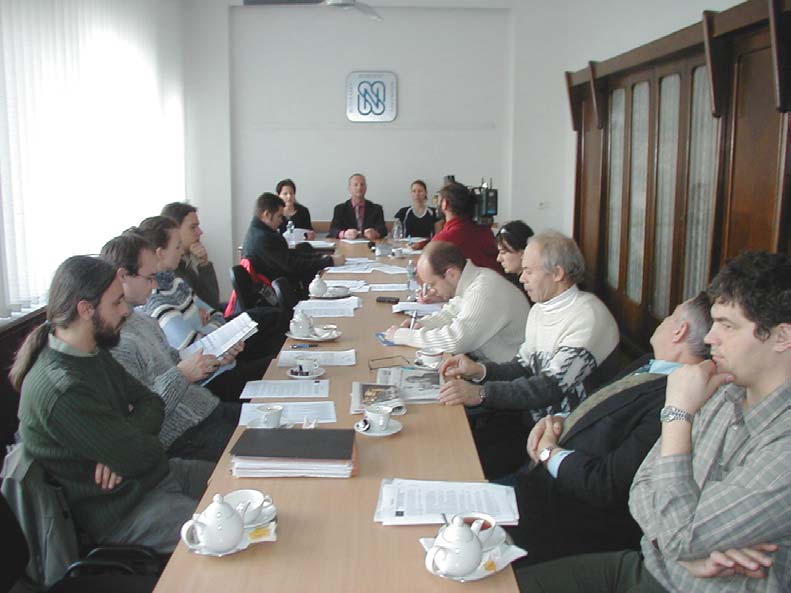
Picture form Press conference with media (journalists, radio Slovakia and Slovak National TV). The even was
broadcasted the same day in Slovak radio and the next day in Slovak TV at 6:40 pm.
P RO J E C T S ( L I S T O F ALL AWAR DED GR AN TS )
Award No
Amount
Project title
DESCRIPTION
awarded
NDG 05 001 9 000 USD Future without toxic pollution Project focusing to decrease polluting Danube basin
in Danube basin
in Sala region and Dubnica town with persistent
organic pollutants: include endangered public into
decision making process, giving help, monitoring,
research about toxic ash management, increase
public awareness in environment pollution with
POPs, work with mass media, lobbing, support
motivation for elimination illegal home waste
burning, environmental education
NDG 05 004 9 000 USD Waters of Kysuce
The project handle activation of streams managers,
municipalities, public and youth for improving and
holding quality of water in the Kysuca river basin,
which is attacking with anthropogenic impacts
concerning to high residential density
NDG 05 005 9 800 USD
"Streams Are Not
The project follows up the previous activities of the
DRAINS II. !
projects "Expedition of Liptov" and "Streams Are
Not Drains!". It is aimed at the reducing of the
pollution in Tatras region (Liptov, Spis, Horehronie)
through the implementation of practical, educational
and repressive measures. The project includes 6
activities which involve the participation of 4
schools, Centre of Environmental Activities (CEA)
Trencín, Slovak Environmental Inspection - Zilina
and Slovak Water Management State Company, Váh
River Basin Management - Ruzomberok.
NDG 05 006 7 200 USD Revitalization of Cilizský
The aim of this project is public participation to
potok catchments such us
reduction of water contamination by nutrients and
common design of The
toxic substances. Applied methods are simple
Danube River Coalition
monitoring (monitoring groups observe some
partners. River programs.
indicative species and measure amount of nutrients),
public presentations and excursions.
NDG 05 007 8 000 USD Conservation and restoration
Main project actions are: involvement in the
of habitats in Danube inland
preparation and implementation of official forest
delta
management plans, designation of new/
enlargement of protected areas, awareness raising
printing of brochure, and cooperation with
stakeholders.
NDG 05 008 7 000 USD Nitrogen removing and
The main aspect is to begin and to coordinate the
renewal of the communication communication between state administration,
in Zitava River Basin
citizens, municipalities, NGOs the themes will be
pollution of water, identification of the causes and
effects, protection and importance of the natural
localities as nutrient filters.
The last past of the lower reach and the dead river
channels of Zitava river are filling up with sediments
and polluted by industrial and incorrect waste
management stop the pollution, erosion in the
chosen localities and manage filter wetland habitat.
REPORT OF GRANTING IMPLEMENTATION
Grants topics addressed in the project:
Agriculture discharges
·
Introduce and apply best agricultural practices related to avoiding, minimising and/or controlling non-
point sources of pollution in the ground- and /or surface waters.
·
Contribute to policy work (EU directives, SAPARD, common agriculture policies).
· Promote eco-farming methods and alternative rural development.
Industrial discharges
·
Promote the best available technology, reporting requirements on pollutant release and transfer
registers, and environmental management systems.
·
Assist in reducing the risk of accidental release of pollutants from facilities.
·
Address toxic-substance pollution
· Promote production (and use) of phosphate-free detergents.
· Address (alternative) treatment methods and/or practices that lead to efficient removal of nutrients
and toxic substances.
Municipal discharges
·
Address household waste management, like the reduction of the use of conventional detergents.
·
Address urban waste-water collection and treatment.
Land-use and Wetlands
·
Address flood management, irrigation, and drainage with attention to the associated pollution-related
effects.
·
Save and protect the natural floodplains (buffer strips).
·
Support conservation and restoration of floodplain and wetland habitat.
Grants monitoring
CO Slovakia prepared "CP winners meeting" on November 11th, 2005 at which we presented instructions to
preparing the Full proposal.
On January 31st, 2006 we organized "winners meeting" during which were all project leaders presented projects
details. During the meeting project leaders (PLs) received concrete instructions how to manage project and how to
communicate with the REC Slovakia. At the same time PLs received information that projects will be monitored
during the period of implementation. Financial manager monitored and was in contact with grantees on a regular
way. Unclear items were solved on-line - by phone, email or in person.
REC Slovakia visited 2 NGOs: NDG 05 007, BROZ "Conservation and restoration of habitats in Danube inland
delta" and NDG 05 004, SZOPK "Waters of Kysuce" in October 2006. Moreover Mr. Alexander Zinke performed
the audit of 4 Slovakian projects in September 2006 BROZ, Bohatska sanca, UMBRA and Friends of the Earth.
During this monitoring visit Mr. Michal Deraj, project manager. REC Slovakia described to Mr. Zinke the process
of all activities organized by the REC Slovakia which included process of announcement of the grants program,
distribution of manual, evaluation criteria preparation for grants committee, two round selections of proposals,
award agreements, training for grantees, monitoring, etc.
The deadline for submission of the progress reports was July 6th 2006. We received all complete reports till July 12th
2006, because some NGOs made some mistakes. All the reports were reviewed and approved.
The deadline for submission of the final reports was January 15th 2007. We received all reports in time. One report
(Civic association Tatry) was delivered already in December 2006. The other reports had some mistakes or missing
documents. We communicated with grantees and 5 completed reports we received till the end of February. One
NGO (Bohatska sanca, civic association) still didn't send complete documentation for finance report due to the very
long inoperability of their grant manager. They promise to send all documents till 15th April 2007. All reports except
Bohatska sanca, civic association were reviewed and approved. The expenses were appropriate.
Two NGOs (Civic association UMBRA and Slovak union of nature and landscape protectors, regional board Cadca)
asked for reallocation of costs, these reallocations were approved.
AC H IE V E ME N T S / IN D IC ATO R S O F S U C C E S S
Overall results and impacts:
-
During the project implementation great emphasize was placed on the cooperation with public with local
governments, citizens, especially with youth big gain for environmental education in 5 projects out of 6
awarded, NGOs closely collaborated with public and representatives of self-government, in two projects
the work aimed at schoolchildren (project Waters of Kysuce and project Streams are not drains II.)
-
During the project implementation it was created and distributed a mass of promotion materials, leaflets,
publications, brochures to different stakeholders and broad public
-
Especially school youth participated by revitalization activities (in 2 projects Waters of Kysuce and
Revitalization of Cilizsky potok catchments such us common design of the Danube river coalition partners.
River programs.)
-
NGOs stressed lobbing one NGO (Friend of the Earth) lobbed in Brussels to members of European
Parliament
-
The greatest success - NGO Friend of the Earth Slovakia halted the plan for the construction of a
hazardous waste incineration plant in town Sala
Results and approaches
List of indicators
Indirect impact on
Direct impact on
Quantitative
Qualitative
nutrient/toxics
nutrient/toxics
reduction
reduction
Promotion of the
educational and
a leaflet Bio non-bio" (15 000 pieces),
Materials were disseminated to
production and use
promotional
a leaflet "How Not To Harm a River"
District Environmental
of phosphate-free
campaign aimed at
(15 000 pieces), a leaflet "We Are Not
Authorities in Liptovský Mikulás
detergents.
the change of
Afraid To Look at Dumps Straight!"(6
and Ruzomberok, municipalities,
consumers´
000 pieces), a leaflet "Do not Separate
civic associations participating,
behaviour issuing
Yourselves! Separate with Us" (10 000
monitoring groups, citizens of
the leaflet, internet
pieces).
Liptovský Mikulás and its suburbs,
campaign
In terms of the campaign "Streams Are
people interested during 6
Not Drains!", the 8-month competition
information stands, tour of the
serial "In the Track of Frodo" was
exhibition Bio Non-bio,
published on the web page
seminars, etc.
www.biospotrebitel.sk. The object web
page was visited by approximately
200 000 visitors in the relevant period.
Promotion of eco-
implementation of
Installing the exhibition Bio Non-bio 9 more intensive co-operation
farming methods
the exhibition "Bio
times in Tatra region. Implementation 56 between CA TATRY and CEA
and alternative rural nebio" (Bio
interactive programmes Bio Non-bio
Trencín, informing the public
development.
Non-bio) in Tatras
(647 participants) and "Fair trade" (652
presence in media
region, consumers´
participants) for elementary and
competition
secondary schools. Implementation 2
devoted to the bio
special field trips aimed at the
production,
preparation of volunteers "Land for
presence in media,
People People for Land",
implementation of
"Interpretation of the Cultural and
interactive
Natural Heritage" and 2 special seminars
programmes for
"How to Look at Land", "Management
pupils and students
of Little Projects".
of elementary and
secondary schools
Promotion of
implementation of
Two revitalization camps were prepared
model example of the revitalization
conservation and
the revitalization
in the region of Spis "Osavica 2006"
of agricultural land
revitalization of
camp in the Spis
(50 participants), "Hrabusice 2006" (34
land.
model region
participants).
The change in
monitoring of load
the work of 7 monitoring groups (140
co-operation between the non-
communal waste
capacity of the
young people) on the rivers of the north
governmental organization and
treatment
environment (illegal part of Slovakia in 2006 (Joint Secondary
state administration in solving the
dumps, discharge of School Bardejov, Elementary School
negative load capacity of the
dung water ...) in
Liptovská Teplicka, Elementary School
environment in the region, exerting
Tatras region and
in the street of Ing. Kozuch Spisská
the pressure to gain legal
ensure the legal
Nová Ves, Elementary School Letná
behaviour, seminars initialization
status,
Poprad, Joint Secondary School
of forming new action groups
implementation of
Liptovský Mikulás, Grammar School of
seminars ""River as P. O. Hviezdoslav Kezmarok,
a living being",
Grammar School of P. O. Hviezdoslav
promotion of the
Dolný Kubín). There is a perspective to
activities of
continue in monitoring in 2007 as well.
monitoring groups
Implementation of 3 seminars "River as a
on the rivers of
Living Being" for 84 participants. 4
northern Slovakia
active groups were given a "little grant"
which enabled them to implement their
own activities to improve the quality of
water streams in immediate surroundings
successfully.
Training monitoring groups at the
Grammar School of Anton Bernolák in
Námestovo (7 people) and at the
Grammar School in Tvrdosín (18
people). They committed themselves to
monitor the environmental loads in the
districts of Námestovo (24 cadastres) and
Tvrdosín (15 cadastres). NGO gave the
groups 3 500,- SKK to pay their
travelling expenses.
More than 150 incentives were given to
municipality, state administration, Slovak
Environmental Inspection and to the
Presidium of Constabulary in Bratislava
during the monitoring of illegal dumps,
invasive plants and contravening the
Water Act (164 days in the field per a
person).
Water quality
Research of
Monitoring was realised in two basic
Students were involved in water
monitoring
wetlands
schools and in one university
quality assessment - control, they
Disposal of dumps
build their environmental
in streams
responsibility
Environmental
Revitalization and
- 8 lectures for students (preferred
- environmental information
education
adoption of springs
themes was "Natural attributes of
- building the environmental
Cilizský potok catchment" and
responsibility
"Contamination of Cilizský potok"
- 3 excursions to Cilizský potok
- e-learning course
-"Mayors" seminar - presentation results
of our activities, planning next activities
- study material to monitoring
- 5 different posters
Small revitalisation
Small revitalisation
- 2 times was eliminated non legal dumps Eliminating the source of
activities
activities
near water (summary about 20 m3 of
contamination and expansion of
municipal waste)
invasive vegetation, which
- 1 time was eliminated invasive
producing high quantum of
vegetation with biomass take away
biomass (nutrient reduction).
Revitalisation activities was realised
with cooperation of local
volunteers.
The farmers did
It was been remove - 1 farmer
- Quality of cooperation with
converted the
of biomass by the
farmers, and other stakeholders has
grasslands and
farmers, the direct
- 4 E-NGOs
been on very good level
arable soils and the
nitrogen was
skiving was realized decreased in the
- 10 municipalities
- Media coverage informing about
4 times in months Zitava river Basin
project and activities of project
Jun, July, August
- 7 ha of maintained grassland
(about seminary, measuring)
and September
Renewal of the
- Habitat quality for birds
traditional farming
(cutting of the
meadows, renewal
of the pasture land).
Stop of the erosion
around area.
Communication
It was been realized Measuring of nitrogen's, nitrates,
Accomplished the activities of
with most
the measuring of
phosphates, oxygen and other matters.
projects
important polluters
pollution in the
surface waters we
The measuring was been realized on fifth The quality of cooperation with
did monitor the
localities and the amount of measuring
state water authority about
progress of
on individual places minimum 4 and
measuring
pollution.
maximum 7 times.
The co-operations with
The value of the individual matters has
municipalities - removal illegal
been different on depending from place
dumps by the form the agreement
of quartering the water.
of cooperation. That was been
realized through the
unemployed citizens within the
public benefit works.
Environmental and
We know the status Co-operation of agreement with state
Quality of cooperation with state
naturalistic
of indicator
water authority
water authority and nature
knowledge about
organisms and the
it was been matured the environmental
conservancy authority
project area for
sources of pollution and naturalistic study, which includes
example: Seminary
in the ground and
indicator organisms, the analyses of
Media coverage the state
about River of
/or surface waters
negative events and 25 GIS points with
television, the regional periodicals
Zitava there were
The feasible sources environmental data
published the articles about project
presented the
of pollution can be
Including also the parts of Botany,
and its activities
project the
the industrial
Ornithology, Ichthyology, Geography
results, activities
manufactory to
and others and
inhabit near the
there were
river, sewage tank,
the lecturers from
the agricultural
fields of water
farming ...
management , the
hydrometeorology
department, experts
from field of this
problematic,
negotiant of
municipalities and
others
Reduce future toxic NGO halted the
They stooped the plan to import and
Writing technical comments,
(include Danube
plan for the
burn 109 000 tons of hazardous waste in
discussed, with Ministry of
basin river)
construction of a
cement mill in Rohoznik
environment, cooperated with local
pollution from
hazardous waste
citizens and involved them to
biggest hazardous
incineration plant in
decision
waste incinerator in
Sala
Creating systemic toll for long-
Slovakia in Sala
term change ensuring "waste
town by stopped
watch"
this bad project
Contributing for improvement of
toxic ash disposal from smaller
company hazardous waste
incineration plant of Duslo Sala a
bit within the reconstruction
project annotating, through the
increasing of awareness about
requirement of the most strict
environmental steps at ash disposal
Public informed
Seminar about environmentally friendly
Contributing for the reduction of
ness and awareness
waste disposal as a prevention of water
illegal landfills production close to
improvement
flows and environment pollution. It was
the rivers of Danube basin through
run from 12. to 13. December in
the public information
Trencianske Teplice. 76 representatives
improvement in Sala and Trencin
of municipalities and state administration city and its surroundings,
were participating, 2 experts were giving
Rohoznik, Solosnica and other
lectures (1 from the Czech republic)
towns with large informational
about prevention of water flows and
actions during many days around
environment pollution.
the Slovakia
2 press conferences, 14 press releases, 79
articles, reports and interviews on this
topic in media
2 monitoring of toxic matters in food
and products from plants which burn
hazardous waste. These analyses helped
to river polluters, media and public on
still actual problem with toxic chemicals
pollution and make press for cleaner
alternatives development.
Helping to other
NGO reached some
During the project it was lobbed to
NGOs at lobbing
partial but quite
improve controversial European
for positive changes important successes
Commissions proposal for
in an amendment of with some other
amendment of WFD by writing
Waste Framework
colleagues from
letters and commenting documents
Directive
European NGOs
to members of European
for example
Parliament, personally lobbing in
enforcing some
Brussels, at Ministry of
specific targets and
Environment of Slovak republic.
measures for
prevention,
restriction of
reclassification of
incineration plants.
Protection of
New forest management plan for
natural floodplain
LHC Rusovce has been approve.
forests
This represents very progressive
and advanced FMP, respecting
principles of sustainable forest
management. Most of the nature
conservation requirements have
been accepted and incorporated
into the plan. Non native tree
species will be replaced by
autochthonous trees and natural
habitats will be restored. Softer
forest management methods have
been applied.
Raised public
2500 pcs of brochure
Celebratory event was organised to
awareness
promote the success of nature
printing bilingual
conservation in long-term lease of
brochure in Slovak
the Velkolelsky ostrov site and to
and Hungarian
introduce plans to the local
language
community and in the region
very successful event attracted
much media attention
Type and Number of Stakeholders:
Volunteers approximately 70
"networking" youth monitoring groups on the rivers of northern Slovakia 7 groups (approximately 140
pupils)
Slovak Environmental Inspection Zilina
District Authority for Environment in Liptovsky Mikulas
District Authority for Environment in Ruzomberok
Slovak Water Management State Company, Vah River Basin Management Ruzomberok
Centre of Environmental Activities Trencin
12 schools
10 tourist divisions
Regional organizations of Slovak union of nature and landscape protectors
Regional weekly Kysuce
ALCEDO, association for nature and landscape
PLA Kysuce
Municipal office Cilizska Radvan,
Water Management Corporation
Basin school in Cilizska Radvan (Hungarian language teaching)
Basin school in Gabcikovo (Slovak language teaching)
Municipal authority Sala
Slovak Health University
Forests of the Slovak republic
Forest administrations Gabcikovo
Forest administrations Sladkovicovo
State Nature Conservancy of the Slovak republic administration of the PLA Danube floodplains, regional
administration of nature and landscape protection Bratislava
Municipalities Cunovo, Cicov, Zlatna na Ostrove
Slovak land fund, regional branch Komarno
Slovak water management enterprise, branch Dunaj
Bratislava Water Company
National park Donau-Auen, Austria
Tools
Awareness-raising and information dissemination through the media
- 4 reports, articles on web page www.zitava.sk and in regional periodicals
- 8-month competition serial "In the track of Frodo" was published on the web page
www.biospotrebitel.sk
- information campaign in weekly periodical Kysuce within the cycle The year of water in Kysuce
contributed to the awareness of citizens about the importance of water resources and the nee for
their protection
- 2 press conferences to topic of environmentally friendly waste disposal as a prevention of water
flows and environment pollution and 14 press releases, 79 articles, reports and interviews on this
topic in media
Lobbying and campaigning.
- official discussion with state water authority and state nature conservancy authority
- more than 150 incentives were given to municipality, state administration, Slovak Environmental
Inspection and to the Presidium of Constabulary in Bratislava during the monitoring of illegal
dumps, invasive plants and contravening the Water Act
- writing technical comments, discussion with Ministry of environment
- lobbing to improve EC proposal for amendment of WFD by writing letters and commenting
documents to members of EP, personally lobbing in Brussels
- lobbing the regional environmental office for designation/enlargement of protected areas phone
calls, personal meetings, official written request for information
Public participation.
- school youth was engaged into caring of small water sources wells, which they have adopted for
permanent care
- cooperation with local citizens by halting the plan for the construction of a hazardous waste
incineration plant in Sala
- contribution for the reduction of illegal landfills production close to the rivers of Danube basin
through the public information improvement in Sala and Trencin city and its surroundings,
Rohoznik, Solosnica and other towns with large informational actions
- in region Sala and surrounding creating systemic tool for long-term change ensuring "waste
watch"
Environmental education and training.
- training course to water-pollution measuring with mall chemical laboratories Aquamerck
- 56 interactive programmes for pupils and students from elementary and secondary schools
- 2 revitalization camps were prepared in the region of Spis
- seminary about environmentally friendly waste disposal as a prevention of water flows and
environment pollution 76 representatives of municipalities and state administration were
participating, 2 experts were giving lectures about prevention of water flows and environment
pollution
Networking and partnerships.
- State Nature Conservancy of the Slovak Republik, state water authority Slovensky
vodohospodarsky podnik, NGOs UMBRA, SONS, FONTIS, SOSNA and Family farm Masek
mill
- Regional conference of experts about protection and exploitation of water resources within the
Kysuca river-basin brought many concrete information, which were published in a separate
publication and provide the possibility to utilisation them in praxis.
- Helping to other NGOs at lobbing for positive changes in an amendment of WFD
Interactive case projects.
- 7 ha restoration and maintain of the new meadow
Monitoring.
- monitoring groups at the Grammar School of Anton Bernolák in Námestovo and at the Grammar
School in Tvrdosín . They committed themselves to monitor the environmental loads in the
districts of Námestovo and Tvrdosín.
- 2 monitoring of toxic matters in food and products from plants which burn hazardous waste
Research.
- environmental and naturalist study indicator organism study, analyses of negative events
- research of wetlands was the beginning of monitoring after their inclusion into the network of
protected nature creations
Media coverage:
- in terms of the campaign "Streams are not drains!" the 8-month competition serial "In the track of Frodo"
was published on the web page www.biospotrebitel.sk. The object web page was visited by approximately
200 000 visitors in the relevant period
- serial of contributions with a theme of water, water resources, water economy and protection, which were
published on 9 thematic pages in regional weekly periodical Kysuce, with the circulation 14 000
- publication of regional conference within which were included also short news about the realisation of
whole project, was published with the circulation 500 prints and was distributed to all relevant addresses
within the region and a part also outside the region
- publishing on webpage www.zitava.sk. This webpage is official web the partner organization FONTIS and
informal public group Zitavsky luh and in regional periodicals and local newspaper. The one article local
newspaper Nase Vrable, two in regional periodical Nitrianske noviny and one on web page www.
zitava.sk.
- publications on web www.spz.sk
- preparing and realize big action for mass media to publish result of toxic POPs monitoring in food, 80
interviews and articles in TV, radio and newspapers in Slovakia
S U C C E S S S TO R IES
Project Title
Future without toxic pollution in Danube basin
Project goals
Decrease toxic pollution (POPs) in part of Danube basin, around Sala and
Dubnica towns
Description of its impact 1. NGO stopped plan build new biggest hazardous waste incinerator in Slovakia
on direct or indirect in Saa (30000 ton HW per year), which means reducing future toxic (include
nutrient reduction
Danube basin river) pollution by POPs.
2. Decrease toxic pollution (include Danube basin river) by:
- increase knowledge, awareness by publishing result form toxic POPs
monitoring, and sending publications, information for state authorities
- press to Duslo Saa by annotate their project "reconstruction old hazardous
waste incinerator" (for minimising POPs pollution realise BAT technology) and
publishing information by mass media
Range and involvement - Municipal authorities Saa
of stakeholders
- Duslo
Saa a.s.
- Slovak Reference Center for Dioxins and similar pollutants, Slovak Health
University, Bratislava
- Ministry of environment Slovakia
- All other state offices for environment
- Local NGO "Eco-team" from Rohozník
- Slovak Members of European Parliament
- More than 20 city where working waste incinerators, in Slovakia
Measurable and concrete - Stopped plan build new biggest hazardous waste incinerator in Slovakia in
outcomes of the project
Saa !
- realising monitoring toxic POPs pollutants near Váh river (Danube basin) and
showing that in food (egs) in Saa have more than 2 time higher concentration
of toxic dioxin and PCB than Slovak state and EU limit which create press
for local chemical plant for decreasing pollution
- increasing public awareness by 8 press release, 80 articles and interviews in
mass media
- 1 annotate to project reconstruction old hazardous waste incinerator in Duslo
Saa
- 1 case study about bad management with toxic ash from Duslo Saa old waste
incinerator
- 4 letters for Ministry of Environment and Slovak MEPs and 1 lobbing in
Brussels about changing bad European Commission proposal for new
Framework Waste Directive (danger with waste import).

Danube Regional Project (Second Round)
National Grants
COUNTRY NARRATIVE FINAL REPORT
REC Country Office:
SLOVENIA
Amount of Grant Fund:
40.000 USD
Amount Disbursed:
40.000 USD
Number of NGOs supported: 4
R E P O RT O F GR AN T IN G S E L E C T IO N
REC CO Slovenia announced the Call for Tender on August 26th 2005. Information about the CfT was sent
directly to all environmental NGOs in REC CO database (120 addresses), it was published on CO Slovenia web site,
and distributed to electronic Eco News network.
Call for Tender documentation was available on line as well as in paper form in the REC CO Slovenia.
CO was providing assistance to the interested applicants in project proposal preparation till the deadline for
submission of concept papers, which was September 30th 2005. Up to the deadline REC CO Slovenia received
eight (8) concept papers. After conformity checking was done, the list of gathered applications was prepared and
the Evaluation Panel nominated. Mr. Mitja Bricelj, ICPDR representative, and Mr. Milan Vogrin, DEF
representative were involved.
First phase evaluation process:
In the first phase evaluation process, all received concept papers (8) were evaluated by ICPDR and DEF
representatives, as well as by the CO staff. The evaluation meeting was held on October 19th 2005.
Seven (7) out of eight received Concept Papers were selected for the second phase preparation of full project
proposals. Deadline for submission of full project proposals was December 9th 2005. Up to the deadline five
(5) Full Proposals were submitted.
In order to assure high quality Full proposals in the second evaluation stage, REC Slovenia organized training on
Full proposal preparation. Training was delivered on November 8 2005, and representatives from all 7 selected
organizations participated. The training program was divided in four packages:
· 1st package was aimed to presentation of the Danube regional project in wider context and to presentation of
the approach to Full proposal preparation.
· 2nd package was aimed to practical exercise in preparation of the Logical Framework (LF) for the project. All the
participants designed LF for their own project, REC Slovenia staff provided comments and suggestions to their
work.
· 3rd package was aimed to preparation of the budget for their projects. The approach to the preparation of the
budget was presented in detail, as well as eligible costs.
· 4th package was aimed to promotion of the projects and work with media.
Participants considered the training very useful, especially because of the concrete work on their own project ideas.
Second phase evaluation process:
Evaluation Panel for the second phase was expanded by NGO representative, Mr. Bojan Znidarsic. On behalf of
Mr. Bricelj, ICPDR representative, Ms. Milena Janezic (MoE) participated the evaluation meeting due to his
absence.
Evaluation panel members were provided with background information on Call for Tender as well as with all
necessary materials and project proposals in advance. They individually scored each application according to
Evaluation Sheets that were prepared.
During the Evaluation panel meeting, held on January 5th 2006 in REC CO Slovenia premises, each of four
experts presented their scoring for each particular project proposal. On the base of the sum-total scoring grid,
preliminary priority list of applications was prepared. Experts started discussion on short-listed projects and
presented their opinion on strengthens and weakness of each project proposal. After that they agreed about
awarding, additional demands and total amount of co-financing for each project. Four (4) Full Proposals were
selected for granting.
The REC CO Slovenia took the responsibility for integration of all additional demands in project proposals before
signing the contracts.
P RO J E C T S ( L I S T O F ALL AWAR DED GR AN TS )
No Award
No Amount Project title
DESCRIPTION
awarded
1. DGP05/1
10.000 $
The Effective Water
Aim of the project was to introduce the
Protection on Rural Areas
ecoremediations (ERM) as the most perspective
in Podonavje Using
way of water protection in the rural area of
Ecoremediation
Podravje region. ERM is the way of protecting
and restoring devastated environment by using
natural ecosystems. Increased use of this
method will contribute to reducing negative
agricultural impacts on the water in Podravje
region and to improving water quality.
Following target groups were directly involved
in project implementation: representatives of
research institutions in the region, local
inhabitants (farmers and land owners) and
media. All together more than 300 people were
involved in the project.
Education program for farmers and local
inhabitants in Podravje region was developed
within the project, the seminar for local
inhabitants and media was delivered, scientific
meeting for the research institution
representatives was held at University of
Maribor, as well as public presentation of the
project and media conference. Three booklets
on ERM were prepared and printed (ERM for
Effective Protection of Environment 250
issues, Views on ERM 200 issues, and Again
Begin to Leave with Mokos Stream 1000
issues). Beside that 2000 pieces of educational
postcards were printed and distributed, and 8
articles were published in local and national
media.
2. DGP05/2
10.000 $
Preserving the Water by
Project was aimed to influence on changing
Promoting the Production
consumption patterns regarding the use of
and Use of Phosphate-free
phosphate-free detergents. The goal was to
Detergents
increase the use of phosphate-free detergents in
proportion to conventional ones, and indirectly
to contribute to improvement of the ecological
and chemical conditions of the water in the
Danube river basin within North East
Slovenian regions. The target groups involved
in the project were Slovenian households,
which did not use phosphate-free detergents so
far, school youth (as potential users in the
future), young families and partially
environmentally conscious population.
Following activities were implemented to
approach listed target groups:
The survey on awareness regarding the use of
phosphate-free detergents was made in the
beginning and at the end of the project,
involving 450 individuals. Promotional leaflet
was prepared, printed and distributed (10.000
issues). Media campaign was organized during
two important events in Maribor Days of
Health and Days of Environment, more than
1500 visitors were noted.
Wide promotion on internet was realised, 250
350 hits were noted per week.
3 articles were prepared and published in
national and local media, promotions were
carried out on the 3 radio and on TV.
The results at the end of the survey are showing
the changes in consumer's behavior (57% of
asked population is using phosphate-free
detergents after having gained knowledge on its
advantages).
3. DGP05/3
10.000 $
Underground Water and
Project's aim was to introduce ecological
Farmers
farming methods and appropriate land use to
the key stakeholders who are living in the
naturally protected area of the Landscape Park
Lahinja, and to educate local tourist guides on
importance of biodiversity conservation in the
area.
Target groups involved were lands owners and
farmers in the Landscape park Lahinja, local
tourist guides in mentioned protected area,
representatives of Nature Conservation
Institute, local and national media.
At the beginning, the initial presentation was
realized in order to introduce the project to the
landowners and key stakeholders. The most
important goal of the meeting was and to gain
permissions from landowners to use their land
for project's purpose, and to gain the guidelines
from Nature Conservation Institute. The goal
was reached, more than 30 people participated
the meeting and their permissions and support
were gathered.
In continuation 3 workshops were realized for
farmers and landowners, local tourist guides in
the Park, local inhabitants, other interested
public and media, aimed to: ecological farming
promotion, biodiversity preservation in
Landscape Park Lahinja, and the third one was
special training for tourist Guides in the Park.
Altogether 60 participants were involved.
The project continued with series of field
activities, important for biodiversity
preservation: appropriate cutting of swamp
meadows, plucking of alder trees and cleaning
of riverbanks. All the activities were extremely
well accepted by local inhabitants, participation
was better than expected. The most important
outcome of this task was, that the activities
linked different stakeholders, who did no work
together successfully in the past, and the
agreement was react to continue similar
activities in the future and with that actively
contribute to biodiversity preservation in the
Park.
The project was also very well promoted and
covered by the media: 2000 pieces of
promotional leaflet (slo/eng) was prepared and
distributed, 2 newspaper articles were prepared
and published, 3 radio broadcasting were
prepared on the project implementation and
reporting from the field during the actions, TV
and radio spots were prepared and broadcasted.
4. DGP05/6
10.000 $
Individual Waste Water
The purpose of the project was to raise
Cleaning Systems for
awareness among the farmers and other
Households and Farms in
residents in dispersed settlements of Volcji
the Areas of Dispersed
potok area (where the sewage system is not built
Settlements
yet) about the consequences of improperly built
sump systems and cesspits on farms, which has
an important impact on the groundwater.
Analyses of non-point sources of pollution in
the ground and surface waters was done as well
as identification and analyses of most
problematic areas was. The possibilities for
restoration of the existing sumps and cesspits
with proper ecological upgrades, which are
suitable for the countryside, were presented.
Workshop for residents and farmers in the area
was organized (25 participants), two booklets
were produced (1100 issues) and the scientific
article was published. Call for research projects
addressing primary school children was
launched, and the web site was be designed.
REPORT OF GRANTING IMPLEMENTATION
Grants topics addressed in the country:
Agriculture discharges
· Promote eco-farming methods and alternative rural development.
· Address (alternative) treatment methods that lead to efficient removal of nutrients and toxic
substances.
Industrial discharges
· Promote use of phosphate-free detergents.
Municipal discharges
·
Address household waste management.
Land-use and Wetlands
·
Address flood management, irrigation, and drainage with attention to the associated pollution-related
effects.
·
Save and protect the natural floodplains (buffer strips).
·
Support conservation and restoration of floodplain and wetland habitat.
Grants monitoring
In order to prepare selected Danube grantees well for the management of the projects and for the reporting, the
REC Slovenia organized workshop on Project Management and Reporting. Representatives of all 4 selected NGOs
participated the event, which took place in REC Slovenia premises in Ljubljana. It was aimed to mutual acquaintance
with selected project, to presentation of the grants monitoring process and reporting requirements, as well as to
signing the contracts.
CO Slovenia was monitoring the grants constantly. Office staff was in close contacts with the grantees by phone and
e-mail. We were regularly acquainted with the course of all projects. As there were no particular problems and due to
very limited budget, CO Slovenia realized only one monitoring trip in Maribor, where two NGOs (Institute for
Environmental Protection Promotion and Association of Family Members »Stork«) were visited in September 2006.
Beside that the grantees visited CO Slovenia office if they had some questions to answer. In September 2006 Mr.
Alexander Zinke performed the audit of all Slovenian projects. REC CO Slovenia assisted him in organizing the trip
and accommodation and the meetings with NGOs and supported the communication. His response about the
projects was very positive.
The deadline for submission of the Midterm Reports was June 30th 2006. All the grantees submitted the reports
within the deadline, CO reviewed the reports and after abolishing some minor mistakes (mainly in financial reports),
the reports were approved by July 20th 2006. As the installments in the contracts were defined as 60% advance
payment and 40% after approving of the final report, no financial allocations were made within interim period.
The deadline for submission of the Final Reports was January 31st 2007. Three out of four final reports were
received within the deadline, one of the grantees (ICRO Institute for Integral Development and Environment) asked
for prolongation of the implementation period due to transferring the workshop for farmers in January. The
prolongation was approved by REC Slovenia, so the final report from their side was received in the beginning of
February 2007. All the reports were reviewed and approved.
During the implementation period two proposals were received for reallocation of costs (by Institute for
Environmental Protection Promotion and by Association of Family Members »Stork«). Due to reasonable
argumentation, the reallocations were approved by REC Slovenia.
No other modifications or problems arise during the implementation period. All the projects were implemented
according to the plan and timely, the expenditures were appropriate and all the funds available were used. Beside
that all the NGOs co financed project activities from their own sources and in-kind.
AC H IE V E ME N T S / IN D IC ATO R S O F S U C C E S S
· Due to the limited financial resources for environmental NGOs in Slovenia, DRP was one of rare
opportunities for small NGOs in Slovenia to get co-financing for their projects. Actually the demand from
NGOs was much higher, altogether they applied for 80.000 USD, but we were limited by available funds, so
we awarded 40.000 USD.
· The cooperative approach used by the REC vis-ŕ-vis NGOs within tender procedure, full support in project
proposal preparation, additional trainings and readiness to help during the implementation period, was
valued as a very positive experience by NGOs. On the other hand it was evident, that NGOs have quality
personnel and high level of knowledge in the field of environmental protection, so they are able to address
technical problems related to nutrient and toxic reduction and to introduce new approaches.
· One of the important achievement of the Danube grants in Slovenia was, that there was relatively high
number of local inhabitants and land owners directly involved in project implementation (250 farmers
participated the seminars on eco farming, and 60 joined the field activities for appropriate cutting of swamp
meadows, plucking of alder trees and cleaning the riverbanks). The project managed to transfer the message
why it is important to use appropriate farming methods in order to reduce nutrient pollution and to
preserve reach biodiversity in the protected area as they took over the initiative to continue with similar
activities by them selves in the future and with that actively contribute to biodiversity preservation in the
preserved area. The project also managed to link different stakeholders, who did no work together
successfully in the past.
· Another important achievement was that the NGO managed to apply new, technically supported method
for reducing nutrient and toxic reduction in the rural area of Podravje use of Ecoremediations (ERM).
ERM is the way of protecting and restoring devastated environment by using natural ecosystems. In
cooperation with top specialists in this field NGO prepared, 3 booklets and several workshops for farmers
(250 farmers and land owners were directly involved in educational activities). NGO approached to the
potential users (farmers) directly, showing why and how they could use the ecoremediation with relatively
low investment and by that contribute to water pollution reduction.
· Next important achievement of the Danube grants in Slovenia is that NGO with thought, constant and
target guided promotion on relevant groups (young families, youth,) influenced on changing consumers
behavior. They made wide media campaign, produced 10.000 issues of leaflets showing all advantages of
phosphate free detergents, used internet and existing infrastructure (health centers) as well as traditional
events (Day of health, Day of Environment,) in order to promote alternative washing means. The research,
done in the beginning and at the end of the project showed that 57% of asked population is using
phosphate-free detergents after having gained knowledge on its advantages (450 participated in each round).
Good improvement of the grant scheme was the media training, which contributed a lot to better promotion of
the Danube Regional Project as a whole as well as of particular projects.
Overall results and impacts:
Addressed
Results and approaches
List of indicators
topic area
Indirect impact on
Direct impact on
Quantitative
Qualitative
nutrient/toxics
nutrient/toxics
reduction
reduction
Three of national
Reducing nutrients
· 250 farmers and
· positive attitude of the
projects
by promoting
land owners
local population towards
contributed to
organic agriculture,
directly involved
project activities, great
agricultural
changing people's
in educational
interes for cooperation
discharges topic
mentality
activities,
· large response of local
area by promoting
· 150 other
and national media,
eco-farming and
stakeholders
good media coverage,
addressing
acquainted with
· readiness of the local
alternative
project activities,
population for
treatment methods
· 3 booklets (in
continuattion of started
total 1450 issues)
activities in the future,
published and
· increased knowledge on
distributed,
ecoremediations,
· 2000 pieces of
ecological farming and
educational
biodiversity preservation
postcards printed
in involved local areas,
and distributed,
· 2 workshops
· 8 media articles
· High quality of the
published,
information posted,
· 1 TV spot
· Media coverage,
prepared and
· Quality of the
broadcasted,
publications,
· 1 Radio spot
prepared and
broadcasted,
· 1 inteview
published in
largest national
daily newspaper
Delo,
· 1 press
conference with
40 participants,
· 1 scientific
meeting, national
and regional
audience
One of the
Conservation and · 3 workshops, 60 · Inclusion of interested
national projects
restoration 200 ha
participants
farmers and other
contributed to
of wetland habitat · 2000 pieces of
projects stakeholders
Land-use and
by reintroducing
promotional
and informing target
Wetlands topic
appropriate
leaflet (slo/eng)
groups
area by supporting
methods for
· 3 field activities, · Key stakeholders
conservation and
maintenance
60 participants
informed on biodiversity
restoration of
·
preservation and on
wetland habitat.
statement for TV
importance of eco-
and radio, 3
farming in Nature Park
broadcastings
· 2 newspaper Lahinja
articles
· 70% of total population
· 3radio shows in the area acquainted
about the project
with the impacts of
were prepared as
project
well as reporting · approximately 15% of
from the field
the area preserved
(during the field · 19 certificates awarded
actions)
to the tourist guides
· 19 Qualified local · Increased shareholders'
tourist guides in
awareness on nature
the Landscape
preservation
Park
· Partnership established
among different
institutions dealing with
the protected area,
follow up foreseen
One of the
Reducing nutrients
· 500 local
· Results of the analyses
national projects
by
inhabitants in the
of non-point sources of
contributed to
minimising and
project area pollution in the ground-
Municipal
controlling non-
acquainted with
and surface waters
discharges
point sources of
the project
· Identified and analysed
Address household pollution in the
· 21 firms
most problematic areas,
waste management ground- and surface
identified
· Results of the analyses
waters.
producing
of different treatment
cleaning systems
systems, 18 systems
· 2 leaflets (1000
involved
and 100 issues) · High
quality
produced and publications
distributed
· 25 participants at
the workshop for
farmers,
· 1 article
published
One of the
Reducing nutrients
15.000 people
· 10.000 pieces of
· 2 surveys implemented
national projects
by changing
informed about the
the promotional
are showing the changes
contributed to
people's mentality
advantages of use
publication
in consumers behavior
promotion of
and promotion of
of phosphate-free
prepared and
(57% of asked
phosphate-free
use of phosphate
detergents
distributed,
population is using
detergents
free detergents
· 450 people
phosphate-free
participated in
detergents after having
the survey,
knowledge on its
· 3 articles in
advantages
national media
· wide media promotion
published
(TV and radio stations),
· 2 special
positive responses were
promotion events
reached
organized - info-
· Raised public awareness
educational stalls,
on impacts of use
1500 visitors
phosphate-free
· 250 350 hits at
detergents
the web page per
· Increased using of
week
Phosphate-free
detergents in households
Type and Number of Stakeholders:
Lands owners, farmers and part-time farmers from local areas -800
NGO members - 37
Local tourist guides in protected areas - 19
Representatives of research institutes, Nature Conservation Institute and Institute for Agriculture and Forestry 65
Local administration representatives - 5
Slovenian households who did not use phosphate-free detergents so far -1000
School youth, pupils - 810
Young families - 900
Local and national media - 31
Tools
Indicate which of the following tools did the NGOs use in each of the project and explain how:
Awareness-raising and information dissemination through the media (articles, leaflets, brochures,
promotional spots, interviews, radio and TV broadcasting, press conference, web sites...)
Lobbying and campaigning. (2 stalls organized on special events (Days of Health and Days of environment,
campaigning for phosphate-free detergents use
Public participation.
Environmental education and training (ecological farming - for farmers and landowners, biodiversity
preservation for tourist guides in protected area, ecoremediations for farmers,
Networking and partnerships. conservation and restoration of wetland habitat field activities for farmers
Research (Analyses of non-point sources of pollution in the ground- and surface water, Analyses of
different treatment systems, Scientific meeting, scientific article).
Media coverage:
All the projects considered visibility guidelines they mentioned the donor on printed materials and at the events, as
well as used the logo.
· 13 media articles published in Slovenian national and local magazines (Vecer, Delo, Novice, Ptujski dnevnik,
Zurnal, Belokranjec, Dolenjski list, Dnevnik, Vestnik, Ptujcan, Stajerski tednik),
· 1 article about the project published in largest Slovenian daily Delo (section Science),
· 12 presentations of the projects at different web sites, 250 350 hints per week
· 1 promotional TV spot prepared and broadcated on local TV Vas Kanal,
· 1 promotional radio spot prepared and broadcated on local Radio Odeon,
· 3 radio broadcasts on Radio Odeon
· 1 press conference with 40 participants,
· wide media promotion on television (POP TV, Info TV, Vas Kanal, TV Slovenia),
· 7 radio stations involved in promotion (Radio Maribor, Radio Slovenia, Radio Student, Radio Prlek Ormoz,
Radio Odeon, Radio Krka, Studio D),
· 1 scientific article published
· 1 statement produced for radio,
· 3 radio shows about the project were prepared as well as reporting from the field (during the field actions)
S U C C E S S S TO R IES
Project Title
Underground Water and Farmers
Project goals
One of the project's goals was to introduce ecological farming methods and
appropriate land use (cutting of swamp meadows, plucking of alder trees and
cleaning of river banks) to the key stakeholders who are living in the naturally
protected area of the Landscape Park Lahinja, to preserve reach biodiversity of
the wetland area. Another goal was to raise awareness of the local population on
biodiversity preservation issues and to stimulate them to participate in
preservation activities in the future.
Description of its impact 15 % of the protected area was conserved and restored (200 ha) of wetland
on direct or indirect habitat by reintroducing appropriate methods for maintenance. Interested farmers
nutrient reduction
and other projects stakeholders were involved in the project activities, key
stakeholders were informed on biodiversity preservation and on importance of
eco-farming in Nature Park Lahinja. At least 70% of target groups knew impact of
project.). 19 local tourist guides were trained on biodiversity preservation in the
Park, certificates were awarded. All the landowners in the targeted area signed the
permissions and allowed to implement project activities on their land. Partnership
was established among different institutions dealing with the protected area,
follow up of similar activities is foreseen. The most important outcome was, that
the project activities linked different stakeholders, who did no work together
successfully in the past, and that the agreement was react to continue similar
activities in the future and with that actively contribute to biodiversity
preservation in the Park.
The project was also very well promoted and covered by the media: 2000 pieces
of promotional leaflet (slo/eng) was prepared and distributed, 2 newspaper
articles were prepared and published, 3 radio broadcasting were prepared on the
project implementation and reporting from the field during the actions, TV and
radio spots were prepared and broadcasted.
Range and involvement Target groups involved were lands owners and farmers in the Landscape park
of stakeholders
Lahinja (60), local tourist guides in mentioned protected area (19), representatives
of Nature Conservation Institute, NGOs, local population, media and tourists
(60)
Measurable and concrete · 3 workshops, 60 participants
outcomes of the project
· 2000 pieces of promotional leaflet (slo/eng)
· 3 field activities, 60 participants
· statement for TV and radio, 3 broadcastings
· 2 newspaper articles
· 3 radio shows about the project were prepared as well as reporting from the
field (during the field actions
· 19 qualified local tourist guides in Park

DRP Regional Grants Second Round
Danube Regional Project
Regional Grants - Second Round
Call for Danube Basin-related NGO Regional Environmental Projects
The Regional Environmental Center for Central and Eastern Europe (REC), on behalf of the UNDP/GEF
Danube Regional Project, hereby announces the second call for proposals to support non-governmental
organisation (NGO) projects related to the reduction of Danube River basin nutrient and toxic chemicals
pollution at the regional level.
Regional grants are up to USD 35,000 each. In exceptional cases (proposals that involve more than three
NGOs, require some form of construction or involve extended networking), the amount can exceed this limit
by 50 percent (i.e. up to USD 50,000).
The deadline for submitting concept papers is September 2, 2005.
BACKGROUND
The Danube Basin and its Environmental Problems
The Danube is Europe's second-longest river, extending 2,780 kilometres from its source in Germany to its
delta at the Black Sea. The river forms a political boundary for 10 countries with vastly different political,
economic and historical backgrounds. It is also a cultural and romantic symbol of central Europe's rich past
and hopes for future integration.
The Danube's drainage basin is extremely large and diverse. It hosts very different ecosystems, including
various wetlands of European importance (e.g. karst caves, alpine and steppe lakes, floodplain forests, the
Danube delta). With more than 80 million people living in its vicinity, the Danube's basin is the most
international in the world. Countless tributaries drain into the Danube, including the Inn, the Morava, the
Tisza, the Sava, and the Prut rivers.
Pollution remains a serious problem in the Danube region. The volume of nutrients -- mainly from
agricultural fertilisers and manure, and urban household sewage -- that enter the Danube basin waters is very
high. Nutrient pollution is the contamination of surface and groundwater bodies by excessive inputs of
nutrients. Although the natural input of nutrients is a prerequisite for the growth of organisms (i.e. the natural
food chain), while river floodplains can cope with even large amounts of nutrients, pollution is typically
caused by human activities and includes point sources such as municipal sewage treatment plants and industry
emissions (e.g. foods), while non-point sources refer to the spraying of commercial fertilisers and animal
waste on agricultural land, from where it infiltrates groundwater or drains with rain water into creeks, lakes
and rivers. Hazardous substances often cause water pollution. The term "hazardous" means substances that
have toxic, carcinogenic, mutagenic, and teratogenic or bio-accumulative effects, in particular those that
decompose slowly or are persistent and have a significant adverse impact on living organisms. Heavy metals
-----------------------------------------------------------------------------------------------------------------------------------------------------------------------------------------
----------
1
DRP Regional Grants Second Round
such as copper, iron, manganese, cobalt, zinc, cadmium, mercury, nickel, and lead are toxic substances (mainly
from the mining and metal industries), which tend to accumulate in the food chain and represent a substantial
risk to aquatic and human life. Numerous other hazardous compounds that cause toxic and/or chronic
pollution are of an organic nature and stem from the chemical, pharmaceutical and paper industries.
This pollution has placed local drinking water sources as well as the Black Sea in serious condition. The
situation is made worse by industrial incidents that spill or flush toxics directly into watercourses.
The August 2002 floods that raged through Central Europe and the Danube basin are evidence of other
environmental problems. They were partly the result of past economic development decisions that led to
deforestation and the destruction of natural floodplains in the Danube basin. Global warming also played a
role. This degradation of the natural flood retention capacities also reduces the natural self-purification
capacities for the uptake of nutrients e.g. in floodplains.
Preserving habitat for the rich and diverse natural species living in the basin is also a constant struggle. Some
80 percent of the Danube's wetlands and floodplains have been lost since the end of the 19th century,
threatening the habitats of pelicans in the Danube delta, sturgeon in the lower Danube, beavers in the upper
Danube, as well as the habitats of countless other species.
In 1998, the Danube River Protection Convention (DRPC) came into force after ratification by eight Danube
states and the European Commission (EC). The International Commission for the Protection of the Danube
River (ICPDR) was created to coordinate the implementation of the convention. Since its creation, the
ICPDR has been effective in finding consensus among basin countries on priorities and strategies for
improving the Danube and implementing the DRPC. Successes include the improvement of tools to manage
the basin, such as the Accident Emergency Warning System, the Trans-National Monitoring Network for
water quality and the information system for the Danube (DANUBIS). In effect, the commission has done
much to promote trans-boundary cooperation among numerous countries in a highly complex European
region.
The objectives of the ICPDR's 2001-2005 Joint Action Programme for the Danube River Basin are directed
towards:
· the improvement of the ecological and chemical status of the water;
· the prevention of accidental pollution events; and
· the minimisation of flood impacts.
In addition to these main objectives, the implementation of the Joint Action Programme will:
· improve the living standard of the Danube basin's population,
· enhance economic development in the region, contribute to the European Union accession process,
· restore the region's biodiversity and strengthen cooperation between the contracting parties.
For further information about the Joint Action Programme's objectives and directives visit:
www.icpdr.org.
The Danube Joint Survey published in May 2002,1 identified various chemical pollutants such as heavy metals,
volatile organic hydrocarbons, polar pesticides and pharmaceuticals that are directly affecting the chemical and
1 Visit: www.icpdr.org.
-----------------------------------------------------------------------------------------------------------------------------------------------------------------------------------------
----------
2
DRP Regional Grants Second Round
biological status of the Danube River. The study on nutrients found different quantities of nitrogen and
phosphorus in organic and inorganic forms along the Danube River, which indicated that the water quality in
different parts of the river is contaminated. As a result, the middle Danube reach indicated eutrophication,
which can cause the pollution of drinking water sources and decrease biodiversity in the long-term. Different
hotspots were detected and prioritised based on the level of water contamination.
The Trans-boundary Analysis and other documents produced within the framework of the Danube Pollution
Reduction Programme (1999, GEF/UNDP) are available on the ICPDR website1 under "GEF Assistance to
the ICPDR" and then "Danube Pollution Reduction Programme 1997 to 1999." This site contains useful
information about the sources of pollution and ways to address them in different parts of the Danube River
basin. These publications contain maps with information on the pollution hotspots, wetlands and other useful
pollution data generated in different pollution sectors such as municipalities, agriculture, industry, land-use
and wetlands. Further information on the current UNDP/GEF DRP (2001-2006) is available at www.undp-
drp.org.
The European Union's Water Framework Directive is now the basis for river basin management in Europe
and thereby is the platform for implementing the DRPC. The ICPDR has been entrusted to coordinate WFD
implementation at the DRB level including the development of the Danube River Basin Management Plan.
Danube Regional Project
The Danube Regional Project (DRP) -- officially known as Strengthening the Implementation Capacities for
Nutrient Reduction and Transboundary Cooperation in the Danube River Basin -- was launched on
December 1, 2001 as the next phase of GEF/UNDP's long-term commitment to achieving environmental
health in the Danube River Basin. A key focus of the DRP is to strengthen the capacity of the ICPDR and
Danube countries to fulfil their legally binding commitment to implement the Danube Protection
Convention. Already well under way, the DRP is an umbrella for some 80 activities.
A recent success story was the significant support from the DRP for developing the Danube River Analysis
2004, the first ever comprehensive analysis of the environment and pressures impacting it, in the Danube
Basin. The report was required by the EC to help to assess how Danube countries will meet the WFD by
2015. It also serves as a key step toward preparing the future Danube River Basin Management Plan (see the
report at www.ocpdr.org).
To reduce nutrient and toxic pollution, the DRP works with a wide range of local, national and international
stakeholders. For example, the DRP is helping national pollution control offices to assess which areas in the
Danube basin are most at risk from floods washing hazardous substances into water bodies. The project
works with farmers and farmer advisory services to improve techniques for applying fertilisers and pesticides.
An activity will soon help Danube governments implement voluntary bans on phosphates used in washing
detergents. And a pilot project will try to demonstrate the effectiveness of wetlands in removing nutrients
from the river by retaining them.
The Danube Grants Programme is part of DRP Objective 3 to strengthen public involvement in
environmental decision-making and to reinforce community actions for pollution reduction and the
protection of ecosystems. In this context, the Grants Programme is also seen as "applied" awareness raising.
Objective 3 has supported the Danube Environmental Forum (DEF), a basin-wide network of NGOs. From
30 members in 2002, the DEF grew to 160 by mid-2005. The DEF's capacity to implement actions for
controlling water pollution has improved. Training materials about wetland rehabilitation and nutrient
reduction have been developed in ten languages. In the future, DEF member involvement in developing
policies will be supported through government partnerships (e.g. the Danube River Basin Management Plan
within the framework of the EU's Water Framework Directive).
-----------------------------------------------------------------------------------------------------------------------------------------------------------------------------------------
----------
3
DRP Regional Grants Second Round
The DRP's Communications Strategy calls for strengthening NGO communications. DEF members, for
example, have already received support in developing products such as their newsletter, website and
publications. The strategy opens the door for NGOs to assist in implementing communications strategies
targeted at key audiences, in part through awareness-raising campaigns at the community level (e.g. for
wetland restoration and changing land-use patterns). And the DRP will actively disseminate news about NGO
activities to the people of the Danube through the media.
The DRP will be carried out over five years with a total budget of USD 15 million. The bigger picture is that
the DRP is part of the USD 95 million GEF Strategic Partnership for Nutrient Reduction in the
Danube/Black Sea Basin, one of GEF's largest and perhaps most ambitious water-related projects in the
world. The partnership supports the goals of the Commissions for the Danube and Black Sea to reduce
nutrient and toxic loads to the levels necessary to allow Black Sea ecosystems to recover their state in the
1960s.
NGO Contributions to Nutrient Reduction
NGOs and other stakeholders can contribute to the reduction of nutrients and toxics in the Danube River
basin at both the national and regional levels. NGOs can undertake activities that lead directly to pollution
reduction or facilitate the process of solving pollution problems. These projects could directly address the
reduction of point and non-point sources of pollution, and confront the transboundary or national problems
present in the identified hotspots. The nutrient reduction projects of NGOs can also take indirect approaches,
such as preventing pollution generation by improving and raising industry and public awareness; facilitating
the flow of information; assisting in the prevention of accidental pollution, promoting the production and use
of phosphate-free detergents and the sound use of organic fertilisers. These projects should also facilitate the
development and functioning of democratic processes by ensuring public involvement and participation in
pollution-related issues and decisions.
They can present community views to decision makers as a bridge between officials and the general public,
facilitate public participation in decision-making processes for Danube basin issues, or suggest alternative
solutions for preventing or reducing pollution. Furthermore, NGOs can be a useful channel for the
dissemination of information to the public, increasing their awareness of the problems and possible solutions.
In order to fulfil their roles, NGOs concerned with the Danube basin need to strengthen various capacities.
Awareness-raising can effectively contribute to expanding the common understanding of trans-boundary and
even global environmental problems and respective solutions.
Based on the DRP grants experience with the first round of grants the overall majority of NGO activities
supported by the grants component had an indirect effect on nutrient and toxic pollutant reduction in the
Danube. This was expected since one of the strengths of NGOs is their ability to raise public awareness and
change behaviours and attitudes to indirectly induce pollution prevention. However, a variety of NGO
activities at the national level have led to direct nutrient reduction and the removal of toxins. These activities
range from the removal of illegal dumps near waterways, to the reforestation of riverbanks to avoid erosion
and improve water quality. Artificially constructed wetlands that can function as wastewater treatment areas
were also planned, along with the management of hydrophytes and the management of nature reserves,
improved water quality in ponds and the creation of new protected areas.
The most typical pollution source addressed by national grants in the first DRP Grants round was agriculture,
with the most common theme being: `Addressing flood management, irrigation, and drainage with attention
to the associated pollution-related effects', followed in popularity by `promoting eco-farming methods and
alternative rural development'. The second most common target after agriculture was municipal discharge:
`Addressing urban waste-water collection and treatment'. The least popular part of the scope has been
industrial discharges, with the specific aim of, `Assisting in reducing the risk of accidental release of pollutants
from facilities'.
-----------------------------------------------------------------------------------------------------------------------------------------------------------------------------------------
----------
4
DRP Regional Grants Second Round
During the first round, NGOs contributed to this process through direct actions as well as through
collaboration with other stakeholders. A range of stakeholders have been targeted during the first grants
round, including farmers, authorities, school children, enterprises and designers. In general, the projects were
able to reach a wide range of stakeholders, as expected. The biggest challenge for the involved NGOs and for
the REC was to monitor and measure the extent to which the stakeholders are impacting the success of the
project. This aspect of the work needs to be further improved and better tackled by the NGOs in the second
grants round.
With respect to the tools used, considering the nature of NGO work, during the first grants round some
lobbying and awareness raising is used extensively, whereas research and monitoring are less popular tools.
This DRP National Grants programme is a follow-up to the first round and is expected to enable NGOs of
the Danube basin region to increase public involvement in nutrient reduction through "practical" projects,
education and training, monitoring and influencing policy at local and regional levels.
ELIGIBILITY
Registered NGOs in the Danube basin countries of Bosnia and Herzegovina, Bulgaria, Croatia, the Czech
Republic, Hungary, Moldova, Romania, Serbia and Montenegro, Slovakia, Slovenia and Ukraine with an
environmental focus and an NGO bank account are eligible for national and regional grants.
NGOs must propose a project that includes cooperation with an NGO partner (or partners) in at least one
other eligible country. The project may be no longer than 13 months in duration (January 2006 January
2007).
In addition, NGOs applying for regional grants are expected to meet the following criteria:
a.
readiness to develop an international project of up to 13-months in duration;
b.
commitment to cooperating with partner NGOs from other countries or sub-regions (i.e. sub-basins);
c.
a proven track record in project management;
d.
experience with water, agriculture or nutrient issues (preferred);
e.
English-language capability; and
f.
access to necessary equipment and facilities.
LIMITATIONS
· Grants will not support projects that focus on research or scientific work (unless they are linked to
other aspects of the project); purely operational expenditures (such as salaries or office rent);
purchase of land, buildings, investments, or vehicles not justified by the project's aims.
· NGOs currently running a cooperative project supported by the REC cannot apply for another
cooperative grant before the final report of the previous project has been submitted and approved.
· Under the regional grants, NGOs may not submit more than one concept paper as a lead NGO and
cannot be involved in more than two concept papers. They may apply as a partner NGO in two
separate concept papers.
-----------------------------------------------------------------------------------------------------------------------------------------------------------------------------------------
----------
5
DRP Regional Grants Second Round
· If an organisation is involved in two concept papers, the NGO must appoint different project
coordinators for each project proposal.
· At the full proposal stage each selected NGO can benefit from only one grant.
PROJECT SCOPE
The main scope of the regional grants is to facilitate a regional approach to the reduction of both point
and non-point sources of nutrient and toxic substances pollution in the Danube basin.
A regional approach implies cross-border NGO cooperation and multi-stakeholder involvement. NGOs are
encouraged to cooperate and work in partnership with NGOs in neighbouring countries (e.g. within the same
Danube sub-basin2) in addressing the cross-border and regional environmental problems related to nutrient
and toxic substances reduction. In addition, they are encouraged to involve other stakeholders, such as local
authorities, water-related institutions, the industrial sector and the agricultural community. NGOs are
encouraged to involve other stakeholders, such as local (environment) authorities, water-related institutions,
the industrial sector and the agricultural community.
These grants will help NGOs to manage projects that:
· directly contribute to the reduction of point and non-point sources of pollution;
· contribute to overall improvement of the monitoring system;
· address transboundary and/or national problems present in identified hotspots;
· prevent pollution generation by increasing public awareness;
· facilitate the flow of information to the public;
· assist in the prevention of accidental pollution;
· promote the production and use of phosphate-free detergents and organic fertilisers; and
· aid democratic processes by ensuring public involvement and participation in decisions affecting
environmental quality in the Danube River Basin.
NGOs are encouraged to manage activities with concrete and measurable impact on reducing nutrients and
toxic substances. Since the overall objective of the call is the reduction of the nutrients and toxic substances in the
Danube River basin, all the activities must demonstrate the direct or indirect impact on the reduction of nutrients
and toxic substances. This impact must be measurable through indicators which should be well defined.
Additionally the regional grants should:
· Involve other stakeholders. Projects should identify stakeholders from the water-management
sector, decision makers in pollution-producing units and other key players, and actively involve them
in project implementation.
· Change consumer behaviour. NGO projects using an awareness-raising or campaigning approach
towards consumers must be able to demonstrate the impact on consumers' behaviour (in terms of
reducing nutrient pollution, promoting best agricultural practices).
· Serve as a model for other areas in the Danube River basin. Preferred projects are those that use
a replicable approach and serve as an example for other areas in the Danube River basin that have
similar problems and framework conditions.
2 The Danube River basin is divided into various sub-basins of its main tributaries, such as the Tisza River or the
Drava River sub-basins.
-----------------------------------------------------------------------------------------------------------------------------------------------------------------------------------------
----------
6
DRP Regional Grants Second Round
· Promote and assist the application of the Aarhus Convention at the national or local level,
especially by improving the public access to information on pollution and their sources and
enhancing public participation in decision-making on Danube water-related issues.
· Contribute to policy work at the national level. NGOs are encouraged to contribute to policy
development and political discussions related to nutrients in the Danube basin (e.g. national or local
pollution abatement programmes, environmental education, the implementation of EU directives).
· Apply a regional approach, networking with NGOs at the regional level (i.e. across the entire
Danube basin or within certain multi-country areas).
· Employ a trans-boundary perspective. Projects must increase the understanding of national
contributions to transboundary environmental problems.
· Use the watershed approach, especially in projects addressing land-use development. NGOs
should relate the source of pollution with the impact area when different from administrative or
political boundaries.
The tools used can be diverse. The REC encourages NGOs to use one or several of the following tools in
their project proposals under this grant programme:
· Awareness-raising and information dissemination through the media. The results of this
commonly used NGO strategy must be disseminated within the project timeframe and the project
outreach must be ensured. The messages and dissemination strategy should be clearly explained in
the proposal.
· Lobbying and campaigning. We encourage NGOs to use lobbying activities in order to reach and
influence policy makers, particularly those at the river basin management level. Campaigning can also
be used to influence consumers, producers, local communities and various stakeholder groups (e.g.
changing consumers' behaviour concerning fertiliser use, phosphates-free detergents, etc.).
· Public participation. NGOs are encouraged not only to reach the public and the producers of
pollution but also to promote and facilitate public involvement in the decision-making process in
relation to water management, planning and other relevant environmental processes reducing
pollution in hotspot areas. At the same time such facilitation should not be limited to information
dissemination and community involvement, but should also be present in active and lasting dialogue
with decision makers, discussing problems and influencing the decision-making process.
· Preparation for or participation in the implementation of the Water Framework Directive.
NGOs should actively cooperate with and assist the authorities in the implementation of the Water
Framework Directive, or its preparation. Activities including the different forms of information and
active involvement of all interested parties including NGOs and affected public in phases I and II of
the WFD, as well as the preparation for phase III when the information and consultation with the
public, including users, should be organised for the draft RBM plan, are encouraged. Existing
opportunities for stakeholder and NGO involvement -- through River Basin Committees, for
example -- should be enhanced and improved.
· Environmental education and training. Educational activities, targeted at teachers, pupils,
students, or other groups, which aim to establish an understanding of nutrient and toxic-related
problems, should also provide measures to prevent and reduce nutrient and toxic-related problems in
the river basin area.
· Networking and partnerships. NGOs are encouraged to develop networks and partnerships with
other NGOs, as well as with other stakeholders from related institutions (e.g. with water and
environmental agencies, industry, agricultural cooperatives).
· Interactive case projects. Activities consisting of concrete conservation, rehabilitation work and
clean-up actions are encouraged. Their lasting benefit should be demonstrated.
· Monitoring. Projects which include environmental monitoring work but exclude work requiring
sophisticated technical equipment and certified expertise are also encouraged.
-----------------------------------------------------------------------------------------------------------------------------------------------------------------------------------------
----------
7
DRP Regional Grants Second Round
· Research. NGOs can receive support for simple applied research projects which do not require
complex scientific work (e.g. opinion polls or assessment of available data).
Innovative ideas for other tools that could prove useful in addressing the reduction of nutrient and toxic
pollution are encouraged.
Types of cooperation required:
a. Cross-border/region-wide cooperation
Only NGOs from at least two different countries working cooperatively to solve an environmental issue that
affects them both (or all) can apply for a grant. Projects should address cross-border or region-wide
environmental problems related to the Danube. Transboundary or cross-border problems should focus on a
shared river, watershed (Danube sub-basin) or habitat. Region-wide projects typically deal with common
issues that concern all the involved countries such as awareness-raising, environmental education, policy
issues and public participation in decision making related to specific pollution problems.
b. Multi-stakeholder cooperation
Through these grants the UNDP-GEF and the REC also intend to promote cooperation between NGOs and
other stakeholders involved in solving pollution-related issues. These include: local or central authorities, the
business sector, farm organisations, and other relevant institutions.
ENVIRONMENTAL TOPICS
The deterioration of groundwater and the eutrophication of surface water both stem from point and non-
point sources of pollution caused by agriculture, industry and municipal discharges. The necessary nutrient
reduction can be facilitated by improving our knowledge about pollution, improving the management tools
used to prevent, reduce and treat pollution, and by establishing or facilitating processes that lead closer to
solutions of pollution problems. The regional approach will be the key to the solutions offered by NGOs.
The environmental issues that the regional grants must address are related to the deterioration of groundwater
and the eutrophication of surface water, both stemming from point and non-point sources of pollution from
agriculture, industry and municipal sectors as well as problems which relate to other water management issues.
Grants will be awarded to NGO projects addressing the following nutrient and toxic substances pollution-
related issues:
Agricultural discharges
· Introduce and apply best agricultural practices to avoid, minimise and/or control non-point
sources of pollution in the ground- and /or surface waters.
· Contribute to policy work (EU directives, SAPARD, common agriculture policies).
· Promote eco-farming methods and alternative rural development.
Industrial discharges
· Promote the best available technology, reporting requirements on pollutant release and transfer
registers, and environmental management systems.
· Assist in reducing the risk of accidental release of pollutants from facilities.
· Address toxic substance pollution.
· Promote production and use of phosphate-free detergents.
-----------------------------------------------------------------------------------------------------------------------------------------------------------------------------------------
----------
8
DRP Regional Grants Second Round
· Address (alternative) treatment methods and/or practices that lead to efficient removal of
nutrients and toxic substances.
Municipal discharges
· Address household waste management, like reducing the use of conventional detergents.
· Address urban wastewater collection and treatment.
Land-use and wetlands
· Address flood management, irrigation, and drainage with attention to the associated pollution
effects.
· Save and protect the natural flood plains (buffer strips).
· Support conservation and restoration of floodplains and wetland habitat.
APPLICATION PROCESS
The application process has two stages. In the first stage, NGOs should submit a short concept paper briefly
describing the proposed project activities and expressing their interest in cooperating to solve a cross-border
or region-wide environmental problem. Only successful NGOs from the first application phase will enter the
second stage. The best proposals will be selected by December 2005. Here are the stages of the application
process for obtaining a DRP grant:
STAGE 1. CONCEPT PAPERS
1. CHOSE PARTNERS
The concept paper should involve NGOs from at least two different countries. NGOs may wish to consult
the following resources for identifying their partners:
The REC's NGO Directory -- A hard copy of the directory is available at REC country offices. The
directory can also be accessed or ordered online.3
Personal contacts.
Apart from the NGOs, partners must also be different stakeholders relevant to the project scope and area
who should be involved in the project implementation.
2. SUBMISSION OF CONCEPT PAPERS (Deadline: September 2, 2005)
The concept paper must be submitted in English and include the following:
Concept paper form: Applicants must fill out the attached form and prepare a brief project description
following the instructions provided in the form template.
Statement of cooperation.
Project preparation grant application. Writing a full proposal for a cooperative grant may be
challenging since the project partners come from different countries. Therefore, a "start-up" grant of up
to USD 1,500 is available to give you the opportunity to meet project partners (NGOs and other
stakeholders) and prepare the full proposal. The meeting can take place in any of the countries involved
in the project. The only costs that can be covered by the REC are related to travel, accommodation and
food.
Eligibility documents: All lead and partner NGOs involved in the concept paper that request funding
from the REC should provide the following documents separately:
3 Visit: www.rec.org/REC/Databases/NGODirectory/.
-----------------------------------------------------------------------------------------------------------------------------------------------------------------------------------------
----------
9
DRP Regional Grants Second Round
o a copy of their NGO's registration;
o a letter of support from the president or director of their NGO the letters should
demonstrate the commitment of the NGO to implementing the project and show support for
the person nominated as project coordinator; and
o short organisational profiles, including a brief presentation (a leaflet or brochure would suffice), a
list of projects implemented and the annual budgets (in EUR) from the past three years.
The lead NGO is responsible for submitting the complete original concept paper to the REC's head office in
Szentendre by the given deadline. All NGOs involved in the concept paper must send copies of this
document to the REC offices in their countries. The concept paper must be sent in its original form, by post
to the REC head office (fax and e-mail submissions will not be considered). The concept paper must arrive at
the REC offices by the end of the day September 2, 2005, or it will not be accepted.
3. EVALUATION OF CONCEPT PAPERS (September 16, 2005)
The concept papers will be evaluated by a panel consisting of REC experts and a representative of the DEF,4
ICPDR5 and DRP.6 The REC country offices and the NIS partners will also review and provide comments
on the concept papers.
Projects will be selected according to the following criteria:
Relevance to the issue: Does the identified action address a regional/cross-border problem related
to the grant's scope as stated in the announcement?
The impact of NGO activities: What does the project intend to improve or change? Are goals and
objectives contributing to the grant's scope?
Approach:
o Are the methodology and tools proposed appropriate/realistic for solving the problem?
To what extent are NGOs using the suggested tools and approaches outlined in the
announcement?
o Regional NGO cooperation: Is the cross-border or regional NGO cooperation feasible
and are the partners committed?
o Involvement of other stakeholders: Are the identified stakeholders willing to cooperate
with the NGOs in addressing the regional problem?
The capacity of the NGOs: Are the NGOs qualified (previous project management
experience/annual budgets)?
The REC strongly recommends that applicants take the selection criteria into consideration when preparing
the concept paper. The concept papers will be scored and ranked against these criteria. The top concept
papers will be selected on this basis.
After the concept paper evaluation meeting, conditions, preconditions, recommendations and suggestions for
improving the quality of the proposals will be given to the selected NGOs.
4 DEF - Danube Environmental Forum, the region-wide NGO platform established to support NGO
involvement in Danube basin issues
5 ICPDR International Commission for the protection of the Danube River
6 DRP Danube Regional Project
-----------------------------------------------------------------------------------------------------------------------------------------------------------------------------------------
----------
10
DRP Regional Grants Second Round
4. TRAINING ON LOG FRAMEWORK AND MEDIA (September 30, 2005)
A short training will be organised by the REC at the regional level to assist the short selected NGOs during
the concept-paper stage in preparing full proposals. The training costs for the participants will be covered by
the REC. Training will cover two major components:
I. Component one: the LOG framework approach, to assist NGOs with project planning, consisting of
three parts:
1. Introduction to the logical framework approach;
2. The LOG frame process (analyses of the problem, objectives setting, indicators, planning phase);
3. LOG frame matrix for a REC project design.
II. Component two: media session will aim to:
· prepare the selected NGOs to include media and communication components in their proposals;
· assist the NGO applicants with hands-on skills in mass-media communications and holding media
events that they should employ during project implementation.
STAGE 2: FULL PROPOSAL
5. SUBMISSION OF FULL PROPOSALS (Deadline November 11, 2005)
The NGOs whose concept papers are approved in stage 1 are eligible for a project preparation grant and a
start-up grant. The purpose of the start-up grant is to help partners meet and work together on a full
proposal. The exact amount of the start-up grant, which cannot exceed USD 1,500, will be approved during
the evaluation of the concept paper. The funds will be transferred to the lead NGO's bank account. The
project coordinator of the lead NGO must keep careful records of how the money was spent and submit a
report together with the full proposal. This project preparation phase will be during October-November 2005.
NGOs prepare the full proposals taking into consideration the comments and recommendations from the
concept paper evaluation. Additionally the NGOs should pay attention to the instructions and tips they will
get at the trainings on the LOG framework and media work.
The full proposal must arrive at the REC's head office and country offices by the end of the day on
November 11, 2005. Only proposals sent by mail will be accepted.
6. EVALUATION OF PROJECT PROPOSALS (December 2, 2003)
An independent expert panel will evaluate all proposals. The expert panel will consist of: three representatives
of the REC NGO Support Programme; three independent expert evaluators (DEF/ICPDR members can be
independent expert evaluators); and one representative from the donor (DRP).
The proposals are first pre-screened by REC staff for completeness. The expert panel will then review the
proposals and score and rank them based on the following standard criteria:
Environmental impact
· Measurable results lead directly or indirectly to nutrient pollution reduction.
· Process and stress reduction indicators are clearly defined.
NGO approach/methodology
· Feasible and effective methods are used.
-----------------------------------------------------------------------------------------------------------------------------------------------------------------------------------------
----------
11
DRP Regional Grants Second Round
· Trans-boundary perspective/watershed approaches are applied.
Cooperation
· Feasible regional/cross-border cooperation is demonstrated.
· Multi-stakeholder cooperation is involved.
Proposal quality
· There is a reasonable and realistic action plan.
· The budget is cost effective.
Staff capability
· Staff experience and competence on the issue exists in all NGOs involved.
The REC country office and EECCA REC partners will contribute to the evaluation with their comments on
the issues relevant to the particular country, the methods employed by the NGOs, and staff capacity.
7. WINNERS' MEETING (January 13, 2006)
Grant winners will be notified and invited to the REC's head office in Szentendre, Hungary for a "winners'
meeting." The REC will invite project leaders and partners to this meeting.
During the winners meeting the NGOs will: present their joint projects to the other grantees, become familiar
with the REC's reporting forms and requirements and review and sign the award agreement. This document
specifies the reporting conditions and disbursement schedule. The grantees will meet the grant officer and a
financial assistant from the REC's head office, who will work closely with them throughout the project's
implementation.
8. PROJECT IMPLEMENTATION (January 2006 January 2007)
Grant winners should expect the first grant instalments within one month after the award agreement has been
signed. The team will manage the project implementation within the given time frame according to the
approved project proposal. The REC's assigned grant officer will monitor the project's implementation
through direct contact and field visits.
ADDITIONAL INFORMATION
For more information on this grant programme, interested parties can:
· visit the website: www.rec.org/REC/Programs/NGO_Support/Grants/RegionalDanubeGrants/ or
· contact Richard Filcak at the REC's head office (e-mail: rfilcak@rec.org; tel: [36-26] 504-000; fax: [36-26]
311-294).
More information on the overall Danube Regional Project can be found on the UNDP/GEF Danube
Regional Project web page: www.undp-drp.org.
The REC's country and field offices will also be available to provide assistance.
-----------------------------------------------------------------------------------------------------------------------------------------------------------------------------------------
----------
12
DRP Regional Grants Second Round
The original concept papers should arrive by post at the REC's head office (Ady Endre ut 9-11, 2000
Szentendre, Hungary) by the end of the day on September 2, 2005. Copies of the concept papers should also
be sent to the REC's country office in each partner's country.
In addition to the second round of regional grants, the REC is managing, on behalf of the UNDP/GEF
Danube Regional Project, the second round of national grants to NGOs in the Danube River basin, in order
to address nutrient issues at the national level by involving other stakeholders. More information on these
national grants can be found at:
www.rec.org/REC/Programs/NGO_Support/Grants/NationalDanubeGrants/
-----------------------------------------------------------------------------------------------------------------------------------------------------------------------------------------
----------
13

DRP Regional Grants Second Round
Danube Regional Project
Regional Grants- Second Round
Call for Danube Basin-related NGO Regional Environmental Projects
C O N C E P T P A P E R F O R M
Please type or write neatly in dark ink. The form for concept papers should be submitted together with a complete
project description, a statement of cooperation from the partner(s), and the project preparation grant and partner
request form (if applicable). Cooperating partners must sign the statement of cooperation. If there are more than two
partner NGOs, please make copies of the statement of cooperation for every group.
REC PROJECT NUMBER (to be filled in by the REC):
Project title:
Lead NGO Information
Name:
Registration number:
Telephone:
E-mail address:
Fax:
Address:
Project coordinator:
Name of individual
preparing this proposal
(if different from above):
Project duration (number
Total project budget
of months):
amount requested from
the REC (in USD):
Bank name:
Name of the account
holder:
-----------------------------------------------------------------------------------------------------------------------------------------------------------------------------------------
----------
14
DRP Regional Grants Second Round
Bank address:
Account number and
SWIFT code:
PROJECT DESCRIPTION
Please provide your project description, addressing each of the three points below. Limit the description to
two A4 pages.
1. Identify and describe the Danube basin-related issue (focusing on nutrient and toxics reduction) your
project will address and specify why it is a problem for each of the partner countries. Explain how this
problem relates to the environmental issues mentioned in the grants announcement. When describing
the environmental problem please refer to the list of topics given in the announcement and describe
which heading your project falls under (i.e. land-use and agriculture, water management, industry or
municipal issues).
2. Describe the actions you will take to address this environmental issue and provide a timeline for
completing these tasks. The project implementation timeline should not exceed 13 months from the
starting date (January 2006). The goals, objectives and expected results of the project should be clearly
specified.
i.
Indicate the methods or approaches identified in the announcement that you intend to employ.
ii. Indicate the tools you will apply to this approach. Please refer to the explanations provided in the
announcement about each of the tools.
3. Estimate the total budget for the project. Explain how much will be required from the REC and how
much funding you have from other sources. Regional grants are up to USD 35,000 each. In exceptional
cases (proposals that involve more than three NGOs, require some form of construction or involve
networking) the amount can exceed this limit by 50 percent (i.e. a total of USD 50,000).
-----------------------------------------------------------------------------------------------------------------------------------------------------------------------------------------
----------
15

DRP Regional Grants Second Round
Danube Regional Project
Regional Grants Second Round
Call for Danube Basin-related NGO Regional Environmental Projects
PROJECT PREPARATION GRANT REQUEST
In order to assist you in preparing the full proposal, the REC offers up to USD 1,500 to cover travel, hotel and meal
costs for a meeting between the partners. NGOs are expected to absorb any costs that exceed this amount. The REC
does not pay per diems. Because the REC encourages the use of the most environmentally friendly form of
transportation, travel to the meeting by train, bus or car should be considered in this order. Air travel will only be
accepted when the travel distance is very large.
Estimate the costs of partner travel, accommodation and food up to a total of USD 1,500. Do not include per diems.
Item
Cost
Travel:
(names of those travelling, destination,
price)
Accommodation:
(# of people X # of nights X price)
Food:
(# of people X # of meals X price)
Total
Please sign and date this concept paper:
Signature of project coordinator (if your NGO has an official stamp, please stamp Date:
here)
-----------------------------------------------------------------------------------------------------------------------------------------------------------------------------------------
----------
16

DRP Regional Grants Second Round
Danube Regional Project
Regional Grants Second Round
Call for Danube Basin-related NGO Regional Environmental Projects
S T A T E M E N T O F C O O P E R A T I O N
Project title:
Statement:
By signing this statement of cooperation, we agree to work together throughout the project's preparation and
implementation. If this concept paper is approved, we plan to meet and develop the full proposal. If the proposal is
selected, we shall implement the project together. We agree that the lead NGO is responsible for communicating and
presenting all materials to the REC. The lead NGO is also responsible for the project's overall management.
Partner NGO Information
Name:
Registration number:
Telephone:
E-mail address:
Fax:
Postal address:
Name of the project coordinator of
the partner NGO:
Signature and date:
(please stamp your name)
Name of the project coordinator
of the lead NGO:
Signature and date:
(please stamp your name )
Note: If more than two organisations are cooperating on this project, please copy the statement of cooperation as
needed. The lead NGO should send the signed statements to each partner NGO(s) for signature. The partner NGO(s)
should return the signed statements to the lead NGO, who will include them in the concept paper package.
-----------------------------------------------------------------------------------------------------------------------------------------------------------------------------------------
----------
17

Danube Regional Project (DRP)
REGIONAL GRANTS
PROGRAMME
(SECOND ROUND)
G U I D E L I N E S F O R P R E PA R I N G
F U L L P RO P O S A L S F O R R E G I O N A L
D R P G R A N T S
Introduction to the REC ................................................................................................................... 2
Description of REGIONAL DANUBE REGIONAL PROJECT Grants ............................. 3
Terms and Conditions ....................................................................................................................... 6
Full DRP Proposal Preparation........................................................................................................ 9
Appendix A DRP Grant Proposal Cover Page........................................................................15
Appendix B 1 - Cooperative Partner Information ......................................................................16
Appendix B 2 Stakeholder's Information..................................................................................17
Appendix C - Logical Framework..................................................................................................18
Appendix D 1 - Budget Summary for the Entire Project Second Round............................19
Appendix D2 - Budget Summary for Partners ............................................................................20
Appendix E - Budget Justification.................................................................................................21
Appendix F - Statement of Cooperation ......................................................................................22
Note: These guidelines are intended for use by those NGOs whose concept papers have already been approved.
I N T RO D U C T I O N TO T H E R E C
The Regional Environmental Center for
The REC assists environmental NGOs,
Central and Eastern Europe (REC) is a non-
governments, businesses, and other
partisan, non-advocacy, not-for-profit
environmental stakeholders in fulfilling their
organisation with a mission to assist in
role in a democratic, sustainable society.
solving environmental problems in Central
and Eastern Europe (CEE). The REC fulfils
Recent donors are the European
this mission by encouraging cooperation
Commission and the governments of the
among non-governmental organisations
United States, Japan, Austria, Canada, the
(NGOs), governments, businesses and other
Czech Republic, Croatia, Denmark, Finland,
environmental stakeholders, by supporting
France, Germany, Hungary, the
the free exchange of information and by
Netherlands, Norway, Slovakia, Switzerland,
promoting public participation in
and the United Kingdom, as well as other
environmental decision-making.
inter-governmental and private institutions.
The REC was established in 1990 by the
The REC works in nine programme
United States, the European Commission
areas:
and Hungary. Today, the REC is legally
based on a charter signed by the
1. Environmental capacity building
governments of twenty-five countries and
2. Information dissemination
the European Commission, and on an
3. NGO support
international agreement with the
4. Business and environment
Government of Hungary. The REC has its
5. Local
initiatives
head office in Szentendre, Hungary, and
6. Public
participation
country offices in each of its 15 beneficiary
7. Environmental
policy
CEE countries which are: Albania, Bosnia
8. Climate
change
and Herzegovina, Bulgaria, Croatia, the
9. Environmental law
Czech Republic, Estonia, Hungary, Latvia,
Lithuania, FYR Macedonia, Poland,
Romania, Slovakia, Slovenia, Serbia and
Montenegro and two field offices in Kosovo
and Banja Luka.
Danube regional Project (DRP)
DRP Regional Grants Proposal Guidelines - Second Round
page 2
D E S C R I P T I O N O F R E G I O NAL DAN UB E R E G I O NA L P RO J E C T G R A N T S
point sources of pollution in
INTRODUCTION
groundwater and/or surface waters.
·
Contribute to policy work (EU
In cooperation with UNDP/GEF the
directives, SAPARD, common
REC is offering Danube Regional Project
agriculture policies).
(DRP) regional grants to the NGOs of the
·
Danube Basin region.
Promote eco-farming methods and
These grants will help NGOs to manage
alternative rural development.
projects that:
Industry:
Directly contribute to the reduction of
·
Promote best available technology,
point and non-point sources of
reporting requirements on pollutant
pollution;
release and transfer registers, and
Contribute to overall improvement of
environmental management systems.
the monitoring system;
·
Assist in reducing the risk of accidental
Address trans-boundary and/or
release of pollutants from facilities.
national problems present in identified
·
Address toxic-substances pollution
hotspots;
(point emissions from chemical and
Prevent pollution generation by
paper industries).
increasing public awareness;
·
Promote production and use of
Facilitate the flow of information to the
phosphate-free detergents.
public;
·
Address (alternative) treatment
Assist in the prevention of accidental
methods and/or practices that lead to
pollution;
efficient removal of nutrients and toxic
Promote the production and use of
substances.
phosphate-free detergents and organic
Municipality:
fertilizers; and
·
Address household waste management
Aid democratic processes by ensuring
(e.g. reduce the use of conventional
public involvement and participation in
detergents).
decisions affecting environmental
·
Address urban wastewater collection and
quality in the Danube River Basin.
treatment (e.g. build constructed wetlands
in rural areas).
ENVIRONMENTAL TOPIC
Land-use and wetlands:
The environmental issues that the DRP
·
Address flood management, irrigation,
regional grants must address are related to
and drainage with attention to the
the deterioration of groundwater and the
associated pollution effects.
eutrophication of surface water (stemming
·
Save and protect the natural flood
from both point and non-point sources of
plains (buffer strips).
pollution from agriculture, industry and
·
Support the conservation and
municipal sectors), as well as problems
restoration of floodplain and wetland
related to land-use and wastewater
habitat.
management.
Those NGOs whose concept papers
Grants will be awarded to NGO
have been selected are invited to prepare
projects addressing the following nutrient
and submit a full proposal with the
and toxic substances pollution-related
involvement of their partners.
issues:
The Trans-boundary Analysis produced within
Agriculture:
the framework of the GEF/UNDP Danube
·
Introduce and apply best agricultural
Pollution Reduction Programme 1999 is
practices related to avoiding,
available at the ICPDR website
minimising and/or control of non-
<www.icpdr.org>. We suggest NGOs use
Danube regional Project (DRP)
DRP Regional Grants Proposal Guidelines - Second Round
page 3
this information source on pollution and
Bulgaria, Croatia, the Czech Republic,
methods to address it in different parts of
Hungary, Moldova, Romania, Slovakia,
the Danube River basin. The publication
Slovenia, Ukraine and Serbia and
contains maps with information on the
Montenegro may apply for a regional
pollution hotspots, wetlands and other
environmental grant. The NGOs should
useful pollution data generated in different
have an environmental focus and an NGO
pollution sectors such as municipalities,
bank account. The NGOs should have a
agriculture, industry, land-use and wetlands.
cooperation agreement with at least one
other partner (in another eligible country).
The REC hosts a website
<www.rec.org> in which more information
In addition, NGOs applying for DRP
about the pollution problems, and the ways
regional grants are expected to meet the
to address them, are presented. The website
following criteria:
also offers some example solutions for
a.
competence and readiness to develop
NGOs to follow. We highly recommend
an international project of up to two
that NGOs visit this website when drafting
years (24 months);
their proposals.
b. commitment to cooperating with
partners from other countries or sub-
Proposal preparation
regions;
NGOs whose concept papers are
c. proven track record in project
passed to the full proposal stage can be
management;
awarded a project preparation grant (or
d.
experience with water, agriculture or
"start-up" grant) of up to USD 1,500. This
nutrient issues (preferred);
amount aims to cover some of the costs
e.
English-language capability (project
incurred by NGOs when meeting their
leader must speak English); and
partners and preparing a full proposal with
f. access to office equipment and
them.
facilities.
The REC provides guidelines to assist
Cooperation with local and regional
NGOs in the preparation of full proposals.
authorities as well as the business sector is
All project partners are requested to attend
also encouraged and will be positively
the preparation meetings.
evaluated during grant awarding, although
the stakeholders cannot benefit directly
ADMINISTRATIVE PROCESS
from this grant.
The DRP regional grants are
LIMITATIONS
administered from the REC's Head Office.
This involves:
Grants will not support projects that
focus on:
· announcing the call for proposals,
issuing guidelines, limitations and
·
a) pure research or scientific work
eligibility requirements;
(unless they are linked to other aspects
· assisting NGOs by answering questions
of the project);
and providing information;
·
b) purely operational expenditures
· organising an expert panel that includes
(such as salaries or rent; or the
experts from outside the REC to
purchase of land, buildings);
analyse and rate the proposals;
·
c) investments; and/or
· supporting NGOs in implementing
·
d) vehicles (not related to the project).
their projects by providing advice on
budgeting, reporting, etc.; and
NGOs can benefit from only one grant
· offering opportunities for promoting
per call. It is conceivable that one specific
the final results of NGO projects.
NGO is approved at the concept paper
stage both as a project leader and a project
ELIGIBILITY
partner on two separate projects (or as a
project partner on two separate projects). In
Registered NGOs in the Danube
this case, the NGO can receive only one
countries of Bosnia and Herzegovina,
Danube regional Project (DRP)
DRP Regional Grants Proposal Guidelines - Second Round
page 4
grant from the REC at the full proposal
· The applications sent by mail are
stage (as lead or partner NGO).
complete and include all original, signed
documents and forms.
· operational costs, including salaries and
NOTE: The REC will not accept
overheads should not reach more than
incomplete or late proposals.
30 percent of the total budget (unless
the nature of the project makes it
SELECTION CRITERIA
absolutely necessary and it is properly
justified in the proposal);
Proposals passing pre-screening are
· services and purchases that include
scored according to the following criteria.
customs taxes or import charges and
duties, including VAT;
Environmental impact
·
·
costs related to non-regional
Measurable results leading directly or
participants or travel outside of the
indirectly to nutrient pollution
grant region, except in the case of
reduction;
cooperation with a non-regional
·
Process and stress reduction indicators
country where travel has been approved
are clearly defined.
by the grant officer.
NGO approach/methodology
·
Feasible and effective methods are
GRANT AMOUNT
used;
·
Trans-boundary perspective/watershed
DRP regional grants can be up to USD
approach are applied.
35,000 each. In exceptional cases (proposals
Cooperation
that involve more than three NGOs, require
·
Feasible regional/cross-border
some form of construction or involve
cooperation is demonstrated;
extended networking), the amount can
·
exceed this limit by 50 percent (i.e. up to
Multi-stakeholder cooperation is
USD 50,000 maximum).
involved.
Proposal quality
The REC encourages NGOs to seek
· Feasible and realistic action plan;
matching or supporting funds from other
· Cost-effective budget.
sources.
Staff capability
· Staff experience and competence on
the issue.
PROJECT PERIOD
The REC country office and NIS
The DRP regional project period must
partners will contribute to the evaluation
not exceed 24 months and the
with their comments on: the relevance of
implementation must start within two
the issue to their particular country; the
months of the award announcement. The
methods employed by the NGOs; and staff
project implementation is expected to start
capacity.
by January 2006 and finish by December
2007.
EVALUATION PROCESS
All full proposals received are pre-
screened to ensure they meet the following
requirements:
· At least two cooperative partners from
different eligible countries are involved.
· Applicants are eligible to receive a
cooperative grant (see Eligibility).
· The proposal is complete.
Danube regional Project (DRP)
DRP Regional Grants Proposal Guidelines - Second Round
page 5
TERMS AN D C O N DITION S
NOTIFICATION
All signatures must be validated with the
NGO stamp. With the signature of the
All applicants will be notified of the
Executive Director and the stamp of the
expert panel's decision no later than six
REC, the award agreement is a legally
weeks after the application deadline.
binding document. Furthermore, the terms
and conditions outlined in the guidelines
AWARD AGREEMENT
and the call for projects are legally binding.
All award agreements are prepared in
USD.
PRE-CONDITIONS
Grant winners are invited to Szentendre,
In many cases pre-conditions for a grant
Hungary, for a Winners' Meeting. At this
are set by the REC. These must be met by a
meeting each lead NGO presents its project,
deadline stated in the award letter and award
and the NGOs meet the other grant winners
agreement, before the first grant payment
and the REC grant and financial officers for
can be transferred.
training. Another important activity at the
award meeting is the preparation of the
GRANT PAYMENT
award agreements. The award agreement
states the approved budget for the grant, the
The NGOs must have separate bank
disbursement schedule and the reporting
accounts. Each partner NGO will receive
requirements. When signed by both the
separate payments based on the sub-award
grantee and the REC's executive director,
agreements.
the award agreement becomes a legal
Grant funds are transferred from the
contract.
REC's account to the NGO's USD bank
The award agreement also states that the
account. Grant payment cannot be made in
project must be implemented as described
cash or by cheque.
in the grant application. If there is any
The funds are disbursed in USD in at
significant change to the project proposal, it
least three instalments, based on the
must be submitted and approved in writing
schedule included in the award documents
by the REC grants officer before the change
and agreed at the winners' meeting. If there
is implemented. Significant changes include:
are budget pre-conditions, the NGO must
a budget difference of any line item greater
prepare new budget summaries to be
than 10 percent, a change in the dates of
discussed at the winners' meeting.
project implementation and changes in the
The first payment of the grant is made
purpose of the project.
when the pre-conditions have been met and
The award agreement must include the
the REC has received the signed award
signatures of:
agreement and sub-award agreement(s). The
· The project coordinator, who signs
next payments are made when the grants
on behalf of the NGO;
officer and financial assistant approve the
· Each cooperative partner (including
progress reports. After the final report has
the lead NGO), which sign sub-
been approved by the REC, the last 10
award agreements. This document
percent is paid to the NGO.
describes the budget for that
particular partner and serves as a
REPORTING REQUIREMENTS
contract between the lead NGO
The lead NGO is responsible for
and the NGO cooperative partners;
submitting all project reports. Each NGO is
and
required to prepare a narrative and financial
· The Executive Director of the
report and send it to the project leader. The
REC, who signs on behalf of the
lead NGO should write a summary
donor organisation.
describing the activities of the partners in
Danube regional Project (DRP)
DRP Regional Grants Proposal Guidelines - Second Round
page 6
the context of the entire project. Because it
· In the unlikely event that the NGO is
is a cooperative project, the REC is
using the equipment improperly, (e.g.
interested in hearing about the project as a
for a personal profit-making venture)
whole. Before submitting the report to the
the REC reserves the right to repossess
REC, the lead NGO should review the
the equipment immediately.
individual reports to ensure they are
complete. Copies of receipts must be
AUDITING
included in the report. The project
coordinator is responsible for the reporting
The REC's staff, Donor's
of all cooperative partners.
representatives or independent audit firms
The award agreement states the
may monitor project performance at any
reporting requirements for each grant. All
time. The REC reserves the right to review
reports must be in English.
finances and expenditures at any time during
NGOs awarded DRP regional grants
the project period or up to one year after
will receive full reporting instructions.
the project's completion. All original
receipts must be kept on file for one year
BUDGET MODIFICATIONS
after the project has finished.
Although the REC cannot increase the
RETURNING FUNDS
overall amount of a grant award, the budget
made in the award agreement can be
If for any reason conditions are not
changed. If it is necessary to transfer more
met and funds have to be returned to the
than 10 percent of one budget line to
REC, the full amount plus a calculated
another budget line, the NGO needs written
average interest is demanded. The award
approval from the REC grants officer.
agreement is a legal document, and the
NGO and the REC should meet all
EQUIPMENT
requirements. In case of disagreement,
Hungarian law is applicable, and the
When REC funds are used to purchase
Hungarian Court of Justice in Budapest is
equipment:
used.
· The purchased equipment must be in
ACCESS TO INFORMATION
the REC's name.
· The award agreement states that the
All approved grant applications and
REC maintains ownership of the
their products are considered to be public
equipment for the entire duration of the
domain. Any information resulting from
project. During this period, the REC is
grant projects is available for the public.
"lending" the equipment to the NGO.
NGOs are encouraged to develop project
At the end of the project, or if the
websites highlighting the results of the
NGO ceases to exist or no longer needs
implemented projects and promoting them
the equipment, all items of equipment
to other stakeholders.
(that cost more than USD 200) must be
If a project results in a publication, the
returned to the appropriate REC
grantee is requested to provide the REC
country office to be made available for
country office with complimentary copies
use by another NGO.
for further distribution.
·
Rejected proposals are not made available to
In the final report, the NGO may
the public unless the author gives the REC
request to permanently retain the use of
country office permission to make the
the equipment, stating by whom and for
application public.
what purposes it would be used. The
NGOs' performance concerning the
ENDORSEMENT AND DISCLAIMER
grant is taken into consideration, as well
as the information in the completed
Sponsorship by the donors of any
Equipment Accounting Form, when
proposal does not suggest their
reviewing the request. If the request is
endorsement of the results. They assume no
approved, the NGO takes ownership of
liability, expressed or implied, for damages
the equipment.
arising from any activity of grantees. The
Danube regional Project (DRP)
DRP Regional Grants Proposal Guidelines - Second Round
page 7
opinions expressed in connection with the
project [or, publication] does not necessarily
represent the policies or opinions of the
donors.
GRANTS ACKNOWLEDGEMENT
Acknowledgement of UNDP/GEF
and REC support is appreciated. Any
announcement published by the NGO, such
as a newsletter article or conference
brochure, should include an
acknowledgement such as following:
"This grant is supported by the Regional
Environmental Center for Central and Eastern
Europe on behalf of UNDP/GEF Danube
Regional Project"
USE OF REC AND DRP LOGOS
NGOs making use of the REC's and
DRP logos on a publication, poster, T-shirt,
stickers, etc, should contact to inform their
REC Grants Officer. REC will forward the
official logos to the NGO upon request.
The logos should be used together with the
above acknowledgement sentence.
VAT
The DRP grants will not cover services
and purchases that include payment of
customs or import charges and duties,
including VAT.
Danube regional Project (DRP)
DRP Regional Grants Proposal Guidelines - Second Round
page 8
F U L L D R P P RO P O S A L P R E PA R A T I O N
The total funds requested usually exceed
Appendix B1 must be filled out. Each NGO
the amount of funds available. Therefore,
must correctly fill out the required banking
applications are selected in a competitive
details.
process. The grants evaluation board established
at the REC with the participation of independent
2 b) Stakeholders
experts evaluates the applications entirely on the
As emphasised throughout this application,
basis of the submitted full proposal.
proper identification and involvement of all key
stakeholders in the project is required by the
The full proposal must include the following
REC. Using Appendix B2, please fill out all the
items:
information required for each stakeholder
1. Proposal cover page (Appendix A);
separately.
2. Cooperative partner's information (Appendix
B1) and Stakeholder's information
Please explain, under "description of the role",
(Appendix B2);
each stakeholder's relation to the problem and in
3. Logical framework (Appendix C);
what way they will be involved in project
4. Narrative description of the project (no
implementation.
template available);
5. Budget summary for the entire project
3. Logical framework approach and
(Appendix D1) and Budget Summaries for all
logframe matrix (Appendix C)
partners (Appendix D2);
6. Budget justification by phase, activity and
Prior to writing a detailed description of the
partner (Appendix E); and
project, several elements should be considered.
7. Statement of Cooperation (Appendix F).
The REC requires that applicants use the logical
framework approach (LFA) to formulate and
And support documentation:
develop the project proposal, following the steps
· Description of the NGOs background;
below. It is expected that the analysis and
· CVs of the project coordinator and all other
preparation of the logical framework (or
key persons involved in the project (NGOs
logframe) will be done during the preparatory
or other stakeholders);
meeting, when the partner NGOs will meet
· Co-sponsorship documentation; and
together.
· Support documents from the stakeholders.
The results should be summarised in the
HOW TO APPLY
logframe matrix (Appendix C). Please keep the
logframe matrix for the project to one page
If your project is selected to proceed beyond the
(the information in the table should be
concept paper phase (details on what is required
concise and specific). However, detailed
at the concept paper phase are provided in the
information about the project must be included
`Call for Projects'), the cooperative partners are
in the narrative description (as explained later in
requested to work together to prepare the full
this document).
proposal application. The application should
follow this order:
The LFA is a tool for project design and
1. Proposal cover page
management. It consists of two phases: the
analysis phase and the planning phase. The
Appendix A must be clearly and fully completed
output of the LFA is the logframe matrix, a table
by the lead NGO.
which shows the goals, objectives, outputs, and
2. Cooperative partner information
activities of the project, the indicators that will
be used to evaluate the project, and the project
2 a) NGO partners
stakeholders and beneficiaries.
How to develop a logical framework
Danube regional Project (DRP)
DRP Regional Grants Proposal Guidelines - Second Round
page 9
addresses? Why are they important? Are
Designing a project starts by defining the contours
they significant for the countries involved?
of the project's intervention area and making an
Why do the NGOs need to cooperate in
inventory of all related problems. An analysis of
addressing those?
the identified problems enables the relevant
project parties to decide on the precise set of
4.b) Detailed project plan
problems that will be addressed by the project and
to select the key problem.
Project goal
What is the general goal that the project will
Analysis phase:
contribute to? How does the goal fit (integrate)
problemsobjectivesstrategy
into the overall objectives of the DRP grants
component, which are:
The analysis phase normally starts with a basic
· Directly contribute to the reduction of point
idea generated by stakeholders related to an
and non-point sources of pollution;
existing problem. The analysis should break this
· Contribute to overall improvement of the
problem down into a set of smaller problems. The
monitoring system;
problems should be listed according to cause and
· Address trans-boundary and/or national
effect.
problems present in identified hotspots;
· Prevent pollution generation by increasing
Internal logic is the basis for the logical
public awareness;
framework, which is designed during the analysis
· Facilitate the flow of information to the
phase. It visualises the causal and hierarchical
public;
relations between project activities, project results,
·
the project objectives and the overall goal.
Assist in the prevention of accidental
pollution;
The next step is for the project team to agree
· Promote the production and use of
upon a project strategy. This is achieved by
phosphate-free detergents and organic
developing a series of solutions needed to attain
fertilizers; and
the objectives, and choosing which objectives will
· Aid democratic processes by ensuring public
be included in the project and which will not. The
involvement and participation in decisions
selected strategy and objectives then become the
affecting environmental quality in the
focus of the project and can be used to complete
Danube River Basin.
the logframe matrix.
Project objectives
The last step is to complete the logframe
·
What are the specific objectives of the
matrix. It is important to remember that the
project? The objectives should be SMART
logframe matrix is not a form to be filled in but
(Specific, Measurable, Achievable, Realistic,
the result of careful analysis and reasoning, which
Timely), and set in accordance with the
must be done before filling in the boxes.
main goal of the project.
·
How does the objectives help directly or
indirectly to reduce the load of nutrients or
4. THE NARRATIVE DESCRIPTION (NO
toxic substances.
FORMAT AVAILABLE)
Activities/timeframe
When preparing the narrative description of the
· What activities will each of the partner
project, the project partners must elaborate by
NGOs undertake in order to reach the goal
responding in detail to the questions below.
and objectives?
There is no template document for this part of
the proposal. The REC is expecting the NGOs
· How do they correspond to the suggested
to follow the order of the following questions,
approaches and tools of this grants
and to limit the description to not longer than
programme?
eight pages (A4 format).
· What are the detailed steps to be taken for
each activity, including which partner (NGOs
and/or other stakeholders) will carry them
out?
4.a) Project statement
· How did you identify the stakeholders, and
·
Which is/are the specific nutrient related
what is their relationship to the problem? In
problem(s) or needs the cooperative project
Danube regional Project (DRP)
DRP Regional Grants Proposal Guidelines - Second Round
page 10
what way are they going to be involved in
project implementation?
Include in the budget summary the overall
· What is the timeframe of all planned
amount committed by other donors to the
activities per partner? An overall project time
project (if applicable).
table indicating the time frame for each
activity is expected.
6. BUDGET JUSTIFICATION (APPENDIX E)
· What is the stakeholder's contribution in the
Each partner NGO must prepare a detailed
implementation of each activity?
budget justification for the project, which is the
· Who are the target group for each activity?
basis for preparing the budget summary. Each
· Who are the beneficiaries of the activity?
partner must use Appendix E to prepare the
· How does each activity contribute to
budget for each activity and then complete the
achieving which objective?
budget breakdown per phase (Appendix D2).
Furthermore, at the preparatory meeting the
Expected outputs and results
partners put everything together and complete
· What will be the results or outputs of the
the Summary Budget for the entire project
proposed activities?
(Appendix D1).
· What are the expected impacts and benefits
of the project, what positive changes will the
Please follow the guide below, and add any other
project achieve?
details appropriate to your project.
· How does each of the countries involved
benefit? How will you measure it?
I. Breakdown by partner
· How will you determine whether your
Each partner must prepare their own budget
activities have achieved the objectives?
justifications, with the help of Appendix E, and
· What means will you use to determine how
then divide it in two phases.
your project contributed to the overall
programme goal?
II. Breakdown by phase
· What qualitative and quantitative indicators
will be used to measure the extent to which
Most projects are long enough to be divided into
the project achieves the expected outcomes
phases. NGOs should decide how many months
and effects? List them.
each project phase will take (the template
· What products will be produced during your
provided by the REC includes two phases) and
project? List them.
the activities that belong to each phase. Because
· How will information resulting from the
the project is divided into two phases, NGOs
project be disseminated to the public?
must indicate the length (starting and ending
· Are the results of the project sustainable?
date) of each phase. Each of the partners will
prepare the budget required for each phase. If
4.c) Follow-up
you have activities for which implementation
·
Do you plan follow-up activities? Describe
bridges the phases, then split the activity costs
them.
accordingly.
·
Can the results of this project be used as a
III. Breakdown by activities
model for others? How?
For each project activity, NGOs must provide a
5. BUDGET SUMMARY (APPENDIXES D1
separate budget breakdown (Appendix E) for
AND D2)
the costs in each budget line item by unit, unit
Use Appendix D1 to outline the budget for the
cost, and number of units. You need to think of
entire project and Appendix D2 for describing
any possible cost that can occur when
the Budgets of each of the partners. The forms
implementing project activities. The cost should
must be clearly completed for the parts of the
then be placed under the appropriate budget
budget requested from the REC. The budget
item. For example, bus tickets go under travel,
summaries (for the entire project and per
and paper goes under supplies.
partner), are based on the budget justification
explained below and completed in the final stage
Budget categories are as follows:
of the budget preparations, after finalising the
work with the Budget Justification (Appendix E)
Stipends/salaries
by partner and phase. State amounts in USD.
Danube regional Project (DRP)
DRP Regional Grants Proposal Guidelines - Second Round
page 11
Specify the amount of time (month or day) that
the project coordinator and other staff will
The REC does not cover contingency costs.
spend managing the project and their
monthly/daily fees.
7. STATEMENTS OF COOPERATION
(APPENDIX F)
Consultants/contract personnel (for
occasional work)
Appendix F should indicate the
Each short-term service needed for this project
commitment of the partner NGOs to take part
should be placed under this budget item. Specify
in this project. The statement should be signed
the amount of time (in months or days) and the
by both project coordinators of the lead and
unit cost.
partner NGOs. The agreement should be signed
with each of the Partner NGOs .
Travel
List the number of trips, destinations, number of
ADDITIONAL SUPPORT DOCUMENTS:
people travelling and the costs involved for their
Descriptions of the NGO's backgrounds
transportation.
Describe each of the involved NGO's
backgrounds and capability to implement the
Accommodation and food
project (with emphasis on the experience related
Estimate the price of accommodation per person
to sustainable development).
per night, per diem allowance per person,
number of people staying and the number of
CVs of project coordinators and all other
days.
key persons involved in the project
The REC requires documentation for the Project
Equipment
coordinators and other key experts to be
Specify type of equipment, how much is needed
involved in the project's implementation. Their
of each and the price per unit. Also explain why
names, addresses and a description of their roles
the equipment is needed. According to the
or tasks in the project must be included in the
REC's financial rules, "equipment" is any item
description of the activities.
costing more than USD 200 and which is useful
Curriculum vitae should include:
for more than one year. Furniture, computers
·
and other machinery such as farm implements
Family name
are examples of equipment. Software may be
· First name
"equipment" depending on the value.
· Date of birth
· Place of birth
Supplies
· Nationality
List items and quantity, price estimation per item
· Current employer
and purpose. Supplies include paper, floppy
· Years of experience in the field
discs, calculators and upgrades to computers that
· Key qualifications (relevant to the project)
are less than USD 200.
·
Education: Under this heading, summarise
Communication costs
college/university and other specialised
Estimate e-mail, telephone, fax and postage costs
education, giving names of schools, dates
(preferable by month or project event).
attended and degrees obtained.
· Experience record: Under this heading, list
Publication costs
all positions, locations, assignments, titles,
Estimate the number of pages, number of
dates and employers. Indicate the work
copies, language, topic and cost per copy.
undertaken which best demonstrates the
person's ability to complete the project
Translation services
tasks.
Specify languages; estimate the number of hours
or pages, fee per hour or page, purpose.
Co-sponsorship documentation
Although it is not a requirement, you may
Other direct costs
consider using additional funds or in-kind
Costs which do not fit any of the budget
support to cover project costs. If this is the case,
categories can be placed under "other direct
you need to indicate this amount under
costs" (e.g. rental of conference facility, office
Appendix D (Budget Summary for the entire
rent and utilities, etc.). Unjustified costs under
project and the Budget Summaries for Partners).
this item will not be considered.
The REC is interested to know only about
Danube regional Project (DRP)
DRP Regional Grants Proposal Guidelines - Second Round
page 12
additional funds for which donor commitment is
Important NOTE about application:
secured. In-kind may include materials and
supplies, work, communication, and so on.
The deadline for submission of DRP full
grant proposals is November 11, 2005. Send
Support documents from stakeholders
the original proposal (unbound) to the REC
Stakeholders can be local or central authorities,
Head Office in Szentendre, Hungary. The
business people, academics or community
proposal must be received by post by the end of
leaders among others. Any concerned party can
the day on November 11, 2005, or it will not be
play a stakeholder role in the project. The
considered. Send copies of the proposal to the
stakeholders are responsible to bring their
country office of your partner, as well as to your
contribution to the project according to the
own, by the same deadline. Late applications or
description and the timeframe given in the
applications sent by e-mail or fax will not be
proposal, providing input for the activities on
accepted. All applications must be signed and
time as well as maintaining close cooperation
stamped where requested.
with the other project stakeholders and
beneficiaries. Support documents, intention
For more information, interested parties
letters and any kind of proof of the stakeholder's
should contact Richard Filcak at the REC Head
support should be included in the Proposal to
Office (e-mail: Rfilcak@rec.org; tel: [36-26] 504-
indicate their commitment in the project. The
000; fax: [36-26] 311-294).
satisfactory presentation of the stakeholder's
commitment will influence the decision over
your proposal.
Danube regional Project (DRP)
DRP Regional Grants Proposal Guidelines - Second Round
page 13
For more information about applying for grants,
please contact our local representatives or the REC Head Office.
Head Office:
ROMANIA
The Regional Environmental Center for Central and
Str Episcop Timus nr 4, Sector 1
Eastern Europe
Bucharest, Romania
Ady Endre ut 9-11
Tel: (40-21) 316 7344 / (40-21) 316 7345
2000 Szentendre, Hungary
Fax: (40-21) 316 7264
Tel: (36-26) 504-000
E-mail: rec@recromania.ro
Fax: (36-26) 311-294
Contact: Dana Olanecku
E-mail: rfilcak@rec.org
Web: www.rec.org
SLOVAKIA
Vysoka 18
REC Offices in Danube Countries
811 06 Bratislava
Slovak Republic
Tel: (421-2) 5263-2942
BOSNIA and HERZEGOVINA
Fax: (421-2) 5296-4208
Kelemova 34
E-mail: rec@changenet.sk
71000 Sarajevo, BiH
www.rec.sk
Tel: (387-33) 263- 050
Contact: Vlado Hudek
Tel/fax: (387-33) 263-051, 209- 130
E-mail: nseremet@rec.org.ba
Contact: Enisa Pulic
SLOVENIA
Slovenska cesta 5
BANJA LUKA FIELD OFFICE
1000 Ljubljana, Slovenia
Slavka Rodica 1, 78000
Tel/fax: (386-1) 425-6860
Banja Luka, RS, BiH
Tel: (386-1) 425-6860
Tel/fax: (387-51) 317-022
E-mail: rec-slovenia@guest.arnes.si
E-mail: rec.bl@inecco.net
www.rec-lj.si
Contact: Julija Skarabot
BULGARIA
1000, Tzar Simeon 42, Ap.2,
SERBIA and MONTENEGRO
Oborishte District, Sofia, Bulgaria
Palata Beograd
Tel: (359-2) 983-4817
Primorska 31
Fax: (359-2) 983-5217
11000 Belgrade, Serbia and Montenegro
E-mail: rec-bulgaria@rec.org
Tel: (381-11) 329 2899
Website: www.rec.org
Fax: (381-11) 329 3020
Contact: Ms. Desislava Stefanova
E-mail: officr@recyu.org
www.recyu.org
CROATIA
NIS Partners:
Djordjiceva 8a Br.
10000 Zagreb, Croatia
Tel: (385-1) 4810-774
REC Moldova
Tel/fax: (385-1) 4810-844
57/1, Banulescu Bodoni St., office 110
E-mail: rec@rec-croatia.hr
2005 Chisinau,
URL: www.rec-croatia.hr
Moldova
Contact: Irena Brnad
Tel: (373-2) 238-685
Fax: (373-2) 238-686
CZECH REPUBLIC
E-mail: recmd@moldova.md
Senovazna 2
Home page: http://www.rec.moldova.md
11000 Prague, Czech Republic
Tel/fax: (420-2) 2422-2843
E-mail tomas.kazmierski@reccr.cz
www.reccr.cz
Contact: Tomas Kazmierski
HUNGARY
Ady Endre ut.9-11,
2000, Szentendre
Tel: (36-26) 504-075
Tel/fax: (36-26) 311-294
www.rec.hu
E-mail: coh@rec.org
Contact: Laszlo Perneczky
Danube regional Project (DRP)
DRP Regional Grants Proposal Guidelines - Second Round
page 14

A P P E N D I X A D R P G R A N T P RO P O S A L C OV E R PAG E
Danube Regional Project (DRP)
Regional Grant Application Second Round
Proposal Cover Page
Project title:
Lead NGO information
Name of NGO
Registration
Tel:
E-mail address
Fax:
Address (include
country)
Project coordinator
Dates of project period Start
day - month - year
End
day - month - year
date:
date:
Brief description of the
project (one paragraph)
Products to be
developed
Total budget of project Amount
requested
(USD):
from the REC
(include other
(USD):
donations, their status,
and in-kind support)
Bank info (name,
Bank name:
address, account
Account holder:
holder, account
Account number:
number, swift code)
SWIFT Code:
To be filled in by the
Date received
Responsible grant officer
REC
Keyword
Decision
Use extra sheets where necessary
Danube regional Project (DRP)
DRP Regional Grants Proposal Guidelines - Second Round
page 15

APPENDIX B 1 - COOPERATIVE PARTNER INFORMATION
Please fill in the information for each cooperative partner. It is helpful to include the information for the
lead NGO as well. Each partner should sign and stamp their information.
Copy this form as necessary.
DRP Regional Grant Application Second Round
Cooperative Partner Information
Lead NGO name and registration number:
Project coordinator:
Address:
Phone number, fax, e-mail:
Bank information:
Bank name and address:
Account number of NGO:
Account holder name:
Swift code:
First partner NGO name and registration number:
Project coordinator:
Address:
Phone number, fax, e-mail:
Bank information:
Bank name and address:
Account number of NGO:
Account holder name:
Swift code:
Note: Add boxes for more partners
Danube regional Project (DRP)
DRP Regional Grants Proposal Guidelines - Second Round
page 16

APPENDIX B 2 STAKEHOLDER'S INFORMATION
Please fill in the information for each stakeholder from every country involved. Each partner should sign
and stamp their information.
Copy this form as necessary per country.
DRP Regional Grant Application Second Round
Stakeholder's Information
Country
Stakeholders
Stakeholder 1
Organisation/entity
Name of the contact person and position
Address (include country):
Telephone and fax number:
E-mail
Description of the role:
Stakeholder 2
Organisation/entity
Name of the involved person and position
Address (include country):
Telephone and fax number:
E-mail
Description of the role:
Stakeholder 3
Organisation/entity
Name of the involved person and position
Address (include country):
Telephone and fax number:
E-mail
Description of the role:
Danube regional Project (DRP)
DRP Regional Grants Proposal Guidelines - Second Round
page 17
APPENDIX C - LOGICAL FRAMEWORK
DRP Regional Grant Application Second Round
You should not modify the forms, but you can type the data into the appropriate boxes.
Preferably, the logframe should not exceed 1 page.
The project
Indicators of achievement Stakeholders/
beneficiaries
a. Project
What is the goal to which
What are the key indicators
What are the long-term
goal (overall the project will contribute?
related to the overall
partnerships this
objective)
objective?
project will bring
about?
Who are the long-term
beneficiaries of this
project?
b. Project
What are the specific
What are the quantitative or Who are the strategic
objectives
objectives of the project?
qualitative indicators
partners (stakeholders)
showing whether and to
required to achieve
what extent the project's
each of the objectives?
specific objectives are
achieved?
c. Expected What are the concrete
What are the indicators to
Who are the
outputs and outputs envisaged to
measure the extent to which beneficiaries of the
results
achieve the specific
the project achieves the
project results? Who
objectives?
envisaged results and
will further use the
What are the envisaged
effects?
project outputs?
effects and benefits of the
project? What
improvements and changes
will be produced by the
project?
d. Activities What are the key activities
What are the methods and
Who will participate in
to be carried out and in
approaches used to
the project activities?
what sequence in order to
implement each of the
What will be their
produce the expected
activities?
contribution?
results?
Danube regional Project (DRP)
DRP Regional Grants Proposal Guidelines - Second Round
page 18
APPENDIX D 1 - BUDGET SUMMARY FOR THE ENTIRE PROJECT SECOND ROUND
DRP Regional Grant Application Second Round
Budget Summary for the Entire Project
(in USD)
Project title
Lead NGO
Name of NGO
Registration number:
E-mail:
Telephone number:
Fax number:
Address (include
country):
Project coordinator
Dates of project
Start
day-month-year
End
day-month-year
period
date:
date:
Direct Costs:
Line Items
Phase I
Phase II
Total USD
Stipends/salaries
Equipment
Travel
Per diem
Supplies
Consultants/contract personnel
Publication costs
Translation services
Communication costs
Other direct costs (please specify)
Total requested from the REC:
USD
USD
USD
Other funding organisations
USD
Please indicate amount and status of
their support.
Total project budget: (REC +
USD
additional funds)
Please sign and stamp this budget summary. Signature will validate the document.
Danube regional Project (DRP)
DRP Regional Grants Proposal Guidelines - Second Round
page 19

APPENDIX D2 - BUDGET SUMMARY FOR PARTNERS
DRP Regional Grant Application Second Round
Budget Summary for Partners
Every partner, including the lead partner, must complete a budget summary
(in USD)
Project title
Partner NGO
Name of NGO
Registration number:
E-mail:
Telephone number:
Fax number:
Address (include
country):
Project coordinator
Dates of project
Start
day-month-year
End
day-month-year
period
date:
date:
Direct costs for your part of the project:
Line Items
Phase I
Phase II
Total USD
Stipends/salaries
Equipment
Travel
Per diem
Supplies
Consultants/contract personnel
Publication costs
Translation services
Communication costs
Other direct costs (please specify)
Total requested from the REC:
USD
USD
USD
Other funding organisations
USD
Please indicate amount and status of
their support.
Total project budget: (REC +
USD
additional funds)
Each partner should sign and stamp the budget summary for their part of the budget. Signature will validate the
document.
(copy as necessary)
Danube regional Project (DRP)
DRP Regional Grants Proposal Guidelines - Second Round
page 20

APPENDIX E - BUDGET JUSTIFICATION
DRP Regional Grant Application Second Round
Budget Justification
Every partner, including the lead partner, must complete a budget justification for each activity per phase
requested from the REC
(in USD)
Partner NGO:
Phase:
Activity:
REC budget
Description
Unit
Number of Requested
Other support/in-
item
cost/personnel units/work from the
kind contribution
cost
time
REC (USD) (USD)
Stipends/ salary
Equipment
Travel
Accommodation
and food
Supplies
Consultants/
contract
personnel
Publication costs
Translation
services
Communication
costs
Other direct
costs (specify)
TOTAL (USD)
Activity
Note:
· This form should be copied and filled out for each of the project activities and for each phase requested from
the REC. Should an activity run through two phases, then the costs should be split accordingly and two of these
forms prepared.
· Under "description" please give a detailed explanation about the budgeted amount. Example: (1) for
consultants/ contracted personnel you need to specify each of the contracted experts or organisations in relation to
the respective activity; (2) For travel, specify the name of the person travelling, destination and the means of
transport.
Danube regional Project (DRP)
DRP Regional Grants Proposal Guidelines - Second Round
page 21

APPENDIX F - STATEMENT OF COOPERATION
DRP Regional Grant Application Second Round
Statement of Cooperation
Project title:
Statement:
By signing this statement of cooperation, we agree to work together in implementing this project if the proposal
is selected according to the task description provided in the project proposal. We all agree that the project
coordinator of the lead NGO is responsible for coordinating the overall project management among partners
and the REC, presenting all of the materials and reports to the REC on time.
During the project implementation the partner NGO is responsible for managing their part of the project
according to the description and the timeframe given in the proposal, preparing accurate finances and reporting
to the lead NGO on time as well as maintaining close cooperation with the other project partners.
Partner NGO information
Name of the organisation:
Registration number:
Phone
number:
E-mail address:
Fax
number:
Address:
Name of the project
coordinator
(partner NGO)
Signature and date:
(please stamp):
Name of the project
coordinator (lead NGO):
Signature and date
(please stamp your name):
(copy as necessary)
Note: If more than two organisations intend to cooperate on this project, please make copies of the statement
of cooperation as necessary. Both lead and partner NGOs should sign and stamp this statement at the project
preparation meeting. The document should be submitted in its original with the full proposal package.
Danube regional Project (DRP)
DRP Regional Grants Proposal Guidelines - Second Round
page 22

NGO Project Summary Report for Regional Projects
REC Project:
#21719
Grant Topic:
Tisza sub basin - pollution
prevention & reduction
Donor: UNDP/GEF
Project Title: "Barriers and bridges" Barriers to waste, nutrients and chemicals; Bridges for communities,
sectors and for information
Lead NGO: Holocén Nature Conservation Organization
NGO Contact information:
H-3525 Miskolc, Kossuth u. 13.; Phone/fax: +36 46 508 944; stoll@holocen.hu; www.holocen.hu
Project leader: László Stoll
Cooperative NGO Partners and Countries:
-
Silvanus Ecological Association - Romania
-
Dialóg for the Communities Public Interest Association - Hungary
Grant Awarded: 28 000 USD
Project Duration: 12 months (01/01/2006 31/12/2006)
Background of the problem:
Growing amount of waste, wastewater and its inappropriate management. The growing rate of endangered areas,
settlements by floods and related phenomena. · Lack of environmental awareness and consciousness. · No any or
minimal participation of public in environmental processes, no any or minimal co-operation among local stakeholders.
· Lack of exact information about environmental attitude of residents problems, ideas, plans, wishes, actual demand
and necessities related to their close and broader environment and about their consumption habits.
These problems unfortunately - are common in the whole Tisza sub basin like in the target areas of our project (in
the Hernád- and Sebes-Körös-valley), and have an important influence on the water quality of the Danube watershed.
Goal and objectives of the project:
Encourage the co-operation of local residents, municipalities, institutions, civil organisations, and government offices
alongside the river Hernád and Körös, identify problems and search for joint solutions in order to achieve the main
targets of the Water Framework Directive appropriate ecological water conditions till 2015.
· Research on the environmental attitude of people and households in the target areas, · Induce local initiatives, ·
Improve civil environmental knowledge, · Strengthen the lobbying ability of the target groups, · Support the
public discussion, · Help the process of building and strengthening democracy, the cooperation of locals, ·
Improve the quality of the environment and the welfare of locals in the target areas, · Co-operations for the
prevention, reduction and management of pollution, · Encourage possible next steps and further co-operations.
Methodology and strategy:
During the process of information gathering and identification of possible target groups, partners to involve we could
also find out what kind of information is important and/or interesting for our target groups. We have added these
themes to the originally planned mainly water related issues - training materials. (Water pollution; Wetlands; River
Coalition - a possible way of PP; Implementation of WFD in Hungary; the Aarhus Convention; Climate change; GMOs).
The trainings and conference were organized at Kalotaszentkirály for all kind of stakeholders interested in water and
public participation issues.
TIME: 02/12/2007
1
Prepared by: project partners, finalized by László Stoll
Two different surveys were carried out - for inhabitants and for local governments - to gather information about
consumption patterns, knowledge about natural waterbodies, about drinking water service, about wastewater
treatment service and about housekeeping habits, about community development at the target areas. (compile and edit
surveys, distribution and col ection of surveys, interviewing, data processing and evaluation, complete study).
With the involvement of citizens and schools the waste carried away by floods, or by the normal stream of the rivers
and creeks has been collected. We decided to add selective waste collection to our activities. In addition to the seven
composting place, two selective waste deposit were constructed.
Connected to our activities several publications have edited, printed and distributed: Selective waste col ection; Composting;
Housekeeping practices (especially water use); Water Framework Directive - Public participation; Ten advice water use;
bookmarker/liner for children (with water issues); stickers for Word Wetland Day, Earth Day; Frosch environmental friendly
sample packages also distributed.
In co-operation with the Environmental Education Center of Miskolc City we have organized lectures for students
and for adults. Presentation materials on CDs distributed to schools and NGOs.
To establish youth river monitoring groups we were purchasing water monitoring instruments. (minilabs, a refill
packages, microscopes, binoculars, water exploring kits, mini meteorological station, thermometers, magnifiers, insect examiners.) Training
were organized for teachers involved, data recording sheets and classifiers prepared, printed.
Competition series were organized for children both in Romania and in Hungary. Participant student were writing
essays, drawing pictures, and took part at the competition. Romanian partners were invited to Miskolc. Youth
monitoring groups (3 RO + 3 HU) gave a presentation about their work, lectures were given, a common international
competition and a fieldtrip were organized. At summer a Camp for 20 students from the 3 schools involved to this
program main topic: water-water pollution.
The closing Conference at the Romanian target area organized at Kalotaszentkirály, and at Felsvadász in Hungary.
All the involved partners, schools, local governments presented their "annual report" about the activities done in the
frame of the project.
Achievements/Outcomes (with specific examples when possible):
· Gathered information, documents in connection of the EU accession, low harmonization process.
· Identified target groups, beneficiaries and participants involved, trained, their knowledge about
environmental raised.
· More than 150 surveys filled out, received back and evaluated.
· Field trips organized to find illegal dumps, the amount of waste collected (more than 200, 50 liters plastic
bags filled), 2 selective waste deposit, 6 composting places done, 8 lectures given, 250 leaflets distributed.
Home etiquette (ten advice) printed, distributed, lectures given, Frosch sample packages introduced,
distributed.
· Altogether 21 lectures given in different schools during the project. Presentation materials written, edited,
put on CDs, distributed to 50 teachers.
· Purchased mini-laboratories and other monitoring instruments, continuous monitoring of the rivers, creeks
by the 3-3 monitoring groups, dozens of sampling, presentation materials, photos made by the groups. 4+1
competition and the summer camp successfully organized with active participation of schools. Prizes,
charters purchased distributed.
Products/Outputs Developed:
Printed, electronic materials: · 5 different leaflets (500 copies) · household practice posters (200 copies) ·
bookmarkers (300 copies) · stickers (300 copies) · A/3 posters (50 copies) · presentation materials, CDs (50
pieces) · website updated; Other: · Frosch sample packages - (50 packages) · composting frames (7 pieces) ·
selective waste collecting places (2 places) · more than a hundred paintings, drawings, arts exhibited, made by the
students · evaluated surveys · fulfilled monitoring documentations · hundreds of photos, some video
Follow Up:
Both Silvanus and Holocén still giving lectures, monitoring rivers with the groups using the minilaboratories
purchased.
Holocen organized the General Assembly of DEF at Miskolc 2-4th February 2007 (68 participants from the 13
Danube country) our program were also introduced. · Silvanus become the member of Danube Environmental
TIME: 02/12/2007
2
Prepared by: project partners, finalized by László Stoll
Forum. · Both Silvanus and Holocen decided to organize Danube Art master competition and International Danube
Day at the target areas.
We are still working together as partners having successful common project for the year 2007, also waiting for the
evaluation of proposal landed to organize an international summer camp.
TIME: 02/12/2007
3
Prepared by: project partners, finalized by László Stoll

NGO Project Summary Report for Regional Projects
REC Project: # 21722
Grant
Topic:
Policy work (EU WFD)
Donor: UNDP/GEF Danube Regional project
Project Title:
Strengthening NGO participation in EU WFD implementation in
Sava River Basin
Lead NGO: Green Action
NGO Contact information:
Project leader: Irma Popovi
Cooperative NGO Partners and Countries: DPPVN-Slovenia, COOR-B&H, DEF Serbia
Grant Awarded: 49,882.28 USD
Project Duration: January 1st, 2006 December 31st, 2006
Background of the problem:
<Please write two or three sentences which explain: - what is the main environmental problem
which this project is addressing?>
On one hand the project addressed lack of proper public involvement in the process
WFD implementation and water management in Sava River Basin and on the other
the lack of education of national NGOs and other interested parties in terms of water
related European legislation. NGO community in the Sava River Basin was
reinforced and become capable of influencing the whole process in serious and
respectable way.
Goal and objectives of the project:
< This part is indicating the goals and objectives as stated in the proposal. We prefer you to write
them in bullet points>
TIME: January/15/2007
1
Prepared by: Project Team
The main goal of the project is to increase public participation in the management planning for
the Sava River Basin, as well to push national water policies more forward to Water Framework
Directive (WFD) implementation. Project objectives are as follows:
1. To establish cooperation between NGO community and International Sava River Basin
Commission.
2. To become watchdog regarding implementation provision of the WFD in the Sava Basin
securing information flaw, consultation and active involvement of the NGOs.
3. To publish results of all national and international project/initiatives related to the Sava
River management that has been finished or that are on going, with purpose of making
them available to the public and forming clearer picture of efforts and achievements in
this region. On such way we will facilitate the flow of information to the public.
4. To strength capacities of NGO sector to take part in the river basin management
planning.
5. To assist governmental authorities in developing Public Participation Strategy for the
Sava River Basin management planning.
6. To established International Sava River NGO Committee.
Methodology and strategy:
<Please describe the methods/ approaches of your work during the project implementation using
the NGO tools and approaches mentioned in the Grants Announcement. E.g. Involving the
public: and than describe shortly (two sentences) where and what? or Organizing public meetings:
the targets and what did you get out of the meetings (One two sentences).
Do not repeat the text of the proposal but refer to the impact of the activities!>
Networking and partnership of NGOs on national and international
level
NGOs from Sava watershed area gathered first in each Sava country at national meeting to
discuss NGO involvement in Sava River Basin Management Planning. After establishing
International Sava River NGO Committee regional NGO cooperation improved in
qualitative and quantitative way and new partnership with purpose of influencing
water management in SRB was created.
Lobbing and involving other stakeholders
Apart form improving NGO involvement in Sava River Basin Management Planning
also cooperation with other stakeholders was initiated (ISRBC, Directorates of Water
Management, Ministries of Environmental protection, Institutes for Nature
protection....)
Dissemination of information and awareness raising
Information on project activities and results were distributed through different
electronic (radio, TV, Web portals and web sites) and paper media (magazines and
TIME: January/15/2007
2
Prepared by: Project Team
bulletins). In this way public awareness on WFD topic was raised within and out of
the Sava River Basin as well.
Environmental education and trainings.
At national trainings participated NGOs and representatives of relevant state
institutions (Directorate for water management and Ministry of environmental
protection) as well as ISRBC. Apart from NGOs and ISRBC at international meeting
participated also representatives of DRP, ICPDR and REC. Overall result of all
meetings is joint NGO initiative for participating in Sava River Basin Management
Planning and WFD implementation expressed in adopted Declaration and welcomed
by ISRBC.
Achievements/Outcomes (with specific examples when possible):
<Please give the list of the significant results/ achievements/ outcomes for the project
implementation. Do not provide extensive info about the achievements since you do that in the
Narrative part of the report, just give the ones which prove you reached the objectives.>
Information on ongoing projects in SRB as well as info on International
Sava River Basin Commission collected and disseminated
Awareness of NGO sector on WFD issue in Sava basin raised and
capacity for NGO participation in water management planning in Sava basin
strengthened
International Sava River NGO Committee established and recognized by
ISRBC as relevant NGO body for PP issue
Green Action gained observes status with ISRBC
Public Participation Strategy drafted
Products/Outputs Developed:
<Please list the products developed within the time frame of the Project E.g.: leaflets, booklets,
posters etc.>
Brochure: River Sava Our Common Heritage
Follow Up:
<Please give some explanations about the up coming activities, which will follow up. You should
explain the up coming activities in the second phase of the project and their implementation timing
if this is a Progress Report. We expect you to write about the future plans, which will fol ow up the
current project if this is the Final Report.
NGO Committee will continue to work and is expected to become a permanent body
that will continue to cooperate with Sava Commission.
TIME: January/15/2007
3
Prepared by: Project Team

NGO Project Summary Report for Regional Projects
REC Project:
# 21724
Grant Topic: Danube Regional Project, Round II
Donor: Regional Environmental Center, UNDP, GEF
Project Title: Cross-sectoral Cooperation for Good Water Quality Management on Lower Danube
Farms
Lead NGO: Association for Integrated Rural Development
NGO Contact information: 21 Hristo Belchev Str, floor 6, office 80, 1000 Sofia, Bulgaria
Project leader: Julia Grigorova
Cooperative NGO Partners and Countries: Romanian Ornithological Association, Romania
Grant Awarded: 29 970 USD
Project Duration: January - December 2006
Background of the problem:
<Please write two or three sentences which explain: - what is the main environmental problem
which this project is addressing?>
The main environmental problem, which this project is addressing, is water pollution from agricultural
activities. Nitrates are easily distributed from waters and they may cause negative effects to a whole
catchment's area or river basin, including eutrophication, pollution of surface, ground and underground
waters. Some of these waters are source of drink and fresh waters, other are used in agriculture again. It
means that in this way pollutions endanger human's health, biodiversity, environment and the balance of
ecosystems.
Goal and objectives of the project:
< This part is indicating the goals and objectives as stated in the proposal. We prefer you to write
them in bullet points>
The overall project goal is the reduction of water pollution caused by agriculture in the Lower
Danube basin in the long-term.
Objective 1: Two model farms for good water quality management creation;
Objective 2: Contribution to water-agricultural policy development;
Objective 3: Cross-sectoral, multi-stakeholder platform establishment;
TIME: January/10/2007
1
Prepared by: Julia Grigorova - project coordinator
Objective 4: Communication and promotion of project activities at each step,
dissemination of information and project results;
Methodology and strategy:
<Please describe the methods/ approaches of your work during the project implementation using the
NGO tools and approaches mentioned in the Grants Announcement. E.g. Involving the public: and
than describe shortly (two sentences) where and what? or Organizing public meetings: the targets and
what did you get out of the meetings (One two sentences).
Do not repeat the text of the proposal but refer to the impact of the activities!>
Involve other stakeholders end environmental education and training:
Pleven (Bulgaria) two days seminar (20-21 March) "Opportunity for reduction of water pollution
and applying the environmentally friendly practices in Danube River Basin", where were 85
representatives from ministries of agriculture and environment; Danube river basin directorate,
agricultural advisory services, farmer's associations, environmental NGOs, local and district
authorities;
Three training farmers' workshops were organized (2-7June) "Financial opportunities for
development of environmentally friendly agricultural practices" in Dolna Mitropolia, Guliantzi
and Levski municipalities. The training aim capacity building for agricultural producers to
participate in the agri-environmentally activities and apply Good farming practices. Workshops
achieved constantly increasing farmers' awareness and knowledge for the farm practices impacts
on the environment, focusing on soil, water and biodiversity, and how to adapt these practices to
the current environmental state, in order to obtain positive results of common significance
(simultaneously social, economical, political and environmental);
"Discussion on DRP project implementation (2 December), GFP and National Agri-
environmental Progrramme, RDP 2007-2013" how DRP project have impact the region and
ongoing activities;
Romanian seminar has been organized on 25th of May 2006 with the support of Braila County
Council. There were 30 farmers and representatives from Ministry of Agriculture, Forestry and
Rural Development, Ministry of Environment and Water Management, National Agency for
Agriculture Consultancy;
The second Romanian seminar has been organized on 26th of June 2006 in partnership with the
Braila County Council, at "Lacul Sarat" resort, near Braila city. The target group of this seminar
was mayors. During the meeting mayors proves not to be informed about WFD or CAP impact over
Danube water quality. The project results have been disseminated between participants and they
took notes about the framework of integrated management of water-agricultural relations in the
Danube River Basin. Priorities and plans in terms of the institutional/organizational responsibilities
has been debated and discussed during this seminar;
Contribute to policy work at the national level:
Meeting in Bulgarian MAF (17 February) between all concerned stakeholders for coordinated
activities about GAP policy implementation. We've got out of this meeting achieved dialogue,
based on the information, experience and opinions on the current environmental state, and related
to it issues, including EU and national policy and legislation, in order to discuss the appropriate
GAP policy implementation, adapted accordingly to the local conditions and needs to make it
successful to the highest degree;
Guidelines of manure management for Braila County (Romania) as a first step in WFD
implementation. This guideline starts with putting together the recommendations formulated for
the selected farm as a small medium size farm and continues to develop guideline for larger
livestock units and communal platforms;
Farm story step by step and check list for DRP monitoring have been develop during the project
monitoring process with representatives from Bulgarian NAAS;
TIME: January/10/2007
2
Prepared by: Julia Grigorova - project coordinator
Achievements/Outcomes (with specific examples when possible):
<Please give the list of the significant results/ achievements/ outcomes for the project
implementation. Do not provide extensive info about the achievements since you do that in the
Narrative part of the report, just give the ones which prove you reached the objectives.>
· Working model farm for GFP implementation in Bulgarian DRP farm have been used within
practical agri-environmental training courses;
· GFP monitoring control check list and farmer handbook;
· Practical conditions for decrease of water pollutions caused by agriculture in the Lower Danube
basin - raised public awareness and farmers education for water conservation and pollution
reduction;
Products/Outputs Developed:
<Please list the products developed within the time frame of the Project E.g.: leaflets, booklets,
posters etc.>
· Set of Good Farming Practices adapted to a specific farm;
· Check list for control and monitoring;
· GFP farmer handbook;
· Presentation of Code of GAP, NVZ action programme, organic farming and National agri-
environmental programme opportunities for water conservation from agricultural pollution
(Power Point presentations);
· Media publications and articles press releases for the project goal and activities, two radio
emissions, TV performances, articles related to project activities has been published in the local
newspapers in Romania and Bulgaria; SOR ( www.clicknet.ro/danube) and AIRD (www.aird-
bg.com) web sites and it has been also introduced on WWF-DCP web-site
http://www.panda.org/about_wwf/where_we_work/europe/what_we_do/danube_carpathian/index
.cfm?uNewsID=61460;
· Guideline of manure management for Braila County;
Follow Up:
<Please give some explanations about the up coming activities, which will follow up. You should
explain the up coming activities in the second phase of the project and their implementation timing
if this is a Progress Report. We expect you to write about the future plans, which will fol ow up the
current project if this is the Final Report.
· Model farm will proceed to serve as a training model within further training courses, environmental
elaborations and developments and result will be disseminated at the other farms;
· Check-list for monitoring used from control authorities, units and farmers for their own information. It
should be further approved and adopted at working level, according its long-term practical value and
importance as effective assessment and control tool;
· Dissemination of information about the overall project implementation and completion. It will
challenge further constant information exchange, proving the use of its availability.
TIME: January/10/2007
3
Prepared by: Julia Grigorova - project coordinator

NGO Project Summary Report for Regional Projects
REC Project:
21727
Grant Topic: `' Danube Regional Project''
Donor: UNDP/GEF, REC
Project Title: Preserving the water by promoting diapers friendly for earth and baby
Lead NGO: Association Storklja Zdruzenje Storklja
NGO Contact information: projekti@storklja.si or spelca@storklja.si
Project leader: dr. sc. Spelca Morojna
Cooperative NGO Partners and Countries: RODA, Croatia
Project leader: Anita Jovanov
Grant Awarded: 35.000 USD
Project Duration: 01. 01. 2006 31.12.2006
Background of the problem:
Project is addressing pollution problem-ecological and chemical status of the water in the Danube basin, specially
preserving waters and environment in Slovenia and Croatia and emphasizes awareness-raising, environmental
education, policy issues and public participation in decision making related to specific pollution problem of using
disposable diapers. Production, transport and everyday use of disposable diapers causes great drinking water and
environmental pollution.
Goal and objectives of the project:
PROJECT GOALS:
·
to increase environmental awareness among public
·
active participation in preserving clean environment and waters in Danube basin by promoting and enlarging
the use of ecological friendly washing detergents and reusable cotton diapers
PROJECT OBJECTIVES:
·
contribution to the nutrient reduction in the Danube water basin by increased No. of cotton diapers and
ecological washing agents from 2% to 5%.
·
increased environmental awareness among public by facilitate the flow of information to the public
·
sustainable and effective cooperation with NGO's and with REC/CDPR.
TIME: 01/13/2007
1
Prepared by: Spelca Morojna, Anita Jovanov, Mojca Fürst
Methodology and strategy:
·
Questionnaire has been set on www. pages of both Associations. Processing the results of the questionnaire (2nd part)
was done in December. The questionnaire is a tool for measuring the progress and change in consumer's mind and
behaviour after they have been present at the presentations or other project activities or hear about ecological
diapering from others. Final results of the questionnaire were processed and published in report.
·
Storklja: info-educational stand, within `'Days of Health'', a public health and environmental fare in Maribor, a lot of
people came to our stand, they were interested in project and environmental problem that project is addressing, spread info
about the Ecological and Health advantages of reusable cotton nappies and impact that disposable diapers have on
Environment in general and indirectly on Danube basin through leaflets and discussion , we got a lot of useful comments,
suggestions.
·
Storklja: 8 presentations/demonstrations of project problem and within it presentation of the reusable diapers (use,
environmental and Health advantages) in Ljubljana and Maribor for pregnant women, parents. Meetings were very
successful, most of visitors decided to use cotton diapers in future.
·
Storklja: Lobbying has been performed through suggestion for subvention for parents who buy ecological diapers that was
placed to the local community of Maribor and Ljubljana.
·
Storklja: Lobbying has been very succesful in Community of Ljubljana, slovenian capital. We communicated our project
very well and succeed to convince the local community that they wil save 1 tone of waste per child if they encourage (financially, not
only moraly) young parents to buy cloth diapers. Therefore we succed to get a check of 1250 Euros, which we have divided among
20 families, who decided to use cotton diapers exclusively for their child. After presenting a bill of purchase we have
refunded them 62,5 Euros. We have promoted this check trough our web page and have used all checks in few weeks. We
will repeat this action as soon as possible. This was first environmental action where politics wes convinced of
financially support people final users and we are very proud of this result!
·
Storklja has performed a mass media campagne in December when press release to over 1000 emails of slovenian journalists
was launched with announcement of issuing the film and information about the project in general, what resulted in many
announcements/articles in newspaper and magazines, radios and Internet portals about the project, including presentation
of Danube Regional Project, description of the environmental problem that project is addressing, activities through which
we try to raise public awareness and change behaviour and attitude to indirectly induce pollution prevention, specially the
DVD film aims to influence the public (targeting at parents, health-care professionals, care-takers, teachers, pupils and
students), behavior immediately and in long-term way. RODA made arrangements with journalist from TV station ,,RTL
Croatia" to make TV show comparing cloth vs. Disposable diapers. Roda has done press conference and special event for
mass media, donors, partners and colleagues in January - to inform them about project implementation and its contribution
to environment and the Danube River Basin.
·
Roda performed lobbying mostly through lots of appearance in media, through public activities (Roda's quarterly sale and
occasional stands), via internet forum on their www pages and also through private contacts.
·
The last filming activities, related to technical details of film postproduction, are going on.
·
Roda: EPHA Environment Network in partnership with PIN for Health, Croatian Nurses Association and Green Action
invited RODA to participate in their Capacity Building Workshop on Environment and Health, to build the capacity of
Croatian environment and health NGOs, to share experience and identify concrete ways in which Croatian NGOs and
community groups could join forces and work together in the framework of a European network.
·
Roda celebrated The Day of the planet Earth by vivid activities in most of major cities in Croatia-Zagreb, Split, Pula,
Osijek and Cakovec by info-educational stands about advantages of using cloth diapers (leaflet is attached) and we
discussed with visitors about the Ecological and Health advantages of reusable cotton nappies and impact that disposable
diapers have on environment and health.
·
One of Roda's members was invited to present Roda's cloth diappers project in very popular live tv show ,,Good morning,
Croatia!", received lots of phone calls immediatelly afterwards, parents asking about modern cloth diapers and where to buy
them.
·
Activities for filming. In June all material for art film was recorded and in July all material for documentary part was
recorded. In documentary part we succeed to include well-known and influential personalities - medical doctors,
politicians, and experts from relevant scientific fields, like chemistry, pollution, social affairs, and also parents who have
TIME: 01/13/2007
2
Prepared by: Spelca Morojna, Anita Jovanov, Mojca Fürst
experience with cotton diapers. The practical part of showing how to use the cotton diapers was represented by dr. Spelca
Morojna, the project leader and experienced breastfeeding consultant and pioneering cotton diapers promotor in Slovenia.
We were very satisfied with activities and it is also seen from the film that people who are talking are chosen very wisely
and represent their own statement with karisma and profound belief in ecological and other benefits of the cotton diapers.
After the material was recorded, the activities for montaging the film started and unfortunately caused a lot of delay. The
translation to Croatian language was done smoothly and within given time frame. The covers for DVD were printed in a
low budget and ecological version, without plastics, only recycled paper. After all complications and with enormous effort
from both project leaders, Spelca Morojna and Anita Jovanov, we have finally managed to publish the film in the January.
We have definitely proved our excel ent organization and co-operation since without this we would never manage to
perform this project to the end with such sustaining and high quality results.
·
Promotion and distribution of the free DVD film started in January in both countries and will continue in next months.
Both was carried out through mass media (already in newspaper announcement in December) on local TV station, home
web page, web pages of NGO's alike ours, web forums, health-care centers where pregnant women and young parents go
(maternity schools and prenatal classes, gynaecologic and paediatric centers) and health-care schools where education
begins.
·
Final process and overlook of the results and objectives took place in Deecember and January, to see the
successfulness of the implementation of the project and its activities and to plan the follow up activities.
Achievements/Outcomes (with specific examples when possible):
·
6 Suggestions for financial subventions were placed in Ljubljana and Maribor, 1 positively answered and accompanied
by the 1250 Eur check.
·
Facilitate the flow of the information: Storklja's and Roda's Info-educational stand within `"Days of Health" in
·
www subpage of the project has been set
·
8 presentations of cotton diapers in Slovenia, 5 in Croatia
·
almost 2000 (all together) fulfiled questionnaire in both countries, results of the questionnaire done
·
cooperation between NGO's, partner organization and REC proved to be very good
·
DVD film is done, presented to media and distribution started and will continously run in next months and probbaly
years.
·
Mass media events, electronic press releaso to over 1000 journalists in Slovenia, press conference in Croatia
Products/Outputs Developed:
·
www subpage of the project ( January)
·
the questionnaire (February), results in December
·
subvention suggestion (March) and positive answer (August)
·
leaflet (April)
·
suggestion financial check (August)
·
media articles (December, January and in following months)
·
DVD film (January)
Follow Up:
·
Since publishing of the film was late both project partners agree on continuing the distribution of the film in the next
months or even years.
·
The response of the final users to the film will be measured by questionnaire in next 6 months on the web pages of
both project partners to estimate the influence of the film to the final users and to raising of their awareness about use
of eco-cotton-diapers and environmenatyll friendly washing agents.
TIME: 01/13/2007
3
Prepared by: Spelca Morojna, Anita Jovanov, Mojca Fürst

NGO Project Summary Report for Regional Projects
REC Project:
# 21728
Grant Topic:
International waters, agriculture
Donor: UNDP/GEF
Project Title: Best Agricultural Practice in My Farm
Lead NGO: Black Sea NGO Network, Varna, Bulgaria
NGO Contact information: 12 Sheinovo Str., Varna 9000 PO Box 91, Bulgaria, Tel. +359
52615856 Mobile +359 886 314 515 Email: reg_off@bseanetwork.org, http: www.bseanetwork.org
Project leader: Emma Gileva
Cooperative NGO Partners and Countries: Prietenii Pamatului (Earth Friends), Galati,
Romania, Romania Mail address: str. Portului, bl.Siret 4, sc 7, ap 109, 800025 Galati, Romania
Tel/Fax: + 40 236 462564 email: earthfriends@clicknet.ro Coordinator: Camelia Zamfir
Eco Counselling Center Cahul (Centrul de Consultanta Ecologica Cahul), Moldova
Mail address: str. Stefan cel Mare 21/28, Cahul, R. Moldova,
Tel/Fax:+373 299 21478 email: arturneb@hotmail.com Coordinator: Artur Nebunu ;Assistant
coordinator: Elana Pertu epertu@yahoo.com
Grant Awarded: USD 34 978 ; Project Duration: 12 months (01/01/2006 31/12/2006)
Background of the problem:
The main problem common for the target rural areas in the three Lower Danube countries is the
overenrichment of surface and ground waters with basic nutrients from agriculture, which leads to
eutrophication and the related negative environmental impacts. Another general problem is low
awareness among farmers, experts, NGOs and media of the problem's transboundary nature, poor
cooperation on all levels and insufficient application of the ecosystem approach. More specifically,
stakeholders, including local media, do not understand sufficiently the Best Agricultural Practice
concept and the requirements of GAP, do not apply and promote GAP and are poorly motivated
to apply ecosystem approach and develop organic farming, as well as multi-stakeholder and
transboundary cooperation and exchange.
Goal and objectives of the project:
Goal(s)
150 200 farmers /stakeholders from the 6 vulnerable regions from Bg, Ro, Md effectively
contribute to the reduction of the negative environmental impact from agriculture (nutrient & toxic
pollution) in the Danube Basin surface and ground waters
Local NGOs from selected regions in Bg, Ro, Md contribute to reinforce local, national and trans
boundary cooperation and the ecosystem approach for Danube protection
Objectives: Participants will
TIME: 01/07/2007
1
Prepared by: Emma Gileva
Understand the concept and requirements of the adopted/to be adopted GAP in Bg, Ro, Md at
local level; Promote and apply GAP in their current agricultural practice in the very near future and
mobilise and motivate 150 - 200 local stakeholders to bring about a change in the region
Make local media interested in DRP, GAP, ecosystem approach/organic production and
transboundary cooperation in target countries; Strengthen multi-stakeholder cooperation and
promote exchange and networking locally, nationally and regionally
Methodology and strategy:
The partners employed the following approaches within the DRP programme strategy:
encouragement of stakeholder involvement 265 Bg farmers, 35 Ro farmers and 57 Md farmers
applying GAP; BAP applied on 70 000 ha of land in Bg, 1100 ha in Ro and 98 livestock in Bg and 150
in Ro; promotion of changes in consumer behavior conversion to organic production on 94 ha in
Bg (3-4 crops), 1000 (tentative) ha in Ro(vineyards); improved chemicals use reporting 120 farmers
in Bg, 10 in Md; support to policy work on national level 6 trainings on GAP and the EU Nitrates
Directive in the 3 countries; exchange of information between government experts and NGOs in the
3 countries; involvement of media in regular coverage of agro-environmental issues 1 competition, 5
- 6 regular features on agro-environmental and water issues; application of regional approach and
transboundary perspective 15 Romanian and Moldovan farmers and experts visit 4 Bulgarian model
farms; 24 Bulgarian and 3 Moldovan farmers and experts visit 1 demonstration manure storage site
and 3 farms in Romania. The project employed tools such as: awareness raising, information
dissemination and media involvement, preparation for the implementation of the WFD, training,
networking and partnerships.
Thus the project has contributed basically to the indirect reduction of the loads of nutrients from
agriculture by stimulating farmers to change some of their farming practices in the direction of
GAP by observing the regulation and by adopting voluntarily the Code of BAP and good
environmentally friendly practices, some of them saving money and resources. The project has also
encouraged the exchange on ecosystem approach and organic production on national and regional
level thus contributing to changes in the existing practices and pattern of production toward
environmentally friendly solutions reducing the loads of nutrients and toxics.
Achievements/Outcomes (with specific examples when possible):
Farmers/stakeholders better informed, motivated and mobilized to apply GAPR 3 info
summaries, 3 summaries for media and experts, 221 farmers trained, 1500 brochures disseminated to
about 6000 reading public.
Local stakeholders and wider public involved in learning about/applying alternative methods of
production and the ecosystem approach 7 public outreach events with a set of information materials
identifying visually the project (banners, posters, diplomas, T-shirts, notebooks, leaflets etc.), 2 cross
border visits (45 visitors, 15 local experts involved, 7 farms and 1 manure storage facility visited), 3
media competitions with 20 journalists nominated, 3 networks created, 300 direct and about 6000
indirect beneficiaries
Products/Outputs Developed:
3 info expert summaries, 1 fact sheet on the Codes of GAP, 3 summaries for media (on GAP,
BAP, DRP etc.); 6 sets of materials for trainings on GAP; 3 brochures on GAP (1500 c.); 3 poster
s -1500 c.,3 banners, 100 T-shirts, 100 personalized diaries, 500 leaflets, 500 leaflets with Charter.
Follow Up:
Networking and extending the network of farmers applying BAP in Bg, Ro and Md.
Dissemination of results on national level among NGOs and experts
Involvement with ongoing projects and preparation of further project proposals
TIME: 01/07/2007
2
Prepared by: Emma Gileva