




UNDP | GEF
DANUBE REGIONAL PROJECT
DANUBE
REGIONAL
WORKING FOR THE DANUBE AND ITS PEOPLE
PROJECT
AUSTRIA | BOSNIA AND HERZEGOVENA | BULGARIA | CROATIA | CZECH REPUBLIC | GERMANY
THE DANUBE REGIONAL PROJECT
HUNGARY | MOLDOVA | ROMANIA | SERBIA AND MONTENEGRO | SLOVAKIA | SLOVENIA | UKRAINE
AND PUBLIC PARTICIPATION
"Anyone who is a stakeholder in the Danube is also a stakeholder in the Danube project."
Ivan Zavadsky, Project Manager, DRP
Working for the Danube and its people, the
The Danube Regional Project works closely with the International Commission for
the Protection for the Danube River, with the Governments and representatives of
Danube Regional Project supports Danube NGOs,
the 13 Danube nations (plus the EU), with organisations and institutions in the region
local projects, communications, public participation
and beyond, and with the people of the Danube Basin.
and access to environmental information.
FOR MORE INFORMATION PLEASE CONTACT
UNDP | GEF DANUBE REGIONAL PROJECT
Vienna International Centre, PO Box 500, A-1400 Vienna, Austria
www.undp-drp.orgwww.drp.org
UNDP | GEF
DANUBE
REGIONAL
PROJECT

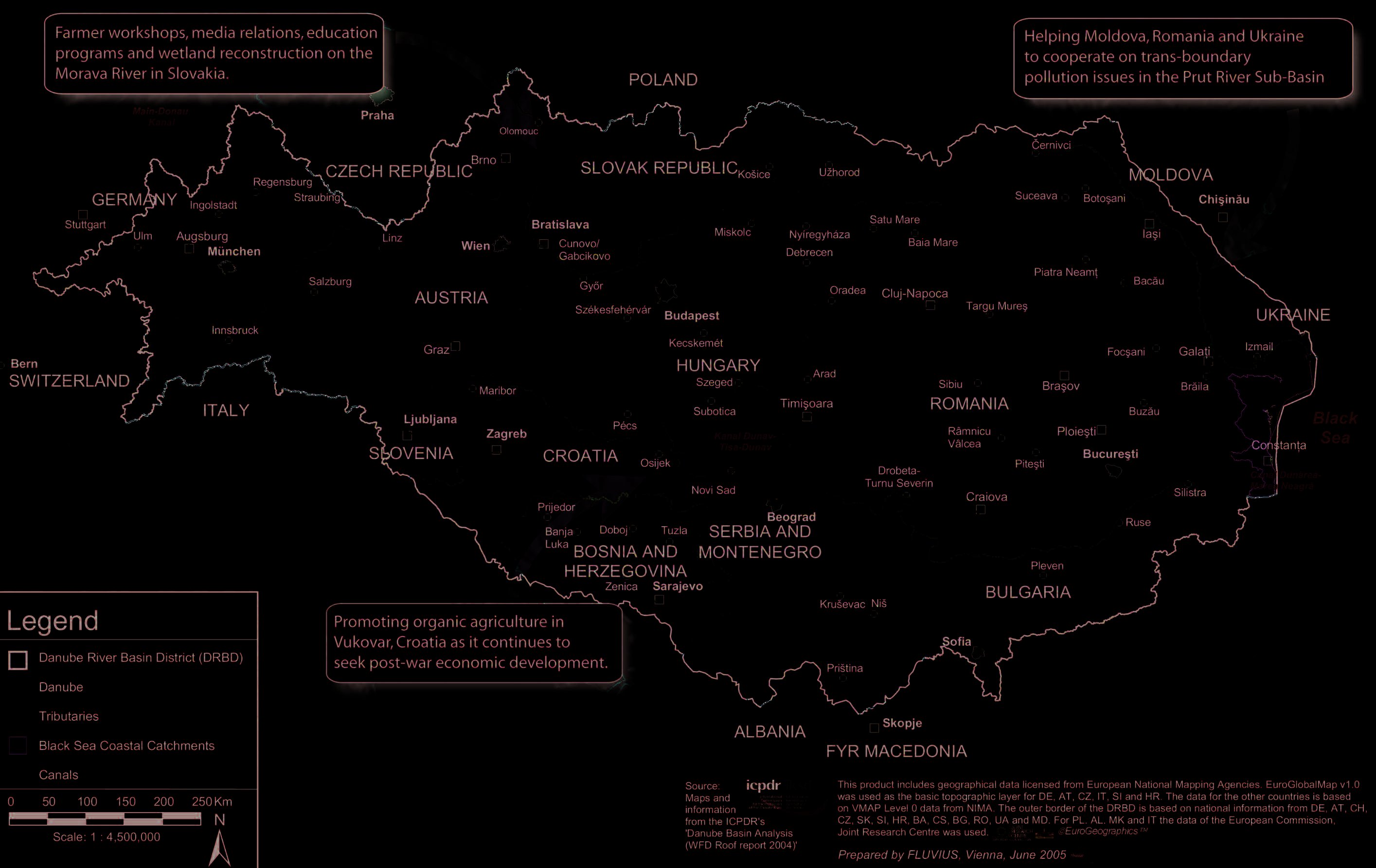
EXAMPLE OF
DRP GRANTS IN THE
DANUBE RIVER BASIN.
SUPPORT FOR DANUBE NGOS
Improving the health of the Danube basin would not be possible without the efforts of the
175-member Danube NGO network, to which DRP has committed support.
GRANTS FOR DANUBE NGOS
Created in 1999, the Danube Environment Forum (DEF)
The DRP has helped to strengthen the DEF's capacity
is a Danube River Basin-wide platform of non-governmental,
and effectiveness in the following areas:
NGOs are supported through the DRP's 2 million USD Small Grants programme,
non-profit, politically independent environmental organisa-
helping to reduce local nutrient and toxic pollution reduction.
tions. For the past six years, some 175 DEF member
> Building and extending the NGO network itself.
organisations from 13 different countries have been working
together, following the network's mission:
> Communication support for products such as publications,
DRP financial support so far has been earmarked for five
of pollution, improving monitoring systems, increasing
website, posters, bulletins and media relations, and internal
trans-boundary `regional' projects, involving NGOs from more
public awareness, facilitating information flows and preventing
"The DEF protects the Danube River and its tributaries, their
communications tools to improve the flow of information
than one country, and 60 `national' projects. The grants
accidental pollution.
biodiversity and resources, through enhancing co-operation
within the DEF community.
program is made available to the 11 countries of Bosnia and
among governments, non-governmental organisations, local
Herzegovina, Bulgaria, Croatia, the Czech Republic, Hungary,
Other projects aim at improving the function of wetlands
people and all kinds of stakeholders geared toward the
> Training programmes (e.g. on Water Framework Directive,
Moldova, Romania, Serbia and Montenegro, Slovakia,
and/or limiting erosion by, for example, revitalising river-
sustainable use of natural ecosystems."
communications).
Slovenia and Ukraine.
banks, reforestation and the creation of artificially construc-
ted wetlands that function as wastewater treatment areas.
> Support for DEF public awareness raising activities.
Many of the projects are geared to solving nutrient and
toxic pollution problems originating from agriculture (e.g.
The second round of grants will be launched in mid-2005.
> Funding for in-house resources such as staff and equipment.
pesticides), municipalities and households (e.g. wastewater)
Both rounds of the Small Grants Programme are managed
and industry (e.g. mining waste). Solutions include direct
by the Regional Environmental Center for Central and Eastern
contributions to the reduction of point and non-point sources
Europe (REC).


COORDINATING COMMUNICATIONS
ENHANCING PUBLIC PARTICIPATION AND ACCESS TO INFORMATION
DRP communications go beyond simply printing posters and launching a website. The Project's sophisticated
The DRP is making sure that everyone in the basin has the opportunity to get information about their
strategies and approaches will ensure that Danube stakeholders are aware of relevant issues and can put their
environment, and that the door is open for their involvement in decision-making processes affecting
concerns into action.
their environment.
To guide communications activities, the DRP developed the
In building these partnerships, an effort is made to
Information is critical for governments in the Danube River
Demonstration projects at selected local pollution
`Danube River Basin Communications Strategy'. Its overall
integrate communications objectives into partner strategies.
Basin striving to make the best decisions for cleaning up
hot spots will `road test' reinforced community involvement
desired outcome is "to create strong public awareness of
To date, the DRP has helped enhance the ICPDR magazine
and managing their shared water resources. It's essential
in solving water pollution issues.
the problem of aquatic pollution, especially of nutrients and
`Danube Watch' with research-based recommendations for
for the public as a precondition for awareness and responsi-
toxics, in the Danube River Basin; and, within the context of
targeting audiences, content and re-design. The communica-
ble behaviour toward their environment, and for the public's
On the international level, the project will strengthen the
implementation of the EU Water Framework Directive, to
tions capacities of the ICPDR and Danube NGOs have been
role as government watchdog. And European Union (EU) law
capacities of the International Commission for the Protection
create strong public support for, and participation in, actions
enhanced. And numerous products such as brochures,
requires public participation supported by quality, accessible
of the Danube River (ICPDR) to provide for stakeholder
that lead to significant and measurable reductions in this
leaflets, maps, posters and websites with valuable environ-
information as key parts of a process geared to meeting the
information and participation in water management.
pollution."
mental information have been produced and widely
EU's water quality objectives.
disseminated publicly.
The project is being implemented by the Regional
Communications activities under the strategy are aimed at
In 2004, the DRP initiated a project to enhance access
Environmental Center for Central and Eastern Europe (REC)
key target audiences such as environmental NGOs, farmers,
In 2004, significant financial support was given to the
to water-related information and public participation in the
with U.S. partners Resources for the Future and the New
Danube communities and local authorities. Implementation
ICPDR to launch the first annual `Danube Day', the basin's
Danube basin. The project will build the capacities of the
York University School of Law.
is led by the DRP in partnership with the International
largest celebration and occasion for people to symbolically
responsible authorities in five Danube countries (Bosnia
Commission for the Protection of the Danube River Basin
communicate the importance of their river.
and Herzegovina, Bulgaria, Croatia, Romania and Serbia
(ICPDR) and other partner organisations such as NGOs and
and Montenegro) to provide water-related information to
More details about the project can be found on the REC
municipalities.
the public.
web site www.rec.org.