




UNDP | GEF
DANUBE REGIONAL PROJECT
DANUBE
REGIONAL
WORKING FOR THE DANUBE AND ITS PEOPLE
PROJECT
"It's not surprising that UNDP-GEF places so much effort here," says DRP Project Manager
THE DANUBE REGIONAL PROJECT
Ivan Zavadsky. "The Danube is globally important because it's the test case for implementing
the Water Framework Directive in Europe; and many see the Directive as the most compre-
AND THE `DANUBE RIVER BASIN ANALYSIS'
hensive and integrated water legislation in the world."
"There was great cooperation from all the Danube countries," says Phillip Weller, ICPDR's
Executive Secretary. "Intense discussions led to a common understanding of the main
challenges a remarkable achievement."
Working for the Danube and its people,
"GEF has been associated with the Danube Basin for over a decade, and in that time
the Danube Regional Project is tackling key
has seen the ICPDR grow into a major force for cooperation among nations, and a model
issues recently reported to affect the health
of how countries should collaborate in resolving their cross-border concerns," said
of the entire Danube River Basin.
Alfred Duda from the International Waters section of the GEF Secretariat.
FOR MORE INFORMATION PLEASE CONTACT
UNDP | GEF DANUBE REGIONAL PROJECT
Vienna International Centre, PO Box 500, A-1400 Vienna, Austria
www.undp-drp.orgwww.drp.org
UNDP | GEF
DANUBE
REGIONAL
PROJECT
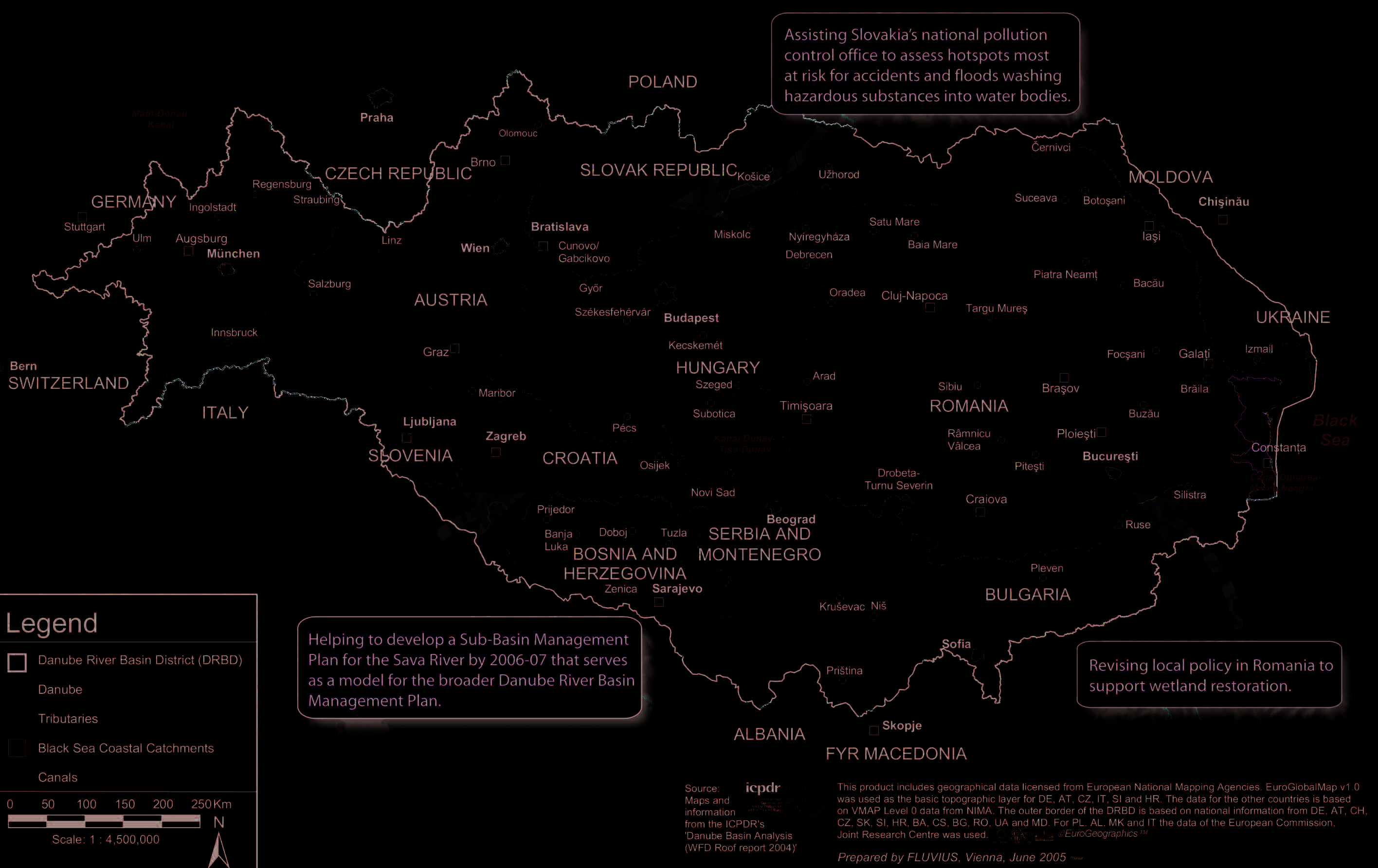

EXAMPLES OF DRP ACTIVITIES IN THE DANUBE BASIN
THE PLAYERS
The Danube River Basin
Length of Danube River: 2780 km
Average discharge: 6,500 m3/s
Catchment area: 801,463 km2
Population: 81 million
Number of states: 18 - the world's
most international river basin
EUROPEAN UNION (EU)
ICPDR
The EU is in the process of implementing the Water
The Vienna-based International Commission for the Protection
Framework Directive (WFD) possibly the most comprehen-
of the Danube River (ICPDR) coordinated the report's develop-
sive water legislation in the world. This legislation has tightly
ment. It is the implementing body for the Danube River
defined timescales and the objective of delivering good ecolo-
Protection Convention (DRPC) to which the 13 countries with
gical status in European rivers by 2015.
significant parts of the Danube basin are Contracting Parties.
THE DANUBE COUNTRIES
DRP
The countries of the Danube Basin are committed to ensuring the best
possible quality of life for people and nature.
The central players leading to the success of the Analysis
Financial and technical support for the Analysis was provided
were the Danube Basin countries. While not all countries in
by the Danube Regional Project (DRP), a 17.2 million USD
Two international organisations the International Commission for the Protection
the Danube basin are EU Member States, all agreed to com-
commitment by the Global Environment Facility (GEF) and the
of the Danube River (ICPDR) assisted by the UNDP/GEF Danube Regional Project
ply with the requirements of the WFD. There are significant
United Nations Development Programme (UNDP) to help
exist to support them.
disparities in wealth between the upper and downstream
Danube countries implement the Danube River Protection
counties. The strength of the countries' economies influen-
Convention.
To deliver this goal, it is first essential to establish the present status of the Danube
ces their ability to implement actions for environmental
and its basin. What are the problems? What are the solutions? Who can deliver them?
enhancement. In the long-term, stronger economies should
The DRP is part of the 95 million USD GEF Strategic
And how?
make the delivery of environmental initiatives easier. In the
Partnership for Nutrient Reduction in the Danube/Black Sea
meantime, the support of donors such as GEF will help to
Basin one of GEF's largest and most ambitious water-rela-
The Danube Basin countries, with the coordinating efforts of the ICPDR,
make the transition possible.
ted projects in the world. The Partnership supports the goals
carried out the Danube River Basin Analysis in 2004.
of the Commissions for the Danube and Black Sea to reduce
nutrient and toxic loads to levels necessary to allow Black
This Analysis represents a vital picture of the status of the Danube today
Sea ecosystems to recover to conditions in the 1960s.
and reveals the steps needed to ensure that the river and its basin can deliver
the best quality of life now and in the future.
WHAT THE DANUBE RIVER BASIN ANALYSIS
HAS REVEALED
The Danube River Basin Analysis 2004 highlights a number of future challenges for protecting
and restoring the environmental health of the basin:
POLLUTION
HYDROMORPHOLOGICAL ALTERATIONS
Most countries appear to be at high risk of groundwater
`Eutrophication' through nutrient pollution has contributed to
These include the building of dams, weirs and sluices and
Some 80% of the Danube's original floodplains have been
pollution from fertilisers, chemicals, untreated sewage and
a severe ecological imbalance in the Black Sea. Many species
the canalisation of rivers. The three main "driving forces"
lost in the last 150 years. Wetlands have been "drastically
leaching from contaminated soils. 48 million people depend
have been heavily impacted, with fish stocks showing alar-
have been power generation, flood protection and navigation.
altered", negatively impacting many fish and bird species that
on groundwater sources for drinking water.
ming declines. Recently, however, there have been reports of
depend on them for dynamic habitat.
recovery in the biological diversity of the northwest part of
Alterations have "significantly affected" a large part of the
Pollution really starts affecting the Danube's water quality
the Black Sea.
Danube from disconnecting floodplains and oxbows, to
Many plans for future infrastructure projects such as dams
after Budapest. The main sources are urban settlements,
eroding the river bed, to lowering water tables. In total,
and efforts to "improve navigation" pose major threats, some
industry and agriculture, from both point and non-point
Overall, pollution has declined in the Basin mainly because
80% of the river's total length has been regulated.
even to the last few remaining free-flowing sections of the
sources.
most economies of the Central and Eastern European (CEE)
Danube.
countries took major hits following political transformation in
A nearly uninterrupted chain of 59 dams and power plants
Nutrient pollution, mainly from nitrogen and phosphorus,
the late 1980s that affected both industry and agriculture.
cut across the first 1,000 km of the river about one dam
is a serious concern:
While the Black Sea shows signs of recovery, expected eco-
every 16 km. Dams have changed the living conditions for
nomic improvements in CEE countries could see pollution
all organisms, with migratory fish especially affected.
> Nitrogen use doubled from the 1950s to the mid-1980s
increase again.
Downstream, the Iron Gate dam led to the extinction of
followed by a substantial reduction in the late 1980s. But
sturgeon migrating upstream.
today, levels are still almost twice those of the 1950s.
Hundreds of hazardous substances are released into the
Danube basin and many pose serious threats to environment
> The main source of phosphorus is wastewater from urban
and health. Of 33 "priority substances" identified by the EU as
settlements. Overall phosphorus levels are 20% higher than
hazardous and requiring phase-out within 20 years, most are
in the 1950s.
used in the Danube basin. The biggest threat is from DDT, a
pesticide banned in Europe - in Danube samples taken, 71%
exceeded permissible levels.
THE DRP WORKING ON SOLUTIONS FOR THE DANUBE
THE MAKING OF THE DANUBE RIVER
BASIN ANALYSIS 2004
The first ever comprehensive analysis of the Danube Basin's environment
and the pressures impacting it
The Analysis clearly shows that the Danube Regional Project has and continues to be on track,
working for the right solutions to the key challenges identified by the Analysis.
RECOMMENDATIONS
DRP SOLUTIONS
Thirteen countries share large portions of the Danube River
The Danube River Basin Analysis 2004 will be a very valuable
FROM DANUBE RIVER BASIN ANALYSIS 2004
PAST, PRESENT AND FUTURE
Basin, making it the most international river basin in the
tool in helping to fulfil the environmental goals of national
world. To develop the Analysis, a significant level of coopera-
governments, UNDP-GEF and ICPDR in the Danube and Black
tion between the countries was necessary and the coun-
Sea region by contributing to:
>
Develop an effective Danube River Basin Management Plan
>
Help develop a Sub-Basin Management Plan for the Sava River
tries provided it.
(DRBMP) by 2009, followed by implementation.
by 2006 - 07 that serves as a model for the broader DRBMP.
> River basin management planning and prioritising required
>
Identify and pilot best available agricultural practices
The EU required that each country provide an assessment
investments and policies.
>
Reduce diffuse pollution from agriculture throughout basin.
(e.g. for applying fertilisers) and disseminate results to farmers.
of water bodies within their borders and cooperate with
neighbouring states. The ICPDR was requested to coordinate
> Improving the ecological quality of the Danube Basin's waters.
>
Pilot projects demonstrate the effectiveness of wetlands in removing
>
Wetlands and floodplains should be protected, restored and
the activities and to prepare the Analysis report on issues
and retaining nutrients, and of changing local land-use policy to
reconnected to the river.
of basin-wide importance to complement the national assess-
> Restoring the Black Sea to its former status.
promote wetland restoration in three countries.
ments.
>
Introduce `best available techniques' (BAT) to industry without delay
>
Assess how BAT has been applied throughout the basin, and
The production of this Analysis report is a significant
to meet EU law.
provide countries not acceding to the EU with a `BAT roadmap'.
Of the 13 countries involved, six were EU Member States
milestone for the implementation of the Water Framework
>
Help governments implement voluntary bans on phosphates used
that were obliged under EU law (specifically, the Water
Directive in the Danube River Basin. The next clear output in
>
Introduce phosphate-free detergents.
in washing detergents.
Framework Directive) to participate: Germany, Czech
the process will be the Danube River Basin Management
Republic, Austria, Slovakia, Hungary and Slovenia. The other
Plan that will be submitted in 2009.
>
Increase awareness of and access to environmental information
>
Assist governments in how to process and respond to environmental
seven countries, although not obliged, still voluntarily agreed
about the basin as well as public participation in environmental
information requests.
in November 2000 in Sofia, Bulgaria to co-develop the
decision-making.
report.
>
Revise the monitoring network to ensure full compliance with the
>
Review the existing network and make recommendations for
WFD.
its improvement.
>
Reduce risks associated with hazardous substances entering
>
Help national pollution control offices assess hotspots in the Danube
Danube water bodies.
Basin most at risk for accidents and floods washing hazardous
substances into water bodies.