UNDP/GEF Danube Regional Project
Strengthening the Implementation Capacities for Nutrient
Reduction and Transboundary Cooperation in the
Danube River Basin
Final Report
Preparation of the Sava River Basin
Management Plan
2004 2006
Project Component 1.1-9: "Development of the Sava
River Basin Management Plan"
May 2004
Prepared by:
ZINKE ENVIRONMENT CONSULTING
for Central and Eastern Europe,
Vienna
Development of the Sava River Basin Management Plan Final Report
3
Table of Contents
Page
ACRONYMS & ABBREVIATIONS.................................................................................................. 4
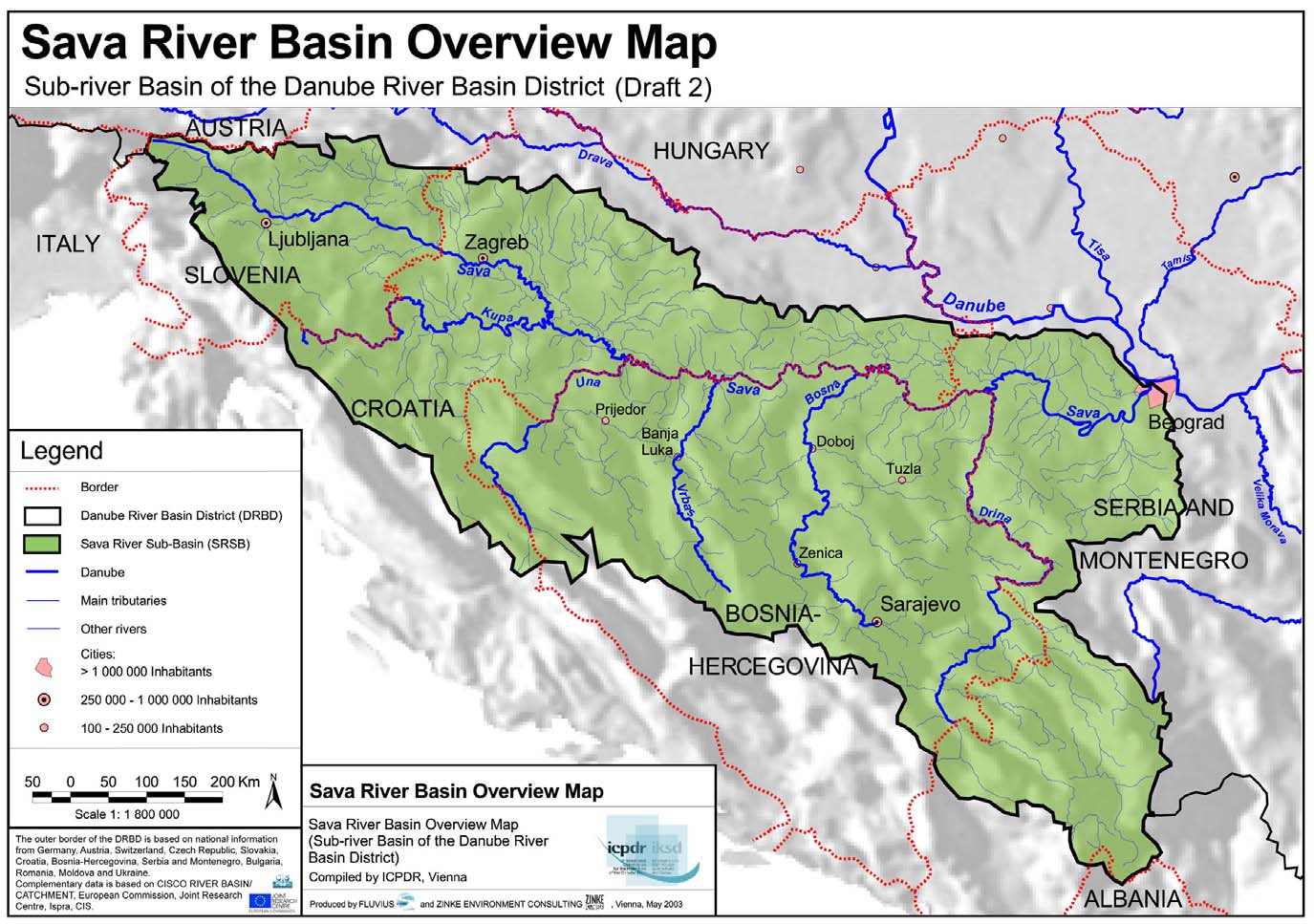
SAVA RIVER BASIN MAP................................................................................................................ 5
1.
BACKGROUND.......................................................................................................................... 7
2.
ACTIVITIES UNDERTAKEN DURING PHASE 1................................................................ 8
2.1.
Preparatory and Inception Phase ............................................................................. 8
2.2.
Results of implementation ......................................................................................... 9
2.3.
Coordination with the Sava Basin Governments and the Interim Sava
Commission............................................................................................................... 10
3.
COOPERATION WITH OTHER PROJECTS OF TECHNICAL ASSISTANCE............ 12
3.1.
Dutch technical assistance ....................................................................................... 12
3.2.
EU-CARDS and EU-ISPA....................................................................................... 12
4.
COORDINATION WITH OTHER GEF-DRP COMPONENTS (PHASES 1 & 2) ........ 13
5.
COORDINATION MECHANISMS FOR PROJECT IMPLEMENTATION.................... 17
6.
METHODOLOGICAL APPROACH FOR PROJECT IMPLEMENTATION ................. 18
6.1.
Project concept for Phases 1 and 2 ......................................................................... 18
6.2.
Modalities of project execution (Phase 1)............................................................... 18
7.
CONCEPT FOR PHASE 2 OF THE GEF-DRP SAVA COMPONENT ............................. 20
7.1.
Description of Main Activities Suggested for Phase 2........................................... 20
7.2.
Suggested Time Input for International and National Experts ........................... 21
Annexes
ZINKE ENVIRONMENT CONSULTING for CEE, Vienna
4
UNDP/GEF Danube Regional Project
Acronyms & Abbreviations
B-H
Bosnia and Herzegovina
CARDS
(EC) Community Assistance for Reconstruction, Development and Stabilization for
the western Balkans 2002-2006
CEE
Central and Eastern Europe
CIS
Common Implementation Strategy (of the WFD)
DRB
Danube River Basin
DRP
(UNDP/GEF) Danube Regional Project
EAR
European Agency for Reconstruction
EC
European
Commission
EG / ESG
Expert Group / Expert Sub-group of the ICPDR
EMIS (EG)
Emission (Expert Group of the ICPDR)
EU
European Union
GEF
Global Environment Facility
GIS
Geographical Information System
HR
Croatia
ICPDR
International Commission for the Protection of the Danube River
ISPA
Instrument for Structural Policies for Accession
mio.
million
MLIM (EG) Monitoring, Laboratory and Information Management (ICPDR)
PIAC
Principal International Alert Center
RBM (EG)
River Basin Management (Expert Group of the ICPDR)
Sava WG
Sava (RBM) Working Group
SG SWM
Strategic Group on Sustainable Water Management (of the Sava Commission)
S-M
Serbia and Montenegro
SI
Slovenia
TNMN
Trans-National Monitoring Network
ToR
Terms of Reference
UNDP
United Nations Development Programme
WFD
EU Water Framework Directive
WG
Working Group
Development of the Sava River Basin Management Plan Final Report
5
ZINKE ENVIRONMENT CONSULTING for CEE, Vienna
Development of the Sava River Basin Management Plan Final Report
7
1. Background
The UNDP-GEF Danube Regional Project supports the development of a pilot plan for the Sava River
Basin as a model for river basin management planning in line with the EU Water Framework
Directive. In this context, the project shall define concepts for common approaches and
methodologies, standards and guidelines to be applied in the regional context, and formulate
recommendations for implementation strategies and program of measures likely to be effective in the
transboundary context.
In Phase I (April to December 2003), the Project has carried out a first situation analysis, examined the
availability of information and data, and assessed institutional capacities in the four Sava countries to
carry out the development of the Sava River Basin Management Plan. In this context, the requirements
of the EU WFD and also of other activities of the GEF Project were taken into account. The result is a
first situation analysis on the environmental status in the Sava river basin, and a concept and work plan
for Phase II of the project, which was discussed and agreed upon at a regional workshop (4th meeting
of the "Sava Working Group") in December 2003.
It was then also agreed that the project should in Phase 2 follow the guidelines established by the
ICPDR River Basin Management Expert Group and be implemented in cooperation and coordination
with other assistance programmes for the Sava River Basin, in particular the upcoming Sava project of
the EU-CARDS Regional Programme, but also the parallel EU-ISPA pilot project for a RBM Plan in
the Krka river sub-basin and the ongoing Dutch assistance for the Sava Interim Commission.
At the end of Phase II (2006), a "Pragmatic River Basin Management Plan (Roof Report" for the Sava
River Basin, including key water management issues and preliminary measures (Sava investment
programme), shall be available.
ZINKE ENVIRONMENT CONSULTING for CEE, Vienna
8
UNDP/GEF Danube Regional Project
2.
Activities undertaken during Phase 1
In line with the resolution of the ICPDR Steering Committee at its meeting in June 2002 in Prague to
use the Sava River Basin as a model for the development of a River Basin Management Plan, the
present project concept, the methodology for project implementation and the necessary resources and
inputs have been developed 1).
2.1. Preparatory and Inception Phase
The project concept and the modalities of implementation of the GEF DRP Project Activity 1.1-9 have
been explained and discussed at the 1st meeting of the "Sava Working Group" on 18 October 2002 in
Vienna. The proposed approach and related activities are in line with objectives of the Framework
Agreement on the Sava River Basin , with special reference to Article 3 (EU Water Framework
Directive), Article 5 (Cooperation with ICPDR), and to Article 12, which stipulates the development
of the "Sava River Basin Management Plan".
Further, the guidelines of the Work Program, developed in the frame of the Sava Initiative for the
Project Sector "Water management", have been fully taken into account with particular attention to
Project Fiche No 7 "Development Strategy for River Basin Management Plan in the Sava River
Basin".
To respond to the mandate of the ICPDR, the GEF Project followed the guidelines established by the
River Basin Management Group, in particular the Strategic Paper for the "Development of a Danube
River Basin District Management Plan" (May 2002) and the guidelines for the preparation of the Roof
Reports for the Danube River Basin.
After contracting Zinke Environment Consulting for Central and Eastern Europe, Vienna, as
international consultant to guide the implementation of the GEF project component, a 2nd meeting of
the Sava Working Group was called up, which took place on 7-8 April 2003 in Vienna.
At this meeting, the Terms of Reference, the methodological approach and the Work Plan for the
implementation of the GEF project component have been discussed and the Work Plan amended.
Particular attention was given to coordinate with the planned technical assistance by the Dutch
Government.
It was further foreseen that the results of the EU-CARDS Project entitled "Pilot River Basin Plan" to
test the implementation of EU-WFD guidelines in selected catchment areas (HR: Dobra river; B-H:
Vrbas river; S-M: Bosut river) should also taken into account in developing the Sava River Basin
Management Plan.
The detailed results of this meeting are given in Annex 4 of the Inception Report.
1) Resolution from the ICPDR Steering Group Meeting 6 and 7 June 2002 in Prague:
The Steering Group
welcomes the initiative of the UNDP/GEF Project to support the activities of the ICPDR Expert Groups and
to reinforce the implementation of the DRPC;
welcomes the preparation of a pilot project for the development of the RBM Plan for the Sava River Basin;
asks the RBM EG to cooperate with the Project with the view to apply and to test the ICPDR strategy for
implementing the EU WFD in the Sava River Basin and to provide support for project implementation;
recommends to establish, with the assistance of the Project, a coordinating body for the preparation of the
Sava RBM Plan.
Development of the Sava River Basin Management Plan Final Report
9
In April, upon proposal of the Sava country Governments, each four national experts were identified
and contracted by the GEF DRP office:
for the water management analysis:
Boris Kompare, Slovenia
Davor Malus, Croatia
Tarik Kupusovic, Bosnia i Herzegovina
Borisav S. Milutinovic, Serbia and Montenegro;
for the economy and population data collection:
Anitra Smitran, Bosnia i Herzegovina
Zeljka Kordej-De Villa, Croatia
Nives Nared, Slovenia
Borisav S. Milutinovic, Serbia and Montenegro.
At the Instruction Meeting in Zagreb on 30 April 2003 all national experts for water management have
received detailed instruction for collection and analysis of data and identification of information gaps.
Detailed guidelines have also been prepared for the collection of demographic and socio-economic
data. In this case, national consultants already identified and working under project component 1.1-3,
"Applying EU Economic Guidelines for the economic analysis to the DRB" have been requested to
collect data on population and social and economic activities in the four Sava Basin countries.
The ToR, the results of the Sava WG meetings in October 2002 and April 2003 as well as the
guidelines and instructions for national experts are given in the Inception Report of this component
from May 2003.
2.2. Results of implementation
From May to September, the national consultants under the guidance of the international consultant
have collected the requested information.
The results of these studies were presented in two reports (completed in November 2003):
ˇ "Summary of National Analysis for Socio-economic Indicators" and
ˇ "Summary of National Analysis for Water Management Indicators of the Sava River Basin".
In brief, the National Analysis for Socio-economic Indicators has resulted in a very imbalanced
result: The data and information provided by Slovenia are rather complete for 2000 and demonstrate
the availability of data and the possibility to obtain these. Also the information provided by Serbia
(with the part of Montenegro missing) is rather complete also for the previous period from 1960 and
1980, which again indicates the availability of those data, which have been collected in previous times
also under different political systems.
The data and information obtained from Croatia need to be further completed and more efforts have
to be undertaken to achieve a better set of data also for the period from 1960 and 1980. Similar
remarks have to be made for Bosnia i Herzegovina, where reliable data and information are difficult
to find but could, as shown in the case of Serbia, most probably be obtained.
ZINKE ENVIRONMENT CONSULTING for CEE, Vienna
10
UNDP/GEF Danube Regional Project
The scarcity of socio-economic data and information has not allowed making a realistic summary of
results for the whole Sava river basin. It has shown that more time and efforts from qualified national
experts are needed, and that full cooperation and support from Government and public sector
institutions is indispensable.
Regarding the second subject of the Sava basin analysis, the Water Management Indicators, the
national data and information provided by Slovenia mostly only indicate that they exist, are available
or will be made available in 2004. This result did not allow a sound evaluation or comparison.
The data and information obtained from Croatia, Serbia & Montenegro and Bosnia & Herzegovina
indicate a rather complete picture. The found gaps and differences are clear but some can probably
still be filled in Phase 2. Again, the diverse character of the local situation and of the provided
information does not allow to making a simple summary for the Sava river basin.
Further, the results for both subjects have shown that, not only for the Sava Project, the questionnaire
and templates have to be further revised and simplified to result in realistically obtainable information.
In this context, both general capacity building on the WFD-related issues for the relevant institutions
(partly possible via the EU-CARDS project) as well as transboundary coordination of data
development (via joints meetings and trainings) is needed to get the right information for the Sava
RBM Plan by 2006.
These findings were presented and discussed at the 3rd meeting of the Sava Working Group on 9
October in Zagreb, and briefly re-addressed at the regional UNDP/GEF Workshop on 12 December
2003 in Ljubljana (4th meeting of the Sava WG). Both Summary Analyses were adopted by all
countries, and it was agreed to improve and complete the required data and information during Phase 2
of the GEF Project.
2.3. Coordination with the Sava Basin Governments and the Interim Sava
Commission
Coordination of the preparation and implementation of this GEF-DRP component with the Sava Basin
governments was secured through regular meetings of the "Sava Working Group" where national
representatives from the relevant national institutions, being members of the ICPDR RBM EG,
discussed the proposed stapes and interim results with the international consultant as well as with the
GEF-DRP project manager and the ICPDR Permanent Secretariat. Results of the first and second
meetings of the Sava WG were given in the Inception Report.
At the 3rd meeting on 9 October in Zagreb the results of national data analysis (compilation and
assessment of national information) were presented. Also, a draft of the concept for the preparation of
the Sava RBM Plan during the UNDP/GEF DRP Phase II (2004-2006) was discussed in order to
prepare for the Regional Workshop in December.
The 4th meeting of the Sava WG on 12 December in Ljubljana constituted the mentioned Regional
Workshop. It served to present and discuss the revised Concept Paper for the development of the Sava
River Basin Management Plan (GEF Phase 2). The meeting was also used to introduce the
requirements of the EU Water Framework Directive (WFD) in developing such a plan at the sub-basin
level and to receive updated information on other donor activities (IAC-Netherlands and EU CARDS)
to assure efficient coordination of activities and careful use of funding.
The Ljubljana meeting concluded that the Concept for Phase 2, after inclusion of the discussion
results, is accepted and should be presented to the Interim Sava Commission. The revised Work
Development of the Sava River Basin Management Plan Final Report
11
Programme for Phase 2 will be discussed with stakeholders and national experts at the Inception
Workshop in spring 2004.
All results of the 3rd and the 4th meeting of the Sava WG are given in Annexes 1 and 2.
Information and coordination with the Interim Sava Commission was secured during Phase 1 through
participation and presentations about the GEF-DRP Sava component by the international consultant
ˇ at the IIIrd Session of the Interim Sava Commission on 9-11 June in Novi Sad (SCG) where
the objectives and planned implementation of the Sava component were presented;
ˇ at the IVth Session of the Interim Sava Commission's on 15-17 December 2003 in Stubicke
Teplice (HR), where the results of the 4th Sava WG meeting (agreed concept for Phase 2) were
presented. It was then agreed that the Phase 2 implementation would be closely coordinated
with the new Strategic Group on Sustainable Water Management of the Sava Commission.
ZINKE ENVIRONMENT CONSULTING for CEE, Vienna
12
UNDP/GEF Danube Regional Project
3.
Cooperation with other projects of technical assistance
3.1. Dutch technical assistance
The Dutch government is preparing a specific program under the name "Water and Ecosystems" to
assist the Sava countries in establishing the new "Sava Commission" and its structures, and to support
the implementation of the Sava Action Plan. The Dutch assistance program will concentrate on the
following issues:
1. Institutional development (Sava River Basin Commission)
2. Capacity building and exchange of knowledge
3. Inter-sectoral
cooperation
4. Development of methods and tools for water management and implementation of the EU
WFD, as e.g.:
Sava GIS
Integrated flood prevention (e.g. levee reconstruction)
Protection of floodplains and ecosystem (e.g. eco-network)
Improved water quality management.
The Work Plan for this project was drafted in May 2003, taken into account in the GEF-Sava work
program and the assistance to assure complementarity of measures but was still under discussion in
March 2004. It is hoped that in the stage of project implementation both projects will closely
cooperate. Tentative end of the Dutch project is December 2004.
3.2. EU-CARDS and EU-ISPA
There are a number of national projects under EU-CARDS (HR, B-H) and the European Agency for
Reconstruction (S-M) presently under way resp. under preparation for implementation between 2004
and 2006. All will strengthen local capacities in water management (including monitoring) and
introducing the EU-WFD.
A new large EU-CARDS project entitled "Pilot River Basin Plan for the Sava River Basin" will assist
Croatia, Bosnia & Herzegovina, and Serbia and Montenegro from fall 2004 on over 36 months to
strengthening national capacities on WFD-oriented, transboundary water management, and to develop
pilot projects in selected catchment areas to test the implementation of the EU WFD.
Slovenia will receive EU support (ISPA funds) to do a similar activity, i.e. to test the EU guidelines
for the implementation of the EU WFD in the Krka river basin.
All four countries will thus under the supervision of the Sava Commission and the ICPDR -
cooperate and exchange experience and information to harmonize the approach for implementing the
WFD in the Sava region.
It is agreed that the EU-CARDS and the GEF-DRP Sava projects will closely be coordinated in order
to prevent overlapping and to secure complementarity both at national and Sava basin level. The
results of the test program and the harmonized approach in implementing the EU WFD will contribute
to the development of the Sava River Basin Management Plan during the GEF-DRP Phase 2.
Development of the Sava River Basin Management Plan Final Report
13
4.
Coordination with other GEF-DRP Components
(Phases 1 & 2)
The Sava component was coordinated and linked during Phase 1 with the following DRP components:
Project Component 1.1-3: Apply the EU Guidelines for economic analysis and arrive at the overall
economic analysis for the Danube River Basin, with particular attention to:
Guidelines and templates for the preparation of a report on data assessment, which have been
modified and adapted to the requirements of the Sava report,
Collection and assessment of national economic data for 4 Sava countries, which are carried
out by national consultants for project component 1.1-3,
The assessment of national capacities to an produce economic analysis, taken into account to
define the work program of Phase II
Project Component 1.2: Reduction of nutrients and other harmful substances from agricultural point
and non-point sources through agricultural policy changes with particular attention to:
The inventory of agricultural point and non-point sources of pollution in line with the EMIS
emission inventory and results from MONERIS (to verify own results),
Relevant legislation, existing policy programs and actual state of enforcement in the Sava
Basin countries with respect to promotion and application of BAP practices (Phase II),
The inventory on important agrochemicals (nutrients etc.),
The analysis of main institutional, administrative and funding deficiencies,
The application of best agricultural practices.
Project Component 1.3: Development of pilot projects on reduction of nutrients and other harmful
substances from agricultural point and non-point sources with focus on:
Inventory and analysis of existing programs and pilot projects promoting best agricultural
practice in the 4 Sava countries,
Definition and planning of pilot projects in the Sava countries (Serbia, Bosnia i Herzegovina
and Croatia).
Project Component 1.4: Policy development for wetland rehabilitation under the aspect of appropriate
land use, with focus on :
Inventory of protected areas (counterchecked by national consultants),
Results from case studies for selected wetland areas and inappropriate land use (if existing
for the Sava river basin).
ZINKE ENVIRONMENT CONSULTING for CEE, Vienna
14
UNDP/GEF Danube Regional Project
Project Component 1.5: Industrial reform and development of policies and legislation for the
application of BAT towards reduction of nutrients (N and P) and dangerous substances with focus on:
Inventory on industrial and mining "hot spots" in the 4 Sava basin countries (counterchecked
by national consultants),
Results of cause - effect analysis and identification of significant impact from industrial "hot
spots" on water resources and water quality in the 4 Sava basin countries,
Analysis on policies and existing and future legislation for industrial pollution control, and
identification of enforcement mechanisms in the 4 Sava basin countries.
Project Component 1.8: Recommendations for the reduction of phosphorus in detergents with
particular attention to.
Existing legislation, policies and voluntary commitments,
Data on import and local production of phosphorus-containing detergents.
Project Component 2.1: Setting up of Inter-Ministerial Coordinating Mechanisms for national
policies, legislation and project implementation, with focus on:
Existing national structures for coordination of water management and water pollution
control with particular attention to the Sava Initiative,
Proposed structures, including technical, administrative and financial departments to
coordinate the development and implementation of river basin management plans (Sava,
Danube) as well as the implementation of policies, legislation and investment projects in
compliance with the EU WFD.
Project Component 2.3: Improvement of procedures and tools for transboundary accident emergency
response, with focus on:
Evaluation of needs for technical and financial (investments) support and prepare
implementation schedules for the extension of AEWS in Serbia and Bosnia i Herzegovina,
and for reinforcement of operational conditions in the national alert centers (PIACs) in all
Sava basin countries.
Project Component 2.4: Support for reinforcement of the ICPDR Information System, with focus on:
Defining needs for equipment (hardware and software) and capacity building in relation to
WFD implementation in all Sava basin countries,
Defining needs for financial support for Serbia, Bosnia i Herzegovina and Croatia,
Reinforcement of training for efficient use of the Info System in Sava basin countries.
Development of the Sava River Basin Management Plan Final Report
15
Project Component 3.2: Applied awareness raising through community-based Small Grants
Programme, with particular attention to:
Assuring that SGP projects are identified in all Sava basin countries to support the
development of the Sava Basin Management Plan for:
o demonstration activities and awareness campaigns for sustainable land management and
pollution reduction,
o small scale community based investment projects for rehabilitation of wetlands, best
agricultural practices, reduction of use of fertilizers, manure management, improvement of
village sewer systems, etc.
Project Component 4.4: Danube Basin study on pollution trading and corresponding economic
instruments for nutrient reduction, with particular attention to (Phase II):
Identifying general possibilities for establishing pollution trading or corresponding economic
instruments for nutrient reduction in Sava countries,
Reviewing and analyzing relevant legislation in Sava countries,
Potential and readiness for pollution trading in Sava countries.
During Phase 2 it is recommended to continue linking with these components. Other DRP
components to be coordinated with in the future are:
Project Component 1.1-5: Developing river basin management tools with particular attention to:
Mapping, development of GIS and remote sensing
Data management.
Project Component 1.1-6: Developing typology of surface waters and defining relevant reference
conditions.
Project Component 1.1-7: Implementing ecological status assessment in line with the requirements of
the EU WFD using specific bio-indicators.
Project Component 1.1-8: Characterization and analysis of groundwater bodies (this Project
Component is accomplished in Phase 1 and should be further used to finalize the specific analysis in
the Sava river basin).
Project Component 2.2: Development of operational tools for monitoring, laboratory and information
management, with focus on:
Developing, upgrading and reinforcing capacities and tools for monitoring, laboratory and
information management and for emission analysis from point and non-point sources of
pollution (follow-up from Phase 1)
Further development of databases (EMIS, MLIM, DABLAS, etc) in order to assess
environmental stress and impact in Sava basin countries,
Harmonizing water quality standards (finalize classification schemes) and quality assurance
for nutrients and toxic substances in Sava basin countries (follow-up from Phase 1);
Optimisation of the TNMN network (program, hardware, software, training) in the Sava
basin countries (in particular in S & M, B i H and Croatia) and identifying sources and
ZINKE ENVIRONMENT CONSULTING for CEE, Vienna
16
UNDP/GEF Danube Regional Project
amounts of transboundary pollution for substances on the list of EU and DRPC priority
substances (follow-up from Phase 1).
Organizing workshops to support capacity building.
Project Component 2.4: Support for reinforcement of the ICPDR Information System, with focus on:
Development and implementation of linkages between Sava Convention GIS (to countries.
GEF Component 3.4: Enhancing support of public participation in addressing priority sources of
pollution (hot spots) through improved access to information through (all Sava countries except
Slovenia):
Identifying and analysing different approaches and developing best practice methods
adapted to the regional conditions (Sava river basin countries),
Examining options and models for effective public involvement in water pollution reduction
and "hot spot" control,
Develop specific legal, regulatory, policy and institutional or practical measures to increase
public access to information,
Assist countries to develop measures and field testing of measures combined with local
capacity building and training,
Organizing workshops for government officials and NGOs on issues of public access to
information concerning water management and pollution control.
Development of the Sava River Basin Management Plan Final Report
17
5. Coordination
mechanisms
for project implementation
The ICPDR has agreed in 2002 to establish a special Working Group to guide and coordinate the
activities of the GEF Project in developing a Sava River Basin Management Plan (see footnote in
Chapter 2).
Four experts from the ICPDR RBM EG from Slovenia, Croatia, Bosnia & Herzegovina and Serbia &
Montenegro participated in the Sava River Basin Working Group (Sava WG). This assured that the
methodologies and guidelines developed within the pilot project for the Sava River Basin.
It is further assumed that these experts will participate in existing structures of the Sava Initiative or
futures structures of the forthcoming Sava Commission to assure full integration of methodological
approach and activities related to the water management sector (e.g. EU-CARDS Sava project) with
those as practiced in the overall Danube Basin under the ICPDR.
This is also to assure that the Sava River Basin Management Plan will be fully compatible with the
approach in the Danube River Basin to serve as a pilot project for the further development of the
Danube "Roof Report".
(Interim) Sava Basin Commission
Strategic Group for
Sustainable Water Management
Secretariat
Ad-hoc Expert Group for RBM
Sava RBM
ICPDR RBM EG
Working Group
Slovenia
Sava Intl. Commission
Croatia
Slovenia
Croatia
Bosnia i Herzeg.
Bosnia i Herzegovina
Serbia&Monten.
Serbia and Montenegro
Coordinates
ICPDR Secretariat
implementation of EU
UNDP/GEF Project
WFD and develops
Dutch technical assist.
Danube River Basin
Other projects
Roof Report
UNDP/GEF Danube
Other Projects
EU CARDS Project:
Regional Project:
US technical assistance
Sava Pilot River Basin
Other.....
Plan
Sava component
ZINKE ENVIRONMENT CONSULTING for CEE, Vienna
18
UNDP/GEF Danube Regional Project
6. Methodological
approach
for project implementation
6.1. Project concept for Phases 1 and 2
Phase I was a preparation phase in which an environmental situation analysis was carried out. Various
data and information necessary for the preparation of a Sava River Basin Management Plan was
collected and analyzed, taking into account the requirements for implementing the EU WFD. Also,
this provided a gap analysis through identified deficiencies in data but also in structural, professional
and general human capacities.
This material helped to prepare a realistic concept and work plan aiming at a Sava River Basin Plan in
Phase 2 of the project during a period of 30 months from mid 2004 to end 2006.
Taking into account the reporting requirements as indicated in the EU WFD, all EU member states and
accession countries should prepare until 2006 a thorough analysis of surface and ground water bodies,
define pressure and impact on surface and groundwater, and carry out an economic analysis. It can
therefore be expected that, with the assistance of GEF and other sources of technical assistance, the
analytical part of the River Basin Management Plan at the level of a "Roof Report" could be achieved
until 2005.
A carefully carried out pressure and impact analysis allows at an early stage to define "measures" as
required by the EU WFD in terms of policies, regulations, investment programs, mechanisms for
compliance, etc. This can be achieved with the help of the GEF DRP whose mandate is to assist the
ICPDR and its member states in developing policies, regulations and other measures to comply with
EU and international standards for pollution reduction and water management.
Also, at this point of time, the ICPDR holds a relative up-to-date and reliable data-base with
information on investment projects, in particular for the municipal sector, which shall be enlarged for
the industrial and agricultural sectors, including investment programs and development of policies and
legal mechanisms.
Therefore, the goal to establish until end 2006 a pragmatic Sava River Basin Management Plan
including proposed preliminary measures to respond to transboundary issues seems realistic.
The future Sava RBM Plan could then serve as a model for the preparation of the Danube River
District Management Plan (Roof Report), which should be finalized until 2010. It could further serve
as a model for the preparation of Sub-river Basin Plans for other parts of the Danube River Basin.
6.2. Modalities of project execution (Phase 1)
The project was carried out under the guidance and organization of the international consultant. He
defined data and information needed for the situation analysis and the definition of environmental key
issues, taking into account the GEF project description. Particular attention was given to issues related
to EU directives and to guidelines developed by the ICPDR RBM Expert Group for implementing the
EU WFD.
The international consultant prepared formats and guidelines for collection of data and information at
the national level, and supervised the work of national consultants. He prepared two summary reports
on "National Analysis for Socio-economic Indicators" and "for Water Management Indicators of the
Sava River Basin".
Development of the Sava River Basin Management Plan Final Report
19
The international consultant prepared an outline for the Sava River Basin Management Plan to be
worked out in Phase 2 of the Project. In close communication with the GEF-DRP office, he co-
organised the meetings of the Sava WG on 7-8 April and 9 October, and the regional workshop on 12
December where the concept and the work program for Phase 2 were discussed and agreed upon. He
prepared reports for all these meetings, and finalized the Concept and the implementation plan for the
period of 30 months (July 2004 to December 2006) for preparing the Sava River Basin Management
Plan.
The contracted eight national consultants worked intensively to collect the requested information
within the narrow time line (regrettably, two of the national consultants sent for different reasons
rather incomplete reports). They national consultants have been encouraged to work closely with other
national consultants working with other GEF project components, as spelled out in Chapter 4.
ZINKE ENVIRONMENT CONSULTING for CEE, Vienna
20
UNDP/GEF Danube Regional Project
7.
Concept for Phase 2 of the GEF-DRP Sava Component
At the end of Phase 1, a concept for Phase 2 has been drafted and was discussed at the 3rd Sava WG
meeting on 9 October and at the Regional workshop (4th meeting of the Sava WG) on 12 December
2003. The agreed and finalized "Concept for the Preparation of the Sava River Basin Management
Plan" is given in a separate document.
The agreed Immediate Objectives of the UNDP/GEF DRP should be in Phase 2 to assist the Save
River Basin countries:
1. to deliver the products required by the ICPDR in order to meet the WFD requirements
between 2004 and 2006, depending on the specific country needs (Objective 1);
2. to develop a pragmatic Sava RBM plan which analyses the major transboundary issues related
to water quality control and water management in the basin and identifies the main measures
to deal with them, including the necessary investments needed to meet the main principles of
the WFD (Objective 2).
This target can be achieved if the GEF DRP supports the Sava basin countries (in particular Serbia &
Montenegro, Bosnia i Herzegovina, but also Croatia) with other Project activities related to the
development of policies, regulations and other measures for water management.
In the same context, support provided by EU CARDS, the IAC - Dutch technical assistance as well as
other international and bilateral assistance (e.g. US Government) should be taken into account in
developing the Phase 2 work programme.
7.1. Description of Main Activities Suggested for Phase 2
In this context, in 2004 and 2005 the analyses and information collection related to the DRB Roof
Report 2004/2005 (Parts A and B) shall be completed (analyses of surface and groundwater bodies,
pressure and impact on surface and groundwater, and economic analysis).
Based on the results of a carefully carried out pressure and impact analysis, it is possible at an early
stage (2005/2006) to identify "preliminary measures" as required by the EU WFD in terms of policies,
laws and regulations, investment programs, mechanisms for compliance, etc.
The following main activities have been agreed:
ˇ Preparation of the Work Programme for Phase 2, taking into account other UNDP/GEF
Project components, the EU-CARDS Sava project, the Dutch technical assistance and other
related support activities;
ˇ Completion of the analyses and information collection related to the Danube River Basin
Roof Report 2004/2005 (Parts A and B) in all Sava countries;
ˇ Assessment of monitoring programmes with regard to the needs of the WFD
implementation;
ˇ Situation analysis and description of transboundary key issues (pressures and impacts)
related to water management and socio-economic conditions in the Sava River Basin;
ˇ Preliminary Programme of Measures in line with the EU WFD;
ˇ Compiled Pragmatic Sava River Basin Management Plan including Preliminary
Programme of Measures and related investments (Roof Report).
Development of the Sava River Basin Management Plan Final Report
21
7.2. Suggested Time Input for International and National Experts
A proposal for a "Time Schedule for Project Implementation of the GEF Sava Component" (July 2004
November 2006) has been worked out by the internatio-nal consultant at the end of Phase 1 and is
annexed to the Sava component Concept for Phase 2.
The actual input of national and international consultants will depend on the budget available for this
component in Phase 2, and will be further discussed and detailed during the Inception Phase of the
GEF-DRP and this Sava component.
ZINKE ENVIRONMENT CONSULTING for CEE, Vienna
Development of the Sava River Basin Management Plan Final Report
23
Annexes
Annex 1
Summary and Results of the 3rd Meeting of the Sava Working Group, 9 October
2003 in Zagreb/HR
Annex 2
Summary and Results of the UNDP/GEF Workshop "Development of SAVA
RBD Plan (Pilot Project)" - 4th Meeting of the Sava Working Group, 12
December 2003 in Ljubljana/SI
ZINKE ENVIRONMENT CONSULTING for CEE, Vienna
Development of the Sava River Basin Management Plan Final Report
25
Annex 1
Summary and Results of the 3rd Meeting of the
Sava Working Group
UNDP/GEF Project Component 1.1-9:
"Development of the Pilot RBM Plan for the Sava"
9 October 2003 at Hrvatske Vode, Zagreb
Attending participants of the meeting were:
Mr. Ivan ZAVADSKY, UNDP/GEF Danube Regional Project Team
Mr Philip WELLER; ICPDR Executive Secretary
Mr. Joachim BENDOW, ICPDR former Executive Secretary
Mr Boris KOMPARE, Slovenia,
Mr Zelko OSTOJIC, Croatia
Ms. Karmen CERAR, Croatia
Mr. Borislav JAKSIC, Bosnia-Hercegovina
Mr Tarik KUPUSOVIC, Bosnia-Hercegovina
Ms Dalila JABUCAR, Bosnia-Hercegovina
Mr. Slobodan PETKOVIC, Serbia and Montenegro
Mr. Alexander ZINKE, consultant for the GEF component
Mr. Henk ZINGSTRA, IAC, Netherlands
Ms Visnja OMERBEGOVIC, ICPDR GIS ESG.
The meeting lasted from 9:30 until 16:00, completing all announced agenda points.
Objectives of the meeting were to discuss the results of national data analysis and the concept for the
preparation of the Sava RBM Plan during the UNDP/GEF DRP Phase II (2004-2006), as well as to
prepare the Regional Workshop.
ZINKE ENVIRONMENT CONSULTING for CEE, Vienna
26
UNDP/GEF Danube Regional Project
1.
Opening of the Meeting
Mr Zelko Ostojic from Croatian Waters welcomed all participants and stated that, due to the sudden
death of a senior staff person, the Croatian representatives have to leave prior to the planned end of the
meeting. He also mentioned that Croatia has started work on a RBM Plan in the Dalmatian basin and
will soon do similar work in the Drava basin.
Mr Ivan Zavadsky, GEF-DRP office, opened the meeting and proposed a time revision of the agenda
(i.e. shorten the presentation and discussion of results of national data analysis) and try to conclude on
the concept by 13:00), which was accepted by all participants. An additional subject was the request of
the GEF component 1.3 that the Working Group should comment on some proposed pilot projects in
the Sava basin.
2.
Results from the National Data Analysis
2.1. Socio-economic
Data
Mr Joachim Bendow presented the results, based on supplied information from national consultants
using the template prepared by the international consultant. Data from Slovenia and Serbia-
Montenegro are rather complete while those from Croatia and Bosnia-Herzegovina are clearly
incomplete. It seems to be unrealistic to receive sufficient data from 1960 and 1980. Therefore, for the
Phase 2 of DRP it will be necessary to revise the template on socio-economic indicators.
2.2.
Water Management Data
Mr. Alexander Zinke presented the national data, which were rather complete, except for Slovenia:
The government via the national consultant explained that for most issues data are available or will be
ready in 2004 (EU time-tables).
Generally there are only few differences of available information (in some cases request for
information was interpreted differently) but there are differences in political development (e.g. certain
laws and policy measures yet not ready) and there are general gaps for certain issues (e.g. groundwater
monitoring, WFD-related water body types).
2.3.
Comments from Sava basin country representatives
While Croatia and Bosnia-Hercegovina were satisfied with their national results, Serbia-Montenegro
regretted that data from Montenegro were yet not available. On the other hand, it was confirmed by
Sava WG members that by the end of 2004 much more concrete information will be available from all
countries which will better allow to prepare the Sava RBM Plan.
Development of the Sava River Basin Management Plan Final Report
27
3.
The Sava RBM Plan Concept for GEF Phase 2
Mr Bendow presented the draft Concept, including the methodological approach, the work plan for
DRP Phase 2 and the specific time schedule.
The Sava WG members emphasized the strong need to revise the Concept by further explaining and
detailing the proposed processes and the planned coordination and facilitation of the national expert
work as well as the specific outputs and needed capacities. The objectives of the entire project
component should be clearly described in the Concept as well as the methodology of works.
Mr Kompare asked to add how this process will help to better understand and implement the WFD in
Sava RB countries.
There was confirmed agreement on the general need to coordinate related ongoing activities in the
field of EU WFD RBM planning processes, which are carried out in the Sava region, in particular NL
assistance, CARDS project, etc., as well as related activities carried out by national institutions. For
the preparation of the Sava RBM Plan it will be necessary to establish internationally guided /
facilitated mechanisms for national data collection, management and maintenance under the overall
structures for the implementation of EU WFD.
Mr. Bendow and Mr. Zinke stressed again that this UNDP/GEF activity will not replace or speed up
the national process to implement the WFD but it will facilitate the work and support the cooperation
of Sava countries. Provided data will be used for a first draft Sava RBM Plan but have no definitive
character.
The Sava WG must keep in mind and decide how far data collection and analysis will have to and can
realistically go. The view was expressed that too much data collection at unrealistic pace was not
useful and more effect needed to be on quality of information and processes that ensure mutual
learning. This work will rather provide benefit in developing a process rather than from completed
data collection and analysis. As a pilot project, the work on the Sava RBM Plan will produce
experience and results useful even at the DRB and EU levels.
Mr Weller explained that the GEF project would provide a microcosm for data harmonisation where
upstream countries (especially SI and then also HR) will, with the support of the GEF Project, lead the
process with their neighbouring countries that are yet not so advanced in dealing with the EU WFD
implementation.
Mr Zavadsky stressed that the GEF and NL funds constitute unique opportunities of support for the
national efforts under the EU WFD objectives but these supports will end in 2004 (NL) resp. 2006
(GEF). So, there is a need not to loose the momentum and make use of the funding provided to
support the development of a Sava RBM Plan.
4.
New Netherlands project "Water and Ecosystems"
Mr. Zingstra informed that there is some delay with the contracting of local experts, now planned for
November. The new GEF data and a contacting of national representatives of the ICPDR Expert
Groups (EMIS, MLIM, GIS and FP) will allow tuning the national support activities to be
implemented in 2004.
ZINKE ENVIRONMENT CONSULTING for CEE, Vienna
28
UNDP/GEF Danube Regional Project
5.
Preparation of the Regional Workshop
The following points were agreed by the Sava Working Group:
Main objective will be the presentation and discussion of the Concept Paper for Phase 2, subsequent
to a presentation of the results from Phase 1.
Focus of the workshop will be on policy for development of Sava RBM but not on data collection
discussion.
Participants:
ˇ Sava WG (experts + decision-makers)
ˇ ICPDR PS
ˇ NL (IAC)
ˇ European Commission
ˇ Additional technical experts from Sava countries
ˇ NGOs (DEF and/or Sava NGOs)
Agenda items:
ˇ RBM according to the WFD in the Sava RB
ˇ EU views on the future tasks at sub-district level
ˇ Presentation of available data on water management and socio-economy
ˇ Activities under the Dutch assistance
ˇ Discussion on the national needs of support for the WFD implementation in the Sava
RB in GEF Phase 2
Venue:
Ljubljana, Slovenia
Needed action:
ˇ Fill in GEF Workshop Template
ˇ Provide list of documents
ˇ Complete list of participants
ˇ Prepare letter of invitation
The next meeting of the Interim Sava Commission could be linked to this GEF - Sava workshop.
Further, the NL assistance experts can arrange a meeting with several national experts from Sava RB
prior or after the Sava Workshop in order to discuss their planned activities in 2004.
A. Zinke, 16 October 2003
Development of the Sava River Basin Management Plan Final Report
29
Annex 2
Summary and Results of the UNDP/GEF Workshop
"Development of SAVA RBD Plan (Pilot Project)" -
4th Meeting of the Sava Working Group
UNDP/GEF Project Component 1.1-9:
"Development of the Pilot RBM Plan for the Sava"
12 December 2003 at the Ministry for Environment, Ljubljana
Attending participants of the meeting were:
Mr. Ivan ZAVADSKY, UNDP/GEF Danube Regional Project Team
Mr Philip WELLER; ICPDR Secretariat
Ms Ursula SCHMEDTJE, ICPDR Secretariat
Mr Mitja BRICELJ, Slovenia,
Ms Helena MATOZ, Slovenia
Mr Marco BIONDIC, Croatia
Ms. Karmen CERAR, Croatia
Mr Tarik KUPUSOVIC, Bosnia-Hercegovina
Mr Igor PALANDZIC, DEF, Bosnia-Hercegovina
Mr. Dusan DOBRICIC, Serbia and Montenegro
Mr Tiosav PETKOVIC, Serbia and Montenegro
Mr Svetomir PROKIC, Serbia and Montenegro
Mr. Alexander ZINKE, consultant for the GEF component
Mr. Joachim BENDOW, advisor
Mr. Henk ZINGSTRA, Netherlands
Mr Martin BAPTIST, Netherlands
Ms Sabine de ROOIJ, Netherlands
Mr Fritz BARTH, consultant
Ms John BUTLER, consultant
Ms Eva Veble, Intl. Trust Fund for Demining and Mine Victims Assistance
Ms Sylvia Koch, UNDP/GEF Danube Regional Project Team.
ZINKE ENVIRONMENT CONSULTING for CEE, Vienna
30
UNDP/GEF Danube Regional Project
The meeting lasted from 9:00 until 16:00, completing all announced agenda points. In addition, a
presentation of the International Trust Fund for Demining was given at 12:30 and a short press
conference (involving Minister Janez Kopac, Mr Mitja Bricelj, Mr Ivan Zavadsky and Mr Philip
Weller) held at 13:00.
The Objectives of the meeting were to present and to discuss the Concept Paper for the development
of the Sava River Basin Management Plan (GEF Phase 2), and to introduce the requirements of the EU
Water Framework Directive (WFD) in developing such a plan at the sub-basin level. Further
information was provided on other donor activities (IAC-Netherlands and EU CARDS) to assure
efficient coordination of activities and careful use of funding.
At the same occasion the results of national data analysis (UNDP/GEF-DRP Phase 1) have been
presented and discussed and conclusions have been drawn for further work in Phase II of the project.
1.
Opening of the Meeting
Minister Janez Kopac from the Slovenian Ministry for Environment welcomed all participants and
expressed his satisfaction about the engagement of the UNDP/GEF Project in supporting the activities
of the Sava River Commission. He underlined the need for priority projects and the continued
involvement of Slovenia in the UNDP/GEF Sava component where a pragmatic approach should be
used in Sava countries.
In his opening remarks Mr Ivan Zavadsky, UNDP/GEF-Project Manager thanked Minister Kopac for
his commitment to the Sava initiative and for supporting the activities initiated by the Danube
Regional Project. He stressed that the Sava is an important building block for the implementation of
the WFD in the Danube Region.
Mr. Zavadsky further underlined that the Sava plays an important role within the GEF Danube
Regional Project and that the project relies on the close cooperation with partners and other donors.
The Sava activities were addressed at the ICPDR Ordinary Meeting on 1 December and will be closely
followed by the European Commission, which will take the Chair of the ICPDR in 2004. The
upcoming EU CARDS Sava Project will provide additional support especially to Bosnia &
Herzegovina and Serbia & Montenegro. The resulting experience will be important for all partners.
Mr Philip Weller, ICPDR Secretariat, appreciated that the workshop solidifies Sava basin cooperation
and reminded that the Government commitment for cooperation under the Danube River Protection
Convention will soon be 10 years old. The ICPDR represents the platform for regional cooperation
also at sub-basin level and recognises that the Sava will provide a leadership role in implementing the
EU WFD. The efforts for implementing the WFD at the national level will be supported by donors
such as GEF, IAC and the EC by strengthening the technical capacities of Sava countries.
Development of the Sava River Basin Management Plan Final Report
31
2.
Presentations on the EU Water Framework Directive
2.1. Implementation of the WFD in the Danube River Basin (Ursula SCHMEDTJE, ICPDR
Secretariat)
This comprehensive presentation focused on the implementation of the WFD in the DRB under the
ICPDR coordination. Mrs. Schmedtje explained the WFD objectives, its timing, the EC guidance
documents and the available support (ICPDR issue papers, GEF-DRP, EU-ISPA and twinning
projects). The ICPDR RBM Expert Group has prepared an outline for the roof report and the national
reports with regard to the reporting obligations in 2005.
2.2. EU Water Framework Directive: Sava River Basin Management Plan (Fritz BARTH,
consultant)
Mr Barth explained the WFD implementation schedule and the key role that the Sava plays as a pilot
project for the implementation of the EU WFD in the Danube basin. The GEF-Phase 2 Sava
component should aim to support the delivery of information and data of the Sava countries for the
Danube Roof Report and support the preparation of National Reports 2004/2005. The main priority
should be the preparation of a "pragmatic" RBM Plan with a first set of cost-efficient measures and
investment planning. Other key issues relate to environmental monitoring and public participation in
the Sava countries. Donors should support the Sava Commission and its national bodies in capacity
and institution building to produce expertise and knowledge.
2.3. In the following discussion on the two subjects, the difficult economic situation in the Sava
countries was addressed. It was mentioned that the institutional capacities in Sava countries need to be
further analyzed and reinforced. Substantial support from GEF-DRP and other donors is required.
Croatia commented positively about the present outline of the GEF Sava component. It was further
stressed that a stakeholder analysis is under preparation through REC/US-AID support (workshop on
23 December in Brcko/BA).
The ICPDR proposed stronger links between the Sava Commission and the ICPDR, e.g. by developing
similar structures that prevent duplication of work. The ICPDR President is ready in 2004 to visit the
Sava Commission. In this context Mr Barth stressed that after EU accession of Slovenia, the EC will
need to become contracting party to the SC.
Slovenia thanked for the results achieved in Phase 1 of the Project and for the improved project
implementation scheme for Phase 2.
There was concern about the additional work load from the Sava project in 2004 but Mr Zavadsky
stressed that assistance would be provided to reinforce the capacities of those countries that have
difficulties to match the reporting requirements.
ZINKE ENVIRONMENT CONSULTING for CEE, Vienna
32
UNDP/GEF Danube Regional Project
3.
Presentation of GEF-DRP Phase 1 Results - National Data Analysis (Alexander ZINKE,
international consultant)
In the frame of this presentation the objectives, major activities and results in Phase 1 as executed
between April and November 2003 were explained, largely relying on the contributions from
national consultants and their support by governments. The templates provided by the international
consultant were based on requirements stipulated by the WFD .
3.1.
Water Management Data
The provided national data are rather complete, compared to what realistically could be provided. For
Slovenia the government via the national consultant explained that for most issues data are available or
will be ready in 2004 in line with the requirements of the EU WFD timetables.
Generally, there are few differences of provided information, in some cases the request for information
was interpreted differently. Further, it had to be considered that certain laws and policy measures are
still under development and that some issues (e.g. groundwater monitoring, WFD-related water body
types, impact analysis, etc) are yet not addressed and some complementary information and data
should easy be obtainable (e.g. surface water, protected areas, stakeholder lists, etc.) in Phase 2.
3.2. Socio-economic
Data
In this case, the data from Slovenia, Croatia and Serbia-Montenegro are rather complete while those
from Bosnia-Herzegovina are clearly incomplete. Again there are typical gaps (e.g. for rural data,
water self supply) and it seems unrealistic to receive sufficient data for 1960 and 1980. For Phase 2 of
the DRP it will therefore be necessary to revise the template on socio-economic indicators.
Serbia-Montenegro indicated that water data from Montenegro would be available in the near future.
It was concluded that concerning minor aspects national institutions could amend the data reports by
the end of 2003, and that then these reports should be finished for Phase 1. In the discussion it was
recommended that the Governments should indicate their needs for capacity building.
4.
Presentation on the Activities under the Dutch Assistance (Henk ZINGSTRA, Sabine
von ROOIJ, Martin BAPTIST)
The Dutch experts regretted the delay in project preparation and implementation. They gained a solid
base but can neither assess the countries' capacities. The draft work programme and outlines for
proposed Dutch assistance activities, focusing on the elaboration of an Integrated RBM Plan under the
Sava Commission, shall be addressed at the next Sava Commission meeting on 15-17 December in
Croatia. There will be tuned activities on flood protection (pilot study for Lonjsko Polje on its
retention capacities and water quality), GIS (spatial data inventory at national and international levels)
and on typology/reference conditions. The Dutch work plan will be ready in January 2004.
Development of the Sava River Basin Management Plan Final Report
33
5.
Presentation on Demining and Water Management in SE Europe (Eva VEBLE)
The International Trust Fund for Demining and Mine Victims Assistance is working in 6 Balkan
countries with its headquarter in Ljubljana. The Organization raised up to now 125 mio. $ from
various donors. Mine contamination is spreading along the Sava river embankments but yet only the
navigation signs were demined. The spreading of contamination will be better surveyed in 2004. More
information can be found at: www.itf-fund.si
6.
The Sava RBM Plan Concept for GEF Phase 2
Mr Zinke presented the draft Concept, which was revised after the last Sava WG meeting in October.
The Objectives of the GEF Sava project have been defined as following:
I. Support the Sava countries to prepare the WFD products 2004-2006
II. Develop a Pragmatic Sava RBM Plan, addressing major transboundary pollution reduction
and water management issues and defining a preliminary programme of measures and needed
investments.
Expected Activities and Outputs
Output 1: A Work Programme, taking into account the RBM EG work plan and guidelines: This
should relate to other GEF components, the EU-CARDS Sava project and NL assistance (e.g.
regarding capacity building) as well as relevant parts of the action plan of the Sava Commission.
Output 2: Completed collection and analysis of information for the Danube RBM Roof Report
2004/2005 (Parts A and B) as follow up the Phase 1 information analysis: Characterisation of surface
waters, assessment of pressure and impact, land use and protected areas, groundwater assessment and
socio-economic analysis. These data and information will also be needed to prepare the Sava RBM
Plan.
Output 3: Monitoring programmes in line with the requirements of the EU WFD and integrated in
the TNMN of the ICPDR.
Output 4: Situation analysis with description of key water management issues and a special focus on
transboundary key issues.
Output 5: Preliminary Programme of Measures developed with the participation of stakeholders
concerned, taking into account the previous GEF hot spot analysis (incl. Significant Impact Areas,
investment portfolio, ICPDR JAP, DABLAS portfolio, etc.) and based on a specific Public
Participation Strategy for the Sava RB (to be tested in selected pilot measures).
Output 6: Compiled "pragmatic" Sava RBM Plan, including:
ˇ
Information compiled for the DRB Roof Report 2004/2005
ˇ Monitoring
programme
ˇ
Situation Analysis with key transboundary issues in SRB
ˇ
Preliminary Programme of Measures and estimation of needed investments.
ZINKE ENVIRONMENT CONSULTING for CEE, Vienna
34
UNDP/GEF Danube Regional Project
The outline for the Sava RBM Plan will be drafted in 2005 and 2006 in close coordination with the
ICPDR RBM EG with regard to the Danube RBM Plan.
Consensus among all riparian countries was achieved that UNDP/GEF should proceed with the Sava
project based on the present draft concept and taking into account the following remarks of the
discussion:
Concerning Output 3 a specific request was raised by Slovenia to provide further details from the
ICPDR MLIM EG. Croatia informed that in 2004 there will be a CARDS project on monitoring.
The ICPDR recommended to focus first on surveillance monitoring and on harmonisation e.g. of
typologies. The next relevant ICPDR meeting will be held in January 2004.
Concerning Output 5 Croatia raised some concerns about the time frame for the development of a
Programme of Measures but supported the outlined direction.
For improving Public Participation, Sava countries have expressed the need to train national experts in
this particular field. In a response reference was also made to GEF-DRP Phase 2 component 3.4 which
will provide training and support for public participation and access to information with particular
attention to Sava countries. The DEF stated the readiness of NGOs to contribute to this process
particularly in the Sava region.
General remarks:
Bosnia & Hercegovina agreed with the concept and informed that their water sector reforms are under
way while a study on monitoring was just completed.
Serbia & Montenegro had no specific remarks but stressed their status as a downstream country and
the willingness to cooperate.
Mr Butler informed that US-AID invests into public participation in the Sava region (ends in 2004)
and is ready to harmonise with the GEF component. He suggests a platform of donors be established.
Mr Zingstra underlined the urgent need for coherence and coordination of all donor support to avoid
duplication and waste of funding in the Sava region.
Mr Barth stressed that international donors should use the RBM approach as a new frame and priority
for all technical assistance. He recommended that the national representatives working within ICPDR
should also become the representatives working at the Sava Commission to assure a coordinated
approach. The question of transboundary or bilateral approach should be sorted out by experts only in
the future. The Preliminary Programme of Measures should be broadly in line with the requirements of
the WFD in order to enable the countries to prepare the final and detailed outputs also after 2006; this
should include public participation and a first portfolio of most urgent measures.
Mr Zinke informed that the ToR for the CARDS Sava Project will be developed in the coming weeks.
This project will also reinforce capacity building activities in the Sava countries and can specifically
complement the activities of the GEF Project.
The ICPDR stressed that in forthcoming workshops and EG meetings issues related to the Sava should
be specifically discussed and coordinated to support the Sava Commission. Similar RBM Plan projects
as in the Sava basin will be prepared by 2006 for the Körös/Cris basin and Bulgaria.
Development of the Sava River Basin Management Plan Final Report
35
Mr Zavadsky concluded that the ICPDR and Slovenia will inform the Sava Commission on 15
December about the GEF Phase 2 concept and that the final report of the GEF Sava component will be
ready in early 2004, including some adjustments.
The Work Programme for Phase 2 will then be drafted and discussed with stakeholders and national
experts at the Inception Workshop, which will be organized probably in March 2004.
He thanked Slovenia for the excellent organization of the workshop and the hospitality.
A. Zinke, 30 December 2003
ZINKE ENVIRONMENT CONSULTING for CEE, Vienna