UNDP/GEF Danube Regional Project
Policies for the Control of Agricultural Point
and Non-point Sources of Pollution
&
Pilot Projects on Agricultural Pollution Reduction
(Project Outputs 1.2 and 1.3)
Inventory of Agricultural Pesticide Use
in the
Danube River Basin Countries
February 2004
Final Report
GFA Terra Systems
in co-operation with Avalon
Your contact person
with GFA Terra Systems is
Dr. Heinz-Wilhelm Strubenhoff
Danube Regional Project - Project RER/01/G32
"Policies for the control of agricultural point and non-point sources of pollution"
and "Pilot project on agricultural pollution reduction"
(Project Outputs 1.2 and 1.3)
Inventory of Agricultural Pesticide Use in the Danube River Basin Countries
Address
GFA Terra Systems GmbH
Eulenkrugstraße 82
22359 Hamburg
Germany
Telephone: 00-49-40-60306-170
Telefax: 00-49-40-60306-179
E-mail: hwstrubenhoff@gfa-terra.de
Inventory of Agricultural Pesticide Use in the Danube River Basin Countries
1

2
UNDP/GEF Danube Regional Project
Preface
The UNDP-GEF Danube Regional Project supports through this Project Component the development of
policies for the control of agricultural point and non-point sources of pollution and the conceptualization
and implementation of pilot projects on agricultural pollution reduction in line with the requirements of
the EU Water Framework Directive.
The Overall Objective of the Danube Regional Project is to complement the activities of the ICPDR
required to strengthen a regional approach for solving transboundary problems in water management and
pollution reduction. This includes the development of policies and legal and institutional instruments for
the agricultural sector to assure reduction of nutrients and harmful substances with particular attention to
the use of fertilizers and pesticides.
Following the mandate of the Project Document,
Objective 1 stipulates the "Creation of Sustainable Ecological Conditions for Land Use and
Water Management" and under
Output 1.2, "Reduction of nutrients and other harmful substances from agricultural point and
non-point sources of pollution through agricultural policy changes",
Activity: 1.2-3 requires to "Review inventory on important agrochemicals (nutrients, etc) in
terms of quantities of utilization, their misuse in application, their environmental impacts and
potential for reduction"
The present document "Inventory of Agricultural Pesticide Use in the DRB" responds to this mandate in
providing an analysis on the present use of pesticides, the existing mechanisms of regulation and control
and proposed measures for policy reforms and their practical application in line with the requirements of
the EU Directives and regulations.
The result of this study on the use of pesticides constitutes an essential contribution for the Summary
Report on "Policies for the Control of Water Pollution by Agriculture in the Central and Lower Danube
River Basin Countries" containing also the findings on the use of fertilizers as well as on the
introduction of Best Agricultural Practices in the Danube River Basin countries
The findings and analysis in the present report have been prepared by the principal authors Lars
Neumeister and Dr Mark Redman, supported by contributions from the following national experts:
Bosnia & Herzegovina
Prof. Dr Hamid Custovic
(including Republica Srpska)
Dr. Mihajlo Markovic
Bulgaria
Association for Integrated Rural Development
Croatia
Dr Milan Mesic with Prof. Dr. Jasminka Igrc-Barci
Czech Republic
Milena Forejtnikova
Hungary
György Mészáros
Moldova
Alexandru Prisacari
Romania
Dr. Cristian Kleps
Serbia and Montenegro
Prof. Dr. Zorica Vasiljevic
Dr. Vlade Zaric
Slovakia
Dr. Radoslav Bujnovsky
Slovenia
Marina Pintar
Ukraine
Natalia Pogozheva
Inventory of Agricultural Pesticide Use in the Danube River Basin Countries
3
Table of Contents
List of tables
List of figures
Acronyms and abbreviations
Country codes used
Executive
Summary
8
1 Introduction
18
2 Methodology
23
3
Availability Of Data on Pesticide Usage
24
3.1
Food and Agriculture Organisation (FAO)
24
3.2 European
Union
24
3.3
Selected DRB countries
25
4
Pesticide usage in the 11 Danube countries
27
5
Problems associated with pesticide use in the drb
31
5.1
Bad Practice by Farmers
31
5.2
Environmental Impact of Pesticide Use
31
6
Potential Policy Reform for Pesticide Pollution Control
37
6.1
Potential for Policy Reform in EU Context
39
6.2
Potential Policy Reform in Wider DRB Context
45
7
Potential Practical Action for Pesticide Pollution Control
48
8
Recommendations for Further Action
54

4
UNDP/GEF Danube Regional Project
Annexes
Annex 1
Chemical Fact Sheets
Annex 2
Pesticide Usage in Bosnia and Herzegovina
Annex 3
Pesticide Usage in Bulgaria
Annex 4
Pesticide Usage in Croatia
Annex 5
Pesticide Usage in the Czech Republic
Annex 6
Pesticide Usage in Hungary
Annex 7
Pesticide Usage in Moldova
Annex 8
Pesticide Usage in Romania
Annex 9
Pesticide Usage in Serbia & Montenegro
Annex 10 Pesticide Usage in Slovakia
Annex 11 Pesticide Usage in Slovenia
Annex 12 Pesticide Usage in the Ukraine
Annex 13 Example of Good Plant Protection Practice for Wheat
Inventory of Agricultural Pesticide Use in the Danube River Basin Countries
5
List of Tables
Table 1:
List of National Experts
2
Table 2
Priority Pesticides in the Danube Region
20
Table 3
Authorisation Status of Danube Priority Pesticides in the 11 Danube
Countries 22
Table 4
Overview of Agricultural Pesticide Use Tracking Systems in the 15 EU
Member States
25
Table 5
Areas of National Territories in the Danube Basin
27
Table 6
Overall Pesticide Consumption in Danube Countries (tonnes)
28
Table 7
Usage of Priority Pesticides in 8 Danube Countries 2001-2002 (tonnes
active ingredients, except Slovenia tonnes formulated product)
29
Table 8
Environmental and Human Toxicty of Selected Priority Pesticides
36
Table 9
Instruments Aiming at the Control of Pollution by Pesticides
38
Table 10
Legislation addressing pesticides in the European Union (without
legislation regarding food safety)
39
Table 11
Mandatory requirements relating to pesticides in the EUREP-GAP Fresh
Produce Protocol
44
List of Figures
Summary Figure 1 Pesticide Consumption in CEE countries and the EU15
8
Figure 1
Pesticide Consumption in CEE countries and the EU15
19
Figure 2
Environmental Fate of Pesticides
32
Figure 3
Moldova: Map of Soils Contaminated with POPs Pesticides (Provided by:
Andrei Isac, Ministry of Ecology Construction and Technical
Development) 34
Figure 4
General Exposure Assessment Model based Upon Pesticide Usage Data
35

6
UNDP/GEF Danube Regional Project
Acronyms & Abbreviations
ai
active ingredient
BAP
Best Agricultural Practise
BPP
Best Plant Protection Practice
CAP
Common Agricultural Policy
DRB
Danube River Basin
DRP
Danube Regional Project
EAP
Environmental Action Programme
EC
European Commission
ECPA
European Crop Protection Association
EPPO
European and Mediterranean Plant Protection Organisation
EU
European Union
FAO
Food and Agriculture Organisation
GPPP
Good Plant Protection Practice
ICM
Integrated Crop Management
IPM
Integrated Pest Management
PAN
Pesticide Action Network
PIC
Prior Informed Consent
POP
Persistent Organic Pollutant
PUR
Pesticide Use Reporting
WB
World Bank
WFD
Water Framework Directive
Country Codes Used
BG Bulgaria
BH
Bosnia and Herzegovina consisting of 2 entities:
FedBH Federation of Bosnia and Herzegovina
RS Republic of Srpska
CZ Czech
Republic
HR Croatia
HU Hungary
MD Moldova
RO Romania
SK Slovakia
SL Slovenia
UA Ukraine
YU
Serbia and Montenegro
(previously the Former Republic of Yugoslavia)
Inventory of Agricultural Pesticide Use in the Danube River Basin Countries
7

8
UNDP/GEF Danube Regional Project
E x e c u t i v e S u m m a r y
1. Overview
The use of pesticides has declined significantly in the countries of Central and Eastern Europe (CEE)
since the political changes and sector reforms of the early 1990s disrupted the process of
modernisation, specialisation and intensification of agricultural production that was characteristic of
the centrally-planned economies in the region.
Reliable data on pesticide use in the CEE region are not available for the decades leading up to 1990.
However, data from the FAOSTAT database show a strong decline in pesticide use in the CEE
countries to about 40% of 1989 levels compared to a relatively small decrease in EU Member States
during the same period (Figure 1).
There are indications, however, that the use of pesticides in the CEE region is increasing again with
concerns especially that enlargement of the EU will further a trend towards the renewed intensification
of crop production, particularly in the more productive regions of central Europe.
At the same time, there are many factors including the risk of water pollution and the impact upon
aquatic ecosystems that are forcing much of European agriculture to rethink the use of pesticides, as
well as many opportunities to promote new management approaches to pesticide use by farmers and
policy-makers.
Summary Figure 1: Pesticide Consumption in CEE countries and the EU151
3 .0
2 .5
2 .0
1 .5
kg/ha
1 .0
0 .5
0 .0
1 9 8 9
1 9 9 0
1 9 9 1
1 9 9 2
1 9 9 3
1 9 9 4
1 9 9 5
1 9 9 6
1 9 9 7
E U 1 5
A C 1 0
Source: Data from the FAOSTAT database of the UN Food and Agriculture Organisation
2. Analysis of Priority Pesticides used in 11 DRB countries
The approach taken has been to focus upon so-called priority pesticides for the DRB. Studies of the
water quality of the Danube River have found a number of polluting substances that regularly occur in
the aquatic environment of the river. Some of these substances are of special concern for
environmental and/or human health reasons and a list of "priority chemicals for the Danube River" has
been prepared. According to Article 7 of the Danube River Protection Convention, which regulates
1 The graph expresses mean consumption of pesticides (active ingredients classed as insecticides, herbicides,
fungicides and others) per unit area of agricultural land.
Inventory of Agricultural Pesticide Use in the Danube River Basin Countries
9
emission limitations and water quality objectives and criteria, the discharge of hazardous substances
from point and non-point sources shall be prevented or considerably reduced.
Annex II defines such hazardous substances and lists under Part 2 A (d) plant protection agents,
pesticides and chemicals used for the preservation of wood, cellulose, paper, hides and textiles etc.
Part 2 B of Annex II lists 40 single hazardous substances. In 2001, substances listed in Annex X of
the European Water Framework Directive 2000/60/EEC were taken into account in revising the
ICPDR list of priority substances. Altogether, the new list contains 41 single substances, thereof 25
chemicals which are used as pesticide active ingredients, and 5 chemicals which are used as inert
ingredients.2
In the Danube River Basin 29 priority chemicals used in pesticide products and their regulatory status
globally and in the European Union have been analyzed. Most substances, except for the inorganic
compounds, are already regulated by international conventions or the European Union including:
· POPs Convention - aims at the elimination or restriction of persistent organic pollutants (POPs),
· EU Water Framework Directive No. 2000/60 - requires that measurements of dangerous priority
substances aim at the phasing-out of these substances within 20 years after the adoption of
measurements,
· EU Authorisation under Directives No. 91/414 and 79/117- only 2 of the Danube priority
pesticides are fully registered in the European Union and listed in Annex I of Council Directive
91/414/EC. For three of the priority pesticides, registration will expire or has already expired and
seven are still in the re-authorisation process. According to Directive 79/117, use of two of the
priority pesticides is banned in the EU.
3. Regulation of Priority Pesticides
The analysis has shown that out of 25 pesticides only three priority pesticides are authorised for use in
all of the DRB countries under study, while seven priority pesticides are not authorised in any of the
countries. There are evidently also differences between the countries.
The Republic of Srpska authorised 15, Romania, Serbia & Montenegro and Slovakia 14 priority
pesticides, while Bulgaria and Moldova authorised eight priority pesticides and the Ukraine only six.
In some countries, there are certain restrictions on specific pesticide products. For example, in
Croatia, it is not allowed to apply Alachlor with a knapsack sprayer or a hand sprayer. It is also not
allowed to use Alachlor on light soils after the maize has emerged. Use of Atrazine is limited to
1.5 kg ai/ha in humid and 1 kg ai/ha in arid areas. Endosulfan cannot be used in oil-seed rape and
forestry. Use of Simazine is permitted only in maize monoculture. TrifIuralin use is not permitted in
post-harvest sown soya bean and sunflower.
4. Use of Priority Pesticides
It has to be stated that there is little information available about the details of the distribution and use
patterns of Priority Pesticides in the DRB countries. From the 11 countries under study, only three
countries maintain pesticide use/sales tracking systems based upon retail sales:
· Hungary - collects sales data from wholesalers and local distributors twice a year. They have to
submit data on the sales in kg as well as on the monetary amounts of individual formulated
pesticide products. Sales data are publicly available in an aggregated format.
2 `Inert' ingredient: These are substances which can enhance the efficiency of the active substance, make a
product more degradable or easier to use.

10
UNDP/GEF Danube Regional Project
· Czech Republic - all professional pesticide users have to keep spray records for 3 years. Farms
larger than 10 ha are required to submit summaries to the Department of Information. Farmers
report on amounts applied by formulated product, crop and geographical region. Usage data are
publicly available by crop and amount of active ingredient. Data on pest and disease infestations
are also published. Pesticide sales data are also collected by the Czech Crop Protection
Association.
· Slovakia - started a pesticide sales reporting system in 1999. All traders are required to report
sales data annually: manufacturer, importer, distributors and retailers. They are required to report
the name and amount of formulated products for agricultural and non-agricultural pesticides. Sales
data are publicly available by amounts of active ingredient, chemical class, use type and by postal
code3. All farmers have to keep detailed records of their pesticide use and are required to submit
summaries to the Central Control and Testing Institute of Agriculture.
National data was analyzed for 8 countries showing that the reported total use of priority pesticides is
highest in Hungary and the Czech Republic - which is probably due to the fact that these two countries
have comprehensive pesticide use tracking systems. In Hungary, the reported use is 10 times higher
than in the Czech Republic, with copper as the most widely used pesticide. This is probably due to the
fact that Hungary cultivates approximately 99,000 hectares of vineyards plus a large area with fruits
and vegetables, while the Czech Republic cultivates only approximately 11,000 ha of grapes. Copper
is globally used in large amounts in vineyards and orchards to control fungus and is approved as a
pesticide in organic agriculture according to EU regulations.
As part of the inventory, data was also collected on the main crops that pesticides are applied to. As
might be expected, it is clear from this data that a high percentage of crops in the DRB countries do
not receive any pesticide applications at all. The findings can be summarized as following:
a) The priority pesticides are high-use pesticides, accounting for over 20% of total pesticide use in
some countries;
b) The use of priority pesticides is associated with specific crops:
· Atrazine is mostly used in maize;
· Alachor is used in maize, rape seed and sunflower;
· copper compounds in vineyards, orchards and in vegetables, including potatoes;
· 2,4-D is mostly used in cereals;
· the insecticides Chlorpyrifos, Malathion and Endosulfan are used in orchards, vineyards, rape
seed, alfalfa and vegetables.
c) The intensity of use in treated areas can be higher than the one commonly found in western
European countries.
Since many soils in the Danube catchment area, particular those closer to the river, are very good for
intensified crop production, it seems likely that these observations at a national level are all directly
relevant to the DRB catchment and that pesticide use on cultivated soils in the catchment will most
likely be higher than national averages reported.
5. Problems Associated with Pesticide Use
Although pesticide use is currently relatively low in the DRB countries (compared, for example, to the
EU Member States), it is important not to be complacent about the risks of pesticide pollution since:
1. Priority pesticides, as well as other pesticides, are frequently detected in surface and ground water
in the DRB catchment area and pose a serious hazard to the environment and human health.
3 Communication with Martin Hajas (Central Control and Testing Institute of Agriculture) and Jozef Kotleba
(Ministry of Agriculture).
Inventory of Agricultural Pesticide Use in the Danube River Basin Countries
11
2. Seven priority pesticides are not authorised in the Danube countries, some of them continue to be
hazardous due to old stockpiles and residues in soils and sediments.
3. The uncontrolled and illegal trade of pesticide products leading to the use of banned pesticides
(e.g. DDT) by farmers is reported as a problem in many countries although this is a sensitive
issue that is difficult to verify. There is particular concern that certain countries lacking an
effective pesticide control system (e.g. Ukraine) are gaining a reputation as a "dumping market"
for obsolete and illegal products.
4. There are reports of high pesticide use in certain areas and on certain high value crops - this
includes priority pesticides that pose a serious hazard to the environment and human health. In
particular, the priority pesticides 2,4-D, Alachlor, Trifluralin, Atrazine and copper compounds are
high use pesticides in most of the DRB countries. They are mostly used on cereals, rapeseed,
sunflower and maize, and in orchards and vineyards.
5. Poor storage of pesticides, including old pesticide stores, continues to be a problem in many
countries. In the Ukraine, there are some 20,000 tons of obsolete pesticides still in storage often
under bad conditions and posing a serious threat to human health and the environment (e.g.
infiltration into groundwater). In Bulgaria, 35% of the pesticide storehouses are reported to be in
bad condition. In Moldova, some 6,000 tonnes of obsolete pesticides are reported to be in storage
on former State and Collective farms, including single stores containing up to 4 tonnes. Several
countries maintain databases containing the location, amounts and storage conditions of the
pesticides, including the use of GIS-based maps in Moldova and the Ukraine.
6. Whenever farmers apply pesticides, there are many examples of "bad practice" that contribute to
the risk of pesticide pollution. Those most commonly reported by the national experts were:
· Use of pesticides in excess of recommended rates in particular, the over-application of
maize with the herbicide Atrazine (up to 2-3 times the recommended rate) is consistently
reported as a serious problem in the DRB countries. In many cases, over-application is due to
lack of knowledge/training and the tendency to apply larger amounts in the belief that this will
increase the effectiveness of the pesticide products a tendency that is made worse now by the
increasing occurrence of weed resistance to Atrazine. The overuse of Atrazine is arguably one
of the most significant pesticide problems in the DRB and accentuated in countries where
large areas of maize are grown and/or most of the maize is routinely treated with Atrazine
for example, in Croatia it is estimated that 87-100% of the 324,000 ha of maize grown is
treated with Atrazine.
· The unauthorised use of pesticides on crops they are not registered for (e.g. use of
Lindane on vegetables) is reported to be a common problem in most countries.
· The cleaning of spraying equipment and disposal of unused pesticide, pesticide
containers and "spray tank washings" nearby to (or even in!) water courses such as rivers
and ponds.
· The drift of pesticide spray to adjacent areas due to the old spraying equipment used (most
spraying equipment used in the DRB region is now more than 15 years old), plus poor
knowledge and lack of operator training (e.g. spraying in windy conditions).
· Lack of knowledge of and/or compliance with obligatory "buffer zones" for surface
waters and other protected areas.
· The poor timing of pesticide application due to poor knowledge and lack of operator
training leads to inefficient application and increased risk of pollution.

12
UNDP/GEF Danube Regional Project
6. Potential for Pollution Control
The current low use of agricultural pesticides in the countries of the DRB presents a unique
opportunity to develop and promote more sustainable agricultural systems before farmers become
dependent again upon the use of agro-chemical inputs.
However, pesticide use is always related to agricultural policy. Farmers grow those crops which are
economically most viable - if agricultural policy, for example, supports subsidy schemes and market
policies for a small number of crops, the range of crops grown by farmers will be limited, crop
rotations be simple or non-existent and, consequently, pesticide use will increase.
There is, for example, concern that with EU enlargement and the expansion of the Common
Agricultural Policy (CAP) into the DRB countries joining the EU there is a risk of increasing pesticide
use due to:
· increasing areas cultivated with cereals and oilseeds due to the availability of EU direct
payments for farmers growing these crops in the new Member States;
· increased intensification of crop production, including the greater use of mineral fertilisers and
pesticides, particularly in the more favourable areas with better growing conditions;
· a reduction in mixed cropping and an increase in large-scale cereal monocultures in some
areas which are dependent upon agro-chemicals for crop protection.
There are numerous policy instruments that can be used to control pesticide pollution such as:
· Use reduction (ICM and IMP standards),
· Advice and compulsory training,
· Performance standards (cut-off criteria, eco-audit),
· Design standards,
· Permits (also transferable permits),
· Taxes and subsidies,
· Crop insurance
These control instruments provide a framework that can be elaborated and filled with more detailed
measures. However, the selection of the most appropriate policy instruments for the DRB countries
will depend upon the establishment of a clear policy strategy for controlling pesticide pollution,
together with clear policy objectives.
According to the aims of the Danube Protection Convention, the risk of pollution should be stopped at
its source with regard to pesticide use this is generally assumed to mean4:
a) withdrawing
approval
for the use of those pesticides that pose the greatest threats to public
health and the environment;
a) reducing the use of those pesticides that remained approved for use;
b) improving the management by farmers of those pesticides that remain approved for use.
This can be achieved through a combination of necessary policy reforms and the promotion of
appropriate practical action by farmers. However, the potential to achieve these outcomes varies
greatly between countries in the DRB and is above all related to the fact whether a country is currently
preparing for EU accession or not.
This review of pesticide use is undertaken during a period of great change in the Danube River Basin
(DRB) with Hungary, Czech Republic, Slovakia and Slovenia being in the final stages of preparation
for accession to the EU in 2004, followed by Bulgaria and Romania preparing for EU accession in
2007 or later.
4 OECD (1995). Sustainable Agriculture: Concepts, Issues and Policies in OECD Countries. Organisation for
Economic Co-operation and Development, Paris.
Inventory of Agricultural Pesticide Use in the Danube River Basin Countries
13
The policy-making context for agricultural pollution control in the DRB is therefore undergoing
significant change and preparation for joining the EU is currently a major driving force for the reform
of agricultural pollution control policies in the six mentioned countries.
In the European Union, there are several Directives addressing the regulation of pesticides, including:
· Directive 79/117EC on the prohibition of pesticides;
· Directive 80/68/EEC on the protection of groundwater against pollution caused by certain
dangerous substances (the Groundwater Directive);
· Directive 80/778/EEC on the quality of water intended for human consumption (the Drinking
Water Directive) to be replaced by Directive 98/83/EC from 2003;
· Directive 91/414/EEC concerning the placing of plant protection products on the market;
· Directive 2000/60/EC establishing a framework for Community action in the field of water
policy (the Water Framework Directive).
The Directive with the highest potential for the control of water pollution by pesticides is the Water
Framework Directive 2000/60/EC (WFD). Similar to the previous Dangerous Substances Directive
(76/464EC), which was repealed by the WFD, pollution control is based upon chemical lists. The list
of main pollutants consists of chemical classes and use types, therefore it includes priority substances
and priority hazardous substances per se.
The EU Rural Development Regulation 1257/1999 (the "second pillar" of the CAP) makes provision
for Member States to encourage more environmentally-friendly farming methods, including practices
and actions that reduce the risk of agricultural pollution.
This offers an opportunity for supporting the control of pesticide reduction in those DRB countries
preparing to join the EU, by allowing them to develop EU co-financed schemes that:
a) offer grant-aided investment (up to 50%) in agricultural holdings;
b) provide training in organic farming or integrated crop management practices as well as training for
farming management practices with a specific environmental protection objective;
c) introduce agri-environment schemes that offer area payments to support the adoption of organic
farming and ICM in orchard, vine and vegetable production, the creation of uncultivated buffer
strips, conversion of arable to pasture land and the introduction of more diverse crop rotations.
Another useful tool will be the "verifiable standards of Good Farming Practice (GFP)" that all farmers
receiving payments from agri-environment and less-favoured area schemes funded by the Rural
Development Regulation - the so-called CAP `Second Pillar' - must comply with across the whole of
their farm5.
Good Farming Practice (GFP) is a relatively new concept to emerge within the EU and its practical
implementation is still being tested in many Member States. Obviously, the interpretation of what
constitutes a "reasonable" standard of farming will vary from country to country; however, it is
generally assumed that it will consistently involve farmers following relevant existing environmental
legislation, and not deliberately damaging or destroying environmental assets, including the pollution
of watercourses.
GFP is likely to become an even more important element of agricultural policy in future and is very
relevant to promoting the better use of pesticide use by farmers, especially on those areas of the farm
that are not suitable for agri-environment payments and continue to be farmed relatively intensively.
5 Section 9 of EC Regulation No. 1750/1999, which sets out the rules for several measures including agri-
environment, states that: "Usual good farming practice is the standard of farming which a reasonable
farmer would follow in the region concerned.....Member states shall set out verifiable standards in their rural
development plans. In any case, these standards shall entail compliance with general mandatory
environmental requirements."

14
UNDP/GEF Danube Regional Project
While the four DRB countries (Czech Republic, Slovakia, Hungary and Slovenia) joining the EU in
2004 will shortly have the possibility to utilize the opportunities outlined above, the two remaining
DRB countries of Romanian and Bulgaria are unlikely to join the EU before 2007. However, financial
assistance is also available for these countries for developing and implementing similar measures with
SAPARD co-funding - the special Pre-accession Programme for agricultural and rural development.
Similarly, Croatia, Bosnia & Herzegovina and Serbia & Montenegro may use funding from the EU
CARDS programme that supports implementation of measures in line with the requirements of the EU
WFD.
Inventory of Agricultural Pesticide Use in the Danube River Basin Countries
15
7. Recommendations for Policy Reform
The national governments of all DRB countries should aim to effectively control pesticide pollution in
order to minimise the risks presented to human health, the quality of environmental resources, and the
integrity of natural ecosystems in the region.
The following objectives are recommended for all national strategies aiming to control pesticide
pollution from agriculture, together with comments on policy instruments that should be adopted
where appropriate to the national context (not all policy instruments are appropriate to all
countries).
OBJECTIVE 1: Reduce the levels of harmful active substances used for crop protection by
prohibiting and/or substituting the most dangerous priority pesticides with safer (including non-
chemical) alternatives
1.1 Pesticide Ban - the use of Atrazine, Lindane, Diuron and Endosulfan needs to be banned
immediately. Atrazine is the pesticide most often detected in the Danube basin, Lindane, Diuron
and Endosulfan are toxic and persistent pesticides.
1.2 Pesticide Phase-out - the use of all other priority pesticides which are authorised should be
reduced to a minimum, and the use should be phased out if possible, and substituted by less-
dangerous pesticides, including non-chemical alternatives. Considering the current low levels of
pesticide use and a lower dependency of farmers upon these chemicals in the DRB regions, the
targets for further pesticide reduction can be ambitious.
1.3 Cut-off Criteria - in order to prevent the replacement of the priority pesticides which are going to
be banned or phased out with other hazardous pesticides, cut-off criteria for the approval of other
pesticides need to be defined. Pesticides with distribution coefficients (Koc ) below 300g/l (low
absorption to soil, prone to leaching and run-off) and a half life greater than 20 days need to be
regulated (prohibition, taxes and transferable permits are possible policy tools). Persistent
pesticides should not receive authorisation.
OBJECTIVE 2: Improve controls on the use and distribution of pesticides
2.1 Monitor Trade - retailers, importers and distributors should be required to supply information on
the amounts of all pesticide sold. Retail sellers need to keep records of their sales of pesticide
products and to submit annual reports to national authorities.
2.2 Control Trade - all DRB countries must work towards stopping the uncontrolled and illegal trade
of pesticides. The authorities at the borders should receive training on the issue of illegal pesticide
trade. National legislation should enable authorities to effectively prosecute those selling illegal
pesticides and to penalise them with high fines.
2.3 Raise Awareness agricultural extension services and farmers should get access to information
about the dangers of illegal and often unlabelled pesticides.
2.4 Monitor Pesticide Use effective monitoring of pesticide use at the farm level is an essential tool
for improving the control of pesticide use and distribution, as well as assessing environmental
risks, developing non-chemical alternatives etc. Uniform record keeping by farming is essential
for a functioning pesticide monitoring system. National regulation must require that pesticide use
records are kept by all pesticide applicators (as in the Czech Republic and Slovakia) according to
certain minimum standards and are reported to the relevant authorities.
2.5 Elimination of Obsolete Pesticides all efforts must be made to immediately secure and remove
stockpiles of obsolete pesticides.

16
UNDP/GEF Danube Regional Project
OBJECTIVE 3: Encourage the proper use of pesticides by farmers and other operators
3.1 Raise Farmers' Awareness - simple and easy to understand information materials, combined
with well-targeted publicity campaigns, can be very effective in raising farmers' awareness of the
dangers of improper pesticide use and the importance of key issues such as the safe storage,
handling, and disposal of pesticide products. Retail stores, extension services and other
organisations working with farmers can serve as effective distributors of information material.
3.2 Develop National Codes of Good Practice national authorities should agree upon clear and
simple codes of good crop protection practice when using pesticides. There are numerous
frameworks for such codes, but as a minimum they should provide guidance to farmers on:
· basic elements of crop protection;
· choice of chemicals available for crop protection, including obsolete/illegal pesticides;
· integrated crop management and non-chemical alternatives for weed, pest and disease
control;
· quantity and types of pesticide product to use;
· pesticide storage;
· use of spray equipment, including cleaning equipment;
· disposal of surplus pesticides and spray mixture (diluted pesticide);
· disposal of empty pesticide containers;
· records of application;
· protective clothing and emergency procedures.
3.3 Mandatory Farming Training - comprehensive training is the most important instrument to
prevent pesticide pollution at the farm level. All farmers and other operators (e.g. contract
workers) who wish to purchase and apply pesticides should be required to have a licence
confirming that they have participated in an approved training programme. As a minimum,
training should highlight the possible adverse effects of pesticides and promote the National Code
of Good Practice for the storage of pesticides, safe handling and application of pesticides, correct
use of spraying equipment, disposal of unused pesticide and containers, and record keeping (see
above).
3.4 Develop Appropriate Extension Capacity agricultural extension services play a key role in
raising awareness and improving the technical skills of farmers with respect to good crop
protection practice, however they often require support in developing the necessary capacity to do
this. National funding should be provided for the training of advisers in good practice and modern
extension techniques, as well as the development of appropriate institutional frameworks for
extension services (including the link to progressive and well-funded research programmes).
3.5 Use Economic Instruments to Promote Good Practice where government schemes provide
support to farmers, the principle of "cross-compliance" can be applied. This involves the
establishment of certain conditions (e.g. compliance with verifiable standards of good agricultural
practice) that farmers have to meet in order to be eligible for government support.
OBJECTIVE 4: Promote certified organic farming, together with integrated crop management
(ICM) systems, as viable alternatives to conventional pesticide use
4.1 Raise Farmers' Awareness viable alternatives to conventional pesticide use, such as organic
farming and ICM, should be actively promoted to farmers through the preparation of simple and
easy-to-understand information materials, combined with well-targeted publicity campaigns.
Organic farming is the most developed of all alternative farming systems and has the highest
potential for a reduction of the use of toxic pesticides (especially since the former intense use of
copper compounds in organic vegetables and fruit has been controlled), plus there are a number of
market opportunities available to organic farmers in the DRB countries.
Inventory of Agricultural Pesticide Use in the Danube River Basin Countries
17
4.2 Develop Relevant Legislation the national legislation for the definition of organic farming
systems in compliance with internationally recognised standards should be developed and
implemented as a high priority (particularly those in accordance with EC legislation) in order to
promote the development of domestic markets and international trade.
4.3 Develop Appropriate Extension Capacity agricultural extension services and farm advisers
play a fundamental role in the re-orientation of farmers towards new production systems,
particularly systems such as organic farming and ICM, which require higher levels of technical
knowledge and management. National funding should be provided for the development of
appropriate extension capacity as 3.4 above.
4.4 Develop On-farm "Quality Assurance Schemes" - in addition to their growing interest in
organic food and farming, the food processing and retail sectors of many European countries are
developing additional "on-farm quality assurance schemes" that promote integrated crop
management and the sale of food products that have been grown with reduced or minimal
pesticide inputs. National authorities in the DRB should support the development of such
"market-led" initiatives since they offer a potential market opportunity for DRB farmers and will
contribute to reducing the risk pesticide pollution now and in the future.
4.5 Use Economic Instruments to Promote Organic Farming and ICM farmers converting to
organic farming and ICM techniques can incur certain additional costs associated with reductions
in input, the establishment of new crop rotations, the adoption of new technologies etc. These
costs can be a significant obstacle to farmers who decide to make the transition from a
conventional farming system. Where national funds and/or other forms of co-financing are
available, national authorities should encourage farmers to convert to organic farming and ICM by
offering appropriate levels of compensatory payment.

18
UNDP/GEF Danube Regional Project
1 I n t r o d u c t i o n
Overview
Pesticides are used to control a wide range of agricultural pests, diseases and weeds. They have
become an integral part of modern European agriculture and their use is one of the most significant
factors contributing to the high levels of agricultural productivity observed in many western European
countries where most cultivated crops receive at least one, and usually many more, pesticide
applications per year.
The development and widespread use of pesticides has largely taken place over the last 50 years with a
succession of more sophisticated and effective pesticide products being introduced. Each of these
pesticide products contains a number of constituents including the active ingredient (ai) (or mixture
of active ingredients) which is specifically intended to kill those pests, diseases or weeds that are
considered noxious or unwanted in modern agricultural production.
Pesticides contribute to higher yields, improved crop quality and higher economic returns for farmers.
Data on their use by farmers is, however, far from comprehensive and accurate data on their
consumption is frequently missing from many European countries. This makes the assessment of
trends in their use rather difficult, especially since the products used by farmers vary enormously
between countries/regions according to seasonal, climatic, agronomic and geomorphological factors.
In spite of this, it is very clear that the use of pesticides has declined significantly in the countries of
Central and Eastern Europe (CEE) since the political changes and sector reforms of the early 1990s
disrupted the process of modernisation, specialisation and intensification of agricultural production
that was characteristic of the centrally-planned economies in the region.
Reliable data on pesticide use in the CEE region are not available for the decades leading up to 1990.
However, data from the FAOSTAT database show a strong decline in pesticide use in the CEE
countries to about 40% of 1989 levels compared to a relatively small decrease in EU Member States
during the same period (Figure 1).
There are indications, however, that the use of pesticides in the CEE region is again increasing, with
concerns especially that enlargement of the EU will sustain a trend towards the renewed intensification
of crop production, particularly in the more productive regions of central Europe.
At the same time it must be said that there are various factors forcing much of European agriculture to
rethink pesticide use and many opportunities to promote new management approaches to pesticide use
by farmers and policy-makers.
Inventory of Agricultural Pesticide Use in the Danube River Basin Countries
19
Figure 1
Pesticide Consumption in CEE countries and the EU156
3 .0
2 .5
2 .0
1 .5
kg/ha
1 .0
0 .5
0 .0
1 9 8 9
1 9 9 0
1 9 9 1
1 9 9 2
1 9 9 3
1 9 9 4
1 9 9 5
1 9 9 6
1 9 9 7
E U 1 5
A C 1 0
Source: Data from the FAOSTAT database of the UN Food and Agriculture Organisation
Aim of this Report
The aim of this report is to present an inventory of major pesticide use the Danube River Basin (DRB)
countries, together with descriptions of observed misuse, potential impact upon the environment and
potential for reduction.
The approach chosen has been to focus upon so-called priority pesticides for the DRB. Studies of the
water quality of the Danube River have found a number of polluting substances that regularly occur in
the aquatic environment of the river. Some of these substances are of special concern for
environmental and/or human health reasons and a list of "priority chemicals for the Danube River" has
been prepared.
According to Article 7 of the Danube River Protection Convention, which regulates emission
limitations and water quality objectives and criteria, the discharge of hazardous substances from point
and non-point sources is to be prevented or considerably reduced. Annex II defines such hazardous
substances and lists under Part 2 A (d) plant protection agents, pesticides and chemicals used for the
preservation of wood, cellulose, paper, hides and textiles etc. Under Part 2 B of Annex II, a number
40 single hazardous substances is listed. In 2001, substances listed in Annex X of the European Water
Framework Directive 2000/60/EEC were taken into account in revising the ICPDR list of priority
substances. Altogether, the new list contains 41 single substances of which 25 are chemicals which
are used as pesticide active ingredients and 5 are chemicals which are used as inert ingredients.7
6 The graph expresses mean consumption of pesticides (active ingredients classed as insecticides, herbicides,
fungicides and others) per unit area agricultural land.
7 `Inert' ingredient: These are substances which can enhance the efficiency of the active substance, make a
product more degradable or easier to use. `Inerts' are mostly handled as trade secrets of the manufacturer,
which means they are not labelled on the product.

20
UNDP/GEF Danube Regional Project
Priority Pesticides in the Danube Region
International
Status EU Water
Status EU
Conventions
Frame Work
Directive
Directive 2000/60
91/414 and
79/117
No. Ingredient
CAS Number Use type PIC
POP
Priority
Priority
Dangerous
Active Ingredients
1 2.4-D
94-75-7 Herbicide
Annex
I
2 Alachlor
15972-60-8
Herbicide
Yes
pending
3 Aldrin
309-00-2 Insecticide Yes Yes
banned
4 Atrazine
1912-24-9 Herbicide
Yes* pending
Copper compounds
7440-50-8 Fungicide
5
Copper carbonate, basic
1184-64-1
Fungicide
Notified
6 Copper
hydroxide
20427-59-2
Fungicide
Notified
7 Copper
oxychloride 1332-40-7
Fungicide
Notified
8 Copper
sulfate
(basic) 1344-73-6
Fungicide, not
listed
Algaecide
9 Malachite
(copper
1319-53-5 Fungicide
not
listed
equivalent 57%)
10 Chlorfenvinphos
470-90-6 Insecticide
Yes
out
7/03
11 Chlorpyrifos
2921-88-2 Insecticide
Yes*
pending
12 DDT
50-29-3
Insecticide
Yes Yes
banned
13 Diuron
330-54-1 Herbicide
Yes*
Dossier
14 Endosulfan
115-29-7 Insecticide
Yes*
pending
15 Endosulfan - alpha
959-98-8
Insecticide
Yes
not listed
16 Ethylene
dichloride
107-06-2 Fumigant,
Yes Yes not
listed
Insecticide
Hexachlorocyclohexanes
17
Lindane (gamma-HCH)
58-89-9
Insecticide
Yes
Yes
out 6/02
18 delta-HCH
608-73-1 Insecticide Yes
Yes* not
listed
19 Isoproturon
34123-59-6 Herbicide
Yes
Annex
I
20 Malathion
121-75-5 Insecticide
Dossier
21 Pentachlorphenol
(PCP)
87-86-5
Wood
Yes Yes* out
7/03
Preservative,
Microbiocide,
22 Simazine
122-34-9 Herbicide
Yes*
pending
23 Trifluralin
1582-09-8 Herbicide
Yes*
Zinc and its Compounds
24
Zinc sulphide
7440-66-6
Herbicide
not listed
25 Zinc
phosphide
1314-84-7 Rodenticide
not
listed
Inert Ingredients
1 1,1,1-trichloroethane
71-55-6 Solvent
not
listed
2
Chloroform,
67-66-3 Solvent,
Yes not
listed
Trichloromethane
Fumigant
3 Lead
7439-92-1 Inert
Yes not
listed
4
Methylene chloride
75-09-2
Solvent
Yes
not listed
5
Trichloro ethylene
79-01-6
Inert
not listed
* candidate priority dangerous substance
Sources: European Union (1991): Council Directive 91/414/EEC of 15 July 1991 concerning the placing of plant protection products on the
market, Official Journal 230, Brussels, Belgium
United Nations Environmental Programme (UNEP) POPs website: www.chem.unep.ch/pops or Stockholm Convention (POPs Convention)
website: www.pops.int/United Nations Environmental Programme (UNEP), website of Interim Secretariat for the Rotterdam Convention
(PIC convention): www.pic.int
European Community, Official Journal L331/1, Entscheidung Nr. 2455/2001/EG Des Europäischen Parlaments und des Rates vom 20.
November 2001 zur Festlegung der Liste prioritärer Stoffe im Bereich der Wasserpolitik und zur Anderung der Richtlinie 2000/60/EG, Brussels
European Council (1978): Council Directive of 21 December 1978 prohibiting the placing on the market and use of plant protection products
containing certain active substances plus its amendments, Official Journals: L 33, 8.2.1979; L 296, 27. 10. 1990; L 159, 10. 6. 1989; L 212, 2. 8.
1986; L 71, 14. 3. 1987; L 212, 2. 8. 1986; L 152, 26. 5. 1986; L 91, 9. 4. 1983
U.S.Environmental Protection Agency, Inert Ingredients of Pesticide Products: http://www.epa.gov/opprd001/inerts/fr54.htm
Inventory of Agricultural Pesticide Use in the Danube River Basin Countries
21
Table 1 lists the 29 priority chemicals used in pesticide products and their regulatory status globally
and in the European Union. The table shows that most substances, except for the inorganic
compounds, are already regulated by international conventions or the European Union including:
POPs Convention
The POPs convention aims at the elimination or restriction of persistent organic pollutant (POPs),
while the PIC (prior informed consent) convention ensures that countries importing certain chemicals
are informed prior to the import, and that information about the hazards of the particular chemicals is
disseminated.
Water Framework Directive
The European Water Framework Directive 2000/60EC requires that measurements regarding
dangerous priority substances aim at the phase-out of these substances within 20 years after the
adoption of measurements. Regarding priority substances, a stepwise discontinuation of the pollution
is required in the same timeframe.
EU Authorisation
Only two of the Danube priority pesticides are fully registered in the European Union and listed in
Annex I of Council Directive 91/414/EC. For three of the priority pesticides, registration will expire
or has already expired and seven are still in the re-authorisation process. According to Directive
79/117, the use of two of the priority pesticides is banned in the EU.
Table 2 shows that only three priority pesticides are authorised for use in all of the DRB countries
under study, while seven priority pesticides are not authorised in any of the countries. There are also
differences between the countries. The Republic of Srpska authorised 15, Romania, Serbia &
Montenegro and Slovakia 14 priority pesticides, while Bulgaria and Moldova authorised eight priority
pesticides and the Ukraine only six.
In some countries, there are certain restrictions upon specific pesticide products. For example, in
Croatia it is not allowed to apply Alachlor with a knapsack sprayer or a hand sprayer. It is also not
allowed to use Alachlor on light soils after the maize has emerged. Use of Atrazine is limited to
1.5 kg ai/ha in humid and 1 kg ai/ha in arid areas. Endosulfan cannot be used in oil-seed rape and
forestry. Use of Simazine is permitted only in maize monoculture. TrifIuralin use is not permitted in
post-harvest sown soya bean and sunflower.

22
UNDP/GEF Danube Regional Project
Authorisation Status of Danube Priority Pesticides in the 11 Danube Countries
BH
Active Ingredients
FedBH RS BG HR CZ HU MD RO YU SK SL UA No
2,4-D
Y
Y Y Y Y Y Y Y Y Y Y Y 12
Copper sulphate (basic)
Y
Y
Y
Y
Y
Y
Y
Y
Y
Y
Y Y
12
Trifluralin
Y
Y Y Y Y Y Y Y Y Y Y Y 12
Alachlor
Y
Y Y Y Y Y N Y Y Y Y Y 11
Copper hydroxide
Y
Y
Y
Y
Y
Y
Y
Y
Y
Y
Y N
11
Copper oxychloride
Y
Y
Y
Y
Y
Y
Y
Y
Y
Y
Y N
11
Chlorpyrifos
Y
Y N Y Y Y Y Y Y Y Y Y 11
Atrazine
N
Y Y R Y Y Y Y Y Y B N 9
Malathion
N
Y N Y N Y Y Y Y Y Y Y 9
Isoproturon
N
Y Y Y Y Y N Y Y Y Y N 9
Endosulfan Y
Y
N
R
Y8 Y N Y Y Y Y N 9
Simazine N
Y
N
R
Y9 N N Y Y Y Y N 6
Zinc
phosphide
N
Y N N Y Y N N Y Y Y N 6
Diuron
Y
N N N N Y N Y N N N N 3
Lindane
(gamma-HCH)
N
Y N N N N N Y N N B N 2
Chlorfenvinphos
Y
Y N N N N N N N N N N 2
Malachite (copper equivalent N
N N N N N N N N Y N N 1
57%)
Copper carbonate, basic
N
N
N
N
N
N
N
N
Y
N
N N
1
Aldrin
B
B B B B B B B B B B B 0
DDT
B
B B B B B B B B B B B 0
alpha-endosulfan
N
N N N N N N N N N N N 0
Ethylene
dichloride
N
N N N N N N N N N N N 0
delta-HCH
N
N N N N N N N N N B N 0
PCP
(pentachlorophenol) N
N N N N N N N N N N N 0
Zinc
sulphide
N
N N N N N N N N N N N 0
Number
authorised
10
15 8 12 12 13 8 14 14 14 12 6
Y= Authorised; N= Not authorised; B= Banned; R= Restricted
8 Endosulfan is authorised, but there is no registered product containing Endosulfan.
9 Simazine is authorised, but there is no registered product containing Simazine.
Inventory of Agricultural Pesticide Use in the Danube River Basin Countries
23
2 M e t h o d o l o g y
In line with the process developed in the Inception report, the international expert team hasd
developed templates and guidelines for the collection and analysis of data and information related to
the use of pesticides in 11 DRB countries. Also, information from existing data sources on pesticide
use available at global and EU level have been collected to compare with the situation in the DRB.
Under the guidance of the international expert team,, national experts in each of the DRB countries
under study have been asked to undertake a survey and to collect:
1. data available on the amount of pesticides applied in DRB countries and how they are used (e.g.
what crops are they applied to, number of applications etc.);
2. information available on bad practice by farmers and others regarding the use of these pesticides;
3. information on legal and control mechanisms and measures for compliance.
The experts mainly submitted data based upon sales data and on recommendations included in the
pesticide product registration. Actual use data by location, crop and active ingredient were generally
not available and could not be submitted. Therefore the figures presented in this report relate to
general estimations of national usage of the priority pesticides, except for the Czech Republic where
some sub-national data has been prepared.
The results obtained are summarised by country. Detailed information on registered products and their
usage by country is presented in Annexes 2 - 11.
The section on environmental impact assessment includes chemical fact sheets for selected priority
pesticides. Each fact sheet comprises physical and chemical properties related to environmental
behaviour, environmental fate, environmental risk associated with them and human and environmental
toxicity.
Based on the analysis of data and information received in the national survey, a first set of policy
recommendations for reducing pesticide usage have been outlined.
These policy recommendations shall be further developed in Phase 2 of the Project to be introduced in
national legislation, assuring a harmonized approach in the use and application of pesticides in the
DRB, responding to the requirements of the EU WFD and to the objectives of the Danube River
Protection Convention

24
UNDP/GEF Danube Regional Project
3 A v a i l a b i l i t y o f D a t a o n P e s t i c i d e U s a g e
Information on the amount and identity of pesticides applied, at a particular location, on a certain date
can be extremely useful in the protection of human and environmental health and in pest management.
Accurate information on pesticide use can help provide better risk assessments and illuminate pest
management practices that are particularly problematic so that they may be targeted for the
development of alternatives.
In spite of the fact that pesticides are among the most toxic substances released into the environment,
little information is available about the details of their distribution and use patterns.
The following section briefly outlines available data collected:
· by the UN Food and Agriculture Organisation (FAO);
· in the European Union; and
· in three DRB countries Hungary, Czech Republic and Slovakia, operating pesticide use/sales
tracking systems.
3 . 1 F o o d a n d A g r i c u l t u r e O r g a n i s a t i o n ( F A O )
The FAO has collected data on pesticide usage and consumption for more than three decades. Data
are collected for major groups (insecticides, herbicides, fungicides etc.) and chemical classes such as
urea herbicides, organophosphate insecticides etc. Data usually refer to quantities of active
ingredients sold or used in the agricultural sector. For some countries, data about uses/ sales to the
non-agricultural sector are included. Some countries provide data by formulated products. The data
collected are publicly available and present the most comprehensive globally database on pesticide
use.
3 . 2 E u r o p e a n U n i o n
The common way to track data on pesticide use in the EU is the collection of sales data. The most
recent data published by EUROSTAT are from 1999. For some Member States, these data include
non-agricultural pesticide sales. Some Member States also include sales data of sulphur, sulphuric
acid and mineral oil or gases which are used as pesticides in large quantities. Table 3 presents an
overview of pesticide tracking systems in EU Member States.
In 2003, Eurostat published more detailed pesticide use data. For this data collection, Eurostat
contracted the pesticide industry through the European Crop Protection Association (ECPA). The
members of ECPA submitted data from their annual surveys and other market research panels. The
publication covers the period 1992 - 1999 and includes pesticide sales data by chemical class for a
number of crops. Even sales data for some active ingredients were made available. For each Member
State, a list of the five top active ingredients per crop group was presented.
Inventory of Agricultural Pesticide Use in the Danube River Basin Countries
25
Overview of Agricultural Pesticide Use Tracking Systems in the 15 EU Member States
Member State Collection of Sales Data
Pesticide
Mandatory
Pesticide
Surveys
Record
Use
Keeping
Reporting
Austria
Volume active ingredients
not regular
no
no
Belgium
Volume formulated products
3-4 crops
for apples,
no
per year
pears and glass
house crops
Denmark
Monetary value and volume of
no yes no
formulated products and active
ingredients
Finland
Monetary value and volume of
no no no
formulated products and active
ingredients (obligatory reporting)
France Yes
no no
no
Germany
Volume active ingredients
no
no
no
Greece
Volume formulated products
no
no
no
Ireland
Volume active ingredients
no
no
no
Italy Yes
no no no
Luxembourg Yes
no
no
no
Portugal
Monetary value and volume of
no no no
active ingredients
Spain Yes
no no no
Sweden
Monetary value and volume of
no yes no
formulated products
The
Volume of formulated products
monthly 1
yes no
Netherlands
and active ingredients
crop
United
Monetary value
yes
yes
for aerial
Kingdom
applications
Source: PAN Germany 200210, OECD 200011
3 . 3 S e l e c t e d D R B C o u n t r i e s
From the 11 DRB countries under study, only three countries maintain pesticide use/sales tracking
systems based upon retail sales - Hungary, the Czech Republic and Slovakia.
Hungary
Hungary collects sales data from wholesalers and local distributors twice a year. They have to submit
data on the sales in kg as well as on the monetary amount on the basis of individual formulated
pesticide products. Sales data are publicly available in an aggregated format.
10 L. Neumeister (2002): Pesticide Use Reporting; Legal Framework, Data Processing and Utilisation, Full
Reporting Systems in California and Oregon, Pestizid Aktions-Netzwerk e.V. (PAN Germany), Hamburg,
Germany.
11 OECD Series on Pesticides, Number 7 (1999): OECD Survey on the Collection and Use of Agricultural
Pesticide Sales Data: Survey Results, Paris, France.

26
UNDP/GEF Danube Regional Project
Czech Republic
In the Czech Republic, all professional pesticide users have to keep spray records for 3 years. Farms
larger than 10 ha are required to submit summaries to the Department of Information. Farmers report
on amounts applied by formulated product, crop and geographical region. Usage data are publicly
available by crop and amount of active ingredient. Data on pest and disease infestations are also
published.
Sales data are collected by the Czech Crop Protection Association, which is an associate member of
the ECPA.
Slovakia
Slovakia started a pesticide sales reporting system in 1999. All traders are required to report sales data
annually: manufacturer, importer, distributors and retailers. They are required to report the name and
amount of formulated product for agricultural and non-agricultural pesticides. Sales data are publicly
available by amounts of active ingredient, chemical class, use type and by postal code12.
All farmers have to keep detailed records of their pesticide use and are required to submit summaries
to the Central Control and Testing Institute of Agriculture.
12 Communication with Martin Hajas (Central Control and Testing Institute of Agriculture) and Jozef Kotleba
(Ministry of Agriculture).
Inventory of Agricultural Pesticide Use in the Danube River Basin Countries
27
4
P e s t i c i d e U s a g e i n t h e 1 1 D a n u b e
C o u n t r i e s
Due to the fact that pesticide use reporting systems only exist in a few Danube countries (Hungary,
the Czech Republic and Slovakia), the GFA national experts were asked to provide (where available)
national usage data for the priority pesticides.
Table 4 shows the total area of the Danube countries and their share of the territory of the Danube
River basin. It shows that Romania, with 28% of its territory, has the largest share of the Danube
Basin, and that 97% of the country belongs to the basin. National pesticide usage/sales data are equal
to usage in the Danube basin for countries which belong almost entirely (Hungary, Romania, Slovak
Republic) to the basin.
Notwithstanding this, the intensity of pesticide usage varies regionally. Agricultural conditions
prevailing along the Danube river are particular suitable for crop growing, and pesticide use is most
likely much higher than in less suitable areas.
0 gives an overview of pesticide use in Danube countries taken from the FAO database. Data for
Bosnia & Herzegovina, Bulgaria and the Ukraine are not available from this source. In some cases,
the latest data are from 1993, but even the most recent data are already 5 years old.
Areas of National Territories in the Danube Basin
Country Total
Area
of
Area of National
% of National
% of DRB
National
Territory in the
Territory in DRB
Occupied by
Territory (km2)
DRB (km2)
National Territory
Romania
238,391
232,200
97
28.4
Hungary
93,030
93,030
100
11.4
Serbia & Montenegro
102,173
88,919
87
10.9
Slovak Republic
49,036
47,064
96
5.8
Bulgaria
110,994
46,896
42
5.7
Bosnia &
51,129 38,719
76
4.7
Herzegovina
Croatia
56,542
34,404
61
4.2
Ukraine
603,700
32,350
5
4.0
Czech Republic
78,866
21,119
27
2.6
Slovenia
20,253
16,842
83
2.1
Moldova
33,700
12,025
36
1.5
TOTAL 1,437,814
663,568
100

28
UNDP/GEF Danube Regional Project
Overall Pesticide Consumption in Danube Countries (tonnes)
Czech
Hungary
Moldov
Croatia Republic
13
a
Romania Slovakia Slovenia FRY
1996 1998 1996 1993 1998 1998 1998 1998
Fungicides &
Bactericides
Benzimidazoles 23
67
226
15
3
Diazines,
Morpholines 2
63
21
14
6
Dithiocarbamates 239 291 329
114
240
Inorganics 1.114
206
1.067
377
Mineral Oils
60
11
135
51
4
Other Fungicides
20
156
1.625
466
106
Total Fungicides &
Bactericides 1458
794
3.403
6.500
741
880
Herbicides
Amides
555 556 1,227
292
487 16
Bipiridils 7
30
202
Carbamates
Herbicides 24
72
557
11
111
3
Dinitroanilines 11
105
1,123
216
88
34
Other Herbicides
212
971
1,567
437
688
116
Phenoxy Hormone
Products
153 545 854
197
621 41
Sulfonyl Ureas
8
26
49
Triazine 483
204
711
19
321
33
Triazoles, Diazoles
14
9
710
88
9
Uracil
11
Urea derivates
75
124
195
6
34
Total Herbicides
1,528
2,642
6,496
1,178
5,400
2,316
277
1,748
Insecticides
Botanical &
Biological Products
2
2
2
Carbamates
Insecticides
24 14 57
8 1
Chlorinated
Hydrocarbons 6
129
62
2
Organo-Phosphates 92 79 1,219
295
85 27
Other Insecticides
17
16
466
27
37
40
Pyrethroids 7
10
208
187
38
1
Total Insecticides
148
119
2,081
571
2,100
170
71
729
Plant Growth
Regulators
35
398
11
Rodenticides
Anti-coagulants
126
Other Rodenticides
1.050
4
2
Total Rodenticides
33
1176
4
152
2
Total Usage
3,123
4,079
13,866
2,450
14,000
3,075
1,091
3,357
Source: FAOSTAT Database
13 Formulated product.
Inventory of Agricultural Pesticide Use in the Danube River Basin Countries
29
0presents a summary of the national pesticide use data that was submitted by the national experts for
eight countries. The table shows that the total use of priority pesticides is the highest in Hungary and
the Czech Republic, which is probably due to the fact that these two countries have comprehensive
pesticide use tracking systems. In Hungary, reported use is 10 times higher than in the Czech
Republic, with copper as the most widely used pesticide. This is most likely due to the fact that
Hungary cultivates approximately 99,000 of vineyards plus a large area with fruits and vegetables,
while the Czech Republic cultivates only about 11,000 ha grapes.
Copper is generally used in large amounts in vineyards and orchards to control fungus and it is
approved as a pesticide in organic agriculture according to EU regulations.
The data show that, in general, copper compounds contribute to the highest use, followed by Atrazine,
2,4-D and Trifluralin.
The pesticide usage data that were submitted are in general rather an estimation. They are based upon
sales data (except for the Czech data) and often neglect trade. Uncontrolled trade into the country was
reported in three countries.
The data collected present a picture of the situation at national level. An estimation of pesticide use in
the Danube catchment is not possible, except for countries of which large parts are located in the
catchment (Hungary, Romania, the Slovak Republic and Slovenia (83%)).
Usage of Priority Pesticides in 8 Danube Countries 2001-2002 (tonnes active ingredients,
except for Slovenia kg formulated product)
BH
Fed BH
RS
HR
CZ
HU
MD
YU
SK
SL*
UA Total**
2002 2001 2001
2002
2001
2002 2002 2002 2001 2001
Copper sulphate
15
4
47
10,093
1,129
7
13
11,295
Atrazine 1
73
406
145
520
115
85
1,344
Copper oxychloride
4
129
451
45
163
19
12
810
2,4-D 24
6
120
83
408
40
0
11
21
27
719
Alachlor
5
37
255
13
80
390
Trifluralin 1
2
100
111
4
96
25
3
339
Chlorpyrifos
13
111
48
8
38
2
218
Copper hydroxide
2
1
37
110
21
10
9
83
189
Malathion
3
9
5
124
0
15
155
Isoproturon
130
3
9
67
141
Endosulfan
82
0
2
82
2,4-D EHE
6
36
42
Diuron
21
0
21
Simazine
10
0
2
10
Zinc phosphide
3
2
2
7
Lindan
1
0
1
Total 56
99
563
1,046
11,869
1,251
524
314
204
42
15,763
* Data for Slovenia is presented as kg of formulated product
The data show that in none of the countries, 100% of the crops are treated with priority pesticides.
However, the priority pesticides are high-use pesticides accounting for over 20% of the total use in
some countries. Treatment data suggest that a high percentage of crops in Danube countries do not
receive pesticide applications at all. However, soils in the Danube catchment and particularly those
close to the river, are very good for intensified crop production. Pesticide usage in these areas is most
likely higher than the national average.

30
UNDP/GEF Danube Regional Project
The use of priority pesticides is associated with specific crops:
· Atrazine is mostly used in maize.
· Alachor is used in maize, rape seed and sunflower;
· copper compounds are used in vineyards, orchards and in vegetable production, including
potatoes.
· 2,4-D is mostly used in cereals.
· The insecticides Chlorpyrifos, Malathion and Endosulfan are used in orchards, vineyards, rape
seed, alfalfa and vegetables.
Inventory of Agricultural Pesticide Use in the Danube River Basin Countries
31
5 P r o b l e m s A s s o c i a t e d w i t h P e s t i c i d e U s e i n
t h e D R B
Although pesticide use is currently relatively low in the DRB countries (compared for example to the
EU Member States) it is important not to be complacent about the risks of pesticide pollution since:
1. Pesticide use is reported to be high in certain areas and for certain high value crops - this includes
priority pesticides that pose a serious hazard to the environment and human health.
2. Where farmers use pesticides, there are many examples of "bad practice" that contribute to the risk
of pesticide pollution.
3. There is concern that with EU enlargement and the expansion of the Common Agricultural Policy
(CAP) into the DRB countries joining the EU, there is a risk of:
· increasing areas cultivated with cereals and oilseeds due to the availability of EU direct
payments for farmers growing these crops in the new Member States;
· increased intensification of crop production, including the greater use of mineral fertilisers and
pesticides, particularly in the more favourable areas with better growing conditions;
· a reduction in mixed cropping and an increase in large-scale cereal monocultures in some
areas.
5 . 1 B a d P r a c t i c e b y F a r m e r s
The national experts reported several significant problems associated with the use of pesticides:
· Wrong time of application due to poor education;
· Poor storage conditions;
· Overuse of Atrazine and Chlorpyrifos;
· Drift of pesticides to adjacent areas due to old spraying equipment and poor knowledge;
· Cleaning of spraying equipment close to surface or even in surface waters;
· Uncontrolled trade.
5 . 2 E n v i r o n m e n t a l I m p a c t o f P e s t i c i d e U s e
Pesticides can be released into the environment in many ways. After application, depending on their
chemical and physical properties, they may run-off from fields and make their way into ditches, rivers,
lakes. Ultimately, they reach the oceans through the water cycle. They may also leach into
groundwater, which is then discharged into streams or is subsequently used for irrigation. Drift,
evaporation and precipitation carry pesticides into both, nearby and far away habitats. Via the food
chain, accumulated in animal tissue, persistent and bioaccumulative pesticides can travel far distances
and arrive at places in which they were never applied. Figure 2 illustrates the behaviour of pesticides
in the environment.

32
UNDP/GEF Danube Regional Project
REGIONAL TRANSPORT
EVAPORATION
DRY
PRECIPITATION
SPRAY DRIFT
DEPOSITION
WIND EROSION
WASTE
WATER
RUNOFF
RUNOFF
SEEPAGE GROUND-WATER SEEPAGE
DISCHARGE
TO STREAMS
Figure 2
Environmental Fate of Pesticides14
In order to evaluate the environmental behaviour and possible impacts of the 25 priority active
ingredients on human health and the environment in the Danube catchment area, scientific literature,
the Internet and previous studies were searched. In addition, national experts in the 11 Danube
countries were asked to provide information on:
· illegal use of a banned pesticides;
· poor storage of pesticides, including the problem of old pesticide stores;
· application rates that are higher than approved;
· `spray drift' problems due to the use of old spraying equipment;
· poor disposal of containers, unused chemicals and "wash water" from spray equipment in the
environment (e.g. streams and rivers).
One of the major sources was the study "Strengthening sustainability of water quality management in
the Danube Basin Component VI, Identification of sources and amounts of pollution for substances
on the EU List of Priority Chemicals (Programme No: ZZ 97 25)15. This study looked into emission
data, and national and international water monitoring programmes. However, the focus of the study
was not limited to the EU List of Priority Chemicals.
Another valuable source was the technical report about the Joint Danube Survey conducted in August
and September 2001. During this survey, a large number of water quality tests was conducted and
samples of phytoplankton and zooplankton were taken and analysed16.
14 "Pesticides in Surface Waters," U.S Geological Survey, Fact Sheet FS-039-97, U.S. Geological Survey,
1997.
15 Environmental Programme for the Danube River Basin (2000): Strengthening the sustainability of water
quality management in the Danube Basin Component VI, Identification of sources and amounts of
pollution for substances on the EU List of Priority Chemical, Final Report (Programme No: ZZ 97 25), WRc
Medmenham, Bucks, UK.
16 ICPDR (2002): Technical Report of the International Commission for the Protection of the Danube River,
Joint Danube Survey, Vienna.
Inventory of Agricultural Pesticide Use in the Danube River Basin Countries
33
Additional scientific literature was searched using the online catalogue of Elsevier Science, Wiley
InterScience and the Online Library of Springer Publications. Altogether these publishers publish over
3,000 scientific journals such as: Agricultural Water Management, Agriculture, Ecosystems &
Environment, Aquatic Ecosystem Health and Management, Aquatic Toxicology, Ecological
Indicators, Ecological Modelling, Ecotoxicology and Environmental Safety, Environmental Impact
Assessment Review, Environmental Pollution and Journal of Contaminant Hydrology.
Articles on environmental impacts of pesticides specific to the Danube catchment were not found,
except for articles repeating the results of the study Strengthening sustainability of water quality
management in the Danube Basin Component VI, Identification of sources and amounts of pollution
for substances on the EU List of Priority Chemicals (Programme No: ZZ 97 25).
Publications on impacts of pesticides on aquatic organisms and the ecosystem of the Danube were not
found. Possible reasons are: such studies do not exist, they do not exist in English language, and/or
such studies are not accessible to the public.
The conclusion of the literature search was that a number of Danube priority pesticides are frequently
detected in the Danube catchment, and that drinking water guidelines and target values for aquatic
organisms are often exceeded. Organochlorine pesticides such as Lindan, DDT are often detected in
sediments and animal tissue. The Joint Danube Survey found that no species of macrozoobenthos at
all was found in the rivers Iskar, the Arges and the Olt, and concluded that toxic effects are possible
reasons. What kind of chemicals are responsible for this impact, however, was not investigated.
The results and conclusions of these studies will not be repeated in this report.
The national experts submitted information that the illegal use of a banned pesticide continues to be a
problem in Ukraine and was a larger problem in Romania. Figures are, however, not available.
Poor storage of pesticides, including old pesticide stores also continues to be a problem. In the
Ukraine, some 20,000 tons of obsolete pesticides are stored. Often stored under bad conditions, they
seriously threaten human and environmental health (infiltration in groundwater).
In Bulgaria, 35% of the pesticide storehouses are in bad condition, and in the southern part of
Moldova there is a pesticides dump site containing almost 4 metric tons of chemicals. Some 6,000
tons of obsolete pesticides are reported to be stored in Moldova. Figure 3 below shows a map of
contaminated soils in Moldova. Several countries maintain databases with the location, amounts,
storage conditions. In Moldova and the Ukraine, GIS-based maps are available17.
17 Information obtained form the 7th International HCH and Pesticides Forum in Kyiv, Ukraine, June 5th-7th
2003.
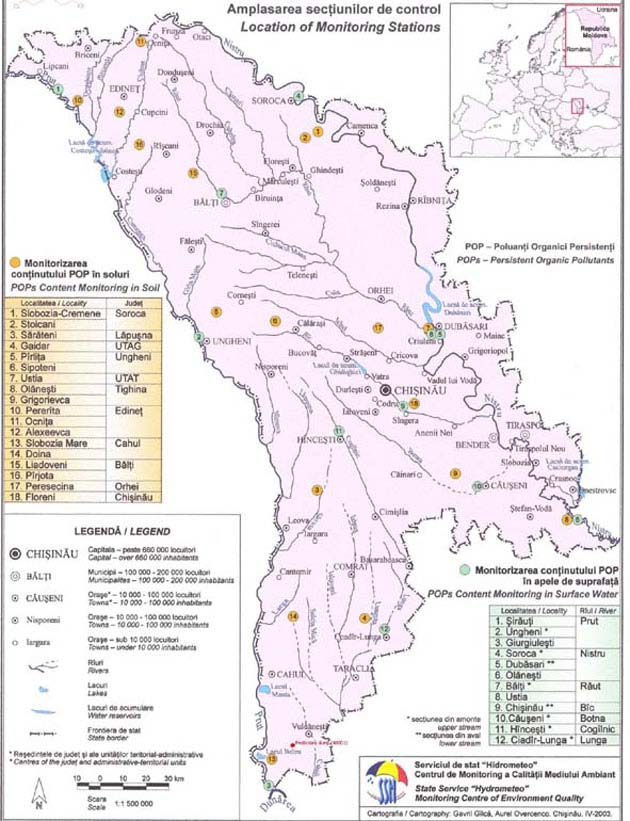

34
UNDP/GEF Danube Regional Project
Figure 3
Moldova: Map of Soils Contaminated with POPs Pesticides (Provided by: Andrei
Isac, Ministry of Ecology Construction and Technical Development)
National experts also often state that Atrazine is used in higher doses, sometimes up to twice the
approved amount.
Spray drift and poor disposal are also mentioned to be a problem to adjacent rivers. Spraying
equipment is old and often cleaned near or even in rivers and ponds.
In order to efficiently monitor and evaluate impacts of pesticides on non-target organism, usage data
such as time, location and amount are very valuable. The next figure shows that pesticide use data in
combination with toxicological, physical and chemical data plus geographical information can be used
as input in field studies, Geographic Information Systems and environmental transport models to
assess exposure and risks.
Pesticide use reporting systems exist in two Danube countries: Slovakia and the Czech Republic.
However, in both countries, usage data collected are not utilised for targeted monitoring.
National sales data are not sufficient for targeted monitoring programmes. Sales data on the retail level
are more useful since they allow assumptions between locations, amounts and kind of pesticides sold,
provided retailers do not report anonymously.
In the absence of use data itemised by location, ingredient and amounts and the relation to sensitive
areas, chemical fact sheets were developed to provide data on toxicity, physical and chemical
properties.
Inventory of Agricultural Pesticide Use in the Danube River Basin Countries
35
Pesticide Use Data:
· location
· date
· amount
· ingredient(s)
Toxicological Data:
Physical and Chemical
Geographical Data:
· acute toxicity
Data, Environmental Fate:
· Location of cities,
· carcinogenicity
· Half life (soil, air, plant)
fields, habitats,
· mutagenicity
· vapour pressure
rivers, lakes etc.
· endocrine effects
· solubility
· Precipitation,
· developmental
· partition coefficient
wind, ground
effects
· adsorption coefficient
water levels
· ecotoxicity
· leaching and runoff
· Distribution of
potential
soil types, slopes
Geographic Information Systems, (GIS), Transport
modelling, Field studies,
Exposure assessment, Risk assessment
Figure 4
General Exposure Assessment Model based Upon Pesticide Usage Data18
In the absence of use data itemised by location, ingredient and amount, and the relation to sensitive
areas, chemical fact sheets were developed to provide data on toxicity, physical and chemical
properties.
0presents a summary of the environmental and human toxicity of synthetic priority pesticides which
are still registered in Danube countries. Information was extracted from the chemical fact sheets. Data
sources and details can be found in the chemical fact sheet (please refer to Annex 1).
The summary shows that all priority pesticides are hazardous, they are either highly acute toxic, are
potential endocrine disruptors and/or are possibly carcinogenic.
18 L. Neumeister (2002): Pesticide Use Reporting; Legal Framework, Data Processing and Utilisation, Full
Reporting Systems in California and Oregon, Pestizid Aktions-Netzwerk e.V. (PAN Germany), Hamburg,
Germany.

36
UNDP/GEF Danube Regional Project
Environmental and Human Toxicity of Selected Priority Pesticides
Bird
Risk
(HD5
Aquatic
Pesticide
Symbol
50%)
Organisms
ED Pers.
Acute Toxicity
EPA Cancer
Moderately
Unclassifiable,
2,4-D
Xn
132,9 slightly - highly
2
Hazardous
ambiguous data
Slightly
Alachlor
Xn; N
330,42 moderately
1
Hazardous
Unlikely to be
Atrazine
Xn; N
408,98 slightly
1
Pers
Hazardous C,
Possible
highly very
Highly
Chlorfenvinphos T+;
N
2,73 highly
Hazardous
Moderately
Chlorpyrifos
T; N
3,76 very highly
Hazardous
E, Unlikely
highly -
Unlikely to be
Diuron
Xn; N
193,04 moderately
2
Hazardous
Known/Likely
Moderately
Endosulfan
T; N
9,53 very highly
2
Pers+
Hazardous Not
Likely
Slightly
Isoproturon Xn;
N 313,4 slightly-nontoxic
Hazardous
highly
Moderately
Lindane T;
N 10,5 very highly
1 Pers Hazardous
B2, Probable
highly -
Slightly
Malathion Xn 139,1 moderately 2
Hazardous Suggestive
Unlikely to be
Simazine
Xn; N
965,25 slightly-nontoxic
2
Hazardous C,
Possible
Unlikely to be
Trifluralin
Xi; N
245,55 very highly
Pers
Hazardous
C, Possible
Risk Symbol (EU 67/548EC): T = Toxic, T+ Very Toxic, Xn= harmful, N = Dangerous for the Environment, ED =
Endocrine Disruption: 1= At least one study providing evidence of endocrine disruption in an intact organism. Not a formal
weight of evidence approach. 2= Category 2: Potential for endocrine disruption. In vitro data indicating potential for
endocrine disruption in intact organisms. Also includes effects in-vivo that may, or may not, be ED-mediated. May include
structural analyses and metabolic considerations. Pers= Persistence: Pers= Persistent, Pers+= Very Persistent
Limitations of Toxicological, Chemical and Physical Data
The chemical fact sheets provided in this report will present toxicological data, chemical and physical
property data and information on the environmental fate of the 25 priority active ingredients.
There are large numbers of data which vary depending on the source. Half-life of chemicals in soil and
water depends on the type of soil, the exposure to sun light and oxygen etc.; exotoxicological data
depend on the study type etc. For chlorpyrifos alone, AQUIRE, a Eco-Tox database for toxicological
effects on aquatic life, maintained by the U.S. Environmental Protection Agency lists over 1,700
records, e.g. studies with different endpoints. However, even scientifically accurate toxicity studies do
not necessarily reflect reality. The small number of test species and the limitation to one chemical and
to mostly one (acute) endpoint (LC50) are severe limitations. Effects of multiple chemical exposure,
which is reality in the Danube catchment, is not addressed by most studies.
Sublethal and chronic adverse effects such as impaired activity, endocrine disruption, cancer in fish,
lower reproduction, or simply reduction in the food chain are usually not covered by these studies.
Additionally, to draw casual relationships between one particular pesticide and an adverse effect
observed is rather impossible in the "chemical cocktail" of the Danube.
However, there are screening methods mimicking reality closer. For instance, in these tests, healthy
water fleas (daphnia magna) are exposed to river water samples. Testing of the chemicals in water and
the toxicological effects does allow to draw correlations, at least to a group of chemicals with the same
mode of action such as Organophosphates19 and N-methyl carbamates. A problem in these studies, and
a general problem, are limits of detections, and the possible non-detection of toxic metabolites or other
substances.
19 Kikuchi, M., Sasaki, Y., Wakabayashi, M.; (2000): Screening of Organophosphate Insecticide Pollution in Water by
Using Daphnia magna, Ecotoxicology and Environmental Safety, Volume 47, Issue 3, November 2000, Pages 239-245.
Inventory of Agricultural Pesticide Use in the Danube River Basin Countries
37
6
P o t e n t i a l P o l i c y R e f o r m f o r P e s t i c i d e
P o l l u t i o n C o n t r o l
The following conclusions may be drawn from the data and information on pesticide use,
environmental impacts and agricultural practices collected and reviewed during the preparation of this
study:
· Overall pesticide use in the Danube countries is low in amounts compared to western
European countries and with a view to the area treated.
· Intensity in treated areas, however, may be higher than in western European countries and
overdosing of Atrazine, probably due to weed resistance, was frequently reported.
· Seven priority pesticides are not authorised in the Danube countries, some of them continue to
be hazardous due to old stockpiles and residues in soils and sediments.
· The priority pesticides 2,4-D, Alachlor, Trifluralin, Atrazine and copper compounds are high-
use pesticides in most of the Danube countries. They are mostly used in cereals, rapeseed and
sunflower, maize and in orchards and vineyards.
· Priority pesticides as well as other pesticides are frequently detected in surface and ground
water.
· Priority pesticides pose a serious hazard to the environment and human health. Most of them
have already been regulated at international and EU level.
The current low use of agricultural pesticides in the countries of the Danube River Basin (DRB)
presents a unique opportunity to develop and promote more sustainable agricultural systems before
farmers become dependent again upon the use of agro-chemical inputs.
However, pesticide use is always related to agricultural policy. Farmers grow those crops which are
most economically viable. If, for instance, agricultural policy supports subsidy schemes and market
policies for a small number of crops, the range of crops grown by farmers will be limited, crop
rotations will be simple or non-existent and, as a consequence, pesticide use will rise.
There are numerous different policy instruments that can be used to control pesticide pollution. 0gives
a general overview of these instruments.20 The control instruments presented in this table provide a
framework which can be elaborated and filled with more detailed measures.
However, the selection of the most appropriate policy instruments for the DRB countries will depend
on the establishment of a clear policy strategy for controlling pesticide pollution, together with clear
policy objectives.
20 Falconer, K.E. (1998): Managing diffuse environmental contamination from agricultural pesticides: An
economic perspective on issues and policy options, with particular reference to Europe, Agriculture,
Ecosystems and Environment 69 (1998) 37-54.

38
UNDP/GEF Danube Regional Project
Instruments Aiming at the Control of Pollution by Pesticides
Control
Target Control
Techniques
Compliance
Measures
Instrument
Advice
Environmentally more-sound Improved advice and extension None (voluntary measures by farmers)
pesticide usage; farmers
services; more crop protection
using and acting according to research
improved information
Use reduction (ICM Mode of use/ timing/
Statutory labelling of
Spot-checks, farm records, fines for
and IPM standards) frequency of application/
formulations
non-compliance; self-regulation
Use restriction
maximum dosage/restrictions
on use, prohibitions in
certain conditions or
generally
Compulsory training More socially desirable
Improve farmers' knowledge
Prohibit use or purchase of pesticides or
levels and types of pesticide and understanding of the
spraying equipment without a certificate
usage (e.g. mode of
necessity for treatments;
of competence
application, timing)
increase decision rationality
Performance
Soil loss/ pesticide run-off or Limits on pesticide losses
Environmental simulation or field
standards (cut off
leaching
measurements
criteria, eco-audits)
Design standards
Pesticide application
Sprayer specifications, buffer
Farm inspections, spot-checks
strips along water courses, field
margins etc.
Permits
Inputs, emissions, treated
Limits on farm input use/
Farm records and inspections; coupons
area, crop area
emissions/ crop area
for pesticide input purchases, handed in
at point of sale
Taxes
Input use, emissions, treated Increase price of materials or
Distributor and/or farmer records
area, numbers of applications applications, perhaps through a
percentage levy or charge per
unit, to encourage reduced
pesticide usage.
Subsidies to change Increased use of reduced
Compensate farmers for
Farm inspections
practices
dose/ non-chemical pest
financial losses resulting from
controls
changed practices
Transferable permits As above
Limits on total (for example,
As above
catchment) input use,
emissions, crop area.
Crop insurance
Reduced pesticide usage
Reduced prophylactic
None (voluntary)
treatments
Source: Falconer modified
According to the aims of the Danube Protection Convention, the risk of pollution should be stopped at
its source with regard to pesticide use this means21:
a) withdraw approval for the use of those pesticides that pose the greatest threats to public health and
the environment;
b) reduce the use of those pesticides that remained approved for use;
c) improve the management by farmers of those pesticides that remain approved for use.
Such objectives can be achieved through a combination of necessary policy reforms and the promotion
of appropriate practical action by farmers. However, the potential to achieve these objectives varies
greatly between countries in the DRB and is above all related to the fact whether a country is currently
preparing for EU accession or not.
21 OECD (1995). Sustainable Agriculture: Concepts, Issues and Policies in OECD Countries. Organisation for
Economic Co-operation and Development, Paris.
Inventory of Agricultural Pesticide Use in the Danube River Basin Countries
39
6 . 1 P o t e n t i a l f o r P o l i c y R e f o r m i n E U C o n t e x t
6.1.1 Adoption of EU Pesticide Regulations
In the European Union, there are several Directives addressing the regulation of pesticides see
Table 9. A specific Regulation or Directive addressing the use of pesticides, however has not been
developed.
The highest potential for the control of water pollution by pesticides is offered by the Water
Framework Directive (WFD). Similar to the previous Dangerous Substances Directive (76/464EC),
which was repealed by the WFD, pollution control is based on chemical lists. Three lists of substances
were composed: an indicative list of main pollutants, a list of priority substances, and a list of priority
hazardous substances. The list of main pollutants consists of chemical classes and use types, therefore
it includes priority substances and priority hazardous substances per se.
The WFD could be a baseline for the overall water policy in the Danube basin. For surface water, the
Directive aims at enhancing the protection and improvement of the aquatic environment, inter alias,
through specific measures for the progressive reduction of discharges, emissions and losses of priority
substances and the cessation or phasing-out of discharges, emissions and losses of the priority
hazardous substances.
For groundwater, the Directive wants to ensure the progressive reduction of pollution of groundwater
and prevents its further pollution. Member States must implement the basic measure of prohibiting
direct discharges of pollutants into groundwater. The European Parliament and the Council must
adopt specific measures to prevent and control groundwater pollution.
The WFD is still not fully implemented. The European Commission did not come up with concrete
measures and many of the priority hazardous substances are still defined as candidates. There is also a
compliance issue between the WFD and the Directive 91/414. The herbicide Isoproturon is a
candidate for being a priority hazardous substance, nevertheless it is listed on the positive list of
Annex 1 of 91/414EC.
Legislation addressing pesticides in the European Union (except that regarding food safety)
Title of Legislation
Obligation(s) Arising from Legislation
Directive 79/117EC on the
· The Directive was enforced in 1981 by the Member States and prohibits the placing on
prohibition of pesticides
the market and use of plant protection products containing certain active substances.
· The first pesticides prohibited were pesticides such as DDT and Aldrin, today known as
POPs pesticides, but also mercury compounds.
· Back then, Member States were allowed to authorize pesticides containing such
ingredients in some cases. By 1990, these exceptions expired or were deleted, and a
number of pesticides were added. The last pesticides were added in 1990. Currently,
some 25 pesticides are prohibited. The production and export to third countries is not
prohibited.
Directive 80/68/EEC on the · The Groundwater Directive establishes a framework for the protection of EU
protection of groundwater
groundwater by prohibiting discharge to ground water of the most detrimental substances
against pollution caused by
including pesticides.
certain dangerous
· It is intended to reduce the amount of pesticides reaching drinking water and thus is not
substances (the
primarily environmental legislation. However, insofar as the intention is to limit or
Groundwater Directive)
largely exclude pesticides from water, this Directive contributes to meeting
environmental objectives by reducing the environmental burden of pesticides.
· The Directive places mandatory obligations on farmers relating to disposal of pesticide
waste (including washing water), implemented in legislation described below. There are
no other mandatory obligations on farmers, rather the obligation is on member states' to
introduce sufficiently precautionary legislation to exclude pesticides from water.
· By 2013, the Groundwater Directive will be repealed by the Water Framework Directive
2000/60.

40
UNDP/GEF Danube Regional Project
Title of Legislation
Obligation(s) Arising from Legislation
Directive 80/778/EEC on
· The Drinking Water Directive (80/778) lays down standards for the quality of water
the quality of water
intended for drinking or for use in food and drink manufacture in order to protect human
intended for human
health.
consumption (the Drinking
Water Directive) to be
· The Directive does not impact upon farmers directly, but sets a maximum admissible
replaced by Directive
pesticide residue level (0.1 parts per billion for individual pesticide Active Ingredients
98/83/EC from 2003
and 0.5ppb for all pesticide Active Ingredients) in drinking water that water suppliers
must comply with. This requires the use of water treatment in some areas to ensure that
the drinking water supplied is acceptable.
Directive 91/414/EEC
· Directive 91/414 - the 'Authorisation Directive' - introduces a Community system to
concerning the placing of
harmonise the authorisation and placing on the market of plant protection products, i.e.
plant protection products
pesticides, to protect human health and the environment.
on the market
· The Directive includes an EU wide common positive list of permitted Active
Ingredients. However, the process of review to place substances on this list is not
proceeding as planned, and interim measures in Member States result in different
substances permitted in the Community. Thus producers in one Member State (and
elsewhere) may be able to use products containing substances which are prohibited in
another Member State (these may pose either more or less risk to the environment).
There is a risk of illegal import of banned products.
· The Directive places no mandatory obligations on farmers. The obligation is on the
regulatory system to only approve products that pose an acceptable risk to human health
and the environment. Detailed criteria and protocols have been devised.
· This legislation provides the framework for the authorisation of pesticide Active
Ingredients, which can only be included in the list if they meet certain conditions,
particularly concerning the likely effects on human health and the environment. Only
products containing active ingredients on the EC positive list can be authorised, initially
for a maximum period of ten years. This process has recently been accelerated by
Commission Regulation No. 2266/2000 which lays down the detailed rules for the
necessary review procedures.
· Directive 91/414 applies primarily to synthetic pesticides. However, at a late stage in
negotiations, its scope was extended to cover authorisations of the marketing of
pesticides containing or composed of GMOs.
· The legislation also requires Member States to prescribe that pesticides '... must be used
properly. Proper use will include compliance with any conditions attached to the product
and specified on the label and the application of the 'principles of good plant protection
practice, as well as, whenever possible, the principles of integrated control'.
Directive 2000/60/EC
· The Directive has the overall environmental objective of achieving 'good water status'
establishing a framework
throughout the EU by 2010 and for it to be maintained thereafter. It sets out to establish
for Community action in
a Community framework for the protection of surface and ground waters across the EU
the field of water policy
through a common approach, objectives, principals and basic measures. It establishes the
(the Water Framework
river basin as the primary administrative unit for the purposes of water management.
Directive)
The Directive will have widespread and significant impacts. It brings together much of
the existing water legislation into an overall framework establishing broad ecological
objectives for water and provides an administrative framework to achieve these.
· The Commission (via the OSPAR Convention agreement) has proposed a priority list of
substances, which will be targeted with the aim of improving water quality. The
pesticides in this list have been selected according to the risk they pose to aquatic life and
to human health from polluted waters this includes alachlor, atrazine, chlorfenvinphos,
diuron, endosulfan, lindane, simazine and trifluralin.
· This Directive places no direct obligation on farmers, but they influence the standards
they must meet.
Inventory of Agricultural Pesticide Use in the Danube River Basin Countries
41
6.1.2 EU Environmental Action Programme (EAP)
In addition to legislation, the European Union addressed pesticide issues in the 5th and 6th
Environmental Action Programme (EAP).
In 1993, the European Union acknowledged in its 5th Environmental Action Programme that the
Common Agricultural Policy (CAP) has led to negative side effects, which include consequential
over-intensification. It was recognised that the systematic use of plant protection products led to a
relative resistance in parasites, increasing the subsequent frequency and costs of treatment and causing
additional soil and water pollution problems.
Proposed objectives were:
· a significant reduction of pesticide use per unit of cultivated land until 2000; and
· farmers' conversion to methods of integrated pest control, at least in areas of importance for
nature conservation.
Proposed actions were:
· registration and control of pesticides sales and use;
· promotion of integrated pest control and bioagriculture22.
A significant reduction in pesticide use per unit of land was not achieved by 2000, and the European
Union, in 2001, realises that the pesticide contamination problem is serious and growing.23
The 6th Environmental Action Programme, which was established in 2001, aims eventually at a
legislation regarding the sustainable use of pesticides and, in its actions, suggests a Community
Thematic Strategy on this issue.
Proposed actions regarding pesticides in the 6th EAP are:
· Development of a Code of Good Practice on pesticide use;
· Revision of Directive 91/414 on the authorisation of pesticides;
· Development of a Community Thematic Strategy on the sustainable use of pesticides that may
include elements to:
a) minimise the risk from the use of pesticides, which is principally linked to the toxicity of the
substances, and monitoring progress; better control of the use and distribution of pesticides;
b) substitute the most dangerous active substances with safer ones, including non-chemical
alternatives;
c) raise awareness of, and train users;
d) encourage the uptake of low input or pesticide free agriculture and the use of Integrated Pest
Management (IPM) techniques;
e) encourage the introduction of fiscal incentives to reduce the use of the most dangerous
pesticides such as a pesticides tax;
f) link the award of Rural Development Funds to the uptake of the Code of Good Practice on
pesticide use.
· Ratification of the Rotterdam Convention on the Prior Informed Consent (PIC) Procedure for
Certain Hazardous Chemicals and Pesticides in International Trade;
22 European Union (1993): Towards Sustainability, A European Community Programme of policy and action in
relation to the environment and sustainable development, Official Journal of the European Communities
C138/5, 17.05.1993.
23 European Commission (2001): Communication from the Commission to the Council, the European
Parliament, the Economic and Social Committee and the Committee of the Regions on the sixth environment
action programme of the European Community,'Environment 2010: Our future, Our choice' - The Sixth
Environment Action Programme - Proposal for a Decision of the European Parliament and of the Council
Laying Down, The Community Environment Action Programme 2001- 2010.

42
UNDP/GEF Danube Regional Project
· Amendment of Community Regulation (2455/92) concerning the import and export of dangerous
chemicals to bring it into line with the Rotterdam Convention, to improve some of its procedural
mechanisms and to improve information to developing countries;
· Development / full implementation of Community programmes to improve chemicals and
pesticides management in developing and accession countries, including for the elimination of
stocks of obsolete pesticides;
· Support for research efforts aimed at the reduction and sustainable use of pesticides.
All of the proposed actions have the potential to reduce environmental contamination. The 6th
Environmental Action Programme, however, ends in 2010 and so far no concrete and legally binding
policy instruments have been introduced.
6.1.3 Financial Incentives for Pollution Control
The EU Rural Development Regulation No. 1257/1999 makes provision for co-financing to encourage
more environmentally-friendly farming by:
· training farmers for the "...application of production practices compatible with the maintenance
and enhancement of the landscape and the protection of the environment" ;
· offering grant-aided investment in agricultural holdings that helps to "...preserve and improve the
natural environment" ;
· introducing agri-environment schemes that offer area payments to support "...agricultural
production methods designed to protect the environment and to maintain the countryside"; and
· other complementary actions under Article 33 concerned with "...protection of the environment in
connection with agriculture, forestry and landscape".
EU Member States began implementing the first so-called "agri-environment programmes" in the
1980s and 1990s, and today such programmes cover over 20% of all agricultural land in the EU.
These programmes pay farmers to modify their farming practices in order to benefit the environment.
Extensive monitoring of agri-environment programmes in EU Member States shows that they lead to
significant benefits for the conservation of valuable semi-natural habitats, biodiversity, landscape,
water and soil resources. The potential for agri-environment schemes to contribute to a wide range of
rural development objectives, including environmental protection, is recognised by the fact that they
are now the only compulsory measures for EU Member States to introduce under Regulation
1257/1999.
It will therefore be obligatory upon accession for all new Member States to introduce an EU co-
financed agri-environment scheme that offers payments to farmers who change their methods of
farming in ways "...which are compatible with the protection and improvement of the environment,
the landscape and its features, natural resources, the soil and genetic diversity" this includes
support for a range of actions contributing to the control of pesticide pollution, including the adoption
of organic farming.
While the four DRB countries (Czech Republic, Slovakia, Hungary and Slovenia) joining the EU in
2004 will shortly be implementing national agri-environment programmes, two DRB countries
(Romania and Bulgaria) are unlikely to join the EU until at least 2007. In these latter countries,
financial assistance is also available for developing and implementing "pilot" agri-environment
measures with SAPARD co-funding the Special Pre-accession Programme for Agriculture and Rural
Development.
According to the SAPARD Implementing Regulation No. 1268/1999, EU co-financing support may be
provided for all the agri-environment actions described in the Rural Development Regulation No.
1257/1999.
Inventory of Agricultural Pesticide Use in the Danube River Basin Countries
43
6.1.4 On-farm Quality Assurance Schemes
There is increasing interest shown by farmers, the food industry and food retailers in EU Member
States to establish "on-farm quality assurance schemes" that offer consumers the assurance of food
products having been grown with reduced or minimal pesticide inputs.
The most developed example is organic farming as defined by EC Regulation 2092/91. Organic
farming has the highest potential for reducing the use of toxic pesticides. Many organic crops are
grown without the use of any pesticide, and the former intense use of copper in organic fruits and
vineyards is now regulated.
In addition, a number of other quality assurance schemes are being developed which are based upon
"integrated crop management". For example, the Euro-Retailer Produce Working Group (EUREP)
has developed a set of standards and procedures for inspecting and certifying farmers who follow so-
called "good agricultural practice" (GAP).
The EUREP-GAP initiative24 is a set of normative documents suitable to be accredited to international
certification laws. Representatives from around the globe and all stages of the food chain have been
involved in the development of these documents and a very robust, very challenging protocol has been
produced which focuses the producer on the key issues that need to be addressed during the pre-farm
gate stage.
0The next table summarises the mandatory requirements relating to pesticides for farmers and growers
complying with EUREP-GAP Fresh Produce Protocol.
24 EUREP website: www.eurep.org/sites/index_e.html.

44
UNDP/GEF Danube Regional Project
Mandatory requirements relating to pesticides in the EUREP-GAP Fresh Produce Protocol
Basic Elements of Crop Protection
·
Protection of crops against pests, diseases and weeds must be achieved with the appropriate minimum pesticide input
and with the minimum adverse environmental impact (volume/type of active ingredients) and with the appropriate
employment of non-chemical methods (biological and cultural/mechanical).
· Wherever possible, growers must apply recognised IPM techniques on a curative basis. Non-chemical pest treatments are
preferred to chemical treatment.
Choice of Chemicals
·
The crop protection product utilised must be appropriate for the control required.
·
Growers must only use chemicals that are officially registered in the country of use and are registered for use on the crop
that is to be protected. A current list of all products that are used and approved for use on crops being grown must be
kept. This list must take account of any changes in pesticide legislation. Chemicals that are banned in the European
Union must not be used on crops destined for sale in the European Union. In addition, growers must be aware of
restrictions on certain chemicals in individual countries.
Advice on Quantity and Type of Pesticide
·
Recommendations for application of pesticides must be given by competent, qualified advisers holding a recognised
national certificate.
·
Where such advisers are unavailable, growers must be able to demonstrate their competence and knowledge (e.g.
through adequate training in pesticide usage and application).
Records of Application
· All applications of pesticides must be recorded in a crop diary or equivalent. Records must include: crop, location, date of
application, reason for application, technical authorisation, trade name, quantity of pesticide used, application machinery
used, name of operator and pre-harvest interval.
Safety, Training and Instructions
· Workers who handle and apply pesticides must be trained and able to demonstrate appropriate competence and
knowledge.
Protective Clothing/Equipment
·
Workers must be equipped with suitable protective clothing in accordance with label instructions and appropriate to the
posed health and safety risks.
·
Growers must be able to demonstrate that they follow label instructions with regard to protective clothing and
equipment.
·
Protective clothing and equipment must be stored separately from pesticides.
Pre-harvest Interval
·
Pre-harvest intervals must be observed and under no circumstances should the recommended pre-harvest interval be
ignored.
·
For crops that are continuously harvested over an extended period of time, there must be a plan for crop protection that
does not compromise pre-harvest intervals.
Spray Equipment
·
Spray equipment must be suitable for use on the land in question and be kept in good condition, with annual calibration
to ensure accurate delivery of the required quantity of spray.
·
When mixing chemicals, the correct handling and filling procedures, as stated on label instructions, must be followed.
The correct quantity of spray mix for the crop to be treated and the proposed treatment type must be calculated,
accurately prepared and recorded.
Disposal of Surplus Spray Mix
· The quantity of spray mix must be calculated before mixing. This calculation must consider: velocity of application,
surface area to be covered, pressure of application system.
Pesticide Residue Analysis
· Growers and/or suppliers must be able to provide evidence of residue testing by laboratories accredited by a competent
national authority
Inventory of Agricultural Pesticide Use in the Danube River Basin Countries
45
Pesticide Storage
·
Pesticides must be stored in accordance with local regulations and include the following minimum standards.
·
Pesticides must be stored in sound, secure, frost resistant, fire-resistant, well ventilated (in case of walk-in storage) and a
well lit location which is sited away from other materials.
·
The pesticide store must be able to retain spillage (e.g. to prevent contamination of watercourses).
·
There must be adequate facilities for measuring and mixing pesticides.
·
There must be emergency facilities (e.g. eyewash, plenty of clean water, a bucket of sand) to deal with operator
contamination and accidental spillage.
·
Keys and access to the store must be limited to workers with adequate training in the handling of pesticides.
·
An accident procedure, a list of contact telephone numbers and the location of the nearest telephone must be available
within the immediate vicinity of the store and next to the nearest telephone.
·
Inventory, stock control and stock rotation documentation must be kept and readily available.
·
All pesticides must be stored in their original package.
·
Only chemicals approved for use on the crops produced in the crop rotation must be stored on the farm.
·
Powders must be stored on shelves above liquids.
·
Signs warning potential dangers must be placed on access doors.
Empty Pesticide Containers
· Empty pesticide containers must not be re-used and disposal of empty pesticide containers must be in a manner that
avoids exposure to humans, and contamination of the environment.
· Empty containers must be rinsed via the use of an integrated pressure rinsing device on the sprayer, or at least three times
with water, and the rinsate (wash water) returned to the spray tank.
· When rinsed, containers must be crushed or pierced to prevent re-use, or adequately labelled according to the rules of a
collection system.
· Empty containers must be kept secure until disposal is possible.
· All local regulations regarding disposal or destruction of containers must be observed.
Obsolete Pesticides
· Obsolete pesticides must only be disposed of through a certified or approved chemical waste contractor or supplying
company, however equipment achieving similarly environmentally sound disposal may be used.
6 . 2 P o t e n t i a l P o l i c y R e f o r m i n W i d e r D R B C o n t e x t
6.2.1 Pesticide Use Reduction
Research and Implementation of Integrated Crop Management (ICM) and Integrated Pest
Management Standards - National Governments shall support research in order to define ICM and
IPM standards for all major crops especially maize, wheat, vine, fruit and vegetables to promote a
minimum use of pesticides. Such measures need to include detailed schemes of integrated crop
management for each crop and crop rotation system (example in Annex 12).
National experts and authorities should define crop rotation systems prone to extreme pest, weed or
disease development. Prohibition or financial incentives are possible instruments to stop crop rotation
systems which are `bad agricultural practices.'
Once the ICM and IPM standards are developed, they need to be disseminated to farmers. ICM and
IPM standards should be legally binding and a condition for agricultural subsidies.
6.2.2 Compulsory Training
Farmers' licence - farmers who apply pesticides need to have a licence. In order to obtain and hold a
licence, farmers must attend a comprehensive training on:
· ICM and IPM (see above);
· non-chemical alternatives;
· the safe handling of plant protection products and spraying equipment (cleaning, safety
distances);
· disposal of unused pesticide and containers;
· record keeping and use reporting.

46
UNDP/GEF Danube Regional Project
The licences should be valid for 3 years. If farmers can proof that they attended a total of 48 hours
training on ICM, preventive measures and non-chemical alternatives over the last 3 years, the licence
will be prolonged.
Purchase of pesticides without a licence should not be possible.
Farm Adviser Licence similar to the farmers, farm advisers should be required to possess a licence
limited to 3 years. In addition to training on the safe handling of pesticide products and handling and
adjusting application equipment, advisers should attend special training on ICM/IPM and practical
measures to prevent and reduce pesticide use to obtain the licence. Farm advisers must be required to
up-date their knowledge regularly, in order to prolong the licence.
6.2.3 Performance Standards & Cut-off-Criteria
Pesticide ban the use of Atrazine, Lindane, Diuron and Endosulfan needs to be banned immediately.
Atrazine is the pesticide most often detected in the Danube basin, Lindane, Diuron and Endosulfan are
toxic and persistent pesticides.
Pesticides phase out uses of all other priority substances need to be phased out in a time frame to be
defined. The EU WFD sets a 20-year target in the EU. Considering the lower use of pesticide and a
lower dependency on these chemicals in the Danube region, targets should be more ambitious.
Cut off criteria - in order to prevent the replacement of dangerous pesticides, which are going to be
banned or phased out with other hazardous pesticides, cut off criteria for pesticides need to be defined.
Pesticides with distribution coefficients (Koc ) below 300g/l (low absorption to soil, prone to leaching
and run-off) and a half-life of more than 20 days need to be regulated (prohibition, taxes and
transferable permits are possible policy tools).
Persistent pesticides should not receive authorisation.
Licensing of spraying equipment all spraying equipment should be inspected every two years.
Accurate spraying equipment should get a licence for two years.
6.2.4 Eco-Audit
Mandatory uniform record keeping is essential for a functioning pesticide monitoring system.
National regulations must require that pesticide use records are kept by all pesticide applicators (as in
the Czech Republic and Slovakia). The records must include, at the minimum, the following
information about the applications:
· name and address of the applicator;
· community name/code, postal code or other identification of the treated field/site location;
· name and registration number (for the pesticide product(s) used;
· quantity of the pesticide product(s) applied;
· application method;
· date of the application;
· size of the field/site treated;
· acreage planted and treated;
· name/ code of the crop treated.
Based on mandatory record keeping, a flexible and expandable pesticide use reporting system can be
developed. If all pesticide applicators have to keep the same type of record, the regulation concerning
pesticide use reporting can differentiate what person is required to report what set of data in what
frequency. In this way, all possible options are thinkable: full reporting, e.g. submitting all application
record data, as well as the submission of summaries extracted from the records.
Pesticide use reporting should be required from all farmers using pesticide. National authorities must
decide, what farmers have to report what information. (quarterly summaries, annual summaries by all
farmers, by all farmer with farms larger 5 or 10 ha).
Inventory of Agricultural Pesticide Use in the Danube River Basin Countries
47
Sales reporting Retailers, importers and distributors should be required to supply information on the
amount of pesticides sold. In order to identify individual products, the bar codes could be used in the
future. Retail sellers need to keep records of their sales of pesticide products and submit annual
reports.
6.2.5 Subsidies to Change Practices
Defining water protection zones and sensitive areas efforts should be made to define water
protection zones and vulnerable areas. In these areas, no pesticide use should be allowed. Farmers in
these areas need special training and must receive compensation for yield losses.
Spraying distances - to water courses and habitats often vary from pesticide to pesticide depending
on the toxicity. Farmers often do not pay attention to the requirements. Pesticide use close to sensitive
water bodies should be phased out. Fixed margins of a minimum of 10 m for arable crops, a minimum
of 5 m for vegetables and a minimum of 50m for orchards and vineyards should be set.25 The phase
out and plantation of buffer stripes could be part of an agri-environment programme.
Disposal of old spraying equipment old and unsafe spraying equipment needs to be replaced by
environmentally friendly new spraying equipment. Funds should be allocated to support a fast
technology change.
Disposal system for pesticide and containers distributors and retailers should have the legal
obligation to take back unused pesticides and empty containers. Unused pesticides and empty
containers should be recycled in an environmentally friendly manner. The responsibility of the
industry needs to be strengthened.
6.2.6 Other Instruments
Data improvement - countries with existing pesticides use reporting systems need to improve data
quality and data evaluation. Collected pesticide use data are of enormous value if used in a appropriate
way.
Targeted monitoring monitoring of environmental impacts of pesticide in the Danube region needs
to be intensified. Sampling should correlate with the time of the application. Toxicity of
organophospates such as Chlorpyrifos and Diazinon to aquatic organisms should be observed more
closely.
Elimination of obsolete pesticides every effort must be made to immediately secure and remove
stockpiles of obsolete pesticides.
25 Based upon drift tables by the Federal Biological Research Centre for Agriculture and Forestry.

48
UNDP/GEF Danube Regional Project
7
P r o p o s e d P r a c t i c a l A c t i o n f o r P e s t i c i d e
P o l l u t i o n C o n t r o l
1. Choice of Site and Crop Rotation
The cropping site should be used so that it meets crop requirements on soil quality and climate. This
allows optimum plant growth and reduces the risk of infestation with harmful organisms. Unsuitable
or unsuitably shared sites weaken the vigour, resistance and competitiveness of the plant. Narrow crop
rotations may lead to an accumulation of harmful organisms, which may have a negative impact on
further cropping.
Growers must try to extend crop rotation by catch-crops and the integration of the areas set-aside.
A number of crops require the observance of crop-free periods to avoid accumulation of harmful
organisms. For instance, sugar beet and potatoes require crop-free periods to contain or avoid
infestation with nematodes. Recommendations regarding crop-free periods must be followed.
2. Soil Tillage
Soil tillage must fit the site and situation, and should be organised so as not to further infestation with
harmful organisms.
Tillage has a great influence on the weediness of crop stands and infection of cereals with stem base
diseases. Appropriate tillage may, for instance, reduce infestation with couch grass. No-plough soil
tillage lessens erosion, but often entails more expenses for plant protection.
3. Choice of Cultivars and Origin
Resistance is an important criterion for the choice of cultivars, apart from yield potential, regional and
specific suitability, and market demand.
Cultivars and origins which are resistant or have at least a certain tolerance of important site-specific
harmful organisms and/or which are able to suppress weeds must be the preferred choice for cropping.
With harmful organisms being able to overcome resistances, the state of health of crops must also be
carefully watched when resistant varieties are grown, so that any protection measures, should they
become necessary, can be taken in time.
4. Hygienic Measures
The farmer must follow all hygienic measures in agriculture and horticulture to reduce the potential of
harmful organisms and to prevent, or delay as much as possible, the first infection with harmful
organisms. This is done by preventing the introduction and spread of harmful organisms, such as
nematodes, Rizomania on sugar beet and ring rot on potato, by seed and planting stock, and the
introduction via contaminated soil, substrates, propagation containers, tools, or diseased plants.
The most important hygienic measure to be taken by the farmer is to use healthy seed and planting
material. This means regular purchase of certified seeds and planting stocks and confining replanting
to seed and planting material from healthy and vigorous stocks.
If several farms share agricultural tools and machinery, these must be carefully cleaned to remove soil.
Agricultural tools and machinery must also be cleaned after tillaging a disease or nematode infested
field.
Combine harvesters may contribute to spreading weeds, such as oat-grass. They must be cleaned
before entering a new field.
5. Planting and Sowing Time
Sowing and planting times must be chosen so as not to promote infestation with harmful organisms.
The occurrence of certain harmful organisms can be influenced by the choice of the planting time.
Inventory of Agricultural Pesticide Use in the Danube River Basin Countries
49
Finding the best possible specific sowing and planting time for a site and a farm is an important
condition for healthy and vigorous growth of the crops.
6. Supply of Nutrients
The supply of nutrients, including fertilisation, must be arranged so that it is balanced and meets the
needs of the crops. Nutrient supply by fertilisation should not further any infestation with harmful
organisms.
It must be noted that both want of nutrients and unbalanced supply of single substances is to the
detriment of the crop, enhances its susceptibility to pests and pathogens and weakens its
competitiveness with weeds.
Observation
Personnel involved in decision-making must be trained in the recognition of pests, diseases, weeds and
beneficial insects: Routine monitoring is an essential element in the best agricultural practice.
Retraining will be required to maintain knowledge levels and cover any pests, diseases or weeds
which, because of changing circumstances, become more problematic.
Crops must be monitored for their development and health status. To examine the need for control,
infestation with harmful organisms has to be assessed and classified as infestation which does not
require control measures or infestation requiring control measures.
Assessment of the state of development and health of crops requires special knowledge, in particular
about patterns of infestation and damage of the most important harmful organism. Special knowledge
is also needed to know which infestation requires control measures.
In assessing crop health and the need for control of harmful organisms, growers must apply control
thresholds, if available. To do this, farmers must first quantify the extent of the infestation by sampling
or counting harmful organisms in the field.
For some harmful organisms, there are indirect methods of infestation assessment, such as
· yellow traps for pests of rape (cabbage stem flea beetle and stem weevils);
· glued colour traps in orchards and glasshouses;
· pheromone traps for noxious butterflies (turnip moth, gamma moth, pea moth, codling moth,
fruit tortrix moth, grape-berry moth, nun moth, pine noctuid, etc.) and bark beetles; and
· electronic warning systems for apple scab and Peronospora in vineyards.
Some diseases, such as foot-rot of wheat, potato late blight, and fire blight of pome fruit do not allow
any early visual recognition and assessment of the need for control. Advice must be obtained from
official extension services which make infestation prognoses with the help of computer models and
other indirect methods.
The farmer must keep a protocol of the observations. This protocol must include the:
· date;
· name/number of the site;
· crop and variety;
· quantity of each pest, weed, disease observed;
· previous weather conditions.
Experience and Decision Aids
In assessing the need for a particular control measure, growers must use their experience and
observations from previous years, consider advice by official extension services and use other decision
aids.

50
UNDP/GEF Danube Regional Project
7. Non-Chemical Measure of Prevention and Control
Non-chemical measures of prevention and control, which have no adverse effects on the environment,
they have to be preferred to others.
The decision to use a non-chemical plant protection measure depends on the site, situation and crop
and is made upon consideration of its effectiveness, environmental compatibility, risk and costs. A
consideration of occupational safety and health protection is also important. In making such decision,
all available knowledge and decision aids such as information leaflets, information by warning
services, meetings and information by the plant protection services have to be used.
Application of Non-chemical Measures of Plant Protection
Non-chemical measure of plant protection have to be preferred to chemical measures.
Mechanical weeding by hoeing and harrowing and other techniques are at the centre of non-chemical
plant protection measures in agriculture and horticulture. The efficiency of mechanical weed control
depends on the condition of the soil, the development of the crop stands and the degree of infestation
with weeds as well as on the weather. In cereals, it may be between 30 and 70 % weed elimination,
while it may be even higher in maize and potatoes.
Mechanical methods are also suitable to control noxious soil insects in farming.
Environmentally compatible preparations (Bacillilus thuringensis, granulose viruses, insect-pathogenic
bacteria etc.) have to be preferred to others. A biological method which has proven to be effective in
farming, is the use of Trichogramma egg parasites against the European corn borer. There are also
Bacillus thuringiensis preparations against potato beetles, European corn borer, nun moth and other
harmful organisms.
8. Use of Suitable Plant Protection Products
If there are no other practicable methods to prevent damage, the use of a suitable chemical plant
protection product must be taken into account. Only plant protection products, which are registered for
use in the country of the farmer are allowed to be used.
When selecting a pesticide, consideration must always be given to the effect the product will have on
predators. Products such as those based on Bacillus thuringiensis are examples of products least likely
to harm predators. The substitution principle must apply - the least toxic and least environmental
hazardous product must be chosen.
Label directions must be read carefully and followed. This concerns for example safety precautions to
protect users, specific use conditions or information about possible damage to beneficial organisms
and earthworms. Possible effects on succeeding crops must be considered.
Soil disinfection and soil fumigation is not best agricultural practice.
Rate and Frequency of Applications
Using a product as a general precaution without first ascertaining the need for control is not best
agricultural practice.
Products which are most suitable for the crop and the harmful organisms in question and which are
least toxic and least hazardous to the environment must be used according to the situation, with the
aim to use as little active substance as possible. Site conditions and weather conditions must be
carefully noted to avoid run-off of plant protection products. In some cases, additives may enhance the
efficiency of the product and thereby allow reduction of the application rate.
In the individual cases, the actual number of applications and application rates should fall below the
maximum levels specified on the label. The supposition therefore is that the harmful organisms can be
monitored and that the assessment of infestation is possible. All decision aids available should be used
to this end.
Inventory of Agricultural Pesticide Use in the Danube River Basin Countries
51
Treatment of Field Patches, Field Boundaries and Single Plants
With weeds, insects and fungi often migrating into a field from the periphery, it is sufficient to treat
only parts of the crop area or single plants. This is all the more the case with large fields. Sometimes it
is also useful to treat field patches at the first signs of infestation to avoid later treatment of the whole
field.
Treatments of field patches, boundaries or single plants often forestall extensive control measures.
9. Suitable and Safe Plant Protection Equipment
These principles must be followed when employing field sprayers:
Spraying equipment serves the purpose of evenly depositing plant protection products on target areas
in exact doses and with as little loss as possible. Loss-reducing technology (drift-reducing nozzles,
recycling equipment) need to be used. The water application per hectare must be determined before
starting the operation. The water application rate depends on the product to be used, the growth stage
of the crop and the weather.
The instructions for operation of the equipment must say everything necessary concerning the choice
of nozzles, the adjustment of spraying pressure and driving speed, and a method of checking the
dosage accuracy before the beginning of operation.
Empty plant protection product containers must be thoroughly rinsed. The water used for rinsing is
added to the spray liquid. Chemical introduction bowls with integrated container-washing facility are
very suitable for that purpose. Washed containers can be returned to product manufacturers free of
charge.
To achieve an even horizontal and longitudinal distribution, the driving speed must be 6 km/h.
Spraying at wind speeds over 5 m/s, temperatures over 25 °C, or relative air humidity over 30 % will
entail high losses through drift and volatilisation and is not best agricultural practice.
If any objects neighbouring the treatment area are at risk, the wind direction must be considered.
When treating near water bodies and biotops, drift reducing measures have to be taken in addition to
following the label instructions, namely slowing down the speed and applying proportionately less
product, applying coarser drops, or switching off the outer nozzles. Buffer zones must be used to
protect areas at risk such as residential areas, gardens, amenity and sports grounds, or pastures. If
product drifts to neighbouring areas in spite of all precautions, the user of these areas must be
immediately contacted and informed about special precautions, such as waiting periods or a ban on
consumption, if necessary.
After finishing spraying, the spray residue in the tank should immediately be diluted by 1 : 10 with
clear water and sprayed over the remaining untreated area. The residue which has remained in the
pipes between controls and nozzles cannot be diluted, so that the first metres are sprayed with full
concentration.
The outside of the sprayer should be cleaned somewhere in the treated field.
Sprayers should also be carefully cleaned and maintained in between the legal inspection dates to
guarantee faultless operation and accuracy of dosage and distribution.
Aerial applications are not best agricultural practice.
These principles must be followed in addition to, or instead of the above-mentioned, when employing
orchard, vineyard or hop sprayers:
According to the official recommendations, the sprayers must be adjusted to the crop (e. g., fruits,
grapes, hops), crop growth stage, shape of crop plants and objects to be treated (e.g., round wood with
bark), so as to produce precise application with little losses. Spray drift is naturally higher in elevated
crops, which means that drift-reducing measures must get particular attention.

52
UNDP/GEF Danube Regional Project
The consumption of water and plant protection products is adjusted depending on the crop growth
stage in vineyards and hopgardens and depending on the crown height of fruit trees in orchards. In
vineyards, the driving speed should not be more than 6 km/h.
If objects neighbouring the treatment area are at risk, spraying along the edge of the treatment area
should be directed inside, as far as wind conditions allow this.
Aerial applications are not best agricultural practice.
10. Verification and Documentation of Success
Each chemical and non-chemical plant protection measure has to be followed by an inspection. This
allows competent decisions about further steps and gathering experience about the effect of plant
protection measures in certain situations.
Documenting plant protection measures serves to critically analyse and, in the long run, optimise plant
protection at the location concerned.
Plant protection measures have to be documented in a way as to compile experience with regard to the
location and situation.
Growers can document plant protection measures in different ways in the framework of general book-
keeping, for instance
· in a logbook;
· in a field card index;
· in a computerised field card index.
It is recommended that growers collect and store the following data:
· name and address of the applicator;
· community name/code, postal code or other identification of the treated field/site location;
· name and registration number (for the pesticide product(s) used;
· quantity of the pesticide product(s) applied;
· application method;
· date of the application;
· size of the field/site treated;
· planted and treated acreage;
· date of the plant protection treatment;
· crop growth stage, age, variety;
· kind and purpose of treatment (target organism, pest density);
· assessment of efficiency;
· conditions of application (water application rate, temperature, wind speed and direction, etc.);
· particularities.
11. Storage, Disposal and Other Handling of Plant Protection Products
Storage of plant protection products must be limited to the necessary minimum in time and amount,
and is subject to the duty of special care.
The store must be sound, secure, well ventilated, frost proof, have ease of access and have sufficient
light to enable the spray operator to read the product label. General warning signs must be placed on
access doors.
The store must be able to retain any spillages or have an adequate sump to prevent contamination of
watercourses. It must have emergency facilities to deal with accidental spillages e.g. bucket of sand or
absorbent granules. The store, including any doors but not the roof, must be made of materials which
will resist fire for 30 minutes or longer.
Inventory of Agricultural Pesticide Use in the Danube River Basin Countries
53
The store must be away from other flammable materials. The store should have shelves made of non-
absorbent materials. Pesticides must be stored in their original package, powders must be stored on
shelves above liquids.
An inventory of pesticide stocks must be maintained and a copy held away from the pesticide store;
existing stocks of pesticides have to be used before new stocks, the stock rotation has to be
documented.
Safe disposal of redundant pesticides has to be planned and recorded, and obsolete pesticides only be
disposed of through a certified or approved chemical waste contractor or the supplying company.
When transporting plant protection products, special precautions must be taken to prevent damage to
transport containers and contamination of the environment.
12. Crop Standards
Plant protection is very specific to crop and region. Following guidelines for crop specific Best Plant
Protection Practices (BPP), build a framework for environmental protection and sustainable
agriculture on farm level. National authorities, farm advisers, scientists and farmers must fill this
frame in order to develop BPP standards for all major field crops, vine, fruits and vegetables. The BPP
standards must focus on avoiding the use of chemical plant protection practices.
BPP standards for crops must include:
· a detailed description (lifecycle, habitus, time of occurrence, favourable conditions) of major
pests diseases and weeds, specific for regions and their natural predators;
· diagnosis possibilities for major pests, diseases and weeds, specific for regions and their
natural predators (light traps, yellow traps, coloured glue traps etc.);
· economic threshold values;
· possible preventive measures, basic strategies (reduced fertilising, tillage, delayed sowing
etc.);
· biological means of control (support and/ or introduction of beneficial insect, use biological
pesticides);
· chemical means of control;
· application time, frequency and equipment;
· measures to manage resistance.
BPP crop standards must be available to all farmers and they must be updated regularly. Fulfilment of
BPP crop standards could be a condition for subsidy schemes to farmers.
An example of a first approach towards a BPP standard for wheat can be found in Annex 12 which
contains major diseases, insect and weed and basic strategies for control. Specific strategies and
thresholds which apply in Denmark are added. These examples are examples of Good Plant Protection
Practice (GPP) developed by EPPO, the European and Mediterranean Plant Protection Organisation.
The EPPO standards not specific to regions and control measure focus more on chemical control and
on current common practice. EPPO standards have been developed for all major crops. These
standards could potentially serve as starting points for BPP in DRB countries.

54
UNDP/GEF Danube Regional Project
8
R e c o m m e n d a t i o n s f o r P o l i c y R e f o r m
The national governments of all DRB countries should aim to effectively control pesticide pollution in
order to minimise the risks presented to human health, the quality of environmental resources, and the
integrity of natural ecosystems in the region.
The following objectives are recommended for all national strategies aiming to control pesticide
pollution from agriculture, together with comments on policy instruments that should be adopted
where appropriate to the national context (not all policy instruments are appropriate to all
countries).
OBJECTIVE 1: Reduce the levels of harmful active substances used for crop protection by
prohibiting and/or substituting the most dangerous priority pesticides with safer (including non-
chemical) alternatives
1.1 Pesticide Ban - the use of Atrazine, Lindane, Diuron and Endosulfan needs to be banned
immediately. Atrazine is the pesticide most often detected in the Danube basin, Lindane, Diuron
and Endosulfan are toxic and persistent pesticides.
1.2 Pesticide Phase-out - the use of all other priority pesticides which are authorised should be
reduced to a minimum, and the use should be phased out if possible, and substituted by less-
dangerous pesticides, including non-chemical alternatives. Considering the current low levels of
pesticide use and a lower dependency of farmers upon these chemicals in the DRB regions, the
targets for further pesticide reduction can be ambitious.
1.3 Cut-off Criteria - in order to prevent the replacement of the priority pesticides which are going to
be banned or phased out with other hazardous pesticides, cut-off criteria for the approval of other
pesticides need to be defined. Pesticides with distribution coefficients (Koc ) below 300g/l (low
absorption to soil, prone to leaching and run-off) and a half life greater than 20 days need to be
regulated (prohibition, taxes and transferable permits are possible policy tools). Persistent
pesticides should not receive authorisation.
OBJECTIVE 2: Improve controls on the use and distribution of pesticides
2.1 Monitor Trade - retailers, importers and distributors should be required to supply information on
the amounts of all pesticide sold. Retail sellers need to keep records of their sales of pesticide
products and to submit annual reports to national authorities.
2.2 Control Trade - all DRB countries must work towards stopping the uncontrolled and illegal trade
of pesticides. The authorities at the borders should receive training on the issue of illegal pesticide
trade. National legislation should enable authorities to effectively prosecute those selling illegal
pesticides and to penalise them with high fines.
2.3 Raise Awareness agricultural extension services and farmers should get access to information
about the dangers of illegal and often unlabelled pesticides.
2.4 Monitor Pesticide Use effective monitoring of pesticide use at the farm level is an essential tool
for improving the control of pesticide use and distribution, as well as assessing environmental
risks, developing non-chemical alternatives etc. Uniform record keeping by farming is essential
for a functioning pesticide monitoring system. National regulation must require that pesticide use
records are kept by all pesticide applicators (as in the Czech Republic and Slovakia) according to
certain minimum standards and are reported to the relevant authorities.
2.5 Elimination of Obsolete Pesticides all efforts must be made to immediately secure and remove
stockpiles of obsolete pesticides.
Inventory of Agricultural Pesticide Use in the Danube River Basin Countries
55
OBJECTIVE 3: Encourage the proper use of pesticides by farmers and other operators
3.1 Raise Farmers' Awareness - simple and easy to understand information materials, combined
with well-targeted publicity campaigns, can be very effective in raising farmers' awareness of the
dangers of improper pesticide use and the importance of key issues such as the safe storage,
handling, and disposal of pesticide products. Retail stores, extension services and other
organisations working with farmers can serve as effective distributors of information material.
3.2 Develop National Codes of Good Practice national authorities should agree upon clear and
simple codes of good crop protection practice when using pesticides. There are numerous
frameworks for such codes, but as a minimum they should provide guidance to farmers on:
· basic elements of crop protection;
· choice of chemicals available for crop protection, including obsolete/illegal pesticides;
· integrated crop management and non-chemical alternatives for weed, pest and disease
control;
· quantity and types of pesticide product to use;
· pesticide storage;
· use of spray equipment, including cleaning equipment;
· disposal of surplus pesticides and spray mixture (diluted pesticide);
· disposal of empty pesticide containers;
· records of application;
· protective clothing and emergency procedures.
3.3 Mandatory Farming Training - comprehensive training is the most important instrument to
prevent pesticide pollution at the farm level. All farmers and other operators (e.g. contract
workers) who wish to purchase and apply pesticides should be required to have a licence
confirming that they have participated in an approved training programme. As a minimum,
training should highlight the possible adverse effects of pesticides and promote the National Code
of Good Practice for the storage of pesticides, safe handling and application of pesticides, correct
use of spraying equipment, disposal of unused pesticide and containers, and record keeping (see
above).
3.4 Develop Appropriate Extension Capacity agricultural extension services play a key role in
raising awareness and improving the technical skills of farmers with respect to good crop
protection practice, however they often require support in developing the necessary capacity to do
this. National funding should be provided for the training of advisers in good practice and modern
extension techniques, as well as the development of appropriate institutional frameworks for
extension services (including the link to progressive and well-funded research programmes).
3.5 Use Economic Instruments to Promote Good Practice where government schemes provide
support to farmers, the principle of "cross-compliance" can be applied. This involves the
establishment of certain conditions (e.g. compliance with verifiable standards of good agricultural
practice) that farmers have to meet in order to be eligible for government support.
OBJECTIVE 4: Promote certified organic farming, together with integrated crop management
(ICM) systems, as viable alternatives to conventional pesticide use
4.1 Raise Farmers' Awareness viable alternatives to conventional pesticide use, such as organic
farming and ICM, should be actively promoted to farmers through the preparation of simple and
easy-to-understand information materials, combined with well-targeted publicity campaigns.
Organic farming is the most developed of all alternative farming systems and has the highest
potential for a reduction of the use of toxic pesticides (especially since the former intense use of
copper compounds in organic vegetables and fruit has been controlled), plus there are a number of
market opportunities available to organic farmers in the DRB countries.

56
UNDP/GEF Danube Regional Project
4.2 Develop Relevant Legislation the national legislation for the definition of organic farming
systems in compliance with internationally recognised standards should be developed and
implemented as a high priority (particularly those in accordance with EC legislation) in order to
promote the development of domestic markets and international trade.
4.3 Develop Appropriate Extension Capacity agricultural extension services and farm advisers
play a fundamental role in the re-orientation of farmers towards new production systems,
particularly systems such as organic farming and ICM, which require higher levels of technical
knowledge and management. National funding should be provided for the development of
appropriate extension capacity as 3.4 above.
4.4 Develop On-farm "Quality Assurance Schemes" - in addition to their growing interest in
organic food and farming, the food processing and retail sectors of many European countries are
developing additional "on-farm quality assurance schemes" that promote integrated crop
management and the sale of food products that have been grown with reduced or minimal
pesticide inputs. National authorities in the DRB should support the development of such
"market-led" initiatives since they offer a potential market opportunity for DRB farmers and will
contribute to reducing the risk pesticide pollution now and in the future.
4.5 Use Economic Instruments to Promote Organic Farming and ICM farmers converting to
organic farming and ICM techniques can incur certain additional costs associated with reductions
in input, the establishment of new crop rotations, the adoption of new technologies etc. These
costs can be a significant obstacle to farmers who decide to make the transition from a
conventional farming system. Where national funds and/or other forms of co-financing are
available, national authorities should encourage farmers to convert to organic farming and ICM by
offering appropriate levels of compensatory payment.