



UNDP/GEF Danube Regional Project
Support for the Extension of Accident Risk
Spots Inventory and Preventive Measures
Final Report
March 2004
UNDP/GEF Danube Regional Project
Strengthening the Implementation Capacities for Nutrient
Reduction and Transboundary Cooperation in the
Danube River Basin
Final Report
Project Component 2.3-2 / 2.3-3: Support for the
Extension of Accident Risk Spots Inventory and
Preventive Measures
March 5th, 2003
Prepared by:
ICSS, Kathrin Werner
IABG, André Dahn
Acknowledgement
This study would not have been possible without the data delivered by the experts of the Danube
Countries. So we would like to thank all members of the APC expert group as there are Mr. Pavel
Biza (Czech Republic), Mr. Daniel Geisbacher (Slovakia), Mr. György Pintér and Ms. Beata Pataki
(Hungary), Mr. Janez Polajnar (Slovenia), Ms. Nena Hak (Croatia), Mr. Aurel Varduca (Romania),
Ms. Jovanka Ignjatovic (Serbia), Mr. Anatoliy Shmurak (Ukraine), Mr. Georgi Koshinchanov
(Bulgaria) , Mr. Richard Stadler (Austria) and Mr. Herbert Walter (Germany).
Furthermore we would like to say many thanks to the chairman of the small expert group for OCS
inventory, Mr. Gerhard Winkelmann-Oei (Germany) and the chairman of the APC expert group, Mr.
Aurel Varduca (Romania) as far as Ms Martha Wepner and Mr. Richard Stadler, who delivered
substantial contribution to the products resulting from this project.
Last but not least we would like to thank Mr. Igor Liska (ICPDR) as far as Ms. Marcella Fabianova,
Mr. Alex Hoebart and Mr. Ivan Zavadsky (UNDP) for the quick reply and support in case of
organisational questions.
K. Werner (ICSS) at the Federal Environmental Agency of Germany
A. Dahn (IABG)
Support for the Extension of Accident Risk Spots Inventory and Preventive Measures / Final Report
7
Preface
The project was conducted by the IABG and ICSS/Federal Environmental Agency of Germany on
behalf of UNDP and in close cooperation with the APC Expert Group of the ICPDR. The project time
frame was 10 months starting from January 2003. Within this time frame the project findings were
discussed twice in the small APC working group for the OCS inventories (March and July) and
presented afterwards in two expert group meetings hold at Vienna in April and Ljubljana in
September this year. At the end the following products are delivered as a result of the project
findings:
· Proposal for evaluation criteria to perform an actual risk assessment on ARS
· Tool for the preassessment of suspected contaminated sites, called m1- methodology
· Recommendation on safety requirements for contaminated sites in flood risk areas
· Draft of a checklist methodology for the investigation and risk assessment of contaminated
sites in flood risk areas
· Project proposal on actual risk assessment of ARS
· Project proposal on know-how transfer for safety measures of contaminated sites in flood risk
areas
The final report consists of two essential parts. The first one is dealing with the evaluation of the
findings of the ARS inventory in the Danube River Basin and the conclusion for further investigation
needs and the second will cover the whole proceeding for the inventory, investigation and assessment
of suspected contaminated sites as far as the identification of safety measures to be performed.
Support for the Extension of Accident Risk Spots Inventory and Preventive Measures / Final Report
9
Table of contents
Acknowledgement .........................................................................................................................5
Preface..........................................................................................................................................7
Table of contents ...........................................................................................................................9
Abbreviations .............................................................................................................................. 11
1
Executive Summary.............................................................................................................. 13
2
Background ......................................................................................................................... 15
3
Part A: Project Activity 2.3-3 ................................................................................................ 16
3.1
Objective of the ARS Inventory..................................................................................... 16
3.2
Description of the Methodology..................................................................................... 16
3.3
Results ......................................................................................................................... 17
3.4
Conclusions and Recommendations for Further Investigations on Actual Risk Assessment 18
3.5
Further Steps ................................................................................................................ 18
4
Part B: Completing and Prioritisation of the Inventory of Old Contaminated Sites in Potentially
Flooded Areas in the Danube River Basin (Activity 2.3-2) ...................................................... 20
4.1
Objectives and Milestones of the Work Program............................................................. 20
4.1.1
Inventory and Screening of Contaminated Sites ....................................................... 21
4.1.2
Recommendation on Safety Requirements for Contaminated Sites
and Checklist Methodology .................................................................................... 21
4.1.3
Milestones of the Work Program: ........................................................................... 22
4.2
Inventory of Contaminated Sites .................................................................................... 22
4.2.1
Proceeding of the Data Record ............................................................................... 22
4.2.2
Identified Problems and Solutions ........................................................................... 23
4.2.3
Results of the Pre Assessment of Suspected Contaminated Sites according
to the m1-Methodology .......................................................................................... 25
4.2.4
Recommendations for the m1-Methodology ............................................................ 28
4.2.5
Conclusion for the further use of Pre Assessment Tools ........................................... 28
10
UNDP/GEF Danube Regional Project
4.3
2nd Meeting of the Small APC Working Group on Inventories ........................................ 29
4.3.1
Visit of Contaminated Sites in Copsa Mica.............................................................. 29
4.3.2
Visit of a Contaminated Site in Hunedoara .............................................................. 33
4.3.3
Safety Recommendation and Measure Catalogue ..................................................... 33
4.3.4
Checklist for the investigation and risk assessment of contaminated sites
in flood risk areas.................................................................................................. 33
4.3.5
Conclusions and Further Proceeding ....................................................................... 34
5
Final Presentation of the Products at the APC Expert Group Meeting....................................... 34
5.1
Ranking List of Contaminated Sites ............................................................................... 34
5.2
Recommendation on Safety Requirements for Contaminated Sites in Flood Risk Areas..... 35
5.3
Checklists for the Investigation and Assessment of Contaminated Sites ............................ 35
5.4
Proposal for a Pilot Project for Further Investigations and Safety Measures
at Contaminated Sites.................................................................................................... 36
5.5
Pilot Project on Actual Risk Assessment of ARS ............................................................ 36
6
Further Steps........................................................................................................................ 37
Annex 1
National Inventory of February 2003
Annex 2
Results of the inventory end of May 2003/ Additional or modified lists of CS
Annex 3
Results of the ranking of CS in flood risk areas with regard to their toxic
potential
Annex 4
Results of the ARS inventory of Austria in 2003
Annex 5
Results of the ARS inventory of Bosnia in 2003
Annex 6
Recommendation on Safety Requirements for Contaminated Sites in Flood Risk
Areas
Annex 7:
Draft Check Lists for the Investigation and Risk Assessment of
Contaminated Sites in Flood Risk Areas
Annex 8
Methodology for the Pre -Assess ment of Suspected Contaminated Sites in Flood
Risk Areas in the Danube River Basin
Annex 9:
Photo Documentation of the Visits in Copsa Mica and Hunedoara
Annex 10:
Pilot Project on Actual Risk Assessment of ARS
Annex 11:
Pilot studies on Know How Transfer for the Safety Measures of CS
Support for the Extension of Accident Risk Spots Inventory and Preventive Measures / Final Report
11
Abbreviations
APC EG
Accident Prevention and Control Expert-Group
ARS
Accidental risk spots
CS
Contaminated sites, sites which are contaminated by hazardous substance. This term
substitutes the term OCS according to the agreement of the APC EG during the
meeting in Ljubljana I September 2003.
ICPDR
International Commission for the protection of the Danube River
OCS
Old contaminated sites, the term was formerly used for contaminated sites
SCS
Suspected contaminated sites. Sites, which are under suspicion to be contaminated
by hazardous substances
WRC3
Equivalent for the water risk class 3
WRI
Water risk index
Support for the Extension of Accident Risk Spots Inventory and Preventive Measures / Final Report
13
1 Executive Summary
The project, which will be described in the following, is consisting of two major tasks aimed at an
· upgrade of the accidental risk spot (ARS) inventory, which was performed in 2001 by the
experts of the ICPDR and
· an assessment and prioritisation of old contaminated sites (OCS) in flood risk areas
Both tasks and their findings are summarized separately in the following.
ARS Inventory
A basin wide inventory of potential accidental risk spots was carried out on behalf of the International
Commission for the Protection of the Danube River (ICPDR) in 2001. For the classification of
potential risk spots, a common procedure was elaborated considering actual European regulations and
findings:
· The findings of the ICPE
· the EU ,,Seveso II" directive
· the ,,UN/ECE agreement on the effects of industrial accidents (Industrial accident convention)
Objective of this inventory was the identification and preliminary ranking of potential accidental risk
spots based on estimated water risk equivalents (WRC 3-equivalents) and calculated water risk
indices. After the upgrade of the ARS inventory ín 2003, where also the additional data from Austria
was considered, about 650 risk spots were recorded and 620 were evaluated. As a result it could be
identified a hazardous equivalent of about 6,6 Mio tons in the Danube catchment area. Emphasis was
to point out the potential danger and not the actual danger.
In consequence to this purpose the inventory led to results, that countries with industries comprising
large amounts of water hazardous substances were automatically prioritised risk spots regardless, if
safety measures were performed or not.
It is not surprising, that the high percentage of the hazardous substance and consequently the risk was
located in Germany and also Romania, where the amount of hazard equivalents is significantly
determined by one mining industry. According to the results of this proceeding Germany and
Romania should be given the highest priority in safety measures, if potential danger would
approximate the actual danger. Thus the elaborated ranking of the risk spots could not give
information to set priorities in actual needs for safety measure performance in these countries.
The findings of this in vestigation led to new proposals of evaluation criteria for the actual risk
assessment of ARS and the risk potential of contaminated sites (CS). The criteria were the following:
· Present safety level in comparison to demanded safety level in installations
· Present information in comparison to demanded information level in industries and
authorities
· State of the art in safety techniques and operational requirements in the country
· Present legal requirements in the country
These criteria should be verified in a pilot project, which was proposed to be performed in 2004 and
2005 on exemplary factories of the same industry sector in three countries with different present
safety standards. The suggested industrial sector for this pilot project is refinery and oil processing.
The APC EG supported this proposal in the APC EG Meeting at September 7th 2003 in Ljubljana.
14
UNDP/GEF Danube Regional Project
Inventory of Contaminated Sites
In addition to the ARS inventory, the experts of the Danube countries performed in 2002 a
compilation of abandoned sites supposed to be contaminated by former industrial activities or waste
disposal.
Based on these data a methodology for the pre assessment was elaborated, which can be used as a
screening tool for suspected contaminated sites with regard to their risk potential. Sites with a high
risk potential should be investigated further in view to a more concrete risk estimation and ranking.
Based on that estimation it is possible to elaborate a list of necessary immediate measures to enhance
the safety level of the site.
In addition a recommendation on safety requirements for contaminated sites in flood-risk areas was
prepared as a guideline. Also a draft of a questionnaire and checklist was elaborated, which should
serve as a basis for the first risk assessment to be performed at site by the country experts. The
checklist contains also a screening of properties, which are consisting of several suspected
contaminated sites, with regard to the aspects substantial hazard, flooding potential, mobility of
contaminated volume or of the contaminant itself and the information level about the site. The drafted
checklist should be seen as a "living document", which should be optimised during their
implementation in the site investigation in the next year. All the findings of the experts should be
introduced to enhance the practicability and the conclusiveness of the checklist methodology. This
activity should be combined with exemplary active safety measures at a pilot site, which will serve as
a focal point for international know how transfer.
Support for the Extension of Accident Risk Spots Inventory and Preventive Measures / Final Report
15
2 Background
Since the two accidents occurred at mining installations in Baia Mare and Baia Borsa in January and
February 2000 an Inventory of Potential Accidental Risk Spots (ARS) in the Danube River Basin was
carried out being one of the first international reviews of potentially dangerous installations in the
Danube region.
In this ARS Inventory, which was completed in summer 2001, 611 potential accidental risk spots in 9
countries as the most significant potential hazards in the Danube catchment area were identified in
industrial installations, where about 6 million tonnes of dangerous substances equivalent to the highest
Water Risk Class (WRC) 3 are handled and stored.
The actual risks arising from those sites depend on the applied safety measures of each installation. In
order to assess the real safety level that has been attained, special checklists have been developed,
which should be used by the authorities of Danube states in a further investigation on necessary safety
measures to be formulated for each potential accidental risk spot. So the ARS inventory is to be seen
as an ongoing activity with regular updates.
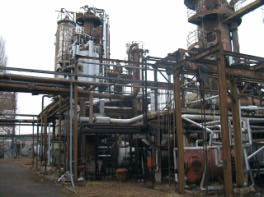
Contaminated sites caused by industrial activities like in figure 1 pose a potential danger for the
environment. Especially contaminated sites containing hazardous substances could lead to a
significant contamination of water bodies, if the substances will be mobilised (e.g. by floods). During
the last years the dramatic floods at Elbe, Danube and Oder have shown that the toxic impact of
contaminated sites could cause a significant harm to water bodies in Europe. For that reason the
ICPDR decided to draw up a basin wide inventory of contaminated sites in flood risk areas of the
Danube river basin in addition to the ARS Inventory.
The APC EG developed brief criteria for selection of such sites. The national inventories of
contaminated sites in potentially flooded areas were expected to be submitted until the end of 2002.
Afterwards, the ad-hoc working group should develop further criteria for the prioritisation of
contaminated sites. As the APC EG members did not have all the necessary expertise for the
prioritisation of contaminated sites additional experts were invited to this ad-hoc working group.
In this context, part of the Project Output 2.3 (Improvement of procedures and tools for accident and
emergency response with particular attention to transboundary emergency solutions will) focus on:
1. Support to completing and prioritisation of the inventory of contaminated sites in potentially
flooded areas in the Danube River Basin (Activity 2.3-2)
2. Support to upgrade of the ARS Inventory providing the detailed analysis, distribution on sub-
basin and industry branches and implementation of the check-lists (Activity 2.3-3)
Keeping these formulated activities in mind, the following main objectives will be derived:
· Assessment and prioritisation of contaminated sites in potentially flooded areas
· Upgrade of the ARS Inventory
Further information will follow in the next chapters.
16
UNDP/GEF Danube Regional Project
3 Part A: Project Activity 2.3-3
The inventory was supplied by information of the ICPDR- Countries. For the classification of
potential risk spots, a common procedure was elaborated considering actual European regulations and
findings such as
- The findings of the International Commission for the Protection of the Elbe River (ICPE)
- The EU ,,Seveso II"directive
- The ,,UN/ECE agreement on the effects of industrial accidents (Industrial accident
convention)
The Inventory of Potential Accidental Risk Spots (ARS) in the Danube River Basin is the first
international review of potentially dangerous installations in the Danube region.
In the following the
· objectives of this inventory,
· the methodology of the ranking of risk spots,
· the results of the assessment and
· the findings and conclusions for the next steps in the investigations
will be described.
3.1 Objective of the ARS Inventory
Main objective of the ARS inventory is the identification and preliminary ranking of the hazard
potential of existing industrial installations. The findings of the inventory should lead to a more
concrete list of industries, which include substances hazardous to water bodies, and should deliver a
more concrete description of the hazard potential situation in the Danube River Basin. Based on those
results it should enable surveillance authorities to elaborate an agreed and suitable measure catalogue
for the enhancement of the safety levels in the investigated region.
Emphasis was to point out the potential danger and not the actual danger of industrial installations
3.2 Description of the Methodology
The hazard potential of accidental risk spots is based on estimated water risk 3 equivalents (WRC 3-
equivalents), based on the highest water risk class 3 (WRC3). The equivalent is defined as a product of
the substance specific water risk class ranged between 0 until 3 and the mass of the hazard substance.
On this basis a water risk index (WRI) is calculated by log WRC3 similar to Richter scale for the
evaluation of the earth quake intensity, which makes it possible to rank industrial sites with regard to
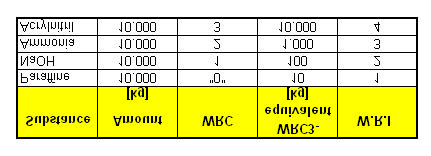
their water hazard potential. It is exemplary shown in Table 1
For the determination of the WRC3 and the calculation of WRI the mass and the water risk class of the
hazardous substance is to be known.
The calculation of the WRC3 equivalents showed substances with low water risk class (WRC) have a
negligible effect to the total WRI. They must be only considered in case of very large quantities.
Support for the Extension of Accident Risk Spots Inventory and Preventive Measures / Final Report
17
Table 1: Exemplary compilation of the water risk indices with regard to
substances with different water risk classes
All industrial sites with a value under the cut off threshold WRI<=5 were not relevant for further risk
assessment.
3.3 Results
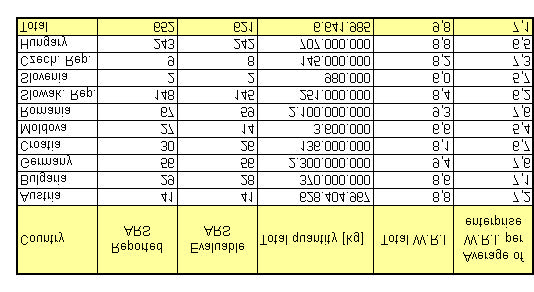
Considering the added results of Austria, which were delivered 2003, about 652 ARS were recorded,
and 621 could be evaluated according to the above described method. (See Table 2)
Table 2: Results of the ARS inventory
It could be stated that the Danube catchment area covers a WR3-equivalent of about 6.6 Mio t.
Germany and Romania include the highest hazard potential. One third of this amount is located in
Germany; even one fourth of the whole hazard potential is located only in Romanian mining activities.
These countries comprise also the enterprises with the highest averaged W.R.I. related to the
enterprise. Austria and Hungary show W.R.I.-values of about 8.8, but Austria is considering a less
18
UNDP/GEF Danube Regional Project
number of industries with high amount of water risk equivalent and Hungary summarizes huge
number industries, which comprise only less water risk equivalents.
3.4 Conclusions and Recommendations for Further Investigations on Actual Risk Assessment
According to the results of this proceeding Germany and Romania should be given the highest priority
in safety measures, if potential danger would approximate the actual danger, but usually one can not
equally compare potential with actual danger. So in the last Small APC Expert Group Meeting in
Vienna, dated March 18th 2003, we agreed, that for the identification of the actual danger in a second
step further investigation is needed. Those further investigations must also consider the following
aspects:
- Safety standards of installations and management,
- measures to be taken and already performed, regarding stepwise implementation
- lack of information about the industrial activity in the relevant authorities
- Missing implementation of capacity building for sufficient expert opinion in relevant
authorities
Based on that conclusion a first attempt was made to introduce a proposal for actual risk determination
in step 2, which was shown as a first draft in a formula as follows:
WRAI = Log [WRC3*(1- FS)*(1-FT)*(1-FI)/S]
WRAI as an actual risk water index
WRC3 as calculated water risk equivalent
FS as a degree of performing/fulfilling identified safety measures
<1
FT as a degree of safety training of personal
<1
FI as a degree of information level of industries and authorities
<1
S = Stage of fulfilling the demands of safety measures
1 = short term; 2 = medium term; 3 = long term
FS could be defined as the percentage of achieved/fulfilled safety measures with regard to the list of
safety demands formulated by the relevant environmental surveillance authorities.
FT could be defined as the percentage of achieved/fulfilled safety training measures with regard to the
listed trainings needs formulated by the relevant technical surveillance authorities.
FI could be defined as the percentage of achieved information level related to estimated maximum
information level in the country. The approach shall be proved through exemplary pilot site
investigations.
3.5 Further Steps
Further investigation is needed to identify the actual danger of ARS. Main objective of further steps
should be the development of a basin wide harmonised methodology, which helps to identify the
actual risk of ARS. Therefore know-how transfer and discussion between all experts of the Danubian
countries are needed, which enable the definition of agreed criteria for the actual risk assessment. For
the actual risk assessment the following aspects should be considered:
· Safety standards of installations and management, safety measures to be taken and already
performed, regarding stepwise implementation
Support for the Extension of Accident Risk Spots Inventory and Preventive Measures / Final Report
19
· lack of information in authorities about the industrial activity
· Harmonised proceeding for the assessment in every Danubian country
· Adaptation and verification of the checklists at industries with different developed safety
levels
The findings of the investigations should lead to a branch related guide to be transferred to other
enterprises as far as regional and national administrations.
These investigations have to meet the
· Need of harmonising the assessment, which is regarding also the enhancement of the safety
level in each industry,
· need of further development of the checklist in consequence to the criteria, which will be
developed/ determined for the evaluation of the actual risk,
· need of training and know how transfer for elaboration of measure catalogues and evaluation
of achieved safety levels,
· need of verification of the amended checklists
These requirements could be met through a study, where three exemplary pilot industries of different
development stages (related to the safety level) were chosen. The development of the evaluation
criteria and the checklists should be supplemented through an on site verification performed by the
experts in their own country, which helps on one hand to perform a stepwise implementation of
capacity building and a creation of sufficient expert opinion in relevant authorities and on the other
hand it gives a feedback about the country specific needs, which have to be taken into consideration
for the development of an assessment methodology. For the preparation of the site investigation the
following requirements must be met:
· Pilot industries of different development stages must be chosen, which include a quite similar
hazard potential.
· The safety measures in these industries must be either already started already ongoing or
nearly completed.
· The technical and organisational action plan of the investigated industries must cover safety
measures in short, medium and long term.
· The findings should lead to a confirmation/adoption of the ARS Checklist methodology
· The transfer of the findings to other enterprises, regional and national administrations must be
possible.
A suited project proposal was presented and confirmed in the last expert group meeting in Ljubljana.
The proposal is attached to this report (Annex 10).
20
UNDP/GEF Danube Regional Project
4 Part B: Completing and Prioritisation of the Inventory of Contaminated
Sites in Potentially Flooded Areas in the Danube River Basin (Activity
2.3-2)
Figure 1: Oil contamination in an industrial area
4.1 Objectives and Milestones of the Work Program
The major goal of Part B of the project was to develop a draft guide line for the countries of the
Danube River Basin, which enable the competent authorities of the riparian countries to maintain the
following activities:
· Establishment of a methodology for the pre assessment for the compiled data of suspected
contaminated sites in flood risk areas
· Drawing up recommendations for respective safety measures which could serve as regulatory
guidelines.
· Drafting a Measure catalogue for the exemplary implementation of these safety guidelines.
This objective led to the following stepwise proceeding:
Support for the Extension of Accident Risk Spots Inventory and Preventive Measures / Final Report
21
4.1.1 Inventory and Screening of Contaminated Sites
In a first step a method for the pre assessment of contaminated sites in flood risk areas compiled in the
inventory of Danube countries with regard to their risk potential was developed and adopted, which
should serve as a screening tool and as a decision support system to classify
· single suspected contaminated sites or
· properties consisting of several suspected contaminated sites
as relevant to be investigated further in view to their actual risk.
The resulted product of that task and the modified version which includes the amendments is shown in
Annex 8.
4.1.2 Recommendation on Safety Requirements for Contaminated Sites and Checklist
Methodology
In the second step a recommendation on
Safety Requirements for Contaminated Sites in Flood-risk Areas
was prepared, which should help to elaborate a detailed measure catalogue for an investigated site and
which allows the competent authorities to improve the safety of contaminated sites and to reduce the
risk of contamination of the Danube
Additionally a draft
Checklist for the investigation and assessment of contaminated sites in flood risk areas
was developed and applied in an exemplary site visit. The experiences gained lead to amendments of
the checklist.
The final products are shown in annex 6 and annex 7.
22
UNDP/GEF Danube Regional Project
4.1.3 Milestones of the Work Program:
Milestone
Time schedule
To analyse the Inventory of suspected contaminated sites in flood risk areas in done, m1-methodology
the Danube River Basin and prepare discussion paper for the ad-hoc working
approved in the 27th APC
group on the inventory ranking system (methodology including risk assessment meeting
of priority sites)
Organize and visit of 2 exemplary contaminated sites (case study) to apply the in June
check list methodologies at the national level. (Copsa Mica and Hunedoara,
Romania)
Recommendation on Safety Requirements for Contaminated Sites in Flood-risk Draft discussed in the Small
Areas
expert group meeting in July
Checklist for the Investigation and Risk Assessment of Contaminated Sites in
Draft of the checklists were
Flood Risk Areas
discussed after site visit in
Copsa Mica
Presentation and adoption of the recommendation and checklist drafts at the
Done in September, 8-9th
28th APC meeting
2003
Final adaptation of the recommendation and safety guidelines
Until the midst of
September
Final adaptation of the checklists
In November
Final report
End of November
4.2 Inventory of Contaminated Sites
4.2.1 Proceeding of the Data Record
According to the recommendation of the ICPDR meeting in June 2002 a specific inventory of
abandoned contaminated sites was compiled, in particular with regard to sites where potentially
contaminants may be released in the case of flood incidents. The existing Federal Inventory of
Contaminated Sites of Austria (FCSI) which is compiled and managed by the Federal Environment
Agency of Austria served as the basis for the closer definition of contaminated sites in flood risk areas.
Sites which meet one of the following criteria were excluded from the inventory:
· Waste sites with a disposal volume smaller than 100,000 m³.
· Industrial sites with surface areas smaller than 5.000 m².
· Small enterprises where only small amounts of hazardous substances were dealt with.
· Sites where remediation measures had already been implemented and which can hence be
considered to have a low contamination potential.
· Contaminated sites situated at large distances to surface waters, where no impacts can be
expected even in the case of a disastrous flooding incident.
Until the end of February 2003, the first inventory of contaminated sites performed by the Danubian
Countries should be evaluated. In the midst of March the Danubian countries reported 212
contaminated sites in potentially flooded areas of the Danube. Sites from Croatia, Bulgaria and
Support for the Extension of Accident Risk Spots Inventory and Preventive Measures / Final Report
23
Germany were delivered in May. Finally Bosnia also reported contaminated sites. The data vary in
quality and reflect the different stage of management of contaminated sites in the different countries.
The data in detail are shown in Annex 1.
4.2.2 Identified Problems and Solutions
After the review of the data, the following problems were identified, when the inventory was compiled
considering the a.m. exclusion criteria:
· Nearly every Danubian Country, which has performed the investigation, listed also sites which
met the a.m. exclusion criteria, because the exclusion criteria did not fit with the countries´
own priority listing of the CS. So the number of suspected contaminated sites became higher
as expected.
· In many cases it was difficult to differ between industrial sites and waste deposits. Only the
tables of Austria and Hungary showed a distinction between industrial sites and waste
deposits. All other countries focussed at landfills or deposits.
· It was not quite clear for every country, if abandoned industries or waste deposits are situated
in flood risk areas and if they are really endangered by flood events.
· A comparison between the countries according to the waste codes was not possible. Only
Romania specified additionally the waste code of the disposed substances.
· The data about handled or disposed substances in the industrial area or in the deposit sites
could not exactly be quantified for every country. Only Moldova was able to give exact data
for every listed site. In general, size, type and location of the contaminated area or
contaminated volume was only estimated. So a determination of the risk potential according to
the ARS inventory is not feasible without a wide limit of variations. For the assessment of risk
potentials in CS a new method had to be elaborated.
· The criteria lead to a complete exclusion of CS in Slovenia. (Please find the excerpt of the
statement from Slovenia Annex 1.5)
· Also Bosnia could not identify sites according to these criteria
Considering the listed problems the exclusion criteria were slightly modified during the APC Small
Expert Group Meeting in March. The criteria are listed beneath:
· old industrial sites with an area smaller than 5.000 m²
· old deposits with a contaminated volume smaller than 100.000 m³
· sites outside of flood risk areas
The criteria aimed at focussing on those sites, which represent the tip of the iceberg and dominate
mainly the risk potential in the Danube river basin. The Danubian Countries were requested to adapt
their lists according to the modified criteria and to apply for the preliminary risk assessment of CS.
They were also asked to list more abandoned industrial sites with potential hazards and to focus on
sites endangered by floods.
In sum it could be stated, that for the completion of the inventory additional data had to be delivered
by the Danubian States. Finally it was agreed, that for the risk assessment a new methodology must
developed, which allows a rough prioritisation of the sites potentially hazardous to water based on the
existing data.
For the ranked sites suitable tools for the
· risk assessment and
· formulation of safety measures (in form of recommendation and check lists)
should be developed and proved later in exemplary visits of pilot sites.
24
UNDP/GEF Danube Regional Project
A first draft of a checklist was elaborated and implemented at the Small Expert Group Meeting in July
in Sibiu at a first site visit. Furthermore a recommendation on safety requirements for contaminated
sites in flood risk areas was developed.
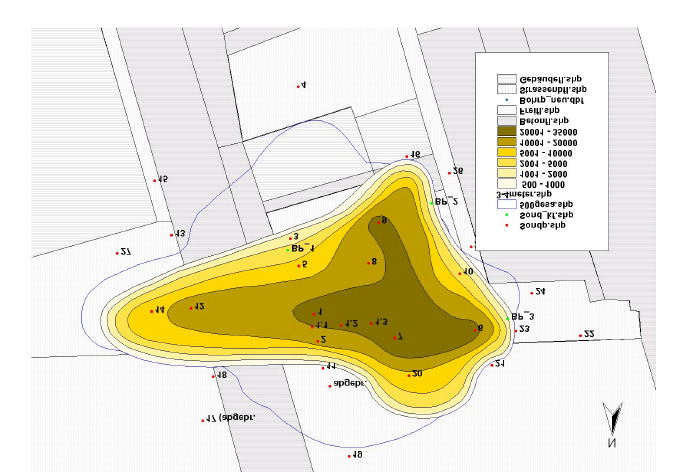
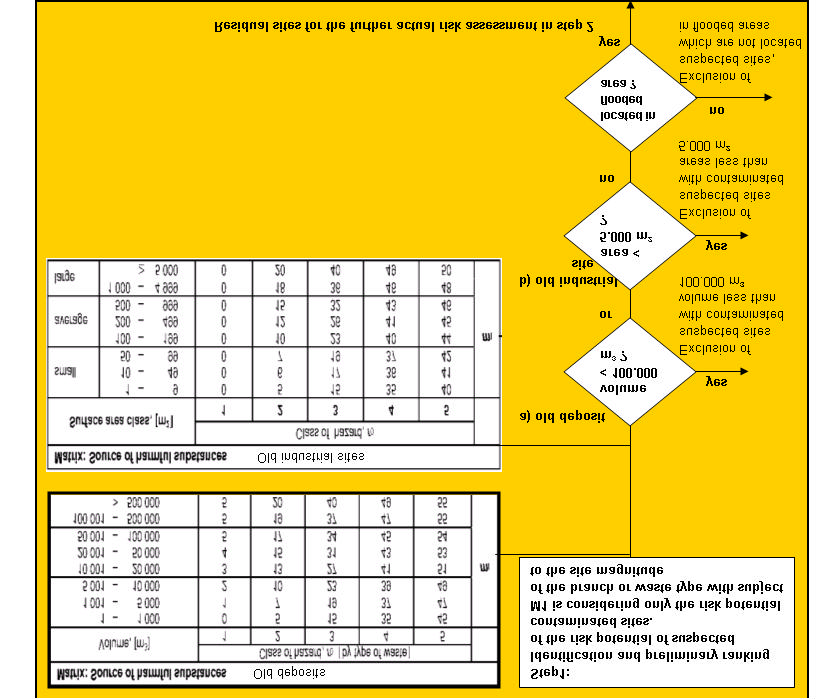
A tool for the preliminary risk assessment of the suspected contaminated sites (see Figure 2) was
presented in the first expert group meeting in April 2003 in Vienna, which was based on expert
knowledge about the industrial sector classification and waste classification following the experience
of the Federal State of Saxony in Germany. This methodology was adopted to be used for the first pre
assessment. The proceeding of the so called m1-methodology is described in annex 8. The results of
the first pre assessment are shown in the next chapter.
Figure 2: Illustration of the first step of the risk assessment
Support for the Extension of Accident Risk Spots Inventory and Preventive Measures / Final Report
25
4.2.3 Results of the Pre Assessment of Suspected Contaminated Sites according to the m1 -
Methodology
The results are based on the inventory of the Danubian Countries as of end of May. The tables of the
national inventories are shown in annex 2. The table was added and completed as follows:
· Austria sent data inclusive m1-value
· Croatia delivered data according to the format of the Hungarian data
· Czech Republic added the list with contaminated sites on industrial sites
· Germany delivered data according the criteria defined in the last Small Expert Group Meeting.
· Hungary delivered data modified according the criteria defined in the last Small Expert Group
Meeting.
· Moldova and Bulgaria focussed on environmental risks caused by pesticides coming up from
landfill use or storage. Bulgaria even took measures for pesticides disposal, so these sites will
be no more critical in future. For Moldova the situation seems to be the same, if further unsafe
disposal of pesticides is stopped.
· Slovakia focussed on waste deposits
· Ukraine delivered mainly data about deposits and tank facilities, but the sites were excluded
according to the defined criteria. The only exception is the Odessa area Izmail Cellulose-
cardboard combine.
· Bosnia completed the data end of 2003 for ARS but could not deliver data according to the
defined criteria.. According to available data there were no heavy contaminated sites on the
presented area, which could cause significant contamination of the water due to flood impact.
Sites
Number
Registered
261
Evaluable
157
Classified by volume or area:
108
Classified by mass*
38
Classified by area
11
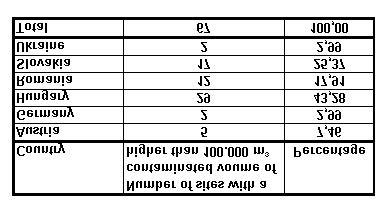
After applying the exclusion criteria: sites with volume >100,000 m³
67**
Sites with area >5,000m³
11
*The mass (tons) was converted into volume (m³)
** Splitting in countries find in table 4
Table 3: Listed sites with a high risk value
At large 261 sites were reported. The data were very heterogeneous and were focussed on (industrial)
waste deposits. Former industrial sites were only reported by Austria . The inventories of each country,
assessed by m1-methodology, as described above, result in 157 valuable sites of total 261 sites, which
represents a degree of 60 %. One third of the valuable sites had shown no waste code, so the sites were
classified according to the European waste Catalogue as far as possible. The resulting table is shown
in Annex 3.
26
UNDP/GEF Danube Regional Project
Table 4: Listed sites with a contaminated volume higher than 100.000 m³
After applying the agreed exclusion criteria 78 sites (67 waste deposits see table 4 and figure 3, 11
abandoned industrial sites) were left.
; %
; % ; %
; %
; %
;
%
Austria
Germany
; %
Hungary
Romania
Slovakia
Ukraine
Figure 3: Listed sites with a contaminated volume higher than 100.000 m³
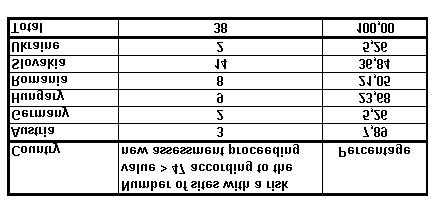
Applying a hazard value threshold of 47 for waste deposits and 50 for abandoned industrial sites
following result was obtained:
· 38 waste deposits (Splitting in Countries find in table 5 and figure 4)
· 11 abandoned industrial sites (listed by the Austrian experts)
Support for the Extension of Accident Risk Spots Inventory and Preventive Measures / Final Report
27
Table 5: Listed sites with a high risk value m1 >= 47
2
3
2
14
9
8
Austria
Germany
Hungary
Romania
Slovakia
Ukraine
Figure 4: Listed sites with a high risk value m1 >= 47
7 sites (3 sites in Romania and 2 sites in Slovakia and 1 site each in Hungary and in the Czech
Republic) reached the m1 values higher or equal 47, but with contaminated volumes lower than
100.000 m³. We recommend that those sites should also be considered for further risk assessment and
if necessary, for the elaboration of a list about short, medium and long term safety measures.
It was also a very astounding result, that the number of contaminated sites between Bavaria (Germany)
and Austria were very different, although similar numbers of sites were expected. We presume that the
defined exclusion criteria of a flood risk area were construed differently. It seems also possible that
each country expert was evaluating either the whole property or only the contaminated part (site) of a
property. Considering the last case most of the sites have to be excluded, because they are under the
exclusion value of 100.000 m³ contaminated volume or 5.000 m² contaminated area.
28
UNDP/GEF Danube Regional Project
4.2.4 Recommendations for the m1-Methodology
Within the APC expert group meeting in Vienna the m1-methodology and the results after the
implementation of the methodology were presented. The methodology was adopted by the expert
group taking into consideration the following suggestions for improvement:
First step to improve the methodology: Extended m1-Methodology
The differentiation between sites of an extension larger than 5.000 m² or of volume bigger than
100.000 m³ is hardly to reach. Maximum values of about 50 or 55 will be not useful, so there has to be
an extended range of values to allow a better differentiation in the ranking . The result of the extended
range of values is also shown in annex 8. This evaluatio n step should serve as a first stage to rank
properties. In future the methodology should be improved in a second step to a so called m2-
Methodology.
In a second step further criteria should be integrated in the assessment like the probability of floods or
the potential discharge of contaminants or contaminated volume in case of flooding. This evaluation
step should serve as a second extended stage of the properties ranking. Also the definition, how a
flood risk is defined should be concretised. So the different interpretation of the flooding situation
could be avoided. These data should be delivered in a next step. The delivery of those data must be
harmonised and agreed.
4.2.5 Conclusion for the further use of Pre Assessment Tools
The results showed, that the "m1-methodology" as shown in Figure 2 could be one of the tools to be
used in the pre assessment. So the results of this preliminary assessment do not demand a detailed
description of the risk potential. A differentiated assessment, which gives more detailed information
about the risk situation needs a detailed investigation using further criteria to determine the actual risk
of sites in case of flooding.
It must be stated, that the "m1-methodology" is only the first step of the assessment. Data had to be
compared, which vary greatly among the different countries and the assessment is carried out on the
basis of a small number of easily obtainable data: taking into account the hazard to be expected from a
given waste or industrial branch and the size of the site. The extended m1-methodology is only to be
seen as an operational tool for a rough ranking of whole properties according to their initial risk.
Any further risk assessment of the properties, which gives information about the actual risk in case of
flooding, has to consider additional criteria like flood- proneness and potential discharge of
contaminants (an old deposit above ground secured by unsafe dams is likely to be more endangered by
flooding than deposits filled in a "hole"). These criteria for the actual risk assessment should be
developed further and should be verified in a separate study in the next years. Nevertheless the criteria
should be presented later in the checklists as a so called m2-methodology, which is seen as an
additional attempt to enhance the ranking accuracy. A first approach is shown in the checklist (See
Annex 7).
Before the verification of these special criteria will be started, a basic revision of the checklist had to
be done with regard to the practicability of the checklists in the frame work of the site visits and the
suitability of the questionnaire according to the country specific requirements. So it became necessary,
to verify the elaborated checklist for the investigation of contaminated sites in abandoned properties
through exemplary visits on real sites. On the basis of the findings the first draft of the checklists
should then be discussed and the recommendation on safety requirements could be finally revised.
These targets should be met at the meeting of the Small APC working group in Sibiu.
Support for the Extension of Accident Risk Spots Inventory and Preventive Measures / Final Report
29
The following work steps were performed for this meeting:
· Preparation of the recommendation draft for the final discussion in the APC small expert
group
· Preparation of the first draft of the checklists for the discussion and amendment.
· Preparation of suitable site visits nearby Sibiu
· Presentation of the drafts in Sibiu to the APC small expert group and to official representatives
of the regional water management agency in Sibiu.
· Performance of the site visits
· Discussion of the findings and conclusion for the prepared documents (Definition of
additional criteria for the actual risk assessment of CS)
The performance and the results of this meeting are presented in the next chapter.
4.3 2nd Meeting of the Small APC Working Group on Inventories
After the completion of the ranking list the final draft of the recommendations of safety measures were
elaborated. The draft was presented at the 2nd meeting of the Small APC Working group in July 17th
and 18th of July at Sibiu and served as basis for the later discussion with the APC experts. Additional
to the recommendations a second draft of the check list for the further risk assessment of contaminated
sites was prepared. With regard to their practicability and the suitability of the chosen evaluation
criteria these drafts should be proved through visits of exemplary high risk sites. Copsa Mica and
Hunedoara in Romania served as location for the site visits. The sites visited are shown in photo
documentation in annex 9. An excerpt of the visit is compiled in the following.
4.3.1 Visit of Contaminated Sites in Copsa Mica
In Copsa Mica, there is an area of around 55 ha, which was or still is used for industrial production.
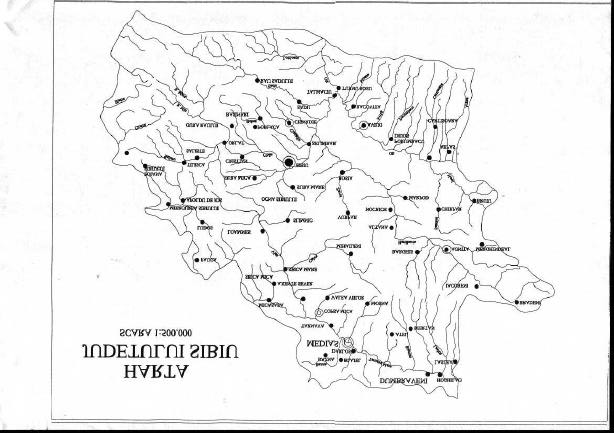
The industrial area is located 60 km in the north from Sibiu and about 15 km in the southwest of
Medias in the midst of the Transylvanian region (see also the map in Figure 5).
30
UNDP/GEF Danube Regional Project
Figure 5: Map of the Sibiu Region
The area is divided into two zones:
1. The still operating factory Sometra
2. The closed-down factory Carbosim
Sometra
In Sometra lead, zinc and copper are still produced. The production is based on a thermal destruction
of the raw materials, usually sulphide ores of the metals above mentioned. The product is precipitated
as dust in the electro filter system, the first stage of the waste gas treatment. The parts, which were not
precipitated, are removed also over waste gas washing system. The sludge of metal hydroxides was
recovered as sediment in the waste water treatment, so it is due to a washing system as second step in
a waste gas treatment. The sludge is recycled into the thermal treatment. The slag arising from the
combustion is disposed at the industrial site. Due to the treatment temperature in the incineration stage
the slag could be not eluted, so heavy metal residues in the slag could be not washed out.
In former years the precipitation process was not operating, when electro filter systems produced by
the Soviet Union were operating. Therefore the complete area and also the slag dumps are
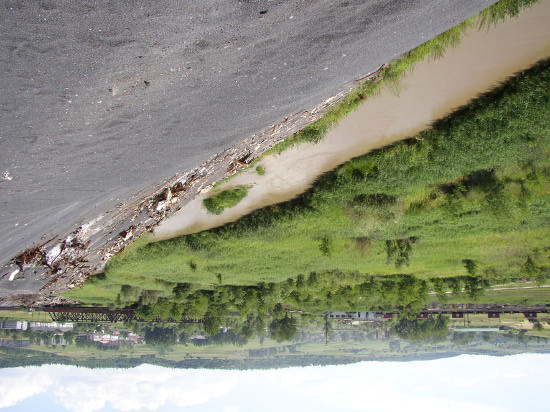
contaminated with heavy metals, which led later to a significant hazardous impact to groundwater. In
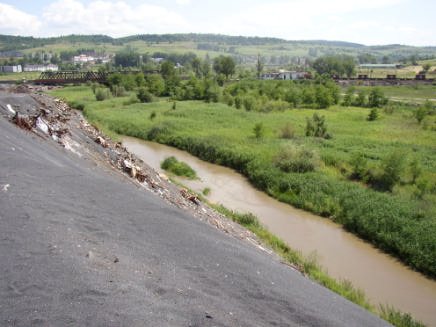
the photo documentation the slag dumps and the factory are illustrated. Figure 6 shows, that the dump
is directly located at the river side. In this case there is a direct potential hazard for the river side, if the
area is flooded or the dumps are directly impacted by heavy rain events. To avoid those incidents
measures are necessary to be determined within an exemplary site study.
The contamination in this area is also confirmed by chemical analysis.
Support for the Extension of Accident Risk Spots Inventory and Preventive Measures / Final Report
31
Figure 6: Slag dump at Sometra
Carbosim
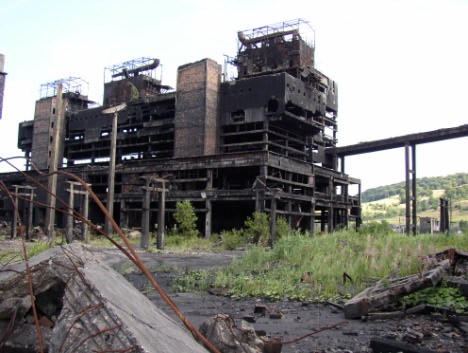
The closed-down industrial facilities in the area of the former state enterprise Carbosim are illustrated
the Figure 7. In former years graphite for initial fuses was produced by catalytic reduction of methane.
The waste gases were not sufficiently treated, so the area was impacted by amounts of dust.
Additionally Plexiglas and other goods were produced since the sixties (see Figure 8).
As a result of the industrial activities in this area, there is a strong suspect for soil contaminations
caused by PAH and Cyanides. But in fact there are no results of analyses available, which confirm the
contamination.
32
UNDP/GEF Danube Regional Project
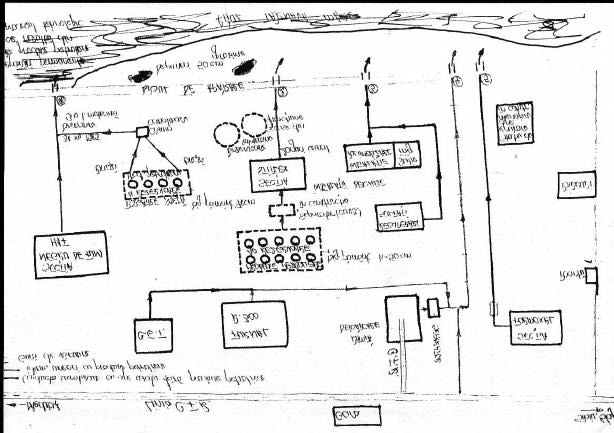
Figure 7: Hand sketch of the industrial area
Figure 8: Abandoned industrial plant at Carbosim
A further investigation should prove, if there is a risk of surface water being contaminated in case of a
flood event. In particular the river dam must be investigated, because the site visit showed that the
dam is not stable in case of heavy rainfall events. First measures to enhance the dam stability have to
Support for the Extension of Accident Risk Spots Inventory and Preventive Measures / Final Report
33
be performed. Further investigations have to be maintained immediately to prove the actual risk of
some contaminated sites identified during the visits (please find inf ormation in the photo
documentation in Annex 9).
4.3.2 Visit of a Contaminated Site in Hunedoara
The visit in Hunedoara was directed to the State Company Siderurgica S.A., a huge metal combination
without metal processing facilities. The company focussed at steel production (semi-finished
products).
As much as the incineration plant is operating in Sometra the steel production line in Hunedoara
operates also at temperatures of above 1500 1700°C, which leads to not elutable slag. So the main
wastes disposed at site are not critical.
An environmental problem was suspected in the acid storage facilities and especially in the tar
distillation process, where asphaltenes were separated from naphthalene's. The last mentioned
products are very hazardous to water. In case of further investigations, the area nearby the tar
production and the feeding pipelines of this facility should be analysed with regard to PAH.
4.3.3 Safety Recommendation and Measure Catalogue
The presented draft recommendation was revised by the small working group. The amendment
proposals from Richard Stadler and Martha Wepner, which could not assist to the meeting, were taken
into account.
The small working group agreed to insert a recommendation with precautionary character: it shall be
recommended, that in future, new deposits and industrial sites where substances are handled which are
hazardous to water, shall not be constructed in flood risk areas.
4.3.4 Checklist for the investigation and risk assessment of contaminated sites in flood risk
areas
After the presentation of the checklists, their application was shown by an exemplary template for the
site in Copsa Mica. As a result of the discussion it can be stated, that the checklist is useful for the site
visits and should be presented for adoption in the next APC Meeting. For a better understanding of the
checklist the following amendments were formulated:
· The objectives of the further investigations should be described
· It is necessary to add some answering possibilities for some questions (for example "not
known" or "not applicable")
· It was agreed, that the checklist should be structured as follows:
One part for the pre-assessment of the risk potential and completion of the data base (does
not involve a site visit),
Further investigation of abandoned sites (industrial sites, waste management sites
installations (for the site investigation),
Assessment and list of measures (findings and conclusions are formulated based on the
gained data)
Additional data framework to be used in following investigations.
· The elaboration of measures should be more concretised and supported by a decision tree.
· The identified hot spots in contaminated sites should be ranked in a second step according to
the WRI determination in the ARS inventory.
The checklist has to be considered as a "living document", that means it will be adapted in the next 2-3
years, according to the experience gained by its application at site visits by inspectorates and other
experts.
34
UNDP/GEF Danube Regional Project
4.3.5 Conclusions and Further Proceeding
It was agreed, that recommendation and checklists were suitable for the further use in site
investigation. As a result of the first implementation of the checklist, it can be stated, that there is a
need for amendment to facilitate the use of the templates (for example to outsource gathered data,
which are not used in the first instance). Additional data should be recorded, if the processor needs
them for further investigations. The templates should be divided in parts, which can be either filled in
at site or in the office. All tools should be prepared for the presentation at the APC Expert Group
Meeting in Ljubljana in September the 7th and 8th, which is described in the following. The following
proceeding was agreed within the meeting.
Checklists:
The checklists were discussed taking into account the experience of applying them at the sites in
Copsa Mica and Hunedoara. They will be revised and send to all members of the small working group
on inventories.
Safety Recommendation:
The revised 2nd draft of the recommendation will be sent to all members of the working group. Both,
checklist and recommendation will be given to a native speaker for revising, when their final version
is decided by the APC-Working Group.
Decision Proposals:
It was agreed to prepare decision proposals concerning
1. further projects on evaluation criteria for the ARS inventory and
2. further investigations on contaminated sites.
5 Final Presentation of the Products at the APC Expert Group Meeting
The products of this project were finally presented in the APC Expert Group Meeting hold in 7th and
8th of September 2003 in Ljubljana. The presentation was structured as follows:
· Photo documentation from the meeting of the Small Working Group OCS Inventory in Sibiu
(including field visits) (see Annex 9)
· Ranking list of suspected contaminated sites in flood risk areas based on the assessment
results made by the m1-methodology (see Annex 3).
· Recommendation on safety requirements for contaminated sites in flood risk areas
· Checklist for the investigation and risk assessment of contaminated sites in flood risk areas
· Project proposal about Know-how Transfer for safety measures of contaminated sites in flood
risk areas
· Results of the update of the ARS inventory
· Pilot Project on Actual Risk Assessment of ARS
After the presentation all draft documents were discussed and commented thoroughly. All in all it
could be stated the following:
5.1 Ranking List of Contaminated Sites
The ranking list of suspected contaminated sites was prepared based on results of national inventories
(status as of end of May 2003) using M1 methodology and the agreed exclusion criteria. Around 180
sites were evaluated and altogether nearly 60 high-risk sites passed through this process. No data were
obtained from Serbia and Montenegro, Bulgarian data focussed on chemicals, amounts were missing.
Support for the Extension of Accident Risk Spots Inventory and Preventive Measures / Final Report
35
The primal results of discussion are the following:
· Because of missing data like the amount of contaminated volume or a missing classification of
the risk value the evaluation and interpretation of the data was difficult. So in some cases the
risk values were estimated. It has to be considered that the estimated data have a high
inaccuracy which could lead to a wrong evaluation of the sites. So. the ranking list is not very
much consistent, but it is sufficient for a first rough risk estimation and a screening of the
sites. It can serve as a basis for Danube countries to make their national assessment.
· With the demand for an open score for the site categories, maximum values of 55 and 50 like
in the first approach of the m1-methodology could not be used any longer. The range of the
tables should be extended.
· A significant source of discrepancy was the flood proneness criterion, which was not applied
by all countries in the first assessment step (please find result of the Austrian data in Annex
2.1).
· It was agreed, that for the first assessment step the use of the m1 methodology is sufficient,
but the criterion of flood probability should be considered in the further development of the
m1-methodology. The flood potential should be addressed in 2004 (as M2 methodology).
· The m1-methodology was adopted as a suitable guide for safety measures and should be
presented within the 6th ordinary Meeting of the ICPDR in Vienna.
5.2 Recommendation on Safety Requirements for Contaminated Sites in Flood Risk Areas
The discussion of the recommendation led to the following results:
· In the discussion, the APC EG agreed to present the statement given in Paragraph 5.2 ("the
countries should take care by appropriate legal provisions and measures that in future no new
contaminated sites in flood risk areas will be created") separately as a general requirement and
to propose it as a resolution for the next ICPDR meeting. The necessary backing-up legal
provisions will be developed next year.
· It was recognised that the safety requirements address not only the old abandoned sites but, in
principle, all sites suspected of being contaminated. Any discrimination between such sites
would be peculiar. Therefore, it was agreed that in future the "OCS" would be referred to as
"contaminated sites (in flood risk areas)"
· The recommendation was adopted as a suitable guide for safety measures and should be
presented within the 6th ordinary Meeting of the ICPDR in Vienna.
· It was agreed, that the recommendation should be revised by a native speaker.
(please find the revised version of the recommendation in Annex 6)
5.3 Checklists for the Investigation and Assessment of Contaminated Sites
In the discussion the following needs of amendment were pointed out by the expert group:
· Within the risk assessment the hazardous potential of the hot spots should be evaluated using
the same approach as applied for ARS (WRC/WRI).
· Before its adoption by the ICPDR the checklist should be reviewed by competent national
experts in waste management.
· The checklist should be primarily looked upon as a basis for development of risk assessment
tools.
36
UNDP/GEF Danube Regional Project
Finally, it was agreed that the revised checklist (please find the checklist in Annex 7) should be
distributed to the APC EG members, who will forward it to national experts in waste management for
commenting. Comments should be delivered until 28 February 2004. A final version should be
prepared afterwards until 15 March 2004. The final version should include also an Excel version.1
5.4 Proposal for a Pilot Project for Further Investigations and Safety Measures at
Contaminated Sites
A proposal for a pilot project of know-how and technology transfer for further investigations and
safety measures at contaminated sites in flood risk areas was presented and discussed. The pilot
project is focussed on training of national experts (future national trainers) at an exemplary site it is a
preparatory activity to get all experts to an equal knowledge level. The APC EG agreed with the
project and proposed it for the UNDP/GEF DRP Phase II. The proposal is shown in Annex 11.
5.5 Pilot Project on Actual Risk Assessment of ARS
Based on the presented findings of the ARS review a proposal for a pilot project was presented, in
which three industrial sites at different stages of implementation of safety measures should be visited
and the measures checked. The suggested industrial sector for this pilot project is refinery/oil
processing. A discussion on suitability of this sector for training purposes was held. GW pointed out
that refineries are fit for purpose and that training will be focussed on special facilities. The APC EG
supported the pilot project for ARS. The pilot project, described in more detail in Annex 10, should be
performed in 2004.
1 In connection with the implementation of the WRI in the risk assessment of contaminated sites, it must be
stated, that the estimated value of WRI can give only a more detailed information about the risk of the substance
expected in the investigated site, which is sufficient for the first site assessment and ranking in a flood risk area.
It does not consider the risk of mixtures of substances, possible degradation processes nor the flooding and
mobility potentials of the substances in the contaminated zone in case of flooding. Furthermore the amount of
the contaminant/contaminated soil may not be known.
Support for the Extension of Accident Risk Spots Inventory and Preventive Measures / Final Report
37
6 Further Steps
Based on the agreement in the APC EG meeting in Ljubljana the following milestones were suggested
for the next months:
Inventory of contaminated sites:
· Preparation of the revised material
End of October 2003
· Revision of the recommendation
End of October 2003
· Forwarding the revised draft of the checklist to
national experts in waste management
End of November 2003
· Delivery of the national comments to the draft checklist
End of February 2004
· Preparation of a final version of checklists including an Excel version Mid of march 2004
· Development of a training program to use the checklists
End of March 2004
· Presentation of the program
Beginning of April
· Definition of further criteria
for the development of a M2-methodology
April 2004
· Preparation of a draft of a M2-methodology
(only the rough frame work without detailed analysis of the criteria) May 2004
· Renewal of the ranking list (draft)
May 2004
· Presentation of the results
End of may 2004
· Providing exemplary training
for the national experts to use the revised checklists
Mid of June 2004
· Listing of the findings of the training measure and conclusion
for the preparation of the national inventories
End of July 2004
· Start of the national inventories on CS
End of August 2004
Inventory of ARS:
· Definition of criteria for the assessment
of the actual risk of ARS
March 2004
· Preparation of exemplary site visits
End of March 2004
· Presentation, discussion and amendment of the program
Beginning of April
· Checklist application industries, oil processing sector
within the time frame of May
and September 2004
· Listing of the findings and recommendation for further proceeding
End of September 2004
Support for the Extension of Accident Risk Spots Inventory and Preventive Measures / Final Report
Annex 1
National Inventory of February 2003
Support for the Extension of Accident Risk Spots Inventory and Preventive Measures / Final Report
Annex 2
Results of the inventory end of May 2003 and
Additional or Modified Lists of CS
Support for the Extension of Accident Risk Spots Inventory and Preventive Measures / Final Report
Annex 3
Results of the Ranking of CS in Flood Risk Areas
with Regard to their Toxic Potential
Support for the Extension of Accident Risk Spots Inventory and Preventive Measures / Final Report
Annex 4
Results of the ARS inventory of Austria in 2003
Support for the Extension of Accident Risk Spots Inventory and Preventive Measures / Final Report
Annex 5
Results of the ARS inventory of Bosnia in 2003
Support for the Extension of Accident Risk Spots Inventory and Preventive Measures / Final Report
Annex 6
Recommendation on Safety Requirements for
Contaminated Sites in Flood Risk Areas
Support for the Extension of Accident Risk Spots Inventory and Preventive Measures / Final Report
Annex 7
Draft Check Lists for the Investigation and Risk
Assessment of Contaminated Sites in Flood Risk
Areas
Support for the Extension of Accident Risk Spots Inventory and Preventive Measures / Final Report
Annex 8
Methodology for the Pre Assessment of Suspected
Contaminated Sites in Flood Risk Areas in the
Danube River Basin
Support for the Extension of Accident Risk Spots Inventory and Preventive Measures / Final Report
Annex 9
Photo Documentation of the Visits
in Copsa Mica and Hunedoara
Support for the Extension of Accident Risk Spots Inventory and Preventive Measures / Final Report
Annex 10
Pilot Project on Actual Risk Assessment of ARS
Support for the Extension of Accident Risk Spots Inventory and Preventive Measures / Final Report
Annex 11
Pilot studies on Know How Transfer for the Safety
Measures of CS