





January 2004
SETTING UP OF INTER-MINISTERIAL
COORDINATING MECHANISMS FOR THE
POLLUTION CONTROL
Evaluation of Results of National Reports

AUTHORS
Michael von Berg
Joachim Bendow
Evaluation of Results of National Reports for `Setting up of Inter-Ministerial
3
Coordinating Mechanisms for the pollution control'
Table of Content
Executive Summary ................................................................................................................................ 7
1
Introduction ..................................................................................................................................... 9
2
Summary of Analysis and Recommendations............................................................................... 10
2.1
Requirements for setting up of coordinating mechanisms..................................................... 10
2.1.1
Political commitment .................................................................................................... 10
2.1.2
Appropriate administrative structures ........................................................................... 10
2.2
Existing coordinating mechanisms ........................................................................................ 10
2.3
Existing coordinating mechanisms for implementing the WFD............................................ 11
2.4
Identified barriers................................................................................................................... 11
2.5
Proposed models for improved governance and effective inter-ministerial coordination ..... 12
2.5.1
Administrative reform and consequently establishment of inter-ministerial
coordinating mechanisms (Moldova, Ukraine, Bosnia i Herzegovina,
Serbia & Montenegro).................................................................................................. 12
2.5.2
Review and improvement of administrative structures and establishment of
efficient inter-ministerial coordinating mechanism (Romania, Croatia) ...................... 13
2.5.3
Review and amendment of existing mechanisms for coordination (Czech
Republic, Slovakia, Hungary, Bulgaria)....................................................................... 13
2.6
Proposal for further actions.................................................................................................... 15
2.6.1
Moldova, Ukraine, Bosnia I Herzegovina, Serbia & Montenegro ................................ 15
2.6.2
Romania and Croatia ..................................................................................................... 15
2.6.3
Czech Republic, Slovakia, Hungary, Bulgaria .............................................................. 16
3
Analysis of National Reports ........................................................................................................ 17
3.1
Czech Republic ...................................................................................................................... 17
3.1.1
Specific Coordinating mechanisms for water and environment.................................... 17
3.1.2
Specific coordinating mechanisms WFD ...................................................................... 17
3.1.3
Main barriers for functioning ........................................................................................ 17
3.1.4
Recommendations ......................................................................................................... 17
3.2
Slovakia ................................................................................................................................. 18
3.2.1
General Coordinating Mechanisms ............................................................................... 18
3.2.2
Specific Coordinating mechanisms for water and environment.................................... 18
3.2.3
Specific coordinating mechanisms for the implementation of the EU Water
Framework Directive.................................................................................................... 18
3.2.4
Main barriers for functioning ........................................................................................ 18
3.2.5
Recommendations ......................................................................................................... 19
3.3
Croatia.................................................................................................................................... 19
3.3.1
General Coordinating Mechanisms ............................................................................... 19
3.3.2
Specific Coordinating mechanisms for water and environment.................................... 19
4
UNDP/GEF Danube Regional Project
3.3.3
Specific coordinating mechanisms for the implementation of the EU Water
Framework Directive.................................................................................................... 20
3.3.4
Main barriers for functioning ........................................................................................ 20
3.3.5
Recommendations ......................................................................................................... 20
3.4
Hungary ................................................................................................................................. 21
3.4.1
General Coordinating Mechanisms ............................................................................... 21
3.4.2
Specific Coordinating mechanisms for water and environment.................................... 21
3.4.3
Specific coordinating mechanisms for the implementation of the EU Water
Framework Directive.................................................................................................... 22
3.4.4
Main barriers for functioning ........................................................................................ 22
3.4.5
Recommendations ......................................................................................................... 22
3.5
Bosnia i Herzegovina............................................................................................................. 22
3.5.1
General Coordinating Mechanisms ............................................................................... 22
3.5.2
Specific Coordinating mechanisms for water and environment.................................... 23
3.5.3
Specific coordinating mechanisms for the implementation of the EU Water
Framework Directive.................................................................................................... 23
3.5.4
Main barriers for functioning ........................................................................................ 23
3.5.5
Recommendations ......................................................................................................... 24
3.6
Bulgaria.................................................................................................................................. 24
3.6.1
General Coordinating Mechanisms ............................................................................... 24
3.6.2
Specific Coordinating mechanisms for water and environment.................................... 25
3.6.3
Specific coordinating mechanisms for the implementation of the EU Water
Framework Directive.................................................................................................... 25
3.6.4
Main barriers for functioning ........................................................................................ 25
3.6.5
Recommendations ......................................................................................................... 26
3.7
Romania................................................................................................................................. 26
3.7.1
General Coordinating Mechanisms ............................................................................... 26
3.7.2
Specific Coordinating mechanisms for water and environment.................................... 26
3.7.3
Specific coordinating mechanisms for the implementation of the EU Water
Framework Directive.................................................................................................... 27
3.7.4
Main barriers for functioning ........................................................................................ 27
3.7.5
Recommendations ......................................................................................................... 28
3.8
Moldova................................................................................................................................. 28
3.8.1
General Coordinating Mechanisms ............................................................................... 28
3.8.2
Specific Coordinating mechanisms for water and environment.................................... 28
3.8.3
Specific coordinating mechanisms for the implementation of the EU Water
Framework Directive.................................................................................................... 29
3.8.4
Main barriers for functioning ........................................................................................ 29
3.8.5
Recommendations ......................................................................................................... 29
Evaluation of Results of National Reports for `Setting up of Inter-Ministerial
5
Coordinating Mechanisms for the pollution control'
3.9
Ukraine .................................................................................................................................. 30
3.9.1
General Coordinating Mechanisms ............................................................................... 30
3.9.2
Specific Coordinating mechanisms for water and environment.................................... 31
3.9.3
Specific coordinating mechanisms for the implementation of the EU Water
Framework Directive.................................................................................................... 31
3.9.4
Main barriers for functioning ........................................................................................ 32
3.9.5
Recommendations ......................................................................................................... 32
Annex .................................................................................................................................................... 35
ANNEX 1 : Summary of findings from the National Reports on Inter-ministerial
Coordinating Mechanisms
ANNEX 2 10: Inter-ministerial Coordinating Mechanisms for pollution control by country
6
UNDP/GEF Danube Regional Project
Abbreviations
BAP
Best Agricultural Practices
BiH
Bosnia & Herzegovina
CO Coordinating
office
(Slovakia)
CWMPC
Committee for Water Management and Pollution Control (BiH&RS)
DABLAS
Danube Black Sea Task Force
DRPC
Danube River Protection Convention
EU
European Union
FBiH
Federation of Bosnia i Herzegovina
GEF
Global Environmental Facility
HoD
Head of Delegation (ICPDR)
ICPDR
International Commission for the Protection of the Danube River
IMCC
Inter-ministerial Coordinating Committee for the implementation of the EU
WFD (Hungary)
ISSG
Inter-sectoral Strategic Group (Slovakia)
MAFWE
Ministry of Agriculture, Forests, Water and Environment (Romania)
MENR
Ministry of Environment an Natural Resources (Ukraine)
MF
Ministry of Finance (Hungary)
MFA
Ministry of Foreign Affaires (Hungary)
MI
Ministry of Interior (Hungary)
MJ
Ministry of Justice (Hungary)
MOA
Ministry of Agriculture and Rural Development (Hungary)
MoE
Ministry of Environment (Slovakia)
MOET
Ministry of Economics and Transport (Hungary)
MoEW
Ministry of Environment and Water (Bulgaria)
MOEW
Ministry of Environment and Water (Hungary)
MOH
Ministry of Health, Family and Social Affaires (Hungary)
MoU
Memorandum of Understanding
NGO
Non Governmental Organization
PMO
Prime Minister's Office
RS
Republic of Srpska
UNDP
United Nations Development Programme
RBM
River Basin Management
RBM EG
River Basin Management Expert Group
WFD
Water Framework Directive
WWTP
Waste water treatment plant
Evaluation of Results of National Reports for `Setting up of Inter-Ministerial
7
Coordinating Mechanisms for the pollution control'
Executive Summary
The present report describes and analyses the existing coordinating mechanisms for water
management and pollution control in all Danube countries except for EU member states (Germany and
Austria) and for Slovenian. Based on the analysis, the reports provides proposals for improving of
existing and for setting up of new inter-ministerial co-coordinating mechanisms with the aim to
reinforce the development and implementation of and compliance with national policies and
legislation for nutrient reduction, pollution control and sustainable water management.
Austria and Germany, as EU member States are not part of those countries benefiting from GEF
support. Also, in implementing the EU WFD both countries have already developed adequate
mechanisms to assure efficient coordination at central Government level and at the "Länder" level.
Slovenia did not participate in the study, taking also into account its advanced stage of preparing to
joint the EU in May 2004.
As in Slovenia, the institutional and legal frame of ministerial departments in other accession countries
like Czech Republic, Slovakia, Hungary and also Bulgaria is equally well developed and
competencies are precisely defined. Hence, in these countries the coordinating mechanisms have to be
fine tuned, taking into account the mandate and the responsibilities of Ministerial departments and of
other Governmental and public institutions. Therefore, specific recommendations have been prepared
for those countries to reinforce and/or to further develop coordinating mechanisms to assure efficient
water management and pollution control.
For other countries, in particular for Moldova, Ukraine, Bosnia & Herzegovina, Serbia & Montenegro
and to a lesser extend for Croatia and Romania the results of the analysis has revealed in certain cases
unclear competencies between Governmental structures, inadequate or missing mechanisms for
coordination in the field of water management and pollution control, insufficient financial and human
capacities for the development and implementation of policies, strategies and measures and an
incomplete legal frame for water management and pollution control.
For these countries it is proposed to organize intensive Target Oriented Planning Workshops of 1 1/2
to 2 1/2 days to analyze the legal and administrative mechanisms of Government structures (mandate
and responsibilities of Ministries and public Institutions) and to design, together with Government
representatives and other stakeholders adequate mechanisms for inter-ministerial coordination.
It is essential that those mechanisms include ministerial departments responsible for environment,
water management, pollution control, agriculture, regional development and land use but also those
responsible for economic development (including industry and transport) and finance to insure
effective environmental protection, pollution control and sustainable management of water resources.
The role and the participation of the Ministry of Finance are critical to assure budgetary provisions for
implementation of policies and priority investments.
In this frame, the designed inter-ministerial coordinating mechanisms should also be responsible to
coordinate the implementation of the EU WFD (in particular the programme of measures) and the
preparation of projects for the DABLAS Task Force.
Evaluation of Results of National Reports for `Setting up of Inter-Ministerial
9
Coordinating Mechanisms for the pollution control'
1 Introduction
The Overall Objective of the Danube Regional Project is to complement the activities of the ICPDR
required to strengthen a regional approach for solving transboundary problems. This includes the
setting up of inter-ministerial coordinating mechanisms for the development, implementation and
follow up of national policies, legislation and projects for nutrient reduction and pollution control as
described in Objective 2:
Objective 2: Capacity building and reinforcement of transboundary co-operation for the
improvement of water quality and environmental standards in the DRB.
Output 2.1 describes the tasks and expected results for the present assignment:
Output 2.1 : Setting up of Inter-Ministerial Co-coordinating Mechanisms for the
development, implementation and follow up of national policies legislation and projects for
nutrient reduction and pollution control.
Preparatory phase
In the Preparatory phase the Term of Reference for National Consultants have been prepared and a
detailed work program and guidelines for the execution of the work have been developed.
Start-up mission
A Start-up mission was carried in out from 23 March to 16 May 2003 to Czech Republic, Slovakia,
Croatia Hungary, Bosnia & Herzegovina, Serbia & Montenegro, Bulgaria, Romania, Moldova and
Ukraine for intensive talks and interviews with high level government officials from Ministries and
Scientific Institutions responsible for water management, pollution control, environmental protection,
agriculture, industry, finance, economy and the Prime Minister's Office. These talks aimed at an
analysis of existing inter-ministerial structures and mechanisms for the coordination of measures for
water management and pollution reduction.
At this occasion, all national consultants have been intensively instructed about the ToR, the Work
Program and the Guidelines to prepare National Reports.
A mission to Slovenia could not be organized because of time constraints; also a national expert has
not been nominated.
Analysis of results and proposals
Based on the results received between July and September 2003 (with the exception of Serbia &
Montenegro) the present report including analysis and proposals was elaborated by the International
Advisor.
Taking into account the results of analysis revealing in certain cases unclear competencies between
Governmental structures, inadequate or missing mechanisms for coordination in the field of water
management and pollution control, insufficient financial and human capacities for the development
and implementation of policies, strategies and measures and an incomplete legal frame for water
management and pollution control, the International Advisor proposes a different approach as foreseen
in the original Terms of Reference.
Organization of Target Oriented Planning Seminars
Instead of a second Implementation Mission to all DRB countries concerned, it is proposed to organize
in a selected group of countries intensive Target Oriented Planning Workshops of 1½ to 2½ days to
analyze the legal and administrative frame (mandate and responsibilities) of Government structures
(Ministries and public Institutions) and to design, together with Government representatives and other
stakeholders adequate mechanisms of inter-ministerial coordination.
10
UNDP/GEF Danube Regional Project
2 Summary of Analysis and Recommendations
2.1 Requirements for setting up of coordinating mechanisms
Requirements for coordination are necessary preconditions and important assumptions to make
possible or to facilitate the work of an inter-ministerial coordinating body responsible for water
management and pollution control.
2.1.1 Political commitment
The first requirement is political commitment, which is expressed through the priority given to
environmental issues, in particular to water management and pollution control. To demonstrate its
engagement, Government should, in the frame of its political, financial and human capacities:
· Provide functional legal and institutional frame and administrative structures at central and
regional or local level with clear coherent or complementary mandates and responsibilities
(Avoid duplication of competencies and waste of human and financial resources in
inappropriate administrative structures);
· Develop appropriate and clear policies, strategies, and coherent legislation;
· Assure inter-sectoral coherence and complementarities in the application of laws and
regulations;
· Assign necessary financial resources for efficient operation of administrative structures and
for implementation of measures;
· Design investment programs in line with identified priorities, provide national funding from
Government and public sector budgets and mobilize funding from external funding not
exceeding national economic capacities;
· Assign adequate human resources (number and competence) in line with administrative
requirements and provide training to adapt knowledge to changing necessities;
2.1.2 Appropriate administrative structures
Existing administrative structures, Ministerial departments and public Institutions with competencies
and responsibilities in water management (ground and surface waters), water balance, water quality
control, nutrient reduction etc. should be reviewed, taking into account:
· Mandate, functions, and responsibilities of Ministries and associated intuitions of the public
sector responsible for agriculture and land use, industry, energy, mining and transport,
environmental protection, water management, pollution control, health, interior, economy,
finance etc;
· Need for necessary changes or amendments to make institutions more efficient and/or to avoid
duplications of mandates and responsibilities in relation to water management and pollution
control of Ministerial Departments and public sector Institutions, Committees and
Commissions.
The analysis and review of competencies and responsibilities of Ministerial departments and public
Institutions is necessary in designing appropriate and functional mechanisms for inter-ministerial
coordination.
2.2 Existing
coordinating
mechanisms
The National reports from nine Danube River Basin countries (Czech Republic, Slovakia, Croatia,
Hungary, Bosnia I Herzegovina, Bulgaria, Romania, Moldova and Ukraine) have been analyzed.
With the exception of Bulgaria, there is no mentioning in the National Reports of functioning
coordinating and decision making structures for environment and water management at highest
Government level (Prime Minister's Office).
Evaluation of Results of National Reports for `Setting up of Inter-Ministerial
11
Coordinating Mechanisms for the pollution control'
Out of nine countries only three (Croatia, Hungary, Bulgaria) have indicated the existence of specific
coordinating mechanisms at inter-ministerial level for environment and water management, which to a
higher or lesser degree respond to the requirements.
Bosnia & Herzegovina has established coordinating mechanisms for environment and water
management between the two Entities (Ministries of Agriculture, Water Management and Forestry of
the Federation of Bosnia i Herzegovina and of the Republic of Srpska.
In most cases inter-ministerial mechanisms for coordination depend largely on Ministerial structures
and their mandate and Government priorities (generally environment and water pollution reduction do
not rank at the highest level).
2.3 Existing
coordinating
mechanisms for implementing the WFD
For the implementation of the EU Water Framework Directive two countries (Hungary and Bulgaria)
have well defined mechanisms for coordination. In Slovakia, these structures have been developed and
are under implementation. The National Report from the Czech Republic does not clearly indicate the
existence of those mechanisms at inter-ministerial level. However, one can assume that the accession
countries have these mechanisms developed at least at the technical level under the responsible
Ministerial department (Croatia under the State Water Directorate), which does not necessarily require
inter-ministerial coordination.
Romania has well functioning decentralized structures at the regional level but still needs to establish
coordinating mechanisms at inter-ministerial level.
Moldova has done an important step forwards with the creation of the "Commission for the
Implementation of the DRPC" which also includes the implementation of the WFD.
Taking into account the fact that the State of Bosnia i Herzegovina is composed of two different
Governmental structures at Entity level, coordinating mechanisms have to be designed at Entity and
State level.
For Serbia and Montenegro, from where so for no National Report has been received, the situation
could be quite similar to BiH.
Ukraine has a multitude of Governmental structures, which are to a higher or lesser degree concerned
with water management, but has no functioning inter-ministerial coordinating mechanisms.
2.4 Identified
barriers
Lack of political commitment and low priority for environmental issues (including pollution control)
was is particularly mentioned in Ukraine. Further, the situation in Ukraine is characterized by unclear
competencies and low efficiency of Government structures, lack of funding (in line with low priority
ranking) and low motivation of Government staff.
In Bosnia & Herzegovina and in Serbia & Montenegro the situation could be considered similar,
taking into account the political situation and problems of governance. However at the individual
level, people are committed to environmental protection and pollution reduction and engage in
regional cooperation (e.g. the development of the Save River Basin Initiative).
Moldova is faced also with serious problems in setting priorities for the use of scarce financial
resources and has serious problems of unclear competencies between ministerial structures and
governance. Also in Moldova, people are committed at the individual level, to environmental
protection and reduction of water pollution.
In most of the countries main problems identified are the lack of adequate laws and unclear
competencies between Governmental structures (Czech Republic, Croatia, BiH, Romania, Moldova
and Ukraine,).
12
UNDP/GEF Danube Regional Project
Insufficient financial and human resources (trained staff in relation to new laws and regulations) are
mentioned by most countries, also accession countries (Slovakia, Croatia, Bulgaria, Bosnia &
Herzegovina, Moldova, ...).
2.5 Proposed models for improved governance and effective inter-ministerial
coordination
Taking into account the results of analysis concerning unclear competencies between Governmental
structures, inadequate or missing mechanisms for coordination in the field of water management and
pollution control, insufficient financial and human capacities for the development and implementation
of policies, strategies and measures and an incomplete legal frame for water management and
pollution control, three models of solutions can be envisaged:
2.5.1 Administrative reform and consequently establishment of inter-ministerial coordinating
mechanisms (Moldova, Ukraine, Bosnia i Herzegovina, Serbia & Montenegro)
In a first step Government structures should be reviewed and the legal and administrative frame
should be defined to insure effective environmental protection, water management and pollution
control. In this context the mandate of the Ministries responsible for environment, water management,
pollution control, agriculture, regional development and land use should be analyzed and
competencies should be clear designed.
In Hungary, Slovakia and Romania but also in Austria and Bosnia and Herzegovina those functions
have been integrated in a single Ministry, which may facilitate inter-ministerial coordination. The
functions, complementarities of mandates and tasks of other Ministries responsible for health, interior,
industry, economy, finance etc. should be taken in consideration when designing operational links of
cooperation.
All Governmental and public Institutions, Committees and Commissions related to water management
and pollution control should be included in the revision of Governmental structures to ensure that their
mandate is coherent or complementary with the those of Ministerial structures (avoiding duplication of
competencies and waste of human and financial resources).
In this context all competencies and responsibilities related to water and water resource management
(ground and surface waters), water balance, water quality control, nutrient reduction etc. should be
clearly defined and the means of compliance should be identified.
In a second step it is recommended that under the Prime Minster's Office (PMO) and/or the Ministry
responsible for environment and water management, an "Inter-ministerial Commission for Water
Management and Pollution Control" should be established.
In designing appropriate mechanisms for inter-ministerial coordination the following proposed
mandate should be taken into account:
· Effective coordination of all water related issues concerning development of policies and
measures for management and protection of ground and surface waters, pollution control and
nutrient reduction;
· Implementation of the EU Water Framework Directive and the development of River Basin
Management Plans, including coastal zone management in the Black Sea area (Bulgaria,
Romania, Ukraine), in line with the requirements of the WFD;
· Adoption of national laws and standards in line with EU directives for environmental
protection and sustainable use of surface and ground water resources;
· Cooperation with neighboring countries to harmonize approaches for water management and
to establish common mechanisms for transboundary cooperation (e. g. development of River
Basin Management Plans for Sub-River Basins or for coastal zone management in the Black
Sea region);
Evaluation of Results of National Reports for `Setting up of Inter-Ministerial
13
Coordinating Mechanisms for the pollution control'
· Cooperation with the ICPDR (presently supported by the UNDP/GEF Danube Regional
Project) to assure harmonization of methodologies for the implementation of the WFD and
development of harmonized standards and operational procedures;
· Facilitating public access to information (national information system) and encouraging public
participation in RBM planning process;
Under the "Commission for Water Management and Pollution Control" a special Working Group
should be created to determine investment priorities in relation to water management and pollution
control (implementing the WFD-Program of measures) and to reinforce the cooperation with the
DABLAS Task Force.
To encourage the participation of local Government, decentralized Ministerial departments and private
stakeholders in water management and pollution control, it is proposed to create regional or local units
at District or Municipality level (see example from Bulgaria, Romania, etc). The work of the regional
units should be guided and supervised by the "Commission for Water Management and Pollution
Control". River Basin Management Planning and the implementation of the WFD should be one of the
priority tasks of these regional units.
2.5.2 Review and improvement of administrative structures and establishment of efficient
inter-ministerial coordinating mechanism (Romania, Croatia)
Also for the second group of countries also a two step approach is proposed:
In a first step Government structures responsible for environmental protection, water management,
pollution control, agriculture, regional development and land use should be reviewed and
complementarities and possible links of cooperation should be clearly identified.
Also the functions of Governmental and public Institutions, Committees and Commissions related to
water management and pollution control should be taken into account when analyzing links of
cooperation and complementarities in relation to Ministerial structures.
The clear definition of competencies and responsibilities of Governmental structures shall facilitate the
establishment of inter-ministerial mechanisms for cooperation.
In defining the mechanisms for inter-ministerial cooperation in the field of water management and
pollution control, the functions of other Ministries responsible for health, interior, industry, economy,
finance etc. should be taken in consideration.
In a second step it is recommended that under the PMO and/or the Ministry responsible for
environment and water management, an "Inter-ministerial Commission for Water Management and
Pollution Control" should be established, entrusted with the proposed mandate as described in the
previous chapter.
Also, as described in the previous chapter a special Working Group to deal with investment project
should be created to reinforce the cooperation with the DABLAS Task Force.
The integration of regional or local units at District or Municipality level is essential to reinforce River
Basin Management Planning and the implementation of the WFD.
2.5.3 Review and amendment of existing mechanisms for coordination (Czech Republic,
Slovakia, Hungary, Bulgaria)
For the third group of countries it is assumed that the institutional and legal frame of ministerial
departments is sufficiently well planned and that competencies are precisely defined.
It is therefore recommended to reinforce either existing or to create new mechanisms for inter-
ministerial cooperation. It should be assured that all major stakeholders would be integrated in the
planning and implementation process.
14
UNDP/GEF Danube Regional Project
Hence, the coordinating mechanisms have to be fine tuned to take into account the mandate and the
responsibilities of Ministerial departments and of other Governmental and public institutions.
Therefore, specific recommendations should be taken into account for the upgrading or for the new
development of coordinating mechanisms to assure efficient water management and pollution control.
According to the specific situations of the different countries, a selection of measures as described
below should be applied:
Czech Republic:
The creation of a standing body for inter-ministerial coordination between the Ministry of Agriculture,
the Ministry of Environment, the Ministry of Regional Development and the Ministry of Finance is
recommended with the mandate, inter alias, to facilitate:
· Effective coordination of all water related issues in line with the mandate of the DRPC,
· Effective implementation of the EU Water Framework Directive and the development of
River Basin Management Plans,
· Effective cooperation with the ICPDR and the UNDP/GEF Danube Regional Project in
implementing commonly agreed programs and activities,
· Development of investment priorities and funding opportunities through cooperation with the
DABLAS Task Force,
This Inter-ministerial body shall also coordinate at the regional level the work of the River Basin
Administrators and report to the Legislative Council of Government to prepare and facilitate
government decisions.
Slovakia
With the setting up of the Inter-sectoral Strategic Group (ISSG) and its specialized Expert Groups
Slovakia will have a powerful mechanism to assure effective implementation of the EU WFD. It is
therefore positively noted, that the functions of water management and environmental protection have
been merged in the same Ministry and that the Ministries of Finance and Economy are part of the
ISSG and therefore being involved in coordination of technical matters and/or in defining of funding
priorities. It is therefore recommended to reinforce cooperation between the ISSG, its Expert Groups
and the ICPDR in order to assure that:
· The methodological approach and guidelines for the implementation of the WFD as developed
by the ICPDR RBM EG are fully taken into account and applied in Slovakia,
· The contributions for the Danube Roof Report are provided in time to develop an overall
River Basin Management Plan for the Danube River Basin District.
· Effective cooperation with the UNDP/GEF Danube Regional Project is established to
facilitate the implementation of commonly agreed programs and activities.
Further it is recommended to establish appropriate mechanisms, eventually in the frame of the ISSG,
for the identification of investment priorities and funding opportunities through cooperation with the
DABLAS Task Force.
Hungary
It is recommended to expand the mandate of the Inter-ministerial Coordinating Committee for the
implementation of the WFD (IMCC) under the MOEW taking into account:
· The cooperation with the ICPDR and the UNDP/GEF Danube Regional Project to facilitate
the implementation of commonly agreed programs and activities;
· The cooperation with the DABLAS Task Force for the identification of investment priorities
(WFD program of measures) and funding opportunities
Evaluation of Results of National Reports for `Setting up of Inter-Ministerial
15
Coordinating Mechanisms for the pollution control'
It could further be examined, in how far the regional coordinating mechanisms (Regional Water
Management Council) could be integrated in the planning and decision making process as required by
the EU WFD
Bulgaria
The Bulgarian Government has set up well designed and functioning mechanisms for inter-ministerial
coordination of water management and pollution control. Analyzing the composition and tasks of the
different coordinating mechanisms, it has been remarked that the Ministerial Departments responsible
for Economy and Finance are not part of the Supreme Consultative Council on Water.
It is therefore proposed to review the mandate of the Supreme Consultative Council on Water, in order
to:
· Invite the Ministerial Departments responsible for Economy and Finance to be part of the
Supreme Consultative Council on Water,
· Reinforce the cooperation with the ICPDR and the UNDP/GEF Danube Regional Project to
facilitate the implementation of commonly agreed programs and activities
· Create, under the Supreme Consultative Council on Water a special Working Group for
investment priorities in relation to water management and pollution control (WFD program of
measures) and to reinforce cooperation with the DABLAS Task Force.
2.6 Proposal for further actions
2.6.1 Moldova, Ukraine, Bosnia I Herzegovina, Serbia & Montenegro
Government structures should be reviewed and the legal and administrative frame (mandate and
responsibilities) of Ministries and public Institutions should be revised or newly defined. Appropriate
mechanisms for inter-ministerial coordination should then be designed.
For this purpose, national workshops of 2 to 2 ½ days should be organized under the guidance of
international facilitators using Target Oriented Planning Method (TOP) to:
· evaluate problems in existing administrative structures (mandate and responsibilities in water
management and pollution control)
· define solutions for improvements of existing structures (outline for administrative reform)
· design inter-ministerial mechanisms for coordination
Participants for the workshop should come from all ministerial departments and institutions involved
(about 12 to 16 participants).
In case of Ukraine special attention shall be given to integrate Governmental structures responsible for
coastal zone and marine ecosystems management, taking into account that Ukraine has subscribed to
the Black Sea Convention, and the protection of Black Sea waters and ecosystems.
2.6.2 Romania and Croatia
Mandate and responsibilities of Ministries and public Institutions should be analyzed to define
linkages, which need inter-ministerial cooperation and coordination. Appropriate mechanisms for
inter-ministerial coordination should then be designed.
For this purpose, national workshops of 1 to 1 ½ days should be organized under the guidance of
international facilitators using Target Oriented Planning Method (TOP) to:
· evaluate mandate and responsibilities of existing administrative structures in water
management and pollution control
· design inter-ministerial mechanisms for coordination
16
UNDP/GEF Danube Regional Project
Participants for the workshop should come from all ministerial departments and institutions involved
(about 15 to 20 participants).
As for the Ukraine, also in the case of Romania, responsible Ministerial departments and other public
institutions responsible for coastal zone and marine ecosystems management should be part of the
process to analyze and design appropriate coordinating structures.
2.6.3 Czech Republic, Slovakia, Hungary, Bulgaria
For the third group of countries it is recommended to reinforce existing or to create appropriate
mechanisms for inter-ministerial cooperation.
For this purpose it is proposed that the present proposals should be transmitted to the respective
countries (Head of Delegation) to examine the proposals and to take appropriate actions.
In case further assistance is required, a consultation meeting (one day Workshop) could be organized
with the participation of all stakeholders concerned to amend or design the necessary inter-ministerial
coordinating mechanisms.
Evaluation of Results of National Reports for `Setting up of Inter-Ministerial
17
Coordinating Mechanisms for the pollution control'
3 Analysis of National Reports
3.1 Czech
Republic
3.1.1 Specific Coordinating mechanisms for water and environment
The Council for Health and Environment, established by the Czech Government in 1999, is
responsible for the implementation of the Action Plan for Health and Environment and for the
implementation of conclusions from different international conferences on health and environment.
The council also coordinates other activities regarding health and environmental protection. Members
are deputies of the Ministers of Environment, Agriculture, Transport, Industry and Trade, Finance,
Education, Youth and Sport, Regional Development, Interior, Work and Social Matters, Defense and
the Deputy Chairman of the State Administration for Nuclear Safety.
Further, the Government of the Czech Republic established in 2003 the Council for Sustainable
Development with the goal to advise the Government on issues of sustainable development and
strategic management. Chairman of the Council is the Vice-Prime Minister; members are
representatives of Government, NGOs and different associations.
3.1.2 Specific coordinating mechanisms WFD
River Basin Management Plans will be elaborated in accordance with the Water Act by the Ministry of
Agriculture in cooperation with the Ministry of Environment. The Ministry of Finance does not play a
direct role in the process. River Basin Administrators will prepare Sub-river Basin Management Plans
that will be approved by the respective regional Government.
The Ministry of Environment established the Working Group for the implementation of the WFD. The
aim of this Group is to enable cooperation between the Ministry of Agriculture, the Ministry of
Environment, the Ministry of Industry and Trade, the Ministry of Regional Development, River Basin
Administrators, Regional Governments, research institutions, and universities in preparation of
institutional, research, investment and financial requirements for the implementation of the WFD and
the elaboration of its time schedule. The Working Group also coordinates the implementation of the
WFD with other EU water directives.
The Ministry of Agriculture established the Committee for Water Planning with members from the
Ministry of Environment, Ministry of Interior, the Ministry of Industry and Trade, the Ministry of
Regional Development, River Basin Administrators, significant water research institutions, water
users and NGOs. The Committee plays a permanent consultative role for State administration and
other institutions in the process of water planning according to the Water Act.
3.1.3 Main barriers for functioning
The competencies in water quality (i.e. in pollution control and dangerous substances) are clearly
designated in the Water Act (No 254/2001 Coll.) for which the Ministry of Environment is
responsible. Also the cooperation between the main Ministries responsible for the implementation of
the "aquis communautaire" is very good, which has been proven by the recent assessment of the EC.
3.1.4 Recommendations
Ministry of Agriculture and Ministry of Environment are the main Governmental structures
responsible for water management and water quality control as well as for the implementation of the
EU WFD, the latter in cooperation with regional Government and River Basin Administrators. Both
Ministries are also responsible for guiding the accession process to the EU.
The Ministry of Finance is responsible for the state budget but does not play a direct role in the
process AND DOES NOT seem to be involved in coordination of technical questions and/or setting of
priorities.
18
UNDP/GEF Danube Regional Project
It is therefore recommended that The Ministry of Finance should equally be involved in the existing
coordinating mechanism to further improve:
· Effective cooperation with the ICPDR and the UNDP/GEF Danube Regional Project to assure
implementation of transboundary measures for water management, pollution control and
nutrient reduction,
· The setting of investment priorities in relation to water management and pollution control
making available the necessary funding (internal and external through cooperation with the
DABLAS Task Force),
3.2 Slovakia
3.2.1 General Coordinating Mechanisms
The Ministry of Environment (MoE) is the central administrative body for water management.
Legislative matters are prepared by the Ministry of Environment and have to pass the inter-ministerial
process of approval before being submitted to the Legislature.
3.2.2 Specific Coordinating mechanisms for water and environment
The Ministry of Environment, the Ministry of Soil Management, the Ministry of Health and the
Ministry of Interior (Regional and district offices for Water Management) are responsible for water
management and water protection.
An institutionalized coordinating body for environmental protection and water management does not
exist whenever the above Ministries are efficiently cooperating in developing relevant policies and
strategies and in preparing and/or amending legislation for water management and pollution control.
3.2.3 Specific coordinating mechanisms for the implementation of the EU Water Framework
Directive
The Ministry of Environment has proposed to set up an Inter-sectoral Strategic Group (ISSG)
responsible for the implementation of the EU WFD. Under the lead of the Ministry of Environment
(Water Section), all relevant Ministries will take part: Soil Management, Health, Economics, Finance,
Interior, Telecommunication and NGOs.
A Coordinating Office, at the Water Section of the MoE will assure coordination of activities and
communication between stakeholders.
At the working level 9 Working Groups will be set up where besides the Ministries of Soil
Management, Health, Economics, Finance, Interior and Telecommunication also other organizations
like Cormenius University, Technical University, Geological Institute, Academy of Science,
Environmental Agency, Environmental Inspection, Hydro-meteorological Institute, Water
Management Enterprise and Water Research Institute will participate.
Each group has a specific mandate related to water management and economic issues as required by
the WFD.
3.2.4 Main barriers for functioning
In some cases lack of political commitment prevents more efficient cooperation and coordination, in
other cases problems are caused by insufficient administrative and institutional capacities. Limited
financial resources are also mentioned as barriers for effective functioning of cooperating
mechanisms.
With the creation of the ISSG, Slovakia hopes to have a powerful mechanism for coordination and
implementation of the WFD.
Evaluation of Results of National Reports for `Setting up of Inter-Ministerial
19
Coordinating Mechanisms for the pollution control'
3.2.5 Recommendations
Under the leadership of the Ministry of Environment (Water Section), all relevant Ministries for Soil
Management, Health, Economics, Finance, Interior and Telecommunication are taking part in water
management and pollution control. With the setting up of the Inter-sectoral Strategic Group (ISSG)
and its specialized Expert Groups Slovakia will have e powerful mechanism to assure effective
implementation of the EU WFD. However, this organizational setting can only function if the financial
means are provided. It is therefore positively noted, that the Ministries of Finance and Economy are
part of the ISSG and therefore being involved in coordination of technical matters and/or in defining
of funding priorities.
It is therefore recommended:
1. to put into place the ISSG as soon as possible and to provide the necessary financial means for
operation,
2. to reinforce cooperation between the ISSG, its Expert Groups and the ICPDR in order to assure
that:
· The methodological approach and guidelines for the implementation of the WFD as developed
by the ICPDR River Basin Management Expert Group are fully taken into account and applied
in Slovakia,
· The contributions for the Danube Roof Report are provided in time to develop an overall
River Basin Management Plan for the Danube River Basin District.
3. to assure via the ISSG effective cooperation with the UNDP/GEF Danube Regional Project in
implementing transboundary measures for water management, pollution control and nutrient
reduction,
4. to create in the frame of the ISSG appropriate mechanisms to reinforce investment opportunities
through continuous cooperation with the DABLAS Task Force.
3.3 Croatia
3.3.1 General Coordinating Mechanisms
The State Water Directorate is the central administrative body for water management in Croatia. Inter-
ministerial coordination in the water sector is assured at Government level through two coordinating
bodies dealing with Environment and Economy.
Under the guidance of the State Water Directorate, and in coordination with the Ministry of
Environment and Physical Planning, the Ministry of Agriculture and Forestry, the Ministry of Health,
the Ministry of Public Works, the Ministry of Economy, the Ministry of Tourism and the Ministry of
Finance, legal instruments are prepared to be enacted by Parliament and the planning process and
procedures for the implementation of the Water Act from 30 June 2000 are defined.
The National Water Council (members of Parliament), revises and provides advise on acts and
regulations dealing with water management.
3.3.2 Specific Coordinating mechanisms for water and environment
Institutionalized inter-ministerial coordinating mechanisms for the implementation of the Water
Management Master Plan of Croatia and Catchment Area Plans are not yet designed.
Several coordinating bodies, Councils and Commissions under the lead of the Ministry of
Environment and Physical Planning deal with Sustainable Development, Environmental Impact
Assessment, Nature Protection, Physical Planning, Plant Protection (under Ministry of Agriculture),
which have all impact on water management and pollution control.
For water use (abstraction of drinking water, definition and management of protection zones, etc) an
inter-disciplinary expert body is appointed on ad-hoc basis by competent local authority. Members are
20
UNDP/GEF Danube Regional Project
the State Water Directorate, Country offices of the Ministry of Environment and Physical Planning,
the Ministry of Economy, the national Water Company (Hrvatske Vode), municipalities and other
stakeholders.
3.3.3 Specific coordinating mechanisms for the implementation of the EU Water Framework
Directive
The EU WFD is presently implemented by the State Water Directorate in the frame of the Danube
River Protection Convention (DRPC), and in following the provisions of the Water Management
Master Plan of Croatia.
Specific structures and cooperating mechanisms for water management and pollution control in
general and for the implementation of the WFD in particular are not yet identified.
3.3.4 Main barriers for functioning
Environmental and water management issues are not of high priority for the Government. Lack of
political decision-making on competencies between Government bodies (Ministry of Environment and
Physical Planning and State Water Directorate) prevents more efficient actions in water management
and pollution control.
Lack of coherent and coordinated sector strategies and measures(Agriculture, Tourism, Economy, etc.)
prevents efficient implementation of water strategies and measures.
Further are mentioned insufficient number of qualified staff in water management and financial
constraints.
3.3.5 Recommendations
The State Water Directorate is the main Governmental structure responsible for water management
and water quality control as well as for the implementation of the EU WFD. Responsibilities between
the State Water Directorate, the Ministry of Environment and Physical Planning, the Ministry of
Public Works need to be clarified and/or revised to assure coherent management of inland and coastal
water resources.
Also, the Ministry of Finance should be more integrated in the evaluation of technical projects and/or
setting of priorities for financing of investment projects.
It is therefore recommended to:
1. Review the competencies for water management and pollution control in present Government
structures (e.g. State Water Directorate, Hrvatske Vode, Ministry of Environment and Physical
Planning and Ministry of Public Works) and reinforce their efficiency to deal with all aspects of
water management and pollution control of inland and coastal waters;
2. Create a standing coordinating body including the State Water Directorate, Hrvatske Vode, the
Ministry of Environment and Physical Planning, the Ministry of Public Works, the Ministry of
Agriculture and Forestry, the Ministry of Health, the Ministry of Economy, the Ministry of
Tourism, and the Ministry of Finance with the mandate to assure:
· Effective coordination of all water related issues concerning development of policies and
measures for management and protection of inland and coastal waters, pollution control and
nutrient reduction (implementation of the Water Management Master Plan of Croatia and the
DRPC),
· Implementation of the EU Water Framework Directive and the development of River Basin
and Coastal Area Management Plans,
· Cooperation with the ICPDR and the UNDP/GEF Danube Regional Project to assure
implementation of transboundary measures for water management, pollution control and
nutrient reduction,
Evaluation of Results of National Reports for `Setting up of Inter-Ministerial
21
Coordinating Mechanisms for the pollution control'
· Cooperation with neighboring countries to harmonize approaches for water management and
to establish common mechanisms for transboundary cooperation (in particular in the frame of
the development of the Sava River Basin Management Plan)
· The setting of investment priorities in relation to water management and pollution control
making available the necessary funding (internal and external through cooperation with the
DABLAS Task Force),
This Inter-ministerial body shall cooperate at the regional level with country offices of relevant
ministerial departments, Hrvatske Vode, municipalities, other stakeholders and NGOs and report to
the Government and the National Water Council (Parliament) to prepare and facilitate government
decisions.
3.4 Hungary
3.4.1 General Coordinating Mechanisms
Inter-ministerial coordination for water management and pollution control is carried out as part of
general tasks and duties of Ministries and inter-ministerial bodies. Specific mechanisms exclusively
for water management and pollution control do not exist.
There are four ministries, in which scope of activity issues related to water management and pollution
control are addressed: in a direct way by the Ministry of Environment and Water (MOEW) and by the
Ministry of Agriculture and Rural Development (MOA) or indirectly by the Ministry of Economics
and Transport (MOET) and the Ministry of Health, Family and Social Affaires (MOH).
The overall governmental decision-making process is based on a broader participation of all Ministries
concerned by the actual issue under consideration. The compulsory co-operation is stated in more
general terms in the scope of the activities of the Ministry of Finance (MF), the Ministry of Justice
(MJ), the Ministry of Interior (MI), the Ministry of Foreign Affaires (MFA) and the Prime Ministers
Office (PMO), with special reference to most recently established State Secretariat for EU Integration.
The National Environmental Council with representatives from the scientific community, professional
organizations and NGOs, is and advisory body to the Ministry of Environment and Water.
3.4.2 Specific Coordinating mechanisms for water and environment
Under the guidance of the Ministry of Environment and Water (MOEW), two inter-ministerial
coordinating bodies are created: The inter-ministerial "Central Environment Fund Committee" and
the inter-ministerial of "Water Fund Committee". In both committees all relevant Ministries including
Finance and PMO are represented. Both committees evaluate submitted request for financial support
to be provided through the Central Environmental Fund (waste management, nature protection, social
programs) and the Water Fund (drinking water supply, wastewater treatment, protection of water
resources, etc.) respectively.
It can be assumed that investment decisions reflect Government policies in setting priorities in the
water sector. However, it has to be noted that, with the exception of the Coordinating Committee for
the Implementation of the EU WFD and the Committee for the National Agro-Environmental
Program, institutionalized inter-ministerial coordinating mechanisms dealing generally with policies
and measures for water management and pollution control do not exist.
At the regional level, the Regional Water Management Councils have been created as a consultative
forum under the guidance of the County President with members from all relevant decentralized
Government offices, local Government and the private sector representatives (agriculture, plant
protection, nature conservation, regional development, tourism, agro-industrial chamber,
municipalities, water associations, public utility companies etc.).
22
UNDP/GEF Danube Regional Project
3.4.3 Specific coordinating mechanisms for the implementation of the EU Water Framework
Directive
Under the Ministry of Environment and Water an Inter-ministerial Coordinating Committee for the
Implementation of the EU WFD (IMCC) has been created to assure effective implementation of the
EU WFD in line with the EU guidelines and in line with the recommendations prepared by the ICPDR
(RBM EG).
All relevant Ministries like Agriculture, Interior, Economy and Transport, Health, Finance, Justice,
Foreign Affairs, the PMO and NGOs are members of the IMCC.
The technical work for implementation of the WFD is carried out by Expert Groups.
3.4.4 Main barriers for functioning
In the Hungarian governmental administration, a long-term problem existed before 2002. The water
quantity and water quality issues were dealt within two separate ministries Ministry of Transport and
Water, and Ministry of Environment causing permanent challenges in inter-ministerial cooperation.
With the creation of the new Ministry of Environment and Water in 2000 the previously existing
barriers in the water management sector were eliminated.
Deficiencies, like lack of political commitment, legal, administrative, institutional, financial obstacle
were not identified.
3.4.5 Recommendations
The inter-ministerial bodies coordinated by MOEW operate appropriately, based on transparent
legislation. All of them have approved own Rules of Procedures and a Work Plan determines their
activities.
For the Agro-Environmental Program, which is implemented under the Ministry of Agriculture and
Regional Development, the necessary legal, administrative and institutional conditions have been
developed, and the inter-ministerial mechanism for decision-making has been set up and is functioning
properly.
However, is seems recommendable to expand the mandate of the Inter-ministerial Coordinating
Committee for the implementation of the WFD (IMCC) under the MOEW taking into account:
· The cooperation with the ICPDR and the UNDP/GEF Danube Regional Project to assure
harmonization of regional policies and standards and the implementation of transboundary
measures for water management, pollution control and nutrient reduction;
· The setting of investment priorities in relation to water management and pollution control
(WFD program of measures) making use of external funding as complementary to internal
funding- through the cooperation with the DABLAS Task Force.
It could further be examined, in how far the regional coordinating mechanisms (Regional Water
Management Council) could be integrated in the decision making process as required by the EU WFD
3.5 Bosnia i Herzegovina
3.5.1 General Coordinating Mechanisms
The situation in Bosnia i Herzegovina needs particular consideration since there are two independent
Entity Governments and one central level Inter-Entity Administration.
In the Federation of Bosnia i Herzegovina (FBiH) the Ministry of Agriculture, Water Management and
Forestry is responsible for all water related issues and assures the inter-entity coordination.
In the Republic of Srpska (RP) the Ministry of Agriculture, Water Management and Forestry RS has
similar functions and responsibilities.
In both entities no inter-ministerial coordinating mechanism are reported.
Evaluation of Results of National Reports for `Setting up of Inter-Ministerial
23
Coordinating Mechanisms for the pollution control'
At the central level, the Environmental Steering Committee of BiH, based on a MoU signed in 1998
between the two Entities with 4 members from RS and 4 members from FBiH assures the coordination
of environmental matters, including water management, between the two Entities.
3.5.2 Specific Coordinating mechanisms for water and environment
3.5.2.1 Federation of Bosnia i Herzegovina
In FBiH the Department of Water Management of the Ministry of Agriculture, Water Management
and Forestry works together with specialized Agencies, the Institute for Public Health and the Federal
Meteorological Institute in all issues related to water resource management, pollution control, waste
water treatment, flood protection, etc.
Also under the Ministry of Agriculture, Water Management and Forestry a public enterprise for the
"Watershed of the Sava River Basin" has been created to prepare strategic decision for river basin
planning, management of water resources, flood control, etc.
At the Regional level, Cantonal Authorities are responsible for licensing and allocation of water
resources, water supply, irrigation, etc.
3.5.2.2 Republic of Srpska
In RS the Directorate for Water of the Ministry of Agriculture, Water Management and Forestry RS
works together with the Institute for Water Management (planning, consulting, research and design)
and the Water Management Companies.
Also the Ministry of Urban, Civil Engineering and Ecology RS, the Ministry of Industry and
Technology RS and the Ministry of Energy and Mining Industries RS are in charge for environmental
protection and control. However, there exist no institutionalized mechanisms for coordination of
activities.
At the regional level, under the supervision of the Ministry of Agriculture, Water Management and
Forestry RS, nine Water Companies in different locations are responsible for maintenance,
rehabilitation and construction of water supply and wastewater instillations.
3.5.3 Specific coordinating mechanisms for the implementation of the EU Water Framework
Directive
There exist no specific coordinating mechanisms for the implementation of the EU WFD. The
Environmental Steering Committee of BiH has nominated a responsible representative to the ICPDR
(Head of Delegation), who represents the interests of both Entities. The HoD is nominating specialist
from BiH to participate in all ICPDR Expert Groups and thus to assure the implementation of ICPDR
guidelines for water management and pollution control, including the requirements of the EU WFD
and the preparation of River Basin Management Plans in both Entities of BiH.
Specific structures and cooperating mechanisms for water management and pollution control in
general and for the implementation of the WFD in particular are neither identified at the level of the
two Entities nor at the level of the central Administration.
3.5.4 Main barriers for functioning
BiH is a complex State with significant powers devoted to its Entities and no effective structure to deal
with water management at the State level. Environmental and water management issues are not of high
priority for the Government, neither at the level of the two Entities nor at the level of the central
Administration.
Also at the Entity level there are weak vertical and horizontal communication channels within and
between Ministries and other Governmental bodies.
Particularly in FBiH responsibilities for water management are not clearly described and assigned to
specific unites at the central and cantonal level. In RS problems are similar but conditions for inter-
department cooperation are lightly better.
24
UNDP/GEF Danube Regional Project
3.5.5 Recommendations
Taking into account the fact that at the level of the central Administration (State) of BiH
administrative mechanisms are weak and/or not yet operational (possible creation of a central Ministry
of Agriculture and Water Management), emphasis should first be put to develop mechanisms of inter-
ministerial coordination an the level of both Entities. The presently existing Commission for
Coordination of Water Management issues should then be reinforced.
Also, Ministries responsible for Economy and Finance should be integrated in the evaluation of
technical projects and/or in the setting of priorities for financing of investment projects.
It is therefore recommended at the level of both Entities to:
1. Review the competencies for water management and pollution control in present Government
structures in the Federation of Bosnia i Herzegovina (FBiH) and in the Republic of Srpska (RP) at
central and local level and propose measures for administrative reforms1);
2. Design and create in each Entity under the guidance of the Ministry of Agriculture, Water
Management and Forestry an inter-ministerial coordinating body taking into account the role not
only of sectoral/technical Ministries and Government bodies but also Governmental departments
responsible for Economy, Finance, the PMO etc, as well as regional and/or local Government
structures, the private sector and NGOs.
3. This inter-ministerial coordinating body (Committee for Water Management and Pollution Control
- CWMPC) should be at the Entity level responsible for:
· Effective coordination of all water related issues concerning development of policies and
measures for management and protection of ground and surface waters (also coastal waters at
the Adriatic coast), pollution control and nutrient reduction,
· Implementation of the EU Water Framework Directive and the development of River Basin
Management Plans in line with the requirements of the WFD,
· Cooperation with the ICPDR and the UNDP/GEF Danube Regional Project to assure
harmonization of regional policies and standards and the implementation of transboundary
measures for water management, pollution control and nutrient reduction;
· Cooperation with neighboring countries to harmonize approaches for water management and
to establish common mechanisms for transboundary cooperation (in particular in the frame of
the development of the Sava River Basin Management Plan)
· The setting of investment priorities in relation to water management and pollution control
making available the necessary funding (external funding through cooperation with the
DABLAS Task Force),
At the State level, the presently existing Environmental Steering Committee of BiH should then be
reinforced and assure the coordination between the two Entities taking into account the responsibilities
and tasks described in Point 3 before.
3.6 Bulgaria
3.6.1 General Coordinating Mechanisms
Inter-ministerial coordination is carried out by the Council of Ministers, which is the highest level of
inter-ministerial coordination chaired by the Prime Minister. The Council of Ministers deals with
1) For FBiH the Ministry of Agriculture, Water Management and Forestry, the Federal Meteorological Institute, the Institute
of Public Health, the Office for the Watershed of Sava River Basin, and at the regional level the Cantonal authorities,
For RS the Ministry of Agriculture, Water Management and Forestry RS, the Ministry of Urban, Civil Engineering and
Ecology RS, the Ministry of Industry and Technology RS and the Ministry of Energy and Mining Industries RS, the
Institute for Water Management and at the regional level the Water Management Companies.
Evaluation of Results of National Reports for `Setting up of Inter-Ministerial
25
Coordinating Mechanisms for the pollution control'
policy but also practical questions related to water management and pollution control: Adoption of
national water economy plan and of national programs for sustainable use of waters, granting water
concessions and permits for water use, adoption of tariffs and charges etc.
3.6.2 Specific Coordinating mechanisms for water and environment
The Ministry of Environment and Water (MoEW) is responsible for the implementation of water
policies and the performance of its national water management tasks.
The Supreme Consultative Council on Water under the Ministry of Environment and Water is the
highest specific coordinating mechanism for water management and pollution control. Members are
the Ministries of Agriculture and Forests, Regional Development and Public Works, Energy and
Energy Resources, Transport, and the Ministry of Defense; further members are from the scientific
community (Academics) and NGOs.
The tasks relate to policy setting and planning (River Basin Management Plans), regulative matters,
protection and exploitation of resources, and compilation and management of information.
Special Working Groups and Project Steering committees are charged with the implementation of :
· Nitrate Directive (lead: Ministry of Agriculture and Forestry)
· Dangerous Substance Directive (lead: MoEW)
· Urban wastewater treatment Directive (lead: MoEW)
At the regional level River Basin Directorates and Basin Councils were created to assure coordination
and execution of activities related to the elaboration of River Basin Management Plans, monitoring of
water quality, issuing permits and controlling compliance with regulations for abstraction, discharge,
etc.
3.6.3 Specific coordinating mechanisms for the implementation of the EU Water Framework
Directive
Under the Ministry of Environment and Water, a Coordination-Group has been created to coordinate
and supervise the implementation of the EU WFD.
The Coordination Group consists of members from the Water Directorate and the Water Protection
Department (both MoEW), from the Executive Environmental Agency, the Bulgarian Academy of
Science, the National Hydrological Institute and the Institute of Environmental Education and
Management (NGO). The task of the Group is
· to coordinate and support all river basin management activities,
· to coordinate and support the work of 6 Expert Groups for the implementation of the WFD at
the central level,
· to support the activities of River Basin Directorates at the regional level (elaboration of River
Basin Management Plans for four Basin Districts: Danube, Black Sea, Western Aegean Sea
and Eastern Aegean Sea).
At the regional level the Coordination-Group of the MoEW coordinates and supervises the work River
Basin Directorates with particular attention to the implementation of the WFD.
3.6.4 Main barriers for functioning
The existing legislation can be considered as nearly completed and well defined and the administrative
structures and management tools for water management and pollution control are being put in place.
However, there are still gaps in legislation and uncertainties in defining precise guidelines for practical
application. Also financial means are insufficient to assure proper staffing and functioning of new
institutional mechanism (River Basin Directorates).
Important barriers are also lack of sufficient trained personnel at Government level but also in the
private sector (emission standards control, self-monitoring tasks, obligations in relation to permits, etc)
Deficiencies, like lack of political commitment, were not identified.
26
UNDP/GEF Danube Regional Project
3.6.5 Recommendations
The Bulgarian Government has set up well designed and functioning mechanisms for inter-ministerial
coordination of water management and pollution control at the highest policy level (Council of
ministers), and at the Ministerial level (Supreme Consultative Council on Water). At the working
level, in particular for the implementation of the WFD, a Coordination Group of the MoEW and six
technical Working Groups have been created.
For practical implementation of water management issues and pollution control at the regional and
local level, River Basin Directorates and Basin Councils have been created.
Analyzing the composition and tasks of the different coordinating mechanisms, it has been remarked
that the Ministerial Departments responsible for Economy and Finance are not part of the Supreme
Consultative Council on Water.
It is therefore proposed to revise the mandate of the Supreme Consultative Council taking into account
the following issues:
· Invite the Ministerial Departments responsible for Economy and Finance to be part of the
Supreme Consultative Council on Water,
· Reinforce the cooperation with the ICPDR and the UNDP/GEF Danube Regional Project to
strengthen transboundary cooperation for water management, pollution control and nutrient
reduction and harmonization of regional policies and standards,
· Create, under the Supreme Consultative Council on Water a special Working Group for
investment priorities in relation to water management and pollution control (WFD program of
measures) and reinforce cooperation with the DABLAS Task Force.
3.7 Romania
3.7.1 General Coordinating Mechanisms
Romania has a number of specialized inter-ministerial coordinating mechanisms but has not yet
created an inter-ministerial body in charge of water management and pollution control, which could
also be responsible to coordinate the implementation of the EU WFD.
However, the presently existing "Inter-ministerial Committee for the Coordination of Environmental
Protection" has a wide mandate and is composed by members form all relevant Ministries: Ministry of
Agriculture, Forests, Water and Environment, Ministry of Economy and Trade, Ministry of Health,
Ministry of Public Finance, Ministry of Administration and Interior, Ministry of Education, Research
and Youth, the National Council for Environment and Sustainable Development, private institutions
and NGOs.
3.7.2 Specific Coordinating mechanisms for water and environment
The Ministry of Agriculture, Forests, Water and Environment (MAFWE) comprises in itself mayor
important sectors responsible for water management and pollution control.
Under the guidance of the MAFWE several coordinating bodies have been created in the following
fields:
1. Commission for water protection against pollution from nitrates from agricultural sources,
responsible for the implementing the Action Plan, identification of vulnerable zones and
introduction of BAP;
Members: MAFWE (Departments for Water, Agriculture, Land reclamation) and Ministry of
Health;
2. Committee for Reduction of Dangerous Substances, responsible for the implementation of the
Action Program for the reduction of pollution in the aquatic environment and groundwater caused
by discharge of dangerous substances;
Members: MAFWE, Ministry of Economy and Trade, Ministry of Health;
Evaluation of Results of National Reports for `Setting up of Inter-Ministerial
27
Coordinating Mechanisms for the pollution control'
3. National Committee for Coastal Zone Management, in charge of preparing national strategies and
local action plans for coastal zone management and pollution control;
Members: MAFWE, local authorities for water and environmental protection, Public works,
Industry, Tourism, Transport, Civil navigation, Fisheries, Naval Forces, Health, Research, Culture,
Local Governments and NGOs;
4. National Commission for Dams, in charge of legal and safety issues of hydro-technical works;
Members: MAFWE, other Ministerial departments concerned, Romanian National Committee for
Large Dams, Economic units and interested public institutions;
5. Central Commission for Flood Protection and Control: in charge of flood control, observation of
dangerous meteorological phenomena and accidents from hydro-technical constructions;
Members: MAFWE, Public administration, National companies and competent private sector,
specialists from research institutions;
At the regional level Basin Committees have been created under the guidance of the MAFWE, in
charge of water works and setting of priorities for implementation of local schemes, prevention of
pollution from accidents, integrated RBM Planning, defining local norms and standards for water
quality and wastewater discharge, defining water quality classes and insuring public access to
information;
Members: MAFWE, Regional Environmental Protection Agencies, Romanian Waters, Ministry of
Health, Consumer Protection Department, Local Governments, waters users, and NGOs;
3.7.3 Specific coordinating mechanisms for the implementation of the EU Water Framework
Directive
Specific inter-ministerial coordinating mechanisms for the implementation of the EU Water
Framework Directive have not yet been created so far. However, under the Water Law it is intended to
establish the "Inter-ministerial Water Council", which should, inter alias, be responsible for the overall
coordination of the implementation of the WFD.
Presently the responsible departments and specialized institutions of the MAFWE, in particular
"Romanian Waters", assure the implementation of the WFD.
At the regional, Basin Committees set up by the MAFWE as described above are involved in the
implementation of the WFD. Further, the MAFWE has crated pilot projects and has set up specific
units (three to five specialized staff members) for the implementation of the WFD in Mures, Arges,
Somes and Dobrogea-Litoral. Technical assistance from bilateral and international sources provides
further support to these RBM Units.
In July 2003 an ICPDR mission has visited the Units in Mures and Somes and was impressed about
the work and the well functioning of the Units.
3.7.4 Main barriers for functioning
The efficient implementation and enforcement of environmental legislation require the redefinition of
responsibilities and relationships between different authorities (horizontal and vertical), and the
capacities of national and county authorities need to be strengthened to monitor efficiently compliance
with regulations and standards.
New legislation is placing administrative obligations on county and municipal authorities, which may
not possess adequate capacities, in terms of staff and/or overall capabilities. Such obligations are often
poorly understood, so that inconsistencies and overlaps in administrative regulations can cause
considerable problems.
Further it should be notices that outdated technology still existing in many Romanian enterprises
would require major investments that only foreign investors could provide. Also benefits to be gained
from integrating economic and environmental concerns need to be clearly illustrated and emphasized.
Deficiencies, like lack of political commitment, were not identified.
28
UNDP/GEF Danube Regional Project
3.7.5 Recommendations
The Romanian Government, under the MAFWE has set up various inter-ministerial bodies at the
central and regional level to coordinate specific issues related to water management and pollution
control. In particular the Commission for water protection against pollution from nitrates from
agricultural sources responds to the EU Nitrate Directive and to requirements stipulated in the GEF
Danube Regional Project.
Institutional mechanisms established at the regional level (Basin Committees and Units for River
Basin Management Planning and the implementation of the WFD) are well designed and functioning.
Under the Water Law it is foreseen to establish an inter-ministerial "Water Council", which could be
entrusted with the following proposed mandate:
· Effective coordination of all water related issues concerning development of policies and
measures for management and protection of ground and surface waters (also coastal waters at
the Black Sea coast), pollution control and nutrient reduction;
· Implementation of the EU Water Framework Directive and the development of River Basin
Management Plans in line with the requirements of the WFD;
· Cooperation with neighboring countries to harmonize approaches for water management and
to establish common mechanisms for transboundary cooperation (e. g. development of River
Basin Management Plan in the Tisza and Brut River Basins);
· Cooperation with the ICPDR and the UNDP/GEF Danube Regional Project to assure
harmonization of methodologies for the implementation of the WFD and development of
regional policies and standards;
· Insuring public access to information and public participation in RBM planning process;
· Create, under the Water Council a special Working Group for investment priorities in relation
to water management and pollution control (WFD program of measures) and reinforce
cooperation with the DABLAS Task Force.
For practical implementation of water management issues and pollution control at the regional and
local level, the Water Council should guide and supervise the work of the Regional Units for River
Basin Management Planning and the implementation of the WFD and participate in Basin
Committees.
3.8 Moldova
3.8.1 General Coordinating Mechanisms
In Moldova, the Ministry of Ecology, Construction and Territorial Development is the main
responsible authority in the field of environmental protection, water management and pollution
control.
Besides coordination at highest Government level (PMO), there exist no special inter-ministerial
coordinating mechanism dealing with water management and pollution control.
3.8.2 Specific Coordinating mechanisms for water and environment
Moldova has no inter-ministerial coordinating mechanism for water management and pollution
control.
Under the Ministry of Ecology, Construction and Territorial Development four specialized
departments or agencies are dealing with water management and pollution control:
· Hydrometeo-Service/Hydrological department is responsible for surface water resources;
· Hydrometeo-Service/Pollution Control Center is responsible for water quality assessment;
· State Ecological Inspectorate (Regional Ecological Agencies) is responsible for water quality
control and wastewater management;
· Agency of Geology of Moldova is responsible for groundwater resources and quality control
Evaluation of Results of National Reports for `Setting up of Inter-Ministerial
29
Coordinating Mechanisms for the pollution control'
Under the Ministry of Health, the Sanitary-Hygiene Republican Center and Sanitary-hygienic Services
at the District level are responsible for quality control of drinking water using chemical and
bacteriological parameters.
Under the Ministry of Agriculture and Food, the State Water Management Consortium "Apele
Moldovei" is in charge of surface water monitoring.
The Ministry of Industry is responsible for industrial development and for introduction of cleaner
production.
At the occasions of visits of the ICPDR to the above Ministries as well as to the Ministry of Economy,
the Ministry of Finance and the PMO, it was recognized that inter-ministerial mechanisms of
cooperation would be necessary and respective suggestions would be welcome.
3.8.3 Specific coordinating mechanisms for the implementation of the EU Water Framework
Directive
Specific inter-ministerial coordinating mechanisms for the implementation of the EU Water
Framework Directive have not yet been created.
However, the Ministry of Ecology, Construction and Territorial Development has recently (June 2003)
established at Ministerial level a "National Commission for the Implementation of the Danube River
Protection Convention", dealing also with the implementation of the EU WFD. National specialists,
participating in the work of the ICPDR Expert Groups and professionals from research institutions are
member of the Commission.
3.8.4 Main barriers for functioning
Main barriers for functioning are summarized as follows:
· Weak or non-existing vertical and horizontal communication between Ministries and other
governmental bodies needs to be improved;
· Policies, legislation, standards and technical regulation need to be revised, and programs for
water management and pollution control need to be developed;
· Legal and institutional mechanisms have to be developed and put in place to monitor
efficiently compliance with regulations and standards;
· Financial resources for construction, rehabilitation and operation of municipal WWTP and
industrial units (poor efficiency and/or outdated technologies) have to be mobilized.
Deficiencies, like lack of political commitment, were not identified, whenever Environment and water
management are not ranking at a high level of priority for the Government.
3.8.5 Recommendations
The Ministry of Ecology, Construction and Territorial Development has undertaken important steps to
improve the cooperation with the ICPDR and to assure participation of Moldavian specialist in all
ICPDR Expert Groups.
In discussion with the Ministry of Ecology, Construction and Territorial Development, other
Ministries and the PMO, it has been indicated that the Government would welcome proposals for
putting in place appropriate mechanisms for inter-ministerial cooperation in the water sector.
The following steps are proposed to review the legal and institutional frame and to establish effective
mechanisms for inter-ministerial coordination:
1. In a first step it seems necessary to review Government structures and to define the legal and
administrative frame for effective environmental protection, water management and pollution
control. In this context the mandate of the Ministry of Ecology, Construction and Territorial
Development and the Ministry of Agriculture should be revised to assure that all issues related to
water and water resource management (ground and surface waters), water balance, and water
quality control should be in under the same responsibility.
30
UNDP/GEF Danube Regional Project
2. In a second step it is recommended that under the PMO and/or the Ministry responsible for
environment and water management, an "Inter-ministerial Commission for Water Management
and Pollution Control" should be established, entrusted with the following proposed mandate:
· Effective coordination of all water related issues concerning development of policies and
measures for management and protection of ground and surface waters, pollution control and
nutrient reduction;
· Implementation of the EU Water Framework Directive and the development of River Basin
Management Plans in line with the requirements of the WFD;
· Cooperation with neighboring countries to harmonize approaches for water management and
to establish common mechanisms for transboundary cooperation (e. g. development of River
Basin Management Plan in the Brut River Basin);
· Cooperation with the ICPDR and the UNDP/GEF Danube Regional Project to assure
harmonization of methodologies for the implementation of the WFD and development of
regional policies and standards (see mandate of the "National Commission for the
Implementation of the Danube River Protection Convention");
· Insuring public access to information and public participation in RBM planning process;
3. Under the "Commission for Water Management and Pollution Control" a special Working Group
should be created for investment priorities in relation to water management and pollution control
(WFD program of measures) and reinforce cooperation with the DABLAS Task Force.
4. Further, it is recommended to revise the mandate of the recent established "National Commission
for the Implementation of the Danube River Protection Convention" and to adapt its mandate to
above-mentioned tasks and to function as a Working Group for the Implementation of the DRPC
and the EU WFD.
5. To encourage the participation of local Government, decentralized Ministerial departments and
private stakeholders in water management and pollution control, it is proposed to create regional
or local units at District or Municipality level. The work of the regional units should be guided and
supervised by the "Commission for Water Management and Pollution Control". River Basin
Management Planning and the implementation of the WFD should be one of the priority tasks of
these regional units.
3.9 Ukraine
3.9.1 General Coordinating Mechanisms
The legislative base for management of water resources, protection and restoration are issued by the
Cabinet of Ministers of Ukraine, the Government of the Autonomous Republic of Crimea and local
Councils of People's Deputies and their executive Committees.
Special authorized bodies of the State executive power in the area of water resources use, protection
and restoration are the Ministry of Environment and Natural Resources and the State Committee for
Water Management and their local bodies. At present some uncertainty exists as to the division of
tasks and responsibilities between the two organizations.
Presently there exists at Government level no specific inter-ministerial coordinating mechanism
dealing with water management and pollution control2).
2) However, to address various specific issues of water management in particular river basins, Inter-sectoral Commissions
have been created which worked quite efficiently (Reservoirs of the Dnipro River, Renewal of navigation on the
Ukrainian section of the Danube River, etc.).
Evaluation of Results of National Reports for `Setting up of Inter-Ministerial
31
Coordinating Mechanisms for the pollution control'
3.9.2 Specific Coordinating mechanisms for water and environment
Under the Ministry of Environment and Natural Resources Inter-sectoral Committees have been
created for the implementation of national programs related to water protection for Dnipro River,
Black Sea, Azov Sea etc.
Other inter-sectoral bodies indicated in the Report of the Ukraine, like the Commission for
implementation of reform of housing and the municipal sector (drinking water), the National Council
for Sustainable Development, the Inter-sectoral Commission for Environmental Monitoring, the Inter-
sectoral Commission for control of land use, the Inter-sectoral Scientific Expert Council for Pesticides
and Agricultural Chemicals as well as the Council for European Integration (adaptation of legislation)
have only limited relation with issues related to water management and pollution control.
Mayor activities in planning and control in water management sector are done under the Ministry of
Environment and Natural Resources and its ministerial Departments and specialized institutions:
· State Ecological Inspectorate
· State Hydro-meteorological Service,
· State Service of Nature Conservation,
· State Cartography and Mapping Service,
· State Geological Service
The functions of the State Committee for Water Management are more focused on operation of
hydraulic infrastructures and hydro chemical and radiological monitoring of surface waters.
Other Ministries (Health, Agriculture, Land Use, Forestry, Housing and Municipal Services, etc) are
equally involved in issues related to a greater or lesser extend to water management and pollution
control.
The Ukraine Governmental administration is characterized by a multitude of Ministerial departments,
State Committees and Inter-sectoral coordinating bodies, which makes it difficult to distinguish tasks
and responsibilities in the water sector.
3.9.3 Specific coordinating mechanisms for the implementation of the EU Water Framework
Directive
Under the lead of the Ministry of Foreign Affairs and the Ministry of Economics, the Ukrainian
Government has created several institutional mechanisms for European integration, in particular for
the harmonization of Ukrainian legislation with EU requirements.
The Inter-sectoral Coordination Council for adaptation of legislation, under the Ministry of Justice, is
an advisory body to revise national legislation in line with EU legislation for environmental protection
and sustainable use of natural resources. It can be assumed that in this context, the EU WFD, including
environmental norms and standards, will also be introduced into national Ukrainian legislation3).
It can be expected that coordinating mechanisms will be created when the Ukraine is prepared to fully
implement the WFD. Presently, Ukrainian specialists are participating in ICPDR Expert Groups to
take part in developing the methodological approach and to introduce the planning process for the
implementation of the WFD in Ukraine.
However, the participation of Ukrainian Experts is neither regular nor does the ICPDR receive in time
all necessary national data and reports from Ukraine to develop a basin wide and complete analysis for
the Danube River Basin District.
3) Members of the Coordinating Council are Ministries responsible for Environment and natural resources, Health care,
Energy and fuel, Agricultural policies and State Committees for Nuclear power, Forestry, Land use and Standards,
32
UNDP/GEF Danube Regional Project
3.9.4 Main barriers for functioning
Main barriers for functioning, as described in the national Ukrainian report, are summarized as
follows:
· Lack of political commitment and low priority for environmental protection in spite of
development of new legislation in line with EU requirements;
· Lack of trust in the Government decision making process and insufficient development of
private public partnership;
· Frequents changes in policies and sector priorities as well as administrative instability are
detrimental to sound and coherent development of environmental cross sector policies and
introduction of measures for compliance;
· Legal acts and decisions for environmental protection do not receive necessary financial
support for implementation of measures;
· Lack of coherent and coordinated sector strategies, which are insufficiently reflecting
environmental concerns;
· Lack of funding for implementation of operational programs and investment projects.
Generally the framework conditions for effective water management and pollution reduction as
described in the report from Ukraine are not encouraging. The development of inter-ministerial
coordinating mechanisms requires first that Government structures are effective and operational and
that responsibilities and tasks between different administrative bodies are sufficiently well designed.
Constant change of staff even at the technical level, irregular attendance of ICPDR Expert Group
meetings in spite of financial support, and missing links of communication (no reply to calls or
messages) do not encourage international cooperation.
3.9.5 Recommendations
The Ministry of Environment and Natural Resources is the main responsible authority in the field of
environmental protection, water management and pollution control. The State Committee for Water
Management is responsible for operation of hydraulic infrastructures but also for monitoring of water
quality. A multitude of other specialized institutions and Ministries have also water related tasks and
administrative responsibilities.
In a first step it seems therefore necessary to review Government structures and to define the legal and
administrative frame for effective environmental protection, water management and pollution control.
In this context the mandate of the Ministry of Environment and Natural Resources, the State
Committee for Water Management and of other Ministries and institutions should be revised to assure
that all issues related to water and water resource management (ground and surface waters), water
balance, and water quality control should be in under clearly defined responsibilities.
In a second step it is recommended that under the PMO and/or the Ministry responsible for
environment and water management, an "Inter-ministerial Commission for Water Management and
Pollution Control" should be established, entrusted with the following proposed mandate:
· Effective coordination of all water related issues concerning development of policies and
measures for management and protection of ground and surface waters, pollution control and
nutrient reduction;
· Implementation of the EU Water Framework Directive and the development of River Basin
Management Plans in line with the requirements of the WFD;
· Cooperation with neighboring countries to harmonize approaches for water management and
to establish common mechanisms for transboundary cooperation (e. g. development of
Danube Delta Management Plan; development of a River Basin Management Plan for the
Tisza River);
Evaluation of Results of National Reports for `Setting up of Inter-Ministerial
33
Coordinating Mechanisms for the pollution control'
· Cooperation with the ICPDR and the UNDP/GEF Danube Regional Project to assure
harmonization of methodologies for the implementation of the WFD and development of
regional policies and standards (see mandate of the Inter-sectoral Coordination Council for
adaptation of national legislation with EU directives for environmental protection and
sustainable use of natural resources);
· Insuring public access to information and public participation in RBM planning process;
Under the "Commission for Water Management and Pollution Control" a special Working Group
should be created for investment priorities in relation to water management and pollution control
(WFD program of measures) and reinforce cooperation with the DABLAS Task Force.
To encourage the participation of local Government, decentralized Ministerial departments and private
stakeholders in water management and pollution control, it is proposed to create regional or local units
at District or Municipality level. The work of the regional units should be guided and supervised by
the "Commission for Water Management and Pollution Control". River Basin Management Planning
and the implementation of the WFD should be one of the priority tasks of these regional units.
Evaluation of Results of National Reports for `Setting up of Inter-Ministerial
35
Coordinating Mechanisms for the pollution control'
Annex
1. Summary Table of findings from the National Reports on Inter-ministerial Coordinating
Mechanisms
2. Summary Table Czech Republic
3. Summary Table Slovakia
4. Summary Table Croatia
5. Summary Table Hungary
6. Summary Table Bosnia & Herzegovina
7. Summary Table Bulgaria
8. Summary Table Romania
9. Summary Table Moldova
10. Summary Table Ukraine
Evaluation of Results of National Reports for `Setting up of Inter-Ministerial
37
Coordinating Mechanisms for the pollution control'- Annex 1
ANNEX 1 : Summary of findings from the National Reports on Inter-
ministerial Coordinating Mechanisms
Specific
Coordinating
Country
Coordinating
Mechanisms for
Main barriers
Recommendations
Mechanisms
WFD
Czech Rep
Council for
Working Group for
Different
Involving Ministry of Finance
Health and
WFD from Ministry competencies between in coordinating process;
Environment; no
of Environment
Ministries; Finance
specific "water"
not part of process
coord. body
existing
Slovakia
No special
Inter Sectoral
Insufficient financial
Reinforce coop. with
"water" coord.
Strategic Group
and human resources
ICPDR/GEF DRP
body existing
under
Create Investment unit
implementation
(DABLAS)
Croatia
Existing at
Not yet existing
Different
Review competencies
Government level
competencies between
Create coordinating body
Gov't bodies
Hungary
Several coord.
Existing: Inter-
No barriers identified Revision of IMCC mandate:
Mechanisms
ministerial
Reinforce cooperation with
existing
Coordinating
ICPDR/GEF DRP
Committee for
Create Investment unit
WFD (IMCC)
(DABLAS)
Bosnia &
Environmental
Not existing (task
Competencies at
Review competencies of
Herze-
Steering
being assumed by
Entity and State level
Gov't structures at State and
govina
Committee for
Steering
not defined
Entity level
Environment at
Committee)
Inefficient Gov't
Design inter-ministerial
State level
structures
coord. body at Entity level
Insufficient finical &
Reinforce coordination at
human resources
State level (Environmental
Political will for
Steering Committee)
improvements
existing
Serbia &
No information
Political will for
Monte-
received
improvements
negro
existing
Bulgaria
Existing at PMO
Well defined and
Gaps in legislation
Include Economy and Finance
and inter-minist.
functioning
Lack of sufficiently
in Water-Council
level
structures existing
trained staff
Reinforce cooperation with
ICPDR/GEF DRP
Create under Water Council
Working Group for
Investment projects
(DABLAS)
38
UNDP/GEF Danube Regional Project
Specific
Coordinating
Country
Coordinating
Mechanisms for
Main barriers
Recommendations
Mechanisms
WFD
Romania
Multitude of
Not yet existing:
Unclear
Creation of the "Inter
coordinating
Inter-ministerial
competencies
ministerial Water Council"
bodies exiting;
Water Council
between different
taking into account:
however, no
under creation;
authorities,
Reinforce cooperation with
specific water
New obligations and
ICPDR/GEF DRP
management
At regional level
pressure of work load
Create under I.M. Water
structure
well functioning
on local
Council Working Group for
units
Governments
Investment projects
Political will for
(DABLAS)
improvements
existing
Moldova
No special
National
Weak communication Review Government structures
"water" coord.
Commission for
channels between
and define legal and
body existing
Implementation of
Ministries,
administrative frame;
the DRPC, also
Policies and
responsible for
legislation need to be
Establish inter-ministerial
WFD, however only
revised
structure for water
limit to bodies of
Insufficient finical &
management and pollution
the Ministry of
human resources
control taking into account:
Ecology
Political will for
Cooperation with
improvements
ICPDR/GEF DRP
existing
Cooperation with DABLAS
for Investment projects
Ukraine
No special
No special "WFD"
Multitude of
Review Government structures
"water" coord.
coord. body existing
Government
and define legal and
body existing
structures but unclear administrative frame;
responsibilities and
inefficient
Establish inter-ministerial
coordination,
structure for water
Lack of political
management and pollution
commitment and low
control taking into account:
priority for
Cooperation with
environment/water
ICPDR/GEF DRP
management
Cooperation with DABLAS
Insufficient finical &
for Investment projects
human resources
Evaluation of Results of National Reports for `Setting up of Inter-Ministerial Coordinating Mechanisms for the pollution control'- Annex 2
39
ANNEX 2 Inter-ministerial Coordinating Mechanisms for pollution control: CZECH REPUBLIC
Sector of
Coordinating
Organizational structure
Legal basis
Date of
Objective/Mandate/Tasks
Main barriers for
coordination
body
enacting
functioning
General inter-
Government
Legislative Council of
Competency Act Constitutiona § Analyse problems in various fields
General Remarks: 1.
ministerial
Government
based on Art 79 l Act 1/1993
concerning also environmental and water Division of
coordinating
of the
management and identify measures to
competencies in water
mechanisms
Constitution
solve problems in question,
management between
§ Work out concepts for development of
Ministry of Environment
respective sectors of the national
and ministry of
economy to be submitted to Government Agriculture makes
(e.g. legislation),
process of coordination
§ Analyse proposals submitted by various
more complicated and
ministries to Government (e.g. Budget),
less effective.
§ Exchange information and require data
2. Problem of
necessary to fulfil tasks of sub-ministerial personnel: not sufficient
bodies.
number of skilled
Environmental
Institutionalised
Formal coordinating mechanisms and are usually
people in the field of
protection and
coordinating body for
used during the process of preparing of relevant
water management,
water
environmental
legislation or other documents for Government
3. Lack of financial
management
protection, water
Resolution/approval
means.
management,
Process for preparation of plans and programmes
4. Complicated system
agriculture and land
(e.g. water plans and programmes, land use plans
of competencies in
use does not exist.
etc.) is based on provisions of relevant Acts where
pollution control and
the whole process is described: competent
dangerous substance
authority, cooperating authorities and organisations,
management dissolved
content of documents, rules for proceeding, public
in numerous pieces of
consultation, rules for approval, etc
legislation.
40
UNDP/GEF Danube Regional Project
Sector of
Coordinating
Organizational structure
Legal basis
Date of
Objective/Mandate/Tasks
Main barriers for
coordination
body
enacting
functioning
Accession to the
Government
Described by Act (see above):
National Programme for the Preparation of
EU
§ Ministry of Environment,
the CR for Membership of the EU for 2001
§ Ministry of Agriculture
containing description of tasks for
responsible ministries for implementation:
§ Implementation Plan for Chapter
Environment: Ministry of Environment
§ Regional Plans for implementation of
Directive 91/271/EEC and 98/83/EC
containing list of priority measures:
Ministry of Agriculture
§ Financing strategies for implementation
of Directive 91/271/EEC and
91/676/EEC: Ministry of Agriculture and
Ministry of Environment.
Land use (physical Ministry of Regional
All involved authorities (regional
Land use plans of large territorial units,
or territorial
Development
governments), in cooperation
protection zones, etc; main steps of process:
planning)
with all influenced legal persons
§ Identification, analysis and preparation of
(bodies) and the public
ToR,
§ Concept and working out phase,
§ Stakeholder consultation,
§ Approval of plan as basis for decision
making in relation to land use including
water management,
System of Water
Ministry of Agriculture Preparation and execution of
Water Act
No 254 /
Annual documents on hydrology and water
Balance
on cooperation with
work by TGM (Water Research
2001
management including amount and quality of
Ministry of
Institute)
surface and ground waters (basis for
Environment
decision making by competent authorities
concerning water use permissions,
abstraction of ground water, discharge of
wastewater.
Evaluation of Results of National Reports for `Setting up of Inter-Ministerial Coordinating Mechanisms for the pollution control'- Annex 2
41
Sector of
Coordinating
Organizational structure
Legal basis
Date of
Objective/Mandate/Tasks
Main barriers for
coordination
body
enacting
functioning
Water supply and
Ministry of Agriculture In cooperation with:
Water
No 274 /
Regional development plans for water supply
waste water
§ Municipalities and owners
Distribution and 2001
and urban wastewater collection and
collection and
and operators of water
Sewer Network
treatment infrastructure; approved plans
treatment
supply and waste water
Act
serve as supporting documents for land use
facilities,
planning and as basis for decision making for
§ Ministry of Environment
water and construction authorities.
concerning nature protection
zones,
§ Ministry of Health in case of
mineral resource zones
River Basin
Ministry of Agriculture MA and ME in cooperation with
Water Act
No 254 /
Three River Basin Management Plans (plans
Management
in cooperation with
Ministry for Regional
2001
of main River Basins PMRB) for Elbe, Odra
Planning (in
Ministry of
Development and other
and Morava/Danube,
accordance with
Environment
administrative bodies, River
Eight Sub-River Basins Management Plans
EU WFD)
Basin Administrators
(Plan of River Basin District PRBD), which
(responsible for water
will be coordinated with land use planning
management at sub-river basin
and which will include strategic programmes
level), regional authorities
for water use, water demand and water
(regional governments) and in
monitoring,
consultation with the public
The final Plans are subject to Environmental
Impact Assessment - EIA
Flood Protection
The Central Flood Commission
Establishing of the Crisis Management Act
and Prevention
of the CR
and a complex system for crisis
management under the leading responsibility
of the Ministry of Interior
In summer 2002 an ad-hoc Committee for
operational activity for restoration of territory
after flood was created
Evaluation of Results of National Reports for `Setting up of Inter-Ministerial Coordinating Mechanisms for the pollution control'- Annex 3
43
ANNEX 3 Inter-ministerial Coordinating Mechanisms for pollution control: SLOVAKIA
Sector of
Coordinating
Organizational structure
Legal basis
Date of
Objective/Mandate/Tasks
Main barriers for
coordination
body
enacting
functioning
Implementation of Inter-sectoral
Lead ministry: Ministry of
Approval by
Peding the
§ Co ordination of involved sectors
Approval of the
WFD
Strategic Group
Environment
government
approval of
§ Active involvement of public
" Strategy for
Level 1:
(ISSG)
§ Mo Soil Management,
"Strategy for § Control of WFD in the Slovak Republic on implementation of the
§ Mo Economics,
implementa-
local, regional, national and international
WFD" by Government
§ Mo Finance,
tion of WFD"
level
in October 2003
§ Mo Health,
by
§ Share in identification of financial sources,
§ Mo Interior
Government
which are necessary to achieve a goals of
§ Mo Telecommunication
in December
WFD in SR
§ Representatives of NGOs,
2003
§ Approval of extension of WGs mainly by
interest groups (users of
NGOs, interest groups as well as
waters) and societal
nominations of their members into each
organizations
WG
Implementation of Coordinating office
Ministry of Environment, Water
Approval by
November
§ Coordination of activities among WG in
WFD
(CO)
section
Government
2001
order to achieve factual and time link in
Level 2:
accordance with the time schedule of WFD
implementation,
§ Communication with working groups
appointed by EC
§ Communication with public (NGO, interest
groups, societal organisations)
§ Establishment and update of a mono
topical WEB site devoted to the WFD
implementation
§ Organizing the training needed in order to
master the implementation of the WFD in
SR
44
UNDP/GEF Danube Regional Project
Sector of
Coordinating
Organizational structure
Legal basis
Date of
Objective/Mandate/Tasks
Main barriers for
coordination
body
enacting
functioning
Implementation of Working Group
§ WRI - responsible subject
Ministry of
November
§ Pressures and impacts analysis of human
WFD
WG 2.1
§ SHMI, SWME
Environment
2002
activity on water bodies
Level 3:
Working Group
§ WRI - responsible subject
(MoE)
§ Determination of heavily modified water
Working Groups
WG 2.2
§ SHMI, SWME
bodies by human activity
Working group
§ SHMI - responsible subject
§ Classification of state of surface water
WG 2.3
§ WRI, SWME, CU, SAS, STU
bodies and identification reference profiles
and conditions
Working Group
§ WRI - responsible subject
§ Designation of inter calibration network ,
WG 2.5
§ SHMI, CU, SAS
organisation and performance of training
Working group
§ SWME - responsible for
Agreement
§ Economic analysis
WG 2.6
subject
between MoE
§ WRI, SHMI
and Mo Economy
Working Group
§ SHMI - responsible subject
Ministry of
§ Monitoring of water bodies
WG 2.7
§ SEI, SWME, WRI, CU, SAS,
Environment
STU
Working Group
§ SHMI - responsible subject
§ Classification and valuation of the state of
WG 2.8
§ GIoDS, WRI
underground water
Working Group
§ WRI - responsible subject
§ River basin management plans activities ,
WG 2.9
§ SHMI, SWME
which affects water regime
Working Group
§ SHMI - responsible subject
§ Geographic information system
WG 3.1
§ SEA, WRI, SAS, STU, CU
N.B. Working group 2.4 dealing with coastal and transitional waters was not established because these conditions are not present in the Slovak Republic.
Abbreviations :
CU
Comenius University
SHMI
Slovak Hydrometeorological Institute
GIoDS,
Geological Institute of Dionyz Stur
STU,
Slovak technical University
SAS,
Slovak Academy of Science
SWME
Slovak Water Management Enterprise
SEA,
Slovak Environmental Agency
WRI,
Water Research Institute
SEI
Slovak Environmental Inspection
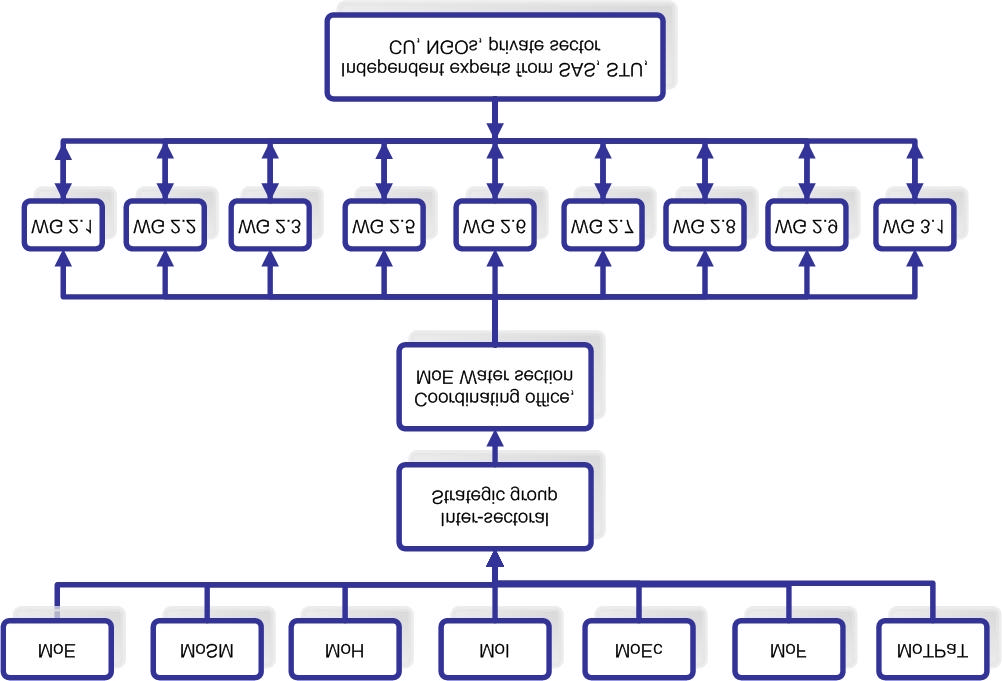
Evaluation of Results of National Reports for `Setting up of Inter-Ministerial Coordinating Mechanisms for the pollution control'- Annex 3
45
Organizational scheme for implementation of Water Framework Directive WFD
Evaluation of Results of National Reports for `Setting up of Inter-Ministerial Coordinating Mechanisms for the pollution control'- Annex 4
47
ANNEX 4 Inter-ministerial Coordinating Mechanisms for pollution control: CROATIA
Sector of
Coordinating
Organizational structure
Legal basis
Date of
Objective/Mandate/Tasks
Main barriers
coordination
body
enacting
for functioning
Water
National Water
Lead: State Water Directorate
Water Act
30/06/00
Revises and provides advise on acts and
General remarks:
management
Council
Members: Representatives from
regulations dealing with water management
1) Environment and
Parliament
and supervises their implementation; revises Water Management
the Water Management Master Plan and
issues are not of
Catchment area plans, and their financial
high priority for
and economic implications to assure
Government,
sustainable social and economic
2) Lack of coherent
development
and coordinated
Coordinating
Not yet defined
Water Act
30/06/00
Water Management Master Plan of Croatia
sector strategies
mechanisms not
and Catchment area water management
3) Insufficient
yet formally
plans including strategies for physical
number of qualified
defined
development, environmental protection,
staff,
forest management and inland navigation
4) Time pressure
Water use
Interdisciplinary
Members: State Water Directorate,
Water Act
30/06/00
Objective: Protection of well fields and areas 5) Financial
(drinking
Expert Body
County offices physical planning,
of water abstraction for drinking water
constrains for
water)
appointed on ad-
economy, Hrvatske Vode (national
purposes: defining size and limits of area
cooperation
hoc basis by
Water Company), municipalities,
and conditions of maintenance for sanitary
6) Lack of
competent local
other stakeholders
protection zones
experience in work
authority
Mandate : prepare decisions for enacting by
with NGOs,
local Government
Sustainable
Council on
Lead: Ministry of Environment and
Law of Environmental Nov 2002
Objective: economic development and
Not yet operational
development
Sustainable
Physical Planning
Protection (will be
environmental protection to assure
(Environmental Development
Members: Ministry of Economy,
changed)
sustainable development
protection)
Ministry for Social Affaires
Mandate: advisory function to Ministry of
Environment.
Environmental Commission for
Lead: Ministry of Environment and
Law on Environment-
Legal
Objective: evaluation and approval of
Lack of funding
protection
Environmental
Physical Planning
al protection and By-
obligation
projects and measures to enforce
does not allow to
Impact
Members: different from case to case, law on Environmental since 1997
environmental protection in line with
use highly qualified
Assessment
depending on subject
Impact Assessment
legislation
experts
Mandate: Advisory to Ministry of
Environment
48
UNDP/GEF Danube Regional Project
Sector of
Coordinating
Organizational structure
Legal basis
Date of
Objective/Mandate/Tasks
Main barriers
coordination
body
enacting
for functioning
Nature
Nature Protection Lead: Ministry responsible for nature
Law on nature
Not yet
Objective: implementation of nature
Not yet operational
protection
Council (not yet
protection
protection
operational
protection measures, maintenance,
operational)
Members: Ministry of Agriculture and
promotion and use of national parks and
Forestry, directors of nature protected
nature conservation parks
sites, scientific institutions (forestry,
Mandate: Advisory role and coordination of
biology, geology, oceanology and
measures
fisheries), Parliamentary working
group
Physical
Council on
Lead: Ministry of Environment and
Law on Physical
1994
Objective: Evaluate proposed projects and
Planning
Physical Planning Physical Planning
Planning
legal and administrative measures to assure
Members: depending on subject:
harmonized physical development
experts, scientists, politicians, other
Mandate: Advisory body to Government
See general
stakeholders
remarks
Agriculture
Commission on
Lead: Ministry of Agriculture and
Law on Plant
1998
Objective: Evaluate proposed projects and
Plant Protection
Forestry
Protection
legal and administrative measures
Products
Members: Ministries of Environment,
(pesticides)
Mandate: Advisory body to Government for
Health and scientific institutions
issuing of license for trade and application of
plant protection products
Implementation Responsible body EU WFD implemented in the frame of Stabilization and
Signed May
Implementation of EU WFD is fulfilled
Structures and
of the EU WFD for implementation the Danube River Protection
Assos. Agreement
2001
indirectly through the implementing of the
cooperating
(Stabilization
of specific EU
Convention (DRPC) by the State
Water Act
Water Management Master Plan (see
mechanisms in
and
directives are not
Water Directorate
30/06/00
description for Water Management Sector)
water sector not yet
Association
yet defined
identified
Agreement)
Coordination
Government
Responsible: State Water Directorate Water Act
30/06/00
Planning process and procedures for
for environ-
and Hrvadske Vode (Croatian
implementing provisions of the Water Act,
ment, Water
Waters)
Preparation of legal instruments to be
management
Members: Ministries of Environment
enacted by Parliament
and pollution
and Physical Planning, Agriculture
control
and Forestry, health, Public Works,
Economy, Tourism and Finance,
Local community Governments and
NGOs if their interest is affected
Evaluation of Results of National Reports for `Setting up of Inter-Ministerial Coordinating Mechanisms for the pollution control'- Annex 5
49
ANNEX 5 Inter-ministerial Coordinating Mechanisms for pollution control: HUNGARY
Sector of
Coordinating
Organizational structure
Legal basis
Date of
Objective/Mandate/Tasks
Main barriers for
coordination
body
enacting
functioning
Environmental National
Lead ministry: Ministry of
Act no. LIII of 1995
1995
Objective: Place the protection of environment on
Deficiencies like lack
Protection
Environmental
Environment and Water
on general rules of
wide social, scientific and professional consensus. of political
Council
(MOEW)
environmental
Mandate: An advisory and consultative body to the commitment, legal,
(National level)
Members:
protection § 45.
minister of environment and water (as such does
administra-tive,
§ Representatives of
not take own decisions)
institutional or
Academy of Science,
Major tasks:
financial obstacles
§ Representatives of NGOs,
§ Participation in strategic decision-making
were not identified
§ Representatives of
concerning environmental policy;
professional organisations
§ Participation in preparation of environmental
and economic sectors
legislation;
§ Participation in national top-level decision
making (Parliament, Government);
Inter-
Working
Lead ministry: Ministry of
1) Decree of MOEW 2003
Objectives: implementation of National
Barriers eliminated by
ministerial
committee on
Environment and Water
no 3/2003. (III.7.) on
Environmental Programme with special emphasis
establishing Ministry
Committee of
"Green village,
Members:
utilization of Central
on sustainable development (Sub-target: "Green
of Environment and
Central
green town"
§ Mo Agriculture and R.D.
Environmental Fund
village, green town" )
Water
Environmental
§ Mo Interior
Tasks: evaluation of applications submitted to this
Fund
§ Mo Economics & Transport
CEF-financial instrument.
§ Mo Finance
§ Mo Health, Family & S.A.
§ Prime Minister Office
§ NGOs and Associations of
Settlements
Working
2) Resolution of
Objectives: implementation of National
Barriers eliminated by
committee on
MOEW no 8/2003.
Environmental Programme with special emphasis
establishing Ministry
"Waste
(K.ert.4.) on rules
on sustainable development (Sub-target: "Waste
of Environment and
management and
for utilization of
management and environmental hygiene")
Water
environmental
financial resources
Tasks: evaluation of applications submitted to this
hygiene"
of CEF
CEF-financial instrument.
50
UNDP/GEF Danube Regional Project
Sector of
Coordinating
Organizational structure
Legal basis
Date of
Objective/Mandate/Tasks
Main barriers for
coordination
body
enacting
functioning
Working
Objectives: implementation of National
committee on
Environmental Programme with special emphasis
"Natural protection
on sustainable development (Sub-target: "Natural
and landscape re-
protection and landscape re-cultivation")
cultivation"
Tasks: evaluation of applications submitted to this
CEF-financial instrument.
Working
Objectives: implementation of National
committee on
Environmental Programme with special emphasis
"Social
on sustainable development (Sub-target: "Social
programmes and
programmes and activities")
activities"
Tasks: evaluation of applications submitted to this
CEF-financial instrument.
Water Fund
Inter-ministerial
Lead ministry: Ministry of
1) Decree of MOEW 2003
Objectives: support of implementation of the water Not identified
Committee of
Environment and Water
no 4/2003. (III.7.) on
management tasks of public interest with special
Water Fund
Members:
utilization of Water
focus on environmental issues.
(National level)
§ Mo Agriculture and R.D.
Fund
Tasks: evaluation of application for support to
§ Mo Interior
2) Resolution of
wastewater treatment and collection investment
§ Mo Economics & Transport MOEW no 9/2003.
development for municipalities in the following
§ Mo Finance
(K.ert.4.) on rules
fields:
§ Mo Health, Family & S.A.
for utili-zation of
§ Development of drinking water supply;
§ Prime Minister Office
finan-cial resources
§ Development of waste water treatment and
§ NGOs and Professional
of WF
collection;
organizations
§ Protection of drinking water resources;
§ Development of rainwater collection system;
Evaluation of Results of National Reports for `Setting up of Inter-Ministerial Coordinating Mechanisms for the pollution control'- Annex 5
51
Sector of
Coordinating
Organizational structure
Legal basis
Date of
Objective/Mandate/Tasks
Main barriers for
coordination
body
enacting
functioning
Water
Inter-ministerial
Lead ministry: Ministry of
1) Government
2001
Objectives: Implementation of WFD in Hungary.
Not identified
Framework
Coordinating
Environment and Water
Decision no.
Tasks: Elaboration of method of coordination and
Directive
Committee on
Members:
2094/2001. (IV.30.)
cooperation with EU and ICPDR (RBM EG).
Implementation of § Mo Agriculture and R.D.
on commencing
Coordination of legal approximation with EU.
Water Framework § Mo Interior
implementation of
Management and coordination the development of
Directive
§ Mo Justice
tasks set down in
national methodologies based on EU and ICPDR
(National level)
§ Mo Economics & Transport WFD
(RBM EG) guidelines, as well as the
§ Mo Finance
2) Government
implementation of tasks based on mentioned
§ Mo Health, Family & S.A.
Decision no.
guidelines.
§ Mo Foreign Affairs
1189/2002. (XI.7.)
§ Prime Minister Office
on action
§ NGOs
programme for
implementation of
WFD.
Agro-
Inter-ministerial
Lead ministry: Ministry of
1) Government
2000
Objective: implementation of National Agro-
Not identified.
Environmental Committee on
Agriculture and Rural
Decree no.
Environmental Programme with special emphasis
Programme
National Agro-
Development
2253/1999. (X. 7.)
on sustainable development
Environmental
Members:
2) Decree of MoA
Tasks: evaluation of applications submitted to this
Programme
§ Mo Finance
3/2003. (I. 24.)
financial instrument, consisting the following
(National level)
§ Mo Environment & Water
3) Government
Schemes:
§ NGOs
Decree No.
§ Agro-Environmental management,
§ Professional organizations
290/2002. (XII.27.)
experimental schemes;
§ Municipalities
§ Integrated plant production (Red, Yellow and
Green products);
§ Organic production;
§ Grassland (extensive animal husbandry);
§ Wetland (fish ponds);
§ Natural conservation schemes and sensitive
environmental area schemes for the listed
settlements;
The above schemes are central budget subsidies
for agricultural and rural development projects,
supervised by MoA..
52
UNDP/GEF Danube Regional Project
Sector of
Coordinating
Organizational structure
Legal basis
Date of
Objective/Mandate/Tasks
Main barriers for
coordination
body
enacting
functioning
Regional
Regional Water
Lead organization: President
Decree of
1998
Objectives: Provide a consultative forum for
Not identified.
Coordinating
Management
of County Municipality.
MCTWM no
the interested parties at the area of the
Mechanisms
Council
Members:
5./1998. (III.11.)
regional water directorates.
for Water
§ The representative of the
on Regional
Tasks: Facilitate the implementation of water
Management
(Regional level)
Minister of Environment
Water
management tasks of the hydrological region.
and Water
Management
§ County & Local
Council
Municipalities
§ Environment protection
and nature conservation
organs
§ National Hygienic
Authority
§ Regional agricultural
office
§ Regional plant protection
office
§ Regional development
council
§ Regional Tourists office
§ Agro-industrial and
engineering chambers
§ Water associations and
public utility companies
Evaluation of Results of National Reports for `Setting up of Inter-Ministerial Coordinating Mechanisms for the pollution control'- Annex 6
53
ANNEX 6 Inter-ministerial Coordinating Mechanisms for pollution control: BOSNIA i
HERZEGOVINA
Sector of
Coordinating
Organizational
Legal basis
Date of
Objective/Mandate/Tasks
Main barriers for
coordination
body
structure
enacting
functioning
Water management
Governmental
Federal Ministry of
§ Legislative and inspection
Practical there is weak
in Federation of BiH structures at
Agriculture, Water
§ Water resource management
vertical and horizontal
central level
Management and
§ Protection against pollution
communication
No inter-
Forestry
§ Flood protection
between Ministries and
ministerial
Department of Water
§ Sewage and wastewater treatment
other govern-mental
coordinating
Management
§ Approval for water use and discharge
bodies.
mechanism
Cooperation with
§ Coordination of development targets and project
Current institutional
reported
specialized agencies:
implementation
arrangements favour
§ Institute of Public
§ Preparing and adoption of international agreements only a sectoral
Health
§ Inter-entity cooperation
approach.
§ Federal
Different
Meteorological
responsibilities in the
Institute
water management
Public Enterprise for the
Competence
§ Preparation of strategic decisions for watershed
sector are not clearly
"Watershed of the Sava
delegated under
and river basin planning,
assigned to specific
River Basin"
the Law on
§ Preparation of regulations, decrees and by-laws for units in particular
(Responsibility delegated Water from
the application of the Water Law,
between central and
by the Federal Ministry of 1998
§ Management and monitoring of water resources
cantonal levels.
Agriculture, Water
and flood control,
Regulatory functions
Management and
§ Administration, investments, exploitation and
and enforcement are
Forestry)
maintenance of water facilities (ownership of public weakly managed.
property),
§ Research and consulting
Regional Level:
Cantons are responsible
Responsible for water protection and licensing and
Cantonal
for environmental policy
allocation of water resources for:
Authorities
in line with the Federal
§ irrigation,
No coordinating Constitution (Ministries
§ water supply,
mechanism
for Environment and/or
§ hydropower,
reported
water management)
§ navigation,
54
UNDP/GEF Danube Regional Project
Sector of
Coordinating
Organizational
Legal basis
Date of
Objective/Mandate/Tasks
Main barriers for
coordination
body
structure
enacting
functioning
Water management
Governmental
Ministry of Agriculture,
Art. 35 of the
§ Preparation and implementation of long and
Same problems as
in Republic of
structures at
Water Management and Constitution
medium terms water management and
described for the
Srpska
central level
Forestry RS
includes the
development plans,
Federation of BiH are
No inter-
Responsible structure:
right of sound
§ Protection and management of spring, stagnant,
also applicable for the
ministerial
Directorate for Water,
environment in
running and ground waters (thermal and mineral
RS whenever here
coordinating
cooperating with the
human rights;
waters)
conditions for
mechanism
Institute for Water
Art. 52 limits
§ Water protection plans against negative human
cooperation are slightly
reported
Management (planning,
free enterprise
impact,
better.
consulting, research and due to the
§ Ensuring water supply for human and industrial
design) and the Water
interest of
consumption,
Management Companies environment,
§ Hydro-melioration, inspection and monitoring
Ministry of Urban, Civil
health, ...
§ Land use and area planning
Engineering and Ecology
§ Consulting on physical and urban plans including
RS
special areas,
§ Protection of public interests,
§ Protection and improvement of natural inheritance,
§ Rehabilitation of endangered areas
Ministry of Industry and
§ Environmental protection programmes and training
technology RS
§ Technological improvements to assure
environmental needs (ISO 14000 standards)
Ministry of Energetic and
§ Controls laws to ensuring environmental protection
Mining Industry RS
in the field of mining and energy production,
Evaluation of Results of National Reports for `Setting up of Inter-Ministerial Coordinating Mechanisms for the pollution control'- Annex 6
55
Sector of
Coordinating
Organizational
Legal basis
Date of
Objective/Mandate/Tasks
Main barriers for
coordination
body
structure
enacting
functioning
Governmental
Water Management
Water Law 1996
Amongst other objectives and tasks:
structures at
Companies in :
and Art. 49 of
§ Maintenance, rehabilitation and construction of
regional level
§ Gradiska (Save),
the Law on
water and hydro-power installations,
No coordinating § Srpsko Sarajevo
State
§ Work and maintenance of regional water supply
mechanism
(Gornja Bosna)
Companies
systems,
reported
§ Bijeljina (Semberija)
§ Organization and execution of studies and tasks in
§ Zvornik (Drina)
relation to water management areas
§ Trebinje (Trebisnjica)
§ Monitoring of water use and control of wastewater
§ Samac (Bona mouth)
§ Collection of data important for water management
§ Loncari (central
Save)
§ Srpski Brod (Save)
§ Vokosavlje
Mechanisms for
Environmental
Environmental Steering
MoU between
1998
§ International contracts and programmes related to
BiH is a complex State
inter-entity and
Steering
Committee members:
Federation BiH
environmental issues
with significant power
regional
Committee of
§ 4 members from
and Republic
§ Cooperation with Croatia and Serbia & Montenegro devoted to its Entities.
cooperation
BiH
Federation of BiH
Srpska
in the field of environment,
No effective structure to
§ 4 members from RS
§ Harmonization between the Entities of existing and deal with water
future environmental laws, regulations, action and
management at the
monitoring programmes, standards and information State level.
systems,
§ Harmonization between the Entities of plans fir
urgent situations,
It is assessed that
§ Coordination between the Entities of all
existing institutions are
environmental activities to provide that BiH joins the of low efficiency in
EU as member country.
56
UNDP/GEF Danube Regional Project
Sector of
Coordinating
Organizational
Legal basis
Date of
Objective/Mandate/Tasks
Main barriers for
coordination
body
structure
enacting
functioning
Commission for Commission with 8
§ International contracts in the field of water
water and
coordination of
members:
management
environmental
water
§ 4 members from
§ International water management projects and water management.
management
Federation of BiH
paths
issues
§ 4 members from RS
§ Cooperation with Croatia and Serbia & Montenegro
in water related issues,
§ Harmonization between the Entities of existing and
future regulations for water management,
protection of water resources, water monitoring and
water quality standards,
§ Harmonization between the Entities of work of
laboratories for water quality and stream
categorization,
§ Construction and rehabilitation of water
management facilities,
§ Harmonization of plans for flood protection,
§ Collection and exchange of data.
Proposed new
§ BiH Federation
MoU between
April 2001
Integral management of water resources at river basin
The new proposed
institutional
Ministry of
the Federation
level based on the provisions of the EU WFD:
structure calls for the
arrangements
Environment and
BiH and RS and
§ Ministry: policy making, legislation, development of
creation of a Water and
for the common
Water Management
the European
strategic measures, quality standards, international Environment Ministry in
environmental
§ River Basin Bodies
Commission
cooperation,
both Entities to assure
programme of
(Steering
§ River Basin Bodies: water resource management,
harmonized
BiH
Committees)
planning, monitoring, EIA, nature and biodiversity
implementation of EU
§ Licensing Units
conservation, inspection,
water directives and
§ Public Companies for
§ Licensing Units: licensing, regulatory functions,
regulations.
Watershed Areas
enforcement and/or promotion of public interests,
(PCWA)
§ PCWA: flood control, erosion control and
environmental protection measures, integrated
water resources management including aquatic
fauna and use of river bed materials, monitoring of
public property, etc.
Evaluation of Results of National Reports for `Setting up of Inter-Ministerial Coordinating Mechanisms for the pollution control'- Annex 7
57
ANNEX 7 Inter-ministerial Coordinating Mechanisms for pollution control: BULGARIA
Sector of
Coordinating
Organizational structure
Legal basis
Date of
Objective/Mandate/Tasks
Main barriers for
coordination
body
enacting
functioning
Inter-ministerial
Council of
Highest level of inter-ministerial
§ Adopts National Water Economy Plan
1) Existing legislation
Coordination
Ministers
body chaired by the Prime
§ Grants water concessions
can be considered as
Minister
§ Adopts national programmes for the protection and sufficient and well
sustainable use of waters
defined and
§ Permits water use for defence and security purposes administrative structures
§ Sets limitation of water use in emergency
and managing tools are
situations
provided.
§ Determines quantities of mineral waters to be used 2) Existing problems:
by public medical facilities
§
Gaps in legislation and
§ Adopts tariffs on charges provided under the law
uncertainties in
defining precise
requirements for
practical application.
National
Supreme
Lead: Ministry of Environment and Water Law
28 January Assists the Ministry of Environment and Waters in the §
Financial means
coordination for Consultative
Water, Vice Minister for
2000
implementation of the water policy and the
insufficient to assure
water
Council on
Environment
performance of its national water management
proper function of new
management
Water
Members:
functions:
institutional
§ Mo Regional Development and
§ Policy setting and planning (National Water
mechanisms (River
Public Works
Economy Plan, River Basin Management Plans,
Basin Directorates),
§ Mo Agriculture and Forests
national water programmes, compilation of water
§
Lack of trained
§ Mo Energy and Energy
and water economy balances)
personnel at
resources
§ Regulative matters (water use permits,
Government and
§ Mo Transport
concessions for water facilities, permits for
private sector level
§ Mo Defence
industrial plants, management of dams and water
(how to fulfil obligations
§ Academics
reservoirs, etc)
in relation to permits,
§ NGOs
§ Approval of exploitation of resources and
emission standard
abstraction of ground and surface waters
control, self-monitoring
§ Compiling and management of information (water
requirements, etc).
cadastre/inventory, water monitoring system, water
resources, etc.)
58
UNDP/GEF Danube Regional Project
Sector of
Coordinating
Organizational structure
Legal basis
Date of
Objective/Mandate/Tasks
Main barriers for
coordination
body
enacting
functioning
Specific
Lead: Ministry of Agriculture and
Implementation of the Nitrate Directive
Working Groups Forestry
and Project
Lead: MoEW
Implementation of the requirements of the Dangerous
Steering
Substances Directive (76/464/EEC)
Committees
Lead: MoEW
Implementation of the requirements of the Urban
(Examples)
Wastewater Treatment Directive (91/271/EEC)
Regional
River Basin
River Basin Directorates function
Order of the 2002
§ Determining boundaries of water bodies
Coordination for Directorates and under the supervision of the
MoEW in
§ Organizing the elaboration of river basin
River Basin
Basin Councils
MoEW (Coordination Group for
compliance
management plans
Management
implementation of the EU WFD)
with the
§ Issuing permits and controlling compliance
and are assisted by the River
Water Law
§ Monitoring of water quality
Basin Council:
§ Compiling water and water economy cadastres
§ Danube River Basin District
and registers of issued permits
(40% of nat.terr.) (Pleven)
§ Surveillance of hydro-technical facilities
§ Black Sea River Basin District
§ Control of river beds and conditions of run off
(Varna),
§ Controlling abstraction, discharge and treatment
§ Western Aegean Sea River
facilities
Basin District (Blagoevgrad)
§ Collection of dues charges
§ Eastern Aegean Sea River
Basin District (Plovdiv)
Evaluation of Results of National Reports for `Setting up of Inter-Ministerial Coordinating Mechanisms for the pollution control'- Annex 7
59
Sector of
Coordinating
Organizational structure
Legal basis
Date of
Objective/Mandate/Tasks
Main barriers for
coordination
body
enacting
functioning
Implementation
Coordination
Lead: Ministry of Environment and Water Law
2003
§ To coordinate and support all river basin
of EU Water
Group for the
Water, Deputy Minister for
chapter 151
management activities,
Framework
implementation Environment and Water
and Order of
§ to coordinate the work of the 6 Export Groups for
Directive
of the WFD
Members:
the MoEW,
the implementation of the WFD at the central level
§ MoEW - Water Directorate
no RD-
and
§ MoEW - Water Protection
253/17.03.03
§ to support the activities of the River Basin
Department
Directorates at the regional level
§ Executive Environmental
Agency - Department for Water
Monitoring
§ Bulgarian Academy of Science
- Institute of Water Problems)
§ National Hydrological and
Meteorological Institute
§ NGO Institute of
Environmental Education and
Management
Working Groups Under the guidance of the
Implementation of the WFD, taking into account:
Coordination Group six Working
§ Typology of water bodies
Groups assure the effective
§ Determination of reference conditions
implementation of the EU WFD
§ Classification of water bodies
for:
§ Intercalibration
§ Typology of water bodies
§ Geographical information System
§ Determination of reference
§ Loading and impact
conditions
§ Classification of water bodies
§ Intercalibration
§ Geographical information
System
§ Loading and impact
Evaluation of Results of National Reports for `Setting up of Inter-Ministerial Coordinating Mechanisms for the pollution control'- Annex 8
61
ANNEX 8 Inter-ministerial Coordinating Mechanisms for pollution control: ROMANIA
Sector of
Coordinating body
Organizational structure
Legal basis
Date of
Objective/Mandate/Tasks
Main barriers
coordination
enacting
for
functioning
Water protection Commission for
Commission composed of 12
Gov. Decision
§ Monitoring and follow-up of the Action Plan,
This
implementing the
members from:
964/ 2000
§ Monitoring and follow up of the list of
Commission has
Action Plan for water
§ MAFWE:
vulnerable zones,
been very
protection against
- Land Reclamation Department,
§ Developing of a Code for good agricultural
successful; it
pollution from nitrates
- Water department
practices,
finalized the
from agricultural
- Agricultural Department
§ Preparing a training programme for farmers
Code for Best
sources;
§ Ministry of Heath
to introduce good agricultural practices,
Agricultural
Support Group to the Commission
§ Preparing action programmes for vulnerable
Practices, which
assuring implementation of
zones,
is now under
measures
§ Preparing surveillance and control
implementation
programmes,
by local
§ Ensure public access to information
authorities.
General
The Government has not enough capacity to enforce the laws, inter alia, because:
remarks
§ the technology to meet environmental standards is not available in many Romanian enterprises and upgrading or changing their current technology would require
concerning
major investments; there is a need for major investment in new technology that only foreign investment could provide at this moment
main barriers
§ the capacity of local authorities to monitor compliance is almost non-existent.
for functioning
§ the capacities for enforcement need to be strengthened through improved compliance monitoring and an integrated permitting system.
§ The creating a subordinate agency in charge of, inter alia, compliance and monitoring should be considered at Government level.
Benefits to be gained from integrating economic and environmental concerns need to be clearly illustrated and emphasized
The efficient implementation and enforcement of environmental legislation require the redefinition of responsibilities and relationships between different authorities
(horizontal and vertical), and the strengthening of national and county authorities in a consistent manner. New legislation is placing administrative obligations on county
and municipal authorities, which may not possess adequate capacities, in terms of staff and/or overall capabilities, to meet these. Such obligations are often poorly
understood at this level, which with the lack of effective administrative regulations, inconsistencies and overlaps can cause considerable problems.
62
UNDP/GEF Danube Regional Project
Sector of
Coordinating body
Organizational structure
Legal basis
Date of
Objective/Mandate/Tasks
Main barriers
coordination
enacting
for
functioning
River Basin
Basin Committees
Basin Committees composed of 15 Art. 47 of Water
Basin Committees cooperate with Romanian
Functioning of
Management
under the guidance of
members from:
Law 107/1996
Waters to assure application of national water
these
the Ministry of
§ MAFWE, central level
management strategy through:
Committees is
Agriculture, Forest,
§ Regional environmental
§ Developing programmes for water
satisfactory;
Water and Environment
protection agency-MAFWE
management works and defining technical
strengthening of
§ Romanian Waters-MAFWE
and financing priorities for implementation of
theses
§ Ministry of Health,
local schemes,
structures will be
§ City/community mayors
§ Preparing plans for prevention of pollution
necessary to
§ Prefect from respective District
from accidents,
assure efficient
(Ministry of Interior),
§ Approving integrated RBM Plan in qualitative implementation
§ County Council President,
and quantitative terms
of the EU WFD
§ NGO representative
§ Defining local norms and standards for water at the regional
§ Water users representative,
management
level.
§ Consumer Protection
§ Defining norms for wastewater discharges
Department
§ Defining water quality classes in respective
River Basin
§ Assuring effective public information
Dangerous
Inter-ministerial
Committee composed of members
Gov. Decision
The Committee has the following mandate and
Committee is
Substances
Committee for
from:
118/2002
tasks:
not yet
promotion, coordination § MAFWE, central level
§ Preparation of a framework for prevention
functional; a
and implementation of
§ Ministry of Economy and Trade,
and reduction of pollution of the aquatic
huge financial
the Action Programme § Ministry of Health
environment and groundwater caused by the effort will be
for the reduction of
discharge of dangerous substances,
required from
pollution in the aquatic
The Committee is supported by a
§ Preparation of an action plan for
industries for
environment and
Technical Working Group under
implementation of the framework scheme
investments and
groundwater, caused
guidance from "Romanian Waters"
with particular attention to industrial
from
by discharge of
discharges and effects on human health,
Government
dangerous substances
§ Development of procedures and monitoring of responsible for
implementation of actions and periodical
monitoring
review of the list of dangerous substances
Evaluation of Results of National Reports for `Setting up of Inter-Ministerial Coordinating Mechanisms for the pollution control'- Annex 8
63
Sector of
Coordinating body
Organizational structure
Legal basis
Date of
Objective/Mandate/Tasks
Main barriers
coordination
enacting
for
functioning
Environmental
Inter-ministerial
Committee composed of members
Consultative
2001
· Assure coherent framework for
The activities of
Protection
Committee for the
from:
body under the
development and approval of legal acts taking this Committee
Coordination of
§ MAFWE,
MAFWE
into account aspects of environmental
should be
environmental
§ Ministry of Economy and Trade,
protection,
strengthened to
protection and
§ Ministry of Health
§ Approval of programmes and plans for
assure
integration of
§ Ministry of Public Finance
integration of environmental protection in
successful
environmental aspects
§ Ministiy of Administration and
sectors strategies and policies,
implementation
into sector strategies
Interior
§ Approve the National Action Plan for
of environmental
and policies
§ Ministry of Education, research
Environmental Protection and identify priority
policies and
and Youth
actions taking into account necessary
strategies in all
§ National Council for Environment
financial requirements,
sectors of the
and Sustainable Development
§ Assess achievements of the National Action
economy.
§ Private institutions and NGOs
Plan and make results available to the public.
Environmental
Environmental Fund
Approval Committee
2000
Financial support for the implementation of
Beginning: no
Fund
Administration under
Council of Directors
projects resulting from the National Action Plan
project has yet
the MAFWE
Executive Secretariat
for Environmental Protection
been financed
Coastal Zone
National Committee for Coastal Zone Management
Integrated
2002
§ Preparing of national strategies and local
The Committee
Management
Coastal Zone
Committees composed of about 40 Coastal Zone
actions plans for coastal zone management
did not yet start
Management
members from:
Management
and follow up their implementation,
its activities;
§ Central authority for environment Law
§ Organizing integrated monitoring of coastal
Lack of financial
and water management
zone ecosystems
resources
(MAFWE)
§ Developing and approving of integrated
§ Local authorities for water and
coastal zone management plans and regional
environmental protection,
and urban development plans,
§ Transport, civil navigation, Naval
§ Developing actions plans and measures to
Forces and fisheries,
minimize pollution from diverse sources,
§ Public works and industry,
§ EIA and environmental audits of measures
§ Health, research, tourism,
and projects for the development of the
culture, etc
coastal zone,
§ Prefect, mayors and town
§ Initiating and approving of projects for parks
counsellors, etc
and natural reserves,
§ NGOs
64
UNDP/GEF Danube Regional Project
Sector of
Coordinating body
Organizational structure
Legal basis
Date of
Objective/Mandate/Tasks
Main barriers
coordination
enacting
for
functioning
Dams
National Commission
Commission working under the
Emergency
Law
§ Analyse and agree on legal acts concerning
for dams and other
MAFEW is composed of 30
Governmental
466/2001
safety of hydro-technical works,
hydro-technical works
members from:
Ordinance
§ Review, together with owners, works
§ Ministries and national
concerning Dam
behaviour and safety operations,
administration,
Safety
§ Review and approve annual reports on hydro-
§ Romanian National Committee
technical works,
for large dams,
§ Assure quality control of constructions,
§ Economic units and interested
§ Order technical expertise to assure safety
public institutions
standards
Flood Protection Central Commission for The Commission, functioning
Water Law
No 107/1996 § Elaborating national defence strategies for
and control
Flood Control,
normally under the MAFWE is
flood prevention and control and for
Dangerous
subordinated, in case of disaster, to
prevention of accidents caused by damage
Meteorological
the Government Commission for
on hydro-technical structures,
Phenomena and
Defence against Disasters;
§ Preparing and approving of operative defence
Hydro-technical
The Commission usually working
plans also at county level,
Construction Accidents under the MAFEW is composed of
§ Respecting and applying international
members from:
conventions in the respective fields,
§ Central public administration
§ Elaborating defence strategies against
§ National companies and
meteorological disasters (abundant snowfall,
competent private sector,
storms, ice, frost, hail, drought, etc) in
§ Specialist from research
cooperation with the Government
institutes
Commission for Defence against Disasters.
Implementation
No inter-ministerial
Involved: MAFWE, Romanian
Water Law
No 107/1996 Pilot projects for the implementation of the EU
of EU WFD
Coordinating
Waters and other specific institutes
WFD, coordinated by Basin Committees = are
mechanisms has been under the MAFWE.
existing in:
established so far
At the local level Basin Committees
§ Mures,
However, under the
are established and involved in the
§ Arges,
Water Law it is
implementation of the WFD
§ Somes,
intended to establish a
§ Dobrogea-Litoral
"Water inter-ministerial
Council"
Evaluation of Results of National Reports for `Setting up of Inter-Ministerial Coordinating Mechanisms for the pollution control'- Annex 9
65
ANNEX 9 Inter-ministerial Coordinating Mechanisms for pollution control: MOLDOVA
Sector of
Coordinating
Organizational
Legal basis
Date of
Objective/Mandate/Tasks
Main barriers for
coordination
body
structure
enacting
functioning
Water management
Governmental
Ministry of Ecology,
§ Constitution of the 1994
Ministry of Ecology, Construction and Territorial 1) Practical there is
and pollution
structures at central Construction and
Rep. of Moldova
Development: Main responsible authority in the
weak or non existing
control
level
Territorial Development § Protected Areas of 1993
field of environmental protection and monitoring vertical and horizontal
No inter-ministerial
Rivers and Lakes
of surface water quality, with following
communication
coordinating
§ Law on
Departments:
between Ministries and
mechanism
Environmental
1993
§ Hydrological Department responsible for
other govern-mental
reported
Protection
surface water quantity monitoring
bodies.
No information
§ Water Code of the 1993
§ Pollution Control Centre responsible for
2) Policies, legis-lation,
exchange and data
Rep. of Moldova
surface water quality monitoring
standards and technical
network existing
§ Code on
1993
§ Department of Municipal Services and
regulation need to be
between Ministries
Underground
Housing, responsible for quality of
revised, and
Resources
1997
wastewater and treatment
programmes for water
§ Law on Industrial
§ State ecological Inspectorate, surface water
manage-ment and
Wastes
1997
quality control and wastewater discharge
pollution control need
§ Law on Natural
§ Agency of Geology of Moldova, "AgeoM",
to be developed.
resources
groundwater quantity and quality control
3) Lack of financial
Cooperation with Ministry of Health, Sanitary-
resources for
Epidemiological Service of the Ministry of Health construction,
are responsible for licensing of wastewater
rehabilitation and
discharge into surface waters
66
UNDP/GEF Danube Regional Project
Sector of
Coordinating
Organizational
Legal basis
Date of
Objective/Mandate/Tasks
Main barriers for
coordination
body
structure
enacting
functioning
Ministry of Agriculture
National Strategic
§ Water quality control at fish farms
operation of WWTP
and Food
Action Plan
§ Application of fertilizer to minimize agro-
(pour efficiency and/or
chemical pollution
outdated technologies)
§ Soil conservation to reduce agricultural run-
off
§ Pollution control through its own laboratories
related to fertilizers, nitrates and phosphorus
§ State Water Management Consortium "Apele
Moldovei", responsible for management of
surface water quantity
§ Cooperation with Ministry of Ecology,
Construction and territorial Development: in
above fields
Ministry of Health
§ Quality control of drinking water (chemical
and bacteriological parameters),
§ Sanitary-Hygiene Republican Centres
(District sanitary-hygienic services)
responsible for control of surface waters and
shallow groundwater (wells) quality
Ministry of Industry
§ Development of "cleaner" production
industries
Evaluation of Results of National Reports for `Setting up of Inter-Ministerial Coordinating Mechanisms for the pollution control'- Annex 10
67
ANNEX 10 Inter-ministerial Coordinating Mechanisms for pollution control: UKRAINE
Sector of
Coordinating body
Organizational structure
Legal basis
Date of
Objective/Mandate/Tasks
Main barriers for
coordination
enacting
functioning
Water protection Intersectoral
Lead: Ministry of Environmental Water Code of 1995,
Objective: Revise and advice on measures for 1) Insufficient funding
and water
Committees on
Protection and Natural
Ukraine
amended
implementation of existing national, regional or 2) Low develop-ment of
management
Implementation of the
Resources
Laws on the
2000
local programs
private/ public
National or State
Stakeholders: Relevant
State
Mandate: prepare recommendations for the
partnership,
Programs related to
authorities of national, regional
Programs
Government of Ukraine on priority measures in 3) Lack of coherent and
water protection,
or local level from different
the framework of the corresponding programs
coordinated sector
including programs for
sectors, managers, scientists,
and changes necessary for successful
strategies
Dnipro river, Black and NGOs
implementation of programs aimed at the
3) In most cases lack of
Azov Sea, etc.
water protection, pollution reduction monitoring permanent secretariat
and sustainable use of water resources.
4) Lack of responsibility
for implementation of
programs
Water use
Intersectoral
Lead: Ministry of Economy
Resolution of
December 1, Objective: development of mechanism for
Frequent changes in
Commission for
Members:
Cabinet of
1999
reforming the housing and public work sector
priorities due to
Implementation of
§ Ministry of Finance,
Ministers ?
Tasks: preparation of recommendations for
administrative instability
Reform of Housing and § State Committee for
2194
February 14, implementation of economic and social,
Environmental issues
Municipal Sector
Municipal Public Works,
Decision of
2002
organizational, investments, and technological are not priority for this
(Program for Reform
§ State Tax Administration,
Cabinet of
aspects of the reform; coordination of actions
Commission. Their
and Development of
State Committee for Const-
Ministers ?
and monitoring of program implementation and solution is expected to
Housing and Public
ruction and Architecture,
139
decisions aimed at the reform; coordination of
follow the improvement
Works for 2002-2005
§ Ministry for Energy and Fuel
preparation of relevant legislation;
of ecological and
until 2010)
§ Local administrations
dissemination of best prac tices;
economic mechanisms
Mandate: Advisory and recommendatory body of functioning of
for the Cabinet of Ministers of Ukraine
municipal sector
68
UNDP/GEF Danube Regional Project
Sector of
Coordinating body
Organizational structure
Legal basis
Date of
Objective/Mandate/Tasks
Main barriers for
coordination
enacting
functioning
Sustainable
National Council of
Lead: National Defense and
Decree of the 3.05.2003
Objective: implementation of strategy of
The Council started its
development
Sustainable
Security Council of Ukraine
President of
sustainable development
work therefore it is
(Environmental
Development of
Members:
Ukraine
Tasks: development of measures for national
difficult to identify the
protection)
Ukraine
§ Parliament of Ukraine,
strategies for transition of Ukraine towards
all main barriers
§ Cabinet of Ministers of
principles of sustainable development,
However, the first
Ukraine,
assessment of environmental and economic
barrier, is that not all
§ Ministry of Economy, Ministry
conditions, intersectoral coordination of
important stakeholders
of Labor and Social Policy,
executive authorities, scientific and Non
are presented in this
§ National Academy of
Governmental Organizations, development of
Council
Sciences,
measures for implementation of decisions and
§ Academy of Medical
recommendations of Council of Sustainable
Sciences of Ukraine,
Development of the UN Council for
§ Ministry of Environment and
Sustainable Development
Natural Resources,
Mandate: Consulting and Advisory Body for
§ NGOs
the President of Ukraine
European
Council for Cooperation Ministry of Foreign Affairs
Decree of the
February 24, Objective: to harmonize legislation of Ukraine
Issues of environmental
Integration
between Ukraine and
Ministry of Economy
President of
1998
with relevant directives of European Union
protection are
European Commission
Ukraine
practically not included
(Ukrainian Component)
Harmonization of Committee for
Ministry of Foreign Affairs,
Decree of the
February 24, Objective: development of legislation and
Low priority for
Ukrainian
Cooperation between
Ministry of Economics,
President of
1998
definition of functions of central executive
environmental
legislation with
Ukraine and European Stakeholders: heads of all
Ukraine
institutions responsible for the main directions
protection
European
Community (Ukrainian central executive institutions
of the European integration
Legislation
Component)
Evaluation of Results of National Reports for `Setting up of Inter-Ministerial Coordinating Mechanisms for the pollution control'- Annex 10
69
Sector of
Coordinating body
Organizational structure
Legal basis
Date of
Objective/Mandate/Tasks
Main barriers for
coordination
enacting
functioning
Intersectoral
Lead:
Resolution of
June 12,
Objective: development of legislation in line
Low priority for
Coordination Council
Ministry of Justice of Ukraine
the Cabinet of 1998
with EU legislation for environmental
environmental issues
for adaptation of
Members:
Ministers of
protection and sustainable use of natural
legislation of Ukraine
§ Ministry of Environment and
Ukraine ?
resources
with EU legislation
Natural Resources (MENR)
852
Tasks: recommendations to the Cabinet of
§ State Committee for Nuclear
Ministers on improvement of legislation in line
Power
with relevant EU legislation and harmonization
§ Ministry of Health Care
of norms and standards
§ Ministry of Energy and Fuel
Mandate: advisory and recommendatory
§ State Committee of
bodies
Standards
§ State Committee for Forestry
§ State Committee for Land
Use
§ Ministry of Agricultural Policy
Environmental
Inter sectoral
Lead: MENR
17.11.2001
Objective: coordination of environmental
The decisions of the
Monitoring
Commission for
Members:
? 1551
monitoring
Commission are not
Environmental
§ Ministry of Agricultural Policy
Tasks: development of national strategies for
supported financially
Monitoring
§ Ministry of Health Care
environmental monitoring, unification of
Sectoral interests
§ State Committee of Urban
methodologies, improvement of monitoring
prevail
Construction and Municipal
network, and techniques, creation of
Incompatible norms
Works
comprehensive databases, procedures and
and techniques
§ State Committee for Forestry,
protocols, interaction with central and local
prevents efficient
authorities, international programs
coordination
Mandate: the decisions of the Commission is
mandatory for implementation for all
monitoring institutions and their territorial
branches, local authorities
70
UNDP/GEF Danube Regional Project
Sector of
Coordinating body
Organizational structure
Legal basis
Date of
Objective/Mandate/Tasks
Main barriers for
coordination
enacting
functioning
Agriculture
Foreseen : the
§ Ministry of Environment and
Law of
June 19,
Objectives: will be established
Not yet operational
Establishment of
Natural Resources,
Ukraine about .2003
Mandate: will be established
Intersectoral
§ Ministry of Agricultural
State control
? 963_??
Commission for Control
Policies,
for protection
of Land Use
§ State Committee for Forestry
and use of
§ Local authorities
lands
Agriculture
Working expert groups Lead: Ministry of Environment
Ministerial
Objective: development of recommendations
for different issues
and Natural Resources
orders
for different problems
related to land use,
Members/Stakeholders :
There is no working groups for environmental
(permanent and ad
§ Ministry of Agricultural
protection in agricultural sector
hoc)
Policies
§ Ministry of Healthcare
§ National Academy of
Science, (Medical Sciences,
Agrarian Sciences)
Intersectoral Scientific
Lead: Ministry of Environment
Law of
March 2,
Objective: Coordination
Low financial support
and Expert Council for
and natural Resources of
Ukraine on
1995 ?.,
Needs :
Pesticides and
Ukraine
Pesticides &
? 86/95-??
1) international
Agricultural Chemicals Members/Stakeholders:
Agricultural
professional training,
§ Ministry of Agricultural Policy, Chemicals
March 15
2) international
§ Ministry of Health Care,
Order of the
2000, ? 137 Mandate: Advisory and Recommendatory
manuals, literature
§ State Committee for Forestry, Ministry of
bodies
and reference
§ National Academy of
Environment
materials,
Science, (Medical Sciences,
and Natural
3) proper information
Agrarian Sciences)
Resources
exchange
Land Use
No coordinating bodies Lead: State Committee for
Law of
20.04.2000
Difficult to establish
Planning
Construction and Architecture
Ukraine
? 1699-?
because decisions are
"About Land
made at the local level
Planning and
The attention should be
Development
paid to development of
of Territories"
proper regulations and
norms
Document Outline