G l o b a l E n v i r o n m e n t F a c i l i t y
GEF/C.27/Inf.6
October 18, 2005
GEF Council
November 8-10, 2005
GEF DANUBE/BLACK SEA BASIN STRATEGIC PARTNERSHIP
INTERIM PROGRESS REPORT
Table of Contents
I.
Introduction......................................................................................................................... 1
II.
Background on the Strategic Partnership............................................................................ 2
III.
Progress in Meeting Objectives of the Strategic Partnership.............................................. 4
IV.
Progress with World Bank Investment Fund For Nutrient Reduction.............................. 10
V.
The Strategic Partnership and Adaptive Management: November 2004 Mid-Term
Stocktaking Meeting and Mid-Term Regional Project Evaluations ................................. 11
VI.
Mid-term Evaluations: Black Sea and Danube UNDP Regional Projects........................ 13
VII.
Results and Outcomes--Danube and Black Sea Nutrient-Related Environmental
Status
Improvements......................................................................................................... 15
Annex I.
Interim Progress Report
Annex II.
Interim Progress Report: Summary Report on Mid-term Evaluations and
Stocktaking
Meeting
I.
INTRODUCTION
1.
At its May 2001 meeting, the GEF Council approved Tranche I of the Danube/Black Sea
Basin Strategic Partnership on Nutrient Reduction (GEF/C.17/7) in the International Waters
Focal Area. Subsequently, Council approved remaining tranches of the regional components of
the partnership as well as remaining tranches of the pilot investment fund component. This
report represents an interim progress report on this Strategic Partnership at mid-term of
implementation as scheduled in the original document approved by Council.
2.
This progress report was produced by the 3 GEF Implementing Agencies following a
scheduled mid-term Partnership Stocktaking Meeting. The mid-term meeting was organized by
the 16 participating nations through their Danube and Black Sea regional conventions with
participation by the European Union, all 3 GEF Implementing Agencies, GEFSEC, the new GEF
office of Monitoring and Evaluation (OME) and other organizations working on the partnership.
The Stocktaking meeting (held in Bucharest, Romania, November, 2004) was programmed to
allow participating nations and organizations to review implementation progress, coordination
modalities, and identify mid-course corrections. Such a participative Stocktaking is consistent
with the adaptive management philosophy of the International Waters Focal Area.
3.
This Strategic Partnership represents a test, a new mechanism for harnessing interagency
collaboration to meet country-driven needs while streamlining the GEF project cycle and
facilitating more rapid disbursement for agreed priority investments. Pilot efforts like this
benefit from mid-course corrections, and this interim report to the GEF Council details progress
as well as recent actions Implementing Agencies have taken to improve implementation.
4.
This paper consists of a short summary of progress at mid-term in implementation of the
Strategic Partnership. Several annexes produced by the Implementing Agencies include the
details on achieving partnership objectives, positive environmental responses in the Danube
River and the Black Sea, and specific outcomes from the mid-term Stocktaking meeting. While
the series of GEF International Waters projects in the Danube/Black Sea basin since 1991 can
not take overall credit for the measurable improvement in water quality, the countries and
partners have underscored GEF's important catalytic role in bringing all 16 countries together to
focus on national actions needed for the transboundary water system and in calling for attention
as part of EU Accession on the needed transboundary reduction of nitrogen and phosphorus
pollution. In fact, the EU highlighted the Danube program as a model for transboundary waters
governance in its report to the U.N. Commission on Sustainable Development in April 2005.
5.
Nowhere on Earth have such demonstrable water quality and ecosystem improvements
been observed in a large river and adjacent sea as in the Danube River/Black Sea system over the
last decade. In particular, nowhere has such nitrogen and phosphorus pollution reduction been
achieved as to reverse the documented dead zone of oxygen depletion in the Black Sea. Data
included in Annex 1 show that nitrogen emissions have decreased about 20% and phosphorus
almost 50 % in the Danube Basin the last 15 years. The results also show that GEF-funded
demonstration investments are complementing those of the EU and calling attention to
mainstreaming agriculture sector and wetland restoration measures into policies on all levels in
order to sustain the improvements. Similar actions as those supported by this GEF partnership on
1
nutrient reduction are needed elsewhere in both GEF and non-GEF recipient nations to restore
and protect coastal waters as noted by the GEF-funded Global International Waters Assessment.
II. BACKGROUND ON THE STRATEGIC PARTNERSHIP
6.
The GEF has funded regional projects for addressing water quality in the Danube River
Basin and the Black Sea since early in GEF's pilot phase. The participating countries in the
regional projects responded to the GEF Operational Strategy for International Waters by
producing a Transboundary Diagnostic Analysis (TDA) and a Strategic Action Programme
(SAP) consisting of country-identified policy/legal/institutional reforms and investments needed
to address the top transboundary concerns identified in the TDAs. These equivalents of enabling
activity projects in the International Waters Focal Area matured to the point that the 16
collaborating nations in the Danube/Black Sea Basin agreed in 2000 to move to implementation
of those Action Programmes consistent with the GEF Operational Strategy. The Strategic
Partnership approved by Council in 2001 represents a pilot test of GEF's strategy to harness all
3 Implementing Agencies in working together according to their comparative advantages to help
the countries address key transboundary concerns---in this case pollution from the nutrients
nitrogen (N) and phosphorus (P) with subsequent eutrophication of the lower Danube and the
Black Sea that has created many environmental and water use problems.
7.
There are 3 components of the Strategic Partnership:
(a)
The Danube Regional Project (DRP) implemented by UNDP. This is the third and
last in the series of GEF Danube Basin regional projects since 1991 with the 13
nations in the basin, including Austria and Germany. The project provides
technical assistance and capacity building for countries implementing the SAP
(now termed Joint Action Programme, JAP) for the Danube Basin with a focus on
nutrient reduction and was divided into 2 tranches by GEF in 2001 because of
resource limitations ($17 mil total). It focuses on policy/legal/institutional reforms
and includes associated finance for national projects for $1 billion in water quality
investments to accompany the reforms and involves the International Commission
for the Protection of the Danube River (ICPDR).
(b)
The Black Sea Ecosystem Recovery Regional Project (BSERP) implemented by
UNDP and UNEP. This is the third and final GEF regional project for the 6 Black
Sea littoral countries and it provides technical assistance and capacity building in
implementing the SAP with a focus on nutrient reduction. It was divided into 2
tranches by GEF in 2001 because of resource limitations ($10 mil total). It also
focuses on reforms; the UNEP element addresses regional legal frameworks for
pollution reduction and fisheries.
(c)
The Investment Fund for Nutrient Reduction (IFNR) implemented by the World
Bank. This test of innovative financing supports single country, single sector
investment sub-projects for nutrient reduction in the municipal, industrial, and
agriculture sectors as well as wetland/floodplain restoration. Council approved
funding in 3 tranches totaling $70 mil for the 6+ year implementation period.
Annex 1 describes modalities for the Fund in which concepts come on a rolling
2
basis consistent with Council-approved criteria, approval is delegated to the CEO,
and sub-project endorsement follows regular GEF processes.
The long-term objective of the Strategic Partnership is for all Danube/ Black Sea basin countries
to take measures to reduce nutrient pollution levels and other hazardous substances to such levels
necessary to permit Black Sea ecosystems to recover to similar conditions as those observed in
the 1960s. The intermediate objective of the Partnership includes the implementation of urgent
control measures by the 16 countries in the Danube/Black Sea basin to reduce discharges of
nitrogen and phosphorus to the Black Sea to levels at or below those observed in 1997. A key
aspect of the Partnership is to put in place sustainable governance and investment frameworks to
prevent the renewed ecosystem deterioration that might occur with the expected overall
economic improvement of the Black Sea Basin countries. Through the Partnership formulation
process, six objectives with indicators of success were adopted by the 16 nations for this
Strategic initiative for the six year duration of the Partnership. Section III reports on progress
toward those 6 partnership objectives while Annex 1 presents a more detailed summary.
Overview of the Danube/Black Sea Basin Strategic Partnership on Nutrient Reduction
FOUNDATIONAL WORK SAP IMPLEMENTATION - STRESS REDUCTION MEASURES
1991 2001 2001 - 2010
Black Sea Basin
Strategic Partnership on Nutrient Reduction
UNDP
Black Sea Basin Countries, the Danube and Black Sea Commissions,
Regional TDA-SAP
GEF, GEF IAs, EIB, EBRD, EU (Tacis, Phare, CASDE, SAPARD), others
foundational
Projects (4) in the Danube
and the Black Sea Basins
World Bank
UNDP
Partnership Investment Fund
Regional Projects within the framework
For Nutrient Reduction
of the Danube and Black Sea Commissions
In this initial phase, GEF joined forces
With related EU programs as a catalyst for
Demonstration Projects
Incorporation of nutrient reduction into
accelerated action. During this same period
Conventions
both the Danube and the Black Sea
Reforms, capacity building, replication
Conventions entered into force. As a result of
mechanisms
GEF action the main transboundary
concern nutrient over-enrichment, was
Sub-Projects
identified and agreed upon by the countries,
and specific Action Programs were endorsed
Dnipro River Basin
Agricultural reforms and practices
at interministerial level in all countries of the
SAP Implementation
Wetland restoration and/or construction
Black Sea Basin. This allowed the countries
Project
Tertiary waste water treatments
to move to the phase of stress reduction.
Clean technologies
Long Term Objective: Permit Black Sea ecosystems to recover to similar conditions as those
observed in 1960
Intermediate Objective: Maintain discharges of nitrogen and phosphorus at or below the levels
observed in 1997
3
III. PROGRESS IN MEETING OBJECTIVES OF THE STRATEGIC PARTNERSHIP
8.
Overall, the three components of the Strategic Partnership Danube Regional Project
(DRP), Black Sea Ecosystem Recovery Project (BSERP) and the World Bank Investment Fund
for Nutrient Reduction (IFNR) - have made substantial progress towards achieving the
immediate and long-term objectives of the Strategic Partnership. With strong linkages to the EU
Water Framework Directive, the two UNDP-GEF projects have played a lead role in facilitating
nutrient-reduction related legal, policy and institutional reform in the basin and to mainstreaming
these strategies for transboundary pollution reduction into national strategies and plans. The
World Bank IFNR is in the process of financing 14 demonstration nutrient reduction investments
in 10 GEF-eligible countries totalling US $83.27 m. in GEF financing and US $496 m. in co-
financing (ratio 6:1). These projects have been projected to deliver estimated nitrogen emissions
reduction of over 5.936 kt/yr (one thousand metric tons per year) and phosphorus reduction of
over 0.443 kt/yr. Overall completed and ongoing nutrient reduction investments in the basin total
US $3.294 billion and represent total nitrogen and phosphorus emissions reductions of an
estimated 25.85 kt/yr and 4.131 kt/yr, or 6 % and 33%, respectively, of recent (2000-2002
average) estimates of N and P loads to the western Black Sea.
9.
These data also underscore significant progress towards achieving and even exceeding
(for P) the intermediate objective of stabilizing Black Sea nutrient loads at 1997 levels, the latter
estimated at 415 and 20 kt/yr for N and P respectively. With regard to the long-term objective,
both the Danube and Black Sea ecosystems are showing initial evidence of recovery; the benthic
hypoxia (oxygen depletion) observed over broad sections of the western Black Sea in the 1970's
and 80's has been virtually non-existent in recent years (Figure 1) and bottom-dwelling species
diversity has roughly doubled from 1980's levels. While the observed recovery is prompted by
the economic collapse in central/eastern Europe in the early nineties (dramatically reduced use of
fertilizers and closure of numerous livestock facilities), the large nutrient reductions achieved
through the investments and governance reforms promoted through EU Accession, the GEF
regional projects, and the Strategic Partnership are certainly helping to sustain the water quality
improvements.
10.
The following paragraphs summarize mid-term progress toward the six partnership
objectives. An estimate of level of accomplishment of the objective is provided as a percentage.
Partnership Objective 1: Legal, Policy and Institutional Reform for Nutrient Reduction
Progress Estimate: 100%
11.
Four countries in the DRB (CZ, SK, SI and HU) have recently become members of the
European Union and three more (RO, BG, HR) are in the accession process. With assistance
from DRP, they have (or are in the process) of implementing a wide range of reforms aimed at
environmental protection that will have a positive impact on the Partnership's nutrient reduction
objectives.
12.
With DRP support, all countries in the Danube River Basin and around the Black Sea
have implemented or are in the process of implementing one or more new policies and
legislation which support nutrient reduction; eight or 57% of the GEF-eligible countries have
4
introduced multiple measures. Three countries (CZ, SK, SI) have declared all surface water
resources sensitive, thus requiring N and P removal for wastewater plants in communities of over
10,000 inhabitants. Within the Danube River Basin, three countries have already imposed
voluntary bans on phosphorus-containing detergents (DE, AT and CZ). With the assistance of
the GEF DRP, the ICPDR is actively encouraging a wider introduction of such a ban.
13.
Within the DRB the non-accession countries (CS, BA, MD, UA) have expressed
willingness to comply with specific directives, most notably the Water Framework Directive
(WFD) and to cooperate with other countries within the frame of the ICPDR. The key relevant
directives under the WFD include the Nitrates Directive, Urban Wastewater Treatment Directive,
Integrated Pollution Prevention and Control Directive, and Common Agricultural Policy (CAP)
reform. A summary of key environment legislation and implementation in the Danube Black
Sea Basin is provided in Annex 1, Section 2.1.
Partnership Objective 2: Investments in Nutrient Reduction
Progress Estimate: 100%
14.
Significant investment opportunities for nutrient reduction have been identified and
carried out throughout the Danube and Black Sea basins; 100% (16 of 16) of the participating
countries have made one or more investments in nutrient reduction during the first 3 years and 10
countries have accessed the World Bank's IFNR. The GEF/World Bank IFNR has supported
identification and preparation of 14 demonstration investments in 10 eligible countries totalling
$83.27 m. in GEF financing and $496 m. in co-financing (ratio 6:1). These projects have been
projected to deliver estimated nitrogen reduction of over 5,936 t/yr and phosphorus reduction of
over 443 t/yr. The latter figures represent approximately 20% and 10% of projected total
nutrient and phosphorus reduction, respectively, of all investments in the region (see Table on
the next page and Annex 1, Table 5).
15.
This demonstrates the significant catalytic contribution of investments through the World
Bank IFNR to overall nutrient pollution reduction in the Danube/Black Sea basin. As shown in
the summary table below, investments leveraged by GEF through the Partnership Investment
Fund concentrate on non-EU member countries, and are focused on less well addressed nutrient
control measures including agricultural nutrient reduction, tertiary elements of wastewater
treatment (WWT), and wetland restoration. Non-GEF investments cover almost exclusively
baseline WWT, and are largely concentrated in (new and pre-existing) EU member countries.
This demonstrates the incremental and complementary nature of GEF/World Bank investments.
The GEF interventions have called attention to important agricultural sources of nutrient
pollution and the importance of removing embankments so that floodplains may function
properly in sequestering nutrient pollution. This now needs to be mainstreamed in policies at all
levels during the final 3 years of the Strategic Partnership so that water quality improvement
gains will not be lost as agricultural policies move intensive farming to Eastern Europe.
5
Project Distribution by Investment Type and GEF vs. Non-GEF Funding
(includes non-GEF investments through 2005 and WB IFNR only)
NON-GEF FUNDING
GEF WORLD BANK IFNR
FUNDING SOURCE
($M US)
($M US)
PROJECT TYPE
AUSTRIA-
NEW EU
NON-EU
NON-EU
NEW EU
GERMANY COUNTRIES COUNTRIES COUNTRIES COUNTRIES
WWT (MUNI,
608.3 690.74 0.73 264.35 92.5
INDUSTRY)
AGRICULTURE/LAND
- - -
205.5 -
USE
WETLANDS
19.5 1.65 - 13.3
-
TOTALS 627.8
692.39
0.73
483.15
92.5
16.
To date, a total of 211 investment projects (all financing sources), representing a
combined total investment of US$3,294 million and estimated N and P reductions of 25.85 and
4.131 kt/a respectively have been implemented or are scheduled for completion in the
Danube/Black Sea basin within the next few years: The following table summarizes the
timeframe and estimates provided by participating countries for their commitments to action.
Total
Nutrient Removal, t/a
No. of
Timeframe
Investment
Projects
MUSD
N P
World Bank - GEF IFNR
14 576 5,936 443
(imple., prep, pipeline)
Non-GEF Investments
Completed by Dec 2003
56
803
5,351
1,013
Completed in 2004 and 2005
35
475
4,552
836
Completed after 2005
106
1,440
10,013
1,839
Sub-totals, Non-GEF
197
2,718
19,916
3,688
Totals: 211
3,294
25,852
4,131
17.
Roughly half of these investments are situated within the DRB EU member countries:
Austria, Germany, Czech Republic, Hungary, Slovakia and Slovenia. Municipal sector projects
account for the majority of the fully financed projects, and national co-financing provided over
50% of total municipal investments; external sources of investment financing include EU, World
Bank, EIB, EBRD and others. 12 projects involved wetland restoration with associated nutrient
6
reduction and habitat protection, and another 13 projects totaling US $78 m. have been
undertaken in the industrial sector. The GEF-UNDP-UNIDO Danube TEST programme has also
been very effective at promoting nutrient and other pollution reduction through transfer of
cleaner production technologies/strategies, while simultaneously enhancing profitability and
reducing resource consumption. However, land use reform and agro-industrial improvements
are as of yet not significantly represented in the EU-funded investment project pipeline.
Investments in Russia and Ukraine have also considerably increased in recent years, with 9
municipal projects due for completion in 2006 in Russia and 46 smaller projects in Ukraine.
Partnership Objective 3: Sustainable Multi-Country Institutions and Development of
Indicators Progress Estimate: 50%
18.
The Danube River Protection Convention came into force on October 22, 1998. The
International Commission for the Protection of the Danube River (ICPDR), its Permanent
Secretariat (PS) and its various permanent and ad hoc Expert Groups have now been fully
operationalized entities for a number of years and are considered institutionally and financially
fully sustainable. All countries are current in their pledged contributions to the ICPDR except
Bosnia and Herzegovina which only recently joined (and ratified December 2004) and Ukraine
for which 2003, 2004 and 2005 payments remain due.
19.
The Bucharest Convention was signed in 1992 and came into force in 1994. The
Convention provided the framework for establishment of the Black Sea Commission, its
Permanent Secretariat and support structures including (7) Activity Centers and various
Advisory and Working Groups. Following a lengthy negotiation process, the Permanent
Secretariat of the Black Sea Commission was established on October 2000. Regular payments of
contributions to the Black Sea Commission by all countries and its associated financial and
institutional sustainability have faced some challenges historically but Ukraine has recently
cleared past arrears. As of this report, only one of the six countries party to the Bucharest
Convention, Georgia, is still behind in their dues (5 pending payments). A strategy for securing
continued country and other contributions to the BSC is presently under development.
20.
Both projects have initiated development of International Waters indicators following or
closely adapted from the GEF M & E Indicators framework issued by the GEF M&E Unit in
2002. The Joint Technical Working Group (JTWG), formed to facilitate implementation of the
Memorandum of Understanding between the BSC and ICPDR, has agreed upon ecological status
indicators and reporting formats, taking into account implementation of the EU WFD in coastal
waters.
21.
The Danube basin has a fully operational monitoring station network (TNMN) and
protocols in place as well as an emissions database (EMIS). The ICPDR closely monitors and
tracks progress in investments in stress reduction through the Joint Action Programme and
monitored by its Emissions Expert Group (EMIS EG).
22.
The current BSERP includes further development of a comprehensive monitoring
program based on relevant chemical and biological indicators, and establishment of an
emissions/state database for point and non-point pollution sources within the coastal zone; these
7
represent significant progress towards establishment of both stress reduction and environmental
status indicators in the Black Sea..
Partnership Objective 4: Incorporating Nutrients and Toxics Reduction into Conventions
and their Action Programs Progress Estimate: 50-75%
23.
In the Danube, specific country commitments to nutrient reduction are being prepared
within the framework of the revision of the ICPDR Joint Action Programme (JAP, the follow-up
to the GEF-supported SAP). Approval of the EU WFD Roof Report at the December 2004
Ministers Meeting confirms the commitment from the 13 Danube River Basin countries in
adopting binding actions in reducing pollution to the Danube River in support of the ICPDR's
JAP. In the context of legislative reform, the four recent EU member states (CZ, HU, SI, SK)
are projected to be in full compliance with the EU Nitrates Directive by 2008 (and Romania soon
thereafter); nevertheless, enforcement of policies and legislation remains a challenge in both the
accession and non-accession countries.
24.
With assistance from UNEP, the BSERP has supported development and negotiation of a
Land-Based Activities Protocol to the Bucharest Convention which is presently under
consideration by the Black Sea Commission and proposed for adoption as early as 2007; a Work
Program to Enhance Implementation of the Black Sea LBA Protocol has been developed and is
ready for implementation. Lastly, the BSERP has advanced the development and negotiation of
a regional fisheries convention for the Black Sea.
Partnership Objective 5: Implementing Agency and Partner Mainstreaming of Nutrient
Reduction Progress Estimate: 75%
25.
Each agency participating in the Partnership has taken a number of steps to mainstream
the objectives of the Partnership into its core programmes and activities. UNDP is
mainstreaming and promoting replication of Black Sea and Danube programmes through its
Bratislava Regional Service Centre; several UNDP Country Offices are supporting integrated
water resources management, river basin management, and EU WFD approximation processes in
a number of Danube/Black Sea basin programme countries as well as in countries outside the
Danube/Black Sea basin addressing similar water resources management challenges. UNDP's
Regional Bureau for Europe and the CIS (RBEC) is presently developing a new strategic
approach for its water governance practice in Europe/CIS, building on UNDP's extensive
experience through the GEF with promoting transboundary waters management in this region.
The strategy will include knowledge management, community and capacity development,
regional and national-level programme development, partnership development and resource
mobilization. As part of this mainstreaming, RBEC has committed to fund the UNDP-GEF
Regional Technical Advisor (RTA) for International Waters & Land Degradation, and has also
mobilized external resources (LEAD) for a Water Governance Advisor who will support
development and oversight of GEF IW portfolio in the region.
26.
World Bank lending, including GEF grant-funded operations, in a country are based on
country assistance strategies (CAS) that are prepared every three years in partnership with the
government and the Bank and in consultation with national stakeholders. CASs lay out the
country's priorities for investment and policy operations that it would like to accomplish with
8
World Bank assistance over the next three years. Black Sea / Danube pollution issues have been
well integrated in CASs for Black Sea/Danube countries since the start of the Partnership. In
summary, since 2000, ten out of twelve new CAS that were prepared in the Black Sea/Danube
countries included a discussion of projects to be implemented under the WB GEF Investment
Fund. A summary of the CASs prepared since 2001 and their integration of nutrient reduction
and water quality improvement objectives is provided in Annex 1, Section 2.4 and Table 10.
27.
The EU ISPA programme is a key mechanism in providing technical and financial
assistance for environmental infrastructure improvements, such as municipal wastewater
treatment; N and P removal is earmarked for each of the ISPA assisted municipal projects in
Bulgaria. The EIB and EBRD have also been instrumental in helping to promote investment in
nutrient reduction throughout the region; for example, EIB have extended several loans for
tertiary treatment of municipal wastewater in CZ, and EBRD is working with EU ISPA on
improvements to the municipal sector. Other relevant EU mainstreaming initiatives include
TACIS (MO, UK, Black Sea), PHARE (cross-border environmental issues between HU, SK,
BG, RO), CADSE (land use, river basin management, infrastructure in Danube tributaries) and
SAPARD (agricultural reform in new/accession countries).
28.
In 2001, the DABLAS Task Force was established by the Environment Ministers of the
Danube-Black Sea region together with the EU, to facilitate coordination and prioritization of
pollution reduction investments needs within the region. The TF identified 354 known/planned
investment projects as part of its 2004 assessment, including 191 municipal, 77 industrial, 32
agro-industrial, 40 wetland restoration and 14 land use projects. Such projects with nutrient
reduction now need to be mainstreamed in the DABLAS Task Force process.
Partnership Objective 6: Integrated Management of Land and Water Resources in Sub-
basins Progress Estimate: 50%
29.
Sub-basin river basin management programmes have been developed or are under
development in the Sava and Tisza River basins for more detailed implementation of basinwide
approaches. The linked GEF-UNDP Dnipro River Basin programme has prepared a
Transboundary Diagnostic Analysis, Strategic Action Programme and draft legal agreement.
The SAP is in the process of being adopted by each riparian country and is expected to be
designated as the `action programme' under the river basin `Agreement'. Nutrient and industrial
toxics pollution are included as priority issues and actions in the Dnipro TDA and SAP.
30.
The Danube Regional Project is providing input to assist countries in developing policies
aimed at Best Agricultural Practices and is supporting wetland managers in the basin with
evaluation of nutrient removal capacities in wetlands. Both the DRP and BSERP have
implemented small grants programmes targeting nutrient reduction in agriculture, land use,
industry and households; to date the DRP has supported 63 projects totalling $600k and the
BSERP has approved 17 projects totalling $320k.. These programmes are essential for
harnessing community participation as part of the water quality improvement process. Integrated
Coastal Zone Management policies for the Black Sea were developed in 1999 with GEF support
as well. Based on this, the BSERP has made significant progress in assisting the countries in
developing a regional Integrated Coastal Zone Management Strategy which was approved by the
BSC in November, 2004. UNDP is also supporting implementation or development of five
9
wetlands conservation projects in RO, HU, BG, SK (2) within the Danube/Black Sea basin under
the GEF Biodiversity focal area.
IV. PROGRESS WITH WORLD BANK INVESTMENT FUND FOR NUTRIENT REDUCTION
31.
The World Bank Investment Fund for Nutrient Reduction (IFNR) is an integral part of
the Partnership, focusing on key investments in the region and is actively engaging other
stakeholders, including national and local governments, EU assistance programmes1, and IFIs in
co-financing nutrient reduction centred interventions.
32.
14 countries2 of the Black Sea and Danube Basin are eligible for GEF funding under the
Investment Fund. These are, Bosnia-Herzegovina, Bulgaria, Croatia, Czech Republic, Georgia,
Moldova, Romania, Russia, Serbia and Montenegro, Slovakia, Slovenia, Turkey and Ukraine.
The IF portfolio includes 14 projects in 10 of these countries. Six of these projects are under
implementation and the rest at various stages of preparation. Table 4 provides a list of these
projects together with information on the status of project processing, GEF grant funding and co-
financing, and estimated N and P pollution reduction.
33.
The portfolio is well diversified among eligible areas of investment that were specified in
the Partnership Framework Brief. Specifically, there are seven Agricultural Pollution Control
(APC) Projects (in Croatia, Moldova, Romania, Russia Krasnodar, Serbia, Turkey and Ukraine);
one wetland restoration project (in Bulgaria), one ICZM project (in Ukraine) and five municipal
wastewater treatment projects (in Hungary, Bosnia, Moldova, Russia Rostov and Ukraine). It
should also be noted that some of the projects include more than one eligible element. For
example, the Moldova APC Project and the Serbia Enterprise Pollution Reduction Project also
support investments for reducing nutrient discharges from agro-industrial enterprises, such as
slaughterhouses and meat-processing facilities, in addition to proper farm nutrient management.
Furthermore, the Hungary Nutrient Reduction Project will support the restoration of wetlands in
the Danube-Drava National Park Gernenc of the Beda-Karapancsa Region. This reflects the
flexible nature of the IFNR that allows for tailoring project interventions to each country's
specific conditions with respect to nutrient pollution reduction.
Table 1: Summary of GEF/World Bank Investment Fund For Nutrient Reduction
Project Status (#)
Funding (US$ million)
Co-financing ratio
Estimated N+P
(GEF:Other)
Reduction
(tons/yr)
GEF Grant
Co-Financing N
P
(*)
Under Implementation
37.87 79.74 1:2 1,359-
218-232
(6)
1,954
Under Preparation(3)
21.5 140 1:7
4,577+
225+
Pre-Pipeline (5)
23.9 273 1:11 tbd
tbd
TOTALS
83.3 492.7 1:6 5,936+
443+
1 E.g. PHARE, ISPA, CARDS, TACIS, CADSES
2 Bosnia-Herzegovina, Bulgaria, Croatia, Czech Republic, Georgia, Hungary, Moldova, Romania, Russia, Serbia and Montenegro, Slovakia,
Slovenia, Turkey and Ukraine
10
V. THE STRATEGIC PARTNERSHIP AND ADAPTIVE MANAGEMENT: NOVEMBER 2004 MID-
TERM STOCKTAKING MEETING AND MID-TERM REGIONAL PROJECT EVALUATIONS
34.
The Strategic Partnership was designed with an adaptive management approach including
two key tools for mid-course corrections: a mid-term Partnership Stocktaking meeting with
funding programmed into the Danube Regional Project, and independent mid-term evaluations of
each of the UNDP projects.
35.
The overall goal of the Stocktaking Meeting was for all countries and partners to: (a)
review progress of key Objectives and associated Indicators of Success established for the
Strategic Partnership, (b) present and analyse the results so far obtained against the SP indicators
and (c) identify and analyse problems and bottlenecks that may hinder efficient project
implementation. The meeting adopted a set of mid-course corrective measures for all parties in
order to improve the implementation of the Partnership towards its Objectives and adopted
recommendations for further reinforcement of cooperation in the Danube Black Sea Region.
Many of the analytical materials and outcomes of this meeting were used in the development of
this Progress Report to the GEF Council on the Strategic Partnership.
36.
The Stocktaking meeting identified eight Partnership implementation issues; gaps have
been analyzed and solutions have been proposed to assure efficient implementation of the
Strategic Partnership in its last 3 years of funding from 2005 to 2007.
Table 2: Stocktaking Issues and Responses
Gap / Issue
Response
1 Inter-ministerial
- Using existing mechanisms for coordination when
coordinating mechanisms
appropriate,
- Organizing high level consultation meetings with
governments to obtain commitment to establishing such
mechanisms,
- Filling gaps where required in improving existing or in
creating new mechanisms.
2 Reporting on progress of
- All Strategic Partnership partners will revise current
Strategic Partnership
progress reports according to issues discussed and will
objectives
report tangible results on:
o Adopting and implementing nutrient and toxics
reduction policies and regulatory measures (national
level), including Convention Protocols/Annexes,
o Implementing nutrients and toxics pollution
reduction investment projects (completed, in
progress) and reporting on actual/projected
nutrient/toxics reductions,
o Development of International Waters process, stress
reduction and environmental status indicators,
o Donor partner (WB, UNDP, EU, etc.)
`mainstreaming' of nutrient and toxics reduction
11
Gap / Issue
Response
commitments into their regular programmes,
o Reinforcing stakeholder involvement.
3 Sustainability of
- Accepting flexibility in payment of contribution
commissions /
(engagement of counties to meet their commitments before
functioning of secretariats
the end of the project),
- Broadening indicators for commitment taking into account
proactive cooperation of countries in expert group meetings,
participation in regional workshops, timely responding to
reporting requirements under the convention and
cooperation in GEF activities.
4 Partnership coordination
- Organizing coordination meetings: Project and task
managers from IAs, EC, WB, UNDP UNEP, Commission
Secretariats,
- Reinforcing inter-focal area cooperation / project
coordination: full scale annual meeting of all relevant GEF
projects (IW, LD, BD, POPs) working in the Danube and
Black Sea basin area,
- Establishing permanent dialogue between DRP, BSERP and
WB IF projects.
5 Replication
- Engaging the EU in continued financing of the pollution
control measures after the Strategic Partnership programme
will phase out as one of the important replication
mechanisms (one of the first issues to be discussed at the
partnership coordination meeting).
6 Public involvement &
- Developing communication and public participation
communication
strategies by the BSERP based on Danube experience to
strengthen public participation and broader stakeholder
involvement in Black Sea countries.
7 Indicators for monitoring
- Reviewing and revising when necessary the process
of progress in
indicators of the project log frames.
implementation of
Strategic Partnership
projects / Investment
Fund
8 Process, stress reduction
- Further reviewing and applying process, stress reduction
and environmental status
and environmental status indicators in the frame of the
indicators for the BSC
BSERP together with the BSC, including the need for
national process indicators (e.g. policy / legal / institutional
reforms which the countries would enact), before the end of
the project.
12
VI. MID-TERM EVALUATIONS: BLACK SEA AND DANUBE UNDP REGIONAL PROJECTS
37.
The UNDP Black Sea and Danube Regional Projects underwent independent mid-term
evaluations as per standard GEF and UNDP M&E procedures. The results and recommendations
of these MTEs are summarized below and further detail can be found in Annex 2. The
recommendations have been discussed with the respective project steering committees and have
been incorporated into the respective 2005-2007 work plans for each project.
38.
Key recommendations from the mid-term evaluation of the Danube project included:
a)
DRP to identify and promote agro-environmental support mechanisms under the
Common Agricultural Policy (CAP) and the SAPARD program
b)
In the work on wetlands rehabilitation and appropriate land use, attention should
also be paid to mixed-use opportunities and compensation issues, recognizing that
wetlands rehabilitation can restrict economic opportunities for landowner
c)
The current and proposed activities under industrial pollution control are not
aimed specifically at the DRP's central focus - nutrient reduction, and they fail to account
for efforts already underway in the EU accession states to transpose EU industrial
pollution legislation. MTE suggested a narrowing of the scope, to specifically focus on
nutrient loading, and the major industrial point sources within the Danube basin that
contribute significant nutrient and phosphorous loading (e.g. large scale agriculture, food
processing, pulp and paper, detergents).
d)
High priority should be placed on the planned workshop to discuss with industry
the phase out of phosphate detergents
e)
The inter-ministerial committee development effort is an important output,
requiring attention and financing still during the 2nd phase, and special emphasis needs to
be placed on engaging agricultural interests.
f)
Within the river basin planning efforts there should be room to engage with
spatial and regional planners in the countries to consider how economic development
aims and environmental protection aims can be reconciled.
g)
Consideration should be given to how the DRP can increase assistance to the
ICPDR and DABLAS task force in the prioritization, pre-feasibility preparation, and
dissemination of information on investment projects for nutrient reduction.
h)
Opportunities exist with current technologies to make the DRP and ICPDR web
sites more interactive and user friendly.
i)
Public awareness raising is an important objective during Phase 2. It is
recommended that a media package gets developed to help local efforts in each
participating country.
13
j)
For the new member states and accession countries, they are wrestling with public
access and reporting requirements across dozens of new statutes. Establishing the proper
mechanisms both legal and practical, to meet these obligations presents a real challenge
for participating countries that the project can help to meet.
39.
Key recommendations from the mid-term evaluation of the Black Sea project included:
a)
Revise elements of planned activities on ICZM, agriculture, industry and
municipal sectors to focus on legislative and regulatory reforms to improve water
resource protection, (harmonized with the WFD), and establish ICZM, (harmonized with
the European Marine Strategy).
b)
The development of ICZM strategies should drive the BSERP effort to promote
inter-ministerial coordination in each participating country
c)
Recognizing the extensive support offered to Romania and Bulgaria, and
increasingly Turkey, for approximation of the EU Environmental Acquis, the BSERP
should focus special attention on regulatory reform / capacity building in the non-
accession states (Georgia, Russia, Ukraine).
d)
The BSERP should assist the BSC to become a more effective and sustainable
organization, including providing funding for a management review of the BSC and its
subsidiary bodies.
e)
The BSERP should strengthen public awareness efforts and revamp the BSERP
communications plan.
f)
Project outputs related to fisheries should be reviewed, and a decision made by
the BSERP SC on whether to continue providing technical assistance. The decision
should depend on expectations for BSC approval of a new Black Sea Fisheries
Convention in 2005.
g)
Investment program development should be done in close coordination with the
WB IFNR, and should focus on small and medium investments in coastal areas.
h)
Project activities related to shipping and electronic ship tracking systems are
outside of the main focus of the BSERP, and should be discontinued.
i)
The research program planned for the 2nd phase should proceed as planned; and
the call for proposals for the second tranche of small grants (5.3) should proceed as
conceived, with continuing focus on agriculture, and wetlands.
40.
At the interagency level, it has also been agreed that, based on experience in the current
Partnership, the GEF International Waters Task Force (IWTF) will be fully involved with all
14
future Strategic Partnerships during formulation and annual PIR reviews, and that mid-term
progress reports on all Strategic Partnerships will be provided to Council. GEF's new Office of
Monitoring and Evluation will fund and participate in the Mid-term Review that will be the
subject of the Stocktaking.
VII. RESULTS AND OUTCOMES--DANUBE AND BLACK SEA NUTRIENT-RELATED
ENVIRONMENTAL STATUS IMPROVEMENTS
41.
The excessive nutrient pollution loading has resulted in large scale eutrophication of tens
of thousands of square kilometres of waters observed in the western Black Sea. The depletion of
oxygen in the lowere levels of the sea observed in the seventies and eighties has been virtually
eliminated, with oxygen levels at or near saturation in most areas during recent years (Figures 1
& 2). Very long lasting calm and warm weather periods can lead to the development of strong
pycnoclines and stagnation in shallow shelf water areas that are strongly influenced by the
Danube discharge,. This resulted in short-term low oxygen conditions near the bottom in
September, 2001 creatign a temporary setback in the decade long improvement in the Black Sea..
42.
Despite this one setback , the frequency of algae blooms as observed with ocean colour
satellites has decreased markedly compared to levels in the 1980's, and surface chlorophyll
concentrations have also shown measurable decreases. The number of benthic species observed
in the early 2000s was 1.5x - 2x higher than levels found in the late 1980s, but still more than
1.5x lower than conditions in the 1960s. The gradual recurrence in the western Black Sea of
Phyllophora, a flagship species which once supported a highly productive ecosystem of over 200
species, was confirmed during a survey cruise of the area in September 2004. Fish stocks in the
western Black Sea have not yet shown signs of recovery even as oxygen levels have rebounded.
The unintentional introduction of the comb jelly Mnemiopsis Ledyi in the 1980's, which
seriously disrupted the Black Sea fisheries, has been curtailed significantly with the subsequent
(also unintentional) introduction of Beroe ovata, a Mnemiopsis predator. .Still, Mnemiopsis may
remain an important impediment to full ecosystem recovery, and the adaptive management
principles accompanying projects in the GEF International Water Focal Area will need to be
utilized after GEF assistance in this Strategic Partnership ends.
43.
Most of the upper reaches of the Danube are no longer considered `at risk' (of not
achieving good ecological status under the EU Water Framework Directive) for hazardous
substances, nutrients and organic loads. The middle and lower reaches of the Danube are still
classified to be `at risk' for hazardous substances and nutrient pollution and from organics to a
lesser degree. For example, cadmium and lead concentrations exceed target values in locations
downstream from Danube River kilo-meter 1071, and the basin is still considered to be at risk for
impacts from hydro-morphological alterations (dams).
44.
Many of the observed positive environmental trends in both the Black Sea and the
Danube stem to a significant degree from the impacts of the economic downturn following the
collapse of the former Soviet Union and associated reductions in fertilizer use and livestock and
industrial emissions. See Figure 3 in Annex 1 for the data related to reduction in fertilizer
application in Eastern Danube Countries while similar levels continue to be used in upstream
nations. At the same time, through the series of regional GEF projects since 1991 and country
15
commitments to improved water quality, and now this Strategic Partnership, the collective efforts
of the governments and agency partners are having a demonstrable effect on reducing total
pollution emissions. In fact, investments under the GEF/World Bank's IFNR represent 20% and
10% of estimated total annual N and P reductions, respectively, from cumulative existing and
planned investments. Coincident with the recovery of economies in the region there is risk that
pollution discharges will again increase, particularly from agricultural nutrient sources. This
underscores the need for continued investment, implementation of agreed nutrient reduction
policy and regulatory reforms, effective implementation of the EU Water Framework Directive,
and close attention to the impact of the EU's Common Agricultural Policy, if the intermediate
target of maintaining Black Sea nutrient loads at mid-1990's levels is to be maintained.
Danube
Danube
Da
D nu
a
be
45.
45 0
.
45.
45 0
.
120
1
45.
45 0
.
0
1
9
4
1
60
0
60
100
10
44.
44 8
.
44.
44 8
.
44.
44 8
.
80
8
140
14
50
120
12
10
1 0
50
0
44.
44 6
.
44.
44 6
.
44.
44 6
.
30
100
30
10
90
80
44.
44 4
.
40
4
40
4
44.
44 4
.
44.
44 4
.
80
8
50
70
0
7
100
7
10
0
100
0
44.
44 2
.
60
6
44.
44 2
.
44.
44 2
.
120
1
80
50
5
80
8
44.
44 0
.
44.
44 0
.
44.
44 0
.
60
60
43.
43 8
.
43.
43 8
.
43.
43 8
Sept
e emb
em er 1
e 996
Sept
Se e
pt m
e be
m r 19
be
99
.
r 1999
r 19
Sept
Sep em
e be
m r 20
be
03
r 20
28.6
29.0
29.4
29.8 30.0
28.6
29.0
29
2 .4
29.4
.
29.4
29.8 30.0
28.6
29.0
29.4
29.8 30.0
Figure 1:
Concentration of dissolved oxygen (expressed as % of saturation value) near
the bottom on the Romanian shelf of the W. Black Sea Sept 1996, Sept 1999 and Sept 2003
(compiled in the daNUbs project from data collected by RMRI) (Roof Report)
16
Sudden collapse and uncertain recovery of the
Black Sea NW Shelf benthic system
Summer benthic hypoxia
1973
0%
1996
2001?
p
i
ed
1993
c
u
1978
ea oc
mid 80s
f
ar
el
h
S 100
Pressure
17







October 2005
DANUBE - BLACK SEA BASIN
STRATEGIC PARTNERSHIP
Interim Progress Report Annex 1
W o r k i n g f o r t h e D a n u b e a n d B l a c k S e a
Interim Progress Report on the Danube Black Sea Strategic Partnership
page ii
TABLE OF CONTENTS
ABBREVIATIONS
EXECUTIVE SUMMARY
1
1.
Introduction to Danube/Black Sea basin Strategic Partnership Interim Report
annex 1 ...................................................................................................................8
2.
Overall Progress on the Strategic Partnership: Objectives vs. Indicators
(Process and Stress Reduction) .................................................................................11
2.1.
Objective 1.............................................................................................................12
2.1.1. Objective 1: Progress Summary .....................................................................13
2.1.2. Objective 1: Progress....................................................................................14
2.2 Objective
2.............................................................................................................16
2.2.1. Objective 2: Progress Summary .....................................................................16
2.2.2. Objective 2: Progress....................................................................................17
2.3.
Objective 3.............................................................................................................31
2.3.1. Objective 3: Progress Summary .....................................................................31
2.3.2. Objective 3: Progress....................................................................................32
2.4.
Objective 4.............................................................................................................33
2.4.1. Objective 4: Progress Summary .....................................................................33
2.4.2. Objective 4: Progress....................................................................................34
2.5.
Objective 5.............................................................................................................35
2.5.1. Objective 5: Progress Summary .....................................................................35
2.5.2. Objective 5: Progress....................................................................................35
2.6.
Objective 6.............................................................................................................46
2.6.1. Objective 6: Progress Summary .....................................................................46
2.6.2. Objective 6: Progress....................................................................................47
3.
Environmental Status of the Danube and Black Sea Basin ............................................49
3.1.
Background ............................................................................................................49
3.2.
System Response Environmental Status Indicators ...................................................50
4.
Perspectives for 2005-2007 and Beyond.....................................................................59
Annex 1
Status of Investments in the Dablas Task Force Project Pipeline
Annex 2
EU Approximation of Environmental Legislation
DRP/BSERP 03/07/2007
Interim Progress Report on the Danube Black Sea Strategic Partnership
page iii
LIST OF TABLES
Table 1:
Summary Overview on Projects under implementation / fully financed ..................17
Table 2:
Summary of Planned Projects .............................................................................17
Table 3:
Projects reported by the Ministry of Environment and Forestry of Turkey..................20
Table 4:
Overview World Bank Investment Fund for Nutrient Reduction Portfolio for Black
Sea/Danube (as of June 2005) ............................................................................22
Table 5:
Projects completed by December 2003.................................................................24
Table 6:
Projects completed (scheduled) in 2004 and 2005 .................................................27
Table 7:
Projects underway with 100% funding secured......................................................29
Table 8:
Projects Planned................................................................................................30
Table 9.
World Bank Country Assistance Strategies (2001-2004) .........................................39
Table 10: UNDP Wetland Projects in Danube Region............................................................ 45
LIST OF PICTURES AND GRAPHS
Figure 1
Development of seasonal areas of low oxygen concentration near the bottom on the
north-western shelf of the Black Sea (after ZAITSEV & MAMAEV 1997) (Roof Report).....50
Figure 2
Concentration of dissolved oxygen (expressed as % of saturation value) near the
bottom on the Romanian shelf of the Western Black Sea in September 1996,
September 1999 and September 2003 (compiled in the daNUbs project from data
collected by RMRI) (Roof Report).........................................................................50
Figure 3: N Market Fertilizers application in Danube Basin....................................................51
Figure 4: Emission sources of Nitrogen in the Danube River Basin (1998-2000 emissions) ...........52
Figure 5: Temporal changes of the nitrogen emissions into the total Danube river system for the
years 1955 to 2000; result of the MONERIS application for this report .....................53
Figure 6: New threats from the EU's Common Agricultural Policy...........................................54
Figure 7: Emission sources of Phosphorus in the Danube River Basin (1998-2000 emissions).......55
Figure 8: Temporal changes of the phosphorus emissions into the total Danube river system for
the years 1955 to 2000; result of the MONERIS application for this report................56
Figure 9: Sudden collapse and uncertain recovery of the Black Sea NW Shelf benthic system ...57
Figure 10: Number of macro benthic species in front of the Danube delta (10 stations on 3
transects off Constanta, data from C. Dumitrache, IRCM Constanta)........................58
page iv
THE COUNTRIES OF THE DANUBE AND BLACK SEA
AT Austria
BA
Bosnia and Herzegovina
HR Croatia
CZ Czech
Republic
SI Slovenia
SK Slovakia
CS/SAM
Serbia and Montenegro
DE Germany
HU Hungary
RO Romania
MD Moldova
UA
Ukraine
BG Bulgaria
RU Russian
Federation
GE Georgia
TR Turkey
ABBREVIATIONS
APC EG
Accident Prevention and Control Expert Group
BAT Best
Available
Technology
BEP Best
Environmental
Practices
BOD
Biological Oxygen Demand
BS Black
Sea
BSC Black
Sea
Commission
BSERP
Black Sea Ecosystems Recovery Project
CAP
Common Agricultural Policy
CAS
Country Assistance Strategy
CCF Country
Cooperation
Framework
COD Chemical
Oxygen
Demand
DABLAS Task Force
Danube Black Sea Task Force
DEF Danube
Environmental
Forum
Interim Progress Report on the Danube Black Sea Strategic Partnership
page v
DRB
Danube River Basin
DRP
Danube Regional Project
DRPC
Danube River Protection Convention
EC European
Commission
EBRD
European Bank for Reconstruction and Development
EIB European
Investment Bank
EMIS EG
Emission Expert Group
EPDRB
Environmental Programme for the Danube River Basin
EUR Euro
EU WFD
European Union Water Framework Directive
EU UWWT D
EU Urban Waste Water Treatment Directive
EU CARDS
EU Community Assistance for Reconstruction, Development and Stabilization
GEF
Global Environment Facility
GEFSEC
GEF Secretariat
GIS Geographical
Information
System
GPA
Global Programme of Action for the Protection of the Marine Environment
from Land-based Activities
IA Implementing
Agency
ICPDR
International Commission for the Protection of the Danube River
ICZM
Integrated Coastal Zone Management
IFNR
World Bank GEF Investment Fund for Nutrient Reduction in the Black Sea
and the Danube
IPPC
Integrated Pollution Prevention and Control (Directive)
ISPA
Instrument for Structural Policies for Pre-Accession
IW International
Waters
JAP
Joint Action Programme
JTWG Joint
Technical
Working
Group
LBA Land
Based
Activities
MLIM EG
Monitoring, Laboratory and Information Management Expert Group
MONERIS
Modelling Nutrient Emission in River System
M&E
Monitoring and Evaluation
N Nitrogen
NGOs
Non Government Organisations
page vi
P Phosphorus
Phare/TACIS
EC Financial support to non-EU and former non-EU countries
PRP
Pollution Reduction Programme
PIAC
Principal International Alert Centre
RBM
River Basin Management
REC Regional
Environmental
Centre
SAP
Strategic Action Programme
SAPARD
Special Accession Programme for Agriculture and Rural Development
SP Strategic
Partnership
TDA
Transboundary Diagnostic Analysis
TNMN
Trans National Monitoring Network
UN
United Nations
UNDP
United Nations Development Programme
UNEP
United Nations Environmental Programme
UNOPS
United Nations Office for Project Services
USD United
States
Dollar
WB World
Bank
Interim Progress Report on the Danube Black Sea Strategic Partnership
page 1
EXECUTIVE SUMMARY
GEF and its Implementing Agencies have initiated a Strategic Partnership (the Partnership)
consisting of capital investments, economic instruments, development of environmental policies and
legal instruments, strengthening of public participation and monitoring of trends and compliance
with proposed measures for pollution control and nutrient reduction over the period of 2001 to 2007
for the 16 countries1 of the Danube-Black Sea basin.
The long-term objective is for all Black Sea basin countries to take measures to reduce nutrient
levels and other hazardous substances to such levels necessary to permit Black Sea ecosystems to
recover to similar conditions as those observed in the 1960s. The intermediate objective of the
Partnership includes the implementation of urgent control measures by the 16 countries in the
Danube-Black Sea basin to avoid that discharges of nitrogen and phosphorus to the Black Sea
exceed those levels observed in 1997. Through the formulation process, six objectives with
indicators of success were adopted by the 16 nations for this Strategic initiative for the six year
duration of the Partnership.
The GEF assistance is designed as three complementary components:
>
The GEF Black Sea Ecosystems Recovery Project (BSERP) implemented by UNDP, with
the assistance of UNEP and in cooperation with the Black Sea Commission (BSC);
>
The GEF Danube Regional Project (DRP) implemented by UNDP and in cooperation with
the International Commission for the Protection of the Danube River (ICPDR); and
>
The GEF/World Bank Partnership Investment Fund focused on country nutrient
reduction investments.
Overall, disbursement of the first half of funding for each of the two regional UNDP/GEF projects
(DRP and BSERP) has achieved key elements of all the Partnership's objectives. The progress of
the two projects is also influenced by a number of circumstances including, improving economic and
social conditions of the countries, the EU accession process, etc. The DRP has, in particular,
benefited from the strong support of the ICPDR and the Contracting Parties to the ICPDR. Both
projects have completed mid-term evaluations and will be able to capitalize on the lessons learned
so far for the second half of each regional project.
The UNDP/GEF projects within the Partnership have had a leading role in regional capacity building
by bridging policy decisions among the recipient countries. This has emphasised the importance of
incorporating transboundary pollution issues, particularly nutrient reduction, into national
environmental action plans.
The EU directives exert a strong legislative framework for implementing change within the Danube
region and parts of the Black Sea leading to improved environmental procedures and enforcement
of regulations.
Significant investment needs have been identified throughout the Danube and Black Sea basins. To-
date a total of over 200 investment projects, representing a combined total investment of 3,294
MUSD and N and P reductions of approximately 25.85 kt/a (metric tons per year) and 4.13 kt/a
respectively have been implemented or are scheduled for completion within the next few years.
1 Austria, Bosnia and Herzegovina, Croatia, Czech Republic, Slovenia, Slovakia, Serbia and Montenegro,
Germany, Hungary, Romania, Moldova, Ukraine, Bulgaria, Russian Federation, Georgia, Turkey.
Executive Summary
page 2
Summary Overview on Projects under implementation / fully financed
Total
Nutrient
No. of
Timeframe
Investment
Removal, t/a
Projects
MUSD
N P
Completed by Dec 2003
56
803
5,351
1,013
Completed in 2004 and 2005
35
475
4,552
836
Completed after 2005 (full financed)
106
1440
>10,013
>1,839
World Bank-GEF NRIF (implem., prep, pipeline)
14
576
5,936
443
TOTAL 211
3,294 >25,852
>4,131
Among the 211 fully financed projects, 128 are situated within the DRB EU member countries:
Austria, Germany Czech Republic, Hungary, Slovakia, and Slovenia. Municipal sector projects
account for the majority of the fully financed projects, and national co-financing provided more than
50% of total municipal investments. Most GEF-WB investments are instead concentrated on non-
EU countries and in the agricultural sector. Investments in Russia and Ukraine have also
considerably increased in recent years, with 9 municipal projects due for completion in 2006 in
Russia and 46 projects (of a smaller size) in Ukraine.
The fully financed industrial sector projects have, in all cases, been 100% financed through national
public and/or own private sources. Considerable amounts of national funds have also been
extended to the wetland restoration projects in Austria and Germany; EU financing has also
supported some of the wetland projects in these 2 countries. In other countries, wetland
restoration projects (12 in total) have mostly drawn on external, international grant financing.
To put these nutrient reduction figures in perspective:
Nitrogen emissions to the Danube River Basin:
>
The total nitrogen emissions to the Danube are estimated as 700 kt/a. For comparison,
the most recent observed nitrogen (dissolved inorganic nitrogen) load, from the ICPDR's
monitoring network (TNMN), to the Black Sea is ca. 410 kt/a (2000-2002 average).
Phosphorus emissions to the Danube River Basin:
>
The total phosphorus emissions to the Danube are estimated 70 kt/a total. For
comparison the observed phosphorous load to the Black Sea is ca. 12 kt/a (2000-2002
average); a sizeable fraction of P emissions to the Danube are trapped behind the Iron
Gates dam complex.
In addition to the investments made in infrastructure (including, municipal, agricultural point and
non-point source pollution control, industrial pollution reduction and wetland rehabilitation) that
have resulted (or will result) in the above reductions, there have been significant efforts by the
countries to reform their policies and legislation applicable to environmental protection. Both
projects have supported the Commissions and the Countries in implementing these changes
together with the necessary strengthening in enforcement procedures. The benefits, in terms of
nutrient reduction, are difficult, if not impossible, to quantify. However all counties in the Danube
River Basin and most in the Black Sea, have either implemented or are in the process of
implementing new policies and legislation which support nutrient reduction. Within the Danube
River Basin, three countries have already imposed voluntary bans on p-containing detergents (DE,
AT and CZ). With the assistance of the DRP, the ICPDR is actively encouraging a wider introduction
of such a ban. Four countries in the DRB (CZ, SK, SL and HU) have recently become members of
the European Union and three more (RO, BG, HR) are in the accession process. They have (or are
Interim Progress Report on the Danube Black Sea Strategic Partnership
page 3
in the process of) implemented a wide range of Directives aimed at environmental protection that
will have a positive impact on the Partnership's objectives. Within the DRB the non-accession
countries (CS, BA, MD, UA) have expressed willingness to comply with specific directives, most
notably the Water Framework Directive and to co-operate with other countries within the frame of
the ICPDR. The key water directives are the Nitrates Directive, Urban Wastewater Directive and the
recent Water Framework Directive. In addition the Integrated Pollution Prevention and Control
Directive will control industrial pollution in particular, again having a positive contribution to the
Objectives of the Partnership. A summary of key environmental legislation and the implementation
in the Danube Black Sea Basin is provided in annex 2.
After years of enduring debilitating eutrophication, the Western Black Sea ecosystem has started to
show signs of recovery, and the present ecosystem health is better off than it was in the 1970s and
1980s. The two cruises carried out by the BSERP in autumn 2003 and spring 2004 were the most
extensive surveys of benthic ecology since 1990. Clear evidence was found of partial recovery of
mussel beds and many other bottom-living animals, but very little recovery of the Phyllophora
meadows. The meadows are regarded as a clear indicator of a 'good environmental state' of the
Black Sea itself. One of the reasons that recovery of mussel beds has only begun very recently
however, is that there was an unexpected widespread occurrence of hypoxia in the late summer of
2001. This followed an exceptionally hot summer and late rainfall that together appear to have
triggered a major summer plankton bloom. The low oxygen conditions again caused a major
mortality of benthic (bottom living) organisms. This example illustrates the increased vulnerability
of ecosystems that have lost much of their resilience, as well as the present trends in the
improvement of the state of the Black Sea can be negatively affected. While these positive trends
are due to the sudden decrease in pollution emissions following the collapse of the former
communist regimes in Central and Eastern Europe, the GEF regional projects since 1991 and
country investments should be seen as contributing as well. Coincident with the recovery of
regional economies there is a risk that pollution discharges will increase in particular from
agricultural diffuse nutrient sources. These risks can be mitigated by effective implementation of
the Water Framework Directive and careful implementation of the EU's Common Agricultural Policy.
It is unlikely that emissions will go back to those of the Soviet era, but maintaining mid-1990s
levels will be an important challenge.
The long-term objective of the Partnership is for all Black Sea basin countries to take measures to
reduce nutrient levels and other hazardous substances to such levels necessary to permit Black Sea
ecosystems to recover to similar conditions as those observed in the 1960s. The intermediate
objective of the SP includes the implementation of urgent control measures by all countries in the
Black Sea basin to avoid that discharges of nitrogen and phosphorus to the Black Sea exceed those
levels observed in 1997. Through the formulation process, six objectives with indicators of success
were adopted by the 16 nations for this Strategic initiative for the entire 6 year period. They are
reported on in detail onwards in this paper. Ensuring the sustainability of the Partnership results will
depend on enhancing integrated resource management, with an eye on both improving
environmental conditions and economic efficiency.
Executive Summary
page 4
Based on stakeholder input to the October 2004 Stocktaking meeting and mid-term evaluations of
the two UNDP/GEF projects, key areas of focus during the remaining funding period of 2005-2007
include:
>
Increase outreach efforts to the agriculture and industrial sector, promoting BAP and
BAT.
>
Further capacity building, particularly using Inter-Ministerial Coordinating Mechanisms
as a facilitating platform.
>
Further develop economic instruments and promotion of investment opportunities for
pollution control and ecosystem protection.
>
Enhance public participation efforts, through expanded small grants programmes to the
NGO community.
>
Continue fostering programmes to phase out P detergents.
>
Harmonizing monitoring and evaluation efforts between the Danube River Basin and
Black Sea coastal countries.
>
Reinforce collaboration with complementary initiatives within the Partnership.
Interim Progress Report on the Danube Black Sea Strategic Partnership
page 5
Summary of the Partnership Progress, 2005 April
Objective
Indicator
Progress Assessment, 2005 Sept
1.
In support of the implementation of the
By 2007, 100% of participating countries
Each of the DRB and most of BS countries have
Black Sea Strategic Action Plan and the
introduce one or more policy or regulatory introduced one or more policies to reduce nutrient
"Common Platform for Development of
measures (including P-free detergents) to
discharges; half have introduced multiple measures.
National Policies and Actions for
reduce nutrient discharges in the
Progress estimate: 100%
Pollution Reduction under the Danube
agricultural, municipal, or industrial
River Protection Convention", and
sectors, to restore nutrient sinks
taking into account the mandate of the
(wetlands, flood plains), and to prevent
Sofia and Bucharest Conventions,
and remediate toxic substances "hot
Danube/Black Sea basin countries
spots", and 50% adopt multiple policy
adopt and implement policy,
measures, towards goals of maintaining
institutional and regulatory changes to
1997 levels of nutrient inputs to the Black
reduce point and non-point source
Sea, and reducing toxic substances
nutrient discharges, restore nutrient
contamination in the basin.
"sinks", and prevent and remediate
toxic substances "hot spots".
2.
Countries gain experience in making
100% of participating countries initiate
All DRB and BS countries have initiated one or more
investments in nutrient reduction and
one or more investments in agricultural,
investments aimed at nutrient reduction.
prevention and remediation of toxic
municipal, land use or industrial sectors
14 country based investment projects in agricultural
substances "hot spots".
for nutrient discharge reduction, nutrient
pollution control, municipal wastewater treatment
sink restoration, and prevention and
(advanced) and wetland restoration under the WB
remediation of hot spots of toxic
Investment Fund for Nutrient Reduction.
substances, some with GEF assistance, by
Progress estimate: 100%
2007 to accompany expected baseline
investments.
3.
Capacity of the Danube and Black Sea
Payments of contributions by all
Contributions to ICPDR pledged, except for Bosnia &
Convention Secretariats is increased
contracting parties to the Danube and
Herzegovina, which has recently joined.
through, sustainable funding, and
Istanbul Conventions made for 2000 and
Regular payment of contributions to the BSC remains
developing of international waters
2001 and pledged for the period beyond
a challenge. Only Georgia has been unable to pay in
process, stress reduction and
project duration. Nutrient control, toxic
due time (5 pending payments).
environmental status indicators adopted substances reduction and ecosystem
Indicators achieved e.g.: ICPDR HoD meetings, WFD
through Convention processes.
indicators assessing processes in place,
implementation plan, public participation strategy
DRP/BSERP 03/07/2007
Executive Summary
page 6
Objective
Indicator
Progress Assessment, 2005 Sept
stress reduction, and environmental
(process); completed investments, BAT and BAP
status, are developed, harmonized and
introduced (Stress Reduction); reduction of nutrients
adopted for reporting to Secretariat
emissions entering DRB (Moneris), improvement of
databases by 2006.
oxygen and benthic community in Black Sea
(Environmental Status)
Emission database (EMIS) and monitoring network
(TNMN) established for DRB. Plans for BS in Phase II.
Monitoring system and database developed and
upgraded for BSC. Continuing support planned for
Phase II.
Progress estimate: 50%
4.
Country commitments to a cap on
Countries adopt protocols or annexes to
MoU between ICPDR and BSC
nutrient releases to the Black Sea at
their two conventions and/or develop
DRB: EU WFD Roof Report approved by Heads of
1997 levels and agreed targets for toxic legally binding "Action Plans" regarding
Delegation Meeting (Dec 04), as a key milestone
substances reduction for the interim,
nutrients and toxic substances reduction
under the implementation of the WFD. All countries in
and possible future reductions or
commitments as part of their obligations
the DRB (EU and non-EU) participated.
revisions using an adaptive
under the GPA for Land-Based Sources of
DRB: ICPDR Joint Action Programme including nutrient
management approach after 2004 are
pollution to the Danube/Black Sea basin
reduction plans (JAP).
formalized into specific nutrients control by 2006 towards agreed goals to restore
BS: LBA protocol developed and under BSC
and toxic substances discharge
the Sea to 1960's environmental status.
consideration.
protocol(s) or Annex(s) to both
For the Danube, such a commitment will
BS: ICZM strategy valid; plan in Phase II.
Conventions.
be contained in the revised Nutrient
UNEP-BS: Work Program to Enhance the
Reduction Plans (coherent with the ICPDR
Implementation of the Black Sea LBA Protocol Taking
Joint Action Programme) and developed in into Consideration the GPA Objectives under
accord with the application of the relevant implementation
EU Water Directives.
Progress estimate: 50-75%
5.
Implementing Agencies, the European
Regular programs of IA's and EC support
EC: DABLAS Task Force (DRB and BS) established
Union, other funding partners and
country nutrient and/or toxic substances
with the objective of co-ordinating and prioritising
countries formalize nutrient and toxic
reduction commitments during 2001-2007 investment needs within the basin. WB (BG, HU, MD,
substances reduction commitments into as part of expected baseline activities and
RO, RU, TR). EU ISPA and EBRD for municipal sector,
IA, EU and partner regular programs
incorporate them into CCF (UNDP), GPA
other EU programmes.
Interim Progress Report on the Danube Black Sea Strategic Partnership
page 7
Objective
Indicator
Progress Assessment, 2005 Sept
with countries.
Office Support (UNEP), CAS (WB), and EU
UNDP: mainstreaming and promoting replication of
(Accession Support) by 2005.
Black Sea and Danube programmes through Bratislava
Regional Service Centre and UNDP Country Offices;
core UNDP funding provided for GEF IW Regional
Coordination post
World Bank: Black Sea / Danube waterbody pollution
issues have been incorporated in ten out of twelve
Country Assistance Strategies prepared in the Black
Sea / Danube Basin since 2000.
UNEP: UNEP/GPA is providing policy advice to the
Black Sea Commission and the GEF-BSERP PIU for the
implementation of the Black Sea Commission's
programme for 2005 as it pertains to the GPA and
Black Sea concerns dealing with nutrients, persistent
organic pollutants, radioactive substances, heavy
metals and other toxic substances.
Progress Estimate: 75%
6.
Pilot techniques for restoration of
All countries in basin begin nutrient sink
WB leverage through Nutrient Investment Fund:
Danube/Black Sea basin nutrient sinks
restoration and non-point source
wetlands restoration, agriculture reform and
and reduction of non-point source
discharge reduction by 2007 through
mainstreaming of good agricultural practices.
nutrient discharges through integrated
integrated river sub-basin management of Sava River, sub-basin management.
management of land and water
land, water and ecosystems with support
Tisza River, sub basin management plan in
resources and their ecosystems in river
from IA's, partners and GEF through small development
sub-basins by involving private sector,
grants to communities, biodiversity
Small grant programmes: DRP and BSERP.
government, NGO's and communities in projects for wetlands and flood plain
DRB: Roof Report, integrated management.
restoration and prevention activities,
conservation, enforcement by legal
BS: ICZM plan and TDA/SAP for Phase II.
and utilizing GEF Biodiversity and MSP
authorities and holistic approaches to
Progress estimate: 40 - 50%
protocols to accelerate implementation
water quality, quantity and biodiversity of
of results.
aquatic ecosystems. Plans (coherent with
the ICPDR Joint Action Programme) are
developed in accord with the application of
the relevant EU Water Directives.
DRP/BSERP 03/07/2007
1. Introduction
page 8
1. INTRODUCTION TO DANUBE/BLACK SEA BASIN
STRATEGIC PARTNERSHIP INTERIM REPORT ANNEX 1
This report presents the progress made on the Danube-Black Sea Basin Strategic Partnership (the
Partnership), since its inception outlined during the June 2000 Istanbul Stocktaking meeting. This
report, to be submitted to the GEF Council in November 2005, is a concise summary of the progress
made with respect to the indicators for success of the Partnership's six objectives adopted by the 16
countries2 in the Danube/Black Sea basin. An evaluation of the ecosystem health and realized
environmental improvements in the basin is also included.
At a meeting in Istanbul in 2000, the 16 nations requested GEF and its Implementing Agencies to
initiate a Strategic Partnership consisting of capital investments, economic instruments,
development of environmental policies and legal instruments, strengthening of public participation,
and monitoring of trends and compliance, all measures for pollution control and nutrient reduction
over the period of 2001 to 2007 for the countries of the Danube-Black Sea basin. The interventions
of GEF are intended to complement and to reinforce the activities of the 16 countries, the EC,
EBRD, EIB and other multilateral and bilateral agency partners aiming at similar objectives related
to pollution control leading to the rehabilitation of the Danube and Black Sea ecosystems.
The Danube-Black Sea Basin Strategic Partnership was also established as part of a test,
responding to Objective 8.5(e) of GEF's Operational Programme 8, to determine if GEF can serve as
a catalyst in leveraging policy, legal, and institutional reforms and priority investments for reversing
degradation of a damaged marine ecosystem and its contributing freshwater basins. The 16
countries in the Black Sea drainage basin share a variety of environmental problems that are
largely transboundary in nature. Through GEF and donor involvement since 1992 in the region, the
countries determined that excessive releases of nutrients (Nitrogen and Phosphorus) from
agricultural, municipal, and industrial sources is the highest priority transboundary water issue.
The long-term objective is for all Black Sea basin countries to take measures to reduce nutrient
levels and other hazardous substances to such levels necessary to permit Black Sea ecosystems to
recover to similar conditions as those observed in the 1960s. The intermediate objective of the
Partnership includes the implementation of urgent control measures by all countries in the Black
Sea basin to avoid that discharges of nitrogen and phosphorus to the Black Sea exceed those levels
observed in 1997. Through the formulation process, six objectives with indicators of success were
adopted by the 16 nations for this Strategic initiative for the duration of the Partnership. They are
reported on in detail onwards in this paper.
The GEF and other donor assistance throughout the 1990s led to development of Strategic Action
Programs (SAPs) for the Danube River and Black Sea that assign priorities to transboundary
problems and interventions needed to address the highest priority pressures. The ICPDR, the
institution responsible for overseeing compliance with the Danube River Protection Convention and
implementation of its associated programmes, have since developed a Joint Action Programme
(JAP) for the Danube River Basin and the implementation of this is being strongly assisted by the
DRP.
2 Austria, Bosnia and Herzegovina, Croatia, Czech Republic, Slovenia, Slovakia, Serbia and Montenegro,
Germany, Hungary, Romania, Moldova, Ukraine, Bulgaria, Russian Federation, Georgia, Turkey
Interim Progress Report on the Danube Black Sea Strategic Partnership
page 9
The Partnership represents the GEF's commitment to assist the 14 recipient countries3 in the basin
addressing, as the highest transboundary priority, nutrient reduction. The GEF assistance is
designed as three complementary components:
> The GEF Black Sea Ecosystems Recovery Project implemented by UNDP, with the
assistance of UNEP and in cooperation with the BSC;
> The GEF Danube Regional Project implemented by UNDP and in cooperation with the
ICPDR; and
> The GEF/World Bank Partnership Investment Fund for Nutrient Reduction focused on
country nutrient reduction investments.
Over the period of 2001-2007, the Partnership aims at catalysing capital investments, economic
instruments, development and enforcement of environmental law and policy, strengthening of
public participation, and monitoring of trends and compliance for the 16 countries of the
Danube/Black Sea basin.
Recognizing that eutrophication is a pressing ecological threat to the fragile Black Sea ecosystem
and that the Danube is a major nutrient source for the sea, the Black Sea Commission and the
International Commission for the Protection of the Danube River decided to join efforts to reduce
inputs from the Danube and protect the Black Sea from further degradation, by signing a
Memorandum of Understanding in November 2001, to expand their commitment for collaborative
action.
Structure of this Report
Following the GEF International Waters M & E Indicators Framework (Process, Stress Reduction and
Environmental Status) this report presents a summary against each of the six Partnership's
objectives and indicators. These objectives correspond to the GEF's Process and Stress Reduction
indicators. A separate section on the current state of the Black Sea and Danube providing summary
information on nutrients trends, oxygen levels and information on the ecological recovery
correspond to the GEF's Environmental Status indicators. To conclude, a short summary of the
focus for both the DRP and BSERP Phase II, together with issues to be addressed in the longer term
(beyond the current Partnership timescale) is presented.
Sources of Information for this Report
A wealth of information is available on the efforts associated with the Partnership. Tables and
figures are reproduced from existing reports and publications and these are acknowledged in the
text. But the main sources of information for this report included:
> Danube and Black Sea Stocktaking Report (November 2004)
> Reports from the Partnership partners at the Stocktaking Meeting
> Mid-Term Evaluations of DRP and BSERP
> ICPDR's Interim Report for the Joint Action Programme
3 Bosnia and Herzegovina, Croatia, Czech Republic, Slovenia, Slovakia, Serbia and Montenegro, Hungary,
Romania, Moldova, Ukraine, Bulgaria, Russian Federation, Georgia, Turkey
DRP/BSERP 03/07/2007
1. Introduction
page 10
> ICPDR's Roof Report (meeting the requirements of the EU Water Framework Directive).
Danube Basin Analysis (WFD Roof Report 2004), March 2005. International Commission
for the Protection of the Danube River;
> ICPDR's contribution DABLAS Task Force 2004 report 'Evaluation of Policies, Regulation
and Investment Projects Implemented in the Danube River Basin Countries in line with EU
Directives and Regulations
> Recent reports provided by the BSERP country offices on the status of investments in
Georgia, Russia, Ukraine and Turkey. These reports were prepared together with the Black
Sea Commissioners, Ministries of Environment and other related Ministries of the
corresponding countries.
> World Bank Investment Fund Progress Report, October 2004.
> Austrian Interim-Report on the Implementation of the ICPDR - Joint Action Programme
2001 2005 for the years 2001-2003
> Germany: Summary Report on the implementation of policies, regulations and measures
of compliance in line with the JAP and EU water directives. November 2004
Interim Progress Report on the Danube Black Sea Strategic Partnership
page 11
2. OVERALL PROGRESS ON THE STRATEGIC PARTNERSHIP:
OBJECTIVES VS. INDICATORS (PROCESS AND STRESS
REDUCTION)
The six Partnership objectives and indicators of success are listed below; the Partnership Brief that
was approved by the May 2001 GEF Council specifies these objectives and indicators.
Partnership
Objective
Indicator
1. In support of the implementation of the
By 2007, 100% of participating countries
Black Sea Strategic Action Plan and the
introduce one or more policy or regulatory
"Common Platform for Development of
measures (including P-free detergents) to reduce
National Policies and Actions for Pollution
nutrient discharges in the agricultural, municipal,
Reduction under the Danube River
or industrial sectors, to restore nutrient sinks
Protection Convention", and taking into
(wetlands, flood plains), and to prevent and
account the mandate of the Sofia and
remediate toxic substances "hot spots", and 50%
Bucharest Conventions, Danube/Black Sea adopt multiple policy measures, towards goals of
basin countries adopt and implement
maintaining 1997 levels of nutrient inputs to the
policy, institutional and regulatory
Black Sea, and reducing toxic substances
changes to reduce point and non-point
contamination in the basin.
source nutrient discharges, restore
nutrient "sinks", and prevent and
remediate toxic substances "hot spots".
2. Countries gain experience in making
100% of participating countries initiate one or
investments in nutrient reduction and
more investments in agricultural, municipal, land
prevention and remediation of toxic
use or industrial sectors for nutrient discharge
substances "hot spots".
reduction, nutrient sink restoration, and
prevention and remediation of hot spots of toxic
substances, some with GEF assistance, by 2007 to
accompany expected baseline investments.
3. Capacity of the Danube and Black Sea
Payments of contributions by all contracting
Convention Secretariats is increased
parties to the Danube and Istanbul Conventions
through, sustainable funding, and
made for 2000 and 2001 and pledged for the
developing of international waters
period beyond project duration. Nutrient control,
process, stress reduction and
toxic substances reduction and ecosystem
environmental status indicators adopted
indicators assessing processes in place, stress
through Convention processes.
reduction, and environmental status, are
developed, harmonized and adopted for reporting
to Secretariat databases by 2006.
4. Country commitments to a cap on nutrient Countries adopt protocols or annexes to their two
releases to the Black Sea at 1997 levels
conventions and/or develop legally binding "Action
and agreed targets for toxic substances
Plans" regarding nutrients and toxic substances
reduction for the interim, and possible
reduction commitments as part of their obligations
future reductions or revisions using an
under the GPA for Land-Based Sources of
adaptive management approach after
pollution to the Danube/Black Sea basin by 2006
DRP/BSERP 03/07/2007
2. Overall Progress on the Strategic Partnership Objectives
page 12
Partnership
Objective
Indicator
2004 are formalized into specific nutrients towards agreed goals to restore the Sea to 1960's
control and toxic substances discharge
environmental status. For the Danube, such a
protocol(s) or Annex(s) to both
commitment will be contained in the revised
Conventions.
Nutrient Reduction Plans (coherent with the
ICPDR Joint Action Programme) and developed in
accord with the application of the relevant EU
Water Directives.
5. Implementing Agencies, the European
Regular programs of IA's and EC support country
Union, other funding partners and
nutrient and/or toxic substances reduction
countries formalize nutrient and toxic
commitments during 2001-2007 as part of
substances reduction commitments into
expected baseline activities and incorporate them
IA, EU and partner regular programs with
into CCF (UNDP), GPA Office Support (UNEP), CAS
countries.
(WB), and EU (Accession Support) by 2005.
6. Pilot techniques for restoration of
All countries in basin begin nutrient sink
Danube/Black Sea basin nutrient sinks
restoration and non-point source discharge
and reduction of non-point source nutrient reduction by 2007 through integrated river sub-
discharges through integrated
basin management of land, water and ecosystems
management of land and water resources
with support from IA's, partners and GEF through
and their ecosystems in river sub-basins
small grants to communities, biodiversity projects
by involving private sector, government,
for wetlands and flood plain conservation,
NGO's and communities in restoration and enforcement by legal authorities and holistic
prevention activities, and utilizing GEF
approaches to water quality, quantity and
Biodiversity and MSP protocols to
biodiversity of aquatic ecosystems. Plans
accelerate implementation of results.
(coherent with the ICPDR Joint Action
Programme) are developed in accord with the
application of the relevant EU Water Directives.
2.1. Partnership Objective 1
In support of the implementation of the Black Sea Strategic Action Plan and the "Common Platform
for Development of National Policies and Actions for Pollution Reduction under the Danube River
Protection Convention", and taking into account the mandate of the Sofia and Bucharest
Conventions, Danube/Black Sea basin countries adopt and implement policy, institutional and
regulatory changes to reduce point and non-point source nutrient discharges, restore nutrient
"sinks", and prevent and remediate toxic substances "hot spots".
Interim Progress Report on the Danube Black Sea Strategic Partnership
page 13
2.1.1. Partnership Objective 1: Progress Summary
Country Indicator
By 2007, 100% of participating countries introduce one or more
policy or regulatory measures (including P-free detergents4) to
reduce nutrient discharges in the agricultural, municipal, or
industrial sectors, to restore nutrient sinks (wetlands, flood plains),
and to prevent and remediate toxic substances "hot spots", and
50% adopt multiple policy measures, towards goals of maintaining
1997 levels of nutrient inputs to the Black Sea, and reducing toxic
substances contamination in the basin.
Czech Republic CZ Yes,
multiple
Slovakia SK Yes,
multiple
Hungary HU Yes,
multiple
Slovenia SI Yes,
multiple
Croatia HR Yes,
multiple
Bosnia-Herzegovina BA
New Water and Environment Laws expected in 2005
Water legislation under preparation, support to approximation of
Serbia-Montenegro CS
Nitrates Directive. Adoption of Code of Good Agricultural Practices
Bulgaria BG Yes,
multiple
Romania RO Yes,
multiple
Yes; restructuring institutional arrangements. Harmonisation with
Moldova MD
EU Dangerous Substances Directive. Development of Water Quality
Management Plan Dnister River (joint with UA)
Water management legislation under revision, development of
Ukraine UA
CZMP and associated policy and legal framework. Development of
Water Quality Management Plan Dnister River (joint with MD)
Target legislation on South Russia (Black Sea). Phase-out of
Russian Federation RU
domestic P detergents in Rostov City
Georgia GE
Yes, law on ICZM (developed within WB ICZM project)
Yes, supporting the implementation of Nitrate Directive
Turkey TR
(91/676/EC) in Turkey. Adoption of Code of Good Agricultural
Practices
Progress Estimate:
100%
4 3 Countries in the Danube River Basin have already established voluntary bans on p-detergents. ICPDR
actively encouraging, with support from DRP, wider adoption of this approach.
DRP/BSERP 03/07/2007
2. Overall Progress on the Strategic Partnership Objectives
page 14
2.1.2. Partnership Objective 1: Progress
The Partnership has a strong focus on facilitating legal, policy, and institutional reform in support of
transboundary nutrient reduction.
The UNDP/GEF projects within the Partnership have had a leading role in regional capacity building,
by bridging policy decisions among the recipient countries, underscoring the importance of
incorporating transboundary pollution issues, particularly nutrient reduction, into national
environmental action plans. These efforts are complementary to the implementation of the EU
Water Framework Directive (WFD), and the WFD has been an opportune platform for emphasizing
the importance of integrated water resources management.
Completion of the WFD Roof Report5in 2005 March for the Danube River Basin represents a major
step toward integrated management of the Danube. Each of the 13 Danube River Basin countries,
including the non-accession countries, participated in the preparation of the Roof Report. This
activity, led by the ICPDR, was significantly assisted by inputs from the DRP.
In Phase 2 of the BSERP an updated Transboundary Diagnostic Analysis (TDA) for the Black Sea,
including the use of the Integrated Coastal Zone Management (ICZM) guidelines given in the EU
Strategy on ICZM, will be undertaken. It will lead to an update/revision of the Black Sea Strategic
Action Plan (BSSAP). This process will build on the activities, which have been initiated by the BSC.
The EU Directives and policy instruments are major driving forces throughout the Danube and Black
Sea basins: including, the Water Framework Directive (WFD); Urban Wastewater Treatment
(UWWT) Directive; Nitrates Directive; Integrated Pollution Prevention Control (IPPC) Directive;
Common Agricultural Practices (CAP). A table, summarising the progress of the DRB countries to
implement the EU directives is given in annex 3.
The EU UWWT Directive has been the main driving force in Europe in reducing pressure exerted by
municipal wastewater discharges. N and P removal are required for discharges to sensitive surface
water bodies, as designated by national policy makers. Within the Danube catchment, the majority
of municipal wastewater plants in Austria or Germany have tertiary treatment.
Experience gained through the engagement of basin countries during the development of the
Strategic Action Programme for the Danube was translated into an integral part of the UWWT
negotiations among the recent EU member states. The Czech Republic, Slovakia, and Slovenia
have declared all surface water resources as sensitive, thus N and P removal is required for
wastewater plants having capacities larger than 10,000 population equivalents.
5 The EU WFD is the most significant water legislation introduced in Europe. Central to the Directive is the
establishment of `Good Environmental Status' by 2015. This Directive is proving to be a key driver within the
DRB for implementing water quality improvement programmes that will contribute to the Partnership's
objectives of reducing nutrient pollution and controlling toxic substances discharges to the Black Sea. An
important milestone of the WFD implementation has been the requirement for a 'characterisation' report to be
prepared by Member States covering all river basins. This report covered a wide range of physical, chemical,
biological and economic issues associated with the Danube River Basin. The ICPDR with support from the
Danube countries co-ordinated the production of this report covering issues of 'basin wide' importance the
Roof Report. The Member States were required to also submit this report together with a detailed country report
to the European Commission. Countries not in the EU or not in the process of acceding to the EU (Moldova,
Ukraine, Bosnia & Herzegovina and Serbia & Montenegro were also actively involved in this process.
Interim Progress Report on the Danube Black Sea Strategic Partnership
page 15
The experience of the recent EU member countries in implementing the UWWT Directive is now
being transferred to the present accession countries (BG, RO, TR, HR). The EU ISPA programme is
a key mechanism in providing technical and financial assistance for environmental infrastructure
improvements, such as municipal wastewater treatment. Lessons learned and criteria developed
during the accession of CZ, HU, SI, and SK are being carried over with ISPA assistance in BG and
RO. For example, N and P removal is earmarked for each of the ISPA assisted municipal projects in
BG.
Most of the Danube River Basin countries are in the process of introducing agricultural reforms in
their national legislation (e.g. Germany has recently amended the Fertiliser Ordinance; Austria's
"ÖPUL" Programme extends compensation payments for environmental friendly agricultural
practice; the four recent EU member states (CZ, HU, SI, SK) will be in full compliance with the EU
Nitrates Directive by 2008 and RO by 2014), and the DRP played an important role in bringing
nutrient reduction goals onto the agriculture policy agendas in the Danube River Basin. Although
legislation is in place or under implementation, enforcement remains a challenge in both the
accession and non-accession countries. Land use reform and agro-industrial improvements are not
significantly represented in the investment project pipeline. It is critical to continue proactively
engaging the Danube River Basin and Black Sea countries in agricultural reform.
For the EU Member States, fulfilment of the EU IPPC Directive is due in 2007, addressing major
industrial processes and installations. The accession and non-accession countries have an
opportunity to utilise the lessons learned in implementing BAT in the EU member states, and
develop pragmatic BAT approaches.
A revised Land-Based Activities (LBA) protocol, developed by the BSERP with support from
UNEP/GPA, was approved by the BSC in November 2004 and submitted for national consultations.
The Commission also approved the Work Program to Enhance the Implementation of the Black Sea
LBA Protocol Taking into Consideration the GPA Objectives. The 1999 Integrated Coastal Zone
Management (ICZM) policies developed for the Black Sea is presently valid, a new Regional ICZM
Strategy was approved by the BSC in November 2004, and completion of an operational ICZM plan
is scheduled for Phase II of the BSERP. Furthermore, a new Fisheries Convention is under
negotiation among the Black Sea countries.
Most projects in the World Bank IFNR portfolio support and plan to support policy, institutional and
regulatory changes that promote nutrient reduction. Notably, support to transposition of the EU
Nitrate Directive and the development of Codes of Good Agricultural Practices in the Agricultural
Pollution Control (APC) projects.
DRP/BSERP 03/07/2007
2. Overall Progress on the Strategic Partnership Objectives
page 16
Partnership Objective 2
2.2.1 Partnership Objective 2: Progress Summary
Country Indicator
100% of participating countries initiate one or more investments in
agricultural, municipal, land use or industrial sectors for nutrient
discharge reduction, nutrient sink restoration, and prevention and
remediation of hot spots of toxic substances, some with GEF
assistance, by 2007 to accompany expected baseline investments.
Germany DE
Yes: municipal, industrial, wetlands restoration, agriculture reform
Austria AT
Yes: municipal, industrial, wetlands restoration, agriculture reform
Czech Republic CZ
Yes: municipal, wetlands restoration
Slovakia SK
Yes: municipal, industrial (incl. TEST), wetlands restoration
Hungary HU
Yes: municipal, industrial (incl. TEST), wetlands restoration
Slovenia SI
Yes: municipal, agro-industrial, wetlands restoration
Croatia HR
Yes: Industrial (TEST), municipal
Bosnia-Herzegovina BA
Yes: industrial, wetlands restoration
Yes: industrial (WB), 2 municipal projects in advanced stages of
Serbia-Montenegro CS
DABLAS Task Force pipeline
Bulgaria BG
Yes: municipal, industrial (TEST), wetlands restoration
Romania RO
Yes: municipal, industrial (TEST)
Moldova MD
Agricultural pollution control (WB)
Yes: Municipal (one project, Kherson, in advanced stage of
Ukraine UA
DABLAS Task Force pipeline; agro-industrial,
Yes: municipal (9 projects under implementation, to be finalised in
Russian Federation RU
2006), coastal/wetland protection, agricultural pollution control
(WB)
Yes: ICZM project
GEF/WB Integrated Coastal Zone Management (Closing: June 30,
Georgia GE
2006)
GEF/WB Agricultural Research, Extension and Training (Closing :
Dec 31, 2006)
Yes: Anatolia Watershed Rehabilitation (WB), Samsun fertiliser
Turkey TR
factory nutrient reduction (WB)
Progress Estimate:
16 out of 16 countries: 100%
Interim Progress Report on the Danube Black Sea Strategic Partnership
page 17
2.2.2 Partnership Objective 2: Progress
Policy and legislative reforms have led to interventions in the basin aimed at transboundary nutrient
reduction. Investments have been realized in the municipal sector (wastewater treatment),
industrial (BAT and improved wastewater treatment), agro-industrial (improved waste handling,
wastewater treatment), and wetland restoration (recovering the nutrient "sinks").
A total of over 200 fully financed investment projects have been completed and/or are under
implementation in the Danube and Black Sea countries. In addition over 300 projects, with a total
investment needed in excess of 4,400 M USD have been identified for future actions.
Table 1: Summary Overview on Projects under implementation / fully financed
Nutrient
Total
No. of
Removal, t/a*
Timeframe Details
Investment
Projects
MUSD
N P
Completed by Dec 2003
Table 6
56
803
5,351
1013
Completed in 2004 and 2005
Table 7
35
475
4,552
836
Completed after 2005 (fully
Table 8
106
1440
>10,013 >1,839
financed)
World Bank-GEF NRIF (implem, prep,
Table 5
14
576
5,936
443
pipeline)
TOTAL
197 3,294 >25,852
>4,131
* Information on nutrient reduction from AT and DE not available.
Table 2: Summary of Planned Projects
Nutrient
Total
No. of
Removal, t/a
Timeframe Details
Investment
Projects
MUSD
N P
Planned
Table 9
>329
>4400
>50,000 >9000
Germany (DE) and Austria (AT)
Germany and Austria continue to make strides in developing their municipal wastewater
infrastructure. In 2002, 94% of the German population was connected to public sewerage, and
similarly in Austria, in 2001, sewerage coverage was approximately 86%. In the period from 2001-
2003, municipal wastewater investments with respect to the measures listed in the ICPDR JAP
totalled 270 MEUR (11 projects). In Germany, 234 MEUR in municipal wastewater investments are
under implementation, between 2001-2005, on projects indicated in the ICPDR JAP.
DRP/BSERP 03/07/2007
2. Overall Progress on the Strategic Partnership Objectives
page 18
Considerable wetland restoration investments are also being realised in Germany and Austria.
Approximately 62 MEUR will be spent in Germany on wetlands restoration, starting in 2001-2002,
and extending until 2020. Four wetland restoration projects were completed in Austria by the end
of 2003, and in total nearly 34 MEUR will be extended to wetlands projects there through 2009.
Industrial sector improvements have also been completed in Germany and Austria, and both
countries are continuing agricultural reform efforts to reduce nutrient emissions. Control of over-
fertilisation, particularly by N, remains a priority in Germany. Through Austria's "ÖPUL"
Programme, a total of 614 MEUR have been extended through 2003 to farmers to support
environmental benign agricultural practices.
In compliance with the EU water framework directive, Germany and Austria will continue to make
water sector investments to achieve "good" status of all water resources by 2015.
Middle and Lower Danube Basin Countries
As part of the DABLAS Task Force 2004 assessment, a total of over 100 fully financed
environmental improvement projects were identified in 11 Danube River Basin Countries (BA, BG,
CS, CZ, HR, HU, MD, RO, SI, SK, UA). The DABLAS Task Force was set up by the Environment
Ministers of the Danube-Black Sea Region together with the European Commission in 2001, with the
aim to provide a platform for co-operation for the protection of water-related ecosystems in the
Danube/Black Sea basin.
These investment projects represent a combined total investment of >1,500 MUSD and N and P
reductions of >16,000 and >3,000 t/a, respectively:
Among these fully financed projects, 79 are situated within the 4 recent EU member countries:
Czech Republic, Hungary, Slovakia, and Slovenia. There are 2 World Bank funded wetland
restoration projects in Bulgaria, one EU-financed wetland restoration project and a 0.065 MUSD
locally funded industrial sector investment in Bosnia-Herzegovina, and EU ISPA assisted municipal
wastewater projects in Bulgaria (1) and Romania (7).
One additional fully-financed project, not included in the DABLAS 2004 assessment, is the 170
MEUR new municipal wastewater plant for Zagreb (HR), financed by the EBRD and KfW.
Investments in Russia have also considerably increased in recent years. Nine municipal projects are
due for completion in 2006 with the total investment of approximately 50M USD. In Ukraine 46
projects of a smaller size have been developed in 2001 2004 with a total investment of 14.3 M
USD. All these projects are financed through national sources.
Two-thirds of the 228 MUSD investments realized by the 27 projects completed by December 2003
were provided by national sources. EU funding represented only 10% of the total investments
through 2003, and the remaining 24% were from the WB (1%), EIB (4%), EBRD (12%), and other
sources (7%).
EU financing is much more prevalent in the timeframes following 2003, indicating that (1) the
majority of EU funding support is in the pipeline and (2) several of the EU-funded projects are large
(e.g., Bucharest) and will not be completed for several more years. For the 22 municipal sector
projects scheduled for completion in 2004 and 2005, EU funding supported 25% of the roughly 294
MUSD combined investment, 25% was provided by the EIB, and nearly 50% from national sources.
EBRD financing is often coupled with EU grant funding in the municipal sector. For example, as part
of their Municipal Environmental Loan Facility (MELF), EBRD extended a loan of 13 MEUR to the
Interim Progress Report on the Danube Black Sea Strategic Partnership
page 19
municipality of Bacau in Romania, to complement a 39 MEUR grant through the EU ISPA
programme.
The 13 industrial sector projects have, in all cases, been 100% financed through national (and/or
own sources). The ca. 78 MUSD total investment in these industrial projects, include a 51.48 MUSD
industrial wastewater improvement realized by the Hungarian Oil and Gas Company (MOL) in 2005.
Design, finance, and construction of this MOL project were completely outsourced to a private
company. Similarly, the 2 agro-industrial sector (pig farms) projects among the 91 fully financed
investments were financed by their own sources. Wetland restoration projects, 11 in total, have
typically drawn on external, international grant financing, including the 5.2 MUSD World Bank
funded project in Bulgaria - this is the first wetlands restoration project under the Strategic
Partnership.
Municipal sector projects account for the vast majority of the 91 fully financed projects. Firstly, and
probably most importantly, data were more readily available for the municipal sector (public
infrastructure). Also, transposition of the Urban Wastewater Treatment Directive (UWWTD) and
consequent inception of investment projects seems to be on a faster track than realisation of other
water quality legislation affecting the other sectors, such as the IPPC Directive (relevant for
industrial and agro-industrial sectors), Nitrates Directive and CAP reform (applicable to land use
reform and also agro-industrial operations).
Hungary has designated only a select number of water resources as sensitive, but nutrient removal
is high on the agenda in the municipal sector there, with direct involvement by the Partnership.
Financing the recently commissioned plant in the city of Dunaújváros was supported by a 2.58
MUSD WB grant, distinct from the IFNR. Through a WB-funded feasibility study, the North Pest
plant in Budapest is preparing to upgrade to tertiary treatment.
A total of 354 projects were identified as part of the DABLAS Task Force 2004 assessment: 191 in
the municipal, 77 industrial, 32 agro-industrial, 40 wetland restoration, and 14 land use projects.
The combined total investment of these 354 projects is approx. 3883 MEUR, and the interventions
represent an estimated nutrient reduction of 61,860 t/a N and 11,241 t/a P. As 91 of the 354
projects have secured total financing, many of the planned investments are in various phases of
project development.
The 1999 ICPDR Danube River Joint Action Programme (JAP) reported 521 potential investment
point and non-point pollution reduction projects in the basin. The difference between the number of
JAP projects and the ones identified in the DABLAS 2004 assessment is attributed to a number of
factors, e.g., DABLAS projects represent known/planned investments, whereas the JAP indicated
"hot spots" where investment might be realized in the future.
The Danube Investment Support Facility (DISF) has been developed under auspices of the DABLAS
Task Force, to provide financial support to investment projects, with an emphasis on nutrient
reduction. There are presently 24 projects in the DABLAS pipeline (see Annex 1), some are at
advanced stages of project development, in both Danube River Basin and Black Sea countries.
Black Sea Countries
There are 9 municipal sector investments under implementation in south Russia, totalling 49.6
MUSD. These projects are to be finalised in 2006. Each of other 5 Black Sea countries have
municipal projects in various stages of development. In the Ukraine area of the Black Sea basin, 17
municipal projects are planned, one of which (Kherson) has is at the advanced stage of the DABLAS
Task Force pipeline. The WB/GEF Investment Fund for Nutrient Reduction supports agricultural
DRP/BSERP 03/07/2007
2. Overall Progress on the Strategic Partnership Objectives
page 20
pollution control in RO, RU, and TR, an industrial sector project (fertiliser factory) in TR, and an
ICZM project in UA. There are additional industrial sector projects, identified in the DABLAS 2002
assessment, in RO (6), GE (2), and TR (3). In addition, there is an EIB-funded Marmara Sea
environmental management project in TR, and an internationally funded (WB, GEF, Dutch Gov.)
ICZM project in GE.
The financing scheme and prioritisation of the investments in the Black Sea countries will be further
worked on in Phase II of the BSERP. The BSC supported by the BSERP has recently added a project
broker function to its programme, to help facilitate project financing and development.
The development of 'National Action Plan for Pollution from Land Based Sources in Turkey' has been
supported by the Ministry of Environment and Forestry of Turkey (approximately USD 67K). The
Ministry also reported a new monitoring programme for the Turkish waters of the Black Sea for
2004-2006 with financial support of about USD 746K. There are a number of other projects
reported by the Ministry of Environment and Forestry of Turkey. These include:
Table 3: Projects reported by the Ministry of Environment and Forestry of Turkey
Project Title
Financing
Anatolian Watershed Rehabilitation (*)
GEF $ 7,000,000
WB $ 38,000,000
Marmara Sea Environmental Management
EIB 2,650,000
The Implementation of Nitrate Directive (91/676/EC) in Turkey EVD 400,000
(*) together with Ministry of Agriculture
GEF/World Bank Investment Fund for Nutrient Reduction
The GEF/World Bank Investment Fund for Nutrient Reduction (IFNR) is an integral part of the
Partnership, focusing on key projects in the region and is actively engaging other stakeholders,
including national and local governments, EU assistance programmes6, and IFIs in co-financing
nutrient reduction centred interventions.
14 countries7 of the Black Sea and Danube Basin are eligible for GEF funding under the Investment
Fund. These are, Bosnia-Herzegovina, Bulgaria, Croatia, Czech Republic, Georgia, Moldova,
Romania, Russia, Serbia and Montenegro, Slovakia, Slovenia, Turkey and Ukraine. The IF portfolio
includes 14 projects in 10 of these countries. Six of these projects are under implementation and
the rest at various stages of preparation. Table 4 provides a list of these projects together with
information on the status of project processing, GEF grant funding and co-financing, and estimated
N and P reduction.
The portfolio is well diversified among eligible areas of investment that were specified in the
Partnership Framework Brief. Specifically, there are seven Agricultural Pollution Control (APC)
Projects (in Croatia, Moldova, Romania, Russia Krasnodar, Serbia, Turkey and Ukraine); one
wetland restoration project (in Bulgaria), one ICZM project (in Ukraine), and five municipal
wastewater treatment projects (in Hungary, Bosnia, Moldova, Russia Rostov and Ukraine). It
6 E.g. PHARE, ISPA, CARDS, TACIS, CADSES
7 Bosnia-Herzegovina, Bulgaria, Croatia, Czech Republic, Georgia, Hungary, Moldova, Romania, Russia, Serbia
and Montenegro, Slovakia, Slovenia, Turkey and Ukraine
Interim Progress Report on the Danube Black Sea Strategic Partnership
page 21
should also be noted that some of the projects include more than one eligible element. For
example, the Moldova APC Project and the Serbia Enterprise Pollution Reduction Project also
support investments for reducing nutrient discharges from agro-industrial enterprises, such as
slaughterhouses and meat-processing facilities, in addition to proper farm nutrient management.
Furthermore, the Hungary Nutrient Reduction Project will support the restoration of wetlands in the
Danube-Drava National Park Gernenc of the Beda-Karapancsa Region. This reflects the IF's flexible
nature that allows for tailoring project interventions to each country's specific conditions with
respect to nutrient pollution.
Other WB Investments in the Black Sea / Danube Basin. The World Bank has carried out a
variety of investment operations which are not formally in the framework of the Partnership IFNR,
either because they became effective before the beginning of the Partnership or they were
submitted to the GEF under an operational program other than International Waters. However they
either were fully geared towards protection of wetlands and biodiversity in the Black Sea/Danube
Basin or include components that target agricultural pollution control. Examples include the
Romania Danube Delta Biodiversity Project, the Ukraine Danube Delta Biodiversity Project, the
Ukraine Biodiversity Conservation in the Azov-Black Sea Corridor Project and the Georgia
Agricultural Research, Extension and Training Project, the Georgia Integrated Coastal Zone
Management Project and the Turkey Biodiversity and Natural Resource Management Project.
DRP/BSERP 03/07/2007
2. Overall Progress on the Strategic Partnership Objectives
page 22
Table 4: Overview World Bank Investment Fund for Nutrient Reduction Portfolio for Black Sea/Danube (as of June 2005)
Project Title
Status
Funding (US$ million)
Co-financing
Estimated N+P
ratio
Reduction
(GEF:Other)
(tons/yr) (***)
GEF Grant
Co-Financing
N
P
(*)
Under Implementation
Romania Agricultural Pollution
WB Board Approval:
5.15 5.65
1:1
200
25
Control
12/13/01
Bulgaria Wetlands Restoration
WB Board Approval:
7.50 5.78
1:1
218-813
23.4-37.4
and Nutrient Reduction
06/13/2002
Moldova Agricultural Pollution
WB Board Approval:
4.95 5.79
1:1
280
70
Control
02/26/2004
Turkey Watershed Rehabilitation
WB Board Approval:
7.00 38.00
1:5
200
25
and APC
06/1/2004
Serbia Danube River Enterprise
WB Board Approval:
9.02 13.12
1:1
430
70
Pollution Reduction
05/12/2005
Bosnia Water Quality Protection
WB Board Approval:
4.25 11.4
1:3
31
5
6/7/2005
Sub-Total
37.87
79.74
1:2
1,359-
218-232
1,954
Under Preparation
Hungary Nutrient Reduction
Expected WB Board
12.50 80.00 1:5
4,108
181
Approval: 12/08/2005
Russia Rostov Reduction of
Expected WB Board
4.00 52.7
1:13
469
44
Nutrient Discharges and Methane
Approval: 2/7/2006
Emissions
Russia Krasnodar Agricultural
Expected WB Board
5.00 7.00
1:1
tbd
tbd
Pollution Control
Approval: 9/5/2006
Sub-total
21.50
139.7
1:6
4,577+
225+
Interim Progress Report on the Danube Black Sea Strategic Partnership
page 23
Project Title
Status
Funding (US$ million)
Co-financing
Estimated N+P
ratio
Reduction
(GEF:Other)
(tons/yr) (***)
GEF Grant
Co-Financing
N
P
(*)
Pre-Pipeline
Croatia Agricultural Pollution
Expected WB Board
5.00 30.00
1:6
tbd
tbd
Control
Approval: 9/2006
Moldova Environmental
Expected WB Board
3.00 10.00
1:3
tbd
tbd
Infrastructure
Approval: 9/2006
Ukraine Odessa Wastewater
Expected WB Board
6.90 150.00
1:22
tbd
tbd
Treatment
Approval: 6/2006
Ukraine Integrated Coastal Zone
Expected WB Board
4.00 8.00
1:2
tbd
tbd
Management
Approval: 12/2006
Ukraine Rural Development (APC)
Expected WB Board
5.00 75.00
1:15
tbd
tbd
Approval: 9/2006
Sub-total
23.9 273.0
1:11
tbd
tbd
Total 83.27
(**)
492.7
1:6
5,936+ 443+
(*) Co-financing includes parallel financing from World Bank and/or other donors which is in support of the GEF project and is part of the
baseline investments but may not be included in the financing plan of the project approved by the World Bank Board. This figure is
expected to increase during project implementation to reflect any additional financing leveraged by the GEF interventions over the life of
the project.
(**) This figure represents approximately 20% more than the overall resource envelope approved by GEF Council for the Investment Fund
($ 70 million). Since the IF operates on a first-come first-serve basis but grants are made available only after a project is approved by the
World Bank Board (approximately 18-24 months after they enter the IF pipeline), a 20% pipeline over-program covers for those projects
that may be dropped during project preparation.
(***) The reduction estimates relate strictly to investments made during the life time of the project which serve mainly the purpose of
demonstration and awareness raising. In the years following the implementation of the project, it is expected that these practices will be
replicated widely and hence the nutrient load reduction will be significantly higher. .
DRP/BSERP 03/07/2007
2. Overall Progress on the Strategic Partnership Objectives
page 24
Table 5: Projects completed by December 2003
Type of
Total
Total
Achieved N Achieved P
Country/Location Project
Title
Source of Investment (MUSD)
Project Investment Investment
Reduction Reduction
MEUR
MUSD
WB
EU
Nat'l
EIB
ERBD Other
t/a t/a
AT/11 projects
Extend and upgrade WWTPs
MUN
270.00
351.00
0.00 0.00 351.00 0.00 0.00 0.00 per EU UWWT Directive
CZ/Hodonin
Extension and Upgrade of WWTP
MUN
4.46
5.80
0.00 0.00
3.46
2.34 0.00 0.00
139
11
CZ/Prostejov
Extension and Upgrade of WWTP
MUN
13.30
17.29
0.00 0.00 13.65 3.64 0.00 0.00
222
18
CZ/Prerov
Extension and Upgrade of WWTP
MUN
14.48
18.82
0.00 0.00 16.48 2.34 0.00 0.00
202
16
CZ/Vyskov
Extension and Upgrade of WWTP
MUN
4.05
5.27
0.00 0.00
2.80
2.47 0.00 0.00
64
5
CZ/Hranice
Extension and Upgrade of WWTP
MUN
4.30
5.59
0.00 0.00
3.90
1.69 0.00 0.00
41
3
DE/Leutkirch
Upgrade of WWTP
MUN
9.50
12.35
0.00 0.00 12.35 0.00 0.00 0.00 per
EU
UWWT
Directive
DE/ZV Starnberger See Upgrade of WWTP
MUN
25.00
32.50
0.00 0.00 32.50 0.00 0.00 0.00 per EU UWWT Directive
DE/ZV Chiemsee
Upgrade of WWTP
MUN
12.00
15.60
0.00 0.00 15.60 0.00 0.00 0.00 per
EU
UWWT
Directive
HU/Budapest S Pest
Upgrade of WWTP
MUN
26.39
34.31
0.00 0.00 34.31 0.00 0.00 0.00
803
257
HU/Szolnok
New
WWTP
MUN
6.25
8.13 0.00 2.21 5.92 0.00 0.00 0.00
307
88
HU/Szekesfehervar
Extension and Upgrade of WWTP
MUN
4.89
6.35
0.00 1.89
4.47
0.00 0.00 0.00
562
52
HU/Tatabanya
Upgrade of WWTP
MUN
0.39
0.51
0.00 0.00
0.51
0.00 0.00 0.00
207
17
HU/Dunaujvaros
Upgrade of WWTP
MUN
9.01
11.71
2.58 1.63
7.49
0.00 0.00 0.00
137
11
HU/Szekszard
Extension and Upgrade of WWTP
MUN
3.15
4.10
0.00 0.94
3.16
0.00 0.00 0.00
255
81
HU/Salgotarjan
Extension and Upgrade of WWTP
MUN
3.75
4.88
0.00 0.00
4.88
0.00 0.00 0.00
140
44
HU/Baja
Extension and Upgrade of WWTP
MUN
3.92
5.09
0.00 0.00
5.09
0.00 0.00 0.00
222
69
SI/Maribor
New
WWTP
MUN
43.00
55.90 0.00 0.00 0.00 0.00
35.10
20.80 485
139
SI/Celje New
WWTP
MUN
20.00
26.00
0.00
13.00
13.00
0.00
0.00
0.00
217
62
SI/Kranjska Gora
New WWTP
MUN
10.00
13.00
0.00 6.50
6.50
0.00 0.00 0.00
23
7
Interim Progress Report on the Danube Black Sea Strategic Partnership
page 25
Type of
Total
Total
Achieved N Achieved P
Country/Location Project
Title
Source of Investment (MUSD)
Project Investment Investment
Reduction Reduction
MEUR
MUSD
WB
EU
Nat'l
EIB
ERBD Other
t/a t/a
SK/Kosice
Extension and Upgrade of WWTP
MUN
21.10
27.43
0.00 0.00 27.43 0.00 0.00 0.00
803
80
SK/Roznava
Extension and Upgrade of WWTP
MUN
2.55
3.32
0.00 0.00
3.32
0.00 0.00 0.00
37
3
SK/Banska
Stiavnica
New
WWTP
MUN
10.78
14.02 0.00 0.00 14.02 0.00 0.00 0.00
49
14
Biological WWTP; pulp & paper
AT/MoDo Hallein
ind.
IND
33.00
42.90 0.00 0.00 42.90 0.00 0.00 0.00
0
0
AT/Steirische
TKV
Extension
of
WWTP
IND
2.10
2.73 0.00 0.00 2.73 0.00 0.00 0.00
0
0
AT/Salinen Austria
Sludge treatment; salt settling
IND
8.20
10.66
0.00 0.00 10.66 0.00 0.00 0.00
0
0
AT/Mayr-Melnhof
Karton
WWTP
IND
5.50
7.15 0.00 0.00 7.15 0.00 0.00 0.00
0
0
AT/Rauch
Fruchtsafte WWTP
IND
2.40
3.12 0.00 0.00 3.12 0.00 0.00 0.00
0
0
AT/Schlempetrocknungs
WWTP
IND
2.70
3.51 0.00 0.00 3.51 0.00 0.00 0.00
0
0
AT/AMI Agrolinz MelamineWWTP (stripper for NH4 prod.)
IND
1.70
2.21
0.00 0.00
2.21
0.00 0.00 0.00
0
0
AT/Burgenlandische TKV Biological WWTP
IND
1.70
2.21
0.00 0.00
2.21
0.00 0.00 0.00
0
0
DE/Esso Ingolstadt
Upgrade of WWTP
IND
0.60
0.78
0.00 0.00
0.78
0.00 0.00 0.00
20
0
DE/Nitrochemie Aschau Upgrade of WWTP
IND
7.50
9.75 0.00 0.00 9.75 0.00 0.00 0.00
55
0
SK/Strazske
Istrochem,
upgrade
WWT
IND
0.50
0.65 0.00 0.00 0.65 0.00 0.00 0.00
0
0
SK/Novaky
NCHZ, upgrade WWT
IND
1.10
1.43
0.00 0.00
1.43
0.00 0.00 0.00
0
0
SK/Kosice
US
Steel,
upgrade
WWT
IND
1.40
1.82 0.00 0.00 1.82 0.00 0.00 0.00
0
0
SK/Sala
DFA, technology modification
IND
9.00
11.70
0.00 0.00 11.70 0.00 0.00 0.00
0
0
SI/Beltinci
Pig Farm, new WWTP, BAT
AGR-IND
3.50
4.55
0.00 0.00
4.55
0.00 0.00 0.00
0.8
0.1
AT/Donauauen Park
Restoration of alluvial flood plains Wetlands
2.80
3.64
0.00
yes
yes
0.00 0.00 0.00
150
15
Reactivating former flow
AT/Morava
channels
Wetlands 0.27
0.35 0.00
yes
yes
0.00
0.00
0.00 140
14
DRP/BSERP 03/07/2007
2. Overall Progress on the Strategic Partnership Objectives
page 26
Type of
Total
Total
Achieved N Achieved P
Country/Location Project
Title
Source of Investment (MUSD)
Project Investment Investment
Reduction Reduction
MEUR
MUSD
WB
EU
Nat'l
EIB
ERBD Other
t/a t/a
AT/Drava Connecting
backwaters
Wetlands
5.00
6.50
0.00
yes
yes
0.00
0.00
0.00
10
1
AT/Mur Floodplain
improvements
Wetlands
0.90
1.17
0.00
yes
yes
0.00
0.00
0.00
20
2
DE/Schwarzach
Wetlands
restoration
Wetlands
5.00
6.50 0.00 0.00 6.50 0.00 0.00 0.00
40
4
SI/Triglav Nat Park
Peat bogs, management plan
Wetlands
0.47
0.61
0.00 0.61
0.00
0.00 0.00 0.00
0
0
SK/Zelienka
Restoration of Peatlands
Wetlands
0.005
0.01
0.00 0.00
0.00
0.00 0.00 0.01
0
0
SK/Morava River
Natura 2000 management plan
Wetlands
0.02
0.03
0.00 0.00
0.00
0.00 0.00 0.03
0
0
Totals
56 Projects
347.63
802.95
2.58 26.77 693.49 12.48 35.10 20.83
5,351 1,013
Source of data: Dablas 2004 assessment; ICPDR 2004 JAP report.
Interim Progress Report on the Danube Black Sea Strategic Partnership
page 27
Table 6: Projects completed (scheduled) in 2004 and 2005
Achieved
Type of
Total
Total
Achieved N
Country/Location Project
Title
Source of Investment (MUSD)
P
Project
Investment Investment
Reduction Reduction
MEUR
MUSD
WB
EU
Nat'l
EIB
ERBD Other
t/a t/a
CZ/Brno
Extension and Upgrade of WWTP
MUN
66.50
86.45
0.00 0.00 23.40 63.05 0.00 0.00
949
80
CZ/Uherske Hradiste Extension and Upgrade of WWTP
MUN
5.80
7.54
0.00 0.00 3.90 3.64 0.00 0.00
153
49
CZ/Breclav
Extension and Upgrade of WWTP
MUN
3.30
4.29
0.00 2.73 1.56 0.00 0.00 0.00
55
4
CZ/Trebic
Extension and Upgrade of WWTP
MUN
6.62
8.61
0.00 5.17 3.45 0.00 0.00 0.00
117
9
CZ/Jihlava
Extension and Upgrade of WWTP
MUN
15.39
20.01
0.00 12.51 7.50 0.00 0.00 0.00
185
15
CZ/Vsetin
Extension and Upgrade of WWTP
MUN
2.90
3.77
0.00 0.00 2.08 1.69 0.00 0.00
113
10
CZ/Kromeriz
Extension and Upgrade of WWTP
MUN
5.80
7.54
0.00 0.00 4.16 3.38 0.00 0.00
64
5
CZ/Zabreh na Morave Extension and Upgrade of WWTP
MUN
5.10
6.63
0.00 0.00 3.51 3.12 0.00 0.00
117
10
CZ/Unicov
Extension and Upgrade of WWTP
MUN
4.04
5.25
0.00 0.00 2.64 2.61 0.00 0.00
25
2
CZ/Bystrice Nad
Extension and Upgrade of WWTP
MUN
3.93
5.11
0.00 0.00 5.11 0.00 0.00 0.00
34
3
DE/München I
Upgrade of WWTP
MUN
86.00
111.80
0.00 0.00 111.80 0.00 0.00 0.00 per EU UWWT Directive
HU/Veszprem
Extension and Upgrade of WWTP
MUN
8.21
10.68
0.00 0.00 10.68 0.00 0.00 0.00
187
16
SI/Ljubljana New
WWTP
MUN 30.00
39.00
0.00
19.50 19.50 0.00 0.00 0.00
920
263
SI/Rogaska
Slatina New
WWTP
MUN
13.20
17.16
0.00 0.00 17.16 0.00 0.00 0.00
31
9
SI/Lendava New
WWTP
MUN 11.20
14.56
0.00
8.06
6.50
0.00
0.00
0.00
115
33
SI/Slovenj Gradec
New WWTP
MUN
6.00
7.80
0.00 7.80 0.00 0.00 0.00 0.00
52
15
SI/Dravograd New
WWTP
MUN 4.80 6.24
1.82
4.42
0.00
0.00
0.00
0.00
23 7
SK/Nitra
Extension and Upgrade of WWTP
MUN
10.35
13.46
0.00 6.73 6.73 0.00 0.00 0.00
413
129
SK/Ruzomberok
Extension and Upgrade of WWTP
MUN
1.67
2.17
0.00 0.00 0.00 0.00 0.00 2.17
75
15
SK/Topolcany
Extension and Upgrade of WWTP
MUN
1.34
1.74
0.00 0.00 1.74 0.00 0.00 0.00
86
26
DRP/BSERP 03/07/2007
2. Overall Progress on the Strategic Partnership Objectives
page 28
Achieved
Type of
Total
Total
Achieved N
Country/Location Project
Title
Source of Investment (MUSD)
P
Project
Investment Investment
Reduction Reduction
MEUR
MUSD
WB
EU
Nat'l
EIB
ERBD Other
t/a t/a
SK/Trencin, R side
New WWTP
MUN
8.09
10.51
0.00 5.26 5.26 0.00 0.00 0.00
77
22
SK/Komarno
Extension and Upgrade of WWTP
MUN
8.84
11.49
0.00 5.74 5.74 0.00 0.00 0.00
85
27
SK/Cadca
Extension and Upgrade of WWTP
MUN
6.18
8.03
0.00 0.00 6.99 0.00 0.00 1.04
139
42
BA/Sarajeva
Bitumenka, reconstruct WWT
IND
0.05
0.07
0.00 0.00 0.07 0.00 0.00 0.00
0
0
HU/Szazhalombatta MOL, new WWT
IND
39.60
51.48
0.00 0.00 51.48 0.00 0.00 0.00
92
0
HU/Dunaujvaros
Dunapack, ext and upg WWT
IND
1.40
1.82
0.00 0.00 1.82 0.00 0.00 0.00
0
0
SK/Novaky
NCHZ, reconstruct WWT
IND
1.59
2.07
0.00 0.00 2.07 0.00 0.00 0.00
0
0
SK/Sturovo
Kappa Sturovo, construct WWT
IND
3.20
4.16
0.00 0.00 4.16 0.00 0.00 0.00
0
0
SK/Sala
Duslo Sala, upg WWT
IND
2.00
2.60
0.00 0.00 2.60 0.00 0.00 0.00
0
0
BA/Banja Luka
Bardaca, establish protection areas
Wetlands
0.51
0.66
0.00 0.66 0.00 0.00 0.00 0.00
70
7
DE/Mindel Wetlands
Restoration
Wetlands
1.00
1.30
0.00
0.00
1.30
0.00
0.00
0.00
20
2
HU/Baja
Gemenc, wetlands restoration
Wetlands
0.18
0.23
0.00 0.00 0.00 0.00 0.00 0.23
5
1
HU/S. Hungary Baja Ven-Duna, wetlands restoration
Wetlands 0.32 0.42
0.00
0.00
0.42
0.00
0.00
0.00
300 30
SK/Morava flat
Elaborate management plan
Wetlands
0.02
0.03
0.00 0.00 0.00 0.00 0.00 0.03
0
0
SK/Morava River
Pilot wetlands restoration (GEF)
Wetlands
0.25
0.33
0.00 0.00 0.00 0.00 0.00 0.33
50
5
Totals
35 Projects
365.37
474.98
1.82 78.57 313.32 77.49 0.00 3.80 4,552 836
Source of data: Dablas 2004 assessment; ICPDR 2004 JAP report.
Interim Progress Report on the Danube Black Sea Strategic Partnership
page 29
Table 7: Projects underway with 100% funding secured
Total
Total
Anticipated N Anticipated P
Country No.
of
Projects
Investment
Investment
Reduction
Reduction
Municipal
Industrial
Agro-Ind.
Wetlands
Land
Use
MEUR
MUSD
t/a
t/a
Germany DE 1
0
0
11
0
108.3
140.8
735
73
Austria AT
0 0 0 6 0
24.9
32.3
1,952
195
Czech Republic CZ
2 0 0 0 0 9.4
12.2
129 13
Slovakia SK
6 3 0 1 0
112.3
146.0
1,791
527
Hungary HU
4 0 0 0 0
205.2
266.8
2l585
395
Slovenia SI
4 0 1 0 0
42.3
55.0
222 34
Croatia HR
1 0 0 0 0
170.0
221.0
not
available
not
available
Bosnia-Herzegovina BA 0 0 0 0 0 0.0
0.0 0 0
Serbia-Montenegro CS 0 0 0 0 0 0.0
0.0 0 0
Bulgaria BG -
Danube 1 0 0 2 0
20.1
26.1
497 98
Bulgaria BG
-
Black
Sea
0 0 0 0 0 0.0
0.0 0 0
Romania RO -
Danube 7 0 0 0 0
369.1
479.8
2,102
504
Romania RO
-
Black
Sea
0 0 0 0 0 0.0
0.0 0 0
Moldova MD
0 0 0 0 0 0.0
0.0 0 0
Ukraine UA -
Danube 0 0 0 0 0 0.0
0.0 0 0
Ukraine UA - Black Sea
37
6
1
2
0
10.7
14.3
0
0
Russian Federation RU 9 0 0 1 0
38.2
49.6
not
available
not
available
Georgia GE
0 0 0 0 0 0 0 0 0
Turkey TR
0 0 0 0 0 0 0 0 0
Totals
72 9 2 23 0
1,110.4 1,443.9 >10,013 >1,839
DRP/BSERP 03/07/2007
2. Overall Progress on the Strategic Partnership Objectives
page 30
Table 8: Projects Planned
Total
Total
Anticipated N Anticipated P
Country
No. of Projects
Investment
Investment
Reduction
Reduction
Municipal Industrial Agro-Ind. Wetlands Land Use
ICZM MEUR MUSD
t/a
t/a
Germany DE
Further investments planned in order to meet "good" water status for all waters by 2015.
Austria AT
Further investments planned in order to meet "good" water status for all waters by 2015.
Czech Republic CZ
9 7 3 6 0 na 114.2 148.5 1,349 208
Slovakia SK
5 6 0 1 0 na 63.2 82.2 1,066 310
Hungary HU
4 1 0 4 0 na 717.2 932.4 10,118 1,593
Slovenia SI 11
9
1
2
0
na
181.5
235.9
779
154
Croatia HR 15
4
0
0
0
na
221.5
288.0
3,062
380
Bosnia-Herzegovina BA 7
19
1 2 0
na
209.7 272.6 6,827 749
Serbia-Montenegro CS 5 0 1 0 0 na 547.7 712.0 2,170 434
Bulgaria BG
-
Danube 32 8 5 0 0 0 256.8 333.8 5,811 1,974
Bulgaria BG
-
Black
Sea 9 0 0 0 0 0 92.4 120.1 417
461
Romania RO - Danube
11
5
11
4
1
0
224.1
291.3
3,745
447
Romania RO
-
Black
Sea 2 6 0 0 0 0 25.8 33.6 3,167
4
Moldova MD
15 5 7 5 12 na 97.7 127.0 5,556 617
Ukraine UA -
Danube 13 0 2 5 3 0 74.2 96.5 2,985 875
Ukraine UA - Black Sea
17
0
0
0
0
1
53.8
69.9
1,118
564
Russian Federation RU 0 0 1 0 1 0 26.0 33.9
not
available
not
available
Georgia GE
4 2 0 0 0 1 125.8 163.6 1,529 265
Turkey TR
11 3 0 0 3 1 362.8 471.7
not
available
not
available
Totals
170 75 32 29 20 3 3,394.5 4,412.8 >49,699 >9,035
Interim Progress Report on the Danube Black Sea Strategic Partnership
page 31
2.3 Partnership Objective 3
Payments of contributions by all contracting parties to the Danube and Istanbul Conventions made
for 2000 and 2001 and pledged for the period beyond project duration. Nutrient control, toxic
substances reduction and ecosystem indicators assessing processes in place, stress reduction, and
environmental status, are developed, harmonized and adopted for reporting to Secretariat
databases by 2006
2.3.1 Partnership Objective 3: Progress Summary
Partner Indicator
Capacity of the Danube and Black Sea Convention Secretariats is
increased through, sustainable funding, and developing of international
waters process, stress reduction and environmental status indicators
adopted through Convention processes..
Danube and Black Sea
Process Indicators: ICPDR Heads of Delegation meetings, BSC
meetings, JTWG meetings, EU Directive implementation, development
of Public Participation strategies.
Stress Reduction Indicators: Approximately 200 projects completed
or fully financed with total investments exceeding 3 billion USD leading
to reduction of nutrients (approximately 25 kt/yr and 4.1 kt/yr for
nitrogen and phosphorus respectively).
Environmental Status Indicators: The NW shelf of the Black Sea
showing signs of recovery (see later section)
JTWG: Development and adoption of 11 environmental indicators for
monitoring the impact of the Danube River on the Black Sea
Danube River
Strategy for contribution from member countries prepared for period
2005-2010, except for Bosnia-Herzegovina, which only recently became
a full member of the ICPDR.
Monitoring stations and protocol (TNMN) in place, emission database
(EMIS) in place. WFD Roof Report submitted on-time to the European
Commission. Further development of these ICPDR activities are planned
in Phase II of UNDP/GEF DRP.
Black Sea
Contribution for the BSC is outstanding from Georgia.
Monitoring system and database development/upgrade in support of
the BSC by the UNDP/GEF BSERP has been provided in 2002 2004 and
is planned for Phase II.
Progress Estimate:
Danube River: 75%; Black Sea: 30%; Overall: 55%
DRP/BSERP 03/07/2007
2. Overall Progress on the Strategic Partnership Objectives
page 32
2.3.2 Partnership Objective 3: Progress
Danube River:
The International Commission for the Protection of the Danube River (ICPDR) is the body
established under the Convention on Co-operation for the Protection and Sustainable Use of the
Danube River (Danube River Protection Convention) The ICPDR contracting parties are: EU,
Germany, Austria, Czech Republic, Slovakia, Hungary, Slovenia, Croatia, Bulgaria, Romania,
Moldova, Ukraine, and Serbia-Montenegro. Formal ratification procedures of the Danube River
Protection Convention for Bosnia-Herzegovina were completed in December 2004.
As of April, the ICPDR received payment for year 2004 from all contracting parties, except Ukraine
for 2003 and 2004.
The trans-national water-quality monitoring network (TNMN) and protocol have been developed, as
well as the emissions inventory (EMIS database). Further development of the TNMN system, the
accident prevention protocols and EMIS database are planned through continued activities of the
Laboratory and Information Management Expert Group (MLIM EG), the Accident Prevention and
Control Expert Group (APC EG) and Emission Expert Group (EMIS EG) respectively, at the ICPDR
during execution of Phase II of the DRP. The DRP will continue to support these activities under
Phase II.
The Danube-Black Sea Joint Technical Working Group (JTWG), formed to facilitate implementation
of the Memorandum of Understanding between the BSC and ICPDR, has agreed upon ecological
status indicators and reporting formats, taking into account implementation of the EU WFD in
coastal waters.
A component of Phase II of the DRP is further strengthening of the Inter-Ministerial Coordination
Mechanisms, to ensure efficient information transfer among the broad group of governmental
stakeholders involved in policies, legislation, and investments in nutrient reduction and pollution
control.
Black Sea:
The Black Sea Commission (BSC) is the body established under the Convention on the Protection of
the Black Sea Against Pollution. The BSC contracting parties are: Bulgaria, Romania, Ukraine,
Russian Federation, Georgia, and Turkey. Each of the Black Sea countries has a legal and
institutional framework sufficient to enable its full participation, and has expressed its written
commitment to make its own infrastructure and resources available for project implementation.
The countries have agreed to support the Secretariat of the Black Sea Commission with cash and in
kind contributions. Georgia has yet to fulfil their financial contributions to the BSC. A strategy for
securing contribution for the BSC is under development.
An Advisory Board composed of selected scientists both international and from the Black Sea
riparian countries was established by the BSERP to prepare and execute the research program
within activities of the International Study Group (ISG). Phase II of the BSERP includes further
research activities, development of a comprehensive monitoring program based on relevant
chemical and biological indicators, and establishment of an emissions/state database for point and
non-point pollution sources within the coastal zone; these represent significant progress towards
establishment of both stress reduction and environmental status indicators.
Interim Progress Report on the Danube Black Sea Strategic Partnership
page 33
2.4 Partnership Objective 4
Country commitments to a cap on nutrient releases to the Black Sea at 1997 levels and agreed
targets for toxic substances reduction for the interim, and possible future reductions or revisions
using an adaptive management approach after 2004 are formalized into specific nutrients control
and toxic substances discharge protocol(s) or Annex(s) to both Conventions
2.4.1 Partnership Objective 4: Progress Summary
Partner Indicator
Countries adopt protocols or annexes to their two conventions and/or
develop legally binding "Action Plans" regarding nutrients and toxic
substances reduction commitments as part of their obligations under
the GPA for Land-Based Sources of pollution to the Danube/Black Sea
basin by 2006 towards agreed goals to restore the Sea to 1960's
environmental status. For the Danube, such a commitment will be
contained in the revised Nutrient Reduction Plans (coherent with the
ICPDR Joint Action Programme) and developed in accord with the
application of the relevant EU Water Directives.
Danube River
Execution of Memorandum of Understanding between BSC and ICPDR.
EU WFD Roof Report approved during Dec 2004 ICPDR Ministers
Meeting. Demonstrating commitments from all DRB countries to
implement the Directive. Implementation of the Directive will have a
significant impact on the reduction of nutrients and toxic substances
entering the DRB contributing to the overall Partnership's objectives.
ICPDR's JAP developed including nutrient reduction plans
EU WFD Roof Report submitted to European Commission on time.
Black Sea
Execution of Memorandum of Understanding between BSC and ICPDR.
Revised protocol on reducing pollution from Land Based Activities (LBA)
under consideration by BSC and riparian countries.
ICZM policies and strategies for the Black Sea coastal states (1999) is
valid; operational level logistical plan part of Phase II.
Work Program to Enhance the Implementation of the Black Sea LBA
Protocol Taking into Consideration the GPA Objectives under
implementation
Progress Estimate:
50-75%
DRP/BSERP 03/07/2007
2. Overall Progress on the Strategic Partnership Objectives
page 34
2.4.2 Partnership Objective 4: Progress
The November 2001 Memorandum of Understanding between the BSC and ICPDR constitutes a
cornerstone in propagating nutrient reduction protocol among the participating countries.
Approval of the EU WFD Roof Report at the Dec 2004 Ministers Meeting confirms the commitment
from the 13 Danube River Basin countries in adopting binding actions in reducing pollution to the
Danube River in support of the ICPDR's JAP.
The BSERP has developed a protocol on reducing pollution from Land Based Activities (LBA) in the
Black Sea coastal states. The LBA protocol is under consideration by the BSC members.
Integrated Coastal Zone Management (ICZM) policies for the Black Sea were developed in 1999
with GEF support. Based on this effort in 2003-2004 a Regional Strategy on ICZM for the Black Sea
Region was developed with support from the EU TACIS program. A draft of the Black Sea ICZM
Strategy has been approved by the BSC in November 2004. The ICZM policies are valid, and an
operational plan is a part of Phase II of the BSERP for 2004-2007.
Additionally, a new Fisheries Convention (or a Legally Binding Document/Protocol to the existing
Convention) is being negotiated between all six Black Sea countries.
Most of the activities included in the Second Phase of the GEF-BSERP coincide with the Work
Programme to Strengthen the Implementation of the Black Sea LBA Protocol Taking into
Consideration the GPA Objectives (BS LBA WP) prepared during the First Phase of the GEF-BSERP
under UNEP's stewardship. Basically, the Second Phase of the GEF-BSERP represents to a great
extent the GPA Programme for the Black Sea8
8 UNEP-An analysis prepared by the GEF-BSERP PIU during the first phase indicated that there are only four
activities that are in the BS LBA WP but are not in the BSERP (EIA, study on erosion, regional workshop on
wastewater and national reports for the Second Inter-Governmental Meeting of the GPA to be held in China in
October 2006). Two activities are only partially covered and the rest of 22 activities are basically covering the
same ground although not exactly in the same way. This analysis indicates that the two programmes are highly
complementary.
Interim Progress Report on the Danube Black Sea Strategic Partnership
page 35
2.5 Partnership Objective 5
Implementing Agencies, the European Union, other funding partners and countries formalize
nutrient and toxic substances reduction commitments into IA, EU and partner regular programs
with countries.
2.5.1 Partnership Objective 5: Progress Summary
Funding Partner
Indicator
Regular programs of IAs and EC support country nutrient and/or toxic
substances reduction commitments during 2001-2007 as part of
expected baseline activities and incorporate them into CCF (UNDP),
GPA Office Support (UNEP), CAS (WB), and EU (Accession Support) by
2005.
WB
Black Sea / Danube pollution issues have been integrated in country
assistance strategies (CAS) that lay the basis for World Bank lending
programs in client countries. Since 2000, ten out of twelve new CAS
that were prepared in the Black Sea Danube countries included a
discussion of projects to be implemented under the WB GEF Investment
Fund.
UNDP
UNDP mainstreaming and promoting replication of Black Sea and
Danube programmes through Bratislava Regional Service Centre; core
UNDP funding provided for GEF IW Regional Coordination post; several
UNDP Country Offices are supporting integrated water resources
management, river basin management, and EU WFD approximation
processes in a number of Danube/Black Sea basin programme countries
as well as in countries outside the Danube/Black Sea basin addressing
similar water resources management challenges..
UNEP
UNEP/GPA is providing policy advice to the Black Sea Commission and
the GEF-BSERP PIU for the implementation of the Black Sea
Commission's programme for 2005 as it pertains to the GPA and Black
Sea concerns dealing with nutrients, persistent organic pollutants,
radioactive substances, heavy metals and other toxic substances.
EC
DABLAS Task Force (DRB and BS) established with the objective of co-
ordinating and prioritising investment needs within the basin. EU ISPA
and EBRD for municipal sector, other EU programmes.
2.5.2 Partnership Objective 5: Progress
UNDP
UNDP is mainstreaming and promoting replication of Black Sea and Danube programmes through
its Bratislava Regional Service Centre; several UNDP Country Offices are supporting integrated
water resources management, river basin management, and EU WFD approximation processes in a
number of Danube/Black Sea basin programme countries as well as in countries outside the
Danube/Black Sea basin addressing similar water resources management challenges. UNDP's
DRP/BSERP 03/07/2007
2. Overall Progress on the Strategic Partnership Objectives
page 36
Regional Bureau for Europe and the CIS (RBEC) is presently developing a new strategic approach
for its water governance practice in Europe/CIS, building on UNDP's extensive experience through
the GEF with promoting transboundary waters management in this region. The strategy will include
knowledge management, community and capacity development, regional and national-level
programme development, partnership development and resource mobilization. As part of this
mainstreaming, RBEC has committed to fund the UNDP-GEF Regional Technical Advisor (RTA) for
International Waters & Land Degradation, and has also mobilized external resources (LEAD) for a
Water Governance Advisor who will support development and oversight of GEF IW portfolio in the
region. UNDP Wetlands projects in the Danube Region are presented below in Table 10 (p.45).
UNDP is defining its work on the country-level through Country Programmes Documents (CPD),
which are being reviewed every 4-6 years. National Human Development Reports (NHDRs) also
play an important role in policy and programme development at the Country level. In the Black Sea
and Danube riparian countries that are eligible for UNDP support, UNDP has taken a number of
steps towards mainstreaming the GEF Strategic Partnership and its objective to reduce
transboundary water pollution in the Danube/Black Sea basin:
Bulgaria: The National Human Development Report 2003 highlights activities towards Sustainable
Development of Rural Areas (SRD). The Bulgarian CPD refers in the context of Energy &
Environment Conservation to using GEF-projects to a) comply with international commitments and
b) to develop pilot and "field models" for replication.
Bosnia/Herzegovina: B/H has engaged into a "Water for Srebrenica" project, aiming at providing a
long-term solution for the constant supply of potable water in Srebrenica town.
Ukraine: In the CPD, UNDP's role is highlighted in supporting the government to comply with
international commitments, and in "fostering [of] public dialogue on environment issues" and the
facilitation and "integration of sustainable development concepts in national policies and planning
initiatives". The CPD stresses UNDP's support to projects undertaken by the Black Sea Commission
and the Danube Commission, as well as the work around the Strategic Action Programme for the
Environmental Rehabilitation of the Dnipro River Basin.
Russian Federation: UNDP is stating in the CPD its support to the Russian government in view of
the implementation of the Stockholm Convention on POPs, as well as other international
conventions such as the Bucharest Convention.
World Bank
World Bank lending, including GEF grant-funded operations, in a country are based on country
assistance strategies (CAS) that are prepared every three years in partnership with the government
and the Bank and in consultation with national stakeholders. CAS's lay out the country's priorities
for investment and policy operations that it would like to accomplish with World Bank assistance
over the next three years. As the below discussion shows, Black Sea / Danube pollution issues
have been well integrated in CASs for Black Sea/Danube countries since the start of the
Partnership. In summary, since 2000, ten out of twelve new CAS that were prepared in the Black
Sea Danube countries included a discussion of projects to be implemented under the WB GEF
Investment Fund." A summary of the CASs prepared since 2001 and their integration of nutrient
reduction and water quality improvement objectives is provided in Table 10. Information on the
process that was used to include Partnership projects in the Bank's portfolio may be found in Box 1.
Interim Progress Report on the Danube Black Sea Strategic Partnership
page 37
The degree to which the GEF Strategic Partnership and its objective to reduce water pollution in the
Black Sea and Danube River have been reflected in the CAS's of the basin counties that are eligible
for funding is reviewed below.
From 2001 to date, a new CAS were prepared in 12 of the 14 eligible countries. These include
Belarus (2002), Bosnia and Herzegovina (2004), Bulgaria (2002), Croatia (2004), Georgia (2003),
Romania (2001), Russia (2002), Serbia and Montenegro (2004), Slovak Republic (2004), Moldova
(2004), Turkey (2003) and Ukraine (2003). In the case of Hungary, Czech Republic and Slovenia
the last CAS were prepared in the late 1990s. Ten of the twelve CASs developed since 2001 and
SAM's Transitional Support Strategy included a discussion of projects to be implemented under the
Investment Fund.
The 2004 CAS of Bosnia and Herzegovina points to competition within shared watersheds, flood
management, water pollution control, protection of aquatic ecosystems, and conservation of
wetlands". It noted that "[t]hese issues will require both improved inter-Entity coordination and
transboundary approaches to improving water resources management, especially regarding the
more effective used of shared rivers. To date, BH has been largely ineffective in addressing these
problems, due largely to ineffective, country-level institutional arrangements and a lack of effective
cooperation with Croatia and SAM, with which it shares key international waterways." The CAS
further recommended that "[t]o address these issues, a water resources management strategy
needs to be developed at the country level, including a viable institutional framework. At the
regional level, a strategic vision and cooperation framework needs to be developed for the
transboundary Neretva, Drina and Sava Basins." The latter recommendation is being addressed
through the proposed GEF Water Quality Protection Project. The part of the project which will
address the Danube Basin (Drina and Sava) is being funded under the IF. The project is listed in
the Lending Program as a FY2005 deliverable.
Bulgaria's 2002 CAS stated that "Under the GEF supported Black Sea program, a GEF Medium Sized
Project (FY04) would be provided for wetland restoration and introduction of environmentally
friendly farming practices."
The main objective of the Croatia CAS is to support the government growth and reform strategy for
successful EU accession while ensuring broad participation in growth and sustainable natural
resource management. The CAS identifies water as the most critical natural resource to Croatia
sustainability and highlights how GEF operations are closely linked to the EU accession agenda, by
helping Croatia meet the environmental challenges. The CAS lists two projects proposed under the
Danube-Black Sea Partnership: an agricultural pollution control project to complement an IBRD loan
for Agricultural Acquis Cohesion, and the Zagreb Municipal Nutrient Reduction in the Danube River
Basin (which however was later dropped).
The CAS prepared for Georgia in 2003 did not include new lending or GEF grant operation
addressing Black Sea pollution issues, however it recounted in two places the outcomes of two
ongoing projects, the Integrated Coastal Management Project (FY1999) and the Agriculture
Research, Extension and Training Project (FY2000), and other assistance in environment and
natural resources management: "[The International Development Association] IDA has assisted
Georgia in developing a National Environmental Action Plan, and a National Oil Spill Contingency
Plan to deal with the existing and future risks of oil pollution in the Black Sea coast. However,
institutional and financial constraints compounded by limited political will have resulted in slow
implementation of these plans. Assistance has been provided for the establishment of operational
protected areas: 46,000 ha for protecting and managing threatened forest and wetland habitats
DRP/BSERP 03/07/2007
2. Overall Progress on the Strategic Partnership Objectives
page 38
along the Black Sea, and 184,000ha for protecting and managing three areas in the Caucasus
Mountains. Activities have been supported to enhance public awareness and interest on the
protection of critical wetlands along the Black Sea with some visible results. Efforts to establish a
sustainable and effective integrated coastal zone management system has produced only modest
results to date." In a separate section the CAS notes that the GEF component of the FY00
Agriculture Research, Extension and Training Project addresses agricultural non-point source
pollution run-off into the Black Sea Basin.
The strategic and long term objectives of the CAS for Moldova include improving quality of water
and sanitation services and reduce environmental degradation and health hazards. The CAS
supports the effort to improve the environment and states that IDA will seek support for GEF
resources focusing on improved wetland and flood management, ecological restoration and
forestation activities, capacity building, etc. The CAS identifies the GEF Agricultural Pollution Control
project (already under implementation) as well as the proposed Environmental Infrastructure
project under the Danube/Black Sea Investment Fund as part of the World Bank base case lending.
Romania's 2001 CAS listed the GEF funded Agricultural Pollution Control Project as one of the
operations related to environmental management. Similarly, Russia's 2002 CAS considered sound
management of arctic and riparian ecosystems as important problems, including the preservation of
World Heritage sites such as Lake Baikal, and the successful implementation of regional
environmental management agreements in the Caspian, the Black Sea, and the Baltics. The CAS
then went on to specifically mention planned "GEF support to environmentally friendly farming
practices in Krasnodar and wastewater treatment in Roov as part of the Regional Black Sea Nutrient
Reduction Program". Serbia and Montenegro's Transitional Support Strategy from 2004 mentions
the GEF Serbia Danube River Enterprise Pollution Reduction Project is being developed for FY05.
The SAM CAS for 2005 2007 made specific reference to water pollution from industrial and
agricultural sources and listed the DREPR Project as one of its FY05 deliverables.
The CAS developed for Turkey in 2003 stated that "pollution of the Black Sea should be prevented"
and lists the GEF Black Sea Agricultural Pollution Control Project (blended with the Anatolia
Watershed Management Project) under projects that would help attain the CSA objective of
"Strengthening Environmental Management and Disaster Mitigation". Similarly, Ukraine's 2003 CAS
discussed two relevant planned GEF operations under the objective "Protection of Natural
Environment": "In the area of Wetland and Coastal Zone Management, the Biodiversity
Conservation in the Azov-Black Sea Ecological Corridor project applies a landscape approach to
sustainable management of coastal resources, which are threatened by unsustainable land use
practices by untreated sewage and solid waste, especially in tourist related areas such as Crimea.
The proposed Crimea Coastal Zone Management and Nutrient Reduction Project (GEF) would build
on this approach by supporting wastewater treatment and improved land use planning in the
Crimea and Black Sea region. This project would also contribute to nutrient reduction in the Black
Sea."
Interim Progress Report on the Danube Black Sea Strategic Partnership
page 39
Table 9. World Bank Country Assistance Strategies (2001-2004)
Country CAS CAS REFERENCE TO Danube/Black Sea basin water quality
date
improvement
Bosnia &
2004
"Competition within shared watersheds, flood management, water
Herzegovina
pollution control, protection of aquatic ecosystems, and conservation of
wetlands...These issues will require both improved inter-entity
coordination and transboundary approaches to improving water
resources management, especially regarding the more effective used of
shared rivers." [...] "To address these issues, a water resources
management strategy needs to be developed at the country level,
including a viable institutional framework. At the regional level, a
strategic vision and cooperation framework needs to be developed for
the transboundary Neretva, Drina and Sava Basins." The latter
recommendation is being addressed through the GEF Water Quality
Protection Project which is partially funded by the IF for the portion that
addresses the Danube Basin (Drina and Sava).
Bulgaria
2002
"Under the GEF supported Black Sea program, a GEF Medium Sized
Project (FY04) would be provided for wetland restoration and
introduction of environmentally friendly farming practices". The IF-
funded Bulgaria Wetland Restoration project was described in the
previous CAS.
Croatia
2004
"The main objective of the CAS is to support the government growth
and reform strategy for successful EU accession while ensuring broad
participation in growth and sustainable natural resource management".
"Water is the natural resource most critical to Croatia sustainability [...]
[E]nvironmental management at both national and municipal level
needs strengthening". "GEF operations are closely linked to the EU
accession agenda, by helping Croatia meet the environmental
challenges". The CAS lists two projects proposed under the Danube-
Black Sea Partnership: an agricultural pollution control project to
complement an IBRD loan for Agricultural Acquis Cohesion, and the
Zagreb Municipal Nutrient Reduction in the Danube River Basin.
Georgia
2003
"[The International Development Association] IDA has assisted Georgia
in developing a National Environmental Action Plan, and a National Oil
Spill Contingency Plan to deal with the existing and future risks of oil
pollution in the Black Sea coast [...] Assistance has been provided for
the establishment of operational protected areas: 46,000 ha for
protecting and managing threatened forest and wetland habitats along
the Black Sea, and 184,000ha for protecting and managing three areas
in the Caucasus Mountains. Activities have been supported to enhance
public awareness and interest on the protection of critical wetlands
along the Black Sea with some visible results. Efforts to establish a
sustainable and effective integrated coastal zone management system
has produced only modest results to date." [...] "The GEF component of
the FY00 Agriculture Research, Extension and Training Project addresses
DRP/BSERP 03/07/2007
2. Overall Progress on the Strategic Partnership Objectives
page 40
Country CAS CAS REFERENCE TO Danube/Black Sea basin water quality
date
improvement
agricultural non-point source pollution run-off into the Black Sea Basin".
No new lending or GEF grants addressing Black Sea pollution issues are
envisaged in the 2003 CAS.
Moldova
2004
The CAS strategic and long term objectives include "improving quality of
water and sanitation services and reduce environmental degradation
and health hazards". "The CAS supports the effort to improve the
environment. IDA will seek support for additional GEF resources
focussing on improved wetland and flood management, ecological
restoration and forestation activities, capacity building, etc...". The CAS
identifies the GEF Agricultural Pollution Control project (already under
implementation) as well as the proposed Environmental Infrastructure
project under the Danube/Black Sea Investment Fund as part of the
World Bank base case lending.
Romania
2001
The GEF Agricultural Pollution Control Project is listed as one of the
operations related to environmental management.
Russia
2002
"Sound management of arctic and riparian ecosystems are important
problems, including the preservation of World Heritage sites such as
Lake Baikal, and the successful implementation of regional
environmental management agreements in the Caspian, the Black Sea,
and the Baltics" [...]
The planned "GEF support to environmentally friendly farming practices
in Krasnodar and wastewater treatment in Rostov as part of the
Regional Black Sea Nutrient Reduction Program" are specifically listed in
the CAS.
Serbia &
2004
The CAS is designed to support the implementation of the EU
Montenegro
stabilization and association process and the poverty reduction strategy
and has 3 goals: more efficient public sector, more dynamic private
sector, improved social protection and reduced poverty. Cleaning up
and protecting the environment is identified as necessary to ensure
quality economic growth. More specifically, the CAS identifies flood and
drainage management, agricultural pollution reduction, water resource
management and agro-biodiversity as critical efforts to improve natural
resource management and agricultural productivity
Serbia and Montenegro (SAM)'s Transitional Support Strategy (2004)
mentioned the GEF Serbia Danube River Enterprise Pollution Reduction
(DREPR) Project while the CAS makes reference to water pollution from
industrial and agricultural sources and lists the DREPR Project as one of
its FY05 deliverables.
Turkey
2003
"Pollution of the Black Sea should be prevented" [...] "The GEF Black
Sea Agricultural Pollution Control Project (blended with the Anatolia
Watershed Management Project would help attain the CAS objective of
strengthening environmental management and disaster mitigation".
Interim Progress Report on the Danube Black Sea Strategic Partnership
page 41
Country CAS CAS REFERENCE TO Danube/Black Sea basin water quality
date
improvement
"Pollution of the Black Sea should be prevented" [...] "The GEF Black
Sea Agricultural Pollution Control Project (blended with the Anatolia
Watershed Management Project would help attain the CAS objective of
strengthening environmental management and disaster mitigation".
Ukraine
2003
"Protection of Natural Environment" is one of the CAS's objectives and
improved natural resource management, improved water quality and
meeting key international environmental obligations are among the
means identified to reverse environmental degradation and increase
environmental sustainability. "The government will continue to work
with neighbouring countries in the preservation and protection of
common ecosystems" "In the area of Wetland and Coastal Zone
Management, the Biodiversity Conservation in the Azov-Black Sea
Ecological Corridor project applies a landscape approach to sustainable
management of coastal resources, which are threatened by
unsustainable land use practices by untreated sewage and solid waste,
especially in tourist related areas such as Crimea. [...] The proposed
IBRD/GEF Ukraine Municipal Infrastructure project and the GEF Crimea
Coastal Zone Management and Nutrient Reduction Project would build
on this approach by supporting wastewater treatment and improved
land use planning in the Crimea and Black Sea region, while
contributing to nutrient reduction in the Black Sea."
Note: Hungary, Czech Republic and Slovenia had their last CAS prepared in the late 1990s and are
not included in this summary. Belarus had a CAS prepared in 2002 and Slovak Republic had a
Country Partnership Strategy (CPS) prepared in 2004. Both strategies make some reference to
environment but do not specifically address water quality issues in the Danube/Black Sea basins.
Knowledge sharing: Since 2002, the Bank has helped organize three annual regional workshops
dedicated to the exchange of information and lessons learnt among countries of the Black Sea,
Danube River and Baltic Sea Basins, implementing agricultural pollution control (APC) projects. The
workshops were organized in Poland (September 2002), Romania (September 2003), Lithuania
(September 2004) and Georgia (October 2005) and included presentations by project managers,
national and local level policy makers, environmental inspectors, agricultural advisors as well as
academicians; study tours to project regions and in-depth discussions on various aspects of APC. In
addition to project implementers from basin countries ranging from Georgia to Serbia and
Montenegro and from Latvia to Turkey, representatives from the European Commission working on
the Nitrate Directive Implementation and Black Sea Danube River Basin Pollution Control issues,
other EU member countries such as Sweden, and from the UNDP/UNEP implemented Partnership
Black Sea and Danube Regional Projects have participated in the workshops. Discussions at the
workshops shave focused on experiences in harmonizing with the EU Nitrate Directive, the
development of a Code of Good Agricultural Practices, monitoring of nutrient runoff and discharges,
the important role of public awareness raising and of mainstreaming nutrient management in the
advice provided by agricultural extension services and enforcement of regulations on manure
management and fertilizer application.
DRP/BSERP 03/07/2007
2. Overall Progress on the Strategic Partnership Objectives
page 42
Box 1. Process IF Portfolio Development
In developing the IF portfolio, the World Bank followed the first come first served principle which
was stated in the Partnership Framework Brief adopted by the May 2000 GEF Council.
Furthermore, the Bank also considered it important that individual projects were well adapted to
individual country priorities with regard to nutrient pollution as well as prospects of financial
sustainability of prospective investments and complementarities with ongoing or planned
operations funded by the Bank, other bilateral or multilateral financiers, the governments
themselves or even the private and non-private sectors. These considerations followed the IF
guiding principle that GEF IF funds were to catalyze investments in nutrient reduction. As first
step, the team coordinating the IF prepared country briefs based on National Reviews and Nutrient
Action Plans that had been prepared by the ICPDR and the Istanbul Commissions, World Bank
sector reviews, CASs, discussions with the Black Sea Commission, ICPDR and project staff, and
interviews with World Bank task managers working in the environment and infrastructure sectors
of the countries in question. The latter discussions also aimed at raising awareness on the part of
task managers of the nutrient pollution problem in the Black Sea and Danube and funding
possibilities offered by the IF to address it. Task managers in turn incorporated Danube/Black sea
water pollution reduction objectives in their discussions with their counterparts in national
governments, NGO community and private sector representatives. Project concepts that emerged
from these discussions were evaluated in the CAS process from the point of view of national
priorities.
UNEP
UNEP, through its Regional Office for Europe (ROE), GPA and Regional Seas Programme (RSP), is
providing policy advice to the Black Sea Commission and the GEF-BSERP PIU for the development
of the detailed plan to undertake consultations at the national level on the revised Protocol for the
Protection of the Black Sea Against Pollution from Land-Based Sources and Activities (BS LBSA
Protocol), as well the future inter-governmental process for its possible adoption in 2007.
UNEP/GPA is providing policy advice to the Black Sea Commission and the GEF-BSERP PIU for the
implementation of the Black Sea Commission's programme for 2005 as it pertains to the GPA and
Black Sea concerns dealing with nutrients, persistent organic pollutants, radioactive substances,
heavy metals and other toxic substances. This includes activities dealing with marine litter, coastal
erosion and the implementation of the BS LBSA Protocol.
UNEP/GPA (Global Programme of Action for the Protection of the Marine Environment from Land-
based Activities) together with The Train-Sea-Coast Black Sea team at the Middle East Technical
University (METU) and UNESCO-IHE UN/DOALOS has translated the Training Course on Municipal
Wastewater Management for Decision Makers at Municipal Level into the Turkish language
(http://www.gpa.unep.org/training/Calendar.html). The course has been delivered to participants
from Ankara, the Black Sea and the Aegean coast. This training was offered in collaboration with
the Ministry of Environment and Forest of Turkey, the Turkish Branch of the International
Foundation of Environmental Education (FEE) and the Chamber of Environmental Engineers (CMO).
Train-Sea-Coast Black Sea is presently finalizing a Train-Sea-Coast course on nutrient reduction
from agricultural run-off. The course on wastewater management is complimentary to the efforts in
reducing nutrients to the Black Sea. A demand for more courses in the region was expressed and a
joint implementation strategy is under development.
Interim Progress Report on the Danube Black Sea Strategic Partnership
page 43
UNEP/RSP is finalizing a MoU with the Black Sea Commission to assist in the environmental
protection and sustainable management and development of the Black Sea region through the
development of a Regional Activity on Marine Litter within the framework of the Strategic Action
Plan on Rehabilitation and Protection of the Black Sea.
In preparation for the Second Inter-Governmental Meeting of the GPA to take place in Beijing,
China, from 16 to 20 October 2006, UNEP/GPA is preparing a State of the Environment report that
will the actual state of pollution coming from land-based sources and activities and the physical
degradation of coastal zones at the global and regional levels. The assessment will be focused on
the GPA's pollutant source categories, namely, wastewater/sewage, physical alteration and
destruction of habitat, nutrients, persistent organic pollutants, radioactive substances, heavy
metals, sediment mobilization, litter and oils.
EU
The DABLAS Task Force was set up by the Environment Ministers of the Danube-Black Sea Region
together with the European Commission in 2001, with the aim to provide a platform for co-
operation for the protection of water-related ecosystems in the Danube/Black Sea basin. The
Dablas Task Force project pipeline includes 24 projects in Danube and Black Sea countries (see
Annex 1). The DABLAS pipeline projects are municipal wastewater investments, but one of the
goals of the DABLAS 2004 updated assessment was to include other interventions, non-point source
reduction and point-source projects in the industrial and agro-industrial sectors.
Other EU initiatives include CARDS, focusing on technical assistance and investment support in the
Balkan countries (including the Danube Clearance Project); TACIS, financing projects in Moldova,
Ukraine, and the Black Sea in general; PHARE, projects focusing on cross-border environmental
issues between Hungary, Slovakia, Bulgaria, and Romania; CADSES, dealing with land use, river
basin management, and environmental infrastructure on the tributaries of the Danube; ISPA,
considerable grant financing in the municipal sector; and SAPARD, supporting agricultural reform
in the recent EU member states and the accession countries.
Other International Development Initiatives
The EIB and EBRD, and other IFIs, have also been instrumental in helping to propagate investment
in nutrient reduction throughout the region. For example, the EIB has extended several loans for
municipal wastewater tertiary treatment upgrades in the Czech Republic, and ERBD is working
jointly with the EU ISPA programme on municipal sector improvements, currently active among the
accession countries (BG, HR, RO) and the recent EU Member States. The 55.8 MUSD Slovenia-
EBRD/GEF Environmental Credit Facility was established with the primary objective of reduction of
nutrient and toxic emissions to the Danube River from sources within Slovenia.
Under the GEF/UNIDO/UNDP TEST (Transfer of Environmentally Sound Technologies to reduce
Transboundary Pollution in the Danube River Basin) 17 polluting industries in BG, RO, HU, SK and
HR were assisted in developing and implementing cleaner production techniques. These
demonstration projects achieved considerable reductions in a range of polluting substances
(including nutrients and toxic substances). This project recognised that one of the success drivers
for this project was the need for the countries (and industries) to comply with the strict EU
standards for environmental compliance.
DRP/BSERP 03/07/2007
2. Overall Progress on the Strategic Partnership Objectives
page 44
Table 10. UNDP Wetland Projects in the Danube Region
COUNTRY TITLE
STATUS
DESCRIPTION
The North-West region of Romania-Maramure is an intracarpathian depression
having connections with the Tisza Plain. The climate, relief and geomorphology
Strengthening
determine a very developed hydrographic network. All the rivers belong to the
Romania's Protected
Tisza system, being collected by this river. The area has an unique structure
Area System by
MSP project very
induced by the diversity of the habitats and by the western climate influences
Romania
Demonstrating Public- close to the final
on the communities (vegetation and fauna). The main near-by hot spot is the
Private Partnership in approval
Baia Borja Mining Company. The wetlands constitute a complex of water
Romania's Maramures
sources, small streams, bogs, marshes and ponds. The restoration and
Nature Park.
conservation of their natural facilities will induce the increasing of the filter
capacity of the landscape.
This project will develop and demonstrate approaches to the realization of
inter-dependent ecological, social and economic benefits arising from the
sustainable conservation of the globally significant biodiversity of the Tisza
River oxbow system, the protection and enhancement of national and
international hydrological resources, and improved land management in three
Conservation and
MSP proposal has
project sites in Hungary. GEF resources will be used to incorporate integrated
Restoration of the
been approved by
oxbow ecosystem conservation with watershed management and agricultural
Globally Significant
GEF, the project
objectives, principles, and practices in the context of rural development. The
Biodiversity of the
document is under
Hungary
integrated ecosystem management approach will secure global biodiversity
Tisza River Floodplain finalization, expected values, help reduce rural poverty through the provision of alternative and
Through Integrated
start of the project - sustainable livelihoods, as well as sustainably manage natural resources. The
Floodplain
summer/autumn
project will serve as a demonstration for the adoption of integrated ecosystem
Management
2005
management approaches outside of the project sites, both in Hungary and
other countries. The project will also support the protection and management of
the three Ramsar sites in the Tisza area. Moreover, important ecological core
areas and corridors will be protected, rehabilitated and some wetlands created
(16-40 km2
Interim Progress Report on the Danube Black Sea Strategic Partnership
page 45
COUNTRY TITLE
STATUS
DESCRIPTION
The project aims at the conservation of Carpathian peatland biodiversity, with a
focus on calcareous fens fens, a unique ecosystem with its center of distribution
Conservation,
MSP under
in Slovakia. In particular, the following principal root causes will be addressed:
Restoration and Wise implementation since
Slovakia
1) drainage of fens, 2) lack of appropriate management of protected fen areas,
Use of Calcareous Fens June 2005, expected and 3) lack of public awareness and appreciation of peatland biodiversity.
in the Slovak Republic duration 5 years
Activities realized in two or three pilot areas will serve to demonstrate best
practices in restoring and managing these valuable habitats.
Conservation of
globally important
migratory species
along the Bulgarian
The project goal is preservation of globally important migratory species and the
Bulgaria Black Sea Coast
PDF A started in
integrity of their habitats along the Bulgarian Black Sea Coast. Internationally
through mainstreaming March 2005,
important biodiversity and natural landscapes will by the end of the project be
conservation practices expected final type significantly more secure in the long-term. This will be achieved through the
into key areas of
of the project: Full
mainstreaming of conservation concerns and principles into urban development,
economic activity
size project
tourism and energy industries and policies.
The proposed project will facilitate a sustainable transition by water managers,
Integration of
farmers and other resource managers in Slovakia's Eastern Lowlands from
Ecosystem
conventional water and agricultural management techniques to integrated
Management Principles PDF A started in
ecosystem management practices. In so doing, resource managers will
and Practices into Land March 2005,
conserve globally significant biodiversity and reduce nutrient loading of
Slovakia
and Water
expected final type: Europe's largest transboundary river. The project will demonstrate ecosystem
Management of
MSP project
management at a pilot site the 29,536 ha Laborec-Uh area and extract best
Slovakia's Eastern
practices and lessons learned for systematic dissemination and application
Lowlands
throughout the Eastern Wetlands and in a great many similar situations around
Slovakia and Eastern Europe
DRP/BSERP 03/07/2007
2. Overall Progress on the Strategic Partnership Objectives
page 46
2.6 Partnership Objective 6
Pilot techniques for restoration of Danube/Black Sea basin nutrient sinks and reduction of non-point
source nutrient discharges through integrated management of land and water resources and their
ecosystems in river sub-basins by involving private sector, government, NGO's and communities in
restoration and prevention activities, and utilizing GEF Biodiversity and MSP protocols to accelerate
implementation of results.
2.6.1 Partnership Objective 6: Progress Summary
Partner Indicator
All countries in basin begin nutrient sink restoration and non-point source
discharge reduction by 2007 through integrated river sub-basin management of
land, water and ecosystems with support from IAs, partners and GEF through small
grants to communities, biodiversity projects for wetlands and flood plain
conservation, enforcement by legal authorities and holistic approaches to water
quality, quantity and biodiversity of aquatic ecosystems. Plans (coherent with the
ICPDR Joint Action Programme) are developed in accord with the application of the
relevant EU Water Directives.
Danube River
WB agricultural reform projects in Romania and Moldova, and wetlands restoration
in Bulgaria under implementation.
Small grants programme launched and expanding in Phase II. Solid foundation for
communication and outreach efforts, and further development in Phase II
DRP Phases 1 & II provided significant input to assisting countries to develop
policies directed at Best Agricultural Practice.
Phase II of DRP will continue to assist wetland managers in the basin with
evaluating nutrient removal capacity in wetlands
EU WFD Roof Report completed demonstrating country commitment to the
implementation of the Directive that will provide significant reductions of nutrients
and toxic substances discharged into the DRB meeting the objectives of the
Partnership..
Communication strategies, Public participation and access to information initiatives
are significant outputs of Phase II of the DRP in support of the ICPDR.
Black Sea
WB projects in Georgia (ICZM close to completion) Russia and Turkey
(approved), and planned for Ukraine (ICZM) and Turkey (fertilizer factory). These
projects could act as a pilot/catalysis and replicated in other parts of the basin.
Small Grants programme launched in 2002 December. Also, outreach efforts
started, and planned to be extended in Phase II.
Updated TDA and ICZM plan to be completed in Phase II.
Progress
Danube River: 60%; Black Sea: 40%; Overall: 40 50%%
Estimate:
Interim Progress Report on the Danube Black Sea Strategic Partnership
page 47
2.6.2 Partnership Objective 6: Progress
The 5.1 MUSD WB-funded Bulgaria wetlands project is an important nutrient "sink" restoration
effort, which is likely to lead to similar intervention in the basin, including, for example, the
restoration of the transboundary wetland Gemenc-Kopacki Rit (HU-HR) which is part of the WB
Hungary Nutrient Reduction programme (pending co-financing).
Nurturing sustainable land use practices is also highlighted in other WB funded projects, including
under the Romania and Moldova Agricultural Pollution Control Programs, the 2 agricultural reform
programmes in Russia, and the Anatolia Watershed Rehabilitation in Turkey.
Completion of the EU WFD "Roof Report" for the Danube River Basin involved multiple
stakeholders and collaboration among the basin countries. Close DRP cooperation with the EU
CARDS "Pilot River Basin Plan for the Sava River Basin", is a vital initiative in the Danube River
Basin. The DRP will assist with the development of a `top level' river basin management plan for the
Sava river. The Tisza river basin is soon to be the subject of a UNDP funded programme developing
detailed river basin management plans including flood issues.
The Black Sea Ecosystem Recovery Project plans similar holistic management efforts in Phase II,
firstly through completion of an updated transboundary diagnostic analysis and an integrated
coastal zone management plan.
Phase I of the DRP extended 600 kUSD in small grants for agriculture (e.g., promoting eco-farming
methods), land use/wetlands (e.g., restoration of flood plain forest), municipal (e.g., household
waste management), and industry (e.g., promoting best available practices) projects. A total of 58
national and 5 regional projects were initiated. Phase II of the DRP will continue this approach. The
number of NGOs actively engaged in the Danube River Basin through the Danube Environment
Forum is now 165, up from 50 at the start of Phase I. Furthermore, a communication strategy has
been prepared, professional public relations assistance has been retained, and a wide range of
community events took place including the initiation of the 2004 June Danube Day. These activities
are co-ordinated closely with the ICPDR.
In Phase II of the DRP, public participation activities are even more prominent. An additional
component in Phase II is a programme to enhance support of public participation in addressing
priority sources of pollution ('hot spots') through improved access to information in the frame of the
EU WFD. This activity will strengthen and enhance the GEF priority of community involvement and
reinforce the capacities of the ICPDR to implement the elements of public participation of the EU
WFD.
The Small-Grants Programme of the BSERP supported 17 projects totalling 320 kUSD, during the
period of December 2002 and December 2003. A number of community activities, through the
coordination of local NGOs, were held on the International Black Sea Day. Educational/training
outreach efforts have also been formulated, intended for distribution to national education
authorities and agricultural extension services in the coastal regions.
For both projects, outreach, including pilot projects, is a critical component for Phase II. The DRP
will place a great deal of focus on promotion of Best Agricultural Practices (BAP) and Best Available
Techniques (BAT). These pilot projects will build on the preparatory work completed in Phase I and
continue to enhance the countries capacity to implement new pollution reducing policies. A key
focus for the DRP Phase II will be on the four 'non-accession' countries (Moldova, Ukraine, Bosnia &
Herzegovina and Serbia & Montenegro).
DRP/BSERP 03/07/2007
2. Overall Progress on the Strategic Partnership Objectives
page 48
Based on an assessment of fully financed investment projects, it is apparent that agricultural land
use, and agro-industrial and industrial point source pollution reduction interventions are under-
represented, emphasizing the need to extend outreach efforts to these sectors. The BSERP will
expand its support to NGO networks to ensure that capacities are mobilized at the "grass roots" to
facilitate pollution reduction in the coastal zone.
Interim Progress Report on the Danube Black Sea Strategic Partnership
page 49
3. ENVIRONMENTAL
STATUS
OF THE DANUBE AND BLACK
SEA BASIN RELATED TO NUTRIENT POLLUTION.
This summary is based on information presented at the Stocktaking Meeting (Bucharest, November
2004), the results of the EC funded daNUbs project, the ICPDR's EU WFD Roof Report and
additional material made available through the ICPDR. The focus here is on providing summary
information on dissolved oxygen levels in the Black Sea North West Shelf (near the mouth of the
Danube River), information on nutrient loads from measured and modelled data from the Danube
River and preliminary information on the signs of ecological recovery in the Black Sea based on
recent survey data.
3.1. Background
From the early 1970s through the 1980s, the Western Black Sea ecosystem suffered from the
effects of excessive nutrient and toxic substances loads, mainly originating from the Danube,
Dniester and Dnipro River basins. Oxygen levels were depleted and frequent algal blooms were the
norm, causing significant declines in fish stocks, deleteriously affecting the benthic community, and
spoiling the recreational features of this popular tourist destination.
The Danube contributes approx. 200 km3/year of the Black Sea's total 350 km3/year freshwater
inflow, and historically about 65-80% of the nutrient load entering the Western Black Sea comes
from the Danube River.
Nutrient and toxic substances emissions have been directly influenced by the unprecedented
change experienced by the basin countries in the last 15 years. With the fall of the ex-communist
regimes, former Soviet agricultural markets collapsed, causing numerous large agricultural
operations to scale back their activities. Application of market fertilizers to croplands in Central and
East European countries was suddenly cut to nearly half the levels seen in the 1980s. Many export
markets for live animals vanished, resulting in the shutdown of scores of large livestock rearing
enterprises. Numerous large industrial complexes also folded, as they were unable to make
necessary capital improvements to compete in the newly opened free market economies. One
positive consequence of the regional economic crises was a significant reduction in pollution
emissions. Indeed, the ecosystem health of the Western Black Sea has improved throughout the
1990s and is presently better off than it was in the 1970s and 1980s.
Environmental stress is on the rise in the region, however, and even maintaining the present
ecosystem status in the Danube River basin and the Western Black Sea will be a formidable
challenge. The economies are recovering in many of the basin countries, and agricultural and
industrial activities are beginning to become revitalized. Agricultural productivity is presently low
throughout much Central and Eastern Europe, but expected to grow as regional markets recoup and
infusion of capital investments take effect.
Also, as sewage collection expands and more and more municipal wastewater treatment plants
come on line, there is a compelling risk that N and P emissions will increase. The recent EU
member states (CZ, HU, SI, SK) were forced to take stock of their water and wastewater
infrastructure systems in the 1990s, in order to comply with relevant EU water directives, as
accession discussions advanced. Many of the municipal sector improvements in these countries are
only now starting to be realized. Tertiary treatment (N and P removal) is being applied for a large
DRP/BSERP 03/07/2007
3. Environmental State of the Danube and Black Sea Basin
page 50
number of the upgraded and new wastewater treatment plants, but not in all cases. Furthermore,
demands for N and P removal for wastewater treatment plants in rural communities, representing
approx. 40% of the Danube River Basin, are lower than for urban settlements. On top of these
pressures, sewerage coverage in the eastern and southeastern Danube River Basin countries today
averages less than 50%, so municipal discharges will certainly proliferate as these nations further
develop in the coming years.
3.2. System Response Environmental Status Indicators
From the early 1970s through the 1980s, excess nutrient loads to the western Black Sea led to
widespread eutrophication; tens of thousands of km2 were under hypoxic conditions (depleted
oxygen). Oxygen levels sharply improved throughout the 1990s, and benthic hypoxia has been
nearly nonexistent in recent years.
Figure 1
Development of seasonal areas of low oxygen concentration near the bottom on the
north-western shelf of the Black Sea (after ZAITSEV & MAMAEV 1997) (Roof Report)
Danube
Danube
Danube
45.
45 0
.
45.0
45.
120
1
45.
45 0
.
0
1
9
4
1
60
0
60
100
10
44.
44 8
.
44.8
44.
44.
44 8
.
80
8
140
14
0
50
120
12
10
1
50
44.
44 6
.
44.6
44.
44.
44 6
.
30
100
30
0
90
9
80
44.
44 4
.
40 40
4
44.4
44.
44.
44 4
.
80
8
50
70
0
7
70
100
70
10
100
1
44.
44 2
.
60
44.2
44.
44.
44 2
.
120
1
80
50
5
80
8
44.
44 0
.
44.0
44.
44.
44 0
.
60
60
43.
43 8
.
43.8
43.
43.
43 8
Septe
Se
m
pte b
m e
b r 19
r
96
19
Septemb
em er
e 1999
.
999
Sept
Se em
pt
b
em e
b r 20
e
03
r 20
28.6
29.
9 0
29.4
29.8
9
30.
0 0
28
2 .6
.
29.0
29
29.
29 4
29..
29.
29.8
29
30
3 .0
.
28.6
28
29.0
29.
29.
9 4
29.
29
2 8
.8
9.
30.
0 0
Figure 2 Concentration of dissolved oxygen (expressed as % of saturation value) near the
bottom on the Romanian shelf of the Western Black Sea in September 1996,
September 1999 and September 2003 (compiled in the daNUbs project from data
collected by RMRI) (Roof Report)

Interim Progress Report on the Danube Black Sea Strategic Partnership
page 51
The recovery of oxygenated conditions in the Western Black Sea is undoubtedly associated with the
sudden decrease in market fertilizer use in the eastern Danube countries and the collapse of many
industrial and agriculture point sources at the beginning of the 1990s, as well as municipal
wastewater treatment improvements and agricultural reforms realized in the upper reaches of the
Danube basin.
Start of
economic
crisis in EDC
Figure 3: N Market Fertilizers application in Danube Basin
Source: Kroiss presentation, STM Nov 2004
The largest fraction (Figure 4) of N emissions to the Danube stem from agricultural sources,
whereas wastewater accounts for nearly a quarter of N emissions.
DRP/BSERP 03/07/2007
3. Environmental State of the Danube and Black Sea Basin
page 52
Total Nitrogen Emissions
Background
25%
Agriculture
45%
Wastewater
22%
Atmospheric
deposition
8%
Figure 4: Emission sources of Nitrogen in the Danube River Basin (1998-2000 emissions)
Source: Kroiss presentation, STM Nov 2004
Total N emissions to the Danube River Basin increased from approx. 400 kt/a in 1960 to a peak of
900 kt/a in 1985, and have since receded to approx. 700 kt/a in the early 2000s. Total N emissions
today are approximately 1.8x greater than 1960 levels.
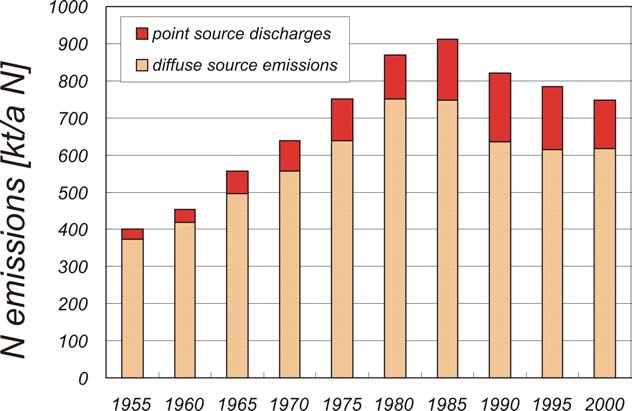
Interim Progress Report on the Danube Black Sea Strategic Partnership
page 53
Figure 5: Temporal changes of the nitrogen emissions into the total Danube river
system for the years 1955 to 2000; result of the MONERIS application for this
report
Source: Roof Report, 2005 March9
Total N loads to the Black Sea from the Danube River Basin are presently approx. 420 kt/a (60% of
total N emissions to the basin). The 40% of the N retained in the system is largely removed
through denitrification. From the peak load situation experienced in the late 1980s, total N loads to
the Western Black Sea have decreased by approximately 20% (Behrendt et al. 200410).
The peak in N fertilizer use, 2-3 million tons per year, during the period from 1970 to 1990 was met
with consequent development of eutrophic conditions in the Western Black Sea. Although headway
is being realized in nutrient reduction efforts throughout the basin, diffuse source pressure,
especially N, is expected to rise as economic recovery in the agricultural sector is attained.
Consider that diffuse N and P emissions in Austria and Germany are presently markedly higher per
hectare than many of the eastern Danube River Basin countries (van Gils et al11). Even if
concurrent with the introduction of Best Agricultural Practices, the potential for future diffuse N
emissions to increase is significant.
9 ICPDR, Mar 2005. Danube Basin Analysis (WFD Roof Report 2004), March 2005. International Commission
for the Protection of the Danube River, Vienna.
10 Behrendt, H., J. van Gils, H. Schreiber, M. Zessner, 2004. Changes of nutrient emissions from point and
diffuse sources and loads in the Danube River system within the last decades. Arhiv Hydrobiol. (accepted).
11 van Gils, J., H. Behrendt, A. Constantinescu, K. Isermann, R. Isermann, M. Zessner. 2005. Future
Developments of Nutrient Emissions and River Loads in the Danube Basin (unpublished report).
DRP/BSERP 03/07/2007
3. Environmental State of the Danube and Black Sea Basin
page 54
New threats from the EU's Common
Agricultural Policy
Variatio n in o bs e rve d are a o f NW s he lf s umme r hypo xia with inc re as ing
lo ading o f nitro ge n fe rtilis e r in the Danube bas in
Predicted
CAP
i
a 45
x
scenarios
40
y
po
f
h 35
o
m 30
k
1961-1972
r
e 25
B
A
a
1973
u
2004
q 20
1974-1991
s 15
of
1994-1996
ds 10
n
a
s
5
ou
0
Th
0
0.5
1
1.5
2
2.5
3
3.5
Nt, Nitro ge n fe rtilis e r, millio n to ns / ye ar, ave rage d o ve r the 7
ye ars prio r to e ac h data po int
Figure 6: New threats Need Policy Attention in the EU's Common Agricultural Policy
Scenario A assumes equality in post accession fertiliser application rates in all states but with no net
increase in total usage from 2001. Scenario B assumes a fixed maximum nitrogen surplus of 50 Kg/Ha
(this is quite optimistic). Both scenarios would result in a return of the dead zone. If this is to be avoided,
careful attention must be paid to reducing nitrogen surpluses by further improvements in agricultural
practices
Source: Mee, April 2005 presentation12
Similar to N emissions, roughly half (43%) of P inputs originate from agricultural activities, and
45% from wastewater discharges (Figure 7).
12 Mee, L., Apr 2005. Presentation to BSERP, April 2005.
Interim Progress Report on the Danube Black Sea Strategic Partnership
page 55
Total Phosphorus Emissions
Background
9%
Agriculture
43%
Wastewater
45%
Atmospheric
deposition
3%
Figure 7: Emission sources of Phosphorus in the Danube River Basin (1998-2000
emissions)
Source: Kroiss presentation, STM Nov 2004
Total P emissions have followed a similar trend as that observed for N: 1960 levels were approx. 50
kt/a, emissions peaked in 1990 at nearly 110 kt/a, and approx. 65 kt/a was emitted to the surface
water bodies in the basin in 2000---see Figure 8. This represents and almost 50 % reduction over
the decade of the 1990s.
DRP/BSERP 03/07/2007
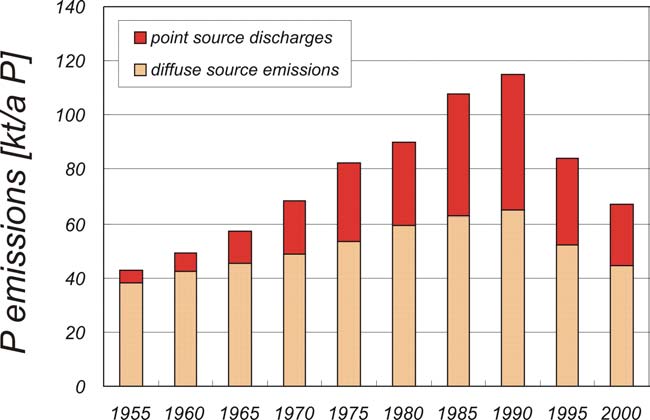
3. Environmental State of the Danube and Black Sea Basin
page 56
Figure 8: Temporal changes of the phosphorus emissions into the total Danube river
system for the years 1955 to 2000; result of the MONERIS application for this
report
Source: Roof Report, 2005 March
A significant proportion of total P emissions are retained in the basin. As much as 65-70% of total
P emissions are removed by sedimentation, approximately 40% within the Iron Gate dam I. P
loads to the Western Black Sea were approximately 20 kt/a in 2000, 30% lower than quantities
entering the sea in the late 1980s. As of latest available data (2001), total P loads had fallen to
only 13 kt/a.
In addition to changes in anthropogenic nutrient inputs, river hydrology significantly influences N
and P loads to the Black Sea. The lower volume of Danube flows since the mid-1990s could be as
significant to nutrient emission reductions as the changes realized from improvements in urban
wastewater treatment and decreases in agricultural activity (van Gils et al.) and as less nutrient
pollution is washed off the fields and feedlots.
Interim Progress Report on the Danube Black Sea Strategic Partnership
page 57
Sudden collapse and uncertain recovery of the
Black Sea NW Shelf benthic system
Summer benthic hypoxia
1973
0%
1996
2001?
p
i
ed
u
1993
1978
ea occ
mid 80s
f
ar
hel
S 100
Pressure
Figure9: Sudden collapse and uncertain recovery of the Black Sea NW Shelf
benthic system
Source: Mee, 2005 April Black Sea presentation
One of the notable ecological casualties of the frequent hypoxic events in the 1970s and 1980s was
the virtual loss of vast, underwater meadows of red algae termed Phyllophora. The species is
considered as a flagship species for the North Western shelf of the Black Sea; The Phyllophora
benthic meadows supported a highly productive ecosystem of plants and animals (more than 200
species). The gradual recurrence of Phyllophora was confirmed during a survey cruise of the
Western Black Sea in September 2004 (Hortsmann et al.13).
There has been measurable, albeit gradual recovery of biodiversity among the benthic community
of the Western Black Sea. The number of benthic species observed in the early 2000s was 1.5x-2x
higher than levels found in the late 1980s, but still more than 1.5x lower than conditions in the
1960s.
13 Hortsmann, U. and A. Davidov, 2004. Effects of Reduced Danube Nutrient Discharge on the
Northwestern Black Sea Ecosystem, ICPDR UNDP/GEF workshop documents: Nutrients as
Transboundary Pressure in the Danube River Basin, Jan 2004, Sofia, Bulgaria.
DRP/BSERP 03/07/2007
3. Environmental State of the Danube and Black Sea Basin
page 58
70
60
e
s 50
40
of speci 30
20
Number
10
0
1960s
1988
1996
1999
2000
2002
Figure10: Number of macro benthic species in front of the Danube delta (10 stations on
3 transects off Constanta, data from C. Dumitrache, IRCM Constanta)
Source: ICPDR Roof Report, March 2005
Eutrophication has not been the only factor behind the loss of fisheries in the Black Sea. Over-
fishing and introduction of invasive species have contributed to the economic crisis in the Black Sea
fisheries industry. High levels of pollution in the 1970s and 1980s coincided with advances in the
fishing industry, resulting in unregulated overexploitation. The number of exploitable fish species
dropped from 26 to just six, over a period of only two decades (Mee, 199714).
Sometime in the mid-1980s, a jellyfish-like organism Mnemiospsis Leidyi was inadvertently
introduced to the sea, probably from release of ballast water from ships. Until recent years
Mnemiopsis had no predators in the Black Sea and hence was free to gorge on zooplankton and fish
larvae, seriously disrupting the fishery balance. However, some years ago another gelatinous
organism feeding on Mnemiopsis, Beroe Ovata, was also unintentionally introduced into the
ecosystem. However, at the peak of the Mnemiopsis population in the early 1990s, there were a
staggering one billion tons of them in the Black Sea, more than the world's annual fish catch (Mee,
Black Sea Strategic Action Plan). By the late 1990s, Mnemiopsis started to decline, but remain a
persistent impediment to the recovery of the Black Sea ecosystem.
From the ICPDR's WFD Roof Report, the middle and lower reaches of the Danube are classified to
be "at risk" (of not achieving good ecological status) from hazardous substances pollution. Based
on water quality monitoring results (TNMN stations), cadmium and lead concentrations exceed
target values in many locations downstream from rkm 1071 (Roof Report, 2005 Mar).
Interestingly, Cd and Pb levels in sediment core samples collected from the Western Black Sea were
not excessive (de Mora15).
14 Mee, L., 1997. The Black Sea Today. Symposium II: Black Sea 1997: "The Black Sea in Crisis", Istanbul,
September 1997.
15 de Mora S. , Jul 2004. Assessment of Marine Pollution in the Black Sea Based on the Analysis of Sediment
Cores. IAEA Marine Environmental Laboratory, Principality of Monaco. Istanbul, July 2004.
Interim Progress Report on the Danube Black Sea Strategic Partnership
page 59
4. PERSPECTIVES
FOR
2005-2007 AND BEYOND
The positive ecosystem trends observed in the Western Black Sea in recent years are largely due to
the sudden decrease in pollution emissions following the collapse of the former communist regimes
in Central and Eastern Europe. The series of regional GEF projects and national pollution reduction
efforts should have also played a role and will play a larger role in the future with the IFNR in
sustaining the water quality and environmental gains that have already been achieved. Coincident
with the recovery of regional economies, pollution discharges from some sources will increase. It is
unlikely that emissions will go back to those of the Soviet era, but maintaining mid-1990s levels will
be a challenge. With introduction of the European Common Agricultural Policy in the East European
EU-accession countries, a serious risk of continued nutrient stress on the Danube/Black Sea
ecosystem remains.
Based on experience gained in Western Europe and North America, economic performance of the
countries will have the highest impact on pollution discharge levels. Adherence to the "polluter
pays principle" will impact different countries in different ways moving forward. For example,
countries struggling to maintain economic outputs and employment levels will not embrace
changing agricultural practices beyond those subsidized by EU donors, especially if that change
involves reducing output and/or increasing costs.
Ensuring the sustainability of the Partnership results will depend on enhancing integrated land and
water resource management, with an eye on both improving environmental conditions and
economic efficiency.
Despite this obvious increasing stress in the Danube River Basin and Black Sea, there are many
significant achievements (some of which have been highlighted in this report, such as improved
wastewater treatment capacity, implementation of new policies and regulations, better information
for and involvement of the public and other stakeholders, etc.) that will assist with mitigating the
increasing pressures and it is important that these are further developed. Some specific focus areas
for GEF-supported efforts planned for 2005-2007 include:
>
Increase outreach efforts to the agriculture and industrial sector, promoting BAP and
BAT.
>
Further capacity building, particularly using Inter-Ministerial Coordinating Mechanisms
as a facilitating platform.
>
Further development of economic instruments and promotion of investment
opportunities in pollution control and ecosystem protection.
>
Enhance public participation efforts, through expanded small grants programmes to the
NGO community.
>
Continue fostering programmes to phase out P detergents.
>
Harmonize monitoring and evaluation efforts between the Danube River Basin and Black
Sea coastal countries.
>
Reinforce collaboration with complementary initiatives.
DRP/BSERP 03/07/2007
4. Perspectives for 2005 2007 and Beyond
page 60
Annex 1: Status of Investments in the Dablas Task Force Project Pipeline
Pipeline
Project
Country
Progress Reported in November 2004
Stage
1
Bucuresti (RO-M-
Romania
ISPA TA signed for project preparation. EIB loans of EUR 33 million for Phase 1
18)
and EUR 47 million for Phase 2 under approval. EBRD loan of EUR 10 million
foreseen. Grants of EUR 70 million from EC-ISPA and EUR 106 million from
cohesion fund foreseen.
2
Banja Luka (BA-
Bosnia and
EBRD initially concept reviewed the project in 2003. Subsequently WB financed a
M-03)
Herzegovina
loan under its BiH Municipal Loan Programme. Discussions with the Water
Company and City have restarted regarding complementary financing from EBRD.
2
Belgrade Serbia
and
Steering committee grouping IFIs and bilateral donors co-ordinating project.
Montenegro
Feasibility study financed by EU (European Agency for Reconstruction) nearing
completion. EIB following project. EBRD has concept cleared a water and waste
water concession. Austria has made a pre-decision on smaller part of Belgrade
project.
3
Sarajevo (BA-M-
Bosnia and
Feasibility study of WWTP for Sarajevo City carried out in 1999, financed by JICA
02)
Herzegovina
EBRD: Sarajevo is still interesting but the city has problems with the necessary
increased tariffs
KfW and World Bank are doing preparatory work
3
Tuzla (BA-M-01)
Bosnia and
Tuzla confirmed to EBRD interest in Project combining operations of three
Herzegovina
municipalitites to solve water and wastewater problems in Modrac Lake. DISF
consultants will complete feasibility study 1st Qtr 2005.
3
Russe
Bulgaria
Russe is included in a ISPA TA for water, approved in the beginning of 2004.
Current feasibility study available from 1992 (in Bulgarian) which needs updating.
Russe among six cities under EBRD Bulgaria Water and Wastewater Facility aimed
at providing co-finance for ISPA project.
Funding also being explored through the Danubian Municipalities
3
Karlovac
Croatia
Study by Danube Investment Support Facility to prepare investment in the City's
short term priority sewerage and sewage treatment investment needs nearly
completed under aegis of EBRD. EIB considering co-financing along with Vukovar
water and wastewater project being proposed to DISF for preparation.
3
Osijek
Croatia
Study by Danube Investment Support Facility to prepare investment in the City's
short term priority wastewater collection and treatment infrastructure nearly
complete under aegis of EBRD. EIB considering co-financing along with Vukovar
water and wastewater project to be proposed to DISF for preparation.
3
South Buda (HU-
Hungary
ISPA TA approved for preparation of project and on the list for 2004-2006
M-04)
Cohesion Fund
3
Baia Mare (no
Romania
ISPA TA signed for project preparation and ISPA application received in July 2004
ref)
and approved and send for signature in December 2004
EIB co-financing
3
Ordu (No ref)
Turkey
Feasibility study to be financed to municipality itself
4
Ravda (no Ref)
Bulgaria
Private funding being explored. Project is not developed enough for IFI interest
but remains a Bulgarian priority. No studies carried out to date
4
Novi Pasat (no
Bulgaria
Project is not developed enough for IFI interest but remains a Bulgarian priority.
Ref)
Pre-feasibility study done in 2002, detailed design developed in 1990.
4
Berkovitza (BG-
Bulgaria
Project is not developed enough for IFI interest but remains a Bulgarian priority. A
M-22)
pre-feasibility study was carried out in 2002 (in Bulgarian).
4
Vidin (BG-M-16)
Bulgaria
Vidin is in a future ISPA TA for solid waste, to be approved by the beginning of
2004. A WWTP site has been identified.
4
Batumi (No ref)
Georgia
Overall value of the investment likely to be 20 million Euro. No other information
available.
EBRD: very little potential due to creditworthy-ness.
4
Town Cahul (MD-
Moldova
No information available
M-01)
EBRD: not interested
4
Town Falest (MD-
Moldova
No information available
M-05)
EBRD: not interested
4
Poarta Alba (No
Romania
EBRD: Poarta Alba investments could be considered as part of an extension to an
ref)
on-going investment programme in Constanza. However Poarta Alba is small and
could not qualify on its own.
A pre-feasibility study has been carried out and 20,000 Euro has been set aside for
a feasibility study by R.A.J.A. Constanta.
4
Trabzon (No ref)
Turkey
No information available
4
Rize (No Ref)
Turkey
No information available
4
Chernivtsi (UA-
Ukraine
A study was carried out in 1996
M-02)
4
Mykolaiv (No ref)
Ukraine
Some out of date pre-feasibility studies available from the early 90's
4
Crimea (No Ref)
Ukraine
No information available
Annex 2: Planned Schedule for Approximation of National Legislation to EU Legislation
Countr 2000/60 EC
EC 91/676/EC EC 80/68/EC on 96/61/EC
EC 98/83/EC
EC 76/464/EC
EC 73/404/EC EC
y
EC
91/271/EC Nitrates
the protection of
IPPC Directive on the quality of
on dangerous
on
78/659/EC
Water
on urban
Directive on the ground water
on integrated water for human
substances
biodegradability on the quality
Framework waste water
protection of
Pollution
consumption and
of detergents
of fresh water
Directive treatment,
waters against
Prevention and household needs
needing
Control
amended as
pollution caused
protection or
98/15/EC
by nitrates from
improvement
1998
agricultural
in order to
sources
support fish
life
DE
2005 Full
Full compliance Full compliance
Full
Full compliance
Full compliance
Full compliance Full
compliance
compliance
compliance
AT
2005 Full
Full compliance Full compliance
Full
Full compliance
Full compliance
Full compliance Full
compliance
compliance
compliance
CZ
2005
2010
2006
Full compliance
Full
Full compliance
2009
Full compliance 2009
compliance
SK
2005
2010
2008
2005
2011
2008
2006
2000
2004
HU
2005
2010
2008
2005
2015
2008
30.09.05
SI
2005 2008
2008
2007
2012
2008
30.09.05
HR
2005 --
--
--
--
--
--
--
BA
-- --
--
--
--
--
--
--
CS
-- --
--
--
--
--
--
--
BG
2005 2015
2012
RO
2005
2022
2014
2015
2022
2015
2010
MD
-- --
--
--
--
--
--
--
UA
--
2010
2003
2003
2005






October 2005
DANUBE - BLACK SEA BASIN
STRATEGIC PARTNERSHIP
Interim Progress Report Annex 2:
Summary Report on Mid-term Evaluations
and Stocktaking Meeting
Summary Report on Mid-Term Evaluations and
Stocktaking Meeting
1. Introduction
The GEF Danube - Black Sea Strategic Partnership Stocktaking Meeting (STM) was held on
10 13 November 2004 in Bucharest, Romania to review progress made over the first 3
years. This large partnership is a test of a new way of working within the GEF, a
demonstration of adaptive management for large water systems; a test determining
whether implementation of regulatory and policy measures and investment project can be
accelerated. This Strategic Partnership is testing for the first time a new GEF modality that
can help with coherence among development assistance institutions.
The overall goal of the Stocktaking Meeting was to review progress of key Objectives and
Indicators of the Strategic Partnership (SP) for the Danube/Black Sea (D-BS) Basin and to
present and analyse the results so far obtained against the SP indicators and to identify
and analyse problems and bottlenecks that are hindering efficient project implementation.
The meeting adopted a set of mid-course corrective measures in order to streamline the
implementation of the Partnership towards its Objectives and adopted recommendations
for further reinforcement of cooperation in the Danube/Black Sea Region. The analytical
materials and outcomes of this meeting were used for the development of the overall
Progress Report to the GEF Council on the Danube/BS Strategic Partnership.
The STM in particular:
1. Reported on progress/delivery of the 6 key Objectives and Indicators of the
Strategic Partnership and reviewed objectives, methodological approach and
progress made in implementing activities of the GEF Danube/Black Sea regional
programs by UNDP, World Bank and UNEP on GEF activities for nutrient reduction
and environmental protection in the Danube/Black Sea Basin;
2. Analysed the roles of the two commissions as regional institutional and legal
platforms and mechanisms of cooperation with GEF implementing agencies, with
national Governments, with international financing institutions and other bilateral
and multilateral donor organizations;
3. Considered legislative/policy drivers in the Danube/Black Sea Basin(e.g. EU Water
Framework Directive, EU Marine Strategy, EU accession process, etc.) that can be
used to reinforce or strengthen GEF efforts;
4. Reviewed current scientific basis on key transboundary environmental issues with
particular attention to Black Sea ecosystems (eutrophication) and water quality
status in the Danube River Basin;
5. Reviewed common approaches for raising awareness of the GEF Strategic
Partnership, analyze involvement of other stakeholders (including the private
sector) in activities related to nutrient reduction and environmental protection and
efficiency of support provided to Non Governmental Organizations;
6. Discussed concerns raised on the efficiency of GEF interventions for nutrient
reduction and environmental protection in Danube/BS region and adopted mid-
course corrections to get the Partnership back on the right track in order to meet
all Objectives and Indicators;
7. Provided input and materials needed for the Progress Report to the GEF Council on
the Partnership.
The STM brought together a number of stakeholders involved in projects and activities of
the Partnership - the representatives of the Danube and Black Sea countries, the two
Commissions, UN organizations (the Partnership Implementing Agencies and GEF
Secretariat), European Commission, donors and NGOs.
A total of about 90 participants, including highly experienced experts and specialists from
the project implementation level and high level decision makers from participating
countries and International Organizations were present at the meeting from the following
organizations and interest groups:
-
Danube and Black Sea country representatives and members of the two
Commissions (ICPDR and BSC Secretariats): 31 participants;
-
GEF Secretariat and M&E team members: 6 participants,
-
Strategic Partnership Implementing Agencies, World Bank, UNDP, UNEP: 8
participants;
-
European Commission/DABLAS: 2 participants;
-
Project staff from the BSERP, DRP, WB IF and Consultants: 31 participants;
-
International and regional NGOs (REC, DEF, BS NGO Network): 10 participants.
Staff of the GEF independent M & E Unit also participated at the meeting to analyze the
efficiency of GEF programme interventions worldwide and also in the Danube Black Sea
region.
All participants contributed proactively to the Stocktaking meeting, gave 22 Presentations,
participated in 3 Working Group sessions, discussed results and made pertinent
recommendations for further actions to enhance the implementation of the Strategic
Partnership Programme in the coming 3 years period.
2. Concerns Raised
Taking into account the essential issues of common concern voiced in the discussions of
the Stocktaking Meeting and taking into consideration the results of the working groups,
the following points have been highlighted at the STM:
·
Sustainability of Commissions (International Commission for the
Protection of the Danube River-ICPDR and the Black Sea Commission-
BSC): It has been confirmed that with the present engagement of participating
countries the work of the Commissions and the functioning of the Secretariats
is assured over the period of the Strategic Partnership. This is in particular true
in the case of the which is already at the present fully self sustained, whereas
the BSC still depends largely on outside support to assure proper functioning of
the Secretariat and to enable certain countries to participate in meetings and
to carry out ecosystem monitoring and other activities related to the
implementation of the SAP.
However, the perspectives for the BSC seem positive in considering that soon
at least 5 out of 6 contracting parties will make their regular financial
contributions. In this context it is also anticipated that the EU will become a
member of the BSC and thus assist with assuring continuous and effective
work of the Commission in reinforcing capacity building, monitoring of the
Black Sea ecosystem and in promoting investment programmes through its
financing mechanisms.
·
Re-introduction of intensive agricultural production in central and
lower Danube Basin: Many participants reiterated their concerns that a "tidal
wave" of agricultural production in the central and lower Danube countries
(new EU Member States and accession countries) could be expected that might
lead to an increase in the use of chemical fertilizers and consequently in a new
increase of nutrients from agricultural non point sources of emissions. There is
likelihood of intensive agriculture with increased fertilizer use moving from
western Europe to the lower basin. The importance of a potential increase of
nutrient pollution in coming years was also raised due to the risk of non-
appropriate implementation of CAP in new EU member states and due to
potential recovery of intensive agriculture practices leading to increased
nutrient pollution in the Danube - Black Sea region.
The debate focused on possible market trends and the production of high
yields and "fuel" crops; the possibility of organic agriculture was not seen as
very realistic taken into account competition on the European and Global
markets.
It was further stipulated that, as a precautionary measure, countries should
give high importance to the control and the rational application of fertilizer and
to ensure enhanced monitoring of nutrient levels in ground and surface waters.
In this context, a close cooperation with the EC was recommended to assure
careful planning when applying the CAP principles for Danube and Black Sea
countries.
·
Partnership coordination: Taking into account the recommendations of the
International Waters Programme Study and consequent discussions it has been
recommended to enhance coordination and cooperation under the Strategic
Partnership and to introduce specific institutional mechanisms, e.g.
Coordination meetings with the participation of UNDP, WB, UNEP, EC, the
GEF/UNDP Regional Projects, the WB IF Projects and the two Commission
Secretariats.
The meeting participants positively noted that the BSERP has developed for
Phase 2 a new approach and revised its activities in line with the work
programme of the DRP. Therefore, sectoral policies and strategies for pollution
reduction (e.g. in agriculture, industry and urban sector), and other
instruments for coordination and communication (e.g. inter-ministerial
coordination, public participation, NGO development, etc.) already developed
by the DRP for Danube countries (Bulgaria, Romania and Ukraine) can be
adapted to conditions prevailing in other Black Sea countries. This will allow
initiating a harmonized approach in policy development and will lead to more
efficient use of project resources. For that reason, a permanent dialogue shall
be established between the three Partnership projects, the BSERP, the DRP
and the WB IF and the relevant Secretariats of the Commissions.
Further, full scale meetings once a year of all relevant GEF projects
(International Waters, Land Degradation, Biological Diversity, POPs) working in
the Danube and Black Sea basin area are proposed to enhance inter-focal area
cooperation and project coordination.
·
Inter-ministerial coordination: High importance was assigned to encourage
and introduce mechanisms for inter-ministerial coordination where these are
not yet established. For that purpose high level consultation meetings with
governments are envisaged to obtain commitment from Governments to
assure sustainability of nutrient reduction measures. In this context particular
attention should be placed on agricultural development and the introduction of
Best Agricultural Practices under the EU Common Agricultural Policy and
Nitrates Directive applicable for EU and EU accession countries.
Therefore inter-ministerial coordination should also relate to the
implementation of investment projects for pollution control and nutrient
reduction to assure coherence between policy measures and investment
programmes; in this context close cooperation with the DABLAS Task Force
should be envisaged.
Further proposed measures relate to the organization of national workshops,
using participatory approach to discuss and design/reinforce appropriate
mechanisms for inter-ministerial coordination concerning all aspects of water
environmental management and protection.
·
Replication of results: Replication mechanisms will be a priority issue of the
Partnership coordination meeting to engage EU (DABLAS), other donors and
provisions in national budgets for continued financing of pollution control
measures and to obtain national commitments under the Conventions (DRPC
and BSC) and other international agreements (e.g. LBS protocol) to implement
relevant policies and regulations after the Strategic Partnership programme is
phased out.
It was further suggested to reinforce the cooperation between the EU DABLAS
Task Force and the WB IF to assure higher efficiency of project financing and
access of GEF Grants also to combined sources of funding.
·
Public involvement & communication: The meeting participants have
taken note of the fact that the DRP, in cooperation with the ICPDR, has
developed adequate concepts for public participation (in line with the EU WFD)
and a communication strategy. The meeting proposed that the BSERP should
develop communication and public participation strategies using Danube
experience to strengthen public participation and broader stakeholder
involvement in all Black Sea countries.
·
Review of indicators and monitoring systems: To improve monitoring of
progress in implementing the objectives of the Strategic Partnership, the
meeting recommended that environmental status, stress reduction and process
indicators should be revised and adapted not only to the expected outcomes of
GEF Programme activities but also to be relevant for the monitoring progress in
implementing Action Programmes of the Commissions. The meeting
recommended further to the BSERP to review, together with the BSC,
environmental status and stress reduction indicators before the end of the
project. In this context it was also suggested to reconsider process indicators
in the Logframe and to make them generally acceptable to the Danube and
Black Sea Protection Commissions to measure progress in implementing legal
and institutional framework mechanisms.
3. Corrective measures proposed for further implementation of the Strategic
Partnership:
Taking into account the presentations and discussions at the Plenary and Working Group
Sessions and the concerns raised set of corrective measures was adopted at the Closing
Session of the Stocktaking Meeting.
In total eight (8) particular issues have been identified, gaps have been analyzed and
solutions have been proposed to assure efficient implementation of the Strategic
Partnership in Phase 2 from 2005 to 2007:
Gap / Issue
Response
1 Inter-ministerial
- Using existing mechanisms for coordination when
coordinating mechanisms
appropriate,
- Organizing high level consultation meetings with
governments to obtain commitment to establishing
such mechanisms,
- Filling gaps where required in improving existing or
in creating new mechanisms.
2 Reporting on progress of
- All Strategic Partnership partners will revise
Strategic Partnership
current progress reports according to issues
objectives
discussed and will report tangible results on:
o Adopting and implementing nutrient and
toxics reduction policies and regulatory
measures (national level), including
Convention Protocols/Annexes,
o Implementing nutrients and toxics pollution
reduction investment projects (completed, in
progress) and reporting on actual/projected
Gap / Issue
Response
nutrient/toxics reductions,
o Development of International Waters
process, stress reduction and environmental
status indicators,
o Donor partner (WB, UNDP, EU, etc.)
`mainstreaming' of nutrient and toxics
reduction commitments into their regular
programmes,
o Reinforcing stakeholder involvement.
3 Sustainability
of
- Accepting flexibility in payment of contribution
commissions / functioning
(engagement of counties to meet their
of secretariats
commitments before the end of the project),
- Broadening indicators for commitment taking into
account proactive cooperation of countries in
expert group meetings, participation in regional
workshops, timely responding to reporting
requirements under the convention and
cooperation in GEF activities.
4 Partnership
coordination
- Organizing coordination meetings: Project and task
managers from IAs, EC, WB, UNDP UNEP,
Commission Secretariats,
- Reinforcing inter-focal area cooperation / project
coordination: full scale annual meeting of all
relevant GEF projects (IW, LD, BD, POPs) working
in the Danube and Black Sea basin area,
- Establishing permanent dialogue between DRP,
BSERP and WB IF projects.
5 Replication
- Engaging the EU in continued financing of the
pollution control measures after the Strategic
Partnership programme will phase out as one of
the important replication mechanisms (one of the
first issues to be discussed at the partnership
coordination meeting).
6 Public
involvement
&
- Developing communication and public participation
communication
strategies by the BSERP based on Danube
experience to strengthen public participation and
broader stakeholder involvement in Black Sea
countries.
7 Indicators for monitoring of
- Reviewing and revising when necessary the
progress in implementation
process indicators of the project log frames.
of Strategic Partnership
projects / Investment Fund
8 Process, stress reduction
- Further reviewing and applying process, stress
and environmental status
reduction and environmental status indicators in
indicators for the BSC
the frame of the BSERP together with the BSC,
including the need for national process indicators
(e.g. policy / legal / institutional reforms which the
countries would enact), before the end of the
project.
4. Midterm Evaluation of UNDP/GEF Danube and Black Sea Regional Projects
Both capacity building regional projects: Danube Regional Project* and Black Sea
Ecosystem Recovery Project* have in 2004 undergone external mid-term evaluation
(BSERP MTE was finished in March 2005) with the objective to enable beneficiaries (both
Commissions, Government bodies in participating countries, etc.), UNDP-GEF and UNOPS
to assess the progress and to take decisions on the future orientation and emphasis of the
projects during their remaining time.
Both midterm evaluation reports contain detailed assessments of progress achieved in
Phase 1 and a set of recommendations for further implementation until 2007. These
recommendations have been incorporated in the detail Project Implementation Plans that
have been discussed and approved by the respective Project Steering Commitees.
·
Danube Regional Project:
· To achieve project objectives it would be useful for the DRP to identify
and promote agro-environmental support mechanisms under the
Common Agricultural Policy (CAP) and the SAPARD program. EU
enlargement may well trigger a resurgence in farm production along the
Danube, with resulting increased nutrient loadings. Many farmers are not
aware of opportunities through the agricultural support mechanisms to
reduce pollution by improving on-farm practices.
· The wetlands rehabilitation and appropriate land use outputs are well
considered. Attention should also be paid to mixed-use opportunities and
compensation issues, recognizing that wetlands rehabilitation can restrict
economic opportunities for landowner. Lessons learnt in the US and
elsewhere on the implementation of conservation easements, and
mitigation requirements for building in wetlands, should be studied.
Cost and benefit analyses should be part of the pilot rehabilitation
efforts.
· Decisions need to be made as to the future thrust of the industrial
pollution output as there has not been a clear consideration of what is to
be achieved. During phase 1, the initiative has considered industrial
pollutants in general and the current status of governmental actions,
largely based on implementation of EU directives (WFD, Dangerous
Substances, IPPC, Seveso II). The outputs identified for phase 2
continue this general approach, including developing a legal gap
assessment and providing country-specific recommendations on legal
measures. As an additional note, the final report for this output in Phase
1 recommends establishing a multi-year assistance effort for industrial
pollution reduction program development in the lower Danube countries.
The current and proposed activities are not aimed specifically at the
DRP's central focus - nutrient reduction, and they fail to account for
efforts already underway in the EU accession states to transpose EU
industrial pollution legislation. We suggest a narrowing of the scope, to
specifically focus on nutrient loading, and the major industrial point
sources within the Danube basin that contribute significant nutrient and
phosphorous loading (e.g. large scale agriculture, food processing, pulp
and paper, detergents). Taking a more narrow sectoral approach would
allow more effort to be directed towards identifying existing problem
sites, and researching and presenting BAT options for the specific sectors
and sites
· The workshop to discuss with industry the phase out of phosphate
detergents was originally planned for Phase 1, but has been carried over
to Phase 2 as a result of the prolonged search to find the proper
facilitation. This initiative holds the greatest promise for enabling the
DRP to meet one of the overall project objectives - to substantially
reduce phosphate loadings into the Danube, and thereby reduce the
problems of eutrophication in the Danube delta and Black Sea. It needs
to be given high priority during Phase 2, with consideration given both to
regulatory and voluntary mechanisms.
· The Phase 2 project brief assumes the setting up of inter-ministerial
committees has been completed during Phase 1. In fact, this effort is
incomplete and several countries have asked for continuing assistance
with establishing inter-ministerial committee structures. The inter-
ministerial committee development effort is an important output,
requiring attention and financing still during the 2nd phase, and special
emphasis needs to be placed on engaging agricultural interests.
· The river basin planning efforts that the DPR is spearheading for the
region can provide great opportunities to establish more holistic and
sustainable land use planning for the region. This will require that plans
get designed not only to improve water quality, but also to stimulate
economic development and employment opportunities. The economic
benefits of a clean and healthy Danube river system need to be tangible
for inhabitants to change behaviors and support costly improvements.
The DRP during phase 2 will continue its work to complete the outputs
dealing with wetlands and appropriate land use. Meanwhile, to complete
output 1.1 the team will be working to develop an economic analysis of
the region, consistent with WFD requirements for establishing the
Danube RBMP. Within these two efforts there should be room to engage
with spatial and regional planners in the countries to consider how
economic development aims and environmental protection aims can be
reconciled.
· Consideration should be given to how the DRP can increase assistance to
the ICPDR and DABLAS task force in the prioritization, pre-feasibility
preparation, and dissemination of information on investment projects for
nutrient reduction. The ICPDR has drawn up a list of priority projects
for nutrient reduction, within the Joint Action Program. Based from
inputs of the 13 countries, it indicates that among 158 identified
projects, 45 are fully funded with a total of 622 mil. EUR. The investment
needs for the remaining 113 projects is 2,567 mil. EUR, of which 2,121
mil. EUR are not yet secured. Interviews during the evaluation mission
highlighted that some IFI's are not cognizant of the basin-wide work
done by DRP and ICPDR to identify nutrient reduction projects.
· Opportunities exist with current technologies to make the DRP and
ICPDR web sites more interactive and user friendly. Real time
information on flow rates, temperature and water quality can be
attached. Real time video footage of beautiful and historic places along
the river can now be viewed on line. Towards the end of the DRP, the
project's dedicated web site will need to phase down, with information
transferred into the ICPDR site.
· Public awareness raising is an important objective during Phase 2. At
this stage, the public awareness efforts have focused on the usual media
package: create a series of brochures and develop a web site that
provides static information. The DRP working with the ICPDR have the
potential to do much more. Two planned initiatives are especially
promising. First there is Danube Day, which is to take place annually,
and has the potential to become a major media event in many if not all
of the Danube countries, especially those with a major city along the
banks of the Danube. The first year's events are centered in Vienna. It
is recommended that a media package gets developed to help local
efforts in each participating country. While the themes may be
environmentally focused, the emphasis should be on events, activities
and fun, to bring people out to celebrate the Danube.
· The public participation activities of ICPDR are supported partly by DRP
and partly funded by ICPDR. During the DRP Phase 1, ICPDR has
prepared the Danube Basin Strategy for Public Participation in River
Basin Management Planning 2003-2009 and ICPDR Operation Plan to
Ensure Public Participation in Implementing the EU WFD on the Basin
Wide (roof) Level. Both relevant and valuable papers outlining roof level
public participation efforts with long-term perspective. During the DRP
phase 2 ICPDR should gain further understanding on financing
possibilities of these activities including other ongoing public awareness
activities such as Danube Watch-magazine and Danube Day-initiative,
both being activities where private interest to participate could be
attracted.
· For the new member states and accession countries, they are wrestling
with public access and reporting requirements across dozens of new
statutes. Signatories to the Aarhus Convention have additional
obligations. Establishing the proper mechanisms both legal and
practical, to meet these obligations presents a real challenge for
participating countries that the project can help to meet. One particular
problem faced in many states is the lack of public access to, and
participation in, not just spatial and regional planning but also to
Environmental Impact Assessment processes for new development
projects affecting them indirectly or directly.
·
Black Sea Ecosystem Recovery Project:
The project efforts should continue to be driven by two overarching project objectives:
·
To assist the six Black Sea countries to develop regulatory frameworks that can
achieve significant and sustainable reductions in nutrient loading into the Black
Sea.
·
To help the Black Sea Commission and Black Sea Countries meet their
commitments under the Bucharest Convention and Odessa Declaration.
To achieve these objectives, the following recommendations are offered to the BSERP
Steering Committee for their consideration:
·
In order to better assist the Black Sea states on regulatory reform, the BSERP 2nd
Phase ProDoc sections on Integrated Coastal Zone Management(ICZM),
agriculture, industry and municipal sectors should be revised. The goals should be
to work with each of the six Black Sea countries to propose legislative and
regulatory reforms to improve water resource protection, (harmonized with the
WFD), and establish ICZM, (harmonized with the European Marine Strategy). The
identification of hot spots and recommendations on the application of BAT are
useful as a starting point, from which detailed country-specific recommendations
should be developed.
·
The development of ICZM strategies should drive the BSERP effort to promote
interministerial coordination in each participating country. The goal should be to
have interministerial / intersectoral coordinating mechanisms in place that can
work to negotiate and approve national Black Sea ICZM strategies and legislation.
ICZM strategy development should also include opportunities for external
stakeholder involvement from NGOs and economic interests.
·
Recognizing the extensive support offered to Romania and Bulgaria, and
increasingly Turkey, for approximation of the EU Environmental Acquis, the BSERP
should focus special attention on regulatory reform / capacity building in the non /
slower accession states (Georgia, Russia, Ukraine).
·
The BSERP should assist the BSC to become a more effective and sustainable
organization, including providing funding for a management review of the BSC and
its subsidiary bodies. The BSERP should also assist the BSC PS so that by mid-
2005 there are detailed work plans and timetables in place for the effort to revise
the Black Sea Transboundary Diagnostic Assessment and Strategic Action Plan,
and to develop the next State of the Environment Report.
·
The BSERP should strengthen public awareness efforts and revamp the BSERP
communications plan. A new public relations person should be hired as soon as
possible, and be tasked also to assist the BSC PS to improve their communications
program. The 2006 Black Sea symposium and the annual Black Sea Day are
significant events requiring greater exposure.
·
Project outputs related to fisheries should be reviewed, and a decision made by the
BSERP SC on whether to continue providing technical assistance. The decision
should depend on expectations for BSC approval of a new Black Sea Fisheries
Convention in 2005. If an agreement is unlikely, the Fisheries activities should be
discontinued. If there is a fair chance for approval, the BSERP assistance should be
framed through the drafting of a Fisheries Development Plan, to include
recommended fishing-free / re-stocking zones, and strategies for the aquaculture
industry. The extent of technical support in the fisheries sector should be decided
recognizing an EU funded Fisheries project in the Black Sea will commence in
2006.
·
The activities related to economic instruments, should be revised, deleting the
expectation of a general report on socio-economic indicators. Cost benefit analyses
and consideration of economic instruments should be included as a part of each
legislative and strategic planning activity.
·
Investment program development should be done in close coordination with the
WB NRF, and should focus on small and medium investments in coastal areas.
Ports facility management should be considered in addition to municipal system
improvements.
·
Project activities related to shipping and electronic ship tracking systems are
outside of the main focus of the BSERP, and should be discontinued.
·
The research program planned for the last several years should proceed as
planned; and the call for proposals for the second tranche of small grants (5.3)
should proceed as conceived, with continuing focus on agriculture, and wetlands.