Support for the Extension of Accident Risk Spots Inventory and Preventive Measures / Final Report
Annex 7
Draft Check Lists for the Investigation and Risk
Assessment of Contaminated Sites in Flood Risk
Areas
4th Draft
International Commission for the protection of the Danube River (ICPDR)
APC (Accident, Prevention and Control) Expert Group
Checklist
for the
Investigation and Risk Assessment of Contaminated
Sites in Flood Risk Areas
elaborated by the ICPDR-APC-EG
within the UNDP/GEF-Danube Regional Project
Investigation and Risk Assessment of Contaminated Sites in Flood Risk
Page 2 of 41
Areas
Index
CHECKLISTS FOR THE INVESTIGATION AND ASSESSMENT OF CS IN FLOOD RISK AREAS ...............3
1
PURPOSE AND PRINCIPLES OF THE CHECKLISTS ......................................................................................3
2
DEFINITIONS..............................................................................................................................................................3
3
SCOPE OF APPLICATION.......................................................................................................................................4
4
DESCRIPTION OF THE PROCEDURE .................................................................................................................7
4.1
BASIC STUDY:..........................................................................................................................................................7
4.2
FURTHER SITE INVESTIGATIONS:.............................................................................................................................8
4.3
ASSESSMENT AND LIST OF SAFETY MEASURES .....................................................................................................10
5
PART 1- BASIC STUDY (DESK STUDY) PREASSESSMENT OF THE PROPERTY SUSPECTED OF
BEING CONTAMINATED ..............................................................................................................................................11
5.1
BASIC DATA ABOUT THE INVESTIGATED PROPERTY ............................................................................................11
5.2
PREASSESSMENT OF THE HAZARD POTENTIAL OF THE CONTAMINANTS ...............................................................16
5.3
ESTIMATION OF THE FLOODING POTENTIAL..........................................................................................................18
5.4
ESTIMATION OF THE MOBILITY POTENTIAL OF THE CONTAMINANT .....................................................................19
5.5
PRELIMINARY RANKING OF THE PROPERTY ..........................................................................................................22
6
PART 2 - FURTHER INVESTIGATIONS OF SUSPECTED CONTAMINATED SITES IN PROPERTIES.
.......................................................................................................................................................................................24
6.1
FRONT PAGE OF THE CHECKLIST FOR THE SUSPECTED SITE INVESTIGATION........................................................24
6.2
HAZARD POTENTIAL OF CLOSED-DOWN PLANT FACILITIES AND USED CHEMICALS .............................................25
6.3
SEWAGE SLUDGE/WASTE WATER TREATMENT....................................................................................................28
6.4
PAST INCIDENTS, LEAKAGES, OPERATIONAL LOSSES............................................................................................30
6.5
WASTE DISPOSAL SITES.........................................................................................................................................32
6.6
SUMMARIZED RESULTS AND PRELIMINARY ASSESSMENT OF THE SITE .................................................................36
6.7
SUMMARIZED RESULTS AND PRELIMINARY ASSESSMENT OF THE PROPERTY .......................................................37
6.8
PHOTO DOCUMENTATION .....................................................................................................................................38
7
PART 3 LIST OF MEASURES..............................................................................................................................39
7.1
PROPOSED IMMEDIATE MEASURES........................................................................................................................39
7.2
PROPOSED INVESTIGATION MEASURES FOR FURTHER PROCEEDING IN MEDIUM AND LONG TERM .......................40
8
APPENDIX 1 WASTE RELATED RISK VALUES...........................................................................................41
9
APPENDIX 2 BRANCH RELATED RISK VALUES........................................................................................41
Investigation and Risk Assessment of Contaminated Sites in Flood Risk
Page 3 of 41
Areas
Checklists for the investigation and assessment of CS in flood risk areas
1 Purpose and principles of the checklists
These checklists will serve as a hand guide for a first visit in properties, which are containing suspected sites
to be contaminated by substances being hazardous to water. Within a staged processing the checklists aim
at a pre assessment of the risk potential in properties and a first investigating visit to evaluate suspected
contaminated sites and to complete the data base for those sites.
The purpose of this first site visit is to find out:
· whether immediate action is needed
· whether and where further investigations or measures should be taken
· where highly contaminated zones are suspected/confirmed
The data collected in the checklists should deliver the basis to assess if further steps are necessary to
enhance the safety level of contaminated sites in flood risk areas. It includes the following information:
· Hydrological data to estimate whether the investigated site is really endangered by flooding
(flooding potential)
· General data, which should give information about location, extension type, ownership structure of the
site and about any precedent investigations
· An evaluation of the hazard situation answering the fol owing questions:
- Is there an indication of potential hazards at the site?
- Is the site assessment with regard to the site's risk potential completed or is it necessary to record
further data?
- Which additional information is already available and could be used for the assessment?
- Is an assessment possible or is a further data record or investigation necessary?
Examples are given for remedial actions and measures for a sustainable solution of the contamination
situation and to protect water from impact of the polluted site. They will help the conductor
· To complete the data for a risk assessment and
· To
indicate
solutions
for the investigated site.
Definitions for the specific terms used in this document are given in the following chapter.
2 Definitions
Properties
Land, which was formerly used by industry, military or agriculture and is mostly consisting of several sites of
different use. As a result of the use properties can include contaminated sites.
Sites
A site is a part of a property, which is specified by its location and its former specific use over the years.
Therefore different sites in one property could also vary in their condition, because of their miscellaneous
types of use. In consequence of the use sites were contaminated by improper handling of hazardous
substances.
Sites suspected of being contaminated (suspected contaminated sites)
These are sites suspected of having harmful impacts on soil, soil functions or water which may lead to risks
or significant harm to human health and the environment. Sites suspected of being contaminated comprise
· Closed-down waste disposal installations (former waste disposal sites) and other sites, at which wastes
have been treated, stored or disposed of in the past, and
· closed down industrial installations (former industrial sites) and other sites, at which environmentally
hazardous substances have been handled,
Investigation and Risk Assessment of Contaminated Sites in Flood Risk
Page 4 of 41
Areas
which could cause hazards to human health and the environment.
Contaminated sites:
Contaminated sites are suspect sites which have been confirmed as being contaminated and /or subject to
harmful soil changes.
Highly contaminated zones (hot spots):
Hazardous substances at contaminated sites are not usually distributed evenly across the whole site, but are
concentrated at locations where the chemicals were handled or stored.
3 Scope
of
application
The checklists apply to all properties containing suspected contaminated sites in flood risk areas. The case
of flooding includes, besides flooding,
·
backflow from water bodies or sewer systems or
·
a rise of the groundwater table as a result of long-term flood events.
The following sites are covered by the scope of the checklist:
·
Sites suspected to have high potential for posing a hazard to water,
·
sites contaminated as a result of former industrial activities and former waste disposal operations, and
·
closed-down plants and plant components containing water endangering substances,
which are not effectively secured and might present a hazard to water in case of flooding.
Radioactively contaminated sites do not fall within the scope of this checklist, nor do sites presenting a
potential hazard due to genetically modified organisms.
Facilities covered by this checklist include, for example:
· Underground
installations
· Surface
facilities
·
Above-ground storage systems within buildings
·
Components of closed-down plants
· Former
waste
disposal
sites
The proceeding of the checklists is based on the idea that hot spots have to be identified in contaminated sites, which
could abound in a property. An exemplary structure in figure 2 shows, how the terms property, site and hot spots have to
be understood.
Although the checklists are designed primarily to assess the risk potential for water bodies arising from properties in flood
risk areas, the checklists give also information about the danger potential to other goods to be protected. Even if
investigated sites are exempt from further investigation within this scope (like shown in figure 1), they could contain
anyhow a risk for other goods, which has to be investigated within the conventional past contamination treatment.
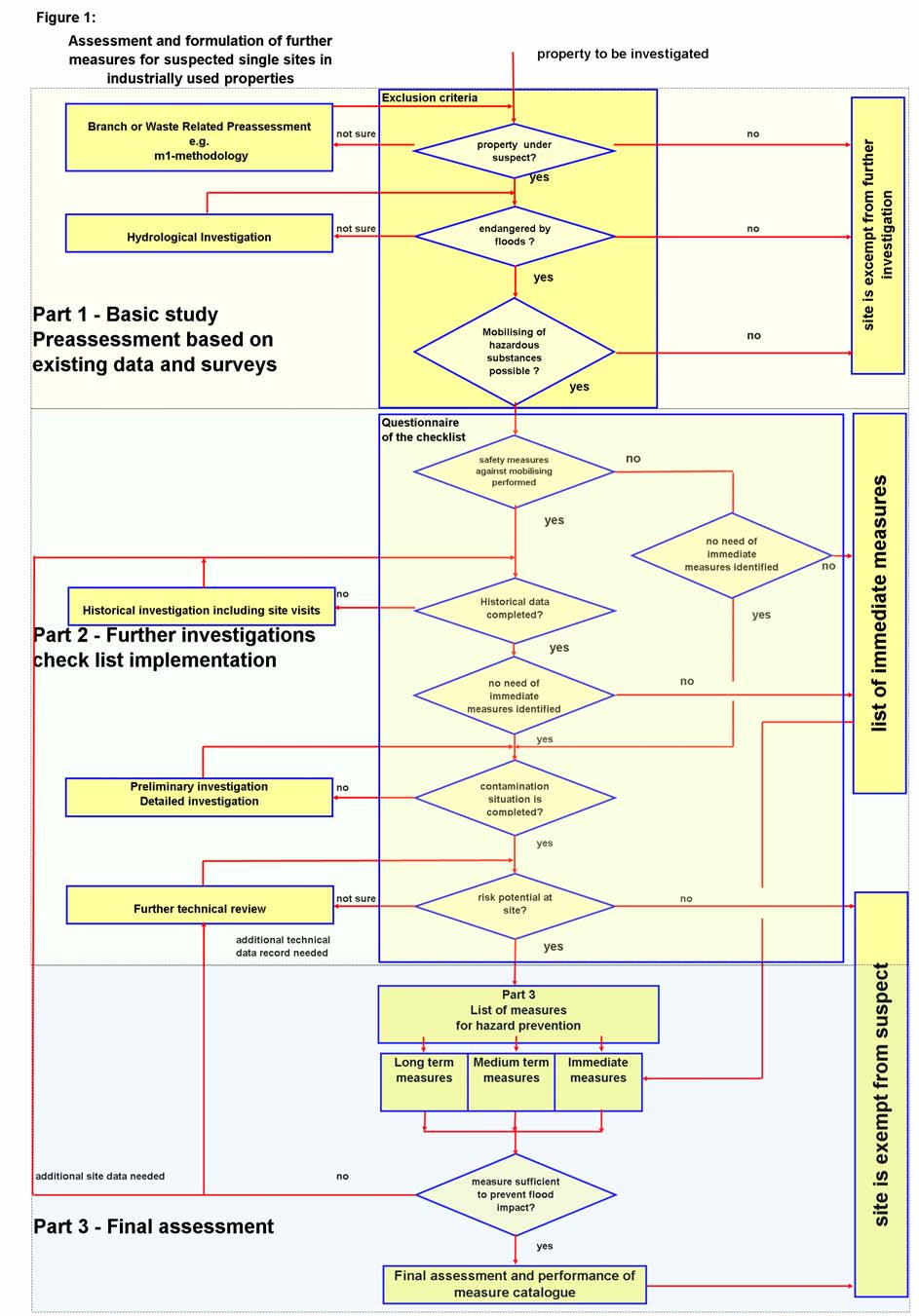
Investigation and Risk Assessment of Contaminated Sites in Flood Risk
Page 5 of 41
Areas
Investigation and Risk Assessment of Contaminated Sites in Flood Risk
Page 6 of 41
Areas
Figure 2: Illustration of the an exemplary property including suspected
contaminated sites and hot spots
Investigation and Risk Assessment of Contaminated Sites in Flood Risk
Page 7 of 41
Areas
4 Description
of the procedure
The checklist consists of three parts which include the following templates
· Part 1- Basic study (desk study) Pre-assessment of the property, which is containing suspected
contaminated sites
· Part 2 - Further investigations of suspected contaminated sites for visits and assessment.
(separated in different checklists for abandoned industrial installations, uncontrolled waste disposals,
waste water treatments and sites of presumed former incidents and hazards.)
· Part 3 - List of measures for prevention of hazard caused by flood events.
(Findings and conclusions based on the collected data)
Figure 1 describes the procedure of the risk assessment to be performed for the suspected contaminated
sites. It is divided into the following three parts:
· Basic study (see chapter 5)
· Further investigation and assessment (Check list implementation) (see chapter 6)
· List of measures (see chapter 7)
4.1 Basic
study:
The basic study is a precondition for the check list implementation indicating, if a property is under suspicion
to include potentially contaminated sites like shown in figure 2, which have to be investigated further. If
further investigation becomes necessary, the sites will be visited and historically recorded by specific
checklists, which include the questionnaire about former specific land use and its possible resulting
contamination.
The basic study includes
· Compilation of fundamental data
· Pre assessment of the hazard potential at the property
· Estimation of the flooding potential
· Estimation of the mobility potential of the polluted volume
· Ranking of the property
The fundamental data should serve as a data base for the responsible authority or operator to indicate if
further site investigations are needed for a special property. Depending on the available data, an estimation
of the information level has to be made to identify the needs of further investigation.
The objective of the pre-assessment is to find out, if there is a reasonable suspect of hazard potential in case
of flooding. For this assessment a screening of the property is needed, where the risk potential is very high.
For this screening methodologies have to be used, which operate with different risk values. These risk values
should be related to branch or waste specific toxic potentials. Depending on a threshold value for the risk,
which is to be defined by the Danube Countries themselves, the properties should be screened and
classified as hazardous and non hazardous to water in case of flooding1.
The estimation of the flooding potential should give information, if the property is really endangered by
floods. If not, there is no need of further site investigation with regard to risks caused by flooding (the site
may still be hazardous for groundwater or other goods). If there is a flooding danger it has to be estimated, if
there is also a danger of mobilising hazardous substances in case of a flood incident. In sum the properties
will be assessed in form of priority values, which help to prioritise the properties with regard to their toxic
potential and their potential to discharge hazardous substances into surface water.
If the basic study indicates a flood risk and a potential mobility of hazardous substances, further
investigations are necessary.
As far as obvious needs of measures can already be identified, a preliminary list of immediate measures
should be elaborated. (Measures could be e.g. immediate visiting of the site, prevention measures like
proscription of site entrance).
1 In an exemplary screening of sites in the Danube river basin the m1-methodology was used, where the toxic potentials of the sites
were estimated on the basis of concretised practical experience (see appendices 1 and 2). The exemplary methodology is described in
appendix 3. The risk values in this methodology ranged between 0 and 55. All sites with a value higher than 35 were classified to be
hazardous.
Investigation and Risk Assessment of Contaminated Sites in Flood Risk
Page 8 of 41
Areas
The screened properties should be ranked at this assessment stage
· at first with regard to the determined risk value
· secondly with regard to the need of further investigation or of elaboration of immediate measures
(which has to be defined by the authorities) and
· thirdly with regard to the size of the investigated property
4.2 Further
site
investigations:
The need of further investigations or of immediate measures at the site should be identified through site visits
combined with the application of the checklist questionnaire shown in figure 1. The questionnaire of the
checklist will answer the following questions:
· Are available data about the site is completed?
· Is the need of immediate measures identified?
· Is it possible to describe the contamination situation?
· Is the risk of the site definitely confirmed?
· Which measures have to be done next?
Besides to the necessary immediate measures further investigations are mostly identified to close the
information gap about the investigated sites. These further investigations consist of the following stages:
· Historical investigation combined with site visits
· Preliminary
investigations
· Detailed
investigations
The checklist questionnaires will only consider the first steps of the historical investigation. Contaminated
sites in flood risk areas have to be investigated predominantly with regard to the impact to surface water in
case of a flood event. All other impacts are subjects for investigations in the field of conventional treatment of
contaminations.
In the checklists the actual risk of an investigated site will be assessed on the basis of calculated water risk
indices, which are based on estimated amounts of water hazardous substances with regard to their water
risk class.
Any more detailed information has to be elaborated separately by performance of the investigation stages.
As the checklist constantly refers to these investigation steps, they are described in the following.
1 Stage Historical investigation combined with site visits
The historical investigation is aiming at a completion of all aspects of former industrial use in a site, which
could cause hazard to water or soil in case of flooding. It helps to narrow the range of possible hazardous
substances to be investigated. In this step all available information about the former use is searched and
analysed, to get as much information about the site and possible hints about contamination. Information is
found in archives, old manufacturing and construction files, documents of authorities etc. Interviews with
former employees, neighbours, mayors are also a valuable source of information. The aim of this step is to
determine possible pathways or hot spots for spreading of contaminants and possible impacts on water, soil
and air and to exclude irrelevant impacts.
The gathered data arising from historical investigation has to be verified and concretised by a site visit, which
should be recorded in a checklist. The objective of this check list is to gather all identified suspicious facts,
which gives information about needs of immediate measures/actions and further investigation steps relevant
for the enhancement of the safety level at site.
If in the first step no need of immediate action is identified, but the site can not be exempt from suspect to be
hazardous, a preliminary investigation is necessary in the second step.
Investigation and Risk Assessment of Contaminated Sites in Flood Risk
Page 9 of 41
Areas
2. Stage Preliminary investigation
The objective of the preliminary investigation is to assess the hazard for the relevant pathways and protected
objects under impact, determined during the historical investigation. The assessment is based on analyses of
the harmful substances distribution, data about the possibilities for their migration in case of flooding, as well
as the prognosis about their load in the protected objects (means water body) under impact. If in the second
step no need of immediate action is identified, but the site can not be exempt from suspect to be hazardous,
a detailed investigation is necessary in the third step.
3. Stage - Detailed investigation
The objectives of the detailed investigation are:
· Final hazard assessment for the particular suspected contamination case (the suspected case is
either dropped out, or accepted as a past contamination case)
· Setting of criteria for further treatment (e.g. parameters for monitoring or preliminary remediation
objectives for the remediation investigation. Therefore a proposal for medium and long term safety
measures and action for hazard prevention has to be elaborated in the fourth step. The concretion of
these measures should be based by well founded reviews or analysis.
Investigation and Risk Assessment of Contaminated Sites in Flood Risk
Page 10 of 41
Areas
4.3 Assessment and list of safety measures
Based on these findings the sites can be prioritised and a list of safety measures can be proposed which
include
· Immediate measures to enhance the safety level
· Preparatory measures to complete data, which are necessary to concretise safety measures for the
investigated site.
· Prevention measures to mitigate the impacts of flood events in contaminated sites
· Remedy measures aiming at
- elimination or reduction of pol utants (decontamination measures),
- Prevention or reduction of pollutants spreading in a lasting way, without eliminating the pollutants
themselves (Securing containment measures) or
- elimination or reduction of harmful changes in soil's physical, chemical or biological characteristics
· Protection and Restriction measures, aiming at a prevention or reduction of hazard impact for health
and environment, especially usage restrictions.
Examples for short, medium and long term measures are listed in the following.
Short-term measures:
Preparatory measures
· Preliminary investigation has to be started, if the risk potential is not well known
· In case of further hazard suspicion a detailed investigation has to be started, if the contamination
situation is still not completely identified
· A hydro geological survey should be started, if the risk of flooding is not quantified sufficiently
· A concept for active remediation or safety measures must be elaborated for a cost prognosis and
for the elaboration of cost variants
· Steady Supervision or monitoring of the sites with regard to stability and dimension of the safety
dams are necessary.
Safety measures
· Protection and restriction measures such as:
o Danger sign for contaminated area
o Closure of the contaminated area
· Excavation and disposal of small volumes of contaminated soil (hot spots)
· Sealing of surfaces (suitable for heavy metal contamination)
· Capsulation of contaminated volume (suitable for mixed contaminants)
Medium-term measures:
Preparatory measures
· Conception for excavation and treatment of contaminated volume for example by washing
(heavy metals or persistent substances) or by bioremediation (organic substances)
· Conception of evasion area for floods
· Conception of optimizing the dimensions of the river dams
· Concept for relocation of large deposits
Safety measures
· Bioremediation of medium sized oil contaminated area
· Stabilising of river dams
· Installation/optimisation of alarm systems
Long-term measures:
· Relocation of the deposits
· Securing measures for strong rain events
· Securing for large amounts of melting snow
· Adaptation of the river bed or the river dam
· Rain water storage basins
· Recultivation of flood plains
Investigation and Risk Assessment of Contaminated Sites in Flood Risk
Page 11 of 41
Areas
5 Part 1- Basic study (desk study)
Preassessment of the property suspected of being contaminated
5.1 Basic Data about the Investigated Property
The basic data should give the following information about the investigated property which may consist of
several suspected sites:
· General
data
· History of the property use
· Location
description
· Status of the property
5.1.1 General
data
The following questionnaire is aiming at a completion of the general data base to give conductors the
necessary sufficient data framework for further investigations and to show the state of the present
information level.
Notation of the property/ No.: _____________________________________________________________
Timeframe of the visits:
first visit:______________________last visit:_________________________
Federal State
___________________________________________________________________
County ___________________________________________________________________
Township/district ___________________________________________________________________
Address
Postcode:
Street and street number:__________________________
Location
inside locality
outside locality
marginal area
specified:___________________________________________________________
Is there a general information available?
Yes
No,
if no, the data have to be collected
if yes, please specify
Property size
__________________________________[ha]
Contact person (authority)_________________________________________________________________
Telephone
___________________________________________________________________
Telefax
___________________________________________________________________
E-Mail
___________________________________________________________________
Responsible Processor ___________________________________________________________________
Contact person (authority)_________________________________________________________________
Telephone
___________________________________________________________________
Telefax
___________________________________________________________________
E-Mail
___________________________________________________________________
Cadastral number
___________________________________________________________________
Coordinates
___________________________________________________________________
Investigation and Risk Assessment of Contaminated Sites in Flood Risk
Page 12 of 41
Areas
Further sources of information should be listed according to Table 1:
Source Name
Contact
person
Address/
Telephone
authorities
Enterprise
Institute
Contemporary
Witness
Table 1: List of further sources of information
5.1.2 History of the property use
The listing of the former use of the property should give information and indicators for possible
contamination. If the use is only supposed but not confirmed, a historical investigation can help to prove the
suspicion. The former use should be listed as shown in Table 2
Time frame
Former use
presumed confirmed Probable contamination
Table 2: List of former use of the site
Investigation and Risk Assessment of Contaminated Sites in Flood Risk
Page 13 of 41
Areas
5.1.3 Description of the location
The description gives information, in which area the property is located and which sensitive bordering area
could be harmed.Table 3 gives an overview of the possible areas
Area
bordering inside
Industrial area
Mixed-use zone
Residential area
Hospital
Nature protection area
Landscape conservation area
Recreation area
Agriculturally used area
Forest area
Drinking water protection zone
Standing water body
Body of flowing water
Table 3: Compilation of sensitive bordering areas
Additional information
(special remarks to the
site condition):
__________________________________________________________________
____________________________________________________________________
____________________________________________________________________
5.1.4 Status of the property
This questionnaire gives conductors information about the present situation of the property and the present
activities at site aiming at the completion of relevant investigation and safety activities.
Is there any information about the ownership structure and the responsibility for the property
available?
Yes
No
If the ownership structure or Status of enterprise is not known, a historical investigation has to be started.
Contemporary witness must be found.
If yes, is the status of enterprise known
Yes
No
If no, further data record on cadastral register has to follow
If yes,
Status
yes no
closed
With formal document
Operating
With permit
Listed for control
No administrative act before
Investigation and Risk Assessment of Contaminated Sites in Flood Risk
Page 14 of 41
Areas
Has the site already been investigated with regard to the hazard potential?
Yes
No
if no go to 5.2
if yes, which investigation
Initial risk assessment
Historical investigation
Preliminary investigation
Detailed investigation
Was the suspicion of contamination confirmed?
Yes
No
if no, further investigation must be started if there is still a strong suspicion of contamination. If there is no
strong suspicion the sites should be handled in the framework of the regular handling of contaminated sites.
If yes, were contaminated area(s) identified?
Yes
No
if no, the detailed investigation must be started. If the detailed investigation shows no further suspicion, the
sites should be handled in the framework of the regular handling of contaminated sites.
if yes, were remedy measures already taken to prevent hazards in case of flooding?
Yes
No
if no, plan for remedy action should be started
If yes, which measures?
Identification of measures
If there is already an impact to surface water then perform
Removal of contaminants
Excavation of contaminated soil
Relocation and disposal of waste
Relocation and intermediate storage of waste
Drainage and intermediate storage of leachates
If not, but an impact to surface water is already expected
Remediation/decontamination of contaminated sectors
Bioremediation
Soil washing
Thermal treatment
Leachate drainage and treatment
Investigation and Risk Assessment of Contaminated Sites in Flood Risk
Page 15 of 41
Areas
If a direct impact to surface water is not expected but in case of a flood eventp, the following measures could
be also performed:
Protective and restrictive measures
Sealing of surface
Encapsulating of contaminated volume
Building of safety dams
Restoration of safety dams
Monitoring and Control
Restricted use of the property
Prohibition to access
Closure of the property
5.1.5 Estimation of the information level
Based on the gathered data, the information level is
1 Very low
2 Low
3 Medium
4 Sufficient
5 High
For the decision making, please consider the following table. The Table 4has to be understood as a clue for
a rough classification of the information level about the property
g
l
al
n
ation
a
t
e
i
on
di
i
r
med
i
r
med
os
l
e
ve
l
i
g
op
n
l
e
ve
i
t
r
e
medy
a
t
i
o
n
ssment
t conf
t conf
i
on
n
v
estigat
n
i
sk
n
i
t
y
regardi
l
invest
oved and
t
ion pr
r
m
i
r
a
t
i
o
s
s
e
t of imme
al of
r
t
y vis
r
es
r
es
r
ior
f
o
l
a
e
d
il
os
P
in
r
m
t lis
essme
essme
f
o
itia
s
t
orica
a
s
u
a
s
u
r
ope
rs
s
t
is pr
r
e
l
iminary
v
estigat
r
e
l
iminary risk
e
ta
e
t
a
i
l
ed
r
op
In
I
n
Hi
P
Fi
me
Li
confirmed
P
i
n
P
ass
D
D
ass
P
me
Remedia
confirmed
1
very low
+
-
- - - - - - - - -
2
low
+
+
+
3
medium
+
+
+
+ +
4
sufficient
+
+ +
+
+
+
(+) (+) (+)
5
high
+
+ +
+
+
+
+
+
+
+
+
+
applicable
(+)
limited applicable in case of further investigation needs
Table 4: Proposal for classification of the information level
Investigation and Risk Assessment of Contaminated Sites in Flood Risk
Page 16 of 41
Areas
5.2 Preassessment of the hazard potential of the contaminants
To assess the hazard potential the dimension of the contamination (in m² or m³) and the substance, the type
of waste itself or the industrial sector have to be known. Based on this data an estimation of a risk value
could be done, like it is exemplarily done in the m1-methodology.
5.2.1 Dimension of the contamination
known
estimated
not known
Area
_____________________________sqm
Contaminated volume _____________________________ m³
5.2.2 Substance/contaminant
known
estimated
not known
Specified:__________________________________________________________
5.2.3 Industrial branch classification code
This question should help to find out, which present and former industrial use is known in this area. It
should be specified by the industrial branch specification code exemplarily shown in annex 1
(Please list codes, if there is a relationship with one or more industrial branches)
_______________________________________________________________
_______________________________________________________________
Resulting Risk class according to the branch related risk value in chapter 10:
Risk Value according to (e.g. M1-methodology):
5.2.4 Waste Codes (according to European Waste Catalogue)
This question should help to find out, which waste was accumulated during the industrial processes or
which waste was or even is actually disposed at the site. It should be specified by the waste codes
according the European waste catalogue shown in annex 2 in a table like shown beneath.
Waste
waste type
amount
Probable Proportion
code
(Mg)
risk class in %
Table 5: List of the accumulated, handled or disposed waste at the site
Resulting Risk class according to the waste related risk value in chapter 9:
Risk Value according to (e.g. M1-methodology):
Investigation and Risk Assessment of Contaminated Sites in Flood Risk
Page 17 of 41
Areas
5.2.5 Results of the hazard potential pre assessment - Determination of the risk value
For the screening of those properties, which might include sites probably contaminated with hazardous
substances, the determined risk values have to be compared with a threshold value, which should be defined
by the authorities themselves. Also the classification, which risk values are considered to be significantly
higher than to the threshold value can be fixed3 by the authorities.
The urgency for safety measures on a property is depending on the defined priority value, which should be
classified according to the ratio between risk value and threshold value as described in Table 6.
Priority value regarding Risk
Risk value compared to threshold value is
impact of the substance
Significant higher
higher
lower
Significant
lower
1
Low
2
Medium
( )
3
High
4
Very high
( )
Applicable
( ) Applicable if estimation is confirmed by survey
Table 6: Proposal fort he classification of the priority values regarding the substantial hazard
The suspicion of risk is confirmed, if one of the resulting risk values is higher than the defined threshold
values. If both risk values are lower than the defined threshold values, a further investigation of the property
is still necessary, if the suspicion of contamination can not be totally excluded by surveys.
The result of this risk estimation is to be fixed in Table 7
Result of the assessment
Branch related risk rB
Waste related risk rW
Resulting risk value:
Threshold risk value rT:
Priority with regard to the impact of the
substance
Table 7: Result of the substantial risk estimation
Short term measures:
· If there is no information given, assess the actual hazard potential by searching indications for
former industrial use.
· If indications of contamination are given, perform a historical investigation to concretise the
contamination potential.
· Perform a first visit of the property using part II and III of the checklist.
3 (E.g. threshold value is 50 percent of the maximum risk value and the risk is considered very high, if the risk
value is 30 percent higher than the threshold value).
Investigation and Risk Assessment of Contaminated Sites in Flood Risk
Page 18 of 41
Areas
5.3 Estimation of the flooding potential
The objective of this questionnaire is to find out, if there is a reasonable suspicion of a risk of flooding. If a
risk of flooding is confirmed for a property containing hazardous substances, it has to be investigated
further if the contaminants can be mobilized by flooding.
How often is a flood expected?
Decennial
Every thirty years
Every hundred years
How did a flood occur?
Yes No Not
sure
High
water
Back pressure from bodies of water or canals
Rising groundwater levels as a result of extended periods of high water
Which data confirmed the danger of flooding ?
Yes No Not
sure
Monitoring
data
Hydrological
surveys
contemporary
witness
Other
reports
Is the whole property endangered by flooding or only parts??
Yes No Not
sure
Whole
site
Parts, but close to contaminated zones
Danger of flooding is
very high
high
medium
low
Resulting priority regarding flood-proneness:______
For the decision making process please consider the Table 8 beneath:
Priority value regarding Flood-
If probability of flooding in years Remarks
flood-proneness
proneness is
< 10
< 30
<100 >100
0
Very low
If flood-proneness is very
low, it has to be proved, if
the site can be exempt
from the investigation.
1
Low
2
Medium
3
High
4
Very high
Table 8: Proposal for the classification of the priority values regarding the flood-proneness
Investigation and Risk Assessment of Contaminated Sites in Flood Risk
Page 19 of 41
Areas
Short-term measures:
· If no data is available a hydrological investigation has to be started to clarify, if a property is
endangered to be flooded.( see also medium term measures)
Medium and long term measures:
· If the property is in a flood risk area, it has to be investigated if measures for the enhancement of
safety level in the suspected property are necessary. If yes, they must be planned and realised, e.g.
stabilisation of old dams or building of new dams.
5.4 Estimation of the mobility potential of the contaminant
The objective of this questionnaire is to find out, if the contaminant or the contaminated soil are mobile in
case of flooding. If a danger arising from this mobility has to be expected, safety measures should be
considered to lower the risk. If a high danger resulting from the mobility is confirmed for a property, which
contains hazardous substances and the flood risk is also high a further investigation of the property and
measures should follow.
Information is existing
Yes
No
If yes go to the next question
if no, the property sites should be visited or additional surveys should be started
(see also short term measures at the end of this chapter).
Where does the contaminant exist? (please fill in Table 9)
Hazardous
in Not
Safety measures performed
substance
saved
Removal
or
Against uncontrolled
Retention
Sealing
clearance
dismantling
basin or dam
Landfill
Leachate
Dump or pit
Tank farm
above ground
Tank farm
under ground
Storage
basin
Storehouse
Barrels
Bags
others
How is the potential of hazardous substances or contaminated soil volume to be mobilized in
case of flooding (mobility potential)?
very high
high
medium
low
very low
Table 9: Compilation of relevant aspects for the assessment of the mobility potential
Table 9 should gives information about the present situation, where the contaminant is located. According to
the data scheduled in this table the investigator can assess the mobility potential of the contaminant. The
mobility potential could be assessed depending on the expected hazard impact and the performed safety
Investigation and Risk Assessment of Contaminated Sites in Flood Risk
Page 20 of 41
Areas
measures to prevent impacts. The assessment should be carried out according to the following table.
(please see Table 10).
Potential of mobility depending on hazard impact and performed measures
Expected hazard impact
Safety measures performed
in case of flooding
Removal or
Against uncontrolled
Building of
Covering
No
clearance
dismantling
Retention basin
or sealing
measures
or dam
Human error
Very low
Low
Low
Very low
Medium
Shockwave
Very low
Medium
Low
Low or
Very high
medium
Heavy rain events
Very low
low
Medium
Very low
High or
Very high
High water
Very low
Very low
Low
Very low
Medium or
or low
high
Table 10: Proposal for the classification of the mobility potential
For the classification of the listed impact in view to the relevance for the investigated location, please
consider the following remarks:
· Human error is mainly characterized through activities which lead to contaminants loss caused by
improper locking or fixing of installations. (e.g. if a sludge treatment facility is not locked early enough
since the flood occurs)
· Shockwave could cause significant destruction on dams, retention basins and installations or even a
flush away of deposits or dumps, which will lead to a contaminant discharge if they are insufficiently
saved. Shockwave appear predominantly in narrow valleys. Since the flood event occurred in the
river Elbe the dimension for narrow valleys should be newly defined.
· Heavy rain events could cause an instability of constructions, which lead to a less function ability of
safety installations (e.g. safety dams, groundings or retention basins).
· High water could cause a raising and destruction of underground storage facilities, an instability of
constructions and a mobilizing of contaminants in unsaturated contaminated volume.
The danger arising from the emission of the contaminated volume, which is hazardous to water, in case of
flooding depends on two factors: the mobility potential of the contaminated volume/contaminat and the
solubility of the harmful substance. Therefore the solubility of the relevant contaminant also has to be
considered in this assessment.
Solubility of the substances
very high
high
medium
low
very low
Based on the estimation of the mobility potential and the solubility of the contaminants the danger of
contaminants discharge should be determined. Table 11 shows a proposal to classify this danger with regard
to these factors.
Solubility of the substances
Very high High
Medium Low
Very low
Mobility potential of the contaminated volume
Very high
Very high Very high
High
Medium
Low
High
Very high
High
Medium
Medium
Low
Medium
High
High
Medium
Low
Very low
Low
High
Medium
Medium
Low
Very low
Very low
Medium
Medium
Low
Low
Very low
Table 11: Proposal for the classification of the danger of contaminants discharge with regard to the
mobility of the contaminated volume and the solubility of the contaminants
Investigation and Risk Assessment of Contaminated Sites in Flood Risk
Page 21 of 41
Areas
According to the determined danger the priority values are defined as follows:
Priority value regarding
Danger from
Estimated
mobility of the contaminated
contaminant
situation,
volume and solubility of the
discharge
please mark
contaminant
with a cross
0 Very
low
1 Low
2 Medium
3 High
4 Very
high
Short-term measures:
· Is no conclusive data available, data research has to be started. Contact to meteorological network
agencies is necessary
· If no data is available about the mobility potential of contaminants in case of flooding, a hydro-
geological investigation has to be started, if the flooding potential is high or very high.
· To avoid impacts on human health abandoned instal ations have to be cleared and/or removed
· Prove the stability of dams and the dimension of retention basins (Wether they are sufficiently
dimensioned and constructed for shock wave events or heavy rain events).
· Prove if mobilising of contaminants caused by high water could be avoided by sealing of
contaminated volume or locking of installations
Medium term measures
· To avoid impacts on human health abandoned instal ations have to be sealed.
· Build sufficiently dimensioned dams and retention basins to mitigate the impact of shockwave and
heavy rain events.
· To avoid the impact of shockwave remove installations and contaminated volume from the flood risk
area
· If the investigation does not affirm an adequate dimensioning start to reconstruct old safety
installations or build new safety installations
Investigation and Risk Assessment of Contaminated Sites in Flood Risk
Page 22 of 41
Areas
5.5 Preliminary ranking of the property
The site is ranked according to the average of the afore mentioned priority values (substance, flooding potential,
mobility)
AP = sum of priority value/3
AP = Average priority value
If two properties have the same AP, the ranking is determined secondly by the information level. The higher the
information level the higher the need for active safety or remedy measures. If the properties are ranked with
regard to their risk potential and their need for urgent measures the property with low need of investigation are
ranked higher than properties with higher need of investigation.
If the need of further investigation is also the same, the size of the property is determining in the third step (which
site could be easier investigated/ remediate in a short time).
According to figure 2 the sites should be classified, if there is need for immediate measures and/or further
investigation.
Immediate measures necessary
Yes
No
Remedial measures (short and medium term) necessary
Yes
No
Further investigation necessary
Yes
No
Figure 2:
Classification of the pre assessed property according to averaged priorities vs. information level
Investigation and Risk Assessment of Contaminated Sites in Flood Risk
Page 23 of 41
Areas
As shown in figure 2, the following requirements on measures result with regard to the information level:
· If priorities for mobility and risk of flooding are very high immediate measures to rise the safety level
are necessary
· If the information level is lower than 2, there is a necessity for further investigation to affirm the estimated
priorities for mobility and risk of flooding (especially if these potentials are very high or high, which
would make immediate measures necessary)
· If the substance priority and mobility are very high, but flooding danger is very low, measures should
depend on the results of further investigations. The same is valid if substance priority and flooding danger
are very high and the mobility is very low.
The following immediate measures in case of identified risk of flooding should be taken into consideration:
· If the property is endangered by high water, stability and dimensions of dams have to be proved.
· All technical facilities in this property have to be proved with regard to safety requirements.
· If the property is endangered by back pressure, all safety facilities of the sewerage system have to be
proved. (Impermeability, swing type check valve, storage tank for process water, rain storage reservoir
etc.)
· In case of rising groundwater levels, stability of tank systems has to be proved and it has to be proved if
rising groundwater is touching a relevant contamination hot spot, which leads to a contamination
displacement.
· In case of rising groundwater levels and heavy rain events, stability of dams have to be proved with
regard to the risk of being eroded.
In case of identified high mobility measures such as
· Excavation of contaminated volume
· Sealing of the surface
should be taken into consideration.
6 Part 2 - Further Investigations of Suspected Contaminated Sites in
Properties
This form has to be completed for each suspected site inside of a property. It comprises
· Checklists for questionnaire and data compilation to classify the suspected site
· Assessment of the probable environmental impact of the suspected site in case of flooding
· Proposal
for
measures
· Summarized results and preliminary assessment of the site
· A photo documentation and description of each single site
All contaminated sites should be listed in specific checklists, where the estimated water risk class
equivalents (according to risk class 3) are determined. At least in a summarized list, where all sites of one
property are listed, the sum of the water risk equivalents and the water risk index WRI should be calculated,
which give the information about the potential impact of the contamination to the surface water. This value
gives no information about the actual risk, but it helps to prioritize the properties and the single sites. It helps
to find out which of them need immediate measures most and which further investigations are necessary
(e.g. how mobile are the contaminants in the polluted zone).
6.1 Front Page of the checklist for the suspected site investigation
Name of the property:
model factory___________________________________
Site description
production line for acryl nitrile____________________
Sequential number of the suspected site
e.g. SuS 1.2_____________________________________
Used
Map
Land register map 2003_11_03 1: 10.000______________
A property can contain several sites with different former uses. Figure 3 shows an exemplary structure of
the checklists. The checklists are built up to four different kind of suspected contamination.
Figure 3: Exemplary structure of the checklists
Investigation and Risk Assessment of Contaminated Sites in Flood Risk
Page 25 of 41
Areas
Please mark with a cross the correct item for the special site in the property to be investigated. Multiple
crossing is possible, if the site includes more than one of the items.
....4.Closed down industrial installations
(see further checklist chapter 6.2)
Sewage sludge/ Water treatment
(see further checklist chapter 6.3)
Other sources of contamination, past incidents, leakages,
operational
losses (see
further
checklist
chapter
6.4)
Waste disposals, pits, combustion residue,
unsorted
landfill,
scrap
yard
(see
further
checklist
chapter
6.5)
Summarized results and preliminary assessment of the site (see table 14 in chapter 6.6)
6.2 Hazard potential of closed-down plant facilities and used chemicals
This questionnaire should help to the specified hazard potential of closed down installations including
operating supplies. It helps to concretise the need for immediate measures. For this property, all specified
suspected sites where hazardous substances and chemicals seemed to be used during the industrial
production have to be listed in a table.
6.2.1 Basic
data
Name of the property:
model factory___________________________________
Site description
production line for acryl nitrile____________________
Sequential number of the suspected site
e.g. SuS 1.1-01___________________________________
Used
Map
e.g.
Land register map 2003_09/02_01
1: 5:000
Classification according branch catalogue
________________________________________________
Suspected
Substance
________________________________________________
Water
risk
Class
________________________________________________
6.2.2 Questionnaire and data compilation
Short description of the instal ation:
4 Number of closed down industrial installations
Investigation and Risk Assessment of Contaminated Sites in Flood Risk
Page 26 of 41
Areas
Were the installations already removed?
Yes
No
if yes go to 6.2.3
if no, please list the remaining instal ations in Table 12:
Identity
Quantity installation Volume Weight
Installation is built
Installation is
Number
in m³
(approx.)
t
o
d
t
e
r
e
t
t
e
v
e
ag
o
u
n
d
e
r
gr
d
ptied
v
e
d
ains
d
r
i
f
t
v
e
d
ains
ak
Abo
gr
un
un
On wa
s
u
rfac
e
m
sa
a
g
up
sa
a
g
le
s
e
aled
SuS-
5
tank
10
1.01
Table 12: List of installations
6.2.3 Assessment of the probable environmental impact
Suspected/estimated amount of contaminants
in the installations in kg
________________________________________________
Water risk equivalent5 of the residues in kg
________________________________________________
Is the underground of the installation affected by pollution? (Proof according organoleptic test)
Yes
No
not sure
if not sure, start a preliminary investigation by chemical analysis of the soil
if yes,
estimate the amount of contaminants in the
polluted
volume
in
m³
___________________________________
Water risk classification according waste or branch catalogue ___________________________________
Water risk equivalent of the waste in kg
___________________________________
Sum of water risk equivalent in kg
___________________________________
5 Related to the water risk class 3
Investigation and Risk Assessment of Contaminated Sites in Flood Risk
Page 27 of 41
Areas
6.2.4 Proposal for safety measures:
Examples of actions:
Short-term measures:
· If vessels and pipelines are containing hazardous substances, emptying of vessels and pipeline
and environmentally safe disposal of the content is necessary.
· After emptying the dismantling and removing of the plant facilities has to be completed
· If measures are already taken, prove if they are sufficient to avoid hazard incidents
· Concept for working safety must be considered
The following measures are necessary if the underground vessel or pipeline can not be emptied, removed and is
not sufficiently protected against uplifting:
· Increase the coverage with earth, or
· install a concrete slab which covers the vessel, or
· Anchor with steel tapes which are secured to a concrete slab.
· Demonstrate that the protection against uplift is sufficient.
The following measures are necessary if highly contaminated zones under the installations are suspected:
· A preliminary investigation has to be carried out to verify if high contaminated zones do exist
identified.
· A detailed investigation has to be started, if either the contamination dimension is not known exactly
or the risk is not confidently excluded by preliminary investigation.
· If the further investigations reveal contamination and indicate a hazard for water, remedial
measures are needed
Medium term measures:
· If site treatment is not feasible in the short time, monitoring of the site is necessary
· If the contamination dimension is known, but remedy measures were not taken so far, preparation
of a remediation concept is needed with measures like
- excavation of tank and contaminated soil
- sealing of the contaminated volume
- bioremediation or disposal of contaminated soil
- extraction of oily phases
· In case of concreted contamination situation, remedial measures have to be chosen with regard to
cost effectiveness and expected result to be achieved. The more mobile the contaminants are
- an excavation,
- degradation or
- removal
of contaminants is preferable to other safety measures like sealing.
· The conception of remedial measures should consider also natural attenuation processes
· Concept for working safety must be considered
Long-term measures:
· If sealing will be removed during future civil works, vessels and pipelines must be also removed.
· Concept for working safety must be considered
Investigation and Risk Assessment of Contaminated Sites in Flood Risk
Page 28 of 41
Areas
6.3 Sewage sludge/Waste Water Treatment
6.3.1 Basic
data
Name of the property:
model factory___________________________________
Site description
production line for acryl nitrile (Waste water treatment)_
Sequential number of the suspected site
e.g. SuS 1.1-02___________________________________
Used
Map
e.g.
Land register map 2002_09/02_02
1: 5:000
Comments: Investigation of the waste water treatment is only necessary,
if the product of Pop. Equivalent* 10WRC > 100.000
Treatment is existing
yes
no
if not go to 6.5
WRC= Water risk class of the treated water contaminants:
____________
Population equivalent of the waste water treatment:
_____________
Product:
_____________
If product is lower than 100.000 go to 6.4
If not, go to 6.3.2
6.3.2 Questionnaire and data compilation
Treatment condition
Treatment facility
still in action
condition
sealed
yes
no
good
bad
unpredictable
yes
no
Sewerage
system
Sewage
plant
Sump, dry wel
If treatment is still in action, is it protected against flooding?
Yes
No
If yes, how
By dams
treatment consists of closed tanks and vessels
By retention basin
Others, please specify
____________________________________________________
If no, how should it be protected
By dams
treatment consists of closed tanks and vessels
By retention basin
Others, please specify
____________________________________________________
Investigation and Risk Assessment of Contaminated Sites in Flood Risk
Page 29 of 41
Areas
Sewage sludge disposal
Sewage sludge is/ was disposed/treated
at site
out of the site
If at site, is the site protected against flooding?
Yes
No
If yes, how
By dams
treatment consists of closed tanks and vessels
By retention basin
Others, please specify
____________________________________________________
If no, how should it be protected
By dams
By retention basin
Others, please specify
____________________________________________________
6.3.3 Assessment of the probable environmental impact
Volume of the disposed sludge:
________________________m³
Classification according waste catalogue
________________________
Calculated
WRC3-equivalent:
_________________________kg
6.3.4 Proposal for safety measures:
Short term measure:
· If no water treatment is specified but there is still a suspicion of treated process water, look for
disposed material within the industrial site
· If water treatment is specified and still in action, look for the residues coming up from the treatment.
· Prove safety of dams with regard to their stability and dimension according estimated tide.
· If water treatment is specified but not in action,
- look for the disposal of remaining residues in treatment facilities, storage or sedimentation tanks,
- sealing of the outlet pipes is necessary.
· If sewage sludge is treated and disposed at site, look for the safety and stability of the deposits in
case of flooding and heavy rain events.
If the waste water residues are high loaded with water hazardous substances the following measures could be
relevant in medium and long term:
Medium term measure:
· Elaboration of a safety concept for waste water treatment residues, disposed at site.
Long term measure:
· Excavation or sealing of the disposed residues.
Investigation and Risk Assessment of Contaminated Sites in Flood Risk
Page 30 of 41
Areas
6.4 Past incidents, leakages, operational losses
6.4.1 Basic
data
Name of the property:
model factory___________________________________
Site description
production line for acryl nitrile (Past incidents)_
Sequential number of the suspected site
e.g. SuS 1.1-03___________________________________
Used
Map
e.g.
Land register map 2002_09/02_03
1: 5:000
Classification according branch catalogue
________________________________________________
Suspected
Substance
________________________________________________
Water
risk
Class
________________________________________________
6.4.2 Questionnaire and data compilation
In Table 13 former incidents at the suspected site should be listed. This table helps to identify hidden
contaminated zones, which are suspected but still not confirmed by investigations. On that basis the need
for further investigations will be formulated, which helps to substantiate the relevant risk areas. Indications
for hidden contaminated zones could be former incidents, leakages or operational losses, which occurred
at the site. Information about those incidents can be given from contemporary witness or a log of the
enterprise are valuable source of .
The amount of the substance set free has to be estimated. With the given water risk class for the
substance a water risk equivalent related to the water risk class 3 will be calculated as a size for the
environmental impact to the water body. This equivalent is calculated with regard to a mobilization of the
whole contaminated volume in case of flooding. It does not consider natural attenuation processes, which
have taken place over the years and may have led to a decrease of the pollution.
Year Local
point.
Hazard
Contaminants
Estimated WRC3-equiv.
incident
and water risk
amount in
class
kg
s
s
l lo
nt
e
ag
ak
e
r
ationa
a
c
c
i
de
le
o
p
1954 Tank 01
x
Ammonia 2
10.000
1000
1973 Reactor03
x
Acrylnitril 3
10.000
10.000
Sum of WRC3
11.000
Table 13: Example for the listing of former incidents
How is the suspicion confirmed
By contemporary witness
By documents of the authorities
By actual investigation
Other sources, please specify
_______________________________________________
Investigation and Risk Assessment of Contaminated Sites in Flood Risk
Page 31 of 41
Areas
6.4.3 Proposal for safety measures (see also proposal at the end of this chapter):
Short term
Medium term
Short term measure at the office:
· If Point 6.4.2 can not be answered but there is a reasonable suspicion, which has to be verified,
further investigation is necessary.
· Proof of consistency of the elaborated information through site visits and interviews with
contemporary witnesses.
Short term measure at site:
· It has to be checked, whether facilities are still existing and have to be emptied and/or removed. If
yes remove all vessels, tank and pipes. Residues of the substances hazardous to water have to be
disposed in an environmental y friendly way.
· It has to be proved, if soil under the removed facilities is affected by pollution,
if yes, excavate and relocate contaminated volume. Excavated soil has to be disposed on safe
landfills.
· If large areas of soil are contaminated, a concept for alternative remediation or safety measures is
needed.
Medium term measure at site:
· If the suspicion is affirmed by historical investigation, further investigations should clarify the
extension and risk of the contamination. If the results show a significant hazard potential a plan for
remediation measures is needed.
· In case of large sites, a priority list of measures for several contamination hot spots has to be
elaborated.
Investigation and Risk Assessment of Contaminated Sites in Flood Risk
Page 32 of 41
Areas
6.5 Waste
disposal
sites
6.5.1 Basic
data
Name of the property:
model factory___________________________________
Site description
production line for acryl nitrile (Waste disposal)_
Sequential number of the suspected site
e.g. SuS 1.1-04___________________________________
Used
Map
e.g.
Land register map 2002_09/02_04
1: 5:000
Kind
of
waste
________________________________________________
Classification according waste catalogue
________________________________________________
Suspected
Substance
________________________________________________
Water
risk
Class
________________________________________________
The investigation of waste disposal sites includes also pits, combustion residue, unsorted landfill, scrap
yards.
6.5.2 Questionnaire and data compilation
6.5.2.1 Kind of disposal
The kind of disposal gives an indication, if the hazard potential of the disposal is high or low in case of
flooding.
Disposal was
Regular
Irregular
If regular, name and address of the liable operator __________________________________________
__________________________________________
Did further disposal out of this site operate?
Yes
No
If yes, which type of disposal?______________________________________________
Waste was disposed in
Landfills
Disordered deposit
Combustion residues
Communal deposits
Fil ing of pits
Tips
Tips
at
slope
Fil ing of depressions
Combination
Other
please specify ___________________________________
Investigation and Risk Assessment of Contaminated Sites in Flood Risk
Page 33 of 41
Areas
6.5.2.2 Safety
Does a leachate collector system exist?
Yes
No
If yes, is the leachate treated
Yes
No
if no, list results of chemical analysis to prove, if treatment is necessary.
Is landfill body safe and/or stable against flood events?
Yes
No
Unpredictable
If unpredictable a survey about the dam static must be made.
If no, dam stability must be enhanced.
Are safety systems like dams or landfill liner system provided?
Yes
No
If yes, which kind of:
Dam Cover system
Leachate collector system
Liner system
Other, please specify:
____________________________
if no, which kind of measures are necessary
Dam Cover system
Leachate collector system
Liner system
Other, please specify:
____________________________
Are safety systems demonstrable stable against flood events?
Yes
No
Periodical Control and monitoring of the landfill body is
Done
Not done
Periodical Control and monitoring of the safety systems are
Done
Not done
Investigation and Risk Assessment of Contaminated Sites in Flood Risk
Page 34 of 41
Areas
6.5.3 Assessment of the probable environmental impact
Estimated capacity of the disposed volume
No
< 1.000
m³
< 5.000
m³
< 10.000
m³
< 50.000
m³
< 100.000
m³
< 200.000
m³
< 300.000
m³
< 400.000
m³
< 500.000
m³
< 600.000
m³
< 700.000
m³
< 800.000
m³
< 900.000
m³
< 1.000.000
m³
> 1.000.000
m³
WRC of the disposed substances:
Calculated WRC3-equivalent: ___________
Resulting
WRI:
___________
6.5.4 Proposal for safety measures:
Short term
Medium term
Investigation and Risk Assessment of Contaminated Sites in Flood Risk
Page 35 of 41
Areas
Short-term measures:
· Irregular waste disposal sites should be displaced if one has to assume that the waste contains
hazardous substances. The waste should be disposed in regular waste management facilities.
· If the capacity and/or safety are not known, further investigation is necessary
· If leachate is collected, its quality has to be analised to determinate the probable hazard potential
· If leachate is not treated, monitoring of the outlet with regard to hazard potential and elaboration of
a list of immediate measures is necessary (e.g. conception of a retention basin or an urgent
removal of the contaminated volume, if the volume is too big, a remediation concept has to be
elaborated in medium term)
· If leachate treatment is existing, prove the stability and dimension of the installation in case of a
flood event.
Medium term measures:
· The larger sites with significant hazard potential should be sealed and saved against heavy rain
events and direct impact by floods. Therefore a concept has to be elaborated based on hydro-
geological data.
· If the contaminated volume can not be removed a concept for a leachate treatment has to be
elaborated. Depending on the leachate constituents the treatment has to include mechanical,
chemical or biological process stages, which are designed to be stable against flood incidents or
are located outside of the flood risk area.
· If the safety of the deposit can not be guaranteed a concept for a deposit displacement must be
elaborated.
· Control and monitoring of safety systems with regard to dimension and stability of the deposit slope
Long -term measures:
· Realisation of a drainage and treatment of the leachate and surface water arising from the deposit.
· If the hazardous substances are at risk to be washed away, a concept has to be elaborated
considering measures such as relocation or sealing/encapsulation with regard to their efficiency
and cost effectiveness. The measures suited best, should then be implemented.
Investigation and Risk Assessment of Contaminated Sites in Flood Risk
Page 36 of 41
Areas
6.6 Summarized results and preliminary assessment of the site
Name of the property:
model factory___________________________________
Site description
production line for acryl nitrile____________________
Sequential number of the suspected site
e.g. SuS02______________________________________
Used
Map
Land register map 2003_11_03 1: 10.000_____________
Table 14 shows the data compilation of all investigated objects of one site, which were taken as a summary
from the checklists in chapter 6.1 6.5.. The summarized results of the investigation give a complete
overview about
· the estimated environmental situation,
· the estimated risk to water bodies in case of flooding and
· a list about necessary measures to enhance the safety of the site.
Investigated site
Number WRC3
[kg]
WRI
SuS 02
Past incidents, leakages, operational losses
Closed-down plant facilities
Waste water treatment
Waste disposal
Sum
Table 14: Compilation of all investigated objects of one site
Further action
6.7 Summarized results and preliminary assessment of the property
Name of the property:
model factory___________________________________
Used
Map
Land register map 2003_11_03 1: 10.000_____________
Table 15 shows the data compilation of all investigated sites of one property listed in checklists. The summarized results of the investigation give a complete
overview about
· the estimated risk to water bodies in case of flooding,
· site dimensions and
· a ranking list of al necessary measures to enhance the safety of the most dangerous sites
Sequential
Investigated site
WRIA
Site dimension [m²/ m³]
Further action
number
Sum
The contaminated sites are ranked according to the following criteria: WRIA > Site dimension
Table 15: Data compilation of all investigated sites in one property
Investigation and Risk Assessment of Contaminated Sites in Flood Risk
Page 38 of 41
Areas
6.8 Photo
Documentation
The photo documentation should include the following information:
Name of the property:
model factory___________________________________
Used
Map
Land register map 2003_11_03 1: 10.000_____________
6.8.1 Overview
Includes photographs and maps, which give an overview of the whole property and the location.
6.8.2 Site
Description
Includes photographs, which helps to describe the several investigated sites of one property.
6.8.3 Illustration of Hot Spots
Includes photographs, which shows areas of a site, which are high contaminated and should be mainly treated.
Investigation and Risk Assessment of Contaminated Sites in Flood Risk
Page 39 of 41
Areas
7 Part 3 List of measures
All identified and gathered measures have to be compiled and separated in immediate measures (short term) and investigations (medium and long term).
The measures have to be concretised. The measures should be fixed in a time schedule and specified with the responsible operator. Examples are shown in
Table 16 and Table 17.
7.1 Proposed immediate measures
Investigated
Identified action needed
Formulated measures
date
responsible
site
ility
n
s
i
o
n
ts
ination
i
o
f
stab
m
g
ing of the
t
ability
ing of the
r
es
a
l of
g
or
u
l
at
f
o
ov
ov
u
ps
h
o
r
i
n
g, fixing
r
m s
m dimen
as
e
Proo
Impr
da
Impr
da
Deconta
me
Remov
c
o
n
t
aminan
Sealin
e
n
c
a
Anc
o
r
l
o
ckin
oth
Table 16: Proposal immediate measures
Investigation and Risk Assessment of Contaminated Sites in Flood Risk
Page 40 of 41
Areas
7.2 Proposed investigation measures for further proceeding in medium and long term
Investigated site
Identified information gap
Formulated measures
date
responsible
Name located
t
not
e ar
d
/
r
s
t
arted
t
ion
t
ion
t
ion
i
o
n
t
ion
d
o
al
ary
t
e
d
o
f
th
n
tifie
at
own
in
c
tivities
n
e
ic
m
p
le
t
u
a
t
i
o
n
ide
k
n
a
t
or
t
a
il
e
d
e
di
m
State
Si
un
un
no
plan
vestiga
vestiga
vestiga
vestiga
His
in
Preli
in
De
in
r
e
m
in
co
Table 17: Proposal for investigation measures
Investigation and Risk Assessment of Contaminated Sites in Flood Risk
Page 41 of 45
Areas
Comments:
· If the situation at site could not be identified by implementation of the checklists, a historical investigation and
further site visits should be performed.
· If no activities are planned or started, a concept for remedial actions must be elaborated if the assessment
suggests a high risk at site. Necessary measures should be more concretised in the following investigation
steps..
· If urgent measures are completed, the site has to be controlled or monitored to verify the success of the
measures.. A concept for following safety measures with lower priority can now be concretised.
(E.g. further investigation of other areas of the industrial site with lower hazard suspicion).
· If the contamination history is completed and suggests a high risk at site, a preliminary investigation should
follow.
· If the preliminary investigation is completed, a concrete answer must be given, if a risk is existing or not. A
concept for a detailed investigation must follow, if the high risk is still suspected but not totally proved.
· If the detailed investigation is completed, a concrete answer must be given, if there is a hazardous impact to
water in case of flooding caused by the investigated substances. If yes, a concept for concrete measures must
be elaborated in a remediation investigation.
· If the remediation investigation is completed, the best solution must be announced for tendering. The best offer
in question of technical and cost effectiveness should be realized.
· If the remediation is completed, monitoring and technical control of the effectiveness of the measure must
follow.