

Support for the Extension of Accident Risk Spots Inventory and Preventive Measures / Final Report
UNDP GEF Danube Regional Project
Proposal for a
Pilot Project on Actual Risk Assessment of ARS
Prepared by:
Contact: A. Dahn (IABG)
Karl-Marx-Allee 90 a
10243 Berlin
Tel.: +4930 293991-33
Fax: +4930 293991-44
Support for the Extension of Accident Risk Spots Inventory and Preventive Measures / Final Report
1
Pilot Project on Actual Risk Assessment of ARS
Background
Since the two accidents occurred at mining installations in Baia Mare and Baia Borsa in January and
February 2000 basin inventory of potential accidental risk spots were carried out on behalf of the
International Commission for the Protection of the Danube River (ICPDR).
For the classification of potential risk spots, a common procedure was elaborated considering actual
European regulations and findings:
- The findings of the ICPE
- the EU ,,Seveso II" directive
- the ,,UN/ECE agreement on the effects
of industrial accidents (Industrial accident convention)
Objective of this inventory was the Identification and preliminary ranking of potential accidental risk
spots based on estimated water risk equivalents (WRC 3-equivalents) and calculated water risk index.
About 650 risk spots were recorded and 620 were evaluated. As a result it could be identified a
hazardous equivalent of about 6,6 Mio tons in the Danube catchment area. Emphasis was to point out
the potential danger and not the actual danger.
In consequence to this purpose the inventory led to results, that countries with industries comprising
large amounts of water hazardous substances were automatically prioritised risk spots regardless, if
safety measures were performed or not.
It is not surprising, that the high percentage of the hazardous substance and consequently the risk was
located in Germany and also Romania, where the amount of hazard equivalents is significantly
determined by one mining industry. According to the results of this proceeding Germany and Romania
should be given the highest priority in safety measures, if potential danger would approximate the
actual danger.
Thus the elaborated ranking of the risk spots could not give information to set priorities in actual needs
for safety measure performance in these countries.
Identified needs for the further development of the ARS inventory
Further investigation is needed to identify the actual danger of ARS. This investigation has to meet the
· Need of harmonising the assessment, which is regarding also the enhancement of the safety
level in each industry,
· need of further development of the checklist in consequence to the criteria, which will be
developed/ determined for the evaluation of the actual risk,
· need of training and know how transfer for elaboration of measure catalogues and evaluation
of achieved safety levels,
· need of verification of the adjusted checklists
2
UNDP/GEF Danube Regional Project
Objective
Main objective is to develop a basin wide harmonised methodology, which helps to identify the actual
risk of ARS. Therefore know-how transfer and discussion between all experts of the Danubian
countries are needed, which enable the definition of agreed criteria for the actual risk assessment.
For the actual risk assessment the following aspects should be considered:
· Safety standards of installations and management, safety measures to be taken and already
performed, regarding stepwise implementation
· lack of information in authorities about the industrial activity
· Harmonised proceeding for the assessment in every Danubian country
· Adaptation and verification of the checklists at industries with different developed safety
levels
The findings of the investigations should lead to a branch related guide to be transferred to other
enterprises as far as regional and national administrations.
Content
The requirement for further investigation could be met through a study, where three exemplary pilot
industries of different development stages (related to the safety level) were chosen. Regarding the
transferability of findings and the country specific aspects the industries should be chosen preferably
in different Danubian countries, where different safety levels in the industries are expected. In addition
the hazard potential of the pilot industries should be similar and comparable, so pilot of the same
branch should be preferred. An example could be oil refineries in Germany, Croatia and Romania.
Based on the conditions of the three chosen factories evaluation criteria for the actual risk assessment
have to be defined and checklists have to be developed, verified or adjusted through exemplary site
visits.
The investigation of the industries should result to technical and organisational action plans, which
cover measures for short, medium and long term aimed at an enhancement of safety level in the
investigated industries of different development stages.
The development of the evaluation criteria and the checklists should be supplemented through an on
site verification performed by the experts in their own country, which helps on one hand to perform a
stepwise implementation of capacity building and a creation of sufficient expert opinion in relevant
authorities and on the other hand it gives a feedback about the country specific needs, which have to
be taken into consideration for the development of an assessment methodology.
Support for the Extension of Accident Risk Spots Inventory and Preventive Measures / Final Report
3
Proposal for a work programme
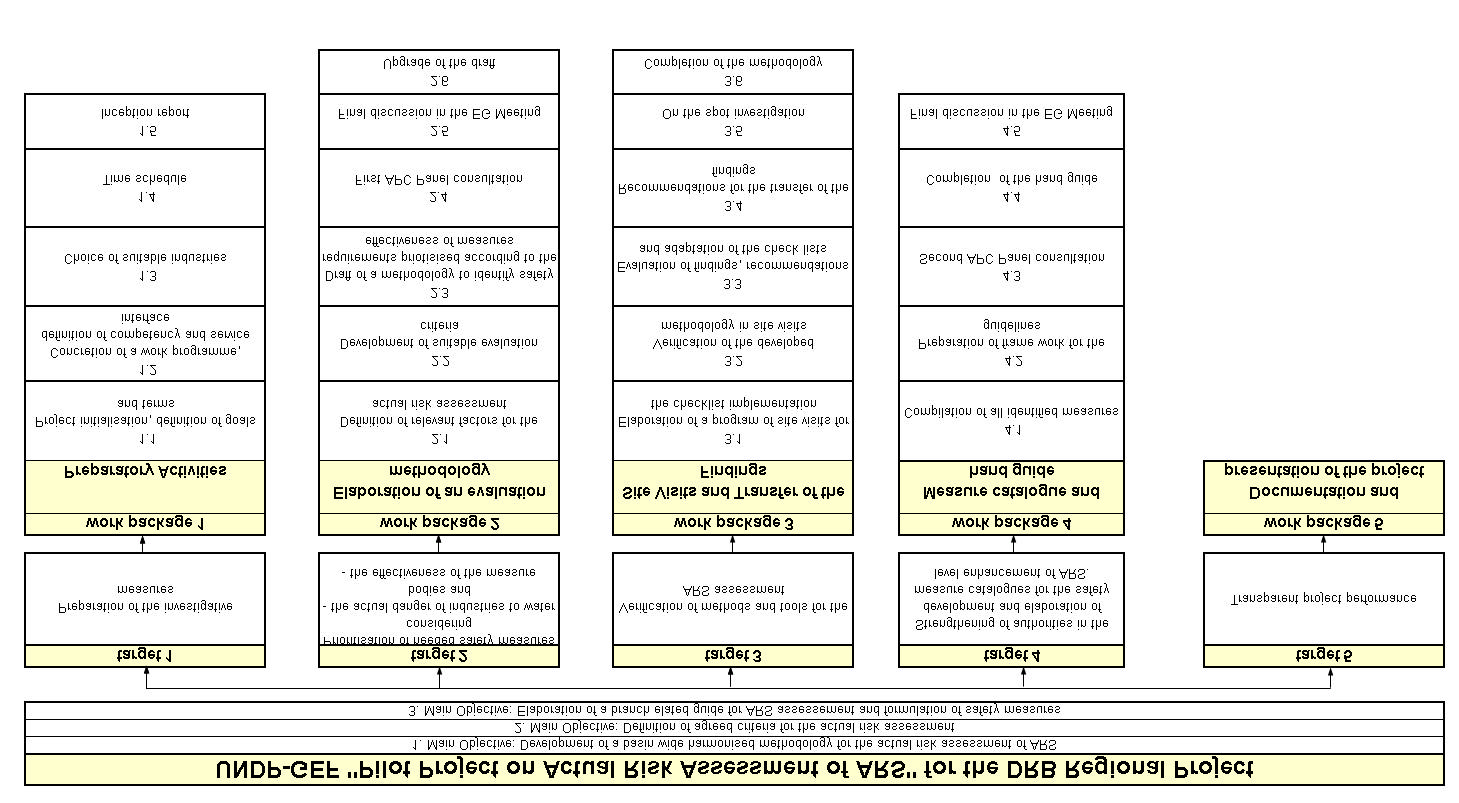
Keeping these project requirements in mind the following formulated targets should be met:
Target 1 - Preparation of the investigative measures
Target 2 - Prioritisation of needed safety measures considering
- the actual danger of industries to water bodies and
- the effectiveness of the measure
Target 3 - Development and verification of methods and tools for the ARS assessment taking in
consideration
· different development stages of industries
· different resulting measure catalogues for short medium and
long term measures
Target 4 - Strengthening of authorities in the development and elaboration of measure catalogues for
the safety level enhancement of ARS
The tasks arising from the formulated targets are shown in figure 1 including also the belonging tasks,
work packages and activities, which will be briefly described in the following.
Work package 1 Pre paratory activities
In this work package the project will be initialised. The target and goals of the work packages and
activities will be concreted according to the country specific needs. Additionally technical terms must
be defined and agreed to achieve a consistent terminology and to avoid, that the handbook, which has
to be developed, will be interpreted differently. It is also needed for the harmonisation of the whole
pilot project proceeding, which is aiming at a compliance of all activities and all products resulting
from the activities. Both tasks will be performed within activity 1.1.
Based on the concreted targets and goals the work program will be specified in detail in the framework
of the activity 1.2. The competence for every activity and for every industry to be investigated as far as
the interfaces between the activities has to be determined.
In parallel to the concretion of the work program suitable pilot industries and branches will be proved
and contacted for the project performance. With the chosen industrial partner the time schedule for the
project performance will be concretised for a harmonised project performance.
Work package 2 - Elaboration of an evaluation methodology
For the elaboration of an effective measure catalogue the actually needed safety measures have to be
identified, prioritised and specified. So it is very important to emphasise the relevant factors, which are
significantly determining for the specification of the actual danger (activity 2.1). It has to be proved if
aspects like
· safety standards of installations and management,
· lack of information in authorities about the industrial activity
· ratio of performed and needed safety measures
4
UNDP/GEF Danube Regional Project
· development stages of the industries
· and lack of information, know how transfer and training needs
are sufficient for the description of the actual danger of an industry.
In any case there is a need of an international and interdisciplinary discussion before suitable
evaluation criteria can be formulated and adopted (activity 2.2). Criteria could be for example
· present safety level in comparison to demanded safety level
· present information in comparison to demanded information level
· state of the art in safety techniques
· present legal requirements
· operational requirements
Based on the determined criteria a draft methodology for the identification of safety requirements
should be elaborated, which helps to prioritise measures according to the identified safety demands
and their effectiveness (activity 2.3). After a presentation in an APC Panel and finally discussion in an
EG Meeting the draft will be completed and the developed methodology has to be approved for the on
the spot investigation.
Work package 3 - Site Visits and Transfer of the Findings
Aimed at a verification of the developed methods and tools for the ARS assessment a program for the
site visits has to be elaborated, where checklists and afore mentioned methodologies should be
implemented (activity 3.1).
Site visits have to be performed (activity 3.2) to verify the checklists and methodologies with regard to
their practicability for the further actual risk assessment of ARS. After the visits an evaluation of the
findings will take place to recommend, adapt the tools (activity 3.3) and finally to complete the
developed methodology (activity 3.6)
In activity 3.4 all findings will be compiled and prepared for a structured measure catalogue and
recommendations about the actual risk assessment of ARS, which should be transferred to all relevant
authorities.
This catalogue should be combined with know how transfer through on site verification (activity 3.5)
performed by the national experts in their own country. The findings of this verification should deliver
the adjustment of the recommendations and of the measure catalogue, which should finally result to a
hand guide for experts.
Work package 4 - Measure catalogue and hand guide
In this work package findings and the know-how elaborated in the third work package will be
completed to a hand guide, that should help to strengthen the authorities in the development and
elaboration of measure catalogues for the enhancement of the ARS safety level.
Support for the Extension of Accident Risk Spots Inventory and Preventive Measures / Final Report
5
A frame work of guidelines will be elaborated for the hand book, which has to consider legislative,
technical and administrative aspects. The frame work, discussed and confirmed within the APC Panel
consultation, should serve as a basis to structure the handbook.
The draft of this hand guide should be implemented with regard to its practicability, in different
Danube countries, so that any country specifics could be considered in the implementation phase. The
amendment statements will be integrated in the draft of this hand guide before it will be discussed in
the final discussion in the EG Meeting.
Documentation and presentation of the project
Aiming at a transparent project performance all opportunities will be used to present the project results
in interim and final reports and in expert group meetings. Agreed products of the projects will be also
finally presented within the EG Meeting and other international meetings.
Expected results
After the project the following products should be available:
· Evaluation criteria for the ARS assessment in view to the actual danger
· Agreed methodology for the actual risk assessment and a harmonised proceeding of the
assessment
· Hand guide to identify the needed safety measures
Proposal for suitable industries
Suitable industries for the investigation could be oil refineries or mining industries. The following
countries would be useful to be involved in this project if oil refineries would be the subject of
investigation:
Germany (PCK Schwedt)
Croatia (Rijeka)
Romania (SN Petrom SA ??)
Duration of the project
Preparatory activities
2 month
Elaboration of an evaluation methodology
3 month
Site visits and transfer of the findings
6 month
Measure catalogue and hand guide
3 month
Sum
.14 month
6
UNDP/GEF Danube Regional Project
Conclusion
We would recommend to implement a pilot project for further investigations on safety measures at
exemplary risk spots in three countries with safety levels of different development stages, where the
Danubian countries will be the beneficiaries of international and multidisciplinary know how and
technology transfer.
Support for the Extension of Accident Risk Spots Inventory and Preventive Measures / Final Report
7
Figure 1: Structure of the proposed pilot project
Support for the Extension of Accident Risk Spots Inventory and Preventive Measures / Final Report
Annex 11
Pilot studies on know how transfer for the safety
measures of CS