






March 2007
Assistance for Bosnia & Herzegovina on WFD
Compliant Monitoring Towards WFD
compliant Monitoring in BiH
Final Report

AUTHORS
Nikolaus FLEISCHMANN
Towards WFD Compliant Monitoring in Bosnia and Herzegovina
page 3
TABLE OF CONTENT
1.
Summary...............................................................................................................5
2.
Introduction ...........................................................................................................7
3.
Proposal for a general strategy..................................................................................8
4.
Main activities.......................................................................................................11
4.2.
Monitoring and national methods for biological quality elements (BQEs) (see Gantt
chart page 24 from 1.1.1.1 to 1.1.2.2) .....................................................................11
4.2.1. Description and relevance.......................................................................................11
4.2.2. Implementation steps ............................................................................................11
4.2.3. Schedule..............................................................................................................13
4.2.4. Interrelations........................................................................................................13
4.3.
Monitoring and hydro-morphological quality elements (see Gantt chart page 24
from 1.2.1 to 1.2.4) ..............................................................................................13
4.3.1. Description and relevance.......................................................................................13
4.3.2. Implementation steps ............................................................................................14
4.3.3. Schedule..............................................................................................................15
4.3.4. Interrelations........................................................................................................15
4.4.
Development of analytical methods and interlaboratory comparison for the
assessment of priority substances and other substances chemical quality (see
Gantt chart page 24 from 1.3.1 to 1.3.4) ..................................................................15
4.4.1. Description and relevance.......................................................................................15
4.4.2. Implementation steps ............................................................................................17
4.4.3. Schedule..............................................................................................................17
4.4.4. Interrelations........................................................................................................17
4.5.
Intercalibration and monitoring (see Gantt chart page 24 from 1.4.1 to 1.4.4) ...............18
4.5.1. Description and relevance.......................................................................................18
4.5.2. Implementation steps ............................................................................................18
4.5.3. Schedule..............................................................................................................19
4.5.4. Interrelations........................................................................................................19
4.6.
Typology and monitoring (see Gantt chart page 24 from 1.5.1 to 1.5.2.3) .....................19
4.6.1. Description and relevance.......................................................................................19
4.6.2. Implementation steps ............................................................................................20
4.6.3. Interrelations........................................................................................................20
4.7.
Automated monitoring stations (see Gantt chart page 24 from 1.6.1 to 1.6.3) ...............20
4.7.1. Description and relevance.......................................................................................20
4.7.2. Implementation steps ............................................................................................21
4.7.3. Interrelations........................................................................................................21
UNDP/GEF DANUBE REGIONAL PROJECT
page 4
4.8.
Monitoring general physico-chemical parameters (see Gantt chart page 24 from
1.7.1 to 1.7.2) ......................................................................................................21
4.8.1. Description and relevance.......................................................................................21
4.8.2. Implementation steps ............................................................................................22
4.8.3. Interrelations........................................................................................................23
4.8.4. Additional remarks ................................................................................................23
4.9.
Monitoring database (see Gantt chart page 24 from 1.8.1 to 1.8.5) ..............................24
4.9.1. Description and relevance.......................................................................................24
4.9.2. Implementation steps ............................................................................................25
4.9.3. Interrelations........................................................................................................25
4.10. Improving pressure related information (see Gantt chart page 24 from 1.9.1 to
1.9.4)..................................................................................................................25
4.10.1. Description and relevance.......................................................................................25
4.10.2. Implementation steps ............................................................................................26
4.10.3. Interrelations........................................................................................................27
ANNEX I Check list of WFD compliant biological assessment methods (prepared by
Sebastian Birk, Feb 2007, provided by ICPDR)...........................................................29
ANNEX II determinants for TNMN surveillance Type II sites .................................................33
ANNEX III Priority (hazardous) substance list (COM 397 (2006) final) ...................................34
ANNEX IV other polluting substances with EU wide EQS (COM 397 (2006) final) .....................37
ANNEX V Recommendations resulting from the first workshop..............................................38
1.
Introduction .........................................................................................................39
2.
Objectives of the workshop on February 8.................................................................39
3.
Recommendations on Intercalibration.......................................................................40
4.
Recommendations on Hydromorphology ...................................................................41
5.
Recommendations on River Typology and Monitoring..................................................42
6.
Recommendations on capacities, strategies for monitoring ecological status...................43
7.
Specific recommendation to refine the operational monitoring of municipal
wastewater discharges ...........................................................................................44
8.
Development of national assessment methods for Biological Quality Elements................45
9.
Recommendation concerning Priority (hazardous) substances (P(h)S) and other
substances (oS) ....................................................................................................46
10.
General recommendation concerning monitoring costs................................................47
ANNEX VI General facts and considerations about WFD compliant monitoring Power
point presentation .................................................................................................48
ANNEX VII Discussion paper for the Monitoring workshop on February 8 in Sarajevo ...............52
1.
Introduction .........................................................................................................53
2.
ranking of issues ...................................................................................................54
3.
Proposals to be discussed .......................................................................................71
4.
Issues for discussion..............................................................................................72
NIKOLAUS FLEISCHMANN
Towards WFD Compliant Monitoring in Bosnia and Herzegovina
page 5
1. SUMMARY
The purpose of this assignment was to draft a way forward for the entire process towards WFD
compliant monitoring in BiH. Monitoring is not regarded as an isolated issue, links to and synergies
with other aspects of WFD implementation have been emphasised.
This document proposes a general strategy in chapter 1, describes technical and managerial
details for 9 main lines of activity in chapter 1 and visualises the time schedule and
interrelations in chapter 0. Annexes provide additional material and earlier documents.
The document shall constitute a common basis for all involved administrative bodies. It is meant as
a starting point, open for amendments and improvements during the implementation process.
Further development could lead to a national guidance paper on monitoring which serves as a tool
for harmonisation, training and knowledge management.
The general strategy
The general strategy in chapter 1 lists and justifies the following 5 general recommendations:
·
Emphasising surveillance monitoring in the first years
·
Stepwise development/refinement of operational monitoring
·
Parallel and synergistic development of typology, national BQE methods and
intercalibration (deviation from the general WFD time plan)
·
Intensive exchange of experience with EU-MS especially with regard to transferable rules
for monitoring design and for developing WFD compliant assessment methods
·
Intensive exchange of experience and cooperation on the Sava level especially with regard
to harmonising methodologies and sharing of international stations along the big rivers.
Main Activities
For each of the nine main activities a general description, implementation steps and interrelations
between these activities are given. 4 out of these 9 activities have been selected by the
beneficiaries for discussion during the first workshop. The consensus has been presented at the
workshop on Feb 28. This refers to
·
Intercalibration and Monitoring (see chapter 4.5)
·
Hydromorphology and Monitoring (see chapter 4.3)
·
River Typology and Monitoring (see chapter 4.6)
·
Strategies, Synergies and options for the assessment of ecological status (no separate
chapter, this topic has been integrated in other topics)
The topic `development of national methods for BQEs' - though not selected by the beneficiaries -
has also been discussed and developed during the workshop (see chapter 4.2).
The remaining activities have been integrated in this document in order to provide a complete
picture of upcoming tasks. These topics are:
·
Analytical methods, QA/QC for chemical quality (see chapter 4.4)
·
Automated monitoring stations (see chapter 4.7)
UNDP/GEF DANUBE REGIONAL PROJECT
page 6
·
Monitoring general physico-chemical determinants (see chapter 4.8)
·
Monitoring database (see chapter 4.9)
·
Improving pressure related information (see chapter 4.10)
Schedule / Roadmap
The roadmap displays how the objective of `WFD compliant monitoring' could be reached until 2009
and visualises interrelations between activities and whether they are part of operational or
surveillance monitoring. A further step could include an estimate for required person days for each
activity.
NIKOLAUS FLEISCHMANN
Towards WFD Compliant Monitoring in Bosnia and Herzegovina
page 7
2. INTRODUCTION
This document is the final report of the UNDP/GEF project "Assistance for BiH on WFD compliant
Monitoring" and it builds on previous papers that have been distributed within the frame of the
project "Assistance for BiH on WFD compliant Monitoring". These documents are:
·
Questionnaire V_2.doc, discussion document dealing with 13 monitoring issues, 9 pages
(has been integrated into Annex VII page 52)
·
WFD compliant monitoring part_I - Power point presentation (see Annex VI page 48
·
Workshop_I_sent, refined discussion document dealing with 13 monitoring issues, 18 pages
(see Annex VII page 52)
·
Workshop_results_1, Recommendations on selected aspects of WFD compliant monitoring, 9
pages (see Annex V page 38)
The contents of these documents are partly overlapping. Contents of earlier documents have been
integrated in later versions in order to make the development and the reasoning behind
transparent. The documents represent the whole consultation and stepwise refinement process.
The contents of the documents are the result of consultations and workshops with the
beneficiaries. Some topics have been selected by the beneficiaries for detailed discussions.
The direct effect of this project is represented by the graph below. The graph shows how the
beneficiaries have ranked the importance of 13 topics before and after the workshop on Feb 28. It
is obvious that the perceived importance of some topics has considerably changed.
9
Capacities, strategies and timetable for monitoring `ecological status'
12
+
List of monitoring stations and programmes versus a set of criteria to select
4
+
stations and programmes.
11
11
Capacities, strategies and timetable for monitoring `hydromorphological QEs'
10
-
Strategies / priorities to update and improve pressure related information for all
6
key water management issues
9
+
10
Interaction and synergies between activites for `typology' and `monitoring'
-
8
9
Capacities, strategies and timetable for monitoring `chemical status'
7
-
Strategies, options/resources to ensure the quality of monitoring data, including
12
Intercalibration/transboundary cooperation
6
-
Checklist for `Priority substances with EU wide EQS' elucidating 1) expertise 2)
2
equipment 3) personnel capacities
5
+
Ensuring comparability of results; technical co-ordination (methods, QC) and
3
harmonised implementation (see also topic 9)
4
+
January, before workshop
Mid term roadmap for monitoring (local/regional responsibilities, gaps and
5
February, after workshop
-
financing needs, ownership for implementation)
3
Development of national methods for `ecological status' and supporting QEs
9
(and monitoring of reference sites)
2
1
Task list and resources for the `technical monitoring group'
1
0
Decision making body (across catchments and entities) 0
0
2
4
6
8
10
12
14
Further this document takes the results of the CARDS RBM project into account. The most relevant
results for Monitoring are the technical reports 3a - d.
UNDP/GEF DANUBE REGIONAL PROJECT
page 8
3.
PROPOSAL FOR A GENERAL STRATEGY
This proposal aims at capitalising on the opportunities that are given by the specific state and
situation of BiH with respect to WFD implementation. While the objectives and technical results
shall comply with the WFD a deviation from the time schedule and order of activities can help to
use synergies and speed up the process.
The proposal for a general strategy is based on an analysis of the existing situation which was
subject of numerous meetings with representatives of BiH institutions and on the discussions
during the workshops on Feb 8 and on Feb 28 2007. It tries to synthesise technical needs and legal
obligations in an optimal way.
The overall aim of the strategy is to have a fully WFD compliant and efficient monitoring system by
2009. Efficiency will be reached by maximising the synergies with other aspects of WFD
implementation in BiH and with other actors on the regional, national and supranational level.
The strategy and the proposed activities are built on generic considerations about monitoring:
·
Monitoring will have clear consequences in terms of measures that need to taken. Flawed
data and high uncertainties compromise the cost effectiveness of the programme of
measures. The cost dimensions even of proactive monitoring are negligible as compared to
the costs of measures.
·
WFD compliant monitoring does not address impacted water bodies only but needs to
establish the (overall)status of all water bodies within (sub)catchments/territories.
·
The concept of ecological status requires that traditionally separated disciplines (and
measurement networks) like e.g. Hydrobiology, Hydrology, Chemistry need to be
coordinated and streamlined. Thus monitoring has become an interdisciplinary issue.
·
Monitoring network design is understood as a continuous (and maybe rule based) process,
accompanying the respective, relevant water management issues. Entirely static networks
are neither effective nor informative.
·
Comparability of status assessments largely depend on the positioning of stations relative
to the position, type and extent of pressures. A consistent and harmonised approach to the
delineation of `allowable zones of impact' is fundamental.
·
Long term monitoring of trivial phenomena and e.g. pressure-impact relations is not
informative and thus not cost-efficient. E.g. monitoring very large or very small point
source pressures will yield very predictable results and no added value for the water
manager.(see also chapter 0 page 44)
The proposal for general strategy considers the current status of development of the different WFD
modules (see chapter 1) that are needed for the establishment of a fully WFD compliant monitoring
network.
The general strategy is based on the following cornerstones:
1. Focus on surveillance monitoring in the first years.
Justification:
o Surveillance sites are important on the bilateral and international scale
o Surveillance monitoring does not need detailed information about pressures. It can
be designed without detailed pressure impact analysis at water body level.
o The parameter range is predefined (except PS and OS)
NIKOLAUS FLEISCHMANN
Towards WFD Compliant Monitoring in Bosnia and Herzegovina
page 9
o Surveillance monitoring does not require at first the delineation of water bodies (an
exercise that is not yet completed in BiH)
o Surveillance monitoring and development of national assessment methods for
biological quality elements have numerous synergies. Both can be addressed in
parallel.
o Surveillance sites are usually less costly than operational sites
o Surveillance monitoring can be implemented stepwise during a water management
cycle.
2. Stepwise development of operational monitoring.
Justification:
o Operational monitoring is flexible and can be focused on the state of development
of the Article 5 reports in terms of
Pressures that are already covered
Catchment scales (from 4000km2 to smaller scales)
o Dominant pressures organic point source pollution may be covered first because
Information about pressures from municipal and industrial point sources is
already existing (, though without link to water bodies)
Essential parts of the required assessment methods (saprobic index
delineated from benthic macroinvertebrates) are already existing
3. Parallel development and maximising the synergies (mainly by provident selection of
sites) between monitoring and the development of
o typology, especially the establishment of type specific references
o national methods for BQEs,
o data sets for intercalibration purposes
4. Capitalising on experiences from countries that have already
o implemented WFD compliant networks especially with respect to
grouping similar water bodies for operational monitoring
selection of parameters indicative for the respective pressures
rules for the location of monitoring sites in relation to the pressures
(considerations concerning the `allowable zone of impact')
approaches for the selection of priority and other substances that need to
be monitored
o developed WFD compliant assessment methods
by adopting the same sampling methods
Justification: Many aspects do not need local knowledge and do not depend upon the
national legislation, thus they are transferable and universally applicable. A proper
separation of local/regional and general aspects helps to avoid unnecessary double-work.
Further, many approaches of EU-MS have already been checked for WFD compliance.
5. Collaboration on the Sava catchment scale for issues which need local knowledge
and input
o Development of WFD compliant methods for large rivers (Sava, Drjina)
o Methodological approach to typology and hydromorphology
o Coordinating and sharing international monitoring sites for efficiency, quality
control and mutual learning
UNDP/GEF DANUBE REGIONAL PROJECT
page 10
Justification: Irrespective of EU (accession) status, Sava countries share the same
commitment for WFD implementation within the framework of Danube convention and
ICPDR. It is an opportunity that important rivers constitute borders between Sava
countries. Many other catchments are shared between two or more countries. Different
methodological approaches at these rivers are inefficient and may compromise the
objective of comparability. Shared stations and coordinated network designs at these rivers
significantly reduce the rather high costs for international stations and they may help to
share technical standards and improve the overall quality of monitoring.
NIKOLAUS FLEISCHMANN
Towards WFD Compliant Monitoring in Bosnia and Herzegovina
page 11
4. MAIN
ACTIVITIES
4.1.1.1.
Fourth level heading
4.2.
Monitoring and national methods for biological quality
elements (BQEs) (see Gantt chart page 28 from 1.1.1.1 to
1.1.2.2)
4.2.1. Description and relevance
Biological quality elements are the core of WFD compliant monitoring of ecological status. The
development of national methods or the adaptation of existing methods to the specific regional
conditions is of utmost importance for comparability and consistency of water management at
catchment scale. It should be kept in mind that the national BQE methods are not only a formal
requirement but they are the new benchmark for almost all aspects of future water management
(except the assessment of chemical status). Therefore, the development and continuous
improvement of assessment methods needs specific attention.
BQEs should not be seen as an additional costly requirement but as a very efficient way to monitor
the status of surface waters. Efficiency is rooted mainly in the integrative character of BQEs. BQEs
integrate both, time and pressures while traditional grab samples represent only a certain property
of the water at a certain time. In some cases BQEs also reflect the situation along a river stretch.
All BQEs are required for surveillance monitoring. In operational monitoring it is required to
monitor the most indicative quality element for the respective pressure.
riv
lakes .
Transi.
coastal
e
There is a common understanding about the
r
s
minimum criteria for WFD compliance. These
criteria are either laid down in the directive or
Benthic Invertebra
I
te Fauna
F
in CIS guidance papers. The ICPDR has
Phytoplankton
presented a checklist for these minimum
Macrophytes and Phytobenthos
o
criteria (see ANNEX I)
Fish Fauna
n
Macroalgae
The table on the left shows the BQEs that
Angiosperms
need to be assessed for different types of
water resources.
Each BQE method can be divided I two steps:
·
Sampling method
·
Evaluation method
The sampling method is oriented towards representativity and does not need to be developed at
the national level, whereas the evaluation method needs to account for the specific regional
conditions (reference status, typology, ...). Usually two sampling methods need to be adopted
rivers, for large and for wadable rivers as well as for lakes.
4.2.2. Implementation
steps
UNDP/GEF DANUBE REGIONAL PROJECT
page 12
1. Decision about the sampling methods to be used (see Gantt chart on page 28 step 1.1.1.1)
It is recommended to use commonly accepted well defined or standardised methods for
sampling. Therefore, this step consists in screening the available methods and finding a
consensus between the four agencies in BiH for the most appropriate.
2. Inventory of sites for the method development (see Gantt chart on page 28 step 1.1.1.2)
The inventory of sites for the development of methods should include different combinations of
2.1. status (I-V)
2.2.
pressures (first estimate: 3 chemical pressures (organic, nutrient, PS), 4-5
hydromorphological pressures (continuity, embankments and other morphological
pressures, hydro-peaking, residual flow)
2.3. river/lake types (first estimate: 5-10 rivers, <5 lakes)
It can be concluded that the combination of 5 status classes with 7-8 different pressures
and 10-15 surface water types would require more than dozens of sites. The selection of
the most appropriate sites at a reasonable number will need to be based on expert
judgement and should be a joint exercise of experts of all agencies in order to account for
the different natural conditions in both entities (RS rather downstream and big rivers, Fed
more small and upstream areas) and catchments (Danube, Mediterranean).
3.
Adoption
of
species
lists
(see Gantt chart on page 28 step 1.1.1.3)
There are minimum requirements for the number of species that need to be taken into account.
With a view to
3.1. upcoming intercalibration tasks,
3.2. the long river stretches along the borders to Croatia and Serbia
3.3. and the fact that all countries share the same ecoregion 5 (Dinaric-West-Balkan)
it might be advantageous to share this task with the neighbouring countries.
Duration: 2 months
4. Training of an appropriate number of experts for sampling (see Gantt chart on page 28 step
1.1.1.4)
Each BQE requires specific sampling methods and sampling equipment.
There are two possibilities for training. Either a separate team of experts will be trained for
each BQE or one team of experts will be trained for all BQEs. While the first option helps to
prioritise selected BQEs the latter would help to perform sampling campaigns in an efficient
way and to develop all methods in parallel.
5. Sampling campaigns (see Gantt chart on page 28 step 1.1.1.5)
Successful sampling needs to be properly planned in order to ensure comparability of the
samples. Therefore sampling should take place in the most appropriate season (differs for
different BQEs) and in comparable hydrologic and climatic conditions. Every external
disturbance will increase the variability and "noise" in delineating the desired indices.
One sample at each site will not be sufficient for the delineation of robust metrics. At least at
some sites all biological quality elements should be assessed (e.g. at surveillance sites).
Duration: depends on the number of sites for each BQE and on the respective BQE. A rough
estimate is as follows:
5.1. Benthic Invertebrate Fauna (BIF): 3 sites/day and sampling team
5.2. Fish: 2 sites per day and sampling team (depends before all on the size of the river)
NIKOLAUS FLEISCHMANN
Towards WFD Compliant Monitoring in Bosnia and Herzegovina
page 13
5.3. Macrophytes - Phytobenthos and Phytoplankton: 4 sites/day and sampling team
6. Development of the multimetric indices
(see Gantt chart on page 28 step 1.1.1.6)
Hering, D., Feld, C.K., Moog, O. and Ofenbock, T., 2006. Cook book for the development of a
Multimetric Index for biological condition of aquatic ecosystems: Experiences from the
European AQEM and STAR projects and related initiatives. Hydrobiologia 566, 311-324.
4.2.3. Schedule
Due to the specific priority pressures in BiH, organic and nutrient pollution, it is an option to start
the development of a method for Benthic Invertebrate Fauna (BIF) in 2007-2008 followed by
Phytobenthos /plankton and fish metrics in 2008-2009.
With a view to the implementation steps which were listed above the first BIF samplings could start
in autumn 2007 and be complemented by a second campaign in autumn 2008. The subsequent
delineation of metrics could be finalised by the end of 2008. It has to be kept in mind that the
delineation of an index for organic pollution is an easier task than other BIF based metrics e.g.
general degradation or hydromorph. pressures as the latter require consistent data about
pressures.
2007-2008: Benthic Invertebrate Fauna
2008-2009: Macrophytes & Phytobenthos, Phytoplankton and fish
4.2.4. Interrelations
For the development of BQE methods the typology needs to be completed including the delineation
of reference conditions. Further a method for the prequalification of monitoring sites is needed.
Sites for the delineation of metrics can be shared with
·
Typology
·
Intercalibration
·
Surveillance Monitoring
4.3.
Monitoring and hydro-morphological quality elements (see
Gantt chart page 28 from 1.2.1 to 1.2.4)
4.3.1. Description and relevance
Hydromorphological quality elements (HM-QEs) play an important role for the risk assessment and
serve as a supporting parameter for ecological status. HM-QEs are an important input for the
typology, the development of national methods for BQEs (see 4.2) and for cause effect
relationships for hydromorphological pressures.
Countries which have not performed basic eco-morphological assessments and classifications for all
rivers may consider to cover them within the monitoring system. Not as a supporting parameter for
selected monitoring stations but to achieve the basic classification for typology etc. This aspect is
mentioned within the HYMO Issue Paper as a gap of the current data basis.
There are various hydro-morphological quality elements but it would be important to target the
effort specifically towards those required by the directive. These are
UNDP/GEF DANUBE REGIONAL PROJECT
page 14
·
Hydrological regime
o quantity and dynamics of water flow
o connection to groundwater bodies
·
River continuity
·
Morphological conditions
o river depth and width variation
o structure and substrate of the river bed
o structure of the riparian zone
4.3.2. Implementation
steps
While Hydrology is a continuous task, Morphology needs to be assessed only once during a RBM
cycle.
During the workshop on Feb 8 in Sarajevo three strategic approaches were presented and one was
recommended on Feb 28 during the second workshop. The hybrid approach defines a priori a mid
term masterplan for hydrology but more important for morphology in terms of rivers/river
stretches and methods and parameters. This masterplan guarantees consistency but it will be
implemented stepwise based on a demand driven approach. The reasons for this recommendation
are
o Harmonised methods
o Consistent data sets
o Financial burden distributed over several years
The following implementation steps are suggested (the list below includes all aspects, including
those that are already finalised)
·
Decision about methodology (see Gantt chart on page 28 step 1.2.1)
o Morphology (done 1)
o Hydrology
·
Development of the masterplan (see Gantt chart on page 28 step 1.2.2)
·
Training (see Gantt chart on page 28 step 1.2.3)
·
Implementation (see Gantt chart on page 28 step 1.2.4)
o Assessment of rivers with catchment > 2.500 km2
o Assessment of rivers with catchment > 1000 km2
o Assessment of rivers with catchments < 1000 km2
1 During the workshop in Sarajevo on Feb 8 it was stated that there is already an agreement on the
methodology for Morphological conditions and that only the decision for a method for Hydrology is missing.
NIKOLAUS FLEISCHMANN
Towards WFD Compliant Monitoring in Bosnia and Herzegovina
page 15
4.3.3. Schedule
·
Decision about methodology
-
6.2007
·
Training - 12.2007
·
Rivers with catchment > 4000 km2
-
6.2008
·
Rivers with catchment > 1000 km2
-
12.2008
·
Rivers with catchments < 1000 km2
-
6.2009
4.3.4. Interrelations
The masterplan should account for the contributions of Hydromorphology to
·
Pressure impact assessment
·
Abiotic typology
·
Delineation of pressure-impact relations (in the frame of validating and supplementing the
risk assessment methodology)
·
Ecological status assessment in the frame of surveillance and operational monitoring (of
hymo pressures)
4.4. Development
of
analytical methods and interlaboratory
comparison for the assessment of priority substances and
other substances chemical quality (see Gantt chart page 28
from 1.3.1 to 1.3.4)
4.4.1. Description and relevance
The Water framework directive together with decision 2455/2001 (list of 33 substances) and COM
2006_398 (EQS) and the QA/QC Commission decision establish the framework for assessing the
chemical quality.
This topic has been addressed within the CARDS RBM project extensively and several processes
and trainings have already started. Therefore the following is restricted to selected aspects that are
pending and have not been part of the CARDS RBM project.
Monitoring of chemical quality can be very expensive. Therefore it was proposed to have two
strategic approaches for the design of the network to monitor chemical quality:
·
Probabilistic `random' approach for site selection combined with deterministic approach for
parameter selection the surveillance approach
·
Deterministic approach for sites and parameters the operational approach
Probabilistic approach:
UNDP/GEF DANUBE REGIONAL PROJECT
page 16
The probabilistic approach is considered as a `search' strategy to complement the regular
deterministic approach. The search is based on two criteria for selection of parameters and a
random site selection. The criteria for determinant selection are considered to reflect the
probability to detect a substance. These criteria are:
·
`Detectability', described as the ratio between the EQS and the LOD. Large numbers
indicate `easily detectable' and vice versa
·
Degradability; a half quantitative criterion that describes whether a substance is refractory
and shows conservative behaviour or whether t is rather easily degradable. Conservative
substances need only limited sites while degradable substances need to be monitored in
more locations or closer to the source.
This approach helps to reduce the determinant list in a target oriented transparent way. It is
targeted at substances where the emission data are poor which is a weakness of the deterministic
approach and possibly also at emerging substances not yet contained in the PS/OS lists.
Deterministic approach:
Due to the high analysis cost it is important to select the sites and parameters carefully. The
directive requires to monitor PS where they are discharged into the subbasin and other substances
where they are discharged in significant quantities. Thus, for a proper design of the monitoring
network it is needed to know the following
·
which PS are discharged
·
where PS are discharged
·
which other substances are discharged in which quantities
Further a criterion for the definition of the term `significant quantity' is needed to design the
monitoring of other substances.
As there is no comprehensive emission inventory available for all potential sources in BiH some
suggestions were made.
·
Adapt `unit emission' approaches from other countries for diffuse agricultural and municipal
point and diffuse sources
·
Collect individual information on large industrial sources
The strategic approach towards a first emission inventory for priority substances and other relevant
substances which was outlined above can be complemented by one monitoring campaign. This
monitoring campaign has the objective to give an overview of the PS/OS situation even before the
emission inventory and the method development is finalised. Such a campaign would be synergetic
with the monitoring requirements of the TNMN network and complement it with information needed
for the national level. The proposal is to complement the 5 international stations with 5-10 national
surveillance sites. The determinant list should be identical with the TNMN list. The analysis would
have to be performed by an external contractor as the BiH laboratories are not yet in the position
to measure all determinants.
The data collected with such a one year campaign will help to
·
Redesign the PS/OS programme for surveillance sites
·
Validate the emission inventory
·
Fulfil international commitments
The CARDS RBM project proposed a list of parameters that need to be developed and validated in
the responsible laboratories in the country. This list is ranked according to analytical methods. Thus
it reflects the laboratory perspective. A complementary approach could be based on the emission
NIKOLAUS FLEISCHMANN
Towards WFD Compliant Monitoring in Bosnia and Herzegovina
page 17
inventory which was outlined above. This inventory could be used to rank the parameter
development of priority of and other substances according to their importance.
The ranking of determinants will reveal how often a substance needs to be analysed. For rare
substances the frequencies might be less than 10 analyses per year per laboratory. In the light of
these frequencies it should be evaluated whether all methods for each and every determinant need
to be developed and validated in all 4 relevant laboratories of BiH. Alternatively synergetic
analytical capacities may be developed and contribute to the efficiency of the monitoring.
4.4.2. Implementation
steps
·
Design and implementation of the proposed PS/OS monitoring campaign by 2008 (see
Gantt chart on page 28 steps 1.3.1.1-1.3.1.2)
·
Probabilistic approach
o Establish criteria `detectability', degradability
o Site selection
·
Deterministic approach (see also Article 4 Com 397 (2006) final):
o Collect `unit emission' data from other countries
o Inventory of relevant diffuse agricultural and municipal sources
o Inventory of large industrial sources.
·
Development and validation of methods and QA/QC scheme according to the proposals
made by the CARDS RBM project (see Gantt chart on page 28 step 1.3.2)
o Ranking of importance of priority substances and other substances with the help of
a draft emission inventory based on `unit emissions' adapted from other countries.
o Re-grouping of determinants and adaptation of the time plan and deadlines
according to the monitoring needs of the WFD
o Stepwise integration of newly developed determinants into the ongoing monitoring
programmes according to the proposal made by the CARDS RBM project.
·
Development of the probabilistic approach (see Gantt chart on page 28 step 1.3.3)
·
Development of the deterministic approach (see Gantt chart on page 28 step 1.3.4)
4.4.3. Schedule
·
PS/OS monitoring campaign for international and 5-10 national surveillance sites
-
1.2008
·
Establishment of the probabilistic approach
- 3.2008
·
Establishment of the deterministic approach
- 1.2009
·
2 phases for development/validation (analytical methods)
- 1.2008
-
1.2009
4.4.4. Interrelations
·
An emission inventory like outlined above and in compliance with Article 4 of COM 397
(2006) for the purpose of chemical monitoring is also useful for the pressure impact
assessment for catchments smaller than 4.000km2.
UNDP/GEF DANUBE REGIONAL PROJECT
page 18
4.5.
Intercalibration and monitoring (see Gantt chart page 28
from 1.4.1 to 1.4.4)
4.5.1. Description and relevance
Comparability and consistency of monitoring results are one essential element of the quality of
monitoring data. In general comparability and consistency have several dimensions:
1. over
time
2. within
(sub)catchments
3. across
(sub)catchments
4. across administrative borders
5. across different assessment methods
Intercalibration (IC) deals with the comparability of classification results of high, good and
moderate status of biological quality elements between countries (see bullet point 4 above). These
classification results should correspond to comparable levels of ecosystem alteration. It should be
kept in mind that a precondition for valid classification results is the availability of national
assessment methods for BQEs.
4.5.2. Implementation
steps
·
Establishment of an intercalibration network. (see Gantt chart on page 28 step 1.4.1)
o Covers sites that are of high, good and moderate status
o Covers different types and pressures
o Selection of sites may be based on expert judgement, no need for national BQE
methods
·
Participating in the geographical intercalibration group (GIG). It is a formal requirement,
that national representatives are integrated in these group(s). (see Gantt chart on page 28
step 1.4.3)
·
Application of national assessment methods at the IC-sites. This task can be done in
parallel to the stepwise development of national assessment methods (see chapter 4). The
proposed sequence is
o Benthic macroinvertebrates (see Gantt chart on page 28 step 1.4.2.1)
Sampling
Evaluation of data, delineation of EQR (see Gantt chart on page 28 step
1.4.4.4)
o Macrophytes & Phytobenthos, Phytoplankton and fish (see Gantt chart on page 28
step 1.4.2.2)
Sampling
Evaluation of data, delineation of EQR (see Gantt chart on page 28 step
1.4.4.4)
NIKOLAUS FLEISCHMANN
Towards WFD Compliant Monitoring in Bosnia and Herzegovina
page 19
4.5.3. Schedule
·
Intercalibration network by 6.2007
·
Participation in GIG meetings scheduled for 2008
·
Collection of data from the IC sites synchronised with the development of national BQE
assessment methods
o 2007-2008 benthic invertebrates
o 2008-2009 other BQEs
·
Data evaluation
o 2008 benthic invertebrates
o 2009 other BQEs
4.5.4. Interrelations
Typology (see chapter 4.6) and some pressure information (see chapter 4.10) is a precondition for
the establishment of an IC-network
National assessment methods for BQEs (4) are required for the assessment of status at IC-sites
4.6.
Typology and monitoring (see Gantt chart page 28 from
1.5.1 to 1.5.2.3)
4.6.1. Description and relevance
Typology is a precondition for water body delineation and no WFD compliant monitoring can be
designed or implemented without water bodies. Although these tasks are designed as subsequent
steps in the directive they have some common requirements which could be addressed at the same
time in order to use synergies and speed up the process.
Typology and surveillance monitoring may share some sites (reference sites with a surveillance
monitoring station). At these sites the assessment of all biological, hydromorphological and
general-physico chemical quality elements is required and may be shared. A more detailed
description of common requirements for monitoring and typology development is given under point
0 on page 61 ( chapter 0 Annex V).
The most important criteria for the designation of surveillance monitoring sites do not include type-
specific information. Thus, surveillance sites may be selected even before the abiotic typology is
completed.
The most important criteria for the selection and grouping of operational monitoring sites do
include type specific information. Operational monitoring relates specifically to water bodies at risk
and the selection of sites may include grouping of similar water bodies. Typology is one criterium
for grouping. Thus operational sites should better be selected after completion of the abiotic
typology.
UNDP/GEF DANUBE REGIONAL PROJECT
page 20
4.6.2. Implementation
steps
Abiotic typology is currently being performed in BiH. Therefore the following focus on the
delineation of reference conditions and the synergies of this exercise with monitoring tasks.
·
Development/decision about methodology and optional factors (see Gantt chart on page 28
step 1.5.1)
·
Delineation (and validation) of reference conditions for
o biota, (see Gantt chart on page 28 step 1.5.2.1)
o hydromorpological (see Gantt chart on page 28 step 1.5.2.2) and
o general physico-chemical quality elements
(see Gantt chart on page 28 step
1.5.2.3)
(overlap with surveillance monitoring of reference sites)
·
Grouping of water bodies for the purpose of designing operational monitoring (see Gantt
chart on page 28 step 1.5.3)
o Delineation of water bodies based on abiotic typology
o Grouping of water bodies based on river types
o Subdivison of groups of operational sites according to identified pressures
4.6.3. Interrelations
Typology includes the delineation of type specific reference conditions for the development of WFD
compliant assessment methods.
Typology is needed for the delineation of water bodies and for grouping of water bodies for the
purpose of operational monitoring.
Typology and the delineation of type specific reference conditions is needed for the development of
WFD compliant assessment methods.
4.7.
Automated monitoring stations (see Gantt chart page 28
from 1.6.1 to 1.6.3)
4.7.1. Description and relevance
Independent from WFD implementation activities BiH has developed considerable resources for
continuous monitoring. The main issue is to analyse whether these instruments can play a role
within WFD compliant monitoring.
The inventory of automatic stations shows that there are different types of instruments with
different parameter ranges. The following suggestions are made under the basic assumption that
the right type of existing automatic station is applied for the respective purpose.
1. Continuous observation of a selection of the general physico chemical parameters and
selected hydrological quality elements (quantity and dynamics of flow) which, however,
needs to be complemented by manual sampling of e.g. nutrients which are not covered.
2. Backbone for alarm systems that need to be complemented by more sophisticated
instruments in the future.
NIKOLAUS FLEISCHMANN
Towards WFD Compliant Monitoring in Bosnia and Herzegovina
page 21
3. Investigative monitoring for the identification of polluters (point sources). Analysis of the
time patterns of determinants indicative for the respective pollution type (e.g. oxygen
depletion, conductivity, diurnial oxygen variation due to excess photosynthesis)
4. Observation of reference sites in order to complement the establishment of type specific
reference conditions, to get a detailed assessment of the reference values for physico-
chemical determinants.
4.7.2. Implementation
steps
·
Selection of the most appropriate sites
o Establishment of criteria and list of sites that may meet the criteria (see Gantt
chart on page 28 step 1.6.1.1)
o Selection of sites according to established priorities (see Gantt chart on page 28
step 1.6.1.2)
·
Establishment of a harmonised database for all instrument types and across administrative
units. Issues for such a database are inter alia (see Gantt chart on page 28 step 1.6.2)
o Consistent names and units for determinants
o Consistent time intervals and synchronisation of instrument watches
o Clearly defined metadata
o Collection of missing metadata (rating curves for hydrologic profiles, coordinates,...)
·
Development of data evaluation methods and conventions (e.g. standard graphs,
aggregation levels,..) (see Gantt chart on page 28 step 1.6.3)
4.7.3. Interrelations
The concept for automated monitoring is directly linked with chapter 4.8 about monitoring general
physico-chemical determinants.
4.8.
Monitoring general physico-chemical parameters (see Gantt
chart page 28 from 1.7.1 to 1.7.2)
4.8.1. Description and relevance
Legal basis:
Annex 5 WFD names the following as general physico-chemical quality elements in support of the
biological elements:
·
Transparency (lakes only)
·
Acidification status (lakes only)
·
Thermal conditions
·
Oxygenation conditions
·
Salinity
·
Nutrient conditions (Annex 5 1.1.1), nutrient status (Annex 5 1.3.4)
The concrete interpretation of these parameters in terms of determinants, methods (and
frequencies) is left open. E.g. which determinants are included in `nutrient conditions'? or
UNDP/GEF DANUBE REGIONAL PROJECT
page 22
`oxygenation conditions' can not be assessed in a reasonable way by spot samples with a frequency
of 4/y. If these general physico-chemical quality elements shall deliver meaningful information it is
essential to develop a basic and consistent concept in terms of determinants, methods, frequencies
etc.
There is only an explicit requirement to monitor `all' general physico-chemical QEs within
surveillance monitoring, though without further defining what is meant by the term `all'.
Annex 2 and implicitly Annex 5 require the determination of type specific physico-chemical
conditions at reference status. Also here no clear advice about determinants and frequencies is
given.
Within operational monitoring general physico-chemical parameters may be included as supporting
QE for biological QEs. The guidance on chemical monitoring (chapter 4.5.3) reconfirms this role.
Technical considerations:
General physico-chemical quality elements may contribute useful information as
·
support for interpretation of biological assessments
·
direct pressure indicators
·
descriptors of type specific characteristics
In order to use this potential there is a need for developing an approach which differs considerably
from the minimum legal requirements of the WFD. If such an approach is not developed it is better
to restrict their assessment to the absolute minimum according to the legal requirements.
4.8.2. Implementation
steps
The following list describes an approach to the assessment of general-physico-chemical
determinants that is more comprehensive than the minimum requirements of the WFD.
·
Development of a strategic approach including
o Common understanding of the role of general physico-chemical determinants (see
Gantt chart on page 28 step 1.7.1.)
Delineation of reference conditions (obligatory) and subsequent analysis of
the discrimination power or significance of differences between different
types of rivers/lakes. Such an exercise may either be based on
·
Independent grab samples i.e. delineation of statistical distributions
of the respective determinants or on
·
Time series i.e. description of the dynamics and interrelations of
the respective determinants
It should be pointed out that flow measurements are a necessary to
complement both approaches
Supporting quality elements within surveillance monitoring (obligatory) and
operational monitoring (optional)
o Concrete list of determinants to be included and corresponding frequencies and
methods. As an example this list could take the following form
temperature, oxygen, conductivity, pH (and flow) with `high' frequency
based on
·
Spot samples at a certain time during the day or
·
Daily average values based on grab samples
NIKOLAUS FLEISCHMANN
Towards WFD Compliant Monitoring in Bosnia and Herzegovina
page 23
·
Diurnial variation based on continuous records (see also chapter
4.7)
`Nutrients' comprises: P: PO4 and total P, N: NH4, NO3 and total Nitrogen
with monthly intervals
Acidifcation comprises: pH and acid capacity
Oxygenation conditions is understood as oxygen balance (consumption,
reaeration) and comprises:
·
oxygen consumption (BOD, D(T)OC) with monthly intervals and
·
oxygen concentration (saturation)
o Methodology for data storage, metadata, data aggregation and evaluation. This
could include the following issues:
Data base and interfaces to other formats and storage devices (e.g. data
loggers, excel sheets, plain text tables, etc)
Metadata: Calibration protocols for electrochemic probes, Information
about chemometric properties of methods, etc...
Data aggregation: arithmetic, flow weighed, boxcar or intermittent
averaging, etc...
·
Develoment of a concrete programme (see Gantt chart on page 28 step 1.7.2.):
Sites and types of samples that should be covered by the enhanced programme for general
physico-chemical determinants. Such a concrete programme could take the following form:
o Obligatory requirements:
All surveillance sites with `all' general physico-chemical determinants. A
more detailed approach could differentiate the following:
·
`Normal' surveillance sites (purpose: probabilistic assessment of the
`overall status') to be monitored for 1 year in a 6 years period
·
`Reference' sites and sites for the assessment of the effects of
`widespread anthropogenic uses' to be monitored every second or
every year for the first 6 year cycle (synergy between assessment
of long-term natural trends and delineation/improvement of
reference conditions for typology)
A selection of `reference sites' if they are not surveillance sites
o Additional options for an enhanced programme
Operational sites if delineation of ecological status of water bodies
(possibly) at risk is the purpose
Operational sites if `chemical' status is the purpose
4.8.3. Interrelations
Delineation of type specific reference conditions (chapter 4.6)
4.8.4. Additional
remarks
Some countries have decided to understand the general physico-chemical quality elements as
fundamental for any sample. Therefore these quality elements are part of any biological or
chemical assessment of water quality. Such an approach might be justified due to the marginal
UNDP/GEF DANUBE REGIONAL PROJECT
page 24
cost of these parameters and due to the fact that they may be useful to continue time series as
they have always been part of any water quality assessment.
4.9.
Monitoring database (see Gantt chart page 28 from 1.8.1 to
1.8.5)
4.9.1. Description and relevance
The development and maintenance of an appropriate monitoring data base (and the corresponding
user interfaces) is often considered to be less important than other elements of monitoring.
Nevertheless it should be emphasised that the data base is the backbone for any data evaluation
and reporting and an important tool to establish a consistent terminology. The development of a
database requires considerable effort on the other hand it allows for significant savings in terms of
time needed for data preparation, visualisation and reporting.
There is a commonly acknowledged need to adapt data storage and handling procedures to the
needs of the WFD compliant water management, especially under the aspect of `integration' of
different disciplines and scales. Currently at different scales numerous databases and `Water
Information Systems' are under development. The European WISE system is complemented by
information systems with river basin, national or sectoral (e.g. shipping) scales.
Thus a monitoring database has to be understood as part of a wider environment for water
management, both, in terms of scaling as well as in terms of other aspects of water management
(e.g. establishment of programmes of measures, risk assessment, reporting, etc.). It should be
clear from the beginning that numerous interrelations between different systems need to be taken
into account in order to capitalise on synergies and avoid double work. For example synergies or
common issues are possible
·
for all geographical aspects (common GIS / geographical reference basis)
·
between Annex 2 and Annex 5 related to information about pressures and risk of
failure to achieve good status
·
typology and grouping of water bodies for operational monitoring
·
and many more ...
However, the core tasks of the monitoring database are:
·
support the design and implementation of monitoring plans
·
data entry, storage, aggregation, evaluation and visualisation of results
·
integrate, replace or harmonise different former or still existing databases (e.g. hydrology,
national/nternational water quality)
·
allow for data queries and flexible filtering in order to optimise data accessibility
·
reporting about the monitoring network design
·
reporting about monitoring results as required
o by national water act or
o WFD Annex 5 chapter 1.4 for inland surface waters (and 2.2.4, 2.5. for
groundwater) and
o other international obligations (e.g. EIONET, TNMN, protected areas, etc ..)
NIKOLAUS FLEISCHMANN
Towards WFD Compliant Monitoring in Bosnia and Herzegovina
page 25
4.9.2. Implementation
steps
·
Development of an appropriate data model (see Gantt chart on page 28 step 1.8.1.) based
on
o Existing data and metadata (e.g. from different administrative units)
o Future needs according to national water act, WFD and other legal documents
The data model might be visualised and discussed on the basis of an entity-
relationship diagramme
·
Decision about hardware architecture and responsibilities (e.g. distributed client server
architecture, backup system, etc.) (see Gantt chart on page 28 step 1.8.2.)
·
Development of system specifications in terms of (see Gantt chart on page 28 step 1.8.3.)
o Interfaces and interoperability with other systems (e.g. DANUBE GIS, BiH database
for automatic stations, WISE?)
o User interface for data entry and data queries
o Underlying geographical reference / GIS
o Data preprocessing, evaluation and visualisation
·
Validation of data
·
Procedures or tools for plausibility assessment
·
Merging data from different subsystems, with different time and
geographical scales, inter- extrapolation rules
·
Statistical procedures, aggregation, averaging and time series analysis and
the corresponding graphs
·
...
·
Coding, Programming either by internal experts or via tender procedure (see Gantt chart
on page 28 step 1.8.4.)
·
Training
of
responsible
staff
(see Gantt chart on page 28 step 1.8.5.)
4.9.3. Interrelations
Interrelations do exist with any other monitoring issue and with many other aspects of WFD
implementation (e.g. impact assessment, intercalibration, programme of measures, ..). For every
topic the data aspect has to be taken into account.
Therefore a timely establishment of the database is of crucial importance in order to avoid losses of
data, information and thus performance.
4.10. Improving pressure related information (see Gantt chart
page 28 from 1.9.1 to 1.9.4)
4.10.1. Description and relevance
Information about pressures is the basis for the design of operational monitoring and for
investigative monitoring on specific issues. In the international context it supports the designation
of TNMN surveillance type II stations.
UNDP/GEF DANUBE REGIONAL PROJECT
page 26
Better information about pressures ensures a comprehensive and targeted approach to operational
monitoring. As the currently available information is poor it was recommended to emphasise
probabilistic surveillance monitoring and subsequently upgrade operational monitoring as soon as
pressure information has been improved.
Further the establishment/planning of measures is largely based on detailed knowledge about
pressures, while the monitoring is status or impact oriented and often does not contribute too
much to the technical design of measures.
Information about pressures can be divided in two main aspects:
·
Types and magnitude of pressures and their respective descriptors (e.g. height of an
continuity interruption)
·
Scales and timing of the the pressure assessment (e.g. 4000km2 by 2006, 1000 km2 by
2007, 100km2 by 200x, 10km2 by 20xx)
4.10.2. Implementation steps
·
Establishment of a catalogue of pressures including e.g. (see Gantt chart on page 28 step
1.9.1)
o Types of pressures
Hydrologic
·
Residual flow, Abstraction
·
Hydro-peaking
·
Rithralisation, Potamalisation
·
Disturbance of groundwater exchange
·
...
Morphologic
·
Sealing of
o river bed
o riparian zone
·
morphologic alteration of
o slope
o river width / depth
o length
Pollution
·
Deagradable organic pollution (oxygen regime)
·
Deagradable nutrient pollution (oxygen depletion due to
nitrification)
·
Nutrients as a local pressure with potential local eutrophication
impact
·
Nutrients as pressures on larger scales with impacts on
downstream water bodies and loads to the marine environment
·
Priority (hazardous) substance emissions
·
Emissions of other substances for which national EQS apply
·
NIKOLAUS FLEISCHMANN
Towards WFD Compliant Monitoring in Bosnia and Herzegovina
page 27
o Descriptors for the magnitude of the pressure
o Assessment of knowledge about pressure impact relations
As many EU member states have already developed and applied their methodology
for pressure assessments it is recommended to capitalise on this experience and
concentrate on the adaptation to specific local conditions. An exchange with
neighbouring countries could help to share the necessary effort for developing the
catalogue and would help to foster comparability on the subbasin scale.
·
Assessment of existing data followed by identification of gaps and strategies to close them
(see Gantt chart on page 28 step 1.9.2)
·
Training of experts for future, methodologically consistent pressure assessments (see Gantt
chart on page 28 step 1.9.3)
·
Implementation of a strategic plan e.g. in 3 steps for large, medium and small catchments
(see Gantt chart on page 28 step 1.9.4)
4.10.3. Interrelations
Synergies with other aspects of WFD implementation concern mainly the pressure impact analysis
and the emission inventories as described in Article Com 397/2006 `Inventory of emissions,
discharges and losses'
UNDP/GEF DANUBE REGIONAL PROJECT
page 28
ROADMAP GANTT CHART
NIKOLAUS FLEISCHMANN
Towards WFD Compliant Monitoring in Bosnia and Herzegovina
page 29
ANNEX I CHECK LIST OF WFD COMPLIANT
BIOLOGICAL ASSESSMENT METHODS
(PREPARED BY SEBASTIAN BIRK, FEB 2007,
PROVIDED BY ICPDR)
The EU Water Framework Directive (WFD) stipulates to monitor the ecological status of surface
waters using Biologicial Quality Elements (BQE). Quality classification is done by biological
assessment methods meeting specific requirements. This document outlines the obligatory
components of assessment methods complying with the demands of the WFD.
0. Check List
Consideration of certain BQE parameters.
Ecological status assessment independent of pressures.
`Ecological Quality Ratio' based on type specific reference values.
5 classes of ecological quality.
Good status boundaries derived from intercalibration.
Worst BQE determines ecological status of water body (one out-all out).
Classification includes measure of uncertainty.
1. Indicative Parameters
For the different water categories (rivers, lakes, transitional and coastal waters) a certain set of
BQEs has to be monitored2. Ecological status classification is based on particular parameters
indicative of the BQE. The biological assessment methods must include all these indicative
parameters in the classification of ecological status. In Table 1 indicative parameters are specified
per surface water category and BQE.
2 surveillance monitoring: all BQEs; operational monitoring: BQEs most sensitive to specific pressures
UNDP/GEF DANUBE REGIONAL PROJECT
page 30
Table 1: Indicative parameters to be included in biological assessment methods for certain
surface water categories and BQEs (a undesirable disturbance to the balance of
organisms or water quality, b only lakes, c only Macroalgae)
a
r
f
to
o
j
o
d
fects
s
a
oups
Surface
e
l
gal
ft
i
ve
Biological Quality
i
t
ive
ef
u
f
m
Water
i
c
ion
taxa
f
a
i
c
gr
cat
Element
ns
e
y
c
y an
l t
o
n
Category
n
ary
di
osit
r
ia
c
e
p
o se
s
i
tiv
rsit
structur
ue
e
q
s
i
ty o
ms
o
utio
se
ve
te
cond
xa in
ll
e
omass
a
Taxonom
com
Adundance
Rati
i
n
Di
Age
Fre
i
n
blo
S
Bact
Bi
Absen
taxonom
T
po
Phytoplankton
x
x
x
x
xb
Macrophytes and
x
x
x
x
Rivers and Phyt
obenthos
Lakes
Benthic invertebrate fauna
x
x
x
x
x
Fish fauna
x
x
x
x
Phytoplankton
x
x
x
x
x
Macroalgae and
x
x
xc
Transitional Angiosperms
Waters
Benthic invertebrate fauna
x
x
x
x
Fish fauna
x
x
x
Phytoplankton
x
x
x
x
x
Coastal
Macroalgae und
x
x
x
Waters
Angiosperms
Benthic invertebrate fauna
x
x
x
x
2. Ecological Quality Assessment, Ecological Quality Ratio and Classification
The WFD concept of ecological status requires an assessment independent of pressure.
"Ecosystem health" has to be in the focus of biological monitoring. In practice, this can be achieved
by using multimetric indices combining the results of several pressure specific indices. Multimetric
indices provide multi-level outputs: The overall results appraise ecological quality, while single
indices inform about causes of degradation. A "cook book" for the development of multimetric
indices is provided by Hering et al. (2006)3.
The biological assessment results need to be expressed using a numerical scale between zero and
one, the `Ecological Quality Ratio' (EQR). The EQR value one represents (type specific) reference
conditions and values close to zero bad ecological status (Figure 1).
3 Hering, D., Feld, C.K., Moog, O. and Ofenbock, T., 2006. Cook book for the development of
a Multimetric Index for biological condition of aquatic ecosystems: Experiences from the
European AQEM and STAR projects and related initiatives. Hydrobiologia 566, 311-324.
NIKOLAUS FLEISCHMANN
Towards WFD Compliant Monitoring in Bosnia and Herzegovina
page 31
Ecological quality is classified by one of five classes (high, good, moderate, poor and bad). To
ensure comparability of the results of biological assessment methods the boundaries of the good
ecological quality status are harmonised by the intercalibration exercise.
The WFD requires classification of water bodies at the level of the Quality Element. The worst of
the relevant Quality Elements determines the final classification ("One out, all out" principle).
1
Hig
Hi h
g
Good
Para
Par m
a e
m t
e e
t r
e valu
val e
u
EQR
EQR
=
Modera
Moder te
a
Reference value
Poor
Bad
Ba
0
Biological
Biological
quality
quality
elements
elements
Figure 1: Graphical representation of the concept of the Ecological Quality Ratio (from van de
Bund and Solimini, 20064)
4. Type specific reference conditions
The natural conditions of a surface water body type define the reference of ecological status
assessment. Within types similar biotic communities are expected due to homogeneous
environmental conditions. Type specific assessment reduces the natural variability and thus detects
the anthropogenic influence on the biology more precisely. Therefore, surface water types shall
reflect biotic types, and it may be necessary to establish different biotic typologies for the various
BQEs. Channel substrate, for instance, is an important factor for macrozoobenthic communities.
Water alkalinity is decisive for macrophytes and phytobenthos.
Type specific reference conditions can be derived by different methods:
> Investigation of existing sites that are not or only minimally influenced by human activity.
General criteria for the selection of reference sites are given by the REFCOND guidance
(CIS WG 2.3, 20035), more specific criteria and threshold values have been elaborated
within the intercalibation exercise (e.g. Olsauskyte and van de Bund, 20076).
4 van de Bund, W. and Solimini, A.G., 2006. Ecological Quality Ratios for ecological quality
assessment in inland and marine waters. REBECCA Deliverable 10. JRC IES, Ispra. -
http://www.rbm-toolbox.net/docstore/docs/3.0.Deliverable_D10.doc
5 CIS WG 2.3, 2003. Guidance on establishing reference conditions and ecological status class boundaries
for inland surface water. - http://www.minenv.gr/pinios/00/odhgia/7th_draft_refcond_final.pdf
6 Olsauskyte, V. and van de Bund, W., 2007. WFD intercalibration technical report. Joint Research
Centre, Ispra. -
http://forum.europa.eu.int/Public/irc/jrc/jrc_eewai/library?l=/intercalibration_2&vm=detailed&sb=Title
UNDP/GEF DANUBE REGIONAL PROJECT
page 32
> Modelling of reference conditions by prediction and historical data. Long-lasting,
ubiquitous anthropogenic activity especially in European lowland areas limits the presence
of existing reference sites. Knowledge about how indicative parameters react to human
pressure enables prediction of parameter values at the absence of human influence.
Historical records (e.g. old scientific literature, lake sediments, historical maps) dating
from times of low industrial and agricultural intensity (usually end of 19th century and
earlier) give information about natural conditions.
> Defintion of reference conditions by expert judgment. In this option information from a
range of sources (e.g. monitoring data, relevant information on background levels) shall
be used to confidently derive reference values for different Biological Quality Elements.
This approach is onfy feasible if references cannot be established using existing sites or
modelling.
4. Confidence and Precision
The use of ecological data in environmental monitoring and assessment bears various sources of
uncertainty due to natural and/or methodological variability. The WFD demands an "adequate
confidence and precision" of biological assessment methods to avoid misclassification of ecological
status. Tools for the estimation of uncertainty are, for instance, given by Clark (2004)7 and Brown
and Heuvelink (2005)8.
7 Clark, R.T., 2004. Error/uncertainty module software STARBUGS. User manual. CEH, Dorchester. -
http://www.ceh.ac.uk/products/software/software_starbugs.html
8 Brown, J.D. and Heuvelink, G.B.M., 2005. Data Uncertainty Engine (DUE) - User's Manual. University of
Amsterdam and Wageningen University and Research Centre, Amsterdam and Wageningen. -
http://161.67.10.126/harmonirib/download/WP2/DUE_MANUAL_V3.0.pdf
NIKOLAUS FLEISCHMANN
Towards WFD Compliant Monitoring in Bosnia and Herzegovina
page 33
ANNEX II DETERMINANTS FOR TNMN
SURVEILLANCE TYPE II SITES
UNDP/GEF DANUBE REGIONAL PROJECT
page 34
ANNEX III PRIORITY (HAZARDOUS)
SUBSTANCE LIST (COM 397 (2006) FINAL)
NIKOLAUS FLEISCHMANN
Towards WFD Compliant Monitoring in Bosnia and Herzegovina
page 35
UNDP/GEF DANUBE REGIONAL PROJECT
page 36
NIKOLAUS FLEISCHMANN
Towards WFD Compliant Monitoring in Bosnia and Herzegovina
page 37
ANNEX IV OTHER POLLUTING SUBSTANCES
WITH EU WIDE EQS (COM 397 (2006) FINAL)
UNDP/GEF DANUBE REGIONAL PROJECT
page 38
ANNEX V RECOMMENDATIONS RESULTING
FROM THE FIRST WORKSHOP
--RECOMMENDATIONS ON WFD
COMPLIANT MONITORING IN BIH --
Vienna,
February
2007
prepared
by:
NIKOLAUS FLEISCHMANN
Towards WFD Compliant Monitoring in Bosnia and Herzegovina
page 39
1. INTRODUCTION
This paper summarises the results of the monitoring workshop on Feb 8. These results are
complemented by information of the meetings between BiH institutions and the consultant on Feb
6-7.
The 4 major topics for the workshop have been selected by the local authorities from the list of
issues which was distributed with the questionnaire (28 Dec 2006). In preparation of the workshop
the selected topics where elaborated in more detail in a refined discussion paper. This document
was distributed on Feb 5.
2. OBJECTIVES OF THE WORKSHOP ON FEBRUARY 8
The workshop aimed at
·
Complementing and continuing the monitoring plan which was proposed by the CARDS
RBM project
·
identifying synergies between monitoring and other issues of WFD implementation
·
fostering consistency and harmonisation of monitoring across national and international
administrative units
·
supporting the `technical monitoring group'
·
scrutinising the distribution of emphasis over different monitoring tasks
Figure 1: Scheme of the territory of BiH, the
entity and catchment borders
Major cities
BiH state border
Entity parting line
Danube catchment boundary
Rivers
UNDP/GEF DANUBE REGIONAL PROJECT
page 40
3. RECOMMENDATIONS ON INTERCALIBRATION
1. The Intercalibration network should maximise the synergies with:
a. Development of national methods for BQEs. All IC sites can also be used for
the development of national methods for BQEs.
i. Synergies concern the
1. hydromorphologic description,
2. pressure
assessment
3. biological
monitoring
results
ii. IC sites should cover a variety of combinations of pressures and river types
iii. IC sites should cover the good status boundaries, i.e. at least sites with
excellent, good and moderate status
b. Site selection for the typology IC should use reference sites that are also part
of the typology development. The synergy refers to:
i. The establishment of type specific reference conditions
ii. Abiotic obligatory / optional descriptors
c. Surveillance
sites
i. Along the borders with neighbouring countries (e.g. TNMN sites)
ii. Within the territory of BiH
d. Neighbouring ICPDR & Sava catchment countries along the Sava and Drina
2. Immediate participation in future EC-GIG activites for remaining BQEs
a. First step: selection and nomination of national representatives / experts for the EC
GIG and corresponding activity for the Mediterranean GIG
3. Clarification of the number of intercalibration river types within the territory of
BiH
a. First proposal (to be discussed within the GIG): To complement the IC typology for
Ecoregion 5 (Dinaric Western Balkan for Serbia, BiH, Croatia and SL) with either:
i. Medium-sized (100 km2-1000 km2), calcareous, mountain (200m-800m)
or
ii. Large (1.000
km2-10.000 km2), calcareous, low mountain (200-500m)
As a result of these first considerations the number of Intercalibration sites
is expected to be at least 6 for each dominant pressure.
4. A priori harmonisation/coordination of criteria for
a. reference conditions
b. BQE sampling methods
with the Milestone 6 report of the EC-GIG and / or with the responsible experts
NIKOLAUS FLEISCHMANN
Towards WFD Compliant Monitoring in Bosnia and Herzegovina
page 41
4. RECOMMENDATIONS ON HYDROMORPHOLOGY
1. It was recommended to consider a harmonised and standardised methodology in
detail because Hydromorphology will be required for numerous concerns:
a. All sites for elaborating a WFD compliant BQE method.
b. Reference sites (high staus) in the frame of the surface water typology
c. Intercalibration sites (high, good and possibly moderate-bad status)
d. All surveillance sites
e. Operational sites (at risk due to hydrological or morphological pressures)
f. Operational sites for grouping according to hydromorphological pressures
g. Water body delineation
h. Cause effect relationships for the development of improved risk criteria for the next
impact assessment
2. Clarification of responsibilities because Hydrology and Morphology are traditionally
covered by different institutions. Harmonisation has been reached nationally on Morphology
but not on methods for Hydrology. Thus the remaining tasks are:
a. To clarify the compliance of morphological methods with WFD criteria and
international standards (e.g. RHS- river habitat survey). Does the method cover :
i. River
continuity?
ii. river depth and width variation?
iii. structure and substrate of the river bed?
iv. structure of the riparian zone ?
According to the discussion during the workshop the national approach to
Morphology covers all relevant aspects.
b. To find a consensus on hydrological methods and institutional responsibility. In this
context it was mentioned that the international standards as promoted by the
World Meteorological Organisation ar a good basis for a harmonised national
approach.
3. Three options to deal with hydromorphology where outlined and one of them the so
called hybrid approach was recommended. The hybrid approach defines a priori a mid term
masterplan for hydromorphology in terms of rivers/river stretches and methods and
parameters. This masterplan guarantees consistency but it will be implemented stepwise
based on a demand driven approach. The reasons for recommending this approach were:
a. Harmonised
methods
b. Consistent data sets
c. Financial burden distributed over several years
UNDP/GEF DANUBE REGIONAL PROJECT
page 42
5.
RECOMMENDATIONS ON RIVER TYPOLOGY AND
MONITORING
A draft table displaying data types/information-needs versus different issues of implementing the
Water Framework Directive was presented and explained in detail. The table is meant as an overall
assessment of potential synergies between tasks in relation to implementing the WFD.
The table should help to reduce the complexity and give an overview, nevertheless it can just
indicate a way forward. It was recommended to elaborate this table in more detail and to
complement it with additional information on deadlines.
data types / information needs
Aspects of implementing WFD
Typology WBD Monitoring IC
A B C D
1 Measurement of all BQEs, HQEs
needed
needed
needed
2 Assessment of system B
needed needed needed needed
obligatory/optional factors
3 Assessment of eological status
needed
needed
needed
needed
4 Measurement of general phys-chem needed needed needed
determinants
5 Collection of pressure information
needed
needed
6 Clarification on representativity, needed needed needed
Extrapolation `site selection'
7
... To be continued and updated ...
Remarks / expalanation:
Field ...
keywords
A1
... to `establish type specific reference conditions'
B1
... no direct use
C1
... necessary for all surveillance sites
D1
... All biological Quality elements are subject to Íntercalibration
A2
... System B Typology is based on these obligatory / optional descriptors
B2
... typology is transferred to river stretches based on (extrapolated) typology descriptors
C2
... needed as an input for the designation of applicable reference conditions
D2
... selection of parameters is needed as metadata or descriptors for IC - sites
A3
... not necessarily needed as a criterium for sites selection (may also be based on expert
judgement)
B3
... no changes of ecological status are allowed within a water body (though, may also be
based on pressure information thus B3 and B5 can replace each other)
NIKOLAUS FLEISCHMANN
Towards WFD Compliant Monitoring in Bosnia and Herzegovina
page 43
C3
... status for all water bodies has to be reported (in some cases based on a selection among
similar water bodies)
D3
... needed for thos QEs that are subject to Intercalibration
A4
... selection of general phys-chem determinants may be part of System B `optional factors'
B4
... abrupt changes of general phys-chem determinants are not allowed within a water body
C4
... According to Annex 5 always needed as a supporting parameter
D4
... no direct use
A5
... needed to underpin the site selection (`reference status')
B5
... can replace B3
C5
... useful to select position monitoring station
A6-C6 ... all issues are based on extrapolation of point information on river stretches/water bodies
6. RECOMMENDATIONS ON CAPACITIES, STRATEGIES FOR
MONITORING ECOLOGICAL STATUS
At first sight it seems very demanding to report ecological status of all water bodies within a
countries territory. Therefore it is important to focus on the efficiency of the network. The directive
allows for some approaches to increase the network efficiency, the corresponding CIS guidances
help to assess the topic of network efficiency in more detail.
During the workshop several aspects of network efficiency have been addressed and some
solutions have been recommended:
·
Grouping of water bodies:
Water bodies may be grouped and monitored by a selection of representative sites if :
o A credible and validated approach to describe the representativity of a water body
can be provided. Such an approach has to consider:
Type and specific sensitivity of a water body. This topic should be covered
by the typology.
Type of the respective pressure and consideration of the combination of
pressures
Magnitde of the pressures
·
Network optimisation through:
o Ranking of priorities, especially priority pressures. Such a ranking may consider the
following aspects
Measures are to be implemented soon, monitoring is needed to
validate/supplement the risk assessment methodology
There is only poor knowledge of cause effect relations. Impact
assessment and establishment of a Programme of Measures are hampered
by this poor knowledge
If there is a high variability due to unknown reasons.
o A priori establishment of evaluation rules: These rules are needed to assess
whether a station delivers meaningful or only trivial results. In the latter case they
can be replaced by more efficient stations.
UNDP/GEF DANUBE REGIONAL PROJECT
page 44
o Ranking of monitoring purposes: E.g. In the beginning the overall status or the
validation of the risk assessment may be more important than the assessment of
long term natural trends.
·
Finding a reasonable equilibrium between surveillance and operational monitoring.
It was recommended to consider to prioritise surveillance monitoring in the beginning and
to increase the intensity of operational monitoring stepwise. The reasons for this
recommendation were:
o Currently the impact assessment does not cover all water bodies, but the impact
assessment is a precondition for the designation of operational sites.
o The international obligations of BiH in the frame of the Danube catchment are
focused on transboundary, large scale issues which can be covered by surveillance
monitoring (2000km2-4000km2)
o Also the TNMN Surveillance Type II approach uses surveillance as a tool to assess
specific pressures.
o Currently the water body delineation is not ready for all catchment sizes and for the
whole territory of BiH. Operational Monitoring refers to concrete water bodies or
groups of water bodies only, thus complete water body delineation is needed for
operational monitoring.
o Surveillance requires all BQEs, intensive Surveillance in the beginning will help to
develop and refine the corresponding measurement methods.
o There are significantly different costs for operational and surveillance monitoring
sites.
o Operational Monitoring requires experience with WFD compliant BQEs for the
selection of the most indicative quality element.
7. SPECIFIC RECOMMENDATION TO REFINE THE
OPERATIONAL MONITORING OF MUNICIPAL WASTEWATER
DISCHARGES
The CARDS RBM Monitoring proposal foresees operational (intensive or extensive) monitoring for
each and every significant point source. In the frame of this project a systematic approach has
been proposed to choose intensive and extensive stations in a reproducible and systematic way.
The underlying consideration is that very low as well as very high specific loads have a predictable
influence on the water body. Very low specific loads will have no effect on ecological quality and
very high specific loads will definitely result in a very clear deterioration of good status. Intensive
monitoring of such sites would produce trivial results and may be reduced in favour of other, more
interesting locations.
Therefore, it was proposed to refine and validate the cause effect relationship that was used within
the CARDS RBM project. The approach was based on a predicted increase of BOD in the river.
Every source causing an increase of more than 1mg/L BOD was considered to be significant.
The following graph illustrates the proposal. Only sites where it can not be predicted that there will
be either a significant or no effect should be subject to intensive operational monitoring. This
requires
NIKOLAUS FLEISCHMANN
Towards WFD Compliant Monitoring in Bosnia and Herzegovina
page 45
>
the delineation of a refined `pressure effect' relation based on ecological status as
dependant variable (instead of BOD increase) and `person equivalent per average (or
minimum) flow' as independent variable
>
validation whether the cause effect relation is type specific
>
an assessment of the confidence interval of this relation
PE/Q
Monitoring for delineation of
river
pressure impact relations
extensive Monitoring
Information=0
Intensive
Monitoring needed
Status I-V
8. DEVELOPMENT OF NATIONAL ASSESSMENT METHODS FOR
BIOLOGICAL QUALITY ELEMENTS
ICPDR recommended the consideration of a paper that defines the minimum criteria for `WFD
compliant methods for Biological quality elements'.
Further it was recommended to split the method development in `sampling' and `evaluation'
method.
For sampling it was recommended to
·
use the common MHS methodology and
·
train sufficient experts.
For the evaluation it was recommended to consider that the time to develop the method is at least
two years and to use only samples according to WFD compliant methods for the derivation of
metrics.
For all other aspects please refer to the identification of synergies in previous chapters of this
document.
UNDP/GEF DANUBE REGIONAL PROJECT
page 46
9. RECOMMENDATION CONCERNING PRIORITY (HAZARDOUS)
SUBSTANCES (P(H)S) AND OTHER SUBSTANCES (OS)
It was stated during the workshop that there is only limited information about emissions of priority
and priority hazardous substances for the entire territory. There is a good coverage for large
industrial sites but limited information on small (municipal), diffuse sources of P(h)S and oS. In
addition there are unknown numbers of former municipal and industrial dumping sites that might
be potential sources of P(h)S. In some cases, due to carstic geology, it will be very complex to
understand, where to monitor.
To design the monitoring of PS it is necessary to know where and which P(h)S are emitted. It is not
necessary to know which quantities are emitted as the directive states that they have to be
monitored as soon as they are discharged, irrespective of the quantity.
To design the monitoring of oS it must also be known which quantities they are discharged,
because the directive requires monitoring, if they are emitted in `significant quantities'.
It was proposed to assess the emissions of agricultural areas and municipal sources by using `unit
emissions'.
For municipal sources specific unit emissions per person can be assumed, similar to `person
equivalents' for organic carbon (BOD, COD). Due to the current situation (almost no wastewater
treatment) there is no need to reduce these unit emissions due to degradation in the WWTPs. It
can be assumed that the complete load is discharged into the rivers. The delineation of specific unit
emissions has been done in EU MS and it has been validated by monitoring. Therefore, BiH might
consider applying the same principle and optimising the approaches of EU MS.
For agricultural sources unit emissions can be delineated based on crop, soil and distance from the
rivers or groundwater table. This approach is more complex but has been applied by other EU MS
and it has been validated in some cases. BiH might capitalise on these experiences and adapt this
approach to local conditions.
This exercise will result in assumed emissions of P(h)S and oS for BiH. It will be the task of
Monitoring to validate and optimise this approach. In other words, it will be necessary to design a
specific programme for validating the assumed discharges. This task is attributed to surveillance
monitoring in the frame of supplementing and validating the risk assessment.
Nevertheless, it will not be necessary/feasible to monitor all substances at all surveillance sites. It
was proposed to apply two criteria to define the `network density' for a certain substance (the
frequency is given by the directive and leaves only 1 degree of freedom - to increase the
frequency). The criteria that were proposed are:
·
A qualitative classification of degradability: Is the substance refractory/conservative it can
be measured even in distant locations, while degradable substances need to be measured
close to the source
·
A quantitative description of the `detectability' of the substance. `Detectability' describes
whether the limit of detection of the analytical method is close or far from the
environmental quality standard. A substance is easily detectable if the limit of detection is
far below the EQS and vice versa.
NIKOLAUS FLEISCHMANN
Towards WFD Compliant Monitoring in Bosnia and Herzegovina
page 47
10. GENERAL RECOMMENDATION CONCERNING MONITORING
COSTS
There was a general agreement that the cost of monitoring should always be considered as part of
cost-effect relation. The benefits of monitoring in terms of better decisions and better allocation of
resources for measures should always be taken into account. Normally the costs/detrimental
effects of type I or type II errors exceed the monitoring costs.
The `monitoring leverage effect' was illustrated by comparing a normal balance with the monitoring
balance.
1
1
1
10
1 -100
0
KM
KM
monitoring
measures
UNDP/GEF DANUBE REGIONAL PROJECT
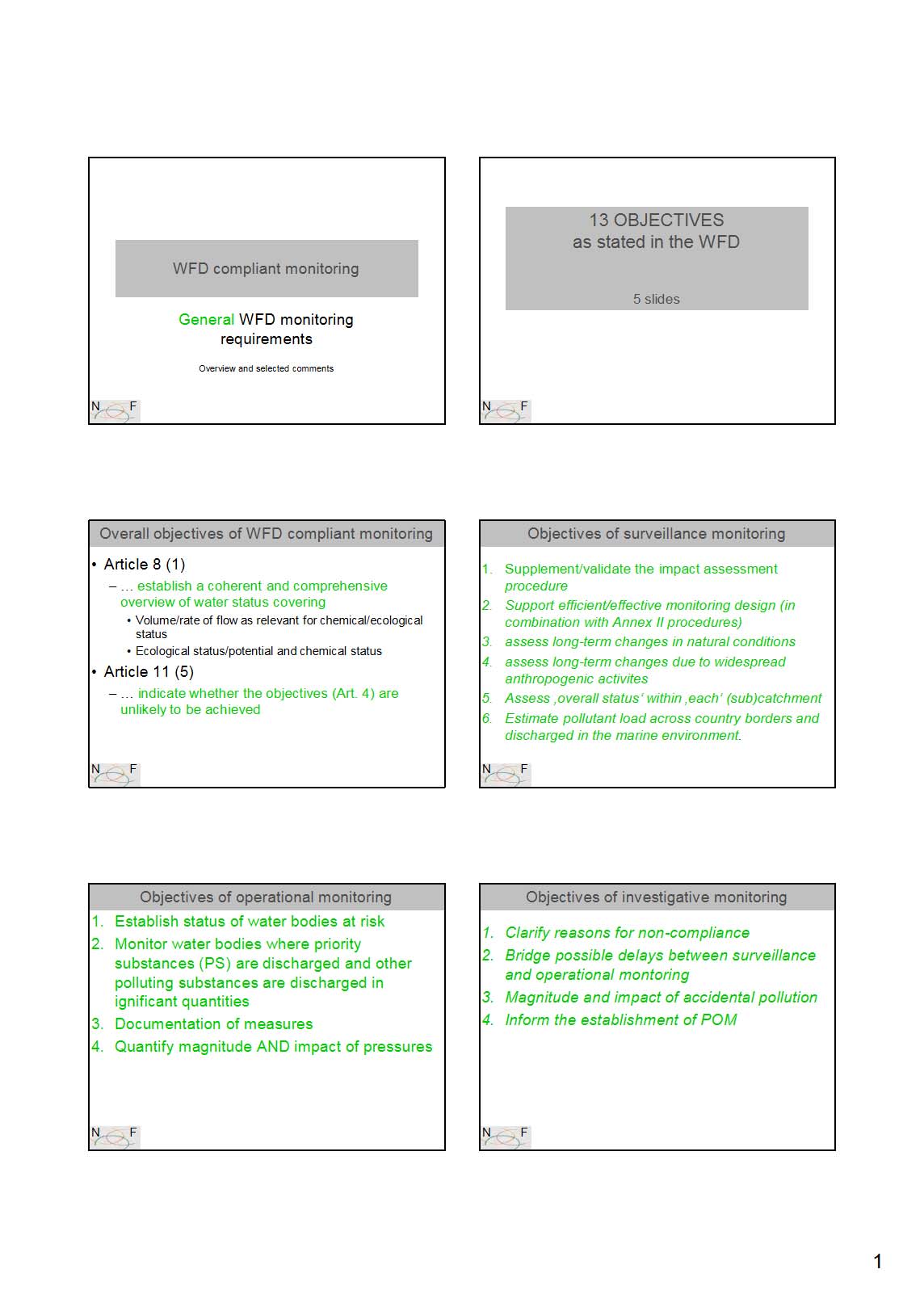
page 48
ANNEX VI GENERAL FACTS AND
CONSIDERATIONS ABOUT WFD COMPLIANT
MONITORING POWER POINT PRESENTATION
NIKOLAUS FLEISCHMANN
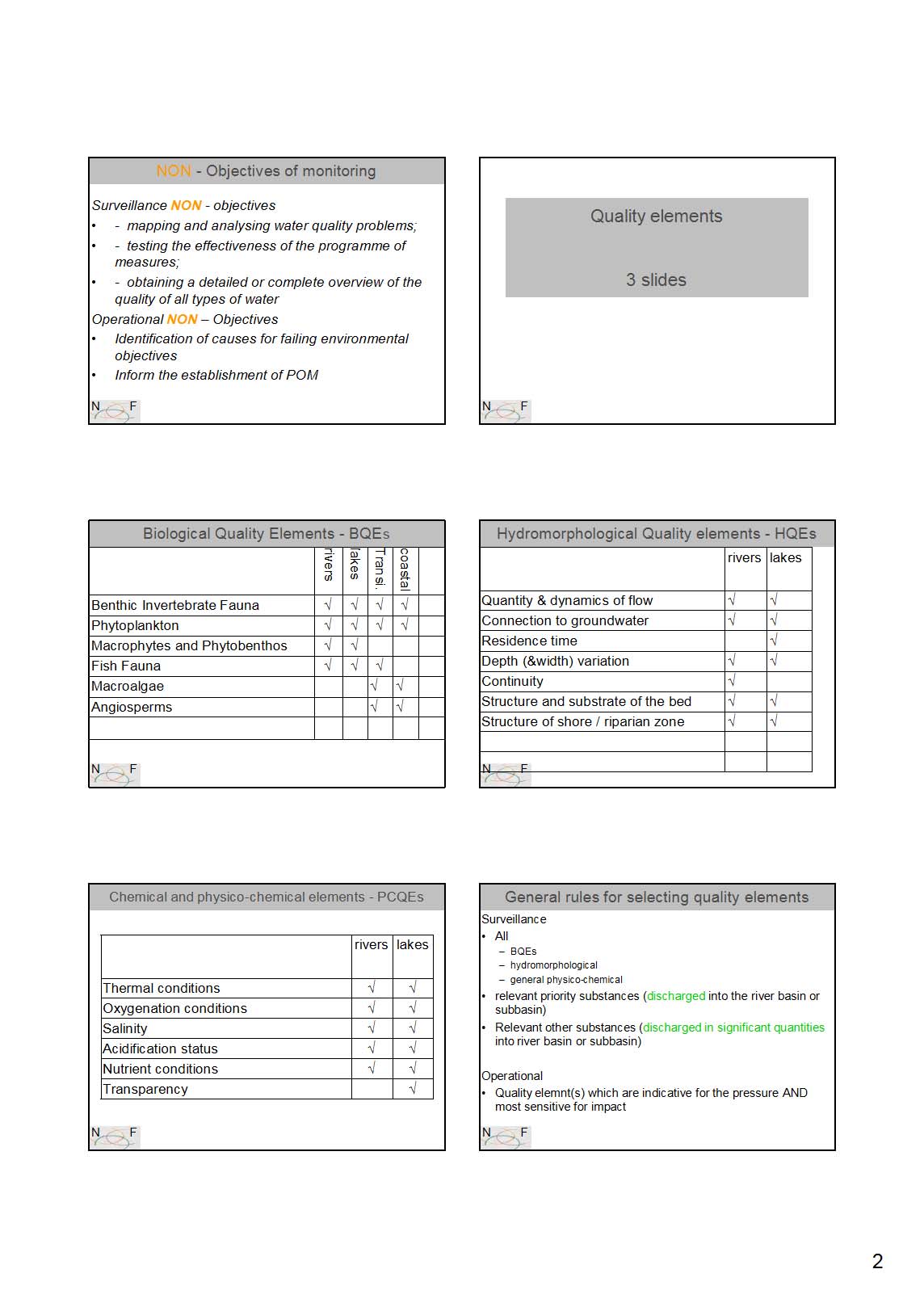
Towards WFD Compliant Monitoring in Bosnia and Herzegovina
page 49
UNDP/GEF DANUBE REGIONAL PROJECT
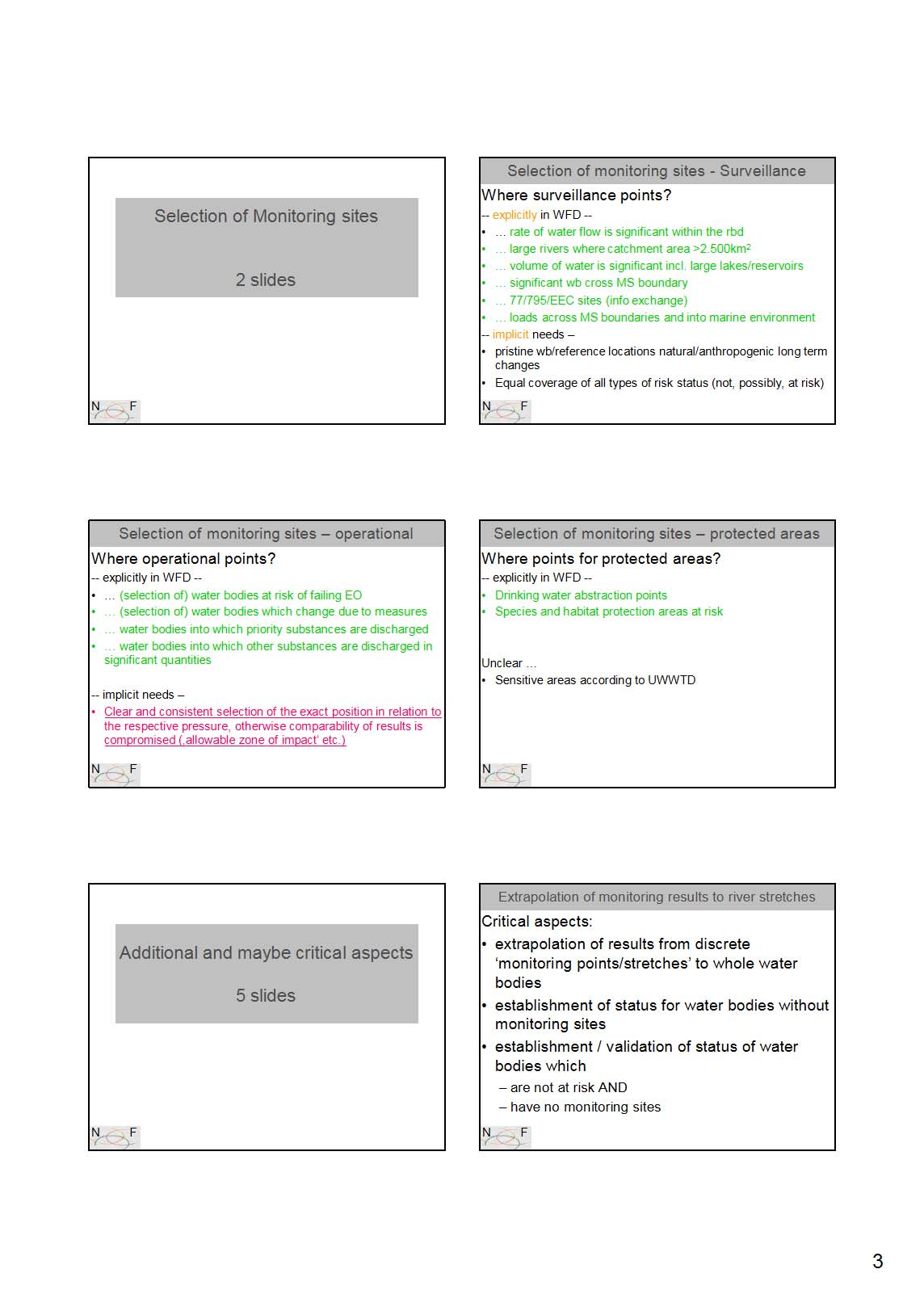
page 50
NIKOLAUS FLEISCHMANN
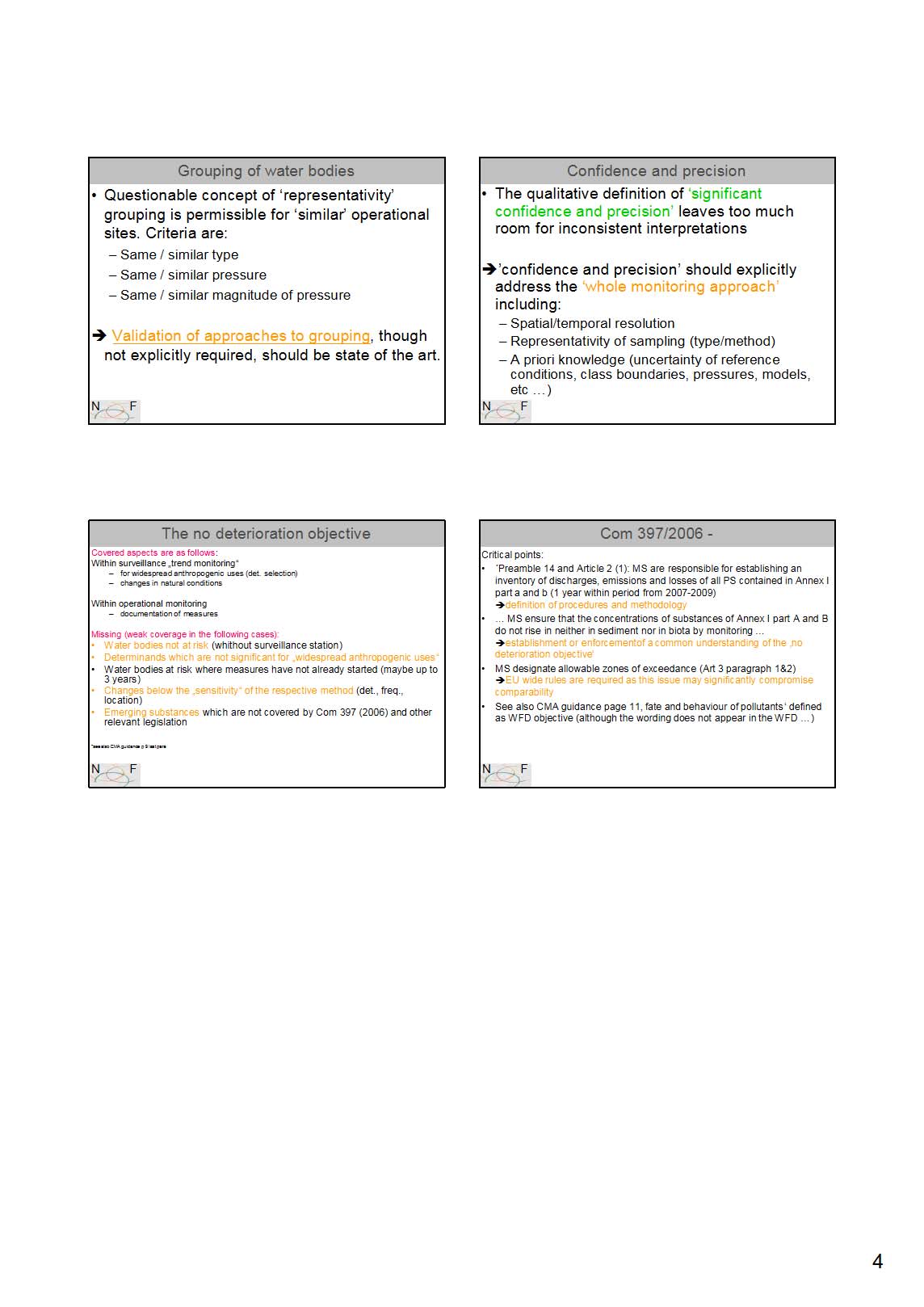
Towards WFD Compliant Monitoring in Bosnia and Herzegovina
page 51
UNDP/GEF DANUBE REGIONAL PROJECT
page 52
ANNEX VII DISCUSSION PAPER FOR THE
MONITORING WORKSHOP ON FEBRUARY 8 IN
SARAJEVO
Assistance for Bosnia & Herzegovina on WFD Compliant
Monitoring: - Discussion Paper in Preparation of the
First Workshop -- Evaluation of the Questionnaire --
Vienna, January 2007
NIKOLAUS FLEISCHMANN
Towards WFD Compliant Monitoring in Bosnia and Herzegovina
page 53
1. INTRODUCTION
This paper is based on the questionnaire which has been sent to relevant actors in BiH in Dec
2006. The paper contains the evaluation of the questionnaire and elaborates in more detail those
issues which have been considered to be most important.
Figure 2: Scheme of the territory of BiH, the
entity and catchment borders
Major cities
BiH state border
Entity parting line
Danube catchment boundary
Rivers
UNDP/GEF DANUBE REGIONAL PROJECT
page 54
2. RANKING OF ISSUES
The following presents the ranking9 of the issues, according to their relevance for the current situation in BiH. This ranking represents the opinion of
those 8 persons/institutions which have answered the questionnaire. It is representative for the ad-hoc opinion of involved persons and might change
during the project and during the further implementation activities.
No topic
Rank points
10 Strategies, options and necessary resources to ensure the quality of monitoring data, including Intercalibration and 1 1,14
transboundary cooperation (see also topic 4)
3
Capacities, strategies and timetable for monitoring `hydromorphological QEs' 2
1,13
11
Interaction and synergies between activites for `typology' and `monitoring' 3
1,085
1
Capacities, strategies and timetable for monitoring `ecological status' 4
1,08
2
Capacities, strategies and timetable for monitoring `chemical status'
4
1,08
4 Development
of national methods for `ecological status' and supporting QEs (and monitoring of reference sites)
4
1,08
13
Strategies / priorities to update and improve pressure related information for all key water management issues
5
1,03
8
Mid term roadmap for monitoring (local/regional responsibilities, gaps and financing needs, ownership for implementation)
6
0,99
12
List of monitoring stations and programmes versus a set of criteria to select stations and programmes.
7
0,98
5 Ensuring
comparability of results; technical co-ordination (methods, QC) and harmonised implementation (see also topic 9)
8
0,93
9
Checklist for `Priority substances with EU wide EQS' elucidating 1) expertise 2) equipment 3) personnel capacities
9
0,88
7
Task list and resources for the `technical monitoring group'
10 0,83
6
Decision making body (across catchments and entities)
11 0,73
Table 1: Ranking of the issues raised in the questionnaire. ------------------------
9 The ranking is based on the normalised score in order to eliminate individual differences. The average score of each questionnaire after nomalisation is 1.
NIKOLAUS FLEISCHMANN
Towards WFD Compliant Monitoring in Bosnia and Herzegovina
page 55
Issue 10:
rank 1/11
Strategies, options and necessary resources to ensure the quality of
monitoring data, including Intercalibration and transboundary cooperation (see
also topic 5)
Original description taken from the Questionnaire document:
WFD implementation has both, national and international aspects. The international basin
wide approach requires specific efforts but it provides also opportunities to collaborate
and improve efficiency. While issue 5 addresses rather technical aspects, issue 10 should
deal with the formal requirements to join the intercalibration exercise.
Topic 10 would aim to elucidate the formal and administrative requirements and
options to manage the intercalibration exercise for BiH. It would aim to ensure
that this activity is harmonised with other aspects of WFD implementation
(monitoring design and method development).
Comparability and consistency of monitoring results are one essential element of the quality of
monitoring data. In general comparability and consistency have several dimensions:
over time
within (sub)catchments
across (sub)catchments
across administrative borders
across different assessment methods (`all roads lead to rome' but which one is the
shortest?)
Intercalibration (IC) deals with the comparability of classification results of high, good and
moderate status of biological quality elements between countries. These classification results
should correspond to comparable levels of ecosystem alteration. It should be kept in mind that a
precondition for valid classification results is the availability of national assessment methods for
BQEs (see chapter 0.).
Intercalibration is based on an intercalibration network that should cover high, good and moderate
status. The first phase of the IC exercise implies the establishment of such an Intercalibration
network. High good and moderate status may be based on `expert judgement from joint
inspections and all available information'. Thus there is no formal requirement of a national
assessment method for the selection/designation of intercalibration sites.
With reference to the situation in BiH it should be pointed out that the intercalibration network
should go beyond the `reference locations' as described in the CARDS RBM monitoring proposal. For
the selection of reference locations see CIS WG 2.3, 2003. `Guidance on establishing reference
conditions and ecological status class boundaries for inland surface water'.
Further it should be pointed out that IC should cover a representative range of combinations of
pressures with surface water types. Two requirements can be delineated from this. The first is the
availability of comparable pressure related information (see chapter 0) and the second is the
UNDP/GEF DANUBE REGIONAL PROJECT
page 56
existence of a rough idea of the respective surface water typology (see chapter 0). National
typology and river types for the intercalibration have to be differentiated.
In addition there is the need to provide unified typology related descriptors for the intercalibration
sites. Selected descriptors have to be delivered for the intercalibration sites. These descriptors are
(have been) agreed upon in the geographical intercalibration group.
The intercalibration is organised in geographical intercalibration groups (GIG). It is a formal
requirement, that national representatives are integrated in these group(s).
There are specific restrictions as to whether heavily modifies water bodies can be included in the
intercalibration network (see CIS guidance No 6 and No 14). Thus, it is a formal precondition to
know which water bodies are candidates for heavily modified water bodies.
In the second phase of IC the respective national assessment methods for BQEs have to be
applied to the IC sites (if there are not already data available). Data need to be evaluated in a way
consistent with the completed evaluations of EU MS. It has to be clarified who will take over the
responsibility and costs of integrating BiH data into the environmental quality ratio calculations
which where delivered to EC in the milestone 6 report.
Remark (to be confirmed by appropriate experts/institutions):
By Dec 2006 in the eastern continental geographical intercalibration group only
benthic invertebrates have been intercalibrated. Therefore, also BiH may consider
to prioritise this BQE. As the dominant pressures on BiH rivers are municipal and
industrial wastewater discharges the prioritisation of benthic invertebrates would be
line with the situation in BiH.
Due to time constraints it may be problematic to wait with the second phase of the
Intercalibration exercise (i.e. application of national assessment method to the sites
of the intercalibration network) until the national assessment method is finalised. In
this case appropriate provisions may be made to ensure that the results can be
reproduced, once the national assessment method is developed. Taking into
consideration that each `assessment method' for BQEs can be divided into the
sampling and the evaluation procedure, a strategy may be developed. Basically this
implies that from the beginning the sampling method and the documentation
should be compliant with the needs of the national method. In this respect it may
be recommendable to capitalise on the sampling experience, practice and standards
of EU member states. The evaluation, based on the completed national assessment
method, may be done at the end of the second phase of the exercise.
Specific issues, general remarks and recommendations concerning IC in BiH:
Continuation of IC in EU MS for remaining regions, types and quality elements (see also
CIS 2007-2009 workplan):
The intercalibration has been an intensive process over years and a number of meetings,
presentations etc. have helped the countries to build up the capacities and expertise for
this work. For BiH it may be more difficult to start without the support of these past
meetings. But not all river/lake types and not all BQEs have been intercalibrated yet.
Therefore, it may be advantageous if BiH joins the continuation of the IC and sends
representatives to future meetings in order to have the support of the larger group for the
remaining types, regions and quality elements.
To be continued and complemented with the workshop outcomes ....
NIKOLAUS FLEISCHMANN
Towards WFD Compliant Monitoring in Bosnia and Herzegovina
page 57
General advantages for BiH:
Benthic invertebrate intercalibration:
The EC GIG based the IC on a `common metric'. Further specific approaches had to be
defined to deal with different definitions of reference sites and different sampling protocols.
These results may be taken into account for the selection/development of a BiH
methodology for benthic invertebrates.
The discussions about benthic invertebrate IC has had results that were reported in the
milesstone 6 report. BiH can capitalise on these results and apply the methodology
straightforward.
The process to define the most appropriate approach to IC was demanding and required
significant efforts. BiH can take over the results and save the corresponding resources for
other WFD implementation activites.
To be continued and complemented with the workshop outcomes ....
General disadvantages for BiH:
BiH does not get the support of repeated meetings concerning benthic invertebrate IC. It
has to perform this exercise alone or within the Sava catchment context in collaboration
with other West-Balkan non member states.
To be continued and complemented with the workshop outcomes ....
Synergies with and links to other WFD implementation activities: Summary
phase 2 of IC may not be finalised before Issue 4 `national methods for BQEs' possibilities
to divide the task into `sampling' and `evaluation' may contribute to a faster completion.
descriptors for intercalibration sites can be collected synergetically in the frame of
o Issue 3 `hydromorphological quality elements'
o Issue 11 `typology and monitoring'
To be continued and complemented with the workshop outcomes ....
Responsibility assessment:
topic RS1,2 Fed1,2 Joint
reporting1
Formal designation of IC sites
Expert judgement from joint inspections
n.a.
Collection of descriptors/metadata for IC sites
n.a.
Join the EC GIG group
Provide assessment method for BQEs (phase 2)
Evaluation of phase 2 data
Revision of IC site inventory based on data evaluation
............
To be continued and complemented with the workshop
outcomes
1 ... Institution and contact person, 2 ... both for Danube and for the Adriatic catchment respectively
UNDP/GEF DANUBE REGIONAL PROJECT
page 58
Issue 3
: rank 2/11
Capacities, strategies and timetable for monitoring `hydromorphological
quality elements'
Original description taken from the Questionnaire document:
Hydromorphological quality elements (HM-QEs) play an important role for the risk assessment and
serve as a supporting parameter for ecological status. HM-QEs are an important input for the
typology, the development of national methods for BQEs (topic No 4) and for cause effect
relationships for hydromorphological pressures. To some extent and under specific conditions it
may be justified that hydromorphological quality elements may replace ecological status
assessments although usually they complement information of BQEs.
Hydro-morphological quality elements play an important role in the WFD and are highly interlinked
with several topics of WFD implementation. Thus a proper strategy to assess hydromorphological
QEs may significantly contribute to an efficient implementation of WFD (compliant monitoring).
Again, comparability and harmonisation of methods and strategies across entities and involved
institutions are decisive.
Countries which have not performed basic eco-morphological assessments and classifications for all
rivers should cover them in their monitoring systems. Not as a supporting parameter for selected
monitoring stations but to achieve the basic classification for typology etc. This aspect is mentioned
within the HYMO IP as a gap of the current data basis.
Discussing topic 3 would help to draft a way forward under consideration of existing
capacities and data ((hydro)meteorological institutes) and it would help to clearly define
and agree about the role of hydro-morphological QEs. The specific BiH context might be
an opportunity to use consistent, high quality information about hydro-morphological
QEs synergistically for several WFD implementation requirements.
Synergies with and links to other WFD implementation activities:
Consistent data about hydromorphological quality elements (HQEs) are needed for the following
purposes and locations:
1. All sites used for elaborating a national WFD compliant assessment method. These will
most probably have to cover all status classes.10
2. Reference sites (high staus) in the frame of the surface water typology
3. Intercalibration sites (high, good and possibly moderate-bad status)
4. All
surveillance sites
5. Operational sites which are at risk due to hydrological or morphological pressures
6. Operational sites for grouping according to hydromorphological pressures
7. Water body delineation
8. Cause effect relationships for the development of improved risk criteria for the next impact
assessment
10 HQEs, especially those considered to be most indicative for hydro-morphological pressures (benthic
invertebrates and fish) serve as the independent variables for developing appropriate metrics. The task could
also be roughly described as `calibrating' the national assessment method and elucidating the specific sensitivity
towards selected pressures. To the same extent they are needed to `validate' the developed metrics.
NIKOLAUS FLEISCHMANN
Towards WFD Compliant Monitoring in Bosnia and Herzegovina
page 59
Possible strategies:
From this compilation it becomes evident that it is difficult to predict in detail where, when and
which data on hydromorphology will be needed in the future. Two approaches may be taken into
consideration:
To perform a complete assessment of hydromorphology over the entire territory at an
early stage of WFD implementation. The resulting data can be used for multiple purposes
in future WFD implementation activities. Another advantage is that they would be
consistent in terms of methodology, quality and spatial resolution.
To assess hydromorphology in a demand driven approach. E.g. in 2007 for surface water
typology sites, in 2008 for sites that are used for the development of national assessment
methods and so forth. The risks of this approach are as follows:
o Inconsistent data sets due to a focus on a selection of some HQEs for defined
purposes
o Parallelities might be overseen thus reducing efficiency
o Inconsistent data formats and methods due to numerous actors.
Concrete questions for the workshop:
Which methods are used to assess HQEs and are they consistent over time and the whole
country? Is it planned to use the same assessment methods in the future?
What is the current status in BiH concerning availability of HQE data? Which rivers, lakes
regions etc are covered and who `owns' the data?
Which HQEs are available?
o Quantity & dynamics of flow
o Connection to groundwater
o Residence time
o Depth (&width) variation
o Continuity
o Structure and substrate of the bed
o Structure of shore / riparian zone
Are the data available in a consistent electronic format?
Could a concerted effort to assess HQEs over the whole country be useful and could it be
financed or is a demand driven approach preferable?
In detail HQEs play the following roles in the WFD:
Annex II: 1.3 (i-vi) Establishment of type-specific reference conditions for surface water
body
types:
For each surface water body type....type-specific hydromorphological and ...conditions shall
be established representing the values ......... for that surface water body type at high
ecological status....
Annex V: 1.2 Normative definitions of ecological status classifications. Table 1.2.
UNDP/GEF DANUBE REGIONAL PROJECT
page 60
o General definition of high ecological status:
There are no, or only very minor, anthropogenic alterations to the values of the ...
hydromorphological quality elements for the surface water body type from those
normally associated with that type under undisturbed conditions.
o For status classes other than high: hydromorphological quality element are
required to be in consistence with the needs of BQEs for the respective status class
Annex V: 1.3.1 Hydromorphology as compulsory quality element for surveillance monitoring
Annex V: 1.3.2 Hydromorphology as a criterion for the selection of monitoring sites and as a parameter indicative
of selected pressures
In the frame of the Article 5 reports hydromorphological alterations have been identified as on of
the most striking anthropogenic pressures on water bodies across Europe. In the light of this the
CIS process has adopted a new activity specifically dedicated to hydromorphological alterations
resulting from shipping, hydropower and flood defence. This activity plays an important role in the
2007-2009 workprogramme: `It is a mandate for CIS activity on Hydromorphology to exchange
information on approaches to the assessment and management of significant hydromorphological
pressures ... to facilitate the transfer of expertise between Member States and ...'
Responsibility assessment:
topic RS1, 2 Fed1,2 Joint
reporting1
WFD compliant assessment methods
Typology rivers / lakes
Formal designation of IC sites
See chapter 0
HQEs for monitoring sites
Water body delineation
To be continued and complemented
with the workshop outcomes
1 ... Institution and contact person, 2 ... both for Danube and for the Adriatic catchment respectively
NIKOLAUS FLEISCHMANN
Towards WFD Compliant Monitoring in Bosnia and Herzegovina
page 61
Issue 11:
rank 3/11
Interaction and synergies between activities for `typology' and `monitoring'
Original description taken from the Questionnaire document:
Typology, water body delineation and monitoring have several technical and administrative aspects
in common although they are designed / considered as subsequent steps in the WFD. It is
important to harmonise these different steps of WFD implementation, to identify potential
synergies and avoid parallel work. Differences of the time plan for WFD implementation between
EU MS and BiH and experiences from other countries may be an opportunity for optimised
approaches to these issues.
Topic 11 would assess the potential for simultaneous, parallel and interlinked
approaches to monitoring, typology, water body delineation and intercalibration with the
objective of increasing efficiency and keeping the time plan.
Typology is a precondition for water body delineation and no WFD compliant monitoring can be
designed without water bodies. Although these tasks are designed as subsequent steps in the
directive they have some common requirements and they have to be consistent. The following
table lists some aspect and illustrates whether there are shared aspects for the tasks of typology,
water body delineation (WBD), Monitoring and Intercalibration (IC). It is not meant as a detailed
description but rather as an approximation and summary of similarities.
A detailed planning of future WFD implementation activities may capitalise from these similarities
and use the potential of these sysnergies.
topic
typology
WBD
Monitoring IC
1 all BQEs, HQEs
y for
y surv-
y hig-
reference
trend
mod.
2 syst. B obligatory/optional factors y
y
y1
y
metadata
3 eological
status
y
site y
`one y for all y for EQR
selection
status'
wbs
4 representativity,
Extrapolation
y
y
y
5 Phys-chem
determinants
y/n
y
y
6 Pressure
information
y
y
1 needed for reference conditions for the type specific BQE method
table 2: summary of similar data needs for different WFD implementation
activites. The first column is used as an identifier for the type of data (see table
below)
1. all BQEs, HQEs
For the typology these are needed to establish `type specific reference conditions'. For
Monitoring all biological and hydromorphological quality elements have to be assessed in
the frame of surveillance monitoring. Identical data sets are needed for typology and
surveillance monitoring of reference sites (for the purpose of detection of long term trends
UNDP/GEF DANUBE REGIONAL PROJECT
page 62
in natural conditions and widespread anthropogenic activity). Data from surveillance sites
(high-moderate status) can be used for Intercalibration puposes.
2. syst. B obligatory/optional factors
The typology is completely based on these obligatory factors and partly, according to the
national approach, on optional factors. The same data have to be used for the water body
delineation as a water body cannot incorporate two or more river types. Monitoring need
these data if BQEs and HQEs are assessed as these methods are type specific. Similar dat
will be required as meta-daa for the reporting sheets of the Intercalibration.
3. ecological
status:
Status information is needed for the selection of reference sites, although it is possible to
select the sites with `expert judgement'. However, selection based on status information is
more reproducible and transparent. For the water body delineation status information is
needed because status should not change within a water body. For Monitoring it is a basic
task to report ecologic (and chemical) status for all water bodies. Finally Intercalibration
needs status information at least for those quality elements that are subject of the data
evaluations.
4. representativity,
Extrapolation:
The first three tasks (but not the Intercalibration) are extrapolating point information to
larger river stretches. In all cases information from selected sites or small stretches is
considered to be representative for parts of the river system. Therefore representativity is
a topic for all four tasks and has to be approached in a consistent way.
5. Phys-chem
determinants:
Within the typology physico-chemical determinants/parameters may be part of the
`optional factors' and they are definitely part of the reference condition that have to be
established. WBD considers abrupt changes of physico-chemical properties as a reason to
separate water bodies. For Monitoring Annex 5 considers the general physico-chemical
parameters as supporting element wherever BQEs or priority/other substances are
measured.
6. Pressure
information:
This information is useful for the typology to underpin the reference status of a site, for
monitoring it is necessary to position the stations and to derive parameters for grouping of
water
bodies.
NIKOLAUS FLEISCHMANN
Towards WFD Compliant Monitoring in Bosnia and Herzegovina
page 63
Opportunities:
Efficient approaches to the four mentioned (and maybe other) tasks would have to aim at
maximising the overlaps and synergies of stations and required data. A simple table as illustrated
below could be developed that serves as a basis to maximise synergies and minimise costs.
Station ID
Typology
WBD
Monitoring
IC
Common data needs for all
tasks
Name 1
e.g.
1 e.g.1,3 e.g
1,3,5
(i.e.BQE,
HQE)
Name 2
....
Here common data identifyers have to be filled in ...
Responsibility assessment:
topic RS1, 2 Fed1,2 Joint
reporting1
Typology
Water body delineation
Monitoring
Intercalibration
Elaboration of the `synergy table'
To be continued and complemented
with the workshop outcomes
1 ... Institution and contact person, 2 ... both for Danube and for the Adriatic catchment respectively
UNDP/GEF DANUBE REGIONAL PROJECT
page 64
Issue 1:
rank 4/11
Capacities, strategies and timetable for monitoring `ecological status'
Original description taken from the Questionnaire document:
The WFD introduced the ecological status as a yardstick to assess the quality of water bodies.
Therefore, one objective of monitoring is to be able to classify the ecological status of each
waterbody within a country's territory. This requires providing a number of resources (human,
institutional, financial).
As BiH is not an EU-MS it may follow a different timetable than the one given in the WFD provided
that the national commitment regarding WFD implementation within the Danube Declaration is
met. Timetable and required resources are interlinked and therefore part of the same topic.
There are different potential solutions for the task to provide the ecological status for all water
bodies with a sufficient level of confidence and precision. By no means all water bodies will have to
be monitored individually. There are possibilities to attribute a status to water bodies by using
other information that might be available and there are options for grouping water bodies.
It has to be kept in mind that this tasks is also synergistically linked with the monitoring objective
of `supplementing and validating' the Risk assessment procedure.
Issue No 1 would help to develop ideas for the most efficient way to provide an ecological status
for all waterbodies.
To deal with this topic would encompass to sketch the required resources and strategies
for assessing ecological status of all water bodies and to develop a realistic timetable for
BiH.
Remark: Topic No 1 is not to be confused with topic No 4 which addresses the
requirements for developing a national assessment method as a separate issue.
The concept of ecological status11 aims at defining a joint degradation scale for different types of
possible pressures on surface waters. One task of monitoring is to report an ecological status class
for all water bodies in Europe accompanied by a realistic statement concerning confidence and
precision of the respective classification.
The most important elements to be able to provide a status classification for all water bodies are:
WFD compliant evaluation methods for BQEs (see chapter 0) in case of high status also for
HQEs (see chapter 0)
A credible approach to representativity or grouping of water bodies how to transfer
monitoring results to river continuums and how to transfer monitoring results to similar
11 While the definitions and discussions of the strengths and weaknesses of this concept are very formal (not to
say dogmatic) the real approaches of EU MS and accession countries seem to be oriented at the best feasible
and realistic transfer and implementation of the priciple. This situation represents the general truth that, if no
one understands what a term or an idea means, a definition has to be found and disseminated. WFD and the
corresponding CIS guidances provide numerous definitions and interpretations, evidence for universality and
generality of the principle. However, there is a common understanding of some elements of ecological quality
and there is also space for solutions and interpretations that are specific for one country (as long as plausible
evidence, explanations and justifications is given).
NIKOLAUS FLEISCHMANN
Towards WFD Compliant Monitoring in Bosnia and Herzegovina
page 65
water bodies. Apart from the trivial approach that all unimpacted waterbodies are at a high
status, different approaches for water bodies which are subject of anthropogenic influences
have been defined or postulated in the frame of designing WFD compliant networks. The
elements to be considered for representativity issues are:
o Spatial basically an evaluation of the river continuum approach versus the
definition of distinct and `uniform' water bodies for management purposes. Spatial
representativity has to reflect the different scales of natural changes (large) and
anthropogenically induced changes (small).
o Natural changes/environmental descriptors basically covered by typology
o Type of pressure or types of combinations of pressures
o Magnitude of pressures or combinations of magnitudes of pressures12
A concept to optimise the efficiency of the network. During network design such a concept
helps to prioritise monitoring purposes and information needs. During the monitoring cycle
the concept shall ensure that stations which deliver trivial or no information are replaced by
other, more efficient stations. Elements of the concept may be the following.
o Ranking of pressures: Pressures which need a detailed assessment thus an
intensive monitoring may be ranked first. Criteria for intensive monitoring may be
It is planned to start soon with the implementation of measures. Monitoring
is needed to validate the risk assessment and to design appropriate
measures.
There is only poor knowledge of cause effect relationships for a specific
combination of pressure and surface water type
There is a high variability due to unknown reasons.
o Evaluation rules: A checklist to assess whether a station fulfils its tasks or not.
These rules will help to detect stations which do not deliver meaningful data and to
replace them with more efficient stations.
o Ranking of information needs. It may be considered to prioritise certain monitoring
purposes. As an example, to validate and supplement the risk assessment may be
regarded as more important than the detection of long term natural trends.
Consequently the frequency and number of stations may be shifted from one to the
other purpose.
o ...
In general surveillance stations cause less costs than operational stations. Consequently a concept
to provide ecological status for all waterbodies should prioritise surveillance stations in the first
years. At a later stage surveillance programmes might be complemented with an operational
programme. In some cases surveillance might be replaced completely by the operational
programme and in some cases even the frequency of the surveillance programme may be reduced
to once in every third water management cycle.
12 The current draft of a CIS guidance of the chemical monitoring activity has for the first time
mentioned the magnitude of a pressure as a criterion for grouping of water bodies, and it has
raised for the first time the issue of grouping in the context of surveillance monitoring.
UNDP/GEF DANUBE REGIONAL PROJECT
page 66
An approach with main emphasis on surveillance in the first years would also help to develop the
BQE methods in the frame of intensive surveillance monitoring. Further it supplements the risk
assessment and helps to bridge the time until the information about pressures (which is necessary
for designing operational programmes) has been refined. The approach to distribute surveillance
stations should not be purely statistical (stratified sampling) but reflect the typology, especially
represent all catchment sizes, however, with a priority on large catchments in the beginning (to be
able to fulfil international obligations).
A recent report presented by EC has revealed that there is a great variation of interpretations of
the topics mentioned above between EU MS. While some states have more than 20 monitoring
stations per 1000km2 others have one, while some countries cover less than 10% of water bodies
with surveillance stations other cover more than 50%.
Issue 2:
rank 4/11
Capacities, strategies and timetable for monitoring `chemical status'
Original description taken from the Questionnaire document:
Assessment of chemical status means to check the compliance with environmental quality
standards for priority-, priority hazardous- and other substances. Currently not all the substances
of the lists can be monitored/analysed by the laboratories in BiH with a sufficient level of
confidence and precision.
The cost of fulfilling this task depends largely on the selection procedure for monitoring sites and
determinands. Not all substances have to be analysed for all water bodies. Inventories of emission
sources and other data may help to develop an efficient selection strategy. Examples of decision
criteria from other countries can be tested for their applicability in BiH and/or an own adapted
strategy can be developed.
Cost assessments from other countries can substantiate that the total cost of WFD compliant
monitoring is very sensitive towards the strategy for assessing the chemical status. Several
determinants are very expensive and, once selected, have to be monitored at least 12 times a
year.
This topic would help to link the laboratory capacities of both entities with a suitable and WFD-
compliant strategy to assess chemical status. A common timetable would help to align the activities
of all involved laboratories and allow to control the process.
NIKOLAUS FLEISCHMANN
Towards WFD Compliant Monitoring in Bosnia and Herzegovina
page 67
Issue 4:
rank 4/11
Development of national methods for `ecological status' and supporting QEs
(and monitoring of reference sites)
Original description taken from the Questionnaire document:
In order to ensure a certain quality level and comparability across country borders the WFD sets a
framework for the minimum standards for the assessment of BQEs (e.g. species composition and
abundance).
While sampling BQEs can be based upon standardised and internationally acknowledged methods,
assessment of the results requires a `national' scale which has to be based on the specific reference
conditions, typologies and deterioration characteristics of the rivers on the country's territory.
Depending on the availability of existing biological data the development of national assessment
scales can be a demanding task and it needs to be planned well in advance as it requires expertise,
data and time. On the one hand it may be a demanding time and resource consuming task but on
the other hand if properly done, it helps also to reduce uncertainties especially with regard to
drafting and implementing a programme of measures.
The efforts for sampling and developing the national methods will also contribute to the initial
status assessment, to supplement and validate the risk assessment procedure, to substantiate the
typology and to assess the `overall status' of surface water in BiH. In addition to these potential
synergies it can be performed and eventually outsourced as an intensive campaign over one or two
years.
Topic 4 will help to get a more precise estimate on the time and financial resources needed to
develop national scales for classification of the ecological status.
Issue 13:
rank 5/11
Strategies / priorities to update and improve pressure related information for all
key water management issues
Original description taken from the Questionnaire document:
Pressure related information plays an important role in both, the monitoring design and in the
pressure impact analysis. Both contribute to the planning process for measures. Priorities are
needed as it is unrealistic to address all pressures at once. Activities to update existing and collect
new pressure related information should be in line with the needs of the monitoring design, with
the priorities for the national programme of measures and with international priorities (key water
management issues: e.g. organic pollution, hydromorphological alterations).
Topic 13 aims to outline which pressure related information would be needed and by when it should
be available. This discussion could be beneficial for the monitoring implementation time plan, for
reviewing the pressure impact analysis, validating and supplementing the risk assessment
procedure and for drafting the programme of measures.
UNDP/GEF DANUBE REGIONAL PROJECT
page 68
Issue 8:
rank 6/11
Mid term roadmap for monitoring (local/regional responsibilities, gaps and
financing needs, ownership for implementation)
Original description taken from the Questionnaire document:
Within this project a road map for the development of the national monitoring networks and
programmes should be drafted. A mid term roadmap for monitoring helps to outline the respective
implementation tasks and helps to make the process transparent for all involved actors. Further, it
ensures continuity of implementation activities. Such a roadmap helps to control a complex process
over a period of one water management cycle.
There are some reasons for recommending a road map:
1) Monitoring is a core element of water management it is linked with numerous other
implementation activities (not only WFD).
2) Usually numerous institutions are involved in monitoring design and implementation and
numerous institutions are involved as stakeholders. A roadmap provides equal access to
information about the state, plans, tasks and responsibilities.
3) The necessity to prioritise due to limited resources and capacities makes the process more
complex.
Topic 8 could assist in the development of a mid term strategy of monitoring design and
implementation and improve the efficiency and communication by providing a joint and
comprehensive programme.
Issue 12:
rank 7/11
List of monitoring stations and programmes versus a set of criteria to select
stations and programmes.
Original description taken from the Questionnaire document:
Monitoring is commonly understood as an iterative process with numerous steps from network
design to information utilisation and redesign. There are different approaches to deal with this
process. One is rather driven by tacit expert knowledge and usually results in lists of stations and
programmes. The other is more formalised and more transparent. In addition to lists of stations
and programmes it requires to clearly point out the motivation and objective for each station and
every programme. As the monitoring objectives are clearly stated it is easier to assess the
performance of the network and to adapt to changes. It is also easier to discuss the necessary
monitoring budget because there is a clear linkage between the costs and the achievable
objectives.
Topic 12 addresses the advantages and disadvantages of both approaches. Based on an in-depth
discussion it would facilitate a general agreement about the strategic approach to monitoring
design.
Issue 5:
rank 8/11
Ensuring comparability of results; technical co-ordination (methods, QC) and
harmonised implementation (see also topic 9)
Original description taken from the Questionnaire document:
NIKOLAUS FLEISCHMANN
Towards WFD Compliant Monitoring in Bosnia and Herzegovina
page 69
Comparability of monitoring results is an important topic especially if decisions about measures are
to be taken. If different actors or institutions are monitoring water quality in the national and
international context it is important to provision against inconsistent data at the basin or sub-basin
level.
Comparability has to be discussed and ensured before the start of monitoring and it has various
dimensions or aspects. It is not sufficient to use the same or equivalent measurement methods
(standards). Comparability has to be ensured also in terms of measurement frequency, spatial
resolution, determinant selection, time (during the hydrological cycle or hydrologic situation),
location (e.g. relative to pressures) and data evaluation.
Comparable data guarantee consistent information at basin level and allow for mutual learning and
synergistic interpretation of monitoring results (e.g. assessment of confidence and precision across
country/entity borders, cause effect / dose-response relationships, etc ...).
Topic 5 would help to stress the importance of a priori agreement on all dimensions of
comparability and raise the awareness in this context. Topic 5 should result in a checklist of factors
that need to be considered to ensure comparability.
Issue 9:
rank 9/11
Checklist for `Priority substances with EU wide EQS' elucidating 1) expertise 2)
equipment 3) personnel capacities
Original description taken from the Questionnaire document:
Environmental quality standards have been set on the EU level by the COM(2006)397. Currently it
is not clear whether and which laboratories in BiH can measure these substances.
Topic 9 would help to assess the situation with regard to monitoring `chemical status' and help to
outline where gaps in terms of expertise, equipment and capacities do exist.
Issue 7:
rank 10/11
Task list and resources for the `technical monitoring group'
Original description taken from the Questionnaire document:
Since the `monitoring group' has been established in BiH it would be advantageous to develop a
concrete mandate for this group. This mandate can only be developed with a view to the full
variety of issues of monitoring design and implementation. This project and the involvement of an
independent expert might be an opportunity to draft a first outline of this mandate.
Topic 7 would result in the formulation of a first task list and mandate for the `monitoring group'
and help to develop a common understanding of its duties.
Issue 6:
rank 11/11
Decision making body (across catchments and entities))
Original description taken from the Questionnaire document:
Some aspects of monitoring design have a political or strategic dimension and scientific / technical
decisions cannot be made due to uncertainties or due to different opinions of involved institutions.
In some cases a profound knowledge of the national legislation is needed which cannot be provided
by technical consultants. In these cases a decision making body is needed, a committee, institution
UNDP/GEF DANUBE REGIONAL PROJECT
page 70
or some other provision must be made to ensure consistency of monitoring design and
implementation. This is not a formal requirement but a question of ownership and responsibility.
Many of these decision are in the context of priority ranking which is necessary due to limited
resources e.g. to prioritise monitoring of certain pressures.
Topic 6 could help to outline the tasks of a decision making body and make recommendations on
the expertise that should be provided.
NIKOLAUS FLEISCHMANN
Towards WFD Compliant Monitoring in Bosnia and Herzegovina
page 71
3. PROPOSALS TO BE DISCUSSED
Opportunities
BiH has pre-accession status and the national water allows for delays in the WFD implementation
time schedule. This specific situation leaves space for implementation strategies that might deviate
from EU-MS but which may be at least as effective and maybe more adapted to the local conditions
and current situation in BiH.
Monitoring Point sources
Proposal:
Organise the monitoring of pressures stemming from municipal wastewater discharges in a way
that focuses on the derivation of a clear pressure impact relation rather than considering each
individual case.
Monitor only those pressures individually where
the decision whether a water body is at risk or not can not be made based on the pressure
impact relation (see figure 3)
Measures are not necessary according to the UWWD
Discussion:
From the directive and the guidance paper it is required to monitor almost each and every point
source. The directive allows only to group different point sources within a water body and to
monitor them with one station. There are questions that go along with these requirements:
Scaling: If a treatment plant has an effluent that is separated from e.g. the rainwater overflow, are
these two point sources? In other words: How far have two or more effluents to be positioned from
each other to be a `separate point source'? This applies for BiH in that sense: Sewers in municipal
areas discharge often at different points to the river within the municipal area. It would be
extremely inefficient and in terms of information extremely meaningless to monitor each single
effluent separately.
Information needs: Does a dominant pressure necessarily needs to be the focus of the monitoring
programme? Although discharges of municipal, industrial and combined wastewater is the most
important pressure in BiH it is questionable whether monitoring each and every point source yields
useful information. Especially discharges of municipal wastewater can be regarded as a relatively
uncomplicated pressure; uncomplicated in terms of pressure impact relation and uncomplicated
in terms of designing, planning measures. With regard to that it would be good to consider
grouping as a legitimate and appropriate tool for monitoring point sources of municipal wastewater.
Parallelities: Agglomerations and their wastewater management are mainly addressed in the UWW-
Directive. Measures can be planned even without any additional input from WFD compliant
monitoring. Regarding EU-MS there is certain logic behind the implementation of the UWWD (1991-
1998-2000-2005) and the WFD. According to these time schedules urban waste water should not
really be an issue for the POMs (Exemptions are only those agglomerations where there is still a
status inferior to good status despite compliance with the UWWD i.e. small agglomerations <2000
PE on very small rivers (catchment >10km2))
UNDP/GEF DANUBE REGIONAL PROJECT
page 72
PE/Qriver
Monitoring for delineation of
pressure impact relations
NO MONITORING
I f
ti
0
MONITORING needed
Status I-V
figure 3: Scheme of the strategy fort he selection of poitn sources for
monitoring (applicable only after a cause-effect relation and its confidence
intervals have been derived)
4. ISSUES FOR DISCUSSION
The following list of issues was compiled as a result of the meetings so far. It is not ranked
according to importance or according to relevance for the project, neither does it separate strategic
from technical topics or questions.
Issue 1: CU
Currently the whole monitoring topic is discussed under the header "WFD implementation" whereas
it can be clearly seen that some of the topics are not genuine WFD implementation (e.g.
monitoring municipal and industrial effluents). To discuss this separation between monitoring of
`single pressures' and `monitoring ecological status' could help to improve the understanding of
WFD compliant monitoring.
Issue 2: CU
The focus of the proposed network is on pollution with degradable organic substance. It would help
NIKOLAUS FLEISCHMANN
Towards WFD Compliant Monitoring in Bosnia and Herzegovina
page 73
to increase the awareness of the fact that effluents of untreated wastewater create three WFD
related pressures: organic pollution, nutrient pollution, hazardous substances pollution.
Issue 3: PotOPP
Sketch the opportunities that arise from the different time schedule in EU-MS and pre-
accession countries (e.g. synergies between typology, monitoring and impact assessment, avoid
errors of EU-MS (e.g. water body delineation), hybrid approach to Article 5 and monitoring design)
Issue 4: GAP
Open discussion of and quantification in terms of financing and time schedule of the
requirements of monitoring the `ecological status' including method development, typology,
intercalibration and water body delineation; drafting a way forward, developing a road map.
Issue 5 (see also Issue 1): CU
General discussion and corresponding decisions on the following topic: Does BiH implement the
WFD only or does it understand these activities as part of the EU integration process (e.g.
implementing the urban waste water directive, surface water for drinking water, nitrates directive,
...). The main difference is that the framework of EU legislation might seem inconsistent without
taking into account the whole ensemble of EU legislation.
preliminary answer by MOFTER (Mr. Reuf Hadzibegi): "The new water act implements ALL relevant
EU directives, thus UWWD has the same status on the political agenda like WFD."
Issue 6: CU strategic cornerstones / principles / paradigms
Promote a quality oriented approach: Assume a quality oriented strategy instead of only formally
fulfilling WFD requirements. Evidentiate the link between targeted measures and monitoring, the
potential economic consequences of flawed data.
Issue 7: CU strategic cornerstones / principles / paradigms
Develop a reasonable compromise between an output oriented and a process oriented
approach. Discuss monitoring as a control circuit of transitional states.
Issue 8: PotOPP
Outline a strategy for a transition from a `station' oriented network to a `water body' oriented
network.
Issue 9: GAP
Assess possibilities to improve pressure related information (land use, emission cataster,
hydromorphological assessments (double role of hydro-morphology: as a `pressure' and as a
`quality element')).
Issue 10: GAP
Inventory of protected areas: Which international conventions are endorsed in BiH?
Issue 11:
Discuss scaling issues with regard to monitoring and pressure impact assessment: DRB scale =
4000km2, surveillance scale = 2.500km2, WFD scale generally assumed to > 10km2, national
scale)
Issue 12: GAP
Outline capacities and resources needed to perform hydromorphological assessments.
Issue 13: GAP
Develop a transition approach from `operational monitoring according to assumed pressures' (tacit
expert knowledge) to `operational monitoring as a consequence of pressure-impact analysis'
Issue 14: potOPP
Highlight transboundary issues and potential synergies: Joint monitoring of the Sava (with
Croatia) and the Drina river (with Serbia) also for QC purposes.
UNDP/GEF DANUBE REGIONAL PROJECT
page 74
Issue 15: CU strategic cornerstones / principles / paradigms
Due to distributed responsibilities for water management and monitoring (2 ministries and 4 water
agencies + hydrometeorological institutes) comparability of the results is an important topic.
Comparability in terms of methods, confidence and precision but also in terms of time schedule for
implementation. Although the proposed programme is for the entire territory and therefore
consistent, the practical implementation needs to take place in a harmonised way across entity
borders (for the Danube catchment) and laboratories (for the Adriatic catchment).
Issue 16: CU strategic cornerstones / principles / paradigms
With reference to Issue 15 there is currently no institution or platform that is responsible to
coordinate and harmonise. MOFTER does not seem to have the authority and technical expertise
Issue 17: GAP
Intercalibration process for BiH: Organisational frame, capacities, resources and time plan?
Issue 18: CU strategic cornerstones / principles / paradigms
Numerous (several 100) online monitoring devices have been supplied to BiH by various projects.
The potential use of these `stations' (namely multiparameter probes) for WFD compliant monitoring
is unclear; in general it seems that the potential of these devices is overestimated. It would help to
define clear tasks of these devices within the frame of WFD compliant monitoring (and to avoid
unnecessary efforts).
Issue 19: GAP
Develop a reasonable and clear strategy for P(H)S and other substances under the given
restrictions. Currently there is no decision rule to decide which (hazardous) priority and which
other substances should be selected for a certain location. An (updated) emission inventory is
missing (although there is a discharge tax system in place).
Issue 20: GAP
Issues of grouping water bodies could not be integrated into the proposed design. Thus the
representativity can currently not be assessed.
Issue 21: GAP
The network in general and the time schedule for implementation are impact oriented. Thus it may
not give a balanced picture of ALL the water bodies in BiH. Changes in the overall picture are likely
to occur as an `artefact' resulting from an increasing number of non-impacted monitoring locations.
Issue 22: GAP
Hydromorphological monitoring is foreseen for stations where biological monitoring is planned. The
selection of sites is largely dominated by pollution due to discharges of untreated wastewater.
Therefore it is likely that sites where only hydromorphological impacts occur are underrepresented.
As a consequence it may become difficult to include hydromorphological alterations in the next
impact assessment due to lasting lack of data.
Issue 23: potOPP
Due to the division in extensive and intensive stations the proposed monitoring frequencies are not
fully compliant with the WFD and guidance document.
NIKOLAUS FLEISCHMANN

