Baltic Bulletin 2/2000
Lake Peipsi
a transboundary lake on the future border
of the European Union
by Gulnara Roll
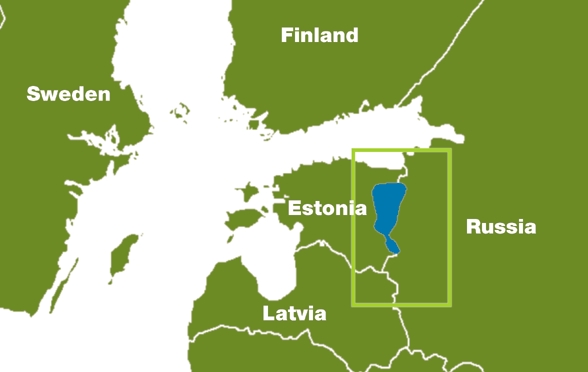
Lake Peipsi is shared by Estonia and Russia. When Estonia joins the
European Union in the near future, it will form the border between Russia
and the EU. This new situation raises complicated questions as to how
regional development and management of natural resources in the Lake
Peipsi basin will be affected. Many people in the region, as well as
international initiatives, are working to fi nd answers.
16
Baltic Bulletin 2/2000
Lake Peipsi, known in Russian as Chudskoe, constitutes
Water Conference of the Global Environmental Facility
a large part of the border between Russia and Estonia
(GEF) in Budapest, Hungary. Management of international
which was re-established in 1992 after the collapse of the
waters in conditions of uncertainty and transition was
Soviet Union (see map). The lake Peipsi is Europe's largest
a major topic at the conference. The commitment of
international lake, connected to the Gulf of Finland and
riparian governments was concluded to be crucial for
the Baltic Sea via the Narva River. Its natural amenities
successful implementation of water management projects.
are unique, being shallow, eutrophic, and biologically very
The importance of developing water basin networks
productive. Wetland areas around Lake Peipsi have been
joining all stakeholders in management of the international
recognized as being of international importance.
waters was also highlighted. In a constantly changing
situation, fixing a long-term work plan is impossible.
The Estonian-Russian Transboundary Water Commission
However, it is believed that by establishing networks
where changes in the water management system are
To manage their shared water basin, Russia and Estonia
communicated, project objectives can still be achieved.
established a Joint Transboundary Water Commission in
Important aspects of the Lake Peipsi Basin Manage-
1997, based on an agreement between both governments.
ment Plan, which will be supported by the GEF, will be to
The Commission has proved to be an important body for
involve various stakeholders and develop networks. The
resolving differences and co-ordinating action between the
GEF programme will assist the governments of Estonia and
governments, as well as helping international initiatives.
Russia, as well as the Estonian-Russian Transboundary
Water Commission, in preparing and starting implementa-
A changing political situation
tion of the Lake Peipsi Management Plan. This plan
will build on ongoing water management projects in the
The Estonian government has set 1 January 2003 as the
basin currently supported by the Danish and Swedish
deadline for the country to be fully prepared to enter
governments and by the European Union. Methodological
the European Union. This means that Estonian laws and
and research support will be provided by a three-year
the administrative system have to be adapted to EU
EU research programme on Integrated Strategies for the
requirements by that date. As part of this work, the Estonian
Management of Transboundary Waters on the Eastern
Water Act is being revised to harmonise with the EU Water
European Fringe The Pilot Study of Lake Peipsi and
Framework Directive. River Basin Management Plans for
its Drainage Basin (MANTRA-East), where ten research
all water basins in Estonia are to be elaborated by 2004. An
institutes from fi ve European countries will take part.
added complication for the river basin management plan for
The experience gained in the Peipsi basin will,
Peipsi/Narva is the fact that half the lake is in the Russian
hopefully, also be fruitful for other international basins in
Federation and managed under Russian legislation.
the Eastern Baltic Sea area.
Both the EU Water Framework Directive and the
Russian Water Code are based on a river basin approach.
In spite of similarities in the water-related legislation, there
About Lake Peipsi/Chudskoe
are differences in specifi c water management practices.
These include standards and procedures, monitoring,
· Lake Peipsi is the fourth largest lake in Europe.
environmental data and information, as well as institutional
· The area of the lake is 3,550 kmē: with 44 per cent
organisation.
Estonian territory; the remaining 56 per cent belongs to
These differences are expected to increase in the
the Russian Federation.
future and may create more points of confl ict between
· The lake is shallow with an average depth of 7.1 m
the two parties. Managing the lake basin under these
(maximum depth 15 m) and biologically it is very
circumstances is not an easy task.
productive.
· The local economy depends on the use of natural
Preparing the Lake Peipsi Management Plan
resources. Main activities in the region are fishing,
recreation, subsistence farming, and forestry.
Representatives of more than 100 international water
· Major environmental issues are water eutrophication
management projects met recently at the International
and fi sh resource management.
Author
Dr Gulnara Roll is the director of the NGO Center for Transboundary Cooperation, CTC, in Tartu, Estonia. She has studied environmental policy
and works with the management of international transboundary environmental projects.
Further information
The website of CTC for information on various activities www.lake-peipsi.net
The website of the Estonian Ministry of Environment: www.envir.ee/eng/index.html
The website of the Estonian Ministry of Foreign Affairs with an overview of Estonia's Accession Negotiations with the EU: www.vm.ee/euro/english
17