UNDP/GEF project "Development and Implementation of the Lake
Peipsi / Chudskoe Basin Management Programme"
Lake Peipsi/Chudskoe Basin Water
Management Programme
Contents
Preface............................................................................................................................3
Abstraction.....................................................................................................................5
1
Description of drainage basin ..............................................................................10
1.1
General overview.........................................................................................10
1.2
Water bodies and water resources................................................................11
1.3
State of waterbodies.....................................................................................12
1.4
State of groundwater....................................................................................14
2
Transboundary human impacts to water ..............................................................15
2.1
Eutrophication of Lake Peipsi......................................................................15
2.2
Fishing in Lake Peipsi..................................................................................15
2.3
Groundwater resources management in the Narva River region .................16
2.4
Other transboundary impacts .......................................................................18
3
Wildlife ................................................................................................................19
3.1
Rare species .................................................................................................19
3.2
Ramsar sites .................................................................................................19
3.3
NATURA areas............................................................................................20
4
Description of monitoring network......................................................................21
4.1
Surface water ...............................................................................................21
4.2
Groundwater ................................................................................................21
5
Water management ..............................................................................................23
5.1
Transboundary Diagnostic Analysis (TDA) ................................................24
5.2
Viru and Peipsi Sub-basins Management Plan (VP-CAMP).......................26
5.3
Water resources Management Plan of the Russian part of River Narva and
Lake Chudskoe Basin ..............................................................................................26
6
Transboundary environmental objectives ............................................................28
6.1
Objectives for surface waters.......................................................................28
6.2
Objectives for groundwater..........................................................................31
6.3
Objectives of wildlife...................................................................................31
6.4
Economic objectives ....................................................................................32
7
Programme of Measures ......................................................................................33
7.1
Water quality sub-programme .....................................................................33
7.2
Sustainable water use subprogramme..........................................................36
7.3
Lake Peipsi/Chudskoe fishery management subprogramme .......................37
7.4
Transboundary sub-programme of wildlife conservation............................38
7.5
Programme management .............................................................................39
Only CD Version:
Annex 1 Rare species
Documents:
1. Transboundary Diagnostic Analysis, defining environmental objectives and a strategy for the
transboundary Lake Peipsi/Chudskoe Basin Management Program (TDA). 12.2004.
2. VIRU-PEIPSI CAMP EU LIFE program supported Viru Peipsi CAMP (website
www.envir.ee/viru.peipsi) project that assist implementation of the EU WFD in the Viru River
Basin and Lake Peipsi/Chudskoe basin. 11.2005.
3. EU TACIS CBC Baltic Line 2000 program will support a project "Environmental
Management of Lake Chudskoe" that will be implemented in Russia. Draft 03.2005.
4. «,
, -
». «» 2004.
2
Preface
Lake Peipsi belongs to the Republic of Estonia and the Russian Federation. In 1991
River Narva and LAKE Peipsi drainage basin acquired international status. Boundary
waters have large social and economic importance for the development of border
regions.
Sustainable use and protection of resources of transboundary waters is possible only
via targeted and agreed measures undertaken by all countries within the drainage
basin.
Russia and Estonia have joined several international conventions for the protection of
environment. In the present context the most significant are UN Convention on the
Protection and Use of Transboundary Watercourses and International Lakes (Water
Convention, Helsinki 1992) and the Convention for the Protection of the Marine
Environment of the Baltic Sea (Helsinki 1992). According to these conventions, the
parties shall take all appropriate measures to prevent, control and reduce any adverse
effect on the environment resulting from a change in the conditions of transboundary
waters caused by a human activity. The Contracting Parties bordering the same
transboundary waters shall cooperate, in particular through bilateral and multilateral
agreements, in order to develop harmonised policies, programmes and strategies
covering the relevant basin areas, aimed at the prevention, control and reduction of
transboundary impact and aimed at the protection of the environment of
transboundary waters.
Estonia, as a member state of the EU, must implement the Water Framework
Directive. According the Directive, within a river basin where use of water may have
transboundary effects, the requirements for the achievement of the environmental
objectives established under that Directive, and in particular all programmes of
measures, should be coordinated for the entire Narva river basin. For river basins
extending beyond the boundaries of the Community, Member States should
endeavour to ensure the appropriate coordination with the relevant non-member
States.
In accordance with the Russian legislation on water protection governmental
programmes on planning and implementation of sustainable usage, reproduction and
protection of waterbodies, incl. water basins, are elaborated. Transboundary River
Basin programmes are elaborated in accordance with the international agreements of
Russian Federation.
Cooperation between the Republic of Estonia and Russian Federation is conducted on
the basis of the intergovernmental agreement on the protection and sustainable use of
transboundary water bodies between the Republic of Estonia and the Russian
Federation (1997). In the same year Joint Estonian-Russian Transboundary Water
Commission was formed. The joint commission organises work between the
governments of these two countries in the international level, organises exchange of
the results of ecological monitoring and intercalibration of the measuring methods,
broadens the possibilities for cooperation of scientific and public organisations of
both sides, and also keeps up public discussion on problems of transboundary
waterbodies.
There is an urgent need to develop a priority list of common environmental objectives
for the whole transboundary Lake Peipsi basin that should coordinate national
environmental objectives and develop a common denominator acceptable by the two
3
governments that is to be addressed by cooperative efforts of the governments of
Estonia and Russia with coordination provided by the Estonian Russian joint
transboundary water commission.
Both parties are concerned of the existence and threats of adverse effects of changes
in the conditions of these waterbodies on the environment, economics and well being
of both countries. Referring to these issues, the parties agree the following Lake
Peipsi/Chudskoe Transboundary Management Programme.
The programme incorporates major transboundary outcomes of the following
documents:
· Transboundary Diagnostic Analysis, defining environmental objectives and a
strategy for the transboundary Lake Peipsi/Chudskoe Basin Management
Programme (TDA). 12.2004.
· VIRU-PEIPSI CAMP project (website www.envir.ee/viru.peipsi) supported
by the EU LIFE programme that assists the implementation of the EU WFD
in the Viru River sub-basin and Lake Peipsi/Chudskoe sub-basin in Estonia.
11.2005.
· EU TACIS CBC Baltic Line 2000 programme support a project
"Environmental Management of Lake Chudskoe" that will be implemented
only in Russia. Draft 03.2005.
·
«,
,
- ». «»
2004.
These documents (or their drafts) stand at websites www.envir.ee/viru.peipsi and
www.peipsi.org/gef as well as annexed in the programme CD version.
The main task of the transboundary Lake Peipsi/Chudskoe Basin (incl. the River
Narva Basin) Water Management Programme is deciding the common objectives and
joint or co-ordinated measures for sustainable use of transboundary waterbodies and
groundwater aquifers. This Water Management Programme is the basic document for
follow-up activities in different levels.
The temporal scope of this programme is 2006-2015. However, some long-term
measures might continue later.
This paper defines Lake Peipsi/Chudskoe as the system of lakes consisting of Lake
Peipsi (a large northern part of the lake), Lake Lämmijärv/Teploe and Lake
Pihkva/Pskov.
4
Abstraction
The national border between Estonia and Russia runs along the River Narva, Lake
Peipsi/Chudskoe and Narva Reservoir. Lake Peipsi exceeds other European lakes in
its productivity of fishery. The entire River Narva basin is an important fishing area.
The status of water bodies in the drainage basin is mostly good or moderate. Water
quality of Lake Peipsi is moderate. The quality of water in River Narva is in good
status but the dam of the hydroelectric power station hinders migration of fish. The
status of transboundary groundwater aquifers is generally good, excluding some
polluted industrial regions both sides of the border.
The Lake basin's major transboundary environmental problems are eutrophication and
reduced fish stocks. Transboundary environmental issues are also decreasing of
biodiversity in the basin and use of groundwater aquifers north from Lake Peipsi.
The prime objective of this programme is to achieve good status of the Lake Peipsi.
The target of the programme is to ensure sustainable use and protection of
transboundary water resources, including:
1. Maintenance and improvement of the quality of the transboundary
waterbodies to bring them towards natural status;
2. Sustainable use of transboundary waters;
3. Sustainable use of fish resources;
4. Lake Peipsi wildlife protection;
5. Common management transboundary waters in river basin principle.
The temporal scope of the programme is 2006 2015.
For the achievement of these objectives it is necessary to adopt and implement the
following measures.
1. Maintenance and improvement of water quality
Eutrophication is the most serious environmental problem of Lake Peipsi/Chudskoe.
Blue-green algal blooms have reappeared in the lake in recent years causing summer
fish-kills. As phosphorus is the main substance responsible for eutrophication, the
priority objective is to reduce Ptot concentration in Lake Peipsi. Very important issue
is to control transboundary emissions of hazardous substances.
1.1. Nutrient load reduction plan
Municipal wastewater. Sewage water from settlements over 10000 population
equivalent (PE) discharged into Lake Peipsi, River Narva and Narva Reservoir have
to be biologically treated by 2015, from settlements over 2000 (PE) by 2015.
By 2015 the target pollutant concentrations in wastewater effluents of large
settlements such as Pskov, Slantsõ, Tartu and Narva are following: BOD 15 mg /l;
Ntot 10 mg/l; Ptot 1.5 mg/l. By 2015 the target concentration of Ptot for these
settlements is 1 mg/l or at least 80% removal from wastewater entering the treatment
plant.
Discharge of untreated sewage water into other waterbodies of the drainage basin will
be prohibited by 2015.
5
The first priority is to complete the renovation of Pskov town sewage water treatment
plant with possible phosphorus reduction 30 t per year.
Animal husbandry. Manure storages and silos will be better isolated to avoid
leakage. Prohibit application of manure into frozen ground. Ecological restrictions
and financial support schemes will be used to avoid concentration of livestock on a
limited territory. Best Available Techniques (BAT) will be promoted.
Plant production. In the perspective, the programme strategy will focus on the
prevention of nutrient pollution from plant production. The strategy works with
encouraging best agricultural practices and management of nutrient losses.
Application of mineral fertilizers to snow cover and frozen land will be prohibited.
The use of herbicides and arboricides for ditch maintenance of drainage systems will
be prohibited. The application, transport and storage of mineral fertilizers and
pesticides will be controlled. Low fertilizer and pesticide application rates will be
promoted. Support BAT in agriculture and develop eco-farming.
The impact of internal loading of nutrients accumulated to waterbodies (i.e. Lake
Pskov, Narva Reservoir) will be investigated. Relevant studies will be conducted in
both countries in near future exchanging regularly information about the results.
1.2. Hazardous substances emissions control
Oil shale and phosphorite mining, oil processing and power stations will be
applied environmental management systems to reduce environmental impact to Lake
Peipsi and River Narva. Information on the results of the control of emissions of
hazardous substances will be exchanged. Transboundary impacts of hazardous
substances (phenols, oil products, heavy metals) to water bodies and fish will be
investigated in cooperation of Estonia and Russia. Information exchange and common
trainings of those issues are mandatory.
Transboundary impacts of pesticides use will be investigated in bilateral
cooperation. Information exchange and common trainings of those issues are
mandatory.
Transboundary impact of hazardous waste landfills will be commonly analyzed.
The storages with high risk to environment must be closed or restored according to
internationally accepted norms. Common inspections will be jointly organized.
The priority of both countries is to prevent of groundwater pollution in their own
territory, excluding thus transboundary movement of pollutants through groundwater.
Information on the negative effects of oil shale and phosphorite mines to groundwater
will be exchanged. Relevant protection measures will be worked out if it would be
necessary.
Illegal wastewater discharges from vessels. Necessary measures will be applied to
eliminate those discharges on Lake Peipsi/Chudskoe and River Narva.
Systems for avoiding oil pollution in harbours. Systems, accepting bilge water and
handling waste will be introduced and developed in harbours.
6
2. Sustainable use of transboundary waters
In the border region, north from Lake Peipsi/Chudskoe, people share joint water
resources. Long-term needs for drinking and industrial water in that region require
ensuring stabile water levels and good chemical quality of transboundary groundwater
aquifers. In the same time, sustainable and safe power generation needs to be
maintained in River Narva and Lake Peipsi drainage basin.
2.1. Protection of groundwater resources
Sustainable abstraction limits for transboundary groundwater resources.
Cambrian-Vendian Voronka and Ordovician-Cambrian transboundary groundwater
resources will be jointly modelled to determine their sustainable abstraction limits.
These abstraction rates will be followed by use of approved groundwater resources
and water permits.
Groundwater quality. Boreholes of monitoring network in Cambrian-Vendian
Voronka, Ordovician-Cambrian and Ordovician carbonate groundwater layers will be
determined for transboundary cooperation and for the control of the state of these
groundwater layers.
Seawater intrusion. Information on groundwater monitoring and abstraction
regarding transboundary aquifers will be communicated to the water specialists of
both countries. Long-term variation of chloride and other characteristic components
of seawater between the coast and the main well fields supplying the area will be
monitored.
2.2. Use of River Narva and Narva Reservoir water resourses
Technical regulation of the use of water resources the Narva Reservoir. The use
of water resources of the reservoir will be organized according to the new regulation.
The minimum water level (24.55 m) in Narva Reservoir, which is sufficient for
cooling of the thermal power plants, should be agreed between Russia and Estonia.
Planning of new water energy installations. The new installations for the
production of electricity at River Narva and other border areas will be built with
bilateral agreements only.
3. Sustainable use of fish resources
The increasing number of fishermen requires measures to regulate the use and
protection of fish resources in the basin.
Fishing regulation. Minimum landing size of pikeperch will be set higher. New ways
to increase the total value of the catch will be sought. There are now rather substantial
catches taken by poachers. The extent of poaching will be decreased.
Spawning areas protection. Spawning areas of commercially valuable fish,
including Vendace, will be mapped, preserved and restored. Solution will be found
for diversion of water to the spawning areas of salmon in the bed of River Narva,
which now is partly dry.
Fish migration. Today Narva Hydroelectric Power Plant hinders the escapement of
eels back to the spawning areas in the Atlantic Ocean. Potential stocking of eels and
feasibility of a fish ladder will be jointly assessed. Russia will construct a fish path
and will guarantee sufficient flow in the bed of River Narva to enable the migration of
eels between Lake Peipsi and the Gulf of Finland.
7
Economic programmes. Fishing industry will be reformed to solve socioeconomic
problems causing augmentation of poaching. Alternative business activities will be
developed in coastal villages.
4. Wildlife protection at Lake Peipsi area
Peipsi/Chudskoe areas have valuable resource of biodiversity. The most important
endangered bird species are White-tailed Eagle, Osprey, Lesser Spotted Eagle,
Golden Eagle and Black-tailed Godwit. The most import fish requiring protection is
Catfish. In addition, several rare botanical, amphibian and other species require
protection. The aim of the sub-programme is to maintain favourable living conditions
and protect the habitats of these species.
Rare species habitats areas will be mapped and negative environmental impacts in
their natural state will be prevented.
Lake Peipsi/Chudskoe Transfrontier Ramsar Site will be established covering a
part of Lake Peipsi/Chudskoe area and some neighbouring wetland areas. That
Ramsar site will protect rare species and their habitats in that area. Joint conservation
management plan will be worked out. Joint monitoring programmes will be
elaborated. Information will be shared; data will be jointly managed (including GIS).
Protected species will be jointly listed. Activities and other information will be jointly
reported in international level.
Visiting areas. To improve the awareness and knowledge related to biodiversity,
special visiting areas will be created.
Joint biological monitoring will compose the inventory of Lake Peipsi flora and
fauna every five years.
Introduction of alien species to Lake Peipsi/Chudskoe will be prohibited, measures
against invaders will be promoted.
5. Common management of transboundary waters
Estonian Ministry of Environment is responsible for the implementation of the tasks
of Estonia within this programme. Ministry of Natural Resources (MNR) of the
Russian Federation is responsible for Russian activities within the programme. The
Estonian-Russian Joint Commission for Protection and Sustainable Use of Trans-
boundary Waters will analyze the implementation of programme every year. For the
implementation of the programme following organisational, inspectional, monitoring
and dissemination as well as study measures will be recommended.
Coordinate activities within the whole drainage basin in both sides according to
international requirements will be promoted. Coordination of international activities
and exchange of information will be conducted in different levels. Improvement of
Coordination and information exchange between the Commission of Protection and
Sustainable Usage of Transboundary Waters and Commission of Fishing will be
improved.
Environmental monitoring of transboundary water bodies and groundwater aquifers
will focus on the criteria of the objectives of this programme. Monitoring parameters
as well as their norms and analyze methods will be harmonized.
Information exchange. Data reporting and their exchange routines will be carried
out. Reports of the ecological status of Lake Peipsi and Narva River and Reservoir
will be published periodically. In two-year interval for the common description of the
8
state of groundwater bodies, professional groundwater seminars will be organized for
the formulation of the state of groundwater and publication of that in annual reports.
Information on fish catch, poaching and other fisheries-related information shared.
Information on the state of biodiversity will be continuously shared
Inspection. Regular joint visits will be organised to the objects, which have
significant transboundary environmental impact. Environmental information about
these objects including their compliance with the ecological requirements will be
exchanged. Surveillance over the fishing organisations and amateur fishers will be
strengthened. Poaching will be combated. Russia will start measuring the content of
total phosphorus in wastewater effluents and P removal efficiency.
Public participation. Public will be informed about management problems and
decision drafts related to Lake Peipsi and its drainage basin. Opinions of different
stakeholders will be collected. Different interest groups, research organisations and
other active citizens will be involved into the decision process regarding policy and
management of Lake Peipsi.
Programme financing. Reducing the transboundary environmental impacts in Narva
River Basin (including Peipsi Basin) takes approximately 500 Mio . Programme
measures will be financed by Estonian and Russian state budget as well as from the
resources of local governments and organisations. For the implementation of the
programme, financial and other support will be jointly applied from national and
international funds and organisations, interested in development of cooperation of the
current basin. The environmental, technical and economical efficiency of
implemented measures will be periodically analysed by harmonized methodology.
Accompanying studies. Lake Peipsi ecosystem will be investigated in order to
identify the roles of factors causing fish death to identify the options for their
removal. Optimal fish catch rates as well as corresponding economic and other
instruments will be jointly worked out. Fish-farming potential and feasibility in River
Narva and Narva Reservoir will be jointly assessed. The impact of the dewatering of
oil-shale mines to the Lake Peipsi, Narva River and Narva Reservoir should be jointly
analyzed. Hydrometry of the source of the River Narva, sediment transport by Narva
River, Narva Reservoir hydrometry and water management data will be jointly
investigated.
9
1 Description of drainage basin
1.1 General
overview
River Narva drainage basin (56 200 km2), situating in the central part of southeast
coast of the Baltic Sea, consists of two major parts: Lake Peipsi/Chudskoe basin (47
814 km2) and River Narva partial basin (8438 km2, Figure 1). This programme aims at
solving transboundary environmental problems of the entire River Narva basin.
However, the biggest attention is paid on Lake Peipsi/Chudskoe.
Surface area of approximately 3550 km2 makes Lake Peipsi one of the largest
European lakes. The lake and its basin drain via River Narva to the Gulf of Finland,
which is a part of the Baltic Sea. The lake is shallow with a maximum depth as 15 m.
Figure 1. River Narva drainage basin consists of Lake Peipsi/Chudskoe basin and partial River
Narva basin.
10
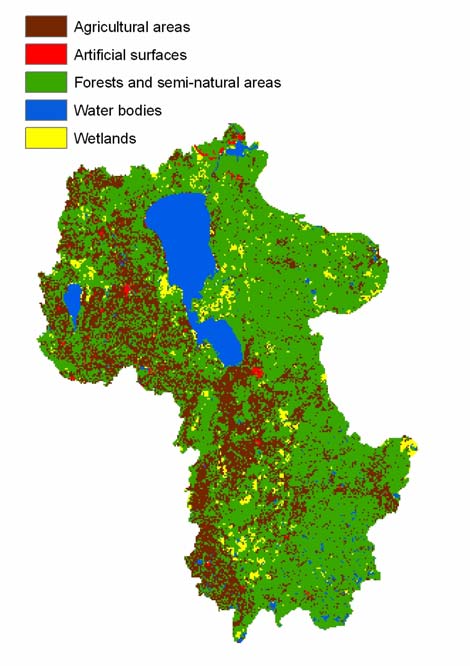
Land cover. Forests and semi-natural areas (Figure 2) dominate in the Lake Peipsi/
Chudskoe drainage basin. Agricultural areas cover around 14% of the basin.
Of Estonian part of the basin, arable
land covers 365 000 ha, in Russian
side 270 000 ha. Arable land in Lake
Peipsi/Chudskoe drainage basin
forms in total 635 000 ha. Forests
and semi-natural areas constitute
most of the Russian part of the basin.
Wetlands, although scattering the
entire basin, locate in a relatively
large portion near the shore of Lake
Peipsi/Chudskoe.
Population. The total population of
the basin provides ca 1
100
000
inhabitants. Of point sources the two
largest cities, Pskov (Russia) and
Tartu (Estonia), with 206 000 and
100 000 inhabitants, respectively,
pollute the Lake Peipsi the most.
Elevation profile. The drainage
basin is flat, with a highest point of
338 m above sea level and an
average elevation of 163 m. This is
Figure 2. Landcover in River Narva and Lake
typical North-European lowland area
Peipsi/Chudskoe drainage basin
of glacial origin bases on Palaeozoic
bedrock, covered by unconsolidated
glacial materials.
1.2 Water bodies and water resources
Lake Peipsi/Chudskoe strikes within European waterbodies. Other large lakes in the
region, Lake Ladoga and Lake Onega, reach incomparably deeper. Large lakes in
Sweden Lake Vänern, Lake Vättern etc differ highly in catchment geology and
ionic composition. Water of Lake Peipsi/Chudskoe 25 km3 resides 2 years. The
lake consists of three unequal parts: the biggest northern Lake Peipsi s.s. (2,603 km2,
maximum depth 12,9 at water level 30 m above sea level, water capacity 22 km3), the
southern part Lake Pskov (710 km2, 5,3 m, 2,7 km3) and the narrow strait-like Lake
Lämmijärv/ Teploe connecting them (240 km2, 15 m, 0,6 km3).
1.2.1 Hydrography
River Narva commences in the northeast part of Lake Peipsi and flows into the Gulf
of Finland. The length of the River Narva is 77 km. The average discharge of the
River Narva in the embouchure is 400 m3/s, during a year through the River Narva
about 12.5 km3 of water flows to the Gulf of Finland. River Narva is the second
biggest river flowing into the Gulf of Finland after the River Neva, the average annual
discharge of which is almost 80 km3. At the same time River Narva is one of the
biggest rivers flowing into the Baltic Sea from the east (in addition to River Neva,
11
bigger rivers than the River Narva are only River Daugava and the River Nemunas,
the average annual outlet of which is 21 km3).
Lake Peipsi/Chudskoe drainage basin, 44,725 km2, exceeds in size the lake surface
12 times. The basin parts between Russia (59%), Estonia (33 %), Latvia (8 %) and
Belarus (0.3%). The largest sub-basin is the Velikaya River basin, draining
approximately 58 % (25,765 km2 mean discharge: 195 m3/s) of the whole Lake Peipsi
drainage basin. The second largest sub-basin, Emajõgi river basin, covers
approximately 20% (8745 km2, mean discharge 68 m3/s) of the total basin. The
Emajõgi sub-catchment holds the largest lake in the basin, Lake Võrtsjärv, with a
surface area of around 270 km2.
1.2.2 Water use
Narva town (75 000 inhabitants) extracts its public water from River Narva. The lake
may potentially supply water to 175 000 inhabitants in future. Russia produces
hydropower from its water while Estonia uses water of Narva Reservoir for cooling in
the production of thermal power. Most of the settlements in the lake basin use
groundwater resources.
1.2.3 Fishing and recreation
Total annual catch of fish in Lake Peipsi/Chudskoe amounts between 8000 and
11 000 tons. Approximately half of this is caught of Russian fishermen. The Estonian
part of Lake Peipsi/Chudskoe constitutes 89% of surface fresh waters catch and gives
90% of the inland fishery of Estonia. The Lake has also great importance in the
aspect of recreation. Boating and yachting are popular activities. The recreational
potential of the Lake is about 27,000 persons per year, of which 16,000 stay at the
northern part of the lake.
1.2.4 Floods
In the Lake Peipsi/Chudskoe region the da
oods with
nger of fl
high water level
appears approxima
flood took place in the year
tely once a century. Last catastrophic
1924. As a result of global climatic changes the possibility of extreme weather
conditions increases, which also increases the risk of flood. These nature phenomena
might have a significant negative impact on economy and human safety. The places,
more apt to the danger, are in the inhabited coasts of Lake Peipsi/Chudskoe.
1.3 State
of waterbodies
1.3.1 Rivers
River Narva. River Narva is in good status although BOD sometimes shows high
values (Figure 3).
tion derived from
Secondary pollu
intensive phytoplankton bloom in
Lake Peipsi explains high variability of BOD content in River Narva.
Estonian rivers. Continuous improvement of water quality has monitored in Estonian
rivers. BOD has shown higher levels in River Emajõgi but instead of direct pollution
it indicates secondary pollution derived from intensive phytoplankton bloom in Lake
Võrtsjärv.
Phosphorus generally limits primary production in Estonian surface waters. Lower
content than the highest permissible value of total phosphorus, 0.08 mg P/l, prevents
12
eutrophication. Mean content of total phosphorus and phosphates in reference rivers
with no significant human impacts in 1992-1999 was correspondingly 0.05 mg P/l and
0.025 mg P/l. Increased content of phosphorus appears in rivers that receive municipal
wastewaters (River Võhandu, River Tarvastu, River Emajõgi, River Ahja, River
Narva). Despite of impact of wastewaters, content of total phosphorus has remained
below 0.15 mg P/l. Reference rivers contained total nitrogen in average 1.1 mg Ntot/l.
Measured time-
4
series
3.
Two-year average
5
3
Standard
2.5
2
BOD (mg/l) 1.5
1
0.5
0
2003
2003
2003
2003
2003
2003
2004
2004
2004
2004
2004
01.
03.
05.
07.
09.
11.
01.
03.
05.
07.
09.
9.
20.
8.
17.
18.
20.
21.
24.
19.
14.
15.
Figure 3. Concentration of BOD7 in River Narva at Narva in 2003-2004
Russian rivers. "SEK-VODA" system has provided, based on the monitoring results
of Rosgidromet, the state of waters in Russian part of the drainage basin. According to
nutrient concentrations and BOD, Russian rivers have mostly qualified to good or
very good class. Ecosystems function well in most part of the Russian side.
Biodiversity is stabile.
River Velikaya
tot
. Concentration of N in River Velikaya varied between 0.35 and
0.66 mg/l, BOD5 has been 1.1 1.7 mg/l and Ptot 0.01 0.2 mg/l. BOD, ammonium
and phosphates indicate good or very good water quality (downstream from the city
of Pskov, phosphates indicate moderate status).
1.3.2 State of Lake Peipsi/Chudskoe
After the reduction of nitrogen loading in 1980s, blue-green algal blooms have
reappeared in recent years and caused summer fish-kills. Algal blooms appear most
seriously and extensively in warm and windless periods.
High phosphorus concentration affects mostly the water quality in the lakes as well as
in the rivers of the basin. The southern and shallower part of the lake, Lake
c pressure than the northern part, L
Pihkva/Pskov suffers from higher anthropogeni
ake
Peipsi s.s. According to the Water Framework Directive, hydrochemical and
phytoplankton data indicate mainly moderate ecological quality in Lake
13
Peipsi/Chudskoe. The medium value of Ptot in the northern part of the Lake remains
0.044 mg/l while in southern part it reaches 0.07 mg/l.
According to the macrophyte and fish indices the ecological status falls between good
and moderate while zooplankton and benthic macro invertebrates indicate good status.
1.4 State of groundwater
The quality of surface- and groundwater used for domestic supply generally meets the
requirements but water from the deep aquifers contains much chloride, affecting the
taste of water. The deep groundwater of the Gdov aquifer exceeds norms of chloride
contents. Continuation of the present abstraction from that aquifer could potentially
cause the intrusion of seawater
1.4.1 Estonian resources
River Narva drainage basin contains all Estonian groundwater layers and 20
groundwater bodies. The present groundwater abstraction forms half of the approved
reserve and will decrease to one third by year 2015 as a result of the reduction of
water losses. It enables to reduce abstraction from the Cambrian-Vendian aquifers
(lower risk of seawater and other water intrusion).
Two of identified Estonian groundwater bodies cross the national border: Cambrian-
Vendian Voronka and Ordovician-Cambrian bodies.
The state of Ordovician Ida-Viru oil-shale basin groundwater body has been estimated
as `bad' due to dewatering of oil shale mines and open cast quarries and residual
pollution from chemical and energy industry. The state of that body depends directly
on human activities, is permanently bad, and impossible to improve significantly
within the next couple of decades.
1.4.2 Russian resources
Russian side uses groundwater of Ordovician-Cambrian limestones and Sub-
Ordovician carbonate rocks in one well simultaneously while Cambrian-Vendian
Gdov layers remain disused. Especially the high natural content of iron, manganese,
barium and radionuclide caused problems for water use. The higher nitrate content
detected nearby pollution sources is only identified as a result of direct human impact.
State of water quality of Russian areas of transboundary groundwater aquifers has
been estimated as good. Ivangorod-Kingissepp-Slantsõ area, falling under the direct
pressures, requires still further assessment.
14
2 Transboundary human impacts to water
The following major transboundary issues are identified:
· Eutrophication of Lake Peipsi (including riverine loads)
· Fishery management
· Groundwater resources management in the Narva River region
The main water-related environmental issue of concern in the transboundary Lake
Peipsi/Chudskoe is eutrophication. Eutrophication has influenced the biogeochemical
cycles leading to undesirable states of nutrient concentrations in the Lake and
secondary impacts upon fish stocks and rare species.
2.1 Eutrophication of Lake Peipsi
Nowadays Lake Peipsi receives ca 830 - 900 tons of phosphorus and 16 000 17 000
tons of nitrogen annually. These values fluctuate much depending mostly of the water
runoff. In wet years the nutrients load is greater while in dry years less. These two
nutrients cause eutrophication. After the collapse of agriculture in the early 1990s, the
loading of nitrogen has sharply decreased while phosphorus continued loading at the
same rate. Such phenomena could result from the sharp decrease of the application of
mineral fertilizers and the reduction of arable land, which reduced N loads also.
In the same time, worsened wastewater treatment and manure management as well as
residual pollution eliminated P reduction from the halved number of animals. The N/P
ratio in loadings and in the Lake has thus decreased. In rivers the ratio dropped from
80-100 in 1987 to 12-15 in 1991. The lowest Ntot : Ptot ratio in the Lake (about 11-13)
was registered in 1995-1996 (Figure 4). The decrease in the N/P loading ratios has
caused blue-green algal (cyanobacterial) blooms in the Lake in recent years. As the
main proportion of phosphorus comes through the two major rivers Velikaya (63%)
and Emajõgi (17%), the main attention should be paid to the reduction of P load from
these rivers.
Figure 4. Long-term dynamics of N/P concentration
ratio in Lake Peipsi/Chudskoe
2.2 Fishing in Lake Peipsi
Due to eutrophication and weak fishery management the total fish catch in Lake has
declined in the 1990s more than twice compared to the catches taken a century ago.
However, the current fishery rate has reached the limit when stocks of not only
valuable fish species, but also other fish species find utilization quite intensively or
15
even over-intensively. Lake suffers from growth over-fishing, especially in pikeperch
fishery
s
. Fi h are harvested younger than the growth optimum that would produce the
maximum yield per recruit. The total yield from the fi
em
shery r
ains therefore smaller
than it could be. Better fishery manageme
igher total revenues.
nt could bring h
The number of professional fishermen exceeds th
imum.
e opt
In 2003 the
approximate num
rm
ber of fishe en in Estonia and Russia reached ca 600 and 900,
respectively. During the Soviet period
bers rem
(end of the 1980s) the num
ained
approximately 200 and 300 respectively. Since du
he fish price of
ring the last decade t
the home and western market has increased slower than averages salaries in Estonia
and Russia, the relative income of fishermen has steadily decreased. This has caused
social problems. Thus, even if Lake Peipsi fishery remains important for employment
in future, the number of the fishermen mu
gradually, following the trend of
st decrease
Western Europe.
Fishing industry must be transformed in
a way that the social-econom
such
ic
problems that generate poaching will be solved. Refusing fishing approach needs
support and development of alternative activities in nearby villages.
In a European context Lake Peipsi "fish productivity" is very good. The prevalence of
the 'grazing food chain' and modest 'microbial loop' cause that, especially production
of predatory fish. The higher the ratio of predatory to non-predatory fish is, the less
phytoplankton and better water quality could be assumed. Thus, effective protection
measures of predatory fish, like pikeperch, perch and pike, could im
ater
prove w
quality that in a second stage would result in higher fisheries revenue.
2.3 Groundwater resources management in the Narva River
region
Cambrian-Vendian Voronka and the Ordovician-Cambrian groundwater bodies cross
the national border. Groundwater bodies in the Ordovician limestone aquifers suffer
no significant transboundary impact. In Estonian side transboundary groundwater
bodies are quite well protected against pollution and therefore the human impacts
through
appears only
water abstraction.
In Russian basin area the Ordovician-Cambrian aquifer is less protected than it is in
Estonia. In Estonia human activities impact mainly the Cambrian-Vendian Voronka
aquifer but less the Ordovician-Cambrian ones, and vice versa in the Russian side.
No significant transboundary impact has been detected in any of the groundwater
aquifers.
Contaminated areas leak pollutants very significantly to the Ordovician Ida-Viru oil
shale basin groundwater body and significantly to the Ordovician Ida-Viru
groundwater body.
In Russian basin area, the pressures to groundwater quality relate to oil shale
chemistry, phosphorite production (located outside Narva basin but impacts could still
appear)
r
, ene
scale groundwater contam
gy industry, and also large-
ination incidents
due to accidents with oil products.
Landfills leak pollutants significantly to groundwater body of the Ordovician Ida-
Viru oil-shale basin and less significantly to the Ordovician Ida-Viru groundwater
body.
16
Of 20 Russian landfills in the basin area only one is protected against groundwater
pollution (Palkiinskii rayon). Energy and oil shale chemistry waste landfills
contaminate the most. Approximately 312 tons collected out-of-use pesticides in
different temporary storages in Russian basin area could have a potential risk of
groundwater contamination.
Leakages from the infrastructures of oil industry production have a significant
pressure to the Ordovician Ida-Viru oil shale basin groundwater body and a less
significant pressure to the Ordovician Ida-Viru groundwater body. Russian basin area
falls under leakages from energy and oil shale chemistry enterprises.
Agriculture is a significant pressure to the Ordovician Ida-Viru groundwater body
and Ordovician Ida-Viru oil shale basin groundwater body. Due to low intensity and
exhaustion of soils (soil nutrient balance is strongly negative) Russian agricultural
pollution remains insignificant.
Mining areas have significant pressure to Ordovician Ida-Viru oil shale basin
groundwater body. In Russian basin area the pressures to groundwater quality relate
to Slantsevski oil shale mine and Kingissepski phosphorite quarry. The production of
phosphorite remains outside Narva basin but its impacts may still reach Narva basin,
including groundwater intake at Ivangorod.
Abstraction for municipal water supply is a significant pressure to Cambrian-
Vendian Voronka and Gdov and Ordovician-Cambrian groundwater bodies,
particularly in the Ida-Viru County towns Sillamäe, Kohtla-Järve, Jõhvi, Kiviõli and
their suburbs, also in Ivangorod in Russia.
Abstra
s
ction by industry form a significant pressure to the Cambrian-Vendian
Voronka and the Gdov groundwater bodies at Kohtla-Järve, Sillamäe, Kiviõli and
Jõhvi towns; Ivangorod and Slantsy from the Russian Federation side.
In Russian basin area municipal water supply and industry abstracted groundwater in
total 55342 m3/d in year 2002, compared to 69006 m3/d in year 2003 in the Estonian
basin area.
Dewatering and drainage for mining (mine water) is a very significant pressure to
the Ordovician Ida-Viru oil shale basin groundwater body.
The Russian mines (including open-cast quarries and underground mines) pumped out
in total 72876 m3/d of water in year 2002 (excluding Kingissepp phosphorite quarry
with 13 000 m3/d), while Estonian mines pumped 556 139 m3/d in 2003.
Due to large areas of Estonian mines, the pumped water originates mainly from
precipitation, which would have been flown into rivers anyway. In addition, a
significant portion of mine water flows back to the mines. Approximately 25% of the
total amount of pumped out water counts as groundwater abstraction.
Seawater intrusion is a significant pressure to Cambrian-Vendian Voronka and Gdov
groundwater bodies in Estonian seashore areas. In Russian basin area seawater
intrusion is a risk for Cambrian-Vendian Voronka aquifer.
Saline water intrusion from bedrock is a significant pressure to Cambrian-Vendian
Voronka and Gdov groundwater bodies. Saline water has intruded to crystalline
bedrock in the substratum of the Cambrian-Vendian Gdov groundwater body. In case
of missing aquifuge, in areas of intensive groundwater consumption, more saline
quality of the gr
water could potentially endanger the current
oundwater body. As the
17
salinity of the Cambrian-Vendian Gdov groundwater body exceeds the salinity of the
Cambrian-Vendian Voronka groundwater body, the groundwater of Gdov aquifer
could harm the qualitative status of the Voronka groundwater body. (The groundwater
level in Voronka aquifer is lower than in the Gdov aquifer due intensive abstraction).
2.4 Other transboundary impacts
Other transboundary human impacts to water resources of the drainage basin
comprise pollution of surface waters from mining activities, damage of biodiversity,
thermal pollution of Narva Reservoir and physical modification of River Narva.
Mining. Oil-shale mining and related industry in Northeast Estonia contribute to
pollution loads in the rivers as well as to Lake Peipsi affecting the quality of waters in
the Narva reservoir. Rivers work as recipients for discharged waters from mines: for
production of one ton of oil-shale, at average 15 m3 of water as average had been
pumped out from mines in Estonia (from which ca 25% counts as groundwater).
Mining waters with high alkalinity may contain suspended solids, oil shale phenols
from past pollution sources, hydrocarbons and sulphates. The concentration of
sulphates, phenols and oil in most Estonian surface water monitoring stations remain
within the permitted levels. The sulphate impact to ecosystems is so small that it is in
most cases unnoticeable.
Thermal pollution. Two thermal power plants at the shore of Narva Reservoir
release their warm cooling waters into Narva Reservoir. The power plants discharge 8
10 degrees warmer water to the reservoir compared to the intake water. Estonian
environmental legislation l
or therm
acks standards f
al pollution. According to Russian
standards, the thermal pollution in Narva Reservoir remains within the limits. Still, in
case of very hot summer periods these cooling waters could significantly affect the
ecosystem of the Narva reservoir.
Modified River Narva. Construction of Narva Hydro Power Plant in 1950-ies
changed significantly the functioning and structure of the ecosystem of River Narva.
about 190km2
Flooding of
land on the right side of the Narva River established the
artificial Narva Water Reservoir. Since several fish species, including eel, fail to
migrate between the Baltic Sea and Lake Peipsi.
Load of heavy metals. When heavy metals such as cadmium, copper, zinc, mercury,
lead, and chromium reach unnaturally high concentrations, they could affect
environment. However, the content of heavy metals in River Narva remains within the
EU and Russian standards (Table 1).
Table 1. Norms of heavy metals in surface waters, ug/l.
EU
environmental
Russian norms Russian norms for Highest
quality standards
for waterbodies waterbodies wh
measured
ich
(Council Directive
which are used are used for water concentration in
98/83/EC on the quality for fishing
supply, cultural and River Narva
of water intended for purposes
recreational
human consumption)
purposes
Lead, ug/l
10
6
30
1
Copper,
2000
1000
36
ug/l
Cadmium,
5 5
1
0.2
ug/l
18
3 Wildlife
3.1 Rare
species
The coast of Lake Peipsi/Chudskoe serves as a habitat for several plant species, which
lack or appear rarely elsewhere in Est
sia (see figures in CD Annex 1)
onia and Rus
.
Rare plant species populate generally the littoral areas of the lake. Eutrophication and
direct local pollution from harbours endanger them.
Lake Peipsi is a living place for many rare species under the threat of extinction.
The most remarkable rare plant species comprise: Siberian iris (Iris sibirica),
marsh gentian (Gentiana pneumonanthe), Water awlwort (Subularia aquatica), and
on the shore Spurious pestilence-wort (Petasites spurious), Silver Spray (Achillea
cartilaginea), and Blue lyme grass (Leymus arenarius,).
Of mammals the most important is to protect the habitats of Flying Squirrel
(Pteromys volans).
The most significant amphibian species are green toad (Bufo viridis) and Common
Spadefoot (mud frog, Pelobates fuscus).
Rare bird species are disturbed by recreational activities, logging for timber, cutting of
shrubs, burning of vegetation, using of motorboats near the lakeshores, poaching of
waterfowl. Fishing with nets occurs along the edge of the vegetation. Disturbance
results from the use of motorboats near the lakeshores. Waterfowl shooting disturbs
birds during the migrations.
Lake Peipsi/Chudskoe serves as an important moulting and staging area for
endangered birds such as Black Stork (Ciconia nigra), Osprey (Pandion haliaetus),
White-tailed Eagle (Haliaeetus albicilla), Whooper Swan (Cygnus Cygnus), Common
Goldeneye (
,
Bucephala clangula) Bewick's Swan (Cygnus columbianus), Mallard
(Anas platyrhynchos), Common Pochard (Aythya ferina), Common Coot (Fulica
atra), Great Crested Grebe (Podiceps cristatus), Bean Goose (Anser fabalis), Smew
(Mergus albellus), Corncrake (Crex crex) and Aquatic Warbler (Acrocephalus
paludicola).
a
Lake Peipsi/Chudskoe provides spawning areas for m ny fish species including perch
(Perca fluviatilis), vendace (Coregonus albula), bream (Abramis brama), pike (Esox
lucius), roach (Rutilus rutilus), bleak (Alburnus alburnus), pikeperch (Sander
lucioperca), rudd (Scardinius erythrophthalmus) and golden orfe (ide, Leuciscus
idus)
ls catfish (
, as well as the endangered we
Siluris glanis) and endemic Peipsi
whitefish (Coregonus lavaretus maraenoides).
ll local rar
A
e species face potential threat of alien species.
3.2 Ramsar
sites
Two Ramsar sites locate on Lake Peips Chudsko
i/
e both near the border between
Estonia and Russia. These two sites neighbour each other.
u
Emajõe S ursoo Mire and Piirissaar Island situated in Estonian sid
p
e com rises
a more or less large, flat wilderness area with an integral complex of different types of
peatland, rivers and lakes (including the shallow waters of Lake Peipsi), coasts and an
island. Fens wa
, s
mps, swamp forests, peat bogs, reedbeds, shores, open and mixed
forests as well as some agricultural areas contain characteristic flora for different mire
19
communities typical for the region. Regulated and traditional human activities hold no
direct threats to the
i
site. The adm nistration has recommended avoid building of
summer cottages. Inten
i
sive f shing in Emajõgi delta, especially during spring
spawning, could affect the site. The site suffers from general eutrophication,
especially in the southern basin.
Pskovsko-Chudskaja lakeside lowland locates in northwestern Pskov Region, 7 km
from the city of Pskov. The northern and western boundaries of the site pass through
the open waters of Lake Peipsi/Chudskoe, Lake Lämmijärv/Teploye and Lake
Pihkva/Pskovskoye along the border between the Russian Federation and Estonia.
The site situates across from the Estonian Ramsar Site Emajõe Suursoo Mire and
Piirissaar Island. The site contains many rare and threatened species of the Russian
Red Data Book. Threats at the site include logging for timber and the cutting of
shrubs, and the burning of vegetation. Fishing
occurs al
with nets
ong the edge of the
vegetation. Disturbance results from the use of motorboats near the lakeshores.
disturbs
Waterfowl shooting
birds during the migrations. Pressure from recreation
will probably increase in the coming years.
3.3 NATURA
areas
In addition to the mentioned Ramsar sites, Lake Peipsi/Chudskoe contains two more
NATURA sites: ,,Raadnast Kalmakülani" covers a large area in the Northern part of
Lake while Lahepera area locates south from Kallaste town. Of other Natura sites
with transboundary character the most important is Karisilla Oja site.
20
4 Description of monitoring network
4.1 Surface
water
Regular investigation of Lake Peipsi started in 1960s and up to now about 35 year data
series on water chemistry and biology have been gathered.
The sampling frequency per year and the number of sampling stations has varied from
3 to 8 times and from 4 to 24 stations.
Hydrochemistry of Lake Peipsi monitored by Tartu Environmental Research Ltd. and
Hydrometeorological Centre of Pskov.
Two joint expeditions (in the years 2003-2004) were organised to Lake Peipsi and the
Narva Reservoir. A selection of biological and chemical tests was organised with the
participation of the Russian and Estonian experts in sampling stations all over the
lake. The analysis of the results of these expeditions was presented by the Estonian as
well as Russian experts in the meeting of the Joint Water Commission and during the
meeting of the working group on water quality and monitoring.
Estonia. Estonian national monitoring programme of Lake Peipsi/Chudskoe is quite
well integrated between different disciplines. Hydrobiological indices monitored by
Limnological Center of Institute of Agricultural and Environmental Sciences at
Estonian Agricultural University. State fishery research is made by Institute of
Zoology and Hydrobiology at Tartu University. These studies are mainly targeted to
establish catch limits and consider mainly commercial fish species.
Russia. In Russian side, responsible body for chemical monitoring of waters is
generally Hydrometeorological Center of Pskov. Concerned quality elements are
hydrochemical state, load of nutrients, load of organic compounds and saprobic index
in the last decade. Monitoring covers both the Lake Peipsi/Chudskoe and rivers in the
drainage basin. The following water quality parameters are measured:
· General indices: dissolved oxygen content (mg/l), Secchi depth (m)
· Hydrochemistry: Suspended solid concentration (mg/l), Biochemical oxygen
demand, chemical oxygen demand by permanganate (mg O/l), ammonium,
nitrates, nitrites, total N (mg N/l), organic P, total P (mg P/l), phenols, heavy
metals (Cd, Cu, Pb)
4.2 Groundwater
Estonian side. The Estonian groundwater monitoring system consists of the national
sub-programme of groundwater monitoring and monitoring results presented by the
requirements of water permits.
Three state-financed ground water monitoring subprograms exist in Viru and Peipsi
sub-basins. These programmes have been carried out within "The national monitoring
programme of the groundwater in Estonia". The Estonian Geological Survey
implements the largest groundwater monitoring sub-.programme while Estonian
Environmental Centre implements the two smaller sub-programmes (Pandivere and
Adavere-Põltsamaa Nitrates Vulnerable area and nearby Kohtla-Järve industrial waste
and semi-coke landfill).
21
Additional monitoring programs (carried out by local water enterprises, Narva Power
Plants, Eesti Põlevkivi etc.) follow the requi
perm
rements of water
its. All enterprises
with significant potential impact to water status in the Ordovician Ida-Viru oil shale
basin groundwater body participate the monitoring network. The biggest network for
groundwater monitoring (100 monitoring stations) belongs to Eesti Põlevkivi Ltd. To
assess transboundary impacts, the Estonian groundwater-monitoring network
demands 1-2 additional monitoring stat
N
ions between
arva town and Narva
Reservoir.
for
Water enterprises control groundwater
drinking. These enterprises submit their
analysis results to local environmental departments. According to future plans these
data will incorporate to Est
nm
onian Enviro
ental Register.
Reverberation of transboundary impacts in Ordovician-Cambrian and Cambrian-
Vendian groundwater bodies require harmonization in Estonian and Russian
groundwater monitoring programmes.
Russia has detected no large-scale problems with groundwater in its basin area.
Anthropogenic compounds contaminate immediate neighbourhood of the sources.
Worsening of organoleptic indicators in
ociate with pollution
Ivangorod intake ass
from Kingissepp phosphorite mines. The potentiometric surface of groundwater at
Novorzhev, Opotshka, Ostrov, and maybe Ivangorod areas has lowered but drawdown
remain apart. Due hydrogeological conditions, oil shale mining has dewatered less
keeping groundwater quality in closed mines better. Considering smaller impacts of
oil-shale production, the state of groundwater in Russian basin area remains good.
Local authorities regard the existi
t.
ng monitoring network as sufficien
Till now the Estonian and Russian national monitoring programmes have selected no
monitoring stations for joint transboundary monitoring networks of Ordovician-
Cambrian and Cambrian-Vendian aquifers.
22
5 Water
management
Sustainable use and protection of resources of transboundary waters is possible only
via targeted and agreed measures undertaken by all countries within the drainage
basin.
Estonia, as a member state of the EU, must implement the Water Framework
Directive. According the Directive, within a river basin where use of water may have
transboundary effects, the requirements for the achievement of the environmental
objectives established under that Directive, and in particular all programmes of
measures, should be coordinated for the whole of the Narva river basin. For river
basins extending beyond the boundaries of the Comm
ber States should
unity, Mem
endeavour to ensure the appropriate coordination with the relevant non-member
States.
Following Russian water protection legislation, river basin management programmes
of transboundary waterbodies are elaborated in accordance with the international
agreements of Russian Federation.
Cooperation between the Republic of Estonia and Russian Federation is conducted in
the basis of the bilateral (intergovernmental) agreement on the protection and
sustainable use of transboundary water bodies between the Republic of Estonia and
the Russian Federation (1997).
For dealing with transboundary water issues, the Joint Estonian-Russian
Transboundary Water Commission was established in 1997,
signing of an
after
intergovernmental agreement. The Transboundary Water Commission plays an
increasingly important role in promoting sustainable development in the Lake Peipsi
basin. The Commission is the main actor in managing Lake Peipsi and it:
1) Organizes exchange of data between the parties in accordance with the
agreed programme
2) Defines priority directions and programs of scientific studies on protection
and sustainable use of transboundary waters;
3) Agrees on common indicators of quality for transboundary waters, methods
of water testing and conducting analyses;
4) Facilitates cooperation between agencies of executive power, local
governments, scientific and public interest organizations, as well as other
institutions in the field of sustainable development and protection of
transboundary waters;
5) Ensures publicity of discussions of questions related to the use and
protection of the transboundary waters.
Another commission dealing with Lake Peipsi issues, Joint Fishery Commission,
works on the constant basic rules and gathers once a year. The functions of the
Commission are to develop recommendations for coordinated actions in fish resource
management, coordinated research in fish resource assessment, possibilities and
procedures for one party to fish in the waters of the other party, exchange of fishing
quotas based on mutual interests and legislation of both parties, establishment of the
maximum total catch for various fish species and its distribution between the two
parties, regulation of allowable fishing gear and methods, minimum permissible size
23
of commercial fish, allowable share of free-time catch, seasonal and territorial
limitations, improvement and efficient reproduction of fish resources, including fish-
breeding, procedures to resolve fishing disputes and incidents, access to fishing of the
third parties' persons and organisations, control over the fulfillment of the approved
measures and other activities in protection and sustainable use of fish resources of
eipsi, Pihkva and Lämmijärv.
Lakes P
Further information about Lake Peipsi/Chudskoe basin inheres in the following
documents:
VIRU-PEIPSI CAMP project (website www.envir.ee/viru.peipsi) that assist
implementation of the EU WFD in the Viru River Basin and Lake Peipsi basin
in Estonia.
EU TACIS CBC Baltic Line 2000 programme will support a project
"Environmental Management of Lake Chudskoe" that will be implemented in
Russia.
5.1 Transboundary Diagnostic Analysis (TDA)
TDA has guided this Lake Peipsi/Chudskoe Transboundary Management Programme.
This chapter outlines the TDA. The full text is annexed in the CD. TDA aimed to
identify and assess the importance of environmental disturbances and threats to the
waters and their causes and to identify potential preventive and remedial actions.
TDA identified the following major perceived transboundary problems:
· Eutrophication of Lake Peipsi,
· Fishery management and,
· Groundwater management at the Narva River region.
The common denominator for the root-causes in all identified problems proved lack
of knowledge in general. This includes issues like information spreading and
interpretation, training and education for stakeholders, inadequate scientific
understanding and inadequate or unreliable information, and inadequate access to
technical and scientific information. In addition, economic problems caused
eutrophication and fishery problems.
The TDA identified four Environmental Qualit
bjectives (EQOs), which represent
y O
the regional perspective of major goals for the regional environment:
1. Good ecological status in Lake Peipsi by 2015;
2. Improve the water quality of rivers in Lake Peipsi catchment area,
3. Sustainable productivity from Lake and river fishery;
4. Stabilized high ground water quality
supplies in Narva River area.
and
TDA has recommended a strategy approach for the transboundary Lake
Peipsi/Chudskoe Basin Management Plan, listed below.
Municipal wastewater. In the short term perspective, in the Lake Peipsi Basin the
priority actions should focus on the phosphorus reduction from municipal wastewater,
specifically by the Pskov town of Russia which beyond any doubt is the largest single
phosphorus source.
24
Diffuse pollution. In the long- term perspective, the strategy should focus on
prevention of nutrient pollution from diffuse sources, including agriculture and forest.
Monitoring. Development of a joint transboundary programme for surface water
monitoring in the two countries by e.g., using the EU-Directive Guidelines (WFD,
Urban Wastewater Directive, Nitrates Directive) and the United Nations European
Economic Commission [UN ECE] guidelines for monitoring and assessment of
transboundary rivers and lakes.
Referring to
ater Fra
W
mework Directive (Articles 3 and 13), TDA suggests work out
and implement the joint river basin management programme, which covers also
the Russian part of the drainage basin.
Development (e.g., via the Joint Estonian-Russian Transboundary Water Commission
and its working group on Monitoring and Research) joint assessment procedures
including share of pressure data like riverine loads and other pollution source data.
More precisely to (i) prepare a biennial background on the nutrient load and its
sources, which shall include (1) more accurate data on land use in riverine
catchments, especially, on agricultural land
lands, pastures,
s subdivided into arable
grasslands, fallow lands and unused lands, and (2) more accurate and reliable data on
nutrient load source apportionment; (ii) prepare a background report on long-term
trends in the riverine load dynamics and nutrients' concentration; (iii) develop a joint
coordinated database on water quality and quantity, land use, and point pollution
sources.
Enc r
ou aging good agricultural practices and management of fertilizers to decrease
nutrient losses and improvement of water quality.
Economic instruments to be used to motivate a more sustainable use of natural
reso c
ur es should be worked out, such as em
ser
ission charges, u
charges, and product
charges. An analysis of the effect of implementing subsidies should be conducted,
since granting subsidies may cause significant distortions in tax system and enables
the transfer of pollution damage costs as indirect costs to the entire society.
The respective state legislations and the cross-border initiatives in the Estonian-
Russian Intergovernmental Lake Peipsi Fisheries Commission work properly and
effectively. However, there is a nec
essity to further tuning and harmonisation of the
fish resources regulation in an overall Lake water management perspective. More
precisely, effective protection measures of predatory fish - like pikeperch, perch and
pike - should be further elaborated and implemented for improved water quality and
subsequent increased fisheries revenue.
The two major groundwater management problems are th
straction of
e over-ab
water from the Cambrian-Vendian aquifer system for urban water supply and the
mine dewatering.
It is proposed to establish joint Estonian and Russian emission standards
g
accordin
to water use (drinking, fish cultivation etc.).
25
5.2 Viru and Peipsi Sub-basins Management Plan (VP-
CAMP)
The project area covers Viru and Peipsi sub-basins in Estonian Lake Peipsi and River
Narva (Figure 1).
As an outcome of Phase I of the project, an assessment of the state of surface waters
and groundwater of the area was prepared. The materials were published in 2004 as a
summary publication "Viru-Peipsi Catchment Area Management Plan, Assessment of
the State of Surface Water Bodies and Groundwater" in Estonian and English
languages.
Phase II of the project resulted in the preparation of an assessment of human impact,
an economic analysis and a programme of measures until 2009 and 2015, which aims
to achieve a good status of water bodies and groundwater and to ensure the supply of
high quality drinking water to the population.
Activities devoted to strengthen Estonian administrative capacities to support the
implementation of the WFD have also included into the Management Plan. The
project is co-financed by the EU LIFE-Environment programme. The project finished
in September 2005.
The materials of the Catchment Area Management Plan are available on the home
e Viru-Peipsi LIFE pr
page of th
oject (www.envir.ee/viru.peipsi).
5.3 Water resources Management Plan of the Russian part of
River Narva and Lake Chudskoe Basin
The overall objective of the Project "Water resources Management Plan of the
Russian part of River Narva and Lake Chudskoe Basin" is to increase the
environmental management potential of Russian regional and local authorities. As
much as the resources allow, all objectives of the Project are achieved in order to
reach stable results by using management principles of the water area of Lake Peipsi.
The Management Plan must include short term as well as long-term water
management measures of River Narva and Lake Peipsi basin. Document describes:
the status of lakes and rivers, human impacts to waters, main problems in water
management and scope the environmental objectives. Programme of measures include
series of target programmes, as: drinking water supply, treatment of sewage water,
of
reduction of diffuse pollution, reduction
flood risks, preservation of waterbodies
ecological status, improvement of water management.
The project will be finished in the beginning of 2006.
26
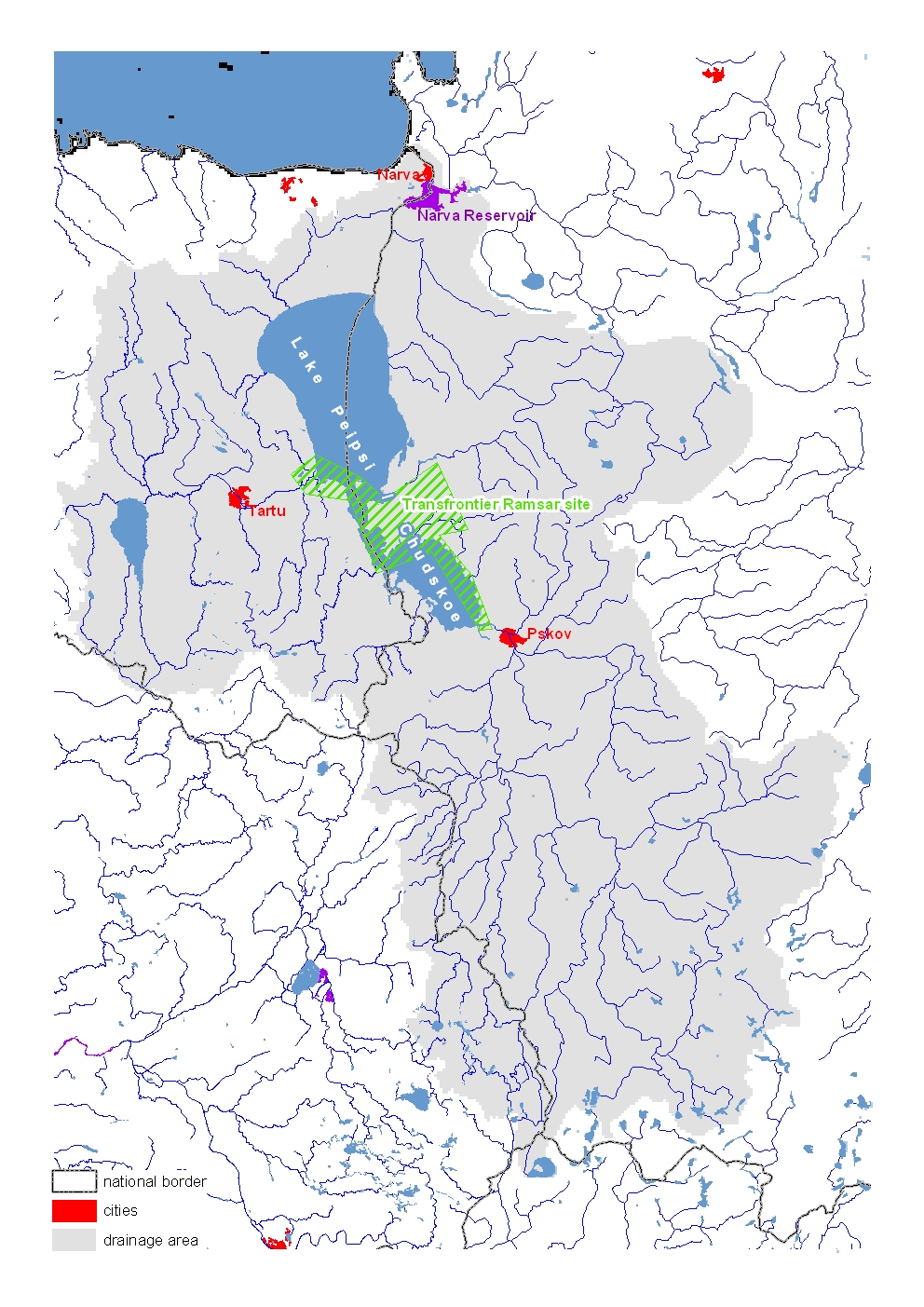
Figure 5. Transboundary hot spots in Lake Peipsi/Chudskoe
drainage basin
27
6 Transboundary environmental objectives
Some water problems of Lake Peipsi and its drainage basin can be handled in national
level. These comprise local environmental impacts such as groundwater pollution and
drinking water production apart from the border, management of beaches along rivers
and small lakes etc. Other water problems should be ultimately solved in transnational
level. Pollution entering Lake Peipsi/Chudskoe and River Narva should be controlled
jointly. Fishing requires the maintenance and refinement of joint quotas and other
cooperation activities.
This management programme aims at tackling specifically transboundary issues. The
temporal scope of the programme is 2006 2015. However, long-term measures need
implementation time beyond 2015. Transboundary Diagnostic Analysis, defining
environmental objectives and a strategy for the transboundary Lake Peipsi/Chudskoe
Basin Management Programme, has identified four key transboundary issues. This
programme, considering also other plans, analysis results and programmes, identifies
following four priorities:
· Good status of transboundary surface waters
· Good status of transboundary groundwater aquifers
· Protection of biodiversity of Lake Peipsi/Chudskoe
· Sustainable use of water resources
6.1 Objectives for surface waters
6.1.1 Common environmental quality standards
Estonian and Russian regulations have standardised pollutant concentrations in
surface waters and effluent wastewaters (Table 2). According to the Agreement
between the Government of the Estonian Republic and the Government of Russian
Federation on Cooperation in Protection and Sustainable Use of Transboundary
Waters, in case of national differences the more stringent standard has been chosen
for the common one.
River standards. According to the Russian pollution index the standard for BOD5 is
2 mg/l, for Ptot 0.2 mg/l. According to the Estonian standards good ecological status
requires for rivers less than 5 mg/l BOD and 0.08 mg/l Ptot. In transboundary rivers
such as River Narva the common standard formally is 2 mg BOD/l and 0.08 mg Ptot
/l. However, such unrealistic BOD norm requires reconsideration 3 mg/l standard
could work better.
In the same time, the joint list of hazardous substances is needed as well as
monitoring, measurement methodology and standard concentrations of these
substances.
Lake standards. Russian standard Ptot concentration for eutrophic lakes such as
Lake Peipsi/Chudskoe is 0.2 mg/l. According to the Estonian standards the
concentration of Ptot in eutrophic lakes should not exceed 0.06 mg/l According to the
present scientific knowledge, good status objectives demand that P concentration in
Lake Peipsi/Chudskoe should remain below 0.034 mg/l. Today common standard
remains 0.06 mg P/l.
28
Table 2. Common standards related to surface water quality
Estonia
Russia
Common
standard
Concentration of Ptot in
0.08 0.2 0.08
transboundary rivers (Narva, Piusa),
mg/l
Concentration of BOD in
5 2 2
transboundary rivers (Narva, Piusa),
mg/l
Concentration of Ptot in Lake 0.06
0.2
0.06 (Good status, however,
Peipsi/ Chudskoe, mg/l
requires lower
concentration)
Concentration of Ptot in effluent 1
1.5
1 (less than 10 000 PE
wastewater discharging to the
1.5)
drainage basin, mg/l
(less than
(Standard for
10 000 PE PP2O4 0.2)
1.5)
6.1.2 Wastewater standards
Est ia
on . According to the EU directive on wastewater treatment (directive 271 from
1991) the minimum outlet criteria for main pollutants are:
· Ptot: 1 mg P/
then 1.5 m
l (if less than 10 000 PE
g/l) or 80 % P removal;
· BOD7: 15 mg/l or 90% removal;
·
tot
N : 15 mg/l or 70-80% removal.
Russian standard for phosphorus concentrations of wastewater effluents is 1.5 mg/l.
Standard for total Nitrogen is 15 mg/l and standard for BOD5 is 15 mg/l.
The common standard pollutant concentrations in wastewater effluents of large
settlements such as Pskov, Slantsõ, Tartu and Narva are following: BOD 15 mg /l;
Ntot 10 mg/l; Ptot 1.5 mg/l. By 2015 the target concentration of Ptot is 1 mg/l and at
least 80% removal from wastewater entering the treatment plant.
6.1.3 Targets to meet surface water quality standards
Reduction of phosphorus concentration in Lake
Peipsi. Reduction of phosphorus loads is the crucial tool
to combat eutrophication of Lake Peipsi/ Chudskoe. The
Lake received approximately 830-900 tons of
phosphorus annually in the time period of 2000-2004.
The concentration of Ptot in the entire Lake
Peipsi/Chudskoe does not exceed the standard value
(0.06 mg P/l) but generally exceeds the threshold of
good status (0.034 mg P/l). In northern part of the Lake
the concentration is approximately 0.044 mg/l and in
southern part, Lake Pihkva/Pskov approximately
0.072 mg/l (Figure 6). As phosphorus is the main
substance responsible for eutrophication, the priority
Figure 6. Concentration of
objective of this programme therefore is to reduce Ptot
P
concentration in Lake Peipsi/Chudskoe. Still, a discussed
tot in the mouth of River
Velikaya, River Emajõgi,
Lake Peipsi/Chudskoe and
River Narva, mg/l
29
rget P concentration below 0.034 mg/l rem
ta
ains unrealistic.
The required concentration of P in rivers (0.08 mg/l in Estonia and 0.2 mg/l in
ussia, table 4) have already
R
generally achi
cludin
eved in
g the m
iver
ouths of R
g
Velikaya (0.07 m /l) and River Emajõgi (0.08 mg/l). As achieving the phosphorus
standards in the rivers will reduce the loads into the Lake Peipsi/Chudskoe only
marginally (ca 5%), it will not be sufficient to ensure good quality of the lake. In other
stringent than corresponding standards for
words, the target for the Lake is more
rivers in the drainage basin.
Phosphorus load reduction from municipal discharges. Two largest cities in the
drainage basin Pskov and Tartu contribute 8
6.1% and 1
% (
.7% respectively) to the
total P load into Lake Peipsi/Chudskoe.
The average concentration of Ptot of municipal wastewater of
e
Tartu, the larg st
Estonian city in the drainage basin, in 2004 was 1.3 mg/l. Stage II of tunnel collector
was commissioned in 2004, whereby most of the former direct discharges into the
River Emaj
inated.
õgi were elim
P load reduced to 13.2 ton per year in 2004. In order
to achieve the required concentration of 1 mg/l, an additional removal of 3 tons of
phosphorus annually is foreseen.
Pskov discharged 54.9 tons of PO4-P annually to River Velikaya in 2003. As the city
is situated at almost the mouth of the river, practically all the pollution reaches Lake
Pihkva. The aim of the programme is to halve the discharge to achieve the load of
PO4-P as low as 27 tons per year by 2015.
Total target for the reduction of municipal phosphorus load is therefore 30 tons per
year, which should reduce the total load of P to Lake Peipsi 3%. Efforts to reduce
phosphorus emissions from municipal wastewater treatment plants remain insufficient
and agricultural loading scenarios are crucial for future fate of Lake Peipsi/Chudskoe.
Phosphorus load reduction from agriculture.
at chang
Model results indicate th
es in
the amount of arable land will be the major factor controlling the future nutrient loads
into Lake Peipsi. The long-term future strategy for nutrient load reduction thus mainly
focuses on lowering the agricultural nutrient runoff. Today, agriculture is responsible
for the largest portion of the total loading to the Lake even though the losses from
agriculture per unit area (e.g. kg/km2) are at a very low international level. Large
animal farms form a growing source of nutrient pollution in Lake Peipsi/Chudskoe
basin. The future loadings will heavily depend on how the agricultural land will be
used in the future, e.g. how much of the present set-aside and abandoned land will be
used in future, and the intensity in the agricultural sector. In order to achieve
mesotrophic status, P-load to Lake Peipsi should be decreased 1.7 times (50 100
tons of reduction from annual load!).
Such target is not realistic. The aim of the programme is to keep the phosphorus
emissions from the agricultural sector as low as these are today without compromising
the growth of production.
Other issues. BOD in River Narva nowadays fluctuates around the common standard
level while Ptot remains within the limit in most samples. In another border river,
Piusa, Ptot sometimes exceeds the limit value. Insufficiently treated wastewater of
town Petseri affects the water quality of River Piusa downstream from the mouth of
River Patskova.
30
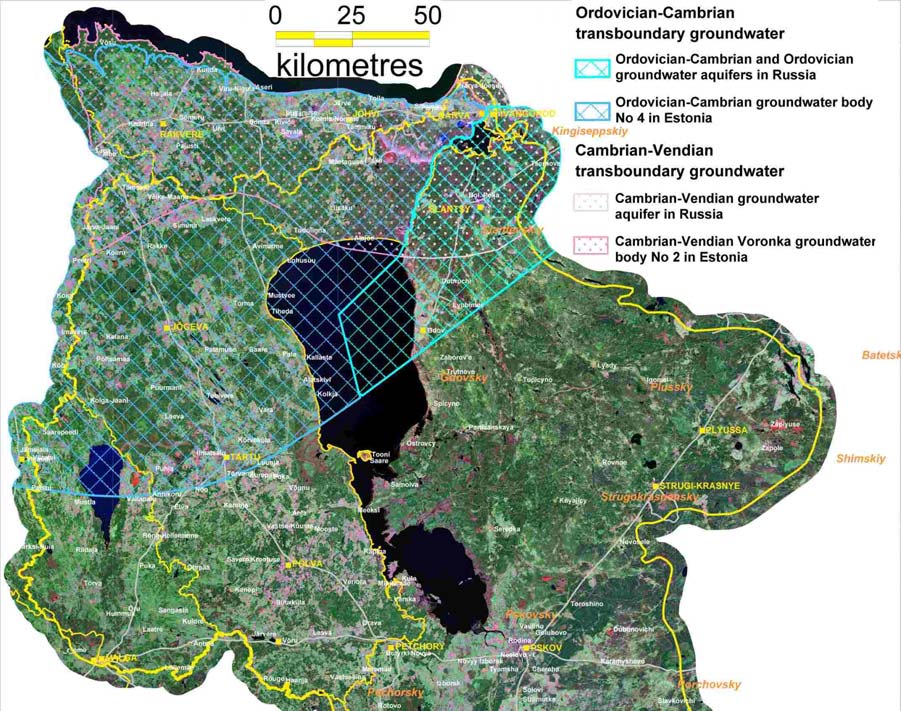
6.2 Objectives for groundwater
Estonia and Russia will ensure stabile potentiometric surface and good chemical
status of transboundary groundwater aquifers in River Narva and Lake
Peipsi/Chudskoe drainage basin area.
As transboundary are identified Cambrian-Vendian Voronka and Ordovician-
Cambrian aquifers (Figure 7) near River Narva, north from Lake Peipsi/Chudskoe.
Current programme aims to ensure good status of these groundwaters, to guarantee
resources long-term usage.
Figure 7. Transboundary groundwater aquifers in River Narva and Lake Peipsi basin
6.3 Objectives
of wildlife
An aim of this programme is to sustain the populations and habitats of rare species in
Lake Peipsi/Chudskoe offering favourable living and breeding conditions for these
species and populations and reducing human impacts. The list of the rare species in
Lake Peipsi Basin is given in chapter 3.1. and pictures of rare species are annexed in
the programme CD.
31
6.4 Economic
objectives
6.4.1 Sustainable water use
The objective of this programme is to ensure long-term satisfaction of the water need
for domestic and industrial purposes in River Narva and Lake Peipsi drainage basin.
6.4.2 Sustainable fishery in Lake Peipsi/Chudskoe
The first objectives concerning Lake Peipsi/Chudskoe fishery is to maintain and
increase the commercial fish stock in the lake. Depending on species, commercial
value of each fish differs. The proportion of high quality fish should be promoted to
improve the quality of the stock. Along with increasing the stock the objective is to
increase fish catch to gain more revenues in both sides of the border. Another goal of
this sub-programme is the promotion of free-time fishery to multiply the revenue from
each fish improving thus life quality of the human communities in lakeshore areas.
The system of goals and objectives of this sub-programme is presented below.
Increased stock
Increased catch
Improvement of
Increased
lake ecosystem
revenue
Promotion of
Increased
commercially
quality of stock
valuable species
Improvement
of life quality
of lakeshore
people
Development of
free-time
fishery
6.4.3 Sustainable power supply
An aim of this programme is to ensure sustainable energy production for River Narva
and Lake Peipsi/Chudskoe Basin. The most critical target is ensuring sufficient water
level in Narva Reservoir to maintain the proper operation of the Narva Thermal
i
Power Plants. Currently, the m nimum required level has set 24.55 m above sea level,
rising that would better ensure proper cooling of the power plants. In the same time,
the production of the Hydro Power Plant should not be compromised.
Additionally, more sustainable, safe and secure energy production alternatives based
on biomass, wind and other green sources should be developed in the region.
32
7 Programme
of
Measures
7.1 Water quality sub-programme
7.1.1 Nutrient load reduction plan
Eutrophication is the most serious environmental problem of Lake Peipsi/Chudskoe.
Blue-green algal blooms have reappeared in the Lake in recent years causing summer
fish-kills. As phosphorus is the main substance responsible for eutrophication, the
priority objective is to reduce total phosphorus (Ptot) concentration in Lake Peipsi.
This chapter summarises the measures to reduce nutrient loading to lake. Peipsi.
Short-term measures are related to the reduction of emissions from municipal
wastewater discharges. Long-term measures are targeted to the development of eco-
farming in the region to reduce nutrient loads from animal husbandry and crop
production.
Construction, upgrade and maintenance of wastewater treatment and sewerage
facilities
Discharge of biologically untreated sewage water into Lake Peipsi/Chudskoe and into
River Narva and Narva Reservoir from settlements over 10000 population equivalents
(PE), will be prohibited by 2010, from settlements over 2000 PE, will be prohibited
by 2015.
By 2015 the target pollutant concentrations in wastewater effluents of large
settlements such as Pskov, Slantsõ, Tartu and Narva are following: BOD 15 mg /l;
Ntot 10 mg/l; Ptot 1.5 mg/l. By 2015 the target concentration of Ptot for these
settlements is 1 mg/l or at least 80% removal from wastewater entering the treatment
plant.
- The priority actions will focus on the phosphorus reduction from municipal
wastewater, specifically by the Pskov town of Russia, which beyond any
doubt is the largest single phosphorus source. Possible phosphorus reduction
in Pskov sewage water treatment plant outlet is 30 t P per year.
- Renovation of Tartu municipal wastewater treatment plant to improve
phosphorus removal is completed. Ca 6% of the inhabitants of Narva not
connected to the wastewater treatment plant. These households will connected
to sewerage systems by the Narva Water Company.
Discharge of untreated sewage water into other waterbodies of the drainage basin will
be prohibited by 2015.
Estonia and the Russian Federation will take effective measures to decrease the
volume of the outlet waters, thrown into the waterbodies, depreciated parts of sewer
systems will be renovated. Estonia will implement measures for the renovation of
wastewater facilities in the entire river basin according to Viru-Peipsi Catchment Area
Management Plan.
Measures to control pollution from animal husbandry
- Manure storages and silos will be better isolated to avoid leakage. Estonia will
continue, using EU support, the approximation of manure storages with EU
legislation and other water protection requirements.
33
- Application of manure to frozen field will be prohibited.
- Environmental restrictions for concentration of animal husbandry and
regulation via financial support schemes to avoid concentration of livestock on
i
a lim ted territory;
- In dairies, phosphorus-free detergents, sludge separation and other Best
Available Techniques will be promoted.
Measures to control pollution from crop production
In the perspective, the programme strategy will focus on the prevention of nutrient
pollution from plant production. The strategy works with encouraging best
agricultural practices and management of nutrient losses.
- Application of mineral fertilizers to snow cover and frozen soil will be
prohibited.
- The use of herbicides and arboricides for ditch maintenance of drainage
systems will be prohibited.
- The application, transport and storage of mineral fertilizers and pesticides will
be controlled.
- Low fertilizer and pesticide application rates will be promoted.
- Support Best Available Techniques (BAT) in agriculture and develop eco-
farming.
- Buffer vegetation stripes will be promoted between waterbodies (streams and
ditches) and agricultural areas.
- In order to maintain the apparent high nutrient retention capacity in the
drainage basin, strategies and careful assessment of the effects of designing
new drainage systems or restoring the old drainage systems (drainage flow
regulation, artificial wetlands, etc.) will be worked out. In general, designing
new drainage systems and restoring old ones will be minimised and
environmental friendly options will be promoted.
7.1.2 Control of transboundary pollution of hazardous substances
Pollution from oil shale mining and processing activities
· Environmental management systems and BAT will be applied in mining
enterprises and power stations to reduce impacts of mining and power
generation to Lake Peipsi/C
.
hudskoe and River Narva
· Transboundary impacts of hazardous substances (phenols, oil products, heavy
metals) to water bodies and fish will be investigated in cooperation of Estonia
and Russia.
· Information on the results of the control of emissions of hazardous substances
will be exchanged.
Hazardous waste landfills
Transboundary impact of hazardous waste landfills will be commonly analyzed. The
storages with high risk to environment must be clos
r
ed o restored according to
internationally accepted norms. Common inspections will be jointly organized.
34
Pesticides
Transboundary impacts of pesticides use will be investigated in bilate
eration.
ral coop
Information exchange and common trainings of those issues are mandatory.
7.1.3 Groundwater pollution
The priority of both countries is:
· Localizing of any groundwater pollution immediately at contamination source,
excluding so transboundary transport of pollutants via groundwater flow.
· Information of the negative changes in groundwater caused by oil-shale
mining, energy producing, oil-shale chemistry and also pollution from
storages of hazardous substances will be shared and relevant protection
measures will be worked out.
7.1.4 Supplementary measures
Sustainable forestry
- Clear cuts will be planned to the eriods when soil layer gets the least damaged.
- In clearcutting machinery will be encourage those, which damages less
vegetation and soil.
- It is recommended to utilize the residues of clearcuttings, using those for
heating (pellets) or spread then evenly if the total removing is impossible.
Heaping of residues will be countered.
-
Sedimentation ponds and small wetlands recommended.
Peat industry
The main tool for the reduction of suspended solids is sedimentation pond where the
particles settle to the bottom. In catching solids, sedimentation pits can be used in
drainage ditches. Peak runoff control by tube dams is recommended.
Other measures
- The impact of internal loading of nutrients accumulated to waterbodies (i.e.
Lake Pskov, Narva Reservoir) will be investigated. Relevant studies will be
conducted in both countries in near future exchanging regularly information
about the results.
- Necessary measures will be applied to eliminate illegal wastewater discharges
from vessels on Lake Peipsi/Chudskoe and River Narva.
- Systems for avoiding and removing oil pollution, accepting bilge water and
handling waste will be introduced and developed in harbours
- Negative environmental impacts of tourism will be minimized.
35
7.2 Sustainable water use subprogramme
7.2.1 Sustainable use of transboundary groundwater resources
Water demand and selection of water sources
- Cam
nka and Ordovician-Cam
brian-Vendian Voro
brian transboundary
groundwater resources will be jointly modelled to determine their sustainable
abstraction limits. These abstraction limits would be followed by use of
approved groundwater resources and will be a basement of water permits.
- In the long term, priority in new water supply projects will be given to
identification of water sources that can substitute all or partly present usage of
Voronka and Gdov aquifers.
Water quality
- Monitoring stations for joint tr
onitoring networks of
ansboundary m
Ordovician-Ca brian and Ca
m
mbrian-Vendian aquifers will be determined. As
in Russia Ordovician-Cambrian groundwater is used simultaneously with
Ordovician groundwater (no permanent a
ccount
quitard), and taking into a
increased vulnerability of Ordovician-Cambrian groundwater in Russia, the
transboundary monitoring network should integrate also 2-3 monitoring
stations the Ordovician aquifer in Estonian side.
- Information from transboundary groundwater monitoring stations, the
abstraction data and transboundary groundwater body's status will be jointly
evaluated by the groundwater specialists of both countries. Long-term
variation of chloride and other characteristic components describing potential
seawater intrusion risk at seashore areas and main well fields will be
monitored and shared.
7.2.2 Sustainable exploitation of the water resources of River
Narva and Narva Reservoir
- The technical regulation of the use of Narva Reservoir will be agreed. The use
of water resources of the reservoir will be organized according to the new
regulation.
- The minimum water level (24.55 m) in Narva Reservoir, which is sufficient
for cooling of the thermal power plants were agreed between Russia and
Estonia. The minimum water level will be re-agreed for keeping in Narva
Reservoir water resources sufficient for cooling of the thermal power plants.
Potential rising of the minimum water level will be discussed.
- Organize the joint inspection of the hydraulic structures of the Narva
hydropower plant in year 2006. Make pr
d m
oposals for repairs an
aintenance
works of the dam.
- The use of water resources of the reservoir will be organised according to the
bilateral agreement between Estonia and Russia on the use of Narva Reservoir.
- New installations for the production of electricity at River Narva and other
border areas will be built with bilateral agreements only.
36
7.2.3 Reduction of flood risks
In Lake Peipsi region dangerously high water table have appeared more rarely than
once a century. In both countries independent risk assessm
tial
ent related to poten
great floods will be performed. Relevant mitigation and adaptation me
l be
asures wil
worked out.
7.3 Lake Peipsi/Chudskoe fishery management
subprogramme
The increasing number of fishermen requires measures to regulate the use and
protection of fish resources in the basin.
The improvement of the fishery management needs strict keeping of the restrictions to
the commercial fishing in Peipsi, Lämmijärv and Pihkva/Pskovskoe lakes, agreed by
Estonian Republic and Russian Federation in Joint Fishery Commission. The aim of
those restrictions is to reduce the catches of the main commercial fish species by
increasing the minimum landing size of pikeperch, setting limits to fishing time and
fishing gear, and looking for new ways to increase the total value of the catch.
The measures to improve fishery management are divided into two major groups:
Environmental measures and Socio-Economic measures.
7.3.1 Environmental measures
- Catch data collection. The catch data from the commercial sector (legal
fishing) is satisfactory. However, the data reflecting the catches taken by free-
time fishermen will be improved. Secondly, the evaluation of the scope and
impact of poaching will be improved.
- Combating overfishing. Through the decrease of growth overfishing of
pikeperch stock the total value of catches could be raised remarkably in the
long run. Minimum number of landing sizes will be set higher. New ways to
increase the total value of the catch will be sought. There is now rather
substantial catches taken by poachers (persons without any fishing rights or by
fishermen violating the rules). The extent of poaching will be decreased.
- Protection of fish spawning areas. In addition to Lake itself the commercial
fish of Lake Peipsi use tributary rivers, lakes and streams for spawning.
Preservation of the Lake fish stock requires protection of these areas.
Spawning areas of valuable commercial fish, including declined Vendace, will
be mapped, preserved and restored. Localisation of new buildings and other
constructions will consider spawning areas of commercial fish. Timing,
localization and technological solutions of water abstraction will avoid
impacts to fish resources. Inventory, protection and restoration of the
spawning areas must be carried out. Solution will be found to direct water to
the spawning areas of salmon in the riverbed of Narva, which is now partly
dry.
- Fish migration. Today Narva hydroelectric plant may hinder the escapement
of eels back to the spawning areas in the Atlantic Ocean. EU Common
Fisheries Policy is calling to diminish sell of glass eels into such waterbodies
where (at least some) fish unable mi
spawning grounds.
grate back to the
Today Lake Peipsi is one of such waterbodies, because migrating adults may
die in the turbines of the power plant. Potential stocking of eels will be jointly
assessed. The investigation and analyze of the efficiency of existing fish
37
ladder is necessary for the feasibility study to construct the new functioning
path for eel. Russia will create sufficient flow of River Narva as well as viable
and safe fish ladders to the reservoir dam to enable the migration of eels
between Lake Peipsi and Gulf of Finland.
Socio-Economic
7.3.2
measures
- Development of fish farming. If technically and econom ally feasible, the
ic
use of artificial waterbodies such as impounding reservoirs and ponds for
fish farm
oted. Creation of
ing purposes will be prom
new fish farms will be
supported.
- Ecotourism will be developed in Lake Peipsi/Chudskoe region. The region is
valuable for its nature, cultural heritage and several tourist sites. The
development of ecotourism requires improvement of road networks, marking
nature roads and observation points, providing objects with information,
offering local souvenirs, development of marketing networks etc.
- Free-time fishery will be developed in the coastal villages. As the fish stock
of Lake Peipsi and its fishing capacity is limited, an option for maintaining the
income of fishery villages along the lakeshore is to increase the revenue from
fish catch. As the revenue per kilogramme of fish is much higher in free-time
fishery than in commercial fishery, free-time fishery in complex with other
recreational activities is the key activity to solve local socio-economic
problems.
7.4 Transboundary sub-programme of wildlife conservation
Lake Peipsi/Chudskoe area has valuable wildlife. The most important endangered bird
species are White-tailed Eagle, Osprey, Lesser Spotted Eagle, Golden Eagle and
Black-tailed Godwit. The most import fish requiring protection is Catfish. In addition,
several rare botanical, amphibian and other species require protection. The aim of the
sub-programme is to maintain favourable living conditions and protect the habitats of
these species.
7.4.1 Establishment of Lake Peipsi/Chudskoe Transfrontier
Ramsar Site
Benefits of joining two separate Ramsar sites:
· Recognition of joint nature values
· Reproduction of fishing and hunting resources
· Protection of several endangered species in population level
· Genetic strengthening of big mammals
· Enhanced spreading and migration of rare species
· Elaboration of platforms for new ecological objectives, such as surveillance
over the pollution rate, surveillance over fishing etc.
Geographic specification. The joint site will integrate both the territories of the
existing Emajõe Suursoo Mire and Piirissaare Island site as well as Pskovsko-
Chudskaja Lakeside Lowland. It will cover Emajõe Suursoo Mire, Piirissaare Island,
the entire land area between the rivers of Zhelcha and Chernaya (including the rivers
38
themselves), the eastern shore of the Lake Pihkva, the delta of the River Velikaya, and
the entire Lake Lämmijärv (Figure 5, green area).
Conservation measures. Joint conservation management plan will be worked out.
Peat digging, clear cut
fertil
ting of forest and use of
isers and pesticides will be
banned. Hunting, fishing between 15 May and 25 June, and the use of vehicles
(except on some roads), grazing on the
nd islands
shores a
up to until the 30th June will
be prohibited. It is also forbidden to conduct any activities that might threaten
wildlife. It will be forbidden to conduct any activities, which change the water level,
to divert water for irrigation purposes, to discharge wastewater. Use of motorboats
will be restricted. Semi-natural communities, especially flooded meadows, require
stable cutting and other maintenance activities.
Administration. The area will manage jointly by the Administration of Emajõe-
Suursoo Landscape Protection Reserve and Pskov Regional Committee for Nature
Protection.
Joint activities. Joint conservation management plan will be worked out based on
above described conservation measures. Joint monitoring programmes will be
elaborated. Information will be shared; data will be jointly managed (including GIS).
Protected species will be listed. Information will be jointly disseminated to general
public via TV, radio etc. Activities and other information will be jointly reported in
international level.
7.4.2 Protection of rare species of Lake Peipsi/Chudskoe
For the protection of botanic biodiversity the following measures will be applied:
· Rare species habitats areas will be mapped and negative environmental
impacts in their natural state will be prevented.
· To improve the awareness and knowledge related to biodiversity, special
visiting areas will be created.
· Joint biological monitoring will compose the inventory of Lake Peipsi flora
and fauna every five years.
· Introduction of alien (non-native) species to Lake Peipsi/Chudskoe will be
prohibited. measures against invaders will be promoted. Invasive species such
as Perccottus glenii will be jointly combated.
7.5 Programme management
Estonian Ministry of Environment is responsible for the implementation of the tasks
of Estonia within this programme. Ministry of Natural Resources (MNR) of the
Rus
n
sia Federation is responsible for Ru
ctivities w
ssian a
ithin the programme.
The s
E tonian-Russian Joint Commission for
d Sustainable Use of Trans-
Protection an
boundary Waters will analyze the implementation of programme every year.
7.5.1 Coordination of activities
Coordinate activities within the whole drainage basin in both sides according to
international requirements will be promoted. Coordination of international activities
and exchange of information will be conducted in different levels.
39
Improvement of coordination and information exchange between the Commission of
Protection and Sustainable Usage of Transboundary Waters and Commission of
Fishing is needed.
Improvement of the joint management of the transboundary waters and their natural
resources needs:
· Good coordination of the management and activities within the whole
drainage basin between both sides in international, national and regional level;
· Harmonization of the water regulations and environmental standards for
transboundary waters and groundwater bodies;
· Unification of the restrictions for environmentally hazardous objects with
possible transboundary environmental impact;
· Expand regional and international cooperation among partners;
· Achieve more transparent decisions in disputable problems. Different interest
groups, as local authorities, research organizations and active citizens will be
involved into decisionmaking process;
· For the implementation of this programme financial and other support will be
jointly applied from national and international funds and organisations,
interested in development of cooperation in the basin;
· Achieve governmental and international support for monitoring of
transboundary waters and groundwater bodies, focusing the criteria of the
objectives of this programme;
· Carry out scientific investigations for sustainable use and protection of natural
resources, including water resources in the Lake Peipsi Basin;
· Publication of annual report for public on the achievements in implementation
of this programme.
7.5.2 Environmental monitoring
Environmental monitoring of transboundary water bodies will focus on the criteria of
the objectives of this programme. The coordinated monitoring strategy and
programme for next 15-20 years will be implemented. Choosing monitoring
parameters is considered adequate regarding those parameters that are named in
UN/ECE Monitoring Guidelines.
Monitoring systems will be harmonised to achieve the comparability of environmental
information. This can be achieved by using firm frameworks (confirmed in the
agreement) of testing using analytical methods, following common system of
analytical surveillance over quality and in the case, if all laboratories participate in
interlaboratory testing-control. In addition to the agreement on analytics it is also
important to achieve comparability in using methods of samp
owever,
ling. H
analytical methods may remain different.
It is important also to follow-up the joint monitoring expeditions on Lake Peipsi once
in summer and winter and on Narva Reservoir once in summer, using harmonised
monitoring and sampling programme.
40
When having transboundary impact to Ordovician-Cambrian and Cambrian-Vendian
groundwater aquifers, relevant information will be reflected in monitoring
programmes of both sides.
7.5.3 Exchange of information
Following transboundary coordination of activities and exchange of information will
be improved in different levels:
· Water quality monitoring data and reports regarding Lake Peipsi/Chudskoe
and its drainage basin will be permanently exchanged. Reports of the chemical
and ecological status of Lake Peipsi, Narva River and Narva Reservoir will be
published periodically.
· Information on ground water monitori
nd abstraction related to the
ng a
transboundary aquifers will be communicat
ialis
ed to the water spec
ts of both
countries.
· Every year or in two-year interval for the common description of the state of
dwater
groundwater bodies, professional groun
seminars will be organized for
the formulation of the state of groundwater and publication of that in annual
reports.
· Information on fish catch (includi
, poaching and other
ng recreational)
fisheries-related information will be better shared.
· Information on the state of wildlife will be continuously shared.
7.5.4 Inspection
Joint visits to the sites that have significant impact on environm
r
ent (la ge wastewater
treatment plants, hazardous waste dumping sites, mines, vast animal breeding
comp e
l xes, power stations) will be organized. Information about their compliance
with environm
e
ental requirem nts will be exchanged.
Both countries will continue
out wastew
collecting data ab
ater discharges including
amounts of wastewater and pollutant concentrations. As the most concerned pollutant
is P, both sides will improve the control of P emissions. Russia will start measuring
Ptot in wastewater effluents and P removal efficiency. Both countries will inspect
manure management.
To fight against poaching surv
nce will be c
eilla
onducted by the relevant organisations
within the border areas of Estonia and Russia. To combat poaching, fishing
equipments, fishing organizations and fishermen will be controlled.
To conduct surveillance over transboundary reserves, ecological surveillance
institutions and border services of both countries will be involved. Joint checking will
be organised periodically.
7.5.5 Lake Peipsi/Chudskoe public participation plan
The objective of Public Participation Plan is better involvement of various
stakeholders to the decision-making processes related to water management in Lake
Peipsi/Chudskoe and its drainage basin.
Estonia and Russia will undertake efforts to better inform public about water
management problems and decision drafts. Public will be informed about
41
management problems and decision drafts related to Lake Peipsi and its drainage
basin. Opinions of different stakeholders will be collected. Different interest groups,
research organisations and other active citizens will be involved into the decision
process regarding policy and management of Lake Peipsi.
7.5.6 Programme financing
Programme m
anced by Es
easures will be fin
tonian and Russian state budget as well
as from the resources of local governments and organisations.
Both countries will have national Water Management Plans with Plans of Measures,
where the investments needs for implementation of the final tasks and objectives are
or will be
dary as
calculated. Transboun
pects are involved in those plans.
According to calculations made in Viru-Peipsi CAMP project, the investments need
for reducing the pollution at Estonian Narva River Sub-basin is 220 Mio .
The corresponding estimations in Russian Federation remain still due. Considering
that the Russian part holds approximately as many citizens as the Estonian part (500
000), needed investments to reduce the transboundary environmental impacts amount
approximately 200 300 Mio . More precise calculations for the Russian Federation
will be give
the TA
n in
CIS- project.
For e
th implementation of the programme, financial and other support will be jointly
applied from national and international funds and organisations, interested in
development of cooperation of the basin.
The economical efficiency of implemented environmental m
e
easures will b
periodically assessed according to harmonized methodology considering their impact
to transboundary waters and groundwater bodies.
The need for investments for the renovation of wastewater treatment plants and sewer
systems in Russia is according to rough estimations (TACIS-project) 6.5 Mio .
Keeping in mind the priority importance of this measure to the status of Lake
Peipsi/Chudskoe, every support to finish the treatment plant renovation of Pskov as
soon as possible is very thankworthy.
Both countries have to guarantee sufficient financial support for transboundary
cooperation management. In Viru and Peipsi Sub-Basins Water Management Plans
for that purpose 30 million Estonian crowns has been proposed to plan for time-period
2006-2014 for Estonian responsible organizations.
7.5.7 Accompanying studies
For better planning of transboundary cooperation between Estonia and Russia the
following accompanying studies are necessary:
· The balance of nutrients in Lake Peipsi/Chudskoe will be jointly studied
including inputs, outputs and retention capacity.
· Bilateral understanding on the sustainable exploitation of the water resources
of the Cambrian-Vendian Voronka and Ordovician-Cambrian ground water
aquifers will be established. Ground water model covering the transboundary
aquifers will be used for the analysis of potential abstractions and their
impacts.
· Lake Peipsi/Chudskoe ecosystem will be investigated in order to identify the
roles of factors causing fish death to identify the options for their removal.
42
· Optimal fish catch rates as well as corresponding economic and other
instruments will be jointly worked out.
· Fish-farming potential and feasibility in River Narva and Narva Reservoir will
be jointly assessed.
· The im
ale
pact of the dewatering of oil-sh
mines to the Lake Peipsi, Narva
River and Narva Reservoir shoul be jointly investigated;
d
· Hydrometry of the source of the River Narva, sediment transport by Narva
River, Narva Reservoir hydrometry and water ma
e
nagem nt data will be jointly
investigated.
· Feasibility of building a water route between Gulf of Finland and Lake Peipsi
will be jointly assessed.
43
Document Outline
- ž˙
- ž˙
- ž˙
- ž˙
- ž˙
- ž˙
- ž˙
- ž˙
- ž˙