



United Nations
Environment Programme
Chemicals
South East
South East Asia and
Asia and South P
South Pacific
REGIONAL REPORT
Regionally
acific
Based
RBA PTS REGIONAL REPOR
Assessment
of
Persistent
T
Available from:
UNEP Chemicals
11-13, chemin des Anémones
CH-1219 Châtelaine, GE
Switzerland
Phone : +41 22 917 1234
Fax : +41 22 797 3460
Substances
E-mail: chemicals@unep.ch
December 2002
http://www.chem.unep.ch
UNEP Chemicals is a part of UNEP's Technology, Industry and
Printed at United Nations, Geneva
Economics Division
GE.03-00157January 2003500
UNEP/CHEMICALS/2003/8
G l o b a l E n v i r o n m e n t F a c i l i t y
UNITED NATIONS
ENVIRONMENT
PROGRAMME
CHEMICALS
Regional y Based Assessment
of Persistent Toxic Substances
Australia, Brunei, Cambodia, Indonesia, Lao People's
Republic, Myanmar, Malaysia, New Zealand, Papua New
Guinea, Philippines, Singapore, Thailand, Vietnam
SOUTH EAST ASIA AND
SOUTH PACIFIC
REGIONAL REPORT
DECEMBER 2002
GLOBAL ENVIRONMENT FACILITY
This report was financed by the Global Environment Facility (GEF) through a global project with co-
financing from the Governments of Australia, France, Sweden, Switzerland and the United States of
America.
This publication is produced within the framework of the Inter-Organization Programme for the Sound
Management of Chemicals (IOMC).
This publication is intended to serve as a guide. While the information provided is believed to be
accurate, UNEP disclaim any responsibility for the possible inaccuracies or omissions and
consequences, which may flow from them. UNEP nor any individual involved in the preparation of
this report shall be liable for any injury, loss, damage or prejudice of any kind that may be caused by
any persons who have acted based on their understanding of the information contained in this
publication.
The designations employed and the presentation of the material in this report do not imply the
expression of any opinion whatsoever on the part of the Secretariat of the United Nations of UNEP
concerning the legal status of any country, territory, city or area, or of its authorities, or concerning
the delimitation of its frontiers or boundaries.
The Inter-Organization Programme for the Sound Management of Chemicals (IOMC), was
established in 1995 by UNEP, ILO, FAO, WHO, UNIDO and OECD (Participating
Organizations), following recommendations made by the 1992 UN Conference on
Environment and Development to strengthen cooperation and increase coordination in the
field of chemical safety. In January 1998, UNITAR formally joined the IOMC as a Participating
Organization. The purpose of the IOMC is to promote coordination of the policies and
activities pursued by the Participating Organizations, jointly or separately, to achieve the
sound management of chemicals in relation to human health and the environment.
Material in this publication may be freely quoted or reprinted but acknowledgement is requested
together with a reference to the document. A copy of the publication containing the quotation or
reprint should be sent to UNEP Chemicals.
UNEP
CHEMICALS
Available from:
UNEP Chemicals11-13, chemin des Anémones
CH-1219 Châtelaine, GE
Switzerland
Phone: +41 22 917 1234
Fax:
+41 22 797 3460
E-mail: chemicals@unep.ch
http://www.chem.unep.ch
UNEP Chemicals is a part of UNEP's Technology, Industry and Economics Division
TABLE OF CONTENTS
PREFACE............................................................................................... V
EXECUTIVE SUMMARY ....................................................................... VI
1. INTRODUCTION ...............................................................................1
1.2. OTHER PTS ASSESSMENT PROJECTS IN THE REGION .....................................3
1.2.1. Existing Regional Assessments ....................................................................................................... 3
1.2.2. Inter-Regional Links and Collaboration......................................................................................... 3
1.2.3. National Programmes for PTS........................................................................................................ 4
1.3. GENERAL DEFINITIONS OF CHEMICALS..........................................................5
1.3.1. Pesticides ........................................................................................................................................ 5
1.3.2. Industrial Compounds..................................................................................................................... 9
1.3.3. Unintended By-products ................................................................................................................. 9
1.3.4. Regional Specific Chemicals......................................................................................................... 10
1.4. DEFINITION OF THE SOUTHEAST ASIA AND SOUTH PACIFIC REGIONS ..........16
1.5. PHYSICAL SETTING.......................................................................................17
1.5.1. Physical/Geographical Description.............................................................................................. 17
1.5.2. Climate and Meteorology ............................................................................................................. 18
1.5.3. Region's Freshwater Environments.............................................................................................. 19
1.5.4. Marine Environment..................................................................................................................... 20
1.5.5. Ecological Characteristics of the Region ..................................................................................... 21
1.6. PATTERNS OF DEVELOPMENT/SETTLEMENT .................................................22
1.7. REFERENCES.................................................................................................23
2. SOURCE CHARACTERISATION ...................................................25
2.1. BACKGROUND INFORMATION .......................................................................25
2.2. DATA COLLECTION ......................................................................................29
2.3. PESTICIDES ...................................................................................................29
2.3.1. Aldrin ............................................................................................................................................ 29
2.3.2. Chlordane ..................................................................................................................................... 29
2.3.3. Dichlorodiphenyltrichloroethane (DDT)...................................................................................... 29
2.3.4. Dieldrin......................................................................................................................................... 30
2.3.5. Endrin ........................................................................................................................................... 30
2.3.6. Endosulfan .................................................................................................................................... 31
2.3.7. Heptachlor .................................................................................................................................... 31
2.3.8. Hexachlorobenzene....................................................................................................................... 31
2.3.9. Mirex............................................................................................................................................. 31
i
2.3.10.
Pentachlorophenol (PCP)........................................................................................................ 32
2.3.11.
Toxaphene................................................................................................................................ 32
2.3.12.
Hexachlorohexanes.................................................................................................................. 32
2.4. INDUSTRIAL CHEMICALS ..............................................................................33
2.4.1. Hexachlorobenzene (HCB) ........................................................................................................... 33
2.4.2. Polychlorinated Biphenyls (PCBs) ............................................................................................... 34
2.5. UNINTENDED BY-PRODUCTS.........................................................................35
2.5.1. Dioxins and Furans (PCDDs/PCDFs) ......................................................................................... 35
2.5.2. Polycyclic Aromatic Hydrocarbons (PAHs) ................................................................................. 38
2.6. OTHER PTS OF EMERGING CONCERN IN REGION ...........................................38
2.6.1. Organotin Compounds.................................................................................................................. 38
2.6.2. Organomercury Compounds......................................................................................................... 39
2.6.3. Organolead Compounds ............................................................................................................... 39
2.6.4. Chlor. Paraffins, Nonyl/Octyl-Phenols, Phthalates, PBBs and PBDEs ....................................... 40
2.7. HOT SPOTS ...................................................................................................40
2.8. DATA GAPS ..................................................................................................40
2.9. SUMMARY ....................................................................................................41
2.10.REFERENCES ................................................................................................41
3. ENVIRONMENTAL LEVELS, TOXICOLOGICAL AND
ECOTOXICOLOGICAL PATTERNS. ....................................................45
3.1. ENVIRONMENTAL LEVELS ............................................................................45
3.1.1. Environmental Media: Air ............................................................................................................ 45
3.1.2. Environmental Media: Water ....................................................................................................... 48
3.1.3. Environmental Media: Sediment................................................................................................... 52
3.1.4. Environmental Media: Soil........................................................................................................... 53
3.1.5. Environmental Media: Animals .................................................................................................... 54
3.1.6. Environmental Media: Humans.................................................................................................... 56
3.1.7. Environmental Media: Vegetation................................................................................................ 59
3.1.8. Data Gaps..................................................................................................................................... 61
3.1.9. Conclusions................................................................................................................................... 61
3.2. SPATIAL AND TEMPORAL TRENDS ...............................................................62
3.3. TOXICOLOGY OF PTS OF REGIONAL CONCERN ...........................................64
3.3.1. Overview of Harmful Effects......................................................................................................... 64
3.3.2. National and Regional Human Health Reports ............................................................................ 65
3.3.3. Health Risk Assessment ................................................................................................................ 69
3.3.4. Risk Characterisation ................................................................................................................... 72
3.3.5. Data Gaps..................................................................................................................................... 72
3.3.6. Conclusions................................................................................................................................... 73
ii
3.4. ECOTOXICOLOGY OF PTS OF REGIONAL CONCERN.....................................74
3.4.1. Overview of Harmful Effects......................................................................................................... 74
3.4.2. Ecological Databases and Laboratory and Field Studies ............................................................ 74
3.4.3. Observed lethal effects in the environment ................................................................................... 79
3.4.4. Field Studies on Ecosystems ......................................................................................................... 81
3.4.5. Ecological Risk Assessment Studies.............................................................................................. 82
3.4.6. Data Gaps..................................................................................................................................... 84
3.4.7. Conclusions................................................................................................................................... 85
3.5. SUMMARY ....................................................................................................85
3.6. REFERENCES.................................................................................................87
4. ASSESSMENT OF MAJOR PATHWAYS OF CONTAMINANT
TRANSPORT.........................................................................................93
4.1. INTRODUCTION.............................................................................................93
4.2. REGIONALLY SPECIFIC FEATURES .................................................................93
4.2.1. Observations on the Properties of the PTS................................................................................... 93
4.2.2. Interhemispheric Mixing of PTS ................................................................................................... 94
4.3. OVERVIEW OF EXISTING MODELLING PROGRAMS AND PROJECTS ..................95
4.4. TRANSPORT PATTERNS OF PTS IN THE REGION............................................96
4.5. MODELLING THE TRANSPORT OF PTS IN THE REGION..................................97
4.5.1. The Study Area.............................................................................................................................. 97
4.5.2. Fugacity Modelling....................................................................................................................... 98
4.5.3. Application of the Modelling Outcomes to Evaluation of Transport .......................................... 101
4.5.4. Interpretation of the Modelling Outcomes.................................................................................. 103
4.6. DATA GAPS ................................................................................................105
4.7. SUMMARY ..................................................................................................105
4.8. REFERENCES...............................................................................................106
5. PRELIMINARY ASSESSMENT OF THE REGIONAL CAPACITY
AND NEEDS ........................................................................................108
5.1. INTRODUCTION...........................................................................................108
5.2. MONITORING CAPACITY.............................................................................108
5.2.1. PTS.............................................................................................................................................. 108
5.2.2. Organometals ............................................................................................................................. 108
5.2.3. Dioxin Analysis........................................................................................................................... 108
5.2.4. Human Health............................................................................................................................. 109
5.3. EXISTING REGULATION AND MANAGEMENT STRUCTURES.........................109
5.3.1. National ...................................................................................................................................... 109
5.3.2. Regional Initiatives..................................................................................................................... 109
iii
5.3.3. International ............................................................................................................................... 110
5.4. STATUS OF ENFORCEMENT .........................................................................113
5.5. ALTERNATIVES OR MEASURES FOR REDUCTION.........................................115
5.5.1. ASEAN ........................................................................................................................................ 115
5.5.2. Australia ..................................................................................................................................... 116
5.5.3. New Zealand ............................................................................................................................... 116
5.6. TECHNOLOGY TRANSFER ...........................................................................117
5.6.1. Integrated Pest Management ...................................................................................................... 117
5.6.2. Cleaner Production..................................................................................................................... 117
5.7. SUMMARY ..................................................................................................117
5.8. REFERENCES...............................................................................................118
6. FINAL RESULTS AND RECOMMENDATIONS ...........................119
6.1. MAIN RESULTS...........................................................................................119
6.1.1. Sources........................................................................................................................................ 119
6.1.2. Levels/Effects .............................................................................................................................. 120
6.1.3. Pathways and Transport............................................................................................................. 122
6.1.4. Regional Capacity ...................................................................................................................... 122
6.1.5. Regional Prioritisation of Chemicals ......................................................................................... 123
6.2. RECOMMENDATIONS FOR FUTURE ACTIVITIES...........................................124
6.2.1. Capacity Building and Assessment ............................................................................................. 125
6.2.2. Information Management ........................................................................................................... 125
6.2.3. Capacity Building, Implementation and Monitoring .................................................................. 125
iv
PREFACE
In 2000, The United Nations Environmental Program asked The Marine Environment and Resources
Foundation Inc. (MERF) to participate in a global assessment of PTS, and in particular, to produce a
report on PTS for the Southeast Asia and South Pacific Region. This document is intended to meet
that request. This report is one of twelve, which make up the global assessment.
The members of the Regional Team approved by UNEP and subsequently commissioned by MERF to
produce the report were chosen on the basis of the following criteria:
Each member should have extensive technical and scientific experience on PTS related subjects;
Each member should be recognized and respected in their country and in the sub-region as
competent in the PTS field;
The members should come from differing countries to represent a cross-section of the region;
Members should be selected to ensure that competence resides to undertake the writing of the
various chapters of the regional report;
Each member should be accessible by email and have internet access;
Each member should have administrative and technical support of a recognizerecognised
institution; and,
Each member should be fluent in English.
The Team Members thus chosen, were as follows:
Regional Coordinator
Dr. Gil S. Jacinto, Director, Marine Science Institute, University of the Philippines, Diliman, Quezon
City, Philippines
Team Members
Dr. Des W. Connell, Professor, School of Public Health, Griffith University, Nathan, Queensland,
Australia;
Dr. Md. Sani Ibrahim, Associate Professor, School of Chemical Sciences, Universiti Sains Malaysia,
Pulau Pinang, Malaysia; and,
Mr. Lim Kew Leong, Chief Engineer/Inspectorate, Pollution Control Department, Ministry of the
Environment, Singapore.
Acknowledgements
As in many complex writing endeavours, this report is the product of many persons whose names do
not appear in the cover. Also, this work would not have been possible without the assistance and
support of the institutions where the team members are affiliated, and the help from members of the
Regional Network who provided information on PTS chemicals within the region. The invaluable
contributions from the participants at the two Regional Technical Workshops and the Regional
Priority Setting Meeting are also gratefully acknowledged. Dr. Pythias Espino of the Institute of
Chemistry, University of the Philippines Diliman, provided valuable support in uploading and
validating PTS data into the project's web site.
The Global Environment Facility through UNEP Chemicals provided funds for the project.
v
EXECUTIVE SUMMARY
Following the recommendations of the Intergovernmental Forum on Chemical Safety, the UNEP
Governing Council decided in February 1997 (Decision 19/13 C) that immediate international action
should be initiated to protect human health and the environment through measures which will reduce
and/or eliminate the emissions and discharges of an initial set of twelve persistent organic pollutants
(POPs). However, in addition to the twelve substances identified and adopted under the Stockholm
Convention of 2001, there are many other persistent toxic substances (PTS) that are of concern and
satisfy the criteria for POPs. The sources, environmental concentrations and effects of these POPs are
to be assessed.
The objective of this project was to deliver a measure of the nature and degree of damage or threat
posed by PTS at national, regional and ultimately, global levels. Findings of the project will provide
the Global Environment Facility (GEF) with a science-based rationale for assigning priorities for
action among and between chemical related environmental issues. It will also determine the extent to
which differences in priority exist among regions. The outcome of this project will be a scientific
assessment of the threats posed by PTS to the environment and human health.
To achieve these results, the globe was divided into 12 regions namely: Arctic, North America,
Europe, Mediterranean, Sub-Saharan Africa, Indian Ocean, Central and North East Asia (Western
North Pacific), Southeast Asia and South Pacific, Pacific Islands, Central America and the Caribbean,
Eastern and Western South America, Antarctica. The twelve regions were selected based on obtaining
geographical consistency while trying to take into account the financial constraints of the project.
Region 8 (Southeast Asia and South Pacific) includes: Australia, Brunei Darussalam, Cambodia,
Indonesia, Lao Peoples' Democratic Republic, Malaysia, New Zealand, Papua New Guinea,
Philippines, Singapore, Thailand, and Viet Nam.
This report describes the assessment of PTS in Region 8. It focuses on the sources of PTS in the
environment, their concentration levels and impact on biota, their transboundary transport, and
examines the root causes of the problems. As an outcome, the capacity of the region to manage these
problems has been evaluated.
The project has relied upon the collection and interpretation of existing data and information as the
basis for the assessment. No research was undertaken to generate primary data, but projections were
made to fill data/information gaps, and to predict threats to the environment.
Sources of PTS
Information on the importation, use and emissions of PTS is limited in the region. Much of the
attention has been on regulatory measures to phase out or to ban the use of PTS pesticides. Except for
DDT, endosulfan, mirex and lindane, many of the pesticides have been banned or have not been used
for the last 10 years.
Emissions of PCDD/PCDFs and PAHs are widespread but have largely not been quantified. Major
sources include forest and vegetation fires, open burning of wastes, releases from landfills and
industrial processes. PCDD/PCDFs emissions from industrial sources are very much dependent on the
technology in use while landfills, fires and open burning of domestic wastes are uncontrolled sources
in some countries in the region. Regular and widespread occurrences of forest and bush fires are also
major sources of PAHs and PCDD/PCDFs.
While the importation of PCBs has been banned in the region, many countries do not have or maintain
national inventories of PCB-contaminated equipment (e.g. transformers).
Knowledge on the sources of other PTS (e.g. chlorinated phenols and PBDEs) is generally lacking in
the region. This also includes organometallic compounds. Currently, leaded petrol and TBT in
antifouling paints are being phased out.
vi
Levels of PTS
The concentrations of most PTS in various environmental compartments (air, water, soil, sediments,
and biota) were obtained from various sources, mainly published literature reports, project
questionnaires and personal communications.
The levels of several PTS in air have been reported to be high in the Southeast Asian countries. In
particular, DDTs, chlordanes, HCHs, and PCBs were found to be relatively high in air above coastal
areas. High levels of DDTs and PCBs were found in soils throughout the region but some sites in
Australia and Viet Nam were reported to be the most contaminated. However, studies of temporal
trends revealed that the DDTs and several other chlorohydrocarbon pesticides are decreasing
exponentially. Endosulfan was found in most sediment in the region, particularly in Malaysia,
suggesting the recent use of this chemical because of its shorter persistence in the environment.
HCHs, particularly lindane, were found at high concentration levels in river waters in the region
particularly Malaysia and Thailand. Other OCPs were also found in relatively high levels but showed
a decreasing trend with time. Surface seawater was also found to contain high levels of HCHs
particularly in seas around Southeast Asia.
The concentration levels of PTS in marine organisms, such as fishes and mussels, have been
extensively studied. The Mussel Watch program reported the widespread presence of a whole
spectrum of PTS in mussels collected from this region, although there were indications that the levels
of PTS such as DDTs, HCHs and PCBs were declining.
PTS levels in humans have not been widely determined although Australia, New Zealand, and
Singapore have undertaken population monitoring studies. New Zealanders have been found to have
very low levels of PTS in blood and breast milk and could provide baseline values to compare with
the region's human population. There is a definite lack of data on the human toxicological effects of
PTS, which are of considerable importance for countries in this region. Data on levels of PTS in food
and vegetables are available but not comprehensive. Most reports on PTS levels in food products
reveal the presence of significant numbers of PTS in most samples and varied concentration levels.
Ecotoxicology and Toxicology
PCDDs/PCDFs were regarded to be of major concern in terms of their potential threat to human
health and the ecosystem in general. Even though data on levels are scarce, estimates on release to the
environment due to industrial and non-industrial activities indicated a significant input to the system.
In view of widespread sources of unintentional releases coupled with high toxicity and accumulative
properties, PCDD/PCDFs are possibly the most important PTS to be evaluated in the future. A greater
effort should be focused on the reduction of unintentional releases of PCDD/PCDFs as well as
monitoring of concentration levels.
The available evidence indicates that DDT concentration levels are falling in the region. However,
DDT and related organochlorine pesticides may occur in significant concentrations and be implicated
in such adverse human health effects as breast cancer and reduced bone density in women. There is
also evidence that endosulfan has been widely used as a substitute for the banned pesticides. This
substance has been shown to have significant effects on human health and the natural environment in
this region.
A number of organochlorine compounds (DDTs, HCHs, chlordane and PCBs) occur in water and
sediments throughout the region in concentrations that exceed guideline values for natural
ecosystems. This would be expected to cause a reduction in the species diversity of natural aquatic
systems in the region and other adverse effects.
The region has urban sources as well as natural sources, such as forest fires, which produce PAHs and
particulates that will have adverse effects on human health.
Most countries in the region have phased out or are regulating the use of organochlorine pesticides,
PCBs and organometals or organometallic compounds. As a result, the concentrations of some PTS
are falling. However, a major regional health issue is concerned with the human health and adverse
ecotoxicological effects resulting from the ongoing presence of PCDD/PCDFs in the environment of
Viet Nam. This has resulted from the extensive use of 2,4,5-T herbicide, contaminated with
PCDD/PCDFs during the Viet Nam war, mainly during the period from 1965-1970.
vii
The analysis of major pathways and PTS transport into and out of the region suggests that the
Southeast Asian sub-region of the Southeast Asia South Pacific region can be considered as a separate
area in relation to transport of PTS due to the presence of ocean currents and atmospheric
convergence zones around the equator. There is no evidence to suggest that Australia and New
Zealand are sources of PTS that could be transported to other areas. On the other hand these countries
do not seem to receive PTS in significant amounts from elsewhere.
Fugacity modelling indicates that the relatively high concentrations of HCHs in air and water in parts
of the Southeast Asia region provide a reservoir for transport to other areas and that water movements
are more important than atmospheric movement for PTS transport. The results suggest that transport
out of the region would be to the north-east through the Kuroshio Current. The transport of PTS from
Southeast Asia towards the south is inhibited by the equatorial ocean and atmospheric convergence
located approximately on the equator.
While there are relatively large potential sources of DDT and PCBs in the region, fugacity modelling
suggests that transport out of the region is not occurring on a significant scale. This analysis is based
on results obtained in the period 1989 to 1991. The situation may have changed during the period up
to the present time.
Capacity, Priorities and Needs
The assessments made in this report have been characterised by the limited amount of information
available or accessible regarding sources, inventories, ecotoxicology, toxicology, and transport of
PTS. Many developing countries in the region lack regulatory infrastructure (including national PTS
registration and control schemes), appropriate legislation and regulations, enforcement mechanisms,
and laboratory infrastructure for quality control and analysis of residual PTS. In addition, financial
constraints make it difficult for countries to implement regulations and mechanisms that may already
be in place. In contrast, Australia, New Zealand, and Singapore do not appear to be faced with such
issues. Australia and New Zealand lead the countries in the region in monitoring, and minimising the
use of or replacing the use of PTS. This includes the National Dioxins Program (Australia) and the
Organochlorines Program in New Zealand. There is scope to transfer technology and experiences
from these countries to the rest of the region.
A major output of the two regional workshops conducted in the course of this study was the
prioritisation of a list of 25 persistent toxic substances for sources, environmental levels,
ecotoxicological effects, human health effects, and data gaps. DDT and PCDD/PCDFs were
considered to be of regional concern with respect to environmental levels, sources, ecotoxicological
and health effects. Endosulfan is also of regional concern because of its continued use in many
countries to replace organochlorine pesticides, and because of its known ecotoxicological effects. In
many parts of the region, forest and vegetation fires are major sources of PAHs. While the short-term
health risks from PAH exposure appear to be low, long-term exposure to PAHs may increase these
risks especially if combined with urban emissions.
Based on the information gathered by the regional team, and the consultations made with various
institutions and participants at the two regional workshops and the priority setting meeting under this
project, a number of needs for the region have been identified and recommendations made. These fall
under two main categories capacity building and information management.
Under capacity building, a major need is to improve analytical facilities and methods for the
determination of PTS, giving emphasis to compounds that are of the greatest cause of concern in the
region. Associated with this, there is a need to develop a set of regional environmental quality
guidelines to evaluate the significance of PTS levels in air, soil, waste, sediment, food and drinking
water. These should relate environmental levels to the occurrence of significant adverse effects on
human health and the natural environment. This could be part of an expanded set of environmental
guidelines already initiated by ASEAN for the region.
Efforts should also be made by countries in the region to develop the software and hardware required
for proper waste management, treatment, minimisation, and disposal facilities for PTS. It would be
advantageous to use the tried and tested multilateral arrangement mechanisms in the region (e.g.
ASEAN-Australia) to bring about projects/activities to support these needs.
viii
The effort of UNEP to use the "toolkit" for PCDD/PCDFs could be expanded to include other
countries in the region in addition to those where the method has been piloted (e.g. Brunei
Darussalam, the Philippines, and Thailand). The procedure could also be developed further to take
into account other priority PTS in the region.
Information management needs to include public information programs, improved handling and
exchange of data, and also information on PTS. Policy makers in governments and developing
countries need accessible information on strategies for improving capacity to regulate and implement
best practices regarding PTS. If continued, the current effort to have a worldwide database on PTS
sources, environmental levels, and national capacity, will benefit from the development of compatible
national databases on PTS.
ix
1. INTRODUCTION
Most chemicals find their way into the environment via various products and processes. Once in the
environment, they can persist for long periods of time or break down into other chemicals with their
own risk (EEA, 1998). They may also produce health or environmental effects when they act together
with other natural or manufactured chemicals that are already in the environment.
Effective risk management for chemicals depends on tracking the pathways, fate and exposure
implications of chemicals. Yet, data identifying the pathways, emissions, environmental fate and
exposure as a base for risk assessment are available for very few chemicals.
Special attention has been given to the persistent toxic organic substances, which are widely found in
the environment. These substances can travel through air, water and living organisms, be released into
the environment in one part of the world, and, through a repeated process of release and deposit, be
transported to regions far away from their original source (UNEP, 2000; EEA, 1998; UN ECE, 1998).
They can become increasingly concentrated in the tissues of animals at higher levels of the food
chain, such as predatory birds and mammals, including humans.
The result is that humans and wildlife are exposed in some cases to very complex mixtures of
chemicals and, in many cases, we have only limited information concerning the harmful effects of
these mixtures at environmental levels of exposure.
1.1. Overview of the RBA PTS Project
Following the recommendations of the Intergovernmental Forum on Chemical Safety, the UNEP
Governing Council decided in February 1997 (Decision 19/13 C) that immediate international action
should be initiated to protect human health and the environment through measures which will reduce
and/or eliminate the emissions and discharges of an initial set of twelve persistent organic pollutants
(POPs). Accordingly, an Intergovernmental Negotiating Committee (INC) was established with a
mandate to prepare an international legally binding instrument for implementing international action
on certain persistent organic pollutants.
These series of negotiations have resulted in the adoption of the Stockholm Convention in 2001. The
initial 12 substances fitting these categories that have been selected under the Stockholm Convention
include: aldrin, endrin, dieldrin, chlordane, DDT, toxaphene, mirex, heptachlor, hexachlorobenzene,
PCBs, PCDD and PCDFs. Besides these 12, there are many other substances that satisfy the criteria
listed above for which their sources, environmental concentrations and effects are to be assessed.
Persistent toxic substances can be manufactured substances for use in various sectors of industry,
pesticides, or by-products of industrial processes and combustion. To date, their scientific assessment
has largely concentrated on specific local and/or regional environmental and health effects, in
particular "hot spots" such as the Great Lakes region of North America or the Baltic Sea.
There is a need for a scientifically-based assessment of the nature and scale of the threats to the
environment and its resources posed by persistent toxic substances that will provide guidance to the
international community concerning the priorities for future remedial and preventive action. The
assessment will lead to the identification of priorities for intervention, and through application of a
root cause analysis will attempt to identify appropriate measures to control, reduce or eliminate
releases of PTS, at national, regional or global levels.
The objective of the project is to deliver a measure of the nature and comparative severity of damage
and threats posed at national, regional and ultimately at global levels by PTS. This will provide the
GEF with a science-based rationale for assigning priorities for action among and between chemical
related environmental issues, and to determine the extent to which differences in priority exist among
regions.
1.1.1.1. Project Activities and Expected Results
The project relies upon the collection and interpretation of existing data and information as the basis
for the assessment. No research will be undertaken to generate primary data, but projections will be
1
made to fill data/information gaps, and to predict threats to the environment. The proposed activities
are designed to obtain the following expected results:
1. Identification of major sources of PTS at the regional level;
2. Impact of PTS on the environment and human health;
3. Assessment of transboundary transport of PTS;
4. Assessment of the root causes of PTS related problems, and regional capacity to manage these
problems;
5. Identification of regional priority PTS related environmental issues; and,
6. Identification of PTS related priority environmental issues at the global level.
The outcome of this project will be a scientific assessment of the threats posed by persistent toxic
substances to the environment and human health. The activities to be undertaken in this project
comprise an evaluation of the sources of persistent toxic substances, their levels in the environment
and consequent impact on biota and humans, their modes of transport over a range of distances, the
existing alternatives to their use and remediation options, as well as the barriers that prevent their
good management.
1.1.1.2. Regional Divisions
To achieve these results, the globe is divided into 12 regions namely: Arctic, North America, Europe,
Mediterranean, Sub-Saharan Africa, Indian Ocean, Central and North East Asia (Western North
Pacific), Southeast Asia and South Pacific, Pacific Islands, Central America and the Caribbean,
Eastern and Western South America, and Antarctica. The twelve regions were selected based on
obtaining geographical consistency while trying to reside within financial constraints.
Region 8 (Southeast Asia and South Pacific) includes: Australia, Brunei Darussalam, Cambodia,
Indonesia, Lao Peoples' Democratic Republic, Malaysia, New Zealand, Papua New Guinea,
Philippines, Singapore, Thailand, and Viet Nam.
1.1.1.3. Management Structure
The project manager who is based at UNEP Chemicals in Geneva, Switzerland directs the project. A
Steering Group comprising representatives of other relevant intergovernmental organisations along
with participation from industry and the non-governmental community is established to monitor the
progress of the project and provide direction for the project manager. A regional co-ordinator, assisted
by a team of approximately 4 persons, heads each region. The co-ordinator and the regional team are
responsible for promoting the project, the collection of data at the national level and carrying out a
series of technical and priority setting workshops for analysing the data on PTS on a regional basis.
Besides the 12 POPs from the Stockholm Convention, the regional team selects the chemicals to be
assessed for its region with selection open for review during the various workshops undertaken
throughout the assessment process. Each team writes the regional report for the respective region.
1.1.1.4. Data Processing
Data is collected on sources, environmental concentrations, human and ecological effects through
questionnaires that are filled in at the national level. The results from this data collection, along with
presentations from regional experts at the technical workshops, are used to develop regional reports
on the PTS selected for analysis. A priority setting workshop with participation from representatives
from each country results in priorities being established regarding the threats and damages of these
substances to each region. The information and conclusions derived from the 12 regional reports will
be used to develop a global report on the state of these PTS in the environment.
The project is not intended to generate new information but to rely on existing data and their
assessment to arrive at priorities for these substances. The establishment of a broad and wide-ranging
network of participants involving all sectors of society was used for data collection and subsequent
evaluation. Close co-operation with other intergovernmental organisations such as UNECE, WHO,
FAO, UNPD, World Bank and others was obtained. Most have representatives on the Steering Group
Committee who monitor the progress of the project and critically review its implementation.
2
Contributions were garnered from UNEP focal points, national focal points selected by the regional
teams, industry, government agencies, research scientists and NGOs.
1.1.1.5. Project Funding
The project costs approximately US$4.2 million funded mainly by the Global Environment Facility
(GEF) with sponsorship from countries including Australia, France, Germany, Sweden, Switzerland
and the USA. The project runs from September 2000 to April 2003 with the intention that the reports
are presented to the first meeting of the Conference of the Parties of the Stockholm Convention
projected for 2003/4.
1.2. Other PTS Assessment Projects In The Region
Assessment projects/initiatives related to PTS have been going on in the region and some of these are
described below:
1.2.1. Existing Regional Assessments
1.2.1.1. Development of Environment Statistics in ESCAP Region
The broad aim of the project is to improve national capabilities of developing countries in the region
for identifying, collecting, processing, analysing and utilising the data needed for formulating policies
and programs for environment and sustainable development, as well as for monitoring and evaluating
the progress made. The basic objectives of the project are to adopt a set of training materials on
environment statistics and to provide the concerned officials with the available basic standard
international methodological issues of environmental statistics through sub-regional training
workshops (environmental statistics, and environmental and resource accounting) for East and
Southeast Asia, South Asia, the Pacific islands and Central Asia during the years 2000-2001.
1.2.1.2. Global Environment Monitoring System (GEMS) Freshwater Quality Program
The GEMS/Water program is a multi-faceted water science program oriented towards understanding
freshwater quality issues throughout the world. Major activities include monitoring, assessment, and
capacity building. The implementation of the GEMS/Water program involves several United Nations
agencies active in the water sector as well as a number of organisations around the world. Participants
from Region 8 include: Cambodia (in progress), Indonesia, Laos (in progress), Thailand, Viet Nam (in
progress) Australia, Malaysia, New Zealand, Philippines, and Papua New Guinea. Organic chemicals
and contaminants being monitored include: p,p-DDT, o,p-DDT, p,p-DDD, o,p-DDD, p,p-DDE, o,p-
DDE, lindane, alpha-BHC, mirex, aldrin, endrin, dieldrin, PCBs, atrazine, methiocarb, aldicarb, 2,4-
D, and BHC.
1.2.2. Inter-Regional Links and Collaboration
1.2.2.1. ASEAN - Transboundary Haze
Transboundary haze pollution arising from land and forest fires continues to be the most prominent
and pressing environmental problem facing ASEAN today. The HPA addresses the transboundary
haze issue through the following objectives, namely (i) to fully implement the ASEAN Co-operation
Plan on Transboundary Pollution with particular emphasis on the Regional Haze Action Plan (RHAP)
by year 2001; (ii) to strengthen the ASEAN Specialised Meteorological Centre with emphasis on the
ability to monitor forest and land fires and provide early warning on transboundary haze by year
2001; and (iii) to establish the ASEAN Regional Research and Training Centre for Land and Forest
Fire Management by the year 2004. ASEAN Secretariat's RHAP-Co-ordination and Support Unit
continuously monitors the haze situation on a day-to-day and region-wide basis and shares its findings
through its website: the ASEAN Haze Action Online (www.haze-online.or.id).
1.2.2.2. ASEAN - Working Group on Multilateral Environmental Agreements
The purpose of the Working Group is to enhance co-operation between ASEAN member countries
with regards to Multilateral Agreements on the Environment with a view to reaching a common
3
ASEAN approach, where appropriate, in the negotiation and implementation of multilateral
environmental agreements. ASEAN member countries will also have the opportunity to:
(a)
Strengthen the co-operation among each other in the implementation of existing
international instruments or agreements in the field of the environment, taking into
account in particular the needs of ASEAN. ASEAN countries need also to be provided
with technical assistance in their attempts to enhance their national legislative capabilities
in the field of environmental agreements,
(b)
Identify and address issues and problems that prevent the ASEAN countries from
participating in or duly implementing international environmental agreements or
instruments and, where appropriate, to review or revise them with the purpose of further
integrating environmental concerns into the development process;
(c)
Promote and support the effective participation of ASEAN countries in the
negotiation, implementation, review and governance of international environmental
agreements or instruments, including appropriate provision of technical and financial
assistance and other available mechanisms for this purpose;
(d)
Exchange views and information on new or revised Multilateral Environmental
Agreements; and,
(e)
Upgrade ASEAN capacity for negotiations in Multilateral Environmental
Agreements (MEAs).
1.2.2.3. Asia Toolkit Project on Inventories of PCDD/PCDFs Releases
This project is a key element of UNEP's capacity building program assisting countries in identifying
their PCDD/PCDFs sources and releases. It supports the Stockholm Convention on Persistent Organic
Pollutants where in Article 5 Parties to the Convention are requested to identify and quantify the
release of by-products. The project, which is supported by the US Government, is piloting the Toolkit
in five countries. Participants in this project in Region 8 are: Viet Nam, the Philippines and Brunei
Darussalam.
1.2.3. National Programmes for PTS
1.2.3.1. Assessing National Management Needs forof PTS Pilot Country Study
The Global Environment Facility (GEF) has approved a project preparation and development grant
(PDF-B) for UNEP to prepare a project entitled "Assessing National Management Needs of Persistent
Toxic Substances (PTS)." This project is wholly complimentary to the large-scale initiative of the
PTS project, focussing on national level assessment of issues and problems, costs and alternatives for
action.
At the national level, the objective for the participating countries is the development (or
strengthening) of a Strategic Action Plan for the management of chemicals, particularly PTS
(including POPs). At the global level, the objectives are two-fold: a) to produce widely applicable
guidelines for assessing national level problems related to PTS and the needs of countries in terms of
managing them (these guidelines will be produced on the basis of conducting eight or more country
studies to address, and identify solutions to problems associated with persistent toxic chemicals in a
few representative developing countries and countries in economic transition); and b) to produce a set
of cost-norms for the set of enabling type activities that countries may have to execute in order to
meet their obligations under a POPs Convention.
1.2.3.2. National Dioxins Program
In the 2001-02 Federal Budget, the Australian Government announced funding of $5 million over four
years (2001-2005) for the National Dioxins Program to reduce dioxins and dioxin-like substances in
the environment.
The key actions of the NDP will be implemented over three phases: Phase One gather as much data
as possible about levels of PCDD/PCDFs in Australia; Phase Two assess the impact of
4
PCDD/PCDFs on human health and the environment; and Phase Three in light of these assessed
impacts, reduce and where feasible, eliminate releases of PCDD/PCDFs in Australia.
1.2.3.3. National Pollutant Inventory Australia
The National Pollutant Inventory (NPI), first publicly available on the internet in early 2000, is an
internet database designed to provide the community, industry and government with information on
the types and amounts of certain substances being emitted to the environment. Australian industrial
facilities, using more than a threshold amount for the substances listed on the NPI reporting list, are
required to estimate and report emissions of these substances annually. PTS are included in the list.
Environment Australia also estimates emissions from non-industry sources and facilities that are using
less than the threshold amount for substances listed on the NPI.
1.2.3.4. The Organochlorines Program New Zealand
The Ministry for the Environment's Organochlorines Program began in 1995 with the aim to: research
levels of organochlorines in humans, food and in the environment; reduce industrial emissions of
PCDD/PCDFs to air, land and water; clean up land contaminated with organochlorine residues; and
manage the safe disposal of waste stocks of organochlorine chemicals. The Ministry has completed a
series of investigations into levels of organochlorines in New Zealand. Detailed information is
available in a series of research reports on organochlorines
(e.g., http://www.mfe.govt.nz/issues/waste/ocreports.htm).
1.3. General Definitions Of Chemicals
Substances that are persistent, bioaccumulative and possess toxic characteristics likely to cause
adverse human health or environmental effects are called PTS (persistent and toxic substances). In
this context, "substance" means a single chemical species, or a number of chemical species that form
a specific group by virtue of (a) having similar properties and being emitted together into the
environment; or (b) forming a mixture normally marketed as a single product. Depending on their
mobility in the environment, PTS could be of local, regional or global concern (Wallack et al., 1998).
A subclass of PTS, so called POPs (persistent organic pollutants), is a group of twelve compounds
that have been selected, under the Stockholm Convention and which are prone to long-range
atmospheric transport and deposition (Wallack et al., 1998; UN ECE, 1996). These include aldrin,
endrin, dieldrin, chlordane, DDT, heptachlor, mirex, toxaphene, hexachlorobenzene, PCBs, dioxins
and furans. These will be considered in this regional assessment along with regional specific
chemicals including HCH, PAHs, endosulphan, pentachlorophenol, organic mercury compounds,
organic tin compounds, organic lead compounds, phthalates. PBDEs, HxBBs, chlordecone,
octylphenols, nonylphenols and short chained chlorinated paraffins. The global extent of POPs
became apparent with their detection in areas such as the Arctic, where they have never been used or
produced, at levels posing risks to both wildlife (Barrie et al., 1992) and humans (Mulvad et al.,
1996).
Persistent toxic substances include two main groups of pollutants, persistent organic pollutants (POPs)
and organometallics. POPs are separated into three subgroups, pesticides, industrial compounds and
unintended by-products. One compound, hexachlorobenzene, belongs to all three groups, pesticides
(fungicide), industrial compounds (by-product) and unintended by-products.
The definitions presented here were agreed upon following consultations among the regional co-
ordinators, their team members, and the program manager.
1.3.1. Pesticides
1.3.1.1. Aldrin
Chemical Name: 1,2,3,4,10,10-hexachloro-1,4,4a,5,8,8a-hexahydro-1,4-endo,exo-5,8-
dimethanonaphthalene (C12H8Cl6).
CAS Number: 309-00-2
5
Properties: Solubility in water: 27 µg/L at 25°C; vapour pressure: 2.3 x 10⁻⁵ mm Hg at 20°C; log
KOW: 5.17-7.4.
Discovery/Uses: It has been manufactured commercially since 1950, and used throughout the world
up to the early 1970s to control soil pests such as corn rootworm, wireworms, rice water weevil, and
grasshoppers. It has also been used to protect wooden structures from termites.
Persistence/Fate: Readily metabolised to dieldrin by both plants and animals. Biodegradation is
expected to be slow and it binds strongly to soil particles, and is resistant to leaching into
groundwater. Aldrin was classified as moderately persistent with a half-life in soil and surface waters
ranging from 20 days to 1.6 years.
Toxicity: Aldrin is toxic to humans; the lethal dose for an adult has been estimated to be about
80 mg/kg body weight. The acute oral LD50 in laboratory animals is in the range of 33 mg/kg body
weight for guinea pigs to 320 mg/kg body weight for hamsters. The toxicity of aldrin to aquatic
organisms is quite variable, with aquatic insects being the most sensitive group of invertebrates. The
96-h LC50 values range from 1-200 µg/L for insects, and from 2.2-53 µg/L for fish. The maximum
residue limits in food recommended by FAO/WHO vary from 0.006 mg/kg milk fat to 0.2 mg/kg
meat fat. Water quality criteria between 0.1 to 180 µg/L have been published.
1.3.1.2. Dieldrin
Chemical Name: 1,2,3,4,10,10-hexachloro-6,7-epoxy-1,4,4a,5,6,7,8,8a-octahydroexo-1,4-endo-5,8-
dimethanonaphthalene (C12H8Cl6O).
CAS Number: 60-57-1
Properties: Solubility in water: 140 µg/L at 20°C; vapour pressure: 1.78 x 10⁻⁷ mm Hg at 20°C; log
KOW: 3.69-6.2. Discovery/Uses: It appeared in 1948 after World War II and was used mainly for the
control of soil insects such as corn rootworms, wireworms and catworms.
Persistence/Fate: It is highly persistent in soils, with a half-life of 3-4 years in temperate climates,
and bioconcentrates in organisms. The persistence in air has been estimated as 4-40 hrs.
Toxicity: The acute toxicity for fish is high (LC50 between 1.1 and 41 mg/L) and moderate for
mammals (LD50 in mouse and rat ranging from 40 to 70 mg/kg body weight). However, a daily
administration of 0.6 mg/kg to rabbits adversely affected the survival rate. Aldrin and dieldrin mainly
affect the central nervous system but there is no direct evidence that they cause cancer in humans. The
maximum residue limits in food recommended by FAO/WHO vary from 0.006 mg/kg milk fat and 0.2
mg/kg poultry fat. Water quality criteria between 0.1 to 18 µg/L have been published.
1.3.1.3. Endrin
Chemical Name: 3,4,5,6,9,9-hexachloro-1a,2,2a,3,6,6a,7,7a-octahydro-2,7:3,6-dimethanonaphth[2,3-
b]oxirene (C12H8Cl6O).
CAS Number: 72-20-8
Properties: Solubility in water: 220-260 µg/L at 25 °; vapour pressure: 2.7 x 10⁻⁷ mm Hg at 25°C;
log KOW: 3.21-5.34
Discovery/Uses: It has been used since the 1950s against a wide range of agricultural pests, mostly on
cotton but also on rice, sugar cane, maize and other crops. It has also been used as a rodenticide.
Persistence/Fate: Is highly persistent in soils (half-lives of up to 12 years have been reported in some
cases). Bioconcentration factors of 14 to 18,000 have been recorded in fish, after continuous
exposure.
Toxicity: Endrin is very toxic to fish, aquatic invertebrates and phytoplankton; the LC50 values are
mostly less than 1 µg/L. The acute toxicity is high in laboratory animals, with LD50 values of 3-43
mg/kg, and a dermal LD50 of 5-20 mg/kg in rats. Long-term toxicity in the rat has been studied over
two years and a NOEL of 0.05 mg/kg bw/day was found.
6
1.3.1.4. Chlordane
Chemical Name: 1,2,4,5,6,7,8,8-octachloro-2,3,3a,4,7,7a-hexahydro-4,7-methanoindene (C10H6Cl8).
CAS Number: 57-74-9
Properties: Solubility in water: 56 µg/L at 25°C; vapour pressure: 0.98 x 10⁻⁵ mm Hg at 25 °C; log
KOW: 4.58-5.57.
Discovery/Uses: Chlordane appeared in 1945 and was used primarily as an insecticide for control of
cockroaches, ants, termites, and other household pests. Technical chlordane is a mixture of at least
120 compounds. Of these, 60-75% are chlordane isomers, the remainder being related to endo-
compounds including heptachlor, nonachlor, diels-alder adduct of cyclopentadiene and
penta/hexa/octachlorocyclopentadienes.
Persistence/Fate: Chlordane is highly persistent in soils with a half-life of about 4 years. Its
persistence and high partition coefficient promote binding to aquatic sediments and bioconcentration
in organisms.
Toxicity: LC50 values from 0.4 mg/L (pink shrimp) to 90 mg/L (rainbow trout) have been reported for
aquatic organisms. The acute toxicity for mammals is moderate with an LD50 in rats of 200-590
mg/kg body weight (19.1 mg/kg body weight for oxychlordane). The maximum residue limits for
chlordane in food are, according to FAO/WHO between 0.002 mg/kg milk fat and 0.5 mg/kg poultry
fat. Water quality criteria of 1.5 to 6 µg/L have been published. Chlordane has been classified as a
substance for which there is evidence of endocrine disruption in an intact organism and possible
carcinogenicity to humans.
1.3.1.5. Heptachlor
Chemical Name: 1,4,5,6,7,8,8-heptachloro-3a,4,7,7a-tetrahydro-4,7-methanoindene (C10H5Cl7).
CAS Number: 76-44-8
Properties: Solubility in water: 180 µg/L at 25°C; vapour pressure: 0.3 x 10⁻⁵ mm Hg at 20°C; log
KOW: 4.4-5.5.
Production/Uses: Heptachlor is used primarily against soil insects and termites, but also against
cotton insects, grasshoppers, and malaria mosquitoes. Heptachlor epoxide is a more stable breakdown
product of heptachlor.
Persistence/Fate: Heptachlor is metabolised in soils, plants and animals to heptachlor epoxide, which
is more stable in biological systems and is carcinogenic. The half-life of heptachlor in soil in
temperate regions is 0.75 2 years. Its high partition coefficient provides the necessary conditions for
bioconcentration in organisms.
Toxicity: The acute toxicity of heptachlor to mammals is moderate (LD50 values between 40 and 119
mg/kg have been published). The toxicity to aquatic organisms is higher and LC50 values down to 0.11
µg/L have been found for pink shrimp. Limited information is available on the effects in humans and
studies are inconclusive regarding heptachlor and cancer. The maximum residue levels recommended
by FAO/WHO are between 0.006 mg/kg milk fat and 0.2 mg/kg meat or poultry fat.
1.3.1.6. Dichlorodiphenyltrichloroethane (DDT)
Chemical Name: 1,1,1-trichloro-2,2-bis-(4-chlorophenyl)-ethane (C14H9Cl5).
CAS Number: 50-29-3.
Properties: Solubility in water: 1.2-5.5 µg/L at 25°C; vapour pressure: 0.2 x 10⁻⁶ mm Hg at 20°C; log
KOW: 6.19 for pp'-DDT, 5.5 for pp'-DDD and 5.7 for pp'-DDE.
Discovery/Use: DDT appeared for use during World War II to control insects that spread diseases
like malaria, dengue fever and typhus. Following this, it was widely used on a variety of agricultural
crops. The technical product is a mixture of about 85% pp'-DDT and 15% op'-DDT isomers.
7
Persistence/Fate: DDT is highly persistent in soils with a half-life of up to 15 years and of 7 days in
air. It also exhibits high bioconcentration factors (in the order of 50,000 for fish and 500,000 for
bivalves). In the environment, the product is metabolised mainly to DDD and DDE.
Toxicity: The lowest dietary concentration of DDT reported to cause eggshell thinning was 0.6 mg/kg
for the black duck. LC50 values of 1.5 mg/L for largemouth bass and 56 mg/L for guppy have been
reported. The acute toxicity of DDT for mammals is moderate with an LD50 in rat of 113-118 mg/kg
body weight. DDT has been shown to have an oestrogen-like activity, and possible carcinogenic
activity in humans. The maximum residue level in food recommended by WHO/FAO range from 0.02
mg/kg milk fat to 5 mg/kg meat fat. Maximum permissible DDT residue level in drinking water
(WHO) is 1.0 µg/L.
1.3.1.7. Toxaphene
Chemical Name: Polychlorinated bornanes and camphenes (C10H10Cl8).
CAS Number: 8001-35-2
Properties: Solubility in water: 550 µg/L at 20°C; vapour pressure: 3.3 x 10⁻⁵ mm Hg at 25°C; log
KOW : 3.23-5.50.
Discovery/Uses: Toxaphene has been in use since 1949 as a non-systemic insecticide with some
acaricidal activity, primarily on cotton, cereal grains, fruits, nuts and vegetables. It was also used to
control livestock ectoparasites such as lice, flies, ticks, mange, and scab mites. The technical product
is a complex mixture of over 300 congeners, containing 67-69% chlorine by weight.
Persistence/Fate: Toxaphene has a half-life in soil from 100 days up to 12 years. It has been shown
to bioconcentrate in aquatic organisms (BCF of 4247 in mosquito fish and 76,000 in brook trout).
Toxicity: Toxaphene is highly toxic in fish, with 96-hour LC50 values in the range of 1.8 µg/L in
rainbow trout to 22 µg/L in bluegill. Long-term exposure to 0.5 µg/L reduced egg viability to zero.
The acute oral toxicity is in the range of 49 mg/kg body weight in dogs to 365 mg/kg in guinea pigs.
In long-term studies NOEL in rats was 0.35 mg/kg bw/day, LD50 ranging from 60 to 293 mg/kg bw.
For toxaphene, there is strong evidence of the potential for endocrine disruption. Toxaphene is
carcinogenic in mice and rats and is of carcinogenic risk to humans, with a cancer potency factor of
1.1 mg/kg/day for oral exposure.
1.3.1.8. Mirex
Chemical Name: 1,1a,2,2a,3,3a,4,5,5a,5b,6-dodecachloroacta-hydro-1,3,4-metheno-1H-
cyclobuta[cd]pentalene (C10Cl12).
CAS Number: 2385-85-5
Properties: Solubility in water: 0.07 µg/L at 25°C; vapour pressure: 3 x 10⁻⁷ mm Hg at 25°C; log
KOW: 5.28.
Discovery/Uses: The use in pesticide formulations started in the mid 1950s, largely focused on the
control of ants. It is also a fire retardant for plastics, rubber, paint, paper and electrical goods.
Technical grade preparations of mirex contain 95.19% mirex and 2.58% chlordecone, the rest being
unspecified. Mirex is also used to refer to baits comprising corncob grits, and soya bean oil.
Persistence/Fate: Mirex is considered to be one of the most stable and persistent pesticides, with a
half-life in soils of up to 10 years. Bioconcentration factors of 2,600 and 51,400 have been observed
in pink shrimp and fathead minnows, respectively. It is capable of undergoing long-range transport
due to its relative volatility (VPL = 4.76 Pa; H = 52 Pa m 3 /mol).
Toxicity: The acute toxicity of mirex for mammals is moderate with an LD50 in rats of 235 mg/kg and
dermal toxicity in rabbits of 80 mg/kg. Mirex is also toxic to fish and can affect their behaviour (LC50
(96 hr) from 0.2 to 30 mg/L for rainbow trout and bluegill, respectively). Delayed mortality of
crustaceans occurred at 1 µg/L exposure levels. There is evidence of its potential for endocrine
disruption and possibly carcinogenic risk to humans.
8
1.3.1.9. Hexachlorobenzene (HCB)
Chemical Name: Hexachlorobenzene (C6Cl6)
CAS Number: 118-74-1
Properties: Solubility in water: 50 µg/L at 20°C; vapour pressure: 1.09 x 10⁻⁵ mm Hg at 20°C; log
KOW: 3.93-6.42.
Discovery/Uses: It was first introduced in 1945 as fungicide for seed treatments of grain crops, and
used to make fireworks, ammunition, and synthetic rubber. Today it is mainly a by-product in the
production of a large number of chlorinated compounds, particularly lower chlorinated benzenes,
solvents and several pesticides. HCB is emitted to the atmosphere in flue gases generated by waste
incineration facilities and metallurgical industries.
Persistence/Fate: HCB has an estimated half-life in soils of 2.7-5.7 years and of 0.5-4.2 years in air.
HCB has a relatively high bioaccumulation potential and long half-life in biota.
Toxicity: LC50 for fish varies between 50 and 200 µg/L. The acute toxicity of HCB is low with LD50
values of 3.5 mg/g for rats. Mild effects on the [rat] liver have been observed at a daily dose of
0.25 mg HCB/kg bw. HCB is known to cause liver disease in humans (porphyria cutanea tarda) and
has been classified as a possible carcinogen to humans by IARC.
1.3.2. Industrial Compounds
1.3.2.1. Polychlorinated biphenyls (PCBs)
Chemical Name: Polychlorinated biphenyls (C12H(10-n)Cln, where n is within the range of 1-10).
CAS Number: Various (e.g. for Aroclor 1242, CAS No.: 53469-21-9; for Aroclor 1254, CAS No.:
11097-69-1)
Properties: Water solubility decreases with increasing chlorination: 0.01 to 0.0001 µg/L at 25°C;
vapour pressure: 1.6-0.003 x 10⁻⁶ mm Hg at 20°C; log KOW: 4.3-8.26.
Discovery/Uses: PCBs were introduced in 1929 and were manufactured in different countries under
various trade names (e.g. Aroclor, Clophen, Phenoclor). They are chemically stable and heat resistant,
and were used worldwide as transformer and capacitor oils, hydraulic and heat exchange fluids, and
lubricating and cutting oils. Theoretically, a total of 209 possible chlorinated biphenyl congeners
exist, but only about 130 of these are likely to occur in commercial products.
Persistence/Fate: Most PCB congeners, particularly those lacking adjacent unsubstituted positions on
the biphenyl rings (e.g. 2,4,5-, 2,3,5- or 2,3,6-substituted on both rings) are extremely persistent in the
environment. They are estimated to have half-lives ranging from three weeks to two years in air and,
with the exception of mono- and di-chlorobiphenyls, more than six years in aerobic soils and
sediments. PCBs also have extremely long half-lives in adult fish, for example, an eight-year study of
eels found that the half-life of CB153 was more than ten years.
Toxicity: LC50 for the larval stages of rainbow trout is 0.32 µg/L with a NOEL of 0.01 µg/L. The
acute toxicity of PCB in mammals is generally low and LD50 values in rats of 1 g/kg bw. IARC has
concluded that PCBs are carcinogenic to laboratory animals and probably also for humans. They have
also been classified as substances for which there is evidence of endocrine disruption in an intact
organism.
Unintended By-products
1.3.3.1. Polychlorinated dibenzo-p-dioxins (PCDDs) and Polychlorinated dibenzofurans (PCDFs)
Chemical Name: PCDDs (C12H(8-n)ClnO2) and PCDFs (C12H(8-n)ClnO) may contain between 1 and 8
chlorine atoms. PCDD/PCDFs have 75 and 135 possible positional isomers, respectively.
CAS Number: Various (2,3,7,8-TetraCDD: 1746-01-6; 2,3,7,8-TetraCDF: 51207-31-9).
Properties: Solubility in water: in the range 0.43 0.0002 ng/L at 25°C; vapour pressure: 2 0.007 x
10-6 mm Hg at 20°C; log KOW: in the range 6.60 8.20 for tetra- to octa-substituted congeners.
9
Discovery/Uses: They are by-products resulting from the production of other chemicals and from the
low-temperature combustion and incineration processes. They have no known use.
Persistence/Fate: PCDD/PCDFs are characterised by their lipophilicity, semi-volatility and resistance
to degradation (half-life of TCDD in soil of 10-12 years) and long-range transport. They are also
known for their ability to bio-concentrate and biomagnify under typical environmental conditions.
Toxicity: The toxicological effects reported refer to the 2,3,7,8-substituted compounds (17 congeners)
that are agonist for the AhR. All the 2,3,7,8-substituted PCDDs and PCDFs plus coplanar PCBs (with
no chlorine substitution at the ortho positions) show the same type of biological and toxic response.
Possible effects include dermal toxicity, immunotoxicity, reproductive effects and teratogenicity,
endocrine disruption and carcinogenicity. At the present time, the only persistent effect associated
with PCDD/PCDFs exposure in humans is chloracne. The most sensitive groups are foetuses and
neonatal infants.
Effects on the immune systems in the mouse have been found at doses of 10 ng/kg bw/day, while
reproductive effects were seen in rhesus monkeys at 1-2 ng/kg bw/day. Biochemical effects have been
seen in rats down to 0.1 ng/kg bw/day. In a re-evaluation of the TDI for PCDD/PCDFs (and planar
PCB), the WHO decided to recommend a range of 1-4 TEQ pg/kg bw, although more recently the
acceptable intake value has been set monthly at 1-70 TEQ pg/kg bw.
1.3.4. Regional Specific Chemicals
1.3.4.1. Hexachlorocyclohexanes (HCH)
Chemical Name: 1,2,3,4,5,6-hexachlorocyclohexane (mixed isomers) (C6H6Cl6).
CAS Number: 608-73-1 (-HCH, lindane: 58-89-9).
Properties: -HCH: solubility in water: 7 mg/L at 20°C; vapour pressure: 3.3 x 10⁻⁵ mm Hg at 20°C;
log KOW: 3.8.
Discovery/Uses: There are two principal formulations: "technical HCH", which is a mixture of
various isomers, including -HCH (55-80%), -HCH (5-14%) and -HCH (8-15%), and "lindane",
which is essentially pure -HCH. Historically, lindane was one of the most widely used insecticides in
the world. Its insecticidal properties were discovered in the early 1940s. It controls a wide range of
sucking and chewing insects and has been used for seed treatment and soil application, in household
biocidal products, and as textile and wood preservatives.
Persistence/Fate: Lindane and other HCH isomers are relatively persistent in soils and water, with
half-lives generally greater than 1 and 2 years, respectively. HCH are much less bioaccumulative than
other organochlorines because of their relatively low liphophilicity. On the contrary, their relatively
high vapour pressures, particularly of the -HCH isomer, determine their long-range transport in the
atmosphere.
Toxicity: Lindane is moderately toxic for invertebrates and fish, with LC50 values of 20-90 µg/L. The
acute toxicity for mice and rats is moderate with LD50 values in the range of 60-250 mg/kg. Lindane
was found to have no mutagenic potential in a number of studies but possesses an endocrine
disrupting activity.
1.3.4.2. Chlorinated Paraffins (CPs)
Chemical Name: Polychlorinated alkanes (CxH(2x-y+2)Cly). They are manufactured by chlorination of
liquid n-alkanes or paraffin wax and contain from 30 to 70% chlorine. The products are often divided
into three groups depending on chain length: short chain (C10 C13), medium (C14 C17) and long (C18
C30) chain lengths.
CAS Number: 108171-26-2
Properties: They are largely dependent on the chlorine content. Solubility in water: 1.7 to 236 µg/L
at 25°C; vapour pressure: 6.78 x 10⁻² to 8.47 x 10⁻⁹ mm Hg at 20°C; log KOW: in the range from 5.06
to 8.12.
10
Discovery/Uses: The largest application is as a plasticiser, generally in conjunction with primary
plasticisers such as certain phthalates in flexible PVC. The chlorinated paraffins also impart a number
of technical benefits, of which the most significant is the enhancement of flame retardant properties
and extreme pressure lubrication.
Persistence/Fate: CPs may be released into the environment from improperly disposed metal-
working fluids or polymers containing chlorinated paraffins. Loss of chlorinated paraffins by leaching
from paints and coatings may also contribute to environmental contamination. Short chain CPs with
less than 50 % chlorine content seem to be degraded under aerobic conditions. The medium and long
chain products are degraded more slowly. CPs bioaccumulate and both uptake and elimination are
faster for the substances with low chlorine content.
Toxicity: The acute toxicity of CPs in mammals is low with reported oral LD50 values ranging from
4 - 50 g/kg bw, although in repeated dose experiments, effects on the liver have been seen at doses of
10 100 mg/kg bw/day. Short-chain and mid-chain grades have been shown, in laboratory tests, to
show toxic effects on fish and other forms of aquatic life after long-term exposure. The NOEL
appears to be in the range of 25 µg/L for the most sensitive aquatic species tested.
1.3.4.3. Chlordecone
Chemical Name: Decachlorooctahydro-1,3,4-metheno-2H-cyclobuta(cd)pentalen-2-one (C10Cl10O).
Also known as Kepone.
CAS Number: 143-50-0
Properties: Solubility in water: 7.6 mg/L at 25°C; vapour pressure: < 3 x 10⁻⁵ mmHg at 25°C; log
KOW: 4.50.
Discovery/Uses: Chlordecone is released to the atmosphere as a result of its manufacture and use as
an insecticide. Chlordecone also occurs as a degradation product of the insecticide mirex. It is used to
control the Colorado potato beetle, rust mite on non-bearing citrus, and potato and tobacco wireworm
on gladioli and other plants. Chlordecone was formerly registered for the control of rootborers on
bananas. Non-food uses included wireworm control in tobacco fields and bait to control ants and other
insects in indoor and outdoor areas. It has been used as a fungicide against apple scab and powdery
mildew.
Persistence/Fate: The estimated half-life in soils is between 1-2 years, whereas in air it is much
higher, up to 50 years. It is not expected to hydrolyse or biodegrade in the environment. Direct
photodegradation and evaporation from water are considered insignificant processes. General
population exposure to chlordecone occurs mainly through the consumption of contaminated fish and
seafood.
Toxicity: Workers exposed to high levels of chlordecone over a long period (more than one year)
showed harmful effects on the nervous system, skin, liver, and male reproductive system. These
workers were probably exposed mainly through touching chlordecone, although they may have
inhaled or ingested some as well. Animal studies with chlordecone have shown effects similar to
those seen in people, as well as harmful kidney effects, developmental effects, and effects on the
ability of females to reproduce. There are no studies available on whether chlordecone is carcinogenic
in people. However, studies in mice and rats have shown that ingesting chlordecone can cause liver,
adrenal gland, and kidney tumours. Very highly toxic for some species such as Atlantic menhaden,
sheepshead minnow or donaldson trout with LC50 values between 21.4 56.9 µg/L.
1.3.4.4. Endosulfan
Chemical Name: 6,7,8,9,10,10-hexachloro-1,5,5a,6,9,9a-hexahydro-6,9-methano-2,4,3-
benzodioxathiepin-3-oxide (C9H6Cl6O3S).
CAS Number: 115-29-7.
Properties: Solubility in water: 320 µg/L at 25°C; vapour pressure: 0.17 x 10⁻⁴ mm Hg at 25°C; log
KOW: 2.23-3.62.
11
Discovery/Uses: Endosulfan was first introduced in 1954. It is used as a contact and stomach
insecticide and acaricide in a great number of food and nonfood crops (e.g. tea, vegetables, fruits,
tobacco, cotton) and it controls over 100 different insect pests. Endosulfan formulations are used in
commercial agriculture and home gardening and for wood preservation. The technical product
contains at least 94% of two pure isomers, - and -endosulfan.
Persistence/Fate: It is moderately persistent in the soil environment with a reported average field
half-life of 50 days. The two isomers have different degradation times in soil (half-lives of 35 and 150
days for - and -isomers, respectively, in neutral conditions). It has a moderate capacity to adsorb to
soils and it is not likely to leach to groundwater. In plants, endosulfan is rapidly broken down to the
corresponding sulphate. On most fruits and vegetables, 50% of the parent residue is lost within 3 to 7
days.
Toxicity: Endosulfan is highly to moderately toxic to bird species (Mallards: oral LD50 31 - 243
mg/kg) and it is very toxic to aquatic organisms (96-hour LC50 rainbow trout 1.5 µg/L). It has also
shown high toxicity in rats (oral LD50: 18 - 160 mg/kg, and dermal: 78 - 359 mg/kg). Female rats
appear to be 45 times more sensitive to the lethal effects of technical-grade endosulfan than male
rats. The -isomer is considered to be more toxic than the -isomer. There is strong evidence of its
potential for endocrine disruption.
1.3.4.5. Hexabromobiphenyl (HxBB)
Chemical Name: Hexabromobiphenyl (C12H4Br6 ).
CAS Number: 59536-65-1
Properties: Solubility in water: 0.6 µg/L at 25°C; vapour pressure: 10-7 mm Hg at 20°C; log KOW:
6.39.
Discovery/Uses: The production of polybrominated biphenyls (PBBs) began in 1970. HxBB was used
as a fire retardant mainly in thermoplastics for constructing business machine housing and industrial
(e.g. motor housing) and electrical (e.g. radio and TV parts) products. Smaller amounts were used as a
fire retardant in coating and lacquers and in polyurethane foam for auto upholstery.
Persistence/Fate: HxBB is strongly adsorbed to soil and sediments and usually persist in the
environment. HxBB resists both chemical and biological degradation. HxBB has been found in
several sediment samples from the estuaries of large rivers and has been identified in edible fish.
Toxicity: Few toxicity data are available from short-term tests on aquatic organisms. The LD50 values
of commercial mixtures show a relatively low order of acute toxicity (LD50 range from > 1 to 21.5
g/kg body weight in laboratory rodents). Oral exposure of laboratory animals to PBBs produced body
weight loss, skin disorders, nervous system effects, and birth defects. Humans exposed through
contaminated food developed skin disorders, such as acne and hair loss. PBBs exhibit endocrine
disrupting activity and possible carcinogenicity to humans.
1.3.4.6. Pentachlorophenol (PCP)
Chemical Name: Pentachlorophenol (C6Cl5OH).
CAS Number: 87-86-5.
Properties: Solubility in water: 14 mg/L at 20°C; vapour pressure: 16 x 10-5 mm Hg at 20°C; log
KOW: 3.32 5.86.
Discovery/Uses: It is used as an insecticide (termiticide), fungicide, non-selective contact herbicide
(defoliant) and particularly, as a wood preservative. It is also used in anti-fouling paints and other
materials (e.g. textiles, inks, paints, disinfectants and cleaners) as an inhibitor of fermentation.
Technical PCP contains trace amounts of PCDDs and PCDFs.
Persistence/Fate: The rate of photodecomposition increases with pH (t1/2 100 hr at pH 3.3 and 3.5 hr
at pH 7.3). Complete decomposition in soil suspensions takes >72 days and half-lives in soils of 23-
178 days have been reported. Although enriched through the food chain, it is rapidly eliminated after
exposure ceases (t
1/2 = 10-24 h for fish).
12
Toxicity: It has been proved to be acutely toxic to aquatic organisms and have adverse effects on
human health. PCP exhibits off-flavour effects at very low concentrations in aquatic foodstuffs. The
24-h LC50 value for trout was 0.2 mg/L, while chronic toxicity effects were observed at concentrations
down to 3.2 µg/L. Mammalian acute toxicity of PCP is moderate-high. LD50 oral values in rats
ranging from 50 to 210 mg/kg bw have been reported. LC50 ranged from 0.093 mg/L in rainbow trout
(48 h) to 0.77-0.97 mg/L for guppy (96 h) and 0.47 mg/L for fathead minnow (48 h).
1.3.4.7. Polybrominated diphenyl ethers (PBDEs)
Chemical Name: Polybrominated diphenyl ethers (C12H(10-n)BrnO, where n = 1-10). As in the case of
PCBs the total number of congeners is 209, with predominance in commercial mixtures of the tetra-,
penta- and octa-substituted isomers.
CAS Number: Various (PeBDE: 32534-81-9; OBDE: 32536-52-0; DeBDE: 1163-19-5)
Properties: Solubility in water: 0.9 ng/L at 25°C (PeBDE); vapour pressure: 3.85 x 10⁻³ to <10-7
mmHg at 20-25 °C; log KOW: 4.28 - 9.9.
Discovery/Uses: Since the 1960s, three commercial PBDE formulations have been in production. The
pentabrominated product is used principally to flame retard polyurethane foams in furniture, carpet
underlay and bedding. Commercial octa is a mixture of hexa- (10-12%), hepta- (44-46%), octa- (33-
35%) and nonabromodiphenyl (10-11%) ethers. It is used to flame retard a wide variety of
thermoplastics and is recommended for injection moulding applications such as high impact
polystyrene (HIPS). The deca product (a single congener) is used predominantly for textiles and
denser plastics such as housings for a variety of electrical products, in particular TVs and computers.
Persistence/Fate: Data on environmental fate, although limited, suggest that biodegradation is not an
important degradation pathway, but that photodegradation may play a significant role. They have
already been found in high concentrations in marine birds and mammals from remote areas. The half-
lives of PBDE components in rat adipose tissue vary between 19 and 119 days, the higher values
being for the higher brominated congeners.
Toxicity: The available data suggest that the lower (tetra- to hexa-) PBDE congeners are likely to be
carcinogens, endocrine disruptors, and/or neurodevelopmental toxicants. Studies in rats with
commercial PeBDE indicate a low acute toxicity via oral and dermal routes of exposure, with LD50
values > 2000 mg/kg bw. In a 30-day study with rats, effects on the liver could be seen at a dose of
2 mg/kg bw/day, with a NOEL at 1 mg/kg bw/day. The toxicity to Daphnia magna has also been
investigated and LC50 was found to be 14 µg/L with a NOEC of 4.9 µg/L. Although data on
toxicology are limited, they have potential endocrine disrupting properties, and there are concerns
over the health effects of exposure.
1.3.4.8. Polycyclic Aromatic Hydrocarbons (PAHs)
Chemical Name: PAHs are a group of compounds consisting of two or more fused aromatic rings.
CAS Number: (various CAS numbers for individual PAHs)
Properties: Solubility in water: 0.00014 -2.1 mg/L at 25şC; vapour pressure: from 0.0015 x 10⁻⁹ to
0.0051 mmHg at 25°C; log KOW: 4.79-8.20.
Discovery/Use: Most of these are formed during incomplete combustion of organic material and the
composition of PAHs mixture vary with the source(s) and also due to selective weathering effects in
the environment.
Persistence/Fate: Persistence of the PAHs varies with their molecular weight. The low molecular
weight PAHs are most easily degraded. The reported half-lives of naphthalene, anthracene and
benzo(e)pyrene in sediment are 9, 43 and 83 hours, respectively, whereas for higher molecular weight
PAHs, their half-lives are up to several years in soils/sediments. The BCFs in aquatic organisms
frequently range between 100-2000 and increase with increasing molecular size. Due to their wide
distribution, the environmental pollution by PAHs has aroused global concern.
Toxicity: The acute toxicity of low PAHs is moderate with an LD50 of naphthalene and anthracene in
rats of 490 and 18,000 mg/kg body weight respectively, whereas the higher PAHs exhibit higher
13
toxicity and LD50 of benzo[a]anthracene in mice is 10 mg/kg body weight. In Daphnia pulex, LC50 for
naphthalene is 1.0 mg/L, for phenanthrene 0.1 mg/L and for benzo(a)pyrene is 0.005 mg/L. The
critical effect of many PAHs in mammals is their carcinogenic potential. The metabolic action of
these substances produces intermediates that bind covalently with cellular DNA. IARC has classified
benz[a]anthracene, benzo[a]pyrene, and dibenzo[a,h]anthracene as probable carcinogens to humans.
Benzo[b]fluoranthene and indeno[1,2,3-c,d]pyrene were classified as possible carcinogens to humans.
1.3.4.9. Phthalates
Chemical Name: They encompass a wide family of compounds. Dimethylphthalate (DMP),
diethylphthalate (DEP), dibutylphthalate (DBP), benzylbutylphthalate (BBP), di(2-
ethylhexyl)phthalate (DEHP)(C24H38O4) and dioctylphthalate (DOP) are some of the most common.
CAS Numbers.: 84-74-2 (DBP), 85-68-7 (BBP), 117-81-7 (DEHP).
Properties: The physico-chemical properties of phthalic acid esters vary greatly depending on the
alcohol moieties. Solubility in water: 9.9 mg/L (DBP) and 0.3 mg/L (DEHP) at 25°C; vapour
pressure: 3.5 x 10⁻⁵ (DBP) and 6.4 x 10⁻⁶ (DEHP) mm Hg at 25°C; log KOW: 1.5 to 7.1.
Discovery/Uses: They are widely used as plasticisers, insect repellents, and solvents for cellulose
acetate in the manufacture of varnishes and dopes. Vinyl plastic may contain up to 40% DEHP.
Persistence/fate: They have become ubiquitous pollutants, in marine, estuarine and freshwater
sediments, sewage sludges, soils and food. Degradation (t1/2) values generally range from 1-30 days in
soils and freshwaters.
Toxicity: The acute toxicity of phthalates is usually low: the oral LD50 for DEHP is about 25-34 g/kg,
depending on the species; for DBP reported LD50 values following oral administration to rats range
from 8 to 20 g/kg body weight; in mice, values are approximately 5 to 16 g/kg body weight. In
general, DEHP is not toxic for aquatic communities at the low levels usually present. In animals, high
levels of DEHP damaged the liver and kidney and affected the ability to reproduce. There is no
evidence that DEHP causes cancer in humans but it has been reported as an endocrine disrupting
chemical. The EPA proposed a Maximum Admissible Concentration (MAC) of 6 µg/L of DEHP in
drinking water.
1.3.4.10.Nonyl- and Octyl-phenols
Chemical Name: NP: C15H24O; OP: C14H22O.
CAS Number: 25154-52-3 (NP).
Properties: Solubility in water: 6.3 µg/L (NP) at 25°C; vapour pressure: 7.5 x 10⁻⁴ mm Hg at 20°C
(NP); log KOW: 4.5 (NP) and 5.92 (OP).
Discovery/Uses: NP and OP are the starting material in the synthesis of alkylphenol ethoxylates
(APEs), first used in the 1960s. These compounds are highly effective cleaning agents or surfactants
that have been widely used in a number of industrial sectors including textiles, pulp and paper, paints,
adhesives, resins and protective coatings. Alkylphenols can also be used as plasticisers, stabilisers for
rubbers, lube oil additives, and the alkylphenol phosphite derivatives can be used as UV stabilisers in
plastics.
Persistence/Fate: NP and OP are the end degradation products of APEs under both aerobic and
anaerobic conditions. Therefore, the major part is released to water and concentrated in sewage
sludges. NPs and t-OP are persistent in the environment with half-lives of 30-60 years in marine
sediments, 1-3 weeks in estuarine waters and 10-48 hours in the atmosphere. Due to their persistence
they can bioaccumulate to a significant extent in aquatic species. However, excretion and metabolism
are rapid.
Toxicity: NP and OP have acute toxicity values for fish, invertebrates and algae ranging from 17 to
3000 µg/L. In chronic toxicity tests the lowest NOEC are 6 µg/L in fish and 3.7 µg/L in invertebrates.
The threshold for vitellogenin induction in fish is 10 µg/L for NP and 3 µg/L for OP (similar to the
lowest NOEC). Alkylphenols are endocrine disrupting chemicals also in mammals.
14
1.3.4.11.Organotin compounds
Chemical Name: Organotin compounds comprise mono-, di-, tri- and tetrabutyl and triphenyl tin
compounds. They conform to the following general formula (n-C4H9)nSn-X and (C6H5)3Sn-X, where
X is an anion or a group linked covalently through a hetero-atom.
CAS Number: 56-35-9 (TBTO); 76-87-9 (TPTOH)
Properties: Solubility in water: 4 mg/L (TBTO) and 1 mg/L (TPTOH) at 25°C and pH 7; vapour
pressure: 7.5 x 10⁻⁷ mm Hg at 20°C (TBTO) 3.5 x 10⁻⁸ mmHg at 50şC (TPTOH); log KOW: 3.19 - 3.84.
In seawater and under normal conditions, TBT exists as three species in seawater (hydroxide,
chloride, and carbonate).
Discovery/Uses: They are mainly used as antifouling paints (tributyl and triphenyl tin) for underwater
structures and ships. Minor identified applications are as antiseptic or disinfecting agents in textiles
and industrial water systems, such as cooling tower and refrigeration water systems, wood pulp and
paper mill systems, and breweries. They are used as stabilisers in plastics and as catalytic agents in
soft foam production. They are also used to control the shistosomiasis in various parts of the world.
Persistence/Fate: Under aerobic conditions, TBT takes 1 to 3 months to degrade, but in anaerobic
soils may persist for more than 2 years. Because of the low water solubility it binds strongly to
suspended material and sediments. TBT is lipophilic and tends to accumulate in aquatic organisms.
Oysters exposed to very low concentrations exhibit BCF values from 1000 to 6000.
Toxicity: TBT is moderately toxic and all breakdown products are even less toxic. Its impact on the
environment was discovered in the early 1980s in France with harmful effects in aquatic organisms,
such as shell malformations of oysters, imposex in marine snails and reduced resistance to infection
(e.g. in flounder). Molluscs react adversely to very low levels of TBT (0.06-2.3 ug/L). Lobster larvae
show a nearly complete cessation of growth at just 1.0 ug/L TBT. In laboratory tests, reproduction
was inhibited when female snails exposed to 0.05-0.003 ug/L of TBT developed male characteristics.
Large doses of TBT have been shown to damage the reproductive and central nervous systems, bone
structure, and the liver bile duct of mammals.
1.3.4.12.Organomercury compounds
Chemical Name: The main compound of concern is methyl mercury (CH3Hg+).
CAS Number: 22967-92-6
Properties: Solubility in water: 0.1 g/L at 21°C (HgCH3Cl) and 1.0 g/L at 25şC (Hg(CH3)2); vapour
pressure: 8.5 x 10⁻³ mm Hg at 25°C (HgCH3Cl); log KOW: 1.6 (HgCH3Cl) and 2.28 (Hg(CH3)2).
Production/Uses: There are many sources of mercury release to the environment, both natural
(volcanoes, mercury deposits, and volatilisation from the ocean) and human-related (coal combustion,
chlorine alkali processing, waste incineration, and metal processing). It is also used in thermometers,
batteries, lamps, industrial processes, refining, lubrication oils, and dental amalgams. Methyl mercury
has no industrial uses; it is formed in the environment by methylation of the inorganic mercurial ion
mainly by microorganisms in the water and soil but also by non-microbial routes.
Persistence/Fate: Mercury released into the environment can either stay close to its source for long
periods, or be widely dispersed on a regional or even worldwide basis. Not only are methylated
mercury compounds toxic, but highly bioaccumulative as well. The increase in mercury as it rises in
the aquatic food chain results in relatively high levels of mercury in fish consumed by humans.
Ingested elemental mercury is only 0.01% absorbed, but methyl mercury is nearly 100% absorbed
from the gastrointestinal tract. The biological half-life of mercury is 60 days.
Toxicity: Long-term exposure to either inorganic or organic mercury can permanently damage the
brain, kidneys, and developing foetus. The most sensitive target of low level exposure to metallic and
organic mercury following short or long-term exposures appears to be the nervous system.
15
1.3.4.13.Organolead compounds
Chemical Name: Alkyllead compounds may be confined to tetramethyllead (TML, Pb(CH3)4) and
tetraethyllead (TEL, Pb(C2H5)4).
CAS Number: 75-74-1 (TML) and 78-00-2 (TEL).
Properties: Solubility in water: 17.9 mg/L (TML) and 0.29 mg/L (TEL) at 25°C; vapour pressure:
22.5 and 0.15 mm Hg at 20°C for TML and TEL, respectively.
Discovery/Uses: Tetramethyl and tetraethyllead are widely used as "anti-knocking" additives in
petrol. The release of TML and TEL are drastically reduced with the introduction of unleaded petrol
in the late 1970s in USA followed by other parts of the world. However, leaded petrol is still available
and is likely to contribute to the emission of TEL, and to a lesser extent TML, to the environment.
Persistence/Fate: Under environmental conditions such as in air or in aqueous solution, dealkylation
occurs to produce the less alkylated forms and finally inorganic lead. However, there is limited
evidence that under some circumstances, natural methylation of lead salts may occur. Minimal
bioaccumulations were observed for TEL in shrimps (650x), mussels (120x), and plaice (130x), and
for TML in shrimps (20x), mussels (170x), and plaice (60x).
Toxicity: Lead and lead compounds have been found to cause cancer in the respiratory and digestive
systems of workers in lead battery and smelter plants. However, tetra-alkyllead compounds have not
been sufficiently tested for the evidence of carcinogenicity. Acute toxicity of TEL and TML are
moderate in mammals and high for aquatic biota. LD50 (rat, oral) for TEL is 35 mg Pb/kg and 108 mg
Pb/kg for TML. LC50 (fish, 96hrs) for TEL is 0.02 mg/kg and for TML is 0.11 mg/kg.
1.4. Definition of the Southeast Asia and South Pacific Regions
The Southeast Asian sub-region comprises the countries of Brunei Darussalam, Cambodia, Indonesia,
Lao People's Democratic Republic, Malaysia, Myanmar, Philippines, Singapore, Thailand, and Viet
Nam. The sub-region remains very diverse in terms of economic development, political systems,
ethnicity, culture, and natural resources. Singapore, for example, is an OECD country and Brunei
Darussalam, an oil-rich microstate. Myanmar, Lao People's Democratic Republic, and Cambodia are
essentially agrarian economies; while Malaysia, Thailand, the Philippines, Indonesia, and Viet Nam
are rapidly industrialising. The diversity of the region is also reflected in the Human Development
Index of its member countries, which range through high to medium to low.
More than half the land area in Southeast Asia is under forest cover and of the remainder only a small
area is under permanent pasture and around 18 per cent is cultivated. The population density is high at
104 persons per square kilometre (compared with the Asia-Pacific average of 90 persons per square
kilometre) but the availability of arable land is also higher, at 18 per cent, compared with the regional
average of 15 per cent (FAO/RAPA, 1993; ESCAP, 1993a and 1993b).
The Southeast Asian sub-region has a per capita forest cover of 0.48 hectares and also the highest
absolute deforestation rates with continental and insular Southeast Asia losing around 1.3 and 1.9
million hectares a year, respectively (FAO/RAPA,1993). In the early 1990s, Indonesia alone had a
deforestation rate of 0.6 million hectares per year (around 0.5 per cent of its forest cover), while
Malaysia, Myanmar, the Philippines and Thailand each lost more than 300,000 hectares a year,
representing 2.0, 1.3, 4.0 and 4.0 per cent of their forest cover, respectively, for the period 1981-1990.
About 980,000 hectares of forest area were depleted between 1989 and 1993 in Thailand alone
(Government of Thailand, 1994). Cambodia, Lao PDR and Viet Nam each lost in excess of 100,000
hectares per year, representing 1.0, 0.9 and 1.6 per cent of their total forest cover, respectively, for the
period 1981-90 (FAO, 1995).
The Pacific sub-region has the highest per capita forest cover at 5.88 hectares per person and the
lowest rate of deforestation at around 130,000 hectares per year, of which 113,000 hectares are
removed in Papua New Guinea alone. This country also has the highest forest cover in the entire
region, at 9.42 hectares per capita (FAO/RAPA, 1993).
16
Domestic sewage, industrial effluents, and run-off from land-based activities, such as agriculture and
mining are major causes of water pollution in countries in the Southeast Asia-Pacific region. As much
as 70 per cent of the waste effluent discharged into the Pacific Ocean is untreated (Fuavo, 1990). Over
40 per cent of marine pollution in the region is derived from land-based activities (via riverine
discharge) and maritime transport contributes a further 12 per cent (Weber, 1993).
The increased use of agro-chemicals in this region also contributes to marine pollution. Fertiliser
consumption in the Asia and the Pacific region rose 74 per cent, from 33.3 million tonnes to 57.8
million tonnes, over the period 198292 (ESCAP, 1995a). The use of pesticides to enhance
agricultural productivity appears to be increasing, especially in the developing countries in the region.
The disposal of domestic and industrial waste is given relatively low priority in many countries; only
around 70 per cent of the waste in urban municipal areas is collected and, of that, only about 5 per
cent is treated (ESCAP, 1995b). Solid waste disposal is a particular problem in the small island states
because of their limited land area. In some of these countries solid waste has been used for land
reclamation, resulting in contamination and pollution of surrounding coastal areas. Some
Governments are in the process of taking measures to treat wastewater. For example, the Government
of Thailand has agreed in principle to establish a Central Waste Water Management Authority to
consolidate policies and institutions to deal with this matter. The Government is also envisaging a role
for private investments in setting up treatment plants (Government of Thailand, 1994). In Singapore,
36 industries were prosecuted in 1993 for discharging acidic effluents into the sewers (ASEAN,
1995). In addition, facilities for handling wastes and ensuring stringent enforcement of standards have
improved significantly.
The terrestrial, freshwater and marine environments throughout this area exhibit considerable
variation in climate, meteorology and physical geography.
1.5. Physical Setting
1.5.1. Physical/Geographical Description
The Southeast Asian countries covered in this report extend from latitude 30o north to 11o south and
longitudes 92o east to 142o east. Only Lao PDR is landlocked, all others having direct access to the
sea.
Southeast Asia consists of those continental margins and offshore archipelagos of Asia lying south of
China and east of India. Continental Southeast Asia includes Thailand, the Lao PDR, Cambodia, and
Viet Nam. Archipelagic Southeast Asia consists of Singapore at the tip of Peninsular Malaysia and the
two sprawling archipelagic states of Indonesia and the Philippines. It also includes Malaysia,
comprising West Malaysia (the Malay Peninsula) and East Malaysia (northern portion of the island of
Borneo). The Sultanate of Brunei Darussalam is on the northern coast of Borneo between the two East
Malaysian states of Sabah and Sarawak. Overall, Southeast Asia extends more than 3,300 km from
north to south and 5,600 km from east to west.
Papua New Guinea is located in southeastern Asia. It consists of a group of islands including the
eastern half of the island of New Guinea between the Coral Sea and the South Pacific Ocean, east of
Indonesia.
Australia, as an island continent with a long coastline, has many different marine and estuarine
environments. The northern, far north-eastern and most of the western coasts of the continent, the
Great Australian Bight and Australia's External Territories in the Indian Ocean, South Pacific,
Southern Ocean and Antarctica are among the least-polluted places on earth. However, even the most
remote regions show traces of persistent global pollutants.
New Zealand lies in the southwest Pacific Ocean and comprises two main and a number of smaller
islands. Their combined area of 270,500 sq km is similar to the size of Japan or the British Isles. The
main islands, the North and South Islands, are separated by Cook Strait, which at its narrowest point
is 20 km wide. The administrative boundaries of New Zealand extend from 33° to 53° south latitude,
and from 160° east to 173° west longitude.
17
1.5.2. Climate and Meteorology
The tropical climate in Southeast Asia and Papua New Guinea is greatly influenced by tropical
monsoons mostly originating in the South China Sea. The climatology of the summer and winter
circulation is shown in Figure 1.4.1. Southern Thailand, Peninsular Malaysia and Indonesia are
influenced by the Andaman Sea and the Indian Ocean. In addition, parts of continental Asia are
subject to cold fronts from China. Semi-temperate climate prevails in the continental high plateau and
mountains.
Consequently, the countries in the region have a diverse range of ecosystems. The relative humidity in
the region is high, ranging from 70% to 90% with average annual temperatures for most locations
ranging from 25°C to 30°C. Temperature inversions are common. When air is stable and sources of
air pollutants are present, concentrations of pollutants may increase due to poor dispersion, causing
hazy mornings, which normally clear by mid-afternoon.
Figure 1.4.1. Climatology of the summer and winter monsoon circulation. Surface winds for the (A)
winter (January) and (B) summer (July) seasons along with areas of high (H) and low (L) pressure, and
precipitation (6 and >9 mm/day contours) for the (C) winter (January) and (D) summer (July) seasons. The
pressure gradients and resulting wind and precipitation patterns reflect the land-sea heating contrasts, which are
a function of solar radiation, elevation, and land surface boundary conditions. Monthly data for 1990-1997 from
NOAA NCEP-NCAR CDAS-1 (Kalnay et al., 1993).
The Southwest monsoon begins in May and ends in September or October. During this period, most
rain falls over Thailand, Cambodia, Lao PDR, Viet Nam and parts of the western coastal districts of
Sumatra and Peninsular Malaysia and the central and northern islands of the Philippines. During the
monsoon, strong winds and rain help dilute and remove air pollutants from the atmosphere. The
Northeast monsoon from October to February brings steady north-easterly winds from the interior of
Asia. It is cool and dry in the northern parts of Thailand, Lao PDR, and Cambodia, and as the wind
18
blows over the South China Sea, it picks up moisture from the sea and deposits it as rain on the east
coast of Viet Nam and Peninsular Malaysia, bringing about the wettest season for this area.
However, winds also carry pollutants and deposit them as `acid rain' or particulate matter in soil and
water bodies, often a considerable distance from the sources. These geographical conditions help
explain why transboundary haze pollution from land and forest fires can be so severe in the region:
winds can quickly transport them over much of the populated areas of ASEAN member countries and
beyond.
Australia's climate is generally arid to semi-arid; temperate in the south and east; tropical in the north.
New Zealand is temperate with sharp regional contrasts. January and February are New Zealand's
warmest months and July is normally the coldest. Average temperature ranges from 8°C in July to
17°C in January - but summer temperatures occasionally reach the 30s in many inland and eastern
regions. The mean average rainfall varies widely - from less than 400 mm in Central Otago to over
12,000 mm in the Southern Alps.
Cyclones. Tropical cyclones, or typhoons, are common in the Asia-Pacific region. They occur most
frequently over the north-west Pacific, just east of the Philippines, during June and November with an
average of 30 typhoons a year, i.e. about 38 per cent of the world total (ESCAP, 1995a). Overall, the
Philippines, Bangladesh and Viet Nam suffer most frequently from major events.
Earthquakes. The Asia-Pacific region alone has recorded 70 per cent of the world's earthquakes
measuring 7 or more on the Richter scale, at an average rate of 15 events per year (ESCAP, 1995a).
The Philippines, which lies between two of the world's most active tectonic plates, experiences an
average of five earthquakes per day, most of which are imperceptible (ESCAP, 1995a). In New
Zealand, an average of 200 perceptible earthquakes occur each year, of which at least one exceeds 6
on the Richter scale (ESCAP, 1995a). The frequency of earthquakes for some countries in the region
may have implications on the siting of storage facilities for PTS.
1.5.3. Region's Freshwater Environments
Lake eutrophication is a significant, but localised, concern in a number of countries in Southeast Asia.
A survey by the United Nations Environment Program/International Lake Environment Committee
(UNEP/ILEC) showed that 54 per cent of the lakes in this sub-region were suffering from
eutrophication problems (UNEP, 1994). The inland water bodies of the sub-region are also affected
by the presence of pathogenic agents, and many rivers carry enhanced nutrient and pollutant loads
resulting from changes in land use, industrialisation and urbanisation.
1.5.3.1. Groundwater
In the small island countries, groundwater resources are suffering from severe salinisation due to the
intrusion of seawater. In Thailand, the rapid lowering of the water table by excessive extraction of
groundwater has caused the shallow aquifers in Bangkok to become contaminated with salt water
from the nearby ocean. Over-extraction of groundwater reserves has also caused land subsidence in
some cities, such as Bangkok and Jakarta. In Bangkok, for example, land has subsided by 0.50.6
metres in some places over the last 2025 years; this in turn has aggravated problems of flooding in
the city (ESCAP, 1995a).
With current levels of population growth, demand for water will increase in each sector throughout
the region up to and beyond the next century. Freshwater availability of less than 1000 cubic metres
of water per capita per year indicates water scarcity. Singapore can already be considered as short of
freshwater.
Different measures are being taken by many countries in the region to meet the growing demands for
water and to safeguard water quality. Such measures include water reuse and recycling, seawater
desalinisation, demand-side management, inter-basin transfers, leak detection programs, differential
payment rates, legislation (e.g. environmental impact assessment (EIA), water and effluent standards),
protection of wetlands and use of economic incentives. Many countries including Malaysia, New
Zealand, and Singapore, employ economic incentives and economic instruments (such as the "polluter
pays principle", tax rebates, tax write-offs, etc.) to encourage industries to reduce water pollution.
19
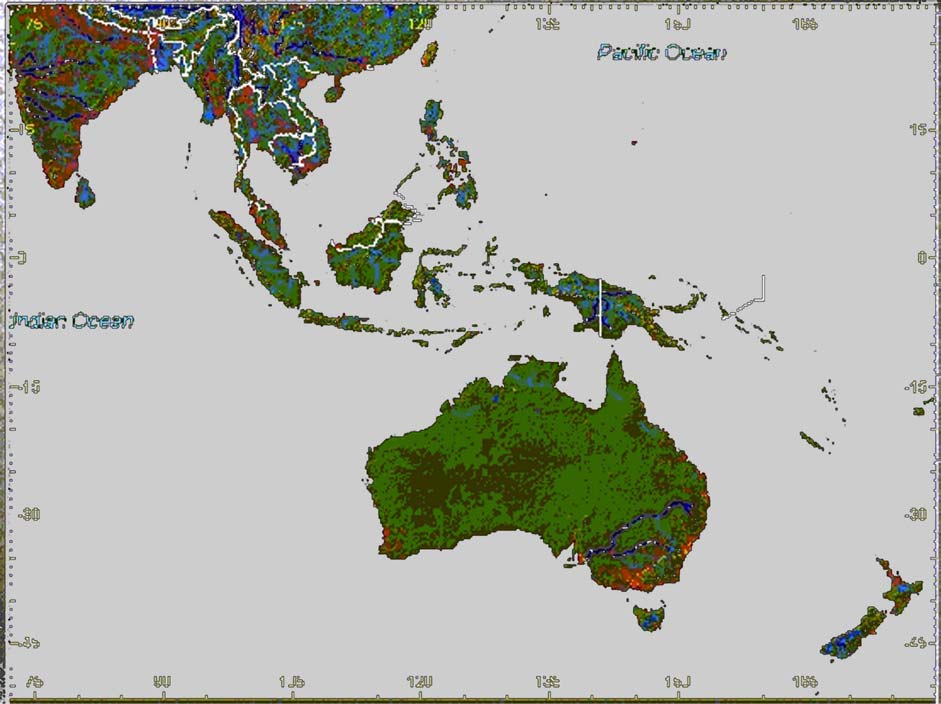
1.5.3.2. Rivers
Major river systems include the Chao Phraya (Thailand), the Mekong (marking much of the Thailand-
Lao PDR border and traversing Cambodia and Viet Nam) and the shorter, eastward flowing Red
River (Song Hong), which reaches the Gulf of Tonkin further north, near the Chinese border. These
river systems flow through broad alluvial plains and fertile deltas, where intensive rice agriculture
sustains dense populations and large cities. No comparably large river systems exist in the islands in
the Southeast Asian region. Closest in length are the large meandering rivers of Borneo, the world's
third largest island. The other major Indonesian and the Philippine islands are, unlike the mainland,
volcanic. Their topsoils support an intensive rice-dominated agriculture.
The Murray and Darling Rivers, the longest river system in Australia, form the Murray-Darling Basin
covering more than one million square kilometres or 14 per cent of the mainland area. Most of
Australia's rivers that feed estuaries contain impoundments or dams to provide water for urban
supply, intensive agriculture or power generation. This has major impacts on the hydrological patterns
and occurrence of above-ground and below-ground flows of water.
Figure 1.4.2. Countries in Region 8 showing major river systems (light and dark blue lines).
1.5.4. Marine Environment
The countries in the Southeast Asian region border the Andaman Sea, the Gulf of Thailand, the South
China Sea, and the Pacific Ocean. The boundary of the Andaman Sea to the north is the Ayeyarwady
River delta; to the east Peninsular Myanmar, Thailand and Malaysia; to the west the Andaman and
Nicobar Islands; and to the south Sumatra and the Strait of Malacca. Huge volumes of runoff water
from Myanmar flow into the Andaman Sea during the summer monsoon and may have implications
on the transport of PTS from that river basin.
The South China Sea is a semi-enclosed sea and is bounded on the east by the Philippines and
Borneo; in the south-west it merges with the Gulf of Thailand; and on the west it is separated from the
Gulf of Tonkin by Hainan Island. The total sea area is 2.32 million sq km and is a major shipping
20
lane. Major ports on or near the South China Sea include Manila, Singapore, Bangkok, Ho Chi Minh
City, and Hai Phong. The principal rivers draining into it are the Mekong and the Xi Jiang.
The Gulf of Thailand has an area of about 320,000 sq km and is an inlet of the South China Sea lying
between Peninsular Malaysia on the west and the Southeast Asian mainland to the north and east. It is
bounded mainly by Thailand (south-west through north), Cambodia, and southern Viet Nam (to the
north-east). Main harbours include Bangkok and Chanthaburi (Thailand), Kompong Som (Cambodia)
and Rach Gia (Viet Nam). The four major rivers of Thailand (Mae Klong, Tha Chin, Chao Phraya and
Bang Pakong) drain into the Upper Gulf. The discharge and possible transport of PTS into these semi-
enclosed seas from agricultural activities and densely populated urban areas have not been quantified.
The Strait of Malacca, which is located between Peninsula Malaysia and the Island of Sumatra
Indonesia, is a busy shipping route between west and east Asia transporting mainly oil and gas from
the Middle East to east Asia, particularly Japan. More than often, oil spill and sludge dumping have
been sighted and reported.
Australia, as an island continent with a long coastline, has many different marine and estuarine
environments. Most of these are far removed from the major population centres and are little affected
by human activities. The northern, far north-eastern and most of the western coasts of the continent,
the Great Australian Bight and Australia's External Territories in the Indian Ocean, South Pacific,
Southern Ocean and Antarctica are among the least-polluted places on earth. However, even the most
remote regions show traces of persistent global pollutants.
Two major ocean boundary currents - the East Australian Current and the Leeuwin Current - influence
the east and west coasts of the continent respectively. The strength, seasonality and southward
extension of both these currents are highly variable and their flow can influence coastal and ocean
conditions along the south of the continent. Most of Australia's rivers that discharge to estuaries
contain dams that affect environmental flows.
1.5.5. Ecological Characteristics of the Region
The Indo-West Pacific is the key area for shallow water marine biodiversity. Coastal habitat loss and
degradation, combined with increased sediment, nutrient and pollutant discharge (including PTS) into
coastal areas, are major causes of concern particularly for the insular countries of the region. The rates
of loss of coral reef and mangrove habitats in this region are amongst the highest in the world.
Thailand alone has lost about 0.2 million hectares of mangrove forest during the period 196193
(Government of Thailand, 1994). However, the impacts of such unsustainable practices on regional
biodiversity are difficult to quantify.
Southeast Asia is home to about half of the world's terrestrial and marine biodiversity, which in the
tropical forest of the sub-region remains largely undocumented (World Bank, 1992). Around 30 per
cent of the world's coral reefs are situated within the sub-region, with the seas around the Philippines,
Indonesia, and Malaysia constituting the centre of marine biodiversity. Some of the last remaining
intact expanses of mangroves also occur in Southeast Asia.
The rainforests of Southeast Asia contain more than 25,000 species of flowering plants, equivalent to
about 10 per cent of the flora of the world. The region as a whole encompasses two thirds of the
world's flora. Almost all the nations in the region (with the exception of Singapore and Brunei
Darussalam) are heavily dependent on direct harvesting of natural products.
Australia has evolved in relative isolation for at least the past 50 million years. This has resulted in a
rich diversity of unique life forms. For example, 85 per cent of the flowering plants, 84 per cent of the
mammals, 45 per cent of the birds, 89 per cent of the reptiles and 93 per cent of our frogs in the
country are endemic. Of the 600 inshore species of finfish in the southern temperate zone, about 85
per cent are found only in Australian waters (SOE Australia, 1996).
Areas like the Great Barrier Reef, the species-rich rainforests of northern Queensland and the
Southwest Botanical Province of Western Australia (with over one-third of Australia's plant species,
of which 70 per cent are endemic) are internationally recognised major centres of biodiversity.
21
New Zealand's biodiversity is more primitive in character than that of many other countries, having a
limited representation of higher plants and animals (e.g. angiosperms and mammals), but a high
representation of older plants and animals (e.g. mosses, liverworts, ferns, flatworms, snails, spiders,
wingless crickets, solitary bees, leiopelmid frogs, sphenodon reptiles and ratite birds). Many species
are endemic (found only in New Zealand) (SOE New Zealand, 1997).
1.6. Patterns of Development/Settlement
The total land area of the Southeast Asia sub-region is more than 435 million hectares, representing
about 3 per cent of the total land surface of the earth, although the region is home to about 520 million
people, or about 11 per cent of the world population. The average population has been growing at a
rate of 1.5 per cent, representing the second highest growth rate in the Asian and Pacific Region. An
average of 39 per cent of the population is urban, and urbanisation is growing at 3.5 per cent.
Projections indicate that by 2050, there will be three megacities (with a population of more than 10
million) in Southeast Asia: Jakarta, Manila, and Bangkok.
Atmospheric pollution. Data for air pollution levels in each Southeast Asian country are limited.
However, the high concentration of industries in the urban centres of the region especially in the two
largest cities of Metro Manila and Jakarta, indicates the high air pollution potential. Vehicular
emissions, particularly in Jakarta, Bangkok and Metro Manila, also contribute largely to the poor
ambient air quality of these cities. However, since the 1997 financial decline, traffic congestion in the
major cities has also been reduced. For example, between 1996 and 1999 automotive production in
Thailand fell by 55 per cent and sales fell 63 per cent (Brown, 1999). Nevertheless, growth trends in
air pollution are being observed in many cities. For example, Malaysia's urban centres have not yet
reached critical levels of air pollution although traffic congestion and consequent vehicular emissions
are fast becoming a problem in Kuala Lumpur and elsewhere.
The developing countries of Asia and the Pacific region have been developing more rapidly than all
other developing countries in the world for the last three decades; this trend is likely to continue in the
future. One of the more important implications of economic growth in the region has been the
increased demand for energy and attendant emissions.
The Asia and the Pacific region, excluding Australia and New Zealand, accounted for 21 per cent of
the world's primary commercial energy demand in 1992. A growth in energy demand of 3.6 per cent
per year for the whole region was maintained between 1990 and 1992, compared with an average
growth of 0.1 per cent for the whole world (ADB, 1994). The region also accounts for about 41 per
cent of the global consumption of coal in 1993 (EIA, 1995). The rapid growth in energy demand, and
especially the reliance on coal, has led to a significant increase in the emissions of air pollutants
wherever appropriate technology interventions are not made (such as scrubbers).
Vehicular emissions are a significant problem in all major cities but also in small cities like Port
Moresby. The government of the Philippines is attempting to address this issue through plans to limit
the number of vehicles on the road. Similar measures are also being taken in Thailand. Significant
penalties are imposed on violators. In several countries, including the Philippines, unleaded petrol has
been introduced widely and new vehicles are required to be able to run on this fuel.
Land degradation. The sub-region suffers from soil erosion and contamination. For Southeast Asian
countries, erosion mostly takes the form of surface water erosion, which contributes to the loss of
topsoil (Van Lynden and Oldeman, 1997). Problems are most acute in the Philippines, Thailand, Viet
Nam, Malaysia, Indonesia, Cambodia, and Lao People's Democratic Republic, where water erosion
impacts an average of 20 per cent of the total land areas. Thailand and Cambodia also suffer from the
impacts of land contamination, where soil fertility declines have affected a total of 36.5 million
hectares (Van Lynden and Oldeman, 1997).
Forest fires. The indiscriminate clearing of land for pulpwood and oil palm plantations is fuelled by
the high demand for paper and palm oil products throughout the world. The traditional way of
clearing land in most of the Southeast Asia sub-region is by fire. The activity has led to devastating
cross border impacts to habitat corridors, and has caused significant transboundary air pollution
problems with particulates, smoke, and haze. The haze from forest fires that engulfed Indonesia,
22
Malaysia, Singapore, Brunei Darussalam, and to a lesser extent the Philippines, in mid 1997, and
intermittently hereafter, has been observed as one of the worst episodes of air pollution in recent
world history. An estimated 70 million people were affected, 9 million hectares of land and forest in
Indonesia were damaged, and total cost was estimated at US$9 billion (ASEAN, 2000).
The geographic location and the topography of Australia mean that almost all vegetation types in the
country are fire prone. There are few high mountains and no truly alpine regions. In 1974-75, lush
growth of grasses and forbs following exceptionally heavy rainfall in the previous two years provided
continuous fuels through much of central Australia and in this season fires burnt over 117 million
hectares or 15 per cent of the total land area of the continent. In 1967, fires burned 264,000 hectares in
Southern Tasmania, 61 lives were lost and more than 1700 homes were destroyed. In 1983, 15 major
fires in South Australia burnt out 160,000 hectares, killed 28 people and destroyed 383 homes. In the
same year, eight major fires in Victoria burnt out 183,000 hectares. In 1994, in New South Wales,
more than 800 fires burnt more than 800,000 hectares (Yearbook Australia, 1995).
Water pollution. Pollution by chemicals of inland and coastal waters by mining and agricultural
wastes, and by domestic sewage is an area of concern in most ASEAN countries and Papua New
Guinea. Of relevance to the assessment of PTS was a 1992 study in Australia to scientifically evaluate
the effluent quality of the 17 licensed Victorian coastal outfalls discharging treated or untreated
sewerage into Bass Strait (McKenzie and Goudey, 1993). The report concluded that it can not be
assumed that because an effluent is only of the domestic type, persistent toxicants are not a problem,
since all the effluent samples in this study analysed contained heavy metals, surfactants and phenols.
1.6. References
ADB. 1994. Energy Indicators of Developing Member Countries of ADB. Energy and Industry
Department. Manila.
ADB/IUCN (1994) Biodiversity Conservation in the Asia and Pacific Region: Constraints and
Opportunities. Proceedings of a Regional Conference. 6-8 June 1994. Manila.
ASEAN Secretariat (1995) ASEAN State of the Environment 1995.
ASEAN Secretariat (2001) Second ASEAN State of the Environment Report 2000. 211 p.
ASEAN Haze Action Online. www.haze-online.or.id.
Barrie L. A., Gregor D., Hargrave B., Lake R., Muir D., Shearer R., Tracey B., Bidleman T. F. (1992)
Arctic contaminants: sources, occurrence and pathways. The Science of the Total Environment
122, 1-74.
Brown, (1999). Introduction to shared environmental problems. Chapter 17, 3.356,
www.unescap.org/enrd/environment/ activities/ES/SOE/CH17.PDF
EEA (1998) EEA's second multiannual report on Europe's Environment produced in 1998: Europe's
Environment: The Second Assessment.
EIA. (1995) International Energy Annual: 1993. Energy Information Agency, U.S. Department of
Energy, Washington.
ESCAP (1993a) Asia-Pacific in Figures 1993. Bangkok.
ESCAP (1993b) Population Data Sheet 1993. Bangkok.
ESCAP (1995a) State of the Environment in the Asia-Pacific, 1995. Bangkok.
ESCAP (1995b) Preparatory Meeting for the Ministerial Conference on Environment and
Development in Asia Pacific. Bangkok.
FAO (1995) Forest Resource Assessment: 1990: Global Synthesis. FAO Forestry Paper No. 124.
(FAO). Rome.
FAO/RAPA (1993) Selected Indicators of Food and Agriculture Development in the Asia and Pacific
Region:1982-92. Publication 1993/26, Bangkok.
23
Fuavo, V. (1990) Areas of Environmental Concerns in the South Pacific Region. SPREP. GESAMP
(IMO, FAO, UNESCO, WMO, WHO, IAEA, UN, UNEP). 1991. Joint group of experts on the
scientific aspects of marine protection, reducing environmental impacts of coastal aquaculture.
Reports and Studies No 47. FAO. Rome.
Government of Thailand (1994) Thailand State of the Environment Report. Bangkok.
Kalnay, E., et. al., (1993) The NCEP/NCAR CDAS/Reanalysis Project. NMC Office Note 401.
Available from NOAA/NCEP Development Division, Washington DC 20233.
McKenzie, J.A. and Goudey, R. (1993) Assessment of coastal discharges for their potential
environmental impact. EPA SRS 91/006.
Mulvad, G., Pedersen, H.S., Hansen, J.C., Dewailly, E., Jul, E., Pederson, M.B., Bjerregaard, P.,
Malcolm, G.T., Deguchi, Y. and Middaugh, J.P. (1996) Exposure of Greenlandic Inuit to
organochlorines and heavy metals through the marine food-chain: an international study. The
Science of the Total Environment 186, 137-139.
New Zealand. (2002) The Organochlorines Programme.
http://www.mfe.govt.nz/issues/hazardous/contaminated/organochlorines.html.
SOE Australia (1996) State of the Environment, Australia.
SOE New Zealand (1997) State of the Environment, New Zealand.
UN ECE (1996) The Dirty Dozen. http://www.unece.org/spot/s01.htm
UN ECE (1998) Convention on long-range transboundary air pollution.
http://www.unece.org/env/lrtap/pops_h1.htm
UNEP (1994) Environmental Data Report 1993-94. United Nations Environmental Programme.
Oxford.
Van Lynden, G.W.J. and Oldeman, L.R. (1997) The assessment of the status of human-induced soil
degradation in South and South-east Asia. United Nations Environment Programme (UNEP),
Food and Agricultural Organization of the United Nations (FAO), International Soil Reference
and Information Centre (ISRIC), Wageningen, The Netherlands (digital map and data sets). The
China Food maps were produced with the IIASA LUC-GIS from ASSOD database and vector
files
Wallack, H. W., Bakker, D.J., Brandt, I., Brostrom-Lundén, E., Brouwer, A., Bull, K. R., Gough, C.,
Guardans, R., Holoubek, I., Jansson, B., Koch, R., Kuylenstirna, J., Lecloux, A., Mackay, D.,
McCutcheon, P., Mocarelli, P. and Taalman, R. D. F. (1998) Controlling persistent organic
pollutants - What next? Environmental Toxicology and Pharmacology 6, 143-175.
Weber, P. C. (1993) Abandoned Seas. Worldwatch Paper 116. Washington.
World Bank. (1992) Bhutan Trust Fund for Environmental Conservation. Project Document.
Yearbook Australia (1995) Yearbook Australia 1995. Canberra.
24
2. SOURCE
CHARACTERISATION
2.1. Background Information
The main sources of PTS in the 12 countries under Region 8 can be broadly grouped into agricultural
and industrial/urban related sources. Agricultural related sources include use and disposal of
agricultural pesticides, open burning of biomass for land clearing activities and the disposal of
agricultural wastes. Industrial/urbanisation related sources include stationary, diffuse and mobile
sources. Examples of stationary sources are industrial plants with large fuel or waste combustion
equipment such as power stations, steel mills, waste incinerators and sanitary landfills.
With increasing urbanisation of the countries in the region, vehicular sources of emissions are of
increasing concern. In general, point sources such as emissions from industrial stacks or exhaust pipes
of vehicles are more amenable to direct regulatory controls such as emission limits, mandatory use of
cleaner fuel and use of pollution control equipment or devices. Diffuse sources such as smouldering
fires from landfills, open burning of solid wastes or biomass, and contaminated run-offs from
agricultural areas may also be controlled or managed to minimise such releases of PTS into the
environment. Approaches include the establishment of appropriate regulatory framework, institutional
capacity and environmental infrastructures.
During the last few years, progress has been made in raising the awareness of many countries in the
region on the need for emission inventories of PTS. However there is still a lack of comprehensive
source and emission inventories of PTS in most of the countries of the region with the exception of
Australia and New Zealand. For example, Australia and New Zealand have in place emission
inventories for PCDD/PCDFs. Several other countries such as Brunei Darussalam, Philippines and
Thailand are compiling PCDD/PCDFs inventories under an UNEP/GEF sponsored project to assist
countries in the implementation of the Stockholm Convention. Such inventories could help decision
makers develop appropriate control strategies for PTS.
Even though source inventories are often unavailable or incomplete, countries in the region have
already taken regulatory and administrative measures to prevent or minimise emissions of many of the
PTS, especially the organochlorine pesticides (OCP). Table 2.1 contains a summary of such measures
taken by countries in the region to prevent or control PTS emissions.
25
Table 2.1. Regulatory controls1 on key PTS pesticides
Aldrin
Chlordane
DDT
Dieldrin
Endosulfan
Endrin Heptachlor
HCB
Mirex
PCP Toxaphene
HCH
Australia Banned
in
Banned Banned
by
Banned
Banned
Banned
in Banned Severely Banned
in
HCH isomers banned.
1995
1987
1995
restricted
1960s
Lindane allowed under
authorisation by Dept.
of Agri., Fisheries and
Forestry
Brunei
Banned in
Banned in
Banned in
Banned in
Banned
in
Banned in
Banned in
Banned in
Banned in
Banned in
Darussalam
1980
1980
1980
1980
1980
1980
1980
1986
1986
1980
Cambodia Banned
in
Banned Banned
Banned
Restricted Banned
Banned Banned Restricted Restricted
Banned
Banned
1992
Indonesia Never Banned in
Banned Banned
in
Never
Never
Banned Banned Banned
in Banned in
HCH isomers banned.
registered
1992
1992
registered for
registered
1980
1980
Lindane not registered
for use
use
for use
Laos Banned
in
Banned Banned
in
Banned in
Banned
in
Banned in
Banned
Banned
in
1992
1992
1992
1992
1992
1992
Malaysia Banned
in
Banned in
Banned in
Banned in
Withdrawn
by
Banned in
Never
Banned Banned
in Banned Registration
under
1994
1998
1999
1994
company
1990
registered
2000
review
New
Banned in
Banned in
Banned in
Banned in
Banned
in
Banned in
Banned in
Banned in
Banned in
Banned in
Banned in 1989
Zealand
1985
1992
1988
1988
1976
1971
1972
1988
1991
1979
Papua New
Banned in
Banned in
Restricted Banned
in
Not
Banned in
Restricted Banned
in
Banned in
Banned in
Banned in
Lindane used in
Guinea
1990
1999
1990
registered
1990
1990
1990
1990
1990
agriculture, all other
isomers banned
Philippines Banned
in Restricted Restricted
Banned
in
Banned
from
Banned in
Restricted Restricted Banned.
Only Banned in
Banned in 1989
1989
1989
import in
1989
allowed for
1989
1989
use in wood
treatment
Singapore Banned
in
Severely
Banned in
Banned in
Not
Severely
Banned in
Restricted
Banned in
Restricted in
Banned in
Banned in 1985, not
1985
restricted
1985
1985
registered
restricted in
1985
in 1985
1985
1985. Banned
1985
used
1985; banned
1985. Banned
in 1995
1999
in 1995
Thailand
Banned
in
Banned in
Banned in
Banned in
Banned in
Banned in
HCH-mixed isomers are
1981
1988 (AG).
2001
1995
1995 (AG).
1983
banned. Lindane banned
Banned in
Banned in
2002. Lindane import
1995 (PH)
2000 (PH)
and use in public health
requires import and
production registration
and import licence
27
Viet Nam
Banned in
Banned in
Banned in
Banned in
Banned
in
Banned in
Banned in
Import
under
Banned in
Banned
1992
1992
1992
1992
1992
1992
1992
conditions
1995
imposed by
Ministry of
Agriculture
and Rural
Development
1 Based upon country contributions to UNEP and submissions at regional technical meetings. Banned refers to pesticides for which all registered uses have been prohibited or for all
requests for registration or equivalent actions.
28
2.2. Data Collection
Data on sources of PTS in the region are collected via the following:
(a)
UNEP/GEF Questionnaires under the Project;
(b)
Papers and other contributions from country experts at the first and second
regional technical workshops held in February and April 2002 and during the
Regional Priority Setting Meeting in August 2002
(c)
Published papers and documents
2.3. Pesticides
2.3.1. Aldrin
Aldrin has been used in several countries in the region. For example, aldrin was used to control
termites in urban areas of Australia (Australian Academy of Technological Sciences and Engineering,
2002; Miller et al., 2002). It has been used in the Philippines as a pesticide for golf courses
(Greenpeace, 2000). In New Zealand, aldrin was used to control horticultural pests such as wireworm,
soldier fly and blackvine weevil and in limited quantities to control household spiders. It was also
used in the control of ectoparasites in sheep (Ministry for the Environment, New Zealand, May 2001).
Most countries in the region have introduced regulatory and administrative measures to ban the use of
aldrin. A summary of the regulatory control instituted by countries in the region is shown in Table
2.1.
There is no known manufacturing facility for aldrin in the region. In most of the countries of the
region, bans or restrictions on the use of aldrin have been in effect for more than 10 years. There is no
available inventory on the import and use of aldrin in the region with the exception of Thailand that
was reported to have imported about 1 ton of aldrin in 1988 but has since ceased such import (Boon-
Long, 1997). There appears to be no significant continuing source of aldrin emissions to the air, water
or land in the region.
2.3.2. Chlordane
Chlordane has been used in the region as an insecticide for control of pests such as termites,
cockroaches, ants and wood boring beetles to protect buildings and structures. It was also used in the
timber industries as treatment against termites and borers and as an insecticide in glues used for
manufacture of plywood and laminated timber.
Most countries in the region have introduced regulatory controls to ban the use of chlordane. A
summary of the regulatory controls in countries of the region is listed in Table 2.1.
There is no known manufacturing facility for chlordane in the region. In many countries in the region,
chlordane was permitted for use till recent years. There is however a lack of available inventories on
the import and use of chlordane in countries in the region with the exception of Thailand which was
reported to have imported about 150 tonnes of chlordane in 1996 but has since ceased such import
(Boon-Long, 1997). As the ban on import and use of chlordane came into force only in recent years,
there could still be continuing sources of chlordane releases from soil or sediments in the region from
recent and perhaps continuing applications of chlordane. There is, however, a lack of emission
inventories of chlordane in the region.
2.3.3. Dichlorodiphenyltrichloroethane (DDT)
DDT has been used extensively in the region for malaria control since the 1950s. It was also used in
agricultural pest control on pests such as corn grasshopper, cotton ball worm and tobacco insect pests.
It was found to be highly effective for malaria control and helped decrease the mortality rate from
malaria in countries in the region. For instance in Thailand, the mortality rate has decreased from
200/100,000 in 1951 to 1/100,000 in 1993 (Boon-Long, 1997). In 1994, Thailand was reported to
29
have imported about 100 tons of DDT but since then no import of DDT was reported (Boon-Long,
1997).
In general, countries in the region have banned the use of DDT. For instance, Brunei banned DDT in
1985 and now uses substitutes such as Dursban and Resigen (Lee, 2002). In Malaysia, DDT has not
been permitted to be imported, manufactured or used or sold in the country, except for purposes of
research or education (PIC Database: Import Decision by Country), since May 1999. The use of DDT
was prohibited on New Zealand farmlands in 1970, and its sale for all other purposes, e.g. borer
bombs, was banned / deregistered in 1989 (Ministry for the Environment, New Zealand, 1998). PNG
allows the use of DDT for malaria control only while in the Philippines, import of DDT for malaria
vector control is subject to special permit from the Department of Health (PIC Database: Import
Decision by Country).
A summary of the regulatory controls instituted by countries in the region on DDT is shown in Table
2.1. There is no known manufacturing facility for DDT in the region. There is, however, a lack of
available inventories on the import and use of DDT in most countries in the region. In Australia, DDT
usage peaked at 3500 tons in 1973 and was phased out totally by 1988. Tables 2.3.1 and 2.3.2 show
the quantity of DDT imported and used in Viet Nam respectively.
Table 2.3.1. Imports of DDT- Viet Nam
Years
Quantity (tons)
Type of DDT
1957-1979 14,847 DDT
30%
1976-1980 1800 DDT
75%
1977-1983 4000 DDT
75%
1981-1985 600 DDT
75%
1984-1985 1733 DDT
75%
1986 262
DDT
75%
1986-1990 800 DDT
75%
Source: Medicine Preventive Department, Ministry of Health 1998
Table 2.3.2. DDT usage in Viet Nam
Year Quantity
(kg)
1992 237,748
1993 33,935
1994 151,675
Source: Medicine Preventive Department, Ministry of Health 1998
2.3.4. Dieldrin
Dieldrin was used in the region as an agricultural insecticide and in the timber processing industry for
wood treatment in the 1970s and 1980s. It has also been used for control of cotton pests in
conjunction with DDT in the 1960s. It has since been banned from use in most countries in the region.
A summary of the regulatory controls instituted by countries in the region is listed in Table 2.1.
There is no known manufacturing facility for dieldrin in the region. In many countries of the region,
the ban or restriction on the use of dieldrin has been in effect for more than 10 years. There is no
available inventory on the import and use of dieldrin in the region. There appears to be no significant
continuing source of dieldrin releases to the air, water or land in the region.
2.3.5. Endrin
Endrin has been used in the region as an insecticide, rodenticide and avicide. It has been banned from
use by most countries of the region.
30
A summary of the regulatory controls instituted by countries in the region is listed in Table 2.1.
There is no known manufacturing facility for endrin in the region. In many countries of the region, the
ban or restriction on the use of endrin has been in effect for more than 10 years. There is no available
inventory on the import and use of endrin in the region.
2.3.6. Endosulfan
Endosulfan is used for cotton and other crops in several countries in the region. It has been used as a
substitute for organotin compounds against the golden kuhol (snail), which was devastating rice-
fields. Its use has been severely restricted or controlled in countries with this pest problem. In
Australia, the National Registration Authority (NRA 02/5) had in September 2002 introduced new
conditions to stop the use of endosulfan on Brussel sprouts and certain leafy vegetables as well as ban
the use of treated fodder for livestock. The National Registration Authority for Agricultural and
Veterinary Chemicals, Australia indicated that about 900 tonnes per year of endosulfan was imported
for use in Australia (NRA, 1998). A review published in 2002 indicated that the quantity of
endosulfan imported for use in Australia has reduced to about 500 tonnes per year (Australian
Academy of Technological Sciences and Engineering, 2002).
In many countries of the region endosulfan is still in use. There is, however, no available inventory on
the import and use of endosulfan in the region. As the use of endosulfan is ongoing, there would be
continuing releases to air, soil or sediments in the region.
2.3.7. Heptachlor
Heptachlor was used in the region to protect soil and seeds against soil infestation and to control
insect pests in crops. Most countries of the region have banned its use. In PNG, heptachlor is
restricted to use against subterranean termites only.
A summary of the regulatory controls instituted by countries in the region is shown in Table 2.1.
There is no known manufacturing facility for heptachlor in the region. In many countries of the
region, the ban or restriction on the use of heptachlor has been in effect for more than 10 years. There
is no available inventory on the import and use of heptachlor in the region except for Thailand which
was reported to have imported 87 tons of heptachlor in 1988 but has since ceased such import (Boon-
Long, 1997). There appears to be no significant continuing source of heptachlor releases to the air,
water or land in the region.
2.3.8. Hexachlorobenzene
Hexachlorobenzene was used briefly in small quantities in Australia and New Zealand in the 1960s
and 1970s. Countries in the region have since either banned it or it has never been registered for use in
agriculture. There are, however, pesticides in which HCB is a contaminant or by-product and the use
of such pesticides could also be a source of HCB emissions.
There is no known manufacturing facility for hexachlorobenzene in the region. In many countries of
the region, the ban or restriction on the use of hexachlorobenzene has been in effect for more than 10
years. There is no available inventory on the import and use of hexachlorobenzene in the region.
There appears to be no significant continuing source of hexachlorobenzene releases to the air, water or
land in the region from agricultural use.
2.3.9. Mirex
Mirex is still used under licence in small quantities as bait for termites in northern Australia and
research is underway to find a suitable alternative. Australia has been granted an exemption to
continue using mirex for five years from the date of the Stockholm Convention's entry-into-force
(Australian Academy of Technological Sciences and Engineering, 2002). It has either been banned or
was not used in most countries of the region.
A summary of the regulatory controls instituted by countries in the region is listed in Table 2.1.
31
There is no known manufacturing facility for mirex in the region. In many countries of the region, the
ban or restriction on the use of mirex has been in effect for more than 10 years. There is no available
inventory on the import and use of mirex in the region. There appears to be no significant continuing
source of mirex releases to the air, water or land in the region.
2.3.10. Pentachlorophenol (PCP)
The sodium salt of pentachlorophenol (sodium pentachlorophenate (NaPCP)) was used in the region
in fungicides, herbicides and other preparations. PCP was used as a fungicide extensively in sawmills
in New Zealand in the treatment of freshly cut timber (mainly Pinus radiata). PCP was also used to a
relatively minor extent by the pulp and paper industry, in mushroom culture, and in home gardens to
control moss and algae. The use of PCP in the timber industry ceased in 1988, and it was withdrawn
from sale / deregistered in 1991 (Ministry for the Environment, New Zealand, 2002). It was estimated
that around 5000 tonnes of PCP have been used in the timber industry in New Zealand over a 35 to 40
year period (Ministry for the Environment, New Zealand, 1998).
Indonesia banned the use of PCP and its salts in 1980. In Malaysia, PCP has not been permitted to be
imported, manufactured or used or sold in the country except for purposes of research or education
since 1 January 2000 (PIC Database, Import Decision by Country). Singapore banned its use in 1995,
while in the Philippines the use of PCP is restricted to wood treatment by FPA-accredited wood
treatment plants. In Thailand, PCP was banned in 1995.
A summary of the regulatory controls instituted by countries in the region is listed in Table 2.1.
There is no known manufacturing facility for PCP in the region. In many countries of the region, PCP
has been restricted or banned from use. There is no available emission inventory on PCP in the region.
2.3.11. Toxaphene
In Australia, toxaphene was registered briefly in the early 1960s for control of grasshoppers
(Harrison, 1997). Only small quantities were used. In New Zealand, the single toxaphene-based
product, registered for field-testing only, was withdrawn by the registrant in 1968 (PIC Database,
Import Decision by Country). Countries in the region have introduced regulations to ban its use.
A summary of the regulatory controls instituted by countries in the region is listed in Table 2.1.
There is no known manufacturing facility for toxaphene in the region. In many countries of the
region, it has not been in use or has been banned for more than 10 years. There appears to be no
significant continuing source of toxaphene releases to the air, water or land in the region.
2.3.12. Hexachlorohexanes
Lindane, a form of hexachlorohexanes, was used as an insecticide in agriculture for the control of lice
on cattle and grass grub in pasture, and for insect control on vegetables and in orchards in New
Zealand (Ministry for the Environment, New Zealand, 1998). The use was progressively restricted
under a permit system and its sale for use was banned in 1989 (Ministry for the Environment, New
Zealand). It may still be in use for palm oil and coconuts in Malaysia (Othman and Palasubramaniam,
2001). Currently, its pesticide board is in the process of reviewing the registration of all products
containing lindane (PIC Database, Import Decision by Country). Indonesia banned the use of lindane
in 1991.
A summary of the regulatory controls instituted by countries in the region is listed in Table 2.1.
There is no known manufacturing facility for hexachlorohexanes in the region. There is, however, no
available emission inventory of lindane or other hexachlorohexanes in the region.
32
2.4. Industrial Chemicals
2.4.1. Hexachlorobenzene (HCB)
HCB was previously used as a fungicide for seed grain. It is also produced as an unintentional by-
product during the manufacture of chlorinated solvents, other chlorinated compounds, such as vinyl
chloride, the building block of PVC, and several pesticides. It is also a by-product in waste streams of
chlor-alkali plants, wood preserving plants, waste incineration and pesticide manufacturing plants
(Greenpeace).
In Australia, HCB was used as a fungicide in the past but now it is no longer used for such a purpose.
Point sources of HCB emissions include aerospace industry, sanitary services, agricultural chemicals
manufacture and industries involved in the manufacture of solvents and pesticides, wood-preserving
plants and municipal waste incinerators (Environment Australia, 2001). Diffuse sources include small
incinerators and agricultural run-offs. There are no known mobile sources of HCB.
Most of the countries in the region have banned the import and use of HCB.
A summary of the regulatory controls instituted by countries in the region is listed in Table 2.4.1.
Table 2.4.1. Control on PTS (industrial chemicals)
Country HCB
PCBs
Australia
· Importation of the
· National management
chemical is prohibited
plan for managing PCB
unless specifically
wastes implemented.1
approved by the
Government.
· All uses discontinued
(dates vary from state to
state) since 1987.
· No remaining uses
allowed.1
Brunei Darussalam
· Banned since 19802
· Not manufactured or
commercially produced
· Importation not
permitted since early
1980s.4
Cambodia
· No information available
· No information available
Indonesia
· Banned2
· Bans the import and use
of PCBs in 19942
Laos
· Banned2
· Banned1
Malaysia
· Import, manufacture, sale · Import of PCBs is
or use is banned.2
banned3
New Zealand
· All uses and products
· Use of PCBs prohibited
banned in 1972
since 1 Jan 19943
· No uses allowed.3
Papua New Guinea
· Current status of the
chemical in the country
is unclear. Requesting
assistance from
exporting countries in
providing addresses of
companies/agencies in
Papua New Guinea to
which PCB is being
imported.1
33
Philippines
· Restricted use3
· Import, manufacture and
industrial uses of PCBs
is restricted3
Singapore
· Banned in 1985 5
· Import banned in 1980
· Mandatory phasing out
and disposal of all old
electrical transformers
implemented 5
Thailand
· Banned in 19806
· Import banned in 19756
Viet Nam
· National law bans
· Restricted use1
substance for all uses in
19922
Sources: 1 Food & Agriculture Organisation, 2 Ibrahim (2002b)
3 Greenpeace, NZ, 4 Hanafi (2000)
5 National Environment Agency, Singapore (2001) 6 Boon-Long (1997)
Despite the regulatory controls on its use, there are likely to be continuing sources of HCB emissions
into the air in the form of unintentional by-products from industrial processes. There is, however, no
available HCB emission inventory in the region.
2.4.2. Polychlorinated Biphenyls (PCBs)
PCBs comprise a group of 209 different congeners. Around half of this number has been identified in
the environment. The more highly chlorinated PCB congeners are the most persistent and account for
the majority of those polluting the environment. PCBs were produced as industrial chemicals that
were mainly used for insulation in electrical equipment. Production of PCBs has almost totally ceased
worldwide.
PCBs are not manufactured in the region. Countries in the region have generally banned the import
and use of PCBs or equipment containing PCBs. Hence, the likelihood and amount of PCBs entering
the environment in the region depend largely on the management and disposal of old electrical
equipment containing PCBs.
Australia has a national management plan for managing PCB wastes. Any waste that contains PCBs at
50 mg/kg or more is classified as a scheduled waste. Under the plan, PCBs have been removed from
sensitive areas such as schools and hospitals. From 1993-1998, approximately 5700 tonnes of PCB
were destroyed (Connell et al., 1999).
In New Zealand, PCBs were used in electrical equipment since the 1930s, mainly in transformers and
capacitors. They were also used as heat exchange fluids, as paint additives, in carbonless copy paper
and in plastics. The use of PCBs has been prohibited in New Zealand since 1 January 1994 under its
Toxic Substances Regulations. Most of the old stocks of PCBs have been shipped overseas for
destruction (Ministry for the Environment, New Zealand, 1998).
Malaysia has banned the import of PCBs since 1995. Since then it has been used mainly in electrical
equipment such as transformers and capacitors. A total of 5.28 tonnes of PCB wastes has been
disposed safely at an integrated treatment and disposal facility for hazardous waste in the country
since 1998 (Hashim, 2001). Prior to this, destruction of PCB wastes was carried out at approved
facilities in developed countries with consent from the relevant authorities.
Singapore has prohibited the import and use of PCBs and PCB-containing equipment such as
electrical transformers since 1980. A waste management program was put in place to phase out and
ensure proper disposal of old electrical equipment containing PCBs or PCB contaminated dielectrics.
The transformers and electrical equipment containing PCBs or PCB contaminated dielectrics were
collected and disposed at approved high-temperature disposal facilities located in other countries. By
1998, only 4 retrofilled transformers remained and these are to be phased out and disposed of by the
end of 2002 (National Environment Agency, Singapore, 2001).
34
Indonesia banned the import and use of PCBs in 1994. There is, however, no available information on
an existing inventory of PCBs.
In the Philippines, the import and industrial uses of PCBs are restricted under a Chemical Control
Order but not banned. However, concerns had been expressed over the inadequate storage and
disposal facilities for stocks of PCBs in older transformers and capacitors (Newbold, 2001).
In Cambodia, according to a report released by the Ministry of Industry, Mine and Energy (MIME),
PCBs are still used in old electrical transformers, although new transformers without PCBs are
replacing the old ones gradually. The Cambodian Electricity Authority has, however, stopped the
import of transformers and transformers with PCBs. PCBs were reported to have been recycled and
reused as lubricant in sewing machines in garment factories (Sokha, 2002).
In Thailand, the import of PCBs was banned in 1975. Capacitors and transformers containing PCBs
and also PCB wastes were exported for disposal overseas. The PCB inventory for Thailand is shown
in Table 2.4.2 (Chareonsong, 2002a).
Table 2.4.2. PCB inventory of Thailand
No.
of
Total Weight
Total Weight
Total Weight
Units
of Units
of Metallic
of Liquids
(tons)
Parts (tons)
(tons)
Total units
849
3403
2544
858
Total no. of transformer
16 12
capacitors (unknown
dielectric)
Transformers 100%
15 47 32 15
PCB
Transformers
711 3045 2277 768
(unknown dielectric)
PCB > 50 ppm
15
36
27
9
Transformers
1 2.7 1.3 1.4
retrofilled
Transformers < 50 ppm
72
278
207
71
Dry transformers
20
29
29
Transformers > 30
64 420 303 116
years
2.5. Unintended by-products
2.5.1. Dioxins and Furans (PCDDs/PCDFs)
Polychlorinated dibenzo-p-dioxins (PCDDs) and polychlorinated dibenzofurans (PCDFs) are
commonly referred to as dioxins and furans or collectively as "dioxins". PCDD/PCDFs are produced
as unintentional by-products of many manufacturing and combustion processes that use, produce or
dispose of chlorine or chlorine-derived chemicals. Important sources of PCDD/PCDFs released to the
environment include waste incineration, landfill fires, open burning of biomass, organochlorine
production processes and PVC production.
There are two countries in the region with published emission inventories for PCDD/PCDFs. In
addition, three countries in the region have embarked on UNEP/GEF-funded projects to establish
PCDD/PCDFs emission inventories. An Environment Australia study estimated that PCDD/PCDFs
emissions in Australia range from 150 g TEQ/year to 2300 g TEQ/year. Sources of PCDD/PCDFs
include prescribed burning, bush fires, residential wood fires, sinter production, coal and oil
35
combustion, metal production, medical waste incinerators, and cement production (Environment
Australia, 1998).
In New Zealand, the major industrial emitters of PCDD/PCDFs were identified as uncontrolled
landfill fires (10 15 g ITEQ/yr), followed by industrial and agricultural coal combustors (0.034 4.0
g I-TEQ/yr), clinical, pathological and quarantine waste incinerators (0.38 3.5 g I-TEQ/yr) and
industrial wood combustors (0.85 2.4 g I-TEQ/yr). Non-industrial and natural sources, namely
domestic wood burning, domestic waste burning and uncontrolled fires (forest, scrub and grass fires,
structure fires and vehicle fires) also contributed significantly to PCDD/PCDFs emissions. The total
annual emissions to air, land and water for 1998 were estimated to be in the range 41 to 109 g I-TEQ
(Buckland et al., 2000).
The leachate or seepage from landfills and dumps can contain PCDD/PCDFs. Data from five landfills
in New Zealand showed that such PCDD/PCDFs released ranged from 7.5 to 221 pg I-TEQ/L. The
New Zealand inventory (Buckland et al., 2000) subdivided the range into 14 to 48.3 pg I-TEQ/L for
small and medium landfills and 7.5 to 221 pg I-TEQ/L for large landfills. The total annual emissions
to land for 1998 were in the range 26 54 g I-TEQ.
Brunei Darussalam has embarked on a UNEP-funded project to establish its national PCDD/PCDFs
inventory. Major PCDD/PCDFs sources include its two medical waste incinerators (0.0019 g
TEQ/yr), uncontrolled burning such as forest fires (0.022 0.050 g TEQ/yr) and vehicles, especially
those running on diesel fuel and leaded petrol (0.075 g TEQ/yr) (Ibrahim, 2002a).
The Philippines has screened 7,300 industries in Metro Manila and 706 industries have been pre-
selected as potential sources of PCDD/PCDFs (Philippines, 2001).
In Thailand, a preliminary source inventory of PCDD/PCDFs has been compiled as shown in Table
2.5.1.
Table 2.5.1. Preliminary source inventory of dioxins and furans in Thailand
Source
Categories
Annual Release (g TEQ/yr)
Air Water Land
Product
Residue
1
Waste
incineration 247.2
0 0 0
30
2 Ferrous and non-ferrous
20.04
0 0 0 1
metal production
3 Power generation and 40.2
0 0 0 0
heating
4 Production of mineral 10.0
0 0 0
0.14
products
5
Transportation
7.3 0 0 0 0
6 Uncontrolled
combustion 632.3
0 0 0
292
processes
7 Production of chemicals
0.4 1.35 0 8.4 382
and consumer goods
8
Miscellaneous
27.2
0 0 0 0
9
Disposal
/
Landfilling 0 0 0 0 0
Source: Chareonsong (2002b)
The most likely sources of PCDD/PCDFs emissions in the region are from industrial and non-
industrial sources. These include waste incineration, industrial processes, open burning of domestic
solid wastes, landfill fires, forest fires and other open burning of biomass.
The amount of PCDD/PCDFs emissions from waste incineration and industrial processes depends
very significantly on the technology and type of pollution control equipment used. The UNEP toolkit
36
(UNEP, 2001) showed that a low technology combustion process with no APC system would have an
emission factor of 3500 µg TEQ/t of waste materials burnt compared with 0.5 µg TEQ/t for high
technology combustion with an advanced APC system. The latest APC systems such as the catalytic
bag filters have been shown to reduce emissions to less than 0.1 µg TEQ/t of waste burnt.
Landfills for domestic wastes could also be major sources of PCDD/PCDFs emissions if such landfills
are not designed and constructed to prevent landfill fires and smouldering. The UNEP toolkit gave an
emission factor of 1000 µg TEQ/t of wastes burnt in landfill fires (UNEP, 2001).
Forest fires and burning of vegetation are also major sources of PAH and PCDD/PCDFs emissions to
air and land in the region. A conservative estimate based upon satellite images of the 1997 forest fire
episode in Southeast Asia was 60 Tg of biomass burnt. This value does not include possible burning
of below ground biomass such as peat fires (Liew, 1998). The UNEP toolkit gave emission factors of
30 µg TEQ/t and 5 µg TEQ/t for burning of agricultural residues and forest fires respectively (UNEP,
2001).
Several countries in the region have imposed regulatory controls to ban open burning of biomass and
agricultural wastes. Singapore and Malaysia have regulations that prohibit or restrict open burning of
wastes. In Malaysia, open burning activities are supervised and must cease if the Air Pollutant Index
exceeds 100 (Tan, 2002). In Singapore, open burning is prohibited at all times under the
Environmental Pollution Control (Prohibition of the Use of Open Fires) Regulations.
Singapore has also under its Environmental Pollution Control (Air Impurities) Regulations stipulated
and enforced stringent emission limits to control the emissions of PCDD/PCDFs from industrial
plants and processes. Under the regulations, all waste incinerators commissioned before 2001 have to
comply with a limit of 1.0 ng TEQ/Nm3. All incinerators commissioned after 2001 have to comply
with an emission limit of 0.1 ng TEQ/Nm3 for PCDD/PCDFs emissions. Such incinerators have
installed advanced APC systems to meet the regulatory requirements. A preliminary estimate shows
the total annual emissions to air in Singapore are about 20 g I-TEQ/year (Lim, 2002).
In Viet Nam, the extensive use of PCDD/PCDFs-contaminated herbicides during the Viet Nam War
was reported to be a major source of PCDD/PCDFs emissions. Based on Major Research
Instrumentation (MRI) documents (1967), the NAS (1974) and Young (1988), the United States
National Academy of Science published data on herbicides used during the Viet Nam war as shown in
Table 2.5.2 (Le et al., 1999).
Table 2.5.2. Major herbicides and pesticides used in Operation Ranch Hand 1962-1971
Herbicides and
Formula Spraying
quantity
Year
pesticides
(gallons)
Agent Purple
2,4-D and 2,4,5-T
145,000
1962-1964
Agent Blue (Phytar
Cacodylic acid
1,124,307
1962-1971
560-G)
Agent Pink
2,4,5-T
122,792
1962-1964
Agent Green
2,4,5-T
8208
1962-1964
Agent Orange
2,4-D and 2,4,5-T
11,261,429
1965-1970
Agent Orange II
Agent White
2,4-D; Picloram
5,246,502
1965-1971
(Tordon-101)
Source: US. NAS - 1997
An estimated total of about 170 kg of TCDD was reported to have been applied (Le, 2002).
37
2.5.2. Polycyclic Aromatic Hydrocarbons (PAHs)
PAHs are compounds consisting of two or more fused aromatic rings, which are strongly suspected to
be carcinogenic and mutagenic (Cooke and Dennis, 1998). They are commonly found in the
environment. The bulk of PAHs comes from incomplete combustion of organic matter, such as in fuel
combustion, coke production, oil refining, aluminium production and open fires. It is evident that such
sources of PAHs are found widely in the region.
Point sources of PAHs include fossil fuel power plants, coal tar production plants, bitumen and
asphalt production plants, paper mills and aluminium production plants. Diffuse sources are asphalt
roads, road tar, coal tar, fires from forest and residential heating, manufacture and use of preserved
wood and motor vehicles exhausts. The total PAH content in diesel has been reported to be 4 to 7%
but can be higher than this depending on the feedstock.
Except for Australia, there is no readily available emission inventory of PAHs. According to
Environment Australia (2001), total PAH emissions from residential firewood combustion are about
625 tonnes/year, based on US emission factors. Among the various PAH congeners, anthracene,
fluoranthene, naphthalene and pyrene have been identified in wood heater emissions (Chesterman,
1984) while for open fireplace emissions, benzo(a)pyrene, benzo(b)fluoranthene, chrysene,
indeno(c,d)pyrene and pyrene were identified (Freeman and Cattell, 1990).
Other emission data reported in the Environment Australia report 2001 are as follows:
Metal
product
manufacturing
0.0696
tonne/year
Waste
disposal 0.0126
tonne/year
Petroleum, coal, chemical & associated
0.0609 tonne/year
product manufacturing
Forest and vegetation fires can also be a major source of PAHs. In Brunei Darussalam, during the
1998 haze episode, the total PAH concentration was found to be between 1 and 33.8 µg/m3
(Muraleedharan et al., 2000). A study conducted to measure PAH emitted from vehicles shows a total
PAH concentration of 1.076 ng/m3.
It was reported that benzo(a)pyrene concentrations in particulate matter from the 1997 forest fire
episode were 15.3 µg/m3 and 1.05 µg/m3 for two cities in the region respectively (Kunii, 1998).
Average level of total PAHs (14 compounds, including benzo(a)pyrene) measured along a roadside
near the University of Brunei Darussalam in the year 2000 was 1.08 ng/m3. The recommended
ambient air quality guideline for benzo(a)pyrene (annual average) is 0.25 ng/m3 (Lee , 2002).
2.6. Other PTS of emerging concern in region
2.6.1. Organotin Compounds
Organotin compounds are used as active ingredients in anti-fouling agents, fungicides, insecticides
and bactericides. In the region, organotin compounds have been used in both the industrial and
agricultural sectors in the past 30 years. They have been used as PVC stabilisers, biocides and
industrial catalysts. Tributyltins (TBT) were used widely for pleasure boats, large ships and vessels,
docks and fishing nets, lumber preservatives and slimicides in cooling systems, and as an effective
antifouling agent in paints. Its derivatives, dibutyltin (DBT) and monobutyltin (MBT), were mostly
used as stabilisers in polyvinyl chloride and as catalysts in the production of polyurethane foams,
silicones, and in other industrial processes.
Triphenyltin compounds were used extensively in the Philippines against golden snails in rice fields
and in fishponds (Philippines, 1996). Studies on the Philippine environment have shown the presence
of organotin contaminants in the different environmental compartments such as marine sediments
(Prudente et al., 1994), fish (Prudente et al., 1997), mussels (Prudente et al., 1999), soils and
sediments (Lee et al., 1997).
38
The main sources of organotins in this region are considered to be antifouling paints, ship-scraping
activities in some areas and sewage disposal (Allsopp and Johnston, 2000). There is, however, no
available inventory of organotin emissions in the region.
2.6.2. Organomercury Compounds
There are many sources of mercury releases to the environment, both natural (volcanoes, mercury
deposits, and volatilisation from the ocean) and human-related (coal combustion, chlorine alkali
processing, gold refining, and metal processing). The mercury from these sources may be discharged
into rivers, river mouths and ultimately to the sea. In the aquatic environment, mercury cycling
encompasses the microbial transformation to methylmercury (MeHg). MeHg has a relatively high
bioaccumulation and biomagnification capacity and exhibits high toxicity, which has led to the WHO
adopting preventive measures, and to several countries establishing seafood standards.
In Papua New Guinea, a study revealed that inhabitants of the Lake Murray region in the remote
Western Province of Papua New Guinea have among the highest recorded level of mercury in hair for
people not directly exposed to human-made mercury concentrations. The diet of the inhabitants was
largely based upon fish and high mercury concentrations were found in a common local fish species
(PEAK, 2000).
In a Singaporean study conducted to determine the mercury (total, inorganic and organic)
concentration in scalp hair of individuals not occupationally exposed to mercury, it was found that the
average mercury level in hair was 5.7 ppm, with inorganic and organic mercury contents at 2.7 ppm
and 3.0 ppm respectively. One suspected cause of having mercury content in individuals, not
occupationally exposed to mercury, could be through their dietary pathway. Foods, typically fish and
other seafood, could be both the reservoir and source of mercury found in humans (Foo et al., 1988).
The annual loading of mercury to the Gulf of Thailand was reported to be about 5.4 metric tons
(Thailand, 2001).
Mercury is widely used in gold mining in the Philippines. Since 1995, high mercury contents have
been found in blood samples from more than 20 people living near the Palawan Quicksilver Mine,
Philippines. The US Geological Survey is working with biomedical researchers from the U.S. and the
Philippines to determine the source and pathway of mercury to humans in this area (USGS, 2000).
2.6.3. Organolead Compounds
Organolead compounds are organic molecules that contain one or more lead atoms. Alkyl-lead
compounds such as tetramethyllead (TML) and tetraethyllead (TEL) were widely used as "anti-
knocking" additives in leaded petrol. The release of TML and TEL was drastically reduced with the
introduction of unleaded petrol. However, leaded petrol is still available which contributes to the
emission of TEL and to a lesser extent TML to the environment. Very little alkyl-lead is emitted from
petrol combustion. The primary source is direct emission through evaporation during refining,
blending, transport and filling of leaded petrol.
Lead and lead compounds may be released to the land, water and air from mining activities,
manufacturing industries, transport and smelting operations. Diffuse sources include contaminated
soil near lead refineries and waste sites, lead-containing pesticides and lead pellets from spent
ammunition. Vehicles running on leaded fuels and lawnmowers constitute mobile sources.
Air emissions of lead and mercury from various sources in Melbourne, Australia are shown below
(EPA (Victoria), 1998):
Concentration
in
tonnes/year
Lead
and
compounds Mercury
and
compounds
Motor
vehicles 184
--
Industry
3.4
0.033
Domestic/commercial
1.1
0.015
39
Several countries such as Brunei Darussalam, New Zealand and Singapore have phased out the use of
leaded petrol. Indonesia has targeted to phase out leaded petrol by January 2003. Similarly, Australia
is phasing out leaded petrol.
Data from Thailand showed that blood lead levels in children are falling as leaded petrol is phased out
(EHP, 2002).
A study on heavy metal concentrations in surface sediments from Manila Bay and its inflowing rivers
found that lead was present in relatively high concentrations in offshore sediments (66 137 µg/g in
Pasig River and 11-220 µg/g in Bulacan rivers) (Prudente et al., 1994). The relatively high metal
concentrations in the rivers were mainly attributed to the discharge of wastes from industries.
2.6.4. Chlor. Paraffins, Nonyl/Octyl-Phenols, Phthalates, PBBs and PBDEs
Chlorinated paraffins are used extensively in industrial cutting oils, in particular in the manufacture of
automobiles and automobile parts. They are also used in paints, adhesives and sealants. Nonyl- and
octyl phenol derivatives are used in industrial processes such as pulp and paper manufacture, textile
manufacture as well as in detergents and other household cleaning products. Phthalates are used as
plasticisers in PVC products as well as in cosmetics. Polybrominated biphenyls (PBB) and
polybrominated diphenyl ethers (PBDE) are used as flame retardant additives in products such as
furniture, thermal insulation for buildings and housing for electronic and electrical equipment.
The use of these PTS in manufacturing processes as well as in products and articles used in the region
indicate that the emissions of these PTS into the environment of the region could be significant.
However, there is in general a lack of data on emission inventories of these PTS in the region.
2.7. Hot Spots
Hot spots refer to areas where PTS have been used or stored in large quantities and where significant
concentrations of PTS are present in the environment of the area.
In the southern part of Viet Nam, between 1962 and 1971, Agent Orange and other herbicides were
sprayed for defoliation. Approximately 18 million gallons of Agent Orange were sprayed. Soil
samples from a site at Ben Hoa Air Base, a former Agent Orange storage facility, showed elevated
PCDD/PCDFs levels (Schecter et al., 2001).
A study by Hatfield Consultants Ltd reported elevated PCDD/PCDFs levels in soil at a former airbase
at Aluoi Valley in Thua Thien Hue province of Viet Nam. The study also suggested that soils in the
vicinity of former facilities related to the Agent Orange spraying program may also have elevated
dioxin levels (Searcy, 2002).
High levels of DDT have been found at former cattle dip sites in Australia. About 1,700 former cattle
dip sites in northern NSW, Australia await remediation (Miller et al., 2002).
2.8. Data Gaps
In general, there are limited data available on inventories of PTS emissions in the region. There are
also limited data available on industrial, agricultural and other activities to allow estimates of
emissions of PTS to be made. Emission inventories on PCDD/PCDFs are the most available. There
are currently two countries with published inventory and three other countries have embarked on
projects to establish their PCDD/PCDFs inventories. Estimates based on activity data and emission
limits have also been made in one country. Two countries in the region have established inventories
on PCB-filled or contaminated transformers, which are the major source of PCBs in the region.
Most of the pesticides listed as PTS have been banned or are not widely used in recent years in the
region with the exception of endosulfan. Although no emission inventory is available for the PTS
pesticides, the trend of decreasing environmental levels reported in some countries indicates that the
emissions of these pesticides are generally declining. There is also a lack of reliable data on emission
inventories of other emerging PTS of concern such as nonyl- and octyl-phenols, PBBs, PDBE and
phthalates.
40
More work is needed to establish comprehensive PTS inventories in countries of the region. The
UNEP/GEF project to establish PCDD/PCDFs inventories in three selected countries in the region is a
key step forward.
2.9. Summary
In summary, there are limited data available on import, use and inventory of PTS emissions in the
region. Regulatory and other measures have been taken to phase out or ban the use of most of the PTS
pesticides in the region. Many of these pesticides with the exceptions of DDT, endosulfan, mirex and
lindane have been banned or were not used in many of the countries of the region for more than 10
years. Mirex is used only in very limited quantities in Australia (termite baits) while DDT, endosulfan
and lindane are still in use in some countries of the region.
The sources of by-products emissions such as PCDD/PCDFs and PAHs are widespread in the region
and include emissions from both industrial and non-industrial sources. These include forest and
vegetation fires, open burning of wastes, releases from landfills and industrial processes.
The amount of PCDD/PCDFs emissions from industrial processes, including waste incineration is
highly dependant on the technology and type of pollution control equipment adopted, ranging from
3500 µg TEQ/t of wastes burnt for plants with no pollution control equipment to 0.5 µg TEQ/t of
waste burnt for plants with advanced pollution control equipment. Landfills for domestic wastes as
well as open burning of domestic wastes are also major sources of PCDD/PCDFs emissions. Landfill
fires emit 1000 µg TEQ/t of wastes burnt while open burning of domestic wastes emit 300 TEQ/t of
wastes burnt. Such sources need close monitoring and control to reduce their emissions.
Forest fires and burning of vegetation are also major sources of PAH and PCDD/PCDFs emissions in
the region. A conservative estimate of biomass burnt based upon satellite images of the 1997 forest
fire episode in Southeast Asia was 60 Tg excluding burning of below ground biomass such as peat
fires. At least two countries in the region, Malaysia and Singapore, have taken regulatory measures to
prohibit open fires and open burning of wastes.
PCBs are also of concern even though countries of the region have banned the import of PCBs. In
many countries the existing stocks of old PCB filled electrical equipment are not closely monitored
and managed. Many of the countries in the region lack adequate PCB waste management programs
and facilities to monitor and ensure proper storage, handling and disposal of the PCB filled or
contaminated equipment. Inventories of old PCB filled or contaminated electrical equipment are
available only in two countries.
Leaded petrol is still in use in many countries of the region and could be a source of organolead
emissions due to direct emissions from evaporation during transport, filling/refilling operations,
storage and handling of the leaded fuel. Organotin compounds are used in agriculture as well as in
antifouling paints on ships.
Phthalates, PDBE, nonyl- and octyl-phenols are known to be used in the region as raw materials,
intermediates and in finished industrial and consumer products. There is, however, a lack of
quantitative data on their import, use and emission inventories.
2.10 References
Allsopp, M. and Johnston, P. (2000) Unseen Poisons in Asia, A Review of POPs Levels in South and
Southeast Asia and Oceania. Greenpeace, Mar 2000.
Australian Academy of Technological Sciences and Engineering (2002) Pesticide Use in Australia.
2002.
Boon-Long, J. (1997) Managing POPs in Thailand. Proceedings of the Sub-Regional Awareness
Raising Workshop on Persistent Organic Pollutants, Bangkok, Thailand, 25-28 Nov 1997.
Buckland, S.J., Ellis, H.K. and Dyke, P.H. (2000) New Zealand Inventory of Dioxin Emissions to Air,
Land and Water and Reservoir Sources. Organochlorines Programme, Ministry for the
Environment, Wellington, NZ, March 2000.
41
Chareonsong, P. (2002a) PCB Inventory in Thailand. UNEP/GEF 1st Technical Workshop for Region
8, Singapore, 6-8 February 2002.
Chareonsong, P. (2002b) PCDD/PCDF Source Inventory in Thailand. UNEP/GEF 1st Technical
Workshop for Region 8, Singapore, 6-8 February 2002.
Chesterman, R.B. (1984) Emissions from Wood Burning Heaters. Tasmania, Dept of Environment.
Connell, D.W., Miller, G.J., Mortimer, M.R., Shaw, G.R. and Anderson, S.A. (1999) Persistent
lipophilic contaminants and other chemical residues in the Southern Hemisphere. Critical
Reviews in Environmental Science and Technology 29 (1), 47.
Cooke, M. and Dennis, A.J. (1998) Polynuclear Aromatic Hydrocarbons: A Decade of Progress.
EHP (2002) World's Children Threatened. Environmental Health Perspectives Volume 110, Number
6, June 2002.
Environment Australia (2001) Air Toxics and Indoor Air Quality in Australia. Environment Australia
Report, 2001.
Environment Australia (1998) Sources of Dioxins and Furans in Australia: Air Emissions 1998.
EPA (Victoria) (1998) Air Emissions inventory - Port Philip Region, Melbourne. Publication 632.
Foo, S.C., Ngim, C.H., Phoon, W.O. and Lee, J. (1988) Mercury in scalp hair of healthy Singapore
residents. The Science of the Total Environment 72, 113-122.
Freeman, D.J. and Cattell, F.C.R. (1990) Woodburning as a source of atmospheric polycyclic
aromatic hydrocarbons. Environmental Science and Technology 24 (10), 1581-1585.
Greenpeace (2000) US Toxic Legacies: Toxic Hotspots in Subic and Clark, 29 Feb 2000
http://www.greenpeace.org/~toxics/toxfreeasia/documents/clarksubic.html
Greenpeace New Zealand (2000) Greenpeace Calls on the New Zealand Government to Clean up its
Act.
http://www.greenpeace.org.nz/gpnz1/campaigns/Toxics/pressreleases/toxicnewsdetail.asp?offset=20
&PRID=76
Greenpeace, NZ: Status of the Dirty Dozen in New Zealand
http://www.greenpeace.org/nz/gpnz1/campaigns/Toxics/dirtydozen.htm
Greenpeace: Down to Zero, POPs Listed by UNEP
http://archive.greenpeace.org/~toxics/downtozero/POPs/unep-list.html
Hanafi, H.H. (2000) Information Paper on PCBs, Subregional Workshop on Identification and
Management of Dioxins/Furans and PCBs, Seoul, Jul 2000.
Harrison, S. (1997) Organochlorines in Australia. Department of Primary Industries & Energy
Commonwealth of Australia. Proceedings of the Subregional Awareness Raising Workshop
on Persistent Organic Pollutants (POPs), Bangkok, Thailand, 25-28 November 1997.
http://www.chem.unep.ch/pops/POPs_Inc/proceedings/bangkok/HARRISON.html
Hashim, H. (2001) Malaysia Country Report on Polychlorinated Biphenyl (PCBs)
http://www.cacpk.org/cacpk/cacpk-en/ann/pop_06.htm
Ibrahim, R.H.A. (2002a) PCDD/PCDF Source Inventory in Brunei. UNEP/GEF 2nd Technical
Workshop for Region 8, Penang, Malaysia, 17 - 19 Apr 2002.
Ibrahim, S. (2002b) Status of PTS in Region 8. UNEP/GEF 2nd PTS Working Group Technical
Workshop, Penang, Apr 2002.
Kunii, O. (1998) A Case Study in the 1997 Forest Fires in Indonesia. WHO Health Guidelines for
Vegetation Fire Events at Peru, 6-9 Oct 1998.
Le, K.S. (2002) Agent Orange in the Vietnam War. GEF: Regionally Based Assessment of Persistent
Toxic Substances First Technical Working Group, Singapore, 6-8 February 2002.
42
Le, T.B.T., Nguyen, N.S., Nguyen, K.K. and Le, B.T. (1999) Persistent Organic Pollutants in
Vietnam. Proceedings of the Regional Workshop on the Management of Persistent Organic
Pollutants (POPs), Hanoi, Vietnam, 16-19 March 1999.
Lee D.B., Prudente, M.S., Tanabe, S. and Tatsukaw, R. (1997) Organochlorine residues in soils and
sediments from Manila Bay and nearby provinces, Philippines. Toxicology and
Environmental Chemistry 60, 171-181.
Lee, H.L. (2002) Particulate PAH Concentration in Brunei - A Preliminary Study. UNEP/GEF 1st
PTS Technical Working Group Meeting on Sources and Concentrations, Singapore, 6- 8 Feb
2002.
Liew, S.C. (1998) A Study of the 1997 Forest Fires in Southeast Asia using SPOT Quicklook
Mosaics. International Geoscience and Remote Sensing Symposium, Seattle, Jul 1998.
Lim, K.L. (2002) Sources of PTS. UNEP/GEF 1st PTS Technical Working Group Meeting on Sources
and Concentrations, Singapore, 6- 8 Feb 2002.
Miller, G.J., Connell, D.W. and Anderson, S.M. (2002) Persistent Toxic Substances in Australia.
Prepared for 1st Technical Working Group Meeting, Region 8, GEF-UNEP Project on Global
Assessment of Persistent and Toxic Substances, 6-8 Feb, 2002, Singapore.
Ministry for the Environment, New Zealand (1998) Reporting on Persistent Organochlorines in New
Zealand, September 1998
http://www.mfe.govt.nz/issues/waste/organochlorines/reporting_on_organochlorines.pdf
Ministry for the Environment, New Zealand (2001) Serum Study: A summary of the Findings, May
2001.
http://www.mfe.govt.nz/issues/waste/organochlorines/Serum_study_summary_of_findings.pdf
Ministry for the Environment, New Zealand (2002) Investigating Persistent Organochlorines in New
Zealand.
http://www.chem.unep.ch/pops/indxhtms/NZBrochure.html
Muraleedharan T.R, Radojevic, M., Waugh, A. and Caruana, A. (2000) Chemical characterisation of
the haze in Brunei Darussalam during the 1998 episode. Atmospheric Environment 34, 2725-
273, 2000.
National Environment Agency, Singapore: Pollution Control Department (2001).
Newbold, R. (2001) Philippines Finally Acts on Poisonous US Legacy, May 15, 2001.
NRA (1998) The NRA Review of Endosulfan 1998. The National Registry Authority (Australia).
Othman, A.B. and Palasubramaniam, K. (2001) Country Report for Malaysia. PAC Meeting, pg. 6,
2001.
PEAK (2000) Mercury Bioaccumulation in Papua New Guinea, PEAK 2000 Annual Report,
Research News, Issue 8, February 2001.
Philippines (1996) Philippine Case Study: A Developing Country's Perspective on POPs. IFCS
Meeting on POPs, Manila, Philippines, 17 19 Jun, 1996.
Philippines (2001) Philippines' Country Paper. Presented at the Kickoff Workshop of the Asia Toolkit
Project on Inventories of Dioxin and Furan Releases, Hanoi, Vietnam, 1 4 Oct 2001.
PIC Database: Import Decision by Country
http://www.fao.org/pic/Country.htm
Prudente, M.S., Ichibashi, H. and Tatsukawa, R. (1994) Heavy metal concentrations in sediments
from Manila Bay, Philippines and inflowing rivers. Environmental Pollution 86, 73-83.
Prudente, M.S., Kim, E.Y., Tanabe, S. and Tatsukawa, R. (1997) Metal levels in some commercial
fish species from Manila Bay, Philippines. Marine Pollution Bulletin 34, 671-674.
43
Prudente, M., Ichihashi, H., Kan-atireklap, S., Watanabe, I. and Tanabe, S. (1999) Butyltin,
organochlorines and metal levels in green mussel, Perna viridis L. from the coast water of the
Philippines. Fisheries Sciences 65, 441-447.
Schecter, A., Dai, L.C., Papke, O., Prange, J., Constable, J.D., Matsuda, M., Thao, V.D. and Piskac,
A.L. (2001) Recent dioxin contamination from Agent Orange in residents of a southern
Vietnam city. Journal of Occupational and Environmental Medicine 43 (5), 435-443.
Searcy, C. (2002) Agent Orange in Vietnam An Overview. Indochina News Spring, 2002.
Sokha, C. (2002) Persistent and Toxic Substance Management in Cambodia. UNEP/GEF 1st
Technical Workshop for Region 8, Singapore, 6 8 February, 2002.
Tan, E. (2002) New Law on Open Burning, New Straits Times (Malaysia), 11 Jan 2002.
Thailand (2001) Mercury Assessment in Thailand. Pollution Control Department, Bangkok, Thailand,
Oct 2001.
UNEP (2001) Standardized Toolkit for Identification and Quantification of Dioxin and Furan
Releases. Prepared by UNEP Chemicals, Geneva, Switzerland, Draft 2001.
USGS (2000) Mercury Contamination in Philippines. US Geological Survey, Nov 14, 2000.
44
3. ENVIRONMENTAL
LEVELS, TOXICOLOGICAL AND
ECOTOXICOLOGICAL PATTERNS.
3.1. Environmental Levels
Monitoring of persistent toxic substances in the region has been conducted since the late 1960s to the
early 1970s. The use and environmental levels of DDT were reported in Australia as early as 1972
(Australian Academy of Science, 1972). Because of worldwide reports on ecotoxicological effects of
several chlorinated pesticides and their wide occurrence in environmental media, several countries in
the region have started monitoring programs for PTS. This has led to the prohibited use and banning
of certain PTS chemicals (see Table 2.1).
A few major monitoring programs have been completed within the region including the Mussel
Watch Program - Marine Pollution Monitoring in Asian Waters (Tanabe et al., 2000), EDC Pollution
Monitoring in the East Asian Coastal Hydrosphere (Coastal Hydrosphere, 2000), New Zealand
Organochlorine Programs (Ministry for the Environment, New Zealand, 1998) and the comprehensive
work of Tanabe on the marine environment in Japan and Asian countries. A number of countries are
conducting PTS monitoring in agricultural and marine products, drinking water, human population
and the environment. However, due to lack of expertise and resources, most countries in this region
are unable to conduct comprehensive monitoring programs for PTS in the environment. Highly toxic
PCDD/PCDFs pose a great challenge to these countries in terms of monitoring and reducing
emissions. Hot spots such as those found in Viet Nam would be of global concern as most PTS may
be transported over long distances.
Efforts made on capacity building through several projects in this region have improved the capability
of the developing countries. The Asean-Canada Cooperative Program on Marine Science and the
Environmental Monitoring and Governance of EDC Pollution in the East Asian Coastal Hydrosphere
were involved in training local scientists and providing funds to acquire monitoring equipment. The
Japanese Society for the Promotion of Science (JSPS) has also contributed to capacity building for
PTS monitoring in participating countries.
Currently, a considerable amount of data is available on the environmental levels of most PTS, which
has been collected mainly through the above-mentioned programs. Data on the marine environment
are the most reported, reflecting the geographical nature of the region , which has extensive coastlines
and significant maritime activities. Due to high technical requirements for the analysis of
PCDD/PCDFs, few data are available on their environmental concentrations and where available,
these are mainly from New Zealand and Australia. However, a parallel program initiated by UNEP is
being conducted to estimate the release of PCDD/PCDFs to the environment through several
industrial and human activities (Asia Toolkit Project on Inventories of Dioxin and Furan Releases).
3.1.1. Environmental Media: Air
Iwata et al. (1993) provide one of the most important works on the levels of PTS in air. They
measured the concentration of several PTS in air as well as surface water from various oceans in
1989-90. Iwata and co-workers determined the distribution of PTS and the role of the ocean in the
long-range atmospheric transport and fate of these PTS on a global scale. They found that
concentrations of these PTS were higher in the Northern Hemisphere than in the Southern
Hemisphere. In particular, the levels of DDTs, chlordanes, HCHs, and PCBs were relatively high in
air above the coastal areas of the Indian Sub-continent and Southeast Asian countries. For example,
they reported a level of 580 pg/m3 of total DDT in air above the Strait of Malacca and as high as 1300
pg/m3 of total HCHs in air above the South China Sea. The distributions of DDTs and PCBs in air are
illustrated in Figures 3.1.1 and 3.1.2 taken from Iwata et al. (1993).
In a continuing effort, Iwata and co-workers reported the geographical distribution of persistent
organochlorines in air, water, and sediments in Region 8 and determined their implications on global
distribution from lower latitude sources (Iwata et al., 1994). Air samples from urban and rural areas in
India, Thailand, Viet Nam, Solomon Islands, Japan, Taiwan, and Australia were analysed for several
persistent organic pollutants. Extremely high levels of HCHs were found in the Indian city of Calcutta
45
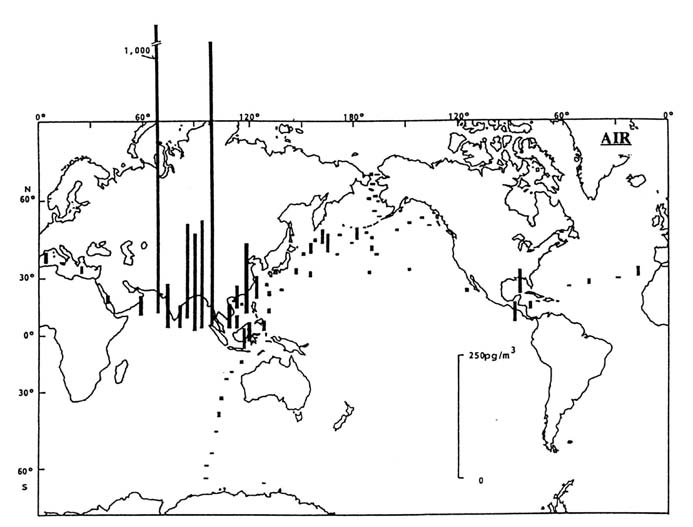
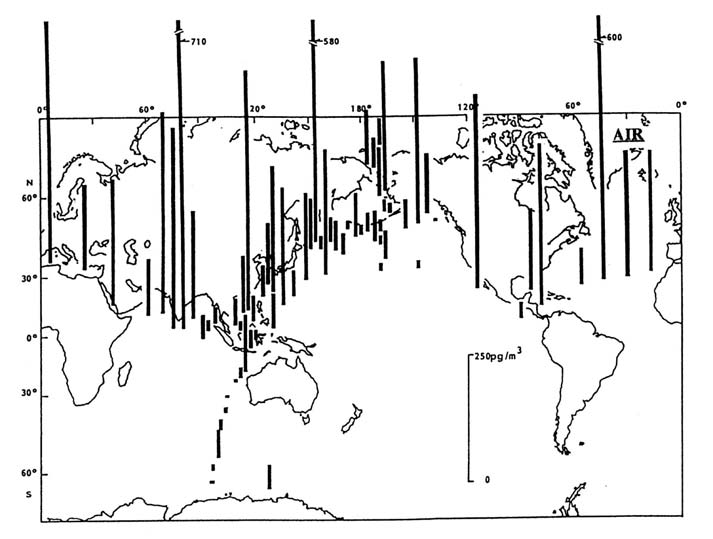
(11 x 106 pg/m3) and Hue in Central Viet Nam (12 x 106 pg/m3). Other areas showed much lower
levels of HCHs in air. DDTs in air were found in high concentrations in Indochina but only trace
amounts were found in Australia and other Southeast Asian countries. Similar distribution was
observed for chlordane in air over these regions. High concentrations of PCBs in air were found in
almost all the areas monitored ranging from 17,000 pg/m3 (Perth) to 700 pg/m3 (Viet Nam).
Figure 3.1.1. Distribution of DDT concentrations in air (Iwata et al., 1993)
Figure 3.1.2. Distribution of PCB concentrations in air (Iwata et al., 1993)
Table 3.1.1 summarises the levels of DDTs, HCHs, chlordanes, and PCBs in air over selected areas in
Region 8. Figure 3.1.3 shows the relatively high concentrations of total HCHs and PCBs in air over
Region 8.
46
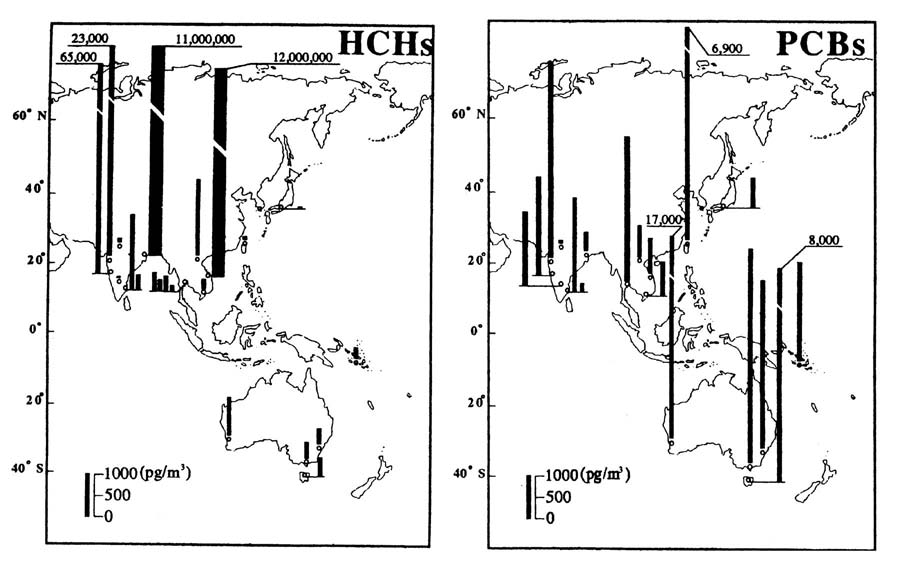
Table 3.1.1. Levels of PTS in air for several cities in Region 8 (Iwata et al., 1994)
Cities DDTs
HCHs
Chlordanes
PCBs
(pg/m3)
(pg/m3)
(pg/m3)
(pg/m3)
Thailand rural areas
35 3600 280-390 27
190 N.A.
Bangkok, Thailand
800
120
2500
3500
Hanoi, Viet Nam
1900
740
66
710
Hue, Central Viet Nam
2400
12 x 106 340 800
Ho Chi Minh City, Viet Nam
1700
220
31
830
Solomon Islands
1300
260
250
2300
Cronulla, NSW
14
350
390
3900
Hobart, Tasmania
8.8
450
30
4700
Melbourne, Victoria
21
380
130
8000
Perth, WA
22
900
650
17,000
Figure 3.1.3. Distribution of HCHs and PCBs in air over rivers and estuaries in Region 8
(Iwata et al., 1994)
The Ministry for the Environment, New Zealand started a national Organochlorine Program in 1995
and one of the environmental media monitored was air over several cities and rural areas throughout
the country (Ministry for the Environment, New Zealand, 1998). In the 1996-1997 sampling period,
they reported low levels of PCDD/PCDFs, PCBs and OCPs. PCDD/PCDFs levels were in the range of
0.94 31.7 fg I-TEQ /m3 of air in the rural areas and between 6.15 262 fg I-TEQ /m3 of air in the
urban areas. An industrial site monitored showed relatively high levels of PCDD/PCDFs of up to
1170 fg I-TEQ /m3 of air. However, these concentrations were more than 100 fold lower than reported
for air in Japan and other developed countries. PCB concentrations in the same sampling areas also
showed a similar trend with higher levels in the air of urban areas (29.9 129 pg/m3) than rural areas
(4.99 30.0 pg/m3). These levels were much lower than the levels obtained in Australian cities (3900
47
17,000 pg/m3) (see Iwata et al., 1994). OCPs were also detected in all samples and the most
abundant were lindane, HCB, dieldrin and DDT. However, the concentration levels were mostly
below 50 pg/m3 which are among the lowest concentrations of OCPs in air when compared globally.
The Pollution Control Department of Thailand has monitored the levels of organolead compounds in
air over the City of Bangkok since 1992. High levels of organolead were reported, increasing
temporally from 170 ng/m3 in 1992 to 330 4750 ng/m3 in 1997. However, there was a decrease to
240 ng/m3 in 1998 (Pollution Control Department, 1998).
3.1.2. Environmental Media: Water
3.1.2.1. Freshwater
Most PTS are not very soluble in water but may also occur adsorbed on suspended solids. A few
studies have been reported on the levels of PTS in water either from continuous monitoring programs
or assessment studies. The Water Department of Singapore has monitored concentrations of several
PTS in lake, river and processed water for drinking (National Environment Agency, Singapore, 2002).
Specified numbers of samples (9 60 samples per year) were analysed for aldrin, chlordane, DDTs,
dieldrin, and heptachlor to ensure the safe level for human consumption.
Tanabe and co-workers reported the concentrations of DDTs, HCHs, chlordanes, and PCBs in
freshwater from several Asian countries and Australia (Iwata et al., 1994). Extremely high
concentrations of HCH were found in one Malaysian river (900 ng/L) while other areas in Region 8
showed much lower levels of HCH (0.08 22 ng/L). Concentrations of HCH in water in Australia
were found to be low (0.079 0.87 ng/L) in the 20 areas studied. DDTs were found to be abundant in
inland waters of most countries in Region 8. Particularly high levels of DDT were found in municipal
sewage in Ho Chi Minh City, Viet Nam (25 ng/L). Chlordanes were found to be generally low in most
parts of the region ranging from 0.002 to 2.8 ng/L. PCBs were found in significant amounts in most
parts of the subcontinent countries while the oceanic countries had lower levels of PCB in the inland
water systems. Table 3.1.2 summarises the levels and distribution of these PTS in Region 8.
Table 3.1.2. Levels of PTS in water for several countries in Region 8 (Iwata et al., 1994)
Cities No.
of DDTs
HCHs
Chlordanes
PCBs
Locations
(ng/L)
(ng/L)
(ng/L)
(ng/L)
Thailand
5
0.23 2.50
0.18 75.00
0.18 1.30
0.24 4.40
Viet Nam
7
0.29 25.00
1.90 19.00
0.05 1.00
0.57 8.00
Malaysia 1
1.70
900.00 2.10
0.45
Australia
20
0.001 1.10
0.08 0.87
0.01 1.20
0.05 2.20
A more recent study on the levels of PTS in freshwater was reported for several rivers (Table 3.1.3) in
Northern Peninsular Malaysia (Tan, 2001). Contrary to the 1994 report (Iwata et al., 1994), the author
found that most OCPs including HCHs were at relatively low levels in the river water suggesting
isolated contamination of samples collected from nearby rivers in the earlier studies. However, Tan
(2001) reported that PAHs and phthalate esters were exceptionally high. The levels of DDT were
comparable to those found by Iwata and co-workers in the same study.
Thailand has monitored several PTS since the early 1980s and data are available in the Agricultural
Department of Thailand annual reports. The data are summarised in Table 3.1.4 together with data on
neighbouring Malaysian rivers. There were no significant changes in concentrations of several PTS
such as aldrin, DDT, dieldrin and heptachlor over the two decades of monitoring river waters
throughout Thailand. Heptachlor seemed to peak in 1995 even though it was already banned in 1981.
It is likely that heptachlor was present at about 10% in the chlordane formulation used for termite
control. Constant levels of several PTS in Thailand and Malaysia suggested continuous input even
though the chemicals had been banned from import.
48
Table 3.1.3. Mean concentration (ng/L) of PTS in several rivers in West Malaysia (Tan, 2001)
No.
Location
Samples Aldrin DDT Dieldrin Endosulfan Endrin HCH Heptachlor PAHs Phthalates Phenols
Sg.
Perak 9 N.D.
10.22
N.D. 3.44 N.D.
N.D.
0.44
175.2 8706 114.2
Sg. Juru/
Sg.
Perai
6 0.43 3.22 1.85 2.47 0.83 8.88
0.4 1544 8241 3559
Sg.
Muda 5 1.04 1.76 0.4
6.86 4.94 2.02
0.22 1227 2593 482.8
Table 3.1.4. Temporal distribution of PTS concentrations (ng/L) in freshwater in Thailand and
Malaysia *
Aldrin DDT
Dieldrin Endosulfan Endrin
Heptachlor Organic Organic Lead
Mercury
Compounds
Year
Compound
1977 30-270
7360
1983 100 80
2 80
1984 235 <116
13,800
1985
30-380
1986 3
1987
18.2
&
4620
1988 12-16
2
38,700
1989
53
110
1990 100
330
160
20
1991
0
0 47* 0 313.3*
0-118.7*
193*
1992 220
1993 -
530
760
1994
490
40
50
1995 40-710
10-
<10
9460
370
1996
120
1997
117.9
1998
0 1.1 * 0.4
0
0.2-4.9* 0.2
120
47,800
9.0*
3.3*
2.2*
0 0.7*
1999
0.2 3.4 0.9
0
90-210
3.9
0 0.4*
*
3.1*
1.1*
1.0 25.2*
6.6*
2000 N.D.
0
N.D.
0 13*
N.D.
0 4*
25*
Under the Environmental Monitoring and Governance of EDC Pollution in the East Asian Coastal
Hydrosphere program, vast amounts of data were collected on the levels of endocrine disrupting
chemicals including several PTS in inland water and seawater. Valuable data on OCPs for
Philippines, Thailand, Indonesia, Viet Nam, and Malaysia were made available at their website
49
(Coastal Hydrosphere, 2000) from recent surveys in 1999 and 2000. These are summarised in Table
3.1.5. Most of the OCPs were found in inland waters, generally, in the parts per trillion (ppt) levels
except in Malaysia, where the levels of HCHs, particularly lindane, were found to be extremely high.
Table 3.1.5. Concentration levels of PTS (ng/L) in freshwater from several Southeast Asian
countries (Coastal Hydrosphere, 2000)
Countries Year
HCH Heptachlor Aldrin Endosulfan Dieldrin Endrin DDT
Indonesia
1999
23.97
-
-
-
6.67
6.39
-
2000
-
-
-
-
-
-
Malaysia 1999 -
-
-
-
-
-
-
2000
16,582
5.82
3.31
434.79
21.51
-
35.35
Philippines
1999
7.17
-
4.84
-
-
-
-
2000
9.85
1.80
5.15
2.40
0.96
10.69
4.35
Thailand 1999 5.7
-
N.D.
-
-
3.40
-
2000
16.0
-
9.6
-
-
-
-
Viet Nam
1999
13.30
-
-
-
-
-
4.87
2000
-
-
-
-
-
-
3.56
In the report "Organochlorines in New Zealand - Ambient Concentrations of Selected
Organochlorines in Rivers", several PTS including PCDD/PCDFs, PCBs and several OCPs were
monitored. From the 1996 studies on several rivers in New Zealand, they found no PTS in the river
water samples (limit of detection was 2 pg/L for 2,3,7,8-TCDD, 0.01 0.6 ng/L for PCB congeners,
and <2 ng/L for most OCPs). However, PCDDs/PCDFs were found in some fish samples collected in
the rivers while PCBs and DDTs were found in almost all fish samples collected. However, the
concentration levels of these PTS in the fish samples were very low and near the detection limit.
3.1.2.2. Seawater
The concentrations of PTS in seawater are difficult to measure due to their very low levels and
difficulties in collecting samples. Iwata et al. (1993) surveyed the PTS levels in surface seawater of
several seas and oceans in this region from the south near Antarctica through Southeast Asia, and the
Pacific Rim to Alaska in the north. The studies were conducted concurrently with the studies on the
concentrations of PTS in air over the oceans. The spatial distribution of HCHs, DDTs, PCBs are
shown in Figures 3.1.4, 3.1.5 and 3.1.6.
The concentrations of PTS in several selected seas and oceans are summarised in Tables 3.1.6 and
3.17. Seawater samples contained high levels of HCHs, mainly lindane, suggesting high and extensive
usage in catchments. Other PTS levels were comparable with other parts of the world.
Table 3.1.6. Mean concentration (pg/L) of PTS in surface seawater in Region 8
(Iwata et al., 1993)
Sampling Location
Total HCHs
Total Chlordanes Total DDT
Total PCBs
East China Sea
580
13
16
17
South China Sea
480
12
6.9
17
Strait of Malacca
480
9.4
6.4
20
Celebes Sea
280
5.1
2.6
20
Java Sea
58
2.8
5.6
22
Eastern Indian Ocean
94
7.5
2.1
21
Southern Ocean
36
4.2
1.0
8.3
50
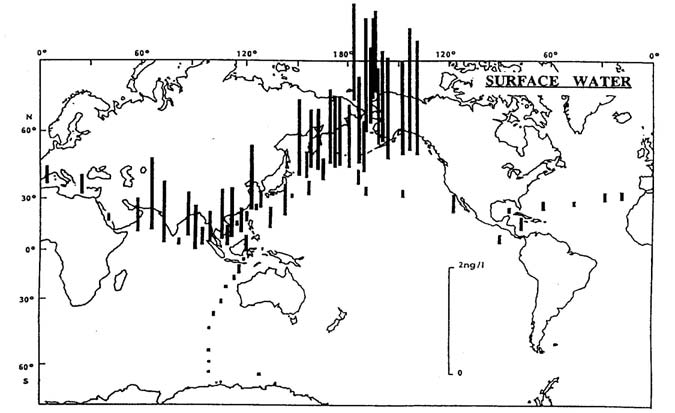
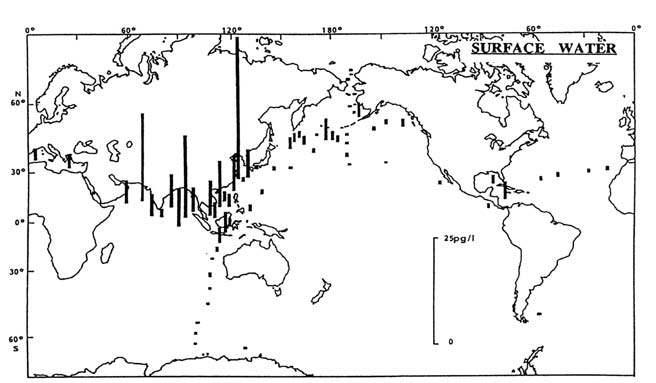
Table 3.1.7. Concentration levels (ng/L) of PTS in seawater from several S.E. Asian Countries
(Coastal Hydrosphere, 2000)
Countries year
HCH Heptachlor Aldrin Endosulfan Dieldrin Endrin DDT
Indonesia
1999
42.19
11.82
6.04
2000
Philippines
1999
11.11
2000
10.1 1.9 7.3 6.1 1.2
11.8
7.4
Thailand 1999
15.30
4.63
4.35
2000
14.25
15.3
3.72
Viet Nam
1999
13.30*
49.27
2000
-
* lindane only
Figure 3.1.4. Distribution of total HCH concentrations in surface seawater (Iwata et al., 1993)
Figure 3.1.5. Distribution of total DDT concentrations in surface seawater (Iwata et al., 1993)
51
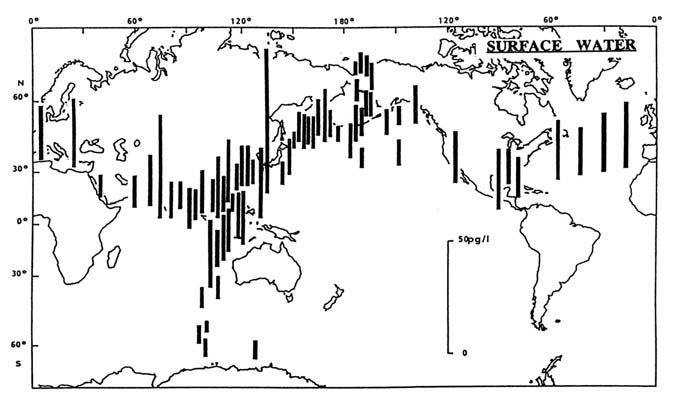
Figure 3.1.6. Distribution of total PCBs concentrations in surface seawater (Iwata et al., 1993)
Another source of environmental data on PTS was from the EDC in Coastal Hydrosphere projects
undertaken by the United Nations Universities Programs. Even though the data are limited, they are
more recent (1999-2000) and should provide a better idea of the current status of PTS in seawater
around Region 8 (Coastal Hydrosphere, 2000). The sampling areas were nearer to the shore compared
with the study by Iwata et al. (1993), which were mostly offshore deepwater zones. Therefore, the
concentration levels obtained in the more recent studies were 1000-fold higher, but similar
proportions of PTS in seawater were found in both studies. The major constituents of PTS were the
HCHs particularly near the Indonesian coast. High concentrations of DDT were found off the coast of
Viet Nam.
Endocrine disrupting PTS (phthalates, alkylphenols, bisphenol A (BPA) and organochlorine
insecticides) have been measured in rivers and estuaries in Viet Nam. Generally, levels of phthalates,
alkylphenols and BPA ranged from ng/L to tens of ng/L. Residues of DDTs in river and estuary water
were from 3 to 8 ng/L and in sediment from 100 to 400 µg/kg dry weight (Chieu et al., 2002).
3.1.3. Environmental Media: Sediment
Due to the low water solubility of most PTS, sediments and soils are the natural sinks or deposition
matrices for PTS upon release to the environment. Tonnes of the PTS that have been applied through
agricultural activities as well as vector control are likely to remain deposited in these sediments with
minimal breakdown and natural decomposition due to the long half-lives of most PTS. For example,
with a half-life of 10 15 years for DDT and longer for DDE, there is more than 10% of the total DDT
released still in the environment since it was banned in the 1970s. High levels of PTS remain in
contaminated sediments while PTS are still deposited in uncontaminated sediments through air and
water dispersion.
Quite a number of studies have been reported on PTS levels in sediments - marine sediment, coastal
sediment, or inland water sediment (rivers and lakes). A study by Iwata et al. (1994) on PTS levels in
sediments from rivers and estuaries is a good indication on the status of PTS in sediments in this
region. These data are summarised in Table 3.1.7. DDT levels in sediment samples from the region
were generally low even though one or two of the sites showed extremely high levels of DDT. For
example, one site in Australia showed a level of 1700 µg/kg while most of other parts of the country
showed DDT levels of less than 20 µg/kg. Similarly, three sites out of eighteen in Viet Nam showed
high levels of PCBs (630 µg/kg) and DDTs (790 µg/kg), indicating hot spots in the country.
52
Table 3.1.7. Level of PTS in sediment (µg/kg) from several different locations in Region 8
(Iwata et al., 1994)
Cities No.
of
DDTs
HCHs
Chlordanes
PCBs
Locations
Indonesia
4
3.4 42
0.04 0.10
0.16 38
5.9 220
Thailand
4
4.8 170
0.48 3.1
1.4 210
11 520
Viet Nam
18
0.37 790
0.43 12
0.07 20
0.18 630
Malaysia 1
1.8
0.18
1.0
<5.0
Papua New Guinea
3
4.7 130
0.17 0.34
0.75 4.1
3.3 54
Solomon Islands
2
9.3, 750
<0.33, 2.2
0.53, 3.9
1.1, 5.0
Australia
19
0.08 1700
0.02 17
0.17 230
0.49 - 790
The levels of PTS in sediments from Malaysian rivers in a more recent report showed similar
concentrations (Tan, 2001), as shown in Table 3.1.8. In an earlier report, Cullen and Connell (1992)
summarised studies on PTS levels in sediments in Australia carried out in the 1970s and 1980s. DDT
levels varied greatly, from not detectable to 50,000 µg/kg, while PCBs were found in marine
sediments at concentrations of up to 1300 µg/kg. These high levels of DDT were attributed to the
large number of cattle tick-dip sites throughout Australia, which are still considered hot spots in some
parts of the country (Connell et al., 1999; Miller et al., 2002).
Table 3.1.8. Levels of PTS in Sediments in Malaysia (µg/kg) (Tan, 2001)
Location Year
Aldrin
Endosulfans
HCHs
Heptachlor
Sg.
Muda 1998
0.25 1.67 0.93 0.13
Strait of Malacca
1998
0.14
0.32
0.61
0.23
Sg.
Bernam 1994
0.05 0.96 3.52 1.28
Sg.
Selangor 1994
0.06 5.35 4.03 0.98
The levels of several organochlorines in sediment samples from New Zealand were very low
compared with other industrialised countries (Scobie et al., 1999). Concentrations of PCDD/PCDFs in
sediments were in the range of 0.081 2.71 ng I-TEQ /kg. Non-detectable values were included as
half LOD values while low values of 0 1.38 ng I-TEQ /kg were obtained when the non-detectable
values were excluded. PCBs were also detected in the sediments but were less frequent than in
shellfish. The sum of 25 congeners was in the range of 0.12 8.80 µg/kg DW for sediment samples
with PCB cogeners 153 and 138 more frequently detected. Dieldrin and DDTs were the most
frequently detected in sediments with concentration ranges of <0.05 0.38 µg/kg and <0.01 3.29
µg/kg, respectively.
3.1.4. Environmental Media: Soil
The Cattle Tick Dip Site Management Committee in Australia released data on levels of DDT in
contaminated sites (Miller et al., 2002). From the various types of soils analysed, DDT levels were
found to be as high as 106 mg/kg in some areas. These soils were also found to contain chlordane and
dieldrin in low concentrations (not detected to 2 µg/kg). However, DDT levels showed a declining
trend since DDT usage was banned in 1987 in Australia.
A more recent work in the Philippines (Lee et al., 1997) reported chlordane, DDT, HCB, and HCH
levels as shown in Table 3.1.9. DDT, HCB and HCH levels were found to be higher in the urban soils
while chlordane and PCB were relatively high in the river sediments. Agricultural soils were almost
free of these PTS.
53
Table 3.1.9. Levels of PTS (µg/kg) in soils from the Philippines (Lee et al., 1997)
Chlordane DDT HCB HCH PCB
No.
Type of Soil Samples mean range mean
range mean range mean
range mean range
Agricultural
10
8.5 0.04 - 20 49 1.2 - 200
6.6
0.1-19 1.7
0.1-5.2 <1.0 <1.0
Urban
10
240 33 - 510 370 50 - 1100
78
15-160
72
12-190
100 28-200
River
5
580 110 - 760 250 99 - 350
2.8
0.6-4.5
13 6.4 - 190 330 31-440
Buckland et al. (1998) summarised the results of a detailed New Zealand study on ambient
concentrations of selected organochlorines in soils. Concentrations of PCDD/PCDFs (including half
LOD values for non-detectable congeners) were typically in the range 0.17 1.99 ng I-TEQ /kg for
forest and grassland soil, 0.17 0.90 ng I-TEQ /kg in agricultural soil and 0.26 6.67 ng I-TEQ /kg in
urban soil. PCBs were not found in forest, grassland and agricultural soils in New Zealand. A limited
number of PCB congeners were found in urban soils, with provincial soils in the range of 0.30 3.38
µg/kg and metropolitan soils in the range of 0.23 9.74 µg/kg. For all soils, PCB TEQ levels were
calculated to be in the range of 0.065 1.33 ng TEQ /kg which were an order of magnitude lower
than the PCDD/PCDFs I-TEQ levels for the same soil type.
Organochlorine pesticide residues found commonly in the soils were chlordanes, HCB, dieldrin, and
DDTs. These residues never exceeded 1.0 µg/kg in the forest and agricultural soils. However, urban
soils contained maximum concentrations of 1.22 µg/kg (HCB), 42.1 µg/kg (dieldrin), 1.72 µg/kg
(chlordane), and 340 µg/kg (DDTs).
3.1.5. Environmental Media: Animals
The concentration levels of PTS in animals such as fishes and other marine organisms have been
extensively studied for this region. Most data were from fairly recent studies covering almost all of
the PTS listed plus a few of the regional specific PTS. Some of the data on mussels are from the
Mussel Watch program while others are from individual studies reported by marine scientists
throughout this region. The data on PTS levels in mussels would provide an interesting comparison on
the distribution of PTS in mussels in Region 8 as well as with other regions in the world. Table 3.1.10
summarises levels of PCBs, DDTs and HCHs in mussel species (either P. viridis or Mytilus sp.)
collected in this region. A decrease in concentration levels of PTS such as DDTs and HCHs in the
green mussels over time was observed in most areas with the 1980s data significantly higher than the
more recent findings.
The levels of PTS in various species of fish in Region 8 are summarised in Table 3.1.11. The levels of
chlordane, HCB and PCBs are relatively low, mostly in the sub-ppb levels except for DDTs, which
were in the ppb range. Fish samples collected in Australia seem to have high levels of these PTS
compared with other parts of the region particularly PCBs which were more than 5 times higher.
Hexachlorobenzene was detected in all the samples but at a much lower concentration.
Hossain (2001) conducted a recent study on the levels of organochlorine pesticides (OCPs) in marine
biota to assess the level of PTS and to look into bioamplification effects of these OCPs in the Strait of
Malacca. All samples were collected in offshore or coastal areas of the West Coast of West Malaysia.
The results are summarised in Table 3.1.12. Most of the results are comparable with other studies in
this region as well as other parts of the world. Total DDT was relatively low and decreasing compared
with earlier studies in Malaysian marine biota. An interesting observation was that coastal species
such as cockles, mussels and shrimps contained higher levels of aldrin, HCH and heptachlor probably
because of export from rivers and inland waters where agricultural activities were intensive.
Table 3.1.10. Levels of PTS (µg/kg wet wt.) in green mussels (Perna viridis, L.)
Location Year
PCBs
DDTs
HCHs
References
Hong Kong Coast
1983
9.6-300
14-320
4.8-34
Phillips (1985)
East Java,
1984 100520
030
Boon
et al. (1989)
Indonesia
54
Indian Coast
198889
2.840
4.316
Ramesh et al. (1990)
Gulf of Thailand
1989
-
0.39-7.41
<0.02-0.19 Siriwong et al. (1991)
Penang, Malaysia
1990
-
180.9
Rohani et al. (1992)
Australia
1991
<10
<1.02.0
Burt and Ebell (1995)
Gulf of Thailand
1991
-
0.745.38
<0.020.09 Ruangwises et al. (1994)
Gulf of Thailand
1994
0.1712
1.338
<0.010.09 Kan-atireklap et al. (1997)
Gulf of Thailand
1995
<0.01-20
1.315.0
<0.010.43 Kan-atireklap et al. (1997)
Indian Coastal
1994-95 0.31-15 0.93-40
1.5-12 Kan-atireklap
et al. (1998)
water
Philippines 1994-97
0.69-36
0.194.20
<0.010.19
Prudente
et al. (1999)
Papua New
1994-97
- 0.00.19
Prudente
et al. (1999)
Guinea
Viet Nam
1997
0.2-3.4
2.7-340
0.04-0.1
Monirith et al. (2000)
Cambodia 1998
<0.05-5.1
0.25-1.6
0.01-0.03
Monirith
et al. (2000)
Malaysia 1998
0.1-5.1
0.2-5.7
0.01-0.15
Monirith
et al. (2000)
West coast,
1998-99 0.00-7.8
0.3211.28
Hossain
(2001)
Malaysia
Indonesia 1998
0.2-2.7
0.1-3.1
0.1-0.1
Monirith
et al. (2000)
Philippines 1998
0.4-14.2
0.1-1.0
0.03-0.06
Monirith
et al. (2000)
Table 3.1.11. Mean concentrations of PTS (µg/kg wet wt.) in several species of fish in Region 8
Countries Lipid
(%)
PCBs
DDTs
HCHs
CHLs
HCB
References
Australia 3.4
55
22
0.34
51
4.2
Kannan
et al. (1995)
Cambodia 5.3
0.36
8.1
0.08
0.11
0.09
Monirith
et al. (1999)
Thailand
5.3 1.6 6.2 0.82 2.6 0.24
Kannan
et al. (1995)
Viet Nam
1.9
10
26
1.8
0.11
0.05 Kannan et al. (1995)
Indonesia 3.0
2.6
28
0.73
0.45
0.05
Kannan
et al. (1995)
Papua New
0.68 7.5 0.43 0.57 0.37 0.03
Kannan
et al. (1995)
Guinea
Table 3.1.12. Levels of PTS in several species of marine organisms (µg/kg) in Malaysia (Hossain,
2001)
Marine Species
Concentration range of PTS (µg/kg wet wt.)
Aldrin DDT Dieldrin
Endosulfan
Endrin HCH Heptachlor
Blood cockle
(Anadara granosa) 0.02-2.5
0.04-1.24 0.01-0.7 0.10-3.25
ND-3.25 0.74-10.23
0.27-3.54
Cat fish (Arius sp.)
0.2-2.5 0.1-3.2 0.02-0.5
0.3-0.8
0.1-5.4
0.9-5.9
0.3-8.2
Green mussel (Perna
viridis)
0.02-15.7
ND-7.8 ND-0.9 ND-2.6 ND-9.1
0.32-11.28
0.1-14.6
Jew fish (Pennahia sp.)
ND-9.5 0.1-6.0 0.02-0.9
0.3-3.8
0.1-6.2
2.7-7.1
0.9-5.7
Mullet (Valamugil sp.)
ND-2.2 0.01-4.9 0.02-0.8
0.5-1.8 ND-13.0
0.3-8.3
0.1-5.2
55
Schrimp (M. monoceros) 0.2-26.5 0-4.1 ND-0.6 ND-0.6 ND-2.7 3.3-35.8 3.5-36.1
Seabass (Lates calcarifer) 0.5-8.0 0-0.5 ND-1.0 0.01-3.4 ND-9.1 1.7-5.1 0.7-21.7
Large marine mammals such as whales and dolphins are at the top of the marine food-chain.
Therefore, bioaccumulative and bioamplification effects of PTS may be estimated from concentration
data on these organisms. A group from Australia reported PTS levels in these mammals. Table 3.1.13
summarises this report. The levels for PCDD/PCDFs were in the sub-ppt levels and only the large
beaked whale contained 1-3 ppt of PCDD/PCDFs. However, other PTS such as DDT, PCBs and HCB
were high as expected.
Table 3.1.13. Level of PTS in marine mammals in Australia (µg/kg, wet weight)
(Miller et al., 1999)
Species Chlordane
DDTs
Dieldrin
PCDD PCDF
HCB
Heptachlor
PBB PCB
Beaked whale
60
720
80
0
0.00126
160
20
0
390
Andrew's
beaked
whale 60 2500
40
0.00116
0.00287
180 0 110
800
Bottlenose
980-
0.0 -
0.00015-
180 - 1200 -
dolphin 60-140
3340 140-260 0.00068 0.00262 80-160 0.0 - 40
410
3300
700-
0.0 -
0.00037-
Pilot whale
60-100
1180 0-160 0.00053 0.00177 80-220 0.0 - 20
0
340 - 600
Fin whale
20
0
0
0.00027
0
20
0
0
0
Leopard seal
340
1540
280
0.00093 0.00027
80
0
0
820
Minh et al. (2000) reported the PCB levels in a number of marine mammals from the North Pacific
and Asian coastal waters and an assessment of isomer specific accumulation and toxicity of various
PCB congeners. The levels of total PCBs (2.4-8.6 µg/kg wet weight) in two dolphin species found in
Mindanao Sea, Philippines were lower than most dolphin species found elsewhere in the world. This
is equivalent to 36-45 pg/g TEQ for the PCBs congeners detected.
In the New Zealand Organochlorine Program (Scobie et al., 1999), the survey on shellfish collected
from the estuaries showed very low levels of PCDD/PCDFs, PCBs, OCPs and chlorophenols in these
samples. Concentrations of PCDD/PCDFs were in the range 0.015 0.26 ng I-TEQ /kg wet weight
with the higher chlorinated congeners most abundant. PCBs were detected in most shellfish samples
where the sum of 25 congeners was in the range 0.11 12.9 µg/kg wet wt. Aldrin and HCHs were not
detected in the shellfish samples but DDTs and dieldrin were found at the concentration ranges of
<0.01 2.77 µg/kg and <0.02-0.56 µg/kg wet weight respectively.
Terrestrial biota have not been widely studied. There are a few studies reported in Australia but most
of these studies were conducted prior to 1990. For example, the king brown snake (reptile) was
reported to have a 50 µg/kg level of aldrin in a 1973 study. Cats and Tasmanian devils had DDT
levels as high as 15,200 µg/kg and a maximum dieldrin level of 4300 µg/kg. Surveys of cattle in
1980-1982 reported relatively high levels of DDT in the fatty tissues and other parts of the mammals
in the range 120 76,500 µg/kg, and a maximum concentration of 490 µg/kg for dieldrin. Extensive
Australian monitoring of livestock has shown a major decline in pesticide residues to negligible or not
detected levels (see Miller et al., 1999). More studies should be made to assess the levels of PTS in
terrestrial animals, particularly livestock.
3.1.6. Environmental Media: Humans
Studies on humans were difficult in terms of sample collections. The media normally used are human
milk and blood and rarely human tissue. Human milk samples limit the study to the postnatal female
population, while analysing blood samples requires the detection limit to be the lowest available. Live
56
human tissue is almost impossible to obtain. However, with advances in analytical techniques, a blood
sample of only two mL is sufficient to monitor the level of PTS in the human population. For
instance, a study was conducted in Singapore on the levels of DDT in humans where 89 subjects were
screened (National Environment Agency, Singapore, 2002). It was reported that the mean DDT level
was 2 µg/kg with the range from not detected to 9 µg/kg. Under the same program, blood lead and
mercury were found to be 66 and 5.57 µg/L.
New Zealand undertook a nation-wide study on the levels of PTS in human blood (Ministry for the
Environment, New Zealand, 2001). In the 1996-97 study, a total of 1834 blood samples were taken
from New Zealanders aged 15 years and over from all over New Zealand. The average PCDD/PCDF
concentrations were 12.8 ng TEQ /kg of serum fat with concentrations increasing with age. PCB
concentrations also increased with population age with an average concentration of 79 µg/kg of fat.
DDE, dieldrin and -HCH were the most frequently detected OCPs. The average concentration of
DDE increased from 646 µg/kg (fat) for the 15-24 years age group to 1780 µg/kg (fat) in the over 65
years old population with the average of 1080 µg/kg (fat) across all age groups. The average dieldrin
concentration was 14.2 µg/kg (fat).
Australia conducted a comprehensive program of monitoring PTS levels in human milk. Started in the
1970s, the program reported studies in several states in Australia and this is summarised in Table
3.1.14. DDT and HCB were found to be high in human milk collected in Queensland in 1974. A more
recent study in Victoria in 1994 showed lower concentrations of some PTS in human milk. Isomers of
PCBs were also found in some of the milk fats at µg/kg levels.
Table 3.1.14. Levels of PTS in human milk fat in Australia (µg/kg)(Miller et al., 1999)
DDTs Dieldrin HCB HCHs
Heptachlor
No.
Location Years
Samples Mean Range Mean Range Mean Range Mean Range Mean Range
Victoria 1994 60 9601 150-39001
60
2252
6-9602 159 13-190 411
16-7600 108
3-480 61 5-150
W Australia 1991
128
800 30-4000
50
15-250 100 0-6000
-
-
20
0-170
500-
50-
Queensland 1974 121 8500 30,400 29 2-100
190
23,000 190 50-1790 -
-
1 ppDDT
2 ppDDE
In a very recent report (Dwernychuk et al., 2002), direct measurements of PCDD/PCDFs were
reported in several media including human blood and breast milk collected in villages in Aluoi Valley
of central Viet Nam. The study attempted to correlate the effect of Agent Orange aerially sprayed in
the valley to the apparent food chain transfer of PCDD/PCDFs from contaminated soil to cultured fish
pond sediments to fish and duck tissues and finally to humans. The report described southern Viet
Nam as PCDD/PCDFs reservoirs, which should be seriously treated as hot spots for PCDD/PCDFs
contamination.
In the report, four communes were selected where pooled blood samples from a number of donors
were collected and divided into gender and two age groups (25 years and above and below 25 years
old). Analysis was conducted for a number of important congeners of PCDD and PCDF and total
I-TEQ calculated. Percent of TCDD was also calculated based on the total I-TEQ to indicate the
significant presence of this compound. A So is a village on the site of the former US Special Force
base while Houng Lam is adjoining A So. Hong Thuong commune is at the centre of Aluoi Valley
while Hong Van commune is to the north and received the fewest aerial applications of Agent Orange.
The study revealed that high levels of PCDD/PCDFs were found in the lipids of human blood samples
from the A So population with total I-TEQ ranging from 16.6 45.9 pg/g I-TEQ (see Table 3.1.15).
Lower levels were found in blood samples from Huong Lam and Hong Thuong and relatively lower
levels of PCDD/PCDFs were found in blood samples from the least affected area of Hong Van. This
study clearly showed the accumulation of PCDD/PCDFs in village populations following aerial
spraying of dioxin-contaminated Agent Orange during the Viet Nam war in the 1960s and 1970s.
57
The study also looked into the levels of PCDD/PCDFs in human breast milk from lactating
primaparous females from the sample area to estimate the daily intake of PCDDs and PCDFs by
infants. Results are summarised in Table 3.1.16.
Table 3.1.15. Level of TCDD and total I-TEQ (pg/g, lipid wt.) in pooled whole human blood
from Aluoi Valley, Viet Nam (Dwernychuk et al., 2002)
Commune and donor No. in pool
TCDD
Total I-TEQ
TCDD as % of
(years of age)
total I-TEQ
A So
Males (> 25)
48
41
45.9
89.3
Males (< 25)
30
31
35.0
88.6
Females (>25)
44
16
18.3
87.4
Females (< 25)
41
14
16.6
84.3
Huong Lam
Males (> 25)
31
17
25.6
66.4
Males (< 25)
33
9.0
19.8
45.5
Females (> 25)
29
5.3
22.0
24.1
Females (< 25)
27
N.D.
10.0
-
Hong Thuong
Males (> 25)
43
21
32.3
65.0
Males (< 25)
27
8.6
15.1
57.0
Females (> 25)
37
12
24.6
48.8
Females (< 25)
25
7.6
11.5
66.1
Hong Van
Males (> 25)
37
N.D.
5.41
-
Males (< 25)
40
N.D.
7.67
-
Females (> 25)
27
N.D.
5.95
-
Females (< 25)
37
N.D.
3.53
-
Table 3.1.16. PCDDs and PCDFs in human breast milk from lactating primaparous females,
Aluoi Valley, Viet Nam (pg/g) (Dwernychuk et al., 2002)
Commune
Donor age
TCDD
Total I-TEQ
TCDD as % of
total I-TEQ
A So
22
5.5
6.15
89.4
20
19.0
21.9
86.8
18
18
18.7
96.3
23
16
18.8
85.1
Huong Lam
58
23
12
14.6
82.2
19
8.3
10.2
81.4
28
2.9
10.6
27.4
21
5.8
9.33
62.2
Hong Thuong
17
11
17.2
64.0
21
8.7
12.6
69.0
22
7.7
9.73
79.1
19
11
18.5
59.5
Hong Van
20
3.3
5.07
65.1
23
2.2
3.85
57.1
20
5.0
13.2
37.9
19
1.4
2.99
46.8
3.1.7. Environmental Media: Vegetation
Kannan et al. (1992) reported the levels of several PTS in foodstuffs collected from several locations
in Viet Nam. Staple foods and meats constituting the dietary intake of an average Vietnamese
population were analysed for PCBs, HCHs, DDTs, HCB, aldrin, dieldrin, and heptachlor. The results
are summarised in Table 3.1.17. All the foodstuffs analysed contained residues of the PTS monitored.
PCBs were found in high concentrations in meat products particularly animal fat, shellfish and crabs.
HCHs were generally low except in caviar samples reaching up to 290 µg/kg. DDTs were also found
to be high in products containing high fat content, especially animal fats. Other PTS were in the sub-
ppb levels.
In a similar study, Kannan et al. (1994) reported the levels of PTS in foodstuffs from Australia, Papua
New Guinea and the Solomon Islands. The results are summarised in Table 3.1.18 (Australia), Table
3.1.19 (Papua New Guinea) and Table 3.1.20 (Solomon Islands). Similar trends were observed in
these samples, with high fat products containing high PTS. PCBs were high in meat products and
fishes but generally low in cereals and vegetables.
Table 3.1.17. Concentration of PTS (µg/kg wet wt) in foodstuffs collected in Viet Nam
(Kannan et al., 1992)
Food Item
No. of
PCBs HCHs DDTs HCB Aldrin Dieldrin Heptachlor
Samples
Rice 3
0.32
4.3
2.0
0.03
0.19
0.26
0.13
Pulses 6
4.0
5.0
1.9
0.04
<0.1
0.08
0.07
Oil 1
21
29
67
1.2
4.2
26
0.79
Butter 2
17
49
7.2
5.0
<0.1
2.2
8.13
Animal
fat
3 61 70 130 0.41 1.5 5.3 2.44
Meat 2
18
17
48
0.11
0.16
1.3
0.35
Fishes 16
10
1.8
26
0.05
0.12
0.17
0.12
Prawn 1
6.6
1.5
1.7
0.03
0.03
0.25
0.15
Shellfish 1 15 2.8 7.2 0.04
0.09 0.40 0.12
59
Crab 1
59
1.4
78
0.17
0.13
0.38
0.33
Caviar 3
51
200
90
3.8
0.81
7.9
0.32
Table 3.1.18. Level of PTS in foodstuffs (µg/kg wet wt) collected from several locations in
Australia (Kannan et al., 1994)
Food Item
No. of
PCBs HCHs DDTs HCB Aldrin Dieldrin Heptachlor
samples
Cereals 5
0.62
0.44
0.82
0.01
0.03
1.6
0.23
Pulses 5
1.4
0.28
2.4
0.02
2.8
1.8
0.75
Oils 8
6.5
0.89
2.1
0.07
0.15
4.2
1.8
Beverages 2 2.3
0.66
0.66
0.03
0.1 0.55 0.31
Vegetables 5 0.40
0.16
3.3
0.01
0.01 0.9 0.07
Fruits 3
0.28
0.10
0.13
0.01
<0.0.01
0.37
0.03
Dairy
9 4.1
6.0
5.9
0.55
0.89 13 13.33
products
Meat 17
11
1.4
13
0.46
0.30
5.1
2.02
Fishes 37
55
0.34
22
4.2
0.77
9.5
1.1
Table 3.1.19. Level of PTS in foodstuffs (µg/kg wet wt) collected from several locations in
Papua New Guinea (Kannan et al., 1994)
Food Item
No. of
PCBs HCHs DDTs HCB Aldrin Dieldrin Heptachlor
Samples
Cheese 1
4.4
1.1
6.2
0.43
<0.01
2.2 1.4
Pork fat
1
45
7.5
24
0.40
0.3
4.3
0.13
Chicken 1
124
9.8
29
0.2
<0.01
2.2 0.31
Striped
6 3.3
0.85
0.51
0.04
0.12 1.2 0.07
mullet
Tilapia 3
1.9
0.47
0.09
0.01
<0.10
0.1
0.09
Mud crab
3
8.6
0.64
0.79
0.03
0.45
0.32
0.26
Oyster 1
16
0.33
0.34
0.02
2.1
0.73
0.17
Table 3.1.20. Level of PTS in foodstuffs (µg/kg wet wt) collected from several locations in the
Solomon Islands (Kannan et al., 1994)
Food Item
No. of
PCBs HCHs DDTs HCB Aldrin Dieldrin Heptachlor
Samples
Pork 1
17
2.2
130
0.14
<0.10
3.0
0.68
Chicken 1
5.2
0.64
4.4
0.06
1.0
2.9
0.22
Greenspotted
4 6.6
0.79
11
0.03
<0.10
0.65 0.14
kingfish
Indian
3 1.1
0.37
2.2
0.01
<0.10
0.18 0.07
mackerel
Snapper 3
3.0
0.43
1.3
0.01
<0.10
0.12
0.12
60
3.1.8. Data Gaps
Region 8 may be divided into the developed countries of Australia, New Zealand, and Singapore, with
the rest being developing countries. Extensive work has been carried out to assess the levels of PTS in
various environmental media in Australia and New Zealand but minimal studies have been made to
determine the environmental concentrations of PTS in other parts of the region. Without additional
technical and financial support, very few data can be made available on concentrations of PTS for this
region particularly in Southeast Asia. There is definitely a lack of data on concentrations of PTS in air
and seawater and very few data on the levels of PTS in humans except for New Zealand. Some of the
concentration data may be available in the form of annual reports of government departments or
agencies in most countries but these could not be readily accessed or made available to the public.
Efforts should be made to fill the data gap in order to have a clearer picture of the status of PTS in this
region where almost all of these chemicals have been banned a number of years ago but are still found
in the environment.
Monitoring of PCDD/PCDFs is difficult and most of the countries in this region are not capable of
undertaking environmental studies by themselves. This issue should be one of the priorities for this
region where the focus should be made to assess the sources and monitor the concentrations of
PCDD/PCDFs. Continuous efforts should also be made to monitor the levels of PTS in foodstuffs to
ensure safe dietary consumption.
Other PTS of emerging concern such as chlorinated paraffins, nonylphenols, octylphenols and
organometallic compounds have received minimal attention. Very little information on concentration
levels of these chemicals is available and there has been very little effort to monitor these PTS
(Coastal Hydrosphere, 2000).
3.1.9. Conclusions
Generally, levels of PTS in the region in most media appear to be elevated when compared with other
parts of the world. However, reported studies showed declining trends in PTS particularly those OCPs
that have been banned from use. PCB, DDTs, HCHs, endosulfan and chlordane seemed to be the
focus of most monitoring studies where their concentration levels were found to be significant. Other
PTS were either low in concentration or were not studied. Little information is available in the region
on PTS of emerging global concern such as organotin, organolead, chlorinated paraffins and alkyl
phenols. PCDD/PCDFs are starting to be determined in some countries but the lack of technical
expertise and funds constrain monitoring studies in most countries.
PTS were found relatively high in air, water, and sediments in most parts of the region. For example,
HCHs were found to be extremely high (12,000,000 pg/m3) in air over Central Viet Nam and PCBs
were found to be high in air over Perth, Western Australia (17,000 pg/m3). Lindane was found at an
exceptionally high level in one location in a Malaysian river water sample (900 ng/L) in 1994 while
neighbouring Thailand recorded a concentration range of 0.18-75.0 ng/L from the same study. Levels
of DDTs and PCBs in sediments from almost all countries in the region were found to be above
sediment quality values of 1.6 and 23 µg/kg respectively.
PTS in biota, particularly marine organisms, have been widely studied and reported. The
concentration levels varied among types of animals, OCPs and locations. The Mussel Watch program
provides most of the data on PCBs, DDTs, and HCHs levels in the bivalve (Perna viridis), and
generally ranged from not detectable to very contaminated. Fishes collected from various countries in
this region showed significant amounts of PCBs, DDTs, HCHs, and chlordanes but were generally
lower than the maximum residual limits.
PCDD/PCDFs apparently pose the greatest threat to humans and the environment. Even though
information on concentration levels of PCDD/PCDFs are scarce, estimates on releases of these
compounds from industrial and human activities (using the UNEP toolkit) coupled with
bioaccumulation and persistence data, indicated high risk situations. Without immediate intervention,
PCDD/PCDFs can cause the greatest damage among the PTS to human health and the environment.
From very recent reports, PCDD/PCDFs in certain regions in Viet Nam may be considered hot spots
as it was well documented that several million gallons of Agent Orange contaminated with TCDD
61
were sprayed widely in the country during the Viet Nam war. It was reported that high concentrations
of PCDD/PCDFs were measured in blood and human milk of Vietnamese living in areas directly
affected by the aerial spraying of Agent Orange.
3.2. Spatial And Temporal Trends
The distribution of selected PTS in air in several cities in the region is shown in Figure 3.2.1.
Relatively high PCBs in air were found over Australian cities and very low concentrations of DDT.
On the other hand, high concentrations of DDT were found in the air of the cities in Viet Nam and
other cities in Southeast Asia. Figure 3.2.2 shows the distribution of selected PTS in freshwater as
reported by Iwata et al. (1994). HCHs seem to predominate in the Southeast Asian region particularly
in Malaysia but it may be misleading due to the fact that only a single sample was collected in the
case of Malaysian water. Thailand and Viet Nam also showed high levels of HCHs in their river
waters, probably due to the extensive use of lindane for vector control and plant protection. DDT was
found to be relatively high in the Solomon Islands while the Australian inland water showed almost
equal distribution of the four PTS although at much lower concentrations compared with the
Southeast Asian waters.
The distribution of selected PTS in surface seawater in the seas and oceans in Region 8 is illustrated
in Figure 3.2.3. High concentrations of HCH were found in all samples of surface seawater indicating
the importance of this PTS in the environment even though it is not listed in the top twelve PTS for
this region.
100%
80%
60%
PCB
Chlordanes
40%
HCH
20%
DDT
0%
k
e
City
rth
gko
noi
Ha
Hue
inh
sland
Pe
Ban
lbourn
i M
on I
Me
Ch
Ho
Solom
Figure 3.2.1. Distribution of selected PTS in air over several cities in Region 8
100%
80%
60%
40%
PCBs
Chlordanes
20%
HCHs
0%
DDTs
m
lia
na
ailand
tra
alaysia
Th
Viet
M
on Islands
Aus
lom
So
Figure 3.2.2. Distribution of selected PTS in freshwater from several countries in Region 8
62
100%
90%
PCBs
80%
70%
Chlordanes
60%
HCHs
50%
40%
DDTs
30%
20%
10%
0%
alacca
Celebes Sea Java Sea
East China Sea
South China Sea
Strait of M
Eastern Indian Ocean
Southern Ocean
Figure 3.2.3. Distribution of selected PTS in surface seawater in Region 8
The aquatic biota were found to contain most of the PTS in relatively high concentrations compared
with other parts of the world. Figure 3.2.4 shows the distribution of selected PTS in several species of
fishes caught near-shore in various countries in this region. DDTs seem to be the dominant
contaminant measured in fish samples collected in SE Asian countries. Fishes from Australia contain
similar proportions of PTS where their concentration levels were slightly higher than those fish found
in other parts of the region.
100%
80%
HCB
60%
PCBs
40%
CHLs
HCHs
20%
DDTs
0%
bodia bodia
uinea
Australia
ThailandVietnam
Cam
Cam
Indonesia
on Island
Solom
Papua New G
Figure 3.2.4. Distribution of selected PTS in several species of fishes from countries in Region 8
Most of the data available on the levels of PTS in this region are temporally scattered and it is difficult
to determine trends in various media. Overall, the levels of most PTS appear to be decreasing with
time. PCDD/PCDFs may not be decreasing but there has been little monitoring to date in this region.
More effort needs to be focused on the PCDD/PCDFs.
63
3.3. Toxicology Of PTS Of Regional Concern
3.3.1. Overview of Harmful Effects
3.3.1.1. General
The primary hazard of PTS relates to their capacity to be readily absorbed into the human body via
inhalation, the digestive system and/or through the skin. This tends to be related to their lipid
solubility. Once absorbed, PTS are readily distributed through the body and tend to accumulate in
fatty tissues, including human milk. Biotransformations or metabolic processes (e.g. liver) may also
produce active and toxic metabolites.
Persistent toxic substances (PTS) are known to pose potential adverse health effects, including
cancers, reproductive disorders, development deformities and learning disabilities in both humans and
wildlife (UNEP/GEF, 2001).
Generally, PTS exposures occur in humans at low doses and toxic effects are difficult to diagnose
(e.g,. the use of biomarkers and clinical tests such as for chronic lead effects). In addition, synergistic
effects are possible when PTS occur together which cannot be taken into account. Health risks are
also difficult to estimate because of uncertainties about assumptions of cause-effect relationships
between low-level exposures to PTS and adverse effects observed in human populations. In particular
there is often a lack of information on children who can be the most susceptible group in a population.
In a regional context, health effects or risks for specific PTS exposures among local or national
populations are reported for relatively few countries (e.g. dioxins in Viet Nam, organochlorines in
Australia, lead in Malaysia and mercury in the Philippines).
3.3.1.2. Genotoxic Effects
Genotoxicity is concerned with genetic damage. One of the main health implications of toxicity to the
gene is carcinogenesis, if the damage carries through to the offspring of the cell that is initially
assaulted (Rodricks, 1994). Not only can genetic damage increase the risk of cancer development, it
can cause cell death or abnormalities. There is limited information and often mixed results for
genotoxic effects following exposure to OCPs including chlordane, dieldrin, heptachlor epoxide and
HCB.
Most organochlorine pesticides (including cyclodienes), PCDD/PCDFs and PCBs are classified as
probable human carcinogens (B2) by the US-EPA and the International Agency for Research on
Cancer (IARC), based on animal feeding studies. Human data tend to be inadequate.
3.3.1.3. Oestrogenic Effects
An environmental endocrine disrupting chemical (EDC) may cause disruption of central nervous
system-pituitary integration of hormonal and sexual behavioural activity, female and male
reproductive system development and thyroid function. In addition, EDCs may play a role in the
induction of breast, testicular and prostate cancers. Evidence for endocrine disruption exists for DDT
(DDE metabolite).
3.3.1.4. Developmental and Reproductive Toxicity
Most organochlorines have shown developmental effects in children due to pre- and postnatal
exposure. Organochlorines accumulate in body tissues and any exposure prior to pregnancy (placental
transfer) can contribute to the overall maternal body burden and result in exposure to the developing
individual (e.g., human milk via lactation). The major observations in children with pre- and postnatal
exposure to organochlorines include effects on the CNS and immune system and neurological effects
such as abnormal behaviour and susceptibility to seizures. Increased post-natal mortality may also
occur. Structural skeletal changes have also been observed following prenatal exposure. Skeletal
malformations, cleft palate, webbed foot, open eyes and extra ribs have been observed in experimental
animals exposed to, for example, dieldrin.
Lactational exposure to organochlorines (e.g. HCB) is also of concern due to the rapid transfer of the
chemical through breast milk. Observations include skin lesions, weakness and convulsions in
64
exposed infants. HCB effects in older children resulted in development of atrophied hands and
fingers, short stature, pinched faces and osteoporosis in the hands and other arthritic changes.
Chemicals from a wide range of chemical classes (e.g. insecticides, herbicides, fungicides,
plasticisers, surfactants, organometallics and halogenated polyaromatic hydrocarbons) have been
shown to induce developmental toxicity via the endocrine system. The strongest evidence of human
effects involves developmental neurotoxicity in children exposed to PCBs (Casarett and Doull's
Toxicology, 6th Edition).
DDT causes toxicity to unborn animals but not birth defects in experimental animals. Studies indicate
that oestrogen like effects on the developing reproductive system occur. DDT is suspected of causing
spontaneous abortion in humans and cattle. It is not known whether this is related to the reproductive
system toxicity of DDT or the developmental toxicity.
3.3.2. National and Regional Human Health Reports
3.3.2.1. General
Health studies related to the use of PTS in the region are limited and tend to reflect specific issues
(e.g. mercury poisoning from gold mining) or episodes (e.g. herbicide spraying in Viet Nam war)
rather than results from national reviews. This can be reasonably expected as environmental levels or
exposures for common PTS in most countries of the region are relatively unknown while health
priorities are generally directed towards the assessment and treatment of communicable diseases.
Despite shifts toward broader health programs and community knowledge, clinical and
epidemiological expertise on PTS is in early stages of development. Available health reports on PTS
from within the region indicate the diverse range of reported effects on the region's people.
3.3.2.2. Herbicide Spraying (2,4,5-T and Dioxins)
Reproductive and carcinogenic effects such as liver cancer have been associated with the large scale
spraying of 2,4,5-T herbicide, together with contaminating PCDD/PCDFs, by the US military during
the Second Indochina war period from 1962 to 1971 (see Westing, 1984). About 10 percent of the
land area of Viet Nam was sprayed, mainly between the years 1965 to 1970 (Phuong et al., 1989).
Since this period the 2,4,5-T would be expected to have effectively disappeared due to degradation
while the contaminating PCDD/PCDFs would remain in significant concentrations (e.g., see Schecter
et al., 2002).
Constable and Hatch (1985) reviewed the reproductive effects of herbicide exposure in Viet Nam,
particularly unpublished studies by Vietnamese researchers. The studies conducted in North Viet Nam
reported a consistent association between presumptive parental exposure to herbicides, prior to or at
conception and congenital defects in children born, particularly for abnormalities such as anencephaly
and orofacial defects. These reviewers noted that the strengths of the association demonstrated in the
data varied among studies. No association with molar pregnancy was documented while miscarriage
rates were conflicting. In the case of South Viet Nam, where both sexes were at risk of exposure,
studies indicated increases in miscarriage, stillbirths, molar pregnancy and birth defects among
couples previously exposed to herbicides. An association between molar pregnancy and herbicide
exposure was considered very suggestive.
Phuong et al. (1989a) compared reproductive anomalies in women living in a herbicide sprayed area
(Thanh Phong Village) and non-herbicide sprayed area (Commune No. 10, first district on Ho Chi
Minh City), 1952 to 1981. As shown in Table 3.3.1, the pooled data indicate that the incidence of
hydatidform mole and congenital malformations was significantly higher (p < 0.005) for the
herbicide-exposed group than the unexposed one. The dates of specific pregnancies were not reported.
65
Table 3.3.1. Frequency of occurrence of reproductive anomalies between herbicide exposed area
(Thanh Phong) and non-exposed area (Commune 10) Viet Nam (1952-1981)
Thanh Phong
Commune 10
Congenital
81/7327 1.1% 29/6690 0.43%
p
<0.005
Anomalies
Hydatidiform
54/7327 0.73% 26/6690 0.38%
p
<0.005
Mole
From Phuong et al. (1989a)
Vietnamese studies on carcinogenic effects from herbicide or PCDD/PCDFs exposures appear to be
limited.
Cordier et al. (1993) conducted a case control study to investigate risk factors for hepatocellular
carcinoma (HCC) among male cases in two hospitals in Hanoi, North Viet Nam between 1989 and
1992. One hospital treated Vietnamese veterans and the other civilians from all the provinces of North
Viet Nam.
Hepatocellular carcinoma is considered one of the most frequent cancers in males in Southeast Asia,
including Viet Nam. As well, Vietnamese studies have claimed that an increased risk of liver cancer
had been observed among persons exposed to herbicides in the south of Viet Nam during the Second
Indochina war (Westing, 1984).
This study confirmed the major role of hepatitis B virus infection in HCC and showed an association
with other factors such as alcohol consumption and chemical exposure (i.e. agricultural use of
organophosphorus pesticides (30 L/yr or more) and military service in the south of Viet Nam for 10
years or more). The authors supported the hypothesis that phenoxyacid herbicides may act as tumour
promoters and TCDD through immunosuppression.
More recently, Schecter et al. (2001) have reported substantially higher blood levels of TCCD (up to
271 parts per trillion) in a cohort of 19 out of 20 persons living in Bien Hoa, near a former Agent
Orange spraying base, 1962-1970, than in a pooled sample from 100 residents of Hanoi (2 parts per
trillion) used for comparison. These authors suggest that current and past exposure are related to food
chain contamination via river-sediment-fish-people (see also Schecter et al., 2002). Other blood levels
of TCDD in Vietnamese exposed to Agent Orange are given in Table 3.1.15.
3.3.2.3. Smoke Haze, Particulates and PAHs
Airborne particulate matter is a key air pollutant of health concern in urban and rural areas throughout
the region especially for chronic respiratory disorders. Aside from indoor air pollution from cooking
and heating using wood and fossil fuels, emissions from urban sources (e.g. Bangkok, Thailand),
forest fires (e.g. Australia) and biomass burning for clearing of land for agriculture, plantations and
resettlement (e.g. Indonesia) are important health and environmental issues for the region. In
particular, smoke haze episodes resulting from biomass burning have affected countries such as
Malaysia, Singapore and Indonesia.
During the late summer and early autumn of 1997, large scale mass burning in Indonesia in an El
Nino year resulted in a widespread dense smoke haze which spread as far as the Philippines to the
north-east and the SE Asian mainland (including areas of Viet Nam, Thailand and Malaysia) to the
north and north-west. Daily PM10 concentrations (µg/m3, 24hr average) monitored at Kuala Lumpur
during August-November 1997 reached a peak value of over 400 µg/m3 and at least 23 daily readings
of over 150 µg/m3.
US-EPA air monitoring (Indonesia and Malaysia) of PM10, PM2.5 and constituents such as PAHs in
the smoke haze from SE Asia biomass fires (1997) identified increased risk of adverse health effects
(e.g. respiratory symptoms, hospital admissions of the elderly, those with pre-existing chronic
cardiorespiratory disease and asthmatic persons) among local populations in Kuala Lumpur and in
Indonesia. Short-term increases in PM10 levels, mainly PM2.5, were about 250 µg/m3 above
background levels.
66
Short-term PAH exposures were considered a low health threat but repeated prolonged exposures over
several weeks or months every few years could result in cumulative doses associated with increased
health risks (e.g. cancer) (Pinto et al., 1998).
Panther et al. (1999) have shown that seasonal exposures to PAHs are significant for local populations
in tropical urban environments from both urban pollution and biomass burning. Higher levels of
PAHs are usually associated with biomass burning compared with urban emissions.
There is little information on effects of PAH in urban air, generated by motor vehicles, on human
health. Estimates from Great Britain indicate that most of the PAHs in urban air are derived from
motor vehicles (Lim et al., 1999) and are associated with the PM10 fraction.
3.3.2.4. Organochlorine Insecticides
Regional reports on health effects from PTS or POPs have tended to identify adverse human health
and environmental impacts from pesticide use, often from occupational exposures. In developing
countries of the region, large proportions of populations and women live in rural areas where risks of
pesticide exposure are elevated. In Australia and New Zealand, urban and rural exposures to
organochlorines have been significant.
For developing countries, a Philippine case study describes the nature of pesticide poisoning cases
documented by the Philippine General Hospital and the National Poisons Control and Information
Service.
A review of admitted cases of poisoning at the Philippine General Hospital, Manila, showed that
before the implementation of the intensive food production program in the 1960s, only 3% of the
acute poisoning cases were caused by pesticides (mostly organochlorines). By 1974, pesticides ranked
among the top four etiologic agents of acute suicide poisonings with about 18% mortality rate. By
1990, the cases of organochlorine poisonings increased significantly with a mortality rate of 29.7%.
A descriptive study of 47 male and 23 female patients with aplastic anemia referred during the period
January 1979 December 1981 was undertaken at the Philippine General Hospital. Insecticides,
which were either organophosphates or organochlorines, were implicated in 21 patients.
In 1988, a retrospective study of mortality statistics in Central Luzon linked occupational exposure to
insecticides to a marked increase in rural male mortality in Central Luzon.
In 1992, the results of a prospective study were released comparing the health status of farmers
exposed to pesticides in the province of Nueva Ecija and those who had not been exposed in the
province of Quezon. Eye, skin, nail, pulmonary, renal and neurological problems were found to be
significantly associated with pesticide exposure (Philippines, 1996).
Since 1992, the pesticide use has generally declined in the Philippines with a shift towards sustainable
agricultural activities (e.g. ICM). Endosulfan was the most widely used of the PTS over the last three
decades. This pattern of use and poisoning is likely to be reflected in most countries where records
exist.
In a Singaporean study, DDT levels detected in blood serum samples from males were found to be
higher than those from females, probably due to their higher intake of meat products. In comparison,
DDE, a metabolite of DDT and being oestrogen-like, was higher in the females than in males as a
result of the biotransformation from DDT to DDE in females. This was possibly implicated in the
occurrence of breast cancer in women. The sources of DDT and DDE found in Singaporeans was
likely through consumption of imported dietary products containing DDT and DDE residues as a
result of bioconcentration through the food chains, especially fish and aquatic products (Anon, 2002).
Australian research has identified significant statistical associations between organochlorine
insecticide levels in serum and adverse biological or biochemical effects in groups of subjects. For
example, in the case of patients with chronic fatigue syndrome, patients with unexplained and
persistent fatigue had significantly higher levels of DDE compared with control subjects and had
different specific blood cell responses to organochlorines compared with controls (Dunstan et al.,
1995; 1996).
67
Beard et al. (2000) investigated the relationship between serum levels of DDE and bone mineral
density in 68 sedentary women. These women reported an adequate dietary intake of calcium.
However, reduced bone mineral density was correlated significantly with age (r = -0.36, p = 0.004) as
well as with increases in the log of DDE levels in serum (r = -0.27, p = 0.03). Hormone replacement
therapy was also identified as another predictor variable. The authors suggested that past community
exposures to DDT might be associated with reduced bone mineral density in women.
Women in this study were selected from northern New South Wales where DDT was extensively used
in cattle dips and significant residues remain (see Miller et al., 1999).
3.3.2.5. Organometallics
Lead
Community health studies on organic lead exposures in the region are related to urban emissions of
total lead from the use of lead additives in petrol. Various monitoring programs on urban pollution in
most countries (e.g. Indonesia, Thailand, Malaysia, Philippines, Australia and New Zealand) have
implicated airborne lead exposure and elevated blood levels, mainly among children.
Air monitoring in countries such as Australia and New Zealand has shown that the phasing out of the
use of tetraethyl lead in petrol has resulted in significantly decreased levels of airborne lead exposure
in major urban areas.
In Singapore, surveys on lead levels in blood samples were carried out from 1995 to 1997 to assess
the measures used to reduce environmental lead pollution. The results revealed that age was a
significant factor in blood level. The older age group (>50 years old) had significantly higher blood
lead levels than the young adults (<30 years old). This could be due to the bioaccumulation of lead in
the adipose and skeletal tissue in the human body. However, the study showed that there was a
definite reduction in the blood lead levels as a result of the introduction of unleaded petrol in 1991
and the control of lead content in paint in 1993 (Anon, 2002).
Organomercury
Health effects on children exposed to mercury from small-scale gold mining and refinery activities in
Tagum, Davao del Norte, about 1545 km south of Manila, in the Philippines have been investigated
(Akagi et al., 2000). In this case, methylmercury has been associated with total mercury levels in
blood and hair. Of the 163 children, 10 (6.13%) had elevated total mercury blood levels. For
methylmercury, only one child exceeded the WHO limit. Of the 163 children, 3.07% had elevated
total mercury hair levels while ME-Hg was elevated in one child. On physical examination,
abnormalities were found in all 163 children with the following five predominant abnormalities:
under-height, gingival discoloration, underweight, adenopathy and dermatologic abnormalities. The
investigators however, did not offer any specific conclusions. Mercury is widely used in the region in
gold mining, including Papua New Guinea and Indonesia, and similar adverse effects would be
expected in these countries. The role of methylmercury in small-scale gold mining exposures in the
tropical areas of the region is unclear.
Organic mercury in hair appears to be significant in Singaporeans. A study on the levels of mercury
(total and organic) in scalp hair of individuals not occupationally exposed to mercury found that the
average total mercury level in hair was 5.7 µg/g (ppm), with inorganic and organic mercury contents
at 2.7 µg/g and 3.0 µg/g, respectively. Other than factors such as gender, age, ethnicity and artificial
hair waving, the levels were considered to also reflect intake from food (typically fish and other
seafood) and from the environment (Anon, 2002).
Organotin
Adverse health effects from exposure to organotins have been reported in the Philippines. Organotin
compounds (e.g. triphenyl tin) have been used extensively as molluscides against the golden snail in
rice fields and in fish ponds. These compounds are known to be highly toxic when absorbed in the
body and can cause severe skin irritations. Organotins as a group are associated with chronic effects
such as immune and reproductive disorders and swelling of the spinal cord and brain (Philippines,
1996).
68
During the early part of 1989, the problem of controlling the damaging effects of golden apple snail
triggered the increased usage of organotin compounds in rice-farming communities. Several
newspapers reported the death of 20 women in Isabela, allegedly exposed to organotin-contaminated
irrigation water. In spite of the lack of direct evidence in this particular case, a suspension order on the
importation and use of organotin compounds was issued by the Government in October 1989.
However, the use of endosulfan as an unofficial alternative chemical to control snails was reported to
be responsible for the largest number of poisoning cases with fatalities in the country (Philippines,
1996).
3.3.3. Health Risk Assessment
3.3.3.1. General
Few health risk assessments on PTS are available for the Southeast Asia Region although risk
assessment practices are developing as part of project assessments (e.g. contaminated land). The risk
assessment process usually follows the four-step framework developed by the United States
Environmental Protection Agency (US-EPA), i.e. hazard identification, dose-response assessment,
exposure assessment and risk characterisation.
The approach can be applied to models that deal with either carcinogenic or non-carcinogenic effects.
However, the dose-response assessment for a hazardous chemical (e.g. carcinogen) may support a
non-threshold response or alternatively, a threshold or safety factor approach. The latter approach
tends to be favoured by European Governments and the World Health Organisation.
3.3.3.2. Organochlorines
Health risks for the Australian population from exposure to organochlorine pesticides (OCPs) have
been estimated as part of a national case study. Miller et al. (2002) have derived estimates of total
exposures to OCPs for the general public and special risk groups by combining data on dietary intake
estimates with likely levels of intake from environmental sources: air, drinking water, soils and dusts.
From this information, health risk levels for the Australian population and sub-population groups have
been estimated for a range of potential exposures (exposure scenarios).
The dietary intake of organochlorine pesticides is considered the main source of exposure for the
general population in Australia and in many other countries. From the 1970s, the Australian Market
Basket Surveys (AMBS) of foods have shown a progressive decline in organochlorine pesticides
detected in food. Since 1976, there has been an exponential decrease in DDT and dieldrin intake in the
Australian diet, as indicated for DDT in Figure 3.3.1. In contrast to other organochlorine pesticides,
there has been an increase in total endosulfan intakes between 1992 and 1996 surveys, which reflects
use (e.g. crops).
Australian estimates of average daily intakes (µg/kg body weight/day) for different human population
groups have been compared with acceptable daily intakes (ADI), as recommended by the WHO/FAO
or adopted by the Australian and New Zealand Food Authority, and also reference doses (RfD) for
non-carcinogenic effects (US-EPA). Table 3.3.2 presents risk estimates for OCP exposures in the case
of the Australian population. The health risks for exposure to OCPs in the Australian population are
estimated to be low to negligible for adults and children, based on 1996 data. The infant diet,
however, indicated elevated DDT intake mainly due to breast feeding.
If a non-threshold is assumed, the lifetime carcinogenic risk for dieldrin intake was calculated to be
between 1 in a hundred thousand and 1 in a million, and lower than 1 in a million for DDT and total
heptachlor.
Other regional estimates of dietary intake of organochlorines are given in Table 3.3.3 for Viet Nam,
Thailand and Papua New Guinea. Average daily intakes are below available ADIs while Vietnamese
values are elevated compared with others. Exposure scenarios for the eating of seafoods in the region
suggest that risk estimates increase significantly for common OCP residues found in seafoods from
urban areas (see Table 3.3.4).
69
0.5
0.45
0.4
0.35
0.3
0.25
Adult Male
ug/kg/day
Dietary Intake
0.2
0.15
0.1
0.05
0
1975
1980
1985
1990
1995
2000
Figure 3.3.1 Trend in Estimated Dietary Intake of Total DDT for Australian Adult Males
Table 3.3.2. Health risks from total daily intake of organochlorine pesticides for the Australian
population
Pesticide Period
Persons Daily
Intake1
ADI
RfD
Ratio
Ratio
Lifetime
(µg/kg
ADI
RfD
Risk
bw/day)
(µg/kg
(µg/kg
Estimate
bw/day)
bw/day)
Total DDT
1996
Adults
0.007
2 0.5
<0.1
<0.1
<1x10⁻⁶
current
Children
0.009
<0.1
<0.1
<1x10⁻⁶
Dieldrin
Adults
0.003
0.1 0.05 <0.1
<0.1
5x10⁻⁵
Children
0.004+
<0.1
(0.08)
6x10⁻⁵
Total
Adults
0.0006
0.5* (0.5) <0.1
<0.1
<1x10⁻⁶
Heptachlor
Children
0.002
0.013*
<0.1
<0.1
<1x10⁻⁶
1.5*
1 air, water, soil and food
+ two year old
* heptachlor epoxide
RfD = reference dose (US-EPA)
Source: Miller et al. (2002a)
70
Table 3.3.3. Comparison of average daily dietary intakes of organochlorines (µg/person/day) in
Region 8 countries with ADIs
Organochlorines Viet
Nam1
Thailand1
Papua New
ADIs
Guineaa
FAO/WHO1
ANZFA2
1989
1996
PCBs 3.7
1.5
1
-
-
HCHs 5.4
2.2
0.2
-
-
Lindane 0.90
0.28
600
780
DDTs 19
4.2
0.5
1200
120
HCB 0.10
0.08
0.01
-
-
Aldrin + dieldrin
0.55
12
0.1
6.0
6
Heptachlor + heptachlor
0.25 0.08 0.02
30 30
epoxide
1 Kannan et al.(1992); 2 ANZFA (1998); a estimates only 2000g diet/day; PTS data from
Table 3.1.19. Person 60 kg body weight
Table 3.3.4. Hypothetical risk estimates for consumption of seafoods from major urban
estuaries of region
Pesticide Person
-
Estimated Daily
ADI RfD
Ratio
Ratio
Added Lifetime
Adult
Intake
ADI
RfD
Carcinogenic Risk
Estimate
µg/kg bw/day
µg/kg bw/day
Total
60kg 0.7 2
0.5
0.35
1.4
2.4x10⁻⁴
DDT
Dieldrin
60kg 0.33
0.1
0.05
3.3
6.6
5x10⁻³
Chlordane 60kg 0.07
0.5
0.5
0.14
0.14
2.3x10⁻⁵
Average seafood intake: 200g/day; total DDT 0.2 mg/kg; dieldrin 0.1 mg/kg; chlordane 0.02 mg/kg, wet weight
tissues
See also Miller et al. (2002a)
3.3.3.3. Dioxins
Humans are estimated to be exposed to "background" levels of dioxin-like compounds (including
PCBs) in the order of 3-6 pg TEQ/kg body weight/day or body burden levels of 40 to 60 ppt in lipid.
This is much higher than the US-EPA risk specific dose estimate (1 x 10⁻⁶ risk or one additional
cancer in one million exposed) of about 0.01 pg TEQ/kg bw/day. "True" risks are likely to be less
(US-EPA 1994 Dioxin Reassessment).
In a recent South Vietnamese survey, Bien Hoa residents were found to contain dioxin-like TEQ
levels in blood ranging from 8.59 ppt to 301 ppt in lipid (Schecter et al., 2001). The US-EPA has
concluded that some adverse health effects may occur at or within one order of magnitude of average
background TEQ intake or body burden levels (equal to 3-6 to 60 pg TEQ/kg body weight/day or 40-
60 to 600ppt in lipid).
71
Potential risks to the health of the Melbourne community in Australia were characterised for
emissions of PCDD/PCDFs from Nufarm Limited, an agricultural chemicals manufacturer in
Laverton North, a suburb of Melbourne (Carlo and Sund, 1993). The exposure assessment used
exaggerated assumptions to estimate both total daily exposure (203 pg total toxic equivalents of
PCDDs and PCDFs, or 2.9 pg TEQ/kg body weight) and daily exposure attributable to Nufarm (56.4
pg, or 0.80 pg TEQ/kg body weight) under a worst-case scenario. The risk characterisation section
found that exposures under 20 pg/kg body weight per day should not induce the aryl hydrocarbon
hydroxylase system, which appears to be the starting point for PCDD and PCDF toxicity. The authors
concluded that the general population exposure to PCDDs and PCDFs in Melbourne was within the
range of acceptable daily intakes that are currently used.
3.3.4. Risk Characterisation
For most people, current intakes of OCPs indicate a safe level in terms of acceptable daily intakes or
US reference doses. Lifetime carcinogenic risks (US-EPA model) are also estimated to be
conservatively low, although uncertainties would exist for persons exposed to higher intakes in the
1960s and 1970s. (Risk levels of 1 in 100,000 or 1,000,000 are assumed to be low.)
In the case of PCDD/PCDFs, cancer risk estimates for general population exposures may be as high as
10-4 or 10-3 (upper bound limits) (US-EPA 2000 Dioxin Reassessment). Risks for specifically exposed
groups, such as some South Vietnamese, could be 10 to 100 times higher than for background
exposures. Some possible toxicological effects such as endocrine disruption continue to be uncertain,
particularly for DDT or DDE, dieldrin and PCDD/PCDFs exposures. Contaminated soils, seafoods
and private drinking waters can still cause abnormal to excessive intakes of persistent organochlorines
where exposure is uncontrolled.
Breast-fed infants appear to be a sensitive group exposed to low levels of DDT and its metabolite
DDE and some other residues (e.g. dieldrin and PCDD/PCDFs). Limited human milk studies in the
region indicate breast-fed children can be exposed to levels above the acceptable daily intakes for
OCPs. Risks for breast fed babies are inconclusive.
Recent studies of breast cancer patterns in women (e.g. USA and The Netherlands) have shown a
statistical association with organochlorine residues, such as dieldrin (see Hoyer et al., 1998). Again,
there is considerable scientific and medical debate because some other studies indicate no significant
association (e.g. Krieger et al., 1994; Zheng et al., 1999). Plausible toxicity mechanisms exist
(Shekhar et al., 1997) to the extent that this issue may be important for long-term health risks in
Australian women, for example, given a past history of elevated DDT, DDE and dieldrin exposures in
the 1970s and 1980s. Breast cancer incidence in Australia has significantly increased (AIHW, 1998)
consistent with the usual delay or latency period between exposure and effect for carcinogens.
The role of organochlorine pesticides as a risk factor in breast cancer has been examined in a
preliminary Australian study. Taylor et al. (1999) found that levels of organochlorine pesticides were
higher in breast adipose tissue taken from women with breast cancer compared with women with
benign breast conditions. DDE levels were significantly different between malignant and benign
tissues.
Studies of plasma levels of organochlorines and breast cancer risks have tended not to support the
hypothesis that exposure to DDT (or DDE) and PCBs increases the risk of breast cancer (e.g. Hunter
et al., 1997). However, Foo (2002) has reported a significant association for breast cancer in a
Singaporean population with oestrogen metabolism and total DDT levels.
While current risk models suggest low health risks for exposure to organochlorines (e.g. Australia),
the significance of past exposures for higher risk groups such as children may be underestimated
along with specific health effects, e.g. endocrine disruption.
3.3.5. Data Gaps
The information gathered by the Philippines General Hospital in Manila has been valuable in
evaluating human health effects. There is a need to have databases, perhaps focused on hospitals,
where data on the occurrence of mortalities and illness as well as possible causes are recorded. This
72
provides a fundamental source of information on human health, which can be used to assess trends
and significance of particular diseases in the population.
Epidemiological investigations of specific communities, which are known to be exposed to PTS, are
necessary. These studies should aim to establish the linkage between human health and exposure to
PTS. Examples include the relationship between the health of the Vietnamese community and the
occurrence of PCDD/PCDFs; the possible effects of the PAH and airborne particulates originating
from forest fires and urban areas on highly exposed urban communities; the effects of DDT on fish-
consuming communities; the effects of mercury on communities involved with gold mining and so on.
It is also valuable to seek to identify problems associated with PTS exposures, which may emerge in
the future. Included in this category are potential problems such as the effects of endosulfan on rural
communities and the potential effects of endocrine disrupting substances such as DDT and its
metabolite, DDE.
3.3.6. Conclusions
Harmful effects and health risks from chronic exposures to PTS of regional concern, such as DDT,
PAH and PCDD/PCDFs, are difficult to characterise because of limited data sources and case studies
which examine relations between exposure levels and measured effects. Regional differences between
developing and developed countries are also apparent in health concerns about long-term risks (e.g.
carcinogenic) from low-level PTS exposures in the diet and environment. Large rural populations in
developing countries have experienced episodes of short-term poisoning from pesticide use and heavy
metal exposures while disease vector control involves large-scale applications of insecticides
including DDT. DDT residues in Singapore and Australia have been implicated in breast cancer and
reduced bone density in women.
The majority of countries have phased out or are regulating the use of organochlorine pesticides, PCB
and organometallics. Recent developments in National Poison Information Centres (e.g. Malaysia and
Philippines) have meant better community access to information on POPs and PTS, poisoning
statistics and surveys of exposed populations. In some countries (e.g. Australia, New Zealand and
Singapore) environmental agencies are co-ordinating national surveys and reports on PTS such as
PCDD/PCDFs emissions and organochlorines.
Regional health issues associated with PTS include the large-scale PCDD/PCDFs contamination of
South Viet Nam during the Second Indochina War. Vietnamese and other studies show elevated
incidences of dioxin (TCDD) in blood and birth defect anomalies among exposed populations
including war veterans. Exposure to herbicide spraying is also identified as a risk factor in increased
incidences of hepatocellular cancer in some Vietnamese males (e.g. war veterans). Hot spots of
PCDD/PCDFs contamination remain (e.g. Bien Hoa) including abnormal levels of blood
PCDD/PCDFs.
By-products from biomass burning in tropical areas (e.g. Indonesia) have produced sub-regional
impacts in the form of smoke haze, excessive levels of PM10 and PM2.5 (~ 250 µg/m3) for periods of
days, and associated PAHs. Health risks from PAHs appear to be low in the short-term but long-term
exposure may be significant when combined with urban emissions of PAHs (e.g. vehicles, wood and
fossil fuel combustion). Endosulfan and several other organochlorine pesticides are implicated in the
occurrence of adverse health effects, particularly in rural communities. This requires further
evaluation.
The phasing out of organochlorine pesticides in Australia demonstrates that dietary and environmental
exposure to PTS can be reduced to low levels of health risks for the general population. However,
special risk groups and susceptible populations need to be protected by regional health agencies or
authorities.
The conclusions outlined above relate to areas where some information is available. There is no
information available on such PTS as HCB, phthalates, nonyl phenols and brominated fire retardants.
It cannot be concluded that these types of PTS produce no adverse health effects.
73
3.4. Ecotoxicology Of PTS Of Regional Concern
3.4.1. Overview of Harmful Effects
In general terms, there are four major properties, which govern the behaviour of a chemical in the
environment and effects on biota. These are:
1. bioaccumulation,
2. environmental persistence,
3. toxicity, and
4. endocrine disruption capacity
Briefly, bioaccumulation can result in the occurrence of relatively high concentrations of PTS in
organisms, particularly aquatic organisms. These is evidence for this effect in the region with levels of
up to 520 µg/kg of DDT and 180.9 µg/kg in mussels in the region (see Table 3.1.10) compared with
mean seawater levels of up to 0.016 ng/L of DDTs and 0.580 ng/L of HCHs, as shown in Table 3.1.6.
With each compound this represents a concentration increase of tens of thousands with DDT and
several hundred with HCH. Similar effects would be expected throughout the region with most of the
PTS and aquatic organisms. Environmental persistence is a characteristic of many of the PTS and the
wide occurrence of several PTS in the region is consistent with this property. Toxic effects, in the
form of fish kills, have been observed in parts of the region associated with harmful levels of PTS.
Effects from endocrine disrupting activity require detailed investigations to evaluate and there have
been limited investigations in the region. However, the occurrence of sufficient levels in organisms
and the environment would be expected to initiate these effects.
3.4.2. Ecological Databases and Laboratory and Field Studies
Relationship of observed environmental levels to guidelines
The existing guidelines for environmental media can be used to evaluate the potential for adverse
effects in natural systems. The Australian and New Zealand Guidelines for Fresh and Marine Water
Quality, 2000 (ANZECC, 2000) were selected for use as a comparison with existing levels in the
environment. These were selected for the following reasons:
1. These guidelines are applicable to two countries in the region - Australia and New Zealand;
2. The guidelines apply to the tropical region of Australia and may be applicable to the rest of
the region, which is in the tropical zone; and,
3. The guidelines are set up on a probabilistic framework and thus have the capability of wider
application than many other guidelines, which are set up in a single value.
The guidelines for the PTS in water (see levels reported in Section 3.1 of this report) are shown in
Table 3.4.1 (ANZECC, 2000). These are described as `trigger values' and have been developed in
terms of the percentage of species, which can be protected in the aquatic system. This probabilistic
approach allows a wider application of the guidelines to evaluate different levels of effect in aquatic
systems resulting from different levels of exposure. The guidelines have been developed to evaluate a
sustained exposure to toxicants or chronic toxicity. The approach utilises a probability distribution of
toxicity endpoints and attempts to protect a predetermined percentage of species, usually 95%. This
level of protection is applied to ecosystems, which could be described as slightly to moderately
disturbed. With aquatic systems of high conservation value the highest level of protection (99%) is
appropriate. This high level of protection is also recommended for systems influenced by
bioaccumulative chemicals, such as DDT, PCBs and so on. All of the chemicals in Table 3.4.1 are
highly bioaccumulative, except endosulfan, and thus the higher levels of protection may be applicable
when considering the effects of PTS in this region.
74
Table 3.4.1. Water quality guidelines for PTS in freshwater trigger
values (µg/L) for level of protection as percentage of species
Compound
99%
95%
90%
80%
Chlordane 0.03
0.08
0.14
0.27
DDT 0.006
0.01
0.02
0.04
Endosulfan 0.03
0.2
0.6
1.8
(marine waters)*
0.005
0.01
0.02
0.05
Lindane 0.07
0.2
0.4
1.0
PCBs
Aroclor1242 0.3
0.6
1.0
1.7
Aroclor1254 0.01
0.03
0.07
0.2
From ANZECC, 2000.
* this guideline is for endosulfan in marine waters
The trigger values have been compared with the levels of the PTS in water reported in Table 3.1.2 of
this report. The measured levels of chlordane and the PCBs are below the 99% protection trigger
value for all countries in the region with the highest levels of chlordane a factor of 10 less than the
99% trigger value. This suggests that these substances do not pose a significant threat to the water
component of the aquatic environment in this region, although more evidence would be needed to
establish this clearly. However, the trigger values do overlap with the measured values for DDT and
HCH for several countries as shown in Figure 3.4.1. Levels for DDT are exceeded at the 90%
protection level in the Solomon Islands and Viet Nam, which represents a higher level of potential
damage to the aquatic ecosystem than the 99% level, which would be an appropriate level of
protection. In addition the levels of HCH exceed the 99% protection level in Thailand.
It is noteworthy that the trigger values have been mainly set for freshwater and the waters involved in
this evaluation include estuarine, marine and freshwater. There are values for marine waters set for
endosulfan as shown in Table 3.4.1 and the levels are generally lower than the freshwater values
suggesting that the levels for the other substances in marine waters may be lower than those reported
in Table 3.4.1. Endosulfan has not been included in this analysis since there are limited data on its
occurrence in the region. There are some data on river water in Malaysia in Table 3.1.3, which range
from 0.00247 to 0.00344 µg/L. These can be compared with the trigger values in Table 3.4.1, which
are considerably higher than this value. Thus, the evidence indicates that DDT and HCH are at levels
in parts of the region that may be damaging to the water component of the aquatic ecosystem.
The PTS, for which levels are reported, are highly accumulative in sediments. Levels in this medium
would be expected to reflect the levels in the environment in general since these chemicals are sorbed
to soil and are transferred with stormwater run-off to aquatic areas where they accumulate. The
Australian and New Zealand Fresh and Marine Water Quality Guidelines (ANZECC, 2000) include
guidelines for PTS in sediments as shown in Table 3.4.2. These values are reported as the Interim
Sediment Quality Guidelines (ISQS) with high and low values which correspond to a statistical
probability of effects at the 10 and 50% level when tested against one or two species of amphipods.
The low ISQS value is the trigger value for evaluation of biological effects and the high value
indicates that there is the need for further evaluation and possibly toxicity testing. Since the presence
of organic carbon influences the availability of organic toxicants, all the values are normalised to
1.0% organic carbon.
The trigger values have been compared with the measured values reported by Iwata et al., 1994, and
the results are shown diagrammatically in Figures 3.4.2 and 3.4.3. The concentrations have been
adjusted to 1.0% organic carbon so that they are comparable with the trigger values. The data indicate
that DDT, HCH, chlordane and PCBs are widely distributed throughout sediments in the region at
concentrations that exceed the trigger values. Perhaps DDT could be singled out as causing the most
75
serious contamination since it has levels that exceed the trigger value in all countries except Malaysia
for which there is a limited amount of data. Also the data suggest that New Zealand is probably the
least contaminated since only DDT exceeds the trigger value in this country. It is particularly
noteworthy that in many countries the relatively high concentration quality guideline, ISQG-high in
Table 3.4.2, has been exceeded. Endosulfan has not been analysed in this way because the sediment
data are limited to that in Table 3.1.8. Thus, the information available indicates that contamination of
sediments by DDT, HCH, chlordane and PCBs at relatively high levels is widespread throughout the
region.
Table 3.4.2. Sediment quality guidelines for PTS (µg/kg dry weight*)
Compound
ISQG Trigger Value
ISQG high
Chlordane 0.5
6.0
Total DDT
1.6
46.0
Endosulfan Na
na
Lindane 0.32
1.0
PCBs 23.0
na
From ANZECC, 2000
* adjusted to 1.0% organic carbon
The U.S. National Academy of Sciences and the National Academy of Engineering (NAS-NAE,
1973) have set maximum levels for the occurrence of some PTS in fish. These are needed to protect
fish-eating wildlife and can be used to evaluate the levels of PTS in fish in Tables 3.1.11 and 3.1.12.
These levels are set at 1000 µg/kg wet weight DDT, 100 µg/kg wet weight HCH and 100 µg/kg wet
weight dieldrin. A few exceedances can be noted but they are insufficient to establish a general
pattern.
76
Figure 3.4.1. Comparison of concentrations of some PTS in water in the region (as bars) with
trigger values from ANZECC (2000)
Source: Iwata et al. (1994)
77
Figure 3.4.2. Comparison of measured sediment concentrations normalised to 1% organic
carbon dry weight in countries of the region (as bars) with ANZECC (2000) trigger values
Source: Iwata et al. (1994).
78
Figure 3.4.3. Comparison of measured sediment concentrations normalised to 1.0% organic
carbon dry weight in countries of the region (as bars) with ANZECC (2000) trigger values
Source: Iwata et al. (1994)
3.4.3. Observed lethal effects in the environment
In the past, many fish kills were associated with the use of many of the PTS pesticides that were in
common use. However endosulfan has replaced many of the organochlorine pesticides in the region
and the usage of these has declined or in many areas ceased. In general, endosulfan is less persistent
in the environment and residues are relatively much lower.
79
The most dramatic and visible ecological effect has been the increase in the number of fish kills
(Sunderam et al., 1992). Sunderam et al. (1992) have found that endosulfan is highly toxic to
Australian native and introduced fish as well as overseas fish. The State Pollution Control
Commission of New South Wales has reported that there are frequent occurrences of fish kills in
cotton growing areas of the state during the season when this pesticide is used. However, they report
that these incidences occur on occasions and under conditions when reports on them are unlikely.
Thus, there is probably considerable under-reporting of these incidents (Whyte and Conlon, 1983).
The reporting of fish kills throughout the region is suspected to be at a low level compared with the
actual incidence. Endosulfan is a powerful fish toxicant and levels of 0.3 µg/L, or higher, are likely to
cause fish kills in natural waters throughout the region (Whyte and Conlon, 1983).
During the Viet Nam war (1961 to 1971), a large quantity of defoliants, particularly 2,4-D and 2,4,5-T
containing PCDD/PCDFs, was sprayed into the Vietnamese environment. Hoang (2002) has reported
that large areas of forest were destroyed and have not recovered up to the present time. In addition
there have been losses of flora and fauna associated with the forest.
Aquatic Biota Sublethal Effects
The residues of pesticides detected in fish from Australian waters have been summarised by noting
the maximum levels detected in the Australian environment in each decade as shown in Table 3.4.3
(Miller et al., 1999 and Connell et al., in press).
The first observation that can be made is that DDT has occurred the most consistently in fish from the
1960s to the present time with maxima at relatively high levels. Also the maximum levels in each
decade exceed the maximum residue limit (MRL) for use of marine fish for human food. This can be
expected to reflect the relatively heavy usage of DDT, its persistence in the environment and its strong
bioconcentration capacity. Dieldrin also has a somewhat similar profile in that it occurs consistently
from the 1970s to the present time in maximum concentrations exceeding the MRL. All the other
pesticides have a less consistent pattern of occurrence, but all of those listed have maxima during
some decades that exceed the MRL (Miller et al., 1999).
Table 3.4.3. Maximum concentrations (µg/g, wet weight muscle) of pesticides measured in fish
in the Australian environment (marine, estuarine and inland)
Compound
1960s
1970s
1980s
1990s
MRL **
(µg/g)
Total DDT
6.3
40.3
3.10
2.4
1.00
HCH -
8.8
2.5
0.041
1.00
Dieldrin -
0.37
3.10
0.23
0.10
Aldrin + Dieldrin
-
-
0.046
0.046
0.10
Aldrin -
0.140
1.75
-
0.10
HCB -
0.02
0.66
3.00
0.10
Heptachlor + heptachlor
- <LOD
4.9
0.059
0.05
epoxide
Total chlordane
-
-
0.72
1.70
0.05
From Miller et al. (1999) and Connell et al. (in press).
** MRL, maximum residue limits in food and animal feedstuffs, 30 June, 1994,
Commonwealth Department of Human Services and Health
The trends in the data seem to be for a maximum level of DDT and dieldrin to occur generally in the
1970s and 1980s with a decline since that period (see Table 3.4.3). Somewhat similar data have been
produced for other aquatic biota. However, the data are limited and this trend is not always apparent.
Many pesticides have shown a trend towards continuing occurrence in the 1990s. Although the
concentrations are lower in the later years the range of pesticides is greatest during the 1990s. This
80
probably reflects the frequency of monitoring, analytical chemistry capability and other factors
(Miller et al., 1999).
The biological significance of these pesticide residues in aquatic biota is difficult to interpret.
However, growth reduction has been reported by Mortimer and Connell (1995) for Australian crab
species when sub-lethal levels of chlorohydrocarbon residues were present in lipid tissues. This and
other sublethal effects, such as lack of breeding success that has been observed with birds, have
probably occurred and may be still occurring in the region.
3.4.4. Field Studies on Ecosystems
3.4.4.1. Terrestrial Ecosystems
As a result of the use of defoliants 2,4-D and 2,4,5-T during the Viet Nam war, 1961 to 1971, Dang
(2002) has reported that the forest faunal ecosystem remains adversely affected. The diversity or
composition of the wildlife has been reduced by 30% of the total number of species, with important
species such as elephant (Elephas maximus), banteng (Bos gaurus), samba deer (Cervus unicolour)
and Elds deer (Cerbus eldi) being particularly reduced.
3.4.4.2. Aquatic Ecosystems
A wide range of ecological investigations has been conducted on the longer term ecological effects of
the use of endosulfan in Australia. These are largely focused on the cotton growing areas where usage
is most intensive. A recent and typical investigation was conducted by Leonard et al. (1999) into the
effects of local usage of endosulfan in growing cotton on the ecosystem of the Namoi River in New
South Wales. They found that the concentrations of endosulfan in the river were closely related to the
depletion of a range of invertebrate fauna. Field investigations on residues and biota in East Java also
implicate endosulfan as having a detrimental effect on aquatic biota in the region (Gorbach et al.,
1971).
There is little doubt that endosulfan usage in cotton growing is having a detrimental effect on the fish
populations and the aquatic ecosystem in Australia. It could be expected that there are similar effects
occurring in other parts of the region.
3.4.4.3. Effects of Endocrine Disrupting Chemicals
Chieu et al. (2002) carried out a comprehensive investigation of endocrine disrupting chemicals on the
river and estuarine environment of Viet Nam. A range of PTS was identified including the DDTs,
which were found to be of declining importance.
There is a limited amount of data available on the occurrence of PTS, particularly pesticides, in birds
in Australia (Miller et al., 1999). Although the data are limited, the concentrations of DDT appear to
be the highest ranging from <0.01 to 519 µg/g (fat) with HCB next in concentration ranging from
<0.01 to 8.62 µg/g (fat), HCH next with concentrations ranging from <0.001 to 1.61 µg/g (fat), and
dieldrin with lowest concentrations ranging from <0.0006 to 0.82 µg/g (fat) assuming 10% fat
content. Levels in the 1970s and 1980s were in the range <0.01 up to 519 µg/g in fat. If the birds
contained 10% fat, then this would be equivalent to <0.001 to 52 µg/g wet weight. It has been
calculated (McEwan and Stephenson, 1979; Brown, 1978) that a 20% reduction in shell thickness
would be sufficient to cause a significant adverse effect on a bird population. Also the total DDT
concentration that would cause this in various bird species ranges from about 10 to 200 µg/g wet
weight (Brown, 1978). Since the concentrations in Australian birds ranged from <0.001 to 52 µg/g
wet weight during the 1970s and 1980s, these data support the egg shell effects observed in the
peregrine falcon, and suggest that DDT was affecting egg shell thickness in bird populations in
Australia during this period.
The association between DDT usage and declining populations of carnivorous birds is well known
(Mellanby, 1967). This has been attributed to an adverse effect on the endocrine system leading to a
residue induced imbalance in calcium metabolism resulting in shell thinning and loss of eggs as well
as other behavioural abnormalities.
In Australia, the peregrine falcon (Falco peregrinus) has been intensively examined to determine if
shell thinning was occurring as a result of DDT usage (Olsen and Olsen, 1979) and having an adverse
81
effect on the endocrine system. The falcon is a cosmopolitan bird of prey that is known in North
America, Europe and elsewhere as well as Australia. Its numbers have fallen and this was attributed to
DDT usage. The CSIRO has examined eggs of known age from museums, private collections and so
on from many different parts of Australia. The results are shown in Figure 3.4.4. The results indicate a
decline in egg shell thickness during the period of introduction and usage of DDT and an adverse
effect on breeding success would be expected as a result.
2.4
pre-1947 thickness mean
2.2
2
1.8
xed 1.6
s ines
icknth 1.4
20% thinning
1.2
DDT enters agriculture
1
1880
1890
1900
1910
1920
1930
1940
1950
1960
1970
1980
Figure 3.4.4: This figure indicates how the thickness of peregrine falcon (Falco peregrinus) egg
shells has changed. Each spot represents the thickness of an egg shell. Before 1947, no shells were 20
per cent thinner than the pre-pesticide mean but after 1947, a substantial proportion of the eggs,
collected from all over the continent, were more than 20 per cent thinner. The use of DDT in
agriculture started about 1947.
Source: Anon, 1979; Olsen and Olsen, 1979
Redrawn from Connell (1981)
The superimposition of male sex organs on female gastropods is described as imposex. This occurs as
a result of disruption of the endocrine system. There are a number of examples of the development of
imposex with gastropods as a result of exposure to tributyl tin (TBT) compounds used in the boating
industry in Australia (Reitsema and Spickett, 1999). Investigations by Tanabe et al. (2000) have
revealed TBT occurs in higher concentrations than the chlorohydrocarbon contaminants in mussels
from tropical coastal waters in Asia, including the Southeast Asia and Oceania region. Increasing
usage suggests increasing contamination and possible imposex effects.
The use of TBT in antifouling paints has been associated with imposex (male genitalia or characters
imposed on females) in whelks and other gastropod molluscs throughout the Southeast Asian Region
(Singapore, Malaysia, Indonesia, Thailand, Australia and New Zealand) (Ellis and Pattisina, 1990;
Pandey and Evans, 1996; Bech, 1999; Hashimoto et al., 1998; Foale, 1993; Swennen et al., 1997;
Nias et al., 1993; and Smith, 1996).
There was a significant decline in imposex levels in dogwhelks in an area of New Zealand following a
ban on the use of TBT antifouling on pleasure craft (Smith, 1996).
3.4.5. Ecological Risk Assessment Studies
Animals at the top of the food web such as mammals and birds can accumulate high levels of DDT
and dieldrin in their body fats. Chronic population effects such as the thin egg shell effect have been
observed in peregrine falcons and acute effects, e.g. fish kills after spraying or from pesticide waste
disposal, have been widely reported.
82
A well-recognised problem in studying the effects of toxic chemicals on wildlife, however, is that it is
often difficult to document sub-lethal and lethal effects on wildlife in the field. At the same time, it is
also difficult to link cause and observed effect, especially when toxic residues cannot be directly
measured or the situation is complicated by other contaminants.
It is useful to identify which major living systems in the environment and species are most at risk
even though any previous level of loss or damage is unknown. An approach used here is to indicate
the relative level of environmental risk posed by each of the common organochlorine pesticides. It
should be kept in mind that the concentrations of these PTS are in decline as outlined above and that
the levels of risk are also in decline. A risk evaluation can be achieved by a risk scoring method using
the relationship:
RISK = EXPOSURE X TOXICITY
A relative risk score can be calculated simply by assigning different values of exposure levels and
toxicity to particular groups of animals and plants. Exposure periods can also be considered a factor
but for environmental chemicals this is ongoing and continuous and so has not been considered. These
scores are based on literature reviews and available data.
Biological Diversity
Potential risks for biological diversity from the use of organochlorine pesticides can be evaluated as in
Table 3.4.4. While this is a qualitative exercise it still provides a basis for the comparison of risks due
to the different biota and PTS. Current risks for these pesticides are primarily related to residues of
DDT and dieldrin with invertebrates, birds and fish species.
Risks to marine and land plants are considered to be low while there is a medium risk with mammals.
The exposure patterns and the susceptibility of the biological species are somewhat similar for the
whole region.
Table 3.4.4. Environmental risk ratings for organochlorine pesticide impacts on biodiversity in
the region
Key Issue(s)
Current Status
Potential Risks
from Pesticides*
1. Plants
Marine plants
· Extensive loss of seagrasses; localised
Low
Habitat modification and loss;
loss of mangroves throughout Region.
pollution; natural events
· Historical herbicide spraying Viet Nam
floods and cyclones
Freshwater plants
Species threatened; siltation of rivers
?
Habitat modification and loss
Land plants
· Many species endangered or vulnerable.
Low
Clearance; habitat
· Agriculture
modification and forest loss
2. Invertebrates
Marine invertebrates
Reduction in population size of exploited
Medium to high
Habitat modification and loss; species; Indo-Pacific; seagrass losses;
harvesting of edible species;
wetlands, estuaries; coral reefs under threat
competition from marine
of development
pests
Freshwater invertebrates
Insufficient information to assess
Medium to high
Habitat modification and loss
Land invertebrates
Massive reduction in population size of
Low to medium
83
· Habitat modification and affected species.
loss
· Agriculture
3. Vertebrates
Amphibia and Reptiles
Insufficient information for assessment.
?
· Declines in some frog
Frog species
populations
· Exploitation and habitat
loss
Marine fish
· Many important species overexploited
Medium to high
Harvesting of edible species
· Estuaries and wetlands under threat
Freshwater fish
Generally in poor condition; many species
High
Habitat modification and loss, endangered
competition and predation
from introduced species
Birds
Some species disappearing, others
Medium to high
Habitat modification and loss; threatened; a few increasing their range
predation from feral animals
Mammals
· Several species lost, others threatened; a
Medium
Habitat modification and loss;
few increasing in numbers and range
competition with and
· Marine mammals uncertain
predation by feral animals;
hunting
4.Genetic Diversity
· Some species show reduced genetic
Uncertain?
Habitat fragmentation and
diversity
loss
· Inadequate data
* refers to organochlorine pesticides; other pesticides may also be significant
3.4.6. Data Gaps
Of particular value to the management of PTS in the region would be the availability of a set of
guideline values for the ecotoxicological significance of the levels of PTS that occur in environmental
media. The use of most guidelines developed elsewhere is inappropriate in the region since it is a
tropical area with features such as coral reefs that have received limited attention in other countries. It
would be of greatest benefit if such guidelines were applicable to all countries in the region. This
would enable a co-ordinated approach to be taken to maximise the use of scarce resources and
improve the applicability of the guidelines. A precedent has been set in this area by ASEAN who has
established guideline values for several water quality parameters.
Ecotoxicological investigations are needed in specific situations where PTS exposure of natural
systems occurs at a significant level. DDT and several other PTS are declining in many areas and
there has been an associated increase in the use of endosulfan. However, DDT is a persistent
substance and will continue to be of concern because of its ecotoxicological effects, particularly the
endocrine disrupting capacity of its metabolite, DDE. Investigations of this are needed as well as
temporal changes. Current evidence on the effects of endosulfan indicates potential major effects but
the evidence is limited and the initiation of ecotoxicological investigations at this stage would be
appropriate. This substance has very high toxicity to fish and other aquatic organisms, which indicates
that aquatic systems should be the highest priority.
84
3.4.7. Conclusions
Ecotoxicological effects of PTS, particularly organochlorine pesticides, have not been quantified in
the region and field studies of effects on non-target species are relatively few compared with results
on monitoring for residual and bioindicator concentrations. As a result of comparison of
environmental levels with guidelines from Australia and New Zealand, the potential ecotoxicological
effects are estimated to be high where exposure exists. Currently there are no water and sediment
quality guidelines in the region except for Australia and New Zealand. The value of such guidelines is
illustrated by this application. Residual levels of DDTs, HCHs, PCBs and chlordane in waters and
sediments have been measured in the ranges of known adverse effects. A difference in the potential
adverse effects in the water and sedimentary components of the aquatic ecosystem has been observed
with a higher level of potential effects indicated with the sedimentary system. The distribution of risk
areas has not been mapped because of inadequate information but is believed to be mainly confined to
major urban and intensive agriculture catchments.
In a geographical sense, the more remote parts of the region have extremely little data available on the
occurrence of pesticides in the environment and wildlife. The limited data available suggest that DDT
and dieldrin are declining in concentration but significant levels still occur in some locations.
Evidence now available suggests that urban areas, in particular sewage, may be a major source of the
PTS including pesticides.
In Viet Nam the effects of residues of defoliant usage, such as PCDD/PCDFs, in the Viet Nam war
during 1961 to 1971 on terrestrial ecosystems have been severe and are continuing at the present time
although the residues appear to be in decline. As residues decline (e.g. biodegrade) and contamination
is thus remediated, recovery of adversely affected ecosystems is probable providing replacement
pesticides or other pollutants do not increase environmental risks. This may be occurring with
endosulfan as outlined below.
Endosulfan has been identified as a major PTS, which has a continuing effect on the natural
ecosystems in the region. This substance is expected to increase in importance as the ongoing banning
of the organochlorine pesticides continues. It has an acute effect in the form of fish kills and long-
term effects on the structure of aquatic ecosystems where it is used. In addition there are examples of
endocrine disrupting activity in marine gastropod populations as a result of exposure to TBT. DDT
and its metabolite DDE have had a detrimental effect on the breeding success of some bird
populations in the past and this is possibly continuing although these effects would be expected to
decline as the use and levels of DDT in the region decline.
There are no ecotoxicological investigations available on PTS such as HCB, phthalates and
brominated fire retardants but this cannot be interpreted as evidence of an absence of effects due to
these substances.
3.5. Summary
The concentration levels of most PTS in various environmental compartments were mainly extracted
from published literature reports, with some information from the project questionnaires database and
several personal communications. The POPs have been considered in detail and residual levels in air,
water, sediments, and biota have been summarised. The prioritisation exercise during the two
technical workshop meetings for the region placed DDTs, dieldrin and PCDD/PCDFs as of regional
concern with limited concern for chlordane, endosulfan, HCHs, PAHs, and PCBs.
The levels of several PTS in air were reported to be high in the Southeast Asian countries. DDT, HCH
and PCB were exceptionally high in a few countries such as Viet Nam, Australia, and Thailand.
HCHs, particularly lindane, were found at high concentration levels in river waters in the region
particularly Malaysia and Thailand. Other OCPs were also found in relatively high levels in this
region but showed a decreasing trend with time. The surface seawater in the region was found to
contain high levels of HCHs particularly in seas around Southeast Asia. PTS in sediments and soil
seem to be the main source of the PTS in the region where sediments and soils act as sinks for these
PTS. High levels of DDTs and PCBs were found in soil all over the region but Australia and Viet
Nam were reported to be the most contaminated. However, temporal trend studies revealed that these
85
chemicals are decreasing exponentially. Endosulfan was found in most sediments in the region
particularly in Malaysia suggesting the recent use of this chemical.
The concentration levels of PTS in marine organisms, such as fishes and mussels, have been
extensively studied. The Mussel Watch program reported widespread presence of a whole spectrum of
PTS in mussels collected from this region. However, there were indications that the levels of PTS
such as DDTs, HCHs and PCBs were declining. Many PTS were found to occur in fish species
collected in the region but the concentration levels were generally lower than the allowable limit.
Marine mammals such as whales and dolphins have been reported to have high concentrations of
DDTs, HCB and PCBs. However, data on terrestrial biota are lacking and efforts should be made to
correct this situation particularly in relation to domestic animals.
Due to difficulties in sample collection and analyses, studies on PTS levels in human tissues have not
been widely reported. A few more developed countries such as Australia, New Zealand, and
Singapore have undertaken population monitoring studies. New Zealand has a comprehensive
program of population studies, which may be used as a model for other countries. However the levels
of a number of PTS in blood and breast milk of New Zealanders studied were found to be very low.
Australia reported decreasing levels of DDTs and HCB in human milk while Singapore reported low
levels of DDT in population studies. There is a definite lack of data on the human toxicological
effects of PTS, which is of considerable importance for countries in this region.
Data on levels of PTS in food and vegetables are available but not comprehensive. Such data are
important for human health risk assessment and dietary intake estimations. Complete and up-to-date
information should be gathered on PTS concentration levels in various food products for each
country. Most reports on PTS levels in food products reveal the presence of significant numbers of
PTS in most samples with varied concentration levels. Even low levels of PTS in food should not be
taken lightly due to the bioaccumulative nature of these chemicals.
PCDD/PCDFs were found to be of major threat to the human health and the ecosystem in general.
Even though data on PCDD/PCDFs levels are scarce, estimates of releases to the environment due to
industrial and human activities indicated a significant input to the system. Through unintentional
release coupled with high toxicity and accumulative properties, PCDD/PCDFs are possibly the most
important PTS to be evaluated in the future. A greater effort should be focused on the reduction of
unintentional release of PCDD/PCDFs as well as monitoring of concentration levels.
Most countries in the region have phased out or are regulating the use of organochlorine pesticides,
PCB and organometallics. As a result, the concentrations of some PTS are falling. However, a major
regional health issue is concerned with the human health and adverse ecotoxicological effects
resulting from the ongoing presence of PCDD/PCDFs in the environment of Viet Nam. This has
resulted from the extensive use of 2,4,5-T herbicide contaminated with PCDD/PCDFs during the Viet
Nam war principally in the period from 1965-1970. Elevated concentrations of TCDD in the blood,
birth defects and the induction of cancer have been reported in exposed human populations. In
addition natural ecosystems have exhibited adverse effects with up to 30% reductions in the number
of species present in the terrestrial ecosystems. Ongoing investigations are needed in the affected
areas to evaluate recovery and any specific actions needed.
The available evidence indicates that DDT concentrations are falling in the region. However, DDT
and related organochlorine pesticides may occur in significant concentrations and be implicated in
such adverse human health effects as breast cancer and reduced bone density in women. At the same
time, reduced use of organochlorine pesticides has resulted in increased use of endosulfan. This
substance has emerged as a substance, which may have significant effects on human health and the
natural environment.
A range of organochlorine compounds (DDT, HCH, chlordane and PCB) occur in water and
sediments throughout the region in concentrations, which exceed guideline values for natural
ecosystems. This would be expected to cause a reduction in the species diversity of natural aquatic
systems in the region and other adverse effects. This confirms the need for control and management of
PTS so that environmental concentrations can be reduced to acceptable levels.
86
The region has urban sources as well as natural sources, such as forest fires, which produce PAHs and
particulates, which have adverse effects on human health. Human health investigations are needed in
specific situations where exposure is most acute. These should aim to establish the relationship
between exposure and adverse effects so that management guidelines can be established to protect
human health.
There is a need for a set of environmental quality regional guidelines to evaluate the significance of
the occurrence of PTS in air, soil, waste, sediment, food and drinking water. These should relate
environmental levels to the occurrence of significant adverse effects on human health and the natural
environment. This could be part of an expanded set of environmental guidelines initiated by ASEAN
for the region. The region has a substantially tropical climate and other unique features which suggest
that guidelines developed elsewhere will not be appropriate.
3.6. References
AIHW (1998) Australia's Health. Australian Institute of Health and Welfare, Australia.
Akagi, H., Castillo, E.S., Cortes-Maramba, N., Francisco-Rivera, A.T. and Timbang, T.D. (2000)
Health assessment for mercury exposure among schoolchildren residing near a gold
processing and refining plant in Apokon, Tagum, Davao del Norte, Philippines. The Science
of the Total Environment 259, 31-43.
Anon (1979) DDT, thin eggshells and an Australian falcon. Ecos 20, 8.
Anon (2002) Country Paper by Singapore. Prepared for 2nd Technical Workshop for Region 8, GEF-
UNEP Project on Global Assessment of Persistent and Toxic Substances, 17-19 April, 2002,
Penang, Malaysia.
ANZECC (2000) Australian and New Zealand Guidelines for Fresh and Marine Waters. Australian
and New Zealand Environment and Conservation Council and Agriculture and Resource
Management Council of Australia and New Zealand, Canberra, 2000.
ANZFA (1998) The Australian Market Basket Survey 1996. Australia New Zealand Food Authority,
Canberra.
Australian Academy of Science (1972) The Use of DDT in Australia. Australian Academy of Science,
Report No 14, Canberra.
Beard, J., Marshall, S., Jong, K., Newton, R., Triplett-McBride, T., Humphries, B. and Bronks, R.
(2000) 1,1,1-trichloro-2,2-bis (p-chlorophenyl)-ethane (DDT) and reduced bone mineral
density. Archives of Environmental Health 55 (3), 177-180.
Bech, M. (1999) Increasing levels of tributyltin-induced imposex in muricid gastropods at Phuket
Island, Thailand. Applied Organometallic Chemistry 13 (10), 799-804.
Boon, J., Everaarts, J., Sumarno, I., Nelissen, P., Stefels, J. and Hillebrand, M. (1989) Cyclic
organochlorines in epi-benthic organisms from coastal waters around East Java, Indonesia.
Netherlands Journal of Sea Research 5, 23-39.
Brown, A.W.A (1978) Ecology of Pesticides in the Environment. John Wiley and Sons, New York.
Buckland, S., Ellis, H. and Salter, R. (1998) Organochlorines in New Zealand: Ambient
concentrations of selected organochlorines in soils. Organochlorines Programme Ministry for
the Environment Report, 1998.
Burt, J.S. and Ebell, G.F. (1995) Organic Pollutants in mussels and sediments of the coastal waters off
Perth, Western Australia. Marine Pollution Bulletin 30, 723-732.
Carlo, G.L. and Sund, K.G. (1993) Assessment of dioxin-related health risks for the Melbourne
metropolitan area. Australian Journal of Public Health 17 (2), 162-168.
Casarett and Doull's Toxicology 6th Ed (2001) C.D. Klaassen (Ed.) McGraw-Hill Medical Publishing
Division, New York.
87
Chieu, L.V., Hoai, P.M., Lieu, T.T., Le, H.M., Dung, H.M., Tuyen L.H. and Viet, P.H. (2002)
Distribution and behaviour of endocrine disrupting chemicals in rivers and estuary
environment from Vietnam. Paper, Research Centre for Environmental Technology and
Sustainable Development (CETASD).
Coastal Hydrosphere (2000) http://landbase.hq.unu.edu/Monitoring/MonitoringtheEnvironment.htm
Connell, D.W (1981) Water Pollution: Causes and Effects in Australia and New Zealand. 2nd Edition.
University of Queensland Press, St Lucia.
Connell, D.W., Miller, G.J., Anderson, S.A. (in press) Chlorohydrocarbons pesticides in the
Australian marine environment after banning in the period from 1970s to 1980s. Marine
Pollution Bulletin.
Connell, D.W., Miller, G.J., Mortimer, M.R., Shaw, G.R. and Anderson, S.A. (1999) Persistent
lipophilic contaminants and other chemical residues in the Southern Hemisphere. Critical
Reviews in Environmental Science and Technology 29 (1), 47.
Constable, J.D. and Hatch, M.C. (1985) Reproductive effects of herbicide exposure in Vietnam:
Recent studies by the Vietnamese and others. Teratogenesis, Carcinogenesis and
Mutagenesis 5, 231-250.
Cordier, S., Thuy, L.T.B., Verger, P., Bard, D., Dai, L.C., Larouze, B., Dazza, M.C., Quinh, H.T. and
Abenhaim, L. (1993) Viral infections and chemical exposures as risk factors for
hepatocellular carcinoma in Vietnam. International Journal of Cancer 55, 196-201.
Cullen, M. and Connell, D.W. (1992) Bioaccumulation of chlorohydrocarbon pesticides by fish in the
natural environment. Chemosphere 25, 1579.
Dang, H.H. (2002) An assessment of forest mammal population change in Ma Da and A Luoi areas
form 1980 to 2000 under the effects of Agent Orange-dioxin sprayed by United States of
America's army during the war in Vietnam. Summaries- Vietnam- United States Conference
on Human Health and Environmental Effects on Agent Orange/Dioxin, Hanoi, Vietnam, page
107.
Dwernychuk, L.W., Hoang, D.C., Hatfield, C.T., Boivin, T.G., Tran, M.H., Phung, T.D. and Nguyen,
D.T. (2002) Dioxin reservoirs in southern Viet Nam A legacy of Agent Orange.
Chemosphere 47, 117-137.
Dunstan, R.H., Donohoe, M., Taylor, W., Roberts, T.K., Murdoch, R.N., Watkins, J.A. and
McGregor, N.R. (1995) A preliminary investigation of chlorinated hydrocarbons and chronic
fatigue syndrome. The Medical Journal of Australia 163, 294-297.
Dunstan, R.H., Roberts, T.K., Donohoe, M., McGregor, N.R., Hope, D., Taylor, W.G., Watkins, J.A.,
Murdoch, R.N. and Butt, H.L. (1996). Bioaccumulated chlorinated hydrocarbons and
red/white blood cell parameters. Biochemical Molecular Medicine 58 (1), 77-84.
Ellis, D.V. and Pattisina, L.A. (1990) Widespread neogastropod imposex: A biological indicator of
global TBT contamination? Marine Pollution Bulletin 21 (5), 248-253.
Foale, S. (1993) An evaluation of the potential of gastropod imposex as a bioindicator of tributyltin
pollution in Port Phillip Bay, Victoria. Marine Pollution Bulletin 26 (10), 546-552.
Foo, S.C. (2002) Serum DDT and DDE in Singapore Population. 1st Technical Working Group
Meeting, Region 8, South-East Asia and South Pacific, 6-8 February, 2002, Singapore.
Gorbach, S., Haarring, R., Knauf, W. and Werner, H.J. (1971) Residue analyses and biotests in rice
fields of East Java with Thiodan. Bulletin of Environmental Contamination and Toxicology 6,
193-199.
Hashimoto, S., Watanabe, M., Noda, Y., Hayashi, T., Kurita, Y., Takasu, Y. and Otsuki, A. (1998)
Concentration and distribution of butyltin compounds in a heavy tanker route in the Strait of
Malacca and in Tokyo Bay. Marine Environmental Research 45 (2), 169-177.
88
Hoang, D. C. (2002) Health and Environmental Problems in Vietnam after War. Summaries- Vietnam-
United States Conference on Human Health and Environmental Effects on Agent
Orange/Dioxin, Hanoi, Vietnam, page 2.
Hossain, M.M. (2001) Fate of organochlorine pesticide residues (OCPs) in sediment and in the marine
food chain. Ph D. Dissertation, Universiti Sains Malaysia.
Hoyer, A.P., Grandjean, P., Jorgensen, T., Brock, J.W. and Hartvig, H.B. (1998) Organochlorine
exposure and risk of breast cancer. Lancet 352 (9143), 1816-1820.
Hunter, D.J., Hankinson, S.E., Laden, F., Colditz, G.A., Manson, J.E., Willett, W.C., Speizer, F.E.
and Wolff, M.S. (1997) Plasma organochlorine levels and the risk of breast cancer. New
England Journal of Medicine 337 (18), 1253-1258.
Iwata, H., Tanabe, S., Sakai, N. and Tatsukawa, R. (1993) Distribution of persistent organochlorines in
the oceanic air and surface seawater and the role of ocean on their global transport and fate.
Environmental Science and Technology 27, 1080.
Iwata, H., Tanabe, S., Sakai, N., Nishimura, A. and Tatsukawa, R. (1994) Geographical distribution of
persistent organochlorines in air, water and sediments from Asia and Oceania, and their
implications for global redistribution from lower latitudes. Environmental Pollution 85, 15.
Kan-atireklap S., Yen, N.T.H., Tanabe, S. and Subramanian, A.N. (1998) Butyltin compounds and
organochlorine residues in green mussels (Perna viridis L.) from India. Toxicology and
Environmental Chemistry 67, 409-424.
Kan-atireklap, S., Tanabe, S., Sanguansin, J., Tabucanon, M.S. and Hungspreugs, M. (1997)
Contamination by butyltin compounds and organochlorine residues in green mussels (Perna
Viridis, L) from Thailand Coastal Waters. Environmental Pollution 97, 79-89.
Kannan, K., Tanabe, S., Quynh, H.T., Hue, N.D. and Tatsukawa, R. (1992) Residue pattern and
dietary intake of persistent organochlorine compounds in foodstuffs from Vietnam. Archives
of Environmental Contamination and Toxicology 22, 367-374.
Kannnan K., Tanabe S., Williams R. J. and Tatsukawa R. (1994) Persistent organochlorine residues in
foodstuffs from Australia, Papua New Guinea and the Solomon Islands: contamination levels
and human dietary exposure. The Science of the Total Environment 153, 29-49.
Kannan, K., Tanabe, S. and Tatsukawa, R. (1995) Geographical distribution and accumulation
features of organochlorine residues in fish in tropical Asian and Oceania. Environmental
Science and Technology 29, 2673-2683.
Krieger, N., Wolff, M.S., Hiatt, R.A., Rivera, M, Vogelman, J. and Orentreich, N. (1994) Breast cancer
and serum organochlorines: a prospective study among white, black, and Asian women. Journal
of National Cancer Institute 86 (8), 589-599.
Lee, D.B., Prudente, M.S., Tanabe, S. and Tatsukawa, R. (1997) Organochlorine residues in soils and
sediments from Manila and nearby provinces, Philippines. Toxicology and Environmental
Chemistry 60, 171-181.
Leonard, A.W., Hyne, R.V., Lim, R.P. and Chapman, J.C. (1999) Effect of endosulfan runoff from
cotton fields on macroinvertebrates in the Namoi River. Ecotoxicology and Environmental
Safety 42, 125.
Lim, L.H., Harrison, R.M. and Harrad, S. (1999) The contribution of traffic to atmospheric
concentrations of polycyclic aromatic hydrocarbons. Environmental Science and Technology
33, 3538-3542.
McEwan, E.L. and Stephenson, G.R. (1979) The Use and Significance of Pesticides in the Environment.
John Wiley and Sons.
Mellanby, K. (1967) Pesticides and Pollution. Fontana New Naturalist, London.
Miller, G.J., Anderson, S.A. and Connell, D.W. (1999) Report on Organochlorine Pesticide (OCP)
Levels in Australia. Envirotest, Prepared for Environment Australia, Canberra.
89
Miller, G.J., Connell, D.W. and Anderson, S.M. (2002) Persistent Toxic Substances in Australia.
Prepared for 1st Technical Working Group Meeting, Region 8, GEF-UNEP Project on Global
Assessment of Persistent and Toxic Substances, 6-8 Feb, 2002, Singapore.
Miller, G.J., Connell, D.W. and Anderson, S.M. (2002a) Health Risk Assessment of Persistent Toxic
Substances in Australia. Prepared for 2nd Technical Working Group Meeting, Region 8,
GEF-UNEP Project on Global Assessment of Persistent and Toxic Substances, 17-19 April,
2002, Penang, Malaysia.
Minh, T.B., Nakata, H., Watanabe, M., Tanabe, S., Miyazaki, N., Jefferson, T.A., Prudente, M. and
Subramanian, A. (2000) Isomer-specific accumulation and toxic assessment of
polychlorinated biphenyls, including coplanar congeners, in cetaceans from the North Pacific
and Asian Coastal Waters. Archives of Environmental Contamination and Toxicology 39,
398-410.
Ministry for the Environment, NZ (2001) Serum Study: A summary of the Finding.
www.mfe.govt.nz/issues/waste/organo.htm
Ministry for the Environment, NZ (1998) Reporting on Persistent Organochlorines in New Zealand,
Ministry for the Environment New Zealand Report, 1998.
(www.mfe.govt.nz/issues/waste/organochlorines/reporting_on_organochlorines.pdf )
Monirith, I., Nakata, H., Tanabe, S. and Tana, T.S. (1999) Persistent Organochlorine Residues in
Marine and Freshwater Fish in Cambodia. Marine Pollution Bulletin 38, 604-612.
Monirith, I., Nakata, H., Watanabe, M., Takahashi, S., Tanabe, S. and Tana, T.S. (2000)
Organochlorine contamination in fish and mussels from Cambodia and other Asian Countries,
in Mussel Watch: Marine Pollution Monitoring in Asian Waters, Ed. S. Tanabe, 129-136.
Mortimer, M.R. and Connell, D.W. (1995) A model of the environmental fate of chlorohydrocarbon
contaminants associated with Sydney sewage discharges. Chemosphere 30, 2021.
NAS-NAE (1973). National Academy of Sciences and National Academy of Engineering, Water Quality
Criteria, 1972, US EPA Report R3-73-033, US Environment Protection Agency, Washington,
DC.
National Environment Agency, Singapore, Country report of PTS, UNEP-GEF 1st PTS Working
Group Technical Workshop, Singapore, Feb 2002.
Nias, D.J., McKillup, S.C. and Edyvane, K.S. (1993) Imposex in Lepsiella vinosa from southern
Australia. Marine Pollution Bulletin 26 (7), 380-384.
Olsen, P. and Olsen, J. (1979). Eggshell thinning in the Peregrine Falcon, Falco peregrinus in
Australia. Australian Wildlife Research 6, 15.
Pandey, E. and Evans, S.M. (1996). The incidence of imposex in gastropods from Indonesian coastal
waters. Asian Marine Biology 13, 53-61.
Panther, B.C., Hooper, M.A. and Tapper, N.J. (1999) A comparison of air particulate matter and
associated polycyclic aromatic hydrocarbons in some tropical and temperate urban
environments. Atmospheric Environment 33, 4087-4099.
Phuong, N.T.N., Thuy, T.T. and Phuong, P.K. (1989) An estimate of reproductive abnormalities in
women inhabiting herbicide sprayed and on-herbicide sprayed areas in the south of Vietnam,
1952-1981. Chemosphere 18 (1-6), 843-846.
Phuong, N.T.N., Thuy, T.T. and Phuong, P.K. (1989a) An estimate of differences among women
giving birth to deformed babies and among those with hydatidiform mole seen at the Ob-Gyn
Hospital of Ho Chi Minh City in the south of Vietnam. Chemosphere 18 (1-6), 801-803.
Pinto, J.P., Grant, L.D. and Hartlage, T.A. (1998) Report on U.S. EPA Air Monitoring of Haze from
S.E. Asia Biomass Fires. EPA/600/R-98/071. U.S. Environmental Protection Agency.
Philippines (1996) Philippine Case Study: A Developing Country's Perspective on POPs. IFCS
Meeting on POPs, 17-19 June, 1996, Manilla, Philippines.
90
Phillips, D.J.H. (1985) Organochlorines and trace metals in green-lipped mussels Perna viridis from
Hong Kong water: a test of indicator ability. Marine Ecology Progress Series 21, 251-258.
Pollution Control Department Thailand Report (1998).
Prudente, M., Ichihashi, H., Kan-atireklap, S., Watanabe, I. and Tanabe, S. (1999) Butyltin,
organochlorines and metal levels in green mussel, Perna viridis L. from the coast water of the
Philippines. Fisheries Sciences 65, 441-447.
Ramesh, A., Tanabe, S., Subramaniam, N.A. and Venugopalan, K.V. (1990) Persistent organochlorine
residues in green mussels from coastal waters of South India. Marine Pollution Bulletin 12
(20), 587-590.
Rohani, I., Chan, S.M. and Ismail, I. (1992) Organochlorine pesticides and PCBs residues in some
Malaysian shell fish. Paper presented at the National Seminar on Pesticides in Malaysia
Environment, Kuala Lumpur.
Reitsema, T.J. and Spickett, J.T. (1999) Imposex in Morula granulata as a bioindicator of tributyl tin
(TBT) contamination in the Dampier Archipelago, Western Australia. Marine Pollution
Bulletin 39, 280.
Rodricks, J. V. (1994) Calculated Risks. The Toxicity and Human Health Risks of Chemicals in Our
Environment. Cambridge University Press, Cambridge.
Ruangwises, S., Ruangwises, N. and Tabucanon, M.S. (1994) Persistent organochlorine pesticide
residues in green mussels (Perna viridis) from the gulf of Thailand. Marine Pollution Bulletin
28, 351-355.
Schecter, A., Dai, L.C., Papke, O., Prange, J., Constable, J.D., Matsuda, M., Thao, V.D. and Piskac,
A.L. (2001) Recent dioxin contamination from Agent Orange in residents of a southern
Vietnam city. Journal of Occupational and Environmental Medicine 43 (5), 435-443.
Schecter, A., Pavuk, M., Dai, L.C., Constable, J.D., Papke, O., Ryan, J.J., Furst, P., Malisch, R., Olie,
K., Gross, M., Matsuda, M., Raisanen, S. and Toniolo, P. (2002) Collaborative USA-
Vietnamese Agent Orange Research from 1968 to 2002.
Scobie, S., Buckland, S., Ellis, H. and Salter, R. (1999) Organochlorines in New Zealand: Ambient
concentrations of selected organochlorines in estuaries. Organochlorines Programme
Ministry for the Environment Report, 1999.
Shekhar, P.V., Werdell, J. and Basrur, V.S. (1997) Environmental estrogen stimulation of growth and
estrogen receptor function in preneoplastic and cancerous human breast cell lines. Journal of
National Cancer Institute 89 (23), 1774-1782.
Siriwong, C., Hironaka, H., Onodera, S. and Tabucanon, M.S. (1991) Organochlorine pesticides
residues in green mussel (Perna viridis) from the gulf of Thailand. Marine Pollution Bulletin
32, 362-365.
Smith, P.J. (1996) Selective decline in imposex levels in the dogwhelk Lepsiella scobina following a
ban on the use of TBT antifoulants in New Zealand. Marine Pollution Bulletin 32 (4), 362-
365.
Sunderam, R.I.M., Cheng, D.M.H. and Thompson, G.B. (1992) Toxicity of endosulfan to native and
introduced fish in Australia. Environmental Toxicology and Chemistry 11, 1469 1476.
Swennen, C., Ruttanadakul, N., Ardseungnern, S., Singh, H.R., Mensink, B.P. and Ten Hallers-
Tjabbes, C.C. (1997) Imposex in sublittoral and littoral gastropods from the Gulf of Thailand
and Strait of Malacca in relation to shipping. Environmental Technology 18 (12), 1245-1254.
Tanabe, S., Prudente, M.S., Kan-atireklap, A. and Subramanian, A. (2000) Mussel watch: marine
pollution monitoring of butyltins and organochlorines in coastal waters of Thailand,
Phillipines and India. Ocean and Coastal Management 43, 819-839.
Tan, E.C. (2001) Development of analytical method for persistent organic pollutants in fresh water
using solid phase extraction. Ph.D Dissertation, Universiti Sains Malaysia.
91
Taylor, C.M., Henderson, M.A., Scurry, J., Venter, D., Probert, W. and Fairclough, R.J. (1999) Are
organochlorine pesticides a risk factor for breast cancer? Environmental Health Review
Australia. May 1999. 35.
UNEP/GEF (2001) Regionally Based Assessment of Persistent Toxic Substances. United Nations,
Geneva.
US-EPA (2000) Exposure and Human Health Reassessment of 2,3,7,8-Tetrachlorodibenzo-p-Dioxin
(TCDD) and Related Compounds Parts I and II. United States Environmental Protection
Agency.
Westing, A.H. (Ed.) (1984) Herbicides in War. The Long Term Ecological and Human Consequences.
Taylor and Francis, London. pp. 3-24.
Whyte, R.J. and Conlon, M.L. (1983) Cotton Growing and the Environment. Technical Report
prepared for the State Pollution Control Commission, Sydney.
Zheng, T., Holford, T.R., Mayne, S.T., Ward, B., Carter, D., Owens, P.H., Dubrow, R., Zahm, S.H.,
Boyle, P., Archibeque, S. and Tessari, J. (1999) DDE and DDT in breast adipose tissue and risk
of female breast cancer. American Journal of Epidemiology 150, 453-458.
92
4.
ASSESSMENT OF MAJOR PATHWAYS OF CONTAMINANT
TRANSPORT
4.1. Introduction
Substances having environmental persistence and occurring widely in ecosystems have been generally
described as persistent lipophilic contaminants (PLCs), persistent organic pollutants (POPs) or
persistent toxic substances (PTS). For a toxic substance to be transported and become widely
distributed in the global environment, particularly in the air and water, remote from specific sources,
it must have specific properties related to volatility, usually measured as the Henrys Law constant,
solubility in fat, measured as the octanol/water constant, and environmental persistence, measured as
the half-life in air, soil and water.
Most of the substances in this group are the semivolatile and persistent chlorohydrocarbon pesticides,
such as DDT, HCHs, dieldrin and chlordane, and industrial chlorohydrocarbons such as the PCBs and
HCB. These substances have been detected throughout environmental compartments and have been
found to be bioaccumulative in lipid-containing tissues in some of the first investigations of
environmental contaminants (Woodwell et al., 1971). In addition, there have been combustion
product residues detected, consisting principally of the PCDD and the PCDF, which share the
persistent, lipophilic and bioaccumulative properties of the chlorohydrocarbons (Rappe et al., 1978).
Thus, currently the following substances are usually considered to be globally important PTS with the
potential for regional transport: chlordane, DDT, dieldrin, endrin, heptachlor, HCB, HCHs including
lindane, mirex, PCBs, PCDD, PCDF and toxaphene. In recent years, residues of such substances as
the PAHs, endosulfan, atrazine and many other substances have been detected in many sectors of the
environment and share many of the attributes of PLCs (e.g. Yang et al., 1991).
Investigations and studies in the 1980s and 1990s have identified long-range transport, primarily in
the Northern Hemisphere, as a mechanism that is important in the distribution of PTS. Recent studies
have focused on the global distribution and hypotheses such as the "grasshopper effect" have been
proposed to explain the nature of the distribution of some PTS from lower to higher latitudes (e.g.
equatorial to polar regions) (Mackay and Wania, 1995).
The significance of the usage patterns and distributions of PTS and other related compounds within
countries and geographical regions of the Southeast Asian and South Pacific region remains much less
clear. The evaluation of transboundary transport is a major objective of the UNEP-PTS project. An
outline of how this could be carried out has been provided by Wania as prepared for UNEP-
Chemicals (WECC Wania Environmental Chemists Corp, 2001).
Basically this approach uses fugacity modelling to evaluate the distribution processes and obtain some
estimation of the inputs into and out of a region. Fugacity is not a new concept but Mackay first
applied it to modelling the behaviour of chemicals in the environment in 1979 (see Mackay and
Paterson, 1981). Fugacity is related to pressure and can be conceived as the "escaping tendency" of a
substance from any given phase and for a single substance will vary from phase to phase. Chemicals
tend to partition from phases in which they have a high fugacity to those where their fugacity is low.
When equilibrium is attained the fugacities in each phase are equal as are the "escaping tendencies".
4.2. Regionally specific features
4.2.1. Observations on the Properties of the PTS
In considering regionally specific features some observations on the occurrence of the PTS relevant to
transboundary movement in the region can be made. It is difficult to make valid comparisons of
concentrations of the PTS in the different parts of the region due to a lack of data and differences in
such factors as: (1) specific local contamination situations; (2) latitude; (3) the nature of the sample
taken; and (4) the sampling time. By considering these factors and taking into account investigations
on a broader geographical scale, it is possible to make comparisons and evaluate trends with different
substances that are relevant to transboundary transport.
93
4.2.1.1. Hexachlorobenzene (HCB) and Hexachlorocyclohexane (HCH)
The global occurrence of HCB in plant biomass was investigated by Calamari et al. (1991). These
authors observed that polar areas are higher in HCB than tropical areas. This is presumably due to the
volatility of HCB and its consequent movement towards the poles, with condensation in the colder
regions.
In the case of the HCHs, the available data suggest an influence of latitude on concentrations in both
the abiotic environments, and plant biomass. The usage of HCH in the tropics (Iwata et al., 1993),
especially in India and some countries in Southeast Asia, appears to be responsible for the relatively
higher concentrations of HCH in tropical areas. Simonich and Hites (1995) have shown that a
correlation exists between latitude and concentrations of HCH and HCB in tree bark samples. In
addition, it has been shown (Calamari et al., 1991; Iwata et al., 1993) that much higher levels of the
HCHs occur in the Northern Hemisphere. This is obviously due in part, at least, to extensive sources
of input with areas such as the Arabian Sea and Bay of Bengal having concentrations of HCHs in
atmospheric samples of over 10,000 pg/m3 (Iwata et al., 1993).
The levels of HCHs in the ocean atmosphere and hydrosphere around Australia and the Southern
Ocean have been shown to be significantly lower than those in the Southeast Asia region (Tatsukawa
et al., 1990) for an eleven year period to 1985. In contrast, however, are the findings of Weber and
Montone (1990), and Kurtz and Atlas (1990). Weber and Montone (1990) found that the levels of
HCHs were of the same order of magnitude in air over the Southern Ocean as in other world oceans.
4.2.1.2. Polychlorinated Biphenyls (PCBs)
The levels of PCBs in various sample types appear to depend largely on the influence of local sources
of contamination. The cases of PCB contamination observed in the region seem to be hot spots related
to local sources that are principally urban areas. PCBs in general are less volatile than HCHs and
HCB and consequently are less influenced by the global distillation process and tend to remain
reasonably close to the source. It has been estimated, however, by Tanabe and Tatsukawa (1986), that
the Northern Hemisphere ocean environment contains about 150,000 tons of PCBs which is about two
thirds of the global load.
4.2.1.3. DDT
A similar situation is observed with DDT as with the PCBs where obvious hot spots occur, in
particular in several areas and countries in the tropical part of the region.
4.2.1.4. Endosulfan
This substance does not seem to be globally distributed since it has not been reported from locations
remote from sources and concentrations are generally location specific and depend on local usage
patterns (Gregor and Gummer, 1989).
4.2.2. Interhemispheric Mixing of PTS
The effects of atmospheric circulation patterns and oceanic currents are important in understanding
the role of transboundary movement patterns on the distribution of PTS both in the region and the
globe. For instance, it is widely accepted that global distillation is a major process involved in the
deposition of volatile PTS such as the HCHs at the poles (Wania and Mackay, 1996). Barrie et al.
(1992) however, have concluded that both the atmosphere and the ocean currents are the major
transport mechanisms that must operate in conjunction with global distillation for the movement of
PTS.
Important findings from the work of Levy (1990) are: atmospheric transport in the east-west direction
will increase with height; air parcels will subside in the tropics; and air passing between hemispheres
will rise in the tropics and be exposed to precipitation produced by the lifting of the moist tropical air.
In the Southern Hemisphere, particularly Australia and New Zealand, the prevailing winds are the
south-easterly trades which blow towards the equator. Little interhemispheric mixing occurs due to
the presence of Hadley cells over the tropics (Levy, 1990). The thermally directed Hadley cells
produce a strong upward flux in the tropics and subsiding flux in the subtropics, with little
interhemispheric mixing as a consequence.
94
It appears that as a general rule, PTS are lifted in the atmosphere in the tropics, and move polewards
due to atmospheric and water movements and exhibit the global distillation effect. However, because
of the presence of Hadley cells in the tropics and very low north-south velocities, little
interhemispheric mixing occurs. Irrespective of season, on a global basis, the major feature is a
converging surface flow in the tropics that is coupled to a vigorous rising motion in the region that
results in strong precipitation. This region has been called the intertropical convergence zone (ITCZ)
(Levy, 1990) and forms a strong barrier to transport of chemicals between the hemispheres. This
would be expected to have a major influence on the movement of PTS in the Southeast Asia South
Pacific resulting in little movement from Australia and New Zealand to Southeast Asia and vice versa.
Thus it would be expected that bush and forest fires would produce smoke haze that would not be
subject to movements across the equator.
The effect of ocean currents on transport between Southeast Asia and Australia and New Zealand has
the potential to be important through direct movement and through flux of contaminants between the
atmosphere and ocean surface water (Iwata et al., 1993). The potential for interhemispheric mixing
varies between PTS. For instance, HCH concentrations in surface water are highest in the high
latitudes of the Northern Hemisphere (Iwata et al., 1993), and significant mixing would not be
expected to occur. In contrast, the highest levels of DDTs are in surface water in tropical Asia (Iwata
et al., 1993; Iwata et al., 1994), and offer a potential for transport south in the region.
A consideration of the ocean currents of the world indicates that the major currents in the Southern
Hemisphere circulate in an anticlockwise direction and in a clockwise direction in the Northern
Hemisphere. The Pacific, Atlantic and Indian equatorial counter currents run along the equator. This
situation does not facilitate significant mixing of Northern and Southern Hemisphere waters in the
region leading to a division of the region into two sub-regions roughly separated by the equator.
Within these sub-regions, contaminants would be expected to have substantially independent
movement patterns.
4.3. Overview of existing modelling programs and projects
Connell and Hawker (1986) have used a fugacity model at the first level, i.e. without accounting for
any other factors than the partitioning characteristics, to calculate the distribution of chemicals in the
Canberra environment as shown in Table 4.3.1.
Table 4.3.1. Hypothetical distribution and concentration of some representative
chemicals in the Canberra environment (adapted from Connell and Hawker, 1986)
DDT
Hexachlorobiphenyl
µg/kg*
% moles#
µg/kg*
% moles#
Air 4.6x10⁻³ 0.4 1.0x10⁻¹ 7.5
Water 4.9x10⁻³ 5x10⁻² 2.0x10⁻⁴ 2x10⁻³
Soil 47.5
86.7
44.5
80.0
Suspended
sediments
142 0.2 134
0.2
Sediment
142 12.7 134
11.7
Aquatic biota
376
2x10⁻³ 354
2x10⁻³
Vegetation
151 0.6 141
0.6
* In a single phase
# Percentage distribution of the compound between all phases.
The results indicate that the soil and atmosphere are the major repositories on a mole percentage basis.
On a concentration basis, the largest values for the selected compounds are found in the aquatic biota
and vegetation with the highest concentrations being consistently found in the aquatic biota.
95
A more advanced fugacity model (Mackay and Wania, 1995) which takes into account additional
environmental factors including degradation and advection has been used to model the PTS in
discharges in Victoria Harbour, Hong Kong (Connell et al., 1998) and in the oceanic discharges
offshore from Sydney, Australia (Mortimer and Connell, 1996).
4.4. Transport Patterns of PTS in the Region
The concentrations reported in the atmosphere by Iwata et al. (1994) can be taken as a general
indication of the presence of a PTS in the associated land area during the period of the survey, 1989-
1991, as shown in Figure 4.4.1. This indicates that relatively high concentrations of HCHs were
present in Calcutta, India (11,000 µg/m3) and also Viet Nam (12,000 µg/m3). Iwata et al. (1994)
suggest this is probably due to the use of these substances in mosquito control for public health
purposes. Atmospheric DDT and CHL levels were highest in India and generally lower elsewhere in
the region. PCBs exhibited a distribution suggesting an association with urban areas in the region.
Figure 4.4.1. Distributions of persistent toxic substances in river and estuarine air from the
eastern and southern Asia and Oceania region
From Iwata et al. (1994)
The water and air movements are the most significant for the transport of PTS in the region. The
atmospheric distributions indicate relatively high concentrations of HCH in the Southeast Asia region
and thus potential for transport out of this area. The water concentrations found by Iwata et al. (1994)
in the Southeast Asia South Pacific region are shown in Figure 4.4.2. Several relatively high
concentrations are attributed to the Southeast Asia region with Selangor, Malaysia reported to have
96
1,900,000 pg/L HCH, Ayutthaya, Thailand, 75,000 pg/L HCH as well as 25,000 pg/L DDTs with
8000 pg/L PCBs reported for Hui, Viet Nam.
The movements of aquatic biota such as fish and birds do not make a significant contribution to the
overall movement patterns of PTS. This is illustrated by the data in Table 4.3.1 where aquatic biota
contain a total percent of 0.002 of two common PTS. However, fish and birds can accumulate
relatively high concentrations of PTS and then move outside the region where this may exhibit
adverse effects.
Figure 4.4.2. Distributions of persistent toxic substances in river and estuarine water from the
eastern and southern Asia and Oceania region
From Iwata et al. (1994)
4.5. Modelling the Transport of PTS in the Region
4.5.1. The Study Area
As outlined above, the Southeast Asia South Pacific Region comprises two sub-regions in terms of the
movement of air and water. The atmospheric tropical convergence zone and the equatorial
convergence zone of the ocean currents effectively divide the region into two separate sub-regions,
which can be referred to as the Southeast Asia sub-region and the Australia New Zealand sub-region.
97
In section 4.4, Southeast Asia was identified as having the potential to transport PTS out of the region
into other regions, particularly those to the north-east. For these reasons, Southeast Asia has been
subject to evaluation of the patterns of movement of PTS using fugacity modelling techniques
basically as suggested by Wania (WECC Wania Environmental Chemists Corporation, 2001).
The study area covers South Esat Asia and surrounding water areas as shown in Figure 4.5.1 with the
dimensions and volumes of the various environmental compartments as compiled in Table 4.5.1
Figure 4.5.1. Map of the Southeast Asia study area used in the fugacity modelling.
4.5.2. Fugacity Modelling
Fugacity modelling was developed by Mackay and co-workers and has been the subject of a series of
papers and books (e.g. Mackay et al., 1992). The models used in previous investigations were an
equilibrium model described as a Level I model and a steady state non-equilibrium model described
as a Level III model. These have been used successfully in previous investigations based on offshore
Sydney, Australia (Mortimer and Connell, 1996) and Victoria Harbour, Hong Kong (Connell et al.,
1998). Both the Level I and Level III models have been applied to the study area in order to develop
an understanding of the movements and distributions of the PTS in this area.
The models which were applied to the study area, in Figure 4.5.1, were the equilibrium Level I model
based on the PTS distributing into air, water, sediment, suspended sediment, aquatic biota, soil and
98
terrestrial vegetation and a Level III model also based on environmental distribution with consistent
discharges to and emissions from the study area and contaminant degradation to form a steady state.
Discharges to the study area could be expected to arise from a divergent set of sources including use
in agriculture, emissions from urban areas, sources in other regions and so on. The information on
these sources is extremely limited and is insufficient to allow quantification. Losses are principally
due to advection and chemical degradation by environmental processes such as oxidation and
hydrolysis. Total discharges and losses to the study area were estimated using the Level III model.
Table 4.5.1. Dimensions of the compartments in the model
Compartment Subcompartment
Volume
(m3) Depth, h (m)
Area, A
(m2)
air air
1.21x10¹⁶ 1000
1.21x10¹³
water water
1.714x10¹⁴ 20
8.57x10¹²
suspended
sediment
1.00x10⁶
biota (fish) (lipid content 5%)
2.00x10⁵
soil
soil (organic matter 5%)
3.53x10¹¹ 0.1
3.53x10¹²
bottom sediment solids (organic matter 10.3%)
2.536x10¹¹ 0.01
8.57x10¹²
vegetation
grassland and pasture crops
1.13x10¹⁰
9.02x10¹¹
(lipid content 1%)
forest (lipid content 1%)
2.40x10¹⁰
1.92x10¹²
total
3.53x10¹⁰
2.82x10¹²
The models used were based on the approach used by Mackay et al. (1992) and developed in a
spreadsheet format as described previously in Mortimer and Connell (1996) and Connell et al. (1998).
The model area is shown in Figure 4.5.1 and has the dimensions as shown in Table 4.5.1 while the
environmental variables used are shown in Table 4.5.2. The PTS modelled and their physicochemical
characteristics are shown in Table 4.5.3. Where mixtures are involved, such as PCB1254, average
characteristics have been used while with others the major typical component has been used as the
basis of the characteristics. Of course the model will be sensitive to changes in these characteristics
and so the accuracy of these data is important in obtaining a representative operation of the model.
Input to the model also included the total amount of the substance in the whole system, which was
obtained by running the model at Level I to obtain the proportion of the contaminant in the sediments
as compared to the whole system. The amount was obtained by multiplying the average concentration
in the sediment by the volume of sediment, from Table 4.5.1, and the proportion in the whole system
to obtain the total amount in the system (see Table 4.5.4).
Table 4.5.2. Values for environmental variables used in the fugacity model
Variable Value
Used Source
Aerosol volume fraction
2 x 10-11 volume of air
Mackay et al. (1992)
Air advection (wind)
23 km/h net removal rate
Collated data
Biota (fish) weight per unit area
89 kg/hectare
Suspended sediment
13.1 g/m3 Collated
data
concentration
Suspended sediment density
1500 kg/m3 Mackay
et al. (1992)
Bottom sediment active layer
0.01 m solids
Mackay et al. (1992)
99
Bottom sediment burial rate
solids residence time in
Mackay et al. (1992)
active layer of 5 x 10⁴ h
Aerosol deposition
6 x 10⁻¹⁰ m/h
Mackay et al. (1992)
Sediment deposition
5 x 10⁻⁷ m/h
Mackay et al. (1992)
Sediment resuspension
2 x 10⁻⁷ m/h
Mackay et al. (1992)
System temperature
280 C
Collated data
Annual rainfall
2.2 m/year
Collated data
Table 4.5.3. Physicochemical properties and degradation rates of PTS contaminants used in the
fugacity model
Half-life
Log
Molecular
Melting
Aqueous
Vapour
Compound Kow weight point solubilitya pressureb Air Water
Sediment
(g/mo1)
(o C)
(g/m3) (Pa) (h)
(h)
(h)
Chlordane 6.00 409.8 106c 0.056c 0.000459c 28.5d 19500d 20000d
DDT 6.36
354.5
108.5e 0.0031e 0.00002e 97.4d 4280d 78800d
Hexachloro-
6.18 284.8 230h 0.005h 0.0023h 17000h 55000h 55000h
benzene
Lindane
3.61 290.8 113
7.3
0.00005 51 3050 3050
(-HCH)
PCB
6.40 327
i 0.043j 0.0000294j 1700h 55000h 55000h
(Aroclor
1254)
a Solubility of solid at 25o C except where indicated, b Vapour pressure of solid, at 25o C except where indicated,
c Mean of cis- and trans- forms, from Howard (1991), d Mean value of range in Howard et al. (1991), e Mackay
(1991), f Howard et al. (1991), g At 20o C, from Howard (1991), h Mackay et al. (1992), i Compound is a viscous
liquid at relevant temperature, j At 20o C.
Table 4.5.4. Measured concentrations and calculated total amounts of PTS in the regional
environment
Mean
Amount
Sediment
Percent
in
Total
Compound Concentration
*
of
Sediment Amount
(µg/kg)
Total
**
(kgx106) (kgx106)
Chlordane 20.8 49.1 3.5 7.2
DDT 69.8
13.3
149.0
112.3
HCH 1.74
2.3
0.4
16.2
PCB 112.0
13.2
24.0
182.0
*
From averages based on Iwata et al. (1993)
** Calculated using a Level I model.
100
The parameters obtained as above were entered into the model and the results of the model
calculations are shown in Table 4.5.5. The distributions agree with the properties of the compounds.
HCH, which has the highest aqueous solubility, has the largest proportion of the substance in the
aqueous phase with lesser proportions in the other phases. The other compounds, chlordane, DDT and
the PCBs are much less soluble in water and have much higher solubility in lipids and organic matter.
These substances have a much lower proportion in the aqueous phase and relatively higher
proportions in the sediments and soil. The concentrations of the PTS calculated by the model are
shown in Table 4.5.5 and are in reasonable agreement with the observed concentrations. The
agreement between the predicted and observed concentrations suggests that the model provides a
reasonable evaluation of the behaviour of the substances in the Southeast Asian environment.
Table 4.5.5. Model predictions of distributions and regional water concentrations *
Regional Water
Distribution
Concentrations
Compound
(% amount)
(pg/L)
Air Water Sediment Soil Vegetation
Observed
**
Calculated
Chlordane
0.02
2.0 49.1
40.5 8.2
482
(45-21,000)
833
DDT
0.05
0.8 13.3
78.0 7.9 1,054
(190-25,000) 5020
HCH
0.002
82.6 2.3 13.6 1.4 26,800
(180-1,900,000) 74,600
(Lindane)
PCB 0.29
0.48
13.2
77.9
7.9 1,850
(380-8000) 6450
*
Calculated using a Level I fugacity model
** Regional averages based on the data in Iwata et al. (1993) for freshwater, estuarine water and seawater
4.5.3. Application of the Modelling Outcomes to Evaluation of Transport
The data in Table 4.5.4 indicate that even though the concentrations of PTS are relatively low, there
are significant total amounts of these PTS in the Southeast Asian environment. There are almost equal
amounts of DDT and PCB residues present totalling HCH (16.2 x 10⁶ kg) and 112.3 x 10⁶ kg (DDT)
and 182.0 x 10⁶ kg (PCB) as well as lesser quantities of chlordane (7.2 x 10⁶ kg). This would be
expected to reflect, to some extent, the usage of these substances in the study area. These data are in
general accord with the data on production of these PTS throughout the world produced by Voldner
and Li (1995).
The data in Table 4.5.6 record some of the concentrations in seawater measured throughout the world.
These values are somewhat lower than the values in Table 4.5.5 since these data include inland
aquatic areas, which have considerably higher values than seawater. The average and single
concentrations available for the South China Sea, Strait of Malacca and the Celebes Sea, which are
marine areas throughout the study area, show a relatively limited range of values. However it is
important to identify the movements of seawater in the study area to obtain a clearer picture of the
transport of PTS out of the area.
101
Table 4.5.6. Concentrations of PTS in seawater in the Southeast Asia study area and elsewhere
Sampling Location
HCHs
Chlordanes
DDTs
PCBs
(pg/L)
(pg/L)
(pg/L)
(pg/L)
Mean Range Mean Range Mean Range Mean Range
North
Pacific
(n=8) 250 75-550 7.6 3.8-14 1.2 0.3-2.8 24 9.1-63
North Pacific
nr 9 2 30
(Phillipines)
South China Sea
480 73-910 12 1.9-21 6.9 3.5-12 17 9.6-33
(n=6)
Strait of Malacca
480 9.4 6.4 20
(n=1)
Celebes Sea (n=1)
280
5.1
2.6
20
Java Sea (n=1)
58
2.8
5.6
22
Eastern Indian Ocean
94 54-170 7.5 2.4-15 2.1 1.3-4.3 21 9.7-42
(n=5)
Southern Ocean
36 23-54 4.2
2.4-5.6 1 0.6-1.5
8.3 4.6-10
(n=5)
North Atlantic (n=4)
140
80-170
5.5
4.1-8.3
0.8
0.7-0.9
26
21-29
From Iwata et al. (1993) and Iwata et al. (1994)
Since the air and water phases contain PTS in solution, the transport of these substances is going to
relate to water and air currents in the study area. Thus, an important variable to be considered in
evaluating the transport of PTS is the advective flow of air and water in the study area. A typical air
flow was derived from collated data from the region and used in the model as shown in Table 4.5.2.
Water movements in the South China Sea are of particular importance since this area is close to the
region of highest contamination and is subject to systematic patterns of oceanic water movement
leading to discharges from the South China Sea to the Pacific Ocean. Chen et al 2001) studied water
movements in the South China Sea and the results obtained are shown in Table 4.5.7.
Of particular importance in these data is the surface movements of the Kuroshio Current, which
partially enters the South China Sea during the wet season under the influence of the persistent winds
of the south-west monsoon. This movement displaces water already containing contaminants in the
South China Sea into the Taiwan Strait and also into the Bashi Strait. This latter water movement
passes into the Pacific Ocean and moves towards the north-east as shown in Figure 4.5.2 joining the
main Kuroshio current. A more limited movement of a somewhat similar pattern seems to occur in the
dry season but this has not been taken into account since the quantities are too small to allow
appropriate quantification. In these considerations the movements of the surface waters (to a depth of
350m) are of prime importance since the contaminants will be contained in these waters. However it
should be kept in mind that movements of subsurface waters occur in this system but these are not
relevant to these calculations.
The surface advective movement during the wet season was quantified by averaging the movement
into the South China Sea, the Kuroshio at +12.8 x 10⁶ m3/second, and the South China Sea (Bashi
Channel) movement out of the basin, - 13.9 x 10⁶ m3/second, and assuming the upper 6 m of the
350 m depth of water contains the contaminant to give 8.04 x 10⁸ m3/ hour. This was entered into the
Level III model spreadsheet as the water advective flow. There is no doubt there are other flows of a
sustained nature out of the study area but insufficient information is available on them to allow an
entry into the model. This indicates that the advective flow out of the study area will most likely be
underestimated.
102
Table 4.5.7. Sea surface (to 350 m depth) flows in the South China Sea Basin*
(Chen et al., 2001)
Net Flow (m3x106)
Zone/Origin
Dry Season**
Wet Season***
River Inflow
+0.03
+0.08
Sanda Shelf
-3.0
+1.8
Mindoo Strait
+1.0
+0.2
Taiwan Strait
-0.2
-0.5
South China Sea (Bashi Channel)
-1.8
-13.9
Kuroshio +4.7
+12.8
Sunda Shelf
-1.8
-2.0
Malacca Strait
0
0
* positive signs indicate movement into the South China Sea and negative the opposite
** the period from November to April when the north-east monsoon occurs
*** the period from May to October when the south-west monsoon occurs
The parameters, as outlined above, were entered into the Level III model and the calculated results are
shown in Table 4.5.8. By comparison with the discharges to the area, it can be seen that the advective
losses of PTS due to movement of both water and air account for only a small proportion of the losses
from the study area. This could be higher if more advective flows through the area could be identified
but, under any circumstances, will not account for the losses from the area due to degradation. The
data also indicate that advective losses due to water movement are much greater than those due to air
movements. This is particularly true with HCH, which has a comparatively high loss rate from the
study area due to water movements. In addition the data show that HCH transport in water, and
overall, exceeds the other PTS, probably due to its greater water solubility. Although DDT and the
PCBs have major quantities present as residues in the environment in the area, these substances seem
to have a much lesser tendency to be transported out of the area than the HCH.
4.5.4. Interpretation of the Modelling Outcomes
The data of Iwata et al. (1993) show a chain of consistent HCH air and water concentrations
extending from the South China Sea to the north Pacific Ocean, running with the Kuroshio Current,
which agrees with the results above. On the other hand the pattern of distribution of DDT found by
these researchers does not indicate significant movement from the South China Sea and this is also
indicated by the modelling results. The patterns of chlordane and PCB distribution are somewhat
similar and differ from those already considered in that there is a consistent distribution of chlordane
and PCB concentrations throughout most of the world.
The data produced by this modelling suggests that chlordane and the PCBs have little capacity for
transregional transport and this pattern arises due to the ubiquitous nature of chlordane and PCB
contamination. PCB contamination is associated with numerous uses and generally originates from
urban areas. The air and water concentrations of most of the PTS generally exhibit a drop to relatively
low concentrations, starting from the equator and moving into the Southern Hemisphere. However
while this pattern is apparent with chlordane and the PCBs in the atmosphere, it is not apparent with
the water concentrations. The reasons for this are unclear. With this exception the overall pattern of
PTS concentrations is in agreement with the presence of a barrier to movement due to the oceanic and
atmospheric convergence zones around the equator.
The total quantities of the PTS in the study area have been quantified as shown in Table 4.5.4.
However the data are insufficient to quantify the discharges and losses to the study area but these can
103
be estimated using the Level III model as shown in Table 4.5.8. Discharges introduce substances that
are not currently in the partitioning system and occur as a result of the following processes:
agricultural usage
urban discharges
emissions from disposal of waste chemicals
emissions from urban wastes
industrial emissions
transport in air and water from other regions
other processes
These are difficult to quantify and only possible total discharges are shown in Table 4.5.8. However
some general observations can be made regarding transport from other regions. These data indicate
that the water phase is the major medium for the advective movement of PTS in the environment.
There are relatively high concentrations of some PTS in the South Asia region to the west of
Southeast Asia as shown in Figures 4.4.1and 4.4.2. In addition there are ocean currents that run from
west to east in the Bay of Bengal, which may transport PTS into the study area. But the route for
water currents into the South China Sea is very limited. The Malaysian Peninsula and Sumatra
provide a land barrier with only the Malacca Strait available for entry of ocean currents. The data in
Table 4.5.7 indicate that there is little flow of seawater through this strait. Thus this is no major water
route for water from the west to enter the South China Sea. This suggests that transport of PTS from
South Asia would be limited.
Losses from the study area are also difficult to measure directly but can be estimated overall as
presented in Table 4.5.8. Losses are principally due to degradation of the compounds by hydrolysis
and oxidation but advection is also important as well as other processes.
North-east monsoon (dry season)
South-west monsoon (wet season)
Figure 4.5.2. Diagrammatic illustration of the flows of seawater in the South China Sea in the
different seasons
104
Table 4.5.8. Calculations of discharges* into and advective losses from the study area
Calculated
Calculated
Calculated
Discharges
Water
Atmospheric
Total
Into
Advective
Advective
Compound Residue
Study
Area
Losses
Losses
(kgx106) (kg/day)
(kg/day)
(kg/day)
Chlordane 7.2 3190
16
1.9
DDT 112.3
620
97
0.56
HCH 16.2
3040
1442
0.007
PCB 182.0
19,400
125
1.00
* Calculated using a Level III model
4.6. Data Gaps
· Data are needed to quantify the inputs, uses and disposal of PTS in individual countries and the
region. Information is very limited and insufficient to allow quantification.
· Better information on movements of seawater, and other pathways, in the region should be
obtained to provide a clearer picture.
· Current data on levels and distribution of PTS in environmental media in the region are needed to
update effects of bans on some PTS and provide a comprehensive baseline on PTS.
4.7. Summary
This analysis leads to the following conclusions regarding PTS transport in the Southeast Asia and
South Pacific region:
·
The Southeast Asia sub-region of the Southeast Asia and South Pacific region can be
considered as a separate area in relation to transport of PTS due to the presence of ocean
current and atmospheric convergence zones around the equator.
·
There is no evidence for Australia and New Zealand as sources of PTS that could be
transported to other areas.
·
Fugacity modelling indicates that the relatively high concentrations of HCH in air and water
in parts of the Southeast Asia region provide a reservoir for transport to other areas.
·
Fugacity modelling also indicates that water movements are more important than atmospheric
movements for PTS transport and these favour transport out of the region towards the north-
east in the Kuroshio Current.
·
Transport of PTS out of Southeast Asia towards the south is inhibited by the equatorial ocean
and atmospheric convergence located approximately on the equator.
·
The "global distillation" effect favours movement of HCH to the north-east.
·
There are relatively large potential sources of DDT and PCBs in the region but fugacity
modelling suggests that transport out of the region is not occurring on a significant scale and
this is supported by the existing environmental data.
105
·
Due to the lack of a water current route there is probably little transport of PTS from South
Asia, where high contamination occurs, to Southeast Asia.
This analysis is based on results obtained in the period 1989 to 1991. The situation may have changed
during the period up to the present time, as the uses of the PTS modelled have been banned, restricted
or phased out in the region.
4.8. References
Barrie, L.A., Gregor, D., Hargrave, B., Leke, R., Muir, D., Shearer, R., Tracey, B. and Bidleman, T.
(1992) Arctic contaminants: sources, occurrence and pathways. The Science of the Total
Environment 122, 1-5.
Calamari, D.C., Bacci, E., Focadi, S., Gaggi, C., Morosini, M. and Vighi, M. (1991) Role of plant
biomass in the global environmental partitioning of chlorinated hydrocarbons. Environmental
Science and Technology 25, 1489-1492.
Chen, C.A., Wang, S.L., Wang, B. and Pai, S. (2001) Nutrient budgets for the South China Sea basin.
Marine Chemistry 75, 281-300.
Connell, D.W. and Hawker, D. (1986) Predicting the distribution of persistent organic chemicals in
the environment. Chemistry in Australia 53, 428-431.
Connell, D.W., Wu, R.S.S., Richardson, B.J., Lam, P.K.S., Leung, K. and Connell, P.A. (1998) Fate
and risk evaluation of persistent organic contaminants and related compounds in Victoria
Harbour, Hong Kong. Chemosphere 36, 2016-2030.
Gregor, D.J. and Gummer, W.D. (1989) Evidence of atmospheric transport and deposition of
organochlorine pesticides and polychlorinated biphenyls in Canadian Arctic snow.
Environmental Science and Technology 23, 561-566.
Howard, P.H. (1991) Handbook of Environmental Fate and Exposure Data for Organic Chemicals
Volume III, Pesticides. Lewis Publishers, Chelsea, Michigan.
Howard, P.H., Boethling, R.S., Jarvis, W.F., Meylan, W.M. and Michalenko, E.M. (1991) Handbook
of Environmental Degradation Rates. Lewis Publishers, Chelsea, Michigan.
Iwata, H., Tanabe, S., Sakai, N. and Tatsukawa, R. (1993) Distribution of persistent organochlorines
in the oceanic air and surface seawater and the role of ocean on their global transport and fate.
Environmental Science and Technology 27, 1080-1084.
Iwata, H., Tanabe, S., Sakai, N., Nishimura, A. and Tatsukawa, R. (1994) Geographical distribution of
persistent organochlorines in air, water and sediments from Asia and Oceania, and their
implications for global redistribution from lower latitudes. Environmental Pollution 85, 15-18.
Kurtz, D.A. and Atlas, E.L. (1990) Distribution of hexacyclohexanes in the Pacific Ocean Basin, air
and water, 1987. In Long Range Transport of Pesticides. Kurtz, D.A. (Ed.), Lewis Publishers,
Michigan 143-146.
Levy, H. (1990) Regional and global transport and distribution of trace species released at the earth's
surface. In Long Range Transport of Pesticides. Kurtz, D.A. (Ed.), Lewis Publishers, Michigan
83-87.
Mackay, D. (1991) Multimedia Environmental Models. The Fugacity Approach. Lewis Publishers,
Chelsea, Michigan.
Mackay, D. and Paterson, S. (1981) The fugacity approach for calculating near source toxic substance
concentrations and partitioning in lakes. Canadian Journal of Water Pollution Research 16, 59-
70.
Mackay, D. and Wania, F. (1995) Transport of contaminants to the Arctic: partitioning processes and
models. The Science of the Total Environment 25, 160-161.
106
Mackay, D., Shiu, W.Y. and Ma, K.C. (1992) Illustrated Handbook of Physical-chemical Properties
and Environmental Fate for Organic Chemicals, Volume I Monoaromatic Hydrocarbons,
Chlorobenzenes, and PCBs. Lewis Publishers, Chelsea, Michigan.
Mortimer, M. and Connell, D.W. (1996) Environmental distribution of chlorohydrocarbons
contaminants associated with Sydney sewage discharges. Marine Pollution Bulletin 33, 160-
167.
Rappe, C., Marklund, S., Buser, H.R. and Bosshard, H.P. (1978) Formation of polychlorinated
dibenzo-p-dioxins (PCPDs) and dibenzofurans (PCDFs) by burning or heating chlorophenates.
Chemosphere 7, 269.
Simonich, S.L. and Hites, R.A. (1995) Global distribution of persistent organochlorine compounds.
Science 269, 1851.
Tanabe, S. and Tatsukawa, R. (1986) Distribution, behaviour and load of PCBs in the oceans. In
PCBs and the Environment, Vol.1. Waid, J.S., (Ed.), CRC Press, Boca Raton, Fl., 143.
Tatsukawa, R., Yamaguchi, Y., Kawano, M., Kannan, N. and Tanabe, S. (1990) Global monitoring of
organochlorine insecticides - an 11 year case study (1975-1985) of HCHs and DDTs in the open
ocean and hydrosphere. In Long Range Transport of Pesticides. Kurtz, D.A. (Ed.), Lewis
Publishers, Michigan, 127.
Voldner, E.C. and Li, Y-F. Global use of selected persistent organochlorines (1995) The Science of
the Total Environment 160/161, 201-210.
Wania, F. and Mackay, D. (1996) Tracking the distribution of persistent organic pollutants.
Environmental Science and Technology 30, 390A-393A.
Weber, R.R. and Montone, R.C. (1990) Distribution of organochlorines in the atmosphere of the
South Atlantic and Antarctic Oceans. In Long Range Transport of Pesticides, Kurtz, D.A. (Ed.),
Lewis Publishers, Michigan. 185.
WECC Wania Environmental Chemists Corporation (2001) Pers. comm.
Woodwell, G.M., Craig, P.P. and Johnson, H.A. (1971) DDT in the biosphere: Where did it go?
Science 174, 1101.
Yang, S.Y.N., Connell, D.W., Hawker, D.W. and Kayal, S.I. (1991) Polyaromatic hydrocarbons
(PAH) in air, soil and vegetation in the vicinity of an urban roadway. The Science of the Total
Environment 102, 229.
107
5.
PRELIMINARY ASSESSMENT OF THE REGIONAL CAPACITY
AND NEEDS
5.1. Introduction
All the twelve countries of Region 8 have signed the Stockholm Convention, 10 have signed or
ratified the Basel Convention, and 6 have signed the Rotterdam Convention. In general, countries
have also introduced regulatory and administrative measures to ban or regulate the use of pesticides,
with the exception of endosulfan. Although no emission inventory is available for the PTS pesticides,
the trend of decreasing environmental levels reported in some countries indicates that the emissions of
the PTS pesticides are generally declining.
Generally, there are limited available data on PTS emissions in the region. This also applies to
available data on industrial, agricultural and other activities to allow estimates of emissions of PTS to
be made. Only Australia and New Zealand have emission inventories for PCDD/PCDFs. However,
Brunei Darussalam, the Philippines and Thailand are compiling PCDD/PCDFs inventories under an
UNEP/GEF sponsored project to assist countries in the implementation of the Stockholm Convention.
There is also a paucity of data on PTS concentrations in various media, and ecological or
ecotoxicological effects. Except for the work of Iwata et al. (1993) and the attempt in this report to
model the transport of PTS, no other studies are available to quantify the movement of PTS within
and outside the region.
5.2. Monitoring Capacity
5.2.1. PTS
Information obtained on PTS in Region 8 indicates that there are some data regarding concentrations
in various environmental media but only on a limited number of PTS mainly organochlorine
pesticides. However, the more developed countries in the region (e.g. Australia and New Zealand)
have generated relatively comprehensive data on levels of PTS in their respective countries. Where
information has been acquired in the developing countries, it has often been with the assistance of
researchers in countries where the infrastructure and expertise are more advanced.
Even less information is available regarding ecological and human health effects of PTS within
countries in the region. The situation also reflects the low priority given to this area for a number of
possible reasons. These include limited expertise and capability, possible liabilities and related
disincentives to gathering the information, and the perception that this type of information can be
costly with little benefit to governments or to the public.
What is generally lacking is a systematic, targeted, and reliable monitoring effort on the sources,
transport and potential effects of PTS on a region-wide and temporal basis. Such an effort, if in place,
could provide feedback to governments on the effectiveness of efforts to abide by PTS-related
conventions that most countries in the region have signed or ratified.
5.2.2. Organometals
A special case exists for the organometallics. Few spatial or temporal trends are apparent in the
existing data, largely due to poor temporal or spatial coverage or to irresolvable artefacts in the data.
Such artefacts appear to be related to differences in sampling, analytical, and reporting protocols.
5.2.3. Dioxin Analysis
Currently, New Zealand has established a capability in the region to analyse for PCDD/PCDFs.
Australia has recognised a future need to analyse environmental and food samples for the presence of
dioxins and furans also. AGAL has developed and implemented a plan to establish such a capability
in its Sydney facility. The laboratory, tentatively named the Australian Ultra Trace Laboratory, has
108
third party technical accreditation through the National Association of Testing Authorities. Malaysia,
Singapore, and Thailand have also started to set up PCDD/PCDFs laboratories but may not yet be
ready to analyse levels in environmental samples.
5.2.4. Human Health
There have been very few health studies related to the use or exposure to PTS in the region. Those
available tend to reflect specific issues (e.g. mercury poisoning from gold mining) or episodes (e.g.
spraying of Agent Orange during the Viet Nam war). In addition, a major study was conducted in
1996-1997 to measure the concentrations of PCDD, PCDF, PCBs and organochlorine pesticides in
serum from a cross-sectional survey of the adult New Zealand population (Buckland et al., 2001).
There is very little information on temporal trends of PTS in humans. Monitoring of PTS in blood
over the next decade is essential to establish whether risk management strategies for POPs are
effective. Existing data for organometallics do not allow a valid estimate of spatial and temporal
trends of current exposures.
5.3. Existing Regulation and Management Structures
For many of the developing countries in the region, government responsibility for the environment,
more specifically for PTS, rests with environment ministries, with a division or a unit in another
ministry, with independent environment agencies or with departments created to assist the
environment ministries (e.g. Ministry of Agriculture under which is a Pesticide Authority).
Most of the environmental institutions are relatively small and suffer from limited staffing and
financial resources. Command and control is the main environmental policy instrument of countries.
Strategic environmental planning, legislation and regulatory standards and planning procedures are
the most commonly used tools for environmental control. The least used instruments are those related
to economic incentives. In addition, environmental institutions often have no power to audit the
environmental performance of sectoral institutions. In response, they are attempting to strengthen
performance by developing additional tools or by improving existing ones.
There is a modest level of participation by the developing countries of the region in PTS-related
international agreements. In most cases, the reason for non-implementation is inadequate professional
and administrative expertise and resources that are necessary to develop domestic legislation. In
addition, there appears to be a need to find an appropriate mix of command and control mechanisms,
economic instruments, and moral persuasion to consider PTS issues.
5.3.1. National
Table 2.1 summarises information on the legal status of PTS in each of the countries in the region. As
expected, most of the chemicals are those included in the Stockholm Convention. No similar
overview of the metals was available.
5.3.2. Regional Initiatives
A number of regional initiatives related or relevant to PTS were described in Section 1.2.1. Other
initiatives are described below.
1) The ASEAN Strategic Plan of Action on the Environment, Strategy 7 promotes environmentally
sound management of toxic chemicals and hazardous wastes, and control of transboundary movement
of hazardous wastes. The main activities under this strategy are the establishment of regional
guidelines for assessing highly polluting industries and the safe handling of potentially harmful
chemicals entering the ASEAN region, and the strengthening of the information network on the
transboundary movement of toxic chemicals and hazardous waste (ASEAN, 1994).
(http://www.eapap.unep.org/apeo/Chp2h-energy.html)
2) ASEAN Agreement on Transboundary Haze. Transboundary haze pollution arising from land and
forest fires continues to be the most prominent and pressing environmental problem facing ASEAN
today. The HPA addresses the transboundary haze issue through the following objectives, namely (a)
to fully implement the ASEAN Co-operation Plan on Transboundary Pollution with particular
109
emphasis on the Regional Haze Action Plan (RHAP) by year 2001; (b) strengthen the ASEAN
Specialised Meteorological Centre with emphasis on the ability to monitor forest and land fires and
provide early warning on transboundary haze by year 2001; and (c) establish the ASEAN Regional
Research and Training Centre for Land and Forest Fire Management by the year 2004. ASEAN
Secretariat's RHAP-Coordination and Support Unit continuously monitors the haze situation on a
day-to-day and region-wide basis and shares its findings through its website: the ASEAN Haze Action
Online (http://www.haze-online.or.id).
5.3.3. International
Persistent toxic substances are covered by several international agreements or arrangements that form
an important focus for political efforts aimed at reducing impacts on the region's environment and its
ecosystems. The following have particular relevance to the UNEP assessment of the region.
International Convention for the Prevention of Pollution from Ships, 1973, as modified by the
Protocol of 1978, (MARPOL 73/78)
The MARPOL Convention is a combination of two treaties adopted in 1973 and 1978. It covers all
technical aspects of pollution from ships, except the disposal of waste into the sea by dumping, and
applies to ships of all types. The Convention has five annexes covering oil, chemicals, sewage,
garbage, and harmful substances carried in packages, portable tanks, freight containers, etc.
WHO Environmental Health Criteria
Over the past twenty years, the WHO has published an extensive list of environmental criteria for
many of the PTS discussed in this assessment. These criteria provide quantitative guidance for human
concentrations including PTDI, TDI and TWI values.
Stockholm Convention on Persistent Organic Pollutants
This convention was adopted at the December 2000 meeting of the intergovernmental negotiating
committee for an international legally binding instrument for implementing international action on
certain persistent organic pollutants in Johannesburg. The objective of this Convention is to protect
human health and the environment from persistent organic pollutants. The selected list of POPs is of
direct relevance to the UNEP assessment of PTS. The Convention was opened for signatures on 23
May 2001 to 22 May 2002. In this region all countries have signed the Convention. As of August
2002, Viet Nam has ratified the Convention (Table 5.1).
Basel Convention
The Basel Convention on the Control of Transboundary Movements of Hazardous Wastes and their
Disposal was adopted in 1989 and entered into force on 5 May 1992. The Convention is the response
of the international community to the problems caused by the annual worldwide production of
hundreds of millions of tonnes of wastes. These wastes are hazardous to people or the environment
because they are toxic, poisonous, explosive, corrosive, flammable, eco-toxic, or infectious.
This global environmental treaty strictly regulates the transboundary movements of hazardous wastes
and provides obligations to its Parties to ensure that such wastes are managed and disposed of in an
environmentally sound manner. The main principles of the Basel Convention are:
·
Transboundary movements of hazardous wastes should be reduced to a minimum consistent
with their environmentally sound management.
·
Hazardous wastes should be treated and disposed of as close as possible to their source of
generation.
·
Hazardous waste generation should be reduced and minimised at source.
IMO Convention on the Control of Harmful Antifouling Systems on Ships
International Convention on the Control of Harmful Anti-fouling Systems on Ships
(Adoption: 5 October 2001; Entry into force: 12 months after 25 States representing 25% of the
world's merchant shipping tonnage have ratified it)
110
A new IMO convention will prohibit the use of harmful organotins in anti-fouling paints used on
ships and will establish a mechanism to prevent the potential future use of other harmful substances in
anti-fouling systems. The International Convention on the control of harmful anti-fouling systems on
ships was adopted on 5 October 2001 at the end of a five-day Diplomatic Conference held at IMO
Headquarters in London. Under the terms of the new Convention, Parties to the Convention are
required to prohibit and/or restrict the use of harmful anti-fouling systems on ships flying their flag, as
well as ships not entitled to fly their flag but which operate under their authority and all ships that
enter a port, shipyard or offshore terminal of a Party.
The Rotterdam Convention
In March 1998, 95 governments finalised the Prior Informed Consent (PIC) Procedure for Certain
Hazardous Chemicals and Pesticides in International Trade. The Convention will enable the world to
monitor and control the trade in very dangerous substances. It will give importing countries the power
to decide which chemicals they want to receive and to exclude those they cannot manage safely. If
trade does take place, requirements for labelling and provision of information on potential health and
environmental effects will promote the safe use of these chemicals. Six pesticides out of the nine
initial POP pesticides are subject to the Rotterdam Convention. In the region, Australia, Indonesia,
New Zealand, the Philippines, and Singapore have signed the final act of the Convention. Thailand
has gone through the accession process of the Convention.
The PIC list includes the following 22 hazardous pesticides: 2,4,5-T, aldrin, captafol, chlordane,
chlordimeform, chlorobenzilate, DDT, dieldrin, dinoseb, 1,2-dibromoethane (EDB), fluoroacetamide,
HCH, heptachlor, hexachlorobenzene, lindane, mercury compounds, certain formulations of
monocrotophos, methamidophos, phosphamidon, methyl-parathion, parathion. The industrial
chemicals are: crocidolite, polybrominated biphenyls (PBB), polychlorinated biphenyls (PCB),
polychlorinated terphenyls (PCT), tris (2,3 dibromopropyl) phosphate. In addition to the 27 chemicals
listed in Annex III of the Convention and carried forward from the original, voluntary PIC procedure,
the Intergovernmental Negotiating Committee has added the pesticides: binapacryl, ethylene
dichloride, ethylene oxide and toxaphene to the interim PIC procedure.
The Waigani Convention
The Waigani Convention Convention to Ban the Importation into Forum Island Countries of
Hazardous and Radioactive Wastes and to Control the Transboundary Movement and Management of
Hazardous Wastes within the South Pacific Region. Ten countries including Australia, New Zealand
and the South Pacific Forum Island countries ratified the convention that entered into force on 21
October 2001.
111
Table 5.1. Ratification of international conventions related to PTS by countries in Region 8.
Conventions
m
nes
alam
aland
Brunei
Guinea
Australia
Cambodia
Indonesia
Lao PDR
Malaysia
Singapore
Thailand
Viet Na
Daruss
Papua New
Philippi
New Ze
S R
S R S R S R S R S R S R S R S R
S R S R
S R
Basel Convention
05
02
20
08 20 01 21
02 24
13
on the Control of
Feb
Mar Sep
Oct Dec Sep Oct
Jan Nov Mar
the Transboundary
Movements of
1992
1991 1993
1993 1994 1995 1993 1996 1997 1995
Hazardous Wastes
(a)
(a)
(a)
(a)
(a)
(a)
and their Disposal
(1989)
Rotterdam
6
11
11
11
19
Convention on the
Jul
Sep
Sep
Sep
Feb
Prior Informed
Consent (PIC) -
1999
1998
1998
1998
2002
1998
(a)
Stockholm
23
21
23
23
5
16
23
23
23
23
22
23 22
Convention on
May
May
May
May
Mar
May
May
May
May
May
May
May Jul
Persistent Organic
Pollutants (POPs) - 2001
2002
2001
2001
2002
2002
2001
2001
2001
2001
2002
2001 2002
2001
Waigani
16
16
16
Convention*
Sep
Sep
Sep
(1995)
1995
1995
1995
Notes: S: Signature; R: Ratification; a: Accession; A: Acceptance; AA: Approval; Sc: Succession
*Regional agreement stopping hazardous and radioactive waste from moving around the Pacific. It also makes sure that regional waste is safely managed. Ten countries including
Australia, New Zealand and the South Pacific Forum Island countries ratified the convention and entered into force on 21 October 2001.Source: Pollution Control Department 2002.
ASEAN Achievements and Future Directions in Pollution Control. Ministry of Science, Technology, and Environment, Bangkok, Thailand. 72 pp.
112
5.4. Status of Enforcement
Some countries in the region have developed mechanisms to monitor and ensure the enforcement of
PTS-related guidelines and/or laws.
Malaysia. The Government administers control of hazardous substances such as PTS and wastes
through the prohibition of imports and exports. The Pesticides Board has control over formulation,
use and sales of pesticides while the Department of Environment (DOE) has carried out checks on
releases from unintentional production of PCDD/PCDFs from waste facilities. This task is possible
due to the availability of PCDD/PCDFs analytical facilities at the Department of Chemistry and the
Doping Control Centre. Enforcement of provisions related to safe treatment and disposal of hazardous
wastes is made possible with the setting up of an integrated hazardous waste treatment and disposal
facility and waste recovery facilities in the country.
Singapore. (http://www.chem.unep.ch/pops/POPs_Inc/proceedings/bangkok/HOCK.html)
All imports of hazardous chemicals are monitored electronically through the Tradenet System, which
requires traders to make import declarations on the types and quantities of hazardous chemicals they
are importing.
Officers from the National Environment Agency (NEA), a statutory board under the Ministry of the
Environment, Singapore also carry out audit checks to ensure the safe storage and handling of
hazardous chemicals at the factories and chemical warehouses. Surprise road checks are also carried
out jointly with the Traffic Police and Fire Safety Bureau to ensure that hazardous chemicals are
transported with the necessary approval and in accordance with prescribed licensing and technical
requirements. The enforcement system is complemented by dialogues, training courses and
workshops to review, brief and train management and operational personnel in industries, including
drivers on regulatory requirements and technical measures to prevent and minimise emissions and
leaks or accidental releases during storage, transport and use.
Thailand. (http://www.chem.unep.ch/pops/POPs_Inc/proceedings/bangkok/JBLPAPER.html)
The Pollution Control Department (PCD), formerly part of the Office of National Environment Board,
has developed policies, strategies and action plans in protecting the environment and other living
systems. Recommendations have been made concerning environmental quality standards with regard
to the control of pollution and also toxic chemicals as protective measures under the Enhancement and
Conservation of National Environmental Quality Act 1975, 1978 and as amended in 1992.
The Ministry of Industry (MOI) has established quality standards and control for industries and
factories involved with chemicals, particularly those generating hazardous or toxic chemicals under
the provision of the Factory Act 1969, 1978 and the amended 1992 and of the Hazardous Substance
Act 1967, 1973 and the amended 1992.
The Ministry of Agriculture and cooperatives (MOA) has the authority to control hazardous
substances in agriculture (pesticides) under the Hazardous Substances Act 1967, 1973 and the
amendment of 1992.
Under the same Act, the Ministry of Public Health (MPH) also controls the toxic substances used as
consumer products and some purposes for human health.
The MOI, MOA and MPH issue a list of hazardous substances in the Ministerial Notification
periodically following the evaluation of such substances, either old or newly introduced. In addition,
the PCD, MOA and MPH have done a great deal of monitoring and analysis of residues of chemicals
including POP chemicals.
Papua New Guinea. Chemicals are regulated principally under the Environmental Contaminants Act,
and to a lesser extent under the Environmental Planning Act and the Water Resources Act, all under
the responsibility of the Department (now Office) of Environment and Conservation. A new strategic
plan and a new environmental regulatory framework have been developed, and a new Environmental
Act (2000) was passed by the National Parliament. These should strengthen chemical and waste
management in PNG.
113
Australia. (http://www.npi.gov.au/about/faqs.html)
National Strategy for the Management of Scheduled Waste
The National Strategy was endorsed by the Australian and New Zealand Environment and
Conservation Council (ANZECC) in 1993 and provides for the safe management and disposal of
scheduled wastes. An important outcome of the National Strategy was the development of the three
national plans for Scheduled Waste:
1) Organochlorine Pesticides Management Plan July 1999;
2) Polychlorinated Biphenyls Management Plan revised July 1999; and
3) Hexachlorobenzene Waste Management Plan November 1996.
More information on the National Strategy for the Management of Scheduled Waste and copies of the
plans can be found at:
http://www.ea.gov.au/industry/chemicals/swm/index.html
Environment Protection and Heritage Council (EPHC)
The EPHC was formed following changes to natural resource and environment related Ministerial
Councils and agreed to by the Council of Australian Governments in June 2001.
EPHC was created by amalgamating the National Environment Protection Council, the environment
protection components of the ANZECC1, and Heritage Ministers' Meetings. The natural resource
management components of ANZECC were transferred to the newly created Natural Resource
Management Ministerial Council (NRMMC).
A comprehensive National Profile of Chemicals Management Infrastructure in Australia was
published by Environment Australia in 1998 and can be found at:
http://www.ea.gov.au/industry/chemicals/infrastructure.html.
Commonwealth, State and Local government authorities all have responsibilities in relation to
chemicals management in Australia. These responsibilities span health, agricultural, environment
protection, workplace relations and transport portfolios. Responsibilities among spheres of
government are generally aligned with stages in the lifecycle of chemicals. Commonwealth agencies
are responsible for substance assessment and product registration, including conditions up to point of
sale. Jurisdictions are responsible for management beyond the point of sale, which may include
enforcing recommendations made at the assessment stage. Jurisdictions are also responsible for
regulating the storage, handling and disposal of chemicals and chemical wastes.
In Australia chemicals are generally assessed and registered under separate schemes according to their
end use industrial, agricultural/veterinary, therapeutic or food-related.
Industrial Chemicals
The National Industrial Chemicals Notification and Assessment Scheme (NICNAS) was established
under the Industrial Chemicals (Notification and Assessment) Act 1989, and operates within the
Therapeutic Goods Administration in the Commonwealth Health and Ageing portfolio.
Around 40,000 chemicals that were in use in Australia before the inception of NICNAS are listed in
the Australian Inventory of Chemical Substances. All industrial chemicals not on the Inventory are
regarded as new to Australia. They must be assessed by NICNAS before they can be manufactured in,
or imported into, Australia. Proponents must supply detailed information on the chemical's properties,
including its exposure effects and methods of safe handling in the workplace.
Agricultural and Veterinary Chemicals
The Agricultural and Veterinary Chemicals (Administration) Act 1992 and the Agricultural and
Veterinary Chemicals Code Act 1994 (the Agvet Code) established a national scheme for the
114
assessment and registration of Agvet chemicals (active constituents) and products, through the
National Registration Authority (NRA). The NRA operates within the Commonwealth Agriculture,
Fisheries and Forestry portfolio. All Agvet products new to Australia must be assessed and registered
or permitted by the NRA before they can be sold, supplied, distributed or used in Australia. NRA
reviews registered chemicals and products in response to new information. It also manages quality
assurance programs that monitor the ongoing safety and performance of registered products.
Proponents must supply information on the product's properties, including its chemistry and
manufacture, toxicology, metabolic studies, proposed use pattern and resulting residues, maximum
residue limits, overseas registration details, exposure effects, methods of safe handling in the
workplace, safety information to be provided on the label, Material Safety Data Sheets, environmental
impacts including bioaccumulation and mobility in soil, degradation and leachability, ecotoxicology
and trade aspects.
Therapeutic Goods
Any product for which therapeutic claims are made must be entered in the Australian Register of
Therapeutic Goods (ARTG) before the product can be supplied in Australia. The ARTG is maintained
by the Therapeutic Goods Administration, operating within the Commonwealth Health and Ageing
portfolio. Its role is to assess and register therapeutic goods (including substances and devices).
Factors in the assessment process include the strength of the product, its efficacy, side effects,
potential harm through prolonged use, toxicity and the seriousness of the targeted medical condition.
The requirements for inclusion of therapeutic goods in the ARTG can include conditions on
advertising, labelling requirements including warnings, and product appearance.
Food Additives
Food additives are prohibited unless they are expressly permitted in the Australia New Zealand Food
Standards Code. Most food additives are assessed by Food Standards Australia New Zealand
(FSANZ) established under the Australia New Zealand Food Standards Act 1991, although some are
assessed by NICNAS. FSANZ operates within the Commonwealth Health and Ageing portfolio.
Applications for approval of food additives are submitted with a package of information addressing
issues such as public health and safety and any trade implications. If the additive is approved for use,
FSANZ recommends an amendment to the Code.
5.5. Alternatives or Measures for Reduction
5.5.1. ASEAN
To support the implementation of the Basel Convention, several ASEAN member countries
(Indonesia, Malaysia, Philippines, Singapore, Thailand, and Viet Nam) have prepared legislation to
fulfil obligations following their accession to the Convention. Thailand established the Hazardous
Substances Act (HAS) in 1992, resulting in the creation of the Hazardous Substance Board to oversee
control of the import/export, manufacturing, storage, transport, use and disposal of hazardous
substances. Singapore has enacted the Hazardous Waste (Control of Import, Export and Transit) Act
and its Regulations in March 1998. Malaysia enacted in 1993 a Customs measure for hazardous
wastes (Prohibition of Import/Export, Amendment No. 2) giving priority to strengthening the
information network on transboundary movement of hazardous wastes and encouraging
implementation of cleaner product concepts and market-based instruments. Regional training
programs and capacity building activities for the management of hazardous wastes were held in Bali,
Indonesia in 1996.
In addition, several countries (Brunei Darussalam, Thailand, the Philippines, and Viet Nam) have
completed or are soon to complete a National Dioxin Inventory in their respective jurisdictions as part
of the Asia Pacific Regional Dioxin Pilot Project.
115
5.5.2. Australia
5.5.2.1. National Dioxins Program
In the 2001-02 Federal Budget, the Commonwealth Government announced funding of $5 million
over four years (2001-2005) for the National Dioxins Program to reduce dioxins and dioxin-like
substances in the environment.
The key actions of the NDP will be implemented over three phases: Phase One - gather as much data
as possible about levels of PCDD/PCDFs in Australia; Phase Two - assess the impact of
PCDD/PCDFs on human health and the environment; and Phase Three - in light of these assessed
impacts, reduce and where feasible, eliminate releases of PCDD/PCDFs in Australia.
The data gathering and consolidation phase of the program will run from mid 2002 through to mid
2003 and aims to: determine the levels of PCDD/PCDFs in the environment and the Australian
population; standardise sampling, analyses and reporting of PCDD/PCDFs data nationally; and
compare Australian and international concentrations.
Up to $2.5 million has been allocated for Phase One with much of the work to be carried out through
contracts let by the Commonwealth to well respected scientific organisations and companies. More
information on the National Dioxins Program can be found at:
http://www.ea.gov.au/industry/chemicals/dioxins/
5.5.2.2. ChemCollect
ChemCollect is a nationally coordinated, free collection scheme for the collection and safe disposal of
unwanted and de-registered agricultural and veterinary chemicals from farms. These chemicals,
particularly the persistent organochlorine pesticides (OCPs) otherwise pose a risk to the environment,
human health and markets for our agricultural products. The $27 million program is being funded on a
50/50 basis between the Commonwealth, States and Northern Territory Governments. ChemCollect
was conducted from 1999-2002. More information on the ChemCollect Program can be found at:
http://www.ea.gov.au/industry/chemicals/swm/farm.html
5.5.2.3. ChemClear
To ensure that stocks do not build up again, the agriculture and veterinary chemicals industry has
agreed to institute ChemClear - an ongoing industry-funded program for regular collections of
registered farm chemicals which are otherwise non-returnable. ChemClear will begin in 2004 after
ChemCollect has finished (2002-2003) in each State. The ChemClear scheme will deal with most
unwanted farm chemicals apart from unregistered chemicals including organochlorine compounds.
5.5.2.4. Industry Waste Reduction Scheme
ChemCollect and ChemClear are complemented by the agricultural and veterinary chemical Industry
Waste Reduction Scheme, which has two objectives: 1) the reduction of the amount of packaging at
source by encouraging manufacturers to adopt alternative containers such as bulk or re-fillable packs,
new packaging technology such as water soluble sachets, and new formulations such as gel packs and
granules; and 2) ensuring that non-returnable crop protection and animal health chemical containers
have a defined route for disposal that is socially, economically and environmentally acceptable.
The scheme aims to reduce the weight of container packaging by 32% and the weight of containers
currently going to landfill by 68% by 2001. An estimated four million non-returnable agricultural
chemical containers are sold every year to farmers in Australia. A key initiative under this scheme is
the drumMUSTER program. drumMUSTER is a national industry program for the collection and
recycling of empty, cleaned farm chemical containers. Managed by Agsafe, it is a joint initiative of
Avcare, the National Farmers Federation, the Veterinary Manufacturers and Distributors Association
and the Australian Local Government Association.
5.5.3. New Zealand
The Ministry of Environment's Organochlorines Program began in 1995 with the aim to: a) research
levels of organochlorines in the country's human population, food, and environment; b) reduce
industrial emissions of PCDD/PCDFs to air, land and water; c) clean up land contaminated with
116
organochlorine residues; and d) manage the safe disposal of waste stocks of organochlorine
chemicals. Among the actions taken to reduce hazards are: a) PCBs are withdrawn from service and
use of materials containing PCBs above 50 ppm are banned; b) all POP pesticides have been
deregistered (i.e. illegal to use without a permit) and there are initiatives in some regions in the
country to collect and destroy waste pesticides from the rural sector; and c) regulations are being
developed to control PCDD/PCDFs emissions from industrial sources and ambient environmental
criteria are being developed.
5.6. Technology Transfer
5.6.1. Integrated Pest Management
Health and environmental concerns associated with pesticide use have motivated development of
integrated pest management (IPM) programs around the world. However, the adoption of IPM
practices in developing countries in the region appears to vary considerably and leaves room for
public policies that would encourage adoption. While support for such programs may be justified on
their productivity effects alone, a significant share of the benefits may be missed if environmental
gains are ignored (Cuyno et al., 2000). Thus, the need is for more empirical work to estimate the
value of environmental benefits of IPM.
The application of IPM includes the search for alternative management approaches against pests and
diseases. The need for such alternatives for POP pesticides is obvious. As five of the nine POP
pesticides are used against termites, FAO, UNEP and the Global IPM Facility recently conducted
(Geneva, February 2000) a joint workshop to recommend strategies for managing termites in
agriculture and constructions. The objectives of this workshop included the identification of new
management approaches and not simply the replacement of a POP pesticide by another chemical.
5.6.2. Cleaner Production
The United Nations Environment Program has defined cleaner production as "the continuous
application of an integrated environmental strategy to process products and services to increase
efficiency and reduce risks to humans and the environment." The idea is that industrial processes can
often be improved in ways that not only reduce the amount of waste, and therefore pollution, but also
save or make money for the company or agency. The Australian and New Zealand Environment and
Conservation Council produced a draft national strategy for cleaner production.
5.7. Summary
Limited information appears to be available or accessible regarding sources, inventories,
ecotoxicology, toxicology, and transport of PTS due to a number of reasons. These include: the lack
of capability and resources to analyse for PTS, the absence of or the limited resources to undertake
such work and to track generated information, and even the reluctance of some governments to make
available such information. The notable exceptions are Australia and New Zealand where national
pollutant inventories are ongoing and much of the information is made available. Most of the
monitoring on PTS levels and toxicity and ecotoxicology have focused on mainly POPs and may
reflect the limited analytical capabilities and the high costs for such analyses.
Many developing countries lack regulatory infrastructure including national PTS registration and
control schemes, appropriate legislation regulations, enforcement mechanisms, and laboratory
infrastructure for quality control and analysis of residual PTS. In addition, financial constraints make
it difficult for countries to implement regulations and mechanisms that may be in place. Australia,
New Zealand, and Singapore do not appear to be faced with such issues.
Countries in the region have already taken regulatory and administrative measures to ban or restrict
the importation, and prevent or minimise emissions of many of the PTS, especially the organochlorine
pesticides (OCP). In addition, most countries have developed mechanisms to monitor and ensure the
enforcement of PTS-related guidelines and/or laws.
117
Australia and New Zealand lead the countries in the region in monitoring, and minimising the use of
or replacing the use of PTS. This includes the National Dioxins Program (Australia) and the
Organochlorines Program in New Zealand. There is scope to transfer technology and experiences
from these countries to the rest of the region.
5.8. References
ASEAN (1994) Network on the Transboundary Movement of Toxic Chemicals and Hazardous Waste.
http://www.eapap.unep.org/apeo/Chp2h-energy.html
ASEAN Haze Action Online. http://www.haze-online.or.id
Australia. National Strategy for the Management of Scheduled Waste.
http://www.npi.gov.au/about/faqs.html
Australia. National Strategy for the Management of Scheduled Waste.
http://www.ea.gov.au/industry/chemicals/swm/index.html
Australia. National Profile of Chemicals Management Infrastructure.
http://www.ea.gov.au/industry/chemicals/infrastructure.html
Australia. National Dioxins Program. http://www.ea.gov.au/industry/chemicals/dioxins
Australia. ChemCollect Program. http://www.ea.gov.au/chemicals/swm/farm.htm
Boon-Long, J. (2001) Managing POPs in Thailand. In: Proceedings of the Workshop on sustainable
approaches for pest and vector management and opportunities for collaboration in replacing
POPs pesticides, Bangkok, March 6 - 10, 2000.
Buckland, S.J., Bates, M.N., Garrett, N., Ellis, H.K. and van Maanen, T. (2001) Concentrations of
selected organochlorines in the serum of the non-occupationally exposed New Zealand
population. Organochlorines Programme. Ministry for the Environment, May 2001.
Cuyno, L.C.M., Norton, G.W. and Rola, R. (2000) Economic Analysis of Environmental Benefits of
Integrated Pest Management: A Philippine Case Study, IPM CRSP Working Papers Series.
Iwata, H., Tanabe, S., Sakai, N. and Tatsukawa, R. (1993) Distribution of persistent organochlorines in
the oceanic air and surface seawater and the role of ocean on their global transport and fate.
Environmental Science and Technology 27, 1080.
Koh, K.H. (2001). Control of Hazardous Chemicals in Singapore. In: Proceedings of the Workshop on
sustainable approaches for pest and vector management and opportunities for collaboration in
replacing POPs pesticides, Bangkok, March 6 - 10, 2000.
Pollution Control Department (2002) ASEAN Achievements and Future Directions in Pollution
Control. Ministry of Science, Technology, and Environment, Bangkok, Thailand. 72 pp.
118
6. FINAL RESULTS AND RECOMMENDATIONS
Chapters 2, 3, 4 and 5 have subsections that identify data gaps and provide summaries with respect to
the sources, levels, ecotoxicology, and toxicity of PTS in the region. Technical/institutional capacities
to address PTS issues have also been considered. The following sections present the key findings.
The main results have been selected from the previous chapters. The selection is subjective; hence, the
interested reader is encouraged to refer to the full record in each chapter. The 'Recommendations for
Future Activities' are general statements, which are not found in the preceding text.
6.1. Main Results
6.1.1. Sources
There are limited available data on import, use and inventory of PTS emissions in the region.
Regulatory and other measures have been taken to phase out or ban the use of most of the PTS
pesticides. Many of these pesticides with the exceptions of DDT, endosulfan, mirex and lindane have
been banned or were not used in many of the countries of the region for more than 10 years. Mirex is
used only in very limited quantities in Australia while DDT, endosulfan and lindane are still in use in
some countries of the region.
The sources of by-product emissions such as PCDD/PCDFs and PAHs are widespread in the region
and include emissions from both industrial and non-industrial sources. These include forest and
vegetation fires, open burning of wastes, releases from landfills and industrial processes.
The amount of PCDD/PCDFs emissions from industrial processes, including waste incineration is
highly dependant on the technology and type of pollution control equipment adopted, ranging from
3500 µg TEQ/t of wastes burnt for plants with no pollution control equipment to 0.5 µg TEQ/t of
waste burnt for plants with advanced pollution control equipment. Landfills for domestic wastes as
well as open burning of domestic wastes are also major sources of PCDD/PCDFs emissions. Landfill
fires emit 1000 µg TEQ/t of wastes burnt while open burning of domestic wastes emit 300 µg TEQ/t
of wastes burnt. Such sources need close monitoring and control to reduce their emissions.
Forest fires and burning of vegetation are also major sources of PAH, PCDD/PCDFs emissions in the
region. A conservative estimate of biomass burnt based upon satellite images of the 1997 forest fire
episode in Southeast Asia was 60 Tg excluding burning of below ground biomass such as peat fires.
At least two countries in the region, Malaysia and Singapore, have taken regulatory measures to
prohibit open fires and open burning of wastes.
PCBs are also of concern even though countries of the region have banned the import of PCBs. In
many countries the existing stocks of old PCB filled electrical equipment are not closely monitored
and managed. Many of the countries in the region lack adequate PCB waste management programs
and facilities to monitor and ensure proper storage, handling and disposal of the PCB filled or
contaminated equipment. Inventories of old PCB filled or contaminated electrical equipment are
available only in two countries.
Leaded petrol is still in use in many countries of the region and could be a source of organolead
emissions due to direct emissions from evaporation during transport, filling/refilling operations,
storage and handling of the leaded fuel. Organotin compounds are used in agriculture as well as in
antifouling paints on ships.
Phthalates, PDBE, nonyl- and octyl-phenols are known to be used in the region as raw materials,
intermediates as well as in finished industrial and consumer products. There is, however, a lack of
quantitative data on their import, use and emission inventories.
119
6.1.2. Levels/Effects
6.1.2.1. Levels
Generally, levels of PTS in most environmental media were on the high side when compared with
concentrations in other parts of the world. However, an assessment of available reports indicates
declining trends in PTS, particularly for those OCPs that have been banned from use. PCB, DDTs,
HCHs, endosulfan and chlordane seemed to be the focus of most monitoring studies where their
concentration levels were found to be significant. Other PTS were either low in concentration or were
not studied. Little information is available in the region on PTS of emerging global concern such as
organotin, organolead, chlorinated paraffins, PBDEs and alkyl phenols. PCDD/PCDFs are starting to
be determined in some countries but the lack of technical expertise and funds restrict their monitoring
studies.
PTS were found at relatively high levels in air, water, and sediments in most parts of the region. For
example, HCHs were found to be extremely high (12,000,000 pg/m3) in air over Central Viet Nam
and PCBs were found to be high in air over Perth, Western Australia (17,000 pg/m3). Lindane was
found at an exceptionally high level in one location in Malaysian river water (900 ng/L) in 1994 while
neighbouring Thailand recorded a concentration range of 0.18-75.0 ng/L from the same study. Levels
of DDTs and PCBs in sediments were found to be above the trigger value of 1.6 and 23 µg/kg in
almost all countries in the region.
PTS in biota, particularly marine organisms, have been widely studied and reported. The
concentration levels varied among types of animals, OCPs and locations. The mussel watch program
provides most of the data on PCB, DDT, and HCH levels in the bivalve (Perna viridis), and generally
ranged from not detectable to highly contaminated. Fishes collected from various countries in this
region showed significant amounts of PCBs, DDTs, HCHs, and chlordanes but were lower than the
maximum residue limits.
PCDDs/PCDFs apparently pose the greatest threat to humans and the environment. Even though
information on concentration levels of dioxin and furan are scarce, estimates on releases of these
compounds from industrial and human activities (using the UNEP toolkit) coupled with
bioaccumulation and persistence data revealed high risk situations. Without immediate intervention,
PCDD/PCDFs can cause the greatest damage amongst the PTS to human health and the environment.
From very recent reports, PCDD/PCDFs in certain regions in Viet Nam may be considered hot spots
as it was well documented that several million gallons of Agent Orange contaminated with TCDD
were sprayed in the country during the Viet Nam war. It was reported that high concentrations of
PCDD/PCDFs were measured in blood and human milk of Vietnamese living in areas directly
affected by the aerial spraying of Agent Orange.
6.1.2.2. Toxicology
Harmful effects and health risks from chronic exposures to PTS of regional concern, such as
endosulfan, PCDD/PCDFs and other organochlorines, are difficult to characterise because of limited
data sources and case studies which examine relations between exposure levels and measured effects.
Regional differences between developing and developed countries are also apparent in health
concerns about long-term risks (e.g. carcinogenic) from low-level PTS exposures in the diet and
environment. Large rural populations in developing countries have experienced episodes of short-term
poisoning from pesticide use and heavy metal exposures while disease vector control involves large-
scale applications of insecticides including DDT.
The majority of countries have phased out or are regulating the use of organochlorine pesticides,
PCBs and organometallics. Recent case studies and surveys have concentrated on longer term health
risks (e.g. reproductive, developmental and carcinogenic) and monitoring of biological indicators (e.g.
lead in blood and hair) of urban and industrial exposures.
Recent developments in National Poison Information Centres (e.g. Malaysia and Philippines) have
meant better community access to information on POPs and PTS, poisoning statistics and surveys of
exposed populations. In some countries (e.g. Australia, New Zealand and Singapore) environmental
agencies are co-ordinating national surveys and reports on PTS such as PCDD/PCDFs emissions and
organochlorines.
120
Regional health issues associated with PTS include the large-scale PCDD/PCDFs contamination of
South Viet Nam during the Second Indochina War. Vietnamese and other studies show elevated
incidences of PCDD (TCDD) in blood and birth defect anomalies among exposed populations
including war veterans. Exposure to herbicide spraying is also identified as a risk factor in increased
incidences of hepatocellular cancer in some Vietnamese males (e.g. war veterans). Hot spots of
PCDD/PCDFs contamination remain (e.g. Bien Hoa) including abnormal levels of blood
PCDD/PCDFs.
By-products from biomass burning in tropical areas (e.g. Indonesia) have produced sub-regional
impacts in the form of smoke haze, excessive levels of PM10 and PM2.5 (~ 250 µg/m3) for periods of
days, and associated PAHs. Health risks from PAHs appear to be low in the short-term but long-term
exposure may be significant when combined with urban emissions of PAHs (e.g. vehicles, wood and
fossil fuel combustion). Endosulfan and several other organochlorine pesticides are implicated in the
occurrence of adverse health effects, particularly in rural communities. This requires further
evaluation.
The phasing out of organochlorine pesticides in Australia demonstrates that dietary and environmental
exposure to PTS can be reduced to low levels of health risks for the general population. However,
special risk groups and susceptible populations need to be protected by regional health agencies or
authorities.
The conclusions outlined above relate to areas where some information is available. There is no
information available on such PTS as HCB, phthalates, nonyl phenols and brominated fire retardants.
It cannot be concluded that these substances produce no adverse health effects.
6.1.2.3. Ecotoxicology
Ecotoxicological effects of PTS, particularly organochlorine pesticides, have not been quantified in
the region and field studies of effects on non-target species are relatively few compared with results
on monitoring for residual and bioindicator concentrations. As a result of comparing environmental
levels with guidelines from Australia and New Zealand, the potential ecotoxicological effects are
estimated to be high where exposure exists. Currently, there are no water and sediment quality
guidelines in the region except for Australia and New Zealand. The value of such guidelines is
illustrated by this application.
Residual levels of DDTs, HCH, PCBs and chlordane in waters and sediments have been measured in
the ranges of known adverse effects. A difference in the potential adverse effects in the water and
sedimentary components of the aquatic ecosystem has been observed with a higher level of potential
effects indicated with the sedimentary system. The distribution of risk areas has not been mapped
because of inadequate information but is believed to be mainly confined to major urban and intensive
agriculture catchments.
In a geographical sense, the more remote parts of the region have extremely little data available on the
occurrence of pesticides in the environment and wildlife. The limited data available suggest that DDT
and dieldrin are declining in concentration but significant levels still occur in some locations.
Evidence now available suggests that urban areas, in particular sewage discharges, may be a major
source of the PTS, including pesticides.
In Viet Nam the effects of residues such as PCDD/PCDFs from defoliant use, in the Viet Nam war
during 1961 to 1971, on terrestrial ecosystems have been severe and are continuing at the present time
although the residues appear to be in decline. As residues decline (e.g. biodegrade) and contamination
is thus remediated, recovery of adversely affected ecosystems is probable, providing that replacement
pesticides or other pollutants do not increase environmental risks, as may be occurring with
endosulfan.
Endosulfan has been identified as the major PTS that has a continuing effect on the natural
ecosystems in the region. It has an acute effect in the form of fish kills and long-term effects on the
structure of aquatic ecosystems where it is used. In addition, there are examples of endocrine
disrupting activity as a result of TBT exposure to marine gastropods. DDT and its metabolite DDE
have had a detrimental effect on the breeding success of some bird populations in the past and this is
121
possibly continuing, although these effects would be expected to decline consistent with the declining
amounts of DDT use and levels in the regional environment.
There are no ecotoxicological investigations available on PTS such as HCB, phthalates and
brominated fire retardants but this cannot be interpreted as evidence of an absence of effects due to
these substances.
6.1.3. Pathways and Transport
The analysis and modelling of available data on PTS has pointed to a number of conclusions
regarding PTS pathways and transport in the Southeast Asia and South Pacific region.
The Southeast Asia sub-region of the Southeast Asia South Pacific region can be considered as a
separate area in relation to transport of PTS due to the presence of ocean current and atmospheric
convergence zones around the equator. There is no evidence for Australia and New Zealand as
sources of PTS that could be transported to other areas.
Fugacity modelling indicates that the relatively high concentrations of HCHs in air and water in parts
of the Southeast Asia region provide a reservoir for transport to other areas. Fugacity modelling also
indicates that water movements are more important than atmospheric movements for PTS transport
and these favour transport out of the region towards the north-east in the Kuroshio Current.
Transport of PTS out of Southeast Asia towards the south is inhibited by the equatorial ocean and
atmospheric convergence located approximately on the equator and the "global distillation" effect
favours movement of HCH to the north-east.
There are relatively large potential sources of DDT and PCBs in the region but fugacity modelling
suggests that transport out of the region is not occurring on a significant scale and this is supported by
the existing environmental data. Due to the lack of a water current route there is probably little
transport of PTS from South Asia, where high contamination occurs, to Southeast Asia.
This analysis is based on results obtained in the period 1989 to 1991. The situation may have changed
during the period up to the present time.
6.1.4. Regional Capacity
In addition to funding and technical support from multilateral and bilateral sources to address PTS, it
is essential to consider how to make the best use of existing systems and resources in the countries in
the region. It is important to recognise that recipient countries should be given technical support that
is both practical and useful within the framework of their socio-economic and climatic situation.
It is important that there be close co-operation and co-ordination of efforts among donor agencies. In
turn, in order to fully benefit from such efforts, recipient countries should work closely with donor
agencies, from inception to finalisation of technical assistance projects related to PTS.
Adequate and efficient regional co-operation and sharing of information and expertise among
recipient countries are also essential.
Countries in the region should be encouraged to participate in ongoing efforts to promote the
implementation of the Rotterdam Convention organised by FAO and UNEP. This will provide
opportunities to take part in regional awareness-raising workshops aimed at informing Designated
National Authorities (DNAs) about the major elements of the Rotterdam Convention on PIC and to
discuss the changes to the voluntary PIC procedure under the new rules of the Convention.
Analytical capability for the analysis of PTS can be enhanced through existing mechanisms including
possible links with the Asia Pacific Metrology Program (APMP) that is primarily responsible for
developing international recognition of the measurement capabilities of the region's national and
territorial measurement laboratories. APMP has been operating in the Asia-Pacific since its inception
as a Commonwealth Science Council initiative in 1977. In addition, training workshops and regional
interlaboratory comparison initiatives of the International Atomic Energy Agency (IAEA) and the
Intergovernmental Oceanographic Commission (IOC) can be expanded to include PTS. In the region,
122
analytical proficiency studies are regularly carried out by the National Residue Survey in Australia
and laboratories in the region can be encouraged to link with this effort.
Countries in the region can be encouraged to take better advantage of activities being conducted by
the International Program on Chemical Safety (IPCS), a co-operative mechanism of UNEP, ILO and
WHO, aimed to establish the scientific health and environmental risk assessment basis for safe use of
chemicals (normative functions) and to strengthen national capabilities for chemical safety (technical
co-operation). Under the program of "emerging issues", IPCS has started to give attention to
"Integrated Health and Environmental Risk Assessment." At the April 2001 workshop held on this
subject, case studies were presented on persistent organic pollutants (POPs) in humans and wildlife,
tributyltin and triphenyltin compounds in humans and wildlife, and organophosphorus compounds in
the environment.
In addition, there are regional mechanisms for co-operation on the environment and pollution control.
These include the ASEAN Ministerial Meeting on the Environment (AMME), the ASEAN Senior
Officials on the Environment (ASOEN), and the ASEAN Haze Technical Task Force. Previous
successful initiatives on the marine environment between ASEAN and Australia (e.g. ASEAN-
Australia Marine Science Program) indicate that a multilateral regional mechanism can be undertaken
again, perhaps to include New Zealand. Australia and New Zealand are certainly capable and could
provide support to ASEAN in addressing PTS concerns. This could include training and information
exchange; PTS risk reduction programs, and monitoring, research and development. Moreover, there
appears to be a need to harmonise criteria values for PTS for the protection of human and
environmental health in the region (which is largely tropical) and this could be initiated also as a
regional program.
6.1.5. Regional Prioritisation of Chemicals
A major output of the two regional workshops conducted in 2002 was the prioritisation of a list of 25
persistent toxic substances for sources, environmental levels, ecotoxicological effects, human health
effects, and data gaps. Each PTS was assessed by the participants of the two workshops (principally
invited scientific and technical representatives from the various countries) based on its source,
ecotoxicological effects from exposure, human effects from exposure, and data gaps. Each substance
was scored "0" if it was considered of least concern; "1" if it was of limited concern; and "2" if it was
of regional concern. The scores given to the chemicals by the participants were tallied and
subsequently grouped in order of priority. The prioritisation was further refined and validated by the
participants in plenary sessions.
The results of the prioritisation are summarised in Table 6.1.
Table 6.1. Prioritisation of PTS in Region 8
Sources
Levels
Ecotox-Efffects
Human Effects
Data Gaps
DDT
DDT
Endosulfan
DDT
Atrazine
Dioxins
Dieldrin
Dioxins
Dioxins
Chlorinated
Regional
Endosulfan
Dioxins
DDT
PAH
Paraffins
Concern
Furans
Nonylphenols
PAH
Octylphenols
Y
PCB
RIT
Atrazine
Chlordane
Chlordane
Chlordane
Dioxins
PRIO
Dieldrin
Endosulfan
Dieldrin
Dieldrin
Furans
Limited
Org-Pb
Furans
Nonylphenols
Endosulfan
PBDE
Concern
Org-Sn
HCH
Org-Pb
PCP
PAH
Org-Hg
Phthalates
PCB
123
Aldrin
Aldrin
Aldrin
Aldrin
Aldrin
Chlordane
Atrazine
Atrazine
Atrazine
Chlordane
Chlordecone
Chlordecone
Chlordecone
Chlordecone
Chlordecone
Chlorinated
Chlorinated
Chlorinated
Chlorinated
DDT
Paraffins
Paraffins
Paraffins
Paraffins
Dieldrin
Endrin
Endrin
Endrin
Endrin
Endosulfan
HCH
Heptachlor
Furans
Furans
Endrin
Heptachlor
HCB
HCH
HCH
HCH
HCB
Mirex
Heptachlor
Heptachlor
Heptachlor
Mirex
Nonylphenols
HCB
HCB
HCB
Least
Nonylphenols
Octylphenols
Mirex
Mirex
Mirex
Concern
Octylphenols
Org-Pb
Octylphenols
Nonylphenols
Org-Pb
Org-Hg
Org-Hg
Org-Pb
Octylphenols
Org-Hg
PBDE
Org-Sn
Org-Hg
Org-Sn
Org-Sn
PCP
PBDE
Org-Sn
PBDE
PAH
Phthalates
PCP
PAH
PCB
PCB
Toxaphene
Phthalates
PBDE
PCP
Toxaphene
Toxaphene
PCB
Phthalates
PCP
Toxaphene
Phthalates
Toxaphene
Among the PTS, DDT and PCDD/PCDFs were considered to be of regional concern with respect to
environmental levels, sources, ecotoxicological and health effects.
While banned in many countries in the region, DDT (used primarily for malaria control) along with a
range of organochlorine compounds (e.g. HCHs, chlordane and PCBs) still occurs in water and
sediments throughout the region in concentrations that exceed guideline values for natural
ecosystems. This would be expected to cause a reduction in the species diversity of natural aquatic
systems in the region and other adverse effects. Moreover, DDT residues in Singapore and Australia
have been implicated in breast cancer and reduced bone density in women.
PCDD/PCDFs were found to be of major threat to the human health and the ecosystem in general.
Even though data on PCDD/PCDFs levels are scarce, estimates on release to the environment due to
industrial and human activities indicated a significant input to the system. Through unintentional
release coupled with high toxicity and accumulative properties, PCDD/PCDFs are possibly the most
important PTS to be evaluated in the future.
Endosulfan was also of regional concern because of its continued use in many countries, replacing
many of the organochlorine pesticides. For instance, Australia imported 900 tons of endosulfan in
1998 although this was reduced to 500 tonnes in 2002. Studies have also shown adverse
ecotoxicological and human health effects from endosulfan exposure.
The health risks from PAHs appear to be low in the short-term but long-term exposure may be
significant when combined with urban emissions of PAHs (e.g. vehicles, wood and fossil fuel
combustion). In many parts of the developing and developed countries in the region, forest fires and
burning of vegetation are major sources of PAHs to air and land.
6.2. Recommendations For Future Activities
Emission sources of PTS that still exist in the region are causing considerable uncertainties in
emission estimates for the region. Information on PTS concentrations in various environmental media,
toxicology, ecotoxicology, and transport are also limited and would need to be acquired to further
assess the importance and priorities to be given to PTS.
Based on the information gathered by the regional team, and the consultations made with various
institutions and participants at the two regional workshops and the priority setting meeting under this
project, a number of needs for the region have been identified and recommendations made:
124
6.2.1. Capacity Building and Assessment
1. More data on PTS sources, concentrations, ecotoxicology, and toxicity are needed. The effort of
UNEP to use the "toolkit" for PCDD/PCDFs could be expanded to include other countries in the
region, in addition to those where the method has been piloted (e.g. Brunei Darussalam, the
Philippines and Thailand). The procedure could also be developed further to take into account
other priority PTS in the region.
2. Resources are required to improve analytical facilities and methods for the determination of PTS,
giving emphasis to compounds that are of the greatest cause of concern in the region. This entails
more trained personnel and the acquisition of appropriate analytical facilities and the funds to
maintain and operate these. A major effort associated with improving analytical capability for
PTS needs to set in place quality assurance and quality control activities among laboratories. This
will include the regular use of reference standards and/or certified reference materials, regional
training programs and intercomparison exercises, a registration system for laboratories, and the
identification of reference laboratories in the region for specific PTS. There would be merit in
using the tried and tested multilateral arrangement mechanisms in the region (e.g. ASEAN-
Australia) to bring about projects to support this need.
3. Support should also be provided to research and government institutions, especially in developing
countries, to undertake epidemiological studies (levels and effects in humans), ecotoxicological
studies (levels, pathways and effects in organisms) and modelling of transport processes. Models
are essential in assessing the sensitivity of individual or linked processes, which in turn can be
instructive in assigning priorities to complex research questions. In particular, models have not
been used to their fullest in the area of terrestrial/freshwater pathways and other complex
questions, including evaluation of the relative importance of processes, estimation of transport
fluxes, and assessment of remedial measures.
6.2.2. Information Management
1. Public information programs are needed to allay public concern, to raise awareness about the risks
associated with exposure to PTS, and about the role they have to play to prevent further
contamination of the environment.
2. In addition, improved handling and exchange of data and information on PTS are required. If
continued, the current effort to have a worldwide database on PTS sources, environmental levels,
and national capacity, will benefit from the development of compatible national databases on
PTS. For a number of countries in the region, it would not necessarily mean starting again but
building upon already existing environmental databases.
3. Policy makers in governments and developing countries require accessible information on
strategies for improving the capacity to regulate and implement best practices regarding PTS.
Some of these efforts are already in place, particularly for pesticides.
6.2.3. Capacity Building, Implementation and Monitoring
1. Efforts should also be directed for countries in the region to consider the software and hardware
required for proper waste management, treatment, waste minimisation, and disposal facilities for
PTS. Funding is required to support PTS-related activities within countries. This includes
resources to develop National Implementation Plans for POPs/PTS, obtain inventories of PTS, as
well as capability-building. Health ministries in the region should also be involved in PTS-related
initiatives and programs.
2. A better assessment of PTS movement through "informal" channels between and among countries
in the region is also needed. Even if many countries have signed or ratified the Rotterdam
Convention on Prior Informed Consent (see Table 2.1), which among others alerts developing
countries to bans and severe restrictions on pesticides and chemicals that are traded internationally
and helps them stop certain unwanted imports, there appears to be continued illegal traffic of PTS
and the possible movement of PTS-contaminated food.
3. There is a need for a set of regional environmental quality guidelines to evaluate the significance
of the occurrence of PTS in air, soil, waste, sediment, food and drinking water. These should
125
relate environmental levels to the occurrence of significant adverse effects on human health and
the natural environment. This could be part of an expanded set of environmental guidelines
initiated by ASEAN for the region. The region has a substantially tropical climate and other
unique features which suggest that guidelines developed elsewhere will not be appropriate.
126




United Nations
Environment Programme
Chemicals
South East
South East Asia and
Asia and South P
South Pacific
REGIONAL REPORT
Regionally
acific
Based
RBA PTS REGIONAL REPOR
Assessment
of
Persistent
T
Available from:
UNEP Chemicals
11-13, chemin des Anémones
CH-1219 Châtelaine, GE
Switzerland
Phone : +41 22 917 1234
Fax : +41 22 797 3460
Substances
E-mail: chemicals@unep.ch
December 2002
http://www.chem.unep.ch
UNEP Chemicals is a part of UNEP's Technology, Industry and
Printed at United Nations, Geneva
Economics Division
GE.03-00157January 2003500
UNEP/CHEMICALS/2003/8
G l o b a l E n v i r o n m e n t F a c i l i t y