
GEF Council Work Program Submission
PROJECT EXECUTIVE SUMMARY


Financing Plan (US$):

GEF Project/Component

Project

3,650,000

PDF A

PDF B

350,000

PDF C

Sub-Total GEF:

4,000,000

Co-financing*

GEF Agency

370,000

Others

22,580,000

Sub-Total Co-financing:

22,950,000

Total Project Financing:

26,950,000

Financing for associated

activities if any: 9,289.49

Leveraged Resources If Any:

* Details provided under the Financial Modality and Cost Effectiveness section

Agency’s Project ID:

Country: People’s Republic of China

Project Title: Nature Conservation and Flood Control in the Yangtze River Basin

GEF Implementing Agency: UNEP

Other Executing Agency/Agencies: State Environmental Protection Administration (SEPA)

Duration: 5 years

GEF Focal Areas: Multi-focal Area/OP-12

GEF Operational Program: OP 12

GEF Strategic Priority: CB: Cross-cutting Capacity Building; BD: Catalyzing Sustainability of Protected Areas; Mainstreaming Biodiversity in Production Landscapes and Sectors; CC: Productive Uses of Renewable Energy; SLM: Capacity Building

Estimated Starting Date: February 2004

IA Fee: US$382,000

Contribution to Key Indicators of the Business Plan: BD: 136,869ha under effective protection; CC: 132,287t of carbon emission reduced or sequestered; Land degradation: 519,885ha under a more effective land mangement; IEM: 6-8 new Ecosystem Function Conservation Areas planned.

Record of endorsement on behalf of the Government:

Mr. Wang Bing, Deputy Director of Division IV, International Cooperation Department, Ministry of Finance, the People's Republic of China Date: 8 September 2003

Approval on behalf of the UNEP. This proposal has been prepared in accordance with GEF policies and procedures and meets the standards of the GEF Project Review Criteria for work program inclusion.

Mr. Ahmed Djoghlaf Takehiro Nakamura

IA/ExA Coordiantor Project Contact Person

Date: October 8, 2003 Tel. And email: +254-20-623886

Takehiro.nakamura@unep.org

PROJECT SUMMARY

a) Project rationale, objectives, outputs, and activities:

The key issues for underlying ecological causes of floods in the Yangtze River basin are related to major ecosystem functions in the basin. These issues include: (i) sharp decline in water retention capacity of forests and grasslands due to deforestation and overgrazing; (ii) decrease in water storage capacity in the middle and lower reaches of the Yangtze River due to loss of lakes and wetlands; and (iii) siltation of the rivers and loss of wetlands in the Yangtze River basin. The Government of China is implementing soil and vegetation conservation programs in the upper Yangtze River basin as part of its efforts to reduce floods. In order to add benefits to such ongoing soil and vegetation conservation programs and to maximize efficiency and effectiveness, the Government of China plans to implement an Ecosystem Function Conservation Areas (EFCAs) program, which will not only increase water retention capacity and reduce sediment loads, but will also provide global environmental benefits in biodiversity, carbon sequestration, sustainable land management and Integrated Ecosystem Management (IEM), which is a mechanism to help alleviate poverty and balance various environmental benefits and costs.

The project objective is to promote and implement an integrated ecosystem management approach for the upper Yangtze River basin to reduce sediment loads, increase catchment water retention capacity, conserve and sustainably use biological diversity, and decrease net Greenhouse Gas emission, while improving socio-economic conditions. The project will aim at reaching the following four outcomes: (i) fully developed institutional mechanism for assessment of ecosystem functions and planning for Ecosystem Function Conservation Areas in the upper Yangtze basin; (ii) established ecosystem function-based Monitoring and Early Warning System (MEWS) in the upper Yangtze basin; and (iii) and (iv) demonstrated efficiency and effectiveness in achieving global environmental benefits and local environmental and socio-economic benefits by taking an integrated ecosystem management approach in the Baoxing and Laojunshan demonstration sites (Sichuan Province and Yunnan Province, respectively). The Government of China will replicate project results throughout the upper Yangtze River basin, and within China.

Major deliverables of the project are: (i) assessment of key ecosystem functions, threats to them, and their economic values; (ii) recommendations for future location of EFCAs; (iii) Monitoring and Early Warning System for the upper Yangtze Basin; (iv) Monitoring and Early Warning Systems for the two demonstration sites; (v) Local Steering Committees and IEM plans for the demo sites; (vi) mainstreamed sector programs to achieve global and local environmental benefits; (vii) strengthened or newly established Protected Areas; (viii) Alternative Livelihoods for key areas; and (ix) raised public awareness and disseminated results.

b) Key indicators, assumptions, and risks (from Logframe)

1. By Year 5, SEPA re-organizes the EFCA Evaluation Committee to take the IEM approach for evaluation and management of ecosystem functions, based on the science-based assessment and planning methodologies established through the current project and on the results of the two demonstration sites;

2. By Year 5, an ecosystem function-based Monitoring and Early Warning System for the upper Yangtze basin is able to send annual reports to SEPA on the situation of ecosystem functions, in a support of integrated ecosystem management of the upper Yangtze basin;

3. By Year 5, SEPA and the provincial governments plan establishment of 6-8 new EFCAs in the upper Yangtze River basin, based on the project recommendations;

4. By Year 5, two demonstration sites are legally established, and when compared to year 1, show:

(i) At least 5% average increases in water retention capacity (baseline[1]: 1,212 million – 1,572 million m3);

(ii) At least 20% average reductions in sediment loads (baseline: 0.8-1.2 kg of sediments in 1 m3 of runoff.);

(iii) Effective protection of 136,869 ha of prime wildlife habitat (Baseline: 46,090ha); (iv) Additional carbon sequestration and reduction in emissions equivalent to 132,287 tonsC (Baseline: 1,598,975 tonsC);

(v) Improved local income level by 5-10% (baseline: 1,014-2,259 Chinese yuan).

5. By Year 5, Yunnan and Sichuan have permanent provincial level mechanisms receiving information from the two EFCA sites and making broad management decisions;

6. By Year 5, the Sichuan and Yunnan provincial governments have adopted EFCA management goals in agriculture, forestry, land resources, water resources, planning and environment, in the two demonstration EFCAs.

The key risks are: (i) SEPA and/or provincial governments may change their priorities, and/or may find other more attractive EFCA models; (ii) Environmentally and culturally diverse nature of the project area prevents clear indication of achievement of global environmental benefits and smooth coordination of stakeholders; and (iii) Ministries may lose current interest in EFCA development.

2. COUNTRY OWNERSHIP

a) Country Eligibility: China ratified the Convention on Biological Diversity in January 1993, the UN Convention on Climate Change in January 1993, and the UN Convention to Combat Desertification in February 1997.

b) Country Drivenness

The Government priority on the establishment of EFCAs is demonstrated by the National Tenth Five-Year Plan for Environmental Protection, covering the period of 2001-2005, which was approved by the State Council of China in December 2001. The Plan includes as major conservation activities establishment of 15 national as well as 40 provincial-level EFCAs. The Plan gives high priority to headwater areas and critical wetlands in the middle and upper basins of the Yangtze River, and commits US$240.24 million to their establishment. Further, a priority is given to incorporating issues related to biodiversity conservation and sustainable use, land degradation, resource and enviornmetnal planning at the watershed level, and preservation of sinks and reservoirs of GHG emissions, into development planning. The National Biodiversity Action Plan is directly related to the upper and middle reaches of the Yangtze River. The Plan advocates, inter alia, adoption of forestry practices consistent with biodiversity conservation, protection of major habitats outside nature reserves, and strict conservation of grasslands and wetlands. The National Ecological Construction Plan identifies the upper basin of the Yangtze as key to conservation, focusing on deforestation, land degradation, desertification and loss of biodiversity. The Guidelines for Climate Change Planning (2001-2010) clarifies that the Government will strengthen its capacity of monitoring and mitigating climate change in the upper basin of the Yangtze River. The Western Development Strategy approved in early 2000, emphasizes the sustainable development of the western provinces, including the provinces in the upper Yangtze basin. The China National Action Program to Combat Desertification (1996) focuses on arid and semi-arid environment. The Yangtze project will contribute to achieving the target set for rehabilitation of degraded rangeland and forest areas for the second phase (2001-2010).

3. PROGRAMME AND POLICY CONFORMITY

a) Fit To GEF Operational Program and Strategy Priority

The project is implemented under the Operational Programme 12: Integrated Ecosystem Management. The project not only endeavors to achieve participatory and multi-sectoral Integrated Ecosystem Management, but also to achieve to protect biological diversity through establishment and/or effective management of protected areas, to reduce emissions of, and sequester carbon, and to reduce soil erosion and increase water retention capacity, contributing to addressing land degradation. By establishing and demonstrating the Integrated Ecosystem Management in the two demo sites, capacity of the provincial and local governments will be developed, and through replication of the results of such enhanced capacity for IEM, further developed capacity of other provincial/local governements and relevant central government agencies will be pursued.

In this way, in addition to the project aimed at achieving strategic priority for Integrated Approach to Ecosystem Management, it also endeavors to achieve GEF Strategic Priorities on Cross-cutting Capacity Building; Catalyzing Sustainability of Protected Areas in the Biodiversity focal area; Mainstreaming Biodiversity in Production Landscapes and Sectors; Productive Uses of Renewable Energy under the Climate Change focal area; and Capacity Building in Sustainable Land Management focal area.

b) Sustainability (including financil sustainability)

A number of factors and strategies will contribute to the sustainability of the benefits to be achieved, beyond the completion of the GEF projet.

1. Strong commitment from the Government of China at all levels to EFCAs management;

2. Considerable co-funding for establishing EFCAs widely, and expected financing from both governmental and non-governmetnal sources to maintain the impacts of the project;

3. After completion of the project, the Local Steering Committee in each demonstration site will become a permanent Integrated Ecosystem Management and Conservation Committee with the responsibility to authorize and balance all programs that directly or indirectly affect the ecosystem functions in the EFCA. The Committee will periodically receive information from the Monitoring and Early Warning System (MEWS) and act accordingly. The project management offices in Beijing and two demosntration sites to be established in the project will become part of the future EFCAs management system structure, and the Monitoring and Early Warning System established in the project will become a permanent entity affiliated to SEPA;

4. Stakeholders extensively participated during the design of the project. These stakeholders will also participate in the implementation of the project and will be involved in extension and promotion of the project results after its completion;

5. Activities in demontration sites include those aiming at socio-economic sustainability (alternative livelihoods, tourism programs, etc.), and will be overseen by the provincial governments or the national government.

6. Also at the demo level, the Local Steering Committee, will function as coordination mechanism, deploying conflict resolution methodologies, such as alternative livelihoods, consideration of cultural diversity, natural sacred sites, etc. In the two demo sites, new PAs will be created or the existing PAs will be reinforced.

7. After the project, the EFCA and PA management will be maintained by the local governments. The project will involve local communities in PA management through provision of alternative livelihoods, establishment of corridors, and initiation of eco- and agro- tourism.

c) Replicability

The project, by conducting science-based ecosystem function assessment, will develop methodologies for such assessment. The project will disseminate not only the assessment results, but also the assessment methodologies, so that methodologies used can be replicated in other parts of China, as well as in other countries, particularly in Asia where the socio-economic and environmental features are similar to those of the upper Yangtze basin. The project further will adopt a strategy that the developed assessment methodologies will be submitted to the existing national-level EFCA Evaluation Committee, so that the project methodologies can be applied to evaluation and selection of EFCA for all over China. Further, through the EFCA Evaluation Committee, the methodologies for integrated ecosystem function assessment can also be replicated by other sectors, such as agriculture, water resources, fisheries, and land use planning.

The MEWS, once established for the two demo sites, can trigger creation of other local MEWS for the existing and planned EFCAs. In order to prompt this, towards the end of the project, managers of other EFCAs or leaders of other local/provincial governments will be invited to visit the two demo sites, for replication of local MEWS within the upper Yangtze basin, as well as outside the basin. The project will create a core ecosystem-function based MEWS capability affiliated to SEPA, by creating the MEWS model on the uper Yangtze basin scale. Such core national capacity, to be maintained by the Government, will allow easy application of the model to other river basins in China. Toward the end of the project and after the project, central MEWS will issue newsletters to report on the change in the major ecosystem functions in the upper Yangtze basin, so that other river basin managers can see the efficiency and effectiveness of the MEWS for their adoption of the MEWS model in their ecological monitoring system. Any new MEWS nodes can easily be connected with the central MEWS.

The two demonstration sites were selected taking into consideration high replicability. Based on the wider framework of the EFCAs management at the national level, the results of the two demonstrations will clearly indicate the way the EFCA can actually function, while producing global and local environmental benefits and ensuring improved livelihoods. Towards the ends of the project, managers of other EFCAs or PAs, or leaders of provincial/local governments as well as from outside China are invited to visit the two demonstration sites for replication of the IEM mode in EFCA/PA management.

Disseminating of project results is a key part of the project strategy to replicate the results of the project for building a system of EFCAs in the Yangtze River basin, in other part of China and outside China. The project aims at disseminating the results to more than 100 EFCAs all over the country. The project has budgetary provisions to eusure dissemination of all its results, totalling US$1,342,354. The project will, at its early stage of implementation, develop a replication strategy, so that any project results can be disseminated in a most effective manner.

d) Stakeholder involvement

During the PDF-B phase, three steering committee meetings involving relevant national level stakeholders were organized. At the local level, meetings with local stakeholders and random household visits were organized for each of five provinces included in the upper Yangtze basin. As the results, the following stakeholders in the project are identified:

Level

Stakeholders

Central government bodies

National Development and Reform Commission (NDRC), Ministry of Finance (MOF), Ministry of Land and Resources (MLR), Ministry of Construction (MOC), Ministry of Water Resources (MWR), Yangtze River Water Resource Commission (YRWRC), Ministry of Agriculture (MOA), State Forestry Administration (SFA), and State Environmental Protection Administration (SEPA)

Local government bodies

Yunnan Provincial Government: departments of planning, finance, land and resources, construction, water resources, agriculture, forestry, and environmental protection;

Sichuan Provincial Government: departments of planning, finance, land and resources, construction, water resources, agriculture, forestry, and environmental protection;

Local communities

Farmers, fishermen, herders, and other local residents.

Private sectors

Interested private sectors, such as resort companies, both inside and outside the demo sites

International organizations

United Nations Environment Programme (UNEP); United Nations Development Programme (UNDP); Asian Development Bank (ADB); World Bank (WB)

Bilateral governments

Italian government, Norwegian government, and etc

International NGOs

The Nature Conservancy (TNC), World Wide Fund for Nature (WWF)-China, Conservation International (CI)

Scientific and research institutes

Chinese Research Academy of Environmental Sciences, Institute of Geographical Sciences and Natural Resources Research of CAS, Institute of Zoology, CAS; Institute of Mountain Hazards and Environment, Chinese Academy of Sciences and Ministry of Water Resources

Key stakeholders will participate in Project Steering Committee, and Local Steering Committees, and all of them will be directly involved in the implementation of relevant project components. Inter-ministerial coordination will be ensured by the Inter-Ministerial Coordination Office coordinated by the Ministry of Finance (GEF Operational Focal Point).

e) Monitoring and evaluation

UNEP and SEPA will formally monitor and evaluate the project following UNEP-GEF rules and procedures. Half-yearly progress reports in line with the UNEP format, as well as finacial reports and steering committee reports are all essentail M&E tools. Project implementation will also be subject to joint review by the Project Management Office, SEPA, and UNEP every 12 months, and wherever necessary, an extraordinary review meeting may be organized. This annual Tripartite Project Review (TPR) will coincide with a Project Steering Committee meeting. Through the Project Steering Committee (PSC) and TPR, the impacts of the project will be annually monitored and evaluated, using the indicators in the Logframe Matrix. During the first year of project implementation, the first task of the MEWS at the two demo sites will be to identify the baseline ecosystem and socio-economic conditions. The baseline conditions as of project year 1 will be agreed upon at the LSCs and PSC.

At the demo level, the PMUs, particularly the Provincial Coordinators, are tasked with demo-level project Monitoring and Evaluation. The demo MEWS can create information on the changes in ecosystem functions for the Years. 4 and 5, to be reported to the Local Steering Committees. The Provincial Coordinators will report to the project progress to the Project Steering Committee, as well as to the Project Management Office.

The UNEP China Office will be engaged in monitoring of the project progress, through direct liaison with the Project Management Office in Beijing. The UNEP China Office will also be directly involved in providing guidance on project operation and as necessary provide necessary training to the project execution personnel. UNEP, SEPA and PMO will ensure timely delivery of technical documentation of satisfactory quality.

The project will have two independent evaluations. The first evaluation will be a mid-term review, 30 months after inception. The second and final independent evaluation will be conducted upon project termination. These two evaluations will be conducted by external project evaluation experts.

4. FINANCIAL MODALITY AND COST-EFFECTIVENESS

The cost of the baseline activities is US$14.70 million. The total cost of the project is US$ 26.95 million (including GEF project preparation costs) with a GEF grant of US$ 4.00 million (including GEF project preparation costs) and a total of US$ 22.95 million in co-financing from the Government of China, UNEP, UN-HABITAT and The Nature Conservancy. Cost effectiveness is maximized by: (i) the project’s link to the major projects in the fields of forestry, water and soil conservation, nature reserve management, poverty alleviation, and rural energy by way of a relatively modest investment of GEF funds (corresponding to less than 9.6% of the alternative cost); (ii) its emphasis on dissemination and replication at a watershed (upper Yangtze Basin) level which would lead to improved consideration of global environmental as well as local benefits on the upper Yangtze River basin scale.

Co-financing Sources

Name of Co-Financier (source)

Classification

Type

Amount

(US$)

Status*

Government of China

Government

Government investment (in-kind and cash)

20.07

Confirmed by the letters** from SEPA, Sichuan and Yunnan Governments.

The Nature Conservancy

NGO

Grants (in-kind and cash)

2.49

The first year co-financing was confirmed by the letter. Confirmation on co-financing on subsequent years will be provided upon completion of the preceding year’s activities.

UNEP
IA

In-kind contribution

0.37

Confirmed by the letter.

UN-HABITAT
UN Agency

In-kind contribution

0.02

Already provided during PDF-B.

Sub-Total Co-financing:

22.95

* Reflect the status of discussion with co-financiers. If there are any letters with expressions of interest or commitment, please attach them.

** The letter of co-financing from SEPA ensures the co-financing of US$20.04 million (excluding the SEPA con-financing of US$0.06 during the PDF-B). This figures includes co-financing from the Governments of Sichuan Province (US$9.42 million) and Yunnan Province (US$5.87 million), based on their letters submitted to SEPA.

3. INSTITUTIONAL COORDIANTION AND SUPPORT

a) Core Commitments and Linkages

The project complies with the priorities established for the UNEP China Country Office: environmental law development and implementation, environmental education and awareness raising, environmental assessment and early warning, environmental capacity building, cleaner production, and environmental emergency prevention and response. The UNEP China Office Work Programme further gives a priority to the implementation of the GEF Yangtze project, as it promotes an integrated ecosystem approach in assessment, policy development, capacity building and disaster prevention, and contributes to the demonstration of the on-the ground impacts in these priority areas.

The Government of China is committed to implementing the Ecosystem Function Conservation Areas in various policy documents, and it has already established the EFCA Evaluation Committee, comprised of experts from concerned ministries/administrations, and the EFCA program has been established as coordination mechanism among the relevant sectors as well as the core nature conservation program of SEPA. Both Sichuan and Yunnan provinces have given their commitments for the implementation of the projects, and willing to utilise their existing EFCA Evaluation Groups. Such existing cooridnation mechnism is a basis for institutional coordination and will be fully utilised for the smooth implemetnation of the project. Some scientific institution will also be actively involved during the implementation of the project. SEPA and two provincial Governments also committed themselves to co-financing. At the end of the PDF-B, the project brief was fully endorsed by a wide range of stakeholders, and their commitments to contribute to the implementation of the project were confirmed.

b) Consultation, Coordination and Collaboration between IAs, and IAs and ExAs, if appropriate

UNDP, World Bank and Asian Development Bank implement GEF and non-GEF projects within or in the vicinity of the upper Yangtze River basin. These three organizations participated in the PDF-B Steering Committee meetings, and agreed that their projects would exchange project information with the UNEP/GEF Yangtze project. During the PDF-B Steering Committee meetings, it was agreed that they would be invited to be members of the Project Steering Committee for the purpose of wider exchange of information on the projects the three organizations implement.

UNEP and SEPA have set up a strategic partnership and will have close coordination and give strong support during the project implementation.

c) Project Implementation Arrangement

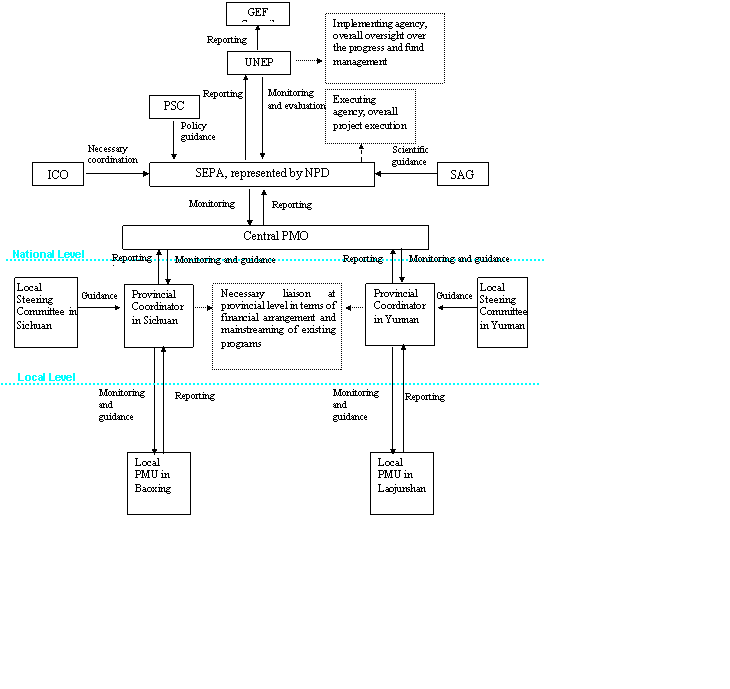
UNEP will be the GEF IA, and the State Environmental Protection Administration (SEPA) will be responsible for overall project execution. Day to day management of the project will be the responsibility of a Project Management Office (PMO) under the responsibility of SEPA. The project will establish a Project Steering Committee (PSC) chaired by the Vice-Minister of SEPA, and comprised of relevant ministries and administrations, as well as relevant provincial and lcoal governments, GEF IAs, Asian Development Bank, and The Nature Conservancy. The PSC will meet at least twice a year during the first two years of the project and once a year thereafter. China already established an EFCAs evaluation committee as part of the EFCAs program. In order to mainstream project activities into the EFCAs program at the national level and receive their scientific guidance, this EFCA evaluation committee will also function as the Scientific Advisory Group (SAG) for the project. Considering the cross-sectoral nature of the project, it is also necessary to establish an Inter-ministerial Coordination Office (ICO). The leader of International Cooperation Department, MOF will head the ICO. The ICO chair will convene meetings as frequently as needed to solve coordination issues among national institutions. Daily management of the project will be the responsibility of a Project Management Office (PMO). A senior SEPA staff member will be the National Project Director (NPD) and lead the PMO on behalf of SEPA. The PMO will be responsible for the overall execution and management of the project and directly responsible for the timely execution of all Assessment and MEWS related outputs. At the provincial level, the existing EFCA Evaluation Groups of Yunnan and Sichuan Provinces, consisting of relevant departments, will act as core of the Local Steering Committees (LSCs). Local communities and NGOs will also participate as full members. Daily management of the demonstration sites will be the responsibility of local Project Management Unit (PMU), located in the Environmental Protection Bureau (EPB) nearest to the demo site. For each of the two provinces (Sichuan and Yunnan), a senior staff member of the provincial EPB will be the Provincial Coordinator and lead the PMU on behalf of the provincial EPB. The shcematic illustration is provided as below.


Annex A. Incremental Cost Analysis

INCREMENTAL COSTS MATRIX

Domestic Benefits

Global Benefits


Outcome 1. Fully developed institutional mechanism for assessment of ecosystem functions, and planning for Ecosystem Function Conservation Areas in the upper Yangtze basin

Baseline

$ 13,204,910

Alternative

$ 15,583,410.

Increment

Total Increment is

$ 2,378,500. Of this sum, the GEF will cover only $ 475,000.

Outcome 2. Established ecosystem-function-based Monitoring and Early Warning System (MEWS) in the upper Yangtze basin

Baseline

$1,334,000.

Alternative

$4,800,250.

Increment

Total Increment

$3,466,250. Of this, the GEF will contribute $ 471,000.

Outcome 3. Demonstrated efficiency and effectiveness in achieving global environmental benefits and local environmental and socio-economic benefits by taking an IEM approach in the Baoxing demo site

Baseline

$ 14,528

Alternative

$ 10,380,328

Increment.

$ 10,365,800.

Of this the GEF will cover

$ 1,247,400

Outcome 4. Demonstrated efficiency and effectiveness in achieving global environmental benefits and local environmental and socio-economic benefits by taking an IEM approach in the Laojunshan demo site

Baseline

$ 150,000

Alternative

$ 9,183,676

Increment.

$ 9,033,676.

Of this the GEF will cover

$ 918,260

Under the business as usual scenario, the GOC will continue with sector-based assessments and training with limited scope: mostly in water retention, sediment loss, and land resources. GOC will designate EFCAs based mostly on water retention and sediment loss. There would be limited dissemination of EFCA values.

$6,226,826.

Complementary activities to assess water retention, soil retention, and land use $494,500 (Paid by GOC) on top of the baseline assessment.

The Increment includes activities needed to assess water retention, soil retention and land use surveys. (The GOC will cover all these costs – US$494,500).

There will be scattered hydrological, rainfall, water quality, and local statistics and measurements of limited use in constructing MEWS. $1,334,000.

From a domestic benefit perspective, MEWS will provide the same information as the Baseline. $1,334,000

The Increment does not include activities with additional domestic benefits.

No measures will be taken to achieve domestic benefits, US$0.

The project will improve livelihood of local stakeholders, and reduce water pollution $3,379,000.

Domestic benefits of the increment will include reduction of water pollution and provision of alternative livelihood consistent with project objective.

The GOC will cover this cost. US$3,379,000.

The GOC will draft sector-based laws and regulations, and natural resources management plans. $100,000.

The project will improve livelihood of local stakeholders, improve energy use and reduce water pollution. $3,791,891.

Domestic benefits of the increment will include reduction of water pollution and provision of alternative livelihood consistent with project goals.US$3,691,891

There will be some global benefits arising from more knowledge about the biodiversity in the area, and from forest surveys. SEPA’s assessment will provide information on threats and root causes.

There are no plans to coordinate among surveys, or to integrate assessments to generate maps of potential EFCA location maximizing local and global environmental values. $ 6,978,084.

The project will complement Baseline surveys and produce an integrated assessment of ecosystem functions, including the ones of primarily national interest and the ones with global environment values: BD, CC, SLM and IEM. The project will generate and disseminate a well-justified list of priority sites for future EFCAs with multiple environmental values. The project will disseminate the results of the assessment widely. $15,088,910.

The Increment includes additional surveys in BD, carbon sequestration, integration of assessments, preparation and dissemination of integrated reports (The GOC and GEF will share the costs). (GEF: US$475,000, GOC: US$1,409,000)

These activities will generate no real global benefits in IEM, BD or CC.

$0

The project will produce a Monitoring and Early Warning System providing integrated information on ecosystem functions on a yearly basis, essential for IEM and in securing global environmental benefits in EFCAs and PAs. $3,466,250.

The Increment includes infrastructure, monitoring and information integration systems that will allow establishment of IEM with multiple environment benefits. US$3,466,250 (GEF: US$471,000, GOC: US$2,845,250. TNC: US$150,000)

These activities will provide very limited and insufficient investments in biodiversity protection, $14,528. There would be no IEM, and unsatisfactory carbon sequestration or avoidance of carbon emission.

The project will show how to support and coordinate the development and implementation of sustainable alternative livelihood programs, mainstream sector programs, reduce water discharges, reduce sediment loads, and eliminate threats and promote global environmental values through IEM. At both demonstration sites, the project will secure protection of globally significant biodiversity, will reduce CO2 emissions and will enhance carbon sequestration mechanisms. The key will be IEM coupled with MEWS. $7,001,328.

Global benefits include establishment of IEM, protection of globally significant biodiversity and avoidance of carbon emissions. US$6,986,800 (GEF: US$1,247,400: GOC: 5,739,400)

These activities will provide very limited and insufficient investments in biodiversity protection, $50,000. There would be no IEM, and unsatisfactory reduction of carbon emission or carbon sequestration.

The project will show how to support and coordinate the development and implementation of sustainable alternative livelihood programs, mainstream sector programs, reduce water discharges, reduce sediment loads, and eliminate threats and promote global environmental values through IEM. At both demonstration sites, the project will secure protection of globally significant biodiversity, will reduce CO2 emissions and will enhance carbon sequestration mechanisms. The key will be IEM coupled with MEWS. $5,391,785.

Global benefits of the Alternative include establishment of IEM, protection of globally significant biodiversity and reduction of carbon emissions. US$5,341,785 (GEF: US$918,260, GOC: 2,081,115, TNC: US$2,342,410))

Summary of project costs

Total Baseline:

$ 14,703,438

Total Alternative (including PDF, national support costs):

$ 41,647,664

Total Increment (including PDF, national support costs):

$ 26,944,226

Total GEF contribution towards the increment:

$ 3,999,660


Annex B. Logframe Matrix

Development/Project/ Immediate Objectives

Indicators of impact (objectives) and successful completion (outputs, end of the year- completion) (Baseline condition[2])

Means of verification

Risks and assumptions

Long-term Project Goal

To reduce flood impacts by conserving and enhancing ecosystem functions in the Yangtze River basin

Project Objective

Promote and implement an Integrated Ecosystem Management approach for the upper Yangtze River basin, to reduce sediment loads, increase catchment water retention capacity, conserve and sustainably use biological diversity, and decrease net Green House Gas emission, while improving socio-economic conditions

1. By the end of Year 5, SEPA re-organizes the EFCA Evaluation Committee to take the IEM approach for evaluation and management of ecosystem functions, based on the science-based assessment and planning methodologies established through the current project and on the results of the two demonstration sites (Baseline: the Government of China has established the EFCA Evaluation Group);

2. By the end of Year 5, an ecosystem function-based Monitoring and Early Warning System for the upper Yangtze basin is able to send annual report to SEPA on the situation of ecosystem functions, in support of integrated ecosystem management of the upper Yangtze basin (Baseline: there are sectoral monitoring activities).

3. Based on the recommendations made by the project, by the end of Yr.5, SEPA and the provincial governments plan the establishment of 6-8 new EFCAs in the upper Yangtze River basin (baseline: two national-level EFCAs, but no EFCA established based on comprehensive scientific assessment).

4. By the end of Yr. 5, the two demos are legally established, and when compared to year 1, show:

(i) At least 5% average increases in water retention (baseline: 1,212 million – 1,572 million m3)

(ii) At least 20% average reductions in sediment loads (baseline: 0.8-1.2 kg of sediments in 1 m3 of runoff.),

(iii) Effective protection of 136,869 ha of prime wildlife habitat (Baseline: 46,090ha),

(iv) Additional carbon sequestration and avoidance of emissions equivalent to 132,287 tons C (Baseline: 1,598,975 tons C).

(v) Improved local income level by 5-10% (Baseline: 1,014-2,259 Chinese Yuan)

5. By the end of Yr.5, Yunnan and Sichuan have permanent provincial level mechanisms receiving information from the 2 EFCA sites and making broad management decisions consistent with agreed national and global benefits. (Baseline: no provincial mechanism established)

6. By the end of Yr.5, the Sichuan and Yunnan provincial governments adopt EFCA management goals in agriculture, forestry, land resources, water resources, planning and environment, in the two demonstration EFCAs. (Baseline: no EFCA management goals established)

1.Report from the Chair of the EFCA Evaluation Group to the PSC, which is to be recorded in the PSC minutes

2. Report from the MEWS operation to the PSC

3. Letters from provincial governors to SEPA, and SEPA decision records.

4.PMO reports to SEPA based on the monitoring and measurement of: (i) water retention capacity (model based on remote sensing of vegetation cover); (ii) reduction in sediment loads (soil loss estimate method available in China); (iii) wildlife habitat (reports of the provincial governments); (iv) carbon sequestration (estimated from changed land use patterns), and carbon emission avoidance (estimated from provision of more energy efficient stoves); and (v) local income level (local income survey)

5. Letters from provincial governors to SEPA informing of the establishment of these EFCA mechanisms.

6. New regulations are available at the SEPA and PMO offices.

SEPA and/or provincial governments may change their priorities, and/or may find other more attractive EFCA models.

Environmentally and culturally diverse nature of the project area prevents smooth coordination of stakeholders, and clear indication of achievement of global environmental benefits.

Ministries maintain current interest in EFCA development.

Outcome 1. Fully developed institutional mechanism for assessment of ecosystem functions, and planning for Ecosystem Function Conservation Areas in the upper Yangtze basin

Activity 1.1. Assess ecosystem functions relevant to nature conservation and flood control.

Activity 1.2. Assess threats to, and root causes for degradation of, ecosystem functions, and economically evaluate the ecosystem functions.

Activity 1.3. Present integrated assessment of ecosystem functions.

Activity 1.4. Recommend new Ecosystem Function Conservation Areas

Activity 1.5. Disseminate and initiate replication of results.

1. Year 5. Situation on the ecosystem functions in the upper Yangtze River Basin in 2008 is estimated and disseminated. (Baseline: no integrated assessment and dissemination of ecosystem functions)

2. Year 5. The Government of China and five provincial governments establish a streamlined and science-based EFCA assessment and designation mechanism, based on the existing EFCA Evaluation Committee and Groups (baseline: The EFCA Evaluation Committee at the national level and EFCA Evaluation Groups at the provincial level exist but its decision is not based on the science based assessment)

3. Year 5. SEPA and five provincial governments decide to establish 6-8 new EFCAs in locations consistent with the recommendations of the assessment. (Baseline: Two national-level EFCAs in the upper Yangtze basin, but no EFCA established base on scientific assessment)

-- Year 2. The SC approves the assessment reports of critical ecosystem functions related to water retention, and soil retention in the upper Yangtze River Basin.

-- Year 3. The SC approves the assessment report of critical ecosystem functions related to biodiversity, carbon sequestration/emissions avoidance, and current and planned land use and productivity in the upper Yangtze Basin.

Year 4. The SC approves the assessment report of threats and root causes for degradation of critical ecosystem functions.

Year 4. The SC approves the assessment report of the economic values of all critical ecosystem functions.

Year 4. The SC approves the integrated assessment report of all critical ecosystem functions and values

Year 4. The SC approves the recommended list of EFCAs, including the final report of the assessment, all maps, and the GIS.

Year 5. Results are disseminated to relevant provincial governments, relevant ministries and international organizations.

Year 5: SEPA initiates to use the assessment and evaluation methodologies in overall EFCA Evaluation mechanism

1. Published integrated report, which is approved by the SC

2. SEPA and provincial reports available at SEPA.

3. SEPA and ministries records.

Minutes of the SC.

Minutes of the SC.

Minutes of the SC.

Minutes of the SC.

Minutes of the SC.

Minutes of the SC.

Letters of all institutions acknowledging receipt of the documents.

Report of SEPA to the Steering Committee.

EFCA planning process at both national and provincial levels will be coordinated with the progress in the ecosystem function assessment.

- Delays caused by unexpected delivery or data management issues.

- Same as above. No problems with surveys.

- Delays caused because of difficulties with agreeable indicators.

-Problems may arise with timely data acquisition.

- Delays may be caused by setting up an valuation methodology

.- There may be non-anticipated delays and problems with integration.

- Delays may be caused by the integrated assessment report not clearly indicating the ecosystem functions and their values

- Delays may be caused if all reports are not delivered in time.


Outcome 2. Established ecosystem-function-based Monitoring and Early Warning System (MEWS) in the upper Yangtze basin

Activity 2.1 Establish technical capacities for MEWS in the upper basin.

Activity 2.2 Establish capacities for MEWS at the Baoxing and Laojunshan demonstration sites

Activity 2.3. Report on Ecosystem function monitoring at the demonstration sites for years 4 and 5, and initiate replication of the demo-level MEWS.

1. By the end of Yr.4, an independent evaluation indicates the usefulness of MEWS in managing the two demo sites. (baseline: no management oriented EFCA MEWS established)

2. By the end of Yr. 4, the Local Steering Committees in two demonstration sites approve the revised management plans of the two demo sites, based on the results provided by MEWS. (Baseline: no management plans on EFCA demo sites)

3. Based on the capacity of upper Yangtze MEWS established and connected with provincial and local nodes (By Year 2), by the end of Yr. 5, SEPA initiates to cover other river basins in the MEWS system (baseline: ecological monitoring capacity at the Chinese Academy of Environmental Sciences)

4. By the end of Yr. 5, at least 3 non-project EFCAs and PAs request MEWS support for their management. (Baseline: no request for MEWS support)

By the end of Yr. 2, all needed equipment is purchased, all personnel is trained, and all databases are in place.

By years 3, 4, and 5, there are 1:1,000,000- scale reports of water retention, soil conservation capacity and vegetation cover.

By the end of Yr. 3, all needed equipment is purchased, all personnel is trained, and all databases are in place.

By the end of Year 3 the list of management indicators with initial conditions are developed and tested by PMUs, and approved by the LSCs and PSC.

During Years 4 and 5, full monitoring reports of demo sites are submitted to the LSCs.

By the end of Year 5, experiences of the demo-level MEWS are disseminated to other EFCAs and/or PAs.

1. Report of the independent evaluation.

2. LSC minutes indicating approval of the revised EFCA management plans and acknowledging input from MEWS.

3. Letter by SEPA/MEWS to the SC

4. Letters from managers of at least 3 non-project EFCAs and/or PAs requesting MEWS technical support.

A report from PMO to SC indicating all needed equipment purchased, all personnel trained, all databases in place.

Available at the PMO.

-Reports from PMU to SC indicating all needed equipment purchased, all personnel trained, and all databases in place

-Minutes of LSCs and PSCs, indicating their approval on demo site management indicators.

- Minutes of the LSCs, acknowledging the monitoring reports and PMU responses.

- Letters by other EFCAs and/or PAs acknowledging receipt of the MEWS reports

-MEWS could be too slow in developing and its report may not be incorporated into management on time.

- Other EFCAs and PAs may find MEWS expensive and/or not very useful.

Delays may be caused by long procedure of procurement.

Delays may be caused by long procedure of procurement.

Delays may be caused by unexpected delivery or data management issues.

Other EFCAs and PAs may show interests in other MEWS models.

Outcome 3 Demonstrated efficiency and effectiveness in achieving global environmental benefits and local environmental and socio-economic benefits by taking an integrated ecosystem management approach in the Baoxing demonstration site

Activity 3.1.Establish an institutional framework for IEM at the Baoxing demonstration site .

Activity 3.2. Develop a participatory IEM plan for public acceptance, and strengthen rules and regulatory framework.

Activity 3.3. Mainstream existing sector programs, including forest management and quarry operations.

Activity 3.4. Strengthen PAs and establishment of buffer zones and corridors.

Activity 3.5 Design and provide Alternative livelihoods (AL) around PAs and other key areas.

Activity 3.6. Conduct public awareness, and disseminate the demonstration values.

1. By the end of Year 4, the LSC is official accepted, by local and provincial governments, as a long-standing IEM-EFCA committees with EFCA management responsibility.

2. By the end of Yr. 4, at least 3 non-project EFCAs use the results and experiences of the Baoxing demonstration site.

3. Comparing initial conditions (Year 1 Baseline) and those prevailing by the end of the project; the Baoxing demonstration site shows:

(a) a 5-10% average increase in water retention capacity (baseline: 2,800-3,300 m3/ha);

(b) 20-40% average reductions in sediment loads (baseline: 0.8 kg of sediments in 1 m3 of run-off);

(c) effective protection of 15,000 ha of wildlife habitat (baseline: 39,567 ha);

(d) additional carbon sequestration equivalent to 22,950 tons C. (baseline: 1,045,407 tonsC/year); and

(e) Average income of local residents in the demonstration site increased by 5% (baseline: 2,259 Chinese Yuan).

-Year one: i) LSC agrees on the IEM as EFCA management principle, ii) Bylaws and regulations on IEM are adopted by local governments, iii) PMU is staffed, trained and equipped.

-Year one: an IEM plan for the EFCA is fully approved by LSC.

- Year two: a list of necessary changes in rules and regulations is identified by LSC.

-Year four: a revised IEM plan, based on the MEWS results, is fully approved by LSC.

-Year four: Acts indicating changes are enacted.

Year two: a list of needed changes to the existing sector programs, is approved by LSC. Target sector programs are: forestry, re-conversion of slope agricultural land into forests, quarry.

Year three, all changes are incorporated into the programs,

Year four, sector programs are implemented in support of IEM.

-Year two, PA plans are approved by the LSC

- Year three: training of staff and trails are finished.

-Year three, an AL Plan is approved by LSC.

- Year four and five: AL is implemented, resulting in improved economic conditions.

-Year two, syllabus and materials are developed to be used in training.

-Year three, four and five: 1000 students, farmers, decision-makers are trained.

-Year five, there are at least 30 visits to the EFCA by key decision-makers at the national and provincial level.

1. Year 4: Letters from governors to SEPA .

2. Three letters show non-project EFCA leaders visit the sites and use their results.

3.PMO reports to SEPA based on the MEWS results : (a) water retention capacity (model based on remote sensing of vegetation cover); (b) reduction in sediment loads (soil loss estimate method available in China); (c) wildlife habitat (reports of the provincial governments); (d) carbon sequestration (estimated from changed land use patterns); and (e) average income (local survey).

(i) LSC minutes (with a list of participants), showing agreements on IEM applicable to EFCA management, ii) Reports by local government to LSC on bylaws and regulations,

iii) Report from PMU to LSC on staffing, training and equipment.

Minutes of LSC, which are submitted to PSC.

-Minutes of LSC, approving necessary changes in laws and regulations;

Minutes of LSC, which are submitted to PSC.

-Reports by local governments to LSC on the acts

Minutes of LSC, approving a list of changes needed;

Minutes of LSC, reporting on the changes already incorporated into the programs

Minutes of the LSC.

-Minutes of the LSC, approving the PA plan;

-Reports by PMU on the staff training and trail development

Minutes of the LSC, approving the AL plan;

Field visits and interviews, to be reported to LSC

Publication by PMU of the syllabus and materials, to be reported to LSC

Report by PMU on the training activities to LSC.

Reports on and vouchers for the visits, prepared by PMU and submitted to LSC.

-The EFCA models implemented provides acceptable balances of local and global benefits.

-Success in implementation makes the inter-sector approach desirable to all parties.

-Climatic conditions allow ecological variables to respond fast enough for early demonstration of on-the-ground impacts during the life of the project.

Inter-sector cooperation may not be smoothly achieved.

Delays may be caused due to time-consuming negotiations.

Delays may be experienced because of inappropriate political incentives for inter-sectoral IEM in each relevant sector.

Training, negotiation and approval of plans may require longer time than expected.

Delays in planting due to seedling availability.

Problems in negotiating and agreeing on AL with all stakeholders.

-Delays may be caused in preparing the materials. Materials may be of satisfactory quality but delivery may not be done effectively.

-Key visitors will come to the site and will be interested in EFCAs.

Outcome 4 Demonstrated efficiency and effectiveness in achieving global environmental benefits and local environmental and socio-economic benefits by taking an integrated ecosystem management approach in the Laojunshan demonstration site

Key Activities

Activity 4.1.Establish an institutional framework for IEM at the Laojunshan demonstration site.

Activity 4.2. Develop a participatory IEM plan for public acceptance and strengthen rules and regulatory frameworks.

Activity 4.3. Mainstream existing sector programs, including forestry and energy programs.

Activity 4.4. Establish New Protected Areas (PAs)

Activity 4.5 Design and provide livelihoods (AL) around PAs and key areas

Activity 4.6. Improve public awareness and disseminate EFCA demonstration values.

1. By the end of Year 4, the LSC is official accepted, by local and provincial governments, as a long-standing IEM-EFCA committees with EFCA management responsibility.

2. By the end of Yr. 4, at least 3 non-project EFCAs use the results and experiences of the Laojunshan demonstration site.

3. Comparing initial conditions (Year 1 Baseline) and those prevailing by the end of the project; the Laojunshan demonstration site shows:

(a) a 5% average increase in water retention capacity (baseline) 2,100-2,600 m3/ha),

(b) about 20% average reductions in sediment loads (baseline: 1.2 kg of sediments in 1m3 of runoff),

(c) effective protection of 121,869 ha of wildlife habitat (baseline: 6,523 ha),

(d) carbon sequestration equivalent to 94,500 tons C, avoidance of carbon emissions amounting to 14,837 tons. C (baseline: 553,568 ton C of carbon sequestration and 10,232 ton C of carbon emission), and

(e) Average income of the local residents in the demonstration site increased by 10% (baseline: 1,014 Yuan)

-Year one: i) LSC agrees on the IEM as EFCA management principle, ii) Bylaws and regulations on IEM are adopted by local governments, iii) PMU is staffed, trained and equipped.

-Year one: an IEM plan for the EFCA, is fully approved by LSC.

- Year two: a list of necessary changes in rules and regulations, is identified by LSC.

-Year four: a revised IEM plan, is based on the MEWS results, fully approved by LSC.

-Year four: Acts indicating changes are enacted.

Year two: a list of needed changes to the existing sector programs, is approved by LSC. Target sector programs are: forestry, re-conversion of slope agricultural land into forests, wetland and fisheries management, and energy.

Year three, all changes are incorporated into the programs,

Year four, sector programs are implemented in support of IEM.

-Year four: Biogas energy is supplied for 5,116 households, and improved stoves are provided for 8,775 households.

-Year two: Protected Area plans are approved by the LSC.

- Year three: training of staff and trails are finished.

-Year three, an AL Plan is approved by LSC.

- Year four and five: AL is implemented, resulting in improved economic conditions.

-Year two, syllabus and materials are developed to be used in training.

-Year three, four and five: 1000 students, farmers, decision-makers are trained.

-Year five, there are at least 50 visits to the EFCA by key decision-makers at the national and provincial level.

1. Year 4: Letters from governors to SEPA .

2. Three letters show non-project EFCA leaders visit the sites and use their results.

3.PMO reports to SEPA based on the MEWS results : (a-1) terrestrial water retention capacity (model based on remote sensing of vegetation cover); (a-2) wetland water storage capacity (using formula established by Yunnan province and using the satellite images through MEWS); (b) reduction in sediment loads (soil loss estimate method available in China); (c) wildlife habitat (reports of the provincial governments); (d-1) carbon sequestration (estimated from changed land use patterns); (d-2) reduction in carbon emission (estimated from provision of more energy efficient stoves; (e) average income (local survey).

(i) LSC minutes (with a list of participants), showing agreements on IEM applicable to EFCA management, ii) Reports by local government to LSC on bylaws and regulations,

iii) Report from PMU to LSC on staffing, training and equipment.

Minutes of LSC, which are submitted to PSC.

-Minutes of LSC, approving necessary changes in laws and regulations;

Minutes of LSC, which are submitted to PSC.

-Reports by local governments to LSC on the acts

Minutes of LSC, approving a list of changes needed;

Minutes of LSC, reporting on the changes already incorporated into the programs

Minutes of LSC.

Through local survey conducted by PMU

-Minutes of the LSC, approving the PA plan;

-Reports by PMU on the staff training and trail development

Minutes of the LSC, approving the AL plan;

Field visits and interviews, to be reported to LSC

Publication by PMU of the syllabus and materials, to be reported to LSC

Report by PMU on the training activities to LSC.

Reports on and vouchers for the visits, prepared by PMU and submitted to LSC.

Field visits and interviews, to be reported to LSC.

-The EFCA models implemented provides acceptable balances of local and global benefits.

-Success in implementation makes the inter-sector approach desirable to all parties.

-Climatic conditions allow ecological variables to respond fast enough for early demonstration of on-the-ground impacts during the life of the project.

Inter-sector cooperation may not be smoothly achieved.

Delays may be caused due to time-consuming negotiations.

Delays may be experienced because of inappropriate political incentives for inter-sectoral IEM in each relevant sector.

Training, negotiation and approval of plans may require longer time than expected.

Delays in planting due to seedling availability.

Problems in negotiating and agreeing on AL with all stakeholders.

-Delays may be caused in preparing the materials. Materials may be of satisfactory quality but delivery may not be done effectively.

-Key visitors will come to the site and will be interested

.


Annex C: Responses to Project Reviews

a) Convention Secretariat

b) Review by expert from STAP Roster

Reviewer: Dr. Pei Sheng-ji

IA Response: UNEP task team

1. Scientific and technical Soundness of the Project

The reviewer believes that the project is scientifically and technically sound, following the concept and principles of the Ecosystem Function Conservation Areas (EFCAs). The project components are essential elements of integrated mountain ecosystem conservation and management.

The EFCAs concept and policy is the basis for designing and implementing the project. We note this, and an integrated approach should be maintained throughout the project implementation.

There is sufficient knowledge and indigenous wisdom in the region to plan and implement the proposed action, and such knowledge should be used for the management of the project.

From the initial stage of the implementation of the project, local stakeholders should be closely contacted to absorb locally available knowledge.

The reviewer suggests that the risk associated with the project is not relevant to the project design but to environmentally and culturally sensitive area to any changes and interventions.

We fully agree that the risk is associated with the implementation of a project in environmentally and culturally sensitive areas and the risk statement in SECTION III and Logframe matrix has been modified to highlight his concern.

The reviewer suggests that the critical issue is to launch the social dimension of the project, to quickly gain community confidence, trust and support for the project.

We fully agree and appreciate the suggestion by the reviewer. It is strongly recognized that socio-economic issues are critical in addressing root causes for the degradation of the ecosystem functions. As soon as the LMOs are established, a wider stakeholder consultation will be conducted through the activities included in Outputs 3.2 and 3.11 in the two demonstration sites. In order to emphasize social as well economic issues, some more information on socio-economic issues in two demo sites has been presented in paragraph 11 and Annex G.

2. Identification of the global environmental benefits and/or drawback of the project

The reviewer believed that the global environmental benefits related to biodiversity, bio-cultural heritage, sequestration of green house gases have been well identified and presented.

In addition to the clear presentation of the biodiversity and climate change related global environmental benefits, the project also aims at sustainable land management benefits. To reinforce the presentation on sustainable land management benefits, SECTIONS I and II have been modified. Further, more information on land management issues is added to ANNEX G.

The project covers a geographic area of sufficient size to address key elements of globally significant biodiversity-rich Eastern Himalayas mountain ridge.

The project targets the upper Yangtze River basin, and its size would be sufficient to conserve globally significant species.

3. How the project fits within the context of the goals of GEF, and linkage with other GEF operational programs

The reviewer believes that the project fits clearly within the GEF operational strategy and programs of biodiversity and climate change.

The project will also aim at securing global environmental benefits related to integrated ecosystem management as outlined in the GEF Operational Programme 12. In order to emphasize the GEF programmatic linkage with the Operational Programme 15, information on sustainable land management benefits has been added in SECTIONS II and III.

4. Regional context

The project geographical coverage falls entirely in China, and there is no regional dimension of the project.

It is estimated that some of the underlying issues for floods (deforestation, soil erosion, loss of water retention capacity, etc.) may be common in surrounding countries, particularly countries sharing the Hindu Kush Himalaya (HKH) and/or Southeast Asian countries. These countries may take interests in the IEM approach the project is pursing. Although the project is designed as a single-country based project, the results of the projects will be disseminated in English to the interested countries through the UNEP network as well as its partners such as ICIMOD and TNC. Further, existing experiences and lessons in other countries, particularly from Asia will be introduced through training of project management personnel. These issues are now reflected in project components and expected results.

5. REPLICABILITY OF THE PROJECT (ADDED VALUE FOR THE GLOBAL ENVIRNMENT BEYOND THE PROJECT ITSELF)

It is important to note that the project functions as a model, and this model be replicated to other mountain areas in China and other Himalaya countries. Local communities can contribute to and benefit from cooperative management. Explicit activities should be included in the project to this effect.

During the PDF-B, selection criteria for demonstration sites were developed, and one of the criteria was replicability. Among the candidate sites identified through the stakeholder consultation, the selected two sites therefore have high potential of replication in the other part of the upper Yangtze River basin and possible in the other parts of China.

The project will seek regional dimension through dissemination of the results to other parts of China and to other countries in Himalayas. Lessons from other countries will also be introduced to project implementation.

We highly appreciate that the reviewer introduced some relevant projects, either planned or implemented, which are potential vehicles to disseminate the results of the project, and to obtain lessons learnt from other parts of the world. The project management team will keep close contact with the projects that have been indicated by the reviewer.

The project can make contribution to integrated ecosystem management of great river systems in China and other Asian countries, in particular on the lowland and highland relationship. MEWS can gain experience in this.

We note that such a lowland-highland aspect can be addressed through the integrated ecosystem management approach. It is expected that the MEWS results will show such linkages between lowland and highland.

The other value-added for the global environment beyond the project itself is improvement of livelihood of mountain rural communities and promotion of social and cultural development among local ethnic minorities.

This is a critical aspect of the project. Through the activities relevant to the alternative livelihoods, socio-economic development of mountain rural communities can be promoted.

6. Sustainability of the project

Conservation of the Yangtze River and its ecosystems is a long-term policy of the Chinese Government, and supported by all societies, and thus there is no doubt about sustainability.

Based on the overall long-term priority of the Government, the project will seek immediate sustainability (end of the project) through integration of the project management structure into existing central and local government structure. Further, by demonstrating actual benefits in which the project approach can result, the long-term government policy for the integrated ecosystem approach is anticipated to be maintained and strengthened.

7. Linkage with other programs and action plans at regional or sub-regional levels

The reviewer proposed that linkages should be established with the proposed WWF/ICIMOD/UNEP project on Eastern Himalaya Biodiversity Programme, PARDYP (People and Resources Dynamics Project) by SDC/IDRC.

The Yangtse River project will seek and maintain linkage with the project indicated by the reviewer during the project implementation, particularly for exchange of lessons learned and dissemination of results.

8. Other beneficial or damaging effects

The reviewer suggests that there be environmental benefits downstream of the Yangtze River.

The project’s overall development goal is to achieve nature conservation and flood control in the Yangtze River basin and when expected results are produced in the upper basin, there should be positive environmental effects on downstream, reduced sediments, reduced flood risks, etc. The assessment component, although targeting the upper basin, can clarify possible downstream benefits in a more concrete term.

9. Degree of involvement of stakeholders

The high degree of stakeholder involvement of different culture will bring challenges to the project implementation.

We appreciate the comment, and during the project implementation, we would like to ensure social and cultural issues are well taken into consideration.

10. Capacity-building aspects

The project covers multiple disciplines, and involves strong capacity building component. The reviewer, however, gives importance to environmental education and awareness raising and practical technology training on tree planting, management and protection.

We agree that the two pronounced fields for training are important for the two demo site, for which project has corresponding components. During the implementation of the project, environmental education and awareness raising, as well as tree planting training on technology aspects will be conducted within the components.

11. Innovativeness of the project

The reviewer identified two aspects of innovativeness of the project: the EFCAs concept and principle will be put in practice, and establishing linkage between protected areas and landscape management in a large watershed.

We note this comment.

12. Other specific comments

Activity 1.1: The indicators for establishment of priority biodiversity areas should be further developed in consultation with experts and institutions in the country (particular in Sichuan and Yunnan Provinces)

We agree that this is of importance. During the project, under the Activity 1.1. and in consultation with the Scientific Advisory Group as well as other experts, such indicators will be developed. The indicator should cover the issues related to habitat quality, mountain crops, and nature reserves and corridors.

Activity 1.1: It is important to explore and identify appropriate tree species for reforestation and herbaceous plants for pastures as the level of absorbing CO2 of different plant species is significant.

The activities Activity 1.1 aim at assessing the current programs and sequestration potential. We would rather suggest that such identification of appropriate plant species be conducted under Outputs 3.4 and 3.13.

Activities 1.1 and 1.2: Assessment of land use and productivity should be based on a study of all traditional land management practices, respecting local knowledge and indigenous strategies.

We agree that, in many cases, local knowledge and indigenous strategies are helpful for maintaining biodiversity. Activity 1.1 incorporates such an issue.

Outcome 2: MEWS is a challenging task amongst project activities, in two aspects: coordination of existing monitoring stations by various ministries at local level; and scientific and multi-disciplinary technical coordination.

It is our main principle concerning the MEWS that the existing monitoring systems by various ministries/administrations should be used as much as possible. In terms of coordination among existing stations, the Local Steering Committee will be able to take a proactive role in the coordination of monitoring activities by various bureaus. To achieve this Outcome, we will seek necessary input from technical experts of differing technical background through the Scientific Advisory Group, as well as direct engagement of such experts.

Demo at Laojunshan: The area has a long history of Sacred Natural Site (SNS) conservation approach by different ethnic cultural groups. There is a need to recognize and integrate this traditional conservation approach into the demo site. The reviewer suggests to include the SNS in the mapping of land use in both Laojunshan and Baoxing demo sites.

While there are not many SNS areas in the two demonstration sites, SNS, as a critical issue suggested by the reviewer, will be given full attention. The SNS will be identified when alternative livelihoods in the demo sites are planned and implemented under Activities 3.5 and 4.5, and will be clearly mapped.

The project should pay attention to the invasive species, eg. Agratina adenophorum in the middle mountains of the Yangtze region, at least in the monitoring work.

We agree that the invasive species are one of the threats to critical ecosystem functions in the demo sites and will be a subject for the MEWS.


c) Response to comments from Secretariat and other Agencies

UNEP Responses to GEFSEC Comments

Secretariat Comment

UNEP Response
Project Design

A revision of the logical framework was suggested. A clearer structure with one long-term goal, one project objective, 4-6 project outcomes (or results) and related to each outcome 3-5 leading activities was suggested.

As per the suggestion by the Secretariat, the logframe matrix was revised. Consistency was sought between the revised logframe and the sections relevant to project components, implementation schedule and budget tables.

It is not clear what activities will lead to the global environmental benefits claimed by the project.

The activities that lead to the global environmental benefits are clearly identified in the logframe matrix.

It is suggested to include information on the current situation in the PA (management regime, including financial and institutional aspects) and how the project will work together with the authorities in charge of PAs).

A new paragraph has been inserted (paragraph 38) and addition information is added in paragraph 148 on how the project will work with the authorities in charge of PAs.

It is suggested that the Incremental Cost Matrix be revised according to the revised logframe matrix.

The Incremental Cost Matrix was revised to reflect the changes in the Logframe Matrix.

Sustainability

A question was raised if there is any innovative financing mechanism at the local level.

The project will introduce alternative livelihood, but no micro-scale financial mechanism is considered at this stage. However, when economic values are evaluated in an appropriate manner, such a scheme may be considered during the project.

It is advised to mention conflict resolution mechanism.

The current Paragraph 131 mentions this issue.

There is no mentioning of financial sustainability of PAs involved in the project.

The current paragraph 132 refers to the financial sustainability of the PAs involved in the project.

Replicability

The replicability argument is general, and is advised to detail a project strategy for replication.

The Replicability Section (paragraphs 137-140) has been fully revised to present the project’s replication strategy.

It is not unclear what replication strategy the project will adopt on the Outcomes 1 and 2.

Two paragraphs (137 and 138) detail the replicability, and the revised logframe currently features replication-related indicators.

Monitoring and Evaluation

Performance indicators. Inclusion of socio-economic indicators was suggested.

Socio-economic indicators were added to the revised logframe matrix (demo sites).

It is recommended to discuss the possibility of a community-based M&E system.

Paragraph 163 discusses future local-level M&E through the demo-level MEWS.

Institutional impact indictors should be added in relation to the assessment of ecosystem functions.

One institutional impact indicator has been added in the revised logframe.

Indicators related to MEWS are mainly output indicators and impact indicators are suggested to be added.

Impact related indicators on MEWS have been added to the logframe.

It is recommended that information on a plan for baseline collection be added with information on baseline categories.

The paragraph 162 indicates a plan of baseline establishment and indicator categories.

Financing plan

It should be discussed if the IA contribution can be increased.

The current UEP contribution is in-kind. Discussion is ongoing to secure further co-financing from UNEP.

UNEP’s role in this project is not clear.

Paragraph 31 indicates the role of UNEP in the project. UNEP’s input is mainly through the UNEP China Country Office.

It is not clear how UNEP will be represented in China to implement this project.

UNEP’s representation for this project is through the UNEP China Country Office.

Core commitments and Linkages

Please provide information on how this project fits into UNEP’s country and sector programs

The information is provided in paragraph 31.

Consultation, Coordination, Collaboration between IAs and IAs and EAs, if appropriate

It is unclear if consultations have been held with the IAS and EAs of the GEF initiatives indicated in the project brief.

The consultations were held with the World Bank, UNDP and the Asian Development Bank, through the meetings of the PDF-B Steering Committee. The results are presented in paragraph 29 of the project brief and the Executive Summary (4 b).

The original STAP review should be attached to the project brief.

The original STAP review has been provided in Annex C of the project brief.

Summary Recommendations

Executive Summary has to be revised to better reflect the project.

The Executive Summary has been fully revised.

Spelling check should be conducted.

The final spelling check was conducted.


UNEP Responses to comments by UNDP

1. Suggestion was made on the inclusion of an activity for the monitoring of the water flow at the middle and lower section of the river during dry season and flood season, so that such an activity would provide information on whether this win-win approach is effective in linking biodiversity conservation and disaster reduction.

The Monitoring and Early Warning System targeting the upper Yangtze basin will consider monitoring of water discharge (both during dry and flood seasons) and sediment transport at the outlet of the upper Yangtze basin, based on the existing monitoring system operated by the Yangtze River Water Resource Commission.

2. A satisfactory coordination mechanism to mitigate or resolve conflicts over natural resources is suggested to be designed in addition to regular meetings for different agencies and stakeholders.

We also consider this issue to be a very important issue, since the project area lies where the cultural and socio-economic diversity can easily lead to conflicts over natural resource use. At the stage, the project will have formal meetings of Local Steering Committees where these issues can be discussed. Further, the project, at its appraisal phase, will design a methodology to better coordinate interests of the local stakeholders.

3. The project should develop mechanisms that will ensure that there is proper consultation and cooperation between SEPA, SFA, SOA, civil society and private sector. The design should ensure that the EFCA is not another 'protected areas programme' strictly implemented by SEPA - and no involvement by other agencies, and no cross-sectoral linkages that would secure the notion of “integrated ecosystem management”. Capacity building activities on this new and innovative deign would be needed.

We appreciate this comment. As indicated in the project brief, the Ecosystem Function Conservation Area (EFCA) program differs from current PA programs in terms of strengthened cooperation among various departments, civil society and private sectors. The Government of China has already initiated such inter-sectoral coordination through the EFCA Evaluation Committee. The project has two safeguard measures in this sense. First, the Inter-ministerial Coordination Office is hosted by the Ministry of Finance (GEF Operational Focal Point in China), which enables inter-ministerial coordination beyond the extent of coordination that the SEPA can ensure. Secondly, at the local level, representatives of Provincial Governors will be chairing the Local Steering Committees and inter-sectoral coordination at the provincial and local levels can be ensured through this mechanism.


UNEP Responses to the Comments by the World Bank

1. The project success depends on good collaboration across sectors (environment, land, water, agriculture, forest). More emphasis needs to be placed on cooperation mechanism.

It is certainly understood that the inter-sectoral cooperation is a key and a challenge to the implementation of the project. This clear understanding of the significance of the inter-sectoral coordination led to seemingly heavy implementation mechanism, involving the Project Steering Committee, Inter-ministerial Coordination Office, EFCA Evaluation Committee, and Local Steering Committees. In implementing the project, the project team will keep in mind this most important element of the project.

2. It is suggested to consult with the Yangtze Water Resources Commission, particularly with the Hydrology Bureau and Soil & Water Conservation Bureau, to integrate their efforts in watershed and flood management, and make best use of any existing monitoring system, as indicated in the project description.

Representatives from the Yangtze River Water Resource Commission (YRWRC) was the members of the PDF-B Steering Committee and the Scientific Advisory Committee, and will continue to be a member of the Project Steering Committee.

3. Linkages should be established between this project and the World Bank financed project now under preparation - Upper Yangtze Watershed Rehabilitation Project.

During the project preparation, consultations were made with the World Bank, UNDP and Asian Development Bank through a series of PDF-B Steering Committee meetings. It was concluded that possible multiple linkages between this project and the initiatives by these agencies would be sought, and WB, UNDP and ADB would be invited to the Steering Committee to ensure synergies and avoid overlaps. The UNEP/GEF Yangtze project is ready to work closely with the mentioned World Bank project on upper watershed rehabilitation.

4. It was pointed out that there is a gap (lack of connection) between what the project will do to improve ecological function in the upper watershed and the areas downstream which will actually benefit from the reduced flooding and sedimentation. It is a big issue to identify how much downstream beneficiaries should pay for reduced flooding and sedimentation. The project will provide data as much as possible on the costs and impact of improved soil and water conservation upstream and on the benefits of reduced flooding and sedimentation downstream. Research on this could be included in the project.

We also consider this to be an issue that the project, as well as the Government, can give more consideration to. At this stage, the project includes a modest activity to economically evaluate the relevant ecosystem functions in the upper Yangtze basin. The project, particularly the assessment and planning component, can reveal which ecosystem functions contribute to what aspects of flood events (and their impacts on downstream) and can economically evaluate these critical ecosystem functions. It is strongly believed that such assessment results can lead to the discussion on the downstream payment.


[1] The baseline indicated in the Logframe Matrix is of indicative nature, based on the preliminary assessment conducted during the PDF-B. During the first year of project implementation, the baseline will be assessed and agreed upon among the stakeholders.

[2] The baseline conditions are of indicative nature, and during Year 1, the baseline conditions will be assessed, so that the stakeholders at the LSC and PSC meetings will agree on them.

Converted with Word to HTML.