A. STRATEGIC CONTEXT AND RATIONALE
1. Country and sector issues
One of the main reasons for environmental degradation of the water bodies of the central European region and the Black Sea is the high content of nutrients. The Danube River, one of the continent’s largest and most important rivers, is by far the single most important contributor to the nutrient pollution of the Black Sea. The loads of nitrogen (N) and phosphorus (P) transported via the Danube River are estimated as of about 690,000 and 70,000 tons per year[1], respectively. As a comparison, these amounts represent about ten times the loads of N and P discharged to the North Sea from the river Rhine. The eutrophication on the northwestern shelf of the Black Sea, at the mouth of the Danube, has had a disastrous impact on water quality, natural habitat, and fish populations on which both biodiversity and human populations depend. Future development of the river basin will further increase the pressure on the ecosystems.
Since the mid 1980s, the countries in the Region have stepped up cooperation for the protection of the Danube River and the Black Sea. The Bucharest (1985) and Sofia (1994) Conventions, signed by eleven Danube basin countries and the European Union (EU), led to the creation of the International Commission for the Protection of the Danube River (ICPDR) in October 1998. Under the ICPDR’s lead, strategic action plans and monitoring programs have been launched, setting baselines and identifying hot spots and investment priorities. In November 2000, the ICPDR adopted its first Joint Action Plan (JAP) for the years 2001-2005, which called for the reduction of municipal discharges from major urban centers. Although, according to studies, pollution from non-point sources represents about 80% of N and 65% of P, it is much more difficult to address them than point-source discharges. One effective method to achieve this consists in developing wetlands as nutrient traps. This method was identified as a strategic priority to improve the Danube River water quality, and thereby decrease the discharges of nutrients in the Black Sea. Budapest is the most important source point of nutrient discharges identified by the JAP in Hungary. As such, it has been included within the top five regional priorities of the JAP.
Hungary joined the EU on May 1st, 2004 and is in the process of adapting its regulatory framework to comply with EU requirements, particularly the EU Directives on water. With this goal in mind, the Municipality of Budapest (MOB) has prepared a long-term comprehensive plan for wastewater collection and treatment in Budapest. This plan represents a substantial step toward Hungary’s compliance with EU Directives. It entails the development, by the end of 2010, of four major projects: the completion of the wastewater collection system in all areas of Budapest; the rehabilitation and the development of nutrient removal facilities at existing wastewater treatment plants (WWTPs); the construction of the Central WWTP; and the increase of landfill capacity for mid-term sludge disposal. The proposed Project complements the actions already undertaken by the MOB, in particular through the ongoing World Bank financed Hungary Municipal Wastewater Project (HMWP), to further reduce nutrient discharges and achieve additional global benefits (for additional information, see Annex 1).
Within the overall investment program of the JAP, construction of wastewater treatment infrastructure is the largest investment, representing about 90 % of the investment program (investments in wastewater treatment infrastructure in Hungary alone represent 25 % of the JAP investment program). Although the Danube River is not declared a sensitive water body, the Hungarian authorities have decided to add tertiary treatment in the North Budapest WWTP (NBWWTP) to fulfill Hungary’s commitments towards the reduction of nutrient discharges into the Danube and the Black Sea.
In order to reduce costs and to make more affordable the achievement of the stated objectives, the JAP also puts emphasis on alternative solutions to reduce nutrients. Restoration of wetlands, in particular floodplains connected to rivers, is one of the main alternative actions proposed. Given the ample capacity they have to act as nutrient filters, wetlands can make a significant contribution to reducing N and P loads. However, to date the impact of such floodplains and wetlands connected to rivers on nutrient reduction have not been systematically documented (water depth, timing of flooding, vegetation etc.) and hence the outcomes remain difficult to predict in quantitative terms. The proposed Project aims at developing knowledge and scientific data to better understand such solutions and facilitate their replication.
2. Rationale for Bank involvement
The Bank has played a catalytic role in the ongoing HMWP by financing a substantial portion of the investment requirements and helping to mobilize funds from other sources to support the Project. The Bank-financed HMWP, co-financed by an EU Phare Grant, is part of a Euro 100 million investments aimed at reducing the pollution load in the Danube River Basin, strengthening compliance with Hungarian and EU environmental standards, and improving wastewater operations in the water and wastewater utilities. Project benefits extend beyond Hungary to Black Sea countries. The HMWP includes the rehabilitation of the North Budapest and South Pest WWTPs to the secondary level of treatment, the improvement of nutrient reduction at the South Pest WWTP, and the construction of a WWTP for secondary treatment in Dunaujvaros. Loan savings and uncommitted funds under the HMWP will be utilized to complement the GEF Grant for the proposed Project.
The Bank and the GEF helped to establish regional coordination and institutional cooperation through the ICPDR, and were instrumental in the development of the UNDP/GEF Strategic Partnership for the protection of the Danube River and the Black Sea. To support actions under the Partnership, the GEF created an investment fund which will finance the proposed Project. As the executing agency for GEF-financed projects, the Bank has gained experience from projects to reduce nutrients in other countries and regions and is incorporating the lessons learned into the proposed Project. Examples include a wetland restoration project in Bulgaria and a project in the Russian Federation to reduce nutrient discharges into the Don river and the Azov/Black Seas from the Rostov-on-Don WWTP.
The proposed Project is consistent with the themes of the last Country Assistance Strategy (CAS) for Hungary discussed by the Bank’s Board of Directors in 2002, namely: support for Hungary’s EU accession objectives, environmental improvements inter alia to comply with EU Directives, sub-national development, poverty reduction and increased social inclusion. The proposed Project is also consistent with the “Framework for World Bank Support to the European Union New Member Countries of Central and Eastern Europe” (SecM2004-0283, dated May 28, 2004). The program set out in the CAS includes the ongoing HMWP and the proposed Project, in parallel with analytic and advisory services.
3. Higher level objectives to which the project contributes
The Project’s higher-level objectives are to assist national and local authorities in Hungary in the implementation of top priority investments in the wastewater sector and to support the Government’s commitments under the Danube Conventions and other international agreements for the protection of the Danube River and the Black Sea.
B. PROJECT DESCRIPTION
1. Lending instrument
The Project’s cost of US$32 million would be partially financed by a full-sized GEF Grant in the amount of US$12.5 million. The Grant will be complemented by a reallocation in the amount of EUR5.9 million (US$7.7 million equivalent) from the Bank’s Loan 4512-HU to the MOB for the HMWP, and additional counterpart funding of about US$10.4 million from MOB, and US$1.4 million from the Ministry of Environment and Water (MOEW).
2. Project development and global environmental objective and key indicators
The key development and global environmental objective of the Project is: (i) to reduce Budapest’s discharge of nutrients (nitrogen and phosphorus) into the Danube River, and consequently into the Black Sea; (ii) to enhance the nutrient trapping capacity of Gemenc and Beda-Karapancsa wetlands situated in the lower Hungarian part of the Danube River; and (iii) to serve as a model for similar nutrient reduction initiatives in Hungary and other Danube basin countries. These objectives will be achieved through: (i) the development of tertiary treatment (nutrient removal) at the NBWWTP; (ii) the rehabilitation of wetlands in the Gemenc and Beda-Karapancsa areas of the Duna-Drava National Park (DDNP); and (iii) the establishment of a comprehensive Monitoring and Evaluation (M&E) system for water quality and environmental health allowing to measure the reduction of nutrients and contributing to the development of an impact evaluation methodology. The Project will also finance dissemination activities to foster replication in Hungary or in other parts of the Danube River basin.
The set of monitoring (physical/technical) and performance (operational and environmental) indicators that will be monitored and reported through Project Management Reports (PMRs) have been agreed during Project preparation. These include:
- Annual reduction of nutrient discharges from the NBWWTP (N and P kg/year);
- Average operation cost of the nutrient reduction process in the NBWWTP (US$/kg of nutrient reduced);
- Number of hectares of wetlands rehabilitated in the DDNP;
- Annual amount of nutrients retained by the DDNP wetlands (N and P kg/year);
- Average operation cost of the wetland management procedures in the DDNP, in terms of its nutrient reduction capacity (US$/kg of nutrient reduced).
Target and baseline figures for these indicators were agreed upon at Negotiations. They might be revised in the early stages of the Project, based on the results of the baseline study.
3. Project components
The Project uses a multi-focal approach to assist the Government of Hungary (GoH) in developing advanced wastewater treatment of domestic discharges and to restore high priority wetlands to work as nutrient traps, while increasing their internationally recognized ecological values. It will enable comparison of two different forms of intervention to reduce discharges of nutrients from point and non-point sources, and evaluation of their impacts in terms of global benefits in relation to their respective investment and operation costs. It is thus expected to have an important demonstration role in Hungary and within the region to help develop technically and financially sound solutions, allowing for best use of scarce resources. Furthermore, the Project is expected to strengthen the institutions involved, build capacity of local staff in efficient development and operation of wetlands for nutrient trapping, and raise awareness of the ecological benefits of wetland rehabilitation and their impacts on biodiversity. (See Sections C.2. and Annex 4 for details). The Project has three components:
Component 1 – Development of nutrient removal at the NBWWTP (Budapest). (GEF amount including contingencies: US$ 6.96 million, Total cost: US$ 25.04 million)
This component, hereafter referred to as MOB- or Budapest- component, will finance works and equipment to upgrade the NBWWTP to the tertiary level of treatment for N and P removal. The technology for such treatment is highly specific and likely to be protected by patents. From a procurement standpoint, specifying the technical solution/process would give an unfair advantage to a given supplier. Therefore, the procurement will be based on a set of precisely defined performance requirements (to be detailed in the technical specifications of the bidding documents), with evaluation based on technical and financial efficiency in attaining the specified outcomes in regards to N and P reduction.
Component 2 - Wetland Restoration in the Duna-Drava National Park (DDNP component). (GEF amount including contingencies: US$5.20 million, Total cost: US$ 6.50 million)
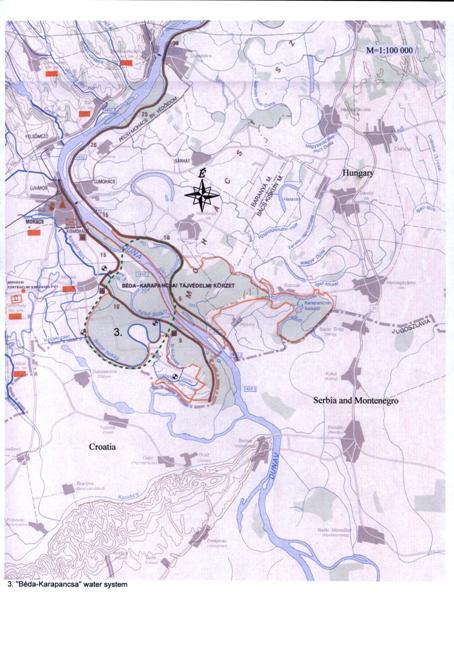
This component, hereafter referred to as DDNP- or Park- component, will finance the rehabilitation of about 10,000 hectares of wetlands to develop their nutrient trapping capacity within two identified areas, Gemenc and Beda-Karapancsa, located within the DDNP, directly along the course of the Danube River. The rehabilitation process will be implemented in stages, starting with the establishment of one pilot in each of the two areas for a period of one year. It will also provide funds to design and install an M&E system for the evaluation of Project impacts in terms of reduction of N and P. A comprehensive baseline study will be carried out at the beginning of the Project to assess the areas’ environmental quality at the first stage of the Project, to help determine the precise location of the two pilots, and to provide recommendations on the design and development of the M&E system. Building on the results and lessons learned from the pilots, the rehabilitation will then be scaled up. Early in the process, an Experts Panel will be convened by the MOEW to assist the South-Transdanubian Environment Protection and Water Management Directorate (WD) and the DDNP Directorate (DDNPD) in the selection and monitoring of the planned interventions. In parallel, the component will adapt a methodology of impact evaluation, using local research organizations and universities. It will also include the development, in a participatory way, of a DDNP Special Area Management Plan, including measures to best accommodate authorized uses and protection measures in the Park area. Finally, this component will include limited funding for incremental Project management costs for the WD, PIU. Works to be carried out in the wetlands include localized clearing, dredging and construction or installation of small scale water regulating structures. As the lead-time requirements for the approval of the required environmental licenses could extend to about eighteen months, execution of works under this component is scheduled to start during the second year of Project implementation. The M&E system will be developed in the meantime, allowing it to be fully operational prior to the execution of works. (See details in Annex 4)
Component 3 - Dissemination and Replication. (GEF amount including contingencies: US$ 0.35 million, Total cost: US$ 0.43 million)
This component will finance consultant services to carry out a comprehensive end-of-project impact evaluation and results analysis study of the two interventions (tertiary treatment and wetlands restoration), including a cost-benefit analysis. The results of these studies will serve as a basis for the dissemination, replication and knowledge sharing activities. The component will finance workshops, public communication campaigns and promotion of cost effective solutions for nutrient reduction in other areas of Hungary and in other riparian countries. The project will also link to the GEF Danube and Black Sea Regional projects, Danube Convention-supported dissemination activities and the GEF-funded IW Learn initiative. In this regard, this component will include setting up a Project website consistent with the GEF IW:LEARN guidance, participation of project staff in IW:LEARN activities, participation in at least two GEF International Waters portfolio conferences, and participation in ICPDR and Black Sea coordination meetings. The Project will also provide limited funds to finance a Project launch workshop; auditing services; and training to strengthen WD for project implementation and to build capacity of DDNPD staff for the efficient development and operation of wetlands for nutrient trapping.
|
Table 1. Project Costs (million US$) |
|
|
|
|
|
|
Component |
Indicative Cost |
% of Total |
Local Financing |
Associated IBRD loan |
GEF Financing |
% GEF Financing |
|
1: Development of tertiary treatment at the NBWWTP (Budapest) |
23.40 |
73% |
9.70 |
7.20 |
6.50 |
52% |
|
2: Wetland Restoration in the Duna-Drava National Park |
6.08 |
19% |
1.22 |
0.00 |
4.86 |
39% |
|
3: Dissemination and Replication |
0.41 |
1% |
0.08 |
0.00 |
0.33 |
3% |
|
Contingencies (Unallocated) |
2.09 |
7% |
0.77 |
0.50 |
0.82 |
6% |
|
Total Project Cost |
31.97 |
100% |
11.77 |
7.70 |
12.50 |
100% |
Benefits and Target Population.
At the global level, the Project is expected to generate benefits through the reduction of N and P discharges into the Danube River and consequently into the Black Sea[2]. The primary beneficiaries of the Project are downstream riparian countries and littoral states of the Black Sea.
The contribution of the Project (reductions of about 4,000 tons per year for N and 260 tons per year for P) might appear small in comparison to the total N and P flow at the mouth of the Danube (about 690,000 tons of N and 70,000 tons of P). However, it represents a 9% and 4% reduction respectively of N and P total nutrient discharges from Hungary (see Annex 15). In particular, the MOB component is expected to reduce 14% of N and 6% of P Hungarian discharges from point sources and the DDNP component 6% of N and 2% of P from diffuse sources. Further, the Project is not only justified by its direct benefits; it represents also a necessary first step to help generate the commitment for the complementary investments for nutrient reduction needed to achieve the ultimate objective of controlling eutrophication in the Black Sea.
More importantly, the Project is expected to have a demonstration effect in Hungary and in the region. It will result in a replicable model for the treatment of non-point sources of nutrient pollution, using wetland and floodplains, and the development of a methodology of impact evaluation, which will potentially benefit the entire Danube-Black Sea basin population. The implementation approach proposed, the environmental monitoring information to be introduced, and the results analysis to be performed will also be reviewed and analyzed from a cost-benefit prospective, comparing the wetland rehabilitation approach to the implementation of tertiary treatment. On that basis, a set of recommendations will be prepared to serve as a "transfer of experience" to other cities in Hungary and riparian countries, through the ICPDR.
The ecosystems of the DDNP are also expected to benefit directly from the Project. These include the Gemenc and Beda-Karapancsa areas, which are two areas of international importance (Ramsar sites) and nesting places for a number of migratory bird and other species of global importance. (See Annex 10 and 18 for details)
At the national level, Hungary will benefit from progress towards compliance with EU Directives, in particular in regard to wetland management aspects of the Water Framework Directive (WFD), and increased capacity of the existing central, regional and local institutions concerned to protect and manage wetlands, floodplains and aquatic ecosystems.
4. Lessons learned and reflected in the Project design
The main lessons learned from similar Bank operations in the country, in the region, and in other countries suggest that:
- A clear understanding of the roles of and responsibility sharing between the MOEW, the MOB, and the WD, on behalf of the DDNPD, should be confirmed by Negotiations. This issue has been addressed through extensive consultations that led to the preparation of a Grant implementation agreement between the partner institutions, which determines the roles and responsibilities of each of them during implementation. A draft of this agreement, along with an Operational Manual, have been submitted to the Bank for review prior to Appraisal. Comments have been provided by the Project team. The submission of a Grant implementation agreement and of an Operational Manual, including financial accounting section, satisfactory to the Bank, is a condition of Negotiations (fulfilled).
- Poor quality at entry may result in unrealistic expectations, delays and unsatisfactory achievement of the Project objectives. To address this risk, funds were made available by the GEF for the purpose of Project preparation. These funds financed detailed consultants’ services for the preparation of economic and financial analysis, environmental impact assessments, pre-feasibility studies and preliminary design (DDNP component).
- The early involvement in Project design of key stakeholders as well as the local communities is critical to ensure ownership, build trust and ensure lasting commitment and collaboration. While socio-economic and local community development issues need to be carefully considered in the Project design, the rationale, benefits and objectives of the Project should be disseminated to all stakeholders early in the preparation process, if not through active participation, through effective public awareness programs. Preparation activities focused on ensuring quality and helped design a Project supported by the main stakeholders and by the population. The Project foresees further public involvement and provides for the development of public awareness, in particular through the dissemination and replication activities.
5. Alternatives considered and reasons for rejection
The MOB as the sole implementation agency. The selection of MOB as the sole implementation agency was considered due to: (i) the possible substantial reduction of nutrients; (ii) the fact that Budapest is considered in the JAP as one of the main hot spots; and (iii) MOB’s good performance in implementing the ongoing HMWP and its commitment to make available counterpart funding for the proposed Project. This alternative was rejected because the fulfillment of GoH’s commitments towards the ICPDR and the development of the EU WFD development agenda fall under the direct responsibility of the MOEW, as does the DDNPD. Given their national mandate, the MOEW is the appropriate agency for the preparation of the dissemination and replication component.
Addressing only point-source pollution. A possible alternative was to focus exclusively on point-source pollution such as municipal wastewater treatment and industrial discharges. This alternative was rejected because of the interest shown by the GoH’s interest in documenting the impacts on nutrient reduction of floodplains and wetlands ecosystems such as the DDNP’s, and in getting the opportunity, while addressing two of the most important hot spots as identified in the JAP, to compare the efficiency of nutrient reduction and cost effectiveness of the two treatment approaches. While nutrient removal technologies are well understood and very efficient, they represent an important incremental cost in terms of investments, operation and maintenance. However, it is a generally accepted assumption that wetland rehabilitation allowing wetland use as nutrient traps requires significantly lower investments and Operation and Maintenance (O&M) costs, while providing a very effective system to reduce nutrients pollution from non-point sources and from large quantities of water.
C. IMPLEMENTATION
1. Institutional and implementation arrangements
Implementation Period: Five years, from FY 2006 to FY 2011.
Project Management Structure: The MOEW will have overall responsibility for managing the Project implementation, including Project oversight and reporting to the Bank, as well as for inter-agency coordination between the two executing agencies. For overall Project management, disbursement, supervision and reporting to the Bank and Hungarian authorities, the MOEW has appointed a Project coordinator and established a small Project Management Unit (PMU) to ensure quality and timely coordination. The MOEW has entered into a Grant implementation agreement with the MOB, the WD and the DDNPD that defines the main roles and responsibilities of each partner institution for the implementation of the Project. Under this agreement, the day-to-day implementation and administration of components 1 and 2 is decentralized to separate executing agencies. Component 1 will be implemented by the MOB and Component 2 by the WD, on behalf of the DDNPD, the final beneficiary of the investments, through respective PIUs, fully integrated in these two institutions. Implementation of Component 3 will remain under the direct responsibility of the MOEW. To provide for inter-agency coordination, a Project Steering Committee (PSC), composed of representatives of the main institutions involved in its implementation, has been established.
MOEW, PMU: During Project preparation, the MOEW has designated a qualified staff from its Budget and Finances Department as Project coordinator, who will continue the existing responsibilities during Project implementation. The MOEW has established a PMU to assist the coordinator, staffed with six professionals: a coordinator’s assistant, a financial analyst, a procurement specialist and three environmental specialists. The PMU will oversee, coordinate, administer and monitor Project implementation, and will act as Bank’s counterpart for any matter related to Project implementation. In addition, the PMU will coordinate the Project management, monitoring and reporting, and will be directly responsible for implementing the dissemination and replication component.
Project Steering Committee: The PSC will continue operating throughout Project implementation. It comprises representatives from the MOEW, the MOB, the WD and the DDNPD, including PMU director and heads of the PIU, MOB and PIU, WD. This committee is to bring the collective expertise of the sectors concerned, at the national, regional and municipal level, and of the stakeholders, to help ensure that Project implementation achieves its objectives. The PSC and will also work as channel for the dissemination of experiences and lessons generated by the Project. The PSC is chaired by a senior level official of the MOEW to ensure appropriate support. For these reasons, the establishment and appropriate staffing of the PSC is a condition to Negotiations (already fulfilled).
Project Implementation Unit-PIU, MOB: Implementation of the Budapest component will be managed by the PIU, MOB. This unit was established more than ten years ago to implement Projects financed by IFIs. The unit is composed of a group of staff who have substantial experience in the implementation of Bank-financed projects, through the ongoing HMWP (Loan 4512-HU), which is at an advanced stage of implementation. The unit will be responsible for the technical and financial management of the Project component, and for handling procurement and reporting requirements. The PIU, MOB will be advised in technical matters by the Public Utilities Department of the MOB, which has experienced personnel. There is a long and well established cooperation between the MOB and the Budapest Municipal Sewerage Company (BMSC), which has been involved in all stages of Project preparation. During the implementation phase, the supervision of the works to be performed at the NBWWTP has been awarded to the BMSC, under a contract financed by MOB from its own funds. The MOB will create a joint review team consisting of representatives of the MOB (Project Unit and Public Utilities Department), the BMSC, and the Private Operator to monitor the implementation of the works. The responsibility for investments remains under the responsibility of the MOB until the facilities are completed and commissioned. Responsibility for their operations and maintenance will then be handed over to the BMSC .
Project Implementation Unit-PIU, WD: Implementation of activities under the DDNP component, including the development of the M&E system, will be supervised by the PIU, WD, acting as an agent on behalf of the DDNPD, whose staff has no experience in dealing with Bank- or IFI-financed projects. This unit was established for the component’s preparation, and it is composed of a coordinator – a consultant was hired for that purpose - and seasoned professional staff of the WD. The selection of the WD as an executing agency on behalf of the DDNP is based on its experience in water project management, including projects financed by IFIs (other than the World Bank), its knowledge of water management and of the area and its river basin approach. On technical aspects the WD and the DDNPD will continue to work in close cooperation during Project implementation. The DDNPD provides comprehensive knowledge of the Park areas, ecosystem and biodiversity to the WD, which has expertise of water management infrastructure and engineering. In order to minimize risks related to the lack of experience in dealing with Bank-financed projects, a Project launch workshop, including training in Bank’s operational rules and Safeguard Policies, will be organized. Additionally, a detailed Project Operational Manual, including the Project’s operational procedures, as well as agreed implementation and procurement plans, has been drafted and commented by the Bank. The PIU, MOB will provide assistance to the PIU, WD, as appropriate.
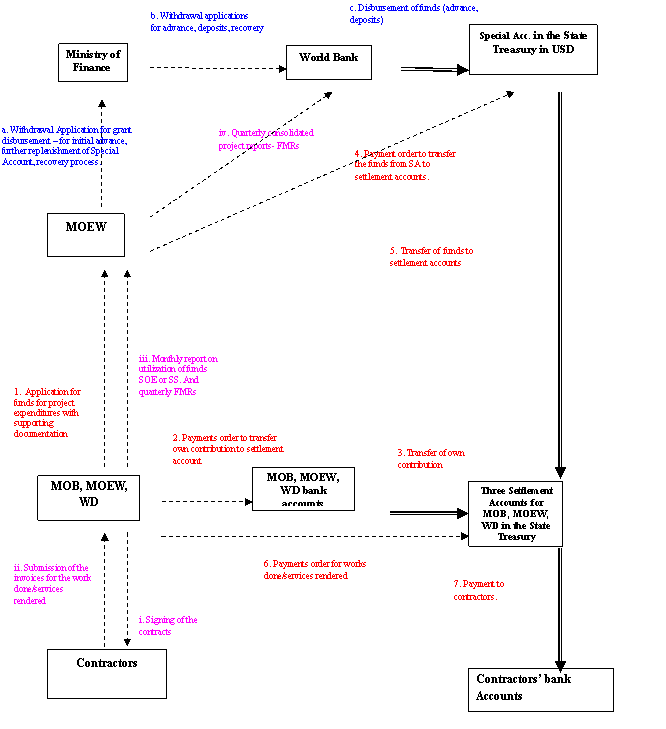
Operational Flow: Each PIU will be required to fulfill Project requirements in regards to the investment planning, procurement, supervision of works and purchases, financial management, and for auditing and reporting to the PMU for its respective Project component. The above tasks will be performed directly by the PMU for component 3. Approval for applications for disbursement, withdrawal of Grant funds, and consolidated reporting to the Bank will be carried out by the PMU in the MOEW and sent to the MOF or entity delegated by MOF for signature prior to submission to the Bank. Main roles and responsibilities in regard to financial management, flow of funds, disbursement, reporting, and execution and monitoring of the Project’s Environmental Management Plans are to be described in the Grant implementation agreement. Additionally, detailed responsibilities for operational processes, rules and standard forms and documents are to be spelled out in sufficient details in the Operational Manual. Drafts of these two documents have been submitted to the Bank for review prior to Appraisal. Comments have been provided. Revised versions of these documents, satisfactory to the Bank, were submitted before Negotiations.
Legal Arrangements: A Grant Agreement will be signed between the Bank, acting as an implementing agency for the GEF, and the Republic of Hungary. This Agreement will include the provisions for the implementation of Components 2 and 3, as both the WD and the DDNPD are under the direct responsibility of the MOEW. A Project Agreement is to be signed between the Bank and the MOB for the purposes of Component 1. An amendment to the Loan Agreement is being prepared by the Bank, at the request of the MOB, to authorize the use of loan savings and uncommitted funds under the Loan 4512-HU to partially finance Component 1 of the proposed Project [3]
2. Monitoring and evaluation of outcomes/results
Monitoring and evaluation of the Project outcomes will be carried out separately for each component. Concerning the MOB component, the proposed Project performance indicators will be monitored by the BMSC and reviewed by the MOB prior to being reported to the PMU. As part of regular operation of the NBWWTP, the BMSC performs continuous measurements of a set of technical and financial indicators. Technical Project performance indicators are already being closely monitored by the BMSC, in accordance with Hungarian and EU requirements.
For the DDNP component, a comprehensive M &E system will be put in place at the DDNP, under the responsibility of the WD, in coordination with the MOEW, PMU. This system will monitor the Project impacts in the DDNP, in terms of reduction of N and P, water quality and environmental health, taking into account the efforts of the GoH to harmonize existing monitoring systems and to integrate the provisions of the EU WFD in regard to wetlands. The list of indicators to be included in the M&E system, including possible indicators species, will be determined in the first stages of the Project, based on the results of the baseline study. Also, as indicated above, the M&E is to be established prior to the execution of the works.
A simple management information system for Project M&E will be designed by the MOEW, PMU to ensure the coordination and aggregation of the data, including reporting formats and the agreed monitoring indicators. Quarterly and consolidated annual reports including the use of Project funds and Project impacts will be prepared by the PMU. Significant supervision by qualified Bank staff is planned during the start-up phase. A Mid-Term Review will be carried out to assess overall Project progress, introduce required changes, identify lessons learned, and disseminate good practices. This process will be closely coordinated with the review of similar projects in the Danube and Black Sea Programs, to allow for maximum benefits and knowledge sharing.
3. Sustainability and Replicability
Sustainability. The MOB has demonstrated its commitment to the Project objectives through the implementation of the baseline investments and the approval of additional direct financial support beyond the GEF contribution. As part of the HMWP, the Bank has financed the construction of the South Pest WWTP and the rehabilitation of the biological secondary treatment of the NBWWTP. These investments, along with the installation of tertiary treatment in the NBWWTP under the proposed Project, and the foreseen construction of the Central Budapest WWTP are included in the long-term comprehensive plan for wastewater collection and treatment in Budapest. Tariff increases will be made as required to cover capital and operational expenses requirements.
In the case of the DDNP component, the long-term sustainability of Project benefits is linked to the adequate management and maintenance of the restored wetlands in the Gemenc and Beda-Karapancsa areas, both reported as hot spots in the JAP of the ICPDR. Such management and maintenance will require sufficient institutional and financial resources, which the GoH has committed to provide. A provision is also made under the Project to support incremental Project management costs of the WD, PIU on a declining basis while developing financial mechanisms to finance the wetlands basic maintenance costs. The Project makes provisions for strengthening capacity of local and regional implementing institutions and central administrations to ensure that they acquire the needed managerial and technical skills and capabilities. Project sustainability will be enhanced by actively involving local institutions during Project implementation and by the preparation of a Special Area Management Plan, involving stakeholders in the process.
Replicability. As indicated above, the dissemination and replication component of the Project will provide the means for developing an M&E system to properly assess Project results. Comprehensive impact evaluation studies will be carried out. The results of these studies will serve as a basis for the dissemination and replication activities. In particular, the component will finance workshops, public communication campaigns and promotion of cost effective solutions for nutrient reduction in other areas of Hungary and in other riparian countries.
4. Critical risks and possible controversial aspects
Lack of continuing commitment from the Government. Negligible, because of the need for compliance with EU requirements and the strong support from MOB for the Project. The risk of lack of continued support for the DDNP component was initially rated as significant on the basis of previous disagreement between the DDNPD and the MOEW, which significantly delayed confirmation of counterpart funds and the signing of the PDF-B grant. However, because of MOEW’s overall responsibility in the preparation and implementation of the Project, and based on the institutional arrangements made to support the Project, this risk has decreased to negligible. Nevertheless, the Bank team will work closely with the MOB and MOEW to maintain current support.
Consumers unwilling/unable to pay required tariffs levels. Negligible, because the increase required in MOB’s wastewater tariffs as a result of the Project investments is not substantial, and studies show that the new tariffs should be affordable to most of the population (less than 4% of the average household monthly income). As regards low income households and households facing temporary difficulties, MOB has certain schemes already in place to provide financial relief.
Institutional capacity to handle preparation and implementation. Negligible for the MOB. The municipality has shown satisfactory capacity during preparation and implementation of the HMWP, financed by Loan 4512-HU, which has a more complex structure and larger requirements than the proposed Project.
Modest for the DDNPD. Despite being technically strong agencies, the implementing teams of the WD and the DDNPD do not have experience in dealing with Bank-financed projects. To decrease this risk, the Project provides for a launch workshop including training in the Bank’s operational rules, coaching from MOB to WD and DDNPD, and assistance from specialized consultants for Project preparation, including procurement.
Capital investments at the NBWWTP are higher than estimated. Modest. Since the selection of the technology as well as the final design are to be carried out as part of the procurement process, there is a risk that the bids result in higher than expected prices. However, cost estimates have been carefully and regularly reviewed during Project preparation and have been found in line with market prices. Additionally, the procurement process with a prequalification of firms and a two-stage-bidding (ICB using the Bank standard bidding documents for Supply and Install) is expected to create the highest possible competition for such contract, as the design will be left to the bidders to decide during the first phase. Thus, prices are expected to be in the low range.
Slow decision-making during implementation. Significant. The complex and rather bureaucratic process of decision-making in Hungary has generated delays during Project preparation. To decrease this risk, a Grant implementation agreement between the MOEW, the MOB, the WD and the DDNPD has been prepared to define the roles and responsibilities of each partner during implementation. This agreement is being complemented by an Operational Manual to describe in sufficient detail the procedures and timeframe for the organization of procurement, financial management, disbursement, auditing and reporting. Drafts of these documents have been submitted to the Bank and comments have been provided. The submission of these documents, satisfactory to the Bank, is a condition for Negotiations. Additionally, the formal establishment and staffing of the PSC, under the leadership of the MOEW, will facilitate the exchange of information, experience and lessons learned among the partner institutions. These arrangements have been agreed at Appraisal. The establishment and appropriate staffing of the PSC is a condition of Negotiations. Confirmation of these arrangements will allow reducing this risk to Modest.
Safeguards policies. Modest. Both the MOB and the WD have completed Environmental Impact Assessment (EIA) reports that fulfill Bank requirements for their respective components prior to appraisal (these have been published in Info-Shop). The MOB has already obtained Government’s approval of its EIA and the corresponding Environmental License, which is required by Hungarian legislation before the works can start. The WD, on behalf of the DDNPD, is working on the preparation of the additional assessment for the DDNP component, which is required to obtain the Environmental License by Hungarian regulations. Such assessment will be completed on the basis of the detailed design of the rehabilitation works planned for the wetlands. This assessment has been budgeted and will be implemented as soon as the Grant is approved. As the process for the approval of such assessments by the Government has proven to be rather lengthy in Hungary, execution of works under this component is scheduled to start during the second year of Project implementation. A Panel of internationally recognized experts on wetland rehabilitation and river dynamics will also be convened to examine the proposed works. The GoH and the Bank will retain the authority to reject the financing of any work which the Panel concludes that could have negative impacts. Additionally, these rehabilitation works will be implemented in stages, starting with the development of pilots, to allow for a better quantitative evaluation of the impacts. Notification to other riparian countries has been made within the scope of the Danube Commission and measures have been developed as part of the EMP to protect Natural Habitats. (See Section D.6 and Annex 10 for details).
5. Grant conditions and covenants
Negotiations of the Legal documents (GEF Trust Fund Grant Agreement and MOB Project Agreement) of the proposed Project will be held once the Bank has received evidence of:
(a) Submission of a Grant implementation agreement between the MOEW, the MOB, the WD and the DDNPD, satisfactory to the Bank;
(b) Submission of an Operational Manual, including the financial accounting section, satisfactory to the Bank;
(c) Confirmation of the establishment and appropriate staffing of the Project Steering Committee;
(d) Confirmation of the FMRs and disbursement reports formats, satisfactory to the Bank; and
(e) Receipt of evidence that staff to perform Financial Management tasks for entire Project has been assigned in the MOEW.
Effectiveness conditions:
The GEF Legal documents will become effective once the Bank has received evidence that the Grant Implementation Agreement has been duly executed and Legal Opinions, respectively from the Government of Hungary attesting the validity and the binding nature of the GEF Trust Fund Grant Agreement and of the Grant Implementation Agreement; and from the MOB attesting the validity and the binding nature of the MOB Project Agreement.
Other covenants: The following covenants were agreed during the Technical Discussions and confirmed at Negotiations:
For the GEF Trust Fund Grant Agreement:
(a) The Recipient shall maintain throughout Project implementation the Project Management Unit with adequate financial and human resources to ensure quality and timely coordination..
(b) In order to ensure appropriate inter-agency coordination, provide overall guidance, facilitate integration and address potential conflicts, the Recipient shall maintain throughout Project implementation a Steering Committee chaired by a senior level official of the MOEW and comprising representatives from the MOF, MOEW, the MOB, the DDNPD and the WD.
(c) The Recipient, through the MOEW, shall cause the WD: (i) to carry out, supervise and monitor component 2 of the Project, including the development of a water quality monitoring system to measure the impact of said component on the reduction of nutrients in the DDNP; and (ii) upon Project completion, to transfer to the DDNP the ownership and the responsibility for the operation and maintenance of the facilities constructed, areas rehabilitated and water quality monitoring system developed under component 2 in accordance with a time action plan agreed by the Recipient and the Bank.
(d) In order to assess and assist the WD authorities in the selection and monitoring of the planned interventions under component 2, the Recipient, through the MOEW, shall ensure that a panel of internationally recognized experts in the area of wetlands restoration and management shall provide appropriate advice and recommendations, all in accordance with the Operational Manual.
(e) The Recipient, through the MOEW, shall take all action required to ensure that the Operational Manual is applied and followed at all times in the implementation, monitoring and evaluation of components 2 and 3 of the Project.
(f) The Recipient shall take all measures necessary on its behalf to carry out, or to enable the WD, as the case may be, to carry out, the measures identified under the Environmental Management Plans at all times in a timely manner, ensuring that adequate information on the implementation of said measures is suitably included in the Project progress reports to be prepared by the WD.
(g) The Recipient, through the MOEW shall, commencing on November 30, 2006 and thereafter, not later than November 30 and May 31 in each calendar year and until Project completion, prepare and furnish to the Bank a semi-annual progress report describing the progress achieved in the implementation of components 2 and 3 of the Project during the preceding calendar semester and the updated MOEW Monitoring and Evaluation Indicators for the upcoming calendar semester.
(h) The Recipient, through the MOEW, shall maintain policies and procedures adequate to enable it to monitor and evaluate on an ongoing basis the carrying out of components 2 and 3 of the Project and the achievement of the objectives thereof and review with the Bank, by February 28, 2009 a mid-term report on the progress achieved in the carrying out of such components and, thereafter, take all measures required to ensure their efficient completion and the achievement of the objectives thereof, based on the conclusions and recommendations of the said report and the Bank’s views on the matter.
For the MOB Project Agreement:
(a) The MOB shall maintain the PIU-MOB throughout Project implementation with financial and human resources adequate to enable it to appropriately carry out its responsibilities under component 1of the Project.
(b) The BMSC shall report to a joint review team formed by representatives of the MOB and of the BMSC.
(c) The MOB shall take all measures necessary to carry out the measures identified under the Environmental Management Plan for component 1 of the Project at all times in a timely manner, ensuring that adequate information on the implementation of said measures is suitably included in the Project progress.
D. APPRAISAL SUMMARY
1. Economic and financial analyses
As a stand-alone GEF Project, the principal economic evaluation criterion is the Project’s potential contribution to global benefits (see the economic and incremental cost analysis details in Annexes 9 and 15). For the MOB component, the baseline scenario for the Project includes the rehabilitation of the NBWWTP and the control of untreated discharges from the sewerage network, carried out during 2001-2005 under the HMWP, but it does not include any specific nutrient reduction actions, as such development is not required under the EU Directive for Urban Wastewater Discharges. The GEF Project fills this gap by financing the upgrading of the NBWWTP to the tertiary level of treatment, to reduce nutrient discharges. For the DDNP component, the baseline scenario is business as usual, as no particular development of nutrient trapping capacity is required in the DDNP to comply with the EU WFD.
Incremental costs: Baseline investment costs are estimated at about US$80 million of which about US$ 27 million is for the NBWWTP. The GEF Project will finance additional investments of about US$32 million, of which GEF will provide US$12.5 million, the ongoing Loan 4512-HU EUR5.9 million (US$7.7 million equivalent), the MOB US$10.4 million, and the MOEW US$1.4 million[4].
Global benefits: The main expected benefits are the reduction in nutrient (N and P) discharges into the Danube and consequently into the Black Sea. Over the 25-year period 2006-2030, the total reduction in nutrient discharges is estimated at 54,200 tons for the MOB component and 38,350 tons for the DDNP component. In terms of cost effectiveness, the unit cost of abatement (estimated as the present value of the relevant annual capital and O&M costs) is estimated at US$1,060/ton for the MOB component and US$240/ton for the DDNP component. As indicated above, as the impact of wetlands on nutrient reduction has not been systematically documented, the unit cost of abatement for the DDNP component has been roughly estimated based on the information provided during Project preparation. Details are provided in the Incremental Cost Analysis in Annex 15.
Financial analysis: The MOB and the BMSC, respectively the borrower and final beneficiary under the ongoing Bank Loan (4512-HU), are in compliance with their financial covenants. Financial statements are provided in Annex 5. A financial rate of return has not been calculated for the Project given the nature of the investments which result in environmental benefits. A financial return on investment is not the main consideration in undertaking the investment. However, as provided under the contractual agreement between the MOB and the BMSC, the tariff formula provides for BMSC to recover any incremental operating expenses due to the investment. The increment in tariff is based on such cost-recovery. However, as seen above and in Annex 15, the Project will yield significant economic benefits. For the MOB component, the upgrading to tertiary treatment is estimated to involve an incremental cash expense (HUF 6.5/m3 for O&M and HUF 1.5/m3 for debt service) of about HUF 8/m3 of wastewater invoiced. The required tariff increase is about 4.5% over the current level of the average wastewater tariff. The resulting new wastewater tariff is estimated to remain affordable to most of the population concerned. As regards low income households and households facing temporary difficulties, MOB has certain schemes already in place to provide financial relief. For the DDNP component, the Project is estimated to result in an increase in O&M expenses by about HUF 135 million per year, which represents about 26% of the 2005 DDNPD annual budget (HUF 529 million, US$2.7 million equivalent). This amount will be provided through budgetary transfers to DDNPD by the MOEW.
2. Technical
MOB component. Although the proposed nutrient removal technology has been widely adopted in many parts of the world, this will be only the second such use in Hungary. It has already been implemented at the South Pest WWTP as part of the ongoing HMWP and both WWTPs fall under the responsibility of the BMSC, which is managed by a private operator having sufficient knowledge and experience of O&M of such facilities. The Bank’s supervision at the design stage, through the procurement process, and during implementation is critical for the success of the Project. Verification protocols for the operation of the new facilities have been discussed and agreed with MOB and BMSC representatives during the pre-appraisal mission.
DDNP component. During Project preparation, a technical assessment at the pre-feasibility level of restoration of the two identified sites was carried out. The assessment found that the development of a number of small interventions could significantly improve the average water flow and the period of water retention in the area’s wetlands, ponds and oxbows. Emphasis was placed on ensuring that the restoration of wetlands maximizes the water flow through the system in order to optimize nutrient trapping and improve ecological conditions and biodiversity. As indicated above, in order to provide additional security and confidence to the authorities, the MOEW will convene a panel of experts, with internationally recognized experience in this type of intervention, to assist the DDNPD in the implementation of proposed works and follow up on the impact they have on the Park’s morphology and ecology. Additionally, the works will be implemented in stages, starting with pilot areas. Foreseen interventions include localized dredging, cleaning of the riverbed and culverts and construction of small scale facilities to increase water retention (bottom weirs, sluices, pipe-culverts, etc.). Feasibility studies and detailed design will be done in the course of Project implementation, following detailed field surveys and investigations, for which provisions have been made under the Project.
3. Fiduciary
Procurement. Procurement under the Project will be limited to a small number of goods, works and consultant services contracts. The major contract, representing 78% of the Project funds, would be a Supply and Install contract for the construction/installation of tertiary treatment facilities in the existing NBWWTP, to be procured under International Competitive Bidding (ICB) on a turn key basis. The procurement of this contract will be carried out by the PIU, MOB, which has gained experience in Bank-financed projects in the successfully implemented HMWP, financed by Loan 4512-HU. The PIU, WD has no previous experience in implementing Bank-financed procurement. The requirements from this Project component are, however, limited to only a few contracts of a very simple nature. An Action Plan has been prepared to minimize the risks which have been identified, specially related to the lack of experience of DDNPD and WD in implementing Bank-financed procurement. The Procurement Plan will be updated at least annually, or as required to reflect the changing Project implementation needs and improvements in institutional capacity. (Detailed information is included in Annex 8).
Financial Management. A Financial Management (FM) assessment was carried out for the Project. The financial management arrangements of the project are acceptable to the World Bank. (See Annex 7 for details).
Strengths & Weaknesses. The strengths that provide a basis of reliance on the Project FM System (FMS) include the use to a great extent of the existing financial accounting and budgetary procedures in the implementing entities, and the extensive experience of MOB in implementing similar Projects co-financed by IFIs (including the World Bank, EBRD, and EIB). The specific risk identified during the assessment relates to the fact that the Project will be implemented by three entities; the MOEW, the MOB and the WD, the latter being located outside Budapest. However, this risk will be mitigated by the coordinating role of MOEW and the fact that the WD falls under the responsibility of the MOEW. The MOEW and the WD assigned staff to carry out the incremental Project FM tasks. (For details, please see Annex 7).
Disbursement: The Department of Budget of MOEW will open one Special Account (SA) with the Hungarian State Treasury in the currency of the GEF Grant. To facilitate payments through each of the implementing entities and to receive the share of their respective contributions to the financing of the project, settlement accounts will be opened for each of the three implementing entities/beneficiaries. The MOB, MOEW and the WD will have to provide the full amount of their respective contributions required to finance Project expenditures before the due date for the payment of suppliers’ invoice. Accordingly, Grant funds will flow from the World Bank to the SA and then through settlement accounts to the suppliers. The MOEW will be responsible for having the SA replenished from time to time, on the basis of withdrawal applications. (For details, please see Annex 7). The associated proceeds under the Loan 4512-HU will remain in the special account already established for that Loan for the purpose of parallel financing of the component under the HMWP.
4. Social
Considering the nature and the location of the investments and the current socio-economic situation, the World Bank concluded that no social impact assessment was needed. Local communities, environmental associations and NGOs have been involved in the preparation of the Project through public meetings and consultations carried out as part of the EIA preparation process. Conclusions and recommendations were recorded in the EIAs. Special attention will be given during Project implementation to maintaining a high level of communication and transparency with local stakeholders.
5. Environment
Impact Assessment. The major environmental objective of the Project is to reduce nutrient discharges into the Danube River and Black Sea and thus to achieve positive environmental benefits. Separate EIAs were prepared for Component 1 and 2. Both EIAs, including the EMPs have been reviewed and found to be satisfactory to the Bank. They were published in the Bank’s Infoshop on June 7, 2005. No significant negative impact on the environment is expected as a result of Project implementation. Given the nature of the investments, the Project has been classified as environmental category “B”.
For the Budapest component, the MOB completed the EIA for its component in compliance with the provisions of OP 4.01. As required, the EIA has been disclosed to the public and a summary of the document has been published on the website of the MOB, in Hungarian and in English. The EIA clearly indicates that no significant negative impact on the environment is expected as a result of the Project’s implementation. Potential impacts on the environment of the investments at the NBWWTP are exclusively limited to those that could occur during the construction phase (noise, dust, etc.). Such potential impacts are well known and will be adequately controlled. Appropriate measures have been included in the EMP.
For the DDNP component, the WD, on behalf of the DDNPD, completed the EIA in compliance with OP 4.01 and presented it in a public forum in March 2005. The final version of the EIA incorporating all comments received, including from the Bank Project Team, was made available for public consultation at the public service offices of the WD in June 2005. Letters were sent to the main stakeholders, including environmental associations and NGOs, to invite them to consult and comment on the document. The EIA contains a description of existing environmental conditions in the two areas (Gemenc and Beda-Karapancsa), including climate, hydrology, soil and water quality, groundwater and biodiversity, and it assesses the impacts on these conditions from implementation of the Project, during the construction and operation phases. The EIA has assessed potential environmental negative impacts associated with dredging, changes in the local hydrology, disposal of dredge materials, and increased flow of pollutants into the wetlands. The EIA concludes that no significant negative impact is expected if the measures included in the EMP are implemented. Moreover, the rehabilitation of the wetlands is expected to improve the ecological conditions of the ecosystem and increase biodiversity, as the quality of valuable habitats will be improved. Positive ecological impacts are in particular expected with the quality improvement of habitats for a number of migratory bird species of global importance, such as the Ferruginous Duck (Aythya Nyroca), the White-tailed Eagle (Haliaeetus albicilla) and Black Storks. Furthermore, the rehabilitation of the wetlands will help solve the desiccation problem caused by the deepening of the Danube River bed, which has resulted in serious loss of wet alluvial habitats over the years. As indicated above, the MOEW will convene an Experts Panel to assist the WD and DDNPD authorities in the assessment and monitoring of the proposed interventions. Additionally, the rehabilitation work in the Park will be implemented in stages, starting with the development of pilots, in parallel with the development of the M&E system, to allow for a better quantitative evaluation of the impacts. For more information on the biological processes of nutrient trapping to take place in the DDNP and on their potential impacts on flora and fauna, see Annex 18. The list of indicators to be measured as part of the M&E system will be determined in the first stages of the Project, based on the results of the baseline study. Also, this study will provide recommendations on the inclusion of indicators species in the M&E system to measure its impacts on the ecology and biodiversity of the DDNP.
As indicated above, Hungarian regulations require that Environmental Licenses need to be obtained on the basis of the EIA before works can start. This Environmental License has already been obtained by MOB for the works planned under component 1. Therefore, works under this component can start as soon as the Project is effective. WD is in the process of requesting the Environmental License for the works planned under component 2. As part of this process, the EIA will be updated to incorporate eventual additional environmental impact information on the basis of the detailed design of the rehabilitation activities for the wetlands[5]. As this process is rather lengthy in Hungary, execution of works under this component is scheduled to start during the second year of Project implementation.
Environmental Management Plan (EMP). EMPs have been prepared for components 1 and 2. Mitigation measures prepared under each EMP determine and address all relevant parameters, impacts and mitigation measures, both during the construction and the operation periods, and designate the responsible agency for their enforcement. In particular, for the DDNP component, possible options for the handling and disposal of the dredged material have been considered, and will be thoroughly examined as part of the detailed design. These measures include testing materials to be dredged for potential contamination, physical isolation of the area during dredging, reuse of dredged material where practicable, if found to be of acceptable quality, and disposal of dredged material to an appropriate site according to its quality. Also, measures have been developed as part of the EMP to protect natural habitats, including concentration of the dredging and construction work during ecologically less sensitive periods of the year. Contractors will be responsible to implement these precautions and measures, and their implementation will be supervised by the WD, the DDNPD and the MOEW. These EMPs will be incorporated in the Project Operational Manual and its implementation will be monitored as part of Bank supervision missions.
6. Safeguard policies
|
Safeguard Policies Triggered by the Project |
Yes |
No |
|
Environmental Assessment (OP/BP/GP 4.01) |
[X] |
[ ] |
|
Natural Habitats (OP/BP 4.04) |
[X] |
[ ] |
|
Pest Management (OP 4.09) |
[ ] |
[X] |
|
Cultural Property (OPN 11.03, being revised as OP 4.11) |
[ ] |
[X] |
|
Involuntary Resettlement (OP/BP 4.12) |
[ ] |
[X] |
|
Indigenous Peoples (OD 4.20, being revised as OP 4.10) |
[ ] |
[X] |
|
Forests (OP/BP 4.36) |
[ ] |
[X] |
|
Safety of Dams (OP/BP 4.37) |
[ ] |
[X] |
|
Projects in Disputed Areas (OP/BP/GP 7.60) |
[ ] |
[X] |
|
Projects on International Waterways (OP/BP/GP 7.50) |
[X] |
[ ] |
Additional information and provisions made under the Project to ensure compliance with applicable safeguards policies are described in Annex 10.
7. Policy Exceptions and Readiness
This project complies with all applicable Bank policies.
Annex 1: Country and Sector or Program Background
Hungary: NUTRIENT REDUCTION PROJECT
Hungary’s investment needs in wastewater treatment to comply with EU directives are estimated as EUR4.0 billion over the next fifteen years. Budapest is by far the most important point of wastewater discharges in Hungary, and consequently of nutrient discharges. In particular, the city generates respectively 45% N and 33% P of nutrient discharges from point sources in the country. In 1999, the Hungarian Government prepared a long-term sewerage and wastewater treatment plan, which covers the priorities for investment in wastewater treatment until 2015. This plan includes the following investments for reducing nutrient discharges in the Danube: (a) the development of tertiary treatment for nutrient removal at the South Pest WWTP; (b) the development of tertiary treatment for nutrient removal at the NBWWTP; (c) the completion of the sewer network in all areas of Budapest; (d) the construction of the Central WWTP, to complete the treatment of Budapest wastewater; and (e) the increase of landfill capacity for mid-term sludge disposal by 165,000m3. Investments for the provision of tertiary treatment facilities for these three plants represent about 30 % of the investment allocated to wastewater treatment in the plan, while the development of wastewater treatment infrastructure in Hungary represents 25% of the overall JAP plan. Although the Danube River is not declared as a sensitive water body according to the EU Directive, Hungarian authorities decided to reach tertiary treatment to fulfill Hungary’s commitments made towards the reduction of nutrient discharges to the Danube and the Black Sea. The JAP includes the investment requirements for the reduction of nutrient discharges in Budapest among the five top priorities in the Plan.
In Hungary, provision of water and wastewater services falls under the responsibility of the municipalities. In the past, the Government gave priority to the extension of drinking water services. Nowadays, the coverage and quality for such services are good in Hungary, and water tariffs generally reflect the cost of service. Therefore, the Government recently shifted sector priorities to increase wastewater collection and treatment (to biological secondary level of treatment). In this regard, the MOB prepared the ongoing HMWP, financed by a Bank Loan and an EU Phare grant. This project includes substantial investments in collection system development and improvement of both the NBWWTP and the South Pest WWTP. The project included also the construction of a WWTP in Dunaujvaros, an important secondary Hungarian city, which is already completed. The South Pest WWTP discharges constituted the largest source of pollution of the sensitive Rackeve-Soroksar-Danube Branch, which is an important recreational area for Budapest and is classified as a “sensitive water body” as defined in the EU Directive. It was therefore a priority to develop nutrient reduction facilities at the South Pest WWTP. The development of tertiary treatment at the NBWWTP was a lower priority, as it discharges directly in the Danube River, which is not considered a “sensitive water body”.
The Government strategy regarding nutrient reduction is based on the following objectives: (a) the establishment of a framework for sustainable use of natural resources; (b) implementation of cost-effective actions to meet the EU requirements in regards to the WFD and the Directive on Urban Wastewater Discharges; and (c) contribution to fulfilling Government’s commitments under international agreements, and in particular the Danube Convention established on June 29, 1994, of which Hungary is a founding member.
The Project is fully consistent with the GEF Partnership on Nutrient Reduction for the Danube and Black Sea Basins, as it addresses the highest priority transboundary issues identified in the Strategic Actions Plans for the Danube River and the Black Sea. The Project complies with eligibility criteria set for the Partnership, through a multi-focal approach, including investments in two focal points: advanced wastewater treatment for substantial discharges from metropolitan areas, and restoration of wetlands to recover their function as nutrient traps. The Project will follow-up on the substantial baseline investments financed in the MOB, through the ongoing HMWP.
The GoH and the MOB have demonstrated their commitment to reducing nutrient discharges from the NBWWTP and in the Gemenc and Beda-Karapancsa areas of the DDNP. To this end, the Government obtained financial support from the GEF Strategic Partnership for Nutrient Reduction in the Danube River Basin and the Black Sea. In addition to the GEF Grant, the MOB will provide counterpart financing from its own funds and from associated funds under the Loan 4512-HU.
As mentioned above, Budapest is the principal source of nutrient discharges in the Danube. Nutrients (N and P) are responsible for the stimulation of aquatic growth and for contributing to eutrophication of the Black Sea. Estimates show that the city of Budapest at the NBWWTP Plant discharges about 2,000 t/yr of Total Kjeldahl Nitrogen and 450 t/yr of total Phosphorus into the Danube. To reduce these discharges, the MOB has examined a number of technologies and has submitted an application for a Preliminary Water License for three pre-selected technologies. License was granted for the three examined technologies, which have been included in the following technical options: (a) using conventional biological nutrient removal, with installation of anoxic zones to improve settling of the sludge; (b) including Membrane Bio-Reactor (MBR) technology in the existing aerated system; (c) constructing new MBR lines; and (d) completing the present activated sludge system by a fix-bed process. As all these technologies are likely to be protected by patents, the bid will be organized in two stages, the first to establish common requirements for the offers, and the second, to compete in prices. The preparation of the prequalification document is well advanced.
A second Project area, the DDNP’s Gemenc and Béda-Karapancsa region, is identified by the Environmental Action Plan for Hungary as an environmentally sensitive area, which could be used to develop cost-effective nutrient reduction measures through the restoration of its wetlands, thereby improving the quality of the Danube River. The DDNP, a protected zone of 50,000 ha, is one of the areas with greater potential for this purpose (these wetlands covered 80,000 ha in the past). The Project will support the rehabilitation of about an additional 10,000 ha of wetlands and test their nutrient reduction capacity. The wetland restoration will take place in the Gemenc and Beda-Karapancsa areas of the DDNP. The size of the area is 27,800 hectares, of which about 19,500 hectares acts as a floodplain and is thus involved, at least during flood events, in trapping part of the nutrients carried by the Danube. In the past, wetlands were covering an area of about 80,000 hectares, providing higher capacity for regulating nutrient quantities in the Danube River.
As a result of numerous actions to regulate the river flow of the Danube, its riverbed has deepened. Consequently, the inundation period in the adjoining floodplain (inundation area), which is today a protected nature reserve, and the frequency of floods have decreased. Flood waves with the same water level inundate smaller floodplain areas than a few decades ago. The degree of riverbed incision is around 1.5 meters during the course of 100 years. As a consequence, the area is becoming drier, wetland habitats keep shrinking, and the nutrient retention capacity of the ecosystem is considerably diminishing.
The hydrological restoration of the Gemenc area of the National Park was started in 1998, in order to reconstruct former wetlands. These activities are believed to have caused the reduction of nutrient levels in the Danube. Stage I of the revitalization of the “Vén-Duna” side branch and the adjoining “Nyéki-tó” was completed in 2001. Corresponding costs, reaching HUF 70 million, were financed from the Environmental Fund administered by the Hungarian Government. As part of the restoration a dam was pulled down. As a result, the “Vén-Duna” branch, which was formerly dead, now functions again as a side-branch, improving water circulation and nutrient retention capacity of the “Nyéki-tó”. For Stage II, which further develops the previous activities, another HUF 35.5 million has been granted from the Environmental Fund. The Project has been launched, and initial steps for Project implementation have been made. The next steps would include interventions in the neighboring flood areas: the so-called “Lassi” and “Decsi” water systems, which represent an area of about 1,300 hectares. For these activities, the MOEW has committed HUF 46 million from the Environmental Fund. By improving the water circulation and regimes in the area, a considerable proportion of the lost nutrient retention capacity will be regained. Opening up of the “Kádár-sziget” side branch is also planned through a government-funded Project, but the amount of necessary investments is still to be determined.
Activities under the Project will contribute to increase the scope of these interventions in the Gemenc and Beda-Karapancsa areas, with a special focus on development of nutrient trapping capacity and improvement of the overall ecological conditions and biodiversity in the Park.
Annex 2: Major Related Projects Financed by the Bank and/or other Agencies
Hungary: NUTRIENT REDUCTION PROJECT
|
Sector Issue |
Project |
Latest Supervision
(PSR) Ratings
(Bank-financed projects only) |
|
Bank-financed |
|
Implementation Progress (IP) |
Development
Objective (DO) |
|
Municipal Wastewater |
Hungary – Municipal Wastewater Project (HMWP) |
S |
HS |
|
|
|
|
|
|
|
|
|
Other development agencies |
|
|
|
|
|
|
|
|
|
|
|
IP/DO Ratings: HS (Highly Satisfactory), S (Satisfactory), U (Unsatisfactory), HU (Highly Unsatisfactory)
Annex 3: Results Framework and Monitoring
Hungary: NUTRIENT REDUCTION PROJECT
Results Framework
|
PDO |
Project Outcome Indicators |
Use of Project Outcome Information |
|
Key Project development and global environmental objective is:
(i) to reduce Budapest’s discharge of nutrients (nitrogen and phosphorus) into the Danube River, and consequently into the Black Sea;
(ii) to enhance the nutrient trapping capacity of Gemenc and Beda-Karapancsa wetlands situated in the lower Hungarian part of the Danube River; and
(iii) to serve as a model for similar nutrient reduction initiatives in Hungary and other Danube basin countries. |
Overall reduction of the nutrient flow into the Danube River and the Black Sea of about 4000 tons per annum at the end of the Project. |
Refine JAP and implement the integrated Danube River environmental management strategy in the region and the country to develop synergies and efficient use of financial resources. |
|
Intermediate Outcomes |
Intermediate Outcome Indicators |
Use of Intermediate Outcome Monitoring |
|
Reduction of point-source nutrient discharges from Budapest and Hungary |
Annual reduction of nutrient discharges from the NBWWTP of about 70% of Nitrogen and about 60% of Phosphorus by the end of the Project.
Average operational cost of the nutrient reduction process in the NBWWTP |
Revise the JAP updating priorities of the ICPDR for point sources of nutrient discharges |
|
Reduction of quantity of nutrients flowing out of Hungary into the Danube River |
About 10,000 hectares of wetlands rehabilitated in the DDNP at the end of the Project.
Annual water flow and quantity of nutrients (N and P) retained by the DDNP wetlands increased by about 40% each at the end of the Project.
Average operational cost of the nutrient reduction process in the DDNP wetlands
M&E system fully operational |
Development of good practices for wetland rehabilitation |
|
Replication strategy is in place |
Cost-benefit analysis of nutrient reduction of wetland restoration compared to WWTP tertiary treatment carried out
Project experience and impact evaluation studies disseminated in the workshops held |
Development of similar initiatives in other cities and countries of the Danube River basin. |
Arrangements for results monitoring
Institutional issues: As indicated above, monitoring and evaluation of the Project outcomes will be carried out separately for each component. Concerning the MOB component, the proposed Project performance indicators will be monitored by the BMSC and reviewed by the MOB prior to being reported to the PMU. As part of regular operation of the NBWWTP, the BMSC performs continuous measurements of a set of technical and financial indicators. Technical Project performance indicators are already being closely monitored by the BMSC, in accordance with Hungarian and EU requirements.
For the Park components, a comprehensive M&E system will be put in place at the DDNP, under the responsibility of the WD, acting as an implementing agency for the DDNPD, and in coordination with the PMU of the MOEW. This M&E system will monitor the Project impacts in the DDNP, in terms of reduction of N and P, water quality and environmental health, taking into account the efforts of the GoH to harmonize existing monitoring systems and to integrate the provisions of the EU WFD in regard to wetlands. The list of indicators to be included in the M&E system, including possible indicators species, will be determined in the first stages of the Project, based on the results of the baseline study. Also, as indicated above, the M&E is to be established prior to the execution of the works.
A simple management information system for Project M&E will be designed by the MOEW, PMU to ensure the coordination and aggregation of the data, including reporting formats and the agreed monitoring indicators. Quarterly and consolidated annual reports including the use of Project funds and Project impacts will be prepared by the PMU. Significant supervision by qualified Bank staff is planned during the start-up phase. A Mid-Term Review will be carried out to assess overall Project progress, introduce required changes, identify lessons learned, and disseminate good practices. This process will be closely coordinated with the review of similar projects in the Danube and Black Sea Programs, to allow for maximum benefits and knowledge sharing.
Data collection: This will be carried out by the BMSC and the DDNPD for components 1 and 2 respectively, under the supervision of the respective PIUs and agencies in charge of the quality control in Hungary. It will take into account the Hungarian and EU regulations in place and to be implemented, as well as the efforts to harmonize existing monitoring systems in Hungary.
Capacity: For the MOB component, the municipality has shown satisfactory capacity during preparation and implementation of the ongoing HMWP, financed by Loan 4512-HU, which has a more complex structure and larger requirements than the proposed Project.
Despite being technically strong agencies, the implementing teams of the WD and the DDNPD do not have experience in dealing with Bank-financed projects. To decrease this risk, the Project provides for a launch workshop, coaching from MOB to WD and DDNPD, and assistance from specialized consultants for Project preparation, including procurement.
Overall, no problems are expected in terms of capacity to monitor Project’s results. Additionally, funds will be made available under the Project to finance training and workshops to ensure that any potential problem will be adequately addressed.
Arrangements for results monitoring
|
|
Target Values |
Data Collection and Reporting |
|
Project Outcome Indicators |
Baseline |
YR1 |
YR2 |
YR3 |
YR4 |
YR5 |
Frequency and Reports |
Data Collection Instruments |
Responsibility for Data Collection |
|
Overall reduction of the nutrient flow into the Danube River and the Black Sea. |
0 tons / annum (t/a) |
0 t/a |
840 to 915 t/a |
3,650 to 3,800 t/a |
3,930 to 4,290 t/a |
3,930 to 4,290 t/a |
Quarterly Project implementation progress reporting from the PMU |
PMU, MOB PIU, WD PIU |
MOB, PIU, WD PIU |
|
Intermediate Outcome Indicators |
|
|
|
|
|
|
|
|
|
|
Quantity of nutrients discharged from the NBWWTP
(in kg/day)
Average operational cost of the nutrient removal facilities at the NBWWTP |
Baseline discharges:
BOD: 20,586
Nitrogen (N): 9,230
Phosphorus (P): 775
0 US$/m3
0 HUF/m3 |
BOD: 20,586
N: 9,230
P: 775
0 US$/m3
0 HUF/m3 |
BOD: 20,586
N: 9,230
P: 775
0 US$/m3
0 HUF/m3 |
BOD: 3,200
N: 2,945
P: 310
0.03 to 0.05 US$/m3
5.2 to 10.3 HUF/m3 |
BOD: 3,200
N: 2,945
P: 310
0.03 to 0.05 US$/m3
5.1 to 10.1 HUF/m3 |
BOD: 3,200
N: 2,945
P: 310
0.03 to 0.05 US$/m3
5.0 to 9.8 HUF/m3 |
Quarterly Project implementation progress reporting from the PMU |
MOB, BMSC water quality monitoring system;
quality control analysis |
BMSC,
WA
|
|
Number of hectares of wetlands rehabilitated in the DDNP
Annual water flow and quantity of nutrients retained by the DDNP wetlands
Average operational cost of the nutrient reduction process in the DDNP wetlands
M&E system fully operational |
0
Water flow in restored wetlands:
37,000 m3/ha/annum N: 3,768t/a
P : 189t/a
No
|
0
37,000 m3/ha/a
N: 3,768t/a
P : 189t/a
No
|
3,000
42,500 to 43,500 m3/ha/a
N: 4,560 to 4,635 t/a
P: 234 to 236 t/a Yes
|
7,000
46,400 to 50,700 m3/ha/a
N: 4,900 to 5,030 t/a
P: 250 to 257 t/a Yes
|
10,525
50,400 to 57,900 m3/ha/a
N: 5,150 to 5,500 t/a
P: 264 to 281 t/a Yes
|
10,525
50,400 to 57,900 m3/ha/a
N: 5,150 to 5,500 t/a
P: 264 to 281 t/a Yes
|
Quarterly Project implementation progress reporting from the PMU
Financial reports
Monitoring and Evaluation Report
Impact Evaluation Studies |
WD, DDNPD, MOEW |
WD, DDNPD
|
|
Cost-benefit analysis of nutrient reduction of wetland restoration compared to WWTP tertiary treatment
Project experience and impact evaluation studies disseminated |
No
No
|
No
No
|
No
No
|
No
No
|
No
No
|
Yes
Yes
|
Monitoring and Evaluation report, Impact evaluation studies, financial reports |
MOEW, MOB PIU, WD PIU |
MOB, WD, DDNPD, MOEW |
This table will be agreed upon at negotiations.
Annex 4: Detailed Project Description
Hungary: NUTRIENT REDUCTION PROJECT
|
Annex 4. Table 1. Estimated Project Costs by Components (million US$) |
|
|
|
|
|
|
Project Components |
Local |
Foreign |
Total |
% |
|
|
|
|
|
|
1: Development of tertiary treatment at the NBWWTP (Budapest) |
9.70 |
13.70 |
23.40 |
73.2% |
|
|
|
|
|
|
2: Wetland Restoration in the DDNP |
|
|
|
|
|
a) Wetland restoration |
0.97 |
3.89 |
4.86 |
15.2% |
|
b) Technical Assistance and Monitoring system |
0.24 |
0.97 |
1.21 |
3.8% |
|
Total Component 2 |
1.22 |
4.86 |
6.08 |
19.0% |
|
|
|
|
|
|
3: Dissemination and Replication |
0.08 |
0.33 |
0.41 |
1.3% |
|
|
|
|
|
|
Contingencies |
|
|
|
|
|
Physical |
0.55 |
0.94 |
1.49 |
4.7% |
|
Price |
0.22 |
0.38 |
0.60 |
1.9% |
|
Total Contingencies |
0.77 |
1.32 |
2.09 |
6.5% |
|
|
|
|
|
|
Grand Total |
11.77 |
20.20 |
31.97 |
100.0% |
Component 1- Development of tertiary treatment at the NBWWTP (Budapest).
This component will finance works and equipment to upgrade the NBWWTP to the tertiary level of treatment for the reduction of nitrogen and phosphorous from nutrient discharges into the Danube River. The NBWWTP, which was built in 1973, has been rehabilitated under the ongoing Bank financed HMWP. It is being operated by a mixed-capital operator company, under a 25-year concession contract, awarded in 1997 to a consortium of the Compagnie Generale des Eaux (now Veolia Water) and Berlinwasser. The Municipality of Budapest, assisted by consultants, prepared a feasibility study assessing three alternatives for this Project component. This feasibility study has been reviewed and approved by the WD who issued the required Preliminary License.
Because most systems for tertiary treatment are likely to be protected by patents, and the solutions in each system are difficult to compare in a one-stage conventional bid, the MOB is working on the preparation of a two-stage process, to permit equalization of proposals. The solution to be developed is not specified at this stage and will be provided by the suppliers in the bids. The technical responsiveness of the solutions to be provided will be checked against its compliance with a set of precisely defined performance requirements (to be detailed in the technical specifications of the bidding documents), based on their technical and financial efficiency and their ability to comply with the EU Urban Wastewater Directive in terms of quality of effluents and the Hungarian regulation. After the selection process is completed, the MOB will seek the final licenses from the WD. The prequalification documents are well advanced and prequalification is expected to be completed prior to effectiveness. After the implementation of the nutrient removal phase the discharges of the NBWWTP in terms of Total N and Total P in the effluent are expected to be reduced by 68% and 60%, respectively.
Component 2- Wetland Restoration in the Duna-Drava National Park.
This component will finance the rehabilitation of about 10,000 hectares of wetlands to develop their nutrient trapping capacity within two identified areas, Gemenc and Beda-Karapancsa, located within the DDNP, directly along the course of the Danube River. The DDNP is located downstream from Budapest, which still discharges a significant proportion of its wastewater into the Danube River without any treatment. Additionally, the surrounding areas upstream from the Park are cultivated areas, and represent a source of non-point pollution of nutrients. This component will test the efficiency of wetlands in trapping nutrients directly from the river. It will establish an M&E system to measure the reduction of nutrients. This M&E system will be developed in compliance with Hungarian regulations in regard to wetland monitoring. It will also incorporate the quality assessment requirements under the WFD, thus supporting Hungary’s compliance with such requirements. In particular, parameters to be included in the M&E system will be determined on the basis of the baseline survey to be carried out at the first stage of the Project. The rehabilitation process will be implemented in stages, starting with the establishment of one pilot in each of the two areas for a period of one year.
A comprehensive baseline study will be carried out at the beginning of the Project to assess the areas’ environmental quality at the first stage of the Project, to help determine the precise location of the two pilots, and to provide recommendations on the design and development of the M&E system. Building on the results and lessons learned from the pilots, the rehabilitation will then be scaled up. Early in the process, an Experts Panel will be convened by the MOEW to assist the WD and the DDNPD authorities in the selection and monitoring of the planned interventions. In parallel, the component will adapt a methodology of impact evaluation, using local research organizations and universities. It will also include the development, in a participatory way, of a DDNP Special Area Management Plan, including measures to best accommodate authorized uses and protection measures in the Park area. Finally, this component will include small provisions for financing incremental Project management costs for the WD, PIU. This provision will cover the cost of the head of the WD, PIU, a consultant hired by the WD for the component’s preparation, and who will continue the existing responsibilities during Project implementation.
The DDNP area includes floodplains and side branches covering about 20,000 hectares. The Project includes their hydrological restoration as wetlands or floodplain (inundation) area. Necessary investments will include some engineering works and earthworks for smaller dikes, weirs and sluices, wetland monitoring and sampling equipment, and some localized dredging and clearing. Additionally, laboratory instruments and operation control systems (computer hardware and software) will be needed to establish the monitoring system. As a result, the drying of the wetland habitat is expected to stop and its degradation to reverse. Through the general improvement of the natural ecosystems with adequate vegetation, the nutrient reduction capacity of the wetland will increase. It is estimated that the Gemenc and Beda-Karapancsa regions will have the ability to annually retain between 1390 and 1,730 tons of N and between 76 and 92 tons of P. For a detailed description of the qualitative biological processes of nutrient trapping to take place in the DDNP and on their potential impacts on flora and fauna, see Annex 18.
A pre-feasibility study has been carried out in the following hydrological units of the Park, to elaborate feasible and cost effective interventions to increase nutrient trapping capacity, while taking into account environmental and biodiversity protection. The study recommended implementing the interventions described below as part of the DDNP component of the Project. Final design for these interventions will be prepared during Project implementation. Detailed maps of these areas, identifying the different zones, are available in Annex 17.
“Veránka” water system, “Rezéti-Duna”. Area: 1,100 hectares.
Description: The Veránka island was created at the end of the 19th century, by artificially cutting across an over-developed bend, what is today the “Rezéti-Duna” side branch. The water surface area of the 15 kilometres long side branch is 206 hectares. Its upper and lower mouths connecting it to the main bed are 3 kilometres apart. As a result of regulation, the branch is increasingly silted up, especially at its upper section and its confluence, with the water flow being totally blocked at low water levels, and being less capable of supplying water to the wetland habitats of the island.
Recommended intervention: Construction of a silt gathering device at the upper mouth. Building a levee or a weir to hold back the water and dredging of the bed at the lower mouth.
“Buvat” water system. Area: 614 hectares.
Description: There are several silted-up dead branches crossing the area. Their desired level of water intake should be ensured from the neighbouring dead branches (“Rezéti-Duna” and “Grébeci-Duna”).
Recommended intervention:
- Improve the linkage between the Keszeges-tó, the Lídia-tavak and Lídia-lapok to the Rezéti-Duna, in order to allow more frequent floods.
- Improve the water transport at Zátony-tava and repair the collapsed culvert at Vajas-fok to stop the leakage by the old abandoned rail road.
“Béda-Karapancsa” water system. Area: 2,500 hectares.
Description: The major elements of this area adjacent to the Croatian border are the “Bédai-Duna” and the “Belső Béda”, comprising a 20 kilometre long system of side-branches. The areas belonging to the two side-branches are separated by a flood-prevention dike. The “Belső-Béda” is situated on the flood-protected side. A small sluice separates Külső-Béda (outer Béda) dead branch from the Danube; with the help of which, the water can be sustained at a constant level averaging 3.2 meters.
Recommended intervention:
- Build a sluice (4.0m x 4.5m) to separate the Külső-Béda (outer Béda) from the Danube and dredge the pre-channel inner river stretch to transform this dead branch into a floodplain lake with a surface of 75 hectares and a depth up to 5.0 meters;
- In the Belső Béda (inner Béda) dead branch, remove the dividing barrier and increase the allowed water level;
- By making a large passage at the upper stretch of the channel linking Mocskos-Duna dead branch, increase the water level with a small escape sluice and dredge the river stretch.
Water system at the Sió-mente canal. Area: 755 hectares.
Description: The area along the Sió-mente canal connecting Lake Balaton with the Danube is interwoven by various types of wetland habitats originating from the Danube’s earlier riverbed movements and from the cross-cutting of bends. In order to be able to maintain the high variety of wetland plant species capable of retaining nutrients, it is necessary to implement bed corrections, and construct regulatory works and water-retaining barriers.
Recommended Interventions:
- Improve the water intake conditions (frequency, accretion volume, level of retention) achieved through cleaning the connections to the river-bed and the internal connections, (profile extension, thalweg correction), through the implementation of controllable water-retention facilities (maneuverable locks, pipe culverts) in the mouth profiles;
- Sió mente II.: Cleaning of the channel No. 1259; Construction of regulating sluice and of a pipe culvert at water body No. 1259 and at the mouth of Szilágy fok;
- Sió mente III.: Bed cleaning at water body and channels No. 1254. Construction of a water flow regulating weir. Construction of a pipe culvert at section 0+105 of the water body No. 1254;
- Sió mente VI.: Bed cleaning at water bodies and channels No. 1263 and No. 1265; Construction of water flow regulating weirs and construction of a pipe culvert at section 000-010 of the water body No. 1265;
- Sió mente VII.: Bed cleaning at water body and channels No. 1268; Construction of a water flow regulating weirs and of a pipe culvert at the mouth of Holt-Sió and Sió;
- Sió mente VIII.: Bed cleaning at the mouth; Construction of water flow regulating weirs and of a pipe culvert at the mouth of Holt-Sió II and Sió.
“Gemenc” water system. Area: 926 hectares.
Description: The most valuable central element of this water system is the 30 hectares surface-area Forgó Lake. The lake is connected with the “Grébeci-Duna” side branch through a 2 kilometres long canal.
Recommended Interventions:
- Improve the water intake conditions (frequency, accretion volume, level of retention) through cleaning the connections to the river-bed and the internal connections, (profile extension, thalweg correction);
- In the Forgó Lake (No. 1002), implementation of a double water induction direction and restoration of the inter-basin diversion under the line road from the direction of north;
- Cleaning of channel No. 1008. Construction of a water flow regulating device at the north side of Forgó-tó, construction of a pipe-culvert with double gate.
“Bátai-Duna” water system. Area: 1,430 hectares.
Description: The system is named after the 6 kilometres long dead branch of 96 hectares surface area. The island between the branch and the Danube River bed is an area of high ecological diversity, partially covered by forest, which is frequently flooded.
Recommended Interventions:
- Bátai-Holt-Duna: construct a water flow control facility (decelerator) in parallel with the village and a weir or sluice at the lower railway bridge pillars section.
- The optional severance of the Jaj-tanyai-tó from Báta water system. Contemplate the repair of an existing channel leading to the Sárosok (and the Danube).
“Fekete-erdei” water system, “Grébeci-Duna”. Area: 500 hectares.
Description: The area is an island bordered by the main bed and the side branch “Grébeci-Duna”. It was created in the 19th century, by cutting across a bend. The side-branch has 66 hectares surface area. Its length is 4 kilometres, and it is connected to the main bed only by its confluent end. It has become strongly silted up, with a developed eutrophication process.
Recommended interventions:
- To block the upper inlet of Grébec in order to slow down the rate of sedimentation and dredge stretches filled with sediment.
- In order to facilitate the improvement of water intake into lakes and swamps, namely Sulymos-tó, Akós-hókony, Döglött Grébec, Keselyűs-(Ásás)-Duna and Tehenes-lap, it is essential to secure more frequent flooding of those sites through the water inflow and outflow of the channels.
“Kerülő-Duna” water system. Area: 640 hectares.
Description: The determining element of water regime in the area is the artificially created bed with the name „Kerülő-Duna”. It is 8 kilometres long. During flood events, it can represent a wetland of 9 hectares.
Recommended Interventions:
- slight dredging of the river-bed in order to increase the volume of the water body;
- improvement of the water supply of the wet habitat defended by the summer dike;
- restoration of 2 dike drains at the same location;
- repair of two pipe weirs at 000-450;
- Construction of a damming weir.
“Báli” water system. Area: 500 hectares.
Description: The central part of the area is occupied by a strongly eutrophic, filled-up inner lake. The surface area of the lake is approximately 15 hectares. Its water supply is regulated by the canal connecting it to the “Vén-Duna” (Old-Danube), the neighbouring hydrological unit, which has already been revitalised.
Recommended Interventions:
- Rebuild the culvert in the dirt road above ground level at Báli-fok (lake);
- Dredge the entire stretch of Báli-fok and the bottom of Báli-tó to ensure a more frequent and prevalent flooding of the lake;
- Construct a water regulating weir or sluice at the inlet to Báli-tó.
Remark: Csörösz is currently getting its water from Nyéki-tó, but it is possible to develop feeding from Simon-Duna, which will result in a more frequent, lower water supply. One of the branches of Zsold-kaszáló is fed from the Nyéki-tó. More frequent flooding can be ensured by moderate dredging.
“Móricz-Duna” water system. Area: 360 hectares.
Description: The Móricz-Duna branch and the associated water system cover an area of 48 hectares, which is periodically flooded and have been considerably silted up, especially at the confluent section.
Recommended Interventions:
- Construction of a weir at 0+000
“Nagy-Pandur” water system. Area: 1,200 hectares.
Description: The Nagy-Pandur Island is a temporarily flooded area with forest cover, belonging to the town of Baja and the village Szeremle. The area is bordered by the main Danube and the 10 kilometres long „Szeremlei-Duna” side branch of 84 hectares open surface area. On the island there are 25 hectares of permanently flooded area and inner lakes, with water supplied at times of flood coming partly from the Danube and partly from the „Szeremlei-Duna” branch. The latter is strongly silted up, and the relative elevation of its bottom level is relatively increasing as the main Danube bed deepens.
Recommended intervention:
- Rebuilding of the confluence at the lower part of Szeremlei-Sugovica and dredging, preferably, along the highly sedimented stretches. Alternatively, the entire dead branch may be subject to dredging.
- Improvement of the water supply into the water bodies at Pandúr-sziget through enhancement of the channels’ water influx.
Component 3: Dissemination and Replication
This component will finance consultant services to carry out a comprehensive end-of-project impact evaluation and results analysis study of the two interventions (tertiary treatment and wetlands restoration), including a cost-benefit analysis. The results of these studies will serve as a basis for the dissemination, replication and knowledge sharing activities. The component will finance workshops, public communication campaigns and promotion of cost effective solutions for nutrient reduction in other areas of Hungary and in other riparian countries. The project will also link to the GEF Danube and Black Sea Regional projects, Danube Convention-supported dissemination activities and the GEF-funded IW Learn initiative. In this regard, this component will include setting up a Project website consistent with the GEF IW:LEARN guidance, participation of project staff in IW:LEARN activities, participation in at least two GEF International Waters portfolio conferences, and participation in ICPDR and Black Sea coordination meetings. The Project will also provide limited funds to finance a Project launch workshop; auditing services; and training to strengthen WD for project implementation and to build capacity of DDNPD staff for the efficient development and operation of wetlands for nutrient trapping.
Annex 5: Project Costs
Hungary: NUTRIENT REDUCTION PROJECT
CONTENTS
Table 1: Project Cost and Financing
Table 2: Financial Results and Projections - Municipality of Budapest
Table 3: Financial Results and Projections - BMSC
Table 4: NBWWTP - Project Stand-Alone Income Statement Projections
Table 5: NBWWTP Financial Operations - Impact of GEF Project
Table 6: Main Assumptions in Financial Projections
Institutional Analysis - Municipality of Budapest
Institutional Analysis - BMSC
Institutional Analysis - DDNPD and WA
Annex 5, Table 1: Project Cost and Financing
|
Project Cost By Component and/or Activity |
Total
US $million |
Local
US $million |
Foreign
US $million |
|
|
Government (MOEW) |
Municipality of Budapest |
GEF
|
Associated IBRD loan |
|
1: Development of tertiary treatment at the NBWWTP (Budapest) |
23.40 |
0 |
9.70 |
6.50 |
7.20 |
|
2: Wetland Restoration in the Duna-Drava National Park |
6.08 |
1.22 |
0 |
4.86 |
0 |
|
3: Dissemination and Replication |
0.41 |
0.07 |
0.01 |
0.33 |
0 |
|
Total Baseline Cost |
29.88 |
1.29 |
9.71 |
11.69 |
7.20 |
|
Physical Contingencies |
1.49 |
0.06 |
0.49 |
0.58 |
0.36 |
|
Price Contingencies |
0.60 |
0.03 |
0.19 |
0.23 |
0.14 |
|
Total Project Costs1 |
31.97 |
1.38 |
10.39 |
12.50 |
7.70 |
|
Interest during construction |
|
|
|
|
|
|
Front-end Fee |
|
|
|
|
|
|
Total Financing Required |
31.97 |
1.38 |
10.39 |
12.50 |
7.70 |
1Identifiable taxes and duties are US$m6.4, and the total Project cost, net of taxes, is US$m25.6. Therefore, the share of Project cost net of taxes is 80%.
|
Annex 5, Table 2: Financial Results and Projections - Municipality of Budapest |
|
(HUF billion) |
|
|
|
|
|
|
|
|
|
|
|
|
2001 |
2002 |
2003 |
2004 |
2005 |
2006 |
2007 |
2008 |
2009 |
2010 |
|
Actual |
Estimate |
Projections |
|
|
|
|
|
|
|
|
|
|
|
|
CURRENT REVENUES |
|
|
|
|
|
|
|
|
|
|
|
A. Operating revenues |
|
|
|
|
|
|
|
|
|
|
|
Centrally regulated funds |
|
|
|
|
|
|
|
|
|
|
|
State grant for operations |
20.1 |
26.8 |
32.0 |
29.8 |
32.1 |
33.7 |
35.4 |
36.9 |
38.6 |
40.5 |
|
Personal income tax |
13.6 |
15.0 |
19.0 |
23.1 |
24.7 |
26.3 |
27.8 |
29.3 |
30.9 |
32.6 |
|
Transfers from Social Security Fund |
43.8 |
53.3 |
66.3 |
64.9 |
67.7 |
70.0 |
71.9 |
73.8 |
75.9 |
78.1 |
|
Total centrally regulated funds |
77.5 |
95.1 |
117.3 |
117.8 |
124.5 |
130 |
135.1 |
140 |
145.4 |
151.2 |
|
Current own revenues |
|
|
|
|
|
|
|
|
|
|
|
Operating revenues of institutions |
18.0 |
23.6 |
24.8 |
23.6 |
24.6 |
25.4 |
26.1 |
26.8 |
27.6 |
28.4 |
Business tax
|
46.6 |
53.3 |
58 |
64.9 |
71.1 |
77.3 |
83.2 |
89.2 |
95.3 |
104.5 |
Tourism tax
|
0.3 |
0.3 |
0.3 |
0.3 |
0.3 |
0.3 |
0.4 |
0.4 |
0.4 |
0.4 |
Stamp duties
|
6.4 |
6.7 |
8.6 |
10.7 |
12.3 |
14.1 |
15.9 |
17.4 |
18.8 |
20.2 |
|
Revenues from financial investments |
2.6 |
3.1 |
3.3 |
3.7 |
3.3 |
3.4 |
3.6 |
3.7 |
3.9 |
4.1 |
|
Miscellaneous other revenues |
4.8 |
4.5 |
5.1 |
3.2 |
3.1 |
3.2 |
3.3 |
3.4 |
3.5 |
3.6 |
|
Total own current revenues |
78.7 |
91.5 |
100.1 |
106.4 |
114.7 |
123.7 |
132.5 |
140.9 |
149.5 |
161.2 |
|
Total operating revenues |
156.2 |
186.6 |
217.4 |
224.2 |
239.2 |
253.7 |
267.6 |
280.9 |
294.9 |
312.4 |
|
B. Specific purpose current revenues |
|
|
|
|
|
|
|
|
|
|
|
Interest income |
7.4 |
4.2 |
3.6 |
2.5 |
1.0 |
1.0 |
1.0 |
1.0 |
1.0 |
1.0 |
|
Other revenues |
9.1 |
10.0 |
10.0 |
1.6 |
2.4 |
2.4 |
2.5 |
2.5 |
2.6 |
2.6 |
|
Total specific purpose revenues |
16.5 |
14.2 |
13.6 |
4.1 |
3.4 |
3.4 |
3.5 |
3.5 |
3.6 |
3.6 |
|
Total current revenues |
172.7 |
200.8 |
231 |
228.3 |
242.6 |
257.1 |
271.1 |
284.4 |
298.5 |
316 |
|
|
|
|
|
|
|
|
|
|
|
|
CURRENT EXPENDITURES |
|
|
|
|
|
|
|
|
|
|
|
Operating expenses of institutions financed by the Social Security |
47.7 |
58.3 |
71.2 |
69.7 |
72.7 |
75.2 |
77.2 |
79.2 |
81.5 |
83.9 |
|
Operating expenses of state financed institutions |
96.9 |
110.3 |
126.5 |
137.9 |
135.5 |
138.0 |
140.8 |
145.5 |
154.4 |
166.0 |
|
Specific purpose current expenses |
2.6 |
10.8 |
8.7 |
1.8 |
1.5 |
1.6 |
1.6 |
1.7 |
1.8 |
1.8 |
|
Total current expenses |
147.2 |
179.4 |
206.4 |
209.4 |
209.7 |
214.8 |
219.6 |
226.4 |
237.7 |
251.7 |
|
|
|
|
|
|
|
|
|
|
|
|
CURRENT OPERATING SURPLUS |
25.5 |
21.4 |
24.6 |
18.9 |
32.9 |
42.3 |
51.5 |
58.0 |
60.8 |
64.3 |
|
Less: surpluses of specific purpose revenues |
13.9 |
3.4 |
4.9 |
2.3 |
1.9 |
1.9 |
1.9 |
1.8 |
1.8 |
1.8 |
|
ADJUSTED CURRENT OPERATING SURPLUS |
11.6 |
18.0 |
19.7 |
16.6 |
31.0 |
40.4 |
49.6 |
56.2 |
59.0 |
62.5 |
|
|
|
|
|
|
|
|
|
|
|
|
DEBT SERVICE |
|
|
|
|
|
|
|
|
|
|
|
Interest payments |
1.5 |
1.9 |
2.3 |
2.3 |
3.0 |
3.8 |
4.3 |
4.6 |
5.0 |
5.4 |
|
Principal repayments |
1 |
0.9 |
18.1 |
|
8.4 |
15.4 |
16.3 |
19 |
21.4 |
17.7 |
|
Total debt service |
2.5 |
2.8 |
20.4 |
2.3 |
11.4 |
19.2 |
20.6 |
23.6 |
26.4 |
23.1 |
|
|
|
|
|
|
|
|
|
|
|
|
NET CURRENT OPERATING SURPLUS |
9.1 |
15.2 |
-0.7 |
14.3 |
19.6 |
21.2 |
29.0 |
32.6 |
32.6 |
39.4 |
|
|
|
|
|
|
|
|
|
|
|
|
ACCUMULATION AND CAPITAL-TYPE EXPENDITURES |
48.0 |
69.3 |
70.1 |
140.2 |
139.7 |
183.9 |
205.7 |
188.0 |
119.9 |
117.4 |
|
|
|
|
|
|
|
|
|
|
|
|
ACCUMULATION AND CAPITAL-TYPE REVENUES |
|
|
|
|
|
|
|
|
|
|
|
Targeted specific purpose disbursements |
5.7 |
0.7 |
0.2 |
0.8 |
5.0 |
5.0 |
10.8 |
13.3 |
12.6 |
8.0 |
|
Transferred funds |
9.7 |
6.5 |
10.7 |
27.9 |
66.2 |
108.7 |
123.1 |
100.6 |
33.1 |
35.0 |
|
Sales of property and physical assets |
2.0 |
7.0 |
6.0 |
10.0 |
2.5 |
2.5 |
2.5 |
1.8 |
1.8 |
1.8 |
|
Total accumulation and capital-type revenues |
17.4 |
14.2 |
16.9 |
38.7 |
73.7 |
116.2 |
136.4 |
115.7 |
47.5 |
44.8 |
|
|
|
|
|
|
|
|
|
|
|
|
LOANS |
15.5 |
37.0 |
19.3 |
42.5 |
44.4 |
44.3 |
38.6 |
37.8 |
38.0 |
31.3 |
|
|
|
|
|
|
|
|
|
|
|
|
RESERVES FOR MUNICIPAL INVESTMENTS |
62.7 |
47.4 |
18.9 |
|
|
|
|
|
|
|
|
|
|
|
|
|
|
|
|
|
|
|
Annex 5, Table 3: BMSC - Summarized Historical Financial Statements |
|
(HUF billion) |
|
|
|
|
|
|
|
|
1999 |
2000 |
2001 |
2002 |
2003 |
2004 |
|
INCOME STATEMENTS |
|
|
|
|
|
|
|
Operating revenues |
14.4 |
17.0 |
18.5 |
20.2 |
20.2 |
25.7 |
|
Direct cost of sales |
7.3 |
8.0 |
8.7 |
9.8 |
11.2 |
11.8 |
|
Indirect cost of sales |
|
|
|
|
|
|
|
selling and marketing |
0.1 |
0.1 |
0.1 |
0.1 |
0.1 |
0.1 |
|
administration |
0.7 |
0.7 |
0.9 |
0.9 |
1.1 |
1.1 |
|
other overhead |
0.7 |
0.6 |
0.7 |
0.8 |
0.8 |
0.8 |
Other revenues
|
4.4 |
5.5 |
7.5 |
6.1 |
9.7 |
8.8 |
|
Other expenditures |
5.0 |
7.7 |
8.3 |
7.4 |
9.7 |
13.6 |
|
Total operating expenses |
13.8 |
17.1 |
18.7 |
19.0 |
22.9 |
18.5 |
|
Operating profit |
5.0 |
5.4 |
7.3 |
7.3 |
7.0 |
7.2 |
|
Financial revenues |
1.0 |
0.9 |
1.1 |
0.8 |
0.7 |
0.9 |
|
Financial expenses |
|
0.1 |
|
0.1 |
0.2 |
0.2 |
|
Financial profit/loss |
1.0 |
0.8 |
1.1 |
0.7 |
0.5 |
0.7 |
|
Profit loss from ordinary activities |
6.0 |
6.2 |
8.4 |
8.0 |
7.5 |
7.9 |
|
Extraordinary revenues |
0.1 |
0.1 |
0.1 |
0.2 |
0.3 |
0.3 |
|
Extraordinary expenditures |
1.6 |
1.2 |
2.7 |
2.2 |
3.3 |
3.1 |
|
Extraordinary profit/loss |
-1.5 |
-1.1 |
-2.6 |
-2.0 |
-3.0 |
-2.8 |
|
Profit before tax |
4.5 |
5.1 |
5.8 |
6.0 |
4.5 |
5.0 |
Corporate tax
|
1.0 |
1.3 |
1.5 |
1.5 |
1.2 |
1.4 |
|
Profit after tax |
3.5 |
3.8 |
4.3 |
4.5 |
3.3 |
3.6 |
|
BALANCE SHEETS |
|
|
|
|
|
|
|
Intangible assets |
0.1 |
0.1 |
0.1 |
0.1 |
0.1 |
0.1 |
|
Tangible assets |
82.8 |
84.1 |
85.9 |
88.6 |
90.5 |
92.2 |
|
Long-term financial assets |
0.1 |
0.1 |
0.1 |
0.1 |
0.1 |
0.1 |
|
Total long-term assets |
83.0 |
84.3 |
86.1 |
88.8 |
90.7 |
92.4 |
Inventories
|
0.2 |
0.1 |
0.2 |
0.2 |
0.2 |
0.2 |
Receivables
|
3.4 |
3.1 |
3.2 |
3.5 |
3.1 |
3.8 |
Securities
|
5.8 |
6.8 |
7.0 |
6.5 |
4.9 |
6.3 |
Liquid assets
|
0.8 |
0.5 |
0.5 |
0.7 |
1.6 |
1.5 |
|
Total current assets |
10.2 |
10.5 |
10.9 |
10.9 |
9.8 |
11.8 |
Prepayments
|
0.4 |
0.3 |
1.2 |
1.6 |
2.0 |
2.8 |
|
Total assets |
93.6 |
95.1 |
98.2 |
101.3 |
102.5 |
107.0 |
Issued capital
|
70.0 |
70.0 |
70.0 |
70.0 |
70.0 |
70.0 |
|
Capital reserve |
13.6 |
13.6 |
13.6 |
13.6 |
13.6 |
13.6 |
|
Retained earnings |
2.6 |
3.9 |
5.1 |
6.6 |
8.3 |
8.8 |
|
Profit/loss of the year |
1.3 |
1.2 |
1.5 |
1.7 |
0.5 |
0.6 |
|
Total shareholders' equity |
87.5 |
88.7 |
90.2 |
91.9 |
92.4 |
93.0 |
Provisions
|
0.9 |
1.7 |
1.7 |
2.4 |
1.2 |
2.7 |
|
Long-term liabilities |
0.7 |
0.2 |
0.4 |
|
|
0.2 |
|
Current liabilities |
1.4 |
1.2 |
1.5 |
1.1 |
1.5 |
1.8 |
|
Total liabilities |
2.1 |
1.4 |
1.9 |
1.1 |
1.5 |
2.1 |
|
Accrued expenses and deferred income |
3.0 |
3.3 |
4.4 |
6.0 |
7.5 |
9.3 |
|
Total equity and liabilities |
93.6 |
95.1 |
98.2 |
101.3 |
102.5 |
106.9 |
|
FINANCIAL RATIOS |
|
|
|
|
|
|
|
Operating margin/operating revenues (%) |
35 |
32 |
39 |
36 |
35 |
28 |
|
Profit before tax/operating revenues (%) |
31 |
30 |
31 |
30 |
22 |
19 |
Current ratio
|
7.3 |
8.8 |
7.3 |
9.9 |
6.5 |
6.5 |
|
Debt equity ratio |
0.01 |
0.00 |
0.00 |
0.00 |
0.00 |
0.00 |
|
|
|
|
|
|
|
|
Annex 5, Table 4: NBWWTP - Project Stand-Alone Income Statement Projections |
|
(000 US$) |
|
|
|
|
|
|
|
|
2007 |
2008 |
2009 |
2010 |
2011 |
2012 |
|
|
|
|
|
|
|
|
A. PROJECT STAND-ALONE |
|
|
|
|
|
|
|
REVENUES |
|
|
|
|
|
|
|
Sewerage revenues |
5277 |
5306 |
5298 |
5363 |
5441 |
5522 |
Other revenues
|
0 |
0 |
0 |
0 |
0 |
0 |
|
Total revenues |
5277 |
5306 |
5298 |
5363 |
5441 |
5522 |
|
EXPENSES |
|
|
|
|
|
|
Salaries
|
238 |
252 |
268 |
283 |
299 |
315 |
Electricity
|
1021 |
1052 |
1083 |
1111 |
1142 |
1174 |
Chemicals
|
1214 |
1251 |
1288 |
1321 |
1359 |
1398 |
|
Sludge disposal (incl. transportation) |
221 |
227 |
234 |
240 |
247 |
254 |
Maintenance
|
160 |
165 |
170 |
174 |
178 |
183 |
|
Other operating expense |
50 |
52 |
54 |
55 |
56 |
58 |
|
Environmental levy |
-376 |
-418 |
-498 |
-498 |
-498 |
-498 |
|
Water pollution charge |
0 |
0 |
0 |
0 |
0 |
0 |
Rental fee
|
2492 |
2465 |
2437 |
2410 |
2382 |
2355 |
|
Provisions for bad debt |
106 |
106 |
106 |
107 |
109 |
110 |
|
Total O & M expense |
5126 |
5152 |
5142 |
5203 |
5274 |
5349 |
Depreciation
|
0 |
0 |
0 |
0 |
0 |
0 |
|
Operating margin |
151 |
154 |
156 |
160 |
167 |
173 |
|
Interest expense |
0 |
0 |
0 |
0 |
0 |
0 |
|
Net income before tax |
151 |
154 |
156 |
160 |
167 |
173 |
Corporate tax
|
24 |
25 |
25 |
26 |
27 |
28 |
|
Net income after tax |
127 |
129 |
131 |
134 |
140 |
145 |
|
|
|
|
|
|
|
|
|
|
|
|
|
|
|
Note: Lease alternative - rental fee to be paid by the operator is included |
|
|
|
|
|
Annex 5, Table 5 - NBWWTP Financial Operations - Impact of GEF Project |
|
(US$ 000) |
|
|
|
|
|
|
|
|
|
|
|
|
|
|
|
|
|
|
|
|
|
2007 |
2008 |
2009 |
2010 |
2011 |
2012 |
2013 |
2014 |
Annually |
|
|
|
|
|
|
|
|
|
2015-2020 |
|
|
|
|
|
|
|
|
|
|
|
NBWWTP operations |
|
|
|
|
|
|
|
|
|
|
(without project) |
|
|
|
|
|
|
|
|
|
|
|
|
|
|
|
|
|
|
|
Revenues
|
48675 |
50142 |
51653 |
52951 |
54476 |
56045 |
57760 |
59322 |
60722 |
|
|
|
|
|
|
|
|
|
|
|
O & M cash expenses |
33999 |
34844 |
36697 |
37504 |
38438 |
39401 |
40393 |
42173 |
43034 |
|
|
|
|
|
|
|
|
|
|
Corporate tax
|
2059 |
1669 |
3352 |
3575 |
3740 |
3902 |
4065 |
4029 |
4169 |
|
|
|
|
|
|
|
|
|
|
|
Net cash income |
12617 |
13629 |
11604 |
11872 |
12298 |
12742 |
13302 |
13120 |
13519 |
|
|
|
|
|
|
|
|
|
|
|
|
|
|
|
|
|
|
|
|
|
Project operations |
|
|
|
|
|
|
|
|
|
|
|
|
|
|
|
|
|
|
|
Revenues
|
5277 |
5306 |
5298 |
5363 |
5441 |
5522 |
5606 |
5624 |
5650 |
|
|
|
|
|
|
|
|
|
|
|
O & M cash expenses |
5020 |
5045 |
5036 |
5095 |
5165 |
5238 |
5315 |
5329 |
5350 |
|
|
|
|
|
|
|
|
|
|
|
|
|
|
|
|
|
|
|
|
|
NBWWTP operator |
|
|
|
|
|
|
|
|
|
|
(with project) |
|
|
|
|
|
|
|
|
|
|
|
|
|
|
|
|
|
|
|
Revenues
|
53952 |
55448 |
56951 |
58314 |
59917 |
61567 |
63366 |
64946 |
66372 |
|
|
|
|
|
|
|
|
|
|
|
O & M cash expenses |
39019 |
39889 |
41733 |
42599 |
43603 |
44639 |
45708 |
47502 |
48384 |
|
|
|
|
|
|
|
|
|
|
Corporate tax
|
2083 |
1694 |
3377 |
3601 |
3767 |
3930 |
4094 |
4140 |
4200 |
|
|
|
|
|
|
|
|
|
|
|
Net cash income |
12850 |
13865 |
11841 |
12114 |
12547 |
12998 |
13564 |
13304 |
13788 |
|
|
|
|
|
|
|
|
|
|
|
Annex 5, Table 6: Main Assumptions in Financial Projections |
|
Unit |
2004 (Base) |
2005 |
2006 |
2007 |
2008 |
2009 |
2010 |
2011 |
2012 |
|
|
|
|
|
|
|
|
|
|
|
|
Biologically treated wastewater (NBWWTP) |
000 m3/year
|
55734 |
55682 |
63802 |
63811 |
63819 |
63827 |
63835 |
64072 |
64309 |
|
Invoiced wastewater volume |
000 m3/year
|
152500 |
153298 |
152977 |
152650 |
152319 |
151982 |
151641 |
151750 |
151860 |
|
|
|
|
|
|
|
|
|
|
|
|
Base wastewater tariff (without env. levy) |
HUF/m3
|
121.2 |
|
|
|
|
|
|
|
|
|
Annual wastewater planned tariff increase due to |
|
|
|
|
|
|
|
|
|
|
|
investments other than under the Project |
HUF/m3
|
21.0 |
30.8 |
51.4 |
54.3 |
66.9 |
78.4 |
110.6 |
120.5 |
121.9 |
|
Total wastewater tariff (excl. environmental levy) without Project |
HUF/m3
|
142.2 |
152.0 |
172.6 |
175.5 |
188.1 |
199.6 |
231.7 |
241.7 |
243.1 |
|
Environmental levy outside the Project area |
HUF/m3
|
|
36.3 |
53.2 |
59.0 |
67.5 |
71.3 |
13.5 |
13.4 |
11.3 |
|
Environmental levy inside the Project area |
HUF/m3
|
|
3.1 |
4.5 |
4.8 |
5.2 |
6.0 |
5.8 |
5.7 |
5.5 |
|
Total tariff (including environmental levy) without project |
HUF/m3
|
|
191.4 |
230.3 |
239.3 |
260.8 |
276.9 |
251.0 |
260.8 |
259.9 |
|
Total wastewater tariff after the Project (excl. VAT) |
HUF/m3
|
|
196.2 |
235.4 |
245.6 |
267.0 |
282.9 |
256.9 |
266.7 |
265.7 |
|
Net incremental tariff after the Project (excl. VAT) |
HUF/m3
|
|
4.8 |
5.1 |
6.3 |
6.2 |
6.0 |
5.9 |
5.9 |
5.8 |
|
|
|
|
|
|
|
|
|
|
|
|
Average per employee salary (in real terms) |
HUF/month
|
210529 |
|
|
|
|
|
|
|
|
|
Annual real wage increase |
%
|
1.5 |
2.0 |
2.2 |
2.7 |
3.0 |
3.0 |
3.0 |
3.0 |
3.0 |
|
Social security contributions (as % of salaries) |
%
|
34.0 |
34.0 |
34.0 |
34.0 |
34.0 |
34.0 |
34.0 |
34.0 |
34.0 |
|
|
|
|
|
|
|
|
|
|
|
|
Price increase in electricity |
%
|
9.0 |
|
|
|
|
|
|
|
|
|
Electricity price (in real terms) |
HUF/kWh
|
15.3 |
15.3 |
15.3 |
15.3 |
15.3 |
15.3 |
15.3 |
15.3 |
15.3 |
|
|
|
|
|
|
|
|
|
|
|
|
Cost of sludge disposal with transportation (real terms) |
HUF/m3
|
2527 |
2527 |
2527 |
2527 |
2527 |
2527 |
2527 |
2527 |
2527 |
|
|
|
|
|
|
|
|
|
|
|
|
Maintenance costs (% of investments) |
%
|
|
|
|
|
|
|
|
|
|
construction
|
|
0.5 |
0.5 |
0.5 |
0.5 |
0.5 |
0.5 |
0.5 |
0.5 |
0.5 |
|
machinery & equipment |
|
1.2 |
1.2 |
1.2 |
1.2 |
1.2 |
1.2 |
1.2 |
1.2 |
1.2 |
|
|
|
|
|
|
|
|
|
|
|
|
Environmental levy |
%
|
30 |
50 |
75 |
90 |
100 |
100 |
100 |
100 |
100 |
|
|
|
|
|
|
|
|
|
|
|
|
Local annual inflation rate |
%
|
6.9 |
4.4 |
3.9 |
3.4 |
3.0 |
3.0 |
2.5 |
2.5 |
2.5 |
Exchange rate
|
HUF/USD
|
205 |
|
|
|
|
|
|
|
|
|
VAT on investments |
%
|
25 |
25 |
25 |
25 |
25 |
25 |
25 |
25 |
25 |
|
VAT on water and wastewater services |
%
|
15 |
15 |
15 |
15 |
15 |
15 |
15 |
15 |
15 |
|
Corporate tax rate |
%
|
30 |
30 |
30 |
30 |
30 |
30 |
30 |
30 |
30 |
Institutional Analysis - Municipality of Budapest
Legal Framework: Hungary's system of government comprises the State, 19 county governments plus Budapest, and 3,148 independent local units organized as villages or towns. Budapest is further structured into 23 independent districts, each district having its own mayor, city council and staff. Of the independent local units, 42 (including the Budapest districts) have a population of 50,000 or more.
Key pieces of legislation govern Hungarian local government spending and revenue powers: the 1990 Law on Local Governments (Act No. LXV); the Law on Local Taxes (Act C of 1990), last modified at the end of 1995; and the 1996 Act on Municipal Debt Adjustment (Law XXV of 1996), providing procedures for formal debt work out and bankruptcy reorganization for municipalities.
Organization and Administration: The 1990 Law on Local Government contains a chapter on Budapest's governmental structure, recognizing its "special role and position" vis-à-vis central government and other local governments. According to the law, Budapest has a municipal government where each of the city's 23 districts has one seat on a General Assembly (city council), and the remaining 65 council seats are elected at large. The Budapest municipal government is headed by a Lord Mayor, elected directly every four years, with the next election in 2006. Deputy Mayors are appointed by the Lord Mayor subject to General Assembly approval.
The Local Government law directs the Municipality to perform functions affecting the whole of the city, including maintaining major roads and providing public transportation, police protection, water and wastewater treatment, wastewater collection, wastewater disposal and drainage. District government is responsible for primary and secondary education and social programs including day/elder care, and birth and death registry.
Revenues: Budapest has two general revenue sources: funds from the central State budget and "own source" local revenues. Revenues received from the State fall into three major categories: intergovernmental transfers, shared taxes and fees, and social security support.
Intergovernmental Transfers. The four categories of budget transfer from State to local government are: normative grants, targeted matching grants, addressed grants and other relatively minor transfers.
Normative (unconditional) Grant. The normative grant is an unconditional transfer composed of two elements: (i) a HUF 2 million lump sum, provided to all local governments and (ii) an amount based on "norms" and need indices. The norms are a function of standard per capita services, a small matching grant (each HUF of tourism tax is supplemented by two from the State) and 18 expenditure related weights designed to estimate the demand and cost for municipal services. From the grant, cost recovery for services is just below 60% for most operations of the Municipality.
Targeted (matching) Grants. Matching grants are provided for specific capital construction projects determined by annual state priorities. The central funds are matched by a local contribution, with the state generally providing 40% of project costs. Most wastewater projects (except for Budapest and the largest cities) are funded by matching grants.
Addressed Grants. Certain infrastructure projects for Hungary's larger cities, including the ongoing Municipal Wastewater Project for Budapest, are funded by addressed grants (special appropriations). Each year legislation is passed earmarking the funds to specific projects.
Shared Taxes and Fees. Local governments receive a share of personal income taxes collected by the state. The local share ranges from 25 to 36%, according to a formula incorporating per capita income and population. Budapest's share of personal income taxes is divided between the Municipality and the districts in a 60:40 ratio.
Other Centrally Earmarked Transfers. There are two other state transfers to the Budapest budget: (i) a social security contribution of pass-through funds to cover the cost of health institutions and (ii) special "ad hoc" grants.
Revenues under Municipality control can be divided into two major categories: (i) those from current operations and (ii) from portfolio income and the sale of municipal assets.
Current Revenues. Municipal revenue from current operations consists primarily of local taxes, together with relatively minor fees, fines and other income. The Law on Local Taxes grants local government authority to levy five types of "own-source" taxes, up to maximum rates defined by the law. In Budapest, the Municipality levies two of these taxes, and the balance are reserved for the district governments. The taxes are:
Local Industrial Tax (general business turnover tax). This is a tax levied by the Municipality on all businesses operating within its limits. The tax is 2% of gross sales revenue net of VAT, cost of goods sold and the value of subcontractor services. Revenue from the general business tax is shared with district government. Budapest's rate is the maximum allowed under the law.
Tourism Tax. The maximum rate is 4%, or 300 HUF per person per night. In its current version, the tax applies to every night's stay at commercial lodgings; previously, the first night was exempted, resulting in large losses due to short average stays by business people. The tax is collected and administered by the Municipality and shared with the local districts. The Municipality retains 60%, which is allocated equally to a tourism infrastructure fund and a general fund.
Property Taxes. Two types of property taxes may be levied by district governments: on unimproved private and public land, and on improvements (private buildings, both commercial and residential). The maximum rate on unimproved property is 200 HUF per square meter, or 3% of "corrected value" (defined as 50% of observed market value). The percentage calculation is rarely used because of low turnover and unreliable price data. The maximum rate on commercial and residential buildings is 900 HUF per square meter, or 3% of corrected value.
Communal Taxes. Communal taxes are charged at a flat rate per employee or per unit of housing. The maximum rate is 12,000 HUF per housing unit or 2,000 HUF per employee. This tax is available only to district governments.
Portfolio Income and Sale of Assets. Municipality of Budapest generates revenue from sales of equity stakes in enterprises, securities transactions, sales of land and other assets, privatization of housing, interest income, rental income, and profits from entrepreneurial activities. The Municipality has significant holdings of shares in recently privatized utilities (Budapest Gas Works, Budapest Electrical Works, the national grid), as well as compensation coupons and securities, and plans to sell several unimproved lots and other real estate.
Borrowing capacity: A limit on municipal borrowing is included in the legislation governing Hungary’s budget. Municipal debt service is limited to 70% of “corrected” own revenues, defined as local taxes, administrative fees, interest income, environmental fees and other specific revenue of local governments less debt service. This definition excludes “current” revenue of municipal institutions having discretion over their own income, and “capital” revenue other than dividends and interest. Budapest’s debt backed by sovereign guarantee is not included in the debt service limitation, but even without this exclusion, Budapest is well within the prescribed limits. Projections prepared by Budapest with the help of international consultants indicate that Budapest will continue to remain within the limits specified at present.
Institutional Analysis - Budapest Metropolitan Sewerage Company (BMSC)
The Operating and Technical Support Agency - Budapest Metropolitan Sewerage Company (BMSC)
Sewer construction was begun in the inner city of Budapest at the end of 18th century. Wastewater collection nationwide, including Budapest, was a central government responsibility until 1946, when an independent company under the control of the local council was established. Since 1950, the company has been known as Budapest Fovarosi Csatorndzdsi Mzuvekor, translation of Budapest Metropolitan Sewerage Company (BMSC). In 1993 it was transformed into a public limited liability company. Water supply is the responsibility of a separate company, the Budapest Metropolitan Water Supply Company.
Ownership and Governance: BMSC is an Operating Company (OC). Its assets comprise buildings, real-estate and operating equipment only. Prior to 1997, BMSC was 100% owned by the Municipality. In 1996, it was registered and the newly registered company concluded a public utility service agreement with the Municipality. The agreement specifies service requirements and a formula for the annual adjustment of tariffs. In 1997, the Municipality sold a 25% share of the BMSC through an international competition to a private investor, a joint venture of Generale des Eaux and Berlinwasser. The shares owned by the investor are preferred shares which entitle the investor to a dividend equal to 18% of the par value of their shares. The dividend is calculated from the after tax profit. Any profits remaining after payment of the private investor's preferred shares dividend then go to the Municipality. The shareholder's agreement gives the investor the right to manage the BMSC for a period of 25 years. The investor's management rights include a majority position on the Board of Directors and the right to appoint the General Manager. Tariff-setting is discussed below in the last paragraph in this section.
Organization and Management: The Company is organized into two management centers--technical and financial--with clear lines of hierarchical authority. Each center is headed by a deputy general manager. There are roughly six management levels, each employee reports to no more than one manager, and responsibility is delegated (within expenditure thresholds) so that senior management involvement is not required in lower level decisions.
The technical center is divided into three sections: network, operations and investments. The network section is responsible for the sewer system, pump stations and associated equipment, including repair, maintenance and reconstruction of sewers, surface drainage, river bank outlets and hydraulic structures. The network section also operates sludge disposal facilities on Csepel Island and in Csomad, and maintains the technical designs inventory. The operations group is responsible for wastewater treatment, including laboratory analysis of samples, control of industrial discharges and scheduled maintenance programs for wastewater treatment plants. The investments department plans the company's capital improvements and manages their implementation.
Institutional Assessment: With the introduction of the private-sector led management starting 1997, BMSC has become a strong institution that has been successful in delivering dependable sewerage and drainage services to the Municipality.
Management. The current management of the company has consistently sought to bring BMSC management systems and practices closer to Western European accepted norms and standards through upgrading the company's operational, financial and commercial management functions; improvements in equipment, facilities and personnel skills; enhancement of operational efficiency through improved maintenance and replacement programs; financial planning and control through improved information systems to provide a better basis for internal decision-making; and improved commercial practices, including customer relations.
Operations. BMSC's operational staff is competent. Company management follows a policy of setting specific and achievable targets and standards. Areas addressed include customer service obligations, system reliability, including improved inspection and monitoring programs; timely preventive and routine maintenance; and reductions in obstructions and breaks in pipe networks.
Employment and Staffing. The company employs about 1,180 persons, down from 1,717 in 1997 when the new management took over. This represents an employee per thousands connections ratio of 1.8 which the management intends over time to bring closer to ratios in similar sized utilities in Western European countries. BMSC encourages the education and training of its employees through company sponsored university education. Skilled worker and driver training are provided, as are short courses for software/hardware applications.
Commercial Activities. For most customers, wastewater charges are a function of water purchased. A computerized bill is prepared by the water company on behalf of BMSC. The bills either are sent by the water company with automatic debiting of the customer's bank account, or are transmitted to a private collection company (Dijbeszedo Rt), which prints the bills, and collects and remits the fees. Dijbeszedo Rt also has contracts for the billing and collection of other city services (water, gas, solid waste, district heating and insurance premiums). With automatic billing, information on a customer's account is available at any time. The collection agency reports remittances and non-collected debts monthly. In both cases, sales revenue is recorded monthly and bank transactions entered daily. Wastewater customers with their own water supply are billed by BMSC on the basis of self-declarations. BMSC has a two year collection contract with the Dijbeszedo Rt. The contract stipulates a minimum 95.2% collection effectiveness ratio. Dijbeszedo Rt transfers the total fee collected less any retention allowed under the contract to the BMSC. BMSC keeps the operations part and transfers the investment and rent parts to the Municipality.
Financial Management. The company has an experienced financial management team aware of the value of timely and accurate information for decision-making. Concurrently with improvements in the management information system, steps have been taken to improve the content and quality of internal reporting and analysis.
Accounting and Internal Control. Company accounts are kept in formats required under current regulations. Prior to 1997, in common with most Hungarian utilities, the focus in accounting was more on the production of financial statements and reports for regulatory, tax and control purposes rather than as an aid to management decision-making. This has progressively changed under the new management. The focus is continually improving linkages between the different financial, accounting and commercial subsystems to enable management to take an integrated and fully informed view.
Wastewater Tariffs. The company utilizes one tariff structure for all customers (domestic, industrial, commercial) and does not take into account differential costs of service. The tariffs are adjusted each year with the new tariff going into effect on January 1st. There are three parts to the tariff: (i) the depreciation of the sewerage system; (ii) an investment fee for the construction of new facilities and the repayment of debt service on loans taken out by the Municipality for new investments, e.g., the ongoing Bank Loan 4512-HU; and (iii) the operating fee. Starting 2003, an environmental levy has been added as a surcharge to the tariff. The investment fee is decided by the Municipality and is used only for replacement of or improvements to the system. The operating fee is proposed by the BMSC based on the formula in the utility services agreement and is subject to negotiation of the assumptions. The formula contains no allowance for a management fee or a fixed profit. The profit, if any, results from the savings realized by the investor over the year in operation of the system. BMSC has consistently realized a net profit after tax for each year since 1999.
Institutional Analysis – Duna Drava National Park Directorate, and
South-Transdanubian Environment Protection and Water Management Directorate
The Hungarian park system covers an estimated 485,000 hectares, of which about 58,400 hectares are wetlands. The Ministry of Environment and Water (MOEW) is the designated central government agency in charge of the national parks. Administration of the parks is carried out through 10 Directorates within the MOEW. Financing for the operations and maintenance of the parks is provided through the central budgetary allocations for the Directorates. In some cases, the Directorates are able to supplement these budgetary allocations with revenues derived through other activities related to forestry, plant growing and horticulture, animal and fish farming, game management, and tourism.
Duna Drava National Park Directorate (DDNPD)
The DDNP covers an area of about 50,000 hectares of which about 19,500 hectares are temporary (floodplain) or permanent wetlands. This includes the Gemenc and Beda-Karapancsa wetlands situated in the lower Hungarian part of the Danube river. Administration of the DDNP is carried out by the DDNPD, established in December 1995. Current responsibilities of the DDNPD include, but are not limited to, the following:
- Maintenance of the Park, including wetlands;
- Operation and maintenance of facilities for nature protection and tourism;
- Monitoring, information gathering and control, activities related to Park protection and maintenance;
- Protection of flora and fauna;
- Forestry activities;
- Cooperation and coordination with municipalities and other local/regional bodies in tasks related to environmental protection, regional development planning; and
- Contribute to research involving nature protection, education, and information dissemination.
The annual budget of the DDNPD is funded mainly through allocations from the central government’s budget. Its other sources of revenue are not very significant. For 2005, the DDNPD budget is HUF 529 million (USD 2.7 million).
The DDNPD has a total of 78 staff, 60 of whom have various degrees in biology, ecology, forestry, etc. The staff has, on average, about 6 to 8 years of experience. To date, the DDNPD has not been involved in large internationally financed projects, but it has some experience in smaller projects of up to HUF 80 million (USD 400,000). In particular, the DDNPD does not have, in-house, the type of water management expertise that will be required for the proposed GEF project. Consequently, the Government has decided to assign implementation management responsibility for the implementation of the Park component (Component 2) of the Project to the South-Transdanubian Environment Protection and Water Management Directorate as described below.
South-Transdanubian Environment Protection and Water Management Directorate (WD)
The WD was established by Government decree in 1953. It is defined as a regional state organization and is an independent legal entity. In 2004, guided in part by the need to bring existing institutions more in line with the requirements of EU membership, the Government initiated a restructuring of the WD. Under this, new functions have been added, e.g. environment protection activities, while some other functions, e.g. licensing activities, have been transferred to a newly created Water Licensing Authority. At present, the WD’s main responsibilities are to:
- Maintain, protect and regulate natural state waters in its jurisdiction;
- Fulfill tasks related to flood protection, environment protection, and water quality management;
- Fulfill tasks connected to hydrogeology;
- Collect primary data for carrying out its tasks and responsibilities for the State Environment Protection Information System;
- Operate laboratories for the fulfillment of the maintenance requirements of state water utilities, state waters and water utilities; and
- Cooperate with the water supervisory body in regards to supervision of water management.
The MOEW approves the annual work plan and budget of the WD. The WD’s activities are funded through three types of schemes: (i) core activities from the state budget; (ii) supplementary activities from operational and institutional incomes; and (iii) entrepreneurial activities (limited to 30% of total revenues) which are to be self-financing. For 2005, the central budgetary allocation, through the MOEW budget, is HUF 807 million (about USD 4 million) which includes about HUF 700 million for administration, HUF 63 million for maintenance and HUF 44 million for investments. The WD supplements this through some revenues generated from its entrepreneurial activities.
The WD is headed by a Director appointed by the MOEW. The restructuring has resulted in a separation of the licensing activities and related staff to the Water Licensing Authority, created for that purpose, and in a new organizational structure for the WD’s remaining and added functions. The WD has four expert consulting/advisory departments (water reserve and monitoring; environment and water utilities; water damage prevention; and watercourse management) and six administrative and support departments or units (finance; project management; information technology; internal audit; information and service; and Director’s support). As a result of the restructuring, while new specialists were added, e.g. in environment protection, there was a significant reduction in the total number of employees, part of which transferred to the Water Licensing Authority. The WD currently employs a total of 185 staff, 65 of whom hold university degrees. More than half the staff has at least 10 years or more of experience with the WD. Over the years, the WD has acquired substantial experience in project implementation for water management projects funded either through central budgetary resources or international financing (e.g. EU Phare) where the WD functioned as implementing agency and/or constructor. As implementing agency, the WD’s experience includes projects dealing with flood plain and reservoirs management (over 100 ha), river regulation works, flood protection planning and management, water base protection schemes, surface and underground water quality analysis, improvement and monitoring. The projects have ranged in size from HUF 150 million (USD 770,000) to HUF 1,000 million (USD 5 million). In addition to the proposed Project, the WD is also involved in the preparation of other activities, including Interreg programmes of various sizes. In particular, the WD is acting as lead expert advisors for the development of compliance wit the requirements under the EU Water Framework Directive.
As regards implementation of the DDNP component of the GEF project, under the Grant implementation agreement between the MOEW, MOB, DDNPD and WD, the responsibility for implementation of the DDNP component has been assigned to the WD, acting as an implementing agency on behalf of the DDNPD. For this purpose, a Project Implementation Unit (PIU) has been set up within the WD. The PIU was involved in the preparation of the component. It consists of a coordinator (an experienced and qualified consultant was appointed for this purpose) and five staff drawn from the existing staff of the WD that cover the engineering; procurement; financial management; monitoring and water management; and environmental protection aspects of implementation. The PIU will also be responsible for implementation of the Monitoring & Evaluation (M&E) system to be installed under the project. A detailed Operational manual has been prepared to assist the PIU in project implementation. Training, including familiarization with Bank procurement rules, and financial management and reporting requirements, will also be provided through a Project Launch Workshop that is planned to take place in the first months of 2006.
To enable proper coverage of the incremental operational and monitoring expenses of project implementation, funds have been provided under the Project to supplement those available for this purpose under the WD budget.
Annex 6: Implementation Arrangements
Hungary: NUTRIENT REDUCTION PROJECT
Implementation Period: The Project would be implemented over a period of five calendar years, from 2006-2011, covering the Fiscal Years 2006 to 2012.
Project Management Structure: The MOEW will have overall responsibility for managing the Project implementation, including Project oversight and reporting to the Bank, as well as for inter-agency coordination between the two executing agencies. For overall Project management, disbursement, supervision and reporting to the Bank and Hungarian authorities, the MOEW has appointed a Project coordinator and established a small PMU to ensure quality and timely coordination. The MOEW has entered into a Grant implementation agreement with the MOB, the WD and the DDNPD that defines the main roles and responsibilities of each partner institution for the implementation of the Project. Under this agreement, the day-to-day implementation and administration of components 1 and 2 is decentralized to separate executing agencies. Component 1 will be implemented by the MOB and Component 2 by the WD, on behalf of the DDNPD, the final beneficiary of the investments. Implementation of Component 3 will remain under the direct responsibility of the MOEW. To provide for inter-agency coordination, the Project’s institutional arrangements include the establishment of a Project Steering Committee (PSC), composed of representatives of the main institutions involved in its implementation.
MOEW, PMU: During Project preparation, the MOEW has designated a qualified staff from its Budget and Finances Department as Project coordinator, who will continue the existing responsibilities during Project implementation. The MOEW has established a PMU to assist the coordinator, staffed with six professionals: a coordinator’s assistant, a financial analyst, a procurement specialist and three environmental specialists. The PMU will oversee, coordinate, administer and monitor Project implementation, and will act as Bank’s counterpart for any matter related to Project implementation. In addition, the PMU will coordinate the Project management, monitoring and reporting, and will be directly responsible for implementing the dissemination and replication component.
Project Steering Committee: The PSC will continue operating throughout Project implementation. It comprises representatives from the MOEW, the MOB, the WD and the DDNPD, including PMU director and heads of the PIU, MOB and PIU, WD. This committee plays an important role in the Project. It is to bring the collective expertise of the sectors concerned, at the national, regional and municipal level, and of the stakeholders, to help ensure that Project implementation achieves its objectives. The PSC and will also work as channel for the dissemination of experiences and lessons generated by the Project. The PSC is to be formally appointed as early in the process as possible. It is to be chaired by a senior level official of the MOEW to ensure appropriate support. For these reasons, the establishment and appropriate staffing of the PSC is a condition to Negotiations.
Project Implementation Unit-PIU, MOB: Implementation activities for the Budapest component will be managed by the PIU, MOB. This unit was established more than ten years ago to implement Projects financed by IFIs. The unit is composed of a group of staff who have substantial experience in the implementation of Bank-financed projects, through the ongoing HMWP (Loan 4512-HU), which is at an advanced stage of implementation. The unit will be responsible for the technical and financial management of the Project component, and for handling procurement and reporting requirements. The PIU, MOB will be advised in technical matters by the Public Utilities Department of the MOB, which has experienced personnel. There is a long and well established cooperation between the MOB and the Budapest Municipal Sewerage Company (BMSC), which has been involved in all stages of Project preparation. During the implementation phase, the supervision of the works to be performed at the NBWWTP has been awarded to the BMSC, under a contract financed by MOB from its own funds. The MOB will create a joint review team consisting of representatives of the MOB (Project Unit and Public Utilities Department), the BMSC, and the Private Operator to monitor the implementation of the works. The responsibility for investments remains under the responsibility of the MOB until the facilities are completed and commissioned. Responsibility for their operations and maintenance will then be handed over to the BMSC.
Project Implementation Unit-PIU, WD: Implementation of activities under the DDNP component, including the development of the M&E system, will be supervised by the PIU, WD, acting as an agent on behalf of the DDNPD, whose staff has no experience in dealing with Bank- or IFI-financed projects. This unit was established for the component’s preparation, and it is composed of a coordinator – a consultant was hired for that purpose - and seasoned professional staff of the WD. The selection of the WD as an executing agency on behalf of the DDNPD is based on its experience in water project management, including projects financed by IFIs (other than the World Bank), its knowledge of water management and of the area and its river basin approach. On technical aspects the WD and the DDNPD will continue to work in close cooperation during Project implementation. The DDNPD provides comprehensive knowledge of the Park areas, ecosystem and biodiversity to the WD, which has expertise of water management infrastructure and engineering. In order to minimize risks related to the lack of experience in dealing with Bank-financed projects, a Project launch workshop, including training in Bank’s operational rules and Safeguard Policies, will be organized. Additionally, a detailed Project Operational Manual, including the Project’s operational procedures, as well as agreed implementation and procurement plans, has been drafted and commented by the Bank. The PIU, MOB will provide assistance to the PIU, WD, as appropriate. Preparation of basic engineering designs and works supervision will be carried out by consultants. As the lead-time requirements for the approval of the required environmental licenses for the DDNP component could extend to about eighteen months, execution of works under this component is scheduled to start late during Project implementation.
Operational Flow: Each PIU will be required to fulfill Project requirements in regards to the investment planning, procurement, supervision of works and purchases, financial management, and for auditing and reporting to the PMU for its respective Project component. Approval for applications for disbursement, withdrawal of Grant funds, and consolidated reporting to the Bank will be carried out by the PMU in the MOEW and sent to the MOF or entity delegated by MOF for signature prior to submission to the Bank. Main roles and responsibilities in regard to financial management, flow of funds, disbursement, reporting, and execution and monitoring of the Project’s Environmental Management Plans are to be described in the Grant implementation agreement. Additionally, detailed responsibilities for operational processes, rules and standard forms and documents are to be spelled out in sufficient details in the Operational Manual. Drafts of these two documents have been submitted to the Bank for review prior to Appraisal. Comments have been provided. Revised versions of these documents, satisfactory to the Bank, are to be submitted by Negotiations.
Legal Arrangements: A Grant Agreement will be signed between the Bank, acting as an implementing agency for the GEF, and the Republic of Hungary. This Agreement will include the provisions for the implementation of Components 2 and 3, as both the WD and the DDNPD are under the direct responsibility of the MOEW. A Project Agreement is to be signed between the Bank and the MOB for the purposes of Component 1. An amendment to the Loan Agreement is being prepared by the Bank, at the request of the MOB, to authorize the use of loan savings and uncommitted funds under the Loan 4512-HU to partially finance Component 1 of the proposed Project [6]
Annex 7: Financial Management and Disbursement Arrangements
Hungary: NUTRIENT REDUCTION (GEF) PROJECT
1. Summary of the Financial Management Assessment
The Financial Management (FM) assessment was performed in April 25-27, 2005, prior to Project Appraisal. The FM arrangements of the Project are acceptable to the World Bank’s fiduciary FM requirements.
Country Issues. Due to the fact that Hungary, an EU member since May 2004, has ceased to borrow from the World Bank, there was no Country Accountability Assessment performed by the World Bank. Hungary is at the final stage of the graduation process. Accordingly, the World Bank Group assistance program is limited to analytical and advisory services. Since the last CAS, approved in 2002, Hungary has continued to complete the transformation agenda and establish a sustainable, robust macroeconomic environment. Hungary's overall financing needs have declined as deficits have been kept at moderate levels. In addition, it enjoys access to private capital at terms that are extremely competitive for sovereign borrowings, and to significant financing from European institutions. During the pre-graduation period, Hungary seeks limited technical support from the Bank to complement the support available from the EU and other sources.
Strengths & Weaknesses. The strengths that provide a basis of reliance on the Project FMS include the use to a great extent of the existing financial accounting budgetary procedures in the implementing entities, and the extensive experience of MOB in implementing similar Projects co-financed by IFIs (including the World Bank, EBRD, and EIB). The specific risk identified during the assessment relates to the fact that the Project will be implemented by three entities MOEW, MOB and WD, the latter being located outside Budapest. However, this risk will be mitigated by the coordinating role of MOEW and the fact that the WD falls under the responsibility of the MOEW. The MOEW and the WD assigned staff to carry out the incremental Project FM tasks.
Implementing Entities
The MOEW has overall responsibility for program implementation. MOEW and Ministry of Finance (MOF) will work closely together to ensure that the Program is adequately funded throughout its life with transparency and clear accountability, and that the necessary arrangements are put in place to ensure satisfactory coordination, implementation, monitoring and auditing for the Project. The Project will be managed and coordinated by designated staff working in existing organizational units of MOEW. MOEW itself will be responsible for direct implementation of the Dissemination and Replication component.
The MOB is the implementing entity for the Budapest component. Within the organization of the Municipality, the PIU, MOB is responsible for the day-to-day coordination and administration of all investment projects implemented by the Municipality with international assistance (grants and Loan proceeds from IBRD, EBRD, EIB, EU). The PIU MOB is working in collaboration with the Public Utilities Department, which takes care of the financial and technical implementation of the Project, in addition to other investment projects in the utility sector. However, PIU, MOB will be responsible for all financial Bank-management aspects of the Budapest component. Thus, all financial management, disbursement and procurement management under the grant activities will be implemented by the PIU, MOB, in accordance with the Bank guidelines.
Regulations concerning the operation, organizational structure, duties and powers of the MOB are described in Act No. LXV of 1990 on Local Governments (hereinafter referred to as the Act on Local Governments) and in General Assembly Decree No. 7/1992 (III. 26.) concerning the Rules of Procedure of the MOB, enacted on the basis of the authorization granted under the aforementioned law (hereinafter referred to as the Rules of Procedure).
Budapest has a two-tier local government system: it consists of the Municipal Government and the District Governments. The special weight and national role of the capital city and its two-tier government system requires regulations differing from the overall one. The Municipality and the District Governments are not subordinated to one another. Concerning their basic rights as defined in the Constitution and in law they are equal, but they differ in their specific duties and powers. Due to the vast population and area of the capital, it is reasonable that most basic and administrative services are provided for the citizens on district level.
However, the Act on Local Governments provides, as a fundamental principle, that the MOB shall perform duties and exercise rights of a local government which concern the whole of the capital or more than one district, or if they relate to the special role of the capital in the country. In order to avoid possible disputes relating to jurisdiction and problems of operation that may arise thereof, the Act on Local Governments stipulates that any act specifying duties and powers for local governments shall also define, in respect of the capital, whether it is the obligation of the City or of the District government, to fulfill certain duties. In accordance with the Act on Local Governments, it is possible for the City and the Districts to agree on taking over duties from one another and assuming the other’s powers.
To be able to fulfill the above duties, the MOB has been provided with own assets; it is subsidized from the central budget and it is entitled to collect revenues of its own, of which the most important is the right to impose local taxes.
The Act on Local Governments offers the opportunity to establish associations to facilitate more efficient management of municipal tasks. The City, the Districts, as well as the local governments outside the capital may participate in such associations. Agglomeration associations may be set up with the local governments outside Budapest, in particular to harmonize public transportation, water management, the containment of catastrophes, public and communal investment projects, as well as the organization of services in the vicinity of Budapest providing education, health and social care.
The PIU, WD will implement DDNP component on behalf of the DDNPD. The proposed interventions consist mostly in dredging and construction of flow regulating devices in the Gemenc and Beda-Karapancsa areas of the DDNP. The PIU WD is operating as a regional governmental organization, separate legal entity, under the supervision of the MOEW. WD is responsible for flood protection, environment and water quality-protection activities. The policy, organizational structure and financing of the activities are regulated in the organizational and operational regulations.
Flow of Funds: The Department of Budget of MOEW will open one Special Account (SA) with the Hungarian State Treasury in the currency of the GEF Grant. To facilitate payments through each of the implementing entities and to receive the share of their respective contributions to the financing of the project, settlement accounts will be opened for each of the three implementing entities/beneficiaries. The MOB, MOEW and the WD will have to provide the full amount of their respective contributions required to finance Project expenditures before the due date for the payment of suppliers’ invoice. Accordingly, Grant funds will flow from the World Bank to the SA and then through settlement accounts to the suppliers. The MOEW will be responsible for having the SA replenished from time to time, on the basis of withdrawal applications. The associated proceeds under the Loan 4512-HU will remain in the special account already established for that Loan for the purpose of parallel financing of the component under the HMWP. (Detailed chart presenting the flow of funds and documents is presented in an Appendix to this Annex).
Staffing. The Project will rely on the existing staff in MOEW, MOB (including PIU), and WD. MOEW’s staff will be responsible for collection and consolidation of reports from other implementing entities. The financial staff of the implementing entities has proven experience in the accounting and reporting of budgetary expenditures. Additionally, MOB staff including the PIU, have proven experience in implementation of projects co-financed by IFIs. The WD assigned staff to be responsible for contract monitoring and Project reporting for the purpose of the DDNP component.
Accounting Policies and Procedures. The accounting books and records of the implementing entities are maintained on modified cash basis (i.e. liabilities are recorded at the date of invoice acceptance). Each implementing entity will record transactions in their accounting books and records in accordance with normal accounting procedures according to Hungarian regulations applicable for budgetary units.
The MOEW documented the Project’s FM arrangements in the Operational Manual for the Project. This document describes Project-specific procedures, roles and responsibilities of the various FM staff in all implementing entities, eligibility of expenditures, flow of funds, applicable budgetary procedures for withdrawal applications, sample formats of the financing agreements between MOEW, MOB, WD and DDNPD, FMRs reporting requirements with the deadline for their preparation, and the Project’ auditing arrangements.
Internal Audit departments of the MOEW, MOB and WD will be responsible to perform the internal audit function according to the annual plan as approved by the management of the entities. Additional assurance could be gained if internal auditors include the Project in their audit plans. However audit plans are established individually in each implementing entity and therefore the World Bank is not able to rely solely on such audits for its fiduciary purposes.
External Audit. MOEW will organize the annual audits of the financial statements for the entire Project. The audit of the Project financial statements will be performed annually by an auditor in accordance with terms of reference acceptable to the Bank. The audit shall be carried out in accordance with International Standards on Auditing and the Project financial statements together with the auditor’s report will be submitted to the Bank within six months of the end of the each fiscal year. The terms of reference acceptable to the Bank were attached to the minutes of negotiation. The short list of auditors will be submitted to the Bank prior to the end of each fiscal year, and only those accepted by the Bank shall be included in the short list. The cost of the audit will be financed from the GEF Grant.
The following table identifies the audit reports that will be required to be submitted by the PMU together with the due date of submission.
|
Audit Report |
Due Date |
|
Project Financial Statements prepared for entire project |
Within six months of the end of each fiscal year and also at the closing of the project |
Reporting and Monitoring. MOEW will be responsible for submission of consolidated FMRs on quarterly basis within 45 days of month-end incorporating the information submitted by implementing entities as well as annual Project Financial Statements subject to external audit. PIU, MOB will assist MOEW in compiling the inputs from implementing entities into a consolidated report. However, MOEW will be ultimately responsible for verification of the consistency of the information in the FMRs, reconciliation of the SA statements, reconciliation of the disbursements/expenditures as recorded by the Bank, and the final acceptance of FMRs. The first FMRs will be submitted to the Bank not later than 45 days after the end of the first calendar quarter after the Effectiveness date. The FMRs will be used for Project monitoring and supervision. Agreed formats of the FMRs were attached to the agreed minutes of technical discussions, and were confirmed at Negotiation.
Information Systems. Each of the implementing entities (MOEW, MOB, WD) uses various computerized financial accounting systems. All the Project transactions will be entered on separate analytical codes within these systems maintained by each implementing entity, to track the use of the Project funds. Additionally all the transactions of the SA and the three settlement accounts will be done within the State Treasury System. The entire Project will have a separate appropriation under the budget chapter. However the systems are not able to generate FMRs or disbursement reports automatically. The FMRs will be complied manually using the Excel spreadsheets. Due to the relatively low volume of transactions, such an approach is acceptable.
Disbursement Arrangements
Disbursement of Funds from the World Bank. There would be one SA for the Project opened by MOEW and three settlement accounts opened for each of the three Beneficiaries. All accounts will be opened in the Hungarian State Treasury. Grant funds will flow from the World Bank to the SA and then through settlement accounts to the suppliers in line with existing State Treasury procedures.
The Project will use traditional disbursement methods. Statement of Expenditures will be used for expenditures incurred on all contracts which do not require The Word Bank’s prior review. For all other contracts, disbursement will be made on the basis of Summary Sheet with full documentation. The first applications will be for advance at the Effectiveness date. Taking into account the fact that the Project will finance the investment contracts of high value, and no direct payments will be used, it is justified to allow the limit of the SA up to 10% of the total Grant amount. Thereafter, MOB and WD will rely on the MOEW for the transfer of funds from the SA to the settlement account (both kept in the Hungarian State Treasury), on the basis of suppliers’ invoices with confirmed delivery. In parallel MOB and WD will transfer their own contributions to the settlement account and notify the MOEW that the own contributions were transferred in full amount. After the grant funds are made available on the settlement account, beneficiaries will submit the payment order (with required supporting documents) to the State Treasury in order to make the payments to the suppliers. Grant funds will not be kept in the settlement account on an ongoing basis but it will be funded in sufficient time to allow for prompt payment to suppliers. All original source documentation supporting Statements of Expenditures and Summary Sheets shall be kept by implementing entities, and made available for review by auditors and the Bank staff until one year from the receipt of the final Project audit report.
Annex 7, Table 1: Allocation of GEF Trust Fund Grant Proceeds and Financing Percentage
|
Disbursement Categories |
Indicative Cost in million USD |
GEF Financing in million USD |
Financing percentage from GEF Grant |
|
Goods, Works and Consultants’ Services under Component 1: Development of tertiary treatment at the NBWWTP (Budapest) |
23.40 |
6.50 |
up to 80% |
|
Goods, Works and Consultants’ Services under Component 2: Wetland Restoration in the Duna-Drava National Park |
6.08 |
4.86 |
80% |
|
Goods and Consultants’ Services and Training under Component 3: Dissemination and Replication |
0.41 |
0.33 |
80% |
Unallocated
|
2.09 |
0.81 |
|
|
Total Project Cost |
31.97 |
12.50 |
39% |
Supervision Plan. During Project implementation, the Bank will review the Project’s FM arrangements in two main ways: (i) review the Project’s quarterly FM reports and the annual audit report; (ii) during the Bank’s missions, review the Project’s financial management and disbursement arrangements to ensure compliance with the Bank's requirements. As required, a Bank-accredited Financial Management Specialist will assist in the supervision process.
Appendix to the Annex 7 –Nutrient Reduction Project
Sequence and Flow of Documents and Funds
Annex 8: Procurement Arrangements
Hungary: NUTRIENT REDUCTION (GEF) PROJECT
A. General
Procurement for the proposed Project would be carried out in accordance with the World Bank’s “Guidelines: Procurement under IBRD Loans and IDA Credits” dated May 2004; and “Guidelines: Selection and Employment of Consultants by World Bank Borrowers” dated May 2004, and the provisions stipulated in the GEF Trust Fund Grant and Project Agreement. For bidding and contracting of consulting firms, the Project executing agencies would use standard Bank documents; for National Competitive Bidding (Works), for Shopping, ECA regional sample documents; and for individual consultants, national standard documents satisfactory to the Bank.
The general description of items under different expenditure categories is provided below. For each bidding package to be financed by the Loan, the procurement method, the need for prequalification, estimated cost, prior-review requirement and time-frame have been agreed between the Recipient and the Bank Project team, and are detailed in the Procurement Plan. The Procurement Plan will be updated at least annually or as required to reflect the changing Project implementation needs and improvements in procurement capacity.
Procurement of Goods and Works: Goods and Works represent most of the total Project cost. They are packaged as follows: (a) the construction/installation of tertiary treatment facilities in the existing NBWWTP. The turn-key contract for this plant will be procured under International Competitive Bidding method (ICB), using the Bank standard bidding document for Supply and Install (Two Stages). There will be pre-qualification of firms. The estimated cost is US$ 23.4 million; (b) the rehabilitation of wetlands to develop trapping capacity for nutrients in the DDNP, through earth moving and installation of water flow controllers. These works include several civil works contracts, to be awarded under National Competitive Bidding (NCB) procedure taking into account the NCB procedural waiver (conditions of broad compatibility with Bank’s guidelines) included in the Legal Agreement, using the Bank ECA Regional sample bidding documents for NCB of works. The aggregate cost of these contracts is estimated at US$3.125 million. (However, subject to the estimated cost being updated higher than the NCB threshold, one additional similar works contract may have to be awarded under ICB procedure for US$1.25 million). Six very small minor works contracts (estimated aggregate: US$ 490,000).would be awarded on the basis of three or more written quotations (Shopping for works). The BMSC has been awarded a contract for the supervision of the construction/installation of tertiary treatment facilities in the existing NBWWTP. Therefore, to avoid conflict of interest, neither the Private Operator managing the BMSC nor its affiliates will be allowed to participate in the bidding for the construction of tertiary treatment facilities. Additionally, following the Bank advice, the MOB will create a committee consisting of representatives of the MOB (Project Unit and Public Utilities Department), the BMSC, and the Private Operator to monitor the implementation of the works.
Selection of Consultants: Consulting services represent about 5 % of the total Project cost and include several assignments to be contracted with individual consultants for support of Project implementation management training and workshops. Two contracts estimated to cost US$ 270,000 would be awarded using Quality and Cost Based (QCBS) Selection method for design, preparation of specifications and bidding documents, and supervision. The same method will be used to award the development of DDNP Special Area Management Plan (US$ 250,000). One contract might be awarded using Least Cost (LCS) Selection method. Other Consultant contracts with firms would be awarded using the selection method based on the Qualifications of Consultants (CQS) for the preparation and implementation of replication and dissemination (three contracts), and for three other contracts listed below under Section E.2 of this Annex.
B) Assessment of the Agency’s Capacity to Implement Procurement.
Project implementation management would be under the responsibility of the MOEW. A Project Steering Committee with representatives of the MOEW, the MOB, the WD and the DDNPD has been set up for advisory and coordination purposes. The MOEW has appointed a Project coordinator, to lead a Project Management Unit involving six other people from different departments of the MOEW. Implementation activities for the Budapest component will be supervised and controlled by the MOB through a Project Implementation Unit - PIU, MOB. The implementation activities for the DDNP Project component will be under supervision and control of the WD through a Project Implementation Unit - PIU, WD. The implementation of the dissemination and replication component will be with the PMU, MOEW.
An assessment of the capacity of both PIUs, as well as of the PMU, to implement the Project’s procurement was carried out on February 4, 2005. The risk assessment of the system’s capacities to implement procurement has been rated as average. The PIU, MOB has gained experience in dealing with Bank-financed projects through the implementation of the ongoing HMWP financed by Loan 4512-HU, which has been successful. The PIU, WD has no previous experience in implementing Bank-financed procurement. The procurement requirements from this Project component, however, are limited to a few contracts of a simple nature. The implementation of the following Action Plan will help minimize the risks which have been identified, especially those related to the lack of experience by DDNPD/WD in implementing Bank-financed procurement.
Description
|
Objective
|
Time-frame
|
|
Procurement Plan/Packaging |
Identify events/work flow |
Appraisal
|
|
Draft Operational Manual |
Define operational rules |
Negotiations
|
|
Project Launch Seminar |
Train/disseminate rules |
Prior to disbursement |
|
Procurement Ex-Post Reviews |
Supervision
|
Two in the Project Implementation period, to be scheduled. |
|
Administrative Support to the PMU at MOEW |
Assure satisfactory supervision/control. |
Appraisal
|
The Bank will prior review the ICB for the Budapest component and the two NCBs for the DDNP component. Regarding services, the Bank will prior-review all consultant contracts with firms and the first two individual contracts with individual consultants. Intensity of the Bank procurement supervision would be average.
C) Procurement Plan.
Both executing agencies have prepared Preliminary Project implementation schedules and procurement plans covering the foreseen implementation period (2005-10). These procurement plans have been updated and annexed to the Operational Manual.
D) Frequency of Procurement Supervision.
The participation of a procurement specialist at least once a year in Bank supervision missions is recommended.
E) Details of Procurement Arrangements Involving International Competition.
1. Goods, Works and Non Consulting Services.
(a) List of contract packages to be procured following ICB and direct contracting:
- Contract: Construction/installation of tertiary treatment facilities in the existing North Budapest Wastewater Treatment Plant.
Estimated Cost: US$ 23.4 million.
Procurement Method: ICB; two stages.
Prequalification: yes
Domestic Preference: No
Review by Bank: Prior
Expected Bid Opening Date: May 2006
Comments: technical and bid preparation is advanced.
(b) Direct Contracting: not planned.
|
Table A: Project Costs by Procurement Arrangements |
|
Million US$ (1) |
|
Expenditure Category |
Procurement Method |
Total Cost |
|
ICB |
NCB |
Other (2) |
N.B.F. |
|
1. Works |
1.34 |
3.34 |
0.52 |
- |
5.20 |
|
(1.07) |
(2.68) |
(0.42) |
- |
(4.16) |
|
2. Goods |
25.04 |
- |
0.07 |
- |
25.10 |
|
(6.96) |
- |
(0.05) |
- |
(7.01) |
|
3. Services |
- |
- |
1.67 |
- |
1.67 |
|
- |
- |
(1.33) |
- |
(1.33) |
|
4. Miscellaneous/Other |
- |
- |
- |
- |
- |
|
- |
- |
- |
- |
- |
|
Total |
26.38 |
3.34 |
2.25 |
- |
31.97 |
|
(8.03) |
(2.68) |
(1.80) |
- |
(12.50) |
1) Total expected value of contracts, including contingencies. Figures in parentheses are the amounts to be financed by the GEF.
2) Includes civil works and goods to be procured through medium works, shopping, consulting services, services of contracted staff of the Project management office, training, technical assistance services and costs related to (i) managing the Project.
2. Consulting Services
(a) List of consulting assignments with short-list of international firms:
- Two contracts estimated to cost respectively US$ 150,000 and US$ 120,000 will be awarded using Quality and Cost Based (QCBS) Selection method for design, and preparation of specifications and bidding documents on one hand, and subsequent construction supervision of the works in the DDNP on the other hand. (First expected submission of proposals: March 2006)
- Three contracts for (i) Design and Development of a Monitoring System (US$ 80,000) (ii) Baseline study and licensing support (US$ 120,000), and (iii) Development of impact evaluation technology (US$ 80,000) will be awarded using Selection method based on Consultants’ Qualifications (CQS). (First expected submission of proposals: January 2006)
- Six Consultant contracts with firms will be awarded using the selection method based on Consultants’ Qualifications (CQS) for (i) the preparation and implementation of replication and dissemination, (ii) training and Project launch workshop, and (iii) impact evaluation and cost-benefit analysis (estimate: US$ 325,000 for the six). (First expected submission of proposals: January 2006)
|
Table A1: Consultant Selection Arrangements (optional) |
|
Million US$ |
|
|
|
|
|
|
|
|
|
|
|
Expenditure Category |
Selection Method |
|
QCBS |
QBS |
SFB |
LCS |
CQ |
|
Other |
N.B.F. |
Total Cost |
|
A. Firms |
0.70 |
- |
- |
- |
0.81 |
|
- |
- |
1.50 |
|
(0.56) |
- |
- |
- |
(0.65) |
|
- |
- |
(1.20) |
|
B. Individuals |
- |
- |
- |
- |
- |
|
0.16 |
- |
0.16 |
|
- |
- |
- |
- |
- |
|
(0.13) |
- |
(0.13) |
|
Total |
0.70 |
- |
- |
- |
0.81 |
|
0.16 |
- |
1.67 |
|
(0.56) |
- |
- |
- |
(0.65) |
|
(0.13) |
- |
(1.33) |
Appendix 1 to the Procurement Plan: Prior Review Thresholds
Thresholds for prior review are specified hereafter as Appendix 1 to the initial Procurement Plan for the starting year of implementation, and may be revised after one year. The updates issued by the Bank are to be construed as Appendix 1 to the current Procurement Plan replacing previous Appendix 1.
Thresholds for prior review are set as follows for the first year:
A). Goods and Works. The following contracts are subject to the Bank’s prior review as set forth in paragraphs 2 and 3 of Appendix 1 to the Guidelines:
1. all ICB contracts;
2. all contracts estimated to cost the equivalent of US$ 200,000 or more; and
3. the first two contracts procured under NCB (regardless of contract value), and first two under Shopping as well as under Minor Works (S or MW).
B). Consulting Services. With respect to consulting services, prior Bank review will be required for all terms of reference for consultants. Contracts for services estimated to cost the equivalent of US$ 100,000 or more for firms and US$ 50,000 or more for individuals, and the first two contracts under CQS, FBS and LCS are subject to Bank’s prior review as set forth in paragraphs 2 and 3 of Appendix 1 to the Guidelines (CQS Method may be used for contracts estimated to cost less than US$ 200,000 equivalent).
C). All other contracts are subject to post review, in a ratio of one contract in five.
Table B: Thresholds for Procurement Methods and Prior Review1
|
Expenditure Category |
Contract Value
Threshold (Method)
(US$) |
Procurement
Method |
Contracts Subject to
Prior Review
(US$) |
|
1. Works |
Over 2,000,000
less than 2,000,000
less than 100,000 |
ICB
NCB
S (MW) |
All
2 first contracts
2 first contracts |
|
2. Goods |
Over 300,000
Up to 300,000
Less than 100,000 |
ICB
NCB
S |
All
2 first contracts
2 first contracts |
|
3. Services (local and foreign firms) |
Over 200,000
Less than 200,000
Less than 200,000
Less than 100,000 |
QCBS
CQ
LCS
IC |
All
above 100,000
above100,000
above 50,000 |
Annex 9: Economic and Financial Analysis
Hungary: NUTRIENT REDUCTION (GEF) PROJECT
1. Economic
The key development objectives of the Project are: (i) to reduce Budapest’s discharge of nutrients (nitrogen and phosphorous) into the Danube River, and consequently into the Black Sea; (ii) to enhance the nutrient trapping capacity of Gemenc and Beda-Karapancsa wetlands situated in the lower Hungarian part of the Danube River; and (iii) to serve as a model for similar nutrient reduction initiatives in Hungary and other Danube basin countries. These objectives will be achieved through: (i) the development of tertiary treatment (nutrient removal) at the NBWWTP; (ii) the rehabilitation of wetlands in the Gemenc and Beda-Karapancsa areas of the DDNP; and (iii) the establishment of a comprehensive M&E system for water quality and environmental health to measure the reduction of nutrients. The Project will also finance dissemination activities to foster replication in Hungary or in other parts of the Danube River basin.
The economic analysis in this annex should be read in conjunction with the detailed Incremental Cost Analysis of the Project which is presented in Annex 15.
Broad sectoral goals and baseline: See Annex 15.
Incremental cost and financing: See Annex 15.
Global benefits: See Annex 15.
Cost-Effectiveness: See Annex 15.
Economic benefits: Incremental benefits are valued at US$ 5 per kg of nutrient reduction.[7] Incremental capital and O&M costs are net of taxes. The projection period is 25 years (2006-2030). On this basis, the economic rate of return (ERR) is estimated at 22% for the Budapest component and 72% for the DDNP component. The high rate of return for the DDNP component, however, has to be viewed with caution given the relative lack of quantitative evaluations of impacts for wetlands. Details are in the attached Table 1.
|
Annex 9, Table 1 - Economic benefits estimation |
|
(US$ 000) |
|
|
|
|
|
|
|
|
|
|
|
|
2006 |
2007 |
2008 |
2009 |
2010 |
2011 |
2012 |
2013 |
2014 |
Annually |
|
|
|
|
|
|
|
|
|
|
2015-2030 |
|
|
|
|
|
|
|
|
|
|
|
|
Budapest component |
|
|
|
|
|
|
|
|
|
|
|
Incremental capital cost |
-1872 |
-7488 |
-6926 |
-2434 |
|
|
|
|
|
|
|
Incremental O&M expenses |
|
-5020 |
-5045 |
-5036 |
-5095 |
-5165 |
-5238 |
-5315 |
-5329 |
-5350 |
|
Incremental economic benefits |
|
|
|
12320 |
12320 |
12320 |
12320 |
12320 |
12320 |
12320 |
|
Net economic benefit |
-1872 |
-12508 |
-11971 |
4850 |
7225 |
7155 |
7082 |
7005 |
6991 |
6970 |
|
|
|
|
|
|
|
|
|
|
|
|
Economic rate of return (ERR) |
22% |
|
|
|
|
|
|
|
|
|
|
|
|
|
|
|
|
|
|
|
|
|
|
|
|
|
|
|
|
|
|
|
|
DDNP component |
|
|
|
|
|
|
|
|
|
|
|
Incremental capital cost |
-100 |
-729 |
-1798 |
-1652 |
-581 |
|
|
|
|
|
|
Incremental O&M expenses |
|
-700 |
-700 |
-700 |
-700 |
-700 |
-700 |
-700 |
-700 |
-700 |
|
Incremental economic benefits |
|
|
|
|
9130 |
9130 |
9130 |
9130 |
9130 |
9130 |
|
|
|
|
|
|
|
|
|
|
|
|
Net economic benefit |
-100 |
-1429 |
-2498 |
-2352 |
7849 |
8430 |
8430 |
8430 |
8430 |
8430 |
|
|
|
|
|
|
|
|
|
|
|
|
Economic rate of return (ERR) |
72% |
|
|
|
|
|
|
|
|
|
|
|
|
|
|
|
|
|
|
|
|
Note: Base economic value of nutrient reduction assumed to be USD 5/kg of reduction.
NBWWTP component: Total project cost (including taxes and duties) = USD 23.4 million; taxes and duties = 20%; cost excluding taxes and duties = USD 18.72 million
DDNP component: Total project cost (including taxes and duties) = USD 6.08 million; taxes and duties = 20%; cost excluding taxes and duties = USD 4.86 million
Sensitivity Analysis: Estimates of the economic value of nutrient reduction range between US$ 2/kg to US$ 9/kg for nitrogen (N) and up to US$ 22//kg for phosphorus (P) in different studies. Sensitivity analysis indicates that, at the lower end value of US$ 2/kg, the ERR for the NBWWTP becomes negative while that for the DDNP component drops to 33%. At the upper end values of US$ 9/kg for N and US$ 22/kg for P, the ERRs for the two components are estimated at 51 % and 111% respectively. For the NBWWTP component, the break-even point (NPV=0) is reached at an economic value of nutrient reduction of about US$3.5/kg. For the DDNP component, given the relative uncertainty about the amount of reductions to be achieved, sensitivity analysis indicates that the ERR would remain above 40 % even if the amount of reduction (in tons) is lower than expected by up to 50%. Furthermore, the ERR would remain about 20% even if both the amount of reduction (in tons) is lower than expected by up to 50%, and the economic value per unit of reduction drops to US$ 2.5/kg. See Table 2 for details.
|
Annex 9, Table 2: Sensitivity Analysis for Economic Benefits Estimation |
|
(USD 000) |
|
|
|
|
|
|
|
|
|
|
|
|
2006 |
2007 |
2008 |
2009 |
2010 |
2011 |
2012 |
2013 |
2014 |
Annually |
|
|
|
|
|
|
|
|
|
|
2015-2030 |
|
LOW CASE (at USD 2/kg of nutrient reduction) |
|
|
|
|
|
|
|
|
|
|
|
|
|
|
|
|
|
|
|
|
|
|
NBWWTP (Budapest component) |
|
|
|
|
|
|
|
|
|
|
|
Incremental capital cost |
-1872 |
-7488 |
-6926 |
-2434 |
|
|
|
|
|
|
|
Incremental O&M expenses |
|
-5020 |
-5045 |
-5036 |
-5095 |
-5165 |
-5238 |
-5315 |
-5329 |
-5350 |
|
Incremental economic benefits |
|
|
|
4928 |
4928 |
4928 |
4928 |
4928 |
4928 |
4928 |
|
Net economic benefit |
-1872 |
-12508 |
-11971 |
-2542 |
-167 |
-237 |
-310 |
-387 |
-401 |
-422 |
|
Economic rate of return (ERR) |
negative |
|
|
|
|
|
|
|
|
|
|
|
|
|
|
|
|
|
|
|
|
|
DDNP (Park component) |
|
|
|
|
|
|
|
|
|
|
|
Incremental capital cost |
-100 |
-729 |
-1798 |
-1652 |
-581 |
|
|
|
|
|
|
Incremental O&M expenses |
|
-700 |
-700 |
-700 |
-700 |
-700 |
-700 |
-700 |
-700 |
-700 |
|
Incremental economic benefits |
|
|
|
|
3652 |
3652 |
3652 |
3652 |
3652 |
3652 |
|
Net economic benefit |
-100 |
-1429 |
-2498 |
-2352 |
2371 |
2952 |
2952 |
2952 |
2952 |
2952 |
|
Economic rate of return (ERR) |
33% |
|
|
|
|
|
|
|
|
|
|
|
|
|
|
|
|
|
|
|
|
|
HIGH CASE (at USD 9.46/kg of reduction) |
|
|
|
|
|
|
|
|
|
|
|
(weighted average of N at USD 8.8 kg and P at USD 22/kg) |
|
|
|
|
|
|
|
|
|
|
|
|
|
|
|
|
|
|
|
|
|
|
NBWWTP (Budapest component) |
|
|
|
|
|
|
|
|
|
|
|
Incremental capital cost |
-1872 |
-7488 |
-6926 |
-2434 |
|
|
|
|
|
|
|
Incremental O&M expenses |
|
-5020 |
-5045 |
-5036 |
-5095 |
-5165 |
-5238 |
-5315 |
-5329 |
-5350 |
|
Incremental economic benefits |
|
|
|
23778 |
23778 |
23778 |
23778 |
23778 |
23778 |
23778 |
|
Net economic benefit |
-1872 |
-12508 |
-11971 |
16308 |
18683 |
18613 |
18540 |
18463 |
18449 |
18428 |
|
Economic rate of return (ERR) |
51% |
|
|
|
|
|
|
|
|
|
|
|
|
|
|
|
|
|
|
|
|
|
DDNP (Park component) |
|
|
|
|
|
|
|
|
|
|
|
Incremental capital cost |
-100 |
-729 |
-1798 |
-1652 |
-581 |
|
|
|
|
|
|
Incremental O&M expenses |
|
-700 |
-700 |
-700 |
-700 |
-700 |
-700 |
-700 |
-700 |
-700 |
|
Incremental economic benefits |
|
|
|
|
17621 |
17621 |
17621 |
17621 |
17621 |
17621 |
|
Net economic benefit |
-100 |
-1429 |
-2498 |
-2352 |
16340 |
16921 |
16921 |
16921 |
16921 |
16921 |
|
Economic rate of return (ERR) |
111% |
|
|
|
|
|
|
|
|
|
|
|
|
|
|
|
|
|
|
|
|
|
50% LOWER NUTRIENT REDUCTION FROM DDNP |
|
|
|
|
|
|
|
|
|
|
|
(annually 913 tons instead of 1,826 tons, at USD 5/kg) |
|
|
|
|
|
|
|
|
|
|
|
|
|
|
|
|
|
|
|
|
|
|
DDNP (Park component) |
|
|
|
|
|
|
|
|
|
|
|
Incremental capital cost |
-100 |
-729 |
-1798 |
-1652 |
-581 |
|
|
|
|
|
|
Incremental O&M expenses |
|
-700 |
-700 |
-700 |
-700 |
-700 |
-700 |
-700 |
-700 |
-700 |
|
Incremental economic benefits |
|
|
|
|
4565 |
4565 |
4565 |
4565 |
4565 |
4565 |
|
Net economic benefit |
-100 |
-1429 |
-2498 |
-2352 |
3284 |
3865 |
3865 |
3865 |
3865 |
3865 |
|
Economic rate of return (ERR) |
41% |
|
|
|
|
|
|
|
|
|
|
|
|
|
|
|
|
|
|
|
|
|
|
|
|
|
|
|
|
|
|
|
|
50% LOWER NUTRIENT REDUCTION & 50% LOWER |
|
|
|
|
|
|
|
|
|
|
|
PER TON VALUE OF BENEFIT FOR DDNP COMPONENT |
|
|
|
|
|
|
|
|
|
|
|
(annually 913 tons of reduction at USD 2.5/kg) |
|
|
|
|
|
|
|
|
|
|
|
|
|
|
|
|
|
|
|
|
|
|
DDNP (Park component) |
|
|
|
|
|
|
|
|
|
|
|
Incremental capital cost |
-100 |
-729 |
-1798 |
-1652 |
-581 |
|
|
|
|
|
|
Incremental O&M expenses |
|
-700 |
-700 |
-700 |
-700 |
-700 |
-700 |
-700 |
-700 |
-700 |
|
Incremental economic benefits |
|
|
|
|
2283 |
2283 |
2283 |
2283 |
2283 |
2283 |
|
Net economic benefit |
-100 |
-1429 |
-2498 |
-2352 |
1002 |
1583 |
1583 |
1583 |
1583 |
1583 |
|
Economic rate of return (ERR) |
19% |
|
|
|
|
|
|
|
|
|
|
|
|
|
|
|
|
|
|
|
|
|
|
|
|
|
|
|
|
|
|
|
|
BREAK-EVEN VALUE FOR NBWWTP Component |
|
|
|
|
|
|
|
|
|
|
|
(USD 3.53/kg of reduction, at which NPV = 0) |
|
|
|
|
|
|
|
|
|
|
|
|
|
|
|
|
|
|
|
|
|
|
NBWWTP (Budapest component) |
|
|
|
|
|
|
|
|
|
|
|
Incremental capital cost |
-1872 |
-7488 |
-6926 |
-2434 |
|
|
|
|
|
|
|
Incremental O&M expenses |
|
-5020 |
-5045 |
-5036 |
-5095 |
-5165 |
-5238 |
-5315 |
-5329 |
-5350 |
|
Incremental economic benefits |
|
|
|
8708.86 |
8708.86 |
8708.86 |
8708.86 |
8708.86 |
8708.86 |
8708.86 |
|
Net economic benefit |
-1872 |
-12508 |
-11971 |
1238.86 |
3613.86 |
3543.86 |
3470.86 |
3393.86 |
3379.86 |
3358.86 |
|
Net Present Value = |
$0.00 |
|
|
|
|
|
|
|
|
|
Note: Base case annual nutrient reduction: NBWWTP = 2,464 tons (2,300 tons of N and 164 tons of P); DDNP = 1,826 tons (1,734 tons of N and 92 tons of P)
Financial (see Annex 5)
Financial rate of return (FRR): An FRR has not been calculated for the Project given the nature of the investments which result in environmental benefits and externalities. A financial return on investment is not the main consideration in undertaking the investment. However, as provided under the contractual agreement between the MOB and the BMSC, the tariff formula provides for BMSC to recover any incremental operating expenses due to the investment. The increment in tariff is based on such cost-recovery.
Financial assessment of the participating entities: The MOB is a borrower under the ongoing Bank Loan 4512-HU for the HMWP and had earlier been a borrower under Loan 3093 for the Urban Transport Project. Budapest has generally followed a prudent fiscal and financial policy, and has been successful in raising funds in European bond markets. It has also followed an active policy of divestiture of assets through privatization with the revenues from these sales being directed largely to developmental, including infrastructure, investments. Budapest, with the help of international consultants, has prepared forward-looking financial plans, updated each year, including detailed financial projections (a summary is provided in Annex 5). The projections indicate that Budapest would continue to be able to meet its debt service obligations in a satisfactory manner. The BMSC is the beneficiary under Loan 4512-HU. Until November 1997, BMSC was a joint stock company owned by Budapest. In November 1997, Budapest entered into an agreement with a consortium of two foreign utility operators General des Eaux (of France) and Berlinwasser (of Germany) under which Budapest transferred 25% of the share ownership and the management of the company to the consortium. The Bank has been in touch with the company through Project supervision under Loan 4512-HU. Operations of the company have been satisfactory and the company has realized a profit each year since 1999 (a summary of the financial statements is provided in Annex 5). The DDNPD falls within the jurisdiction of the MOEW. Revenues of the DDNPD are derived primarily through budgetary transfers from the MOEW.
Incremental O & M expenses and tariffs: For the NBWWTP, the annual incremental O & M expenses on account of the addition of tertiary treatment have been estimated at about US$ 5 million equivalent (HUF 975 million). For BMSC as a whole, with a total invoiced volume of about 154 million m3 per year, this implies a per m3 incremental O & M expense of about HUF 6.5/m3. Annual debt service on the loan amount of US$ 7.2 million (HUF 1440 million) is estimated to amount to about HUF 1.5/m3. The total incremental expense for the NBWWTP is therefore estimated at about HUF 8/m3 which represents an increase of about 4.5% over the existing level of average wastewater tariff (about HUF 173/m3) and of about 2.3% over the existing level of the average water and wastewater tariff. The resulting new tariff is projected to remain affordable for the population (less than 4% of the average households’ monthly income). For the DDNPD, the incremental expenses associated with the Project are estimated at HUF135 million per year which represents 26% of the 2005 DDNPD annual budget (HUF 529 million, US$2.7 million equivalent). This amount will be provided through budgetary transfers to DDNPD by the MOEW.
Annex 10: Safeguard Policy Issues
Hungary: NUTRIENT REDUCTION (GEF) PROJECT
|
Safeguard Policies Triggered by the Project |
Yes |
No |
|
Environmental Assessment (OP/BP/GP 4.01) |
[X] |
[ ] |
|
Natural Habitats (OP/BP 4.04) |
[X] |
[X] |
|
Pest Management (OP 4.09) |
[ ] |
[X] |
|
Cultural Property (OPN 11.03, being revised as OP 4.11) |
[ ] |
[X] |
|
Involuntary Resettlement (OP/BP 4.12) |
[ ] |
[X] |
|
Indigenous Peoples (OD 4.20, being revised as OP 4.10) |
[ ] |
[X] |
|
Forests (OP/BP 4.36) |
[ ] |
[X] |
|
Safety of Dams (OP/BP 4.37) |
[ ] |
[X] |
|
Projects in Disputed Areas (OP/BP/GP 7.60) |
[ ] |
[X] |
|
Projects on International Waterways (OP/BP/GP 7.50) |
[X] |
[ ] |
Environmental Assessment (OP/BP 4.01).
No significant indirect or long term negative impact on the environment is expected as part of the Project, which, given the nature of the investments, has been classified as environmental category "B".
The MOB completed the environmental assessment report for its component for which it received Government's approval. The WD, on behalf of the DDNPD, completed an EIA for the DDNP component. As the process for its approval is rather lengthy in Hungary, the Project provides for a late start of implementation for the DDNP component, to take place after the Government’s approval for this EIA is obtained, in compliance with Hungarian regulation.
The EIAs and other studies carried out during preparation clearly indicate that no significant negative impact on the environment is expected as a result of the Project’s implementation. For the Budapest component, potential impacts are exclusively limited to those that could occur during the construction phase (noise, etc.) which will be adequately controlled (the EMP includes measures to this end). For the DDNP component, the EIA has identified potential environmental negative impacts associated with dredging, changes in the local hydrology, disposal of dredge materials, and increased flow of pollutants into the wetlands. The EIA concludes that no significant negative impacts are expected if the precautions foreseen under the EMP are followed. Moreover, the rehabilitation of the wetlands is expected to improve the ecological conditions of the ecosystem and increase biodiversity, as new valuable habitats will be created. Positive ecological impacts are in particular expected with the creation of additional habitats and nesting places for a number of migratory bird species of global importance, such as the Ferruginous Duck (Aythya Nyroca), the White-tailed Eagle (Haliaeetus albicilla) and Black Storks. As indicated above, the Ministry of Environment will convene an Experts Panel to assist the WD and DDNPD authorities in the assessment and monitoring of the proposed interventions. Qualitative aspects of the biological processes to occur in the DDNP in regards to nutrient trapping and their possible consequences on the ecology and biodiversity are detailed in Annex 18.
Environmental Management Plans have been prepared for each of the aforementioned components, and mitigation measures have been proposed. The Mitigation Plan prepared under each EMP identifies and addresses all relevant parameters, impacts and mitigation measures, both during the construction and operation periods, and identifies the agency with designated responsibility for its implementation and for its enforcement. In particular, for the DDNP component, possible options for the handling and disposal of the dredged material have been considered and will be thoroughly examined as part of the detailed design. These measures include testing materials to be dredged for potential contamination, physically isolate areas during dredging, reuse dredged material where practicable if found to be of acceptable quality, dispose of dredged material to an appropriate site according to its quality, and concentrate the dredging and construction work during ecologically less sensitive periods of the year. Contractors will be responsible for implementing these precautions and measures, and their implementation will be supervised by the WD, the DDNPD and the MOEW. The distribution of responsibilities for the implementation and monitoring of these EMPs will be incorporated in the Grant implementation agreement between the MOEW, the MOB, the WD and the DDNPD. Additionally, these EMPs will be incorporated in the Project Operational Manual and its implementation will be monitored as part of Bank supervision missions.
Natural Habitats (OP/BP 4.04)
On the basis of the conclusions of the EIAs, the Project is not expected to have any significant conversion (loss) or degradation of natural habitats, particularly in the DDNP. The DDNP is currently flooded periodically (several times a year) by the Danube River. The Project will increase water retention and expand the areas of permanent wetlands. Specific provisions have been included in the EMP to ensure that these works are carried out taking into consideration the functioning of these habitats so as to avoid disturbing migratory species or reduce biodiversity. Populations of selected endangered species will be monitored during and beyond the Project life as part of the Park monitoring system to be established. Consistent with the Safeguards meeting and comments received, the Project Team took all necessary measures to comply with the OP/BP, in particular in the EMPs.
Cultural Property (OPN 11.03) and Involuntary Resettlement (OP/BP 4.12)
The investments financed by the Project will not affect any known archeological or historical site, nor will it affect indigenous people or require resettlement or purchase of land.
Safety of Dams (OP/BP 4.37)
No dams higher than 15 meters are located within the Project area and no upstream dam infrastructure failure could impact the planned investments.
Projects on International Waterways (OP/BP/GP 7.50).
The Project is expected to have a positive impact on the water quality of the Danube, which is an international waterway. In addition, riparian countries which are signatory members of the Danube convention have been informed of and have discussed the Project within the scope of the Danube Commission, which has included it in the priority list of the Joint Action Program. Therefore notification to the riparian countries as part of OP7.50 has been waived for this Project via Memo from the ECA RVP dated March 18, 2005.
No other Safeguard Policy is triggered.
Annex 11: Project Preparation and Supervision
Hungary: NUTRIENT REDUCTION (GEF) PROJECT
|
Planned |
Actual |
PCN review
|
10/08/2004 |
12/08/2004 |
|
Initial PID to PIC |
|
11/24/2004 |
|
Initial ISDS to PIC |
|
11/24/2004 |
Appraisal
|
06/07/2005 |
10/12/2005 |
Negotiations
|
11/21/2005 |
|
|
Board/RVP approval |
1/21/2006 |
|
|
Planned date of effectiveness |
2/15/2006 |
|
|
Planned date of mid-term review |
12/15/2007 |
|
|
Planned end of implementation |
12/31/2009 |
|
|
Planned closing date |
12/31/2011 |
|
Key institutions responsible for preparation of the Project:
As indicated above, the MOEW has been given overall responsibility for the preparation and the implementation of the Project. It will be directly responsible for the coordination and the implementation of the dissemination and replication component. The MOB and the WD, on behalf of the DDNPD, are responsible for the preparation of components 1 and 2, respectively.
Bank staff and consultants who worked on the Project included:
Name
|
Title |
Unit |
|
Xavier Chauvot de Beauchêne |
Water & Sanitation Specialist, TTL |
ECSIE |
Manuel Mariño
|
Lead Water & Sanitation Specialist, co-TTL |
ECSIE |
|
Emilio Rodriguez |
Consultant |
LCOPR |
David Sislen
|
Senior Infrastructure Economist |
LCSFU |
Iwona Warzecha
|
Senior Financial Management Specialist |
ECSPS |
Andreas Rohde
|
Senior Sanitary Engineer |
ECSIE |
|
Salim Benouniche |
Senior Procurement Specialist |
ECSPS |
Suman Mehra
|
Country Program Coordinator |
ECCU7 |
|
Christine Castillo |
Operations Analyst |
ECCU7 |
|
Claudia Pardiñas Ocaña |
Senior Counsel |
LEGEC |
Rohit Mehta
|
Senior Finance Officer |
LOAG1 |
|
Maria Teresa Lim |
Program Assistant |
ECSIE |
Bank funds expended to date on Project preparation:
1. Bank resources:
2. Trust funds:
3. Total:
Estimated Approval and Supervision costs:
1. Remaining costs to approval:
2. Estimated annual supervision cost:
Annex 12: Documents in the Project File
Hungary: NUTRIENT REDUCTION (GEF) PROJECT
Extension of the North Budapest Wastewater Treatment Plant: II Stage, Nutrient Removal. Estimation of Investment and Operation Costs for Technological Alternatives (Hydrochem Kft. Vituki Innosystem Kft.) Mai 2003
Nutrient Removal Extension of North Budapest Wastewater Treatment Plant – Financial and Economical Analysis (Oko Inc.) February 2005
Nutrient Removal Extension of North Budapest Wastewater Treatment Plant – Environmental Impact Assessment (Imsys Ltd.) February 2005
Reduction of Nutrient Discharges Project – DDNP Component – Environmental Assessment and Public Consultation (VITUKI Kht/ VTK Innosystem Ltd.) March 2005
Reduction of Nutrient Discharges Project – (DDNP) Pre-Feasibility Study, Financial and Economic Analysis (DHV Hungary Ltd.) March 2005
Annex 13: Statement of Loans and Credits
Hungary: NUTRIENT REDUCTION (GEF) PROJECT
|
|
|
Original Amount in US$ Millions |
|
|
Difference between expected and actual disbursements |
Project ID
|
FY |
Purpose
|
IBRD |
IDA |
SF |
GEF |
Cancel. |
Undisb. |
Orig. |
Frm. Rev’d |
P008497
|
2000
|
MUN. WASTEWATER |
31.60
|
0.00
|
0.00
|
0.00
|
0.00
|
10.68
|
10.02
|
6.71
|
|
|
Total: |
31.60
|
0.00
|
0.00
|
0.00
|
0.00
|
10.68
|
10.02
|
6.71
|
Hungary
STATEMENT OF IFC’s
Held and Disbursed Portfolio
In Millions of US Dollars
|
|
Committed |
Disbursed |
|
|
IFC |
|
IFC |
|
FY Approval
|
Company
|
Loan
|
Equity |
Quasi |
Partic. |
Loan
|
Equity |
Quasi |
Partic. |
|
ESCO Hungary
|
0.00
|
0.40
|
0.00
|
0.00
|
0.00
|
0.40
|
0.00
|
0.00
|
1990
|
FHF
|
0.00
|
2.16
|
0.00
|
0.00
|
0.00
|
2.16
|
0.00
|
0.00
|
2001
|
HEECP2
|
12.00
|
0.00
|
0.00
|
0.00
|
0.00
|
0.00
|
0.00
|
0.00
|
|
Total portfilio: |
12.00
|
2.56
|
0.00
|
0.00
|
0.00
|
2.56
|
0.00
|
0.00
|
|
|
Approvals Pending Commitment |
FY Approval
|
Company
|
Loan |
Equity |
Quasi |
Partic. |
|
|
|
|
|
|
|
|
|
|
|
|
|
Total pending commitment: |
0.00
|
0.00
|
0.00
|
0.00
|
Annex 14: Country at a Glance
Hungary: NUTRIENT REDUCTION (GEF) PROJECT
Annex 15: Incremental Cost Analysis
Hungary: NUTRIENT REDUCTION (GEF) PROJECT
Broad Sectoral Development Goals and the Baseline
Background: Hungary joined the EU in May 2004 and is in the process of adapting its regulatory framework to meet the requirements under EU Directives, including those in regards to water quality and environment. Along with other countries that joined the EU in 2004, Hungary has been given a period of ten years to achieve full compliance with the EU Directives. The Government’s priorities in regards to the sector are therefore governed by the need to meet the EU requirements within the specified time frame. Hungary is also a signatory to the ICPDR created in October 1998. As such, it is committed to international cooperation for the protection of the Danube River and the Black Sea.
Status of the sector: Water supply in Hungary generally functions well. Water service levels are high, ownership and management in the sector have been decentralized to the local governments, and most tariffs reflect the cost of service. The Government’s principal objectives in the sector are to: (i) close the gap between water supply coverage, and wastewater collection and treatment; (ii) keep water and wastewater services affordable; and (iii) increasingly reach full compliance with the relevant EU Directives. For Hungary, investment in additional wastewater facilities, particularly treatment facilities, is by far the largest aspect of compliance with the EU Directives. The Government, in dialogue with the EU and other institutions including the World Bank, has guided resources towards investments that are local and /or national priorities (including improvement of water quality in the Danube basin) and which also help Hungary move towards compliance with EU requirements.
Budapest is by far the most important source point of nutrient discharges in Hungary. As such, it has been included within the top priorities in the first JAP of the ICPDR. Development of the wastewater treatment infrastructure in Hungary represents about 25% of the overall investment program under the JAP. Alternative solutions to achieve nutrient reduction, including wetlands, and in particular, floodplain solutions, are also considered. The DDNP, a protected area of 27,800 ha includes about 19,500 ha of wetlands. In the past, these wetlands covered about 80,000 ha but the area has been drastically whittled down by conversion of land to agricultural use. The DDNP, particularly its Gemenc and Beda-Karapancsa sections, lies close to the southern body of the country where the Danube exits Hungary. Because of its characteristics and location, it is the area with the largest nutrient reduction potential in Hungary, and capable of eliminating large amounts of nutrients from agricultural and other diffuse uses.
Baseline: In recent years, the Government has initiated a number of wastewater treatment related investments. In the case of Budapest, this includes expansion and upgrading of two WWTPs for North Budapest and South Pest respectively (these investments were financed in part by the Bank through Loan 4512-HU). The South Pest WWTP was expanded from a capacity of 72,000 m3/day to 120,000 m3/day, and upgraded to provide nitrogen and phosphorus removal, and biogas recovery. The NBWWTP was expanded to a capacity of 200,000 m3/day and includes secondary treatment; however, nutrient removal facilities were left for implementation in the future (when it was planned to add more high-rate primary sedimentation tanks, fixed-bed filters, and chemical dosing for phosphorus removal). The estimated total cost of the investment was about US$ 80 million of which US$ 31 million was for the South Pest WWTP, US$ 27 million for the NBWWTP, and US$ 22 million for complementary investments. This is taken as the Baseline for the proposed Project.
Annex 15, Table 1: Expected achievements under the Baseline (pollution and nutrient reduction):
|
Indicator |
South Pest WWTP |
NBWWTP |
|
Wastewater discharged |
90,000 m3/day |
152,000 m3/day |
BOD discharged
|
1,350 kg/day |
20,600 kg/day |
|
Nitrogen discharged |
900 kg/day |
9,230 kg/day |
|
Phosphorus discharged |
90 kg/day |
775 kg/day |
Incremental Cost: Although the Government is keenly aware of its commitment to cooperate in improving the environmental situation and transboundary impacts of pollution in the Danube River, and consequently, the Black Sea, it is prevented from pursuing these goals as rapidly as it would like by the lack of sufficient funds. Under the current EU directives, tertiary treatment is not a requirement for discharges into the Danube River. Therefore, as regards the important nutrient reduction investments (extension to tertiary treatment for the NBWWTP and wetlands restoration in the DDNP), unless complementary financing is available from external sources, the Government’s financial constraints would prevent it from undertaking the investments until such time as it has funds available for the purpose. This would indefinitely delay the nutrient reduction activities and result in continued pollution of the Danube and the Black Sea. The entire cost of the Project (estimated at US$ 32 million) is therefore taken as additional to the Baseline. For details, please see Table 6 and 8 below.
Global Environmental Objective and the GEF Alternative
The global objective is to reduce the discharge of nutrients into the Danube River and thereby to reduce nutrient loads into the Black Sea.
Under the Baseline discussed above, the Government is unlikely to be able to allocate sufficient financial resources to address the growing pollution effects from nutrient discharges into the Danube River which will also result in negative transboundary and global environmental consequences including:
- endangered marine ecosystems and habitats
- endangered coastal ecosystems
- risks and adverse impacts of biodiversity
- development of algae populations
- declining marshlands of global importance
GEF alternative: To minimize the nutrient discharges and consequent eutrophication of the wetlands and marine areas, the GEF alternative proposed includes investments that will significantly reduce nutrient loads of the wastewater discharged into the Danube River and into the Black Sea. Availability of a significant GEF Grant contribution will enable the Government to complete the financing required to launch the early implementation of the environmental protection interventions. The local contribution to the Project is expected to be about US$11.8 million of which about US$10.4 million would be from the Municipality of Budapest and US$1.4 million from the Government. An amount of US$7.7 million equivalent (Euro5.9 million) will be made available from the reallocation of loan savings and uncommitted funds under the Bank’s Loan 4512-HU (for the HMWP). The balance of US$12.5 million is to be provided through the GEF Grant. The investments proposed under the GEF alternative are the following:
- Upgrading of the NBWWTP to the tertiary level of treatment for nutrient reduction (N and P);
- Rehabilitation of wetlands and the development of nutrient trapping capacity in the Gemenc and Beda-Karapancsa regions of the DDNP; and
- Establishment of monitoring systems to measure nutrient reduction, improvement of water quality, and impacts on ecology and biodiversity.
GEF financing is expected to be used in conjunction with associated complementary financing for each of the components (see Table 5).
The Project investments are expected to result in the following reductions in nutrient emissions:
Annex 15, Table 2: Nutrient emissions (in tons/annum) of the NBWWTP compared to large scale fluxes. The figures into brackets represent the reduction percentage generated by Component 1.
|
NBWWTP |
Budapest |
Hungary point sources emissions |
|
|
|
|
|
|
|
Components
|
Current
|
After Project
|
Current
|
After Project
|
Current
|
After Project
|
N (t/yr)
|
3,370
|
1,075 (68%)
|
7,150
|
4850 (32%)
|
15,900
|
13,600 (14%)
|
P (t/yr)
|
280
|
110 (60%)
|
985
|
820 (17%)
|
3,000
|
2800 (6%)
|
(Date Source: Behrendt et al., 2003 and Municipality of Budapest)
Annex 15, Table 3: Estimated nutrient reduction in the DDNP component (in tons/annum).
The figures into brackets represent the reduction percentage generated by Component 2.
|
Estimated reductions in DDNP |
Total non point sources emissions in Hungary |
Components
|
Current
|
After Project
|
Current
|
After Project
|
|
|
|
|
|
N (t/yr)
|
3,770
|
5,500 (46%)
|
29,300
|
27,300 (6%)
|
P (t/yr)
|
190
|
280 (49%)
|
4,000
|
3,900 (2%)
|
(Date Source: Behrendt et al., 2003 ; DHV Hungary Ltd., 2005)
As a result of the Project, total point and non-point source nutrient discharges from Hungary are expected to be reduced by about 9% for N and 4% for P, as indicated in Table 4 below.
Annex15, Table 4: Project impact on Hungary nutrient discharges (in tons/annum) compared to large scale fluxes.
|
Hungary current discharges per source |
Project reduction |
% Reduction per sources |
|
Point -
|
Non-point -
|
Total
|
NBWWTP
|
DDNP
|
Total
|
Point -
|
Non-point -
|
Total
|
|
|
|
|
|
|
|
|
|
|
N (t/yr)
|
15,900
|
29,300
|
45,200
|
2,300
|
1,740
|
4040
|
14%
|
6%
|
9%
|
P (t/yr)
|
3,000
|
4,000
|
7,000
|
170
|
100
|
270
|
6%
|
2%
|
4%
|
Additionality: The measures under the proposed interventions are additional to the Baseline. These actions will complement existing and planned activities. Specifically, the additional activities are designed to improve international waters quality and reduction of pollution from municipal sources, wildlife management of the wetlands, restore precious habitats, and secure long-term biodiversity protection of both marine and marshland areas. Incorporation of the proposed alternative will ensure the conservation of globally unique biodiversity by integrating biodiversity protection with the improvement of quality of life.
Expected outputs and global benefits: These are the following:
- significant reduction in nutrient discharges in the Danube River basin and the Black Sea;
- improving the quality of the Danube River providing benefits to downstream areas;
- restoration of high priority wetlands with benefits for biodiversity of the ecosystems; and
- demonstration effects for other potential investors in Hungary as well as other countries in the region.
Cost and Financing Plan
The total cost of the GEF alternative is estimated at US$ 32 million and is expected to be financed as follows:
Annex 15, Table 5: Cost and financing of the GEF alternative (US$ million)
|
Component |
Total cost
and financing |
GEF |
Government (budget) |
Municipality of Budapest |
Reallocated Bank loan |
|
Development of tertiary treatment at the NBWWTP (Budapest) |
25.04 |
6.96 |
0 |
10.38 |
7.70 |
|
Wetland Restoration in the Duna-Drava National Park |
6.50 |
5.20 |
1.30 |
0 |
0 |
|
Dissemination and Replication |
0.43 |
0.35 |
0.07 |
0.01 |
0 |
|
Total |
31.97 |
12.50 |
1.37 |
10.39 |
7.70 |
Above amounts include contingencies.
Benefits-Global Environmental Effects
Annex 15, Table 6: Matrix of global environmental benefits and incremental costs (GEF component)
|
Baseline |
Alternative |
Incremental global environmental benefit |
|
Implementation of wastewater treatment activities up to levels required to comply with EU directives (secondary treatment) and investment in wetlands restoration only as and when funding becomes available |
Extension of NBWWTP to tertiary treatment and wetlands restoration in the Gemenc and Beda-Karapancsa areas of the DDNP together with associated Project monitoring activities |
Reduce nutrient loads into the Danube and the Black Sea; protect and restore endangered marine ecosystems and habitats; increase of biodiversity |
|
Cost |
US$ 80 million of which US$ 27 million for the NBWWTP |
US$ 25.0 million for the NBWWTP and US$ 6.5 million for the DDNP |
US$ 108 million for the NBWWTP and US$ 79 million for the DDNP |
|
Development of tertiary treatment at the NBWWTP (Budapest) |
No further extension of treatment from the current level (secondary treatment) |
Extension to tertiary treatment |
Reduce nutrient discharges into the Danube and thereby reduce nutrient loads for the Black Sea |
|
Wetland Restoration in the Danube-Drava National Park |
No action leading to further degradation of the wetlands |
Wetlands restoration and development of nutrient trapping capacity |
Reduce nutrient discharges into the Danube and thereby reduce nutrient loads for the Black Sea; improve protection of ecology and biodiversity |
|
Dissemination and replication component |
No action
|
Establish proper monitoring system, and arrangements for dissemination and facilitating replication |
Contribute to efficient and effective use of allocated resources under the Project; demonstration effect for future projects |
Cost Effectiveness
Annex 15, Table 7: Nutrient (N and P) reduction and cost-effectiveness
|
Projected quantity reduced |
Financial cost/unit reduction |
Total annualized cost of nutrient reduction |
|
(tons/year) |
(US$/kg) |
(US$/ton) |
(000 US$) |
(million HUF) |
|
Development of tertiary treatment at the NBWWTP (Budapest) |
2,464 |
1.06 |
1,059 |
2,296 |
448 |
|
Wetland Restoration in the DDNP |
1,826 |
0.24 |
241 |
370 |
72 |
|
Total |
4,290 |
0.62 |
621 |
2,666 |
520 |
Note: Over the period 2006-2030, the total nutrient reduction (N and P) is estimated at
92,554 tons at a total cost (in PV terms) of US$ 66.7 million.
Annex 15, Table 8: Incremental cost-benefit for the period 2006-2030
|
Incremental effects
(2006-2030) |
Total |
Budapest
component |
DDNP component |
|
Nitrogen reduction (tons) |
87,014 |
50,600 |
36,414 |
|
Phosphorus reduction (tons) |
5,540 |
3,608 |
1,932 |
|
Total (tons) |
92,554 |
54,208 |
38,346 |
|
Incremental economic benefits (PV at US$ 5/kg of nutrient reduction over 25 years) (US$ million) |
187 |
108 |
79 |
|
Incremental abatement costs (PV of annual capital and operating costs over 25 years) (US$ million) |
66.7 |
56.0 |
10.7 |
|
Cost per unit of nutrient reduction (US$/kg) |
0.62 |
1.06 |
0.24 |
|
Total annualized cost (capital + operating cost) per inhabitant (US$ per capita) |
0.27 |
0.23 |
0.04 |
|
GEF investment cost per inhabitant (US$ per capita) |
3.15 |
2.50 |
0.65 |
Annex 16: STAP Roster Review
Hungary: NUTRIENT REDUCTION (GEF) PROJECT
Context information: In accordance with GEF guidelines, a Scientific and Technical Advisory Panel (STAP) review of the Project has been performed by Dr. Cristobal Felix Diaz Morejon, member of the STAP roster of the GEF. The below STAP report has been received June 7, 2005. It confirmed the scientific soundness and technical quality of the Project and provided comments, which have been incorporated in the present PAD and associated Project documents, in compliance with Bank procedures. The comments and answers to the question raised by the STAP reviewer are also available at the end of the present Annex.
Original title: HUNGARY NUTRIENT REDUCTION (GEF) Project - Review 1
Expert Reviewer STAP/GEF: Dr. Cristóbal Félix Díaz Morejón
Date: June 1, 2005
------------------------------------------------------------------------
- Introduction
The Project is of utmost importance for the European environment, taking into account its benefits for sanitation improvement in Budapest, reducing the nutrients (mainly N and P) to the Danube River and Black Sea. The sanitation sector has been less benefited than that of drinking water in most countries in the world, and Hungary is not an exception. Hence the importance to develop this kind of projects, with replicability possibilities in other riparian countries, if results are as foreseen.
Key Issues
- Scientific and technical soundness of the project
The project has an acceptable scientific and technical backing, although tending more to technical soundness. It is perhaps advisable to propitiate the inclusion in it of the scientific community and universities, thus giving a strong scientific support to the necessary research in the design, implementation and follow-up stages, specially monitoring and evaluation activities.
However the following comments are valid:
- The improvement of treatment in wastewater treatment plants on the North (including the addition of tertiary treatment), the South, and in the future the construction of other one in the central part of Budapest, will undoubtedly improve the city sanitation and the reduction of nutrients rich in N and P effluence in the Danube River and, subsequently, in the Black Sea. Three technologies are mentioned for the license process for the tertiary treatment in the Northern Plant (NBWWTP), but without an in-depth analysis of the technical considerations of convenience according to the wastewater quantity and characteristics. Thus it is very difficult to make a potential analysis of technological alternatives. With their own use characteristics, the 3 technologies mentioned have demonstrated good results in different parts of the world, but at different scales (quantity and quality of wastewater to be treated). The activate sludge system by a fix-bed process, although it is the many countries.
- It is not very clear whether the municipal wastewaters to be treated in the treatment plants are only domestic or also include industrial wastewaters, an aspect that has to be explicitly reflected and explained in the text. In the latter case, the existence or not of heavy metals content should be takes into account, because they are very difficult to eliminate by conventional treatment methods. In the case of domestic wastewaters, the special treatment of foams from detergents and soaps for various home uses should also be accounted for, since they contain chemicals that are very difficult to eliminate in the treatment.
- The results and recommendations established in the Environmental Impact Assessment (EIA) are very important. The EIA was adopted by the government for Budapest Component conducted by MOB y WD. It is unfortunate that the main findings and recommendations were not included in the Draft. I suggest their inclusion.
For the National Park Component the representative WD on behalf of DDNPD is working in the preparation of the required evaluation. This will require a stringent work because of the implications wetland restorations (11) may have over the environment in terms of affectation and biodiversity variation, the potential creation in the future of anaerobic conditions as a result of systematic accumulations of considerable volumes of nutrients rich in N and P, that with time may lead to swampy conditions through eutrophication processes and GHG emissions. Apart from the potential impact on the Danube itself and riparian countries, if changes and negative impacts due to variations in the conditions initially expected by the Project, there should be special attention on the Beda-Karapancsa area given its proximity to Croatia. Attention should be also given to cases of “Fekete-erdei”, “Grébeci-Duna” wetland with advanced eutrophications processes, and “Bali” whose central part is occupied by a strongly eutrophic, filled-up inner lake.
§ The Project Operational Manual should be acquired without delay for its various components and a strict follow-up of it future implementation.
§ Monitoring and Evaluation should have first priority, because there are negative cases of projects, since they are later steps in the Project, there was less or no money for them and they were partially or totally ignored, with natural disasters that could have been avoided with systematic monitoring and evaluation. In the case of the wetland restoration monitoring system in Duna-Drava National Park (Annex 4. Table 1. Estimated Project Costs by Components, page 13), taking into account the necessary volume of research and the follow-up required for a comprehensive evaluation, including biodiversity, water quality, bottom sediment studies and other. I suggest a percentage increase for monitoring and evaluation (0.7 %), since 250 M euros is actually very little.
- Identification of the global environmental benefits and/or drawbacks of the project.
The global environmental benefits for Europe, Hungary – specially Budapest - and the riparian countries in this part of Danube are clearly reflected, as well as for the Black Sea, because of the reduction of nutrients rich in N and P entering into the river, with the treatment plant improvement located in the North and South of Budapest and the water systems.
- Project’s context within GEF goals, operational strategies, program priorities, GEF Council guidance and the provisions of the relevant conventions.
The Project context perfectly classifies within the GEF objectives and its operational strategies, program priorities, and guidelines of the GEF Council. It clearly articulates with the European Union Water Directives, and specially those having to do with the Danube River and the Black Sea, as well as with the European Union Directive for the discharge of urban wastewaters, and the provisions of the Bucharest Convention (1985) and the Sofia Convention (1998), the strategic plans of the International Commission for the Protection of the Danube River, and the UNDP/GEF Partnership on Nutrient Reduction for the Danube and Black Sea basins.
In the Annex 10: Safeguard Policy Issues (page 20) it may perhaps be necessary to deepen on Natural Habitats (OP/BP 4.04), since the creation of water systems will change the natural habitats. This is also valid for Involuntary Resettlement (OP/BP 4.12), since there is no explanation or what will be done with landowners working in agriculture, because it is not explained.
Foreseen supervisions by qualified personnel of the World Bank (as GEF implementing agency) and GEF teams is essential, not only during the start-up phase but during the implementation, especially the field visits where each components of Project will be analyzed.
- Regional context
In general, the analysis of regional context is adequate, approaching essential elements and actors. However it will be good to add that, at national and local levels, additional benefits will be obtained with an improved water quality in the Danube River and the Black Sea together with a better quality of life in the population.
- Replicability of the project
The Project will be perfectly replicable in other areas of Hungary, riparian countries, and other parts of the world, if the initial foreseen results are obtained.
- Sustainability of the project
The Project intends to achieve sustainability with an element of great importance in every country – the reduction of pollution. In this case, the reduction of nutrients rich in N and P arriving to the Danube River and later to the Black Sea, with the improvement of existing wastewater treatment plants, and an ambitious rehabilitation plan of a former wetland through 11 water systems restoring the National Park former conditions.
However, results useful, the following comments on the Project as a whole are relevant:
- It is important to really take into account, not only the technical, operative and maintaining costs, but too the social costs when service tariffs are established, in correspondence with the characteristics of the population of North and South wastewater treatment plants.
It is necessary to comply with what is established in the Consumers unwilling/unable to pay required tariffs levels in Point 5 Critical risks and possible controversial aspects of C. Implementation (page 16), that mechanisms “are already in place […] for any cross – subsidies that would be required to provide services to the poor”, if we hope the Project reaches the intended economic, social and environmental repercussions.
- The relationship between sustainability and water management is often viewed in terms of the exploitation of natural systems for water treatment. Ponds, reed beds, and wetlands have consequently been granted extensive coverage as potentially sustainable solutions to water management problems. However, it is important to recognize that engineered water treatment technologies are not, in themselves, a threat to sustainable water management. Where there is room for improvement is in the wise design and implementation of technology.
For this reason we must research to study, and deepen into the variant of establishing 11 water systems the lower part of the Danube River in Hungary, since their long-term effects maybe negative. It would be trying to reconstruct something destroyed by men themselves and it while never be as originally conceived by Nature. That is why I believe a pilot water system should be built in each zone: ¨ Béda – Karapancsa ¨ y ¨ Gemenc ¨, where the impact on the environment and the consequences of accumulating of nutrients rich in N and P may be studied in depth. That is why in Point 2 I suggested the intervention of the scientific community and the universities, creating multidisciplinary research groups.
- It will be useful in the future, together with the construction the Central new wastewater treatment plant, and even in the already constructed ones, to work in the capacity of the types of technologies to recycle grey and black waters at the neighborhood, street or even household level thus offering new opportunities for the design of comprehensive water supply and sewerage network that will allow smaller physic and treatment dimensions in wastewater treatment plants (in a household level, for example, sand filters and physical filter/membrane systems for recycling bath/shower water and even the wastewater from kitchens). This consideration has large economic, social and environmental advantages.
- Project sustainability should be viewed comprehensively with an integral management for the entire region. Thus it would be important to include:
- variant analysis for possible reuse of treated wastewaters( for example in agriculture for irrigation, in municipalities for irrigation of gardens, parks, and other uses) with important savings of water in the sources;
- the use of possible sludge arising in wastewater treatment plants (for example, in agriculture as fertilizer, if it does not contain heavy metals or other hazardous substances; or in the production of energy);
- the gradual reduction in the application of inorganic fertilizers rich in N and P, that constitutes non-point sources of pollution to the Danube River; with the consequent savings, utilizing organic fertilizers as compost, biofertilizers and others.
These possible applications may be considered in the financial analysis, because they will result in incomes from the Project
- Other aspects about sustainability were raised in Point 2.
Secondary issues
- Linkages to other focal areas
This Project has links with the focal areas of Biodiversity, Land Degradation, and even with Climate Changes, if we take into account the emissions in wastewater treatment plants and if the possible adverse effects described above in water systems occur (Point 2).
- Linkages with other programs and action plans at regional or sub-regional levels
They are well described in the Draft Project.
- Other beneficial or possible environmental damaging effects
All important issues were described in Points 2 and 7.
In the Annex 3: Results Framework and Monitoring (pages 9 –12), in the part on Monitoring (Table: Arrangements for results monitoring, page 11), I suggest to include in the Intermediate Outcome Indicators: Quantity of treated wastewaters reused; Variation in the number of existing species in water systems; Average of N and P contained in each water system /ha.
- Capacity building aspects
These aspects are described in generic form without a very clear and defined plan, of what is intended. I insist in the need of working together with the scientific community and universities.
- Innovativeness of the project
Some aspects may be reflected in Point 5 Lesson learned and reflected in the Project design (pages 10 y 11) and in Point 6 Alternatives considered and reasons for rejection (pages 11 y 12) in B Project description.
However the main innovation is the application in a complex Hungarian region, within the limits of the capital and a National Park, an improvement of wastewater treatment systems, and the application of wetlands. These are well known technologies used in other parts of the world.
Dr. Cristóbal Félix Díaz Morejón
STAP/GEF Expert
Response by the Project Team to comments and answers
to the question raised by the STAP reviewer
This is to acknowledge that I received your excellent and very well written STAP review report on the design of the aforementioned Project. We have incorporated your comments in the document and discussed them with our Hungarian counterpart during our mission there. I just have the following comments on some of the points you raised.
Point 2:
I fully agree with you on the fact that university and the research community should be involved in a study to help in the wetland rehabilitation in the Gemenc and Beda-Karapancsa areas of the Park. Provisions have been made under the Project to finance the development of an impact evaluation methodology, in addition to the contracts for final designs, baseline study. This study should serve as a basis for the design and development of the Monitoring and Evaluation system. This study is foreseen to be implemented by searchers or university involved in such activities or similar activities in Hungary.
The technology to be developed is not decided yet, and since the treatment technologies referred to in the feasibility studies are only indicative at this stage, they have not been described in details in the document. Since these technologies are likely to be protected by patents, and in order to guarantee competition, the turn key contract will be procured based on technical specifications that will allow the widest range of technical solutions to be applied, while taking into account the operation and maintenance (O&M) costs. Of course, thorough technical review will be performed in the process, in particular at the end of the prequalification stage, to make sure that the technical specifications allow reaching the appropriate level of treatment, that these technologies demonstrated good results while minimizing the O&M costs.
The impact evaluation you are referring to and the potential implications in terms of creation of anaerobic conditions which might lead to eutrophication and GHG emissions will be studied as part of the aforementioned study. Mitigations measure for potential negative impacts will be added to the Environmental Management Plan of the Park component.
As indicated above, Monitoring and Evaluation will be given the right level of attention. A baseline study will be prepared, an impact evaluation methodology will be developed and a M&E system will be implemented, taking into account your comments. Altogether, about 250,000 Euro equivalent (USD320,000) will be allocated to these aspects, which represents more than 6% of the component amount. This percentage looks rather on the high side, compared to other projects in the Bank. Additionally, preparation of the development of the M&E system will take place at the early stages of the Project and not at the end, giving the priority to the M&E of the activities to be implemented in the Park.
Point 4:
Regarding your mention on the Annex 10, we will deepen on the Natural Habitat in the Environmental Management Plan, based on the results on the baseline, final design and the impact evaluation methodology results. As indicated in the Environmental Impact Assessments, the Project is expected to improve the habitats of a number of species, including some protected species and migratory birds. Additionally, the dredged material, which good quality has just been confirmed, will be used as game island to prevent animals from drowning during the flood events. Concerning the Involuntary Resettlement Safeguard Policy, the national park is property of the state and no agriculture is taking place within the park boundaries. This is the reason why there is no mention of any agricultural activity within the Park.
In addition to regular supervision missions, and in order to provide additional security and confidence to the authorities, the MOEW will convene a short team of experts, with internationally recognized experience in the type of interventions to be developed, to review the proposed works and follow up the impact they have on the park’s morphology and ecology.
Point 7:
I fully agree with your comment on the possible development of technologies to recycle grey and black waters at the street or household level, however, this is outside the scope of this Project.
Point 10:
In regard to the indicators, we agreed during the last mission with the indicators proposed by the authorities to focus on a limited number of monitoring indicators that can be easily measured.
Point 11
Detail plan of activities and associated terms of reference for the capacity Building aspects will be prepared before Project Effectiveness, based on the identified needs at that time.
Annex 17: Maps
Hungary: NUTRIENT REDUCTION (GEF) PROJECT
Map 1: Gemenc area of the Duna Drava National Park[8]
Map 2: Beda Karapancsa area of the Duna Drava National Park
Map 1: Gemenc area of the Duna Drava National Park
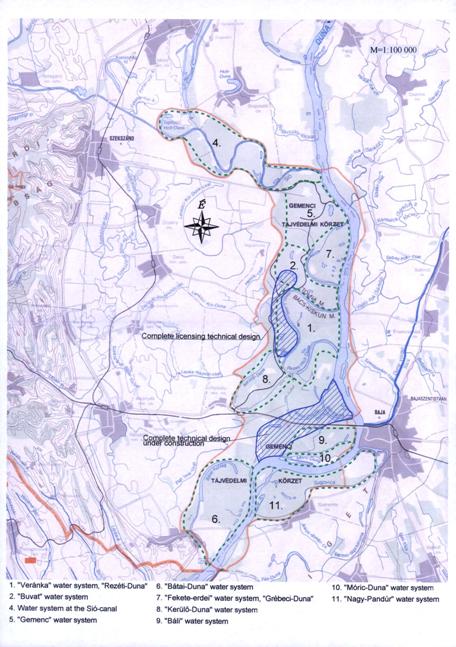
Map 2: Beda Karapancsa area of the Duna Drava National Park
Annex 18: Biological Processes of Nutrient Trapping in Floodplains and Wetlands
Hungary: NUTRIENT REDUCTION (GEF) PROJECT
Introduction:
Wetlands perform many important biochemical functions in watersheds in relation to nutrients (Nitrogen and Phosphorus). Among these are sediment trapping; nutrient removal, storage and release; and transformation of inorganic nutrients to organic forms. Floodplains and temporary wetlands, like Gemenc and Beda-Karapancsa areas of the Duna-Drava National Park, can also be high efficiency purifiers, during both flood and dry periods. Studies have shown that, under optimal conditions, floodplains and temporary wetlands can make a significant contribution to reducing N and P loads entering the wetlands carried in surface water. Permanent wetlands and wetlands used as nutrient filters at the discharges of wastewater treatment plants indicate retention rates of up to 90% of nitrates and up to 50% of phosphorous which transit through them. However, to date, the impacts of natural floodplains and temporary wetlands on nutrient reduction have not been systematically documented. Hence, the outcomes remain difficult to predict in quantitative terms. The purpose of this annex is to describe in simple and qualitative terms the complexity of the processes expected to take place in the Project areas in relation to nutrient reduction. In particular, it will focus on the biological processes and their impacts on biodiversity. However, as indicated in the Project description, the proposed Project intends to develop knowledge and scientific data to better understand such solutions and facilitate their replication.
Processes affecting nutrient reduction in floodplains and wetlands
Nutrients entering a wetland carried in surface water may be in dissolved or particulate (suspended sediment) form, and may exist as organic and inorganic compounds. Organic N or P compounds are in either dissolved or particulate form. Inorganic compounds occur primarily in solution, as nitrate (NO3- ) or ammonium (NH4+) for N, and as orthophosphate (H2PO4- and HPO42-) or phosphate-containing minerals suspended in the water column for P. Once in the wetland, nutrients are exposed to complex combinations of physical (water flow, depth, sedimentation, filtration, absorption), chemical (denitrification) and biological (nutrient reduction through aquatic micro and macrophytes and the roots of terrestrial vegetation) processes involving a large number of dynamic parameters. These processes result in retention, cycling and release of nutrients, as indicated in Figures 1, 2, and 3. Major processes affecting retention, cycling and release of nutrients in wetlands are described in Table 1 below.
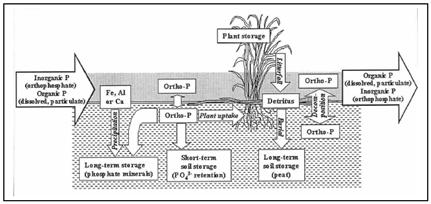
Figure 1: Simplified diagram of the Phosphorus cycle in wetlands
(Source: Phosphorus cycling in wetlands, a fact sheet of the Soil and Water Science Department, Florida Cooperative Extension Service, Institute of Food and Agricultural Sciences, University of Florida. Published: July 1999.)
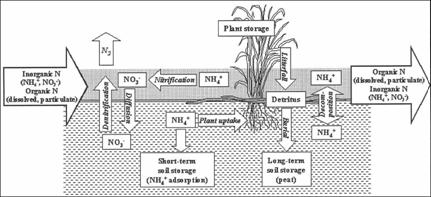
Figure 2: Simplified diagram of the Nitrogen cycle in wetlands
(Source: Nitrogen cycling in wetlands, a fact sheet of the Soil and Water Science Department, Florida Cooperative Extension Service, Institute of Food and Agricultural Sciences, University of Florida. Published: July 1999.)
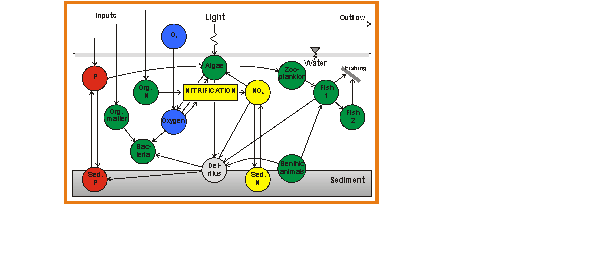

Figure 3: Much simplified scheme of nutrient cycles in wetlands
(Source: Reduction of Nutrient Discharges Project – DDNP Component – Environmental Assessment and Public Consultation (VITUKI Kht/ VTK Innosystem Ltd.) March 2005)
Table 1: Major processes affecting retention, cycling and release of nutrients in wetlands
Process
|
Effect on Nitrogen compound |
Effect on Phosphorus compound |
|
Diffusion
(Physical process) |
Driven by the concentration gradient, dissolved forms of N and P can be transferred from surface water to soil solution (porewater) and vice versa, diffusing from a region of high concentration to regions of lower concentration. |
|
Plant uptake
(Biological process) |
Inorganic forms are taken up by plants either rooted in the soil or floating in the water, including algae. |
|
Litterfall
(Physical process) |
Dead plant tissue (e.g., leaves and stems) falls from the live plants and collects at the soil surface to form a litter layer, also known as detritus. |
|
Sedimentation
(Physical process) |
Particulate matter (inorganic and/or organic sediment) entrained in the water column settles out, due to the reduced water velocity, shallow water depth and filtering action of emergent vegetation, and collects on the soil surface. |
|
Decomposition
(Biochemical process) |
Organic matter, including plant detritus, organic sediments and peat, is broken down by a variety of microorganisms that utilize organic carbon as a source of energy. Organic compounds, such as proteins and amino acids, are broken down to smaller organic molecules, both particulate and dissolved, and ultimately to ammonium (NH4+) for N and orthophosphate for P, which may be utilized either as a nutrient by the microorganisms or diffuse back into the soil or water. |
|
Ammonia volatilization
(Chemical process) |
Under high-pH conditions in the wetland floodwater, concentration of the un-ionized form of ammonia (NH3) becomes appreciable compared to NH4+, and may be released to the atmosphere as ammonia gas. This process is not usually a major factor for N cycling in most wetlands, but can lead to substantial N losses for poorly buffered waters with high photosynthetic activity (due to the associated daily increase in pH). |
|
|
Nitrification
(Biochemical process) |
Microbial conversion (by Nitrosomonas and Nitrobacter spp.) of reduced inorganic N (NH4+) to the oxidized nitrate form. This process occurs in aerobic, or oxygenated, regions of the wetland, usually confined to the surface water and the top few millimeters of the underlying soil. |
|
|
Denitrification
(Biochemical process) |
Microbial conversion (e.g., by Pseudomonas spp.) of nitrate to nitrogen (N2) gas and, to a lesser extent, nitrous oxide (N2O), which are lost to the atmosphere. The release of nitrous oxide is of particular concern, because of ozone-layer impacts. Denitrification occurs only in the anaerobic, or oxygen-depleted, regions of the wetland that typically exist below the soil surface. |
|
|
Sorption / Adsorption
(Physicochemical process) |
Retention of N in the soil by adsorption occurs through the process of cation exchange, whereby the ammonium ion (NH4+) is weakly bound to soil particles by electrostatic attraction. Most soil profiles are negatively charged, so the corresponding retention of nitrate (NO3-) is rare. |
This general term is applied to the processes of adsorption of the orthophosphate ion by clays and iron or aluminum oxides (chemisorption) in the soil, and precipitation of PO4 with either iron and aluminum oxides or dissolved calcium, to form solid compounds (Fe- and Al-phosphates or Ca-phosphates) in the soil or water column. These phosphate minerals are potentially very stable in the soil, affording long-term storage of phosphorus. |
|
Burial and peat accretion
(Physical process) |
Partially decomposed plant detritus and other organic matter is gradually buried and incorporated into the soil profile. The buried material representing the portion of organic matter that is more resistant to decomposition. It becomes highly decomposed and compressed, forming peat (i.e., peat accretion). This process takes decades to take place. |
Denitrification represents an important N removal mechanism in wetlands, because it is rapid and results in gaseous losses of N from the ecosystem. Highly favorable environmental conditions for denitrification are commonly found in wetland soils. The existence of an aerobic- anaerobic interface near the wetland soil surface greatly facilitates the coupling of nitrification and denitrification, which allows removal of inorganic N as both nitrate and ammonium. Comparatively, the capacity of wetlands for P removal is limited, as there is no loss mechanism for P in wetlands that is analogous to denitrification. Therefore, P tends to accumulate in wetlands at a higher rate than does N. However, precipitation of phosphate minerals can provide a significant sink for P in wetlands with large stores or inputs of iron and aluminum (low-pH wetlands) or calcium (high-pH wetlands).
The vast majority of nutrients in wetlands are in organic form, contained either in the vegetation (live plants), plant detritus, macrofauna, microorganisms, soil (soil organic matter or peat) or water (dissolved organic compounds or suspended sediments). Although wetlands may remove and store substantial quantities of nutrients, they also can potentially release a significant quantity to downstream ecosystems. In particular, wetlands’ functions may change seasonally. During the growing season of the vegetation, late spring, summer and early fall, emergent and submerged aquatic plants take up large quantities of nutrients from water and sediment. Algae and floating plants absorb nutrients from surface water. These plants essentially convert the wetland into a "nutrient sink," by taking nutrients from the water and sediment and retaining them as plant material. By taking up and holding nutrients during the summer, wetlands decrease the possibility of contamination downstream (Figure 4).
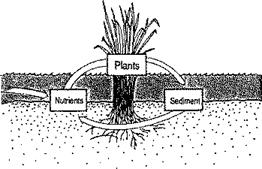
Figure 4. Nutrient Sink
However, this process reverses when these plants die. Then, decomposition and litterfall take place, generating a large portion of nutrients to return to the water and sediment. During this period (in late fall and early spring), wetlands serve as a nutrient source when water flows from the wetlands to ecosystems downstream (Figure 5).
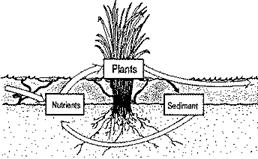
Figure 5. Nutrient Source
In most cases nutrients are recycled within the wetland. Emergent and submerged plants bring nutrients from the sediment into the water column, acting as "nutrients pumps." Algae and floating plants serve as "nutrient dumps" by taking nutrients from the water and depositing them back in the sediment when they die and settle on the bottom. The cycle breaks when nutrients are removed from the wetland system, occurring when nutrient-rich water flows out of the wetland. The release of nitrogen gas to the atmosphere by denitrification, ammonia volatilization or possibly nitrification of ammonia also causes nutrients to be lost.
Major factors influencing the efficiency of nutrient retention capacity of floodplains
Efficient management of the above processes is critical to ensure proper nutrient retention, enhance biological processes transforming nutrients into biomass, and avoid potential negative impacts such as release of nutrients or maintaining optimal conditions for flora and fauna. The efficiency of such biological processes linked to nutrient retention in floodplain ecosystems is determined by two main multi-factor parameters:
(i) The volume of water entering the ecosystem; and
(ii) The active vegetation biomass within the ecosystem.
The water flow in the ecosystems is of utmost importance, more specifically the volume of water current and its speed. On the one hand, the water inflow provides the necessary reduction-oxidation (redox) potential for the photosynthesis; on the other hand, the river provides nutrients to the vegetation biosynthesis. Since the concentration of nutrients in the Danube river waters remains quite stable all year around, the nutrient retaining capacity is in proportion to the volume of water delivering redox potential directly, and the amount of suspended solids in the river waters indirectly, provided that the water velocity is sufficiently low to allow the suspended solids to settle.
The other critical parameter regulating the retention capacity is the volume of vegetation biomasses characterizing the floodplain, as it is in proportion to the level of nutrient intake. The nutrient retaining capacity of the ecosystems will be optimal when the inundated areas of the floodplain are covered with vegetation and when the flooding episodes are taking place during the seasonal growing period of the vegetation cycle, when nutrient consumption is at its peak. However, the water depths should be shallow enough to permit the vegetation to continue its biosynthesis, even during long submersions.
On the one hand, through the restoration of the oxbows in the Gemenc and Beda-Karapancsa areas of the Park, more water will enter the floodplain during flood events. On the other hand, the development of small water regulation works intends to slow down the flow of water exiting the floodplain. As a result, temporary wetlands will be created from time to time, creating suitable conditions for the retention of nutrient loads of the Danube River and subsequently the Black Sea. In the process, both the ecology of the riverside habitats and the quality of the water leaving the floodplain are expected to improve. To reach such results, it is critical to integrate the specificity of the vegetation throughout the Project area, to take into account their relative capacity to trap nutrients and their potential limitations.
Specificity of the Gemenc- and Béda-Karapancsa floodplains
Over the last 125 years, records have shown a decrease of the water level of the Danube River by 1.6 to 1.8 meter. The cause of this decrease is the numerous hydraulic works to regulate the flow of the Danube River. As a result, the number and frequency of flood events in the Gemenc- and Béda-Karapancsa floodplains have considerably decreased, leading to a general drying of the areas. Additionally, the flood events are shorter in time and the flood waves of the Danube River are likely to occur at any period of time during the year. However, the probability is higher during the 6 month period between February and July than in the period between August and January.
The floodplains of Gemenc- and Béda-Karapancsa are habitats of a large variety of flora and fauna, which has adapted to regular floods and related sedimentation followed by dry periods. In addition, the hydrology and ecology of the Park has been modified by various human interventions. A significant portion of the forests occupying the floodplain of the Park are composed of non-indigenous tree species (e.g., about 50% in Béda-Karapancsa in 2002) such as acacias and poplars. All woodlands are managed in the area. Nowadays, the natural vegetation of the Gemenc floodplain is represented by riverine willow scrubs, riverine willow-poplar woodlands, riverine oak-elm-ash woodlands to a lesser extent, and wetland euhydrophyte, reed, typha and sedge communities. The nature conservation value of the flora is high: 30 rare, protected species have been described from the region so far, a number of which are growing in the woodlands (see Appendix I to this Annex). Higher frequency of flooding events are expected to be beneficial for forestry (natural and cultivated), as increased land desiccation represents a threat to some species.
In terms of fauna, the number of specialized and rare species of birds, bats, fishes, amphibians and other aquatic species is much larger than that of common species in the Gemenc and Beda-Karapancsa areas. Altogether 198 bird species were detected in the Gemenc and Béda- Karapancsa areas of the Park. That represents 52 % of the total number of 377 species described in Hungary until now. The number of species nestling is 124 in this area, including the Ferruginous Duck (Aythya Nyroca), the White-tailed Eagle (Haliaeetus albicilla) and Black Storks, representing 62 % of the number of total nestling species in Hungary. About 40 % of the strictly protected species are found in the Lower Danube stretch, according to ornithological observations (DEME, 2003). In addition, the Park harbours two species of rare fishes (Perca fluviatilis and Gymnocephalus cernuus), three “International Red Data Book” amphibians, and a strictly protected otter (Lutra lutra), which population is considered stable.
The Environmental Impact Assessment of the Park component, carried out during Project preparation, concludes that no significant negative impacts are expected if the measures included in the Environmental Management Plan are implemented. Moreover, the rehabilitation of the wetlands is expected to improve the ecological conditions of the ecosystem and to increase biodiversity, as new valuable habitats will be created. Positive ecological impacts are in particular expected with the creation of additional habitats for a number of migratory bird species of global importance. Furthermore, the rehabilitation of the wetlands will help solve the desiccation problem caused by the deepening of the Danube River bed, which has resulted in serious loss of wet alluvial habitats over the years. Nevertheless, given the outstanding importance of the Park in terms of biodiversity and nature conservation, proper attention should be paid to monitor the possible impacts of the Project on the ecology and biodiversity of the area. In this regard, as part of the baseline study, selected indicators species will be identified. They are to be included in the Monitoring and Evaluation system of the Project, which is to be implemented early in the process and prior to the investments. Monitoring of such indicator species is to be introduced in the list of performance indicators of the Project, to ensure that their populations remain stable and serve as an early warning system for any threats to that stability.
Appendix 1 to Annex 17: list of endangered species identified in the Park
1. A). List of protected plant species described in the Gemenc area (SZARVAS, 2003)
|
1. Listera ovata |
16. Equisetum hyemale |
|
2. Carex strigosa |
17. Vitis sylvestris |
|
3. .Orchis purpurea |
18. Marsilea quadrifolia |
|
4. Crataegus x degenii |
19. Senecio palodosus |
|
5. Scilla vindobonensis |
20. Leucojum aestivum |
|
6. Cephalantera damasonium |
21. Salvinia natans |
|
7. Nymphaea alba |
22. Clematis integrifolia |
|
8. Crategus nigra |
23. Trapa natans |
|
9. Carpensium abrotanoides |
24. Epipactis helleborine |
|
10. Dactylorhiza incarnata |
25. Iris sibirica |
|
11. Cephalanthera longifolia |
26. Dryopteris carthusiana |
|
12. Acorus calamus |
27. Dryopteris dilatata |
|
13. Platanthera bifolia |
28. Nymhoides peltata |
|
14. Gentiana pneumonanthe |
29. Orchis militaris |
|
15. Ophioglossum vulgata |
30. Platanthera clorantha |
B). List of fish species found in main riverbed (1), connected backwaters (2), and disconnected standing waters (3) in the Gemenc area.
Black boxes common, grey boxes rare, x historical data (GUTI, 2001). Where no indication is given, the presence of the fish species is suspected but was not be documented as part of this study.
|
Fish species |
1 |
2 |
3 |
|
Eudontomyzon mariae |
|
|
|
|
Acipenser ruthenus |
|
|
|
|
Acipenser güldenstaedti |
x
|
|
|
|
Acipenser nudiventris |
x
|
|
|
|
Acipenser stellatus |
x
|
|
|
|
Huso huso |
x
|
|
|
|
Hucho hucho |
|
|
|
|
Oncorhycus mykiss |
|
|
|
|
Umbra krameri |
|
|
x
|
|
Esox lucius |
|
|
|
|
Rutilus rutilus |
|
|
|
|
Rutilus pigus virgo |
|
|
|
|
Ctenopharyngodon idella |
|
|
|
|
Scardinius erythrophthalmus |
|
|
|
|
Leuciscus leuciscus |
|
|
|
|
Leuciscus cephalus |
|
|
|
|
Leuciscus idus |
|
|
|
|
Aspius aspius |
|
|
|
|
Alburnus alburnus |
|
|
|
|
Blicca bjoerkna |
|
|
|
|
Abramis brama |
|
|
|
|
Abramis ballerus |
|
|
|
|
Abramis sapa |
|
|
|
|
Vimba vimba |
|
|
|
|
Pelecus cultratus |
|
|
|
|
Tinca tinca |
|
|
|
|
Chodrostoma nasus |
|
|
|
|
Barbus barbus |
|
|
|
|
Barbus meridionalis |
|
|
|
|
Gobio gobio |
|
|
|
|
Gobio albipinnatus |
|
|
|
|
Pseudorasbora parva |
|
|
|
|
Rhodeus sericeus amarus |
|
|
|
|
Carassius carassius |
|
|
|
|
Carassius auratus |
|
|
|
|
Cyprinus carpio |
|
|
|
|
Hypophtalmichthys molitrix |
|
|
|
|
Aristichthys nobilis |
|
|
|
|
Misgurnus fossilis |
|
|
|
|
Cobitis taenia |
|
|
|
|
Silurus glanis |
|
|
|
|
Ameirus nebulosus |
|
|
|
|
Ameiurus melas |
|
|
|
|
Anguilla anguilla |
|
|
|
|
Lota lota |
|
|
|
|
Lepomis gibbosus |
|
|
|
|
Micropterus salmoides |
|
|
|
|
Perca fluviatilis |
|
|
|
|
Gymnocephalus cernuus |
|
|
|
|
Gymnocephalus baloni |
|
|
|
|
Gymnocephalus schraetzer |
|
|
|
|
Stizostedion lucioperca |
|
|
|
|
Stizostedion volgense |
|
|
|
|
Zingel zingel |
|
|
|
|
Proterorhinus marmoratus |
|
|
|
|
Neogobius fluviatilis |
|
|
|
|
Neogobius kessleri |
|
|
|
|
Neogobius syrman |
|
|
|
[1] Source: Nutrient Removal Extension of North Budapest Wastewater Treatment Plant – Environmental Impact Assessment (Imsys Ltd.) February 2005, based on MONERIS results.
[2] Estimation of the nutrient reduction potential of the rehabilitation of Gemenc and Beda-Karapancsa wetlands was carried out on the basis of the data collected, international experience in other regions and extensive literature research, with data adapted to the size and general characteristics of the selected restoration sites (e.g., permanent water bodies, water depth, timing of flooding, vegetation). Expected incremental annual nutrient reduction is estimated to range between 1,390 and 1,734 tons of N and between 76 and 92 tons of P, i.e., between 130 and 165 kilogram per hectare per year of N and between 7.3 and 8.8 kilogram per hectare per year.
[3] In addition, the amendment expressly includes such development in the Project description of the HMWP and to introduce the use of the revised procurement guidelines, dated May 2004. In parallel, a Memo is also being processed, in compliance with OP/BP 13.25 on the use of Project Cost Savings, to seek the endorsement of the Country Director, (in compliance with the ECAVP Memo dated July 8, 2005) to reallocate the loan savings and uncommitted funds for that purpose. The amendment will be signed concomitantly with the signing of the legal documents.
[4] The GEF leverage ratio is 1:7.96 (12.5 million provided by GEF and 99.5 million provided as baseline investments and counterpart)
[5] The detailed design work has been budgeted but cannot start before the GoH has assurance of financial support under the Project.
[6] In addition, the amendment expressly includes such development in the Project description of the HMWP and to introduce the use of the revised procurement guidelines, dated May 2004. In parallel, a Memo is also being processed, in compliance with OP/BP 13.25 on the use of Project Cost Savings, to seek the endorsement of the Country Director, (in compliance with the ECAVP Memo dated July 8, 2005) to reallocate the loan savings and uncommitted funds for that purpose. The amendment will be signed concomitantly with the signing of the legal documents.
[7] Current estimates of the value of nutrient reduction range from US$2/kg to about US$9/kg for N and up to US$22/kg for P. Therefore, the estimate of US$5/kg appears rather conservative. This figure of 5 US$ per kg has been adopted on the basis of available references, such as: 47 SEK/kg ($5.58/kg) and 112 SEK/kg ($13.30/kg) for the marginal cost of the reduction of nitrogen and phosphorous to coastal waters, as proposed by K. Elofsson (Cost efficient reductions of stochastic nutrient loads to the Baltic Sea, Paper presented at the 7th Ulvoe conference 19-21 June 2000), $2/kg proposed by G. Constantinides (Cost-Benefit Analysis Case Studies in Eastern Africa for the GPA Strategic Action Plan on Sewage. UNEP, 2000); 62 SEK/kg ($7.36/kg) proposed for the marginal benefit of N-reduction proposed by I.M. Gren and H. Folmer (Cooperation vs. Non-Cooperation in Cleaning of an International Water Body with Stochastic Environmental Damage: The Case of the Baltic Sea. Swedish University of Agricultural Sciences, Uppsala, September, 2001), and 11.50 EUR/kg as the critical emission "tax" level for the removal of P from detergents, as proposed by I. Ijjasz (Reducing Phosphorus in the Danube Basin Workshop, Hungary, 1995). In more recent studies, the US EPA established a benchmark for the cost-effectiveness of nutrient removal of $4 per pound of nitrogen ($8.8/kg) and $10 per pound ($22/kg) of phosphorus (Federal Register / Vol. 68, No. 29 / Wednesday, February 12, 2003 / Rules and Regulations).
[8] These two maps are the property of the WA. Written authorization to use and publish these maps has been received and filed. They have been cleared by the Cartography Department of the World Bank.