


GEF IWCAM BULLETIN
FROM THE PROJECT COORDINATION UNIT
OCTOBER 2007 ISSUE NO. 6
The last GEF-IWCAM Bulletin (August 2007, Issue
No. 5) focused on Monitoring and Evaluation Examples: Non-point source pollution programmes imple-
(M&E) systems. This naturally leads to the ques-
mented (areas treated with best management practices; kg
tion: What should we be monitoring and evaluat-
reduced); Amount of underwater or wetland area placed
ing? The answer is indicators!
into protected management, including the establishment of
Indicators
no fishing zones; Reduced pollution to groundwater re-
charge zones.
3) Environmental Quality:
What is an indicator?
Actual performance or success in restoring or protecting
Indicators are quantitative or qualitative statements that can
the targeted area.
be used to describe existing situations and measure
changes or trends over time. Indicators can be used to
Examples: Measurable improvements in tropic status; Im-
define a performance standard which, when reached,
proved (measurable) ecological or biological indices;
represents achievement of an objective.
Changes in local community income and social conditions
(stable or not worsened by the GEF intervention and, in
What are some examples of indicators?
some cases, improved) as a result of improvements in envi-
ronmental conditions.
There are many different types of indicators. The Global
Environment Facility (GEF) suggests that international wa-
Why are indicators important for the GEF-IWCAM Pro-
ters projects, such as GEF-IWCAM, group indicators into
ject?
three categories:
It is important that the GEF-IWCAM Project determine how
1) Process:
successful we have been in achieving the objective of inte-
grating watershed and coastal area management with re-
Institutional processes on the multi-country or the single-
sulting improvements in the state of the environment and
country national-level that will result in joint action on
livelihoods. Identifying indicators and keeping track of them
needed policy, legal, and institutional reforms and invest-
throughout the life of the project help us to measure the
ments which aim to reduce environmental stress.
effectiveness of activities or measures put in place. In
some cases, these indicators will be adopted by others and
Examples: Establishment of country-specific inter-
will continue to be monitored long after the GEF-IWCAM
ministerial committees to engage key ministries that may
Project has finished. This would help to determine the
be involved with reducing sectoral stress on the water
long-term impact of the project, and more specifically, its
body; Country ratification of the regional or global conven-
sustainability.
tions and protocols pertinent to the project; Country adop-
tion of specific water, environment, or sector-related legal
The establishment of indicators and their consistent moni-
reforms, policies, institutions, standards, and programmes
toring and evaluation should help us to determine which
necessary to address the transboundary priority issues,
including stakeholder participation programmes.
IWCAM--Promoting an integrated approach to the
2) Stress Reduction:
management of our watersheds and coastal
areas!
www.iwcam.org
On-the-ground measures implemented by the collaborating
countries to reduce damage to the environment.
(Continued on page 2)

GEF IWCAM PROJECT COORDINATION UNIT
approaches are beneficial to Caribbean SIDS and therefore should
continue to be used. Approaches may sometimes need to be modi-
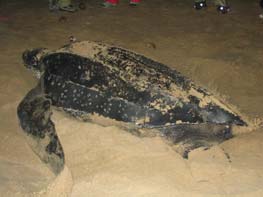
Monitoring and evaluating care-
fied or expanded upon. The hard and convincing data provided by
fully selected indicators can help us
indicators is essential to "spreading the IWCAM message." Being
to preserve the environment.
able to show improvement in conditions over time can help con-
vince key stakeholders of the benefits of this approach.
How are indicators established?
The GEF-IWCAM Project Coordinating Unit, consultants hired for
this activity, Dr. Sherry Heileman and Mr. Leslie Wallings, Demon-
stration Projects and Participating Countries (PCs) are working to-
gether to develop a suite of indicators. The first step in this process
was to determine the baseline. To do this the Project surveyed all
PCs regarding their current tracking of indicators and other data.
This provides a "snapshot" at the beginning of the GEF-IWCAM
project against which comparisons can be made at a later date, or
at different stages.
Currently, GEF-IWCAM is compiling a template of key indicators
related to institutions, policy, legislation, community participation
Other useful websites include:
and stakeholder involvement, atmosphere, biodiversity, coastal
zones, freshwater, land, natural disasters, sanitation and human
The Environment Agency, United Kingdom:
health, population, poverty level, land tenure, etc. This template will
http://www.environment-agency.gov.uk/yourenv/432430/?
be evaluated at a Workshop of experts in early 2008. It will then be
version=1&lang=_e
further refined and presented to the PCs.
A Guidebook to Environmental Indicators, CSIRO, Aus-
What is the next step after the indicators are established?
tralia:
http://www.csiro.au/csiro/envind/code/pages/menu.htm
The GEF-IWCAM Project will be working with PCs to determine and
establish sustainable mechanisms for data monitoring and capture,
The United Nations Global Environment Monitoring Sys-
through capacity building, institutional strengthening, national labo-
tem:
ratory enhancements, etc. We will be consulting our colleagues in
http://www.gemswater.org/publications/index-e.html
the region, as well as beyond, to help us determine the best way to
do this.
UNEP IWRM 2005 Programme:
http://www.ucc-water.org/iwrm05/components/
The indicators will also be monitored in the ongoing monitoring and
indicatorssem.html
evaluation (M&E) programme under the GEF-IWCAM project (see
the August 2007 Bulletin).
The presentations on indicators which were made at the
GEF-IWCAM Orientation Workshop held in May 2007
How can I find out more about indicators?
may also be useful. These can be found at:
See "Monitoring and Evaluation Indicators for GEF International
http://www.iwcam.org/information/iwcam-orientation-may-
Waters Projects" by Alfred Duda:
2007/Presentation%204%20-%20Indicators%20training.ppt
http://www.iwcam.org/information/iwcam-orientation-may-
http://www.iwcam.org/information/iwcam-orientation-may-2007/
2007/Presentation%205%20-%20IWRM%20Indicator%
documents-referenced-in-indicators-training/duda_indicator.pdf
20Presentation.ppt
Some of the information in this bul etin was excerpted from that
paper.
For more information, contact:
IWCAM Project Coordination Unit
C/O Caribbean Environmental Health Institute
The Morne, P.O. Box 1111
Castries, St. Lucia
Phone: 1 (758) 452 2501; Fax: 1 (758) 453 2721
E-mail: dspencer@cehi.org.lc
http:// www.iwcam.org