



Caribbean WaterWays
Newsletter of the GEF IWCAM Project
Volume 1, Issue 4
December 2007
In this issue:
· Feature: Protect-
Feature Article:
ing Watershed
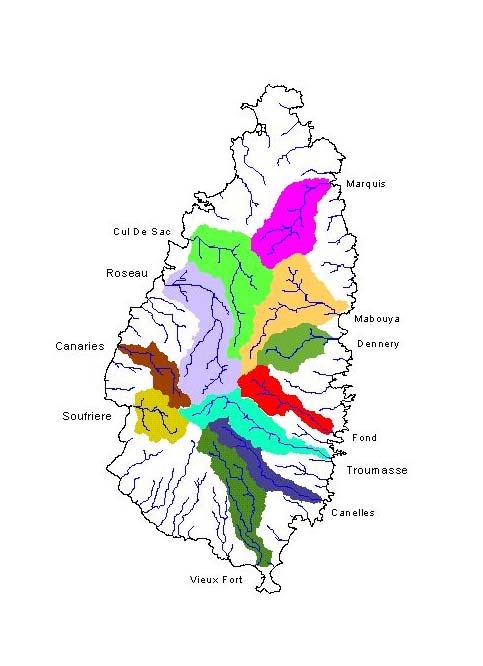
Watersheds of St. Lucia
Protecting Watershed Services and
Services and De-
veloping Manage-
Developing Management Incentives in
ment Incentives in
the Fond D'or
the Fond D'or Watershed Area of St.
Watershed Area of
St. Lucia (pgs.
Lucia
1,2,3,4)
Introduction
The Fond D'or watershed, Saint Lucia's GEF-
· Background on the
IWCAM Demonstration Project site, is considered an ideal
IWCAM Project
location to develop and test compensation for environmental
(pg. 2)
services (CES), a creative and novel approach to integrated
· Fond D'or Water-
watershed and coastal areas management. The project is
shed Activities
being executed by the Ministry of Agriculture, Fisheries and
(pg. 4)
Forestry (MAFF), through both a Project Steering Commit-
tee (PSC) for oversight and a Project Management Unit
· Legislation, Policy
(PMU) which oversees day-to-day implementation within the
and Institutional
Structures in sup-
Project's geographical area. The PMU is also guided by the
port of IWCAM--
Fond D'or Watershed Management Committee (WMC) es-
GEF-IWCAM Work-
tablished by the GEF-IWCAM Demonstration Project (see
shop participants
below).
weigh in on
"toolkit" being
Fond D'or Watershed - orange
developed (pg. 5)
St. Lucia is currently reforming its approach to water
resource management in response to deficiencies which
· World Water Moni-
have plagued the sector for years and limited the potential
toring Day and
for development in other key sectors, including agriculture
Public Awareness
and tourism. The island has taken steps to address the
Project launched
by BRT and the
varied challenges necessary to develop effective manage-
GEF-IWCAM To-
ment approaches to watersheds using innovative tech-
bago Demonstra-
niques. A national water policy, an agricultural policy and
tion Project (pg. 6)
strategic plan, and a coastal zone management policy have
all been developed recently and a national land use policy is
· IWRM IWG at the
The Fond
16th Annual
in the final stages of preparation. The concept of CES is the
D'or
CWWA Conference
most recent consideration.
Watershed
(pg. 7)
Although not traditionally considered within St. Lucia's
· Compensation for
watershed management approach, incentives are now being
Environmental
Services (pg. 8)
evaluated for water conservation and the development of a
mechanism to sustain environmental services. The island
· 2nd GEF-IWCAM
also recognizes the potential for market-based approaches
Steering Commit-
which could provide effective and efficient management of
tee Meeting (pg. 8)
watersheds, water resources, and conservation of associ-
(Continued on page 2)
www.iwcam.org
2
IWCAM Caribbean WaterWays Newsletter
(Continued from page 1)
Fond D'or Demonstr
ation Project General Ob-
ated biodiversity and ecosystems throughout the water-
jectives:
shed/coastal complex.
· To develop a
model approach to partici-
patory watershed management which
The Fond D'or Watershed
will capture the input and support of all
stakeholders, particularly local communi-
The Fond D'or Watershed is the second largest watershed
ties, within a specific watershed com-
in St. Lucia. It is 10,230 acres in area, most of which is
plex;
hilly. Government Forest Reserves makes up 23% of the
watershed. Although the reserves are located within the
· To capture requirements for integration
upper watershed area, they are linearly configured and are
with other national policies, legislation
not significant in terms of their impact on water supply; in
and resource management strategies;
fact only one of the four water intakes used to supply pipe
borne water to residents of local communities has its drain-
· To demonstrate the use of incentives
age basin completely protected within the forest reserve.
and transferred benefits within a water-
shed management structure;
The other intakes are fed mainly from privately owned
lands which are either subjected to, or threatened by, in-
· To achieve reduction in wastage and
tensive agricultural and urban activities. The middle and
water loss;
lower watershed areas are commonly used for intensive
cultivation and livestock production.
· To encourage better conservation and
more long-term sustainable use of natu-
A water scarce area
ral resources.
Managing delivery of water services to the populace of the
Fond D'or watershed has been a major challenge for many
years. Current supply, as reported by the local water sup-
ply operator, indicates a chronic 59% daily water supply
deficit currently experienced by all or most of the water-
shed's 15 settlements.
The main factors contributing to this situation are:
1. many years of inappropriate land management prac-
tices including extensive deforestation;
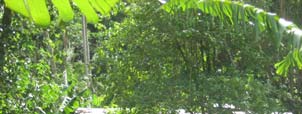
Water intake
2. significant losses/wastage of available water at the
intake and delivery network due to ageing infrastruc-
ture, inadequate management capacity, and low capi-
BACKGROUND ON THE IWCAM PROJECT:
tal investments; and
3. climatic predisposition of the area as a subtropical life
The Integrating Watershed and Coastal Areas Management in Caribbean Small
Island Development States (IWCAM) Project, with a value of USD 112 million,
zone.
was approved by the Global Environment Facility (GEF) in May 2004. Imple-
menting agencies are the United Nations Environment Programme (UNEP) and
All three factors
the United Nations Development Programme (UNDP). Executing agencies are
the Secretariat of the Cartagena Convention (UNEP-CAR/RCU) and the Carib-
have cumula-
bean Environmental Health Institute (CEHI) and the UN Office of Project Ser-
tively interacted
vices (UNOPS). The thirteen participating SIDS are: Antigua and Barbuda, The
Bahamas, Barbados, Cuba, Grenada, Dominica, Dominican Republic, Haiti,
to create what
Jamaica, Saint Kitts and Nevis, Saint Lucia, Saint Vincent and the Grenadines,
is now a water
and Trinidad and Tobago. The length of the Project is 5 years and commenced in
scarce water-
the second quarter of 2005. The Project Coordinating Unit is located at the CEHI,
as agreed by the Implementing and Executing Agencies and the participating
shed.
countries.
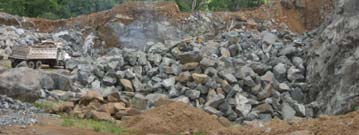
Quarry within the watershed area (Continued on page 3)
www.iwcam.org
3
IWCAM Caribbean WaterWays Newsletter
(Continued from page 2)
mental and natural resource issues, and, for their recom-
Inappropriate land management practices
These take place on the mainly privately owned
lands in this hilly area which is characterized by unstable
soil and inadequate or unsustainable social and economic
support systems. These combined factors have resulted in
many environmentally degrading practices which contrib-
ute significantly to turbidity, agrochemical, and livestock
effluent contamination of stream water. These include
unregulated changes in land use, inappropriate land cover,
poor land and soil management practices, poor waste
management, and the use of waterways as disposal points
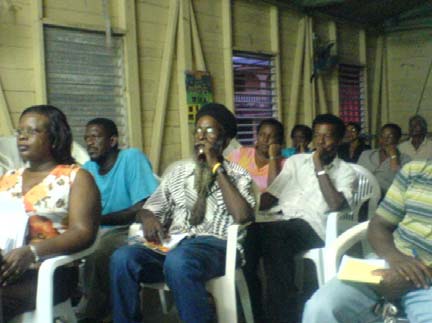
Stakeholders at a meeting of the Watershed Man-
for agricultural and other waste.
agement Committee
A recent stream water survey by the Caribbean
mendations with regard to improved management of water
Environmental Health Institute (CEHI) in its "Certificate of
resources. It is expected that this forum will be sustainable
Analysis", clearly stated the magnitude of the problem by
and continue to function wel beyond the life of the project.
observing that, "The microbiological results show that
these areas suffer
So far members of this committee have partnered
from borderline to with the PMU in a number of activities, including the map-
extremely high levels
ping of point sources of pol ution, water quality monitoring,
of faecal contamina-
to plan educational field trips for students, and delivering
tion, ...In any case,
lectures to a Parent Teacher's Association and primary
even areas with rela-
schools.
tively low counts were
unacceptable for di-
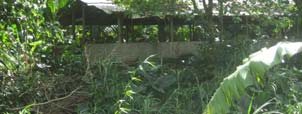
A pigsty within the watershed
rect contact recrea-
tional activities".
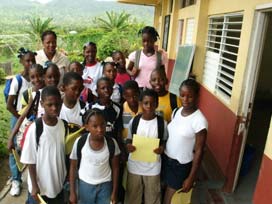
Primary school students
visit
A participatory approach
A participatory approach to integrated watershed
management is a critical aspect of the demonstration pro-
ject, as shown by activities currently underway and
planned for the future. The Fond D'or Watershed Man-
agement Committee is effectively the core of the partici-
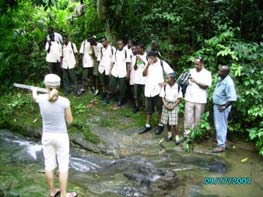
Participating in
patory watershed management mechanism. It is made up
training
of community members, government representatives, the
water utility, and other key stakeholders.
The group focuses on activities related to
changes in land management and water quality. They rep-
resent those who stand to lose or gain from the project and
whose actions can adversely affect the ability of the project
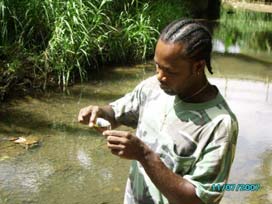
Secondary school
to meet its objectives. The WMC forum considers and ap-
students learn about
proves all plans and proposals developed by the project.
water quality testing
All consultants hired by the project must make presenta-
tions to the WMC for their input with respect to environ-
(Continued on page 4)
www.iwcam.org
4
IWCAM Caribbean WaterWays Newsletter
Similar to other GEF-IWCAM Demonstration Projects, the
Fond D'or Watershed Activities
Fond D'or Project seeks to develop an integrated water-
shed management plan, complete with:
· long-term watershed monitoring;
Since its inception in mid-2007 the St. Lucia Demo
·
Project has established the PMU, held meetings, developed
awareness and education;
its work plan and a suite of indicators. In addition it has be-
· capacity building;
gun co-operation with the Forestry Department and the Ba-
· land use plans;
nana Fair Trade Organisation, and held community meetings.
· a drainage improvement plan;
In 2008 a wide range of activities are planned, including:
· flood mitigation; and
1) A communications, public education and awareness strat-
soil and water conservation.
egy and campaign in the areas of sustainable natural resource
and environmental management. This aims to guide the building
What distinguishes the Fond D'or Demonstra-
of public awareness related to the project; help secure the commit-
tion Project from the other GEF-IWCAM Demonstration ment of stakeholders to the project aims; influence specific policies
Projects is the fact that it also seeks to compensate or policymakers with regard to key aspects of the project; and
individuals and groups for providing environmental encourage input and participation by stakeholders, through the use
services through a sustainable funding mechanism.
of planned, positive and targeted communication.
2) Development of a map of current land use and land use
It is the development and evaluation of this proposals for the Fond D'or watershed to provide a blueprint
mechanism that gets to the heart of the project itself and which can assist in guiding community participation in natural re-
will include the development of tools and mechanisms to source management and also help guide the identification of new
compensate for the conservation of the ecosystem and opportunities for sustainable economic development.
provision of environmental services, identification of finan-
cial requirements to sustain watershed management 3) A Training Needs Assessment and Capacity Building Plan
works, identification of all possible sources of funding, and for Members of the Fond D'or Watershed Management Com-
an appropriate financial management regime.
mittee to develop an appropriate human resource training plan
geared towards achieving project objectives. The project will as-
More information on the Saint Lucia Demonstration sess skills and competences of the committee members as well as
technical support staff.
Project can be found at the GEF-IWCAM website
(www.iwcam.org) and by contacting the project man-
4) A Rainwater Harvesting (RWH) Demonstration System
ager, Mr. Cornelius Isaac (cornel_isaac@yahoo.com).
which will promote a simple and low-cost water supply technology
which can provide water of an acceptable quality. This would com-
plement the current water scheme and ensure the reliability of
water supply within the Fond D'or watershed, particularly during
the dry season and periods of induced and natural drought. This
activity would include needs assessments; training of contractors;
construction of 20 RWH units at homes, schools, community cen-
tres, health centres, sporting facilities, etc; community awareness
exercises; and an evaluation of the economic and other major
impacts on demonstration households
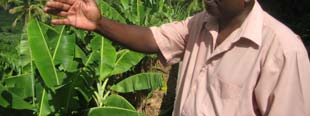
Cornelius Isaac, Project
Manager
5) A study on compensation for environment services to im-
prove sustainable land management, exploring national options
and opportunities for the establishment of a sustainable system to
compensate natural resource users for the environmental services
their management practices provide to society/community, using
the Fond D'or Watershed as a demonstration and case study site.
The study would conclude in an analysis and recommended op-
tions for implementing a sustainable funding mechanism in support
of CES and recommendations on the most appropriate Plan of
Action, including institutional arrangements and modalities to es-
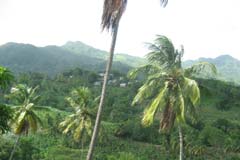
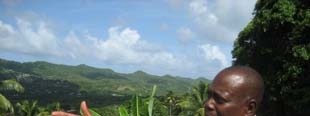
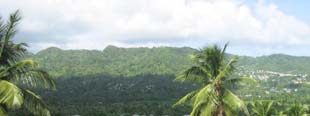
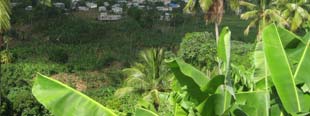
View across the Mabouya Valley
tablish a functional CES program.
www.iwcam.org
5
IWCAM Caribbean WaterWays Newsletter
IWCAM project in terms of its interventions in this area,
Legislation, Policy and Institu-
and promote the objective of IWCAM mainstreaming.
tional Structures in Support of
IWCAM
Judy Daniel (right), and Judy
- GEF-IWCAM Workshop partici-
Gobin (below), Consultants
pants weigh in on "toolkit" being
developed
Adequate and appropriate legislation, policy and institu-
tional structures are essential to mainstreaming the inte-
grated watershed and coastal areas management
(IWCAM) approach. As such, the GEF-IWCAM project is
committed to providing technical support to its participat-
ing countries in this area.
Sasha Gottlieb, Technical Coordinator , GEF-IWCAM
The issue of multilateral environmental agreements (MEAs)
as a tool for achieving IWCAM generated much discussion
over the two days. Participants highlighted the importance
of MEAs and, in general, promoted accession to these as a
way of catalyzing action in similar areas such as IWCAM.
There was also recognition of some of the challenges
faced by countries that accede to various MEAs, including
limited finances, human resources, etc. needed to achieve
the targets and fulfil reporting requirements.
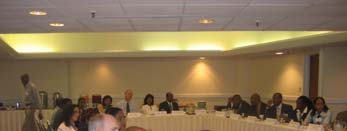
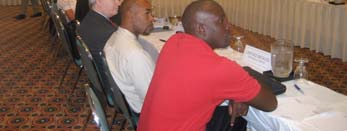
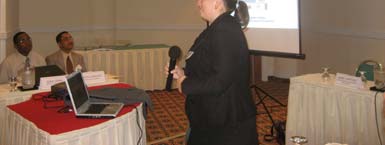
Workshop participants
This year, the project has focused on a review of relevant
and existing legislation, policy and institutional structures
and the development of a "toolkit"/ guidance document. A
group of technical and legal experts from all GEF-IWCAM
participating countries met 27 28 November 2007 in
Nassau, Bahamas for a two-day workshop.
The workshop helped to familiarize legal officers with the
IWCAM approach and technical officers with legal, policy,
Workshop participants also raised the vital importance of
and institutional tools available to better mainstream IW-
public awareness and education at all levels, from Prime
CAM. Participants also took the time to review a toolkit /
Ministers to community groups and schools. They felt that
guidance document prepared by consultants
policies and legislation related to IWCAM would be
(Environmental Advisors, Inc.) and provide concrete sug-
adopted more readily and enforced more effectively if all
gestions for improvements and the most appropriate way
segments of society were fully aware of the benefits of
to implement the guidelines / toolkit.
adopting this approach and the dangers of continuing with
the status quo, for society, the environment and the econ-
The structure and composition of the workshop itself was
omy.
based on suggestions from the GEF-IWCAM Regional
Technical Advisory Group (RTAG), when it last met in July
The report of this workshop is being prepared and
of 2007. At that time, the RTAG highlighted the need for
will be posted on the GEF-IWCAM website shortly.
action in these areas, but also acknowledged that such
Sasha Gottlieb, Technical Coordinator, may be con-
interventions would be more effective if Attorney Generals
tacted at sgottlieb@cehi.org.lc for additional infor-
Offices / National Legal Counsels were involved from the
mation.
beginning. The input and participation of the legal officers
at the workshop was a welcome addition and their contri-
butions should serve to improve the toolkit, guide the GEF-
www.iwcam.org














6
IWCAM Caribbean WaterWays Newsletter
World Water Monitoring Day and
volvement in monitoring water quality and the need for them to
become more aware of their environment, since they are today
Public Awareness Project launched
by Buccoo Reef Trust and the GEF-
IWCAM Tobago Demonstration Pro-
ject
On 7 November 2007, at Goodwood High School in Tobago, the
Buccoo Reef Trust (BRT) and the Global Environment Facility
funded Integrating Watershed and Coastal Areas Management
(GEF-IWCAM) Tobago Demonstration Project presented secon-
dary schools in Tobago with water monitoring test kits as part of
a World Water Monitoring Day and Public Awareness Project.
World Water Monitoring Day is a worldwide activity celebrated in
October and designed to increase awareness of the importance
of monitoring water quality in waterways while encouraging the
A cross-section of the audience
participation of the public. Internationally, it is coordinated by the
International Water Association and the Water Environment
and tomorrow's users, decision makers and advocates. She also
Federation.
reminded them that poor water quality has a negative impact
upon human health and biodiversity.
Approximately one hundred and fifty enthusiastic science stu-
dents and their teachers from all of Tobago's secondary schools
Remarks were also made by Andrew Daniel, Quality Control
participated in the launch. The Water and Sewerage Authority of
Manager, WASA; and Michelle Stanislaus, Environmental Officer
Trinidad and Tobago (WASA), the Division of Education, Youth
II, DNRE, THA. Ms. Sandra Timothy, GEF-IWCAM Project Man-
Affairs and Sport, and the Department of Natural Resources and
ager presented an overview of the project. The programme was
the Environment (DNRE) of the Tobago House of Assembly
chaired by Mr. Gerald McFarlane, Director, BRT.
(THA) also supported the venture.
After the official ceremony Mrs. Stanislaus and Mr. Daniel lead
Secretary for Education, Youth Affairs and Sport in the Tobago
the students in a one-on-one break-out session about the envi-
ronment and the role of watersheds and waterways in their daily
lives. This was followed by a demonstration on the use of the
test kits. The parameters measured were pH, dissolved oxygen,
turbidity and temperature.
The data collected from these assessments will become part of
the World Water Monitoring database, as well as a key compo-
nent of the BRT/ GEF-IWCAM overall land-base database. The
information gleaned will provide a snapshot of freshwater quality
which can be illustrated on Geographic Information Systems
(GIS) maps. The data will also be useful to students for school-
based assessment projects. While the WWM exercise has in-
creased awareness and given students some practical experi-
ence, the data gathered will provide valuable information that
can be used for decision making regarding watershed manage-
ment.
Mrs. Groome-Duke presents a student with a water
quality testing kit
House of Assembly, the Honorable Mrs. Claudia Groome-Duke,
affirmed her support for the programme when she agreed to be
the keynote speaker. She stressed the importance of youth in-
www.iwcam.org





7
IWCAM Caribbean WaterWays Newsletter
IWRM Informal Working Group at the 16th CWWA Annual Conference
Saint Kitts and Nevis, October 3, 2007
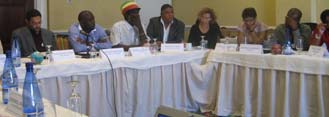
The IWRM Informal Working Group (IWG), established with support from GEF-
IWCAM and convened by GEF-IWCAM, met for the second time during the 16th
Annual Caribbean Water and Wastewater Association (CWWA) Conference in Saint
Kitts and Nevis on Wednesday, October 3rd. Among subjects discussed were:
Some relevant IWRM Activities underway in the region, including:
· A Master's level programme in Integrated Water Resources Management
(IWRM) being developed by The University of the West Indies' Centre for Resource
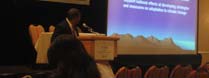
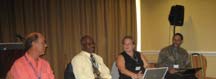
IWRM Panel
Management and Environmental Studies (UWI-CERMES).
Session
· Collaboration amongst GEF-IWCAM, the United Nations Environment Pro-
gramme's Collaborating Centre on Water and Environment (UNEP-UCC), the Carib-
bean WaterNet, the Global Water Partnership Caribbean (GWP-C), the National
Oceanic and Atmospheric Administration of the United States Department of Com-
High Level
Water Session
merce (NOAA), the Caribbean Environmental Health Institute (CEHI), and others,
on IWRM workshops in Dominica, Saint Vincent and the Grenadines, and Grenada.
· Caribbean WaterNet and CEHI collaboration on a capacity needs assessment
for IWRM in the Caribbean, in which barriers and constraints to training as well as
Conference
short and medium-term training needs were identified. An inventory of training mate-
Plenary
rials in the area of water and sanitation for the Caribbean is also being planned.
Ideas for future collaboration included:
· Development of an inventory of training materials for sanitation, water supply
and water resource management for the region.
· A database of technical expertise in the region.
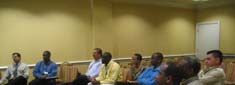
The IWRM
· The certification process for water and wastewater technicians.
IWG meets
· Linkages between the National Programmes for Action (NPA) for the Protec-
tion of the Marine Environment from Land-Based Activities and IWRMs since
the processes to develop these are very similar. The Global Programme of
Action (GPA) no longer focusses simply upon delivery of a single plan but
rather a process, highlighting sustainability, strategic planning and financing
concerns.
It was suggested that the IWG convene in June 2008 at the next Caribbean Envi-
ronmental Forum and possibly at the next CWWA Annual Conference in Fall
2008. While the option of formalizing the IWG was discussed, the decision was
made to remain as an informal grouping, but provide information and guidance as
needed to more official bodies, such as the Water High Level Sessions that are
traditionally convened at the CWWA. CEHI, in collaboration with partners is look-
ing at the preparation of a white paper or documentation of the issues that the
high level session may want to bring forward to COHSOD or others. Possibilities
for synergies regarding IWRM inception workshops in Haiti and Dominica exist.
www.iwcam.org



8
IWCAM Caribbean WaterWays Newsletter
Compensation for Environmental Services
2nd GEF-IWCAM Project Steering
Sustainable natural resource management is increasingly focusing on the ser-
vices provided by ecosystems, their value, and the growing willingness of stake-
Committee Meeting
holders to compensate natural resources stewards for such services.
Compensation for Environmental Services, also referred to as Compensation for
The second official meeting of the GEF-IWCAM Project Steering
Ecosystems Services (CES) when incorporated into broader development strate-
Committee (PSC) was held in Frigate Bay, Saint Kitts and Nevis on
gies geared towards expanding the whole basket of assets (natural, social-
October 1, 2007 and was attended by delegates from all thirteen
political, human, physical, and financial in the hands of the poor communities)
participating countries as well as the implementing and executing
can significantly contribute to improving the livelihoods of the rural poor and
agencies. The delegates were briefed on activities that had taken
advancing environmental goals.
place since the previous PSC (June 2006) and the recommenda-
tions of the Regional
CES should therefore not be pursued in an isolated fashion or be seen as an end
Technical Advisory
in itself, but should be integrated into broader sustainable development frame-
works.
Committee. They
Participants in PSC
also reviewed and
In the context of the GEF-IWCAM Project CES mechanisms could be used or
approved the draft
adopted for, for instance: watershed protection, land degradation, biodiversity
budget and work
protection and to preserve scenic beauty.
plan for 2008, mak-
- Ref. The Global Mechanism,
ing suggestions and
United Nations Convention to
revisions as needed.
Combat Desertification:
The PSC meeting
http://www.global-mechanism.org/about-us/strategicprogrammes/ces
report can be found
at the GEF-IWCAM
See also: Environment and Natural Resource Management, Compensation for
website at:
Ecosystems Services, IDRC:
http://www.idrc.ca/rpe/ev-100852-201-1-DO_TOPIC.html
http://www.iwcam.org/information/gef-iwcam-project-steering-
committee
Seasons Greetings and All the Best in 2008
from the GEF-IWCAM Team!
Participating Country Focal Points, Demonstration Pro-
jects and others are invited to submit articles. Please con-
tact Donna Spencer at dspencer@cehi.org.lc
Contact Information:
IWCAM Project Coordination Unit
P.O. Box 1111, The Morne, Castries, Saint Lucia
Tel: (758)-452-2501/1412; Fax: (758)-453-2721
E-mail: dspencer@cehi.org.lc
www.iwcam.org