


GEF IWCAM BULLETIN
FROM THE PROJECT COORDINATION UNIT
APRIL 2007 ISSUE NO. 3
Integrated Water Resources Man-
undertaking that includes the following:
agement (IWRM) Roadmapping -
Data gathering and situational analysis to provide the neces-
Two Different Approaches
sary scientific, socio-economic data required for preparation
of the National Water Policy and IWRM plan development; in
Introduction
two stages: 1) Information gathering using a data capture
In December 2006 the Caribbean Environmental Health
template 2) Preparation of a Situation Analysis.
Institute (CEHI) and the United Nations Environment Pro-
gramme Caribbean Regional Coordinating Unit (UNEP-CAR/
Development and distribution of Public Education and
RCU), under the auspices of the Integrating Watershed and
Awareness materials such as brochures, posters, presenta-
Coastal Area Management (IWCAM) Project, convened a
tions and video shorts.
meeting of the IWRM Informal Working Group in Kingston,
Preparation of an IWRM monitoring framework for Grenada
Jamaica. This resulted in a collaborative effort which aims
to provide assistance to governments in the region to accel-
erate the achievement of the Johannesburg Plan of Imple-
mentation target of Integrating Water Resources Manage-
ment and Efficiency Plans by 2005; in particular, ensuring
that environmental aspects and public participation are ade-
quately incorporated in the roadmaps and plans produced.
The United Nations Environment Programme Collaborating
Centre on Water and Environment (UNEP-UCC), the United
States National Oceanic and Atmospheric Administration
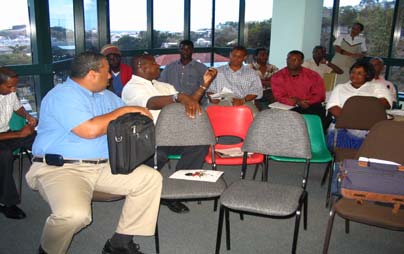
Stakeholders' Consultation,
Grenada
(NOAA) emerged as partners working with CEHI and IW-
CAM to develop IWRM Roadmaps for Grenada and Saint
based on the GEF International Waters indicators proposal.
Vincent and the Grenadines.
Presentation of the Situation Analysis to stakeholders.
Grenada
The Grenada IWRM Roadmap is being developed in tandem
Preparation of the Roadmap and National Water Policy by
with the National Water Policy as the two processes are
the WPSC as shaped by the situation analysis, visioning
interlinked. The situational assessment and strategic plan-
exercise, stakeholder input, focus groups and technical
ning elements of the road mapping process are being used
stakeholder inputs and followed by IWRM Plan validation
to inform the policy development process. This process is
and ratification through national stakeholder workshops and
being led by a multi-sectoral Cabinet-appointed Steering
policy-level input followed by formal endorsement and adop-
Committee, referred to as the Water Policy Steering Com-
tion.
mittee (WPSC). The work of the WPSC is being carried out
under the auspices of the Ministry of Agriculture, Lands,
Saint Vincent and the Grenadines (SVG)
Forestry and The approach adopted in SVG focused upon a specific geo-
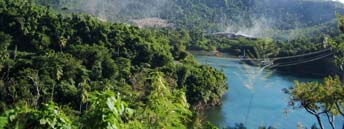
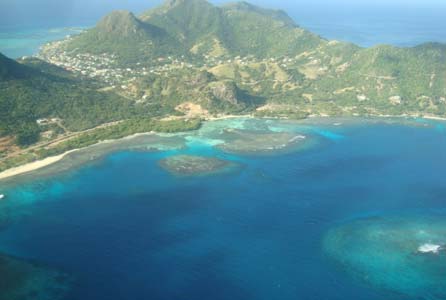
Halifax Bay, Grenada
Fisheries. The
graphical area. Using criteria developed by project partners,
Government of
and taking into consideration the enthusiasm and commit-
Grenada ex-
ment of stakeholders on the island, the acute water manage-
pects to com-
ment issues (in particular water scarcity), and its relative lack
plete the Na-
of development activities, Union Island, the southern-most
tional Water
Policy within
the next six
IWCAM--Promoting an integrated approach to the
months.
management of our watersheds and coastal
areas!
The UNEP-
www.iwcam.org
UCC supported IWRM planning process is a multi-stage
(Continued on page 2)
GEF IWCAM PROJECT COORDINATION UNIT
island in the St. Vincent Grenadine chain, was selected. It is very small,
ecosystem health. It was essentially a `train-the-trainers' exercise.
both in terms of population (estimated at just under 2,000) and size (8.5
square kilometres). Its economy is based primarily on tourism and fishing
Presentation of the Situation Analysis to stakeholders at a one-day strate-
with small-scale commercial and agriculture activities also taking place.
gic planning workshop, as part of CEHI's ongoing activities in Saint Vin-
cent and the Grenadines, at which the results of the analysis will be pre-
IWRM has not been addressed previously on Union Island, either through
sented to stakeholders and followed by discussion. Facilitation of the
public education, application and enforcement, regulations, or utilization of
discussion towards reaching consensus on strategic directions for deci-
traditional knowledge. Traditionally, Unionites have not considered man-
sion-making for consideration in preparation of the IWRM Roadmap. It is
agement of their water resources in an integrated manner given the ex-
treme acuity of their water scarcity and quality. As a result, the approach
taken in this roadmapping was to show the clear linkage between that
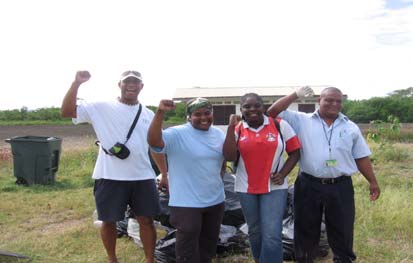
Union Island stakeholders, SVG
issue and IWRM in general. This approach consisted of the following
activities:
The UNEP-UCC and NOAA supported IWRM planning process is a multi-
stage undertaking that includes:
anticipated that the roadmap will be formally tabled to all national stake-
holders jointly by the Environmental Services Unit of the Ministry of Health
and Environment and the Ministry for Grenadine Affairs. This information
and recommendations from these consultations will inform the roadmap-
ping document, leading to the eventual development of an IWRM plan for
Union Island.
Lessons Learned
Union Island, SVG
Partnering: Partnering with other agencies, activities, and organizations
will help to ensure long-term sustainability of IWRM initiatives. Partnering
National-level Stakeholder Consultations .
with local groups will assist significantly in implementation and logistics.
Data gathering, situational analysis and water resources mapping, as in
Stress health and economic impacts of poor WRM: It is important to
the case of Grenada, but in three stages: 1) Collection of data using the
make the link between poor management of water resources and health
template. 2) Preparation of a situation analysis. 3) Mapping of the water
impacts in particular. People in affected communities as well as decision-
resources of Union Island using GIS tools to provide information that
makers are likely to pay more attention when their health is threatened.
would constitute an inventory of the water resources on the island.
Public Education and Awareness is important: If people understand
Development and dissemination of Public Education and Awareness ma-
the negative effects of their activities they are more likely to want to
terials: Brochures, posters, presentations, and video shorts
change them, particularly if their role in mitigating impacts is described
and good practices demonstrated and practiced.
Local community sensitization workshop to raise local awareness on the
In small places (as are SIDS) the empowerment of Non-Governmental
roadmapping initiative and also to gather direct feedback from the local
community on the issues related to water resources management, the
Organizations (NGOs) and Community-Based Organizations (CBOs)
challenges, and gain preliminary consensus on the strategic directions for
is particularly important: Empowering local NGOs and CBOs through
IWRM on Union Island.
the process of consultation as well as through the provision of information
and training (capacity building) will help to ensure greater sustainability.
Community-Based Water Resource Assessment Workshop which was
undertaken with schools, volunteer groups and other service organizations
Lack of financial resources are a serious limitation: In the case of
based in Union Island in order to demonstrate the link between the proc-
Union Island, for instance, fencing of a newly constructed rainwater catch-
ess of IWRM planning and development and the status of the environ-
ment would provide significantly more drinking water and storage for the
mental quality of fresh and coastal waters. The workshop focused on
community, but the catchment was constructed over two years ago and
assessment of upland land degradation, coastal water quality and coastal
this has, to date, not been completed due to lack of funds.
For more information, contact:
IWCAM Project Coordination Unit
C/O Caribbean Environmental Health Institute
The Morne, P.O. Box 1111
Castries, St. Lucia
Phone: 1 (758) 452 2501; Fax: 1 (758) 453 2721
E-mail: dspencer@cehi.org.lc
http:// www.iwcam.org