Second Project Steering Committee Meeting
Frigate Bay, Saint Kitts
1 October 2007
Prepared by
Project Coordination Unit of the
Global Environment Facility-funded Integrating Watershed
and Coastal Areas Management (GEF-IWCAM) Project
P.O. Box 1111, The Morne
Castries, St. Lucia
List of Acronyms ...................................................................................................................................... iii
Background................................................................................................................................................. 1
MEETING PROCEEDINGS...................................................................................................................... 1
Opening Remarks / Lead Agency Statements .................................................................................. 1
Explanation of Work Schedule and Objectives of Meeting and Adoption of Agenda................ 3
Regional Project Overview and Status Report .................................................................................. 3
Review of Minutes and Matters Arising ............................................................................................ 3
2008 Work Programme and budget for the regional component ................................................... 5
Presentation of status reports for participating countries ............................................................... 6
Antigua and Barbuda ........................................................................................................................ 6
Bahamas............................................................................................................................................... 7
Barbados .............................................................................................................................................. 7
Cuba ..................................................................................................................................................... 8
Dominica ............................................................................................................................................. 8
Dominican Republic .......................................................................................................................... 8
Grenada ............................................................................................................................................... 8
Haiti...................................................................................................................................................... 9
Jamaica................................................................................................................................................. 9
Saint Lucia........................................................................................................................................... 9
Saint Vincent and the Grenadines ................................................................................................. 10
Trinidad and Tobago ....................................................................................................................... 10
EAs/IAs Feedback on Demonstration Project............................................................................. 10
Annexes are included as separate documents.
List of Acronyms
Term / Phrase
Acronym
Administrative Officer
AO
Barbados Water Authority
BWA
Bilingual Administrative Assistant
BAA
Capacity Building for Integrated Water Resources Management
CAP-NET
Caribbean Environmental Forum & Exhibition
CEF
Caribbean Environmental Health Institute
CEHI
Caribbean Large Marine Ecosystem
CLME
Caribbean Water & Wastewater Association
CWWA
Centre for Resource Management and Environmental Studies
CERMES
Centers for Disease Control (U.S.)
CDC
Coastal Zone Management Unit
CZMU
Communication, Networking and Information Specialist
CNIS
Council for Human and Social Development
COHSOD
Council for Trade and Economic Development
COTED
Demonstration Focal Points
DFP
Executing Agency
EA
Global Environment Facility
GEF
Global Programme of Action for the Protection of the Marine
GPA
Environment from Land-Based Activities
Global International Waters Assessment
GIWA
Global Water Partnership Caribbean
GWP-C
Hotspot Diagnostic Analyses
HSDA
Implementing Agency
IA
Integrated Water Resources Management
IWRM
Integrating Watershed and Coastal Areas Management
IWCAM
Inter-American Water Resources Network
IWRN
International Waters Learning Exchange and Resource Network
IW:LEARN
Land Based Sources of Marine Pollution
LBS
Medium Sized Project
MSP
Monitoring and Evaluation
M&E
Multilateral Environmental Agreements
MEA
National Environmental Management Strategy
NEMS
National Focal Point
NFP
National Intersectoral Committee
NIC
National Oceanic and Atmospheric Administration (U.S.)
NOAA
National Programme of Action for the Protection of the Marine
NPA
Environment from Land-Based Activities
National Project Management Unit
NPMU
OECS Protected Areas and Associated Livelihoods (Project)
OPAAL
Organisation of Eastern Caribbean States
OECS
Pan-American Health Organisation
PAHO
Participating Country
PC
Project Coordination Unit
PCU
Project Development Facility
PDF
Project Implementation Report
PIR
Project Information Management System
PIMS
Project Steering Committee
PSC
Regional Project Coordinator
RPC
Regional Technical Advisory Group
RTAG
Ridges to Reefs
R2R
Small Island Developing State(s)
SIDS
Sustainable Integrated Resources Management
SIRM
Technical Coordinator
TC
Terms of Reference
TOR
The Nature Conservancy
TNC
Trinidad and Tobago Solid Waste Management Company Limited
SWMCOL
United Nations Development Programme
UNDP
United Nations Environment Program Collaborating Centre on Water
UCC-Water
and Environment
United Nations Environment Programme
UNEP
United Nations Environment Programme Caribbean Regional
UNEP CAR-RCU
Coordinating Unit
United Nations Office for Project Services
UNOPS
Voice over Internet Protocol
VOIP
Water Use Efficiency
WUE
Whitewater to Bluewater
WW2BW
World Resources Institute
WRI
World Summit on Sustainable Development
WSSD
Background
The second official meeting of the GEF-IWCAM Project Steering Committee (PSC) was held in
Frigate Bay, Saint Kitts and Nevis on October 1, 2007. The standard and annotated agendas for
this meeting are attached as Annexes 1 and 2 and for the Terms of Reference of the PSC, refer to
Annex 4.
MEETING PROCEEDINGS
Opening Remarks / Lead Agency Statements
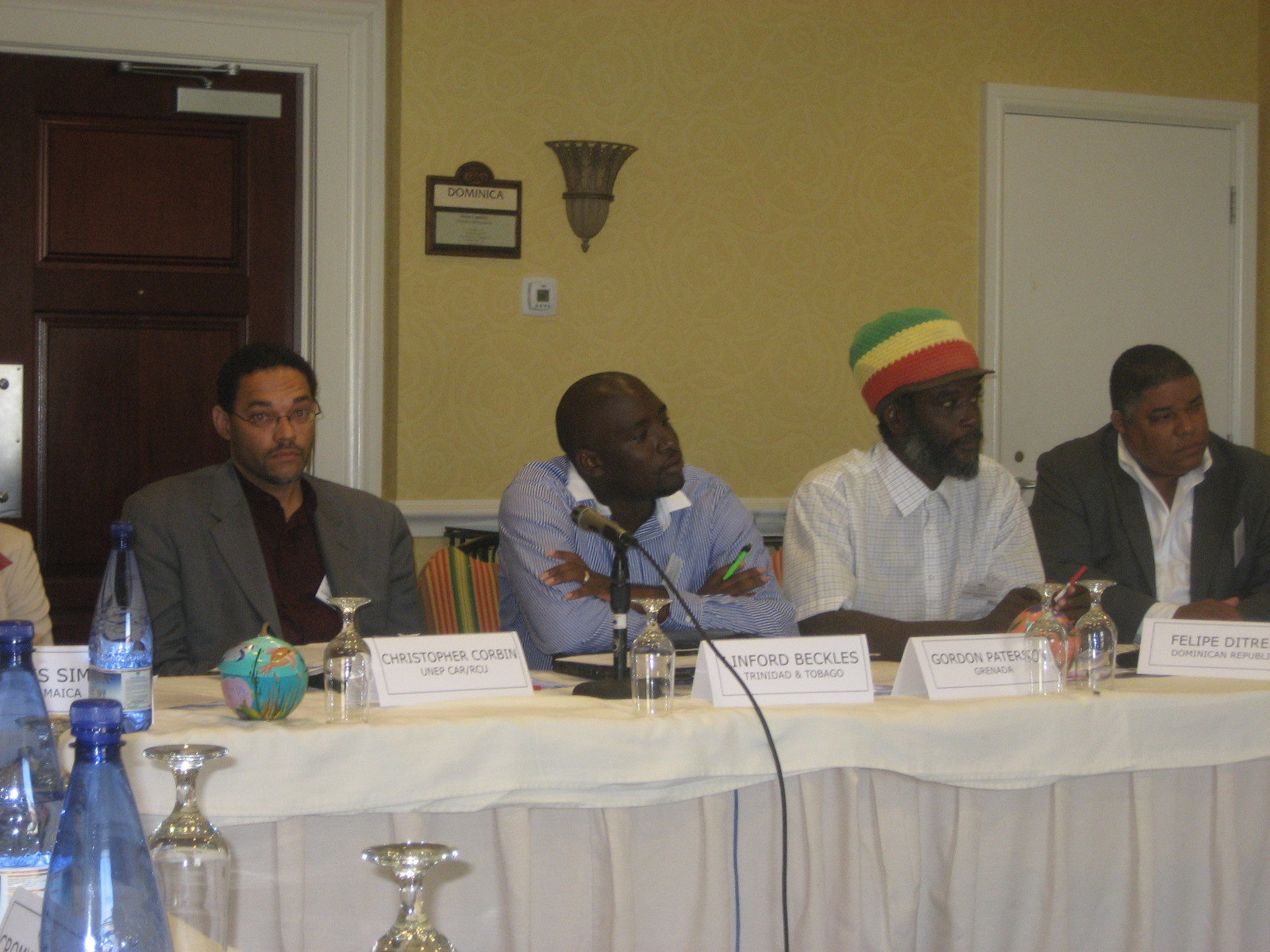
The meeting was opened by Christopher Corbin of the United Nations Environment
Programme Caribbean Regional Coordinating Unit (UNEP CAR-RCU). Cromwell Williams,
GEF-IWCAM National Focal Point (NFP) for Saint Kitts and Nevis had been expected to serve
as chair for the meeting, but due to commitments related to the Caribbean Water and
Wastewater Association (CWWA) Annual Conference, he was unable to attend the meeting in
its entirety. As such, Linford Beckles (Trinidad and Tobago Delegate) served as co-chair of the
meeting, after being nominated by Edmund Jackson (Saint Vincent and the Grenadines
Delegate) with a second to the nomination from Stephen Lindo (Barbados Delegate). At mid-
day, a third co-chair, Sheries Simpson (Jamaica Delegate) was added as Mr. Beckles lost his
voice. Sasha Beth Gottlieb (GEF-IWCAM Technical Coordinator) served as the rapporteur for
the meeting. The meeting participants agreed that the meeting would run until 5:30 pm. The
end time was later extended due to ongoing conversation regarding the PSC terms of reference.
Brief opening remarks were made by the Implementing and Executing Agencies of the GEF-
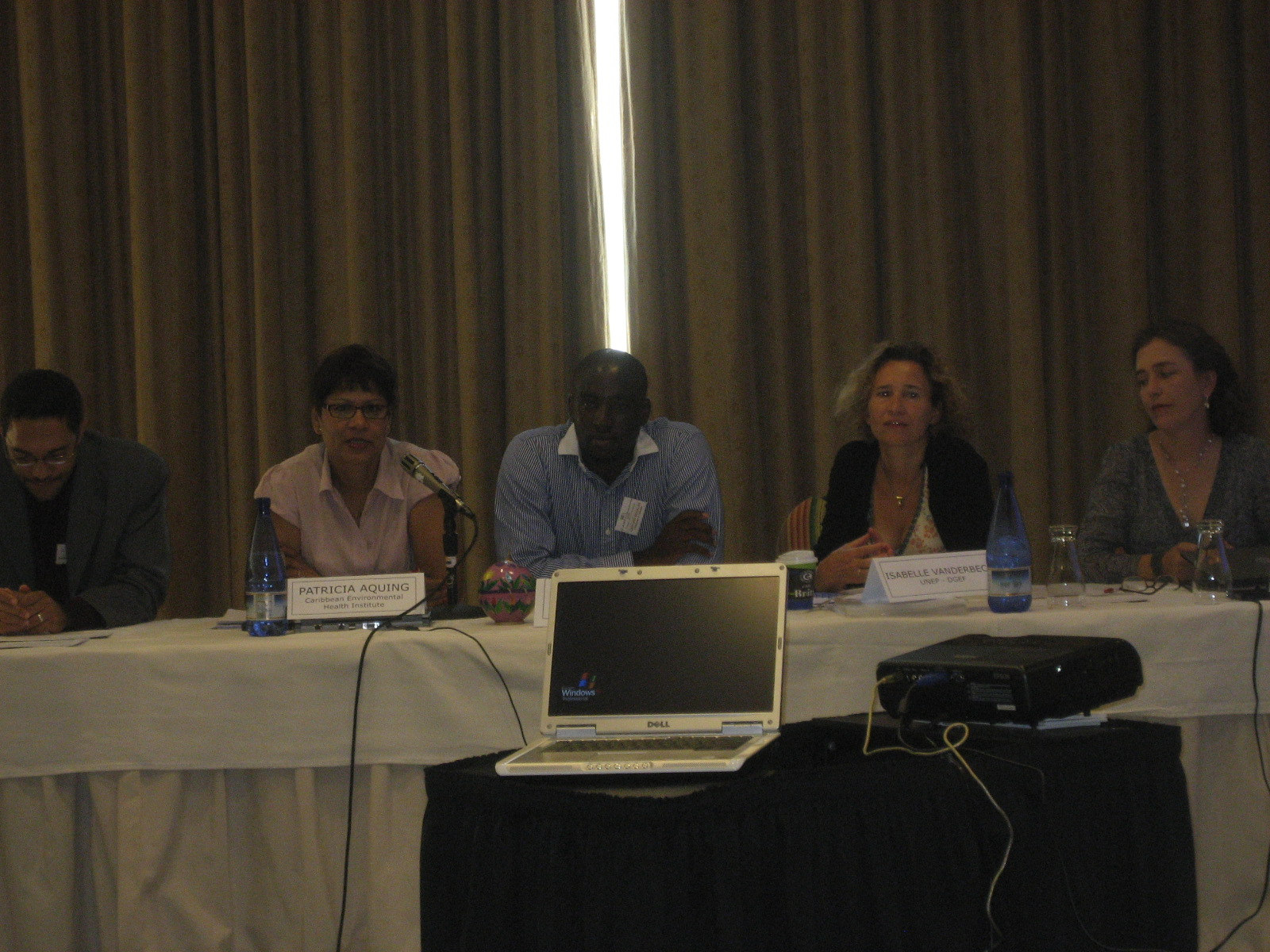
IWCAM Project. Isabelle Vanderbeck of the Division of Global Environment Facility of the
United Nations Development Programme (UNEP DGEF), who is responsible for UNEP's GEF
international waters projects in the Caribbean and South America expressed her enthusiasm at
reviewing the progress to date and taking stock of what has been done and shared her positive
impression of the GEF-IWCAM Project Coordinating Unit. Specifically Ms. Vanderbeck saw the
meeting as an opportunity to identify any problems that may exist and come up with possible
solutions. She stated her agreement for scheduling the PSC meeting near the end of the
calendar year. Ms. Vanderbeck highlighted that the GEF funding for IWCAM in the Caribbean
is incremental and must be catalytic in nature. The GEF-IWCAM project has the luxury of
"filling the gaps" of others so the region can better advance with the IWCAM approach. Ms.
Vanderbeck encouraged countries to avoid delays in order to better build synergies.
Paula Caballero of the United Nations Development Programme (UNDP) welcomed the
participants and expressed thanks to Saint Kitts and Nevis for hosting the PSC Meeting. She
reiterated remarks by Ms. Vanderbeck and also took the opportunity to thank the PCU for what
she described as a remarkable and exceptional job in getting the project underway. She
attributed this to the leadership and technical support of the PCU partnered with the
commitment from countries. Ms. Caballero described the GEF-IWCAM project as a flagship that
may well be able to exceed expectations. She encouraged all to focus on timely and consistent
delivery. In terms of demonstration projects, Ms. Caballero underscored their importance, as
GEF-IWCAM Second Project Steering Committee Meeting Report
Page 1
they are the principal tool to demonstrate IWCAM's impact to the GEF and the world. Other
topics highlighted by Ms. Caballero included the importance of enabling environments (which
are being supported by the regional activities), the importance of indicators to demonstrate
impact and of developing strong baselines and consistent monitoring regimes. She also
encouraged the countries to think about linkages with the related GEF-funded global UNDP
project for Least Developed Countries (LDC) and Small Island Developing States (SIDS) related
to sustainable land management, for which all the countries are developing Medium Sized
Projects (MSPs) in the range of US$500,000. Antigua and Barbuda is also developing a related
full sized project on integrated resource management at the island level (landscape approach).
Additionally, GEF-IWCAM should continue to collaborate with the GEF-funded Caribbean
Large Marine Ecosystem project (CLME).
Mr. Corbin expressed his gratitude to Saint Kitts and Nevis and Mr. Beckles, for hosting and co-
chairing respectively. He presented his remarks on behalf of UNEP CAR-RCU, and more
specifically, Nelson Andrade Colmenares (Coordinator), who was unexpectedly called to a
high-level government meeting in Jamaica and was unable to attend the GEF-IWCAM PSC. He
endorsed comments by Ms. Caballero in recognition of the PCU's significant work in the
quantity and quality of workshops, activities, meetings coordinated and planned over the past
year and also highlighted the Caribbean Environmental Health Institute's (CEHI) important
contribution monitoring the work and being a partner in the activities developed. The PSC
would now learn about the challenges faced by the PCU and countries and UNEP CAR-RCU
and partners are ready to work with the PCU in getting everyone up to the same level of
implementation through identifying specific national barriers and/or constraints. He noted
that the GEF-IWCAM project is different from other projects in that it is very country-driven
and the executing agencies (EAs), implementing agencies (IAs), and PCU are really working on
behalf of the countries. All are taking a similar approach to linking IWCAM with regional
initiatives and Mr. Corbin encouraged countries to do the same, especially as it related to an
integrated and streamlined approach to multilateral environmental agreements (MEAs), for
their implementation and ratification. He specifically noted the support for ratification of the
LBS Protocol that would be provided by IWCAM.
On behalf of CEHI, Patricia Aquing welcomed the participants to the meeting. She recalled that
the process leading to this GEF-IWCAM Project began in 1998 and it has been a long road in
terms of negotiating this project. She holds very high expectations for the GEF-IWCAM project
and is pleased with the role that CEHI is able to play in terms of technical backstopping and
oversight. She noted that the relationship and synergies built up over the last year have been
tremendous. CEHI is pleased to serve as host to the GEF-IWCAM PCU, whose offices are based
there and the IWCAM approach is a major programmatic focus of the Institute, with a number
of initiatives and programmes feeding into this work. She specifically informed of
complementary projects being developed or implemented by CEHI. Ms. Aquing reinforced
CEHI's commitment to support countries in adopting IWCAM (even after the project is ended)
and hopes that the project can serve as a platform from which the countries can take off. She
stressed that this project is not about reports, meetings, and documents but instead the impact
at the country and regional level and how we have changed/improved the situation and the
proof will be in the demonstration projects themselves. Patricia Aquing highlighted the
changing scenario of the GEF, the need for country representatives to support IWCAM at GEF
GEF-IWCAM Second Project Steering Committee Meeting Report
Page 2
meetings, and the need for flexibility in responding to the changes at the GEF. She also stressed
that the EAs and IAs will serve as advocates for the region in this process.
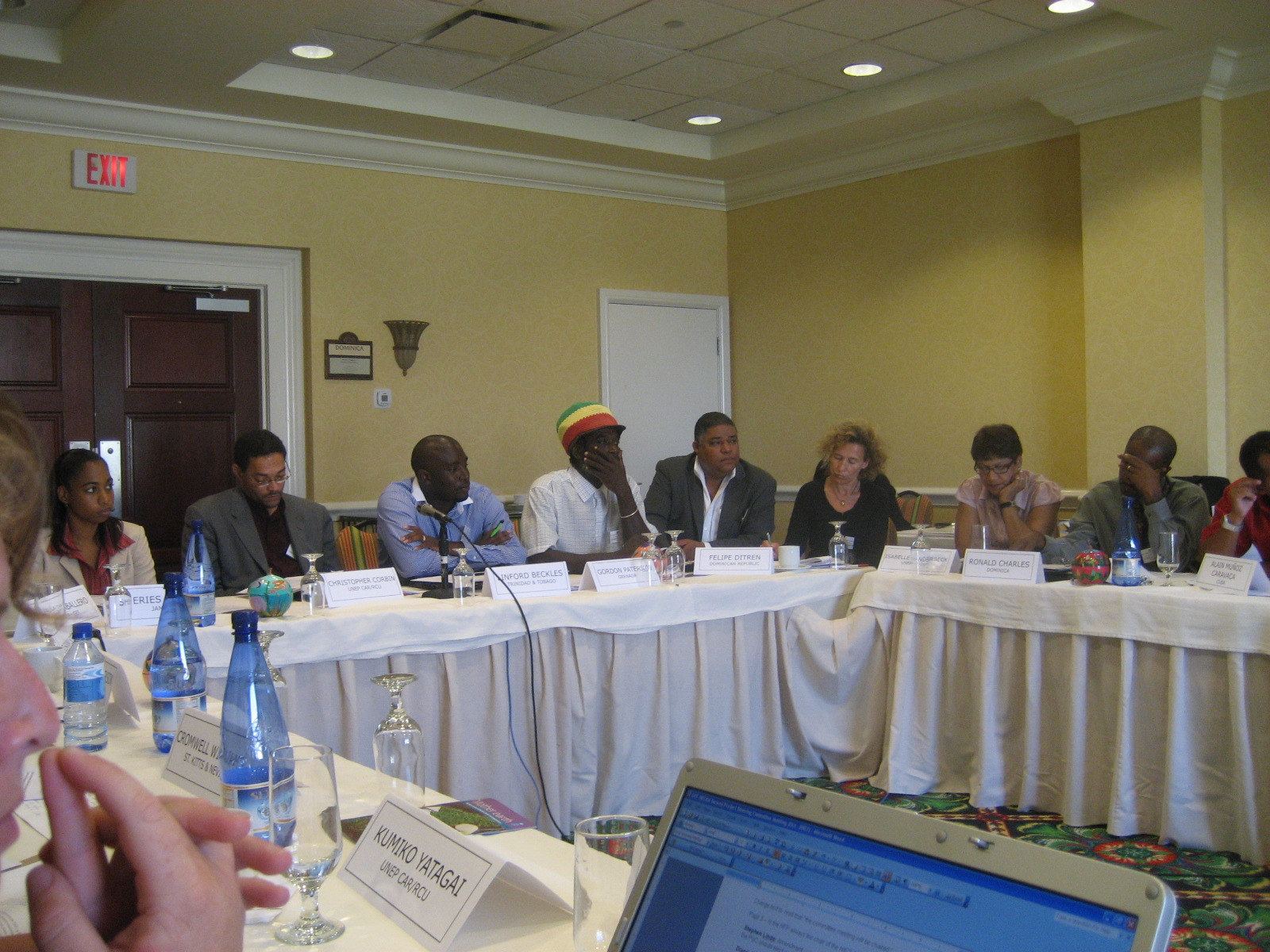
The meeting participants, which included representatives from all participating countries
(although Haiti arrived late and St. Kitts/Nevis only attended briefly), were next asked to
introduce themselves and highlight their expectations for the meeting, which included:
Networking
Reviewing progress to date
Catalyzing the demonstration projects
Sharing experiences from the demonstration project
Learning more about the project
Gaining a better understanding of challenges, problems, and constraints
Understanding how countries without demonstration projects will benefit from the
regional activities
Promoting the role of the project in assisting with linkages between different projects
running in parallel
Approving workplan and budget
Hearing what countries think of the project, want from the project, and how to deliver
what the countries need and want
Explanation of Work Schedule and Objectives of Meeting and Adoption of Agenda
Ronald Charles (Dominica Delegate) moved to adopt the agenda which was seconded by
Melesha Banhan (Antigua and Barbuda Delegate). As such, the agenda was adopted (See
Annexes 1 and 2).
Vincent Sweeney, GEF-IWCAM Regional Project Coordinator, then reviewed the objectives of
the project steering committee meeting (See Annex 3). The key points were to:
Formalize the terms of reference of the PSC
Endorse and approve the 2008 workplan and budget
Apprise the PSC of the national level project arrangements and progress for all
countries.
Regional Project Overview and Status Report
Mr. Sweeney then presented an overview on the regional activities and a status report (See
Annex 6). This was followed by a coffee break and then discussion on the presentation. At this
time, the Land Based Sources of Marine Pollution (LBS) Protocol was highlighted and the
meeting was informed that recently a regional workshop and a number of national workshops
related to the LBS took place. It was stated that one of the objectives of the GEF-IWCAM project
is to assist participating countries in the ratification and implementation of relevant MEAs in
general, by facilitating an enabling environment.
Review of Minutes and Matters Arising
GEF-IWCAM Second Project Steering Committee Meeting Report
Page 3
PSC meeting participants went on to review the minutes of the previous steering committee
meeting and the PSC terms of reference. The revised minutes, with the changes tracked, are
included as an Annex (See Annex 7). Much time and consideration was then dedicated to the
review of the PSC terms of reference. The three principal concerns were:
Rotational nature of the PSC chair
Review and endorsement of reports
Designation of PSC participants.
The language in Annex 7 was finally agreed to by all present at the meeting. Some other matters
that came up during this discussion were:
Reporting requirements: UNEP will soon be sending the PCU a template for 6 monthly
reporting.
RTAG Meetings: The PSC agreed to two Regional Technical Advisory Group (RTAG)
meetings in 2008 in order to provide additional technical guidance to the demonstration
projects.
EA/IA Information Requests: All requests for information from the countries should be
coordinated by the PCU (not coming independently from EAs and IAs). Additionally, a
six monthly report on all activities will be sent to all EAs and IAs.
Marine Vessel: The funds for the marine vessel have been reallocated to build laboratory
capacity at the national and regional level. If marine vessel use is needed, the project
will explore other options, such as the United States Environmental Protection Agency,
counterparts in Mexico, Venezuela, Colombia and France.
Participation of Other Agencies: The role of other agencies on the PSC was brought up
(e.g. the Caribbean Development Bank) and, as per previous decisions, it was agreed
that those institutions would be invited on a case-by-case basis.
Following the extensive discussion of the terms of reference, the chair sought the commitment
of members of the PSC to extend the operating hours of the meeting beyond the agreed upon
end time of 5:30 pm. A motion to do this was raised by Mr. Charles (Dominican Delegate),
seconded by the Susanna Scott (Saint Lucian Delegate), and as such agreed upon.
Lunch Break
Immediately following the lunch break, four public service announcements, commissioned by
the GEF-IWCAM project and produced by the Buccoo Reef Trust, were shown to the PSC. The
themes of these videos were:
Think About Water
Water Governance
Land-Based Sources of Pollution
GEF-IWCAM Tobago Demonstration Project
The PSC participants requested that multiple copies of the videos be sent to the NFP,
Demonstration Project, and EAs/IAs. Sheries Simpson (Jamaica Delegate) also suggested that
future videos highlight additional demonstration projects. Following the videos, Ms. Scott
GEF-IWCAM Second Project Steering Committee Meeting Report
Page 4
announced that a water quality video currently was being developed in Saint Lucia, which can
be shared with the project.
The meeting then returned to discuss the issue of the PSC terms of reference. In addition to
those listed above, the participants suggested, budget allowing, that the demonstration project
managers also be able to participate in steering committee meetings, in an observer status.
Ms. Scott then made a motion to accept the terms of reference of the PSC as modified, which
was seconded by Gordon Paterson (Grenada Delegate) and as such they were officially
approved by the PSC.
2008 Work Programme and budget for the regional component
Mr. Sweeney presented the 2008 workplan and budget for the regional component via a
powerpoint presentation (See Annex 5), which reviewed all components, upcoming activities,
and project budgets. Additional detail is available in the plan of operations. The discussion
regarding the budget is summarized below:
Consulting Activities: Rochelle Newbold (Bahamas Delegate) requested that the PCU provide
NFPs with the names of agencies undertaking consulting activities on behalf of the project. It
was also requested that all workshop reports be sent to NFPs.
Unspent Funds: Mr. Jackson (Saint Vincent and the Grenadines Delegate) inquired as to the
finances of the project -- specifically, if funds are remaining after a particular activity is
completed, what is done with these funds? Mr. Sweeney explained that on an annual basis
there will be a budget presentation for the upcoming year, which would indicate any variation
from the original budget. The PSC is then able to approve or reject the proposed changes.
Funds that are not used in any particular year are then allocated to subsequent years. If at the
end of the project the funds have not been used, the project may be extended or any unspent
money would go back to the GEF. Additionally, modified budgets must be approved by the
EAs / IAs. Ms. Caballero informed the group that she has never had the experience of sending
funds back to the GEF, as the agencies have always been able to find appropriate activities in
order to spend the remaining funds.
Secondments: The PSC requested some clarification on secondments. The meeting was informed
that secondments are for the benefit of all GEF-IWCAM participating countries (not just
countries with demonstration projects). Countries are asked to present requests for
secondments, as well as offer up areas where they might have a particular expertise.
Feedback on the Budget: An update on IA feedback on the budget was requested. The revised
budget was sent to UNEP the previous week and the officer in charge had signed the revision. It
is expected that everything will be in place in the next couple of weeks.
Standards for Sewage Management: Diann Black-Layne (Antigua and Barbuda Delegate)
suggested that this might be handled through a national-level certificate programme. A desire
was expressed to better institutionalize knowledge in country.
GEF-IWCAM Second Project Steering Committee Meeting Report
Page 5
Lessons Learned: Joseph Ronald Toussaint (Haiti Delegate) underscored the importance of
tracking lessons learned and lessons to be shared. He emphasized the need for establishing a
framework to do this early in the project. Mr. Sweeney highlighted the use of a communications
strategy to help, and informed the group that a draft version has already been prepared. It was
agreed that a section on "lessons learned" would be incorporated into the six-monthly reports.
MSPs: Mr. Toussaint asked about the next steps in the process of helping countries without
demonstration projects to develop GEF MSP projects. Mr. Sweeney responded that for countries
that were not beneficiaries of demo projects, the project has endeavoured to schedule country
specific activities in those countries as a priority (e.g. Integrated Water Resource Management
or IWRM Inception Workshop). In terms of Haiti specifically, in 2008 the project will provide
special support to achieve IWRM and Water Supply and Sanitation targets. Additionally, the
project ensures that all countries will benefit from the regional component.
Linkages: Mr. Jackson asked about which activities contribute to a more coordinated approach at
a regional level. He was informed that the GEF-IWCAM is very focused on linkages and works
hard to encourage these in all activities bringing relevant partners or parties together. Some
linkages include the LDC-SIDS project and the CLME project. Additionally, the PCU continues
to collaborate and share information through the IWRM Working Group and many awareness
raising activities focus on partnerships and linkages. CEHI emphasized that the responsibility
also lies with the countries to make the linkages and keep GEF-IWCAM informed.
Presentation of status reports for participating countries
Antigua and Barbuda
A brief presentation on the demonstration project was made. The project changed sites from St.
John's to McKinnons, as the streets in St. Johns were recently renovated, so it would be
extremely controversial to dig them up again. The National Project Management Unit (NPMU)
is now fully staffed, a Technical Advisory Committee (TAC) has been established, and terms of
reference for the initial three consultancies have been disseminated. Data collection has begun
and as such Global Positioning System (GPS) reference points were established. The NPMU
developed indicators and a workplan, both of which were approved by CEHI, UNDP, and the
United Nations Office for Project Services (UNOPS). The time period for the demonstration
project has been shortened to two years, because of its nature and also the linkages between it
and the GEF-funded Sustainable Integrated Resources Management (SIRM) Project, which is
scheduled to begin in November 2007. They are also preparing an MSP related to wetlands
filtration. Antigua and Barbuda underscored the importance of synergies in their own work on
the national level. In general, the coordination between the land management project and GEF-
IWCAM (and others) is not too challenging, as all MEA focal points are located in the same
agency. Antigua and Barbuda noted that it is sometimes hard to create synergies between
projects due to the slow speed of the GEF and the much faster one year budget cycle of the
government.
GEF-IWCAM Second Project Steering Committee Meeting Report
Page 6
Members of the PSC asked Antigua and Barbuda if there were any social issues related to the
change of project site. How did the government work with the community at the first site in St.
John's? Were they upset by a lack of commitment? Was there a concern that the relationship
between the government and community might be jeopardized because of the move? Antigua
and Barbuda's response was that, as St. Johns is a commercial area, and much has changed in
the city since the demonstration project was initially designed, there was no objection. The
demonstration project was to use one square block to implement a new sewerage system, but
since then the streets of St. John's have been upgraded. It would not make sense at this time to
tear it all up.
Mr. Corbin commented that UNEP CAR-RCU was engaged in a sewage needs assessment,
which has already been completed in Saint Lucia and should take place shortly in Tobago (with
Environment Tobago, the Pan-American Health Organisation, and the Water Council). He also
shared with the PSC that technology assessments for sewage have been published by CEHI and
UNEP. Finally, he let the PSC know that UNEP and GEF are considering the establishment of a
Caribbean revolving fund for wastewater management
Bahamas
The Exuma demonstration project has convened its steering committee, which is comprised of
local government, the private sector, Ministry of Education, etc. The first meeting was
introductory and in the second meeting the terms and conditions for membership were
determined. At the third meeting, more technical matters were discussed and the
demonstration project is now looking at potential buoy sites and at harbour management. On
the whole, things are moving along smoothly. The demonstration project is linking with marine
policy, as Harbour Masters are not a normal fixture, but Elizabeth Harbour is considering doing
this, without depending on government financing.
The demonstration project in Andros addresses land management, zoning, and biodiversity
governance. To date, two steering committee meetings have been held, and a significant
amount of work has started relative to the project. A land and sea biodiversity assessment has
started and will be submitted to the steering committee shortly for their consideration. The
steering committee would then consider endorsement of its findings and develop a land use
plan for Andros to protect the aquifer.
Barbados
Barbados has been active in the PSC and attending workshops. It has established a local
committee with the Ministry of Agriculture, the Barbados Water Authority (BWA), the Coastal
Zone Management Unit (CZMU), and the Environmental Protection Department. This
committee is looking to see how all these departments can be integrated to look at coastal and
groundwater modelling for the country. Currently BWA develops and allocates resources, but
is advocating that these roles be separate in order to promote better governance. All agencies
are trying to work together as a team to see what can be done. Barbados also underscored the
need to address disaster preparedness as a region as it relates to IWRM and suggested that
GEF-IWCAM Second Project Steering Committee Meeting Report
Page 7
specific plans for each country be designed and coordinated by a central body and that MOAs
between the countries be developed so that they can help each other at the time of disaster.
Cuba
The Cuban demonstration project is not yet up and running, which is problematic since it is
designed as a full four year programme. Recognizing this, the strategy of the Cuban
government is to begin work on the activities that do not require significant capital or are
longer-term in nature, even without the funding. One of these areas is a quality assurance
programme for laboratories. As a result, twenty methodologies to ensure quality have been
certified, together with chemical technicians. The university in Cienfuegos has also developed
an IWRM programme and has since graduated ten Masters level students. In terms of linkages,
the centre slated to execute the demonstration project also receives funding from the
International Atomic Energy Agency and has sponsored a course related to the sedimentation
process in estuaries and coastal zones, attended by participants from twelve Caribbean
countries
Dominica
The Dominican delegate informed the meeting that GEF-IWCAM is alive and well in Dominica,
with the Permanent Secretary in the Ministry of Agriculture serving as the focal point.
Dominica has participated in the PSC meetings and recently hosted an RTAG Meeting and
Geographic Information System (GIS) Workshop. Additionally, last week Dominica had an
IWRM Inception Workshop.
Dominican Republic
Basic demographics and vital statistics on the Dominican Republic were provided to the PSC
(See Annex 8). There have been challenges in getting the demonstration project initiated. They
now have quotes for equipment and material, the team established, key stakeholders identified,
and have made the first contact with stakeholders, while working to ensure that the
institutional knowledge gained in this project will remain within government. The Dominican
Republic participated in the RTAG and GIS Workshops and is involved with the LBS Protocol.
A question was asked as to the impact of the change in government on the project. In response
it was stated that the new Minister required a bit of time to come up to speed and there were
some personnel changes, which did delay the process.
Grenada
Grenada participated in the RTAG Meeting, the 2006 PSC and reviews of documents. A
national intersectoral committee (NIC) has been established in Grenada to address IWRM. A
draft water policy was developed for Grenada and there is a proposed IWRM plan under
consideration also. The draft roadmap that was prepared for Grenada fed into this process, as
did community consultations, national workshops, training programs and other related IWRM
meetings. The delegate from Grenada did not have information to share on the LBS protocol,
GEF-IWCAM Second Project Steering Committee Meeting Report
Page 8
due primarily to the fragmented nature of the initiative: Fisheries is responsible for LBS,
Agriculture is responsible for IWRM, and Finance and Economic Affairs is responsible for the
GEF-IWCAM Project.
Haiti
Since Haiti has been involved in the GEF-IWCAM project, they have participated in technical
events (Coastal Water Quality Monitoring Training, GIS Workshop, etc., study on
legal/institutional issues). Haiti also participated in the recent GEF-International Waters
Conference in South Africa. Haiti also noted that the questionnaire regarding indicators was
confusing.
Like other countries, water issues in Haiti are fragmented between different institutions, with
the Ministry of Works responsible for potable water and the Ministry of Agriculture responsible
for natural resources management. The Ministry of Agriculture is working to solve the
institutional challenge of fragmentation by proposing a national agency to deal with water
resources. Currently there is a draft project that has been submitted to the parliament that
would create a National Agency for the Management of Water Resources. On the national level
there are other initiatives regarding groundwater, such as the International Atomic Energy
Agency collaboration that addresses shared aquifers between the Dominican Republic and Haiti
and the impacts of exploitation of water on alluvial aquifers. Haiti hopes to develop (within the
context of IWCAM) an integrated watershed management strategy and action plan.
Jamaica
Jamaica presented a powerpoint regarding the status of GEF-IWCAM (See Annex 9). The
demonstration project in Jamaica understands that people are tired of the talk and want action,
and the project is doing just that. Progress to date includes watershed characterization, training,
environmental monitoring, project management, public education, and workplan development.
One example of the work underway is harvesting rainwater to use to flush toilets at schools and
then having the wastewater go to biodigestors and reedbeds. This moves from pit latrines to
tertiary treated waste. The water is not reused because of the terrain of the area and cultural
misconceptions regarding treated water (e.g. farmers think that it is sewage and do not want to
use it). This demonstrates the importance of public awareness. Other questions that arose
include regulatory requirements for the system and back-ups in the case of breakdowns. In
terms of the regulatory requirements, Jamaica has national standards that are being adhered to.
The case of back-up systems is a pertinent one, as following the recent hurricane activities in
Jamaica, parts of the tanks have been stolen in order to rebuild damaged properties within the
community and were swiftly replaced.
Saint Lucia
Saint Lucia presented a powerpoint on the status of GEF-IWCAM (See Annex 10), which
provided an overview of the demonstration project and the composition of the NIC. There
GEF-IWCAM Second Project Steering Committee Meeting Report
Page 9
were some questions regarding the generation of a management fund at the demonstration
project site. These questions will be answered by the consultancy that should start soon
regarding the payment for environmental services. It was suggested that the demonstration
project take a look at World Wildlife Fund watershed projects in Belize and Guatemala that did
a lot of modelling related to payment for environmental services.
Saint Vincent and the Grenadines
Saint Vincent and the Grenadines has been involved in the development of an IWRM plan for
Union Island, which is complementary to a European Union project focused on water
monitoring. Saint Vincent and the Grenadines will be hosting two national workshops to share
the results of this initiative. The country has also been involved in the GIS workshop, RTAG
and the regional training workshop on coastal zone management/environmental monitoring.
The challenge that was noted is when someone gets training, but equipment and laboratory are
not available to implement what they have learned. As a result, the Environmental Department
now uses the laboratory of the Bureau of Standards.
Trinidad and Tobago
The delegate from Trinidad and Tobago provided a powerpoint presentation regarding the
status of the demonstration project (See Annex 11). The project has been very active and some
of the highlighted initiatives included public education/sensitisation, the establishment of a GIS
Unit, data collection and monitoring of the marine and terrestrial environments. The delegate
also spoke to the Trinidad and Tobago NIC, which has been functioning for almost one year.
The meetings take place every two months and there have been five meetings to date.
EAs/IAs Feedback on Demonstration Project
Following the country presentations, the EAs and IAs provided their feedback. Ms. Caballero
stated that the countries had made remarkable progress and showed significant achievements
and we could already see a lot of best practices taking hold. She noted that it was very
encouraging that with just one year into project implementation, so much is already underway.
Ms. Caballero took the opportunity to remind the participants that it is essential that all logos
have the GEF name on them. Ms. Vanderbeck took the opportunity to also compliment the
countries that do not have demonstration projects on their impressive work and underscored
the importance of using the full name and all EA / IA names when referring to the project. Ms.
Aquing expressed her enthusiasm at seeing so many on-the-ground activities. Mr. Corbin was
also pleased with the progress and he warned the NFPs that they should get used to being
asked for more input, with the upcoming workplan.
GEF-IWCAM Second Project Steering Committee Meeting Report
Page 10