Regional Technical Advisory Group Meeting
Roseau, Dominica
4 July 2007
Prepared by
Project Coordination Unit of the
Global Environment Facility-funded Integrating Watershed
and Coastal Areas Management (GEF-IWCAM) Project
P.O. Box 1111, The Morne
Castries, St. Lucia
Page 1 of 79
List of Acronyms ........................................................................................................................ 3
Background................................................................................................................................ 5
MEETING PROCEEDINGS ....................................................................................................... 5
Opening Ceremony ................................................................................................................ 5
Adoption of the Meeting Agenda and Terms of Reference ..................................................... 5
RTAG Decisions Regarding Terms of Reference ................................................................ 6
Rules of Procedure for the Regional Technical Advisory Group ............................................. 6
RTAG Decisions Regarding Rules of Procedure ................................................................. 6
Status Report ......................................................................................................................... 7
Draft 2008 Work Plan Demonstration Projects .................................................................... 7
Draft 2008 Workplan Indicators ........................................................................................... 8
RTAG Decisions regarding Indicators ................................................................................. 8
Hotspot Diagnostic Assessments ........................................................................................... 8
RTAG Decisions regarding Hot Spot Diagnostic Assessments ........................................... 9
Institutional, Policy and Legislative Inventory ......................................................................... 9
RTAG Decisions regarding Institutional, Policy and Legislative Inventory ..........................10
IWRM Planning .....................................................................................................................10
RTAG Decisions regarding IWRM Planning .......................................................................10
Partnership Forum / Networking and Utilization of Geographic and other Information Systems
for IWCAM ............................................................................................................................10
RTAG Decisions regarding Partnership Forum / Networking and Utilization of Geographic
and other Information Systems for IWCAM ........................................................................11
Annex 1: Provisional Annotated Agenda ...............................................................................12
Annex 2: Provisional Agenda (with times) .............................................................................15
Annex 3: RTAG Terms of Reference.....................................................................................17
Annex 4: Draft 2008 GEF-IWCAM Plan of Operations...........................................................37
Annex 5: Participants List......................................................................................................57
Annex 6: Presentations .........................................................................................................63
GEF-IWCAM Status Report ...............................................................................................64
Hotspot Diagnostic Assessment.........................................................................................70
GEF-IWCAM Partnership Forum / Networking ...................................................................75
GIS and Other Information Systems...................................................................................77
RTAG Recommendations ..................................................................................................78
Page 2 of 79
List of Acronyms
Term / Phrase
Acronym
Administrative Officer
AO
Bilingual Administrative Assistant
BAA
Capacity Building for Integrated Water Resources Management
CAP-NET
Caribbean Environmental Forum & Exhibition
CEF
Caribbean Environmental Health Institute
CEHI
Caribbean Large Marine Ecosystem
CLME
Caribbean Water & Wastewater Association
CWWA
Centre for Resource Management and Environmental Studies
CERMES
Centers for Disease Control (U.S.)
CDC
Communication, Networking and Information Specialist
CNIS
Council for Human and Social Development
COHSOD
Council for Trade and Economic Development
COTED
Demonstration Focal Points
DFP
Executing Agency
EA
Global Environment Facility
GEF
Global Programme of Action for the Protection of the Marine
GPA
Environment from Land-Based Activities
Global International Waters Assessment
GIWA
Global Water Partnership Caribbean
GWP-C
Hotspot Diagnostic Analyses
HSDA
Implementing Agency
IA
Integrated Water Resources Management
IWRM
Integrating Watershed and Coastal Areas Management
IWCAM
Inter-American Water Resources Network
IWRN
International Waters Learning Exchange and Resource Network
IW:LEARN
Medium Sized Project
MSP
Monitoring and Evaluation
M&E
Multilateral Environmental Agreements
MEA
Page 3 of 79
National Environmental Management Strategy
NEMS
National Focal Point
NFP
National Intersectoral Committee
NIC
National Oceanic and Atmospheric Administration (U.S.)
NOAA
National Programme of Action for the Protection of the Marine
NPA
Environment from Land-Based Activities
National Project Management Unit
NPMU
OECS Protected Areas and Associated Livelihoods
OPAAL
Organisation of Eastern Caribbean States
OECS
Pan-American Health Organisation
PAHO
Participating Country
PC
Project Coordination Unit
PCU
Project Development Facility
PDF
Project Implementation Report
PIR
Project Information Management System
PIMS
Project Steering Committee
PSC
Regional Project Coordinator
RPC
Regional Technical Advisory Group
RTAG
Ridges to Reefs
R2R
Small Island Developing State(s)
SIDS
Technical Coordinator
TC
Terms of Reference
TOR
The Nature Conservancy
TNC
Trinidad and Tobago Solid Waste Management Company Limited
SWMCOL
United Nations Development Programme
UNDP
United Nations Environment Program Collaborating Centre on Water
UCC-Water
and Environment
United Nations Environment Programme
UNEP
United Nations Environment Programme Caribbean Regional
UNEP CAR-RCU
Coordinating Unit
Page 4 of 79
United Nations Office for Project Services
UNOPS
Voice over Internet Protocol
VOIP
Water Use Efficiency
WUE
Whitewater to Bluewater
WW2BW
World Resources Institute
WRI
World Summit on Sustainable Development
WSSD
Background
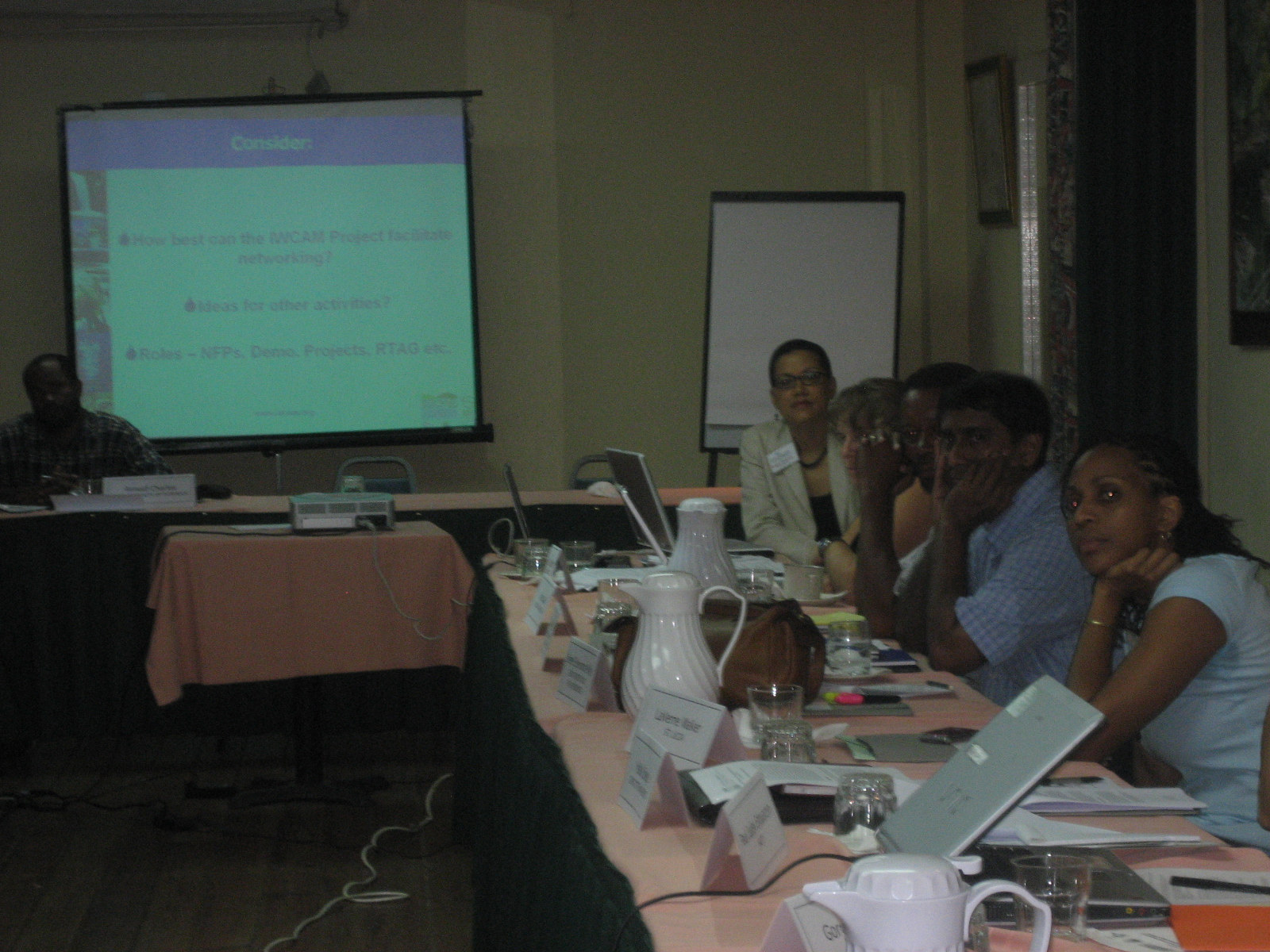
The first official meeting of the GEF-IWCAM Regional Technical Advisory Group (RTAG) was
held in Roseau, Dominica on July 4, 2007. For information on the Terms of Reference of the
RTAG, refer to Annex 3.
MEETING PROCEEDINGS
Opening Ceremony
Brief opening remarks were made by Mr. Vincent Sweeney (GEF-IWCAM RPC), Dr.
Christopher Cox (CEHI Senior Programme Officer), Ms. Nadia-Deen Ferguson (UNEP CAR-
RCU Assistant Programme Officer), and Mr. David Williams (Acting Director of Forestry, Wildlife
and National Parks Ministry of Forestry, Agriculture, and Fisheries, Dominica). The speakers
highlighted the importance of the RTAG in creating synergies between agencies and groups
working on IWRM and the role of RTAG members as advocates and champions of the GEF-
IWCAM project. They underscored their commitment to the project and wished the participants
the best in providing sound technical guidance on the project activities.
The meeting participants then introduced themselves to the group and went on to nominate and
accept Mr. Ronald Charles of Dominica as Chairperson and Ms. Sasha Beth Gottlieb of the
GEF-IWCAM Project Coordination Unit (PCU) as rapporteur.
Adoption of the Meeting Agenda and Terms of Reference
The participants of the meeting officially adopted the agenda, which was provided to them for
review the previous week. The Terms of Reference for the RTAG were then reviewed by the
group, highlighting the RTAG functions. The possibility of expanded membership on the RTAG
was discussed and it was agreed that opening of the group to a variety of members (regional
institutions, experts, etc.) would benefit the project and help to better provide guidance to the
Project Steering Committee (PSC). It was suggested that the RTAG create a contact list or
database of experts that the group could call on when needed.
The RTAG discussed the establishment of working groups. Two different approaches to working
groups were suggested, one based on activities and another was based on relevant themes.
These are each detailed below.
Page 5 of 79
Activities-based working group approach:
·
IWRM Informal Working Group
·
GIS Working Group
·
Indicators Working Group
·
Hotspot Diagnostic Assessment Working Group
Thematic working group approach:
·
IWRM / NPAs / Water Safety Planning
·
GIS / Information Systems / Database Management
·
Policy and Legal
·
Hotspot / Mapping / Indicators / Monitoring
·
Economics / Development
·
Private sector participation / outreach
RTAG members brought up the frequency of RTAG meetings, currently scheduled for at least
once a year. There was some concern that it would be difficult for the RTAG to provide
meaningful guidance to the demonstration projects if it only meets annually. A suggestion was
made that an intersessional RTAG meeting be held in January 2008, in order to provide the
needed guidance to demonstration projects, subject to budgetary considerations. It was
suggested that RTAG members should all have access to the semi-annual progress reports for
the Demonstration Projects, and input will be sought by individuals on the RTAG with expertise
in demonstration project focal areas (e.g. RTAG members with a teaching background might be
called on to provide guidance related to curriculum development).
The group suggested that the PCU develop step-by-step guidelines for meetings of the RTAG
(i.e. Terms of Reference re: procedures) to direct matters such as: How voting is addressed?
What is the role of the Chair? What happens if consensus is not reached?
RTAG Decisions Regarding Terms of Reference
·
Expansion of RTAG membership, subject to the availability of resources.
·
Develop a database/contact list of other agencies and individuals that could join or
contribute to the RTAG.
·
Working groups to be established on an ad hoc basis by PCU and later formally
endorsed by the EAs/IAs.
·
Clear Terms of Reference and timeframes should be developed for working groups.
·
Bullet points will be added to the RTAG Terms of Reference to guide meeting
procedures (e.g. election of Chair and rapporteur, using consensus, etc.) and
communication in general (interim meetings and communications, etc.).
Rules of Procedure for the Regional Technical Advisory Group
The RTAG agreed to aim for consensus as much as possible, since it is an advisory/guidance
group, and not a decision-making body for the project.
RTAG Decisions Regarding Rules of Procedure
Page 6 of 79
·
Seek to achieve consensus. When consensus cannot be reached, options would be
ranked and presented to the PSC as such.
Status Report
Presentations were made on the status of project activities and specifically demonstration
projects. These are attached as Annex 6.
There were some questions regarding the development and selection of demonstration projects.
The GEF-IWCAM PCU explained that in the identification of the demonstration projects, the
project tried to be as exhaustive as possible in addressing all critical issues related to IWCAM.
The process was country-driven with hotspots identified on a national level and concept notes
prepared. The Project Steering Committee for the PDF-B Stage of the GEF-IWCAM Project,
made up of representatives from all participating countries reviewed the concepts to ensure that
criteria were met and agreed on the nine demos.
Draft 2008 Work Plan Demonstration Projects
The group suggested that many tools should be used to improve communications with the
demonstration project. They noted the resistance that many governments have to the use of
voice over internet protocol (VOIP) and other internet-based technologies and suggested that
the PSC could highlight the importance of these tools to the government, in order to improve
project execution. There was also some concern regarding the reliability of technologies,
especially in countries like the Bahamas that receive their internet service via satellite. The
group also suggested that the PCU send e-mail to demonstration project teams with step-by-
step instructions for installation and use of Skype. It was predicted that the level of
communication might increase as projects proceed further into the actual implementation
activities. A suggestion was also made to consider the internet-based Blackboard technology.
Some countries took this opportunity to provide updates on their respective demonstration
project. The Bahamas noted that part of the delay with the project in Andros was as a result of a
change in partners. In Cuba, it is expected that the Memorandum of Agreement will be finalised
in the next month and they are now preparing the human resources needed for the execution.
Saint Lucia noted that the Demonstration Project Steering Committee meeting will be taking
place on July 5 and the National Intersectoral Committee (NIC) meeting is scheduled for late
July or early August and is being planned by the Coastal Zone Management Unit. Antigua and
Barbuda is requesting a site change for their demonstration project due, in part, to the fact that
preparations for CWC government refurbished all the sidewalk infrastructure to "hide" the open
drains. The demo project had intended to rectify the drainage issues in St. John's but now this
does not seem immediately possible as it would mean ripping up all the work that was recently
done.
It was noted that in some countries there is a level of disconnect between the demonstration
projects, RTAG, NIC, and other bodies related to GEF-IWCAM as well as the problem of
"bottlenecks" at the national level. This type of territoriality, fragmentation and lack of feedback
was felt to be common throughout the region. It was emphasized by the GEF-IWCAM PCU that
while the project will make every attempt to improve that coordination, the collaboration is really
the responsibility of stakeholders at the national level. This was considered one of the major
challenges of the project, but could also be one of the major successes with the help of GEF-
IWCAM stakeholders. A well-coordinated and collaborative NIC was considered to be critical to
the success of the project and the RTAG and NFP should be advocates/champions for this.
Page 7 of 79
Demonstration project managers were reminded of their responsibility at the national level for
spreading its message. The representative from the demonstration project in Trinidad and
Tobago noted that websites are often easy to create and an effective way to share information.
For example, the Buccoo Reef Trust has diagrams of mooring designs on its website that could
be of use to the demonstration project in Exuma, Bahamas.
Draft 2008 Workplan Indicators
The RTAG reviewed the proposed indicators activities and then offered updates on the use of
indicators in participating countries. It was noted that across the region, indicators are used but
often scattered and fragmented. For example, in Barbados, the Barbados Water Authority
collects and maintains water quality data and the meteorological office collects and maintains
data on hydrology and meteorology. Countries need assistance in coordinating and
consolidating data, creating and managing databases, selecting key indicators and updating
them, as priorities and needs change. There was a hope that the demonstration projects could
help to get the "ball rolling" in terms of indicators in many cases and then it could move to the
national level.
In Tobago, indicators for Sustainable Development were developed (environmental, social,
economic) and significant data was collected, both through surveys and the 2000 census.
Tobago is also working on sustainable tourism indicators and coastal sensitivity mapping was
conducted and is now available in GIS format. Given all of this data, it was highlighted that any
indicators framework developed by GEF-IWCAM should be compatible with the other indicators
already being collected.
In OECS countries, the suggestion was made that the National Environmental Management
Strategy (NEMS) be used as the foundation for future indicators work as it was specifically
developed to support the St. George's Declaration. Nonetheless, there is not a structured
reporting mechanism and so much data is lost.
RTAG Decisions regarding Indicators
·
Indicators work should focus on:
o
Establishing baselines, through either data collection or consolidation
o
Database development and management
o
Mainstreaming the use of indicators into everyday practice
·
Creation of an informal working group on indicators. Volunteers from the RTAG included
Kamau Akili, Alex Ifill, Andrew Magloire, Halla Sahely, and Rochelle Newbold.
Hotspot Diagnostic Assessments
A presentation was made regarding hotspot diagnostic analysis, which is included in Annex 6. In
the case of GEF-IWCAM demonstration projects, the GIWA was used. It was noted that GIWA
tends be subjective and biased towards watersheds (away from coastal areas), and it may be
more appropriate for large land masses rather than SIDS. There were also some concern
regarding socio-economic factors being addressed thoroughly in the GIWA and its prioritization
of socio-economic gain from environmental services. The group suggested that GEF-IWCAM
work to modify the assessment mechanisms to better evaluate the specific requirements of
SIDS. Ideally, a revised assessment would be used in the preparation of any future International
Page 8 of 79
Waters projects for the GEF in the Caribbean. As reference, the marine ecosystem analysis by
the Nature Conservancy (TNC), Reefs at Risk analysis by the World Resources Institute (WRI),
and HSDA indexing by UNEP CAR-RCU (which they are doing throughout the wider Caribbean)
should be considered.
RTAG Decisions regarding Hot Spot Diagnostic Assessments
·
Adapt/refine the methodology to better address Caribbean SIDS (esp. addressing the
bias towards watersheds vs. coastal areas and socio-economic aspects).
·
Working group on hotspot diagnostic analysis proposed to make it SIDS specific. This
group should include representatives from all SIDS, not exclusively Caribbean. The
working group would also be encouraged to share experiences with similar projects in
the Pacific SIDS.
Institutional, Policy and Legislative Inventory
The RTAG reviewed the items listed in the draft Plan of Operations for 2008 related to this
component and then discussed the utility of toolkits and models. It was generally agreed that
they are useful, but in order to be effective, buy-in and participation of the Attorney General's
Office is needed from the beginning. The usefulness of model legislation, especially in the
OECS, is that it can lead to the harmonization of legislation.
It was noted that the problem of overlapping jurisdiction is common in addressing watershed
management and that reform should focus, in part, on problems associated with implementation
and enforcement.
The RTAG suggested that specific consideration be given to multi-island nations (e.g. Trinidad
and Tobago). It was felt that due to their particular institutional and legislative structure, models
produced often do not work well.
The group discussed the connection between GEF-IWCAM's work in this area and support for
the ratification of the Cartagena Convention. They felt that this should be closely linked,
although there is some concern about a model being overtly related to the LBS protocol as that
might make passage of the legislation more difficult in some countries.
It was noted that policy is less useful than legislation and regulation as it is unenforceable and
changes of administrations can set back previously made gains.
The RTAG underscored that results should be action-oriented and measurable and suggested
that the NEMS serve as the over-arching framework in OECS countries.
The GEF-IWCAM PCU emphasized that the project itself cannot solve all problems in this area
but instead leadership at the national level is needed.
Cuba offered other GEF-IWCAM participating countries its assistance in the evaluation of
standards as it had just modified its land-based pollution standard to cooincide with the LBS
protocol. The Dominican Republic extended the same offer as it is now discussing a new water
law to integrate all water management issues, using Costa Rican legislation as a model and
including payment for water.
Page 9 of 79
RTAG Decisions regarding Institutional, Policy and Legislative Inventory
·
Follow up with Cuba and Dominican Republic regarding professional exchanges, etc. for
other countries regarding land and water management laws and regulations.
·
Focus on making legislation enforceable and implementable.
·
Models are useful, but Offices of Attorney Generals should be involved from the
beginning (to ensure buy-in).
·
Address the special challenges in multi-island nations.
·
Results need to be action-oriented and measurable.
·
Focus on legislation and regulation rather than policies.
·
Show how land based sources of pollution impacts human health.
IWRM Planning
A presentation on the GEF-IWCAM approach to IWRM planning was made and is attached
within Annex 6. Following that, a discussion ensued about both the status of IWRM planning
and suggestions for GEF-IWCAM in this area. It was noted that in many countries, the regulator
of water is also the main water user and service provider. Changes in this structure are
complicated by the lack of human and financial capacity in other government bodies to
undertake the role of regulator.
The RTAG again noted the problem of both territoriality and fragmentation as it pertains to
sharing of information within governments. This underscored the need for full participation and
transparency.
RTAG Decisions regarding IWRM Planning
·
IWRM work is needed, at different levels in different countries.
·
Saint Kitts and Nevis expressed the need for an IWRM inception workshop in that
country.
·
Barbados is looking forward to IWRM Workshop.
·
There is a need to facilitate information sharing.
Partnership Forum / Networking and Utilization of Geographic and other
Information Systems for IWCAM
Information sharing and networking is a key component of GEF-IWCAM and that was illustrated
in the presentation made to the RTAG (see Annex 6).
The RTAG went on to endorse the tools that could be used for effective networking and
communications, as described in the presentation. Substantive discussion of GIS was
postponed for the next two days when a workshop specific to GIS would be taking place.
In terms of networking, the RTAG discussed the importance of incorporating NGOs in a non-
adversarial, advocacy role.
Specific themes around which to structure the Project Information Management System (PIMS)
were suggested:
·
IWRM / NPAs / Water Safety Planning
Page 10 of 79
·
GIS, Information Systems, Database Management
·
Policy and Legal
·
Hotspot / Mapping / Indicators / Monitoring
·
Economics / Development
·
Private sector participation / outreach
Note: It was also suggested that these themes could serve for the working groups.
RTAG Decisions regarding Partnership Forum / Networking and Utilization of
Geographic and other Information Systems for IWCAM
·
A bevy of tools are needed for effective networking and communications.
·
Vivid images should be used for education component.
A strategy to allow for the bridge between NGOs and CBOs and the government is needed.
What issues can we focus on that would promote buy in from everyone in a non-adversarial
manner?
There being no other business, the meeting concluded at approximately 5pm with the exchange
of pleasantries.
Page 11 of 79
ANNEXES
Annex 1: Provisional Annotated Agenda
First Meeting of Regional Technical Advisory Group
GEF/IWCAM Project
July 4, 2007
Garraway Hotel
Roseau, Commonwealth of Dominica
Provisional Annotated Agenda
1.
OPENING OF THE MEETING
The IWCAM Regional Project Coordinator will Chair the Opening session, prior to the election of a
Chairperson from among the RTAG members.
1.1
Welcome Remarks
Brief remarks will be given by representatives from the Executing Agencies and the host country
1.2
Introduction of Members
The participants will be invited to introduce themselves, giving a brief outline of their expertise and
experience and elaborating on their interest in or roles in the project.
2.
ORGANISATION OF THE MEETING
2.1
Designation of Officers
The members will be invited to nominate a Chairperson, and identify a Rapporteur
2.2
Organisation of work
The meeting will agree on hours of work and discuss other administrative arrangements for the
conduct of the meeting
3.
ADOPTION OF THE MEETING AGENDA
The Provisional Agenda will be considered for amendment and adoption
4.
TERMS OF REFERENCE AND RULES OF PROCEDURE FOR THE
REGIONAL TECHNICAL ADVISORY GROUP
4.1
Terms of Reference for the Committee
The TOR (see below) contained in the Project Document will be discussed, clarified, and considered
Page 12 of 79
4.2
Membership of the Committee
The meeting will consider the need for additional expertise and possibly specialized Working Groups in
order to facilitate the work of the RTAG and the PCU/PSC. Questions for consideration by the RTAG
might include:
·
Should we involve specific agencies (such as CANARI; OECS; CDERA; FAO; SOPAC etc) in
future?
·
Are there needs for specialized Working Groups such as for IWRM, Indicators, Legislation &
Policy, Hot Spot Diagnostics and GIS?
4.3
Rules of Procedure
Recognising that the meeting is advisory in nature and not binding on the project, the RTAG may wish
to consider any rules or norms under which the meeting will be conducted
5.
STATUS REPORT ON IMPLEMENTATION OF THE GEF PROJECT "INTEGRATING
WATERSHED AND COASTAL AREAS MANAGEMENT IN CARIBBEAN SIDS"
The meeting will be apprised of the status of project implementation, including the status of
all Demonstration Projects
6.
DISCUSSION ON THE DRAFT WORKPLAN FOR 2008
The core of the input from RTAG members will be provided during this session. It would be expected
that through this discussion that a larger constituency base will be built, at the country-level, around
the major activities underway and planned. The RTAG would also be expected to assist in identifying
what relevant activities/projects are already being carried out and how the RTAG members could
specifically assist in the implementation of ongoing and/or future activities under the IWCAM project.
Potential key elements of the Work Plan for 2008 will be presented for the consideration of the RTAG
and for advice on how best these elements can be structured, prior to presentation to the Project
Steering Committee in October 2007. These Key elements will include:
6.1
Demonstration Project Implementation
6.2
Indicator Development
·
How can the IWCAM project and the outcomes from its Indicator consultancy facilitate
participating countries in utilizing indicators?
6.3
Hotspot Diagnostic Assessments
· What might be criteria considered in identifying environmental "Hot Spots"?
6.4
Legislative & Policy Reform
· What can the IWCAM project do once the framework recommendations have been made to
advance accession to the Cartagena Convention and specifically the Land-Based Sources of
Marine Pollution (LBS) Protocol?
6.5
Integrated Water Resources Management Planning
· What are the most appropriate follow-on steps needed, and which can be supported by the
IWCAM project, to advance preparation of IWRM Plans and implementation of same?
6.6
Partnership Forum/Networking
· What form should a "Partnership Forum" take?
· When should such a forum be held and where?
· How best can the IWCAM project facilitate networking?
6.7
Utilization of Geographic & other Information Systems for IWCAM
· What are the most important roles that GIS could play in integrated watershed and coastal areas
management?
· How best can the IWCAM project support GIS development?
· What are the most critical elements of a Project Information Management System for the IWCAM
project?
7.
ANY OTHER BUSINESS
Page 13 of 79
Matters not discussed previously but considered of relevance to the RTAG will be considered here
8.
DATE AND PLACE OF THE NEXT MEETING OF THE RTAG
The members will be invited to consider hosting the next RTAG meeting, possibly in 2008
9.
CLOSURE OF THE MEETING
Page 14 of 79
Annex 2: Provisional Agenda (with times)
First Meeting of Regional Technical Advisory Group (RTAG)
GEF/IWCAM Project
July 4, 2007
Garraway Hotel
Roseau, Commonwealth of Dominica
Provisional Agenda
09:00 OPENING OF THE MEETING
· Welcome Remarks
· Introduction of RTAG Members
09:30 ORGANISATION OF THE MEETING
· Designation of Officers
· Organisation of work
09:45 ADOPTION OF THE MEETING AGENDA
10:00 TERMS OF REFERENCE AND RULES OF PROCEDURE FOR THE
REGIONAL TECHNICAL ADVISORY GROUP
· Terms of Reference for the Committee
· Membership of the RTAG
· Rules of Procedure
10:30 Coffee Break
10:45 STATUS REPORT ON IMPLEMENTATION OF THE GEF PROJECT "INTEGRATING
WATERSHED AND COASTAL AREAS MANAGEMENT IN CARIBBEAN SIDS"
Page 15 of 79
11:30 DISCUSSION ON THE DRAFT WORKPLAN FOR 2008
13:00 Lunch
14:00 DISCUSSION ON THE DRAFT WORKPLAN FOR 2008 (continued)
16:30 ANY OTHER BUSINESS
16:45 DATE AND PLACE OF THE NEXT MEETING OF THE RTAG
17:00 CLOSURE OF THE MEETING
Page 16 of 79
Annex 3: RTAG Terms of Reference
The RTAG is fundamentally a technical advisory group to the project, and specifically to the
Project Steering Committee (PSC). The RTAG will consist of a senior technical representation
from each country (wherever possible this national member should represent a sector which is
related to that country's demonstration project or areas of principal IWCAM concern). The
national member will be nominated by the National Intersectoral Committee and the nomination
endorsed by the PCU and the PSC (in order to ensure an appropriate level of representation as
well as a useful balance of expertise across the RTAG membership). Other RTAG members will
include the RPC (or his/her nominated representative for that meeting), and a representative
from each of the two Executing Agencies (EAs), UNEP CAR/RCU and CEHI. The RTAG may
invite regional or international technical expertise as guests to a meeting where that expertise
may prove to be valuable (and with the agreement of the EAs).
The RTAG will meet at least once a year and immediately prior to the annual meetings of the
PSC (so that technical recommendations can be carried directly forward). Interim meetings can
be called by the EAs or requested by the PSC membership to address urgent issues. This
would be decided at the discretion of the EAs and dependent upon confirmation of adequate
funding.
The RTAG will also operate as an Interim Body through a system of networking so that issues
can be brought to the attention of the membership and discussed electronically as they arise.
The specific functions of the RTAG include:
·
Reviewing reports from the Demonstration Projects
·
Reviewing all technical matters related to project objectives
·
Addressing any increased or emerging technical concerns within the region pertinent to
the participating countries and to IWCAM issues
·
Providing technical guidance and recommendations to the PSC on project-related issues
·
React to any other requests from the PSC, PCU or EAs requiring technical input and
advice
Other than these Terms of Reference, the RTAG will set its own guidelines and procedures for
operating.
Page 17 of 79
Page 18 of 79
Annex 4: 2007 GEF-IWCAM Annual Plan of Operations
Project on
"Integrating Watershed & Coastal Areas Management in
Caribbean Small Island Developing States (IWCAM)"
ANNUAL PLAN OF OPERATIONS
2007
Prepared by
Project Coordination Unit
Page 19 of 79
ANNUAL PLAN OF OPERATIONS
2007
Table of Contents
INTRODUCTION
PURPOSE OF PLAN OF OPERATIONS
ANNUAL PLAN OF OPERATIONS
Component 1 - Demonstration, Capture and Transfer of Best Practices
Component 2 - Development Of IWCAM Process, Stress Reduction and
Environmental Status Indicators Framework
Component 3 - Policy, Legislation and Institutional Reforms
Component 4 - Regional and National Capacity Building and Sustainability
Component 5- Project Management and Coordination
ANNEXES
Project Management Structure
Reporting Requirements
Schedule of Activities
Page 20 of 79
INTRODUCTION
The Global Environment Facility (GEF) has funded a full sized Project to support 13
Participating Caribbean Small Island Developing States (Antigua and Barbuda, Bahamas,
Barbados, Cuba, Dominica, Dominican Republic, Grenada, Haiti, Jamaica, St. Kitts and Nevis,
Saint Lucia, St. Vincent & the Grenadines and Trinidad & Tobago) address issues related to the
management of watersheds and coastal areas in an integrated manner. It is specifically
supporting pilot demonstration activities on Integrating Watershed & Coastal Area Management
(IWCAM) to address priority issues at the national level with potential for replication across the
region and in other Small Island Developing State (SIDS) regions.
The overall objective of the IWCAM Project is to strengthen the commitment and capacity of the
participating countries to implement an integrated approach to the management of watersheds
and coastal areas, with a long-term goal of enhancement of the capacity of the countries to plan
and manage their aquatic resources and ecosystems on a sustainable basis.
The project recognises the highly integrated and closely interlinked nature of watersheds and
coastal areas in small islands and aims to develop a more sector-coordinated management
approach, both at the national and the regional level, with a strong emphasis on an expanded
role for all stakeholders within a participatory management framework. The project further
recognises the constraints on the development and implementation of such an integrated and
sectoral-coordinated management approach in the absence of applicable and cost-effective
solutions to many of the primary threats and their root causes at the grass-roots level. In this
respect, the Project aims to develop and secure a more effective landscape for coastal and
watershed management in the Caribbean SIDS through a logical framework of components and
activities. To this effect, project components are focusing on:
1. On-the-ground Demonstrations targeted at national hotspots where specific threats to
national, regional and global environmental amenities have been identified. Emphasis
will be on cross-sectoral management approaches, institutional/infrastructure
realignment and policy reform; sectoral and stakeholder participation and coordination,
related capacity building, and the replication and transfer of best lessons and practices
from these demonstrations.
2. Identification of impact indicators for measuring IWCAM efficacy (including indicators of
improvements in process, stress reduction, and the overall status of the coastal and
watershed environment), and to support a programme of monitoring which can drive
policy reforms.
3. Overall national and regional policy and legislative reforms (using lessons developed
through the Demonstrations), alongside institutional improvements. High priority will be
given to assisting the countries to meet the commitments required in the ratification
process for important regional legal agreements such as the Cartagena Convention and
its protocols (especially the Protocol on Land-Based Sources of Pollution). A specific
outcome from the project will be the development of effective Integrated Water
Resources Management plans for each country, followed by assistance to identify
strategies for implementing these plans.
4. Establishing mechanisms for regional integration and networking to develop active
partnerships for IWCAM (e.g. in public awareness, stakeholders participation, policy-
level sensitisation, evolution of educational materials and curricula, training,
secondments) and the development of a long-term strategy for sustainable IWCAM at
the regional level.
Page 21 of 79
5. Effective management and coordination of the overall regional project and the hotspot
demonstrations with an emphasis on developing long-term, sustainable management
and coordination approaches.
Consequently, the project aims to demonstrate the development of an effective regional strategy
for IWCAM, in parallel with demonstrating and replicating geographically targeted national
solutions to common Caribbean SIDS issues, through a series of interconnected components
that capture best practices and translate these into replicable actions.
PURPOSE OF PLAN OF OPERATIONS
The Plan of Operations has been prepared to provide details on the activities planned for 2007
and how those activities are interlinked. It will utilize a flexible approach, using the results of
continuous assessment of on-going and/or completed interventions, to inform the
design/redesign of subsequent yearly Work Plans. The Plan of Operations will form the basis for
evaluating progress achieved against agreed time-lines.
Page 22 of 79
ANNUAL PLAN OF OPERATIONS
Component 1 - Demonstration, Capture and Transfer of Best Practices
The first Component of the IWCAM focuses on "On-the-ground" Demonstrations which target
national hotspots where specific threats to national, regional and global environmental amenities
have been identified. These hotspots were identified during the PDF-Block "B" phases of the
project.
1.1
Demonstration implementation
The role of the PCU includes assistance and supervision in the execution of the demonstration
projects. In this regard, emphasis during 2007 will continue to be on initiation of implementation
of demonstration projects and assisting the national IWCAM and demonstration focal points in
establishing their National Project Management Units (NPMU), including with staffing and
administrative arrangements. These NPMUs will have reporting arrangements which require the
submission of reports to UNOPS as well as to UNEP & UNDP. The Regional Project
Coordinator, Technical Coordinator and other staff of the Regional Project Coordination Unit
(PCU) and CEHI will provide guidance on preparing and will review Work Plans and budgets for
the various Demonstration Projects and assist in finalization. Contact lists will be created for all
Demo Project PMUs (which will be integrated with the overall IWCAM Project database).
Weekly updates on the status of Memoranda of Agreement will be provided to UNOPS and IAs
until all MoAs are signed.
Demonstration project implementation, though managed on a day-to-day basis by the NPMUs
will be monitored by the PCU. The PCU has been staffed to provide technical support to the
NPMUs in the key focal areas of the demos. A Technical Coordinator (TC) was recruited during
the Fourth Quarter of 2006 (i.e. October), with expertise in the areas of water resources and
environmental management, to provide assistance to the NPMUs, during demo project start-up
and on an on-going basis. She will be supported by other PCU and CEHI technical expertise.
The Terms of Reference for the TC include:
To provide direct technical support to the participating countries and assist with the
coordination of the Demonstration Project implementation.
To provide technical advisory services and support the execution of the nine
demonstration projects and the collection and analysis of lessons learnt and best
practices
A number of countries have not developed demonstrations projects which could be funded. In
this regard, there was a desire to see Medium-Sized Projects developed for these countries.
Whereas the development of MSPs was originally within the Work Plan for Year 1, based on
reforms taking place within the GEF Secretariat, it may be more reasonable to aim for 2008 or
later to develop additional MSPs.
An alternative approach will be taken during 2007, where special focus will be placed on these
countries. Specifically, as discussed under Component 3, some of these countries (such as
Grenada and St. Vincent & the Grenadines) will be the early focus for IWRM Plan development
(in collaboration with co-financers such as NOAA and UCC).
Monitoring and evaluation of the demonstration projects will be an ongoing process. This
monitoring will be facilitated by the indicators which will be developed under Component 2
Page 23 of 79
(below). The PCU will help to establish an M&E system for the demo projects, in conjunction
with the overall Project Information Management System (PIMS), discussed under Component
5. A list-serve for all Demo project managers will also be established, including the possibility of
discussion groups using technology such as VOIP (e.g. skype).
1.2
Capture of Lessons and Best Practices
The capture of lessons and best practices will be an on-going process, involving desk research
and exchange of experiences with other relevant projects and regions. During the First Quarter
of 2007, exchange of information and lessons will be focused around the Inception Workshops
and IWRM Planning in Grenada and the Grenadines. The RPC will also participate in the
"Ocean Security Initiative" Caribbean Conference and present a paper on IWCAM in the First
Quarter.
Through interaction with other projects within the region, such as the Caribbean Large Marine
Ecosystem (CLME) project being implemented by CERMES, and with the OECS Protected
Areas and Associated Livelihoods (OPAAL) project being implemented by the OECS
Environment & Sustainable Development Unit, the groundwork for inter-project exchange will be
laid. Interaction with the South Pacific SIDS, through the South Pacific Applied Geosciences
Commission (SOPAC) will also provide for opportunities to learn lessons from and share
lessons with relevant SIDS. The PCU is also expected to participate in the Pacific SIDS PDF
Project Steering Committee meeting in the Second Quarter of 2007.
Within the IWCAM participating countries, exchanges among these Focal Points will allow for
both formal and informal learning related to best practices. These will all be facilitated by active
participation in the PSC and other meetings, such as a training activity being proposed for
Demo Focal Points in IWRM (for June).
Future opportunities for exchanges related to lessons learned which IWCAM will support during
2007 include the GEF International Waters Conference (in July/August 2007) and the Caribbean
Water & Wastewater Association (CWWA) Annual Conference (in October 2007). The PCU will
also support the High-Level Session at the CWWA Conference by assisting in preparing a
relevant background paper for Ministerial consideration.
A formal meeting of the Regional Technical Advisory Group will be convened, possibly on the
margins of another regional meeting, such as the training workshop for Demo Focal Points in
IWRM, in Tobago or Barbados. This will allow for input from Demo Focal Points (DFP) into the
discussions of the RTAG, while possibly also allowing for exchange of information and a field
evaluation of one of the demonstration sites at Buccoo Reef, Tobago. Alternatively, the PSC
meeting will be convened in Tobago to allow for the information exchange (see Component 5).
A project database will be designed with input from the Communications, Networking & IT
Specialist (CNIS) during 2007. This database will serve as a building block for the regional
Project Information Management System (PIMS). Components will include initially a database
on IWCAM contacts (including GEF Focal Points; NFPs; National PMU staff; Ministries of
Environment and other relevant Ministries; UNEP & UNDP GEF experts/associates etc.). The
database will be linked with other relevant databases in order to achieve synergies. These will
include the GPA Clearing House and the IWRN Caribbean Portal. It is expected to also initially
be the node for the storage of indicator-related information (see 2.4 below)
Page 24 of 79
The Partnership Forum will be a dynamic part of this Component, utilizing existing arenas and
events such as the CWWA, WW2BW, and the GEF/IW Conference.
1.3
Transfer & Replication of Lessons and Practices
Uptake of lessons and best practices from the demonstration projects are also tasks to be
facilitated by the PCU. However the replication and transfer of best lessons and practices from
the demonstrations is not expected to happen until later on during the overall project life (i.e.
beyond 2007).
The project, in practical terms, will actively support the IW:LEARN Inter-focal dialogue for the
Caribbean. The website for the project will be re-designed/upgraded and managed, allowing
public access to a wealth of information on the project and the demo sites. Over time, as the
website evolves, a number of innovations are planned, including interactivity, access control,
and possibly on-line training opportunities. Strong linkages to the IW:LEARN and Inter-American
Water Resources Network (IWRN) websites will be developed.
Page 25 of 79
Component 2 - Development of IWCAM Process, Stress Reduction and Environmental
Status Indicators Framework
2.1
Review IWCAM Indicators
During 2007, a review, utilizing Consultants, will be done of the existing mechanisms in the
region for the three sets of indicators developed for use in monitoring and evaluating GEF
International Waters Projects Process, Stress Reduction and Environmental Status indicators.
This work will take cognizance of work already done by agencies such as the Caribbean
Development Bank (CDB), the United Nations Economic Commission for Latin America and the
Caribbean (ECLAC), the National Oceanic & Atmospheric Administration (NOAA) and the
Organisation of Eastern Caribbean States (OECS), among others. This review will inform the
development of templates for use in the participating countries.
2.2
Develop National Indicator Templates
Templates will be developed, either in late 2007 or in 2008. These templates will be discussed
during a workshop and informed by the work of the consultants utilized for 2.1 above.
Assistance in early identification of indicators for use in M&E will be provided as appropriate,
based on the findings of the review conducted in 2.1.
2.3
Undertake National Hotspot Diagnostic Analyses
During 2007, it is proposed to begin the conduct of hotspot diagnostic analyses (HSDA) of each
of the (non-demo) hotspots in each country, including identification of priority water-related
issues/problems, immediate and root causes and required reforms. In the First Quarter, St.
Vincent & the Grenadines and Grenada will be targeted (see Component 3.4). Based on the
analyses, project concepts for follow-up/project preparation will be prepared, possibly in Year 2
or 3. The HSDA will be conducted with the assistance of Consultants and CEHI, and will be
guided by UNEP CAR/RCU.
2.4
Indicator Coordination & Training
The development and establishment of a monitoring system for indicators, using a template, will
begin within 2007 and continue into future years. Training of stakeholders in the application of
relevant indicators will be considered during 2007, based on the desire by participating
countries to begin this process of applying indicators as early as possible. This will take the form
of an Indicators workshop, which will have among its objectives to strategise for application of
indicators, provide some training, and share lessons related to the use of indicators. It will likely
involve organizations such as the CDB, CANARI, IMA, OECS, CLME and others, including from
outside of the region, such as NOAA and the GEF.
The regional centre for storage of indicator-related information will in essence, form part of the
project database (see 1.2) initially. It remains to be determined as to how the centre will evolve.
This evolution will be informed by the work of the indicator consultants. The same holds true for
the development of a Centre of Excellence for Indicator Training, which has been proposed to
start late in 2007.
2.5
Indicator Demonstration
Page 26 of 79
The establishment of a pilot monitoring system using the newly developed indicator templates
will begin late in 2007 or in 2008.
Page 27 of 79
Component 3 - Policy, Legislation and Institutional Reforms
3.1
Review of National Policy, Legislation & Institutional Structures
Beginning in the First Quarter of 2007, a review, utilizing Consultants, will be done of the
National policies and institutional structures related to integrated watershed and coastal area
management. Beyond simply a review, the Consultancy will propose remedial activities, where
necessary. These activities will be programmed for subsequent years. A workshop to discuss
findings and recommend future development of guidelines will be convened, also in 2007, after
the review has been conducted. The review will take into account other similar reviews (s.a.
CAPNET legislative review, scheduled for March 2007) and seek to ensure coordination.
3.2
Development of Models & Guidelines
Models and Guidelines development will begin in 2007, informed by the outputs from 3.1, the
Hotspot Diagnostic Analyses and stakeholder workshops. For example, specific guidelines
related to IWRM Road Maps, policies and plans, with a SIDS focus, will be developed based on
the initial work in the Grenadines and Grenada. Further guidelines, based on the outcomes from
the demo projects, will also be developed in future years.
3.3
Programme for Regional Policy, Legislative & Institutional Reform
The regional programme for amendment of national legislation and policy as well as
improvement and restructuring of institutional arrangements will be initiated in 2008. So too will
be the parallel development of incentives related to the ratification of relevant MEAs.
3.4
Development of IWRM & Water Use Efficiency Plans
A series of Regional Workshops/Meetings to discuss preparation of IWRM and Water Use
Efficiency (WUE) Plans and coordination of regional IWRM interventions took place during
2006. The IWCAM Project will continue to facilitate coordination of this work together with CEHI
and UNEP, in order to assist the countries in the Caribbean in achieving the World Summit on
Sustainable Development (WSSD) Directive on IWRM plans and strategies and specifically on
developing "Integrated Water Resources Management and Water Efficiency Plans by 2005".
The IWCAM will coordinate an "Informal Working Group" on IWRM, established in December
2006. IWCAM will also convene a number of National "Inception" Workshops which will address
the respective needs of PCs in relation to IWRM Plan preparation. These Workshops will take
place in the following order:
St. Vincent & the Grenadines January; Grenada February; Cuba or Dominican Republic
April; Dominica May; Barbados and Trinidad & Tobago June/July; St. Lucia September;
St. Kitts/Nevis October; Bahamas November (tentatively); Jamaica December
(tentatively).
Other workshops will be scheduled for 2008 in Haiti and Antigua/Barbuda. All workshops will
combine National Awareness-raising, Public Education and Stakeholder involvement. A Public
Awareness and Education strategy will be prepared and fine-tuned based on the initial
experiences in St. Vincent & the Grenadines and Grenada. Follow-up activities in all PCs will be
scheduled, based on the outcome of the Inception Workshops.
Page 28 of 79
The initial interventions in St. Vincent & the Grenadines and Grenada will seek to provide
technical assistance through the process of IWRM Plan Development, specifically:
- Visioning (workshop);
- Situation Analysis (using focus groups);
- Strategy Formulation;
- Identifying opportunities for capacity building in IWRM (specifically through GWP and
CAPNET) to strengthen and promote partnerships and networking for the implementation of
IWRM and Water Safety Plans (and NPAs).
Recommendations and outcomes from all Workshops will inform the National IWRM
development process, which will be further supported by the project. A position paper on IWRM
will also be prepared for consideration by Ministers at the High-Level Session at the CWWA
Annual Conference.
A specific training workshop in IWRM for all Demo Focal Points will also be convened, possibly
to coincide with the RTAG (as mentioned in 1.2). National Train-the-Trainers workshops will
also be encouraged, based on the training delivered, and as follow-up to training provided by
CAPNET in December 2006.
Page 29 of 79
Component 4 - Regional and National Capacity Building and Sustainability
4.1
Awareness & Sensitization
2007 will see a number of national and regional efforts to raise awareness of IWCAM, both as a
project and as an approach. These efforts will involve utilizing a combination of existing fora as
well as creating new and additional fora for awareness raising. The messages related to
IWCAM will be tailored to the various audiences, bringing issues "down to earth" and making
them meaningful to the general public. Opportunities such as Earth Day, World Water Day,
Inter-American Water Day, and World Environment Day will be used to spread the message,
utilizing the Communications Specialist within the PCU and her counterparts at the participating
country-level. In order to target senior policy-makers, IWCAM will utilize Ministerial meetings
such as CARICOM Councils (COHSOD; COTED) and the CWWA High-Level Ministerial
Session to raise IWCAM issues, placed within the appropriate context, such as IWRM, for
example.
Various media will be utilized to spread the message and cost effective approaches, such as the
Government Information Services and community/public radio will be utilized, as well as Press
Releases and a constant flow of relevant information. Every effort will be made to nurture good
relations with the media houses as well.
Bulletins, brochures, leaflets or other appropriate information products will be made available to
various publics on the IWCAM approach, what it means, and why it is important to the region.
Bulletins will be prepared on a monthly basis for electronic distribution, and translated into
Spanish. A newsletter will be prepared on a quarterly basis, in both electronic and hard copy.
The bulletins and newsletters will also be placed on the project website (www.iwcam.org).
Project brochures, Decision-makers Briefing Sheets/Packages, posters, banners, press articles
and articles for regional magazines will all be produced when needed, as part of the awareness
material. A Public Education video will also be produced.
These efforts will be consolidated through the preparation of a regional Communications
Strategy, which will be discussed at a workshop (possibly in June, to coincide with the PSC
Meeting).
As mentioned above, the National "Inception" Workshops for IWRM will also be used as
workshops to raise awareness on IWCAM.
4.2
Stakeholders Involvement
Stakeholder involvement will be an on-going strategy for all activities. Specific approaches will
be integrated as appropriate. These will include through the National "Inception" Workshops for
IWRM (and follow-up activities) and the National Intersectoral Committee meetings. A
questionnaire to determine the needs for training and information support, related to stakeholder
involvement, will be prepared and disseminated.
4.3
Education and Training
The overall thrust of GEF-funded international waters activities includes to meet the incremental
costs of building the capacity of existing institutions (or, if appropriate, developing the capacity
through new institutional arrangements). This thrust is represented throughout Component 4 of
the IWCAM and will continue in 2007.
Page 30 of 79
Capacity building will focus at the national level (including within the National Focal Point
agencies) and regional level (including at CEHI). Initially, the focus will include capacity building
for monitoring of the environment, particularly of water quality. Training in environmental
monitoring and data handling will be conducted for the demo sites and for laboratory personnel
in PCs, based on the findings of the needs assessments. The project will also support
laboratory development at the national and regional level. Equipment will be provided to PCs to
assist with their monitoring efforts. The reference capability of the accredited laboratory within
CEHI will be strengthened as well as that of appropriate other regional laboratories in PCs. The
investment in these laboratories will support the capacity building of national laboratories during
the project, through in-country training and possible attachments to these regional laboratories.
Such investments will also support the countries after the project has ended and ensure
sustainability of the project objectives (see 4.4 below). CEHI will also provide technical
backstopping to the PCs in developing, inter alia, environmental surveillance programmes.
Training in 2007 will also focus on IWRM (see 3.4 above), indicators (see 2.4 above) and on
tools for managing data, such as GIS. The specific work on GIS will form part of a major
assessment of GIS capabilities in IWCAM PCs which will be conducted by consultants in the
First Half of 2007 (see above). Recommendations from the GIS assessment will inform future
IWCAM support to PCs.
Further specifics will be identified based on training needs and capacity assessments to be
conducted in 2007.
The project will liaise closely with IW:LEARN in its global efforts, learn from its experiences and
utilize tools already developed through IW:LEARN.
Based on the rates at which various participating countries begin implementation of activities, as
well as the level at which the various countries have reached in relation to IWCAM issues,
secondments will be scheduled as appropriate. It is likely that Jamaica might be identified as a
host country, based on its experiences with the "Ridge-to-Reef" project and the lessons that
might be learned. However, due to the delays with demo project implementation, secondments
will likely be postponed until 2008.
Strategy for IWCAM Regional Sustainability
IWCAM sustainability will be ensured through strengthening of the programmes within
institutions at the national and regional level. These would include CEHI, national Ministries and
agencies, as well as relevant community groups. A concrete example of the strengthening of
programmes was referred to under 4.3 above. Specifically, the laboratory at CEHI, which is
currently the only accredited regional laboratory, will be supported to allow it to sustain the gains
made by all laboratories within PCs through IWCAM project interventions. The accreditation
status is key to the credibility of laboratory results. As such, formal auditing (by an accreditation
body) as well as Lead Assessor training and training in the preparation of Proficiency Test
samples will take place in 2007. This will allow CEHI to directly support Proficiency Testing in
future for PCs. Institutional strengthening such as this will sustain a number of initiatives of
IWCAM, such as indicator frameworks and environmental monitoring.
Development of the strategy will begin in 2007 and will evolve over time. It will be incorporated
into all demonstration activities, utilizing the co-financing options as potential building blocks for
Page 31 of 79
an on-going programme, post-project. The Partnership Forum will be utilized to catalyze
strategy development and implementation.
Project Networking
The project will strengthen the linkages with related initiatives, building on existing relationships
such as with WW2BW, GPA, the South Pacific (through SOPAC) and others. Currently, the
RPC sits on the Executive Committee of WW2BW and Co-Chairs the Integrated Watershed
Management thematic group. The linkage with WW2BW is therefore direct. The RPC also
serves on the Board of Clean Islands International, another regional NGO involved in
environmental education and waste management. Such involvement by the PCU will facilitate
greater networking.
The Partnership Forum will "piggy-back" on existing events, including possibly the Caribbean
Waste Management Conference on 2007 and/or other regional events. On a national level,
networking will be encouraged through events such as the Green Expo (in Barbados), the
Waste Expo (in Jamaica) and the World Environment Day activities and SWMCOL Conferences
(in Trinidad).
The project will also rely on the institutional linkages that exist between CEHI, UNEP RCU and
other institutions in order to spread the message. These EAs attend numerous regional
meetings involving governing bodies (e.g. PAHO) and Technical Advisory Committees (e.g.
OECS ESDU) for other agencies. Such opportunities will be exploited to learn more about and
share information on the IWCAM concept and objectives.
Regional IWCAM Clearing House
In order to establish the Clearing House, which will be housed within CEHI, a review of all
projects of relevance will take place during 2007, by a Consultant or intern. The findings of the
review will form the baseline data for the Clearing House. The Clearing House will be managed
by CEHI, with direct support provided by the Communications Specialist within the PCU. The
Clearing House will form part of the Project Information Management System and will be part of
the evolution of the website.
The form of the Clearing House will be determined based on the models which exist, such as
the GPA and the IWRN Portals. Networking, sourcing of information, and dissemination of
information will be on-going, once the Clearing House is established.
Page 32 of 79
Component 5- Project Management and Coordination
5.1
Project Management
The Project Management structure is included in Annex 1. The Project Coordination Unit was
fully established within the Fourth Quarter of 2006. Equipment and needed supplies for the PCU
will be purchased under a Memorandum of Understanding between CEHI and UNEP RCU
which has made funding available for such purchases. Further staffing requirements will be
finalized within 2007 to allow for the Bilingual Administrative Assistant to have access to the
UNEP IMIS system.
A Sub-Project between CEHI and UNEP will also be prepared in the First half of 2007, to allow
for improved management of project funds directly by CEHI. This Sub-Project will replace the
MoU and will cover CEHI's major activities related to, inter alia, Laboratory Strengthening and
IWRM Plan Development, and also Personnel Costs.
5.2
Regional Project Steering
The Second meeting of the Regional Project Steering Committee (RPSC) will be convened in
June or July of 2007. Discussions at the RPSC will allow for endorsement of the RTAG Report
and the work planned by the PCU. The RPSC meeting will focus on reviewing the Work Plan
and budget, and updating the participating countries on the status of national project
implementation.
5.3
National Project Steering (National Intersectoral Committees)
The PCU, as needed, will facilitate meetings of the National Intersectoral Committees (NIC), which will meet based
on the readiness of these committees to begin planning national activities. Such meetings will be informed by the
respective demonstration project initiations. Where possible, these meetings will be coordinated to coincide with
National IWRM Inception meetings (see 3.4 above). Countries will be requested to provide a detailed description of
their NICs, including composition and mandate in order to ensure that these are functional and operative for IWCAM
requirements.
5.4
IA/EA Management Group
The IA/EA Management Group will meet formally, just prior to the RPSC meeting. The EAs will
meet regularly during the year, as appropriate and using modalities such as conference calling
and email in order to coordinate their respective activities and functions in relation to the project
execution. The excellent working relationship which currently exists will facilitate greater formal
and informal exchanges between EAs.
5.5
Project Technical Support
Technical support will be provided to the project through a Regional Technical Advisory Group
(RTAG). An initial meeting will be scheduled prior to the RPSC Meeting (possibly in early June).
This first meeting will allow for updating on progress being made with demo projects and with
the regional component. It will also allow for early technical guidance on aspects of the project
by the body established to inform and advise the RPSC on such matters. The RTAG may
review the report on the GIS assessments and discuss indicator mechanisms, clearing house
functions and IWRM Planning as well as what models and guidelines would be most useful for
development by the project. One venue being considered is Tobago, which is most advanced in
Page 33 of 79
its demo project implementation. Convening the RTAG meeting in Tobago might also allow for
attendance of the Demo Focal Points (who might be attending IWRM training), which provides a
good opportunity to network.
Future meetings of the RTAG will be scheduled prior to RPSC meetings so that its deliberations
and recommendations can inform RPSC discussions.
5.6
Project Reporting
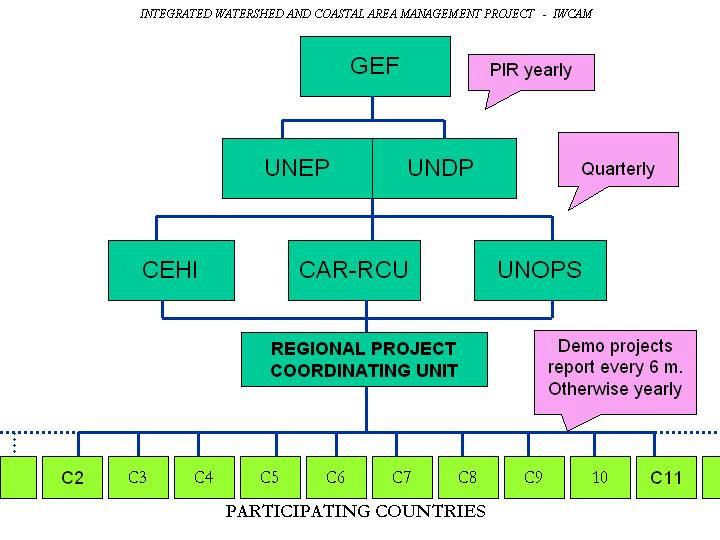
A schedule for reporting at all levels of project execution and implementation has been agreed
to during the First RPSC meeting. Once the demo projects are up and running, they will be
expected to report on a quarterly basis. All reports will be submitted to the Project Coordinating
Unit (at CEHI). Two reports will be required:
·
Formal progress report on the demo project progress every 6 months
·
Brief (approximately 100 words or less) updating progress submitted every quarter. This
will include information on budget disbursements (delivery rates)
A template will be developed (with assistance from the IAs) to include key progress indicators.
This will be based on existing UNEP/UNDP monitoring instruments, and adapted to this project.
CEHI, CAR/RCU and UNOPS will be expected to also report on a quarterly basis with
CAR/RCU to coordinate information flow to UNEP and UNDP. These reports will be informed by
input from the PCU.
Additionally, as the project will have been under implementation for over one year by June
2007, a first Project Implementation Report (PIR) will need to be completed and submitted to
GEF. As lead IA, UNEP will take a lead in this with the Project Coordinating Unit, but it will be
shared with UNDP, CEHI, CAR-RCU and UNOPS.
A diagram of reporting requirements is included in Annex 2.
5.7
Project Evaluation
Evaluation will be an on-going activity throughout the life of the project, as a standard GEF
requirement. In terms of the IA responsibilities, the PCU will submit timely reports to allow for
evaluation of progress and will maintain close contact with IAs, providing feedback and soliciting
input from IAs as needed.
5.8
Project Information Management System
The Project Information Management System (PIMS) will be a priority for establishment during
2007. It will include the Clearing House mechanism (ref to 4.6) and project database (ref to 1.2),
as well as a storage facility for indicator-related information (ref to 2.4). An interactive project
website may also form part of this PIMS.
Page 34 of 79
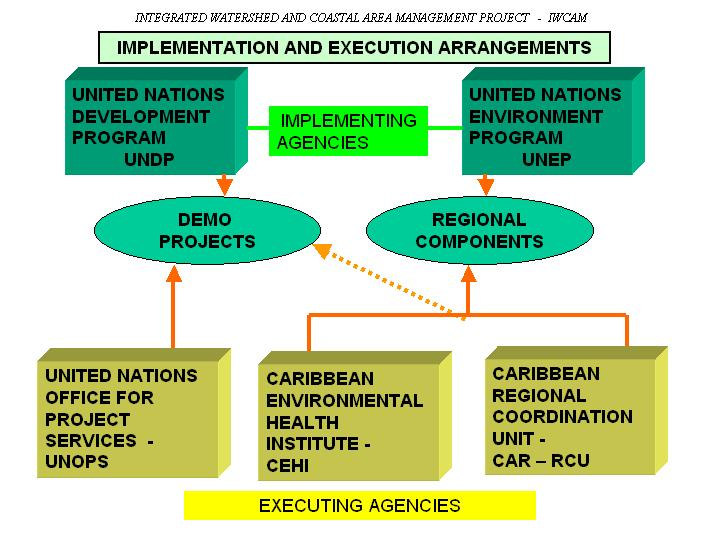
ANNEX 1
PROJECT MANAGEMENT STRUCTURE
Page 35 of 79
ANNEX 2
REPORTING REQUIREMENTS
Page 36 of 79
Annex 4: Draft 2008 GEF-IWCAM Plan of Operations
Project on
"Integrating Watershed & Coastal Areas Management in
Caribbean Small Island Developing States (IWCAM)"
ANNUAL PLAN OF OPERATIONS (DRAFT)
2008
Prepared by
Project Coordination Unit
Page 37 of 79
ANNUAL PLAN OF OPERATIONS
2008
Table of Contents
TABLE OF ACRONYMS
INTRODUCTION
PURPOSE OF PLAN OF OPERATIONS
ANNUAL PLAN OF OPERATIONS
Component 1 - Demonstration, Capture and Transfer of Best Practices
Component 2 - Development of IWCAM Process, Stress Reduction and
Environmental Status Indicators Framework
Component 3 - Policy, Legislation and Institutional Reforms
Component 4 - Regional and National Capacity Building and Sustainability
Component 5- Project Management and Coordination
ANNEXES
Project Management Structure
Reporting Requirements
Schedule of Activities
Page 38 of 79
TABLE OF ACRONYMS
Administrative Officer
AO
Bilingual Administrative Assistant
BAA
Capacity Building for Integrated Water Resources Management
CAP-NET
Caribbean Environmental Forum & Exhibition
CEF
Caribbean Environmental Health Institute
CEHI
Caribbean Large Marine Ecosystem
CLME
Caribbean Water & Wastewater Association
CWWA
Center for Resource Management and Environmental Studies
CERMES
Centers for Disease Control (U.S.)
CDC
Communication, Networking and Information Specialist
CNIS
Council for Human and Social Development
COHSOD
Council for Trade and Economic Development
COTED
Demonstration Focal Points
DFP
Executing Agency
EA
Global Environment Facility
GEF
Global Programme of Action for the Protection of the Marine Environment from Land-
GPA
Based Activities
Global Water Partnership Caribbean
GWP-C
Hotspot Diagnostic Analyses
HSDA
Implementing Agency
IA
Integrated Water Resources Management
IWRM
Integrating Watershed and Coastal Areas Management
IWCAM
Inter-American Water Resources Network
IWRN
International Waters Learning Exchange and Resource Network
IW:LEARN
Medium Sized Project
MSP
Monitoring and Evaluation
M&E
Multilateral Environmental Agreements
MEA
National Focal Point
NFP
National Intersectoral Committee
NIC
National Oceanic and Atmospheric Administration (U.S.)
NOAA
National Programme of Action for the Protection of the Marine Environment from Land-
NPA
Based Activities
National Project Management Unit
NPMU
OECS Protected Areas and Associated Livelihoods
OPAAL
Organisation of Eastern Caribbean States
OECS
Pan-American Health Organisation
PAHO
Participating Country
PC
Project Coordination Unit
PCU
Project Development Funds
PDF
Project Implementation Report
PIR
Project Information Management System
PIMS
Project Steering Committee
PCS
Regional Project Coordinator
RPC
Regional Technical Advisory Group
RTAG
Ridges to Reefs
R2R
Small Island Developing States
SIDS
Technical Coordinator
TC
Terms of Reference
TOR
Trinidad and Tobago Solid Waste Management Company Limited
SWMCOL
Page 39 of 79
United Nations Development Programme
UNDP
United Nations Environment Program Collaborating Centre on Water and Environment
UCC-Water
United Nations Environment Programme
UNEP
United Nations Environment Programme Caribbean Regional Coordinating Unit
UNEP CAR-RCU
United Nations Office for Project Services
UNOPS
Voice over Internet Protocol
VOIP
Water Use Efficiency
WUE
Whitewater to Bluewater
WW2BW
World Summit on Sustainable Development
WSSD
Page 40 of 79
INTRODUCTION
The Global Environment Facility (GEF) has funded a full sized Project to support 13
Participating Caribbean Small Island Developing States (Antigua and Barbuda, Bahamas,
Barbados, Cuba, Dominica, Dominican Republic, Grenada, Haiti, Jamaica, St. Kitts and Nevis,
Saint Lucia, St. Vincent & the Grenadines and Trinidad & Tobago) address issues related to the
management of watersheds and coastal areas in an integrated manner. It is specifically
supporting pilot demonstration activities on Integrating Watershed & Coastal Area Management
(IWCAM) to address priority issues at the national level with potential for replication across the
region and in other Small Island Developing State (SIDS) regions.
The overall objective of the GEF-IWCAM Project is to strengthen the commitment and capacity
of the participating countries to implement an integrated approach to the management of
watersheds and coastal areas, with a long-term goal of enhancement of the capacity of the
countries to plan and manage their aquatic resources and ecosystems on a sustainable basis.
At the same time, the Project seeks to build regional capacity among institutions and within the
Executing Agencies according to their comparative advantages so as to ensure sustainability of
the IWCAM practices and principles beyond the life of the Project.
The project recognises the highly integrated and closely interlinked nature of watersheds and
coastal areas in small islands and aims to develop a more sector-coordinated management
approach, both at the national and the regional level, with a strong emphasis on an expanded
role for all stakeholders within a participatory management framework. The project further
recognises the constraints on the development and implementation of such an integrated and
sectoral-coordinated management approach in the absence of applicable and cost-effective
solutions to many of the primary threats and their root causes at the grass-roots level. In this
respect, the Project aims to develop and secure a more effective landscape for coastal and
watershed management in the Caribbean SIDS through a logical framework of components and
activities. To this effect, project components are focusing on:
6. On-the-ground Demonstrations targeted at national hotspots where specific threats to
national, regional and global environmental amenities have been identified. Emphasis
will be on cross-sectoral management approaches, institutional/infrastructure
realignment and policy reform; sectoral and stakeholder participation and coordination,
related capacity building, and the replication and transfer of best lessons and practices
from these demonstrations.
7. Identification of impact indicators for measuring GEF-IWCAM efficacy (including
indicators of improvements in process, stress reduction, and the overall status of the
coastal and watershed environment), and to support a programme of monitoring which
can drive policy reforms.
8. Overall national and regional policy and legislative reforms (using lessons developed
through the Demonstrations), alongside institutional improvements. High priority will be
given to assisting the countries to meet the commitments required in the ratification
process for important regional legal agreements such as the Cartagena Convention and
its protocols (especially the Protocol on Land-Based Sources of Pollution). A specific
outcome from the project will be the development of effective Integrated Water
Resources Management plans for each country, followed by assistance to identify
strategies for implementing these plans.
9. Establishing mechanisms for regional integration and networking to develop active
partnerships for GEF-IWCAM (e.g. in public awareness, stakeholders participation,
policy-level sensitisation, evolution of educational materials and curricula, training,
Page 41 of 79
secondments) and the development of a long-term strategy for sustainable IWCAM at
the regional level.
10. Effective management and coordination of the overall regional project and the hotspot
demonstrations with an emphasis on developing long-term, sustainable management
and coordination approaches.
Consequently, the project aims to demonstrate the development of an effective regional strategy
for GEF-IWCAM, in parallel with demonstrating and replicating geographically targeted national
solutions to common Caribbean SIDS issues, through a series of interconnected components
that capture best practices and translate these into replicable actions.
PURPOSE OF PLAN OF OPERATIONS
The Draft Plan of Operations has been prepared to provide details on the activities proposed for
2008 and how those activities are interlinked. It will utilize a flexible approach, using the results
of continuous assessment of on-going and/or completed interventions, to inform the
design/redesign of subsequent yearly Work Plans. The Plan of Operations will form the basis for
evaluating progress achieved against agreed time-lines.
Page 42 of 79
ANNUAL PLAN OF OPERATIONS
Component 1 - Demonstration, Capture and Transfer of Best Practices
The first Component of the GEF-IWCAM focuses on "On-the-ground" Demonstrations which
target national hotspots where specific threats to national, regional and global environmental
amenities have been identified. These hotspots were identified during the PDF-Block "B" phases
of the project.
1.1
Demonstration implementation
The role of the PCU includes assistance and supervision in the execution of the demonstration
projects. In this regard, emphasis during 2008 will continue to be on implementation of
demonstration projects and assisting the national GEF-IWCAM demonstration focal points, and
their National Project Management Units (NPMU), in managing and reporting on project
implementation. These NPMUs have reporting arrangements which require the submission of
reports to UNOPS as well as to UNEP & UNDP, through the Regional Project Coordinating Unit
(PCU). The Regional Project Coordinator, Technical Coordinator, the other staff of the PCU,
and CEHI will provide guidance on Work Planning and budgeting for the various Demonstration
Projects. Monthly updates on the status of implementation will be provided to UNOPS and IAs.
Demonstration project implementation, though managed on a day-to-day basis by the NPMUs
will be monitored by the PCU. The PCU has been staffed to provide technical support to the
NPMUs in the key focal areas of the demos. A Technical Coordinator (TC) has been recruited
with expertise in the areas of water resources and environmental management, to provide
assistance to the NPMUs on an on-going basis. She will be supported by other PCU, CEHI and
UNEP CAR/RCU technical expertise, and additional monitoring and guidance will be provided
through the Regional Technical Advisory Group (RTAG) and its sub-groupings. The Terms of
Reference for the TC include:
To provide direct technical support to the participating countries and assist with the
coordination of the Demonstration Project implementation.
To provide technical advisory services and support the execution of the nine
demonstration projects and the collection and analysis of lessons learnt and best
practices
A number of countries did not develop demonstration projects which could be funded within the
overall GEF-IWCAM Project. Consequently, there is a desire to see Medium-Sized Projects
developed for these countries. Whereas the development of MSPs was originally within the
Work Plan for Year 1, based on reforms taking place within the GEF Secretariat, it may be more
reasonable to aim for 2008 or later to develop additional MSPs.
Additionally, special focus will be placed on these countries. Specifically, as discussed under
Component 3, these countries (such as Grenada, Dominica, Haiti and St. Vincent & the
Grenadines) will be the initial focus for IWRM Plan development (in collaboration with others
such as GWP-Caribbean, NOAA, US Centers for Disease Control and UNEP-UCC).
Monitoring and evaluation of the demonstration projects will be an ongoing process. This
monitoring will be facilitated by the indicators which will be developed under Component 2
(below). The PCU will help to establish a monitoring and evaluation (M&E) system for the demo
projects, in conjunction with the overall Project Information Management System (PIMS),
Page 43 of 79
discussed under Component 5. Networking tools for demo project managers will also be
established, including possibly discussion groups using technology such as VOIP (e.g. skype),
list-serves, and/or specific training.
1.3
Capture of Lessons and Best Practices
The capture of lessons and best practices will be an on-going process, involving desk research
and exchange of experiences with other relevant projects and regions. During 2008, exchange
of information and lessons will be focused around the Demonstration Projects, which will be fully
up and running. PCU staff and National Focal Points will also participate in relevant regional and
international Conferences and present papers related to GEF-IWCAM. A major focal point will
be the 5th Caribbean Environmental Forum & Exhibition, tentatively scheduled for June 2008, at
which GEF-IWCAM will showcase its work to date.
Through interaction with other projects within the region, such as the Caribbean Large Marine
Ecosystem (CLME) project being implemented by CERMES, and with the OECS Protected
Areas and Associated Livelihoods (OPAAL) project being implemented by the OECS
Environment & Sustainable Development Unit, inter-project exchanges will be facilitated.
Interaction with the South Pacific SIDS, through the Pacific GEF Sustainable Integrated Water
Resources and Wastewater Management Project (under development) will also provide for
opportunities to learn lessons from and share lessons with relevant SIDS.
Within the GEF-IWCAM participating countries, exchanges among NFPs will allow for both
formal and informal learning related to best practices. These will all be facilitated by active
participation in the PSC, RTAG and other meetings and training activities.
Opportunities for exchanges related to lessons learned which GEF-IWCAM will support during
2008 include the Caribbean Water & Wastewater Association (CWWA) Annual Conference (in
October 2008).
An annual meeting of the Regional Technical Advisory Group (RTAG) will be convened,
possibly on the margins of another regional meeting and/or at the location of an active Demo
Project. This could allow for input from Demo Focal Points (DFP) into the discussions of the
RTAG, while possibly also allowing for exchange of information and a field evaluation of one of
the demonstration sites. The RTAG will be expected to report on general GEF-IWCAM lessons
and practices to the Project Steering Committee (PSC).
A project database will be refined with input from the Communications, Networking &
Information Specialist (CNIS) during 2008. This database will be a building block for the regional
Project Information Management System (PIMS). Components will include a database on GEF-
IWCAM contacts (including GEF Focal Points; NFPs; National Demonstration PMU staff;
Ministries of Environment and other relevant Ministries; UNEP & UNDP GEF experts/associates
etc.) and on relevant projects on-going or recently completed. The database will be linked with
other relevant databases in order to achieve synergies. These will include the GPA Clearing
House and the IWRN Caribbean Portal. It is expected to also be the node for the storage of
indicator-related information (see 2.4 below)
The Partnership Forum will be a dynamic part of this Component, utilizing existing arenas and
events such as the CWWA, WW2BW, and the CEF Conferences. It will be structured to allow
for review of lessons and best practices from Demos and general IWCAM approaches.
Page 44 of 79
1.3
Transfer & Replication of Lessons and Practices
Uptake of lessons and best practices from the demonstration projects are also tasks to be
facilitated by the PCU. However the replication of best lessons and practices from the
demonstrations is not expected to happen until later on during the overall project life (i.e.
beyond 2008).
The project, in practical terms, will actively support the IW:LEARN Inter-focal dialogue for the
Caribbean. The website for the project will be re-designed/upgraded and managed, allowing
public access to a wealth of information on the project and the demo sites. Over time, as the
website evolves, a number of innovations are planned, including interactivity, access control,
and possibly on-line training opportunities. Strong linkages to the IW:LEARN and Inter-American
Water Resources Network (IWRN) websites will be developed.
Page 45 of 79
Component 2 - Development of IWCAM Process, Stress Reduction and Environmental
Status Indicators Framework
2.6
Review IWCAM Indicators
This set of activities should have been largely completed prior to 2008 but will inform the
following activities.
2.7
Develop National Indicator Templates
During 2008, based on the review (conducted in 2007) of the existing indicator mechanisms in
the region for the three sets of indicators developed for use in monitoring and evaluating GEF
International Waters Projects Process, Stress Reduction and Environmental Status indicators,
the development and dissemination of indicator templates will begin.
These templates will have been discussed during a workshop and informed by the work of the
consultants utilized to conduct the indicator review. Assistance to countries in identification of
indicators for use in M&E will be provided as appropriate, based on the findings of the review
conducted in 2007. The Demo Projects will be expected to have begun harvesting information
on Environmental Status/Water Resources, Stress Reduction and Process Indicators during
2008 and providing such information to the PCU.
2.8
Undertake National Hotspot Diagnostic Analyses
During 2008, it is proposed to conduct hotspot diagnostic analyses (HSDA) in participating
countries, with emphasis on the non-demo countries, including identification of priority water-
related issues/problems, immediate and root causes and required reforms. Based on the
analyses, project concepts for follow-up/project preparation will be prepared. The HSDA will be
conducted with the assistance of Consultants and CEHI, and will be guided by UNEP
CAR/RCU.
2.9
Indicator Coordination & Training
The development and establishment of a monitoring system for indicators, using a template, will
continue in 2008. Training of stakeholders in the application of relevant indicators will continue
in 2008, based on earlier training conducted in 2007 and the need to begin this process of
applying indicators as early as possible. This may take the form of Indicators workshops, which
will strategize for application of indicators, provide some training, and share lessons related to
the use of indicators.
The regional centre for storage of indicator-related information will in essence, form part of the
project database (see 1.2) initially. It remains to be determined how the centre will evolve. This
evolution will be informed by the work of the indicator consultants. The same holds true for the
development of a Centre of Excellence for Indicator Training, which will proceed in 2008.
Page 46 of 79
2.10
Indicator Demonstration
The establishment of a pilot monitoring system using the newly developed indicator templates
will begin in 2008. Therefore, guidance from the RTAG will be needed in identifying a suitable
pilot country to test the system/templates. Consistent and effective tracking of indicators will
allow for a better monitoring of the impact of the IWCAM approach (or lack thereof). It is also
envisioned that the indicators work will assist countries in their reporting for international
agreements and conventions.
Page 47 of 79
Component 3 - Policy, Legislation and Institutional Reforms
3.5
Review of National Policy, Legislation & Institutional Structures
A review of the National policies and institutional structures related to integrated watershed and coastal area
management would have been conducted in 2007. Beyond simply a review, the Consultancy is to propose remedial
activities, where necessary. These activities will be programmed for 2008 and future years.
3.6
Development of Models & Guidelines
Models and Guidelines development will continue in 2008, informed by the outputs from 3.1, the
Hotspot Diagnostic Analyses and stakeholder workshops. For example, IWRM Methodology
and Guidelines in SIDS will be developed in collaboration with other SIDS regions, based on
agreements reached through the GEF Implementing Agencies. Further guidelines, based on the
outcomes from the demo projects, will also be developed in future years.
3.7
Programme for Regional Policy, Legislative & Institutional Reform
The regional programme for amendment of national legislation and policy as well as
improvement and restructuring of institutional arrangements will be initiated in 2008. So too will
be the parallel development of incentives related to the ratification of relevant MEAs.
3.8
Development of IWRM & Water Use Efficiency Plans
A series of Regional Workshops/Meetings to discuss preparation of IWRM and Water Use
Efficiency (WUE) Plans and coordination of regional IWRM interventions took place in 2006 and
2007. The GEF-IWCAM Project will continue to facilitate coordination of this work together with
CEHI, UNEP, GWP-Caribbean and others, in order to assist the countries in the Caribbean in
achieving the World Summit on Sustainable Development (WSSD) Directive on IWRM plans
and strategies and specifically on developing "Integrated Water Resources Management and
Water Efficiency Plans by 2005".
The GEF-IWCAM will coordinate an "Informal IWRM Working Group", established in December
2006. GEF-IWCAM will also convene a number of National "Inception" Workshops which will
address the respective needs of PCs in relation to IWRM Plan preparation. These Workshops,
which began in 2007, will take place possibly in Cuba; St. Kitts/Nevis; Bahamas; Jamaica; Haiti;
and Antigua/Barbuda.
All workshops will combine National Awareness-raising, Public Education and Stakeholder
involvement. A Public Education and Outreach strategy will be implemented based on the
experiences in 2007. Follow-up activities in all PCs will be scheduled, based on the outcome of
the Inception Workshops.
The interventions will seek to provide technical assistance through the process of IWRM Plan
Development, specifically:
- Visioning (workshop);
- Situation Analysis (using focus groups);
- Strategy Formulation;
Page 48 of 79
- Identifying opportunities for capacity building in IWRM (specifically through GWP and
CAPNET) to strengthen and promote partnerships and networking for the implementation of
IWRM and Water Safety Plans (and NPAs).
Recommendations and outcomes from all Workshops will inform the National IWRM
development process, which will be further supported by the project. National Train-the-Trainers
workshops will be encouraged, based on the training delivered, and as follow-up to training
provided by CAPNET (e.g. in December 2006 and July 2007).
Page 49 of 79
Component 4 - Regional and National Capacity Building and Sustainability
4.1
Awareness & Sensitization
In 2008 national and regional efforts will continue to raise awareness of GEF-IWCAM, both as a
project and as an approach. These efforts will involve utilizing a combination of existing fora as
well as creating new and additional fora for awareness raising. The messages related to GEF-
IWCAM will be tailored to the various audiences, bringing issues "down to earth" and making
them meaningful to the general public. Opportunities such as Earth Day, World Water Day,
Inter-American Water Day, and World Environment Day will be used to spread the message,
utilizing the Communications Specialist within the PCU and her counterparts at the participating
country-level. In order to target senior policy-makers, IWCAM will utilize Ministerial meetings
such as CARICOM Councils (COHSOD; COTED) and the CWWA High-Level Ministerial
Session to raise IWCAM issues, placed within the appropriate context, such as IWRM, for
example.
Various media will be utilized to spread the message and cost effective approaches, such as the
Government Information Services and community/public radio will be utilized, as well as Press
Releases, press articles and the regular provision of relevant information. Every effort will be
made to nurture good relations with the media houses as well.
Bulletins, brochures, leaflets, videos or other appropriate information products will be made
available to various publics on the IWCAM approach, what it means, and why it is important to
the region. Bulletins will be prepared eight times per yearfor electronic distribution, and
translated into Spanish. A newsletter will be prepared on a quarterly basis, in both electronic
and hard copy. The bulletins and newsletters will also be placed on the project website
(www.iwcam.org). Project brochures, Decision-makers Briefing Sheets/Packages, posters,
banners, press articles and articles for regional magazines will all be produced when needed, as
part of the awareness material. These efforts will be consolidated through a regional
Communications Strategy.
As mentioned above, the National "Inception" Workshops for IWRM will also be used as
workshops to raise awareness on IWCAM.
4.2
Stakeholders Involvement
Stakeholder involvement will be an on-going strategy for all activities. Specific approaches will
be integrated as appropriate. These will include through the National "Inception" Workshops for
IWRM (and follow-up activities) and the National Intersectoral Committee meetings.
4.3
Education and Training
The overall thrust of GEF-funded international waters activities includes meeting the incremental
costs of building the capacity of existing institutions (or, if appropriate, developing the capacity
through new institutional arrangements). This thrust is represented throughout Component 4 of
the GEF-IWCAM and will continue in 2008.
Capacity building will focus at the national level (including within the NFPagencies) and regional
level (including at CEHI and UNEP CAR/RCU). The focus will include capacity building for
monitoring of the environment, particularly water quality. Training in environmental monitoring
and data handling will be conducted for the demo sites and for laboratory personnel in PCs,
Page 50 of 79
based on the findings of a needs assessments. The project will also support laboratory
development at the national and regional level. Equipment will be provided to PCs to assist with
their monitoring efforts. The reference capability of the accredited laboratory within CEHI will be
strengthened as well as that of appropriate other regional laboratories in PCs. The investment in
these laboratories will support the capacity building of national laboratories during the project,
through in-country training and possible attachments to these regional laboratories. Such
investments will also support the countries after the project has ended and ensure sustainability
of the project objectives (see 4.4 below). CEHI will also provide technical backstopping to the
PCs in developing, inter alia, environmental surveillance programmes.
Training in 2008 will focus on those areas identified in the training needs and capacity
assessments conducted in 2007 (such as that conducted by the CAPNET Project).
The project will liaise closely with IW:LEARN in its global efforts, learn from its experiences and
utilize tools already developed through IW:LEARN.
Based on the rates at which various participating countries begin implementation of activities, as
well as the level at which the various countries have reached in relation to IWCAM issues,
secondments will be scheduled as appropriate. It is likely that Jamaica might be identified as a
host country, based on its experiences with the "Ridge-to-Reef" project and the lessons that
might be learned.
Strategy for IWCAM Regional Sustainability
IWCAM sustainability will be ensured through strengthening of the programmes within
institutions at the national and regional level. These would include CEHI, national Ministries and
agencies, as well as relevant community groups. A concrete example of the strengthening of
programmes was referred to under 4.3 above. Specifically, the laboratory at CEHI, which is
currently the only accredited regional laboratory, will be supported to allow it to sustain the gains
made by all laboratories within PCs through IWCAM project interventions. The accreditation
status is key to the credibility of laboratory results. As such, formal auditing (by an accreditation
body) will take place as necessary in 2008. This will allow CEHI to directly support Proficiency
Testing in future for PCs. Institutional strengthening such as this will sustain a number of
initiatives of GEF-IWCAM including indicator frameworks and environmental monitoring.
Development of the strategy for sustainability will continue in 2008 and will evolve over time. It
will be incorporated into all demonstration activities, utilizing the co-financing options as
potential building blocks for an on-going programme, post-project. The Partnership Forum will
be utilized to catalyze strategy development and implementation.
Project Networking
The project will strengthen the linkages with related initiatives, building on existing relationships
such as with WW2BW, GPA, other SIDS (South Pacific - through SOPAC, Indian Ocean,
Atlantic Ocean) and others. Currently, the RPC sits on the Executive Committee of WW2BW
and Co-Chairs the Integrated Watershed Management thematic group. The linkage with
WW2BW is therefore direct. The RPC also serves on the Board of Clean Islands International,
another regional NGO involved in environmental education and waste management. Such
involvement by the PCU will facilitate greater networking.
Page 51 of 79
The Partnership Forum will "piggy-back" on existing events, including the Caribbean
Environmental Forum and UNEP CAR/RCU Intergovernmental Meeting in 2008 and/or other
regional events. At the national level, networking will be encouraged through events such as the
Green Expo (in Barbados), the Waste Expo (in Jamaica) and the World Environment Day
activities and the Trinidad and Tobago Solid Waste Management Company Limited (SWMCOL)
Conferences (in Trinidad & Tobago).
The project will also rely on the institutional linkages that exist between CEHI, UNEP CAR-RCU
and other institutions in order to spread the message. The EAs attend numerous regional
meetings involving governing bodies (e.g. PAHO) and Technical Advisory Committees (e.g.
OECS ESDU) for other agencies. Such opportunities will be exploited to learn more about and
share information on the IWCAM concept and objectives.
Regional IWCAM Clearing House
In order to establish the Clearing House, which will be housed within CEHI, a review of all
projects of relevance would have taken place during 2007. The findings of the review will form
the baseline data for the Clearing House. The Clearing House will be managed by CEHI, with
direct support provided by the Communications, Networking, and Information Specialist within
the PCU. The Clearing House will form part of the Project Information Management System
(PIMS) and will be part of the evolution of the website.
The form of the Clearing House will be determined based on the models which exist, such as
the GPA and the IWRN Portals. Networking, sourcing of information, and dissemination of
information will be on-going, once the Clearing House is established.
Page 52 of 79
Component 5- Project Management and Coordination
5.3
Project Management
The Project Management structure is included in Annex 1. The Project Coordination Unit was
fully established within the Fourth Quarter of 2006. A Sub-Project between CEHI and UNEP,
prepared in 2007, will allow for improved management of project funds directly by CEHI. This
Sub-Project will cover CEHI's major activities related to, inter alia, Laboratory Strengthening and
IWRM Plan Development, and also Personnel Costs.
5.4
Regional Project Steering
At least one Regional Project Steering Committee (PSC) meeting will be convened in 2008.
Discussions at the Regional PSC will allow for endorsement of the RTAG Report and the work
planned by the PCU. The Regional PSC meeting will focus on reviewing the Work Plan and
budget, and updating the participating countries on the status of national project
implementation.
5.3
National Project Steering (National Intersectoral Committees)
The PCU, as needed, will facilitate meetings of the National Intersectoral Committees (NIC),
which will meet based on the need to plan national activities. Such meetings will be informed by
the respective demonstration projects. Where possible, these meetings will be coordinated to
coincide with National IWRM Inception meetings (see 3.4 above). Countries will be requested to
provide Minutes of their NIC meetings to the PCU.
5.4
IA/EA Management Group
The IA/EA Management Group will meet formally, just prior to the Regional PSC meeting. The
EAs will meet regularly during the year, as appropriate and using modalities such as conference
calling and email in order to coordinate their respective activities and functions in relation to the
project execution. The excellent working relationship which currently exists will facilitate greater
formal and informal exchanges between EAs.
5.5
Project Technical Support
Technical support will be provided to the project through the RTAG. A meeting will be scheduled
prior to the Regional PSC Meeting (as decided by the RTAG). It will allow for ongoing technical
guidance on aspects of the project by the body established to inform and advise the Regional
PSC on such matters. This meeting will also allow for updating on progress being made with
demo projects and with the regional component. The RTAG may review the reports of
consultants, endorse selection of the pilot country for testing of the Indicator Mechanism, advise
on clearing house functions and IWRM Planning, review/endorse HSDA and the criteria for Hot
Spot designation, and endorse lessons learned from the demos. The venue would have been
considered at the 2007 RTAG meeting.
5.6
Project Reporting
A schedule for reporting at all levels of project execution and implementation has been agreed
to during the First Regional PSC meeting. The demo projects will be expected to report on a
Page 53 of 79
quarterly basis. All reports will be submitted to the Project Coordinating Unit (at CEHI). Two
reports will be required:
·
Formal progress report on the demo project progress every 6 months
·
Brief (approximately 100 words or less) updating progress submitted every quarter. This
will include information on budget disbursements (delivery rates)
A template will be developed (with assistance from the IAs) to include key progress indicators.
This will be based on existing UNEP/UNDP monitoring instruments, and adapted to this project.
CEHI, CAR/RCU and UNOPS will be expected to also report on a quarterly basis with
CAR/RCU to coordinate information flow to UNEP and UNDP. These reports will be informed by
input from the PCU.
Additionally, a Project Implementation Report (PIR) will need to be completed and submitted to
GEF. As lead IA, UNEP will take a lead in this with the Project Coordinating Unit, but it will be
shared with UNDP, CEHI, CAR-RCU and UNOPS.
A diagram of reporting requirements is included in Annex 2.
5.7
Project Evaluation
Evaluation will be an on-going activity throughout the life of the project, as a standard GEF
requirement. In terms of the IA responsibilities, the PCU will submit timely reports to allow for
evaluation of progress and will maintain close contact with IAs, providing feedback and soliciting
input from IAs as needed.
5.9
Project Information Management System
The Project Information Management System (PIMS) will be a priority for commissioning during
2008. It will include the Clearing House mechanism (ref to 4.6) and project database (ref to 1.2),
as well as a storage facility for indicator-related information (ref to 2.4). An interactive project
website may also form part of this PIMS.
Page 54 of 79
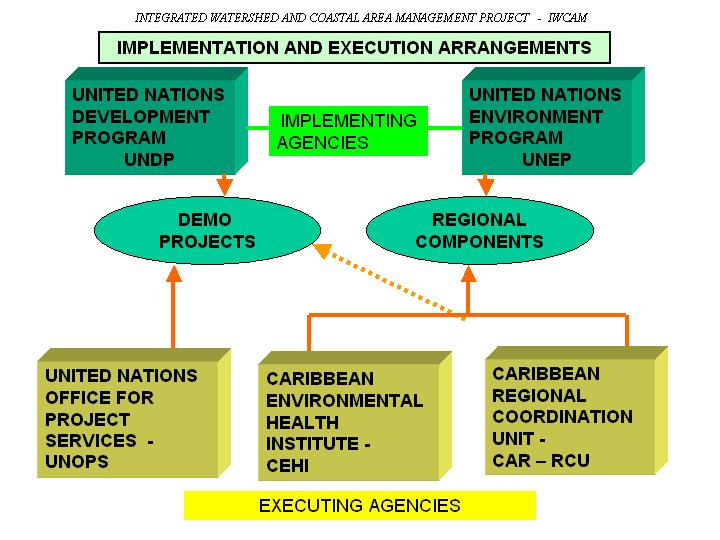
ANNEX 1
PROJECT MANAGEMENT STRUCTURE
Page 55 of 79
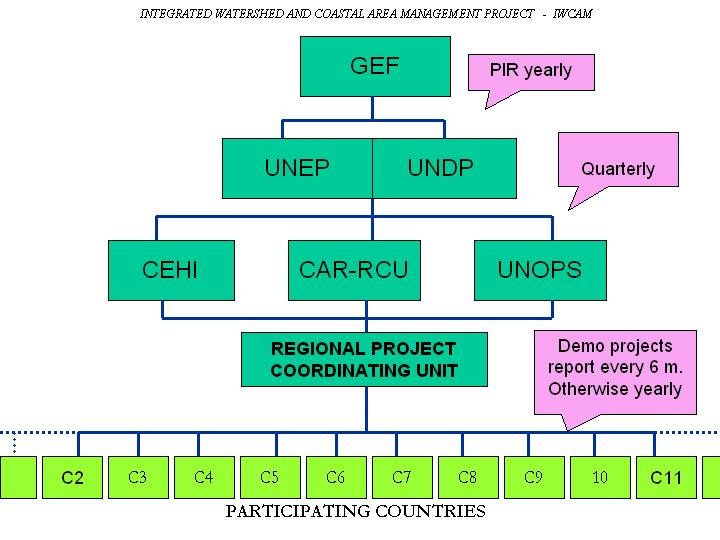
ANNEX 2
REPORTING REQUIREMENTS
Page 56 of 79
Annex 5: Participants List
GEF-IWCAM Regional Technical Advisory Group RTAG Meeting
4 July 2007, Roseau, Dominica
Participants List
Countries
Antigua and Barbuda Ivan Rodrigues
Operations and Maintenance
Engineer
Antigua Public Utilities Authority
Cassada Gardens
St John's
Antigua and Barbuda
Tel: 268 480 7021
Fax: 268-462-2761
E-mail: ivan@apua.ag
Bahamas
Rochelle Newbold
Project Manager
BEST Commission
Nassau Court
Nassau
BAHAMAS
Tel: 242 322 4546
Fax: 242 326 3509
E-mail: bestnbs@hotmail.com
Barbados
Alex Ifill
Water Quality Technologist
Barbados Water Authority (BWA)
The Pine
St. Michael
BARBADOS
Tel: 246 425 9110/1/2
Fax: 246 425 9121
E-mail: alex.ifill@bwa.bb
Page 57 of 79
Cuba
Alain Muñoz Caravaca
Lorenzo Brito Galloso
Environmental Specialist
GIS Specialist
CEAC-CITMA
CIGEA CITMA
Calle 17 esq. 46,
Calle 20
Reparta Reina
Esq. 18-A
CP 55100
Miramar, Playa
Cienfuegos
Ciudad Habana
CUBA
CUBA
Tel/Fax: 53043965146
Tel.: 537 202 9351
E-mail: alain@ceac.cu
Fax.: 537 204 9031
E-mail:
Lorenzo@ama.cu
Lor01@yahoo.com
Marlen Perez Hernandez
Orleáns Garcia Fuentes
RAC-CIMAB Technical Specialist
RAC-CIMAB Technical Specialist
Centre of Engineering and
Centre of Engineering and
Environmental Management of Bays
Environmental Management of
and Coasts, CIMAB
Bays and Coasts, CIMAB
Carretera del Cristo No.3.
Carretera del Cristo No. 3
Esq. Tiscornia
Esq. Tiscornia
Regla.C.
Casablanca
Habana
Regla.C
CUBA
Habana
Tel.: 537 862 4387
CUBA
Fax.: 537 866 9681
Tel.: 537 862 4387
E-mail: marlen@cimab.transnet.cu
Fax.: 537 866 9681
E-mail:
orleans@cimab.transnet.cu
Dominica
Ronald Charles
David Williams
Assistant Forest Officer
Acting Director of Forestry,
Forestry, Wildlife and National Parks
Wildlife, and Parks
Division
Ministry of Agriculture, Fisheries,
Ministry of Agriculture, Fisheries, and
and the Environment
the Environment
Botanical Gardens
Botanical Gardens
Roseau
Roseau
COMMONWEALTH OF
COMMONWEALTH OF DOMINICA
DOMINICA
Tel.: 767 266 3817; 767 448 2401,
Tel.: 767 266 3817
Ext. 3817
Fax.: 767 448 7999
Fax.: 767 448 7999
E-mail:
forestofficerprotection@cwdom.dm
Andrew Magloire
Chief Fisheries Officer
Fisheries Division
Ministry of Agriculture, Fisheries, and
the Environment
Botanical Gardens
Page 58 of 79
Roseau
COMMONWEALTH OF DOMINICA
Fax: 767 448 0140
E-mail: fisheriesdivision@cwdom.dm
Dominican Republic
Juan Felipe de J. Ditren Flores
National Focal Point
Secretaria de Estado de Medio
Ambiente y Recursos Naturales
Av. 27 de Febrero Esquina
Tiradendes
Plaza Merengue
Santo Domingo
DOMINICAN REPUBLIC
Tel.: 809 472 0626, ext. 250
Fax.: 809 472 0631
E-mail:
sga.calidad@medioambiente.gov.do
Grenada
Gordon Paterson
Head of Watershed Management Unit
Forestry Department
Queen's Park
St George's
GRENADA
Tel: 1 473 440 2934
Fax: 1 473 440 4191
E-mail: massaiman2004@yahoo.com
Haiti
Paul Judex Edouarzin
Director of Awareness and Education
Ministry of Environment
181 Haut Turgeau
Port au Prince
HAITI
Tel : 509 777 1910, 458 2750
Fax : 509 245 7360
E-Mail : judouarzin@yahoo.fr
Saint Kitts and Nevis
Dr. Halla Sahely
Assistant Water Engineer
St. Kitts Water Services Department
P.O. Box 80
Needsmust
Basseterre
ST. KITTS AND NEVIS
Tel.: 869 466 3070/1467/2485
Fax.: 869 466 7901
Page 59 of 79
E-mail: halla@sahely.com
Saint Lucia
LaVerne Walker
Coastal Zone Management Unit
Coordinator
Ministry of Economic Affairs,
Economic Planning, National
Development and Public Service
Greaham Louisy Building
Waterfront
Castries
SAINT LUCIA
Tel: 758 451 9884
Fax: 758 453 1305
E-mail: lwalker@planning.gov.lc,
lwalker2006@gmail.com
Saint Vincent and the Janeel Miller
Grenadines
Environmental Officer/National Ozone
Officer
Ministry of Health and the
Environment
Ministerial Complex
Kingstown
SAINT VINCENT AND THE
GRENADINES
Tel.; 784 485 6992
Fax.: 784 475 2684
E-mail: janeelmiller@hotmail.com
Trinidad and Tobago
Vijay Datadin
Kamau Akili
GIS Specialist
Deputy Sustainable Development
Buccoo Reef Trust BRT
Coordinator
Cowie's Building
Office of the Chief Secretary
Carnbee Junction
Tobago House of Assembly
Auchenskeoch Road
P.O. Box 5664
Carnbee
Scarborough
TRINIDAD AND TOBAGO
TRINIDAD AND TOBAGO
Tel.: 868 636 2000 or 592 624 4733
Tel: 868 639 0601
Fax.: 868 639 7333
Mobile: 868 796 0999
E-mail:
Fax: 868 660 7467
v.datadin@buccooreeftrust.org
E-mail: kakili@tstt.net.tt
International/Regional Organisations
Page 60 of 79
CEHI
Christopher Cox
Senior Programme Officer
Caribbean Environmental Health
Institute (CEHI)
P.O. Box 1111
The Morne
Castries
SAINT LUCIA
Tel.: 758 452 2501
Fax.: 758 453 2721
E-mail: ccox@cehi.org.lc
UNEP/CAR/RCU
Nadia-Deen Ferguson
Assistant Programme Officer AMEP
UNEP CAR RCU
14 20 Port Royal Street
Kingston
JAMAICA
Tel.: 876 922 9267
Fax.: 876 922 9292
E-mail:
ndf.uneprcu@cwjamaica.com
GEF-IWCAM Project
Vincent Sweeney
Donna Spencer
Coordinating Unit
Communications, Networking, and
Regional Project Coordinator,
Information Specialist
UNEP/IWCAM
GEF-IWCAM Project Coordination
GEF-IWCAM Project Coordination
Unit
Unit
C/O Caribbean Environmental
C/O Caribbean Environmental
Health Institute
Health Institute
The Morne, P.O. Box 1111
The Morne, P.O. Box 1111
Castries
Castries
ST. LUCIA
ST. LUCIA
Tel: 758 452-2501, 452-1412
Tel: 758 452-2501, 452-1412
Fax: 758 453-2721
Fax: 758 453-2721
Email: dspencer@cehi.org.lc
E-mail: vincent.sweeney@unep.org
Sasha Beth Gottlieb
Una McPherson
GEF-IWCAM Project Coordination
Administrative Officer
Unit
GEF-IWCAM Project Coordination
C/O Caribbean Environmental
Unit
Health Institute
C/O Caribbean Environmental
The Morne, P.O. Box 1111
Health Institute
Castries
The Morne, P.O. Box 1111
ST. LUCIA
Castries
Tel: 758 452-2501, 452-1412
ST. LUCIA
Fax: 758 453-2721
Tel: 758 452-2501, 452-1412
Email: sgottlieb@cehi.org.lc
Fax: 758 453-2721
E-mail: una.mcpherson@unep.org
Page 61 of 79
Magnalia Goldson
Bilingual Administrative Assistant
GEF-IWCAM Project Coordination
Unit
C/O Caribbean Environmental
Health Institute
The Morne, P.O. Box 1111
Castries
ST. LUCIA
Tel: 758 452-2501, 452-1412
Fax: 758 453-2721
Email: mgoldson@cehi.org.lc
Page 62 of 79
Annex 6: Presentations
Page 63 of 79
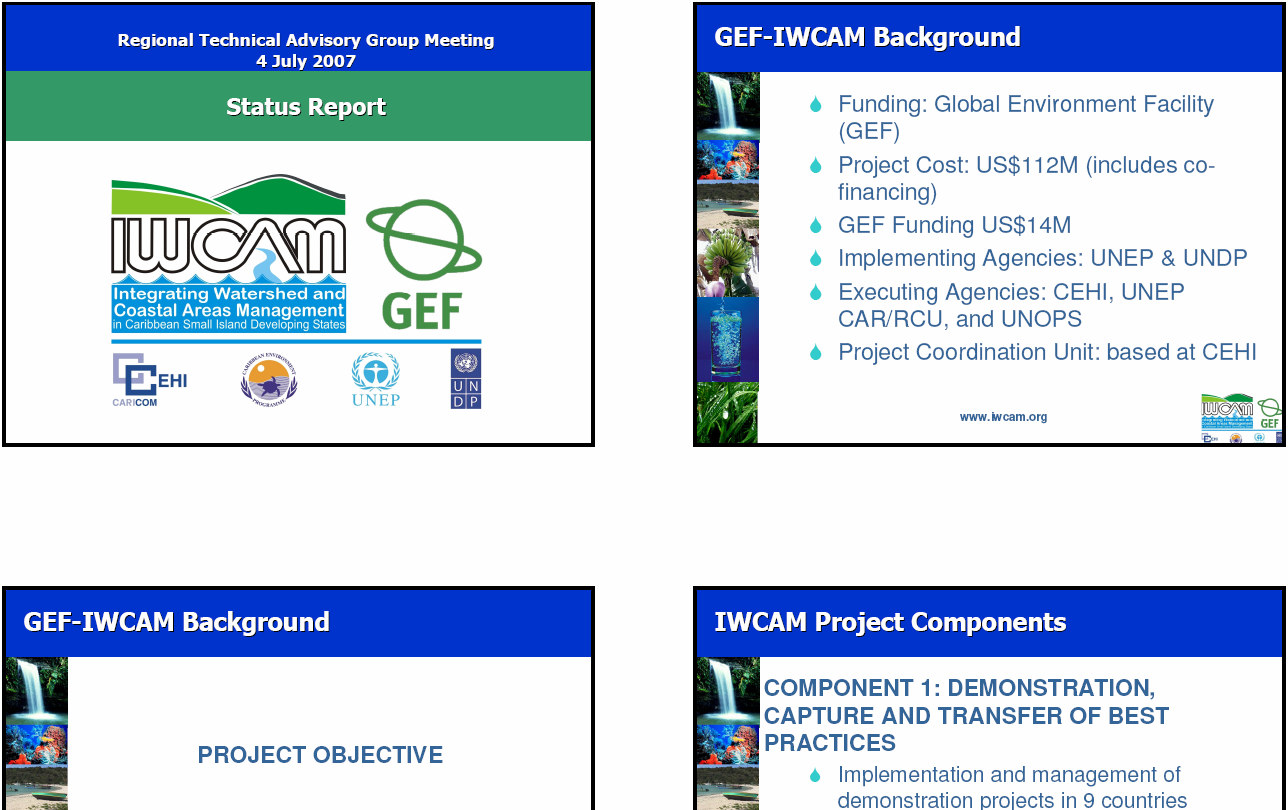
GEF-IWCAM Status Report
Page 64 of 79
Page 65 of 79
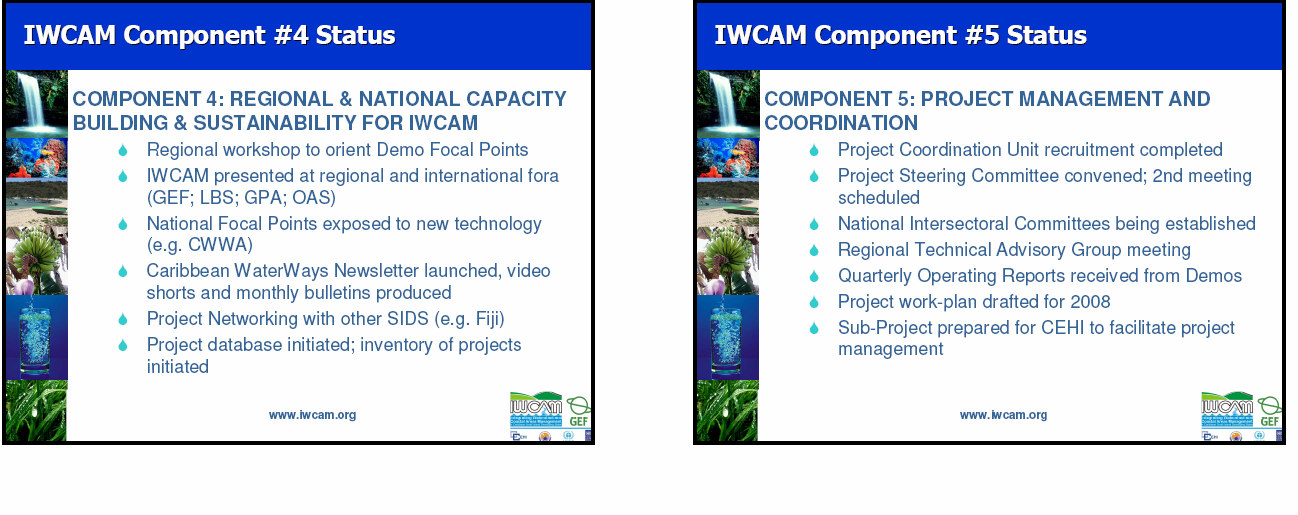
Page 66 of 79
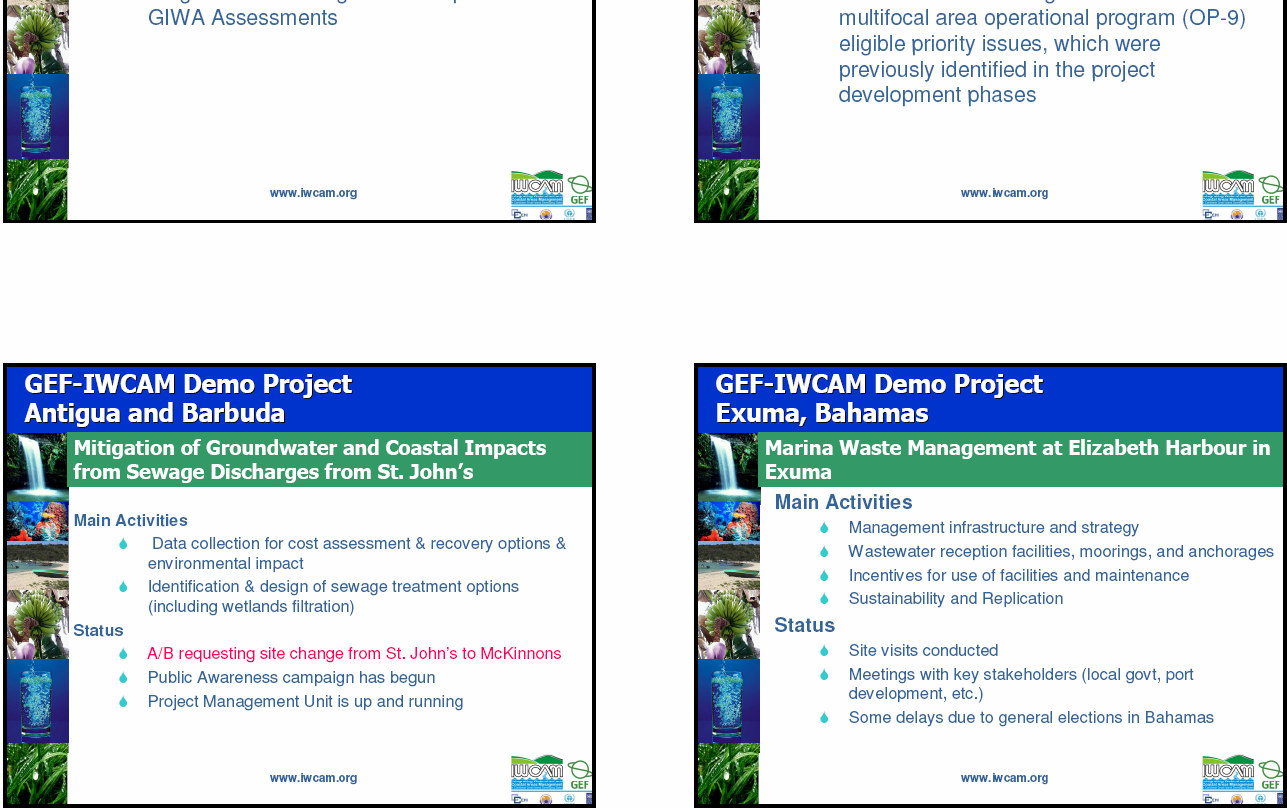
Demonstration Project Status Update
Page 67 of 79
Page 68 of 79
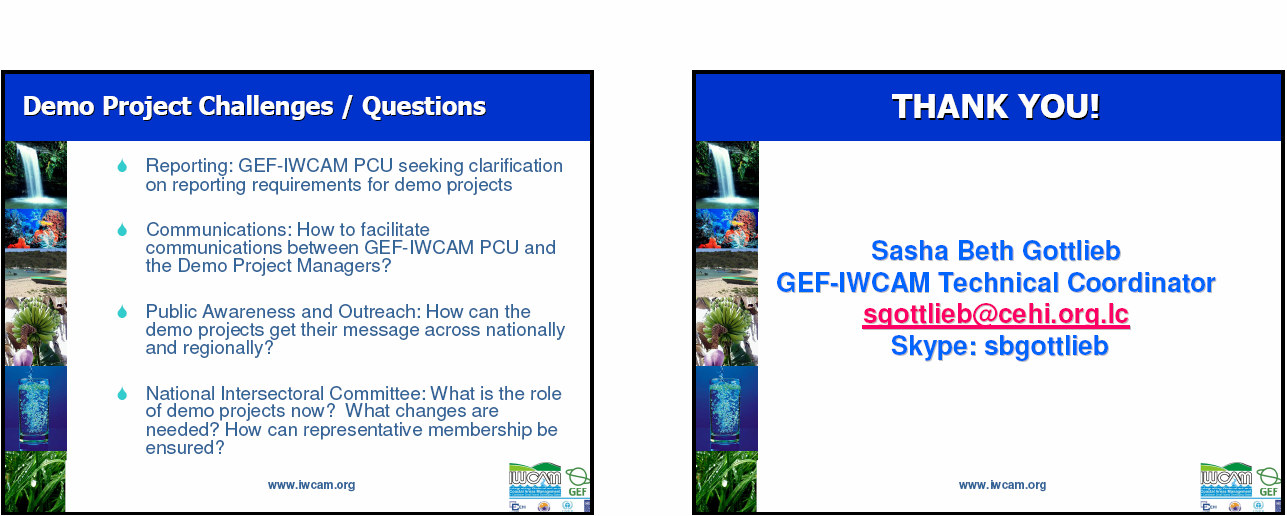
Page 69 of 79
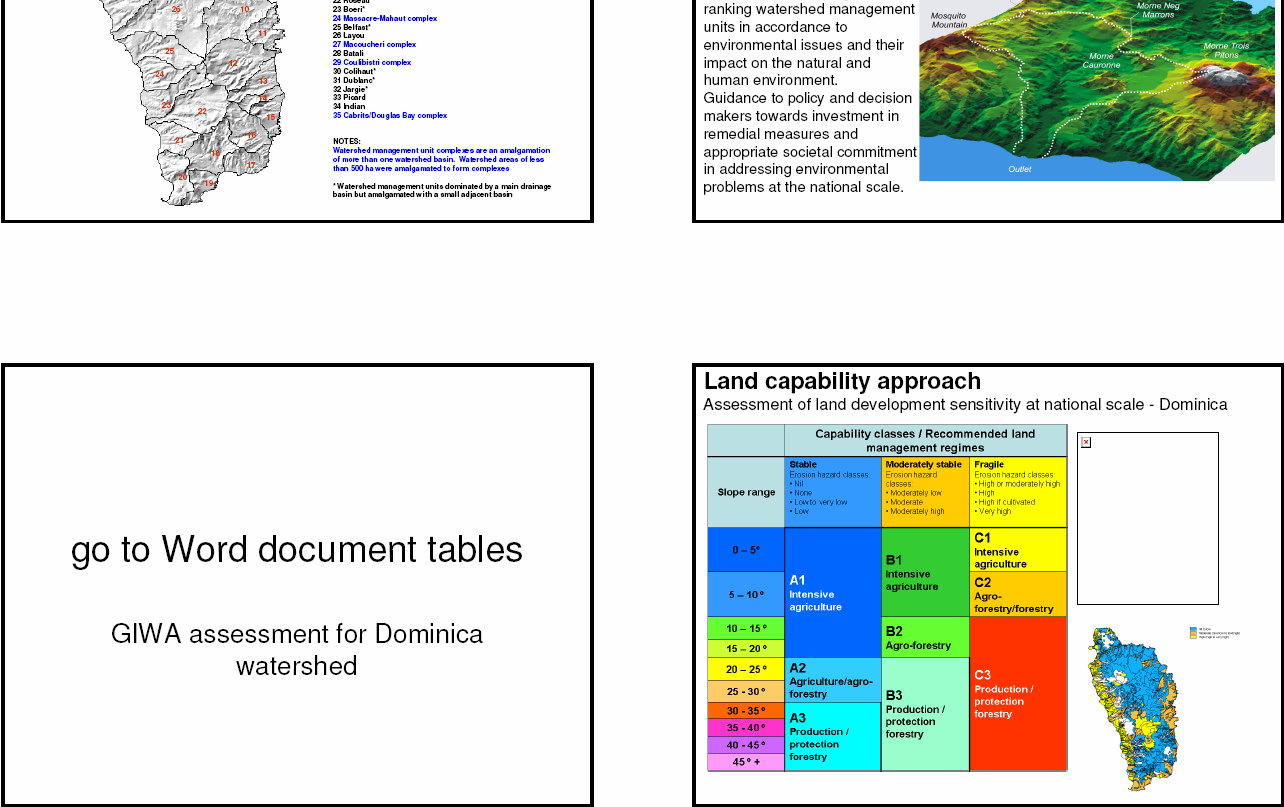
Hotspot Diagnostic Assessment
Page 70 of 79
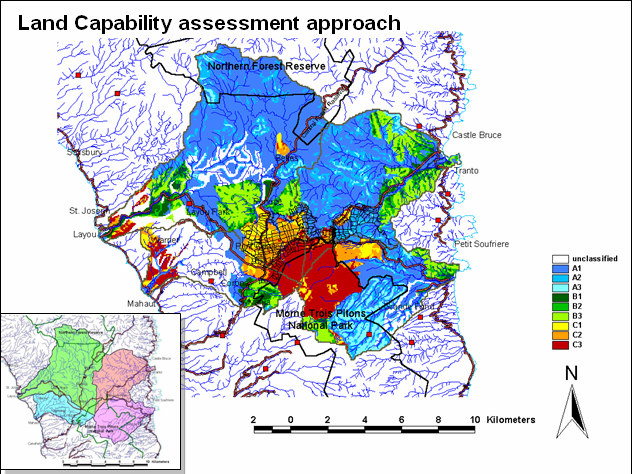
Page 71 of 79
GIWA assessment criteria Dominica example
#
Name of the criteria
Weight (1 Rating
4)
1
Size of affected area (see table below
1
1 - less than 10 sq. km.
adaptation to Dominica)
2 - 10 to 100 sq. km.
3 - 100 to 1,000 sq. km.
4 - 1,000 to 10,000 sq. km.
5 - over 10,000 sq. km.
2
Affected population (see table below
3
1 - less than 1,000
adaptation to Dominica)
2 - 1,000 to 10,000
3 - 10,000 to 100,000
4 - 100,000 to 500,000
5 - over 500,000
3
Extent to which the natural watershed,
4
5- very important (>80%)
coastal and marine resources of the
4- important (50-80%)
site support the livelihood of local
3- average importance (30-50%)
communities (for instance, in the case
2- low importance (10-30%)
of fisheries, tourism);
1- very low importance (<10%)
4
Extent to which the natural watershed,
2
5- very important (>80%)
coastal and marine resources of the
4- important (50-80%)
site support the national development
3- average importance (30-50%)
(for instance, in the case of fisheries,
2- low importance (10-30%)
tourism);
1- very low importance (<10%)
5
Extent to which the site is a
3
5 yes, very high priority
government priority (refer to NEAP or
4- yes, high priority
other strategic environmental action
3- yes, medium priority
programme)
2 yes, low priority
1 no, not a priority
6
Extent to which the site is of regional
2
5 yes, very high priority
and/or global significance and priority
4- yes, high priority
(see WWF ecoregions, IUCN
3- yes, medium priority
categories, etc.).
2 yes, low priority
1 no, not a priority
7
Degree of Degradation at the site (e.g.
3
5 extremely high
type of degradation)). Apply the GIWA
4 high
issues under Major Concerns: I
3 average
Freshwater shortage, II Pollution, III
2 low
Habitat and community modification,
1 very low
IV Unsustainable exploitation of
fisheries and other living things
8
Extent of degradation on watershed,
2
5 extremely high
coastal and marine resources and
4 high
systems. Apply the GIWA issues
3 average
under Major Concerns: I Freshwater
2 low
shortage, II Pollution, III Habitat and
1 very low
community modification, IV
Unsustainable exploitation of fisheries
and other living things
Page 72 of 79
Modified GIWA assessment criteria for SIDS
#
Name of the criteria (modified for Weight (1 Proposed revised rating
Dominica)
4)
1
Size of affected area. In the case of small
1
1 - less than 5 sq. km.
islands the area rating will need to be
2 5 to 10 sq. km.
scaled. The `5' rating may be assigned to
3 - 10 to 25 sq. km.
the size of the largest watershed in
4 25 - 50 sq. km.
Dominica, in this case the Layou at 76.5
5 - over 50 sq. km.
sq.km.
2
Affected population. In the case of small
3
1 - less than 1,000
islands the population rating will need to
2 - 1,000 to 2,500
be scaled. The `5' rating may be applied
3 2,500 to 5,000
to the largest communities. In this case,
4 5,000 to 10,000
Roseau
which
has
some
16,000
5 - over 10,000
inhabitants (1991 census).
Layou watershed GIWA assessment
Criteria # Justification
Rating
Weight
Ranking
1
Watershed area is 76 km2
5
1
5
Population within watershed - assumed to be relatively
sparse. The communities within the watershed limits are
Belles, Layou Park, Penrice, Pont Cassé and Layou. These
2
3
3
9
are small, likely containing less than 1,000 inhabitants each.
The combined population is therefore estimated to fall
between 2,500 and 5,000.
Main economic activities include agriculture, eco-tourism.
3
These generate income for communities. Significant
4
4
16
extraction of quarry material for the construction industry
4
Same as above
4
2
8
Key issues include the presence of significant agricultural
5
production, forest reserves, national park. The Layou is a
5
2
10
large watershed area with significant political importance
Presence of the Morne Trois Pitons National Park, inscribed
6
as a World Heritage Site. Forest reserves also fall within
4
2
8
watershed
Degradation at spot locations where quarrying occurs,
7
intensive agriculture on steep slopes and landslides
3
3
9
associated with infrastructure
8
Same as above
3
2
6
HOT-SPOT ASSESSMENT SCORE (out of 100)
71
EXAMPLE SUMMARIES OF THE GIWA HOTSPOT SELECTION PROCESS FOR IWCAM
PROJECT
COUNTRY
CUBA
DOMINICA
Hotspot 1
Cienfuegos
West Coast Dublanc
GIWA Score
83
62
Page 73 of 79
Hotspot 2
Cauto Watershed
Jimmit/Morge Espagnol
GIWA Score
83
69
Hotspot 3
Zaza Watershed
GIWA Score
68
Sensitive Area 1
Cuyaguateje Watershed
Carib Territory
GIWA Score
74.4
82.4
Sensitive Area 2
Toa W/S
Penville
GIWA Score
71.2
72.8
Sensitive Area 3
Hanabanilla Watershed
GIWA Score
69
Demo 1 Area
Cienfuegos Bay
Carib Territory
Hotspot/SA No.
Hotspot 1
Sens. Area 1
Demo 2 Area
Hotspot/SA No.
Environmental hot-spots = geographically defined watershed, coastal areas and other areas
of the sea, of national, regional and/or global significance, where the conditions are such as to
adversely affect human health, threaten ecosystem functioning, reduce biodiversity
and/or compromise resources and amenities of economic importance in a manner that
would appear to warrant priority management attention. A degraded area is said to display
significant and measurable environmental degradation.
Sensitive areas = geographically defined areas, of national regional and/or global significance
which, although not degraded at present, are threatened with future degradation, either
because of sensitivity of the receptor or the magnitude of the anthropogenic activity posing the
threat.
Page 74 of 79
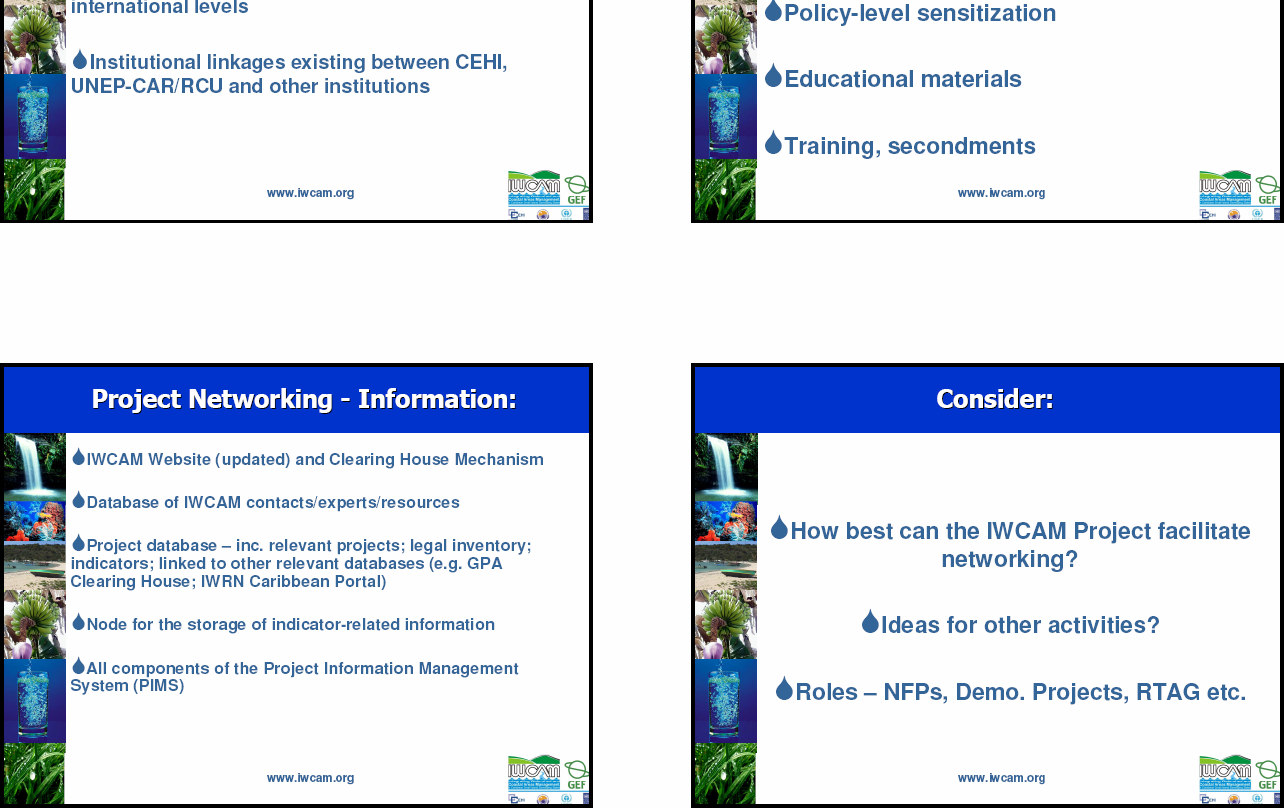
GEF-IWCAM Partnership Forum / Networking
Page 75 of 79
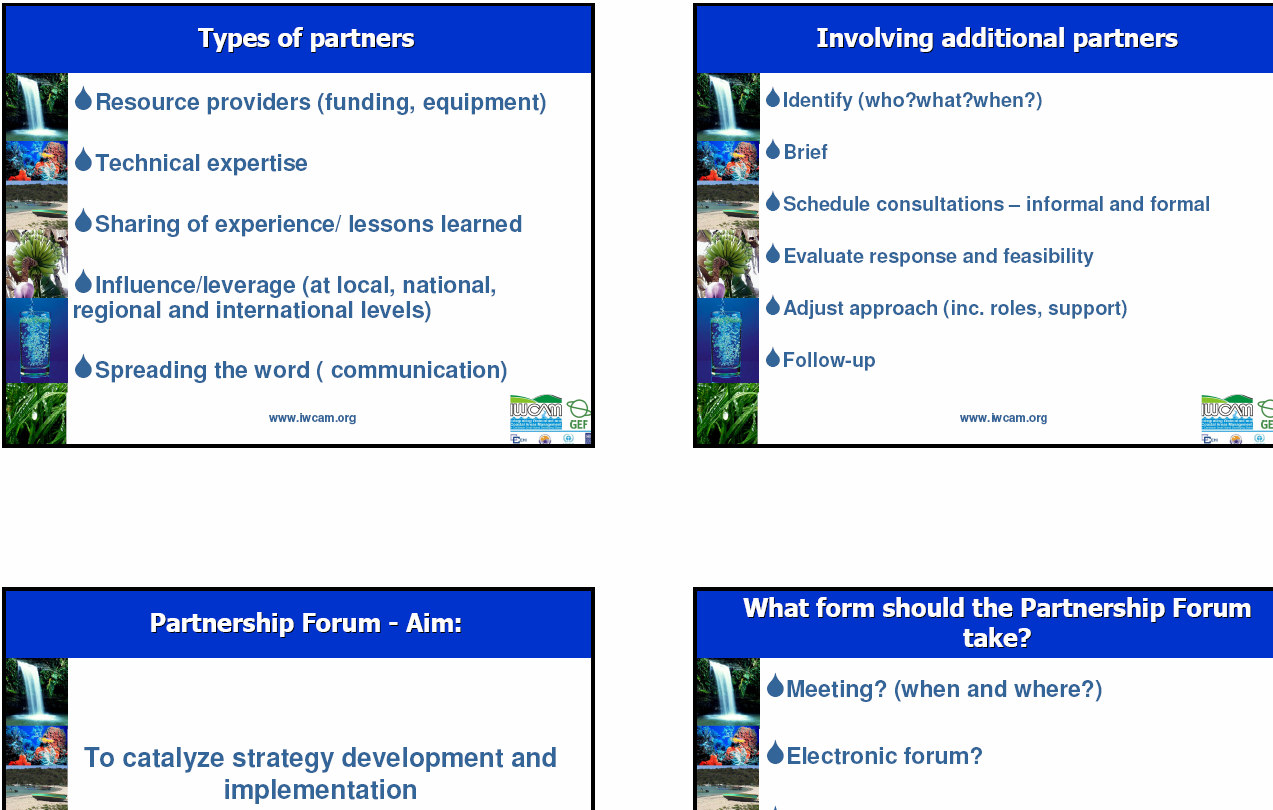
Page 76 of 79
GIS and Other Information Systems
Page 77 of 79
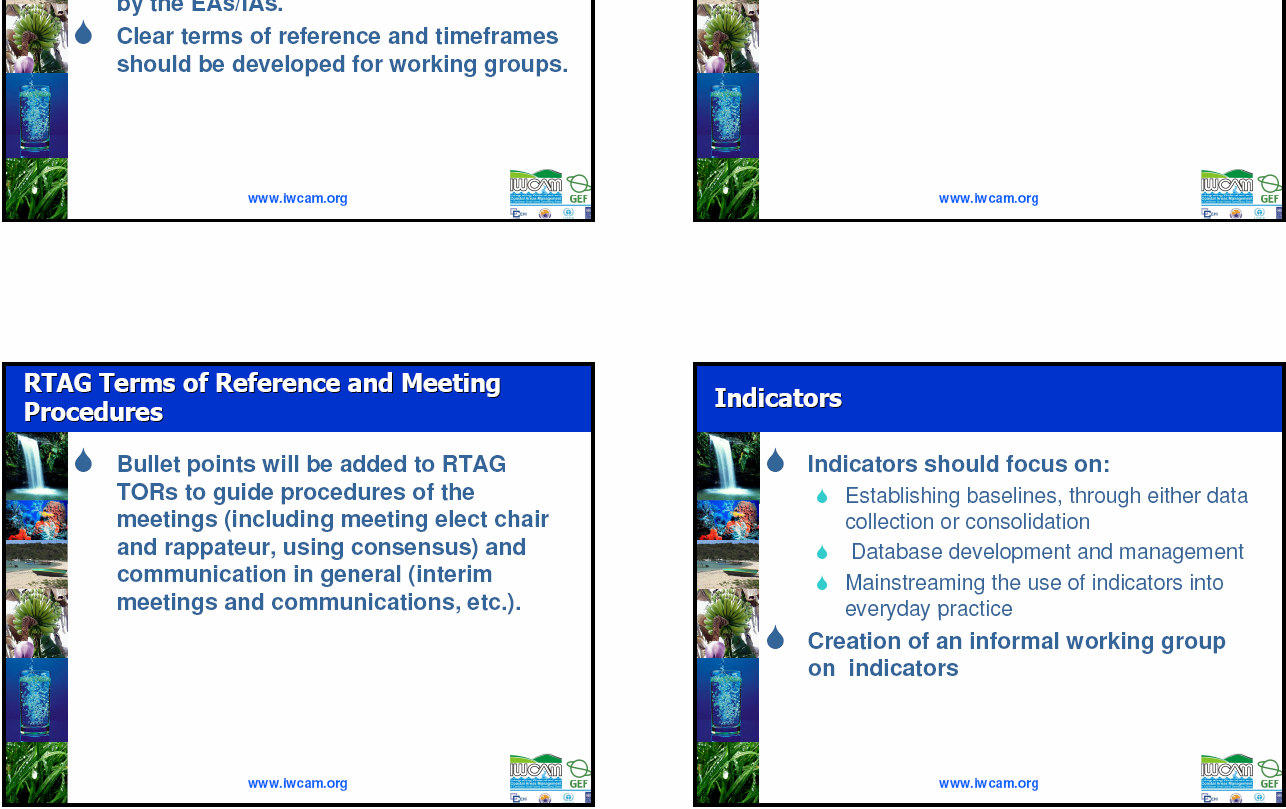
RTAG Recommendations
Page 78 of 79
Page 79 of 79