


Regional Technical Advisory Group Meeting
Nassau, Bahamas
7-8 July 2009
Prepared by
Project Coordination Unit of the
Global Environment Facility-funded Integrating Watershed
and Coastal Areas Management (GEF-IWCAM) Project
P.O. Box 1111, The Morne
Castries, St. Lucia
Page 1 of 12
List of Acronyms ........................................................................................................................ 3
Background................................................................................................................................ 4
MEETING PROCEEDINGS ....................................................................................................... 4
Welcome Remarks................................................................................................................. 4
Introduction of Members......................................................................................................... 4
Organisation of the Meeting / Adoption of the Agenda ........................................................... 5
Designation of Officers........................................................................................................ 5
Organisation of Work .......................................................................................................... 5
Status Report ......................................................................................................................... 5
Haiti .................................................................................................................................... 5
Translation .......................................................................................................................... 6
Sustainability....................................................................................................................... 6
Technical Cooperation among Countries ............................................................................ 6
Mid-Term Evaluation .............................................................................................................. 6
Exit Strategy ....................................................................................................................... 6
Country Presentations............................................................................................................ 8
Indicator Development ........................................................................................................... 8
Discussion on Draft Work Plan for 2010................................................................................. 9
Legislative and Policy Reform ................................................................................................ 9
Integrated Water Resource Planning...................................................................................... 9
Capacity Building ..................................................................................................................10
Utilization of Geographic and Other Information Systems for IWCAM ...................................11
Any Other Business ..............................................................................................................11
Date and Place of the Next Meeting of the RTAG .................................................................11
Annexes ................................................................................................................................12
Page 2 of 12
List of Acronyms
Term / Phrase
Acronym
Assessment and Management of Environmental Pollution (AMEP)
AMEP
Bahamas Environment, Science and Technology Commission
BEST Commission
Caribbean Environmental Health Institute
CEHI
Fifth Caribbean Environmental Forum
CEF-5
Geographic Information Systems
GIS
Global Environment Facility-funded Integrating Watershed and Coastal
GEF-IWCAM
Areas Management (project)
Integrated Water Resource Management
IWRM
National Intersectoral Commission
NIC
Project Coordination Unit
PCU
Project Information System
PIMS
Protocol Concerning Pollution from Land-Based Sources and Activities
LBS Protocol
of the Cartagena Convention
Reducing Pesticide Runoff to the Caribbean Sea (project)
REPCAR
Regional Technical Advisory Group
RTAG
Small Island Developing States
SIDS
Technical Cooperation among Countries
TCC
United Nations Development Programme
UNDP
United Nations Development Programme, Jamaica Country Office
UNDP Jamaica
United Nations Environment Programme
UNEP
United Nations Environment Programme's Caribbean Regional
UNEP CAR-RCU
Coordinating Unit
Watershed Management Committee
WMC
Page 3 of 12
Background
The fourth official meeting of the Global Environment Facility-funded Integrating Watershed
and Coastal Areas Management (GEF-IWCAM) Project Regional Technical Advisory Group
(RTAG) was held in Nassau, Bahamas on 7-8 July 2009. For information on the Terms of
Reference of the RTAG, refer to Annex 1.
MEETING PROCEEDINGS
Welcome Remarks
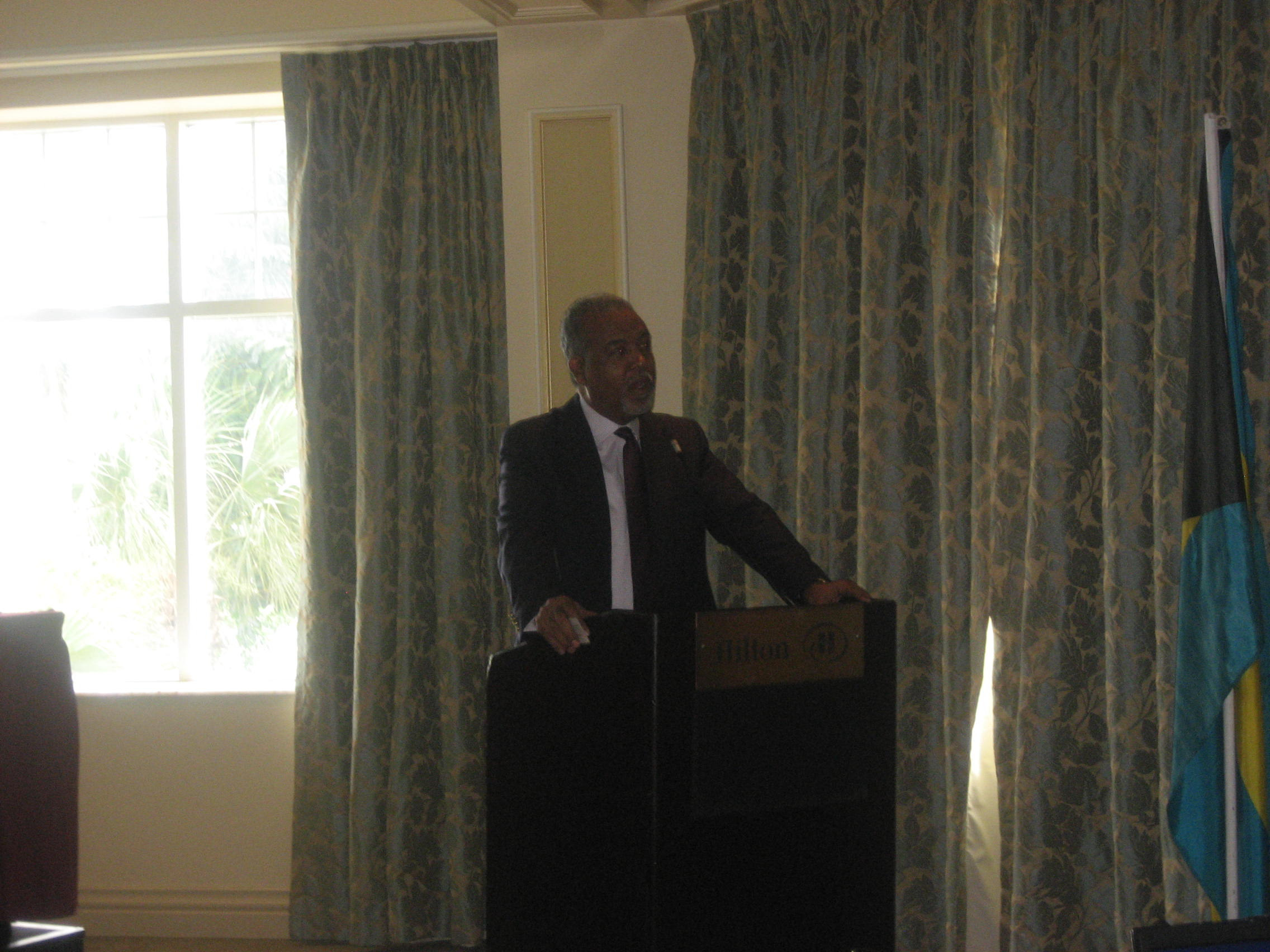
Vincent Sweeney, Regional Project Coordinator of the GEF-IWCAM Project welcomed
participants on behalf of the project. This was followed by remarks from Philip Weech of the
Bahamas Environment, Science and Technology (BEST) Commission, Nelson Andrade
Colmenares of the United Nations Environment Programme Caribbean Regional Coordinating
Unit (UNEP CAR-RCU), Patricia Aquing of the Caribbean Environmental Health Institute
(CEHI), and Akiko Fujii of the United Nations Development Programme, Jamaica Country Office
(UNDP Jamaica).
Mr. Weech welcomed participants to the Bahamas and underscored the importance of the work
of the meeting. Mr. Andrade Colmenares spoke of the great significance of the technical input of
the RTAG in advising on future work plans and specific activities. He stressed the link between
the Protocol Concerning Pollution from Land-Based Sources and Activities (LBS Protocol) to the
Cartagena Convention and the project and told the participants that only 3 more countries'
ratification is needed to bring the LBS Protocol into force. Mrs. Aquing reported that there are
three simultaneous activities taking place in the Bahamas: 1. GEF-IWCAM Meeting on Lessons
Learned, 2. United Nations Environment Programme (UNEP) Global Programme of Action
CEHI collaborative workshop on wastewater management, and 3. the RTAG Meeting. She also
spoke about the sustainability of the IWCAM approach, stating how imperative it is that the
IWCAM approach becomes a way of doing business in the Caribbean. The final welcoming
remarks were made by Ms. Fujii, in which she re-emphasized the importance of the project to
United Nations Development Programme (UNDP). She spoke of the significance of a regional
approach to environmental issues and how this can help countries to apply it to national level
policy and legislation. Ms. Fujii also highlighted the issue of sustainability and national
ownership of the project.
Introduction of Members
RTAG participants introduced themselves and shared their expertise. Technical areas
represented included:
-
Agronomy and Agricultural
-
Environmental Awareness,
Engineering
Education, Engineering, Health and
-
Chemistry
Management
-
Civil Engineering
-
Forestry
-
Coastal Zone Management
-
Geography and Geographic
Information Systems (GIS)
-
Hydrology
Page 4 of 12
-
International Economics
-
Pollution Control / Hazardous Waste
-
Linguistics
-
Physical Geography
-
Marine Biology and Ecology
-
Urban Planning
-
Natural Resources Management
-
Water and Wastewater Management
-
Parks Management
and Water Quality
-
Policy
-
Watershed Management
See Annex 2 for the Participants List.
Organisation of the Meeting / Adoption of the Agenda
Designation of Officers
A representative from Barbados nominated the Bahamas to serve as the Chair of this meeting
of the RTAG. The nomination was seconded by Jamaica and Grenada and Deon Stewart of the
Bahamas was designated the Chair by acclamation of the group.
Sasha Beth Gottlieb for the GEF-IWCAM Project Coordination Unit (PCU) was appointed as the
rapporteur of the meeting, based on unanimous agreement.
Organisation of Work
The participants of the meeting officially adopted the agenda, which was provided to them for
review the previous week. The working hours of the meeting were modified slightly to 9:00 am
5:00 pm and with the attempt to finish the meeting by mid-day on July 8th. The representative
from Haiti suggested that adaptation strategies to climate change related to IWCAM be
addressed by the meeting, which was agreed to by consensus.
See Annex 3 for the Agenda.
Status Report
A presentation was made by Mr. Sweeney on the implementation status of project activities,
which is attached as Annex 4.
This presentation led into discussion about the past year's activities and suggestions for
upcoming interventions by the project. The discussion about the past year's activities is
presented below and comments related to upcoming activities are detailed in the following
section.
Haiti
It was noted that the GEF-IWCAM Projects' interventions have now moved from ideas to
concrete action with a specific budgetary allocation, which will help to accelerate activities in
Haiti. The representative from Haiti committed to assist the project in overcoming any barriers
impeding this progress of such activities.
Mr. Andrade underscored the attention and resources that UNEP is also dedicating to Haiti and
that organization's plan to implement related activities. UNEP is seeking to define these
activities and will be visiting Haiti, together with the GEF-IWCAM Project, in late July. Mr.
Page 5 of 12
Andrade stressed the need for government commitment in order to see these projects to
fruition.
Translation
The RTAG strongly recommended that awareness and technical materials developed by the
project be translated into French and Spanish.
Sustainability
With one and one-half years left of the project, its sustainability was the topic of much
discussion. The RTAG stressed that much of the sustainability of the approach would be linked
to ratification of the LBS Protocol. LBS ratification would entrench the IWCAM approach into
national governance structures. It will also prove helpful in obtaining external funding from
donors. Currently, ratification by three additional countries is all that is needed to turn the
Protocol into international law. The RTAG suggested that the project focus its activities on
countries that are close to ratifying in order to help with this process, identify the gaps, and take
the needed actions to help the process move forward. It was noted that Bahamas and Haiti
have not yet signed (acceded) to the Cartagena Convention. The representative from Barbados
noted that there is still a lot of work to be done nationally before they are able to ratify the LBS
Protocol.
Mr. Sweeney noted that perhaps a number of countries don't realize how easy it is to move from
where they are to ratification, and this can be further exacerbated by the lack of champions at
the national level. Nadia-Deen Ferguson of UNEP CAR-RCU noted that they have recently
launched a web-page dedicated to the LBS Protocol (http://www.cep.unep.org/countdown-to-
the-lbs-protocol). The page includes count-down to LBS, a legislative toolkit specifically oriented
to the LBS, sample press kits, draft memorandums, etc.
In regards to the LBS Protocol, Ms. Aquing highlighted the division between technocrats and
politicians, underscoring how important it is for us to re-orient ourselves to speak the language
that our legal / policy people can understand. The IWCAM approach and the LBS Protocol must
be linked to economic development, sustainability, human health, with clear downsides
highlighted.
Technical Cooperation among Countries
Additional information was requested on the opportunities for technical cooperation among
countries (TCC). RTAG representatives were informed that a formal communication was sent to
all National Focal Points, asking them to identify their needs for TCC as well as areas in which
they felt their country could provide training for others. The response to date has been very
weak, which is of concern for the PCU. All RTAG representatives were requested to follow up
on this matter with their national focal points.
Mid-Term Evaluation
In May-June 2009, a mid-term evaluation on the project was conducted, the results of which Mr.
Sweeney presented (see Annex 5). This presentation was then followed by an active discussion
on some of the more salient issues.
Exit Strategy
The RTAG spent some time discussing the "exit strategy" of the project, which is closely linked
to the previously discussed sustainability issue.
Page 6 of 12
Some representatives, such as Jamaica and Saint Lucia, shared their countries' approaches in
terms of developing exit strategies for the demonstration projects.
The government of Jamaica, from the inception of the demonstration project, committed to
engaging community members as much as possible to ensure sustainability of effort after the
project concluded. They employed many different approaches, such as:
-
Grants Programme
-
Economic Incentives
-
Community Animators
-
Meetings in a variety of different forms (community meetings, sports and environment
events, etc.)
The Jamaican representative also spoke about the monitoring programme, whose results in turn
have spurned people on to undertake community work. The project team and others help to
present and interpret the monitoring results and then solicit solutions from the community itself
to the problems.
In retrospect, the Jamaica demonstration project noted that it could have better documented on
video some of the activities of the project and the reactions of the community members to it. The
Jamaican representative spoke of one experience in particular, where a local man was in tears
speaking about the positive impact that the project had accomplished, stating that it literally had
changed his life. It is those sorts of images and interactions that the demonstration project team
regrets not having documented, in addition to the more technical information.
The Saint Lucia demonstration project has been addressing the sustainability issue through the
establishment and strengthening of a Watershed Management Committee (WMC). The
empowerment of the WMC is such that the members truly "own" the project and are able to note
with pride the impact it makes on their lives and the lives of their neighbors. The demonstration
project has been working with national programmes, to help promote a replication of the lessons
learned from the project. For example, these good practices will hopefully be adopted and
promoted by the newly established Water Resources Management Agency. Also data from the
demonstration project will be included in national level databases.
In more general terms, it was suggested that sustainability really fell under the headings of
management, project design, policy and legal framework, and capacity and knowledge
generation, all of which are key to any successful and sustainable exit strategy. This was
echoed by many other representatives.
The reliance on external funding was brought up as a deterrent to sustainability. Funding should
not be project driven and projects should strive to be less reliant on external funding, but instead
locally driven and their activities should be supported by regular budgetary allocations. In order
to do this, highly successful initiatives should be packaged and shown to decision-makers in
terms of how truly transforming they can be. Building on previous initiatives was suggested as a
way to help ensure their sustainability.
It was noted that co-funding needed to be better captured and the PCU was asked to create a
specific template for GEF-IWCAM countries to ensure consistency. Ms. Fujii noted that co-
financing has a lot to do with the project's sustainability, demonstrating government ownership.
If the government doesn't find a particular project or set of activities beneficial, it won't put in its
own resources.
Page 7 of 12
Participants recommended incorporation of both legislators and the private sector in IWCAM
work, again to ensure that the approach continues on after the project ends. It was also
suggested that the GEF-IWCAM Project consider contracting a private sector consultant to
determine how best to incorporate the private sector in the work of the project and hold
additional training for legislators to help them better understand environmental issues. Training
in proposal writing was also suggested, with a specific focus on writing proposals for internal
consideration of national governments, and not specifically for external funding.
Country Presentations
Participants made brief and informal country presentations. Salient points are listed below.
Saint Kitts and Nevis noted that the technology used for mapping of the aquifer has proven to
be a very efficient and economical way to obtain important hydrological and geological data.
Two abstracts have been prepared and submitted to the annual Caribbean Water and
Wastewater Association conference on these activities.
The representative from Saint Kitts and Nevis also highlighted three challenges that the project
faced or is facing:
-
Project inception was significantly delayed due to problems in finding and hiring a
suitable project manager. That person has now been in place for approximately one year
and things are moving forward.
-
Due to the shortened time period for project execution, demonstrating stress reduction is
a real challenge. It is important to be realistic about what can be achieved in this
timeline.
-
The re-composition of the National Intersectoral Commission (NIC) is likely to be difficult.
Such a committee previously existed, but will need to be revived.
The Saint Kitts and Nevis representative also asked the other participating countries to share
their experiences in separating the regulatory functions from the water utility.
The Antigua and Barbuda representative noted communications challenges with consultants
hired to undertake much of the policy / strategic work, which has resulted in delays in starting
the actual construction.
The representative from Cuba underscored their willingness to provide training for other
participating countries.
Indicator Development
A presentation on Indicator Development is included as Annex 6, which was followed by a
discussion on how to promote the effective use of indicators within the IWCAM approach. It
was suggested that many people are unfamiliar with indicators and how they are used. In order
to address this deficiency, RTAG participants recommended IWCAM indicators workshops.
These could be national workshops which present the IWCAM template, address how to define
and talk about indicators, and then move on to how indicators are used. The indicators
template should be distributed at those workshops. The national workshops would lead to a
regional workshop in which the indicators database activities in Barbados would be highlighted.
Page 8 of 12
It was also suggested that the IWCAM indicators approach could be promoted to specific
entities identified by the RTAG and by national focal points. The representative from Haiti
suggested the National Geographic Information Systems Centre in that country, as they are
soon going to define indicators for watersheds and protected areas.
It was noted that the Community-Based Resource Assessment tool being developed is an
excellent example of translating environmental indicators into common language, which could
lead to mainstreaming indicators.
Discussion on Draft Work Plan for 2010
Mr. Sweeney made a presentation on the draft work plan for 2010, which is attached as Annex
7.
The work plan was endorsed by the RTAG, although participants made suggestions as to
additions that could be considered. These included:
-
Senior-Level Ambassadorial Workshop for private sector with high level politicians: This
would promote dialogue on how we can involve the private sector in an effective way. It
could be held at a regional or national level, but national level is preferable.
-
Co-financing strategy: It was recommended that projects work with the Ministries of
Planning in order to ensure the necessary project co-financing. The South China Seas
project has a good model / template for co-financing and adaptation and application of
that would be useful. A workshop was suggested to develop a co-financing model for
participating countries.
-
LBS Protocol: The contracting of a consultant to prepare cabinet notes, draft legislation,
and undertake similar tasks was recommended in order to promote the ratification of the
LBS Protocol. In addition, a factsheet that clearly lays out the advantages of the LBS
Protocol, would be useful. The Fifth Caribbean Environmental Forum (CEF-5) is an apt
opportunity to promote the LBS Protocol and the work of the GEF-IWCAM Project.
Legislative and Policy Reform
Nadia-Deen Ferguson, of UNEP/CAR-RCU, presented on Legislative and Policy Reform (see
Annex 8). Following her presentation, RTAG representatives noted that capacity was needed in
legislative drafting and preparation of cabinet papers. It was suggested that in order to achieve
ratification of the LBS Protocol, assistance should be very targeted rather than spread
throughout all countries. UNEP/CAR-RCU is targeting Barbados, Grenada, Dominica, and
Antigua/Barbuda.
The representative from Antigua and Barbuda noted that access to a ministerial body is needed
for Cabinet consideration. They suggested that a Ministerial / IWCAM meeting be organized and
then the LBS Protocol be presented.
The Barbadian representative stressed the link between the Caribbean Regional Fund for
Wastewater Management (CReW) and the LBS Protocol.
Integrated Water Resource Planning
The session on Integrated Water Resource Planning was facilitated by Dr. Cox, and his
presentation is included as Annex 9.
RTAG participants discussed whether the project should work with one participating country to
develop a full scale integrated water resource management (IWRM) plan or work with more than
Page 9 of 12
one. Some participants felt that there was not enough time remaining, as by its very nature, the
IWRM plan development process must be stakeholder driven and participatory, which is a full
iterative process and can take a long time. On the other hand, it was suggested that the process
may not take as long as we think, and it would be very useful in terms of lessons learned. In
general, the consensus of the group is that the GEF-IWCAM efforts should focus more on the
ratification of the LBS Protocol than the development of full IWRM plans.
Other suggestions included:
-
The project could hire IWRM Champions at the national level for one year.
-
Linking the highly-publicized issue of climate change to IWRM-related work.
-
Provide guidelines for the development of the IWRM plan (general for all countries). In
regards to this point, it was noted that a Global Small Island Developing States (SIDS)
IWRM Methodology is being developed by a consortium of consultants. GEF-IWCAM will
convene a workshop to review this methodology prior to finalization.
It was agreed by the RTAG that the GEF-IWCAM Project should focus its LBS and IWRM
activities on Grenada, Dominica, and Barbados first and then later on St. Lucia and
Antigua/Barbuda. It was recommended that the project work with the first three countries for six
months and then assess how much has been accomplished. Based on that determination, a
decision would be made whether to extend the technical assistance in this area to additional
countries. Some suggested activities include:
-
High level ministerial session
-
One week "blitz" lobbying
-
Identification of a champion
-
Targeted publications and materials to address different groups.
Capacity Building
Training needs for 2010 identified by the RTAG were:
-
Project and Proposal Writing (targeting national governments rather than external
funding sources)
-
Wastewater treatment and re-use. A specific need for training in wastewater re-use in
agriculture and related guidelines was identified.
-
Preparing watershed management plans (process / methodology)
-
Hydrochemistry and water analysis interpretation
-
Train-the-trainer workshops at the national level, in a variety of subject matters that were
not identified at the time
-
Online tutorials for all trainings.
-
Online tutorial on GIS (related to GIS workshop in Cuba). RTAG participants stressed
this training as extremely important.
In the session on capacity building, the RTAG also discussed the laboratory strengthening
activities. UNEP/CAR-RCU informed the group that it is preparing an inventory of all
laboratories in the region, listing their capabilities, which should be available for review in
August 2009. A similar exercise has taken place at the national level, led by the government of
the Dominican Republic. The representative from Grenada expressed concern that laboratories
don't have sufficient capacity and needed to broaden the amount of tests that they do. In Haiti,
the laboratories actually have more than enough equipment, but lack adequately trained
personnel. The representative from the Barbados noted that they use two laboratories for water
Page 10 of 12
and environment, which are the public health laboratory and government analytical services.
The Barbados Water Authority has provided equipment and personnel to the lab to strengthen
the capacity. It also helped the laboratory to develop a client base.
Utilization of Geographic and Other Information Systems for IWCAM
Annex 9 includes the PowerPoint presentation made by Dr. Cox on the Utilization of Geographic
and Other Information Systems for IWCAM. It was followed by a presentation by Trevor
Thompson on the Water Information System in Grenada. Ms. Ferguson also presented on the
interactive map prepared by UNEP/CAR-RCU regarding Assessment and Management of
Environmental Pollution (AMEP) and the Reducing Pesticide Runoff to the Caribbean Sea
(REPCAR) Project.
A formal recommendation was made by the RTAG to standardize data within GEF-IWCAM and
ensure common metadata and for countries to standardize their GIS data. Along the similar
lines, the project was asked to consider information exchange protocols, focusing on the LBS /
IWCAM indicators.
It was noted that without the need for data, there will not be a strong enough impetus to
maintain any sort of information system. As such, it is essential that data be used as part of a
decision support system for policy formulation and implementation.
The RTAG participants were asked how the project could best assist in GIS and for the Project
Information System (PIMS). The following recommendations were made:
-
Saint Lucia noted that the cost of data collection is high, so direct support for the Water
Resources Management Unit in the re-establishment of a Water Information System
would be useful.
-
Dominica requested continued capacity building in collecting and establishing baseline
data.
-
Barbados highlighted the need for human resource development to better manage data.
Any Other Business
A request for proposals regarding sustainability of GEF-IWCAM demonstration projects was
presented and participants were asked if the approach was appropriate. General consensus
was that yes, but it should be extended to help all participating countries with their sustainability
and replicability plans.
A GEF Caribbean Constituency Meeting will be held in the Fall in Barbados and it was
recommended that the GEF-IWCAM Project do a presentation at this meeting. The RTAG
asked the PCU to follow up on this.
The link between the IWCAM approach and climate change adaptation strategies was noted. It
was suggested that the project should try to capture its achievements in terms of adaptation to
climate change and the contributions that the IWCAM approach has been able to make, bearing
in mind different aspects of adaptation strategies.
Date and Place of the Next Meeting of the RTAG
The RTAG recommended that one RTAG Meeting be scheduled for 2010, to take place in July
2010, with the possibility of adding another if so determined necessary by the PCU and
Implementing and Executing Agencies.
Page 11 of 12
Annexes
The following annexes are available at
http://www.iwcam.org/documents/meeting-reports/gef-iwcam-regional-technical-advisory-group-
rtag/rtag-4-july-2009/rtag-4-report-of-proceedings or http://tiny.cc/fcfoD
Annex 1: RTAG Terms of Reference
Annex 2: RTAG Meeting Participants List
Annex 3: RTAG Meeting Agenda
Annex 4: GEF-IWCAM Implementation Status Presentation
Annex 5: Mid-Term Evaluation Presentation
Annex 6: Indicator Development Presentation
Annex 7: Draft Workplan Presentation
Annex 8: Legislative and Policy Reform Presentation
Annex 9: Integrated Water Resource Planning Presentation, Utilization of Geographic and Other
Information Systems for IWCAM Presentation
Page 12 of 12