Third Project Steering Committee Meeting
Montego Bay, Jamaica
6 October 2008
Prepared by
Project Coordination Unit of the
Global Environment Facility-funded Integrating Watershed
and Coastal Areas Management (GEF-IWCAM) Project
P.O. Box 1111, The Morne
Castries, St. Lucia
Table of Contents
Table of Contents........................................................................................................................ ii
List of Acronyms ........................................................................................................................ iii
Background.................................................................................................................................1
MEETING PROCEEDINGS ........................................................................................................1
Opening Remarks / Lead Agency Statements........................................................................ 1
Explanation of Work Schedule and Objectives of Meeting and Adoption of Agenda............... 3
Regional Project Overview and Status Report........................................................................ 3
Review of Minutes and Matters Arising .................................................................................. 3
2008 Work Plan and Budget................................................................................................... 4
Training / Secondments ...................................................................................................... 4
Laboratory Strengthening.................................................................................................... 5
Sustainability....................................................................................................................... 5
Country Presentations............................................................................................................ 6
Antigua and Barbuda .......................................................................................................... 6
Bahamas............................................................................................................................. 7
Cuba ................................................................................................................................... 7
Dominican Republic ............................................................................................................ 7
Jamaica .............................................................................................................................. 8
Saint Kitts and Nevis ........................................................................................................... 8
Saint Lucia .......................................................................................................................... 8
Trinidad and Tobago........................................................................................................... 8
Reducing Pesticide Runoff to the Caribbean Sea (REPCAR) Project..................................... 8
Closing Remarks.................................................................................................................... 8
GEF-IWCAM Third Project Steering Committee Meeting Report
Page ii
List of Acronyms
Term / Phrase
Acronym
Administrative Officer
AO
Barbados Water Authority
BWA
Bilingual Administrative Assistant
BAA
Capacity Building for Integrated Water Resources Management
CAP-NET
Caribbean Environmental Forum & Exhibition
CEF
Caribbean Environmental Health Institute
CEHI
Caribbean Large Marine Ecosystem
CLME
Caribbean Water & Wastewater Association
CWWA
Centre for Resource Management and Environmental Studies
CERMES
Centers for Disease Control (U.S.)
CDC
Coastal Zone Management Unit
CZMU
Communication, Networking and Information Specialist
CNIS
Council for Human and Social Development
COHSOD
Council for Trade and Economic Development
COTED
Demonstration Focal Points
DFP
Executing Agency
EA
Global Environment Facility
GEF
Global Programme of Action for the Protection of the Marine
GPA
Environment from Land-Based Activities
Global International Waters Assessment
GIWA
Global Water Partnership Caribbean
GWP-C
Hotspot Diagnostic Analyses
HSDA
Implementing Agency
IA
Inter-governmental Panel on Climate Change
IPCC
Integrated Water Resources Management
IWRM
Integrating Watershed and Coastal Areas Management
IWCAM
Inter-American Water Resources Network
IWRN
International Waters Learning Exchange and Resource Network
IW:LEARN
Land Based Sources of Marine Pollution
LBS
Medium Sized Project
MSP
Monitoring and Evaluation
M&E
Multilateral Environmental Agreements
MEA
National Environmental Management Strategy
NEMS
National Focal Point
NFP
National Intersectoral Committee
NIC
National Oceanic and Atmospheric Administration (U.S.)
NOAA
National Programme of Action for the Protection of the Marine
NPA
Environment from Land-Based Activities
GEF-IWCAM Third Project Steering Committee Meeting Report
Page iii
National Project Management Unit
NPMU
OECS Protected Areas and Associated Livelihoods (Project)
OPAAL
Organisation of Eastern Caribbean States
OECS
Pan-American Health Organisation
PAHO
Participating Country
PC
Project Coordination Unit
PCU
Project Development Facility
PDF
Project Implementation Report
PIR
Project Information Management System
PIMS
Project Steering Committee
PSC
Regional Project Coordinator
RPC
Regional Technical Advisory Group
RTAG
Ridges to Reefs
R2R
Small Island Developing State(s)
SIDS
Sustainable Integrated Resources Management
SIRM
Technical Coordinator
TC
Terms of Reference
TOR
The Nature Conservancy
TNC
Trinidad and Tobago Solid Waste Management Company Limited
SWMCOL
United Nations Development Programme
UNDP
United Nations Environment Program Collaborating Centre on Water and UCC-Water
Environment
United Nations Environment Programme
UNEP
United Nations Environment Programme Caribbean Regional
UNEP CAR-RCU
Coordinating Unit
United Nations Office for Project Services
UNOPS
University of the West Indies
UWI
Voice over Internet Protocol
VOIP
Water Use Efficiency
WUE
Whitewater to Bluewater
WW2BW
World Resources Institute
WRI
World Summit on Sustainable Development
WSSD
GEF-IWCAM Third Project Steering Committee Meeting Report
Page iv
Background
The third official meeting of the GEF-IWCAM Project Steering Committee (PSC) was held in
Montego Bay, Jamaica on October 6, 2008. The agenda for this meeting is attached as Annex 1
and for the Terms of Reference of the PSC, refer to Annex 3.
MEETING PROCEEDINGS
Opening Remarks / Lead Agency Statements
The meeting was opened by Vincent Sweeney, GEF-IWCAM Regional Project Coordinator (RPC).
Winsome Townsend, GEF-IWCAM National Focal Point (NFP) from Jamaica welcomed the
participants to her country and expressed her pleasure at participating in the GEF-IWCAM
Project. These welcome remarks were followed by comments from the two project
Implementing Agencies (IA) and two of the Executing Agencies (EA).
Paula Caballero of the United Nations Development Programme (UNDP) welcomed the
participants and expressed thanks to Jamaica for hosting the PSC Meeting. She complimented
the project team and participating agencies for their hard work and dedication in promoting the
IWCAM approach. Ms. Caballero called the GEF-IWCAM Project a flagship for the region and for
the GEF. She highlighted how the IWCAM approach builds a foundation for impending issues
such as adaptation to natural disasters and food security. Ms. Caballero expressed the concern
of UNDP regarding the slow implementation and start-up of the demonstration projects.
Demonstration projects, she asserted, are the heart of the project, as they ground-truth the
approach that Caribbean SIDS need to undertake to make IWCAM a reality. Currently, less than
one-half of the demonstration projects are fully operational and achieving the goals set out in
their established workplans. Ms. Caballero told the group that she hopes that at the next PSC
meeting countries will be able to report on the substantive development of these projects. She
also asked the participants to let the Project Coordination Unit (PCU) and the IAs and EAs know
what help is needed to overcome any barriers or constraints to the demonstration projects
implementation.
Isabelle Vanderbeck of the Division of Global Environment Facility of the United Nations
Environment Programme (UNEP DGEF) asked the participants in the meeting to take stock and
devise a plan to bring demonstration projects to success within a year. She informed the group
that in January 2009 a Mid-term review is scheduled. External evaluators would be visiting the
demonstration projects, seeing the progress made to date, and rating the project's success in
achieving its goals. The GEF-IWCAM Project needs to address the problems in terms of
demonstration project implementation and have devised and undertaken corrective measures.
She also underscored the need for synergies between projects in the region, highlighting the
new Caribbean Revolving Fund for Wastewater Management (CReW). This project should be
submitted to the GEF Council for review in late 2008, as the GEF Chief Executive Officer has
already signed off on it. The project works with municipalities and promotes alternative
technologies related to wastewater treatment. It is a US$20 Million project, is being co-
implemented by the Inter-American Development Bank (IADB) and UNEP and the UNEP
Caribbean Regional Coordinating Unit (UNEP CAR-RCU) is the executing agency.
GEF-IWCAM Third Project Steering Committee Meeting Report
Page 1
After the remarks of the two Implementing Agencies were completed, the two Executing
Agencies took the floor. Firstly, Christopher Corbin, of UNEP CAR-RCU welcomed the
participants on behalf of Nelson Andrade Colmenares, UNEP CAR-RCU Coordinator, who was
unable to attend the meeting due to extenuating circumstances. Mr. Corbin informed the
participants that they are reaching a point in which critical decisions must be made in terms of
refining activities and recommitting at the agency and country level to meet objectives and
targets. He spoke about the aforementioned CReW Project, explaining that it will build on the
experiences and successes of the GEF-IWCAM Project. Mr. Corbin also highlighted the
ratification of the Land-based Sources of Marine Pollution (LBS) Protocol by Saint Lucia and
Trinidad and Tobago. UNEP CAR-RCU and other partners are planning to undertake LBS
Promotional activities in other countries. They also hope to work with Bahamas and Haiti, who
have not yet signed on to the Cartagena Convention. Mr. Corbin reminded the participants that
GEF-IWCAM is a country-driven project and encouraged them to provide advice and guidance
on activities to undertake over the next 2.5 years.
On behalf of the Caribbean Environmental Health Institute (CEHI), its Executive Director,
Patricia Aquing welcomed the participants to the meeting and expressed her gratitude to
Jamaica for hosting. She noted that GEF-IWCAM has resulted in a complex but extremely
rewarding relationship among agencies that came together to work for the interests of the
region and she highlighted the very strong collaboration between these agencies. Mrs. Aquing
reminded participants that negotiations regarding this project started in 1998 and it was
approved in 2005. Those seven years in between were filled with a lot of effort from countries
and agencies, alike. She brought up the issue of the region's absorptive capacity and
questioned: Is it possible to make this project work in Caribbean SIDS? Are the countries
committed enough to dedicate necessary resources? Finally she noted that the success of this
project will determine the regions ability to leverage funds beyond IWCAM.
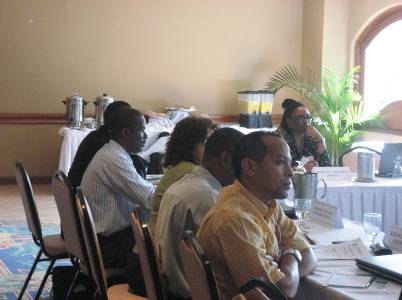
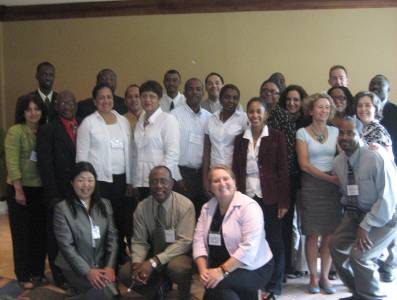
The meeting participants, which included representatives from all participating countries (except
for Trinidad and Tobago and Antigua and Barbuda, who both arrived later due to travel delays),
were next asked to introduce themselves and highlight their expectations for the meeting,
which included:
-
Better understanding of how to get demonstration projects up and running
-
Improved relationship with the other members of the Project Steering Committee, the
Project Coordination Unit, the Implementing Agencies, and the Executing Agencies
-
Learn from the experiences of the other demonstration projects
-
Receive updates on the progress of the project
-
Brainstorm regarding ways to integrate the recently started project in Barbados that
addresses groundwater / zone protection policy with GEF-IWCAM
-
Address budgetary issues at the demonstration project level
-
Request that GEF-IWCAM seek greater presence / visibility in Dominica
-
Seek assistance on LBS policy and legislation in Grenada
-
Learn more about the project and new goals for its second half
-
Promote activities in Haiti
-
Networking between countries / exchange of management experiences
GEF-IWCAM Third Project Steering Committee Meeting Report
Page 2
Explanation of Work Schedule and Objectives of Meeting and Adoption of Agenda
The delegate from Jamaica, Ms. Townsend, was selected as the Chair of the meeting, following
a nomination from the Saint Lucian delegate, seconded by the delegate from Grenada and
unanimous approval from the group. Sasha Beth Gottlieb, GEF-IWCAM Technical Coordinator,
was nominated to serve as rapporteur by the delegate from Saint Kitts and Nevis, seconded by
the Bahamas, and acclamation by the group. The agenda was adopted, without modification,
unanimously (see Annexes 1).
Mr. Sweeney then presented the objectives of the Project Steering Committee meeting, which is
included in a presentation as Annex 2.
Regional Project Overview and Status Report
During this session, Mr. Sweeney presented an overview of regional activities and a status
report of the achievements during the previous year (see Annex 4). Highlights of the status
report presented to the PSC include:
·
Demonstration Project low implementation rates
·
Hotspot Diagnostic Assessment concepts prepared for Haiti and Barbados
·
Site visits conducted to many demo sites
·
Indicators template prepared and to be tested in Barbados
·
Numerous training activities conducted in participating countries
·
Legislative Toolkit for IWCAM completed and designed to support LBS Protocol
·
Integrated Water Resources Management Planning activities conducted in a number of
participating countries
·
Public awareness material produced on a regular basis
·
Laboratory assessments conducted and equipment ordered for some countries
·
Technical cooperation facilitated
·
Website redesigned and PIMS development advanced
The overview and status report presentation was followed by a coffee break and then
discussion on the presentation. The discussion was limited and focused on the absorptive
capacity of the countries to address these activities.
Review of Minutes and Matters Arising
PSC meeting participants went on to review the Minutes of the previous Steering Committee
meeting from October 2007. No amendments were suggested and Diann Black-Layne, the
delegate from Antigua and Barbuda, motioned for the Minutes to be confirmed. The meeting
agreed and the Minutes are attached as Annex 5.
During this session, Mr. Sweeney took the opportunity to remind the participants of certain
matters that were highlighted at the PSC in 2007 and other salient matters. These are listed
below:
GEF-IWCAM Third Project Steering Committee Meeting Report
Page 3
-
RTAG Meetings: It was requested that the RTAG be convened two times in 2008, in
order to devote one of the meetings primarily to address the results to date of
demonstration projects. A decision was made over the course of the year to only hold
the RTAG once, as the demonstration projects had not yet made significant progress
and a second meeting would therefore not be as useful at this time. Nonetheless, in
2009 it was suggested that two meetings be held, as more demonstration projects are
now in their full implementation stage. This suggested change is included in the 2009
budget and workplan.
-
Six Monthly Reports: Demonstration projects are now reporting semi-annually on all
activities they have completed during that time period.
-
Marine Vessel: The marine vessel has been removed from the budget, as there was
not a need for it, and funds were reallocated to laboratory strengthening activities.
-
IWCAM DVDs: All countries would have received copies of the IWCAM DVDs. Donna
Spencer, GEF-IWCAM Communications, Networking, and Information Specialist,
requested that countries provide feedback to the PCU regarding their distribution and
use.
-
Secondments: The PCU has not received any official requests for secondments to
date. Cuba has offered its expertise, which is currently being used in conducting
environmental modelling activities in Antigua and Barbuda. In 2009, the PCU will be
more proactive in facilitating secondments for participating countries.
-
Lessons learned: The importance of documenting and sharing lessons learned was re-
emphasized.
-
Medium-Sized Projects: As a result of changes at the GEF, the issue of Medium-Sized
Projects being developed as part of the GEF-IWCAM Project is no longer a viable option.
Accordingly efforts to support non-demo countries in other ways are now the focus.
-
Collaboration: Collaboration with OECS ESDU and others is needed in terms of
sustainability.
2008 Work Plan and Budget
Mr. Sweeney presented the 2009 Draft Workplan and Budget via a Powerpoint presentation
(see Annexes 6 and 7), which reviewed all components, upcoming activities, and project
budget. The Work Plan proposed for 2009 followed on from work ongoing in 2008. This work
would include training, awareness raising, transfer of lessons learned, support for IWRM
planning, and laboratory capacity building. Additional detail is also available in the Plan of
Operations. The discussion regarding the budget is summarized below:
Training / Secondments
GEF-IWCAM Third Project Steering Committee Meeting Report
Page 4
-
Stephen Lindo, the delegate from Barbados, indicated the need for training of persons
at the operational level in water supply and sanitation - people within the operating
facilities. He also highlighted the need for training in project management.
-
Ronald Charles, the delegate from Dominica, noted that the training addressing the
linkages between water quality and the physical environment (forest, development,
surrounding areas, etc.) would be very useful, especially for staff within the water
utilities. Mrs. Aquing explained the water safety planning being executed by CEHI,
together with the National Oceanic and Atmospheric Administration of the US, does just
that. This planning looks at water quality issues from the source all the way to the tap,
addressing issues such as deforestation, waste management, health, etc.
-
Mrs. Black-Layne suggested that linkages with climate change should be considered in
the training.
-
In terms of secondments, Dunley Auguste, the Saint Lucian delegate, mentioned that St.
Lucia would be officially requesting a secondment in 2009 in Jamaica to train staff of the
newly established Water Resources Authority. He also offered to help other countries
with issues like ratification of the LBS Protocol.
Laboratory Strengthening
-
It was suggested that the PSC consider shifting funds from the budget line 5105 that
addresses the maintenance of survey and laboratory equipment to line 4203, which
would allow for provision of more laboratory equipment for participating countries. The
meeting agreed that less funds would be needed for equipment maintenance, as the
equipment being purchased would be relatively new. As a result, the budget adjustment
was approved unanimously by the PSC.
-
Participants requested additional information on the role of the University of the West
Indies (UWI) in the assessment of laboratories being undertaken by CEHI. It was
explained that UWI may be involved on a case-by-case basis, particularly through
completing of survey forms, but the National Focal Point (NFP) was ultimately
responsible for selecting those laboratories to be strengthened. On a related note, Ms.
Black-Layne noted that the demonstration project in Antigua and Barbuda has been able
to make use of a UWI graduate student to collect project baseline data.
Sustainability
-
Participants were encouraged to discuss the issue of sustainability approaches for
IWCAM. It was suggested that one sole approach would not be appropriate, but instead
a multitude of approaches.
-
Participants then considered how to measure sustainability and are there indicators of
sustainability. They discussed whether signing of the LBS Protocol or institutionalization
of the IWRM approach would increase the likelihood of sustainability. It was suggested
to develop a number of well-defined, well-packaged project proposals
GEF-IWCAM Third Project Steering Committee Meeting Report
Page 5
-
Another idea that was floated was the institutionalization of an IWCAM desk at a
regional agency, or incorporating IWCAM into the actual workplan of regional agencies,
which, incidentally, CEHI has already done. A suggestion was made to consider the
establishment of an independent body, akin to the Intergovernmental Panel on Climate
Change (IPCC), to consider IWCAM.
-
It was also thought that the Project Information Management System (PIMS) would be
able to contribute to the sustainability of the approach, by maintaining a presence on an
ongoing basis. Data generation/management and communication related information
will be central to the PIMS. Consideration of how data will be made available needs to
be considered. Also how do countries contribute to the PIMS? Who will check the quality
of the data? It is considered key that an institution has responsibility / oversight for the
PIMS. Additionally, the PIMS will only be useful if countries contribute to it, take
information from it and give feedback.
-
Participants were asked how the GEF-IWCAM Project can be a more effective advocate.
It was suggested that perhaps establishing a network of people providing data (like the
IPCC) would be helpful, as that would help governments make their decisions based on
sound science. The lack of baseline data for decision-making is a real challenge in the
region, as well as its scattered and inconsistent nature.
-
Given the prominence of climate change currently, it was suggested that the
sustainability of the IWCAM approach might be strengthened by linking the two in IWRM
planning and public awareness activities. The PCU was encouraged to consider
participation (e.g. in a side event) in the climate change conference of parties in Poland,
or asking one of the participating countries to represent it.
-
The CReW Project, currently in the project preparation phase, can create synergies with
the GEF-IWCAM Project and CEHI's workplan in its work on capacity building.
-
Ms. Caballero reminded participants that the LDC-SIDS Project, which focuses on
capacity building for sustainable land management, is another important synergy.
Participating countries should consider linkages between the projects in terms of training
components and project management.
Country Presentations
Antigua and Barbuda
Mrs. Black-Layne made the presentation orally. She noted that the project needed to change
the location of the demonstration site on very short notice. The move from St. John's city to
McKinnon's Pond changed the fundamental nature of the project, as it moved from a square
city block to a mixed use area, with mangrove, beach, tourism, residential, etc. The new site is
highly developed and, due to construction, is no longer able to control floods and filter
sediment. Homes in the area have septic tanks or discharge directly into the pond, whereas
hotels have package sewage treatment plants. The demonstration project is currently assessing
the nature of the problem and collecting baseline data, with the help of two UWI students.
GEF-IWCAM Third Project Steering Committee Meeting Report
Page 6
Under the scope of the project, they are unable to collect baseline data for the off-shore reef,
which would be very useful.
Due to delays caused by the site move, three years will be needed to implement the project.
Some activities currently underway, such as the sewage management strategy, will help to
determine what will be the follow-on activities.
Antigua and Barbuda has learned some lessons over the years of executing GEF projects. All
projects are now managed through one office in the Environment Division, which helps with
coordination. Issues and challenges include change of government (although transition was
smooth), certain changes in the priority of the government, limited human capacity within
government as a result of the voluntary separation package for civil servants, Antigua and
Barbuda's role as chair of the G-77, and health issues for staff members. In the past year, the
Environment Division has shrunk from seven persons to three and fifty percent of the technical
advisory committee has left the government. Government is now re-hiring and new staff should
be on-board soon. This will help get new people involved in the project, but training is needed.
Ms. Black-Layne highlighted a bright spot in terms of project management, which included
contracting an accounting firm to undertake all accounting for GEF projects, which has freed up
a lot of time for the technical team to do its work.
Bahamas
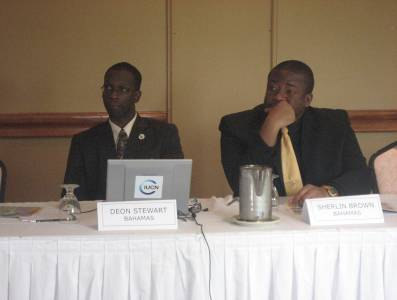
Mr. Deon Stewart, the participant from Bahamas, gave a Powerpoint presentation on the two
demonstration projects in that country (see Annex 8). Bahamas noted the milestones presented
earlier in the day, and was in agreement with them. The participant highlighted that the Clear
Water Caribbean contract was ready to be signed at the end of the month, and that
bureaucratic issues have been quite challenging in terms of project execution.
Cuba
The presentation is attached as Annex 9 (to be added later). Mr. Alain Muñoz Caravaca, the
Demonstration Project Manager, noted that the challenge that Cuba faces is more
administrative than technical, due to the complications of purchasing equipment. The PCU is
looking into mechanisms to purchase laboratory equipment and vehicles on behalf of the
project.
Dominican Republic
The presentation is attached as Annex 10. Mrs. Mercedes Socorro Inoa Pantaleón , the
Demonstration Project Manager, spoke about the progress made over the past few months in
terms of project execution. She noted the bureaucratic challenges resulting from the current
administrative structure. A request is being submitted to bring about a change in structure in
order to facilitate effective project management. Another challenge facing the Demonstration
Project is the low availability of analytical laboratory facilities. This is being addressed by
sending samples to laboratories in other countries to run necessary tests. Ms. Inoa Pantaleon
has found the industrial sector to be very receptive to the work of the Demonstration Project.
GEF-IWCAM Third Project Steering Committee Meeting Report
Page 7
Jamaica
The presentation is attached as Annex 11. Mrs. Townsend, Jamaica Delegate, briefed the group
on the progress being made by the demonstration project, especially as it relates to stakeholder
involvement and public participation. She highlighted the work of three committees established
by the project: Governance and Enforcement, Public Education, and Environmental Monitoring.
She also informed participants of the impact of Hurricane Gustav on the watershed.
Saint Kitts and Nevis
The presentation is attached as Annex 12. Dr. Sahely, the Saint Kitts and Nevis Delegate, spoke
of the recent steps taken to catch up after an approximately two year delay in the execution of
the project. She reported that the recently appointed demonstration project manager had
worked within the government as a Permanent Secretary and also has significant managerial
experience and training. Dr. Sahely and her colleagues at the Water Services Department will
continue to support the project technically. Dr. Sahely spoke of the significance of the
Demonstration Project, including returning historically cultivated land to its pre-colonial state
and establishing a protected area near a main urban area and a tourist area on highly coveted
real estate.
Saint Lucia
The presentation is attached as Annex 13. Mr. Auguste, the delegate from Saint Lucia, informed
participants about the wide variety of activities taking place at the demonstration site, such as
rainwater harvesting, regular stakeholder consultation, and water quality monitoring. The
extensive counterpart funding brought in by the Saint Lucia Demonstration Project was also
highlighted.
Trinidad and Tobago
The presentation is attached as Annex 14. Mr. Linford Beckles, Trinidad and Tobago Delegate,
highlighted some of the major challenges faced by the demonstration project and how these
challenges are being addressed. One example was the perception that the demonstration
project is a "Tobago" project, instead of a national project for Trinidad and Tobago. As such,
the demonstration project management unit has been making appearances on the national
media and is becoming involved with the national environmental compendium through the
Central Statistical Office.
Reducing Pesticide Runoff to the Caribbean Sea (REPCAR) Project
Alexandre Cooman, Project Coordinator, made a presentation on the REPCAR Project, which is
attached as Annex 15.
Closing Remarks
Linford Beckles, the participant from Trinidad and Tobago, reminded participating countries to
be sure to ask the PCU for help when needed and the PCU reminded everyone to be sure to
document their experiences.
Mrs. Aquing expressed her pleasure with the approval of the workplan and budget, as well as
the participation of GEF-IWCAM countries regarding critical interventions of the project. She
GEF-IWCAM Third Project Steering Committee Meeting Report
Page 8
underscored the reminder to all to document lessons learned and best practices. Mrs. Aquing
reminded everyone that the demonstration projects must move forward at full steam, or they
will compromise the success of the entire project. She offered CEHI's commitment to take the
IWCAM approach forward for the region.
Mr. Corbin thanked the host country of Jamaica for chairing the meeting and moving the group
through the agenda effectively and efficiently. He underscored the team-oriented approach,
linkages with the Cartagena Convention and specifically the LBS Protocol.
The meeting ended at approximately 6pm.
GEF-IWCAM Third Project Steering Committee Meeting Report
Page 9