Global Environment Facility funded Integrating Watersheds and Coastal Areas
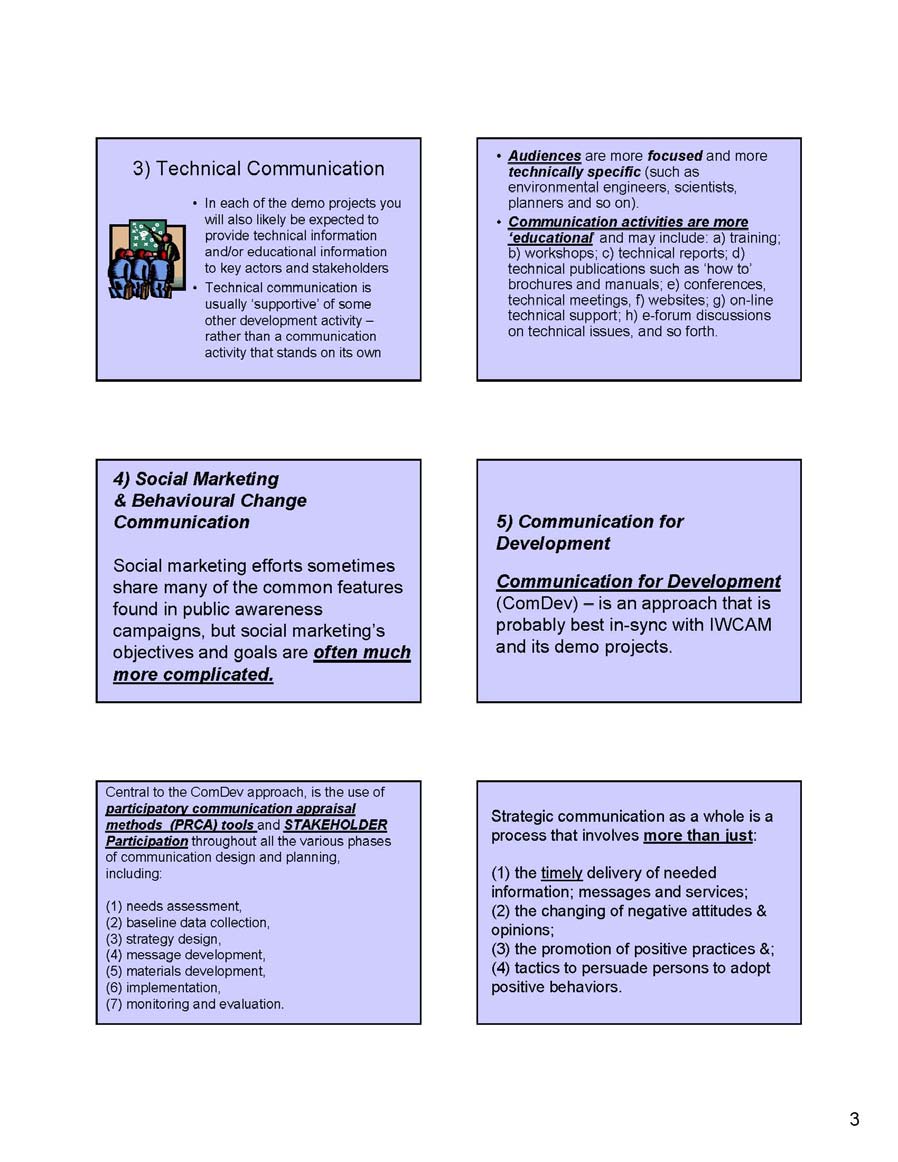
Management in Caribbean Small Island Developing States (GEF-IWCAM) Project*
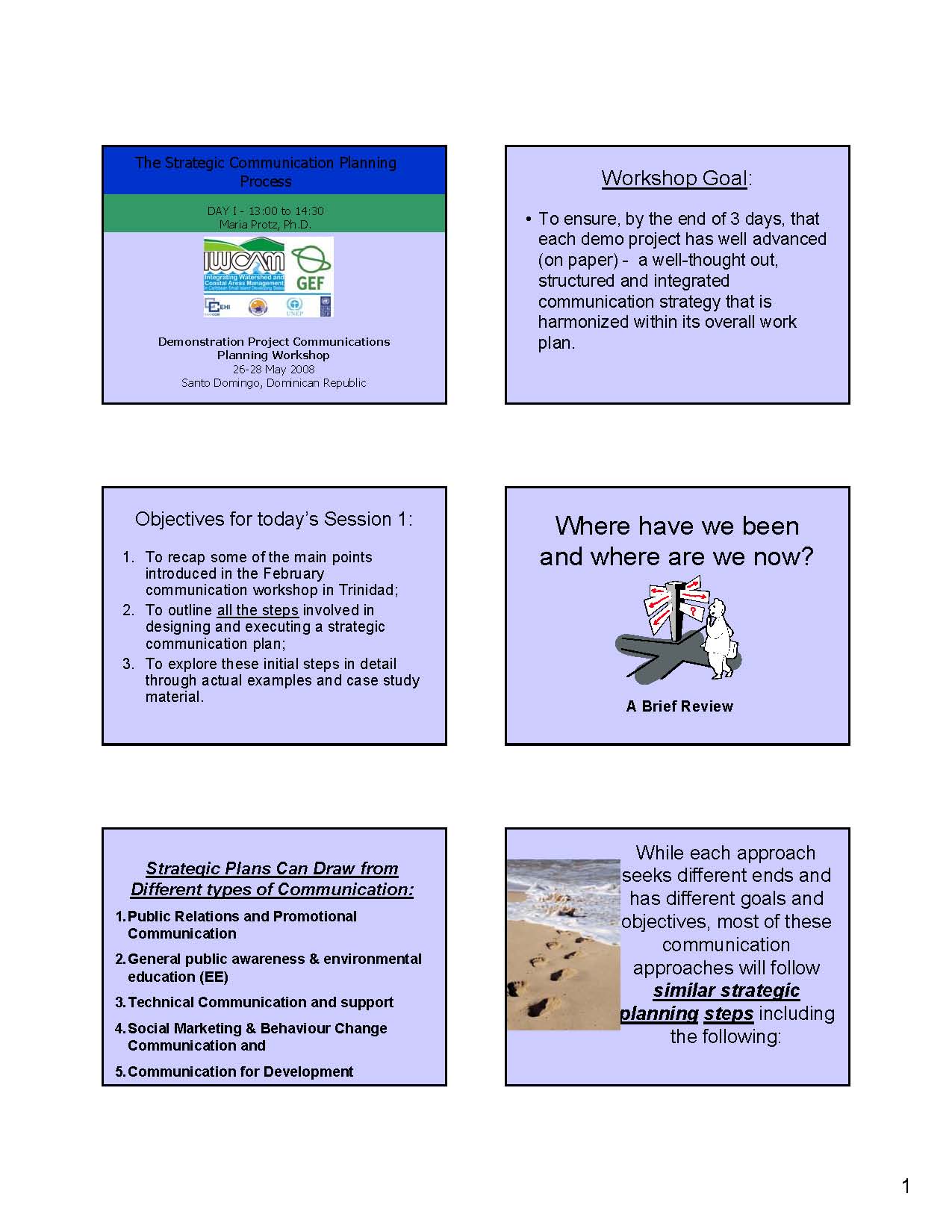
Demonstration Project Communications Planning Workshop
26-28 May 2008, Santo Domingo, Dominican Republic
FINAL REPORT
Table of Contents
Item: Page:
1. Background, Purpose and Organization of the Workshop
4
2. Introduction to the GEF-IWCAM Project
4
3. Status of the Demonstration Projects Country Report Summaries
5
5. The GEF-IWCAM Communications and Education Approach and
10
Role of the Project Coordination Unit:
6. The Strategic Communications Planning Process
11
7. Field Trip Lower Haina River Basin, site of the Dominican
12
Republic's Demonstration Project
8. Mainstreaming Communications Activities into Demonstration
12
Project Work Plans
9. Demonstration Project Presentations - Strategic Communications
13
Outlines
10. Ensuring Meaningful Participation
13
11. The IWCAM Information Management System and Sustainability
13
12. The Way Forward
14
Appendix I
Workshop Agenda
15
Appendix II
Presentation: GEF-IWCAM Project Introduction
18
Appendix III
Presentation: Status Antigua & Barbuda
20
Appendix IV
Presentation; Status The Bahamas
23
Appendix V
Presentation: Status Cuba
24
Appendix VI
Presentation: Status Dominican Republic
26
Appendix VII
Presentation: Status Jamaica
27
Appendix VIII
Presentation: Status St. Kitts & Nevis
30
Appendix IX
Presentation: St. Lucia
34
Appendix X
Presentation: Trinidad & Tobago
37
Appendix XI
Presentation: The GEF-IWCAM Communications
40
and Education Approach and Role of the Project
Coordination Unit
Appendix XII
Presentation: The Strategic Communications
44
Planning Process
Appendix XIII
Strategic Communications Process Templates
57
Appendix XIV
Presentation: Mainstreaming Communications
65
Activities into Demo Project Work Plans
Appendix XV
Presentation: Communications Strategy Exercise
77
Antigua & Barbuda
Appendix XVI
Presentation: Communications Strategy Exercise
79
The Bahamas
Appendix XVII
Presentation: Communications Strategy Exercise
82
Cuba
Appendix XVIII
Presentation: Communications Strategy Exercise
84
2
Dominican Republic
Appendix XIX
Presentation: Communications Strategy Exercise
87
Jamaica
Appendix XX
Presentation: Communications Strategy Exercise
90
St. Kitts & Nevis
Appendix XXI
Presentation: Communications Strategy Exercise
94
St. Lucia
Appendix XXII
Presentation: Communications Strategy Exercise
96
Trinidad & Tobago
Appendix XXIII
Presentation: Ensuring Meaningful Participation
99
Appendix XXIV IWCAM: Ensuring Meaningful Participation
102
Checklist
Appendix XXV
Presentation: The IWCAM Information
108
Management System and Sustainability
Appendix XXVI List of Participants
110
3
1. Background, Purpose and Organization of the Workshop
The development and implementation of communications activities to help promote and
strengthen IWCAM at community, national and regional levels are fundamental to the success of
the Global Environment Facility-funded Integrating Watershed and Coastal Areas Management
(GEF-IWCAM) Project. As such, the GEF IWCAM Project convened a Workshop on
Communications, Public Education and Outreach for Integrated Watershed and Coastal Areas
Management in February 2008 in Port of Spain, Trinidad & Tobago. Later, recognizing that there
was need for more in-depth work in support of the Demonstration Project Work Plans, a second
Communications Workshop for Demonstration Projects was scheduled for 26 28 May 2008 in
Santo Domingo, Dominican Republic.
The GEF-IWCAM Project has nine demonstration projects, in eight of its Participating Countries,
which will deliver on-the-ground demonstrations targeted at national hotspots where specific
threats have been identified. Each Demonstration activity has been designed to substantially
involve national and local NGOs and community groups which are concerned stakeholders in
these areas.
The objectives of the Workshop were:
· To develop the Communications and Public Education Strategies and Action plans of
each of the Demonstration Projects;
· To provide guidance in the development of meaningful participation by stakeholders; and
· To obtain input from the Demonstration Projects regarding the planned IWCAM
Information Management System.
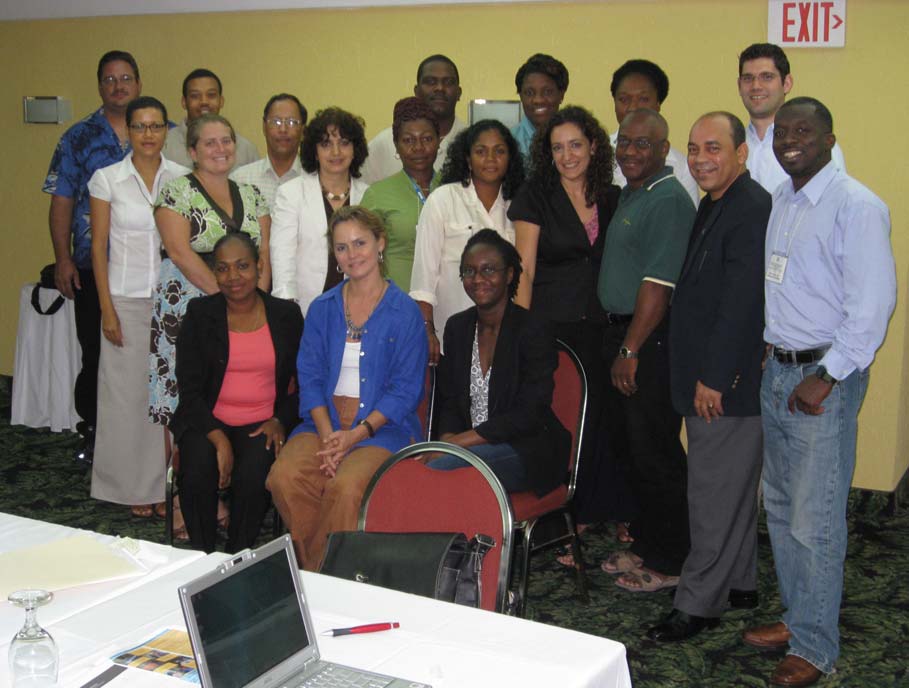
The Workshop was coordinated by the Project's Communications, Networking and Information
Specialist (CNIS), Donna Spencer, and the strategic planning exercise was led by Dr. Maria
Protz, a Communication for Development Specialist, with extensive experience in the Caribbean
who had led the wider strategic communications planning at the February 2008 Workshop.
The Workshop took place over three days from 26 28 May 2008 (See Workshop Agenda,
Appendix I, page 15).
2. Introduction to the GEF-IWCAM Project
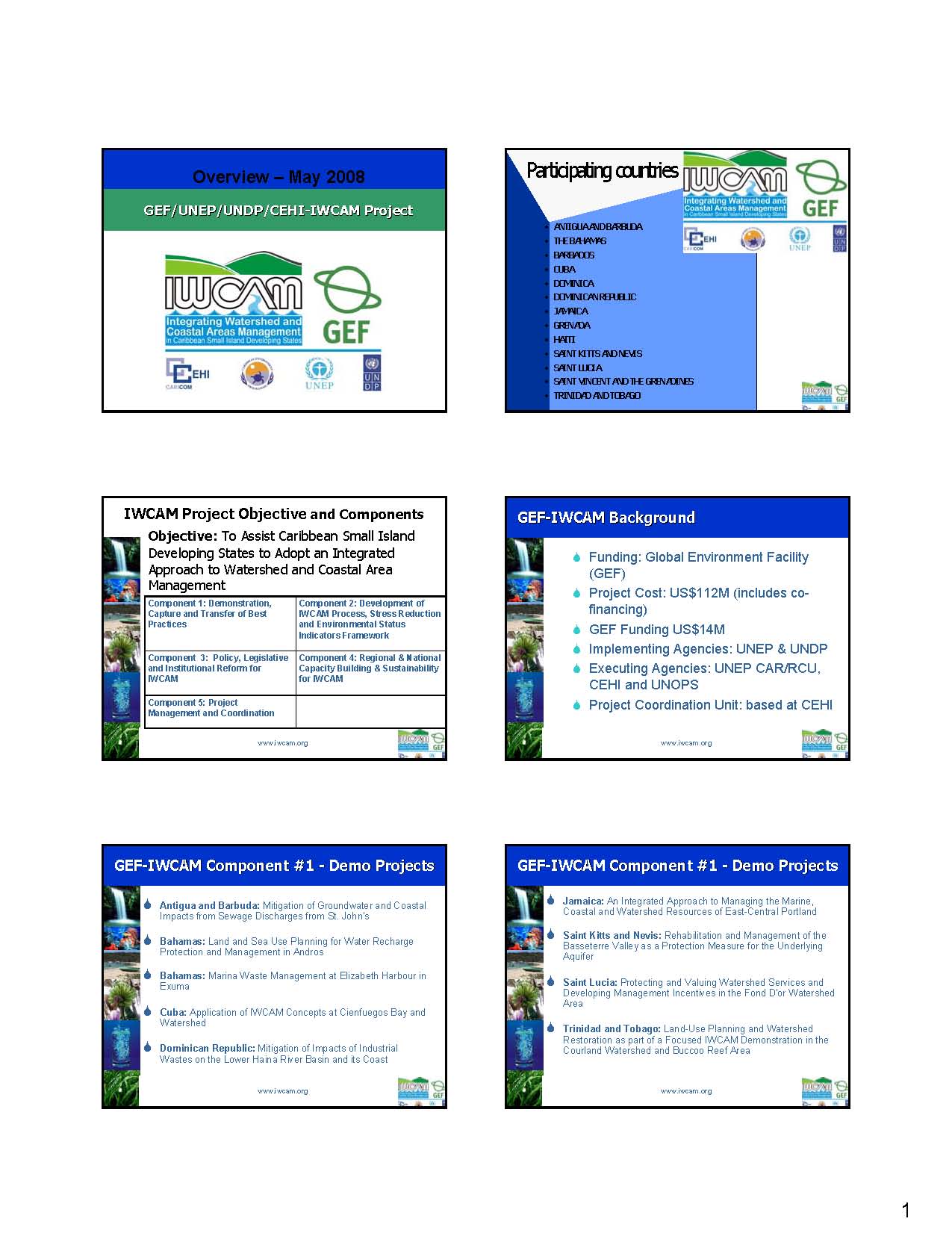
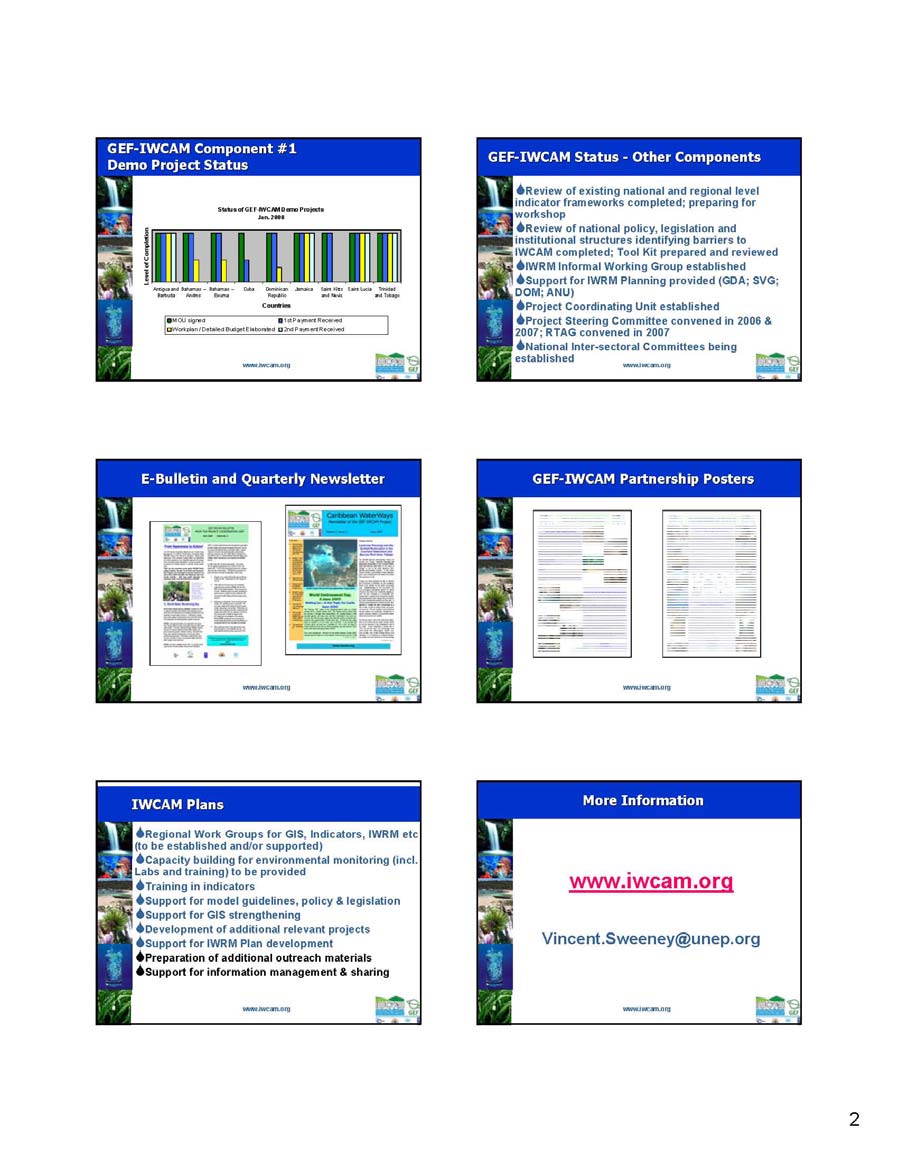
Vincent Sweeney, Regional Project Coordinator, briefly introduced the GEF-IWCAM project and
its various components (see his presentation, Appendix II, page 18). This included an overview
of the implementation status of all nine demonstration projects, which are part of Component 1 of
the Project. In addition the following had been completed so far:
· Review of existing national and regional level indicator frameworks; the indicators
template was being finalized following review at a Workshop in March 2008
· Review of national policy, legislation and institutional structures identifying barriers to
IWCAM completed; a Tool Kit has been prepared and reviewed
· IWRM Informal Working Group established
· Support for IWRM Planning provided to Grenada, St. Vincent & the Grenadines,
Dominica and Antigua & Barbuda
· Project Steering Committee convened in 2006 & 2007; RTAG convened in 2007
· National Inter-sectoral Committees being established
· Production of a range of public education and outreach materials including the
quarterly newsletter "Caribbean WaterWays" and the bulletin.
4
Ongoing work mentioned included:
· Regional Work Groups for GIS, Indicators, IWRM etc (to be established, expanded
and/or supported)
· Capacity building for environmental monitoring (including Laboratory Strengthening
and training) to be provided
· Training in indicators
· Support for model guidelines, policy and legislation
· Support for GIS strengthening
· Development of additional relevant projects
· Support for IWRM Plan development
· Preparation of additional outreach materials
· Support for information management and sharing.
3. Status of the Demonstration Projects Country Presentations
Antigua & Barbuda: Mitigation of Groundwater and Coastal Impacts from Sewage
Discharges from St. Johns
See presentation, Appendix III, page 20.
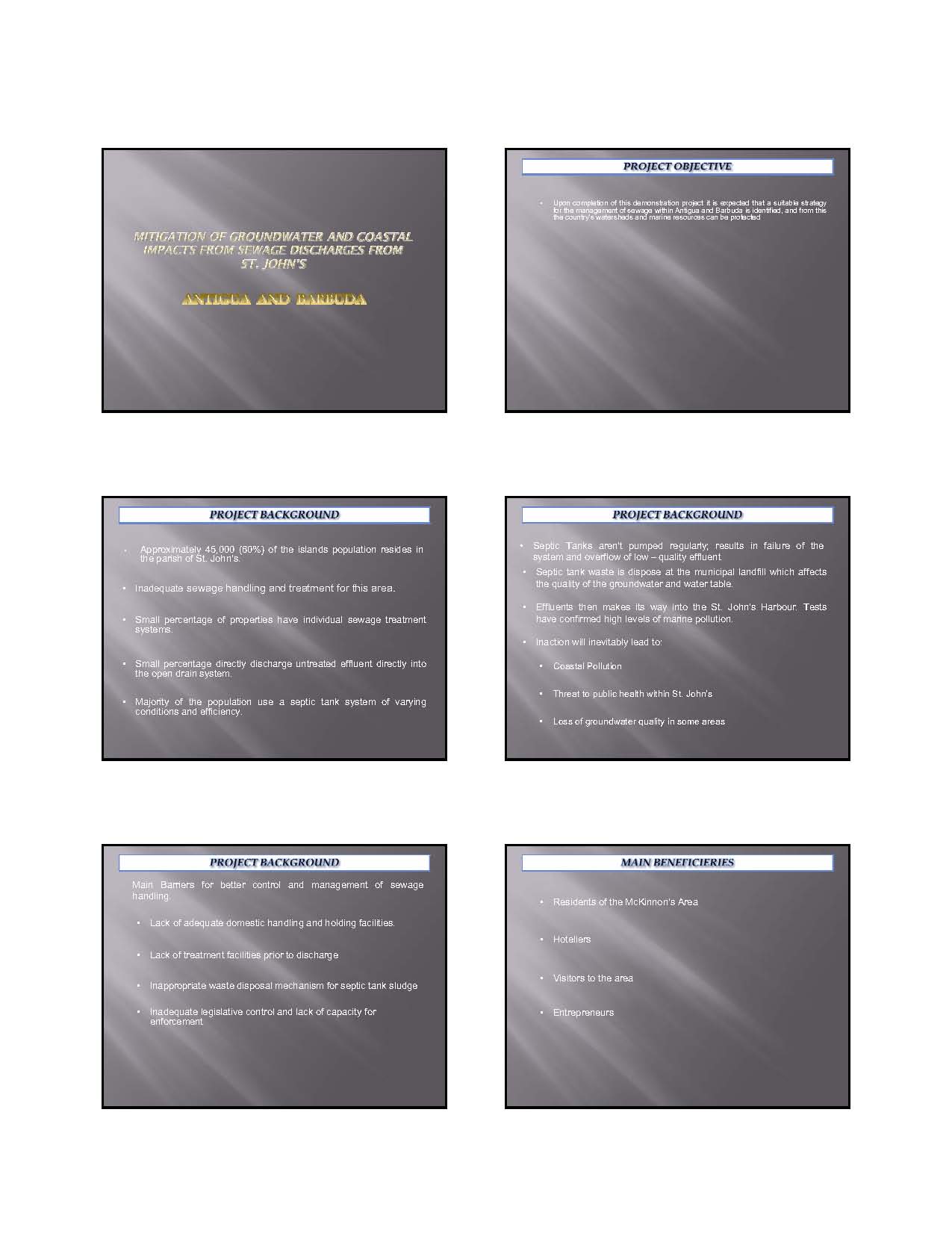
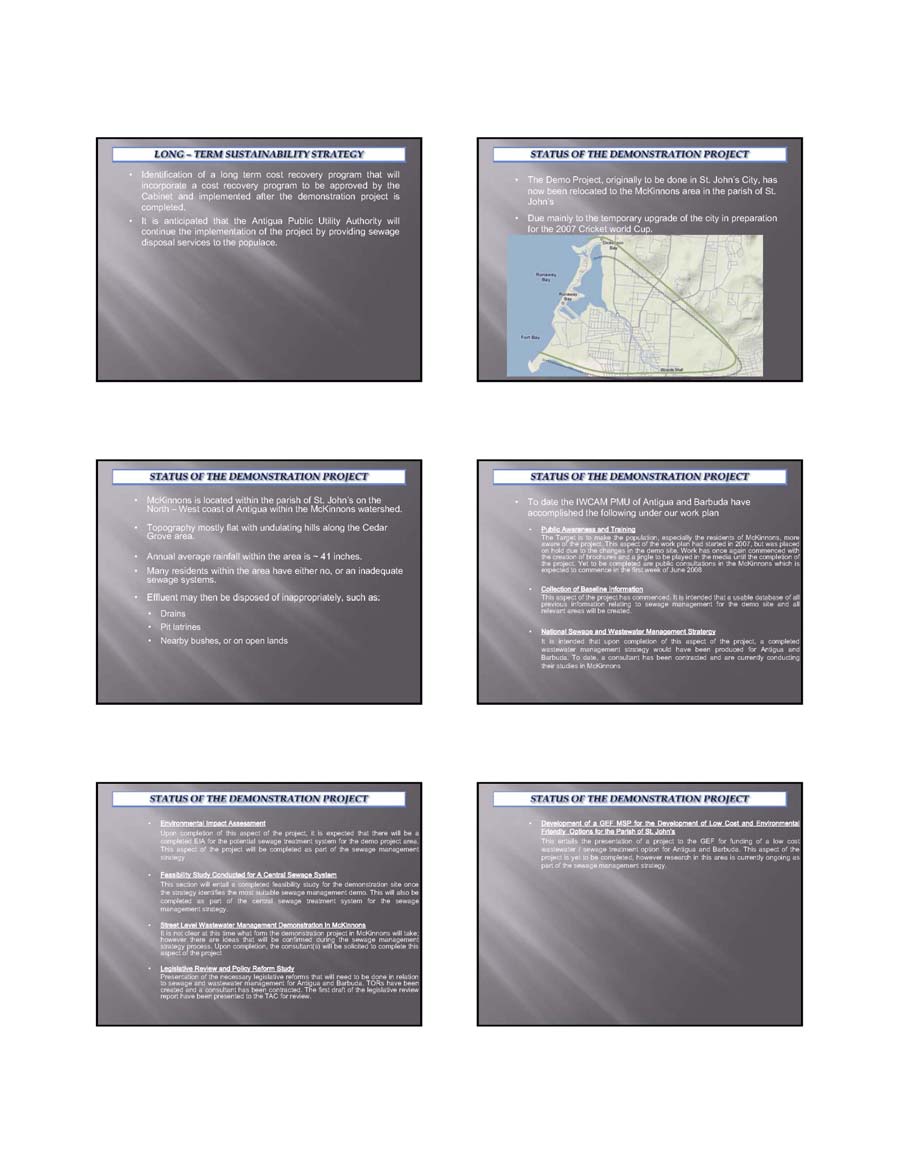
The Demonstration Project, originally located in the city of St. Johns, had recently been relocated
to the McKinnons area in the parish of St. Johns on the North-West coast of Antigua.
By the end of this Project a completed wastewater management strategy would have been
produced for Antigua and Barbuda. To date, a consultant has been contracted and is currently
conducting studies in the McKinnons area. Collection of baseline data is also an important part of
this project. It is intended that a usable database of all previous information relating to sewage
management for the demo site and all relevant areas will be created.
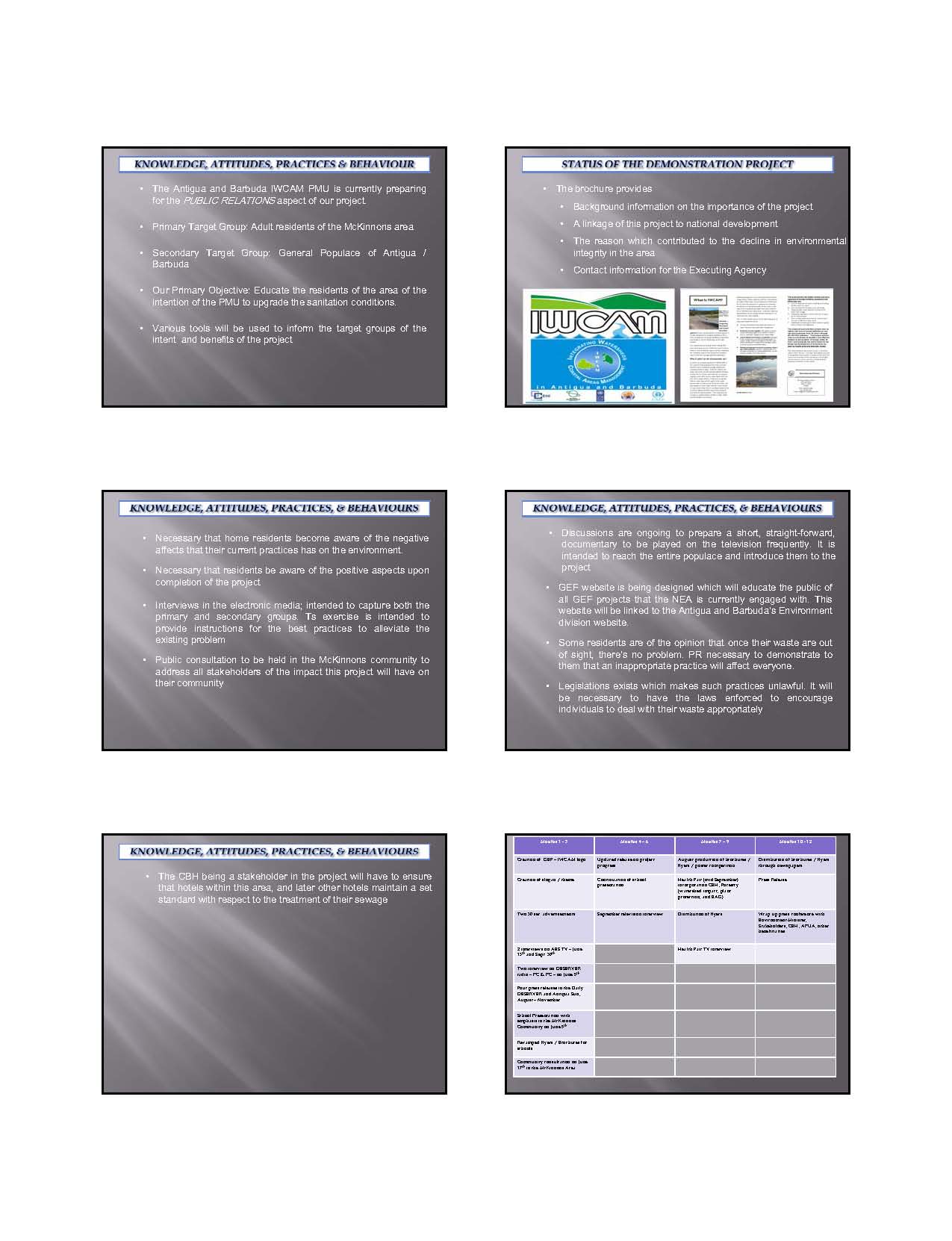
While the Pubic Awareness and Training work had started in 2007, it was placed on hold due to
the changes in the location of the demo site. Work has once again begun with the creation of
brochures and a jingle to be played in the media until the completion of the project. Yet to be
completed are public consultations in the McKinnons area which are expected to commence in
the first week of June 2008.
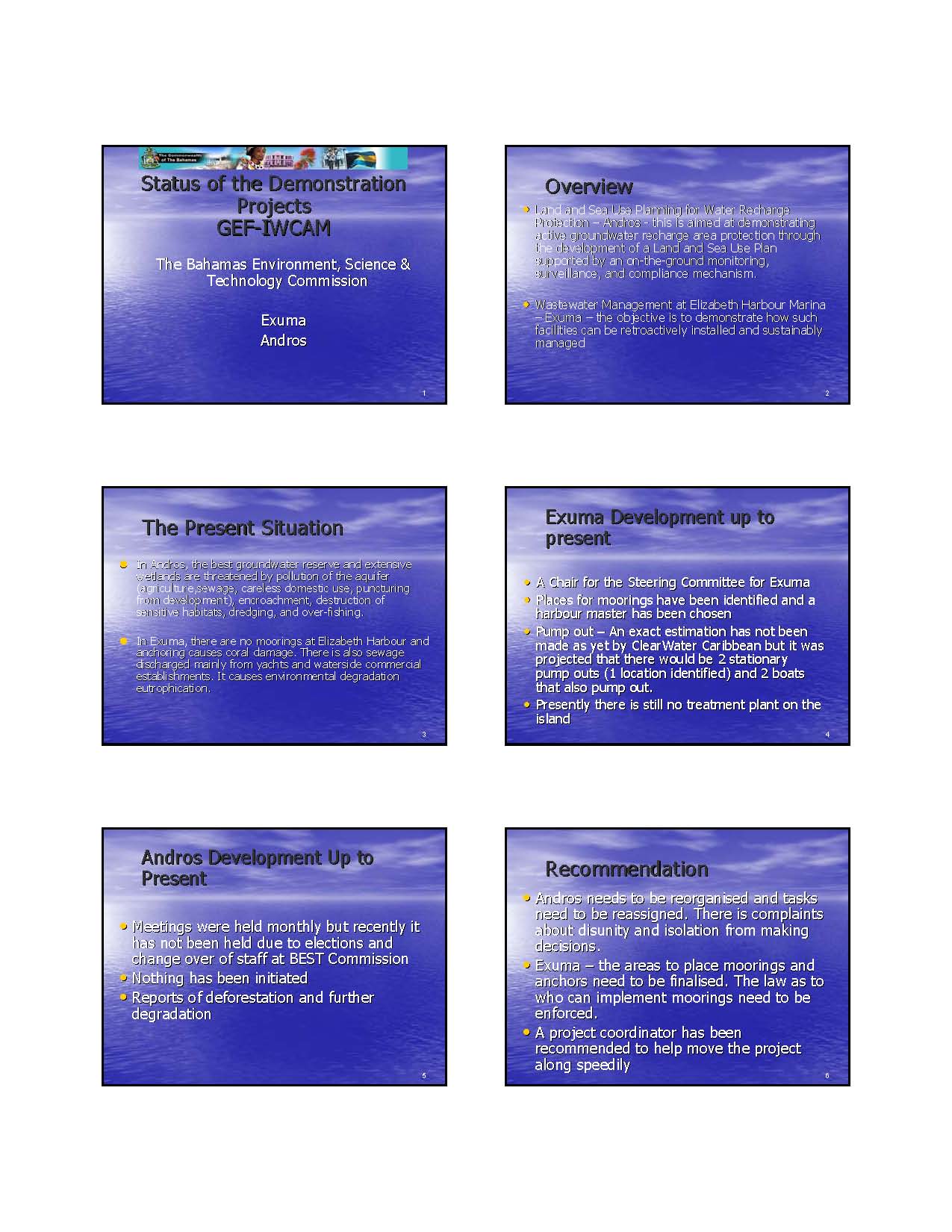
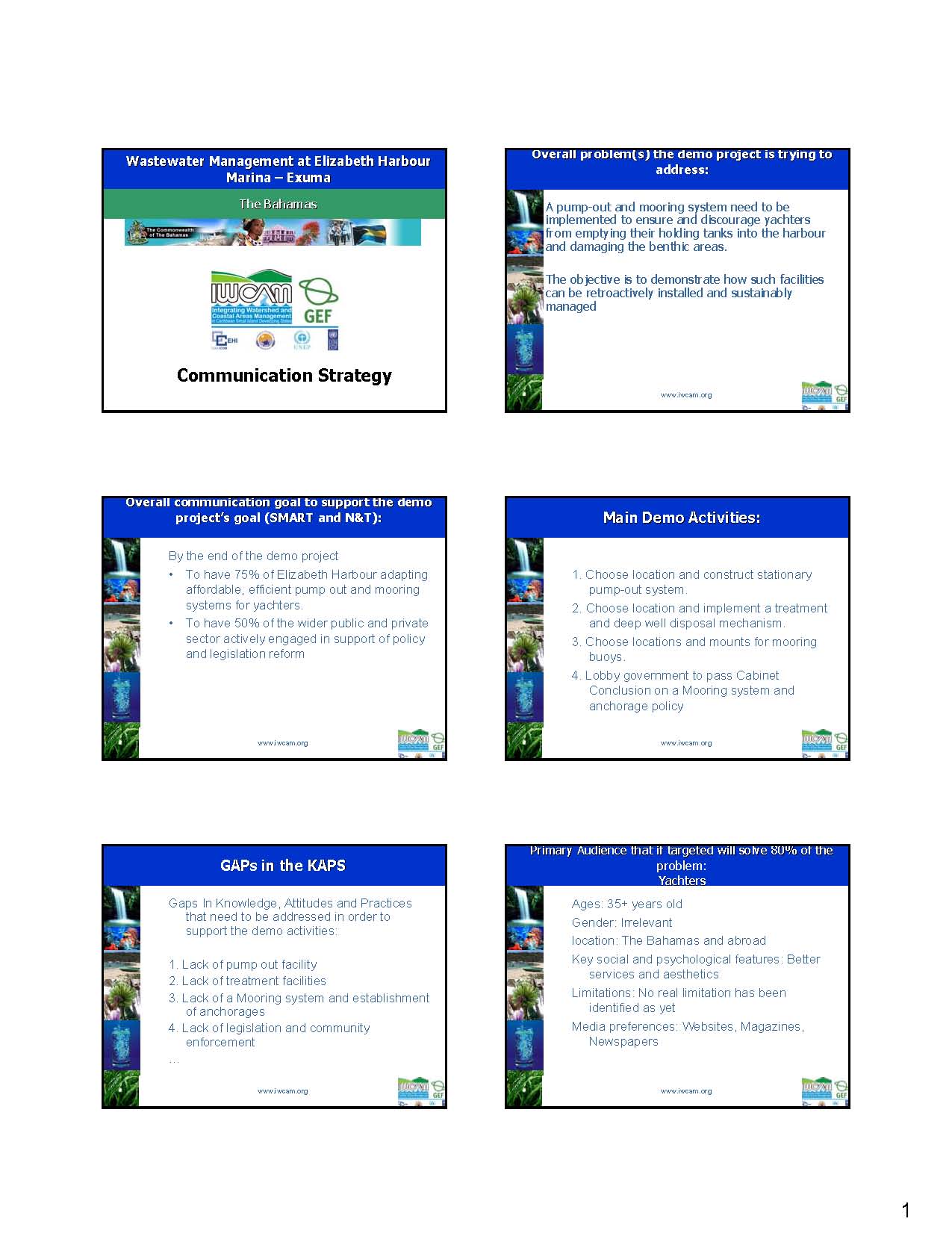
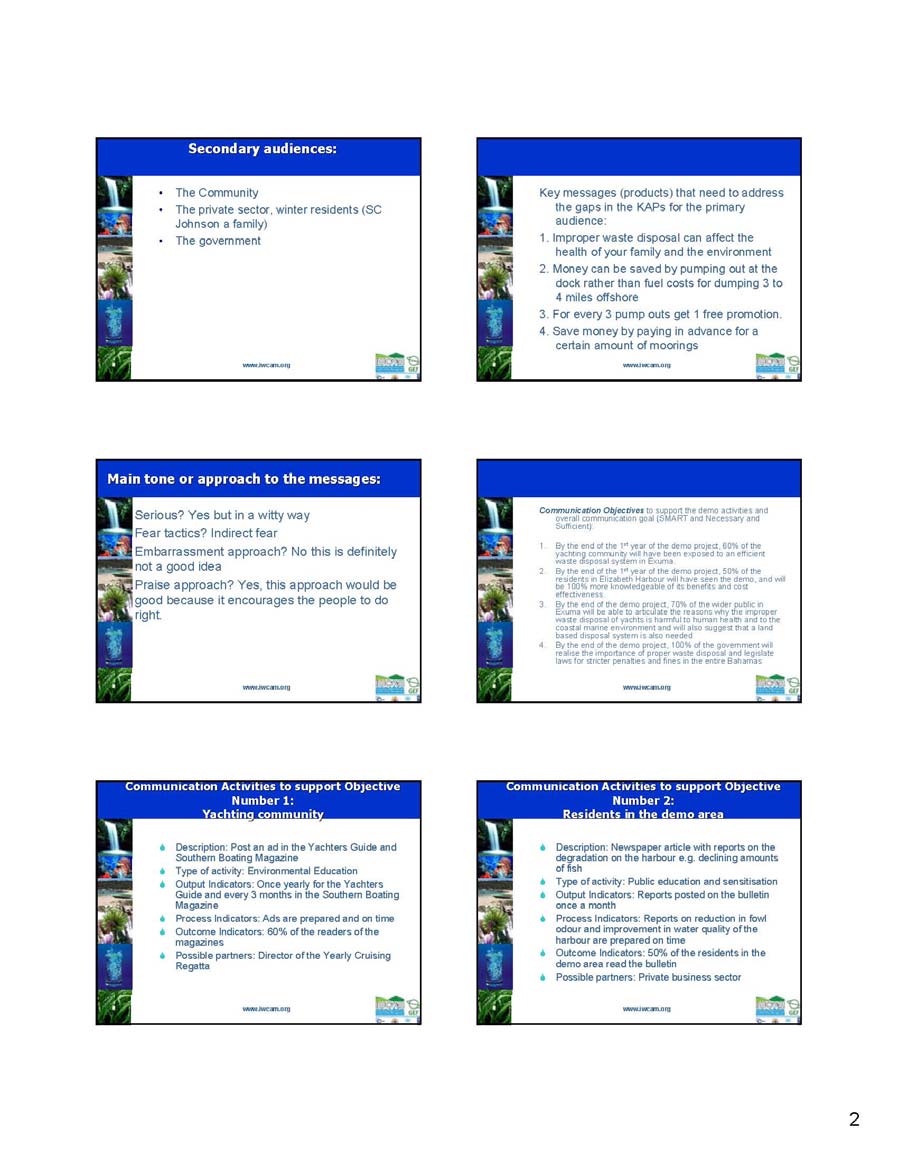
The Bahamas: 1) Marine Waste Management at Elizabeth Harbour in Exuma, Bahamas
2) Land and Sea Use Planning for Water Recharge Protection and
Management in Andros, Bahamas
See presentation, Appendix IV, page 23.
Exuma
This project aims to demonstrate active groundwater recharge area protection through the
development of a Land and Sea Use Plan supported by an on-the-ground monitoring,
surveillance, and compliance, mechanism. In addition, sewage is discharged mainly from yachts
and waterside commercial establishments. There are no moorings at Elizabeth Harbour and
anchoring causes coral damage leading to environmental degradation. The objective is to
demonstrate how such facilities can be retroactively installed and sustainably managed.
5
To date a Chair for the Steering Committee for Exuma has been appointed, places for moorings
have been identified and a harbour master has been selected. With regard to pump out, an exact
estimation has not been made as yet by ClearWater Caribbean, partners in the Project, but it was
projected that there would be 2 stationary pump outs (1 location identified so far) and 2 boats that
also pump out. Areas for placement of moorings and anchors need to be finalised. The law as to
who can implement moorings needs to be enforced.
Andros
The best groundwater reserve and extensive wetlands are threatened by pollution of the aquifer
(as a result of agricultural activities, sewage, careless domestic use, puncturing from
development), encroachment, destruction of sensitive habitats, dredging, and over-fishing. To
date no project activity has been initiated. Meetings have been held monthly until recently, due to
elections and change of staff at the Bahamas Environmental Science and Technology (BEST)
Commission.
A project coordinator has recently been recommended in an effort to accelerate progress on both
demonstration projects.
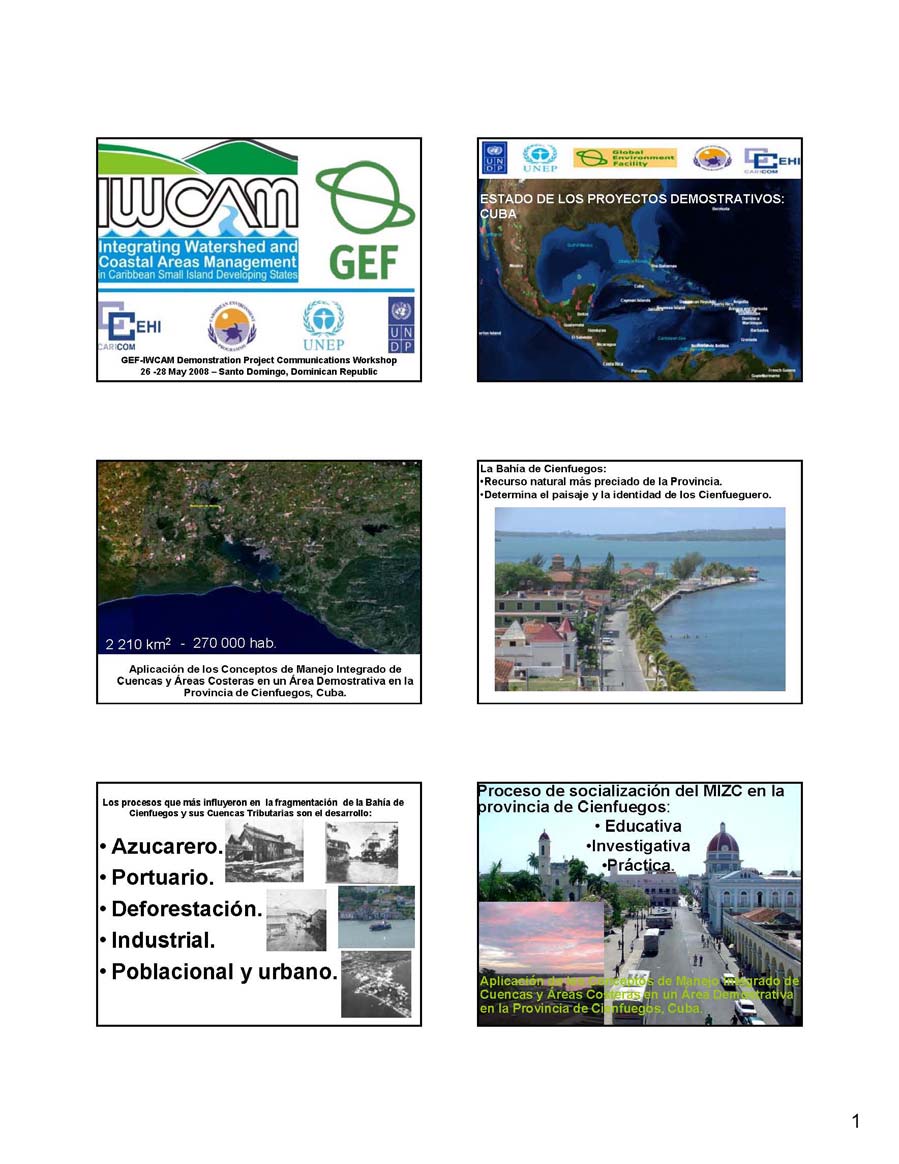
Cuba: Application of IWCAM Concepts at Cienfuegos Bay and Watershed
See presentation, Appendix V, page 24.
The main objective of Cuba's Demonstration Project is to demonstrate the benefits of application
of the IWCAM concepts for effective management of watershed and coastal areas (IWCAM) in
Cienfuegos Bay basin.
Cienfuegos Bay, site of the Cuban Demonstration Project, is located in the South-Central part of
Cuba and represents an area that has traditionally suffered from the absence of any integrated
environmental management approach. This area extends to some 2 210 km², and is one of the
biggest hydrological systems in the country. Its rivers are impacted by several land-based point
sources of pollution. These land-based sources of pollutants include excessive nutrients (from
agricultural and domestic sources), chemicals (industrial and agricultural), suspended sediment,
etc.
Port and marine activities represent one of the principal multiple uses of the bay. Cienfuegos port
is located inside the bay, and is one of the most important ports in the country. Associated
activities include the movement of general cargo, export of sugar, tanker movement and coastal
traffic, and a well-developed fishing industry. The coastal area of the bay is also important for
tourism. A whole series of environmental problems have arisen in this area as a consequence of
industrialization and a rapid, poorly regulated programme of urbanisation. This has created
additional pressure to that already caused by the existing development of the sugar industry,
increasing port activities, and the use of environmentally inappropriate fishing technologies.
Increased population growth and increased agricultural activities, along with inappropriate and
poorly controlled methods of cultivation, have led to depletion of soil fertility and soil erosion.
Additionally, there has been insufficient environmental education of decisions-makers and
citizens and a lack of community participation in the decision-making process.
Some of the main environmental problems emerging from the aforementioned concerns include:
· Increase
of wastewater flow (organic and inorganic wastes) into the basins, leading to
eutrophication.
· Increase of soil erosion processes causing excessive areas of sedimentation within
watercourses and ultimately within the bay.
· Loss of soil fertility.
6
· Deforestation of rivers fringes and coastal areas.
· Increased levels of salinity and sediments affecting drinking and irrigation waters.
· General impacts on natural ecosystems with inherent risks to biodiversity and natural
resource accessibility/productivity (e.g. fisheries and recreational usage)
· General threats to human health.
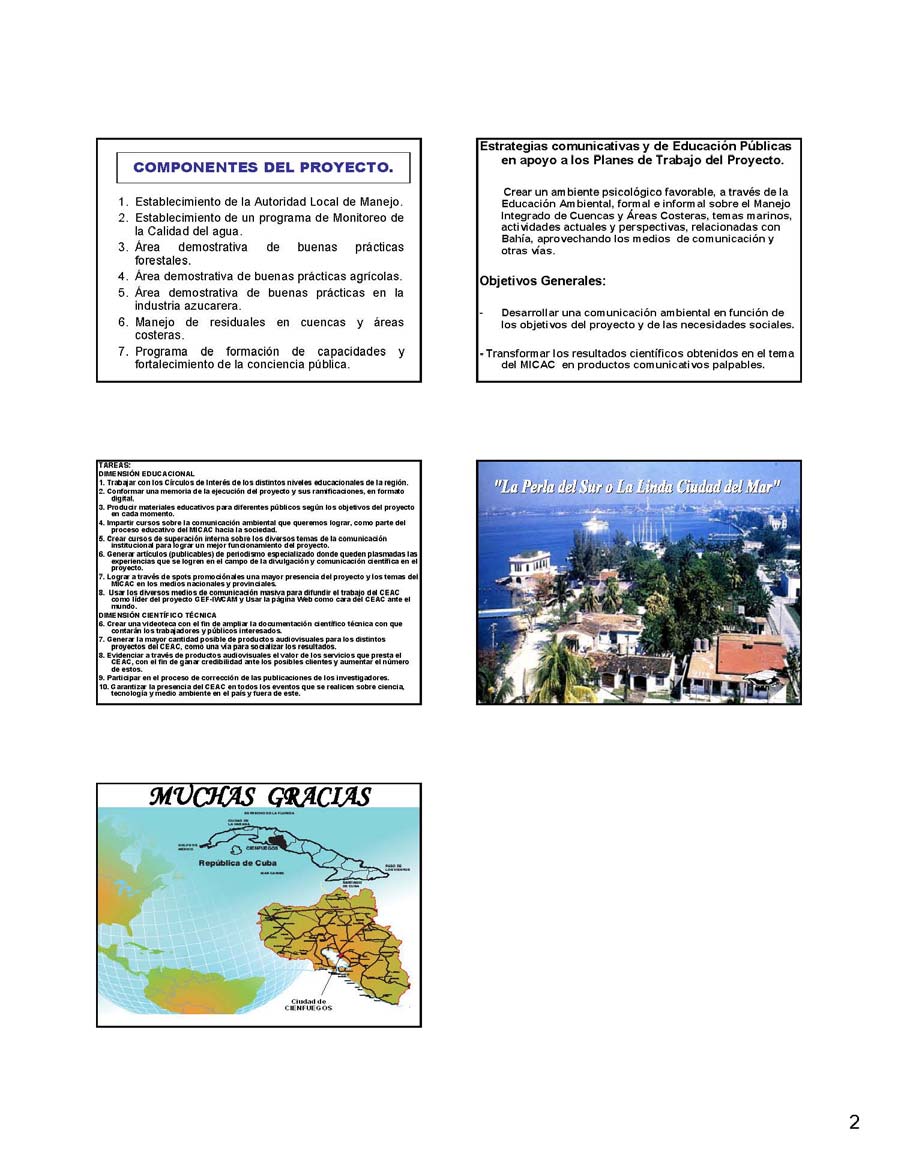
Priorities activities for this demonstration project are:
· Water Supply Management, Pollution Mitigation and Environmental Monitoring
· Soil Management and Conservation
· Environmental Education, Capacity Building and Community Work
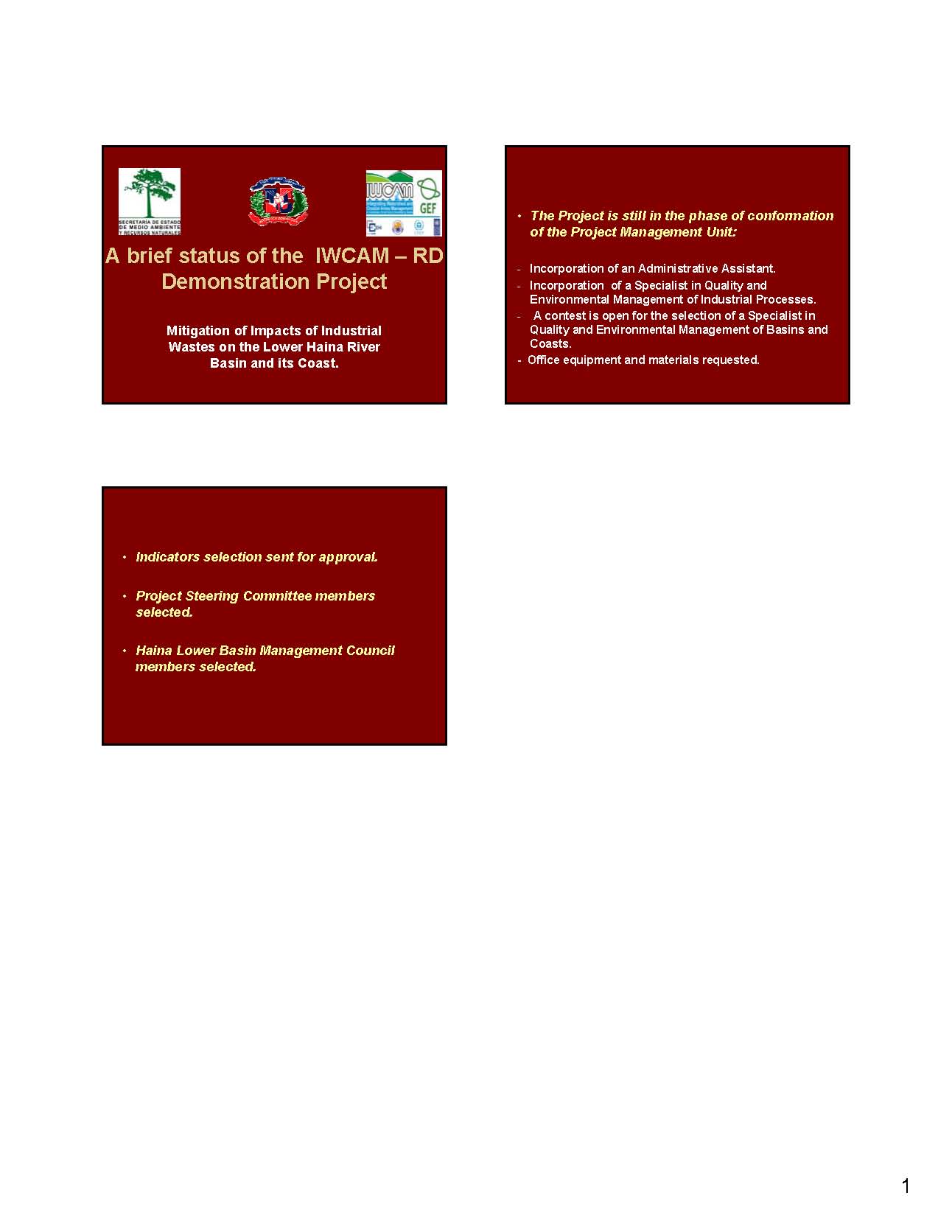
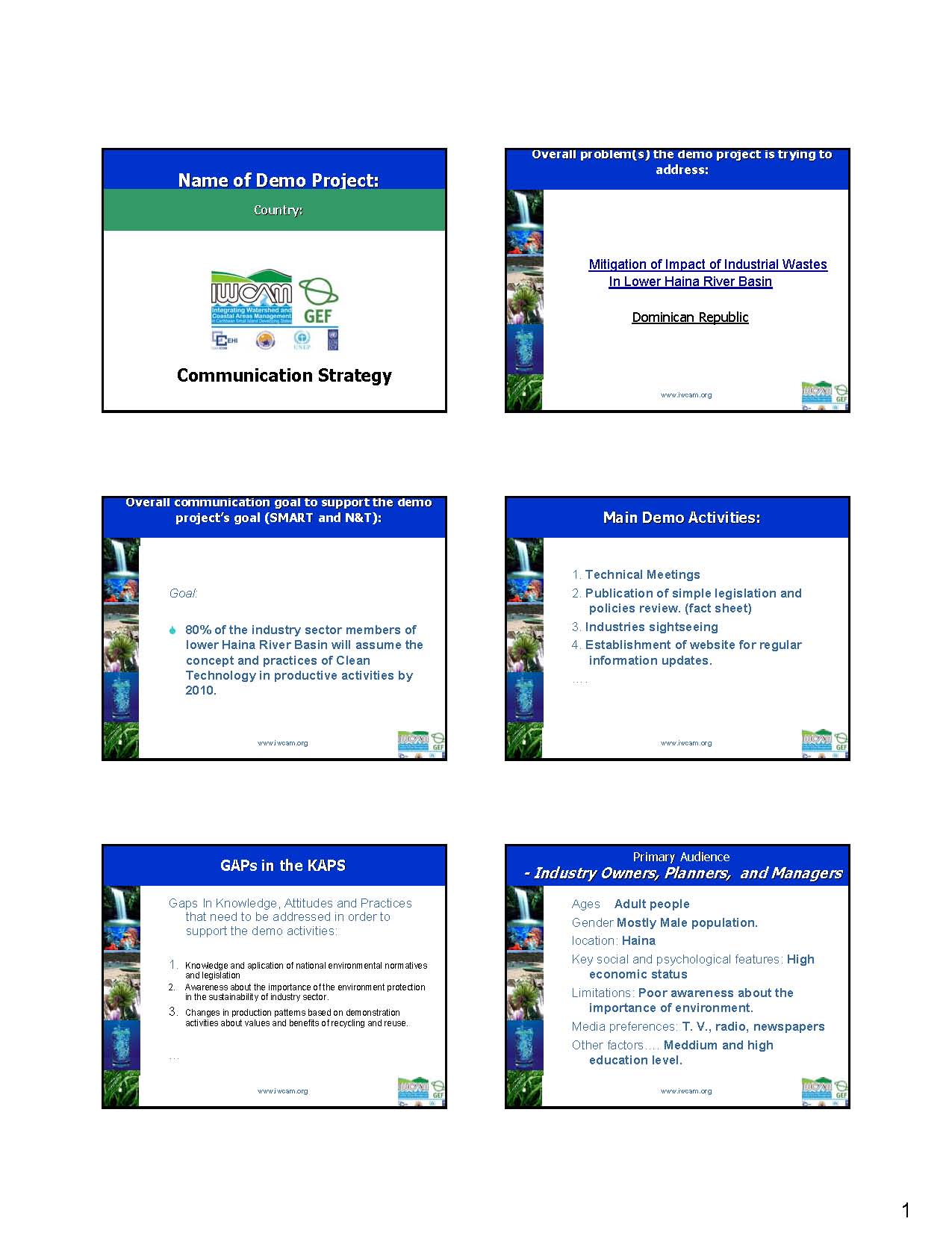
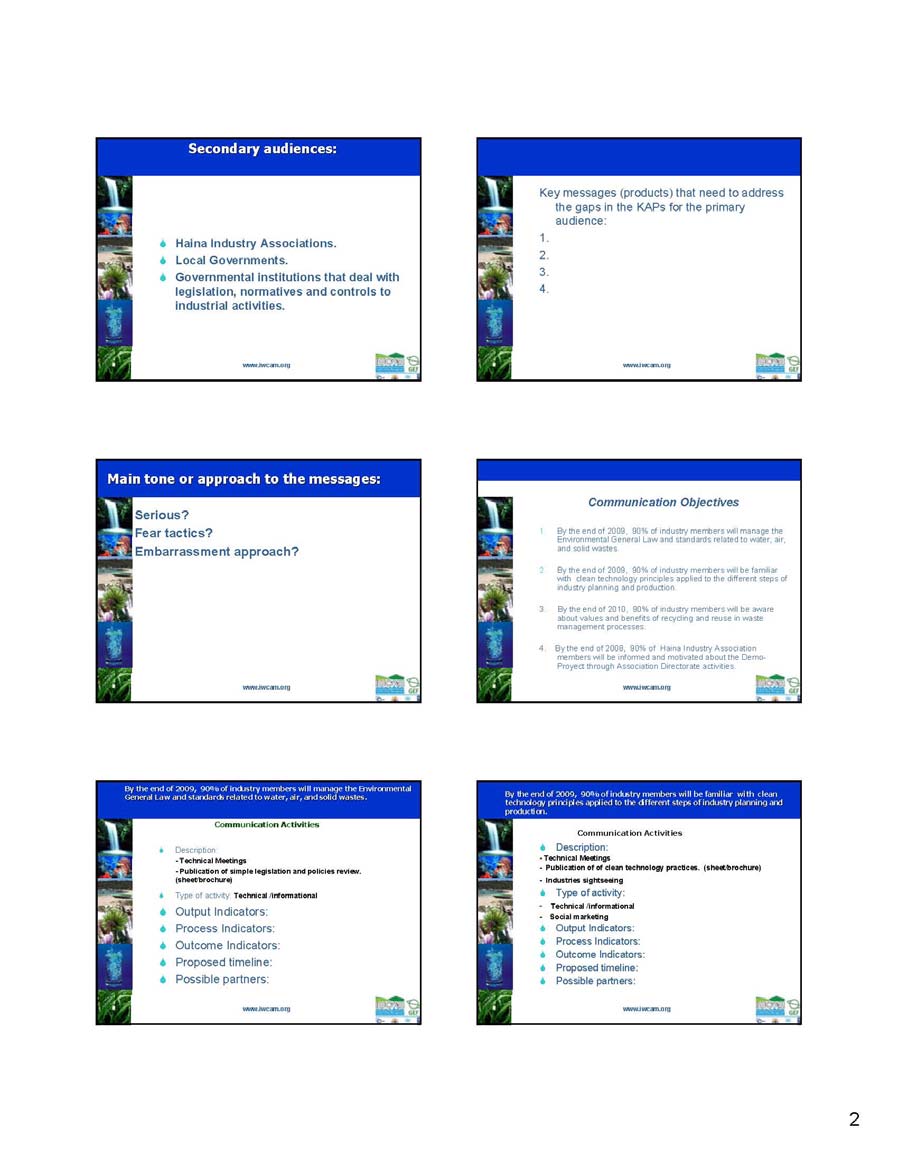
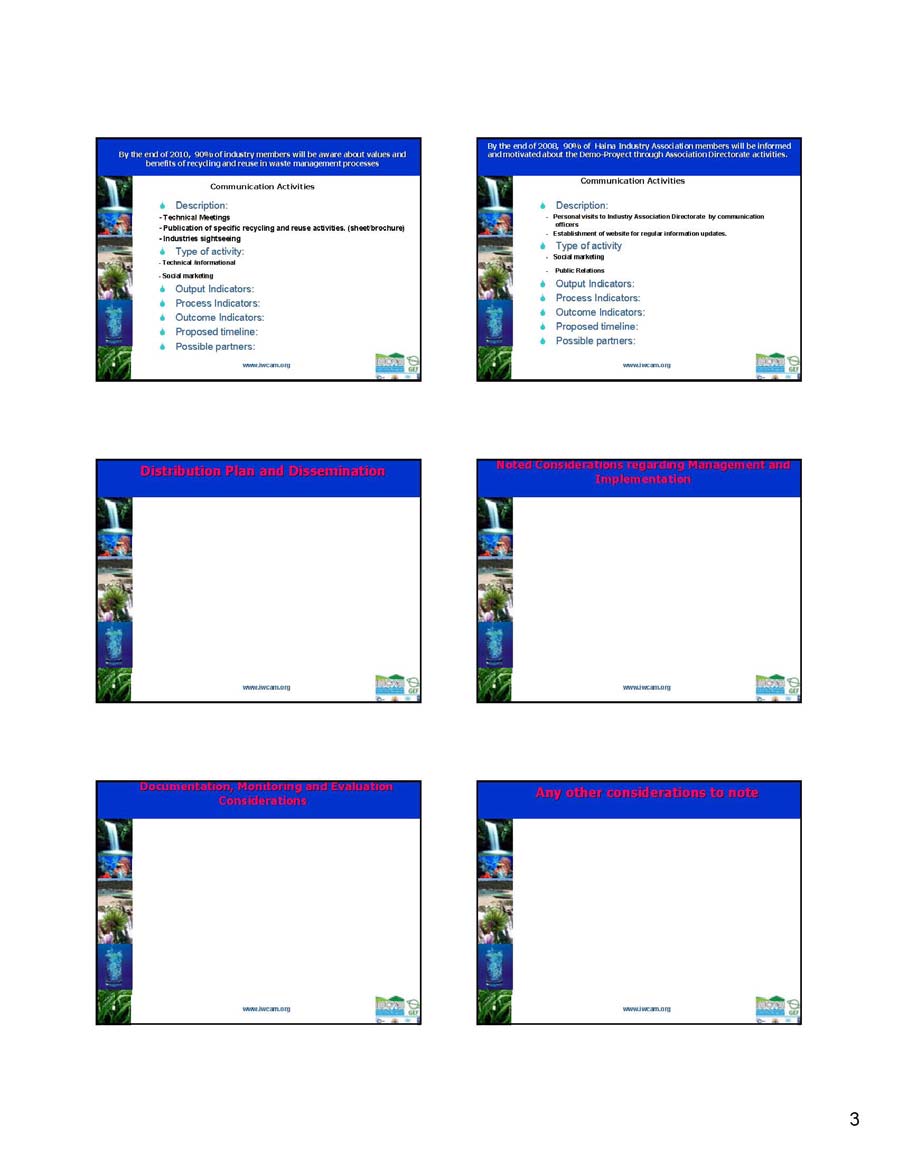
Dominican Republic: Mitigation of Impacts of Industrial Wastes on the Lower Haina River
Basin and its Coast
See presentation, Appendix VI, page 26.
This presentation was very brief as the Project Management Unit was in the process of being set
up. The Unit would include a Specialist in Quality and Environmental Management of Industrial
Processes, a Specialist in Quality and Environmental Management of Basins and Coasts. Project
Steering Committee members and Haina Lower Basin Management Council members had been
selected.
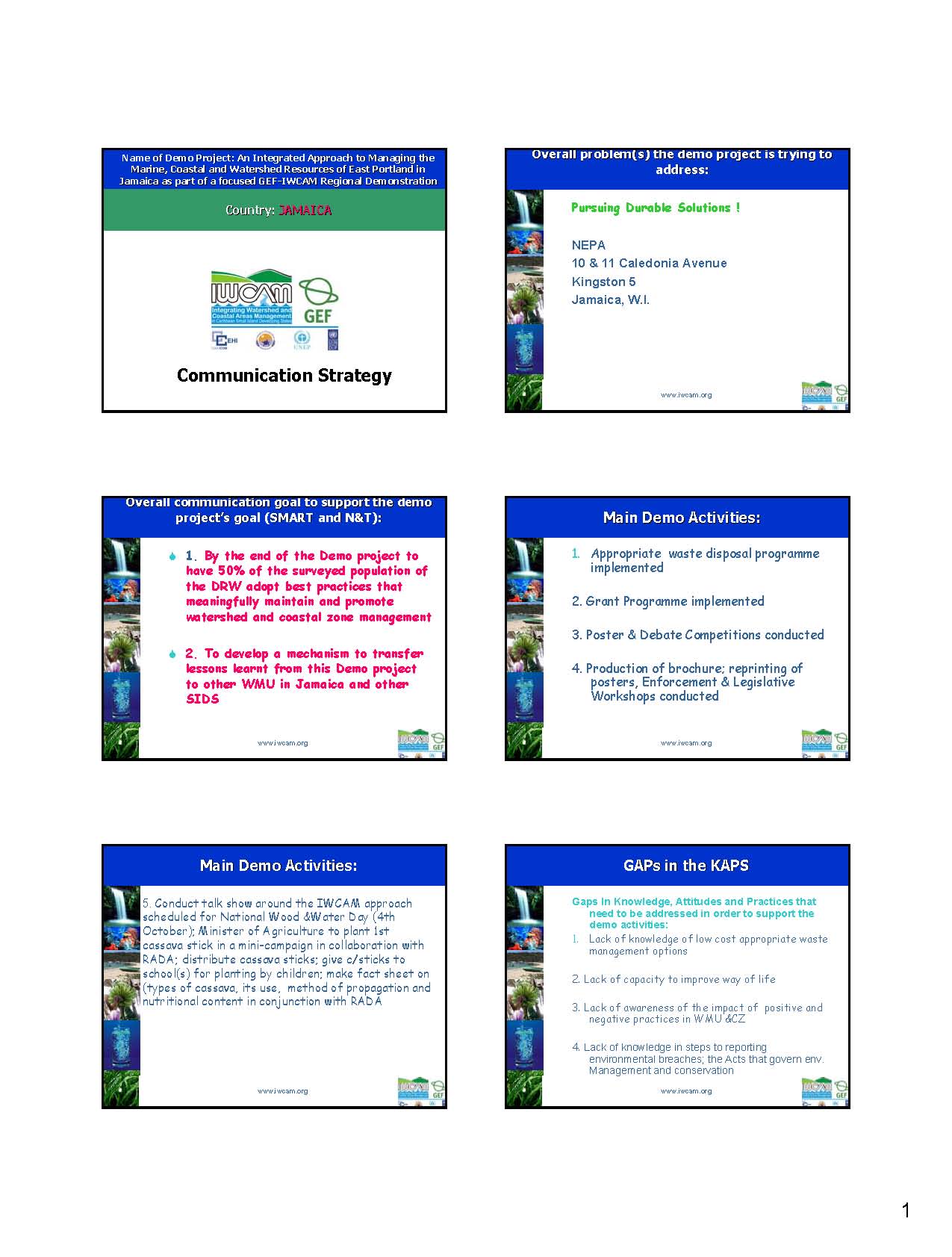
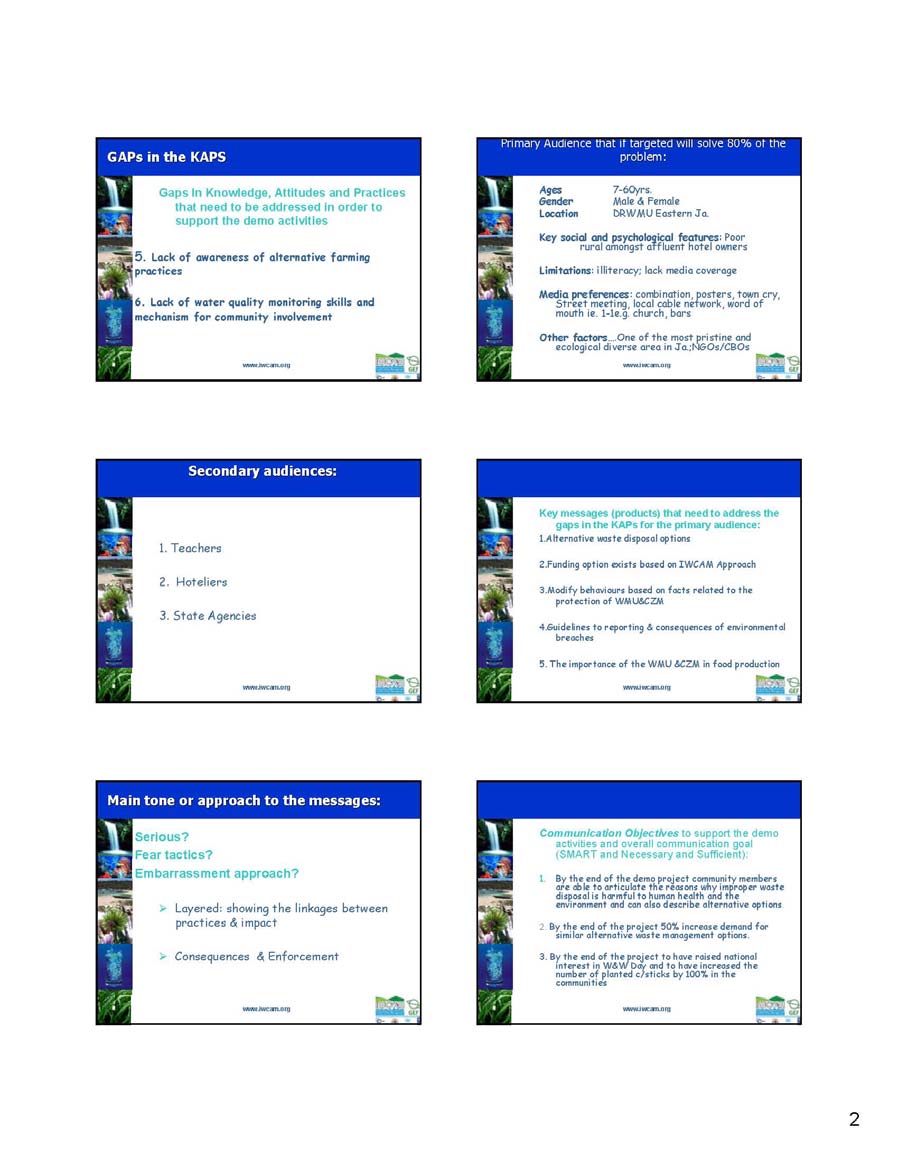
Jamaica: An Integrated Approach to Managing the Marine, Coastal and Watershed
Resources of east-central Portland
See presentation, Appendix VII, page 27.
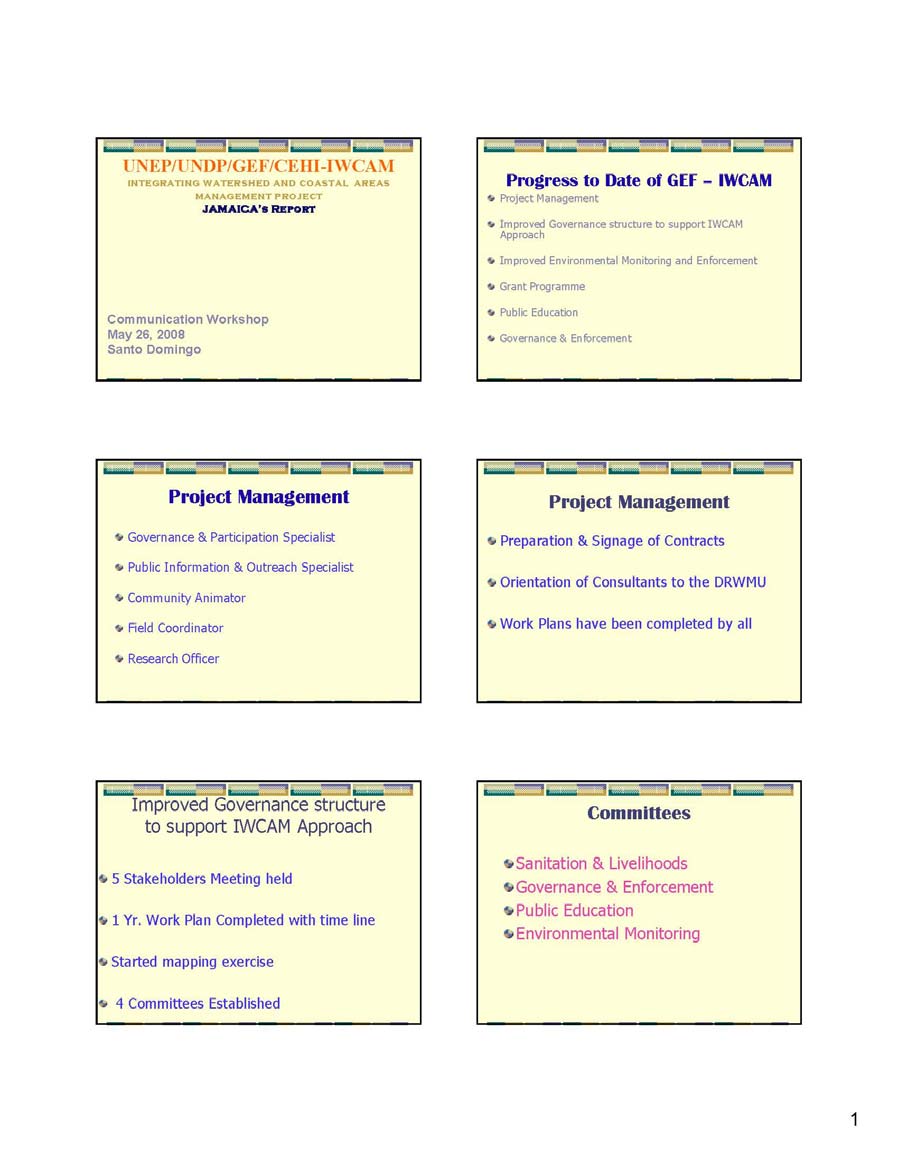
The Project Management Unit had been set up and consists of the following; a Governance and
Participation Specialist; a Public Information and Outreach Specialist; a Community Animator; a
Field Coordinator, and; a Research Officer. All work plans have been completed.
An improved governance structure to support the IWCAM Approach had been put in place with
the result that environmental monitoring and enforcement are better.
Five stakeholder meetings have been held. A one-year Work Plan has been completed and a
mapping exercise has begun. The following four Committees have been established:
· Sanitation and Livelihoods
· Governance
and
Enforcement
· Public
Education
· Environmental
Monitoring
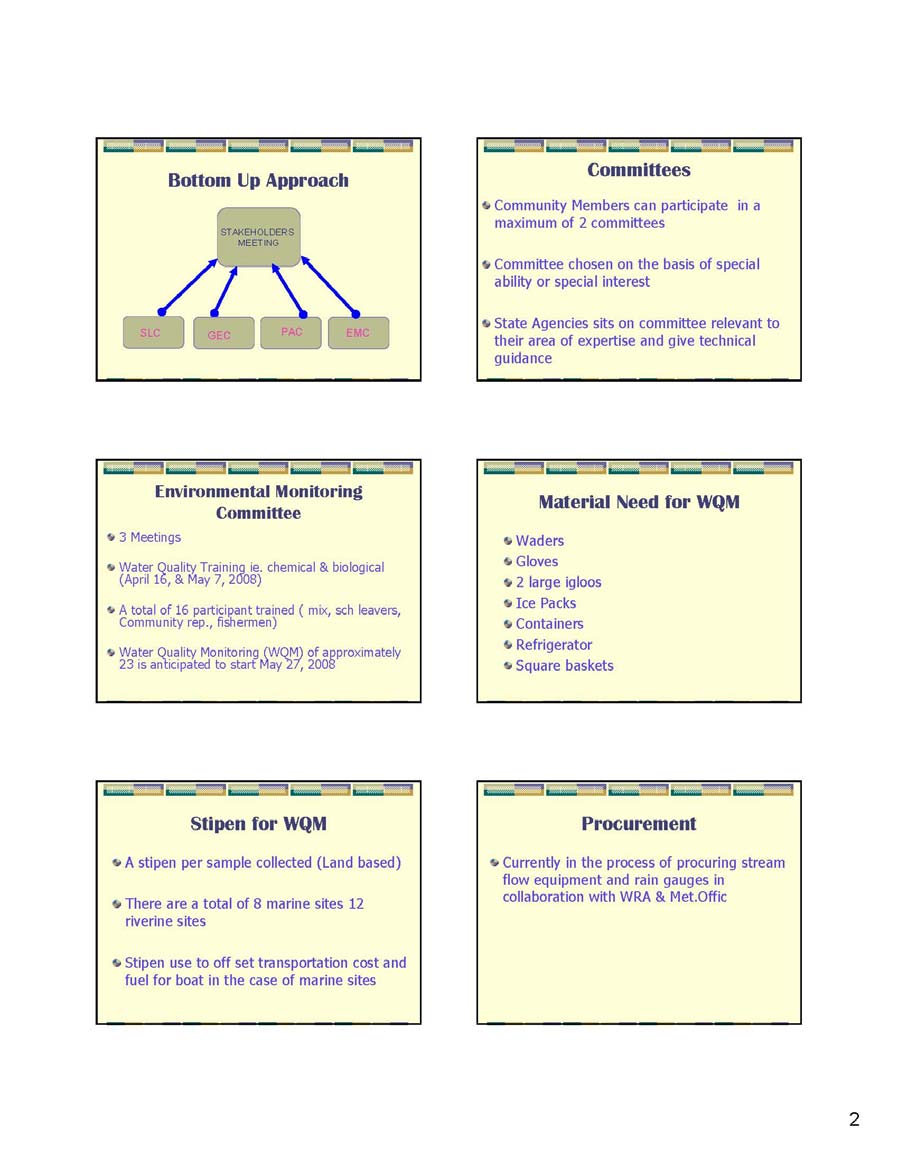
Community members can participate in a maximum of two committees based upon special ability
or special interest. State agencies sit on committees relevant to their areas of expertise in order
to provide technical guidance. The Environmental Monitoring committee has held three meetings
so far and conducted training for a total of 16 persons in chemical and biological water quality in
April and May 2008. Monitoring is being conducted for a total of 8 marine sites and 12 riverine
sites.
7
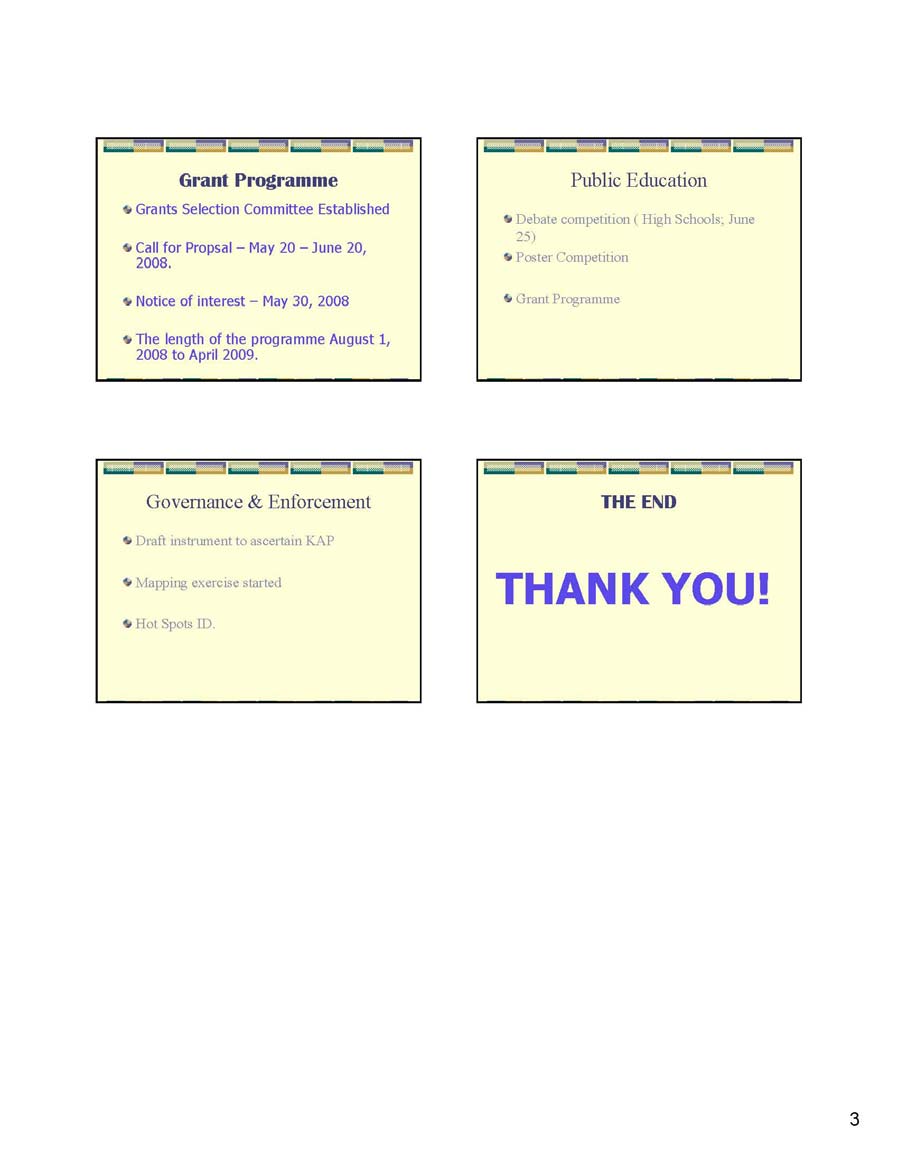
A Grant Programme began earlier in 2008. Following establishment of a Grant Selection
Committee, a call for proposals was put out in May with the programme intended to last from
August 2008 April 2009.
Public Education activities have included a debating competition for high schools which takes
place in June 2008, a poster competition and a grant programme.
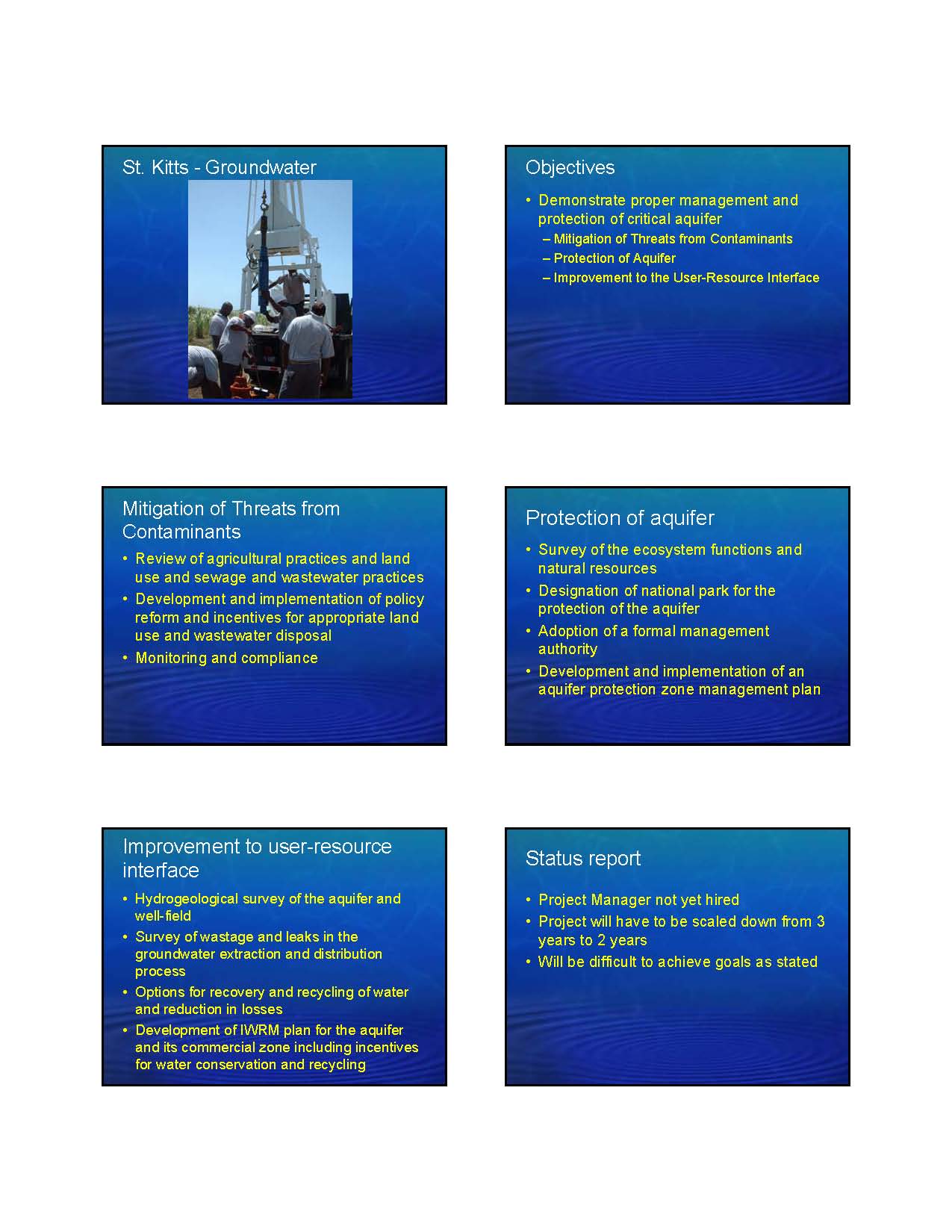
St. Kitts and Nevis: Rehabilitation and Management of the Basseterre Valley as a
Protection Measure for the Underlying Aquifer
See presentation, Appendix VIII, page 30.
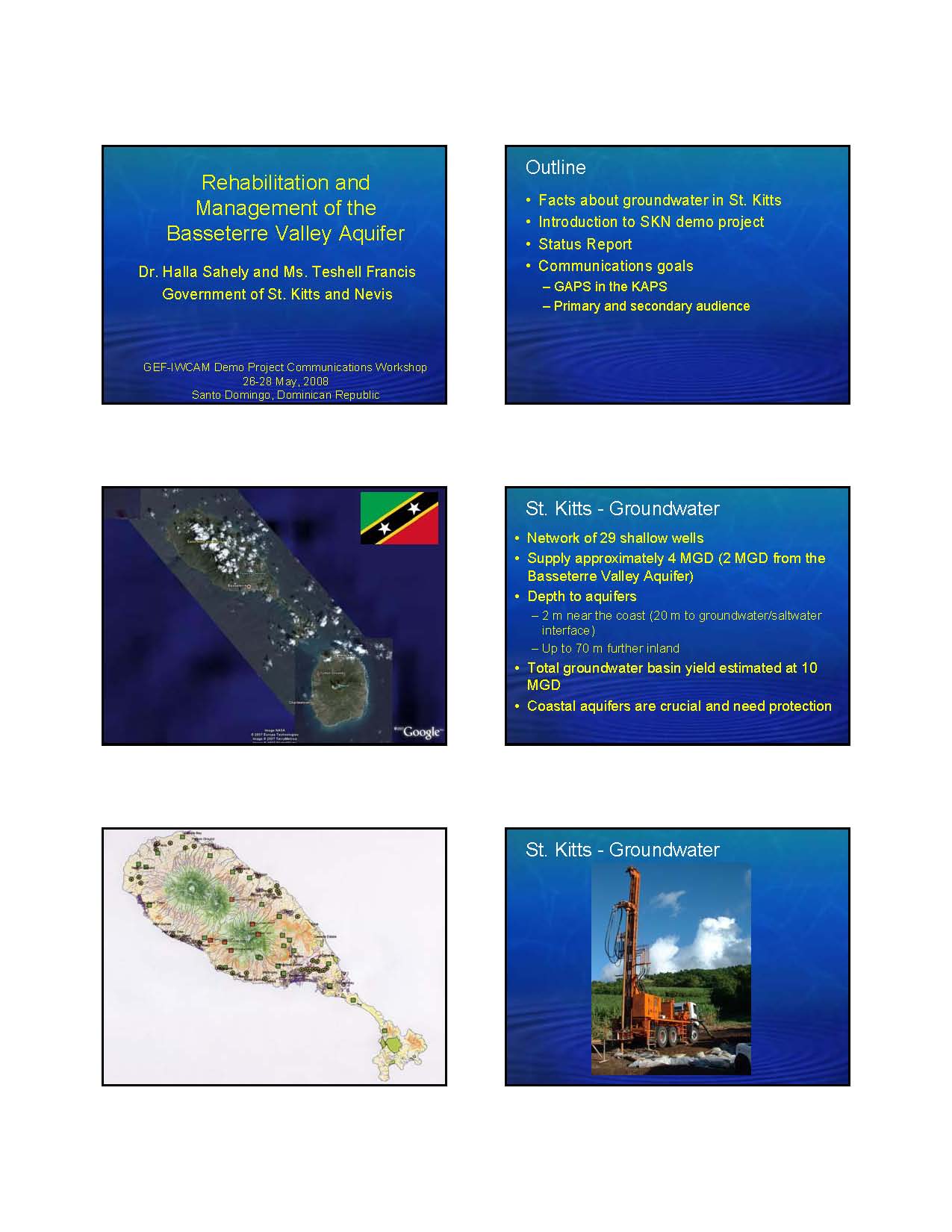
St. Kitts' water supply comes from a network of shallow wells located on aquifers which are found
at a depth of as little as 2 metres near the coast to 70 metres in mountainous areas. The
Basseterre Valley Aquifer supplies approximately half of the daily supply. It is only 20 metres to
the groundwater/saltwater interface. Coastal aquifers are crucial and need to be protected.
The Demonstration Project has the main objective of demonstrating proper management and
protection of this critical aquifer through the following means: mitigation of threats from
contaminants; protection of the aquifer, and improvement to the user-resource interface.
Mitigation of threats from contaminants
·
Review of agricultural practices and land use and sewage and wastewater practices
·
Development and implementation of policy reform and incentives for appropriate land use
and wastewater disposal
·
Monitoring and compliance
Protection of the aquifer
·
Survey of the ecosystem functions and natural resources
·
Designation of national park for the protection of the aquifer
·
Adoption of a formal management authority
·
Development and implementation of an aquifer protection zone management plan
Improvement to the user-resource interface
·
Hydro-geological survey of the aquifer and well-field
·
Survey of wastage and leaks in the groundwater extraction and distribution process
·
Options for recovery and recycling of water and reduction in losses
· Development of IWRM plan for the aquifer and its commercial zone including incentives
for water conservation and recycling
The Project Manager had not yet been hired with the result that the Project would have to be
scaled down from 3 years to 2 years and there might be implications for the achievement of goals
as stated.
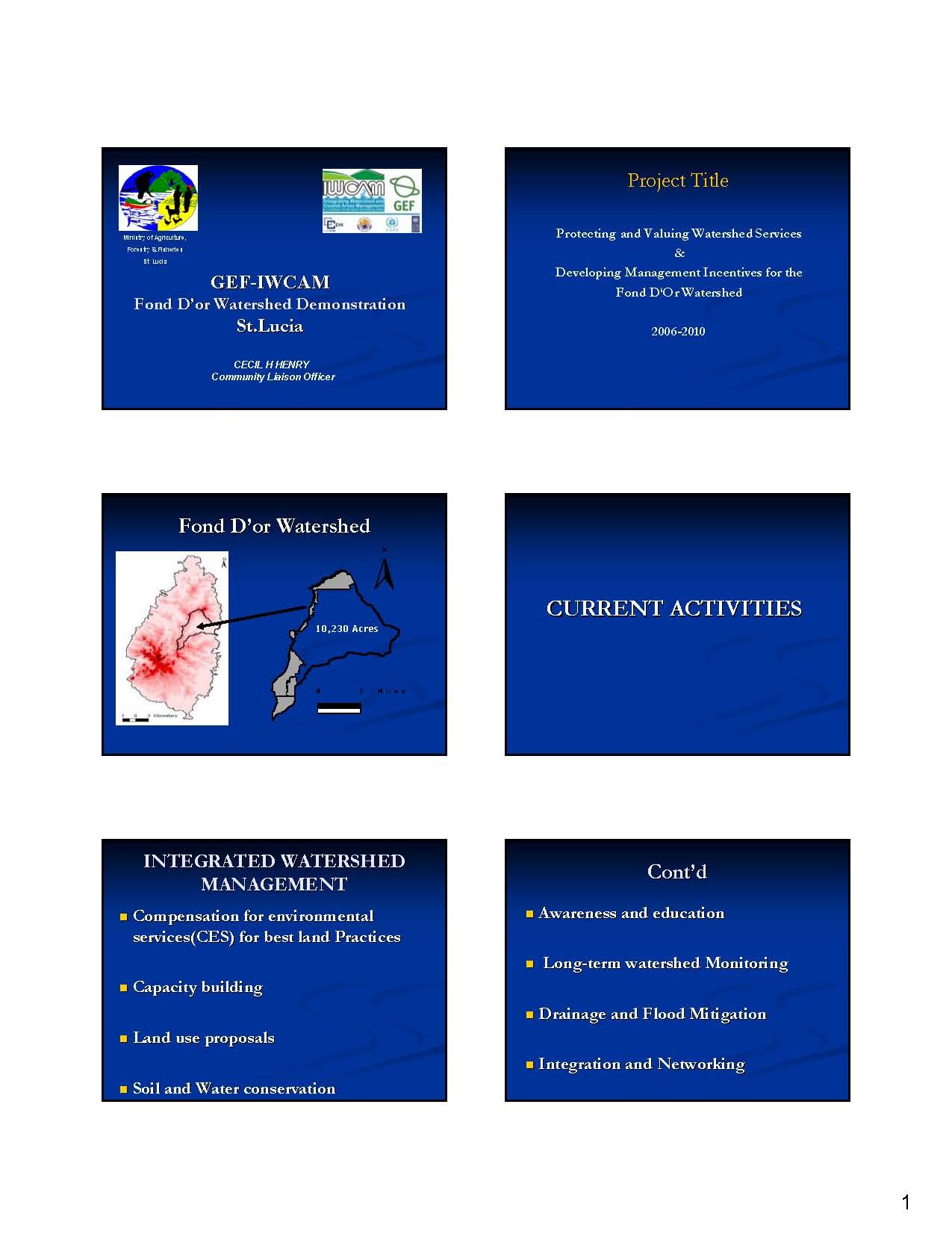
St. Lucia: Protecting and Valuing Watershed Services and Developing Management
Incentives in the Fond D'or Watershed Area.
See presentation, Appendix IX, page 34.
8
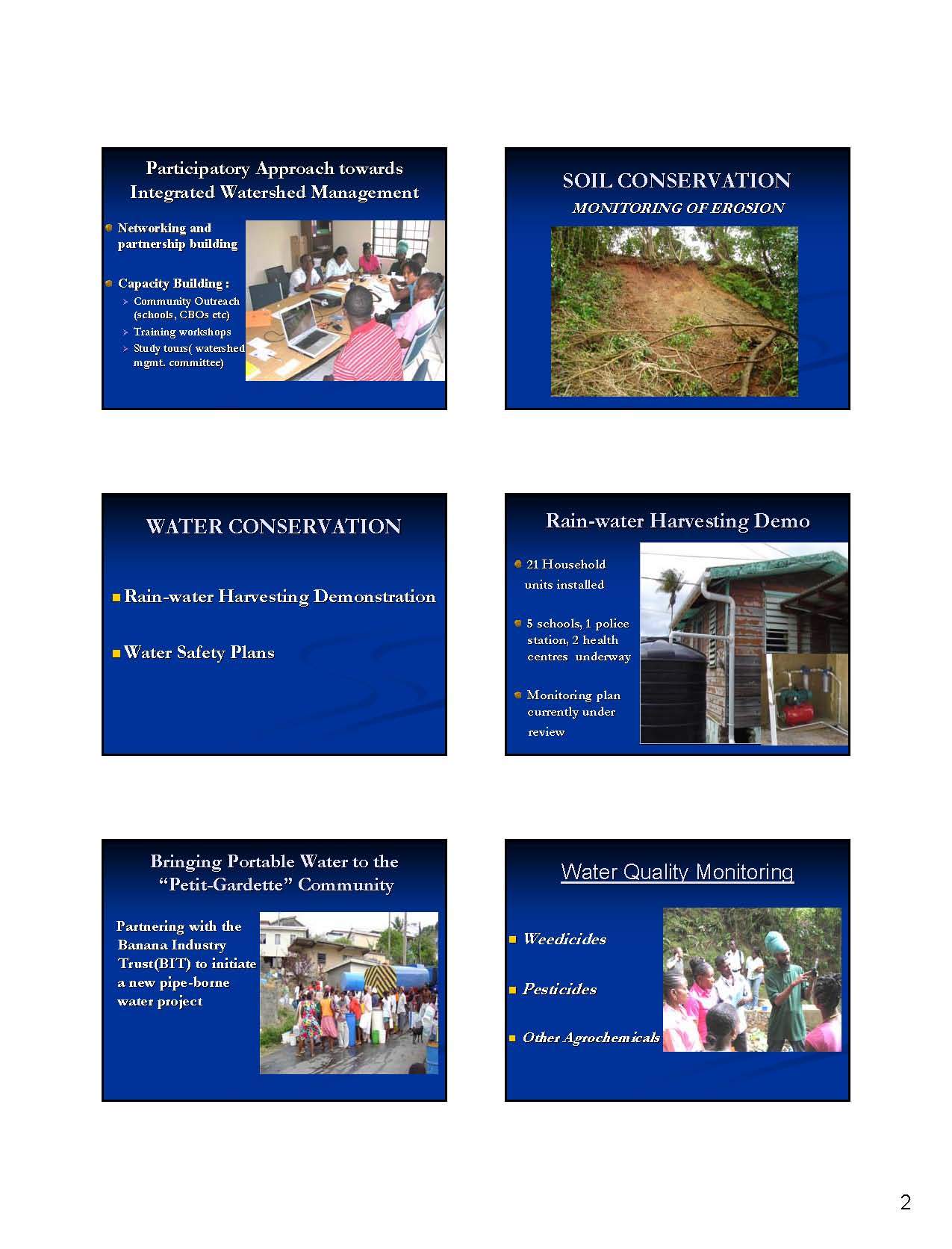
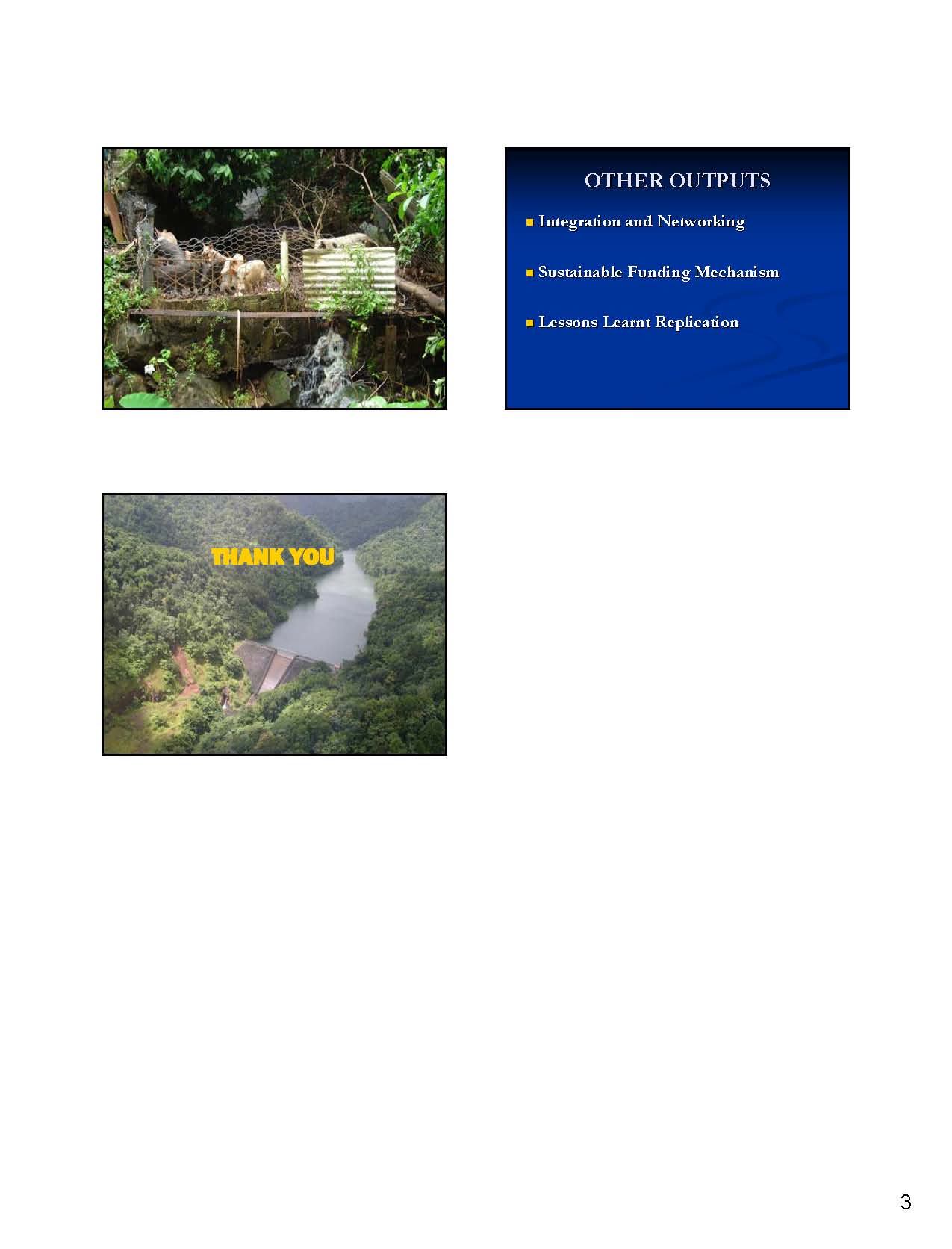
The Fond D'or Watershed where St. Lucia's Demonstration Project is located is the country's
second largest watershed at 10,230 acres. Many years of inappropriate land management
practices, significant wastage of available water at the intake and in the delivery network due to
ageing infrastructure, inadequate management capacity and low capital investments; and natural
climate have resulted in the area being water scarce. To address this, the Demonstration Project
uses a range of activities:
·
Compensation for environmental services (CES) for best land Practices
· Capacity
building
·
Land use proposals
·
Soil and Water conservation
·
Awareness and education
·
Long-term watershed Monitoring
·
Drainage and Flood Mitigation
·
Integration and Networking
A participatory approach is particularly important. The Project Management Unit is guided by the
Fond D'or Watershed Management Committee (WMC) which is made up of community members,
government representatives, representatives of the water utility and other key stakeholders. The
WMC meets regularly. Ongoing and recent activities have included:
·
Training workshops and study tours
·
Community outreach, particularly through schools and CBOs
·
The monitoring of soil erosion
·
The launch of a rainwater harvesting demo
·
Partnering with the Banana Industry Trust (BIT) to initiate a new pipe-borne water
project
·
Water quality monitoring (for weedicides, pesticides and other agrochemicals)
·
Water safety plans
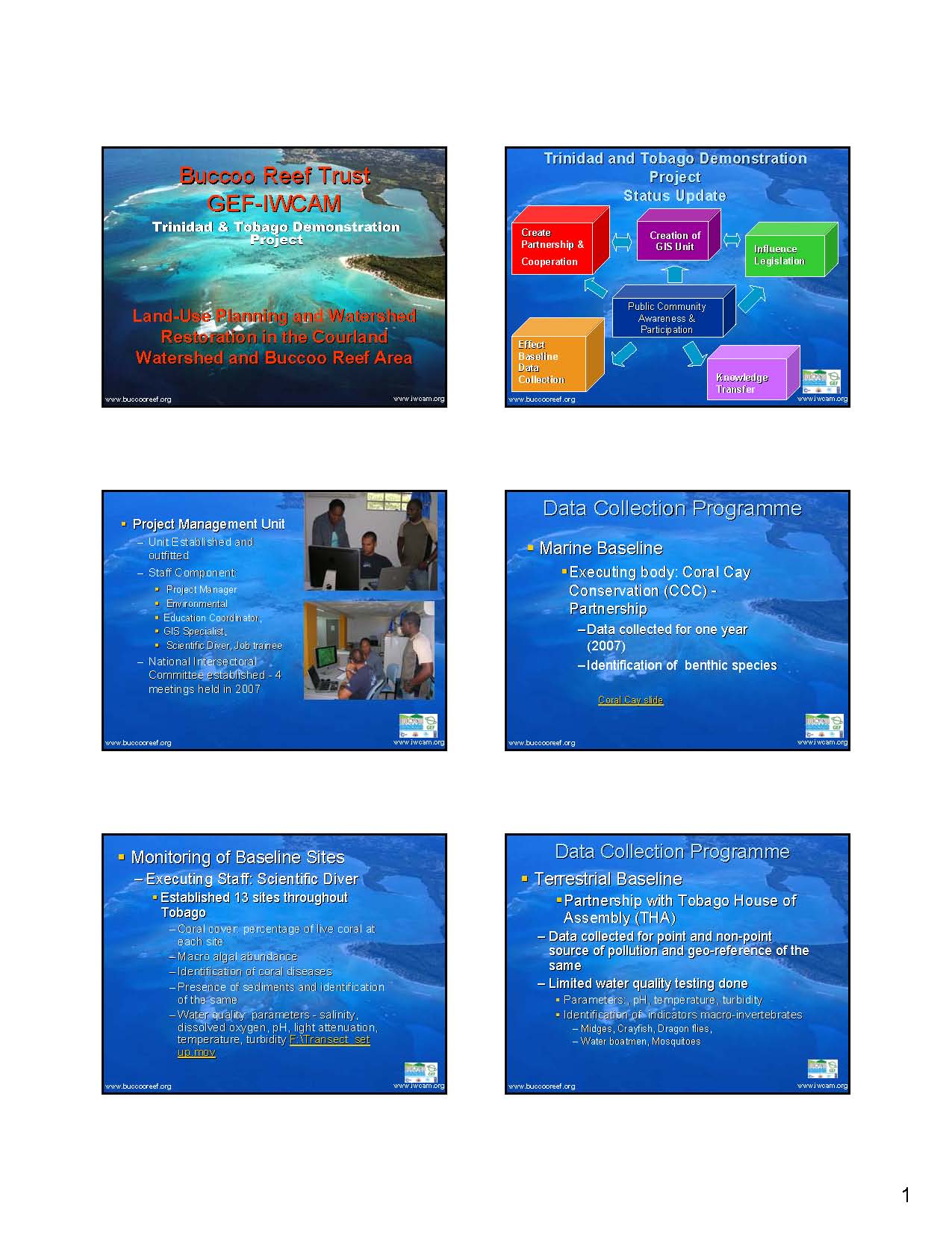
Trinidad & Tobago: Land-Use Planning and Watershed Restoration in the Courland
Watershed and Buccoo Reef Area
See presentation, Appendix X, page 37.
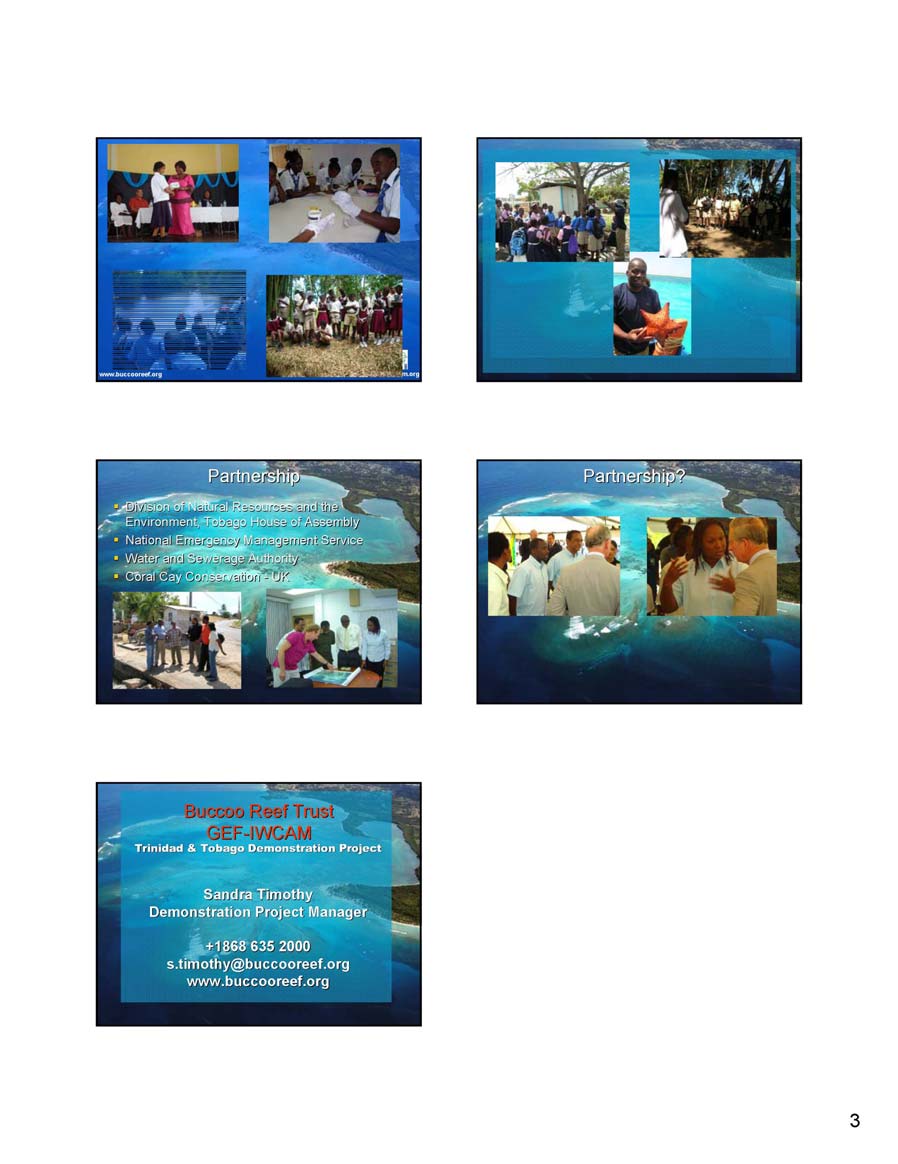
The PMU has been fully staffed and includes the Project Manager, an Environmental Education
Coordinator, a Geographic Information Systems Specialist, and a Scientific Diver. The National
Intersectoral Committee is well established and held four meetings in 2007. There has been
significant progress in the following areas:
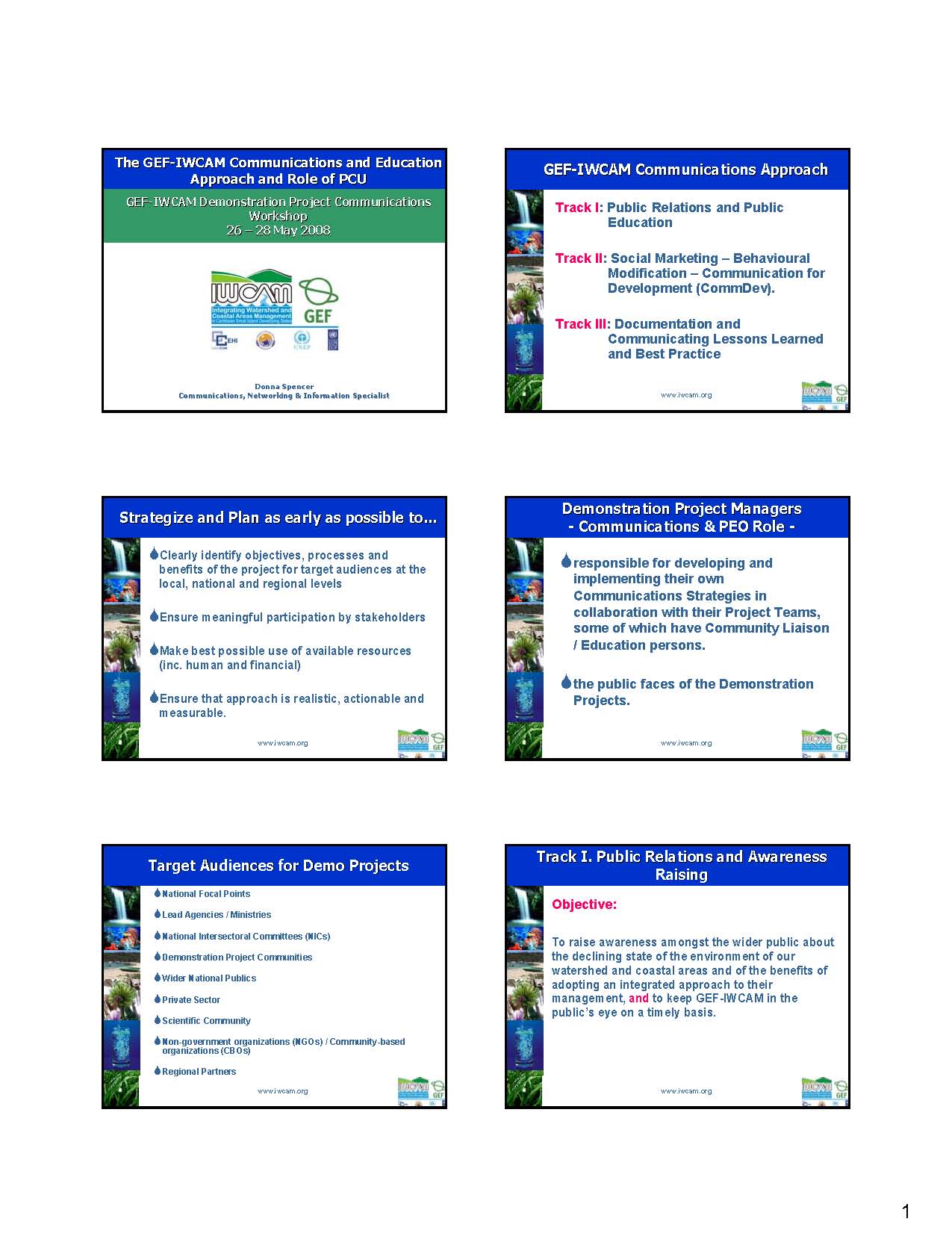
·
The creation of partnerships and cooperation major partners are the
Division of Natural Resources and the Environment, Tobago House of Assembly,
the National Emergency Management Service, the Water and Sewerage
Authority, and Coral Cay Conservation of the United Kingdom.
·
Baseline data collection Marine - Coral Cay conservation has collected the
marine baseline for one year, 2007, and has identified benthic species. Baseline
sites are monitored by the Scientific Diver (13 throughout Tobago) for coral
cover, macro algal abundance, coral diseases, presence and identification of
sediments and water quality; Terrestrial in partnership with the Tobago House
of Assembly, data is collected for point and non-point sources of pollution and
limited water quality testing is conducted.
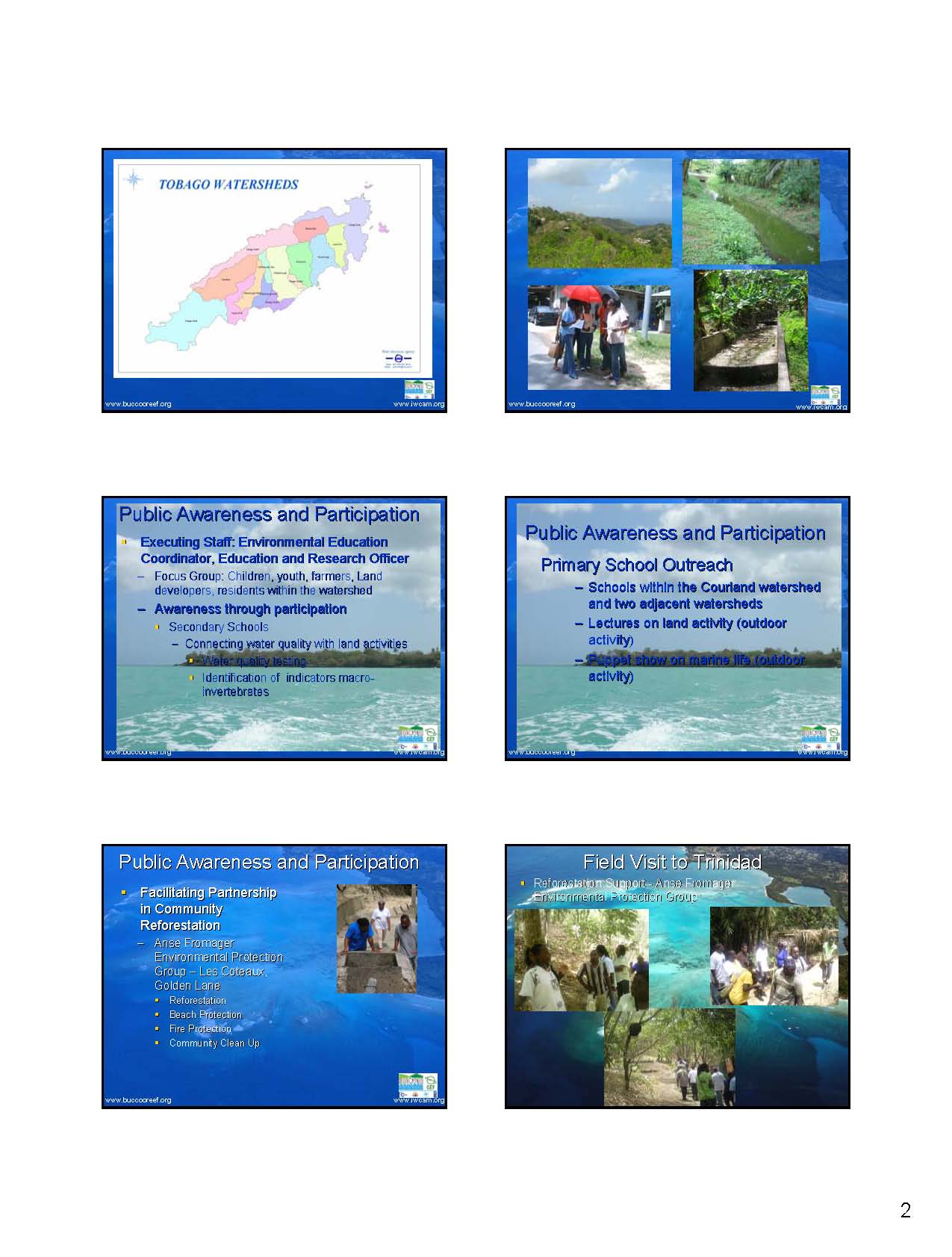
·
Public and Community Awareness and Participation children, youth, land
developers, residents and farmers within the watershed make up the main focus
9
groups. Students from secondary schools are introduced to water quality testing
and encouraged to make connections between water quality with land activities.
Primary schools within the Courland Watershed and two adjacent watersheds
are given outdoor lectures and puppet shows.
·
Community Reforestation this is facilitated through partnership with the Anse
Fromager Environmental Protection Group and includes reforestation, beach
protection, fire protection and community clean-ups.
5. The GEF-IWCAM Communications and Education Approach and Role of the Project
Coordination Unit
Donna Spencer described the GEF-IWCAM approach to Communications and Public Education
(refer to the GEF-IWCAM Project Communications and Education Planning Guide at:
http://www.iwcam.org/information/gef-iwcam-communications-public-education-and-outreach-
workshop-12-13-february-2008-port-of-spain-trinidad-tobago/gef-iwcam-communications-and-
education-planning-guide-revised-april-2008 as consisting of three parallel sets of activities:
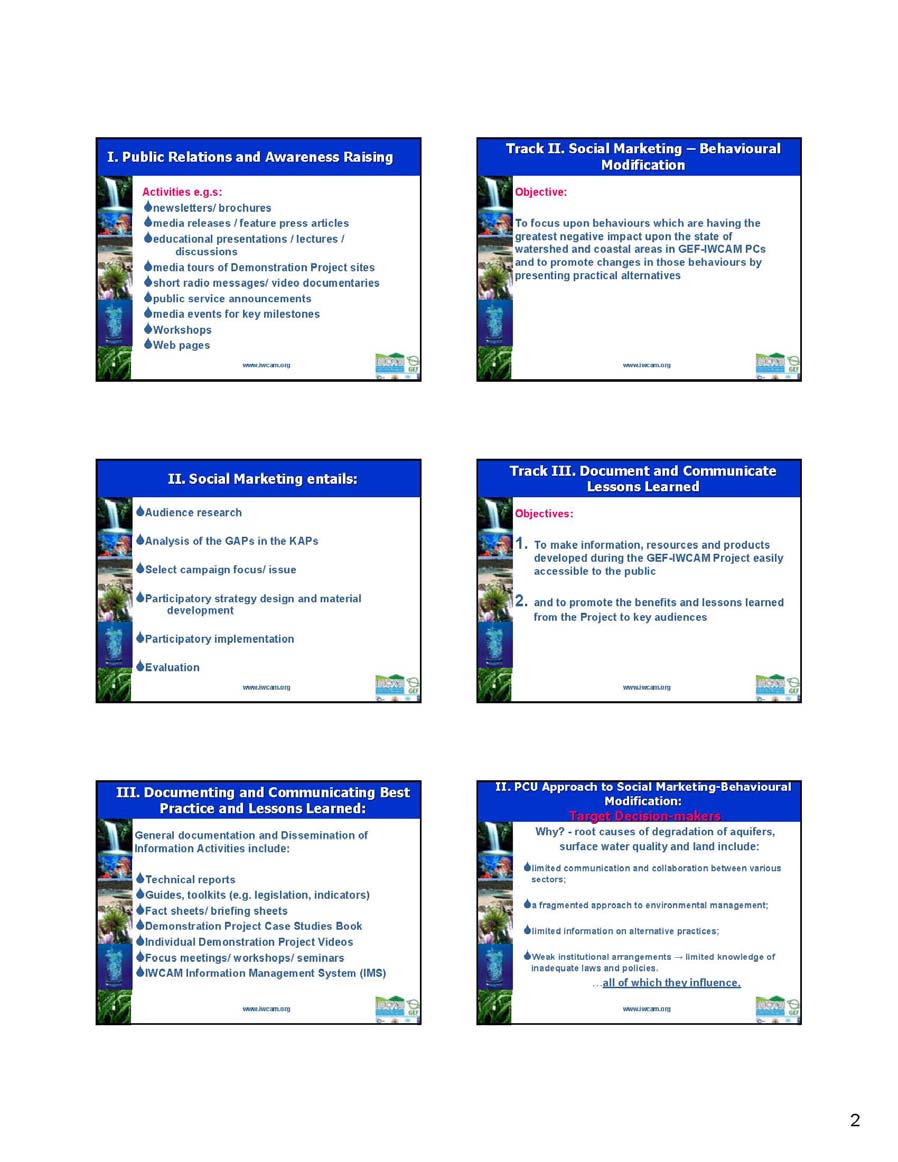
·
Track I: Public Relations and Public Education
·
Track II: Social Marketing Behavioural Modification Communication for
Development (CommDev).
·
Track III: Documentation and Communicating Lessons Learned and Best
Practice
Demonstration Project Managers were reminded that they are responsible for developing and
implementing their own communication strategies in collaboration with their Project Teams, and,
that they are the public faces of the Demonstration Projects. The importance of strategizing and
planning as early as possible was stressed.
The objectives of the three tracks are different. These were explained and some examples of
activities illustrating each were given.
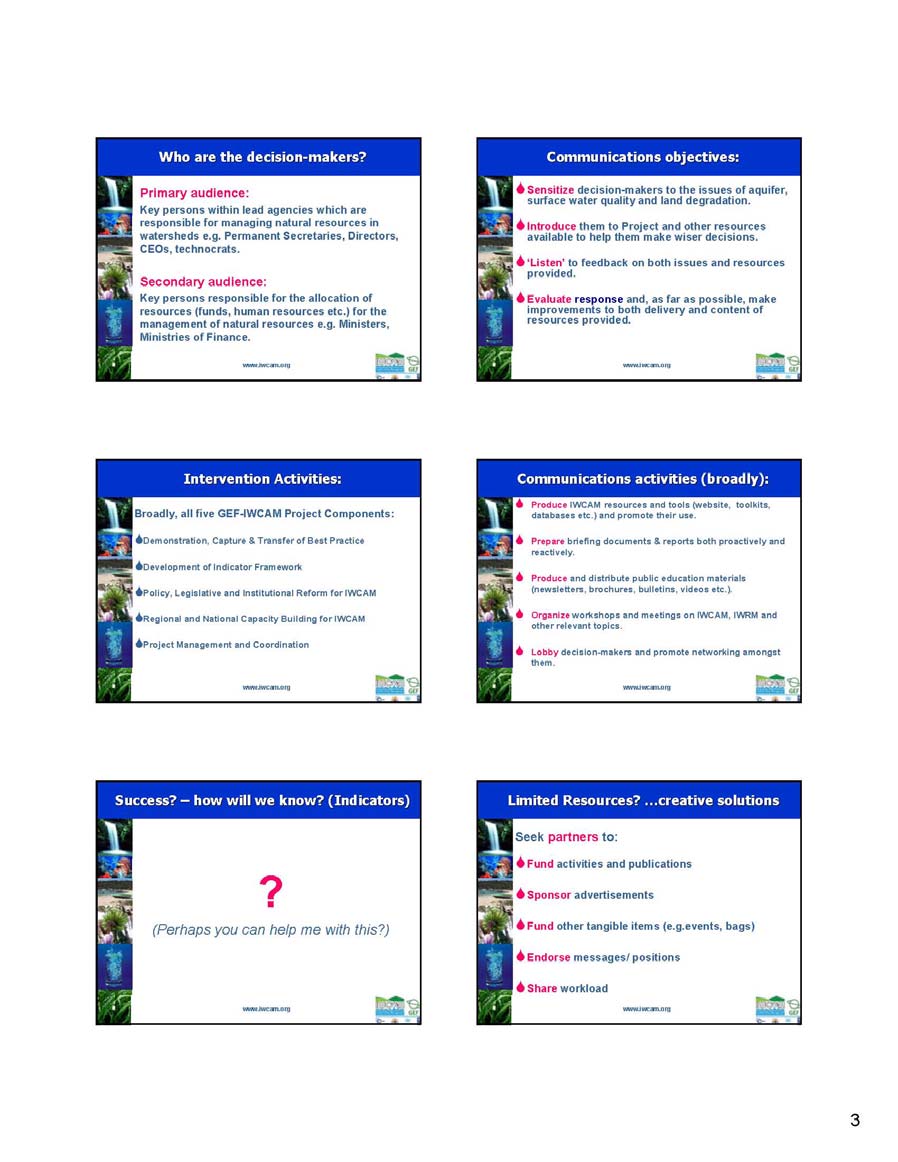
Track I: Public Relations and Public Education
Objectives to raise awareness amongst the wider public about the declining state of the
environment of our watershed and coastal areas and of the benefits of adopting an integrated
approach to their management, and; to keep GEF-IWCAM in the public's eye on a timely basis.
Activities could include: newsletters/brochures; media releases/feature press articles; educational
presentations/lectures /discussions; media tours of Demonstration Project sites; short radio
messages/video documentaries; public service announcements; media events for key milestones;
workshops, and; web pages.
Track II: Social Marketing Behavioural Modification Communication for Development
Objective - To focus upon behaviours which are having the greatest negative impact upon the
state of watershed and coastal areas in GEF-IWCAM PCs and to promote changes in those
behaviours by presenting practical alternatives.
This entails:
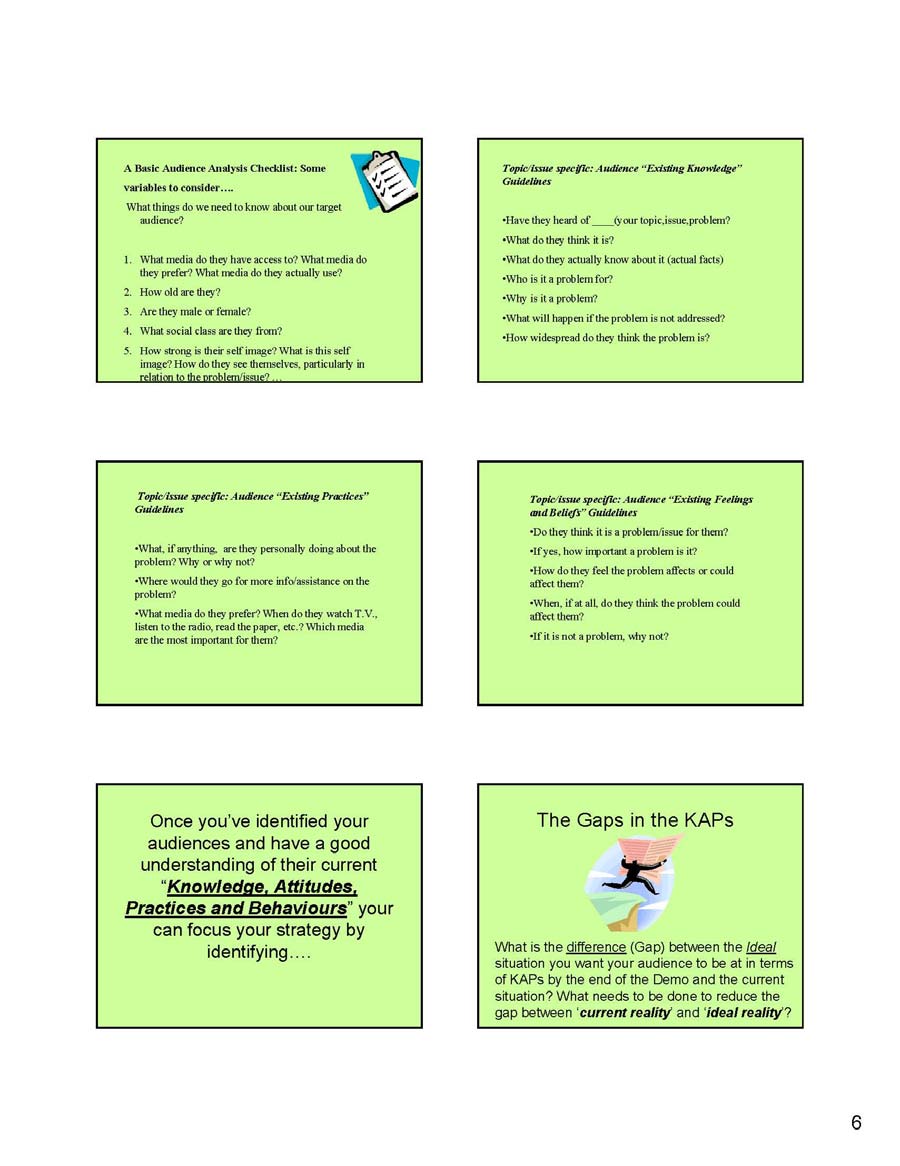
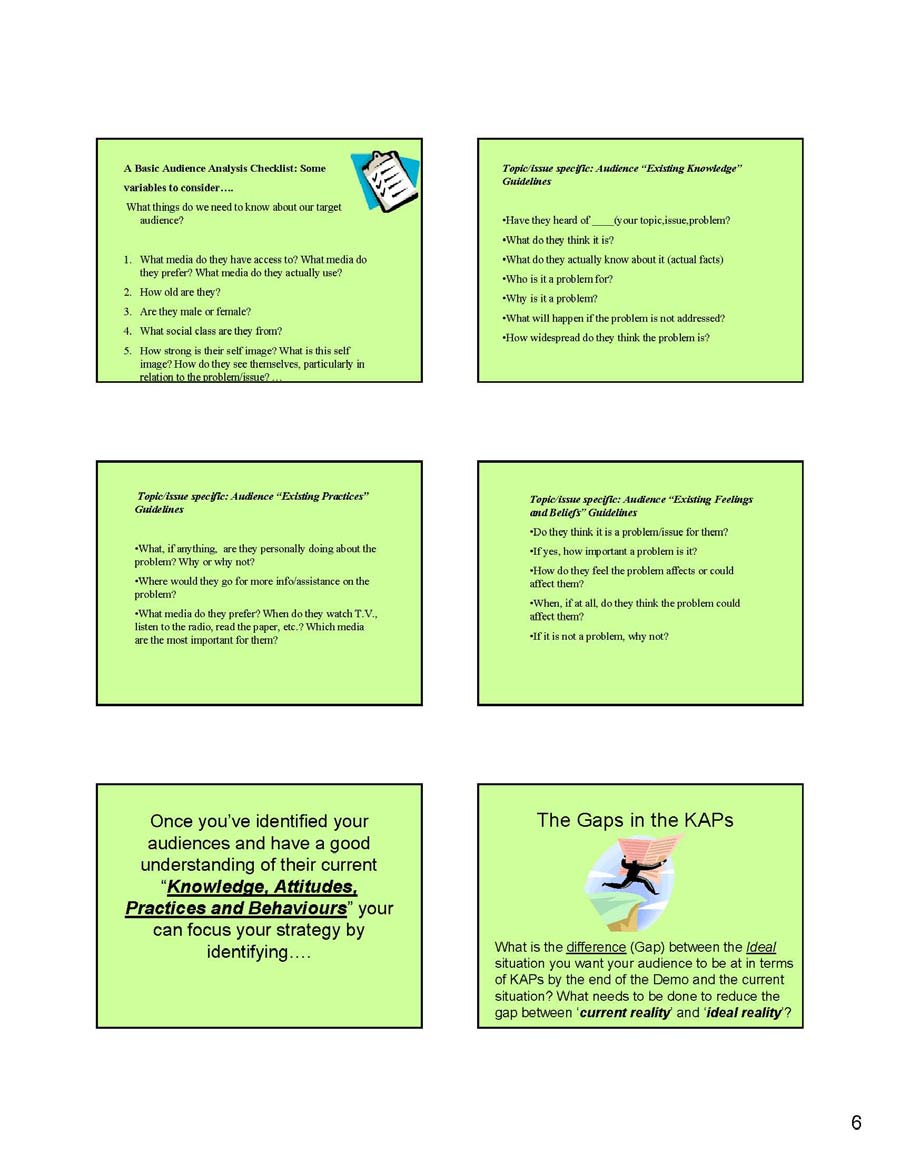
Audience research
10
Analysis of the GAPs in the KAPs
Select campaign focus/ issue
Participatory strategy design and material development
Participatory implementation
Evaluation
Track III: Documentation and Communication of Lessons Learned
This has two main objectives:
1) to make information, resources and products developed during the GEF-IWCAM Project easily
accessible to the public; and
2) to promote the benefits and lessons learned from the Project to key audiences.
General documentation and Dissemination of Information Activities include: technical reports;
guides, toolkits (e.g. legislation, indicators); fact sheets/ briefing sheets; Demonstration Project
Case Studies; individual Demonstration Project videos; focus meetings/ workshops/ seminars
and; the IWCAM Project Information Management System (PIMS).
With respect to each of the three parallel tracks, the Project Coordination Unit (PCU) would have
its own set of activities. Donna Spencer explained the PCU's approach to Track II, which targets
decision-makers, in some detail, given its implications for the sustainability of the approach. See
presentation, Appendix XI, page 40.
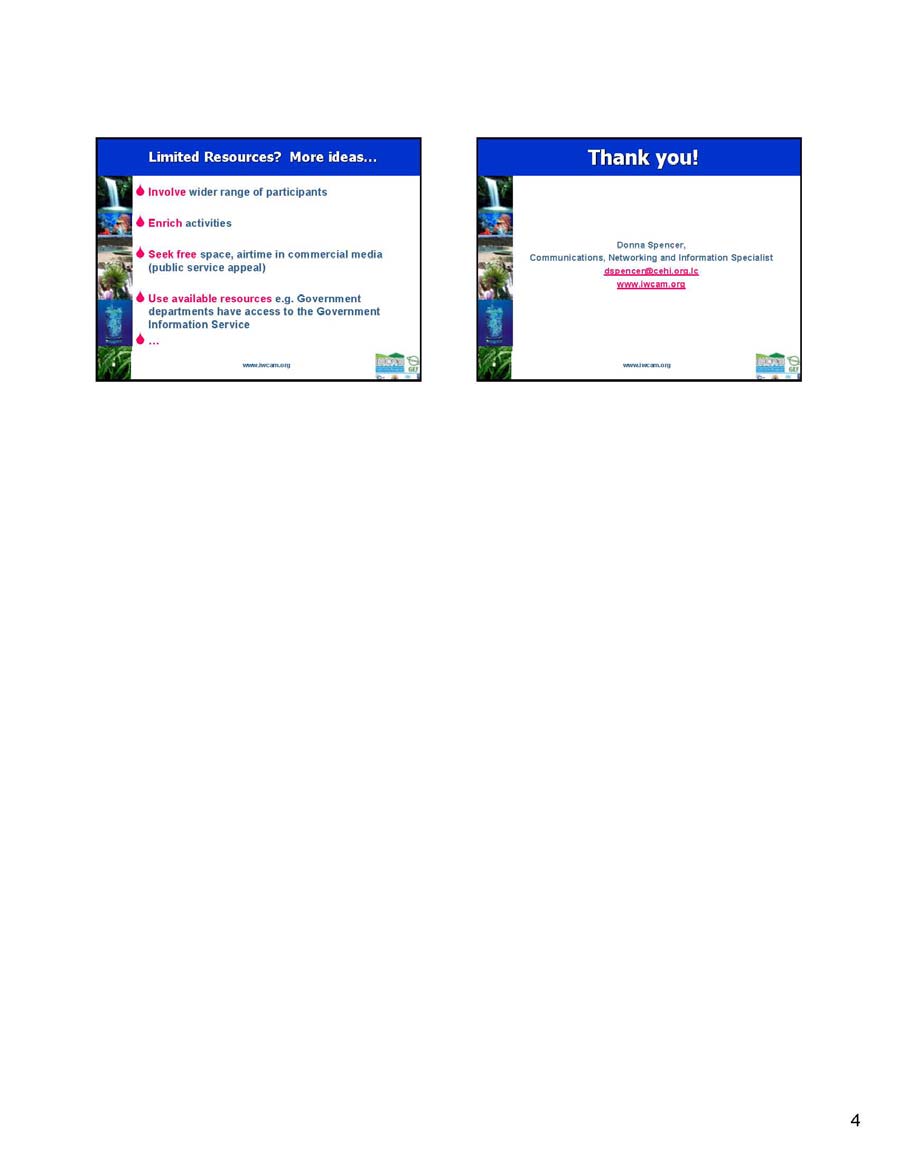
In recognition of the resource constraints faced by the Demonstration Projects with regard to
communications and public education activities, the importance of seeking partners was stressed.
They can help to, among other things:
· Fund activities and publications
· Sponsor
advertisements
· Fund other tangible items (e.g. events, bags)
· Endorse messages/ positions
· Share
workload
· Involve wider range of participants
· Enrich
activities
· Seek free space, airtime in commercial media (public service appeal)
· Use available resources (e.g. Government departments have access to the Government
Information Service)
6) The Strategic Communications Planning Process
Maria Protz reiterated that the main goal of the Workshop was to ensure that by the end of it each
demonstration project had well advanced, on paper, a well-thought out, structured and integrated
communication strategy that is harmonized within its overall work plan.
11
She then proceeded to recap some of the main points introduced at the Project's first
communications workshop held in Trinidad in February 2008.
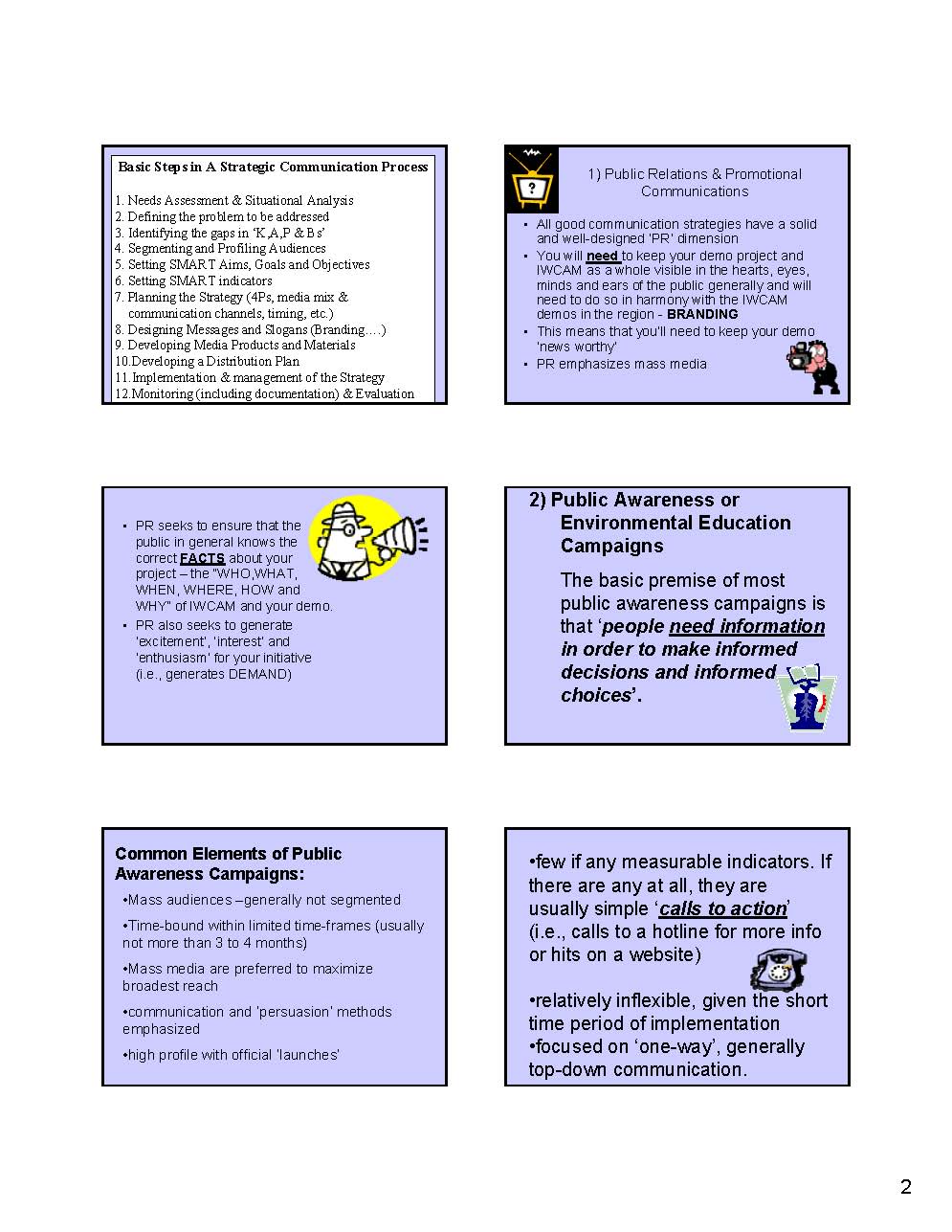
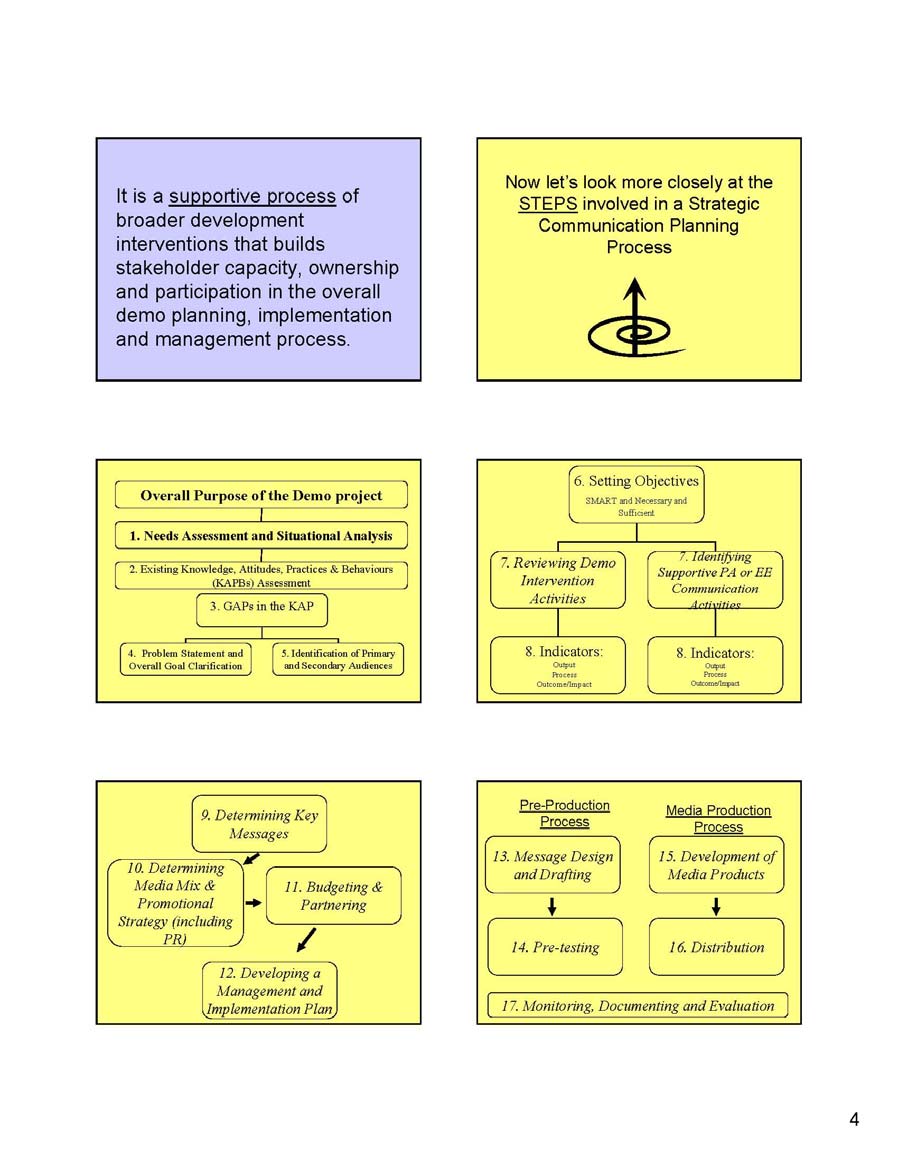
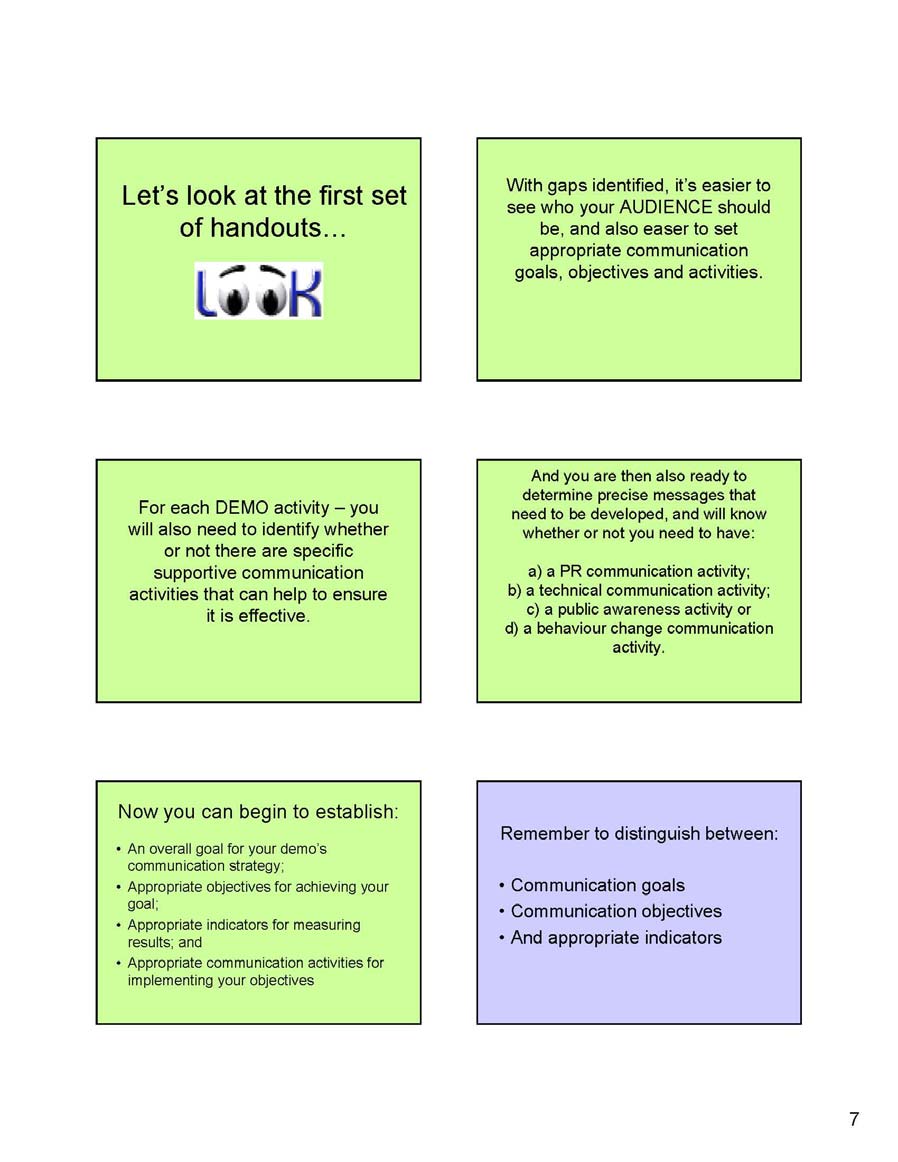
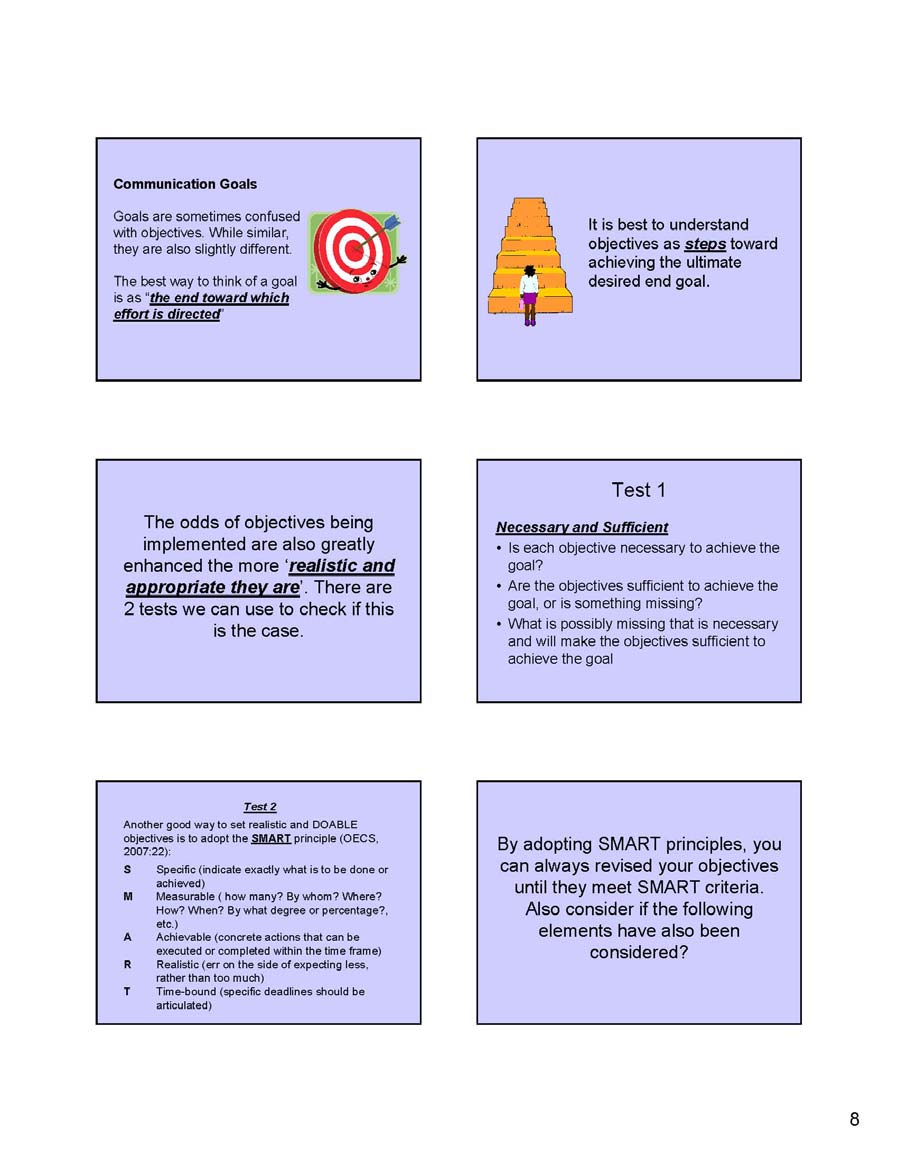
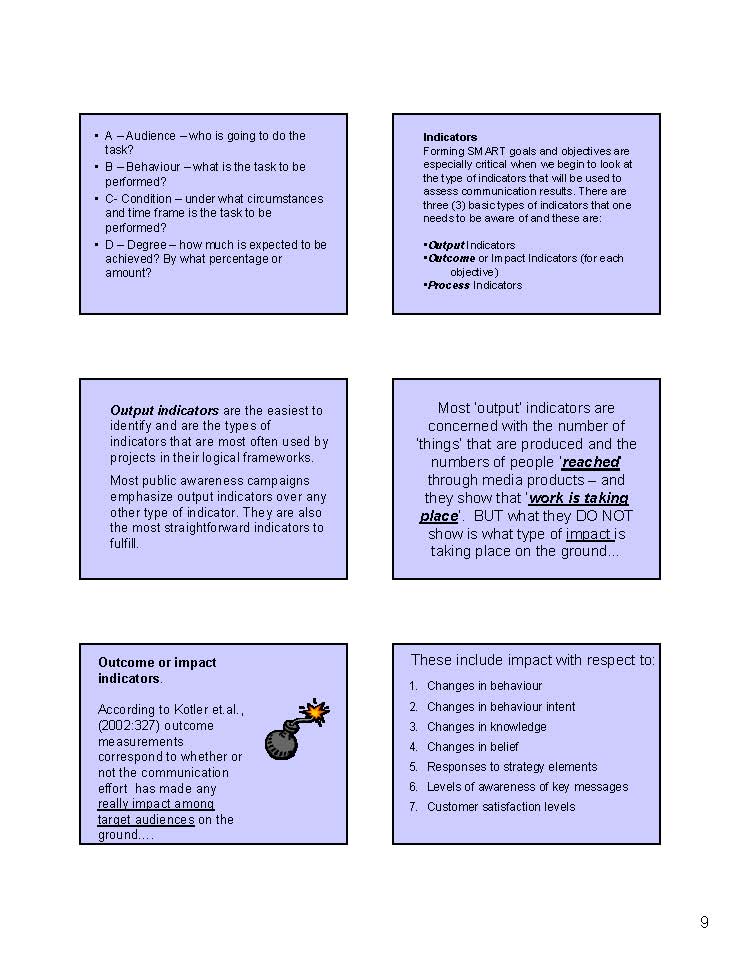
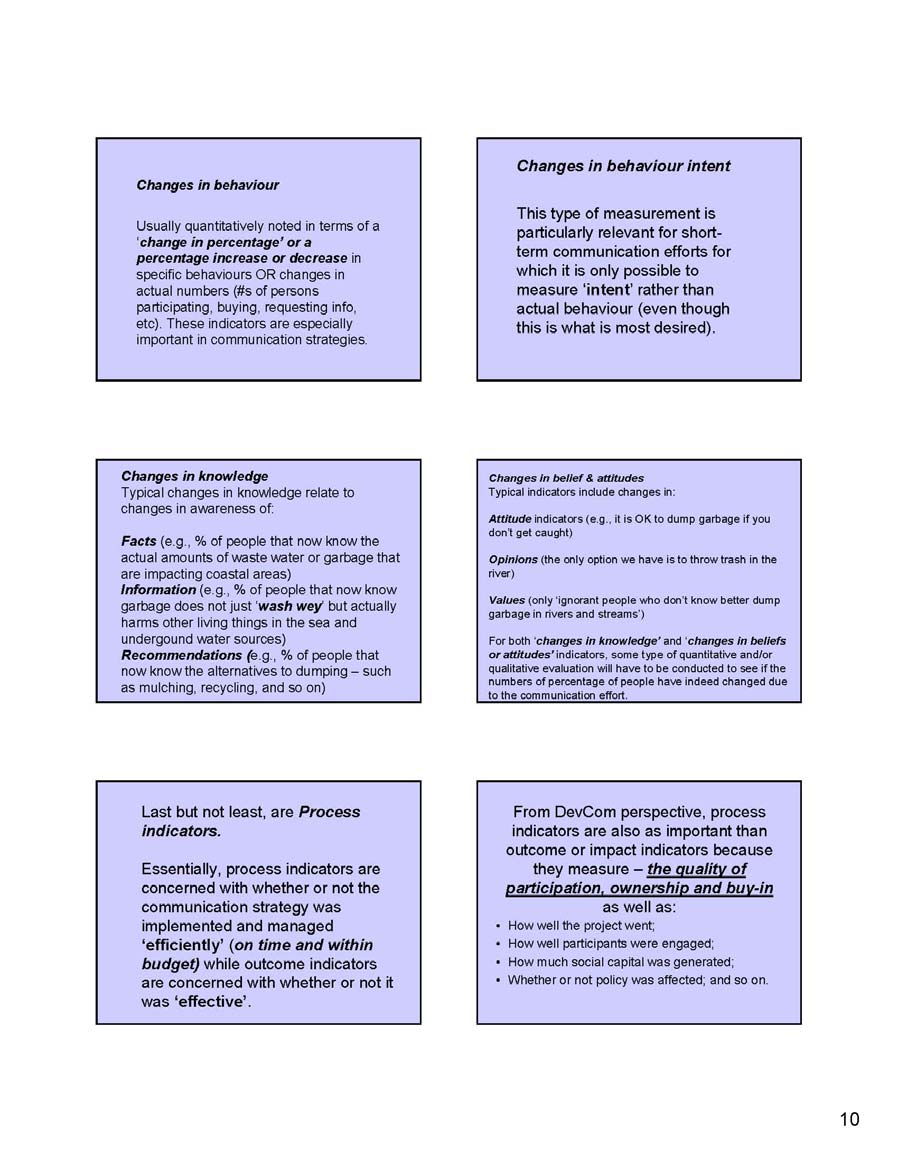
All of the steps involved in designing and executing a strategic communications plan were
introduced and discussed by Dr. Protz (See presentation Appendix XII, page 44). Participants
worked in pairs consisting of the Demonstration Project Manager and communications person
present from each country, with the exception of St. Lucia which had only one representative. In
the series of working sessions which followed, each group worked through the following stages of
the Strategic Communications Planning process:
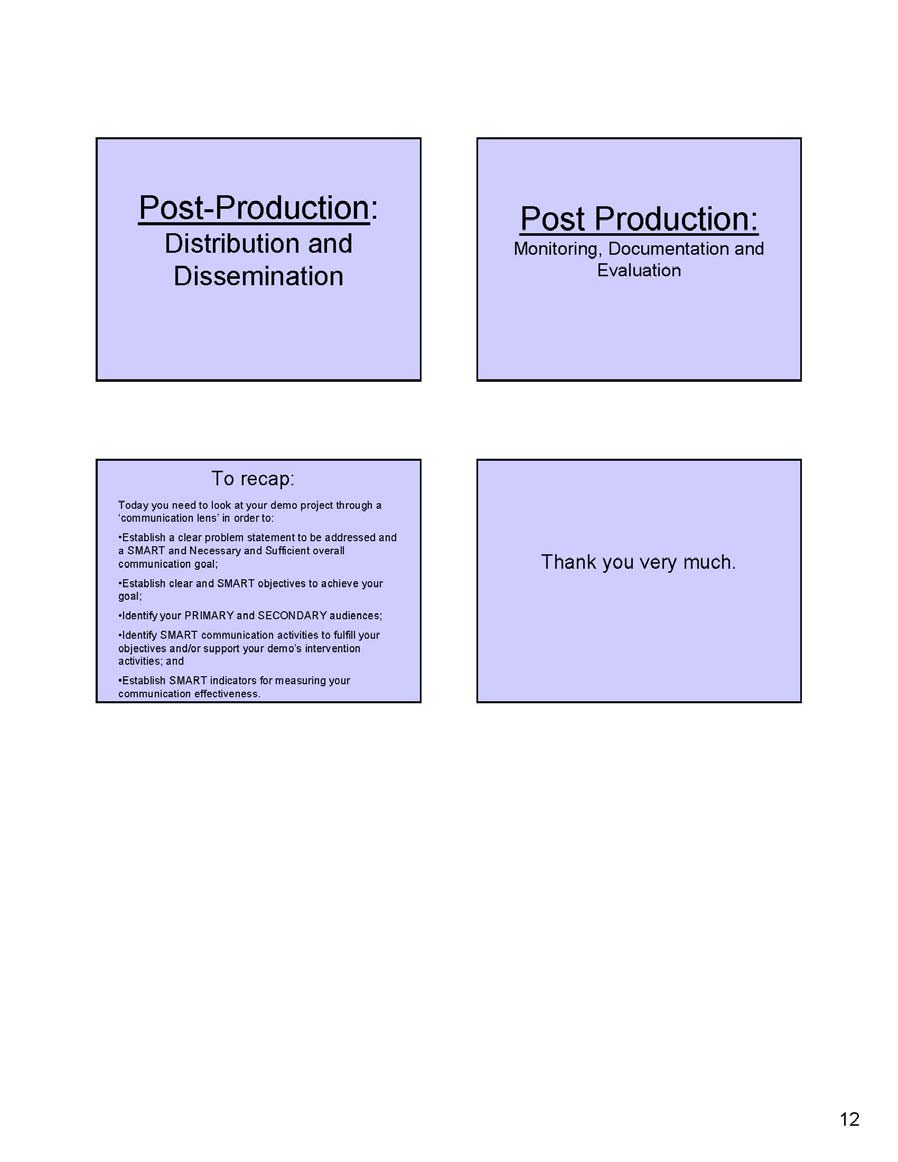
· Establishing a clear problem statement to be addressed and a SMART and Necessary
and Sufficient overall communication goal;
·
Establishing clear and SMART objectives to achieve the goal;
·
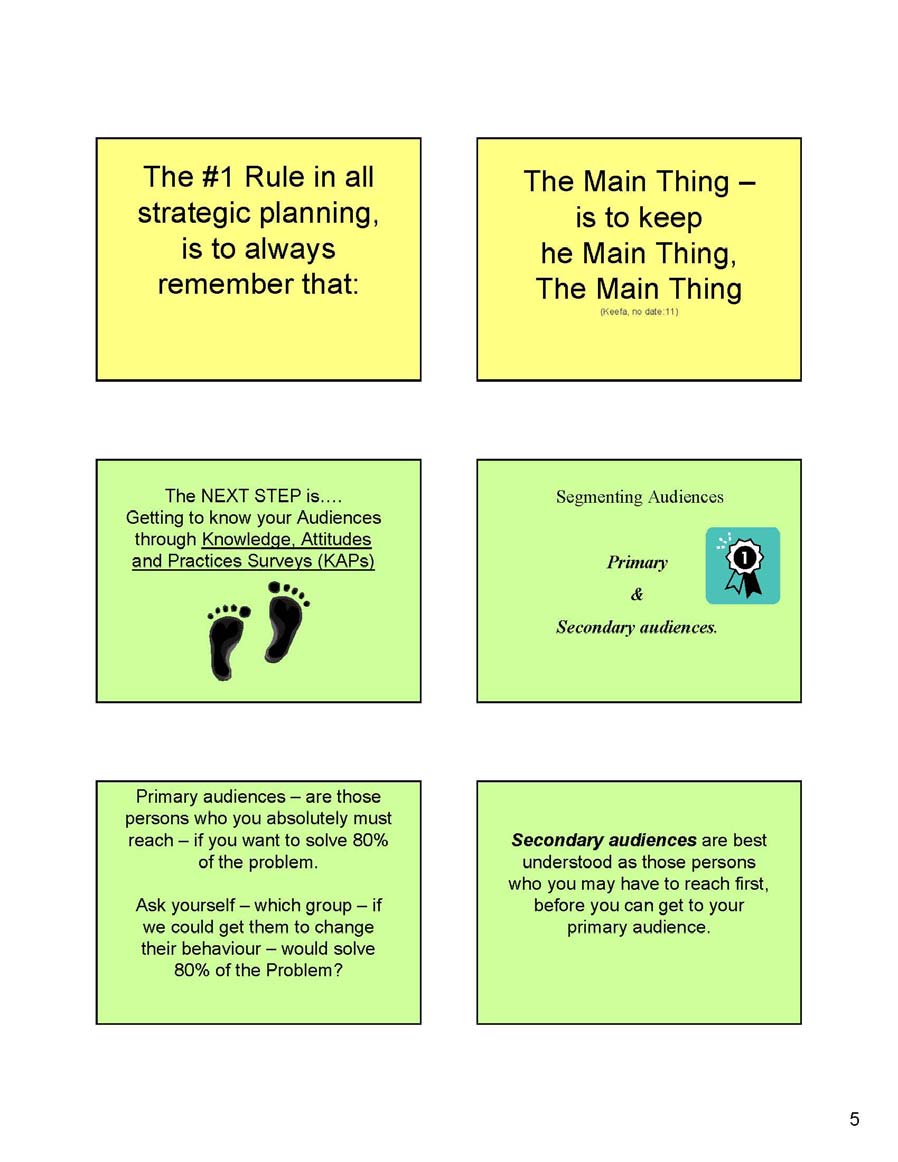
Identifying PRIMARY and SECONDARY audiences;
· Identifying SMART communication activities to fulfill your objectives and/or support the
demonstration project's intervention activities; and
·
Establishing SMART indicators for measuring communication effectiveness.
At intervals selected templates were distributed to participants as they allowed exploration and
discussion of these steps in detail and with reference to case study material. All templates used
may be found in Appendix XIII, page 57. In addition a series of resource and example materials
were referred to and distributed to participants during the course of presentations as well as the
working sessions. The PCU should be contacted if copies are desired for reference.
7) FIELD TRIP: Lower Haina River Basin, site of the Dominican Republic's Demonstration
Project
On the afternoon of Tuesday 27 May participants in the workshop visited the Lower Haina River
Basin, site of the Dominican Republic's GEF-IWCAM Demonstration Project and one of the main
industrial conglomerations in the Dominican Republic. Within this River Basin there is a coal-fired
electricity generating plant, a petroleum refinery and a vehicle battery factory amongst more than
one hundred medium to large sized industries. The area has been highly contaminated by these
industrial activities as well as by the solid and liquid wastes generated by the communities. It is
home to very large unplanned or squatter settlements and the effects of the lack of planning and
services are very apparent on the hills, along the river banks and in the water.
The waters of this Basin are among the main fresh water sources of the capital city, Santo
Domingo. The Project is working to reduce the pollutants in the river basin through interventions
in the industrial sector. Participants were shown some of the key sites.
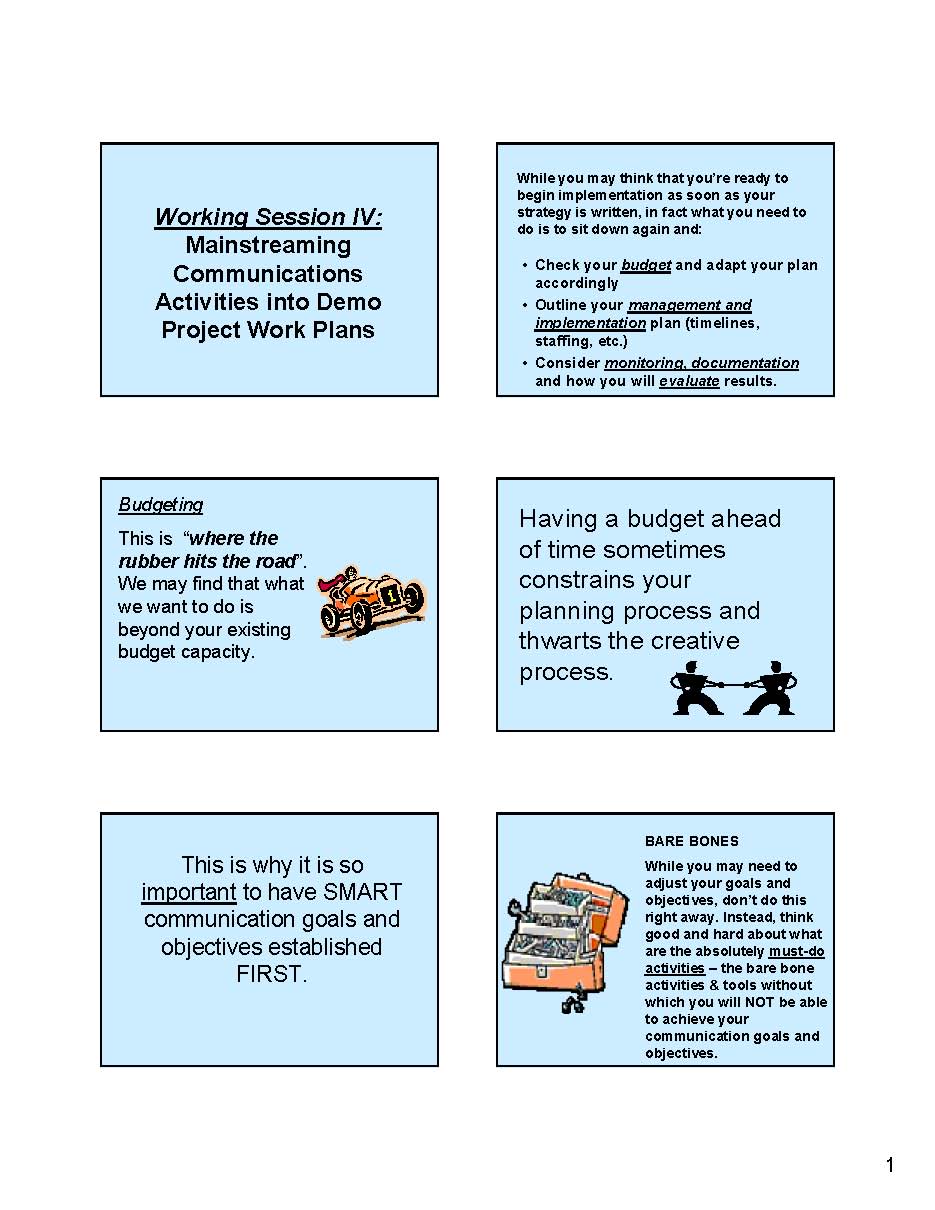
8) Mainstreaming Communications Activities into Demonstration Project Work Plans
The first part of Day 3, Wednesday 28 May, focused upon mainstreaming communications
activities into the work plans of the Demonstration Projects once the strategy is written. In this
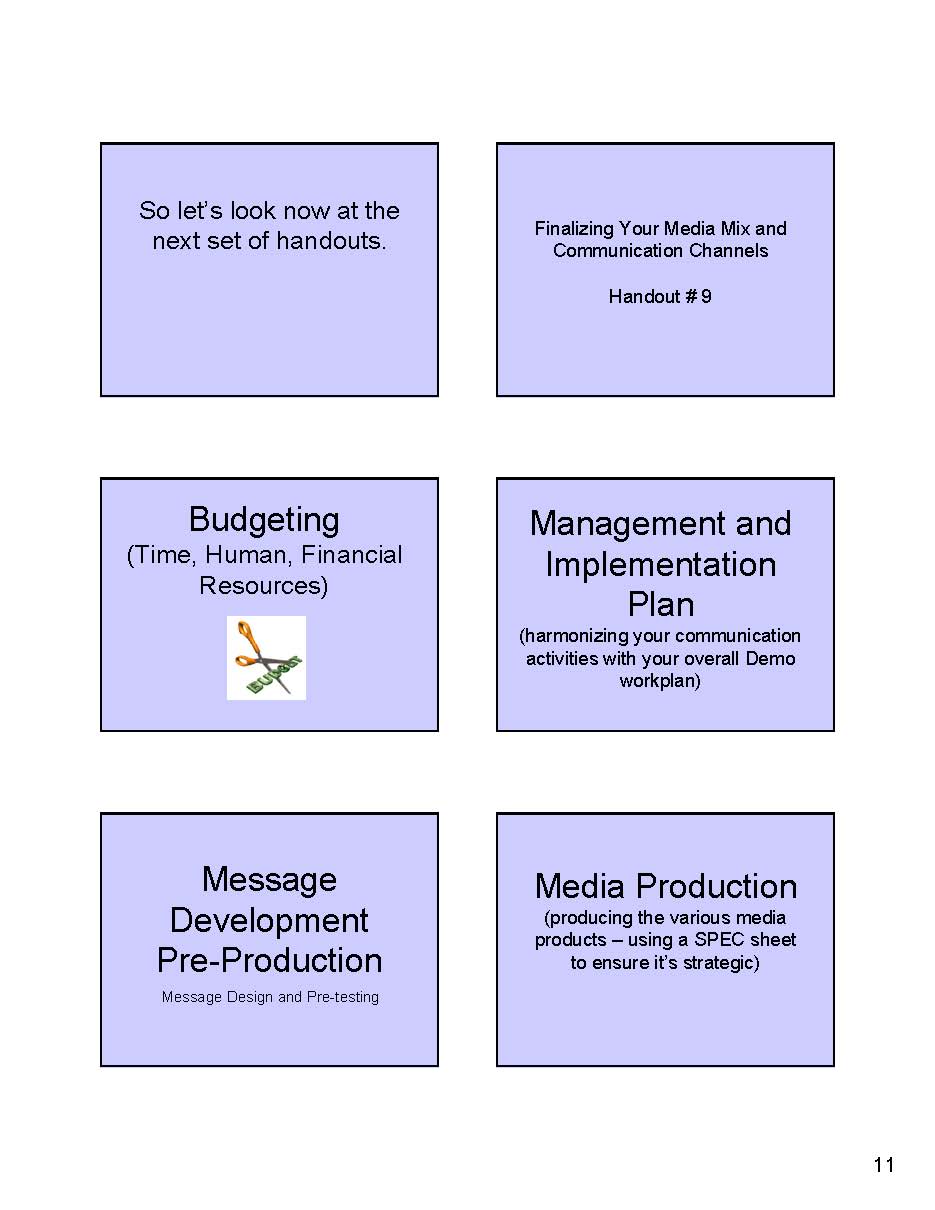
presentation (see Appendix XIV, page 65) Maria Protz stressed the importance of:
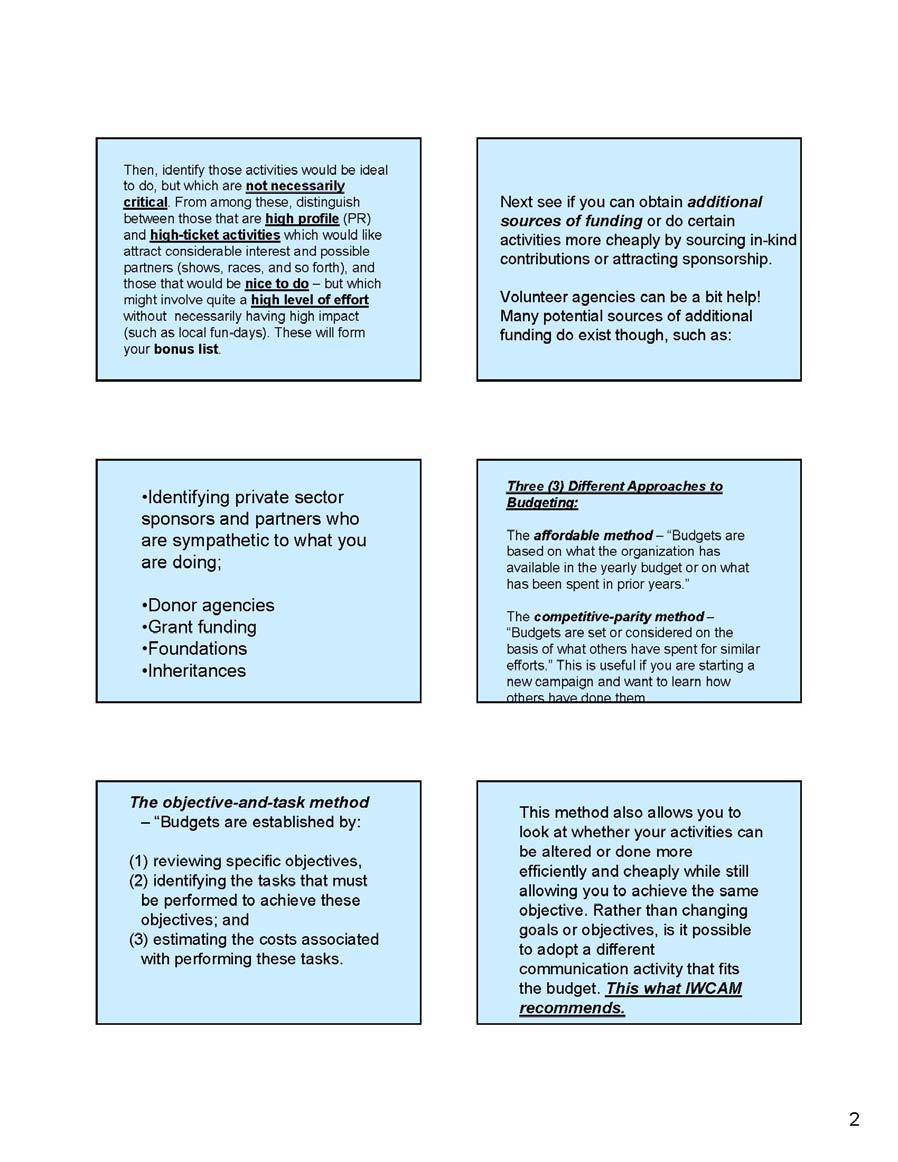
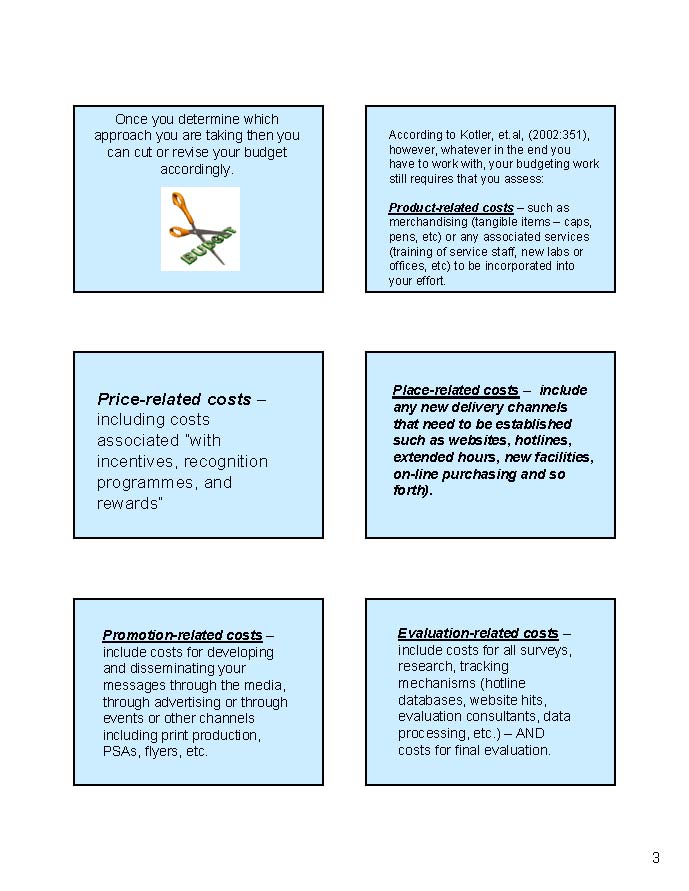
· Budgeting: checking the available budget and adapting the plan accordingly:
distinguishing the "must-do activities" i.e. those necessary to the achievement of the
communication goals and objectives. The objective-and-task method of budgeting in
which budgets are established by: reviewing specific objectives, identifying the tasks that
must be performed to achieve these objectives; and estimating the costs associated with
performing these tasks is the approach recommended by IWCAM. This method also
allows projects to look at whether activities can be altered or done more efficiently and
cheaply while still allowing achievement of the same objective. Rather than changing
12
goals or objectives, is it possible to adopt a different communication activity that fits the
budget?
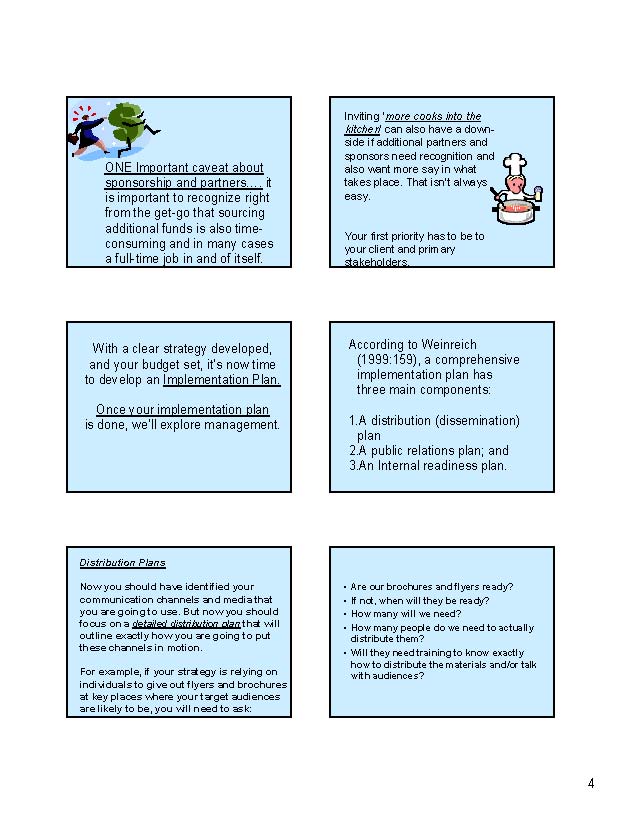
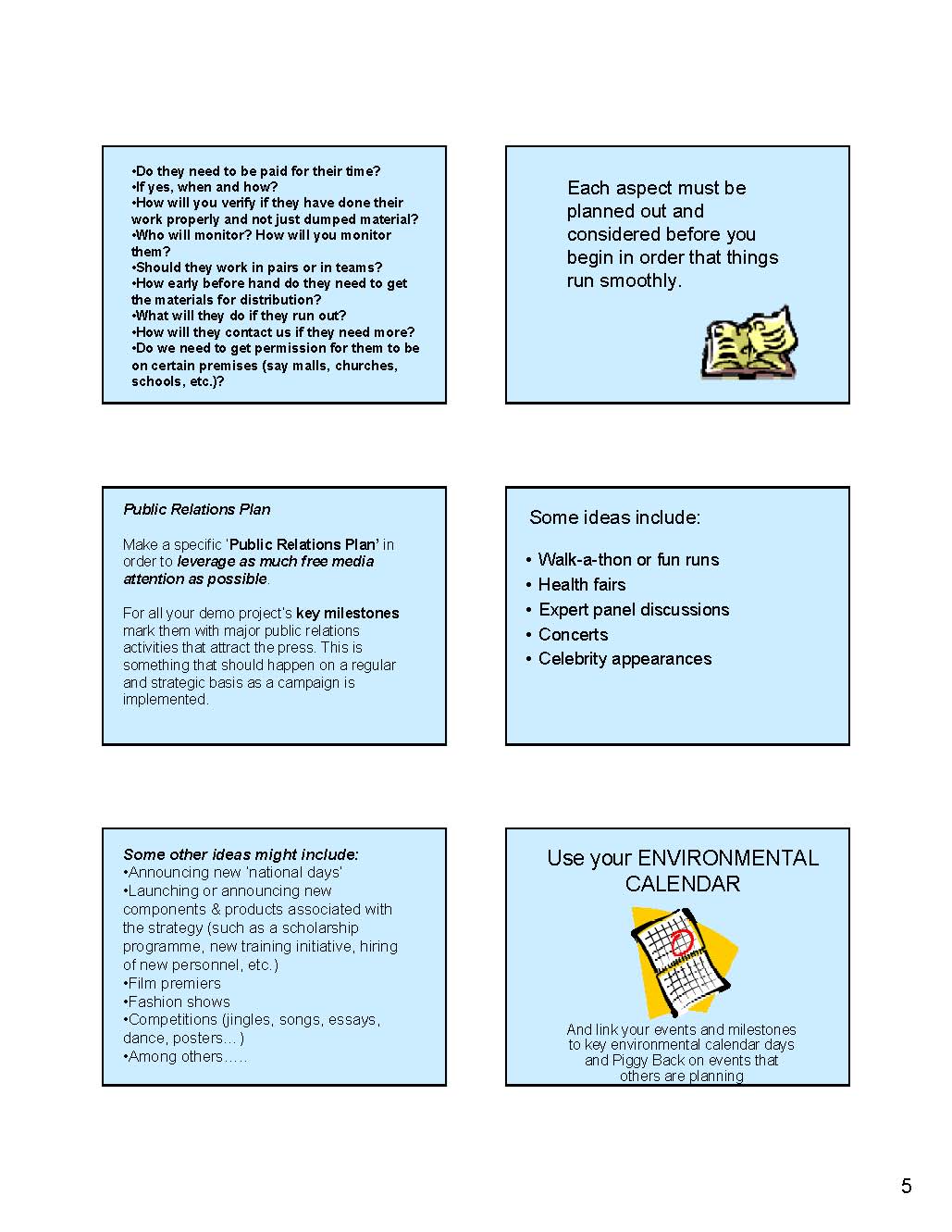
· a comprehensive implementation plan with three main components: 1) a distribution
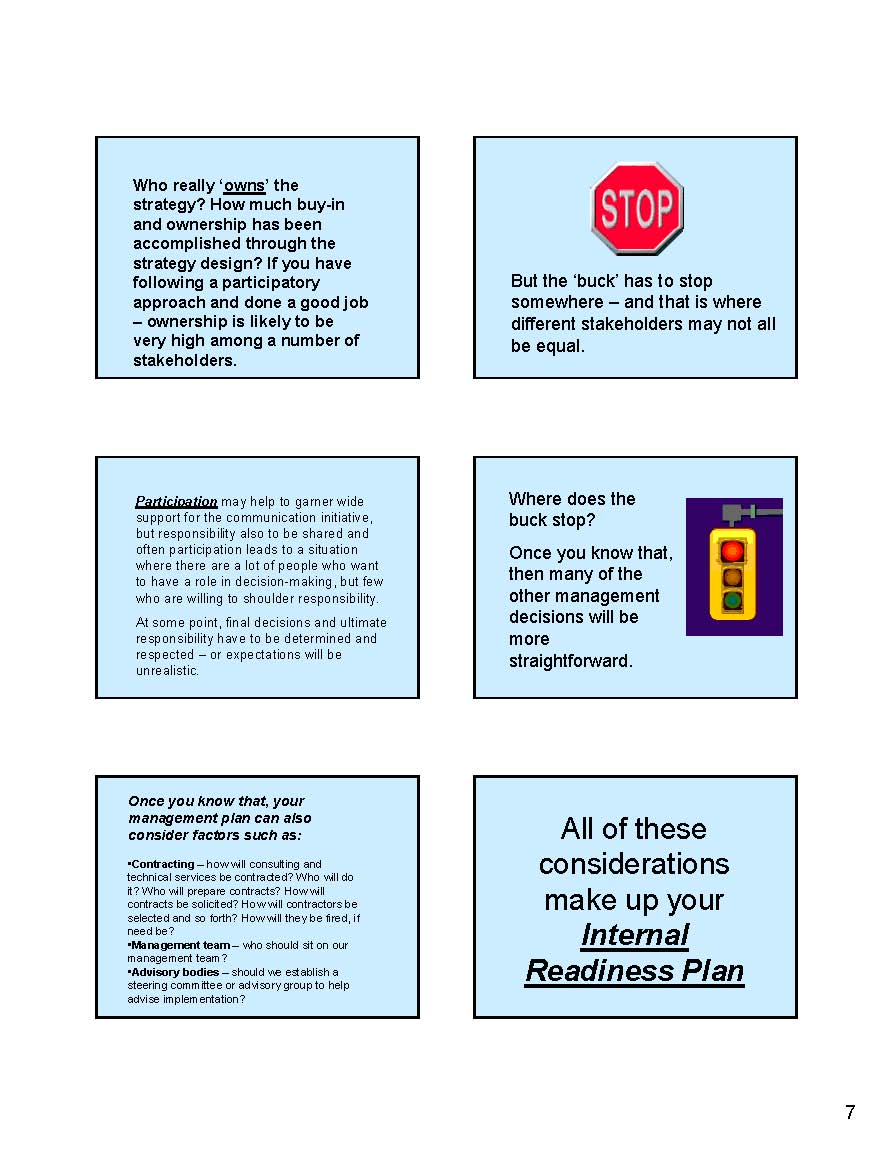
(dissemination) plan; 2) a public relations plan; and 3) an internal readiness plan.
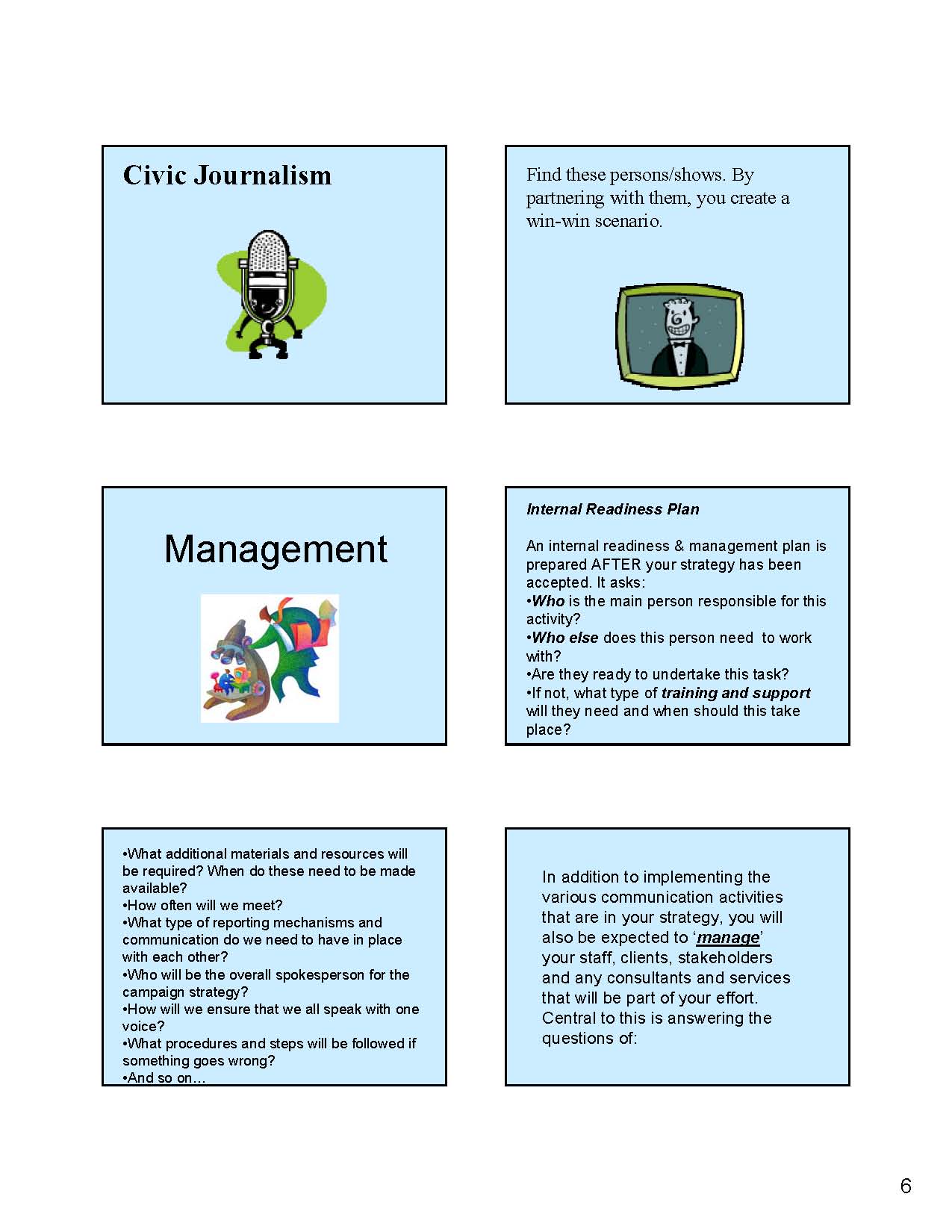
· outlining the management and implementation plan, and
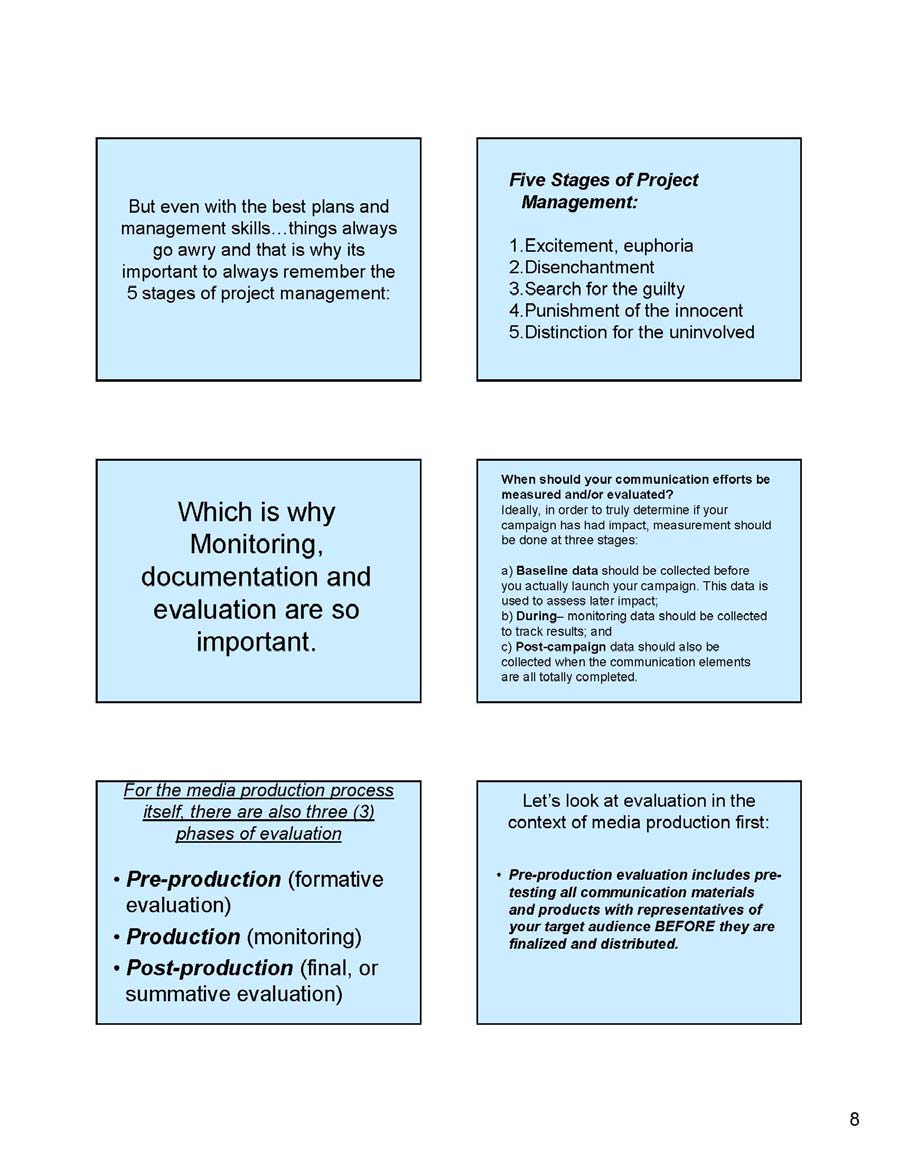
· monitoring, documentation and evaluation: Ideally, in order to determine if the
campaign has had an impact, measurement should be done at three stages: a) Baseline
data should be collected before the launch of the campaign. This data is used to assess
later impact; b) During campaign monitoring data should be collected to track results;
and c) Post-campaign data should also be collected when the communication elements
are all totally completed.
9) Demonstration Project Presentations
Following the Working Sessions, each of the Demonstration Projects presented their Strategic
Communications Plans for discussion. Given the limited time available for working through each
of the stages of the planning process, although much progress was made, no demo was actually
able to complete all stages for all activities. The presentations were made using the templates
given (see Appendices XV to XXII, pages 77 - 98) and each was in turn commented upon by
Maria Protz as well as the other participants.
10) Ensuring Meaningful Participation
The inclusion of stakeholders is a fundamental component of Integrated Water Resource
Management (IWRM) and is necessary to ensure that the multiple perspectives, needs and
objectives of the community of water users are properly represented. Edward Spang, doctoral
candidate, Tufts University, in his presentation (see Appendix XXIII, page 99) stressed the
benefits of participation while acknowledging that it is a time consuming process. These include
enhanced democracy, empowerment, ownership, access to data, insight into the problem, and
knowledge sharing.
In order to help Participating Countries and the Demonstration Projects in particular ensure that
stakeholder participation is meaningful, and not merely token, he had developed, in consultation
with the PCU, an Evaluation Checklist for Ensuring Meaningful Participation (see Appendix
XXIV, page 102). This provides a brief set of assessment criteria to monitor participatory learning
based upon the common principles of PLA (Wageningen University): Acceptance Criteria;
Process Criteria; Learning Criteria, and; System Change and "Bottom Line" Results.
The Checklist was reviewed and Demonstration Project Managers were encouraged to use it to
evaluate participation. It can be adapted to suit their particular contexts and should be used
periodically at successive meetings of a watershed management committee, for instance, in order
to evaluate participation over time. Since this is an important aspect of evaluation, all
demonstration projects were asked to use the tool as much as possible.
11) The GEF-IWCAM Information Management System (IMS) and Sustainability
The PCU is working to develop an IWCAM Information Management System (IMS) which
facilitates and supports the Project's implementation and continues to provide support and
information for the IWCAM approach into the future. This is relevant to Track III of the Project's
13
Communications Strategy: Documenting and Communicating Lessons Learned and Best
Practice.
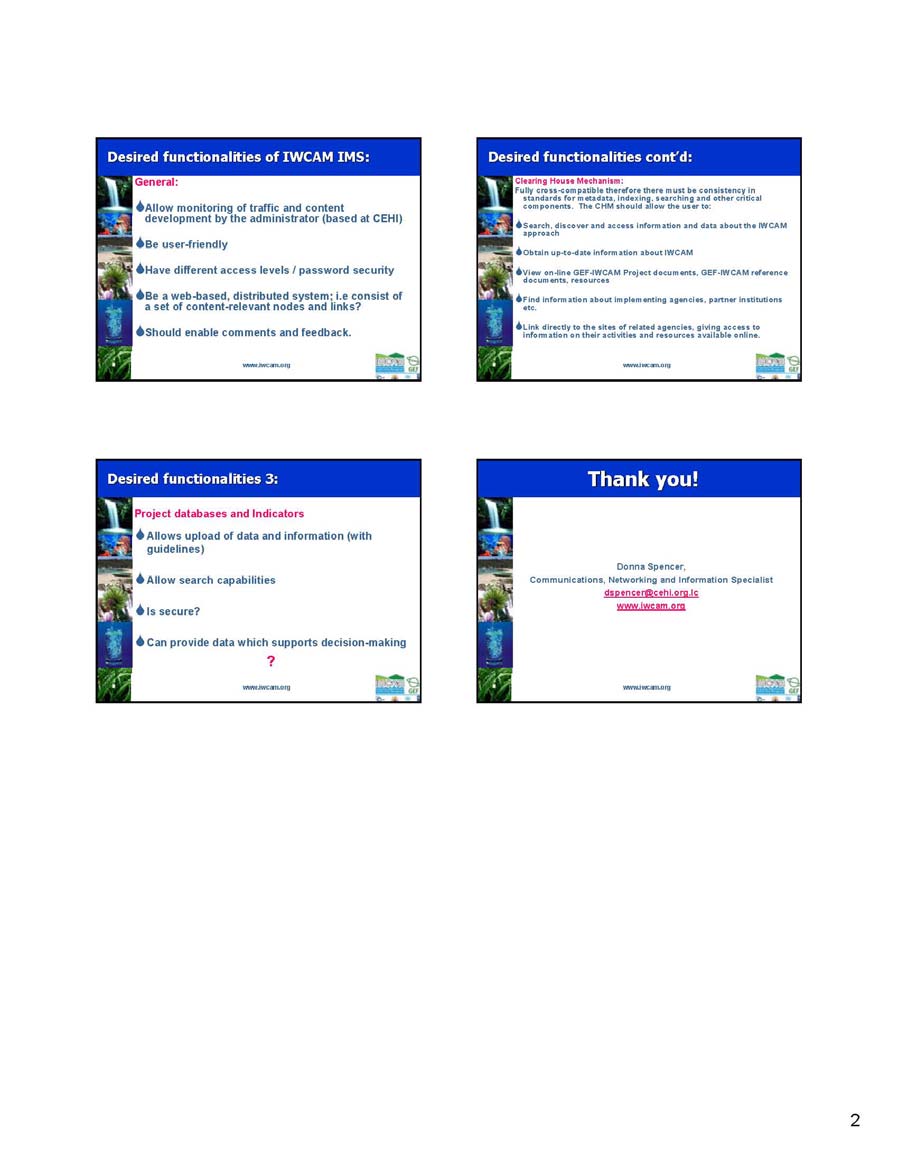
Donna Spencer briefly presented the rationale for the IMS and its status. It would be built in
stages, with the initial stage to begin later this year. Terms of Reference (TORs) for consultants
were being prepared. Inputs on desired functionalities of the system were being sought from the
Demonstration Project Managers, given their roles and country perspectives. Brief discussion
followed and participants were encouraged to send input following the meeting due to the fact
that there was little time for more discussion during the Workshop. See presentation, Appendix
XXV, page 108.
12) The Way Forward
The participants (see complete List of Participants, Appendix XXVI, page 110) were all urged to
complete their Demonstration Project Strategic Communications Plans and begin implementing
them as soon as possible. Donna Spencer reminded that the PCU is available to assist and that
she would welcome any questions regarding their communications and public education and
outreach activities as work continues.
Participants were also reminded that the Project has a Communications Protocol, to which they
had been introduced at the orientation meeting which took place in May 2007 in St. Lucia and
which was meant to guide them in such things as use of the Project logo etc. Further information
could be sought from the CNIS.
Maria Protz and Edward Spang were both thanked for their invaluable contributions to the
Workshop. Both voiced their willingness to continue assisting the Project as it developed
communications and stakeholder participation further. The Dominican Republic's Demonstration
Project team, and in particular, Felipe Ditren, Director of the Secretariat for Environment and
Natural Resources, who had most graciously been the guide, were thanked for a very interesting
and enlightening field trip to the nearby Lower Haina River Basin.
Participants were assured that the Draft Workshop Report would be circulated to all participants
for comment before finalization as soon as possible.
After a final thank you to the Secretariat and all participants for their keen participation, the
meeting ended.
14
APPENDIX I: Workshop Agenda
Global Environment Facility funded Integrating Watersheds and Coastal Areas
Management in Caribbean Small Island Developing States (GEF-IWCAM) Project*
Demonstration Project Communications Planning Workshop
26-28 May 2008, Santo Domingo, Dominican Republic
AGENDA
DAY 1: Monday 26 May
8:30 9:00
Registration
Vincent Sweeney, GEF-IWCAM
Welcome and Introduction to the GEF-IWCAM Project
9:00 9:15
Regional Project Coordinator
Jose Valenzuela, Project
Greetings from the Government of the Dominican
9:15 9:20
Coordinator, Dominican Republic
Republic
Demonstration Project
Donna Spencer, GEF-IWCAM
Purpose and Organization of the Workshop
9:20 9:30
Communications, Networking &
Information Specialist
Status of the Demonstration Projects:
1) Antigua & Barbuda 2) The Bahamas 3) Cuba
9:30 10:45
4)Dominican Republic 5) Jamaica 6) St. Kitts & Nevis
Demonstration Project Managers
7) St. Lucia 8) Trinidad & Tobago
Followed by brief discussion
10:45 11:00
Coffee Break
The GEF-IWCAM Communications and Education
11:00 12:00
Approach and Role of the Project Coordinating Unit:
Donna Spencer
1) Public Relations and Education
2) Behaviour Modification
15
3) Documentation and Communicating Lessons
Learned
Followed by brief discussion
12:00 13:00
Lunch
The Strategic Communications Planning Process
Maria Protz
13:00 14:30
.
14:30 14:45
Coffee Break
Working Session I: Demonstration Projects Report:
Demonstration Project
GAPS in the KAPS and Identifying Primary and
Representatives
14:45 16:30
Secondary Audiences
Review by Maria Protz
Followed by review and revision
DAY 2: Tuesday 27 May
8:30 8:45
Recap of Day I
Donna Spencer
Working Session II SMART Objectives and Appropriate
Facilitated by Maria Protz
8:45 10:00
Indicators
10:005 10:15
Coffee Break
Working Session III Identifying Communications
10:15 12:00
Facilitated by Maria Protz
Activities
12:00
Lunch
FIELD TRIP - Dominican Republic's Demonstration
Afternoon
Project site Lower Haina River Basin
Day 3: Wednesday 28 May
16
8:30 8:45
Introduction to Day 3
Donna Spencer
Working Session IV: Mainstreaming Communications
8:45 10:15
Facilitated by Maria Protz
Activities into Demonstration Project Work Plans
The Importance of Evaluation
10:15 10:45
Maria Protz
Followed by discussion
10:45 11:00
Coffee break
Presentation of Demonstration Project Communications
11:00 12:15
Demonstration Project Managers
Work Plan Outlines
12:15 13:15
Lunch
Ensuring Meaningful Stakeholder Participation
13:15 13:45
Edward Spang
Followed by brief discussion
Working Session - Towards Meaningful Stakeholder
13:45 14:45
Facilitated by Edward Spang
Participation
14:45 15:00
Coffee Break
The IWCAM Information Management System and
15:00 15:15
Donna Spencer
Sustainability
Demonstration Project Information Needs and
Contributions/Inputs
15:15 16:00
Facilitated by Donna Spencer
Discussion, to include consideration of outputs re.
documentation of best practice and lessons learned
16:00 16:30
Wrap Up and Way Forward
Donna Spencer
* The GEF-IWCAM Project is co-implemented by the United Nations Development
Programme (UNDP) and the United Nations Environment Programme (UNEP) and co-
executed by the Caribbean Environmental Health Institute (CEHI) and the Secretariat of the
Cartagena Convention (UNEP CAR-RCU).
17
APPENDIX II: Presentation: GEF-IWCAM Project Introduction
18
19
APPENDIX III: Presentation Antigua and Barbuda Demonstration Project Status
20
21
22
APPENDIX IV: Presentation Bahamas Demonstration Project Status
23
APPENDIX V: Presentation Cuba Demonstration Project Status
24
25
APPENDIX VI: Presentation Dominican Republic Demonstration Project Status
26
APPENDIX VII: Presentation Jamaica Demonstration Project Status
27
28
29
APPENDIX VIII: Presentation St. Kitts and Nevis Demonstration Project Status
30
31
32
33
APPENDIX IX: Presentation St. Lucia Demonstration Project Status
34
35
36
APPENDIX X: Presentation Trinidad and Tobago Demonstration Project Status
37
38
39
APPENDIX XI: Presentation The GEF-IWCAM Communications and Education approach
and Role of the Project Coordination Unit
40
41
42
43
APPENDIX XII: Presentation The Strategic Communications Planning Process
44
45
46
47
48
49
50
51
52
53
54
55
56
APPENDIX XIII: Strategic Communications Process Templates
AUDIENCE IDENTIFICATION TEMPLATE
DAY 1 WORKING SESSION 1
Demo Project:
Country:
Demo Activities to address gaps
Potential Audiences "Knowledge, Attitudes and Practices" Gaps to be Addressed based on the goals and objectives
Primary:
Secondary:
Primary:
Secondary:
Demo Activities to address gaps
Potential Audiences
Gaps to be Addressed based on the goals and
objectives
58
A review of legislation as it applies to sewage handling, treatment and
Primary: Government,
Not so much a lack of awareness or knowledge, but lack
discharges and to pollution of groundwater and coastal waters
enforcement officers
of capacity. Perhaps lack of what alternative legislative
control options might exist (such as community
Recommendations for policy reforms and supportive regulations and
Secondary: Public,
enforcement).
legislation in support of a new sewage treatment option.
environmental NGOs,
private sector
Little advocacy for policy reforms.
Fines may be inadequate to encourage compliance.
Perhaps little awareness of incentives and/or
disincentives for construction
Little knowledge of alternatives
Lack of knowledge of cost/benefits of effective,
alternative septic tanks
The collection of data for the assessment of recurrent cost of system
Primary: Government,
Lack of awareness of the importance of monitoring
and infrastructure, cost recovery options (source of co-financing)
technical officers,
water quality among the public at large and policy
private sector
makers and legislators in particular
The implementation of a programme of collection of environmental
indicators to identify principal areas of impact and concern and for
Secondary: Public,
Improved water quality monitoring skills and
monitoring environmental conditions
environmental NGOs
mechanisms for community involvement
Identification and design of sewage treatment option (including
options related to a Wetland Filtration System) that will meet the
environmental and economic needs of A. St. John and B. the rest of
the country;
Identification of funding mechanisms to cover costs of monitoring
(compliance and water quality data) and enforcement
59
GAPS IN THE KAPS TEMPLATE
DAY 1 WORKING SESSION 1
Demo Project:
Country:
Actual Reality (Current
Gaps to be Addressed based
Demo Activities to
Expected Outcomes
Ideal "Knowledge, Attitudes and
"Knowledge, Attitudes and
on the goals and objectives
address gaps
from Demo Activities
Practices the Demo hopes to achieve)
Practices)
60
GAPS IN THE KAPS TEMPLATE
DAY 1 WORKING SESSION 1
Demo Project:
Country:
Actual Reality (Current
Gaps to be Addressed based
Demo Activities to
Expected Outcomes
Ideal "Knowledge, Attitudes and
"Knowledge, Attitudes and
on the goals and objectives
address gaps
from Demo Activities
Practices the Demo hopes to achieve)
Practices)
61
COMMUNICATION GOALS AND OBJECTIVES TEMPLATE
S.M.A.R.T AND "NECESSARY AND SUFFICIENT"
DAY 2 WORKING SESSION 2
Demo Project:
Country:
Overall Communication Goals:
1.
2.
.
Demo Activities to
Potential
"Knowledge, Attitudes and Practices" Gaps to be Addressed based on the
Communication
address gaps
Audiences
goals and objectives
Objectives
COMMUNICATION ACTIVITIES AND INDICATORS
DAY 2 SESSIONS II AND III
S.M.A.R.T. AND "NECESSARY AND SUFFICIENT"
Demo Project:
Country:
Communication Objectives Potential Communication Activities
Type of
Output
Process Indicators Outcome/Impact Indicators
Communication indicators
Activity
63
64
APPENDIX XIV: Presentation Mainstreaming Communications Activities into Demo
Project Work Plans
66
67
68
69
70
71
72
73
74
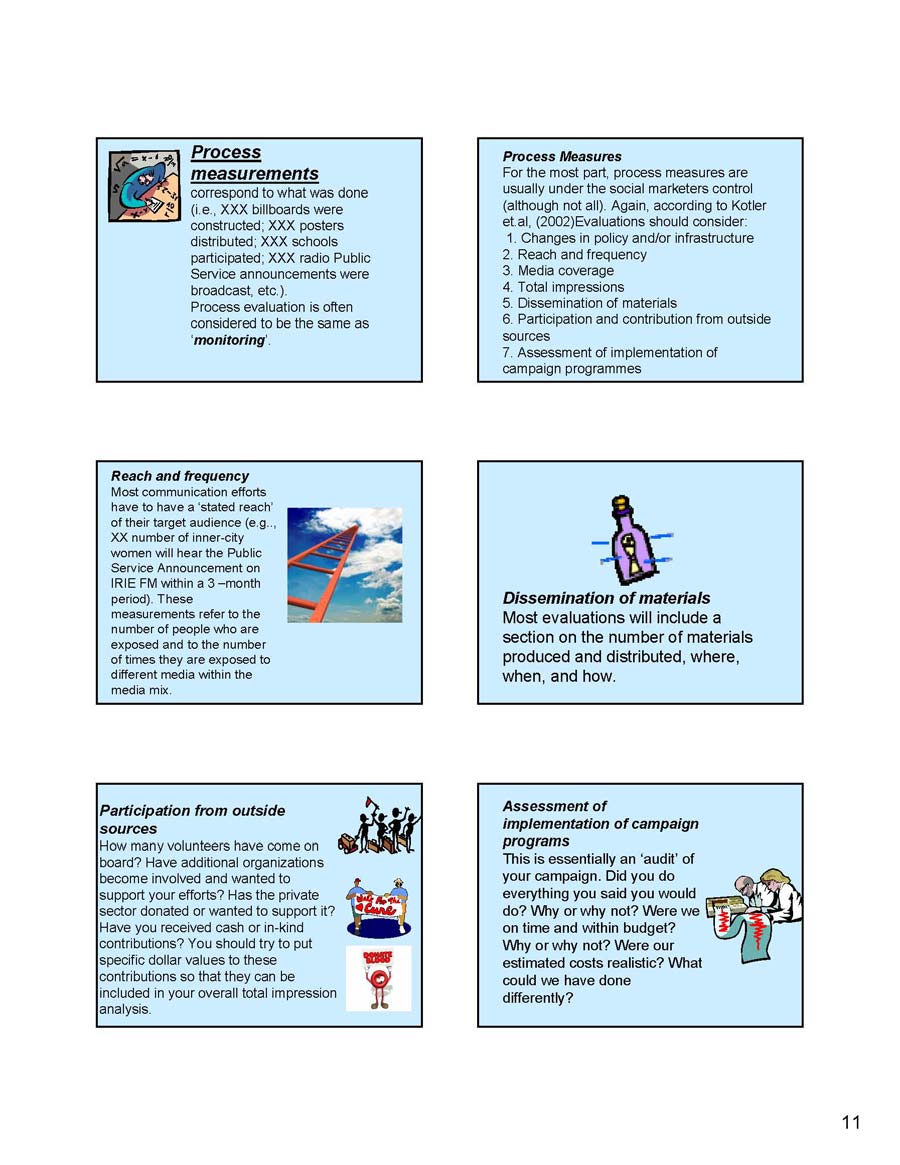
75
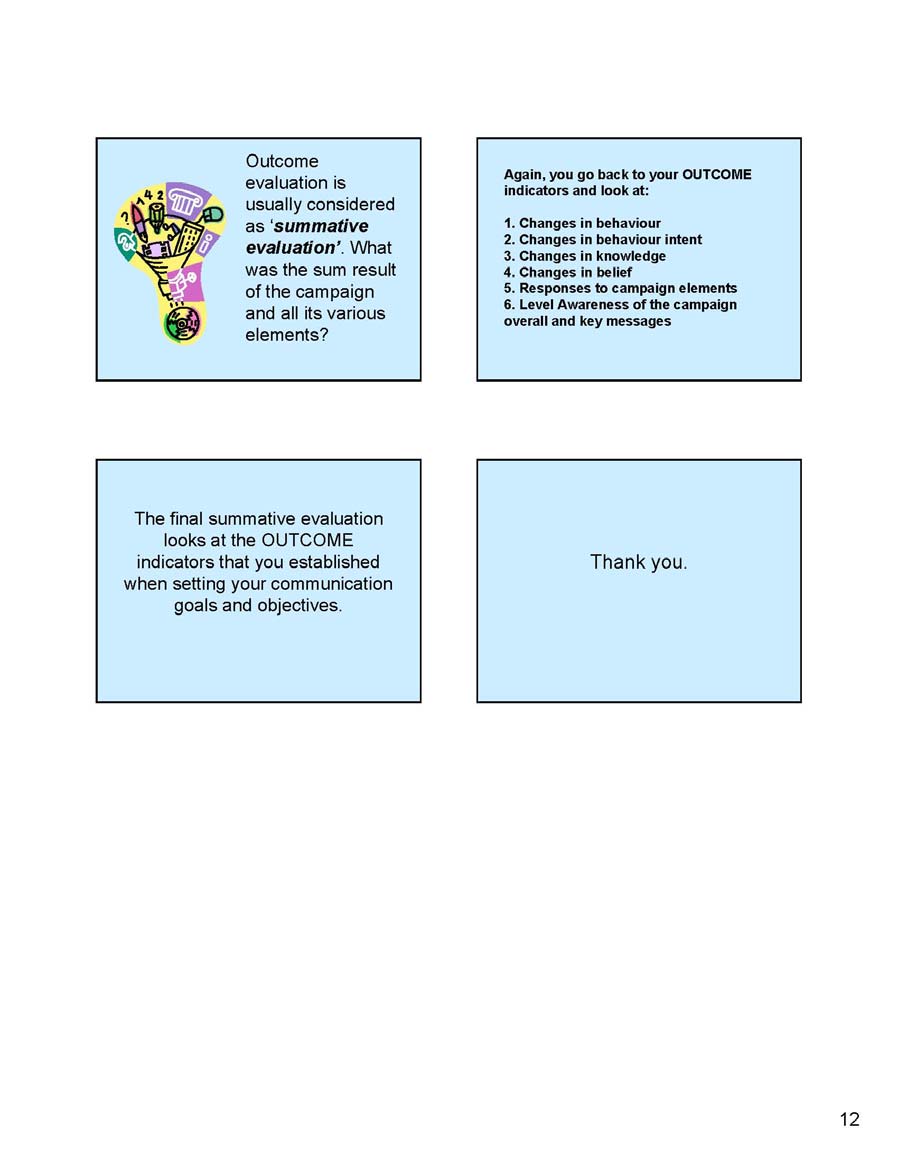
76
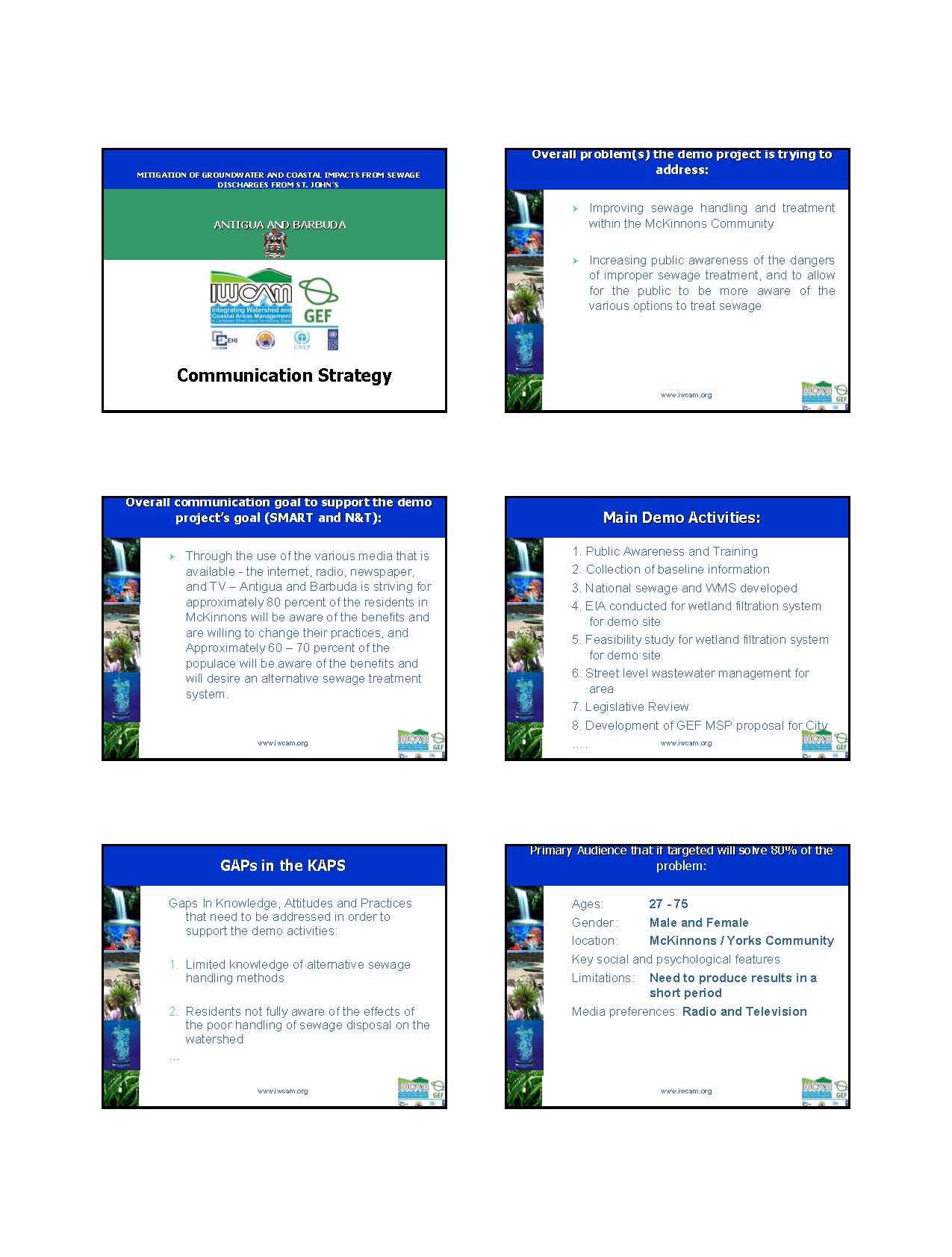
APPENDIX XV: Presentations Communications Strategy Antigua & Barbuda
77
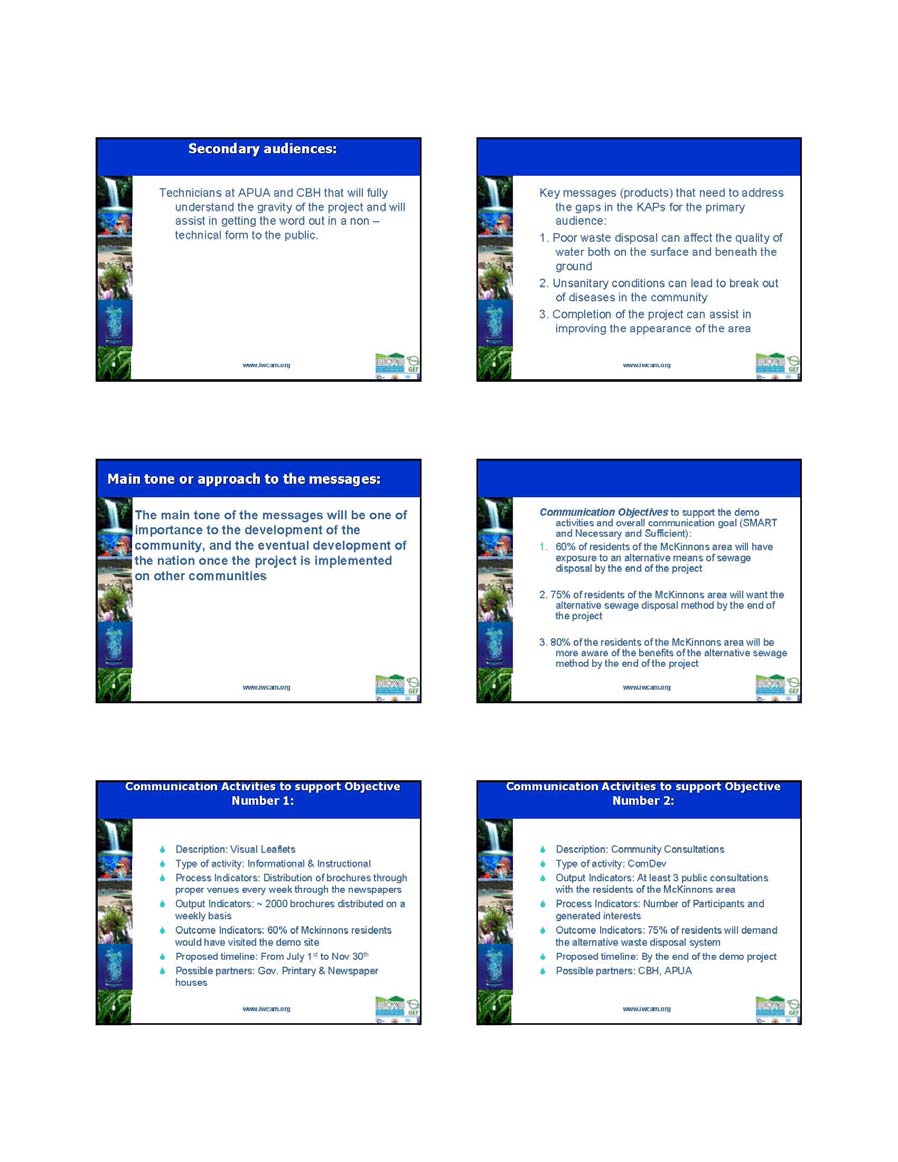
78
APPENDIX XVI: Presentation Communications Strategy The Bahamas
79
80
81
APPENDIX XVII: Presentation Communications Strategy Cuba
COMMUNICATION ACTIVITIES AND INDICATORS
DAY 2 SESSIONS II AND III
S.M.A.R.T. AND "NECESSARY AND SUFFICIENT"Demo Project:
Country: CUBA
Communication Objectives
Potential Communication
Type of
Output
Process
Outcome/Impact
Activities
Communication
indicators
Indicators
Indicators
Activity
1. Trasladar el enfoque
- Talleres para tomadores de
Sensibilización y
Nivel de
Disponibilidad de un
de manejo integrado de
decisiones, personal
Educación
participación de los
Plan de manejo
cuencas hidrográficas y
técnico y público en
pública
actores involucrados
integrado y
zonas costeras a los
general
en la elaboración del
socializado
tomadores de decisiones,
- Elaboración de materiales
Plan de manejo de
personal técnico y público
de comunicación/ posters,
la cuenca y su zona
en general
plegables, videos
costera asociada
- Programas y entrevistas
en los medios locales y
nacionales de difusión /TV,
radio, prensa escrita
- Disminución de los
2. Sensibilizar a los
- Talleres de Sensibilización
Sensibilización y
Cantidad de
niveles de tala ilegal
tomadores de decisiones
- Charlas/conversatorios a
Educación
participantes en
- Disminución de los
y público en general,
nivel de las comunidades
pública
talleres, charlas y
incendios forestales
acerca de los problemas
- Elaboración de materiales
conversatorios
- Disminución de los
ambientales existentes y
relacionados con este
consumos de agua
su impacto en la cuenca
tema/ posters, plegables,
en la industria y en
hidrográfica y zona
videos
la actividad
costera asociada
- Programas y entrevistas en
domestica
los medios locales y
- Disminución de
nacionales de difusión /TV,
prácticas inadecuadas
radio, prensa escrita
de disposición de
desechos sólidos
Communication Objectives
Potential Communication
Type of
Output
Process
Outcome/Impact
Activities
Communication
indicators
Indicators
Indicators
Activity
3. Transformar los
- Modelación que permita
Instructivo
Cantidad de
- Cantidad
de
resultados obtenidos en
facilitar la interpretación de
modelaciones
modelos
el proyecto en
los resultados del
disponibles
utilizados en los
productos
Monitoreo Ambiental para
procesos de
comunicativos
todos los públicos meta
toma de
palpables
decisiones a
nivel local
- Cantidad de
modelos utilizados
en las actividades
de sensibilización y
educación a las
comunidades
involucradas
83
APPENDIX XVIII: Presentation Communications Strategy Dominican Republic
85
86
APPENDIX XIX: Presentation Communication Strategy Jamaica
87
88
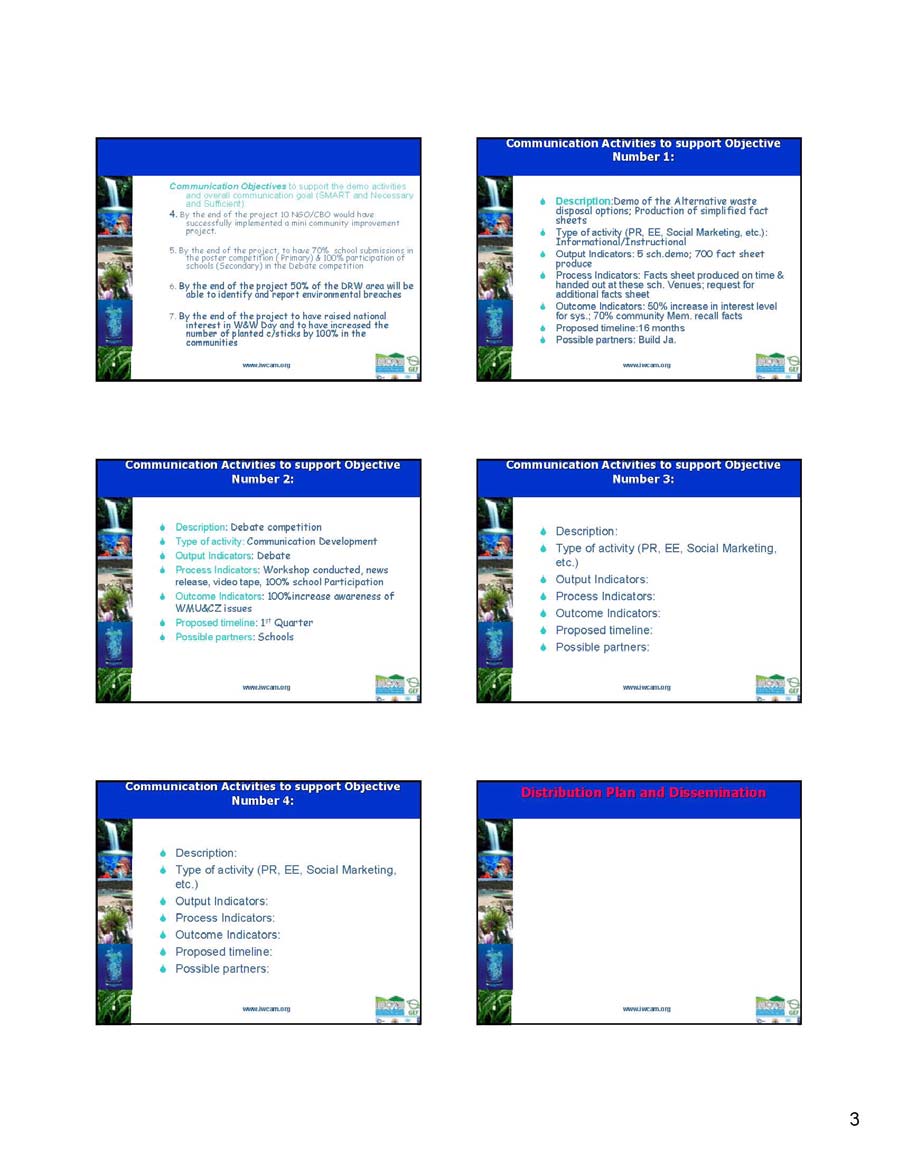
89
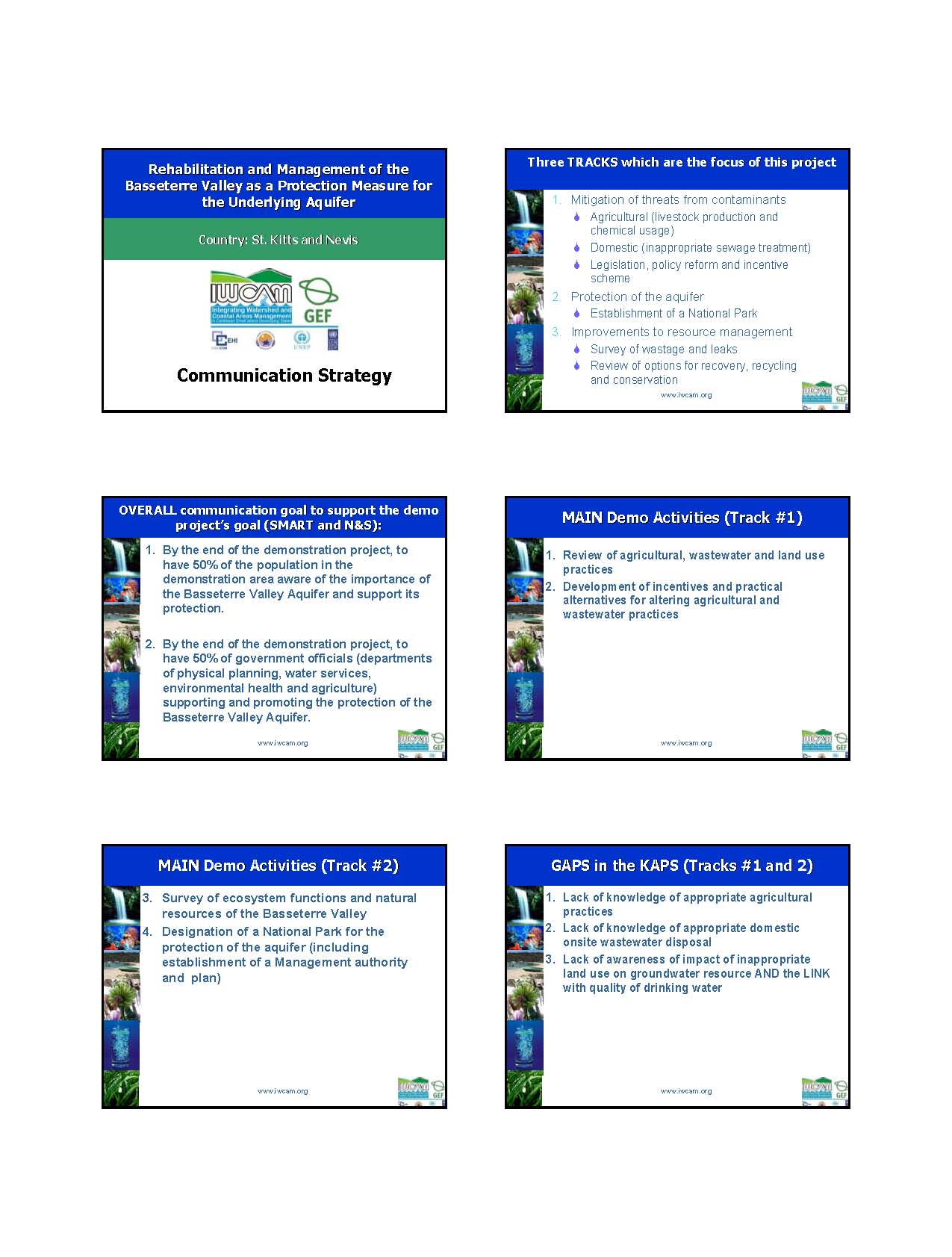
APPENDIX XX: Presentation Communications Strategy St. Kitts & Nevis
90
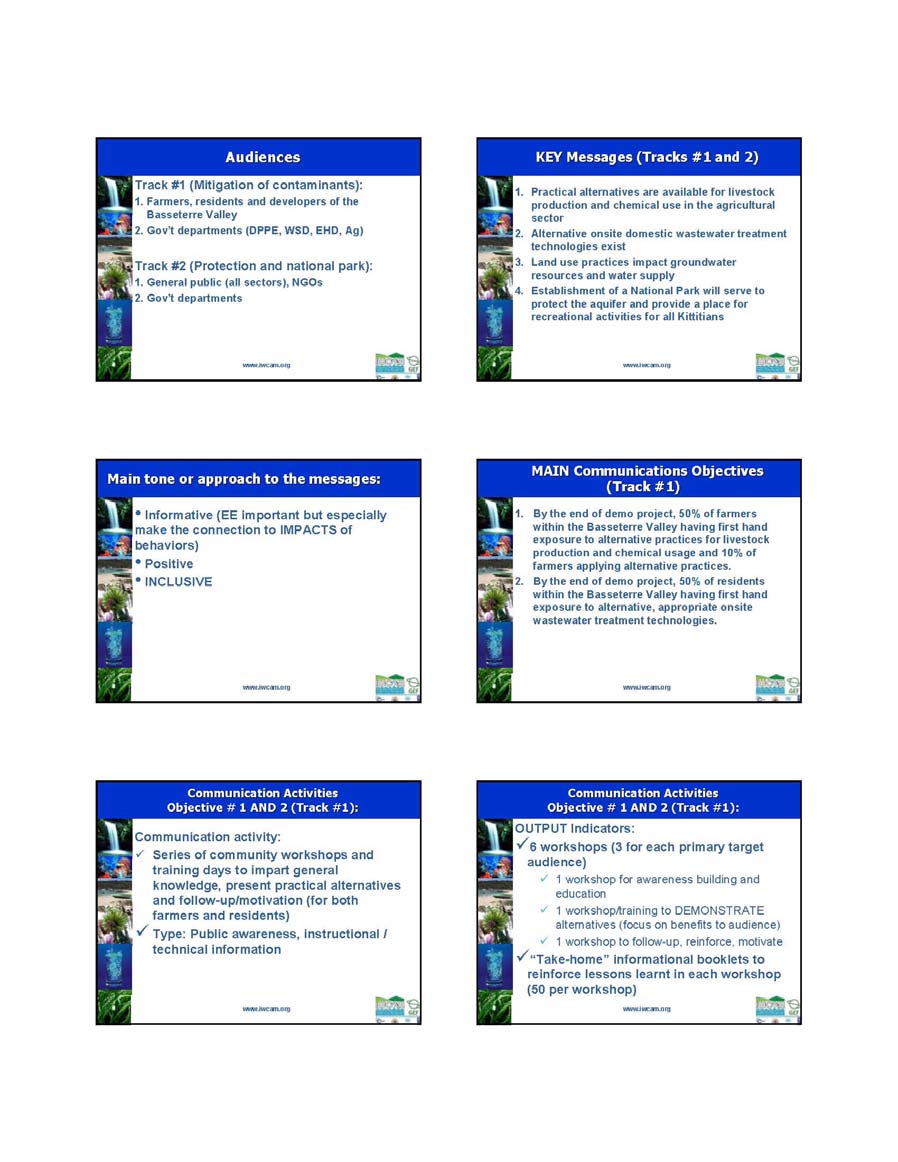
91
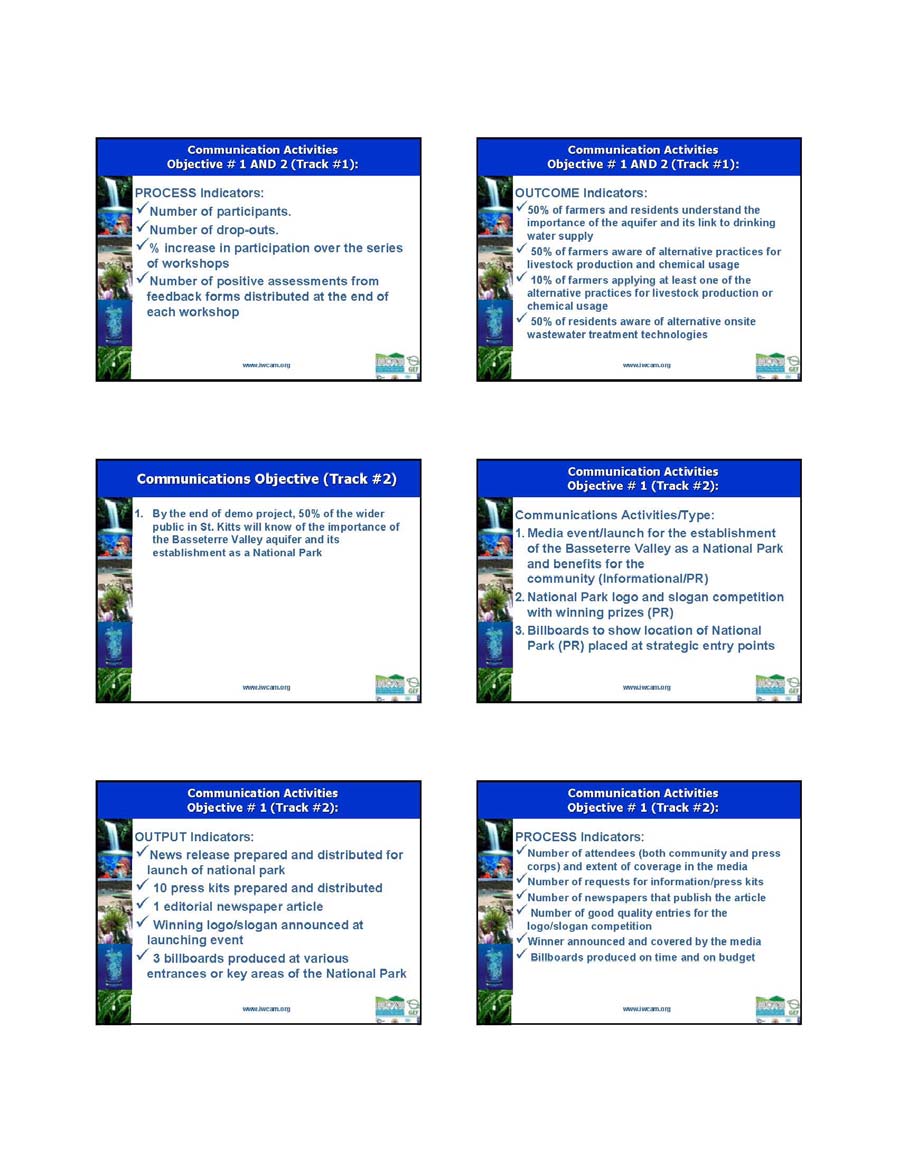
92
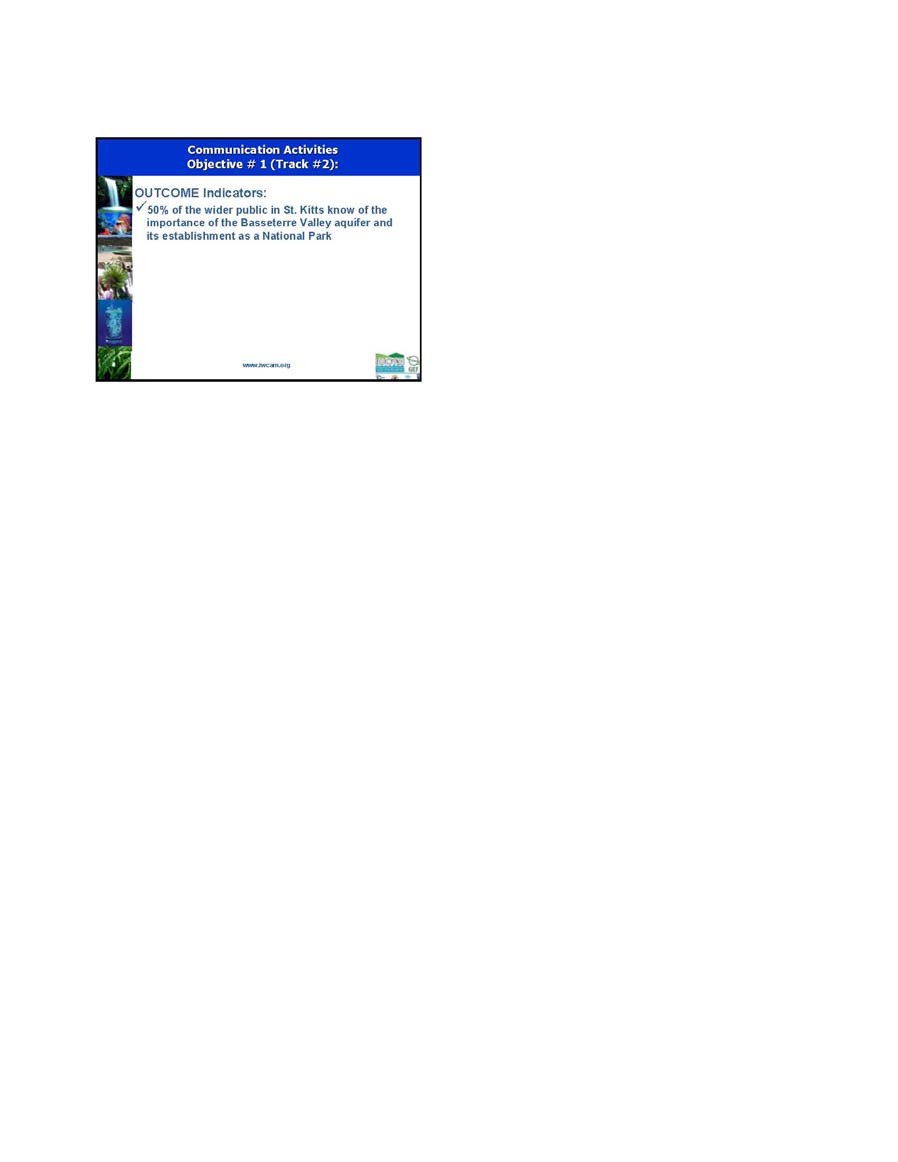
93
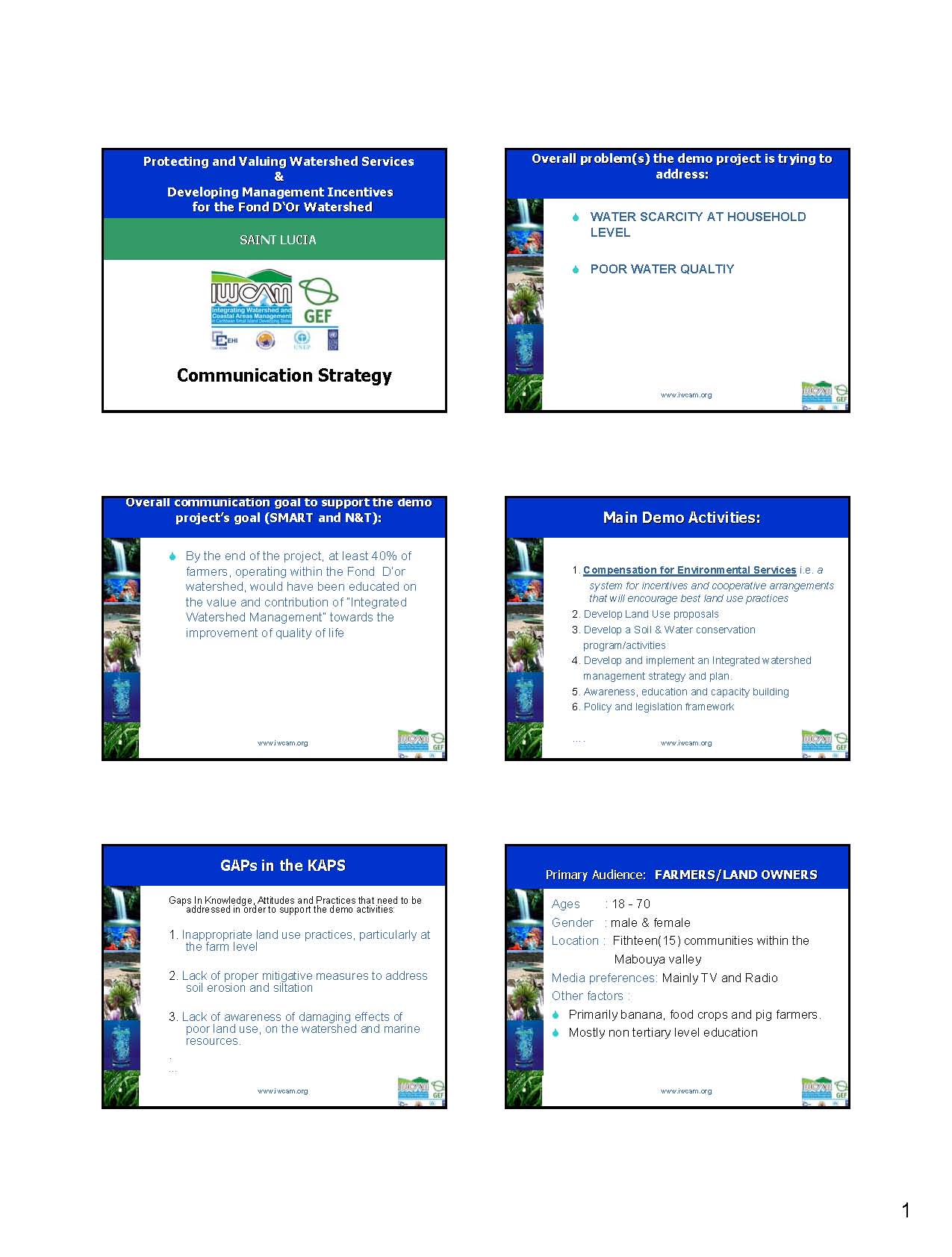
APPENDIX XXI: Presentation Communications Strategy St. Lucia
94
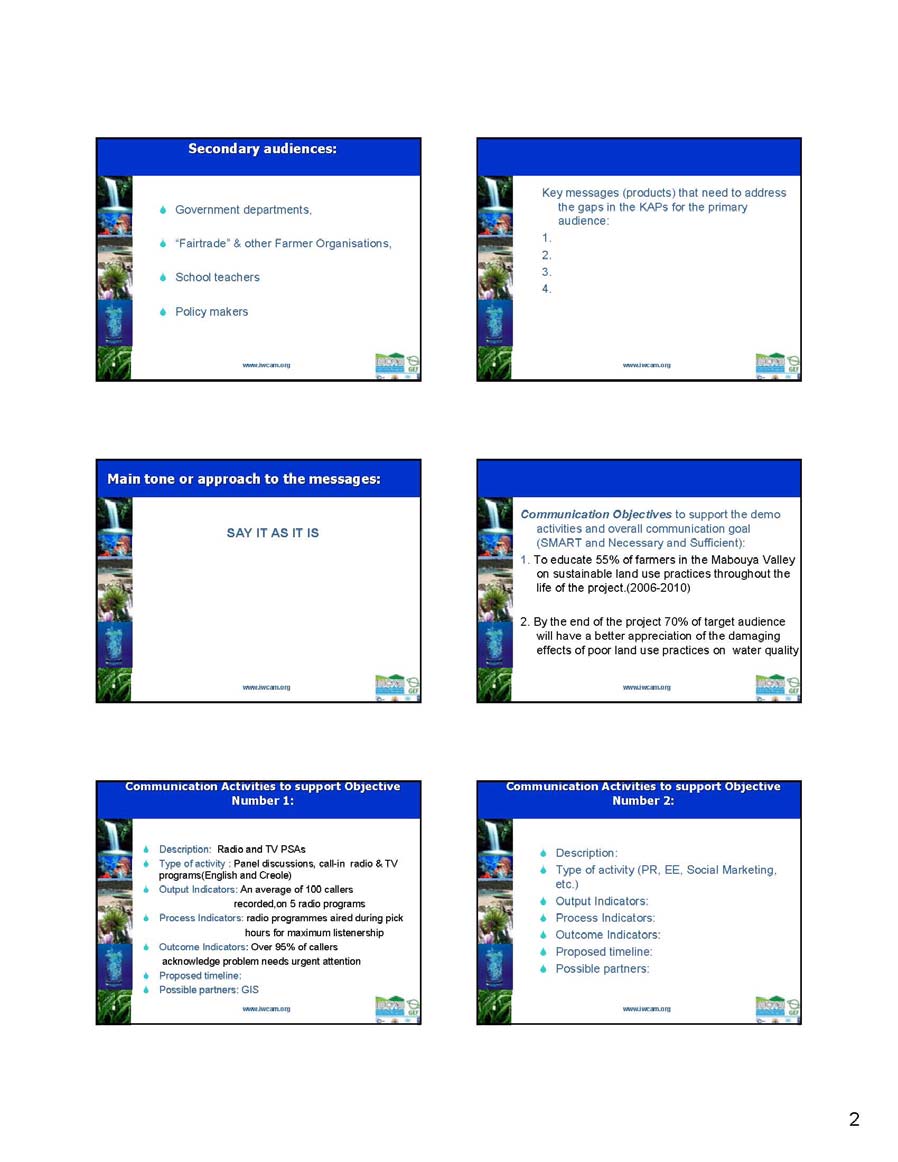
95
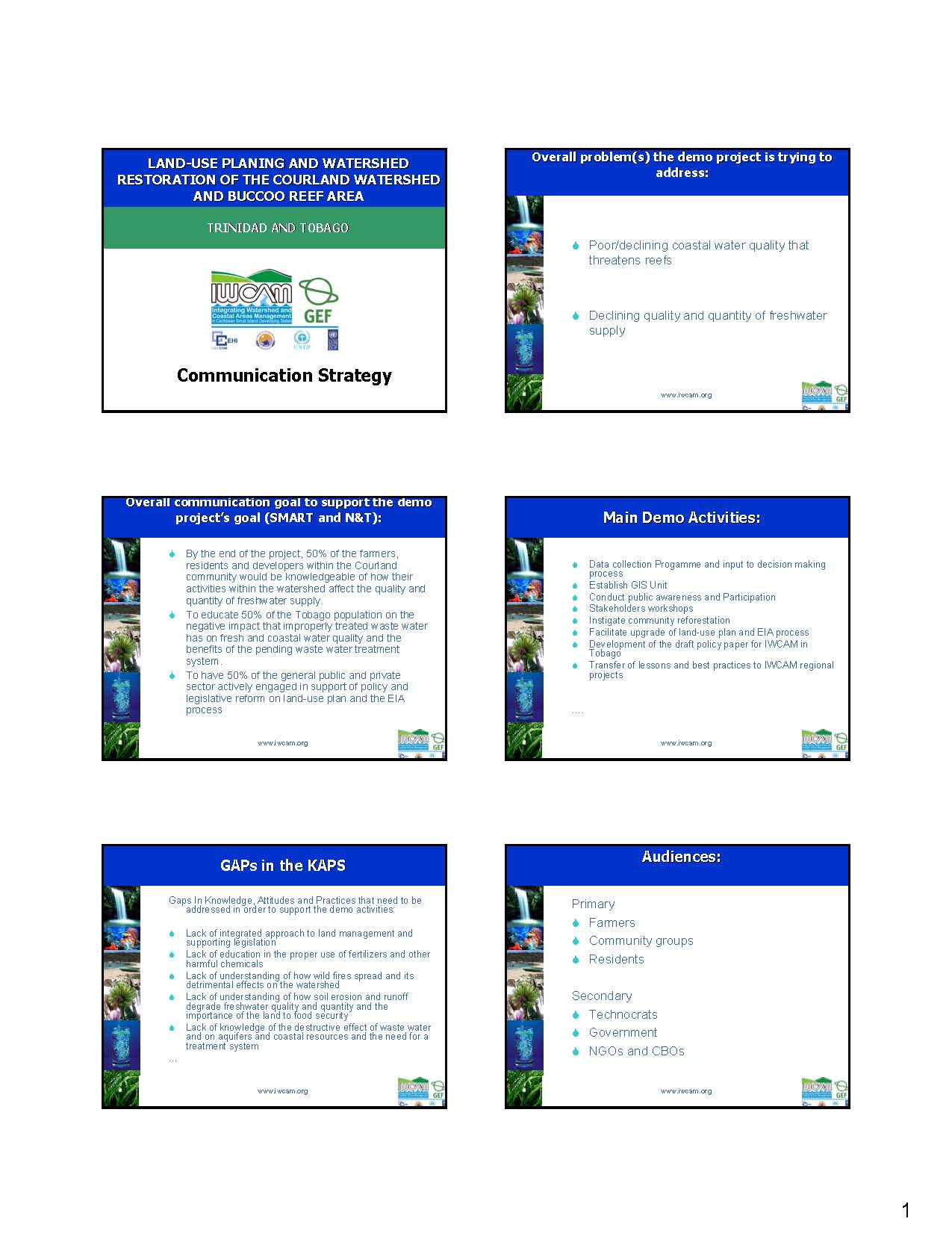
APPENDIX XXII: Presentation Communications Strategy Trinidad & Tobago
96
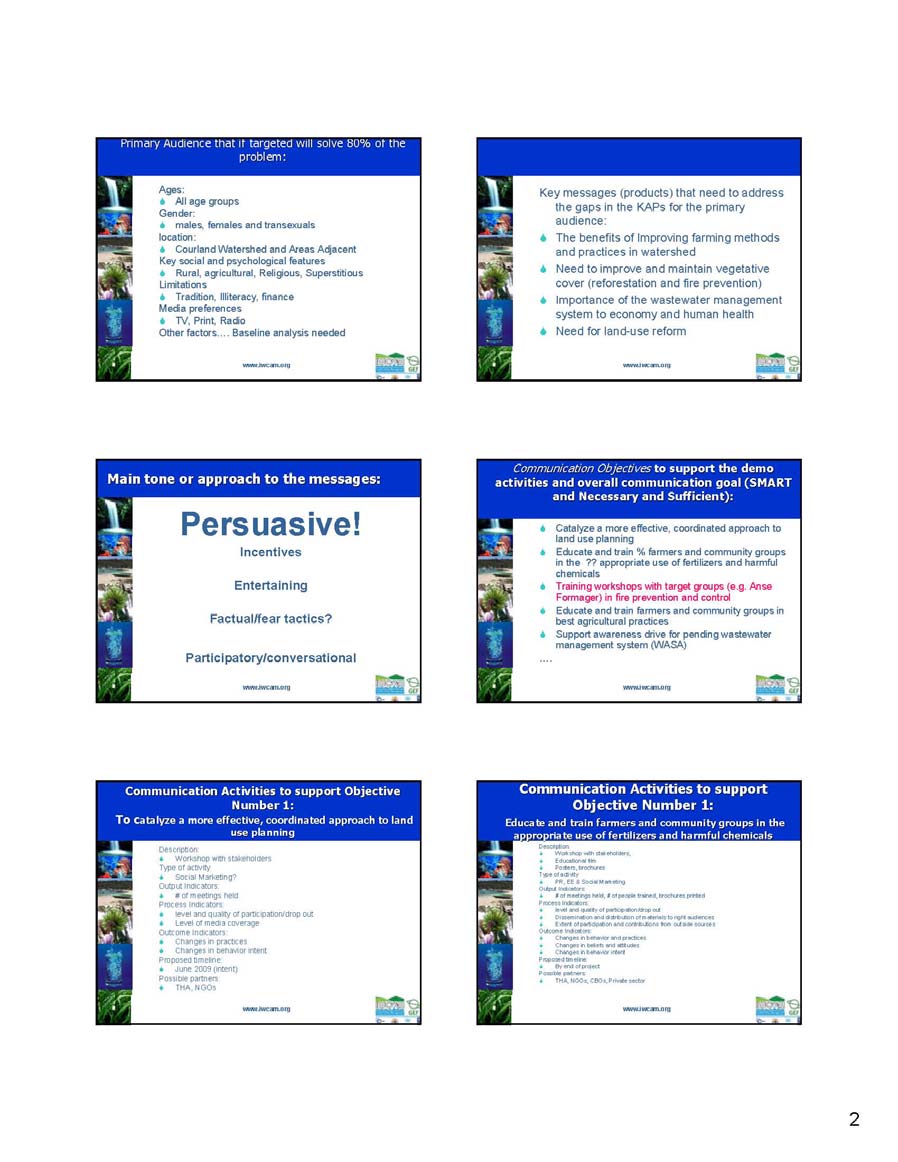
97
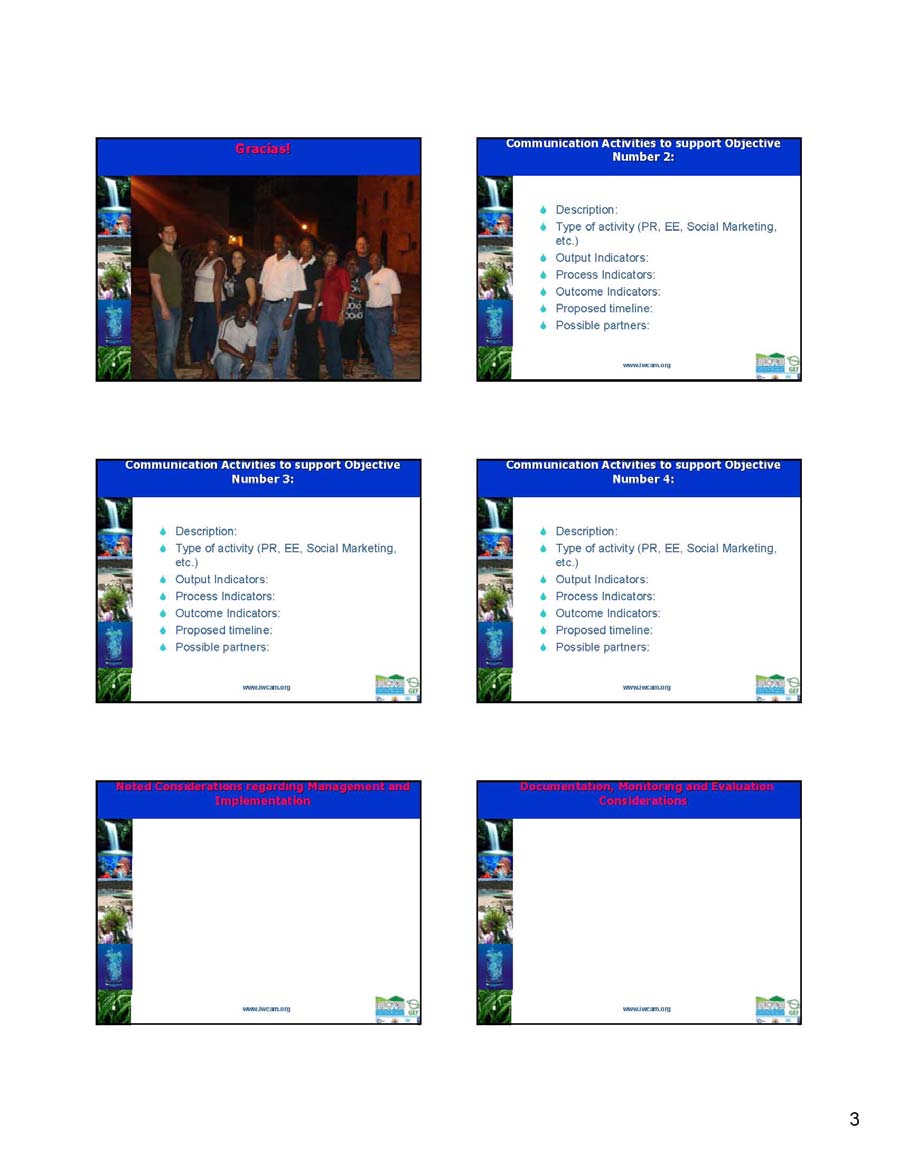
98
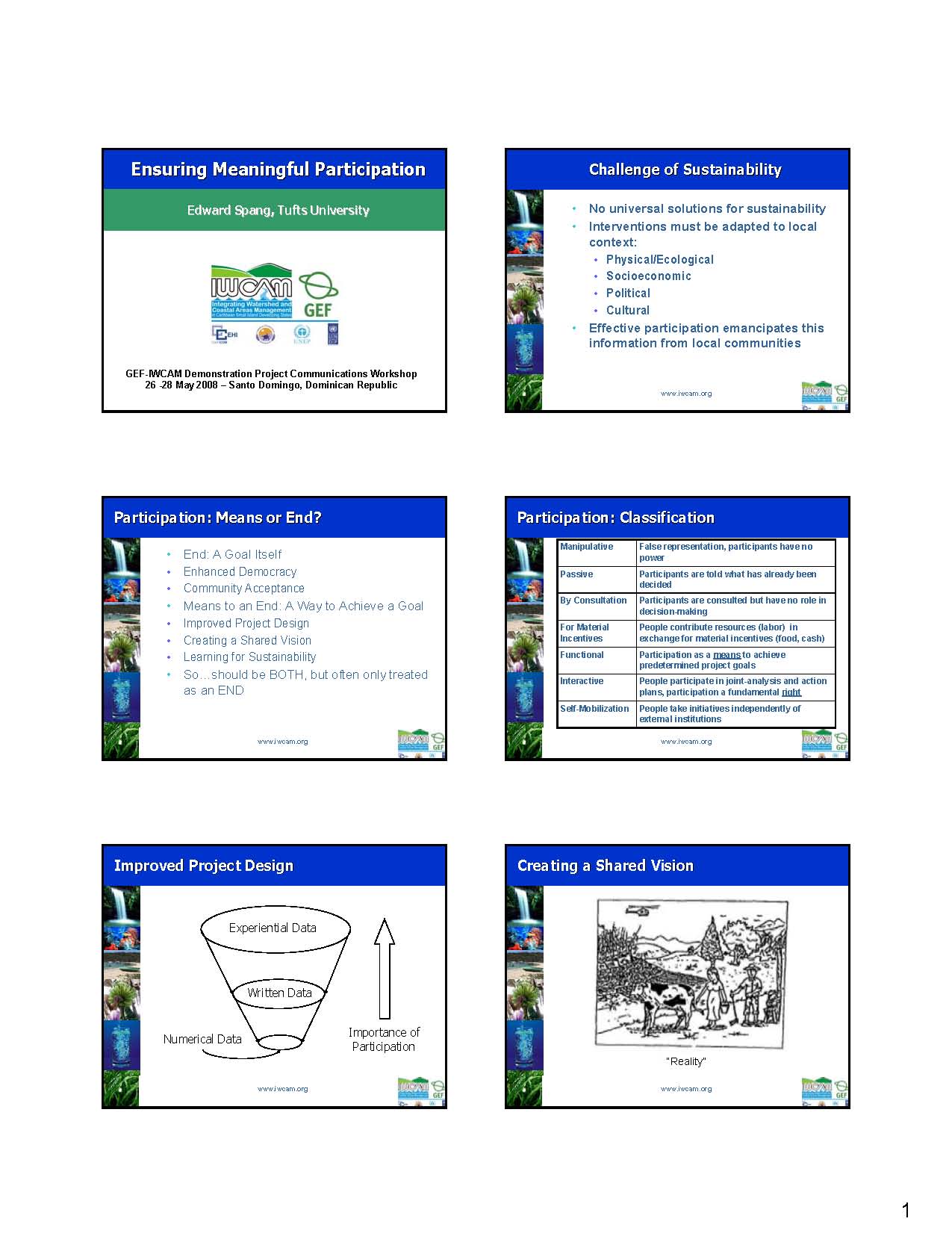
APPENDIX XXIII: Presentation - Ensuring Meaningful Participation
99
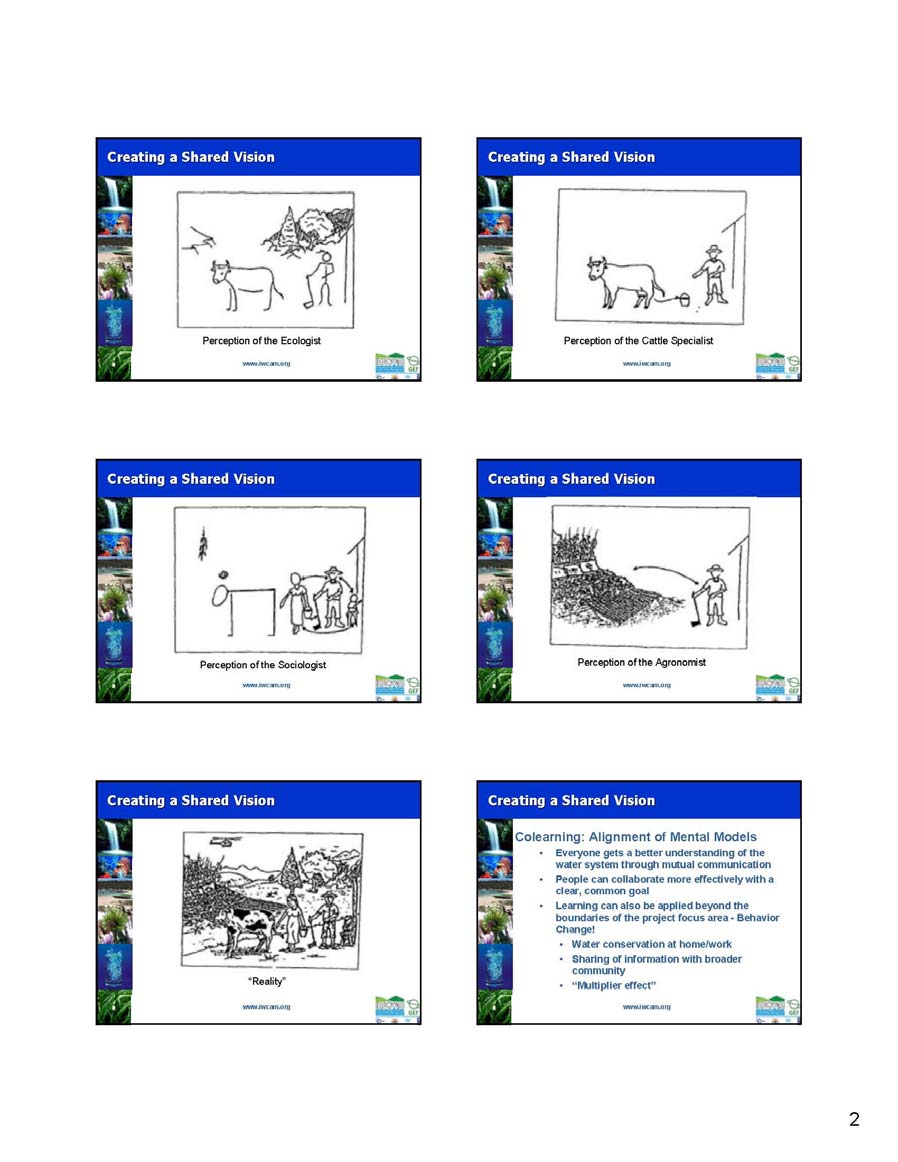
100
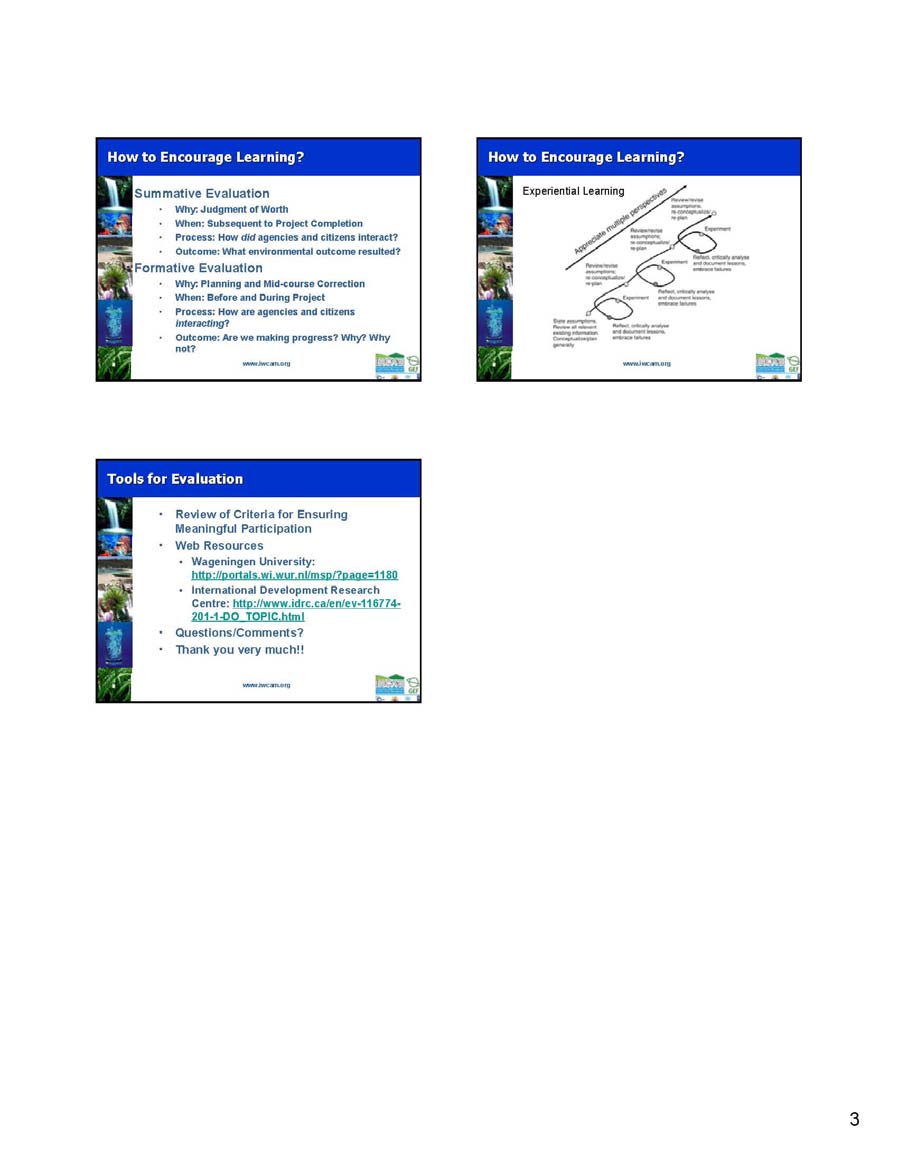
101
APPENDIX XXIV: Ensuring Meaningful Participation Evaluation Checklist
ACCEPTANCE CRITERIA
Representation: The public participants should comprise a broadly
representative sample of the population of the affected public.
Broad Representation: Do participants represent a broad sample of the affected public?
Circle the appropriate number on the left
3
Participants represent a complete sample of affected stakeholders in the project area.
2
Participants represent most of the affected stakeholders in the project area.
1
Participants represent a less than half of the affected stakeholders in the project area.
0
Participants represent only a few stakeholders in the project area.
Women's participation: How fully and actively do women participate in the
operation and management of the group?
Circle the appropriate number on the left
3
Women participate as fully as men or even more fully in running the group.
2
Women participate almost as fully in running the group.
1
Women participate somewhat in running the group.
0
Women do not participate in running the group.
Active Involvement: The public should be actively involved through project
implementation.
Frequency of exchange opportunities: How often are participants consulted?
Circle the appropriate number on the left
3 Weekly and whenever needed.
2
At least monthly and more often if required.
1
At least every two months on average.
0 Irregularly.
102
Communication: Open and equitable discussion is essential to effective
participation.
Open participation: How fully do participants engage in project meetings and activities?
Circle the appropriate number on the left
3 All members participate actively in meetings and group activities. Everyone feels free
to speak up and play an active role.
2 Most members participate actively in meetings and group activities. Most feel free to
speak and play an active role.
1 Some members participate actively in meetings and group activities.
0 Few members participate actively in meetings and group activities.
Quality of discussion: How do members communicate with one another?
Circle the appropriate number on the left
3
There is always frank and constructive discussion.
2
There is usually frank and constructive discussion.
1
There is sometimes frank and constructive discussion.
0
There is seldom frank and constructive discussion.
Communications: How good is communication within the group?
Circle the appropriate number on the left
3 All members are always kept informed about plans, programs etc.
2 Most members are usually kept informed.
1 Some members are generally kept informed.
0 No members are as a rule kept informed.
Interpersonal relations: How do members relate to one another?
Circle the appropriate number on the left
3 All members maintain friendly and mutually supportive relations.
2 Most members maintain friendly and supportive relations.
1 Some members maintain friendly and supportive relations.
0 No members maintain friendly and supportive relations.
Conflict management: How able is a group to resolve conflicts?
Circle the appropriate number on the left
3
Group is always able to resolve conflicts among members and with external bodies.
2
Group is usually able to resolve such conflicts.
1
Group is sometimes able to resolve such conflicts.
0
Group is never able to resolve such conflicts.
103
Influence: The output of the participation process should have a genuine
impact on project implementation.
Speed and effectiveness of decision-making: How quickly are decisions made and with what
likelihood that they will be implemented?
Circle the appropriate number on the left
3
Decisions as a rule are made quickly and effectively.
2
Decisions are made quickly but not always followed up, or even if made slowly are
generally given effect.
1
Decisions are only sometimes made quickly or effectively.
0
Decisions take a long time and are seldom effective.
Transparency: The process should be transparent so that the public can see
what is going on and provide feedback about the process.
Opportunities for feedback: Do the participants have opportunity to provide feedback?
Circle the appropriate number on the left
3 Participants
have
frequent opportunities to provide feedback to the project.
2 Participants
have
periodic opportunities to provide feedback to the project.
1 Participants
have
occasional opportunities to provide feedback to the project.
0
Participants have no provision opportunity to provide feedback to the project.
104
PROCESS CRITERIA
Resource Accessibility: Public participants should have access to the appropriate
resources to enable them to successfully fulfill their assignment.
Facilities for meetings: How well provided for are group meetings?
Circle the appropriate number on the left
3
Meetings are held in a comfortable and congenial setting either through having a
regular meeting place or a satisfactory rotation among members' homes.
2
Meetings are held in a satisfactory place for everybody.
1
Meetings are sometimes held in a satisfactory place.
0
Meetings are held in uncomfortable and uncongenial settings.
Structured Decision-making: The participation process should include appropriate
mechanisms for structuring the decision-making process.
Style of management: How are group activities managed?
Circle the appropriate number on the left
3
Decisions are always made with all members' knowledge and participation.
2
Decisions are usually made with all members' knowledge and participation.
1
Decisions are sometimes made with all members' knowledge and participation.
0
Decisions are never made with all members' knowledge and participation.
Decision-making method: How are decisions made?
Circle the appropriate number on the left
3 By
consensus with agreement reached by all.
2 By
majority vote.
1
By group officers.
0
Not made in any regular way.
Cost-effectiveness: The participation process should be cost-effective.
Productivity of meetings: How productive are group meetings?
Circle the appropriate number on the left
3
Group meetings are always very productive; time is well spent; decisions clearly made
and followed up.
2
Group meetings are usually reasonably productive.
1
Group meetings are sometimes productive.
0
Group meetings are never productive.
105
SYSTEM CHANGE AND "BOTTOM LINE" RESULTS
"Bottom Line" Results: Improved outcomes for participants
Broader benefits: Are benefits beyond the IWCAM objectives being generated for the
community as a result of the participatory process?
Circle the appropriate number on the left
3
Participants have produced substantial benefits beyond the IWCAM activities.
2
Participants have created some benefits beyond the IWCAM activities.
1
Participants have considered producing benefits beyond the IWCAM activities.
0
Participants have undertaken and are concerned only with IWCAM activities.
Improved Knowledge Sharing: Improving community access to knowledge
Knowledge sharing: Do members who get training share their new knowledge with others?
Circle the appropriate number on the left
3
Group actively provides for the sharing of members' new knowledge and skills with
others, both other members and even persons outside the group.
2
Group sharing of members' new knowledge
1
Sharing of new knowledge occurs only at individual initiative.
0
There is no sharing of new knowledge.
Spreading the program: Do participants take initiative to spread the program to other areas
and other community members?
Circle the appropriate number on the left
3
Participants have helped numerous other community members engage in the project.
2
Participants have helped some other community members engage in the project.
1
Participants have helped a few others to engage in the project.
0
Participants have not helped others to engage in the project.
Improved Autonomy: Local groups are able to function beyond the boundaries of
the IWCAM project.
Continuation of groups: How confident is the group that it can maintain itself after the GEF-
IWCAM project ends?
Circle the appropriate number on the left
3
Group is quite confident it can maintain itself on its own.
2
Group is somewhat confident it can maintain itself on its own.
1
Group thinks it might be able to maintain itself on its own.
0
Group lacks confidence it can maintain itself on its own.
106
Improved Partnerships: Shifts in network of agencies that support services
integration
Community support: How much understanding and support has the group created within the
community?
Circle the appropriate number on the left
3
Group enjoys strong and enthusiastic support from the community.
2
Group has good understanding and support from some parts of the community, such
as chief or local administrators.
1
Group has a little understanding and support from the community.
0
Group has no understanding and support from the community.
Linkages with other local organizations: Does group have link-ages with other groups at the
local level, like cooperatives, church associations, youth clubs, etc.?
Circle the appropriate number on the left
3
Group has very active and good cooperation with other voluntary organizations at
local level.
2
Group has some very good cooperation with other voluntary organizations at local
level.
1
Group has at least one cooperative link with another voluntary organization at local
level.
0
Group has no links with other voluntary organizations.
Linkages outside program: How does group relate to government agencies?
Circle the appropriate number on the left
3
Group has excellent interaction with many relevant agencies that can help it achieve
its goals.
2
Group has some good interaction with several relevant agencies.
1
Group has a few interactions with some agencies.
0
Group has no reliable interaction with any agencies.
107
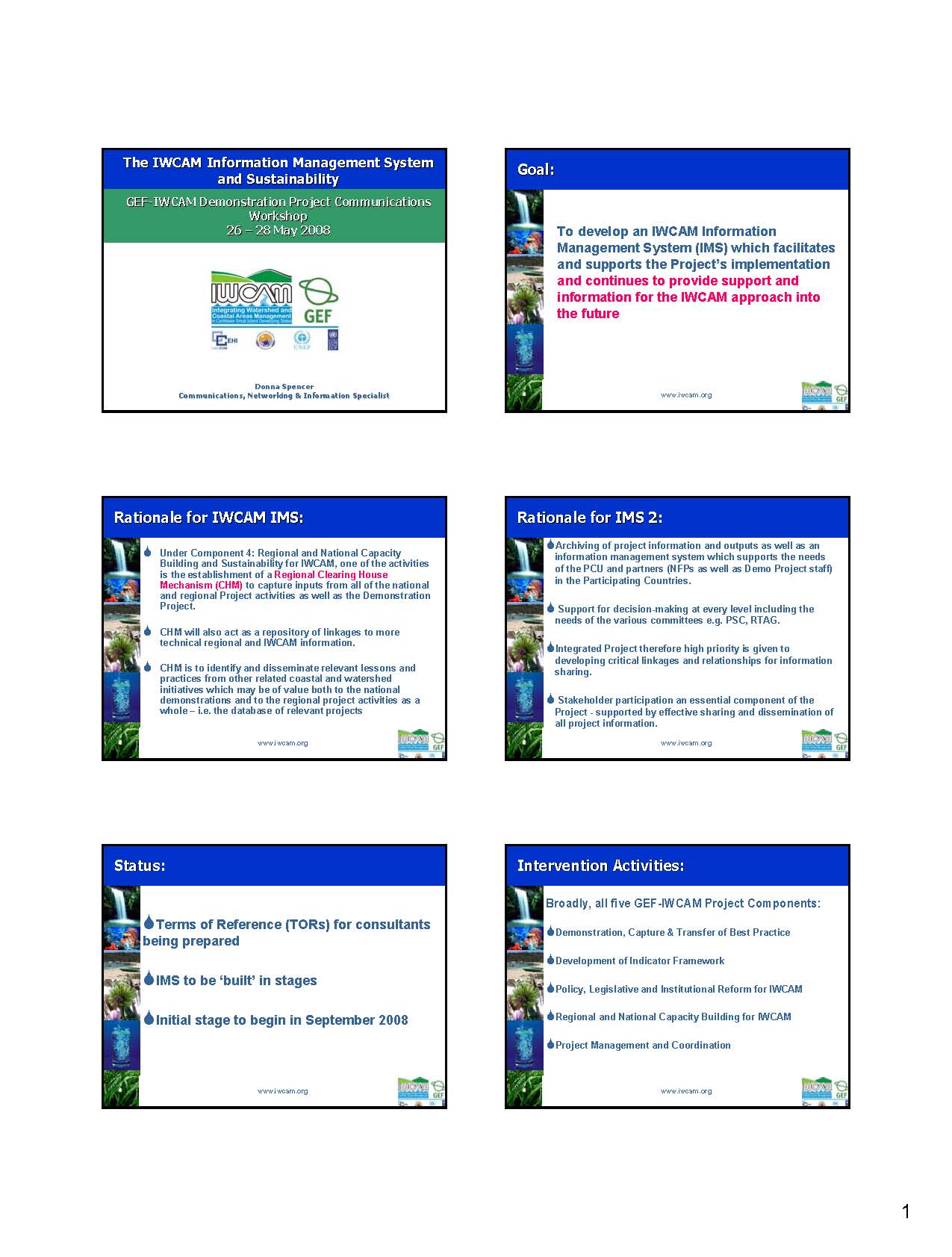
APPENDIX XXV: The IWCAM Information Management System and Sustainability
108
109
APPENDIX XXVI: List of Participants
GEF-IWCAM Demonstration Project Communications
Workshop
26 -28 May 2008 Santo Domingo, Dominican Republic
Countries PARTICIPANT
PARTICIPANT
A&B
Cedric Dyer
Erdine Richards
Environment Officer
Chemist Water-Laboratory
Environment Division
Antigua Public Utilities Authority
Ministry of Tourism, Civil Aviation,
Barnes Hill
Culture and the Environment
St Georges
#1 Prime Minister's Drive
Antigua and Barbuda
Factory Road
Tel: 268 480 7000 ext 7252
St. John's
Fax: 268 462 2761
Antigua and Barbuda
E-mail: timica_r@hotmail.com
Tel: 268 562 2568
Fax: 268 462 4625
E-mail:
cdyer@environmentdivision.info
BAH
Craig Parotti
BAH
Zanda Bonamy
P.O. Box Ex-29242
Environmental Officer
Georgetown Exuma
BEST Commission
The Bahamas
Nassau Court
Tel : 242 336 2145
P.O. CB 10980
Fax: 242 336 2416
Nassau
E-mail: nicolep@batelnet.bs
The Bahamas
Tel: 242 322 4546
Fax: 242 326 3509
E-mail: zandabonamy@bahamas.gov.bs
CUB
Mario Abo Balanza
CUB
Jesús Manuel Rey Novoa
Director
Especialista de la Ciencia y la Técnica
Centro de Información, Gestión y
Ministerio de Ciencia, tecnología y medio
Educación Ambiental CIGEA-
Ambiente (CITMA)
CITMA
Centro de Estudios Ambientales de
Calle 20, Esq. 18-A
Cienfuegos (CEAC)
Miramar
Carretera castillo de jagua km 1 ½
Playa Ciudad
Ciudad Nuclear,
La Habana
Cienfuegos,
Cuba
Código Posta: 59350
Tel: 53 72096014
Cuba
Fax:5372049031
Tel: 00 53 43 965146/00 53 43 55 2040,
E-mail: mabo@ama.cu
Fax: 00 53 43 965146
E-mail: proyag21@perla.inf.cu
DR
Jose Valenzuela
DR
Antonio Esteban Mataranz Rodriguez
Coordinador Proyecto IWCAM
Division Head
Secretariat of State of Environment
Non-Formal Environmental Education
and Natural Resources
Subsecretariat of Education and
Ave 27 de Febrero esq Tiradentes
Environmental Information
Plaza Merengue Local 202
Secretariat of State of Environment and
Ensanche naco
Natural Resources
Santo Domingo
Autopista Duarte km 61/2
Dominican Republic
Jardines del Norte Edificio SEA,
Tel: 809 472 0626
Santo Domingo
Fax:809 472 0631
Dominican Republic
E-mail: jvalram@gmail.com
Tel: 809 567 0030
Fax: 809 732 9001
Mobile: 809 697 5350
E-mail: antonio_matarranz@hotmail.com
DR
Mercedes Pantaleon
Coordinadora
IWCAM-RD
Avenida 27 de febrero, Esq.
Tiradentes
Plaza Merengue, Local 202
Ensanche Naco
Santo Domingo
Dominican Republic
Tel:8094720626/8098657561
Fax:8094720631
E-mail: mercedes_p@hotmail.com
JA
Lisa Kirkland
JA
Becki Patterson
Project Manager
Public Information & Outreach Specialist
National Environment and Planning
to the Project
Agency
National Environment and Planning
10 Caledonia Avenue
Agency
Kingston 5
10 Caledonia Avenue
Jamaica W.I.
Kingston 5
Tel: 876 754 7540
Jamaica W.I.
Fax: 876 754 7599
Tel: 876 754 7540
E-mail: lkirkland@nepa.gov.jm
Fax: 876 754 7599
E-mail: beckipatterson@gmail.com
111
SKN
Halla Sahely
SKN
Teshell Francis
Assistant Water Engineer
Environmental Education Unit
St. Kitts Water Services Department
Department of Planning and Environment
P.O. Box 80
Bladen's Commercial Development
Needsmust
Basseterre
Basseterre
St Kitts And Nevis
St Kitts and Nevis
Tel: 869 465 2277
Tel.: (869) 466 3070/1467/2485
Fax: 869 465 5842
Fax.: (869) 466 7901
E-mail: phyplskb@sisterisles.kn
E-mail: halla@sahely.com
Teshi37@hotmail.com
SLU
Cecil Hudge Henry
Community Liason Officer
Ministry of Agriculture, Lands,
Fisheries and Forestry
Mabouya Valley Agricultural Office
Richfond
Dennery
Tel: 758 453 3242/453-8389
Fax: 758 453 3048
E-mail:
hudgehenry@hotmail.com/hudgehe
nry73@yahoo.com
T&T
Sandra Timothy
T&T
Barry Lovelace
GEF-IWCAM Project Manager
Environmental Education and
Buccoo Reef Trust
Communications Coordinator
Cowie's Building
Buccoo Reef Trust
Carnbee Junction
Cowie's Building
Auchenskeoch Road
Carnbee Junction
Carnbee Main Road
Auchenskeoch Road
Trinidad and Tobago
Carnbee Main Road
Tel: 868 635 2000/868 660 8250
Trinidad and Tobago
Fax: 868 639 7333
Tel: 868 635 2000/868 660 8250
Email: s.timothy@buccoreef.org
Fax: 868 639 7333
E-mail: b.lovelace@buccooreef.org
Consultants
Edward Spang
Maria
Protz
Tufts University
Consultant
41 Windsor Road
P.O. Box 291
Medford
St Ann's Bay
MA 02155
St Ann
USA
Jamaica
Tel: 781 395 0263
Tel: 876 972 2352
Fax:
Fax: 876 972 0578
E-mail: edward.spang@tufts.edu
E-mail: protz@mail.infochan.com
INSTITUTIONS
CEHI
Patricia Aquing
Executive Director
Caribbean Environmental Health
Institute
The Morne
P.O. Box 1111
Castries
St. Lucia
112
Tel: 758 452 2501
Fax: 758 453 2721
E-mail: paquing@cehi.org.lc
GEF-IWCAM
Vincent Sweeney
Una
McPherson
Project
Regional Project Coordinator,
Administrative Officer
Coordinating
GEF-IWCAM Project Coordinating
GEF-IWCAM Project Coordinating Unit
Unit
Unit
C/O Caribbean Environmental Health
C/O Caribbean Environmental
Institute
Health Institute
The Morne,
The Morne,
P.O. Box 1111
P.O. Box 1111
Castries
Castries
ST. LUCIA
ST. LUCIA
Tel: 758 452-2501, 452-1412
Tel: 758 452-2501, 452-1412
Fax: 758 453-2721
Fax: 758 453-2721
E-mail: una.mcpherson@unep.org
E-mail: vincent.sweeney@unep.org
Sasha Gottlieb
Donna
Spencer
Technical Coordinator
Communications, Networking, and
GEF-IWCAM Project Coordination
Information Specialist
Unit
GEF-IWCAM Project Coordination Unit
C/O Caribbean Environmental
C/O Caribbean Environmental Health
Health Institute
Institute
The Morne, P.O. Box 1111
The Morne, P.O. Box 1111
Castries
Castries
ST. LUCIA
ST. LUCIA
Tel: 758 452-2501, 452-1412
Tel: 758 452-2501, 452-1412
Fax: 758 453-2721
Fax: 758 453-2721
Email: dspencer@cehi.org.lc
Email: dspencer@cehi.org.lc
113