GEF-IWCAM Workshop on Communications, Public Education and
Outreach for Integrated Watershed and Coastal Areas Management
12 13 February 2008
Port of Spain, Trinidad and Tobago
Workshop Report
1
GEF - IWCAM Communications, Public Education and Outreach
Workshop
Workshop Report
Table of Contents
Item: Page:
1. Background
3
2. Opening Ceremony
3
3. Introduction to the GEF-IWCAM Project
4
4. Issues and Challenges Country Reports
4
5. Introduction to the Draft Communications Planning Guide
6
6. Communication for Development
7
7. Communication Goals and Objectives - Presentations
7
8. Making the Most of the Media
8
9. The Media Conference
8
10. Working Group Presentations
8
11. Wrap-up
8
Appendix I
Workshop Agenda
9
Appendix II
Presentation GEF-IWCAM Project Introduction
12
Appendix III
Note to Participants
15
Appendix IV
Draft Communications Planning Guide
17
Appendix V
Presentation: Introduction to the Communications
22
Planning Guide
Appendix VI
Presentation: Communications for Development
46
Appendix VII
Presentation: Summary of OPAAL KAPS
68
Appendix VIII
Communications Strategic Planning Handouts
81
Appendix IX
Presentation: Making the Most of the Media
90
Appendix X
Media Conference Programme
94
Appendix XI
Presentation: The GEF-IWCAM Project Objectives
96
and Benefits for the Caribbean
Appendix XII
Presentation: The Trinidad & Tobago Demonstration
101
Project Land-Use Planning and Watershed
Restoration in the Courland Watershed and Buccoo
Reef Area, Tobago.
Appendix XIII
List of Participants
105
2
1. Background
The GEF-funded Integrating Watershed and Coastal Areas Management in Caribbean Small Island
Developing States (IWCAM) Project has as its overall objective strengthening the commitment and capacity
of all participating countries to implement an integrated approach to the management of watersheds and
coastal areas.
The development and implementation of communications activities to help promote and strengthen IWCAM
at community, national and regional levels are fundamental to the success of the Project. As such, the
GEF-IWCAM Project convened a Workshop on Communications, Public Education and Outreach for
Integrated Watershed and Coastal Areas Management.
The objectives of the workshop were:
· to review, amend and endorse the GEF-IWCAM Draft Communications Planning Guide;
· to develop a communications, Public Education and Outreach Strategy and Action Plan consistent
with the above;
· To provide guidance to Participating Countries and Demonstration Project Representatives on
dealing effectively with the media;
· To introduce participants and the regional media to IWCAM, IWCAM resources and promotional
materials (media conference planned).
2. Opening Ceremony
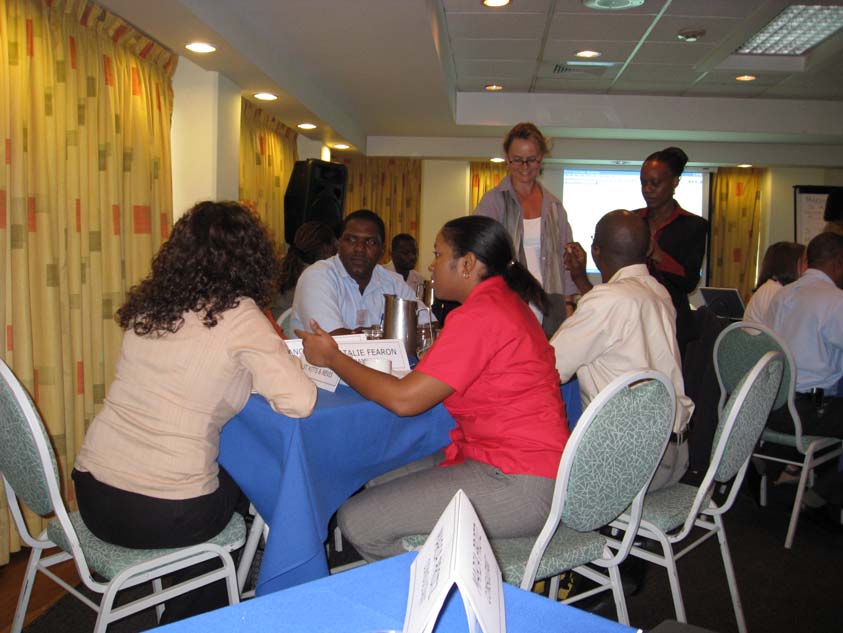
The Workshop began with a short Opening Ceremony chaired by Ms. Donna Spencer, the
Communications, Networking, and Information Specialist (CNIS) at the IWCAM PCU (Appendix I:
Workshop Agenda). Ms. Spencer welcomed all the workshop participants and thanked them for
accepting the invitation to participate in the workshop. Participating countries had been asked to send
representatives who have responsibility for communicating about IWCAM to the broader public. Countries
with Demonstration Projects had additionally been asked to nominate someone directly involved with
communications and outreach activities aimed at local communities within the Demonstration Project area.
Opening remarks were made by Mr. Vincent Sweeney, the GEF-IWCAM Regional Project Coordinator who
welcomed the participants and stressed that beyond stimulating awareness among participants, the
Workshop would set the stage for future awareness building activities and establish a foundation upon
which a sustainable partnership for communication in environment and development could be build,
especially with media partners. He was followed by Mrs. Patricia Aquing, the Executive Director of the
Caribbean Environmental Health Institute, one of the co-executing agencies of the Project. She underlined
the importance of an integrated approach to environmental management and hoped that deliberations at
the workshop would result in an agreed approach to the promotion of IWCAM. Ms. Heidi Savelli finally
made remarks on behalf of the other co-executing agency, the Secretariat of the Cartagena Convention,
UNEP Regional Coordinating Unit (UNEP-CAR/RCU).
3
3. Introduction to the GEF-IWCAM Project
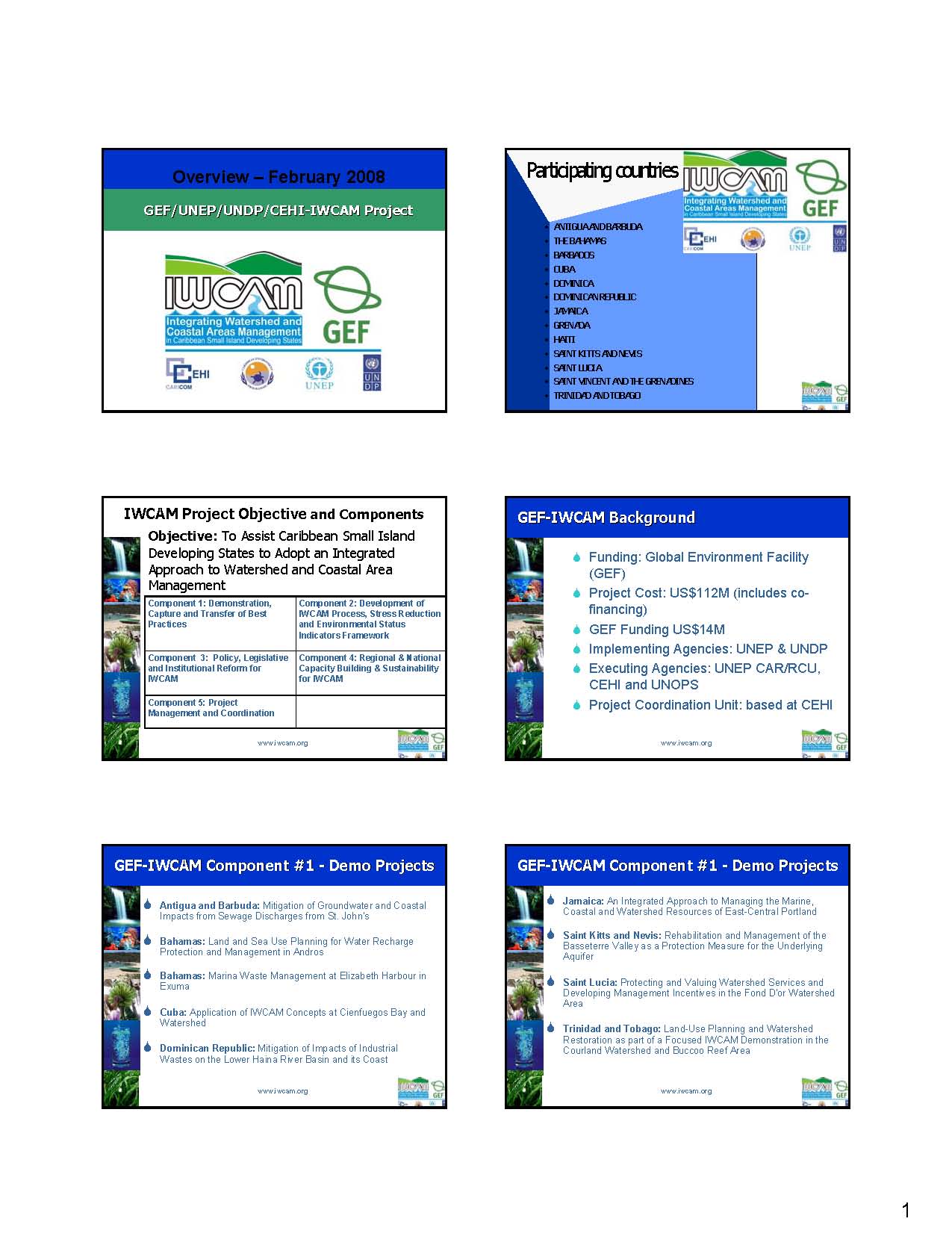
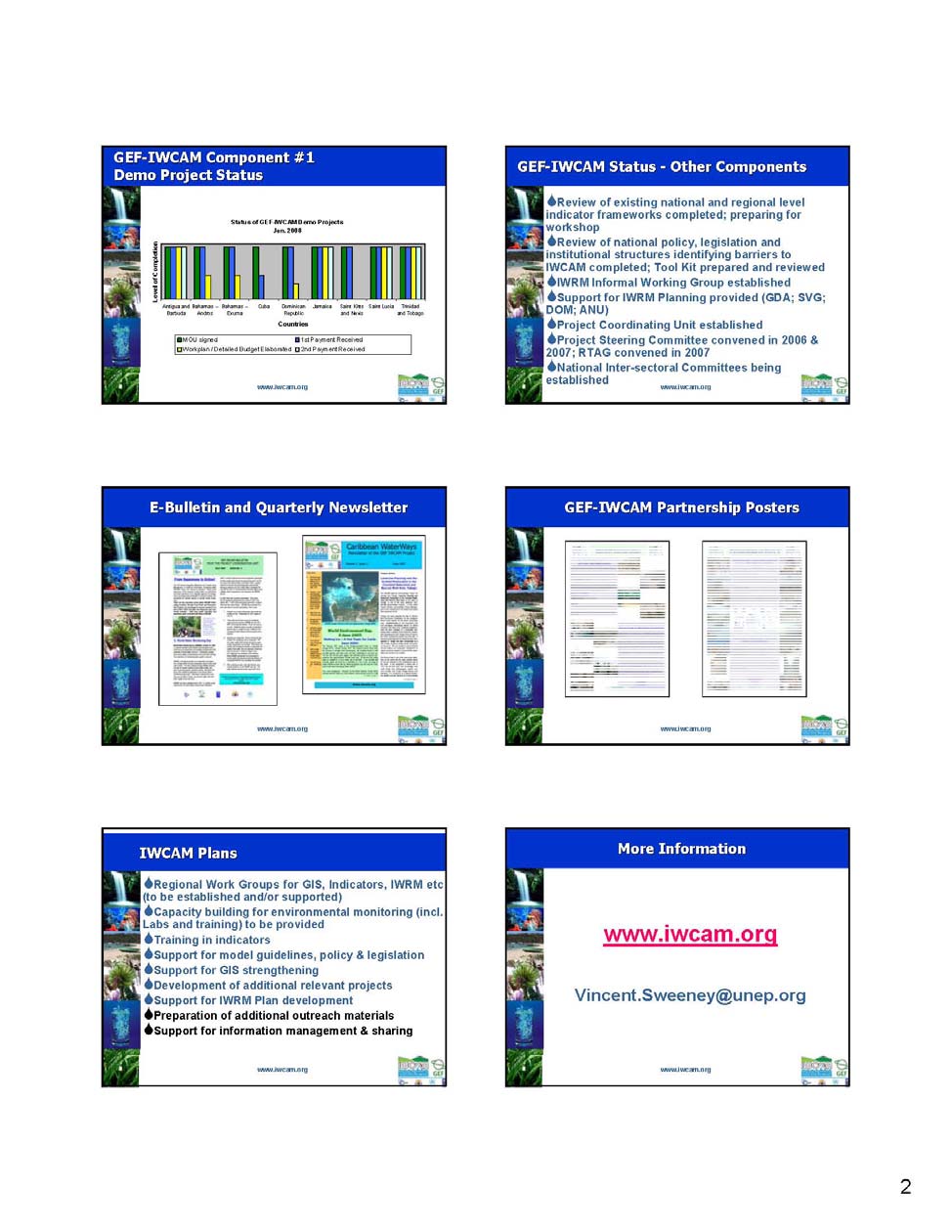
Following the Opening Ceremony, the Regional Project Coordinator (RPC) made a presentation which
provided background on the GEF-IWCAM Project (Appendix II). He was followed by the Communications,
Networking and Information Specialist (CNIS) who briefly described the purpose and organization of the
workshop.
4. Issues and Challenges - Country Reports
After a coffee break, the Participating Country representatives made brief presentations on challenges
which they face in Communications, Public Education and Outreach at the national level. These were
generally guided by the Note to Participants which had been circulated prior to the Workshop (Appendix
III).
The following is a summary of the major challenges as outlined by countries:
Antigua & Barbuda:
· PEO is in early stages; newspapers and television are used for dissemination of messages;
· using language which is understandable to the public is a major challenge.
The Bahamas:
· Where demonstration projects are located in remote areas (the "out-islands") communication
can be difficult as the media (television, radio, internet) is concentrated in Nassau;
· Yachters are the main target audience in the Exhuma Demonstration Project;
· Internet access is limited on Andros;
· Getting people to attend meetings is difficult.
Barbados:
· With no local demonstration project, the Steering Committee lacks the motivation to meet;
· Products, such as the inventory of existing legislation and policy are useful because they
generate discussion;
· Main issues are: land use conflicts, where environmental impact assessments are seen as an
imposition rather than a means of protecting the environment, and, farming practices, in
particular fertilizer overuse (hence farmers and land developers are important target groups)
· The Coastal Zone Monitoring Unit's summer camp trains participants in all aspects of coastal
zone management issues.
Cuba:
· Reaching people in a way that is understandable to them is a great challenge;
· Much communication is done by way of a television station;
· The Demonstration Project employs a journalist;
· A community network is working with the Demonstration Project.
Dominica:
· No demonstration project therefore difficult to focus nation on IWCAM;
4
· Dominica promotes itself as "the nature island of the Caribbean" and while there is high interest in
the environment amongst the media and NGOs, there is also a need to change attitudes and bad
habits amongst the general public;
· Radio is widely listened to, television is widely watched, and a limited amount of literature goes into
schools;
· The Government Information Service has a regular television programme called "Environment
Corner".
Dominican Republic:
· An Environmental Education Directorate was created in 2000 and is guided by a National
Environmental Education Strategy. Both formal (teachers and students in a classroom setting) and
non-formal (e.g. fishermen and farmers) approaches are used;
· Resources are limited; particularly trained staff and access to printed materials;
· While the participant is not directly involved in the Demonstration Project, it was recognized that
the industrial sector would be the primary audience to be targeted.
Grenada:
· A range of educational materials are produced by the Ministry of Agriculture including: a 30-
minute television programme per week, a daily 5-minute radio programme which is aired on 2
stations and a weekly news article;
· Challenges include a shortage of staff, a damaged building, and, a shortage of information.
Haiti:
· Approaches to environmental education are both formal (working with schools and teachers) and
informal (particularly in meetings with local communities).
Jamaica:
· Projects implemented by the National Environment and Planning Agency, including the IWCAM
Demonstration Project, are intended to be institutionalized as sustainability beyond each project is
desirable;
· Main challenges faced are: cultural (due to the localities involved), the fact that generally people
do not read much (newspapers are not well read), language, perceptions about the messenger,
and gender issues;
· Primary targets at the national level are farmers and the youth;
· Secondary targets at the national level are the media;
· In the demonstration Project area, farmers are the primary target group while agriculture, tourism,
fishing and mining are all activities of interest;
· Stakeholders' meetings and workshops are held in the Demonstration Project area;
· A range of strategies is used to increase awareness and bring about attitudinal changes, including
work with schools, skits and the reggae beat.
Saint Kitts and Nevis:
· The Water Services Department communicates with the public via radio and occasional press
articles;
· No specific resources are allocated;
5
· Communications tend to be ad hoc in nature;
· The public's understanding of IWCAM is poor;
· Challenges faced in water management are similar to those faced in Barbados (land use planning
and cooperation from land developers) with groundwater and surface water being affected by
inadequate management of waste from livestock and inadequate onsite domestic wastewater
disposal.
Saint Lucia:
· The print media is used for interventions at the national level;
· Pig farmers are a primary audience due to the problem of no treatment of livestock waste;
· Major challenge is getting people to stop damaging practices, such as washing of vehicles in rivers;
· Networking with NGOs and CBOs is important within the Demonstration Project area.
Saint Vincent & the Grenadines:
· Although SVG does not have a demonstration project, it has a pilot programme in one of the
Grenadines, Union Island, which targets schools and uses radio;
· A lack of funding means that outreach is very limited;
· There is poor understanding of the word "watershed";
· The primary audience is the general public while the secondary audience is the policy maker.
Trinidad & Tobago:
· In the Demonstration Project area, nutrients from the land are the main concern as they reach the
sea to affect Buccoo Reef;
· Farmers and land-developers are the main target audiences;
· The communications strategy is multifaceted: videos (Buccoo Reef Trust has an in-house film
unit), print media, talk shows, music video, website, use of flyers distributed by students,
exhibitions etc.
· The recent employment of a dedicated Education Officer will enable more PEO;
· In 2008, International Year of the Reef, additional efforts to educate the public are being made;
· This Demonstration Project is being executed by a NGO, the Buccoo Reef Trust. It faces
challenges in getting the kind of support needed from government agencies, ensuring that the
project has a national projection, and, as a research body, keeping the project `community
focused'.
5. Introduction to the Draft Communications Planning Guide
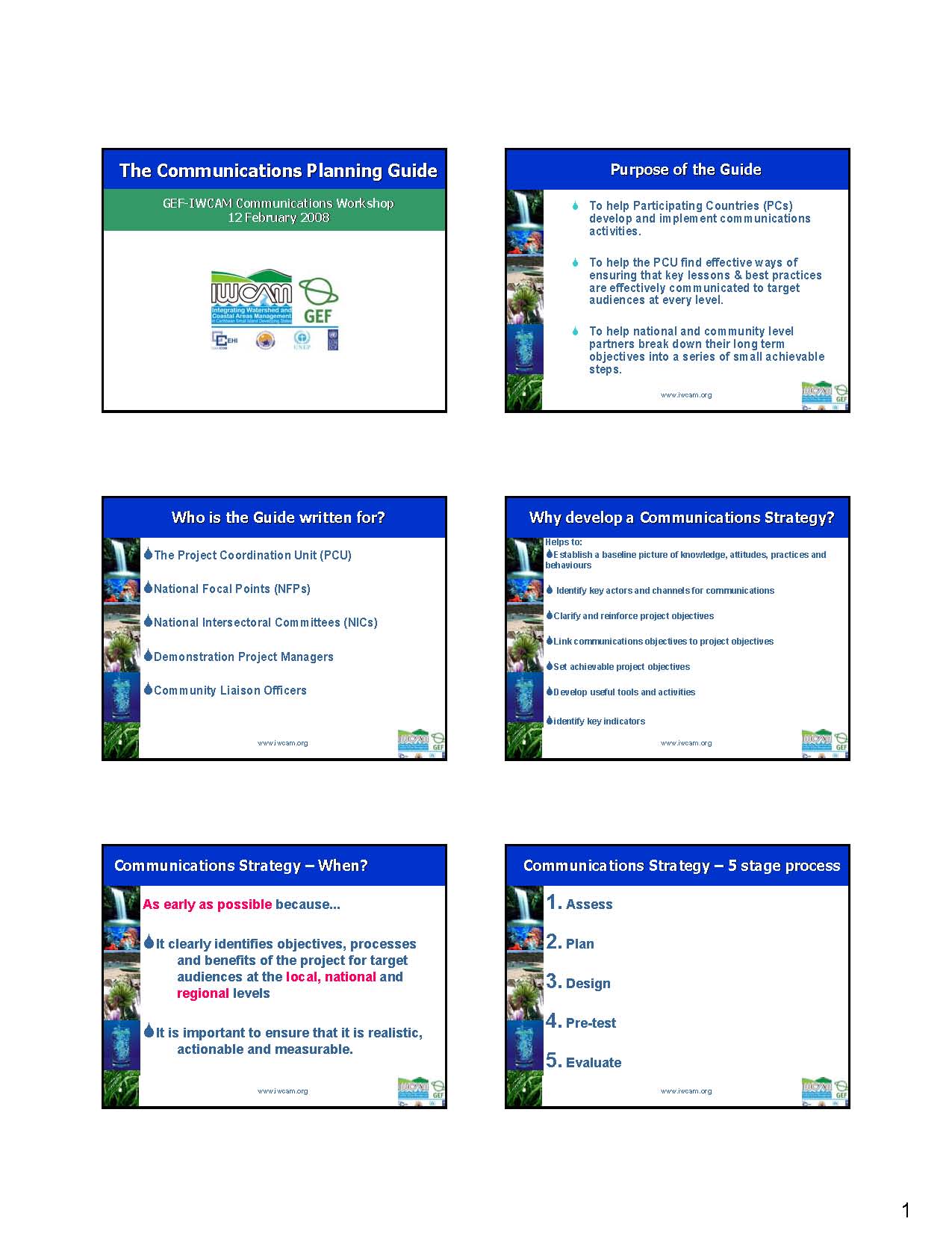
Ms. Spencer then introduced the participants to the Communications Planning Guide (Appendix IV),
stressing that it's purpose is: to help Participating countries develop and implement communications
activities; to help the PCU find effective ways of ensuring that key lessons and best practices are effectively
communicated to target audiences at every level; and, to help national and community level partners break
down their long term objectives into a series of small achievable steps. She described the GEF-IWCAM
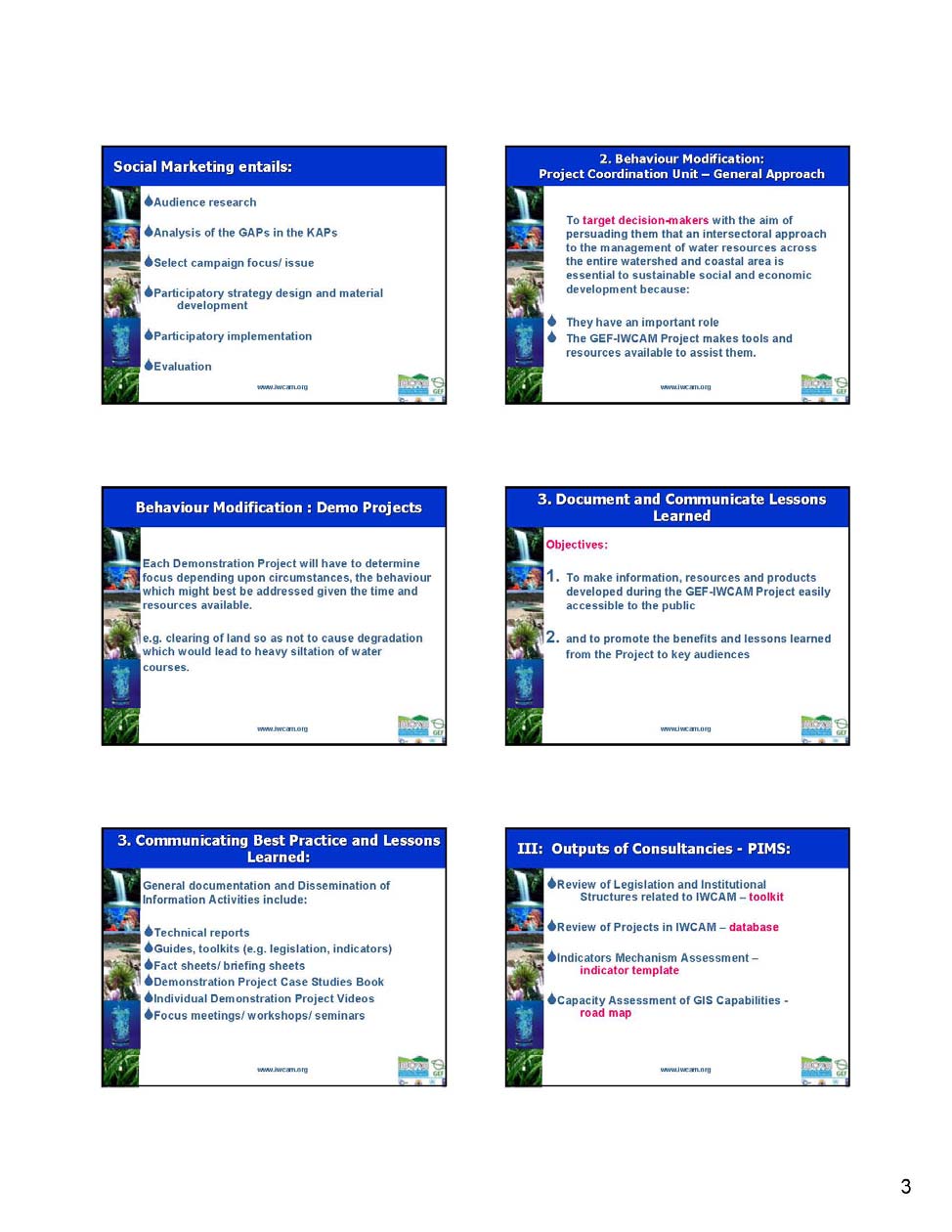
communications approach as being made up of three parallel and overlapping sets of activities:
1. Public Relations and Awareness Raising
2. Social Marketing Behaviour Modification Campaigns
6
3. Documenting and Communicating Lessons Learned and Best Practice.
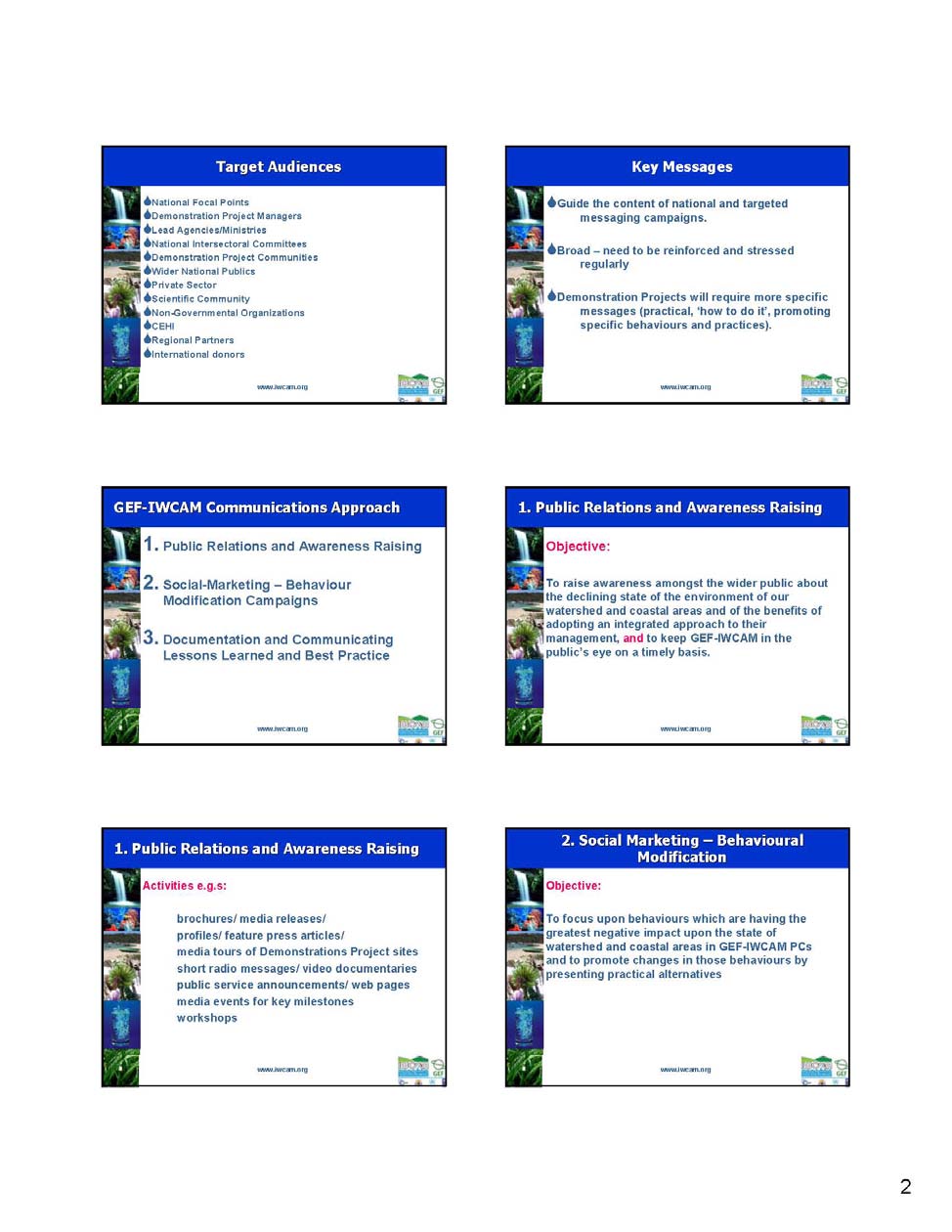
These were briefly outlined in terms of both objectives and some of the activities involved (see presentation
Appendix V).
Brief discussion followed during which two important points were made and replied to:
1) the approach did not seem to be very participatory.
Reply: In the context of the GEF-IWCAM Project, it is at the Demonstration Project level that participation
can best be encouraged and facilitated because target groups and audiences as well as issues are more
specific. Indeed, participation is necessary if sustainable change in behaviours or negative practices is to
be achieved. At all levels; regional, national and demonstration project (community) sincere efforts to gain
meaningful participation should be made as activities are planned and implemented. This was a particular
challenge given the deadlines incorporated into the overall GEF-IWCAM Project.
2) the term "environmental education" is not used throughout the document but should be explicitly
used as it is of fundamental importance and essentially what we need to do educate people
about the environment.
Reply: Although the term is not actually used, environmental education of different target audiences, using
different approaches, is understood to underpin all aspects of communications and outreach activities in all
three phases of the Project. Consideration would be given to using the term explicitly.
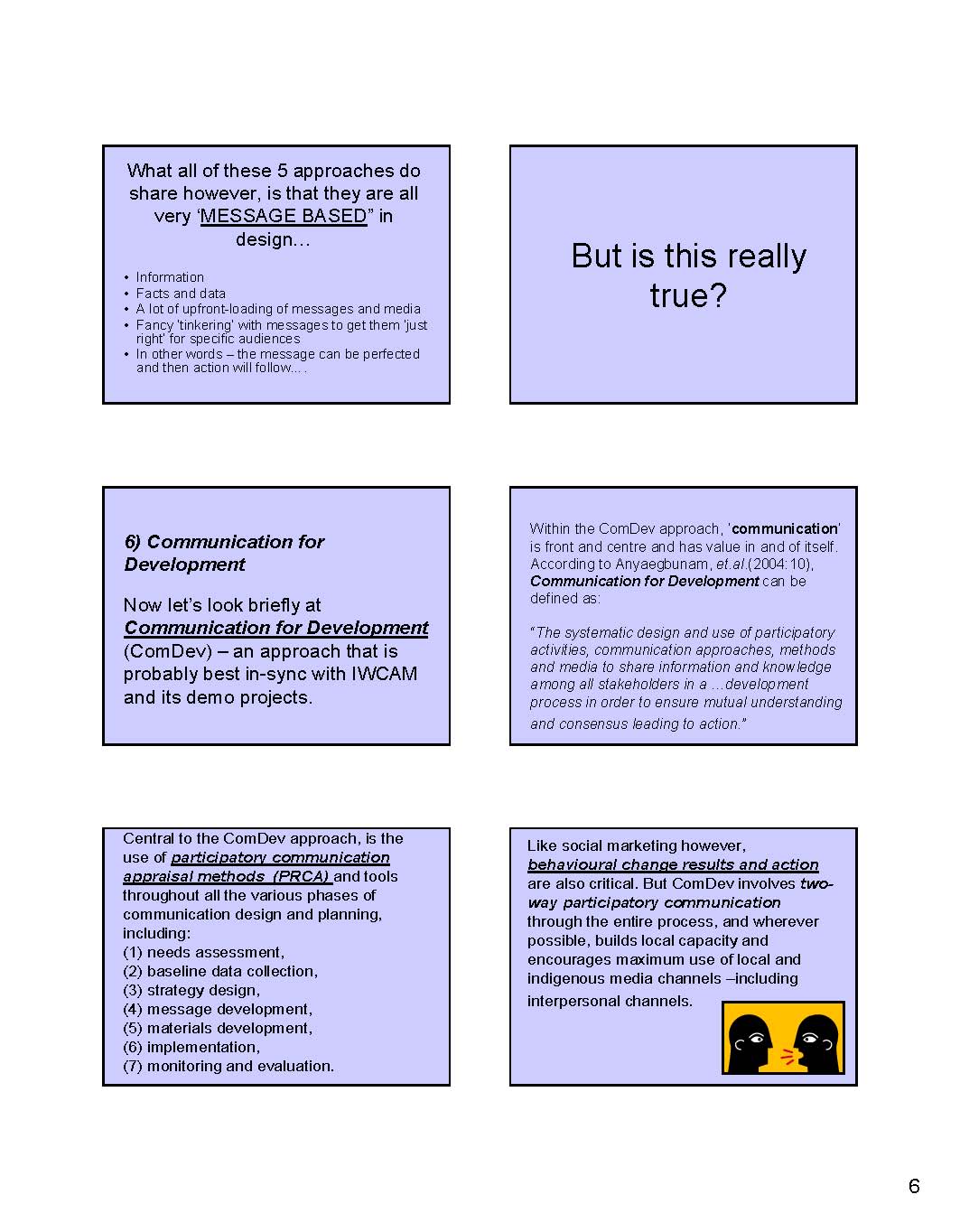
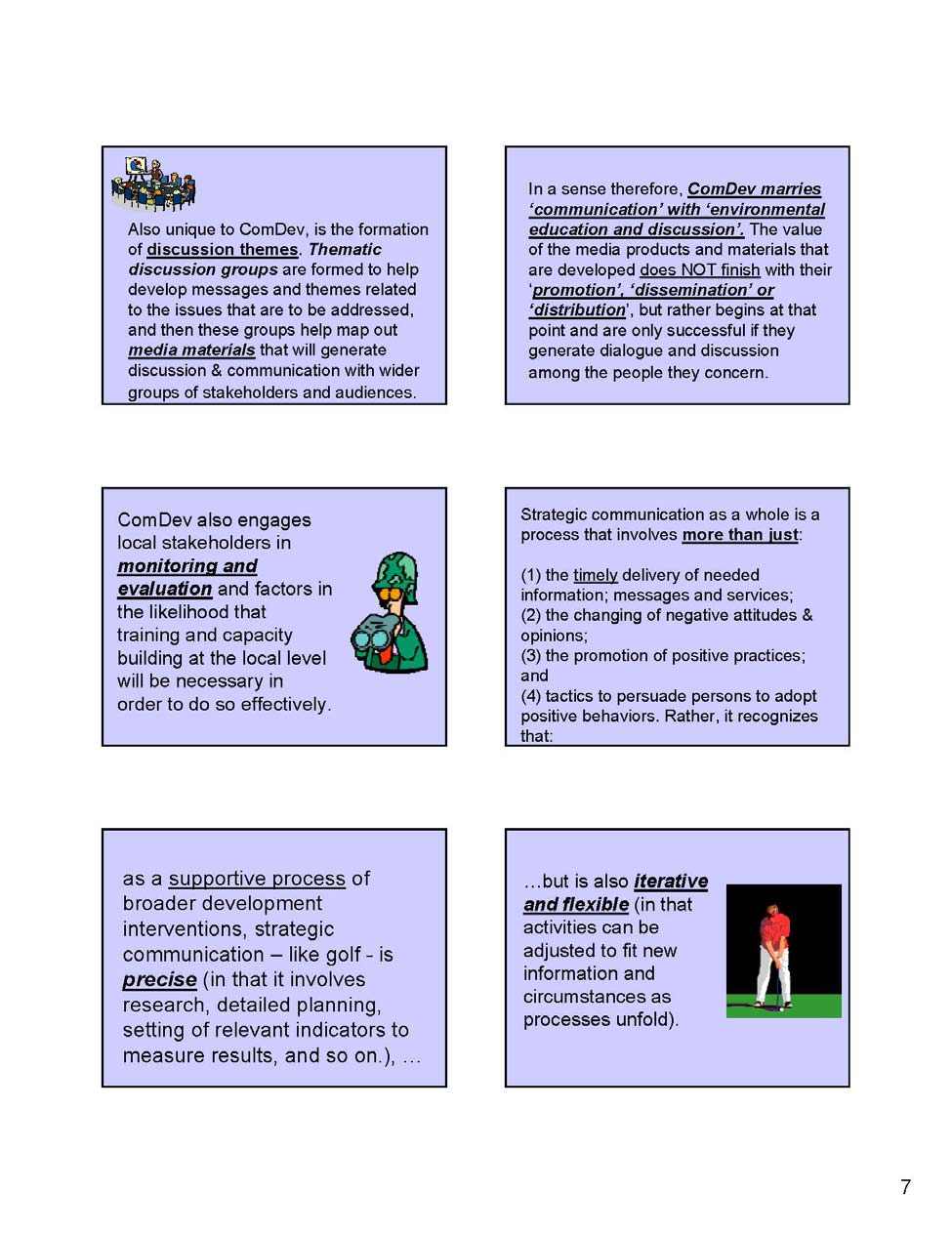
6. Communication for Development
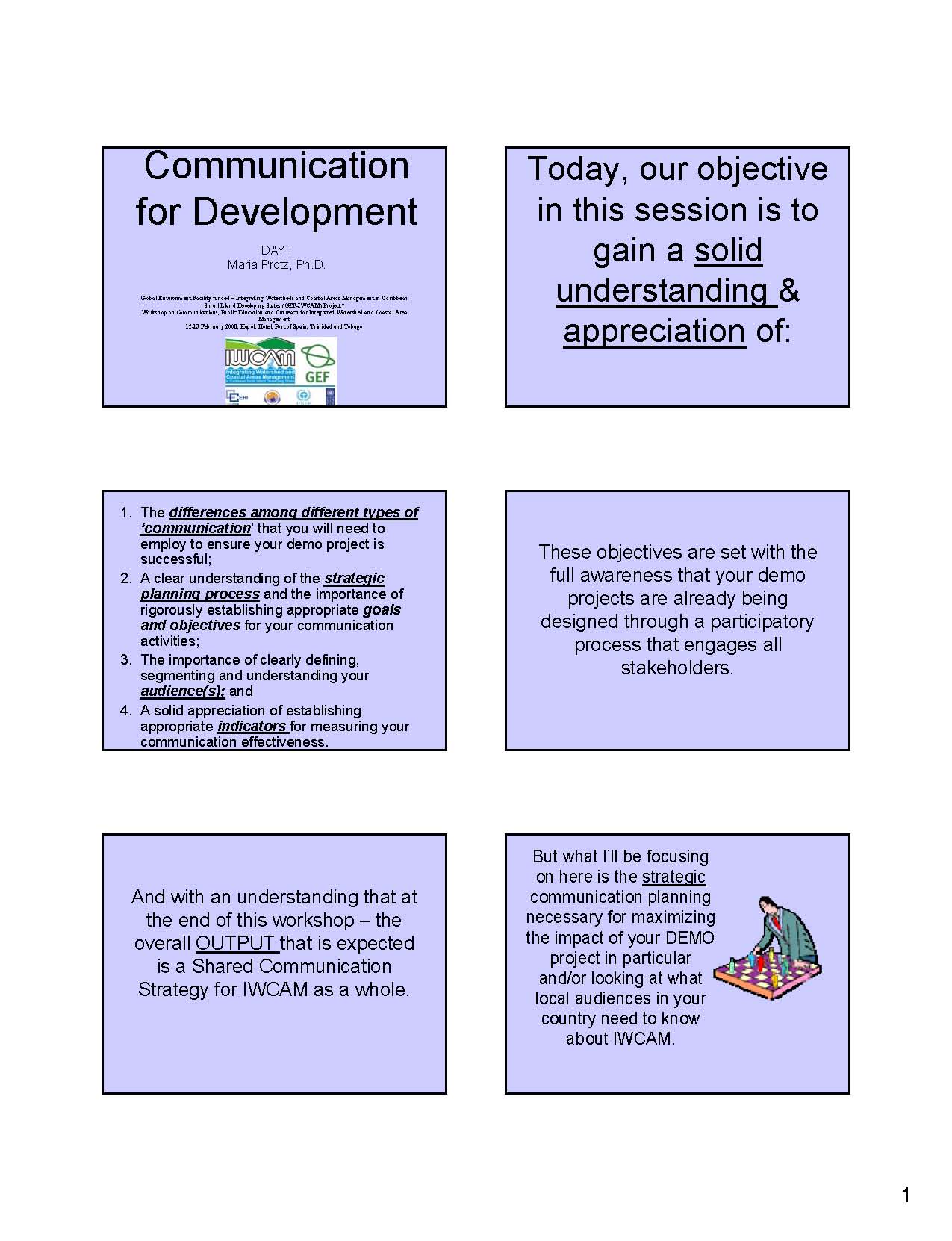
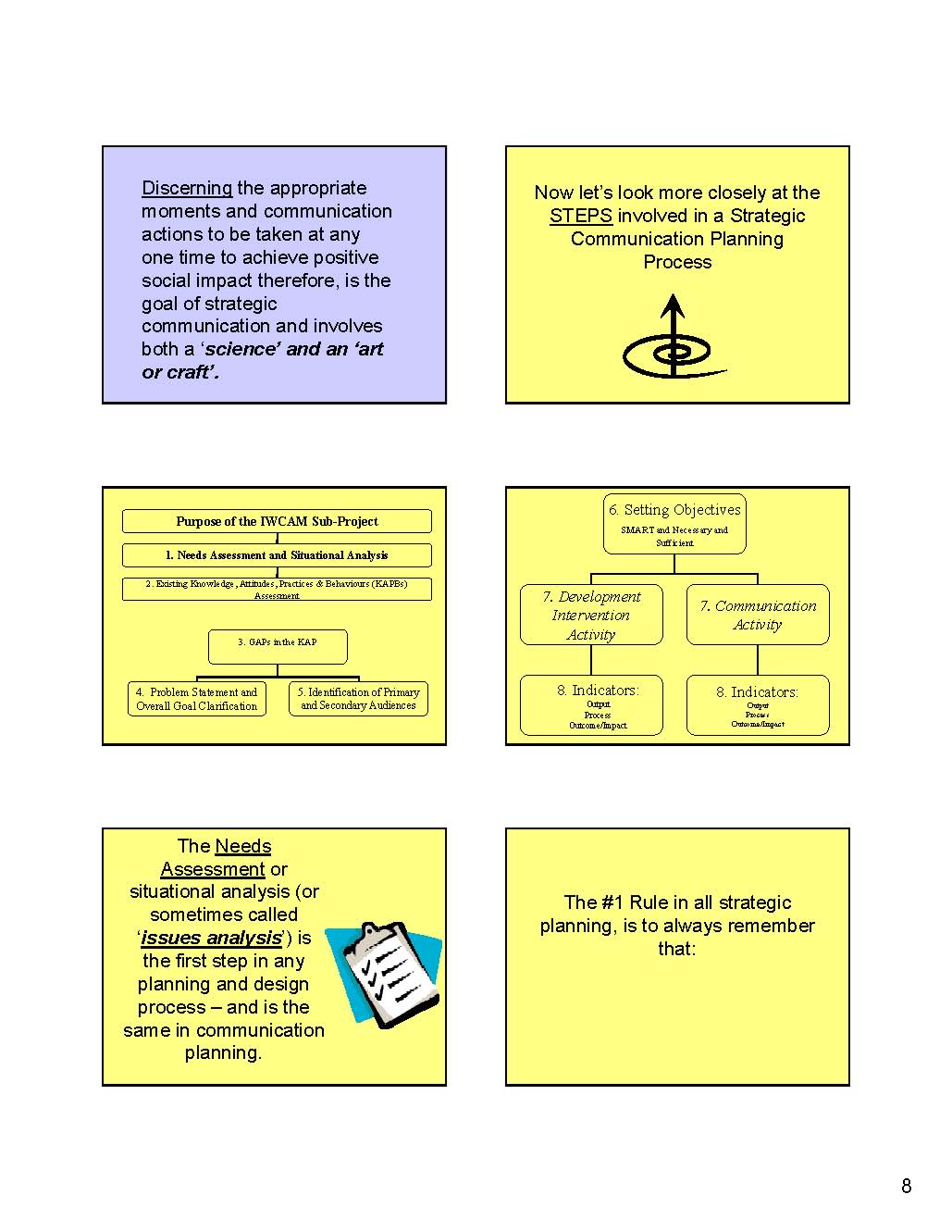
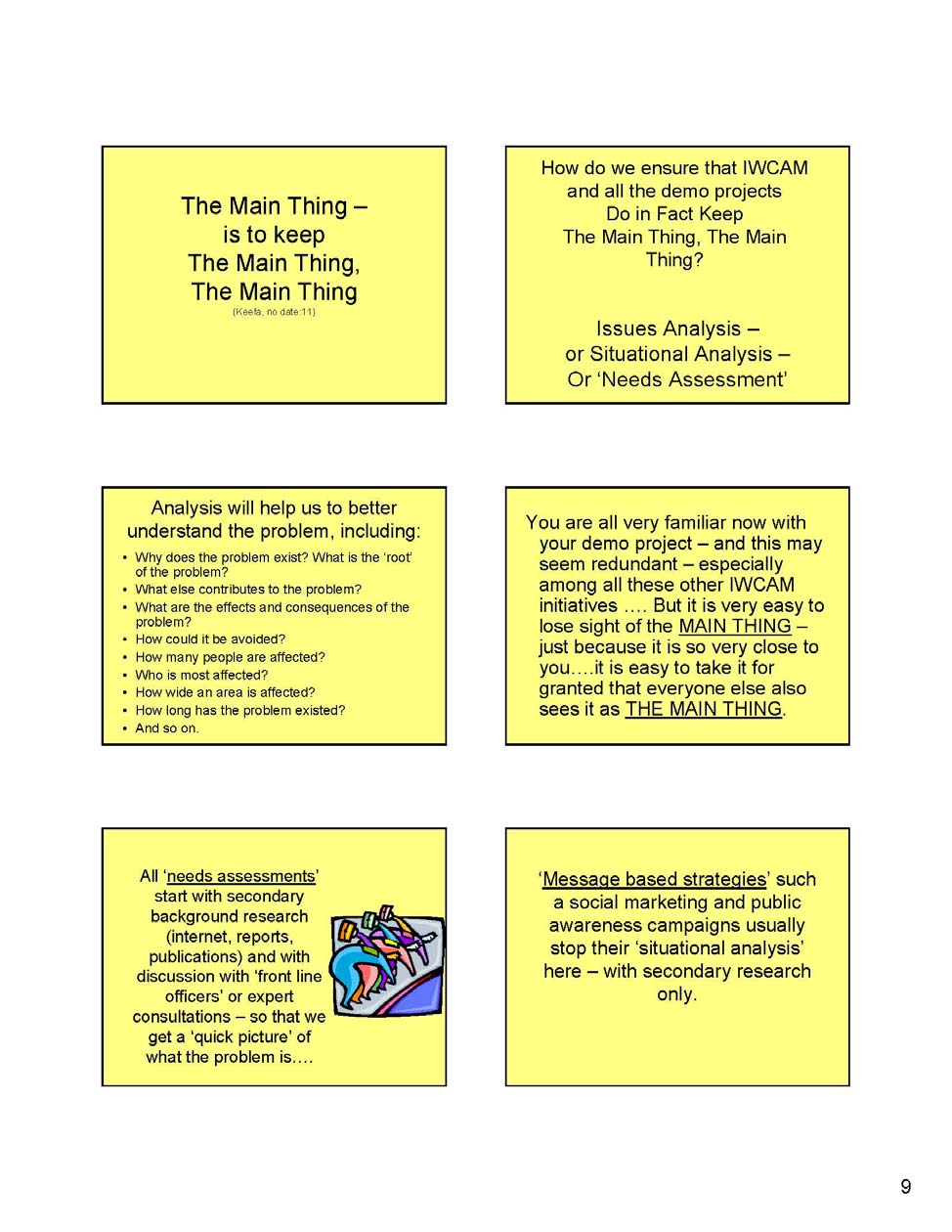
After the lunch break, Dr. Maria Protz, Consultant, in her presentation (Appendix VI) went through the
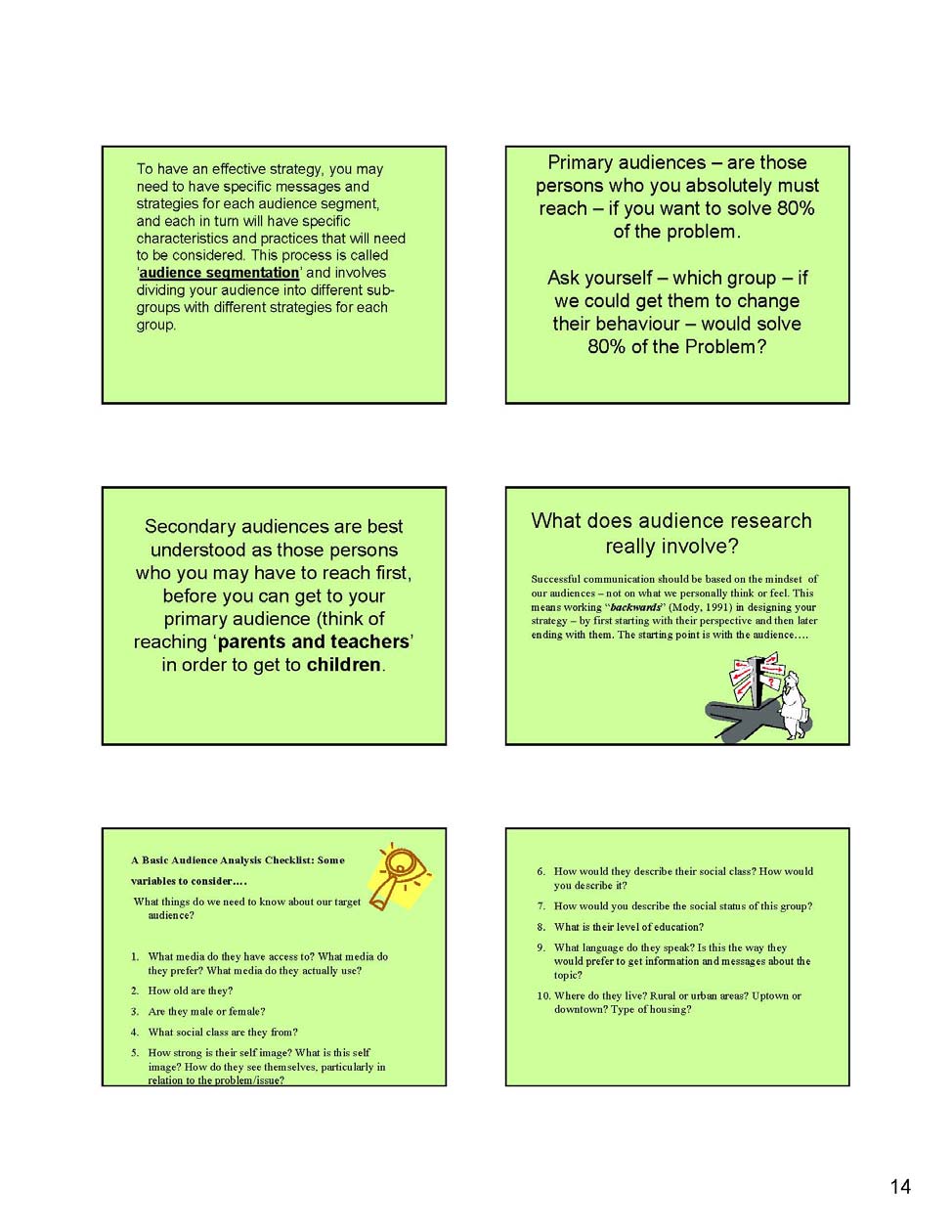
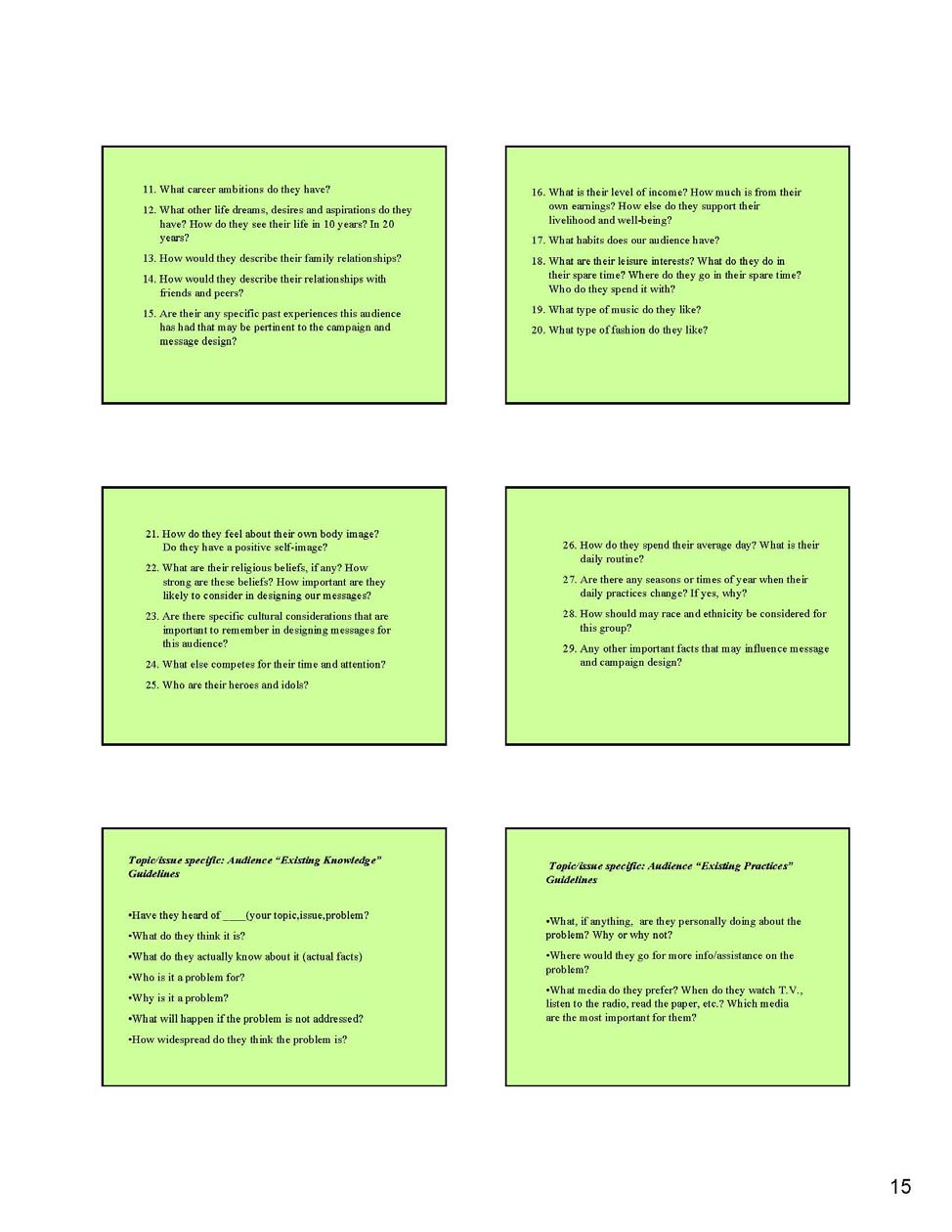
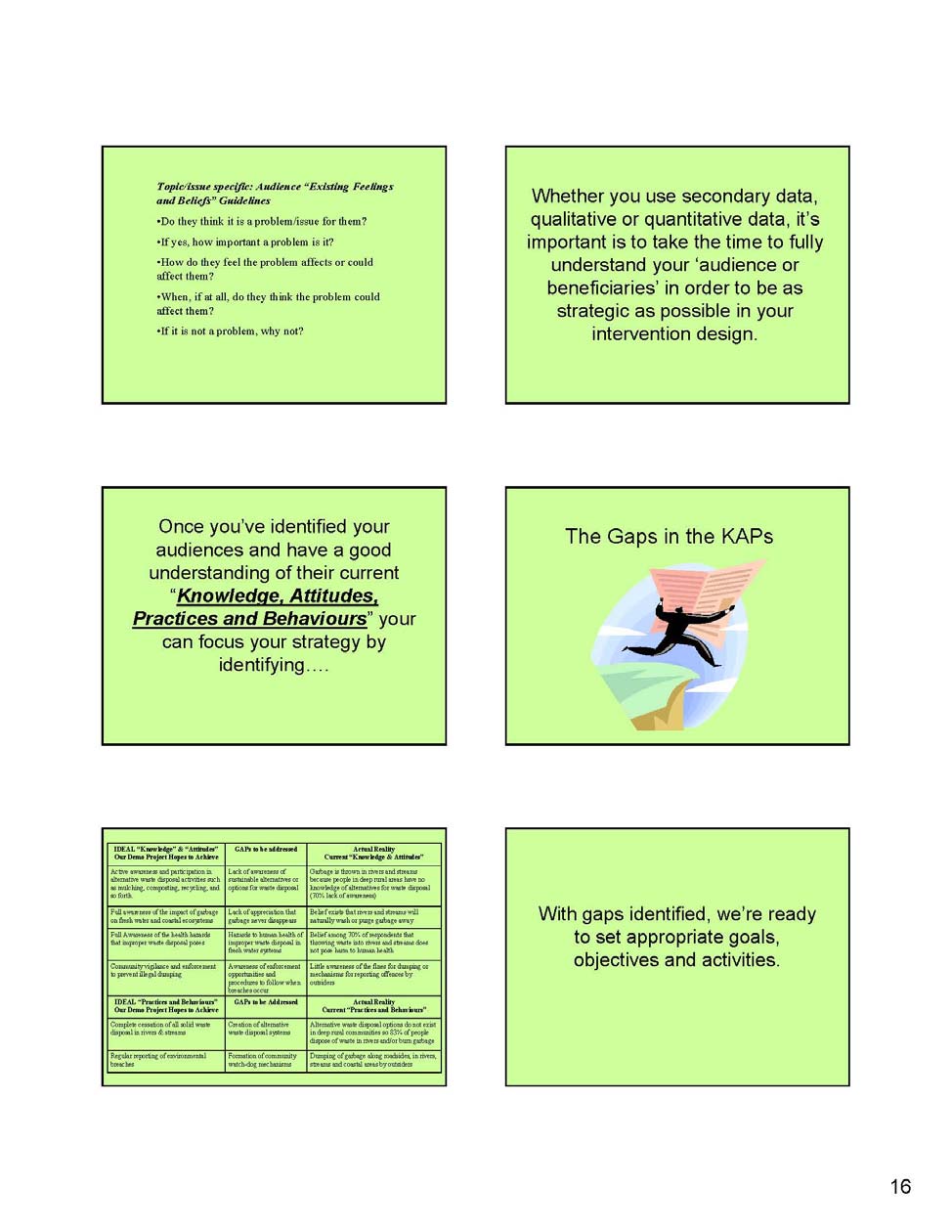
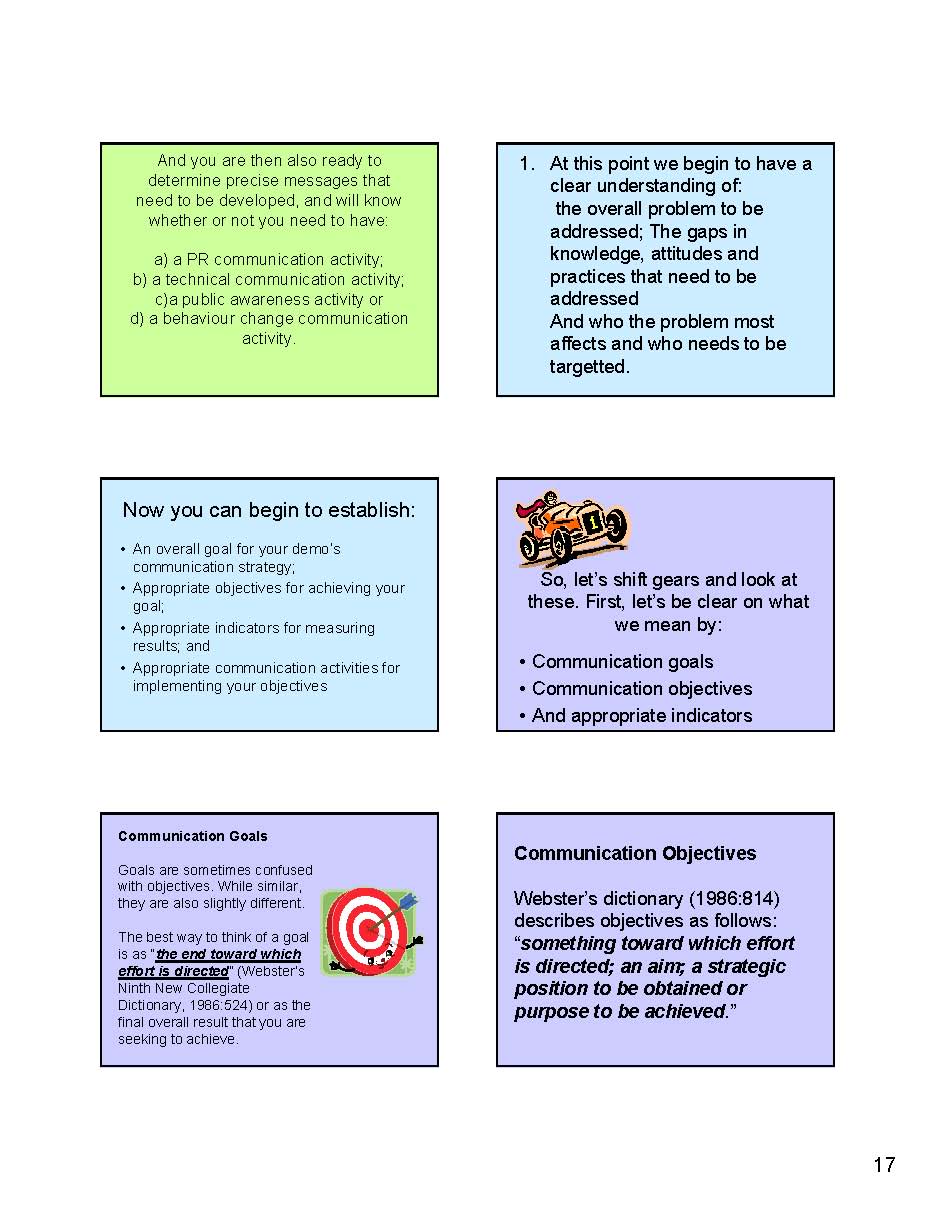
three essential steps in the strategic communications planning process: 1) Identifying GAPS in the KAPS;
2) Identifying Primary and Secondary Audiences; and 3) Developing Appropriate Indicators and
Communication Interventions. During the segment dealing with the GAPS in the KAPS, Tecla Fontenard of
the OECS' OPAAL Project presented the results of the recently conducted OPAAL KAPS (Appendix VII).
These presentations were followed after the coffee break by a Working Session during which Participating
Countries were asked to identify primary and secondary audiences to be targeted in communications
activities, SMART communications goals and objectives, types of development intervention and
communication activities, and related output, process and outcome/impact indicators . The series of five
handouts including working sheets (Appendix VIII) were completed by each Participating Country with the
guidance of Dr. Protz. The outcomes of this exercise were to be presented on the morning of Day 2.
Day 2, Wednesday 13 February:
7. Communications Goals and Objectives Exercise - Presentations
Following a brief introduction to the day's activities, the PC representatives made brief presentations on
Appropriate Communications Goals and Objectives, at both national and demonstration project levels, and
received feedback from Dr. Protz as well as other participants. They were asked to submit their amended
7
write-ups to the CNIS for inclusion as examples in the revised Communications Planning Guide; after the
Workshop would be fine.
It was agreed that the Draft Communications Planning Guide would be revised taking into consideration the
comments made on Day 1 as well as to include the SMART objectives given by PCs in this session as
examples of targeted actions/activities for demonstration project, national and regional levels. The regional
level example would focus upon promotion of the LBS Protocol and would be completed by the PCU in
consultation with the LBS Regional Activity Centre Institute of Marine Affairs. The revised
Communications Planning Guide would be circulated for comment before being finalized.
8. Making the Most of the Media
After a brief coffee break, Indi McLymont-Lafayette, Journalist, PANOS, which works with communities and
sees information as a tool for development, changed the focus of the Workshop to effective media relations
with a presentation titled: "Making the most of the Media' (Appendix IX). This included some guidance on
preparing a media release and preparing for an interview. She then introduced a few scenarios and asked
participants to break into six Working Groups, selecting one to work with. Three Working Groups would
prepare a media release; three would prepare for an interview. The Groups were given time before lunch
to work on this and presentations would be made following the Media Conference which was scheduled to
begin promptly after lunch at 2:00 pm.
9. The Media Conference
The Media Conference began at 2:20 pm, later than scheduled due to problems with the sound system. It
followed the Programme (Appendix X). Four media houses were present. After a brief introduction by Ms.
Spencer, the public education video shorts series "Think About Water", which was prepared for the GEF-
IWCAM and Integrated Water Resource Management (IWRM) Projects, was launched with a showing of
two of the shorts. These were followed by an introduction to the Project by Vincent Sweeney, Regional
Project Coordinator, titled "The GEF-IWCAM Project: Objectives and Benefits for the Caribbean"
(Appendix XI). Sandra Timothy, Trinidad and Tobago's Demonstration Project Manager, then described
the local Demonstration Project in a presentation titled "Land-Use Planning and Watershed Restoration in
the Courland Watershed and Buccoo Reef Area, Tobago." (Appendix XII). Questions were then taken
from the media. A highly interactive session in which Workshop participants asked questions of the media
then followed. The media-present were then invited to share refreshments.
10. Working Group Presentations Media Releases and Interviews
A brief session in which the Working Groups read their media releases and "staged" their interviews then
followed. Facilitators and participants provided feedback to this very instructive session.
11. Wrap-up
The meeting ended at 5:30 pm with a Vote of Thanks given by the Regional Project Coordinator.
See Appendix XIII for the List of Participants.
8
Appendix I: Workshop Agenda
9
Global Environment Facility funded Integrating Watersheds and Coastal Areas Management in
Caribbean Small Island Developing States (GEF-IWCAM) Project
Workshop on Communications, Public Education and Outreach for Integrated Watershed and
Coastal Area Management
12-13 February 2008, Kapok Hotel, Port of Spain, Trinidad and Tobago
AGENDA
DAY 1: Tuesday 12 February
8:30 9:00
Registration
Vincent Sweeney, GEF-IWCAM
Regional Project Coordinator
Opening Ceremony
Patricia Aquing, Executive Director,
9:00 9:20
CEHI
(Media invited)
Heidi Savelli, UNEP CAR/RCU
Vincent Sweeney, GEF-IWCAM
Introduction to the GEF-IWCAM Project
9:20 9:35
Regional Project Coordinator
Donna Spencer, GEF-IWCAM
Purpose and Organization of the Workshop
Communications, Networking &
9:35 9:40
Information Specialist
9:40 10:00
Coffee Break
Country Presentations
Challenges and Priorities in Communications, Public
GEF-IWCAM Country Participants
10:00 11:00
Education and Outreach at National Level
(followed by limited discussion)
Introduction to the Communications Planning Guide
11:00 11:15
The objectives, rationale and organization of the Planning
Donna Spencer
Guide to be introduced. This would be followed by limited
discussion. This theme would be continued throughout the
Workshop towards making the Guide most useful.
10
Communication for Development
Maria Protz, Consultant
11:15 12:30
1) Identifying GAPS in the KAPS
12:30 13:30
Lunch break
Communication for Development -
2) Identifying Primary and Secondary Audiences
Maria Protz, Consultant
13:30 15:00
3) Developing Appropriate Indicators and
Communication Interventions
15:00 15:15
Coffee break
Facilitators:
Maria Protz and Indi Mclymont -
15:15 16:30
Communications for Development Working Session
Lafayette
.
DAY 2: Wednesday, February 13
8:45 9:00
Welcome and Introduction to Day's Activities
Vincent Sweeney
Presentation of Appropriate Communications Goals and
Objectives
Followed by Discussion towards consensus on
Moderator:
9:00 10:00
Communications Strategy and Action Plan, focussing
Donna Spencer
upon specific actions at Regional, National and
Demonstration Project levels
Indi McLymont Lafayette,
10:00 10:45
Making the Most of the Media
Journalist, PANOS Caribbean
10:45 11:00
Coffee Break
Connecting with your Target Audience (Parallel Working
Groups)
Facilitated by Indi Mclymont -
11:00 12:30
1) Preparing a media release
Lafayette,
2) Preparing for an interview
Maria Protz and Donna Spencer
(presentations at 12:00 noon)
12:30 13:30
Lunch
GEF-IWCAM Communications Protocol
13:30 14:00
Donna Spencer
GEF-IWCAM Media Conference
14:00 15:00
Open Session Media invited
(separate agenda)
15:00 15:30
Coffee Break
Media invited
15:30 16:00
Wrap Up
Vincent Sweeney
11
Appendix II:
Presentation - Introduction to GEF-IWCAM Project
12
13
14
Appendix III:
Note to Participants
15
GEF- IWCAM Project Workshop on Communications, Public Education and Outreach,
12 13 February 2008, Port of Spain, Trinidad & Tobago
NOTE TO PARTICIPANTS
Participants in the GEF-IWCAM Communications Workshop are asked to do their best to answer the
following questions before coming to the Workshop. These questions should also guide the brief, 5 minute,
presentations (no PowerPoints necessary) to be made by each country on the morning of Day 1:
1. In the context of the GEF-IWCAM Project, what do you think is the function of communication?
a. to raise awareness?
b. to increase consensus and understanding?
c. to change attitudes?
d. to change practices?
e. to advertise or promote the project?
f. to advocate?
g. to mobilize (e.g. by building alliances and capacity)
2. How do you currently communicate with the public?
3. What resources (human, material, access to media, time etc.) does the NFP/Demo Project/your department
have for communications?
4. What resources (human, material, access to material, time etc.) does the NFP/Demo Project/your
department have for public education and outreach?
5. How would you describe understanding of the following terms amongst the general public? (poor, fair,
good, very good)
a. Watershed
b. Integrated
c. Conservation
d. Management
6. Demonstration projects, and at the community level only what group do you feel is the most important
audience to target in order to achieve the sustainable behaviour and attitudinal changes your demo is
addressing? In determining this audience, it is helpful to ask: "which group at the community level, if we
could enable them to change their attitudes and behaviours, would thereby solve 80% of the problem the
demo project is trying to address?
7. What specific knowledge, attitudes and behaviour/practices does this audience need to change in order to
address the problem adequately?
8. What other `secondary audiences' does the demonstration project need to include? In answering this
question, it is also helpful to ask: "who are the people that will help us get to our main primary audiences?"
9. And finally, can you bring any type of data or background information to support your conclusions and to
define these audiences in a little more detail?
16
Appendix IV:
Presentation - Introduction to the Communications Planning Guide
17
18
19
20
21
Appendix V:
Draft Communications Planning Guide
22
Global Environment Facility funded-Integrating Watershed and
Coastal Areas Management in the Small Island Developing States
(SIDS) of the Caribbean (GEF-IWCAM)
GEF - IWCAM Project
Communications Planning Guide
23
Table of Contents
1.0 Introduction
............................................................
3
1.1
The Purpose of this Communications Planning Guide
3
1.2
Who is this Communications Planning Guide written for?
4
1.3
International Waters (IW) Communications Strategy
4
2.0
Background on the GEF-IWCAM Project ..................
5
2.1
Objectives
5
2.2
Issues
5
2.3
Project
Components
5
2.4
Demonstration
Projects 6
2.5
GEF-IWCAM's
Vision
6
3.0
Target Audiences .....................................................
6
4.0
Key Messages .........................................................
9
5.0 GEF-IWCAM
Communications
Strategy
......................
10
5.1
Phase I: Public Relations and Awareness Raising
10
5.2
Phase 2: Social Marketing Behavioural Modification
12
5.3
Phase 3: Document and Communicate Lessons Learned
14
6.0
Role of the Project Communications Unit (PCU) ..........
16
Appendices
............................................................
18
Appendix I : Public Involvement Plan Summary
18
Appendix II: Root Cause Analysis, IWCAM in the Caribbean SIDS
19
24
1.0 Introduction
The recurrent issues of small size and the coastal focus of development together with their linked
problems make Caribbean islands a priority area for the introduction of Integrated Watershed and Coastal
Areas Management (IWCAM). The issues and problems facing Small Island Developing States (SIDS) of
the Caribbean are characterized by small size and limited resources for development. An unsustainable
sectoral approach to management of our watershed and coastal areas now dominates in the public and
private sectors. Administrative responsibility tends to be fragmented and jurisdiction over the
management of resource use is unclear. This approach fails to take account of the high level of
interaction between the resources and processes at work in the continuous watershed to coastal area.
Lack of an integrated approach has resulted in degradation of the environment, overexploitation of natural
resources, competing resource uses and conflicts between users. Problems include diminishing
freshwater supplies, degraded freshwater and coastal water quality; inappropriate land use and; poor
hygiene and sanitation.
The GEF-IWCAM Project is one of several International Waters (IW) Projects worldwide which aims to
influence human behaviour in order to protect shared natural resources by:
· Raising public awareness of specific environmental problems;
·
· Promoting public participation in decision-making, (through participatory communication methods
and approaches essentially what is called a `Communication for Development' or ComDev
approach) and;
·
· Minimizing the harmful impacts of specific human behaviours and encouraging positive,
sustainable behaviours.
Many categories of stakeholders are involved in the GEF-IWCAM Project (See Appendix 1). The
participatory approach is a guiding principle to ensure transparency in the planning and execution of
project activities. The stakeholders are the direct beneficiaries of the project. One of the main purposes
of the project is to build partnerships. As such, relevant stakeholders need to be integrated into the
project formulation and implementation activities as early as possible. Ensuring the necessary
understanding of the Project as well as identifying and developing the role and specific contribution to be
made by each interest group requires clear and consistent communication at all stages and levels.
1.1
The Purpose of this Communications Planning Guide
The purpose of this Guide is to help Participating Countries (PCs) develop and implement
communications activities to help promote and strengthen integrated approaches to watershed and
coastal area management at the community, national and regional levels. This strategy also aims to help
the Project Coordinating Unit (PCU) find effective ways of ensuring that key lessons and best practices
from the Project are effectively communicated to target audiences at every level.
It is designed to help GEF-IWCAM national and community level partners break down their long-term
objectives into a series of small, achievable steps. Demonstration Project Managers in particular need to
think about their communications objectives and barriers. Stakeholders can become confused about:
· Exactly what the project is trying to achieve (and should thus be actively involved in setting
objectives and project priorities)
· The benefits of the project (both personal and to the community) as well as their own roles and
responsibilities in the process.
25
· How the project is intended to work with the community/government and other stakeholders to
achieve these objectives.
Demonstration Project Managers should consider the following:
· What problem their project is trying to address. A situational analysis, needs assessment, ideally
using PRCA tools, should be done.
· What the project wants to achieve.
· What the community/personal benefits would be, as well as roles and responsibilities of
individuals and the community.
· How the project intends to work with the community/government and other stakeholders to
achieve these objectives.
1.2
Who is this Communications Planning Guide written for?
This document, which is based upon the Communications Workplan prepared for the IW Project of the
Pacific Islands, Strengthening the Management of Waste, Freshwater and Coastal Fisheries in the Pacific
Islands (2005), was prepared to help the Project Coordinating Unit (PCU) clarify the communications
objectives, target audiences, tools and activities for the IWCAM Project. The Project's Communications,
Networking and Information Specialist (CNIS), Donna Spencer, will work with National Focal Points,
National Intersectoral Committees, Demonstration Project Managers and Community Liaison Officers to
fine-tune and adapt this general plan to meet local needs. Some Demonstration Projects may already
have begun implementing public awareness and outreach plans.
National Focal Points and Demonstration Project Managers are encouraged to conduct a quick
assessment of communications resources available to them as well as of existing environmental
communications activities.
1.3
The Importance of developing a Communications Strategy
Development of a communications strategy can help to:
· Establish a `baseline' picture of existing "Knowledge levels, Attitudes, Practices and Behaviours"
(KAPBs) that will in turn indicate where there are gaps in behaviours or attitudes that need to be
addressed or targeted.
· Identify key actors and channels for communications including traditional forms of
communication.
· Clarify and reinforce project objectives, particularly in terms of strengthening environment and
resource management at the national level.
· Link communications objectives to project objectives.
· Set achievable project objectives, given available resources.
· Develop useful tools and activities to raise awareness.
· Identify key indicators (including behaviour change indicators) and measure their performance
26
The overall IWP Communications Strategy follows a 5-stage process:
Stage 1: Assess
· The current KAPBs and gaps that need to be addressed
· The problem (including how local communities perceive the problem, which can be ascertained
through baseline KAPB research or situational analysis
· The target audiences
· Communication channels and opportunities
· Resources available to implement communications activities
Stage 2: Plan
Setting realistic, achievable and measurable objectives. Both SMART objectives and `necessary and
sufficient' indicators.
Stage 3: Design
Developing effective messages, communication interventions or activities that engage stakeholders in
learning about the problem and in identifying solutions.
Stage 4: Pre-test
Testing these messages and methods with their target audiences.
Stage 5: Evaluation
Finding ways to continuously improve their communications programmes.
2.0
Background on the GEF-IWCAM Project
2.1
What are its Objectives?
The GEF-IWCAM Project has the overall objective of strengthening the commitment and capacity of the
participating countries to implement an integrated approach to watershed and coastal area management.
The long-term goal is to enhance the capacity of the participating countries to plan and manage their
aquatic resources and ecosystems on a sustainable basis.
The GEF-IWCAM Project seeks to:
· Undertake
demonstration,
capture
and transfer of best practices;
· Develop IWCAM process, stress reduction and an environmental status indicator framework, and;
· Encourage technological and management approaches and policy and legislative reforms.
2.2 Issues:
The main issues faced by Caribbean SIDS in terms of IWCAM are:
1. Diminishing freshwater supplies
2. Degraded freshwater and coastal water quality
3. Inappropriate land use
4. Hygiene
and
sanitation
27
2.3 Project
Components:
The Project consists of 5 components:
· Demonstration, Capture and Transfer of Best Practice
· Development of IWCAM Process, Stress Reduction and Environmental Status Indicator
Frameworks
· Policy, Legislative and Institutional Reform for IWCAM
· Regional and National Capacity Building for IWCAM
· Project Management and Coordination
2.4 Demonstration
Projects:
The nine demonstration projects will deliver on-the-ground demonstrations targeted at national hotspots
where specific threats have been identified. They must, most critically, develop mechanisms for the
replication of activities and the transfer of best lessons and practices. Each Demonstration activity has
been designed to substantially involve national and local NGOs and community groups which are
concerned stakeholders in these areas.
2.5 GEF-IWCAM's
Vision:
GEF-IWCAM's vision is that the Caribbean SIDS will be better able to manage the natural resources of
their environment for sustainable development.
3.0 Target
Audiences
Table 1: The Target Audiences for the GEF-IWCAM Project
Target Audience
Description/Comments
National Focal Points
The NFPs are the key linkage points between the Project
(NFPs)
Coordination Unit, the lead agencies, the National
Intersectoral Committees, the Demonstration Projects,
Project Steering Committees, the national stakeholders, the
communities, and the wider publics.
Demonstration Project
The Demo Project Managers are responsible for developing
Managers
and implementing their own Communications Strategies in
collaboration with their Project Teams, some of which have
Community Liaison persons.
Demo Project Managers are the public faces of the
Demonstration Projects.
Communication Strategies can assist the Demo Project
Managers to :
· Clarify their project objectives and target audiences
at the community and national levels.
28
· Clarify national communications objectives and
targets such as lobbying for new legislation or more
effective regulatory enforcement, greater resources
and institutional changes.
· Identify key project partners that will help them to
implement their communications plans and
campaigns.
· Identify the most effective media and
communications activities to meet their short and
long-term objectives.
Lead Agencies/Ministries
It is vital that key persons within lead agencies see how the
GEF-IWCAM project, including Demos, can be used to
improve their ongoing work to manage natural resources
throughout watershed areas, both during and beyond the life
of the Project.
IW Projects worldwide have attempted to find effective ways
to promote ownership of the project within lead agencies.
Tactics have included:
· Profiling key management officials in the
media/videos
· Involving key lead agency managers and staff in the
project Communications Teams
National Intersectoral
The role of the NICs include the promotion of project
Committees
concepts and objectives at national level, thereby ensuring
integration of IWCAM into national policy. As such they are
responsible for the long-term sustainability of the project and
the national replication/integration of lessons beyond 2009.
Concerted effort must be made if GEF-IWCAM activities are
to have an impact beyond the community level. Allowing the
NICs input to project development and communications may
help this to happen.
Demonstration Project
At the community level the Communications Strategies can
Communities
help to:
· Promote the objectives, processes and benefits of
the IWCAM.
· Help to prioritize issues to be addressed and help to
identify solutions
· Raise awareness of the specific problems the
project is trying to address.
· Promote/support specific behaviours and activities
to reduce waste, and protect freshwater and coastal
water quality.
· Promote the establishment of community-based
management plans and other tools
The use of "community champions" can be an effective way
of communicating the key behaviours the project is trying to
promote. Involving them is necessary for community
mobilization and can help with monitoring.
Wider National Publics
Generating understanding and support from the wider public
is necessary if there is to be sustainable change at the
29
national level.
National level social marketing campaigns may help
promote behaviours such as waste reduction, recycling,
composting, safe disposal of hazardous wastes,
deforestation, etc.
Private Sector: national Consultation with such groups is important, as their
and regional organizations contribution or partnership is multifaceted: technology and
representing farmers;
financial investment, public-private partnerships, NIC and
fisherfolk; manufacturers; other advisory committee memberships, co-financing and
hotel owners/managers;
participation in the implementation of demo projects.
tour operators; dive
operators; yachtsmen etc.
Scientific Community
Consultation, review of outputs, research, information
technology, Regional Technical Advisory Group (RTAG),
risk assessment, monitoring, training.
Non-government
Consultation, implementation, public awareness, spreading
organizations
of messages at grassroots level, steering committee and
management advisory committee membership, training,
participation in demo projects.
CEHI
In order that GEF-IWCAM not be perceived as a separate
"GEF" project and largely removed from the day to day work
of CEHI's professional staff it is necessary to collaborate
and share information on Project activities early, to highlight
parts of CEHI's and GEF-IWCAM's Workplans where there
is collaboration, to promote greater ownership of the
projects' best-practice to CEHI's staff and recognize and
acknowledge publicly areas of collaboration and assistance.
Regional Partners
UNEP-CAR/RCU
Caribbean Environmental
Health Institute (CEHI)
United Nations Development
Programme (UNDP)
The IWRM Informal Working
Group
The GIS Working Group
Global Water Partnership
Caribbean (GWP-C)
International/Donors
IW:Learn
IW:Learn is the key knowledge centre and information
network for all the IWP
UNDP/GEF
Global Environment Facility
4.0 Key
Messages
Specific messages will be adapted for specific target audiences. The following overall messages have
been determined to guide the content of national and targeted messaging campaigns. They should be
communicated consistently and incorporated into local messaging efforts. As far as possible they should
30
refer to the negative consequences of poor management of watersheds and coastal area natural
resources upon human health and the economy:
· In small islands, the relationship between inland, upstream areas and coastal, downstream areas
is closely linked.
· Small Island Developing States (SIDS) of the Caribbean are extremely vulnerable to land-based
sources of marine pollution.
· SIDS are extremely vulnerable to land degradation as a result of human activity.
· Managing our precious water resources in a fragmented and uncoordinated manner has resulted
in degradation of our freshwater and coastal waters, increased conflicts between resource users,
compromised human health and sanitation, and degradation of life-giving ecosystems such as
mangroves and coral reefs.
· Careful water resource management is necessary if sustainable social and economic
development is to take place.
· IWCAM requires that we look at the water cycle as a whole, that we consider what happens to
water from the time it falls as rain on the hillsides to the time it enters and becomes one with the
sea.
· An integrated approach to water resource management requires that all the different uses of
water resources are considered together.
· The involvement of stakeholders is essential if we are to ensure that the limited water resources
available are managed so that everyone benefits.
· An integrated approach to watershed and coastal areas management requires the building of
partnerships at every level and stage.
· IWCAM requires long-term commitment of resources and political support as well as a shift in
approach.
· IWCAM is "integrated water resource management" (IWRM) for SIDS.
These are all broad `messages' for the general public that need to be reinforced and stressed on a
regular basis. Specific demonstration projects will require very specific messages that are practical, `how
to do it' types of messages which promote specific behaviours and practices.
5.0
GEF- IWCAM Communications Strategy
GEF-IWCAM Communications can be implemented in three complementary but parallel and sometimes
overlapping phases:
1. Public Relations and Awareness Raising of the Global Environment Facility funded-Integrating
Watershed and Coastal Area Management (GEF-IWCAM) Project's objectives, processes and
benefits at the community and national levels.
2. Developing Social Marketing Behaviour Modification Campaigns to encourage behaviour
and attitudinal change to counter negative impacts and to promote sustainable practices.
31
3. Documentation and Communicating Lessons Learned and Best Practice in order to
encourage replication of successful approaches.
5.1
Phase I: Public Relations and Awareness Raising
5.1.1 Objective:
To raise awareness amongst the wider public about the declining state of the environment of our
watershed and coastal areas and of the benefits of adopting an integrated approach to their
management,and, to keep GEF-IWCAM in the public's eye on a timely basis.
5.1.2 Activities to consider:
· Communications
strategy
· Project
brochure
· Media
GEF-IWCAM
Workshop
· Media Releases
· Profiles of key managers
· Feature press article/s
· Media tours of Demonstration project sites
· Short radio messages
· Video documentary/public service announcements (ideally, to be done with both a PR
perspective in mind and an `instructional' perspective for later communication of best practices
· Country web page on GEF-IWCAM website/links with partners
· `media event's for key milestones
5.1.2.1 Communications Strategy
The outlining of a communications strategy is a useful exercise to conduct early. Clearly identify the
objectives, processes and benefits of the project for key target audiences (including the community) at the
local, national and regional level. A rapid assessment of communications capacity might be needed in
order to ensure that the communications strategy is realistic, actionable and measurable. The strategy
should assist Demo Project Managers to:
· Ideally using Participatory Rural Communication Appraisal (PRCA) methods, establish baseline
data concerning existing "knowledge levels, attitudes and practices (KAPs) ' as they relate to
IWCAM priorities at the community level. Baseline KAP data will allow IWCAM to set precise
objectives with measurable indicators and will also allow for later evaluation to assess impact. In
addition, it is only through KAP data that IWCAM can identify the most appropriate audiences to
work with, and can identify appropriate communication channels
· clarify their project objectives, processes and benefits for key audiences
· identify key project partners to help them to implement their communications plans
· clarify the behaviours they want to promote in the community
· identify the most effective media and communications activities to meet short and long-term
objectives.
Individual projects, while conforming to some suggested activities, can develop their own unique
approaches as well. These might include: the use of community competitions and events (e.g. youth
sports, youth environmental journalists, river and beach clean-ups, community champions, jingles, song
competitions, and public relations activities).
32
5.1.2.2 Project Brochure
Project brochures should be simple and should clearly describe the objectives, processes and benefits of
the project. Target audiences should be carefully considered project partners? National and
community level stakeholders? regional partners?
5.1.2.3 Media GEF-IWCAM Workshop or Session
Organizing a session to sensitize the media to IWCAM issues, whether a workshop or shorter format
meeting, can be well worth the effort. It is an opportunity to introduce the media to IWCAM issues, to
establish a network of contacts amongst local media and to get feedback from them on public interests
and perspectives as well as preferred ways of receiving information from the project. Media information
kits should be developed for and distributed at such events. They could consist of simple briefing sheets,
contact information and any public education materials developed for the project. Media coverage of
such an event should also be pursued so that the opportunity to reach the wider public as well is not lost.
5.1.2.4 Media Releases
Media releases are distinguished from feature press articles in that they should be used to provide
information on events, landmark project developments, and updates of public significance. They should
be concise, relevant to public interest, and clearly provide information on who should be contacted for
additional information or for interviews. They should ideally be followed up by a phone call, particularly if
coverage of the event is desired. Key persons or "champions" referred to in the media release or who are
spokespersons for the project should be prepared for requests for interviews, whether in person or via
telephone.
Each IWCAM demo project should also have a `timeline' for which key milestones should be achieved
and should plan to have media releases and/or media events at each of these junctures
5.1.2.5 Profiles of Key Managers
Key managers within lead agencies/ministries and the project can be profiled to help clarify connections
between community activities and relevant plans to improve watershed and coastal areas management at
the national level.
5.1.2.6 Feature Press article/s
Establishing a contact at a local newspaper editorial department can be helpful in terms of placing feature
articles, tip sheets and interviews. Feature articles written by the Project Manager, or with the guidance
of the CNIS, PCU can be placed in national or local newspapers and regional magazines. Editors can be
approached to determine their willingness to print single or short series of articles accompanied by an
illustration. They are often willing to provide space free of charge (copy) provided that the articles are
placed exclusively with them at the national level. News story ideas can also be provided to features
editors. Alternatively, local journalists could be contracted to write articles.
Feature articles should: help clarify project objectives at community and national levels; raise local
awareness by showing the regional importance and interest in the work; build local media interest in the
project.
5.1.2.7 Short radio messages
Radio is listened to extensively throughout the Caribbean and can therefore be an effective broadcast
medium. Community radio in particular is listened to in areas where it exists. Short radio messages (two
minutes or less) can be pre-recorded/produced and aired by arrangement on several radio stations,
sometimes as public service announcements. The Government Information Service (GIS) is often
available to assist with production in most Project Countries (PCs) and may make time slots for public
service announcements (PSAs) available to the project.
33
5.1.2.8 Video documentary/public service announcements
Establish contact with television news and current affairs editors and reporters. Providing news story
ideas, tip sheets, media releases and videotaped coverage of events makes it easier and quicker for
them to provide coverage, particularly as it is not always possible for them to reach remote areas. Some
Demo Projects already have funds for the production of a video within their budgets. The PCU will be
commissioning a comprehensive documentary of the project during its third year (by which time activities
of the Demonstration Projects should be showing results). The PCU will make a series of four 2-minute
video shorts on integrating watershed and coastal areas management, produced by the Buccoo Reef
Trust, available to PCs. These can be aired as public service announcements on local television stations
or shown at public gatherings or meetings. Wherever possible, video footage should be shot
`instructionally' so that later `how to do it' best practice examples can be clearly communicated.
5.1.2.9 Country web page on GEF-IWCAM website/links with partners
The PCU is responsible for the GEF-IWCAM web site and will be creating pages dedicated to specific
Demonstration Projects which should consider the type of content which they would publish. For
instance, a 'youth page' might be a good idea. Where demos are affiliated with agencies or NGOs, the
relevant links can be created from the GEF-IWCAM web site. Material for the web page can be based
upon that prepared for the information brochure referred to earlier.
5.2
Phase II: Social Marketing Behavioural Modification
5.2.1 Objective
To focus upon the behaviours which are having the greatest negative impact upon the state of watershed
and coastal areas in GEF-IWCAM PCs and to promote changes in those behaviours by presenting
practical alternatives.
The Social Marketing Guide for the Pacific, prepared by Steve Menzies, Pacific Project Communications
Specialist in 2004, may be referenced for more information.
5.2.2 Social marketing entails the following:
· Audience research it is important to develop a clear understanding of the root causes of specific
environmental problems. KAP here too.
· Analysis of the GAPs in the KAP
· Campaign focus decide issue/s to be tackled (e.g. recycling, proper disposal of hazardous
wastes, chemical over-use by farmers); targets; messages, products and activities, monitoring
and evaluation, pre-testing; timeline and implementation schedule.
· Participatory strategy design and material development
· Participatory
implementation
· Evaluation
5.2.3 Suggested
Approach
The aim here is to develop and implement a social marketing campaign which promotes changes in
behaviour at the national and community levels. Key to the success of such a campaign is not only
demonstrating the link between the behaviour and the negative impact but also upon presenting practical
alternatives. While Demonstration Projects will be guided by the objectives of their respective projects in
determining the particular issue to be focused upon in this phase, the PCU will use a more general
approach to a more pervasive issue.
34
The root cause analysis conducted in the GEF-IWCAM project development stage (see Annex I)
examined the primary environmental issues and problems associated with watershed and coastal
management in Caribbean SIDS, then followed a logical progression to identify the root causes. Many of
the root causes are closely linked or overlapping. An examination of the root causes may be helpful in
determining what group and behaviour, or set of behaviours, might be reasonably targeted during the
course of the project.
5.2.4 PCU
Social
Marketing-Behavioural Modification Campaign
In an effort to change the "approach to problem-solving" (if not the actual behaviour) of decision-
makers, the PCU will target decision-makers with the aim of convincing/persuading them that an
intersectoral approach to the management of water resources across the entire watershed and
coastal area is essential if sustainable social and economic development is to take place and that
they have an important role in ensuring this. The GEF-IWCAM Project makes tools and resources
available to assist them.
The root causes acting together to cause degradation of aquifers, surface water quality and land in a
particular watershed include:
· limited communication and collaboration between various sectors;
· a fragmented approach to environmental management;
· limited information on alternative practices;
· limited knowledge of inadequate laws and policies linked to an absence of intersectoral
networking and communication as a result of weak institutional arrangements.
At the regional and national level it is possible to reasonably treat with the above in a "social marketing"
campaign of limited duration. The PCU will design a campaign which:
· surveys decision makers and technocrats in different sectors to determine their level of
understanding of the problems associated with watershed and coastal area management.
· targets decision-makers and technocrats at national and regional level (key actors) with the aim
of sensitizing them to the issues of aquifer, surface water quality and land degradation and
introducing them to some of the IWCAM resources and tools which can help them to address
the problem.
· sends messages describing the extent of the problem (supported by figures and statistics etc.),
presenting resources and tools being created, alternatives or actions already being undertaken
by the IWCAM Project to address these and how these resources and tools can be accessed
both during and after the project.
· creates opportunities for sharing best practice and lessons learned by the various
Demonstration Projects.
· evaluates the impact of this campaign.
This is arguably stretching the definition of behaviour modification and social marketing in the usual
sense. However, convincing decision-makers that these problems can only be solved using an integrated
approach, introducing them to easily accessible tools, and, persuading them to use them on an ongoing
basis is a major challenge given the many things which compete for their time. The uptake of such
messages by decision-makers and their actual use of the resources provided by the GEF-IWCAM project
would be a major achievement.
5.2.5 Demonstration Project Social Marketing-Behavioural Modification Campaign
35
The Demonstration Projects will have to determine, based upon their particular circumstances, the
behaviour which they might best address in the time available. Different stakeholders in the community
could be brought together to decide upon the focus of such a campaign as well as to design and
implement it. The benefit of this approach would include getting their buy-in and input/"wisdom" as to the
local situation early.
An example of an issue which might be effectively tackled by a Demonstration Project is Surface Water
Quality Degradation. Several of the root causes identified could be tackled in a campaign aimed at
farmers. Such a campaign could provide information and instruction on best practices for:
· clearing of land so as not to cause degradation which would lead to heavy siltation of water
courses
· pesticide and fertilizer use so that water courses are not contaminated by chemicals
· not over-grazing livestock which exposes land
5.3
Phase III: Document and Communicate Lessons Learned
5.3.1 Objective:
To make information, resources and products developed during the GEF-IWCAM Project easily
accessible to the public and to promote the benefits and lessons from the IWCAM Project to key
audiences.
While documentation is a routine activity at every level and stage of the project, it is important to ensure
that information is easily accessible and to find effective ways of promoting the benefits and lessons
learned in the GEF-IWCAM project. The PCU, the National Intersectoral Committees and Demonstration
Project Managers in particular need to give these issues consideration. Tools such as video and photo
documentation are very useful. Advance planning is however necessary in order to incorporate these into
reporting and documentation. This aspect of communications planning can have a significant positive
impact upon the project sustainability. Information and resources developed as part of the project should
be available to the many stakeholders well beyond the life of the project.
5.3.2 General Documentation and Dissemination of Information Activities
Several activities undertaken by the PCU as well as in Phase I of the Communications Plan, Public
Relations and Awareness Raising, will promote the outputs of the project and how they may be
accessed. The Project Information Management System (PIMS) will, in later stages of the project and
after the project is completed, be a major means by which information is accessed.
During the GEF-IWCAM Project, the following activities or products could be considered as means of
communicating best practice and lessons learned. They could all be based upon the outputs of various
project activities:
· Technical
Reports
· Guides/ toolkits re. Legislation, Indicators etc.
· 1-page fact sheets or Decision-Makers Briefing Sheets
· Demonstration Project Case Studies Book
· Individual Demonstration Project Videos (in some instances already budgeted for)
· Focus
meetings/workshops/seminars
5.3.4 Outputs of Consultancies
36
The GEF-IWCAM Project includes several consultancies which will generate outputs that must be made
available via the PIMS as well as in various information products, if they are to reach as many
stakeholders as possible. The PCU should be contacted for additional information on these. The
following list is provided for convenience:
5.3.4.1 Review of Policy, Legislation and Institutional Structures related to IWCAM
· Legislative Compilation. A compilation of relevant laws and regulations for each PC related to
the integrated management of watersheds and coastal areas, ready for publication on the Internet
as part of a policy clearinghouse
· National Reports. A report for each PC of relevant institutional, legislative, and policy
frameworks and arrangements related to IWCAM with a specific focus on compliance with
relevant Conventions and Protocols. A single executive summary, highlighting regional trends,
similarities, and differences will accompany the reports.
· Guidance for Harmonising and Enhancing Laws and Institutions to Improve the
Implementation of IWCAM Principles. A toolkit to provide specific guidelines to PCs on how
existing legislation and policies may be amended, updated, or revised to ensure inclusion of
IWCAM Principles and compliance with relevant Conventions and Protocols. The toolkit will
include: model legislation, templates and examples from other countries.
· Workshop Report. A workshop report detailing proceedings, recommendations and suggested
next steps.
5.3.4.2 Review of Projects in Integrating Watershed and Coastal Area Management (IWCAM)
· Database of pipeline, recently completed and on-going relevant projects in IWCAM.
· Database Creation Activity Report. A brief report of activities, outlining process and
highlighting trends identified in projects and identifying best practices and lessons learned. It also
identifies significant findings encountered in monitoring and evaluation of the projects.
5.3.4.3 Indicators Mechanism Assessment
· Assessment Report containing findings from literature review, assessment of the baseline
situation and all evaluations and assessments conducted
· Regional Workshop Report
· Preliminary Indicator Template containing recommended Environmental Status/Water
Resources Indicators, Stress Reduction Indicators, and Process Indicators
5.3.4.4 Capacity Assessment of the Geographic Information Systems Capabilities of the
Caribbean
· GIS Regional Assessment Report
· Regional GIS Workshop Report
· Road Map containing recommendations to bring the capacity of Participating Countries up to a
level where GIS data can be generated, manipulated and shared among PCs within a common
framework.
37
6.0
Role of the Project Coordination Unit
The following are PCU Work Plan activities over the life of the project which are related to, or part of, the
overall communications plan and which provide support to all Participating Countries (PCs) for all three
phases of their Communications activities. Generally, the PCU will work to increase awareness of
IWCAM, sensitize the public and stakeholders to issues, and contribute to project sustainability. The
CNIS, Donna Spencer, may be contacted at dspencer@cehi.org.lc for additional information.
· Development and maintenance of the GEF-IWCAM Project web site www.iwcam.org
· Development and promotion of the GEF-IWCAM Project logo on all project products.
· Development of a GEF-IWCAM Communications Protocol and dissemination to NFPs and
Demonstration Project Managers.
· GEF-IWCAM
Meetings/Workshops/Conferences.
· Development and maintenance of an easily accessible up-to-date Project contacts database.
· Maintenance of a project photo and video archive.
· National and Regional IWCAM/IWRM Workshops in first eighteen months of the Project.
· Conduct of Community Management Workshops after the first eighteen months of the Project.
· Publication and distribution of the quarterly GEF-IWCAM Project newsletter "Caribbean
WaterWays".
· Publication and electronic distribution of the monthly GEF-IWCAM Project bulletin.
· Publication of public education brochures.
· Preparation and review of media releases; facilitation of media opportunities (interviews etc.).
· GEF-IWCAM
video
· Preparation and Publication of feature articles in the press.
· Large poster displays for use in conferences, workshops and exhibitions.
· Project
networking.
· Linking with IW:Learn initiatives.
· Developing a strategy for IWCAM Regional sustainability.
· Establishing and managing a Project Information Management System, to include: a clearing
house mechanism; a project database; and a regional centre for storage of indicator-related
information.
38
ANNEX I:
PUBLIC INVOLVEMENT PLAN SUMMARY
1.
Categories of stakeholders who will be involved in the project include the national and local
governments in the participating countries, the private sector, the scientific community, non-governmental
organizations, environmental advocacy groups, local communities, and business organizations. The
participatory approach is the guiding principle to ensure transparency in the planning and execution of
project activities. The stakeholders are the direct beneficiaries of the project.
2.
Within the project, activities for public involvement are included under Component 5: Regional
And National Capacity Building And Sustainability For IWCAM.
The specific involvement of stakeholders throughout the project is given below.
STAKEHOLDER INVOLVEMENT
National
governments
Consultation, implementation, Steering Committees,
National Intersectoral Committees, International
Conventions, policy, legislation, investment, capacity
building, public-private partnerships, institutional reform
Local governments
Consultation, implementation, coastal management,
capacity building, investment, public-private sector
partnerships, National Intersectoral Committees
39
Private sector: national and
Consultation, technology and financial investment, public-
regional organisations
private partnerships, steering committee and management
representing: farmers; fisherfolk;
advisory committee membership, co-financing and
manufacturers/industrialists; hotel
participation in the implementation of demo projects
owners/managers; tour operators;
cruise line companies;
yachtsmen; and dive operators;
Scientific community
Consultation, research, information technology, Regional
Technical Advisory Group, risk assessment, monitoring,
training
Non-government organizations
Consultation, implementation, public awareness, steering
committee and management advisory committee
membership, training, participation in the demo projects,
implementation.
Community-based organizations,
Consultation, Monitoring, training, community mobilization
youth and women
Environmental advocacy group
Workshop, training, seminars, public awareness
People's organization
Community mobilization, habitat protection
4. Since the purpose of the project is to build partnerships, relevant stakeholders will need to be
integrated into the project formulation and implementation activities as early as possible. The
idea is to identify and develop the role and specific contribution to be made by each interest
group within the project framework.
40
ANNEX II:
ROOT CAUSE ANALYSIS
INTEGRATING WATERSHED AND COASTAL AREA MANAGEMENT IN THE CARIBBEAN SIDS
Environmental
Causes
Issue &/or
1
2
3
OVERLAPPING/LINKED ROOT CAUSES
Problem
Aquifer
Chemical
Domestic waste
No or improper
Inadequate, laws,
Limited communication Weak institutional arrangements
Degradation
Contamination
water discharge
waste water
policies & regulation and collaboration
treatment
between various sectors.
Fragmented approach to
environmental
management
non-enforcement
of
Limited human resource Limited understanding of the
existing legislation & availability
environmental impacts and
regulations
economic losses consequent
upon improper waste disposal
Agricultural
Chemical over-use Poor agricultural
Limited information on Weak agricultural extension
leaching
practices
alternative practices
Industrial
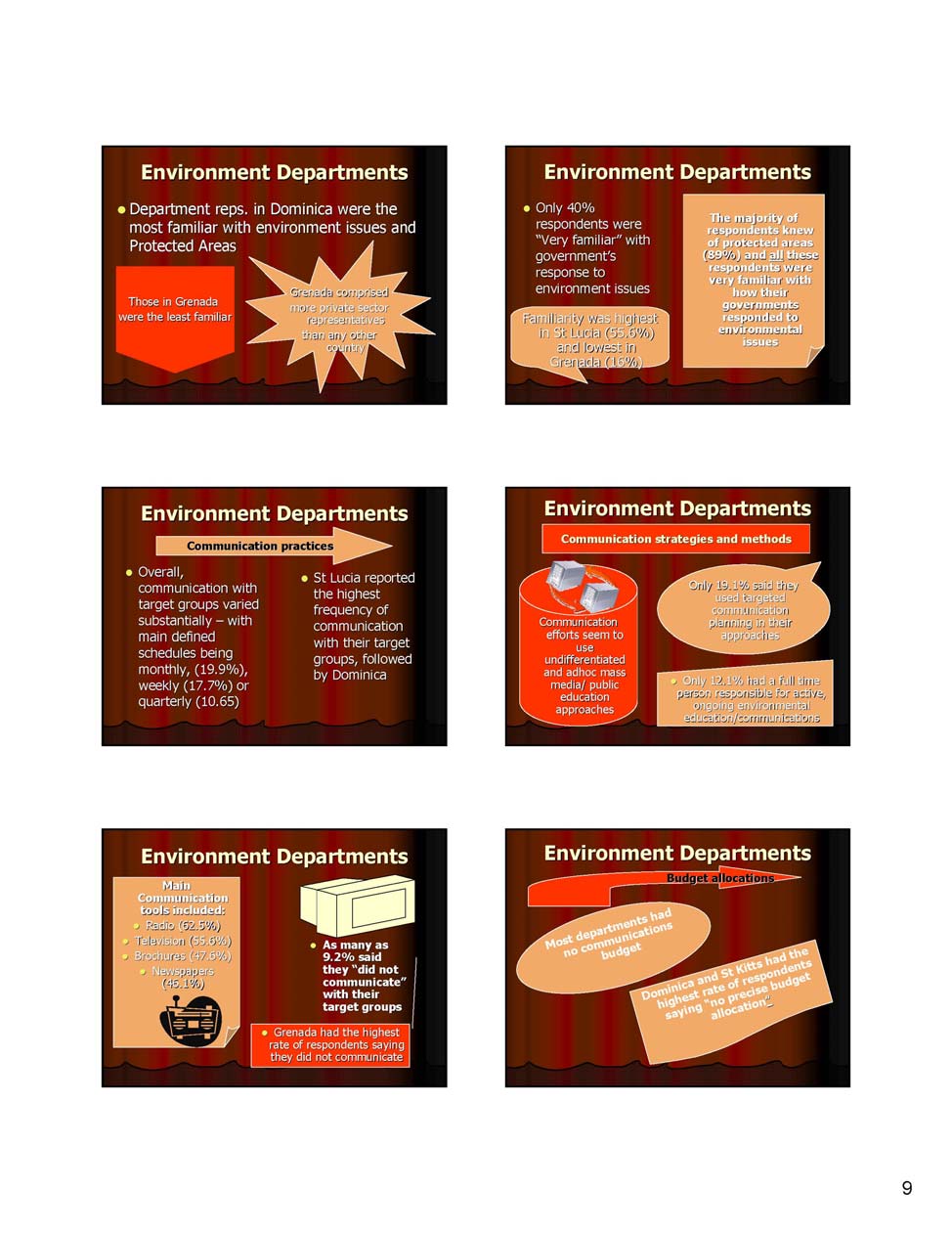
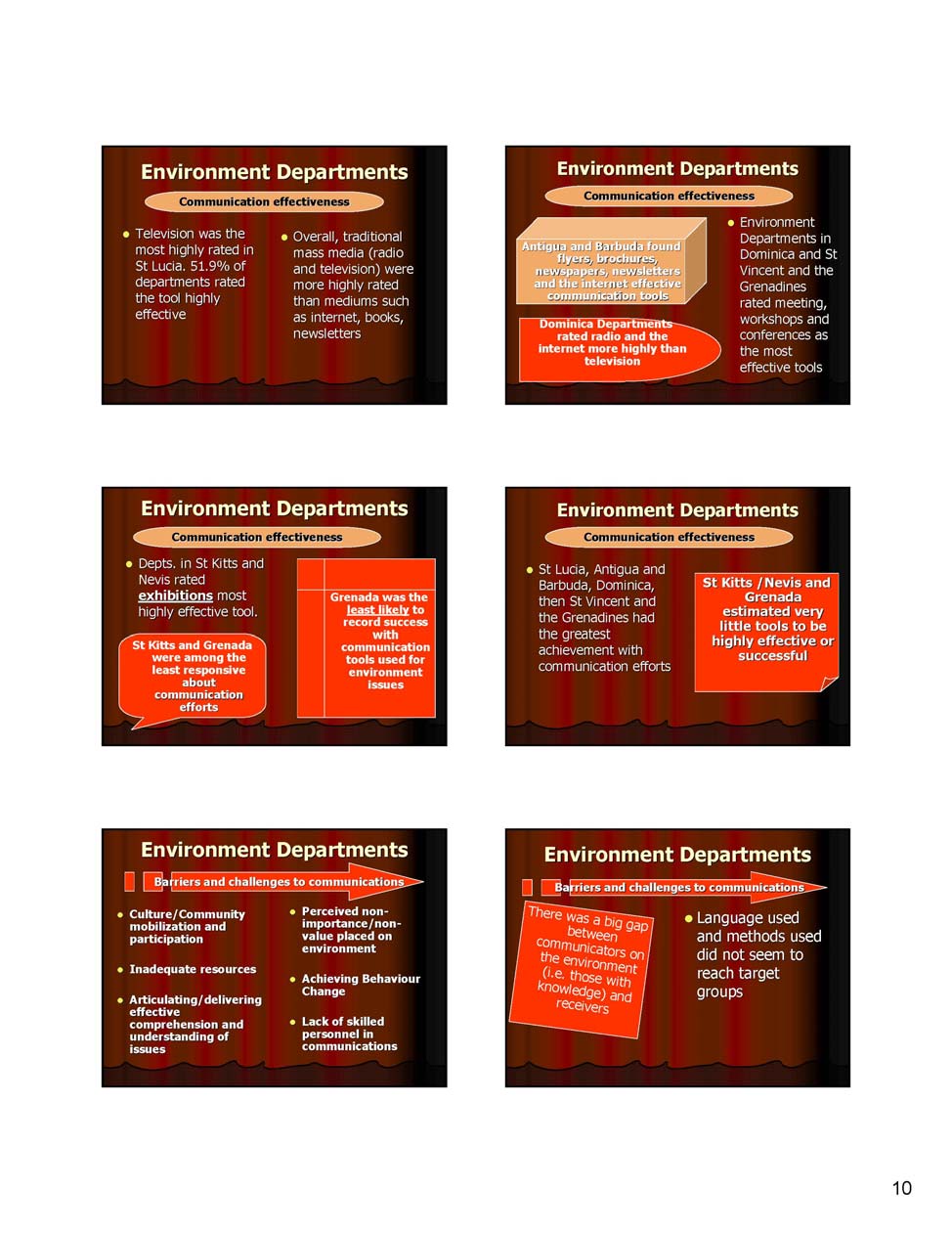
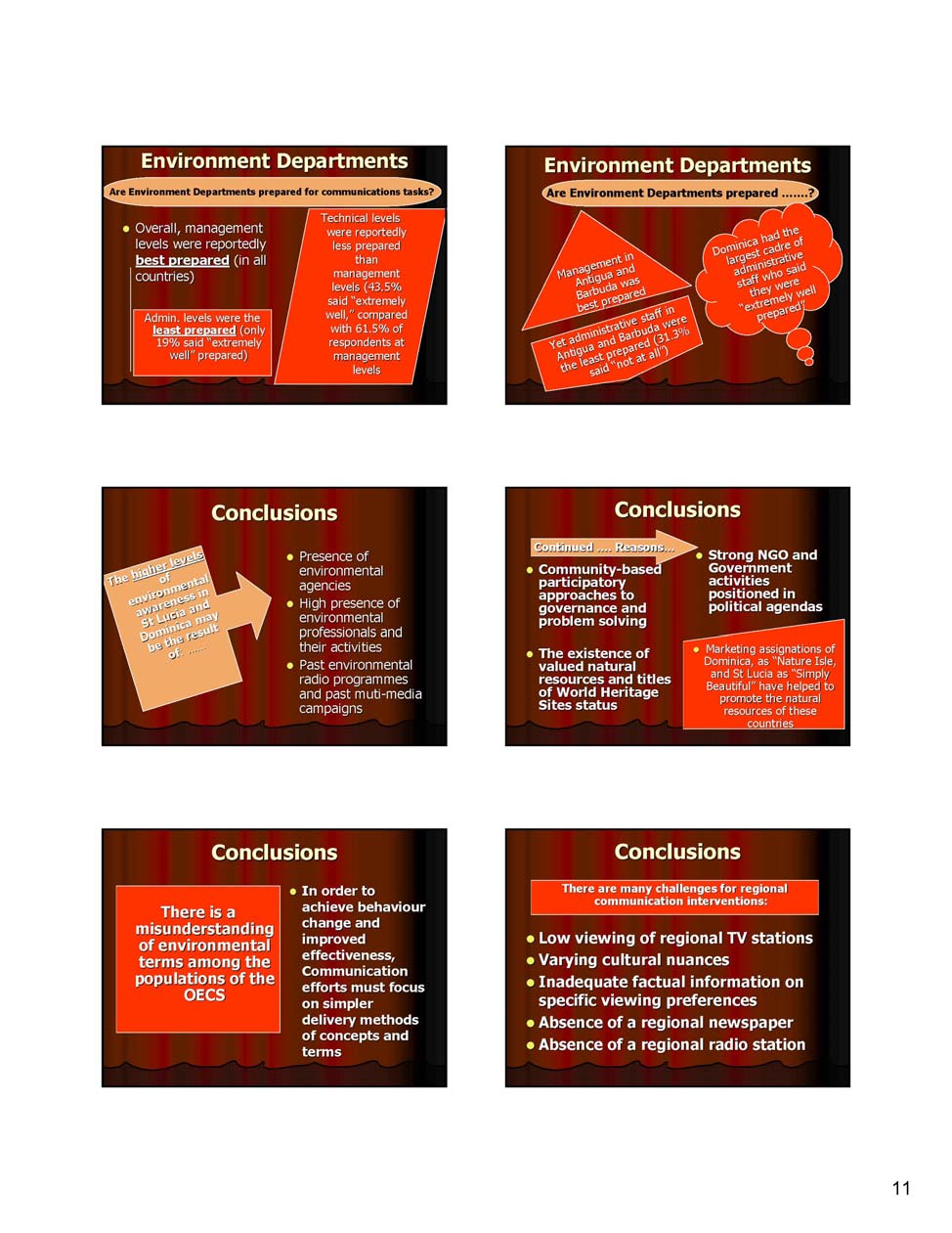
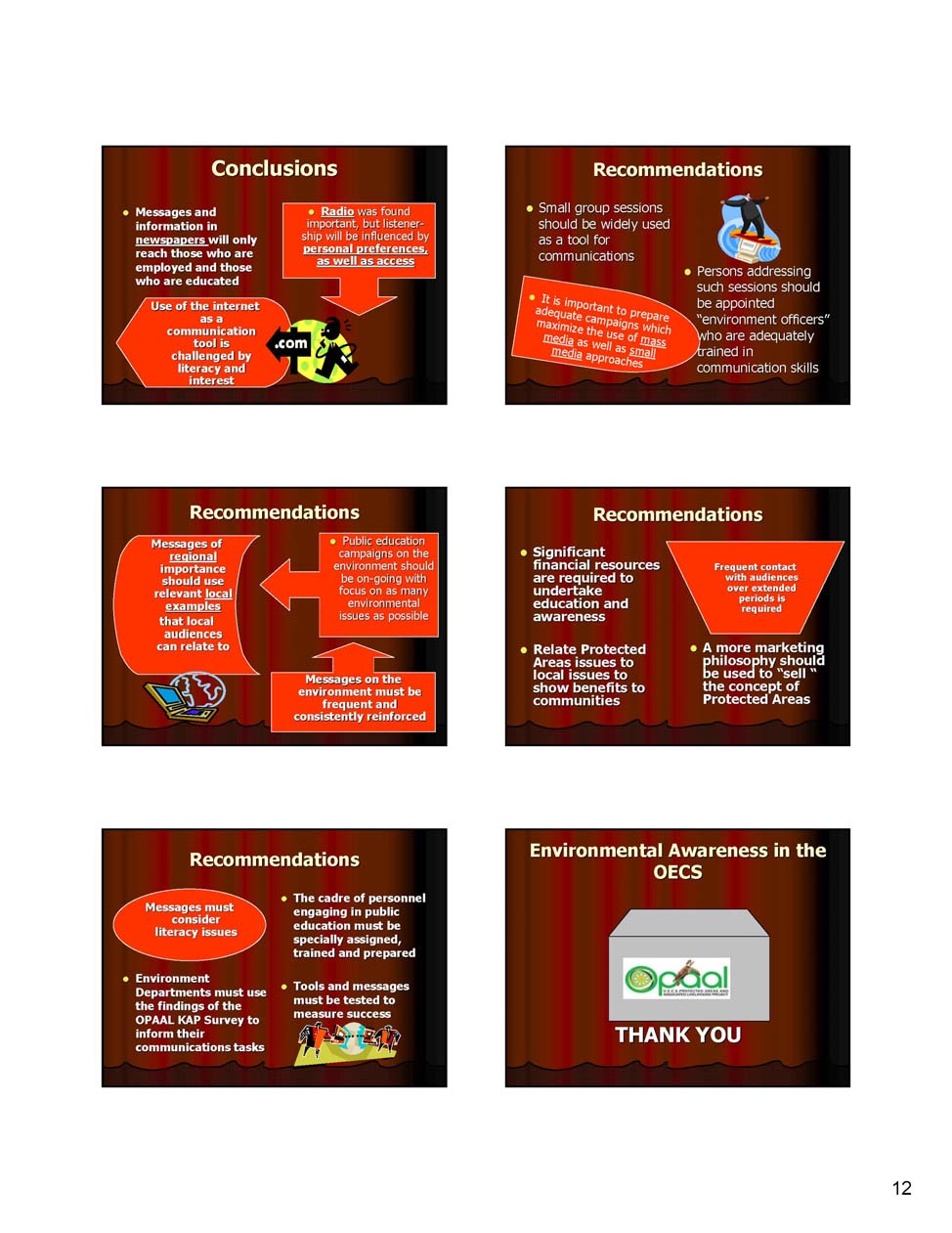
waste
No or improper
Limited investments Limited capital finance
Lack of public awareness
water discharge
waste water
in best practices for
Education
treatment
waste treatment and
disposal
Salinisation
(Sea- Over abstraction water demand
Inefficient water use Lack of knowledge or
Service cost recovery schemes
Water Intrusion)
exceeds renewable
culture of water
and market practices that do not
supply
conservation
encourage conservation
Population
growth,
Rural/urban economic
Inadequate development
urbanisation
inequities
planning
Increased tourism
National need for hard
Private sector income
currency earnings
Lack
of
knowledge
Non-existent,
Limited investments in
Lack of public awareness
about aquifer
inadequate, or
monitoring
education
41
dynamics &
unreliable data
recharge rates
Limited
human
resource
Limited human capacity
availability
Environmental
Causes
Issue &/or
1
2
3
OVERLAPPING/LINKED ROOT CAUSES
Problem
Surface Water- Contamination Agricultural
Run- Pesticide and
Limited knowledge of Fiscal and regulatory
Quality
Off
fertiliser over-use
sustainable
systems that encourage
Degradation
agricultural practices unsustainable agricultural
practices
Domestic
waste
See above regarding
water discharge aquifer
contamination
Industrial
effluent
See above regarding
discharge
aquifer degradation
Sedimentation
Land
degradation
Deforestation
Lack of reforestation
Inadequate land management
policies
Loss
of
vegetative
Over-grazing Inadequate
Poor land-use planning
cover
agricultural practices
Construction
Inappropriate
methods
Reduction in
Over-use Demand
exceeds
See above regarding
surface water
renewable supply aquifer depletion
Loss of
Land Conversion Rapid
Rural urban
Changing economic
Terrestrial
urbanisation
economic inequities trends
Biodiversity
Changes in human Population growth
settlement
patterns
Increasing
Demand for foreign
Tourism
exchange;
Private sector profit
Changes
in
Changing
economic
Globalisation & world
agricultural sector
trends
markets
Infrastructure
Inappropriate
Inadequate regulation Inadequate human
construction
technology
& control
resources,
42
Deforestation
Unsustainable
Increasing demand for Poor regulation and control Land tenure and ownership
exploitation
fuel wood, timber
in the forestry sector
issues
43
Environmental
Causes
Issue &/or
1
2
3
OVERLAPPING/LINKED ROOT CAUSES
Problem
Loss of wetlands Reduction in
Over abstraction See above in
freshwater
stream flow
relation to
biodiversity
reduction in surface
water supply
Drainage
Changes
in
land
use
Loss of marine Over-
Demand for
Population growth Unregulated poorly
Open access, lack of
See above
biodiversity
exploitation
marine products Export demand
regulated fisheries
stakeholder ownership
sector
Loss of coastal Unplanned or
Lack of regulation Use of inappropriate
habitats,
Poorly Planned
& control Changing technology
spawning and
Coastal
economic activities
feeding grounds Development
Changed
coastal
Uncontrolled
See above in
water quality
waste water
relation to aquifer
discharge
degradation
Land
Loss of
Deforestation
See above
Land Tenure Issues
Degradation
vegetative cover
Soil
erosion
&
Over-grazing
Land
Tenure
Issues
loss
Chemical
Limited or no
Little important
No culture of
No understanding of the Lack of knowledge about
changes in soils stakeholder
given to
participation
benefits of stakeholder
the participatory process
participation
stakeholder
participation
participation
Agriculture,
Inappropriate
No legal
construction
Agricultural
framework to allow
for stakeholder
participation
Practices
No institutional space for stakeholder participation
Coastal
Sand-Mining
Increased demand for sand for construction
Inadequate regulation and control
44
Erosion
Sea level rise
Changing economic
activities
Coastal
Increasing tourist activity Poor land-use planning
Inadequate or non-existent regulations and laws
Construction
and demand
45
Appendix VI:
Presentation Communication for Development
46
47
48
49
50
51
52
53
54
55
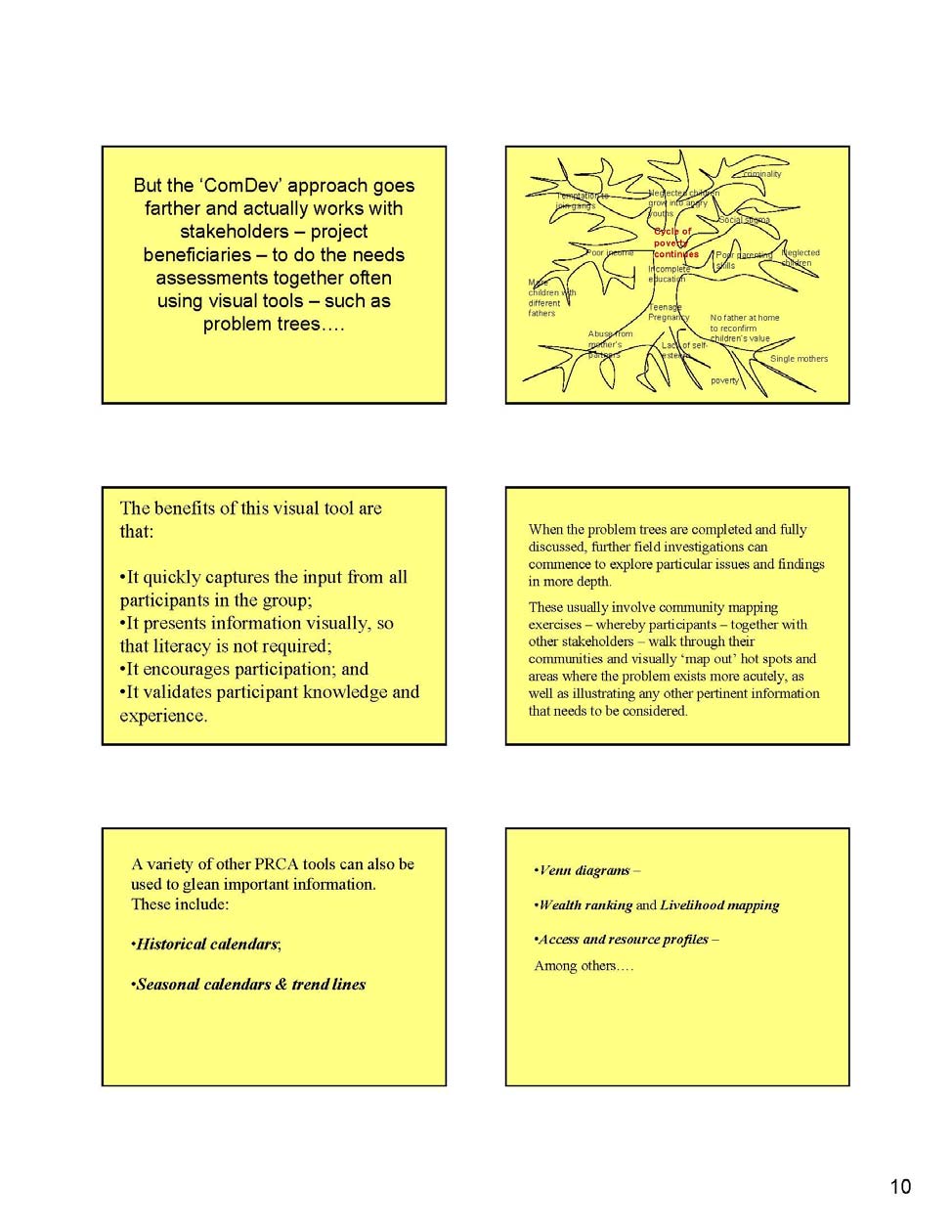
56
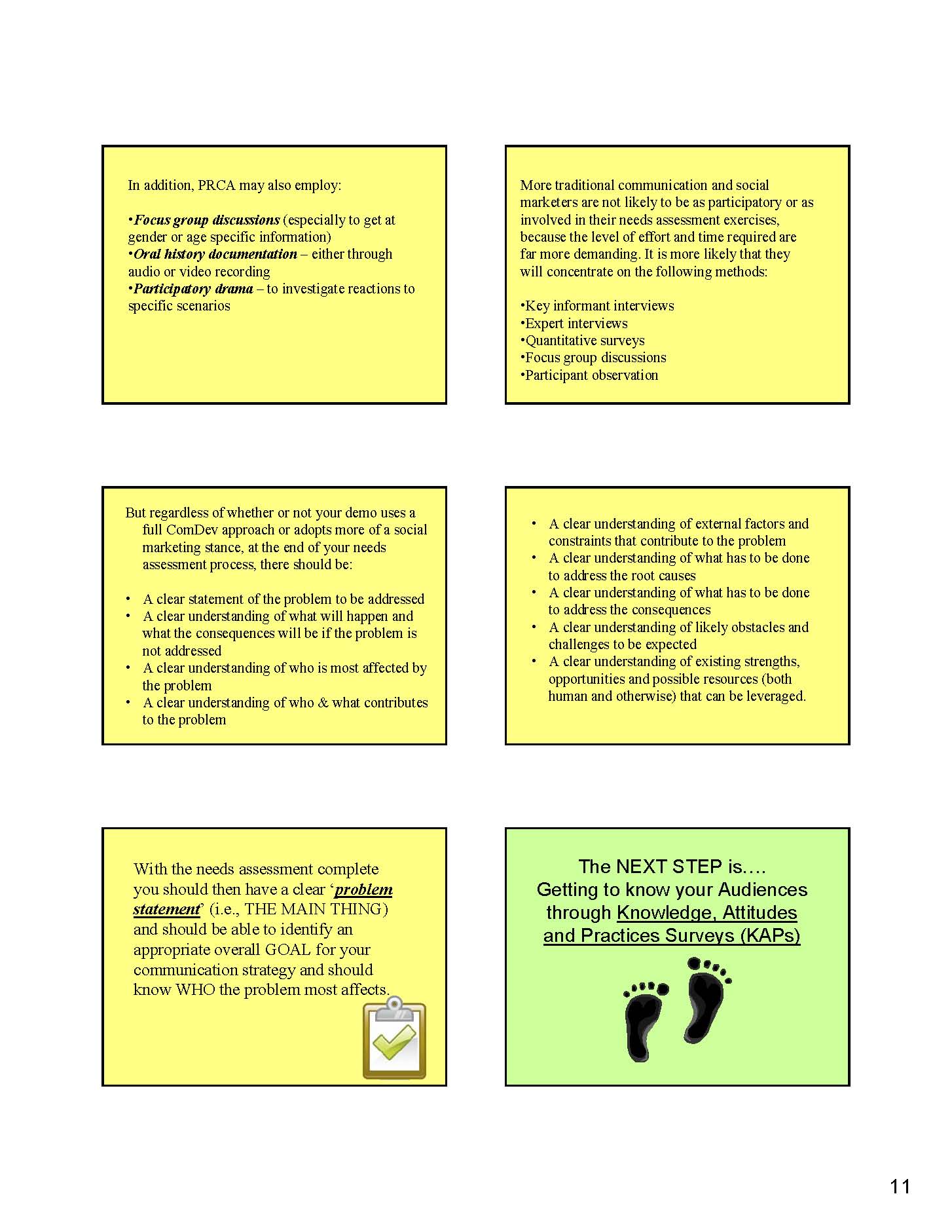
57
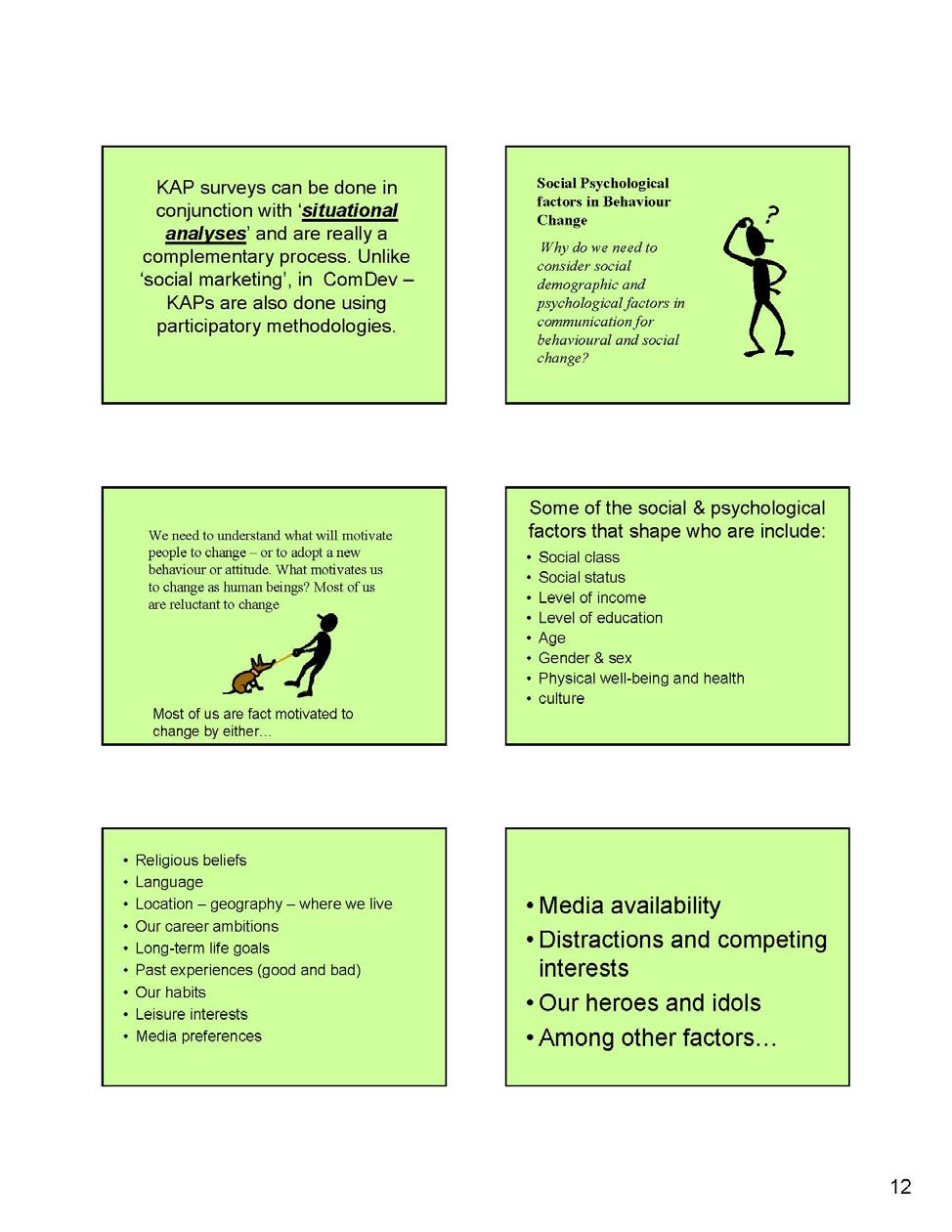
58
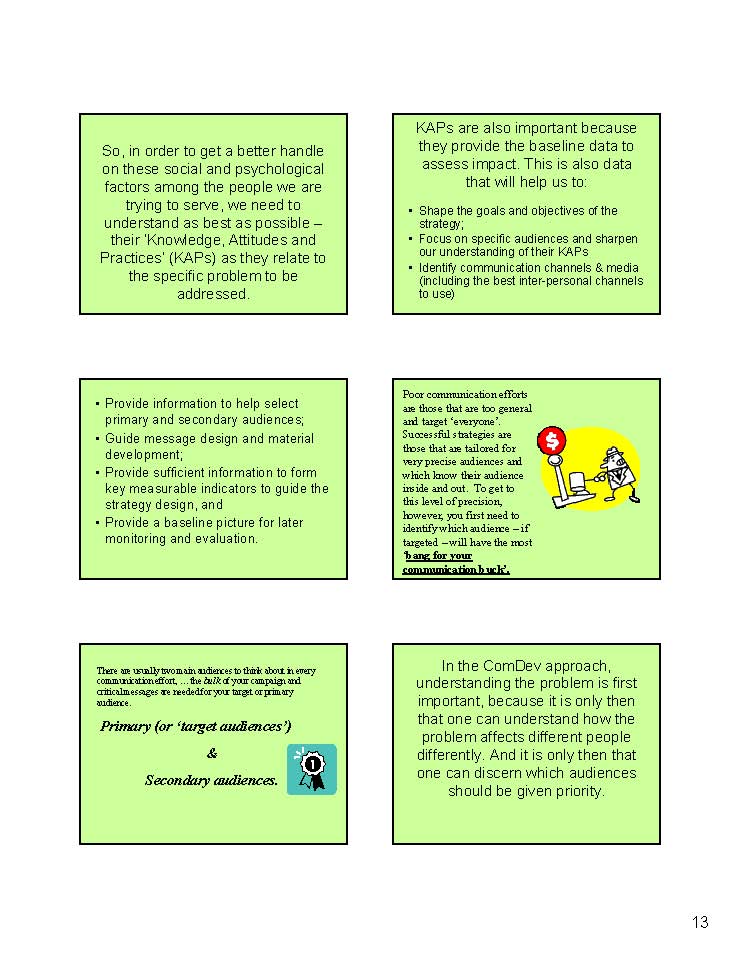
59
60
61
62
63
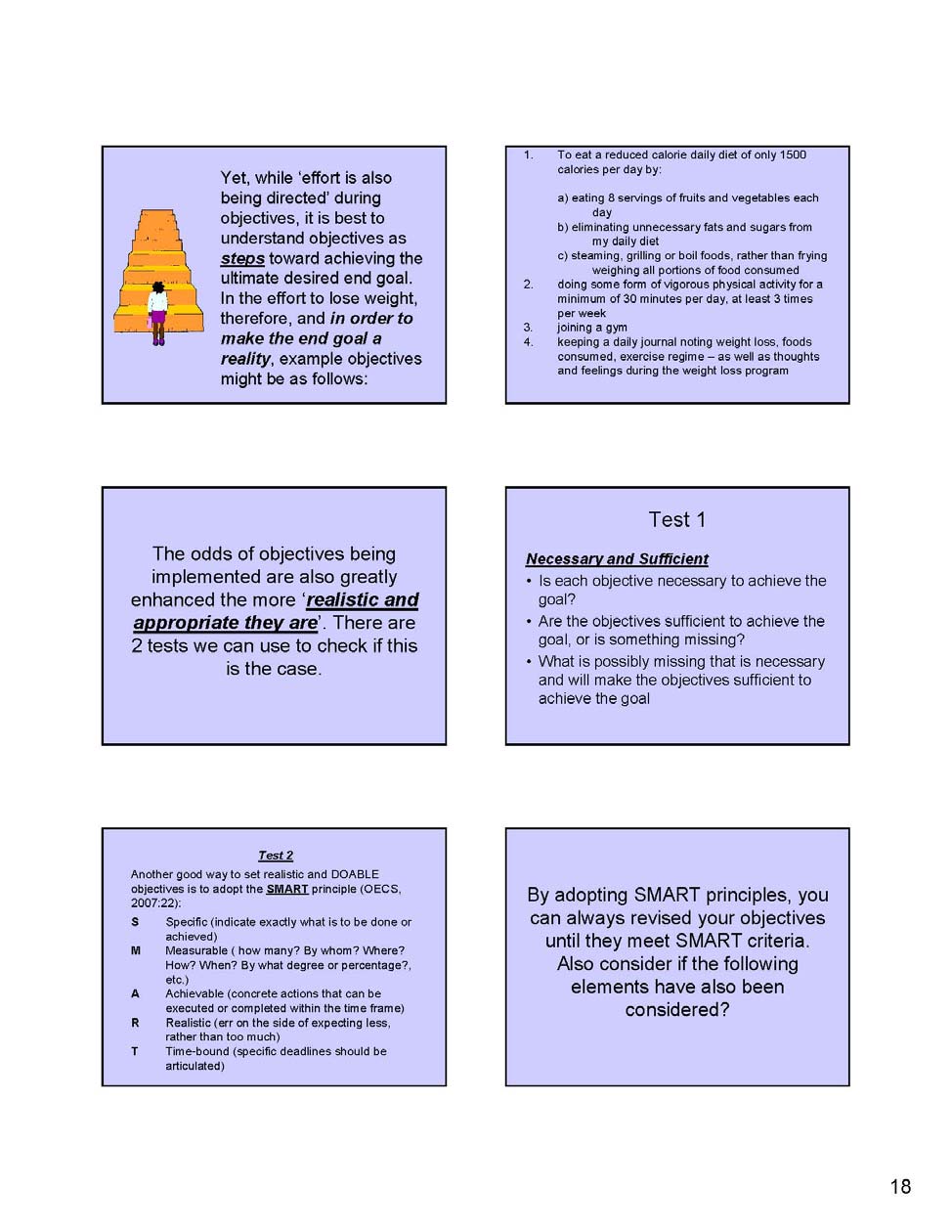
64
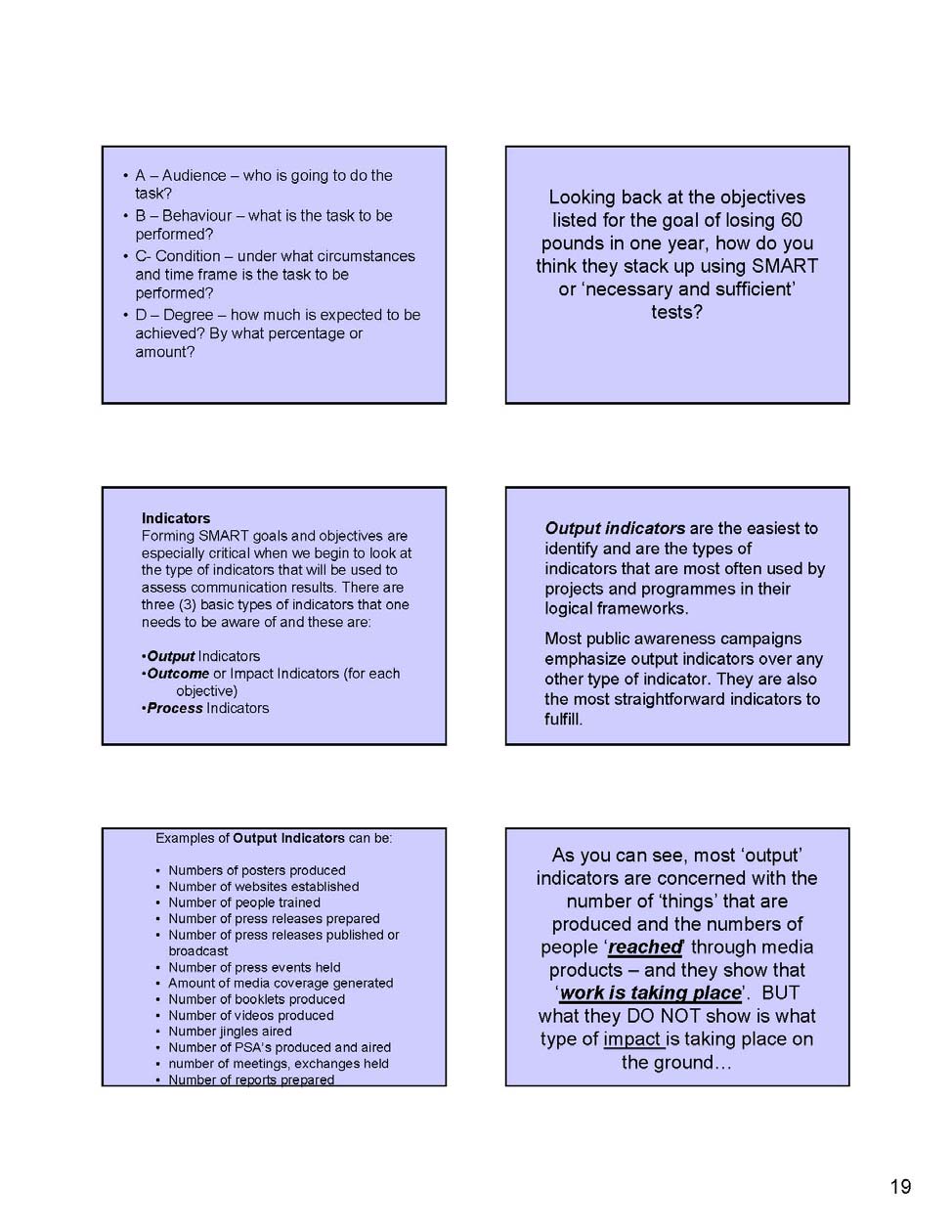
65
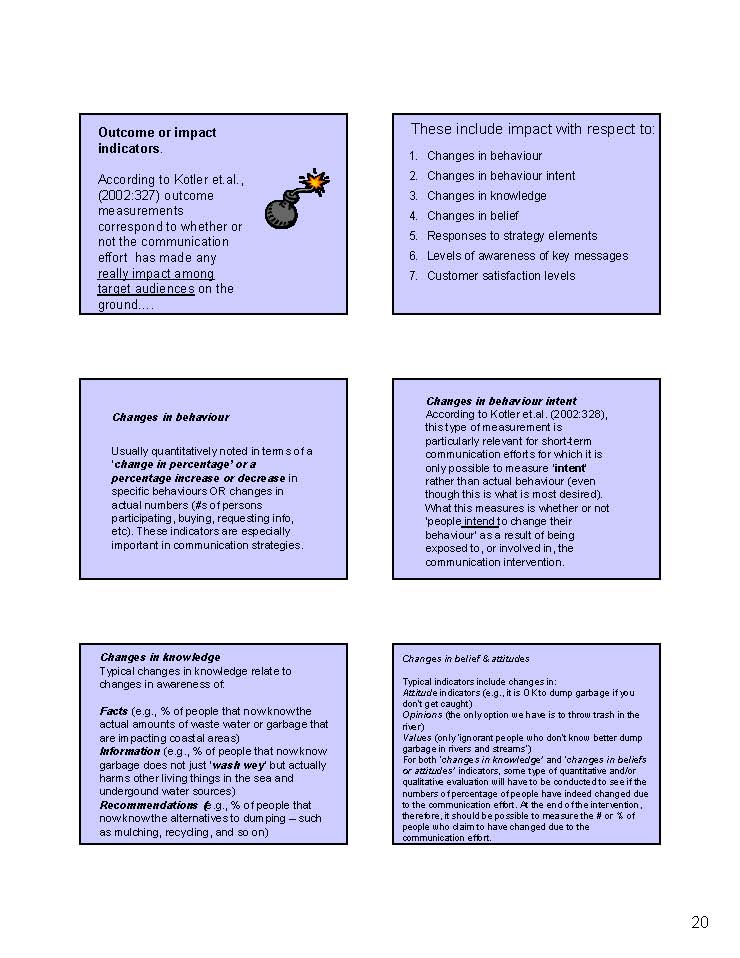
66
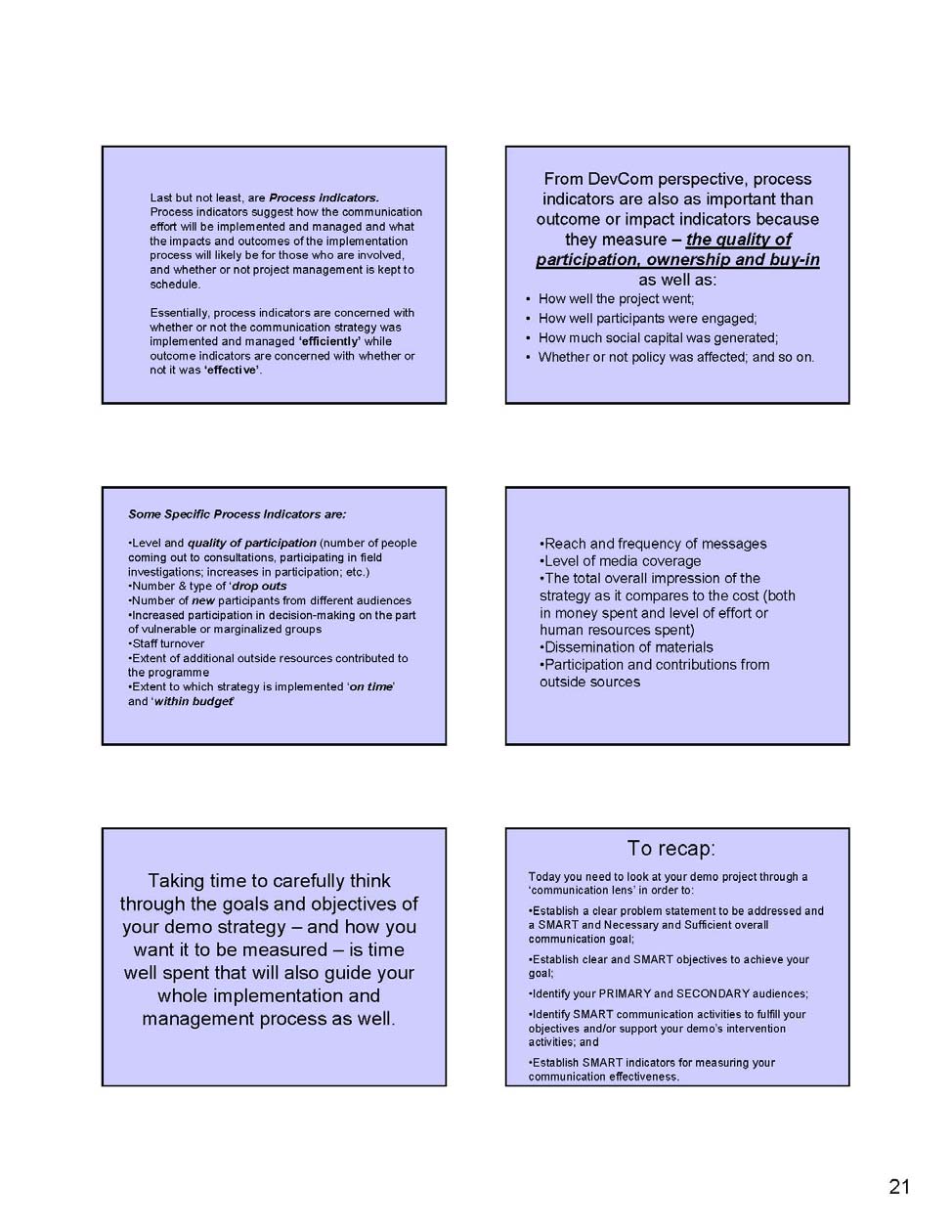
67
Appendix VII:
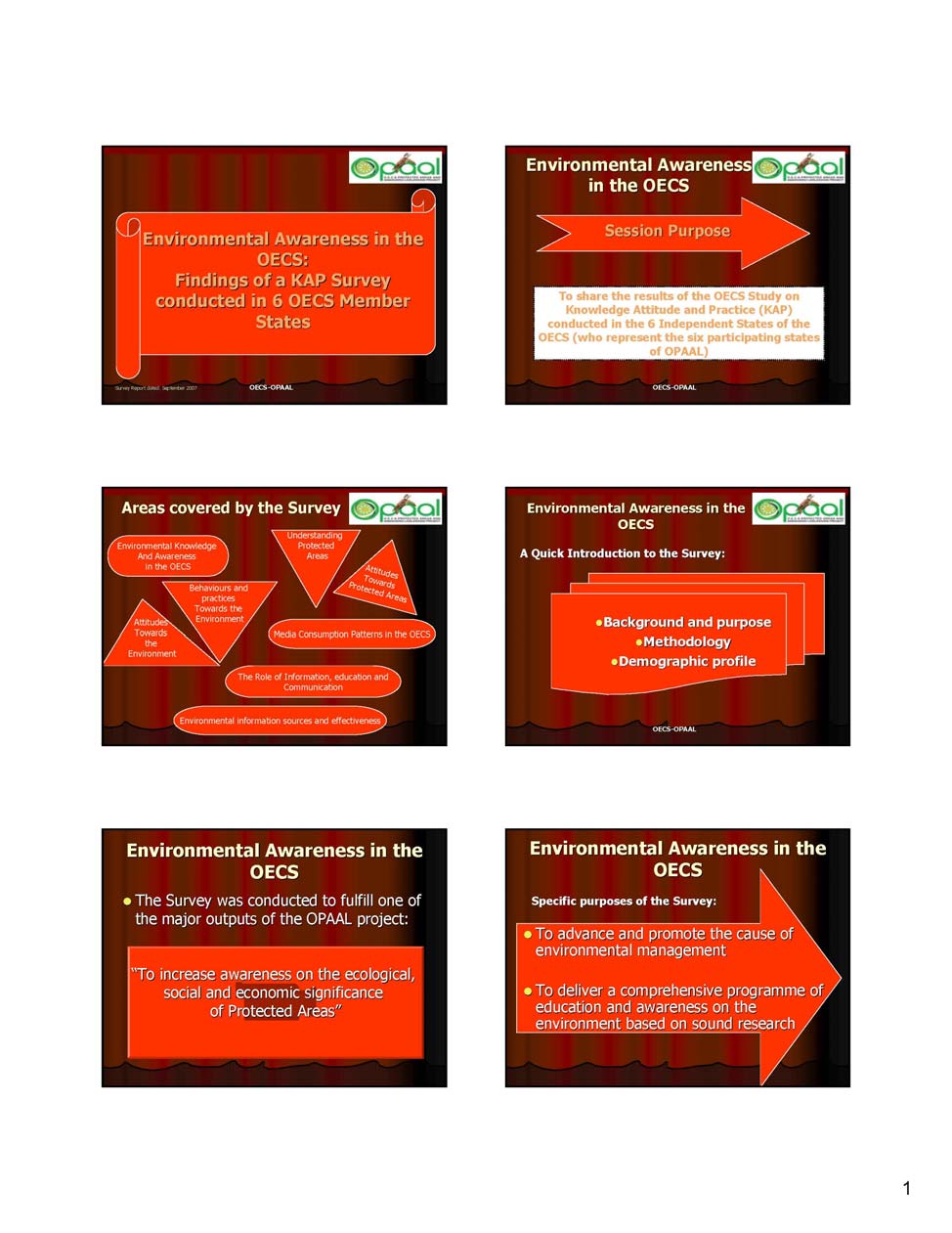
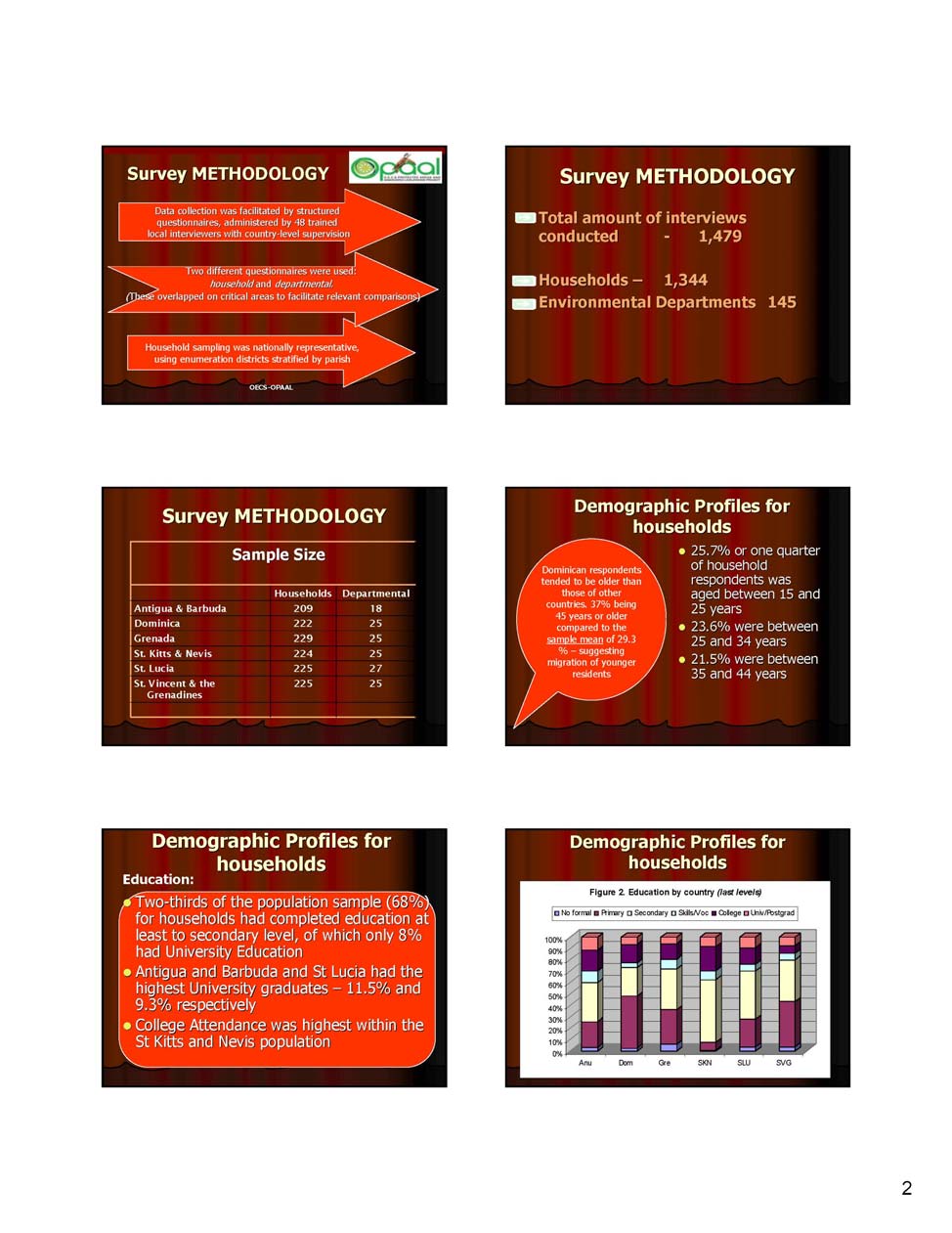
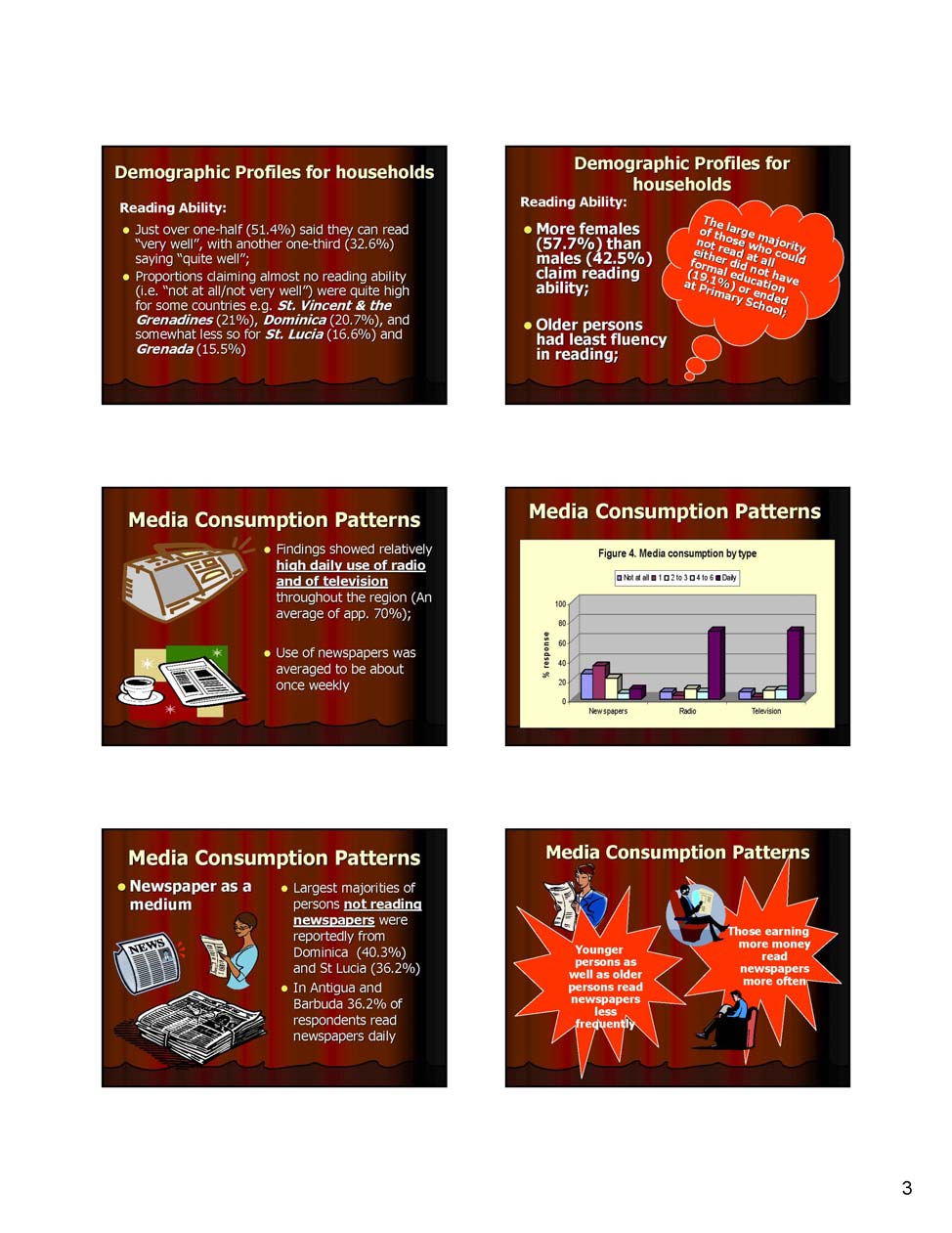
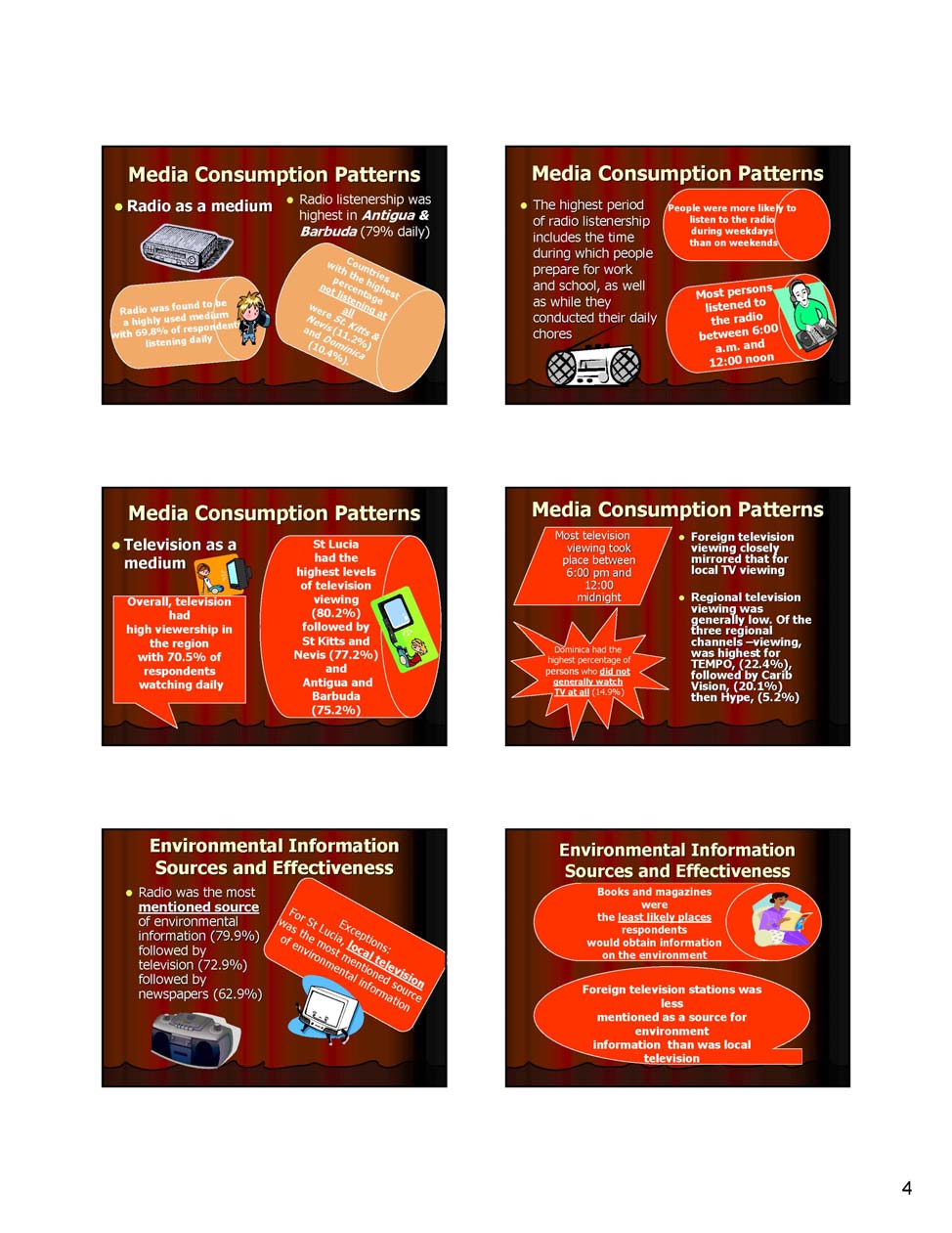
Presentation - Summary of OPAAL OECS Knowledge, Attitudes and Practices
Survey
68
69
70
71
72
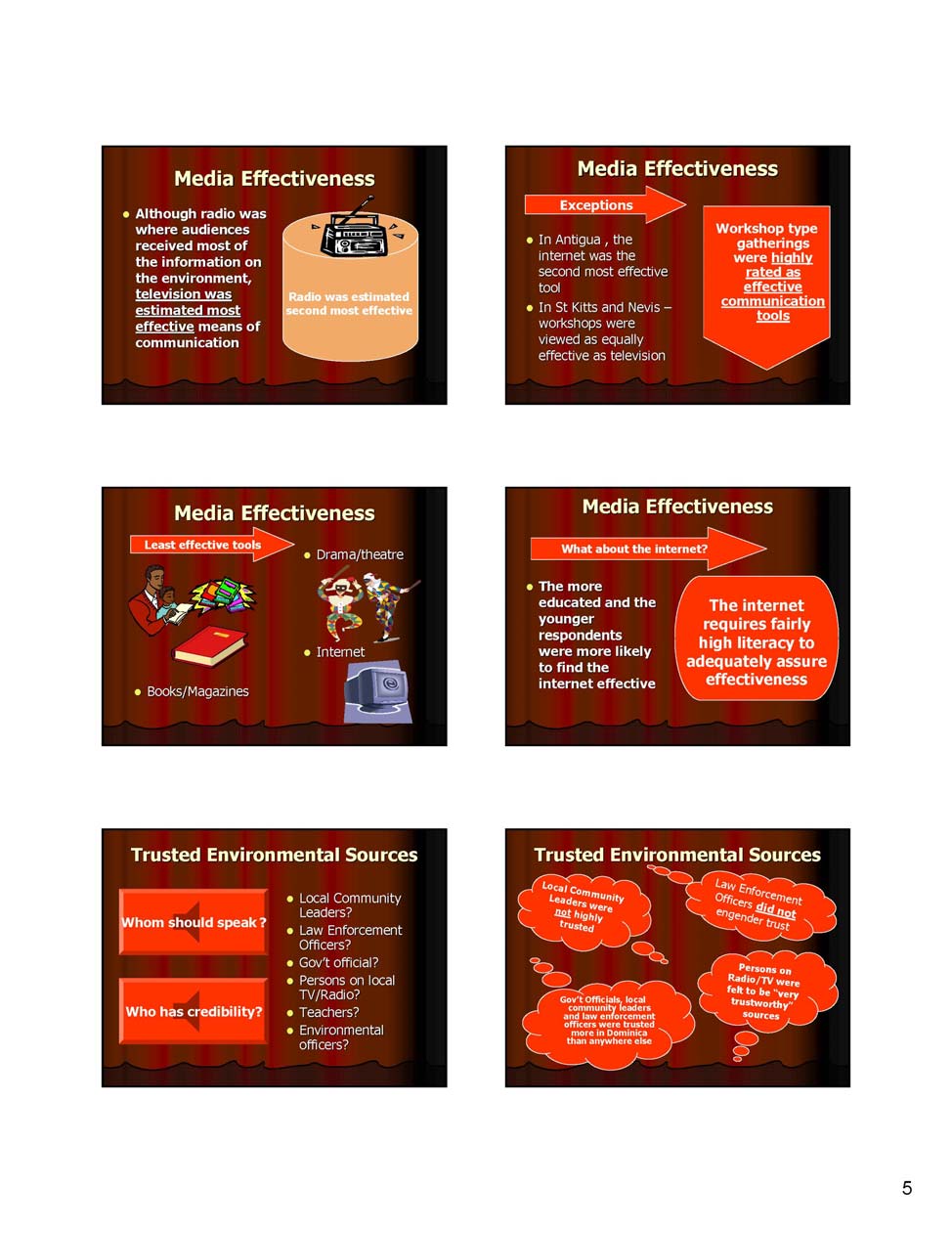
73
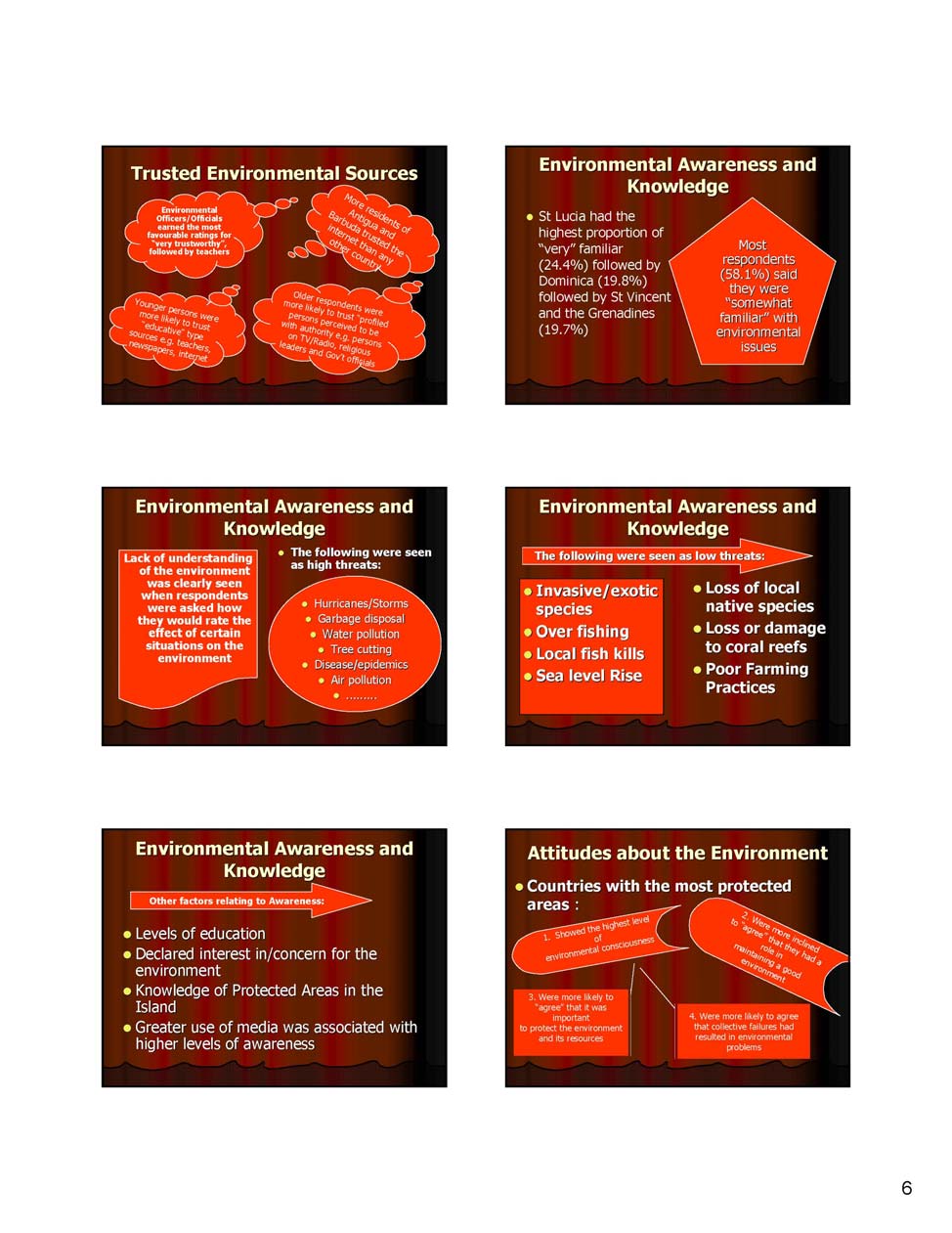
74
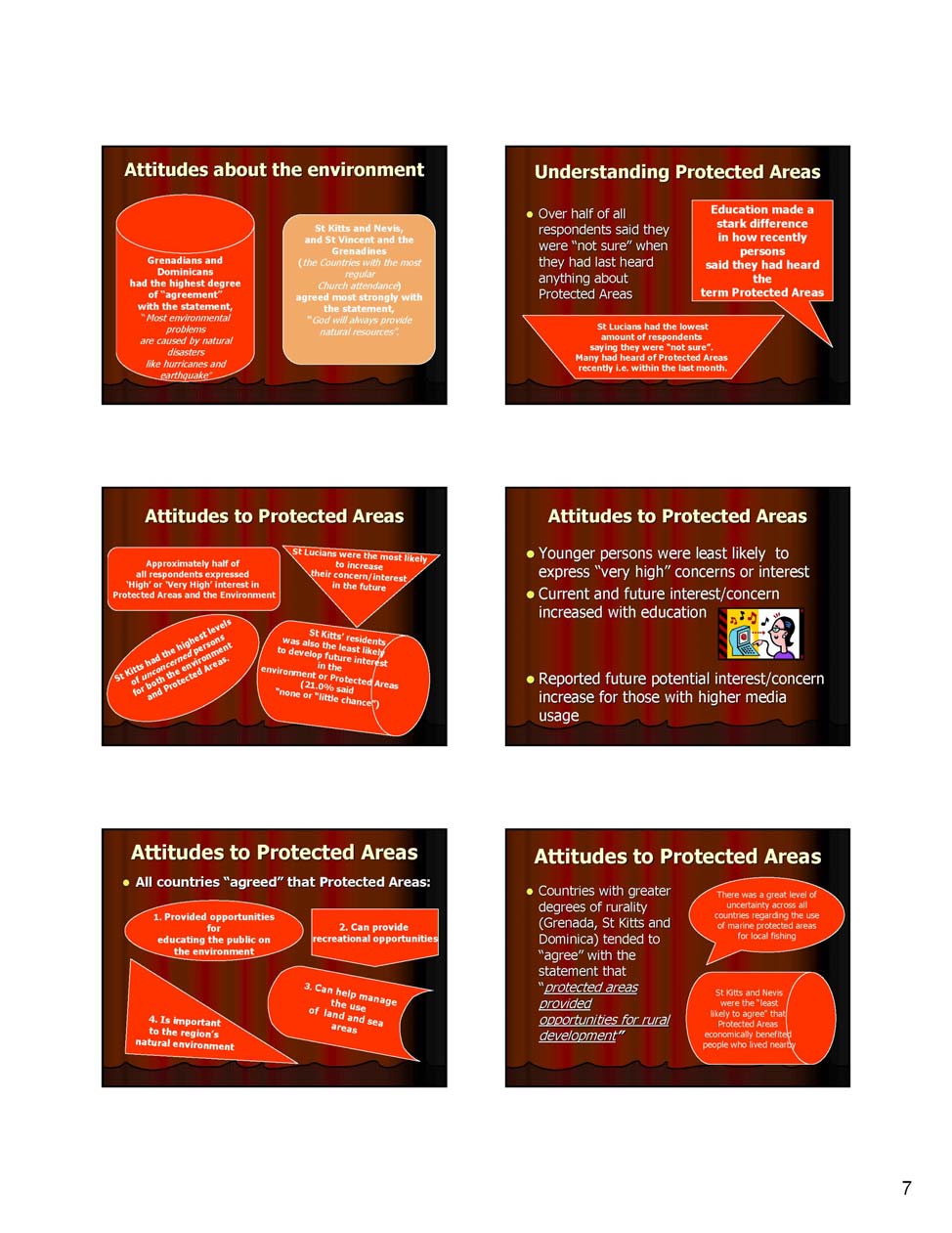
75
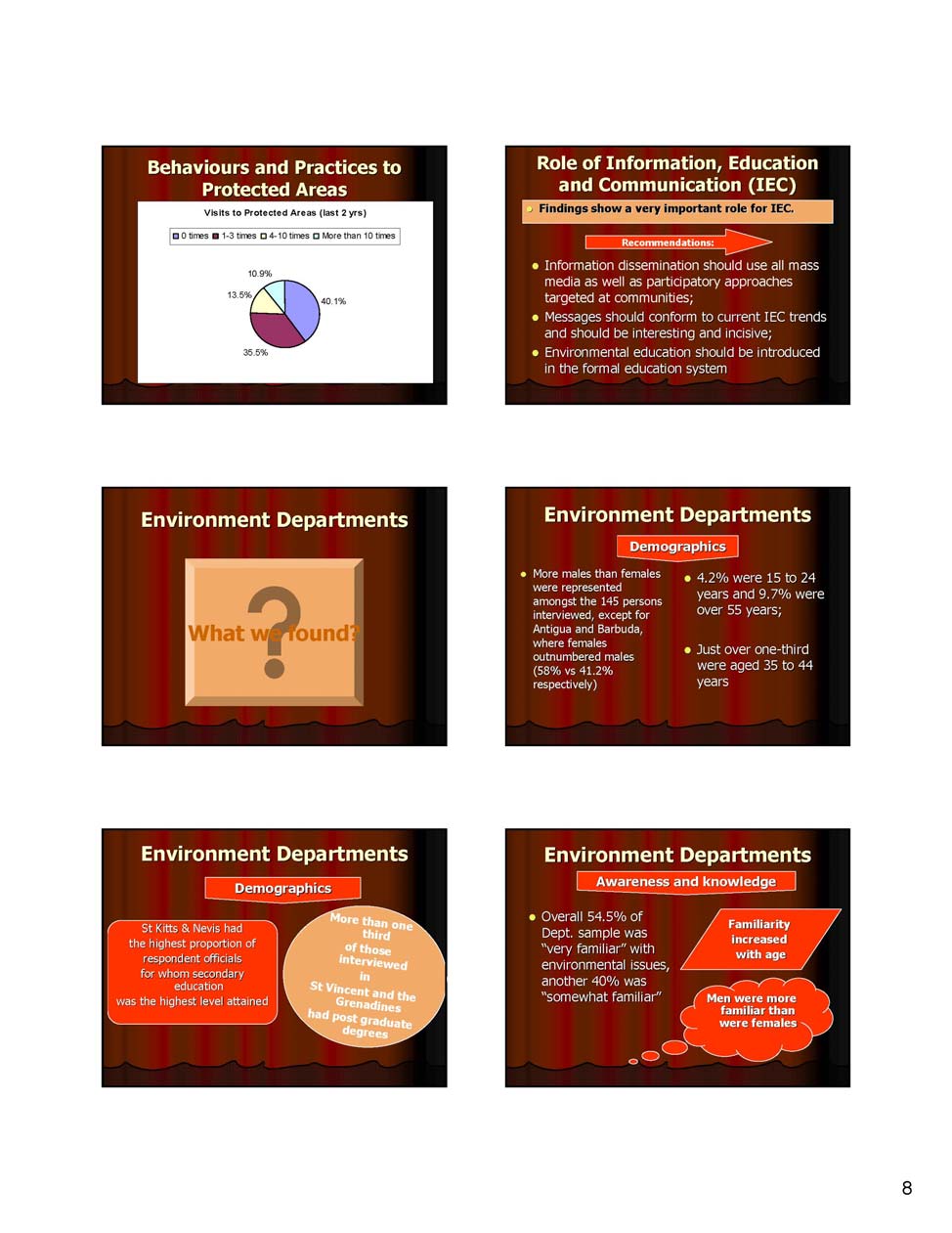
76
77
78
79
80
Appendix VIII:
Strategic Communications Planning Handouts,
Numbers 1 5
81
82
Communications for Development Working Session
DAY I Handout #1
Demo Project_________________________________ Country _______________________________________
IDEAL "Knowledge" & "Attitudes"
GAPs to be addressed
Actual Reality
Our Demo Project Hopes to Achieve
Current "Knowledge & Attitudes"
IDEAL "Practices and Behaviours"
GAPs to be Addressed
Actual Reality
Our Demo Project Hopes to Achieve
Current "Practices and Behaviours"
83
Communications for Development Working Session
DAY I Handout #2
Audience Identification
Our Primary Audience:
Which one main group of people, if we were able to change their attitudes, practices and
behaviours would address or solve 80 percent of the problem?
What are the characteristics of this target group? (age, education level, gender
considerations, socio economic status, location, beliefs, religious preferences, aspirations, media
preferences, and so on?) The better you can describe this group and the more detailed
information that you have about them the more targeted and strategic you strategy will be).
84
Our secondary Audience(s):
Which other groups might we need to address first in order to get to our primary audience?
What are the characteristics of this secondary (audience)? (age, education level, gender
considerations, socio economic status, location, beliefs, religious preferences, aspirations, media
preferences, and so on?) The better you can describe this group and the more detailed
information that you have about them the more targeted and strategic you strategy will be).
85
Communications for Development Working Session
DAY I Handout #3
Based on our analysis of the "GAPs" in Knowledge, Attitudes, Practices and Behaviours
(KAPBs) what is the overall goal we should be trying to achieve through our demo project? (Be
sure to write it as a S.M.A.R.T. goal.
Goal:
Our objectives, and the steps we need to take to achieve this goal are:
Objectives:
(be sure that these are also SMART and Necessary & Sufficient)
1.
2.
3.
4.
86
Communications for Development Working Session
DAY I Handout #4
Objective
Corresponding Demo
Development
Intervention (if any)
Type of communication
Audience Time
Indicators
Intervention
Frame
Output
Process
Outcome/Impact
(also SMART and N&S)
Indicators
Indicators
Indicators
(increase or decrease, %age
change...)
87
Handout # 5: Strategic Communications Planning
Purpose of the IWCAM Sub-Project
1. Needs Assessment and Situational Analysis
2. Existing Knowledge, Attitudes, Practices & Behaviours (KAPBs)
Assessment
3. GAPs in the KAP
4. Problem Statement and
5. Identification of Primary
Overall Goal Clarification
and Secondary Audiences
88
6. Setting Objectives
SMART and Necessary and
Sufficient
7. Development
7. Communication
Intervention
Activity
Activity
8. Indicators:
8. Indicators:
Output
Output
Process
Process
Outcome/Impact
Outcome/Impact
89
Appendix IX:
Presentation Making the Most of the Media
90
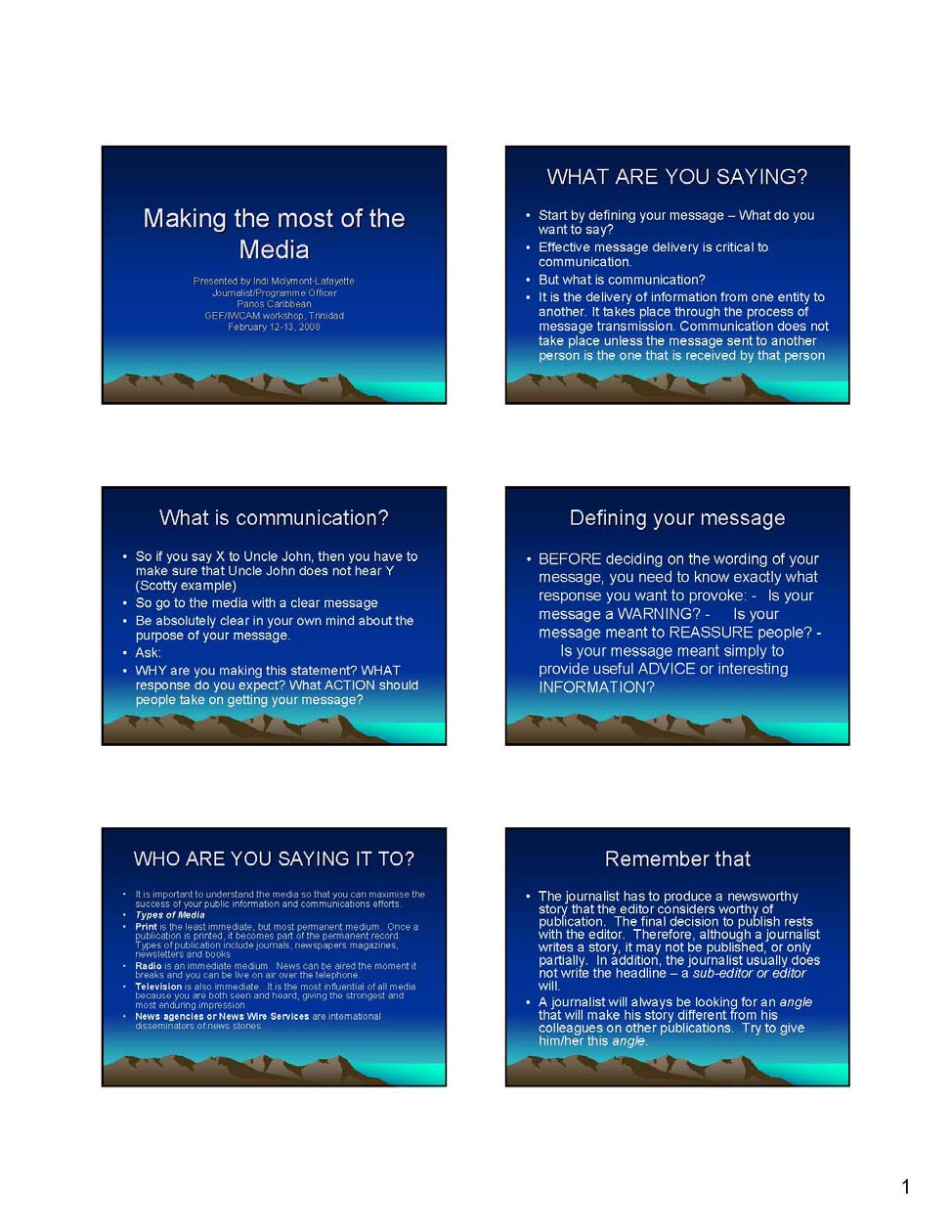
91
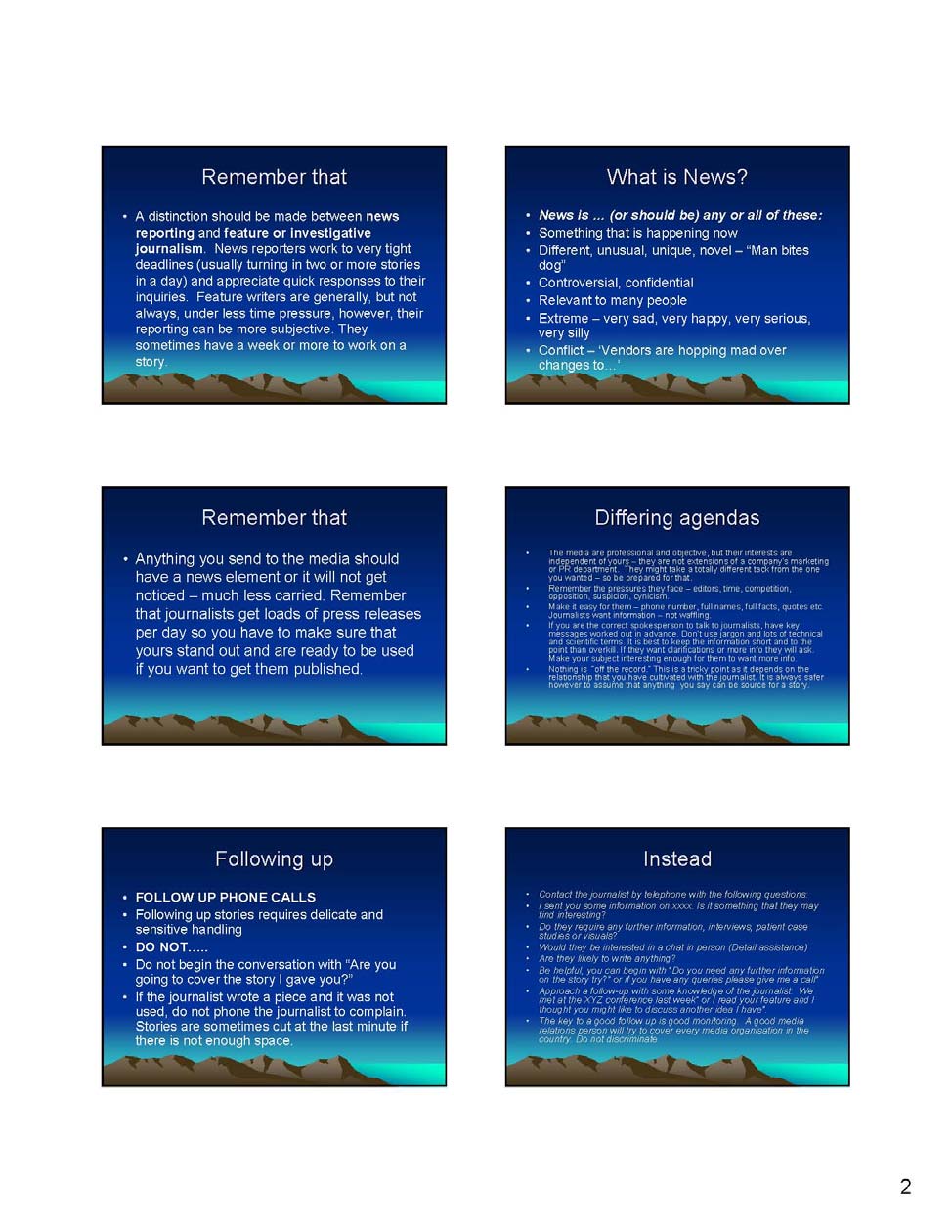
92
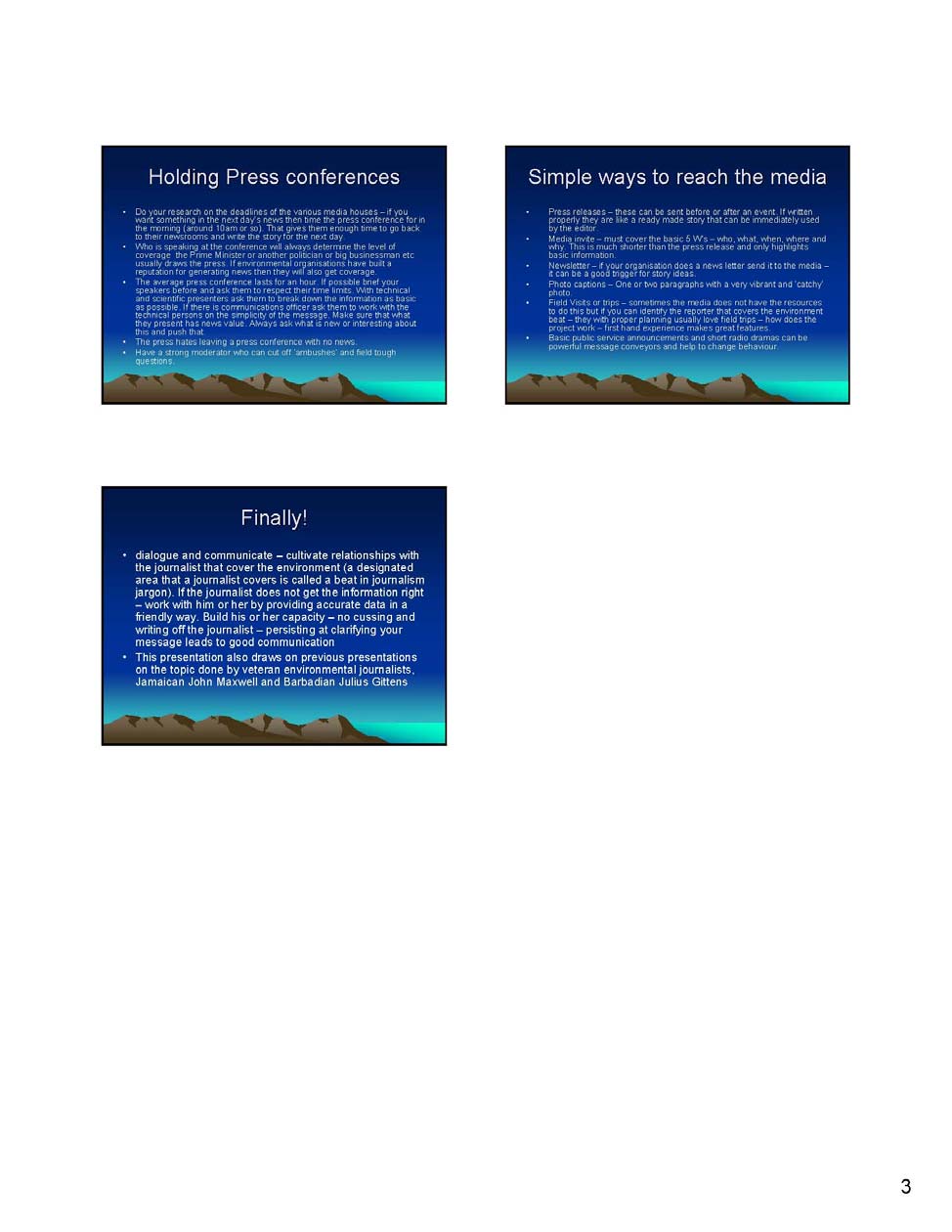
93
Appendix X:
Media Conference Programme
94
Global Environment Facility funded Integrating Watershed and Coastal Areas Management in
Caribbean Small Island Developing States (GEF-IWCAM) Project*
MEDIA CONFERENCE
13 February 2008, Kayak Room, Kapok Hotel, Port of Spain
2:00 pm
Programme
Donna Spencer, Communications,
2:00 2:05 pm
Introduction
Networking and Information Specialist,
GEF-IWCAM
"Think About Water" Video Shorts Nos. 1 and 2,
2:05 2:10 pm
(DVD showing)
The GEF-IWCAM Project: Objectives and Benefits for
Vincent Sweeney, Regional Project
2:10 2:20 pm
the Caribbean
Coordinator, GEF-IWCAM
The Trinidad and Tobago GEF-IWCAM Demonstration
Project: "Land-Use Planning and Watershed Restoration Sandra Timothy, Demonstration Project
2:20 2:30 pm
in the Courland Watershed and Buccoo Reef Area,
Manager
Tobago."
2:30 2:45 pm
Questions from the Media
Moderator: Donna Spencer
2:45 3:00 pm
Feedback from the Media
Moderator: Donna Spencer
The End
3:00 3:30
Refreshments
Media invited
* The GEF-IWCAM Project is co-implemented by the United Nations Development Programme (UNDP) and the United Nations
Environment Programme (UNEP) and co-executed by the Caribbean Environmental Health Institute (CEHI) and the Secretariat of
the Cartagena Convention (UNEP CAR-RCU).
95
Appendix VI:
Media Conference Presentation
The GEF-IWCAM Project:
Objectives and Benefits for the Caribbean
96
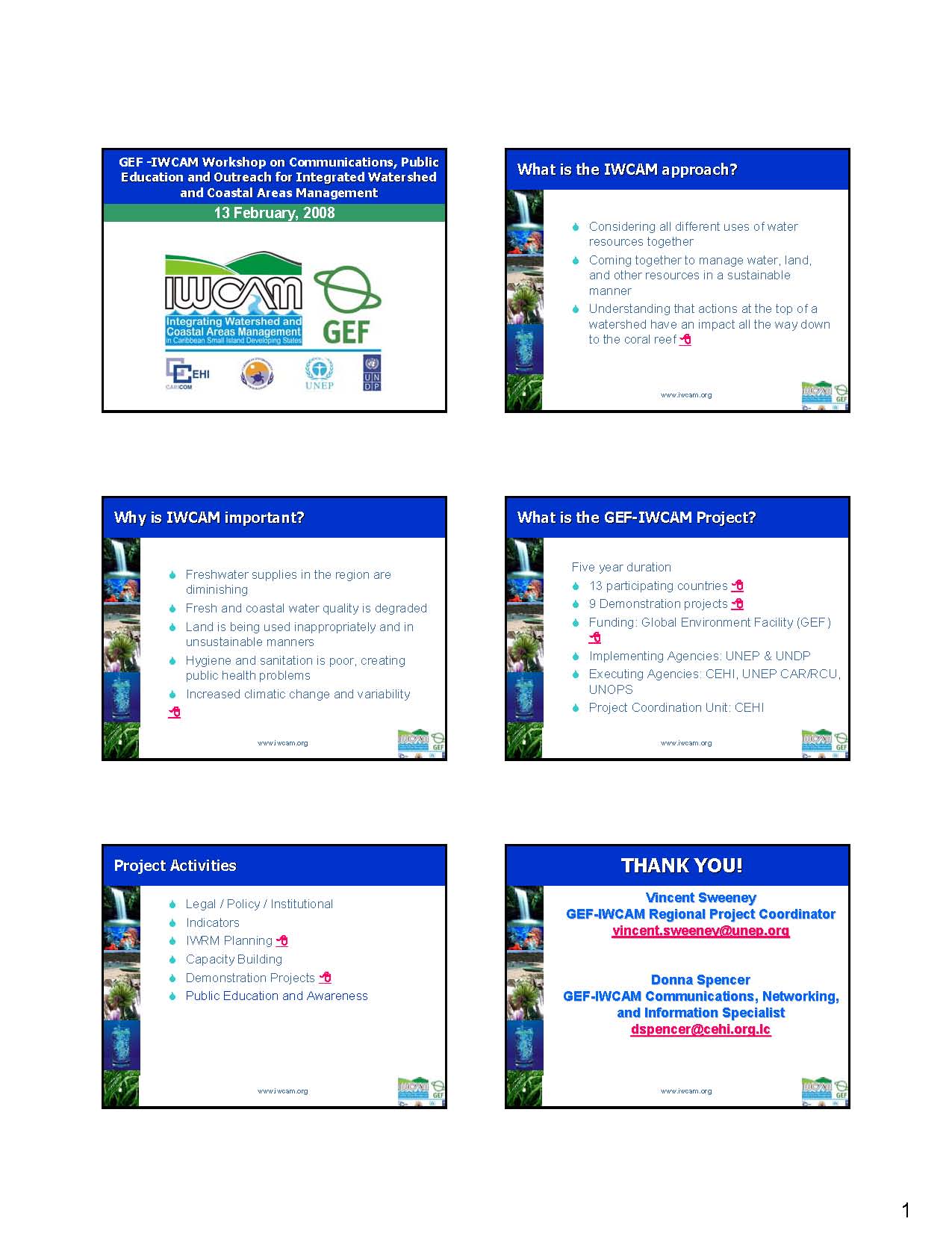
97
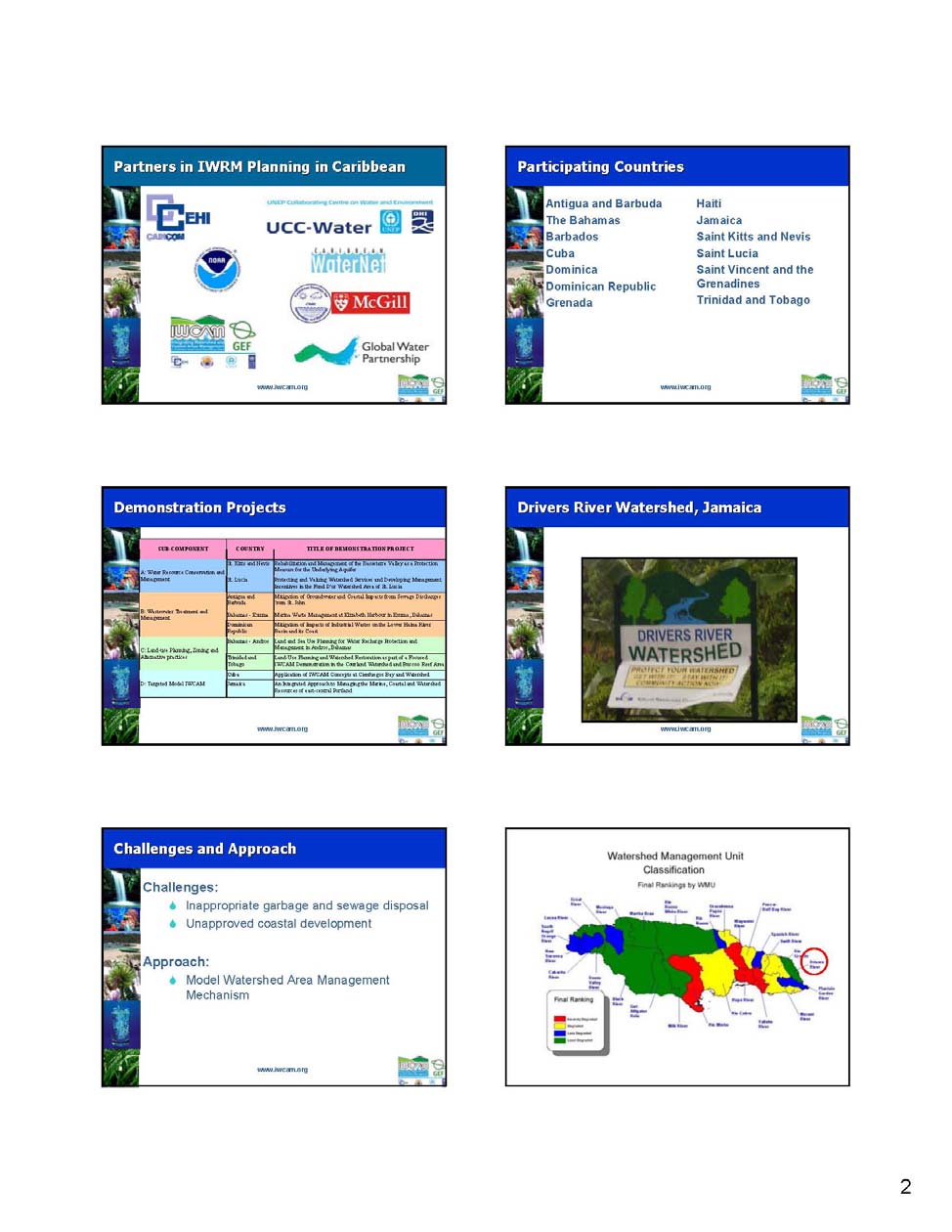
98
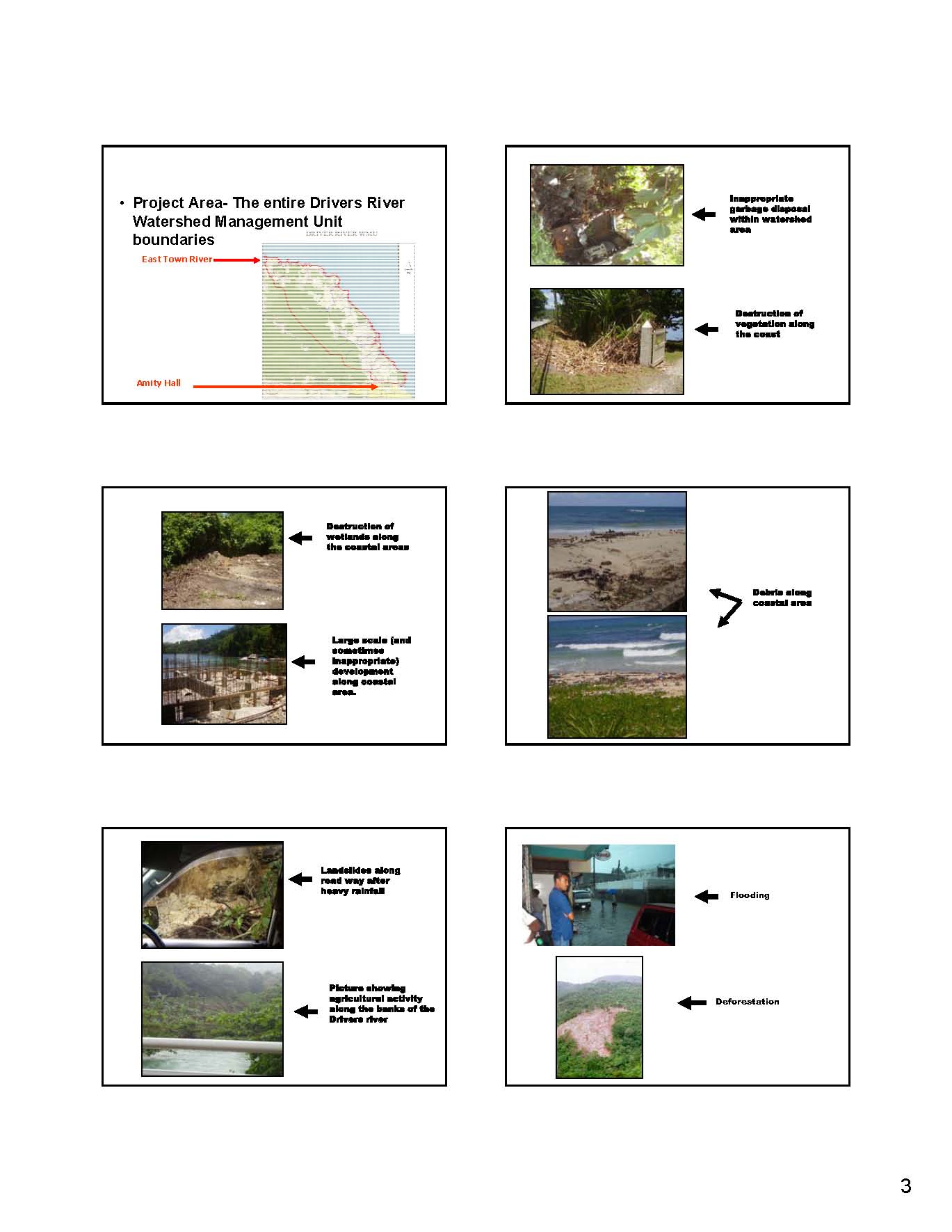
99
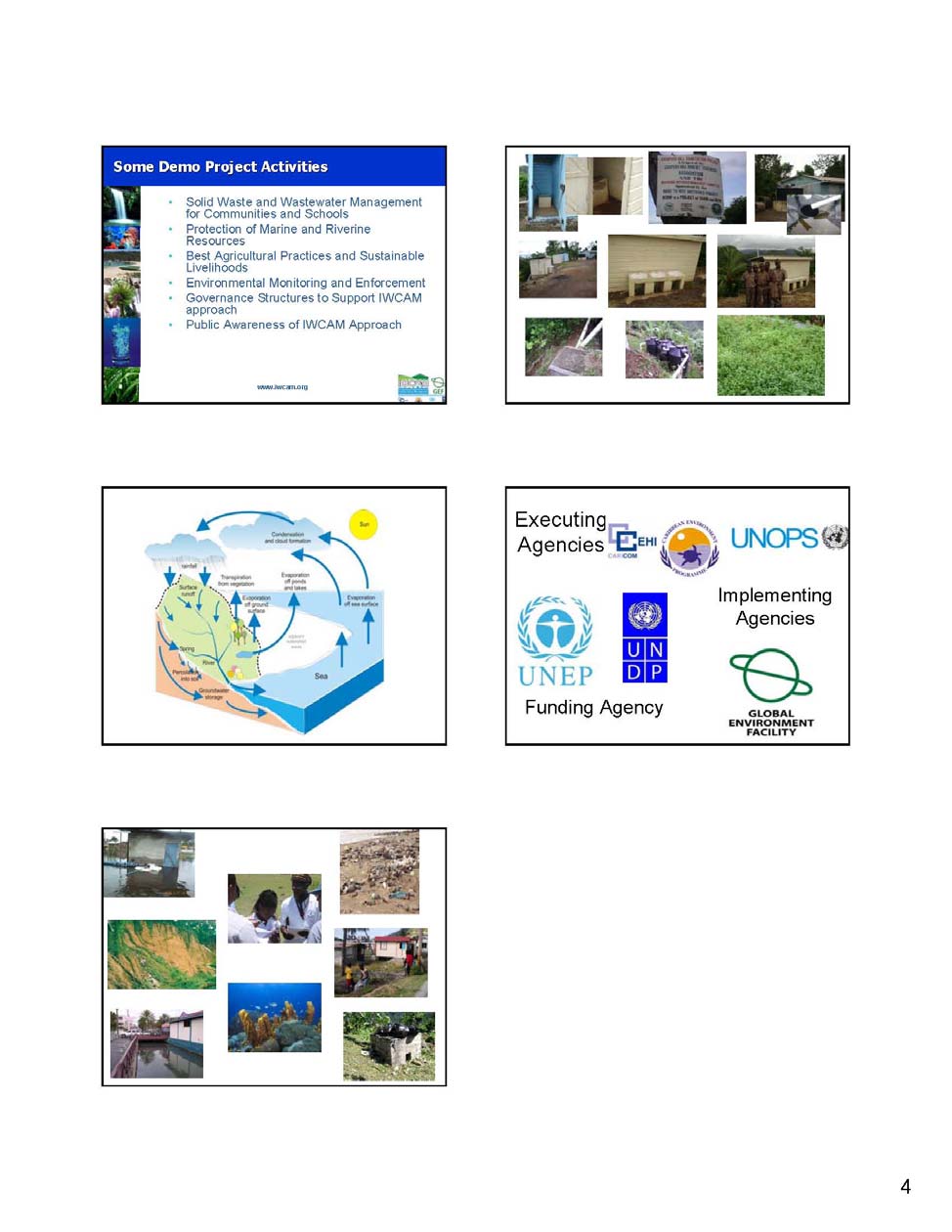
100
Appendix VII:
Media Conference Presentation
GEF-IWCAM Trinidad & Tobago Demonstration Project:
Land-Use planning and Watershed Restoration in the Courland Watershed and
Buccoo Reef Area, Tobago
101
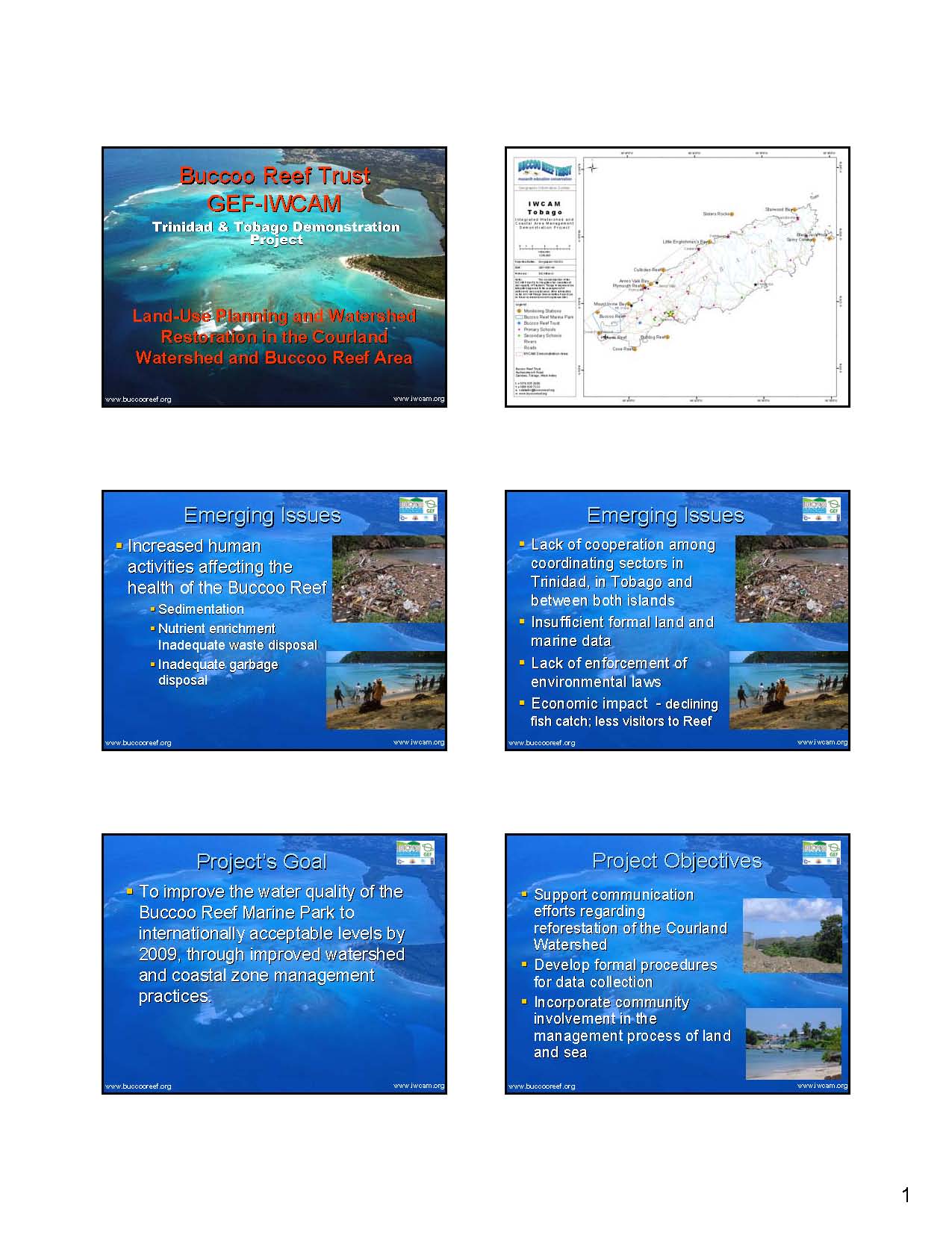
102
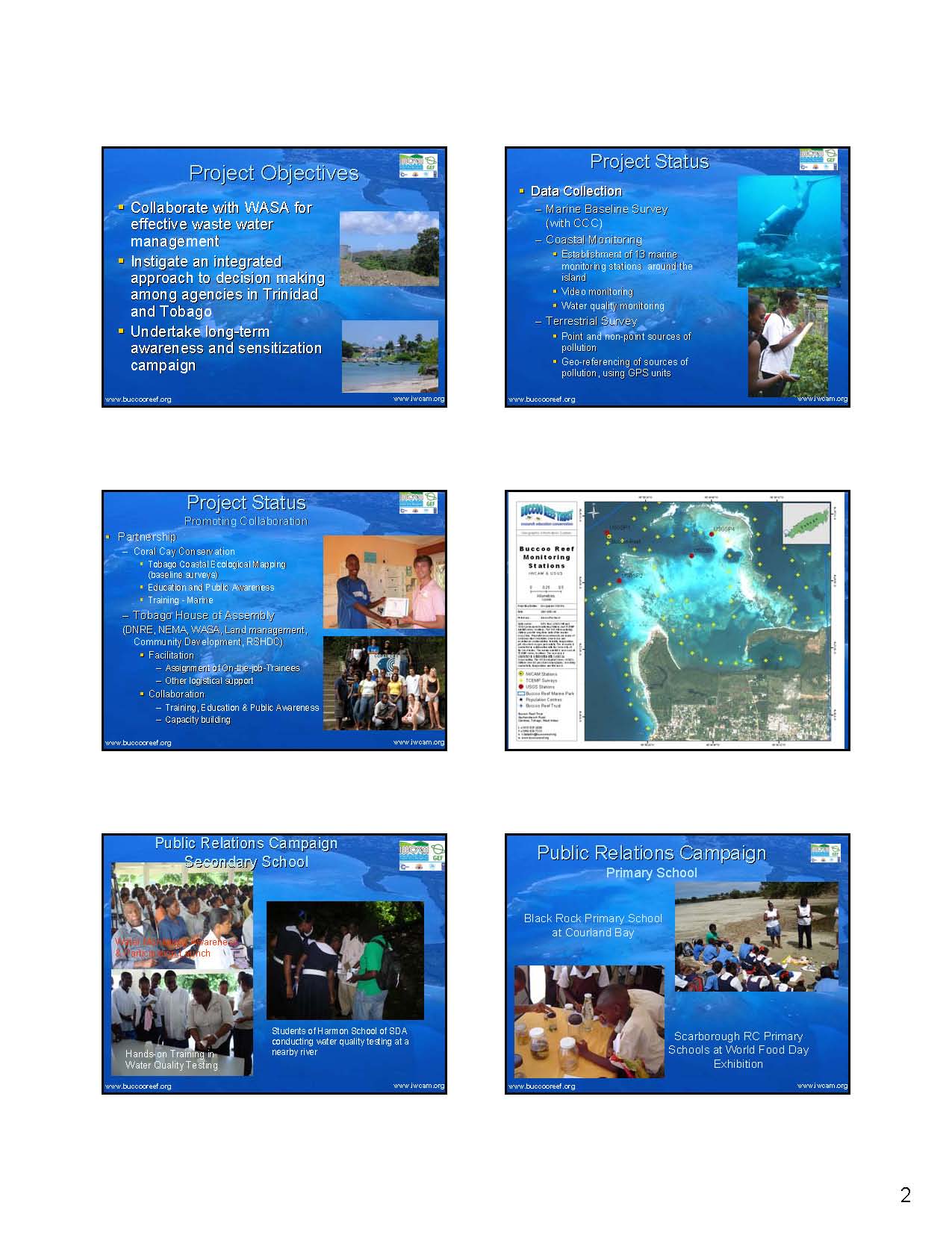
103
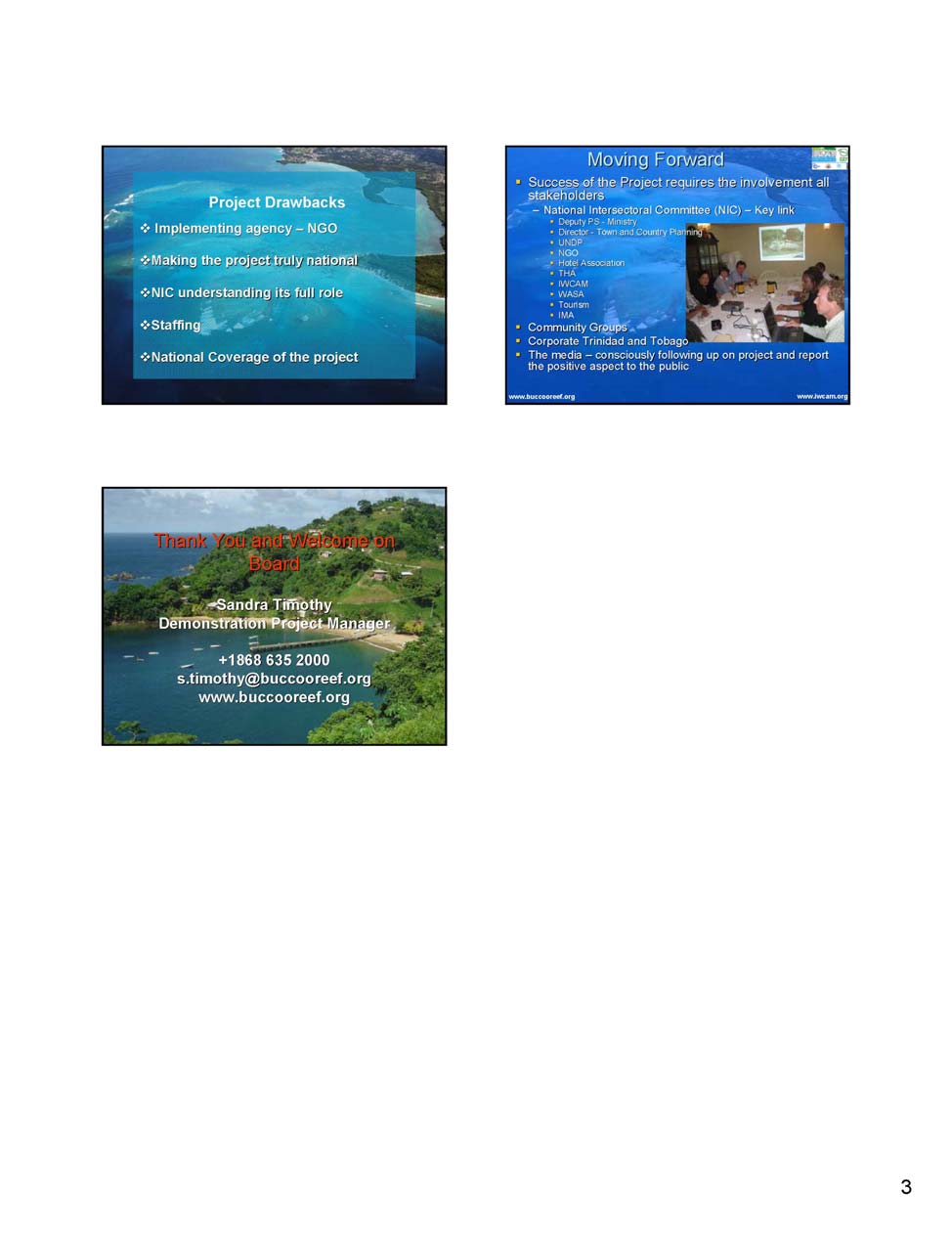
104
Appendix VIII:
List of Participants
105
LIST OF PARTICIPANTS
GEF - IWCAM Workshop on Communications, Public Education and Outreach for
Integrated Watershed and Coastal Areas Management
12-13 February 2007 Port of Spain,
Trinidad & Tobago
Countries PARTICIPANT
PARTICIPANT
A&B
Frances Fuller
BAH
Danah Albury
Environment Officer
Environmental Officer
Environment Division
Bahamas Environment Science &
Ministry of Tourism, Civil Aviation, Culture
Technology Commission (BEST)
and the Environment
P.O. Box CB-10980
#1 Prime Minister's Office Drive
Nassau Court
Factory Road
Nassau
St. John's
The BAHAMAS
Antigua and Barbuda
Tel: (242) 322 4546
Tel: 268 562 2568/268 724 4047
Fax: (242) 326 3509
Fax: 268 462 4625
E-mail: bestnbs@hotmail.com
E-mail: f_fuller1@hotmail.com
djalbury@hotmail.com
BAR
John Mwansa
CUB
Alain Muņoz Caravaca
Manager of Engineering
Cienfuegos Bay IWCAM Demo Project
Barbados Water Authority
Environmental Studies Centre of
Plantrac Building
Cienfuegos
Eagle Hall
Cienfuegos
St Michael
AP 5 CP 59350
Barbados
Cuba
Tel: 246 228 0850
Tel: 5343965146
Fax: 246 228 0858
Fax: 5343965146
E-mail: john.mwansa@bwa.bb
Email: alain@ceac.cu/
bjmwansa@bwa.bb
alain@ciget.cienfueos.cu
DOM
Ronald Charles
DR
Antonio Esteban Mataranz Rodriguez
Assistant Forestry Officer
Non-Formal Environmental Education
Forestry and Wildlife Division
Division Head
Botanical Gardens
Subsecretariat of Education and
Roseau
Environmental Information
Dominica
Secretariat of State of Environment and
Tel: 767 266 3817
Natural Resources
Fax: 767 448 7999
Autopista Duarte km 61/2
Mob: 767 225 7763
Jardines del Norte Edificio SEA,
Email : forestofficerprotection@cwdom.dm
Santo Domingo
Dominican Republic
Tel: 809 567 0030
Fax: 809 732 9001
Mobile: 809 697 5350
E-mail: antonio_matarranz@hotmail.com
106
GR
James Mahon
HA
Nicole Yolette Altidor
Agricultural Information Officer
Director of Environmental Awareness
Ministry of Agriculture
Education and Communication
Marlmount
Ministry of Environment
St David's
181 Haut Turgeau
Grenada
Port au Prince
Tel: 473 440 2708 (work)
Haiti
Fax: 473 440 4191
Tel : 509 449 4037/256 9957/256 3939
E-mail: james@spiceisle.com
Fax : 509 245 7360
Email : yolettealtidor@yahoo.com
JA
Selvyn Thompson
Natalie
Fearon
IWCZM Branch Focal Point for the IWCAM
Manager
Project/Conservation Officer
Public Education and Corporate
National Environment and Planning Agency
Communication Branch
10 Caledonia Avenue
National Environment and Planning
Kingston 5
Agency
Jamaica
10 & 11 Caledonia Avenue
Tel: 876 866 5907/456-8156
Kingston 5
Fax: 876 754 7594
Jamaica
E-mail: tryi2003@yahoo.com
Tel: 876 754 7575
Fax: 876 754 7596
Mobile: 876 478 7957
Email: nfearon@nepa.gov.jm
SKN
Halla Sahely
Assistant Water Engineer
St. Kitts Water Services Department
P.O. Box 80
Needsmust
Basseterre
St Kitts and Nevis
Tel.: (869) 466 3070/1467/2485
Fax.: (869) 466 7901
E-mail: halla@sahely.com
SLU
Angelina Polius
Cecil
Hudge
Henry
Watershed Management Committee
Community Liason Officer
Secretary
Ministry of Agriculture, Lands, Fisheries
Watershed Management Committee of
and Forestry
GEF-IWCAM Demonstration Project
Mabouya Valley Agricultural Office
Mabouya Valley
Richfond
Richfond
Dennery
Dennery
Tel: 758 453 3242/453-8389
Tel: 758 488 9742
Fax: 758 453 3048
Fax:
E-mail:
E-mail: pherapolius@hotmail.com
hudgehenry@hotmail.com/hudgehenry73
@yahoo.com
SVG
Aloma Williams
Public Outreach Consultant
Environmental Services Unit
Ministry of Health and the Environment
Ministerial Building
Kingstown
St Vincent and the Grenadines
Tel: 784 485 6992
Fax: 784 456 1785
Email: aloma03@yahoo.com
107
T&T
Sandra Timothy
Barry
Lovelace
GEF-IWCAM Project Manager
Environmental Education and Information
Buccoo Reef Trust
Coordinator
Cowie's Building
Buccoo Reef Trust
Carnbee Junction
Cowie's Building
Auchenskeoch Road
Carnbee Junction
Carnbee Main Road
Auchenskeoch Road
Trinidad and Tobago
Carnbee Main Road
Tel: 868 635 2000/868 660 8250
Trinidad and Tobago
Fax: 868 639 7333
Tel: 868 635 2000/868 660 8250
Email: s.timothy@buccoreef.org
Fax: 868 639 7333
E-mail: b.lovelace@buccooreef.org
Linford Beckles
Samantha Lezama
Environment Officer (National Focal Point)
Communications Policy Advisor
Department of Natural Resources and
Ministry of Planning, Housing and the
Environment
Environment
Tobago House of Assembly
Level 14
Trinidad and Tobago
Eric Williams Finance Building
Tel: 868 660 7636
Independence Square
Fax: 868 639 5232
Port of Spain
E-mail: linfordbeckles@yahoo.com
Trinidad and Tobago
Tel: 868 627 9700 ext 2018
Fax: 868 623 8123
Email: Samantha.lezama@planning.gov.tt
l
Organisations
CEHI
Patricia Aquing
Executive Director
Caribbean Environmental Health Institute
The Morne
P.O. Box 1111
Castries
St. Lucia
Tel: 758 452 2501
Fax: 758 453 2721
E-mail: paquing@cehi.org.lc
EMA
Nicola Cross
Marcia
Tinto
Senior Education Officer
Education Officer
Environmental Management Authority
Environmental Management Authority
8 Elizabeth Street
8 Elizabeth Street
Port of Spain
Port of Spain
Trinidad and Tobago
Trinidad and Tobago
Tel: 868 628
Tel: 868 628
Fax: 868 628
Fax: 868 628
E-mail: ncross@ema.co.tt
E-mail: mtinto@ema.co.tt
Institute of
Krystal Chandler
Simon
Teixeira
Marine Affairs
Information Officer
Information Officer
Institute of Marine Affairs
Institute of Marine Affairs
Hilltop Lane
Hilltop Lane
Chaguaramas
Chaguaramas
Box 3160
Box 3160
Carenage P.O.
Carenage P.O.
Trinidad and Tobago
Trinidad and Tobago
Tel: 868 634 4291 ext 412
Tel: 868 634 4291/4
Fax: 868 634 2479
Fax: 868 634 2479
108
E-mail kchandler@ima.gov.tt E-mail
:
steixeira@ima.gov.tt
OECS
Tecla Fontenard
Communications Specialist
Organization of Eastern Caribbean States
Secretariat (OECS)
Morne Fortune
Castries
St Lucia
Tel : 758 455 6366
Fax: 758 452 2194
E-mail: tfontenard@oecs.org
Panos
Indi McLymont-Lafayette
Caribbean
Programme Officer/Journalist
Panos Caribbean
9 Westminster Road
Kingston 10
Jamaica
Tel : 876 920 0070-1
Fax : 876 920 0072
E-mail : indi@panoscaribean.org
Consultant
Maria Protz
Consultant
P.O. Box 291
St Ann's Bay
St Ann
Jamaica
Tel: 876 972 2352
Fax: 876 972 0578
E-mail: protz@mail.infochan.com
UNEP
Heidi Savelli-Soderberg
CAR/RCU
Communications, Education, Training and
Awareness Programme Officer
UNEP CAR/RCU
14-20 Port Royal Street
Kingston
JAMAICA
Tel. # (876) 922 9267-9
Fax. # (876) 922 9292
E-mail: hss@cep.unep.org
GEF-IWCAM
Vincent Sweeney
Una
McPherson
Project
Regional Project Coordinator,
Administrative Officer
Coordinating
GEF-IWCAM Project Coordinating Unit
GEF-IWCAM Project Coordinating Unit
Unit
C/O Caribbean Environmental Health
C/O Caribbean Environmental Health
Institute
Institute
The Morne,
The Morne,
P.O. Box 1111
P.O. Box 1111
Castries
Castries
ST. LUCIA
ST. LUCIA
Tel: 758 452-2501, 452-1412
Tel: 758 452-2501, 452-1412
Fax: 758 453-2721
Fax: 758 453-2721
E-mail: vincent.sweeney@unep.org
E-mail: una.mcpherson@unep.org
Donna Spencer
Magnalia
Goldson
Communications, Networking, and
Bilingual Administrative Assistant
Information Specialist
GEF-IWCAM Project Coordination Unit
GEF-IWCAM Project Coordination Unit
C/O Caribbean Environmental Health
C/O Caribbean Environmental Health
Institute
109
Institute
The Morne, P.O. Box 1111
The Morne, P.O. Box 1111
Castries
Castries
ST. LUCIA
ST. LUCIA
Tel: 758 452-2501, 452-1412
Tel: 758 452-2501, 452-1412
Fax: 758 453-2721
Fax: 758 453-2721
Email: mgoldson@cehi.org.lc
Email: dspencer@cehi.org.lc
110