


UNITED NATIONS ENVIRONMENT PROGRAMME
EAST ASIAN REGIONAL COORDINATING UNIT
NATIONAL REPORT OF MALAYSIA
On the
Formulation of a Transboundary Diagnostic Analysis
And
Preliminary Framework of a Strategic
Action Programme for the Bay of Bengal
C O N T E N T S
Page
Chapter 1 :
NATIONAL REPORT OF MALAYSIA ON THE BAY OF
1
BENGAL LARGE MARINE ECOSYSTEM PROGRAMME
1.
INTRODUCTION
1
1.1 AIM OF REPOR T
1
1.2 MAJOR WATER-RELATED ENVIRONMENTAL
1
PROBLEMS
1.2.1 Air-Related Environmental Problems
2
1.3 COUNTRY BACKGROUND
4
Chapter 2
:
DETAILED ANALYSIS OF MAJOR WATER-RELATED
15
CONCERNS AND PRINCIPAL ISSUES
2.1 POLLUTION
15
2.1.1 Rivers
15
2.1.2 Sedimentation
17
2.1.3 Industrial Waste
17
2.1.4 Domestic Waste
18
2.1.5 Agricultural and Livestock Waste
19
2.1.6 Heavy Metals
20
2.2 MARINE POLLUTION
20
2.2.1 Ports, Harbours and Marine Transport
20
2.2.2 Small Vessel Operation and Discharge
22
2.2.3 Aquaculture Effluents
23
2.2.4 Domestic Discharge from Coastal Population
23
2.2.5 Land Reclamation
25
2.3 FRESHWATER SHORTAGE AND DEGRADATION OF
26
QUALITY
2.3.1 Surface Water
26
2.3.2 Surface Water Demand and Supply
26
2.3.3 Groundwater
28
2.3.4 Water Related Issues and Problems
29
2.3.5 Sensitive and High Risk Areas
31
2.4 EXPLOITATION OF LIVING AQUATIC RESOURCES
32
2.4.1 Living Freshwater Resources
35
2.4.2 Living Marine Resources
38
2.4.2.1 Marine Capture Fisheries
38
2.4.3 Impact of Man-based Activities on Freshwater and
49
Marine Ecosystems
Chapter 3
: ANALYSIS OF SOCIO AND ECONOMIC COSTS OF
51
IDENTIFIED WATER-RELATED PRINCIPAL
ENVIROMENTAL ISSUES
Chapter 4
: ANALYSIS OF THE ROOT CAUSE OF IDENTIFIED
55
WATER-RELATED ISSUES
i
C O N T E N T
Page
Chapter 5
: CONSTRAINTS TO ACTION
58
5.1 INSTITUTIONAL PROBLEMS
58
5.2 LACK OF CAPACITY TO IMPLEMENT POLICIES AND
59
ENFORCE REGULATIONS
5.3 INADEQUATE CENTRAL SEWAGE SYSTEM AND
60
TREATMENT FACILITIES
5.4 INTEGRATED RIVER BASIN MANAGEMENT (IRBM)
61
APPROACH
5.5 PUBLIC AWARENESS ON WATER CONSERVATION
62
5.6 COASTAL POLLUTION
63
5.7 INTEGRATED COASTAL ZONE MANAGEMENT (ICZM)
64
Chapter 6
: ONGOING AND PLANNED ACTIVITIES RELEVANT TO
65
IDENTIFIED ISSUES
6.1 INSTITUTIONAL
65
6.2 LACK OF CAPACITY TO IMPLEMENT POLICIES AND
66
ENFORCE REGULATIONS
6.3 INADEQUATE CENTRAL SEWAGE SYSTEM AND
66
TREATMENT FACILITIES
6.4 LACK OF PUBLIC AWARENESS
68
Chapter 7
: TRANSBOUNDARY ISSUES, KNOWLEDGE GAPS, AND
69
RECENT DEVELOPMENTS
7.1 POLLUTION
69
7.2 EXPLOITATION OF MARINE RESOURCES
73
7.3 COASTAL LAND RECLAMATION
74
7.4 HIGH DEMAND FOR MARINE PRODUCTS
75
7.5 KNOWLEDGE GAPS
76
7.6 RECENT DEVELOPMENTS
77
References
ii
L I S T O F T A B L E S
Page
1.1
: General Economic Data, Malaysia (2002)
6
1.2
: Major Export Items, Malaysia (2002)
8
1.3
: Major Export Markets by Country (2002)
8
1.4
: Major Import Items, Malaysia (2002)
9
1.5
: Major Import Sources by Country, 2002
9
2.1
: Status and Trend of River Water Quality, Malaysia, (1988-1994)
16
2.2
: Distribution of Major Industrial
18
Sources of Water Pollution, West Coast States (1993)
2.3
: Malaysia: Organic Pollution Load Discharged According to Sector
19
(1989 1993)
2.4
: Number of Vessel by Major Ports in the Straits of Malacca (2001-2002)
21
2.5
: Oil Spill Incidents in Malaysia Water Year 1975-1997
22
2.6
: Population by State, West Coast Malaysia (2000)
24
2.7
: Domestic and Industrial Water Demand, West Coast (1980-2000)
27
2.8
: Inshore Vs Offshore landing (tonnes), West Coast Malaysia (1990 2000)
34
2.9
: Freshwater Culture Systems by Species
36
2.10 : Fish Species Landings by Location, Malaysia (2000)
38
2.11 : Number of Licensed Fishing Vessels by Tonnage Class,
43
West Coast Malaysia (1980 2000)
2.12 : Aquaculture Resource Potential in Malaysia
45
2.13 : Aquaculture Production from Brackish/Marine Aquaculture Systems,
45
West Coast Peninsular Malaysia (2000)
2.14 : Mangrove Reserves and State Land Mangroves in Peninsular Malaysia
47
2.15 : Summary of Adverse Impacts of Man-based Activities On the Marine and
50
Freshwater Ecosystems
3.1
: Endangered Marine Resources and Mortality Sources
54
4.1
: Analysis of Root Causes and Socio-Economic Impacts of Water-Related
56
Issues - (a and b)
iii
L I S T O F F I G U R E S
Page
1.1 : Map of Study Area
8
1.2 : Temporal Monsoons Affecting Peninsular Malaysia
12
2.1 : Number of Fisherman Working in Licensed Vessels
33
West Coast Peninsular Malaysia, 2000
2.2 : Composition of Marine Fish Species Group Landings, West Coast
41
Peninsular Malaysia (2000, 1980, 1990)
2.3 : Contribution by Gear Group to Total Landing, West Coast Peninsular
43
Malaysia (2000)
3.1 : The Socio-Economic Costs of Water Resource Degradation
52
iv
NATIONAL STUDY TEAM
PRINCIPAL AUTHOR
Prof. Ishak bin Haji Omar (PhD)
Professor, Faculty of Economics and Management
University Putra Malaysia
43400 Serdang, Selangor, Malaysia
Email: ishak@econ.upm.edu.my
Tel: +6012 3793 047
TECHNICAL ADVISOR
Fauzy Abdullah
Capital Risk Management Sdn Bhd
E703, Phileo Damansara
46350 Petaling Jaya, Selangor, Malaysia
Email: fauzy@seacomm.net
Tel: +603 7660 7272
RESEARCH ASSISTANT
Soffie, W.M.
Capital Risk Management Sdn Bhd
E703, Phileo Damansara 1
46350 Petaling Jaya, Selangor, Malaysia
Email: soffie@asia.com
Tel: +603 7660 7272
v
ACKNOWLEDGEMENT
The author wishes to express his sincere gratitude to the following individuals for
providing valuable literature and spending time for an interview;
1. Y.B. Dato' Dr. Hashim Hassan
Secretary-General II
Ministry of Science, Technology and
Environment, Putrajaya, Malaysia.
2. Dr. Mohd Zahit b. Ali
Director
Conservation and Environment Division,
Ministry of Science, Technology and
Environment, Putrajaya, Malaysia
3. Mr. Lee Choong Min
Director
River Division
Department of Environment
Ministry of Science, Technology and
Environment, Putrajaya, Malaysia
4. Dr. K. Kuperan Viswanathan
ICLARM
The World Fish Centre
Penang, Malaysia
5. Prof. Dr. Mohd Ibrahim Hj.
Professor
Mohamed
Faculty Science and Environmental
Studies
UPM, Serdang, Malaysia
vi
UNEP/SCS National Report Malaysia
NATIONAL REPORT OF MALAYSIA ON THE
BAY OF BENGAL LARGE MARINE
ECOSYSTEM PROGRAMME
By
Ishak Haji Omar*
1.
INTRODUCTION
1.1
AIM OF REPORT
The aim of the national report is to review existing information on the use of, and
threats to, the Malaysian coastal and marine resources off the Straits of Malacca and the
adjacent waters of the Andaman Sea and the Indian Ocean. In the process, an attempt is made
to identify, examine, and rank those threats that have transboundary effects on man and the
environment and to determine information gaps that need to be addressed for integrated
management of coastal and marine resources in the region.
1.2
MAJOR WATER-RELATED ENVIRONMENTAL PROBLEMS
The sources of water-related environmental problems in Malaysia are both land and
sea-based pollution. The fouling of the water ecosystem, natural or man induced, cause
delirious effects such as harm to living resources, hazards to human health, and a hindrance to
economic processes.
Land-based Sources of Pollution
One of the main causes of water/river pollution is the rapid urbanisation on the West
Coast, arising from the development of residential, commercial, and industrial sites,
infrastructural facilities (ports and roads) as well as land reclamation in coastal waters. The
* Professor, Faculty of Economics and Management, University Putra Malaysia, 43400 Serdang, Selangor,
Malaysia. The author takes responsibility for the views expressed in the paper.
1
UNEP/SCS National Report Malaysia
destruction of rainforests and water catchments, and the subsequent erosion of soils together
with the heavily silted run-offs, pollutes the rivers. These and other sources of land-based
pollution are as follows:
· Sediment run-off
· Industrial waste
· Domestic waste
· Agricultural and animal waste
· Heavy metals
Sea-based Sources of Marine Pollution
Next to the Dover Straits in U.K., the Straits of Malacca is the world's second busiest
international shipping lane. Over 15,000 vessels, large and small, utilize the straits waters
daily. Shipping activities, discharges, and accidents are all threats to the marine environment.
In general, the sea-based sources of marine pollution in the coastal waters off the West Coast
of Peninsular Malaysia are:
· Shipping activities (operational discharge, deballasting, tank cleaning,
bilge water and sludge)
· Small vessel discharge (barges and fishing vessels)
· Aquaculture development (prawn and fish culture)
· Domestic discharge from coastal population
· Land reclamation (for commercial/industrial centres)
1.2.1 Air-Related Environmental Problems
Though not directly a water related environmental problem, the haze in 1997 caused
by Indonesia's shifting agriculture and slash-and-burn technique of jungle clearing was one
of Asia's worst man-made catastrophe. The emission of smoke, soot, organic particles and
2
UNEP/SCS National Report Malaysia
noxious gases such as nitrous oxides, sulphur oxides, dioxins, and other volatile compounds
sent the air pollution index in neighbouring Southeast Asian countries beyond the very
unhealthy (201-300) and, for some areas, above the hazardous (>500) level.
Haze is a phenomenon characterised by visibility impairment due to the scattering and
absorption of light by particles and gases in the atmosphere. Its effect to the water
environment is through:
· Emissions of sulphur dioxide (SO2) and oxides of nitrogen (N0x) and related
particulate matter (sulphates and nitrates) that contribute to poor visibility and
impact public health that in form is associated with breathing difficulties,
damage to lung tissue, cancer and premature death.
· Acid rain, as emissions of SO2 and N0x in the atmosphere react with water,
oxygen and oxidants to form acidic compounds. The acid rain raises the acid
levels of lakes and streams making the water unsafe for some fish and other
wildlife.
Indonesian haze has hit the region on a number of occasions in the 1980's and 1990's.
The one in 1977 was the worst incurring an economic loss of US1.3 billion, from close-down
of factories, curtailing of regional flights, drop in tour packages, to vessel accidents in the
Straits of Malacca (www.icsea.org/sea-span).
With Malaysian companies investing in a big way in palm plantations in Kalimantan
and Sumatra and with palm oil prices expected to be bullish, the torching of forest lands in
Indonesia could be on an industrial scale in the future. The monitoring, control, and
management of Indonesian haze has to be on a regional basis among ASEAN members.
Being hit by the ASEAN financial crisis, Indonesia is not in a position to adopt the polluter-
pays principle.
3
UNEP/SCS National Report Malaysia
1.3
COUNTRY BACKGROUND
General Geography
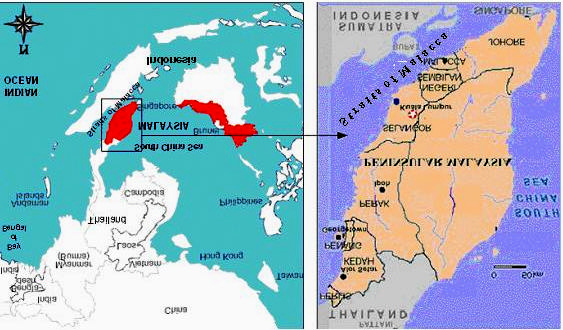
Malaysia is situated in the central part of South-East Asia and occupies a total land
area of 330,434 square kilometres. The land mass comprises three main components:
Peninsular Malaysia and the two states of Sabah and Sarawak, which occupy the coastal strip
of northwest Borneo (Figure 1.1). Peninsular Malaysia is the largest of the three areas,
covering 131,387 square kilometres.
Figure 1.1: Map of Study Area
Malaysia has a long coastline of 4,810 km. Her marine waters consist of a continental
shelf of 148,307 km2 and an Exclusive Economic Zone of 450,000 km2.
Economic Setting
Malaysia consists of a federation of 11 states in Peninsular Malaysia and the states of
Sabah and Sarawak in the north of Kalimantan. Kuala Lumpur, the national capital, Labuan
4
UNEP/SCS National Report Malaysia
and Putra Jaya form the Federal territories. The multiracial population of Malaysia is
composed of 58 percent bumiputra (Malays and indigenous people), 24 percent Chinese, and
the remainder Indians and other minor groups (18 per cent). The population was about 22
million in 2002, with the majority (over 80 per cent) living in Peninsular Malaysia.
Under the Federal Constitution, both land and water are state matters, while public
health and sanitation are concurrent matters on which both can legislate. To some extent, the
federal and state jurisdiction overlaps in environmental management, whereby broad policies
are formulated at the national level for implementation by the respective federal and state
agencies at the ground level. This overlapping of roles and responsibilities at the
implementing level can lead to unnecessary bureaucracy, agency rivalry and slow action.
In Peninsular Malaysia, the 11 states can be divided into two economic regions. The
majority of the manufacturing industries, plantations, tin reserves, ports and populations are
concentrated in the west coast states, while the east coast states are sparsely populated and
relatively undeveloped.
The general data on the Malaysian economy are shown in Table 1.1. With a gross
National Product (GNP) of RM310.8 billion and a GNP per capita of RM13,361 (US$3,516),
Malaysia enjoys a reasonable standard of living with low poverty (9.6 per cent of households)
and unemployment rates (3 per cent).
Since independence in 1957, the structure of the Malaysian economy progressed from
a simple agriculture economy to one that is industrial and export-oriented economy.
Subsequently, the share of agriculture dropped from 29 per cent in 1970 to 14 per cent in
2000, while the share of manufacturing jumped from 14 per cent in 1970 to27.8 per cent for
the same period (Dept. of Statistics, 2002).
5
UNEP/SCS National Report Malaysia
Table 1.1: General Economic Data, Malaysia (2000)
329.758 sq km
Area
(incl. inland water) 330,417 sq km
(Peninsular) 131,598 sq km
(Sabah) 73,711 sq km
(Sarawak) 124,449 sq km
Poverty rate
9.6% of households
GDP
RM339.4 billion
GNP
RM310.8 billion
GNP per capita
RM13,361
Current Account Balance
+RM31.2 billion
Exports / imports
RM373.3 bn / RM312.4 billion
CPI change
+1.5% (Q1 2001)
9.64 million
Employment
Agriculture = 14.0%
Mining = 00.5%
Manufacturing = 27.8%
Construction = 08.8%
Services = 48.3%
Unemployment
3.0%
Water coverage
91% of population
Sources: Department of Statistics, Malaysia.
6
UNEP/SCS National Report Malaysia
Table 1.2 shows the major export items of Malaysia in 2002, both in terms of value
and share. Electrical and electronic, palm oil, petroleum, and wood-based industries
contributed over 75 per cent to total export value.
In terms of export markets, Singapore, USA, and Japan were the main trading partners
(Table 1.3). Together, these countries imported merchandise worth about RM27 billion and
accounted almost 50 per cent of Malaysian exports.
Malaysian imports consist mainly of intermediate raw materials and equipment for her
value-added manufacturing activities (Table 1.4). These include mainly electrical and
electronic materials, machinery appliance and parts, metals and iron and steel products.
Similar to export markets, her major import sources were from Japan, USA and Singapore
(Table 1.5).
Study Area
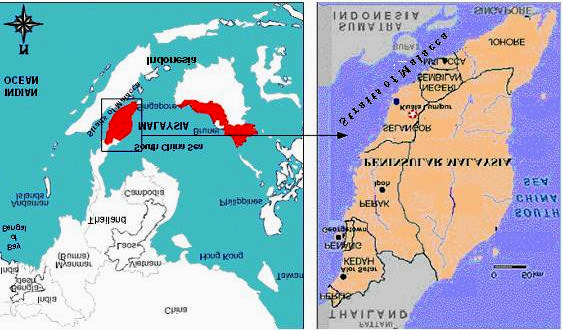
Peninsular Malaysia comprises mainly of highlands, floodplains, and coastal zones.
The mountain range, Banjaran Titiwangsa, which runs from north to south divides the west
coast and east coast states of the Peninsular. Starting from the north, the west coast states that
fringe the Straits of Malacca are Perlis, Kedah, Penang, Perak, Selangor, Negeri Sembilan,
Malacca, and West Johore (Figure 1).
Most rivers on the west coast of Peninsular Malaysia such as Sg. Muda, Sg. Pinang,
Sg. Perak, and Sg. Klang are short and steep. Open water bodies, natural wetlands, and man-
made lakes such as dams, and ex-mining pools are mostly found in the Klang and Kinta
Basins. These water bodies are used for power generation, flood control, national water
supply, recreation, aquaculture and tourism.
7
UNEP/SCS National Report Malaysia
Figure 1.1: Map of Study Area
Table 1.2: Major Export Items, Malaysia (2002)
Value
Share
(RM Million)
(%)
Electrical and electronic
197,986.6
55.9
Palm oil
17,193.2
4.9
Chemical
16,731.9
4.7
Crude petroleum
11,831.8
3.3
Machinery appliances & parts
11,150.5
3.1
LNG
10,451.4
2.9
Wood products
10,451.4
2.9
Textiles and clothing
8,408.3
2.4
Optical and scientific
8,157.3
2.3
Refined petroleum
6,790.1
1.9
Source: Department of Statistics, Malaysia.
Table 1.3: Major Export Markets by Country (2002)
Value (RM Million
Share
(%)
USA
71,501.9
20.2
Singapore
60,663.5
17.1
Japan
39,776.3
11.2
Hong Kong
20,169.3
5.7
China
19,965.8
5.6
Thailand
15,096.0
4.3
Taiwan
13,223.9
3.7
Netherlands
13,146.9
3.7
Korea Republic of
11,823.7
3.3
United Kingdom
8,353.1
2.4
Source: Department of Statistics, Malaysia.
8
UNEP/SCS National Report Malaysia
Table 1.4: Major Import Items, Malaysia (2002)
Value
Share
(RM Million)
(%)
Electrical & electronic
149,469.8
49.2
Machinery appliance & parts
26,659.2
8.8
Chemical
21,525.0
7.1
Manufactures of metal
11,004.7
3.6
Transport equipment
11,540.1
3.8
Iron and steel products
9,746.9
3.2
Optical and scientific
9,139.2
3.0
Refined petroleum
7,496.3
2.5
Crude petroleum
4,780.1
1.6
Textiles and clothing
4,319.9
1.4
Source: Department of Statistics, Malaysia.
Table 1.5:
Major Import Sources by Country, 2002
Value
Share
(RM Million)
(%)
Japan
53,909.6
17.8
USA
49,699.8
16.4
Singapore
36,316.1
12.0
China
23,474.4
7.7
Taiwan
16,803.5
5.6
Korea Republic of
16,079.4
5.3
Thailand
12,017.0
4.0
Germany
11,163.4
3.7
Philippines
9,862.8
3.2
Indonesia
9,688.0
3.2
Source: Department of Statistics, Malaysia.
9
UNEP/SCS National Report Malaysia
Marine Environment
Covering both the continental shelf and exclusive economic zone, Malaysian maritime
waters off the West Coast of Peninsular Malaysia is approximately 600 nautical miles long,
semi-conical in shape, with widths of 220 nautical miles in the northwest and 8 nautical miles
at the Riau Archipelago. A major portion of the waters lies within the continental shelf areas
of 10 to 60m in depth. The deepest area (70m) is in the Andaman Sea at the northern tip of
the Straits, while the shallowest is at the One Fathom Bank in the south.
The current predominantly flows in a northwest direction with rates of 1 to 1.25 knots,
although in some areas it may increase to 5 knots. The tidal range varies from 1.6 to 3.7
meters, with a much higher range inshore. For instance, Port Klang has experienced tides of
up to 5 meters and with a tidal stream of over 4 knots.
The West Coast of Peninsular Malaysia has an equatorial climate, with an average
annual rainfall of more than 2500mm and a daily temperature that ranges from a minimum of
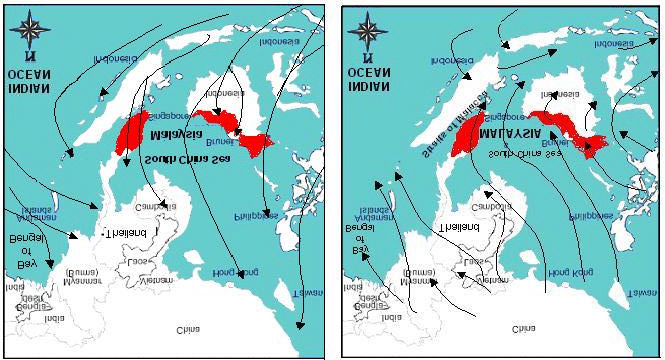
25°C to a high of 33°C. The area is subjected to two rainy spells, the Southwest monsoon
from June to September and the Northeast monsoon from November to March (Figure 1.2).
During these periods, the marine waters may be rough enough to curtail fishing operations in
the Straits.
The coastal zone along the Straits of Malacca is rich in mangroves, estuaries, coral
reefs, sea-grass meadows and algae beds, mudflats, beaches and small island ecosystems.
Each of these marine-based resources, with its unique habitat, supports a wealth of marine
life, some not well explored nor documented.
10
UNEP/SCS National Report Malaysia
Figure 1.2
Temporal Monsoons Affecting Peninsular Malaysia
I) South West Monsoon
II) North East Monsoon
Pollution Control and Management
The main legislation protecting the environment in Malaysia is the Environmental
Quality Act (EQA), 1974. The legislation sets limits to allowable pollutant levels for both
land and sea-based sources as well as for prescribed development activities as specified under
the Environmental Impact Assessment Regulations (1987). There are other regulations to
complement the Environment Quality Act, 1974, such as laws governing resource use
(National Forestry Act, 1984, Fisheries Act, 1985, and Exclusive Economic Zone Act, 1984),
vessel operation and conduct (The Merchant Shipping Ordinance, 1952), land use pattern
(National Land Code, 1965, and Land Conservation Act, 1960), and other local government
by-laws on earthworks, earth removal, mining, sanitation and solid waste disposal.
Thus, with respect to water resources, the most important legislation in Malaysia
governing water quality management is the Environmental Quality Act (EQA), 1974. The
objective of the EQA is basically twofold: pollution prevention, abatement and control as
11
UNEP/SCS National Report Malaysia
well as environment enhancement. There are at least six sets of regulations under EQA, 1974,
for control of water pollution and the environment, and these are:
· Environmental Quality (Prescribed Premises)(Crude Palm Oil Regulation,
1974)
· Environmental Quality (Prescribed Premises)(Law Natural Rubber)
Regulation, 1979.
· Environmental Quality (Sewage and Industrial Effluents) Regulations, 1979.
· Environmental Quality (Prescribed Premises)(Schedules Waste Treatment and
Disposal Facilities), Regulations, 1989.
· Environmental Quality (Scheduled Wastes) Regulations, 1989.
· Environmental Quality (Prescribed Activities Environmental Impact
Assessment) Order, 1987.
The above regulations stipulate the standards and procedures for handling the various
types of domestic and industrial wastes.
Stakeholders and Water Resource Management
The conservation, use, and management of water resources, freshwater or marine, is
everyone's concern. The general public, private sector, national and local governments, non-
governmental organizations, and international agencies have a role and responsibility to
ensure proper and sustainable use of water resources.
In Malaysia, the administration and management of water resources is carried out by
Federal and various state government agencies. The Federal Government sets the policies and
undertakes studies at the national level for overall planning and development purposes.
Recently, the Federal Government initiated the National Water Resource Studies (till year
2050) and established the National Water Resource Council (1998) with the responsibility of
streamlining water resource development and management activities of all states.
12
UNEP/SCS National Report Malaysia
As mentioned earlier, the relationship between the states and Federal Government in
terms of legislative and executive powers is governed by the Federal Constitution. Under the
Constitution, land is a state matter and, hence, state governments have legislative powers over
rivers, lakes, streams, aquifers, including turtles and riverine fishing. The key agencies that
deal with the implementation, management and monitoring of water resources include the
following: -
· Department of Irrigation and Drainage (under the Ministry of
Agriculture)
Involves in development works, operations, and maintenance of water
supply and infrastructures. Also, provides other technical services such
as flood control, coastal pollution information, hydrological data
collections, irrigation and river conservancy.
· Department of Environment (DOE) (under Ministry of Science,
Technology and Environment)
Mission is to promote, ensure and sustain sound environmental
management in the process of nation building. Has responsibility to
ensure the water in rivers is clean by controlling and monitoring
pollution. Also undertakes mitigated measures through implementation
of the Environmental Impact Assessment (EIA) for projects.
· State Water Departments
State agencies are responsible for water abstraction, treatment, and
distribution to consumers and industrial users.
· Local Authority
The local authorities indirectly influence the state of rivers and water
resources through their overall development plans and land use
decisions.
· Department of Town and Country Planning (Ministry of Local
Government)
Controls land use patterns and pace of development as the Department
gives the final approval to developers. Land-use zoning directly affects
river and water resources.
· Forestry Department
Responsibility to manage state gazetted forests, peat wetlands and
mangrove forests as well as catchment areas and rivers within forests. It
also controls logging activities through the selective management system
(SMS).
13
UNEP/SCS National Report Malaysia
Besides the state and federal agencies, some of the local community groups and
NGOs that are active on environmental issues include: Friends of the Earth (Sahabat Alam
Malaysia), World Wildlife Fund for Nature (Malaysia), Malaysian Institute of Marine Affairs
(MIMA), Malaysian Nature Society, Malaysian Fisheries Society, Environmental Protection
Society of Malaysia, Public Media Club, and various charity organizations.
Malaysia participates actively in the regional and international fora on environment
and has good working relationships with a number of international organizations. Some of
these linkages include United Nations Environmental Programme (UNEP), United Nations
Conference on Environment and Development (UNCED), Food and Agriculture Organization
(FAO), Coordinating Body on the Seas of Asia (COBSEA), UNESCO, GEF/UNDP/IMO,
and PEMSEA.
14
UNEP/SCS National Report Malaysia
2.
DETAILED ANALYSIS OF MAJOR WATER-RELATED
CONCERNS AND PRINCIPAL ISSUES
2.1
POLLUTION
Often associated with the flow of residuals, pollution can be defined as the presence
of matter or energy that has undesired effects on the environment. Pollutants pose a risk to
life support ecosystems and can be difficult to control. Water pollutants are many, if not
more than their polluting sources.
2.1.1 Rivers
Rivers with their loads of municipal, industrial and agricultural wastes eventually end
up discharging these at the estuaries and polluting the coastal marine waters. Under the
previous Malaysian Water Quality Programme, a total of 116 rivers encompassing 892
sampling stations were monitored by the Dept. of Environment throughout the country.
Assessment of water quality in these stations were measured in terms of biological and
chemical characteristics and compared against the national water quality standards.
Table 2.1 shows the status and trend of river quality for the period 1988-1994. It can
be seen from the water quality measured in terms of Biological Oxygen Demand (BOD)
caused by organic decomposition, ammoniacal nitrogen (NH3-N) emitted from sewage and
animal waste, and suspended solids from soil erosion and sedimentation all registered
negative overall trend (deteriorated) for the period 1988-1994. The overall water quality
index, measured for its physical, chemical and biological characteristics in form of turbidity,
salinity, temperature, pH, dissolved oxygen and electrical conductivity, also worsened for all
116 rivers over the same period.
15
UNEP/SCS National Report Malaysia
Table 2.1: Status and Trend of River Water Quality, Malaysia, (1988-1994)*
Status in 1994
Overall Rate of Change
Pollutants
Polluted
Slightly
Clean
(1988-1994)
Biological Oxy.
13
18
83
-0.88
Deteriorated
Demand (BOD)
(13%)
(15%)
(72%)
Suspended Solids
66
16
34
-0.91
Deteriorated
(SS)
(57%)
(14%)
(29%)
Ammonia cal
36
35
45
-1.72
Deteriorated
Nitrogen (NH3-N)
(31%)
(30%)
(39%)
Overall Water
14
64
38
-0.92
Deteriorated
Quality Index
(12%)
(55%)
(33%)
(WQI)
* A total of 116 rivers were evaluated.
Source: Dept. of Environment Malaysia (1994).
From the table, suspended solids and ammoniacal nitrogen were the main pollutants
accounting for 57 per cent and 36 per cent of the total polluted rivers respectively.
Since 1995, there were no documented statistics on river water assessment that was
published by the DOE, as the Natural Water Quality Programme was contracted to a private
company, Alam Sekitar Malaysia Sdn Bhd (ASMA). However, in 2000 the DOE resumed the
data collection but the format was changed from river to basin-based reporting, depriving
inter-period comparisons. This time around, the DOE covered 931 water-monitoring stations
which were located within 120 river basins (DOE, 2001). Of these 931 monitoring stations,
489 (53%) were found to be clean, 303 (33%) slightly polluted, and 135 (15%) polluted.
Even though the outcomes are not exactly comparable to those of 1994, because of sample
size and location of stations, nonetheless the broad picture indicates a general improvement
in water quality of the Malaysian rivers. This improvement could be due to several factors
that include a slowdown of economic activities and property development due to the Asean
16
UNEP/SCS National Report Malaysia
financial crisis, relocation of swine farms away from rivers, and the improved awareness of
the general public on environmental pollution due to intensive public and NGO campaigns.
2.1.2 Sedimentation
The rapid pace of urbanization, indiscriminate destruction of rainforests and
catchments for the establishment of new townships and industrial sites have resulted in the
high sedimentation of rivers in the littoral states of the Straits of Malacca. Prior to
urbanisation, rainwater gets absorbed by the vegetation, infiltrates the ground and takes time
to get to the rivers. Without vegetation, the run offs are excessive, rapidly eroding both
land surfaces and river banks. The heavy loads of sedimentation that empties into the rivers
are a hazard to both human and aquatic life.
2.1.3 Industrial Waste
The common forms of industrial pollution are suspended particulate emissions that
cause air pollution, BOD discharges that cause water pollution, and toxic waste discharges
that affect all elements. Over 80 per cent of the total volume of industrial water discharge in
Malaysia originate from four categories of manufacturing activities (1) food and beverage
processing, (2) industrial chemicals and chemical products, (3) rubber products
manufacturing and (4) textile and leather products (Table 2.2).
Rivers in the highly industrialized states of Penang, Perak, Selangor, Malacca and
Johore were most affected by industrial waste.
17
UNEP/SCS National Report Malaysia
Table 2.2: Distribution of Major Industrial Sources of Water Pollution,
West Coast States (1993)
Major Pollution Sources/Industries
Raw Natural
Rubber
Food and
Textile &
States
Palm Oil
Rubber
Product
Beverages
Leather
Paper
Chemicals
Total
Selangor
31
8
252
174
92
87
194
838
Johor
67
39
32
199
203
43
76
659
Pulau Pinang
4
8
58
164
76
38
77
425
Perak
48
26
54
102
1
1
28
260
Kedah
4
28
47
55
33
23
18
208
Negeri Sembilan
13
20
43
25
14
11
21
147
Melaka
2
10
28
48
55
22
27
192
Perlis
0
2
8
3
2
0
15
30
169
141
522
770
476
225
456
2759
Total States
Contribution by
6.13%
5.11%
18.92%
27.91%
17.25%
8.16%
16.53%
100.00%
Pollution Source
Total MALAYSIA
287
18
597
1169
545
292
560
3468
Contribution by
Pollution Source (%) 8.28%
0.52%
17.21%
33.71%
15.72%
8.42%
16.15%
100.00%
Overall Contribution
79.56%
to Total Pollution
Source: Dept. of Environment Malaysia (1994).
2.1.4 Domestic Waste
Domestic or human waste affects the environment in at least three ways. When solid
waste is burnt it pollutes the air, when sewage is inadequately treated it contaminates
drinking water; and when sanitation is poor, it results in water and insect-borne diseases.
Lack of proper sewage disposal and treatment systems result in the waste being discharged
directly into the rivers and seas.
Table 2.3 shows the organic pollution load discharge according to sectors. In 1993,
the pollution load measured in BOD from domestic sewage accounted for 67% of total BOD
load, followed by agricultural and animal waste (22%), manufacturing industries (7%), and
agro-based industries (2.7%). One interesting feature that needs investigation is the rapid
increase in BOD loads from the other sectors over the years, resulting in a decline in the
amount of domestic sewage from about 80 per cent in 1989 to 67 per cent in 1993.
18
UNEP/SCS National Report Malaysia
Table 2.3:
Malaysia: Organic Pollution Load Discharged According to Sector
(1989 1993)
Year
1989
1990
1991
1992
1993
1
2
BOD Population BOD Population BOD Population BOD Population BOD Population
Sector
Load Equivalent Load Equivalent Load Equivalent Load Equivalent Load Equivalent
1. Agro-based
Industries
(Palm Oil &
11
0.22
15
0.30
12
0.24
30
0.60
28
0.56
Raw Natural
Rubber)
2. Manufacuturing
21
0.42
25
0.50
25
0.50
27
0.54
77
1.54
Industries
3. Agriculture
(Animal
60
1.20
65
1.30
65
1.30
211
4.20
230
4.60
Husbandry)
4. Population
366
7.32
380
7.60
385
7.70
481
9.63
698
13.96
(Sewage)
Total
458
9.16
485
9.7
487
9.74
749
14.97
1033
20.66
Source: Dept. of Environment Malaysia (1994).
2.1.5 Agricultural and Livestock Waste
As can be seen in Table 2.3, there has been a more than three fold increase in
livestock waste over the years. Agricultural wastes from agro-based industries, such as
wood, palm oil, and rubber processing mills were also on the increase. Johore, Selangor, and
Perak collectively accounted 65.7 per cent of the total number of identified sources of
pollution in the agro-based and manufacturing sector (DOE, 2001).
Livestock waste, pesticides, and fertilizers pollute our rivers and coastal waters. As
coastal aquaculture systems are located mainly in sheltered coastal waters of the Straits of
Malacca, these agricultural wastes, carrying bacteria and heavy metals, can be a health
hazard if transmitted to the fish species cultured. There are very few studies on this causal
link, although food poisoning incidences are often associated with cultured mussels and
cockles.
19
UNEP/SCS National Report Malaysia
2.1.6 Heavy Metals
The Department of Environment reported consistently much higher concentrations of
heavy metals in rivers of the littoral states of the Straits of Malacca than in other parts of the
country. Admittedly, this is due to extensive land use and industrialization, especially in
Penang, Perak, Selangor and Malacca.
Penang has a large electronic industry and producing computer chips and semi-
conductors generates a lot of wastewater, toxic chemicals and hazardous gases. In Malacca,
the river alongside Alor Gajah Industrial Estate is polluted with heavy metals such as
mercury, copper, and zinc that are higher than the permissible limits.
2.2
MARINE POLLUTION
The extent of marine pollution in the Straits of Malacca and adjacent waters depends
mainly on the discharges of land-based activities from rivers, shipping operations,
aquaculture effluents, domestic discharge from coastal population, land reclamation and from
illegal dumping of waste.
2.2.1 Ports, Harbours and Marine Transport
Usually, cargo and oil ports are not major sources of pollution, except when shipping
accidents, oil spills and groundings take place. With the busiest tanker traffic in the world,
vessels that patronize the Straits, docked, berthed, anchored, laid-up, steaming or being
serviced carry inherent risks where an accident can develop into an environmental
catastrophe. Such risks are real but difficult to quantify as shipping statistics are difficult to
compile. Although ships passing through are now required to report under the International
Maritime Organization's Mandatory Ship Reporting System (1998) these, at times, do not
20
UNEP/SCS National Report Malaysia
follow specific routes. Besides this, there are many cross traffic cargo vessels that service
intra regional trade as well as thousands of licensed and unlicensed fishing vessels operating
in the same sea space.
Table 2.4 presents an attempt to collate available statistics on the number of vessels
that call on the major ports along the Straits for the period 2000-2002. Penang and Port
Klang were the busiest ports and, in 2002, accounted over 85 percent of the traffic.
Table 2.4:
Number of Vessel by Major Ports in the Straits of Malacca
(2001-2002)
Port
2000
2001
2002
Penang
7,263
7,460
7,328
Port Klang
12,804
1,303
13,175
Sungai Udang
955
1,066
987
Port Dickson
1,185
1,152
908
Malacca
1,356
1,090
1,137
Tg. Bruas
461
462
423
TOTAL
24,024
24,533
23,958
Source: Compiled from Marine Department, Malaysia.
With thousands of large and small vessels plying the Straits a total of 476 accidents
took place between 1978-1994 (Gunalan, 1999). Also, there were 18 major oil spill incidents
(Table 2.5) due mainly to collision, grounding and human error.
Another source of marine pollution in the Straits is the non-accidental oil discharge as
routine ship maintenance requires pumping out bilge water and, to a lesser extent, ballast
water. Gunalan (1999) reported that vessel maintenance alone is capable of generating
888,000 tonnes of waste per year, consisting of 150,000 tonnes of oily bilge water sludge, 18
tonnes of solid waste and 720,000 tonnes of sewage. While a National Contingency Plan has
been drawn up by the Malaysian government to control and mitigate oil spills in the Straits,
21
UNEP/SCS National Report Malaysia
the threat of non-accidental oil discharge to the coastal marine environment has been
overlooked.
Table 2.5: Oil Spill Incidents in Malaysia Waters Year (1975-1997)
Year
Name of Ship
Location
Cause
Type and Quantity
of Oil Spill
1975
SHOWA MARU
The Straits of Singapore
Grounding
Crude oil 4000 tons
1975
TOLA SEA
The Straits of Singapore
Collision
Fuel oil 60 tons
1976
DIEGO SILANG
The Straits of Malacca
Collision
Crude oil 5500 tons
1976
MYSELLA
The Straits of Singapore
Grounding
Crude oil 2000 tons
1976
CITTA DI SAVONNA
The Straits of Singapore
Collision
Crude oil 1000 tons
1977
ASIAN
The Straits of Malacca
Collision
Fuel oil 60 tons
1978
ESSO MERSIA
The South China Sea
Collision
Fuel oil 505 tons
1979
FORTUNE
The South China Sea
Collision
Crude oil 10000 tons
1980
LIMA
The Straits of Singapore
Collision
Crude oil 700 tons
1981
MT OCEAN TREASURE
The Straits of Malacca
Human Error
Fuel oil 1050 tons
1984
BAYAN PLATFORM
The South China Sea
Human Error
Crude oil 700 tons
1986
BRIGHT DUKE/MV
The Straits of Malacca
Collision
-
PANTAS
1987
MV STOLT ADV
The Straits of Singapore
Grounding
Crude oil 2000 tons
1987
ELHANI PLATFORM
The Straits of Singapore
Grounding
Crude oil 2329 tons
1988
GOLAR LIE
The Straits of Singapore
Grounding
-
1992
NAGASAKI SPIRIT
Near Medan, Indonesia
Collision
Crude oil 13000 tons
1997
EVOIKOS / ORADIN
The Straits of Singapore
Collision
Fuel oil 25000 tons
GLOBAL
1997
AN TAI
The Straits of Malacca
Material
Fuel oil 237 tons
Fatigue
Source: Marine Department, Malaysia.
2.2.2 Small Vessel Operation and Discharge
Besides the oil and petroleum tankers as well as large container carriers that ply the
Straits of Malacca, another significant cause of marine pollution is from the fishing
operations and, to a lesser extent, the cargo vessels that transport goods between
neighbouring countries. About 13,000 vessels or 37% of Malaysian fishing vessels are
operating from the shores of the littoral states along the Malacca Straits. The waste
discharged from fishing vessels, villages and jetties, and the indiscriminate encroachment of
trawlers into inshore waters pollute as well as destroy the breeding grounds of aquatic
resources.
22
UNEP/SCS National Report Malaysia
2.2.3 Aquaculture Effluents
With the levelling of fish landings, marine aquaculture is seen as an important
alternative for fish production, especially along the sheltered coastal areas of the Straits of
Malacca. Although the aquaculture industry is sensitive to water pollution, it is also a
polluter to the marine environment (Chua, at. el., 1997). Semi and intensive culture of finfish
and prawns has often been associated with eutrophication of coastal waters and the spread of
disease. For example, aquaculture pollution from the intensive culture of groupers, sea-bass
and snappers, is often caused by faeces and uneaten food, as well as nutrient discharges
which reduce dissolved oxygen in the water and cause high BOD. The adverse effects of
aquaculture effluents on water quality are seldom reported. In general, poor management of
aquaculture effluents has resulted in the outbreak of fish diseases that often incur more
financial losses to the farmers than the damage to the marine environment due to
eutrophication..
However, of more pressing concern than aquaculture effluents is the destruction of
the mangrove ecosystem in order to accommodate the rapid expansion in aqua farming.
2.2.4 Domestic Discharge from Coastal Population
The West Coast states are well developed and have the highest concentration of the
Malaysian population. Table 2.6 shows that the West Coast has 58.62% of the national
population despite having only 20.46% of the total land area. Penang, Selangor, Malacca, and
Perlis have population densities that are multiples of the national average.
23
UNEP/SCS National Report Malaysia
Table 2.6:
Population by State - Malaysia (2000)
% of
Negeri
Pulau
Total
MALAYSIA
Total
Johor
Kedah
Melaka
Sembilan
Perak
Perlis
Pinang
Selangor
Malaysia
AREA
Area in square
18,987
9,425
1,652
6,644
21,005
795
1,031
7,960
67,499
329,847
20.46%
kilometres
POPULATION
SIZE AND
COMPOSITION
Total population 2,740,625 1,649,756 635,791
859,924
2,051,236
204,450
1,313,449
4,188,876
13,644,107
23,274,690
58.62%
Population density
(per square
144
175
385
129
98
257
1,274
526
373.5*
71
kilometre)
Urban population
65.2
39.3
67.2
53.4
58.7
34.3
80.1
87.6
486
62
783.55%
(%)
* Average
Source: Department of Statistics, Malaysia, 2002
24
UNEP/SCS National Report Malaysia
With the cities, towns, industrial sites, fishing ports and villages located in close
proximities to river mouths and coastal waters, improper treatment of the sewage discharge
seeps into the drainage system and pollutes the rivers and seas. Poor sanitation is also a
source of water-borne diseases.
Domestic wastewater comprising of used water from toilets, bathrooms, laundry,
kitchen and synthetic cleaning chemicals, if not properly treated, is toxic to humans, plants,
and wildlife. Presently, the wastewater is collected by a system of sanitary sewers and
treated at municipal plants before being discharged to rivers, but these are still inadequate
even in urban centres (Keizrul Abdullah and Azuhan Muhamed, 1998).
2.2.5 Land Reclamation
Land reclamation for housing, infrastructure, and industrial purposes has an adverse
impact on mangroves, cockle mudflats and fish stocks if not properly planned as it affects
both the stability of the coastline and sustainability of capture and culture fisheries. For
instance, land reclamation off Prai in Penang for industrial purposes, and subsequent
discharges from factories, has threatened cockle farming at Kuala Juru because of high
sedimentation and the incidence of heavy metals. It was reported that the heaviest
concentration of mercury was near Nan Sing Textile factory, Kuala Juru, where the water
contained 2.30ppm of mercury, 460 times the permissible level in the US.
(http://www.surforever.com/sam/a 2z/content3.
With 76 coastline reclamation projects covering 97,000 ha in the pipeline,
particularly the large ones in Kedah, Penang, Perak and Selangor, there is an urgent need for
a thorough EIA appraisal on the impact of land reclamation on the marine ecosystem.
25
UNEP/SCS National Report Malaysia
2.3 FRESHWATER SHORTAGE AND DEGRADATION OF QUALITY
2.3.1 Surface Water
In Malaysia, rainfall is the only source of freshwater, especially during the wet
monsoon seasons. The annual downpour amounts to above 900 billion m3, of which 566
billion m3 is in form of surface runoff, 360 billion m3 is lost through evaporation, and 64
billion m3 is trapped in aquifers (Govt. of Malaysia, 1982). The volume of groundwater
resources stored in aquifers is estimated at 5000 billion m3. Even though groundwater
accounts for 90 per cent of total freshwater resources, 97 per cent of the national water
supply for domestic, agricultural, and industrial use originates from surface runoffs.
Surface water resources are trapped mainly in dams or reservoirs at water catchment
areas, chlorinated, and channelled through pipes to the end-users. Some rural folks living in
squatter settlements and villages along riverbanks utilize surface runoffs directly from the
rivers.
2.3.2 Surface Water Demand and Supply
The national demand for water is expected to grow at a rate of about 4 per cent
annually, and projected to be almost 20 billion m3 by 2020. Of this, 5.8 billion m3 is for
annual domestic and industrial water demand and the remainder for irrigation purposes
(Keizrul, 1998). On a per day basis, consumption of water has increased from 7.6mn m3 in
1995 to 10.4mn m3 in 2000 (Mak, 2002).
With the present irrigated rice bowl areas in Kedah and Butterworth not expected to
increase significantly in the future, the share of agricultural relative to domestic and
industrial demand for water is expected to fall. On the , especially in Penang, Selangor and
26
UNEP/SCS National Report Malaysia
Malacca, the domestic and commercial demand for water is expected to increase further
given the current pace of urbanisation and industrial growth.
Table 2.7 illustrates the rapid growth in water demand for the states fringing the
Straits of Malacca. Between 1980-2000, there was more than a three-fold increase in
domestic and industrial water demand. With many catchments areas on the under intense
pressure from land development activities, and the rapid rise in domestic and industrial
demand from urban centres downstream, there have been frequent shortages and disruptions
in water supply to the end users in recent years.
Table 2.7:
Domestic and Industrial Water Demand, (1980-2000)
(million m3)
State
1980
1985
1990
2000
Perlis
7
9
16
37
Kedah
49
82
113
266
Penang
124
169
236
343
Perak
145
216
327
596
Selangor
470
658
787
1201
Negeri Sembilan
62
102
131
197
Malacca
30
43
61
112
Johore*
159
258
338
578
Total
1,046
1,537
2,009
3,324
* For the whole state
Source: Dept. of Irrigation and Drainage
On the supply side, the availability of water has also increased from 9.5mn m3 per
day in 1995 to 12.8mn m3 in 2000. Under the Water Resource Master Plan (till 2050), an
allocation of RM52 billion has been made for 62 water projects, including 47 dams.
Recently, another RM 3.4 billion has been set aside under the 8th Malaysia Plan (2001-2004)
to fund ongoing projects, upgrade the distribution network, and repair existing infrastructure.
27
UNEP/SCS National Report Malaysia
2.3.3 Groundwater
Groundwater resources are replenished by rainfall and through seepage from streams.
Despite the abundance of groundwater, it only accounts for 3 per cent of total water use.
The under utilization of groundwater resources is due to several factors and these include;
the lack of information or maps to indicate their locations, perception that the supply is non-
sustainable and harmful due to effluent seepages, and the lack of local expertise on
groundwater technology. Furthermore, the present disposal of industrial and domestic waste
in landfills in suburban areas poses a threat as the leachates can contaminate the groundwater
with chemicals, heavy metals, and bacteria (E. coli).
Groundwater is extracted mainly through wells, especially in very rural areas for
domestic use and irrigation. With water supply readily available to over 90 percent of the
communities, planners previously gave little thought on groundwater development. Also,
for practical reasons, investments in groundwater systems are expensive for urban dwellers
because of the high capital outlays and operating costs. However, since the recent water
crisis, the DOE has taken preliminary steps to determine the quality and distributions of
groundwater through the national groundwater-monitoring programme in 1997. By 2001, the
DOE had established 79 monitoring wells in Peninsular Malaysia and another 19 in
Sarawak.
Samples taken were analysed for volatile organic components (VOC), pesticides,
heavy metals, anions, bacteria, phenolic compounds, radioactivity, total hardness, total
dissolved solids (TDS), pH, temperature, conductivity and dissolved oxygen. The
groundwater status was determined by comparing against the National Guidelines for Raw
Drinking Water Quality (1990). The results indicate iron, manganese, nitrates, and arsenic
wastes (especially near landfills) contents in groundwater were significant (DOE 2003).
28
UNEP/SCS National Report Malaysia
Much has still to be done for groundwater utilization as data on the distribution and relative
abundance of groundwater resources, wells, and users are still scanty for macro planning.
2.3.4 Water Related Issues and Problems
Drought
In recent years, the water situation in the West Coast, especially Penang, Klang
Valley, Negeri Sembilan and Malacca, has worsened. In1998, the prolonged drought caused
by the El-Nino resulted in a water crisis and many parts of the country had to be rationed for
water. Water demand from new growth centres such as the Kuala Lumpur International
Airport and the Multimedia Super Corridor (MSC) further aggravated the drought effect
causing frequent cutbacks in water supplies to neighbouring townships. This crisis has
alerted the government of the need for prudent and integrated approach to water resource
management so as to sustain commercial and industrial activities in order to achieve
economic growth.
Floods
Floods occur due to the inability of streams and rivers to drain excess water from
heavy downpours. About 29,000 km2 or 9 per cent of the country's land area is flood-prone
affecting the livelihood of 2.7 million people, both rural and urban dwellers. Even the
aquaculture farms in coastal waters suffered high mortalities of fish, prawns and cockles
from reduced salinity and heavy sedimentation due to sudden and excessive intrusions of
freshwater from streams and rivers. Due to the freshwater intrusions, mussels culture in
Malacca, cockles at Kuala Juru and prawn farms at Kuala Muda have incurred heavy
financial losses.
29
UNEP/SCS National Report Malaysia
In the urban centres, there has been a steady increase in the incidence of flash floods.
The Klang Valley and Penang are two areas most susceptible to flash floods even after a
short spell of heavy downpour, causing massive traffic jams that may last for hours. Flood
mitigation measures, such as widening and deepening of drainage systems, are expensive but
do not seem to be able to curb with the heavy downpours.
Water pollution
As with most Asean countries, man tend to be the main culprits to water pollution.
Indiscriminate dumping of domestic and industrial wastes and the silting of rivers due to
erosion caused by the destruction of forests and catchment areas pollute as well as reduce the
carrying capacities of rivers. Water pollution reduces availability of good quality water,
increases water treatment costs, and is also an ecological hazard affecting both human and
aquatic life. Water pollution is a concern for all nations.
Management Issues
The management of national water resources, both from supply and demand
perspectives, is not easy with an uneven distribution of residents, catchment areas, and
differing financial capabilities of the states. As land is a state matter under the Malaysian
Constitution, the powers of the federal agencies are limited at the ground level and this
complicates the implementation of projects, particularly those that are of national interest.
Malaysia has an abundance of sector-based regulations but not those that focus on the
polluter-pays principle.
Exploration and Exploitation of Groundwater
With catchment areas gradually reduced for economic development and with an
abundance of groundwater resources, efforts must be made to explore and map out the viable
30
UNEP/SCS National Report Malaysia
locations for the exploitation of groundwater. Human capacity building and collaboration
with countries such as Denmark, Germany and Holland, which have considerable experience
in groundwater supply systems, can assist in our new focus for future water needs.
2.3.5 Sensitive and High Risk Areas
Most of the Straits of Malacca and coastal areas around densely populated urban and
industrial centres can be considered sensitive and high-risk locations. These places pose
direct and indirect threats to public health and aquatic resources as well as the sustainability
of coastal biodiversity.
Starting from the north of the Malacca Straits, the Muda River has deteriorated from
industrial and urban discharge due to rapid development at Sungai Petani, the state's new
growth centre. Presently, the polluted river is threatening fish cage culture systems and the
mangrove ecosystem downstream. Other rivers such as Sg. Pinang and Sg. Juru have also
been degraded due to upstream economic growth, endangering the coastal life support
systems affecting both aquaculture yields and fish landings.
In the central and southern regions, the high risk locations that are prone to flash
floods, water pollution, and ecological damage, are Klang Valley, upper Kinta Valley,
Linggi and Malacca Basins. Many urban rivers, lakes, and ponds that serve these areas are
unfit for use as these are overloaded with non-point source (NPS) pollutants and storm
water-generated waste.
The biggest danger to the marine and coastal resources, including the lives of
fishermen, comes from the perpetual threat of oil spills and vessel accidents from ships that
patronize the international straits. Such accidents are bound to damage marine life as well as
life support systems such as mud flats, mangroves and coral reefs.
31
UNEP/SCS National Report Malaysia
2.4 EXPLOITATION OF LIVING AQUATIC RESOURCES
The fishery sector is an important economic sector to the growing population as it
continues to provide animal protein, employment and foreign exchange earnings.
In 2000, total fish production from marine capture, brackish/marine aquaculture and
freshwater culture systems was 1.43 million tonnes valued over RM5.4 billion or about 1.6%
of the GNP. Employment for the sector amounted to over 106,000 people or about 1.10% of
the national total.
Marine captured fisheries contributed over 88% of the total fish production and
provided 77.3% of employment in the sector. Overall, coastal fisheries is the major
contributor to the sector with a production of 1.115 million tonnes or about 72% of total
value of fish production.
West Coast Marine Fishery
West Coast of Peninsular Malaysia remains the most productive fisheries region in
Malaysia. In year 2000, the West Coast marine waters contributed 535,188 tonnes or 41.61%
of Malaysia's total marine landings. It also dominates other regions in aquaculture
production, contributing over 89% and 54% of the total fish production from brackish/marine
aquaculture and freshwater culture systems respectively.
West Coast marine fishery employs some 31,000 fishermen (Figure 2.1) using around
13,095 vessels of which 98% were those licensed for inshore fishery and operating within 30
nautical miles from land. These vessels contributed 513,508 tonnes or 96% of the aggregate
marine fish landing for the West Coast. Notice that there was a general decline in the number
32
UNEP/SCS National Report Malaysia
of fishermen over time. In part, the gazetting of coastal waters for port activities such as the
Klang and Malacca ports had displaced fishermen from vicinity villages (Ishak, 2000).
Figure 2.1: Number of Fisherman Working in Licensed Vessels
West Coast Peninsular Malaysia, 2000
2000
30,922
1999
30,669
1998
29,765
1997
30,258
1996
30,363
1995
33,433
1994
30,744
1993
32,382
1992
37,403
1991
38,213
1990
39,594
1989
41,782
1988
37,487
1987
38,792
1986
38,815
1985
43,778
1984
47,339
1983
47,028
1982
51,189
1981
56,997
1980
59,729
-
10,000
20,000
30,000
40,000
50,000
60,000
No. of Fishermen
Source Annual Fisheries Statistics
In 2000, there were only 186 offshore fishing vessels operating in the West Coast. In
spite all the government efforts to encourage fishermen to venture into deep-sea fishing,
landings from this sector only contributed about 21,610 tonnes or 4 % of total fish production
(Table 2.8). In 2003, the Fishery Development Authority (LKIM) bought five 80-tonner
fishing vessels from Japan for the exploitation of skipjack tuna in the Indian Ocean . If
successful, the venture may attract others to participate in deep-sea fisheries.
33
UNEP/SCS National Report Malaysia
Table 2.8:
Inshore Vs Offshore landing (tonnes), 1990-2000
West Coast Malaysia, 1990 - 2000
INSHORE (< 30 n.m.)
OFFSHORE ( = > 30 n/m.)
< 70 GRT
Total
% of
= > 70 GRT
Total
% of
Total
No. of
Landing
Total
(No. of Vessels) Landing
Total
Landing
Vessels
(tonnes)
Landing
(tonnes)
Landing
(tonnes
1990
16,801 494,842
96.94%
193
15,629
3.06%
510,471
1991
16,474 365,266
93.86%
185
23,897
6.14%
389,163
1992
15,693 452,604
95.49%
194
21,391
4.51%
473,995
1993
14,116 423,228
94.78%
190
23,287
5.22%
446,515
1994
13,269 439,564
95.49%
168
20,738
4.51%
460,302
1995
16,277 501,214
94.78%
172
27,604
5.22%
528,818
1996
14,509 485,980
94.21%
167
29,848
5.79%
515,828
1997
14,218 483,896
93.88%
154
31,533
6.12%
515,429
1998
14,048 521,334
94.58%
164
29,848
5.42%
551,182
1999
13,463 475,950
95.17%
163
24,131
4.83%
500,081
2000
12,909 513,508
95.96%
186
21,610
4.04%
535,118
1990-
2000
468,853
95.01%
24,501
4.99%
100%
Average
Source Annual Fisheries Statistics
34
UNEP/SCS National Report Malaysia
2.4.1 Living Freshwater Resources
Freshwater Aquaculture
The living freshwater resources cover fishing activities in ponds, cages, lakes, ex-
mining pools, hydroelectricity impoundments, reservoirs and others. Inland fishing is done on
a part-time basis and is supplemented by other agricultural pursuits. The contribution of
inland fisheries is small, about 4.1% of total fish production in the West Coast.
The ornamental fish industry, which requires smaller establishment (tanks) and under
controlled environment, has steadily gained importance. In 2000, the industry produced about
306 million aquarium fishes valued at RM72 million (Lim and Chuah, 2002).
Freshwater aquaculture is probably the most diversified in terms of species and
culture systems. There are almost 20 species that are cultured using at least four different
culture systems. The main culture systems by species are shown in Table 2.9.
Expansion of freshwater aquaculture industry has been slow, despite early optimism
of its potential contribution to national fish production. The discharge of agricultural
chemicals and pesticides to heavily silted rivers has limited the growth in the industry. In
recent years, excavated ponds for recreational fishing is gaining popularity around urban
centres.
35
UNEP/SCS National Report Malaysia
Table 2.9:
Freshwater Culture Systems by Species
Culture System
Intensive Culture
Semi-Intensive
Pond
Poly
Chinese Carps
Carps
Mono
Tilapia, Catfish, Prawns Tilapia, Catfish, Snakehead, Goby, Prawns
Integrated
X
Carps
Cage
Poly
X
Mono
Tilapia, Catfish
Tilapia, Catfish
Tank
Mono
Tilapia, Catfish
X
Pen
Poly
X
Carps
Mono
X
Tilapia, Catfish
Integrated
X
Tilapia, Catfish
Note: X seldom practised
36
UNEP/SCS National Report Malaysia
Swamps and Water Bodies
Swamp forests act as carbon sinks and play an important role in regulating floods, as
well as a source of water during droughts. These are also the home to diverse animals and
plants besides being an important source of timber, fish and medicinal products. Land
development, unabated logging and improved drainage, tend to dry out the top peat layers
making them fire hazards and causing a loss in biodiversity.
Besides the swamps, mining for minerals, especially alluvial tin and sand, caused
widespread degradation of areas with mineral deposits leaving behind sandy, barren and
unfertile land, unattended water bodies, and silted waterways. Landslips, particularly of
open-cast alluvium mines, also pose a hazard to life and property.
Paya Indah, covering 4000 hectares of degraded tin-mining land and bogged peat
swamp forest, including the Kuala Langat Forest Reserve, has been gazetted in 1996 as the
Malaysian Wetland Sanctuary. This is a high-profile environmental project and, with the
Prime Minister as its patron, this initiative reflects Malaysia's continued commitment to
Agenda 21 and Ramsar obligations.
Another government initiative is a RM20 million 5 year-project to promote the
conservation and sustainable use of peat swamp forests in three sites in Pahang, Sabah and
Sarawak (New Straits Time, 10/9/2003). This project funded by the United Nations
Development Programme/Global Environment Facility (UNDP/GEF) in collaboration with
the Danish International Development Agency (Danida) is intended to develop a model to be
used in sustainable management and conservation of Malaysia's 3.3 million hectares of peat
swamp forests.
37
UNEP/SCS National Report Malaysia
However, present legislations governing the use of wetlands and mining are still
inadequate due to the absence of clear guidelines, standards or benchmarks for sustainable
utilization of the resource.
2.4.2 Living Marine Resources
2.4.2.1 Marine Capture Fisheries
The main marine species landed in Malaysia are classified under pelagics, demersal,
crustacean/shellfish, mollusks/cephalopods and trash fish. Table 2.10 shows the amount and
type of marine species caught by region in terms of tonnage. The West Coast region
dominates for most species groups in Malaysia.
Table 2.10:
Fish Species Landings by Location, Malaysia (2000)
Trash
%
Fish &
of
Demersal
Pelagics
Crustacean Mollusks
Others
Total
Total
Region
(tonnes)
(tonnes)
(tonnes)
(tonnes)
(tonnes)
(tonnes)
Malaysia
West Coast
75,680
126,987
67,211
47,635
217,605
535,118
41.62%
East Coast
55,032
196,822
7,797
25,447
113,677
398,775
31.02%
East Malaysia
103,886
105,673
34,710
15,353
92,181
351,803
27.36%
Total Malaysia
234,598
429,482
109,718
88,435
423,463 1,285,696
100%
% by Species
18.25%
33.40%
8.53%
6.88%
32.94%
100%
Group
Source: Annual Fisheries Statistics
38
UNEP/SCS National Report Malaysia
Pelagic species dwell and feed on plankton and zooplankton near the water surface.
Most of the pelagic species are transboundary and migrate along coastal and EEZ waters.
Those of economic importance are the mackerels (Rastrelliger), scads (Decapterus), sardines
(Sardinella), tunas (Thunnaus, Auxis), pomfrets (Parastormateus) and anchovy
(Encrasicholina). These pelagic species are caught mainly by purse-seiners and trawlers.
Pelagic species are difficult to manage as these are mainly shared stocks with neibouring
coastal nations. Any conservation efforts or restrain on catch by one country will result in a
gain for others. The optimal management of shared stocks is an area that requires
collaborative effort among the littoral nations of the Bay of Bengal and the Andaman Sea.
Demersal fish resources are bottom-dwelling and often carnivorous. The marine
species require light to hunt for food and are found in shallow waters, usually among
mangroves rocks and reefs. Those of commercial value are threadfin bream (Enmities),
bigeye (Piracanthus), barracuda (Sphyraena), red snapper (Lutjanus), and groupers.
Demersal fishes are mainly caught by trawlers, traditional gear types, and hook and line.
Attempts have been made by the Malaysian government to increase the productivity of
fishery resources through the establishment of artificial reefs with the hope of creating a new
breeding ground for marine fishes. A study by Zainuddin and Razak (2000) and recent
evidence on the increase in marine landings on the West Coast suggest that artificial reefs
can enhance fish productivity. However, a detail study on this is needed, to determine the
extent of productivity increases as well as the fish species that are attracted to the artificial
habitat.
Of concern to Malaysian fisheries, especially the West Coast fisheries, is the large
amount of trash fish landed recently, over 200,000 tonnes or about 40% of total catch. Trash
fish is an assortment of commercial and non-commercial species which are processed into
fishmeal or other foods. The abundance of trash fish landings is an indicator that the West
39
UNEP/SCS National Report Malaysia
Coast fisheries has been over exploited, that is a level of fishing effort which produces a
catch over the maximum sustainable yield (MSY).
The West Coast fisheries is also important for other marine species that are of
commercial value such as prawns and mollusks. These species are both cultured and caught
from the wild. In aggregate, West Coast prawns and mollusks landings contributed about
61% and 54% respectively of the national output. The increase in squid and cuttlefish
landings recently is another phenomenon that can be linked to an over capitalized fishery.
The general pattern in the species mix of landings over time is shown in Figure 2.2
(a to c). The ranking in terms of contribution by species group to total landing has been
consistent over the three decades indicating that the fishery, though over exploited, has been
relatively stable.
40
UNEP/SCS National Report Malaysia
Figure 2.2: Composition of Marine Fish Species Group Landings
West Coast Peninsular Malaysia
a)
Composition of Marine Species Groups Landing
West Coast Peninsular Malaysia (2000)
Demersal
Trash Fish &
14.14%
others
40.67%
Pelagics
23.73%
Mollusks
8.90%
Crustacean
12.56%
b)
c)
Composition of Marine Species Group
Compostion of Marine Species Group
Landing
Landing
West Coast Peninsular Malaysia (1980)
West Coast Peninsular Malaysia (1990)
Demersal
Demersal
Trash Fish &
14.15%
12.07%
others
Trash Fish
37.33%
& others
Pelagics
42.42%
25.81%
Pelagics
27.85%
Mollusks
Mollusks
Crustacean
6.39%
Crustacean
4.87%
14.83%
14.28%
41
UNEP/SCS National Report Malaysia
There has been a decline in the number of licensed fishing vessels over the years from
22,082 in 1980 to 13,095 in 2000 (Table 2.11). Most of the increase in landings in the West
Coast was due to technological development, through the use of better fishing techniques,
synthetic instead of fibre nets, large powered vessels and the rapid adaptation of trawl gear
since the mid-1960's. Figure 2.3 shows the relative share of the gear groups. As expected, the
mobile gear types, trawlers and purse-seiners landed the most, about 79% of the total catch.
One of the main problems in the West Coast fishery is the encroachment of trawlers
into the coastal fishing grounds of traditional fishermen that has resulted in frequent conflicts
between the two. Also, there are inter-country conflicts arising from the encroachment by
Thai and Indonesian fishing boats into Malaysian waters, some have resulted in violence and
even death (Ishak, 1994). The present trend in employing foreign fishermen, especially from
Thailand to man offshore vessels has also created social problems resulting in hostility
between the local and foreign fishermen.
Besides the above, and of international concern, is piracy in the Straits of Malacca
that is prevalent even in present times. For the first half of 2003, one quarter or 64 cases of
piracy incidents worldwide occurred in Indonesian waters. Four ships were reported hijacked
and 43 boarded while attempted attacks were made on 17 vessels (The Sun, 28 July 2003).
Malaysia, with her better naval and marine capabilities to monitor her coastline had only five
cases of piracy.
42
UNEP/SCS National Report Malaysia
Table 2.11:
Number of Licensed Fishing Vessels by Tonnage Class
West Coast Malaysia (1980 2000)
Inboard - Powered
0 to 5 n. m.
5 to 12 n.m. 12 to 30 n. m. > 30 n.m.
Year
TotaI
Outboard-
70 tons &
Inboard-
Total
Non- powered Powered
< 40 tons 40 - 69.9 tons
above
Powered Vessels
1980
3,820
5,709
11,995
548
10
12,553
22,082
1981
2,948
6,428
11,865
592
15
12,472
21,848
1982
1,557
6,294
10,972
755
43
11,770
19,621
1983
1,308
6,181
9,600
754
52
10,406
17,895
1984
1,133
6,207
10,058
788
73
10,919
18,259
1985
979
5,707
9,120
770
120
10,010
16,696
1986
763
5,875
8,770
685
137
9,592
16,230
1987
653
5,462
8,945
628
152
9,725
15,840
1988
588
4,993
8,824
637
167
9,628
15,209
1989
664
6,281
9,578
621
193
10,392
17,337
1990
677
6,034
9,513
577
193
10,283
16,994
1991
626
5,838
9,415
595
185
10,195
16,659
1992
555
5,353
9,164
621
194
9,979
15,887
1993
407
4,456
8,623
630
190
9,443
14,306
1994
374
4,193
8,076
626
168
8,870
13,437
1995
438
7,260
7,959
620
172
8,751
16,449
1996
379
6,191
7,317
622
167
8,106
14,676
1997
352
6,194
7,026
646
154
7,826
14,372
1998
298
5,780
7,256
714
164
8,134
14,212
1999
182
5,260
7,272
749
163
8,184
13,626
2000
163
5,149
6,827
770
186
7,783
13,095
% of
2000
1.24%
39.32%
52.13%
5.88%
1.42%
59.43%
100%
Total
Source Annual Fisheries Statistics
Figure 2.3: Contribution by Gear Group to Total Landing
West Coast Peninsular Malaysia (2000)
Contribution by Gear Group to Total Landing
West Coast Peninsular Malaysia (2000)
Traditional
21.62%
Trawl Net
Seine Purse
62.81%
15.57%
43
UNEP/SCS National Report Malaysia
Marine/Brackish Aquaculture
Malaysia has a good potential to develop her aquaculture industry due to the
abundance of sheltered marine waters, bays, lakes, mining pools and rivers as well as suitable
climatic conditions for rearing fish. It has been estimated that a total 491,559 hectares of land
and water bodies are suitable for aquaculture (Lim and Chuah, 2003).
Table 2.12 indicates the distribution of the potential areas for aquaculture by region in
Malaysia, of which less than 10% has been utilized. Table 2.13 shows the number of
culturists, and type of marine and brackish water output for the period 1980-2000. Cage
culture of finfish (sea bass, groupers, and snappers) and pond culture of tiger prawns in
mangrove areas has been increasing steadily over the years. In 2000, the value of aquaculture
output was at RM403.7 million, almost doubling the previous period. Some of the main
problems that limit the expansion of marine/brackish aquaculture are (i) pollution from rivers,
(ii) lack of breeding technology for new fish species and (iii) poaching. The destruction of
mangrove areas for brackish aquaculture is also of concern as these are important breeding
and feeding grounds for the offshore fisheries.
44
UNEP/SCS National Report Malaysia
Table2.12:
Aquaculture Resource Potential in Malaysia
Suitable Area (ha)
Peninsular
Sarawak
Sabah
Total Area
Resource Type
Malaysia
Open Coastal Waters (marine fish)
58,980
19,350
19,390
97,720
Lagoon Resources (seaweed)
x
x
102,413
102,413
Protected Coastal Waters (marine fish), mussels
x
na
1,229
1,229
and oysters)
Mudflats (cockles)
8,330
na
na
8,330
Coastal Land (shrimp)
3,376
14,116
8,050
25,542
Freshwater Land Resources (freshwater fish)
60,000
na
51,178
111,178
Ex-Mining Pool (freshwater fish)
3,451
na
na
3,451
Lake/Reservoirs (freashwater fish)
25,496
116,000
na
141,496
Total
159,633
146,466
182,260
491,359
Source: Lim and Chuah (2003)
Table 2.13: Aquaculture Production from Brackish/Marine Aquaculture Systems
West Coast Peninsular Malaysia (2000)
BrackishMarine Cages, Ponds, Cockles, Mussels, Oysters, Seaweed & Micellaneous
Total
Culturist
Production (tonnes)
Wholesale Value
(Nos.)
Cages Ponds Cockles Mussels Oysters
(RM '000)
1980
na
n.a.
n.a.
n.a.
n.a.
n.a.
na
1981
na
n.a.
n.a.
n.a.
n.a.
n.a.
na
1982
363
413
317
n.a.
n.a.
n.a.
4,392
1983
463
546
414
n.a.
n.a.
n.a.
12,438
1984
469
33
64
63,313
n.a.
n.a.
na
1985
547
373
158
44,684
n.a.
n.a.
20,569
1986
494
463
4,601
45,664
605
n.a.
27,155
1987
660
1,246
793
40,794
605
n.a.
40,376
1988
783
1,559
956
34,867
1,368
n.a.
45,238
1989
802
1,893
1,025
38,146
1,551
n.a.
54,644
1990
1,117
2,049
1,659
32,292
566
n.a.
50,885
1991
1,155
2,118
1,860
45,546
1,554
n.a.
72,087
1992
1,029
3,307
1,944
55,542
1,418
na
83,416
1993
1,100
5,414
3,525
16,590
1,179
5
146,886
1994
1,072
4,849
4,362
81,782
961
10
185,328
1995
1,312
4,850
4,568
99,658
761
12
190,818
1996
2,093
4,810
5,658
71,796
1,127
12
221,679
1997
1,895
5,237
5,975
58,400
1,751
13
235,937
1998
1,978
5,701
7,239
81,717
959
14
308,810
1999
1,987
6,184
7,833
79,885
1,302
21
224,114
2000
2,009
62,675
9,178
64,396
1,476
28
403,772
Note : n.a.
- Not available
Ponds fish
- Baramundi, Grouper, Mangrove Snapper, Banana Prawn, Tiger Prawn, Mud Crab,
Red Tilapia & miscellaneous
Cages fish
- Baramundi, Grouper, Mangrove Snapper, Red Snapper, Tiger Prawn, Mud Crab,
Berried Crab, Red Tilapia & miscellaneous
Source Annual Fisheries Statistics
45
UNEP/SCS National Report Malaysia
Marine Habitat
The Straits of Malacca is blessed with a myriad of ecosystems that host many species
of resident and migratory wildlife which when coupled with extensive beaches and coral
reefs, are attracting a growing number of tourists, both local and foreign. Among the
important habitats found in the Straits of Malacca are mangroves, coral reefs, mudflats, and
seagrass meadows.
Mangroves
Mangroves are important spawning, nursery, and feeding grounds for many marine
crustaceans and fishes. The habitat plays a valuable role in the food chain, exporting out
detritus and nutrients which form the food base for microorganisms, which in turn support the
near shore fishes. Several mangrove areas and associated mudflats are also breeding,
foraging, and transit sites for some resident and migratory shore birds. Tg. Piai (Johore) and
Kg. Kuantan (Selangor) are popular ecotourism sites for watching birds and fireflies.
Mangroves too play a protective ecological function by acting as a buffer against tidal
erosion.
Even though only 17% of the total 640,000 hectares of mangrove forest are in
Peninsular Malaysia, most of these are found in sheltered estuaries and deltas of rivers in the
West Coast. The Larut-Matang area (40,711 hectares) in the north coast of Perak is the
largest mangrove reserve, while others fringe the coastal borders of West Johore, Selangor
and Kedah (Table 2.14). Small patches of mangrove are also found in the rocky shores of
Pulau Langkawi, Pulau Pangkor, Port Dickson and the estuaries of Sg. Pulai. The common
species of mangrove trees are Rhizophora, Bruguiera, Ceriops, Avicennia, Sonneratia and
Xylocarpus.
46
UNEP/SCS National Report Malaysia
Table 2.14: Mangrove Reserves and State Land Mangroves in Peninsular Malaysia
State
Mangrove Forest
Stateland Mangrovesb
Total Mangroves
Reservesa
Perlis
0
100
100
Kedah
7,949
100
8,049
Penang
451
100
551
Perak
43,502
2,600
56,102
Selangor
15,090
4,000
19,909
Negeri Sembilan
233
0
233
Melaka
238
0
238
Johor
16,659
8,000
24,659
Pahang
2,483
450
2,933
Trengganu
1,295
0
1,295
Kelantan
0
20
20
Sources: a Annual Report of Forestry Department (1995)
b Chan and others (1993)
The principal threats to the mangrove ecosystem are: -
· Pollutant from rivers.
· Reclamation of land for development such as ports (Port Klang and
Malacca Port), airports and industrial estates (Penang) and commercial
centres (Malacca and Penang).
· Conversion of mangrove into aquaculture ponds for prawns and fish
culture such as those those in Yan and Kuala Muda (Kedah) and Larut and
Lumut areas (Perak).
· Coastal erosion due to tidal storms
· Inadequate legislation for mangrove conservation.
Mangrove areas are partly gazetted as forest reserve (Federal Government)
while the remainder is for state use. The absence of all-compassing
legislation and institutional arrangement results in little attention paid to
mangrove conservation or its use.
Coral Reefs
Coral reefs are important food, nesting, and nursery grounds for many commercial
and aquarium species of fish, crustaceans, turtles, otters, dugongs, sea-cucumbers and other
invertebrates. These are entirely living ecosystems comprising colonies of small coral polyps
that live inside limestone cups and feed on plankton using their tentacles. Even though coral
47
UNEP/SCS National Report Malaysia
reefs occupy less than 1% of the marine environment, they are the home of more than 25% of
all known fish species (www.wwfmalaysia.org/features/spaces/coral.htm).
Coral reef colonies are found around groups of islands off Pulau Langkawi, Pulau
Pangkor, Pulau Sembilan and off the coast of Port Dickson. There is evidence that these
habitats are being threatened or degraded due to sediments and pollutants from development
activities on land, use of explosives to catch fish or to harvest corals, tourism-related
activities and boat anchoring. Examples of these include the coral reefs at Pulau Giam near
Pangkor Island (due to vessel traffic), Tanjung Tuan in Port Dickson (land reclamation) and
Langkawi's Datai Bay (fishing and illegal harvest of corals).
Coral reef degradation could also be due to nature. Under currents, storms and starfish
infestations can damage or destroy the habitat.
In order to conserve and protect the important coral reef areas, the Department of
Fisheries has gazetted such places are marine parks. A marine park is essentially a sanctuary
prohibiting the exploitation of any form of marine flora and fauna. On the West Coast, the
four islands off Kedah have been gazetted as the Pulau Payar Marine Park, which today is a
popular tourist destination.
Sea Grass Meadows
Unlike mangroves and coral reefs, sea grass meadows are hardly studied in Malaysia,
even though the habitat is rich in food resources as well as important breeding and nursery
grounds for many marine species. Sea grass meadows are located in shallow waters of 0.2 to
1.8 metres off the littoral states of the Straits of Malacca, from southwest Johore to
Langkawi.
48
UNEP/SCS National Report Malaysia
Arshad et.al (2001), in evaluating sub-tidal sea grass areas in southwest Johore, found
a total of twenty fish species, mainly juveniles of Ariidae and Dorosomatidae families, that
live in the meadows. Grunters, silver biddies, and scad, penaid prawns and portunid crabs
were also in abundance. The dugong, a mammal protected under the World Conservation
Union list of threatened animals, no longer frequent the meadows as in the past because of
the heavy vessel traffic in the Straits of Malacca.
Land reclamation, industrial and domestic pollutants, sedimentation, sand mining, and
oil spills constitute a threat to the habitat.
2.4.3 Impact of Man-based Activities on Freshwater and Marine Ecosystems
The impacts of men's activities on the freshwater and marine ecosystems are
summarized in Table 2.15. These negative impacts are drawn from earlier discussions on the
threats to each ecosystem.
Admittedly, it is impossible to quantify or attach a monetary value to these
degradations for lack of empirical evidence. Thus, the ranking of the impacts on the basis of
significant, moderate and non-significant will help to identify those critical man-based
activities that need to be closely monitored and regulated. From the table, it can be seen that
land reclamation, international shipping, industrial discharge, and urban development were
the major causes to the degradation of marine and freshwater ecosystems.
As mentioned earlier, mother nature is also capable of habitat degradation. Heavy
downpours and subsequent erosion of hills, land and river banks, floods, sedimentation, and
sudden changes in marine salinity due to freshwater intrusions to the sea all nature-based and
are damaging to all ecosystems.
49
UNEP/SCS National Report Malaysia
Table 2.15: Summary of Adverse Impacts of Man-based Activities
On Marine and Freshwater Ecosystems
Man-based
Marine Ecosystems
Freshwater Ecosystems
Activities
Mangrove Seagrass
Coral
Mudflats Rivers, Swamps, Water
Meadows
Reefs
Bodies
1. Fishing Activities
Capture
P
P
P
NS
NS
Culture
P
P
NS
NS
NS
2. Agriculture
P
NS
NS
NS
P
3. Industrial Activity
P
P
NS
P
P
4. Urbanization
P
P
M
P
P
5. Sewage Disposal
P
P
NS
M
P
6. Land Reclamation
P
P
P
P
P
7. Mining
P
P
NS
M
P
8. Logging
P
P
NS
P
P
9. Shipping Accidents
P
P
P
P
M
Note : P
= significant impact
M
= moderate impact
NS = non-significnt impact
50
UNEP/SCS National Report Malaysia
3.
ANALYSIS OF SOCIO AND ECONOMIC COSTS OF
IDENTIFIED WATER-RELATED PRINCIPAL
ENVIROMENTAL ISSUES
The importance of biodiversity conservation in all ecosystems is important as these
provide food, water, and opportunities for enhancing our wealth. There is a need to conserve,
protect or even develop the biodiversity assets, although valuing the benefits is a complex
task because of physical, ecological, and species interactions. However, the lack of proper
management of life support habitats will lead to environmental problems that will incur high
social and economic costs to society. Figure 3.1 provides an indication for a thorough
appraisal of the socio economics costs of poor water resource management.
Some of the principal water-related environmental issues and socioeconomic costs
discussed earlier can be summarized as follows: -
· Water related issues (pollution, rising costs of water supply, erosion,
floods, droughts and management)
· Resource use issues (ecosystem degradation, resource exploitation, and
man-based threats)
· Biodiversity issues (loss in biodiversity, aesthetic value and endangered
species)
Water related issues are generally self-inflicted by society due to ill-conceived
planning and management of projects and are most expensive to rectify. Poor sewage
disposal systems, indiscriminate discharge of toxic materials from industries, erosion,
siltation and floods arising from rapid runoffs in the urbanization process result in outbreak of
water-borne diseases, destruction of valuable habitat and high capital expenditures to
alleviate or overcome the problems. Establishment of embankments to curtail erosion and
51
UNEP/SCS National Report Malaysia
improve drainage systems cost billions of Ringgit to the government. For the general public,
the rising costs of safe water supply is of concern.
Figure 3.1:
The Socio-Economic Costs of Water Resource Degradation
Contributory Factors
Y
Poor Development Policies
Y
Market failures
Y
Technological limitations
Y
Human resource problems
Y
Poor management & enforcement
Pollution
Over-exploitation
Resource misallocation
Competing users
Environmental
Habitat & Resource
Global Commons:
Degradation
Degradation
Climate Change
(quantity & quality)
Sea-level Rise
Y
Loss of use and non-use values
Ecological &
Y
Loss of intrinsic value ecosystems
Socio-economic Impacts
Loss of
Loss of
Food
Flooding and loss of
Loss of
human
productive
Adequacy
shoreline protection
resiliency
capital
capacity
and
&
Security
Loss of nursery &
Human
Impacts on
feeding areas
Option Value
health costs
Employment
&
& Income
Loss of carbon sink
Non-use
Values
The link of marine habitat, as life support systems, to many commercial fishes of the
West Coast has been well acknowledged. For lack of biological information, extrapolations
on monetary values of these relationships are far from convincing. At times non-market
valuation of an ecosystem is exaggerated to be multiple times that of actual value of the
52
UNEP/SCS National Report Malaysia
marine resources harvested. Of more serious concern is the man-based activities that are
threatening the very ecosystems that they depend upon for food and income. Over-
exploitation of fishery resources and the destruction of marine ecosystems by coastal
communities and others represent an economic loss for both present and future generations.
The compensation sought from polluters is also not easy to recover and may take
years of arbitration. Even local polluters, especially the manufacturing industries, are rarely
subjected to the polluter-pays principle for lack of clear guidelines and benchmarks. The
same can be said of international users of the Straits of Malacca. Despite our adoption of the
MARPOL resolutions, compensations for vessel accidents or oil spills to littoral states is
seldom promptly honoured as the negotiation process is lengthy and involves international
arbitration. In the meantime, the costs of vessel surveillance, safe passage and maintenance of
an integrated oil spill contingency plan rest mainly on the Malaysian government that gets her
financing from the general public.
The degradation of freshwater and marine ecosystems has resulted in loss of
biodiversity and endangering some species of fish, plants, mammals, turtles and other
wildlife. It also carries a social cost, since the aesthetic and recreational values of the habitat
are lost for local and foreign tourists.
As a party to the Convention of International Trade of Endangered Species (CITES)
and other organizations, Malaysia is concerned with any loss in biodiversity. Table 3.1
shows some of endangered species of water-based ecosystems and the causes for their high
mortality, evidence obtained from research and documented literature.
53
UNEP/SCS National Report Malaysia
Table 3.1:
Endangered Marine Resources and Mortality Sources
Type of Ecosystem
Endangered Species
Cause for High Mortality
Freshwater Ecosystem
Fish
· rivers, lakes, and
Tor tambroides (Ikan Kelah)
· Pollution
swamps
Scleropages formusus (Ikan Kelisa)
· Illegal fishing techniques
Hampala macrolepidota (Ikan Sebarau)
(explosives & poison)
· Excessive sedimentation due to
urbanization
Source: Hanan (2002)
Marine Ecosystem
Fish
· rocks, reefs and
Lactarius lactarius
· Overfishing
mangroves
Sciaenids (Jewfish)
· Vessel traffic
Helsa species
· Environmental factors
Source: Abu Talib et. al, (2000)
Turtles
· coral reefs
Eretmochelys imbricata (Hawsbill turtle)
· Accidentally caught by fishing
· coastal waters
gears
· Vessel traffic along the Straits
· Land Reclamation activities
Source: Tan et. al. (2002)
· seagrass meadows
Mammals
· Accidentally caught by fishing
Dugong
gears
· Vessel traffic along the Straits
· Degradation of grazing areas
· Land Reclamation activities
Source: Gan, S. L. (1999)
54
UNEP/SCS National Report Malaysia
4.
ANALYSIS OF THE ROOT CAUSE OF INDENTIFIED
WATER-RELATED ISSUES
The analysis
of the main issues, causal chains, socio-economic impacts, and
suggested remedies for water related problems are presented in Table 4.1. Poor land
practices, enforcement limitations, rapid urban development, and lack of funds for
investment in treatment technologies, presumably due to the ASEAN financial crisis (1997),
have taken a toll on the aquatic environment, resulting in food contamination, land erosion,
degradation of habitats and loss in biodiversity.
As the Straits of Malacca is the principal depository of land-based pollution via river
systems, and coupled with the fouling of marine waters from oil spills and coastal land
reclamation activities, the ultimate outcome is the degradation of critical habitats for fish,
crustaceans, mollusks, mammals and other wildlife. The loss in productivity of the marine
waters, income for fishermen, and aesthetic and recreational values of habitats for tourism
are transboundary issues as the resources of the Straits of Malacca are shared by Singapore,
Indonesia, Thailand and Malaysia. The economic losses to littoral states due to foreign
vessel accidents or oil spills in the Straits can also be transboundary but have to be resolved
through international arbitration.
55
UNEP/SCS National Report Malaysia
Table 4.1 (a):
Analysis of Root Causes and Socio-Economic Impacts of Water-Related Issues
Causal Chain
Major Problem
Location
Source
Cause
Root Cause
Socio-economic Impacts
Action
1. Degradation of Major towns (Alor
· Sewage related liquids
· Domestic wastewater
· Insufficient treatment
· Health problems from
· Build central sewage
Water Quality
Star, SG. Petani,
and microbes
(BOD), nutrients, low
facilities
microbial contamination
system and treatment
Penang, Klang,
oxygen
· Financial constraints
facilities
Malacca, Muar, Ipoh,
· Invest in human
Kuala Juru
resource development
Major rivers (Sg. Juru,
· Agricultural, livestock,
· Untreated animal
· Unclear policies, failure
· Eutrophication and loss
· Enforce benchmarks and
Sg. Pinang, Sg. Perak,
and industrial waste
waste, fertilizers,
to treat industrial waste
of aquatic production
polluter-pays principle
Sg. Klang, Sg. Melaka,
pesticides, and
· Human health problems
Sg. Muar)
chemicals
from hazardous metals
· Loss in biodiversity
2. Sedimentation
All major rivers and
· Logging
· Soil erosion
· Poor land use, practices
· Destruction of property
· Review laws and adopt
and Solid
deltas
· Urbanization
· Tailing Discharge
and enforcement
due to flash floods
integrated river basin
Waste
· Land Reclamation
· Illegal logging
· Degradation of habitats
management
· Mining
· Direct dumping of
· Loss of revenue from
· Minimize land
· Dredging
municipal waste
fisheries and tourism
reclamation projects
activities
· Stricter surveillance and
enforcement of forest
lands and industrial
estates
· Improve drainage
systems
3. Heavy Metals
All major rivers,
· Industrial discharge, city · Heavy metals taken-in
· Lack of treatment
· Health hazard from
· Introduce recycling or
deltas, mudflats and
pipes, land fills,
by marine resources,
technologies
contaminated seafood.
environmental-friendly
coastal waters near
agricultural weedicides,
e.g. shellfish, cockles,
· Financial constraints
· Destruction of coastal
treatment technologies
industrialized sites
and pesticides
fishes and other
· Lack of enforcement
habitat and loss of
· Provide tax incentives
organisms
revenue due to lower
for cleansing
yield
technologies
· Stricter enforcement and
adopt polluter-pays
principle.
Source:
56
UNEP/SCS National Report Malaysia
Table 4.1 (b):
Analysis of Root Causes and Socio-Economic Impacts of Water-Related Issues (con't)
Causal Chain
Major Problem
Location
Source
Cause
Root Cause
Socio-economic Impacts
Action
4. Degradation of
Coastal waters of
· Accidents, oil spills,
· Lack of oxygen to
· Accidents and leakage
· High costs of clean-ups
· Build central sewage
Marine Waters littoral states
operational and ballast
marine ecosystem due
· Human error
· Habitat damage and loss
system and treatment
water discharge
to the oil
· Lack of enforcement on
of income from loss of
facilities
vessel sea-worthiness
fishing and tourism
· Invest in human
· Irresponsible attitudes
· Loss in biodiversity
resource development
Langkawi , Prai, Port
· Land Reclamation
· Loss of benthic
· Expensive urban land
· Damages coastal habitat
· Discourage or ban
Klang, Malacca,
Activities
community, biological
· Easy shipment
and reduces fishing
coastal reclamation
Penang, Lumut
community
· Infrastructure-building,
incomes
projects
composition and
e.g. roads to ease traffic
· Increase coastal erosion
· Stricter monitoring of
degradation of coastal
congestion (Penang)
and sedimentation that
reclamation of activities
habitats (mudflats,
affects other economic
so as to minimize
seagrass meadows and
activities
ecological damage
mangroves)
· Conversion into urban
centers, ports and
industrial centers.
Source:
57
UNEP/SCS National Report Malaysia
5.0 REMEDIAL ACTIONS
5.1
WATER POLLUTION
At the national level, the strategy adopted by Malaysia to control pollution is the
enactment of laws, the principal being the Environment Quality Act (EQA), 1974. The Act
controls pollution from land-based and vessel-based sources while legislation of prescribed
development activities is stipulated under the Environmental Impact Assessment
Regulation, 1987.
At the state level, the legislation and prosecution of the various acts are done by
both federal and state agencies. Pollution of inland waters by industries may also be
prosecuted by state legislations such as the Waters Enactment, 1920, Mining Enactments,
and even the rearing of pigs enactments that are adopted by Malacca, Negeri Sembilan and
Johore state governments.
Under the Local Government Act, legislation for domestic wastewater is under the
local municipal authorities. However, in 1993, due to the lack of sewerage infrastructure
and poor maintenance of treatment plants by state municipalities, a private consortium
(Indah Water Consortium) was commissioned by the Federal government to undertake all
development and operations of municipal wastewater infrastructure. The privatisation of
sewage system meant an additional cost to consumers who now have to pay the water bill
plus an environmental cost. With treatment cost, at times, exceeding the water bill there
was obvious outcry from the public and subsequent defiance to pay the charges. An
amicable solution is yet to be found, and in the meantime Indah Water has to burden the
expenses. Also, the separate billings for users by the local municipality and IWK reflect
that the two agencies are not in the best of terms.
58
UNEP/SCS National Report Malaysia
One major success of the EQA (1974) was the curtailing of effluents from rubber
and palm oil mills, once the main culprits to river pollution. Also, the Dept. of Environment
was effective in controlling organic discharge from pig farms into rivers, especially those
located in Negeri Sembilan and Malacca.
Since 1985, the DOE began monitoring pollution in coastal waters. Presently, there
are approximately 153 locations that are monitored for chemical and bacteria content
5.2
WATER SHORTAGE
For reasons mentioned earlier, urban areas with a high population density and
experiencing rapid growth have frequent interruptions of treated water supply. Non-
revenue water losses due to leaks in the distribution system and pilferages that are on the
increase aggravate the shortage.
At the peak of the water crisis, more than 600,000 residents in central Selangor and
Kuala Lumpur had to be rationed for water. Lorry tankers were used to transport water to
residents and 10 mobile water treatment units from France were installed at disused mining
pools to ease the water shortage. Penang had to source her supply from the Muda Dam in
Kedah to meet her needs. This stopgap measures were still inadequate and new
investments had to be made to ensure sustainable supplies of water to urban centres. These
include:
· Sungai Selangor Phase III Project (RM2.4 billion)
Expected to be operational in 2004, this project will supply 1,050
million litres per day of water to the state of Selangor. It involves the
contruction of the Sungai Selangor Dam as well as water treatment
plants for Rasa and Bukit Badong.
· Pahang Selangor Water Transfer Program (RM3.8 billion)
The project is aimed at transferring water from water sufficient states
like Pahang to water deficient states. Via underground pipes, the
59
UNEP/SCS National Report Malaysia
project is expected to transfer 2,400 million litres per day of raw water
from Pahang to Selangor, Kuala Lumpur, and Negeri Sembilan.
5.3
PRIVATISATION OF WATER DEPARTMENTS AND PROJECTS
Following the National Water Resource Study in 1982, another move to ensure
water adequacy in terms of both quantity and quality to the populace, a number of states
have privatised their water departments (Selangor, Johore, Pahang, Kelantan and Negeri
Sembilan). While the strategy reduces the financial burden and augments state control of
water resources and projects, it attracted new players or stakeholders to the industry. With
contracts running to billions of Ringgit, the industry has drawn in a number of new and
listed companies, jockeying for influence and contracts.
Some of those that have won lucrative contracts include Gamuda which holds a 30
per cent in SPLASH (Selangor's water department that has been privatised and owns the
concession) for the construction of Sungai Selangor Phase III Project and Perangsang
Water Management (also state-linked) and Puncak Niaga which were earlier awarded
contracts for the Phase 1 and Phase II Projects. Even a prominent businessman has his
finger in the pie through a reverse take-over of a listed company and immediately acquiring
the operation and management of 16 water treatment plants in Johore. In other states, a
similar pattern of awarding of contracts was adopted, with state-owned entities
collaborating with firms or influential dignitaries. The performances of these joint ventures
have yet to be evaluated but the present trend in privatisation of state water departments
clearly indicates that state authorities are not going to succumb easily to control or pressure
from the central authority, i.e. the National Water Resource Council.
60
UNEP/SCS National Report Malaysia
5.4
INTEGRATED RIVER BASIN MANAGEMENT (IRBM) APPROACH
Deforestation, dam construction, urbanization, industrial discharges, landfills, and
indiscriminate dumping of wastes represent uncoordinated activities that pollute and
undermine the natural capacity of rivers to carry their loads and excessive runoffs to the
sea. Also, the planning, monitoring and enforcement of regulations for water resource
management rests with a host of sector-based agencies as well as local and federal
agencies, at times complementing and, on other occasions, they rival each other. Thus,
environmental conservation, water resource development and management on an integrated
and sustainable basis is an arduous task.
Recently, Malaysia has adopted the Integrated River Basin Management framework
for sustainable river management. The approach takes a holistic perspective and looks into
the whole river system from its headwaters through its middle course, associated lakes, and
right down to where the river empties itself into the sea at the estuary. The framework also
includes efforts for river restoration activities and protection of the flora and fauna.
The first pilot project was launched in 1997 by the Dept. of Environment (DOE) for
the Sungai Trengganu River as a model for other states to emulate. In 1999, the Selangor
State government enacted the Waters Management Enactment (1999) for the establishment
of the Waters Management Authority for Selangor to carry out a four-year restoration
programme covering six rivers. As expected Sungai Selangor was to serve as the pilot
project for the IRBM system. In line with the Ramsar Convention, Malaysia has also
incorporated wetland conservation and use into river basin management initiatives.
However, the achievements of the IRBM projects are yet to be documented.
61
UNEP/SCS National Report Malaysia
5.5
PUBLIC AWARENESS ON WATER CONSERVATION
With the consumption of water generally twice the population growth, our supply of
water will be scare in the future. There is a need to create awareness among all water users
on the need to avoid wastage and reduce pollution, so as to preserve our valuable resource
for humans, terrestrial and aquatic life.
Some of the efforts taken by the government to inculcate responsible attitudes to
water users include:
· Establishment of Environment Education and Information unit at the
DOE in 1981 for public use,
· Incorporation of environmental science in the curriculum at all levels
of education,
· Public campaigns, seminars, documentaries, advertising and other
awareness programmes. Some of the prominent activities include
Malaysian Environmental Week, World Environmental Celebrations
(yearly), and Love Our River Campaign,
· Utilisation of NGOs such as Sahabat Alam Malaysia and World
Wildlife Association to participate in the programmes, and
· Participation in the International Year for Freshwater (2003) organised
by the United Nations in order to galvanise action on the critical water
problems the world faces.
Although Malaysia has been active in local and international awareness
programmes, there have been few attempts to evaluate their achievements to see if the
messages delivered were short-lived, or ingrained in the users' minds.
62
UNEP/SCS National Report Malaysia
5.6
COASTAL POLLUTION
While land-based sources of pollution have to be mitigated and regulated by the
littoral states, marine-based sources have to be managed integrally by all stakeholders. In
the case of the waters of the Straits of Malacca, bilateral, regional and international
cooperation is needed to minimize the incidence of oil spills, vessel collisions, and the
dumping of toxic wastes.
In the last two decades the Malaysian government has made serious efforts to
regulate and manage the Straits with some international support. These efforts include a
traffic separation scheme, a reporting system to ensure safety of navigation, and the
development of an integrated oil spill contingency plan (National Oil Contingency Plan).
The National Oil Contingency Plan is a collaborative effort between the public agencies
(leadership provided by DOE) and the private sector (leadership by the National Oil
Corporation, Petronas). Petronas coordinates the private sector efforts and resources, with
funds from the Petroleum Industry of Malaysia Mutual Aid Group (PIMMAG) and the
Japanese government.
Probably, the most significant effort at strengthening marine protection is the
seeking of compensation for marine pollution. Malaysia has adopted the International
Convention for the Prevention of Pollution from ships, 1973, and the Protocol of 1978
(MARPOL 73/78) which Malaysia ratified on 28 Jan 1997. This ratification provides
Malaysia a control instrument for Malaysian flagged vessels while concurrently protects
Malaysia from pollution by ships of other member countries through the polluter-pays
principle.
While Malaysia is relatively advanced in her precautionary efforts to minimize
accidents in the Straits of Malacca, her neighbour Sumatra is ill-equipped with facilities
63
UNEP/SCS National Report Malaysia
and personnel to handle any crisis. Any mishap on Indonesian waters will incur ecological
and economic losses to her neighbours.
5.7
INTEGRATED COASTAL ZONE MANAGEMENT (ICZM)
In an attempt to curtail ad hoc development of coastal areas as well as protect the
marine ecosystem, an integrated management framework in managing coastal resources has
been adopted (Ismail, 2003). Issues, problems, and challenges in managing coatal resources
are complex, multidisciplinary, cross-boundary and cross-sectoral in nature. Thus,
development options have to be viewed in as integrated, holistic, and sustainable manner in
order to avoid multiple use conflicts.
By adopting the ICZM approach, environmental considerations are factored into
policies, programmes, plans, and project formulation in a more comprehensive manner.
The strategy, to move from a project to regional development, allows implementation,
assessment, and monitoring of physical and ecological processes to be made in a broader
perspective, so as to capture cumulative and synergic impacts of several concurrent
developments. Among other things, ICZM helps overcome existing legislative and
institutional problems that are fragmented, sometimes overlapped in function and not
effectively geared towards a common goal. Environmental Impact Assessment (EIA) and a
Shoreline Management Plan (SMP) are other inputs that enhance the ICZM approach.
64
UNEP/SCS National Report Malaysia
6.
CONSTRAINTS TO ACTION
6.1
INSTITUTIONAL PROBLEMS
As mentioned earlier, there are essentially two main authorities in water resource use
and management, the federal and state governments. The Federal Constitution (1957) has
bestowed state governments with powers to manage land, turtle and riverine fisheries, while
the Federal government has authority over shipping, navigation, maritime and estuarine
fisheries. This duality in water resource jurisdiction creates problem of leadership and
authority for the conservation, planning and management of the national resource, as rivers
transverse both jurisdictions as they meander from land to sea.
Water tariff is an important source of revenue for state governments. With huge
investments tied to water-related projects, it is unlikely that state governments will succumb
easily to the pressure or demands of the Federal Government, even with the formation of the
National Water Council. However, during the National Water Council Meeting on 29th July
2003, the Prime Minister made it clear that for cost-effective management of national water
resources, the Federal Government intends to take over the administration and management
of the resource, including the states' powers. As an incentive, the Federal Government will
assume all water supply debts and liabilities from the states. However, this will take time, as
constitutional implications have to be ironed out before amendments can be made. In the
meantime, trend towards integrated river basin and coastal zone management will reduce
institutional conflicts.
65
UNEP/SCS National Report Malaysia
6.2
LACK OF CAPACITY TO IMPLEMENT POLICIES AND ENFORCE
REGULATIONS
The lack of trained personnel to implement policies on development matters and to
enforce regulations is a pressing problem at the ground level. Local municipalities are
usually small outfits, lack professional staff, and are often pre occupied with water bill
collections and public complains.
Enforcement of regulations on water contamination and applying the polluter-pays
principle is not easy. Benchmarks for allowable limits of toxic discharge are yet to be
documented, as there are still knowledge gaps in determining the threshold contaminant
levels. For instance, there is a need to establish a causal link of specific industries to the
exact form and amount of pollutants they discharge and, subsequently, harmonizing these to
permissible limits to prevailing water qualities before one can enforce the notion of polluter-
pays for the damage.
Lack of capacity to enforce regulations can also be tied to financial constraints.
Effective enforcement requires trained personnel who are backed with good logistical
support and adequate financial resources to monitor the geographical spread of activities.
However, state governments place a high priority on choice of development projects and,
most of the time, environmental enforcement considerations are not factored in for a budget.
6.3
INADEQUATE CENTRAL SEWAGE SYSTEM AND TREATMENT
FACILITIES
Prior to the ASEAN financial crisis, countries in the region enjoyed high growth
rates. Along with the prosperity, there was the mushrooming of residential, commercial, and
industrial estates, including rapid development of supporting infrastructures such as roads,
ports and power plants. All of these developments together with growth in population and
66
UNEP/SCS National Report Malaysia
immigrant labour have contributed significantly to the degradation of both freshwater and
marine ecosystems.
There were also huge investments in water-related projects, with RM328 million
spent on development of sewerage systems and another RM7.7 billion on water catchments.
Even then, the sewerage system managed to serve only 52.7 % of the population (Seventh
Malaysia Plan, 1996-2000) as growth in water consumption and wastewater discharge
outpaced growth in sewage treatment facilities, thus aggravating the badly polluted rivers in
the West Coast.
After the Financial Crisis, ASEAN countries as a whole not only lost their wealth but
were also saddled with massive foreign debts. With the currency devaluation that
subsequently inflated foreign debts, the federal and state governments made severe cuts on
their development budgets including investments in water supply and treatment systems.
Most water-related companies, also caught by the financial crisis due to heavy external
borrowings, were either financially bust or were unable to continue their obligations for lack
of financial resources. Obviously, the urban and high growth centres such as Kuala Lumpur,
Shah Alam, Bangi, Klang, Penang, Sungai Petani, Malacca and Seremban suffered the most
from water shortages, inadequate central sewage and wastewater treatment facilities. All
these places are pollution `hotspots' for the West Coast.
Even the National Sewage Company, Indah Water Konsortium (IWK), till today, has
problems in meeting its loan obligations to creditors. As of 31 December 2002, IWK had
spent RM246 million for refurbishing 3,019 sewage treatment plants and another RM59
million for upgrading works of plants and network pumping stations, against a total
collection of only RM31 million from its 1.8 million customers (IWK Customer's Pamphlet,
2003). It had to draw down a substantial portion of funds for these investments from the
67
UNEP/SCS National Report Malaysia
Ministry of Finance and Ministry of Housing and Local Government instead of commercial
banks.
6.4
LACK OF PUBLIC AWARENESS
Water is essential for our lives, and yet in development planning and management we
ignore other living things that also depend on clean water for their survival. The awareness
to conserve the aquatic habitats and resources came about with the mandatory requirement
for an Environmental Impact Assessment (1987) for large projects to complement the more
specific Environmental Acts (Prescribed Premise) made earlier. Even then, during the boom
periods, planners and developers paid little attention to the EIA requirement and it is usually
the NGO's such as Friends of the Earth (Sahabat Alam), Malaysian Nature Society and
Environmental Detection Society that applied the pressure for a thorough appraisal.
The frequency of fresh floods in urban centres, loss of public and private property,
and the rising costs of food and water bills have generated greater awareness among the
Malaysian public for prudent management of our water resources and the valuable
ecosystems the resource supports. This awareness is reflected in the local press, especially on
the recent public outcry on forest clearing activities in Cheras and the reluctance of residents
in Semenyih to allow the Selangor State government to locate its municipal waste incinerator
nearby for fear of cancerous emissions. Regular campaigns such as "Love Our River" done
previously together with documentaries and advertisements in the mass media can educate
the public of the responsibilities to conserve water and the consequences of pollution.
68
UNEP/SCS National Report Malaysia
7.
TRANSBOUNDARY ISSUES, KNOWLEDGE GAPS,
AND RECENT DEVELOPMENTS
In the light of earlier discussions on the threats to the Malaysian coastal and marine
resources in the Straits of Malacca, we can attempt to examine those that have
transboundary effects, measures taken to mitigate them, and the knowledge gaps that need
to be addressed or researched.
Generally, environmental concerns that are transboundary create pressure on the
marine ecosystems, at times over large geographical areas. Transboundary issues arise
because,
· Marine resources are mostly mobile (fish stocks, mammals, and turtles),
· Activities in the marine environment (such as shipping, fishing and
movement of migratory wildlife) can act as carriers for contaminants and
diseases, and
· Oceanic or marine currents act as a medium through which pollutants
(from rivers or coastal hotspots) are carried and transmitted to other
locations.
With current growth in economic and shipping activities expected to be sustained,
the threat to further degradation of marine resources and ecosystems as well as its
transboundary effects on other littoral states in the Straits of Malacca and the region has to
be taken seriously. The concern, especially on transboundary issues, has attracted the
attention of several international organisations and NGO's. PEMSEA (undated) identified
the main transboundary issues, among others, to include pollution, introduction of alien
species, over-exploitation, destructive fishing practices, and international trade.
69
UNEP/SCS National Report Malaysia
Based on the text, the main transboundary issues for the West Coast marine
resources, and in order of importance, arise from pollution, exploitation of living resources,
coastal reclamation, external market forces, and use of destructive fishing methods.
7.1
POLLUTION
As discussed earlier, both land and marine based sources of pollution result in the
destruction of coastal resources and marine habitats. Land based sources such as sediment
run-off, industrial, domestic, agricultural and livestock wastes pollute the rivers that unload
these to the Straits of Malacca. Based on the Water Quality Index, almost 50 percent of
Malaysian rivers are polluted. In terms of BOD, sewerage, agriculture, livestock, and
industries were the main contributers to water pollution.
Heavy Metal and Toxic Materials
Polluted rivers have transboundary effects in that heavy metals and toxic materials
can be absorbed and stored by some marine life, especially cockles and mussels. Infected
cockles or mussels can be a health hazard of transboundary dimension as these are exported
to Thailand, Singapore, and East Malaysia.
It is also worth noting that cockles and mussels resources, whether reared or
gathered, tend to be found in abundance in the West Coast and in close proximities to
polluted areas such river mouths, mudflats and reclaimed industrial sites (Kuala Juru,
Perak, Selangor and Malacca). For instance, Toshihiro (1999) found mercury content in
Port Dickson to be 23ug/km, a level twice that of Kuala Trengganu on the East Coast.
Also, Abu Talib et.al (2000) reported that samples collected from coastal waters in the
Straits of Malacca had values of lead, copper, and cadmium exceeding the national
standards.
70
UNEP/SCS National Report Malaysia
E. Coli Bacteria
The presence of E. Coli in coastal waters which when transmitted to marine fishes,
captured or cultured, poses another health problem. For instance, demersal fish species that
are of high market value such as the sea bass and snappers are exported abroad, mainly to
Singapore, Hong Kong, Taiwan and even Japan.
A survey by DOE (1995) reported that the main contaminants of coastal/marine
water quality were oil and grease (84 per cent), total suspended solids (65 per cent) and E.
Coli (37 per cent). As mentioned earlier, sewerage collection and treatment facilities for
the densely populated urban centres on the West Coast are still inadequate. On a per day
basis, about 645.43 tonnes of domestic waste were drained into the Malacca Straits, of
which about 50 per cent were treated.
Erosion and Sedimentation
Heavy erosion and sedimentation by rivers destroy mangrove, seagrass beds and
coral reefs, habitats of endemic and migratory wildlife. As discussed earlier, degradation
of these ecosystems has led to the extinction of some species and reduced populations of
those species still surviving. As most of the commercial fish species depend on these
habitats to breed, any loss in juvenile population will affect the landings of both demersal
and transboundary/shared stocks in the littoral states of the Straits. Sasekumar et. al (2000)
provided some crude estimates of the value of the marine habitats based on economic
benefits these systems support. However, more information such as species mix, their
relative abundance, ecological interdependencies and life cycles are needed before
meaningful estimates and conclusions can be drawn on the monetary value of marine
ecosystems.
71
UNEP/SCS National Report Malaysia
Oil Spills and Vessel Activities
Oil spills and compensation are transboundary issues that have been discussed and
debated at local, regional and international fora. As one of the busiest international Straits
in the world, thousands of vessels, ranging from large tankers, cargo vessels, tourist
cruisers, fishing boats and even pirates patronise the channel daily. Transboundary issues
that arise from shipping and transportation activities include oil spills, docking activities,
and discharge from small vessels.
The biggest threat to the marine environment is that of oil spillage from tanker
collision, grounding or human error (Aprilani, 1999). In spite of the serious efforts made
over the last two decades to regulate and manage shipping activities through traffic
separation scheme, safety in navigation, oil spills preparedness and response, and an
integrated oil spill contingency plan, the Straits of Malacca is still the world's hotspot for
oil spills, vessel accidents and piracy. Even with Malaysia's oil spill contingency plan,
Indonesia's lack of support and enforcement capabilities is worrisome. Like the haze, any
oil spills in Indonesian waters can have catastrophic effects on neighbouring resources and
habitats because of the tidal currents.
Docking activities for transfer of cargo, sourcing of supplies (including water) and
the pumping out of bilge and ballast water during maintenance can result in transmission of
bacteria and other contaminants onto the vessels, while vessel discharge may introduce
alien organisms to our waters. Although the threat of this transboundary issue is real, there
has been little documented evidence on this.
72
UNEP/SCS National Report Malaysia
7.2
EXPLOITATION OF MARINE RESOURCES
The exploitation of marine resources in fishing grounds that are shared with others,
such as the Straits of Malacca and the Indian Ocean, will have transboundary issues. Over
exploitation or conservation measures by one party will affect landings of another. The
most obvious case is with pelagic species such as the mackerels (Rastrelliger), scads
(Atule, Alepes, Selar) sardine (Sardinella, Dussumieria) and hardtail (Megalaspis) that
migrate across territorial waters of Thailand, Malaysia, Thailand, and Singapore.
Here, over-exploitation by one will reduce landings of others. Conversely, catch
restraint through conservation measures by any party will benefit the others. As fishery
resources in the Straits are generally exploited beyond their maximum sustainable yields, it
makes sense for the littoral states to collaborate to from a regional regime for optional
management of the shared stocks. A prerequisite to this will be knowledge on the
biological life cycles and migratory habits of each species but such information need to be
collated collectively.
The exploitation of tuna species, especially the skipjack tuna, in the offshore waters
of the Indian Ocean can also be subjected to regional management by the littoral states of
the Bay of Bengal large marine ecosystem. Here again, sharing of information and catch
quotas can result in sound management of the offshore fisheries.
The composition of trash fish which amounted to over 200,000 tonnes or about 40
per cent of total catch on the West Coast is of serious concern to resource managers and
those that depend on the sea for a livelihood. Trash fish, composed of an assortment of
juveniles of commercial and non-commercial fish species, represents an economic loss for
Malaysia and other littoral states that share the same resource. Reasons for the significant
73
UNEP/SCS National Report Malaysia
premature fish harvests are unclear, especially when the increase in trash fish landings is
amidst declining number of fishing vessels.
In Malaysia, the Fisheries Act (1985) prohibits the use of poisons, electrical shocks,
and explosives to catch fish, as these will indeed detrimentally affect the flora and fauna
that share the same habitat. Such destructive methods result in loss bio diversity and size
of parent stocks, including those that are transboundary. Despite the ban, there have been
isolated cases that breach the regulations, such as the use of explosives to blast corals off
Pulau Langkawi for the purpose of making tourists handicrafts.
7.3
COASTAL LAND RECLAMATION
Coastal land reclamation, including sand mining activities, destroys mangroves,
seagrass beds, mudflats, adjacent shores and the ecological balance of aquatic life that
depends on these ecosystems. If not properly planned, land reclamation for housing,
infrastructure, and industrial purposes affects both the stability of the coastline and
sustainability of capture and culture fisheries. As discussed earlier, these are issues of
national and regional concerns. The degradation of marine habitats also represents a loss in
biodiversity and recreational value for local and foreign tourists.
Hadibah (2001) expressed her concern on the mega reclamation projects that are in
the pipeline especially those bodering the Straits of Malacca such as Perlis, Kedah, Penang,
Perak and Selangor. These include Kedah's 110km coastline covering 20,000ha, the
world's largest reclamation, at a cost of RM30 billion and Malacca's Coastal Reclamation
Project covering 2,835 hectares. She called for a mandatory Macro-Environmental Impact
Assessment and An Integrated Shoreline Management Plan, as well as close monitoring of
these projects so as to minimise damage to the coastal environment. Again, there is a
74
UNEP/SCS National Report Malaysia
dearth of information on the ecological and hydrography processes of the coastal
environment to provide benchmarks for modelling runs and post-project impact
assessments.
7.4
HIGH DEMAND FOR MARINE PRODUCTS
The local and world demand for high-value fish species and prawns provide short
and long-term economic opportunities for coastal communities and investors to generate
wealth. Marine products such as Penaied prawns, seabass, snappers, jellyfish and seaweeds
are highly sought in the local (restaurants and hotels) and world markets (Singapore, Hong
Kong, Japan, Europe and U.S.). The rising export demand for marine products provides
incentives for conversion of mangroves and other wetland forests to ponds for the culture
of prawns and fishes. The rapid expansion of aquaculture activities in mangrove areas,
especially from recent participation by the corporate sector, has destroyed the spawning
and breeding grounds for fish, prawns, and shellfish stocks, other life support habitats
(seagrass beds mudflats), reduced biodiversity and visits by migratory shore birds, as well
as threatened the survival of some wildlife species. Transboundary issues that arise from
mangrove-based aquaculture include declining fish populations offshore, increased
vulnerability of shorelines to tidal erosion, indirect destruction of other vicinity habitats due
to sedimentation, and loss in aesthetic and recreational value of mangroves for tourism.
Changing trade regimes, under the World Trade Organization (WTO) and the
General Agreement on Tariffs and Trade (GATT) have implications on transboundary trade
in fish (World Fish Centre, 2002). Technical standards like Sanitary and Phytosanitary
(SPS) measures, Hazard Analysis and Critical Control Point (HACCP) are being
introduced by developed countries in place of tariffs and quota restrictions. Even though
75
UNEP/SCS National Report Malaysia
improved hygienic requirements may curtail the spread of bacterial infection from
contaminated marine exports, most exporting countries in the region expressed widespread
apprehension as the technicalities may act as a barrier to trade.
Other transboundary issues that arise from the high global demand for
marine products include the encroachment of foreign fishing vessels into Malaysian waters
to search for fish (especially the Thai vessels), and the transboundary transaction of fish at
sea between Malaysian and Indonesian vessels because of higher domestic fish prices.
7.5
KNOWLEDGE GAPS
From the review of previous research activities and documented literature, there
exists considerable knowledge gaps on the complex physical, chemical and biological
processes taking place in estuaries, marine habitats, coastal waters and the marine resources
therein, so as to provide reliable empirical data for the valuation of these resources and,
subsequently, the impact of man's development activities on these. Even the frequently
researched mangrove habitat lacks reliable information on the composition and relative
abundance of fish species and other flora and fauna, their biological cycles, and migratory
habits, as well as the physical processes that link these to their parent stocks offshore.
Admittedly, Malaysia has made attempts to generate information on the marine
ecosystem through fish resource surveys, research at marine-based centres in universities
such as Universiti Putra Malaysia (Malacca Straits Research and Development Centre or
MASDEC), Universiti Malaya (mangrove habitat) and Universiti Sains Malaysia (marine
biological sciences), and the establishment of a central depository for Environment
Statistics at the Statistics Department (Dept. of Statistics 1997). The research efforts
include assessment of various living and non-living resources, tidal currents, suspended
76
UNEP/SCS National Report Malaysia
materials, pollution, marine habitats, and shipping traffic. Some of the research apply
modern technologies such as Remote Sensing and GIS (Ibrahim et. al., 2000).
Unfortunately, the research activities reflect the interests of researchers or sponsors and
lack a holistic approach to provide the information gaps that are needed for a reliable
database of the marine environment for development planning and decision-making.
7.6
RECENT DEVELOPMENTS
There have been several developments of late that reflect Malaysia's strong
commitment to protect her coastal waters and marine resources and that development in
these areas are undertaken on an environmentally sound and sustainable manner. This is
reflected in the recent formulation and endorsement of the National Policy on the
Environment at the Meeting of Ministers (Ministry Science, Technology And Environment,
2002). The broad objectives of the Policy are to: -
· Achieve a healthy and productive environment for present and future
generations,
· Conservation of the country's unique and diverse cultural and natural
heritage with effective participation by all sectors of society, and
· Sustainable lifestyles and patterns of consumption and production
Among the Policy's eight guiding principles to harmonise economic development
goals with environment imperatives that have direct, or indirect, impacts on transboundary
issues are: -
· Integrate environmental dimensions in the planning and implementation of
policies, objectives, and mandates of all sectors to protect the
environment,
· Manage natural resource base and prevent degradation of the environment,
· Conserve natural ecosystems to ensure integrity of biodiversity and life
support systems, and
77
UNEP/SCS National Report Malaysia
· Participate actively and effectively in regional and global efforts towards
environmental conservation and enhancement.
Malaysia's strong commitment to the global community on environmental and
transboundary issues are reflected in her active and multilateral participation in a number of
regional and international agencies. At the regional level, the Policy document states that
Malaysia will fully cooperate with neighbouring countries on transboundary environmental
issues and adopt practical measures to minimise the occurrence of transboundary pollution
and industrial accidents. As for the international arena, Malaysia hopes to play a proactive
role in addressing global environment issues such depletion of the ozone layer, climatic
changes, transboundary pollution, hazardous chemicals and toxic waste management, and
trade in endangered species.
In order to uphold the above commitments, there have been several in-house
developments. Some of these include: -
· A National Policy in Biodiversity (1998) was formed to conserve, manage,
and promote utilization of biological resources, with the Steering
Committee under the chairmanship of Ministry of Science, Technology
and Environment (MOSTE).
· Formulation of Soil and Conservation Act (under review) to address
problems related to soil erosion, air and water pollution due to
indiscriminate land clearing (MOSTE, 2000).
· National Coastal Zone Policy is being drawn up to protect coastal and
marine resources, address issues of multiple use conflicts, and to
streamline the legislative and administrative responsibilities of state and
federal agencies.
· Establishment of Environmental Depository to institutionalise the
compilation of environment statistics.
From the discussions and the continuous evolvement of management regimes and
regulations, managing aquatic life and resources is more complex than terrestrial life. Our
knowledge of coastal resources and marine life is indeed limited and the monetary value in
78
UNEP/SCS National Report Malaysia
the loss of natural habitat and biodiversity is hard to gauge. Malaysia's commitment to
safeguard her natural environment, in a way, was rewarded when Tg. Piai and Pulau Kukup,
in Johore were included in Ramsar's prestigious list of Wetlands of International Importance
in 2003.
79
REFERENCES
A. Abu Talib, et. al, 2000. Abundance and Distribution of Demersal Fish Resources in the Straits of
Malacca, in Towards Sustaining Management of the Straits of Malacca, edited by M.
Shariff, F.M. Yusoff, N. Gopinath, H.M. Ibrahim, R.A. Nik Mustapha, MASDEC,
Serdang, Malaysia, pp. 25-43
A. Keizul 1998. Hydrology For Sustainable Water Resources Planning, Development and Management in
Malaysia, International Conference on Hydrology and Water Resources of Humid Tropics,
24-26 Nov. 1998, Ipoh, Malaysia.
A. Keizul and M. Azuhan, 1998. Water: A Situation Appraisal and Possible Actions at the Community
Level, paper presented at seminar on "Local Communities and the Environment", 24-25
Oct. 1992, Petaling jaya, Malaysia.
Apulani, S., 2000. Pollution Management and Mitigation in the Straits of Malacca: priorities, uncertainties
and decision-making, in Towards Sustainable Development of the Straits of Malacca,
MASDEC, UPM, Serdang, Malaysia, pp 503-518.
Arshad, B.J. Sidik and Z.M. Horah, 2001, Fishes Associated with Seagrass Habitat, in Aquatic Resource
and Environmental Studies of the Straits of Malacca, UPM, Serdang, Malaysia,
pp. 151-162.
Chong T.S., 1997. The Reckless Torching of Indonesia's Forest Lands, Asiaweek, 13 Oct. 1997.
Chua, Thia-Eng, S.A. Ross and Huming Yu (editors), 1997. Malacca Straits Environmental Profile,
GEF/UNDP/IMO Regional Programme for Prevention and Management of Marine
Pollution in the East Asian Seas, Quezon, the Philippines.
Department of Environment (various years), Malaysia: Environmental Quality Act report, Ministry of
Science, Technology and the Environment, Putrajaya, Malaysia.
Department of Fisheries (various years). Annual Fisheries Statistics, Ministry of Agriculture, Kuala
Lumpur, Malaysia.
Department of Statistics, 1997. Framework For the Development of Environment Statistics (FDES) in
Malaysia, Kuala Lumpur, Malaysia, pp. 25
Department of Statistics, various issues. Statistics Handbook, Malaysia, Putrajaya, Malaysia.
Gan S.L., 1999. Malacca: The Impact of Transportation of Wildlife in the Malacca Straits, TED Case
Studies, http://www.american.edu/projects.mandala/TED/malacca.htm
GEF/UNDP/IMO, 1999. Total Economic Valuation: Coastal and Marine Resources in the Straits of
Malacca, Quezon City, Philippines, pp. 52.
Government of Malaysia, 1982. National Water Resources Study, EPU-JICA, Kuala Lumpur, Malaysia
Government of Malaysia, 1996. Seventh Malaysia Plan, 1996-2000, Government Printers, Kuala Lumpur,
Malaysia.
Government of Malaysia, 2001. Eighth Malaysia Plan, (2001-2004), Government Printers, Kuala Lumpur,
Selangor.
H.M. Ibrahim, J.A. Raymond and S.A. Tan, 1999. Total Suspended Solids in the Straits of Malacca Using
Remote Sensing and GIS, in Abstract: International Conference on the Straits of Malacca,
19-22 April 1999, Malacca, Malaysia. of Malacca, MASDEC, UPM, Serdang, Malaysia.
H.O. Ishak, 1994. An Evaluation of the Coastal Fishing Communities of Malacca, a Consultancy Report
prepared for The Malacca State Government, UPM, Malaysia.
Hadibah, H. 2000. Approach to Formulating Regional Assessment and Monitoring of Coastal Processes
Due to Mammoth-Scale Reclamation Projects, paper presented at national Conference on
Hydraulics, Hydrology and Sustainable Water Resources Management, 24-25 Sept. 2001,
Bangi, Malaysia.
Indah Water Consortium, 2003. Customer Pamphlet Information, Kuala Lumpur, Malaysia.
Ismail, A. K. 2003, Key Management Recommendations and Research Agenda for Malaysia, National
Conference on Management of Coastal Fisheries in Malaysia, 11-12 March, Kuala
Lumpur, Malaysia.
Lim, C.F. and Chuah, T.T., 2003. Aquaculture Technology, Fishing Practices, and Processing Technology
In Malaysia, in Strategies and Options For Increasing and Sustaining Fisheries and
Aquaculture Production To Benefit Poor Households in Asia, ADB-RETA 5945, World
Fish Centre, Penang, Malaysia.
Mak, H.K. 2002. The Water Industry: A Mouth-Watering Industry, Mayban Securities research, 9 April
2002, Kuala Lumpur, Malaysia.
Marine Dept. Malaysia, 1998. Navigational Safety In The Straits of Malacca, Kuala Lumpur, Malaysia.
Ministry of Science, Technology and the Environment, Kuala Lumpur, 2002. National Policy On The
Environment, Putrajaya, Malaysia.
REFERENCES
Ministry of Science, Technology and the Environment, 2000. Malaysia: Initial National Communication,
Report Submitted to the UN Framework Convention on Climatic Change (Mimeographed
report).
New Straits Times, 2003. Conservation and Sustainability of Peat Swamp Forest, local newspaper dated
10 Sept. 2003.
PEMSEA, 2001. Environmental Strategy for The Sea of East Asia, (Mimeographed report).
Rahmat, M.S. Legal and Institutional Aspects of Integrated Water Management Lesson Learnt From
Establishment of SWMA.
Sasekumar, A., V.C. Chong and S.M. Phang, 1999. Economic Valuation of Coastal Resources in the Straits
of Malacca, in Abstract: International Conference on the Straits of Malacca, 19-22 April
1999, Malacca, Malaysia.
Tan, S.G. and Ng, W.K., Joseph, J. and Chan, EH, 2000. Genetic variation in hawsbill turtle from Malaysia
using RAPD Markers, in Towards Sustainable Development of the Straits of Malacca,
MASDEC, UPM, Serdang, Malaysia, pp 261-266.
Tan. S.G. and Yusoff, F.M., 2002. Biodiversity in the Straits of Malacca: What are the Opportunities in
tropical Marine Environment: Charting Strategies for the Millennium, MASDEC, UPM,
Serdang, Malaysia, pp. 137-154.
The Sun, 2003, Local press report "Piracy in the Straits of Malacca", dated 28 July 2003, Penang, Malaysia.
The World Fish Center, 2003. Fish : An Issue for Everyone, A Concept Paper, Penang, Malaysia.
Toshihiro Ichikawa, 1999. Organic Carbon and Mercury Content in the Coastal Waters off Port Dickson in
Abstract: International Conference on the Straits of Malacca, 19-22 April 1999, Malacca,
Malaysia.
UNEP, 2000. Report of the 15th Meeting of the Coordinating Body On The Seas of East Asia (COBSEA),
Pattaya, Thailand, pp. 7-12.
Zainuddin and L Razak, 1999. Fish Stock Observation at the Artificial Reefs of Pulau Payar, Kedah in
Abstracts: International Conference on the Straits of Malacca, 19-22 April 1999,
Malacca, Malaysia.
Websites
http://surforever.com/sam/a2z/content3.html#human
http://www.icsea.org/sea-span/0497/tp103e1.htm
http://www.wwfmalaysia.org/features/spaces/coral.htm