
Country Report for BOBLME Programme:
THAILAND
Praulai Nootmorn
Andaman Sea Fisheries Research and Development Center,
Department of Fisheries, Phuket 83000, Thailand

4500
4000
) 3500
o
ns 3000
2500
1000 t 2000
1500
a
t
c
h (
C 1000
500
0
1981
1982
1983
1984
1985
1986
1987
1988
1989
1990
1991
1992
1993
1994
1995
1996
1997
1998
1999
2000
2001
2002
2003
2004
2005
2006 Year
Total Catch
Marine
Inland
Coastal Aquacuture
Inland Aquaculture
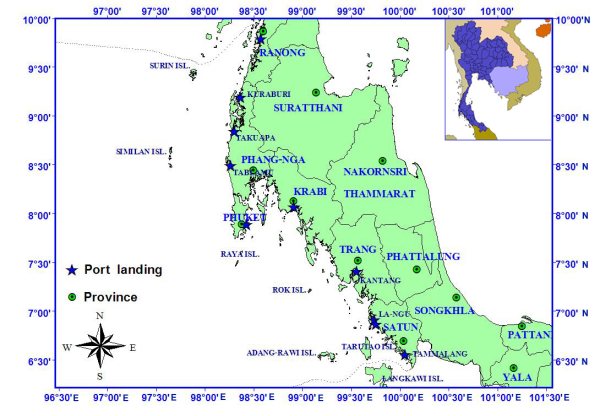
In 2007, The marine fish production from the Andaman Sea was 891,416 mts
or 36% of total marine capture.


Legal and Institutional Framework
National Institution: the Department of Fisheries has played an active role in promoting fisheries
and aquaculture development in Thailand. Reengineered in B.E. 2545 (2002), it has engaged in study,
research and development on fisheries resources management; in controlling of fishing and
aquaculture; in promoting sufficient fisheries products with sanitary standard for domestic and
exported demand; and in sustainable and optimum utilization of fisheries and aquatic resources.
The Department of Fisheries is entrusted with the following responsibilities:
1. Implementation and application of the Fisheries Act B.E. 2490 (1947) at present the Fisheries Act
under the processes of amendment, Act Governing the Right to Fish Within Thai Waters B.E. 2482
(1939), Act Organizing the Activities of Fish Market B.E. 2496(1953), Wildlife Reservation and
Protection Act B.E.2535(1992), and other related laws and regulations;
2. Research and development concerning fisheries and aquaculture, stock improvement, production,
stock enhancement of aquatic animals, ornamental fishes, aquatic plants, aquatic feed, aquatic animal
health, fishing gears, and other related fishery matters including certification for the standard (i.e.
quality and sanitary) of the source of cultured aquatic animals;
3. Research and survey of fishing grounds both within the Thai waters and beyond (neighboring States'
waters or high seas) to increase the productivity and management of the utilization of aquatic
resources;
4. Measures governing activities of capture fisheries and utilization of fishery resources and control,
prevention and suppression regarding fishing activities within inland and marine fishing grounds and
fish trade in compliance with the provisions of laws or regulations;

Legal and Institutional Framework
5. Research and development on preservation, food processing, analysis, inspection control, and
certification on quality of fish and fishery products in compliance with international sanitary
standards and sanitary laws and regulation;
6. Research and development of technology transfer in fisheries, promotion and occupation
development in aquaculture, fishing techniques, fish product processing, and related occupation to
ensure that these activities are essential in economical development for stakeholders, farmers and
general public;
7. Management of international fisheries affairs concerning technology, exploratory research on
overseas fishing areas, fishery joint-venture agreement, and other international related activities;
8.Development of fisheries information system, survey system arrangement, compilation, and
usage of information data including services in information technology for stakeholders, farmers
and general public;
9. Other operational matters authorized by laws as responsibilities of the Department of Fisheries
or other works entrusted by Ministry or the Cabinet.
Andaman Sea Fisheries Research and Development Center (AFRDEC) has belonged to
the Marine Fisheries Technology Research and Development Institute, the Marine
Fisheries Technology Research and Development Bureau, The Department of
Fisheries, and to Ministry of Agriculture and Cooperatives. This mentioned
authority is the one responsible for conducting research and development activity
in the field of marine fisheries along the Andaman Coast of Thailand.

Legal and Institutional Framework
Royal Forestry Department is in general responsible for park management
Ministry of Natural Resources and Environment (MNRE) Department of Marine
and Coastal Resources (DMCR) was given the mandate to develop appropriate
regulations in order to achieve updated and effective managerial action with the
objective of looking after the nation's marine and coastal fragile and vulnerable
resources including resources preservation, conservation aimed at sustainable use and
rehabilitation. DMCR have proposed the new law, which emphasize on the marine
resources management, to enhance the community participation on using and managing
of marine resources to the cabinet. It is under the processes of regulation.
Phuket Marine Biological Center (PMBC) under Department of Marine and Coastal
Resources (DMCR) is taking an importance role of research to manage and improve of
marine resources in Andaman Sea. There are quit numbers of national and
international projects and programmes have been going on since past few years to
rehabilitate and collect information to access the status of marine resources.
Pollution Control Department (PCD) is the main agency implementing the national
policy on pollution control.

The Master Plan of Marine Fisheries Management of Thailand
Vision "Sustainable Fisheries Development based on the Sufficiency Economy that
places the people at the centre"
Mission 1) To manage all activities pertaining to resource use, rehabilitation, maintenance
and protection of the marine environment to ensure its high productivity under the current
socio-economic reality and the state of the marine resources and ecosystem;
2) To carry out the human resource development, institutional strengthening, and activities
leading to the generation of bodies of knowledge pertaining to marine fisheries and
environment management;
3) To promote the application of the FAO Code of Conduct for Responsible Fisheries, and to
promote the networking of such an observance at all levels.

The Master Plan of Marine Fisheries Management of Thailand
Objectives
1) To manage the responsible and sustainable marine fisheries;
2) To facilitate the rapid recovery of the depleted fish stocks and to safeguard marine
ecosystem from any destructive practices;
3) To support the fishery institutional strengthening and co-management, including the
networking at all levels to enable their active participation in marine fisheries management;
4) To promote the capacity building of fishing enterprises at all levels to enable their
effective operations under the changing fisheries situation around the globe, and the
increasingly stringent governance;
5) To enhance fishermen's quality of life;
6) To ensure the seafood safety and the confidence of consumers of fish and fish products.
Targets 1) Security and sustainability of Thailand's marine fisheries: its annual landing of
1.7-2.0 million tonnes comprising at least 80% of economically important species from
fishing grounds within the EEZ, and 1.0-1.6 million tonnes from distant water fishing;
2) Fishermen's organization at the provincial level actively participating in the marine
fisheries management: at least one organization per province and its networking with other
organizations in the proximity;
3) Active participation of fishing communities: at least 10% of all fishing communities
participate.

The Master Plan of Marine Fisheries Management of Thailand
Time Frame
This Master Plan will remain active over the period of 10 years (2009-2018). It is divided
into two 5-year periods: the first period from 2009-2013, and the second period from 2014-
2018.
Strategies
Strategy 1: Efficiency enhancement of marine fisheries management system and co-
management
Strategy 2: Structural strengthening and efficiency improvement of fisheries bodies
Strategy 3: Development and promotion of responsible and sustainable fisheries
Strategy 4: Ecosystem and Fishing Ground Rehabilitation to Safeguard Biodiversity
and Marine Environmental quality
Strategy 5: Promotion and development of distant water fisheries

AFRDEC/DOF
-Long term monitoring on demersal fish, fish
larvae, phytoplankton, zooplankton,
enviroment parameters by Research Vessel.
And long term monitoring on pelagic fish,
demersal fish, crab, shrimp from small-scale
and commercial fisheries by landing survey.
-Study on the impact of Tsumani for the
marine fisheries status.
-Thai-Norwegian Cooperation Project

3. Listing any recent large scale oceanographic/environmental/resource
surveys and the status of any major national / donor assisted projects
in the BOBLME area that are relevant to the BOBLME Project
PMBC/DMCR
·Coral: Long term monitoring of coral reef in Andaman Sea (to provide statute and data
Base of coral) including monitoring of Coral disease, Rehabilitation of coral Reefs
Impact of climate change on coral (coral bleaching)
CORDIO is the international programme which concern on coral management and
rehabilitation in the Andaman Sea
EU programme on coral rehabilitation
GREEN FIN programme is to provide information and management of coral reef by
participation of tourist sector especially on diving activities
·Sea-grass:Monitoring statute of sea-grass
Role of community on sea-grass
·Coastal and marine environment monitoring programme. It is regularly monitoring in Thai's
waters including Andaman Sea. The long term information will be analyzed to accesses the
trend and impact of land-base and sea-base pollution. DMCR is to provide data base and
information of marine and coastal resources for management and development of shoreline.
The large scale of oceanographic and environmental study has been carrying out under
cooperation of Thai and German programme. The project was joint funding by National
Research Council of Thailand and German Research Foundation
The programme is going on the the Indian Ocean call Global Ocean Observing system for
Indian Ocean (IOGOOS).

4. A list of institutions and acronyms involved in activities relevant to BOBLME
AFRDEC,APFIC, BOB, BIMSTEC, BOBLME, ,DFG, DMCR, DOF , FAO
FAT, FMO, GEF, IOGOOS, IOTC, MFRDB, MOAC, MONRE, PMBC, ,
SEAFDEC, SSFF, UNCLOS, UNEP
5. State of preparedness with respect to implementing the BOBLME Project,
including the extent to which the proposed management structure (i.e. the
identification of personnel, formation of advisory panels and task forces) has been
implemented: Applicable
6. An analysis of the developments that have occurred in each country that might
have relevance to the activities proposed in the Project since it was approved by
member countries in June 2007, and any proposals for changes to the current Project
design: Some Applicable


Thank your for your kind
attention