Note:
The designations employed and the presentation of the material in this document do not
imply the expression of any opinions whatsoever on the part of UNEP concerning the legal
status of any State, Territory, city, or area, or its authorities, or concerning the
delimitation of their frontiers or boundaries. The document contains the views expressed
by the authors acting in their individual capacity and may not necessarily reflect the views
of UNEP.
For bibliographic purposes this document may be cited as:
Eckert, Karen L., Julie A. Overing and Bertrand B. Lettsome. 1992. WIDECAST Sea
Turtle Recovery Action Plan for the British Virgin Islands (Karen L. Eckert, Editor).
CEP Technical Report No. 15 UNEP Caribbean Environment Programme, Kingston,
Jamaica. 116 p.

Caribbean Environment Programme
United Nations Environment Programme
Sea Turtle Recovery Action Plan
for the British Virgin Islands
Karen L. Eckert 1
Julie A. Overing 2
Bertrand B. Lettsome 3
1 Executive Director, WIDECAST
2 Marine Biologist, Conservation and Fisheries Department
3 Conservation Officer, Conservation and Fisheries Department
Karen L. Eckert, Editor
Prepared by:
CEP Technical Report No. 15
1992
British Virgin Islands Sea Turtles...
PREFACE
Sea turtle stocks are declining throughout most of the Wider Caribbean region; in some
areas the trends are dramatic and are likely to be irreversible during our lifetimes. According to
the IUCN Conservation Monitoring Centre's Red Data Book, persistent over-exploitation, espe-
cially of adult females on the nesting beach, and the widespread collection of eggs are largely
responsible for the Endangered status of five sea turtle species occurring in the region and the
Vulnerable status of a sixth. In addition to direct harvest, sea turtles are accidentally captured in
active or abandoned fishing gear, resulting in death to tens of thousands of turtles annually.
Coral reef and sea grass degradation, oil spills, chemical waste, persistent plastic and other ma-
rine debris, high density coastal development, and an increase in ocean-based tourism have
damaged or eliminated nesting beaches and feeding grounds. Population declines are
complicated by the fact that causal factors are not always entirely indigenous. Because sea
turtles are among the most migratory of all Caribbean fauna, what appears as a decline in a local
population may be a direct consequence of the activities of peoples many hundreds of kilometers
distant. Thus, while local conservation is crucial, action is also called for at the regional level.
In order to adequately protect migratory sea turtles and achieve the objectives of CEP's
Regional Programme for Specially Protected Areas and Wildlife (SPAW), The Strategy for the
Development of the Caribbean Environment Programme (1990-1995) calls for "the development
of specific management plans for economically and ecologically important species", making par-
ticular reference to endangered, threatened, or vulnerable species of sea turtle. This is consis-
tent with Article 10 of the Cartagena Convention (1983), which states that Contracting Parties
shall "individually or jointly take all appropriate measures to protect ... the habitat of depleted,
threatened or endangered species in the Convention area." Article 10 of the 1991 Protocol to the
Cartagena Convention concerning Specially Protected Areas and Wildlife (SPAW Protocol)
specifies that Parties "carry out recovery, management, planning and other measures to effect the
survival of [endangered or threatened] species" and regulate or prohibit activities having
"adverse effects on such species or their habitats". Article 11 of the SPAW Protocol declares
that each Party "shall ensure total protection and recovery to the species of fauna listed in Annex
II". All six species of Caribbean-occurring sea turtles were included in Annex II in 1991.
This CEP Technical Report is the third in a series of Sea Turtle Recovery Action Plans
prepared by the Wider Caribbean Sea Turtle Recovery Team and Conservation Network
(WIDECAST), an organization comprised of a regional team of sea turtle experts, local Country
Co-ordinators, and an extensive network of interested citizens. The objective of the recovery
action plan series is to assist Caribbean governments in the discharge of their obligations under
the SPAW Protocol, and to promote a regional capability to implement scientifically sound sea
turtle conservation programs by developing a technical understanding of sea turtle biology and
management among local individuals and institutions. Each recovery action plan summarizes
the known distribution of sea turtles, discusses major causes of mortality, evaluates the effect-
tiveness of existing conservation laws, and prioritizes implementing measures for stock recovery.
WIDECAST was founded in 1981 by Monitor International, in response to a recommendation by
the IUCN/CCA Meeting of Non-Governmental Caribbean Organizations on Living Resources
Conservation for Sustainable Development in the Wider Caribbean (Santo Domingo, 26-29
August 1981) that a "Wider Caribbean Sea Turtle Recovery Action Plan should be prepared ...
consistent with the Action Plan for the Caribbean Environment Programme." WIDECAST is an
autonomous NGO, partially supported by the Caribbean Environment Programme.
Page i
CEP Technical Report No. 15
ACKNOWLEDGEMENTS
The authors gratefully acknowledge the assistance of all those who made the production
of this Sea Turtle Recovery Action Plan possible. These include members of the WIDECAST
Sea Turtle Recovery Team 1/, personnel of the Ministry of Natural Resources and Labour's
(MNRL) Conservation and Fisheries Department (CFD), the National Parks Trust (NPT), the
Dive Operator's Association, and a network of interested coastal residents, fishermen, and others
who provided information crucial for this document and for the agenda it seeks to define.
Specifically, within the CFD we owe a debt of gratitude to Dr. Gillian Cambers (Chief
Conservation and Fisheries Officer), Halstead Lima (Assistant Conservation Officer), Steve
Alimoso (Fisheries Officer), Sam Davies (Assistant Fisheries Officer), Mervin Hastings
(Fisheries Assistant), and Annalie Morris (Trainee). In addition, Dr. Nicholas Clarke (NPT
Director, 1986-1988), Robert Norton (NPT Director, 1988-1990), and Iva Archibald (NPT
Office Manager, 1986-1991) were instrumental in initiating and maintaining the Sea Turtle
Conservation Programme prior to the formation of the CFD.
Valuable programme support has been given by the Hon. Ralph O'Neal (Minister,
Ministry of Natural Resources and Labour), Sebulita Christopher (Permanent Secretary, MNRL),
Ethelyn Smith (fmr Permanent Secretary, MNRL), Elroy Turnbull (Chief Education Officer,
Department of Education), Beverly Braithwaite (Department of Education), and Bill Bullimore
(aerial survey pilot, Doyle Sails). Trunkers (leatherback fishermen) Austin Freeman, Osmond
Frett, Frank George, Hugo Hodge, Capt. Maxwell Lettsome, and Sanford Lettsome provided
valuable information on the history and status of the trunk fishery. Many volunteers, both
resident and non-resident, have assisted in the gathering of data, especially on the nesting
beaches. These individuals include: Bill Bailey, Peter and Barbara Bailey, Trish Bailey, Michael
and Carolanne Booth, Fiona and David Dugdale, Emmet and Ruth Evans, Austin Freeman,
Reeial George, Jean Green, Bradford Hull, Randy Kiel, Kay Klein, Randa Jacobs, Winston
Leonard, Walter and Beverly Plachta, Patrick Rogers, Vivian Morris, John Queern, Maxine
Starkey, Marion Syms, Anita Venner, Benjamin, Fiona and Dorothy Woods, and Rosemary
Young. K. Eckert gratefully acknowledges the NPT, Annalie Morris, and Alan Baskin and Eva
Cope for generosity in providing housing during her repeated visits to the BVI since 1986.
_____________
1/ The WIDECAST regional Recovery Team provided impetus for this document and critiqued earlier drafts. These
persons are the following: Lic. Ana Cecilia Chaves (Costa Rica), Dr. Karen Eckert (USA), Jacques Fretey (France),
John Fuller (Antigua), Molly Gaskin (Trinidad), Dr. Julia Horrocks (Barbados), Maria Teresa Koberg (Costa Rica),
Dr. Peter Pritchard (USA), Dr. James Richardson (USA), and Dr. Georgita Ruiz (Mexico). The IUCN/SSC Marine
Turtle Specialist Group (Dr. Karen Bjorndal, Chair) also provided useful comments on an earlier draft. Major
financial support for WIDECAST has come from Monitor International, The Chelonia Institute, the UNEP
Caribbean Environment Programme, and the U. S. National Marine Fisheries Service. Special appreciation is due
Milton Kaufmann (President of Monitor International and Founder of WIDECAST) and Robert Truland (Trustee,
The Chelonia Institute) for their unwavering personal commitment to WIDECAST since its inception more than a
decade ago.
P
age ii
British Virgin Islands Sea Turtles...
TABLE OF CONTENTS
Preface
i
Acknowledgements
ii
Table
of
Contents
iii
List
of
Tables
and
Figures
vi
Dedication
vii
Abstract
(English,
Spanish,
French)
viii
I. INTRODUCTION
1
II.
STATUS AND DISTRIBUTION OF SEA TURTLES IN THE BVI
4
2.1 Caretta caretta,
Loggerhead
Sea
Turtle
5
2.2 Chelonia mydas,
Green
Sea
Turtle
5
2.3 Dermochelys coriacea, Leatherback Sea Turtle
7
2.4 Eretmochelys imbricata, Hawksbill Sea Turtle
8
2.5 Lepidochelys kempii,
Kemp's
Ridley
Sea
Turtle
10
2.6 Lepidochelys olivacea, Olive Ridley Sea Turtle
10
III.
STRESSES ON SEA TURTLES IN THE BVI
11
3.1 Destruction or Modification of Habitat
11
3.2
Disease
or
Predation
12
3.3
Over-utilisation
13
3.4
Inadequate
Regulatory
Mechanisms
16
3.5 Other Natural or Man-made Factors
18
IV.
SOLUTIONS TO STRESSES ON SEA TURTLES IN THE BVI
19
4.1
Manage
and
Protect
Habitat
19
4.11
Identify
essential
habitat 21
4.111
Survey
foraging
areas
21
4.112
Survey
nesting
habitat
22
4.12 Develop area-specific management plans
24
4.121
Involve
local
coastal
zone
authorities
25
4.122
Develop
regulatory
guidelines
26
4.123 Provide for enforcement of guidelines
28
4.124
Develop
educational
materials
28
4.13 Prevent or mitigate degradation of nesting beaches
29
4.131
Sand
mining
29
4.132
Lights
30
4.133
Beach
stabilization
structures
32
4.134 Beach cleaning equipment and vehicles
33
4.135
Beach
rebuilding
projects
34
Page iii
CEP Technical Report No. 15
4.14 Prevent or mitigate degradation of marine habitat
34
4.141
Dynamiting
reefs
34
4.142
Chemical
fishing
35
4.143
Industrial
discharges
35
4.144
At-sea
dumping
of
garbage
36
4.145 Oil exploration, production, refining, transport
37
4.146
Agricultural
runoff
and
sewage 38
4.147
Anchoring
39
4.148
Others
40
4.2 Manage and Protect All Life Stages
41
4.21 Review existing local laws and regulations
41
4.22 Evaluate the effectiveness of law enforcement
43
4.23
Propose
new
regulations
where
needed
43
4.231
Eggs
44
4.232
Immature
turtles 45
4.233
Nesting
females 45
4.234
Unprotected
species
46
4.24 Augment existing law enforcement efforts
46
4.25 Make fines commensurate with product value
47
4.26 Investigate alternative livelihoods for turtle fishermen
47
4.27 Determine incidental catch and promote the use of TEDs
49
4.28 Supplement reduced populations using management techniques
49
4.29
Monitor
stocks
50
4.291
Nests
51
4.292
Hatchlings
53
4.293
Immature
and
adult
turtles
53
4.3 Encourage and Support International Legislation
54
4.31
CITES
54
4.32
Regional
cooperation
55
4.33
Subregional
sea
turtle
management
56
4.4
Develop
Public
Education 58
4.41
Residents 58
4.42
Fishermen 59
4.43
Tourists
59
4.44 Non-consumptive uses of sea turtles to generate revenue
60
4.5
Increase
Information
Exchange
61
4.51
Marine
Turtle
Newsletter 61
4.52 Western Atlantic Turtle Symposium (WATS)
61
4.53
WIDECAST
61
4.54 IUCN/SSC Marine Turtle Specialist Group
62
4.55 Workshops on research and management
63
4.56 Exchange of information among local groups
63
P
age iv
British Virgin Islands Sea Turtles...
4.6 Implement Sea Turtle Conservation Programme
64
4.61
Rationale 64
4.62
Goals
and
objectives
65
4.63
Activities 66
4.64
Results
and
outputs
69
4.65
Budget
71
V. LITERATURE
CITED
73
APPENDIX I: SUMMARY OF RECOMMENDATIONS
112
LIST OF ACRONYMS
BVI
British
Virgin
Islands
CFD
Conservation and Fisheries Department
CIDA
Canadian
International
Development
Agency
CITES
Convention
on
International Trade in Endangered Species
DOA
Dive
Operators
Association
ECNAMP
Eastern Caribbean Natural Areas Management Programme
IUCN
World
Conservation
Union
LDCA
Land Development Control Authority
MNRL
Ministry
of
Natural Resources and Labour
NPT
National
Parks
Trust
OECS
Organization
of
Eastern Caribbean States
TCP
Town and Country Planning
UK
United
Kingdom
UNEP
United Nations Environment Programme
USVI
United States Virgin Islands
WATS
Western
Atlantic Turtle Symposium
WIDECAST
Wider Caribbean Sea Turtle Recovery Team and Conservation Network
Page v
CEP Technical Report No. 15
LIST OF TABLES AND FIGURES
TABLE 1
81
Summary of sea turtle nesting records in the British Virgin Islands.
TABLE 2
91
Results of 1990-1992 field surveys for green (Chelonia mydas) and
hawksbill
(Eretmochelys imbricata) sea turtle nests.
TABLE 3
98
Results of 1986-1992 field surveys for leatherback sea turtle (Dermo-
chelys coriacea) nests.
TABLE 4
101
Weights of sea turtles captured during 1991-1992 in Anegada.
TABLE 5
102
Details obtained from 18 turtle fishermen interviewed in a Fisheries
Frame Survey, June-July 1991.
TABLE 6
103
Estimated number of leatherback (trunk) sea turtles nesting in Tortola
during 1987-1992 and the number known to have been killed.
FIGURE 1
104
The British Virgin Islands.
FIGURE 2
105
A guide to the sea turtles of the British Virgin Islands.
FIGURE 3
106
Potential nesting beaches on the largest islands in the BVI.
FIGURE 4
107
Sea grass and reefs around Tortola, British Virgin Islands.
FIGURE 5
108
Sea grass and reefs around Virgin Gorda, British Virgin Islands.
FIGURE 6
109
Sea grass and coral reefs around Anegada, British Virgin Islands.
FIGURE 7
110
The Horseshoe Reef Protected Area, Anegada, established May 1990.
P
age vi
British Virgin Islands Sea Turtles...
DEDICATION
"Ways Turtles Die" 1
People like turtles for their shell and taste
But you must not let turtles go to waste
There is something you must do, really must
That's to let turtles live just like us.
Turtles are intelligent creatures
And they have very talented features
Things that you throw in the sea like candy
Wrappers and grape vines will mess up turtles' lives
So listen to my advice and let turtles
Live their lives just like yours and mine.
Yachts throw out their anchors
Where the turtles' food grow
That is sea grass, as you know
Don't pollute the ocean blue
Please, let turtles live like you!
Akesha Smith (Age 9)
Isabella Morris Primary School
Carrot Bay, Tortola
July 1990
1 Winning entry (3rd Place, Creative Writing, Class 3) from a Creative Writing Contest
sponsored by the MNRL Conservation and Fisheries Department for primary school
children in the British Virgin Islands.
Page vii
CEP Technical Report No. 15
ABSTRACT
The British Virgin Islands lie between 18o20'N and 18o50'N latitude and 64o18'W and
64o51'W longitude in the northeastern Caribbean Sea, situated 100 km east and northeast of
Puerto Rico. Sea turtles have played an important role in the cultural and socio-economic
development of the BVI. It does not appear that there was ever an established commercial
export of sea turtles, but locally occurring species have been extensively exploited at the
subsistence level. Although there has been a considerable decline in the fishery, it continues to
the present day and remains family or community oriented. Hawksbill (Eretmochelys imbricata)
turtles and green (Chelonia mydas) turtles are primarily captured by the use of nets (but also by
leaping on them from a boat and, increasingly, by spearing), while leatherbacks (Dermochelys
coriacea) are taken on the beach during nesting. The hawksbill/green turtle fishery was
widespread historically and concentrated in the major fishing villages on each island. The
leatherback (trunk) fishery was concentrated in villages close to nesting beaches in Tortola and
Virgin Gorda. This fishery has declined significantly; by 1986 when a closed season was
established, fewer than 10 females (total) nested each year. The harvest of green and hawksbill
turtles in 1991 was 10% what it was in 1981, partly because of depleted stocks and partly
because of reduced demand. The total harvest of eggs is unquantified, but approaches 100% on
some monitored beaches. Incidental catch in longline and net fisheries is a potential problem.
There must be two central components to any recovery programme: (1) protection of
turtles and eggs and (2) protection of important feeding and nesting habitats. While some
progress has been made, current legislation is inadequate to provide for the recovery of sea
turtles. There is no protection for eggs and no size limit for turtles landed during the open season
(1 December-31 March). The Ministry of Natural Resources and Labour is currently considering
the Turtles Act of 1992 which will protect eggs and mandate a maximum size limit to protect
large juveniles and breeding-age adults. A moratorium on the harvest of turtles and eggs is
recommended by this Recovery Action Plan, as is passage of a strong Coast Conservation and
Management Act. Additional law enforcement resources, including marine transportation, are
needed. Several comprehensive workshops have been organized to familiarize enforcement
officers and government personnel with conservation laws. Nevertheless, it is difficult to
apprehend violators because the theft of eggs or the landing of a turtle out-of-season is easily
accomplished clandestinely. An increased awareness on the part of the public has resulted in
numerous reports to the Conservation and Fisheries Department (CFD) of illegal activity. One
option for improving environmental law enforcement (e.g., mining, pollution, wildlife and
fisheries, endangered species) is to create a Division of Enforcement under the aegis of CFD.
With regard to the protection of habitat, it is clear that the areas most important to sea
turtles are sea grass meadows and coral reefs (food, shelter) and sandy beaches (nesting). These
habitats are widespread in the BVI and support several important commercial enterprises,
including fishing and tourism. A variety of regulatory guidelines are herein proposed for the
protection of coastal and marine habitat. These involve waste disposal and pollution,
construction set-backs, shoreline lighting, beach access, mooring, and the physical destruction of
the sea bed. An expanded system of protected areas is also recommended. The BVI encom-
passes more than 40 islands and islets and dozens of pristine bays and sheltered anchorages. A
national development plan is needed to protect the rich diversity of this community of islands for
P
age viii
British Virgin Islands Sea Turtles...
residents and future generations. Public awareness programmes are an essential component of
any effort to both develop and conserve the environment. CFD has a full-time Environmental
Awareness Officer and has worked collaboratively with Department of Education personnel to
design and present regular programmes to school children on mangroves, sea turtles, coral reefs,
and beaches. These units will eventually become a standard part of the BVI curriculum. Efforts
to educate the adult public and tourists are also underway.
In addition to protecting turtles and habitat, monitoring programmes are needed to
determine population trends and to evaluate the success of conservation efforts. Because it is
neither possible nor necessary to monitor all sea turtle nesting beaches in the BVI, the selection
of Index Beaches for comprehensive study is recommended. Several important nesting areas
suitable for Index Beach designation have already been identified. These include the northeast
coast of Tortola from Trunk Bay east to Long Bay (Beef Island) for leatherbacks, the northern
cays (Scrub Island, Great and Little Camanoe islands, Guana Island) for hawksbills, and the
island Anegada for greens and hawksbills. Little is known of the distribution or timing of
nesting in Virgin Gorda, Jost Van Dyke, or the southern cays. Even less is known of the
residency, range, or behaviour patterns of juveniles foraging in BVI waters. Sea turtles are
long-lived (most require 20-35 years to reach sexual maturity) and highly migratory. Local
juvenile and adult (nesting) populations are not likely to be related. Nesting females are not
residents. They arrive from distant feeding grounds to lay their eggs on BVI beaches,
presumably because they were born in the BVI many years before. Hatchling turtles released
from local beaches travel widely throughout the Caribbean prior to reaching maturity.
Local-caught juveniles represent the future breeding stock for other Caribbean nations.
All Caribbean peoples must work together to conserve remaining sea turtles. Historical
accounts confirm that sea turtles once swarmed throughout the region in numbers almost
unimaginable today. They have been harvested for generations with no thought given to
population size, rates of recruitment, or sustainable yield. The outcome is now clear. Nesting
populations are declining; some have completely disappeared. If we are to safeguard what
remains of this legacy, what remains of these mysterious and ancient reptiles, we must act
without further delay to protect them. Few men are still involved in the sea turtle fishery. This
is not to say, however, that their circumstances are unimportant. CFD should undertake a
comprehensive Turtle Fishery Frame Survey to determine income derived from the turtle
harvest. Technologies and programmes designed to enhance the harvest of fish may be all that is
needed to compensate for income lost if turtles are protected year-around. The choice would
appear an obvious one -- either explore alternatives to the turtle harvest now or be faced with the
same challenge (that of finding alternatives) at a later date. In the second instance, the price may
be the loss of sea turtles in the BVI. Since turtles return to their natal beaches, once nesting
populations are exterminated, they cannot return. This Recovery Action Plan reviews a wide
variety of solutions to contemporary stresses on sea turtles and outlines a detailed Sea Turtle
Conservation Programme. A summary of recommendations is provided in Appendix I.
Page ix
CEP Technical Report No. 15
RESUMEN
Las Islas Vírgenes Británicas se encuentran entre los 18o20' y 18o50' de latitud Norte y
los 64o18' y 64o51' de longitud Oeste en el Noroeste del Mar Caribe, situadas a 100 km al este y
noroeste de Puerto Rico. Las tortugas marinas han desempeñado un papel importante en la
cultura y el desarrollo socio económico de las Islas Vírgenes Británicas. No parece que haya
habido nunca un comercio establecido de exportación de la tortuga marina, pero las especies que
se encuentran localmente, han sido explotadas de manera frecuente a nivel de subsistencia.
Aunque ha habido una disminución considerable en la pesca, esta continúa hasta el presente y
permanece dentro de la familia o la comunidad. Las tortugas Carey (Eretmochelys imbricata) y
las Verdes del Atlántico (Chelonia mydas), son capturadas, principalmente, utilizando redes
(también, saltando sobre ellas desde un bote y, cada vez más, con harpón), mientras que las
tortugas Toras (Dermochelys coriacea) son capturadas en las playas durante su anidación. La
pesca de las tortugas Carey y Verde del Atlántico ha sido muy difundida históricamente y se ha
concentrado en las mayores aldeas pesqueras de cada isla. La pesca (troncal) de la tortuga Tora
se concentraba en las aldeas cercanas a las playas de anidación en Tórtola y Virgen Gorda. Esta
pesca se ha reducido significativamente; para 1986, cuando se estableció una temporada cerrada,
anidaban cada año menos de 10 hembras (total). El aprovechamiento de las tortugas Verde del
Atlántico y Carey en 1991 fue 10% menor que en 1981, en parte a causa de las reservas agotadas
y en parte a causa de una demanda reducida. El total de huevos aprovechados no se cuantifica,
pero se aproxima al 100% en algunas playas monitoreadas. La captura incidental en hilos largos
y redes de pesca constituye un problema latente.
Debe haber dos componentes centrales en cualquier programa de rescate: (1) protección
de tortugas y de huevos y (2) protección de importantes habitats de anidación y de alimentación.
Mientras se ha logrado algún progreso, la legislación actual resulta inadecuada para ocuparse del
rescate de la tortuga marina. No existe protección para los huevos ni tamaño límite para las
tortugas que llegan a las costas durante la temporada abierta (1 diciembre-31 marzo). El
Ministerio de Trabajo y Recursos Naturales está actualmente considerando la Ley de las
Tortugas de 1992 que protegerá los huevos y que ordena un límite máximo de tamaño para
proteger a los juveniles grandes y a las adultas en edad de reproducción. Este Plan de Acción
recomienda una moratoria en el aprovechamiento de tortugas y huevos, ya que es parte de una
Ley de la Conservación y el Manejo de Costas. Se necesitan recursos adicionales para la
observancia de la ley, que comprendan el transporte marítimo. Se han organizado varios talleres
integrales para fami-liarizar a los oficiales encargados de la observancia de la ley y al personal
del gobierno con las leyes de la conservación. Sin embargo es difícil arrestar a quienes violan la
ley, porque el robo de huevos y la captura de tortugas fuera de temporada se logra fácilmente de
forma clandestina. El aumento en la concientización por parte del público ha resultado en
numerosos informes sobre actividades ilegales al Departamento de Conservación de Pesquerías
(CFD). Una de las opciones para mejorar la observancia del derecho ambiental (ej. minería,
contaminación, vida silvestre y pesquerías, especies en peligro) es crear una División de
Observancia de la Ley bajo el eje de CFD.
Con respecto a la protección de habitats, queda claro que las áreas más importantes para
las tortugas marinas son los pastizales marinos y los arrecifes de coral (alimento, protección) y
P
age x
British Virgin Islands Sea Turtles...
las playas arenosas (anidación). Estos habitats se encuentran diseminados por las IVB y apoyan
varias empresas comerciales importantes, incluso la pesca y el turismo. Se proponen aquí una
variedad de directrices regulatorias para la protección de habitats marinos y costeros. Estas
comprenden, eliminación de desechos y contaminación, construcción de edificaciones de
blindaje, iluminación de la fajas costeras, acceso a las playas, fondeo de embarcaciones, y la
destrucción física del lecho marino. También se recomienda un sistema extendido de áreas
protegidas. Las IVB abarcan más de 40 islas e islotes y docenas de bahías primitivas y
ancladeros protegidos. Se precisa un plan de desarrollo nacional que proteja la rica diversidad de
esta comunidad de islas para los residentes y las generaciones futuras. Los programas de
concientización pública constituyen un componente esencial de cualquier esfuerzo, tanto para el
desarrollo como para la conservación del medio ambiente. El CDF tiene un Oficial de
Concientización Ambiental de tiempo completo, que ha trabajado en colaboración con personal
del Departamento de Educación en el diseño y la presentación de programas regulares para los
escolares sobre manglares, tortugas marinas, arrecifes de coral y playas. Estas unidades se
convertirán finalmente en una parte corriente del programa de estudios de las IVB. Los
esfuerzos por educar al público adulto y a los turistas se hallan también en camino.
Además de proteger las tortugas marinas y sus habitats, se necesitan programas de
monitoreo para determinar las tendencias de la población y para evaluar el éxito de los esfuerzos
conservacionistas. Como, no es posible ni tampoco es necesario monitorear todas las playas de
anidación de tortugas marinas en las IVB, se recomienda la selección de un Indice de Playas para
su estudio exhaustivo. Ya se han identificado varias áreas importantes adecuadas para integrar el
Indice de Playas. Estas comprenden la costa nordeste de Tórtola desde Bay Trunk hacia el este
de Log Bay (Beef Island) para las tortugas toras, los cayos del norte (Scrub Island, las islas Great
y Little Camanoe, Guana Island) para la tortuga carey, y la isla Anegada para tortugas verdes del
Atlántico y carey. Poco se sabe de la distribución o el tiempo de anidación en Virgen Gorda,
Jost Van Dyke, o los cayos del sur. Se conoce aún menos sobre la residencia, el rango o los
patrones de comportamiento de los juveniles que se alimentan en aguas de las IVB. Las tortugas
marinas tienen larga vida (la mayoría requiere de 25-30 años para alcanzar la madurez sexual) y
son altamente migratorias. La población de ejemplares locales jóvenes y adultos (anidando)
tienden a no relacionarse. Las hembras en período de anidación no son residentes. Llegan desde
terrenos distantes donde se alimentan, a poner sus huevos en las playas de las IVB, se presume
que porque nacieron en las IVB hace muchos años. Los nuevos ejemplares que salen de las
playas locales, viajan extensamente a lo largo del Caribe previo a alcanzar la madurez. Las
juveniles capturadas localmente representan la futura reserva de reproductoras para otras
naciones del Caribe.
Todos los pueblos del Caribe deben trabajar juntos para conservar las tortugas marinas
que quedan. Descripciones históricas confirman que las tortugas marinas pulularon por las
playas de la región en cantidades casi inimaginables hoy en día. Estas han sido aprovechadas
por generaciones sin detenerse a pensar en el tamaño de la población, velocidad del
abastecimiento, o crecimiento sustentable. El resultado es ahora claro. Las poblaciones que
anidan están disminuyendo; algunas han desaparecido por completo. Si fuéramos a salvaguardar
lo que resta de este legado, lo que resta de estos reptiles misteriosos y antiguos, deberíamos
actuar sin más detenimiento para protegerlos. Hay pocos hombres todavía dedicados a la pesca
de la tortuga. No queremos decir, sin embargo, que sus circunstancias carecen de importancia.
La CDF debe emprender un exhaustivo Estudio de Marco de la Pesca de la Tortuga para deter-
Page xi
CEP Technical Report No. 15
minar el ingreso que se deriva del aprovechamiento de la tortuga. Las tecnologías y los
programas diseñados para incrementar el aprovechamiento de peces tal vez sea todo lo que se
necesita para compensar la pérdida de ingresos en caso de proteger las tortugas durante todo el
año. La decisión parecería bastante obvia -- o se exploran alternativas al aprovechamiento de
tortugas ahora, o se enfrenta el mismo reto (el de encontrar alternativas) en una fecha posterior.
En segunda instancia, el precio puede ser la pérdida de la tortuga marina en las IVB. Ya que las
tortugas regresan a sus playas natales, una vez que se exterminan las poblaciones que anidan, ya
no se pueden recuperar. Este Plan de Acción para el Rescate de la Tortuga Marina contempla
una variedad de soluciones a sobrecargas actuales a las tortugas marinas y destaca un Programa
de Conservación de la Tortuga Marina. Se ofrece un sumario de recomendaciones en el
Apéndice I.
P
age xii
British Virgin Islands Sea Turtles...
RESUME
Les Iles Vierges britanniques sont situées entre les latitudes 18o20 N et 18o50 N et les
longitudes 64o18 W et 64o51 W dans le nord-est de la Mer des Caraïbes, à 100 km à l'estnordest
de Porto Rico. Les tortues de mer ont joué un rôle important dans le développement culturel et
socio-économique de ces îles. Il n'y a aucune preuve d'une exportation commerciale organisée
des tortues de mer, bien que cette espèce ait été exploitée au niveau de la subsistance. Malgré la
baisse importante de la capture, celle-ci persiste aujourd'hui à l'échelle familiale et
communautaire. La tortue cahouanne (Eretmochelys imbricata) et la tortue verte (Chelonia
mydas) sont capturées le plus souvent à l'aide de filets; on leur saute également dessus et, de plus
en plus souvent on les tue au harpon. La tortue cuir (Dermochelys coriacea) est capturée sur la
plage pendant sa ponte. Dans le passé, la capture de la tortue cahouanne et de la tortue verte était
répandue et se concentrait dans les principaux villages de pêche dans chaque île. La capture de
la tortue cuir se limitait aux villages près des plages de nidation à Tortola et à Virgin Gorda.
Cette capture a subi une baisse importante et en 1986, au moment de la déclaration de la
fermeture d'une saison de pêche, moins de 10 femelles y pondaient chaque année. En 1991, la
capture de la tortue verte et de la tortue cahouanne atteignait 10% de son niveau de 1981, dû en
partie au nombre réduit et en partie à une demande moins importante. La récolte totale des oeufs
ne peut pas être quantifiée, mais sur certaines plages surveillées, ceci pourrait s'élever à 100%.
La capture fortuite à l'aide de lignes longues et de filets est un problème potentiel.
Tout programme de sauvegarde doit comprendre deux principaux composants: (1) la
protection des tortues et de leurs oeufs et (2) la protection des habitats importants pour
l'alimentation et la réproduction. En dépit des progrès réalisés, la législation nationale
actuellement en vigueur n'est pas adéquate pour faire face au problème de la sauvegarde des
tortues de mer. Il n'y a aucune protection pour les oeufs et aucune limitation en ce qui concerne
des tortues capturées au cours de la saison de pêche qui s'étend du 1er décembre au 31 mars. Le
Ministère des ressources naturelles et du travail étudie actuellement la Loi de 1992 sur les
Tortues de 1992 qui porte sur la protection des oeufs et la fixation d'une taille maximale pour la
capture des jeunes adultes et de ceux qui sont en âge de se reproduire. Un moratoire sur la
capture des tortues et sur la prise de leurs oeufs ainsi que l'adoption d'une Loi solide sur la
protection et la gestion des côtes. D'autres mécanismes pour l'application de la loi, y compris le
transport maritime seront nécessaires. Plusieurs ateliers détaillés ont été organisés afin de mettre
les écologistes ainsi que les responsables gouvernementaux au courant des lois sur la
préservation. Néanmoins, il est difficile de saisir les contrevenants car le vol des oeufs ou la
capture des tortues en dehors de la saison de chasse peut facilement se faire clandestinement.
Grâce à une plus grande sensibilisation du public, le Département pour la protection de
l'environnement et de la pêche (DPEP) a été averti de nombreuses activités illégales. Une option
pour améliorer l'application de la loi environnementale (par exemple, l'exploitation minière, la
pollution, la vie sauvage et les ressources halieutiques ainsi que les espèces menacées) est de
créer une Section d'application de la loi sur l'environnement sous l'égide du DPEP.
En ce qui concerne la protection de l'habitat, il est évident que les zones les plus
importantes pour les tortues de mer sont les bancs d'algues et les récifs coralliens (pour
l'alimentation et l'habitat) et les plages sableuses (pour la reproduction). Ces habitats s'étendent
dans les Iles Vierges britanniques et abritent plusieurs entreprises commerciales importantes, y
Page xiii
CEP Technical Report No. 15
compris la pêche et le tourisme. Plusieurs directives pour la protection de l'habitat côtier et
marin sont proposées dans le présent document. Elles concernent l'évacuation des déchets et la
pollution, la construction de remparts, l'éclairage public des côtes, l'ancrage et la destruction
physique des fonds marins. Une extension du nombre des zones protégées est également
recommandé. Les Iles Vierges britanniques comprennent plus de 40 îles et îlots et des douzaines
de baies vierges et de mouillages protégés. Un plan national de développement est nécessaire
pour protéger la diversité de ce groupe d'îles pour les résidents et les générations futures. Les
programmes de sensibilisation du public sont des éléments essentiels à tout effort pour protéger
l'environnement et le mettre en valeur. Le DPEP a un Responsable de la sensibilisation du
public qui travaille à plein temps et qui a collaboré étroitement avec le personnel du Département
de l'éducation pour concevoir et présenter régulièrement aux écoliers des programmes sur les
mangroves, les tortues de mer les récifs coralliens et les plages. A la longue, ces unités feront
partie intégrante des programmes dans les écoles des Iles Vierges britanniques. Des efforts sont
en cours pour sensibiliser la population adulte et les touristes.
En plus des programmes visant la protection des tortues et des habitats, des programmes
de surveillance sont nécessaires pour déterminer la croissance de la population et pour évaluer la
réussite des programmes de conservation. Etant donné qu'il n'est ni possible ni nécessaire de
surveiller toutes les plages où se reproduisent les tortues de mer dans les Iles Vierges
britanniques, il est recommandé de choisir des plages-témoins pour mener des études détaillées.
Plusieurs endroits importants pour la réproduction ont été déjà identifiés comme pouvant servir
de plagestémoins. Il s'agit de la côte nord-est de Tortola, de la Baie Trunk à la Baie Long (sur
l'Ile Beef) pour les tortues cuir, les récifs du nord (l'Ile Scrub, les Grandes et les Petites Iles
Camanoe, l'Ile Guana) pour les tortues cahouannes et l'île Anegada pour les tortues cuir et les
tortues cahouannes. On en sait très peu sur la distribution et la période de ponte à Virgin Gorda,
Jost Van Dyke ou dans les récifs du sud. On en sait encore moins sur les habitats, l'étendue du
territoire ou le comportement des jeunes qui s'alimentent dans les eaux des Iles Vierges
britanniques. Les tortues de mer ont une espérance de vie très élevée (la plupart d'entre elles
atteignent la maturité sexuelle entre l'âge de 20 et 35 ans) et sont très migratrices. Il y a peu de
chance que les populations locales de jeunes et les populations adultes (en reproduction)
appartiennent aux même familles. Les femelles en reproduction ne vivent pas dans des eaux
côtières des Iles Vierges britanniques; elles y arrivent des zones de forage lointaines pour pondre
leurs oeufs sur les plages, car elles y étaient nées beaucoup d'années auparavant. Des
nouveauxnés voyagent beaucoup dans les Caraïbes avant d'atteindre l'âge adulte. Les jeunes
capturés dans les eaux d'une île constituent la future population reproductrice d'autres pays des
Caraïbes.
Tous les peuples des Caraïbes sont appelés à travailler ensemble pour protéger les tortues
de mer restantes. D'après les documents historiques, les tortues de mer étaient présentes dans la
région dans des quantités qu'on peut imaginer guère aujourd'hui. Elles ont été capturées pendant
des générations sans qu'on se préoccupe de la taille de leurs populations, du taux d'exploitation
ou d'un rendement durable. Le résultat en est évident. Les populations susceptibles de se
reproduire sont en baisse et certaines ont complètement disparu. Nous devons agir immédiate-
ment pour sauvegarder ce qui reste de cet héritage et de ces reptiles anciens et mystérieux. Il y a
peu d'individus qui se livrent actuellement à la chasse aux tortues. Néanmoins, cela ne diminue
pas la gravité de la situation de ces dernières. Le DPEP devrait entreprendre une Etude détaillée
sur l'exploitaion des tortues afin d'évaluer les revenus découlant
P
age xiv
British Virgin Islands Sea Turtles...
de leur capture. De meilleurs techniques et programmes dans le domaine de la pêche pourraient
se substituer aux revenus qui seront perdus par la protection des tortues toute l'année. Le choix
paraît évident - chercher aujourd'hui des options à la capture des tortues ou bien devoir faire face
plus tard à ce même défi. Dans le deuxième cas, on risque d'avoir à payer la perte de tortues de
mer dans les Iles Vierges britanniques. Puisque les tortues de mer retournent à leur plage natale
pour se reproduire, l'extinction des populations en âge de reproduction signifie qu'elles ne
pourraient pas le faire. Le Plan d'action de sauvegarde étudie plusieurs solutions aux pressions
actuelles exercées sur les tortues de mer et présente en détail un Programme pour la sauvegarde
des tortues de mer. Un résumé de ces recommandations figure à l'Annexe 1 du présent docu-
ment.
Page xv
British Virgin Islands Sea Turtles...
I. INTRODUCTION
The British Virgin Islands (BVI) lie between 18o20'N and 18o50'N latitude and 64o18' W
and 64o51'W longitude in the northeastern Caribbean Sea (Figure 1). The Territory's more than
40 islands, islets and rocks are situated 100 km east and northeast of Puerto Rico and lie with the
U. S. Virgin Islands (USVI) on a common submerged platform known as the Puerto Rican
Plateau on the Greater Antillean submarine ridge. Most of the islands are hilly and of volcanic
formation, except Anegada which rises only to about 8 m at its highest point. Virgin Gorda and
the southern cays (Norman, Peter, Dead Chest, Salt, Cooper, and Ginger islands) are separated
from Tortola by the Sir Francis Drake Channel, about 7 km at its widest point and 51 m at its
greatest depth. The southern cays are very close to the edge of the submarine shelf. Jost Van
Dyke is 5.5 km northwest of Tortola, and Anegada, the northernmost island, is about 24 km
north of Virgin Gorda (NPT/ECNAMP, 1986). The BVI population was 17,733 in 1991, an
increase of 47.4% (mostly as a result of immigration) from the 1980 total of 12,034.
Sea turtles have played an important role in the cultural and socio-economic development
of the BVI. It does not appear that there was ever an established commercial export of sea
turtles, but locally occurring species have been extensively exploited at the subsistence level.
Although there has been a significant decline in the fishery, it continues to the present day and
remains family or community oriented. Hawksbill (Eretmochelys imbricata) and green
(Chelonia mydas) sea turtles are primarily captured by the use of nets, while leatherbacks
(Dermochelys coriacea) have been (and to some extent still are) taken on the beach during
nesting. The hawksbill and green turtle fishermen, known locally as 'turtle fishermen', are
generally true fishermen who set turtle nets in addition to their fish traps. In contrast, the
leatherback fishermen, known locally as 'trunkers', hunt at night on the nesting beach and are not
involved in the hawksbill/ green turtle fishery. The industry thus has two components, and two
distinct sets of cultural and socio-economic traditions have evolved.
The hawksbill/green turtle fishery was widespread historically and centered in the major
fishing villages on each island (e.g., The Settlement in Anegada; North Sound and The Valley in
Virgin Gorda; East End, Long Look, Baugher's Bay, and Road Town in Tortola; Great Harbour
and East End in Jost Van Dyke). Nets were set throughout the territory from Anegada to Jost
Van Dyke. The art of knotting, hanging, setting and hauling turtle nets, along with the handling
and processing of the animals, was passed on from generation to generation within families and
through apprenticeships. Turtle meat was an important and readily available source of protein
and also an important source of income for local fishermen. Today, during the season when
local restaurants are permitted to buy and sell turtle meat (1 December - 31 March), turtle is still
a popular delicacy in some areas, commanding a price (per pound) somewhat less than fish. The
exact number of turtles landed has never been formally recorded. The estimated catch of green
turtles has declined over the last decade from 700 in 1981 to 200 in 1985 to 71 during the
1990-1991 open season. Similarly, the estimated catch of hawksbills has declined from 400 in
1981 to 75 in 1985 to 32 during the 1990-1991 open season.
Traditionally the shells ("turtle backs") of both hawksbills and green turtles were cured,
cleaned and sold. In the 1940's, turtle shells, particularly hawksbill, were in demand by local
craftsmen and thus fetched a good price. The sale of shells was a major source of income for the
Page 1
CEP Technical Report No. 15
fishermen. Apparently there was also some export of shells that were purchased from the fisher-
men by wealthy residents. With the advent of plastics and other substitutes, perhaps coupled
with international pressure for sea turtle protection, the demand eventually diminished and the
shell trade declined. Today shells are sold locally, given away, or kept by fishermen to be
mounted and displayed in private homes, clubs, restaurants and hotels. The handicraft industry
which once fashioned jewelry and trinkets from hawksbill shell scutes ("tortoiseshell") has
declined noticeably over the last decade and is virtually non-existent today.
The leatherback, or trunk, fishery was concentrated in villages close to leatherback
nesting beaches in Tortola and Virgin Gorda. This fishery has declined significantly and by
1986 when a closed season was established, the harvest had been reduced to the nesting beaches
along the northeast coast of Tortola. The fishermen claim that they never took both turtle and
eggs, in accordance with sections 3(d) and 3(e) of the now amended 1959 Turtles Ordinance, but
this cannot be verified. Fishermen interviewed in 1987 recalled as many as six trunks per night
nesting in the 1920's on beaches such as Josiahs and Long Bay Lambert (Tortola). Today it
appears that fewer than ten females nest per year on all of Tortola. Since 1986, the most crawls
observed during one year on any of the major leatherback nesting beaches on Tortola was three
at Trunk Bay in 1990 (Morris, 1990) and four at Long Bay Belmont in 1991 (Hastings, 1991).
There are numerous beaches where these animals no longer nest at all (e.g., Trunk Bay, Virgin
Gorda; Cane Garden Bay, Tortola; White Bay, Guana Island). In 1991, two of an estimated total
nesting population of four females were slaughtered.
Because of its seasonal nature, the leatherback fishery was never as important
economically as the hawksbill/green turtle fishery. Leatherbacks are temperate Atlantic turtles
which periodically leave foraging and residence grounds, such as in the northeastern USA and
Canada, and migrate long distances to lay their eggs in the warm sand of the BVI and other
Caribbean nations and territories. They can be found nesting during the months of March to
July. In addition to the brief timeframe, there was not a large market for the primary product
derived from the animal, which was oil. The meat and eggs were distributed in a subsistence
fashion among families and the community. What this fishery lacked in socio-economic
importance, however, it made up for culturally. "Trunking" is deeply rooted in tradition and
mysticism. Some fishermen trace the roots of the fishery back to the days of slavery, while
others believe it was actually brought over from Africa like so many other local customs.
Over the years knowledge has been gained about the trunk turtle (the nesting cycle, the
arts of "turtle watching", capture, slaughter and preparation) through practical experience. There
is also a certain "mystical knowledge" about the animals that is not so easily or logically
explained. The sighting of the silhouette of a trunk turtle in the clouds with the head of the turtle
pointing in the direction of the chosen nesting beach is the most widely experienced
phenomenon. The silhouette is commonly experienced at the community level, with everyone
being capable of recognizing the silhouette and sounding the alarm to watch for the expected
animal. One of the authors (BBL) has personally observed this silhouette on numerous
occasions from when he was a small boy until now, and there are several documented cases of
trunk turtles being caught as a result of these signs in the sky. Noises in the bushes, sticks
breaking, whistling, human voices, strange odors and ghosts of deceased trunk fishermen have
been reported just prior to the emergence of the turtles on the beach.
P
age 2
British Virgin Islands Sea Turtles...
When a trunk was slaughtered, the head, back, belly plate (=plastron), flippers and
internal fat were boiled in sea water in a copper kettle on the beach. As the oil rose to the
surface, it was siphoned off and bottled. Remains and entrails were buried well behind the
beach; care was taken not to contaminate the beach or the nearshore water with any part of the
turtle because it was believed that this would prevent turtles from nesting in the future. The
tough meat was never as popular as that of the hawksbill or green turtles, but the eggs and, to a
lesser extent, the oil were prized for their reputed aphrodisiac qualities. In addition, trunk oil was
considered to have potent medicinal value, especially in the treatment of severe colds and other
general respiratory ailments. The oil was sometimes mixed with seawater, lime and/or honey
prior to drinking. Trunk oil is still available for sale on an informal basis. In 1992, it was selling
for $30 for a small bottle and up to $200 for a larger bottle, such as a whiskey bottle.
The opportunistic harvest of sea turtle eggs for personal consumption occurs year-around
(despite the 1 April-30 November closed season) and is considered a serious threat to sea turtle
conservation. All factors indicate that the level of poaching has decreased in recent years, but
the proportion of nests poached per season remains unknown. Fletemeyer (1984) estimated that
the harvest approached 50% of all eggs laid. Winston Leonard (Leonard's Sea Food Ltd., pers.
comm.) concedes that historically it was probably close to 100% in some areas; the target was
primarily hawksbill eggs. Poaching has recently been reported from Rogues Bay (Tortola), Long
Bay (Beef Island), Cam Bay and North Bay (Great Camanoe), North Beach (Guana Island),
North Bay Beach and the West End beaches of Scrub Island, and all around Anegada. It is
possible that the leatherback has been most affected by egg poaching, given its restricted nesting
range and the ease of nest identification. Nevertheless, since virtually all sandy beaches are
accessible by fishing boat, even relatively isolated nesting beaches on offshore cays, no species
has escaped the theft of eggs.
The BVI participates in a number of regional and international treaties and organizations
that are concerned with the conservation of sea turtles, including the Convention on International
Trade in Endangered Species (CITES), the Convention for the Protection and Development of
the Marine Environment of the Wider Caribbean Region (Cartagena Convention), the Western
Atlantic Turtle Symposium (WATS), and the Wider Caribbean Sea Turtle Conservation Network
(WIDECAST). In addition, hawksbill, green and leatherback turtles are listed as "endangered"
under the First Schedule of the 1976 BVI Endangered Animals and Plants Ordinance, which
prohibits their importation and exportation. In 1985, the Ministry of Natural Resources and
Labour (MNRL), reflecting government policy, made the conservation of sea turtles a priority.
A joint Sea Turtle Survey was initiated by the National Parks Trust and the Conservation Officer
of MNRL. Funding for the project was solicited locally, as well as from WATS.
In 1986, technical assistance was sought from Dr. Karen Eckert, former co-Director of
the Sandy Point Leatherback Research Project in St. Croix and current Executive Director of
WIDECAST. Public awareness and education programmes about sea turtles were developed at
that time and have since been expanded. These programmes take the form of public lectures,
classroom slide shows, radio interviews, and newspaper articles. A volunteer network was
established under the guidance of WIDECAST to assist in data collection and population
monitoring for the BVI Sea Turtle Survey. The network consists of coastal residents, SCUBA
divers, fishermen, boat captains, government personnel, and many interested citizens. In April
Page 3
CEP Technical Report No. 15
1986, periodic boat surveys (April-May, generally weekly) of the inaccessible beaches of the
northern coast of Tortola and the northeast cays (Guana Island to Scrub Island) were initiated. In
addition, efforts were made between July-October to survey beaches where hawksbill and green
turtles had been reported to nest. Annual and increasingly comprehensive surveys conducted by
foot, boat, and/or airplane are ongoing and are an important aspect of the Sea Turtle
Conservation Programme.
In addition to field surveys, research, monitoring, and public education, the effective
long-term conservation of sea turtles in the BVI will require planning and law enforcement.
While the cultural and traditional uses of the sea turtles must be considered, the status of local
nesting and foraging populations should be the most important factor in any decision-making
process. The 1986 amendments to the 1959 Turtles Ordinance which lengthened the closed
season and protected the leatherback turtle for the first time are a good start. In 1990, a
Conservation and Fisheries Department (CFD) was formed within MNRL. A Chief Conservation
and Fisheries Officer and a technical staff are now responsible for conservation and
environmental management, with particular emphasis on coastal and marine resources. One of
the first actions taken by the CFD in 1990 was to recommend a moratorium on the catch of
leatherback turtles. The moratorium was never implemented, and in 1991 two nesting females
were killed in April during the closed season. In 1992, new regulations seeking a maximum size
limit for harvestable turtles were proposed by CFD, as well as a moratorium on the killing of
leatherbacks (see section 4.23). The regulations have yet to be approved.
The main objective of this Sea Turtle Recovery Action Plan, first completed in December
1988 and revised for publication in 1992, is to provide policy-makers and non-government
groups with detailed information requisite to make informed decisions regarding the
conservation and recovery of depleted sea turtle populations in the BVI. The Plan includes the
most up-to-date information on the distribution of sea turtles, a discussion of threats to their
survival, detailed recommendations for their conservation, and a summary of the national and
international legal responsibilities of the Government towards sea turtles. Gaps in present
knowledge are indicated. In order to promote the survival of remaining stocks, a five-year plan
for the Sea Turtle Conservation Programme is proposed (see section 4.6) to be implemented
under the aegis of the CFD. The priority needs in the BVI are for improved sea turtle
conservation legislation (including full protection from harvest at all times), more consistent law
enforcement, comprehensive survey and research activities (including population monitoring),
habitat protection (sandy beaches, coral reefs, sea grass), and enhanced public awareness.
II. STATUS AND DISTRIBUTION OF SEA TURTLES IN THE BVI
In the Caribbean Sea, five species of sea turtle are recognized as Endangered and a sixth,
the loggerhead turtle, as Vulnerable by the World Conservation Union (IUCN) (Groombridge,
1982). Sea turtles are harvested throughout the region for meat, shell, oil, and skins. They are
accidentally captured in active or abandoned fishing gear, resulting in the death of tens of thou-
sands of turtles each year. Oil spills, chemical waste and persistent plastic debris, as well as the
ongoing degradation of important nesting beaches and feeding grounds, also threaten the con-
tinued existence of Caribbean populations. A recent report concluded that about half the world's
P
age 4
British Virgin Islands Sea Turtles...
nesting populations of hawksbill turtle are known or suspected to be in decline; in particular, the
study found, "the entire Western Atlantic-Caribbean region is greatly depleted" (Groombridge
and Luxmoore, 1989).
In the BVI, three species of endangered sea turtle are known to nest: the hawksbill, the
green, and the leatherback. In addition, foraging (=feeding) hawksbills and green turtles of
varying sizes are present year-around. The giant leatherback, referred to locally as the trunk
turtle, is a seasonal visitor. Gravid (=egg-bearing) females arrive in early summer to lay their
eggs and presumably return to more temperate latitudes in June or July after egg-laying has been
completed; foraging has not been observed. The loggerhead is not known to nest in the BVI, but
is occasionally caught offshore, particularly around Anegada, by local fishermen. Neither the
Kemp's ridley nor the olive ridley has ever been reported. A general key to the identification of
local species is presented in Figure 2. Table 1 summarizes all known nesting records; potential
nesting beaches on the main islands are labeled in Figure 3.
2.1 Caretta caretta, Loggerhead Sea Turtle
The loggerhead can be recognized by its large head (to 25 cm wide), thick and somewhat
tapered shell (=carapace), and frequently heavy encrustation of barnacles (Figure 2). The large
head and strong jaws, for which the species was named, are necessary adaptations to a diet of
mollusks and hard-shelled crabs; tunicates, fishes, and plants are also eaten (Dodd, 1988).
Adults attain a carapace length of 120 cm (straight line, nuchal notch to posterior tip) and weigh
up to 200 kg (440 lb) (Pritchard et al., 1983). The colour is red-brown to brown. The species
has a predominantly temperate distribution, with the greatest numbers of nesting females
recorded along the Atlantic coast of Florida (USA) and at Masirah Island in Oman. Nesting is
also reported on the Yucatan Peninsula of Mexico and occasionally along the Caribbean coast of
Central America (Belize, Honduras, Nicaragua). Nesting occurs only rarely in the Lesser
Antilles (Dodd, 1988; Ehrhart, 1989) and is not known to occur in the BVI.
Loggerheads are periodically net-caught in the BVI, generally off the Island of Anegada.
The fishermen report that the meat is disliked because it is "too oily" and apparently the turtle is
often released unharmed when caught. Winston Leonard (Leonard's Sea Food, Ltd.), a resident
of Tortola with a close association to the fishing community, reports that four loggerheads were
caught in 1985 and three in 1984. There have been no documented sightings since 1985. There
is no information to specify what age/size classes are (or were) caught most often or whether the
species is a year-around resident. While the loggerhead presumably forages in BVI waters,
dietary requirements are not known, nor have preferred foraging areas been identified. The
species is considerably rarer in local waters than either the green turtle or the hawksbill.
2.2 Chelonia mydas, Green Sea Turtle
There are no indigenous common names other than "green turtle" or "tur'le". The green
turtle is recognized by its round blunt face, slightly serrated beak, and smooth carapace plates
(=scutes) that do not overlap one another (cf. hawksbill sea turtle, section 2.4). A single pair of
scales is present between the eyes (Figure 2). The carapace is generally devoid of barnacles.
Adult West Indian green turtles attain weights of 230 kg (ca. 500 lb) (Pritchard et al., 1983).
Page 5
CEP Technical Report No. 15
Adults generally measure 95-120 cm in straight carapace length (nuchal notch to posterior tip).
A mean of 100.2 cm (n=2107) is reported for adult females nesting at Tortuguero, Costa Rica
(Bjorndal and Carr, 1989). Individuals of varying sizes are present all year in the BVI. Juveniles
show bold scute patterns, often with radiating wavy or mottled markings. The rear edge of the
carapace can be serrated. Colour is variable, but shades of gray green or brown dominate.
Green turtles are herbivorous and in the Caribbean they feed primarily on the sea grass
Thalassia testudinum (Bjorndal, 1982). Field studies indicate that individual turtles maintain
feeding "scars" by returning to the same area of sea grass meadow to forage each day (Ogden et
al., 1983). These scars, or grazing plots, are maintained by regular cropping for several months
and the more digestible newer growth (higher in protein, lower in lignin) is preferred (Bjorndal,
1980). When the cropped grasses show signs of stress (blade thinning, increased inter-nodal
distance), the turtle apparently abandons the scar and moves on to form another. Green turtles
travel widely during their juvenile years. Individuals are long-lived and require 25-35 years to
reach sexual maturity in the Caribbean (Frazer and Ladner, 1986). The age structure of
populations foraging in local waters has not been studied. There are several sites in the BVI
where foraging green turtles are predictably seen. These include Norman Island, Frenchman's
Cay, Great Harbour (Jost Van Dyke), the western end of Anegada, the channel between Marina
Cay and Great Camanoe, and the channel between Beef Island and Guana Island.
Green turtles have been traditionally netted and occasionally speared. All sizes, ranging
from about 24 cm to mature adults, are landed, though the latter are rare. Nets set within 1 km of
shore commonly yield green turtles and sometimes small hawksbills, while those set further
away (2-4 km) catch predominantly hawksbills. Some fishermen use the "rodeo" style of
capture, where turtles are approached while resting at the surface and captured by leaping on
them from the boat. There are also accounts of fishermen cornering green turtles in the shallows
of Trellis Bay (Beef Island) and literally running them onto the beach. There is no export of
green turtles; those not sold to local restaurants are sold to or shared with members of the
community. People from St. Martin (and perhaps other neighbouring islands) once traveled to
Tortola twice each year to purchase green and hawksbill turtle shells. This activity has markedly
declined in recent years as fewer green turtles have been landed in the BVI and CITES
provisions (section 4.31) have restricted international commerce in endangered species,
including sea turtles.
All parties agree that the catch of green turtles is declining, but the reasons are not clear.
Some fishermen interviewed maintain that catches have declined simply because there is
virtually no market anymore; thus, fewer turtles are brought in. Others complain that with the
increasing use of outboard motors, it is difficult to keep turtle nets from being struck and ruined
by propellers. As a result, fewer nets are set and fewer turtles are landed. Many fishermen and
long-time residents believe that the turtles have been over-exploited, and that this has
precipitated population declines that have resulted in a reduced catch per unit effort;
consequently many fishermen have turned to more abundant commercial fishes for their
livelihood and/or to conch and lobster which bring high prices. The over-exploitation hypothesis
is widely supported by older residents who report a great abundance of sea turtles (both nesting
and in the water) when they were young, far more than are present now. Given that several
hundred turtles have been landed annually for many, many years without regard for the number
of turtles present, and that eggs are widely collected, the over-exploitation hypothesis seems
more plausible.
P
age 6
British Virgin Islands Sea Turtles...
Based on 1990-1992 annual surveys conducted between September-December under the
aegis of the CFD, it has been shown that green turtles still nest on selected beaches, though no-
where in large numbers (Table 2). Only five crawls were reported outside of Anegada during
these three years, but an additional 23 potential nest sites were documented during 1992 surveys
of the northern coast of Anegada. Information is still incomplete regarding which beaches are
most important to this species, but it is very likely that Anegada includes the last important
nesting beaches for green turtles in the BVI. It is certain that more nests would be counted if
surveys began in June, but it is also likely that green turtle nesting throughout most of the BVI is
very low. Furthermore, it is quite possible that while green turtle nesting may once have been
higher, it may never have been abundant. Many of the older fishermen in the community cannot
remember a time when green turtle crawls were common. Indeed, some believed that the green
turtle laid her eggs in the surf, so rare was evidence of a nest (Halstead Lima, Assistant
Conservation Officer, pers. comm., 1992).
It is noteworthy that there is no relation between the relatively large number of juvenile
green turtles foraging in local waters and the small breeding assemblage. The juveniles and the
adults represent different populations. Decades of tagging studies elsewhere in the region have
shown that when a female is ready to lay her eggs, she leaves her resident feeding area (often
located many hundreds of kilometers away) and journeys to the nesting beach. When egg-laying
is complete, the female returns to her area of residence. Green turtles prefer to nest on open,
sandy beach platforms. Nests are characterized by a deep pit (1.5-2 m wide and 1 m deep) and a
symmetrical crawl (1-1.2 m in diameter) leading to and from the ocean. Gravid females will
cross submerged coral and rock to reach suitable nesting beaches. It is not known how many
nests an individual female will deposit in the BVI during a given season, but it is likely (based on
data collected elsewhere in the Caribbean) that 2-6 clutches of 125-150 eggs each are laid at
intervals of 12-14 days. Nesting is typically nocturnal. Again based on data collected elsewhere,
a female would be expected to return to the BVI to renest at intervals of 2-3+ years.
2.3 Dermochelys coriacea, Leatherback Sea Turtle
The leatherback turtle, or 'trunk' turtle, is the largest of all turtles. Adult females typically
weigh 300-500 kg (660-1100 lb). An adult male weighing 916 kg stranded on the coast of Wales
(U. K.) in 1988 (Morgan, 1989). Leatherbacks lack a bony shell and cornified epidermal scales.
The smooth, black skin is spotted with white. The carapace is strongly tapered, generally
measures 130-165 cm in total (straight-line) length and is raised into seven prominent ridges
(Figure 2). Powerful front flippers extend nearly the length of the body. Adults are excellent
divers, having been recorded at depths exceeding 1000 m in waters off St. Croix, USVI (Eckert
et al., 1989). Leatherbacks feed predominantly on jellyfish and other soft-bodied prey (Den
Hartog and Van Nierop, 1984; Davenport and Balazs, 1991). Based on studies of diving by adult
females nesting in St. Croix, Eckert et al. (1989) proposed that internesting dive behaviour may
reflect nocturnal feeding on vertically migrating zooplankton, chiefly siphonophore and salp
colonies.
Leatherbacks are seasonal visitors, migrating from temperate latitudes (cf. Eckert and
Eckert, 1988) to nest on BVI beaches between March and July. Long-term studies of this species
in the USVI and Puerto Rico have shown that gravid females produce an average of 5-7 clutches
Page 7
CEP Technical Report No. 15
per year at intervals of 9-10 days and will return to the same nesting beach every 2-3+ years.
Clutch size averages 80-90 yolked eggs; a variable number of smaller, yolkless eggs are also laid
in each nest. All indications are that nesting was much higher historically than it is now. Some
beaches were named after this species (e.g., Big and Little Trunk Bays and Valley Trunk Bay in
Virgin Gorda) and once supported nesting, but no longer do so. Relatively few beaches support
nesting today (Tables 1, 3). A subsistence fishery active for most of this century has surely
contributed to population decline. Five areas of leatherback nesting may still exist, the primary
one encompassing the high energy beaches on the northeast coast of Tortola from Long Bay
(Beef Island) to Trunk Bay; Long Bay Belmont on the northwest coast is also important. Less
important areas are potentially Anegada (the west coast), Virgin Gorda, and Sandy Cay/Jost Van
Dyke. Fewer than 10 nests have been recorded each year since 1987 (see section 3.3) when
censuses began. Neither males nor juveniles have ever been observed.
There are several mystical aspects to the trunk fishery; the fishermen speak of music,
unexplained movements in the vegetation, and maintain that they see turtle-shaped apparitions in
the clouds that point to the beach where the female will lay her eggs. Leatherbacks have
traditionally been killed for meat and oil. Trunk fishermen report that 50-60 gallons of oil can be
rendered from a "big" leatherback and perhaps 35 gallons from a "small" one. These estimates
are probably inflated and the exact figure is difficult to estimate because oil is routinely poured
into assorted household containers. The absolute volume is rarely calculated. One source
reported that 15-20 40-ounce bottles of oil were obtained from each turtle. In recent years, prices
have ranged from $20-$40 per 40-ounce bottle, suggesting that the profit from a single turtle
could approach several thousand dollars. Winston Leonard (pers. comm., 1987) reported a price
of $30 per "fifth" (187.5 ml). Prices in 1992 ranged from $30 to $200, depending on the size of
the bottle. Drinking the oil is said to "make you strong" and is sometimes reputed to have
aphrodisiac qualities. The oil is most commonly used for medicinal purposes, generally in cases
of respiratory congestion.
'Trunkers' (leatherback fishermen) are few in number and, for the most part, are elderly.
They await the nesting females during the hours of high tide, believing that this is the most likely
time of arrival; the full moon is preferred. When a turtle comes ashore, she is flipped over onto
her carapace, a machete is used to cut a hole in each front flipper, and her front flippers are tied
over her plastron (=belly). She is left until morning when the whole village community comes to
share in the harvest. Women bring pans to carry chunks of meat home and the men dismember
the turtle and boil it in large cauldrons on the beach to render the oil. Traditionally, some oil is
shared with the community and the rest is sold locally. Sales have dropped in recent years and
the lower demand lessens the desire of the young men to perpetuate the fishery. The unique
cultural ties to the trunk turtle prompted the MNRL to begin study of this species in 1986 and
later that year the species was afforded legal protection for the first time. Enforcement is
inadequate, however, and nesting females have been killed during the 1 April-30 November
closed season as recently as 1991. An unknown number of eggs are taken each year.
2.4 Eretmochelys imbricata, Hawksbill Sea Turtle
The hawksbill is distinguished by a narrow, pointed face and an "over-bite" which is
useful in prying sponges and other soft-bodied organisms from the reef. The plates on the cara-
P
age 8
British Virgin Islands Sea Turtles...
pace (=scutes) overlap, like shingles on a roof. Adults rarely exceed 80 kg (175 lb) (Pritchard et
al., 1983). In the U. S. Caribbean the curved carapace length (CCL) of nesting females averages
about 87 cm (n=61) (Hillis and Mackay, 1989; Richardson, 1990). At Buck Island, situated off
the north shore of St. Croix, nesting females measured 78.7-100 cm CCL from 1988-1991
(Zandy Hillis, U. S. Natl. Park Service, pers. comm., 1992) Bright mottled colouration (brown,
orange, gold) is common. Juveniles often have a sharply serrated posterior carapace margin
which becomes less serrated as the turtle matures. Both the green turtle and the hawksbill have
four pairs of lateral carapace scutes, but the hawksbill has two pairs of scales between the eyes
and the green turtle has only one pair (Figure 2). Hawksbills of varying sizes are present in BVI
waters throughout the year. They are generally net-caught offshore, but are occasionally speared
or noose-caught. They are found most often in nets set some distance from shore (often 3-4 km)
in reef areas. Size classes from 24 cm to mature adults are landed.
Despite the fact that hawksbills are the most common nesting turtle in the BVI (Table 2),
they have proven difficult to study. Based on data collected in Antigua, females coming ashore
in the BVI are likely to lay four to six clutches of eggs per year at intervals of 14-15 days (range
13-18 days; Corliss et al., 1989). Five nests were exhumed in March 1992 on Northwest Beach,
Scrub Island, after hatchlings had emerged, revealing clutch sizes of 15, 80, 102, 132 and 172
eggs, hatch successes of 79-100%, and incubation intervals of 70-72 days (Bill Bailey, pers.
obs.). Average annual clutch size at Mona Island, Puerto Rico, has ranged from 141.0 (1989) to
157.6 (1984); incubation lasts 47-63 days (Richardson, 1990). At Buck Island, USVI, average
annual clutch size ranges from 137.3 to 153.4 eggs (n=262 nests) (Z. Hillis, pers. comm., 1992).
Females often nest deep in the shelter of beach vegetation. Little evidence of the visit exists
aside from a faint asymmetrical crawl (flippers alternating) about 70 cm wide leading to and
from the ocean. Crawl widths measured at Scrub Island in 1991 ranged from 60-80 cm (B.
Bailey, pers. obs.). As is true for other sea turtles, females predictably return to the same beach
or area to renest every 2-3 years, again based on data collected in Antigua and Buck Island.
Three years of beach surveys (1990-1992) suggest that the majority of nesting, at least in
the northern cays, occurs from August-January, peaking in November (B. Bailey, pers. obs.).
The peak is later than has been reported for hawksbills nesting in neighbouring political
jurisdictions. For comparison, the USVI nesting season extends from June to December (peak:
August-September) on St. John (Small, 1982) and May to December (peak: July-September) on
Buck Island (Hillis, 1992). Roughly 75% of all nests are laid from August-November on Mona
Island, Puerto Rico (Richardson, 1990). In Antigua, the "primary nesting season" is mid-June to
mid-November (Corliss et al., 1989), with most nesting taking place from July-October. Each
individual hawksbill has herown "clock" and arrives at the nesting beach at the same time every
nesting season (e.g., every two years). It is possible that the early season nesters have been
exterminated in the BVI, leaving remnant assemblages consisting only of relatively late-nesting
females. Further study into the frequency and timing of hawksbill nesting in the BVI is needed.
Known nesting beaches are summarized in Table 1 (see also Figure 3).
The potential foraging habitat available to hawksbills is extensive. The species feeds
almost exclusively on sponges in the Caribbean. The diet is taxonomically narrow and includes
sponges that are toxic to other vertebrates. In a study of the gut contents of hawksbills from Pan-
ama, the Dominican Republic, and the Lesser Antilles, the ten most commonly ingested sponge
Page 9
CEP Technical Report No. 15
species were Geodia sp., Ancorina sp., Ecionemia sp., Myriastra sp., Chondrosia sp., Chondrilla
nucula, Tethya cf. actinia, Aaptos sp., Suberites sp., and Placospongia sp. (Meylan, 1988).
Based on repeated sightings, it appears that the following areas are important foraging grounds in
the BVI: Eustatia Reef (North Sound), Guana Island, Marina Cay, Great Camanoe, the channel
between Thatch Island and Jost Van Dyke, around the southern islands of Cooper, Salt, and
Ginger, and in selected areas of the southern coast of Tortola. Many of these are favoured
yachting areas, and thus a sampling bias is likely. Territory-wide surveys are needed. It appears,
based on sightings reports, that juvenile hawksbills are most often encountered in water less than
40 ft deep. In contrast, adults are often (though not exclusively) seen in deeper water, frequently
>80-100 feet (Sam Davies, Assistant Fisheries Officer, pers. comm., 1992).
The exquisite beauty of the shell scutes has long played a central role in jewelry and
ornamentation in the Caribbean. Buyers from the Lesser Antilles (especially St. Martin) have
been known to purchase hawksbill shell (known as "tortoiseshell") on Tortola, presumably for
resale on other islands. This activity has declined in recent years. Some imported tortoiseshell
jewelry was found for sale in Road Town, Tortola, in 1987 and Little Denmark had three pair of
earrings for sale in November 1992; the products reportedly sell poorly and clerks typically
confide that they will not be reordered (see section 3.3). The number of hawksbills harvested has
declined in recent years but the precise number of turtles taken is not known, nor are historical
data available. An unquantified level of egg harvest has been widespread for many years and
continues today. Local tradition maintains that a silhouette of the turtle will be visible in the
clouds on the evening of nesting, and that the turtle figure points in the direction of the nesting
beach that will be used that night (W. Leonard, pers. comm., 1987); this phenomenon is also
reported for leatherback turtles (section I).
2.5 Lepidochelys kempii, Kemp's Ridley Sea Turtle
There are no records of Kemp's ridleys in the BVI. This diminutive turtle is gray in
colour as an immature and primarily olive green as an adult (Pritchard et al., 1983). The
carapace is round, often as wide as it is long, and carapace scutes do not overlap one another (cf.
hawksbill, section 2.4). According to Ross et al. (1989), adults weigh 60-90 lb (27-41 kg) and
have a shell length of 23-30 inches (ca. 55-75 cm). Ridleys are carnivorous and eat mostly crabs,
but also prey on other crustaceans, shellfish, jellyfish, sea urchins, starfish, and fish. With the
exception of a single recapture from Caribbean Nicaragua of a "head-started" individual
(Manzella et al., 1991), which may have displayed altered behaviour due to having been held
captive during its first year (Woody, 1991), Kemp's ridleys are confined to the Gulf of Mexico
and temperate northern Atlantic. Unarguably the most endangered sea turtle in the world, the
total adult population is thought to number no more than 900 females and an unknown number of
males (Ross et al., 1989). The species nests almost exclusively in the state of Tamaulipas,
Mexico.
2.6 Lepidochelys olivacea, Olive Ridley Sea Turtle
There are no records of olive ridleys in the BVI, nor would the species be expected to
occur. Olive ridleys are similar in appearance to Kemp's ridleys (section 2.5), having a nearly
round carapace (width about 90% of the length) and an adult colour of olive green or brown
dorsally and yellowish white ventrally. The turtle rarely exceeds 100 lb (45 kg) (Pritchard et al.,
P
age 10
British Virgin Islands Sea Turtles...
1983). Each front flipper bears a single claw, the horny beak may be finely serrated, and
carapace scutes do not overlap one another. The lateral scutes (those to either side of the
median) are divided into 5-9 pairs, considerably more than other sea turtles which typically have
4-5 pairs. In the western Atlantic, olive ridleys have been reported from Brazil northward to
Venezuela (Pritchard, 1969), but significant levels of nesting appear to occur only in Suriname
and primarily at Eilanti Beach (Schulz, 1975). Olive ridleys nesting in Suriname have declined
considerably in recent years from about 3,000 nests per year in the late 1960's to fewer than 500
nests per year today (Fretey, 1990). Incidental catch and drowning in shrimp trawls has been
implicated in their demise. Diffuse nesting occurs in northwest Guyana and in French Guiana
(Reichart, 1989).
III. STRESSES ON SEA TURTLES IN THE BVI
3.1 Destruction or Modification of Habitat
Sea turtles depend on a healthy marine environment, especially coral reefs and sea grass
meadows which provide food for hawksbill (section 2.4) and green (section 2.2) turtles,
respectively. The most prominent causes of marine habitat deterioration are indiscriminate
anchoring, dredging, ocean dumping, vessel groundings, sewage and other effluents,
sedimentation, specimen collecting, coastal land reclamation, and trampling of corals by divers
and snorkelers. Some coral reefs, including Coral Gardens at Dead Chest, The Indians, White
Bay (Jost Van Dyke), and White Bay at Guana Island have sustained obvious damage from
anchoring (Alan Baskin, Baskin-in-the-Sun, pers. obs.). An estimated 33 km (20.5 miles), or
18% of the total linear length of fringing reef in the BVI, have been "heavily impacted" by
activities such as those noted above. The most seriously affected sites include portions of
Horseshoe Reef, southwestern Virgin Gorda and North Sound, Beef Island, portions of Peter
Island (especially Deadmans Bay), Jost Van Dyke (especially White Bay, Great Harbour, and
Long Bay), and areas along the southern coast of Tortola including East End, Fish Bay, Baughers
Bay, Slaney, Nanny Cay and towards West End (BVI Government, 1992).
Sea grass meadows have not received as much study or attention as coral reefs, but there
are data to indicate that sea grasses are showing signs of stress in some areas. For example, sea
grasses in Manchineel Bay (Cooper Island) and North Sound have been described as unhealthy
as a direct result of anchoring (Salm, 1980; ECNAMP, 1981; Rogers et al., 1982) [N.B. the
situation has improved considerably with the installation of moorings, see section 4.147].
Land-based sedimentation (run-off) and dredging also threaten the health of sea grass ecosystems
in the BVI (BVI Government, 1992). In addition, the use of spear-guns, SCUBA, and bleach
and other chemicals for the purpose of catching fish has resulted in damage to benthic
communities and has accelerated the depletion of fisheries resources in general (Koester, 1987).
Since sea turtles coexist with many species of commercial fishes, the turtles are affected by
short-sighted fishing practices which involve the destruction of habitat. Coral reefs and sea grass
meadows should be protected not just because they are important to endangered sea turtles, but
because they provide a livelihood for many BVI residents involved in commercial and
subsistence fishing and marine tourism.
Page 11
CEP Technical Report No. 15
Sandy beaches are vital to the survival of sea turtles. All sea turtle species come ashore
to lay their eggs, which incubate unattended for about two months in the warm sand. Sand
mining has already destroyed some nesting beaches (e.g., Fat Hogs Bay, Josiahs Bay) and coastal
development, including roads and fences, has also brought its share of problems. The CFD has
determined that 66% of Tortola beaches eroded and decreased in area by 20% between 1989 and
1990 (BVI Government, 1992). Shoreline development continues to accelerate and beach-front
property is increasingly valued for its commercial potential, rather than its importance to
wildlife. Coastal development generally brings increased activity to beaches, in addition to
armouring, litter, artificial lighting, domestic animals, ease of access for poachers, and other
hazards. As an example, modern development of Great Camanoe began in 1972; turtles nested
at Low Bay in the early 1970's, but none have come there in the past 10 years (B. Bailey, pers.
comm., 1992). Artificial lighting is particularly worrisome since it disorients hatchlings
(preventing them from reaching the sea) and may discourage females from coming ashore.
Hatchling disorientation has already been reported from some areas, such as Bercher's Bay in
Virgin Gorda, Marina Cay, and Long Bay Belmont in Tortola. Nonetheless, not all forms of
beach-front development are incompatible with sea turtle nesting. Solutions to a wide variety of
threats are provided in sections 4.13 and 4.14.
The BVI National Report prepared for the U. N. Conference on Environment and
Development in June 1992 (the "Earth Summit") attributes a "gradual deterioration in the state of
the natural environment, not only in terms of resource depletion, but in a relative disregard for
conservation policies" to (1) government policies which have sought to encourage a
diversification of the economy by providing an atmosphere conducive to the development of an
offshore financial centre in the BVI (giving rise to policies aimed at not unduly burdening the
private sector with prohibitive taxes and regulations) and (2) an expanding tourism industry.
Recent resistance to coastal zone management considerations and to environmental impact
assessments are manifestations of this new reality (BVI Government, 1992). In order to reduce
the destruction or adverse modification of habitat, especially of coastal and marine areas
important to endangered sea turtles, the same report concludes that there is a need to incorporate
environmental and physical planning considerations into the design and evaluation of public
sector projects and for improved data generation and dissemination to aid inter-sectoral planning
and project implementation.
3.2 Disease or Predation
There are no data on the extent to which disease and predators affect sea turtle survival in
the BVI. Beach erosion and natural predators, including crabs, birds and mammals, contribute to
the loss of eggs and hatchlings. Egg predation by mongooses (Herpestes auropunctatus) is high
on neighbouring St. John (Nellis and Small, 1983; Zullo, 1986), for example, and in recent years
has represented a major source of mortality to turtle eggs on Buck Island, St. Croix (Boulon,
1984; Zullo, 1986). Boulon (1984) estimated that 23% of the hawksbill eggs on St. John
(1980-1981) were lost to mongooses, feral dogs, and/or beach erosion. The absence of
information on nest fate in the BVI is unacceptable from a management standpoint. It is a
recommendation of this Recovery Action Plan that a comprehensive evaluation be undertaken of
the loss of sea turtle eggs and hatchlings to predators and other events (e.g., erosion, flooding) on
selected beaches. The identification of "index beaches" for research and monitoring purposes is
discussed in section 4.29.
P
age 12
British Virgin Islands Sea Turtles...
In addition to losses on the nesting beach, birds and reef fishes consume hatchlings at sea,
and sharks and orcas (Orcinus orca, "killer whales") hunt juvenile and adult turtles. The scutes
(=carapace plates) from a young hawksbill weighing an estimated 28 kg were found in the
stomach of a 4-meter tiger shark caught in St. Thomas (Boulon, 1984) and a similar account was
recently published for Nevis (Young, 1992). Young leatherbacks apparently attacked by sharks
have washed ashore in Barbados (Horrocks, 1987) and leatherback remains have been found in
the stomachs of orcas in St. Vincent (Caldwell and Caldwell, 1969). There is no evidence that
the loss of juveniles and adults at sea to predators is excessive or outside natural tolerances. A
quantitative assessment of natural rates of mortality in juvenile and adult turtles at sea is virtually
impossible and is not considered a priority at this time.
Green turtle fibropapilloma disease has not been documented in the BVI, but there are
unconfirmed reports dating back to the 1970's. The disease is a herpesvirus-like infection and
has been reported elsewhere in the Caribbean (e.g., Jacobson, 1990) and is extensively
documented in Florida (Ehrhart, 1991). Symptoms include external tumors of varying sizes.
Two green turtles with small papillomas (0.5-1.5 cm) were recently caught off St. Thomas as
part of an ongoing tag and recapture study; they were not subsequently recaptured (Ralf Boulon,
USVI Division of Fish and Wildlife, pers. comm., 1991). The tumors can result in blindness and
turtles starving to death; in several cases, internal tumors have been seen in the lungs, intestinal
surface, and kidneys (Jacobson, 1990). The cause of this debilitating and potentially fatal
disease is not known. If turtles with visible tumors are captured they should be returned
immediately to the sea; under no circumstances should diseased turtles be eaten by humans.
3.3 Over-utilisation
Formal catch statistics have never been kept. Fletemeyer (1984) reported that 600 green
turtles were landed in 1981, and an additional 100 were caught incidentally. Winston Leonard
(owner, Leonard's Sea Food, Ltd., Tortola) estimated that 250 green turtles were landed in 1983,
225 in 1984, and 200 in 1985 (pers. comm., 1986). His figures were computed by doubling the
reported catch on the island of Anegada, where most of the turtles had been captured. In 1987,
informed opinion within the MNRL held that the 1987 harvest was comparable to that estimated
for 1983-1985; however, a former Fisheries Officer confided his belief that the 1987 catch was
comparable to that estimated in 1981. Today it is still true that more green turtles are landed
than hawksbills, although the turtles are, in general, smaller than they were a generation ago and
the total harvest has been reduced to 10% of what it was a decade ago. According to Davies
(1991), 71 green turtles were caught during the 16-week 1990-1991 open season. The average
size was estimated to be 35-40 lb (range 25-200 lb; Davies, 1991). The fishery is still centered in
Anegada, which supplies at least half of the annual catch. Most netting is done off the western
coast of Anegada in sea grass habitat. Turtles are also caught by "jumping"; that is, leaping onto
them from a boat. Two fishermen caught 35-50 greens (8-10 per trip) in this way off Anegada
during the 1991-1992 season. Similarly, Roger White landed two greens (70, 80 lb) at
Government Dock (East End Jetty) in December 1991, also by jumping. On 19 March 1992, the
remains of a slaughtered green were found discarded on a side road in Road Town.
In the case of hawksbill turtles, Fletemeyer (1984) reported that 300 were landed in 1981
and an additional 100 incidentally net-caught. According to Winston Leonard, approximately
Page 13
CEP Technical Report No. 15
100 hawksbills were landed in 1983, 75 in 1984, and 75 in 1985 (calculated by doubling the
number of landings reported for Anegada). It is generally believed that there has been a decline
in stocks over recent decades and, especially now that the closed season extends through most of
the nesting season, fewer hawksbills are landed today than five years ago. An estimated 30-50%
of the catch is composed of hawksbill turtles, partly because green turtles are more common than
hawksbills in nearshore waters and partly because nets are typically set in sea grass rather than
coral reef or other "hard bottom" habitats. According to Davies (1991), 32 hawksbills were
caught during the 16-week 1990-1991 open season. These turtles weighed 25-72 lb. A similar
range is seen in local fisherman Kenneth Faulkner's data (Table 4). During the 1991-1992 open
season, an observer reported to the CFD that a "60 or 70 lb" hawksbill was landed at St. Thomas
Bay, Virgin Gorda, and 30-40 "small" hawksbills were landed at Gun Creek (North Sound,
Virgin Gorda). The small animals were probably taken from Horseshoe Reef, Anegada. The
data indicate that the reported catch is less than 10% of what it was a decade ago. However,
opportunistic take, especially by spearing, has not been quantified and is believed by some to
exceed the turtle fishermen's catch.
Not all the harvest occurs during the open season. For example, on 21 May 1991, the
head of a slaughtered hawksbill was recovered at Havers (south of Nannie Cay, southwestern
Tortola); CFD staff photographed the remains. On 28 July 1992, a concerned citizen notified the
CFD that he had seen the remains of four hawksbills on the beach at Kingstown. Three green
turtle shells were reported seen at Trellis Bay "in the water" during the closed season. The
turtles had apparently been speared. The take of egg-bearing females has declined steeply since
the 1986 extension of the closed season; nevertheless, some illegal killing continues on the
nesting beaches as evidenced by shells occasionally found "hidden" in the bushes.
A Frame Survey conducted during June-July 1991 by the Fisheries Division (Alimoso
and Davies, 1991) documented 49 turtle nets in the possession of 18 part-time turtle fishermen,
75% of which had been fished that year. Since the Frame Survey did not reach everyone,
Fisheries personnel estimate a total of 24 part-time turtle fishermen and a total of 64 turtle nets
(tangle nets, 10-12 inch mesh). There are an estimated 276 fishermen in the BVI, meaning that
approximately 8.5% of them occasionally target turtles. [N.B. These are the green
turtle/hawksbill fishermen, as opposed to the trunkers (leatherback hunters) discussed below.] A
precise tally of turtle fishermen is difficult for several reasons. Not all net owners fish for turtles
in a given year (it is not uncommon to fish for turtles one year and not the next) and in some
cases fishermen who do not own a turtle net target turtles by borrowing a neighbour's net. In no
case can a fisherman rely on turtles for his complete income because the season is only open for
four months (1 December - 31 March). Nearly one-third of the declared turtle fishermen earn
their livelihood from a profession other than fishing (Table 5). There are a few restaurants still
serving turtle, but most of the catch is sold informally to friends and community. Turtle meat
(live weight) sells for about $2/lb, cheaper than fish at $2.50-5.00/lb (local currency is US$).
Restaurant demand has traditionally focused on the green sea turtle. Locally popular
dishes were common restaurant fare before the 1986 amendments to the Turtles Ordinance
(section 4.21) extended the closed season from April through November. Turtle stew was a high
price item, selling for approximately $8. Six local restaurants regularly sold turtle; generally
20-25 lunches per week. Thus, turtle was worth $1000-1200 per week to the restaurant commun-
P
age 14
British Virgin Islands Sea Turtles...
ity as a whole (W. Leonard, pers. comm., 1986). With the passage of the 1986 amendments,
some restaurants took a loss on turtle meat which had been legally purchased prior to 1 April but,
with the advent of the new closed season, could not be sold. In April 1987, at least one res-
taurant in Road Town contacted the MNRL to ask advice concerning frozen sea turtles left in the
freezer when the closed season commenced. Today only a few restaurants, including the Beach
Club and Little Apple, still serve sea turtle. The risk of losing the investment made in turtle meat
by not being able to sell it all during the 16-week open season is reportedly the impetus behind
the declining number of restaurants offering sea turtle on their menus. The price for turtle steak
at Little Apple in 1991 was $21, comparable to other seafood dishes.
The leatherback turtle is the most endangered turtle in the BVI. Residents recall as many
as six per night nesting on Tortola beaches prior to World War II. Today it appears from annual
survey data that fewer than ten leatherbacks nest per year on all of Tortola. Cambers and Lima
(1989) concluded that it "may well be becoming extinct from some of the more developed
islands in the BVI". The primary reason for the decline is certain to be the persistent harvest of
gravid females on the nesting beaches for meat and oil (sections I, 2.3), the latter selling for as
much as $200 per bottle in 1992. During the last five years, one female was killed in 1986 (Long
Bay Lambert) and another in 1987 (Josiahs Bay); an unconfirmed killing was rumored in May
1990 (Table 6). Of a total estimated nesting population of four females in 1991, two were killed.
While relatively few are taken, the harvest is significant in terms of overall population size.
Other factors contributing to the precarious state of the BVI colony may include
incidental catch and drowning, beach sand mining, marine pollution, and garbage (especially
plastics) carelessly disposed of at sea. These are not likely to be dominant factors, however,
since important nesting beaches are still relatively undisturbed. Further, it would be difficult to
defend the hypothesis that gravid females are killed in large numbers en route between feeding
and nesting grounds. Leatherbacks nesting in St. Croix probably travel the same routes as those
nesting in Tortola. Yet nesting trends at Sandy Point National Wildlife Refuge are stable, the
difference being that nesting females (and all sea turtles) are protected in the USVI.
In addition to the use of sea turtles for meat and oil, the value of their shell, especially
that of the hawksbill, is well known. In 1987, a few turtle products were found for sale in Road
Town, Tortola. In one store, tortoiseshell bracelets and earrings were offered at $15 each. The
products were imported, but the source country was not known by the clerk who expressed the
opinion that the items were high priced, slow to sell, and would probably not be ordered again.
In a second store, bracelets for $9 and rings for $8-10 were labeled "Farmed Green Turtle
Products" from the Cayman Islands. Importation of sea turtle products is illegal under the BVI
Endangered Animals and Plants Ordinance (1976), but Cayman Island Turtle Farm products may
legally circulate amongst British territories. The sale of all sea turtle products, 'farmed' or not,
should logically be banned since they are intended for sale to tourists who will simply have them
confiscated upon re-entry into the USA, Latin America, and most of Europe because these
nations are all Parties to CITES (section 4.31). A November 1992 survey of Road Town
boutiques revealed only one store (Little Denmark) selling tortoiseshell; three pair of earrings
were priced at $11.95 ea. The Little Denmark clerk indicated that the items had been imported
(country of origin unknown), sold poorly, and were not likely to be reordered.
Page 15
CEP Technical Report No. 15
An artisan in The Valley (formerly Spanishtown), Virgin Gorda, told the authors in 1987
that tortoiseshell had not been offered for sale on that island since perhaps 1984. He used to buy
the scutes locally and fashion them into jewelry, but harassment from divers and USVI
enforcement officers prompted him to abandon the art. Scutes were purchased from turtles that
had been killed for meat; turtles were not killed specifically for their shells. Generally the scutes
were removed after soaking the carapace in water, but sometimes the entire shell was purchased
and polished for sale. Whole shells from juvenile and adult hawksbills and green turtles,
obtained before the present concern for the status of sea turtle species, grace the walls of many
local restaurants, hotels, and businesses. Whole shells are no longer available for sale in local
gift shops. The last such incident was of juvenile hawksbill shells reported for sale in the airport
restaurant (Beef Island) in 1986. Fishermen report that shell used to bring $16-35/lb (W.
Leonard reports $75-100 per shell).
At the present time the collection of sea turtle eggs is legal year-around (section 4.21).
The harvest, which is primarily for personal consumption, is believed to be widespread but there
has been no record-keeping in this regard. Fletemeyer (1984) estimated for the First Western
Atlantic Turtle Symposium that the harvest approached 50% of all eggs laid. Winston Leonard
concedes that historically it was probably close to 100% in some areas; the target was primarily
hawksbill eggs and secondarily leatherback eggs. Contemporary harvest is reported from Rogues
Bay (Tortola), Long Bay (Beef Island), Cam Bay and North Bay (Great Camanoe), North Beach
(Guana Island), Scrub Island, and all around Anegada. In 1990, neither hawksbill nest laid on
North West Beach, Scrub Island, was successful. One washed away and the other had the eggs
removed. In 1991, two of four known nests on North Bay, Scrub Island, had all the eggs
removed (B. Bailey, pers. obs.).
In summary, commercial product (jewelry, shells, curios, trunk oil) and restaurant (meat,
soup) demand have both contributed to the decline of sea turtle stocks in the BVI. In addition,
the personal consumption (as opposed to the commercial sale) of meat, oil, and eggs has
traditionally affected all three of the most commonly occurring sea turtle species: the green,
hawksbill, and trunk or leatherback. The BVI is fortunate in that it has never had a serious
commercial import/export industry in sea turtles, and thus does not appear to have experienced
the catastrophic declines in green and/or hawksbill turtle populations that have accompanied
such ventures in other nations (e.g., the Cayman Islands). Nonetheless, it is apparent from
interviews with longtime residents of the BVI that turtles were once much more abundant than
they are today and the leatherback turtle, in particular, has all but been exterminated. The most
serious threat facing sea turtle populations in the coming decades may well be the intensive
harvest of eggs in recent decades. If, as some fear, there have been virtually no hatchlings
emerging from many of the more prominent nesting beaches, then there will not be any turtles
returning as adults to lay their own eggs, regardless of conservation efforts now being initiated.
3.4 Inadequate Regulatory Mechanisms
Sea turtle conservation legislation enacted in 1986 is inadequate to promote the recovery
of depleted stocks. The regulations include a closed season between 1 April and 30 November,
which effectively protects most breeding adults (except hawksbills) during their nesting period,
but there are no size limits or other constraints on turtles harvested during the open season and
P
age 16
British Virgin Islands Sea Turtles...
no protection at any time for sea turtle eggs. Improved legislation in the form of a draft Turtles
Act of 1992 was submitted to the Minister of Natural Resources and Labour by the CFD in
February 1992 and was presented to the Executive Council the following November (section
4.21). The proposed Act represents a significant improvement over the 1986 law, but falls short
of calling for an unconditional ban on the harvest of sea turtles (section 4.23). When the 1992
Act was submitted, the CFD emphasized that it was to be viewed as an interim measure and that
a full moratorium was needed. Such a moratorium is essential throughout the Caribbean Sea if
migratory sea turtles are to be saved from extinction.
As is the case throughout the Caribbean (indeed, throughout the world), conservation law
enforcement could be greatly improved. Since the BVI Royal Police are responsible for
enforcing all legal statutes in the Islands there is, understandably, a distinct lack of personnel
available for patrol of beaches, markets, boat landings, and open water. There is no enforcement
branch specifically dedicated to the protection of natural biotic and abiotic resources. All CFD
personnel have been deputized by the Minister to serve as Fisheries Inspectors and as such they
are empowered to enforce fisheries legislation. In reality, however, the Fisheries boat is not
capable of long distance surveillance or pursuit. Furthermore, CFD staff do not receive formal
law enforcement training and are often hesitant to involve themselves in arrest procedures.
Enforcement capability will be improved with the planned purchase of a new CFD surveillance
vessel and could be enhanced considerably by the creation of a Division of Enforcement within
the CFD (see section 4.24).
Enforcement capacity has been hindered historically because BVI Royal Police officers
have generally lacked an awareness of conservation ordinances and regulations. In an attempt to
rectify this situation, a February 1986 workshop entitled "Environmental Law Enforcement" was
sponsored by the Eastern Caribbean Natural Areas Management Program (ECNAMP) in Tortola.
All government Ministries were involved. The purpose of the workshop was to bring
conservation law to the attention of all parties. In November 1991, a Surveillance Workshop
sponsored by the OECS was convened in Tortola for the purpose of informing enforcement
personnel from Customs, Police, Immigration, and the National Parks Trust (NPT) about existing
environmental legislation and the need for vigilant enforcement. Workshops such as this should
be repeated regularly. Further discussions of law enforcement are found in sections 4.123, 4.22
and 4.24.
In the arena of habitat protection, it is clear that legislative, administrative and technical
provisions for town and country planning are modest and development planning has not been
undertaken in a comprehensive manner. Some development plans have been prepared, but the
machinery for their implementation has been far from adequate. While the pace of development
remained slow and the population small, the lack of control over development did not result in
any serious damage to either human or natural environments. However, that is no longer the
case. On Tortola to a high degree, and on other islands to a lesser degree, the pressure on land
and along the coast for residential, hotel and commercial development is creating a "critical
situation" (BVI Government, 1992). The Land Development Control Ordinance, 1969, is the
principal piece of planning legislation. Under the Ordinance a person wishing to develop land is
required to obtain the permission of the Land Development Control Authority (LDCA). In
addition, a person intending to erect a building or undertake construction activity on a building is
Page 17
CEP Technical Report No. 15
required to obtain the approval of the Building Authority under the Building Ordinance. More
comprehensive legislation has recently been proposed in the form of a Coast Conservation and
Management Act.
Finally, there is no holistic legislation which addresses the long-term conservation of
coral reefs or sea grass communities, despite the fact that these natural communities are known
to be very important to the survival of marine turtles, as well as to the survival of local fishing
and tourism industries. Jurisdiction is not difficult to define, since the Government owns the
seabed and therefore the coral reefs and sea grasses within the Territorial Sea. Some
improvements have recently been made in that coral reefs within the boundaries of marine parks
are now covered by specific legislation (section 4.21) and in 1990, the Horseshoe Reef southeast
of Anegada was declared a protected area under the Fisheries Ordinance. Under this order it is
illegal to harvest any marine product or to anchor any vessel except by special license from the
Minister, but the Government's capability to enforce this order (which covers a very large area of
the Horseshoe Reef complex) is limited. The Taking of Marine Products Order of 1991 prohibits
the taking of any marine product using SCUBA gear and also prohibits spear fishing within the
10 fathom depth contour around Anegada (BVI Government, 1992). The Marine Parks and
Protected Areas Regulations, 1991, prohibit anchoring in designated areas.
3.5 Other Natural or Man-made Factors
Hurricane
Frederic
(September 1979) devastated some reefs in North Sound, Virgin
Gorda, but neither Hurricane David (August 1979) nor Hurricane Allen (August 1980) caused
significant damage to BVI reefs (Rogers et al., 1982). The damage wrought by Hurricane Hugo
in 1989 was never quantified, but empirical evidence suggests that many corals were broken
and/or uprooted. Hurricane Hugo was a Category 4 hurricane which passed 60 miles (97 km)
south of the BVI with sustained winds of 100 mph (161 km/hr). The storm had an estimated
surge of 8 ft (2.4 m) and heavy rainfall. In addition to estimated damage of some $200,000,000,
Hugo caused noticeable damage to some stands of elkhorn coral (Acropora sp.) which were
found dead after the event. Since most of the storm-generated swells came from the
east-southeast, most of the damage occurred along the southeast coastlines. The occasional
erosion of nesting areas during periods of high northerly swells has also proven to be a problem
in some areas. A recent example of this was November 1991 at Long Bay Belmont when a
hawksbill nest already partially washed away by an ocean swell was rescued and reburied by an
alert coastal resident.
A threat of unknown magnitude involves the catching of leatherbacks on longlines baited
with squid. Foreign vessels paid the government of the BVI $7000 each in 1987 to fish for
swordfish using longlines during the November-May season. The lines (ca. 35 miles in length)
were set north of Anegada in 1000-2000 fathoms of water; hooks hung at 50 fathoms. Incidental
catch was reported to include many nontarget species, including sea turtles and commercial
fishes important to the livelihood of fishermen in Anegada. One leatherback was hooked in
March 1987 and two more in December 1987; all were released apparently unharmed after the
hook and line were cut (S. Davies, pers. comm., 1989). No hooking of sea turtles has been
reported since and longlining is now done only part-time by one foreign and two local vessels. It
is a recommendation of this Recovery Action Plan that the number of sea turtles caught
incidentally on longlines be determined, as well as the rate of mortality associated with the long-
P
age 18
British Virgin Islands Sea Turtles...
line hook remaining lodged in the turtle's throat (see also section 4.27). Incidental catch and
drowning in net fisheries also occurs to an unknown extent. Two turtles (1 green?, 1 hawksbill)
washed ashore together at Guana Island in early 1991, apparently having been drowned in
offshore nets (S. Davies, pers. comm., 1991).
Recently, preparations have been made to build two desalination plants on Virgin Gorda,
one at Handsome Bay and the other at South Sound. Both of these areas, especially South
Sound, have extensive and healthy coral reefs which provide protection to the shoreline and calm
areas for feeding by sea turtles. South Sound is a particularly good feeding and resting area for
turtles, which are often seen diving and basking there. The introduction of very warm
hypersaline water to the coastal zone will have a negative and potentially lethal impact on the
coral reefs there, and for this reason should be discharged seaward of the coral community. In
early 1991, a small hawksbill washed ashore dead on the east end of Tortola in Beef Island
channel. The turtle had a sharp chop on its neck attributed to an encounter with a boat propeller
or a jet-ski. The CFD received two reports of green turtles struck by boat propellers in October
1992; one washed ashore on Peter Island and the other at Havers. Finally, the entire coastline of
the BVI, including its sandy beaches, is threatened by potential sea level rise.
IV. SOLUTIONS TO STRESSES ON SEA TURTLES IN THE BVI
4.1 Manage and Protect Habitat
The protection of marine and terrestrial habitats critical to the continued survival of sea
turtles in the BVI is viewed as an essential component of any effective recovery programme.
Two broad types of marine habitat are important to sea turtles: sea grass meadows and coral
reefs. Green turtles depend almost exclusively on sea grasses for food (section 2.2) and
loggerheads consume a wide variety of invertebrates (section 2.1), many of whom depend on sea
grass for some part of their life cycle. Protection of sea grass is, therefore, vital for the survival
and recovery of sea turtles. The great value of healthy sea grass beds need not be defined solely
in terms of sea turtles, however. Sea grasses are characterized by an extensive root and rhizome
system, dense leaf cover, high growth rates, and high organic productivity that rivals some of the
most intensive agricultural crops. Sea grasses exert considerable influence over their
environment. Their exceptionally high productivity is supplemented by that of associated
epiphytic algae and benthic and planktonic micro-algae, which together provide food for a wide
variety of marine animals.
Meadows of broad leaved "turtle grass" (Thalassia testudinum) and the more slender
"manatee grass" (Syringodium filiforme) are particularly vital as nursery areas for commercially
important fishes and invertebrates (e.g., queen conch, spiny lobster). Sea grasses, with their
extensive root system, prevent the suspension of sediments, thus stabilising sand and other
sediments. The leafy canopy slows waters movement and filters the water column. Once the sea
grass cover is removed, the many ecological contributions of the grasses are lost, turbidity
increases, and it becomes nearly impossible for new grass to recolonize the area (Wilcox, 1989).
Sea grass can be damaged or eliminated by many factors, most notably pollution, sedimentation,
coastal land reclamation, dredging, and anchoring. Sedimentation (smothering sea grasses with
Page 19
CEP Technical Report No. 15
silt and dirt) commonly results from dredging, anchoring and land-based run-off, the latter often
associated with upland deforestation or other clearing of vegetation. The most important sea
grass communities in the BVI are found along the south shore of Tortola, the sheltered bays of
Virgin Gorda, the southwestern shoreline of Anegada, the southern coast of Jost Van Dyke, and
surrounding many of the smaller islets.
Coral reef communities are also important. They provide food and shelter for hawksbill
turtles, which consume mainly reef-associated sponges (section 2.4). Wilcox (1989), in her
recent study of the marine resources of the Southeast Peninsula of St. Kitts, noted that in order to
grow and flourish, coral reefs need clear, clean water and relatively high wave energy. In return,
a healthy reef system, especially the barrier type of reef, continually acts to reduce incoming
wave energy and provides a source of beach sand. In the BVI, the extensive barrier reefs
(Eustatia and Colquhoun Reef) protecting North Sound, Virgin Gorda, make this an important
hurricane anchorage (Rogers et al., 1982). Coral reefs are also critical habitat for the majority of
bottom-dwelling or demersal fish living in nearshore areas of the Caribbean. As such, reefs are
vital not only for sea turtles, but also for a wide variety of commercially important fishes. More
than 300 fish species are found on Eastern Caribbean coral reefs, and approximately 180 of these
are used for human consumption (Goodwin et al., 1986). Coral reefs, constructed by countless
tiny coral animals, grow very slowly. Once they are destroyed by anchors or pollution, they
require many decades to fully recover.
Fringing coral reefs are seen around all the islands and consist mainly of large
boulder-type corals (e.g., Diploria sp., Montastrea sp. and Siderastrea sp.), branching-type corals
(e.g., Acropora sp., Porites sp.), and several species of soft corals. The most extensive reef
formations are located in North Sound (Eustatia Reef) and south of Anegada (Horseshoe Reef).
These generally have an Acropora sp. backreef and crest with a typical spur-and-groove forereef.
Within recent years BVI corals have come under increasing threat. Anchors of small yachts and
cruise ships, as well as ship groundings have caused extensive damage (see section 4.147).
Increased numbers of tourists diving and snorkeling also take their toll. Upland clearing for
development, combined with the cutting of coastal mangroves, has increased the volume of
sediment being deposited on reefs. This is especially obvious in areas where dredging is also
occurring. Harvesting of coral for jewelry, although presently small in total volume, has had
noticeably damaging effects in some areas. Pollution from sewage, nutrients, industrial waste,
solid waste, antifouling paint and oil is also compromising the health of local corals. Finally,
recent storms, especially Hurricanes Frederick (1979) and Hugo (1989) and Tropical Storm
Klaus (1984) have caused damage.
In addition to managing and protecting marine habitat, the long-term integrity of sandy
beaches is essential to the continued survival of sea turtles. Sandy beaches are widely distributed
in the BVI and many are used for egg-laying (Table 1). There are no beaches protected
specifically for sea turtles at the present time, but since all beaches are publicly owned, some
threats are already controlled. For example, littering is prohibited and sand mining is allowed
only by permit. Nevertheless, beaches are under intense pressure for tourist development and
many (e.g., Bercher's Bay, Virgin Gorda; Long Bay Belmont, Tortola) already host lights and
intense levels of activity which are likely to adversely affect nesting sea turtles. It is imperative
that the most significant nesting beaches be identified quickly so that specific management plans
P
age 20
British Virgin Islands Sea Turtles...
can be formulated before these important habitats are lost or irreparably degraded. In the
sections that follow, the essential components of a comprehensive habitat management
programme are discussed in detail. These subsections include identifying important habitats
(section 4.11), developing management plans (section 4.12), and preventing degradation to
nesting (section 4.13) and foraging (section 4.14) grounds. Recommendations are summarized
in Appendix I.
4.11 Identify essential habitat
The identification of essential habitat is the first step in any effective species management
programme. Ideally, a comprehensive, long-term survey of all potential foraging and nesting
habitats should be implemented in order to fully quantify usage by marine turtles. However, the
realities of an extensive territory and limited resources preclude such an undertaking. In lieu of a
complete survey, maximum advantage should be taken of all ongoing CFD programmes that
monitor specific coastal and coral reef habitats. These surveys should be modified as appropriate
in order to accommodate the recording of sea turtle sightings. Supplementing the government
effort, valuable empirical data can be gathered by divers, fishermen, and recreational boaters.
Similarly, until such time as a comprehensive terrestrial survey can be undertaken, a selection of
sandy beaches known to be visited by nesting sea turtles should be consistently monitored by
government researchers and/or trained volunteers.
With these points in mind, it is the recommendation of this Recovery Action Plan that (i)
relevant survey and monitoring programmes, such as those ongoing for coral reefs and proposed
for sea grass meadows, incorporate sea turtle sightings and behavioural patterns in the database,
(ii) fishermen, divers, and charter boat captains be provided with sightings forms and encouraged
to report at-sea observations and patterns of habitat use by turtles, (iii) CFD hire and train
seasonal employees to comprehensively monitor a subsample of important nesting beaches, (iv)
trained community volunteers continue to monitor nesting activity, (v) as soon as practicable, the
entire BVI be surveyed as a single management unit so that decisions regarding the most
efficient use of limited human and monetary resources can be made based on an overview of
important sea turtle habitat. These ideas are further developed in sections 4.111 and 4.112. It is
noteworthy that a Coastal Inventory Project funded by the British Development Division and
undertaken by the Natural Resources Institute-U.K. is expected to be completed by mid-1993.
The final product will be an atlas of the distribution and extent of coastal resources in the BVI,
including beaches, mangroves, coral reefs, and sea grasses.
4.111 Survey foraging areas
This vital task is greatly complicated in the BVI, which includes more than 40 islands,
islets and rocks (29 with coastlines greater than 1 km in length) totalling about 153 square
kilometers of land area. The area of the Territorial Sea is 1,469 square kilometers, some 10
times the land area. Although some preliminary assessments of the distribution of coral reefs
and sea grasses have been made (e.g., Dunne and Brown, 1979; ECNAMP, 1980; Rogers et al.,
1982) (Figures 4-6) and a comprehensive coastal atlas is in preparation (see section 4.11), neither
the government nor the private sector has the financial means or the manpower to study all, or
even a significant portion of, existing coral reef and sea grass habitat for use by sea turtles. Data
currently available are largely anecdotal. For example, Rogers et al. (1982) noted, "We observed
Page 21
CEP Technical Report No. 15
only six turtles while in Virgin Gorda. Those which we saw well enough to identify were
hawksbills, the largest being about 50 cm across. Turtles were seen at Colquhoun Reef, The
Invisibles, Oil Nut Bay, Eustatia Island Reef, North of Prickly Pear, and off Bitter End Yacht
Club." Until more detailed knowledge is available, it should be assumed that all healthy sea
grass meadows and coral reefs are potential foraging grounds for sea turtles and, as such, should
be managed with care and foresight.
Continuing efforts to refine existing knowledge are being sponsored by the CFD (Lead
Organization for the local WIDECAST network), NPT, and DOA. Ferry captains, fishermen,
and the annual Sail Caribbean programme in the BVI are potential partners in this effort. A map
of locations where sea turtles have been reported surfacing and/or foraging is continually
updated by the CFD, based on sightings reported by the public. North Sound/Eustatia Reef and
the channel between Beef Island/Tortola and the northern cays are frequently mentioned as
important feeding areas. Divers and charter boat captains who lead SCUBA or snorkeling trips
for tourists visit the same areas repeatedly and have been encouraged to keep records of turtles
encountered as a means of monitoring stocks and identifying threats in localized foraging areas.
Sightings forms have been developed and these, along with identification sheets produced by
WIDECAST, have been provided to dive operators and other willing marine user-groups.
Fishermen are encouraged to report sightings to Fisheries Extension Assistants. It would be
useful if log books were provided to fishermen interested in reporting sightings on a regular
basis. Finally, the CFD has established several coral reef monitoring sites, including sites at
Cane Garden Bay (Tortola), White Bay (Jost Van Dyke), Muskmelon and White bays (Guana
Island), and Horseshoe Reef (Anegada). There are also plans to assess coral reef and sea grass
communities around Tortola and eventually throughout the BVI. During these studies,
observations of sea turtle foraging habits will be recorded.
In the case of leatherbacks, nothing is known of feeding habits or foraging grounds (if
any) in the BVI. Adults are encountered only occasionally at sea, such as the recent (June 1992)
sighting at Little Harbour, Peter Island, and are periodically caught on longline hooks baited with
squid (Cambers and Lima, 1990). Studies of offshore diving behaviour by adult females
between bouts of nesting in St. Croix indicate that these turtles are capable of diving to depths
exceeding 1000 m (Eckert et al., 1989). Eckert et al. (1989) have proposed that the diving,
which is shallower and more regular at night, may reflect feeding on deep water plankton,
including siphonophores and salps, which approach the surface after sunset. The typical diet of
leatherbacks in temperate waters consists of jellyfish and related soft-bodied animals (e.g., Den
Hartog and Van Nierop, 1984). In order to identify foraging areas for leatherbacks in the BVI,
remote telemetry studies will be needed. To protect potential deep water feeding areas, general
conservation measures are necessary, including efforts to eliminate pollution such as solid waste
(garbage) and oil.
4.112 Survey nesting habitat
There are 49 miles (79 km) of beaches in the BVI, with Anegada (16 miles) and Virgin
Gorda and surrounding islands (11.5 miles) boasting the greatest concentration of beach habitat
(BVI Government, 1992). The first attempt to draw together existing fragments of information
relating to the utilisation of these beaches by nesting turtles was made by the Eastern Caribbean
P
age 22
British Virgin Islands Sea Turtles...
Natural Areas Management Program (ECNAMP, 1980). However, no original survey work was
initiated by ECNAMP and no criteria for nest frequency, density, or species were employed.
The first comprehensive attempt to survey BVI nesting beaches was undertaken by John
Fletemeyer for the Western Atlantic Turtle Symposium (Fletemeyer, 1984). Fletemeyer
conducted his survey over 12 days in July of 1981; the data, while understandably superficial,
provided a starting point for subsequent efforts. In 1985, the MNRL and NPT targeted sea
turtles for survey and study. In 1986, Dr. Karen Eckert of WIDECAST was invited to train
MNRL and NPT personnel in the details of sea turtle natural history and assist in the design of a
beach monitoring programme.
In 1986, a survey of selected nesting beaches began under the auspices of the MNRL
Conservation Office. Government-sponsored ground and boat surveys have since continued on a
yearly basis and were expanded in 1990 to include aerial surveys (see also section 4.291).
Between 1986 and 1989, surveys were designed to count leatherback nests and thus were largely
confined to April and May. In 1990, September-December surveys were added in an attempt to
quantify green turtle and hawksbill nesting. Eighteen beaches were surveyed in 1990, 23 in
1991, and 14 (in addition to Anegada) in 1992 (Table 2). Volunteers have also contributed to the
growing knowledge of nest distribution in the BVI by reporting observed incidents of nesting,
hatching, or poaching. A few volunteer activists have monitored selected beaches since 1986
and their surveillance efforts have also served to reduce poaching. The ongoing survey of
nesting habitat, which still consists largely of documenting crawls, is a priority for the CFD.
Species are generally identified on the basis of crawl characteristics. In section 4.29, candidate
"index beaches" are proposed where nesting is predictable and where serious monitoring
programmes should be a priority.
Recent surveys have shown that sea turtles nest throughout the BVI, but nowhere in large
numbers. Surveys beginning in July are needed in order to refine estimates of green and
hawksbill turtle nesting and verification is needed regarding whether green turtles and/or
hawksbills nest on a given beach; there is little evidence to suggest that these species were
consistently correctly identified prior to 1990. It appears from data gathered so far that the most
important nesting areas for leatherback turtles lie along the north coast of Tortola (Tables 1, 3).
Less is known about the distribution of hawksbill and green turtle nesting. Beach surveys
undertaken between 1990-1992 suggest that the cays north of Beef Island, including Scrub
Island, Great and Little Camanoe islands, and Guana Island are important for hawksbills, as are
selected beaches on Tortola (e.g., Long Bay Belmont) and Beef Island. In the latter case, it is
possible that at least some tracks are obscured by heavy visitor traffic. Green turtle nests are
rare. Anegada appears to be the most important nesting area for this species. Twenty-three
potential nest sites were reported on Anegada between mid-July and late-November 1992 (Table
2). Excluding the Anegada records, only five nesting crawls attributed to green turtles have been
reported to the CFD since 1990 when territory-wide monitoring began.
It is worth noting that ground and aerial surveys conducted since 1986 of leatherback
nesting habitat are somewhat mystifying. On the one hand, it is quite clear that fewer than 10
females (perhaps typically <5) arrive each year to nest in Tortola and that Tortola is the only
island with any measurable nesting. On the other hand, it is not clear why the surveys, which
were designed to be comprehensive during peak nesting season (May), reveal a nesting pattern
inconsistent with leatherback biology; that is, the data do not demonstrate site fidelity and
renesting by individual turtles at 9-10 day intervals. Plausible explanations for the fragmented
Page 23
CEP Technical Report No. 15
record include: (i) the population has been reduced to such a low level that characteristic
behaviour, including site fidelity, has broken down, (ii) females are harassed by hunters on the
nesting beach, disrupting both beach fidelity and inter-nesting interval, and are eventually killed
before all clutches of eggs have been laid (females should average 5-7 nests per year), (iii) aerial
and boat surveys routinely miss nesting tracks on the beach. While it is highly unlikely that a
significant number of the huge tracks are missed during the survey period, it is certainly true that
the surveys do not encompass the entire nesting period. Leatherbacks are teetering on the brink
of extinction in the BVI. They may be more endangered here than in any other Eastern
Caribbean nation or territory. It is important that accurate, full-season (March-July) data be
collected.
The Sea Turtle Conservation Programme proposed in section 4.6 reiterates the need for
consistent monitoring by trained personnel on several key beaches. This cannot be
over-emphasised. In the absence of adequate survey data, population size cannot be estimated,
trends in population size cannot be observed, important habitat cannot be identified, threats
cannot be appraised, and specific management plans cannot be designed.
4.12 Develop area-specific management plans
The Sea Turtle Conservation Programme proposed in section 4.6 has as one of its
objectives to "develop holistic management plans for critical nesting and foraging habitats".
Site-specific plans are useful because threats vary amongst areas and management options should
be tailored to specific circumstances. Heavy tourist visitation may be a dominant problem in one
area, whereas oil tanker traffic or sand mining may need priority attention at another site. At the
present time, there are no area-specific management plans in place with regard to sea turtles.
Only one area, the Wreck of the Rhone, has been designated as a Marine Park. There is no
anchoring, collecting, fishing, or hunting at this site, and these restrictions also apply within 250
yards of all established moorings. Some management has recently been directed toward the
Horseshoe Reef, as well, which was declared a Protected Area in May 1990 (Figure 7). In
March 1991, marker buoys were installed along the reef to demarcate the protected area. Within
this area anchoring and fishing are not permitted; SCUBA diving is allowed. No turtles may be
taken at any time. Ongoing monitoring of fish populations and coral reef health is carried out
every two months by CFD personnel in order to evaluate the effects of closing the area to
mooring and fishing. A management plan for the area is being developed by the CFD which
will, among other things, specify which areas should remain protected as refugia, and what
criteria needs to be met before an area can be reopened to fishing. It will also recommend the
installment of moorings prior to the reopening of an area. Additional marine protected areas are
needed in order to safeguard sensitive marine habitat, offer refuge to endangered sea turtles, and
boost commercial fish production.
In addition to management planning for marine areas, it is important that significant
nesting beaches be identified as soon as possible so that appropriate management plans can be
developed and implemented. Area-specific management may involve a wide array of options,
from Park or protected area designation to more focused actions such as the establishment of a
hatchery for eggs threatened by erosion or predators. In any case, sand mining (section 4.131),
P
age 24
British Virgin Islands Sea Turtles...
artificial lighting (section 4.132), the construction of seawalls and jetties (section 4.133), and
sewage and other waste disposal (sections 4.143, 4.144) should be closely evaluated in zones
proximal to nesting beaches. A summary of recommended guidelines can be found in section
4.122. Several relevant management techniques are presented and explained by Pritchard et al.
(1983) in the Manual of Sea Turtle Research and Conservation Techniques, prepared for the
Second Western Atlantic Turtle Symposium and available in the CFD library. With regard to the
Government purchase of Long Bay Belmont, Josiahs Bay, and Long Bay (Beef Island) as
conservation and recreation areas, we recommend that management of these areas, which are all
used for egg-laying by sea turtles, incorporate guidelines provided in section 4.122. Furniture
and rental water sports equipment should be removed from sandy beaches at sundown so that
they do not become obstacles to sea turtles coming ashore to nest.
It is a recommendation of this Recovery Action Plan that "Sea Turtle Reserves" be
declared under the authority of the Marine Parks and Protected Areas Ordinance (1979).
Alternatively, with passage of the Coast Conservation and Management Act the Minister would
be empowered to designate "Special Resource Areas" which could easily be defined as sea turtle
conservation areas. The Reserves should encompass the most important nesting areas and serve
as a focal point for conservation, management, and monitoring of sea turtle populations [N.B. the
Reserves should include the "index beaches" described in section 4.291]. Reserve status would
not exclude residents from using the beach for recreation, fishing, etc. but constraints
summarized in section 4.122 would apply. The harvest and harassment of sea turtles and their
eggs would be illegal under all circumstances on the protected beaches. Since the support and
involvement of residents would be central to the success of a Reserve, we recommend that the
CFD and/or relevant non-government groups initiate a dialogue with land owners and coastal
residents living near a proposed Reserve in order to solicit their input and encourage their
support. Where needed, Wardens should be hired to monitor compliance with Reserve
regulations. The following beaches are good candidates for Sea Turtle Reserve status: the
beaches of Scrub Island, Guana Island (already a Nature Reserve), the beaches of Great and
Little Camanoe islands, Long Bay Belmont, Sandy Cay, and the west end beaches of Anegada
from Cow Wreck High Point to Pomato Point. As beach monitoring data reveal additional sites
important to sea turtles, these sites should also be considered for Reserve (or other protected)
status.
4.121 Involve local coastal zone authorities
Responsibility for development and use of the coastal zone is shared by two principal
agencies. The MNRL is responsible for the foreshore and seabed and the issuing of seabed
leases. The LDCA is responsible for development on land or the seabed. As an example, in
order to build a hotel with a jetty, the LDCA must grant permission to build the hotel, MNRL
must grant permission for the use of the seabed, and then the LDCA must grant permission for
actual construction of the jetty. The MNRL refers these types of applications to an in-house
technical review committee on Marine Applications. It is fortunate that decisions affecting
foreshore and nearshore habitats are overseen by Natural Resources personnel (the CFD is
represented on the Board of the LDCA). It is a recommendation of this Recovery Action Plan
that the LDCA and its Office of Town and Country Planning be provided with a list of
environmentally important or sensitive areas. Such a list would assist them in making
environmentally informed decisions. In the case of sea turtles, the list should include significant
Page 25
CEP Technical Report No. 15
foraging and nesting areas. More integrated and centralized planning is anticipated with passage
of the Coast Conservation and Management Act.
4.122 Develop regulatory guidelines
The proposed Coast Conservation and Management Act (see section 4.23) will constitute
an important improvement over existing regulatory mechanisms and the authors of this Recovery
Action Plan urge the Government to adopt and implement it as soon as possible. In addition to
conditions imposed by the Act, it is a recommendation of this Recovery Action Plan that the
following specific guidelines be adopted and implemented for nesting beaches and relevant
coastal zones throughout the BVI. The recommendations are further expanded in the section(s)
referenced in each category. The nesting beach guidelines were adapted from a beach
management plan submitted by Orme (1989) and a sea turtle management plan submitted by
Eckert (1989) to the Southeast Peninsula Land Development and Conservation Board in St.
Kitts, West Indies.
Sand mining: Sand mining should be prohibited on all sandy beaches. Sand mining is
currently prohibited under most circumstances (section 4.131), but consistent enforcement is
needed. The removal of beach sand disrupts stabilising vegetation, may seriously exacerbate
erosion, and has resulted in the complete loss of some BVI beaches (and hence the disappearance
of some sea turtle nesting grounds). In addition, the mining pits not only invite injury to humans
and livestock, but they accumulate water and serve as breeding areas for mosquitoes and other
unwanted insects.
Artificial lighting: Sea turtles, especially hatchlings, are profoundly influenced by light.
Hatchlings depend largely on a visual response to natural seaward light to guide them to the
ocean. In zones of coastal development, sources of artificial light distract the young turtles so
that they turn away from the sea and crawl landward. It is essential that artificial light sources be
positioned so that the source of light is not directly visible from the beach, does not directly
illuminate the beach, and/or emits wavelengths (i.e., 560-620 nm) which are least attractive to
sea turtles (section 4.132).
Beach stabilisation structures: No permanent impermeable engineering structures,
including breakwaters, jetties, impermeable groynes and seawalls, should be constructed on
sandy beaches or in any nearshore zone if it is likely that such engineering structures will
promote erosion or the loss of adjoining sandy beaches where sea turtles nest. Unfortunately,
there is an increasing trend in the construction of private jetties in the BVI. Some jetties have
already accelerated erosion and, in some cases, have resulted in the disappearance of actual or
potential nesting areas (section 4.133).
Access: Access to beaches should be confined to specific locations and strictly regulated
so as to minimise destruction of backshore vegetation and beaches by trampling and vehicle use.
Whenever possible, access should be provided by elevated walkways built over the primary
dunes and positioned to direct foot traffic. Parking lots and roadways (including any paved or
unpaved areas where vehicles will operate) should be positioned so that headlights do not cast
light onto the beach at night. The use of motorized vehicles should be prohibited on all sandy
beaches (section 4.134).
P
age 26
British Virgin Islands Sea Turtles...
Design setbacks: Setbacks should provide for vegetated areas including native coastal
vegetation, dunes, and/or lawns between hotels, homes and similar structures, and the beach
proper. Setbacks of 30-40 m and 80-100 m from the line of permanent vegetation are reasonable
guidelines for upland coast development and lowland beach coast development, respectively.
Setbacks not only help to protect coastal properties from storm damage, but also reduce
overcrowding of the shorezone, lessen the likelihood that local residents will be excluded from
the beach, and enhance the probability that artificial lighting will not shine directly on the beach
(section 4.133).
Waste disposal: No dumping should be permitted within the nearshore, beach, dune, or
coastal wetland (including mangrove) environments. On the beach, discarded glass and metal
can injure sea turtles and larger objects obstructing the beach can prevent gravid sea turtles from
finding a nest site. Trash cans and regular pickup should be provided in high-use areas. To the
extent that beach cleanup is necessary, it should be accomplished using hand tools (section
4.134).
Vegetation cover and fires: All attempts should be made to preserve vegetation above the
mean high tide line. Creeping vines and other plants stabilise the beach and offer protection
against destructive erosion by wind and waves. Larger vegetation can enhance nesting habitat
for hawksbills, as well as offer natural shielding for the beach from the artificial lighting of
shoreline development. Fires should be prohibited on sandy beaches. Fires are a hazard to the
surrounding dry forest, create unsightly scars on the beach, may scorch turtle eggs and hatchlings
beneath the surface of the sand, and can disorient hatchlings. All beach fires should be restricted
to designated grill facilities.
In addition to beach management policies described above, a variety of regulatory
guidelines are recommended by this Recovery Action Plan in order to provide sustainable use of
the marine environment by both sea turtles and human beings. These guidelines, taken from
Eckert (1989), are as follows:
Anchoring: Anchor damage is a leading cause of destruction to sea grass meadows and
coral reefs throughout the Eastern Caribbean. Several reef habitats in the BVI show signs of
significant damage from anchoring. It is essential that yachts, mini-cruise ships, and vessels of
all sizes be required to either anchor in designated sand bottom areas or tie in at approved
moorings. At this time there are few cost-effective systems for mooring larger vessels, such as
cruise ships. Therefore, ships >200 feet in length should be required to dock at port facilities or
anchor in specially designated areas. Indiscriminate anchoring should not be permitted under
any circumstances. Halas (1985) has designed a relatively inexpensive mooring system
($100-200 per mooring) which is adequate for holding yachts and live-aboard dive boats <55 feet
in length (and <36 tons) and which has been installed in the BVI (section 4.147).
Waste disposal and general pollution: The dumping of solid waste into the sea should be
prohibited. In addition to degrading the environment for residents and visitors alike, sea turtles
often ingest tar, plastic, rope, and other substances, presumably mistaking these for food (section
4.144). One environmental cost of accommodating increasing boat traffic in the BVI is the
dumping of solid waste and sewage at sea. The latter practice adds nutrients to the water which
Page 27
CEP Technical Report No. 15
can result in eutrophication and algae overgrowth in shallow coastal areas. Ideally, only yachts
and sailboats with proper holding tanks should be admitted to offshore moorings and/or planned
marinas. Unfortunately, as there are no pump-out facilities in the BVI, holding tank contents
disposed of on shore are ultimately dumped at sea at Slaney Point with the land-based sewage.
Some solutions to this problem have been proposed (see section 4.146).
Physical destruction of coral and sea grass: Neither coral reefs nor algal ridges should be
dynamited or dragged with chains. Anchoring should not occur in reef or sea grass areas (see
above, and section 4.147). The practices of using chemicals or dynamite for the purpose of
stunning fish for harvest should be prohibited at all times and under all circumstances (sections
4.141, 1.142). Specimen collecting and trampling of corals should be actively discouraged. The
destruction of coral reefs resulting from these practices can be irreversible in our lifetime. In the
absence of the sheltering influence of offshore reefs, shorelines are often severely altered,
resulting in great economic losses. Sea grass, too, is profoundly important to coastal ecology, to
water clarity, and to commercial and subsistence fisheries. Sea grass is easily degraded and even
destroyed by sedimentation, anchoring, dredging, and explosives.
4.123 Provide for enforcement of guidelines
Law enforcement is important to the perpetuation of any protected area management
programme. Guidelines should be formulated with the needs of the surrounding communities in
mind. Ideally, a general acceptance of the guidelines and of the importance of the protected area
will result from community involvement. Civic groups, proximal residents, and frequent
commercial users (e.g., fishermen, divers) should be made thoroughly familiar with the
management programme and be responsible for reporting any violations that occur. In this way,
limited enforcement personnel will not have additional burdens placed upon them. This does not
lessen the importance, however, of familiarizing enforcement officers with the new guidelines
and regulations and ensuring that all reports of violations are properly addressed by the
appropriate enforcement entity. Wardens should be hired to oversee compliance with protected
area regulations.
It is a recommendation of this Recovery Action Plan that an enforcement division
de-voted specifically to environmental law be established (section 4.24). At the present time,
both the Fisheries Ordinance (1979) and the Marine Parks and Protected Areas Ordinance (1979)
provide for enforcement personnel. The proposed Coast Conservation and Management Act also
has provisions for the appointment of authorized enforcement officers. There are currently two
Marine Parks Wardens responsible for law enforcement in the Wreck of the Rhone Marine Park,
as well as all mooring areas established under the NPT. Surveillance is facilitated by the NPT
vessel, Rhone Ranger. A disadvantage in the present system is that the Wardens are authorized
to enforce the laws of the BVI only within the confines of the only designated marine park, the
Wreck of the Rhone.
4.124 Develop educational materials
It is a recommendation of this Recovery Action Plan that materials be developed for each
management area that explain why it is an important ecological area. These can include signs or
P
age 28
British Virgin Islands Sea Turtles...
displays on site, fliers or posters placed in public areas (airports, hotels, government offices),
books and pamphlets available from the NPT or MNRL, guided tours or field trips to the area,
regular media attention, public forum slide shows or interpretive programmes. Revenue can be
generated by offering supervised access to protected areas and developing interpretive
programming. The NPT has several excellent interpretive posters, pamphlets, books and maps
available for currently protected areas. A poster developed by the DOA and the NPT identifies
moorings and provides information about regulations within Marine Parks. Newspaper and
magazine articles and press releases concerning the Horseshoe Reef Protected Area have been
published and several radio interviews have aired to inform the public of the importance of this
protected area, as well as the long term benefits to be gained. A poster and pamphlet for the
Horseshoe Reef Protected Area are being developed for general distribution, especially to
visitors entering the territory. Insufficient funding and staff time are major impediments to the
development of educational materials.
4.13 Prevent or mitigate degradation of nesting beaches
4.131 Sand mining
On the beach, natural sand deposits are important for recreation by residents and tourists
and serve as a barrier against storm waves, thus protecting coastal residences and commercial
investments. Removed from the beach, sand is a vital component of the construction industry as
a raw material for cement. Unfortunately, the chronic removal of sand for construction or for
any other purpose often accelerates beach erosion and degrades or destroys stabilising coastal
vegetation by uprooting it or flooding it with seawater. In severe cases, such as at Josiahs Bay
on the north coast of Tortola, saline ponds are formed in pits left by mining operations and
shoreline trees and associated vegetation have been lost to the sea. In other cases, such as at Fat
Hogs Bay, entire beaches have been eradicated. With their loss, the coast's potential to support
recreation, tourism, commercial development, and wildlife such as sea turtles is reduced. For
this reason, sand mining is prohibited by the Beach Protection Ordinance (1985) (as well as by
the draft Coast Conservation and Management Act), except by permit from the Government.
There are several sites for beach sand mining in the BVI and in some areas the mining
poses a serious threat to important sea turtle nesting habitat. Although it is prohibited on the
foreshore (mean high water mark to mean low water mark) except by special permit (see section
4.21), and it is theoretically prohibited under all circumstances when likely to result in shoreline
erosion, some beaches continue to be mined with the permission of the Government to the extent
that large saline ponds have been created. Due to sand mining for construction, the sea has
encroached into Josiahs Bay beach for more than 300 ft (100 m) and created an unsightly pit.
Some mined beaches, including Well Bay and Bluff Bay on Beef Island and Josiahs Bay, Fat
Hogs Bay, Lloyds Beach, and Capoons Bay on Tortola, were once important for turtle nesting.
Josiahs Bay beach now consists of eroded dunes and fallen trees (BVI Government, 1992); only
three leatherback crawls were reported there between 1986-1992. Bluff Bay may still support
limited nesting, but there is no monitoring at this site. Turtles no longer visit the other sites. It is
laudable that Smiths Gore Overseas Ltd. has erected fences at access points to Well Bay and
Bluff Bay to prevent illegal mining vehicles from working on these beaches.
Page 29
CEP Technical Report No. 15
There is some evidence that mining affects more than just the beach where sand is
removed. The excavation at Josiahs Bay may be starving adjacent beaches to the west (Cooten
and Carrot) which are now largely cobble but, according to older fishermen, were once broad
and sandy and regularly visited by leatherback turtles. It is a recommendation of this Recovery
Action Plan that close and careful attention be given to the evaluation of permit applications and
to the oversight of permitted mining operations. In addition, legislation needs to be strengthened
and ambiguous regulatory terms defined. The Beach Protection Ordinance of 1985 prohibits the
removal of sand from the foreshore and beach if likely to cause inroads by the sea. The
legislation is inadequate and has been so proven in court, the term "inroads by the sea" being
subject to many interpretations (BVI Government, 1992). Site-specific management plans, such
as the one developed for Josiahs Bay beach, are an important advance and should be negotiated
for other sites as well. In the case of Josiahs, sand mining is now restricted to 100 m behind the
dune line and miners are required to restore damage previously done to the beach as a result of
sand extraction. This agreement is precedent-setting and should become standard policy.
Since sand is a valuable commodity needed for the development of the BVI, it is a
recommendation of this Recovery Action Plan that a consistent and sustainable policy be
developed and implemented with regard to the acquisition of sand, be it from offshore mining,
extraction from designated inland deposits, or imported from other islands. Sandy beaches
should be completely protected from mining activities and, to the extent possible, beaches
previously degraded by mining should be restored. Sites should be designated from which sand
can be obtained with the least environmental cost. Stiffer penalties, including higher fines for
convicted violators, are needed, as is vigilant field enforcement and judicial follow-up. It is a
measure of progress that during 1991 there were two convictions of violations against the Beach
Protection Ordinance; each resulted in a $500 fine. Since $500 fines (the maximum monetary
penalty allowable by law) are inadequate to deter illegal activity, it is a recommendation of this
Recovery Action Plan that the draft Coast Conservation and Management Act incorporate stiffer
penalties for the contravention of coastal conservation regulations.
4.132 Lights
Sea turtle hatchlings orient to the sea using the brightness of the open ocean horizon as
their primary cue (e.g., Mrosovsky, 1972, 1978). When commercial, residential, security and/ or
recreational lights shine on the nesting beach, hatchlings often orient landward toward these
lights instead of toward the ocean horizon. The typical result is that the little turtles are crushed
by passing vehicles, eaten by dogs or other predators, or die from exposure in the morning sun.
Nesting females are also sometimes misdirected landward by artificial lighting. Studies in
Florida (USA) and Tortuguero (Costa Rica) reveal that the presence of mercury vapor lights all
but eliminates nesting on affected beaches; nesting by green turtles and loggerheads on beaches
so lit was 1/10 and 1/20 that observed on darkened beaches (Witherington, 1992). With this in
mind, some beach-front owners in Florida have switched to low pressure sodium (LPS) vapor
lighting, which shines primarily in the 590 nm range and has little if any effect on nesting
females. Unfortunately, low pressure sodium lights do not appear to constitute a complete
answer to this difficult problem because they mildly attract green turtle hatchlings (though to a
much lesser extent than do mercury vapor lights; Blair Witherington, pers. comm., 1991).
P
age 30
British Virgin Islands Sea Turtles...
An absence of lighting is the best guarantee that hatchlings will safely find the sea.
Where this is not an option, Witherington (1990) proposes several "next-best" solutions,
including (i) time restrictions (lights extinguished during evening hours when hatching is most
likely to occur; e.g., 1900-2300 hrs during the hatching season), (ii) area restrictions (restrict
beach lighting to areas of the beach where little or no nesting occurs; the effectiveness of this is
diminished, however, since sources of light several km away can disrupt hatchling orientation),
(iii) motion sensitive lighting (sensor-activated lighting comes on only when a moving object,
such as a person, approaches the light; this might be effective in low traffic areas), (iv) shielding
and lowering light sources (low intensity lighting at low elevations can be both attractive and
adequate for most purposes; the glow can be shielded from the beach by ornamental hedges or
other barriers), (v) alternative light sources (LPS lighting is known to be less attractive to
hatchlings than full-spectrum white light).
It is a recommendation of this Recovery Action Plan that existing and planned devel-
opments on sea turtle nesting beaches be required to incorporate the above suggestions to the
extent necessary to preclude light shining on the beach at night.
It is important that developers and residents alike understand that sea turtles are very
sensitive to light whilst on the beach. Lights, even low pressure sodium vapor lights, should
always be shielded from shining directly on the beach. An effective technique for accomplishing
this is to plant a decorative hedge of vegetation between the sea and shoreline developments. As
an alternative, shields can be built into the lighting fixture (see Raymond, 1984). Coastal
developments in many parts of Florida are required to turn lights out during specified evening
hours during the hatching season so as to reduce hatchling disorientation. In the U. S. Virgin
Islands, an overview of the problems posed by beach-front lighting and a review of potential
solutions (Raymond, 1984) is issued to all developers seeking permits for projects which may
have an effect on sea turtle orientation due to lighting. Most developers now include this
information in their environmental impact assessments and are designing appropriate lighting
systems (Ralf Boulon, USVI Division of Fish and Wildlife, pers. comm., 1990). In Belize,
recent applications to build beach-front resorts were granted under the condition that there be no
"bright lighting on the beach" (Smith et al., 1992).
Some beaches where nesting occurs are heavily developed (i.e., Cane Garden Bay and
Sophie's Bay, Tortola; St. Thomas Bay, Virgin Gorda; Great Harbour, Jost Van Dyke). It is a
recommendation of this Recovery Action Plan that studies be initiated to determine whether sea
turtle disorientation is a problem in these areas. In May of 1988, a leatherback came ashore to
nest on Anegada and died in the morning sun after being disoriented by the security lights of a
local business (Lettsome, 1988). Disorientation has also been reported from Bercher's Bay,
Virgin Gorda, where in October 1990 several leatherback hatchlings were found wandering in
the vegetation. In October 1992, hawksbill hatchlings were rescued at Marina Cay after being
disoriented and crawling inland toward lights. There is a large development planned for Long
Bay Lambert (Tortola), which is one of the few remaining leatherback nesting areas; it is
recommended that the architect plan lighting that does not result in beach illumination. Lighting
restrictions should be incorporated at the time of permit application, or acceptance by the LDCA.
Since recommendations are often taken from Town and Country Planning, TCP should be fully
aware of potential lighting problems and solutions.
Page 31
CEP Technical Report No. 15
Finally, it is a recommendation of this Recovery Action Plan that the CFD send letters to
all hotels and restaurants built near the beach asking that (1) security or other personnel report
incidents of sea turtle nesting on the beach and (2) lights shining on nesting beaches be re-
directed, shielded, or extinguished. If the latter is impossible, the grounds should be inspected
each morning to rescue hatchlings that mistakenly crawled away from the sea. Rescued hatch-
lings should be kept quiet and shaded in a bucket with damp beach sand until nightfall when they
can be released to the sea. Further information on construction, materials, and other details
concerning "turtle sensitive" lighting can be obtained from Dr. Blair Witherington (or Barbara
Schroeder, Sea Turtle Recovery Coordinator), Florida Department of Natural Resources, 19100
SE Federal Hwy, Tequesta, Florida 33469-1712 USA. The Florida Department of Natural
Resources and Florida Power and Light are collaborating on a booklet on the subject of coastal
lighting which, when published, will be provided by WIDECAST to all WIDECAST Country
Coordinators, including the CFD.
4.133 Beach stabilisation structures
Most beaches are naturally dynamic. In order to protect commercial investments such as
beach-front hotels, beach stabilisation typically involves the use of breakwaters, jetties,
impermeable groynes and/or seawalls. Unfortunately, these structures are expensive and rarely
effective in the long-term. Furthermore, because they interfere with the natural longshore
transport of sediment, the armouring of one beach segment can result in the "starvation" and
eventual loss of other beach segments down current. There are several examples in the BVI of
solid jetties which are known to have contributed to the destruction of adjacent beaches (e.g., the
Buck Island jetty at the east end of Tortola; Fat Hogs Bay, Tortola). Coastal erosion resulting
from the construction of a solid jetty, combined with nearshore dredging, resulted in over 20
vertical feet of beach loss at Fat Hogs Bay, East End, Tortola (ECNAMP, 1981). Jetties are also
located on the islands of Anegada, Beef (Trellis Bay), Eustatia, Frenchman's Cay, Great
Camanoe (Low Bay, Lee Bay), Little Thatch, Peter (Sprat Bay), Salt (Salt Island Bay), and at
numerous sites in Tortola and Virgin Gorda.
It is a recommendation of this Recovery Action Plan that hard engineering options to
beach protection, sometimes referred to as "beach armouring", be regarded as a last resort. In
particular, alternatives should be sought when armouring is likely to result in the deterioration of
sandy beaches where endangered species of sea turtle nest. In all cases, the construction of
impermeable structures to alter the transport of nearshore sediments and/or to protect coastal
development should be carefully evaluated in light of long-term negative effects on the very
investment they are designed to "protect". In many cases, the long-term scenario is likely to
include exacerbated erosion and even beach loss. If some type of shoreline armouring is
inescapable, we recommend that the structure be situated at a slope of 1:2 to 1:3 so that the
natural build up of sand is more likely to be retained than would be the case for vertical seawalls
or unconsolidated boulders. Finally, there is an escalating trend in the number of private jetties
constructed in the BVI. The need for these structures should to be carefully evaluated and they
should be made permeable if possible; that is, constructed on pilings.
The better solution to beach maintenance is an enforced construction setback adequate to
reduce or eliminate the risk of losing coastal buildings to routine erosion or violent storms. Un-
P
age 32
British Virgin Islands Sea Turtles...
der the Development Control Guidelines, buildings have to be set back 50 ft (15 m) from the
high water mark. This setback is clearly inadequate and it is not always enforced. Hurricane
Hugo in 1989 illustrated an inadequacy of this guideline when the south coast highway on
Tortola was severely damaged along 4.3 miles (7 km) of its length, and one hotel on Peter Island
built partly on reclaimed land was also severely damaged (BVI Government, 1992). It is a
recommendation of this Recovery Action Plan that setback regulations be revised and
strengthened, including defining ambiguous terms such as "high water mark", and that
conservative setback regulations apply to all lowland coasts below the 10 ft (3 m) contour.
Setback limits should be defined that reflect the damage likely to be caused to the beach and
backshore environment during a major storm, and that take into consideration beach and
backshore characteristics. Because of the undeveloped nature of much of its coastline, the BVI
still has the potential to utilise coastal development control as a low cost solution to shoreline
erosion.
4.134 Beach cleaning equipment and vehicles
The Litter Abatement Ordinance (1987) "prohibits the deposit of litter in a public place
except in a receptacle provided for that purpose." The maximum fine under the Ordinance is
$250. Despite the legislation, beach littering occurs. In addition, ocean-borne debris (including
seaweeds) sometimes accumulates at the high tide line. It is a recommendation of this Recovery
Action Plan that beach cleaning, when necessary, be done using hand tools such as shallow rakes
and not heavy machinery or tools which deeply incise the sand. While the uppermost eggs in a
green turtle or leatherback nest commonly incubate 20 cm (8 in) or more beneath the surface,
hawksbills construct shallow nests in which eggs are protected by less than 10 cm (4 in) of
overlying sand. Damage to incubating eggs (or hatchlings awaiting an evening emergence) is
easily caused by compaction or puncture arising from mechanized beach cleaning techniques.
If raking seaweeds or debris by use of a tractor or other heavy machinery is inevitable,
this activity should be confined to beach zones below the mean high tide line in order to avoid
the compaction of sand above incubating eggs. Repeated compaction will kill developing
embryos. At the present time, mechanized beach cleaning is not known to occur in the BVI.
Some beaches are regularly cleaned by hand rake (e.g., Long Bay, Beef Island; Deadman Bay
and White Bay, Peter Island) and this is not considered harmful to sea turtles. Beach cleaning
personnel should be alerted to watch for signs of sea turtle nesting and to report crawls and
hatchlings to the CFD.
The use of motorized vehicles should be prohibited on beaches at all times. Where
vehicles are needed to transport heavy fishing or recreational equipment, multiple access points
should be provided and vehicles parked landward of the line of permanent vegetation. Driving
on the beach creates unsightly ruts, exacerbates erosion, and can lower sea turtle hatch success
by compacting nests and crushing embryos. Tyre ruts also present a significant hazard to
hatchlings crossing the beach. The tiny turtles fall into the ruts, which often run parallel to the
sea, and because they cannot get out they die in the morning sun or become easy prey for
predators. It is a recommendation of this Recovery Action Plan that driving on sandy beaches be
prohibited by law, perhaps by the Coast Conservation and Management Act presently under
consideration.
Page 33
CEP Technical Report No. 15
4.135 Beach rebuilding projects
There are no beach renourishment projects presently underway in the BVI, but one has
been proposed for Brandywine Bay, Tortola. It is a recommendation of this Recovery Action
Plan that beach rebuilding in areas of sea turtle nesting be conducted outside the nesting and
hatching seasons. Properties of replacement sand should be closely akin to that which was lost.
Sand brought to a beach from inland or offshore deposits is often of a constitution (e.g., grain
size, organic content) different from that of the original beach sand. The most common problem
is that new sediments become compacted and useless for sea turtle nesting. In Belize, for
example, beach replenishment on Caye Chapel resulted in "hard compacted sand beach unusable
to sea turtles for nesting" (Smith et al., 1992).
The best approach is to avoid expensive rebuilding projects altogether by implementing
sound coastal construction policies (such as are advocated in the draft Coast Conservation and
Management Act), prohibiting sand mining (section 4.131), minimising beach armouring and
adhering to conservative setbacks (section 4.133). With few exceptions, undisturbed sandy
beaches replenish themselves. In contrast, unsound and short-sighted development eventually
leads to costly rebuilding and is more likely to diminish the suitability of the shoreline for sea
turtle nesting. Useful information regarding beach rebuilding in sea turtle nesting habitat can be
obtained from the Florida Department of Natural Resources, 19100 SE Federal Hwy, Tequesta,
Florida 33469-1712 USA.
4.14 Prevent or mitigate degradation of marine habitat
4.141 Dynamiting reefs
Koester (1987) reported that the fishermen of Anegada sent a petition to the government
in 1984 "outlining a series of problems including spear-fishing, dynamiting [Horseshoe] reef and
trap theft", but that the petition was never acknowledged. We have been unable to confirm
incidences of dynamiting by talking to fishermen and Fisheries Officers on Tortola. Presumably
this kind of activity is rare; however, it is strongly recommended that the government investigate
any such charges immediately and take whatever steps are necessary to prevent this potentially
devastating environmental destruction from recurring. The use of dynamite to stun fishes,
making it easier to capture them, results in severe damage to surrounding coral.
Recognizing that it is not presently illegal for a fisherman to employ the use of dynamite
in the catching of fish, and in light of the destructiveness of this technique, it is a strong
recommendation of this Recovery Action Plan that an unconditional ban on the use of explosives
in catching fish be included in any revised BVI Fisheries Regulations. The Fisheries Regulations
are currently under review by the Fisheries Division of the Conservation and Fisheries
Department. The slow-growing and virtually irreplaceable reefs serve as nurseries, refugia, and
foraging grounds for many species of commercial fishes; they are crucial to the sustained health
of local fishing and marine tourism industries. They also provide important refugia and forage to
sea turtles (see sections 2.4, 4.1).
P
age 34
British Virgin Islands Sea Turtles...
4.142 Chemical fishing
In 1986, a group of fishermen in Anegada reported that foreign fishermen (allegedly
Puerto Ricans, perhaps from the USVI) were using chlorine bleach on Horseshoe Reef. The
offenders, reportedly seeking lobsters, were never identified or apprehended. There have been
no such complaints or reports in recent years. Another potential opportunity for chemical fishing
lies in the aquarium fish trade. In recent years, licence applications to collect aquarium fish for
the export market have been received and denied by the Government. There are likely to be
more applications in the future. Many commercial aquarium fish collectors employ the use of
chemicals sprayed directly at schools of fish in order to expedite the collection process. The use
of any chemical to stun fishes or to assist in the capture of lobsters is a short-sighted and
destructive form of fishing that should be prohibited under all circumstances. If allowed to
continue, this activity will result in the death of vast communities of coral which, in turn, will
adversely affect the survival prospects of locally depleted sea turtle stocks and will diminish
fishing and tourism profits.
It is a recommendation of this Recovery Action Plan that an unconditional ban on the use
of chemicals in catching fish be included in any revised BVI Fisheries Regulations. The
Fisheries Regulations are currently under review by the Fisheries Division of the Conservation
and Fisheries Department. In support of informal CFD policy, it is also a recommendation of
this Recovery Action Plan that any applications for the commercial collection of reef fish for
export be denied.
4.143 Industrial discharges
There are no heavy industries in the BVI, but sewage (section 4.146), toxic anti-fouling
paints (widely used in the yachting/cruise industry with little disposal oversight), and phosphate
effluent from local laundry operations have been identified as potential sources of nearshore
pollution. The common anti-fouling paint used in the BVI includes T.B.T., a toxin outlawed in
the USA, UK, and many other European countries. As boats are hauled up in the yacht yards
and their bottoms scraped clean for repainting, the run-off drains into the sea (B. Bailey, pers.
comm., 1992). The Ports Regulations, 1988, prohibit the discharge of pollutants within
territorial waters. Fines upon conviction include a maximum fine of $1000. With the assistance
of the Caribbean Environmental Health Institute, a water quality monitoring programme was
developed in the BVI in 1988. Monitoring is carried out by the CFD and the Water and Sewage
Department on a monthly basis at various marinas and nearshore areas where contamination of
sea water is a potential problem. Water quality monitoring at present determines total and faecal
coliform counts; however, more suitable indicators and environmental standards for tropical
waters are being researched.
It is not clear at the present time exactly what the cumulative effect of land- and
marine-based discharges has been or will be on local populations of sea turtles. However, it is
logical to conclude that damage to coral reefs and sea grass meadows, which provide essential
prey items for sea turtles, will further harm the already depleted sea turtle fauna. In addition,
there is always the possibility for episodes of debilitating or lethal poisoning of sea turtles caused
by industrial effluent or accidental spills. It is a recommendation of this Recovery Action Plan
Page 35
CEP Technical Report No. 15
that investment in infrastructure to treat and properly dispose of commercial and industrial
wastes be a priority for both Government and industry. Routine monitoring for compliance with
environmental standards is essential.
4.144 At-sea dumping of garbage
The Dumping at Sea Act (1974), which was extended to the BVI in 1975 and implements
the Convention on Marine Pollution by Dumping of Wastes and Other Matter, prohibits the
dumping at sea of certain kinds of wastes (Caribbean Law Institute, 1991). The BVI Ports and
Marine Services Regulations, 1988, promulgated under the authority of the Ports and Marine
Services Act (Act No. 19 of 1985), state: "90. (1) No person shall discharge or deposit any
pollutants upon the territorial waters. (2) The master of a vessel or a person who permits or fails
to prevent the discharge or deposit of pollutants into or upon the territorial waters is guilty of an
offence and, in addition to any other punishment provided by the Act and other laws of the
Territory, is liable to a penalty of one thousand dollars. (3) For the purposes of these Regulations
"pollutants" includes any discharge or deposit of oil, oily waste or sludge which causes a slick,
film or sheen upon the surface of the water or, causes a sludge or emulsion beneath the surface of
the water."
Sea turtles often consume tar, plastic, rope, and other substances (e.g., Mrosovsky, 1981;
Balazs, 1985; Lutz and Alfaro-Schulman, 1991), presumably mistaking these for food. It is
commonplace for turtles to confuse plastic bags with jellyfish and to ingest them. Mrosovsky
(1981) summarized data showing that 44% of adult non-breeding leatherbacks had plastic in
their stomachs. The disposal of waste at sea is recognized as a growing problem throughout the
Caribbean and death to marine organisms as a result of ingestion or entanglement is widespread
(e.g., O'Hara et al., 1986; Laist, 1987; CEE, 1987). Balazs (1985) summarized worldwide
records of ingestion of oceanic debris by marine turtles and listed a wide variety of items
consumed, including discarded banana bags which were ingested by green sea turtles in Costa
Rica. To date, there have not been any documented reports of sea turtles ingesting or becoming
entangled in marine debris in the BVI. In the neighbouring USVI (St. Croix), a hawksbill was
recently found so entangled in discarded monofilament fishing line that it was barely able to
surface to breathe (Zandy Hillis, U. S. National Park Service, pers. comm., 1992).
Several categories of waste have been identified as having been dumped in the Territorial
Sea of the BVI, including pitch (road surfacing), scrap automobiles, oil, gas, bottles, and tyres.
Items too bulky for the landfill are routinely disposed of off the shelf south of Peter Island (600
m depth). Sewage, plastics, and other waste from the yachting/cruise industry also have the
potential for becoming a serious threat. Dumping violations by the boating community are
difficult to monitor and require a concentrated effort at public education, coupled with
convenient places to safely dispose of refuse on shore and stiff penalties for offenders. In the
USVI there is an annual campaign to alert boaters to bring home their refuse -- everything from
sandwich bags and beer cans to motor oil canisters and tangled fishing line. Announcements are
prepared for radio and newspaper. It is a recommendation of this Recovery Action Plan that a
similar campaign be undertaken in the BVI under the aegis of the CFD, NPT, DOA, BVI Marine
Trade Association, the media, and/or interested industry and civic groups.
P
age 36
British Virgin Islands Sea Turtles...
4.145 Oil exploration, production, refining, transport
There has been some formal oil exploration off the north coast of Tortola, and there is
talk of more; however, no commercial reserves have yet been discovered. There are no
production or refining industries. There is some transport through BVI waters of both refined
and crude oils, but no spills or other hazardous incidents have been reported to date. The most
likely origin of a serious spill in BVI waters is the shipping corridor north of Anegada where
there is considerable oil tanker traffic. The pumping of boat bilges and the disposal of engine oil
into the sea are serious problems in some areas and there are no designated sites to dispose of
such waste. The Ports and Marine Services Regulations, 1988, make it an offence to deposit any
pollutant into the Territorial Sea (as noted in section 4.144), but this provision is not enforced.
Because disposal facilities are not available, there are few if any alternatives to the
indiscriminate dumping of oil at sea, in ponds, in swamps, or in streets where it eventually runs
to the sea. [N.B. In Barbados, some oil companies collect used automobile engine oil and store it
until sufficient quantities can be shipped off-island for recycling (Julia Horrocks,
UWI-Barbados, pers. comm., 1992); similar efforts should be encouraged in the BVI.] The BVI
has been fortunate to avoid any noticeable effects from recent oil spills in the northeastern
Caribbean, but the reality of these repeated spills indicates the very serious nature of this threat.
In September 1989, following Hurricane Hugo, a 42,000 gallon spill of #6 fuel oil (heavy
crude oil) at the Water and Power Authority facility in Christiansted, St. Croix, left south coast
beaches on that island heavily oiled. Pelican Cove, a hawksbill nesting beach, was buried under
0.3 m of crude oil (Z. Hillis, pers. comm., 1990). On 6 March 1991, 13 nm north of Nevis, the
Trinidad-registered barge Vestabella, loaded with about 560,000 gallons of #6 fuel oil, sank in
600 m of water after a towing cable snapped; the initial oil slick was more than 30 miles long
(Simmonds, 1991). According to The Daily News (30 March 1991), a USVI newspaper, tar balls
and tar sheets began appearing on St. John on 21 March; tar balls washed ashore soon thereafter
on St. Thomas, St. Croix, Culebra, Vieques, and the main island of Puerto Rico. Several BVI
beaches also experienced oil fouling as a result of this spill; several oiled pelicans were found
dead. A hawksbill soaked in oil attributed to the Vestabella was recovered near Guayama on the
south coast of Puerto Rico (Benito Pinto R., Depto. Recursos Naturales, pers. comm., 1991).
One year later, on 15 March 1992, a pipe ruptured during ship-to-shore pumping of #6 fuel oil to
a transfer station at St. Eustatius Terminal on the west coast of St. Eustatius. About 150 barrels
of crude oil were released to the sea (Sybesma, 1992).
Behavioural experiments indicate that sea turtles possess limited ability to avoid oil
slicks, and physiological experiments show that the respiration, skin, some aspects of blood
chemistry and composition, and salt gland function of 15-18 month old loggerheads are
significantly affected by exposure to crude oil preweathered for 48 hrs (Vargo et al., 1986).
There is some evidence to suggest that hawksbills are also vulnerable to oil pollution.
Hawksbills (predominantly juveniles), were only 2.2% (34/1551) of the total sea turtle strandings
in Florida between 1980-1984, yet comprised 28.0% of petroleum-related strandings. Oil and tar
fouling was both external and internal. Chemical analysis of internal organs provided clear
evidence that crude oil from tanker discharge had been ingested (Vargo et al., 1986). Carr
(1987) reported juvenile hawksbills (to 20 cm) "stranded [in Florida] with tar smeared
sargassum"; some individuals had ingested tar.
Page 37
CEP Technical Report No. 15
The BVI does not have the equipment or capability to deal with a major oil spill (BVI
Government, 1992). Nevertheless, an oil spill contingency plan does exist which outlines the
framework in which resources are to be marshalled and coordinated in the BVI for the purpose of
responding to any large-scale pollution of the marine environment which may result from a spill
of oil or another noxious substance. The contingency plan assumes that external assistance will
be requested and obtained through bilateral or regional arrangements to deal with larger spills
beyond the capacity of local resources. It is a recommendation of this Recovery Action Plan that
the oil spill contingency plan be strengthened as necessary, and that oil response teams be
properly trained in first response protocol. Perhaps joint training sessions could be arranged with
USVI counterparts.
4.146 Agricultural runoff and sewage
Plantations of sugar cane and cotton dominated local agriculture in the 1800's and early
1900's. Following the demise of the plantation era, small scale agriculture enterprises prevailed.
Recently there has been a movement of labour from agriculture to tourism, and agriculture now
contributes a mere 1.8% to the GDP (BVI Government, 1992). Agricultural techniques are
traditional and few chemicals are used. There is a government research station at Paraquita Bay
(Tortola) and there is some chemical runoff associated with testing done there. At the present
time there is pressure to increase agricultural output in order to reduce imports. A five-year plan
to encourage agricultural diversification and productivity has been prepared. It is a
recommendation of this Recovery Action Plan that agricultural chemicals be registered and that
their use be monitored for compliance with accepted safety standards. There is no list of
pesticides approved for use in the BVI, no records or control of imports, and no controls on
distribution or disposal. Many agricultural pesticides and herbicides enter the natural environ-
ment as persistent toxins which accumulate up the food chain, presenting a significant threat to
higher order consumers such as some species of fish and sea turtles, and ultimately to human
beings when contaminated species are consumed.
Tortola sewage not disposed of in a septic tank is released in 70 ft (21.5 m) of water from
a pipe that runs along the sea floor at Slaney Point. Currents dissipate the effluent and
environmental degradation has not been observed. However, domestic septic tanks are often
siphoned into collecting trucks which discharge their loads into the mangroves at Paraquita Bay.
Residents complain of foul smells in this area. Rogers et al. (1982) report that sewage from
Biras Creek (Virgin Gorda) has damaged nearby benthic communities. Yacht sewage discharges
and general pollution arising from bilge flushing on the part of local ferries are sometimes
reported to the CFD by fishermen and other residents (S. Davies, pers. comm., 1992). Few of
the marinas have pump-out stations and there are no regulations concerning holding tanks.
Bacterial water quality monitoring conducted regularly since 1988 by the Water and Sewage
Department and the CFD, indicates pollution problems at some marinas and some popular beach
sites (BVI Government, 1992).
It is a recommendation of this Recovery Action Plan that investment in infrastructure to
treat and properly dispose of raw sewage be a priority for both Government and industry.
Routine monitoring for compliance with environmental standards is essential.
P
age 38
British Virgin Islands Sea Turtles...
4.147 Anchoring
Sea grasses in Manchineel Bay (Cooper Island) and North Sound (Virgin Gorda) have
been described as unhealthy as a direct result of anchoring (Salm, 1980; ECNAMP, 1981;
Rogers et al., 1982). An estimated 17,000 boats anchored in North Sound (Virgin Gorda)
between 1977-1980, causing widespread turbidity and ruin to sea grass beds (Salm, 1980).
Fortunately, moorings subsequently installed at Bitter End Yacht Club, Leverick Bay, and Vixen
Point have significantly allayed this damage. Similarly, irreparable damage to coral reefs (e.g.,
Coral Gardens at Dead Chest; The Indians; White Bay at Jost Van Dyke; White Bay at Guana
Island) in the 1980's ignited concern amongst dive operators that their very livelihood was at
stake, so pervasive was the destruction caused by mini-cruiseships and ever larger numbers of
yachts, dive boats, and other pleasure and commercial vessels. The arrival of two mini-cruisers
in 1986 and seven in 1987, plus increasing numbers of visits by larger charter yachts like the
'Aquanaut Explorer' (live-aboard dive boat, 142-foot), only heightened the DOA's concern. At
popular dive sites such as The Settlement (Salt Island), The Indians (Pelican Island), and Alice in
Wonderland (Ginger Island), sea grass meadows were ripped and fragmented and coral heads
shattered by the action of anchors and their chains.
A comprehensive system of moorings was clearly needed. In 1988, the DOA surveyed
proposed anchoring sites and marked with buoys and flags those they felt would invite the least
environmental damage. The Association labeled five of the 11 popular cruise-ship anchor sites
as 'extremely sensitive' and in immediate need of moorings (or strict anchoring regulations) if
they were to survive the following season. These included The Settlement (Salt Island), Great
Harbour (Peter Island), The Byte and The Caves (Norman Island), and Great Harbour (Jost Van
Dyke). Soon "Stop Reef Busting" T-shirts were sold by the Association and donations solicited
to pay for the placement of permanent moorings. Alan Baskin, DOA President at that time, sent
proposals to several organizations (e.g., World Wildlife Fund), in an effort to raise enough
money to install the planning moorings. Eventually $30,000 was awarded by CIDA [Canadian
International Development Agency] and a matching grant was generously donated by a local
Rotary Club member. The DOA arranged for John Halas (Key Largo National Marine
Sanctuary), inventor of the mooring technology selected for use in the BVI, to visit the islands,
examine and critique the mooring plan, and provide the necessary training.
In September 1988, the first 32 moorings were installed by members of the DOA.
Installation continued under the aegis of the NPT. By July 1992, 170 of the planned 250
moorings were in place. Only one has been lost, and that to a mini-cruiser illegally moored at
The Indians which ripped out the entire mooring apparatus. The system is perhaps the most
sophisticated in the Western Hemisphere, with supporting legislation, a comprehensive user-fee
schedule, an enforcement vessel, and two paid Marine Park Wardens. The Marine Parks and
Protected Areas Regulations of 1991 prohibit anchoring, using any mooring without a permit,
and carrying out any activity that could result in "damage or destruction to any flora or fauna or
artifact" within a Marine Park. The NPT is empowered to revoke or suspend mooring permits
for improper behaviour; persons convicted of violating the Regulations are liable to a maximum
fine of $500 and/or six months imprisonment. Permit fees are assessed for use of the mooring
system. The NPT has produced an excellent video for yachting and public television audiences
explaining the mooring system and extolling the economic benefits of protecting coral reefs.
Page 39
CEP Technical Report No. 15
Mini-cruiseships are a topic of continuing controversy. Yachting representatives have
long claimed that the anchors and anchor chains of these larger vessels are doing enormous
damage to popular reef areas. Hard evidence was made public in 1988 when the DOA released
underwater video footage of destruction to a reef near The Settlement after a mini-cruiser had
dropped anchor there and the action of the chain uprooted an entire coral head. Jackson (1987),
in a report prepared for the BVI Government, recommended reducing the number of anchorages
used by mini-cruiseships from 21 to nine and identifying specific areas for anchor placement.
Subsequently, nine sites were designated: Long Bay (Beef Island), Cane Garden Bay (Tortola),
Savannah Bay, Pond Bay, and Long Bay (Virgin Gorda), Vixen Point (Prickly Pear), Pomato
Point and West End (Anegada), and Salt Island Bay. The support of mini-cruiseship captains
and agents in restricting the anchoring sites of their vessels has been solicited. It is a
recommendation of this Recovery Action Plan that (i) the mooring system be expanded on an
ongoing basis, (ii) mooring legislation be stringently enforced, and (iii) designated cruiseship
anchorages be made into law.
4.148 Others
Dredging, land reclamation, and sedimentation are clear threats to coastal and marine
environments in the BVI. Dragline dredging in 1982 in the cove just south of Bitter End Yacht
Club (Virgin Gorda) caused extensive damage to the sea grass meadows there (Rogers et al.,
1982). Recent dredging in Trellis Bay (Beef Island) has all but destroyed the benthic
(bottom-dwelling) communities in the western side of the bay. Now a new dredging site at
Parham Harbour on the east end of Tortola has been established, but it is not expected that this
site will affect sea turtles; there are few turtles reported there and apparently no sea grass or
coral. In contrast, dredging for construction materials at Sandy Point on the southwest coast of
Tortola eliminated the beach there, as well as nearshore sea grasses. The permit to dredge at
Sandy Point expired in November 1990, but the activity continues. Ongoing shallow water
dredging at Long Bay (east coast Jost Van Dyke) for construction sand has also severely
degraded both the adjacent nesting beach and the offshore sea grass. Local fishermen report
significant numbers of juvenile conch, shellfish, and sea turtles north of the East End Harbour in
the vicinity of Long Bay (S. Davies, pers. comm., 1992).
Land reclamation is ongoing at several points on the coast of Tortola. The prerequisite
filling of mangrove areas with garbage is unsightly and ultimately fatal to these unique and
productive ecosystems. Reclamation at Sea Cow Bay, Fat Hogs Bay, and Baughers Bay has
already claimed nesting habitat, since sandy beaches where turtles once came ashore to lay their
eggs have been eliminated. In the case of sedimentation, this is related to the clearing of land for
development and leaving cleared land unvegetated for long periods of time, both of which result
in increased soil erosion. Most of the eroded soil is carried by ghuts (stream valleys) to the sea
during heavy rainfall, where it can smother coral and sea grass. Nearshore waters often turn
brown in colour after heavy rains (BVI Government, 1992). An increased public awareness is
needed concerning soil erosion and nearshore sedimentation caused by upland clearing and
development, cutting of roads, etc. Finally, physical damage from fish pots dropped on coral
reefs is evident in some areas and greater numbers of dive tourists are stressing coral reefs with
high visitation. A NPT brochure informs divers and boaters that divers should not touch brittle
corals, and that correct buoyancy adjustment can avoid damage caused by SCUBA fins.
P
age 40
British Virgin Islands Sea Turtles...
4.2 Manage and Protect All Life Stages
In addition to long-term stewardship of the marine and coastal environments of the BVI,
it is essential to the recovery of local sea turtle stocks that an indefinite moratorium on the
harvest of sea turtles and their eggs be implemented. Such a moratorium was proposed for the
leatherback in 1990, but has not yet been enforced. As a result of decades of harvest, only a
handful of leatherbacks nest each year (sections I, 2.3, 3.3). Even with full protection, we will
not see during our lifetime the return of this species in numbers remembered by fishermen alive
today. The timing of their recovery, which will take several decades, will depend on strict
protection in British waters, as well as in adjacent French, U. S., and Dutch territorial waters.
The simple lesson to be learned from the collapse of the local leatherback colony is that sea
turtles cannot indefinitely be harvested in the absence of data on population size and rates of
recruitment. Without a strong commitment now to protect all sea turtle species, all of which are
depleted, the green and hawksbill turtles will inevitably go the same way as the leatherback. The
BVI is not alone in its struggle to conserve sea turtles. All nations and territories in the
Caribbean Sea are working toward the same end. Migratory sea turtles are a shared resource.
The following sections review existing conservation legislation in the BVI, propose new
regulations where needed, and discuss the challenges of law enforcement.
4.21 Review existing local laws and regulations
The first Ordinance to offer protection to sea turtles was the Turtles Ordinance of 1959.
Young (<20 lb) sea turtles were protected at all times and all sea turtles (except leatherbacks,
locally referred to as trunk turtles) were protected during a closed season between 1 July and 31
August. Similarly, all sea turtle eggs (including leatherback eggs) were protected during the
same closed season, it being an offence to take, attempt to take, buy, sell, expose for sale or
possess the eggs during this time. Persons convicted of contravening the Ordinance were liable
to a fine not exceeding one hundred dollars. The Ordinance also provided for seizure of turtles,
their parts or their eggs during the closed season and forfeiture of "any net, instrument or thing"
used in connection with the offence.
The Ordinance was amended in 1986 to include the protection of leatherback turtles and
the closed season was extended from 1 April to 30 November. During these eight months, the
amended Ordinance made it unlawful "(a) to catch or take or attempt to catch or take or cause to
be caught or taken any turtle; (b) to slaughter any turtle or buy, sell, offer or expose for sale or
have in possession the whole or any portion of the meat of any such turtle." Unfortunately, since
the two provisions just quoted repeal and replace all provisions in Paragraph 3 of the 1959
Ordinance (described above), there is at the present time no protection whatsoever for sea turtle
eggs and no size restriction on sea turtles caught. Thus, adult turtles and large juveniles, the
most important components of any sea turtle population (sections 4.232, 4.233), can be legally
caught. Furthermore, the penalties for a convicted offence were not changed by the Turtles
(Protection) (Amendment) Notice, 1986, and are insufficient to act as a reasonable deterrent.
Recognizing the inadequacy of the present legislation, the CFD submitted the Turtles Act
of 1992 to the MNRL in February 1992. The Act is intended to repeal and replace the Turtles
Ordinance, as amended. The Act provides for full protection to trunk turtles and their eggs at all
Page 41
CEP Technical Report No. 15
times, retains the 1 April-30 November closed season for green turtles and hawksbills (but
eliminates protection to other species of sea turtle, some of which, like the loggerhead, are
occasionally encountered in BVI waters), prohibits the taking, catching, killing, buying, selling,
or exposing for sale any green or hawksbill turtle during the closed season, establishes a
maximum size limit of 24 inches (60 cm) shell length for green and hawksbill turtles caught
during the open season, prohibits the take, capture or disturbance of any green or hawksbill turtle
or their eggs on shore or within 100 yards thereof at all times, and increases the maximum
penalty to a fine of $1000.
The proposed Turtles Act of 1992 was sent to the Executive Council in November 1992
(Sheila Browne, MNRL, pers. comm., 1992). The Act represents a clear advance over present
legislation in that it protects nesting turtles and their eggs at all times and sets a maximum size
limit on legal catches during the four-month open season, but it falls short of a full moratorium
on the harvest of all sea turtles. Therefore, it must remain the recommendation of this Recovery
Action Plan that a ban on sea turtle catch be implemented throughout the Territory as soon as
possible. Nevertheless, we applaud the actions of the Ministry in acting on the recommendation
of the CFD to strengthen the legislative framework protecting sea turtles. We suggest that the
proposed Turtles Act be adopted as an interim measure and that it be enforced for a period of
time not to exceed one year, at which time a moratorium on the capture of all sea turtles (and
collection of their eggs) should be announced. During the interim period, fisheries personnel
should be preparing the fishing community for the complete protection of endangered sea turtles.
It is noteworthy that such a moratorium is required by the Protocol to the Cartagena Convention
concerning Specially Protected Areas and Wildlife (section 4.32) and urged by the Organization
of Eastern Caribbean States (OECS/FAO, 1992). Further discussion of these recommendations
is provided in section 4.23.
In addition to legislation protecting sea turtles, several other laws are important to the
recovery of sea turtles in the BVI. The Marine Parks and Protected Areas Ordinance (1979)
empowers the Governor in Council to proclaim any area to be a marine park or protected area, so
long as part of the area is submarine within the territorial sea of the BVI and the remaining area,
which may be adjoining land or swamp, forms with the submarine area a single ecological entity
or complementary ecological units. It gives the NPT responsibility for the supervision and
management of marine parks and protected areas, and prohibits spearfishing and "removal of
objects or willful damage to flora and fauna". The 1991 Marine Parks and Protected Areas
Regulations forbid, in sites so designated by the NPT, anchoring, mooring without a permit,
fishing, exceeding the posted speed limit, and carrying out any activity that could endanger the
health and safety of divers and snorkelers, or that would result in damage or destruction of any
flora or fauna or any artifact within the boundary of a protected area. A permit fee schedule is
included. If convicted of an offence against these Regulations, persons are liable for a maximum
fine of $500 and/or six months in prison.
All BVI beaches are protected under the Beach Protection Ordinance (1985). This
Ordinance prohibits the removal of natural sea barriers or sand, stone, or gravel foreshore except
by permission of the Minister and prohibits under all circumstances removal that is likely to
result in shoreline erosion. The Ordinance permits the carrying away of quantities of sand small
enough to be removed without an animal or a wheeled vehicle (including wheel barrows). It also
P
age 42
British Virgin Islands Sea Turtles...
prohibits the fouling of the foreshore with garbage or any other debris and establishes penalties
for violations. Finally, the Marine Products (Prohibited Methods of Taking) Order, 1989,
prohibits the harvesting of marine products using SCUBA. It is a recommendation of this
Recovery Action Plan that this law be interpreted to include as an offence the catch of any sea
turtle by means of a speargun when using SCUBA.
4.22 Evaluate the effectiveness of law enforcement
The enforcement of environmental legislation is widely known to be less than adequate.
The BVI Royal Police lack sufficient personnel to provide vigilant enforcement of conservation
statutes and there is a general indifference on the part of the public and judiciary with respect to
environmental law enforcement. There have been notable recent exceptions to the norm,
however, and these illustrate the depth of concern some residents feel for local wildlife. The
following incident involving a leatherback sea turtle (as reported in the BVI Beacon, 16 May
1991) reflects this sentiment and also shows how enforcement can be made more effective by the
active participation of residents. A female leatherback was dragged ashore on 29 April 1991 at
Little Apple Bay, Tortola, as it swam in shallow water, apparently seeking a nesting area. The
turtle was flipped over and its neck and flippers trussed with rope. As an alternative to the
impending slaughter, local fisherman Albert Stoutt and several others in the gathering crowd
persuaded the captors that the turtle was endangered and should not be harmed during its nesting
season. "This was a special turtle," Stoutt told the Beacon, "very old, and maybe the biggest I've
ever seen. I'd never eat such a thing and certainly not stand around and let others kill it."
The article went on to tell how Constables Simon Gilbert and Otho Gibbons soon arrived
on the scene in response to an anonymous phone call. Constable Gilbert, supported by several
bystanders, told the crowd that turtle season was over and that the turtle was an endangered
species and should be set free to lay her eggs unmolested. Deputy Police Commissioner Vernon
Malone confirmed that both officers received official commendations for their actions. Citizen
involvement such as occurred at Little Apple Bay is vital, since enforcement officers cannot be
in all places at all times. Arrests and convictions are, however, also needed. There has never
been a fine or other penalty levied against persons who have violated the closed season for sea
turtles, or any other environmental regulation (dredging, pollution, etc.) with the exception of
occasional fines for sand mining in violation of the Beach Protection Ordinance. Apprehending
violators at sea is especially problematic. Current efforts by CFD staff to regularly patrol BVI
waters should force a stricter following of fisheries regulations on the part of the public. Crimes
against endangered species and habitats erode an irreplaceable national heritage that is unique to
the BVI and belongs equally to all her people, present and future.
4.23 Propose new regulations where needed
Existing sea turtle legislation -- the Turtles (Protection) (Amendment) Notice, 1986 (see
section 4.21) -- is inadequate to promote the recovery of local populations. While there is an
eight-month closed season (1 April-30 November), there is no protection for sea turtle eggs and
no size limit for turtles legally captured during the open season. Thus, it is a strong
recommendation of this Recovery Action Plan that the 1986 Notice be repealed and that revised
legislation make it an offence to slaughter, catch or take (or attempt or cause same) any species
Page 43
CEP Technical Report No. 15
of sea turtle encountered in the BVI, be the turtle on land or at sea, and to collect any turtle eggs.
Furthermore, the buying, selling, offering or exposing for sale, or possession of the whole or any
part of the meat, shell, oil, or eggs of any turtle should be prohibited at all times. Such a law is
an essential component of any national strategy to promote the survival of remaining sea turtle
stocks. Leatherback turtle has been all but exterminated in the BVI and green turtles and
hawksbills are noticeably depleted from their former abundance (see section 3.3).
Should an immediate and indefinite moratorium on the harvest of sea turtles and their
eggs be politically impossible at the present time, then the reluctant but unavoidable
recommendation of this Recovery Action Plan is that the Turtles Act of 1992, presently under
consideration by the MNRL (see section 4.21), be adopted and implemented during an interim
period not to exceed one year. During this period, Fisheries personnel should be preparing the
fishing community for a complete ban. It should be recognized that whilst such interim
regulations represent a significant advancement over the present regulatory framework in that
they (1) provide protection at all times to leatherback turtles, turtles found on a nesting beach or
within 100 yards of shore, and all sea turtle eggs and (2) set a maximum size limit for green and
hawksbill turtles harvested during a four-month open season, the Act is not capable of realizing
the objective of a sustained recovery of depleted sea turtle stocks. It should be viewed only as a
credible intermediate step toward full protection. Under the framework of the Cartagena
Convention (see section 4.32), all nations of the Caribbean are now working toward a common
goal in providing full protection to migratory, shared sea turtle stocks. The BVI is urged to join
hands with the Caribbean community in this regard.
In addition to the need for revised sea turtle legislation, passage of the Coast
Conservation and Management Act is important to the long-term survival of sea turtles and the
habitats upon which they depend. The draft Act was recently returned to the MNRL by the
Legislative Council and is being revised. The Act establishes a mechanism whereby the Minister
can declare any area of the foreshore or seabed a "Special Resources Area" (to protect
mangroves, coral reefs, sea grasses, or other special resources from destruction or deterioration)
or a "Special Use Area" (to ensure the safety and welfare of the public and for the preservation of
the coastal environment). The Act requires that persons obtain a permit prior to engaging in "any
development activity within the coastal zone", allows for technical and public review of permit
applications, and gives the Minister the option to require an environmental impact assessment.
In addition, sand mining is prohibited from the foreshore and any other land within the coastal
zone without a permit. Pollution of "any part of the coastal zone whether by discharging oil or
depositing sewage, solid waste, garbage or other waste" is forbidden.
It is a recommendation of this Recovery Action Plan that a strong Coast Conservation
and Management Act be adopted as soon as possible.
4.231 Eggs
It was, presumably, an oversight which eliminated protection for eggs from sea turtle
legislation in 1986. Nevertheless, the result has been that at present there is no closed season on
the harvest of sea turtle eggs. Egg collection has traditionally been widespread and high (despite
a July-August closed season between the years 1959 and 1986), and it continues at an unquanti-
P
age 44
British Virgin Islands Sea Turtles...
fied level. Fletemeyer (1984) estimated the take at 50% of all eggs laid, but some residents place
it close to 100% in some areas. The removal of eggs is currently reported from Long Bay (Beef
Island), Trunk and Rogues Bays (Tortola), Cam Bay and North Bay (Great Camanoe), North
Bay Beach and the West End beaches of Scrub Island, and all around Anegada. In some areas,
such as the northern cays, documented poaching approaches 100% of the eggs laid (Bill Bailey,
pers. obs., 1992; see section 3.3).
In order to realize the recovery of depleted sea turtle populations, it is important that sea
turtle eggs of all species be protected at all times. This has been a consistent stance of the OECS
in recent years (Harmonized Fisheries Regulations) and is required by the Cartagena Convention
(section 4.23). Thousands of eggs may be laid by a single female during her reproductive years,
which may span two decades or more. Because young juvenile mortality is so high, it is
essential that hatchling production is not compromised by egg poaching. Upon reaching sexual
maturity (generally at 20-30 years of age), sea turtles will return to the beaches where they were
hatched in order to lay their own eggs. If the majority of eggs are stolen, then there will be no
"BVI hatchlings". The inevitable result, despite all other conservation measures, will be the
disappearance of local nesting populations.
It is a recommendation of this Recovery Action Plan that the harvest of sea turtle eggs
and the disturbance of sea turtle nests be forbidden at all times and under all circumstances.
4.232 Immature turtles
The eight-month closed season (1 April to 30 November) for sea turtles adopted in 1986
was an excellent first step toward a comprehensive sea turtle recovery programme in the BVI.
The extended time period offers substantially greater protection to foraging juveniles than had
been the case when the season was closed only during July and August (see section 4.21).
Nevertheless, because turtles of all sizes can be legally caught during the remaining four months
of the year, legal recognition of the fact that large juveniles are especially important to
population survival is still lacking. Most species of sea turtle require upwards of two decades to
reach sexual maturity in the Western Atlantic and Caribbean (e.g., Frazer and Ehrhart, 1985;
Frazer and Ladner, 1986). Natural rates of mortality are high for eggs and small turtles, which
are constantly replenished from productivity on the nesting beaches, but larger juveniles
represent a decade or more of selective survival and their loss, especially in populations already
declining, can be catastrophic (e.g., Crouse et al., 1987; Frazer, 1989).
It is a recommendation of this Recovery Action Plan that pending an anticipated
moratorium on the harvest of all sea turtles, the Turtles Act of 1992 be adopted and implemented
on an interim basis for a period not to exceed one year. The Act protects leatherback turtles at all
times, as well as adult and near-adult green and hawksbill turtles larger than 24 inches (60 cm)
shell length.
4.233 Nesting females
The recent extension of the closed season for all sea turtle species (section 4.21) was a
great stride forward in the effort to conserve BVI turtles, but protection for adult turtles at all
Page 45
CEP Technical Report No. 15
times is still needed. It is important to remember that natural mortality for an adult sea turtle is
very low. In undisturbed populations the average adult survives for many years, often decades.
Some tagged females in long-studied populations, such as in Georgia (USA), have returned to
the same nesting beach to lay their eggs for more than 20 years (J. Richardson, pers. comm.,
1990). Repeated nesting is necessary because very few of the eggs laid will result in a mature
turtle. Indeed, it is likely that fewer than 1% of the hatchlings entering the sea will survive the
many years required to reach adulthood. Thus, several hundreds, if not thousands of eggs may
be needed to replace an adult female and her mate in the next generation. If a female is killed
during her reproductive years, much more than just a single turtle has been lost. The effect of
harvesting breeding adults is nowhere more clearly demonstrated than in the BVI, as seen by the
total collapse of a once thriving leatherback (trunk turtle) colony.
It is a recommendation of this Recovery Action Plan that pending an anticipated
moratorium on the harvest of all sea turtles, the harassment, capture, and/or killing of adult
turtles, especially nesting females, be strictly forbidden at all times. This could be accomplished
by adoption and implementation of the proposed Turtles Act of 1992 which includes protection
for sea turtles larger than 24 inches (60 cm) shell length and all turtles encountered on the shores
of the Territory or within 100 yards thereof.
4.234 Unprotected species
The amended BVI Turtles Ordinance (see section 4.21) protects only green sea turtles,
hawksbills, and leatherbacks. However, all sea turtles need protection, even those rarely seen in
BVI waters. Therefore, it must be a recommendation of this Recovery Action Plan that all
Caribbean sea turtle species be protected at all times and under all circumstances. These are the
loggerhead (Caretta caretta), green turtle (Chelonia mydas), leatherback or trunk turtle
(Dermochelys coriacea), hawksbill (Eretmochelys imbricata), Kemp's ridley (Lepidochelys
kempii), and olive ridley (L. olivacea).
4.24 Augment existing law enforcement efforts
The Fisheries, National Parks Trust, Public Health, and Marine Ordinances all have
provisions for their respective Ministers to deputize Officers within the Ministry (or hire
enforcement personnel) to enforce local Ordinances. These options are rarely exercised. Little
enforcement outside of routine law enforcement offered by the Police takes place. It has been
suggested by several parties that a Government division be created specifically for environmental
law enforcement. This would promote administrative continuity and more efficient use of
personnel, training, time, and equipment. In the interim, CFD personnel have been deputized as
Fisheries Inspectors with the authority to enforce the Fisheries Ordinance and commercial dive
operators and fishermen have been encouraged to support formal law enforcement efforts.
Divers and fishermen are in unique positions to monitor offshore damage to habitat, report
out-of-season catches, and exert peer pressure to prevent violations. The owners of residential
and commercial beach-front property have also been enlisted to report sea turtles caught or eggs
collected out of season, and to monitor nesting beaches for poaching and other disturbances.
P
age 46
British Virgin Islands Sea Turtles...
Recognizing that environmental law is becoming increasingly important and increasingly
technical in the BVI, as is the case throughout the Eastern Caribbean, and it is a recommendation
of this Recovery Action Plan that a Division of Enforcement be formed under the aegis of the
MNRL Conservation and Fisheries Department. The Division should be charged with duties
similar to those of the USVI Department of Environmental Enforcement. Officers should be
specifically trained in environmental law and enforcement procedures and be responsible for
regulations concerning mining and minerals, pollution, protected species, fisheries and marine
resources, boater safety, game and hunting, coastal zone permits and compliance, etc. Officers
would logically coordinate closely with NPT Wardens who have enforcement responsibility for
Parks and Protected Areas. One option to ensure adequate coverage of the entire territory is to
station extension/enforcement officers on each of the major islands. Initially, 2-4 full-time
officers should be based in Tortola; additional officers should be stationed in Virgin Gorda and
Anegada as resources permit. Island offices will need reliable access to marine vessels and other
essential transport.
In order to facilitate enforcement of environmental legislation by Police, Customs,
Immigation, and other relevant agencies, a concise yet comprehensive manual of existing
environmental legislation is presently being developed for public distribution.
4.25 Make fines commensurate with product value
The maximum fine for violating the Turtles Ordinance is $100 and the forfeiture of
equipment used (section 4.21). This fine is wholly inadequate, however, since leatherback oil
can sell for as much as $200 a bottle (section 3.3), implying a potential profit of several thousand
dollars per animal, and the meat of an adult green or hawksbill turtle easily exceeds $100 at a
price of $2/lb. It is a recommendation of this Recovery Action Plan that a maximum fine of
$2000 be included in any revised sea turtle legislation. Such legislation should also provide for
the seizure of turtle parts or products taken in offence of the Turtles Act and the forfeiture of any
boat, vehicle or other equipment used in committing the crime.
4.26 Investigate alternative livelihoods for turtle fishermen
While no one depends on income derived from sea turtles to provide a majority portion of
their living, the monies earned may be important in some cases and consideration should be
given to the men still seasonally active in the turtle fishery. In the case of green/hawksbill turtle
fishermen, which number fewer than 20 on a part-time basis (section 3.3), such consideration
may include purchasing turtle nets and/or offering training and other support toward increasing
income derived from fish. Before reasonable alternatives can be formulated, however, it is
necessary to determine the extent to which fishermen will be affected by a moratorium on the
capture of turtles. There is no known market for turtle shell, but a few restaurants still offer
turtle meat in season and purchase it from local fishermen. The trunkers (leatherback fishermen)
are a small group of men, most of them elderly, who historically watched the nesting beaches at
regular intervals to obtain gravid females. With the near extinction of the trunk turtle in the BVI,
the fishery has all but ended. So few leatherbacks have been killed over the last decade (Table 6)
that no one can be considered dependent on this activity for their diet or livelihood.
Page 47
CEP Technical Report No. 15
It is a recommendation of this Recovery Action Plan that the Fisheries Division conduct a
Sea Turtle Fishery Frame Survey. To the extent possible, bearing in mind that formal records
have not been kept, the following should be determined: (i) number of men active in the turtle
fishery, (ii) number of turtles caught per year, (iii) species and size classes caught, (iv) capture
methods, (v) capture/landing sites, (vi) catch per unit effort, (vii) gear in possession, (viii) gear
used and frequency of use, (ix) cost of gear, (x) market price for turtle meat and products, (xi)
income and proportion of total income derived from turtles. The exercise will also provide an
opportunity for Fisheries personnel to talk with fishermen about the endangered status of sea
turtles, emphasize the importance of a region-wide moratorium on these migratory species, and
solicit comments on a moratorium in the BVI. Historical trends in catch per unit effort are also
important to determine whenever possible. Do hunters have to travel further today than they did
20 years ago to obtain turtles? Set their nets (or wait on the nesting beach) for longer periods of
time? With Frame Survey data in hand, credible scenarios for enhancing alternative sources of
income can be developed and implemented.
The following points should be made when talking to fishermen about endangered turtles
and the necessity for protecting them:
1.
Sea turtles are long-lived, reaching sexual maturity in 20-35 years.
2.
Mortality is high in young juvenile stages, but extremely low for fully
armoured large juveniles and adults.
3.
Adult females average five clutches of eggs per year and nest every 2-5
years; under natural conditions females live for many years and lay thou-
sands of eggs in order that populations remain stable.
4.
Unfortunately, large turtles have historically been targeted because they
provide the most meat; Fisheries laws usually protect only small turtles.
5. Egg-bearing adult females are taken in disproportionate numbers be-
cause they are easily obtained from the nesting beach.
6.
Harvesting large turtles, especially gravid females, is the surest way to
invite population collapse (this has been observed at rookeries through-
out the world and is easily shown mathematically).
7.
Sea turtle populations cannot sustain the persistent harvest of large juve-
nile and adult animals.
8.
Nesting populations have been greatly reduced or exterminated all over
the Caribbean, including the BVI, because adults are not surviving long
enough to produce the next generation (the widespread harvest of eggs
only exacerbates this problem).
9.
The fact that nesting populations are crashing but juvenile turtles are still
seen in local waters is not surprising -- the two stocks are unrelated.
10. Juveniles travel widely during the many years prior to maturity local
juveniles are not residents, they are a shared regional resource.
11. Nesting females, which return to the BVI at regular intervals to lay their
eggs on beaches where they were born many years ago, leave the BVI at
the end of the nesting season and return to resident feeding areas which
are most likely located in distant countries.
12. All nations must work together if this shared resource is to survive.
P
age 48
British Virgin Islands Sea Turtles...
There have already been several efforts on the part of the Fisheries Division to enhance
the fishing success, and thus the income, of local fishermen, including part-time turtle fishermen.
These have included the increasing use of fish attracting devices (FADs), the culture of sea moss,
and the planned development of pelagic fisheries. These programmes will continue in
conjunction with efforts to conserve commercially important fish stocks. It is well known that
the decline in sea turtles has occurred in concert with the depletion of fisheries resources in
general. Statistics for Anegada, where the majority of fish are caught in the BVI, are most
telling. Koester (1987) reported that reef fish, conch, and lobster have all declined in Anegadan
waters over the last several decades. He quoted one fisherman saying that he "now sets twice as
many traps" (40 vs. 15-20) but "only catches one-third" (140 lb vs. 400 lb/week) of what he
hauled 20 years ago. Other fishermen reported that they now set three times the number of traps
they once did. Furthermore, not only are fewer fish caught per unit effort, they are uniformly
smaller in size. More recent statistics from the shallow reef trap fishery (BVI-wide) reveal a
decline in average yield from 5 lb per trap in 1975 to 2 lb per trap in 1991 (CFD, 1992).
4.27 Determine incidental catch and promote the use of TEDs
Longline vessels in BVI waters and elsewhere unintentionally hook sea turtles. This
situation deserves further study. One leatherback was hooked off Anegada in March 1987 and
two more in December 1987; all were released apparently unharmed after the hook and line were
cut. Lines are usually set north of Anegada in 1000-2000 fathoms of water; hooks hang at 50
fathoms. The small year-around fishery peaks during November-April. The capture of sea
turtles by longlines has been documented elsewhere in the northeast Caribbean (e.g., Fuller et al.,
1992; Tobias, 1991), as well as in the southeastern U. S. (Witzell, 1984) and Gulf of Mexico
(Hildebrand, 1987). It is not known how long the turtles survive after being released with a large
hook embedded in their mouth or throat. It is a recommendation of this Recovery Action Plan
that the full extent of incidental catch be determined for the longline industry in BVI waters.
This information is especially important because the BVI is considering expanding its pelagic
fishing capabilities, including longlining. Fisheries personnel should interview the captains
involved and ask that they report future incidents of sea turtle capture. Asian (Taiwanese?)
longliners reportedly fish illegally for tuna in waters offshore Anegada. The extent of illegal
activity should be determined.
There is no shrimp trawling in the BVI. Therefore, commercial trawling does not pose a
threat to local sea turtles and turtle excluder devices (TEDs) designed in the USA to release
trawl-caught turtles before they drown are not needed. Should trawling be undertaken in the
future, the Ministry of Natural Resources and Labour should contact the U. S. National Marine
Fisheries Service (Gear Division, P. O. Drawer 1207, Pascagoula, Mississippi 39567 USA) for
technical information on the use of TEDs. TEDs are highly effective in reducing trawl-related
sea turtle deaths and reducing unwanted bycatch (Crouse et al., 1992).
4.28 Supplement reduced populations using management techniques
Hands-on sea turtle management with the objective of enhancing productivity is
important but is not a high priority at the present time. The reason for this is that threats, such as
excessive predation or beach erosion at major rookeries, which lend themselves well to specific
Page 49
CEP Technical Report No. 15
management action have not been documented. Rather, (i) adopting a moratorium on sea turtle
harvest and passing a strong Coast Conservation and Management Act (section 4.23), (ii)
creating a CFD Division of Enforcement (section 4.24), (iii) establishing a comprehensive
system of protected areas (section 4.12), and (iv) enhancing public awareness of and
participation in sea turtle conservation (section 4.4) are seen as the best ways to promote sea
turtle survival. Protecting habitat is essential, and many relevant recommendations are offered in
sections 4.13 and 4.14. Should the adoption of more elaborate strategies, such as sea turtle
tagging programmes or the maintenance of an egg hatchery, become necessary or desirable,
methodology should follow that described in the WATS Manual of Sea Turtle Research and
Conservation Techniques (Pritchard et al., 1983). The Manual is available in the CFD library.
WIDECAST can assist in the organization and presentation of management techniques
workshops.
Certainly one of the most commonly employed management techniques is the reburial of
threatened eggs. While an individual sea turtle has the capacity to lay thousands of eggs in her
lifetime, the probability that a given egg will lead to the production of a mature female is less
than one percent. Many hundreds of hatchlings must enter the sea for each female that survives
to adulthood. For all sea turtle nests not harvested but allowed to develop, it should be a
conservation management goal to see that at least 50% of these hatch successfully. Recognizing
that there will continue to be productivity losses to predators, erosion, natural levels of infertility,
etc., it is important that Government take quick steps to protect eggs from human consumption.
Where necessary to protect eggs from poachers or predators, fenced hatcheries may have to be
considered. But hatcheries should be used only if absolutely necessary. The artificial incubation
of eggs and the improper handling of eggs and hatchlings can be disastrous. Incubation
temperature is largely responsible for determining hatchling sex, so any attempt to artificially
incubate eggs may skew the normal sex ratio of the nest.
In lieu of centralized hatcheries, protecting individual nests from erosion and predators
can be useful. Such action should be initiated only after careful consideration. If the occasional
erosion-prone nest is to be relocated to a safe place on the beach, the decision to do so should be
made at the time of egg-laying. If eggs are moved after the first 24 hours of incubation, the risk
is high of dislodging the tiny embryo from the inner lining of the eggshell and killing it.
Sometimes a compromise has to be made. If eggs are being washed away, such as by a storm
surge, an attempt to salvage the clutch is prudent. There may be a steep decline in the hatch
success of the rescued nest, but this would be preferable to a total loss. Eggs should always be
handled with great care and reburied on a natural beach, preferably the one where the female
made the original nest. The new nest should be dug to the same depth as the original nest and in
the same type of habitat (open beach, in the beach forest, etc.) so that the temperature of
incubation is not altered. Hatchlings should always be allowed to emerge from the nest naturally
and should traverse the beach unaided as soon as they emerge. Each hatchling is very important
and contributes to the probability that enough turtles will survive the two decades or more to
sexual maturity and eventually return to the BVI to lay the eggs of the next generation.
4.29 Monitor stocks
The status of sea turtle populations, and thus evaluation of the success (or failure) of
specific management programmes, cannot be known unless population size is determined with
P
age 50
British Virgin Islands Sea Turtles...
statistical accuracy. Standing stocks and changes in numbers that may reflect worsening
conditions are impossible to identify without such accuracy. Existing statistics on the sea turtle
populations of the BVI are virtually nonexistent. To this end, it is a recommendation of this
Recovery Action Plan that the following actions be taken: (i) designate index beaches for
intensive monitoring, (ii) design and implement a programme for the proper statistical evaluation
of existing numbers of sea turtles, (iii) establish a data-gathering system to ensure that data are
comparable among locations, turtle species, and observers, (iv) encourage research that will
provide statistical estimates of stocks and develop a long-term stock assessment program to
identify trends over periods of decades, and (v) designate the CFD as the official repository for
statistical data. The following subsections articulate the proper methods to be used in monitoring
nests, hatchlings and the larger size classes of turtles. A time-table and budget for the
monitoring effort are presented in section 4.6.
4.291 Nests
Because it is neither possible nor necessary to monitor all sea turtle nesting beaches in the
BVI, it is a recommendation of this Recovery Action Plan that index beaches be selected for
comprehensive study. These areas should encompass important nesting habitat for leatherbacks,
hawksbills, and green turtles and should be monitored on a daily basis during the breeding
season for nest and hatch success. At least one major nesting beach or area on each major island
should be selected as an index beach and protected from activity that will compromise the
suitability of the habitat to support sea turtle nesting. On Tortola, the Atlantic beaches from
Trunk Bay east to Long Bay (Beef Island) are logical candidates because they receive nearly all
leatherback nesting in the Territory. The relatively remote island of Anegada supports the
largest number of nesting green and hawksbill turtles and should be a high priority for protection
and study. The northern cays (Scrub Island, Great and Little Camanoe islands, Guana Island) are
important hawksbill rookeries and are also excellent candidates for long-term protection and
monitoring efforts. Surveys are still needed to identify critical nesting areas on Jost Van Dyke,
Virgin Gorda, and the so-called southern cays (especially Norman, Peter, and Cooper islands).
Leatherback nesting is likely to commence in March or April, followed by green turtles
in June, and hawksbills in July [N.B. there is some evidence that hawksbill nesting does not
begin until October or November on some BVI islets; see section 2.4]. Elsewhere in the
Caribbean, leatherbacks generally terminate nesting by mid-July, but the other species will
continue to nest into the winter season, with hawksbills active through December or later.
Hawksbills are the most common nesters in the BVI. In contrast, fewer than a dozen green
turtles and leatherbacks combined probably arrive to nest each year. Monitoring the deposition
of eggs provides a wealth of useful information, including the distribution and timing of the
breeding effort, the species involved, the location of the most important breeding habitats, and
nest fate.
A successful management programme must be based on accurate estimates of productiv-
ity (number of nests laid) and mortality (losses due to erosion, feral animals, crabs, birds, mon-
gooses, poachers, etc.). Monitoring nests will also provide baseline data with which to evalu-ate
the success of nest and habitat protection efforts. Positive results will not be seen right away.
Eggs protected today are not likely to mature into breeding adults for two decades or more.
Page 51
CEP Technical Report No. 15
Nest monitoring efforts to date have relied on reports from residents and crawl counts
obtained by CFD staff during diurnal (daytime) ground and aerial surveys (see also section
4.112). The number of crawls counted has formed the basis for comparison among beaches and
among years. There has been no consistent distinction, however, between successful egg-laying
and unsuccessful egg-laying (a "false crawl") because such a determination is problematic after
the fact. Whether or not eggs are deposited depends on obstacles (erosion bluffs, fallen trees,
beach lagoons) encountered by the female during the course of her time on the beach,
disturbance (human activity, dogs, lighting), injury, and the physical condition of the site chosen.
If the female encounters impenetrable roots, debris or water, or the sand is too dry to construct an
egg chamber, the nesting attempt is likely to be aborted. As funds become available, personnel
will be hired to conduct more in-depth, nocturnal censuses of important nesting beaches in order
to document the actual deposition of eggs (section 4.6). A nest:false crawl ratio determined from
proposed night patrols will permit an estimate of nest density from crawl tallies obtained during
diurnal census efforts.
While it is difficult to confirm egg-laying during diurnal (and especially aerial) surveys,
sometimes it is obvious that a turtle returned to the sea without ever attempting to dig. This is a
"false crawl" and should be reported as such. Alternatively, eggs are confirmed when a poacher
or predator exposes the nest or hatchlings are observed. When the activity site includes both a
crawl and an associated disturbance which may or may not contain eggs, distinguishing a true
nest from an unsuccessful attempt is difficult even for an experienced worker. Gently probing
for the eggs with a sharp stick will sometimes confirm the presence of a nest, but this is strongly
discouraged because the subsequent bacterial invasion attacking the broken egg(s) may destroy
the entire nest. In the case of hawksbills, even finding a site suitable for probing among dense
vegetation can be difficult. Hence the logic that crawls, rather than nests, has been and should
continue to be the basis of reporting. When a crawl has been counted, it should be disguised
with a palm frond, hand rake, or gentle sweeping motion of hands or feet in order to dissuade
possible poachers from finding the site and also to prevent the crawl from being counted twice.
Identifying the crawl to species is easy in many cases, since sea turtles leave either a
symmetrical or an asymmetrical track in the sand. In the first case, the pattern is made by the
simultaneous movement of the fore flippers. In the second case, the pattern alternates like a
zipper, a result of the turtle moving her fore flippers in an alternating rhythm. Leatherbacks
leave a deep, symmetrical crawl about 2 m in width. Green turtles also create a symmetrical
crawl, but it is only about 1 m in width and the nest site is often characterized by a deep, solitary
pit 1 m or more in depth and breadth. Hawksbills and loggerheads leave an asymmetrical crawl,
the hawksbill about 0.7 m in width and the loggerhead about 1.2 m in width. The hawksbill crawl
is often quite faint since the animal averages a mere 54 kg (Caribbean Nicaragua: Nietschmann,
1972 in Witzell, 1983). Loggerheads are typically twice as massive, averaging about 116 kg in
Florida (Ehrhart and Yoder, 1978 in Dodd, 1988). In addition, hawksbills will often make their
nests deep within the shelter of Coccoloba or other beach vegetation.
Once the nest:false crawl ratio has been determined for a beach and the number of nests
laid (per species) is known, a knowledge of the average number of clutches laid per female will
enable the CFD to estimate the number of breeding females at that site. Leatherbacks deposit, on
average, about six clutches of eggs per season (Tucker and Frazer, 1991) and hawksbills five
P
age 52
British Virgin Islands Sea Turtles...
(Fuller et al., 1992). Thus, 30 hawksbill nests represents approximately six individual females.
The clutch frequency for green turtles is not known, but is likely to fall between four and five.
To obtain a more accurate assessment of the number of nesting females than is possible from
converting nest counts, all-night patrol must be undertaken by trained personnel and tagging
initiated. Tagging is not something to be undertaken lightly. It is time-consuming and can be
expensive. Most importantly, one does not learn much about nesting dynamics from tagging for
a year or two. A long term research commitment is requisite to gain knowledge beyond that
obtained from daily nest counts. However, valuable insight on the international movements of
local sea turtles can be obtained from even short-term tagging (sections 4.33, 4.62).
4.292 Hatchlings
Any successful management programme must be based on credible estimates of
reproductive success. Thus, while nest counts are vital (see above), follow-up at the hatchling
stage is also important. Estimates of mortality, including losses due to erosion or high seas,
domestic or feral animals (dogs, pigs), natural predators (crabs, mongooses, birds), and poachers
should be obtained. Other threats should also be watched for and reported. These might include
entrapment in debris, entanglement in beach vines, disorientation by artificial lighting, and
harassment by onlookers. Some information can be collected on an opportunistic basis; for
instance, disorientation, predation, or the spilling of eggs from a bluff created during a storm. In
addition, it is useful if some nests are marked for study. It is not recommended that the nest site
per se be marked, but rather the distance from the nest site to two proximal objects, such as trees
or other landmarks, should be measured and recorded so that the site can be found at hatching
two months later by using triangulation.
Hatchling emergence at the beach surface usually occurs at dusk and can be observed
with ease. Predators, disorientation, and/or entanglement at the time of emergence should be
noted. If the emergence is missed, the hatch can be confirmed by the presence of dozens of
tracks leading from the nest site to the sea. After a day or two has passed, the nest can be
excavated and the number of hatchlings roughly estimated from the remains of broken egg
shells. In addition, unhatched (whole) eggs can be counted to determine the proportion of eggs
which did not produce hatchlings. These eggs may subsequently be opened for an analysis of
embryo stage death. If a particular problem recurs, such as nest flooding, then a conservation
programme to move eggs either at oviposition or early the next morning to higher ground should
be considered. In this case, it is crucial that nest dimensions (depth and width) reflect the
original so that incubation temperature and hence hatchling sex is not distorted (for
methodology, see section 4.28). It is a recommendation of this Recovery Action Plan that an
in-depth evaluation of hatch success be undertaken by trained personnel at selected important
nesting beaches as soon as resources permit. A permitting process under the aegis of the CFD
should be established to allow the handling of endangered sea turtle eggs for legitimate
conservation purposes.
4.293 Immature and adult turtles
The monitoring of juvenile and adult turtles at sea requires special preparation and is
more difficult than counting nests or evaluating hatchling mortality. Systematic surveys at
known foraging grounds and the tagging of individuals are required in order to evaluate popula-
Page 53
CEP Technical Report No. 15
tion size, foraging behaviour, and movement (the latter revealed when a turtle is captured at a
point distant from where it was tagged). In the short-term, until established methods are avail-
able to quantify foraging populations with statistical accuracy and the resources are available to
implement such an undertaking, an effort is being made to record turtle sightings, particularly
repeated observations in specific areas. Data sheets designed by WIDECAST have been distri-
buted by the CFD for this purpose and a network of volunteers, including ferry captains, divers
and fishermen, have been recruited. Summer camp groups which sail around the islands may
also assist in these efforts. Ongoing coral reef monitoring and proposed assessments of coral
reefs and sea grass beds around the BVI by the CFD can also contribute important information
regarding foraging distribution and behaviour and the relative numbers of turtles encountered in
local waters.
Beyond sightings data, specific and highly valuable information can be gained using
biotelemetry. Comprehensive monitoring of juvenile populations can only be accomplished
using radio or other remote tracking technologies designed to document range and movement.
Range and movement data are also necessary for the effective conservation of reproductively
active adults. The monitoring of gravid females during the nesting season is particularly
important. Where regular surveys of leatherback and hawksbill nesting have occurred (northeast
coast of Tortola and the northern cays, respectively), disturbing irregularity in site fidelity and
clutch frequency has been observed. It is possible that routine disturbance of gravid females
during egg-laying is occurring, or perhaps populations have been reduced to such low levels that
characteristic nesting behaviour has broken down (section 4.112). In both these species, a suite
of beaches, rather than just one primary beach, appear to be used. Without accurate information
on the inter-nesting movement of the females, comprehensive habitat protection is not possible.
We recommend that the CFD seek assistance from qualified professionals to design and
implement a study to monitor stocks at sea using biotelemetry.
4.3 Encourage and Support International Cooperation
4.31 CITES
The 1973 Convention on International Trade in Endangered Species of Wild Fauna and
Flora (CITES) was established to protect certain endangered species from over-exploitation by
means of a system of import/export permits. The Convention regulates international commerce
in animals and plants whether dead or alive, and any recognizable parts or derivatives thereof.
Appendix I lists endangered species (including all species of sea turtle), trade in which is tightly
controlled; Appendix II lists species that may become endangered unless trade is regulated;
Appendix III lists species that any Party wishes to regulate and requires international cooperation
to control trade; Appendix IV contains model permits. Permits are required for species listed in
appendices I and II stating that export/import will not be detrimental to the survival of the
species. CITES is one of the most widely supported wildlife treaties of all time. With the recent
accession of Barbados, the Convention has 118 Parties (USFWS, 1992).
The United Kingdom ratified CITES in 1976 and soon thereafter the BVI implemented it
with the Endangered Animals and Plants Ordinance of 1976. In addition, any article that does
not have proof of legal importation is liable to forfeiture under the BVI Customs Ordinance of
P
age 54
British Virgin Islands Sea Turtles...
1975. The difficulty is that Customs Officers are not adequately trained to recognize endangered
species, or products derived therefrom, and regular checks do not occur. It is a recommendation
of this Recovery Action Plan that training be provided for Customs officials with regard to the
details of implementing CITES. Such training should include identification of animal and plant
parts and products, the proper issuance of documents, permit fraud, shipping container standards,
the transport of live animals, methods of search and seizure, etc. The need for such training
should be communicated to John Gavitt, Enforcement Officer, CITES Secretariat, 6 rue du
Maupas, Case postale 78, 1000 Lausanne 9, Switzerland.
The effect of the international market on Caribbean sea turtles, especially hawksbills,
should not be underestimated. Because Japan entered a "reservation" on some sea turtle species
when it joined CITES, Japanese imports of raw hawksbill shell (tortoiseshell, or 'bekko') between
1970 and 1989 totalled 713,850 kg, representing >670,000 turtles; more than half the imports
originated from the Caribbean and Latin America (Milliken and Tokunaga, 1987, updated by
Greenpeace to 1989). In addition, between 1970 and 1987 Japan imported 675,247 kg of stuffed
hawksbills (Greenpeace, 1989). Milliken and Tokunaga (1987) estimated that in order to
maintain these levels of importation, the annual slaughter of at least 28,000 hawksbills was
required. Between 1970 and June 1989, Japan imported 368,318 kg of bekko from the Wider
Caribbean alone, the equivalent of more than a quarter million turtles; in 1988, Japan imported
from the Wider Caribbean the tortoiseshell from nearly 12,000 adult hawksbills (Canin, 1989).
As a result of this activity, an IUCN/CITES report on the global status of hawksbills concluded
that about half of the known nesting populations are known or suspected to be in decline; in
particular, "the entire Western Atlantic-Caribbean region is greatly depleted."
Because all nations of western Europe, as well as North, Central and South America,
belong to CITES, it is illegal for tourists returning home to these countries to bring sea turtle
items with them. Furthermore, it is technically illegal for BVI merchants to knowingly sell sea
turtle items to tourists without issuing them a CITES export permit. By selling and purchasing
tortoiseshell, merchants and tourists unwittingly (and illegally) contribute to the further decline
of sea turtles in the Caribbean region. It is a recommendation of this Recovery Action Plan that
the possession and sale of sea turtle products be prohibited in the BVI.
4.32 Regional treaties
In 1940, the Convention on Nature Protection and Wildlife Preservation in the Western
Hemisphere was opened for signature to Member States of the Pan American Union, now called
the Organization of American States. It was a "visionary instrument" (Lyster, 1985) that
protected species from man-induced extinction, established protected areas, regulated
international wildlife trade [this aspect has been largely superseded by CITES; section 4.31], and
encouraged international participation in the conservation of migratory species. Unfortunately
the Convention contains no mechanism for reaching decisions binding upon the Parties; thus, it
has been described as having "little or no practical value" (Lyster, 1985). In any event, the
United Kingdom never ratified it (UNEP, 1989). The Bonn Convention for the Conservation of
Migratory Wild Animals (1979), if ratified by enough nations in the wider Caribbean, could be
an effective tool in the conservation of sea turtles. It was developed to deal with all threats to
migratory species, including habitat destruction and taking for domestic consumption. It has not
Page 55
CEP Technical Report No. 15
been effective in the Caribbean basin largely because only the Netherlands, Suriname, and the
United Kingdom, among nations of the Wider Caribbean, have ratified it (UNEP, 1989).
At the present time, the most promising vehicle for regional cooperation on behalf of
depleted and endangered species in the Wider Caribbean is the United Nations Environment
Programme's (UNEP) Convention for the Protection and Development of the Marine
Environment of the Wider Caribbean Region (Cartagena Convention). In March 1983, a
Conference of Plenipotentiaries met in Cartagena, Colombia, to negotiate the Convention.
Representatives from 16 States participated, including Great Britain. The Conference adopted
both the Convention and a Protocol concerning cooperation in combating oil spills in the region.
The Convention describes the responsibilities of Contracting Parties to "prevent, reduce and
control" pollution from a variety of sources (i.e., pollution from ships, from at-sea dumping of
waste, from land-based sources, from sea-bed activities, and from airborne sources). Article 10
is of special interest in that it addresses the responsibilities of Contracting Parties to "individually
or jointly, take all appropriate measures to protect and preserve rare or fragile ecosystems, as
well as the habitat of depleted, threatened or endangered species, in the Convention area." The
United Kingdom ratified the Cartagena Convention on 28 February 1986.
In January 1990, a Protocol concerning Specially Protected Areas and Wildlife (SPAW)
to the Cartagena Convention was adopted by a Conference of Plenipotentiaries, including Great
Britain. This landmark Protocol provides a mechanism whereby species of wild fauna and flora
(listed in three categories, or annexes) can be protected on a regional scale. Annex I includes
species of flora exempt from all forms of destruction or disturbance. Annex II ensures total
protection and recovery to listed species of fauna, with minor exceptions. Specifically, Annex II
listing prohibits (a) the taking, possession or killing (including, to the extent possible, the
incidental taking, possession or killing) or commercial trade in such species, their eggs, parts or
products, and (b) to the extent possible, the disturbance of such species, particularly during
periods of breeding, incubation, estivation or migration, as well as other periods of biological
stress. Annex III denotes species in need of "protection and recovery", but subject to a regulated
harvest.
On 11 June 1991, Plenipotentiaries again met in Kingston, Jamaica, to formally adopt the
Annexes. The Conference, including Great Britain, voted unanimously to include all six species
of sea turtle inhabiting the Wider Caribbean (i.e., Caretta caretta, Chelonia mydas, Eretmochelys
imbricata, Dermochelys coriacea, Lepidochelys kempii, and L. olivacea) in Annex II (UNEP,
1991; Eckert, 1991). The unanimous vote on this issue is a clear statement on the part of
Caribbean governments that the protection of regionally depleted species, including sea turtles, is
a priority. It is a recommendation of this Recovery Action Plan that the UK ratify the SPAW
Protocol (which was signed on 18 January 1990) and fully implement the letter and spirit of the
Convention and its Protocols in the BVI and throughout the British West Indies.
4.33 Subregional sea turtle management
Sea turtles are amongst the most migratory of all Caribbean fauna. Consequently, it is
not possible to fully realize the recovery of local populations without the cooperation of
neighbouring states. The USVI already protects all sea turtles under all circumstances; similar
P
age 56
British Virgin Islands Sea Turtles...
regulations are necessary throughout the northeast Caribbean and indeed throughout the region
as a whole. The latter will be achieved when all Caribbean nations ratify and implement the
Cartagena Convention and SPAW Protocol (section 4.32). In the absence of cooperation,
resources expended on enforcement and monitoring are wasted when "BVI turtles" are killed
outside the BVI. It is well known that leatherbacks nesting in the BVI are seasonal visitors from
temperate waters. Greens and hawksbills remain in tropical waters throughout their lives, but
travel widely in the two decades or more prior to sexual maturity. Once mature, routine
migrations, which may encompass several hundred kilometers, are undertaken by green turtles at
2-3+ year intervals between nesting beaches and what are believed to be more or less fixed
feeding grounds.
An award-winning short story written by Clarissa Drew of Francis Lettsome Primary
School emphasizes that we all must work together if the turtles are to survive. She wrote, "I am
a little sea turtle. Not long ago a fisherman tried to catch me while I was laying my eggs one
night. I had not finished laying my eggs when he turned me over, lifted me up and started to take
me to his boat. I continued to lay eggs in the net. When he was almost to his boat, the net was
torn and I fell into the sea. I quickly swam away and told the other sea turtles the whole story.
They were so mad that we all decided to go to Dominica. When we got to Dominica the same
thing happened there. Last of all we went to Barbados but the same thing happened there, too.
There was no place for us to go because fishermen were looking out for us in every island. It
seems as though people like to eat our flesh, and they can make nice things from our shells. That
is why we have no resting place." The story won First Place (Creative Writing, Class 3) in the
1990 CFD-sponsored Art/Creative Writing Contest/Exhibition for BVI Primary Schools.
Scientific evidence for international movement is not difficult to come by. Leatherbacks
tagged in locales as distant as Chesapeake Bay (USA) and Tortuguero (Costa Rica) have been
killed after swimming into Cuban waters (Carr and Meylan, 1984; Barnard et al., 1989). One
leatherback tagged while nesting on St. Croix (USVI) later stranded in New Jersey (Boulon et
al., 1988); another was captured in Campeche (Boulon, 1989). Adult green turtles tagged while
nesting in Costa Rica have been recovered from the Greater Antilles (Cuba, Jamaica, Puerto
Rico), the USA, Mexico, throughout Central America, and from Colombia and Venezuela (Carr
et al., 1978; Meylan, 1982). Juvenile green turtles tagged in the USVI have been recaptured in
the Grenadines, the Dominican Republic, and the Bahamas (Boulon, 1989). Green turtles
nesting in Suriname are routinely recaptured in Brazil (Pritchard, 1976). Juvenile hawksbills
tagged in the USVI have been recovered in Puerto Rico, St. Lucia, St. Martin, Ginger Island
(BVI) (Boulon, 1989) and the Dominican Republic (Ralf Boulon, USVI Div. Fish and Wildlife,
pers. comm., 1991). A hawksbill tagged on Long Island (Antigua) whilst nesting was later
captured by a fishermen in Dominica (J. Richardson, pers. comm., 1992). Tagging studies
designed to provide data on the movement of local turtles into distant waters are proposed in
section 4.6.
As an example of how discrepancies in legal protection can cause problems between
nations with a shared resource, USVI enforcement officers report that USVI fishermen resent not
being able to kill turtles when they know that BVI fishermen are allowed to take these same
animals when they cross into British waters. Furthermore, it is tempting for USVI fishermen to
break the law, since the open port on the east end of St. Thomas is an easy entrance point for
turtles legally caught in British waters and illegally imported into the USVI. A case in point was
the November 1988 seizure of the "Jenny", a 44-foot Thompson trawler, at Red Hook, St.
Page 57
CEP Technical Report No. 15
Thomas, by the U. S. National Marine Fisheries Service on charges that the vessel was utilised to
import large volumes of green sea turtle meat to the USVI from Anegada. Finally, BVI
fishermen reportedly illegally catch turtles in USVI waters and return safely across the border to
legally market the catch in Tortola. These facts point to the fundamental importance of
consistency between nations when widely ranging endangered species are involved.
4.4 Develop Public Education
4.41 Residents
Several excellent environmental awareness programmes were made available to local
schools through the MNRL and NPT in the 1980's. In 1990, when the Conservation and
Fisheries Department (CFD) acquired a full-time Environmental Awareness Officer, the CFD
and the Department of Education worked together to design and present regular programmes on
mangroves and sea turtles for Class 3 students and coral reefs and beaches for Class 4 students.
These programmes include an audio-visual presentation and a follow-up field trip. The
programmes have been presented to primary schools on Tortola, Virgin Gorda, Anegada and Jost
Van Dyke. The entire natural history series was designed to be transferred to the Department of
Education as a standard part of the curriculum. In order to facilitate this transfer, the CFD pro-
duced Educational Packages and audio-visual presentations for each school; each Package
includes all four natural history subjects. Each Package includes a slide show with accompany-
ing narration, background information for teachers, follow-up activities for students, and
descriptions of field trips for each of the four study subjects. With the assistance of the OECS-
NRMU and the University of the Virgin Islands, a two-week diploma course was held on Tortola
in July 1992 to teach teachers about the issues covered in the natural history series. The course
was designed to familiarize teachers with the material and help them incorporate it into the
primary school curriculum as of September 1992.
In addition to educational programmes in the primary schools and slide presentations
given to High School students, field trips to National Park sites are led on request by NPT
personnel. Electronic and print media have also contributed meaningfully to public awareness.
Media attention to environmental issues has taken the form of newspaper articles (e.g., a regular
column in the Island Sun), radio interviews (GIS, ZBVI), and films. A locally produced film
entitled "Island Web" explains the natural and cultural history of the BVI and cautions against
overzealous development. The Friends of the National Parks Trust edits and distributes a regular
newsletter devoted to natural history topics. Many other community groups, such as the Botanic
Society, East End/Long Look Action Committee, Historical Society, Lion's Club, Rotary, the
DOA, Brownies, Guides, and Boy Scouts, have also become actively involved in conservation
issues and community activities (e.g., beach clean-ups, recycling, tree planting, and sea turtle
surveys). Public meetings (e.g., church and civic groups) are ideal as forums for environmental
awareness presentations. Environmental exhibitions and competitions have also been successful
in involving residents and groups in conservation efforts.
We recommend that the published "Sea Turtle Recovery Action Plan for the British
Virgin Islands" be announced in a Press Conference convened by the MNRL. The objectives
and major recommendations of the Plan should be articulated at the Press Conference, public
P
age 58
British Virgin Islands Sea Turtles...
support for a ban on turtle fishing solicited, and public participation in ongoing habitat surveys
encouraged. In addition, it would be very useful if a regular feature of either radio or newspaper
would excerpt pertinent sections of the Plan, using the document to broaden and deepen public
understanding of the biology of sea turtles, their endangered status, and how to become more
involved in their conservation. Finally, the WIDECAST brochure, Sea Turtles of the British
Virgin Islands, should be updated and reprinted and at least one poster produced for display
throughout the Territory. Local art, photography, and/or poetry should be featured.
4.42 Fishermen
There are no formal education programmes for fishermen at the present time. The
education of fishermen, as well as their involvement in issues that concern them, would be
greatly enhanced by a stronger Fishermen's Association (FA). The FA is neither a registered
organization nor a legal body, and it is not perceived as having much power to influence
Government. As a consequence, fishermen do not activity participate in the Association and it is
generally ineffective. There has been some discussion within the Fisheries Division of assisting
the FA in improving their effectiveness by, for example, revising the constitution so that the
Association can lobby, fund-raise, and be more supportive of the fishing community. In turn,
more fishermen would be likely to participate in the FA (meaning it would more fairly reflect the
fishing community as a whole) and Fisheries personnel would have the benefit of working with a
strong liaison to their fishing constituency.
There is also a need for more extension work on the part of the Fisheries Office,
particularly targeted to turtle fishermen. Regular "Town Meetings", such as were convened (and
well received) on several islands during the preliminary stages of the recent frame survey, would
be very useful. We recommend that informal Town Meetings be planned on each major island to
focus specifically on the subject of sea turtle biology and the need for an indefinite moratorium
on the harvest of turtles and their eggs. In this way, fishermen would learn why late-maturing,
long-lived species such as turtles must be managed very differently from the way most fishes are
managed, they would have an opportunity to see that the Government is serious about the
protection of sea turtles, and they would have a chance to discuss ways in which the transition to
a zero quota could be eased. Enhanced awareness on the part of user groups, such as fishermen,
of why sea turtles are endangered is central to any successful conservation initiative. See also
section 4.26.
4.43 Tourists
There is no organized education toward tourists, but most members of the DOA make a
concerted effort to educate dive tourists about coral reef etiquette. In 1987, the Caribbean
Conservation Association's Caribbean Conservation News noted that the DOA had the following
recommendations for divers and boaters: (i) do not take any live coral, plants or shells, (ii) do not
spear fish, (iii) do not take lobster or conch, (iv) never anchor on a reef, (v) weight divers
correctly to avoid any diver damage to reefs. Some dive shops, such as Baskin in the Sun, refuse
to sell gloves, preferring instead to encourage divers to touch nothing. In 1991, the BVI Marine
Trade Association requested a list of "dos and don'ts" from the Conservation and Fisheries
Department to share with tourists. These included restrictions concerning littering, boat sewage
Page 59
CEP Technical Report No. 15
disposal, anchoring, and a request not to harass sea turtles. In addition, Sea Turtles of the British
Virgin Islands, a brochure designed by WIDECAST for the NPT, is available at the tourist office
and in selected hotels and dive shops.
It is imperative that visitors be made more aware of the adverse environmental effects of
such activities as indiscriminate anchoring, garbage disposal, spear-fishing, the harassment of
marine life, and the collection of corals, sponges, shells, and plants. Tourism is a significant
source of income for the BVI; it would be ironic if tourists were allowed to destroy the very
resources that attracted them to the area in the first place. Charter operations, divers, and hotel
owners should have (and in many cases do have) materials available to tourists concerning the
legality of activities such as those just listed, and encouraging visitors to report any violations.
The MNRL, NPT, DOA are probably in the best position to design and distribute the necessary
materials. Recently, the CFD requested the assistance of the DOA and several charter boat
operators in reporting sightings of turtles at sea. Reports were received from both operators and
visitors alike, showing that operators are sharing this important ecological information with
visiting guests.
In 1992, a video was produced by the NPT entitled, "Welcome to Paradise" which
explains the mooring system and urges marine users to treat the fragile marine environment of
the BVI with care. Charter boat operations and private vessels are encouraged to purchase and to
view the video. Colourful displays at the airport and new cruise port would be very useful for
tourists arriving through either of these ports of entry. The displays should explain the endan-
gered status of sea turtles and alert tourists to regulations pertaining to the conservation of sea
turtles, beaches, coral reefs, and sea grasses. Posters aimed at the education of tourists should be
produced and displayed in boutiques, the BVI Tourist Board Office, rental car agency officers,
dive shops, and other relevant venues. It is noteworthy that The Welcome tourist magazine,
published bi-monthly, usually includes at least one article on conservation and/or natural history
in the BVI.
4.44 Non-consumptive uses of sea turtles to generate revenue
It would be useful if income could be generated from the protection of sea turtles, rather
than from killing them. Some hotels in the Caribbean, such as Jumby Bay Resort in Antigua,
sponsor and support sea turtle research and conservation projects on their beaches. In the case of
Jumby Bay, lodging is provided to a team of biologists during the breeding season and hotel
guests are professionally guided to the beach to quietly witness egg-laying and research
activities. This has been extremely popular with the guests and promotes an awareness within
the hotel regarding beach cleanliness, the importance of beach vegetation, the problems
associated with artificial beach-front lighting, etc. If BVI beaches can be identified where sea
turtles still nest in appreciable numbers, expeditions might be organized to allow the public to
view this activity in a controlled and responsible manner. If these activities are not properly
controlled, the turtles may be driven away by the disturbance.
If significant turtle habitat is protected within a Park or other protected area, it is
recommended that revenue generated from expeditions be recycled into Park conservation or
interpretive programmes. A number of Marine Parks and Protected Areas are currently planned
P
age 60
British Virgin Islands Sea Turtles...
and some turtle nesting sites are included (e.g., Anegada, Sandy Cay). It is possible that regular
sea turtles programmes could be initiated in these areas to enable the public, for a fee, to engage
in "turtle watching". Field expeditions should be organized under the aegis of the NPT and/or
the CFD and should enlist the technical advice of WIDECAST. In addition to viewing turtles on
the nesting beach, encountering sea turtles whilst diving or fishing adds interest to these trips and
makes them more enjoyable for tourists. This contributes to the economy of the BVI in the
long-term, as it results in more business for local guides through recommendations and returns.
There is no question in the mind of the authors that more revenue and more recreational
and commercial options will be available to the people of the BVI if native species and habitats
are protected for the benefit of future generations, than if they are exploited for short-term gain.
Working with the environment, not against it, is the key to success.
4.5 Increase Information Exchange
4.51 Marine Turtle Newsletter
The Marine Turtle Newsletter (MTN) is published in both English and Spanish and is
distributed quarterly, free of charge, to readers in more than 100 countries. The MTN provides a
means for decision-makers to remain informed about current sea turtle research, as well as sea
turtle conservation and management activities around the world. The Director of the Conser-
vation and Fisheries Department, the Fisheries and Assistant Fisheries Officers, the Director of
the National Parks Trust, the Guana Island Wildlife Sanctuary, and a few interested residents
currently receive the newsletter. Others, especially local libraries, are encouraged to subscribe to
this resource. To receive the MTN, please write to: Editors, Marine Turtle Newsletter, Hubbs-
Sea World Research Institute, 1700 South Shores Road, San Diego, California 92109 USA.
4.52 Western Atlantic Turtle Symposium (WATS)
The BVI has participated in both Western Atlantic Turtle Symposia: WATS I in Costa
Rica, 1983, and WATS II in Puerto Rico, 1987. The territory was represented by Mr. Louis
Walters, formerly of the Ministry of Natural Resources and Labour, at WATS I and by Dr. Karen
Eckert (WIDECAST) at WATS II. National reports were submitted by Fletemeyer (1984) and
Lettsome (1987). The government expects to continue to participate to the extent possible in this
valuable regional database. The WATS Manual of Sea Turtle Research and Conservation Tech-
niques (Pritchard et al., 1983) is available in the library of the CFD.
4.53 WIDECAST
The Wider Caribbean Sea Turtle Recovery Team and Conservation Network, known as
WIDECAST, consists of a regional team of sea turtle experts that works closely with in-country
Coordinators, who in turn enlist the support and participation of citizens in and out of govern-
ment who have an interest in sea turtle conservation. The primary project outputs are Sea Turtle
Recovery Action Plans (STRAPs) for each of 39 government regions, including the British
Virgin Islands, in the Wider Caribbean. Each STRAP is tailored specifically to local circum-
stances and provides the following information:
Page 61
CEP Technical Report No. 15
1. The local status and distribution of nesting and feeding sea turtles.
2. The major causes of mortality to sea turtles.
3. The effectiveness of existing national and international laws protecting sea
turtles.
4. The present and historical role of sea turtles in local culture and economy.
5. Local, national, and multi-lateral implementing measures for scientifically
sound sea turtle conservation.
The short-term objectives of WIDECAST are to provide Wider Caribbean governments
with updated information on the status of sea turtles in the region, to provide specific recommen-
dations for the management and recovery of endangered, threatened, and vulnerable sea turtle
stocks, and to assist Wider Caribbean governments in the discharge of their obligations under the
Protocol Concerning Specially Protected Areas and Wildlife (SPAW) in the Wider Caribbean
Region (see section 4.32). The longer-term objectives are to promote a regional capability to im-
plement scientifically sound sea turtle conservation programmes; specifically, to develop and
support a technical understanding of sea turtle biology and management among local individuals
and organizations by:
1. Implementing WIDECAST through resident Country Coordinators.
2. Utilizing local network participants to collect information and draft, under
the supervision of regional sea turtle experts, locally appropriate sea turtle
management recommendations.
3. Providing or assisting in the development of educational materials (slides,
brochures, posters, pamphlets).
4. Sponsoring or supporting local or subregional workshops on sea turtle bi-
ology and management.
5. Assisting governments and non-government groups with the implemen-
tation of effective management and conservation projects for sea turtles.
Beyond supporting the local and national efforts of governments and non-governmental
organizations, WIDECAST works to integrate these efforts into a collective regional response to
a common problem, the disappearance of sea turtles. WIDECAST is supported by the Caribbean
Trust Fund of the UNEP Caribbean Environment Programme, as well as by government and
non-government agencies and groups. Government and non-government personnel, biologists,
fishermen, coastal residents, educators, developers, and other interested persons are encouraged
to join WIDECAST's efforts. In the BVI, the Ministry of Natural Resources and Labour, the
National Parks Trust, the Dive Operators Association, and a large number of interested residents
are active in the WIDECAST network. The network is participating in the collection of data
concerning the nesting and foraging habitats of sea turtles and, as a result of these efforts, critical
management decisions, such as closed seasons and protected areas, will be based on solid infor-
mation. WIDECAST is implemented through the MNRL-CFD.
4.54 IUCN/SSC Marine Turtle Specialist Group
The Marine Turtle Specialist Group (Dr. Karen Bjorndal, Chair) is responsible for track-
ing the status of sea turtle populations around the world for the World Resources Union (IUCN)
P
age 62
British Virgin Islands Sea Turtles...
Species Survival Commission (SSC). The Group is presently drafting an outline for a global
Marine Turtle Action Plan. The Group is a valuable source of information about sea turtles and
technical advice on conservation projects. For further information, contact Dr. Karen Bjorndal,
Archie Carr Center for Sea Turtle Research, University of Florida, Gainesville, Florida 32611.
4.55 Workshops on research and management
Karen Eckert (WIDECAST) and Conservation and Fisheries Department (CFD) person-
nel have convened several seminars on Tortola and Virgin Gorda to inform interested residents
about how to distinguish one species of sea turtle from another and how to gather appropriate
data for CFD's ongoing Sea Turtle Survey. Information packages have been distributed for this
purpose and data sheets provided to be completed and returned to the Department. In February
1992, a workshop was held by the CFD and the Caribbean Stranding Network to train volunteers
and government personnel in marine mammal and sea turtle identification, rescue, rehabilitation
and salvage methods. The main emphasis of this workshop was the need to determine causes of
injury and/or mortality so that management strategies may be developed accordingly. Overseas
training opportunities have also been encouraged. The Caribbean Conservation Corporation's
Sea Turtle Conservation Short Course held in Tortuguero, Costa Rica, was attended by Halstead
Lima in September 1991. Financial assistance for Lima's participation was provided by
WIDECAST and by the Government of the BVI.
Future training of CFD personnel should include visits to Sandy Point National Wildlife
Refuge, St. Croix, to participate in nightly surveys and tagging of leatherback turtles,
collaborative work with Ralf Boulon (USVI Division of Fish and Wildlife) on capture-tag-
release efforts to census turtles at sea, and participation in the WIDECAST project with
hawksbill sea turtles at Jumby Bay Resort, Antigua. Local workshops focused specifically on
research and management techniques are also available on request through WIDECAST.
Several years ago WIDECAST prepared a narrated slide show on the biology and status of
endangered local sea turtles for the NPT; this has now been updated and expanded by CFD
personnel for use in public schools and other fora and is part of the routine training provided to
volunteers before they begin their work censusing beaches for sea turtle crawls.
4.56 Exchange of information among local groups
In almost any field there is always a need for greater communication and information
exchange. The many islands and large territory of the BVI magnify this basic challenge.
Nonetheless, government and non-government organizations have worked well together to
promote an awareness of natural resources, including sea turtles. In the early 1980's Bertrand
Lettsome (Conservation Officer, MNRL) and Dr. Nicholas Clarke (then Director, NPT) seriously
advocated public awareness of local conservation issues. Books and articles were written, field
trips were initiated, and work began to incorporate natural history information, including sea
turtles and other marine resources, into the public school curricula. Today the CFD, DOA, and
other local groups are heavily involved in resident and visitor education.
Since 1990, the CFD in particular has made a concerted effort to increase environmental
awareness among local people. Although this has been geared toward the BVI as a whole, the
Page 63
CEP Technical Report No. 15
majority of the public awareness activities and information exchange has been on Tortola. In
order to increase information exchange on other islands it is a recommendation of this Recovery
Action Plan that representatives of the CFD (extension officers) be stationed on each of the
major islands to act as liaisons between the CFD and local residents. These representatives
would also be in a position to monitor regulatory compliance and report back to the CFD. The
North Sound Heritage Project being developed on Virgin Gorda would provide an opportunity
for this type of extension service on that island.
The role of the broadcast (television, radio) and print (newspaper) media cannot be
over-emphasized. The NPT newsletter is a useful source of information, as is The Welcome
Magazine and the Beacon. It is important that every avenue be explored in order that advocacy
groups and the interested public retain contact with one another. Sea turtle survival will require
awareness and support on the part of everyone, not just the attention of a few select agencies.
4.6 Implement Sea Turtle Conservation Programme
4.61 Rationale
It is clear from the information provided in this Recovery Action Plan that three species
of sea turtle, all categorized as Endangered by the World Conservation Union (Groombridge,
1982; Groombridge and Luxmoore, 1989), nest in the BVI. These species are the hawksbill,
leatherback, and green turtle (Figure 2). The loggerhead turtle is occasionally reported and is
sometimes captured but is not known to nest. Extensive harvest combined with the destruction
of nesting and foraging habitats has resulted in depleted sea turtle populations. We are par-
ticularly concerned about the leatherback (trunk) turtle which has plunged from an estimated six
females per night on some Tortola beaches during peak season in the 1920's to fewer than ten
turtles per year on all beaches combined during the last decade. It is vital that we protect the
remaining trunk turtles, as well as plan responsibly for the conservation of green and hawksbill
turtles so that they do not meet the same fate.
In 1985, the MNRL, reflecting BVI Government policy, made the conservation of sea
turtles a priority. The result of this was a joint research project entitled the BVI Sea Turtle
Survey which was initiated by the NPT and the MNRL Conservation Office [now the
Conservation and Fisheries Department]. Since 1986, public awareness and education pro-
grammes about marine turtles have been carried out through lectures and seminars, classroom
slide shows, radio interviews, and newspaper articles. Sea turtle conservation is at present being
incorporated into the primary school curriculum. A volunteer network has also been established
to assist in data collection and population monitoring. With funding from WWF-United King-
dom, aerial surveys of leatherback nesting beaches were flown in 1990 and 1991 during the
April-July nesting season. A number of technical reports have been prepared from these surveys
by the Conservation and Fisheries Department (CFD).
At the present time, the status of sea turtles in the BVI is jeopardized by two main
factors: (1) the legal and illegal harvest of turtles and eggs and (2) the destruction of nesting and
foraging habitat as a result of increasing development due to a thriving tourism industry and
increasing human population. A lack of funding prevents the CFD from carrying out a number of
P
age 64
British Virgin Islands Sea Turtles...
important activities, such as implementing comprehensive surveys of turtle populations, con-
ducting more frequent aerial surveys of remote areas, enforcing existing legislation, buying turtle
fishing nets from fishermen, and purchasing tags, tagging equipment, and other basic research
supplies. Conservation efforts are also hindered, to varying degrees, by the following:
1. The BVI consists of 36-plus islands. It is very difficult to survey remote
beaches consistently due to a lack of personnel and/or transportation, not to
mention occasional rough seas. Surveys of nesting beaches are, for the
most part, sporadic because of the lack of funds and personnel and, as a
result, having to depend on volunteers to perform field duties.
2. The BVI coastline includes approximately 49 miles (79 km) of beaches
widely distributed across nearly 84,000 square miles of the northeastern
Caribbean Sea. Consequently, it is impossible with present resources to
carry out regular and comprehensive patrols of isolated and remote beaches
throughout the year, or even during the eight months (April-November)
when sea turtles would be most likely to nest.
3. The beaches which are surveyed tend to be those which are easily acces-
sible. These are most likely to be commercially developed and may no
longer be appropriate nesting beaches. It would be useful to be able to
survey and monitor more remote beaches which could perhaps give more
representative figures for existing population numbers and a clearer idea of
reproductive periodicity.
4. Due to the infrequency and irregularity of surveys and beach patrols,
poachers are often able to kill turtles or dig nests without being caught. In
1991 alone, two gravid leatherbacks (of an estimated 1991 nesting popu-
lation of four) were slaughtered and volunteers surveying beaches reported
several cases where turtle nests had been raided.
The constraints described above have made it difficult to reach conclusions on such factors as the
distribution and size of breeding populations, nesting frequency and success, distribution and
size of foraging populations, and extent of legal and illegal exploitation. Meanwhile, it is clear
from interviewing local fishermen that sea turtle stocks (especially nesting assemblages) have
noticeably declined from pre-World War II levels and ongoing censuses indicate that leatherback
(trunk) turtles have all but been exterminated in the BVI.
4.62 Goals and objectives
The broad goals of the proposed Sea Turtle Conservation Programme are to obtain
comprehensive and accurate data on the distribution of sea turtle nesting and foraging, to
implement an integrated, scientifically sound conservation programme based on the information
and recommendations assembled in this Recovery Action Plan, and to promote the recovery of
remaining sea turtle stocks. The specific objectives of the Programme are as follows:
Page 65
CEP Technical Report No. 15
1. Lobby for a moratorium on the catch of sea turtles and their eggs, as well
as passage of the Coast Conservation and Management Act (the latter to
provide a legislative framework for the protection of critical habitat).
2. Determine nest density and nest success in three important rookery areas
Anegada, the north coast of Tortola, and the "northern cays" from Scrub
Island to Jost Van Dyke over five consecutive years based on ground and
aerial surveys.
3. Collect information relative to the distribution and abundance of turtles at
sea over five consecutive years based on sightings data assembled during
ongoing coral reef and proposed sea grass monitoring programmes, as well
as taking advantage of a volunteer sightings network.
4. Identify critical nesting and foraging habitats, based on the results of field
surveys described in 1. and 2. above, and develop holistic management
plans for critical nesting and foraging habitats based on the recommenda-
tions articulated in this Recovery Action Plan.
5. Increase our understanding of the residency patterns and movements of lo-
cal sea turtles, including evaluating the extent to which turtles are shared
with neighbouring jurisdictions (e.g., USVI, Anguilla, St. Martin), by
initiating tagging programmes and participating in satellite and other tel-
emetry efforts.
6. Quantify the exploitation of sea turtles, based on user and market surveys.
7. Improve law enforcement by increasing manpower, both employed and
volunteer, and increasing public awareness.
8. Promote community support of and participation in sea turtle conservation
by increasing public awareness through ongoing education programmes in
the schools, public talks, press releases, brochures, posters, etc.
9. Solicit assistance from the public in documenting turtle sightings (nesting
and at sea), reporting illegal activities, and safeguarding turtles and nests
from poaching by providing informal surveillance.
4.63 Activities
Activities proposed for the Sea Turtle Conservation Programme to meet the goals and
objectives outlined above include:
1. Urge revision of the Turtles Act of 1992 to include a moratorium on the
capture and sale of sea turtles and their eggs, as well as the adoption and
implementation of the Coast Conservation and Management Act.
P
age 66
British Virgin Islands Sea Turtles...
2. Undertake daily ground surveys of known nesting beaches in the BVI over
five consecutive nesting seasons, with emphasis on Anegada, the north
coast of Tortola, and the small cays and islands from Scrub Island to Jost
Van Dyke (see Figure 3). Student interns will be hired and trained for this
purpose by the CFD. Volunteers will also be recruited to assist and will
receive any necessary training by the CFD.
3. Initiate long-term tagging studies at accessible and significant nesting
grounds, capture-tag-release studies at important foraging sites, and tele-
metry (movement, behaviour) studies of both juvenile and nesting adult
turtles. There is some in-house expertise in this regard; additional training
in proper methodology will be solicited from WIDECAST personnel in
Antigua, Barbados, the USVI and USA.
4. Acquire field and camping equipment for sea turtle surveys, as well as data
collection materials (e.g., measuring tapes, tags, flashlights, clipboards,
tents, sleeping bags, cooking utensils, a small dinghy). These may be
obtained by direct purchase, as well as by soliciting the donation of items.
5. Conduct interview and market surveys in order to determine or estimate the
number of sea turtles caught during the annual open season (1 December-
31 March). The number of turtles involved, as well as size, species, place
and method of capture, and fate (market) will be recorded. The number of
fishermen involved will be determined.
6. Provide funds for the purchase of turtle fishing gear from fishermen in
order to encourage them to give up turtle fishing and to compensate them
for lost income.
7. Develop holistic management plans for critical nesting and foraging habi-
tats within existing legislation, taking into account the recommendations of
this Recovery Action Plan.
8. Provide for the long-term protection of important sea turtle habitats, such
as Anegada and the East End of Tortola, and hire and train wardens to
oversee such areas to enforce compliance with appropriate regulations.
9. Improve enforcement by soliciting the assistance of Fisheries Extension
Assistants to oversee compliance at landing sites; support the efforts of the
NPT Wardens to enforce sea turtle conservation regulations within the
boundaries of the NPT system; support the creation of a Division of
Enforcement within the MNRL/CFD.
10. Provide training opportunities for field personnel in data collection tech-
niques. Whenever possible, encourage persons to attend relevant training
Page 67
CEP Technical Report No. 15
programmes overseas (such as the training course offered at Tortuguero,
Costa Rica) or visit ongoing research projects in neighbouring islands (such
as Sandy Point National Wildlife Refuge, St. Croix; Pasture Bay, Long
Island, Antigua).
11. Host workshops for volunteers, SCUBA dive operators, yacht and charter-
boat crews, etc. to provide training in sea turtle identification. This activity
will promote accurate reporting of sea turtle nesting and at-sea sightings to
the CFD, as well as enhance public awareness of depleted sea turtle stocks.
Provide volunteers with log books.
12. Record sightings of sea turtles as part of ongoing coral reef and sea grass
monitoring programmes. Data sheets will be designed for this purpose, and
participants will be trained in the identification of sea turtle species.
13. Host "Town Meetings" on major islands for fishermen in order to provide
them with information on sea turtle biology and conservation and to solicit
their support for a ban on turtle fishing.
14. Expand the existing environmental education programme for schools and
the general public by purchasing audio-visual materials and literature on
sea turtle biology and conservation, designing a sea turtle identification
poster to aid the public in reporting sea turtle sightings, reprinting the
WIDECAST brochure "Sea Turtles of the British Virgin Islands" (revising
it as necessary), producing a sea turtle conservation poster, and placing a
sea turtle display at the airport.
These activities, which will be coordinated by the CFD, may be summarized as follows:
--------------------------------------------------------------------------------------------------------------------
Activity Year
1 2 3 4 5
--------------------------------------------------------------------------------------------------------------------
Determine size/number turtles caught
X
X
during open season; market surveys
Host "Town Meetings" for fishermen
X
Revise turtle legislation to fully
X
protect trunk turtles and adults
of other species; revise CCM Act
Revise turtle legislation to fully
X
protect all species of sea turtle
at all times; pass CCM Act
P
age 68
British Virgin Islands Sea Turtles...
continued . . .
--------------------------------------------------------------------------------------------------------------------
Activity Year
1 2 3 4 5
--------------------------------------------------------------------------------------------------------------------
Purchase turtle nets from fishermen
X
X
Comprehensive
nesting
beach
surveys X X X X X
Ongoing
marine
habitat
surveys X X X X X
Ongoing
personnel
training,
workshops X X X X X
Ongoing reporting of sightings by
X
X
X
X
X
volunteer network
Ongoing
environmental
awareness;
X X X X X
acquire A/V materials, literature
Appointment/training of two Wardens
X
X
or existing Fisheries Inspectors
Reprint "Sea Turtles of the BVI" brochure
X
Distribute sea turtle conservation poster
X
Develop sea turtle display at airport
X
Acquisition of field and camping
equip-
X
X
X
ment for survey work
Tagging studies of green and hawksbill
X
X
X
turtles in nesting and feeding areas
Telemetry studies to determine foraging and
X
X
and inter-nesting movements
Compile existing data, formulate manage-
X
X
X
ment plans for critical nesting areas
______________________________________________________________________________
4.64 Results and outputs
Results and outputs of the proposed five-year Sea Turtle Conservation Programme can be
summarized as follows:
Page 69
CEP Technical Report No. 15
1. Comprehensive legislation will be in place for the protection of sea turtles
and their habitats.
2. Index beaches (important nesting areas) will be identified to serve as a
focus for conservation and management activities.
3. A network of volunteers will have been identified to collect data on nest-
ing, hatching, nest fate, and observations of turtles at sea. Annual work-
shops will be convened for the purpose of training these volunteers.
4. A Manual will be developed describing how to conduct beach surveys,
complete sightings data forms, etc.
5. Annual reports will be published by the CFD summarizing data collected
during daily ground surveys of known nesting beaches, as well as sea tur-
tle sightings accumulated during marine habitat surveys.
6. One workshop will be convened for the purpose of training tagging per-
sonnel, and annual reports will be published by the CFD summarizing re-
sults from tagging projects.
7. A comprehensive report will be published by the CFD summarizing data
collected during interviews with turtle fishermen and market surveys.
8. All turtle nets identified in Fisheries Division frame survey will be pur-
chased or otherwise removed from commission; three "Town Meetings"
will be convened to involve fishermen in sea turtle conservation efforts.
9. Management plans will be developed for at least three important sea turtle
nesting areas and two important foraging areas; these will be based on
recommendations provided in this Recovery Action Plan.
10. Two permanent CFD staff members will have received formal training in
sea turtle conservation and management.
11. A video will be produced, oriented to the tourist industry, for the purpose
of educating visitors about regulations concerning the marine environment
and opportunities to participate in marine surveys.
12. The Sea Turtles of the British Virgin Islands brochure will be reprinted
and distributed.
13. A sea turtle conservation poster will be produced.
14. The Educational Packet developed for BVI teachers will be revised and
distributed. A Sea Turtle study unit will be designed by the CFD and pro-
P
age 70
British Virgin Islands Sea Turtles...
vided to the Department of Education for integration into the standard
curriculum; the unit will include audio-visual materials, background infor-
mation for teachers, and follow-up activities for students.
15. A colourful display in a prominent location, such as at the airport and/or
cruiseport, will be in place to alert visitors of the endangered status of sea
turtles and the rules pertaining to their conservation in the BVI.
4.65 Budget
Financial support for the Sea Turtle Conservation Programme is needed. The CFD will
actively seek support for the activities described above. Proposals will be submitted to WWF-
UK, OECS-NRMU, and other potential donors. Three project proposals were submitted in
March 1992 to the Chairman of the IUCN/SSC Marine Turtle Specialist Group for inclusion in
the upcoming "Global Action Plan for Marine Turtles". These brief proposals described the need
for (1) a comprehensive survey of nesting hawksbill and green turtles, (2) a comprehensive
survey of nesting leatherback turtles, and (3) monitoring sea turtle (family Cheloniidae) popu-
lations in the BVI. The Global Action Plan will provide potential donors with a description of
sea turtle research and conservation projects around the world seeking financial assistance.
WIDE-CAST will support the CFD in its fund-raising efforts. The projected costs to implement
a five-year BVI Sea Turtle Conservation Programme are as follows:
--------------------------------------------------------------------------------------------------------------------
Item
D/G * Yr 1 2
3
4
5
Total US$
--------------------------------------------------------------------------------------------------------------------
Wages: wardens
G
6000 6000
6000 6000
6000 30000
- 2 wardens @
$250/mo, 12 mo/yr
Wages: trainees
G
20000 20000
20000 --- ---
60000
- 8 students @
$2500/3mo in field,
1mo in office (3 yr)
Wages: taggers
D
--- ---
7500 7500
7500 22500
- 3 students
(as above)
Student training
G
2000 2000
2000 2000
2000 10000
Transport to/from
D
5000 5000
5000 1000
1000 17000
study sites
Accommodations/
D
16000 16000
16000 16000
16000 80000
food for students
Page 71
CEP Technical Report No. 15
Budget, continued.
--------------------------------------------------------------------------------------------------------------------
Item
D/G * Yr 1 2
3
4
5
Total US$
--------------------------------------------------------------------------------------------------------------------
Tents
D
800
--- ---
--- ---
800
- 5 @ $160
Tags/pliers
D
---
--- 100
100 100
300
G
---
--- 100
100
100
300
Communication
D
800
--- 800
--- ---
1600
(radios)
Stoves
D
675
---
---
---
---
675
- 5 @ $135
Misc (maps, first
D
400
400
400
---
---
1200
aid, etc.)
G
---
---
---
400
400
800
Dinghy & engine
D
10000 ---
---
---
---
10000
- 2 @ $5000
Dinghy fuel
G
500
500
500
500
500
2500
Buy-back nets
D
2000 1000
---
---
---
3000
Training and
D
2000 2000
2000 2000
2000 10000
workshops
G
1000 1000
1000 1000
1000 5000
Educ. materials
D
1000 1000
1000 1000
1000 5000
Turtle poster
D
2000 ---
---
2000
---
4000
Airport display
D
1500 ---
---
---
---
1500
Contingencies
D
4218 2540
3280 2960
2760 15758
(10%)
G
2950 2950
2960 1000
1000 10860
TOTAL/YR
78843 60390
68640 43560
41360
GRAND
TOTAL
US$
292793
Donor
contribution
US$
173333
Government contribution
US$ 119460
*
D = Donor contribution; G = Government contribution
P
age 72
British Virgin Islands Sea Turtles...
V. LITERATURE CITED
Alimoso, S. and S. Davies. 1991. Frame Survey of the Artisanal Fisheries of the British Virgin
Islands. Technical Report No. 7. Conservation and Fisheries Department, Ministry of
Natural Resources and Labour, British Virgin Islands.
Balazs, G. H. 1985. Impact of ocean debris on marine turtles: entanglement and ingestion,
p.387-429. In: Proceedings of the Workshop on the Fate and Impact of Marine Debris (R.
S. Shomura and H. O. Yoshida, Editors). NOAA Tech. Memo. NMFS-SWFC-54. U. S.
Dept. Commerce.
Barnard, D. E., J. A. Keinath and J. A. Musick. 1989. Distribution of ridley, green, and
leatherback turtles in Chesapeake Bay and adjacent waters, p.201-203. In: Proceedings of
the Ninth Annual Conference on Sea Turtle Conservation and Biology (S. A. Eckert, K.
L. Eckert and T. H. Richardson, Compilers). NOAA Tech. Memo. NMFS-SEFC-232.
U.S. Dept. Commerce.
Bjorndal, K. A. 1980. Nutrition and grazing behavior of the green turtle, Chelonia mydas.
Marine Biology 56:147-154.
Bjorndal, K. A. 1982. The consequences of herbivory for the life history pattern of the Caribbean
green turtle, Chelonia mydas, p.111-116. In: Biology and Conservation of Sea Turtles (K.
A. Bjorndal, Editor). Smithsonian Institution Press, Washington D. C.
Bjorndal, K. A. and A. Carr. 1989. Variation in clutch size and egg size in the green sea turtle
nesting population at Tortuguero, Costa Rica. Herpetologica 45(2):181-189.
Boulon, R. Jr. 1984. National Report for the United States Virgin Islands to the Western Atlantic
Turtle Symposium, 17-22 July 1983, Costa Rica, p.489-499. In: Proceedings of the
Western Atlantic Turtle Symposium (P. Bacon et al., Editors). Vol. 3, Appendix 7. Uni-
versity of Miami Press, Miami, Florida.
Boulon, R. H. 1989. Virgin Island turtle recoveries outside of the U. S. Virgin Islands,
p.207-209. In: Proceedings of the Ninth Annual Conference on Sea Turtle Conservation
and Biology (S. A. Eckert, K. L. Eckert and T. H. Richardson, Compilers). NOAA Tech.
Memo. NMFS-SEFC-232.
Boulon, R. H., K. L. Eckert and S. A. Eckert. 1988. Migration: Dermochelys coriacea. Herp.
Rev. 19(4):88.
BVI Government. 1992. British Virgin Islands National Report. Prepared for United Nations
Conference on Environment and Development, June 1992. 63 p.
Caldwell, D. K. and M. C. Caldwell. 1969. Addition of the leatherback sea turtle to the known
prey of the killer whale, Orcinus orca. J. Mammalogy 50(3):636.
Page 73
CEP Technical Report No. 15
Cambers. G. and H. Lima. 1989. Survey of leatherback turtle nesting sites in 1989. Technical
Report No. 2. Conservation Office, Government of the British Virgin Islands. 11 p.
Cambers, G. and H. Lima. 1990. Leatherback turtles disappearing from the BVI. Marine Turtle
Newsletter 49:4-7.
Canin, J. 1989. International trade in sea turtle products, p.27-29. In: Proceedings of the Ninth
Annual Workshop on Sea Turtle Conservation and Biology (S. A. Eckert, K. L. Eckert,
and T. H. Richardson, Compilers). NOAA Tech. Memo. NMFS-SEFC-232. U.S. Dept.
Commerce.
Carr, A. 1987. New perspectives on the pelagic stage of sea turtle development. Conservation
Biology 1(2):103-121.
Carr, A. and A. Meylan. 1984. Dermochelys coriacea (Leatherback sea turtle) Migration. Herp.
Rev. 15(4):113.
Carr, A., M. H. Carr, and A. B. Meylan. 1978. The ecology and migrations of sea turtles, 7. The
West Caribbean green turtle colony. Bull. Amer. Mus. Natur. Hist. 162(1):1-46.
Caribbean Law Institute. 1991. The Environmental Laws of the Commonwealth Caribbean:
Analysis and Needs Assessment. Carib. Law Inst. Commercial Law Monograph Series
No. 1. 528 p.
CEE. 1987. Plastics in the ocean: more than a litter problem. Center for Environmental
Education, Washington D. C. 128 p.
CFD. 1992. Fisheries Management Plan for the British Virgin Islands. Conservation and
Fisheries Dept., Ministry of Natural Resources and Labour, British Virgin Islands. 65 p.
Corliss, L. A., J. I. Richardson, C. Ryder, and R. Bell. 1989. The hawksbills of Jumby Bay,
Antigua, West Indies, p.33-35. In: Proceedings of the Ninth Annual Workshop on Sea
Turtle Conservation and Biology (S. A. Eckert, K. L. Eckert, and T. H. Richardson,
Compilers). NOAA Tech. Memo. NMFS-SEFC-232. U. S. Dept. Commerce.
Crouse, D. T., L. B. Crowder, and H. Caswell. 1987. A stage-based population model for
loggerhead sea turtles and implications for conservation. Ecology 68(5):1412-1423.
Crouse, D. T., M. Donnelly, M. J. Bean, A. Clark, W. R. Irvin, and C. E. Williams. 1992. The
TED Experience: Claims and Reality. Center for Marine Conservation, Wash. D.C. 17 p.
Davenport, J. and G. H. Balazs. 1991. 'Fiery bodies' -- are pyrosomas an important component of
the diet of leatherback turtles? Brit. Herp. Soc. Bull. 31:33-38.
Davies, S. 1991. Turtle catch for 1990-1991 in the British Virgin Islands. Fisheries Division,
Conservation and Fisheries Department, Ministry of Natural Resources and Labour,
British Virgin Islands. 1 p. (Unpubl.)
P
age 74
British Virgin Islands Sea Turtles...
Den Hartog, J. C. and M. M. van Nierop. 1984. A study of the gut contents of six leathery turtles,
Dermochelys coriacea (Linnaeus) (Reptilia: Testudines: Dermochelyidae) from British
waters and from the Netherlands. Zool. Verh. 209(1984):1-36.
Dodd, C. K., Jr. 1988. Synopsis of the biological data on the loggerhead sea turtle, Caretta
caretta (Linnaeus 1758). U. S. Fish Wildl. Serv., Biological Report 88(14):1-110.
Dunne, R. P. and B. E. Brown. 1979. Some aspects of the ecology of reefs surrounding Anegada,
British Virgin Islands. Atoll Research Bulletin 236:1-80.
Eckert, K. L. 1989. Wildlife Resource Management Plan: Sea Turtles. In: The Southeast
Peninsula Project in St. Kitts, Volume I: Resource Management Plans. Prepared for the
U. S. Agency for International Development, contract #DHR 5438-C-00-6054-00. 33 p.
Eckert, K. L. 1991. Caribbean nations vote to protect sea turtles. Marine Turtle Newsl. 54:3-4.
Eckert, K. L. and S. A. Eckert. 1988. Pre-reproductive movements of leatherback sea turtles
(Dermochelys coriacea) nesting in the Caribbean. Copeia 1988:400-406.
Eckert, S. A., K. L. Eckert, P. Ponganis, and G. L. Kooyman. 1989. Diving and foraging
behavior of leatherback sea turtles (Dermochelys coriacea). Can. J. Zool. 67:2834-2840.
ECNAMP. 1980. Survey of Conservation Priorities in the Lesser Antilles: Preliminary Data
Atlases for Tortola, Virgin Gorda, and Anegada. Eastern Caribbean Natural Areas
Management Program.
ECNAMP. 1981 (Draft). A System of Marine Parks and Protected Areas for the BVI. Prepared
by the Eastern Caribbean Natural Areas Management Program.
Ehrhart, L. M. 1989. Status report of the loggerhead turtle (Caretta caretta), p.122-143. In:
Proceedings of the Second Western Atlantic Turtle Symposium (L. Ogren, Editor-in-
Chief). NOAA Tech. Memo. NMFS-SEFC-226. U. S. Dept. Commerce.
Ehrhart, L. M. 1991. Fibropapillomas in green turtles of the Indian River Lagoon, Florida:
distribution over time and area, p.59-61. In: Research Plan for Marine Turtle Fibro-
papilloma (G. Balazs and S. Pooley, Editors). NOAA Tech. Memo. NMFS-SWFSC-156.
U. S. Dept. Commerce.
Ehrhart, L. M. and R. G. Yoder. 1978. Marine turtles of Merritt Island National Wildlife Refuge,
Kennedy Space Center, Florida. Fla. Mar. Res. Publ. 33:25-30.
Fletemeyer, J. 1984. National Report for the British Virgin Islands to the Western Atlantic Turtle
Symposium, 17-22 July 1983, Costa Rica, p.70-117. In: Proceedings of the Western
Atlantic Turtle Symposium (P. Bacon et al., Editors). Vol. 3, Appendix 7. University of
Miami Press, Miami, Florida.
Page 75
CEP Technical Report No. 15
Frazer, N. B. 1989. A philosophical approach to population models, p.198-207. In: Proceedings,
Second Western Atlantic Turtle Symposium (L. Ogren, Editor-in-Chief). NOAA Tech.
Memo. NMFS-SEFC-226. U. S. Dept. Commerce.
Frazer, N. B. and L. M. Ehrhart. 1985. Preliminary growth models for green, Chelonia mydas,
and loggerhead, Caretta caretta, turtles in the wild. Copeia 1985:73-79.
Frazer, N. B. and R. C. Ladner. 1986. A growth curve for green sea turtles, Chelonia mydas, in
the U. S. Virgin Islands, 1913-14. Copeia 1986:798-802.
Fretey, J. 1990 (Draft). WIDECAST Sea Turtle Recovery Action Plan for Suriname. Prepared
under the auspices of the Wider Caribbean Sea Turtle Conservation Network, with
support from the UNEP Caribbean Environment Programme.
Fuller, J. D., K. L. Eckert, and J. I. Richardson. 1992. WIDECAST Sea Turtle Recovery Action
Plan for Antigua and Barbuda (K. L. Eckert, Editor). CEP Technical Report No. 16.
UNEP Caribbean Environment Programme, Kingston, Jamaica.
Goodwin, M. H., Heyliger, S. J., and R. M. Wilkins. 1986. Progress Report on Development of a
Management Plan for the St. Kitts/Nevis Spiny Lobster Fishery. Basseterre.
Greenpeace. 1989. Trade of Caribbean hawksbills to Japan. Report prepared for the Seventh
Conference of Parties to CITES. Lausanne, Switzerland, 9-20 October 1989. 7 p.
Groombridge, B. (Compiler). 1982. Red Data Book, Amphibia-Reptilia, Part I: Testudines,
Crocodylia, Rhynchocephalia. Intl. Union for the Conservation of Nature and Natural
Resources (IUCN), Gland, Switzerland.
Groombridge, B. and R. Luxmoore. 1989. The Green Turtle and Hawksbill (Reptilia:
Cheloniidae): World Status, Exploitation and Trade. CITES Secretariat, Lausanne. 601 p.
Halas, J. C. 1985. A unique mooring system for reef management in the Key Largo National
Marine Sanctuary, p.237-242. In: Proceedings of the Fifth International Coral Reef
Congress (C. Gabrie and B. Salvat, Editors). Volume 4. Antenne Museum-Ephe, Moorea,
French Polynesia.
Hastings, M. 1991. Survey of leatherback turtle nesting sites in 1991. Technical Report No. 9.
Conservation and Fisheries Department, Ministry of Natural Resources and Labour,
British Virgin Islands. 25 p.
Hastings, M. 1992. Survey of hawksbill/green turtle nesting sites in 1990 and 1991 in the British
Virgin Islands. Tech. Report No. 13. Conservation and Fisheries Department, Ministry of
Natural Resources and Labour, British Virgin Islands. 21 p.
Hildebrand, H. 1987. A reconnaissance of beaches and coastal waters from the border of Belize
to the Mississippi River as habitats for marine turtles. Final Report to NOAA/NMFS/
SEFC Panama City Lab (purchase order #NA-84-CF-A-134). 63 p.
P
age 76
British Virgin Islands Sea Turtles...
Hillis, A. M. 1992. Buck Island Reef National Monument sea turtle program, 1990. Poster
presentation at the Eleventh Annual Workshop on Sea Turtle Biology and Conservation,
26 February-2 March, 1991. Jekyll Island, Georgia USA.
Horrocks, J. A. 1987. Leatherbacks in Barbados. Marine Turtle Newsletter 41:7.
Jackson, I. 1987. Study of mini-cruiseships in the British Virgin Islands. Prepared for the
Government of the British Virgin Islands by Ivor Jackson and Associates. St. John's,
Antigua. 59 p.
Jacobson, E. R. 1990. An update on green turtle fibropapilloma. Marine Turtle Newsl. 49: 7-8.
Jennison, M. 1991. Inclusion of the British Virgin Islands into the Ramsar Convention. MSc.
thesis, Institute of Offshore Engineering, Heriot-Watt University, UK.
Koester, S. 1987. Fishing and marine resource use around Anegada. Report to the BVI National
Parks Trust. 23 p.
Laist, D. W. 1987. Overview of the biological effects of lost and discarded plastic debris in the
marine environment. Mar. Pollut. Bull. 18(6 Part B):319-326.
Lettsome, B. B. 1987. National Report for the British Virgin Islands to the Second Western
Atlantic Turtle Symposium, 12-16 1987, Mayagüez, Puerto Rico. 60 p.
Lettsome, B. B. 1988. British Virgin Islands Marine Turtle Annual Report, 1988. Conservation
Office, Ministry Natural Resources and Labour. 1 p.
Lutz, P. L. and A. A. Alfaro-Schulman. 1991. The effects of chronic plastic ingestion on green
sea turtles. Final Report for U. S. Dept. Commerce, NOAA SB21, WC H06134. 49 p.
Lyster, S. 1985. International Wildlife Law: An Analysis of International Treaties Concerned
with the Conservation of Wildlife. The Research Centre for International Law, Univ.
Cambridge. Grotius Publ. Ltd., Cambridge. 470 p.
Manzella, S., K. Bjorndal, and C. Lagueux. 1991. Head-started Kemp's ridley recaptured in
Caribbean. Marine Turtle Newsletter 54:13-14.
Meylan, A. B. 1982. Sea turtle migration -- evidence from tag returns, p.91-100. In: Biology and
Conservation of Sea Turtles (K. A. Bjorndal, Editor). Smithsonian Institution Press,
Washington D. C.
Meylan, A. B. 1988. Spongivory in hawksbill turtles: a diet of glass. Science 239:393-395.
Milliken, T. and H. Tokunaga. 1987. The Japanese Sea Turtle Trade 1970-1986. Prepared by
TRAFFIC(JAPAN) for the Center for Environ. Education, Washington D. C. 171 p.
Page 77
CEP Technical Report No. 15
Morgan, P. J. 1989. Occurrence of leatherback turtles (Dermochelys coriacea) in the British Isles
in 1988, with reference to a record specimen, p.119-120. In: Proc. Ninth Annual Work-
shop on Sea Turtle Conservation and Biology (S. A. Eckert, K. L. Eckert, and T. H.
Richardson, Compilers). NOAA Tech. Memo. NMFS-SEFC-232. U. S. Dept. Commerce.
Morris, A. 1990. Survey of leatherback turtle nesting sites in 1990. Technical Report No. 6.
Conservation and Fisheries Department, Ministry of Natural Resources and Labour,
British Virgin Islands. 19 p.
Mrosovsky, N. 1972. The water-finding ability of sea turtles. Brain, Behav. Evol. 5:202-225.
Mrosovsky, N. 1978. Orientation mechanisms of marine turtles, p.413-419. In: Animal
Migration, Navigation and Homing (K. Schmidt-Koenig and W. Keeton, Editors).
Springer-Verlag, New York.
Mrosovksy, N. 1981. Plastic jellyfish. Marine Turtle Newsletter 17:5-7.
Nellis, D. W. and V. Small. 1983. Mongoose predation on sea turtle nests. Biotropica 15(2):159-
160.
Nietschmann, G. 1972. The exploitation and conservation of hawksbill sea turtles, eastern
Nicaragua. Report to the Department of Geography, University of Michigan. 15 p.
NPT/ECNAMP. 1986. A Parks and Protected Areas System Plan for the British Virgin Islands.
Prepared by the BVI National Parks Trust (NPT) and the Eastern Caribbean Natural
Areas Management Program (ECNAMP), with assistance from the Ministry of Natural
Resources and Labour and the Town and Country Planning Office. 90 p.
OECS/FAO. 1992. Draft Report of the Workshop on the Review of the Harmonized Fisheries
Legislation. March 30 - April 2, 1992. Roseau, Dominica.
Ogden, J. S., L. Robinson, K. Whitlock, H. Daganhardt, and R. Cebula. 1983. Diel foraging
patterns in juvenile green turtles (Chelonia mydas L.) in St. Croix, U. S. Virgin Islands. J.
Exp. Mar. Biol. Ecol. 66:199-205.
O'Hara, K., N. Atkins and S. Iudicello. 1986. Marine Wildlife Entanglement in North America.
Center for Environmental Education, Washington D. C. 219 p.
Orme, A. J. 1989. Morphodynamics, sediment characteristics, and management considerations.
In: The Southeast Peninsula Project in St. Kitts, Volume I: Resource Management Plans.
Prepared for the U. S. Agency for International Development, contract #DHR
5438-C-00-6054-00. 48 p.
Pritchard, P. C. H. 1969. Sea turtles of the Guianas. Bull. Fla. State Mus. 13(2):85-140.
Pritchard, P. C. H. 1976. Post-nesting movements of marine turtles (Cheloniidae and
Dermochelyidae) tagged in the Guianas. Copeia 1976:749-754.
P
age 78
British Virgin Islands Sea Turtles...
Pritchard, P., P. Bacon, F. Berry, A. Carr, J. Fletemeyer, R. Gallagher, S. Hopkins, R. Lankford,
R. Márquez M., L. Ogren, W. Pringle, Jr., H. Reichart, and R. Witham. 1983. Manual of
Sea Turtle Research and Conservation Techniques, Second Edition (K. A. Bjorndal and
G. H. Balazs, Editors). Center for Environmental Education, Washington D. C. 125 p.
Raymond, P. W. 1984. Sea Turtle Hatchling Disorientation and Artificial Beachfront Lighting: A
Review of the Problem and Potential Solutions. Center for Environmental Education,
Washington D. C. 72 p.
Reichart, H. A. 1989. Status report on the olive ridley turtle (Lepidochelys olivacea), p.175-188.
In: Proceedings of the Second Western Atlantic Turtle Symposium (L. Ogren, Editor-in-
Chief). NOAA Tech. Memo. NMFS-SEFC-226. U. S. Dept. Commerce.
Richardson, J. I. 1990. Estimation of sea turtle abundance and nesting success on Mona Island,
Puerto Rico. Final Report, Fish Wildl. Serv., Unit Coop. Agreement #14-16-0009-1551,
Work Order #10. 42 p.
Rogers, C. S., H. C. Fitz, and M. Gilnack. 1982. Coral reefs, mangroves, and sea grass beds of
northern Virgin Gorda, British Virgin Islands. ECNAMP/BVI. Road Town, Tortola. 45 p.
Ross, J. P., S. Beavers, D. Mundell, and M. Airth-Kindree. 1989. The Status of the Kemp's
Ridley. A Report to the Center for Marine Conservation from the Caribbean Conserva-
tion Corporation. Washington D. C. 51 p.
Salm, R. V. 1980. British Virgin Islands: Evaluation of Proposed Protected Areas. ECNAMP/
BVI. Road Town, Tortola.
Schulz, J. P. 1975. Sea Turtles Nesting in Suriname. Zool. Verh. (Leiden) 143:1-143.
Simmonds, J. N. 1991. Draft Report on the impact on marine environment of St. Kitts/Nevis
from the oil spill of the barge Vestabella. Fisheries Officer, St. Kitts/Nevis. 12 p.
Small, V. 1982. Sea Turtle Nesting at Virgin Islands National Park and Buck Island Reef
National Monument, 1980-1981. Research/Resources Mgmt. Rept. SER-61. U. S.
National Park Service, Dept. Interior. 54 p.
Smith, G. W., K. L. Eckert, and J. Gibson. 1992. WIDECAST Sea Turtle Recovery Action Plan
for Belize. (K. L. Eckert, Editor). CEP Technical Report No. 18. UNEP Caribbean
Environment Programme, Kingston, Jamaica.
Sybesma, J. 1992. WIDECAST Sea Turtle Recovery Action Plan for the Netherlands Antilles
(K. L. Eckert, Editor). CEP Technical Report No. 11. UNEP Caribbean Environment
Programme, Kingston, Jamaica.
Tobias, W. 1991. Turtles caught in Caribbean swordfish net fishery. Marine Turtle Newsletter
53:10-12.
Page 79
CEP Technical Report No. 15
Tucker, A. D. and N. B. Frazer. 1991. Reproductive variation in leatherback turtles, Dermo-
chelys coriacea, at Culebra National Wildlife Refuge, Puerto Rico. Herpetologica 47(1):
115-124.
UNEP. 1989. Register of International Treaties and Other Agreements in the Field of the
Environment. UNEP/GC.15/Inf.2. United Nations Environment Programme, Nairobi,
Kenya. 250 p.
UNEP. 1991. Final Act. Conference of Plenipotentiaries for the Adoption of the Annexes to the
Protocol Concerning Specially Protected Areas and Wildlife in the Wider Caribbean
Region. UNEP Caribbean Environment Programme, Kingston, Jamaica.
USFWS. 1992. New CITES Party in the Caribbean. CITES Update No. 20, December 1992. U.
S. Department of the Interior, Fish and Wildlife Service, Washington D. C.
Vargo, S., P. Lutz, D. Odell, E. Van Vleet, and G. Bossart. 1986. Effects of oil on marine turtles.
Final Report, Vol. 2-Technical Report. Prepared for Minerals Management Service, U. S.
Dept. Interior. OCS Study MMS 86-0070.
Wilcox, E. 1989. Marine Resources Management Plan. In: The Southeast Peninsula Project in St.
Kitts, Volume I: Resource Management Plans. Prepared for the U. S. Agency for
International Development, contract #DHR 5438-C-00-6054-00. 40 p.
Witherington, B. E. 1990. Photopollution on sea turtle nesting beaches: problems and next-best
solutions, p.43-45. In: Proceedings of the Tenth Annual Workshop on sea Turtle Biology
and Conservation (T. H. Richardson, J. I. Richardson, and M. Donnelly, Compilers).
NOAA Tech. Memo. NMFS-SEFC-278. U. S. Department of Commerce.
Witherington, B. E. 1992. Behavioral responses of nesting sea turtles to artificial lighting.
Herpetologica 48(1):31-39.
Witzell, W. N. 1983. Synopsis of Biological Data on the Hawksbill Turtle, Eretmochelys
imbricata (Linnaeus, 1766). FAO Fish. Synopsis No. 137. Food and Agricultural Organi-
zation of the United Nations, Rome. 78 p.
Witzell, W. N. 1984. The incidental capture of sea turtles in the Atlantic U. S. Fishery
Conservation Zone by the Japanese Tuna Longline Fleet, 1978-81. Marine Fisheries
Review 46:56-58.
Woody, J. B. 1991. It's time to stop head-starting Kemp's ridley. Marine Turtle Newsl. 54:7-8.
Young, R. 1992. Tiger shark consumes young sea turtle. Marine Turtle Newsletter 59:14.
Zullo, E. S. 1986. Sea turtle nesting at Virgin Islands National Park and Buck Island Reef
National Monument, 1980-1985. U. S. National Park Service, Final Report. 27 p.
P
age 80
British Virgin Islands Sea Turtles...
______________________________________________________________________________
Table 1. Summary of sea turtle nesting records in the British Virgin Islands. Green (Chelonia
mydas) = G; Hawksbill (Eretmochelys imbricata) = H; Leatherback (Dermochelys coriacea) = L;
G/H indicates that the species in question is definitely not a Leatherback, a conclusion often
based on a crawl <1.5 m wide. Species listed in parentheses are suspected to nest but have not
actually been observed; a question mark in parentheses indicates that nesting may occur but
species is unknown. "WATS I" refers to the BVI National Report to the 1983 Western Atlantic
Turtle Symposium (Fletemeyer, 1984). "ECNAMP" data were taken from Resource Data Maps
prepared by the Eastern Caribbean Natural Areas Management Programme (ECNAMP, 1980).
Annual population estimates are fairly well defined for Leatherback turtles, but population size is
not known for either Green turtles or Hawksbills, nor is it likely that the latter two were
consistently or accurately differentiated on the basis of their crawls on the nesting beach prior to
1990 (as evidenced by the code "G/H" seen below on numerous occasions). Clarification is
greatly needed in this regard. CFD = Conservation and Fisheries Department, Ministry of Nat-
ural Resources and Labour. Beach length measured in kilometers (km).
--------------------------------------------------------------------------------------------------------------------
Beach
Length Species Source
--------------------------------------------------------------------------------------------------------------------
ANEGADA
Creque's
Restaurant
--
L
nester disoriented by street
lamp;
found
dead
14
May
1988
(Lettsome,
1988)
"west end beaches" where
--
L
CFD staff
there are breaks in reef
Pomato Pt/ West End
3.2
G, H, L
WATS I (aerial survey,
ECNAMP), residents
G
Ruffling
Pt:
1
nest,
12
Jun
1992
(Sam
Davies,
CFD)
West End/ Cow Wreck
3.4
H
WATS I (aerial survey)
H
4
nests,
21
Nov
1992
survey; 2 nests, 4 Dec
1992
survey
(B.
Bailey)
Cow Wreck/ Windlass
3.5
G/H
WATS I (ECNAMP)
H
recent
nest,
20-21
Nov
1992
survey
(B.
Bailey)
Windlass/ Soldier Pt
3.0
G, H
WATS I (fishermen)
Soldier Pt/ Loblolly Pt
3.4
G/H
WATS I (ECNAMP)
G
6
old
nests,
6
Nov
1992
(K.
Eckert);
1
new
nest,
21
Nov
1992
(B.
Bailey)
H
3
nests,
20-21
Nov
1992
survey;
2
"old",
1
recent-
ly
hatched
(B.
Bailey)
Page 81
CEP Technical Report No. 15
Table 1, continued.
--------------------------------------------------------------------------------------------------------------------
Beach
Length Species Source
--------------------------------------------------------------------------------------------------------------------
Soldier Pt/ Loblolly Pt
H
2 nests, 4 Dec 1992 survey
(continued)
(B.
Bailey)
Loblolly Pt/ East Pt
6.9
G, H
WATS I (aerial survey,
fishermen,
ECNAMP)
G
15
nests,
20-21
Nov
1992
survey
(B.
Bailey)
H
24
nests,
20-21
Nov
1992
survey
(B.
Bailey)
H
4
nests,
5
Dec
1992
survey
(B. Bailey)
BEEF ISLAND
1.
Well
Bay
0.2
(G),
H
WATS
I
(fishermen)
H
1
nest,
8
Sept
1990
(Hastings,
1992)
2.
Bluff
Bay
--
H
B.
Lettsome,
N.
Clarke
3.
Trellis
Bay
0.3
(G)
WATS
I
H
WATS
I
(aerial
survey)
H
1
crawl,
20
Oct
1991
(Hastings,
1992)
L
N.
Brathwaite
(hatching,
16
Jan
1991)
4. Long Bay
0.4
G, H
WATS I (aerial survey,
ECNAMP)
H
M.
Doran
(hatch
report,
Jan
1986)
H
T.
Davies
(hatch
report,
Mar
1987)
H
1
crawl,
22
Aug
1990
(Hastings,
1992)
H
nest
poached,
13
Mar
1992
L
B.
Lettsome,
pers.
obs.
L
hatching;
Feb
1990,
May
1992
(CFD
data)
BUCK ISLAND
West
Beach
--
no
data
North
Beach
--
no
data
P
age 82
British Virgin Islands Sea Turtles...
Table 1, continued.
--------------------------------------------------------------------------------------------------------------------
Beach
Length Species Source
--------------------------------------------------------------------------------------------------------------------
COCKROACH ISLAND
No beaches suitable for nesting
COOPER ISLAND
Manchioneel
0.7
(G),
(H) WATS
I
(fishermen)
Coral
Bay
--
H
W.
Leonard,
pers.
comm.
Hallover's
Pond 0.9
G/H
WATS
I
(ECNAMP)
DEAD CHEST ISLAND
unnamed
--
H
W.
Leonard,
pers.
comm.
EUSTATIA
North
End
Beach
0.6
(?)
WATS
I
FALLEN JERUSALEM
North Lee Bay
0.1
H
W. Leonard, pers. comm.
H
1
nest,
7
Oct
1992
(CFD)
FRENCHMAN'S CAY
No beaches suitable for nesting
GEORGE DOG
Crabbe
Hill
0.2
(?)
WATS
I
GINGER ISLAND
South
Bay
0.4
H
W.
Leonard,
pers.
comm.
Wedego
Bay
0.2
H
ibid.
The Sound Beach
0.3
H
ibid.
Grape
Tree
Landing
--
H
ibid.
GREAT CAMANOE
Cam
Bay
0.4
G/H
WATS
I
(fishermen)
Page 83
CEP Technical Report No. 15
Table 1, continued.
--------------------------------------------------------------------------------------------------------------------
Beach
Length Species Source
--------------------------------------------------------------------------------------------------------------------
Cam
Bay
H
H.
Lima
(CFD),
pers.
obs.
(continued)
H
5
nests
(3
poached),
Oct-
Nov
1992
(CFD
data)
Low Bay
0.2
(?)
WATS I; "none in 10 yrs"
(B.
Bailey,
pers.
comm.)
Lee
Bay 0.3
(?)
WATS
I
North
Bay
0.4
G/H
ECNAMP
H
B.
Lettsome,
pers.
obs.
H
A. Freeman: 2 nests late
Aug,
4
early
Sept
1990
GREAT DOG
North
Bay
0.4
G/H
ECNAMP
South
Bay
0.5
G/H
ibid.
GREAT TOBAGO
Camp
Bay
0.1
(G),
H
WATS
I
(fishermen)
GREAT THATCH ISLAND
The
Hollow
0.5
(G),
H
WATS
I
GREEN CAY
No beaches suitable for nesting
GUANA ISLAND
White
Bay
0.6
G/H
WATS
I,
residents
Muskmellon
Bay
0.5
G/H
WATS
I
(fishermen)
North Beach
0.9
H
A. Freeman: 10 nests mid-
Sept;
6
nests
25-27
Oct
1990
H
10
nests
plus
2
non-nesting
crawls,
Jun-Oct;
1
hatch,
16
Aug
1992
(CFD
data)
G
nest,
30
Oct
1992
(CFD)
Dig-a-Low Beach
--
G/H
crawl, 12 Apr 1989 (CFD)
P
age 84
British Virgin Islands Sea Turtles...
Table 1, continued.
--------------------------------------------------------------------------------------------------------------------
Beach
Length Species Source
--------------------------------------------------------------------------------------------------------------------
JOST VAN DYKE
1.
Saddle
Bay
0.2
(?)
WATS
I
2.
White
Bay
0.6
G
WATS
I
(aerial
survey;
3
crawls)
H
nest,
13
Oct
1991;
nest,
19
Jul
1992
(CFD)
3. Upper Dog Hole
0.4
(?)
WATS I
4. Great Harbour Beach
0.3
G/H
ECNAMP
5.
East
End
Beach
0.2
(?)
WATS
I
6.
Long
Bay
0.6
(?)
ibid.
7. North Side Bay
0.3
(?)
ibid.
LITTLE CAMANOE
East End/ South Bay
--
G, (H)
WATS I (aerial survey)
H
2
nests,
3-7
Oct
91
(Hastings,
1992)
H
1
nest,
8
Jun
1992
(CFD)
LITTLE JOST VAN DYKE
Crawl
Beach
--
G/H
B.
Lettsome,
pers.
obs.
LITTLE THATCH ISLAND
Northwest coast
--
H
B. Selzer, pers. comm.
LITTLE TOBAGO
No beaches suitable for nesting
MARINA CAY
Jetty
beach
--
H
hatchling
found
disoriented
by
lights,
30
Oct
1992;
unlikely
it
hatched
there
MOSQUITO ISLAND
Manchioneel
0.4
G/H
WATS
I
(fishermen)
Page 85
CEP Technical Report No. 15
Table 1, continued.
--------------------------------------------------------------------------------------------------------------------
Beach
Length Species Source
--------------------------------------------------------------------------------------------------------------------
NECKER ISLAND
Devil
Hill
Bay
0.4
G/H
WATS
I
(fishermen)
West End Beach
--
G, (H)
WATS I (aerial survey)
NORMAN ISLAND
Buff
Bay
0.7
G/H
WATS
I
(fishermen)
PELICAN ISLAND
unnamed
--
H
H.
Lima
(CFD),
pers.
obs.
PETER ISLAND
Little
Reef
Bay 0.3
(?)
WATS
I
(H)
B. Lettsome
Big
Reef
Bay
--
(H)
B.
Lettsome
Deadman
Bay
0.8
G/H
WATS
I
(fishermen,
divers)
L
"Resource" magazine
(Oct/Dec
1985):
nester
killed
Sprat
Bay
0.6
(?)
WATS
I
Rock
Hole/
Rogers
Pt
--
(H)
B.
Lettsome
West of Key Pt
--
(H)
ibid.
White
Bay
--
(H)
ibid.
Sand
Pierre
Bay 0.6
G/H
ECNAMP
Stoney
Bay
0.9
(?)
WATS
I
PRICKLY PEAR
Opuntia Pt/ Asbestos Pt
1.6
G/H
WATS I (fishermen,
ECNAMP)
G
1
nest,
21
Sept
1990
(Hastings,
1992)
Bandy
Point
1.4
G/H
WATS
I
(fishermen)
(=Prickly Bay)
Vixen
Point
0.9
(?)
WATS
I
P
age 86
British Virgin Islands Sea Turtles...
Table 1, continued.
--------------------------------------------------------------------------------------------------------------------
Beach
Length Species Source
--------------------------------------------------------------------------------------------------------------------
ROUND ROCK
No beaches suitable for nesting
SANDY CAY
Sandy Cay Beach
0.7
G, H
WATS I (aerial survey)
L
B.
Lettsome,
N.
Clarke
L
crawl report to CFD, 5
May
1990
SANDY SPIT
Sandy Spit Beach
0.05
G, H
WATS I (aerial survey)
H
nest
report
to
CFD,
16
May
1990
H
3
crawls,
Jun
1992
(CFD)
SALT ISLAND
South
Bay
0.3
H
W.
Leonard,
pers.
comm.
Salt
Island
Bay 0.2
H
ibid.
Sound
Beach
0.3
H
ibid.
SCRUB ISLAND
North
Bay
0.3
G/H
ECNAMP
H
A. Freeman: 2 nests Aug;
1
nest
mid-Sept
1990
H
B.
Bailey:
tracks
(21
Sept
1990);
poached
nest,
egg
shells
found,
22
Oct
1990
H
crawl:
21
Aug
90;
2
nests:
25
Sept,
12
Nov
1991
(Hastings,
1992)
H
hatch,
19
Jan
1992
(CFD)
West End beaches
--
H
W. Robinson, pers. obs.
H
A. Freeman: 1 crawl, mid-
Oct
1990
H
1
nest,
10
Aug
1991
(Hastings,
1992)
Page 87
CEP Technical Report No. 15
Table 1, continued.
--------------------------------------------------------------------------------------------------------------------
Beach
Length Species Source
--------------------------------------------------------------------------------------------------------------------
North
West
Beach
--
H
"nests",
Nov
1991
(Hastings,
1992)
H
2
nests:
Jan
1992
(CFD)
H
5
nests
hatched,
March
1992
(CFD)
H
1
nest:
5
Nov
1992
(CFD)
West Corner Beach
--
H
4+ crawls, Sep-Nov 1991
(Hastings,
1992)
South West Beach
--
H
hatch, 2 Feb 1992 (CFD)
SEAL DOG ISLANDS
No beaches suitable for nesting
TORTOLA
5.
Lloyd's
Beach
--
H
B.
Lettsome
6. Little Bay Lambert
0.5
G
WATS I (aerial survey)
H, L
WATS I
L
crawl,
22
May
1992
(CFD)
7. Long Bay Lambert
1.4
L
nester killed, May 1986
L
B.
Lettsome:
2
crawls
(21
Apr,
22
May
1986
L
B. Lettsome, N. Clarke:
crawls
(Apr-May
1987)
L
nest,
17
May
1988
(Lettsome,
1988)
L
A.
Freeman:
2
nests
(3,
7
Apr
1991)
L
1
nest,
15
Apr
1991
(Hastings,
1991)
L
nester
killed,
28
Apr
1991
G, H
WATS I (ECNAMP)
8. Josiahs Bay
0.9
L
B. Lettsome, K. Pickering:
crawls
(Apr-Jun
1987)
L
nester
killed,
May(?)
1987
L
crawl,
26
May
1992
(CFD)
G, H
WATS I (ECNAMP)
9. Cooten Bay
--
H
Halstead Lima, pers. obs.
P
age 88
British Virgin Islands Sea Turtles...
Table 1, continued.
--------------------------------------------------------------------------------------------------------------------
Beach
Length Species Source
--------------------------------------------------------------------------------------------------------------------
10. Rogues Bay
--
L
B. Lettsome: 2 crawls (3,
12
May
1986)
L
B. Lettsome, N. Clarke:
2
crawls,
May
1987
L
A.
Freeman:
1
nest,
28
Mar
1991
L
nest
poached,
15
May
1992;
crawl
25
May
1992
(CFD data)
11. Trunk Bay
0.8
L
B. Lettsome: 3 crawls (7
Apr;
3,
15
May
1986)
L
B. Lettsome, N. Clarke:
crawls,
Apr-May
1987
L
3
crawls:
15,
22
May;
14
Jun
1990
(Morris,
1990)
L
1
nest:
28
March
1991
(Hastings,
1991)
L
nester
killed,
26
Apr
1991
L
A. Freeman: 1 crawl, 18
Apr
1991
L
crawl,
30
June
1992
(CFD)
12. Cooper Bay
0.7
G/H
WATS I (fishermen)
13. Larmer's Bay
1.2
H
A. Freeman: 1 nest, early
Sept
1990
G, H
WATS I
14. Brewer's Bay
--
H
hatch, Jan 1986 (NPT data)
15. Cane Garden Bay
1.8
G/H
WATS I (ECNAMP)
16. Capoon's Bay
--
G/H
B. Lettsome, pers. obs.
L
29
Apr
1991,
nester
caught
for
killing;
turtle
released
after
public
outcry
17. Long Bay/ Belmont Bay 2.2
H
4 crawls, 1 Sept-10 Nov; 2
hatches
(M.
Booth
in
Hastings,
1992)
L
H. Cuff: 1 crawl, 8 April
1991;
M.
Booth
later
re-
ported
hatchlings
L
M.
Booth:
3
crawls,
14-15
April
1991;
hatching,
23
Jun
1991
(Hastings,
1991)
Page 89
CEP Technical Report No. 15
Table 1, continued.
--------------------------------------------------------------------------------------------------------------------
Beach
Length Species Source
--------------------------------------------------------------------------------------------------------------------
18. Smuggler's Cove
--
G, H
C. Arneborg, pers. comm.
19.
Sophie
Bay --
G/H
ECNAMP
G
L.
Blok:
adults
nesting
G
G.
Blok:
hatch,
June
1984
G
nest,
6
Sep
1991
(Hastings,
1992)
20. Brandywine Beach
0.6
G/H
WATS I (fishermen,
ECNAMP)
21.
Halfmoon
Bay
0.8
G/H
residents
22. Hodges Bay
0.8
G/H
WATS I (fishermen)
(=Money Bay/Bar Bay)
23. Fat Hogs Bay
--
L
fishermen; nester killed,
1982
comment:
beach
has
been
lost
to
dredging,
mining
"north coast"
--
L
nester killed (?), May 1990
VIRGIN GORDA
1.
Crook's
Bay
1.1
G/H
ECNAMP
2. Little Trunk Bay
--
G/H
ECNAMP
3. St. Thomas Bay
1.3
G, (H)
WATS I (aerial survey)
4.
Savannah
Bay
1.1
(?)
WATS
I
5. Tetor/ Mt. Trunk Bay
1.0
L
WATS I (fishermen)
6. Long Bay/ Mt. Point
--
G/H
ECNAMP
7.
Deep
Bay
0.3
(?)
WATS
I
L
nest,
Aug
1990;
hatch,
Oct
(Morris,
1990)
8. Oil Nut Bay
--
G/H
ibid.
9. Bercher's Bay
--
L
C. Preece: 2 nests, Sept
1990
(hatch,
mid-Oct)
H
nests,
12
Sept
1990
(Hastings,
1992)
H
nest,
9
Aug
1992
(CFD)
G
2
nests,
7
&
21
Aug
1992
(CFD data)
_______________
Editor's Note -- Numbered beaches are indicated in Figure 3.
______________________________________________________________________________
P
age 90
British Virgin Islands Sea Turtles...
______________________________________________________________________________
Table 2. The results of 1990-1992 (as of 8 December 1992) field surveys for green (Chelonia
mydas) and hawksbill (Eretmochelys imbricata) sea turtle nests. Eighteen (18) beaches on six
islands were surveyed in 1990, 23 beaches on 10 islands in 1991, and 14 beaches on 11 islands,
in addition to November surveys of Anegada, in 1992. Data were collected for the Conservation
and Fisheries Department (Ministry of Natural Resources and Labour) by volunteers. Dates are
survey dates, not nesting dates.
--------------------------------------------------------------------------------------------------------------------
Beach
Date
Observer
Activity Species
--------------------------------------------------------------------------------------------------------------------
ANEGADA
Ruffling Pt
12 Jun 1992
S. Davies
1 nest
green
West End/Soldier Pt
20 Nov 1992
B. Bailey
5 nests
hawksbill
Soldier Pt/Loblolly Pt
Jul-Aug 1992
Footloose 2
crawls green
06
Nov
K.
Eckert
4
crawls green
21
Nov
B.
Bailey
1
crawl
green
21
Nov
" 3
nests
hawksbill
04
Dec
" 4
nests
hawksbill
Loblolly Pt/East Pt
20 Nov 1992
"
15 nests
green
20
Nov
" 24
nests hawksbill
05
Dec
" 4
nests
hawksbill
BEEF ISLAND
Well Bay
08 Sept 1990
R. Evans
nest
hawksbill
30
Sept E.
Evans
none
--
Bluff
Bay
25
Aug
1990
" " --
08 Sept
"
"
--
Trellis Bay
20 Oct 1991
R. Jacobs
crawl
hawksbill
30
Oct
" none
--
15 Nov
"
"
--
Long Bay
22 Aug 1990
R. Evans
crawl
hawksbill
25
Aug
" none
--
07 Sept
"
"
--
30
Sept E.
Evans
" --
19
Oct
1991
R.
Evans
none
--
23 Oct
"
"
--
03 Nov
"
"
--
13
Mar
1992
E.
Evans
poached
nest
hawksbill
08
Aug
R.
Evans
none
--
16 Aug
"
"
--
Page 91
CEP Technical Report No. 15
Table 2, continued.
--------------------------------------------------------------------------------------------------------------------
Beach
Date
Observer
Activity Species
--------------------------------------------------------------------------------------------------------------------
EUSTATIA
North End Beach
01 Nov 1991
F.&D. Woods none
--
04 Nov
B.&D. Woods "
--
22
Nov
B.&F.
Woods
"
--
25
Nov
F.&D.
Woods
"
--
FALLEN JERUSALEM
North Side
07 Oct 1992
F. Woods
crawl
hawksbill
GINGER ISLAND
Wedgeo Bay
06 Oct 1991
B. Bailey
none
--
The Sound
06 Oct 1991
"
"
--
GREAT CAMANOE
Cam Bay
30 Sept 1990
B. Bailey
none
--
07 Oct
"
"
--
13
Oct
"
"
--
22
Oct
"
"
--
01 Sept 1991
"
"
--
08
Sept "
"
--
14
Sept "
"
--
19
Sept "
"
--
22
Sept "
"
--
25
Sept "
"
--
30
Sept "
"
--
03
Oct
"
"
--
22
Oct
"
"
--
09
Oct
1992
CFD
staff
2
nests
hawksbill
(both poached)
02
Nov
B.
Bailey
3
nests
--
(1 poached)
GUANA ISLAND
North Beach
23 Jun 1992
W. Plachta
nest
hawksbill
09
Jul
" nest
hawksbill
24
Jul
" nest
hawksbill
P
age 92
British Virgin Islands Sea Turtles...
Table 2, continued.
--------------------------------------------------------------------------------------------------------------------
Beach
Date
Observer
Activity Species
--------------------------------------------------------------------------------------------------------------------
North
Beach
16
Aug
J.
Overing
hatching hawksbill
(continued)
18
Aug
W.
Plachta
nest
hawksbill
26
Aug
" nest
hawksbill
31
Aug
" nest
hawksbill
15
Sep
J.
Overing
crawl
hawksbill
03
Oct
W.
Plachta
nest
green
11
Oct
" crawl
hawksbill
12
Oct
" 2
nests
hawksbill
25
Oct
" nest
hawksbill
26
Oct
" nest
hawksbill
JOST VAN DYKE
White Bay
13 Oct 1991
K. Klein
nest
hawksbill
21
Oct
" none
--
22 Oct
"
"
--
23 Oct
"
"
--
19
Jul
1992
A.
Venner
nesting
hawksbill
LITTLE CAMANOE
South Beach
03 Oct 1991
B. Bailey
poached nest hawksbill
07
Oct
" nest
hawksbill
East
End
Bay
08
Jun
1992
" nest
hawksbill
(?)
MARINA CAY
Jetty Beach
30 Oct 1992
C. Petrovic
hatchling
hawksbill
found
on
beach,
washed ashore?
PETER ISLAND
Reef
Bay
21
Sept
1991
B.
Hull
none
--
Deadman's
Bay 21
Sept
1991
" " --
White
Bay
21
Sept
1991
" " --
PRICKLY PEAR
Opuntia Pt
02 Sept 1990
J. Overing
none
--
21
Sept " nest
green
turtle
Page 93
CEP Technical Report No. 15
Table 2, continued.
--------------------------------------------------------------------------------------------------------------------
Beach
Date
Observer
Activity Species
--------------------------------------------------------------------------------------------------------------------
Opuntia
Pt
25
Oct
1991
B.&F.
Woods
none
--
(continued)
28
Oct
B.&D.
Woods
" --
SANDY CAY
Sandy Cay Beach
02 Jun 1992
H. Lima
nest
hawksbill
09
Jun
S.
Davies
nest
hawksbill
26
Jun
" crawl
unknown
SCRUB ISLAND
North Bay
21 Aug 1990
B. Bailey
crawl
hawksbill
30
Sept " none
--
07 Oct
"
"
--
13 Oct
"
"
--
22 Oct
"
"
--
01
Sept
1991
" " --
08 Sept
"
"
--
14 Sept
"
"
--
19 Sept
"
"
--
25
Sept " poached
nest
hawksbill
12
Nov
" crawl
hawksbill
20
Nov
" none
--
19
Jan
1992
" hatching hawksbill
West End Bay
07 Oct 1990
"
none
--
13 Oct
"
"
--
19
Sept
1991
" " --
08 Oct
"
"
--
19 Sept
"
"
--
17
Feb
1992
" " --
12 Mar
"
"
--
North
West
Beach
22
Oct
" nest
hawksbill
12
Nov
1991
" crawl
hawksbill
20
Nov
" crawl
hawksbill
09
Jan
1992
" nest
hawksbill
14
Jan
" crawl
hawksbill
03
Mar
" hatching hawksbill
09
Mar
" hatching hawksbill
14
Mar
" hatching hawksbill
16
Mar
" hatching hawksbill
P
age 94
British Virgin Islands Sea Turtles...
Table 2, continued.
--------------------------------------------------------------------------------------------------------------------
Beach
Date
Observer
Activity Species
--------------------------------------------------------------------------------------------------------------------
North West Beach
29 Mar 1992
B. Bailey
hatching
hawksbill
(continued)
05
Nov
" nest
hawksbill
West Corner Beach
01 Sept 1991
B. Bailey
none
--
08 Sept
"
"
--
14 Sept
"
"
--
19
Sept " nest
hawksbill
01
Oct
" none
--
03
Oct
" crawl
hawksbill
08
Oct
" nest
hawksbill
22
Oct
" none
--
12
Nov
" 2
nests
hawksbill
15
Nov
" crawl
hawksbill
17
Nov
" none
--
18 Nov
"
"
--
20 Nov
"
"
--
17
Feb
1992
" hatching hawksbill
12
Mar
" hatching hawksbill
TORTOLA
Trunk Bay
01 Sept 1990
J. Queern
none
--
05 Sept
"
"
--
08 Sept
"
"
--
19 Sept
"
"
--
24 Sept
"
"
--
28 Sept
"
"
--
16 Oct
"
"
--
Brewer's Bay
22 Aug 1990
F. Dugdale
"
--
29 Aug
"
"
--
11 Sept
"
"
--
18 Sept
"
"
--
21
Sept
1991
" " --
28 Sept
"
"
--
05 Oct
"
"
--
21
Aug
1992
D.
Dugdale
" --
08 Sep
"
"
--
12 Sep
"
"
--
24 Sep
"
"
--
01 Oct
"
"
--
Page 95
CEP Technical Report No. 15
Table 2, continued.
--------------------------------------------------------------------------------------------------------------------
Beach
Date
Observer
Activity Species
--------------------------------------------------------------------------------------------------------------------
Cane Garden Bay
21 Sept 1991
F. Dugdale
none
--
28 Sept
"
"
--
05 Oct
"
"
--
Capoon's Bay
04 Sept 1990
J. Green
none
--
11 Sept
"
"
--
25 Sept
"
"
--
02 Oct
"
"
--
Sebastin's
21
Sept
1991
R.
Kiel
" --
Long Bay Belmont
01 Sept 1991
M. Booth
nest
hawksbill
13
Sept " nest
hawksbill
19
Sept " crawl
hawksbill
27
Oct
" hatching hawksbill
10
Nov
" hatching hawksbill
Smuggler's Cove
13 Sept 1991
R. Young
none
--
20 Sept
"
"
--
08 Oct
"
"
--
16 Oct
"
"
--
21 Oct
"
"
--
30 Oct
"
"
--
10 Nov
"
"
--
Sophie Bay
06 Sept 1991
M. Starkey
nest
green turtle
Brandywine Bay
04 Sept 1990
P. Rogers
none
--
09 Sept
"
"
--
16 Sept
"
"
--
23 Sept
"
"
--
30 Sept
"
"
--
Hodges
Bay
04
Sept
1990
" " --
09 Sept
"
"
--
Fat
Hogs
Bay
09
Sept
1990
" " --
16 Sept
"
"
--
23 Sept
"
"
--
30 Sept
"
"
--
Witches Brew
09 Sept 1990
P. Rogers
"
--
13
Sept V.
Morris
" --
16
Sept P.
Rogers
" --
18
Sept W.
Morris
" --
22
Sept V.
Morris
" --
23
Sept P.
Rogers
" --
26
Sept W.
Morris
" --
29
Sept V.
Morris
" --
30
Sept P.
Rogers
" --
P
age 96
British Virgin Islands Sea Turtles...
Table 2, continued.
--------------------------------------------------------------------------------------------------------------------
Beach
Date
Observer
Activity Species
--------------------------------------------------------------------------------------------------------------------
Witches Brew
06 Oct 1990
V. Morris
none
--
(continued)
13
Oct
" " --
VIRGIN GORDA
St. Thomas Bay
24 Aug 1990
J. Queern
none
--
01 Sept
"
"
--
05 Sept
"
"
--
08 Sept
"
"
--
19 Sept
"
"
--
24 Sept
"
"
--
28 Sept
"
"
--
02 Oct
"
"
--
16 Oct
"
"
--
Savannah
Bay
24
Aug
1990
" " --
08
Dec
1992
B.
Bailey
nest
hawksbill
Oil Nut Bay
26 Aug 1990
J. Overing
none
--
Bercher's Bay
12 Sept 1990
"
2 nests
hawksbill
07
Aug
1992
R.
George
nest
green
09
Aug
" nest
hawksbill
21
Aug
" nest
green
______________________________________________________________________________
Page 97
CEP Technical Report No. 15
______________________________________________________________________________
Table 3. Results of April-June field surveys for leatherback sea turtle (Dermochelys coriacea)
nesting, 1986-1992, and other relevant observations. Data are from B. Lettsome and N. Clarke
(1986-1987, unpubl.), Lettsome (1988), Cambers and Lima (1989), Morris (1990), Hastings
(1991), and Conservation and Fisheries Department (1992, unpubl. data). Confirmation of
egg-laying was not possible (unless hatchlings were observed), but it is assumed that eggs were
laid in the majority of cases.
--------------------------------------------------------------------------------------------------------------------
Date
Turtle
Activity Location
--------------------------------------------------------------------------------------------------------------------
1986
07
April 1
crawl
Trunk
Bay,
Tortola
21
April 1
crawl
Long
Bay
Lambert
03
May 1
crawl
east
end
of
Rogues
Bay
03
May 1
crawl
Trunk
Bay,
Tortola
09
May no
crawls
12
May 1
crawl
Rogues
Bay
15 May
1 crawl
west end Trunk Bay, Tortola
17
May no
crawls
22 May
1 crawl
east end of Long Bay Lambert
(May?)
nester
killed
Long
Bay
Lambert
1987
April
2
crawls Josiahs
Bay
12
May 1
crawl
middle
of
Rogues
Bay
15 May
1 crawl
west end of Trunk Bay
19
May no
crawls
22 May
1 crawl
east end of Long Bay Lambert
27
May no
crawls
29
May no
crawls
nester
killed
Josiahs
Bay
N.B. Cambers and Lima (1989) reported 9 nests; the reason for the discrepancy is not known.
1988«
14 May
nester disoriented by
southwest coast, Anegada
light and found dead
17
May 1
crawl
Long
Bay
Lambert
N.B. Beach surveys were conducted mid-March to mid-June 1988; exact dates unknown.
P
age 98
British Virgin Islands Sea Turtles...
Table 3, continued.
--------------------------------------------------------------------------------------------------------------------
Date
Turtle
Activity Location
--------------------------------------------------------------------------------------------------------------------
1989
19 April
no crawls
N.B. Each survey included:
25
April no
crawls
04 May
no crawls
Little Bay Lambert, Long Bay
10 May
no crawls
Lambert, Josiahs, Rogues and
19 May
no crawls
Trunk Bays (Tortola); Dig-a-
Low
Bay
(Guana
Island);
and
Long
Bay
(Beef
Island),
except
19
April;
in
addition,
White,
Muskmellon
and
North
Bays
(Guana
Island)
and
Pull-and-Be-
Damn
Pt
and
South
Bay
(Little
Camanoe)
were
periodically
sur-
veyed;
Sandy
Spit
and
Sandy
Cay were surveyed on 19 April
1990
02
February
hatchlings
Long Bay (Beef Island)
15
May 1
crawl
Trunk
Bay,
Tortola
22
May 1
crawl
Trunk
Bay,
Tortola
(May?)
nester
killed
north coast Tortola, unconfirmed
14
June 1
crawl
Trunk
Bay,
Tortola
August
1
nest
Biras
Creek
(Virgin
Gorda)
--
hatchlings
observed
in
October
N.B. In March, ground surveys were
Josiahs Bay and Long Bay Lam-
conducted of the following beaches:
bert (Tortola); Long Bay (Beef
Island); the west coast of Virgin
Gorda; the west (around Pomato
Pt)
and
north
coasts
of
Anegada
In addition, beach walks were con-
Josiahs Bay and Long Bay Lam-
ducted 2-3 times/week, April-June, on:
bert, Tortola; Long Bay, Beef
Island
Aerial surveys were carried out
Tortola, Beef Island, Peter Island
twice weekly during April-July of:
Sandy
Cay,
Sandy
Spit,
Virgin
Gorda,
and
Anegada
Page 99
CEP Technical Report No. 15
Table 3, continued.
--------------------------------------------------------------------------------------------------------------------
Date
Turtle
Activity Location
--------------------------------------------------------------------------------------------------------------------
1991
16
January
hatchlings
Trellis Bay, Beef Island (leather-
back
hatchlings
washed
ashore)
28 March
nest (eggs seen)
Rogues Bay
08
April crawl
Long
Bay
Belmont
14
April crawl
Long
Bay
Belmont
15
April 2
crawls Long
Bay
Belmont
26
April nester
killed
Trunk
Bay,
Tortola
28
April nester
killed
Long
Bay
Lambert
29 April
nester captured for
Sebastin's, Capoon's Bay
killing,
then
released
23
June hatchlings
Long
Bay
Belmont
N.B. Aerial surveys were carried out twice
Tortola, Beef Island, Peter Island
weekly, mid-March to mid-May, of: Virgin
Gorda
and
Anegada
Boat surveys were conducted weekly
Tortola, Beef Island, Jost Van
mid-May
to
mid-July
of:
Dyke
Beach surveys of Long Bay Belmont,
Tortola, were carried out by residents,
during the nesting season (March-July)
1992
15
May hatchlings
Long
Bay,
Beef
Island
15
May nest
(poached)
Rogues
Bay
22
May crawl
Little
Bay
Lambert
25
May crawl
Rogues
Bay
26
May crawl
Josiahs
Bay
30
June crawl
Trunk
Bay,
Tortola
N.B. Aerial surveys were carried out
Tortola, Beef Island, Peter Island
twice weekly, 8 May-12 June, of:
Sandy Cay, Sandy Spit, Virgin
Gorda,
and
Anegada
Boat surveys were conducted twice weekly,
Tortola, Beef Island, Jost Van
14 April-5 May and 16-30 June, of:
Dyke, and Guana Island
______________________________________________________________________________
P
age 100
British Virgin Islands Sea Turtles...
______________________________________________________________________________
Table 4. Weights (lb) of sea turtles captured during two hunting trips off the western coast of
Anegada, 1991-1992 open season. Data courtesy of fisherman Kenneth Faulkner.
--------------------------------------------------------------------------------------------------------------------
Date
Green
turtles
Hawksbill
turtles
--------------------------------------------------------------------------------------------------------------------
10
December
1991
84
27
32
31
28
31
27
75
41
51
111
25
25
9
January
1992 28
41
53
28
24
25
28
43
______________________________________________________________________________
Page 101
CEP Technical Report No. 15
______________________________________________________________________________
Table 5. Details obtained from 18 part-time turtle fishermen interviewed in a Fisheries Frame
Survey during June-July 1991. Data courtesy of Steve Alimoso, CFD Fisheries Officer.
--------------------------------------------------------------------------------------------------------------------
Location
Age
Occupation
Nets
Owned
Condition
--------------------------------------------------------------------------------------------------------------------
Tortola
52
fisherman
2 used
Tortola
54
fisherman
5 used
Tortola
69
fisherman
2 used
Tortola
61
farmer
4 unused
Tortola
80
fisherman
1 used
Tortola
79
shopkeeper
2 used
Tortola
64
farmer
7 unused
Tortola
33
painter
5 used
Tortola
65
fisherman
3 used
Anegada
65
fisherman
1 used
Anegada
28
fisherman
1 unused
Anegada
30
fisherman
1 used
Virgin
Gorda
54
fisherman
6 used
Virgin
Gorda
31
fisherman
4 used
Virgin
Gorda
60
fisherman
1 used
Salt
Island
65
fisherman
1 used
Peter
Island
73
fisherman
2 used
Cooper
Island
62
farmer
2 used
______________________________________________________________________________
P
age 102
British Virgin Islands Sea Turtles...
_____________________________________________________________________________
Table 6. The estimated number of leatherback (trunk) sea turtles nesting in Tortola during
survey years 1987-1992 and the number known to have been killed whilst on the nesting beach.
--------------------------------------------------------------------------------------------------------------------
Census Crawls Locations
Females Females
year
recorded
(Tortola)
nesting
1/ killed
--------------------------------------------------------------------------------------------------------------------
1986
7 Trunk
Bay
3 1
Long
Bay
Lambert
Rogues
Bay
1987
6 Long
Bay
Lambert
4 1
Josiahs
Bay
Rogues
Bay
Trunk
Bay
1988
1 Long
Bay
Lambert
1 0
2/
1989
0 --
0 0
1990
5 Trunk
Bay
3
3/
( 1? )
Long
Bay,
Beef
Is
"north coast"
1991
9 Trellis
Bay,
Beef
Is
2-4
2
Rogues
Bay
Long
Bay
Belmont
Trunk
Bay
Sebastin's
1992
6 Long
Bay,
Beef
Is
4-5
0
Rogues
Bay
Little
Bay
Lambert
Josiahs
Bay
Trunk
Bay
1/ Estimated number of females nesting on Tortola during the year indicated. The average number of nests laid per
female per year is 6, but because not all nests were recorded, determining the annual nesting population is more
complicated than simply dividing the number of crawls by 6. To arrive at the estimate, the number and location of
crawls were taken into account, as well as the time lapsed (females lay eggs at intervals of 9-10 days).
2/ No females were killed, but one died in Anegada after being disoriented by a security light and crawling inland.
3/ In addition to nesting reported from Tortola, a hatch was observed at Biras Creek, Virgin Gorda.
______________________________________________________________________________
Page 103
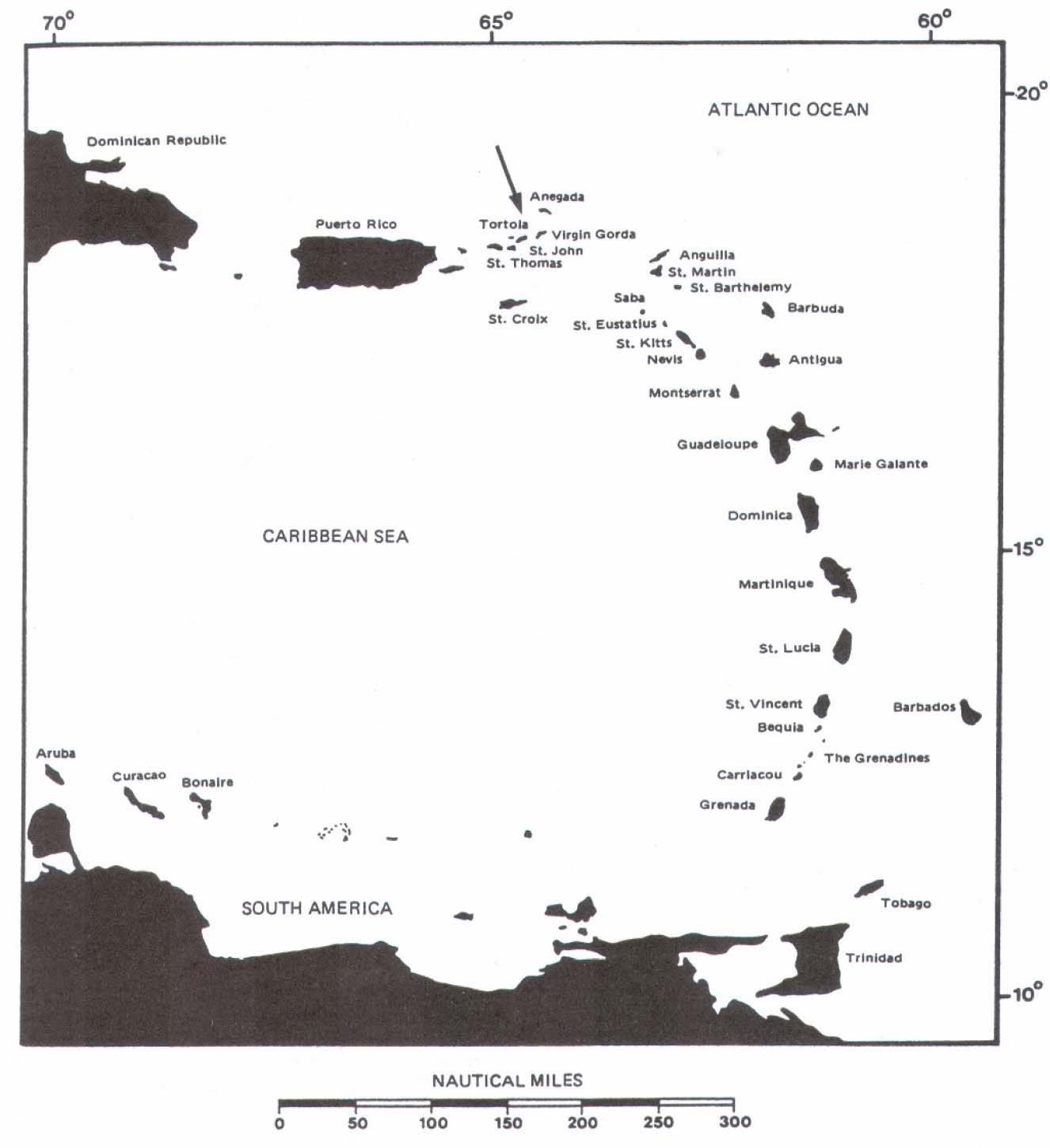
CEP Technical Report No. 15
Figure 1. The British Virgin Islands are composed of more than 40 islands, islets and rocks in
the northeastern Caribbean Sea.
P
age 104
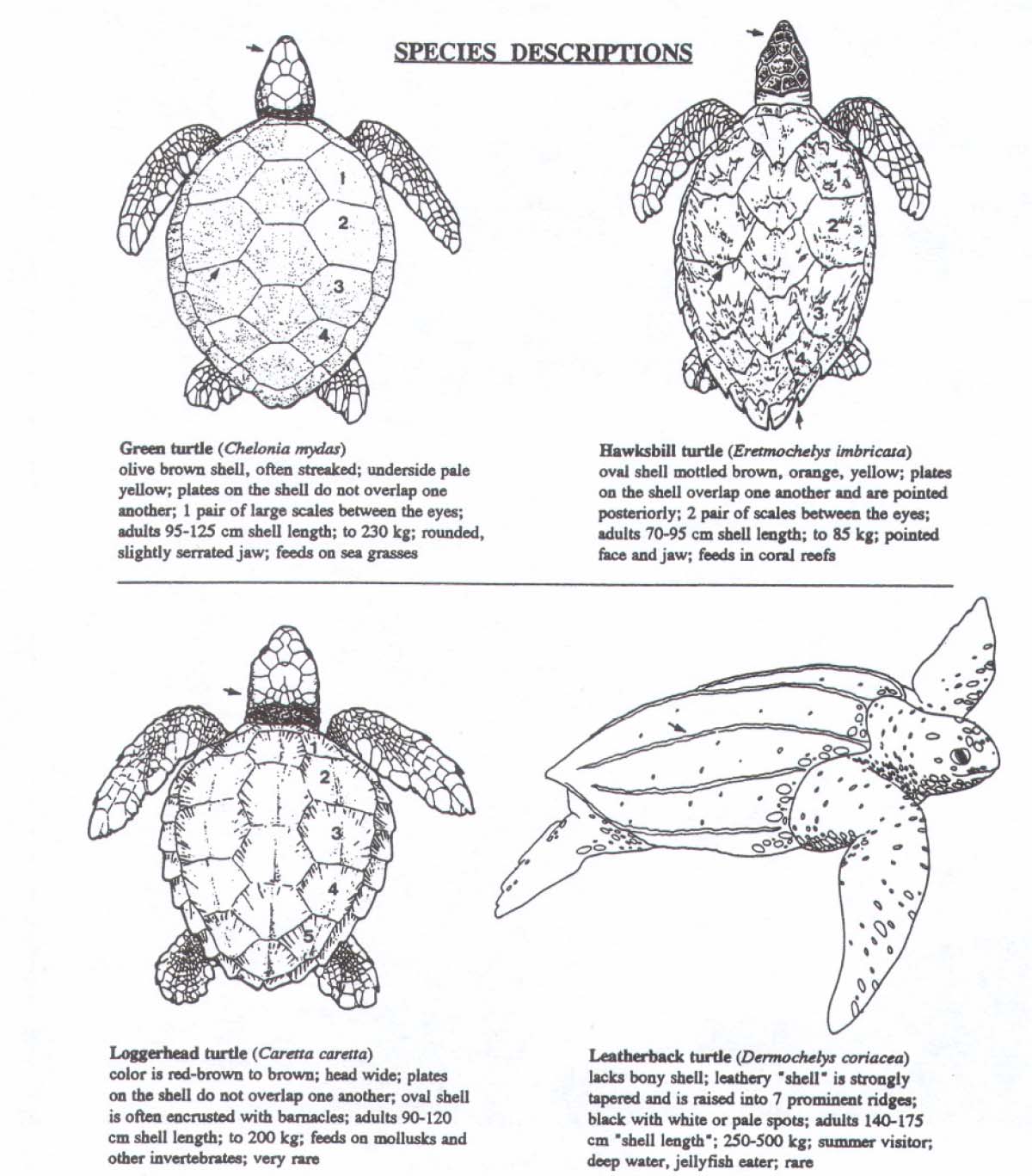
British Virgin Islands Sea Turtles...
Figure 2. A guide to the sea turtles of the British Virgin Islands. Green and hawksbill turtles of
various sizes are encountered year-round. The leatherback is a seasonal visitor, arriving in
March or April for a four-month nesting season. The loggerhead is occasionally observed.
Page 105
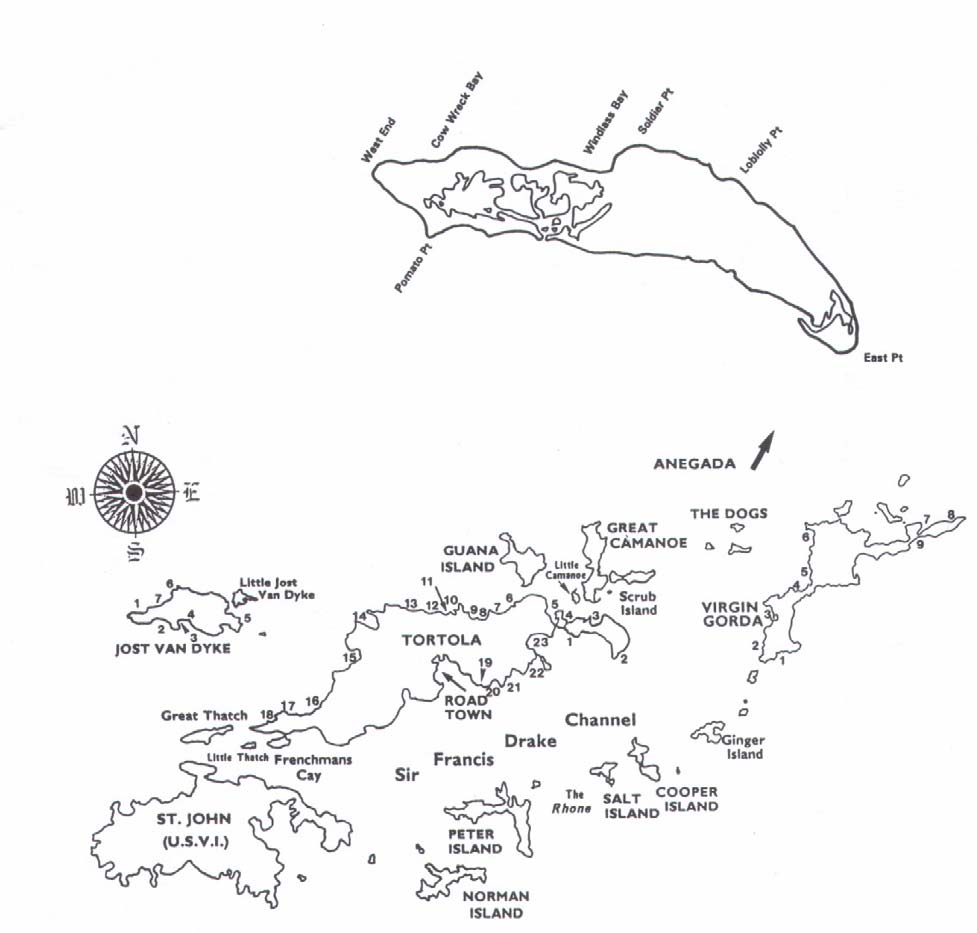
CEP Technical Report No. 15
Figure 3. Potential nesting beaches on the major islands of the BVI (numbers correspond to
Table 1). The northeast coast of Tortola (3-16) supports most of the leatherback nesting. Less is
known about green and hawksbill nesting; Anegada is probably the most important area.
Anegada is not drawn to scale.
P
age 106
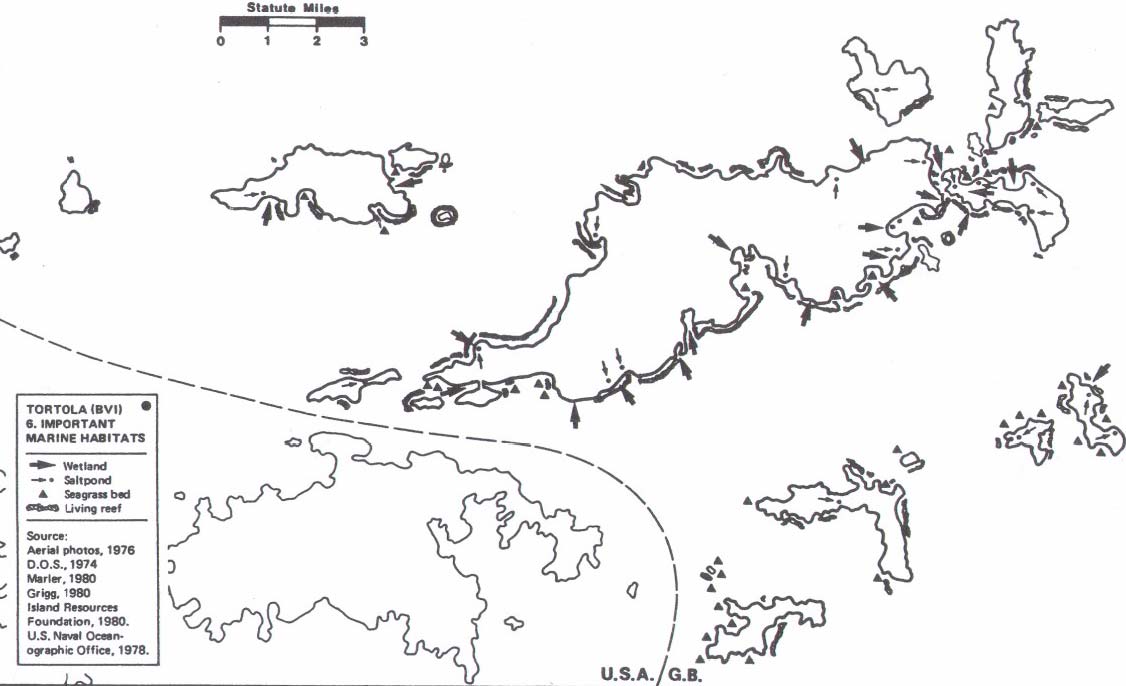
British Virgin Islands Sea Turtles...
Figure 4. Sea grass and reefs around Tortola, BVI (source: ECNAMP, 1980).
Page 107
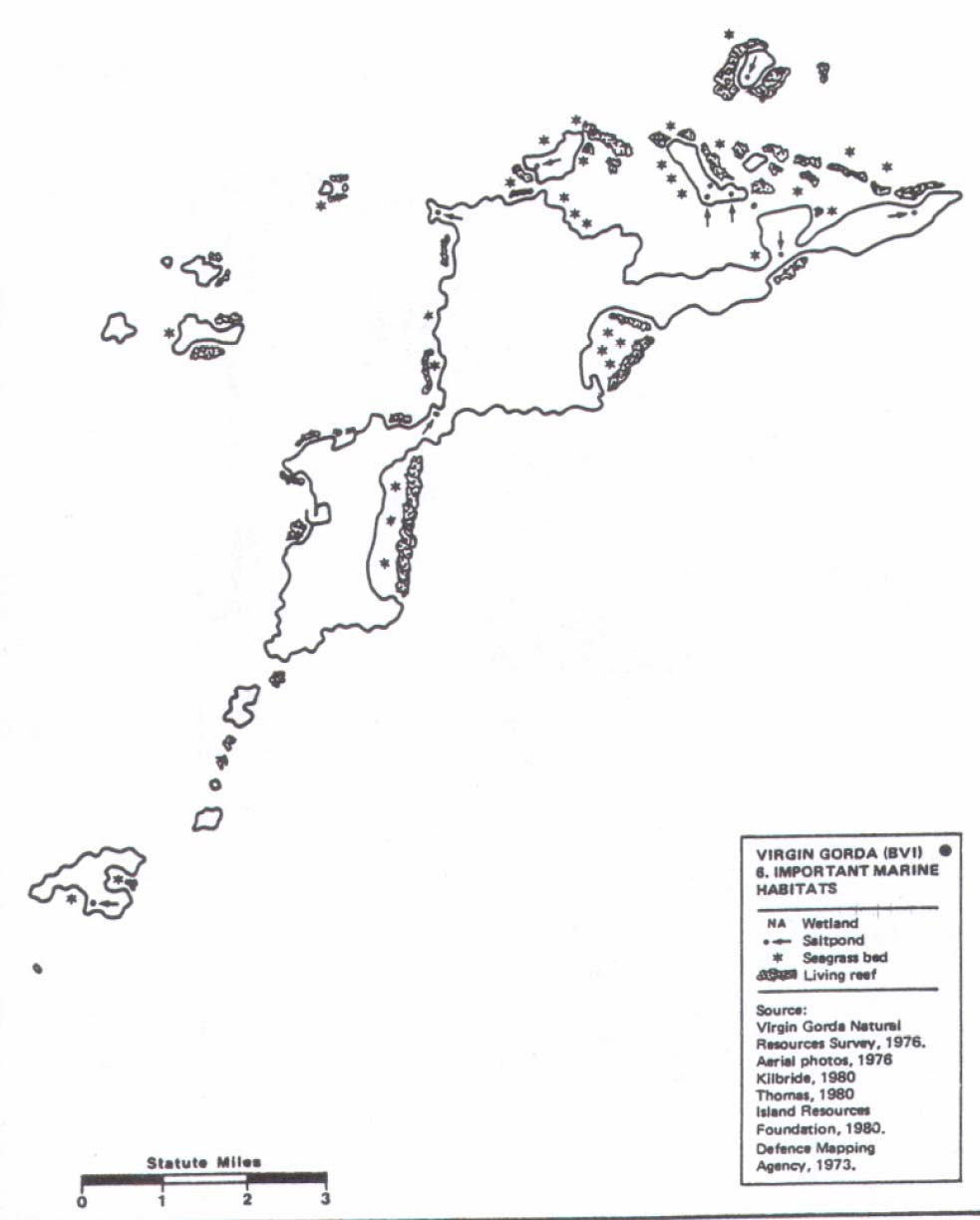
CEP Technical Report No. 15
Figure 5. Sea grass and reefs around Virgin Gorda, BVI (source: ECNAMP, 1980).
P
age 108
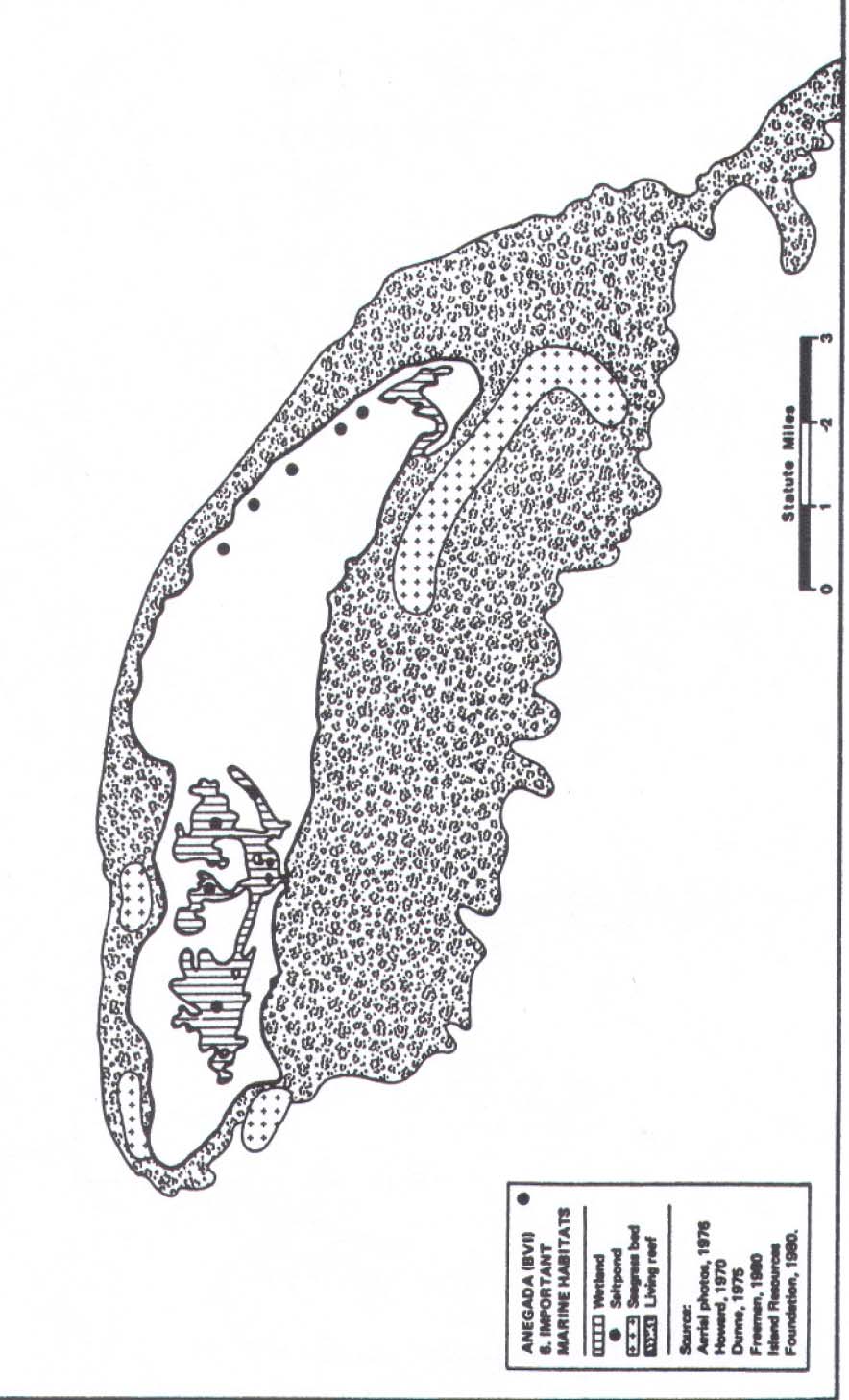
British Virgin Islands Sea Turtles...
Figure 6. Sea grass and coral reefs around Anegada, BVI (source: ECNAMP, 1980).
Page 109
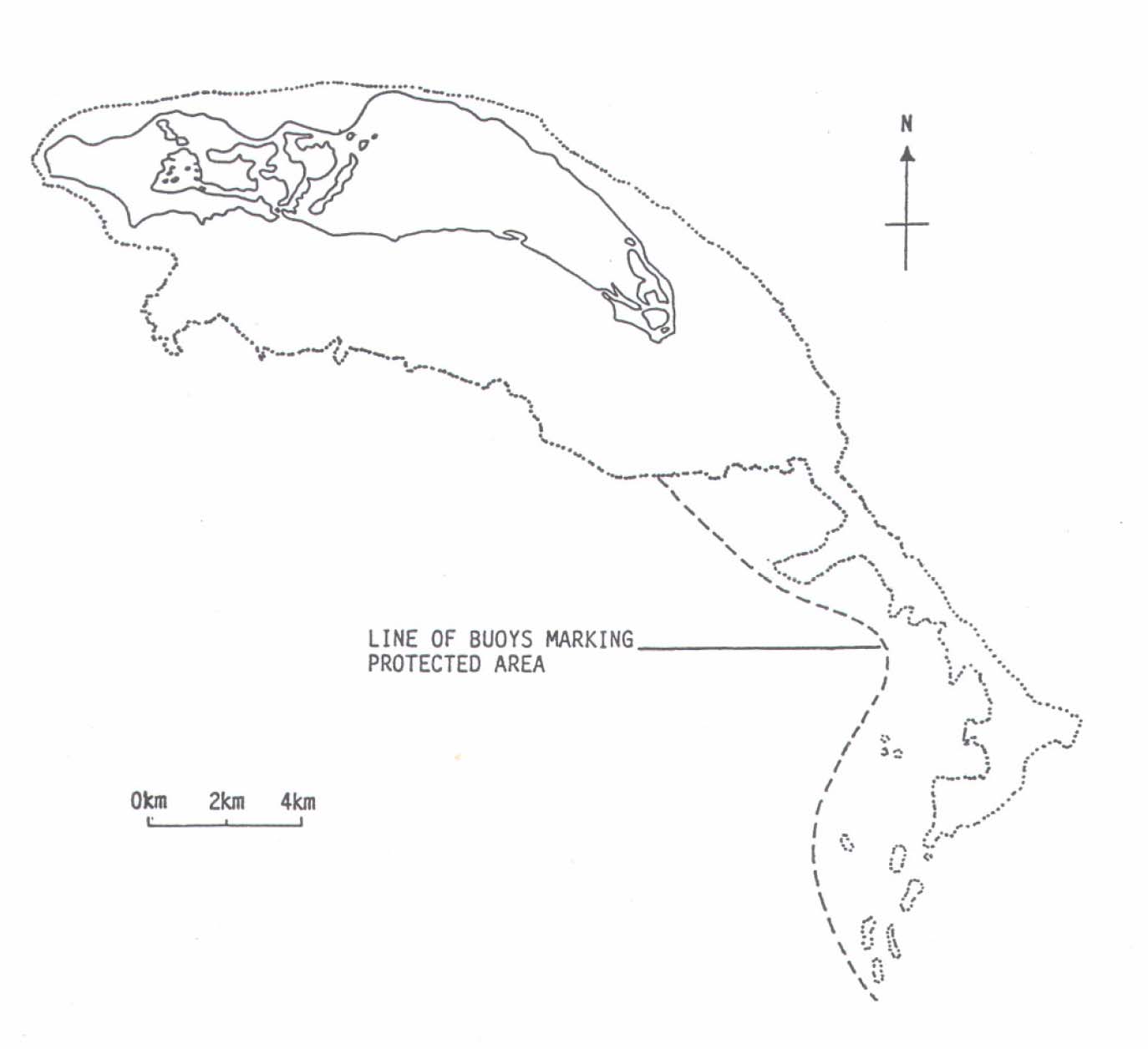
CEP Technical Report No. 15
Figure 7. The Horseshoe Reef Protected Area (Anegada, BVI) was established in May 1990.
P
age 110
British Virgin Islands Sea Turtles...
APPENDIX I
SUMMARY OF RECOMMENDATIONS
This summary is not intended to be a substitute for reading and studying the body of the
text, where methodology, supporting literature, action alternatives, and other details are
presented. Rather, the following synopsis is offered as a quick-reference guide to priority actions
recommended by this Recovery Action Plan. The synopsis is intended to assist policy-makers
and others who need an abridged presentation of proposed solutions to stresses on BVI sea
turtles.
4.1 Manage and Protect Habitat
4.11 Identify essential habitat
Important
habitat
includes
sea grass (feeding), coral reefs (feeding, refuge), and sandy
beaches (egg-laying). In order to identify important or high-use areas, it is a recommendation of
this Recovery Action Plan that (1) relevant survey and monitoring programmes, such as those
ongoing for coral reefs and proposed for sea grass meadows, incorporate sea turtle sightings and
behavioural patterns into the database, (2) fishermen, divers, and charter boat captains be pro-
vided with sightings forms and encouraged to report at-sea observations and patterns of habitat
use by turtles, (3) the CFD hire and train seasonal employees to systematically monitor a
subsample of important nesting beaches, (4) trained community volunteers continue to monitor
nesting activity, (5) as soon as practicable, the entire BVI be surveyed as a single management
unit so that decisions regarding the most efficient use of limited human and monetary resources
can be made based on an overview of important sea turtle habitat.
4.12 Develop area-specific management plans
In order to preserve essential habitat, it is a recommendation of this Recovery Action
Plan that (1) site specific management plans be developed and implemented for important
nesting and foraging habitats, (2) Marine Parks or other protected areas be designated to safe-
guard sensitive marine habitat, and to provide food and refuge to endangered sea turtles, (3) Sea
Turtle Reserves be declared that encompass the most important nesting areas and can serve as
focal points for conservation, management, and monitoring of sea turtle populations, (4) enforce-
ment personnel be hired and provided with training, surveillance equipment, and transport in
order to ensure compliance with guidelines and regulations, and (5) education materials be
produced to alert visitors to regulations governing Sea Turtle Reserves, Marine Parks, and other
management areas.
Management plans should prohibit (1) sand mining on sandy beaches, (2) beach-front
construction without ample setbacks, (3) beach-front lighting that attracts and disorients sea
turtles and their hatchlings away from the sea, (4) impermeable engineering structures (break-
waters, jetties, groynes, seawalls) likely to promote erosion or loss of adjoining sandy beaches,
(5) the destruction of beach vegetation, (6) vehicular driving on sandy beaches, (7) beach fires,
Page 111
CEP Technical Report No. 15
(8) waste disposal in nearshore, beach, and beach forest environments, (9) beach cleaning
methods which employ heavy machinery and/or tools that deeply incise the sand, (10) at-sea
disposal of solid waste and sewage, (11) the physical destruction of healthy coral reefs and sea
grasses by anchoring, explosives, chemicals, specimen collecting, or sedimentation, (12) the
disturbance and/or capture of any sea turtle or their eggs or hatchlings.
In addition to site-specific management planning for Sea Turtle Reserves, Marine Parks,
and other conservation or management areas, the regulatory guidelines summarized above should
be incorporated into all coastal usage plans, including zones of commercial or residential dev-
elopment, Government-owned recreation areas (e.g., Long Bay Belmont, Long Bay-Beef Island,
Josiahs Bay), etc. The conservation of endangered sea turtles does not automatically exclude
coastal development or recreation, but it requires forethought and an awareness of actions which
can threaten the survival of local turtle populations. Conservation guidelines should be imple-
mented in all areas that adjoin sandy beaches suitable for sea turtle nesting and/or coral reefs and
sea grass meadows utilized by sea turtles for feeding.
4.2 Manage and Protect all Life Stages
4.23 Propose new regulations where needed
In addition to long-term stewardship of the marine and coastal environments of the BVI,
it is a recommendation of this Recovery Action Plan that an indefinite moratorium on the harvest
of endangered sea turtles and their eggs be declared, as recommended by the Organization of
Eastern Caribbean States and required by the Protocol to the Cartagena Convention concerning
Specially Protected Areas and Wildlife. Revised legislation should make it an offence to (1)
slaughter, catch or take (or attempt or cause same) any species of sea turtle encountered in the
BVI, be the turtle on land or at sea, (2) to collect any turtle eggs, and (3) buy, sell, offer or
expose for sale, or possess the whole or any part of the meat, shell, oil, or eggs of any turtle.
Penalties should include a maximum fine of $2000, confiscation of equipment used (including
boats and other vehicles), and forfeiture of illegally obtained wildlife or wildlife products.
4.24 Augment existing law enforcement efforts
It is a recommendation of this Recovery Action Plan that (1) a Division of Enforcement
be created within the MNRL/CFD to promote administrative continuity and more efficient use of
enforcement personnel, training, time, and equipment, (2) Division Officers be trained in
environmental law and enforcement procedures and be responsible for regulations concerning
mining and minerals, pollution, protected species, fisheries and marine resources, boater safety,
game and hunting, and relevant coastal zone permits and construction conditions [N.B. NPT Park
Wardens are responsible for enforcement within the NPT system), and (3) Division Officers be
stationed in Tortola, Virgin Gorda, and Anegada and have access to marine and other essential
transport. In the interim, (4) provisions of the Fisheries, National Parks Trust, Public Health, and
Marine Ordinances providing for the deputizing of Officers, Wardens, and other enforcement
personnel to enforce conservation legislation should be exercised. Finally, in order to enhance
the effectiveness of law enforcement personnel, (5) divers, boaters, fishermen, and beachfront
property owners should be encouraged to report illegal harvest and habitat damage.
P
age 112
British Virgin Islands Sea Turtles...
4.26 Investigate alternative livelihoods for turtle fishermen
It is a recommendation of this Recovery Action Plan that the Fisheries Division conduct a
Sea Turtle Fishery Frame Survey. The following should be determined: (1) number of men
active in the turtle fishery, (2) species and size classes caught, (3) number caught per year, (4)
capture methods, (5) gear in possession, (6) gear used and frequency of use, (7) catch per unit
effort and, especially for older fishermen, long-term trends in CPUE, (8) market price, (9)
income (including proportion of total income) derived from turtle products, and (10) capture/
landing sites. The Survey will also provide a one-on-one opportunity for Fisheries personnel to
talk with fishermen about the endangered status of sea turtles, emphasize the importance of a
region-wide moratorium on these migratory species, and solicit comments on a moratorium in
the BVI. Frame Survey data will reveal the economic impact of a moratorium on sea turtle
harvest and enable the CFD to explore credible scenarios for enhancing alternative sources of
income, such as Fish Attracting Devices (FADs) and other technologies that will enable local
fishermen to make a better living from fishes.
4.27 Determine incidental catch and promote the use of TEDs
In addition to direct harvest by turtle fishermen, sea turtles are also captured incidental to
other fishing enterprises. It is a recommendation of this Recovery Action Plan that the CFD
determine the full extent of the incidental catch of sea turtles, such as by the longline industry.
Turtle Excluder Devices (TEDs) are incorporated into commercial trawls in order to release
captured sea turtles before they drown. Trawling is not done in the BVI; TEDs are not relevant.
4.28 Supplement reduced populations using management techniques
It is the view of this Recovery Action Plan that hands-on sea turtle management with the
objective of enhancing productivity is important, but is not a high priority at the present time.
The reason for this is that threats which lend themselves well to specific management action,
such as excessive predation or beach erosion at major rookeries, have not been documented.
Rather, (1) adopting a moratorium on sea turtle harvest, (2) passing a strong Coast Conservation
and Management Act, (3) creating a Division of Enforcement under the aegis of the CFD, (4)
establishing a comprehensive system of protected areas, and (5) enhancing public awareness of
and participation in sea turtle conservation are seen as the best ways to promote sea turtle
survival. This notwithstanding, protecting individual nests from erosion and predators is some-
times necessary. Any decision to relocate eggs to safer incubation sites should be made at the
time of egg-laying to avoid causing harm to developing embryos. The new nest should be con-
structed in the same type of habitat as the original nest and be dug to the same depth in the sand.
The hatchlings should be allowed to hatch and crawl to the sea unassisted.
4.29 Monitor stocks
It is a recommendation of this Recovery Action Plan that breeding populations be
monitored to determine (1) species, (2) distribution and timing of the breeding effort, (3) nest
fate, (4) annual reproductive success (nests laid vs. nests lost to erosion, dogs, crabs, mongooses,
birds, poachers, etc.) and (5) the success of specific beach management programmes. In addition,
Page 113
CEP Technical Report No. 15
sea turtles in Territorial waters should be monitored using bio-telemetry or other means to
determine (6) residency and movement patterns and (7) habitat use. The CFD should (8) design
and implement a programme for the proper statistical evaluation of existing numbers of sea
turtles, (9) establish a data-gathering system and training protocol to ensure that data are com-
parable among locations, turtle species, and observers, (10) encourage research that will provide
statistical estimates of stocks and develop a long-term stock assessment program to identify
trends over periods of decades, and (11) identify index beaches to serve as a focus for intensive
monitoring and trend analysis.
4.3 Encourage and Support International Cooperation
Sea turtles are amongst the most migratory of all Caribbean fauna. The cooperation of all
nations is needed if Caribbean basin populations are to survive. It is a recommendation of this
Recovery Action Plan that relevant international treaties to which the UK is a party be fully
implemented and enforced in the BVI, especially the 1973 Convention on International Trade in
Endangered Species of Wild Fauna and Flora (CITES) and the 1983 Convention for the Pro-
tection and Development of the Marine Environment of the Wider Caribbean Region (Cartagena
Convention).
4.4 Develop Public Education
It a recommendation of this Recovery Action Plan that (1) public awareness programmes
be available territory-wide, (2) CFD-designed environmental studies units (including a unit on
sea turtles) be transferred to the Department of Education as a standard part of BVI primary
school curricula, (3) the availability and use of audio-visual materials be increased, (4) the
WIDECAST Sea Turtles of the British Virgin Islands brochure be updated and reprinted, (5) sea
turtle conservation and biology information be made available to the fishing community through
the CFD staff, the Fisherman's Association, and the media, (6) informal Town Meetings be
convened on each major island to focus specifically on the subject of sea turtle biology and the
need for sea turtle protection (these are intended primarily for an audience of fishermen and
other marine users), (7) tourists be alerted to the endangered status of sea turtles by airport/
cruiseport displays and leaflets available from Customs, rental car agencies, dive operators, NPT,
hoteliers, etc., and (8) the electronic and print media be encouraged to provide visible and regular
coverage of sea turtle conservation issues.
4.5 Increase Information Exchange
It is a recommendation of this Recovery Action Plan that (1) residents be alerted to the
existence of the internationally distributed Marine Turtle Newsletter, (2) the BVI be represented
in future Western Atlantic Turtle Symposia, (3) the BVI continue its active participation in the
regional WIDECAST project, taking advantage of the WIDECAST network to keep abreast of
the latest information regarding sea turtle biology and conservation, (4) CFD staff attend
international sea turtle scientific meetings and training opportunities, (5) workshops on research
and management techniques be convened at appropriate intervals for Sea Turtle Survey staff and
volunteers, (6) full advantage be taken of the media, NGO newsletters, yacht and other local
marine shows, and all other avenues for the exchange of information among local groups.
P
age 114
British Virgin Islands Sea Turtles...
4.6 Implement Sea Turtle Conservation Programme
It is clear from the information provided in this Recovery Action Plan that three species
of endangered sea turtle nest (and at least two regularly feed) in the BVI. Extensive harvest
(legal and illegal) combined with the destruction of nesting and foraging habitats has resulted in
the depletion of local stocks. The leatherback (trunk) turtle has plunged from an estimated six
females per night on some Tortola beaches during peak season in the 1920's to fewer than ten
turtles per year on all beaches combined during the last decade. The goals of the proposed Sea
Turtle Conservation Programme are (1) to obtain comprehensive and accurate data on the dis-
tribution of sea turtle nesting and foraging, (2) to implement an integrated, scientifically sound
conservation programme based on the information and recommendations assembled in this
Recovery Action Plan, and (3) to promote the survival and sustained recovery of remaining sea
turtle stocks. Several specific objectives, as well as activities, results, outputs, and a budget are
presented in section 4.6 of the Recovery Action Plan. The cost of the Programme is estimated to
be $40,000-$80,000 per year for the next five years.
Page 115
Issued and printed by:
Caribbean Environment Programme
United Nations Environment Programme
Additional copies of this and other publications issued by UNEP's
Caribbean Environment Programme can be obtained from:
Regional Co-ordinating Unit
Caribbean Environment Programme
United Nations Environment Programme
14-20 Port Royal Street
Kingston
Jamaica
Telephone: (1-809) 922-9267 to 9
Telex: 3672 UNEPCAR JA
Telefax: (1-809) 922-9292
Electronic Mail: UNIENET: UNX040 & ENVIRONET: UNE091 & ECONET: UNEPRCUJA
The series of CEP Technical Reports contains selected information resulting from the
various activities performed within the framework of the UNEP Caribbean Environment Pro-
gramme (CEP). CEP was initiated in 1976 by UNEP with the assistance of ECLAC, at the
request of the Governments of the region. A framework for regional projects and activities
was first formulated in Montego Bay in 1981, when the Action Plan for the Caribbean Envi-
ronment Programme was adopted by the First Intergovernmental Meeting.
The major legal instrument of CEP was adopted at the Second Intergovernmental
Meeting, convened at Cartagena de Indias, in 1983: the Convention for the Protection and
Development of the Marine Environment in the Wider Caribbean Region. The Cartagena
Convention provides a framework for the development of specific protocols.
The implementation of CEP is supported by the Caribbean Trust Fund, established by
the participating States and Territories. Their active participation is ensured through regular
Intergovernmental and Contracting Parties Meetings, a rotating Monitoring Committee
formed by representatives from nine States and Territories and through the National Focal
Points. The principal focal point in each State or Territory is the ministry or department re-
sponsible for external relations or foreign affairs. Additionally, the agency responsible for
the management of marine and coastal resources is the focal point for technical purposes.
Currently, the Action Plan of CEP concentrates in six major areas for the manage-
ment of marine and coastal resources: Overall Co-ordination, Specially Protected Areas and
Wildlife (SPAW), Assessment and Control of Marine Pollution (CEPPOL), Integrated Plan-
ning and Institutional Development (IPID), Information Systems (CEPNET), and Education,
Training and Awareness (ETA).
*
The Protocol Concerning Specially Protected Areas and Wildlife (SPAW) to the
Cartagena Convention was adopted in two stages: the text of the Protocol was adopted on 18
January 1990 and the initial Annexes listing relevant marine and coastal species, were
adopted on 11 June 1991. The Protocol will enter into force following ratification by nine
Contracting Parties.
The Regional Programme for Specially Protected Areas and Wildlife in the Wider
Caribbean Region (SPAW) was designed to implement the provisions and requirements of
the SPAW Protocol. Its objectives are: (a) to develop specific management plans for eco-
nomically and ecologically important species; (b) to significantly increase the number of
adequately managed protected areas and species in the region; and © to develop a strong re-
gional capability for the co-ordination of information exchange, training and technical assis-
tance in support of national, subregional and regional efforts on management of protected
areas and wildlife.
Document Outline
- BVI front cover.pdf
- BVI title page.pdf
- BVI title page.pdf
- =Blank page.pdf
- BVI orig body.pdf
- BVI back cover.pdf