

SGF2007_SSF_02 Page 1 of 8
CASE STUDY
ENHANCING MARINE RESOURCE GOVERNANCE THROUGH
DEVELOPING CAPACITY FOR COMMUNICATIONS IN THE
EASTERN CARIBBEAN
Implementing Organization: Centre for Resource Management and Environmental Studies
(CERMES) of the University of the West Indies, Cave Hill Campus in Barbados
GRANT NUMBER: SIDA QCL-2324-3474-2661-2271.
Submitted by: The Gulf and Caribbean Fisheries Institute, Inc.
GCFI Tracking Number: SGF2007_SSF_02
SGF2007_SSF_02 Page 2 of 8
Executive Summary
Enhancing marine resource governance through developing capacity for communications
in the Eastern Caribbean - CERMES
This project was originally designed to help break down barriers between fishers,
fisheries managers, and the fishing community in a non-adversarial setting by developing
a network among the groups in four eastern Caribbean Islands. The workshops were
primarily targeted at the public relations officers, or the executive members responsible
for communication and information sharing activities of the national fisher folk
organizations and fisher folk co-operatives on each island. The workshops were
interactive and participatory utilizing group dynamics and role playing among the
instruction methods used. These exercises formed practical examples of fishers and
fisheries management collaborating to come up with ways to publicise issues and garner
wider stakeholder involvement in the issues
The following outputs were achieved:
1. Six one-day workshops entitled "Enhancing Marine Resource Governance
through Developing Capacity for Communication in the Eastern Caribbean" were
were held in Barbados, Grenada, St Lucia, St Kitts and Nevis, and St Vincent
between March and June 2008.
2. Eighty-eight stakeholders in the fisheries industries across five eastern Caribbean
territories received training in the fundamentals of communication skills and
techniques over a four month period as a means of building capacity for
networking and advocacy within the industry.
3. A survey of participants in the month following the end of the series of workshops to
ascertain what level of use of the tools and techniques delivered in the workshops spoke
to a need for resource capacity building in other areas in order to augment the knowledge
gained.
4. A presentation was prepared for dissemination the 2008 meeting of the Gulf and
Caribbean Fisheries Institute to be held in Guadeloupe in November, 2008.
5. An instruction manual was created which was designed to lead participants
through the workshop and provide them with a reference for future
communication initiatives.
SGF2007_SSF_02 Page 3 of 8
Analysis of the Environment
Activities were examined solely within the marine environment. The workshops were
primarily targeted at the public relations officers, or the executive members responsible
for communication and information sharing activities, of the national fisher folk
organizations and fisher folk co-operatives on each island. The initial scope of the project
provided for four workshops in Antigua, Barbados, Grenada and St Lucia. However, a re-
structuring of the manner in which the workshops were delivered, and the inability to
come to an agreement with the Antigua Fisheries Division on a mutually acceptable date
for their workshop, allowed the project to widen its geographic reach to accommodate St
Vincent, St Kitts and Nevis.
Invited to participate were staff from the fisheries management authorities on the islands
from the levels of extension officers, technical officers, and senior fisheries officers, and
communications or information officers from the respective ministries of agriculture.
Workshop resource persons were drawn from the CERMES staff complement as well as
the private sector.
In each country, the workshop was officially opened by a senior representative of the
various ministries of agriculture in the presence of national or regional print and
broadcast media. This had the three-fold benefit of: introducing decision-makers to this
project and the overarching MarGov Project, thus laying a foundation for future
interactions that could open the way for policy interventions, which is one of the MarGov
Project's strategic planks; while acquainting the media with the initiatives; and creating
avenues to publicise the projects to a wider cross-section of stakeholders.
The Experience
The vision of this case was to develop a long-term structure within which government
and private fishing sector can operate to achieve sustainable fishing practices in a non-
adversarial setting.
The mission of this case was to develop a network of stakeholders in Eastern Caribbean
countries who successfully collaborate to define sustainable governance and management
approaches which are adaptive and resilient through a series of workshops.
The Centre for Resource Management and Environmental Studies (CERMES) of the
University of the West Indies, Cave Hill Campus in Barbados, is undertaking a four-year
applied research project on marine resource governance in the eastern Caribbean
(MarGov). Using a conceptual framework derived from complex adaptive system (CAS)
and social-ecological system (SES) perspectives, the research focuses on understanding
governance related to small-scale fisheries (SSF) in the eastern Caribbean mainly through
network analysis. Stakeholders who are networked and have access to information can
more successfully collaborate to define sustainable governance practices that are adaptive
and resilient. Moreover, in an environment of enabling policy, self-organisation into
teams or work groups allows stakeholders to respond without being constrained by rules
SGF2007_SSF_02 Page 4 of 8
and regulations that do not adapt readily to different situations. Communication and
collaboration are key features of the project. Interactions are central to the concepts of
governance and networks. How efficiently and effectively the project can communicate
to partners and other stakeholders, or target institutions for uptake, is an integral part of
the research.
Development
Sustainable fishing practices are dependent upon input from the entire spectrum of
stakeholders of the resources. Issues within the organizational structure of fisheries
divisions often create barriers for effective communication with fishers. Using a
conceptual framework derived from complex adaptive system (CAS) and social-
ecological system (SES) perspectives, this case focuses on understanding governance
related to small-scale fisheries (SSF) in the eastern Caribbean mainly through network
analysis. Stakeholders who are networked and have access to information can more
successfully collaborate to define sustainable governance practices that are adaptive and
resilient.
Important Aspects for Decision Making
An important lesson not necessarily learned anew but reinforced was that, as
fisherfolk in the eastern Caribbean are largely self-employed, there needs to be a
powerful motivating factor in order to get them to sacrifice a day of fishing, which is
essentially a day in which they would not earn money, to participate in a workshop. As a
result, the majority of representatives from fishers' associations who attended the
workshops were either boat owners or employees of fishers' cooperatives. The profile of
the fishers who did attend was usually of more established, more successful fishers who
were accustomed to taking on roles of responsibility and for whom the workshop served
to fulfill needs of self-actualization. It was more difficult to guarantee the turnout of
fishers who were more dependent on fishing to meet their basic needs. For workshops
such as these, which do not offer practical skills training that can be utilized
directly in fishing, the provision of a small stipend to offset loss of income from
participating might prove to be more attractive to fishers and guarantee a larger turnout.
One of the most important lessons learned is that the fisheries management
authorities in the eastern Caribbean are not in each case the best agency for the
mobilization of fisherfolk. This stems in some cases from a lack of trust by the fishers,
mostly brought on by the fact that the fisheries officers sometimes are placed in the role
of enforcement officers given that most territories do not have marine police or other
authorities to enforce compliance with regulations governing the industry, especially as it
relates to harvesting. Fisheries officers expressed what they saw as barriers to
communication namely low levels of education, literacy, critical thinking, and the
privileging of traditional fishing practices, cultural biases and a belief that the sea would
never run out of fish which hampered their ability to build trust and encourage
sustainable fisheries practices among the fishers. In the absence of established NFOs in
SGF2007_SSF_02 Page 5 of 8
most territories there is no other central agency that can be used to contact and mobilize
fisher folk. This would require for future workshops that a more diverse approach be used
to effect a larger turnout for events. This approach would have to involve using points of
contacts in the various cooperatives and established fishing associations to disseminate
the information about forthcoming workshops. It would also involve correspondences
being targeted toward past participants inviting them to the proposed workshops and
asking them to take on the responsibility of bringing at least one other fisheries
stakeholder to attend as well. While this was not a possibility prior to this workshop
series, now that the contact information for the past participants has been recorded, it
would allow for such mobilization tactics to be employed more successfully in the future.
Another important lesson learned was that, in some territories, issues within the
organizational structure of fisheries divisions created barriers to effective communication.
Fisheries officers within two territories expressed concern that policy directives about the
industry were issued for them to execute without prior consultation with them as
officers directly involved in the industry to ascertain whether what was being proposed
would work. There was also concern expressed that feedback mechanisms from the level
of officers back up the communication chain were either no longer functioning;
functioning too slowly to be effective; or simply non-existent. In one territory, officers
expressed a lack of trust in their superior to keep information confidential, especially as it
related to enforcement of regulations, which they said prevented them from doing their
jobs effectively. In most territories, concern was also expressed over the fact that more
resources were skewed toward land-based agriculture within the ministries of agriculture,
which had a negative impact on the ability to devise strategies for sustainable managing
the fishing industry. In future, invitations to participate in such workshops should be
expressly targeted at the chief fisheries officers and permanent secretaries.
Another important lesson learned was that, although 91.5% of the 71 participants
who provided feedback at the end of the workshop said they would encourage the
development of communication tools in their respective organizations following the
workshop, it was difficult to get participants in the workshop to commit to the use of
specific tools. Participants generally gave indications at the end of the workshop as to
where they saw uses for the communication skills gained in the workshop in their
organizations.
However, when pressed to identify specific tools that is, newsletters, press
releases, press conferences, etc. that they would put directly into use following the
workshop, most participants indicated that they needed more time to digest the
information provided in the manual before they could commit to the use of any particular
tool or medium for communication in their organization. This then made it difficult to
fulfil the original intention of the workshop in having participants agree to use specific
tools and circulate them for peer review in the months following the workshop. It was
recognized that planned follow-up activities would be necessary to ensure participants
utilized the skills and tools they were introduced to.
Pending Questions or Tasks
1. How can fisherfolk be more effective at disseminating information
2. How can more fisherfolk be brought into the process
SGF2007_SSF_02 Page 6 of 8
3. How can fisheries officers and fishers better gain mutual trust
4. What kinds of mechanisms are available for financial support o dissemination
products
5. How can the importance of marine environment be elevated in the political arena
Annexes
Annex 1.
Background of the case
The Centre for Resource Management and Environmental Studies (CERMES) of the University of
the West Indies, Cave Hill in Barbados, is undertaking a four-year applied research project on
marine resource governance in the eastern Caribbean (MarGov). Using a conceptual framework
derived from complex adaptive system (CAS) and social-ecological system (SES) perspectives,
the research focuses on understanding governance related to small-scale fisheries (SSF) in the
eastern Caribbean mainly through network analysis.
Stakeholders who are networked and have access to information can more successfully
collaborate to define sustainable governance practices that are adaptive and resilient. Moreover,
in an environment of enabling policy, self-organisation into teams or work groups allows
stakeholders to respond without being constrained by rules and regulations that do not adapt
readily to different situations. Communication and collaboration are key features of the project.
Interactions are central to the concepts of governance and networks. How efficiently and
effectively the project can communicate to partners and other stakeholders, or target institutions
for uptake, is an integral part of the research.
As part of the groundwork toward implementation of the communication strategy, a series of
scoping meetings were held in the eastern Caribbean islands of Antigua, Barbados, Grenada and
St Lucia between November 21 and December 5, 2008. The consultations were held with
representatives from the Fisheries Divisions of the four islands' governments as well as
representatives from fisher folk organisations. Coming out of these four meetings there was a
general consensus that given the different levels of communication needed within the industry
local, regional and international that the fisheries managers and fisher folk could benefit from
communication workshops. Particularly highlighted at each meeting was the devastating effect
that a lack of information and/or poor disseminating channels can have on fisher folk livelihoods,
especially with reference to what occurred during the 1999 `fish kill' experienced throughout the
region. Other challenges to sustainable livelihoods ranging from impacts of globalisation to
externally driven conservation initiatives are now being experienced.
Fisheries stakeholders requested the following to be included in designing the workshops:
Communications Strategy Drafting
Public
Speaking
Speaking for Broadcast Purposes
Writing for the Print Media
Electronic Mailing and the use of Internet-based forums
Database
Management
Conflict Resolution and Dispute Mediation
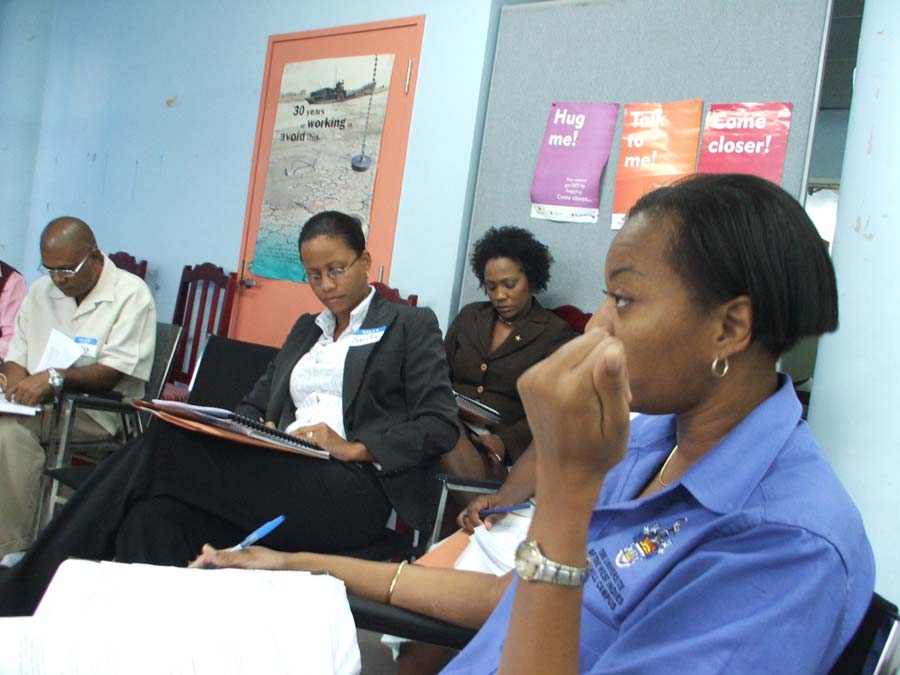
Annex 2. Photographs of the Workshops


SGF2007_SSF_02 Page 7 of 8
SGF2007_SSF_02 Page 8 of 8
Annex 3 Manual produced for the workshops entitled: "Enhancing Marine Resource
Governance through Developing Capacity for Communication in the Eastern Caribbean"
See attached document